<?xml version="1.0" encoding="ISO-8859-1"?><article xmlns:mml="http://www.w3.org/1998/Math/MathML" xmlns:xlink="http://www.w3.org/1999/xlink" xmlns:xsi="http://www.w3.org/2001/XMLSchema-instance">
<front>
<journal-meta>
<journal-id>0034-7744</journal-id>
<journal-title><![CDATA[Revista de Biología Tropical]]></journal-title>
<abbrev-journal-title><![CDATA[Rev. biol. trop]]></abbrev-journal-title>
<issn>0034-7744</issn>
<publisher>
<publisher-name><![CDATA[Universidad de Costa Rica]]></publisher-name>
</publisher>
</journal-meta>
<article-meta>
<article-id>S0034-77441999000300013</article-id>
<title-group>
<article-title xml:lang="es"><![CDATA[Dinámica energética del crecimiento en una población del mejillón Perna perna (Filibranchia: Mytilidae) en el noreste del Estado Sucre,Venezuela]]></article-title>
</title-group>
<contrib-group>
<contrib contrib-type="author">
<name>
<surname><![CDATA[Prieto]]></surname>
<given-names><![CDATA[Antulio S.]]></given-names>
</name>
<xref ref-type="aff" rid="A01"/>
</contrib>
<contrib contrib-type="author">
<name>
<surname><![CDATA[Vasquez]]></surname>
<given-names><![CDATA[Marti]]></given-names>
</name>
<xref ref-type="aff" rid="A01"/>
</contrib>
<contrib contrib-type="author">
<name>
<surname><![CDATA[Ruiz]]></surname>
<given-names><![CDATA[Lilia J.]]></given-names>
</name>
<xref ref-type="aff" rid="A01"/>
</contrib>
</contrib-group>
<aff id="A01">
<institution><![CDATA[,U.D.O. Laboratorio de Ecología de Poblaciones ]]></institution>
<addr-line><![CDATA[Cumaná Estado Sucre]]></addr-line>
<country>Venezuela</country>
</aff>
<pub-date pub-type="pub">
<day>00</day>
<month>09</month>
<year>1999</year>
</pub-date>
<pub-date pub-type="epub">
<day>00</day>
<month>09</month>
<year>1999</year>
</pub-date>
<volume>47</volume>
<numero>3</numero>
<fpage>399</fpage>
<lpage>410</lpage>
<copyright-statement/>
<copyright-year/>
<self-uri xlink:href="http://www.scielo.sa.cr/scielo.php?script=sci_arttext&amp;pid=S0034-77441999000300013&amp;lng=en&amp;nrm=iso"></self-uri><self-uri xlink:href="http://www.scielo.sa.cr/scielo.php?script=sci_abstract&amp;pid=S0034-77441999000300013&amp;lng=en&amp;nrm=iso"></self-uri><self-uri xlink:href="http://www.scielo.sa.cr/scielo.php?script=sci_pdf&amp;pid=S0034-77441999000300013&amp;lng=en&amp;nrm=iso"></self-uri><abstract abstract-type="short" xml:lang="en"><p><![CDATA[The quantities of biomass produced in gametes, somatic tissue growth, byssus formation and organic matrix in the shell were studied from September 1988 through September 1989 in an exploited population of Perna perna (L.) in Guatapanare, State Sucre, Venezuela. The specific biomass of each component were evaluated using monthly length - dry weight equations and a model of population growth. Growth rate is high, reaching 87.84 mm at 12 months. The production of somatic tissue (Ps) was maximun at 10 months of age; however, organic matrix of shell (Pc) and byssus (Pb), reached a maximun at 8 months of age. Gonad production (Pg) evaluated by weight loss in two principal periods of spawning (October - December, 1988 and April - June 1989) increased with age from a value of 0.04 g / month at 4 months to 0.25 g/month at 14 months of age. The ratio production/biomass (P/B) decreased with population age; however, reproductive effort (Pg/Px 100) increased from 14.81 % at 4 months to 42.37 at 14 months of age, reveling a population strategy of scarse longevity and higher reproductive potential.]]></p></abstract>
<abstract abstract-type="short" xml:lang="es"><p><![CDATA[Se estudió la producción de biomasa en gónadas, tejido somático, materia orgánica de la concha y biso en individuos de una población explotada del mejillón Perna perna en Guatapanare, Estado Sucre, Venezuela, en muestras mensuales recolectadas desde septiembre de 1988 hasta septiembre de 1989. La variación mensual de cada componente se evaluó utilizando ecuaciones de regresión y un modelo de crecimiento en la misma población. La especie es de crecimiento rápido alcanzando 87.84 mm a los 12 meses. La producción de tejido somático fue máxima a los 10 meses de edad mientras que la producción de materia orgánica y biso alcanzaron sus máximos a los ocho meses, disminuyendo luego. La producción de gónadas evaluada por la pérdida de peso en los dos principales desoves (octubre - noviembre de 1988 y abril - junio de 1989) aumenta con la edad desde un valor de 0.4 g/mes a los cuatro meses hasta 0.25 a los 14 meses de edad. La relación P/ B disminuye con la edad mientras que el esfuerzo reproductivo (Pg/P x 100) aumenta desde 14.81 % a los cuatro meses hasta 42.37 a los 14 meses de edad, revelando la existencia de una estrategia de supervivencia poblacional con individuos de reducida longevidad y un alto potencial reproductivo desde muy joven que garantizan la viabilidad de la población.]]></p></abstract>
<kwd-group>
<kwd lng="en"><![CDATA[Production]]></kwd>
<kwd lng="en"><![CDATA[growth energetic]]></kwd>
<kwd lng="en"><![CDATA[mussel]]></kwd>
<kwd lng="la"><![CDATA[Perna perna]]></kwd>
<kwd lng="en"><![CDATA[bivalve]]></kwd>
<kwd lng="en"><![CDATA[Venezuela]]></kwd>
</kwd-group>
</article-meta>
</front><body><![CDATA[ <CENTER><B><FONT FACE="Arial,Helvetica">Din&aacute;mica energ&eacute;tica del crecimiento en una poblaci&oacute;n del mejill&oacute;n <I>Perna</I></FONT></B></CENTER>      <CENTER><B><FONT FACE="Arial,Helvetica"><I>perna</I> (Filibranchia: Mytilidae) en el noreste del Estado Sucre,Venezuela</FONT></B></CENTER>      <CENTER><FONT SIZE=-1>&nbsp;</FONT></CENTER> <FONT SIZE=-1></FONT>     <CENTER><B><FONT FACE="Arial,Helvetica"><FONT SIZE=-1>Antulio S. Prieto, Marti Vasquez y Lilia J. Ruiz&nbsp;<A NAME="1a"></A></FONT><SUP><FONT SIZE=-2><A HREF="#1b">1</A></FONT></SUP></FONT></B></CENTER> <FONT SIZE=-1></FONT>      <P><FONT SIZE=-1>&nbsp;</FONT>     <CENTER><FONT FACE="Arial,Helvetica"><FONT SIZE=-1>Recibido 24-VIII-1998. Corregido 10-III-1999. Aceptado 18-III-1999.</FONT></FONT></CENTER> <FONT SIZE=-1>&nbsp;</FONT><FONT SIZE=-1></FONT>      <P><B><FONT FACE="Arial,Helvetica"><FONT SIZE=-1>Abstract</FONT></FONT></B><FONT FACE="Arial,Helvetica"><FONT SIZE=-1></FONT></FONT>      <P><FONT SIZE=-1><FONT FACE="Arial,Helvetica">The quantities of biomass produced in gametes, somatic tissue growth, byssus formation and organic matrix in the shell were studied from September 1988 through September 1989 in an exploited population of <I>Perna perna</I> (L.) in Guatapanare, State Sucre, Venezuela. The specific biomass of each component were evaluated using monthly length – dry weight equations and a model of population growth. Growth rate is high, reaching 87.84 mm at 12 months. The production of somatic tissue (Ps) was maximun at 10 months of age; however, organic matrix of shell (Pc) and byssus (Pb), reached a maximun at 8 months of age. Gonad production (Pg) evaluated by weight loss in two principal periods of spawning (October – December, 1988 and April – June 1989) increased with age from a value of 0.04 g / month at 4 months to 0.25 g/month at 14 months of age. The ratio production/biomass (P/B) decreased with population age; however, reproductive effort (Pg/Px 100) increased from 14.81 % at 4 months to 42.37 at 14 months of age, reveling a population strategy of scarse longevity and higher reproductive potential.</FONT></FONT><FONT SIZE=-1></FONT>      <P><B><FONT FACE="Arial,Helvetica"><FONT SIZE=-1>Key words</FONT></FONT></B><FONT FACE="Arial,Helvetica"><FONT SIZE=-1></FONT></FONT>      <P><FONT SIZE=-1><FONT FACE="Arial,Helvetica">Production, growth energetic, mussel, <I>Perna perna</I>, bivalve, Venezuela.</FONT></FONT><FONT SIZE=-1></FONT>      ]]></body>
<body><![CDATA[<P><FONT SIZE=-1><FONT FACE="Arial,Helvetica">&nbsp;</FONT></FONT>     <BR><FONT SIZE=-1><FONT FACE="Arial,Helvetica">Un bivalvo potencialmente cultivable en Venezuela es el mejill&oacute;n <I>Perna perna</I>, principalmente en los bancos naturales de la costa norte del Estado Sucre donde su explotaci&oacute;n es intensiva y responde b&aacute;sicamente a una pr&aacute;ctica de tipo artesanal. Comparada con otras especies de g&eacute;neros de la familia Mytilidae cercanamente relacionados, y particularmente con <I>Mytilus edulis</I>, la especie ha recibido poca atenci&oacute;n. Algunos aspectos de su ciclo reproductivo han sido investigados por <A HREF="#Velez67">Velez y Mart&iacute;nez (1967)</A>, <A HREF="#Carvajal">Carvajal (1969)</A> y <A HREF="#Velez71">Velez (1971)</A> en Venezuela; <A HREF="#Lunetta">Lunetta (1969)</A> en Brasil y <A HREF="#Berry78">Berry (1978)</A> en Sur&aacute;frica.</FONT></FONT><FONT SIZE=-1></FONT>      <P><FONT SIZE=-1><FONT FACE="Arial,Helvetica">Los estudios sobre productividad en bivalvos son muy abundantes en especies de zonas templadas (<A HREF="#Burke">Burke y Mann 1974</A>, <A HREF="#Dare">Dare 1976</A>, <A HREF="#Bayne">Bayne y Worrall 1980</A>, <A HREF="#Griffiths80">Griffith 1980</A>, <A HREF="#Thompson">Thompson 1984</A>) pero muy escasos en especies de zonas tropicales (<A HREF="#Prieto">Prieto <I>et al</I>. 1985</A>, <A HREF="#Tata">Tata y Prieto 1991</A>). Los primeros estudios sobre este tema (P) se basaron en estimaciones globales; sin embargo existe una progresiva tendencia a calcular la productividad de cada componente (soma, g&oacute;nada, concha) en las diferentes clases de edades (<A HREF="#MacDonald86">MacDonald y Thompson 1986</A>, <A HREF="#MacDonald87">MacDonald y Bourne 1987</A>). En los estudios de flujo de materia se considera la energ&iacute;a utilizada en el crecimiento y la reproducci&oacute;n denominada en forma general P como la variable de mayor importancia cuando se trata de estimar el &eacute;xito de una poblaci&oacute;n en el ambiente, ya que representa una respuesta integral de cada uno de sus individuos; adem&aacute;s porque permite evaluar, por una parte, la biomasa disponible hacia otros niveles tr&oacute;ficos o de importancia econ&oacute;mica y por la otra, analizar la distribuci&oacute;n espec&iacute;fica de la energ&iacute;a dentro de los diferentes grupos de edades de una poblaci&oacute;n.</FONT></FONT><FONT SIZE=-1></FONT>      <P><FONT SIZE=-1><FONT FACE="Arial,Helvetica">Hasta el momento, a pesar de la importancia que reviste el mejill&oacute;n <I>Perna perna</I> como recurso pesquero, no existe en Venezuela informaci&oacute;n sobre la potencialidad de la producci&oacute;n de biomasa en las poblaciones naturales del nororiente de Venezuela, por ello se intenta en el presente trabajo establecer un patr&oacute;n de distribuci&oacute;n de la energ&iacute;a en los compartimientos de la producci&oacute;n de la especie en la poblaci&oacute;n de Guatapanare y evaluar su evoluci&oacute;n en individuos de diferentes edades a trav&eacute;s del tiempo.</FONT></FONT><FONT SIZE=-1></FONT>      <P><FONT SIZE=-1><FONT FACE="Arial,Helvetica">&nbsp;</FONT></FONT>     <BR><B><FONT FACE="Arial,Helvetica"><FONT SIZE=-1>Materiales y m&eacute;todos</FONT></FONT></B><FONT SIZE=-1></FONT>      <P><FONT SIZE=-1><FONT FACE="Arial,Helvetica">Las muestras de <I>Perna perna</I> se obtuvieron mensualmente desde septiembre de 1988 hasta septiembre de 1989 en la ensenada de Guatapanare, situada en la costa norte del Estado Sucre a 63&ordm; 24&acute; 35" W; 10&ordm; 39&acute;47" N. Las caracter&iacute;sticas ecol&oacute;gicas de esta &aacute;rea han sido descritas por <A HREF="#Carvajal">Carvajal (1969)</A>. Los ejemplares se recolectaron mediante buceo simple a profundidades de 1 a 5 m y se colocaron en contenedores isot&eacute;rmicos con agua de mar por un tiempo no menor de 6 horas a fin de eliminar el exceso de sedimento contenido en el tracto digestivo. Posteriormente se trasladaron al laboratorio donde se congelaron hasta su procesamiento. Cada organismo fue limpiado cuidadosamente de adherencias en la concha y determinada su longitud total (Lt) desde el gozne hasta el borde ventral de la concha con un vernier de apreciaci&oacute;n 0.05 mm; luego utilizando un equipo de disecci&oacute;n se extrajeron las partes blandas de cada mejill&oacute;n separando cuidadosamente el material gonadal, tejido som&aacute;tico y el biso (este &uacute;ltimo fue separado desde la porci&oacute;n interior hasta el borde de la concha). Una vez separados cada uno de los componentes, se sometieron a deshidrataci&oacute;n en una estufa a 70 &ordm;C por 48 horas a fin de obtener el peso seco en una balanza de apreciaci&oacute;n 0.001 g. El contenido de materia org&aacute;nica de la concha (pc) y del biso (pb) se obtuvo introduciendo ambas partes previamente disecadas en una mufla a 450 &ordm;C por dos horas (<A HREF="#Barker">Barker-Jorgensen 1976</A>) y obteniendo el peso seco por diferencia.</FONT></FONT><FONT SIZE=-1></FONT>      <P><FONT SIZE=-1><FONT FACE="Arial,Helvetica">Los valores obtenidos en cada recolecta mensual para los pesos secos del tejido som&aacute;tico (ps), gonadal (pg), biso (pb) s&eacute; sometieron por separado a un modelo de regresi&oacute;n con la longitud total de cada bivalvo (Lt), ajustandose por la ecuaci&oacute;n p=aLt<SUP>b</SUP> que se transform&oacute; en una ecuaci&oacute;n lineal convirtiendo ambas variables a logaritmo seg&uacute;n el modelo: Log<SUB>10</SUB> p = Log<SUB>10</SUB> a + b log<SUB>10</SUB> Lt; donde Lt = longitud de la concha (mm), p es el peso seco de cada una de las variables; a y b son par&aacute;metros de las ecuaciones de regresi&oacute;n ajustadas para obtener el peso de los individuos.</FONT></FONT><FONT SIZE=-1></FONT>      <P><FONT SIZE=-1><FONT FACE="Arial,Helvetica">Las ecuaciones mensuales del peso seco de cada tejido vs longitud en los bivalvos se construyeron de acuerdo a las indicaciones de <A HREF="#Crisp">Crisp (1971)</A> y se utilizaron para predecir los pesos.</FONT></FONT><FONT SIZE=-1></FONT>      <P><FONT SIZE=-1><FONT FACE="Arial,Helvetica">La producci&oacute;n total individual (P) se evalu&oacute; a partir de la suma de cada uno de los componentes: P = Ps + Pg + Pc + Pb, donde: Ps es la energ&iacute;a invertida en tejido som&aacute;tico, Pg la energ&iacute;a invertida en la reproducci&oacute;n, Pc la energ&iacute;a invertida en la formaci&oacute;n de materia org&aacute;nica de la concha y Pb la energ&iacute;a invertida en la formaci&oacute;n del biso. Las estimaciones del Ps, Pc y Pb se obtuvieron por los incrementos de peso entre dos clases de edades sucesivas a intervalos de dos meses (P<SUB>t+1</SUB> – P<SUB>t</SUB>). La producci&oacute;n de g&oacute;nadas Pg para cada clase de edad se calcul&oacute; a partir de la p&eacute;rdida de peso de la g&oacute;nada predesovada seg&uacute;n <A HREF="#MacDonald87">MacDonald y Bourne (1987)</A> utilizando las ecuaciones mensuales Lt – pg a cada longitud en los dos per&iacute;odos principales de desove de la especie (<A HREF="#Carvajal">Carvajal 1969</A>, <A HREF="#Velez71">Velez 1971</A>), expresandolos en promedios mensuales. La longitud a cada edad se calcul&oacute; utilizando un modelo de von Bertalanffy determinado con los datos de incrementos de longitud informados por <A HREF="#Carvajal">Carvajal (1969)</A> en la misma poblaci&oacute;n de Guatapanare. Un &iacute;ndice gonadosom&aacute;tico mensual (IG) fue estimado a partir de la expresi&oacute;n IG = pg / pst X 100; donde pg es el peso seco de la g&oacute;nada y pst es el peso seco de todos los tejidos.</FONT></FONT><FONT SIZE=-1></FONT>      ]]></body>
<body><![CDATA[<P><FONT SIZE=-1><FONT FACE="Arial,Helvetica">En cada ocasi&oacute;n de muestreo se determinaron la temperatura del agua, ox&iacute;geno disuelto y salinidad con un conduct&iacute;metro YSI de 0.2 ppm, 0.7 &ordm;C y 1 %o de precisi&oacute;n respectivamente.</FONT></FONT><FONT SIZE=-1></FONT>      <P><FONT SIZE=-1><FONT FACE="Arial,Helvetica">&nbsp;</FONT></FONT>     <BR><B><FONT FACE="Arial,Helvetica"><FONT SIZE=-1>Resultados</FONT></FONT></B><FONT SIZE=-1></FONT>      <P><FONT SIZE=-1><FONT FACE="Arial,Helvetica">Debido a la necesidad de disponer de un modelo de crecimiento para el c&aacute;lculo de la producci&oacute;n individual por edades, se utilizaron datos del incremento de longitud aportados por <A HREF="#Carvajal">Carvajal (1969)</A> sobre la misma poblaci&oacute;n de Guatapanare. Con los incrementos mensuales y empleando la t&eacute;cnica de Ford-Walford se determin&oacute; la ecuaci&oacute;n: Lt = 126.52 [ 1 – e<SUP>-0,11(t – 0,80)</SUP>] , para intervalos mensuales (t = mes). De acuerdo a la misma, los mejillones alcanzaron 89.6 mm a la edad de un a&ntilde;o, con una longevidad te&oacute;rica m&aacute;xima de tres a&ntilde;os.</FONT></FONT><FONT SIZE=-1></FONT>      <P><FONT SIZE=-1><FONT FACE="Arial,Helvetica">Las regresiones mensuales entre la longitud de la concha (Lt) y el peso seco (ps) del tejido som&aacute;tico fueron altamente significativas (P&lt; 0.001) con valores de b que fluctuaron entre 1.39 y 2.47 lo que indica una sensible alometr&iacute;a negativa con altos valores del coeficiente de determinaci&oacute;n (<A HREF="#CUADRO 1">Cuadro 1</A>). Un an&aacute;lisis de covarianza indic&oacute; que no existen diferencias significativas entre las pendientes (P > 0.05). Las relaciones Lt – pg tambi&eacute;n presentaron altos valores de correlaci&oacute;n y la pendiente b present&oacute; una variaci&oacute;n que oscil&oacute; entre 2.23 en</FONT></FONT>     <BR><FONT SIZE=-1>&nbsp;</FONT>     <BR><FONT SIZE=-1>&nbsp;</FONT>     <CENTER><A NAME="CUADRO 1"></A><B><FONT FACE="Arial,Helvetica"><FONT SIZE=-1>CUADRO 1</FONT></FONT></B></CENTER>      <CENTER><FONT SIZE=-1>&nbsp;</FONT></CENTER>      <CENTER><I><FONT FACE="Arial,Helvetica"><FONT SIZE=-1>Relaciones alom&eacute;tricas mensuales entre el peso seco som&aacute;tico (g) y la longitud total (cm), en una poblaci&oacute;n</FONT></FONT></I></CENTER>      ]]></body>
<body><![CDATA[<CENTER><FONT FACE="Arial,Helvetica"><FONT SIZE=-1><I>del mejill&oacute;n</I> Perna perna<I>, en Guatapanare, Estado Sucre, Venezuela.</I></FONT></FONT></CENTER>      <CENTER><I><FONT FACE="Arial,Helvetica"><FONT SIZE=-1>&nbsp;</FONT></FONT></I></CENTER>      <CENTER><FONT FACE="Arial,Helvetica"><FONT SIZE=-1><I>Monthly length (cm) – dry weight somatic (g) relationships in a</I> <I>population</I></FONT></FONT></CENTER>      <CENTER><FONT FACE="Arial,Helvetica"><FONT SIZE=-1><I>of</I> Perna perna <I>from Guatapanare, State Sucre, Venezuela</I></FONT></FONT></CENTER>      <CENTER><FONT SIZE=-1>&nbsp;</FONT></CENTER> <FONT SIZE=-1>&nbsp;</FONT>     <BR><FONT SIZE=-1>&nbsp;</FONT>     <CENTER><TABLE BORDER=0 CELLSPACING=0 CELLPADDING=0 WIDTH="80%" > <TR> <TD VALIGN=TOP WIDTH="22%">     <CENTER><FONT FACE="Arial,Helvetica"><FONT SIZE=-1>Meses</FONT></FONT></CENTER> </TD>  <TD VALIGN=TOP COLSPAN="2" WIDTH="17%">     <CENTER><FONT FACE="Arial,Helvetica"><FONT SIZE=-1>Log<SUB>10</SUB> a</FONT></FONT></CENTER> </TD>  <TD VALIGN=TOP WIDTH="22%">     <CENTER><FONT FACE="Arial,Helvetica"><FONT SIZE=-1>b</FONT></FONT></CENTER> </TD>  <TD VALIGN=TOP WIDTH="22%">     ]]></body>
<body><![CDATA[<CENTER><FONT FACE="Arial,Helvetica"><FONT SIZE=-1>r<SUP>2</SUP></FONT></FONT></CENTER> </TD>  <TD VALIGN=TOP WIDTH="16%">     <CENTER><FONT FACE="Arial,Helvetica"><FONT SIZE=-1>N</FONT></FONT></CENTER> </TD> </TR>  <TR> <TD VALIGN=TOP COLSPAN="2" WIDTH="24%"><FONT FACE="Arial,Helvetica"><FONT SIZE=-1>Septiembre 1988</FONT></FONT></TD>  <TD VALIGN=TOP WIDTH="16%">     <CENTER><FONT FACE="Arial,Helvetica"><FONT SIZE=-1>-2.14</FONT></FONT></CENTER> </TD>  <TD VALIGN=TOP WIDTH="22%">     <CENTER><FONT FACE="Arial,Helvetica"><FONT SIZE=-1>2.47</FONT></FONT></CENTER> </TD>  <TD VALIGN=TOP WIDTH="22%">     <CENTER><FONT FACE="Arial,Helvetica"><FONT SIZE=-1>0.76</FONT></FONT></CENTER> </TD>  <TD VALIGN=TOP WIDTH="16%">     <CENTER><FONT FACE="Arial,Helvetica"><FONT SIZE=-1>65</FONT></FONT></CENTER> </TD> </TR>  <TR> <TD VALIGN=TOP COLSPAN="2" WIDTH="24%"><FONT FACE="Arial,Helvetica"><FONT SIZE=-1>Octubre</FONT></FONT></TD>  <TD VALIGN=TOP WIDTH="16%">     <CENTER><FONT FACE="Arial,Helvetica"><FONT SIZE=-1>-1.38</FONT></FONT></CENTER> </TD>  <TD VALIGN=TOP WIDTH="22%">     <CENTER><FONT FACE="Arial,Helvetica"><FONT SIZE=-1>1.53</FONT></FONT></CENTER> </TD>  <TD VALIGN=TOP WIDTH="22%">     <CENTER><FONT FACE="Arial,Helvetica"><FONT SIZE=-1>0.72</FONT></FONT></CENTER> </TD>  <TD VALIGN=TOP WIDTH="16%">     <CENTER><FONT FACE="Arial,Helvetica"><FONT SIZE=-1>72</FONT></FONT></CENTER> </TD> </TR>  <TR> <TD VALIGN=TOP COLSPAN="2" WIDTH="24%"><FONT FACE="Arial,Helvetica"><FONT SIZE=-1>Noviembre</FONT></FONT></TD>  <TD VALIGN=TOP WIDTH="16%">     ]]></body>
<body><![CDATA[<CENTER><FONT FACE="Arial,Helvetica"><FONT SIZE=-1>-1.62</FONT></FONT></CENTER> </TD>  <TD VALIGN=TOP WIDTH="22%">     <CENTER><FONT FACE="Arial,Helvetica"><FONT SIZE=-1>1.81</FONT></FONT></CENTER> </TD>  <TD VALIGN=TOP WIDTH="22%">     <CENTER><FONT FACE="Arial,Helvetica"><FONT SIZE=-1>0.81</FONT></FONT></CENTER> </TD>  <TD VALIGN=TOP WIDTH="16%">     <CENTER><FONT FACE="Arial,Helvetica"><FONT SIZE=-1>59</FONT></FONT></CENTER> </TD> </TR>  <TR> <TD VALIGN=TOP COLSPAN="2" WIDTH="24%"><FONT FACE="Arial,Helvetica"><FONT SIZE=-1>Diciembre</FONT></FONT></TD>  <TD VALIGN=TOP WIDTH="16%">     <CENTER><FONT FACE="Arial,Helvetica"><FONT SIZE=-1>-1.89</FONT></FONT></CENTER> </TD>  <TD VALIGN=TOP WIDTH="22%">     <CENTER><FONT FACE="Arial,Helvetica"><FONT SIZE=-1>2.14</FONT></FONT></CENTER> </TD>  <TD VALIGN=TOP WIDTH="22%">     <CENTER><FONT FACE="Arial,Helvetica"><FONT SIZE=-1>0.73</FONT></FONT></CENTER> </TD>  <TD VALIGN=TOP WIDTH="16%">     <CENTER><FONT FACE="Arial,Helvetica"><FONT SIZE=-1>71</FONT></FONT></CENTER> </TD> </TR>  <TR> <TD VALIGN=TOP COLSPAN="2" WIDTH="24%"><FONT FACE="Arial,Helvetica"><FONT SIZE=-1>Enero 1989</FONT></FONT></TD>  <TD VALIGN=TOP WIDTH="16%">     <CENTER><FONT FACE="Arial,Helvetica"><FONT SIZE=-1>-1.49</FONT></FONT></CENTER> </TD>  <TD VALIGN=TOP WIDTH="22%">     <CENTER><FONT FACE="Arial,Helvetica"><FONT SIZE=-1>1.64</FONT></FONT></CENTER> </TD>  <TD VALIGN=TOP WIDTH="22%">     ]]></body>
<body><![CDATA[<CENTER><FONT FACE="Arial,Helvetica"><FONT SIZE=-1>0.83</FONT></FONT></CENTER> </TD>  <TD VALIGN=TOP WIDTH="16%">     <CENTER><FONT FACE="Arial,Helvetica"><FONT SIZE=-1>69</FONT></FONT></CENTER> </TD> </TR>  <TR> <TD VALIGN=TOP COLSPAN="2" WIDTH="24%"><FONT FACE="Arial,Helvetica"><FONT SIZE=-1>Febrero</FONT></FONT></TD>  <TD VALIGN=TOP WIDTH="16%">     <CENTER><FONT FACE="Arial,Helvetica"><FONT SIZE=-1>-1.54</FONT></FONT></CENTER> </TD>  <TD VALIGN=TOP WIDTH="22%">     <CENTER><FONT FACE="Arial,Helvetica"><FONT SIZE=-1>1.77</FONT></FONT></CENTER> </TD>  <TD VALIGN=TOP WIDTH="22%">     <CENTER><FONT FACE="Arial,Helvetica"><FONT SIZE=-1>0.84</FONT></FONT></CENTER> </TD>  <TD VALIGN=TOP WIDTH="16%">     <CENTER><FONT FACE="Arial,Helvetica"><FONT SIZE=-1>63</FONT></FONT></CENTER> </TD> </TR>  <TR> <TD VALIGN=TOP COLSPAN="2" WIDTH="24%"><FONT FACE="Arial,Helvetica"><FONT SIZE=-1>Marzo</FONT></FONT></TD>  <TD VALIGN=TOP WIDTH="16%">     <CENTER><FONT FACE="Arial,Helvetica"><FONT SIZE=-1>-2.00</FONT></FONT></CENTER> </TD>  <TD VALIGN=TOP WIDTH="22%">     <CENTER><FONT FACE="Arial,Helvetica"><FONT SIZE=-1>2.22</FONT></FONT></CENTER> </TD>  <TD VALIGN=TOP WIDTH="22%">     <CENTER><FONT FACE="Arial,Helvetica"><FONT SIZE=-1>0.77</FONT></FONT></CENTER> </TD>  <TD VALIGN=TOP WIDTH="16%">     <CENTER><FONT FACE="Arial,Helvetica"><FONT SIZE=-1>74</FONT></FONT></CENTER> </TD> </TR>  <TR> <TD VALIGN=TOP COLSPAN="2" WIDTH="24%"><FONT FACE="Arial,Helvetica"><FONT SIZE=-1>Abril</FONT></FONT></TD>  <TD VALIGN=TOP WIDTH="16%">     ]]></body>
<body><![CDATA[<CENTER><FONT FACE="Arial,Helvetica"><FONT SIZE=-1>-1.28</FONT></FONT></CENTER> </TD>  <TD VALIGN=TOP WIDTH="22%">     <CENTER><FONT FACE="Arial,Helvetica"><FONT SIZE=-1>1.72</FONT></FONT></CENTER> </TD>  <TD VALIGN=TOP WIDTH="22%">     <CENTER><FONT FACE="Arial,Helvetica"><FONT SIZE=-1>0.70</FONT></FONT></CENTER> </TD>  <TD VALIGN=TOP WIDTH="16%">     <CENTER><FONT FACE="Arial,Helvetica"><FONT SIZE=-1>59</FONT></FONT></CENTER> </TD> </TR>  <TR> <TD VALIGN=TOP COLSPAN="2" WIDTH="24%"><FONT FACE="Arial,Helvetica"><FONT SIZE=-1>Mayo</FONT></FONT></TD>  <TD VALIGN=TOP WIDTH="16%">     <CENTER><FONT FACE="Arial,Helvetica"><FONT SIZE=-1>-1.26</FONT></FONT></CENTER> </TD>  <TD VALIGN=TOP WIDTH="22%">     <CENTER><FONT FACE="Arial,Helvetica"><FONT SIZE=-1>1.68</FONT></FONT></CENTER> </TD>  <TD VALIGN=TOP WIDTH="22%">     <CENTER><FONT FACE="Arial,Helvetica"><FONT SIZE=-1>0.80</FONT></FONT></CENTER> </TD>  <TD VALIGN=TOP WIDTH="16%">     <CENTER><FONT FACE="Arial,Helvetica"><FONT SIZE=-1>75</FONT></FONT></CENTER> </TD> </TR>  <TR> <TD VALIGN=TOP COLSPAN="2" WIDTH="24%"><FONT FACE="Arial,Helvetica"><FONT SIZE=-1>Junio</FONT></FONT></TD>  <TD VALIGN=TOP WIDTH="16%">     <CENTER><FONT FACE="Arial,Helvetica"><FONT SIZE=-1>-1.13</FONT></FONT></CENTER> </TD>  <TD VALIGN=TOP WIDTH="22%">     <CENTER><FONT FACE="Arial,Helvetica"><FONT SIZE=-1>1.52</FONT></FONT></CENTER> </TD>  <TD VALIGN=TOP WIDTH="22%">     ]]></body>
<body><![CDATA[<CENTER><FONT FACE="Arial,Helvetica"><FONT SIZE=-1>0.75</FONT></FONT></CENTER> </TD>  <TD VALIGN=TOP WIDTH="16%">     <CENTER><FONT FACE="Arial,Helvetica"><FONT SIZE=-1>73</FONT></FONT></CENTER> </TD> </TR>  <TR> <TD VALIGN=TOP COLSPAN="2" WIDTH="24%"><FONT FACE="Arial,Helvetica"><FONT SIZE=-1>Julio</FONT></FONT></TD>  <TD VALIGN=TOP WIDTH="16%">     <CENTER><FONT FACE="Arial,Helvetica"><FONT SIZE=-1>-1.03</FONT></FONT></CENTER> </TD>  <TD VALIGN=TOP WIDTH="22%">     <CENTER><FONT FACE="Arial,Helvetica"><FONT SIZE=-1>1.39</FONT></FONT></CENTER> </TD>  <TD VALIGN=TOP WIDTH="22%">     <CENTER><FONT FACE="Arial,Helvetica"><FONT SIZE=-1>0.68</FONT></FONT></CENTER> </TD>  <TD VALIGN=TOP WIDTH="16%">     <CENTER><FONT FACE="Arial,Helvetica"><FONT SIZE=-1>68</FONT></FONT></CENTER> </TD> </TR>  <TR> <TD VALIGN=TOP COLSPAN="2" WIDTH="24%"><FONT FACE="Arial,Helvetica"><FONT SIZE=-1>Agosto</FONT></FONT></TD>  <TD VALIGN=TOP WIDTH="16%">     <CENTER><FONT FACE="Arial,Helvetica"><FONT SIZE=-1>-1.35</FONT></FONT></CENTER> </TD>  <TD VALIGN=TOP WIDTH="22%">     <CENTER><FONT FACE="Arial,Helvetica"><FONT SIZE=-1>1.73</FONT></FONT></CENTER> </TD>  <TD VALIGN=TOP WIDTH="22%">     <CENTER><FONT FACE="Arial,Helvetica"><FONT SIZE=-1>0.73</FONT></FONT></CENTER> </TD>  <TD VALIGN=TOP WIDTH="16%">     <CENTER><FONT FACE="Arial,Helvetica"><FONT SIZE=-1>71</FONT></FONT></CENTER> </TD> </TR>  <TR> <TD VALIGN=TOP COLSPAN="2" WIDTH="24%"><FONT FACE="Arial,Helvetica"><FONT SIZE=-1>Septiembre</FONT></FONT></TD>  <TD VALIGN=TOP WIDTH="16%">     ]]></body>
<body><![CDATA[<CENTER><FONT FACE="Arial,Helvetica"><FONT SIZE=-1>-2.15</FONT></FONT></CENTER> </TD>  <TD VALIGN=TOP WIDTH="22%">     <CENTER><FONT FACE="Arial,Helvetica"><FONT SIZE=-1>2.61</FONT></FONT></CENTER> </TD>  <TD VALIGN=TOP WIDTH="22%">     <CENTER><FONT FACE="Arial,Helvetica"><FONT SIZE=-1>0.65</FONT></FONT></CENTER> </TD>  <TD VALIGN=TOP WIDTH="16%">     <CENTER><FONT FACE="Arial,Helvetica"><FONT SIZE=-1>69</FONT></FONT></CENTER> </TD> </TR> </TABLE></CENTER> <FONT SIZE=-1><FONT FACE="Arial,Helvetica">&nbsp;</FONT></FONT>     <BR><FONT SIZE=-1><FONT FACE="Arial,Helvetica">&nbsp;&nbsp;&nbsp;&nbsp;&nbsp;&nbsp;&nbsp;&nbsp;&nbsp;&nbsp;&nbsp;&nbsp;&nbsp;&nbsp;&nbsp;&nbsp;&nbsp;&nbsp;&nbsp; Log<SUB>10</SUB> ps = log<SUB>10</SUB> a + b log<SUB>10</SUB> Lt; P&lt;0.001</FONT></FONT>     <BR><FONT SIZE=-1>&nbsp;</FONT>     <BR><FONT SIZE=-1>&nbsp;</FONT><FONT SIZE=-1></FONT>      <P><FONT SIZE=-1><FONT FACE="Arial,Helvetica">febrero de 1988 hasta 5.51 en marzo del mismo a&ntilde;o (<A HREF="#CUADRO 2">Cuadro 2</A>). Un an&aacute;lisis de covarianza indic&oacute; que estas son significativamente diferentes (P &lt; 0,001). En las relaciones Lt – pc se obtuvieron valores muy altos de r<SUP>2 </SUP>y la pendiente b oscil&oacute; entre 1.94 en septiembre de 1988 y 2.46 en junio de 1989.</FONT></FONT>     <BR><FONT SIZE=-1>&nbsp;</FONT>     <BR><FONT SIZE=-1>&nbsp;</FONT>     ]]></body>
<body><![CDATA[<CENTER><A NAME="CUADRO 2"></A><B><FONT FACE="Arial,Helvetica"><FONT SIZE=-1>CUADRO 2</FONT></FONT></B></CENTER>      <CENTER><FONT SIZE=-1>&nbsp;</FONT></CENTER>      <CENTER><I><FONT FACE="Arial,Helvetica"><FONT SIZE=-1>Relaciones alom&eacute;tricas mensuales entre el peso seco de las g&oacute;nadas (g) y la longitud total (cm),</FONT></FONT></I></CENTER>      <CENTER><FONT FACE="Arial,Helvetica"><FONT SIZE=-1><I>en una poblaci&oacute;n del mejill&oacute;n</I> Perna perna<I>, en Guatapanare, Estado Sucre, Venezuela.</I></FONT></FONT></CENTER>      <CENTER><I><FONT FACE="Arial,Helvetica"><FONT SIZE=-1>&nbsp;</FONT></FONT></I></CENTER>      <CENTER><FONT FACE="Arial,Helvetica"><FONT SIZE=-1><I>Monthly length (cm) – dry weight gonad (g) relationships in a</I> <I>population</I></FONT></FONT></CENTER>      <CENTER><FONT FACE="Arial,Helvetica"><FONT SIZE=-1><I>of</I> Perna perna <I>from Guatapanare, State Sucre, Venezuela</I></FONT></FONT></CENTER> <FONT SIZE=-1>&nbsp;</FONT>     <BR><FONT SIZE=-1>&nbsp;</FONT>     <BR><FONT SIZE=-1>&nbsp;</FONT>     <CENTER><TABLE BORDER=0 CELLSPACING=0 CELLPADDING=0 WIDTH="80%" > <TR> <TD VALIGN=TOP WIDTH="22%">     ]]></body>
<body><![CDATA[<CENTER><FONT FACE="Arial,Helvetica"><FONT SIZE=-1>Meses</FONT></FONT></CENTER> </TD>  <TD VALIGN=TOP WIDTH="17%">     <CENTER><FONT FACE="Arial,Helvetica"><FONT SIZE=-1>Log<SUB>10 </SUB>a</FONT></FONT></CENTER> </TD>  <TD VALIGN=TOP WIDTH="22%">     <CENTER><FONT FACE="Arial,Helvetica"><FONT SIZE=-1>b</FONT></FONT></CENTER> </TD>  <TD VALIGN=TOP WIDTH="20%">     <CENTER><FONT FACE="Arial,Helvetica"><FONT SIZE=-1>r<SUP>2</SUP></FONT></FONT></CENTER> </TD>  <TD VALIGN=TOP WIDTH="18%">     <CENTER><FONT FACE="Arial,Helvetica"><FONT SIZE=-1>N</FONT></FONT></CENTER> </TD> </TR>  <TR> <TD VALIGN=TOP WIDTH="22%"><FONT FACE="Arial,Helvetica"><FONT SIZE=-1>Septiembre 1988</FONT></FONT></TD>  <TD VALIGN=TOP WIDTH="17%">     <CENTER><FONT FACE="Arial,Helvetica"><FONT SIZE=-1>-3.22</FONT></FONT></CENTER> </TD>  <TD VALIGN=TOP WIDTH="22%">     <CENTER><FONT FACE="Arial,Helvetica"><FONT SIZE=-1>3.38</FONT></FONT></CENTER> </TD>  <TD VALIGN=TOP WIDTH="20%">     <CENTER><FONT FACE="Arial,Helvetica"><FONT SIZE=-1>0.64</FONT></FONT></CENTER> </TD>  <TD VALIGN=TOP WIDTH="18%">     <CENTER><FONT FACE="Arial,Helvetica"><FONT SIZE=-1>65</FONT></FONT></CENTER> </TD> </TR>  <TR> <TD VALIGN=TOP WIDTH="22%"><FONT FACE="Arial,Helvetica"><FONT SIZE=-1>Octubre</FONT></FONT></TD>  <TD VALIGN=TOP WIDTH="17%">     <CENTER><FONT FACE="Arial,Helvetica"><FONT SIZE=-1>-2.58</FONT></FONT></CENTER> </TD>  <TD VALIGN=TOP WIDTH="22%">     ]]></body>
<body><![CDATA[<CENTER><FONT FACE="Arial,Helvetica"><FONT SIZE=-1>2.82</FONT></FONT></CENTER> </TD>  <TD VALIGN=TOP WIDTH="20%">     <CENTER><FONT FACE="Arial,Helvetica"><FONT SIZE=-1>0.72</FONT></FONT></CENTER> </TD>  <TD VALIGN=TOP WIDTH="18%">     <CENTER><FONT FACE="Arial,Helvetica"><FONT SIZE=-1>72</FONT></FONT></CENTER> </TD> </TR>  <TR> <TD VALIGN=TOP WIDTH="22%"><FONT FACE="Arial,Helvetica"><FONT SIZE=-1>Noviembre</FONT></FONT></TD>  <TD VALIGN=TOP WIDTH="17%">     <CENTER><FONT FACE="Arial,Helvetica"><FONT SIZE=-1>-2.61</FONT></FONT></CENTER> </TD>  <TD VALIGN=TOP WIDTH="22%">     <CENTER><FONT FACE="Arial,Helvetica"><FONT SIZE=-1>2.72</FONT></FONT></CENTER> </TD>  <TD VALIGN=TOP WIDTH="20%">     <CENTER><FONT FACE="Arial,Helvetica"><FONT SIZE=-1>0.68</FONT></FONT></CENTER> </TD>  <TD VALIGN=TOP WIDTH="18%">     <CENTER><FONT FACE="Arial,Helvetica"><FONT SIZE=-1>69</FONT></FONT></CENTER> </TD> </TR>  <TR> <TD VALIGN=TOP WIDTH="22%"><FONT FACE="Arial,Helvetica"><FONT SIZE=-1>Diciembre</FONT></FONT></TD>  <TD VALIGN=TOP WIDTH="17%">     <CENTER><FONT FACE="Arial,Helvetica"><FONT SIZE=-1>-3.35</FONT></FONT></CENTER> </TD>  <TD VALIGN=TOP WIDTH="22%">     <CENTER><FONT FACE="Arial,Helvetica"><FONT SIZE=-1>3.51</FONT></FONT></CENTER> </TD>  <TD VALIGN=TOP WIDTH="20%">     <CENTER><FONT FACE="Arial,Helvetica"><FONT SIZE=-1>0.81</FONT></FONT></CENTER> </TD>  <TD VALIGN=TOP WIDTH="18%">     ]]></body>
<body><![CDATA[<CENTER><FONT FACE="Arial,Helvetica"><FONT SIZE=-1>71</FONT></FONT></CENTER> </TD> </TR>  <TR> <TD VALIGN=TOP WIDTH="22%"><FONT FACE="Arial,Helvetica"><FONT SIZE=-1>Enero 1989</FONT></FONT></TD>  <TD VALIGN=TOP WIDTH="17%">     <CENTER><FONT FACE="Arial,Helvetica"><FONT SIZE=-1>-2.34</FONT></FONT></CENTER> </TD>  <TD VALIGN=TOP WIDTH="22%">     <CENTER><FONT FACE="Arial,Helvetica"><FONT SIZE=-1>2.48</FONT></FONT></CENTER> </TD>  <TD VALIGN=TOP WIDTH="20%">     <CENTER><FONT FACE="Arial,Helvetica"><FONT SIZE=-1>0.69</FONT></FONT></CENTER> </TD>  <TD VALIGN=TOP WIDTH="18%">     <CENTER><FONT FACE="Arial,Helvetica"><FONT SIZE=-1>68</FONT></FONT></CENTER> </TD> </TR>  <TR> <TD VALIGN=TOP WIDTH="22%"><FONT FACE="Arial,Helvetica"><FONT SIZE=-1>Febrero</FONT></FONT></TD>  <TD VALIGN=TOP WIDTH="17%">     <CENTER><FONT FACE="Arial,Helvetica"><FONT SIZE=-1>-2.18</FONT></FONT></CENTER> </TD>  <TD VALIGN=TOP WIDTH="22%">     <CENTER><FONT FACE="Arial,Helvetica"><FONT SIZE=-1>2.23</FONT></FONT></CENTER> </TD>  <TD VALIGN=TOP WIDTH="20%">     <CENTER><FONT FACE="Arial,Helvetica"><FONT SIZE=-1>0.75</FONT></FONT></CENTER> </TD>  <TD VALIGN=TOP WIDTH="18%">     <CENTER><FONT FACE="Arial,Helvetica"><FONT SIZE=-1>73</FONT></FONT></CENTER> </TD> </TR>  <TR> <TD VALIGN=TOP WIDTH="22%"><FONT FACE="Arial,Helvetica"><FONT SIZE=-1>Marzo</FONT></FONT></TD>  <TD VALIGN=TOP WIDTH="17%">     <CENTER><FONT FACE="Arial,Helvetica"><FONT SIZE=-1>-5.17</FONT></FONT></CENTER> </TD>  <TD VALIGN=TOP WIDTH="22%">     ]]></body>
<body><![CDATA[<CENTER><FONT FACE="Arial,Helvetica"><FONT SIZE=-1>5.51</FONT></FONT></CENTER> </TD>  <TD VALIGN=TOP WIDTH="20%">     <CENTER><FONT FACE="Arial,Helvetica"><FONT SIZE=-1>0.64</FONT></FONT></CENTER> </TD>  <TD VALIGN=TOP WIDTH="18%">     <CENTER><FONT FACE="Arial,Helvetica"><FONT SIZE=-1>67</FONT></FONT></CENTER> </TD> </TR>  <TR> <TD VALIGN=TOP WIDTH="22%"><FONT FACE="Arial,Helvetica"><FONT SIZE=-1>Abril</FONT></FONT></TD>  <TD VALIGN=TOP WIDTH="17%">     <CENTER><FONT FACE="Arial,Helvetica"><FONT SIZE=-1>-2.58</FONT></FONT></CENTER> </TD>  <TD VALIGN=TOP WIDTH="22%">     <CENTER><FONT FACE="Arial,Helvetica"><FONT SIZE=-1>3.02</FONT></FONT></CENTER> </TD>  <TD VALIGN=TOP WIDTH="20%">     <CENTER><FONT FACE="Arial,Helvetica"><FONT SIZE=-1>0.76</FONT></FONT></CENTER> </TD>  <TD VALIGN=TOP WIDTH="18%">     <CENTER><FONT FACE="Arial,Helvetica"><FONT SIZE=-1>69</FONT></FONT></CENTER> </TD> </TR>  <TR> <TD VALIGN=TOP WIDTH="22%"><FONT FACE="Arial,Helvetica"><FONT SIZE=-1>Mayo</FONT></FONT></TD>  <TD VALIGN=TOP WIDTH="17%">     <CENTER><FONT FACE="Arial,Helvetica"><FONT SIZE=-1>-2.80</FONT></FONT></CENTER> </TD>  <TD VALIGN=TOP WIDTH="22%">     <CENTER><FONT FACE="Arial,Helvetica"><FONT SIZE=-1>2.99</FONT></FONT></CENTER> </TD>  <TD VALIGN=TOP WIDTH="20%">     <CENTER><FONT FACE="Arial,Helvetica"><FONT SIZE=-1>0.85</FONT></FONT></CENTER> </TD>  <TD VALIGN=TOP WIDTH="18%">     ]]></body>
<body><![CDATA[<CENTER><FONT FACE="Arial,Helvetica"><FONT SIZE=-1>72</FONT></FONT></CENTER> </TD> </TR>  <TR> <TD VALIGN=TOP WIDTH="22%"><FONT FACE="Arial,Helvetica"><FONT SIZE=-1>Junio</FONT></FONT></TD>  <TD VALIGN=TOP WIDTH="17%">     <CENTER><FONT FACE="Arial,Helvetica"><FONT SIZE=-1>-3.87</FONT></FONT></CENTER> </TD>  <TD VALIGN=TOP WIDTH="22%">     <CENTER><FONT FACE="Arial,Helvetica"><FONT SIZE=-1>3.95</FONT></FONT></CENTER> </TD>  <TD VALIGN=TOP WIDTH="20%">     <CENTER><FONT FACE="Arial,Helvetica"><FONT SIZE=-1>0.66</FONT></FONT></CENTER> </TD>  <TD VALIGN=TOP WIDTH="18%">     <CENTER><FONT FACE="Arial,Helvetica"><FONT SIZE=-1>75</FONT></FONT></CENTER> </TD> </TR>  <TR> <TD VALIGN=TOP WIDTH="22%"><FONT FACE="Arial,Helvetica"><FONT SIZE=-1>Julio</FONT></FONT></TD>  <TD VALIGN=TOP WIDTH="17%">     <CENTER><FONT FACE="Arial,Helvetica"><FONT SIZE=-1>-3.77</FONT></FONT></CENTER> </TD>  <TD VALIGN=TOP WIDTH="22%">     <CENTER><FONT FACE="Arial,Helvetica"><FONT SIZE=-1>4.08</FONT></FONT></CENTER> </TD>  <TD VALIGN=TOP WIDTH="20%">     <CENTER><FONT FACE="Arial,Helvetica"><FONT SIZE=-1>0.81</FONT></FONT></CENTER> </TD>  <TD VALIGN=TOP WIDTH="18%">     <CENTER><FONT FACE="Arial,Helvetica"><FONT SIZE=-1>68</FONT></FONT></CENTER> </TD> </TR>  <TR> <TD VALIGN=TOP WIDTH="22%"><FONT FACE="Arial,Helvetica"><FONT SIZE=-1>Agosto</FONT></FONT></TD>  <TD VALIGN=TOP WIDTH="17%">     <CENTER><FONT FACE="Arial,Helvetica"><FONT SIZE=-1>-4.43</FONT></FONT></CENTER> </TD>  <TD VALIGN=TOP WIDTH="22%">     ]]></body>
<body><![CDATA[<CENTER><FONT FACE="Arial,Helvetica"><FONT SIZE=-1>4.72</FONT></FONT></CENTER> </TD>  <TD VALIGN=TOP WIDTH="20%">     <CENTER><FONT FACE="Arial,Helvetica"><FONT SIZE=-1>0.64</FONT></FONT></CENTER> </TD>  <TD VALIGN=TOP WIDTH="18%">     <CENTER><FONT FACE="Arial,Helvetica"><FONT SIZE=-1>69</FONT></FONT></CENTER> </TD> </TR>  <TR> <TD VALIGN=TOP WIDTH="22%"><FONT FACE="Arial,Helvetica"><FONT SIZE=-1>Septiembre</FONT></FONT></TD>  <TD VALIGN=TOP WIDTH="17%">     <CENTER><FONT FACE="Arial,Helvetica"><FONT SIZE=-1>-3.20</FONT></FONT></CENTER> </TD>  <TD VALIGN=TOP WIDTH="22%">     <CENTER><FONT FACE="Arial,Helvetica"><FONT SIZE=-1>3.40</FONT></FONT></CENTER> </TD>  <TD VALIGN=TOP WIDTH="20%">     <CENTER><FONT FACE="Arial,Helvetica"><FONT SIZE=-1>0.70</FONT></FONT></CENTER> </TD>  <TD VALIGN=TOP WIDTH="18%">     <CENTER><FONT FACE="Arial,Helvetica"><FONT SIZE=-1>70</FONT></FONT></CENTER> </TD> </TR> </TABLE></CENTER> <FONT SIZE=-1>&nbsp;</FONT>     <BR><FONT SIZE=-1><FONT FACE="Arial,Helvetica">&nbsp;&nbsp;&nbsp;&nbsp;&nbsp;&nbsp;&nbsp;&nbsp;&nbsp;&nbsp;&nbsp;&nbsp;&nbsp;&nbsp;&nbsp;&nbsp;&nbsp;&nbsp;&nbsp; Log<SUB>10</SUB> pg = log<SUB>10 </SUB>a + b log<SUB>10</SUB> Lt; P&lt; 0.001.</FONT></FONT>     <BR><FONT SIZE=-1>&nbsp;</FONT><FONT SIZE=-1></FONT>      <P><FONT SIZE=-1><FONT FACE="Arial,Helvetica">Las regresiones Lt – pb resultaron ser significativas con coeficientes de determinaci&oacute;n que oscilaron entre 0.29 y 0.77. La pendiente m&aacute;xima se observ&oacute; en marzo de 1989 y la m&iacute;nima en julio del mismo a&ntilde;o.</FONT></FONT><FONT SIZE=-1></FONT>      ]]></body>
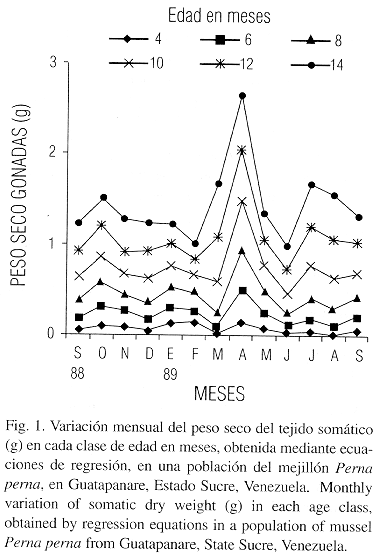
<body><![CDATA[<P><FONT SIZE=-1><FONT FACE="Arial,Helvetica">La variaci&oacute;n del peso seco del soma (ps) para cada clase de edad obtenido por las ecuaciones de conversi&oacute;n indican que las clases de edad 8, 10, 12 y 14 presentaron un descenso desde septiembre hasta octubre de 1988 seguido de un breve aumento hasta diciembre de 1988 (<A HREF="#Fig. 1">Fig. 1</A>), con un fuerte aumento para abril de 1989 seguidos de breves descensos en las clases de edades m&aacute;ximas (8 a 14 meses) y permanecieron constantes hasta marzo de 1989.</FONT></FONT>     <BR><FONT SIZE=-1>&nbsp;</FONT>     <CENTER><A NAME="Fig. 1"></A><IMG SRC="/img/fbpe/rbt/v47n3/0548i01.GIF" HEIGHT=556 WIDTH=379></CENTER> <FONT SIZE=-1>&nbsp;</FONT>     
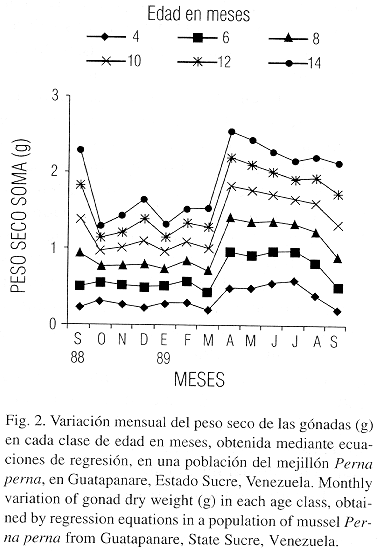
<BR><FONT SIZE=-1>&nbsp;</FONT><FONT SIZE=-1></FONT>      <P><FONT SIZE=-1><FONT FACE="Arial,Helvetica">El peso seco de las g&oacute;nadas (pg) registr&oacute; un aumento ligero en octubre de 1988, con variaciones ligeras entre noviembre y febrero de 1989, alcanzando su m&aacute;ximo en abril con una disminuci&oacute;n en marzo y junio. En julio de 1989 hay una recuperaci&oacute;n para descender en agosto y aumentar ligeramente en septiembre de 1989, salvo la clase de edad 14 (<A HREF="#Fig. 2">Fig. 2</A>).</FONT></FONT>     <BR><FONT SIZE=-1>&nbsp;</FONT>     <CENTER><A NAME="Fig. 2"></A><IMG SRC="/img/fbpe/rbt/v47n3/0548i02.GIF" HEIGHT=554 WIDTH=385></CENTER> <FONT SIZE=-1>&nbsp;</FONT><FONT SIZE=-1></FONT>      
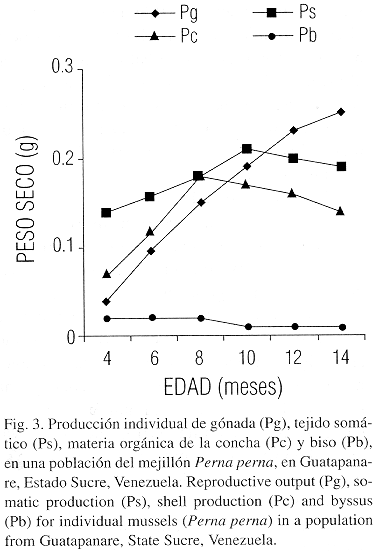
<P><FONT SIZE=-1><FONT FACE="Arial,Helvetica">La producci&oacute;n de tejido som&aacute;tico, alcanz&oacute; su m&aacute;ximo a los diez meses mientras que la materia org&aacute;nica de la concha y el biso alcanzaron sus m&aacute;ximos valores a los ocho meses de edad, declinando a partir de entonces (<A HREF="#Fig. 3">Fig. 3</A>). La producci&oacute;n de gametos, por el contrario, se increment&oacute; con la edad hasta la mayor clase estudiada (<A HREF="#CUADRO 3">Cuadro 3</A>). Finalmente la producci&oacute;n total (P) se estabiliz&oacute; a partir de los 10 meses.</FONT></FONT>     <BR><FONT SIZE=-1>&nbsp;</FONT>     <CENTER><A NAME="Fig. 3"></A><IMG SRC="/img/fbpe/rbt/v47n3/0548i03.GIF" HEIGHT=551 WIDTH=376></CENTER> <FONT SIZE=-1>&nbsp;</FONT>     
]]></body>
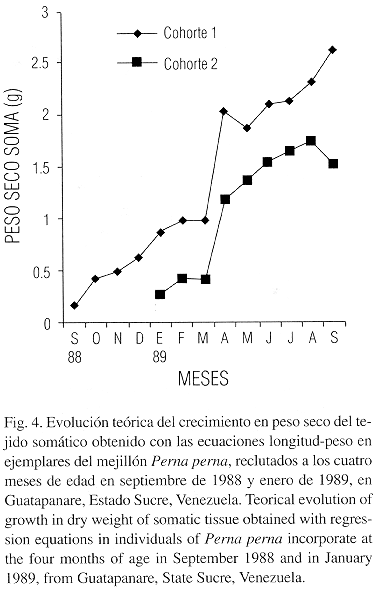
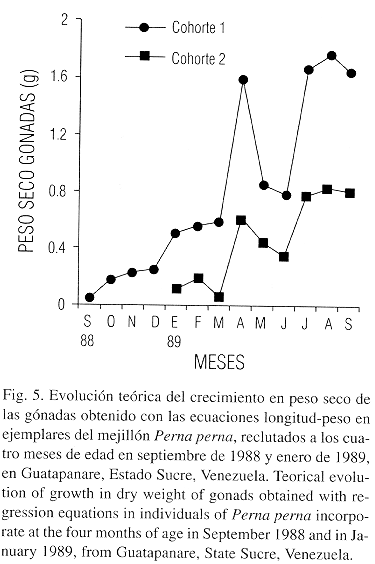
<body><![CDATA[<BR><FONT SIZE=-1>&nbsp;</FONT><FONT SIZE=-1></FONT>      <P><FONT SIZE=-1><FONT FACE="Arial,Helvetica">La evoluci&oacute;n te&oacute;rica del crecimiento en peso seco del tejido som&aacute;tico (<A HREF="#Fig. 4">Fig. 4</A>) y las g&oacute;nadas (<A HREF="#Fig. 5">Fig. 5</A>) calculado a partir de las ecuaciones longitud-peso para mejillones reclutados a los cuatro meses en septiembre de 1988 y enero de 1989 muestran un comportamiento similar, aunque en estos &uacute;ltimos se observ&oacute; una disminuci&oacute;n en el peso de las g&oacute;nadas en el mes de marzo de 1989.</FONT></FONT>     <BR><FONT SIZE=-1>&nbsp;</FONT>     <CENTER><A NAME="Fig. 4"></A><IMG SRC="/img/fbpe/rbt/v47n3/0548i04.GIF" HEIGHT=589 WIDTH=377></CENTER> <FONT SIZE=-1>&nbsp;</FONT><FONT SIZE=-1></FONT>      
<P><FONT SIZE=-1><FONT FACE="Arial,Helvetica">El peso seco de la materia org&aacute;nica de la concha (pc) present&oacute; valores constantes con muy pocas variaciones durante el per&iacute;odo estudiado y el promedio de materia org&aacute;nica (conquiolina) represent&oacute; el 6.49 &plusmn; 0.15 % del peso seco de la concha de <I>Perna perna</I>.</FONT></FONT><FONT SIZE=-1></FONT>      <P><FONT SIZE=-1><FONT FACE="Arial,Helvetica">La variaci&oacute;n del peso seco (biomasa) individual total en todas las edades indica la existencia de un aumento leve en noviembre de 1988, seguido de otro m&aacute;s pronunciado que se inicia en marzo de 1989 y que alcanza el m&aacute;ximo en el mes de abril del mismo a&ntilde;o, para descender progresivamente hasta septiembre de 1989. En las clases menores de seis meses las biomasas m&iacute;nimas se observaron en diciembre de 1988 y marzo de 1989, mientras que en diciembre de 1988 las clases mayores de 10 meses mostraron un leve aumento de biomasa.</FONT></FONT><FONT SIZE=-1></FONT>      <P><FONT SIZE=-1><FONT FACE="Arial,Helvetica">La biomasa total y el esfuerzo reproductivo (Pg/P) en promedios mensuales guardaron una relaci&oacute;n directamente proporcional con la edad, mientras que la tasa de renovaci&oacute;n (P/B) disminuy&oacute; con la edad (<A HREF="#CUADRO 3">Cuadro 3</A>).</FONT></FONT>     <BR><FONT SIZE=-1>&nbsp;</FONT>     <CENTER><A NAME="CUADRO 3"></A><B><FONT FACE="Arial,Helvetica"><FONT SIZE=-1>CUADRO 3</FONT></FONT></B></CENTER>      <CENTER><FONT SIZE=-1>&nbsp;</FONT></CENTER>      ]]></body>
<body><![CDATA[<CENTER><I><FONT FACE="Arial,Helvetica"><FONT SIZE=-1>Estimaciones espec&iacute;ficas por clase de edad en meses de la biomasa total (B, g), producci&oacute;n total (Pt, g), dividida</FONT></FONT></I></CENTER>      <CENTER><I><FONT FACE="Arial,Helvetica"><FONT SIZE=-1>en producci&oacute;n som&aacute;tica (Ps, g), Producci&oacute;n gam&eacute;tica (Pg, g), producci&oacute;n materia org&aacute;nica de la concha (Pc, g)</FONT></FONT></I></CENTER>      <CENTER><I><FONT FACE="Arial,Helvetica"><FONT SIZE=-1>y producci&oacute;n del biso (Pb, g). Se incluye la tasa de renovaci&oacute;n (P/B),el esfuerzo reproductivo (ER = Pg/P x 100)</FONT></FONT></I></CENTER>      <CENTER><I><FONT FACE="Arial,Helvetica"><FONT SIZE=-1>y Longitud de la concha (Lt) estimada en funci&oacute;n de la edad, a partir de la ecuaci&oacute;n de von Bertalanffy,</FONT></FONT></I></CENTER>      <CENTER><FONT FACE="Arial,Helvetica"><FONT SIZE=-1><I>en una poblaci&oacute;n del mejill&oacute;n</I> Perna perna<I>, en Guatapanare, Estado Sucre, Venezuela.</I></FONT></FONT></CENTER>      <CENTER><I><FONT FACE="Arial,Helvetica"><FONT SIZE=-1>&nbsp;</FONT></FONT></I></CENTER>      <CENTER><I><FONT FACE="Arial,Helvetica"><FONT SIZE=-1>Specific variations from age class in months of total biomass (B,g), total production (P, g), somatic production (Ps, g),</FONT></FONT></I></CENTER>      <CENTER><I><FONT FACE="Arial,Helvetica"><FONT SIZE=-1>gamete production (Pg, g), organic production by the shell (Pc, g), byssal production (Pb, g).</FONT></FONT></I></CENTER>      <CENTER><I><FONT FACE="Arial,Helvetica"><FONT SIZE=-1>Data included turnover ratios (P/B), reproductive effort (Pg/Px100) and shell length (Lt) estimated with relation to the</FONT></FONT></I></CENTER>      <CENTER><FONT FACE="Arial,Helvetica"><FONT SIZE=-1><I>age using the von Bertalanffy equation, in a population of </I>Perna perna<I> from Guatapanare, State Sucre, Venezuela.</I></FONT></FONT></CENTER> <FONT SIZE=-1>&nbsp;</FONT>     ]]></body>
<body><![CDATA[<BR><FONT SIZE=-1>&nbsp;</FONT>     <CENTER><TABLE BORDER=0 CELLSPACING=0 CELLPADDING=0 WIDTH="90%" > <TR> <TD VALIGN=TOP WIDTH="10%">     <CENTER><FONT FACE="Arial,Helvetica"><FONT SIZE=-1>EDAD</FONT></FONT></CENTER> </TD>  <TD VALIGN=TOP WIDTH="10%">     <CENTER><FONT FACE="Arial,Helvetica"><FONT SIZE=-1>Lt</FONT></FONT></CENTER> </TD>  <TD VALIGN=TOP WIDTH="10%">     <CENTER><FONT FACE="Arial,Helvetica"><FONT SIZE=-1>B</FONT></FONT></CENTER> </TD>  <TD VALIGN=TOP WIDTH="10%">     <CENTER><FONT FACE="Arial,Helvetica"><FONT SIZE=-1>Ps</FONT></FONT></CENTER> </TD>  <TD VALIGN=TOP WIDTH="10%">     <CENTER><FONT FACE="Arial,Helvetica"><FONT SIZE=-1>Pg</FONT></FONT></CENTER> </TD>  <TD VALIGN=TOP WIDTH="10%">     <CENTER><FONT FACE="Arial,Helvetica"><FONT SIZE=-1>Pc</FONT></FONT></CENTER> </TD>  <TD VALIGN=TOP WIDTH="11%">     <CENTER><FONT FACE="Arial,Helvetica"><FONT SIZE=-1>Pb</FONT></FONT></CENTER> </TD>  <TD VALIGN=TOP WIDTH="11%">     <CENTER><FONT FACE="Arial,Helvetica"><FONT SIZE=-1>P</FONT></FONT></CENTER> </TD>  <TD VALIGN=TOP WIDTH="11%">     ]]></body>
<body><![CDATA[<CENTER><FONT FACE="Arial,Helvetica"><FONT SIZE=-1>P/B</FONT></FONT></CENTER> </TD>  <TD VALIGN=TOP WIDTH="10%">     <CENTER><FONT FACE="Arial,Helvetica"><FONT SIZE=-1>ER</FONT></FONT></CENTER> </TD> </TR> </TABLE></CENTER> <FONT SIZE=-1>&nbsp;</FONT>     <CENTER><TABLE BORDER=0 CELLSPACING=0 CELLPADDING=0 WIDTH="90%" > <TR> <TD VALIGN=TOP WIDTH="10%">     <CENTER><FONT FACE="Arial,Helvetica"><FONT SIZE=-1>4</FONT></FONT></CENTER> </TD>  <TD VALIGN=TOP WIDTH="10%">     <CENTER><FONT FACE="Arial,Helvetica"><FONT SIZE=-1>36.33</FONT></FONT></CENTER> </TD>  <TD VALIGN=TOP WIDTH="10%">     <CENTER><FONT FACE="Arial,Helvetica"><FONT SIZE=-1>0.49</FONT></FONT></CENTER> </TD>  <TD VALIGN=TOP WIDTH="10%">     <CENTER><FONT FACE="Arial,Helvetica"><FONT SIZE=-1>0.14</FONT></FONT></CENTER> </TD>  <TD VALIGN=TOP WIDTH="10%">     <CENTER><FONT FACE="Arial,Helvetica"><FONT SIZE=-1>0.04</FONT></FONT></CENTER> </TD>  <TD VALIGN=TOP WIDTH="10%">     <CENTER><FONT FACE="Arial,Helvetica"><FONT SIZE=-1>0.07</FONT></FONT></CENTER> </TD>  <TD VALIGN=TOP WIDTH="11%">     <CENTER><FONT FACE="Arial,Helvetica"><FONT SIZE=-1>0.02</FONT></FONT></CENTER> </TD>  <TD VALIGN=TOP WIDTH="11%">     ]]></body>
<body><![CDATA[<CENTER><FONT FACE="Arial,Helvetica"><FONT SIZE=-1>0.27</FONT></FONT></CENTER> </TD>  <TD VALIGN=TOP WIDTH="11%">     <CENTER><FONT FACE="Arial,Helvetica"><FONT SIZE=-1>0.66</FONT></FONT></CENTER> </TD>  <TD VALIGN=TOP WIDTH="10%">     <CENTER><FONT FACE="Arial,Helvetica"><FONT SIZE=-1>14.81</FONT></FONT></CENTER> </TD> </TR>  <TR> <TD VALIGN=TOP WIDTH="10%">     <CENTER><FONT FACE="Arial,Helvetica"><FONT SIZE=-1>6</FONT></FONT></CENTER> </TD>  <TD VALIGN=TOP WIDTH="10%">     <CENTER><FONT FACE="Arial,Helvetica"><FONT SIZE=-1>53.54</FONT></FONT></CENTER> </TD>  <TD VALIGN=TOP WIDTH="10%">     <CENTER><FONT FACE="Arial,Helvetica"><FONT SIZE=-1>1.30</FONT></FONT></CENTER> </TD>  <TD VALIGN=TOP WIDTH="10%">     <CENTER><FONT FACE="Arial,Helvetica"><FONT SIZE=-1>0.16</FONT></FONT></CENTER> </TD>  <TD VALIGN=TOP WIDTH="10%">     <CENTER><FONT FACE="Arial,Helvetica"><FONT SIZE=-1>0.10</FONT></FONT></CENTER> </TD>  <TD VALIGN=TOP WIDTH="10%">     <CENTER><FONT FACE="Arial,Helvetica"><FONT SIZE=-1>0.12</FONT></FONT></CENTER> </TD>  <TD VALIGN=TOP WIDTH="11%">     <CENTER><FONT FACE="Arial,Helvetica"><FONT SIZE=-1>0.02</FONT></FONT></CENTER> </TD>  <TD VALIGN=TOP WIDTH="11%">     ]]></body>
<body><![CDATA[<CENTER><FONT FACE="Arial,Helvetica"><FONT SIZE=-1>0.40</FONT></FONT></CENTER> </TD>  <TD VALIGN=TOP WIDTH="11%">     <CENTER><FONT FACE="Arial,Helvetica"><FONT SIZE=-1>0.30</FONT></FONT></CENTER> </TD>  <TD VALIGN=TOP WIDTH="10%">     <CENTER><FONT FACE="Arial,Helvetica"><FONT SIZE=-1>25.00</FONT></FONT></CENTER> </TD> </TR>  <TR> <TD VALIGN=TOP WIDTH="10%">     <CENTER><FONT FACE="Arial,Helvetica"><FONT SIZE=-1>8</FONT></FONT></CENTER> </TD>  <TD VALIGN=TOP WIDTH="10%">     <CENTER><FONT FACE="Arial,Helvetica"><FONT SIZE=-1>67.46</FONT></FONT></CENTER> </TD>  <TD VALIGN=TOP WIDTH="10%">     <CENTER><FONT FACE="Arial,Helvetica"><FONT SIZE=-1>2.41</FONT></FONT></CENTER> </TD>  <TD VALIGN=TOP WIDTH="10%">     <CENTER><FONT FACE="Arial,Helvetica"><FONT SIZE=-1>0.18</FONT></FONT></CENTER> </TD>  <TD VALIGN=TOP WIDTH="10%">     <CENTER><FONT FACE="Arial,Helvetica"><FONT SIZE=-1>0.15</FONT></FONT></CENTER> </TD>  <TD VALIGN=TOP WIDTH="10%">     <CENTER><FONT FACE="Arial,Helvetica"><FONT SIZE=-1>0.18</FONT></FONT></CENTER> </TD>  <TD VALIGN=TOP WIDTH="11%">     <CENTER><FONT FACE="Arial,Helvetica"><FONT SIZE=-1>0.02</FONT></FONT></CENTER> </TD>  <TD VALIGN=TOP WIDTH="11%">     ]]></body>
<body><![CDATA[<CENTER><FONT FACE="Arial,Helvetica"><FONT SIZE=-1>0.53</FONT></FONT></CENTER> </TD>  <TD VALIGN=TOP WIDTH="11%">     <CENTER><FONT FACE="Arial,Helvetica"><FONT SIZE=-1>0.21</FONT></FONT></CENTER> </TD>  <TD VALIGN=TOP WIDTH="10%">     <CENTER><FONT FACE="Arial,Helvetica"><FONT SIZE=-1>28.30</FONT></FONT></CENTER> </TD> </TR>  <TR> <TD VALIGN=TOP WIDTH="10%">     <CENTER><FONT FACE="Arial,Helvetica"><FONT SIZE=-1>10</FONT></FONT></CENTER> </TD>  <TD VALIGN=TOP WIDTH="10%">     <CENTER><FONT FACE="Arial,Helvetica"><FONT SIZE=-1>78.72</FONT></FONT></CENTER> </TD>  <TD VALIGN=TOP WIDTH="10%">     <CENTER><FONT FACE="Arial,Helvetica"><FONT SIZE=-1>3.57</FONT></FONT></CENTER> </TD>  <TD VALIGN=TOP WIDTH="10%">     <CENTER><FONT FACE="Arial,Helvetica"><FONT SIZE=-1>0.21</FONT></FONT></CENTER> </TD>  <TD VALIGN=TOP WIDTH="10%">     <CENTER><FONT FACE="Arial,Helvetica"><FONT SIZE=-1>0.19</FONT></FONT></CENTER> </TD>  <TD VALIGN=TOP WIDTH="10%">     <CENTER><FONT FACE="Arial,Helvetica"><FONT SIZE=-1>0.17</FONT></FONT></CENTER> </TD>  <TD VALIGN=TOP WIDTH="11%">     <CENTER><FONT FACE="Arial,Helvetica"><FONT SIZE=-1>0.01</FONT></FONT></CENTER> </TD>  <TD VALIGN=TOP WIDTH="11%">     ]]></body>
<body><![CDATA[<CENTER><FONT FACE="Arial,Helvetica"><FONT SIZE=-1>0.58</FONT></FONT></CENTER> </TD>  <TD VALIGN=TOP WIDTH="11%">     <CENTER><FONT FACE="Arial,Helvetica"><FONT SIZE=-1>0.16</FONT></FONT></CENTER> </TD>  <TD VALIGN=TOP WIDTH="10%">     <CENTER><FONT FACE="Arial,Helvetica"><FONT SIZE=-1>32.75</FONT></FONT></CENTER> </TD> </TR>  <TR> <TD VALIGN=TOP WIDTH="10%">     <CENTER><FONT FACE="Arial,Helvetica"><FONT SIZE=-1>12</FONT></FONT></CENTER> </TD>  <TD VALIGN=TOP WIDTH="10%">     <CENTER><FONT FACE="Arial,Helvetica"><FONT SIZE=-1>87.84</FONT></FONT></CENTER> </TD>  <TD VALIGN=TOP WIDTH="10%">     <CENTER><FONT FACE="Arial,Helvetica"><FONT SIZE=-1>4.32</FONT></FONT></CENTER> </TD>  <TD VALIGN=TOP WIDTH="10%">     <CENTER><FONT FACE="Arial,Helvetica"><FONT SIZE=-1>0.20</FONT></FONT></CENTER> </TD>  <TD VALIGN=TOP WIDTH="10%">     <CENTER><FONT FACE="Arial,Helvetica"><FONT SIZE=-1>0.23</FONT></FONT></CENTER> </TD>  <TD VALIGN=TOP WIDTH="10%">     <CENTER><FONT FACE="Arial,Helvetica"><FONT SIZE=-1>0.16</FONT></FONT></CENTER> </TD>  <TD VALIGN=TOP WIDTH="11%">     <CENTER><FONT FACE="Arial,Helvetica"><FONT SIZE=-1>0.01</FONT></FONT></CENTER> </TD>  <TD VALIGN=TOP WIDTH="11%">     ]]></body>
<body><![CDATA[<CENTER><FONT FACE="Arial,Helvetica"><FONT SIZE=-1>0.60</FONT></FONT></CENTER> </TD>  <TD VALIGN=TOP WIDTH="11%">     <CENTER><FONT FACE="Arial,Helvetica"><FONT SIZE=-1>0.14</FONT></FONT></CENTER> </TD>  <TD VALIGN=TOP WIDTH="10%">     <CENTER><FONT FACE="Arial,Helvetica"><FONT SIZE=-1>38.33</FONT></FONT></CENTER> </TD> </TR>  <TR> <TD VALIGN=TOP WIDTH="10%">     <CENTER><FONT FACE="Arial,Helvetica"><FONT SIZE=-1>14</FONT></FONT></CENTER> </TD>  <TD VALIGN=TOP WIDTH="10%">     <CENTER><FONT FACE="Arial,Helvetica"><FONT SIZE=-1>95.22</FONT></FONT></CENTER> </TD>  <TD VALIGN=TOP WIDTH="10%">     <CENTER><FONT FACE="Arial,Helvetica"><FONT SIZE=-1>5.05</FONT></FONT></CENTER> </TD>  <TD VALIGN=TOP WIDTH="10%">     <CENTER><FONT FACE="Arial,Helvetica"><FONT SIZE=-1>0.19</FONT></FONT></CENTER> </TD>  <TD VALIGN=TOP WIDTH="10%">     <CENTER><FONT FACE="Arial,Helvetica"><FONT SIZE=-1>0.25</FONT></FONT></CENTER> </TD>  <TD VALIGN=TOP WIDTH="10%">     <CENTER><FONT FACE="Arial,Helvetica"><FONT SIZE=-1>0.14</FONT></FONT></CENTER> </TD>  <TD VALIGN=TOP WIDTH="11%">     <CENTER><FONT FACE="Arial,Helvetica"><FONT SIZE=-1>0.01</FONT></FONT></CENTER> </TD>  <TD VALIGN=TOP WIDTH="11%">     ]]></body>
<body><![CDATA[<CENTER><FONT FACE="Arial,Helvetica"><FONT SIZE=-1>0.59</FONT></FONT></CENTER> </TD>  <TD VALIGN=TOP WIDTH="11%">     <CENTER><FONT FACE="Arial,Helvetica"><FONT SIZE=-1>0.12</FONT></FONT></CENTER> </TD>  <TD VALIGN=TOP WIDTH="10%">     <CENTER><FONT FACE="Arial,Helvetica"><FONT SIZE=-1>42.37</FONT></FONT></CENTER> </TD> </TR> </TABLE></CENTER> <FONT SIZE=-1>&nbsp;&nbsp;&nbsp;&nbsp;&nbsp;&nbsp;&nbsp; <FONT FACE="Arial,Helvetica">Todos los par&aacute;metros est&aacute;n expresados en promedios mensuales.&nbsp;</FONT></FONT>     <BR><FONT SIZE=-1><FONT FACE="Arial,Helvetica">&nbsp;&nbsp;&nbsp;&nbsp;&nbsp;&nbsp;&nbsp; All parameter are expresed in monthly means</FONT></FONT>     <BR><FONT SIZE=-1>&nbsp;</FONT><FONT SIZE=-1></FONT>      <P><FONT SIZE=-1><FONT FACE="Arial,Helvetica">Las estimaciones de la producci&oacute;n para los meses de mayor crecimiento como fueron octubre de 1988 y abril de 1989 presentaron las mismas tendencias en t&eacute;rminos generales con relaci&oacute;n a las distribuciones energ&eacute;ticas. El crecimiento del tejido som&aacute;tico present&oacute; un pico peque&ntilde;o en diciembre de 1988 y otro de mayor grado en abril de 1989 (<A HREF="#Fig. 1">Fig. 1</A>). Aunque el comportamiento de las clases menores de 8 meses no sigue el mismo patr&oacute;n, con relaci&oacute;n al primero. Estas tasas son observables al graficar el crecimiento de este tejido, utilizando las ecuaciones longitud – peso en individuos reclutados a los cuatro meses de edad en septiembre de 1988 y en enero de 1989 (<A HREF="#Fig. 4">Fig. 4</A>). En el crecimiento de las g&oacute;nadas utilizando las ecuaciones longitud – peso en individuos reclutados a los cuatro meses en los mismos per&iacute;odos, se observa que en los primeros la tasa de producci&oacute;n de g&oacute;nadas es mayor, aunque en los reclutados a partir de enero de 1989 parece ocurrir un desove parcial en marzo del mismo a&ntilde;o (<A HREF="#Fig. 5">Fig. 5</A>). De acuerdo a los resultados obtenidos un mejill&oacute;n con un a&ntilde;o de edad y una biomasa de 4.32 g, exporta anualmente como gametos la cantidad de 2.76 g que es equivalente al 63.68 % de su biomasa y al 38.33 de su producci&oacute;n total (<A HREF="#CUADRO 3">Cuadro 3</A>).</FONT></FONT>     <BR><FONT SIZE=-1>&nbsp;</FONT>     <CENTER><A NAME="Fig. 5"></A><IMG SRC="/img/fbpe/rbt/v47n3/0548i05.GIF" HEIGHT=564 WIDTH=375></CENTER> <FONT SIZE=-1>&nbsp;</FONT><FONT SIZE=-1></FONT>      
<P><FONT SIZE=-1><FONT FACE="Arial,Helvetica">El biso, con relaci&oacute;n a la edad, present&oacute; bajas tasas de crecimiento en noviembre de 1988 y marzo de 1989, en cambio el contenido de materia org&aacute;nica de la concha en las diferentes edades fue constante. El &iacute;ndice gonadosom&aacute;tico present&oacute; dos picos claramente definidos, el primero ocurrio en octubre de 1988 y el segundo, de mayor magnitud, alcanz&oacute; valores m&aacute;ximos en abril y mayo de 1989 disminuyendo luego (<A HREF="#CUADRO 4">Cuadro 4</A>).</FONT></FONT>     <BR><FONT SIZE=-1>&nbsp;</FONT>     ]]></body>
<body><![CDATA[<CENTER><A NAME="CUADRO 4"></A><B><FONT FACE="Arial,Helvetica"><FONT SIZE=-1>CUADRO 4</FONT></FONT></B></CENTER>      <CENTER><FONT SIZE=-1>&nbsp;</FONT></CENTER>      <CENTER><FONT FACE="Arial,Helvetica"><FONT SIZE=-1><I>Variaci&oacute;n mensual del &iacute;ndice gonosom&aacute;tico (pg/pst X 100) en una poblaci&oacute;n del mejill&oacute;n</I> Perna perna</FONT></FONT></CENTER>      <CENTER><I><FONT FACE="Arial,Helvetica"><FONT SIZE=-1>en Guatapanare, Estado Sucre, Venezuela.</FONT></FONT></I></CENTER>      <CENTER><I><FONT FACE="Arial,Helvetica"><FONT SIZE=-1>&nbsp;</FONT></FONT></I></CENTER>      <CENTER><FONT FACE="Arial,Helvetica"><FONT SIZE=-1><I>Monthly variation of gonosomatic index (ps/pstX100) in a population of mussel </I>Perna perna</FONT></FONT></CENTER>      <CENTER><I><FONT FACE="Arial,Helvetica"><FONT SIZE=-1>from Guatapanare, State Sucre, Venezuela.</FONT></FONT></I></CENTER> <FONT SIZE=-1>&nbsp;</FONT>     <CENTER><TABLE BORDER=0 CELLSPACING=0 CELLPADDING=4 WIDTH="538" > <TR> <TD VALIGN=TOP WIDTH="28%"><FONT FACE="Arial,Helvetica"><FONT SIZE=-1>Mes</FONT></FONT></TD>  <TD VALIGN=TOP WIDTH="28%">     <CENTER><IMG SRC="/img/fbpe/rbt/v47n3/promedio.JPG" HEIGHT=15 WIDTH=11></CENTER> </TD>  <TD VALIGN=TOP WIDTH="28%">     
<CENTER><FONT FACE="Arial,Helvetica"><FONT SIZE=-1>d</FONT></FONT></CENTER> </TD>  <TD VALIGN=TOP WIDTH="16%">     ]]></body>
<body><![CDATA[<CENTER><FONT FACE="Arial,Helvetica"><FONT SIZE=-1>N</FONT></FONT></CENTER> </TD> </TR>  <TR> <TD VALIGN=TOP WIDTH="28%"><FONT FACE="Arial,Helvetica"><FONT SIZE=-1>Septiembre, 1988</FONT></FONT></TD>  <TD VALIGN=TOP WIDTH="28%">     <CENTER><FONT FACE="Arial,Helvetica"><FONT SIZE=-1>14.81</FONT></FONT></CENTER> </TD>  <TD VALIGN=TOP WIDTH="28%">     <CENTER><FONT FACE="Arial,Helvetica"><FONT SIZE=-1>3.22</FONT></FONT></CENTER> </TD>  <TD VALIGN=TOP WIDTH="16%">     <CENTER><FONT FACE="Arial,Helvetica"><FONT SIZE=-1>51</FONT></FONT></CENTER> </TD> </TR>  <TR> <TD VALIGN=TOP WIDTH="28%"><FONT FACE="Arial,Helvetica"><FONT SIZE=-1>Octubre</FONT></FONT></TD>  <TD VALIGN=TOP WIDTH="28%">     <CENTER><FONT FACE="Arial,Helvetica"><FONT SIZE=-1>27.85</FONT></FONT></CENTER> </TD>  <TD VALIGN=TOP WIDTH="28%">     <CENTER><FONT FACE="Arial,Helvetica"><FONT SIZE=-1>2.45</FONT></FONT></CENTER> </TD>  <TD VALIGN=TOP WIDTH="16%">     <CENTER><FONT FACE="Arial,Helvetica"><FONT SIZE=-1>62</FONT></FONT></CENTER> </TD> </TR>  <TR> <TD VALIGN=TOP WIDTH="28%"><FONT FACE="Arial,Helvetica"><FONT SIZE=-1>Noviembre</FONT></FONT></TD>  <TD VALIGN=TOP WIDTH="28%">     <CENTER><FONT FACE="Arial,Helvetica"><FONT SIZE=-1>21.13</FONT></FONT></CENTER> </TD>  <TD VALIGN=TOP WIDTH="28%">     <CENTER><FONT FACE="Arial,Helvetica"><FONT SIZE=-1>3.03</FONT></FONT></CENTER> </TD>  <TD VALIGN=TOP WIDTH="16%">     <CENTER><FONT FACE="Arial,Helvetica"><FONT SIZE=-1>52</FONT></FONT></CENTER> </TD> </TR>  <TR> <TD VALIGN=TOP WIDTH="28%"><FONT FACE="Arial,Helvetica"><FONT SIZE=-1>Diciembre</FONT></FONT></TD>  <TD VALIGN=TOP WIDTH="28%">     ]]></body>
<body><![CDATA[<CENTER><FONT FACE="Arial,Helvetica"><FONT SIZE=-1>16.39</FONT></FONT></CENTER> </TD>  <TD VALIGN=TOP WIDTH="28%">     <CENTER><FONT FACE="Arial,Helvetica"><FONT SIZE=-1>2.82</FONT></FONT></CENTER> </TD>  <TD VALIGN=TOP WIDTH="16%">     <CENTER><FONT FACE="Arial,Helvetica"><FONT SIZE=-1>53</FONT></FONT></CENTER> </TD> </TR>  <TR> <TD VALIGN=TOP WIDTH="28%"><FONT FACE="Arial,Helvetica"><FONT SIZE=-1>Enero, 1989</FONT></FONT></TD>  <TD VALIGN=TOP WIDTH="28%">     <CENTER><FONT FACE="Arial,Helvetica"><FONT SIZE=-1>20.93</FONT></FONT></CENTER> </TD>  <TD VALIGN=TOP WIDTH="28%">     <CENTER><FONT FACE="Arial,Helvetica"><FONT SIZE=-1>3.41</FONT></FONT></CENTER> </TD>  <TD VALIGN=TOP WIDTH="16%">     <CENTER><FONT FACE="Arial,Helvetica"><FONT SIZE=-1>54</FONT></FONT></CENTER> </TD> </TR>  <TR> <TD VALIGN=TOP WIDTH="28%"><FONT FACE="Arial,Helvetica"><FONT SIZE=-1>Febrero</FONT></FONT></TD>  <TD VALIGN=TOP WIDTH="28%">     <CENTER><FONT FACE="Arial,Helvetica"><FONT SIZE=-1>21.86</FONT></FONT></CENTER> </TD>  <TD VALIGN=TOP WIDTH="28%">     <CENTER><FONT FACE="Arial,Helvetica"><FONT SIZE=-1>2.30</FONT></FONT></CENTER> </TD>  <TD VALIGN=TOP WIDTH="16%">     <CENTER><FONT FACE="Arial,Helvetica"><FONT SIZE=-1>57</FONT></FONT></CENTER> </TD> </TR>  <TR> <TD VALIGN=TOP WIDTH="28%"><FONT FACE="Arial,Helvetica"><FONT SIZE=-1>Marzo</FONT></FONT></TD>  <TD VALIGN=TOP WIDTH="28%">     <CENTER><FONT FACE="Arial,Helvetica"><FONT SIZE=-1>23.41</FONT></FONT></CENTER> </TD>  <TD VALIGN=TOP WIDTH="28%">     ]]></body>
<body><![CDATA[<CENTER><FONT FACE="Arial,Helvetica"><FONT SIZE=-1>3.15</FONT></FONT></CENTER> </TD>  <TD VALIGN=TOP WIDTH="16%">     <CENTER><FONT FACE="Arial,Helvetica"><FONT SIZE=-1>52</FONT></FONT></CENTER> </TD> </TR>  <TR> <TD VALIGN=TOP WIDTH="28%"><FONT FACE="Arial,Helvetica"><FONT SIZE=-1>Abril</FONT></FONT></TD>  <TD VALIGN=TOP WIDTH="28%">     <CENTER><FONT FACE="Arial,Helvetica"><FONT SIZE=-1>33.15</FONT></FONT></CENTER> </TD>  <TD VALIGN=TOP WIDTH="28%">     <CENTER><FONT FACE="Arial,Helvetica"><FONT SIZE=-1>2.28</FONT></FONT></CENTER> </TD>  <TD VALIGN=TOP WIDTH="16%">     <CENTER><FONT FACE="Arial,Helvetica"><FONT SIZE=-1>53</FONT></FONT></CENTER> </TD> </TR>  <TR> <TD VALIGN=TOP WIDTH="28%"><FONT FACE="Arial,Helvetica"><FONT SIZE=-1>Mayo</FONT></FONT></TD>  <TD VALIGN=TOP WIDTH="28%">     <CENTER><FONT FACE="Arial,Helvetica"><FONT SIZE=-1>32.57</FONT></FONT></CENTER> </TD>  <TD VALIGN=TOP WIDTH="28%">     <CENTER><FONT FACE="Arial,Helvetica"><FONT SIZE=-1>3.43</FONT></FONT></CENTER> </TD>  <TD VALIGN=TOP WIDTH="16%">     <CENTER><FONT FACE="Arial,Helvetica"><FONT SIZE=-1>50</FONT></FONT></CENTER> </TD> </TR>  <TR> <TD VALIGN=TOP WIDTH="28%"><FONT FACE="Arial,Helvetica"><FONT SIZE=-1>Junio</FONT></FONT></TD>  <TD VALIGN=TOP WIDTH="28%">     <CENTER><FONT FACE="Arial,Helvetica"><FONT SIZE=-1>25.83</FONT></FONT></CENTER> </TD>  <TD VALIGN=TOP WIDTH="28%">     <CENTER><FONT FACE="Arial,Helvetica"><FONT SIZE=-1>2.21</FONT></FONT></CENTER> </TD>  <TD VALIGN=TOP WIDTH="16%">     ]]></body>
<body><![CDATA[<CENTER><FONT FACE="Arial,Helvetica"><FONT SIZE=-1>56</FONT></FONT></CENTER> </TD> </TR>  <TR> <TD VALIGN=TOP WIDTH="28%"><FONT FACE="Arial,Helvetica"><FONT SIZE=-1>Julio</FONT></FONT></TD>  <TD VALIGN=TOP WIDTH="28%">     <CENTER><FONT FACE="Arial,Helvetica"><FONT SIZE=-1>21.32</FONT></FONT></CENTER> </TD>  <TD VALIGN=TOP WIDTH="28%">     <CENTER><FONT FACE="Arial,Helvetica"><FONT SIZE=-1>2.62</FONT></FONT></CENTER> </TD>  <TD VALIGN=TOP WIDTH="16%">     <CENTER><FONT FACE="Arial,Helvetica"><FONT SIZE=-1>53</FONT></FONT></CENTER> </TD> </TR>  <TR> <TD VALIGN=TOP WIDTH="28%"><FONT FACE="Arial,Helvetica"><FONT SIZE=-1>Agosto</FONT></FONT></TD>  <TD VALIGN=TOP WIDTH="28%">     <CENTER><FONT FACE="Arial,Helvetica"><FONT SIZE=-1>16.85</FONT></FONT></CENTER> </TD>  <TD VALIGN=TOP WIDTH="28%">     <CENTER><FONT FACE="Arial,Helvetica"><FONT SIZE=-1>3.83</FONT></FONT></CENTER> </TD>  <TD VALIGN=TOP WIDTH="16%">     <CENTER><FONT FACE="Arial,Helvetica"><FONT SIZE=-1>54</FONT></FONT></CENTER> </TD> </TR>  <TR> <TD VALIGN=TOP WIDTH="28%"><FONT FACE="Arial,Helvetica"><FONT SIZE=-1>Septiembre</FONT></FONT></TD>  <TD VALIGN=TOP WIDTH="28%">     <CENTER><FONT FACE="Arial,Helvetica"><FONT SIZE=-1>15.63</FONT></FONT></CENTER> </TD>  <TD VALIGN=TOP WIDTH="28%">     <CENTER><FONT FACE="Arial,Helvetica"><FONT SIZE=-1>3.81</FONT></FONT></CENTER> </TD>  <TD VALIGN=TOP WIDTH="16%">     <CENTER><FONT FACE="Arial,Helvetica"><FONT SIZE=-1>52</FONT></FONT></CENTER> </TD> </TR> </TABLE></CENTER> <FONT SIZE=-1>&nbsp;</FONT>     ]]></body>
<body><![CDATA[<BR><FONT SIZE=-1>&nbsp;<IMG SRC="/img/fbpe/rbt/v47n3/promedio.JPG" HEIGHT=15 WIDTH=11><FONT FACE="Arial,Helvetica">= promedio,&nbsp;<IMG SRC="/img/fbpe/rbt/v47n3/de.JPG" HEIGHT=14 WIDTH=9> = desviaci&oacute;n estandard, N= n&uacute;mero de individuos.</FONT></FONT>     
<BR><FONT SIZE=-1><FONT FACE="Arial,Helvetica">&nbsp;<IMG SRC="/img/fbpe/rbt/v47n3/promedio.JPG" HEIGHT=15 WIDTH=11>= average ,&nbsp;<IMG SRC="/img/fbpe/rbt/v47n3/de.JPG" HEIGHT=14 WIDTH=9> = standard desviation, N = number of individuals.</FONT></FONT><FONT SIZE=-1></FONT>      
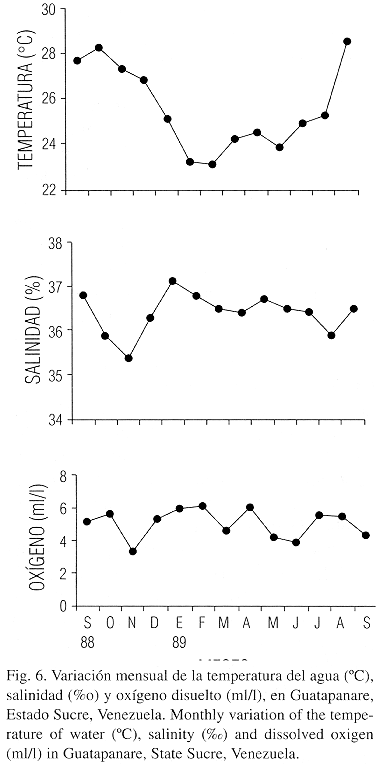
<P><FONT SIZE=-1><FONT FACE="Arial,Helvetica">&nbsp;</FONT></FONT>     <BR><B><FONT FACE="Arial,Helvetica"><FONT SIZE=-1>Discusi&oacute;n</FONT></FONT></B><FONT SIZE=-1></FONT>      <P><FONT SIZE=-1><FONT FACE="Arial,Helvetica">El crecimiento de <I>Perna perna</I> en Guatapanare determinado con datos de <A HREF="#Carvajal">Carvajal (1969)</A> es superior al informado para la misma especie en Sud&aacute;frica por <A HREF="#Berry78">Berry (1978)</A>, lo cual indica que logran un mayor tama&ntilde;o en menor tiempo, probablemente debido a las mejores condiciones del ambiente. Los valores bajos en el promedio del peso seco de la biomasa total registrados durante los primeros seis meses (septiembre de 1988 – febrero de 1989) revelan la existencia de un per&iacute;odo pobre en cuanto a producci&oacute;n se refiere, mientras que el aumento de marzo de 1989 hasta abril de 1989 es originado por un incremento en la disponibilidad de alimento, relacionado con el fen&oacute;meno de surgencia que se da con regularidad en la regi&oacute;n, causando un notable incremento de la productividad primaria debido a los nutrientes que aporta el afloramiento de aguas profundas (<A HREF="#Griffiths72">Griffiths y Simpson 1972</A>, <A HREF="#Ferraz">Ferraz – Reyes 1980</A>).</FONT></FONT><FONT SIZE=-1></FONT>      <P><FONT SIZE=-1><FONT FACE="Arial,Helvetica">En este per&iacute;odo se registra una disminuci&oacute;n de la temperatura, aumento de la salinidad y del ox&iacute;geno disuelto (<A HREF="#Fig. 6">Fig. 6</A>) con una fuerte incidencia de vientos que aumentan la intensidad del oleaje, aportando un subsidio energ&eacute;tico que contribuye a la formaci&oacute;n de detritus, acelera el flujo de agua y mantienen en suspensi&oacute;n part&iacute;culas que sirven de alimento a muchos filtradores, y en especial a los mit&iacute;lidos los cuales lo utilizan como una fuente adicional de alimentaci&oacute;n, explotando totalmente su potencial de filtraci&oacute;n (<A HREF="#Kiorboe">Kiorboe <I>et al</I>. 1981</A>, <A HREF="#Lodeiros">Lodeiros <I>et al.</I> 1993</A>).</FONT></FONT>     <BR><FONT SIZE=-1>&nbsp;</FONT>     <BR><FONT SIZE=-1>&nbsp;</FONT>     <CENTER><A NAME="Fig. 6"></A><IMG SRC="/img/fbpe/rbt/v47n3/0548i06.GIF" HEIGHT=764 WIDTH=382></CENTER> <FONT SIZE=-1>&nbsp;</FONT><FONT SIZE=-1></FONT>      
<P><FONT SIZE=-1><FONT FACE="Arial,Helvetica">Los cambios en los pesos de la biomasa total que expresan las variaciones de la velocidad del crecimiento de los tejidos som&aacute;tico y gonadal, representan el comportamiento t&iacute;pico de algunas especies tropicales que disponen de un suministro de energ&iacute;a cont&iacute;nuo.</FONT></FONT><FONT SIZE=-1></FONT>      ]]></body>
<body><![CDATA[<P><FONT SIZE=-1><FONT FACE="Arial,Helvetica">La productividad de las g&oacute;nadas se estim&oacute; sobre la base de la disminuci&oacute;n del peso en los dos per&iacute;odos principales de desove (octubre- diciembre de 1988 y abril-julio de 1989), sin tomar en consideraci&oacute;n otro probable desove ocurrido en febrero de 1989, los cuales han sido previamente se&ntilde;alados por <A HREF="#Carvajal">Carvajal (1969)</A> y <A HREF="#Velez71">V&eacute;lez (1971)</A>. En <I>Perna perna</I> la actividad gonadal es cont&iacute;nua y no ocurren desoves totales, por lo que existe una r&aacute;pida capacidad de recuperaci&oacute;n con gametog&eacute;nesis y desoves prolongados que pudieran propiciar una subestimaci&oacute;n de la producci&oacute;n.</FONT></FONT><FONT SIZE=-1></FONT>      <P><FONT SIZE=-1><FONT FACE="Arial,Helvetica">La variaci&oacute;n mensual del &iacute;ndice gonosom&aacute;tico (<A HREF="#CUADRO 4">Cuadro 4</A>) coincide parcialmente con la de los pesos gonadales (<A HREF="#Fig. 2">Fig. 2</A>). Las diferencias observadas en la variaci&oacute;n del peso de las g&oacute;nadas para el mes de marzo de 1989 entre los mejillones de cero a 10 meses y los de mayor edad (12 y 14 meses) pueden explicarse por las siguientes razones: 1. Un error en la predicci&oacute;n de la ecuaci&oacute;n de conversi&oacute;n longitud – peso. 2. Indicaci&oacute;n de un desove previo o m&aacute;s pronunciado del primer grupo y 3. Diferencias en el comportamiento reproductivo de las edades. Esta &uacute;ltima hip&oacute;tesis parece descartarse al analizar la evoluci&oacute;n te&oacute;rica del crecimiento de las g&oacute;nadas en individuos reclutados a los 4 meses en dos per&iacute;odos diferentes, donde se observa un comportamiento similar (<A HREF="#Fig. 5">Fig. 5</A>); aunque los mejillones reclutados en septiembre de 1988 pierden en el desove de abril de 1989 un mayor porcentaje de peso con una edad de 12 meses. Hacen falta sin embargo estudios histol&oacute;gicos y bioenergeticos directos para analizar en detalle este comportamiento. <A HREF="#Berry78">Berry (1978)</A> ha se&ntilde;alado que las cohortes de <I>Perna perna</I> en Natal (Sur – Africa) pueden presentar din&aacute;micas bioenergeticas diferentes.</FONT></FONT><FONT SIZE=-1></FONT>      <P><FONT SIZE=-1><FONT FACE="Arial,Helvetica">La disminuci&oacute;n del peso de las g&oacute;nadas en los mejillones observado en febrero de 1989 (<A HREF="#Fig. 2">Fig. 2</A>) pudiera explicarse por la baja temperatura del agua (<A HREF="#Fig. 6">Fig. 6</A>), que inhibe el desarrollo de los gametos en la especie (<A HREF="#Velez81">V&eacute;lez y Epifanio 1981</A>) o m&aacute;s probablemente por la ocurrencia de una marea roja observada que pudo haber debilitado a la poblaci&oacute;n. En <I>Argopecten irradians</I> se ha informado que este fen&oacute;meno induce un agotamiento de las g&oacute;nadas, con reabsorci&oacute;n de la energ&iacute;a destinada a la reproducci&oacute;n, aunque los organismos sobrevivientes experimentaron una notable recuperaci&oacute;n (<A HREF="#Bricelj">Bricelj <I>et al</I>. 1987</A>). En el presente trabajo a partir de marzo de 1989 se observ&oacute; un fuerte incremento en la generaci&oacute;n de tejido gon&aacute;dico con un m&aacute;ximo en abril de 1989, explotando la elevada disponibilidad de alimento y prepar&aacute;ndose para el principal desove ocurrido hasta junio de 1989, en el cual los individuos m&aacute;s grandes invierten mayor cantidad de energ&iacute;a desarrollando un alto esfuerzo reproductivo. Diversos autores han se&ntilde;alado que los bivalvos adultos poseen una mayor estabilidad fisiol&oacute;gica basada en una cantidad superior de reservas energ&eacute;ticas en condiciones de ser movilizadas con mayor facilidad para soportar alteraciones org&aacute;nicas introducidas en el medio ambiente (<A HREF="#Langton">Langton <I>et al</I>. 1987</A>).</FONT></FONT><FONT SIZE=-1></FONT>      <P><FONT SIZE=-1><FONT FACE="Arial,Helvetica">Las fluctuaciones observadas entre septiembre y diciembre de 1988 en el tejido som&aacute;tico (<A HREF="#Fig. 1">Fig. 1</A>) con tendencias opuestas entre individuos mayores y menores de 6 meses, puede ser debido principalmente al incremento de la actividad reproductiva ocurrida en octubre; en el cual los mejillones mayores de 6 meses exhibieron esfuerzo reproductivo m&aacute;s elevado, restando energ&iacute;a para el crecimiento. El aumento del peso seco som&aacute;tico a partir de abril de 1989 (<A HREF="#Fig. 1">Fig. 1</A>) coincide con un incremento de los sustratos energ&eacute;ticos informados por <A HREF="#Benitez">Benit&eacute;z (1968)</A>. En regiones templadas se ha demostrado que diversas especies de bivalvos movilizan sustratos energ&eacute;ticos de tejido som&aacute;tico para la formaci&oacute;n de gametos (<A HREF="#Taylor">Taylor y Venn 1979</A>, <A HREF="#Barber">Barber y Blake 1981</A>). Tambi&eacute;n ha sido observado en el pect&iacute;nido tropical <I>Euvola</I> (<I>Pecten</I>) <I>ziczac</I> (<A HREF="#Brea">Brea 1986</A> y <A HREF="#Marcano">Marcano 1989</A>).</FONT></FONT><FONT SIZE=-1></FONT>      <P><FONT SIZE=-1><FONT FACE="Arial,Helvetica">Los mejillones presentaron un aumento gradual en la tasa de producci&oacute;n de materia org&aacute;nica de la concha hasta los 8 meses, en cambio el ligero aumento observado en los mayores de 8 meses en marzo de 1989 pudiera explicarse por la elevada disponibilidad de alimento que existe en ese lapso (<A HREF="#Ferraz">Ferraz – Reyes 1980</A>, <A HREF="#Griffiths72">Griffiths y Simpson 1972</A>) lo que implicar&iacute;a un mayor consumo. El incremento en el peso seco del biso observado en diciembre de 1988 probablemente ocurre como una estrategia de los individuos para fijarse en una &eacute;poca en la cual la din&aacute;mica del oleaje es violenta tal como ha sido informado en <I>Mytilus edulis</I> (<A HREF="#Price82">Price 1982</A>). El segundo m&aacute;ximo ocurrido en abril de 1989, coincide con el per&iacute;odo de mayor producci&oacute;n de tejidos e igualmente con las altas tasas de productividad primaria, relacionadas normalmente con per&iacute;odos previos de surgencias.</FONT></FONT><FONT SIZE=-1></FONT>      <P><FONT SIZE=-1><FONT FACE="Arial,Helvetica">La producci&oacute;n de tejido som&aacute;tico aumenta hasta la edad de 10 meses, en cambio la producci&oacute;n de g&oacute;nadas aumenta desde tempranas edades, representando a los seis meses mas del 20 % de la producci&oacute;n total (<A HREF="#Fig. 3">Fig. 3</A>, <A HREF="#CUADRO 3">Cuadro 3</A>). Este comportamiento constituye una estrat&eacute;gia adecuada para una especie cuya longevidad normalmente no alcanza los 18 meses y que debe explotar su potencial reproductivo desde muy temprana edad para garantizar la viavilidad de la poblaci&oacute;n, aprovechando las condiciones del medio, donde no se presentan limitaciones excesivas en el suministro de alimento. A los 12 meses de edad, el mejill&oacute;n alcanz&oacute; un esfuerzo reproductivo medio de 38.33 %, lo que indica que cerca de la mitad de la energ&iacute;a invertida en la producci&oacute;n total es vertida al medio como gametos, estimaci&oacute;n muy superior a la informada por <A HREF="#Berry83">Berry y Schleyer (1983)</A> en una poblaci&oacute;n de <I>Perna perna</I> de Sur&aacute;frica.</FONT></FONT><FONT SIZE=-1></FONT>      <P><FONT SIZE=-1><FONT FACE="Arial,Helvetica">El promedio de materia org&aacute;nica determinado con relaci&oacute;n al peso de la concha (6.5 %) es ligeramente m&aacute;s elevado que el de mit&iacute;lidos de zonas templadas. <A HREF="#Barker">Barker-Jorgensen (1976)</A> report&oacute; de 5.4 a 6.0 % en <I>Modiolus demisus</I> y 4.3 % en <I>Mytilus edulis</I>, <A HREF="#Price76">Price <I>et al</I>. (1976)</A> estimaron 5.32 % en <I>Mytilus edulis</I> y entre 4.6 y 6.2 en <I>Modiolus demisus</I>. Se ha se&ntilde;alado que la temperatura del agua puede influir sobre el tipo de cristal de la concha de los moluscos, debido a que origina cambios en la actividad secretora del manto, los cuales se reflejan en los componentes org&aacute;nicos e inorg&aacute;nicos del flu&iacute;do extrapaleal. La salinidad, otro componente del ambiente, puede tambi&eacute;n afectar la composici&oacute;n org&aacute;nica de la concha (<A HREF="#Price76">Price <I>et al</I>. 1976</A>). La producci&oacute;n de materia org&aacute;nica en este trabajo oscil&oacute; entre 25 y 33 % de la producci&oacute;n total, disminuyendo con la edad. Este porcentaje es semejante al reportado por <A HREF="#Kautsky">Kautsky (1982)</A> en <I>Mytilus edulis</I> (25 %), aunque otros autores han determinado valores m&aacute;s altos en otras poblaciones de esta &uacute;ltima especie (<A HREF="#Price76">Price <I>et al. </I>1976</A>).</FONT></FONT><FONT SIZE=-1></FONT>      <P><FONT SIZE=-1><FONT FACE="Arial,Helvetica">La tasa de producci&oacute;n del biso se mantuvo estable hasta los ocho meses, disminuyendo luego, y alcanz&oacute; un 3.60 % del total, superando los valores de 1.2 y 1.7 % reportados por <A HREF="#Berry78">Berry (1978)</A> en la poblaci&oacute;n de Sur&aacute;frica.</FONT></FONT><FONT SIZE=-1></FONT>      <P><FONT SIZE=-1><FONT FACE="Arial,Helvetica">La tasa de producci&oacute;n total aument&oacute; constantemente, aunque se estabiliz&oacute; a los 12 meses, compensando el comportamiento reproductivo, la reducci&oacute;n de la tasa de producci&oacute;n del tejido som&aacute;tico a partir de los 12 meses y de la materia org&aacute;nica de la concha y biso a partir de los 10 meses (<A HREF="#Fig. 3">Fig. 3</A>, <A HREF="#CUADRO 3">cuadro 3</A>). Tendencias similares, con relaci&oacute;n a la evoluci&oacute;n individual de estos compartimientos, han sido reportadas en poblaciones de bivalvos de zonas templadas (<A HREF="#Thompson">Thompson 1984</A>); no obstante, en especies como <I>Patinopecten caurinus</I> la producci&oacute;n total puede reducirse a edades tempranas debido a que la generaci&oacute;n de tejido som&aacute;tico y materia org&aacute;nica de la concha disminuyen m&aacute;s rapidamente que lo que se incrementa la producci&oacute;n de gametos (<A HREF="#MacDonald87">MacDonald y Bourne 1987</A>).</FONT></FONT><FONT SIZE=-1></FONT>      <P><FONT SIZE=-1><FONT FACE="Arial,Helvetica">La disminuci&oacute;n de la tasa de renovaci&oacute;n (P/B) con relaci&oacute;n a la edad es un proceso que ocurre en todos los bivalvos y se explica debido a que individuos m&aacute;s viejos dedican una mayor cantidad de energ&iacute;a para el soporte del metabolismo que los jovenes, resultando en menos energ&iacute;a disponible para la producci&oacute;n en comparaci&oacute;n con el tama&ntilde;o del cuerpo. Por la misma raz&oacute;n los j&oacute;venes son m&aacute;s eficientes en la utilizaci&oacute;n de energ&iacute;a para el crecimiento (<A HREF="#MacDonald86">MacDonald y Thompson 1986</A>). En <I>Mytilus edulis</I> de zonas sub&aacute;rticas, con una alta longevidad, la tasa de renovaci&oacute;n es independiente de la edad (<A HREF="#Thompson">Thompson 1984</A>).</FONT></FONT><FONT SIZE=-1></FONT>      ]]></body>
<body><![CDATA[<P><FONT SIZE=-1><FONT FACE="Arial,Helvetica">El esfuerzo reproductivo se increment&oacute; con la edad alcanzando el 42.37 % a los 14 meses. En especies de zonas templadas el esfuerzo reproductivo alcanza valores m&aacute;s altos (<A HREF="#Kautsky">Kautsky 1982</A>); sin embargo, debe tenerse en cuenta que &eacute;stas tienen un crecimiento m&aacute;s lento y su reproducci&oacute;n ocurre en un lapso breve, de forma explosiva, aprovechando las condiciones ambientales. Se ha sugerido que existe una considerable variaci&oacute;n intraespecifica en la repartici&oacute;n de la energ&iacute;a en las poblaciones que depende de los factores ambientales, as&iacute; <A HREF="#MacDonald86">MacDonald y Thompsom (1986)</A> se&ntilde;alan que la liberaci&oacute;n de altos porcentajes de producci&oacute;n en gametos sea una caracter&iacute;stica de especies de agua fr&iacute;a y alta longevidad. En el caso de la poblaci&oacute;n estudiada de <I>Perna perna</I>, esta se caracteriza por una corta longevidad con desoves parciales intermitentes desde edades tempranas que garantizan la viabilidad de la poblaci&oacute;n.</FONT></FONT><FONT SIZE=-1></FONT>      <P><FONT SIZE=-1><FONT FACE="Arial,Helvetica">&nbsp;</FONT></FONT>     <BR><B><FONT FACE="Arial,Helvetica"><FONT SIZE=-1>Resumen</FONT></FONT></B><FONT SIZE=-1></FONT>      <P><FONT SIZE=-1><FONT FACE="Arial,Helvetica">Se estudi&oacute; la producci&oacute;n de biomasa en g&oacute;nadas, tejido som&aacute;tico, materia org&aacute;nica de la concha y biso en individuos de una poblaci&oacute;n explotada del mejill&oacute;n <I>Perna perna</I> en Guatapanare, Estado Sucre, Venezuela, en muestras mensuales recolectadas desde septiembre de 1988 hasta septiembre de 1989. La variaci&oacute;n mensual de cada componente se evalu&oacute; utilizando ecuaciones de regresi&oacute;n y un modelo de crecimiento en la misma poblaci&oacute;n. La especie es de crecimiento r&aacute;pido alcanzando 87.84 mm a los 12 meses. La producci&oacute;n de tejido som&aacute;tico fue m&aacute;xima a los 10 meses de edad mientras que la producci&oacute;n de materia org&aacute;nica y biso alcanzaron sus m&aacute;ximos a los ocho meses, disminuyendo luego. La producci&oacute;n de g&oacute;nadas evaluada por la p&eacute;rdida de peso en los dos principales desoves (octubre – noviembre de 1988 y abril – junio de 1989) aumenta con la edad desde un valor de 0.4 g/mes a los cuatro meses hasta 0.25 a los 14 meses de edad. La relaci&oacute;n P/ B disminuye con la edad mientras que el esfuerzo reproductivo (Pg/P x 100) aumenta desde 14.81 % a los cuatro meses hasta 42.37 a los 14 meses de edad, revelando la existencia de una estrategia de supervivencia poblacional con individuos de reducida longevidad y un alto potencial reproductivo desde muy joven que garantizan la viabilidad de la poblaci&oacute;n.</FONT></FONT>     <BR><FONT SIZE=-1>&nbsp;</FONT>     <BR><FONT SIZE=-1>&nbsp;</FONT>     <BR><B><FONT FACE="Arial,Helvetica"><FONT SIZE=-1>Referencias</FONT></FONT></B>     <BR><FONT SIZE=-1>&nbsp;</FONT>     <!-- ref --><BR><A NAME="Barber"></A><FONT SIZE=-1><FONT FACE="Arial,Helvetica">Barber, B. &amp; J. Blake. 1981. Energy storage and utilization to gametogenesis in <I>Argopecten irradians concentricus</I> (Say). J. Exp. Mar. Biol. 52: 124 – 133.</FONT></FONT><FONT SIZE=-1></FONT>    &nbsp;&nbsp;&nbsp;&nbsp;&nbsp;&nbsp;&nbsp;&nbsp;[&#160;<a href="javascript:void(0);" onclick="javascript: window.open('/scielo.php?script=sci_nlinks&ref=1316637&pid=S0034-7744199900030001300001&lng=','','width=640,height=500,resizable=yes,scrollbars=1,menubar=yes,');">Links</a>&#160;]<!-- end-ref --><!-- ref --><P><A NAME="Barker"></A><FONT SIZE=-1><FONT FACE="Arial,Helvetica">Barker – Jorgensen, C. B. 1976. Growth efficiences and factors Controling size in some mylitids bivalves, especially <I>Mytilus edulis</I> (L): review and interpretations. Ophelia 5: 175 – 192.</FONT></FONT><FONT SIZE=-1></FONT>    &nbsp;&nbsp;&nbsp;&nbsp;&nbsp;&nbsp;&nbsp;&nbsp;[&#160;<a href="javascript:void(0);" onclick="javascript: window.open('/scielo.php?script=sci_nlinks&ref=1316638&pid=S0034-7744199900030001300002&lng=','','width=640,height=500,resizable=yes,scrollbars=1,menubar=yes,');">Links</a>&#160;]<!-- end-ref --><!-- ref --><P><A NAME="Bayne"></A><FONT SIZE=-1><FONT FACE="Arial,Helvetica">Bayne, B. L. &amp; C. M. Worrall. 1980. Growth and production of mussels <I>Mytilus edulis</I> from two populations. Mar. Ecol. Prog. Ser. 3: 313 – 328.</FONT></FONT><FONT SIZE=-1></FONT>    &nbsp;&nbsp;&nbsp;&nbsp;&nbsp;&nbsp;&nbsp;&nbsp;[&#160;<a href="javascript:void(0);" onclick="javascript: window.open('/scielo.php?script=sci_nlinks&ref=1316639&pid=S0034-7744199900030001300003&lng=','','width=640,height=500,resizable=yes,scrollbars=1,menubar=yes,');">Links</a>&#160;]<!-- end-ref --><!-- ref --><P><A NAME="Benitez"></A><FONT SIZE=-1><FONT FACE="Arial,Helvetica">Benitez, J. 1968. Variaci&oacute;n mensual de la composici&oacute;n qu&iacute;mica del mejill&oacute;n <I>Perna perna</I> (L). Bol. Inst. Oceangr. Univ. Oriente 7: 137 – 147.</FONT></FONT><FONT SIZE=-1></FONT>    &nbsp;&nbsp;&nbsp;&nbsp;&nbsp;&nbsp;&nbsp;&nbsp;[&#160;<a href="javascript:void(0);" onclick="javascript: window.open('/scielo.php?script=sci_nlinks&ref=1316640&pid=S0034-7744199900030001300004&lng=','','width=640,height=500,resizable=yes,scrollbars=1,menubar=yes,');">Links</a>&#160;]<!-- end-ref --><!-- ref --><P><A NAME="Berry78"></A><FONT SIZE=-1><FONT FACE="Arial,Helvetica">Berry, P.F. 1978. Reproduction Growth and production in the mussel <I>Pena-perna</I> (L) on the east coast of South Africa. S. Afr. Ass. Mar. Ecol. Res. Oceanogr. Res. Inst. Rep. 48: 1 – 28.</FONT></FONT><FONT SIZE=-1></FONT>    &nbsp;&nbsp;&nbsp;&nbsp;&nbsp;&nbsp;&nbsp;&nbsp;[&#160;<a href="javascript:void(0);" onclick="javascript: window.open('/scielo.php?script=sci_nlinks&ref=1316641&pid=S0034-7744199900030001300005&lng=','','width=640,height=500,resizable=yes,scrollbars=1,menubar=yes,');">Links</a>&#160;]<!-- end-ref --><!-- ref --><P><A NAME="Berry83"></A><FONT SIZE=-1><FONT FACE="Arial,Helvetica">Berry, P. F. &amp; M. H. Schleyer. 1983. The brown mussel, <I>Perna perna</I> on the Natal Coast, South Africa: utilization of available food and energy budget, Mar. Ecol. Prog. Ser. 13: 201 – 210.</FONT></FONT><FONT SIZE=-1></FONT>    &nbsp;&nbsp;&nbsp;&nbsp;&nbsp;&nbsp;&nbsp;&nbsp;[&#160;<a href="javascript:void(0);" onclick="javascript: window.open('/scielo.php?script=sci_nlinks&ref=1316642&pid=S0034-7744199900030001300006&lng=','','width=640,height=500,resizable=yes,scrollbars=1,menubar=yes,');">Links</a>&#160;]<!-- end-ref --><!-- ref --><P><A NAME="Brea"></A><FONT SIZE=-1><FONT FACE="Arial,Helvetica">Brea, J. 1986. Variaciones estacionales en la composici&oacute;n bioquimica de <I>Pecten ziczac</I> (L.1758) en relaci&oacute;n al metabolismo energ&eacute;tico, crecimiento y reproducci&oacute;n. Tesis de Licenciatura. Universidad de Oriente. Cuman&aacute;, Venezuela.</FONT></FONT><FONT SIZE=-1></FONT>    &nbsp;&nbsp;&nbsp;&nbsp;&nbsp;&nbsp;&nbsp;&nbsp;[&#160;<a href="javascript:void(0);" onclick="javascript: window.open('/scielo.php?script=sci_nlinks&ref=1316643&pid=S0034-7744199900030001300007&lng=','','width=640,height=500,resizable=yes,scrollbars=1,menubar=yes,');">Links</a>&#160;]<!-- end-ref --><!-- ref --><P><A NAME="Bricelj"></A><FONT SIZE=-1><FONT FACE="Arial,Helvetica">Bricelj, V. J. Epp. &amp; R. E. Malouf. 1987. Intraspecific variation in reproductive and somatic growth cycles of bay scallops<I> Argopecten irradians</I>. Mar. Ecol. Prog. Ser. 356: 123 – 137.</FONT></FONT><FONT SIZE=-1></FONT>    &nbsp;&nbsp;&nbsp;&nbsp;&nbsp;&nbsp;&nbsp;&nbsp;[&#160;<a href="javascript:void(0);" onclick="javascript: window.open('/scielo.php?script=sci_nlinks&ref=1316644&pid=S0034-7744199900030001300008&lng=','','width=640,height=500,resizable=yes,scrollbars=1,menubar=yes,');">Links</a>&#160;]<!-- end-ref --><!-- ref --><P><A NAME="Burke"></A><FONT SIZE=-1><FONT FACE="Arial,Helvetica">Burke, M. V. &amp; K. H. Mann. 1974. Productivity and production: biomass rations of bivalves and gastropod populations in a eastern Canadian estuary. J. Fish. Res. Bol. Can. 31: 167 – 177.</FONT></FONT><FONT SIZE=-1></FONT>    &nbsp;&nbsp;&nbsp;&nbsp;&nbsp;&nbsp;&nbsp;&nbsp;[&#160;<a href="javascript:void(0);" onclick="javascript: window.open('/scielo.php?script=sci_nlinks&ref=1316645&pid=S0034-7744199900030001300009&lng=','','width=640,height=500,resizable=yes,scrollbars=1,menubar=yes,');">Links</a>&#160;]<!-- end-ref --><!-- ref --><P><A NAME="Carvajal"></A><FONT SIZE=-1><FONT FACE="Arial,Helvetica">Carvajal, J. 1969. Fluctuaci&oacute;n mensual de las larvas y crecimiento del mejill&oacute;n <I>Perna perna </I>(L) y la condiciones ambientales de la Ensenada de Guatapanare, Edo. Sucre. Venezuela. Bol. Inst. Oceanogr. Univ. Oriente 8: 13 – 20.</FONT></FONT><FONT SIZE=-1></FONT>    &nbsp;&nbsp;&nbsp;&nbsp;&nbsp;&nbsp;&nbsp;&nbsp;[&#160;<a href="javascript:void(0);" onclick="javascript: window.open('/scielo.php?script=sci_nlinks&ref=1316646&pid=S0034-7744199900030001300010&lng=','','width=640,height=500,resizable=yes,scrollbars=1,menubar=yes,');">Links</a>&#160;]<!-- end-ref --><!-- ref --><P><A NAME="Crisp"></A><FONT SIZE=-1><FONT FACE="Arial,Helvetica">Crisp, D. J. 1971. Energy flow measurements, p. 197-279. In N. A. Holmes &amp; A. D. MacIntyre (eds). Methods for the study of marine Benthos. Blackwell. Oxford.</FONT></FONT><FONT SIZE=-1></FONT>    &nbsp;&nbsp;&nbsp;&nbsp;&nbsp;&nbsp;&nbsp;&nbsp;[&#160;<a href="javascript:void(0);" onclick="javascript: window.open('/scielo.php?script=sci_nlinks&ref=1316647&pid=S0034-7744199900030001300011&lng=','','width=640,height=500,resizable=yes,scrollbars=1,menubar=yes,');">Links</a>&#160;]<!-- end-ref --><!-- ref --><P><A NAME="Dare"></A><FONT SIZE=-1><FONT FACE="Arial,Helvetica">Dare, R. F. 1976. Settlement, growth and production of the mussel <I>Mytilus</I> <I>edulis</I> (L) in Morecambe Bay, England. Fish. Invest. London. Ser. III. 28: 1 – 25.</FONT></FONT><FONT SIZE=-1></FONT>    &nbsp;&nbsp;&nbsp;&nbsp;&nbsp;&nbsp;&nbsp;&nbsp;[&#160;<a href="javascript:void(0);" onclick="javascript: window.open('/scielo.php?script=sci_nlinks&ref=1316648&pid=S0034-7744199900030001300012&lng=','','width=640,height=500,resizable=yes,scrollbars=1,menubar=yes,');">Links</a>&#160;]<!-- end-ref --><!-- ref --><P><A NAME="Ferraz"></A><FONT SIZE=-1><FONT FACE="Arial,Helvetica">Ferraz – Reyes, E. 1980. Productividad primaria del Golfo de Cariaco, Venezuela. Bol. Inst. Oceanogr. Venezuela 26: 97 – 110.</FONT></FONT><FONT SIZE=-1></FONT>    &nbsp;&nbsp;&nbsp;&nbsp;&nbsp;&nbsp;&nbsp;&nbsp;[&#160;<a href="javascript:void(0);" onclick="javascript: window.open('/scielo.php?script=sci_nlinks&ref=1316649&pid=S0034-7744199900030001300013&lng=','','width=640,height=500,resizable=yes,scrollbars=1,menubar=yes,');">Links</a>&#160;]<!-- end-ref --><!-- ref --><P><A NAME="Griffiths72"></A><FONT SIZE=-1><FONT FACE="Arial,Helvetica">Griffiths, R. C. &amp; J. G. Simpson. 1972. Afloramiento y otras caracter&iacute;sticas oceanogr&aacute;ficas de las aguas costeras del noreste de Venezuela. Serie recursos y Explotaci&oacute;n pesquera. M.A.C./ P.N.U.D./ F.A.O. 2: 1 – 72.</FONT></FONT><FONT SIZE=-1></FONT>    &nbsp;&nbsp;&nbsp;&nbsp;&nbsp;&nbsp;&nbsp;&nbsp;[&#160;<a href="javascript:void(0);" onclick="javascript: window.open('/scielo.php?script=sci_nlinks&ref=1316650&pid=S0034-7744199900030001300014&lng=','','width=640,height=500,resizable=yes,scrollbars=1,menubar=yes,');">Links</a>&#160;]<!-- end-ref --><!-- ref --><P><A NAME="Griffiths80"></A><FONT SIZE=-1><FONT FACE="Arial,Helvetica">Griffiths, R. J. 1980. Ecophysiology of the black mussel <I>Chloromytilus meridionalis</I> (Kr). Unpublished Ph. D. Thesis, University of Cape Town, South Africa.</FONT></FONT><FONT SIZE=-1></FONT>    &nbsp;&nbsp;&nbsp;&nbsp;&nbsp;&nbsp;&nbsp;&nbsp;[&#160;<a href="javascript:void(0);" onclick="javascript: window.open('/scielo.php?script=sci_nlinks&ref=1316651&pid=S0034-7744199900030001300015&lng=','','width=640,height=500,resizable=yes,scrollbars=1,menubar=yes,');">Links</a>&#160;]<!-- end-ref --><!-- ref --><P><A NAME="Kautsky"></A><FONT SIZE=-1><FONT FACE="Arial,Helvetica">Kautsky, N. 1982. Quantitalive studies on gonad cycle, fecundity, reproductive output and recruitment in a Baltic <I>Mytilus edulis</I> populations. Mar. Biol. 68: 143 – 160.</FONT></FONT><FONT SIZE=-1></FONT>    &nbsp;&nbsp;&nbsp;&nbsp;&nbsp;&nbsp;&nbsp;&nbsp;[&#160;<a href="javascript:void(0);" onclick="javascript: window.open('/scielo.php?script=sci_nlinks&ref=1316652&pid=S0034-7744199900030001300016&lng=','','width=640,height=500,resizable=yes,scrollbars=1,menubar=yes,');">Links</a>&#160;]<!-- end-ref --><!-- ref --><P><A NAME="Kiorboe"></A><FONT SIZE=-1><FONT FACE="Arial,Helvetica">Kiorboe, T., F. Mohlenberg &amp; O. Nohr. 1981. Effect of bottom material on growth and energetics in <I>Mytilus edulis</I>. Mar. Biol. 61: 283 – 288.</FONT></FONT><FONT SIZE=-1></FONT>    &nbsp;&nbsp;&nbsp;&nbsp;&nbsp;&nbsp;&nbsp;&nbsp;[&#160;<a href="javascript:void(0);" onclick="javascript: window.open('/scielo.php?script=sci_nlinks&ref=1316653&pid=S0034-7744199900030001300017&lng=','','width=640,height=500,resizable=yes,scrollbars=1,menubar=yes,');">Links</a>&#160;]<!-- end-ref --><!-- ref --><P><A NAME="Langton"></A><FONT SIZE=-1><FONT FACE="Arial,Helvetica">Langton, R. W., W. Robinson &amp; D. Schick. 1987. Fecundity, and reproductivity effort of sea scallop <I>Placopecten magellanicus </I>from the Gulf of Maine. Mar. Ecol. Prog. Ser. 37: 19 – 25.</FONT></FONT><FONT SIZE=-1></FONT>    &nbsp;&nbsp;&nbsp;&nbsp;&nbsp;&nbsp;&nbsp;&nbsp;[&#160;<a href="javascript:void(0);" onclick="javascript: window.open('/scielo.php?script=sci_nlinks&ref=1316654&pid=S0034-7744199900030001300018&lng=','','width=640,height=500,resizable=yes,scrollbars=1,menubar=yes,');">Links</a>&#160;]<!-- end-ref --><!-- ref --><P><A NAME="Lodeiros"></A><FONT SIZE=-1><FONT FACE="Arial,Helvetica">Lodeiros, C., L. Freites, M. Nu&ntilde;ez &amp; J. Himmelman. 1993. Growth of the caribbean scallop <I>Argopecten nucleus</I> (Born 1780) in suspended culture. J. Shellfish Res. 12: 291-294.</FONT></FONT><FONT SIZE=-1></FONT>    &nbsp;&nbsp;&nbsp;&nbsp;&nbsp;&nbsp;&nbsp;&nbsp;[&#160;<a href="javascript:void(0);" onclick="javascript: window.open('/scielo.php?script=sci_nlinks&ref=1316655&pid=S0034-7744199900030001300019&lng=','','width=640,height=500,resizable=yes,scrollbars=1,menubar=yes,');">Links</a>&#160;]<!-- end-ref --><!-- ref --><P><A NAME="Lunetta"></A><FONT SIZE=-1><FONT FACE="Arial,Helvetica">Lunetta, J. E. 1969. Reproductive physiology of the mussel <I>Mytilus perna</I>. Bol. Fac. Filos. Cienc. Univ. S. Paulo 26: 33 – 111.</FONT></FONT><FONT SIZE=-1></FONT>    &nbsp;&nbsp;&nbsp;&nbsp;&nbsp;&nbsp;&nbsp;&nbsp;[&#160;<a href="javascript:void(0);" onclick="javascript: window.open('/scielo.php?script=sci_nlinks&ref=1316656&pid=S0034-7744199900030001300020&lng=','','width=640,height=500,resizable=yes,scrollbars=1,menubar=yes,');">Links</a>&#160;]<!-- end-ref --><!-- ref --><P><A NAME="MacDonald87"></A><FONT SIZE=-1><FONT FACE="Arial,Helvetica">MacDonald, B. A. &amp; F. Bourne. 1987. Growth, reproductive output, and energy partitioning in weathervane scallop, <I>Patinopecten caurinus</I> from British Columbia. Can. J. Fish. Aquat. Sci. 44: 152 – 160.</FONT></FONT><FONT SIZE=-1></FONT>    &nbsp;&nbsp;&nbsp;&nbsp;&nbsp;&nbsp;&nbsp;&nbsp;[&#160;<a href="javascript:void(0);" onclick="javascript: window.open('/scielo.php?script=sci_nlinks&ref=1316657&pid=S0034-7744199900030001300021&lng=','','width=640,height=500,resizable=yes,scrollbars=1,menubar=yes,');">Links</a>&#160;]<!-- end-ref --><!-- ref --><P><A NAME="MacDonald86"></A><FONT SIZE=-1><FONT FACE="Arial,Helvetica">MacDonald, B. A. &amp; R. J. Thompson. 1986. Producci&oacute;n, dynamic and energy partitioning in two populations of the giant scallop <I>Placopecten magellanicus.</I> J. Exp. Mar. Biol. Ecol. 101: 285 – 299.</FONT></FONT><FONT SIZE=-1></FONT>    &nbsp;&nbsp;&nbsp;&nbsp;&nbsp;&nbsp;&nbsp;&nbsp;[&#160;<a href="javascript:void(0);" onclick="javascript: window.open('/scielo.php?script=sci_nlinks&ref=1316658&pid=S0034-7744199900030001300022&lng=','','width=640,height=500,resizable=yes,scrollbars=1,menubar=yes,');">Links</a>&#160;]<!-- end-ref --><!-- ref --><P><A NAME="Marcano"></A><FONT SIZE=-1><FONT FACE="Arial,Helvetica">Marcano, L. 1989. Composici&oacute;n Bioqu&iacute;mica de algunos tejidos e &iacute;ndice gonosom&aacute;tico, y capacidad oxidativa mitocondrial de la glandula digestiva de <I>Pecten ziczac</I> (L), bajo condiciones controladas. Tesis de Licenciatura, Universidad de Oriente, Cuman&aacute;, Venezuela.</FONT></FONT><FONT SIZE=-1></FONT>    &nbsp;&nbsp;&nbsp;&nbsp;&nbsp;&nbsp;&nbsp;&nbsp;[&#160;<a href="javascript:void(0);" onclick="javascript: window.open('/scielo.php?script=sci_nlinks&ref=1316659&pid=S0034-7744199900030001300023&lng=','','width=640,height=500,resizable=yes,scrollbars=1,menubar=yes,');">Links</a>&#160;]<!-- end-ref --><!-- ref --><P><A NAME="Price76"></A><FONT SIZE=-1><FONT FACE="Arial,Helvetica">Price, T. J., G. W. Thayer, M. W. LaCroiz &amp; G. P. Montgomery. 1976. The organic content of shell and soft tissues of selected estuarine gastropods and pelecipods. Proc. Shellfish. Assoc. 85: 26 – 31.</FONT></FONT><FONT SIZE=-1></FONT>    &nbsp;&nbsp;&nbsp;&nbsp;&nbsp;&nbsp;&nbsp;&nbsp;[&#160;<a href="javascript:void(0);" onclick="javascript: window.open('/scielo.php?script=sci_nlinks&ref=1316660&pid=S0034-7744199900030001300024&lng=','','width=640,height=500,resizable=yes,scrollbars=1,menubar=yes,');">Links</a>&#160;]<!-- end-ref --><!-- ref --><P><A NAME="Price82"></A><FONT SIZE=-1><FONT FACE="Arial,Helvetica">Price, H. A. 1982. An analysis of factors determining seasonal variation in the bissal attachment strength of <I>Mytilus edulis</I>. J. Mar. Biol. Ass. U. K. 62: 147 – 155.</FONT></FONT><FONT SIZE=-1></FONT>    &nbsp;&nbsp;&nbsp;&nbsp;&nbsp;&nbsp;&nbsp;&nbsp;[&#160;<a href="javascript:void(0);" onclick="javascript: window.open('/scielo.php?script=sci_nlinks&ref=1316661&pid=S0034-7744199900030001300025&lng=','','width=640,height=500,resizable=yes,scrollbars=1,menubar=yes,');">Links</a>&#160;]<!-- end-ref --><!-- ref --><P><A NAME="Prieto"></A><FONT SIZE=-1><FONT FACE="Arial,Helvetica">Prieto, A., R. Pereira &amp; R. Manrique. 1985. Producci&oacute;n secundaria del mejill&oacute;n <I>Modiolus squamosus</I> (Beauperthuy, 1967) en Tocuchare, Golfo de Cariaco. Venezuela. Act. Cient. Venez. 36: 258 – 264.</FONT></FONT><FONT SIZE=-1></FONT>    &nbsp;&nbsp;&nbsp;&nbsp;&nbsp;&nbsp;&nbsp;&nbsp;[&#160;<a href="javascript:void(0);" onclick="javascript: window.open('/scielo.php?script=sci_nlinks&ref=1316662&pid=S0034-7744199900030001300026&lng=','','width=640,height=500,resizable=yes,scrollbars=1,menubar=yes,');">Links</a>&#160;]<!-- end-ref --><!-- ref --><P><A NAME="Tata"></A><FONT SIZE=-1><FONT FACE="Arial,Helvetica">Tata, A. &amp; A. Prieto. 1981. Producci&oacute;n secundaria en una poblaci&oacute;n de bivalvo tropical <I>Tivela mactroides</I> (Veneridae) en el oriente de Venezuela. Carib. J. Sci. 21: 28 – 34.</FONT></FONT><FONT SIZE=-1></FONT>    &nbsp;&nbsp;&nbsp;&nbsp;&nbsp;&nbsp;&nbsp;&nbsp;[&#160;<a href="javascript:void(0);" onclick="javascript: window.open('/scielo.php?script=sci_nlinks&ref=1316663&pid=S0034-7744199900030001300027&lng=','','width=640,height=500,resizable=yes,scrollbars=1,menubar=yes,');">Links</a>&#160;]<!-- end-ref --><!-- ref --><P><A NAME="Taylor"></A><FONT SIZE=-1><FONT FACE="Arial,Helvetica">Taylor, A. &amp; T. Venn. 1979. Seasonal Variation in the weight and biochemical composition of the tissues of the queen scallop <I>Chlamys</I> <I>opercularis</I> from the Clyde Sea Area. J. Fish. Res. Bd. Can. 34: 2184- 2116.</FONT></FONT><FONT SIZE=-1></FONT>    &nbsp;&nbsp;&nbsp;&nbsp;&nbsp;&nbsp;&nbsp;&nbsp;[&#160;<a href="javascript:void(0);" onclick="javascript: window.open('/scielo.php?script=sci_nlinks&ref=1316664&pid=S0034-7744199900030001300028&lng=','','width=640,height=500,resizable=yes,scrollbars=1,menubar=yes,');">Links</a>&#160;]<!-- end-ref --><!-- ref --><P><A NAME="Thompson"></A><FONT SIZE=-1><FONT FACE="Arial,Helvetica">Thompson, R. J. 1984. Production, reproductive effort, reproductive value and reproductive east in a population of the blue mussel <I>Mytilus edulis </I>from a subartic environment. Mar. Ecol. Prog. Ser. 16: 249 – 257.</FONT></FONT><FONT SIZE=-1></FONT>    &nbsp;&nbsp;&nbsp;&nbsp;&nbsp;&nbsp;&nbsp;&nbsp;[&#160;<a href="javascript:void(0);" onclick="javascript: window.open('/scielo.php?script=sci_nlinks&ref=1316665&pid=S0034-7744199900030001300029&lng=','','width=640,height=500,resizable=yes,scrollbars=1,menubar=yes,');">Links</a>&#160;]<!-- end-ref --><!-- ref --><P><A NAME="Velez67"></A><FONT SIZE=-1><FONT FACE="Arial,Helvetica">Velez, A. &amp; R. Mart&iacute;nez. 1967. Reproducci&oacute;n y desarrollo larval experimental del mejill&oacute;n comestible de Venezuela <I>Perne perna</I> (L) Bol. Inst. Oceanogr. Univ. Oriente 6: 266 – 285.</FONT></FONT><FONT SIZE=-1></FONT>    &nbsp;&nbsp;&nbsp;&nbsp;&nbsp;&nbsp;&nbsp;&nbsp;[&#160;<a href="javascript:void(0);" onclick="javascript: window.open('/scielo.php?script=sci_nlinks&ref=1316666&pid=S0034-7744199900030001300030&lng=','','width=640,height=500,resizable=yes,scrollbars=1,menubar=yes,');">Links</a>&#160;]<!-- end-ref --><!-- ref --><P><A NAME="Velez71"></A><FONT SIZE=-1><FONT FACE="Arial,Helvetica">Velez, A. 1971. Fluctuaci&oacute;n mensual del &iacute;ndice de engorde del mejill&oacute;n <I>Perna-perna</I> natural y cultivado. Bol. Inst. Oceanogr. Universidad Oriente 10: 3 – 8.</FONT></FONT><FONT SIZE=-1></FONT>    &nbsp;&nbsp;&nbsp;&nbsp;&nbsp;&nbsp;&nbsp;&nbsp;[&#160;<a href="javascript:void(0);" onclick="javascript: window.open('/scielo.php?script=sci_nlinks&ref=1316667&pid=S0034-7744199900030001300031&lng=','','width=640,height=500,resizable=yes,scrollbars=1,menubar=yes,');">Links</a>&#160;]<!-- end-ref --><!-- ref --><P><A NAME="Velez81"></A><FONT SIZE=-1><FONT FACE="Arial,Helvetica">Velez, A. &amp; E. Epifanio. 1981. Effects of temperature and ration on gametogenesis and growth in the tropical mussel <I>Perna perna</I> (L). Aquaculture 22: 21 – 26.</FONT></FONT>    &nbsp;&nbsp;&nbsp;&nbsp;&nbsp;&nbsp;&nbsp;&nbsp;[&#160;<a href="javascript:void(0);" onclick="javascript: window.open('/scielo.php?script=sci_nlinks&ref=1316668&pid=S0034-7744199900030001300032&lng=','','width=640,height=500,resizable=yes,scrollbars=1,menubar=yes,');">Links</a>&#160;]<!-- end-ref --><BR><FONT SIZE=-1></FONT>&nbsp;<FONT SIZE=-1></FONT>      <P><A NAME="1b"></A><FONT SIZE=-1><FONT FACE="Arial,Helvetica"><SUP><A HREF="#1a">1</A></SUP> Laboratorio de Ecolog&iacute;a de Poblaciones, Departamento de Biolog&iacute;a, Escuela de Ciencias, U.D.O.</FONT></FONT>     <BR><FONT SIZE=-1><FONT FACE="Arial,Helvetica">Cuman&aacute;, Estado Sucre, Venezuela, Apdo. 245. E-mail: <A HREF="mailto:liruiz@sucre.udo.edu.ve">liruiz@sucre.udo.edu.ve</A></FONT></FONT>      ]]></body><back>
<ref-list>
<ref id="B1">
<nlm-citation citation-type="journal">
<person-group person-group-type="author">
<name>
<surname><![CDATA[Barber]]></surname>
<given-names><![CDATA[B.]]></given-names>
</name>
<name>
<surname><![CDATA[Blake]]></surname>
<given-names><![CDATA[J.]]></given-names>
</name>
</person-group>
<article-title xml:lang="en"><![CDATA[Energy storage and utilization to gametogenesis in Argopecten irradians concentricus (Say)]]></article-title>
<source><![CDATA[J. Exp. Mar. Biol.]]></source>
<year>1981</year>
<volume>52</volume>
<page-range>124 - 133</page-range></nlm-citation>
</ref>
<ref id="B2">
<nlm-citation citation-type="journal">
<person-group person-group-type="author">
<name>
<surname><![CDATA[Barker - Jorgensen]]></surname>
<given-names><![CDATA[C. B.]]></given-names>
</name>
</person-group>
<article-title xml:lang="en"><![CDATA[Growth efficiences and factors Controling size in some mylitids bivalves, especially Mytilus edulis (L): review and interpretations]]></article-title>
<source><![CDATA[Ophelia]]></source>
<year>1976</year>
<volume>5</volume>
<page-range>175 - 192</page-range></nlm-citation>
</ref>
<ref id="B3">
<nlm-citation citation-type="journal">
<person-group person-group-type="author">
<name>
<surname><![CDATA[Bayne]]></surname>
<given-names><![CDATA[B. L.]]></given-names>
</name>
<name>
<surname><![CDATA[Worrall]]></surname>
<given-names><![CDATA[C. M.]]></given-names>
</name>
</person-group>
<article-title xml:lang="en"><![CDATA[Growth and production of mussels Mytilus edulis from two populations]]></article-title>
<source><![CDATA[Mar. Ecol. Prog. Ser.]]></source>
<year>1980</year>
<volume>3</volume>
<page-range>313 - 328</page-range></nlm-citation>
</ref>
<ref id="B4">
<nlm-citation citation-type="journal">
<person-group person-group-type="author">
<name>
<surname><![CDATA[Benitez]]></surname>
<given-names><![CDATA[J.]]></given-names>
</name>
</person-group>
<article-title xml:lang="es"><![CDATA[Variación mensual de la composición química del mejillón Perna perna (L)]]></article-title>
<source><![CDATA[Bol. Inst. Oceangr. Univ. Oriente]]></source>
<year>1968</year>
<volume>7</volume>
<page-range>137 - 147</page-range></nlm-citation>
</ref>
<ref id="B5">
<nlm-citation citation-type="journal">
<person-group person-group-type="author">
<name>
<surname><![CDATA[Berry]]></surname>
<given-names><![CDATA[P.F.]]></given-names>
</name>
</person-group>
<article-title xml:lang="en"><![CDATA[Reproduction Growth and production in the mussel Pena-perna (L) on the east coast of South Africa]]></article-title>
<source><![CDATA[S. Afr. Ass. Mar. Ecol. Res. Oceanogr. Res. Inst. Rep.]]></source>
<year>1978</year>
<volume>48</volume>
<page-range>1 - 28</page-range></nlm-citation>
</ref>
<ref id="B6">
<nlm-citation citation-type="journal">
<person-group person-group-type="author">
<name>
<surname><![CDATA[Berry]]></surname>
<given-names><![CDATA[P. F.]]></given-names>
</name>
<name>
<surname><![CDATA[Schleyer]]></surname>
<given-names><![CDATA[M. H.]]></given-names>
</name>
</person-group>
<article-title xml:lang="en"><![CDATA[The brown mussel, Perna perna on the Natal Coast, South Africa: utilization of available food and energy budget, Mar]]></article-title>
<source><![CDATA[Ecol. Prog. Ser.]]></source>
<year>1983</year>
<volume>13</volume>
<page-range>201 - 210</page-range></nlm-citation>
</ref>
<ref id="B7">
<nlm-citation citation-type="">
<person-group person-group-type="author">
<name>
<surname><![CDATA[Brea]]></surname>
<given-names><![CDATA[J.]]></given-names>
</name>
</person-group>
<source><![CDATA[Variaciones estacionales en la composición bioquimica de Pecten ziczac (L.1758) en relación al metabolismo energético, crecimiento y reproducción]]></source>
<year>1986</year>
</nlm-citation>
</ref>
<ref id="B8">
<nlm-citation citation-type="journal">
<person-group person-group-type="author">
<name>
<surname><![CDATA[Bricelj]]></surname>
<given-names><![CDATA[V.]]></given-names>
</name>
<name>
<surname><![CDATA[Epp]]></surname>
<given-names><![CDATA[J.]]></given-names>
</name>
<name>
<surname><![CDATA[Malouf]]></surname>
<given-names><![CDATA[R. E.]]></given-names>
</name>
</person-group>
<article-title xml:lang="en"><![CDATA[Intraspecific variation in reproductive and somatic growth cycles of bay scallops Argopecten irradians]]></article-title>
<source><![CDATA[Mar. Ecol. Prog. Ser.]]></source>
<year>1987</year>
<volume>356</volume>
<page-range>123 - 137</page-range></nlm-citation>
</ref>
<ref id="B9">
<nlm-citation citation-type="journal">
<person-group person-group-type="author">
<name>
<surname><![CDATA[Burke]]></surname>
<given-names><![CDATA[M. V.]]></given-names>
</name>
<name>
<surname><![CDATA[Mann]]></surname>
<given-names><![CDATA[K. H.]]></given-names>
</name>
</person-group>
<article-title xml:lang="en"><![CDATA[Productivity and production: biomass rations of bivalves and gastropod populations in a eastern Canadian estuary]]></article-title>
<source><![CDATA[J. Fish. Res. Bol. Can.]]></source>
<year>1974</year>
<volume>31</volume>
<page-range>167 - 177</page-range></nlm-citation>
</ref>
<ref id="B10">
<nlm-citation citation-type="journal">
<person-group person-group-type="author">
<name>
<surname><![CDATA[Carvajal]]></surname>
<given-names><![CDATA[J.]]></given-names>
</name>
</person-group>
<article-title xml:lang="es"><![CDATA[Fluctuación mensual de las larvas y crecimiento del mejillón Perna perna (L) y la condiciones ambientales de la Ensenada de Guatapanare, Edo. Sucre. Venezuela]]></article-title>
<source><![CDATA[Bol. Inst. Oceanogr. Univ. Oriente]]></source>
<year>1969</year>
<volume>8</volume>
<page-range>13 - 20</page-range></nlm-citation>
</ref>
<ref id="B11">
<nlm-citation citation-type="book">
<person-group person-group-type="author">
<name>
<surname><![CDATA[Crisp]]></surname>
<given-names><![CDATA[D. J.]]></given-names>
</name>
</person-group>
<article-title xml:lang="en"><![CDATA[Energy flow measurements]]></article-title>
<person-group person-group-type="editor">
<name>
<surname><![CDATA[Holmes]]></surname>
<given-names><![CDATA[N. A.]]></given-names>
</name>
<name>
<surname><![CDATA[MacIntyre]]></surname>
<given-names><![CDATA[A. D.]]></given-names>
</name>
</person-group>
<source><![CDATA[Methods for the study of marine Benthos]]></source>
<year>1971</year>
<page-range>197-279</page-range><publisher-loc><![CDATA[Oxford ]]></publisher-loc>
<publisher-name><![CDATA[Blackwell]]></publisher-name>
</nlm-citation>
</ref>
<ref id="B12">
<nlm-citation citation-type="journal">
<person-group person-group-type="author">
<name>
<surname><![CDATA[Dare]]></surname>
<given-names><![CDATA[R. F.]]></given-names>
</name>
</person-group>
<article-title xml:lang="en"><![CDATA[Settlement, growth and production of the mussel Mytilus edulis (L) in Morecambe Bay, England]]></article-title>
<source><![CDATA[Fish. Invest. London. Ser. III.]]></source>
<year>1976</year>
<volume>28</volume>
<page-range>1 - 25</page-range></nlm-citation>
</ref>
<ref id="B13">
<nlm-citation citation-type="journal">
<person-group person-group-type="author">
<name>
<surname><![CDATA[Ferraz - Reyes]]></surname>
<given-names><![CDATA[E.]]></given-names>
</name>
</person-group>
<article-title xml:lang="es"><![CDATA[Productividad primaria del Golfo de Cariaco, Venezuela]]></article-title>
<source><![CDATA[Bol. Inst. Oceanogr. Venezuela]]></source>
<year>1980</year>
<volume>26</volume>
<page-range>97 - 110</page-range></nlm-citation>
</ref>
<ref id="B14">
<nlm-citation citation-type="journal">
<person-group person-group-type="author">
<name>
<surname><![CDATA[Griffiths]]></surname>
<given-names><![CDATA[R. C.]]></given-names>
</name>
<name>
<surname><![CDATA[Simpson]]></surname>
<given-names><![CDATA[J. G.]]></given-names>
</name>
</person-group>
<article-title xml:lang="es"><![CDATA[Afloramiento y otras características oceanográficas de las aguas costeras del noreste de Venezuela]]></article-title>
<source><![CDATA[Serie recursos y Explotación pesquera]]></source>
<year>1972</year>
<volume>2</volume>
<page-range>1 - 72</page-range><publisher-name><![CDATA[M.A.C./ P.N.U.D./ F.A.O]]></publisher-name>
</nlm-citation>
</ref>
<ref id="B15">
<nlm-citation citation-type="">
<person-group person-group-type="author">
<name>
<surname><![CDATA[Griffiths]]></surname>
<given-names><![CDATA[R. J.]]></given-names>
</name>
</person-group>
<source><![CDATA[Ecophysiology of the black mussel Chloromytilus meridionalis (Kr)]]></source>
<year>1980</year>
</nlm-citation>
</ref>
<ref id="B16">
<nlm-citation citation-type="journal">
<person-group person-group-type="author">
<name>
<surname><![CDATA[Kautsky]]></surname>
<given-names><![CDATA[N.]]></given-names>
</name>
</person-group>
<article-title xml:lang="en"><![CDATA[Quantitalive studies on gonad cycle, fecundity, reproductive output and recruitment in a Baltic Mytilus edulis populations]]></article-title>
<source><![CDATA[Mar. Biol.]]></source>
<year>1982</year>
<volume>68</volume>
<page-range>143 - 160</page-range></nlm-citation>
</ref>
<ref id="B17">
<nlm-citation citation-type="journal">
<person-group person-group-type="author">
<name>
<surname><![CDATA[Kiorboe]]></surname>
<given-names><![CDATA[T.]]></given-names>
</name>
<name>
<surname><![CDATA[Mohlenberg]]></surname>
<given-names><![CDATA[F.]]></given-names>
</name>
<name>
<surname><![CDATA[Nohr]]></surname>
<given-names><![CDATA[O.]]></given-names>
</name>
</person-group>
<article-title xml:lang="en"><![CDATA[Effect of bottom material on growth and energetics in Mytilus edulis]]></article-title>
<source><![CDATA[Mar. Biol.]]></source>
<year>1981</year>
<volume>61</volume>
<page-range>283 - 288</page-range></nlm-citation>
</ref>
<ref id="B18">
<nlm-citation citation-type="journal">
<person-group person-group-type="author">
<name>
<surname><![CDATA[Langton]]></surname>
<given-names><![CDATA[R. W.]]></given-names>
</name>
<name>
<surname><![CDATA[Robinson]]></surname>
<given-names><![CDATA[W.]]></given-names>
</name>
<name>
<surname><![CDATA[Schick]]></surname>
<given-names><![CDATA[D.]]></given-names>
</name>
</person-group>
<article-title xml:lang="en"><![CDATA[Fecundity, and reproductivity effort of sea scallop Placopecten magellanicus from the Gulf of Maine]]></article-title>
<source><![CDATA[Mar. Ecol. Prog. Ser.]]></source>
<year>1987</year>
<volume>37</volume>
<page-range>19 - 25</page-range></nlm-citation>
</ref>
<ref id="B19">
<nlm-citation citation-type="journal">
<person-group person-group-type="author">
<name>
<surname><![CDATA[Lodeiros]]></surname>
<given-names><![CDATA[C.]]></given-names>
</name>
<name>
<surname><![CDATA[Freites]]></surname>
<given-names><![CDATA[L.]]></given-names>
</name>
<name>
<surname><![CDATA[Nuñez]]></surname>
<given-names><![CDATA[M.]]></given-names>
</name>
<name>
<surname><![CDATA[Himmelman]]></surname>
<given-names><![CDATA[J.]]></given-names>
</name>
</person-group>
<article-title xml:lang="en"><![CDATA[Growth of the caribbean scallop Argopecten nucleus (Born 1780) in suspended culture]]></article-title>
<source><![CDATA[J. Shellfish Res.]]></source>
<year>1993</year>
<volume>12</volume>
<page-range>291-294</page-range></nlm-citation>
</ref>
<ref id="B20">
<nlm-citation citation-type="journal">
<person-group person-group-type="author">
<name>
<surname><![CDATA[Lunetta]]></surname>
<given-names><![CDATA[J. E.]]></given-names>
</name>
</person-group>
<article-title xml:lang="en"><![CDATA[Reproductive physiology of the mussel Mytilus perna]]></article-title>
<source><![CDATA[Bol. Fac. Filos. Cienc. Univ. S. Paulo]]></source>
<year>1969</year>
<volume>26</volume>
<page-range>33 - 111</page-range></nlm-citation>
</ref>
<ref id="B21">
<nlm-citation citation-type="journal">
<person-group person-group-type="author">
<name>
<surname><![CDATA[MacDonald]]></surname>
<given-names><![CDATA[B. A.]]></given-names>
</name>
<name>
<surname><![CDATA[Bourne]]></surname>
<given-names><![CDATA[F.]]></given-names>
</name>
</person-group>
<article-title xml:lang="en"><![CDATA[Growth, reproductive output, and energy partitioning in weathervane scallop, Patinopecten caurinus from British Columbia]]></article-title>
<source><![CDATA[Can. J. Fish. Aquat. Sci.]]></source>
<year>1987</year>
<volume>44</volume>
<page-range>152 - 160</page-range></nlm-citation>
</ref>
<ref id="B22">
<nlm-citation citation-type="journal">
<person-group person-group-type="author">
<name>
<surname><![CDATA[MacDonald]]></surname>
<given-names><![CDATA[B. A]]></given-names>
</name>
<name>
<surname><![CDATA[Thompson]]></surname>
<given-names><![CDATA[R. J.]]></given-names>
</name>
</person-group>
<article-title xml:lang="en"><![CDATA[Producción, dynamic and energy partitioning in two populations of the giant scallop Placopecten magellanicus]]></article-title>
<source><![CDATA[J. Exp. Mar. Biol. Ecol.]]></source>
<year>1986</year>
<volume>101</volume>
<page-range>285 - 299</page-range></nlm-citation>
</ref>
<ref id="B23">
<nlm-citation citation-type="">
<person-group person-group-type="author">
<name>
<surname><![CDATA[Marcano]]></surname>
<given-names><![CDATA[L.]]></given-names>
</name>
</person-group>
<source><![CDATA[Composición Bioquímica de algunos tejidos e índice gonosomático, y capacidad oxidativa mitocondrial de la glandula digestiva de Pecten ziczac (L), bajo condiciones controladas]]></source>
<year>1989</year>
</nlm-citation>
</ref>
<ref id="B24">
<nlm-citation citation-type="journal">
<person-group person-group-type="author">
<name>
<surname><![CDATA[Price]]></surname>
<given-names><![CDATA[T. J.]]></given-names>
</name>
<name>
<surname><![CDATA[Thayer]]></surname>
<given-names><![CDATA[G. W.]]></given-names>
</name>
<name>
<surname><![CDATA[LaCroiz]]></surname>
<given-names><![CDATA[M. W.]]></given-names>
</name>
<name>
<surname><![CDATA[Montgomery]]></surname>
<given-names><![CDATA[G. P.]]></given-names>
</name>
</person-group>
<article-title xml:lang="en"><![CDATA[The organic content of shell and soft tissues of selected estuarine gastropods and pelecipods]]></article-title>
<source><![CDATA[Proc. Shellfish. Assoc.]]></source>
<year>1976</year>
<volume>85</volume>
<page-range>26 - 31</page-range></nlm-citation>
</ref>
<ref id="B25">
<nlm-citation citation-type="journal">
<person-group person-group-type="author">
<name>
<surname><![CDATA[Price]]></surname>
<given-names><![CDATA[H. A.]]></given-names>
</name>
</person-group>
<article-title xml:lang="en"><![CDATA[An analysis of factors determining seasonal variation in the bissal attachment strength of Mytilus edulis]]></article-title>
<source><![CDATA[J. Mar. Biol. Ass. U. K.]]></source>
<year>1982</year>
<volume>62</volume>
<page-range>147 - 155</page-range></nlm-citation>
</ref>
<ref id="B26">
<nlm-citation citation-type="journal">
<person-group person-group-type="author">
<name>
<surname><![CDATA[Prieto]]></surname>
<given-names><![CDATA[A.]]></given-names>
</name>
<name>
<surname><![CDATA[Pereira]]></surname>
<given-names><![CDATA[R.]]></given-names>
</name>
<name>
<surname><![CDATA[Manrique]]></surname>
<given-names><![CDATA[R.]]></given-names>
</name>
</person-group>
<article-title xml:lang="es"><![CDATA[Producción secundaria del mejillón Modiolus squamosus (Beauperthuy, 1967) en Tocuchare, Golfo de Cariaco. Venezuela]]></article-title>
<source><![CDATA[Act. Cient. Venez.]]></source>
<year>1985</year>
<volume>36</volume>
<page-range>258 - 264</page-range></nlm-citation>
</ref>
<ref id="B27">
<nlm-citation citation-type="journal">
<person-group person-group-type="author">
<name>
<surname><![CDATA[Tata]]></surname>
<given-names><![CDATA[A.]]></given-names>
</name>
<name>
<surname><![CDATA[Prieto]]></surname>
<given-names><![CDATA[A.]]></given-names>
</name>
</person-group>
<article-title xml:lang="es"><![CDATA[Producción secundaria en una población de bivalvo tropical Tivela mactroides (Veneridae) en el oriente de Venezuela]]></article-title>
<source><![CDATA[Carib. J. Sci.]]></source>
<year>1981</year>
<volume>21</volume>
<page-range>28 - 34</page-range></nlm-citation>
</ref>
<ref id="B28">
<nlm-citation citation-type="journal">
<person-group person-group-type="author">
<name>
<surname><![CDATA[Taylor]]></surname>
<given-names><![CDATA[A.]]></given-names>
</name>
<name>
<surname><![CDATA[Venn]]></surname>
<given-names><![CDATA[T.]]></given-names>
</name>
</person-group>
<article-title xml:lang="en"><![CDATA[Seasonal Variation in the weight and biochemical composition of the tissues of the queen scallop Chlamys opercularis from the Clyde Sea Area]]></article-title>
<source><![CDATA[J. Fish. Res. Bd. Can.]]></source>
<year>1979</year>
<volume>34</volume>
<page-range>2184- 2116</page-range></nlm-citation>
</ref>
<ref id="B29">
<nlm-citation citation-type="journal">
<person-group person-group-type="author">
<name>
<surname><![CDATA[Thompson]]></surname>
<given-names><![CDATA[R. J.]]></given-names>
</name>
</person-group>
<article-title xml:lang="en"><![CDATA[Production, reproductive effort, reproductive value and reproductive east in a population of the blue mussel Mytilus edulis from a subartic environment]]></article-title>
<source><![CDATA[Mar. Ecol. Prog. Ser.]]></source>
<year>1984</year>
<volume>16</volume>
<page-range>249 - 257</page-range></nlm-citation>
</ref>
<ref id="B30">
<nlm-citation citation-type="journal">
<person-group person-group-type="author">
<name>
<surname><![CDATA[Velez]]></surname>
<given-names><![CDATA[A.]]></given-names>
</name>
<name>
<surname><![CDATA[Martínez]]></surname>
<given-names><![CDATA[R.]]></given-names>
</name>
</person-group>
<article-title xml:lang="es"><![CDATA[Reproducción y desarrollo larval experimental del mejillón comestible de Venezuela Perne perna (L)]]></article-title>
<source><![CDATA[Bol. Inst. Oceanogr. Univ. Oriente]]></source>
<year>1967</year>
<volume>6</volume>
<page-range>266 - 285</page-range></nlm-citation>
</ref>
<ref id="B31">
<nlm-citation citation-type="journal">
<person-group person-group-type="author">
<name>
<surname><![CDATA[Velez]]></surname>
<given-names><![CDATA[A.]]></given-names>
</name>
</person-group>
<article-title xml:lang="es"><![CDATA[Fluctuación mensual del índice de engorde del mejillón Perna-perna natural y cultivado]]></article-title>
<source><![CDATA[Bol. Inst. Oceanogr. Universidad Oriente]]></source>
<year>1971</year>
<volume>10</volume>
<page-range>3 - 8</page-range></nlm-citation>
</ref>
<ref id="B32">
<nlm-citation citation-type="journal">
<person-group person-group-type="author">
<name>
<surname><![CDATA[Velez]]></surname>
<given-names><![CDATA[A.]]></given-names>
</name>
<name>
<surname><![CDATA[Epifanio]]></surname>
<given-names><![CDATA[E.]]></given-names>
</name>
</person-group>
<article-title xml:lang="en"><![CDATA[Effects of temperature and ration on gametogenesis and growth in the tropical mussel Perna perna (L)]]></article-title>
<source><![CDATA[Aquaculture]]></source>
<year>1981</year>
<volume>22</volume>
<page-range>21 - 26</page-range></nlm-citation>
</ref>
</ref-list>
</back>
</article>