<?xml version="1.0" encoding="ISO-8859-1"?><article xmlns:mml="http://www.w3.org/1998/Math/MathML" xmlns:xlink="http://www.w3.org/1999/xlink" xmlns:xsi="http://www.w3.org/2001/XMLSchema-instance">
<front>
<journal-meta>
<journal-id>0034-7744</journal-id>
<journal-title><![CDATA[Revista de Biología Tropical]]></journal-title>
<abbrev-journal-title><![CDATA[Rev. biol. trop]]></abbrev-journal-title>
<issn>0034-7744</issn>
<publisher>
<publisher-name><![CDATA[Universidad de Costa Rica]]></publisher-name>
</publisher>
</journal-meta>
<article-meta>
<article-id>S0034-77441999000300012</article-id>
<title-group>
<article-title xml:lang="en"><![CDATA[Two new species of Monogenea (Platyhelminthes: Cercomeridea) parasitic on Chaetodipterus faber (Teleostei: Ephippidae) from the Brazilian coastal zone]]></article-title>
</title-group>
<contrib-group>
<contrib contrib-type="author">
<name>
<surname><![CDATA[Cezar]]></surname>
<given-names><![CDATA[A. D.]]></given-names>
</name>
<xref ref-type="aff" rid="A03"/>
</contrib>
<contrib contrib-type="author">
<name>
<surname><![CDATA[Luque]]></surname>
<given-names><![CDATA[J. L.]]></given-names>
</name>
<xref ref-type="aff" rid="A01"/>
</contrib>
<contrib contrib-type="author">
<name>
<surname><![CDATA[Amato]]></surname>
<given-names><![CDATA[J. F. R.]]></given-names>
</name>
<xref ref-type="aff" rid="A02"/>
</contrib>
</contrib-group>
<aff id="A01">
<institution><![CDATA[,Universidade Federal Rural do Rio de Janeiro Departamento de Parasitologia Animal ]]></institution>
<addr-line><![CDATA[ ]]></addr-line>
</aff>
<aff id="A02">
<institution><![CDATA[,Universidade Federal do Rio Grande do Sul Departamento de Zoologia ]]></institution>
<addr-line><![CDATA[ ]]></addr-line>
<country>Brasil</country>
</aff>
<aff id="A03">
<institution><![CDATA[,Universidade Federal Rural do Rio de Janeiro  ]]></institution>
<addr-line><![CDATA[ ]]></addr-line>
</aff>
<pub-date pub-type="pub">
<day>00</day>
<month>09</month>
<year>1999</year>
</pub-date>
<pub-date pub-type="epub">
<day>00</day>
<month>09</month>
<year>1999</year>
</pub-date>
<volume>47</volume>
<numero>3</numero>
<fpage>393</fpage>
<lpage>398</lpage>
<copyright-statement/>
<copyright-year/>
<self-uri xlink:href="http://www.scielo.sa.cr/scielo.php?script=sci_arttext&amp;pid=S0034-77441999000300012&amp;lng=en&amp;nrm=iso"></self-uri><self-uri xlink:href="http://www.scielo.sa.cr/scielo.php?script=sci_abstract&amp;pid=S0034-77441999000300012&amp;lng=en&amp;nrm=iso"></self-uri><self-uri xlink:href="http://www.scielo.sa.cr/scielo.php?script=sci_pdf&amp;pid=S0034-77441999000300012&amp;lng=en&amp;nrm=iso"></self-uri><abstract abstract-type="short" xml:lang="en"><p><![CDATA[Metazoan parasites were extracted for 110 Chaetodipterus faber (Broussonet, 1782) (Teleostei: Ephippidae) specimens from the coastal zone of the State of Rio de Janeiro, Brazil (nearly 21-23° S, 41-45° W). Two new species of monogeneans belonging to genera Sprostoniella and Parancylodiscoides are described and illustrated. The new species of Sprostoniella, differ from S. multitestis, the only known species of the genus, by: 1. the arrangement of septa (with 17 septa, two of them bifid and two incomplet in the new species; 17 septa, two of them trifid in S. multitestis). 2. the new species showed two central loculi, while S. multitestis only one, and 3. the first pair of anchors of the new species is small and poorly developed, while in S. multitestis is well developed and strong. The new species of Parancylodiscoides differs from P. chaetodipteri, the only known species of the genus, by: 1. the testis shape (bilobated in the new species, not bilobated in P. chaetodipteri), and 2. by the presence of accessory prostatic reservoir at the copulatory organ base (absent in P. chaetodipteri).]]></p></abstract>
<abstract abstract-type="short" xml:lang="es"><p><![CDATA[Se extrajeron metazoos parásitos de 110 Chaetodipterus faber (Broussonet, 1782) (Teleostei: Ephippidae) del litoral del Estado de Rio de Janeiro, Brasil (aprox. 21-23° S, 41-45° W). Se describe e ilustra dos nuevas especies de monogéneos de los géneros Sprostoniella y Parancylodiscoides. La nueva especie de Sprostoniella difiere de S. multitestis, la otra especie del género, por 1. la disposición de los septos (con 17 septos, dos de ellos bífidos y dos incompletos en la nueva especie; 17 septos, dos de ellos trífidos en S. multitestis), 2. la nueva especie muestra dos lóculos centrales, mientras S. multitestis sólo uno, y 3. el primer par de ganchos en la nueva especie es pequeño y poco desarrollado, mientras que en S. multitestis es robusto y bien desarrollado. La nueva especie de Parancylodiscoides difiere de P. chaetodipteri, la otra especie del género, por 1. la forma del testículo (bilobulado en la nueva especie, no bilobulado en P. chaetodipteri), y 2. por la presencia de un reservorio prostático accesorio que alcanza la base del órgano copulador (ausente en P. chaetodipteri).]]></p></abstract>
<kwd-group>
<kwd lng="en"><![CDATA[Monogenea]]></kwd>
<kwd lng="la"><![CDATA[Sprostoniella]]></kwd>
<kwd lng="la"><![CDATA[Parancylodiscoides]]></kwd>
<kwd lng="en"><![CDATA[new species]]></kwd>
<kwd lng="la"><![CDATA[Chaetodipterus faber]]></kwd>
<kwd lng="en"><![CDATA[Brazil]]></kwd>
</kwd-group>
</article-meta>
</front><body><![CDATA[ <CENTER><B><FONT FACE="Arial,Helvetica">Two new species of Monogenea (Platyhelminthes: Cercomeridea) parasitic on <I>Chaetodipterus faber</I> (Teleostei: Ephippidae) from the Brazilian coastal zone</FONT></B></CENTER> <FONT FACE="Arial,Helvetica"><FONT SIZE=-1>&nbsp;</FONT></FONT><FONT FACE="Arial,Helvetica"><FONT SIZE=-1></FONT></FONT>     <CENTER><B><FONT FACE="Arial,Helvetica"><FONT SIZE=-1>Cezar, A. D.<A NAME="1a"></A><SUP><A HREF="#1">1</A> <A HREF="#3">3</A></SUP>, J. L. Luque<SUP><A HREF="#1">1</A></SUP> &amp; J. F. R. Amato<SUP><A HREF="#1">2</A></SUP></FONT></FONT></B></CENTER>      <CENTER><B><FONT FACE="Arial,Helvetica"><FONT SIZE=-1>&nbsp;</FONT></FONT></B></CENTER>      <CENTER><B><FONT FACE="Arial,Helvetica"><FONT SIZE=-1>&nbsp;</FONT></FONT></B></CENTER> <FONT FACE="Arial,Helvetica"><FONT SIZE=-1>&nbsp;</FONT></FONT>     <CENTER><FONT FACE="Arial,Helvetica"><FONT SIZE=-1>Received 14-VII-1998. Corrected 9-II-1999. Accepted 22-II-99.</FONT></FONT></CENTER> <FONT FACE="Arial,Helvetica"><FONT SIZE=-1>&nbsp;</FONT></FONT><FONT FACE="Arial,Helvetica"><FONT SIZE=-1></FONT></FONT>      <P><B><FONT FACE="Arial,Helvetica"><FONT SIZE=-1>Abstract</FONT></FONT></B><FONT FACE="Arial,Helvetica"><FONT SIZE=-1></FONT></FONT>      <P><FONT FACE="Arial,Helvetica"><FONT SIZE=-1>Metazoan parasites were extracted for 110 <I>Chaetodipterus faber</I> (Broussonet, 1782) (Teleostei: Ephippidae) specimens from the coastal zone of the State of Rio de Janeiro, Brazil (nearly 21-23&ordm; S, 41-45&ordm; W). Two new species of monogeneans belonging to genera <I>Sprostoniella</I> and <I>Parancylodiscoides</I> are described and illustrated. The new species of <I>Sprostoniella</I>,<I> </I>differ from <I>S. multitestis</I>, the only known species of the genus, by: 1. the arrangement of septa (with 17 septa, two of them bifid and two incomplet in the new species; 17 septa, two of them trifid in <I>S. multitestis</I>). 2. the new species showed two central loculi, while <I>S. multitestis</I> only one, and 3. the first pair of anchors of the new species is small and poorly developed, while in <I>S. multitestis</I> is well developed and strong. The new species of <I>Parancylodiscoides </I>differs from <I>P. chaetodipteri</I>, the only known species of the genus, by: 1. the testis shape (bilobated in the new species, not bilobated in <I>P. chaetodipteri</I>), and 2. by the presence of accessory prostatic reservoir at the copulatory organ base (absent in <I>P. chaetodipteri</I>).</FONT></FONT><FONT FACE="Arial,Helvetica"><FONT SIZE=-1></FONT></FONT>      <P><B><FONT FACE="Arial,Helvetica"><FONT SIZE=-1>Key words</FONT></FONT></B><FONT FACE="Arial,Helvetica"><FONT SIZE=-1></FONT></FONT>      <P><FONT FACE="Arial,Helvetica"><FONT SIZE=-1>Monogenea, <I>Sprostoniella, Parancylodiscoides</I>, new species, <I>Chaetodipterus faber</I>, Brazil.</FONT></FONT>     <BR><FONT FACE="Arial,Helvetica"><FONT SIZE=-1>&nbsp;</FONT></FONT>     ]]></body>
<body><![CDATA[<BR><FONT FACE="Arial,Helvetica"><FONT SIZE=-1>&nbsp;</FONT></FONT>     <BR><FONT FACE="Arial,Helvetica"><FONT SIZE=-1>&nbsp;</FONT></FONT>     <BR><FONT FACE="Arial,Helvetica"><FONT SIZE=-1><I>Chaetodipterus faber</I> (Broussonet, 1782) is a benthic fish distributed from New England to southern Brazil, and common in the southern Brazilian coastal zone (<A HREF="#Menezes">Menezes &amp; Figueiredo 1985</A>). Papers on parasites of <I>C. faber</I> from Brazil are restricted to some records of digenean species: <A HREF="#Kohn">Kohn (1966)</A>, <A HREF="#Fernándes">Fernandes <I>et al</I>. (1985)</A>, and <A HREF="#Wallet">Wallet &amp; Kohn (1987)</A> recorded digenean parasites of <I>C. faber</I> from the State of Rio de Janeiro; and <A HREF="#Amato82">Amato (1982</A>, <A HREF="#Amato83a">1983a</A>, <A HREF="#Amato83b">b</A>) from Florian&oacute;polis, State of Santa Catarina.</FONT></FONT><FONT FACE="Arial,Helvetica"><FONT SIZE=-1></FONT></FONT>      <P><FONT FACE="Arial,Helvetica"><FONT SIZE=-1>During a parasitological survey of marine fishes from the coastal zone of the State of Rio de Janeiro, were necropsied 110 specimens of <I>C. faber</I> and collected numerous metazoan parasites. In the present paper two new species of polyonchoinean monogeneans are described and illustrated.</FONT></FONT>     <BR><FONT FACE="Arial,Helvetica"><FONT SIZE=-1>&nbsp;</FONT></FONT>     <BR><FONT FACE="Arial,Helvetica"><FONT SIZE=-1>&nbsp;</FONT></FONT>     <BR><B><FONT FACE="Arial,Helvetica"><FONT SIZE=-1>Materials and methods</FONT></FONT></B><FONT FACE="Arial,Helvetica"><FONT SIZE=-1></FONT></FONT>      <P><FONT FACE="Arial,Helvetica"><FONT SIZE=-1>The monogeneans studied are part of the material collected from 110 specimens of <I>C. faber</I> from the coastal zone of the State of Rio de Janeiro, Brazil (21-23&ordm;S, 41-45&ordm;W) during 1995-1996. Specimens of <I>C. faber</I> were identified according to <A HREF="#Menezes">Menezes &amp; Figueiredo (1985)</A>. The fishes measured 14.0 – 46.0 cm (27.7 &plusmn; 7.1 cm) of total length, and weighted 150 - 2430 g (817.5 &plusmn; 462.8 g). All the monogeneans were fixed in A.F.A., preserved in ethanol 70&deg;GL, stained with Gomori’s trichrome, and mounted in Canada balsam. Measurements were made in micrometers (*m), unless otherwise stated, the range is followed by the mean within parentheses. The terms prevalence, mean intensity and mean abundance were used according to <A HREF="#Bush">Bush <I>et al.</I> (1997)</A>. Holotypes and paratypes were deposited in the Cole&ccedil;&atilde;o Helmintol&oacute;gica do Instituto Oswaldo Cruz (CHIOC), Rio de Janeiro, Brazil. Also, some paratypes were deposited in the Colecci&oacute;n Nacional de Helmintos, Instituto de Biologia, Universidad Nacional Aut&oacute;noma de M&eacute;xico (CNHE).</FONT></FONT>     <BR><FONT FACE="Arial,Helvetica"><FONT SIZE=-1>&nbsp;</FONT></FONT>     <BR><FONT FACE="Arial,Helvetica"><FONT SIZE=-1>&nbsp;</FONT></FONT>     ]]></body>
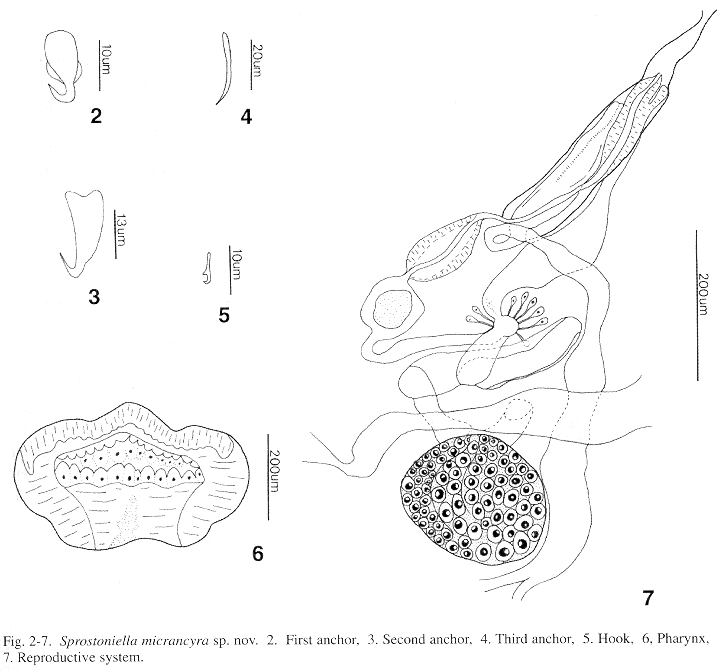
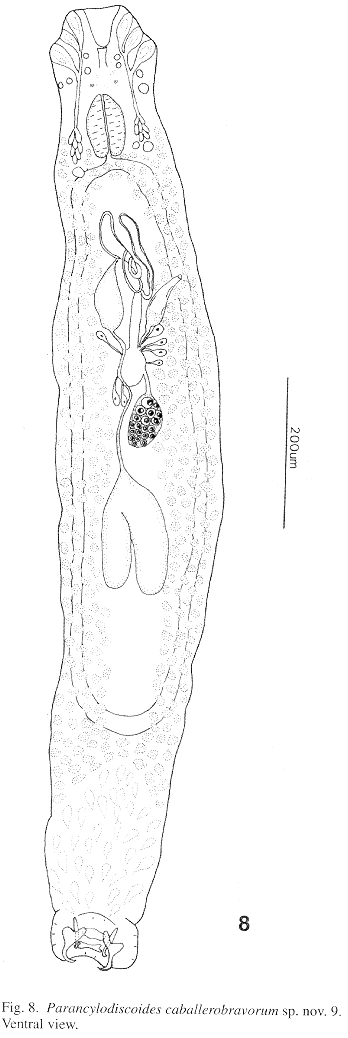
<body><![CDATA[<BR><B><FONT FACE="Arial,Helvetica"><FONT SIZE=-1>Results</FONT></FONT></B>     <BR><FONT FACE="Arial,Helvetica"><FONT SIZE=-1>&nbsp;</FONT></FONT>     <CENTER><B><FONT FACE="Arial,Helvetica"><FONT SIZE=-1>Monogenea van Beneden, 1858</FONT></FONT></B></CENTER>      <CENTER><FONT FACE="Arial,Helvetica"><FONT SIZE=-1>Capsalidae Baird, 1853</FONT></FONT></CENTER>      <CENTER><FONT FACE="Arial,Helvetica"><FONT SIZE=-1><B>Sprostoniella micrancyra sp. nov. </B>(Figs 1-7)</FONT></FONT></CENTER> <FONT FACE="Arial,Helvetica"><FONT SIZE=-1></FONT></FONT>      <P><FONT FACE="Arial,Helvetica"><FONT SIZE=-1>Description (based on 18 whole-mount, all measured): Body 3.2 – 8.3 mm (6.3 mm) in total length, elliptical (<A HREF="#Fig. 1">Fig. 1</A>); greatest width 1.1 – 2.7 mm (2.2 mm) in germarian level. Four eyes with trapezoidal arrangement. Haptor 1.3 mm – 2.2 (1.6 mm) in diameter, with peripheral papilliform ornamentation, pedunculated, concave; with 17 septa, two of them bifid, and other two incomplete; two central loculi of unequal size. Three pairs of diminute anchors, first pair 31 (n=3) long, second pair 27.5 (n=3) long, third pair 25.6 – 36.6 (31.6, n=4) long (<A HREF="#Figs. 2-7">Figs. 2-4</A>). Fourteen peripheral hooks (<A HREF="#Figs. 2-7">Fig. 5</A>) 6.2 (n=6) long. Buccal organs 274 - 640 (426) long, 366 - 421 (522) wide; pharynx (<A HREF="#Figs. 2-7">Fig. 6</A>) 219 - 540 (500) long, 275 - 603 (461) wide, with internal papillae; intestinal ceca not confluent posteriorly, with ramifications. Testes, 146.4 - 348 (256, n=13) in diameter, in two groups, left group with 8-10 testes, right group with 9-10 testes. Four conspicuous Goto’s glands 109 - 146 (127, n=6) long, 43.8 - 51 (47, n=13) wide. Penis pouch (<A HREF="#Figs. 2-7">Fig. 7</A>) 175 - 292 (235, n=10) long, 51 - 131 (84, n=10) wide, posterior to pharynx; oblique, genital atrium opened to left of pharynx. Germarium oval, 164 - 495 (365) in diameter, pretesticular; short uterus; vagina long, with distal papilliform structure (<A HREF="#Figs. 2-7">Fig. 7</A>); two seminal receptacles; vitellaria limited in trunk.</FONT></FONT>     <BR><FONT FACE="Arial,Helvetica"><FONT SIZE=-1>&nbsp;</FONT></FONT>     <CENTER><A NAME="Fig. 1"></A><IMG SRC="/img/fbpe/rbt/v47n3/0547i01.GIF" HEIGHT=973 WIDTH=348></CENTER>      
<CENTER><FONT FACE="Arial,Helvetica"><FONT SIZE=-1>&nbsp;</FONT></FONT></CENTER>      <CENTER><FONT FACE="Arial,Helvetica"><FONT SIZE=-1>&nbsp;</FONT></FONT></CENTER>      ]]></body>
<body><![CDATA[<CENTER><FONT FACE="Arial,Helvetica"><FONT SIZE=-1>&nbsp;</FONT></FONT></CENTER>      <CENTER><FONT FACE="Arial,Helvetica"><FONT SIZE=-1>&nbsp;</FONT></FONT></CENTER>      <CENTER><A NAME="Figs. 2-7"></A><IMG SRC="/img/fbpe/rbt/v47n3/0547i02.GIF" HEIGHT=671 WIDTH=723></CENTER> <FONT FACE="Arial,Helvetica"><FONT SIZE=-1>&nbsp;</FONT></FONT><FONT FACE="Arial,Helvetica"><FONT SIZE=-1></FONT></FONT>      
<P><FONT FACE="Arial,Helvetica"><FONT SIZE=-1><B>Etymology:</B> The specific name is from Greek (<I>mikr&oacute;s </I>= small + <I>agkyra </I>= anchor) and refers to diminute size of the first pair of anchors.</FONT></FONT><FONT FACE="Arial,Helvetica"><FONT SIZE=-1></FONT></FONT>      <P><FONT FACE="Arial,Helvetica"><FONT SIZE=-1><B>Type host:</B> <I>Chaetodipterus faber</I> (Broussonet, 1782).</FONT></FONT><FONT FACE="Arial,Helvetica"><FONT SIZE=-1></FONT></FONT>      <P><FONT FACE="Arial,Helvetica"><FONT SIZE=-1><B>Type locality:</B> coastal zone of the State of Rio de Janeiro, Brazil.</FONT></FONT><FONT FACE="Arial,Helvetica"><FONT SIZE=-1></FONT></FONT>      <P><FONT FACE="Arial,Helvetica"><FONT SIZE=-1><B>Site of infestation:</B> gills.</FONT></FONT><FONT FACE="Arial,Helvetica"><FONT SIZE=-1></FONT></FONT>      <P><FONT FACE="Arial,Helvetica"><FONT SIZE=-1><B>Type material:</B> Holotype CHIOC N&deg;34000a, paratypes (three whole-mount) CHIOC N&deg;34000b, (three whole-mount) CNHE N&deg;3431.</FONT></FONT><FONT FACE="Arial,Helvetica"><FONT SIZE=-1></FONT></FONT>      <P><FONT FACE="Arial,Helvetica"><FONT SIZE=-1><B>Prevalence:</B> 8.2 %.</FONT></FONT><FONT FACE="Arial,Helvetica"><FONT SIZE=-1></FONT></FONT>      <P><FONT FACE="Arial,Helvetica"><FONT SIZE=-1><B>Mean intensity:</B> 1.2.</FONT></FONT><FONT FACE="Arial,Helvetica"><FONT SIZE=-1></FONT></FONT>      ]]></body>
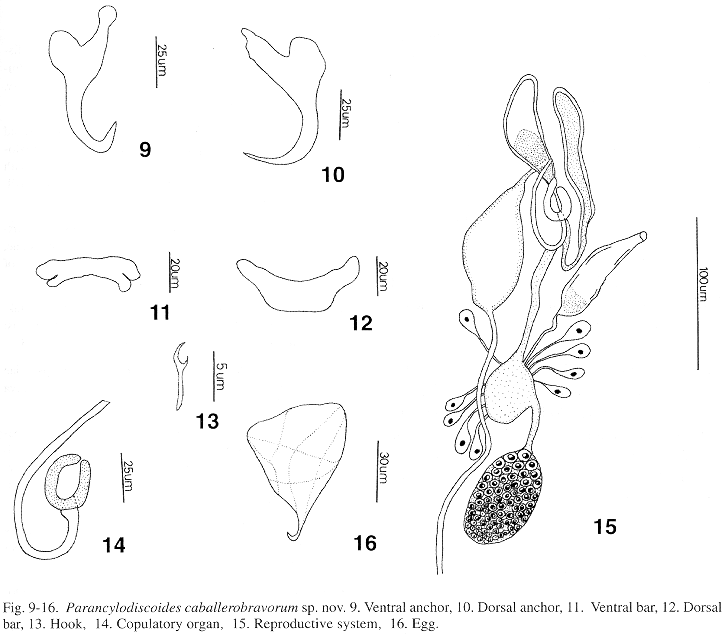
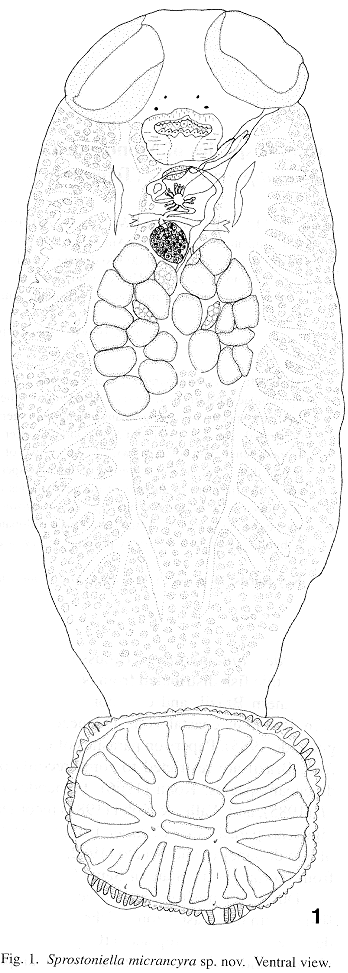
<body><![CDATA[<P><FONT FACE="Arial,Helvetica"><FONT SIZE=-1><B>Mean abundance:</B> 0.1.</FONT></FONT><FONT FACE="Arial,Helvetica"><FONT SIZE=-1></FONT></FONT>      <P><FONT FACE="Arial,Helvetica"><FONT SIZE=-1><B>Remarks:</B> Bychowsky &amp; Nagibina (1967) established <I>Sprostoniella</I> with the type species <I>S. multitestis</I> parasitic on <I>Platax pinnatus</I> (L.). Diagnostic characters of this genus are the two neighbouring groups of testes, and the structure of loculi of the haptor. These characters were confirmed by <A HREF="#Ergorova">Ergorova (1994)</A> in her revision of Trochopodinae. <I>Sprostoniella micrancyra </I>sp. nov.,<I> </I>differ from <I>S. multitestis</I> by the arrangement of septa (with 17 septa, two of them bifid and two incomplet in the new species; 17 septa, two of them trifid in <I>S. multitestis</I>). Moreover, the new species showed two central loculi, while <I>S. multitestis</I> only one. In the new species the first pair of anchors is small and poorly developed, while in <I>S. multitestis</I> is well developed and strong.</FONT></FONT>     <BR><FONT FACE="Arial,Helvetica"><FONT SIZE=-1>&nbsp;</FONT></FONT>     <CENTER><FONT FACE="Arial,Helvetica"><FONT SIZE=-1>Dactylogyridae Bychowsky, 1933</FONT></FONT></CENTER>      <CENTER><FONT FACE="Arial,Helvetica"><FONT SIZE=-1><B>Parancylodiscoides caballerobravorum sp. nov.</B> (Figs 8- 16)</FONT></FONT></CENTER> <FONT FACE="Arial,Helvetica"><FONT SIZE=-1>&nbsp;</FONT></FONT><FONT FACE="Arial,Helvetica"><FONT SIZE=-1></FONT></FONT>      <P><FONT FACE="Arial,Helvetica"><FONT SIZE=-1>Description (based on 15 whole-mount, 10 measured): Body elongate (<A HREF="#Fig. 8">Fig. 8</A>), peduncle with conspicuous glandular area. Total length 1.35 – 1.42 mm (1.40 mm), greatest width 221 - 239 (230) to germarium level. Cephalic region 82 - 94 (88) long, 143 - 148 (146) wide; with three cephalic lobes. Eye spots dispersed. Haptor 89 - 94 (92) long, 157 - 176 (165) wide; anchors subequal, ventral anchors (<A HREF="#Figs. 9-16">Fig. 9</A>) 40 - 41 (40) long, 12 - 14 (13) wide; dorsal anchors (<A HREF="#Figs. 9-16">Fig. 10</A>) 30 - 33 (32) long, 11 - 12 (12) wide, with curved shaft and point; ventral bar (<A HREF="#Figs. 9-16">Fig. 11</A>) 7 - 16 (12) long, 42 - 52 (48) wide, with lateral bifid, round, extremities; dorsal bar (<A HREF="#Figs. 9-16">Fig. 12</A>) 12 - 16 (15) long, 52 - 61 (57) wide, with lateral folded extremities. Ten equal hooks (<A HREF="#Figs. 9-16">Fig. 13</A>) 6-8 (7) long, with long shank, curved shaft, and delicate point; FH loop not observed.<FONT COLOR="#FF0000"> </FONT>Mouth subterminal; pharynx pyriform 70 - 94 (85) long, 56 - 59 (58) wide; intestinal ceca confluent posteriorly. Testis bilobate, 117 - 188 (141) long, 94 - 118 (106) wide; deferent duct long, not overlooped intestinal ceca; seminal vesicle 117 - 141 (133) long, 61 - 70 (67) wide, prostatic and accessory reservoirs well developed; sclerotized copulatory organ (<A HREF="#Figs. 9-16">Fig. 14</A>), 16 - 28 (22) long, 12 wide, with ejaculatory bulb. Germarium 56 - 59 (57) in diameter, ovoid, pretesticular; Mehlis’s gland with elongate radial cells; vaginal aperture ventrolateral (<A HREF="#Figs. 9-16">Fig. 15</A>); vitellaria limited in trunk; eggs (<A HREF="#Figs. 9-16">Fig. 16</A>) 59 (n=1) long, 12 (n=1) wide, tetragonal, short posterior filament.</FONT></FONT>     <BR><FONT FACE="Arial,Helvetica"><FONT SIZE=-1>&nbsp;</FONT></FONT>     <CENTER><A NAME="Fig. 8"></A><IMG SRC="/img/fbpe/rbt/v47n3/0547i03.GIF" HEIGHT=1038 WIDTH=348></CENTER>      
<CENTER><FONT FACE="Arial,Helvetica"><FONT SIZE=-1>&nbsp;</FONT></FONT></CENTER>      <CENTER><FONT FACE="Arial,Helvetica"><FONT SIZE=-1>&nbsp;</FONT></FONT></CENTER>      ]]></body>
<body><![CDATA[<CENTER><A NAME="Figs. 9-16"></A><IMG SRC="/img/fbpe/rbt/v47n3/0547i04.GIF" HEIGHT=636 WIDTH=728></CENTER> <FONT FACE="Arial,Helvetica"><FONT SIZE=-1>&nbsp;</FONT></FONT>     
<BR><FONT FACE="Arial,Helvetica"><FONT SIZE=-1>&nbsp;</FONT></FONT><FONT FACE="Arial,Helvetica"><FONT SIZE=-1></FONT></FONT>      <P><B><FONT FACE="Arial,Helvetica"><FONT SIZE=-1>Etymology:</FONT></FONT></B><FONT FACE="Arial,Helvetica"><FONT SIZE=-1> The specific name is in honor to Dr. Eduardo Caballero y Caballero and Dr. Margarita Bravo Hollis (Universidad Nacional Aut&oacute;noma de M&eacute;xico) who established <I>Parancylodiscoides</I>.</FONT></FONT><FONT FACE="Arial,Helvetica"><FONT SIZE=-1></FONT></FONT>      <P><FONT FACE="Arial,Helvetica"><FONT SIZE=-1><B>Type host: </B><I>Chaetodipterus faber</I> (Broussonet, 1782).</FONT></FONT><FONT FACE="Arial,Helvetica"><FONT SIZE=-1></FONT></FONT>      <P><FONT FACE="Arial,Helvetica"><FONT SIZE=-1><B>Type locality:</B> coastal zone of the State of Rio de Janeiro, Brazil.</FONT></FONT><FONT FACE="Arial,Helvetica"><FONT SIZE=-1></FONT></FONT>      <P><FONT FACE="Arial,Helvetica"><FONT SIZE=-1>Site of infestation: gill filaments.</FONT></FONT><FONT FACE="Arial,Helvetica"><FONT SIZE=-1></FONT></FONT>      <P><FONT FACE="Arial,Helvetica"><FONT SIZE=-1><B>Type material:</B> Holotype CHIOC N&deg;, paratypes (three whole-mount) CHIOC N&deg;, (three whole-mount) CNHE N&deg; 3432.</FONT></FONT><FONT FACE="Arial,Helvetica"><FONT SIZE=-1></FONT></FONT>      <P><FONT FACE="Arial,Helvetica"><FONT SIZE=-1>Material examined: Three paratypes of <I>Parancylodiscoides chaetodipteri</I> <A HREF="#Caballero">Caballero &amp; Bravo-Hollis, 1960</A>; CNHE N&deg; N-217-20.</FONT></FONT><FONT FACE="Arial,Helvetica"><FONT SIZE=-1></FONT></FONT>      <P><FONT FACE="Arial,Helvetica"><FONT SIZE=-1><B>Prevalence:</B> 21.8 %.</FONT></FONT><FONT FACE="Arial,Helvetica"><FONT SIZE=-1></FONT></FONT>      <P><FONT FACE="Arial,Helvetica"><FONT SIZE=-1><B>Mean intensity:</B> 6.9.</FONT></FONT><FONT FACE="Arial,Helvetica"><FONT SIZE=-1></FONT></FONT>      ]]></body>
<body><![CDATA[<P><FONT FACE="Arial,Helvetica"><FONT SIZE=-1><B>Mean abundance:</B> 1.5.</FONT></FONT><FONT FACE="Arial,Helvetica"><FONT SIZE=-1></FONT></FONT>      <P><FONT FACE="Arial,Helvetica"><FONT SIZE=-1><B>Remarks:</B> <A HREF="#Caballero">Caballero &amp; Bravo-Hollis (1960)</A> established <I>Parancylodiscoides</I>, with the type species <I>P. chaetodipteri</I>, parasitic on gills of <I>Chaetodipterus zonatus</I> (Girard) from the coastal zone of the Mexican Pacific Ocean. <A HREF="#Yamaguti">Yamaguti (1963)</A> proposed <I>Parancylodiscoides </I>as junior synonym of <I>Pseudohaliotrematoides</I> (Yamaguti, 1953), emending the subgenus status to genus level. <A HREF="#Young">Young (1967)</A> in his revision of some species of <I>Tetrancistrum</I>, validity <I>Parancylodiscoides</I>, based in the structure of the intestine and by the variability of other characters in <I>Pseudohaliotrematoides</I>.</FONT></FONT><FONT FACE="Arial,Helvetica"><FONT SIZE=-1></FONT></FONT>      <P><FONT FACE="Arial,Helvetica"><FONT SIZE=-1><I>Parancylodiscoides caballerobravorum</I> sp. nov. differ from <I>P. chaetodipteri</I> <A HREF="#Caballero">Caballero &amp; Bravo-Hollis, 1960</A> by the testis shape (bilobated in the new species, not bilobated in <I>P. chaetodipteri</I>), and by the presence of accessory prostatic reservoir reaching at the copulatory organ base (absent in <I>P. chaetodipteri</I>).</FONT></FONT>     <BR><FONT FACE="Arial,Helvetica"><FONT SIZE=-1>&nbsp;</FONT></FONT><FONT FACE="Arial,Helvetica"><FONT SIZE=-1></FONT></FONT>      <P><B><FONT FACE="Arial,Helvetica"><FONT SIZE=-1>Acknowledgements</FONT></FONT></B><FONT FACE="Arial,Helvetica"><FONT SIZE=-1></FONT></FONT>      <P><FONT FACE="Arial,Helvetica"><FONT SIZE=-1>We thank Rafael Lamothe Argumedo (Colecci&oacute;n Nacional de Helmintos, Instituto de Biologia de la Universidad Nacional Aut&oacute;noma de M&eacute;xico) for loaning paratypes of <I>Parancylodiscoides chaetodipteri</I>, Delane Kritsky (Idaho State University) for providing Russian literature, Jos&eacute; R. Pujol-Luz (Universidade Federal Rural do Rio de Janeiro) for the suggestions on the <I>Sprostoniella</I> specific name. The authors are also grateful to Conselho Nacional de Desenvolvimento Cient&iacute;fico e Tecnol&oacute;gico (CNPq) for support.</FONT></FONT>     <BR><FONT FACE="Arial,Helvetica"><FONT SIZE=-1>&nbsp;</FONT></FONT>     <CENTER><FONT FACE="Arial,Helvetica"><FONT SIZE=-1>&nbsp;</FONT></FONT></CENTER> <B><FONT FACE="Arial,Helvetica"><FONT SIZE=-1>Resumen</FONT></FONT></B><FONT FACE="Arial,Helvetica"><FONT SIZE=-1></FONT></FONT>      <P><FONT FACE="Arial,Helvetica"><FONT SIZE=-1>Se extrajeron metazoos par&aacute;sitos de 110 <I>Chaetodipterus faber</I> (Broussonet, 1782) (Teleostei: Ephippidae) del litoral del Estado de Rio de Janeiro, Brasil (aprox. 21-23&ordm; S, 41-45&ordm; W). Se describe e ilustra dos nuevas especies de monog&eacute;neos de los g&eacute;neros <I>Sprostoniella</I> y <I>Parancylodiscoides</I>. La nueva especie de <I>Sprostoniella </I>difiere de <I>S. multitestis</I>, la otra especie del g&eacute;nero, por 1. la disposici&oacute;n de los septos (con 17 septos, dos de ellos b&iacute;fidos y dos incompletos en la nueva especie; 17 septos, dos de ellos tr&iacute;fidos en <I>S. multitestis</I>), 2. la nueva especie muestra dos l&oacute;culos centrales, mientras <I>S. multitestis</I> s&oacute;lo uno, y 3. el primer par de ganchos en la nueva especie es peque&ntilde;o y poco desarrollado, mientras que en <I>S. multitestis</I> es robusto y bien desarrollado. La nueva especie de <I>Parancylodiscoides </I>difiere de <I>P. chaetodipteri</I>, la otra especie del g&eacute;nero, por 1. la forma del test&iacute;culo (bilobulado en la nueva especie, no bilobulado en <I>P. chaetodipteri</I>), y 2. por la presencia de un reservorio prost&aacute;tico accesorio que alcanza la base del &oacute;rgano copulador (ausente en <I>P. chaetodipteri</I>).</FONT></FONT>     <BR><FONT FACE="Arial,Helvetica"><FONT SIZE=-1>&nbsp;</FONT></FONT>     ]]></body>
<body><![CDATA[<BR><FONT FACE="Arial,Helvetica"><FONT SIZE=-1>&nbsp;</FONT></FONT>     <BR><B><FONT FACE="Arial,Helvetica"><FONT SIZE=-1>References</FONT></FONT></B><FONT FACE="Arial,Helvetica"><FONT SIZE=-1></FONT></FONT>      <!-- ref --><P><A NAME="Amato82"></A><FONT FACE="Arial,Helvetica"><FONT SIZE=-1>Amato, J. F. R. 1982. Digenetic Trematodes of Percoid fishes of Florian&oacute;polis, Southern Brasil - Monorchiidae, with the description of two new species. Rev. Brasil. Biol. 42: 701-719.</FONT></FONT><FONT FACE="Arial,Helvetica"><FONT SIZE=-1></FONT></FONT>    &nbsp;&nbsp;&nbsp;&nbsp;&nbsp;&nbsp;&nbsp;&nbsp;[&#160;<a href="javascript:void(0);" onclick="javascript: window.open('/scielo.php?script=sci_nlinks&ref=1327387&pid=S0034-7744199900030001200001&lng=','','width=640,height=500,resizable=yes,scrollbars=1,menubar=yes,');">Links</a>&#160;]<!-- end-ref --><!-- ref --><P><A NAME="Amato83a"></A><FONT FACE="Arial,Helvetica"><FONT SIZE=-1>Amato, J. F. R. 1983a. Digenetic trematodes of Percoid fishes of Florian&oacute;polis, southern Brasil - Homalometridae, Lepocreadiidae and Opecoelidae, with the description of seven new species. Rev. Brasil. Biol. 43: 73-98.</FONT></FONT><FONT FACE="Arial,Helvetica"><FONT SIZE=-1></FONT></FONT>    &nbsp;&nbsp;&nbsp;&nbsp;&nbsp;&nbsp;&nbsp;&nbsp;[&#160;<a href="javascript:void(0);" onclick="javascript: window.open('/scielo.php?script=sci_nlinks&ref=1327388&pid=S0034-7744199900030001200002&lng=','','width=640,height=500,resizable=yes,scrollbars=1,menubar=yes,');">Links</a>&#160;]<!-- end-ref --><!-- ref --><P><A NAME="Amato83b"></A><FONT FACE="Arial,Helvetica"><FONT SIZE=-1>Amato, J. F. R. 1983b. Digenetic trematodes of Percoid fishes of Florian&oacute;polis, southern Brasil - Pleorchiidae, Didymozoidae and Hemiuridae, with description of three new species. Rev. Brasil. Biol. 43: 99-124.</FONT></FONT><FONT FACE="Arial,Helvetica"><FONT SIZE=-1></FONT></FONT>    &nbsp;&nbsp;&nbsp;&nbsp;&nbsp;&nbsp;&nbsp;&nbsp;[&#160;<a href="javascript:void(0);" onclick="javascript: window.open('/scielo.php?script=sci_nlinks&ref=1327389&pid=S0034-7744199900030001200003&lng=','','width=640,height=500,resizable=yes,scrollbars=1,menubar=yes,');">Links</a>&#160;]<!-- end-ref --><!-- ref --><P><A NAME="Bush"></A><FONT FACE="Arial,Helvetica"><FONT SIZE=-1>Bush, J. O., K. D. Lafferty, J. M. Lotz &amp; A. W. Shostak. 1997. Parasitology meets ecology on its own terms: Margolis et al. revisited. J. Parasitol. 83: 575-583.</FONT></FONT><FONT FACE="Arial,Helvetica"><FONT SIZE=-1></FONT></FONT>    &nbsp;&nbsp;&nbsp;&nbsp;&nbsp;&nbsp;&nbsp;&nbsp;[&#160;<a href="javascript:void(0);" onclick="javascript: window.open('/scielo.php?script=sci_nlinks&ref=1327390&pid=S0034-7744199900030001200004&lng=','','width=640,height=500,resizable=yes,scrollbars=1,menubar=yes,');">Links</a>&#160;]<!-- end-ref --><!-- ref --><P><A NAME="Bychowsky"></A><FONT FACE="Arial,Helvetica"><FONT SIZE=-1>Bychowsky, B. &amp; L. Nagibina. 1967. New Capsalidae (Monogenoidea) from Pacific fishes. Parasitologiya 1: 521-527. (In Russian).</FONT></FONT><FONT FACE="Arial,Helvetica"><FONT SIZE=-1></FONT></FONT>    &nbsp;&nbsp;&nbsp;&nbsp;&nbsp;&nbsp;&nbsp;&nbsp;[&#160;<a href="javascript:void(0);" onclick="javascript: window.open('/scielo.php?script=sci_nlinks&ref=1327391&pid=S0034-7744199900030001200005&lng=','','width=640,height=500,resizable=yes,scrollbars=1,menubar=yes,');">Links</a>&#160;]<!-- end-ref --><!-- ref --><P><A NAME="Caballero"></A><FONT FACE="Arial,Helvetica"><FONT SIZE=-1>Caballero, E. &amp; M. Bravo-Hollis. 1960. Trematodos de peces de aguas Mexicanas del Pac&iacute;fico. Un nuevo g&eacute;nero y una nueva especie de Monogenoidea Bychowsky, 1937. An. Inst. Biol. Univ. Nac. Aut&oacute;n. M&eacute;x. 30: 197-205.</FONT></FONT><FONT FACE="Arial,Helvetica"><FONT SIZE=-1></FONT></FONT>    &nbsp;&nbsp;&nbsp;&nbsp;&nbsp;&nbsp;&nbsp;&nbsp;[&#160;<a href="javascript:void(0);" onclick="javascript: window.open('/scielo.php?script=sci_nlinks&ref=1327392&pid=S0034-7744199900030001200006&lng=','','width=640,height=500,resizable=yes,scrollbars=1,menubar=yes,');">Links</a>&#160;]<!-- end-ref --><!-- ref --><P><A NAME="Ergorova"></A><FONT FACE="Arial,Helvetica"><FONT SIZE=-1>Ergorova, T. P. 1994. A taxonomic review of the subfamily Trochopodinae (Monogenoidea: Capsalidae). Parasitologiya 28: 81-91. (In Russian).</FONT></FONT><FONT FACE="Arial,Helvetica"><FONT SIZE=-1></FONT></FONT>    &nbsp;&nbsp;&nbsp;&nbsp;&nbsp;&nbsp;&nbsp;&nbsp;[&#160;<a href="javascript:void(0);" onclick="javascript: window.open('/scielo.php?script=sci_nlinks&ref=1327393&pid=S0034-7744199900030001200007&lng=','','width=640,height=500,resizable=yes,scrollbars=1,menubar=yes,');">Links</a>&#160;]<!-- end-ref --><!-- ref --><P><A NAME="Fernándes"></A><FONT FACE="Arial,Helvetica"><FONT SIZE=-1>Fern&aacute;ndes, B. M. M., A. Kohn &amp; R. Pinto. 1985. Aspidogastrid and digenetic trematodes parasites of marine fishes of the coast of Rio de Janeiro State, Brazil. Rev. Brasil. Biol. 45: 109-116.</FONT></FONT><FONT FACE="Arial,Helvetica"><FONT SIZE=-1></FONT></FONT>    &nbsp;&nbsp;&nbsp;&nbsp;&nbsp;&nbsp;&nbsp;&nbsp;[&#160;<a href="javascript:void(0);" onclick="javascript: window.open('/scielo.php?script=sci_nlinks&ref=1327394&pid=S0034-7744199900030001200008&lng=','','width=640,height=500,resizable=yes,scrollbars=1,menubar=yes,');">Links</a>&#160;]<!-- end-ref --><!-- ref --><P><A NAME="Kohn"></A><FONT FACE="Arial,Helvetica"><FONT SIZE=-1>Kohn, A. 1966. Ocorr&ecirc;ncia de <I>Multitestis inconstans</I> (Linton, 1905) Manter, 1931 (Lepocreadiidae) no litoral brasileiro. Atas Soc. Biol. Rio de Janeiro 10: 75-77.</FONT></FONT><FONT FACE="Arial,Helvetica"><FONT SIZE=-1></FONT></FONT>    &nbsp;&nbsp;&nbsp;&nbsp;&nbsp;&nbsp;&nbsp;&nbsp;[&#160;<a href="javascript:void(0);" onclick="javascript: window.open('/scielo.php?script=sci_nlinks&ref=1327395&pid=S0034-7744199900030001200009&lng=','','width=640,height=500,resizable=yes,scrollbars=1,menubar=yes,');">Links</a>&#160;]<!-- end-ref --><!-- ref --><P><A NAME="Menezes"></A><FONT FACE="Arial,Helvetica"><FONT SIZE=-1>Menezes, N. A. &amp; J. L. Figueiredo. 1985. Manual de peixes marinhos do Sudeste do Brasil<I>. V. Teleostei (4).</I> Museu de Zoologia da Universidade de S&atilde;o Paulo, S&atilde;o Paulo, 105 p.</FONT></FONT><FONT FACE="Arial,Helvetica"><FONT SIZE=-1></FONT></FONT>    &nbsp;&nbsp;&nbsp;&nbsp;&nbsp;&nbsp;&nbsp;&nbsp;[&#160;<a href="javascript:void(0);" onclick="javascript: window.open('/scielo.php?script=sci_nlinks&ref=1327396&pid=S0034-7744199900030001200010&lng=','','width=640,height=500,resizable=yes,scrollbars=1,menubar=yes,');">Links</a>&#160;]<!-- end-ref --><!-- ref --><P><A NAME="Wallet"></A><FONT FACE="Arial,Helvetica"><FONT SIZE=-1>Wallet, M. &amp; A. Kohn. 1987. Trematodes parasites de Poissons marins du littoral de Rio de Janeiro, Br&eacute;sil. Mem. Inst. Oswaldo Cruz 82: 21-27.</FONT></FONT><FONT FACE="Arial,Helvetica"><FONT SIZE=-1></FONT></FONT>    &nbsp;&nbsp;&nbsp;&nbsp;&nbsp;&nbsp;&nbsp;&nbsp;[&#160;<a href="javascript:void(0);" onclick="javascript: window.open('/scielo.php?script=sci_nlinks&ref=1327397&pid=S0034-7744199900030001200011&lng=','','width=640,height=500,resizable=yes,scrollbars=1,menubar=yes,');">Links</a>&#160;]<!-- end-ref --><!-- ref --><P><A NAME="Yamaguti"></A><FONT FACE="Arial,Helvetica"><FONT SIZE=-1>Yamaguti, S. 1963. Systema Helminthum. Vol. IV. Monogenea &amp; Aspidocotylea. John Wiley &amp; Sons, New York, 699 p.</FONT></FONT><FONT FACE="Arial,Helvetica"><FONT SIZE=-1></FONT></FONT>    &nbsp;&nbsp;&nbsp;&nbsp;&nbsp;&nbsp;&nbsp;&nbsp;[&#160;<a href="javascript:void(0);" onclick="javascript: window.open('/scielo.php?script=sci_nlinks&ref=1327398&pid=S0034-7744199900030001200012&lng=','','width=640,height=500,resizable=yes,scrollbars=1,menubar=yes,');">Links</a>&#160;]<!-- end-ref --><!-- ref --><P><A NAME="Young"></A><FONT FACE="Arial,Helvetica"><FONT SIZE=-1>Young, P. C. 1967. Some species of the genus <I>Tetrancistrum</I> Goto and Kikuchi, 1917 (Monogenoidea: Dactylogyridae). J. Parasitol. 53: 1016-1022.</FONT></FONT>    &nbsp;&nbsp;&nbsp;&nbsp;&nbsp;&nbsp;&nbsp;&nbsp;[&#160;<a href="javascript:void(0);" onclick="javascript: window.open('/scielo.php?script=sci_nlinks&ref=1327399&pid=S0034-7744199900030001200013&lng=','','width=640,height=500,resizable=yes,scrollbars=1,menubar=yes,');">Links</a>&#160;]<!-- end-ref --><BR><FONT FACE="Arial,Helvetica"><FONT SIZE=-1></FONT></FONT>&nbsp;<FONT FACE="Arial,Helvetica"><FONT SIZE=-1></FONT></FONT>      <P><A NAME="1"></A><FONT FACE="Arial,Helvetica"><FONT SIZE=-1><A HREF="#1a">1</A>. Departamento de Parasitologia Animal - Curso de P&oacute;s-Gradua&ccedil;&atilde;o em Medicina Veterin&aacute;ria - Parasitologia Veterin&aacute;ria, Universidade Federal Rural do Rio de Janeiro, CP. 74508, Serop&eacute;dica, RJ, Brasil, 23890-000. Fax: (021) 6821617.</FONT></FONT>     <BR><FONT FACE="Arial,Helvetica"><FONT SIZE=-1>&nbsp;</FONT></FONT>     <BR><A NAME="2"></A><FONT FACE="Arial,Helvetica"><FONT SIZE=-1><A HREF="#1a">2</A>. Departamento de Zoologia, Universidade Federal do Rio Grande do Sul, Porto Alegre, RS, Brasil.</FONT></FONT>     <BR><FONT FACE="Arial,Helvetica"><FONT SIZE=-1>&nbsp;</FONT></FONT>     ]]></body>
<body><![CDATA[<BR><A NAME="3"></A><FONT FACE="Arial,Helvetica"><FONT SIZE=-1><A HREF="#1a">3</A>. Corresponding author. E-mail: <FONT COLOR="#000000"><A HREF="mailto:acezar@domain.com.br">acezar@domain.com.br</A></FONT></FONT></FONT>      ]]></body><back>
<ref-list>
<ref id="B1">
<nlm-citation citation-type="journal">
<person-group person-group-type="author">
<name>
<surname><![CDATA[Amato]]></surname>
<given-names><![CDATA[J. F. R.]]></given-names>
</name>
</person-group>
<article-title xml:lang="en"><![CDATA[Digenetic Trematodes of Percoid fishes of Florianópolis, Southern Brasil - Monorchiidae, with the description of two new species]]></article-title>
<source><![CDATA[Rev. Brasil. Biol.]]></source>
<year>1982</year>
<volume>42</volume>
<page-range>701-719</page-range></nlm-citation>
</ref>
<ref id="B2">
<nlm-citation citation-type="journal">
<person-group person-group-type="author">
<name>
<surname><![CDATA[Amato]]></surname>
<given-names><![CDATA[J. F. R.]]></given-names>
</name>
</person-group>
<article-title xml:lang="en"><![CDATA[Digenetic trematodes of Percoid fishes of Florianópolis, southern Brasil - Homalometridae, Lepocreadiidae and Opecoelidae, with the description of seven new species]]></article-title>
<source><![CDATA[Rev. Brasil. Biol.]]></source>
<year>1983</year>
<month>a</month>
<volume>43</volume>
<page-range>73-98</page-range></nlm-citation>
</ref>
<ref id="B3">
<nlm-citation citation-type="journal">
<person-group person-group-type="author">
<name>
<surname><![CDATA[Amato]]></surname>
<given-names><![CDATA[J. F. R.]]></given-names>
</name>
</person-group>
<article-title xml:lang="en"><![CDATA[Digenetic trematodes of Percoid fishes of Florianópolis, southern Brasil - Pleorchiidae, Didymozoidae and Hemiuridae, with description of three new species]]></article-title>
<source><![CDATA[Rev. Brasil. Biol.]]></source>
<year>1983</year>
<month>b</month>
<volume>43</volume>
<page-range>99-124</page-range></nlm-citation>
</ref>
<ref id="B4">
<nlm-citation citation-type="journal">
<person-group person-group-type="author">
<name>
<surname><![CDATA[Bush]]></surname>
<given-names><![CDATA[J. O.]]></given-names>
</name>
<name>
<surname><![CDATA[Lafferty]]></surname>
<given-names><![CDATA[K. D.]]></given-names>
</name>
<name>
<surname><![CDATA[Lotz]]></surname>
<given-names><![CDATA[J. M.]]></given-names>
</name>
<name>
<surname><![CDATA[Shostak]]></surname>
<given-names><![CDATA[A. W.]]></given-names>
</name>
</person-group>
<article-title xml:lang="en"><![CDATA[Parasitology meets ecology on its own terms: Margolis et al. revisited]]></article-title>
<source><![CDATA[J. Parasitol.]]></source>
<year>1997</year>
<volume>83</volume>
<page-range>575-583</page-range></nlm-citation>
</ref>
<ref id="B5">
<nlm-citation citation-type="journal">
<person-group person-group-type="author">
<name>
<surname><![CDATA[Bychowsky]]></surname>
<given-names><![CDATA[B.]]></given-names>
</name>
<name>
<surname><![CDATA[Nagibina]]></surname>
<given-names><![CDATA[L.]]></given-names>
</name>
</person-group>
<article-title xml:lang="en"><![CDATA[New Capsalidae (Monogenoidea) from Pacific fishes]]></article-title>
<source><![CDATA[Parasitologiya]]></source>
<year>1967</year>
<volume>1</volume>
<page-range>521-527</page-range></nlm-citation>
</ref>
<ref id="B6">
<nlm-citation citation-type="journal">
<person-group person-group-type="author">
<name>
<surname><![CDATA[Caballero]]></surname>
<given-names><![CDATA[E.]]></given-names>
</name>
<name>
<surname><![CDATA[Bravo-Hollis]]></surname>
<given-names><![CDATA[M.]]></given-names>
</name>
</person-group>
<article-title xml:lang="es"><![CDATA[Trematodos de peces de aguas Mexicanas del Pacífico. Un nuevo género y una nueva especie de Monogenoidea Bychowsky, 1937]]></article-title>
<source><![CDATA[An. Inst. Biol. Univ. Nac. Autón. Méx.]]></source>
<year>1960</year>
<volume>30</volume>
<page-range>197-205</page-range></nlm-citation>
</ref>
<ref id="B7">
<nlm-citation citation-type="journal">
<person-group person-group-type="author">
<name>
<surname><![CDATA[Ergorova]]></surname>
<given-names><![CDATA[T. P.]]></given-names>
</name>
</person-group>
<article-title xml:lang="en"><![CDATA[A taxonomic review of the subfamily Trochopodinae (Monogenoidea: Capsalidae)]]></article-title>
<source><![CDATA[Parasitologiya]]></source>
<year>1994</year>
<volume>28</volume>
<page-range>81-91</page-range></nlm-citation>
</ref>
<ref id="B8">
<nlm-citation citation-type="journal">
<person-group person-group-type="author">
<name>
<surname><![CDATA[Fernándes]]></surname>
<given-names><![CDATA[B. M. M.]]></given-names>
</name>
<name>
<surname><![CDATA[Kohn]]></surname>
<given-names><![CDATA[A.]]></given-names>
</name>
<name>
<surname><![CDATA[Pinto]]></surname>
<given-names><![CDATA[R.]]></given-names>
</name>
</person-group>
<article-title xml:lang="en"><![CDATA[Aspidogastrid and digenetic trematodes parasites of marine fishes of the coast of Rio de Janeiro State, Brazil]]></article-title>
<source><![CDATA[Rev. Brasil. Biol.]]></source>
<year>1985</year>
<volume>45</volume>
<page-range>109-116</page-range></nlm-citation>
</ref>
<ref id="B9">
<nlm-citation citation-type="journal">
<person-group person-group-type="author">
<name>
<surname><![CDATA[Kohn]]></surname>
<given-names><![CDATA[A.]]></given-names>
</name>
</person-group>
<article-title xml:lang="pt"><![CDATA[Ocorrência de Multitestis inconstans (Linton, 1905) Manter, 1931 (Lepocreadiidae) no litoral brasileiro]]></article-title>
<source><![CDATA[Atas Soc. Biol. Rio de Janeiro]]></source>
<year>1966</year>
<volume>10</volume>
<page-range>75-77</page-range></nlm-citation>
</ref>
<ref id="B10">
<nlm-citation citation-type="book">
<person-group person-group-type="author">
<name>
<surname><![CDATA[Menezes]]></surname>
<given-names><![CDATA[N. A.]]></given-names>
</name>
<name>
<surname><![CDATA[Figueiredo]]></surname>
<given-names><![CDATA[J. L.]]></given-names>
</name>
</person-group>
<source><![CDATA[Manual de peixes marinhos do Sudeste do Brasil: V. Teleostei (4)]]></source>
<year>1985</year>
<page-range>105</page-range><publisher-loc><![CDATA[São Paulo ]]></publisher-loc>
<publisher-name><![CDATA[Museu de Zoologia da Universidade de São Paulo]]></publisher-name>
</nlm-citation>
</ref>
<ref id="B11">
<nlm-citation citation-type="journal">
<person-group person-group-type="author">
<name>
<surname><![CDATA[Wallet]]></surname>
<given-names><![CDATA[M.]]></given-names>
</name>
<name>
<surname><![CDATA[Kohn]]></surname>
<given-names><![CDATA[A.]]></given-names>
</name>
</person-group>
<article-title xml:lang="fr"><![CDATA[Trematodes parasites de Poissons marins du littoral de Rio de Janeiro, Brésil]]></article-title>
<source><![CDATA[Mem. Inst. Oswaldo Cruz]]></source>
<year>1987</year>
<volume>82</volume>
<page-range>21-27</page-range></nlm-citation>
</ref>
<ref id="B12">
<nlm-citation citation-type="book">
<person-group person-group-type="author">
<name>
<surname><![CDATA[Yamaguti]]></surname>
<given-names><![CDATA[S.]]></given-names>
</name>
</person-group>
<source><![CDATA[Monogenea & Aspidocotylea]]></source>
<year>1963</year>
<volume>Vol. IV</volume>
<page-range>699</page-range><publisher-loc><![CDATA[New York ]]></publisher-loc>
<publisher-name><![CDATA[John Wiley & Sons]]></publisher-name>
</nlm-citation>
</ref>
<ref id="B13">
<nlm-citation citation-type="journal">
<person-group person-group-type="author">
<name>
<surname><![CDATA[Young]]></surname>
<given-names><![CDATA[P. C.]]></given-names>
</name>
</person-group>
<article-title xml:lang="en"><![CDATA[Some species of the genus Tetrancistrum Goto and Kikuchi, 1917 (Monogenoidea: Dactylogyridae)]]></article-title>
<source><![CDATA[J. Parasitol.]]></source>
<year>1967</year>
<volume>53</volume>
<page-range>1016-1022</page-range></nlm-citation>
</ref>
</ref-list>
</back>
</article>