<?xml version="1.0" encoding="ISO-8859-1"?><article xmlns:mml="http://www.w3.org/1998/Math/MathML" xmlns:xlink="http://www.w3.org/1999/xlink" xmlns:xsi="http://www.w3.org/2001/XMLSchema-instance">
<front>
<journal-meta>
<journal-id>0034-7744</journal-id>
<journal-title><![CDATA[Revista de Biología Tropical]]></journal-title>
<abbrev-journal-title><![CDATA[Rev. biol. trop]]></abbrev-journal-title>
<issn>0034-7744</issn>
<publisher>
<publisher-name><![CDATA[Universidad de Costa Rica]]></publisher-name>
</publisher>
</journal-meta>
<article-meta>
<article-id>S0034-77441999000300007</article-id>
<title-group>
<article-title xml:lang="es"><![CDATA[Reprodución de tres especies de Clidemia (Melastomataceae) en Brasil]]></article-title>
</title-group>
<contrib-group>
<contrib contrib-type="author">
<name>
<surname><![CDATA[Melo]]></surname>
<given-names><![CDATA[Gladys Flávia]]></given-names>
</name>
<xref ref-type="aff" rid="A01"/>
</contrib>
<contrib contrib-type="author">
<name>
<surname><![CDATA[Machado]]></surname>
<given-names><![CDATA[Isabel Cristina]]></given-names>
</name>
<xref ref-type="aff" rid="A01"/>
</contrib>
<contrib contrib-type="author">
<name>
<surname><![CDATA[Luceño]]></surname>
<given-names><![CDATA[Modesto]]></given-names>
</name>
<xref ref-type="aff" rid="A02"/>
</contrib>
</contrib-group>
<aff id="A01">
<institution><![CDATA[,Cidade Universitária departamento de Botânica-CCB/UFPE ]]></institution>
<addr-line><![CDATA[ ]]></addr-line>
<country>Brasil</country>
</aff>
<aff id="A02">
<institution><![CDATA[,Universidad Pablo de Olavide Real Area de Botánica ]]></institution>
<addr-line><![CDATA[ ]]></addr-line>
<country>España</country>
</aff>
<pub-date pub-type="pub">
<day>00</day>
<month>09</month>
<year>1999</year>
</pub-date>
<pub-date pub-type="epub">
<day>00</day>
<month>09</month>
<year>1999</year>
</pub-date>
<volume>47</volume>
<numero>3</numero>
<fpage>359</fpage>
<lpage>363</lpage>
<copyright-statement/>
<copyright-year/>
<self-uri xlink:href="http://www.scielo.sa.cr/scielo.php?script=sci_arttext&amp;pid=S0034-77441999000300007&amp;lng=en&amp;nrm=iso"></self-uri><self-uri xlink:href="http://www.scielo.sa.cr/scielo.php?script=sci_abstract&amp;pid=S0034-77441999000300007&amp;lng=en&amp;nrm=iso"></self-uri><self-uri xlink:href="http://www.scielo.sa.cr/scielo.php?script=sci_pdf&amp;pid=S0034-77441999000300007&amp;lng=en&amp;nrm=iso"></self-uri><abstract abstract-type="short" xml:lang="en"><p><![CDATA[We compared the reproductive systems in populations of Clidemia capitellata (Bonpl.) D. Don, C. bullosa DC. and C. hirta (L.) D. Don. (Melastomataceae). The three species occur in small populations in forest margins at Mata de Dois Irm<IMG SRC="http:/img/fbpe/rbt/v47n3/http:/img/fbpe/rbt/v47n3/a_2.JPG" WIDTH=8 HEIGHT=12>os, Recife, Pernambuco, Brasil and are sympatric. They flower throughout the year, and are occasionaly visited by Halictidae bees, Augochloropsis sp.; the bees collect pollen by vibration ("buzz pollination"). The three species are agamospermous and exhibit a high level of male sterility, as measured by their low pollen viability.]]></p></abstract>
<abstract abstract-type="short" xml:lang="es"><p><![CDATA[Se estudió el sistema reproductivo de Clidemia capitellata (Bonpl.) D. Don, C. bullosa DC. y C. hirta (L.) D. Don. Las tres especies se distribuyen en las márgenes de la selva de Dois Irm<IMG SRC="http:/img/fbpe/rbt/v47n3/a_2.JPG" WIDTH=8 HEIGHT=12>os, Recife, Pernambuco, Brasil donde forman pequeñas poblaciones y se pueden calificar como especies simpátricas. El periodo de floración se extiende todo el año. Hay visitas esporádicas de abejas Halictidae (Augochloropsis sp.) que recogen polen por vibración ("buzz pollination"). Las tres especies son agamospérmicas y muestran un elevado índice de esterilidad masculina, medida por la escasa viabilidad polínica.]]></p></abstract>
<kwd-group>
<kwd lng="en"><![CDATA["Buzz pollination"]]></kwd>
<kwd lng="en"><![CDATA[agamospermy]]></kwd>
<kwd lng="en"><![CDATA[hibridization]]></kwd>
<kwd lng="la"><![CDATA[Clidemia]]></kwd>
<kwd lng="en"><![CDATA[Melastomataceae]]></kwd>
</kwd-group>
</article-meta>
</front><body><![CDATA[ <CENTER><B><FONT FACE="Arial,Helvetica">Reproduci&oacute;n de tres especies de <I>Clidemia</I> (Melastomataceae) en Brasil</FONT></B></CENTER> <FONT FACE="Arial,Helvetica"><FONT SIZE=-1></FONT></FONT>      <P><FONT FACE="Arial,Helvetica"><FONT SIZE=-1>&nbsp;</FONT></FONT>     <CENTER><B><FONT FACE="Arial,Helvetica"><FONT SIZE=-1>Gladys Fl&aacute;via Melo<A NAME="1a"></A><SUP><A HREF="#1">1</A></SUP>, Isabel Cristina Machado<SUP><A HREF="#1">1</A></SUP>, y Modesto Luce&ntilde;o<SUP><A HREF="#2">2</A></SUP></FONT></FONT></B></CENTER>      <CENTER><B><FONT FACE="Arial,Helvetica"><FONT SIZE=-1>&nbsp;</FONT></FONT></B></CENTER>      <CENTER><B><FONT FACE="Arial,Helvetica"><FONT SIZE=-1>&nbsp;</FONT></FONT></B></CENTER> <FONT FACE="Arial,Helvetica"><FONT SIZE=-1></FONT></FONT>     <CENTER><FONT FACE="Arial,Helvetica"><FONT SIZE=-1>Recibido 8-IX-1998. Corregido 18-I-1999. Aceptado 2-II-1999.</FONT></FONT></CENTER> <FONT FACE="Arial,Helvetica"><FONT SIZE=-1>&nbsp;</FONT></FONT><FONT FACE="Arial,Helvetica"><FONT SIZE=-1></FONT></FONT>      <P><B><FONT FACE="Arial,Helvetica"><FONT SIZE=-1>Abstract</FONT></FONT></B><FONT FACE="Arial,Helvetica"><FONT SIZE=-1></FONT></FONT>      <P><FONT FACE="Arial,Helvetica"><FONT SIZE=-1>We compared the reproductive systems in populations of <I>Clidemia capitellata </I>(Bonpl.) D. Don, <I>C. bullosa </I>DC. and <I>C. hirta </I>(L.) D. Don. (Melastomataceae). The three species occur in small populations in forest margins at Mata de Dois Irm<IMG SRC="/img/fbpe/rbt/v47n3/a_2.JPG" HEIGHT=12 WIDTH=8 ALIGN=ABSCENTER>os, Recife, Pernambuco, Brasil and are sympatric. They flower throughout the year, and are occasionaly visited by Halictidae bees, <I>Augochloropsis</I> sp.; the bees collect pollen by vibration ("buzz pollination"). The three species are agamospermous and exhibit a high level of male sterility, as measured by their low pollen viability.</FONT></FONT><FONT FACE="Arial,Helvetica"><FONT SIZE=-1></FONT></FONT>      
<P><B><FONT FACE="Arial,Helvetica"><FONT SIZE=-1>Key words</FONT></FONT></B><FONT FACE="Arial,Helvetica"><FONT SIZE=-1></FONT></FONT>      <P><FONT FACE="Arial,Helvetica"><FONT SIZE=-1>"Buzz pollination", agamospermy, hibridization, <I>Clidemia</I>, Melastomataceae.</FONT></FONT>     ]]></body>
<body><![CDATA[<BR><FONT FACE="Arial,Helvetica"><FONT SIZE=-1>&nbsp;</FONT></FONT><FONT FACE="Arial,Helvetica"><FONT SIZE=-1></FONT></FONT>      <P><FONT FACE="Arial,Helvetica"><FONT SIZE=-1>Los trabajos referentes al sistema reproductivo de Melastomataceae han demostrado la existencia de varias especies agamosp&eacute;rmicas que habitan diferentes ecosistemas de Suram&eacute;rica (<A HREF="#Baumgratz">Baumgratz e Silva 1986</A>, <A HREF="#Renner89">Renner 1989</A>, <A HREF="#Borges">Borges 1991</A>, <A HREF="#Goldenberg">Goldenberg 1994</A>, <A HREF="#Melo96">Melo &amp; Machado 1996</A>). Sin embargo, debido al escaso n&uacute;mero de especies estudiadas, existen dudas razonables sobre el origen de la agamospermia en la familia.</FONT></FONT><FONT FACE="Arial,Helvetica"><FONT SIZE=-1></FONT></FONT>      <P><FONT FACE="Arial,Helvetica"><FONT SIZE=-1>El objetivo de nuestro trabajo fue investigar aspectos comparativos de fenolog&iacute;a, biolog&iacute;a floral, del sistema reproductivo y del comportamiento mey&oacute;tico de las c&eacute;lulas madres del polen entre tres especies de <I>Clidemia</I>.</FONT></FONT>     <BR><FONT FACE="Arial,Helvetica"><FONT SIZE=-1>&nbsp;</FONT></FONT><FONT FACE="Arial,Helvetica"><FONT SIZE=-1></FONT></FONT>      <P><B><FONT FACE="Arial,Helvetica"><FONT SIZE=-1>Materiales y m&eacute;todos</FONT></FONT></B><FONT FACE="Arial,Helvetica"><FONT SIZE=-1></FONT></FONT>      <P><FONT FACE="Arial,Helvetica"><FONT SIZE=-1>Estudiamos las especies <I>Clidemia capitellata</I> (Bonpl.) D. Don.,<I> C. bullosa</I> DC. (arbustos de 1,5 a 2,0m de altura) y <I>C. hirta </I>(L.) D. Don. (hierba de unos 80cm) en la selva de Dois Irm<IMG SRC="/img/fbpe/rbt/v47n3/a_letra12.JPG" HEIGHT=14 WIDTH=9>os, municipio de Recife, restos de pluvisilva oce&aacute;nica en el estado de Pernambuco ( 8&deg;00'00''-8&deg;7'30'' S; 34&deg;52'30' W). Las observaciones de campo se realizaron entre los meses de enero de 1993 y enero de 1995.</FONT></FONT><FONT FACE="Arial,Helvetica"><FONT SIZE=-1></FONT></FONT>      
<P><FONT FACE="Arial,Helvetica"><FONT SIZE=-1>Seleccionamos diez individuos de cada especie para el registro quincenal de las fenofases de floraci&oacute;n y fructificaci&oacute;n. Hemos considerado como periodo de floraci&oacute;n, el intervalo de tiempo entre el comienzo del desarrollo de los botones, hasta la ausencia completa de flores en antesis; y el periodo de fructificaci&oacute;n, desde el comienzo del desarrollo de los frutos hasta la madurez total de los mismos.</FONT></FONT><FONT FACE="Arial,Helvetica"><FONT SIZE=-1></FONT></FONT>      <P><FONT FACE="Arial,Helvetica"><FONT SIZE=-1>Las observaciones sobre el horario y la duraci&oacute;n de la flor se realizaron a partir de flores en pre-antesis, marcadas y observadas hasta el inicio de la marchitez, en cinco flores de los diez individuos. La viabilidad pol&iacute;nica se obtuvo mediante el test de te&ntilde;ibilidad en carm&iacute;n ac&eacute;tico al 2% (<A HREF="#Radford">Radford <I>et al.</I> 1974</A>). El cociente polen/&oacute;vulo (P/O) y el &iacute;ndice de reproducci&oacute;n cruzada se hallaron seg&uacute;n las t&eacute;cnicas de <A HREF="#Cruden">Cruden (1977)</A>. Las anteras de viente flores separadamente fueron abiertas y su contenido vaciado en una soluci&oacute;n (3: 1, v/v) de &aacute;cido l&aacute;tico y glicerina de acuerdo con <A HREF="#Lloyd">Lloyd (1972)</A> e inmediatamente se registr&oacute; el n&uacute;mero de granos de polen (<A HREF="#Maeda">Maeda 1985</A>), con un hemacit&oacute;metro (C&aacute;mara de Neubauer).</FONT></FONT><FONT FACE="Arial,Helvetica"><FONT SIZE=-1></FONT></FONT>      <P><FONT FACE="Arial,Helvetica"><FONT SIZE=-1>Para el estudio del sistema reproductor se realizaron experimentos de polinizaci&oacute;n controlada (auto-polinizaci&oacute;n espont&aacute;nea y manual y polinizaci&oacute;n cruzada), donde los granos de polen fueron retirados de las anteras y depositados sobre el estigma receptivo. La existencia o no de agamospermia fue comprobada siguiendo a <A HREF="#Radford">Radford <I>et al.</I> (1974)</A>. En todos los experimentos las flores fueron protegidas con bolsas de papel semipermeable hasta un dia despu&eacute;s de la antesis.</FONT></FONT><FONT FACE="Arial,Helvetica"><FONT SIZE=-1></FONT></FONT>      <P><FONT FACE="Arial,Helvetica"><FONT SIZE=-1>Los an&aacute;lisis mey&oacute;ticos se hicieron fijando botones florales en una soluci&oacute;n de alcohol absoluto/&aacute;cido ac&eacute;tico glacial/carm&iacute;n ac&eacute;tico (10: 4: 1, v/v/v) a&ntilde;adiendo una gota de acetato f&eacute;rrico como mordiente. Despu&eacute;s de 15 hr, se procedi&oacute; a la tinci&oacute;n del material en carm&iacute;n ac&eacute;tico (2%) durante 30 min, tras la cual fue montado en l&aacute;minas histol&oacute;gicas para su observaci&oacute;n (<A HREF="#Luceño">Luce&ntilde;o &amp; Castroviejo 1991</A>).</FONT></FONT><FONT FACE="Arial,Helvetica"><FONT SIZE=-1></FONT></FONT>      ]]></body>
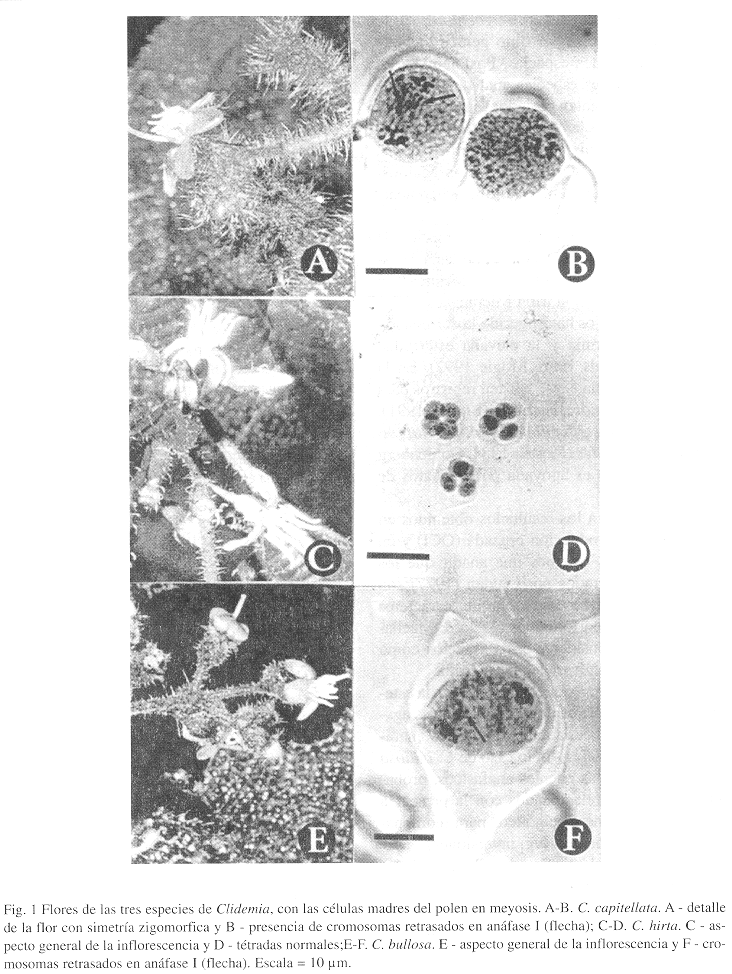
<body><![CDATA[<P><FONT FACE="Arial,Helvetica"><FONT SIZE=-1>Un exicata testigo de cada especie se conserva en el herbario UFP (n 08895, 09272 y 10703).</FONT></FONT>     <BR><FONT FACE="Arial,Helvetica"><FONT SIZE=-1>&nbsp;</FONT></FONT>     <BR><FONT FACE="Arial,Helvetica"><FONT SIZE=-1>&nbsp;</FONT></FONT>     <BR><B><FONT FACE="Arial,Helvetica"><FONT SIZE=-1>Resultados</FONT></FONT></B><B><FONT FACE="Arial,Helvetica"><FONT SIZE=-1></FONT></FONT></B>      <P><FONT FACE="Arial,Helvetica"><FONT SIZE=-1>El per&iacute;odo de floraci&oacute;n de las tres especies se extiende a lo largo de todo el a&ntilde;o. En <I>C. capitellata</I> la intensidad de floraci&oacute;n fue uniforme durante todo el a&ntilde;o, mientras que en las otras dos especies hubo picos de floraci&oacute;n: abril y julio de 1993 y abril y mayo de 1994 para <I>C</I>. <I>bullosa</I> y marzo y abril para <I>C</I>. <I>hirta</I>. Paralelamente al periodo de floraci&oacute;n, la fructificaci&oacute;n se extendi&oacute; durante casi todo al a&ntilde;o, con variaciones en el porcentaje de frutos seg&uacute;n la fenofase.</FONT></FONT><FONT FACE="Arial,Helvetica"><FONT SIZE=-1></FONT></FONT>      <P><FONT FACE="Arial,Helvetica"><FONT SIZE=-1>Las especies aqu&iacute; estudiadas presentan grandes semejanzas en cuanto a los caracteres vegetativos, y las flores se disponen en tirsoides axilares (Figs. <A HREF="#Fig. 1">1A</A>, <A HREF="#Fig. 1">1C</A> y <A HREF="#Fig. 1">1E</A>), presentan antesis diurna (5: 00 hr) y duran m&aacute;s de 12 hr.</FONT></FONT><FONT FACE="Arial,Helvetica"><FONT SIZE=-1></FONT></FONT>      <P><FONT FACE="Arial,Helvetica"><FONT SIZE=-1>En el &aacute;rea estudiada, las tres especies se distribuyen por los m&aacute;rgenes de la selva y crecen siempre juntas, formando peque&ntilde;as poblaciones. De hecho, se registraron visitas espor&aacute;dicas a las tres especies, de abejas del g&eacute;nero <I>Augochloropsis</I>, que recogen polen por vibraci&oacute;n ("buzz pollination").</FONT></FONT><FONT FACE="Arial,Helvetica"><FONT SIZE=-1></FONT></FONT>      <P><FONT FACE="Arial,Helvetica"><FONT SIZE=-1>Los resultados de la prueba de agamospermia demuestran que las tres especies estudiadas son agamosp&eacute;rmicas, no seudog&aacute;micas, ya que las porcentajes de frutos formados en el test de apomixia y en el de auto-polinizaci&oacute;n manual son semejantes.</FONT></FONT><FONT FACE="Arial,Helvetica"><FONT SIZE=-1></FONT></FONT>      <P><FONT FACE="Arial,Helvetica"><FONT SIZE=-1>Los resultados obtenidos en el &iacute;ndice de reproducci&oacute;n cruzada (OCI) y en el cociente P/O, que califican las especies como xen&oacute;gamas.</FONT></FONT><FONT FACE="Arial,Helvetica"><FONT SIZE=-1></FONT></FONT>      <P><FONT FACE="Arial,Helvetica"><FONT SIZE=-1>Los estudios mei&oacute;ticos realizados en las tres especies muestran que en <I>C</I>. <I>bullosa</I> y <I>C. capitellata</I> hay cromosomas retrasados en an&aacute;fase I (Fig. <A HREF="#Fig. 1">1B</A> y <A HREF="#Fig. 1">1F</A>) con numerosas figuras cromosom&aacute;ticas distintas del bivalente en met&aacute;fase I y formaci&oacute;n de t&eacute;tradas con micron&uacute;cleos, como exponente de una meiosis irregular, lo que tiene como consecuencia una elevada esterilidad cromosom&aacute;tica. En<I> C. hirta</I> la meiosis es regular (Fig. <A HREF="#Fig. 1">1D</A>), con formaci&oacute;n de t&eacute;tradas normales. En <I>C. bullosa </I>y<I> C. capitellata<B> </B></I>fueron observadas varias c&eacute;lulas con puentes anaf&aacute;sicos.</FONT></FONT><FONT FACE="Arial,Helvetica"><FONT SIZE=-1></FONT></FONT>      ]]></body>
<body><![CDATA[<P><FONT FACE="Arial,Helvetica"><FONT SIZE=-1>&nbsp;</FONT></FONT>     <CENTER><A NAME="Fig. 1"></A><IMG SRC="/img/fbpe/rbt/v47n3/0542i01.GIF" HEIGHT=974 WIDTH=732></CENTER> <FONT FACE="Arial,Helvetica"><FONT SIZE=-1>&nbsp;</FONT></FONT>     
<BR><FONT FACE="Arial,Helvetica"><FONT SIZE=-1>&nbsp;</FONT></FONT>     <BR><FONT FACE="Arial,Helvetica"><FONT SIZE=-1>&nbsp;</FONT></FONT>     <BR><B><FONT FACE="Arial,Helvetica"><FONT SIZE=-1>Discusi&oacute;n</FONT></FONT></B><FONT FACE="Arial,Helvetica"><FONT SIZE=-1></FONT></FONT>      <P><FONT FACE="Arial,Helvetica"><FONT SIZE=-1>La distribuici&oacute;n de las tres especies por los m&aacute;rgenes de la selva las encuadra como especies simp&aacute;tricas que, probablemente, comparten recursos e incluso el mismo vector polinizador (<A HREF="#Grant">Grant 1989</A>).</FONT></FONT><FONT FACE="Arial,Helvetica"><FONT SIZE=-1></FONT></FONT>      <P><FONT FACE="Arial,Helvetica"><FONT SIZE=-1>Seg&uacute;n la revisi&oacute;n hecha por <A HREF="#Renner89">Renner (1989)</A>, la polinizaci&oacute;n por abejas predomina en las Melastomat&aacute;ceas (98%); el 25% de las 57 especies de Miconieae estudiadas, son visitadas por abejas del g&eacute;nero <I>Augochloropsis</I>, lo que podria provocar un flujo g&eacute;nico elevado entre las diferentes especies. Posiblemente es el caso de las tres especies analizadas en este trabajo, que presentan periodos fenol&oacute;gicos superpuestos y semejanza en la morfologia floral y comparten los mismo vectores polinizadores.</FONT></FONT><FONT FACE="Arial,Helvetica"><FONT SIZE=-1></FONT></FONT>      <P><FONT FACE="Arial,Helvetica"><FONT SIZE=-1>Las tres especies estudiadas son agamosp&eacute;rmicas y pertenecen a la tribu Miconieae, apoyando lo inventario de <A HREF="#Goldenberg">Goldenberg (1994)</A> sobre el sistema reproductivo de especies de Melastomat&aacute;ceas que encontr&oacute;, de las 100 especies estudiadas, 39 son agamosp&eacute;rmicas (el 87,2% pertenecen a la tribu Miconieae).</FONT></FONT><FONT FACE="Arial,Helvetica"><FONT SIZE=-1></FONT></FONT>      <P><FONT FACE="Arial,Helvetica"><FONT SIZE=-1>Varios trabajos han sugerido la correlaci&oacute;n entre agamospermia y la elevada esterilidad pol&iacute;nica (<A HREF="#Richards">Richards 1986</A>, <A HREF="#Mogie">Mogie 1992</A>). En la familia Melastomataceae existen registros para las especies <I>Leandra australis</I> (<A HREF="#Borges">Borges 1991</A>), <I>Miconia albicans</I>, <I>M. pohliana,</I> <I>M. stenotaschya</I> y<I> M. ligustroides </I>(<A HREF="#Renner84">Renner 1984</A>, <A HREF="#Goldenberg">Goldenberg 1994</A>). Esta idea es apoyada por los datos de este art&iacute;culo.</FONT></FONT><FONT FACE="Arial,Helvetica"><FONT SIZE=-1></FONT></FONT>      <P><FONT FACE="Arial,Helvetica"><FONT SIZE=-1>En relaci&oacute;n a los resultados obtenidos en el &iacute;ndice de reproducci&oacute;n cruzada (OCI) y en el cociente P/O, tenemos que a&ntilde;adir que los criterios considerados por <A HREF="#Cruden">Cruden (1977)</A> son imperfectos por basarse solo en caracteres cuantitativos y morfol&oacute;gicos (<A HREF="#Melo98">Melo &amp; Machado 1998</A>), sin considerar otros aspectos como la esterilidad pol&iacute;nica y agamospermia.</FONT></FONT><FONT FACE="Arial,Helvetica"><FONT SIZE=-1></FONT></FONT>      ]]></body>
<body><![CDATA[<P><FONT FACE="Arial,Helvetica"><FONT SIZE=-1>Otro dato citogen&eacute;tico que refuerza la esterilidad cromosom&aacute;tica de muchas especies agamosp&eacute;rmicas es la aparici&oacute;n de puentes anaf&aacute;sicos (<A HREF="#Stebbins">Stebbins 1971</A>). En lo caso de <I>C. bullosa </I>y<I> C. capitellata<B> </B></I>las puentes anaf&aacute;sicos, probablemente, est&aacute;n relacionados con la presencia de cromosomas heterocig&oacute;ticos para reordenaciones cromosom&aacute;ticas (vg. inversiones).</FONT></FONT><FONT FACE="Arial,Helvetica"><FONT SIZE=-1></FONT></FONT>      <P><FONT FACE="Arial,Helvetica"><FONT SIZE=-1>En relaci&oacute;n al posible origen h&iacute;brido de las especies agamosp&eacute;rmicas en las Melastomat&aacute;ceas, no existen datos concluyentes. Los &uacute;nicos registros mey&oacute;ticos, fuera lo presente trabajo, son los de <A HREF="#Goldenberg">Goldenberg (1994)</A> en <I>Miconia fallax</I> y <I>M. stenotaschya.</I> Este autor encontr&oacute; irregularidades mey&oacute;ticas en las especies y sugiri&oacute; que ser&iacute;an producto de hibridaciones.</FONT></FONT>     <BR><FONT FACE="Arial,Helvetica"><FONT SIZE=-1>&nbsp;</FONT></FONT>     <CENTER><FONT FACE="Arial,Helvetica"><FONT SIZE=-1>&nbsp;</FONT></FONT></CENTER> <B><FONT FACE="Arial,Helvetica"><FONT SIZE=-1>Agradecimientos</FONT></FONT></B>     <CENTER><FONT FACE="Arial,Helvetica"><FONT SIZE=-1>&nbsp;</FONT></FONT></CENTER> <FONT FACE="Arial,Helvetica"><FONT SIZE=-1>Agradecemos al Marcelo Guerra, por sus comentarios y sugerencias, a Ana Em&iacute;lia Barros, por su ayuda t&eacute;cnica y el procesado de las fotografias, a Susanne Renner, por la identificaci&oacute;n de las especies vegetales estudiadas y a la "Coordena&ccedil;<IMG SRC="/img/fbpe/rbt/v47n3/a_letra12.JPG" HEIGHT=14 WIDTH=9 ALIGN=ABSCENTER>o de Aperfei&ccedil;oamento de Pessoal de N&iacute;vel Superior" (CAPES) por la ayuda financiera.</FONT></FONT>     
<BR><FONT FACE="Arial,Helvetica"><FONT SIZE=-1>&nbsp;</FONT></FONT><FONT FACE="Arial,Helvetica"><FONT SIZE=-1></FONT></FONT>      <P><B><FONT FACE="Arial,Helvetica"><FONT SIZE=-1>Resumen</FONT></FONT></B><FONT FACE="Arial,Helvetica"><FONT SIZE=-1></FONT></FONT>      <P><FONT FACE="Arial,Helvetica"><FONT SIZE=-1>Se estudi&oacute; el sistema reproductivo de <I>Clidemia capitellata</I> (Bonpl.) D. Don, <I>C. bullosa</I> DC. y <I>C. hirta</I> (L.) D. Don. Las tres especies se distribuyen en las m&aacute;rgenes de la selva de Dois Irm<IMG SRC="/img/fbpe/rbt/v47n3/a_2.JPG" HEIGHT=12 WIDTH=8 ALIGN=ABSCENTER>os, Recife, Pernambuco, Brasil donde forman peque&ntilde;as poblaciones y se pueden calificar como especies simp&aacute;tricas. El periodo de floraci&oacute;n se extiende todo el a&ntilde;o. Hay visitas espor&aacute;dicas de abejas Halictidae (<I>Augochloropsis</I> sp.) que recogen polen por vibraci&oacute;n ("buzz pollination"). Las tres especies son agamosp&eacute;rmicas y muestran un elevado &iacute;ndice de esterilidad masculina, medida por la escasa viabilidad pol&iacute;nica.</FONT></FONT><FONT FACE="Arial,Helvetica"><FONT SIZE=-1></FONT></FONT>      
<P><FONT FACE="Arial,Helvetica"><FONT SIZE=-1>&nbsp;</FONT></FONT>     <BR><B><FONT FACE="Arial,Helvetica"><FONT SIZE=-1>Referencias</FONT></FONT></B><FONT FACE="Arial,Helvetica"><FONT SIZE=-1></FONT></FONT>      ]]></body>
<body><![CDATA[<!-- ref --><P><A NAME="Baumgratz"></A><FONT FACE="Arial,Helvetica"><FONT SIZE=-1>Baumgratz, J.F.A. &amp; N.M.F., Silva,. 1986/88. Ecologia da poliniza&ccedil;<IMG SRC="http:/img/fbpe/rbt/v47n3/a_2.JPG" HEIGHT=12 WIDTH=8>o e biologia da reprodu&ccedil;<IMG SRC="http:/img/fbpe/rbt/v47n3/a_2.JPG" HEIGHT=12 WIDTH=8>o de<I> Miconia stenotaschya</I> DC. (Melastomataceae). Rodriguesia 64/66 (38/40): 11-23.</FONT></FONT><FONT FACE="Arial,Helvetica"><FONT SIZE=-1></FONT></FONT>    &nbsp;&nbsp;&nbsp;&nbsp;&nbsp;&nbsp;&nbsp;&nbsp;[&#160;<a href="javascript:void(0);" onclick="javascript: window.open('/scielo.php?script=sci_nlinks&ref=1312907&pid=S0034-7744199900030000700001&lng=','','width=640,height=500,resizable=yes,scrollbars=1,menubar=yes,');">Links</a>&#160;]<!-- end-ref --><!-- ref --><P><A NAME="Borges"></A><FONT FACE="Arial,Helvetica"><FONT SIZE=-1>Borges, H.B.N. 1991. Biologia reprodutiva de quatro esp&eacute;cies de Melastomataceae. Disserta&ccedil;<IMG SRC="http:/img/fbpe/rbt/v47n3/a_2.JPG" HEIGHT=12 WIDTH=8>o de Mestrado. Universidade Estadual de Campinas, S<IMG SRC="http:/img/fbpe/rbt/v47n3/a_2.JPG" HEIGHT=12 WIDTH=8>o Paulo.</FONT></FONT><FONT FACE="Arial,Helvetica"><FONT SIZE=-1></FONT></FONT>    &nbsp;&nbsp;&nbsp;&nbsp;&nbsp;&nbsp;&nbsp;&nbsp;[&#160;<a href="javascript:void(0);" onclick="javascript: window.open('/scielo.php?script=sci_nlinks&ref=1312908&pid=S0034-7744199900030000700002&lng=','','width=640,height=500,resizable=yes,scrollbars=1,menubar=yes,');">Links</a>&#160;]<!-- end-ref --><!-- ref --><P><A NAME="Cruden"></A><FONT FACE="Arial,Helvetica"><FONT SIZE=-1>Cruden, R. W. 1977. Pollen-ovule ratios: a conservative indicator of breeding systems in flowering plants. Evolution 31: 32-46.</FONT></FONT><FONT FACE="Arial,Helvetica"><FONT SIZE=-1></FONT></FONT>    &nbsp;&nbsp;&nbsp;&nbsp;&nbsp;&nbsp;&nbsp;&nbsp;[&#160;<a href="javascript:void(0);" onclick="javascript: window.open('/scielo.php?script=sci_nlinks&ref=1312909&pid=S0034-7744199900030000700003&lng=','','width=640,height=500,resizable=yes,scrollbars=1,menubar=yes,');">Links</a>&#160;]<!-- end-ref --><!-- ref --><P><A NAME="Ernst"></A><FONT FACE="Arial,Helvetica"><FONT SIZE=-1>Ernst, A. 1918. Bastardierung als Ursache der Apogamie im Pflanzenreich. Gustav Fischer, Jena.</FONT></FONT><FONT FACE="Arial,Helvetica"><FONT SIZE=-1></FONT></FONT>    &nbsp;&nbsp;&nbsp;&nbsp;&nbsp;&nbsp;&nbsp;&nbsp;[&#160;<a href="javascript:void(0);" onclick="javascript: window.open('/scielo.php?script=sci_nlinks&ref=1312910&pid=S0034-7744199900030000700004&lng=','','width=640,height=500,resizable=yes,scrollbars=1,menubar=yes,');">Links</a>&#160;]<!-- end-ref --><!-- ref --><P><A NAME="Goldenberg"></A><FONT FACE="Arial,Helvetica"><FONT SIZE=-1>Goldenberg, R. 1994. Estudos sobre a biologia reprodutiva de esp&eacute;cies de Melastomataceae de Cerrado em Itirapina . Disserta&ccedil;<IMG SRC="http:/img/fbpe/rbt/v47n3/a_2.JPG" HEIGHT=12 WIDTH=8>o de Mestrado. Universidade Estadual de Campinas, S<IMG SRC="http:/img/fbpe/rbt/v47n3/a_2.JPG" HEIGHT=12 WIDTH=8>o Paulo.</FONT></FONT><FONT FACE="Arial,Helvetica"><FONT SIZE=-1></FONT></FONT>    &nbsp;&nbsp;&nbsp;&nbsp;&nbsp;&nbsp;&nbsp;&nbsp;[&#160;<a href="javascript:void(0);" onclick="javascript: window.open('/scielo.php?script=sci_nlinks&ref=1312911&pid=S0034-7744199900030000700005&lng=','','width=640,height=500,resizable=yes,scrollbars=1,menubar=yes,');">Links</a>&#160;]<!-- end-ref --><!-- ref --><P><A NAME="Grant"></A><FONT FACE="Arial,Helvetica"><FONT SIZE=-1>Grant, V. 1989. Especiaci&oacute;n Vegetal. M&eacute;xico. Limusa, M&eacute;xico, D.F. 578 p.</FONT></FONT><FONT FACE="Arial,Helvetica"><FONT SIZE=-1></FONT></FONT>    &nbsp;&nbsp;&nbsp;&nbsp;&nbsp;&nbsp;&nbsp;&nbsp;[&#160;<a href="javascript:void(0);" onclick="javascript: window.open('/scielo.php?script=sci_nlinks&ref=1312912&pid=S0034-7744199900030000700006&lng=','','width=640,height=500,resizable=yes,scrollbars=1,menubar=yes,');">Links</a>&#160;]<!-- end-ref --><!-- ref --><P><A NAME="Gustafsson"></A><FONT FACE="Arial,Helvetica"><FONT SIZE=-1>Gustafsson, A. 1946/47. Apomixis in higher plants. L. Univ. Arsskrift 42-43: 1-370.</FONT></FONT><FONT FACE="Arial,Helvetica"><FONT SIZE=-1></FONT></FONT>    &nbsp;&nbsp;&nbsp;&nbsp;&nbsp;&nbsp;&nbsp;&nbsp;[&#160;<a href="javascript:void(0);" onclick="javascript: window.open('/scielo.php?script=sci_nlinks&ref=1312913&pid=S0034-7744199900030000700007&lng=','','width=640,height=500,resizable=yes,scrollbars=1,menubar=yes,');">Links</a>&#160;]<!-- end-ref --><!-- ref --><P><A NAME="Lloyd"></A><FONT FACE="Arial,Helvetica"><FONT SIZE=-1>Lloyd, D.G. 1972. Breeding systems in <I>Cotula</I> L. (Compositae, Anthemideae). New Phytol. 71: 1181-1194.</FONT></FONT><FONT FACE="Arial,Helvetica"><FONT SIZE=-1></FONT></FONT>    &nbsp;&nbsp;&nbsp;&nbsp;&nbsp;&nbsp;&nbsp;&nbsp;[&#160;<a href="javascript:void(0);" onclick="javascript: window.open('/scielo.php?script=sci_nlinks&ref=1312914&pid=S0034-7744199900030000700008&lng=','','width=640,height=500,resizable=yes,scrollbars=1,menubar=yes,');">Links</a>&#160;]<!-- end-ref --><!-- ref --><P><A NAME="Luceño"></A><FONT FACE="Arial,Helvetica"><FONT SIZE=-1>Luce&ntilde;o, M. &amp; S., Castroviejo. 1991. Agmatoploidy in <I>Carex laevigata</I> (Cyperaceae). Fusion and fission of chromosomes as the mechanism of cytogenetic evolution in Iberian populations. Pl. Syst. Evol. 177: 149-159.</FONT></FONT><FONT FACE="Arial,Helvetica"><FONT SIZE=-1></FONT></FONT>    &nbsp;&nbsp;&nbsp;&nbsp;&nbsp;&nbsp;&nbsp;&nbsp;[&#160;<a href="javascript:void(0);" onclick="javascript: window.open('/scielo.php?script=sci_nlinks&ref=1312915&pid=S0034-7744199900030000700009&lng=','','width=640,height=500,resizable=yes,scrollbars=1,menubar=yes,');">Links</a>&#160;]<!-- end-ref --><!-- ref --><P><A NAME="Maeda"></A><FONT FACE="Arial,Helvetica"><FONT SIZE=-1>Maeda, J.M. 1985. Manual para uso da c&acirc;mara da Neubauer para contagem de p&oacute;len de esp&eacute;cies florestais. Departamento de Silvicultura. Escola Superior de Agricultura "Luiz de Queiroz". Universidade de S<IMG SRC="http:/img/fbpe/rbt/v47n3/a_2.JPG" HEIGHT=12 WIDTH=8>o Paulo. Piracicaba, S<IMG SRC="http:/img/fbpe/rbt/v47n3/a_2.JPG" HEIGHT=12 WIDTH=8>o Paulo.</FONT></FONT><FONT FACE="Arial,Helvetica"><FONT SIZE=-1></FONT></FONT>    &nbsp;&nbsp;&nbsp;&nbsp;&nbsp;&nbsp;&nbsp;&nbsp;[&#160;<a href="javascript:void(0);" onclick="javascript: window.open('/scielo.php?script=sci_nlinks&ref=1312916&pid=S0034-7744199900030000700010&lng=','','width=640,height=500,resizable=yes,scrollbars=1,menubar=yes,');">Links</a>&#160;]<!-- end-ref --><!-- ref --><P><A NAME="Melo96"></A><FONT FACE="Arial,Helvetica"><FONT SIZE=-1>Melo, G.F.A. &amp; I.C.S. Machado. 1996. Biologia da reprodu&ccedil;<IMG SRC="http:/img/fbpe/rbt/v47n3/a_2.JPG" HEIGHT=12 WIDTH=8>o de <I>Henriettea succosa</I> DC. (Melastomataceae). Rev. Bras. Biol. 56(2): 383-389.</FONT></FONT><FONT FACE="Arial,Helvetica"><FONT SIZE=-1></FONT></FONT>    &nbsp;&nbsp;&nbsp;&nbsp;&nbsp;&nbsp;&nbsp;&nbsp;[&#160;<a href="javascript:void(0);" onclick="javascript: window.open('/scielo.php?script=sci_nlinks&ref=1312917&pid=S0034-7744199900030000700011&lng=','','width=640,height=500,resizable=yes,scrollbars=1,menubar=yes,');">Links</a>&#160;]<!-- end-ref --><!-- ref --><P><A NAME="Melo98"></A><FONT FACE="Arial,Helvetica"><FONT SIZE=-1>Melo, G.F.A. &amp; I.C.S. Machado. 1998. Auto-incompatibilidade em <I>Miconia ciliata</I> (L.C. Rich.) DC. (Miconieae-Melastomataceae). Acta bot. bras. 12(2): 113-120.</FONT></FONT><FONT FACE="Arial,Helvetica"><FONT SIZE=-1></FONT></FONT>    &nbsp;&nbsp;&nbsp;&nbsp;&nbsp;&nbsp;&nbsp;&nbsp;[&#160;<a href="javascript:void(0);" onclick="javascript: window.open('/scielo.php?script=sci_nlinks&ref=1312918&pid=S0034-7744199900030000700012&lng=','','width=640,height=500,resizable=yes,scrollbars=1,menubar=yes,');">Links</a>&#160;]<!-- end-ref --><!-- ref --><P><A NAME="Mogie"></A><FONT FACE="Arial,Helvetica"><FONT SIZE=-1>Mogie, M. 1992. The evolution of asexual reproduction in plants. Chapman &amp; Hall Press. London. 276 p.</FONT></FONT><FONT FACE="Arial,Helvetica"><FONT SIZE=-1></FONT></FONT>    &nbsp;&nbsp;&nbsp;&nbsp;&nbsp;&nbsp;&nbsp;&nbsp;[&#160;<a href="javascript:void(0);" onclick="javascript: window.open('/scielo.php?script=sci_nlinks&ref=1312919&pid=S0034-7744199900030000700013&lng=','','width=640,height=500,resizable=yes,scrollbars=1,menubar=yes,');">Links</a>&#160;]<!-- end-ref --><!-- ref --><P><A NAME="Radford"></A><FONT FACE="Arial,Helvetica"><FONT SIZE=-1>Radford, A.E., W.C., Dickison,J.R.Massey &amp; C.R. Bell. 1974. Vascular plant systematics. Harper &amp; Row Publishers. New York. 891p</FONT></FONT><FONT FACE="Arial,Helvetica"><FONT SIZE=-1></FONT></FONT>    &nbsp;&nbsp;&nbsp;&nbsp;&nbsp;&nbsp;&nbsp;&nbsp;[&#160;<a href="javascript:void(0);" onclick="javascript: window.open('/scielo.php?script=sci_nlinks&ref=1312920&pid=S0034-7744199900030000700014&lng=','','width=640,height=500,resizable=yes,scrollbars=1,menubar=yes,');">Links</a>&#160;]<!-- end-ref --><!-- ref --><P><A NAME="Renner84"></A><FONT FACE="Arial,Helvetica"><FONT SIZE=-1>Renner, S. S. 1984. Phaenologie, Bluetenbiologie und Rekombinationsysteme einiger zentralamazonischer Melastomataceen. Tesis de Dotorado. Universit&auml;t Hamburg.</FONT></FONT><FONT FACE="Arial,Helvetica"><FONT SIZE=-1></FONT></FONT>    &nbsp;&nbsp;&nbsp;&nbsp;&nbsp;&nbsp;&nbsp;&nbsp;[&#160;<a href="javascript:void(0);" onclick="javascript: window.open('/scielo.php?script=sci_nlinks&ref=1312921&pid=S0034-7744199900030000700015&lng=','','width=640,height=500,resizable=yes,scrollbars=1,menubar=yes,');">Links</a>&#160;]<!-- end-ref --><!-- ref --><P><A NAME="Renner89"></A><FONT FACE="Arial,Helvetica"><FONT SIZE=-1>Renner, S.S. 1989. A survey of reproductive biology in neotropical Melastomataceae and Memecylaceae. Ann. Missouri Bot. Gard. 76: 496-518.</FONT></FONT><FONT FACE="Arial,Helvetica"><FONT SIZE=-1></FONT></FONT>    &nbsp;&nbsp;&nbsp;&nbsp;&nbsp;&nbsp;&nbsp;&nbsp;[&#160;<a href="javascript:void(0);" onclick="javascript: window.open('/scielo.php?script=sci_nlinks&ref=1312922&pid=S0034-7744199900030000700016&lng=','','width=640,height=500,resizable=yes,scrollbars=1,menubar=yes,');">Links</a>&#160;]<!-- end-ref --><!-- ref --><P><A NAME="Renner93"></A><FONT FACE="Arial,Helvetica"><FONT SIZE=-1>Renner, S.S. 1993. Phylogeny and classification of the Melastomataceae and Memecylaceae. Nord. J. Bot. 13: 519-540.</FONT></FONT><FONT FACE="Arial,Helvetica"><FONT SIZE=-1></FONT></FONT>    &nbsp;&nbsp;&nbsp;&nbsp;&nbsp;&nbsp;&nbsp;&nbsp;[&#160;<a href="javascript:void(0);" onclick="javascript: window.open('/scielo.php?script=sci_nlinks&ref=1312923&pid=S0034-7744199900030000700017&lng=','','width=640,height=500,resizable=yes,scrollbars=1,menubar=yes,');">Links</a>&#160;]<!-- end-ref --><!-- ref --><P><A NAME="Richards"></A><FONT FACE="Arial,Helvetica"><FONT SIZE=-1>Richards, A.J. 1986. Plant breeding systems. Unwin &amp; Allem. London. 529 p.</FONT></FONT><FONT FACE="Arial,Helvetica"><FONT SIZE=-1></FONT></FONT>    &nbsp;&nbsp;&nbsp;&nbsp;&nbsp;&nbsp;&nbsp;&nbsp;[&#160;<a href="javascript:void(0);" onclick="javascript: window.open('/scielo.php?script=sci_nlinks&ref=1312924&pid=S0034-7744199900030000700018&lng=','','width=640,height=500,resizable=yes,scrollbars=1,menubar=yes,');">Links</a>&#160;]<!-- end-ref --><!-- ref --><P><A NAME="Sell"></A><FONT FACE="Arial,Helvetica"><FONT SIZE=-1>Sell, Y. &amp; G. Cremers. 1987. Les inflorescences des Melastomataceae guyanaises, leur filiation et leur valeur taxonomique. Can. J. Bot. 65: 999-1010</FONT></FONT><FONT FACE="Arial,Helvetica"><FONT SIZE=-1></FONT></FONT>    &nbsp;&nbsp;&nbsp;&nbsp;&nbsp;&nbsp;&nbsp;&nbsp;[&#160;<a href="javascript:void(0);" onclick="javascript: window.open('/scielo.php?script=sci_nlinks&ref=1312925&pid=S0034-7744199900030000700019&lng=','','width=640,height=500,resizable=yes,scrollbars=1,menubar=yes,');">Links</a>&#160;]<!-- end-ref --><!-- ref --><P><A NAME="Stebbins"></A><FONT FACE="Arial,Helvetica"><FONT SIZE=-1>Stebbins,G.L. 1971. Chromosomal evolution in higher plants. Edward Arnold, London. 468 p.</FONT></FONT><FONT FACE="Arial,Helvetica"><FONT SIZE=-1></FONT></FONT>    &nbsp;&nbsp;&nbsp;&nbsp;&nbsp;&nbsp;&nbsp;&nbsp;[&#160;<a href="javascript:void(0);" onclick="javascript: window.open('/scielo.php?script=sci_nlinks&ref=1312926&pid=S0034-7744199900030000700020&lng=','','width=640,height=500,resizable=yes,scrollbars=1,menubar=yes,');">Links</a>&#160;]<!-- end-ref --><!-- ref --><P><A NAME="Whiffin"></A><FONT FACE="Arial,Helvetica"><FONT SIZE=-1>Whiffin, T. 1973. Analysis of a hybrid swarm between <I>Heterocentron</I> <I>elegans</I> and <I>H. glandulosum</I> (Melastomataceae). Taxon 22: 413-423.</FONT></FONT>    &nbsp;&nbsp;&nbsp;&nbsp;&nbsp;&nbsp;&nbsp;&nbsp;[&#160;<a href="javascript:void(0);" onclick="javascript: window.open('/scielo.php?script=sci_nlinks&ref=1312927&pid=S0034-7744199900030000700021&lng=','','width=640,height=500,resizable=yes,scrollbars=1,menubar=yes,');">Links</a>&#160;]<!-- end-ref --><BR><FONT FACE="Arial,Helvetica"><FONT SIZE=-1></FONT></FONT>&nbsp;<FONT FACE="Arial,Helvetica"><FONT SIZE=-1></FONT></FONT>      <P><A NAME="1"></A><FONT FACE="Arial,Helvetica"><FONT SIZE=-1><A HREF="#1a">1</A> Departamento de Bot&acirc;nica-CCB/UFPE, Cidade Universit&aacute;ria. 50.372-970. Recife/PE. Brasil. Fax: 550812718348. E-mail:<A HREF="mailto:gfmelo@npd.ufpe.br">gfmelo@npd.ufpe.br</A></FONT></FONT>     <BR><FONT FACE="Arial,Helvetica"><FONT SIZE=-1>&nbsp;</FONT></FONT>     <BR><A NAME="2"></A><FONT FACE="Arial,Helvetica"><FONT SIZE=-1><A HREF="#1a">2</A> &Aacute;rea de Bot&aacute;nica. Facultad de Ciencias Experimentales, Universidad Pablo de Olavide Real. Ctra. de Utrera, Km 1 E-4100- Sevilla, Espa&ntilde;a.</FONT></FONT>      ]]></body><back>
<ref-list>
<ref id="B1">
<nlm-citation citation-type="journal">
<person-group person-group-type="author">
<name>
<surname><![CDATA[Baumgratz]]></surname>
<given-names><![CDATA[J.F.A.]]></given-names>
</name>
<name>
<surname><![CDATA[Silva]]></surname>
<given-names><![CDATA[N.M.F.]]></given-names>
</name>
</person-group>
<article-title xml:lang="pt"><![CDATA[Ecologia da polinizaç<IMG SRC="http:/img/fbpe/rbt/v47n3/a_2.JPG" WIDTH=8 HEIGHT=12>o e biologia da reproduç<IMG SRC="http:/img/fbpe/rbt/v47n3/a_2.JPG" WIDTH=8 HEIGHT=12>o de Miconia stenotaschya DC. (Melastomataceae)]]></article-title>
<source><![CDATA[Rodriguesia]]></source>
<year>1986</year>
<month>/8</month>
<day>8</day>
<volume>64/66</volume>
<numero>^s38/40</numero>
<issue>^s38/40</issue>
<supplement>38/40</supplement>
<page-range>11-23</page-range></nlm-citation>
</ref>
<ref id="B2">
<nlm-citation citation-type="">
<person-group person-group-type="author">
<name>
<surname><![CDATA[Borges]]></surname>
<given-names><![CDATA[H.B.N.]]></given-names>
</name>
</person-group>
<source><![CDATA[Biologia reprodutiva de quatro espécies de Melastomataceae]]></source>
<year>1991</year>
</nlm-citation>
</ref>
<ref id="B3">
<nlm-citation citation-type="journal">
<person-group person-group-type="author">
<name>
<surname><![CDATA[Cruden]]></surname>
<given-names><![CDATA[R. W.]]></given-names>
</name>
</person-group>
<article-title xml:lang="en"><![CDATA[Pollen-ovule ratios: a conservative indicator of breeding systems in flowering plants]]></article-title>
<source><![CDATA[Evolution]]></source>
<year>1977</year>
<volume>31</volume>
<page-range>32-46</page-range></nlm-citation>
</ref>
<ref id="B4">
<nlm-citation citation-type="book">
<person-group person-group-type="author">
<name>
<surname><![CDATA[Ernst]]></surname>
<given-names><![CDATA[A.]]></given-names>
</name>
</person-group>
<source><![CDATA[Bastardierung als Ursache der Apogamie im Pflanzenreich]]></source>
<year>1918</year>
<publisher-name><![CDATA[Gustav Fischer]]></publisher-name>
</nlm-citation>
</ref>
<ref id="B5">
<nlm-citation citation-type="">
<person-group person-group-type="author">
<name>
<surname><![CDATA[Goldenberg]]></surname>
<given-names><![CDATA[R.]]></given-names>
</name>
</person-group>
<source><![CDATA[Estudos sobre a biologia reprodutiva de espécies de Melastomataceae de Cerrado em Itirapina]]></source>
<year>1994</year>
</nlm-citation>
</ref>
<ref id="B6">
<nlm-citation citation-type="">
<person-group person-group-type="author">
<name>
<surname><![CDATA[Grant]]></surname>
<given-names><![CDATA[V.]]></given-names>
</name>
</person-group>
<source><![CDATA[Especiación Vegetal]]></source>
<year>1989</year>
<page-range>578</page-range><publisher-loc><![CDATA[México, D.F. ]]></publisher-loc>
</nlm-citation>
</ref>
<ref id="B7">
<nlm-citation citation-type="journal">
<person-group person-group-type="author">
<name>
<surname><![CDATA[Gustafsson]]></surname>
<given-names><![CDATA[A.]]></given-names>
</name>
</person-group>
<article-title xml:lang="en"><![CDATA[Apomixis in higher plants]]></article-title>
<source><![CDATA[L. Univ. Arsskrift]]></source>
<year>1946</year>
<month>/4</month>
<day>7</day>
<volume>42-43</volume>
<page-range>1-370</page-range></nlm-citation>
</ref>
<ref id="B8">
<nlm-citation citation-type="journal">
<person-group person-group-type="author">
<name>
<surname><![CDATA[Lloyd]]></surname>
<given-names><![CDATA[D.G]]></given-names>
</name>
</person-group>
<article-title xml:lang="en"><![CDATA[Breeding systems in Cotula L. (Compositae, Anthemideae)]]></article-title>
<source><![CDATA[New Phytol.]]></source>
<year>1972</year>
<volume>71</volume>
<page-range>1181-1194</page-range></nlm-citation>
</ref>
<ref id="B9">
<nlm-citation citation-type="journal">
<person-group person-group-type="author">
<name>
<surname><![CDATA[Luceño]]></surname>
<given-names><![CDATA[M.]]></given-names>
</name>
<name>
<surname><![CDATA[Castroviejo]]></surname>
<given-names><![CDATA[S.]]></given-names>
</name>
</person-group>
<article-title xml:lang="en"><![CDATA[Agmatoploidy in Carex laevigata (Cyperaceae). Fusion and fission of chromosomes as the mechanism of cytogenetic evolution in Iberian populations]]></article-title>
<source><![CDATA[Pl. Syst. Evol.]]></source>
<year>1991</year>
<volume>177</volume>
<page-range>149-159</page-range></nlm-citation>
</ref>
<ref id="B10">
<nlm-citation citation-type="book">
<person-group person-group-type="author">
<name>
<surname><![CDATA[Maeda]]></surname>
<given-names><![CDATA[J.M]]></given-names>
</name>
</person-group>
<source><![CDATA[Manual para uso da câmara da Neubauer para contagem de pólen de espécies florestais]]></source>
<year>1985</year>
<publisher-loc><![CDATA[^eS<IMG SRC="http:/img/fbpe/rbt/v47n3/a_2.JPG" WIDTH=8 HEIGHT=12>o Paulo S<IMG SRC="http:/img/fbpe/rbt/v47n3/a_2.JPG" WIDTH=8 HEIGHT=12>o Paulo]]></publisher-loc>
<publisher-name><![CDATA[Departamento de Silvicultura. Escola Superior de Agricultura "Luiz de Queiroz". Universidade de S<IMG SRC="http:/img/fbpe/rbt/v47n3/a_2.JPG" WIDTH=8 HEIGHT=12>o Paulo]]></publisher-name>
</nlm-citation>
</ref>
<ref id="B11">
<nlm-citation citation-type="journal">
<person-group person-group-type="author">
<name>
<surname><![CDATA[Melo]]></surname>
<given-names><![CDATA[G.F.A.]]></given-names>
</name>
<name>
<surname><![CDATA[Machado]]></surname>
<given-names><![CDATA[I.C.S.]]></given-names>
</name>
</person-group>
<article-title xml:lang="pt"><![CDATA[Biologia da reproduç<IMG SRC="http:/img/fbpe/rbt/v47n3/a_2.JPG" WIDTH=8 HEIGHT=12>o de Henriettea succosa DC. (Melastomataceae)]]></article-title>
<source><![CDATA[Rev. Bras. Biol.]]></source>
<year>1996</year>
<volume>56</volume>
<numero>^s2</numero>
<issue>^s2</issue>
<supplement>2</supplement>
<page-range>383-389</page-range></nlm-citation>
</ref>
<ref id="B12">
<nlm-citation citation-type="journal">
<person-group person-group-type="author">
<name>
<surname><![CDATA[Melo]]></surname>
<given-names><![CDATA[G.F.A.]]></given-names>
</name>
<name>
<surname><![CDATA[Machado]]></surname>
<given-names><![CDATA[I.C.S.]]></given-names>
</name>
</person-group>
<article-title xml:lang="en"><![CDATA[Auto-incompatibilidade em Miconia ciliata (L.C. Rich.) DC. (Miconieae-Melastomataceae)]]></article-title>
<source><![CDATA[Acta bot. bras.]]></source>
<year>1998</year>
<volume>12</volume>
<numero>^s2</numero>
<issue>^s2</issue>
<supplement>2</supplement>
<page-range>113-120</page-range></nlm-citation>
</ref>
<ref id="B13">
<nlm-citation citation-type="book">
<person-group person-group-type="author">
<name>
<surname><![CDATA[Mogie]]></surname>
<given-names><![CDATA[M.]]></given-names>
</name>
</person-group>
<source><![CDATA[The evolution of asexual reproduction in plants]]></source>
<year>1992</year>
<page-range>276</page-range><publisher-loc><![CDATA[London ]]></publisher-loc>
<publisher-name><![CDATA[Chapman & Hall Press]]></publisher-name>
</nlm-citation>
</ref>
<ref id="B14">
<nlm-citation citation-type="book">
<person-group person-group-type="author">
<name>
<surname><![CDATA[Radford]]></surname>
<given-names><![CDATA[A.E.]]></given-names>
</name>
<name>
<surname><![CDATA[Dickison]]></surname>
<given-names><![CDATA[W.C.]]></given-names>
</name>
<name>
<surname><![CDATA[Massey]]></surname>
<given-names><![CDATA[J.R.]]></given-names>
</name>
<name>
<surname><![CDATA[Bell]]></surname>
<given-names><![CDATA[C.R.]]></given-names>
</name>
</person-group>
<source><![CDATA[Vascular plant systematics]]></source>
<year>1974</year>
<page-range>891</page-range><publisher-loc><![CDATA[^eNew York New York]]></publisher-loc>
<publisher-name><![CDATA[Harper & Row Publishers]]></publisher-name>
</nlm-citation>
</ref>
<ref id="B15">
<nlm-citation citation-type="">
<person-group person-group-type="author">
<name>
<surname><![CDATA[Renner]]></surname>
<given-names><![CDATA[S. S.]]></given-names>
</name>
</person-group>
<source><![CDATA[Phaenologie, Bluetenbiologie und Rekombinationsysteme einiger zentralamazonischer Melastomataceen]]></source>
<year>1984</year>
</nlm-citation>
</ref>
<ref id="B16">
<nlm-citation citation-type="journal">
<person-group person-group-type="author">
<name>
<surname><![CDATA[Renner]]></surname>
<given-names><![CDATA[S.S.]]></given-names>
</name>
</person-group>
<article-title xml:lang="en"><![CDATA[A survey of reproductive biology in neotropical Melastomataceae and Memecylaceae]]></article-title>
<source><![CDATA[Ann. Missouri Bot. Gard.]]></source>
<year>1989</year>
<volume>76</volume>
<page-range>496-518</page-range></nlm-citation>
</ref>
<ref id="B17">
<nlm-citation citation-type="journal">
<person-group person-group-type="author">
<name>
<surname><![CDATA[Renner]]></surname>
<given-names><![CDATA[S.S.]]></given-names>
</name>
</person-group>
<article-title xml:lang="en"><![CDATA[Phylogeny and classification of the Melastomataceae and Memecylaceae]]></article-title>
<source><![CDATA[Nord. J. Bot.]]></source>
<year>1993</year>
<volume>13</volume>
<page-range>519-540</page-range></nlm-citation>
</ref>
<ref id="B18">
<nlm-citation citation-type="book">
<person-group person-group-type="author">
<name>
<surname><![CDATA[Richards]]></surname>
<given-names><![CDATA[A.J.]]></given-names>
</name>
</person-group>
<source><![CDATA[Plant breeding systems]]></source>
<year>1986</year>
<page-range>529</page-range><publisher-loc><![CDATA[London ]]></publisher-loc>
<publisher-name><![CDATA[Unwin & Allem]]></publisher-name>
</nlm-citation>
</ref>
<ref id="B19">
<nlm-citation citation-type="journal">
<person-group person-group-type="author">
<name>
<surname><![CDATA[Sell]]></surname>
<given-names><![CDATA[Y.]]></given-names>
</name>
<name>
<surname><![CDATA[Cremers]]></surname>
<given-names><![CDATA[G.]]></given-names>
</name>
</person-group>
<article-title xml:lang="fr"><![CDATA[Les inflorescences des Melastomataceae guyanaises, leur filiation et leur valeur taxonomique]]></article-title>
<source><![CDATA[Can. J. Bot.]]></source>
<year>1987</year>
<volume>65</volume>
<page-range>999-1010</page-range></nlm-citation>
</ref>
<ref id="B20">
<nlm-citation citation-type="book">
<person-group person-group-type="author">
<name>
<surname><![CDATA[Stebbins]]></surname>
<given-names><![CDATA[G.L.]]></given-names>
</name>
</person-group>
<source><![CDATA[Chromosomal evolution in higher plants]]></source>
<year>1971</year>
<page-range>468</page-range><publisher-loc><![CDATA[London ]]></publisher-loc>
<publisher-name><![CDATA[Edward Arnold]]></publisher-name>
</nlm-citation>
</ref>
<ref id="B21">
<nlm-citation citation-type="journal">
<person-group person-group-type="author">
<name>
<surname><![CDATA[Whiffin]]></surname>
<given-names><![CDATA[T.]]></given-names>
</name>
</person-group>
<article-title xml:lang="en"><![CDATA[Analysis of a hybrid swarm between Heterocentron elegans and H. glandulosum (Melastomataceae)]]></article-title>
<source><![CDATA[Taxon]]></source>
<year>1973</year>
<volume>22</volume>
<page-range>413-423</page-range></nlm-citation>
</ref>
</ref-list>
</back>
</article>