<?xml version="1.0" encoding="ISO-8859-1"?><article xmlns:mml="http://www.w3.org/1998/Math/MathML" xmlns:xlink="http://www.w3.org/1999/xlink" xmlns:xsi="http://www.w3.org/2001/XMLSchema-instance">
<front>
<journal-meta>
<journal-id>0034-7744</journal-id>
<journal-title><![CDATA[Revista de Biología Tropical]]></journal-title>
<abbrev-journal-title><![CDATA[Rev. biol. trop]]></abbrev-journal-title>
<issn>0034-7744</issn>
<publisher>
<publisher-name><![CDATA[Universidad de Costa Rica]]></publisher-name>
</publisher>
</journal-meta>
<article-meta>
<article-id>S0034-77441999000100018</article-id>
<title-group>
<article-title xml:lang="en"><![CDATA[New North American Lachesilla in the Forcepeta group (Psocoptera: Lachesillidae)]]></article-title>
</title-group>
<contrib-group>
<contrib contrib-type="author">
<name>
<surname><![CDATA[García Aldrete]]></surname>
<given-names><![CDATA[Alfonso Neri]]></given-names>
</name>
<xref ref-type="aff" rid="A01"/>
</contrib>
</contrib-group>
<aff id="A01">
<institution><![CDATA[,UNAM Instituto de Biologia ]]></institution>
<addr-line><![CDATA[México, D.F ]]></addr-line>
<country>México</country>
</aff>
<pub-date pub-type="pub">
<day>00</day>
<month>06</month>
<year>1999</year>
</pub-date>
<pub-date pub-type="epub">
<day>00</day>
<month>06</month>
<year>1999</year>
</pub-date>
<volume>47</volume>
<numero>1-2</numero>
<fpage>163</fpage>
<lpage>188</lpage>
<copyright-statement/>
<copyright-year/>
<self-uri xlink:href="http://www.scielo.sa.cr/scielo.php?script=sci_arttext&amp;pid=S0034-77441999000100018&amp;lng=en&amp;nrm=iso"></self-uri><self-uri xlink:href="http://www.scielo.sa.cr/scielo.php?script=sci_abstract&amp;pid=S0034-77441999000100018&amp;lng=en&amp;nrm=iso"></self-uri><self-uri xlink:href="http://www.scielo.sa.cr/scielo.php?script=sci_pdf&amp;pid=S0034-77441999000100018&amp;lng=en&amp;nrm=iso"></self-uri><abstract abstract-type="short" xml:lang="en"><p><![CDATA[Ten species of Lachesilla, belonging in species group Forcepeta, are here described and ilustrated; three of them occur exclusively in the United States, six are exclusive to México and one occurs mostly in Mexico, extending also to Guatemala. They differ among themselves, and are separated from other species in the group, mostly on genital characters. The location of the types is indicated in each description.]]></p></abstract>
<abstract abstract-type="short" xml:lang="es"><p><![CDATA[Se describen e ilustran, diez especies de Lachesilla en el grupo Forcepeta. Tres de ellas han sido recolectadas exclusivamente en los Estados Unidos, seis son exclusivas de México, y una se ha registrado en el suroeste de los Estados Unidos, en México y en Guatemala. Las especies descritas son: L. carinata n. sp., de Chiapas, Campeche, Hidalgo, Morelos, Oaxaca, San Luis Potosí, Tabasco, Tamaulipas y Veracruz; L. carinatoides n. sp., de la Isla María Madre, Guerrero y Oaxaca; L. cladiumicola n. sp., de una sola localidad en Levy County, Florida; L. estradaorum n. sp., de una sola localidad en Los Tuxtlas, Veracruz; L. filicicola n. sp., de una sola localidad en Tabasco; L. floridana n. sp., de varias localidades en Florida; L. laciniosiforceps n. sp., de Florida, Louisiana, Chiapas, Coahuila, Guerrero, Hidalgo, Jalisco, Nuevo León, Puebla, San Luis Potosí, Tamaulipas, Veracruz, Yucatán, y Guatemala; L. maculata n. sp., de Chiapas, Tabasco y Veracruz; L. rectiforceps n. sp., de Veracruz, Chiapas y Oaxaca, y L. typhicola n. sp. de Florida, Illinois, Indiana, Michigan y Minnesota. Todas ellas difieren entre sí, y de las otras especies del grupo, en caracteres de venación y, principalmente, en caracteres genitales de los dos sexos. La locación de los tipos se indica en las descripciones respectivas.]]></p></abstract>
<kwd-group>
<kwd lng="en"><![CDATA[Lachesilla]]></kwd>
<kwd lng="en"><![CDATA[Forcepeta group]]></kwd>
<kwd lng="en"><![CDATA[new species]]></kwd>
<kwd lng="es"><![CDATA[U.S.A]]></kwd>
<kwd lng="es"><![CDATA[Mexico]]></kwd>
</kwd-group>
</article-meta>
</front><body><![CDATA[ <div align=right><font face="Arial,Helvetica"><font size=-1>Rev. Biol. Trop., 47(1-2): 163-188, 1999</font></font></div>      <div align=right><font face="Arial,Helvetica"><font size=-1><a href="../../../../../img/fbpe/rbt/v47n1-2/Mailto:www.ucr.ac.cr">www.ucr.ac.cr</a><a href="../../../../../img/fbpe/rbt/v47n1-2/Mailto:www.ots.ac.cr">www.ots.ac.cr</a> <a href="../../../../../img/fbpe/rbt/v47n1-2/Mailto:www.ots.duke.edu">www.ots.duke.edu</a></font></font></div> <font size=-1></font>     <center>     <p>    <br><b><font face="Arial,Helvetica">New North American Lachesilla in the Forcepeta</font></b>     <br><b><font face="Arial,Helvetica">group (Psocoptera: Lachesillidae)</font></b><font size=-1></font>     <p><font face="Arial,Helvetica"><font size=-1><b>Alfonso Neri Garc&iacute;a Aldrete&nbsp;<a NAME="1"></a></b><sup><a href="#1a">1</a></sup></font></font><font size=-1></font>     <p><font face="Arial,Helvetica"><font size=-1>Received 12-I-1998. Cerrected 7-IX-1998.Accepted 19-X-1998.</font></font></center> <font size=-1></font>     <p><b><font face="Arial,Helvetica"><font size=-1>Abstract</font></font></b><font face="Arial,Helvetica"><font size=-1></font></font>     <p><font face="Arial,Helvetica"><font size=-1>Ten species of Lachesilla, belonging in species group Forcepeta, are here described and ilustrated; three of them occur exclusively in the United States, six are exclusive to M&eacute;xico and one occurs mostly in Mexico, extending also to Guatemala. They differ among themselves, and are separated from other species in the group, mostly on genital characters. The location of the types is indicated in each description.</font></font>     ]]></body>
<body><![CDATA[<br><font size=-1></font>&nbsp;<font size=-1></font>     <p><b><font face="Arial,Helvetica"><font size=-1>Key words</font></font></b><font face="Arial,Helvetica"><font size=-1></font></font>     <p><font face="Arial,Helvetica"><font size=-1>Lachesilla, Forcepeta group, new species, U.S.A., Mexico.</font></font>     <br><font size=-1></font>&nbsp;<font size=-1></font>     <p><font face="Arial,Helvetica"><font size=-1>Lachesilla is one of the most speciose psocid genera, in which, to the present , some 360 species can be recognized, represent in the National Insect Collection (Instituto de Biolog&iacute;a, UNAM., Mexico City, and in the E.L. Mockford&acute;s Collection (Illinois&nbsp; State University, Normal, Illinois). Of those, 204 species have been described and 156 are new to science. In such a large assemblage of species, distributed worldwide, 15 species groups have been phenetically recognized, these are the groups Andra, Centralis, Corona, Forcepeta, Fuscipalpis, Intermedia, Magnifica, Mexica, Palmicola, Patzunensis, Pedicularia, Q., Riegeli, Rufa and Texcocana. A phylogenetic study of the genus remains to be attempted, although Mockford (unpublished), utilizing <a href="#Badonnel">Nadleria Badonnel &amp; Garc&iacute;a Aldrete (1979)</a> as outgroup, presented a proposal, based on genital and paragenital characters of males, that recognizes five lines, three of which include exclusively Pedicularia group species, one line includes 11 groups of species,and another one includes species in the gropus Andra, Forcepeta, Intermedia and Pedicularia.</font></font><font size=-1></font>     <p><font face="Arial,Helvetica"><font size=-1>&nbsp;The group Forcepeta is a large assemblage of 102 species, most of them undescribed, morphologically well defined within the genus, than occur in the Neotropical (85 species), Nearctic (13 species), and Ethiopian (seven species) regions. The group was recognized and diagnosed by <a href="#García74">Garc&iacute;a Aldrete (1974, in press)</a> and <a href="#Mockford93">Mockford (1993)</a>, included it in a key to the North Amercian subfamiles, genera and species of the family Lachesillidae. A brief diagnosis, based on genital characters, follows:</font></font><font size=-1></font>     <p><font face="Arial,Helvetica"><font size=-1>&nbsp;FEMALE. Subgenital simple, without a median tongue or process, with posterolateral shoulders or short processes. Ninth sternum usually without pair of short projections on anterior margin. Ovipositor valvulae broad, round or blunt tipped, directed mesally.</font></font><font size=-1></font>     <p><font face="Arial,Helvetica"><font size=-1>MALE. Phallosome apodemes fused to form a single rod or baculum, branching once distally into a pair of rounded or triangular membranous extensions. Claspers lateral to hypandrium, with proximal and distal ends distinct, well defined, moderately long, frequently recurved, not approaching midline. Paraproct without process or extremely short one.</font></font>     <br><font face="Arial,Helvetica"><font size=-1>In this paper, I present descriptions of ten species that occur in the United States (three species), and in Mexico (seven species).</font></font>     <br><font size=-1></font>&nbsp;<font size=-1></font>     ]]></body>
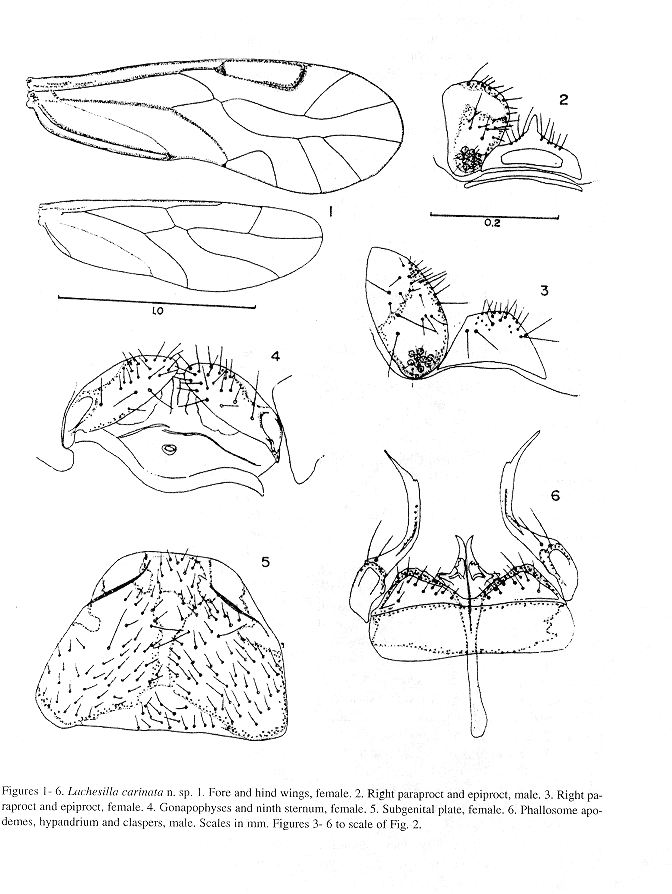
<body><![CDATA[<p><b><font face="Arial,Helvetica"><font size=-1>Materials and Methods</font></font></b><font size=-1></font>     <p><font face="Arial,Helvetica"><font size=-1>The material studied consists of 720 specimens, preserved in 80% alcohol, or dissected and mounted on slides, either in Euparal or in Balsam of Canada. Color was recorded by examination of the specimen in 80% alcohol, under a dissecting microscope at 100X. Standard measurements (FW = righ fore wing length, HW = righ hind wing length, F= hind femur length, T= hind tibia length, t<sub>1</sub>, t<sub>2</sub> = lengths of hind tarsomeres 1 and 2, cct1 = number of ctenidia on t<sub>1</sub>, Mx<sub>4</sub> = length of fourth segment of maxillary palp, f<sub>1</sub>...f<sub>n</sub>= length of flagellomeres 1...n, Io = minimum distance between compound eyes, D = antero-posterior diamentes of compound eye, d = transverse diameter of compound eye, PO = d/D) are given in microns, and were taken from parts mounted on slides, under the compound microscope, utilizing a filar micrometer whose measuring unit is 1.36 microns for wings and 0.53 microns for other parts. The scales of the illustrations are in mm.</font></font><font size=-1></font>     <p><font face="Arial,Helvetica"><font size=-1>The names of the collectors are abbreviated as follows: AC, Alex Cadena; AMN, Aaron M. Nadler; ANGA, Alfonso N. Garc&iacute;a Aldrete; CWOB, Charles W. O&acute;Brien; EB, Ernesto Barrera; ELM, Edward L Mockford; GBM, George B. Marshall; GEE, Gary E. Eertmoed; GO, Guillermina Ortega; HB; Harry Brailovsky; JAC, J. Arturo Casassola; JL, Joe L&oacute;pez; LBM, Leticia B. Menchaca; LBOB, Lois B. O&uml;Brien; LC, Luis Cervantes; OR, Omar Rilett; RC, Rodamond Coates and RS, Ron Sloan.</font></font><font size=-1></font>     <p><font face="Arial,Helvetica"><font size=-1>The types are deposited in the National Insect Collection Instituto de Biolog&iacute;a, UNAM; Mexico City (CNI-IBUNAM), or in the E.L. Mockford Collection, housed in the Departament of Biological Sciences, Illinois State University, Normal, IL (ISU).</font></font>     <center><i><font face="Arial,Helvetica"><font size=-1>Lachesilla carinata n.sp.</font></font></i>     <br><font face="Arial,Helvetica"><font size=-1>(<a href="#fig1-6">Figs. 1-6</a>)</font></font></center> <font size=-1></font>     <p><font face="Arial,Helvetica"><font size=-1><b>Female.</b> Color. Body dark reddish brown. Compound eyes black, ocelli hyaline, without pigmented centripetal crescents. Two dark brown bands from each compound eye to epistomal sulcus, enclosing antennal fossae. Maxillary palps dark brown. Antennae and legs brown. Wings opaque, fumose, veins reddish brown. Abdomen with reddish brown subcuticular rings, less pigmented ventrally.</font></font><font size=-1></font>     <p><font face="Arial,Helvetica"><font size=-1><b>&nbsp;Morphology.</b> Forewing (<a href="#fig1-6">Fig. 1</a>) with pterostigma almost rectangular, R1 deeply pigmented. Rs-M fused basally for a short length. Hind wing (<a href="#fig1-6">Fig.1</a>) with Rs-M joined basally for a length. Subgenital plate (<a href="#fig1-6">Fig. 5</a>) broad, straigth posteriorly, with a long, slender, pigmented band, diagonal on each postero-lateral corner. Gonapophyses (<a href="#fig1-6">Fig. 4</a>), large, robust, setose as illustrated. Spermapore small, surrounded by a slender, pigmented band, diagonally on each postero-lateral corner. Gonapophyses (<a href="#fig1-6">Fig. 4</a>), large, robust, setose as ilustrated. Spermapore small, surrounded by a slender, pigmented ring, slightly towards anterior border of ninth sternum. Paraprocts (<a href="#fig1-6">Fig.3</a>) large, almost elliptic, setose as illustrated;sensory fields with 10 trichobothria, a marginal one without basal rosette, distal half of paraproct distinctly less pigmented than proximal one, bearing the sensory field. Epiproct (<a href="#fig1-6">Fig. 3</a>) trapecial, setal field on posterior half, as illustrated.</font></font><font size=-1></font>     <p><font face="Arial,Helvetica"><font size=-1><b>&nbsp;Measurements.</b> FW: 1906, HW: 1470, F: 382, T: 754, tl: 223, t<sub>2</sub>: 75, ctt1: 18, Mx4: 84, f<sub>1</sub>: 247, f2: 200. F<sub>3</sub>: 172, f<sub>4</sub>: 119, f<sub>5</sub>: 80, f<sub>6</sub>: 72, f<sub>7</sub>: 61, f<sub>8</sub>: 64, f<sub>9</sub>: 58, f<sub>10</sub>: 55, f<sub>11</sub>: 66, IO:289, D: 152, d:106, IO/D: 1.89, Po: 0.69.</font></font><font size=-1></font>     <p><font face="Arial,Helvetica"><font size=-1><b>&nbsp;Male. </b>COLOR. Same as the female.</font></font><font size=-1></font>     ]]></body>
<body><![CDATA[<p><font face="Arial,Helvetica"><font size=-1><b>&nbsp;Morphology.</b> Hypandrium (<a href="#fig1-6">Fig.6</a>) deeply concave posterirly, with a strongly pigmented</font></font>     <br><font face="Arial,Helvetica"><font size=-1>band along posterior border; setae as illustrated. Phallosome apodemes fused to form a long, stout baculum (Fig.6), wider posteriorly and divided posteriorly, each arm forming a basally wide, curved prong, bearing on inner side a small, denticulate extension. Claspers (<a href="#fig1-6">Fig.6</a>) with short, rounded, proximal portion, bearing two large setae, and long, acuminate shaft, bearing mesally a long, denticulate ridge, that ends much before the apex of the shaft, as illustrated. Paraprocts (<a href="#fig1-6">Fig.2</a>) broad, setose, mesally with a lightly pigmented area; sensory fields with 11 trichobothiria, a marginal one without basal rosette. Epiproct (<a href="#fig1-6">Fig.2</a>) strongly pigmented, anterior margin flat, with a stout, pointed extension posteriorly, and an elongate, mesal, less pigmented area. Setae as illustrated.</font></font>     <br><font size=-1></font>&nbsp;<font size=-1></font>     <center>     <p><a NAME="fig1-6"></a><img SRC="/img/fbpe/rbt/v47n1-2/0332i1.GIF" height=894 width=672></center> <font size=-1></font>     
<p>    <br><font size=-1></font>     <p><font face="Arial,Helvetica"><font size=-1><b>&nbsp;Measurements.</b> FW: 1713, HW: 1326, F:371, T:708, t<sub>1</sub>:258, t2: 137, cct<sub>1</sub>: 17, Mx4: 86, f<sub>1</sub>: 240, f<sub>2</sub>: 212, f<sub>3</sub>: 200, f<sub>4</sub>: 141, f<sub>5</sub>: 98, f<sub>6</sub>: 83, f<sub>7</sub>: 76, f<sub>8</sub>: 70, f<sub>9</sub>: 76, f<sub>10</sub>: 66, f<sub>11</sub>: 79, IO: 248, D: 154, d: 108, IO/D: 1.61, PO: 0.70.</font></font>     <br><font size=-1></font>&nbsp;<font size=-1></font>     <p><font face="Arial,Helvetica"><font size=-1><b>Type Locality. M&eacute;xico.</b> Chiapas. 4 Km S Simojovel, 880 m., 13.VIII.1975, on dead, hanging leaves of herbaceous plants, ANGA, holotype&nbsp;<img SRC="/img/fbpe/rbt/v47n1-2/Macho.GIF" height=18 width=20>, allotype&nbsp;<img SRC="/img/fbpe/rbt/v47n1-2/Hembra.GIF" height=21 width=15> , paratypes&nbsp;<img SRC="/img/fbpe/rbt/v47n1-2/Macho.GIF" height=18 width=20> 11 paratypes&nbsp;<img SRC="/img/fbpe/rbt/v47n1-2/Hembra.GIF" height=21 width=15>&nbsp; (CNI-IBUNAM).</font></font><font size=-1></font>     
]]></body>
<body><![CDATA[<p><font face="Arial,Helvetica"><font size=-1><b>Records.</b> MEXICO. <b>Campeche.</b> Km. 178 Hwy. Esc&aacute;rcega-Chetumal, 23.VI.1989, beating vegetation, LC &amp; AC, 1&nbsp;<img SRC="/img/fbpe/rbt/v47n1-2/Hembra.GIF" height=21 width=15>. Calakmul Biosphere Reserve,&nbsp; Hormiguero Archaeologial Zone, 6. V.1997, beating shrubs, ANGA, 2<img SRC="/img/fbpe/rbt/v47n1-2/Macho.GIF" height=18 width=20> , 2&nbsp;<img SRC="/img/fbpe/rbt/v47n1-2/Hembra.GIF" height=21 width=15>. EJIDO Col&oacute;n, 7.V.1997, beating herbaceous plants with dead leaves. JAC, 3&nbsp;<img SRC="/img/fbpe/rbt/v47n1-2/Hembra.GIF" height=21 width=15>. <b>Chiapas.</b> 4 Km N Tuxtla Guti&eacute;rrez, 15.VII.1962, beating vegetation on secondary growth forest, edge of Sumidero Canyon. ELM, 1&nbsp;<img SRC="/img/fbpe/rbt/v47n1-2/Hembra.GIF" height=21 width=15>. Chinkultik Archaeological Zone, 51 Km SE Comit&aacute;n, 1,500 m., 11.VIII.1975, on dead haning leaves of Compositae, ANGA, 1&nbsp;<img SRC="/img/fbpe/rbt/v47n1-2/Hembra.GIF" height=21 width=15>. 2 Km S Ixtapa, Hwy. 195, 1,100 m., 12.VIII.1975, on dead banana fronds, ANGA, 1&nbsp;<img SRC="/img/fbpe/rbt/v47n1-2/Macho.GIF" height=18 width=20>. 42 Km NW Ocozocoautla, 1.VII.1981, beating branches with dead leaves of fallen shrubs, forest edge, ANGA, 1&nbsp;<img SRC="/img/fbpe/rbt/v47n1-2/Hembra.GIF" height=21 width=15>.&nbsp; El Ocote Biophere Reserve, 700 m., 1.V.1993, beating branches with dead leaves, ANGA &amp; EB,&nbsp; 1&nbsp;<img SRC="/img/fbpe/rbt/v47n1-2/Hembra.GIF" height=21 width=15>. <b>Hidalgo.</b> Omitl&aacute;n, ca. Real del Monte, Hwy. 105, 21. VIII.1980, beating oaks, ANGA, 1&nbsp;<img SRC="/img/fbpe/rbt/v47n1-2/Hembra.GIF" height=21 width=15>. <b>Morelos.</b> Ticum&aacute;n, 17.X.1971, on dead handing leaves of Compositae, ANGA, 1&nbsp;<img SRC="/img/fbpe/rbt/v47n1-2/Macho.GIF" height=18 width=20>, 1&nbsp;<img SRC="/img/fbpe/rbt/v47n1-2/Hembra.GIF" height=21 width=15>. <b>Oaxaca.</b> Toltepec. 1.XI. 1987, EB, 1&nbsp;<img SRC="/img/fbpe/rbt/v47n1-2/Macho.GIF" height=18 width=20>. Km 16, Rd. Jalapa de D&iacute;az - Tuxtepec, 18.III.1989, beating vegetation, LC &amp; AC, 1<img SRC="/img/fbpe/rbt/v47n1-2/Macho.GIF" height=18 width=20>. Km 5, Rd. Mogo&ntilde;e –San Juan Guichicovi, 70 m., 22.XI.1990, EB, 1<img SRC="/img/fbpe/rbt/v47n1-2/Macho.GIF" height=18 width=20>. <b>San Luis Potos&iacute;.</b> 6 Km&nbsp; N Tamazunchale, 25-II.1973, on dead leaves of miscelaneous vegetation on mountain slope, ANGA, 1&nbsp;<img SRC="/img/fbpe/rbt/v47n1-2/Macho.GIF" height=18 width=20>. 20 Km N Jct. Hwy. 85 and Rd to Xilitla, ca. Tamu&iacute;n. 25.II.1973, on dead leaves of Convolvulaceae, ANGA, 3&nbsp;<img SRC="/img/fbpe/rbt/v47n1-2/Hembra.GIF" height=21 width=15>. <b>Tabasco.</b> Villahermosa, Agua Blanca, 17.VI.1989, beating vegetation, LC &amp; AC, 1&nbsp;<img SRC="/img/fbpe/rbt/v47n1-2/Macho.GIF" height=18 width=20>. Tamaulipas. 1.6 Km S Rd. To Xicot&eacute;ncatl, on Hwy. 85, 30.III.1961, beating cattails, ELM, 1&nbsp;<img SRC="/img/fbpe/rbt/v47n1-2/Macho.GIF" height=18 width=20>, 1&nbsp;<img SRC="/img/fbpe/rbt/v47n1-2/Hembra.GIF" height=21 width=15>. Veracruz. 8 Km S Tecolutla, 26.VI.1962, ELM, 1&nbsp;<img SRC="/img/fbpe/rbt/v47n1-2/Hembra.GIF" height=21 width=15>. 3 Km N Santiago Tuxtla, Hwy. 180, 9.VII.1962, beating vegetation, upland rain forest, ELM, 1&nbsp;<img SRC="/img/fbpe/rbt/v47n1-2/Hembra.GIF" height=21 width=15>. Rd. To Cerro El Vig&iacute;a, ca. Santiago Tuxtla, 12.VII.1973, beating branches with dead leaves in forest ANGA, 1&nbsp;<img SRC="/img/fbpe/rbt/v47n1-2/Macho.GIF" height=18 width=20>. 6 Km NE San Andr&eacute;s Tuxtla, rd. to San Mart&iacute;n Volcano, 15.VII.1973, beating vegetation, semi-arid scrub on lava flow, ANGA, 1&nbsp;<img SRC="/img/fbpe/rbt/v47n1-2/Macho.GIF" height=18 width=20>. Ca. Tuxpan, 2.VIII.1978, on dead, handing leaves of herbaceous plants, N edge of Tuxpan River, ANGA, 1<img SRC="/img/fbpe/rbt/v47n1-2/Hembra.GIF" height=21 width=15> , 6&nbsp;<img SRC="/img/fbpe/rbt/v47n1-2/Macho.GIF" height=18 width=20>.</font></font><font size=-1></font>     
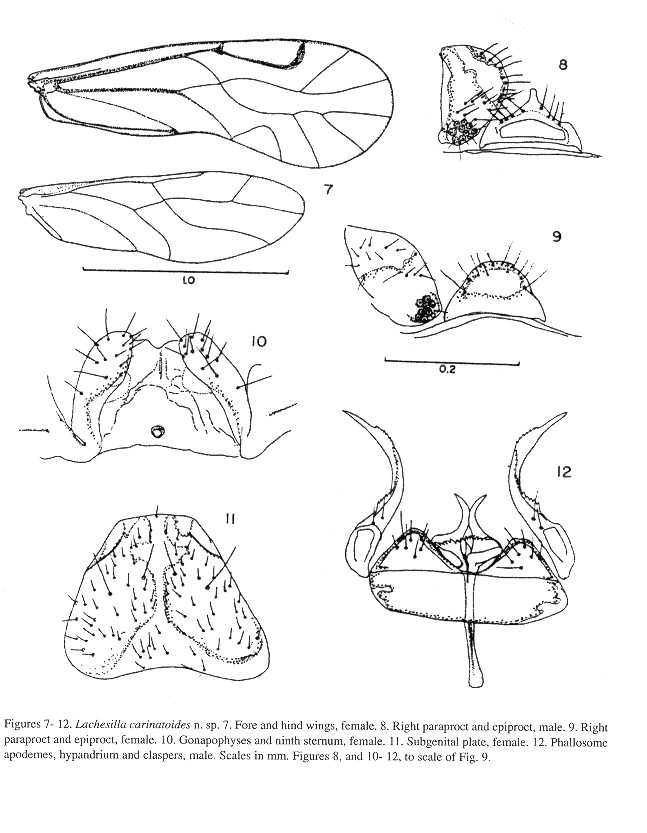
<center>     <p><i><font face="Arial,Helvetica"><font size=-1>Lachesilla carinatoides n. sp.</font></font></i>     <br><font face="Arial,Helvetica"><font size=-1>(<a href="#fig7-12">Figs. 7-12</a>)</font></font></center> <font size=-1></font>     <p><font face="Arial,Helvetica"><font size=-1>&nbsp;Female. COLOR. Body reddish brown. Compound eyes black, ocelli hyaline, without pigmented centripetal crecents. Two dark brown bands from each compound eye to epistomal sulcus, enclosing antennal fossae. Maxillary palps and antennae dark brown. Wings slightly fumose, veins reddish brown. Stigmasac and R1 of fore wing ochre. Legs pale brown. Abdomen with reddish brown subcuticular rings, less pigmented ventrally.</font></font>     <br><font face="Arial,Helvetica"><font size=-1></font></font>&nbsp;<font size=-1></font>     <center>     <p><a NAME="fig7-12"></a><img SRC="/img/fbpe/rbt/v47n1-2/0332i2.GIF" height=833 width=647></center> <font size=-1></font>     
<p>    <br><font size=-1></font>     ]]></body>
<body><![CDATA[<p><font face="Arial,Helvetica"><font size=-1><b>&nbsp;Morphology. </b>Fore wing pterostigma (<a href="#fig7-12">Fig.7</a>) about 3.5 times as long as wide in the middle, R1 wide. Rs-M diverging from a point, areola postica wide basally, almost triangular. Hind wing with Rs-M diverging from a point (<a href="#fig7-12">Fig.7</a>). Subgenital plate narrow (<a href="#fig7-12">Fig.11</a>), setae as illustrated, with one slender pigmented band diagonally on each postero-lateral corner. Gonapophyses (<a href="#fig7-12">Fig. 10</a>) very robust, setose. Spermapore (<a href="#fig7-12">Fig.10</a>) towards anterior border of ninth sternum, surrounded by a slender, pigmented ring. Paraprocts semi-elliptic (<a href="#fig7-12">Fig. 9</a>), setae as illustrated; sensory fields with 10-11 trichobothria, a marginal one without basal rossette Epiproct (<a href="#fig7-12">Fig.9</a>) almost trapezial, setae as illustrated.</font></font><font size=-1></font>     <p><font face="Arial,Helvetica"><font size=-1><b>&nbsp;Measurements.</b> FW: 1705, HW: 1297, F: 347, T: 689, t<sub>1</sub>: 222, t<sub>2</sub>: 85, cct1: 19, Mx4: 71, f<sub>1</sub>: 220, f<sub>2</sub>: 167, f<sub>3</sub>: 160, f<sub>4</sub>: 113, f<sub>5</sub>: 62, f<sub>6</sub>: 66, f<sub>7</sub>: 64, f<sub>8</sub>: 62, f<sub>9</sub>: 61, f<sub>10</sub>: 57, f<sub>11</sub>: 76, IO: 271, D: 138, IO/D: 1.9, PO: 0.68.</font></font><font size=-1></font>     <p><font face="Arial,Helvetica"><font size=-1><b>&nbsp;Male.</b> COLOR. Same as the female.</font></font><font size=-1></font>     <p><font face="Arial,Helvetica"><font size=-1>&nbsp;Morphology. Hypandrium (<a href="#fig7-12">Fig.12</a>), deeply concave posteriorly, with a strongly pigmented band along posterior border. Phallosome apodemes fused to from a long, stout, baculum (<a href="#fig7-12">Fig.12</a>), divided posteriorly, each arm forming a basally wide, stout, curved prong, bearing on inner side a wide extension limited posteriorly by a row of 6-7 posterior denticles. Claspers (<a href="#fig7-12">Fig. 12</a>), basally rounded, elongate; shaft long, slender, acuminate, with two basal large setae, and bearing a long, denticulate ridge from anterior end to the apex. Paraprocts (<a href="#fig7-12">Fig. 8</a>), robust, almost semicircular, setae as illustrated, mesally with a clear, elongate area; sensory fields with 11-12 trichobothria, a marginal one without basal rosette. Epiproct (<a href="#fig7-12">Fig.8</a>), with hind margin flat, with a process directed posteriorly from te hind margin, mesally with a transverse, almost rectangular pale area; setae as illustrated.</font></font><font size=-1></font>     <p><font face="Arial,Helvetica"><font size=-1><b>Measurements.</b> FW:1762, HW: 1346, F: 363, T: 693, t<sub>1</sub>: 243, t<sub>2</sub>: 87, ctt<sub>1</sub> 20, Mx4: 94, f<sub>1</sub>: 239, f<sub>2</sub>: 220, f<sub>3</sub>: 201, f<sub>4</sub>: 156, f<sub>5</sub>: 98, f<sub>6</sub>: 84,f<sub>7</sub>: 78, f<sub>8</sub>: 73, f<sub>9</sub>: 69, f<sub>10</sub>: 66, IO: 267, D: 166, d: 105, IO/D:1.6, PO:0.63.</font></font><font size=-1></font>     <p><font face="Arial,Helvetica"><font size=-1><b>Type Locality.</b> MEXICO. Nayarit. Mar&iacute;a Madre Island, rd. from Port Balleto to LA Antena, 210 m., 226.III.1984, beating branches in low deciduos forest, ANGA, holotype&nbsp;<img SRC="/img/fbpe/rbt/v47n1-2/Macho.GIF" height=18 width=20>, allotype&nbsp;<img SRC="/img/fbpe/rbt/v47n1-2/Hembra.GIF" height=21 width=15>, one paratype of each sex (CNI-IBUNAM).</font></font><font size=-1></font>     
<p><font face="Arial,Helvetica"><font size=-1><b>Records.</b> MEXICO. <b>Guerrero. </b>22 Km SW Carrizal de Bravo, rd. Milpillas-Atoyac, 5.II.1974, beating shrubs, ANGA, 1&nbsp;<img SRC="/img/fbpe/rbt/v47n1-2/Macho.GIF" height=18 width=20>. Oaxaca. 20 Km NW Pochutla, 9.III.1995, beating vegetation, GO, 1&nbsp;<img SRC="/img/fbpe/rbt/v47n1-2/Macho.GIF" height=18 width=20>.</font></font><font size=-1></font>     
<p><font face="Arial,Helvetica"><font size=-1><b>Comments.</b> This species presumably constitutes the sister species of L. carinata. This assertion is based on a male synapomorphous character: presence of a denticulate ridge on the clasper shaft, relatively short in L. carinata, and distinctly longer in L. carinatoides. Other differences are the narrow denticulate lamellae of the distal prongs of the phallosome apodemes and relatively broader sudgenital plate in L. carinata, as compared to the distinctly wider lamellae of the distal prongs of the phallosome apodemes, and narrower subgenital plate in L. carinatoides.</font></font><font size=-1></font>     <p><font face="Arial,Helvetica"><font size=-1>&nbsp;L. carinata is much more widely distributed than L. carinatoides, this being restricted to Mar&iacute;a Madre Island and two points near the Pacific coast, in the states of Guerrero and Oaxaca. The two species are allopatric.</font></font><font size=-1></font>     <center>     ]]></body>
<body><![CDATA[<p><i><font face="Arial,Helvetica"><font size=-1>Lachesilla cladiumicola n. sp.(&nbsp;<img SRC="/img/fbpe/rbt/v47n1-2/Hembra.GIF" height=21 width=15>)</font></font></i>     
<br><font face="Arial,Helvetica"><font size=-1>(<a href="#fig13-17">Figs. 13-17</a>)</font></font></center> <font size=-1></font>     <p><font size=-1><font face="Arial,Helvetica">&nbsp;Color. Body light brown. Compound eyes black, ocelli clear, without pigmented centripetal crescents. A reddish brown band</font> <font face="Arial,Helvetica">from each compound eye to epistomal sulcus, enclosing antennal fossae. Antennae and maxillary palps light brown. Legs light brown. Wings hyaline, veins brown. A slender, brown band on each side of thorax, running above the coxae, abdomen with brown subcuticular rings, more conspicuous on the sides.</font></font>     <br><font face="Arial,Helvetica"><font size=-1></font></font>&nbsp;<font size=-1></font>     <center>     <p><a NAME="fig13-17"></a><img SRC="/img/fbpe/rbt/v47n1-2/0332i3.GIF" height=604 width=655></center> <font size=-1></font>     
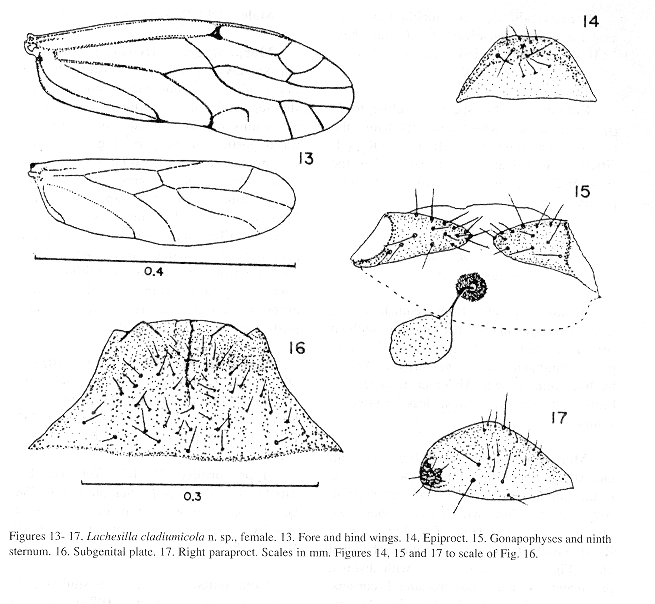
<p>    <br><font size=-1></font>     <br><font size=-1></font>     <p><font face="Arial,Helvetica"><font size=-1><b>Morphology.</b> Fore wings (<a href="#fig13-17">Fig.13</a>) small, narrow, with crossvein from lower posterior angle of pterostigma to R2+3, Rs-M diverging from a point. Areola postica anomalous, incomplete (<a href="#fig13-17">Fig.13</a>). HW with Rs-M fused for a lengh. Sudgenital plate (<a href="#fig13-17">Fig.16</a>), broad, setose, almost trapezial, with distinctly prominent postero-lateral corners and a trinagular, sclerotized prominence next to each corner. Gonapophyses wide based, narrowing to blunt apex, setose as illustrated (<a href="#fig13-17">Fig.15</a>). spermapore round, almost in center o of ninth sternum, surrounded by a wide, pigmented ring. Paraprocts (<a href="#fig13-17">Fig.17</a>) almost semi circular, sensory fields with eight trichobothria, one without basal rosette, epiproct (<a href="#fig13-17">Fig.14</a>) trapezial, setal field on posterior half.</font></font>     ]]></body>
<body><![CDATA[<br><font size=-1></font>&nbsp;<font size=-1></font>     <p><font face="Arial,Helvetica"><font size=-1><b>Measurements.</b> FW: 1400, F: 401, T: 562, t<sub>1</sub>: 179, t2:77, ctt<sub>1</sub>: 9, Mx4: 76, f<sub>1</sub>: 256, f<sub>2</sub>: 244, f<sub>3</sub>: 194, f<sub>4</sub>: 145, f<sub>5</sub>: 92, f<sub>6</sub>: 88, f<sub>7</sub>: 77, f<sub>8</sub>: 77, f<sub>9</sub>: 72, f<sub>10</sub>: 72, f<sub>11</sub>: 76, IO: 285, D: 150, d: 106,&nbsp; IO/D: 1.89, PO: 0.70.</font></font>     <br><font size=-1></font>&nbsp;<font size=-1></font>     <p><font face="Arial,Helvetica"><font size=-1><b>Type Locality.</b> U.S.A. Florida. Levy Co., East side of causeway to Cedar Key, 12.IIIV.1965, on dried sawgrass leaves, holotye&nbsp;<img SRC="/img/fbpe/rbt/v47n1-2/Hembra.GIF" height=21 width=15>, ELM (ISU).</font></font><font size=-1></font>     
<p><font face="Arial,Helvetica"><font size=-1><b>Comments.</b> This species is close to L. typhicola n.sp., which it shares the crossvein between the pterostigma and R2+3. It differs from it in its smaller size, and in the subgenital plate, lacking pointed protuberances in L. typhicola.</font></font>     <br><font size=-1></font>&nbsp;<font size=-1></font>     <center>     <p><i><font face="Arial,Helvetica"><font size=-1>Lachesilla estradaorum n.sp.</font></font></i>     <br><font face="Arial,Helvetica"><font size=-1>(<a href="#fig18-23">Figs.18-23</a>)</font></font></center> <font size=-1></font>     <p><font face="Arial,Helvetica"><font size=-1><b>Female.</b> COLOR. Boby reddish brown. Compound eyes black, ocelli hyaline, without centripetal pigmented crescents. Maxillary palps, antennae and legs brown. Abdomen with reddish brown subcuticular rings, less pigmented ventrally.</font></font><font size=-1></font>     ]]></body>
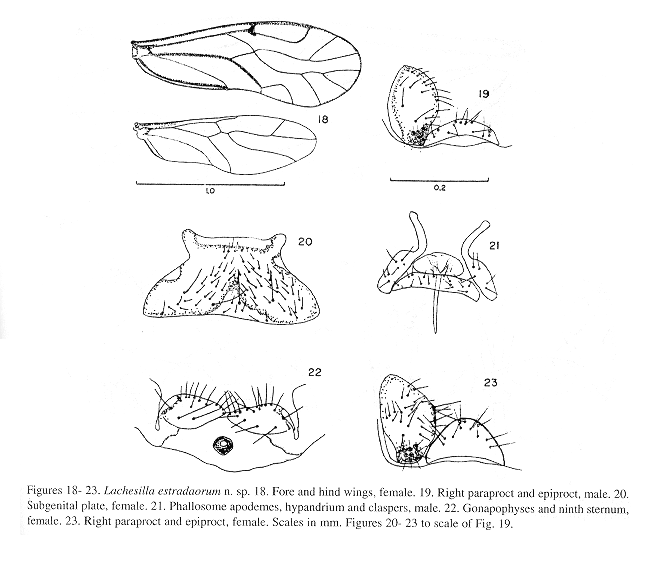
<body><![CDATA[<p><font face="Arial,Helvetica"><font size=-1><b>Morphology.</b> Fore wing (<a href="#fig18-23">Fig.18</a>), with pterostigma about three times as long as wide in the middle. Rs-M diverging from a point. Areola postica low, wide basally, about two times as wide as tall. Himd wing (<a href="#fig18-23">Fig.18</a>) with Rs-m basally fused for a length. Subgenital plate (<a href="#fig18-23">Fig.20</a>), broad, setose, with, distinct, prominent, rounded postero-lateral corners, hind marging almost flat, bordered by a hyaline band. Gonapophyses (<a href="#fig18-23">fig.22</a>), widest in the middle, narrowing to apex, setae as illustrated. Spermapore (<a href="#fig18-23">Fig.22</a>), large, almost in the center of ninth sternum, with a wide, irregular ring surrounding it. Paraprocts, (<a href="#fig18-23">Fig.23</a>), semi-elliptic, setae as illustrated, sensory fields with 9-10 trichobothria, a marginal one without basal rosette. Epiproct (<a href="#fig18-23">Fig.23</a>), wide, setae as illustrated.</font></font><font size=-1></font>     <p><font face="Arial,Helvetica"><font size=-1><b>Measurements.</b> FW: 1516, HW: 1180, F: 318, T: 552, t<sub>1</sub>: 178, t<sub>2</sub>: 71, ctt1: 15, Mx4:72, f<sub>1</sub>:212, f<sub>2</sub>:169, f<sub>3</sub>:155, f<sub>4</sub>:113, f<sub>5</sub>:68, f<sub>6</sub>:73, f<sub>7</sub>:58, f<sub>8</sub>:61, f<sub>9</sub>:60, f<sub>10</sub>:61, f<sub>11</sub>:61, IO:265, D:150, d:95, IO/D:1.76, PO:0.63.</font></font><font size=-1></font>     <p><font face="Arial,Helvetica"><font size=-1><b>Male.</b> COLOR. Same as the female.</font></font><font size=-1></font>     <p><font face="Arial,Helvetica"><font size=-1><b>Morphology.</b> Hypandrium wide transversely, narrow antero-posteriorly (<a href="#fig18-23">Fig. 21</a>). Phallosome apodemes fused to form a slender rd or baculum, membranous extensions of each distal arm contiguous. Basal portion of claspers (<a href="#fig18-23">Fig. 21</a>) almost rectangular, each with two large setae ans 3-5 additional, smaller ones, shafts curved, very stout, with the apices dilated. Paraprocts (<a href="#fig18-23">Fig.19</a>), large, semi-elliptic, setae as illustrated, with a small mesal prominence, sensory fields with 10-11 trichobothria, a marginal one without basal rosette. Epiproct (<a href="#fig18-23">Fig.19</a>)., large, with anterior margin nearly flat, rounded posteriorly, setae as illustrated.</font></font><font size=-1></font>     <p><font face="Arial,Helvetica"><font size=-1><b>Measurements.</b> FW:1426, HW:1076, F: 303, T:546, t<sub>1</sub>:180, t<sub>2</sub>:70,ctt1:16, Mx4:81, f<sub>1</sub>:200, f<sub>2</sub>:167, f<sub>3</sub>:153, f<sub>4</sub>:123, f<sub>5</sub>:90, f<sub>6</sub>.80, f<sub>7</sub>:74, f<sub>8</sub>:71,f<sub>9</sub>:71, f<sub>10</sub>:69, f<sub>11</sub>:85, IO:252, D:150, d:101, IO/D:1.67, PO:0.66.</font></font><font size=-1></font>     <p><font face="Arial,Helvetica"><font size=-1><b>Type Locality.</b> MEXICO. <b>Veracruz. </b>Los Tuxtlas, UNAM Biology Station. 8.VII. 1988, beating branches with dead leaves in forest, ANGA, holotype<img SRC="/img/fbpe/rbt/v47n1-2/Macho.GIF" height=18 width=20>, allotype&nbsp;<img SRC="/img/fbpe/rbt/v47n1-2/Hembra.GIF" height=21 width=15>, (CNI-IBUNAM).</font></font><font size=-1></font>     
<p><font face="Arial,Helvetica"><font size=-1><b>Comments.</b> This species is similar to L. cuala <a href="#García88">Garc&iacute;a Aldrete (1988)</a>, widely distributed from Mexico to South America, and to several others, undescribed South American species, from which it differs mostly by the prominent postero-lateral corners of the subgenital plate, and by the stout clasper shafts, unique among the species of the group.</font></font>     <br><font face="Arial,Helvetica"><font size=-1></font></font>&nbsp;     <br><font face="Arial,Helvetica"><font size=-1></font></font>&nbsp;     <br><font size=-1></font>     ]]></body>
<body><![CDATA[<center>     <p><a NAME="fig18-23"></a><img SRC="/img/fbpe/rbt/v47n1-2/0332i4.GIF" height=570 width=672><font size=-1></font><i><font face="Arial,Helvetica"><font size=-1></font></font></i>     
<p><i><font face="Arial,Helvetica"><font size=-1>Lachesilla filicicola n. sp. (<img SRC="/img/fbpe/rbt/v47n1-2/Macho.GIF" height=18 width=20>)</font></font></i>     
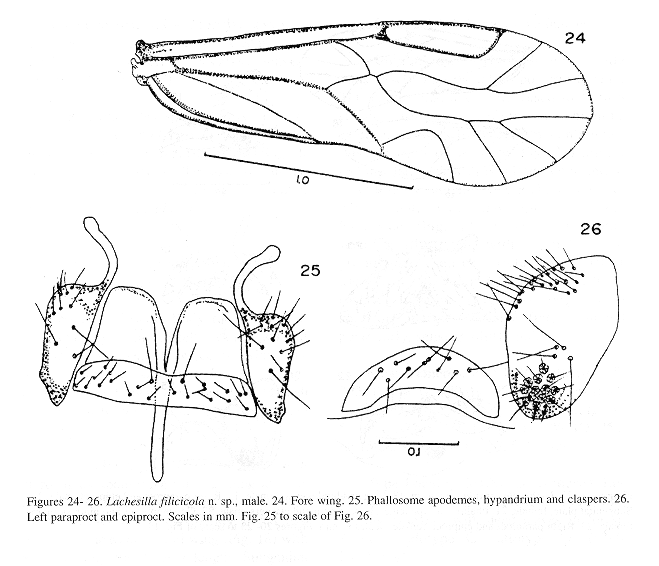
<br><font face="Arial,Helvetica"><font size=-1>(<a href="#fig24-26">Figs. 24-26</a>)</font></font></center> <font size=-1></font>     <p><font size=-1><font face="Arial,Helvetica"><b>Male. </b>COLOR. Brown. Compound eyes black, ocelli hyaline, with ochre centripetal crescents. Maxillary palps and antennae</font> <font face="Arial,Helvetica">brown. Legs pale brown. Wings hyaline, veins brown. Thoracic pleurae with a reddish brown band above the coxae. Abdomen with reddish brown subcuticular rings, less pigmented ventrally.</font></font><font size=-1></font>     <p><font face="Arial,Helvetica"><font size=-1><b>Morphology.</b> Fore wing (<a href="#fig24-26">Fig.24</a>). hypandrium (<a href="#fig24-26">Fig.25</a>), narrow antero-posteriorly, slightly concave posteriorly. Phallosome apodemes fused to from a short, stout rod or baculum (<a href="#fig24-26">Fig.25</a>), with distal membranous extensions very large. Claspers (<a href="#fig24-26">Fig. 25</a>), with shafts curved, apically dilated; basal portions robust, wider posteriorly, each with two large setae and 7-10 smaller setae, as illustrated. Paraprocts (<a href="#fig24-26">Fig.26</a>), almost elliptic, with setae as illustrated and sensory field with 14 trichobothria, a marginal one without basal rosette. Epiproct (<a href="#fig24-26">Fig. 26</a>), wide, concave anteriorly, rounded posteriorly; setae as illustrated.</font></font><font size=-1></font>     <p><font face="Arial,Helvetica"><font size=-1><b>Measurements.</b> FW:2189, F:472, T:832, t<sub>1</sub>:299, t<sub>2</sub>:94, ctt<sub>1</sub>:22, Mx4:106, f<sub>1</sub>:311, f<sub>2</sub>:162, f<sub>3</sub>:133.</font></font><font size=-1></font>     <p><font face="Arial,Helvetica"><font size=-1><b>Type Locality.</b> MEXICO. <b>Tabasco.</b> R&iacute;o Tonal&aacute; &amp; Hwy. 180, 17.III.1964, beating dried fern leaves, ELM, 1<img SRC="/img/fbpe/rbt/v47n1-2/Macho.GIF" height=18 width=20> holotype (CNI-IBUNAM).</font></font><font size=-1></font>     
<p><font face="Arial,Helvetica"><font size=-1><b>Comments.</b> This species is unique in the group by having large, stout basal portions of the claspers, with short, curved, apically dilated shafts. The extremely large, distalextensions of the baculum are also unique in the group. Several undescribed Central and South American species also have apically dilated clasper shafts.</font></font>     <br><font size=-1></font>&nbsp;     ]]></body>
<body><![CDATA[<br><font size=-1></font>&nbsp;     <br><font size=-1></font>     <center>     <p><a NAME="fig24-26"></a><img SRC="/img/fbpe/rbt/v47n1-2/0332i5.GIF" height=566 width=659><font size=-1></font><i><font face="Arial,Helvetica"><font size=-1></font></font></i>     
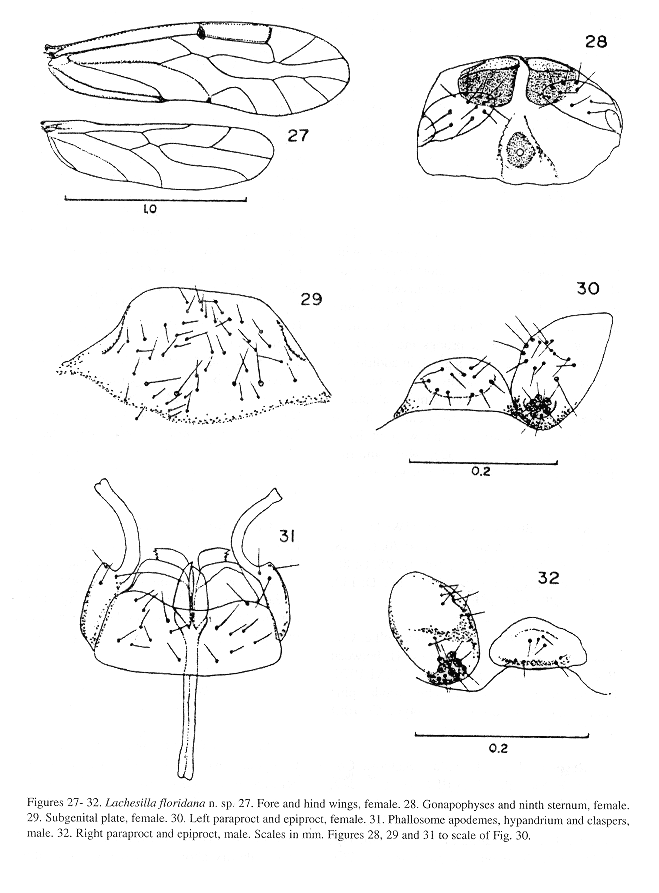
<p><i><font face="Arial,Helvetica"><font size=-1>Lachesilla floridana n.sp.</font></font></i>     <br><font face="Arial,Helvetica"><font size=-1>(<a href="#fig27-32">Figs. 27-32</a>)</font></font></center> <font size=-1></font>     <p><font face="Arial,Helvetica"><font size=-1><b>Female.</b> COLOR. Pale brown. Compound eyes black, ocelli hyaline, with ochere centripetal crescents. Two brown bands from each compound eye to epistomal sulcus, enclosing antennal fossae. Antennae and maxillary palps ligh brown. Legs pale brown. Wings hyaline, veins brown. A brown band on each side of thorax, running above coxae. Abdomen with ochre sudcuticular rings, more conspicuous laterally.</font></font><font size=-1></font>     <p><font size=-1><font face="Arial,Helvetica"><b>Morphology. </b>Fore wings (<a href="#fig27-32">Fig.27</a>), slender, with a crossvein from the lower posterior angle of pterostigma to Rs, before junction of R2+3.- R4+5 (some specimens with crossvein between pterostigma and proximal end of R2+3). Rs-M joined basally for a length (<a href="#fig27-32">Fig.27</a>). areola postica wide basally, almost triangular. Hind wing Rs-m joined basally for a length (<a href="#fig27-32">Fig.27</a>). subgenital plate (<a href="#fig27-32">Fig. 29</a>), broad, s&egrave;tose,posteriorly straight. Gonapophyses (<a href="#fig27-32">Fig.28</a>) narrowing distally to blunt apices. Ninth sternum with two semi-circular pigmented areas posteriorly (<a href="#fig27-32">Fig.28</a>). spermapore towards anterior border of ninth sternum surrounded by an elliptic, pigmented area (<a href="#fig27-32">Fig.28</a>). apraprocts (<a href="#fig27-32">Fig 30</a>) broad, elogante, setose as illustrated, sensory fields</font> <font face="Arial,Helvetica">with 9-10 trichobothria, one without basal rosette. Epiproct (<a href="#fig27-32">Fig. 30</a>), almost trapezial, wide basally, posteriorly rounded; setal field on distal half.</font></font>     <br><font size=-1></font>&nbsp;     <br><font size=-1></font>&nbsp;     ]]></body>
<body><![CDATA[<br><font size=-1></font>     <center>     <p><a NAME="fig27-32"></a><img SRC="/img/fbpe/rbt/v47n1-2/0332i6.GIF" height=893 width=659></center> <font size=-1></font>     
<p>    <br><font size=-1></font>     <br><font size=-1></font>     <p><font face="Arial,Helvetica"><font size=-1><b>Measurements. </b>FW:1733, HW:1327, F344, T: 614, t<sub>1</sub>:187, t<sub>2</sub>:85, ctt1:11, Mx4:74, f<sub>1</sub>:265, f<sub>2</sub>:242, f<sub>3</sub>:207, f<sub>4</sub>:143, f<sub>5</sub>:88, f<sub>6</sub>:80, f<sub>7</sub>:68, f<sub>8</sub>:73, f<sub>9</sub>:64, f<sub>10</sub>:73, f<sub>11</sub>:81, IO:265, D:137, d:117, IO/D:1.93, PO:0.86.</font></font><font size=-1></font>     <p><font face="Arial,Helvetica"><font size=-1><b>Male.</b> COLOR. Same as the female.</font></font><font size=-1></font>     <p><font face="Arial,Helvetica"><font size=-1><b>Morphology. </b>Hypandrium wide, posteriorly concave (<a href="#fig27-32">Fig. 31</a>), claspers with three setae on distal end of short basal portion (<a href="#fig27-32">Fig. 31</a>). Clasper shafts stout, curved, distally dilated as illustrated (<a href="#fig27-32">Fig.31</a>), phallosome apodemes fused to form a long baculum, distally with two pointed prongs and two broad lamellae with outer edge jagged, in addition to the two broad membranous extensions (<a href="#fig27-32">Fig.31</a>). paraprocts (<a href="#fig27-32">Fig.32</a>), almost elliptical, setose as illustrated, sensory fields with 9-10 trichobothria, a marginal one without basal rosette. Epiproct (<a href="#fig27-32">Fig. 32</a>), with anterior margin flat, rounded posteriorly, setae as illustrated.</font></font><font size=-1></font>     <p><font face="Arial,Helvetica"><font size=-1><b>Measurements.</b> FW:1556, HW:1175, F:286, T:540, t<sub>1</sub>:172, ctt<sub>1</sub>:11, Mx4:70, f<sub>1</sub>:248, f<sub>2</sub>:232, f<sub>3</sub>:201, f<sub>4</sub>:162, f<sub>5</sub>:106, f<sub>6</sub>:95, f<sub>7</sub>:86, f<sub>8</sub> :88, f<sub>9</sub>:90, f<sub>10</sub>:84, f<sub>11</sub>:108, IO:232, D:132, d:106, IO/D:1.76, PO:0.80.</font></font><font size=-1></font>     ]]></body>
<body><![CDATA[<p><font face="Arial,Helvetica"><font size=-1><b>Type Locality.</b> USA. Florida. Collier Co., State Hwy. 846, ca. 2mi.W Hwy. 41, between Bonita Springs and Naples, 29.XI.1970, beating vegetation (dried palm fronds, pine branches, etc.), holotype<img SRC="/img/fbpe/rbt/v47n1-2/Macho.GIF" height=18 width=20>, allotype&nbsp;<img SRC="/img/fbpe/rbt/v47n1-2/Hembra.GIF" height=21 width=15>, 10<img SRC="/img/fbpe/rbt/v47n1-2/Hembra.GIF" height=21 width=15> and 7&nbsp;<img SRC="/img/fbpe/rbt/v47n1-2/Macho.GIF" height=18 width=20> paratypes (ISU), ELM.</font></font><font size=-1></font>     
<p><font face="Arial,Helvetica"><font size=-1><b>Records.</b> USA. Florida. Okaloosa Co., 17 mi. E Niceville, 22.VIII.1951, 1&nbsp;<img SRC="/img/fbpe/rbt/v47n1-2/Macho.GIF" height=18 width=20>, 1&nbsp;<img SRC="/img/fbpe/rbt/v47n1-2/Hembra.GIF" height=21 width=15> , ELM. Monroe Co., Lower Matecumbe Key, 29. VIII.1951, 2&nbsp;<img SRC="/img/fbpe/rbt/v47n1-2/Hembra.GIF" height=21 width=15>, 1&nbsp;<img SRC="/img/fbpe/rbt/v47n1-2/Macho.GIF" height=18 width=20>,&nbsp; ELM. Big pine Key,28-29.VIII.1951, beating <i>Pinus caribbea</i>, 1&nbsp;<img SRC="/img/fbpe/rbt/v47n1-2/Hembra.GIF" height=21 width=15> , ELM. 16.II.1954, on dry palm fronds, 7&nbsp;<img SRC="/img/fbpe/rbt/v47n1-2/Hembra.GIF" height=21 width=15> , 5&nbsp;<img SRC="/img/fbpe/rbt/v47n1-2/Macho.GIF" height=18 width=20> , ELM. 21.II.1956, beating silver palm leaves, 6&nbsp;<img SRC="/img/fbpe/rbt/v47n1-2/Hembra.GIF" height=21 width=15> , 4&nbsp;<img SRC="/img/fbpe/rbt/v47n1-2/Macho.GIF" height=18 width=20> , ELM. Marathon, 16.II.1954, on dead palm fronds, 2&nbsp;<img SRC="/img/fbpe/rbt/v47n1-2/Hembra.GIF" height=21 width=15> , ELM. Highlands Co., Lake Placid, Archbold Biological Station, 7.II.1951, 3&nbsp;<img SRC="/img/fbpe/rbt/v47n1-2/Hembra.GIF" height=21 width=15> , AMN, Polk Co., 2 mi. N Lake Wales on US Hwy. 27, 25.XI.1961, beating dead, saw palmetto leaves, 6&nbsp;<img SRC="/img/fbpe/rbt/v47n1-2/Hembra.GIF" height=21 width=15> , ELM &amp; OR. Taylor Co., at Taylor-Dixie county line on US Hwy. 24.XI.1961, beating Sabal palmetto and Serenoa repens dry leaves, 6&nbsp;<img SRC="/img/fbpe/rbt/v47n1-2/Hembra.GIF" height=21 width=15>, ELM &amp; OR. Taylor Co., at Taylor-Dixie county line on US Hwy. 24:XI.1961, beating Sabal palmetto and Serenoa repents dry leaves, 1&nbsp;<img SRC="/img/fbpe/rbt/v47n1-2/Hembra.GIF" height=21 width=15>, 1&nbsp;<img SRC="/img/fbpe/rbt/v47n1-2/Macho.GIF" height=18 width=20>, ELM. Manatee Co., US Hwy. 301, 3 min. S Parrish, 4.XII. 1970, beating Serenoa repens, 4&nbsp;<img SRC="/img/fbpe/rbt/v47n1-2/Hembra.GIF" height=21 width=15>, 5&nbsp;<img SRC="/img/fbpe/rbt/v47n1-2/Macho.GIF" height=18 width=20>, ELM. Marion Co., on road between Sparr and Kerr City, Ocala National Forest, 19.III. 1953, beating dry saw palmetto leaves, 1&nbsp;<img SRC="/img/fbpe/rbt/v47n1-2/Macho.GIF" height=18 width=20> , 1&nbsp;<img SRC="/img/fbpe/rbt/v47n1-2/Hembra.GIF" height=21 width=15>, ELM. Levy Co., E side of causeway to Cedar Key, 12.IV.1965, on dried sawgrass leaves, 1&nbsp;<img SRC="/img/fbpe/rbt/v47n1-2/Hembra.GIF" height=21 width=15> , ELM. Palm Beach Co., Hwy. 441, 8 min. S Hwy. 98, Jct. (to Palm Beach) 3.XII. 1970, beating Serenoa plam with blue pruinosity, 7&nbsp;<img SRC="/img/fbpe/rbt/v47n1-2/Hembra.GIF" height=21 width=15>, 3&nbsp;<img SRC="/img/fbpe/rbt/v47n1-2/Macho.GIF" height=18 width=20>, ELM. Hernando Co. Bayport 28. XI. 1970, beating dried fronds of Serenoa repens, 9&nbsp;<img SRC="/img/fbpe/rbt/v47n1-2/Hembra.GIF" height=21 width=15> , 7&nbsp;<img SRC="/img/fbpe/rbt/v47n1-2/Macho.GIF" height=18 width=20>,ELM. Alachua Co., I mi. W Newnan`s Lake, on road from Gainesville, 20. VIII. 1952,in dried saw palmetto leaves,1&nbsp;<img SRC="/img/fbpe/rbt/v47n1-2/Macho.GIF" height=18 width=20>, 1&nbsp;<img SRC="/img/fbpe/rbt/v47n1-2/Hembra.GIF" height=21 width=15>, ELM. Hendry Co., La Belle, 4.II.1953, on small bromeliad on oak in hammock, 1<img SRC="/img/fbpe/rbt/v47n1-2/Hembra.GIF" height=21 width=15>, 1&nbsp;<img SRC="/img/fbpe/rbt/v47n1-2/Macho.GIF" height=18 width=20> , ELM.</font></font><font size=-1></font>     
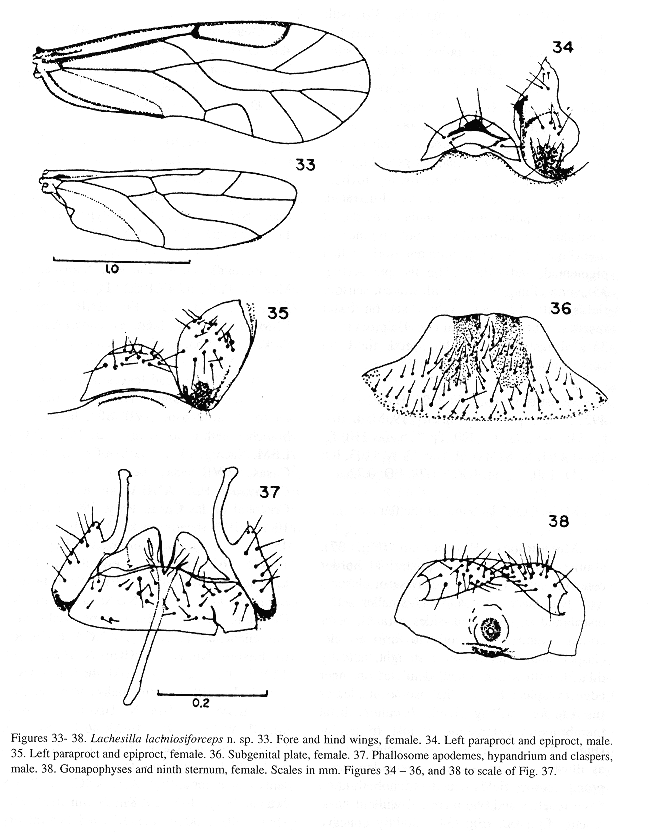
<p><font face="Arial,Helvetica"><font size=-1><b>Comments.</b> The pigmented areas of the fenale ninth sternum, and the apices of the clasper shafts, make this species unique in the species group. The acuminate distal extensions of the baculum, and its denticulate projections, are similar to the corresponding structures of the males of<i> L. caranita and L. carinatoides</i>.</font></font><font size=-1></font>     <p>    <br><font size=-1></font>     <center>     <p><i><font face="Arial,Helvetica"><font size=-1>Lachesilla laciniosiforceps n. sp.</font></font></i>     <br><font face="Arial,Helvetica"><font size=-1>(<a href="#fig33-38">Figs. 33-38</a>)</font></font></center> <font size=-1></font>     <p><font size=-1><font face="Arial,Helvetica">&nbsp;Femela. COLOR. Light yellowish brown. Compound eyes black, ocellii hyaline, without centripetal crescents. Two brown bands from each compound eye to epistomal sulcus, enclosing antennal fossae. Antennae and legs pale brown. A brown, irregular band on each side of thorax, above the coxae. Wings hyaline,</font> <font face="Arial,Helvetica">veins brown. Abdomen with reddish brown subcuticular rings, more conspucuous dorsally.</font></font>     <br><font size=-1></font>&nbsp;<font size=-1></font>     ]]></body>
<body><![CDATA[<center>     <p><a NAME="fig33-38"></a><img SRC="/img/fbpe/rbt/v47n1-2/0332i7.GIF" height=837 width=651></center> <font size=-1></font>     
<p>    <br><font size=-1></font>     <br><font size=-1></font>     <p><font face="Arial,Helvetica"><font size=-1><b>Morphology.</b> Fore wing (<a href="#fig33-38">Fig.33</a>), with pterostigma elongate, almost rectangular; Rs-M diverging from a point; areola postica almost triangular. Himd wing (<a href="#fig33-38">Fig. 33</a>), with Rs-M fused basally for a short length. Subgenital plate (<a href="#fig33-38">Fig.36</a>), broad, setae as illustrated, postero-lateral corners rounded; one elongate pigmented area on each side of longitudinal midline. Gonapophyses (<a href="#fig33-38">Fig. 38</a>), widest in the middle and narrowing to both ends, blunt distally, setae as illustrated. Spermapore small, towards anterior border of ninth sternum, surrounded by wide, pigmented band in the middle. Paraprocts (<a href="#fig33-38">Fig. 35</a>), semi-elliptic, setae as illustrated, sensory fields with 12 trichobothria set on basal rosettes, except a marginal one. Epiproct (<a href="#fig33-38">Fig.35</a>), almost semi-circular, setal field on posterior half.</font></font><font size=-1></font>     <p><font face="Arial,Helvetica"><font size=-1><b>Measurements.</b> FW: 2524, HW:1935, F: 492, T:909, t<sub>1</sub>:321, t2:98,ctt<sub>1</sub>:19, Mx4.107, f<sub>1</sub>:348, f<sub>2</sub>:298, f<sub>3</sub>:229, f<sub>4</sub>:176, f<sub>5</sub>:110, f<sub>6</sub>:102, f<sub>7</sub>:91, f<sub>8</sub>:82, f<sub>9</sub>:74, f<sub>10</sub>:73, f<sub>11</sub>:103,IO:319, D:180,d:131, IO/D:1.77, PO:0.72.</font></font>     <br><font size=-1></font>&nbsp;<font size=-1></font>     <p><font face="Arial,Helvetica"><font size=-1><b>Type Locality.</b> MEXICO. Chiapas. Parque Nacional Lagunas de Montebello, 60 Km SE Comit&aacute;n, 1,500 m., 11.VIII.1975, beating brnaches with dead leaves of fallen tree, ANGA, holotype &Oacute; paratypes (CNI-IBUNAM).</font></font><font size=-1></font>     <p><font face="Arial,Helvetica"><font size=-1><b>Records.</b> USA. <b>Florida.</b>     ]]></body>
<body><![CDATA[Sarasota Co., Myakka Park, 12.IV.1952, 1&nbsp;<img SRC="/img/fbpe/rbt/v47n1-2/Hembra.GIF" height=21 width=15>,     
1&nbsp;<img SRC="/img/fbpe/rbt/v47n1-2/Macho.GIF" height=18 width=20>, ELM. Monroe Co., Big Pine     
Key, 21.II.1956, 1&nbsp;<img SRC="/img/fbpe/rbt/v47n1-2/Hembra.GIF" height=21 width=15>, ELM.     
<b>Louisiana</b>.     New Orleans, Audubon Park, 1:XII.1965, beating vegetation, 2&nbsp;<img SRC="/img/fbpe/rbt/v47n1-2/Macho.GIF" height=18 width=20>,1&nbsp;<img SRC="/img/fbpe/rbt/v47n1-2/Hembra.GIF" height=21 width=15>,     
ELM. MEXICO. <b>Coahuila.</b> Zaragoza, 23.VIII.1970, on dead leaves of     Fraxinus sp. 1&nbsp;<img SRC="/img/fbpe/rbt/v47n1-2/Hembra.GIF" height=21 width=15>, ANGA. <b>Chiapas.</b>     
5 Km N Ocozocoaula, on rd. To Malpaso, 1.VII.1981, beating oak branches     with dead leaves, 3&nbsp;<img SRC="/img/fbpe/rbt/v47n1-2/Hembra.GIF" height=21 width=15>, 1<img SRC="/img/fbpe/rbt/v47n1-2/Macho.GIF" height=18 width=20>     
, ANGA, LBM. Nachig, 15 Km W San Crist&oacute;bal de las Casas, 2.VII.1981,     ]]></body>
<body><![CDATA[beating branches of <i>Cupressus</i>, 1&nbsp;<img SRC="/img/fbpe/rbt/v47n1-2/Macho.GIF" height=18 width=20>,     
ANGA. 46 Km SW San Crist&oacute;bal de las Casas, Hwy, 190, 1,100 m., 10.VII.1975,     beating oaks, 2<img SRC="/img/fbpe/rbt/v47n1-2/Macho.GIF" height=18 width=20>, 4<img SRC="/img/fbpe/rbt/v47n1-2/Hembra.GIF" height=21 width=15>,     
ANGA. 45 Km E Tuxtla Guti&eacute;rrez, Hwy, 190, 15.VII.1962, beating vegetation,     ELM. Lagunas de Mntebello , 3.VII.1981 beating <i>Liquidambar</i>, 2&nbsp;<img SRC="/img/fbpe/rbt/v47n1-2/Hembra.GIF" height=21 width=15>,     
ANGA. 10 Km NE Comit&aacute;n, 2.VII.1981, beating oaks and miscellaneous     shrubs, 4&nbsp;<img SRC="/img/fbpe/rbt/v47n1-2/Hembra.GIF" height=21 width=15>, ANGA. 6 Km Rd,     
to Pueblo Nuevo, 53 Km N Hwy, 190, 17.VII.1962, 1&nbsp;<img SRC="/img/fbpe/rbt/v47n1-2/Hembra.GIF" height=21 width=15>,     
1&nbsp;<img SRC="/img/fbpe/rbt/v47n1-2/Macho.GIF" height=18 width=20>, ELM, 40 Km N Hwy.190,     
17.VII.1962, beating oaks and pines, 2&nbsp;<img SRC="/img/fbpe/rbt/v47n1-2/Hembra.GIF" height=21 width=15>,     
]]></body>
<body><![CDATA[1&nbsp;<img SRC="/img/fbpe/rbt/v47n1-2/Macho.GIF" height=18 width=20>, ELM. 14 Km N Tuxtla Guti&eacute;rrez,     
14. VII.1962, 2&nbsp;<img SRC="/img/fbpe/rbt/v47n1-2/Hembra.GIF" height=21 width=15>, 1&nbsp;<img SRC="/img/fbpe/rbt/v47n1-2/Macho.GIF" height=18 width=20>,     
ELM, 46 Km SW San Crist&oacute;bal de las Casas Hwy. 190, 1,100 m., 10.VIII.1975,     beating brnaches with dead leaves of mango, 3&nbsp;<img SRC="/img/fbpe/rbt/v47n1-2/Hembra.GIF" height=21 width=15>,     
2&nbsp;<img SRC="/img/fbpe/rbt/v47n1-2/Macho.GIF" height=18 width=20>, ANGA. 2 Km S Ixtapa, Hwy.     
195, 10 Km N Juction with Hwy. 190, 1,100 m., 12.VIII.1975, beating dry     banana leaves and shrubs, 2&nbsp;<img SRC="/img/fbpe/rbt/v47n1-2/Hembra.GIF" height=21 width=15>,     
2&nbsp;<img SRC="/img/fbpe/rbt/v47n1-2/Macho.GIF" height=18 width=20>, ANGA. 5 Km N Ocozocoautla,     
rd. To Malpaso, 1.VII.1981, beating oak branches with dry leaves, 1&nbsp;<img SRC="/img/fbpe/rbt/v47n1-2/Hembra.GIF" height=21 width=15>,     
1&nbsp;<img SRC="/img/fbpe/rbt/v47n1-2/Macho.GIF" height=18 width=20>. ANGA. 26 Km E Tapanatepec,     
]]></body>
<body><![CDATA[Oaxaca, Hwy. 190, 12. VII.1962, 1&nbsp;<img SRC="/img/fbpe/rbt/v47n1-2/Macho.GIF" height=18 width=20>     
ELM. <b>Guerrero.</b> 94 Km N Acapulco, 29.VII.1969, beating oak branches     with dry leaves, 2&nbsp;<img SRC="/img/fbpe/rbt/v47n1-2/Macho.GIF" height=18 width=20>, ANGA.     
<b>Hidalgo,</b>     Omitl&aacute;n, ca. Real del Monte, Hwy. 105, 21.VII.1980, beating oaks,     2&nbsp;<img SRC="/img/fbpe/rbt/v47n1-2/Hembra.GIF" height=21 width=15>, 4&nbsp;<img SRC="/img/fbpe/rbt/v47n1-2/Macho.GIF" height=18 width=20>,     
ANGA. 16 Km S Jacala, Hwy. 85, 23.VI.1962, beating broad leaved tress and     shrubs, 1&nbsp;<img SRC="/img/fbpe/rbt/v47n1-2/Hembra.GIF" height=21 width=15>, 1<img SRC="/img/fbpe/rbt/v47n1-2/Macho.GIF" height=18 width=20>     
, ELM. 18 Km NE Rancho Viejo, Hwy. 85, 22.VI.1962, 36&nbsp;<img SRC="/img/fbpe/rbt/v47n1-2/Hembra.GIF" height=21 width=15>,     
20&nbsp;<img SRC="/img/fbpe/rbt/v47n1-2/Macho.GIF" height=18 width=20>, ELM. 38 Km NE Rancho     
]]></body>
<body><![CDATA[Viejo, Hwy. 85, 22.VI.1962, beating vegetation in forest, mostly oaks,     2&nbsp;<img SRC="/img/fbpe/rbt/v47n1-2/Hembra.GIF" height=21 width=15>, 3&nbsp;<img SRC="/img/fbpe/rbt/v47n1-2/Macho.GIF" height=18 width=20>,     
ELM. 35 Km E Pachuca, Hwy. 130, 24.VI.1962, sifting ground litter, 1<img SRC="/img/fbpe/rbt/v47n1-2/Hembra.GIF" height=21 width=15>     
, 1&nbsp;<img SRC="/img/fbpe/rbt/v47n1-2/Macho.GIF" height=18 width=20>, ELM, <b>Jalisco</b>.     
Ca. El Tuito, Rd. to El Cuale, 890 m., 18.IX.1988, on boulder covered with     lichens, 1&nbsp;<img SRC="/img/fbpe/rbt/v47n1-2/Macho.GIF" height=18 width=20>, ANGA. <b>Nuevo     
Le&oacute;n</b>. Guadalupe, Rancho Alamillos, NE, slope Cerro de la Silla,     600 m.,13.VIII.1972, on dried hanging leaves of Sechium, edule, 1&nbsp;<img SRC="/img/fbpe/rbt/v47n1-2/Hembra.GIF" height=21 width=15>,     
1&nbsp;<img SRC="/img/fbpe/rbt/v47n1-2/Macho.GIF" height=18 width=20>, ANGA, 20.VIII.1978, beating     
vegetation, 3 &Oacute;, 5 &Oacute;, ANGA, 27.VIII.1978, beating branches     ]]></body>
<body><![CDATA[with dead leaves of vegetation, including Quercus, Musa and Ruteceae, 2&nbsp;<img SRC="/img/fbpe/rbt/v47n1-2/Hembra.GIF" height=21 width=15>,     
1&nbsp;<img SRC="/img/fbpe/rbt/v47n1-2/Macho.GIF" height=18 width=20>, ANGA, 22.XII.1978, beating     
vegetation, 4&nbsp;<img SRC="/img/fbpe/rbt/v47n1-2/Hembra.GIF" height=21 width=15>, 1&nbsp;<img SRC="/img/fbpe/rbt/v47n1-2/Macho.GIF" height=18 width=20>,     
ANGA. 31.VII.1979, beating branches of miscellaneous trees, 2<img SRC="/img/fbpe/rbt/v47n1-2/Macho.GIF" height=18 width=20>,     
ANGA. 11.IV.1976, beating branches with dead leaves of avocado trees, Quercus     and shrubs 25&nbsp;<img SRC="/img/fbpe/rbt/v47n1-2/Hembra.GIF" height=21 width=15>, 20&nbsp;<img SRC="/img/fbpe/rbt/v47n1-2/Macho.GIF" height=18 width=20>,     
ANGA. 31.VII.1979, beating branches branches of trees, 1, ANGA. 22.X.1978,     on dead banana leaves, 9&nbsp;<img SRC="/img/fbpe/rbt/v47n1-2/Hembra.GIF" height=21 width=15>,     
3&nbsp;<img SRC="/img/fbpe/rbt/v47n1-2/Macho.GIF" height=18 width=20>,&nbsp; ANGA. 26.VIII.1984,&nbsp;     
beating pear trees and miscellaneuous shrubs, 1<img SRC="/img/fbpe/rbt/v47n1-2/Hembra.GIF" height=21 width=15>,1<img SRC="/img/fbpe/rbt/v47n1-2/Macho.GIF" height=18 width=20>,     
]]></body>
<body><![CDATA[ANGA. 23.VII 1979, sifting oak litter, 1<img SRC="/img/fbpe/rbt/v47n1-2/Macho.GIF" height=18 width=20>,     
ANGA. 23.VIII.1981, beating <i>Quercus </i>and miscellaneous shrubs, 2<img SRC="/img/fbpe/rbt/v47n1-2/Hembra.GIF" height=21 width=15>     
, 1<img SRC="/img/fbpe/rbt/v47n1-2/Macho.GIF" height=18 width=20>, ANGA.&nbsp; 17.IV.1982, beating     
vegetation with dried leaves 3<img SRC="/img/fbpe/rbt/v47n1-2/Hembra.GIF" height=21 width=15>,     
2<img SRC="/img/fbpe/rbt/v47n1-2/Macho.GIF" height=18 width=20>, under loose bark of tree trunk,     
1&nbsp;<img SRC="/img/fbpe/rbt/v47n1-2/Hembra.GIF" height=21 width=15>, ANGA. 30.III.1988,&nbsp;     
beating vegetation, 1&nbsp;<img SRC="/img/fbpe/rbt/v47n1-2/Hembra.GIF" height=21 width=15>, ANGA.     
22.V.1967, beating vegetation, 2 &Oacute;, 4 &Oacute;, ANGA. Ca. Monterrey,     W slope Cerro de la Silla, Col. Contry, 22. V.1975, on dead Dasylirion     inflorescence, 1&nbsp;<img SRC="/img/fbpe/rbt/v47n1-2/Hembra.GIF" height=21 width=15>, ANGA.     
]]></body>
<body><![CDATA[Trail to N Peak, beating vegetation, 300 m., 18.IX.1977, 5<img SRC="/img/fbpe/rbt/v47n1-2/Hembra.GIF" height=21 width=15>,     
4&nbsp;<img SRC="/img/fbpe/rbt/v47n1-2/Macho.GIF" height=18 width=20>, sifting litter, 1&nbsp;<img SRC="/img/fbpe/rbt/v47n1-2/Hembra.GIF" height=21 width=15>,     
ANAG. Trail to the Arch, 900 m., 28.VIII.1982, beating vegetation, thory     scrub, 2&nbsp;<img SRC="/img/fbpe/rbt/v47n1-2/Hembra.GIF" height=21 width=15>, 1<img SRC="/img/fbpe/rbt/v47n1-2/Macho.GIF" height=18 width=20>     
, ANGA. 12.VIII.1982, beating vegetation, throny scrub, 2&nbsp;<img SRC="/img/fbpe/rbt/v47n1-2/Hembra.GIF" height=21 width=15>,     
1&nbsp;<img SRC="/img/fbpe/rbt/v47n1-2/Macho.GIF" height=18 width=20>, ANGA.12.VIII.1989, 800     
m., beating vegetation, 1&nbsp;<img SRC="/img/fbpe/rbt/v47n1-2/Hembra.GIF" height=21 width=15>,     
1<img SRC="/img/fbpe/rbt/v47n1-2/Macho.GIF" height=18 width=20> , ANGA. 16 Km E Iturbide, Hwy.     
60, 13.VI.1962, beating cycads on hillside, 3&nbsp;<img SRC="/img/fbpe/rbt/v47n1-2/Hembra.GIF" height=21 width=15>,     
beating vegetation, 1&nbsp;<img SRC="/img/fbpe/rbt/v47n1-2/Hembra.GIF" height=21 width=15>, 1&nbsp;<img SRC="/img/fbpe/rbt/v47n1-2/Macho.GIF" height=18 width=20>,     
]]></body>
<body><![CDATA[ELM. Santiago Horsetail Fall, 14.IX.1963, beating branches with dry leaves     at park entrance, 2&nbsp;<img SRC="/img/fbpe/rbt/v47n1-2/Hembra.GIF" height=21 width=15>, 2&nbsp;<img SRC="/img/fbpe/rbt/v47n1-2/Macho.GIF" height=18 width=20>,     
ELM. 21:VIII.1978, beating vegetation, 10&nbsp;<img SRC="/img/fbpe/rbt/v47n1-2/Hembra.GIF" height=21 width=15>,     
4<img SRC="/img/fbpe/rbt/v47n1-2/Macho.GIF" height=18 width=20>, ANGA, 18.VII.1980, on dried     
leaves of broad leaved trees, 1&nbsp;<img SRC="/img/fbpe/rbt/v47n1-2/Macho.GIF" height=18 width=20>,     
ANGA. La Boca Dam, 27.XII.1973, beating vegetation on mountain slope, 3&nbsp;<img SRC="/img/fbpe/rbt/v47n1-2/Macho.GIF" height=18 width=20>,     
ANGA. 4.IV.1988, beating Cyperus and Senecio, stream edge, 1&nbsp;<img SRC="/img/fbpe/rbt/v47n1-2/Hembra.GIF" height=21 width=15>,     
2&nbsp;<img SRC="/img/fbpe/rbt/v47n1-2/Macho.GIF" height=18 width=20>, ANGA. Santiago, 3 Km N     
El Alamo, 23.II.1977, on dried Seloa and banana leaves, 2&nbsp;<img SRC="/img/fbpe/rbt/v47n1-2/Hembra.GIF" height=21 width=15>,     
ANGA. Ca. Santiago, El Carrito, 30.VIII.1985, on dried leaves of Convolvulaceae     ]]></body>
<body><![CDATA[vine, 1&nbsp;<img SRC="/img/fbpe/rbt/v47n1-2/Hembra.GIF" height=21 width=15>, ANGA. 26 Km SW     
Linares 680m., Hwy.60 Santa Rosa Canyon, 24.VIII.1975, beating oaks, 13&nbsp;<img SRC="/img/fbpe/rbt/v47n1-2/Hembra.GIF" height=21 width=15>,     
5&nbsp;<img SRC="/img/fbpe/rbt/v47n1-2/Macho.GIF" height=18 width=20>, ANGA. 11 Km. W La Ci&eacute;nega,     
towards Laguna de S&aacute;nchez, 18.VII.1980, on dried leaves of broad     leaves of broad leaved trees, 1<img SRC="/img/fbpe/rbt/v47n1-2/Hembra.GIF" height=21 width=15>,&nbsp;     
ANGA. La Boca Dam, 27.XII.1973, beating vegetation on mountain slope, 3<img SRC="/img/fbpe/rbt/v47n1-2/Macho.GIF" height=18 width=20>,     
ANGA. 4.IV.1988, beating Cyperus and Senecio, stream edge, 1<img SRC="/img/fbpe/rbt/v47n1-2/Hembra.GIF" height=21 width=15>,     
2<img SRC="/img/fbpe/rbt/v47n1-2/Macho.GIF" height=18 width=20>, ABGA. Santiago, 3 Km&nbsp; N     
El Alamo, 23.II.1977, on dried Seloa and&nbsp; banana leaves, 2<img SRC="/img/fbpe/rbt/v47n1-2/Hembra.GIF" height=21 width=15>,     
ANGA. Ca. Santiago, El Cerroto, 30.VIII. 1985, on dried leaves of Convolvulaceae     ]]></body>
<body><![CDATA[vine, 1&nbsp;<img SRC="/img/fbpe/rbt/v47n1-2/Hembra.GIF" height=21 width=15>, ANGA. 26 Km SW     
Linares, 680 m., Hwy. 60 Santa Rosa Canyon, 424.VIII:1975, beating oaks,     13&nbsp;<img SRC="/img/fbpe/rbt/v47n1-2/Hembra.GIF" height=21 width=15>, 5<img SRC="/img/fbpe/rbt/v47n1-2/Macho.GIF" height=18 width=20>,     
ANGA. 11 km. W la Ci&eacute;nega, towards Laguna de S&aacute;nchez, 18.VII.1980,     on dried leaves of broad leaves trees, 1&nbsp;<img SRC="/img/fbpe/rbt/v47n1-2/Hembra.GIF" height=21 width=15>,     
Ana. 9 Km. SE Monterrey, 12.VI.1962, beating oaks, 1&nbsp;<img SRC="/img/fbpe/rbt/v47n1-2/Hembra.GIF" height=21 width=15>,     
1&nbsp;<img SRC="/img/fbpe/rbt/v47n1-2/Macho.GIF" height=18 width=20>, ELM. Garza Garc&iacute;a,     
28.XII.1969, beting hanging dry banana leaves, 2&nbsp;<img SRC="/img/fbpe/rbt/v47n1-2/Hembra.GIF" height=21 width=15>,     
2<img SRC="/img/fbpe/rbt/v47n1-2/Macho.GIF" height=18 width=20>, ANGA. 17 Km S La Ascenci&oacute;n,     
Hwy. NL-63, 1, 900 m., 24.VIII.1975, beating oaks and shrubs, 3&nbsp;<img SRC="/img/fbpe/rbt/v47n1-2/Hembra.GIF" height=21 width=15>,     
]]></body>
<body><![CDATA[1<img SRC="/img/fbpe/rbt/v47n1-2/Macho.GIF" height=18 width=20>, ANGA. 8 Km N Allende, 650m.,     
23.II.1977, beating herbaceous plants, stream edge, 1<img SRC="/img/fbpe/rbt/v47n1-2/Hembra.GIF" height=21 width=15>,     
1&nbsp;<img SRC="/img/fbpe/rbt/v47n1-2/Macho.GIF" height=18 width=20>, ANGA. Lazarillos, ca.     
Allende 370m., 30.VIII.1985, on dead leaves of Salix, 2<img SRC="/img/fbpe/rbt/v47n1-2/Hembra.GIF" height=21 width=15>,     
1<img SRC="/img/fbpe/rbt/v47n1-2/Macho.GIF" height=18 width=20>, ANGA. 3 Km SE Aramberri, 1,000     
M., 12.XI.1976, beating branches with dead leaves of avocado trees and     shrubs, 5&nbsp;<img SRC="/img/fbpe/rbt/v47n1-2/Hembra.GIF" height=21 width=15>, 6<img SRC="/img/fbpe/rbt/v47n1-2/Macho.GIF" height=18 width=20>,     
ANGA. 9 Km S Villaldama, 440 m., 27.V.1976, beating branches with dead     leaves of Ehretia elliptica, 3&nbsp;<img SRC="/img/fbpe/rbt/v47n1-2/Hembra.GIF" height=21 width=15>,     
ANGA. El Encadenado Creek, 29 KM N Hualahuises, 24V.1977, beating vegetation,     ]]></body>
<body><![CDATA[1&nbsp;<img SRC="/img/fbpe/rbt/v47n1-2/Hembra.GIF" height=21 width=15>, ANGA. 32 Km nE Rayones,     
640 m., 24.II.1977, beating shrubs on stream edge, 1&nbsp;<img SRC="/img/fbpe/rbt/v47n1-2/Hembra.GIF" height=21 width=15>,     
ANGA. Ca. Monterrry, Chipinque, 9.VIII.1970, beating oak branches with     dried leaves and abundant lichens, 4<img SRC="/img/fbpe/rbt/v47n1-2/Hembra.GIF" height=21 width=15>,     
3&nbsp;<img SRC="/img/fbpe/rbt/v47n1-2/Macho.GIF" height=18 width=20>, ANGA. 17.V.1976, 1,200     
m., beating Seloa with dead, hanging leaves, 1&nbsp;<img SRC="/img/fbpe/rbt/v47n1-2/Macho.GIF" height=18 width=20>,     
ANGA. Rd. to Chipinque, 950m., 23.V.1976, beating oaks, 9&nbsp;<img SRC="/img/fbpe/rbt/v47n1-2/Hembra.GIF" height=21 width=15>,     
3<img SRC="/img/fbpe/rbt/v47n1-2/Macho.GIF" height=18 width=20>, ANGA. <b>Puebla.</b> Finca Lourdes,     
La Uni&oacute;n, ca. Xicotepecde Ju&aacute;rez, 2.XI.1963, beating coffee     trees, 1&nbsp;<img SRC="/img/fbpe/rbt/v47n1-2/Hembra.GIF" height=21 width=15>, JL. Ca. Xicotepec     
]]></body>
<body><![CDATA[de Ju&aacute;rez, rd. to La Uni&oacute;n, 1,150 m., 16.X.1982, beating     vegetation, 8&nbsp;<img SRC="/img/fbpe/rbt/v47n1-2/Hembra.GIF" height=21 width=15>, 2&nbsp;<img SRC="/img/fbpe/rbt/v47n1-2/Macho.GIF" height=18 width=20>,     
ANGA. Ca.&nbsp; Hotel&nbsp; Mi Ranchito 1,200 m., 17.X.1982, on dead, hanging     Yucca leaves, 1 O, ANGA. Hwy. 130, Jct to Nuevo Necaxa, 1,300 m., 16.XI.1974,     beating vegetation, 1&nbsp;<img SRC="/img/fbpe/rbt/v47n1-2/Hembra.GIF" height=21 width=15>, ANGA,     
13 Km. NE Teziutl&aacute;n, Hwy. 131, 1,200 m., 11.VI1983, beating vegetation,     1&nbsp;<img SRC="/img/fbpe/rbt/v47n1-2/Hembra.GIF" height=21 width=15>, CWOB &amp; LBOB. <b>San     
Luis Potos&iacute;.</b> El Salto, 13.VIII.1958, beating vegetation, 1&nbsp;<img SRC="/img/fbpe/rbt/v47n1-2/Hembra.GIF" height=21 width=15>,     
1<img SRC="/img/fbpe/rbt/v47n1-2/Macho.GIF" height=18 width=20>, ELM. 18.VI.1962, beating lemon     
tree, 1&nbsp;<img SRC="/img/fbpe/rbt/v47n1-2/Macho.GIF" height=18 width=20>, ELM. 19.VI1962,     
]]></body>
<body><![CDATA[beating vegetation near falls, 14&nbsp;<img SRC="/img/fbpe/rbt/v47n1-2/Hembra.GIF" height=21 width=15>,     
13&nbsp;<img SRC="/img/fbpe/rbt/v47n1-2/Macho.GIF" height=18 width=20>, ELM. 13 Km W Naranjo,     
20.VI.1962, beating palms and understory vegetation in oak forest, 6<img SRC="/img/fbpe/rbt/v47n1-2/Hembra.GIF" height=21 width=15>     
, 10&nbsp;<img SRC="/img/fbpe/rbt/v47n1-2/Macho.GIF" height=18 width=20>, ELM. Tamailupas. 15     
Km W G&oacute;mez Far&iacute;as, 16.VI.1962, beating vegetation along road,     forest edge, 1<img SRC="/img/fbpe/rbt/v47n1-2/Hembra.GIF" height=21 width=15> , ELM. Veracruz.     
9 Km. E Las Trancas, Hwy. 140, 29.VI.1962, beating vegetation, 3&nbsp;<img SRC="/img/fbpe/rbt/v47n1-2/Hembra.GIF" height=21 width=15>,     
ELM. 15 Km E Orizaba, Hwy. 150, 7VII.1962, 1&nbsp;<img SRC="/img/fbpe/rbt/v47n1-2/Hembra.GIF" height=21 width=15>,     
ELM. Ca. Maltrata, 1,875 m., 31.V.1976, beating oaks, 2<img SRC="/img/fbpe/rbt/v47n1-2/Macho.GIF" height=18 width=20>     
HB. 2Km SW Fort&iacute;n, Hwy. 150, 11.VII.1973, beating dead banana leaves     ]]></body>
<body><![CDATA[on mountain slope, 1&nbsp;<img SRC="/img/fbpe/rbt/v47n1-2/Hembra.GIF" height=21 width=15>, 1<img SRC="/img/fbpe/rbt/v47n1-2/Macho.GIF" height=18 width=20>,     
ANGA. Las Minas, ca. 30 Km N Perote, 6.IX.1977, beating vegetation, 3&nbsp;<img SRC="/img/fbpe/rbt/v47n1-2/Hembra.GIF" height=21 width=15>,     
HB. Yucat&aacute;n. 19 Lm SE Tekax, 25.III.1964, beating&nbsp; dried fronds     os Queen Palm, 1&nbsp;<img SRC="/img/fbpe/rbt/v47n1-2/Hembra.GIF" height=21 width=15>, 1<img SRC="/img/fbpe/rbt/v47n1-2/Macho.GIF" height=18 width=20>,     
ELM. GUATEMALA. Naciones unidas National Park, ca.. Amatitl&aacute;n, 24.VIII.1968,     betaing shrubs, 1&nbsp;<img SRC="/img/fbpe/rbt/v47n1-2/Hembra.GIF" height=21 width=15>, ANGA.     
13 Km NE Guatemala City, Hwy. To Puerto Barrios, 27.VIII.1968, beating     oaks, 1<img SRC="/img/fbpe/rbt/v47n1-2/Macho.GIF" height=18 width=20>, ANGA.</font></font><font size=-1></font>     
<p><font face="Arial,Helvetica"><font size=-1><b>Comments.</b> This species shares with L. gracilis Garc&iacute;a Aldrete , the conical extension of the epiproct, but the claspers are not apically dilated inte former, and the row of denticles extends more towards the base of the shafts; the subgenital plates and gonapohyses are distnict in both species. <i>L. yamnomamioides</i> Garc&igrave;a Aldrete, also has a mesal projection in the male epiproct, transverse and elongated, not conical, the clasper shafts are slender, with a row of denticles along the inner edge, and the apices are not as swollen as in L. laciniosiforceps. Also the female subgenital plate and the gonapohpyses are distinct in both species.</font></font>     <br><font size=-1></font>&nbsp;     ]]></body>
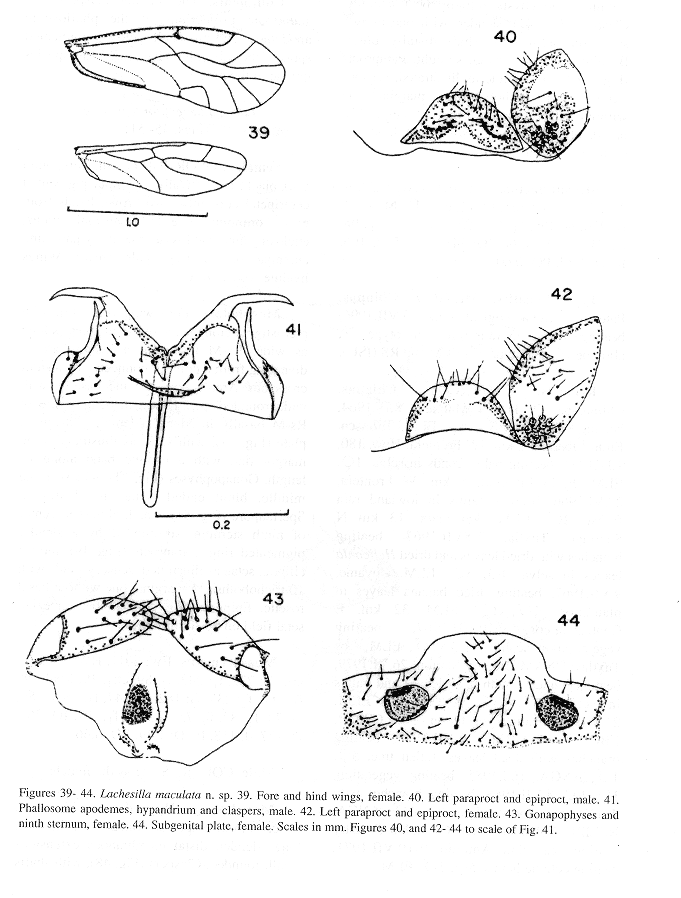
<body><![CDATA[<p>    <br><font size=-1></font>     <center>     <p><i><font face="Arial,Helvetica"><font size=-1>Lachesilla maculata n.sp.</font></font></i>     <br><font face="Arial,Helvetica"><font size=-1>(<a href="#fig39-44">Figs. 39-44</a>)</font></font></center> <font size=-1></font>     <p><font face="Arial,Helvetica"><font size=-1><b>Female.</b> COLOR. Light brown. Compound eyes black, ocelli hyaline, without pigmented centripetal crescents. Two brown bands fron each compound eye to epistomal sulcus, enclosing antennal fossae. Antemmae and legs pale brown. Wings hyaline, veins brown. Abdomen with dark brown subcuticular rings, more conspicuous ventrally.</font></font><font size=-1></font>     <p><font face="Arial,Helvetica"><font size=-1><b>Morphology.</b> Pterostigma elongate, almost rectangular. Fore wing Rs-M diverging from a point; areola postica almsot triangular Hind wing Rs-M fused for a length (<a href="#fig39-44">Fig. 39</a>). Subgenital plate (<a href="#fig39-44">Fig. 44</a>), wide, extended posteriorly, setae as illustrated; one almost ciruclar, deeply pigmented area mesally on each side. Gonapophyses (<a href="#fig39-44">Fig. 43</a>), stout, widest in the middle, blunt ended, setae as illustrated. Spermampore small, surrounded by large, elliptic, pigmented area (<a href="#fig39-44">Fig. 43</a>). Paraprocts (<a href="#fig39-44">Fig. 42</a>), almost elliptic, sensory without basal rosette, setae as illustrated. Epiproct (fig. 42), wide basally, rounded posteriorly, setal field on posterior half.</font></font><font size=-1></font>     <p><font face="Arial,Helvetica"><font size=-1><b>Measurements.</b> FW: 1653, HW: 1251, F: 312, T: 622, t<sub>1</sub>: 190, t2: 77, ctt<sub>1</sub>: 17, Mx4: 92.7, f<sub>1</sub>: 236, f<sub>2</sub>: 191, f<sub>3</sub>: 178, f<sub>4</sub>: 127, f<sub>5</sub>: 85, f<sub>6</sub>: 75, f<sub>7</sub>: 72, f<sub>8</sub>: 56, f<sub>9</sub>: 68, f<sub>10</sub>: 64, IO: 267, D: 153, d: 106, IO/D: 1.73, PO: 0.68.</font></font><font size=-1></font>     <p><font face="Arial,Helvetica"><font size=-1><b>Male.</b> COLOR. Same as the female.</font></font><font size=-1></font>     <p><font face="Arial,Helvetica"><font size=-1><b>Morphology. </b>Hypandrium (<a href="#fig39-44">Fig. 41</a>) wide, with flat anterior margin; bilobed posteriorly, each lobe terminating posteriorly as an acuminate apohysis abruptly ben laterally. Claspers (<a href="#fig39-44">Fig. 41</a>), slender, with one or towo setae on basal half, shaft distally blunt. Baculum (<a href="#fig39-44">Fig. 41</a>), stout, straight. Para procts (<a href="#fig39-44">Fig. 40</a>) ovoid, setae as illustated, sensory fields with 12 trichobothria, a marginal one without basal rosette. Epiproct (<a href="#fig39-44">Fig. 40</a>), broad, almost trapezial, with setal fields on each side, as illustrated.</font></font>     ]]></body>
<body><![CDATA[<br><font size=-1></font>&nbsp;<font size=-1></font>     <center>     <p><a NAME="fig39-44"></a><img SRC="/img/fbpe/rbt/v47n1-2/0332i8.GIF" height=898 width=681></center> <font size=-1></font>     
<p>    <br><font size=-1></font>     <br><font size=-1></font>     <p><font face="Arial,Helvetica"><font size=-1><b>Measurements. </b>FW: 1616, HW: 1252, F: 297, T: 572, t<sub>1</sub>: 165, t<sub>2</sub>: 72, ctt<sub>1</sub>: 15, Mx4: 74, f<sub>1</sub>: 220, f<sub>2</sub>: 196, f<sub>3</sub>: 168, f<sub>4</sub>: 136, f<sub>5</sub>: 91, f<sub>6</sub>: 95, f<sub>7</sub>: 73, f<sub>8</sub>: 74, f<sub>9</sub>: 68 IO: 241, D: 175, d: 106, IO/D: 1.37, PO: 0.60.</font></font><font size=-1></font>     <p><font face="Arial,Helvetica"><font size=-1><b>Type Locality.</b> MEXICO. Chiapas. Palenque Archaeological Zone, 5.VII.1996, beating foliage in rain forest, holotype 1<img SRC="/img/fbpe/rbt/v47n1-2/Hembra.GIF" height=21 width=15> allotype 1<img SRC="/img/fbpe/rbt/v47n1-2/Macho.GIF" height=18 width=20>, ELM and RS (ISU).</font></font><font size=-1></font>     
<p><font face="Arial,Helvetica"><font size=-1><b>&nbsp;Records. </b>MEXICO. <b>Chiapas.</b> Chimalapa, 29 km N Malpaso, 8.IV.1964, beating palms in selva, 1&nbsp;<img SRC="/img/fbpe/rbt/v47n1-2/Hembra.GIF" height=21 width=15>, ELM. <b>Tabasco.</b> Ejido Libertad, 2 km SW Frontera, Hwy. 180, 1.IV.1964, beating palm fronds in selva, 1&nbsp;<img SRC="/img/fbpe/rbt/v47n1-2/Macho.GIF" height=18 width=20>, ELM. Ejido Libertad, 6 Km. W Frotnera 27.VI.1966, beating palms in lowland rain forest, 2&nbsp;<img SRC="/img/fbpe/rbt/v47n1-2/Macho.GIF" height=18 width=20>, ELM. <b>Veracruz.</b> 13 Km N Santiago Tuxtla, 7-8VII.197, beating branches with dried leaves and dried Heliconia leaves in selva, 4<img SRC="/img/fbpe/rbt/v47n1-2/Hembra.GIF" height=21 width=15> , 3&nbsp;<img SRC="/img/fbpe/rbt/v47n1-2/Macho.GIF" height=18 width=20>, ELM. Coyame, 9.VII.1967, beating dried banana leaves in plantation, 1<img SRC="/img/fbpe/rbt/v47n1-2/Macho.GIF" height=18 width=20>, 1&nbsp;<img SRC="/img/fbpe/rbt/v47n1-2/Hembra.GIF" height=21 width=15>, ELM. 32 Km E Coatzacoalcos, 10.VII.1967, beating vegetation in acahual, 1&nbsp;<img SRC="/img/fbpe/rbt/v47n1-2/Macho.GIF" height=18 width=20>, 1<img SRC="/img/fbpe/rbt/v47n1-2/Hembra.GIF" height=21 width=15>, ELM. Los Tuxtlas, UNAM Biology Station, 26.VI.1979, beating branches with dead leaves and palms in selva, 7&nbsp;<img SRC="/img/fbpe/rbt/v47n1-2/Hembra.GIF" height=21 width=15>, 7<img SRC="/img/fbpe/rbt/v47n1-2/Macho.GIF" height=18 width=20> ANGA and ELM. 21.V.1983, beating vegetation, 1&nbsp;<img SRC="/img/fbpe/rbt/v47n1-2/Macho.GIF" height=18 width=20>, CWOB, LBOB, and GBM. 20.XII.1984, beating branches with dead leaves, fallen tree 5<img SRC="/img/fbpe/rbt/v47n1-2/Hembra.GIF" height=21 width=15>, 1<img SRC="/img/fbpe/rbt/v47n1-2/Macho.GIF" height=18 width=20>, ANGA: 16.I.1985, beating vegetation, 1&nbsp;<img SRC="/img/fbpe/rbt/v47n1-2/Hembra.GIF" height=21 width=15>, RC. 8.VII.1988, beating branches with dead leaves, forest edge, 3&nbsp;<img SRC="/img/fbpe/rbt/v47n1-2/Hembra.GIF" height=21 width=15>, 1<img SRC="/img/fbpe/rbt/v47n1-2/Macho.GIF" height=18 width=20>, ANGA. BELIZE. Toledo District, Columbia, Forestry Station, ca. San Antonio 9-10.VII.1971, beating cohune palms, 5&nbsp;<img SRC="/img/fbpe/rbt/v47n1-2/Hembra.GIF" height=21 width=15>,1&nbsp;<img SRC="/img/fbpe/rbt/v47n1-2/Macho.GIF" height=18 width=20>, ELM.</font></font><font size=-1></font>     
<p><font face="Arial,Helvetica"><font size=-1><b>Comments. </b>The slender claspers, the acuminate projections of the phallosome apodemes, and the well defined pigmented spots of the subgenital plate, make this species unique in the group.</font></font>     ]]></body>
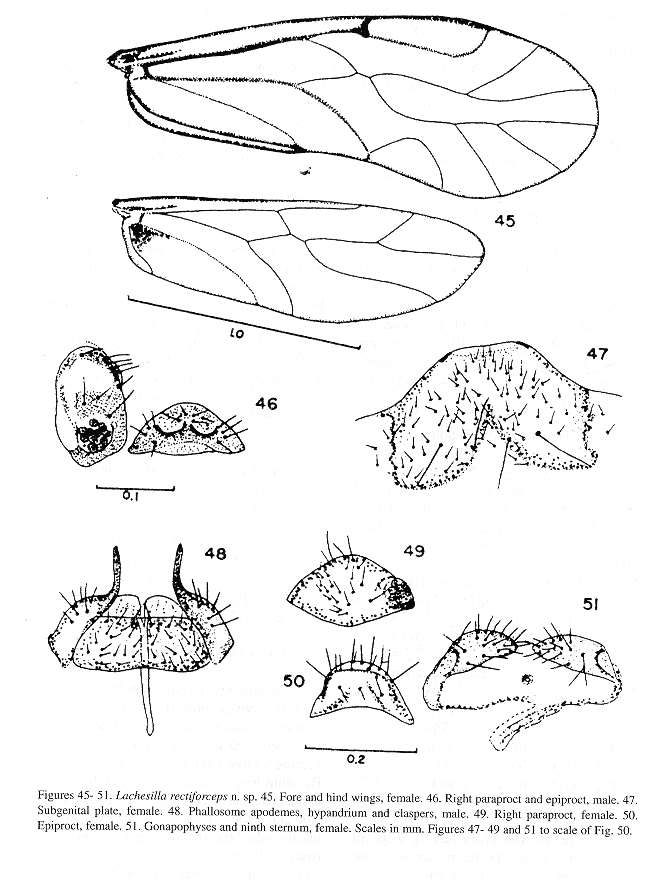
<body><![CDATA[<br><font size=-1></font>&nbsp;<font size=-1></font>     <center>     <p><i><font face="Arial,Helvetica"><font size=-1>Lachesilla rectiforceps n. sp.</font></font></i>     <br><font face="Arial,Helvetica"><font size=-1>(<a href="#fig45-51">Figs. 45-51</a>)</font></font></center> <font size=-1></font>     <p><font face="Arial,Helvetica"><font size=-1><b>Female. </b>COLOR. Pale brown. Compound eyes black ocelli hyaline, without pigmented centripetal crescents. Two brown bands from each compound eye to epistomal sulcus, enclosing antennal fossae. Maxillary palps and antennae brown. Legs pale brown. Wings hyaline, veins brown.</font></font>     <br><font size=-1></font>&nbsp;<font size=-1></font>     <p><font face="Arial,Helvetica"><font size=-1><b>Morphology.</b> Fore wing (<a href="#fig45-51">Fig. 45</a>), with pterostigma elongate, about four times as long as wide. Rs-M fused for a length basally, diverging from a point or connected by a shor crossvein. Areola postica wide basally, with wide, rounded apex. Hind wing (<a href="#fig45-51">Fig. 45</a>), with Rs-M basally fused for a length. Subgenital plate (<a href="#fig45-51">Fig. 47</a>), with seatae as illustrated, hind margin flat, with a hyaline band along its length. Gonapophyses (<a href="#fig45-51">Fig. 51</a>), widest in teh middle, blunt ended seae as illustrated. Spermapore (<a href="#fig45-51">Fig. 51</a>), small, almost&nbsp; in center of ninth sternum, surrounded by a slender pigmented rign. Paraprocts (<a href="#fig45-51">Fig. 49</a>), almost elliptic, setae as illustrated, sensory fields with 10 trichobothria, a marginal one without basal rosette. Epiproct (<a href="#fig45-51">Fig. 50</a>), almost trapezial, setal field on posterior half.</font></font><font size=-1></font>     <p><font face="Arial,Helvetica"><font size=-1><b>Measurements. </b>FW: 2011, HW: 1543, F. 402, T: 732, t<sub>1</sub>; 243, t<sub>2</sub>: 89, ctt<sub>1</sub>: 19, Mx4: 98, f<sub>1</sub>: 268, f<sub>2</sub>: 235, f<sub>3</sub>: 182, f<sub>4</sub>: 147, f<sub>5</sub>: 96, f<sub>6</sub>: 86, f<sub>7</sub>: 73, f<sub>8</sub>: 82, f<sub>9</sub>: 75, f<sub>10</sub>: 68, f<sub>11</sub>: 97, IO: 265, D: 177, d: 118, IO/D: 1.49, PO: 0.66.</font></font><font size=-1></font>     <p><font face="Arial,Helvetica"><font size=-1><b>Male.</b> COLOR.&nbsp; Same as the female.</font></font><font size=-1></font>     <p><font face="Arial,Helvetica"><font size=-1><b>Morphology.</b> Hypandrium (<a href="#fig45-51">Fig. 48</a>), wide, setose, trapezial. Baculum (<a href="#fig45-51">Fig. 48</a>), long, slender, distal membranous extensions small, rounded. Claspers (<a href="#fig45-51">Fig. 48</a>), with shafts slender, straight, directed posteriorly; basal portions stout, with sides almost paralled, setae as illustrated, base with two large setae and 3-4 smaller ones paraprocts (<a href="#fig45-51">Fig. 46</a>), long, quadrate, setae as illustrated, sensory fields with 12 trichobothria, a marginal one without basal rosette. Epiproct (<a href="#fig45-51">Fig. 46</a>), almost semicircular, with a setal field on each anterolateral corner, and one posteriorly; a concave ban on each side of longitudinal midline.</font></font>     ]]></body>
<body><![CDATA[<br><font size=-1></font>&nbsp;<font size=-1></font>     <center>     <p><a NAME="fig45-51"></a><img SRC="/img/fbpe/rbt/v47n1-2/0332i9.GIF" height=880 width=655></center> <font size=-1></font>     
<p>    <br><font size=-1></font>     <p><font face="Arial,Helvetica"><font size=-1><b>Measurements.</b> FW: 1537, HW: 1202, F: 323, T: 595, t<sub>1</sub>: 197, t<sub>2</sub>: 78, ctt<sub>1</sub>: 15, Mx4: 73, f1226, f<sub>2</sub>: 197, f<sub>3</sub>: 177, f<sub>4</sub>: 131, f<sub>5</sub>: 89, f<sub>6</sub>: 83, f<sub>7</sub>: 70, f<sub>8</sub>: 73.6, IO: 258, D: 153, d: 106, IO/D: 1.67, PO: 0.68.</font></font><font size=-1></font>     <p><font face="Arial,Helvetica"><font size=-1><b>Type Locality.</b> MEXICO. <b>Veracruz.</b> Los Tuxtlas, ca. Balzapote, 3.VIII.1989 on dead fronds of coconut palm and on dried guava leaves, holotype&nbsp;<img SRC="/img/fbpe/rbt/v47n1-2/Macho.GIF" height=18 width=20>, allotype&nbsp;<img SRC="/img/fbpe/rbt/v47n1-2/Hembra.GIF" height=21 width=15>, paratype&nbsp;<img SRC="/img/fbpe/rbt/v47n1-2/Macho.GIF" height=18 width=20>, ANGA (CNI-IBUNAM).</font></font>     
<br><font size=-1></font>&nbsp;<font size=-1></font>     <p><font face="Arial,Helvetica"><font size=-1><b>Records.</b> MEXICO. <b>Chiapas.</b> Biosphere Reserve El Ocote, 700 m., 1.V.1993, La Reina beating branches with dried leaves, 1&nbsp;<img SRC="/img/fbpe/rbt/v47n1-2/Macho.GIF" height=18 width=20>, ANGA. 2.V.1993 beating&nbsp; branches with dead leaves, ca. Mayan&nbsp; ruins, 1&nbsp;<img SRC="/img/fbpe/rbt/v47n1-2/Hembra.GIF" height=21 width=15>, ANGA. 10 Km SW Jaltenango, 700 m., 4.V.1993, beating branches with dried leaves, 1&nbsp;<img SRC="/img/fbpe/rbt/v47n1-2/Hembra.GIF" height=21 width=15>, ANGA. Oaxaca. Chiltepec, 17.III.1990, 1&nbsp;<img SRC="/img/fbpe/rbt/v47n1-2/Macho.GIF" height=18 width=20>, AC. Veracruz. 23 Km N Nautla, Hwy, 180, 27.VI.1962, beating broad leaved trees, shrubs and vines, lowland rain forest, 1&nbsp;<img SRC="/img/fbpe/rbt/v47n1-2/Macho.GIF" height=18 width=20>, ELM. Los Tuxtlas, UNAM, Biology Station, 26.VI.1979, beating foliage in forest 1<img SRC="/img/fbpe/rbt/v47n1-2/Hembra.GIF" height=21 width=15> 1&nbsp;<img SRC="/img/fbpe/rbt/v47n1-2/Macho.GIF" height=18 width=20>, ANGA. 17.VIII.1987, on dead leaves of fallen trees, 24&nbsp;<img SRC="/img/fbpe/rbt/v47n1-2/Hembra.GIF" height=21 width=15>, 4&nbsp;<img SRC="/img/fbpe/rbt/v47n1-2/Macho.GIF" height=18 width=20>, ANGA. 8.VII.1988, beating branches with dried leaves, forest edge, 2&nbsp;<img SRC="/img/fbpe/rbt/v47n1-2/Hembra.GIF" height=21 width=15>, 1&nbsp;<img SRC="/img/fbpe/rbt/v47n1-2/Macho.GIF" height=18 width=20>, ANGA. Ca. UNAM Biology Station 9.VII. 1988, beating citrus banches, 1&nbsp;<img SRC="/img/fbpe/rbt/v47n1-2/Macho.GIF" height=18 width=20>, ANGA. 23 Km NW Alvarado, 13.III.1984, beating vegetation in hammock, 3&nbsp;<img SRC="/img/fbpe/rbt/v47n1-2/Hembra.GIF" height=21 width=15>, 1&nbsp;<img SRC="/img/fbpe/rbt/v47n1-2/Macho.GIF" height=18 width=20>, ANGA.</font></font><font size=-1></font>     
<p><font face="Arial,Helvetica"><font size=-1><b>&nbsp;Comments.</b> The characteristis shape of the claspers in this species makes it unique among the other species in the group.</font></font><font size=-1></font>     ]]></body>
<body><![CDATA[<center>     <p><i><font face="Arial,Helvetica"><font size=-1>Lachesilla typhicola n. sp.</font></font></i>     <br><font face="Arial,Helvetica"><font size=-1>(<a href="#fig52-58">Figs. 52-58</a>)</font></font></center> <font size=-1></font>     <p><font face="Arial,Helvetica"><font size=-1><b>Female.</b> COLOR. Pale yellowish brown. Compound eyes black, ocelli hyaline, without pigmented centripetal crescents. Antennae and maxillary palps pale brown. Legs pale brown, witns hyaline, veins pale brown. A slender, brown, irregular band on each side of thorax, running above the coxae. Abdomen pale brown subcuticular rings, more conspicuous on the sides.</font></font><font size=-1></font>     <p><font face="Arial,Helvetica"><font size=-1><b>Morphology</b>. Fore wings with a crossvein between lower posterior angle of pterostigma to the base of R<sub>2+3</sub>. Rs-M joined for a short length; areola postica almost triangular (<a href="#fig52-58">Fig. 52</a>). Hw Rs-M joined for a length (<a href="#fig52-58">Fig. 52</a>). Subgenital plate trapezial, wide, setose as illustrated (<a href="#fig52-58">Fig. 54</a>). Gonapophyses (<a href="#fig52-58">Fig. 53</a>) wide basally, narrowing to blunt apex, setae as illustrated. Spermapore near the center of the&nbsp; ninth sternum, surrounded by a wide, pigmented ring. Paraprocts broad, setose, sensory fields with 10-11 trichobothria, one, on inner edge, without basal rosette (<a href="#fig52-58">Fig. 55</a>). Epiproct (<a href="#fig52-58">Fig. 56</a>), rounded posteriorly, setal field as illustrated.</font></font><font size=-1></font>     <p><font face="Arial,Helvetica"><font size=-1><b>Measurements.</b> FW: 1651, HW: 1348, F: 385, T: 701, t1: 249, t<sub>2</sub>: 97, ctt1: 14, Mx4: 84, f1: 301, f2: 265, f3: 219, f4: 190, f5: 102, f6: 102, f7: 78, f8: 84, f9: 74, f10: 77, f11: 83, IO: 289, D: 138, d: 132, IO/D: 2.08, PO: 0.95.</font></font><font size=-1></font>     <p><font face="Arial,Helvetica"><font size=-1><b>&nbsp;Male.</b> COLOR. Same as the female.</font></font><font size=-1></font>     <p><font face="Arial,Helvetica"><font size=-1><b>Morphology.</b> Hypandrium broad, setose, sligntly convex posteriorly; basal half of claspers continuos with shaft, bearing three large seatae. Shaft stouf, with apex rounded, bearing a largetooth on inner edge (<a href="#fig52-58">Fig. 57</a>). Baculum long, slender, distal lamellae broad, almost triangular. Paraprocts (<a href="#fig52-58">Fig. 58</a>), broad elongate, setae as illustrated; sensory field with ten trichobothria, one marginal without basal rosette. Epiproct (<a href="#fig52-58">Fig. 58</a>), wide basally, almost triangular, setae as illustrated.</font></font>     <br><font size=-1></font>&nbsp;<font size=-1></font>     <center>     ]]></body>
<body><![CDATA[<p><a NAME="fig52-58"></a><img SRC="/img/fbpe/rbt/v47n1-2/0332i10.GIF" height=880 width=651></center>      
<br>&nbsp;     <p>    <br><font size=-1></font>     <p><font face="Arial,Helvetica"><font size=-1><b>Measurements</b>. FW: 1766, HW: 1345, F: 378, T: 645, t<sub>1</sub>: 212, t2: 84, ctt<sub>1</sub>: 15, Mx4: 114, f<sub>1</sub>: 300, f<sub>2</sub>: 279, f<sub>3</sub>: 226, f<sub>4</sub>: 185, f<sub>5</sub>: 107, f<sub>6</sub>: 106, f<sub>7</sub>: 78, f<sub>8</sub>: 81, f<sub>9</sub>: 76, f<sub>10</sub>: 75, f<sub>11</sub>: 93, IO: 260, D: 144, d: 106, IO/D: 1.81, PO: 0.73.</font></font><font size=-1></font>     <p><font face="Arial,Helvetica"><font size=-1><b>Type Locality. </b>USA. Illinois. Lake Co. 1 mi E Waukonda, 26.VII. 1959 beating cattails, holotype&nbsp;<img SRC="/img/fbpe/rbt/v47n1-2/Macho.GIF" height=18 width=20>, allotype&nbsp;<img SRC="/img/fbpe/rbt/v47n1-2/Hembra.GIF" height=21 width=15> 3 paratypes of each sex, ELM (ISU).</font></font><font size=-1></font>     
<p><font face="Arial,Helvetica"><font size=-1><b>Records.</b> USA. <b>Illinois.</b> Lake Co. Illinois Toll Rd. and State Rd. 176, 26.VII.1959, beating cattails, 2&nbsp;<img SRC="/img/fbpe/rbt/v47n1-2/Macho.GIF" height=18 width=20>, 3&nbsp;<img SRC="/img/fbpe/rbt/v47n1-2/Hembra.GIF" height=21 width=15>, ELM. Makanda, 5.IX.1967, beating Typha latifolia, 2&nbsp;<img SRC="/img/fbpe/rbt/v47n1-2/Macho.GIF" height=18 width=20>, 6&nbsp;<img SRC="/img/fbpe/rbt/v47n1-2/Hembra.GIF" height=21 width=15>, ELM. Mason Co., Mason State Forest, 23..X.1965, beating tree branches, 2&nbsp;<img SRC="/img/fbpe/rbt/v47n1-2/Macho.GIF" height=18 width=20>, GEE. Florida. Liberty Co., Torreya State Park, 23.VIII.1962, 3&nbsp;<img SRC="/img/fbpe/rbt/v47n1-2/Hembra.GIF" height=21 width=15>, ELM. 3-4.VI.1952, 12&nbsp;<img SRC="/img/fbpe/rbt/v47n1-2/Macho.GIF" height=18 width=20>, 5&nbsp;<img SRC="/img/fbpe/rbt/v47n1-2/Hembra.GIF" height=21 width=15>, ELM. <b>Indiana.</b> Steuben Co., State Rd. 120 at Fawn River, 31.VII.1956, beating cattails, 6&nbsp;<img SRC="/img/fbpe/rbt/v47n1-2/Macho.GIF" height=18 width=20>, 9&nbsp;<img SRC="/img/fbpe/rbt/v47n1-2/Hembra.GIF" height=21 width=15>, ELM. Parke Co., Turkey Run State Park, 27.VI.1964, beating oaks, 2&nbsp;<img SRC="/img/fbpe/rbt/v47n1-2/Macho.GIF" height=18 width=20>, 8&nbsp;<img SRC="/img/fbpe/rbt/v47n1-2/Hembra.GIF" height=21 width=15>, GEE. <b>Michigan.</b> Livingston Co., E.S. George Reserve, 26.VII.1956, beating dead clumps of Typha angustifolia in cattail marsh, 3<img SRC="/img/fbpe/rbt/v47n1-2/Macho.GIF" height=18 width=20> , 2&nbsp;<img SRC="/img/fbpe/rbt/v47n1-2/Hembra.GIF" height=21 width=15>, ELM. 7.IX.1952, 10&nbsp;<img SRC="/img/fbpe/rbt/v47n1-2/Macho.GIF" height=18 width=20>, 9&nbsp;<img SRC="/img/fbpe/rbt/v47n1-2/Hembra.GIF" height=21 width=15>, ELM. <b>Minnesota. </b>St. Paul, State Hwy. 49 at 500 Line tracs. 30.VIII.1956, beating cattails at marsh edge, 8&nbsp;<img SRC="/img/fbpe/rbt/v47n1-2/Macho.GIF" height=18 width=20>, 16&nbsp;<img SRC="/img/fbpe/rbt/v47n1-2/Hembra.GIF" height=21 width=15>, ELM.</font></font><font size=-1></font>     
<p><font face="Arial,Helvetica"><font size=-1><b>Comments.</b> This species is very close to <i>L. anna</i> Sommerman, which occurs throughout eastern United States and southeastern Canada. The clasper shafts of <i>L. anna</i> are straight, much more slender,and the inner distal tooth is smaller than in <i>L. typhicola</i>. The female of the latter lacks the two yellow, ovoid sclerotized areas underlyng the subgenital plate of&nbsp;<i> L. anna</i>.</font></font>     <br><font size=-1></font>&nbsp;<font size=-1></font>     <center>     ]]></body>
<body><![CDATA[<p><font face="Arial,Helvetica"><font size=-1>Key to the North American species of Lachesilla in the group Forcepeta</font></font></center> <font size=-1></font>     <p>    <br><font size=-1></font>     <p><font face="Arial,Helvetica"><font size=-1>1. Fore wing with a crossvein between lower angle of pterostigma and Rs or R<sub>2+3</sub> ....................................................................&nbsp; 2</font></font>     <br><font face="Arial,Helvetica"><font size=-1>1'. Fore wing without a crossvein between lower angle of pterostigma and Rs or R<sub>2+3</sub>................................................................. 4</font></font><font size=-1></font>     <p><font face="Arial,Helvetica"><font size=-1>2. Female subenital plate with postero-lateral corners pointed, slightly protruding, and&nbsp; with a conical projection next to each one (<a href="#fig13-17">Fig. 16</a>). Males unknown&nbsp; ......................................................................................................................... L. cladiunicola n.sp.</font></font>     <br><font face="Arial,Helvetica"><font size=-1>2`. Female subgenital plate without posterior&nbsp; pointed projections.............................................................................................. 3</font></font><font size=-1></font>     <p><font face="Arial,Helvetica"><font size=-1>3. Female ninth sternum with a dintinct, almost circular pigmented area on&nbsp; posterior margin, on each side of longitudinal midline (Fig. 30). Male claspers slightly dilated apically and slightly&nbsp; divided apically;&nbsp; phallosome apodemes posteriorly with two stout prongs, and a wide, denticulate lamella associated with each (<a href="#fig27-32">Fig. 31</a>) ................................................................L. floridana n.sp.</font></font>     <br><font face="Arial,Helvetica"><font size=-1>3`.&nbsp; Female ninth sternum not as above (<a href="#fig52-58">Fig. 53</a>). Claspers with a strong, acuminate projection distally on inner edge;&nbsp; phallosome apodemes divided posteriorly to form two almost triangular membranous pads (<a href="#fig52-58">Fig. 57</a>) ......................................L. typhicola n. sp.</font></font><font size=-1></font>     <p><font face="Arial,Helvetica"><font size=-1>4. Hypandrium projected posteriorly to form a long, stout, auminate extension; phallosome apodemes undivided posteriorly. Female gonapophyses broad, distally blunt, ninth sternum with a distinct, almost elliptical pigmented area posterior to spermapore, with transverse striae (<a href="#García76">Garc&iacute;a Aldrete, 1976</a>) ............................................................................................. L. aculeata Garc&iacute;a Aldrete</font></font>     ]]></body>
<body><![CDATA[<br><font face="Arial,Helvetica"><font size=-1>4`. Hypandrium not as above. Phallosome podemes clearly divided posteriorly or extended into a membranous area. Female gonapophyses and ninth sternum not as above&nbsp; ...................................................................................................................... 5</font></font><font size=-1></font>     <p><font face="Arial,Helvetica"><font size=-1>5. Phallosome apodemes posteriorly extended into a broad, membranous area ..........................................................................6</font></font>     <br><font face="Arial,Helvetica"><font size=-1>5`. Phallosome apodemes posteriorly divided in two membranous pads or in two acuminate prongs ............................................ 9</font></font><font size=-1></font>     <p><font face="Arial,Helvetica"><font size=-1>6. Clasper shaft with an acuminate projection on inner edge .................................................................................................... 7</font></font>     <br><font face="Arial,Helvetica"><font size=-1>6`.&nbsp; Clasper shaft smooth, without projections ........................................................................................................................ 8</font></font><font size=-1></font>     <p><font face="Arial,Helvetica"><font size=-1>7.&nbsp; Male epiproct with well defined, stout prong posteriorly; male paraproct with small mesal prong. Female subgenital plate without pigmented areas (<a href="#García96">Garc&iacute;a Aldrete, 1996</a>) ................................................................................... L. denticuliforceps Garc&iacute;a Aldrete</font></font>     <br><font face="Arial,Helvetica"><font size=-1>7`.&nbsp; Male epiproct with wide posterior projection; paraproct without mesal prong. Female subgenital plate with two mesal, well defined pigmented areas, one to each side of longitudinal midline (<a href="#García88">Garc&iacute;a Aldrete, 1988</a>) .................... L. denticulata Garc&iacute;a Aldrete</font></font><font size=-1></font>     <p><font face="Arial,Helvetica"><font size=-1>8.&nbsp; Clasper shaft curved inwards distally acuminate. Female ninth sternum limited anteriorly by wide pigmented band; postero-lateral corners of subgenital plate, protruding, almost square (<a href="#García88">Garc&iacute;a Aldrete, 1988</a>) ........................................... L. alpejia Garc&iacute;a Aldrete</font></font>     <br><font face="Arial,Helvetica"><font size=-1>8`. Clasper shaft curved outwards, distally blunt (<a href="#fig18-23">Fig. 21</a>). Female ninth sternum without pigmented&nbsp; band anteriorly (Fig. 22); postero-lateral corners of subgenital plate rounded, protrudind (<a href="#fig18-23">Fig. 20</a>) ....................................................... L. estradaorum n. sp.</font></font><font size=-1></font>     <p><font face="Arial,Helvetica"><font size=-1>9. Phallosome apodemes posteriorly with two distint acuminate prongs .................................................................................&nbsp; 10</font></font>     ]]></body>
<body><![CDATA[<br><font face="Arial,Helvetica"><font size=-1>9`. Phallasome apodemes posteriorly with two membranous pads .......................................................................................... 13</font></font><font size=-1></font>     <p><font face="Arial,Helvetica"><font size=-1>10. Claspers slender, distally blunt; prongs of phallosome apodemes large, fused to posterior border of hypandrium, directed laterally (Fig. 41). Female subgenital plate with two mesal, rounded, distinct pigmented areas (<a href="#fig39-44">Fig. 44</a>) .........................&nbsp; L. maculata n. sp.</font></font>     <br><font face="Arial,Helvetica"><font size=-1>10`.&nbsp; Claspers large, distally acuminate; prongs of phallosome not as above. Female subgenital plate withour mesal pigmented&nbsp; areas ................................................................................................................................................................................ 11</font></font><font size=-1></font>     <p><font face="Arial,Helvetica"><font size=-1>11, Prongs of phallosome apodemes curved inwards; clasper shaft with stout projection on outer edge, near apex. Female subgenital plate with two large, weakly pigmented areas mesally one to each side of longitudinal midline; ninth sternum with large elongate, tear-shaped, longitudinal pigmented area, enclosing spermapore (<a href="#García88">Garc&iacute;a Aldrete, 1988</a>) ........................ L. disjuncta Garc&iacute;a Aldrete</font></font>     <br><font face="Arial,Helvetica"><font size=-1>11`.&nbsp; Prongs of phallosome apodemes curved outwards; clasper shaft withour projection on outer edge. Female subgenital plate and ninth sternum not as above ................................................................................................................................................. 12</font></font><font size=-1></font>     <p><font face="Arial,Helvetica"><font size=-1>12.&nbsp; Prongs of phallosome apodemes each with a narrow, denticulate lamella; clasper shaft with a short, denticulate&nbsp; carina (<a href="#fig1-6">Fig. 6</a>). Female subgenital plate broad (<a href="#fig1-6">Fig. 5</a>)................................................................................................. L. carinata Garc&iacute;a Aldrete</font></font>     <br><font face="Arial,Helvetica"><font size=-1>12`. Prongs of phallosome apodemes each with a wide, denticulate lamella, clasper shaft with a long, denticulate carina. (<a href="#fig7-12">Fig. 12</a>). Female subgenital plate narrow (<a href="#fig7-12">Fig. 11</a>)......................................................................................... L.carinatoides Garc&iacute;a Aldrete</font></font><font size=-1></font>     <p><font face="Arial,Helvetica"><font size=-1>13, Male epiproct simple, without projections or protuberances, at most with mesal field of papillae ........................................... 19</font></font>     <br><font face="Arial,Helvetica"><font size=-1>13`.Male epiproct not project posteriorly or with&nbsp; one or two mesal protuberances .................................................................... 14</font></font><font size=-1></font>     <p><font face="Arial,Helvetica"><font size=-1>14.&nbsp; Male epiproct simple, without projections or protuberances, at most with mesal field of papillae .......................................... 15</font></font>     ]]></body>
<body><![CDATA[<br><font face="Arial,Helvetica"><font size=-1>14`. Male epiproct not projected posteriorly; mesally with one or two mesal protuberances ....................................................... 16</font></font><font size=-1></font>     <p><font face="Arial,Helvetica"><font size=-1>15. Clasper shaft stout, dilated near the apex; female subgenital plate broad, posterior margin wide (<a href="#Mockford56">Mockford &amp; Gurney. 1956</a>) .............................................................................................................................................. L. kathrynae Mockford &amp; Gurney</font></font>     <br><font face="Arial,Helvetica"><font size=-1>15`.&nbsp; Clasper shaft slender, acuminate; female subgenital plate with sides coverging to a narrow posterior margin (Sommerman, 1946) .............................................................................................................................................&nbsp; L. chapmani Sommerman</font></font><font size=-1></font>     <p><font face="Arial,Helvetica"><font size=-1>16. Clasper shaft with row of denticles on inner edge ............................................................................................................. 17</font></font>     <br><font face="Arial,Helvetica"><font size=-1>16`.&nbsp; Clasper shaft not as above .......................................................................................................................................... 18</font></font><font size=-1></font>     <p><font face="Arial,Helvetica"><font size=-1>17, Clasper shaft slender; male epiproct with a slender, transverse, mesal protuberance (<a href="#García96">Garc&iacute;a Aldrete, 1996</a>)&nbsp; ...........................................................................................................................................&nbsp; L. yanomamioides Garc&iacute;a Aldrete</font></font>     <br><font face="Arial,Helvetica"><font size=-1>17`, Clasper shaft stout; male epiproct with a mesal triangular protuberance, posterior to two fieldes of papillae (<a href="#García88">Garc&iacute;a Aldrete, 1988</a>) ................................................................................................................................................ L. gracilis Garc&iacute;a Aldrete</font></font><font size=-1></font>     <p><font face="Arial,Helvetica"><font size=-1>18. Clasper shaft slightly dilated distally, apically with 2-3 denticles on inner edge (<a href="#fig33-38">Fig. 37</a>); male epiproct with basally wide, mesal, triangular protuberance ........................................................................................................... L. laciniosiforceps Garc&iacute;a Aldrete</font></font>     <br><font face="Arial,Helvetica"><font size=-1>18`. Clasper shaft distally acuminate, with an acuminate projection on inner edge; male epiproct with two mesal, rounded protuberances (<a href="#García96">Garc&iacute;a Aldrete, 1996</a>) .......................................................................................... acuminiforceps Garc&iacute;a Aldrete</font></font><font size=-1></font>     <p><font face="Arial,Helvetica"><font size=-1>19. Hypandrium extended&nbsp; posteriorly in the middle; clasper shaft almost straight, directed posteriorly, distally with a slender, acuminate projection; epiproct robust, trapecial, with postero-lateral corners prominent, rounded (<a href="#Sommerman">Sommerman, 1946</a>, <a href="#Mockford93">Mockford, 1993</a>) .................................................................................................................................................... L. penta Sommerman</font></font>     ]]></body>
<body><![CDATA[<br><font face="Arial,Helvetica"><font size=-1>19`. Hypandrium, claspers and epiproct not as above ............................................................................................................ 20</font></font><font size=-1></font>     <p><font face="Arial,Helvetica"><font size=-1>20. Clasper shaft distally divided, with outer arm longer than inner one; female subgenital plate with two distinct, pigmented oval areas, one to each side of longitudinal midline (<a href="#Sommerman">Sommerman, 1946</a>; <a href="#Mockford93">Mockford, 1993</a>) ..................................... L. anna Sommerman</font></font>     <br><font face="Arial,Helvetica"><font size=-1>20`. Claspers and female subgenital plate not as above ......................................................................................................... 21</font></font><font size=-1></font>     <p><font face="Arial,Helvetica"><font size=-1>21. Clasper shaft distally acuminate .................................................................................................................................... 22</font></font>     <br><font face="Arial,Helvetica"><font size=-1>21`.&nbsp; Clasper shaft distally blunt .......................................................................................................................................... 25</font></font><font size=-1></font>     <p><font face="Arial,Helvetica"><font size=-1>22. Base of clasper shaft with field spines on outer edge; male epiproct with field of papillae near anterior border ........................ 23</font></font>     <br><font face="Arial,Helvetica"><font size=-1>22`.&nbsp; Base of clapser shaft and male epiproct not as above .................................................................................................... 24</font></font><font size=-1></font>     <p><font face="Arial,Helvetica"><font size=-1>23. Spines on base of clasper shaft stout, strongly sclerotized, male epiproct with broad field of large papillae (<a href="#Mockford93">Mockford, 1993</a>) ........................................................................................................................................................ L. forcepeta Sommerman</font></font>     <br><font face="Arial,Helvetica"><font size=-1>23`.&nbsp; Spines on base of clasper shaft slender, weakly sclerotized; male epiproct with transverse, slender field&nbsp;&nbsp; of small papillae (<a href="#Mockford93">Mackford, 1993</a>) .................................................................................................................................... L. major Sommerman</font></font><font size=-1></font>     <p><font face="Arial,Helvetica"><font size=-1>24. Clasper shaft stout, curved apices pointing inwards; male epiproct subquadrante (<a href="#Mockford56">Mockford &amp; Gurney, 1956</a>) ..............................................................................................................................................&nbsp; L. bottimeri Mockford &amp; Gurney</font></font>     ]]></body>
<body><![CDATA[<br><font face="Arial,Helvetica"><font size=-1>24`. Clasper shaft slender, almost straight, directed posteriorly (Fig. 48); male epiproct broadly triangular (<a href="#fig24-26">Fig. 25</a>) ................................................................................................................................................................ L. reciforceps n. sp.</font></font><font size=-1></font>     <p><font face="Arial,Helvetica"><font size=-1>25. Clasper shaft distinctly bulged apically; membranous pads distalto phallosome apodemes large, almost square (<a href="#fig24-26">Fig. 25</a>) .................................................................................................................................................................... L. filicicola n. sp.</font></font>     <br><font face="Arial,Helvetica"><font size=-1>25`. Clasper shaft and pads of phallosome apodemes not as above ....................................................................................... 26</font></font><font size=-1></font>     <p><font face="Arial,Helvetica"><font size=-1>26. Hypandrium narrow antero-posteriorly; outer border of clasper base straight (<a href="#García88">Garc&iacute;a Aldrete, 1988</a>)&nbsp;&nbsp; ..........................................................................................................................................................&nbsp; L. cuala Garc&iacute;a Aldrete</font></font>     <br><font face="Arial,Helvetica"><font size=-1>26.Hypandrium&nbsp; wide antero-posteriorly;&nbsp; outer border of clasper base convex .......................................................................... 27</font></font><font size=-1></font>     <p><font face="Arial,Helvetica"><font size=-1>27.Clasper base longer than clasper shaft, phallosome apodemes stout, distal pads large; spermapore large, a small pore posteriorly on pigmented area surrounding spermapore (<a href="#Mockford74">Mockford, 1974</a>; <a href="#García96">Garc&iacute;a Aldrete, 1996</a>) .................. L. sandersoni Mockford</font></font>     <br><font face="Arial,Helvetica"><font size=-1>27`. Clasper base about as long as clasper shaft, phallosome apodemes slender, distal pads small; spermapore small; lacking a posterior pore on pigmented ring surrounding spermapore (<a href="#Sommerman">Sommerman, 1946</a>; <a href="#Mockford93">Mockford, 1993</a>) ...... L. contraforcepea Sommerman</font></font>     <br><font size=-1></font>&nbsp;<font size=-1></font>     <p><b><font face="Arial,Helvetica"><font size=-1>Resumen</font></font></b><font size=-1></font>     <p><font face="Arial,Helvetica"><font size=-1>Se describen e ilustran, diez especies de Lachesilla en el grupo Forcepeta. Tres de ellas han sido&nbsp; recolectadas exclusivamente en los Estados Unidos, seis son exclusivas de M&eacute;xico, y una se ha registrado en el suroeste de los Estados Unidos, en M&eacute;xico y en Guatemala. Las especies descritas son: L. carinata n. sp., de Chiapas, Campeche, Hidalgo, Morelos, Oaxaca, San Luis Potos&iacute;, Tabasco, Tamaulipas y Veracruz; L. carinatoides n. sp., de la Isla Mar&iacute;a Madre, Guerrero y Oaxaca; L. cladiumicola n. sp., de una sola localidad en Levy County, Florida; L. estradaorum n. sp., de una sola localidad en Los Tuxtlas, Veracruz; L. filicicola n. sp., de una sola localidad en Tabasco; L. floridana n. sp., de varias localidades en Florida; L. laciniosiforceps n. sp., de Florida, Louisiana, Chiapas, Coahuila, Guerrero, Hidalgo, Jalisco, Nuevo Le&oacute;n, Puebla, San Luis Potos&iacute;, Tamaulipas, Veracruz, Yucat&aacute;n, y Guatemala; L. maculata n. sp., de Chiapas, Tabasco y Veracruz; L. rectiforceps n. sp., de Veracruz, Chiapas y Oaxaca, y&nbsp; L. typhicola n. sp. de Florida, Illinois, Indiana, Michigan y Minnesota. Todas ellas difieren entre s&iacute;, y de las otras especies del grupo, en caracteres de venaci&oacute;n y, principalmente, en caracteres genitales de los dos sexos. La locaci&oacute;n de los tipos se indica en las descripciones respectivas.</font></font>     ]]></body>
<body><![CDATA[<br><font size=-1></font>&nbsp;<font size=-1></font>     <p><b><font face="Arial,Helvetica"><font size=-1>References</font></font></b><font size=-1></font>     <!-- ref --><p><a NAME="Badonnel"></a><font face="Arial,Helvetica"><font size=-1>Badonnel, A. &amp; A. N. Garc&iacute;a Aldrete. 1979. Nadleria, un nouveau genre de Lachesillidae (Psocoptera) de Br&eacute;sil. Nouv. Rev. Ent. 9: 3-8.</font></font><font size=-1></font>    &nbsp;&nbsp;&nbsp;&nbsp;&nbsp;&nbsp;&nbsp;&nbsp;[&#160;<a href="javascript:void(0);" onclick="javascript: window.open('/scielo.php?script=sci_nlinks&ref=1165182&pid=S0034-7744199900010001800001&lng=','','width=640,height=500,resizable=yes,scrollbars=1,menubar=yes,');">Links</a>&#160;]<!-- end-ref --><!-- ref --><p><a NAME="García74"></a><font face="Arial,Helvetica"><font size=-1>Garc&iacute;a Aldrete, A. N. 1974. A classification above species level of the genus Lachesilla Westwood (Psocoptera: Lachesilladae). Folia Entomol. Mex. 27: 1-88.</font></font><font size=-1></font>    &nbsp;&nbsp;&nbsp;&nbsp;&nbsp;&nbsp;&nbsp;&nbsp;[&#160;<a href="javascript:void(0);" onclick="javascript: window.open('/scielo.php?script=sci_nlinks&ref=1165183&pid=S0034-7744199900010001800002&lng=','','width=640,height=500,resizable=yes,scrollbars=1,menubar=yes,');">Links</a>&#160;]<!-- end-ref --><!-- ref --><p><a NAME="García76"></a><font face="Arial,Helvetica"><font size=-1>Garc&iacute;a Aldrete, A. N. 1976. Nuevas Lachesilla (Psocoptera: Lachesillidae) neotropicales. Folia Entomol. Mex. 34: 3-11.</font></font><font size=-1></font>    &nbsp;&nbsp;&nbsp;&nbsp;&nbsp;&nbsp;&nbsp;&nbsp;[&#160;<a href="javascript:void(0);" onclick="javascript: window.open('/scielo.php?script=sci_nlinks&ref=1165184&pid=S0034-7744199900010001800003&lng=','','width=640,height=500,resizable=yes,scrollbars=1,menubar=yes,');">Links</a>&#160;]<!-- end-ref --><!-- ref --><p><a NAME="García88"></a><font face="Arial,Helvetica"><font size=-1>Garc&iacute;a Aldrete, A. N. 1988. Species of Lachesilla (Psocoptera: Lachesillidae) from the coast of the Mexican state of Jalisco. Folia. Entomol. Mex. 77: 33-61.</font></font><font size=-1></font>    &nbsp;&nbsp;&nbsp;&nbsp;&nbsp;&nbsp;&nbsp;&nbsp;[&#160;<a href="javascript:void(0);" onclick="javascript: window.open('/scielo.php?script=sci_nlinks&ref=1165185&pid=S0034-7744199900010001800004&lng=','','width=640,height=500,resizable=yes,scrollbars=1,menubar=yes,');">Links</a>&#160;]<!-- end-ref --><!-- ref --><p><a NAME="García96"></a><font face="Arial,Helvetica"><font size=-1>Garc&iacute;a Aldrete, A. N. 1996. Species of Lachesilla in the Caribbean islands and Trinidad (Insecta: Psocoptera: Lachesillidae). Insecta Mundi, 10: 105-138</font></font><font size=-1></font>    &nbsp;&nbsp;&nbsp;&nbsp;&nbsp;&nbsp;&nbsp;&nbsp;[&#160;<a href="javascript:void(0);" onclick="javascript: window.open('/scielo.php?script=sci_nlinks&ref=1165186&pid=S0034-7744199900010001800005&lng=','','width=640,height=500,resizable=yes,scrollbars=1,menubar=yes,');">Links</a>&#160;]<!-- end-ref --><!-- ref --><p><a NAME="García98"></a><font face="Arial,Helvetica"><font size=-1>Garc&iacute;a Aldrete, A. N. 1998. New South American Lachesilla in the group Forcepeta (Psocoptera: Lachesillidae). Insecta Mundi (in press).</font></font><font size=-1></font>    &nbsp;&nbsp;&nbsp;&nbsp;&nbsp;&nbsp;&nbsp;&nbsp;[&#160;<a href="javascript:void(0);" onclick="javascript: window.open('/scielo.php?script=sci_nlinks&ref=1165187&pid=S0034-7744199900010001800006&lng=','','width=640,height=500,resizable=yes,scrollbars=1,menubar=yes,');">Links</a>&#160;]<!-- end-ref --><!-- ref --><p><a NAME="http:/img/fbpe/rbt/v47n1-2/Mockford74"></a><font face="Arial,Helvetica"><font size=-1>Mockford, E. L. 1974. Records and descriptions of Cuban Psocoptera. Entomol Amer. 48: 103-215.</font></font><font size=-1></font>    &nbsp;&nbsp;&nbsp;&nbsp;&nbsp;&nbsp;&nbsp;&nbsp;[&#160;<a href="javascript:void(0);" onclick="javascript: window.open('/scielo.php?script=sci_nlinks&ref=1165188&pid=S0034-7744199900010001800007&lng=','','width=640,height=500,resizable=yes,scrollbars=1,menubar=yes,');">Links</a>&#160;]<!-- end-ref --><!-- ref --><p><a NAME="http:/img/fbpe/rbt/v47n1-2/Mockford93"></a><font face="Arial,Helvetica"><font size=-1>Mockford, E. L. 1993. North American Psocoptera (Insecta) Flora and Fauna Handbook No. 10. Sandhill Crane Press, Inc. Gainesville, Florida-Leiden, The Netherlands. 455pp.</font></font><font size=-1></font>    &nbsp;&nbsp;&nbsp;&nbsp;&nbsp;&nbsp;&nbsp;&nbsp;[&#160;<a href="javascript:void(0);" onclick="javascript: window.open('/scielo.php?script=sci_nlinks&ref=1165189&pid=S0034-7744199900010001800008&lng=','','width=640,height=500,resizable=yes,scrollbars=1,menubar=yes,');">Links</a>&#160;]<!-- end-ref --><!-- ref --><p><a NAME="http:/img/fbpe/rbt/v47n1-2/Mockford56"></a><font face="Arial,Helvetica"><font size=-1>Mockford, E. L. &amp; A. B. Gurney. 1956. A review of the psocids, or book-lice and bark-lice, of Texas (Psocoptera). Jour. Wash. Acad. Sci. 46: 353-368.</font></font><font size=-1></font>    &nbsp;&nbsp;&nbsp;&nbsp;&nbsp;&nbsp;&nbsp;&nbsp;[&#160;<a href="javascript:void(0);" onclick="javascript: window.open('/scielo.php?script=sci_nlinks&ref=1165190&pid=S0034-7744199900010001800009&lng=','','width=640,height=500,resizable=yes,scrollbars=1,menubar=yes,');">Links</a>&#160;]<!-- end-ref --><!-- ref --><p><a NAME="Sommerman"></a><font face="Arial,Helvetica"><font size=-1>Sommerman, K. M. 1946. A revision of the genus Lachesilla north of Mexico CorrodentiaCaeciliidae). Ann. Entomol. Soc. Amer. 39: 627-661.</font></font><font face="Arial,Helvetica"><font size=-1></font></font>    &nbsp;&nbsp;&nbsp;&nbsp;&nbsp;&nbsp;&nbsp;&nbsp;[&#160;<a href="javascript:void(0);" onclick="javascript: window.open('/scielo.php?script=sci_nlinks&ref=1165191&pid=S0034-7744199900010001800010&lng=','','width=640,height=500,resizable=yes,scrollbars=1,menubar=yes,');">Links</a>&#160;]<!-- end-ref --><p><a NAME="1a"></a><font face="Arial,Helvetica"><font size=-1><sup><a href="#1">1</a></sup> Departamento de Zoolog&iacute;a, Instituto de Biologia, UNAM, Apdo. Postal 70-153, 04510 M&eacute;xico, D.F.,&nbsp; M&eacute;xico, e-mail: <a href="../../../../../img/fbpe/rbt/v47n1-2/Mailto:anga@servidor.unam.mx">anga@servidor.unam.mx</a></font></font>      ]]></body><back>
<ref-list>
<ref id="B1">
<nlm-citation citation-type="journal">
<person-group person-group-type="author">
<name>
<surname><![CDATA[Badonnel]]></surname>
<given-names><![CDATA[A]]></given-names>
</name>
<name>
<surname><![CDATA[García Aldrete]]></surname>
<given-names><![CDATA[A. N]]></given-names>
</name>
</person-group>
<article-title xml:lang="fr"><![CDATA[Nadleria, un nouveau genre de Lachesillidae (Psocoptera) de Brésil]]></article-title>
<source><![CDATA[Nouv. Rev. Ent.]]></source>
<year>1979</year>
<volume>9</volume>
<page-range>3-8</page-range></nlm-citation>
</ref>
<ref id="B2">
<nlm-citation citation-type="journal">
<person-group person-group-type="author">
<name>
<surname><![CDATA[García Aldrete]]></surname>
<given-names><![CDATA[A. N]]></given-names>
</name>
</person-group>
<article-title xml:lang="en"><![CDATA[A classification above species level of the genus Lachesilla Westwood (Psocoptera: Lachesilladae)]]></article-title>
<source><![CDATA[Folia Entomol. Mex]]></source>
<year>1974</year>
<volume>27</volume>
<page-range>1-88</page-range></nlm-citation>
</ref>
<ref id="B3">
<nlm-citation citation-type="journal">
<person-group person-group-type="author">
<name>
<surname><![CDATA[García Aldrete]]></surname>
<given-names><![CDATA[A. N]]></given-names>
</name>
</person-group>
<article-title xml:lang="es"><![CDATA[Nuevas Lachesilla (Psocoptera: Lachesillidae) neotropicales]]></article-title>
<source><![CDATA[Folia Entomol. Mex]]></source>
<year>1976</year>
<volume>34</volume>
<page-range>3-11</page-range></nlm-citation>
</ref>
<ref id="B4">
<nlm-citation citation-type="journal">
<person-group person-group-type="author">
<name>
<surname><![CDATA[García Aldrete]]></surname>
<given-names><![CDATA[A. N]]></given-names>
</name>
</person-group>
<article-title xml:lang="en"><![CDATA[Species of Lachesilla (Psocoptera: Lachesillidae) from the coast of the Mexican state of Jalisco]]></article-title>
<source><![CDATA[Folia. Entomol. Mex]]></source>
<year>1988</year>
<volume>77</volume>
<page-range>33-61</page-range></nlm-citation>
</ref>
<ref id="B5">
<nlm-citation citation-type="journal">
<person-group person-group-type="author">
<name>
<surname><![CDATA[García Aldrete]]></surname>
<given-names><![CDATA[A. N]]></given-names>
</name>
</person-group>
<article-title xml:lang="en"><![CDATA[Species of Lachesilla in the Caribbean islands and Trinidad (Insecta: Psocoptera: Lachesillidae)]]></article-title>
<source><![CDATA[Insecta Mundi]]></source>
<year>1996</year>
<volume>10</volume>
<page-range>105-138</page-range></nlm-citation>
</ref>
<ref id="B6">
<nlm-citation citation-type="journal">
<person-group person-group-type="author">
<name>
<surname><![CDATA[García Aldrete]]></surname>
<given-names><![CDATA[A. N]]></given-names>
</name>
</person-group>
<article-title xml:lang="en"><![CDATA[New South American Lachesilla in the group Forcepeta (Psocoptera: Lachesillidae)]]></article-title>
<source><![CDATA[Insecta Mundi]]></source>
<year>1998</year>
</nlm-citation>
</ref>
<ref id="B7">
<nlm-citation citation-type="journal">
<person-group person-group-type="author">
<name>
<surname><![CDATA[Mockford]]></surname>
<given-names><![CDATA[E. L]]></given-names>
</name>
</person-group>
<article-title xml:lang="en"><![CDATA[Records and descriptions of Cuban Psocoptera]]></article-title>
<source><![CDATA[Entomol Amer]]></source>
<year>1974</year>
<volume>48</volume>
<page-range>103-215</page-range></nlm-citation>
</ref>
<ref id="B8">
<nlm-citation citation-type="book">
<person-group person-group-type="author">
<name>
<surname><![CDATA[Mockford]]></surname>
<given-names><![CDATA[E. L]]></given-names>
</name>
</person-group>
<source><![CDATA[North American Psocoptera (Insecta) Flora and Fauna Handbook No. 10]]></source>
<year>1993</year>
<publisher-loc><![CDATA[Gainesville^eFlorida-Leiden Florida-Leiden]]></publisher-loc>
<publisher-name><![CDATA[Sandhill Crane Press, Inc]]></publisher-name>
</nlm-citation>
</ref>
<ref id="B9">
<nlm-citation citation-type="journal">
<person-group person-group-type="author">
<name>
<surname><![CDATA[Mockford]]></surname>
<given-names><![CDATA[E. L]]></given-names>
</name>
<name>
<surname><![CDATA[Gurney]]></surname>
<given-names><![CDATA[A. B]]></given-names>
</name>
</person-group>
<article-title xml:lang="en"><![CDATA[A review of the psocids, or book-lice and bark-lice, of Texas (Psocoptera)]]></article-title>
<source><![CDATA[Jour. Wash. Acad. Sci]]></source>
<year>1956</year>
<volume>46</volume>
<page-range>353-368</page-range></nlm-citation>
</ref>
<ref id="B10">
<nlm-citation citation-type="journal">
<person-group person-group-type="author">
<name>
<surname><![CDATA[Sommerman]]></surname>
<given-names><![CDATA[K. M]]></given-names>
</name>
</person-group>
<article-title xml:lang="en"><![CDATA[A revision of the genus Lachesilla north of Mexico CorrodentiaCaeciliidae)]]></article-title>
<source><![CDATA[Ann. Entomol. Soc. Amer]]></source>
<year>1946</year>
<volume>39</volume>
<page-range>627-661</page-range></nlm-citation>
</ref>
</ref-list>
</back>
</article>