<?xml version="1.0" encoding="ISO-8859-1"?><article xmlns:mml="http://www.w3.org/1998/Math/MathML" xmlns:xlink="http://www.w3.org/1999/xlink" xmlns:xsi="http://www.w3.org/2001/XMLSchema-instance">
<front>
<journal-meta>
<journal-id>0034-7744</journal-id>
<journal-title><![CDATA[Revista de Biología Tropical]]></journal-title>
<abbrev-journal-title><![CDATA[Rev. biol. trop]]></abbrev-journal-title>
<issn>0034-7744</issn>
<publisher>
<publisher-name><![CDATA[Universidad de Costa Rica]]></publisher-name>
</publisher>
</journal-meta>
<article-meta>
<article-id>S0034-77441998000400027</article-id>
<title-group>
<article-title xml:lang="es"><![CDATA[Reproducción asincrónica de Sceloporus palaciosi (Sauria: Phrynosomatidae) en México, con comentarios sobre sus ventajas y regulación]]></article-title>
</title-group>
<contrib-group>
<contrib contrib-type="author">
<name>
<surname><![CDATA[Méndez]]></surname>
<given-names><![CDATA[Fausto R.]]></given-names>
</name>
<xref ref-type="aff" rid="A01"/>
</contrib>
<contrib contrib-type="author">
<name>
<surname><![CDATA[Villagrán]]></surname>
<given-names><![CDATA[Maricela]]></given-names>
</name>
<xref ref-type="aff" rid="A02"/>
</contrib>
</contrib-group>
<aff id="A01">
<institution><![CDATA[,Instituto de Biología  ]]></institution>
<addr-line><![CDATA[ ]]></addr-line>
</aff>
<aff id="A02">
<institution><![CDATA[,Universidad Nacional Autónoma de México Facultad de Ciencias ]]></institution>
<addr-line><![CDATA[México Distrito Federal, México]]></addr-line>
</aff>
<pub-date pub-type="pub">
<day>00</day>
<month>12</month>
<year>1998</year>
</pub-date>
<pub-date pub-type="epub">
<day>00</day>
<month>12</month>
<year>1998</year>
</pub-date>
<volume>46</volume>
<numero>4</numero>
<fpage>1159</fpage>
<lpage>1161</lpage>
<copyright-statement/>
<copyright-year/>
<self-uri xlink:href="http://www.scielo.sa.cr/scielo.php?script=sci_arttext&amp;pid=S0034-77441998000400027&amp;lng=en&amp;nrm=iso"></self-uri><self-uri xlink:href="http://www.scielo.sa.cr/scielo.php?script=sci_abstract&amp;pid=S0034-77441998000400027&amp;lng=en&amp;nrm=iso"></self-uri><self-uri xlink:href="http://www.scielo.sa.cr/scielo.php?script=sci_pdf&amp;pid=S0034-77441998000400027&amp;lng=en&amp;nrm=iso"></self-uri><abstract abstract-type="short" xml:lang="en"><p><![CDATA[Fall reproduction is a common pattern in viviparous lizards from Mexican mountains. The reproductive pattern of Sceloporus palaciosi is seasonal but asynchronous between sexes. Males show testicular development in May and June whereas females ovulate in October. We suggest that the same environmental stimulous to reproduction occur twice a year, but the internal system determines the response of both sexes to different seasons, and fall stimulation allows early sexual maturity in females.]]></p></abstract>
<kwd-group>
<kwd lng="en"><![CDATA[Reproductive cycle]]></kwd>
<kwd lng="en"><![CDATA[viviparity]]></kwd>
<kwd lng="en"><![CDATA[sexual maturity]]></kwd>
<kwd lng="en"><![CDATA[Sceloporus palaciosi]]></kwd>
</kwd-group>
</article-meta>
</front><body><![CDATA[ <CENTER><B><FONT FACE="Arial,Helvetica">Reproducci&oacute;n asincr&oacute;nica de <I>Sceloporus palaciosi</I></FONT></B> <B><FONT FACE="Arial,Helvetica">(Sauria: Phrynosomatidae) en M&eacute;xico,</FONT></B></CENTER>      <CENTER><B><FONT FACE="Arial,Helvetica">con comentarios sobre sus ventajas y regulaci&oacute;n</FONT></B></CENTER>      <CENTER>&nbsp;</CENTER>      <CENTER>&nbsp;</CENTER>      <CENTER><FONT FACE="Arial,Helvetica"><FONT SIZE=-1><B>Fausto R. M&eacute;ndez<A NAME="1"></A></B><SUP><A HREF="#1a">1</A></SUP><B>&nbsp;&nbsp;&nbsp; Maricela Villagr&aacute;n<A NAME="2"></A></B><SUP><A HREF="#2a">2</A></SUP></FONT></FONT></CENTER>      <CENTER></CENTER>      <CENTER>&nbsp;</CENTER>      <CENTER>&nbsp;</CENTER>      <CENTER><FONT FACE="Arial,Helvetica"><FONT SIZE=-1>Recibido 13-II-1998. Corregido 2-VII-1998. Aceptado 29-VII-1998.</FONT></FONT></CENTER>       <P>&nbsp;     ]]></body>
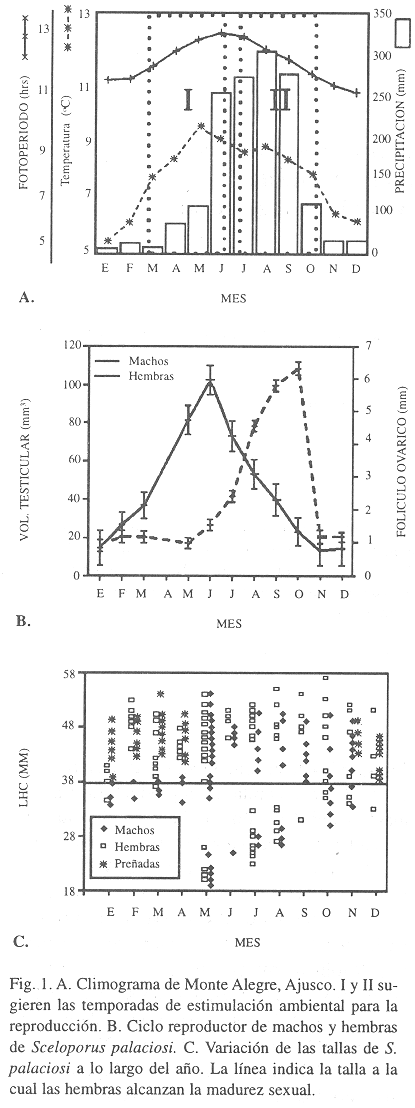
<body><![CDATA[<BR><B><FONT FACE="Arial,Helvetica"><FONT SIZE=-1>Abstract</FONT></FONT></B>      <P><FONT FACE="Arial,Helvetica"><FONT SIZE=-1>Fall reproduction is a common pattern in viviparous lizards from Mexican mountains. The reproductive pattern of <I>Sceloporus palaciosi</I> is seasonal but asynchronous between sexes. Males show testicular development in May and June whereas females ovulate in October. We suggest that the same environmental stimulous to reproduction occur twice a year, but the internal system determines the response of both sexes to different seasons, and fall stimulation allows early sexual maturity in females.</FONT></FONT>     <BR>&nbsp;      <P><B><FONT FACE="Arial,Helvetica"><FONT SIZE=-1>Key words</FONT></FONT></B>      <P><FONT FACE="Arial,Helvetica"><FONT SIZE=-1>Reproductive cycle, viviparity, sexual maturity, <I>Sceloporus palaciosi.</I></FONT></FONT>     <BR><FONT FACE="Arial,Helvetica"><FONT SIZE=-1>&nbsp;</FONT></FONT>      <P><FONT FACE="Arial,Helvetica"><FONT SIZE=-1>Dentro del g&eacute;nero <I>Sceloporus</I>, el grupo <I>grammicus</I> presenta una amplia distribuci&oacute;n y todos sus miembros son viv&iacute;paros (M&eacute;ndez <I>et al</I>. en prensa). En este grupo se presentan ambos patrones reproductores: sincr&oacute;nicos y asincr&oacute;nicos (<A HREF="#Guillette1993">Guillette y M&eacute;ndez 1993</A>). <I>Sceloporus palaciosi</I> es una especie del grupo <I>grammicus</I> que se distribuye en el centro de M&eacute;xico, del cual se desconoce su biolog&iacute;a. Este trabajo describe su ciclo reproductor, plantea a que obedece la fenolog&iacute;a reproductora y cuales son sus ventajas.</FONT></FONT>      <P><FONT FACE="Arial,Helvetica"><FONT SIZE=-1>La poblaci&oacute;n estudiada se localiza en la Sierra del Ajusco, al sur de la Ciudad de M&eacute;xico, entre 3200 y 3400 msnm. Se colectaron mensualmente de 10 a 15 espec&iacute;menes de cada sexo de <I>S. palaciosi</I> de enero a diciembre de 1984, se les determin&oacute; la longitud hocico cloaca (LHC) y la condici&oacute;n reproductora. En los machos fu&eacute; obtenido con base en el volumen testicular (calculado con la f&oacute;rmula de un elipsoide: VT = 4/3 &para; (a<SUP>2</SUP>b), en donde: VT = volumen testicular, a = 1/2 di&aacute;metro testicular menor y b = 1/2 del di&aacute;metro testicular mayor y en las hembras se obtuvo midiendo el di&aacute;metro del fol&iacute;culo ov&aacute;rico mayor, definiendo previtelog&eacute;nesis, vitelog&eacute;nesis o pre&ntilde;ez. Se determinaron cambios significativos mensuales a trav&eacute;s del a&ntilde;o para el volumen testicular y el di&aacute;metro folicular mediante un An&aacute;lisis de Covarianza (ANCOVA) y una prueba de intervalos m&uacute;ltiples (<A HREF="#Bruning">Bruning y Kintz 1977</A>).</FONT></FONT>      <P><FONT FACE="Arial,Helvetica"><FONT SIZE=-1>Se elabor&oacute; el climograma (<A HREF="#FIG 1">Fig. 1A</A>) utilizando los datos de temperatura media y precipitaci&oacute;n promedio de cada mes de la estaci&oacute;n meteorol&oacute;gica de Monte Alegre, Ajusco y la cantidad de horas luz promedio mensual para la Ciudad de M&eacute;xico (<A HREF="#Anónimo">An&oacute;nimo 1986</A>). El coeficiente de determinaci&oacute;n entre los valores gonadales (volumen testicular y di&aacute;metro folicular) y los datos ambientales mensuales (precipitaci&oacute;n, temperatura y fotoper&iacute;odo) se utiliz&oacute; para determinar la asociaci&oacute;n entre la reactivaci&oacute;n gonadal y los factores clim&aacute;ticos, aplic&aacute;ndose posteriormente una prueba de Fisher (<A HREF="#Bruning">Bruning y Kintz 1977</A>). Para evaluar el crecimiento y la madurez sexual, se grafic&oacute; la longitud hocico cloaca (LHC) de los espec&iacute;menes colectados a lo largo del a&ntilde;o.</FONT></FONT>      <P><FONT FACE="Arial,Helvetica"><FONT SIZE=-1><I>S. palaciosi</I> presenta un ciclo reproductor asincr&oacute;nico (<A HREF="#FIG 1">Fig. 1B</A>). El volumen testicular present&oacute; cambios significativos durante el a&ntilde;o (F = (11, 95) = 12.79, p &lt; 0.0001). De noviembre a enero muestra bajos vol&uacute;menes (inactividad), mientras que el incremento se inicia en febrero (reactivaci&oacute;n). La m&aacute;xima actividad reproductora ocurre durante mayo y junio y la regresi&oacute;n gonadal de julio a octubre, indicando un patr&oacute;n de actividad primavera-verano. El incremento testicular se correlacion&oacute; positivamente con la temperatura (r <SUP>2</SUP> = 58.0, p &lt; 0.0001), con la precipitaci&oacute;n (r <SUP>2</SUP> = 57.9, p &lt; 0.0001) y con el fotoperiodo (r <SUP>2</SUP> = 61.6, p &lt; 0.0001).</FONT></FONT>     ]]></body>
<body><![CDATA[<BR>&nbsp;     <BR>&nbsp;     <CENTER></CENTER>      <CENTER><A NAME="FIG 1"></A><IMG SRC="/img/fbpe/rbt/v46n4/0308i01.GIF" HEIGHT=1108 WIDTH=415></CENTER> &nbsp;     
<BR>&nbsp;      <P><FONT FACE="Arial,Helvetica"><FONT SIZE=-1>En las hembras, el di&aacute;metro del fol&iacute;culo ov&aacute;rico mayor mostr&oacute; cambios significativos a lo largo del a&ntilde;o (F [11,91] = 122.84, p &lt; 0.0001). La fase de inactividad ocurre de noviembre a mayo, coincidiendo con la gestaci&oacute;n. Las hembras previtelog&eacute;nicas se encuentran en mayo y junio y la etapa vitelog&eacute;nica sucede de junio a octubre. En noviembre ocurre la ovulaci&oacute;n y de diciembre a abril se encuentran pre&ntilde;adas, indicando que la m&aacute;xima actividad gonadal ocurre en el oto&ntilde;o (<A HREF="#FIG 1">Fig. 1B</A>). Durante la vitelog&eacute;nesis, el di&aacute;metro folicular se correlacion&oacute; negativamente con la temperatura (r<SUP> 2</SUP> = 70.6, p &lt; 0.0001) y con el fotoperiodo (r <SUP>2</SUP> = 75.2, p &lt; 0.0001).</FONT></FONT>      <P><FONT FACE="Arial,Helvetica"><FONT SIZE=-1>La distribuci&oacute;n de tama&ntilde;os en machos y hembras indica que existe un r&aacute;pido crecimiento en los primeros meses de vida (<A HREF="#FIG 1">Fig. 1C</A>), alcanzando las hembras 38 mm de LHC a los 7 meses de edad e iniciando la pre&ntilde;ez.</FONT></FONT>      <P><FONT FACE="Arial,Helvetica"><FONT SIZE=-1>El ciclo reproductor asincr&oacute;nico de<I> S. palaciosi</I> es similar al que presentan otras poblaciones de monta&ntilde;a de <I>Sceloporus grammicus</I> y al de otras especies de <I>Sceloporus</I> viv&iacute;paras (<A HREF="#Guillette1993">Guillette y M&eacute;ndez 1993</A>), lo que parece ser una estrategia favorecida en zonas templadas. Una ventaja de este ciclo es que las cr&iacute;as nacen en mayo, cuando inicia la temporada de lluvias (<A HREF="#FIG 1">Fig. 1A</A>), y esta &eacute;poca coincide con una alta disponibilidad de alimento (<A HREF="#Méndez1995">M&eacute;ndez <I>et al</I>. 1995</A>).</FONT></FONT>      <P><FONT FACE="Arial,Helvetica"><FONT SIZE=-1><A HREF="#Guillette 1980">Guillette y Casas-Andreu (1980</A>) proponen que la actividad reproductora en ambos sexos de <I>S. grammicus</I> responde a diferentes est&iacute;mulos ambientales. <A HREF="#Jones">Jones (1981</A>) menciona que la luz estimuladora de la reproducci&oacute;n se presenta dos veces al a&ntilde;o, y proponemos que podr&iacute;a ser extensivo para la variaci&oacute;n de la temperatura a lo largo del a&ntilde;o. Con base en lo anterior sugerimos que hay dos fases de est&iacute;mulo: una entre primavera y verano (<A HREF="#FIG 1">Fig. 1A</A>, I) y otra entre verano y oto&ntilde;o (<A HREF="#FIG 1">Fig. 1A</A>, II). Los machos de<I> S. palaciosi</I> parecen responder a la primera fase, al igual que la mayor&iacute;a de especies ov&iacute;paras y viv&iacute;paras (M&eacute;ndez <I>et al</I>. en prensa), y las hembras no responden a &eacute;sta fase por estar pre&ntilde;adas. La segunda fase parece estimular la vitelog&eacute;nesis en las hembras, cuando los factores clim&aacute;ticos presentan valores similares a los de marzo-junio, pero con tendencia decreciente. Esta segunda estimulaci&oacute;n parece ser clave en el alcance de la madurez sexual de las hembras de <I>S. palaciosi</I>.</FONT></FONT>      <P><FONT FACE="Arial,Helvetica"><FONT SIZE=-1><A HREF="#Dunham">Dunham <I>et al</I>. (1988</A>) mencionan que la madur&eacute;z sexual de los lacertilios se alcanza desde los 5.5 hasta los 30 meses y consideran que las especies ov&iacute;paras maduran m&aacute;s tempranamente que las viv&iacute;paras (14.9 vs 17.9 meses respectivamente). Sin embargo, en <I>S. palaciosi</I> la segunda fase de estimulaci&oacute;n es vital en la estrategia reproductora, ya que las hembras que alcanzan tallas mayores de 38 mm a los 7 meses de vida se encuentran pre&ntilde;adas (<A HREF="#FIG 1">Fig. 1C</A>). La madurez sexual temprana se ha registrado previamente en otras especies viv&iacute;paras del g&eacute;nero (M&eacute;ndez <I>et al.</I> en prensa). El aprovechamiento de la &eacute;poca de mayor cantidad de alimento (promovido por las lluvias) y de una segunda fase de estimulaci&oacute;n permite crecer e iniciar la reproducci&oacute;n tempranamente. De esta manera, algunas hembras, pueden reproducirse antes de alcanzar un a&ntilde;o de edad. Lo anterior sugiere que en las especies de este g&eacute;nero de ambientes templados se combinan, dentro la misma estrategia reproductora, la viviparidad y la madruez sexual temprana.</FONT></FONT>     ]]></body>
<body><![CDATA[<BR>&nbsp;      <P><B><FONT FACE="Arial,Helvetica"><FONT SIZE=-1>Agradecimientos</FONT></FONT></B>      <P><FONT FACE="Arial,Helvetica"><FONT SIZE=-1>A DGAPA, UNAM por el apoyo para la estancia en Virginia Polytechnic Institute &amp; State Univestity y a CONACYT de M&eacute;xico proyectos 2155 N 9302 y 4171 N9405.</FONT></FONT>     <BR>&nbsp;      <P><B><FONT FACE="Arial,Helvetica"><FONT SIZE=-1>Referencias</FONT></FONT></B>      <!-- ref --><P><A NAME="Anónimo"></A><FONT FACE="Arial,Helvetica"><FONT SIZE=-1>An&oacute;nimo. 1986. Anuario del Observatorio Meteorol&oacute;gico Nacional. Instituto de Astronom&iacute;a, Universidad Nacional Aut&oacute;noma de M&eacute;xico, M&eacute;xico, D.F.</FONT></FONT>    &nbsp;&nbsp;&nbsp;&nbsp;&nbsp;&nbsp;&nbsp;&nbsp;[&#160;<a href="javascript:void(0);" onclick="javascript: window.open('/scielo.php?script=sci_nlinks&ref=1147014&pid=S0034-7744199800040002700001&lng=','','width=640,height=500,resizable=yes,scrollbars=1,menubar=yes,');">Links</a>&#160;]<!-- end-ref --><!-- ref --><P><A NAME="Bruning"></A><FONT FACE="Arial,Helvetica"><FONT SIZE=-1>Bruning J.L. &amp; B. Kintz 1977. Computational handbook of statistics. Scott Foresman, Glenview, Illinois. 308 p.</FONT></FONT>    &nbsp;&nbsp;&nbsp;&nbsp;&nbsp;&nbsp;&nbsp;&nbsp;[&#160;<a href="javascript:void(0);" onclick="javascript: window.open('/scielo.php?script=sci_nlinks&ref=1147015&pid=S0034-7744199800040002700002&lng=','','width=640,height=500,resizable=yes,scrollbars=1,menubar=yes,');">Links</a>&#160;]<!-- end-ref --><!-- ref --><P><A NAME="Dunham"></A><FONT FACE="Arial,Helvetica"><FONT SIZE=-1>Dunham, A.E., D.B. Miles &amp; D.N. Reznick. 1988. Life history patterns of squamate reptiles. p. 441-522. In<I> </I>C. Gans &amp; R.B. Huey (eds.). Biology of the Reptilia. Vol. 16, Ecology B. Defense and Life History. Wiley, Nueva York.</FONT></FONT>    &nbsp;&nbsp;&nbsp;&nbsp;&nbsp;&nbsp;&nbsp;&nbsp;[&#160;<a href="javascript:void(0);" onclick="javascript: window.open('/scielo.php?script=sci_nlinks&ref=1147016&pid=S0034-7744199800040002700003&lng=','','width=640,height=500,resizable=yes,scrollbars=1,menubar=yes,');">Links</a>&#160;]<!-- end-ref --><!-- ref --><P><A NAME="Guillette 1980"></A><FONT FACE="Arial,Helvetica"><FONT SIZE=-1>Guillette, L.J., Jr. &amp; G. Casas-Andreu. 1980. Fall reproductive activity in the high altitude Mexican lizard <I>Sceloporus grammicus microlepidotus</I>. J. Herpetol. 14:143-147.</FONT></FONT>    &nbsp;&nbsp;&nbsp;&nbsp;&nbsp;&nbsp;&nbsp;&nbsp;[&#160;<a href="javascript:void(0);" onclick="javascript: window.open('/scielo.php?script=sci_nlinks&ref=1147017&pid=S0034-7744199800040002700004&lng=','','width=640,height=500,resizable=yes,scrollbars=1,menubar=yes,');">Links</a>&#160;]<!-- end-ref --><!-- ref --><P><A NAME="Guillette1993"></A><FONT FACE="Arial,Helvetica"><FONT SIZE=-1>Guillette, L.J., Jr. &amp; F.R. M&eacute;ndez. 1993. The reproductive cycle of the viviparous Mexican lizard <I>Sceloporus torquatus</I>. J. Herpetol. 27:168-174.</FONT></FONT>    &nbsp;&nbsp;&nbsp;&nbsp;&nbsp;&nbsp;&nbsp;&nbsp;[&#160;<a href="javascript:void(0);" onclick="javascript: window.open('/scielo.php?script=sci_nlinks&ref=1147018&pid=S0034-7744199800040002700005&lng=','','width=640,height=500,resizable=yes,scrollbars=1,menubar=yes,');">Links</a>&#160;]<!-- end-ref --><!-- ref --><P><A NAME="Jones"></A><FONT FACE="Arial,Helvetica"><FONT SIZE=-1>Jones, R.E. 1981. Mechanisms controlling seasonal ovarian quiescence. p. 205-234. In Schwartz N.B. &amp; M. Hunzicker-Dunn (eds.). Dynamics of Ovarian Function. Raven, Nueva York.</FONT></FONT>    &nbsp;&nbsp;&nbsp;&nbsp;&nbsp;&nbsp;&nbsp;&nbsp;[&#160;<a href="javascript:void(0);" onclick="javascript: window.open('/scielo.php?script=sci_nlinks&ref=1147019&pid=S0034-7744199800040002700006&lng=','','width=640,height=500,resizable=yes,scrollbars=1,menubar=yes,');">Links</a>&#160;]<!-- end-ref --><!-- ref --><P><A NAME="Méndez1995"></A><FONT FACE="Arial,Helvetica"><FONT SIZE=-1>M&eacute;ndez, F.R , R. S&aacute;nchez-Trejo &amp; O. Cuellar. 1995. Reproductive differences betwen sympatric oviparous and viviparous Mexican spiny lizards. Biogeographica 71:61-67.</FONT></FONT>    &nbsp;&nbsp;&nbsp;&nbsp;&nbsp;&nbsp;&nbsp;&nbsp;[&#160;<a href="javascript:void(0);" onclick="javascript: window.open('/scielo.php?script=sci_nlinks&ref=1147020&pid=S0034-7744199800040002700007&lng=','','width=640,height=500,resizable=yes,scrollbars=1,menubar=yes,');">Links</a>&#160;]<!-- end-ref --><!-- ref --><P><A NAME="Méndez1998"></A><FONT FACE="Arial,Helvetica"><FONT SIZE=-1>M&eacute;ndez, F.R., M. Villagr&aacute;n &amp; R. M. Andrews. 1998. Evolution of viviparity in the lizard genus <I>Sceloporus</I>. Herpetologica (en prensa).</FONT></FONT>    &nbsp;&nbsp;&nbsp;&nbsp;&nbsp;&nbsp;&nbsp;&nbsp;[&#160;<a href="javascript:void(0);" onclick="javascript: window.open('/scielo.php?script=sci_nlinks&ref=1147021&pid=S0034-7744199800040002700008&lng=','','width=640,height=500,resizable=yes,scrollbars=1,menubar=yes,');">Links</a>&#160;]<!-- end-ref --><P><A NAME="1a"></A><FONT FACE="Arial,Helvetica"><FONT SIZE=-1><SUP><A HREF="#1">1</A></SUP>Instituto de Biolog&iacute;a y&nbsp;<A NAME="2a"></A><SUP><A HREF="#2">2</A></SUP> Facultad de Ciencias, Universidad Nacional Aut&oacute;noma de M&eacute;xico, C.P. 04510, A.P. 70-515, M&eacute;xico 20 Distrito Federal, M&eacute;xico.</FONT></FONT>      ]]></body><back>
<ref-list>
<ref id="B1">
<nlm-citation citation-type="book">
<person-group person-group-type="author">
<name>
<surname><![CDATA[Anónimo]]></surname>
</name>
</person-group>
<source><![CDATA[Anuario del Observatorio Meteorológico Nacional]]></source>
<year>1986</year>
<publisher-name><![CDATA[Instituto de Astronomía, Universidad Nacional Autónoma de México]]></publisher-name>
</nlm-citation>
</ref>
<ref id="B2">
<nlm-citation citation-type="book">
<person-group person-group-type="author">
<name>
<surname><![CDATA[Bruning]]></surname>
<given-names><![CDATA[J.L]]></given-names>
</name>
<name>
<surname><![CDATA[Kintz]]></surname>
<given-names><![CDATA[B]]></given-names>
</name>
</person-group>
<source><![CDATA[Computational handbook of statistics]]></source>
<year>1977</year>
<page-range>308</page-range><publisher-loc><![CDATA[Illinois ]]></publisher-loc>
<publisher-name><![CDATA[Scott Foresman, Glenview]]></publisher-name>
</nlm-citation>
</ref>
<ref id="B3">
<nlm-citation citation-type="book">
<person-group person-group-type="author">
<name>
<surname><![CDATA[Dunham]]></surname>
<given-names><![CDATA[A.E]]></given-names>
</name>
<name>
<surname><![CDATA[Miles]]></surname>
<given-names><![CDATA[D.B]]></given-names>
</name>
<name>
<surname><![CDATA[Reznick]]></surname>
<given-names><![CDATA[D.N]]></given-names>
</name>
</person-group>
<article-title xml:lang="en"><![CDATA[Life history patterns of squamate reptiles]]></article-title>
<person-group person-group-type="editor">
<name>
<surname><![CDATA[Gans]]></surname>
<given-names><![CDATA[C.]]></given-names>
</name>
<name>
<surname><![CDATA[Huey]]></surname>
<given-names><![CDATA[R.B]]></given-names>
</name>
</person-group>
<source><![CDATA[Biology of the Reptilia]]></source>
<year>1988</year>
<volume>16</volume>
<page-range>441-522</page-range><publisher-loc><![CDATA[Nueva York ]]></publisher-loc>
<publisher-name><![CDATA[Wiley]]></publisher-name>
</nlm-citation>
</ref>
<ref id="B4">
<nlm-citation citation-type="journal">
<person-group person-group-type="author">
<name>
<surname><![CDATA[Guillette]]></surname>
<given-names><![CDATA[L.J]]></given-names>
</name>
<name>
<surname><![CDATA[Casas-Andreu]]></surname>
<given-names><![CDATA[G]]></given-names>
</name>
</person-group>
<article-title xml:lang="en"><![CDATA[Fall reproductive activity in the high altitude Mexican lizard Sceloporus grammicus microlepidotus]]></article-title>
<source><![CDATA[J. Herpetol.]]></source>
<year>1980</year>
<volume>14</volume>
<page-range>143-147</page-range></nlm-citation>
</ref>
<ref id="B5">
<nlm-citation citation-type="journal">
<person-group person-group-type="author">
<name>
<surname><![CDATA[Guillette]]></surname>
<given-names><![CDATA[L.J]]></given-names>
</name>
<name>
<surname><![CDATA[Méndez]]></surname>
<given-names><![CDATA[F.R]]></given-names>
</name>
</person-group>
<article-title xml:lang="en"><![CDATA[The reproductive cycle of the viviparous Mexican lizard Sceloporus torquatus]]></article-title>
<source><![CDATA[J. Herpetol]]></source>
<year>1993</year>
<volume>27</volume>
<page-range>168-174</page-range></nlm-citation>
</ref>
<ref id="B6">
<nlm-citation citation-type="book">
<person-group person-group-type="author">
<name>
<surname><![CDATA[Jones]]></surname>
<given-names><![CDATA[R.E]]></given-names>
</name>
</person-group>
<source><![CDATA[Mechanisms controlling seasonal ovarian quiescence]]></source>
<year>1981</year>
<page-range>205-234</page-range><publisher-loc><![CDATA[^eNueva York Nueva York]]></publisher-loc>
<publisher-name><![CDATA[Raven]]></publisher-name>
</nlm-citation>
</ref>
<ref id="B7">
<nlm-citation citation-type="">
<person-group person-group-type="author">
<name>
<surname><![CDATA[Méndez]]></surname>
<given-names><![CDATA[F.R]]></given-names>
</name>
<name>
<surname><![CDATA[Sánchez-Trejo]]></surname>
<given-names><![CDATA[R.]]></given-names>
</name>
<name>
<surname><![CDATA[Cuellar]]></surname>
<given-names><![CDATA[O]]></given-names>
</name>
</person-group>
<source><![CDATA[Reproductive differences betwen sympatric oviparous and viviparous Mexican spiny lizards]]></source>
<year>1995</year>
<volume>71</volume>
<page-range>61-67</page-range></nlm-citation>
</ref>
<ref id="B8">
<nlm-citation citation-type="">
<person-group person-group-type="author">
<name>
<surname><![CDATA[Méndez]]></surname>
<given-names><![CDATA[F.R]]></given-names>
</name>
<name>
<surname><![CDATA[Villagrán]]></surname>
<given-names><![CDATA[M.]]></given-names>
</name>
<name>
<surname><![CDATA[Andrews]]></surname>
<given-names><![CDATA[R. M]]></given-names>
</name>
</person-group>
<source><![CDATA[Evolution of viviparity in the lizard genus Sceloporus]]></source>
<year>1998</year>
</nlm-citation>
</ref>
</ref-list>
</back>
</article>
