<?xml version="1.0" encoding="ISO-8859-1"?><article xmlns:mml="http://www.w3.org/1998/Math/MathML" xmlns:xlink="http://www.w3.org/1999/xlink" xmlns:xsi="http://www.w3.org/2001/XMLSchema-instance">
<front>
<journal-meta>
<journal-id>0034-7744</journal-id>
<journal-title><![CDATA[Revista de Biología Tropical]]></journal-title>
<abbrev-journal-title><![CDATA[Rev. biol. trop]]></abbrev-journal-title>
<issn>0034-7744</issn>
<publisher>
<publisher-name><![CDATA[Universidad de Costa Rica]]></publisher-name>
</publisher>
</journal-meta>
<article-meta>
<article-id>S0034-77441998000400018</article-id>
<title-group>
<article-title xml:lang="en"><![CDATA[Postfire Regrowth of Vaccinium consanguineum (Ericaceae) in the Costa Rican Páramos]]></article-title>
</title-group>
<contrib-group>
<contrib contrib-type="author">
<name>
<surname><![CDATA[Horn]]></surname>
<given-names><![CDATA[Sally P.]]></given-names>
</name>
<xref ref-type="aff" rid="A01"/>
</contrib>
</contrib-group>
<aff id="A01">
<institution><![CDATA[,University of Tennessee Department of Geography ]]></institution>
<addr-line><![CDATA[Tennessee ]]></addr-line>
<country>USA</country>
</aff>
<pub-date pub-type="pub">
<day>00</day>
<month>12</month>
<year>1998</year>
</pub-date>
<pub-date pub-type="epub">
<day>00</day>
<month>12</month>
<year>1998</year>
</pub-date>
<volume>46</volume>
<numero>4</numero>
<fpage>1117</fpage>
<lpage>1120</lpage>
<copyright-statement/>
<copyright-year/>
<self-uri xlink:href="http://www.scielo.sa.cr/scielo.php?script=sci_arttext&amp;pid=S0034-77441998000400018&amp;lng=en&amp;nrm=iso"></self-uri><self-uri xlink:href="http://www.scielo.sa.cr/scielo.php?script=sci_abstract&amp;pid=S0034-77441998000400018&amp;lng=en&amp;nrm=iso"></self-uri><self-uri xlink:href="http://www.scielo.sa.cr/scielo.php?script=sci_pdf&amp;pid=S0034-77441998000400018&amp;lng=en&amp;nrm=iso"></self-uri><abstract abstract-type="short" xml:lang="es"><p><![CDATA[Se estudió el crecimiento de Vaccinium consanguineum Klotzsch en la Cordillera de Talamanca, Costa Rica, cinco años después del incendio de 1992 , usando 50 plantas en cada uno de dos lugares. Las laturas medias fueron 72.6 + 24.6 cm en Asunción y 75.2 + 17.6 cm en Zacatales, mientras que las medias antes del incendio diferían en 30 cm. Esta diferencia puede explicarse por diferencias en condiciones climáticas locales.]]></p></abstract>
<kwd-group>
<kwd lng="es"><![CDATA[Costa Rica]]></kwd>
<kwd lng="en"><![CDATA[fire]]></kwd>
<kwd lng="en"><![CDATA[páramo]]></kwd>
<kwd lng="en"><![CDATA[regeneration]]></kwd>
<kwd lng="en"><![CDATA[regrowth]]></kwd>
<kwd lng="en"><![CDATA[Vaccinium consanguineum]]></kwd>
</kwd-group>
</article-meta>
</front><body><![CDATA[  <FONT FACE="Arial,Helvetica"><FONT SIZE=-1>Communication</FONT></FONT>     <BR>&nbsp;     <CENTER></CENTER>      <CENTER><B><FONT FACE="Arial,Helvetica">Postfire Regrowth of <I>Vaccinium consanguineum </I>(Ericaceae) in the Costa Rican P&aacute;ramos</FONT></B></CENTER>      <CENTER>&nbsp;</CENTER>      <CENTER>&nbsp;</CENTER>      <CENTER><FONT FACE="Arial,Helvetica"><FONT SIZE=-1><B>Sally P. Horn&nbsp;<A NAME="1"></A></B><SUP><A HREF="#1a">1</A></SUP></FONT></FONT></CENTER>      <CENTER>&nbsp;</CENTER>      <CENTER>&nbsp;</CENTER>      <CENTER><FONT FACE="Arial,Helvetica"><FONT SIZE=-1>Received 18-II-1998. Corrected 28-VIII-1998. Accepted 10-IX-1998.</FONT></FONT></CENTER>       ]]></body>
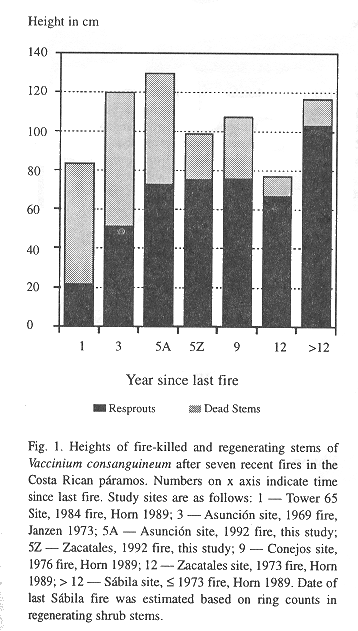
<body><![CDATA[<P><B><FONT FACE="Arial,Helvetica"><FONT SIZE=-1>Resumen</FONT></FONT></B>      <P><FONT FACE="Arial,Helvetica"><FONT SIZE=-1>Se estudi&oacute; el crecimiento de<I> Vaccinium consanguineum</I> Klotzsch en la Cordillera de Talamanca, Costa Rica, cinco a&ntilde;os despu&eacute;s del incendio de 1992 , usando 50 plantas en cada uno de dos lugares. Las laturas medias fueron 72.6 <U>+</U> 24.6 cm en Asunci&oacute;n y 75.2 <U>+</U> 17.6 cm en Zacatales, mientras que las medias antes del incendio difer&iacute;an en 30 cm. Esta diferencia puede explicarse por diferencias en condiciones clim&aacute;ticas locales.</FONT></FONT>     <BR>&nbsp;      <P><B><FONT FACE="Arial,Helvetica"><FONT SIZE=-1>Key words</FONT></FONT></B>      <P><FONT FACE="Arial,Helvetica"><FONT SIZE=-1>Costa Rica, fire, p&aacute;ramo, regeneration, regrowth, <I>Vaccinium consanguineum</I>.</FONT></FONT>     <BR><I><FONT FACE="Arial,Helvetica"><FONT SIZE=-1>&nbsp;</FONT></FONT></I>      <P><FONT FACE="Arial,Helvetica"><FONT SIZE=-1><I>Vaccinium consanguineum</I> Klotzsch is a common shrub in high elevation p&aacute;ramo vegetation (3200-3800 m a.s.l.) in the Cordillera de Talamanca, Costa Rica (<A HREF="#Weber">Weber 1959</A>, <A HREF="#Horn 1989">Horn 1989</A>, <A HREF="#Schneidt">Schneidt and Weberling 1992</A>). Most of the Costa Rican p&aacute;ramos have burned during this century due to accidental or intentional ignition by humans; charcoal fragments in lake sediment cores from the Chirrip&oacute; highlands document earlier p&aacute;ramo fires, ignited by people or lightning at intervals over the past 10,000 years (<A HREF="#Horn  1993">Horn 1993</A>). The above ground portions of shrubs of <I>V. consanguineum</I> are usually killed by fire, but the plants resprout vigorously from basal buds (<A HREF="#Janzen">Janzen 1973</A>). Typically nearly all shrubs within a burn site will resprout following crown loss, but individuals are slow to regain their prefire stature (<A HREF="#Horn 1989">Horn 1989</A>).</FONT></FONT>      <P><FONT FACE="Arial,Helvetica"><FONT SIZE=-1><A HREF="#Janzen">Janzen (1973</A>) presented data on height recovery three years after a fire on Cerro Asunci&oacute;n in the Buenavista p&aacute;ramo (Cerro de la Muerte) along the Inter-American highway (study site near 3340 m elevation). <A HREF="#Horn 1989">Horn (1989</A>) provided similar data for nearby sites that had burned one year (Tower 65; 3310 m), 12 years (Cerro Zacatales; 3340-3370 m), and 12 or more years before sampling (Cerro S&aacute;bila; 3370-3410 m), and for the more remote Conejos site (3480-3500 m) within the Chirrip&oacute; p&aacute;ramo, which had burned nine years before sampling. <A HREF="#Williamson">Williamson <I>et al.</I> (1986</A>) also reported on regeneration of <I>V. consanguineum</I> on Cerro Zacatales, but may have confused this shrub with the smaller ericad <I>Pernettia coriacea</I>.</FONT></FONT>      <P><FONT FACE="Arial,Helvetica"><FONT SIZE=-1>In March 1992 a fire burned some 100 ha on the upper slopes (3300 m) of Cerro Asunci&oacute;n and parts of the south slopes of Cerros Zacatales and S&aacute;bila (<A HREF="#Moya">Moya 1992</A>, and pers. obs.). This fire, likely human-set, provided opportunities to investigate shrub regeneration following the reburning of previously studied burn sites. Sampling in February 1994 revealed that 88% of burned shrubs of <I>V. consanguineum</I> on the upper south slope of Cerro Asunci&oacute;n (3340-3370 m), and 96% of burned shrubs on the upper south slope of Cerro Zacatales (3340-3370 m), had resprouted within two years of the fire (<A HREF="#Horn 1997">Horn 1997</A>).</FONT></FONT>      <P><FONT FACE="Arial,Helvetica"><FONT SIZE=-1>In March 1997 I examined the same populations of <I>V. consanguineum</I> to assess height recovery in the five years since the fire. I randomly selected 50 resprouting shrubs from each population, and measured the heights of their tallest living and fire-killed stems to the nearest cm using a rigid metal tape measure. As in previous work by <A HREF="#Janzen">Janzen (1973</A>), <A HREF="#Williamson">Williamson <I>et al.</I> (1986</A>), and <A HREF="#Horn 1989">Horn (1989</A>), the heights of fire-killed stems were used as estimates of the prefire stature of the shrubs. The actual heights of the plants prior to burning may have averaged somewhat higher owing to the loss of the smallest twigs in the last fire. The estimated prefire heights reflect regrowth following the penultimate fire at each site. A voucher specimen collected on Cerro Asunci&oacute;n prior to the 1992 fire was deposited at CR (S.P. Horn 114; CR #109167), with duplicates sent to the UC and WIS herbaria.</FONT></FONT>      ]]></body>
<body><![CDATA[<P><FONT FACE="Arial,Helvetica"><FONT SIZE=-1>I selected the plants to measure using Ward's 1974 "ignorant man" technique, which I suggest be renamed the "ignorant researcher" technique. This technique requires a field assistant, who has in hand a list of ordered random numbers, drawn from within a range judged to approximate the number of individuals in the population to be sampled. For this study, I wanted to collect height recovery data on 50 burned shrubs from within areas that I estimated to each include about 200 shrubs, so I used a list of 50 random numbers drawn from within 200 numbers. Some such lists are included in <A HREF="#Ward">Ward (1974</A>) and others can be generated from random number tables, programmed calculators, or even creative use of playing cards or dice. My role as the "ignorant researcher" was to walk through the study sites, counting aloud shrubs that fit my criteria (in this case, shrubs burned in the last fire that had subsequently resprouted). I was "ignorant" while counting shrubs of the ones that would be selected to measure; my assistant held the list of random numbers, and advised me when I reached a number that called for a plant to be sampled. This "ignorant researcher" method produced an unbiased and rapid randomization of plants, that allowed us to quickly collect field data without the need to number all individuals or establish plots or transects.</FONT></FONT>      <P><FONT FACE="Arial,Helvetica"><FONT SIZE=-1>Average postfire heights for <I>Vaccinium consanguineum</I> at the two sites were within 3 cm of each other (72.6 <U>+</U> 24.6 cm at Asunci&oacute;n and 75.2 <U>+</U> 17.6 cm at Zacatales), whereas the average prefire heights differed by more than 30 cm (129.6 <U>+</U> 58.6 cm at Asunci&oacute;n and 98.4 <U>+</U> 30.4 cm at Zacatales). The latter difference is statistically significant (Mann-Whitney, p&lt;0.05), and may in part reflect the differing fire histories of the sites. The penultimate fire at the Asunci&oacute;n site was in 1969; prior to that the site may have been fire free for some 30 years (<A HREF="#Williamson">Williamson <I>et al.</I> 1986</A>). The Zacatales site had previously burned in 1973, after an earlier fire perhaps only 10-12 years beforehand, and another fire some 10 years before that (<A HREF="#Williamson">Williamson <I>et al.</I> 1986</A>, <A HREF="#Horn 1989">Horn 1989</A>). The lower prefire statures at the Zacatales site may reflect both the later occurrence of the penultimate fire, and the fact that the site had had a shorter fire-free interval during which to recover root reserves (<A HREF="#Williamson">Williamson <I>et al.</I> 1986</A>). Other environmental factors not measured in this study may also have influenced growth rates following the penultimate fires.</FONT></FONT>      <P><FONT FACE="Arial,Helvetica"><FONT SIZE=-1>The nearly identical rates of regrowth at the two sites suggests that by the time of the 1992 fire, root reserves may have recovered to more even levels. However, future monitoring may reveal differences not apparent over the five year time span investigated here. The similarity in postfire growth rates for <I>V. consanguineum</I> and in postfire resprout rates for this shrub and <I>Hypericum irazuense</I> (<A HREF="#Horn 1997">Horn 1997</A>) also suggest approximately similar burning conditions, but no data exist on fire temperatures or other burning parameters. Postfire climatic conditions are assumed to be nearly identical, owing to the proximity and corresponding exposure and elevation of the two sites.</FONT></FONT>      <P><FONT FACE="Arial,Helvetica"><FONT SIZE=-1><A HREF="#FIG 1">Fig. 1</A> compares the prefire and postfire height data from this study with earlier results from <A HREF="#Janzen">Janzen (1973</A>) and <A HREF="#Horn 1989">Horn (1989</A>). Within five years, regenerating shrubs of <I>V. consanguineum</I> on Cerros Asunci&oacute;n and Zacatales were as tall as nine-year old shrubs in the Conejos study site within the Chirrip&oacute; p&aacute;ramo. This difference may be explained by possibly harsher climatic conditions at the Conejos site, which is some 140 m higher in elevation than the Asunci&oacute;n and Zacatales sites. The five-year old stems measured in this study were also taller than 12-year old stems on shrubs that regenerated following the penultimate fire on Cerro Zacatales. As suggested above, the comparatively slower growth following the 1973 Zacatales fire may reflect the fact that root reserves at the time of this fire had been depleted by successive fires at close intervals. Varying climatic conditions could also have affected the regrowth rates; the five years following the 1992 fire may have been more favorable to plant growth than the 12 years following the 1973 Zacatales fire.</FONT></FONT>     <BR>&nbsp;     <CENTER></CENTER>      <CENTER><A NAME="FIG_1"></A><IMG SRC="/img/fbpe/rbt/v46n4/0299i01.GIF" HEIGHT=631 WIDTH=358></CENTER> &nbsp;     
<BR>&nbsp;      <P><FONT FACE="Arial,Helvetica"><FONT SIZE=-1>Information on postfire shrub regeneration is important for assessing not only the ecological impacts of p&aacute;ramo fires, but also their <I>visual</I> impacts. I have suggested elsewhere (<A HREF="#Horn 1998">Horn 1998</A>) that resource managers might want to consider using some prescribed burning within the p&aacute;ramo of Chirrip&oacute; National Park. Prescribed burning of small areas could be useful in limiting the occurrence of large fires, and in enhancing overall habitat and species diversity. But prescribed fires, and the firebreaks that would contain them, could affect visitor perceptions and perhaps enjoyment of the p&aacute;ramo environment, by detracting from the "wilderness" experience that many visitors seek (<A HREF="#Horn 1998">Horn 1998</A>). Thus careful thought needs to be given to the rate at which burned vegetation will recover its prefire appearance. Height recovery is an important part of this. The recent burning of easily accessible sites within the Buenavista p&aacute;ramo provides good opportunities to collect data needed to assess visual impacts of possible future prescribed fires in the Costa Rican p&aacute;ramos.</FONT></FONT>      <P><FONT FACE="Arial,Helvetica"><FONT SIZE=-1>Field sampling in 1997 was carried out while I was in Costa Rica for a project funded by The A.W. Mellon Foundation. I thank Brandon League and Lisa Kennedy for field assistance, and two anonymous reviewers for improvements to the manuscript.</FONT></FONT>      ]]></body>
<body><![CDATA[<P><FONT FACE="Arial,Helvetica"><FONT SIZE=-1>&nbsp;</FONT></FONT>     <BR><B><FONT FACE="Arial,Helvetica"><FONT SIZE=-1>References</FONT></FONT></B>      <!-- ref --><P><A NAME="Horn_1989"></A><FONT FACE="Arial,Helvetica"><FONT SIZE=-1>Horn, S.P. 1989. Postfire vegetation development in the Costa Rican p&aacute;ramos. Madro&ntilde;o 36: 3-14.</FONT></FONT>    &nbsp;&nbsp;&nbsp;&nbsp;&nbsp;&nbsp;&nbsp;&nbsp;[&#160;<a href="javascript:void(0);" onclick="javascript: window.open('/scielo.php?script=sci_nlinks&ref=1163576&pid=S0034-7744199800040001800001&lng=','','width=640,height=500,resizable=yes,scrollbars=1,menubar=yes,');">Links</a>&#160;]<!-- end-ref --><!-- ref --><P><A NAME="Horn__1993"></A><FONT FACE="Arial,Helvetica"><FONT SIZE=-1>Horn, S.P. 1993. Postglacial vegetation and fire history in the Chirrip&oacute; p&aacute;ramo of Costa Rica. Quatern. Res. 40: 107-116.</FONT></FONT>    &nbsp;&nbsp;&nbsp;&nbsp;&nbsp;&nbsp;&nbsp;&nbsp;[&#160;<a href="javascript:void(0);" onclick="javascript: window.open('/scielo.php?script=sci_nlinks&ref=1163577&pid=S0034-7744199800040001800002&lng=','','width=640,height=500,resizable=yes,scrollbars=1,menubar=yes,');">Links</a>&#160;]<!-- end-ref --><!-- ref --><P><A NAME="Horn_1997"></A><FONT FACE="Arial,Helvetica"><FONT SIZE=-1>Horn, S.P. 1997. Postfire resprouting of <I>Hypericum irazuense</I> in the Costa Rican p&aacute;ramos: Cerro Asunci&oacute;n revisited. Biotropica 29: 529-531.</FONT></FONT>    &nbsp;&nbsp;&nbsp;&nbsp;&nbsp;&nbsp;&nbsp;&nbsp;[&#160;<a href="javascript:void(0);" onclick="javascript: window.open('/scielo.php?script=sci_nlinks&ref=1163578&pid=S0034-7744199800040001800003&lng=','','width=640,height=500,resizable=yes,scrollbars=1,menubar=yes,');">Links</a>&#160;]<!-- end-ref --><!-- ref --><P><A NAME="Horn_1998"></A><FONT FACE="Arial,Helvetica"><FONT SIZE=-1>Horn, S.P. 1998. Fire management and natural landscapes in the Chirrip&oacute; p&aacute;ramo, Costa Rica. Chapter 4 <I>in</I> K. Zimmerer and K. Young (Eds.), From Nature's Geography: Biogeographical Landscapes and Conservation in Developing Countries. University of Wisconsin, Madison (in press).</FONT></FONT>    &nbsp;&nbsp;&nbsp;&nbsp;&nbsp;&nbsp;&nbsp;&nbsp;[&#160;<a href="javascript:void(0);" onclick="javascript: window.open('/scielo.php?script=sci_nlinks&ref=1163579&pid=S0034-7744199800040001800004&lng=','','width=640,height=500,resizable=yes,scrollbars=1,menubar=yes,');">Links</a>&#160;]<!-- end-ref --><!-- ref --><P><A NAME="Janzen"></A><FONT FACE="Arial,Helvetica"><FONT SIZE=-1>Janzen, D.H. 1973. Rate of regeneration after a tropical high elevation fire. Biotropica 5: 117-122.</FONT></FONT>    &nbsp;&nbsp;&nbsp;&nbsp;&nbsp;&nbsp;&nbsp;&nbsp;[&#160;<a href="javascript:void(0);" onclick="javascript: window.open('/scielo.php?script=sci_nlinks&ref=1163580&pid=S0034-7744199800040001800005&lng=','','width=640,height=500,resizable=yes,scrollbars=1,menubar=yes,');">Links</a>&#160;]<!-- end-ref --><BR><FONT FACE="Arial,Helvetica"><FONT SIZE=-1>&nbsp;</FONT></FONT>      <!-- ref --><P><A NAME="Moya"></A><FONT FACE="Arial,Helvetica"><FONT SIZE=-1>Moya Ch., R. 1992. Gran incendio en Cerro de la Muerte. La Naci&oacute;n, 27 March 1992, p. 10A.</FONT></FONT>    &nbsp;&nbsp;&nbsp;&nbsp;&nbsp;&nbsp;&nbsp;&nbsp;[&#160;<a href="javascript:void(0);" onclick="javascript: window.open('/scielo.php?script=sci_nlinks&ref=1163582&pid=S0034-7744199800040001800006&lng=','','width=640,height=500,resizable=yes,scrollbars=1,menubar=yes,');">Links</a>&#160;]<!-- end-ref --><!-- ref --><P><A NAME="Schneidt"></A><FONT FACE="Arial,Helvetica"><FONT SIZE=-1>Schneidt, J. &amp; F. Weberling. 1992. Wuchsformuntersuchungen im P&aacute;ramo Costa Ricas III.Untersuchungen an Ericaceen-Arten. Flora 187: 403-427.</FONT></FONT>    &nbsp;&nbsp;&nbsp;&nbsp;&nbsp;&nbsp;&nbsp;&nbsp;[&#160;<a href="javascript:void(0);" onclick="javascript: window.open('/scielo.php?script=sci_nlinks&ref=1163583&pid=S0034-7744199800040001800007&lng=','','width=640,height=500,resizable=yes,scrollbars=1,menubar=yes,');">Links</a>&#160;]<!-- end-ref --><!-- ref --><P><A NAME="Ward"></A><FONT FACE="Arial,Helvetica"><FONT SIZE=-1>Ward, D.B. 1974. The "ignorant man" technique of sampling plant populations. Taxon 23: 325-330.</FONT></FONT>    &nbsp;&nbsp;&nbsp;&nbsp;&nbsp;&nbsp;&nbsp;&nbsp;[&#160;<a href="javascript:void(0);" onclick="javascript: window.open('/scielo.php?script=sci_nlinks&ref=1163584&pid=S0034-7744199800040001800008&lng=','','width=640,height=500,resizable=yes,scrollbars=1,menubar=yes,');">Links</a>&#160;]<!-- end-ref --><!-- ref --><P><A NAME="Weber"></A><FONT FACE="Arial,Helvetica"><FONT SIZE=-1>Weber, H. 1959. Los P&aacute;ramos de Costa Rica y su Concatenaci&oacute;n Fitogeogr&aacute;fico con los Andes Suramericanos. Instituto Geogr&aacute;fico Nacional, San Jos&eacute;, Costa Rica. 71 p.</FONT></FONT>    &nbsp;&nbsp;&nbsp;&nbsp;&nbsp;&nbsp;&nbsp;&nbsp;[&#160;<a href="javascript:void(0);" onclick="javascript: window.open('/scielo.php?script=sci_nlinks&ref=1163585&pid=S0034-7744199800040001800009&lng=','','width=640,height=500,resizable=yes,scrollbars=1,menubar=yes,');">Links</a>&#160;]<!-- end-ref --><!-- ref --><P><A NAME="Williamson"></A><FONT FACE="Arial,Helvetica"><FONT SIZE=-1>Williamson, B., G.E. Schatz, A. Alvarado, C.S. Redhead, A.C. Stam &amp; R.W. Sterner. 1986. Effects of repeated fires on tropical p&aacute;ramo vegetation. Trop. Ecol. 27: 62-69.</FONT></FONT>    &nbsp;&nbsp;&nbsp;&nbsp;&nbsp;&nbsp;&nbsp;&nbsp;[&#160;<a href="javascript:void(0);" onclick="javascript: window.open('/scielo.php?script=sci_nlinks&ref=1163586&pid=S0034-7744199800040001800010&lng=','','width=640,height=500,resizable=yes,scrollbars=1,menubar=yes,');">Links</a>&#160;]<!-- end-ref --><P><A NAME="1a"></A><FONT FACE="Arial,Helvetica"><FONT SIZE=-1><SUP><A HREF="#1">1</A></SUP> Department of Geography, University of Tennessee, Knoxville, Tennessee 37996, USA. Fax (423)9746025, <A HREF="Mailto:shorn@utk.edu">shorn@utk.edu</A></FONT></FONT>      ]]></body><back>
<ref-list>
<ref id="B1">
<nlm-citation citation-type="journal">
<person-group person-group-type="author">
<name>
<surname><![CDATA[Horn]]></surname>
<given-names><![CDATA[S.P.]]></given-names>
</name>
</person-group>
<article-title xml:lang="en"><![CDATA[Postfire vegetation development in the Costa Rican páramos]]></article-title>
<source><![CDATA[Madroño]]></source>
<year>1989</year>
<volume>36</volume>
<page-range>3-14</page-range></nlm-citation>
</ref>
<ref id="B2">
<nlm-citation citation-type="journal">
<person-group person-group-type="author">
<name>
<surname><![CDATA[Horn]]></surname>
<given-names><![CDATA[S.P.]]></given-names>
</name>
</person-group>
<article-title xml:lang="en"><![CDATA[Postglacial vegetation and fire history in the Chirripó páramo of Costa Rica.]]></article-title>
<source><![CDATA[Quatern. Res.]]></source>
<year>1993</year>
<volume>40</volume>
<page-range>107-116</page-range></nlm-citation>
</ref>
<ref id="B3">
<nlm-citation citation-type="journal">
<person-group person-group-type="author">
<name>
<surname><![CDATA[Horn]]></surname>
<given-names><![CDATA[S.P.]]></given-names>
</name>
</person-group>
<article-title xml:lang="en"><![CDATA[Postfire resprouting of Hypericum irazuense in the Costa Rican páramos:: Cerro Asunción revisited]]></article-title>
<source><![CDATA[Biotropica]]></source>
<year>1997</year>
<volume>29</volume>
<page-range>529-531</page-range></nlm-citation>
</ref>
<ref id="B4">
<nlm-citation citation-type="book">
<person-group person-group-type="author">
<name>
<surname><![CDATA[Horn]]></surname>
<given-names><![CDATA[S.P.]]></given-names>
</name>
</person-group>
<article-title xml:lang="en"><![CDATA[Fire management and natural landscapes in the Chirripó páramo, Costa Rica.: Chapter 4]]></article-title>
<person-group person-group-type="editor">
<name>
<surname><![CDATA[Zimmerer]]></surname>
<given-names><![CDATA[K.]]></given-names>
</name>
<name>
<surname><![CDATA[Young]]></surname>
<given-names><![CDATA[K.]]></given-names>
</name>
</person-group>
<source><![CDATA[From Nature's Geography:: Biogeographical Landscapes and Conservation in Developing Countries.]]></source>
<year>1998</year>
<publisher-loc><![CDATA[Madison ]]></publisher-loc>
<publisher-name><![CDATA[University of Wisconsin]]></publisher-name>
</nlm-citation>
</ref>
<ref id="B5">
<nlm-citation citation-type="journal">
<person-group person-group-type="author">
<name>
<surname><![CDATA[Janzen]]></surname>
<given-names><![CDATA[D.H.]]></given-names>
</name>
</person-group>
<article-title xml:lang="en"><![CDATA[Rate of regeneration after a tropical high elevation fire.]]></article-title>
<source><![CDATA[Biotropica]]></source>
<year>1973</year>
<volume>5</volume>
<page-range>117-122</page-range></nlm-citation>
</ref>
<ref id="B6">
<nlm-citation citation-type="journal">
<person-group person-group-type="author">
<name>
<surname><![CDATA[Moya Ch]]></surname>
<given-names><![CDATA[R.]]></given-names>
</name>
</person-group>
<article-title xml:lang="es"><![CDATA[Gran incendio en Cerro de la Muerte]]></article-title>
<source><![CDATA[La Nación]]></source>
<year>1992</year>
<month>27</month>
<day> M</day>
</nlm-citation>
</ref>
<ref id="B7">
<nlm-citation citation-type="journal">
<person-group person-group-type="author">
<name>
<surname><![CDATA[Schneidt]]></surname>
<given-names><![CDATA[J.]]></given-names>
</name>
<name>
<surname><![CDATA[Weberling]]></surname>
<given-names><![CDATA[F.]]></given-names>
</name>
</person-group>
<article-title xml:lang="de"><![CDATA[Wuchsformuntersuchungen im Páramo Costa Ricas III: Untersuchungen an Ericaceen-Arten]]></article-title>
<source><![CDATA[Flora]]></source>
<year>1992</year>
<volume>187</volume>
<page-range>403-427</page-range></nlm-citation>
</ref>
<ref id="B8">
<nlm-citation citation-type="journal">
<person-group person-group-type="author">
<name>
<surname><![CDATA[Ward]]></surname>
<given-names><![CDATA[D.B.]]></given-names>
</name>
</person-group>
<article-title xml:lang="en"><![CDATA[The "ignorant man" technique of sampling plant populations.]]></article-title>
<source><![CDATA[Taxon]]></source>
<year>1974</year>
<volume>23</volume>
<page-range>325-330</page-range></nlm-citation>
</ref>
<ref id="B9">
<nlm-citation citation-type="book">
<person-group person-group-type="author">
<name>
<surname><![CDATA[Weber]]></surname>
<given-names><![CDATA[H.]]></given-names>
</name>
</person-group>
<source><![CDATA[Los Páramos de Costa Rica y su Concatenación Fitogeográfico con los Andes Suramericanos.]]></source>
<year>1959</year>
<publisher-loc><![CDATA[San José ]]></publisher-loc>
<publisher-name><![CDATA[Instituto Geográfico Nacional]]></publisher-name>
</nlm-citation>
</ref>
<ref id="B10">
<nlm-citation citation-type="journal">
<person-group person-group-type="author">
<name>
<surname><![CDATA[Williamson]]></surname>
<given-names><![CDATA[B.]]></given-names>
</name>
<name>
<surname><![CDATA[Schatz]]></surname>
<given-names><![CDATA[G.E.]]></given-names>
</name>
<name>
<surname><![CDATA[Alvarado]]></surname>
<given-names><![CDATA[A.]]></given-names>
</name>
<name>
<surname><![CDATA[Redhead]]></surname>
<given-names><![CDATA[C.S.]]></given-names>
</name>
<name>
<surname><![CDATA[Stam]]></surname>
<given-names><![CDATA[A.C.]]></given-names>
</name>
<name>
<surname><![CDATA[Sterner]]></surname>
<given-names><![CDATA[R.W.]]></given-names>
</name>
</person-group>
<article-title xml:lang="en"><![CDATA[Effects of repeated fires on tropical páramo vegetation]]></article-title>
<source><![CDATA[Trop. Ecol.]]></source>
<year>1986</year>
<volume>27</volume>
<page-range>62-69</page-range></nlm-citation>
</ref>
</ref-list>
</back>
</article>
