<?xml version="1.0" encoding="ISO-8859-1"?><article xmlns:mml="http://www.w3.org/1998/Math/MathML" xmlns:xlink="http://www.w3.org/1999/xlink" xmlns:xsi="http://www.w3.org/2001/XMLSchema-instance">
<front>
<journal-meta>
<journal-id>0034-7744</journal-id>
<journal-title><![CDATA[Revista de Biología Tropical]]></journal-title>
<abbrev-journal-title><![CDATA[Rev. biol. trop]]></abbrev-journal-title>
<issn>0034-7744</issn>
<publisher>
<publisher-name><![CDATA[Universidad de Costa Rica]]></publisher-name>
</publisher>
</journal-meta>
<article-meta>
<article-id>S0034-77441998000400013</article-id>
<title-group>
<article-title xml:lang="en"><![CDATA[Compared gametophytic development of three species of Phebodium (Polypodiaceae, s.str.)]]></article-title>
</title-group>
<contrib-group>
<contrib contrib-type="author">
<name>
<surname><![CDATA[Pérez-García]]></surname>
<given-names><![CDATA[Blanca]]></given-names>
</name>
<xref ref-type="aff" rid="A01"/>
</contrib>
<contrib contrib-type="author">
<name>
<surname><![CDATA[Riba]]></surname>
<given-names><![CDATA[Ramón]]></given-names>
</name>
<xref ref-type="aff" rid="A01"/>
</contrib>
<contrib contrib-type="author">
<name>
<surname><![CDATA[Mendoza]]></surname>
<given-names><![CDATA[Aniceto]]></given-names>
</name>
<xref ref-type="aff" rid="A01"/>
</contrib>
<contrib contrib-type="author">
<name>
<surname><![CDATA[Reyes J.]]></surname>
<given-names><![CDATA[Irma]]></given-names>
</name>
<xref ref-type="aff" rid="A01"/>
</contrib>
</contrib-group>
<aff id="A01">
<institution><![CDATA[,Universidad Autónoma Metropolitana Departamento de Biología ]]></institution>
<addr-line><![CDATA[México, D. F. ]]></addr-line>
</aff>
<pub-date pub-type="pub">
<day>00</day>
<month>12</month>
<year>1998</year>
</pub-date>
<pub-date pub-type="epub">
<day>00</day>
<month>12</month>
<year>1998</year>
</pub-date>
<volume>46</volume>
<numero>4</numero>
<fpage>1059</fpage>
<lpage>1067</lpage>
<copyright-statement/>
<copyright-year/>
<self-uri xlink:href="http://www.scielo.sa.cr/scielo.php?script=sci_arttext&amp;pid=S0034-77441998000400013&amp;lng=en&amp;nrm=iso"></self-uri><self-uri xlink:href="http://www.scielo.sa.cr/scielo.php?script=sci_abstract&amp;pid=S0034-77441998000400013&amp;lng=en&amp;nrm=iso"></self-uri><self-uri xlink:href="http://www.scielo.sa.cr/scielo.php?script=sci_pdf&amp;pid=S0034-77441998000400013&amp;lng=en&amp;nrm=iso"></self-uri><abstract abstract-type="short" xml:lang="en"><p><![CDATA[A comparison was made of the gametophytic development of Phlebodium araneosum, P. pseudoaureum and P. decumanum. Spores were collected from several Mexican localities ranging in altitude from 30 to 2300 m and sown on agar with mineral salts. Similarities in germination type and prothallial development were observed. Adult gametophytes are cordate-spathulate to cordate-reniform; gametangia are of the tipical type of the common leptosporangiate ferns. All three species share similar morphogenetic features of the gametophytes, and these do not lend additional characteristics to support the distinction of Phlebodium from Polypodium, Microgramma and Niphidium, as regard the sexual phase.]]></p></abstract>
<abstract abstract-type="short" xml:lang="es"><p><![CDATA[Una comparación del desarrollo del gametofito de Phlebodium araneosum, P. pseudoaureum y P. decumanum fue hecha. Las esporas fueron sembradas en agar con sales minerales. Similitudes en el tipo de germinación y desarrollo protálico fueron observadas. Los gametofitos adultos fueron cordiforme-espatulados a cordiforme-reniformes; los gametangios son del tipo común de los helechos leptosporangiados. Las tres especies muestran caracteristicas morfogenéticas del gametofito similares y no a aden características adicionales que apoyen la distinción entre Phlebodium, Polypodium, Microgramma y Niphidium, por lo que se refiere a la fase sexual.]]></p></abstract>
<kwd-group>
<kwd lng="en"><![CDATA[Gametophyte]]></kwd>
<kwd lng="en"><![CDATA[México]]></kwd>
<kwd lng="en"><![CDATA[Microgramma]]></kwd>
<kwd lng="en"><![CDATA[morphogenesis]]></kwd>
<kwd lng="en"><![CDATA[Niphidium]]></kwd>
<kwd lng="en"><![CDATA[Phlebodium]]></kwd>
<kwd lng="en"><![CDATA[Polypodiaceae]]></kwd>
<kwd lng="en"><![CDATA[Pteridophyta]]></kwd>
</kwd-group>
</article-meta>
</front><body><![CDATA[ <CENTER><B><FONT FACE="Arial,Helvetica">Compared gametophytic development of three species of <I>Phebodium</I></FONT></B></CENTER>      <CENTER><B><FONT FACE="Arial,Helvetica">(Polypodiaceae, <I>s.str</I>.)</FONT></B></CENTER>      <CENTER>&nbsp;</CENTER>      <CENTER>&nbsp;</CENTER>      <CENTER><FONT FACE="Arial,Helvetica"><FONT SIZE=-1><B>Blanca P&eacute;rez-Garc&iacute;a&nbsp;&nbsp; Ram&oacute;n Riba&nbsp; Aniceto Mendoza&nbsp; Irma Reyes J&nbsp;<A NAME="1"></A></B><SUP><A HREF="#1a">1</A></SUP></FONT></FONT></CENTER>      <CENTER>&nbsp;</CENTER>      <CENTER>&nbsp;</CENTER>      <CENTER><FONT FACE="Arial,Helvetica"><FONT SIZE=-1>Received 22-IV-1998. Corrected 16-IX-1998. Accepted 3-X-1998.</FONT></FONT></CENTER>       <P><B><FONT FACE="Arial,Helvetica"><FONT SIZE=-1>Abstract</FONT></FONT></B>      <P><FONT FACE="Arial,Helvetica"><FONT SIZE=-1>A comparison was made of the gametophytic development of <I>Phlebodium araneosum, P. pseudoaureum </I>and <I>P. decumanum</I>. Spores were collected from several Mexican localities ranging in altitude from 30 to 2300 m and sown on agar with mineral salts. Similarities in germination type and prothallial development were observed. Adult gametophytes are cordate-spathulate to cordate-reniform; gametangia are of the tipical type of the common leptosporangiate ferns. All three species share similar morphogenetic features of the gametophytes, and these do not lend additional characteristics to support the distinction of <I>Phlebodium</I> from <I>Polypodium,</I> <I>Microgramma</I> and <I>Niphidium, as regard the sexual phase.</I></FONT></FONT>     ]]></body>
<body><![CDATA[<BR>&nbsp;      <P><B><FONT FACE="Arial,Helvetica"><FONT SIZE=-1>Key words</FONT></FONT></B>      <P><FONT FACE="Arial,Helvetica"><FONT SIZE=-1>Gametophyte, M&eacute;xico, <I>Microgramma,</I> morphogenesis, <I>Niphidium</I>, <I>Phlebodium</I>, Polypodiaceae, Pteridophyta.</FONT></FONT>     <BR>&nbsp;      <P><FONT FACE="Arial,Helvetica"><FONT SIZE=-1>Phlebodium differs from areolated species of <I>Polypodium</I> by the sori ocurring on the junction of double included veins in the areoles, whereas the sori in <I>Polypodium</I> are terminal on single included vein.</FONT></FONT>      <P><FONT FACE="Arial,Helvetica"><FONT SIZE=-1>The genus <I>Phlebodium </I>comprises epiphytic to terrestrial plants (<A HREF="#Mickel">Mickel and Beitel 1988</A>), with three species in the tropical and subtropical areas of Mexico:<I> Phlebodium araneosum</I> (M. Martens and Galeotti) Mickel and Beitel, <I>P. pseudoaureum </I>(Cav.) Lellinger and <I>P. decumanum </I>(Willd.) J. Sm. The three species are widely distributed and grow in <I>Pinus-Liquidambar-Quercus</I> forests, <I>Pinus-Quercus</I> forests, tropical evergreen forests and mountain rain forests. <I>Phlebodium araneosum </I>and <I>P. pseudoaureum</I> are epiphytic or terrestrial, in altitudes ranging from 600 to 2,500 m; <I>P. decumanum</I> is a typical epiphytic plant on palms, at altitudes from 200 to 500 m (<A HREF="#Mickel">Mickel and Beitel 1988</A>).The morphological characteristics distinguishing the three species are the sori present in either one or several rows and the absence or presence of scales and trichomes in the leaf blade. <I>P. decumanum</I> has 3-7 series of sori between the costa and the margin, while <I>P. araneosum</I> and <I>P. pseudoaureum</I> (<I>P. areolatum</I> fide Mickel and Beitel 1988) have one series. <I>P. araneosum </I>has scales in the abaxial surface of the lamina, and the lamina of <I>P. decumanum </I>and <I>P. pseudoaureum</I> is glabrous.</FONT></FONT>      <P><FONT FACE="Arial,Helvetica"><FONT SIZE=-1>The morphological features of development from the spore to the young sporophyte in the three species are presented, in order to assess whether there are interspecific differences in the sexual phases of the studied species.</FONT></FONT>      <P><FONT FACE="Arial,Helvetica"><FONT SIZE=-1>Previous studies have been conducted on the sexual phase of <I>Phlebodium aureum </I>(<A HREF="#Nayar 1971">Nayar and Kaur 1971</A>). There are also studies on fertilization and embryo development of that species (<A HREF="#Ward 1954a">Ward 1954a</A>, <A HREF="#Ward 1954b">1954b</A>, <A HREF="#Ward 1954">Ward and Wetmore 1954</A>). Other studies on Indian taxa allied to <I>Phlebodium </I>are those of <A HREF="#Nayar 1954">Nayar (1954</A>, <A HREF="#Nayar 1962">1962</A>), <A HREF="#Stokey">Stokey (1959</A>), <A HREF="#Atkinson">Atkinson and Stokey (1970)</A>. Studies on development of antheridia and antheridial dehiscence have been conducted by <A HREF="#Davie">Davie (1951</A>) and <A HREF="#Hartman">Hartman (1931</A>).</FONT></FONT>     <BR>&nbsp;      <P><B><FONT FACE="Arial,Helvetica"><FONT SIZE=-1>Materials and Methods</FONT></FONT></B>      ]]></body>
<body><![CDATA[<P><FONT FACE="Arial,Helvetica"><FONT SIZE=-1>Spores were collected from different individuals at the localities shown in<A HREF="#TABLE 1"> Table 1</A>. Leaves with mature sporangia were placed in paper envelopes and sealed to prevent contamination and to allow for the sporangia to open. Spores were obtained by sifting the envelopes contents through a sieve (# 200) with a 0.074 mm mesh (<A HREF="#Reyes 1994">Reyes and P&eacute;rez-Garc&iacute;a 1994</A>, <A HREF="#Mendoza">Mendoza<I> et al</I>. 1996-1997</A>).</FONT></FONT>     <BR><FONT FACE="Arial,Helvetica"><FONT SIZE=-1>&nbsp;</FONT></FONT>     <CENTER></CENTER>      <CENTER><A NAME="TABLE 1"></A><B><FONT FACE="Arial,Helvetica"><FONT SIZE=-1>TABLE 1.</FONT></FONT></B></CENTER>      <CENTER><FONT FACE="Arial,Helvetica"><FONT SIZE=-1>Collectors, numbers, localities, and habitats of the material studied.</FONT></FONT></CENTER>       <P>&nbsp;     <CENTER><TABLE BORDER=0 CELLSPACING=0 CELLPADDING=0 WIDTH="662" > <TR> <TD VALIGN=TOP WIDTH="26%" HEIGHT="26">     <CENTER><B><FONT FACE="Arial,Helvetica"><FONT SIZE=-1>Species</FONT></FONT></B></CENTER> </TD>  <TD VALIGN=TOP WIDTH="17%" HEIGHT="26">     <CENTER><B><FONT FACE="Arial,Helvetica"><FONT SIZE=-1>Collector/Number</FONT></FONT></B></CENTER> </TD>  <TD VALIGN=TOP WIDTH="24%" HEIGHT="26">     <CENTER><B><FONT FACE="Arial,Helvetica"><FONT SIZE=-1>Locality</FONT></FONT></B></CENTER> </TD>  <TD VALIGN=TOP WIDTH="18%" HEIGHT="26">     ]]></body>
<body><![CDATA[<CENTER><B><FONT FACE="Arial,Helvetica"><FONT SIZE=-1>Habitat/Elevation</FONT></FONT></B></CENTER> </TD>  <TD VALIGN=TOP WIDTH="15%" HEIGHT="26">     <CENTER><B><FONT FACE="Arial,Helvetica"><FONT SIZE=-1>Date</FONT></FONT></B></CENTER> </TD> </TR>  <TR> <TD><FONT FACE="Arial,Helvetica"><FONT SIZE=-1><I>Phlebodium araneosum</I> (M. Martens &amp; Galeotti) Mickel &amp; Beitel&nbsp;</FONT></FONT></TD>  <TD><FONT FACE="Arial,Helvetica"><FONT SIZE=-1>AMR-107&nbsp;</FONT></FONT>&nbsp;      <P><FONT FACE="Arial,Helvetica"><FONT SIZE=-1>&nbsp;</FONT></FONT>&nbsp;     <BR><FONT SIZE=-1>&nbsp;</FONT></TD>  <TD><FONT FACE="Arial,Helvetica"><FONT SIZE=-1>Km 504 M&eacute;xico-Oaxaca Hgy.,&nbsp;&nbsp;</FONT></FONT>&nbsp;     <BR><FONT FACE="Arial,Helvetica"><FONT SIZE=-1>Oaxaca&nbsp;</FONT></FONT></TD>  <TD><FONT FACE="Arial,Helvetica"><FONT SIZE=-1>BE, 2010 m&nbsp;</FONT></FONT>&nbsp;      <P><FONT FACE="Arial,Helvetica"><FONT SIZE=-1>&nbsp;</FONT></FONT>&nbsp;     <BR><FONT SIZE=-1>&nbsp;</FONT></TD>  <TD><FONT FACE="Arial,Helvetica"><FONT SIZE=-1>11-IX-1995&nbsp;</FONT></FONT>&nbsp;     <BR>&nbsp;&nbsp;      <P><FONT FACE="Arial,Helvetica"><FONT SIZE=-1>&nbsp;</FONT></FONT></TD> </TR>  <TR> <TD VALIGN=TOP WIDTH="26%" HEIGHT="36"></TD>  <TD VALIGN=TOP WIDTH="17%" HEIGHT="36"><FONT FACE="Arial,Helvetica"><FONT SIZE=-1>IRJ-1B&nbsp;</FONT></FONT></TD>  <TD VALIGN=TOP WIDTH="24%" HEIGHT="36"><FONT FACE="Arial,Helvetica"><FONT SIZE=-1>Rinc&oacute;n de Ugarte, Tejupilco de Hidalgo, M&eacute;xico</FONT></FONT></TD>  <TD VALIGN=TOP WIDTH="18%" HEIGHT="36"><FONT FACE="Arial,Helvetica"><FONT SIZE=-1>&nbsp;BE, 1500 m</FONT></FONT></TD>  <TD VALIGN=TOP WIDTH="15%" HEIGHT="36"><FONT FACE="Arial,Helvetica"><FONT SIZE=-1>08-VIII-1993&nbsp;</FONT></FONT>&nbsp;     <BR><FONT FACE="Arial,Helvetica"><FONT SIZE=-1>&nbsp;</FONT></FONT></TD> </TR>  <TR> <TD></TD>  <TD><FONT FACE="Arial,Helvetica"><FONT SIZE=-1>BPG-1030, 1031&nbsp;</FONT></FONT></TD>  <TD><FONT FACE="Arial,Helvetica"><FONT SIZE=-1>Tuxtepec, Oaxaca</FONT></FONT></TD>  <TD><FONT FACE="Arial,Helvetica"><FONT SIZE=-1>SAP, 930 m</FONT></FONT></TD>  <TD><FONT FACE="Arial,Helvetica"><FONT SIZE=-1>09-IX-1995</FONT></FONT></TD> </TR>  <TR> <TD><FONT FACE="Arial,Helvetica"><FONT SIZE=-1><I>Phlebodium pseudoaureum</I> (Cav.) Lellinger</FONT></FONT></TD>  <TD><FONT FACE="Arial,Helvetica"><FONT SIZE=-1>AMR-57&nbsp;</FONT></FONT>&nbsp;     ]]></body>
<body><![CDATA[<BR><FONT FACE="Arial,Helvetica"><FONT SIZE=-1>&nbsp;</FONT></FONT></TD>  <TD><FONT FACE="Arial,Helvetica"><FONT SIZE=-1>Cerro de Iztapalapa, Mpio. Tepoztl&aacute;n, Morelos&nbsp;</FONT></FONT></TD>  <TD><FONT FACE="Arial,Helvetica"><FONT SIZE=-1>BPE, 2225 m</FONT></FONT>&nbsp;     <BR><FONT FACE="Arial,Helvetica"><FONT SIZE=-1>&nbsp;</FONT></FONT></TD>  <TD><FONT FACE="Arial,Helvetica"><FONT SIZE=-1>13-IX-1993</FONT></FONT>&nbsp;     <BR><FONT FACE="Arial,Helvetica"><FONT SIZE=-1>&nbsp;</FONT></FONT></TD> </TR>  <TR> <TD></TD>  <TD><FONT FACE="Arial,Helvetica"><FONT SIZE=-1>BPG-1012</FONT></FONT>&nbsp;     <BR><FONT FACE="Arial,Helvetica"><FONT SIZE=-1>&nbsp;</FONT></FONT></TD>  <TD><FONT FACE="Arial,Helvetica"><FONT SIZE=-1>Pedregal de de San angel, Cd. Universitaria, Distrito Federal&nbsp;</FONT></FONT></TD>  <TD><FONT FACE="Arial,Helvetica"><FONT SIZE=-1>SBC, 2300 m</FONT></FONT>&nbsp;     <BR><FONT FACE="Arial,Helvetica"><FONT SIZE=-1>&nbsp;</FONT></FONT></TD>  <TD><FONT FACE="Arial,Helvetica"><FONT SIZE=-1>14-IX-1993&nbsp;</FONT></FONT>&nbsp;     <BR><FONT FACE="Arial,Helvetica"><FONT SIZE=-1>&nbsp;</FONT></FONT></TD> </TR>  <TR> <TD></TD>  <TD><FONT FACE="Arial,Helvetica"><FONT SIZE=-1>IRJ-68&nbsp;</FONT></FONT>&nbsp;     <BR><FONT FACE="Arial,Helvetica"><FONT SIZE=-1>&nbsp;</FONT></FONT></TD>  <TD><FONT FACE="Arial,Helvetica"><FONT SIZE=-1>Ca&ntilde;on de Iscahuasco, Tetela de Ocampo, Puebla&nbsp;</FONT></FONT></TD>  <TD><FONT FACE="Arial,Helvetica"><FONT SIZE=-1>BE, 1580 m</FONT></FONT>&nbsp;      <P><FONT FACE="Arial,Helvetica"><FONT SIZE=-1>&nbsp;</FONT></FONT></TD>  <TD><FONT FACE="Arial,Helvetica"><FONT SIZE=-1>11-XI-1994</FONT></FONT>&nbsp;     <BR><FONT FACE="Arial,Helvetica"><FONT SIZE=-1>&nbsp;</FONT></FONT></TD> </TR>  <TR> <TD></TD>  <TD><FONT FACE="Arial,Helvetica"><FONT SIZE=-1>IRJ-82&nbsp;</FONT></FONT>&nbsp;      <P><FONT FACE="Arial,Helvetica"><FONT SIZE=-1>&nbsp;</FONT></FONT></TD>  <TD><FONT FACE="Arial,Helvetica"><FONT SIZE=-1>Behind Ometepetl, Tetela de Ocampo., Puebla.&nbsp;</FONT></FONT></TD>  <TD><FONT FACE="Arial,Helvetica"><FONT SIZE=-1>BPE, 1830 m</FONT></FONT>&nbsp;     ]]></body>
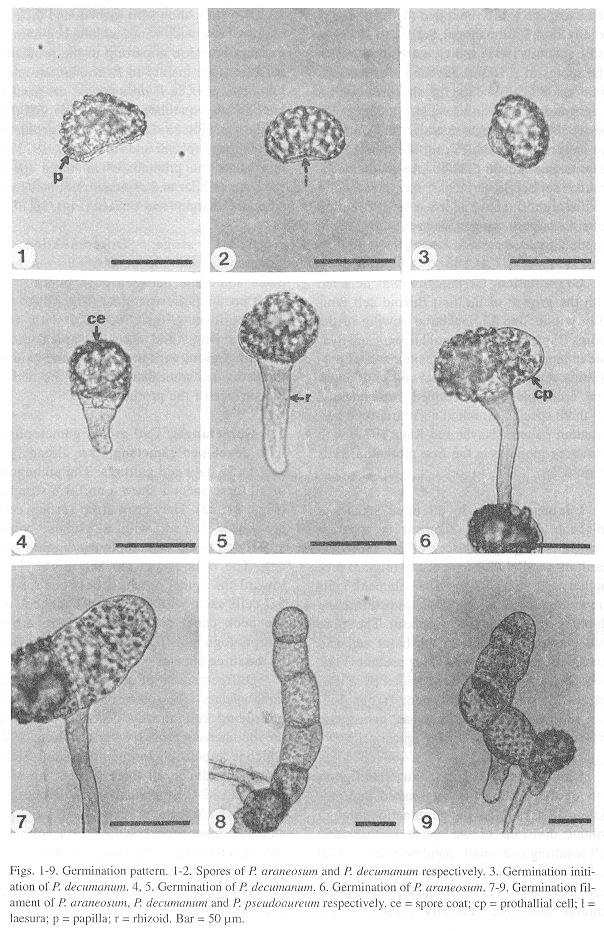
<body><![CDATA[<BR><FONT FACE="Arial,Helvetica"><FONT SIZE=-1>&nbsp;</FONT></FONT></TD>  <TD><FONT FACE="Arial,Helvetica"><FONT SIZE=-1>12-XI-1994</FONT></FONT>&nbsp;      <P><FONT FACE="Arial,Helvetica"><FONT SIZE=-1>&nbsp;</FONT></FONT></TD> </TR>  <TR> <TD><FONT FACE="Arial,Helvetica"><FONT SIZE=-1><I>Phlebodium decumanum</I> (Willd.) J. Smith</FONT></FONT></TD>  <TD><FONT FACE="Arial,Helvetica"><FONT SIZE=-1>BPG-1032, 1033</FONT></FONT></TD>  <TD><FONT FACE="Arial,Helvetica"><FONT SIZE=-1>Tuxtepec, Oaxaca&nbsp;</FONT></FONT></TD>  <TD><FONT FACE="Arial,Helvetica"><FONT SIZE=-1>SAP, 100 m</FONT></FONT></TD>  <TD><FONT FACE="Arial,Helvetica"><FONT SIZE=-1>09-IX-1995&nbsp;</FONT></FONT></TD> </TR>  <TR> <TD></TD>  <TD><FONT FACE="Arial,Helvetica"><FONT SIZE=-1>BPG-1036&nbsp;</FONT></FONT></TD>  <TD><FONT FACE="Arial,Helvetica"><FONT SIZE=-1>Tuxtepec, Oaxaca</FONT></FONT></TD>  <TD><FONT FACE="Arial,Helvetica"><FONT SIZE=-1>SAP, 30 m</FONT></FONT></TD>  <TD><FONT FACE="Arial,Helvetica"><FONT SIZE=-1>09-IX-1995</FONT></FONT></TD> </TR>  <TR> <TD></TD>  <TD><FONT FACE="Arial,Helvetica"><FONT SIZE=-1>IRJ-101, 102</FONT></FONT></TD>  <TD><FONT FACE="Arial,Helvetica"><FONT SIZE=-1>Tuxtepec, Oaxaca</FONT></FONT></TD>  <TD><FONT FACE="Arial,Helvetica"><FONT SIZE=-1>SAP, 85 m</FONT></FONT></TD>  <TD><FONT FACE="Arial,Helvetica"><FONT SIZE=-1>10-IX-1995&nbsp;</FONT></FONT></TD> </TR> </TABLE></CENTER> &nbsp; <UL><FONT FACE="Arial,Helvetica"><FONT SIZE=-1>Abbreviations: AMR, Aniceto Mendoza Ru&iacute;z; BPG, Blanca P&eacute;rez-Garc&iacute;a; IRJ, Irma.</FONT></FONT>     <BR><FONT FACE="Arial,Helvetica"><FONT SIZE=-1>Reyes Jaramillo; BE, oak forest; BPE, pine-oak forest; SAP, tropical evergreen forest;</FONT></FONT>     <BR><FONT FACE="Arial,Helvetica"><FONT SIZE=-1>SBC, tropical deciduous forest.</FONT></FONT>    </UL>       <P><FONT FACE="Arial,Helvetica"><FONT SIZE=-1>Spores for each species were sown without previous sterilization in 35 petri dishes (5 cm across) in Thompson medium (<A HREF="#Klekowski">Klekowski 1969</A>, <A HREF="#Pérez-García">P&eacute;rez-Garc&iacute;a 1989</A>) to a density of 80-150 spores/cm<SUP>2</SUP>. Cultures were grown at room temperature (25-30 C); and 75 watt (Luz de D&iacute;a Solar brand t 38/ A 1D, Slimline 75 v) lamps were used to provide light with a 12 h/12 h photoperiod. Photomicrographs were taken from live specimens.</FONT></FONT>     <BR>&nbsp;      <P><B><FONT FACE="Arial,Helvetica"><FONT SIZE=-1>Result</FONT></FONT></B>      <P><FONT FACE="Arial,Helvetica"><FONT SIZE=-1><B>Spores</B>: In all three species, spores are monolete, ellipsoid, and golden in appearance. The exospore is bilayered and the perispore is usually thin (<A HREF="#Erdtman">Erdtman and Sorsa 1971</A>, <A HREF="#Tryon">Tryon and Lugardon 1991</A>) and type 1 (<A HREF="#Lloyd">Lloyd 1981</A>). The spores of <I>P. araneosum </I>and <I>P. pseudoaureum</I> are 40-(45)-48 &micro;m in diameter, with a roughly papillated surface (<A HREF="#FIG 1">Fig. 1</A>). The papillae are blunt and irregular in size (2-5) and the laesura ranges 30-35 &micro;m; the spores of <I>P. decumanum</I> are 36-(38)-40 &micro;m in diameter, and the surface is verrucose; the verrucae are 2.5 &micro;m high, and have an irregular distribution pattern; laesura ranges from 25-30 &micro;m in length (<A HREF="#FIG 2">Fig. 2</A>).</FONT></FONT>     <BR>&nbsp;     ]]></body>
<body><![CDATA[<CENTER></CENTER>      <CENTER><A NAME="FIG 1"></A><IMG SRC="/img/fbpe/rbt/v46n4/0294i01.GIF" HEIGHT=931 WIDTH=604></CENTER>      
<CENTER>&nbsp;</CENTER>      <CENTER>&nbsp;</CENTER>      <CENTER></CENTER>      <CENTER><A NAME="FIG 2"></A><IMG SRC="/img/fbpe/rbt/v46n4/0294i02.GIF" HEIGHT=946 WIDTH=655></CENTER>      
<CENTER>&nbsp;</CENTER>      <CENTER>&nbsp;</CENTER>      <CENTER></CENTER>      <CENTER><A NAME="FIG 3"></A><IMG SRC="/img/fbpe/rbt/v46n4/0294i03.GIF" HEIGHT=937 WIDTH=643></CENTER>      
]]></body>
<body><![CDATA[<CENTER>&nbsp;</CENTER>      <CENTER></CENTER>      <CENTER><A NAME="FIG 4"></A><IMG SRC="/img/fbpe/rbt/v46n4/0294i04.GIF" HEIGHT=385 WIDTH=661></CENTER>       
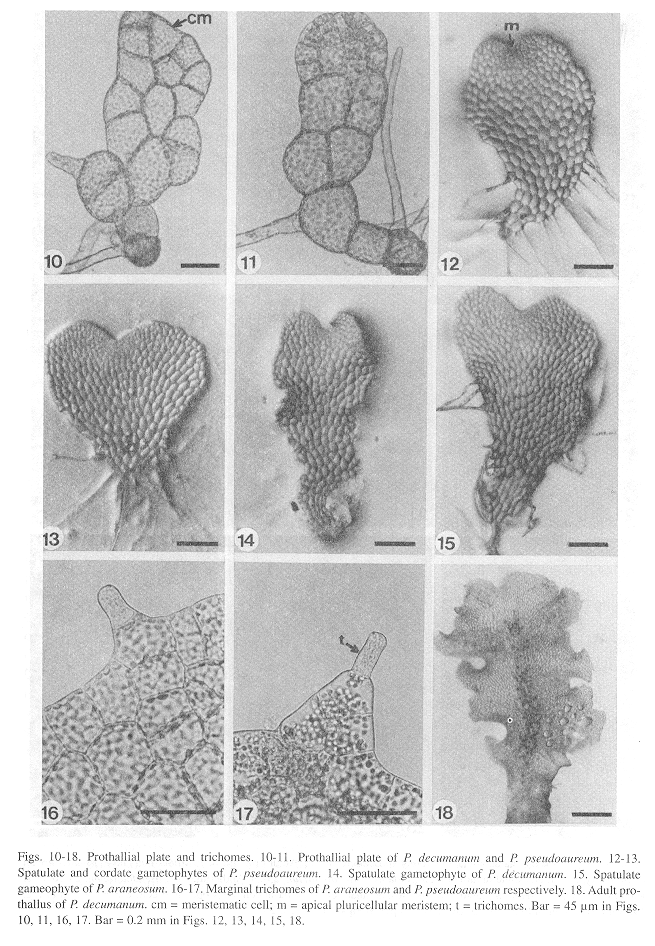
<P>&nbsp;     <BR>&nbsp;     <BR>&nbsp;      <P><FONT FACE="Arial,Helvetica"><FONT SIZE=-1><B>Germination</B>: Germination was detected with the growth of the first rhizoid cell typically within 7 to 15 days after sowing of the spores (<A HREF="#FIG 1">Figs. 3-5</A>). The rhizoid is long and hyaline in appearance with a large number of proplastids. A globose prothallial cell with abundant chloroplasts was formed subsequently. All three species exhibited a Vittaria-type germination pattern (<A HREF="#Nayar 1971">Nayar and Kaur 1971</A>) with refracting globules in the first prothallial cells (<A HREF="#FIG 1">Figs. 6,7</A>).</FONT></FONT>      <P><FONT FACE="Arial,Helvetica"><FONT SIZE=-1><B>Filament stage</B>: In all three species a uniseriate germination filament is apparent after 12-30 days, consisting of 2-7 cells as a result of parallel divisions of the original prothallial cell (<A HREF="#FIG 1">Figs. 7-9</A>). The filament cells show abundant chloroplasts and refracting globules scattered in the cytoplasm. The spore wall was still attached to the basal cell and there were one to three rhizoids present (<A HREF="#FIG 1">Figs. 7-9</A>). The terminal cell was divided by a wall parallel to the axis of the filament; further division follows an oblique direction, giving rise to an obconic or meristematic apical cell.</FONT></FONT>      <P><FONT FACE="Arial,Helvetica"><FONT SIZE=-1><B>Laminar stage</B>: The laminar configuration of the prothalli is established approximately 30 days following germination through oblique divisions of the apical meristematic cell resulting in a small spatulate plate of 8-20 cells (<A HREF="#FIG 2">Figs. 10, 11</A>). Within 40-60 days, the meristematic cell develops into an apical pluricellular meristem centrally located (<A HREF="#FIG 2">Figs. 12,13</A>), which allows the growth and differentiation of two wide wings and the beginning of a central cushion imparting to the prothalli a cordate shape mainly in <I>P. araneosum</I> and <I>P. pseudoaureum</I>; in <I>P. decumanum</I> the prothalli are basically spatulate (<A HREF="#FIG 2">Figs. 14,15</A>). All three species exhibit a Drynaria-type prothallial development (<A HREF="#Nayar 1969">Nayar and Kaur 1969</A>, <A HREF="#Nayar 1971">1971</A>). At this stage, the prothalli of all three species show unicellular and capitate trichomes located on the margins and surface (<A HREF="#FIG 2">Figs. 16,17</A>).</FONT></FONT>      <P><FONT FACE="Arial,Helvetica"><FONT SIZE=-1><B>Adult stage</B>: Differentiation of gametangia and the central cushion takes place sometime between days 60-120. The adult prothalli are spatulate (<A HREF="#FIG 2">Fig. 18</A>) to cordate-reniform (<A HREF="#FIG 3">Figs. 19, 20</A>), with wide undulate wings and a central apical meristematic region, with unicellular and capitate secretory trichomes at the margins and on the surface of the prothalli.</FONT></FONT>      ]]></body>
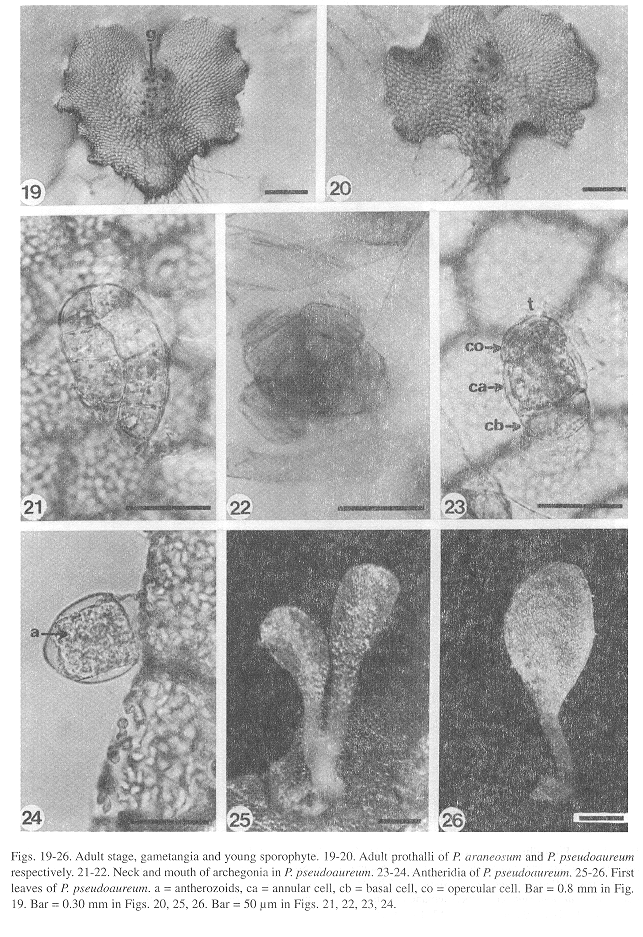
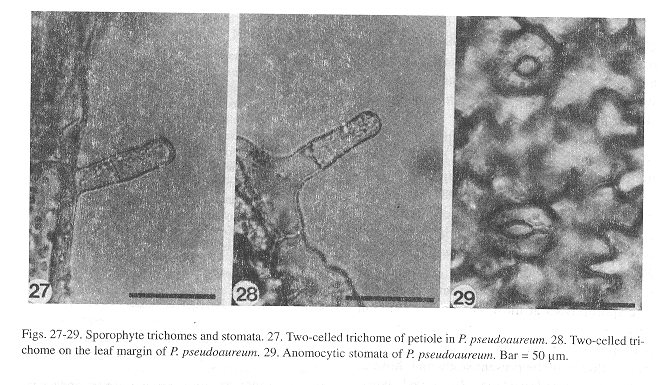
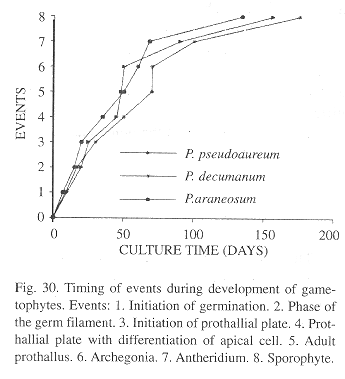
<body><![CDATA[<P><FONT FACE="Arial,Helvetica"><FONT SIZE=-1><B>Gametangia</B>: Full grown gametophytes with developed gametangia are already present in 55 days old cultures. The archegonia of all three species show a uniform structure (<A HREF="#FIG 3">Figs. 21, 22</A>). They grow from surface cells, are bottle-shaped, with a globose venter embedded in the gametophyte containing the egg. The neck is straight and slightly bent toward the apical notch, it has four rows of 5-7 cells each, with the ventral canal cell and the neck canal cells inside. There are no morphological differences in the archegonia of the three species.</FONT></FONT>      <P><FONT FACE="Arial,Helvetica"><FONT SIZE=-1>Differentiation of the antheridia in the three species takes place on the surface of a protruding cell already described for other polypodiaceous ferns (<A HREF="#Nayar 1971">Nayar and Kaur 1971</A>) which is responsible for their pendulous shape. The antheridia in all three species are small (<A HREF="#FIG 3">Figs. 23, 24</A>), spherical or subglobose to somewhat elongate in shape and are found along the margins and on the ventral surface of the gametophytes. The basic structure of the antheridia consists of a basal cell with a flat to concave shape, a ring cell lining the antheridial cavity, and an opercular cell.</FONT></FONT>      <P><FONT FACE="Arial,Helvetica"><FONT SIZE=-1><B>Sporophyte</B>: The embryo development is similar to that of <I>Phlebodium aureum </I>(<A HREF="#Ward 1954b">Ward 1954b</A>). The first leaves, which appear within 150-400 days after sowing, in all three species (<A HREF="#FIG 3">Figs. 25, 26</A>), are simple, spatulate, and have a dichotomous vascular bundle. As in the gametophytes, the young sporophyte shows unicellular, short, capitate trichomes along the margin and on the leaf surface, although two-celled trichomes can also be found on the petiole (<A HREF="#FIG 4">Fig. 27</A>) and on the margin of the lamina (<A HREF="#FIG 4">Fig. 28</A>). Stomata are anomocytic (<A HREF="#Van Cotthem">Van Cotthem 1973</A>), with two occlusive cells surrounded by epidermal cells with wavy lateral walls (<A HREF="#FIG 4">Fig. 29</A>), and are present on the abaxial surface of the lamina, but absent on the adaxial surface.</FONT></FONT>     <BR>&nbsp;      <P><B><FONT FACE="Arial,Helvetica"><FONT SIZE=-1>Discussion</FONT></FONT></B>      <P><FONT FACE="Arial,Helvetica"><FONT SIZE=-1>Comparative analysis of the gametophyte morphogenesis of these three species of <I>Phlebodium</I> showed similarities (<A HREF="#FIG 5">Fig. 30</A>). Spores are all monolete, ellipsoid, and golden although spores from <I>P. decumanum</I> are smaller (by about 10 &micro;m), and show a less conspicuous ornamentation, with underdeveloped papillae as compared to the spores of <I>P. araneosum</I> and <I>P. pseudoaureum.</I></FONT></FONT>     <BR>&nbsp;     <CENTER></CENTER>      <CENTER><A NAME="FIG 5"></A><IMG SRC="/img/fbpe/rbt/v46n4/0294i05.GIF" HEIGHT=379 WIDTH=345></CENTER> &nbsp;     
<BR>&nbsp;      ]]></body>
<body><![CDATA[<P><FONT FACE="Arial,Helvetica"><FONT SIZE=-1>Differences in shape were evident in the gametophytic phase. In <I>P. araneosum </I>and <I>P. pseudoaureum</I> prothalli are mainly cordate, although sometimes reniform and with wide wings, whereas in <I>P. decumanum</I>, wings are shorter and spatulate.</FONT></FONT>      <P><FONT FACE="Arial,Helvetica"><FONT SIZE=-1>Gametangia are of the leptosporangiate type in all three species, with no significant morphological differences among them.</FONT></FONT>      <P><FONT FACE="Arial,Helvetica"><FONT SIZE=-1>According with <A HREF="#Stolze">Stolze (1981</A>), there are several ideas about the circumscription of the genera segregated from <I>Polypodium</I>. Recent papers recognize the following genera: <I>Polypodium</I>, <I>Microgramma</I>, <I>Niphidium</I>, <I>Campyloneurum</I>, <I>Phlebodium</I> and <I>Pleopeltis</I>. The sporophytes at those genera are different between them, but the development and morphology of their gametophytes are very similar, as shown by the present study and those of <I>Polypodium lepidotrichum</I> (<A HREF="#Reyes 1994">Reyes and Perez-Garc&iacute;a 1994</A>), <I>Niphidium crassifolium</I> (<A HREF="#Reyes 1996">Reyes <I>et al.</I> 1996</A>) and <I>Microgramma</I> <I>nitida</I> (<A HREF="#Ramírez">Ram&iacute;rez and P&eacute;rez-Garc&iacute;a 1998</A>).</FONT></FONT>      <P><FONT FACE="Arial,Helvetica"><FONT SIZE=-1>The sexual phase of the species mentioned above and the species studied of <I>Phlebodium</I> share several characters as monolete ellipsoidal spores, with oil globules typical of Polypodiaceae s.str., germination and pattern of prothallial development, archegonia and antheridia typical of the leptosporangiate ferns and unicellular trichomes in margins and surfaces of the adult gametophytes.</FONT></FONT>      <P><FONT FACE="Arial,Helvetica"><FONT SIZE=-1>Although there are differences in the shape of the adult gametophytes and the time apparition of the sporophytes those are not significative and do not lend additional support for the circumscription of the genera as regard their sexual phase.</FONT></FONT>     <BR>&nbsp;      <P><B><FONT FACE="Arial,Helvetica"><FONT SIZE=-1>Acknowledgements</FONT></FONT></B>      <P><FONT FACE="Arial,Helvetica"><FONT SIZE=-1>The authors thank Laura E. Riba for the English translation and Robbin C. Moran for extremely valuable comments to the manuscript.</FONT></FONT>     <BR>&nbsp;      <P><B><FONT FACE="Arial,Helvetica"><FONT SIZE=-1>Resumen</FONT></FONT></B>      ]]></body>
<body><![CDATA[<P><FONT FACE="Arial,Helvetica"><FONT SIZE=-1>Una comparaci&oacute;n del desarrollo del gametofito de <I>Phlebodium araneosum</I>, <I>P. pseudoaureum</I> y <I>P. decumanum</I> fue hecha. Las esporas fueron sembradas en agar con sales minerales. Similitudes en el tipo de germinaci&oacute;n y desarrollo prot&aacute;lico fueron observadas. Los gametofitos adultos fueron cordiforme-espatulados a cordiforme-reniformes; los gametangios son del tipo com&uacute;n de los helechos leptosporangiados. Las tres especies muestran caracteristicas morfogen&eacute;ticas del gametofito similares y no a aden caracter&iacute;sticas adicionales que apoyen la distinci&oacute;n entre <I>Phlebodium,</I> <I>Polypodium, Microgramma </I>y <I>Niphidium, </I>por lo que se refiere a la fase sexual.</FONT></FONT>     <BR>&nbsp;      <P><B><FONT FACE="Arial,Helvetica"><FONT SIZE=-1>References</FONT></FONT></B>      <!-- ref --><P><A NAME="Atkinson"></A><FONT FACE="Arial,Helvetica"><FONT SIZE=-1>Atkinson, L.R. &amp; A.G. Stokey. 1970. Gametophyte of <I>Polypodium chnoodes</I>. Phytomorphology 20: 364-367.</FONT></FONT>    &nbsp;&nbsp;&nbsp;&nbsp;&nbsp;&nbsp;&nbsp;&nbsp;[&#160;<a href="javascript:void(0);" onclick="javascript: window.open('/scielo.php?script=sci_nlinks&ref=1151210&pid=S0034-7744199800040001300001&lng=','','width=640,height=500,resizable=yes,scrollbars=1,menubar=yes,');">Links</a>&#160;]<!-- end-ref --><!-- ref --><P><A NAME="Davie"></A><FONT FACE="Arial,Helvetica"><FONT SIZE=-1>Davie, J.H.1951. The development of the antheridium in the Polypodiaceae. Amer.J. Bot. 38: 621-628.</FONT></FONT>    &nbsp;&nbsp;&nbsp;&nbsp;&nbsp;&nbsp;&nbsp;&nbsp;[&#160;<a href="javascript:void(0);" onclick="javascript: window.open('/scielo.php?script=sci_nlinks&ref=1151211&pid=S0034-7744199800040001300002&lng=','','width=640,height=500,resizable=yes,scrollbars=1,menubar=yes,');">Links</a>&#160;]<!-- end-ref --><!-- ref --><P><A NAME="Erdtman"></A><FONT FACE="Arial,Helvetica"><FONT SIZE=-1>Erdtman, G. &amp; P. Sorsa. 1971. Pollen and spore morphology / Plant taxonomy, Pteridophyta, 302 pp, Almqvist and Wiksell, Stockholm.</FONT></FONT>    &nbsp;&nbsp;&nbsp;&nbsp;&nbsp;&nbsp;&nbsp;&nbsp;[&#160;<a href="javascript:void(0);" onclick="javascript: window.open('/scielo.php?script=sci_nlinks&ref=1151212&pid=S0034-7744199800040001300003&lng=','','width=640,height=500,resizable=yes,scrollbars=1,menubar=yes,');">Links</a>&#160;]<!-- end-ref --><!-- ref --><P><A NAME="Hartman"></A><FONT FACE="Arial,Helvetica"><FONT SIZE=-1>Hartman, N.E. 1931. Antheridial dehiscence in the Polypodiaceae. Bot. Gaz. (Londres) 91: 252-276.</FONT></FONT>    &nbsp;&nbsp;&nbsp;&nbsp;&nbsp;&nbsp;&nbsp;&nbsp;[&#160;<a href="javascript:void(0);" onclick="javascript: window.open('/scielo.php?script=sci_nlinks&ref=1151213&pid=S0034-7744199800040001300004&lng=','','width=640,height=500,resizable=yes,scrollbars=1,menubar=yes,');">Links</a>&#160;]<!-- end-ref --><!-- ref --><P><A NAME="Klekowski"></A><FONT FACE="Arial,Helvetica"><FONT SIZE=-1>Klekowski, E. J., Jr. 1969. Reproductive biology of the Pteridophyta. III. A study of the Blechnaceae. J. Linn. Soc., Bot. 62: 361-377.</FONT></FONT>    &nbsp;&nbsp;&nbsp;&nbsp;&nbsp;&nbsp;&nbsp;&nbsp;[&#160;<a href="javascript:void(0);" onclick="javascript: window.open('/scielo.php?script=sci_nlinks&ref=1151214&pid=S0034-7744199800040001300005&lng=','','width=640,height=500,resizable=yes,scrollbars=1,menubar=yes,');">Links</a>&#160;]<!-- end-ref --><!-- ref --><P><A NAME="Lloyd"></A><FONT FACE="Arial,Helvetica"><FONT SIZE=-1>Lloyd, R.M. 1981. The perispore in <I>Polypodium</I> and related genera (Polypodiaceae). Canad. J. Bot. 59: 175-189.</FONT></FONT>    &nbsp;&nbsp;&nbsp;&nbsp;&nbsp;&nbsp;&nbsp;&nbsp;[&#160;<a href="javascript:void(0);" onclick="javascript: window.open('/scielo.php?script=sci_nlinks&ref=1151215&pid=S0034-7744199800040001300006&lng=','','width=640,height=500,resizable=yes,scrollbars=1,menubar=yes,');">Links</a>&#160;]<!-- end-ref --><!-- ref --><P><A NAME="Mendoza"></A><FONT FACE="Arial,Helvetica"><FONT SIZE=-1>Mendoza, A., B. P&eacute;rez-Garc&iacute;a, I. Reyes Jaramillo &amp; M. Ricci. 1996-1997. Desarrollo del gametofito de <I>Pteris berteroana</I> (Pteridaceae: Pterideae). Rev. Biol. Trop. 44/45: 51-57.</FONT></FONT>    &nbsp;&nbsp;&nbsp;&nbsp;&nbsp;&nbsp;&nbsp;&nbsp;[&#160;<a href="javascript:void(0);" onclick="javascript: window.open('/scielo.php?script=sci_nlinks&ref=1151216&pid=S0034-7744199800040001300007&lng=','','width=640,height=500,resizable=yes,scrollbars=1,menubar=yes,');">Links</a>&#160;]<!-- end-ref --><!-- ref --><P><A NAME="Mickel"></A><FONT FACE="Arial,Helvetica"><FONT SIZE=-1>Mickel, J.T. &amp; J.M. Beitel. 1988. Pteridophyte Flora Of Oaxaca, Mexico. Mem. New York Bot. Gard. 46: 1-568.</FONT></FONT>    &nbsp;&nbsp;&nbsp;&nbsp;&nbsp;&nbsp;&nbsp;&nbsp;[&#160;<a href="javascript:void(0);" onclick="javascript: window.open('/scielo.php?script=sci_nlinks&ref=1151217&pid=S0034-7744199800040001300008&lng=','','width=640,height=500,resizable=yes,scrollbars=1,menubar=yes,');">Links</a>&#160;]<!-- end-ref --><!-- ref --><P><A NAME="Pérez-García"></A><FONT FACE="Arial,Helvetica"><FONT SIZE=-1>P&eacute;rez-Garc&iacute;a, B. 1989. Morfog&eacute;nes de gemetofitos de Cyatheaceae (Pterophyta: Filicales). tesis Doctoral. Fac. Ciencias. Universidad Nacional Aut&oacute;noma de M&eacute;xico, M&eacute;xico, D.F.</FONT></FONT>    &nbsp;&nbsp;&nbsp;&nbsp;&nbsp;&nbsp;&nbsp;&nbsp;[&#160;<a href="javascript:void(0);" onclick="javascript: window.open('/scielo.php?script=sci_nlinks&ref=1151218&pid=S0034-7744199800040001300009&lng=','','width=640,height=500,resizable=yes,scrollbars=1,menubar=yes,');">Links</a>&#160;]<!-- end-ref --><!-- ref --><P><A NAME="Nayar 1954"></A><FONT FACE="Arial,Helvetica"><FONT SIZE=-1>Nayar, B.K. 1954. Studies in Polypodiaceae-II. Contributions to the morphology of <I>Pseudodrynaria coronans</I> (Wall.) C. Chr. Phytomorphology 4: 379-390.</FONT></FONT>    &nbsp;&nbsp;&nbsp;&nbsp;&nbsp;&nbsp;&nbsp;&nbsp;[&#160;<a href="javascript:void(0);" onclick="javascript: window.open('/scielo.php?script=sci_nlinks&ref=1151219&pid=S0034-7744199800040001300010&lng=','','width=640,height=500,resizable=yes,scrollbars=1,menubar=yes,');">Links</a>&#160;]<!-- end-ref --><!-- ref --><P><A NAME="Nayar 1962"></A><FONT FACE="Arial,Helvetica"><FONT SIZE=-1>Nayar, B.K. 1962. Morphology of spores and prothalli of some species of Polypodiaceae. Bot. Gaz. (Crawfordsville) 123: 223-232.</FONT></FONT>    &nbsp;&nbsp;&nbsp;&nbsp;&nbsp;&nbsp;&nbsp;&nbsp;[&#160;<a href="javascript:void(0);" onclick="javascript: window.open('/scielo.php?script=sci_nlinks&ref=1151220&pid=S0034-7744199800040001300011&lng=','','width=640,height=500,resizable=yes,scrollbars=1,menubar=yes,');">Links</a>&#160;]<!-- end-ref --><!-- ref --><P><A NAME="Nayar 1969"></A><FONT FACE="Arial,Helvetica"><FONT SIZE=-1>Nayar, B.K. &amp; S. Kaur. 1969. Types of prothallial development in homosporous ferns. Phytomorphology 19: 179-188.</FONT></FONT>    &nbsp;&nbsp;&nbsp;&nbsp;&nbsp;&nbsp;&nbsp;&nbsp;[&#160;<a href="javascript:void(0);" onclick="javascript: window.open('/scielo.php?script=sci_nlinks&ref=1151221&pid=S0034-7744199800040001300012&lng=','','width=640,height=500,resizable=yes,scrollbars=1,menubar=yes,');">Links</a>&#160;]<!-- end-ref --><!-- ref --><P><A NAME="Nayar 1971"></A><FONT FACE="Arial,Helvetica"><FONT SIZE=-1>Nayar, B.K., &amp; S. Kaur. 1971. Gametophytes of homosporous ferns. Bot. Rev. (Lancaster) 37: 350-351.</FONT></FONT>    &nbsp;&nbsp;&nbsp;&nbsp;&nbsp;&nbsp;&nbsp;&nbsp;[&#160;<a href="javascript:void(0);" onclick="javascript: window.open('/scielo.php?script=sci_nlinks&ref=1151222&pid=S0034-7744199800040001300013&lng=','','width=640,height=500,resizable=yes,scrollbars=1,menubar=yes,');">Links</a>&#160;]<!-- end-ref --><!-- ref --><P><FONT FACE="Arial,Helvetica"><FONT SIZE=-1>P&eacute;rez-Garc&iacute;a, B. 1989. Morfog&eacute;nesis de gametofitos de Cyatheaceae (Pterophyta: Filicales). Tesis Doctoral. Fac. Ciencias, Universidad Nacional Aut&oacute;noma de M&eacute;xico, M&eacute;xico, D. F.</FONT></FONT>    &nbsp;&nbsp;&nbsp;&nbsp;&nbsp;&nbsp;&nbsp;&nbsp;[&#160;<a href="javascript:void(0);" onclick="javascript: window.open('/scielo.php?script=sci_nlinks&ref=1151223&pid=S0034-7744199800040001300014&lng=','','width=640,height=500,resizable=yes,scrollbars=1,menubar=yes,');">Links</a>&#160;]<!-- end-ref --><!-- ref --><P><A NAME="Ramírez"></A><FONT FACE="Arial,Helvetica"><FONT SIZE=-1>Ram&iacute;rez T. R. &amp; B. P&eacute;rez-Garcia. 1998. Fase gametof&iacute;tica de <I>Microgramma nitida</I> (J.Sm.) A. R. Sm. (Polypodiaceae s.str.). Rev. Biol. Trop. 43: 000-000-</FONT></FONT>    &nbsp;&nbsp;&nbsp;&nbsp;&nbsp;&nbsp;&nbsp;&nbsp;[&#160;<a href="javascript:void(0);" onclick="javascript: window.open('/scielo.php?script=sci_nlinks&ref=1151224&pid=S0034-7744199800040001300015&lng=','','width=640,height=500,resizable=yes,scrollbars=1,menubar=yes,');">Links</a>&#160;]<!-- end-ref --><!-- ref --><P><A NAME="Reyes 1994"></A><FONT FACE="Arial,Helvetica"><FONT SIZE=-1>Reyes, I. &amp; B. P&eacute;rez-Garc&iacute;a. 1994. Morfolog&iacute;a y estrategias reproductivas del gametofito de <I>Polypodium lepidotrichum</I> (F&eacute;e) Maxon (Polypodiaceae). Acta Bot. Mex. 28: 71-78.</FONT></FONT>    &nbsp;&nbsp;&nbsp;&nbsp;&nbsp;&nbsp;&nbsp;&nbsp;[&#160;<a href="javascript:void(0);" onclick="javascript: window.open('/scielo.php?script=sci_nlinks&ref=1151225&pid=S0034-7744199800040001300016&lng=','','width=640,height=500,resizable=yes,scrollbars=1,menubar=yes,');">Links</a>&#160;]<!-- end-ref --><!-- ref --><P><A NAME="Reyes 1996"></A><FONT FACE="Arial,Helvetica"><FONT SIZE=-1>Reyes Jaramillo, I., B. P&eacute;rez-Garc&iacute;a &amp; A. Mendoza. 1996. Desarrollo del gametofito y del esporofito joven de <I>Niphidium crassifolium</I> (Filicales: Polypodiaceae s.str.). Rev. Biol. Trop. 44: 485-490.</FONT></FONT>    &nbsp;&nbsp;&nbsp;&nbsp;&nbsp;&nbsp;&nbsp;&nbsp;[&#160;<a href="javascript:void(0);" onclick="javascript: window.open('/scielo.php?script=sci_nlinks&ref=1151226&pid=S0034-7744199800040001300017&lng=','','width=640,height=500,resizable=yes,scrollbars=1,menubar=yes,');">Links</a>&#160;]<!-- end-ref --><!-- ref --><P><A NAME="Stolze"></A><FONT FACE="Arial,Helvetica"><FONT SIZE=-1>Stolze, R. G. 1981. Ferns and fern allies of Guatemala. Fieldi. Bot., N. S., No.6: 358-359.</FONT></FONT>    &nbsp;&nbsp;&nbsp;&nbsp;&nbsp;&nbsp;&nbsp;&nbsp;[&#160;<a href="javascript:void(0);" onclick="javascript: window.open('/scielo.php?script=sci_nlinks&ref=1151227&pid=S0034-7744199800040001300018&lng=','','width=640,height=500,resizable=yes,scrollbars=1,menubar=yes,');">Links</a>&#160;]<!-- end-ref --><!-- ref --><P><A NAME="Stokey"></A><FONT FACE="Arial,Helvetica"><FONT SIZE=-1>Stokey, A.G. 1959. <I>Polypodium pectinatum</I> and <I>P. plumula</I> – Polypodiaceae or Grammitidaceae?. Amer. Fern J. 49: 142-146.</FONT></FONT>    &nbsp;&nbsp;&nbsp;&nbsp;&nbsp;&nbsp;&nbsp;&nbsp;[&#160;<a href="javascript:void(0);" onclick="javascript: window.open('/scielo.php?script=sci_nlinks&ref=1151228&pid=S0034-7744199800040001300019&lng=','','width=640,height=500,resizable=yes,scrollbars=1,menubar=yes,');">Links</a>&#160;]<!-- end-ref --><!-- ref --><P><A NAME="Tryon"></A><FONT FACE="Arial,Helvetica"><FONT SIZE=-1>Tryon, A.F. &amp; B. Lugardon. 1991. Spores of the Pteridophyta: surface, wall structure, and diversity based on electron microscope studies. Springer, New York. 648 p.</FONT></FONT>    &nbsp;&nbsp;&nbsp;&nbsp;&nbsp;&nbsp;&nbsp;&nbsp;[&#160;<a href="javascript:void(0);" onclick="javascript: window.open('/scielo.php?script=sci_nlinks&ref=1151229&pid=S0034-7744199800040001300020&lng=','','width=640,height=500,resizable=yes,scrollbars=1,menubar=yes,');">Links</a>&#160;]<!-- end-ref --><!-- ref --><P><A NAME="Van Cotthem"></A><FONT FACE="Arial,Helvetica"><FONT SIZE=-1>Van Cotthem, W.R.J. 1973. Stomatal types and systematics. <I>In</I>: A. C. Jermy, J. A. Crabbe and B. A. Thomas (Eds.). The Phylogeny and classification of the ferns. Academic, New York. p. 59-71.</FONT></FONT>    &nbsp;&nbsp;&nbsp;&nbsp;&nbsp;&nbsp;&nbsp;&nbsp;[&#160;<a href="javascript:void(0);" onclick="javascript: window.open('/scielo.php?script=sci_nlinks&ref=1151230&pid=S0034-7744199800040001300021&lng=','','width=640,height=500,resizable=yes,scrollbars=1,menubar=yes,');">Links</a>&#160;]<!-- end-ref --><!-- ref --><P><A NAME="Ward 1954a"></A><FONT FACE="Arial,Helvetica"><FONT SIZE=-1>Ward, M. 1954a. Fertilization in <I>Phlebodium aureum</I> J. Sm. Phytomorphology 4: 1-17.</FONT></FONT>    &nbsp;&nbsp;&nbsp;&nbsp;&nbsp;&nbsp;&nbsp;&nbsp;[&#160;<a href="javascript:void(0);" onclick="javascript: window.open('/scielo.php?script=sci_nlinks&ref=1151231&pid=S0034-7744199800040001300022&lng=','','width=640,height=500,resizable=yes,scrollbars=1,menubar=yes,');">Links</a>&#160;]<!-- end-ref --><!-- ref --><P><A NAME="Ward 1954b"></A><FONT FACE="Arial,Helvetica"><FONT SIZE=-1>Ward, M. 1954b. The development of the embryo of<I> Phlebodium aureum</I> J. Sm. Phytomorphology 4: 18-26.</FONT></FONT>    &nbsp;&nbsp;&nbsp;&nbsp;&nbsp;&nbsp;&nbsp;&nbsp;[&#160;<a href="javascript:void(0);" onclick="javascript: window.open('/scielo.php?script=sci_nlinks&ref=1151232&pid=S0034-7744199800040001300023&lng=','','width=640,height=500,resizable=yes,scrollbars=1,menubar=yes,');">Links</a>&#160;]<!-- end-ref --><!-- ref --><P><A NAME="Ward 1954"></A><FONT FACE="Arial,Helvetica"><FONT SIZE=-1>Ward, M. &amp; R.H. Wetmore. 1954. Experimental control of development in the embryo of the fern <I>Phlebodium aureum</I>. Amer.<I> </I>J. Bot. 41: 428-434.</FONT></FONT>    &nbsp;&nbsp;&nbsp;&nbsp;&nbsp;&nbsp;&nbsp;&nbsp;[&#160;<a href="javascript:void(0);" onclick="javascript: window.open('/scielo.php?script=sci_nlinks&ref=1151233&pid=S0034-7744199800040001300024&lng=','','width=640,height=500,resizable=yes,scrollbars=1,menubar=yes,');">Links</a>&#160;]<!-- end-ref --><P><A NAME="1a"></A><FONT FACE="Arial,Helvetica"><FONT SIZE=-1><SUP><A HREF="#1">1</A></SUP>Departamento de Biolog&iacute;a, C. B. S., Universidad Aut&oacute;noma Metropolitana. Ap. Postal 55-535. M&eacute;xico, D. F. 09340. Fax: 7-24-46-88<SUP>, </SUP>e-mail: <A HREF="mailto:bpg@xanum.uam.mx">bpg@xanum.uam.mx</A></FONT></FONT>      ]]></body><back>
<ref-list>
<ref id="B1">
<nlm-citation citation-type="journal">
<person-group person-group-type="author">
<name>
<surname><![CDATA[Atkinson]]></surname>
<given-names><![CDATA[L.R.]]></given-names>
</name>
<name>
<surname><![CDATA[Stokey]]></surname>
<given-names><![CDATA[A.G.]]></given-names>
</name>
</person-group>
<article-title xml:lang="en"><![CDATA[Gametophyte of Polypodium chnoodes.]]></article-title>
<source><![CDATA[Phytomorphology]]></source>
<year>1970</year>
<volume>20</volume>
<page-range>364-367</page-range></nlm-citation>
</ref>
<ref id="B2">
<nlm-citation citation-type="journal">
<person-group person-group-type="author">
<name>
<surname><![CDATA[Davie]]></surname>
<given-names><![CDATA[J.H.]]></given-names>
</name>
</person-group>
<article-title xml:lang="en"><![CDATA[The development of the antheridium in the Polypodiaceae.]]></article-title>
<source><![CDATA[Amer.J. Bot.]]></source>
<year>1951</year>
<volume>38</volume>
<page-range>621-628</page-range></nlm-citation>
</ref>
<ref id="B3">
<nlm-citation citation-type="book">
<person-group person-group-type="author">
<name>
<surname><![CDATA[Erdtman]]></surname>
<given-names><![CDATA[G.]]></given-names>
</name>
<name>
<surname><![CDATA[Sorsa]]></surname>
<given-names><![CDATA[P.]]></given-names>
</name>
</person-group>
<source><![CDATA[Pollen and spore morphology / Plant taxonomy, Pteridophyta]]></source>
<year>1971</year>
<publisher-name><![CDATA[Almqvist and Wiksell, Stockholm.]]></publisher-name>
</nlm-citation>
</ref>
<ref id="B4">
<nlm-citation citation-type="journal">
<person-group person-group-type="author">
<name>
<surname><![CDATA[Hartman]]></surname>
<given-names><![CDATA[N.E.]]></given-names>
</name>
</person-group>
<article-title xml:lang="en"><![CDATA[Antheridial dehiscence in the Polypodiaceae]]></article-title>
<source><![CDATA[Bot. Gaz. (Londres)]]></source>
<year>1931</year>
<volume>91</volume>
<page-range>252-276</page-range></nlm-citation>
</ref>
<ref id="B5">
<nlm-citation citation-type="journal">
<person-group person-group-type="author">
<name>
<surname><![CDATA[Klekowski]]></surname>
<given-names><![CDATA[E. J.]]></given-names>
</name>
</person-group>
<article-title xml:lang="en"><![CDATA[Reproductive biology of the Pteridophyta. III.: A study of the Blechnaceae.]]></article-title>
<source><![CDATA[J. Linn. Soc., Bot.]]></source>
<year>1969</year>
<volume>62</volume>
<page-range>361-377</page-range></nlm-citation>
</ref>
<ref id="B6">
<nlm-citation citation-type="journal">
<person-group person-group-type="author">
<name>
<surname><![CDATA[Lloyd]]></surname>
<given-names><![CDATA[R.M.]]></given-names>
</name>
</person-group>
<article-title xml:lang="en"><![CDATA[The perispore in Polypodium and related genera (Polypodiaceae).]]></article-title>
<source><![CDATA[Canad. J. Bot.]]></source>
<year>1981</year>
<volume>59</volume>
<page-range>175-189</page-range></nlm-citation>
</ref>
<ref id="B7">
<nlm-citation citation-type="journal">
<person-group person-group-type="author">
<name>
<surname><![CDATA[Mendoza]]></surname>
<given-names><![CDATA[A.]]></given-names>
</name>
<name>
<surname><![CDATA[Pérez-García]]></surname>
<given-names><![CDATA[B.]]></given-names>
</name>
<name>
<surname><![CDATA[Reyes Jaramillo]]></surname>
<given-names><![CDATA[. I]]></given-names>
</name>
<name>
<surname><![CDATA[Ricci.]]></surname>
<given-names><![CDATA[M.]]></given-names>
</name>
</person-group>
<article-title xml:lang="en"><![CDATA[Desarrollo del gametofito de Pteris berteroana (Pteridaceae: Pterideae).]]></article-title>
<source><![CDATA[Rev. Biol. Trop.]]></source>
<year>1996</year>
<month>-1</month>
<day>99</day>
<volume>44/45</volume>
<page-range>51-57</page-range></nlm-citation>
</ref>
<ref id="B8">
<nlm-citation citation-type="journal">
<person-group person-group-type="author">
<name>
<surname><![CDATA[Mickel]]></surname>
<given-names><![CDATA[J.T.]]></given-names>
</name>
<name>
<surname><![CDATA[Beitel]]></surname>
<given-names><![CDATA[J.M.]]></given-names>
</name>
</person-group>
<article-title xml:lang="en"><![CDATA[Pteridophyte Flora Of Oaxaca, Mexico]]></article-title>
<source><![CDATA[Mem. New York Bot. Gard.]]></source>
<year>1988</year>
<volume>46</volume>
<page-range>1-568</page-range></nlm-citation>
</ref>
<ref id="B9">
<nlm-citation citation-type="">
<person-group person-group-type="author">
<name>
<surname><![CDATA[Pérez-García]]></surname>
<given-names><![CDATA[B.]]></given-names>
</name>
</person-group>
<source><![CDATA[]]></source>
<year>1989</year>
</nlm-citation>
</ref>
<ref id="B10">
<nlm-citation citation-type="journal">
<person-group person-group-type="author">
<name>
<surname><![CDATA[Nayar]]></surname>
<given-names><![CDATA[B.K.]]></given-names>
</name>
</person-group>
<article-title xml:lang="en"><![CDATA[Studies in Polypodiaceae-II.: Contributions to the morphology of Pseudodrynaria coronans (Wall.)]]></article-title>
<source><![CDATA[C. Chr. Phytomorphology]]></source>
<year>1954</year>
<volume>4</volume>
<page-range>379-390</page-range></nlm-citation>
</ref>
<ref id="B11">
<nlm-citation citation-type="journal">
<person-group person-group-type="author">
<name>
<surname><![CDATA[Nayar]]></surname>
<given-names><![CDATA[B.K]]></given-names>
</name>
</person-group>
<article-title xml:lang="en"><![CDATA[Morphology of spores and prothalli of some species of Polypodiaceae]]></article-title>
<source><![CDATA[Bot. Gaz. (Crawfordsville)]]></source>
<year>1962</year>
<volume>123</volume>
<page-range>223-232</page-range></nlm-citation>
</ref>
<ref id="B12">
<nlm-citation citation-type="journal">
<person-group person-group-type="author">
<name>
<surname><![CDATA[Nayar]]></surname>
<given-names><![CDATA[B.K.]]></given-names>
</name>
<name>
<surname><![CDATA[Kaur]]></surname>
<given-names><![CDATA[S.]]></given-names>
</name>
</person-group>
<article-title xml:lang="en"><![CDATA[Types of prothallial development in homosporous ferns]]></article-title>
<source><![CDATA[Phytomorphology]]></source>
<year>1969</year>
<volume>19</volume>
<page-range>179-188</page-range></nlm-citation>
</ref>
<ref id="B13">
<nlm-citation citation-type="journal">
<person-group person-group-type="author">
<name>
<surname><![CDATA[Nayar]]></surname>
<given-names><![CDATA[B.K.]]></given-names>
</name>
<name>
<surname><![CDATA[Kaur.]]></surname>
<given-names><![CDATA[S.]]></given-names>
</name>
</person-group>
<article-title xml:lang="en"><![CDATA[Gametophytes of homosporous ferns.]]></article-title>
<source><![CDATA[Bot. Rev. (Lancaster)]]></source>
<year>1971</year>
<volume>37</volume>
<page-range>350-351</page-range></nlm-citation>
</ref>
<ref id="B14">
<nlm-citation citation-type="">
<person-group person-group-type="author">
<name>
<surname><![CDATA[Pérez-García]]></surname>
<given-names><![CDATA[B.]]></given-names>
</name>
</person-group>
<source><![CDATA[Morfogénesis de gametofitos de Cyatheaceae (Pterophyta: Filicales).]]></source>
<year>1989</year>
</nlm-citation>
</ref>
<ref id="B15">
<nlm-citation citation-type="journal">
<person-group person-group-type="author">
<name>
<surname><![CDATA[Ramírez]]></surname>
<given-names><![CDATA[T. R.]]></given-names>
</name>
<name>
<surname><![CDATA[Pérez-Garcia]]></surname>
<given-names><![CDATA[B.]]></given-names>
</name>
</person-group>
<article-title xml:lang="es"><![CDATA[Fase gametofítica de Microgramma nitida (J.Sm.) A. R. Sm. (Polypodiaceae s.str.).]]></article-title>
<source><![CDATA[Rev. Biol. Trop.]]></source>
<year>1998</year>
<volume>43</volume>
<page-range>000-000</page-range></nlm-citation>
</ref>
<ref id="B16">
<nlm-citation citation-type="journal">
<person-group person-group-type="author">
<name>
<surname><![CDATA[Reyes]]></surname>
<given-names><![CDATA[I.]]></given-names>
</name>
<name>
<surname><![CDATA[Pérez-García]]></surname>
<given-names><![CDATA[B.]]></given-names>
</name>
</person-group>
<article-title xml:lang="es"><![CDATA[Morfología y estrategias reproductivas del gametofito de Polypodium lepidotrichum (Fée) Maxon (Polypodiaceae).]]></article-title>
<source><![CDATA[Acta Bot. Mex.]]></source>
<year>1994</year>
<volume>28</volume>
<page-range>71-78</page-range></nlm-citation>
</ref>
<ref id="B17">
<nlm-citation citation-type="journal">
<person-group person-group-type="author">
<name>
<surname><![CDATA[Reyes Jaramillo]]></surname>
<given-names><![CDATA[I.]]></given-names>
</name>
<name>
<surname><![CDATA[Pérez-García]]></surname>
<given-names><![CDATA[B.]]></given-names>
</name>
<name>
<surname><![CDATA[Mendoza]]></surname>
<given-names><![CDATA[A.]]></given-names>
</name>
</person-group>
<article-title xml:lang="es"><![CDATA[Desarrollo del gametofito y del esporofito joven de Niphidium crassifolium (Filicales: Polypodiaceae s.str.).]]></article-title>
<source><![CDATA[Rev. Biol. Trop.]]></source>
<year>1996</year>
<volume>44</volume>
<page-range>485-490</page-range></nlm-citation>
</ref>
<ref id="B18">
<nlm-citation citation-type="journal">
<person-group person-group-type="author">
<name>
<surname><![CDATA[Stolze]]></surname>
<given-names><![CDATA[R. G.]]></given-names>
</name>
</person-group>
<article-title xml:lang="en"><![CDATA[Ferns and fern allies of Guatemala.: Fieldi.]]></article-title>
<source><![CDATA[Bot., N. S.]]></source>
<year>1981</year>
<numero>.6</numero>
<issue>.6</issue>
<page-range>358-359</page-range></nlm-citation>
</ref>
<ref id="B19">
<nlm-citation citation-type="journal">
<person-group person-group-type="author">
<name>
<surname><![CDATA[Stokey]]></surname>
<given-names><![CDATA[A.G.]]></given-names>
</name>
</person-group>
<article-title xml:lang="en"><![CDATA[Polypodium pectinatum and P. plumula - Polypodiaceae or Grammitidaceae?.]]></article-title>
<source><![CDATA[Amer. Fern J.]]></source>
<year>1959</year>
<volume>49</volume>
<page-range>142-146</page-range></nlm-citation>
</ref>
<ref id="B20">
<nlm-citation citation-type="book">
<person-group person-group-type="author">
<name>
<surname><![CDATA[Tryon]]></surname>
<given-names><![CDATA[A.F]]></given-names>
</name>
<name>
<surname><![CDATA[Lugardon]]></surname>
<given-names><![CDATA[B.]]></given-names>
</name>
</person-group>
<source><![CDATA[Spores of the Pteridophyta: surface, wall structure, and diversity based on electron microscope studies]]></source>
<year>1991</year>
<publisher-loc><![CDATA[^eNew York New York]]></publisher-loc>
<publisher-name><![CDATA[Springer]]></publisher-name>
</nlm-citation>
</ref>
<ref id="B21">
<nlm-citation citation-type="book">
<person-group person-group-type="author">
<name>
<surname><![CDATA[Van Cotthem]]></surname>
<given-names><![CDATA[W.R.J.]]></given-names>
</name>
</person-group>
<article-title xml:lang="en"><![CDATA[Stomatal types and systematics.]]></article-title>
<person-group person-group-type="editor">
<name>
<surname><![CDATA[Jermy]]></surname>
<given-names><![CDATA[A. C.]]></given-names>
</name>
<name>
<surname><![CDATA[Crabbe]]></surname>
<given-names><![CDATA[J. A.]]></given-names>
</name>
<name>
<surname><![CDATA[Thomas]]></surname>
<given-names><![CDATA[B. A.]]></given-names>
</name>
</person-group>
<source><![CDATA[The Phylogeny and classification of the ferns.]]></source>
<year>1973</year>
<page-range>59-71</page-range><publisher-loc><![CDATA[^eNew York New York]]></publisher-loc>
<publisher-name><![CDATA[Academic]]></publisher-name>
</nlm-citation>
</ref>
<ref id="B22">
<nlm-citation citation-type="journal">
<person-group person-group-type="author">
<name>
<surname><![CDATA[Ward]]></surname>
<given-names><![CDATA[M.]]></given-names>
</name>
</person-group>
<article-title xml:lang="en"><![CDATA[Fertilization in Phlebodium aureum]]></article-title>
<source><![CDATA[J. Sm. Phytomorphology]]></source>
<year>1954</year>
<volume>4</volume>
<page-range>1-17</page-range></nlm-citation>
</ref>
<ref id="B23">
<nlm-citation citation-type="journal">
<person-group person-group-type="author">
<name>
<surname><![CDATA[Ward]]></surname>
<given-names><![CDATA[M.]]></given-names>
</name>
</person-group>
<article-title xml:lang="en"><![CDATA[The development of the embryo of Phlebodium aureum]]></article-title>
<source><![CDATA[J. Sm. Phytomorphology]]></source>
<year>1954</year>
<volume>4</volume>
<page-range>18-26</page-range></nlm-citation>
</ref>
<ref id="B24">
<nlm-citation citation-type="journal">
<person-group person-group-type="author">
<name>
<surname><![CDATA[Ward]]></surname>
<given-names><![CDATA[M.]]></given-names>
</name>
<name>
<surname><![CDATA[Wetmore]]></surname>
<given-names><![CDATA[R.H.]]></given-names>
</name>
</person-group>
<article-title xml:lang="en"><![CDATA[Experimental control of development in the embryo of the fern Phlebodium aureum.]]></article-title>
<source><![CDATA[Amer. J. Bot.]]></source>
<year>1954</year>
<volume>41</volume>
<page-range>428-434</page-range></nlm-citation>
</ref>
</ref-list>
</back>
</article>