<?xml version="1.0" encoding="ISO-8859-1"?><article xmlns:mml="http://www.w3.org/1998/Math/MathML" xmlns:xlink="http://www.w3.org/1999/xlink" xmlns:xsi="http://www.w3.org/2001/XMLSchema-instance">
<front>
<journal-meta>
<journal-id>0034-7744</journal-id>
<journal-title><![CDATA[Revista de Biología Tropical]]></journal-title>
<abbrev-journal-title><![CDATA[Rev. biol. trop]]></abbrev-journal-title>
<issn>0034-7744</issn>
<publisher>
<publisher-name><![CDATA[Universidad de Costa Rica]]></publisher-name>
</publisher>
</journal-meta>
<article-meta>
<article-id>S0034-77441998000400003</article-id>
<title-group>
<article-title xml:lang="es"><![CDATA[Producción secundaria de una población de Chione cancellata (Bivalvia: Veneridae) de la costa sur del Golfo de Cariaco, Venezuela]]></article-title>
</title-group>
<contrib-group>
<contrib contrib-type="author">
<name>
<surname><![CDATA[Prieto A]]></surname>
<given-names><![CDATA[Antulio S.]]></given-names>
</name>
<xref ref-type="aff" rid="A01"/>
</contrib>
<contrib contrib-type="author">
<name>
<surname><![CDATA[Ramos]]></surname>
<given-names><![CDATA[Cenia]]></given-names>
</name>
<xref ref-type="aff" rid="A01"/>
</contrib>
<contrib contrib-type="author">
<name>
<surname><![CDATA[Arrieche]]></surname>
<given-names><![CDATA[Dwight]]></given-names>
</name>
<xref ref-type="aff" rid="A02"/>
</contrib>
</contrib-group>
<aff id="A01">
<institution><![CDATA[,Escuela de Ciencias, UDO Laboratorio Econtullogía de Poblaciones ]]></institution>
<addr-line><![CDATA[Sucre ]]></addr-line>
<country>Venezuela</country>
</aff>
<aff id="A02">
<institution><![CDATA[,IIBCA-UDO  ]]></institution>
<addr-line><![CDATA[Cumaná Sucre]]></addr-line>
<country>Venezuela</country>
</aff>
<pub-date pub-type="pub">
<day>00</day>
<month>12</month>
<year>1998</year>
</pub-date>
<pub-date pub-type="epub">
<day>00</day>
<month>12</month>
<year>1998</year>
</pub-date>
<volume>46</volume>
<numero>4</numero>
<fpage>913</fpage>
<lpage>919</lpage>
<copyright-statement/>
<copyright-year/>
<self-uri xlink:href="http://www.scielo.sa.cr/scielo.php?script=sci_arttext&amp;pid=S0034-77441998000400003&amp;lng=en&amp;nrm=iso"></self-uri><self-uri xlink:href="http://www.scielo.sa.cr/scielo.php?script=sci_abstract&amp;pid=S0034-77441998000400003&amp;lng=en&amp;nrm=iso"></self-uri><self-uri xlink:href="http://www.scielo.sa.cr/scielo.php?script=sci_pdf&amp;pid=S0034-77441998000400003&amp;lng=en&amp;nrm=iso"></self-uri><abstract abstract-type="short" xml:lang="en"><p><![CDATA[Production and biomass of Chione cancellata, an abundant species in Thalassia testudinum sea beds, were studied from March, 1984 to May, 1985 in Guaracayal, Cariaco Gulf, Venezuela. The population distribution ranges were stable. Many individuals were 20-30 mm long (80%) and recruitment was low. The mean density was 45.54 ind m-2 with a mean standing dry weight biomass of 7.37 g m-2, both changed significantly with time. Growth rates in marked bivalves of different size classes was maximum in the period between 14-X-1984 and 10-V-1985. A production of 17.34 g m-2 year-1 was obtained using a method designed to study populations with continuous reproduction and indistinguishable age classes. The greatest production values were obtained for cockles 20 to 30 mm in length. Highest production was between 28-II-1985 and 27-IV-1985. The annual turnover rate (P/B) was 2.65 year-1.]]></p></abstract>
<abstract abstract-type="short" xml:lang="es"><p><![CDATA[La producción y la biomasa de Chione cancellata un bivalvo abundante en praderas de Thalassia testudinum se estudió desde marzo, 1984 hasta mayo, 1985 en Guaracayal, localidad de la costa sur del Golfo de Cariaco, Venezuela. La población está integrada principalmente por individuos entre 20 y 30 mm de longitud (80%), la cual presentó un bajo reclutamiento. La densidad promedio (45.54 ind m-2) y la biomasa promedio en peso seco de (7.37 g m -2) presentaron variaciones significativas entre los muestreos. Las tasas de crecimiento en individuos marcados en diferentes clases de tallas fueron más altas durante el período comprendido entre el 14-X-1984 al 10-V-1985. Utilizando un método para poblaciones con reproducción continua y clases de edades no separables se obtuvo una producción total de 17.34 g m-2 año-¹ durante el período de estudio. Los máximos valores fueron aportados por los bivalvos entre 20 y 30 mm de longitud y la mayor producción ocurrió entre el 28-II al 27-IV-1985. La tasa anual de renovación (P/B) se estimó en 2.65 año -1 .]]></p></abstract>
<kwd-group>
<kwd lng="en"><![CDATA[Chione cancellata]]></kwd>
<kwd lng="en"><![CDATA[density]]></kwd>
<kwd lng="en"><![CDATA[biomass]]></kwd>
<kwd lng="en"><![CDATA[production]]></kwd>
<kwd lng="en"><![CDATA[P/B ratio]]></kwd>
<kwd lng="en"><![CDATA[bivalves]]></kwd>
</kwd-group>
</article-meta>
</front><body><![CDATA[ <CENTER><FONT FACE="Arial,Helvetica"><B>Producci&oacute;n secundaria de una poblaci&oacute;n de </B><I>Chione cancellata</I></FONT></CENTER>      <CENTER><B><FONT FACE="Arial,Helvetica">(Bivalvia: Veneridae) de la costa sur del Golfo de Cariaco, Venezuela</FONT></B></CENTER>      <CENTER>&nbsp;</CENTER>      <CENTER>&nbsp;</CENTER>      <CENTER><FONT FACE="Arial,Helvetica"><FONT SIZE=-1><B>Antulio S. Prieto A&nbsp;<A NAME="1"></A></B><SUP><A HREF="#1b">1</A></SUP><B>&nbsp; Cenia Ramos<A NAME="1a"></A></B><SUP><A HREF="#1b">1</A></SUP>&nbsp;<B>&nbsp; Dwight Arrieche&nbsp;<A NAME="2"></A></B><SUP><A HREF="#2b">2</A></SUP></FONT></FONT></CENTER>      <CENTER>&nbsp;</CENTER>      <CENTER>&nbsp;</CENTER>      <CENTER><FONT FACE="Arial,Helvetica"><FONT SIZE=-1>Recibido 19-II-1998. Corregido 24-IX-1998. Aceptado 5-X-1998.</FONT></FONT></CENTER> &nbsp;     <BR>&nbsp;     <BR><B><FONT FACE="Arial,Helvetica"><FONT SIZE=-1>Abstract</FONT></FONT></B>      ]]></body>
<body><![CDATA[<P><FONT FACE="Arial,Helvetica"><FONT SIZE=-1>Production and biomass of <I>Chione cancellata,</I><B> </B>an abundant species in <I>Thalassia testudinum </I>sea beds, were studied from March, 1984 to May, 1985 in Guaracayal, Cariaco Gulf, Venezuela. The population distribution ranges were stable. Many individuals were 20-30 mm long (80%) and recruitment was low. The mean density was 45.54 ind m<SUP>-2</SUP> with a mean standing dry weight biomass of 7.37 g m<SUP>-2</SUP>, both changed significantly with time. Growth rates in marked bivalves of different size classes was maximum in the period between 14-X-1984 and 10-V-1985. A production of 17.34 g m<SUP>-2</SUP> year<SUP>-1</SUP> was obtained using a method designed to study populations with continuous reproduction and indistinguishable age classes. The greatest production values were obtained for cockles 20 to 30 mm in length. Highest production was between 28-II-1985 and 27-IV-1985. The annual turnover rate (P/B) was 2.65 year<SUP>-1</SUP>.</FONT></FONT>     <BR>&nbsp;      <P><B><FONT FACE="Arial,Helvetica"><FONT SIZE=-1>Key words</FONT></FONT></B>      <P><FONT FACE="Arial,Helvetica"><FONT SIZE=-1><I>Chione cancellata,</I> density, biomass, production, P/B ratio, bivalves.</FONT></FONT>     <BR><FONT FACE="Arial,Helvetica"><FONT SIZE=-1>&nbsp;</FONT></FONT>      <P><FONT FACE="Arial,Helvetica"><FONT SIZE=-1>La familia Veneridae es considerada el grupo de bivalvos en el cual las conchas han alcanzado el mejor y m&aacute;s ajustado balance anat&oacute;mico y fisiol&oacute;gico, con una gran eficiencia hidrodin&aacute;mica, representando quiz&aacute;s el m&aacute;s alto logro en la evoluci&oacute;n de los bivalvos por su belleza tanto en su forma como en color (<A HREF="#Waldo">Waldo 1950</A>). Dentro de esta familia se incluye a <I>Chione cancellata</I>, especie de distribuci&oacute;n tropical y subtropical, muy abundante en comunidades litorales someras del Oriente de Venezuela. En el Golfo de Cariaco vive sobre fondos areno fangosos cubiertos por <I>Thalassia testudinum</I>, formando parte de la infauna superficial y junto con otras especies de moluscos en una comunidad relativamente compleja en su organizaci&oacute;n que se extiende desde 10 cm a 4 m de profundidad. Sobre la especie se conocen aspectos de la embriog&eacute;nesis y morfolog&iacute;a de la concha criada en el laboratorio (<A HREF="#D´Assaro">D&acute;Assaro 1967</A>).<A HREF="#Moore"> Moore y L&oacute;pez (1969</A>) estudiaron su ecolog&iacute;a en Key Biscayne (Florida) determinando que la especie madura al alcanzar 15 mm de longitud, se reproduce dos veces al a&ntilde;o, estimando una productividad anual del 83% de la cosecha potencial.</FONT></FONT>      <P><FONT FACE="Arial,Helvetica"><FONT SIZE=-1>Las investigaciones sobre producci&oacute;n secundaria en poblaciones de moluscos de zonas templadas son abundantes (<A HREF="#Burke">Burke y Mann 1974</A>, <A HREF="#Warwick">Warwick y Price 1975</A>), pero escasas en especies tropicales. De los reportes de la literatura se deduce que la magnitud del compartimiento de producci&oacute;n (P) se relaciona entre otros factores con la producci&oacute;n primaria del &aacute;rea, longevidad de la especie y el grado de organizaci&oacute;n del ecosistema. As&iacute; se han obtenido altas estimaciones en poblaciones de <I>Donax denticulatus</I> (<A HREF="#Vélez">V&eacute;lez <I>et al</I>. 1985</A>), <I>Tivela mactroides</I> (<A HREF="#Tata">Tat&aacute; y Prieto 1991</A>), y bajas en <I>Modiolus squamosus</I> (<A HREF="#Prieto">Prieto <I>et al.</I> 1985</A>) y <I>Pinctada</I> <I>imbricata</I> (<A HREF="#Verginelli">Verginelli y Prieto 1991</A>). Dada la importancia ecol&oacute;gica de <I>C.cancellata</I> por la abundancia en las comunidades litorales, la presente investigaci&oacute;n permiti&oacute; estimar la producci&oacute;n secundaria anual de la especie en base a determinaciones de densidad, biomasa y crecimiento en peso del tejido; y la tasa de renovaci&oacute;n anual de una poblaci&oacute;n del Golfo de Cariaco, Venezuela.</FONT></FONT>     <BR>&nbsp;      <P><B><FONT FACE="Arial,Helvetica"><FONT SIZE=-1>Materiales y M&eacute;todos</FONT></FONT></B>      <P><FONT FACE="Arial,Helvetica"><FONT SIZE=-1>Se estudi&oacute; la poblaci&oacute;n de <I>C. Cancellata</I><B> </B>de Guaracayal (10&deg; 27&acute; 00''&nbsp; N y 63&deg; 57&acute; 45'' W), Golfo de Cariaco, Estado Sucre, Venezuela, durante un a&ntilde;o (marzo, 1984 - mayo, 1985). Los organismos se colectaron en un &aacute;rea aproximada de 3 200 m<SUP>2</SUP> efectuando los muestreos en dos estaciones, una de poca profundidad desde 0.3 hasta 1.2 m, y otra de 1.5 m a 3 m de profundidad. Los muestreos se efectuaron en intervalos de uno y dos meses, sobre transectos numerados cada 0.5 m perpendiculares a la costa. Se aplic&oacute; un sistema de muestreo al azar, usando un marco met&aacute;lico de 0.25 m<SUP>2</SUP> el cual se fijaba en el fondo del sustrato, colectando todos los ejemplares contenidos en el interior del marco. Posteriormente los organismos fueron trasladados al laboratorio y colocados en un acuario con aireaci&oacute;n constante por un tiempo no menor a 12 horas para eliminar el exceso de sedimentos del tracto digestivo.</FONT></FONT>      ]]></body>
<body><![CDATA[<P><FONT FACE="Arial,Helvetica"><FONT SIZE=-1><B>Relaci&oacute;n longitud-peso y biomasa</B>: En cada muestreo se seleccionaron 30 ejemplares representativos de todas las tallas a las cuales se les determin&oacute; la longitud total (Lt) medida desde los bordes anterior y posterior de la concha, el peso h&uacute;medo de las partes blandas, y el peso seco (Ps) colocando las partes blandas a 80 &deg;C por 48 horas. Con estos datos se calcul&oacute; la relaci&oacute;n longitud-peso por la ecuaci&oacute;n Ps = a Lt<SUP>b</SUP> (<A HREF="#Wilburg">Wilburg y Owen 1964</A>), ajustada por el m&eacute;todo de los m&iacute;nimos cuadrados. La significaci&oacute;n estad&iacute;stica del grado de correlaci&oacute;n se comprob&oacute; utilizando el m&eacute;todo de Hotelling en cada relaci&oacute;n (<A HREF="#Sokal">Sokal y Rohlf 1969</A>). La biomasa (B) en gramos de peso seco se calcul&oacute; convirtiendo los valores de longitud a peso con la ecuaci&oacute;n anterior.</FONT></FONT>      <P><FONT FACE="Arial,Helvetica"><FONT SIZE=-1><B>Crecimiento</B>: El crecimiento se analiz&oacute; marcando organismos de diferentes clases de tallas y confin&aacute;ndolos en jaulas pl&aacute;sticas colocadas en &aacute;reas cercanas. Este m&eacute;todo permiti&oacute; seguir el crecimiento de las diferentes clases de tallas y obtener las tasas respectivas. El marcaje se efectu&oacute; utilizando etiquetas pl&aacute;sticas numeradas adheridas con masilla ep&oacute;xica de endurecimiento r&aacute;pido. Los organismos se agruparon en clases de tallas de 4 mm, y para estimar el crecimiento se promedi&oacute; el incremento al final de cada per&iacute;odo. La tasa instant&aacute;nea espec&iacute;fica de crecimiento en peso (G = d log10&nbsp; Ps/dt x 2.303) se obtuvo a partir de los incrementos en longitud (Lt) seg&uacute;n el m&eacute;todo de <A HREF="#Crisp">Crisp (1971)</A>, donde Ps es el peso en gramos, t es el intervalo de tiempo y 2.303 es la constante de conversi&oacute;n a logar&iacute;tmo neperiano.</FONT></FONT>      <P><FONT FACE="Arial,Helvetica"><FONT SIZE=-1><B>Producci&oacute;n secundaria</B>: Con los datos de biomasa, densidad, tasas de crecimiento y lapsos de tiempo, se calcul&oacute; la producci&oacute;n anual total para clases de 10 mm de Lt, aplicando el m&eacute;todo para poblaciones con reproducci&oacute;n continua y clases de edades no separables seg&uacute;n la relaci&oacute;n</FONT></FONT>      <P><IMG SRC="/img/fbpe/rbt/v46n4/0284i03.GIF" HEIGHT=36 WIDTH=177>      
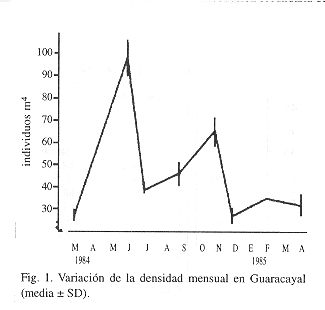
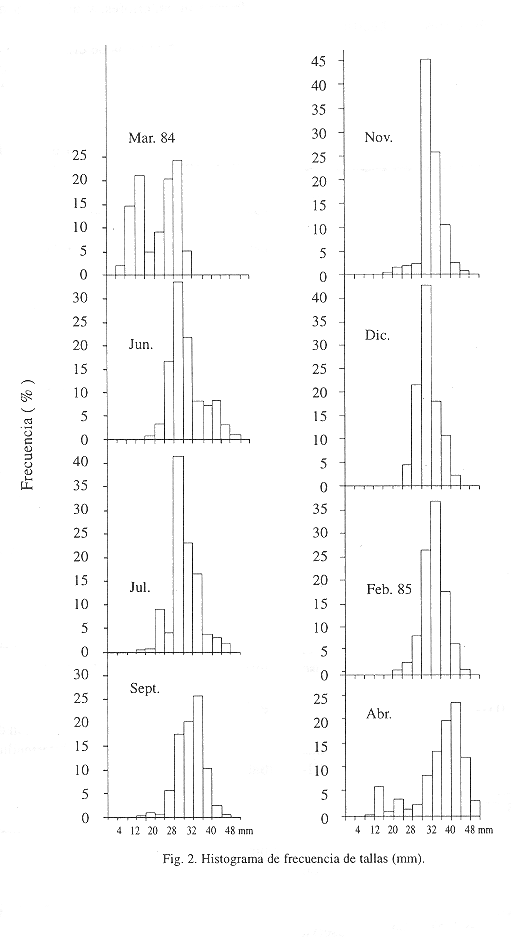
<P><FONT FACE="Arial,Helvetica"><FONT SIZE=-1>donde F es la densidad para cada clase de talla en la poblaci&oacute;n, G es la tasa espec&iacute;fica de crecimiento en peso seco, Ps es el peso seco promedio de cada intervalo de talla y <U>A</U>t es el lapso de tiempo considerado.</FONT></FONT>     <BR>&nbsp;      <P><B><FONT FACE="Arial,Helvetica"><FONT SIZE=-1>Resultados</FONT></FONT></B>      <P><FONT FACE="Arial,Helvetica"><FONT SIZE=-1>Se recolectaron 1 250 individuos, obteni&eacute;ndose una densidad promedio de 45.54 ind m<SUP>-2 </SUP>(<A HREF="#figura1">Fig. 1</A>). La m&aacute;xima densidad (98.5 ind m<SUP>-2</SUP>) se obtuvo en junio-1984 y la m&iacute;nima (24.5 ind m<SUP>-2</SUP>) en diciembre-1984, detect&aacute;ndose oscilaciones mensuales significativas de la densidad (Fs = 12.8; P &lt; 0.05), pero no entre las dos estaciones (Fs = 0.469, P > 0.05). La longitud total m&iacute;nima fue de 5.95 mm y la m&aacute;xima 43.6 mm, representando el intervalo 20-30 mm el 80% de la poblaci&oacute;n, con una distribuci&oacute;n predominantemente unimodal, y con reclutamientos en marzo-1984 y abril-1985 (<A HREF="#figura2">Fig. 2</A>).</FONT></FONT>     <BR>&nbsp;     <CENTER></CENTER>      ]]></body>
<body><![CDATA[<CENTER><A NAME="figura1"></A><IMG SRC="/img/fbpe/rbt/v46n4/0284i01.GIF" HEIGHT=310 WIDTH=325></CENTER> &nbsp;     
<BR>&nbsp;      <P><FONT FACE="Arial,Helvetica"><FONT SIZE=-1>Las relaciones entre el Ps y la Lt obtenidas por el m&eacute;todo de los m&iacute;nimos cuadrados fueron positivas y altamente significativas. El coeficiente de determinaci&oacute;n (r<SUP>2</SUP>) oscil&oacute; entre 0.63 (dic-84) y 0.86 (abr-85) (p &lt; 0.001) (<A HREF="#CUADRO1">Cuadro 1</A>). La relaci&oacute;n entre el Ps y el peso h&uacute;medo (Ph) mostr&oacute; una correlaci&oacute;n (r<SUP>2</SUP> = 0.956, p &lt; 0.001) altamente significativa, y se expresa por la ecuaci&oacute;n com&uacute;n log10 Ps = - 0.798 + 1.453 log10 Ph.</FONT></FONT>      <P><FONT FACE="Arial,Helvetica"><FONT SIZE=-1>La biomasa en Ps promedio fue de 7.37 g m<SUP>-2</SUP> con un m&iacute;nimo de 1.76 g m<SUP>-2</SUP> (dic-84) y el m&aacute;ximo de 13.71 g m<SUP>-2</SUP> (jun-84), detect&aacute;ndose diferencias significativas entre los muestreos (Fs = 12.4; P &lt; . 0.05).</FONT></FONT>     <BR>&nbsp;      <P><FONT FACE="Arial,Helvetica"><FONT SIZE=-1>Las tasas de crecimiento se obtuvieron de 110 organismos agrupados en clases de tallas de 5 mm de longitud, en los lapsos del 15-VI-84 al 1-II-85 y del 14-X-84 al 10-V-85. Por el m&eacute;todo de confinamiento en jaulas, se observ&oacute; que el crecimiento individual es variable, y la mortalidad fue de 40%. En cada grupo se regresion&oacute; el promedio de la longitud en funci&oacute;n del tiempo, ajustando la relaci&oacute;n por el m&eacute;todo de los m&iacute;nimos cuadrados, obteni&eacute;ndose dos ecuaciones (<A HREF="#CUADRO2">Cuadro 2</A>), en la cuales se observa que las pendientes de las ecuaciones del segundo lapso son superiores, y mostraron diferencias significativas en los intervalos 20-25 mm y 25-30 mm. Las tasas de crecimiento en longitud (D Lt) y las tasas instant&aacute;neas en peso seco (G) disminuyeron en los intervalos de tallas de los organismos m&aacute;s grandes (<A HREF="#CUADRO3">Cuadro 3</A>).</FONT></FONT>      <P><FONT FACE="Arial,Helvetica"><FONT SIZE=-1>Utilizando los promedios de densidad en las dos estaciones, se estim&oacute; una producci&oacute;n anual de 17.34 g m<SUP>-2</SUP> a&ntilde;o <SUP>-1</SUP>, el menor aporte anual correspondi&oacute; al intervalo 5-10 mm (0.036%), y el m&aacute;ximo fue del intervalo 20-30 mm con 81,71% del total de la producci&oacute;n. En estos valores se excluyeron los correspondientes a la materia org&aacute;nica contenida en la concha, y la biomasa liberada como gametos (<A HREF="#CUADRO4">Cuadro 4</A>). Los per&iacute;odos de menor producci&oacute;n fueron los lapsos entre el 3-VI-84 al 21-VII-84 y de &eacute;ste &uacute;ltimo al 14-X-84. Los incrementos m&aacute;s altos se obtuvieron entre el 28-II-85 al 27-IV-85 y desde el 14-IX-84 al 3-X-843 (<A HREF="#CUADRO4">Cuadro 4</A>). La relaci&oacute;n entre la producci&oacute;n anual y el promedio de la biomasa anual en la poblaci&oacute;n de Guaracayal fue de 2.65 a&ntilde;o<SUP>-1</SUP> para todas las clases de tallas.</FONT></FONT>     <BR>&nbsp;      <P><B><FONT FACE="Arial,Helvetica"><FONT SIZE=-1>Discusion</FONT></FONT></B>      <P><FONT FACE="Arial,Helvetica"><FONT SIZE=-1>La distribuci&oacute;n de grupos de edades en la poblaci&oacute;n estudiada es aparentemente estable, ya que siempre prevalecieron individuos con longitudes comprendidas entre 20 y 30 mm, a&uacute;n a pesar que se registraron diferencias significativas de la densidad entre los muestreos bimensuales. La composici&oacute;n de la poblaci&oacute;n es unimodal como la descrita para <I>Crassostrea columbiensis</I>, con la mayor proporci&oacute;n de individuos en los grupos de tallas intermedios (<A HREF="#Caballero">Caballero <I>et al</I>. 1996)</A></FONT></FONT>      ]]></body>
<body><![CDATA[<P><FONT FACE="Arial,Helvetica"><FONT SIZE=-1>La densidad promedio obtenida (45.54 ind m-2) fue la m&aacute;s alta en relaci&oacute;n a otras especies que coexisten en la misma &aacute;rea, tales como <I>Modiolus squamosus</I> (31 ind m-2)(<A HREF="#Prieto">Prieto <I>et al.</I> 1985</A>) y <I>Anadara notabilis</I> (14.06 ind m-2) (<A HREF="#Manrique">Manrique 1982</A>); sin embargo es<I> </I>muy superior a las informadas para la misma especie en Key Biscayne, Florida (<A HREF="#Moore">Moore y L&oacute;pez 1969</A>). Las diferencias significativas de la densidad determinadas en los muestreos podr&iacute;an atribuirse a efectos del mismo, o a la variaci&oacute;n de la granulometr&iacute;a y heterogeneidad del sedimento, como ha sido se&ntilde;alada en &aacute;reas someras (<A HREF="#McNulty">McNulty <I>et al</I>. 1962</A>).</FONT></FONT>     <BR>&nbsp;     <CENTER></CENTER>      <CENTER><A NAME="figura2"></A><IMG SRC="/img/fbpe/rbt/v46n4/0284i02.GIF" HEIGHT=940 WIDTH=511></CENTER>      
<CENTER>&nbsp;</CENTER>      <CENTER>&nbsp;</CENTER>      <CENTER><A NAME="CUADRO1"></A></CENTER>      <CENTER><FONT FACE="Arial,Helvetica"><FONT SIZE=-1>CUADRO 1</FONT></FONT></CENTER>      <CENTER><I><FONT FACE="Arial,Helvetica"><FONT SIZE=-1>Constantes de regresi&oacute;n para las ecuaciones que relacionan el peso</FONT></FONT></I></CENTER>      <CENTER><I><FONT FACE="Arial,Helvetica"><FONT SIZE=-1>seco (g) y la longitud total (mm) transformados a log<SUB>10</SUB>.</FONT></FONT></I></CENTER>      ]]></body>
<body><![CDATA[<CENTER><TABLE BORDER=0 CELLSPACING=0 CELLPADDING=4 WIDTH="415" > <TR> <TD VALIGN=TOP WIDTH="25%">     <CENTER><FONT FACE="Arial,Helvetica"><FONT SIZE=-1>FECHA&nbsp;</FONT></FONT></CENTER> </TD>  <TD VALIGN=TOP WIDTH="25%">     <CENTER><FONT FACE="Arial,Helvetica"><FONT SIZE=-1>b&nbsp;</FONT></FONT></CENTER> </TD>  <TD VALIGN=TOP WIDTH="25%">     <CENTER><FONT FACE="Arial,Helvetica"><FONT SIZE=-1>a&nbsp;</FONT></FONT></CENTER> </TD>  <TD VALIGN=TOP WIDTH="25%">     <CENTER><FONT FACE="Arial,Helvetica"><FONT SIZE=-1>r<SUP>2</SUP></FONT></FONT></CENTER> </TD> </TR>  <TR> <TD VALIGN=TOP WIDTH="25%"></TD>  <TD VALIGN=TOP WIDTH="25%"></TD>  <TD VALIGN=TOP WIDTH="25%"></TD>  <TD VALIGN=TOP WIDTH="25%"></TD> </TR>  <TR> <TD VALIGN=TOP WIDTH="25%">     <CENTER><FONT FACE="Arial,Helvetica"><FONT SIZE=-1>24 –III - 84&nbsp;</FONT></FONT></CENTER> </TD>  <TD VALIGN=TOP WIDTH="25%">     <CENTER><FONT FACE="Arial,Helvetica"><FONT SIZE=-1>5.65&nbsp;</FONT></FONT></CENTER> </TD>  <TD VALIGN=TOP WIDTH="25%">     <CENTER><FONT FACE="Arial,Helvetica"><FONT SIZE=-1>-3.59&nbsp;</FONT></FONT></CENTER> </TD>  <TD VALIGN=TOP WIDTH="25%">     <CENTER><FONT FACE="Arial,Helvetica"><FONT SIZE=-1>.83&nbsp;</FONT></FONT></CENTER> </TD> </TR>  <TR> <TD VALIGN=TOP WIDTH="25%">     <CENTER><FONT FACE="Arial,Helvetica"><FONT SIZE=-1>03 – VI - 84&nbsp;</FONT></FONT></CENTER> </TD>  <TD VALIGN=TOP WIDTH="25%">     ]]></body>
<body><![CDATA[<CENTER><FONT FACE="Arial,Helvetica"><FONT SIZE=-1>2.82&nbsp;</FONT></FONT></CENTER> </TD>  <TD VALIGN=TOP WIDTH="25%">     <CENTER><FONT FACE="Arial,Helvetica"><FONT SIZE=-1>-1.92&nbsp;</FONT></FONT></CENTER> </TD>  <TD VALIGN=TOP WIDTH="25%">     <CENTER><FONT FACE="Arial,Helvetica"><FONT SIZE=-1>.69&nbsp;</FONT></FONT></CENTER> </TD> </TR>  <TR> <TD VALIGN=TOP WIDTH="25%">     <CENTER><FONT FACE="Arial,Helvetica"><FONT SIZE=-1>21 – VII - 84&nbsp;</FONT></FONT></CENTER> </TD>  <TD VALIGN=TOP WIDTH="25%">     <CENTER><FONT FACE="Arial,Helvetica"><FONT SIZE=-1>4.93&nbsp;</FONT></FONT></CENTER> </TD>  <TD VALIGN=TOP WIDTH="25%">     <CENTER><FONT FACE="Arial,Helvetica"><FONT SIZE=-1>-3.02&nbsp;</FONT></FONT></CENTER> </TD>  <TD VALIGN=TOP WIDTH="25%">     <CENTER><FONT FACE="Arial,Helvetica"><FONT SIZE=-1>.68&nbsp;</FONT></FONT></CENTER> </TD> </TR>  <TR> <TD VALIGN=TOP WIDTH="25%">     <CENTER><FONT FACE="Arial,Helvetica"><FONT SIZE=-1>14 – IX - 84&nbsp;</FONT></FONT></CENTER> </TD>  <TD VALIGN=TOP WIDTH="25%">     <CENTER><FONT FACE="Arial,Helvetica"><FONT SIZE=-1>2.85&nbsp;</FONT></FONT></CENTER> </TD>  <TD VALIGN=TOP WIDTH="25%">     <CENTER><FONT FACE="Arial,Helvetica"><FONT SIZE=-1>-2.11&nbsp;</FONT></FONT></CENTER> </TD>  <TD VALIGN=TOP WIDTH="25%">     ]]></body>
<body><![CDATA[<CENTER><FONT FACE="Arial,Helvetica"><FONT SIZE=-1>.65&nbsp;</FONT></FONT></CENTER> </TD> </TR>  <TR> <TD VALIGN=TOP WIDTH="25%">     <CENTER><FONT FACE="Arial,Helvetica"><FONT SIZE=-1>03 – XI - 84&nbsp;</FONT></FONT></CENTER> </TD>  <TD VALIGN=TOP WIDTH="25%">     <CENTER><FONT FACE="Arial,Helvetica"><FONT SIZE=-1>3.96&nbsp;</FONT></FONT></CENTER> </TD>  <TD VALIGN=TOP WIDTH="25%">     <CENTER><FONT FACE="Arial,Helvetica"><FONT SIZE=-1>-2.83&nbsp;</FONT></FONT></CENTER> </TD>  <TD VALIGN=TOP WIDTH="25%">     <CENTER><FONT FACE="Arial,Helvetica"><FONT SIZE=-1>.71&nbsp;</FONT></FONT></CENTER> </TD> </TR>  <TR> <TD VALIGN=TOP WIDTH="25%">     <CENTER><FONT FACE="Arial,Helvetica"><FONT SIZE=-1>15 – XII - 84&nbsp;</FONT></FONT></CENTER> </TD>  <TD VALIGN=TOP WIDTH="25%">     <CENTER><FONT FACE="Arial,Helvetica"><FONT SIZE=-1>2.66&nbsp;</FONT></FONT></CENTER> </TD>  <TD VALIGN=TOP WIDTH="25%">     <CENTER><FONT FACE="Arial,Helvetica"><FONT SIZE=-1>-2.19&nbsp;</FONT></FONT></CENTER> </TD>  <TD VALIGN=TOP WIDTH="25%">     <CENTER><FONT FACE="Arial,Helvetica"><FONT SIZE=-1>.63&nbsp;</FONT></FONT></CENTER> </TD> </TR>  <TR> <TD VALIGN=TOP WIDTH="25%">     <CENTER><FONT FACE="Arial,Helvetica"><FONT SIZE=-1>28 – II - 85&nbsp;</FONT></FONT></CENTER> </TD>  <TD VALIGN=TOP WIDTH="25%">     ]]></body>
<body><![CDATA[<CENTER><FONT FACE="Arial,Helvetica"><FONT SIZE=-1>3.19&nbsp;</FONT></FONT></CENTER> </TD>  <TD VALIGN=TOP WIDTH="25%">     <CENTER><FONT FACE="Arial,Helvetica"><FONT SIZE=-1>-2.21&nbsp;</FONT></FONT></CENTER> </TD>  <TD VALIGN=TOP WIDTH="25%">     <CENTER><FONT FACE="Arial,Helvetica"><FONT SIZE=-1>.82&nbsp;</FONT></FONT></CENTER> </TD> </TR>  <TR> <TD VALIGN=TOP WIDTH="25%">     <CENTER><FONT FACE="Arial,Helvetica"><FONT SIZE=-1>27 – IV - 85&nbsp;</FONT></FONT></CENTER> </TD>  <TD VALIGN=TOP WIDTH="25%">     <CENTER><FONT FACE="Arial,Helvetica"><FONT SIZE=-1>5.17&nbsp;</FONT></FONT></CENTER> </TD>  <TD VALIGN=TOP WIDTH="25%">     <CENTER><FONT FACE="Arial,Helvetica"><FONT SIZE=-1>-3.18&nbsp;</FONT></FONT></CENTER> </TD>  <TD VALIGN=TOP WIDTH="25%">     <CENTER><FONT FACE="Arial,Helvetica"><FONT SIZE=-1>.86&nbsp;</FONT></FONT></CENTER> </TD> </TR> </TABLE></CENTER> <FONT FACE="Arial,Helvetica"><FONT SIZE=-1>Pendiente (b), intercepto (a), coeficiente de determinaci&oacute;n (r<SUP>2</SUP>), n&uacute;mero de ejemplares N = 30.</FONT></FONT>     <BR>&nbsp;     <CENTER></CENTER>      <CENTER><A NAME="CUADRO2"></A><FONT FACE="Arial,Helvetica"><FONT SIZE=-1>CUADRO 2</FONT></FONT></CENTER>      ]]></body>
<body><![CDATA[<CENTER><I><FONT FACE="Arial,Helvetica"><FONT SIZE=-1>Constantes de regresi&oacute;n obtenidas en las ecuaciones que relacionaron</FONT></FONT></I></CENTER>      <CENTER><I><FONT FACE="Arial,Helvetica"><FONT SIZE=-1>la longitud promedio (mm) versus el tiempo (d&iacute;as) durante el crecimiento</FONT></FONT></I></CENTER>      <CENTER><I><FONT FACE="Arial,Helvetica"><FONT SIZE=-1>estacional en intervalos de tallas, de ejemplares mantenidos en jaulas.</FONT></FONT></I></CENTER> &nbsp;     <BR>&nbsp;     <CENTER><TABLE BORDER=0 CELLSPACING=0 CELLPADDING=0 WIDTH="473" > <TR> <TD ALIGN=RIGHT VALIGN=TOP COLSPAN="3" WIDTH="25">     <CENTER><FONT FACE="Arial,Helvetica"><FONT SIZE=-1>Per&iacute;odo desde el&nbsp;</FONT></FONT>&nbsp;</CENTER>      <CENTER><FONT FACE="Arial,Helvetica"><FONT SIZE=-1>15 - VI - 84 al 01 - II - 85</FONT></FONT></CENTER> </TD>  <TD VALIGN=TOP COLSPAN="3" WIDTH="16%">     <CENTER><FONT FACE="Arial,Helvetica"><FONT SIZE=-1>Per&iacute;odo desde el</FONT></FONT>&nbsp;</CENTER>      <CENTER><FONT FACE="Arial,Helvetica"><FONT SIZE=-1>10- V - 84 al 10- V - 85</FONT></FONT></CENTER> </TD> </TR>  <TR> <TD><FONT FACE="Arial,Helvetica"><FONT SIZE=-1>Intervalo de&nbsp;</FONT></FONT>&nbsp;     <BR><FONT FACE="Arial,Helvetica"><FONT SIZE=-1>Lt (mm)</FONT></FONT></TD>  <TD>     ]]></body>
<body><![CDATA[<CENTER><FONT FACE="Arial,Helvetica"><FONT SIZE=-1>a</FONT></FONT></CENTER> </TD>  <TD>     <CENTER><FONT FACE="Arial,Helvetica"><FONT SIZE=-1>b</FONT></FONT></CENTER> </TD>  <TD>     <CENTER><FONT FACE="Arial,Helvetica"><FONT SIZE=-1>a</FONT></FONT></CENTER> </TD>  <TD>     <CENTER><FONT FACE="Arial,Helvetica"><FONT SIZE=-1>b</FONT></FONT></CENTER> </TD>  <TD>     <CENTER><FONT FACE="Arial,Helvetica"><FONT SIZE=-1>ts</FONT></FONT></CENTER> </TD> </TR>  <TR> <TD VALIGN=TOP WIDTH="16%"></TD>  <TD VALIGN=TOP WIDTH="16%"></TD>  <TD VALIGN=TOP WIDTH="16%"></TD>  <TD VALIGN=TOP WIDTH="16%"></TD>  <TD VALIGN=TOP WIDTH="16%"></TD>  <TD VALIGN=TOP WIDTH="21%"></TD> </TR>  <TR> <TD VALIGN=TOP WIDTH="16%"><FONT FACE="Arial,Helvetica"><FONT SIZE=-1>15 - 20&nbsp;</FONT></FONT></TD>  <TD VALIGN=TOP WIDTH="16%">     <CENTER><FONT FACE="Arial,Helvetica"><FONT SIZE=-1>18.65&nbsp;</FONT></FONT></CENTER> </TD>  <TD VALIGN=TOP WIDTH="16%">     <CENTER><FONT FACE="Arial,Helvetica"><FONT SIZE=-1>.014&nbsp;</FONT></FONT></CENTER> </TD>  <TD VALIGN=TOP WIDTH="16%">     <CENTER><FONT FACE="Arial,Helvetica"><FONT SIZE=-1>17.3&nbsp;</FONT></FONT></CENTER> </TD>  <TD VALIGN=TOP WIDTH="16%">     <CENTER><FONT FACE="Arial,Helvetica"><FONT SIZE=-1>.0151&nbsp;</FONT></FONT></CENTER> </TD>  <TD VALIGN=TOP WIDTH="21%">     <CENTER><FONT FACE="Arial,Helvetica"><FONT SIZE=-1>1.8</FONT></FONT></CENTER> </TD> </TR>  <TR> <TD VALIGN=TOP WIDTH="16%"><FONT FACE="Arial,Helvetica"><FONT SIZE=-1>20 - 25&nbsp;</FONT></FONT></TD>  <TD VALIGN=TOP WIDTH="16%">     ]]></body>
<body><![CDATA[<CENTER><FONT FACE="Arial,Helvetica"><FONT SIZE=-1>21.72&nbsp;</FONT></FONT></CENTER> </TD>  <TD VALIGN=TOP WIDTH="16%">     <CENTER><FONT FACE="Arial,Helvetica"><FONT SIZE=-1>.0068&nbsp;</FONT></FONT></CENTER> </TD>  <TD VALIGN=TOP WIDTH="16%">     <CENTER><FONT FACE="Arial,Helvetica"><FONT SIZE=-1>22.9&nbsp;</FONT></FONT></CENTER> </TD>  <TD VALIGN=TOP WIDTH="16%">     <CENTER><FONT FACE="Arial,Helvetica"><FONT SIZE=-1>.0182&nbsp;</FONT></FONT></CENTER> </TD>  <TD VALIGN=TOP WIDTH="21%">     <CENTER><FONT FACE="Arial,Helvetica"><FONT SIZE=-1>5&nbsp; . 2&nbsp; 2</FONT></FONT></CENTER> </TD> </TR>  <TR> <TD><FONT FACE="Arial,Helvetica"><FONT SIZE=-1>p&lt; .001&nbsp;</FONT></FONT></TD>  <TD></TD>  <TD></TD>  <TD></TD>  <TD></TD>  <TD></TD> </TR>  <TR> <TD VALIGN=TOP WIDTH="16%"><FONT FACE="Arial,Helvetica"><FONT SIZE=-1>25 - 30&nbsp;</FONT></FONT></TD>  <TD VALIGN=TOP WIDTH="16%">     <CENTER><FONT FACE="Arial,Helvetica"><FONT SIZE=-1>26.33&nbsp;</FONT></FONT></CENTER> </TD>  <TD VALIGN=TOP WIDTH="16%">     <CENTER><FONT FACE="Arial,Helvetica"><FONT SIZE=-1>.0024&nbsp;</FONT></FONT></CENTER> </TD>  <TD VALIGN=TOP WIDTH="16%">     <CENTER><FONT FACE="Arial,Helvetica"><FONT SIZE=-1>26.82&nbsp;</FONT></FONT></CENTER> </TD>  <TD VALIGN=TOP WIDTH="16%">     <CENTER><FONT FACE="Arial,Helvetica"><FONT SIZE=-1>.0156&nbsp;</FONT></FONT></CENTER> </TD>  <TD VALIGN=TOP WIDTH="21%">     <CENTER><FONT FACE="Arial,Helvetica"><FONT SIZE=-1>6.&nbsp;&nbsp; 5&nbsp;&nbsp;&nbsp; 8&nbsp;</FONT></FONT></CENTER> </TD> </TR>  <TR> <TD><FONT FACE="Arial,Helvetica"><FONT SIZE=-1>p&lt; .001&nbsp;</FONT></FONT></TD>  <TD></TD>  <TD></TD>  <TD></TD>  <TD></TD>  <TD></TD> </TR>  <TR> <TD><FONT FACE="Arial,Helvetica"><FONT SIZE=-1>30 - 35</FONT></FONT></TD>  <TD>     ]]></body>
<body><![CDATA[<CENTER><FONT FACE="Arial,Helvetica"><FONT SIZE=-1>33.28</FONT></FONT></CENTER> </TD>  <TD>     <CENTER><FONT FACE="Arial,Helvetica"><FONT SIZE=-1>.0015</FONT></FONT></CENTER> </TD>  <TD>     <CENTER><FONT FACE="Arial,Helvetica"><FONT SIZE=-1>32.66</FONT></FONT></CENTER> </TD>  <TD>     <CENTER><FONT FACE="Arial,Helvetica"><FONT SIZE=-1>.0041&nbsp;</FONT></FONT></CENTER> </TD>  <TD>     <CENTER><FONT FACE="Arial,Helvetica"><FONT SIZE=-1>3.01 p&lt;.05</FONT></FONT></CENTER> </TD> </TR>  <TR> <TD VALIGN=TOP WIDTH="16%"><FONT FACE="Arial,Helvetica"><FONT SIZE=-1>35 - 40&nbsp;</FONT></FONT></TD>  <TD VALIGN=TOP WIDTH="16%">     <CENTER><FONT FACE="Arial,Helvetica"><FONT SIZE=-1>37.15&nbsp;</FONT></FONT></CENTER> </TD>  <TD VALIGN=TOP WIDTH="16%">     <CENTER><FONT FACE="Arial,Helvetica"><FONT SIZE=-1>.002&nbsp;</FONT></FONT></CENTER> </TD>  <TD VALIGN=TOP WIDTH="16%">     <CENTER><FONT FACE="Arial,Helvetica"><FONT SIZE=-1>36.38&nbsp;</FONT></FONT></CENTER> </TD>  <TD VALIGN=TOP WIDTH="16%">     <CENTER><FONT FACE="Arial,Helvetica"><FONT SIZE=-1>.0036</FONT></FONT></CENTER> </TD>  <TD VALIGN=TOP WIDTH="21%">     <CENTER><FONT FACE="Arial,Helvetica"><FONT SIZE=-1>2.04&nbsp;</FONT></FONT></CENTER> </TD> </TR> </TABLE></CENTER> <FONT FACE="Arial,Helvetica"><FONT SIZE=-1>Pendiente (b), intercepto (a), valores de t-student de la comparaci&oacute;n de las pendientes en dos intervalos para la misma clase de tallas (ts).</FONT></FONT>     ]]></body>
<body><![CDATA[<BR>&nbsp;     <CENTER></CENTER>      <CENTER><A NAME="CUADRO3"></A><FONT FACE="Arial,Helvetica"><FONT SIZE=-1>CUADRO 3</FONT></FONT></CENTER>      <CENTER><I><FONT FACE="Arial,Helvetica"><FONT SIZE=-1>Tasas instant&aacute;neas de crecimiento en los intervalos de tallas</FONT></FONT></I></CENTER>       <P><FONT FACE="Arial,Helvetica"><FONT SIZE=-1>&nbsp;</FONT></FONT>     <CENTER><TABLE BORDER=0 CELLSPACING=0 CELLPADDING=4 WIDTH="483" > <TR> <TD VALIGN=TOP COLSPAN="3" WIDTH="20%">     <CENTER><FONT FACE="Arial,Helvetica"><FONT SIZE=-1>Per&iacute;odo desde el&nbsp;</FONT></FONT>&nbsp;</CENTER>      <CENTER><FONT FACE="Arial,Helvetica"><FONT SIZE=-1>15 - VI - 84 al 01 - II - 85</FONT></FONT></CENTER> </TD>  <TD VALIGN=TOP COLSPAN="2" WIDTH="20%">     <CENTER><FONT FACE="Arial,Helvetica"><FONT SIZE=-1>&nbsp;Per&iacute;odo desde el</FONT></FONT>&nbsp;</CENTER>      <CENTER><FONT FACE="Arial,Helvetica"><FONT SIZE=-1>10 - V - 84 al 10 - V - 85</FONT></FONT></CENTER> </TD> </TR>  <TR> <TD><FONT FACE="Arial,Helvetica"><FONT SIZE=-1>Intervalo (mm)</FONT></FONT></TD>  <TD>     ]]></body>
<body><![CDATA[<CENTER><IMG SRC="/img/fbpe/rbt/v46n4/triang.JPG" HEIGHT=17 WIDTH=17 ALIGN=TEXTTOP><FONT FACE="Arial,Helvetica"><FONT SIZE=-1>Lt&nbsp;</FONT></FONT></CENTER> </TD>  <TD>     
<CENTER><FONT FACE="Arial,Helvetica"><FONT SIZE=-1>G</FONT></FONT></CENTER> </TD>  <TD>     <CENTER><IMG SRC="/img/fbpe/rbt/v46n4/triang.JPG" HEIGHT=17 WIDTH=17 ALIGN=TEXTTOP><FONT FACE="Arial,Helvetica"><FONT SIZE=-1>Lt</FONT></FONT></CENTER> </TD>  <TD>     
<CENTER><FONT FACE="Arial,Helvetica"><FONT SIZE=-1>G</FONT></FONT></CENTER> </TD> </TR>  <TR> <TD VALIGN=TOP WIDTH="20%"></TD>  <TD VALIGN=TOP WIDTH="20%"></TD>  <TD VALIGN=TOP WIDTH="20%"></TD>  <TD VALIGN=TOP WIDTH="20%"></TD>  <TD VALIGN=TOP WIDTH="20%"></TD> </TR>  <TR> <TD VALIGN=TOP WIDTH="20%">     <CENTER><FONT FACE="Arial,Helvetica"><FONT SIZE=-1>5 - 10&nbsp;</FONT></FONT></CENTER> </TD>  <TD VALIGN=TOP WIDTH="20%"></TD>  <TD VALIGN=TOP WIDTH="20%"></TD>  <TD VALIGN=TOP WIDTH="20%"></TD>  <TD VALIGN=TOP WIDTH="20%"></TD> </TR>  <TR> <TD VALIGN=TOP WIDTH="20%">     <CENTER><FONT FACE="Arial,Helvetica"><FONT SIZE=-1>10 - 15&nbsp;</FONT></FONT></CENTER> </TD>  <TD VALIGN=TOP WIDTH="20%">     <CENTER><FONT FACE="Arial,Helvetica"><FONT SIZE=-1>4.08&nbsp;</FONT></FONT></CENTER> </TD>  <TD VALIGN=TOP WIDTH="20%"></TD>  <TD VALIGN=TOP WIDTH="20%">     <CENTER><FONT FACE="Arial,Helvetica"><FONT SIZE=-1>4.10&nbsp;</FONT></FONT></CENTER> </TD>  <TD VALIGN=TOP WIDTH="20%">     <CENTER><FONT FACE="Arial,Helvetica"><FONT SIZE=-1>.05&nbsp;</FONT></FONT></CENTER> </TD> </TR>  <TR> <TD VALIGN=TOP WIDTH="20%">     <CENTER><FONT FACE="Arial,Helvetica"><FONT SIZE=-1>15 - 20&nbsp;</FONT></FONT></CENTER> </TD>  <TD VALIGN=TOP WIDTH="20%">     ]]></body>
<body><![CDATA[<CENTER><FONT FACE="Arial,Helvetica"><FONT SIZE=-1>3.24&nbsp;</FONT></FONT></CENTER> </TD>  <TD VALIGN=TOP WIDTH="20%">     <CENTER><FONT FACE="Arial,Helvetica"><FONT SIZE=-1>.0007&nbsp;</FONT></FONT></CENTER> </TD>  <TD VALIGN=TOP WIDTH="20%">     <CENTER><FONT FACE="Arial,Helvetica"><FONT SIZE=-1>4.05&nbsp;</FONT></FONT></CENTER> </TD>  <TD VALIGN=TOP WIDTH="20%">     <CENTER><FONT FACE="Arial,Helvetica"><FONT SIZE=-1>.008&nbsp;</FONT></FONT></CENTER> </TD> </TR>  <TR> <TD VALIGN=TOP WIDTH="20%">     <CENTER><FONT FACE="Arial,Helvetica"><FONT SIZE=-1>20 - 25&nbsp;</FONT></FONT></CENTER> </TD>  <TD VALIGN=TOP WIDTH="20%">     <CENTER><FONT FACE="Arial,Helvetica"><FONT SIZE=-1>1.57&nbsp;</FONT></FONT></CENTER> </TD>  <TD VALIGN=TOP WIDTH="20%">     <CENTER><FONT FACE="Arial,Helvetica"><FONT SIZE=-1>.0003&nbsp;</FONT></FONT></CENTER> </TD>  <TD VALIGN=TOP WIDTH="20%">     <CENTER><FONT FACE="Arial,Helvetica"><FONT SIZE=-1>3.75&nbsp;</FONT></FONT></CENTER> </TD>  <TD VALIGN=TOP WIDTH="20%">     <CENTER><FONT FACE="Arial,Helvetica"><FONT SIZE=-1>.0007&nbsp;</FONT></FONT></CENTER> </TD> </TR>  <TR> <TD VALIGN=TOP WIDTH="20%">     <CENTER><FONT FACE="Arial,Helvetica"><FONT SIZE=-1>25 - 30&nbsp;</FONT></FONT></CENTER> </TD>  <TD VALIGN=TOP WIDTH="20%">     ]]></body>
<body><![CDATA[<CENTER><FONT FACE="Arial,Helvetica"><FONT SIZE=-1>.55&nbsp;</FONT></FONT></CENTER> </TD>  <TD VALIGN=TOP WIDTH="20%">     <CENTER><FONT FACE="Arial,Helvetica"><FONT SIZE=-1>.0001&nbsp;</FONT></FONT></CENTER> </TD>  <TD VALIGN=TOP WIDTH="20%">     <CENTER><FONT FACE="Arial,Helvetica"><FONT SIZE=-1>3.47&nbsp;</FONT></FONT></CENTER> </TD>  <TD VALIGN=TOP WIDTH="20%">     <CENTER><FONT FACE="Arial,Helvetica"><FONT SIZE=-1>.0006&nbsp;</FONT></FONT></CENTER> </TD> </TR>  <TR> <TD VALIGN=TOP WIDTH="20%">     <CENTER><FONT FACE="Arial,Helvetica"><FONT SIZE=-1>30 - 35&nbsp;</FONT></FONT></CENTER> </TD>  <TD VALIGN=TOP WIDTH="20%">     <CENTER><FONT FACE="Arial,Helvetica"><FONT SIZE=-1>.42&nbsp;</FONT></FONT></CENTER> </TD>  <TD VALIGN=TOP WIDTH="20%">     <CENTER><FONT FACE="Arial,Helvetica"><FONT SIZE=-1>4 x 10<SUP>-5</SUP></FONT></FONT></CENTER> </TD>  <TD VALIGN=TOP WIDTH="20%">     <CENTER><FONT FACE="Arial,Helvetica"><FONT SIZE=-1>.85&nbsp;</FONT></FONT></CENTER> </TD>  <TD VALIGN=TOP WIDTH="20%">     <CENTER><FONT FACE="Arial,Helvetica"><FONT SIZE=-1>.0001&nbsp;</FONT></FONT></CENTER> </TD> </TR>  <TR> <TD VALIGN=TOP WIDTH="20%">     <CENTER><FONT FACE="Arial,Helvetica"><FONT SIZE=-1>35 - 40&nbsp;</FONT></FONT></CENTER> </TD>  <TD VALIGN=TOP WIDTH="20%"></TD>  <TD VALIGN=TOP WIDTH="20%"></TD>  <TD VALIGN=TOP WIDTH="20%">     ]]></body>
<body><![CDATA[<CENTER><FONT FACE="Arial,Helvetica"><FONT SIZE=-1>.25&nbsp;</FONT></FONT></CENTER> </TD>  <TD VALIGN=TOP WIDTH="20%">     <CENTER><FONT FACE="Arial,Helvetica"><FONT SIZE=-1>3.27 x 10<SUP>-5</SUP></FONT></FONT></CENTER> </TD> </TR> </TABLE></CENTER> <FONT FACE="Arial,Helvetica"><FONT SIZE=-1>&nbsp;</FONT></FONT>     <BR><FONT FACE="Arial,Helvetica"><FONT SIZE=-1>Tasa de crecimiento diario en mm (<U>A</U>Lt). Tasa instant&aacute;nea de crecimiento diario en peso seco (G).</FONT></FONT>     <BR>&nbsp;     <CENTER></CENTER>      <CENTER><A NAME="CUADRO4"></A><FONT FACE="Arial,Helvetica"><FONT SIZE=-1>CUADRO 4</FONT></FONT></CENTER>      <CENTER><I><FONT FACE="Arial,Helvetica"><FONT SIZE=-1>Producci&oacute;n secundaria anual (g Ps m<SUP>-2</SUP> a&ntilde;o<SUP>-1</SUP>) por clases de tallas,</FONT></FONT></I></CENTER>      <CENTER><I><FONT FACE="Arial,Helvetica"><FONT SIZE=-1>y en los intervalos de tiempo.</FONT></FONT></I></CENTER> &nbsp;     <BR>&nbsp;     <CENTER><TABLE BORDER=0 CELLSPACING=0 CELLPADDING=0 WIDTH="597" > <TR> <TD VALIGN=TOP WIDTH="25%">     ]]></body>
<body><![CDATA[<CENTER><FONT FACE="Arial,Helvetica"><FONT SIZE=-1>Intervalo&nbsp;</FONT></FONT>&nbsp;</CENTER>      <CENTER><FONT FACE="Arial,Helvetica"><FONT SIZE=-1>de talla&nbsp;</FONT></FONT>&nbsp;</CENTER>      <CENTER><FONT FACE="Arial,Helvetica"><FONT SIZE=-1>(mm)&nbsp;</FONT></FONT></CENTER> </TD>  <TD VALIGN=TOP WIDTH="25%">     <CENTER><FONT FACE="Arial,Helvetica"><FONT SIZE=-1>Produc.&nbsp;</FONT></FONT>&nbsp;</CENTER>      <CENTER><FONT FACE="Arial,Helvetica"><FONT SIZE=-1>secundaria&nbsp;</FONT></FONT></CENTER> </TD>  <TD VALIGN=TOP WIDTH="25%">     <CENTER><FONT FACE="Arial,Helvetica"><FONT SIZE=-1>Per&iacute;odos&nbsp;</FONT></FONT></CENTER> </TD>  <TD VALIGN=TOP WIDTH="25%">     <CENTER><FONT FACE="Arial,Helvetica"><FONT SIZE=-1>Produc.&nbsp;</FONT></FONT>&nbsp;</CENTER>      <CENTER><FONT FACE="Arial,Helvetica"><FONT SIZE=-1>secun</FONT></FONT></CENTER> </TD> </TR>  <TR> <TD VALIGN=TOP WIDTH="25%">     <CENTER><FONT FACE="Arial,Helvetica"><FONT SIZE=-1>0 - 10&nbsp;</FONT></FONT></CENTER> </TD>  <TD VALIGN=TOP WIDTH="25%">     <CENTER><FONT FACE="Arial,Helvetica"><FONT SIZE=-1>.02&nbsp;</FONT></FONT></CENTER> </TD>  <TD VALIGN=TOP WIDTH="25%">     ]]></body>
<body><![CDATA[<CENTER><FONT FACE="Arial,Helvetica"><FONT SIZE=-1>24 - III - 84 al 03 - VI - 84</FONT></FONT></CENTER> </TD>  <TD VALIGN=TOP WIDTH="25%">     <CENTER><FONT FACE="Arial,Helvetica"><FONT SIZE=-1>2.59&nbsp;</FONT></FONT></CENTER> </TD> </TR>  <TR> <TD VALIGN=TOP WIDTH="25%">     <CENTER><FONT FACE="Arial,Helvetica"><FONT SIZE=-1>10 - 20&nbsp;</FONT></FONT></CENTER> </TD>  <TD VALIGN=TOP WIDTH="25%">     <CENTER><FONT FACE="Arial,Helvetica"><FONT SIZE=-1>1.11&nbsp;</FONT></FONT></CENTER> </TD>  <TD VALIGN=TOP WIDTH="25%">     <CENTER><FONT FACE="Arial,Helvetica"><FONT SIZE=-1>03 -VI - 84 al 21 -VII - 84</FONT></FONT></CENTER> </TD>  <TD VALIGN=TOP WIDTH="25%">     <CENTER><FONT FACE="Arial,Helvetica"><FONT SIZE=-1>.72&nbsp;</FONT></FONT></CENTER> </TD> </TR>  <TR> <TD VALIGN=TOP WIDTH="25%">     <CENTER><FONT FACE="Arial,Helvetica"><FONT SIZE=-1>20 - 30&nbsp;</FONT></FONT></CENTER> </TD>  <TD VALIGN=TOP WIDTH="25%">     <CENTER><FONT FACE="Arial,Helvetica"><FONT SIZE=-1>14.06&nbsp;</FONT></FONT></CENTER> </TD>  <TD VALIGN=TOP WIDTH="25%">     <CENTER><FONT FACE="Arial,Helvetica"><FONT SIZE=-1>21 - VII - 84 al 14 -IX - 84</FONT></FONT></CENTER> </TD>  <TD VALIGN=TOP WIDTH="25%">     <CENTER><FONT FACE="Arial,Helvetica"><FONT SIZE=-1>.62&nbsp;</FONT></FONT></CENTER> </TD> </TR>  <TR> <TD VALIGN=TOP WIDTH="25%">     ]]></body>
<body><![CDATA[<CENTER><FONT FACE="Arial,Helvetica"><FONT SIZE=-1>30 - 40&nbsp;</FONT></FONT></CENTER> </TD>  <TD VALIGN=TOP WIDTH="25%">     <CENTER><FONT FACE="Arial,Helvetica"><FONT SIZE=-1>2.11&nbsp;</FONT></FONT></CENTER> </TD>  <TD VALIGN=TOP WIDTH="25%">     <CENTER><FONT FACE="Arial,Helvetica"><FONT SIZE=-1>14 - IX - 84 al 03 - XI - 84</FONT></FONT></CENTER> </TD>  <TD VALIGN=TOP WIDTH="25%">     <CENTER><FONT FACE="Arial,Helvetica"><FONT SIZE=-1>4.2&nbsp;</FONT></FONT></CENTER> </TD> </TR>  <TR> <TD VALIGN=TOP WIDTH="25%">     <CENTER><FONT FACE="Arial,Helvetica"><FONT SIZE=-1>40 - 50&nbsp;</FONT></FONT></CENTER> </TD>  <TD VALIGN=TOP WIDTH="25%">     <CENTER><FONT FACE="Arial,Helvetica"><FONT SIZE=-1>.04&nbsp;</FONT></FONT></CENTER> </TD>  <TD VALIGN=TOP WIDTH="25%">     <CENTER><FONT FACE="Arial,Helvetica"><FONT SIZE=-1>03 - XI -84 al 15 - XII - 84</FONT></FONT></CENTER> </TD>  <TD VALIGN=TOP WIDTH="25%">     <CENTER><FONT FACE="Arial,Helvetica"><FONT SIZE=-1>2.55&nbsp;</FONT></FONT></CENTER> </TD> </TR>  <TR> <TD VALIGN=TOP WIDTH="25%"></TD>  <TD VALIGN=TOP WIDTH="25%"></TD>  <TD VALIGN=TOP WIDTH="25%">     <CENTER><FONT FACE="Arial,Helvetica"><FONT SIZE=-1>15 -XII - 84 al 28 -II - 85</FONT></FONT></CENTER> </TD>  <TD VALIGN=TOP WIDTH="25%">     <CENTER><FONT FACE="Arial,Helvetica"><FONT SIZE=-1>1.76&nbsp;</FONT></FONT></CENTER> </TD> </TR>  <TR> <TD VALIGN=TOP WIDTH="25%"></TD>  <TD VALIGN=TOP WIDTH="25%"></TD>  <TD VALIGN=TOP WIDTH="25%">     ]]></body>
<body><![CDATA[<CENTER><FONT FACE="Arial,Helvetica"><FONT SIZE=-1>28 - II - 85 al 27 - IV - 85</FONT></FONT></CENTER> </TD>  <TD VALIGN=TOP WIDTH="25%">     <CENTER><FONT FACE="Arial,Helvetica"><FONT SIZE=-1>4.9&nbsp;</FONT></FONT></CENTER> </TD> </TR> </TABLE></CENTER>       <P>&nbsp;      <P><FONT FACE="Arial,Helvetica"><FONT SIZE=-1>En especies de zonas templadas se ha sugerido que los par&aacute;metros poblacionales de los bivalvos var&iacute;an de acuerdo a su posici&oacute;n sobre la playa (<A HREF="#Burke">Burke y Mann 1974</A>,<A HREF="#Mason"> Mason 1972</A>, <A HREF="#Roberts">Roberts 1975</A>).</FONT></FONT>      <P><FONT FACE="Arial,Helvetica"><FONT SIZE=-1>Las estimaciones de densidad obtenidas en este trabajo son t&iacute;picas para bivalvos que habitan comunidades de <I>T. testudinum</I> las cuales caracterizan costas de baja energ&iacute;a y se corresponden con las observadas para <I>Macoma baltica</I> y <I>Mya arenaria</I><B> </B>en estuarios canadienses cubiertos por macrofitas (<A HREF="#Burke">Burke y Mann 1974</A>). No existen hasta el momento otras informaciones sobre la situaci&oacute;n actual de la poblaci&oacute;n en el &aacute;rea de Tocuchare.</FONT></FONT>      <P><FONT FACE="Arial,Helvetica"><FONT SIZE=-1>La producci&oacute;n secundaria en <I>C. cancellata</I> es mucho m&aacute;s alta que las obtenidas para <I>Anadara notabilis</I> (<A HREF="#Manrique">Manrique 1982</A>) y <I>Modiolus squamosus</I> (<A HREF="#Prieto">Prieto <I>et al</I>. 1985</A>) quienes comparten el mismo habitat de fanerogamas marinas: sin embargo son inferiores a las de <I>Tivela mactroides</I> (<A HREF="#Tata">Tat&aacute; y Prieto 1991</A>) y <I>Donax denticulatus</I> (<A HREF="#Vélez">V&eacute;lez <I>et al</I>.1985</A>) bivalvos de corto ciclo vital que caracterizan playas arenosas abiertas de alta energ&iacute;a. Los m&aacute;ximos incrementos de producci&oacute;n que ocurrieron entre el 28-II y el 27-IV-85 se corresponden con las altas tasas de crecimiento y biomasa promedio, que se asocian con el per&iacute;odo de surgencias costeras que caracterizan la estaci&oacute;n seca del Golfo de Cariaco, los cuales oxigenan el agua superficial con temperaturas bajas, altos valores de salinidad y clorofila <I>a</I>; y una alta productividad primaria (<A HREF="#Ferráz-Reyes">Ferr&aacute;z-Reyes 1987</A>). Los per&iacute;odos de menor productividad secundaria observados desde 3-VI al 14-IX-84 (<A HREF="#CUADRO4">Cuadro 4</A>) pudieran estar relacionados con procesos de post-desove en los individuos, el cual no fue estudiado, o m&aacute;s probablemente con una condici&oacute;n fisiol&oacute;gica menor debido a una disminuci&oacute;n del fitoplancton en el &aacute;rea, asociada con una mayor utilizaci&oacute;n de las reservas energ&eacute;ticas de los tejidos. En el Golfo de Cariaco, desde agosto hasta octubre aproximadamente la actividad de los vientos disminuye considerablemente, originando una disminuci&oacute;n de la productividad primaria en la zona (Lodeiros y Himmelman en prep.). La estimaci&oacute;n de la producci&oacute;n en este trabajo debe considerarse subevaluada, de acuerdo a los enfoques nuevos ya que no se tom&oacute; en cuenta la biomasa reproductiva liberada, cuya omisi&oacute;n puede disminuir las estimaciones, dependiendo de la especie (<A HREF="#Bayne">Bayne y Worral 1980</A>, <A HREF="#Griffiths">Griffiths 1981</A>, <A HREF="#Thompson">Thompson 1984</A>). El hecho que en la poblaci&oacute;n de <I>C. cancellata</I> el 81.17% de la producci&oacute;n sea aportada por los bivalvos entre 20 y 30 mm, con un aporte muy peque&ntilde;o para la producci&oacute;n total de las clases de tallas menores, indica una cierta estabilidad. La poblaci&oacute;n posee bajas tasas de reclutamiento debido probablemente a una alta mortalidad de juveniles que es t&iacute;pico en comunidades de fanerogamas marinas con alta diversidad espec&iacute;fica y en donde existe una alta estabilidad relativa de factores ambientales, y se conoce que las especies de bivalvos que las habitan son mas eficientes, longevas y menos productivas (<A HREF="#Prieto">Prieto <I>et al</I>. 1985</A>).</FONT></FONT>      <P><FONT FACE="Arial,Helvetica"><FONT SIZE=-1>La relaci&oacute;n P/B estimada (2.65 a&ntilde;o-1) es superior a la de otros bivalvos relacionados e indica que al menos la especie es cap&aacute;z de duplicar su biomasa anualmente, pudiendo ser objeto de estudios futuros que eval&uacute;en su potencial para la acuicultura.</FONT></FONT>     <BR>&nbsp;      <P><B><FONT FACE="Arial,Helvetica"><FONT SIZE=-1>Agradecimientos</FONT></FONT></B>      <P><FONT FACE="Arial,Helvetica"><FONT SIZE=-1>Agradecemos al Consejo de Investigaci&oacute;n, UDO por la subvenci&oacute;n a trav&eacute;s del proyecto CI-5-024-00333/84-85. A Ysabel Campos y Amalfi Graterol por la ayuda en las labores de campo, y a Rafael Malav&eacute; y Fernando Rivero en la elaboraci&oacute;n de las figuras.</FONT></FONT>     ]]></body>
<body><![CDATA[<BR>&nbsp;      <P><B><FONT FACE="Arial,Helvetica"><FONT SIZE=-1>Resumen</FONT></FONT></B>      <P><FONT FACE="Arial,Helvetica"><FONT SIZE=-1>La producci&oacute;n y la biomasa de <I>Chione cancellata</I> un bivalvo abundante en praderas de <I>Thalassia testudinum</I> se estudi&oacute; desde marzo, 1984 hasta mayo, 1985 en Guaracayal, localidad de la costa sur del Golfo de Cariaco, Venezuela. La poblaci&oacute;n est&aacute; integrada principalmente por individuos entre 20 y 30 mm de longitud (80%), la cual present&oacute; un bajo reclutamiento. La densidad promedio (45.54 ind m-2) y la biomasa promedio en peso seco de (7.37 g m <SUP>–2</SUP>) presentaron variaciones significativas entre los muestreos. Las tasas de crecimiento en individuos marcados en diferentes clases de tallas fueron m&aacute;s altas durante el per&iacute;odo comprendido entre el 14-X-1984 al 10-V-1985. Utilizando un m&eacute;todo para poblaciones con reproducci&oacute;n continua y clases de edades no separables se obtuvo una producci&oacute;n total de 17.34 g m<SUP>-2 </SUP>a&ntilde;o-<SUP>1</SUP> durante el per&iacute;odo de estudio. Los m&aacute;ximos valores fueron aportados por los bivalvos entre 20 y 30 mm de longitud y la mayor producci&oacute;n ocurri&oacute; entre el 28-II al 27-IV-1985. La tasa anual de renovaci&oacute;n (P/B) se estim&oacute; en 2.65 a&ntilde;o <SUP>-1</SUP>.</FONT></FONT>     <BR>&nbsp;      <P><B><FONT FACE="Arial,Helvetica"><FONT SIZE=-1>References</FONT></FONT></B>      <!-- ref --><P><A NAME="Bayne"></A><FONT FACE="Arial,Helvetica"><FONT SIZE=-1>Bayne, B. &amp; C Worral 1980. Growth and production of mussel <I>Mytilus edulis</I> from two populations. Mar. Ecol. Prog. Ser. 3:317-328.</FONT></FONT>    &nbsp;&nbsp;&nbsp;&nbsp;&nbsp;&nbsp;&nbsp;&nbsp;[&#160;<a href="javascript:void(0);" onclick="javascript: window.open('/scielo.php?script=sci_nlinks&ref=1168826&pid=S0034-7744199800040000300001&lng=','','width=640,height=500,resizable=yes,scrollbars=1,menubar=yes,');">Links</a>&#160;]<!-- end-ref --><!-- ref --><P><A NAME="Burke"></A><FONT FACE="Arial,Helvetica"><FONT SIZE=-1>Burke, M. &amp; K. Mann 1974. Productivity and production: biomass ratios of bivalve and gastropod populations in an Eastern Canadian estuary. J. Fish. Res. Bd. Can. 31:167-177.</FONT></FONT>    &nbsp;&nbsp;&nbsp;&nbsp;&nbsp;&nbsp;&nbsp;&nbsp;[&#160;<a href="javascript:void(0);" onclick="javascript: window.open('/scielo.php?script=sci_nlinks&ref=1168827&pid=S0034-7744199800040000300002&lng=','','width=640,height=500,resizable=yes,scrollbars=1,menubar=yes,');">Links</a>&#160;]<!-- end-ref --><!-- ref --><P><A NAME="Caballero"></A><FONT FACE="Arial,Helvetica"><FONT SIZE=-1>Caballero, A., J. Cabrera &amp; Y. Solano 1996. Descripci&oacute;n del crecimiento y madurez sexual de una poblaci&oacute;n de <I>Crassostrea columbiensis</I>. Rev. Biol. Trop. 44:335-339.</FONT></FONT>    &nbsp;&nbsp;&nbsp;&nbsp;&nbsp;&nbsp;&nbsp;&nbsp;[&#160;<a href="javascript:void(0);" onclick="javascript: window.open('/scielo.php?script=sci_nlinks&ref=1168828&pid=S0034-7744199800040000300003&lng=','','width=640,height=500,resizable=yes,scrollbars=1,menubar=yes,');">Links</a>&#160;]<!-- end-ref --><!-- ref --><P><A NAME="Crisp"></A><FONT FACE="Arial,Helvetica"><FONT SIZE=-1>Crisp, D. 1971. Energy flow measurement. p 197-279. <I>In</I> N. A. Holme and A. D. Mc Intire (eds.). Methods for the study of marine benthos. Handbook N&deg; 16. Blackwell Scientific, Oxford.</FONT></FONT>    &nbsp;&nbsp;&nbsp;&nbsp;&nbsp;&nbsp;&nbsp;&nbsp;[&#160;<a href="javascript:void(0);" onclick="javascript: window.open('/scielo.php?script=sci_nlinks&ref=1168829&pid=S0034-7744199800040000300004&lng=','','width=640,height=500,resizable=yes,scrollbars=1,menubar=yes,');">Links</a>&#160;]<!-- end-ref --><!-- ref --><P><A NAME="D´Assaro"></A><FONT FACE="Arial,Helvetica"><FONT SIZE=-1>D&acute;Assaro, C. 1967. The morphology of larvae <I>Chione cancellata</I> Linn&eacute; 1767 (Eulamelibranchia: Veneridae) reared in the laboratory. Bull. Mar. Sci. 17:949-972.</FONT></FONT>    &nbsp;&nbsp;&nbsp;&nbsp;&nbsp;&nbsp;&nbsp;&nbsp;[&#160;<a href="javascript:void(0);" onclick="javascript: window.open('/scielo.php?script=sci_nlinks&ref=1168830&pid=S0034-7744199800040000300005&lng=','','width=640,height=500,resizable=yes,scrollbars=1,menubar=yes,');">Links</a>&#160;]<!-- end-ref --><!-- ref --><P><A NAME="Ferráz-Reyes"></A><FONT FACE="Arial,Helvetica"><FONT SIZE=-1>Ferr&aacute;z-Reyes, E. 1987. Productividad primaria del Golfo de Cariaco, Venezuela. Bol. Inst. Oceanogr. Venezuela 26:97-110.</FONT></FONT>    &nbsp;&nbsp;&nbsp;&nbsp;&nbsp;&nbsp;&nbsp;&nbsp;[&#160;<a href="javascript:void(0);" onclick="javascript: window.open('/scielo.php?script=sci_nlinks&ref=1168831&pid=S0034-7744199800040000300006&lng=','','width=640,height=500,resizable=yes,scrollbars=1,menubar=yes,');">Links</a>&#160;]<!-- end-ref --><!-- ref --><P><A NAME="Griffiths"></A><FONT FACE="Arial,Helvetica"><FONT SIZE=-1>Griffiths, R. 1981. Production and energy flow in relation to age and shore level in the bivalve <I>Chromomytilus meridionalis</I> (Kr). Estuar. Coast. Shelf. Sci. 13:477-493.</FONT></FONT>    &nbsp;&nbsp;&nbsp;&nbsp;&nbsp;&nbsp;&nbsp;&nbsp;[&#160;<a href="javascript:void(0);" onclick="javascript: window.open('/scielo.php?script=sci_nlinks&ref=1168832&pid=S0034-7744199800040000300007&lng=','','width=640,height=500,resizable=yes,scrollbars=1,menubar=yes,');">Links</a>&#160;]<!-- end-ref --><!-- ref --><P><A NAME="Manrique"></A><FONT FACE="Arial,Helvetica"><FONT SIZE=-1>Manrique, R. 1982. Estudio de la producci&oacute;n y algunos aspectos ecol&oacute;gicos de la pepitona roja <I>Anadara notabilis</I> del Golfo de Cariaco. Tesis Lic. Biol., Universidad de Oriente, Cuman&aacute;, Venezuela. p 94.</FONT></FONT>    &nbsp;&nbsp;&nbsp;&nbsp;&nbsp;&nbsp;&nbsp;&nbsp;[&#160;<a href="javascript:void(0);" onclick="javascript: window.open('/scielo.php?script=sci_nlinks&ref=1168833&pid=S0034-7744199800040000300008&lng=','','width=640,height=500,resizable=yes,scrollbars=1,menubar=yes,');">Links</a>&#160;]<!-- end-ref --><!-- ref --><P><A NAME="Mason"></A><FONT FACE="Arial,Helvetica"><FONT SIZE=-1>Mason, J. 1972. The cultivation of the European mussel <I>Mytilus edulis</I> (L). Oceanogr. Mar. Biol. Ann. 10:437-460.</FONT></FONT>    &nbsp;&nbsp;&nbsp;&nbsp;&nbsp;&nbsp;&nbsp;&nbsp;[&#160;<a href="javascript:void(0);" onclick="javascript: window.open('/scielo.php?script=sci_nlinks&ref=1168834&pid=S0034-7744199800040000300009&lng=','','width=640,height=500,resizable=yes,scrollbars=1,menubar=yes,');">Links</a>&#160;]<!-- end-ref --><!-- ref --><P><A NAME="McNulty"></A><FONT FACE="Arial,Helvetica"><FONT SIZE=-1>McNulty, J., R. Wark &amp; H. Moore 1962. Level sea-bottom communities in Biscayne Bay and neighbouring areas. Bull. Sci. Gulf. &amp; Carib. 12:204-233.</FONT></FONT>    &nbsp;&nbsp;&nbsp;&nbsp;&nbsp;&nbsp;&nbsp;&nbsp;[&#160;<a href="javascript:void(0);" onclick="javascript: window.open('/scielo.php?script=sci_nlinks&ref=1168835&pid=S0034-7744199800040000300010&lng=','','width=640,height=500,resizable=yes,scrollbars=1,menubar=yes,');">Links</a>&#160;]<!-- end-ref --><!-- ref --><P><A NAME="Moore"></A><FONT FACE="Arial,Helvetica"><FONT SIZE=-1>Moore, H. &amp; N. L&oacute;pez 1969. The ecology of <I>Chione cancellata</I>. Bull. Mar. Sci. 19:131-148.</FONT></FONT>    &nbsp;&nbsp;&nbsp;&nbsp;&nbsp;&nbsp;&nbsp;&nbsp;[&#160;<a href="javascript:void(0);" onclick="javascript: window.open('/scielo.php?script=sci_nlinks&ref=1168836&pid=S0034-7744199800040000300011&lng=','','width=640,height=500,resizable=yes,scrollbars=1,menubar=yes,');">Links</a>&#160;]<!-- end-ref --><!-- ref --><P><A NAME="Prieto"></A><FONT FACE="Arial,Helvetica"><FONT SIZE=-1>Prieto, A., R. Pereira &amp; R. Manrique 1985. Producci&oacute;n secundaria del mejill&oacute;n <I>Modiolus squamosus</I> (Beauperthuy, 1967) en Tucuchare, Golfo de Cariaco, Venezuela. Acta Cient. Venezolana 36:258-264.</FONT></FONT>    &nbsp;&nbsp;&nbsp;&nbsp;&nbsp;&nbsp;&nbsp;&nbsp;[&#160;<a href="javascript:void(0);" onclick="javascript: window.open('/scielo.php?script=sci_nlinks&ref=1168837&pid=S0034-7744199800040000300012&lng=','','width=640,height=500,resizable=yes,scrollbars=1,menubar=yes,');">Links</a>&#160;]<!-- end-ref --><P><A NAME="Roberts"></A><FONT FACE="Arial,Helvetica"><FONT SIZE=-1>Roberts, C. 1975. Investigations into a <I>Modiolus modiolus</I> (L) (Mollusca, Bivalvia) community in Strang Ford Lough. N. Ireland. Rep. Underwater Ass. 1:27-49.</FONT></FONT>      <!-- ref --><P><A NAME="Sokal"></A><FONT FACE="Arial,Helvetica"><FONT SIZE=-1>Sokal, R. &amp; J. Rohlf 1969. Biometry. W. H. Freeman, San Francisco, California.</FONT></FONT>    &nbsp;&nbsp;&nbsp;&nbsp;&nbsp;&nbsp;&nbsp;&nbsp;[&#160;<a href="javascript:void(0);" onclick="javascript: window.open('/scielo.php?script=sci_nlinks&ref=1168839&pid=S0034-7744199800040000300014&lng=','','width=640,height=500,resizable=yes,scrollbars=1,menubar=yes,');">Links</a>&#160;]<!-- end-ref --><!-- ref --><P><A NAME="Tata"></A><FONT FACE="Arial,Helvetica"><FONT SIZE=-1>Tata, A. &amp; A. Prieto 1991. Producci&oacute;n secundaria en una poblaci&oacute;n del bivalvo tropical <I>Tivela mactroides</I> (Veneridae) en el Oriente de Venezuela. Carib. J. Sci. 21:28-34.</FONT></FONT>    &nbsp;&nbsp;&nbsp;&nbsp;&nbsp;&nbsp;&nbsp;&nbsp;[&#160;<a href="javascript:void(0);" onclick="javascript: window.open('/scielo.php?script=sci_nlinks&ref=1168840&pid=S0034-7744199800040000300015&lng=','','width=640,height=500,resizable=yes,scrollbars=1,menubar=yes,');">Links</a>&#160;]<!-- end-ref --><!-- ref --><P><A NAME="Thompson"></A><FONT FACE="Arial,Helvetica"><FONT SIZE=-1>Thompson, R. 1984. Production, reproductive effort value and reproductive cost in a population of the blue mussel <I>Mytilus edulis</I> from a subartic environment. Mar. Ecol. Prog. Ser. 16:249-257.</FONT></FONT>    &nbsp;&nbsp;&nbsp;&nbsp;&nbsp;&nbsp;&nbsp;&nbsp;[&#160;<a href="javascript:void(0);" onclick="javascript: window.open('/scielo.php?script=sci_nlinks&ref=1168841&pid=S0034-7744199800040000300016&lng=','','width=640,height=500,resizable=yes,scrollbars=1,menubar=yes,');">Links</a>&#160;]<!-- end-ref --><!-- ref --><P><A NAME="Vélez"></A><FONT FACE="Arial,Helvetica"><FONT SIZE=-1>V&eacute;lez, A., B. Venables &amp; L. Fitzpatrick 1985. Growth and production of the tropical beach clam <I>Donax denticulatus</I> (Tellinidae) in Eastern Venezuela. Carib. J. Sci. 21:63-73.</FONT></FONT>    &nbsp;&nbsp;&nbsp;&nbsp;&nbsp;&nbsp;&nbsp;&nbsp;[&#160;<a href="javascript:void(0);" onclick="javascript: window.open('/scielo.php?script=sci_nlinks&ref=1168842&pid=S0034-7744199800040000300017&lng=','','width=640,height=500,resizable=yes,scrollbars=1,menubar=yes,');">Links</a>&#160;]<!-- end-ref --><!-- ref --><P><A NAME="Verginelli"></A><FONT FACE="Arial,Helvetica"><FONT SIZE=-1>Verginelli, R. &amp; A. Prieto 1991. Producci&oacute;n secundaria de <I>Pinctada imbricata</I> (R&ouml;ding, 1798) (Pterioida: Pteridae) en una poblaci&oacute;n del Golfo de Cariaco, Venezuela. Acta Cient. Venezolana 42:138-144.</FONT></FONT>    &nbsp;&nbsp;&nbsp;&nbsp;&nbsp;&nbsp;&nbsp;&nbsp;[&#160;<a href="javascript:void(0);" onclick="javascript: window.open('/scielo.php?script=sci_nlinks&ref=1168843&pid=S0034-7744199800040000300018&lng=','','width=640,height=500,resizable=yes,scrollbars=1,menubar=yes,');">Links</a>&#160;]<!-- end-ref --><!-- ref --><BR><A NAME="Waldo"></A><FONT FACE="Arial,Helvetica"><FONT SIZE=-1>Waldo, M. 1950. Field Book Seashore Life. G. P. Putnam, Nueva York 888 p.</FONT></FONT>    &nbsp;&nbsp;&nbsp;&nbsp;&nbsp;&nbsp;&nbsp;&nbsp;[&#160;<a href="javascript:void(0);" onclick="javascript: window.open('/scielo.php?script=sci_nlinks&ref=1168844&pid=S0034-7744199800040000300019&lng=','','width=640,height=500,resizable=yes,scrollbars=1,menubar=yes,');">Links</a>&#160;]<!-- end-ref --><!-- ref --><BR><A NAME="Warwick"></A><FONT FACE="Arial,Helvetica"><FONT SIZE=-1>Warwick, R. &amp; R. Price 1975. Macrofauna productions in an estuarine mud-flat. J. Mar. Biol. Ass. U.K. 55:1-18.</FONT></FONT>    &nbsp;&nbsp;&nbsp;&nbsp;&nbsp;&nbsp;&nbsp;&nbsp;[&#160;<a href="javascript:void(0);" onclick="javascript: window.open('/scielo.php?script=sci_nlinks&ref=1168845&pid=S0034-7744199800040000300020&lng=','','width=640,height=500,resizable=yes,scrollbars=1,menubar=yes,');">Links</a>&#160;]<!-- end-ref --><!-- ref --><P><A NAME="Wilburg"></A><FONT FACE="Arial,Helvetica"><FONT SIZE=-1>Wilburg, K. &amp; G. Owen 1964. Growth. p. 212-242. In K. M. Wilburg &amp; C. M. Young (eds.). Physiology of Mollusca. Academic, Nueva York.</FONT></FONT>    &nbsp;&nbsp;&nbsp;&nbsp;&nbsp;&nbsp;&nbsp;&nbsp;[&#160;<a href="javascript:void(0);" onclick="javascript: window.open('/scielo.php?script=sci_nlinks&ref=1168846&pid=S0034-7744199800040000300021&lng=','','width=640,height=500,resizable=yes,scrollbars=1,menubar=yes,');">Links</a>&#160;]<!-- end-ref --><P><A NAME="1b"></A><FONT FACE="Arial,Helvetica"><FONT SIZE=-1><SUP><A HREF="#1">1</A></SUP>Laboratorio Ecolog&iacute;a de Poblaciones, Dpto. Biolog&iacute;a, Escuela de Ciencias, UDO, Cuman&aacute;, Sucre, Venezuela, Apartado Postal 245. Tel.-FAX 58-93-514754. Tel. 302445. .</FONT></FONT>      <P><A NAME="2b"></A><FONT FACE="Arial,Helvetica"><FONT SIZE=-1><SUP><A HREF="#2">2</A></SUP> IIBCA-UDO, Cuman&aacute;, Sucre, Venezuela, <A HREF="mailto:darriech@cumana.sucre.udo.edu.ve">darriech@cumana.sucre.udo.edu.ve</A></FONT></FONT>      ]]></body>
<back>
<ref-list>
<ref id="B1">
<nlm-citation citation-type="journal">
<person-group person-group-type="author">
<name>
<surname><![CDATA[Bayne]]></surname>
<given-names><![CDATA[B.]]></given-names>
</name>
<name>
<surname><![CDATA[Worral]]></surname>
<given-names><![CDATA[C]]></given-names>
</name>
</person-group>
<article-title xml:lang="en"><![CDATA[Growth and production of mussel Mytilus edulis from two populations]]></article-title>
<source><![CDATA[Mar. Ecol. Prog. Ser]]></source>
<year>1980</year>
<volume>3</volume>
<page-range>317-328</page-range></nlm-citation>
</ref>
<ref id="B2">
<nlm-citation citation-type="journal">
<person-group person-group-type="author">
<name>
<surname><![CDATA[Burke]]></surname>
<given-names><![CDATA[M.]]></given-names>
</name>
<name>
<surname><![CDATA[Mann]]></surname>
<given-names><![CDATA[K.]]></given-names>
</name>
</person-group>
<article-title xml:lang="en"><![CDATA[Productivity and production: biomass ratios of bivalve and gastropod populations in an Eastern Canadian estuary.]]></article-title>
<source><![CDATA[J. Fish. Res. Bd. Can.]]></source>
<year>1974</year>
<volume>31</volume>
<page-range>167-177</page-range></nlm-citation>
</ref>
<ref id="B3">
<nlm-citation citation-type="journal">
<person-group person-group-type="author">
<name>
<surname><![CDATA[Caballero]]></surname>
<given-names><![CDATA[A.]]></given-names>
</name>
<name>
<surname><![CDATA[Cabrera]]></surname>
<given-names><![CDATA[J.]]></given-names>
</name>
<name>
<surname><![CDATA[Solano]]></surname>
<given-names><![CDATA[Y.]]></given-names>
</name>
</person-group>
<article-title xml:lang="es"><![CDATA[Descripción del crecimiento y madurez sexual de una población de Crassostrea columbiensis]]></article-title>
<source><![CDATA[Rev. Biol. Trop.]]></source>
<year>1996</year>
<volume>44</volume>
<page-range>335-339</page-range></nlm-citation>
</ref>
<ref id="B4">
<nlm-citation citation-type="book">
<person-group person-group-type="author">
<name>
<surname><![CDATA[Crisp]]></surname>
<given-names><![CDATA[D.]]></given-names>
</name>
</person-group>
<article-title xml:lang="en"><![CDATA[Energy flow measurement.]]></article-title>
<person-group person-group-type="editor">
<name>
<surname><![CDATA[Holme]]></surname>
<given-names><![CDATA[N. A.]]></given-names>
</name>
<name>
<surname><![CDATA[Mc Intire]]></surname>
<given-names><![CDATA[A. D.]]></given-names>
</name>
</person-group>
<source><![CDATA[Methods for the study of marine benthos.]]></source>
<year>1971</year>
<volume>16</volume>
<page-range>197-279</page-range><publisher-loc><![CDATA[Oxford ]]></publisher-loc>
<publisher-name><![CDATA[Blackwell Scientific]]></publisher-name>
</nlm-citation>
</ref>
<ref id="B5">
<nlm-citation citation-type="journal">
<person-group person-group-type="author">
<name>
<surname><![CDATA[D ;Assaro]]></surname>
<given-names><![CDATA[C.]]></given-names>
</name>
</person-group>
<article-title xml:lang="en"><![CDATA[The morphology of larvae Chione cancellata Linné 1767 ( Eulamelibranchia: Veneridae) reared in the laboratory]]></article-title>
<source><![CDATA[Bull. Mar. Sci.]]></source>
<year>1967</year>
<volume>17</volume>
<page-range>949-972</page-range></nlm-citation>
</ref>
<ref id="B6">
<nlm-citation citation-type="journal">
<person-group person-group-type="author">
<name>
<surname><![CDATA[Ferráz-Reyes]]></surname>
<given-names><![CDATA[E.]]></given-names>
</name>
</person-group>
<article-title xml:lang="es"><![CDATA[Productividad primaria del Golfo de Cariaco, Venezuela]]></article-title>
<source><![CDATA[Bol. Inst. Oceanogr.]]></source>
<year>1987</year>
<volume>26</volume>
<page-range>97-110</page-range></nlm-citation>
</ref>
<ref id="B7">
<nlm-citation citation-type="journal">
<person-group person-group-type="author">
<name>
<surname><![CDATA[Griffiths]]></surname>
<given-names><![CDATA[R.]]></given-names>
</name>
</person-group>
<article-title xml:lang="en"><![CDATA[Production and energy flow in relation to age and shore level in the bivalve Chromomytilus meridionalis (Kr).]]></article-title>
<source><![CDATA[Estuar. Coast. Shelf. Sci.]]></source>
<year>1981</year>
<volume>13</volume>
<page-range>477-493</page-range></nlm-citation>
</ref>
<ref id="B8">
<nlm-citation citation-type="">
<person-group person-group-type="author">
<name>
<surname><![CDATA[Manrique]]></surname>
<given-names><![CDATA[R.]]></given-names>
</name>
</person-group>
<source><![CDATA[Estudio de la producción y algunos aspectos ecológicos de la pepitona roja Anadara notabilis del Golfo de Cariaco.]]></source>
<year>1982</year>
</nlm-citation>
</ref>
<ref id="B9">
<nlm-citation citation-type="journal">
<person-group person-group-type="author">
<name>
<surname><![CDATA[Mason]]></surname>
<given-names><![CDATA[J.]]></given-names>
</name>
</person-group>
<article-title xml:lang="en"><![CDATA[The cultivation of the European mussel Mytilus edulis (L).]]></article-title>
<source><![CDATA[Oceanogr. Mar. Biol. Ann.]]></source>
<year>1972</year>
<volume>10</volume>
<page-range>437-460</page-range></nlm-citation>
</ref>
<ref id="B10">
<nlm-citation citation-type="journal">
<person-group person-group-type="author">
<name>
<surname><![CDATA[McNulty]]></surname>
<given-names><![CDATA[J.]]></given-names>
</name>
<name>
<surname><![CDATA[Wark]]></surname>
<given-names><![CDATA[R.]]></given-names>
</name>
<name>
<surname><![CDATA[Moore]]></surname>
<given-names><![CDATA[H.]]></given-names>
</name>
</person-group>
<article-title xml:lang="en"><![CDATA[Level sea-bottom communities in Biscayne Bay and neighbouring areas.]]></article-title>
<source><![CDATA[Bull. Sci. Gulf. & Carib.]]></source>
<year>1962</year>
<volume>12:</volume>
<page-range>204-233</page-range></nlm-citation>
</ref>
<ref id="B11">
<nlm-citation citation-type="journal">
<person-group person-group-type="author">
<name>
<surname><![CDATA[Moore]]></surname>
<given-names><![CDATA[H.]]></given-names>
</name>
<name>
<surname><![CDATA[López]]></surname>
<given-names><![CDATA[N.]]></given-names>
</name>
</person-group>
<article-title xml:lang="en"><![CDATA[The ecology of Chione cancellata.]]></article-title>
<source><![CDATA[Bull. Mar. Sci.]]></source>
<year>1969</year>
<volume>19</volume>
<page-range>131-148</page-range></nlm-citation>
</ref>
<ref id="B12">
<nlm-citation citation-type="journal">
<person-group person-group-type="author">
<name>
<surname><![CDATA[Prieto]]></surname>
<given-names><![CDATA[A.]]></given-names>
</name>
<name>
<surname><![CDATA[Pereira]]></surname>
<given-names><![CDATA[R.]]></given-names>
</name>
<name>
<surname><![CDATA[Manrique]]></surname>
<given-names><![CDATA[R.]]></given-names>
</name>
</person-group>
<article-title xml:lang="es"><![CDATA[Producción secundaria del mejillón Modiolus squamosus (Beauperthuy, 1967) en Tucuchare, Golfo de Cariaco, Venezuela.]]></article-title>
<source><![CDATA[Acta Cient. Venezolana]]></source>
<year>1985</year>
<volume>36</volume>
<page-range>258-264</page-range></nlm-citation>
</ref>
<ref id="B13">
<nlm-citation citation-type="book">
<person-group person-group-type="author">
<name>
<surname><![CDATA[Roberts]]></surname>
<given-names><![CDATA[C.]]></given-names>
</name>
</person-group>
<source><![CDATA[Investigations into a Modiolus modiolus (L) (Mollusca, Bivalvia) community in Strang Ford Lough]]></source>
<year>1975</year>
<page-range>27-49</page-range><publisher-loc><![CDATA[N. Ireland. ]]></publisher-loc>
<publisher-name><![CDATA[Underwater Ass.]]></publisher-name>
</nlm-citation>
</ref>
<ref id="B14">
<nlm-citation citation-type="book">
<person-group person-group-type="author">
<name>
<surname><![CDATA[Sokal]]></surname>
<given-names><![CDATA[R.]]></given-names>
</name>
<name>
<surname><![CDATA[Rohlf]]></surname>
<given-names><![CDATA[J.]]></given-names>
</name>
</person-group>
<source><![CDATA[Biometry]]></source>
<year>1969</year>
<publisher-loc><![CDATA[San Francisco^eCalifornia. <A NAME="Tata"></A> California. <A NAME="Tata"></A>]]></publisher-loc>
<publisher-name><![CDATA[W. H. Freeman]]></publisher-name>
</nlm-citation>
</ref>
<ref id="B15">
<nlm-citation citation-type="journal">
<person-group person-group-type="author">
<name>
<surname><![CDATA[Tata]]></surname>
<given-names><![CDATA[A.]]></given-names>
</name>
<name>
<surname><![CDATA[Prieto]]></surname>
<given-names><![CDATA[A.]]></given-names>
</name>
</person-group>
<article-title xml:lang="es"><![CDATA[Producción secundaria en una población del bivalvo tropical Tivela mactroides (Veneridae) en el Oriente de Venezuela.]]></article-title>
<source><![CDATA[Carib. J. Sci.]]></source>
<year>1991</year>
<volume>21</volume>
<page-range>28-34</page-range></nlm-citation>
</ref>
<ref id="B16">
<nlm-citation citation-type="journal">
<person-group person-group-type="author">
<name>
<surname><![CDATA[Thompson]]></surname>
<given-names><![CDATA[R.]]></given-names>
</name>
</person-group>
<article-title xml:lang="en"><![CDATA[Production, reproductive effort value and reproductive cost in a population of the blue mussel Mytilus edulis from a subartic environment.]]></article-title>
<source><![CDATA[Mar. Ecol. Prog. Ser.]]></source>
<year>1984</year>
<volume>16</volume>
<page-range>249-257</page-range></nlm-citation>
</ref>
<ref id="B17">
<nlm-citation citation-type="journal">
<person-group person-group-type="author">
<name>
<surname><![CDATA[Vélez]]></surname>
<given-names><![CDATA[A.]]></given-names>
</name>
<name>
<surname><![CDATA[Venables]]></surname>
<given-names><![CDATA[B.]]></given-names>
</name>
<name>
<surname><![CDATA[Fitzpatrick]]></surname>
<given-names><![CDATA[L.]]></given-names>
</name>
</person-group>
<article-title xml:lang="en"><![CDATA[Growth and production of the tropical beach clam Donax denticulatus (Tellinidae) in Eastern Venezuela]]></article-title>
<source><![CDATA[Carib. J. Sci.]]></source>
<year>1985</year>
<volume>21</volume>
<page-range>63-73</page-range></nlm-citation>
</ref>
<ref id="B18">
<nlm-citation citation-type="journal">
<person-group person-group-type="author">
<name>
<surname><![CDATA[Verginelli]]></surname>
<given-names><![CDATA[R.]]></given-names>
</name>
<name>
<surname><![CDATA[Prieto]]></surname>
<given-names><![CDATA[A.]]></given-names>
</name>
</person-group>
<article-title xml:lang="es"><![CDATA[Producción secundaria de Pinctada imbricata (Röding, 1798) (Pterioida: Pteridae) en una población del Golfo de Cariaco, Venezuela.]]></article-title>
<source><![CDATA[Acta Cient. Venezolana]]></source>
<year>1991</year>
<volume>42</volume>
<page-range>138-144</page-range></nlm-citation>
</ref>
<ref id="B19">
<nlm-citation citation-type="book">
<person-group person-group-type="author">
<name>
<surname><![CDATA[Waldo]]></surname>
<given-names><![CDATA[M.]]></given-names>
</name>
</person-group>
<source><![CDATA[Field Book Seashore Life.]]></source>
<year>1950</year>
<publisher-loc><![CDATA[^eNueva York Nueva York]]></publisher-loc>
<publisher-name><![CDATA[G. P. Putnam]]></publisher-name>
</nlm-citation>
</ref>
<ref id="B20">
<nlm-citation citation-type="journal">
<person-group person-group-type="author">
<name>
<surname><![CDATA[Warwick]]></surname>
<given-names><![CDATA[R.]]></given-names>
</name>
<name>
<surname><![CDATA[Price]]></surname>
<given-names><![CDATA[R.]]></given-names>
</name>
</person-group>
<article-title xml:lang="en"><![CDATA[Macrofauna productions in an estuarine mud-flat.]]></article-title>
<source><![CDATA[J. Mar. Biol. Ass. U.K.]]></source>
<year>1975</year>
<volume>55</volume>
<page-range>1-18</page-range></nlm-citation>
</ref>
<ref id="B21">
<nlm-citation citation-type="book">
<person-group person-group-type="author">
<name>
<surname><![CDATA[Wilburg]]></surname>
<given-names><![CDATA[K.]]></given-names>
</name>
<name>
<surname><![CDATA[Owen]]></surname>
<given-names><![CDATA[G.]]></given-names>
</name>
</person-group>
<article-title xml:lang="en"><![CDATA[Growth]]></article-title>
<person-group person-group-type="editor">
<name>
<surname><![CDATA[Wilburg]]></surname>
<given-names><![CDATA[K. M.]]></given-names>
</name>
<name>
<surname><![CDATA[Young]]></surname>
<given-names><![CDATA[C. M.]]></given-names>
</name>
</person-group>
<source><![CDATA[Physiology of Mollusca.]]></source>
<year>1964</year>
<page-range>212-242</page-range><publisher-loc><![CDATA[^eNueva York Nueva York]]></publisher-loc>
<publisher-name><![CDATA[Academic]]></publisher-name>
</nlm-citation>
</ref>
</ref-list>
</back>
</article>