<?xml version="1.0" encoding="ISO-8859-1"?><article xmlns:mml="http://www.w3.org/1998/Math/MathML" xmlns:xlink="http://www.w3.org/1999/xlink" xmlns:xsi="http://www.w3.org/2001/XMLSchema-instance">
<front>
<journal-meta>
<journal-id>0034-7744</journal-id>
<journal-title><![CDATA[Revista de Biología Tropical]]></journal-title>
<abbrev-journal-title><![CDATA[Rev. biol. trop]]></abbrev-journal-title>
<issn>0034-7744</issn>
<publisher>
<publisher-name><![CDATA[Universidad de Costa Rica]]></publisher-name>
</publisher>
</journal-meta>
<article-meta>
<article-id>S0034-77441998000300041</article-id>
<title-group>
<article-title xml:lang="en"><![CDATA[Host plant use and possibly defensive horns in Trichochermes magna (Psilidae: Homoptera)]]></article-title>
</title-group>
<contrib-group>
<contrib contrib-type="author">
<name>
<surname><![CDATA[Briceño Lobo]]></surname>
<given-names><![CDATA[R. D.]]></given-names>
</name>
<xref ref-type="aff" rid="A01"/>
</contrib>
</contrib-group>
<aff id="A01">
<institution><![CDATA[,Universidad de Costa Rica Escuela de Biolog{ia ]]></institution>
<addr-line><![CDATA[San José ]]></addr-line>
<country>Costa Rica</country>
</aff>
<pub-date pub-type="pub">
<day>00</day>
<month>09</month>
<year>1998</year>
</pub-date>
<pub-date pub-type="epub">
<day>00</day>
<month>09</month>
<year>1998</year>
</pub-date>
<volume>46</volume>
<numero>3</numero>
<fpage>841</fpage>
<lpage>843</lpage>
<copyright-statement/>
<copyright-year/>
<self-uri xlink:href="http://www.scielo.sa.cr/scielo.php?script=sci_arttext&amp;pid=S0034-77441998000300041&amp;lng=en&amp;nrm=iso"></self-uri><self-uri xlink:href="http://www.scielo.sa.cr/scielo.php?script=sci_abstract&amp;pid=S0034-77441998000300041&amp;lng=en&amp;nrm=iso"></self-uri><self-uri xlink:href="http://www.scielo.sa.cr/scielo.php?script=sci_pdf&amp;pid=S0034-77441998000300041&amp;lng=en&amp;nrm=iso"></self-uri><abstract abstract-type="short" xml:lang="es"><p><![CDATA[En un muestreo hecho de febrero a junio en Puntarenas, Costa Rica, cuatro de 20 árboles de Psedolmedia oxphylaría (Moraceae) tenían agallas del insecto Trichochermes magma. Un 7% de las agallas mostraban signos de parasitación o depredación. La mayoría de las agallas estaban en hojas jóvenes, pero no hubo correlación entre tamaño de hoja y número de agallas. La ninfa tiene una estructura en forma de cuerno que podría servirle de defensa.]]></p></abstract>
<kwd-group>
<kwd lng="en"><![CDATA[Defense]]></kwd>
<kwd lng="en"><![CDATA[host plant use]]></kwd>
</kwd-group>
</article-meta>
</front><body><![CDATA[  <B><FONT FACE="Arial,Helvetica"><FONT SIZE=-1>Communication</FONT></FONT></B>     <CENTER></CENTER>      <CENTER><B><FONT FACE="Arial,Helvetica">Host plant use and possibly defensive horns in <I>Trichochermes</I></FONT></B></CENTER>      <CENTER><B><FONT FACE="Arial,Helvetica"><I>magna</I> (Psilidae: Homoptera)</FONT></B></CENTER>      <CENTER>&nbsp;</CENTER>      <CENTER>&nbsp;</CENTER>      <CENTER><FONT FACE="Arial,Helvetica"><FONT SIZE=-1><B>R. D. Brice&ntilde;o Lobo&nbsp;<A NAME="1"></A></B><SUP><A HREF="#1 ref.">1</A></SUP></FONT></FONT></CENTER>      <CENTER>&nbsp;</CENTER>      <CENTER>&nbsp;</CENTER>      <CENTER><FONT FACE="Arial,Helvetica"><FONT SIZE=-1>Received 15-IV-1998. Corrected 14-V-1998. Accepted 8-VI-1998.</FONT></FONT></CENTER>       ]]></body>
<body><![CDATA[<P><B><FONT FACE="Arial,Helvetica"><FONT SIZE=-1>&nbsp;</FONT></FONT></B>     <BR><B><FONT FACE="Arial,Helvetica"><FONT SIZE=-1>Resumen</FONT></FONT></B>      <P><FONT FACE="Arial,Helvetica"><FONT SIZE=-1>En un muestreo hecho de febrero a junio en Puntarenas, Costa Rica, cuatro de 20 &aacute;rboles de<I> Psedolmedia oxphylar&iacute;a </I>(Moraceae) ten&iacute;an agallas del insecto <I>Trichochermes magma. </I>Un 7% de las agallas mostraban signos de parasitaci&oacute;n o depredaci&oacute;n. La mayor&iacute;a de las agallas estaban en hojas j&oacute;venes, pero no hubo correlaci&oacute;n entre tama&ntilde;o de hoja y n&uacute;mero de agallas. La ninfa tiene una estructura en forma de cuerno que podr&iacute;a servirle de defensa.</FONT></FONT>     <BR>&nbsp;      <P><B><FONT FACE="Arial,Helvetica"><FONT SIZE=-1>Key words</FONT></FONT></B>      <P><FONT FACE="Arial,Helvetica"><FONT SIZE=-1>Defense, host plant use, morphology, parasitoids.</FONT></FONT>     <BR>&nbsp;      <P><FONT FACE="Arial,Helvetica"><FONT SIZE=-1>The superfamily Psylloidea contains around 2000 species of Stenorrhyncha (Homoptera) that are characterized by rear legs adapted for jumping (<A HREF="#Eastop, V. F.">Earstop 1978</A>). The nymphs feed mainly on phloem, and some species induce the formation of galls in plants (<A HREF="#Woodbum, T. L.">Woodbum and Lewis 1973</A>; Hodkinson 1973; <A HREF="#Clark, L. R.">Clark 1962</A>). This group includes potential pests in forests and is particularly rich in species in neotropical forests. In Costa Rica, they feed on several native trees, such as <I>Alaroa, Cedrella, Haematoxylum, Hymenaea, Inga, Lonchocarpus, Pentaclethra </I>and<I> Virola </I>(<A HREF="#Noyes, J. S.">Noyes and Hanson 1996</A>).</FONT></FONT>      <P><FONT FACE="Arial,Helvetica"><FONT SIZE=-1>The following note includes observations on the distribution, size and behavior of the nymphs of the gall-former <I>Trichochermes magna </I>on<I> Psedolmedia oxyphylaria.</I></FONT></FONT>      <P><FONT FACE="Arial,Helvetica"><FONT SIZE=-1>The galls were collected from February to June in the Monteverde Reserve Forest, Puntarenas, Costa Rica. All the new leaves with galls and a similar number of old leaves were collected. The number, size and distribution of the galls on the leaf were measured. The galls were dissected traversely so that the animal was observed dorsally. Voucher specimens were deposited in the Museo de Insectos, University of Costa Rica.</FONT></FONT>      ]]></body>
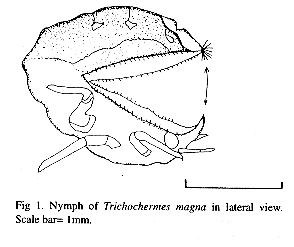
<body><![CDATA[<P><FONT FACE="Arial,Helvetica"><FONT SIZE=-1>Only four of 20 host plant trees<I> Psedolmedia oxphylar&iacute;a </I>(Moraceae) had developing galls; <I>Trichochermes magma </I>forms a rounded, hemispherical gall with thorn-like prolongation. Each gall had a single chamber that contained only one nymph. Developing galls were present on new leaves only. When the adult was ready to emerge, the gall expanded outward and opened like a flower. Opened galls were more abundant on old leaves. Of 257 galls examined 39. 7% showed perforations of various sizes that suggested mortality caused by predators and parasitoids. Three parasitoids, <I>Psyllaephagus ufens </I>(Encyrtidae) (<A HREF="#Noyes, J. S.">Noyes and Hanson 1996</A>) and two species of the family Eulophidae (subfamily Tetrasichinae), were reared</FONT></FONT>      <P><FONT FACE="Arial,Helvetica"><FONT SIZE=-1>There were an average of 33. 7 galls per leaf (n=54), and of those 65% were present on "new leaves" (38. 2&plusmn;31. 6 galls per leaf, n =35) and 35% on "old" ones (18. 5&plusmn;13. 4, n= 19, P&lt;0. 01, t= 2. 77). The average diameter of galls on "young" leaves was 2. 2&plusmn;1. 9 mm (n= 524) and on mature leaves 4. 1&plusmn;0. 7 mm (n= 222) (P&lt;O. Ol, t=5. 69). There was no correlation between size of the leaf and number of galls on it (P&lt; 0. 01, r= 0. 0576). Of the developing galls 7% contained eggs, 13. 8% first instar nymphs, 20. 8% second instar, 25% third &iacute;nstar, 20. 2 fourth and 13. 2% fifth instar nymph (n= 144).</FONT></FONT>      <P><FONT FACE="Arial,Helvetica"><FONT SIZE=-1>The nymph, is robust and dorsoventrally flattened with dorsal sclerites of the thorax fused. The labium and the antennae are relatively short, and the legs are not functional. A horn projects from the head l&iacute;ke a rhinoceros horn (<A HREF="#fig. 1">Fig l.</A> ). In the fifth instar the thorax and head are yellow and the abdomen is intense light green.</FONT></FONT>     <BR>&nbsp;     <BR>&nbsp;     <BR>&nbsp;     <CENTER></CENTER>      <CENTER><A NAME="fig. 1"></A><IMG SRC="/img/fbpe/rbt/v46n3/0223i01.GIF" HEIGHT=247 WIDTH=294></CENTER> &nbsp;     
<BR>&nbsp;      <P><FONT FACE="Arial,Helvetica"><FONT SIZE=-1>Typically the nymph rested in the gall with its body curved and the horn oriented toward the apex of the gall. When the larva's head was experimentally stimulated with an insect pin, the horn was tossed quickly in the direction of the stimulus toward the opening of the gall (n=31, P&lt;0. 01, x<SUP>2</SUP> test). Stimulation of the abdomen provoked the animal to curve quickly and swing it several times like a scorpion (n=35, P&lt;0. 01, x<SUP>2</SUP> test). When the nymph was stimulated in the middle part (near the junction of the abdomen and the thorax), it responded by repeatedly flexing and closing both parts of the body on the pin (n=40, P&lt;0. 01, x<SUP>2</SUP> test). When the animal was stimulated repeatedly it oriented the ventral part of the abdomen toward the opening of the gall. This behavior resembles that of <I>Trioza ru1sellae </I>(Triozidae) on <I>Brosimun </I>sp. in which the nymph covers the opening of the gall with a sclerot&iacute;zed plate (P. Hanson, pers. comm. ). However, in <I>T. magna </I>there is no plate rather the intense green colored abdomen is exposed.</FONT></FONT>      ]]></body>
<body><![CDATA[<P><FONT FACE="Arial,Helvetica"><FONT SIZE=-1>Apparently this species is capable of developing <B>a </B>full nynfal cycle when a<B> </B>leaf is young. The high density of galls found on some of the leaves produced distortions in the growth that induce<B> </B>a severe corrugation.</FONT></FONT>      <P><FONT FACE="Arial,Helvetica"><FONT SIZE=-1>The galls of psylids are through to protect them from extreme climatic conditions, particularly drying, and from parasitoids and predators (Hodkinson 1973). Many galls <I>of T. magna</I> however showed damage apparently occasioned by predators and/or parasitoids. Probably, the evolution of the horn and associated behaviors was evolved to aid in active defense during the nymphal stage against such enemies.</FONT></FONT>     <BR>&nbsp;     <BR>&nbsp;     <BR>&nbsp;      <P><B><FONT FACE="Arial,Helvetica"><FONT SIZE=-1>Acknowledgements</FONT></FONT></B>      <P><FONT FACE="Arial,Helvetica"><FONT SIZE=-1>D. Hollis identified the psylids, P. Hanson the parasitoids and J. G&oacute;mez the plants. W. Eberhard and P. Hanson made suggestions and comments on the manuscript. This study was financed by the Vicerrector&iacute;a de Investigaci&oacute;n of the University of Costa Rica.</FONT></FONT>      <P><FONT FACE="Arial,Helvetica"><FONT SIZE=-1>..</FONT></FONT>     <BR><B><FONT FACE="Arial,Helvetica"><FONT SIZE=-1>References</FONT></FONT></B>      <!-- ref --><P><A NAME="Brown R-G."></A><FONT FACE="Arial,Helvetica"><FONT SIZE=-1>Brown R-G. &amp; 1. D. Hodkindon. 1988. Taxonomy and ecology of the jumping plant-lice of Panama. Entomograph 9. 304 p.</FONT></FONT>    &nbsp;&nbsp;&nbsp;&nbsp;&nbsp;&nbsp;&nbsp;&nbsp;[&#160;<a href="javascript:void(0);" onclick="javascript: window.open('/scielo.php?script=sci_nlinks&ref=1144270&pid=S0034-7744199800030004100001&lng=','','width=640,height=500,resizable=yes,scrollbars=1,menubar=yes,');">Links</a>&#160;]<!-- end-ref --><!-- ref --><P><A NAME="Clark, L. R."></A><FONT FACE="Arial,Helvetica"><FONT SIZE=-1>Clark, L. R. 1962. The general biology of <I>Cardiaspina albitextura</I> (Psyllidae) and its abundance in relation to weather and parasitism. Aust. J . Zool. 10: 537-586.</FONT></FONT>    &nbsp;&nbsp;&nbsp;&nbsp;&nbsp;&nbsp;&nbsp;&nbsp;[&#160;<a href="javascript:void(0);" onclick="javascript: window.open('/scielo.php?script=sci_nlinks&ref=1144271&pid=S0034-7744199800030004100002&lng=','','width=640,height=500,resizable=yes,scrollbars=1,menubar=yes,');">Links</a>&#160;]<!-- end-ref --><!-- ref --><P><A NAME="Eastop, V. F."></A><FONT FACE="Arial,Helvetica"><FONT SIZE=-1>Eastop, V. F. 1973. Deductions from the present day host plants of aphids and relates insects, p. 157-178<I>. In </I>H. F van Emden,. Insect/Plant Relationships. Royal Entomological Society of London. Symposium 6. Edward Arnold, London.</FONT></FONT>    &nbsp;&nbsp;&nbsp;&nbsp;&nbsp;&nbsp;&nbsp;&nbsp;[&#160;<a href="javascript:void(0);" onclick="javascript: window.open('/scielo.php?script=sci_nlinks&ref=1144272&pid=S0034-7744199800030004100003&lng=','','width=640,height=500,resizable=yes,scrollbars=1,menubar=yes,');">Links</a>&#160;]<!-- end-ref --><!-- ref --><P><A NAME="Hodkinson I. D. 1974."></A><FONT FACE="Arial,Helvetica"><FONT SIZE=-1>Hodkinson I. D. 1974. The Biology of the Psylloidea (Homoptera): a review. Bull. Ent. Res 64: 325-339.</FONT></FONT>    &nbsp;&nbsp;&nbsp;&nbsp;&nbsp;&nbsp;&nbsp;&nbsp;[&#160;<a href="javascript:void(0);" onclick="javascript: window.open('/scielo.php?script=sci_nlinks&ref=1144273&pid=S0034-7744199800030004100004&lng=','','width=640,height=500,resizable=yes,scrollbars=1,menubar=yes,');">Links</a>&#160;]<!-- end-ref --><!-- ref --><P><A NAME="Hodkinson, I. D. , 1984."></A><FONT FACE="Arial,Helvetica"><FONT SIZE=-1>Hodkinson, I. D. , 1984. The biology and ecology of gall-forming Psylloidea, p. 59-78. <I>In</I> T. N. Ananthakrishnan (ed). Biology of Gall Insects. Oxford &amp; IBH New Delhi, India.</FONT></FONT>    &nbsp;&nbsp;&nbsp;&nbsp;&nbsp;&nbsp;&nbsp;&nbsp;[&#160;<a href="javascript:void(0);" onclick="javascript: window.open('/scielo.php?script=sci_nlinks&ref=1144274&pid=S0034-7744199800030004100005&lng=','','width=640,height=500,resizable=yes,scrollbars=1,menubar=yes,');">Links</a>&#160;]<!-- end-ref --><!-- ref --><P><A NAME="Noyes, J. S."></A><FONT FACE="Arial,Helvetica"><FONT SIZE=-1>Noyes, J. S. &amp; P. Hanson. 1996. Encyrtidae (Hymenoptera: Chalcidoldea) of CostaRica: the genera and species associated with jumping plant-lice (Homoptera: Psylloidea). Bull. Nat. Hist. Mus. Lond (Ent) 65(2): 105-164.</FONT></FONT>    &nbsp;&nbsp;&nbsp;&nbsp;&nbsp;&nbsp;&nbsp;&nbsp;[&#160;<a href="javascript:void(0);" onclick="javascript: window.open('/scielo.php?script=sci_nlinks&ref=1144275&pid=S0034-7744199800030004100006&lng=','','width=640,height=500,resizable=yes,scrollbars=1,menubar=yes,');">Links</a>&#160;]<!-- end-ref --><!-- ref --><P><A NAME="Woodbum, T. L."></A><FONT FACE="Arial,Helvetica"><FONT SIZE=-1>Woodbum, T. L. &amp; E. E. Lewis. 1973. A comparative histological study of the effects of feeding by nymphs of four psyllid spec&iacute;es on the leaves of eucalyptus. J. Aust. Ent. Soc 12: 134- 138.</FONT></FONT>    &nbsp;&nbsp;&nbsp;&nbsp;&nbsp;&nbsp;&nbsp;&nbsp;[&#160;<a href="javascript:void(0);" onclick="javascript: window.open('/scielo.php?script=sci_nlinks&ref=1144276&pid=S0034-7744199800030004100007&lng=','','width=640,height=500,resizable=yes,scrollbars=1,menubar=yes,');">Links</a>&#160;]<!-- end-ref --><P><A NAME="1 ref."></A><FONT FACE="Arial,Helvetica"><FONT SIZE=-1><SUP><A HREF="#1">1</A></SUP>Escuela de Biologia, Universidad de Costa Rica, 2060 San Jos&eacute;, Costa Rica, <A HREF="mailto:rbriceno@cariari.ucr.ac.cr">rbriceno@cariari.ucr.ac.cr</A></FONT></FONT>      ]]></body><back>
<ref-list>
<ref id="B1">
<nlm-citation citation-type="journal">
<person-group person-group-type="author">
<name>
<surname><![CDATA[Brown]]></surname>
<given-names><![CDATA[R-G.]]></given-names>
</name>
<name>
<surname><![CDATA[Hodkindon]]></surname>
<given-names><![CDATA[D.]]></given-names>
</name>
</person-group>
<article-title xml:lang="en"><![CDATA[Taxonomy and ecology of the jumping plant-lice of Panama]]></article-title>
<source><![CDATA[Entomograph]]></source>
<year>1988</year>
<volume>9</volume>
</nlm-citation>
</ref>
<ref id="B2">
<nlm-citation citation-type="journal">
<person-group person-group-type="author">
<name>
<surname><![CDATA[Clark]]></surname>
<given-names><![CDATA[L. R.]]></given-names>
</name>
</person-group>
<article-title xml:lang="en"><![CDATA[The general biology of Cardiaspina albitextura (Psyllidae) and its abundance in relation to weather and parasitism.]]></article-title>
<source><![CDATA[Aust. J . Zool.]]></source>
<year>1962</year>
<volume>10</volume>
<page-range>537-586</page-range></nlm-citation>
</ref>
<ref id="B3">
<nlm-citation citation-type="confpro">
<person-group person-group-type="author">
<name>
<surname><![CDATA[Eastop]]></surname>
<given-names><![CDATA[V. F.]]></given-names>
</name>
</person-group>
<article-title xml:lang="en"><![CDATA[Deductions from the present day host plants of aphids and relates insects]]></article-title>
<person-group person-group-type="editor">
<name>
<surname><![CDATA[van Emden]]></surname>
<given-names><![CDATA[H. F]]></given-names>
</name>
</person-group>
<source><![CDATA[Insect/Plant Relationships]]></source>
<year>1973</year>
<conf-name><![CDATA[6 Edward Arnold]]></conf-name>
<conf-loc>London </conf-loc>
<page-range>157-178</page-range></nlm-citation>
</ref>
<ref id="B4">
<nlm-citation citation-type="journal">
<person-group person-group-type="author">
<name>
<surname><![CDATA[Hodkinson]]></surname>
<given-names><![CDATA[I. D.]]></given-names>
</name>
</person-group>
<article-title xml:lang="en"><![CDATA[The Biology of the Psylloidea (Homoptera): a review]]></article-title>
<source><![CDATA[Bull. Ent. Res]]></source>
<year>1974</year>
<volume>64</volume>
<page-range>325-339</page-range></nlm-citation>
</ref>
<ref id="B5">
<nlm-citation citation-type="book">
<person-group person-group-type="author">
<name>
<surname><![CDATA[Hodkinson]]></surname>
<given-names><![CDATA[I. D.]]></given-names>
</name>
</person-group>
<article-title xml:lang="en"><![CDATA[The biology and ecology of gall-forming Psylloidea]]></article-title>
<person-group person-group-type="editor">
<name>
<surname><![CDATA[Ananthakrishnan]]></surname>
<given-names><![CDATA[T. N.]]></given-names>
</name>
</person-group>
<source><![CDATA[Biology of Gall Insects.]]></source>
<year>1984</year>
<page-range>59-78</page-range><publisher-loc><![CDATA[New Delhi ]]></publisher-loc>
<publisher-name><![CDATA[Oxford & IBH]]></publisher-name>
</nlm-citation>
</ref>
<ref id="B6">
<nlm-citation citation-type="journal">
<person-group person-group-type="author">
<name>
<surname><![CDATA[Noyes]]></surname>
<given-names><![CDATA[J. S.]]></given-names>
</name>
<name>
<surname><![CDATA[Hanson]]></surname>
<given-names><![CDATA[P.]]></given-names>
</name>
</person-group>
<article-title xml:lang="en"><![CDATA[Encyrtidae (Hymenoptera: Chalcidoldea) of CostaRica: the genera and species associated with jumping plant-lice (Homoptera: Psylloidea).]]></article-title>
<source><![CDATA[Bull. Nat. Hist. Mus. Lond]]></source>
<year>1996</year>
<volume>65</volume>
<numero>2</numero>
<issue>2</issue>
<page-range>105-164</page-range></nlm-citation>
</ref>
<ref id="B7">
<nlm-citation citation-type="journal">
<person-group person-group-type="author">
<name>
<surname><![CDATA[Woodbum]]></surname>
<given-names><![CDATA[T. L.]]></given-names>
</name>
<name>
<surname><![CDATA[Lewis]]></surname>
<given-names><![CDATA[E. E.]]></given-names>
</name>
</person-group>
<article-title xml:lang="en"><![CDATA[A comparative histological study of the effects of feeding by nymphs of four psyllid specíes on the leaves of eucalyptus.]]></article-title>
<source><![CDATA[J. Aust. Ent. Soc]]></source>
<year>1973</year>
<volume>12</volume>
<page-range>134- 138</page-range></nlm-citation>
</ref>
</ref-list>
</back>
</article>
