<?xml version="1.0" encoding="ISO-8859-1"?><article xmlns:mml="http://www.w3.org/1998/Math/MathML" xmlns:xlink="http://www.w3.org/1999/xlink" xmlns:xsi="http://www.w3.org/2001/XMLSchema-instance">
<front>
<journal-meta>
<journal-id>0034-7744</journal-id>
<journal-title><![CDATA[Revista de Biología Tropical]]></journal-title>
<abbrev-journal-title><![CDATA[Rev. biol. trop]]></abbrev-journal-title>
<issn>0034-7744</issn>
<publisher>
<publisher-name><![CDATA[Universidad de Costa Rica]]></publisher-name>
</publisher>
</journal-meta>
<article-meta>
<article-id>S0034-77441998000300037</article-id>
<title-group>
<article-title xml:lang="es"><![CDATA[Seguimiento anual de la parasitosis gastrointestinal de venados cola blanca Odocoileus virginianus (Artiodactyla: Cervidae) en cautiverio en Yucatán, México]]></article-title>
</title-group>
<contrib-group>
<contrib contrib-type="author">
<name>
<surname><![CDATA[Montes Pérez]]></surname>
<given-names><![CDATA[Rubén C.]]></given-names>
</name>
</contrib>
<contrib contrib-type="author">
<name>
<surname><![CDATA[Rodríguez Vivas]]></surname>
<given-names><![CDATA[Roger I.]]></given-names>
</name>
</contrib>
<contrib contrib-type="author">
<name>
<surname><![CDATA[Torres Acosta]]></surname>
<given-names><![CDATA[Juan Felipe de J.]]></given-names>
</name>
</contrib>
<contrib contrib-type="author">
<name>
<surname><![CDATA[Ek Pech]]></surname>
<given-names><![CDATA[Lucy G.]]></given-names>
</name>
<xref ref-type="aff" rid="A01"/>
</contrib>
</contrib-group>
<aff id="A01">
<institution><![CDATA[,Universidad Autónoma de Yucatán Facultad de Medicina Veterinaria y Zootecnia ]]></institution>
<addr-line><![CDATA[Mérida Yucatán]]></addr-line>
<country>México</country>
</aff>
<pub-date pub-type="pub">
<day>00</day>
<month>09</month>
<year>1998</year>
</pub-date>
<pub-date pub-type="epub">
<day>00</day>
<month>09</month>
<year>1998</year>
</pub-date>
<volume>46</volume>
<numero>3</numero>
<fpage>821</fpage>
<lpage>827</lpage>
<copyright-statement/>
<copyright-year/>
<self-uri xlink:href="http://www.scielo.sa.cr/scielo.php?script=sci_arttext&amp;pid=S0034-77441998000300037&amp;lng=en&amp;nrm=iso"></self-uri><self-uri xlink:href="http://www.scielo.sa.cr/scielo.php?script=sci_abstract&amp;pid=S0034-77441998000300037&amp;lng=en&amp;nrm=iso"></self-uri><self-uri xlink:href="http://www.scielo.sa.cr/scielo.php?script=sci_pdf&amp;pid=S0034-77441998000300037&amp;lng=en&amp;nrm=iso"></self-uri><abstract abstract-type="short" xml:lang="en"><p><![CDATA[Gastrointestinal parasites, and egg and oocyst output in the faeces of captive white-tailed deer (Odocoileus virginianus yucatanensis) were recorded in Yucatan, Mexico. Feces were obtained from from January through December 1995 (ten samples every two weeks per place). Samples were processed by flotation and the McMaster techniques. Faecal cultures for L3 larvae were made by the Corticelli-Lai technique. Oocysts in faeces were cultured in 2% potasium dicromate. Seven genera were determined (Haemonchus spp., Cooperia spp, Isospora spp., Eimeria spp., Trichuris spp., Strongyloides spp. and Moniezia spp.) which represent five orders. The most frequent genera were Haemonchus, Isospora and Eimeria. The genus Isospora is reported for the first time in deer of this region, although it was not possible to explain the source of this parasite. The frequency and level of faecal egg and oocyst outputs were variable during the year and increased during the rainy season. There was a positive correlation between relative humidity, environmental temperature and rainfall with the coccidia and strongylida orders. In the central zone of Yucatan the meteorological conditions during the rainy season are favourable for the development of gastrointestinal parasitism which enable an increased risk of infection for deer.]]></p></abstract>
<abstract abstract-type="short" xml:lang="es"><p><![CDATA[El objetivo del presente estudio fue determinar los géneros y estimar la cantidad de huevecillos y ooquistes de parásitos gastrointestinales (PGI) excretados durante un año en heces de venados cola blanca (Odocoileus virginianus yucatenensis) mantenidos en cautiverio en Yucatán, México. Se recolectaron muestras fecales en tres confinamientos ubicados en la zona centro del estado de Yucatán, de enero a diciembre de 1995. Diez muestras fueron colectadas de cada confinamiento cada dos semanas. Las muestras fueron procesadas mediante la técnica de Flotación Centrifugada y McMaster. Se realizaron cultivos de heces para obtener larvas infectantes L3 mediante la técnica de Corticelli-Lai. Las heces positivas a ooquistes fueron cultivados en dicromato de potasio al 2%. Se determinaron siete géneros (Haemonchus spp, Cooperia spp, Isospora spp, Eimeria spp, Trichuris spp, Strongyloides spp y Moniezia spp) correspondientes a cinco órdenes. Haemonchus spp, Isospora spp y Eimeria spp fueron los géneros más frecuentes. El género Isospora se reporta por primera vez en venados de la región, aunque no fue posible explicar el origen de este hallazgo. La frecuencia y nivel de excresión de huevecillos y ooquistes de PGI fue variable durante el año, con incremento en la época de lluvia. Se encontró correlación positiva entre humedad relativa, temperatura ambiente y precipitación pluvial con los órdenes Coccidia y Strongylida. En la zona centro del estado de Yucatán, México, las condiciones meteorológicas en la época de lluvia son propicias para el desarrollo del parasitismo gastrointestinal, lo que permite mayor riesgo de infección en los venados.]]></p></abstract>
<kwd-group>
<kwd lng="en"><![CDATA[Gastrointestinal parasites]]></kwd>
<kwd lng="en"><![CDATA[Odocoileus]]></kwd>
<kwd lng="en"><![CDATA[Strongylida]]></kwd>
<kwd lng="en"><![CDATA[white-tailed deer]]></kwd>
<kwd lng="en"><![CDATA[Coccidia]]></kwd>
<kwd lng="en"><![CDATA[Helminthes]]></kwd>
</kwd-group>
</article-meta>
</front><body><![CDATA[ <CENTER><B><FONT FACE="Arial,Helvetica">Seguimiento anual de la parasitosis gastrointestinal de venados cola</FONT></B></CENTER>      <CENTER><B><FONT FACE="Arial,Helvetica">blanca <I>Odocoileus virginianus </I>(Artiodactyla: Cervidae)</FONT></B></CENTER>      <CENTER><B><FONT FACE="Arial,Helvetica">en cautiverio en Yucat&aacute;n, M&eacute;xico</FONT></B></CENTER>      <CENTER>&nbsp;</CENTER>      <CENTER>&nbsp;</CENTER>      <CENTER><FONT FACE="Arial,Helvetica"><FONT SIZE=-1><B>Rub&eacute;n C. Montes P&eacute;rez&nbsp;&nbsp;&nbsp; Roger I. Rodr&iacute;guez Vivas&nbsp;&nbsp; Juan Felipe de J. Torres Acosta&nbsp;&nbsp;&nbsp; Lucy G. Ek Pech<A NAME="1"></A></B><SUP><A HREF="#1a">1</A></SUP></FONT></FONT></CENTER>      <CENTER>&nbsp;</CENTER>      <CENTER>&nbsp;</CENTER>      <CENTER><FONT FACE="Arial,Helvetica"><FONT SIZE=-1>Recibido 4-XII-1997. Corregido 8-VI-1998. Aceptado 12-VI-1998.</FONT></FONT></CENTER> &nbsp;     <BR>&nbsp;     ]]></body>
<body><![CDATA[<BR><B><FONT FACE="Arial,Helvetica"><FONT SIZE=-1>Abstract</FONT></FONT></B>      <P><FONT FACE="Arial,Helvetica"><FONT SIZE=-1>Gastrointestinal parasites, and egg and oocyst output in the faeces of captive white-tailed deer (<I>Odocoileus virginianus yucatanensis</I>) were recorded in Yucatan, Mexico. Feces were obtained from from January through December 1995 (ten samples every two weeks per place). Samples were processed by flotation and the McMaster techniques. Faecal cultures for L<SUB>3</SUB> larvae were made by the Corticelli-Lai technique. Oocysts in faeces were cultured in 2% potasium dicromate. Seven genera were determined (<I>Haemonchus</I> spp., <I>Cooperia</I> spp, <I>Isospora</I> spp., <I>Eimeria</I> spp., <I>Trichuris</I> spp., <I>Strongyloides</I> spp. and <I>Moniezia</I> spp.) which represent five orders. The most frequent genera were <I>Haemonchus</I>, <I>Isospora</I> and <I>Eimeria</I>. The genus <I>Isospora</I> is reported for the first time in deer of this region, although it was not possible to explain the source of this parasite. The frequency and level of faecal egg and oocyst outputs were variable during the year and increased during the rainy season. There was a positive correlation between relative humidity, environmental temperature and rainfall with the coccidia and strongylida orders. In the central zone of Yucatan the meteorological conditions during the rainy season are favourable for the development of gastrointestinal parasitism which enable an increased risk of infection for deer.</FONT></FONT>     <BR>&nbsp;      <P><B><FONT FACE="Arial,Helvetica"><FONT SIZE=-1>Key words</FONT></FONT></B>      <P><FONT FACE="Arial,Helvetica"><FONT SIZE=-1>Gastrointestinal parasites, <I>Odocoileus</I>, Strongylida, white-tailed deer, Coccidia, Helminthes.</FONT></FONT>     <BR>&nbsp;      <P><FONT FACE="Arial,Helvetica"><FONT SIZE=-1>La parasitosis gastrointestinal (PGI) en venados cola blanca (<I>Odocoileus virginianus</I>), afecta a poblaciones libres y cautivas (<A HREF="#Prestwood">Prestwood <I>et al</I>. 1973,</A><A HREF="#Rogel">Rogel y Luj&aacute;n 1982</A>). Estudios realizados en venados cola blanca libres en reserva natural de los Estados Unidos de Norteam&eacute;rica (<A HREF="#Woolf, A.">Woolf y Harder 1979</A>), indican que la mortalidad de venados por causa de PGI es baja, alrededor de 2.7%, la cual representa el s&eacute;ptimo lugar de causas importantes de mortalidad en esta poblaci&oacute;n. En M&eacute;xico no se han registrado datos acerca de la mortalidad de venados por causa de PGI mantenidos en condiciones libres o en cautiverio; sin embargo, se menciona que puede representar un serio problema para animales confinados en zool&oacute;gicos y criaderos (<A HREF="#Roa, R. M.">Roa 1986</A>).</FONT></FONT>      <P><FONT FACE="Arial,Helvetica"><FONT SIZE=-1>Los estudios registrados en M&eacute;xico por <A HREF="#Carrillo, M. F.">Carrillo (1987</A>), <A HREF="#Domínguez, J. 1988">Dom&iacute;nguez <I>et al</I>. (1988</A>), <A HREF="#Rivera, M.M.">Rivera (1991</A>), <A HREF="#Olvera">Olvera (1991</A>) y <A HREF="#Jaimes">Jaimes <I>et al</I>. (1993</A>) indican la presencia de PGI de los &oacute;rdenes Coccidia, Strongylida, Rahbditoidea, Enoplida y Anoplocephalidea. Los principales g&eacute;neros de &eacute;stos son: <I>Eimeria, Haemonchus, Oesophagostomum, Ostertagia, Trichostrongylus, Strongyloides, Cooperia, Nematodirus, Chabertia, Capillaria, Toxocara, Moniezia, Trichuris, Bunostomum y Metastrongylus.</I> Ninguna de las investigaciones realizadas en venado cola blanca en esta regi&oacute;n describen las variaciones en la frecuencia de animales parasitados, ni las cargas parasitarias presentes en esos animales a lo largo de un ciclo anual; de tal manera que no se tiene alg&uacute;n dato que permita suponer los cambios parasitarios esperados para el siguiente ciclo. Si se contara con esta informaci&oacute;n, ser&iacute;a posible iniciar estrategias para el control de la parasitosis en venado cola blanca mantenidos en cautiverio. Con tal prop&oacute;sito se realiz&oacute; este trabajo, con los siguientes objetivos: determinar los g&eacute;neros de helmintos y coccidias que parasitan el tracto gastrointestinal de venados cola blanca mantenidos en cautiverio en el estado de Yucat&aacute;n, M&eacute;xico; medir las variaciones en las frecuencias de animales parasitados, asi como la cantidad de ooquistes y huevecillos excretados a lo largo de un a&ntilde;o; relacionar la humedad relativa, temperatura ambiental y precipitaci&oacute;n pluvial con las variaciones en las frecuencias de animales parasitados.</FONT></FONT>     <BR>&nbsp;      <P><B><FONT FACE="Arial,Helvetica"><FONT SIZE=-1>Materiales y M&eacute;todos</FONT></FONT></B>      ]]></body>
<body><![CDATA[<P><FONT FACE="Arial,Helvetica"><FONT SIZE=-1>Se colectaron muestras fecales frescas de venado cola blanca (<I>Odocoileus virginianus yucatanensis</I>) en tres cautiverios ubicados en la zona centro del estado de Yucat&aacute;n, M&eacute;xico. El clima de la regi&oacute;n es tropical subh&uacute;medo con lluvias en verano; clasificaci&oacute;n clim&aacute;tica de K&ouml;ppen Awoig, modificada por <A HREF="#García, E.">Garc&iacute;a (1988</A>). La temperatura ambiental m&aacute;xima var&iacute;a de 35 a 40 <SUP>o</SUP>C y la temperatura ambiental promedio es de 27<SUP> o</SUP>C. La humedad relativa var&iacute;a de 65 a 90%, con promedio de 80% y precipitaci&oacute;n pluvial anual total de 935.5 mm. Se presentan dos estaciones anuales: de lluvia (de junio a noviembre) y seca (de diciembre a mayo) (<A HREF="#Anónimo. 1970.">An&oacute;nimo 1970</A>, <A HREF="#García, E.">Garc&iacute;a 1988</A>).</FONT></FONT>      <P><FONT FACE="Arial,Helvetica"><FONT SIZE=-1>Se muestrearon dos zool&oacute;gicos y un criadero bajo un sistema de producci&oacute;n semi-intensivo. Estos confinamientos fueron denominados C1, C2 y C3 respectivamente. El C1 corresponde al Parque Zool&oacute;gico del Centenario; el cual est&aacute; localizado en la Ciudad de M&eacute;rida, Yucat&aacute;n, M&eacute;xico. El C2 es el Zool&oacute;gico de Cholul, ubicado en Cholul, municipio de M&eacute;rida, Yucat&aacute;n, M&eacute;xico. El C3 es un criadero perteneciente a la empresa Cementos Maya, ubicado en la zona industrial de la ciudad de M&eacute;rida, Yucat&aacute;n, M&eacute;xico. C1 dispon&iacute;a de diez venados, C2 diez y C3 diecisiete; entre los cuales hab&iacute;a juveniles y adultos de ambos sexos. En el cautiverio C2 se administr&oacute; a los venados un solo tratamiento antihelm&iacute;ntico (albendazol, 5 mg/kg de peso vivo) durante la &eacute;poca de lluvia (15 de Julio).</FONT></FONT>      <P><FONT FACE="Arial,Helvetica"><FONT SIZE=-1>Diez muestras fueron tomadas directamente del suelo y obtenidas cada quince dias durante doce meses, de enero a diciembre de 1995.</FONT></FONT><FONT FACE="Arial,Helvetica"><FONT SIZE=-1></FONT></FONT>      <P><FONT FACE="Arial,Helvetica"><FONT SIZE=-1>Las muestras fueron identificadas por cautiverio y transportadas en refrigeraci&oacute;n al laboratorio de Parasitolog&iacute;a de la Facultad de Medicina Veterinaria y Zootecnia de la Universidad Aut&oacute;noma de Yucat&aacute;n. Fueron procesadas en un periodo no mayor de 24 horas, mediante la t&eacute;cnica cualitativa de Flotaci&oacute;n centrifugada y cuantitativa de McMaster (<A HREF="#Rodríguez, V.R.I. 1994">Rodr&iacute;guez <I>et al</I>. 1994</A>). Las muestras positivas a huevecillos del orden Strongylida fueron transferidas a cultivo de larvas infectantes mediante la t&eacute;cnica de Corticelli-Lai descrita por <A HREF="#Rodríguez, V.R.I. 1994">Rodr&iacute;guez <I>et al</I>. (1994</A>). Las larvas obtenidas de los cultivos fueron clasificadas de acuerdo a su morfolog&iacute;a y tama&ntilde;o, seg&uacute;n el <A HREF="#Ministry of Agriculture Fisheries and Food.">Ministry of Agriculture, Fisheries and Food (1986</A>). Las muestras que contenian ooquistes del orden Coccidia fueron transferidas a cultivos en dicromato de potasio al 2% para la determinaci&oacute;n de g&eacute;neros.</FONT></FONT>      <P><FONT FACE="Arial,Helvetica"><FONT SIZE=-1>Durante el periodo de muestreo, se obtuvieron datos climatol&oacute;gicos cada quince dias de la estaci&oacute;n metereol&oacute;gica de la Comisi&oacute;n Nacional del Agua, ubicada en la ciudad de M&eacute;rida, Yucat&aacute;n, M&eacute;xico. Las variables registradas fueron: temperatura media ambiental (TA), precipitaci&oacute;n pluvial (PP) y humedad relativa (HR).</FONT></FONT>      <P><FONT FACE="Arial,Helvetica"><FONT SIZE=-1>Se contrastaron las frecuencias y cantidad de excresi&oacute;n de ooquistes y huevecillos de los &oacute;rdenes Coccidia y Strongylida entre cautiverios. Se prob&oacute; el efecto de dos estaciones anuales: lluvia y seca con respecto a la frecuencia y descarga parasitaria, a trav&eacute;s de an&aacute;lisis de Kruskal-Wallis, y se correlacionaron los valores de HR, PP y TA con la frecuencia de parasitosis de los &oacute;rdenes Coccidia y Strongylida, por medio de la prueba de correlaci&oacute;n de rangos de Spearman (<A HREF="#Downie, N.M.">Downie y Heath 1986</A>).</FONT></FONT>     <BR>&nbsp;      <P><B><FONT FACE="Arial,Helvetica"><FONT SIZE=-1>Resultados</FONT></FONT></B>      <P><FONT FACE="Arial,Helvetica"><FONT SIZE=-1>Se determinaron siete g&eacute;neros, correspondientes a cinco &oacute;rdenes de PGI en venado cola blanca, los cuales fueron: Coccidia, cuyos g&eacute;neros fueron <I>Isospora</I> y <I>Eimeria</I>; Strongylida, representado por los g&eacute;neros <I>Haemonchus</I> y <I>Cooperia</I>; Rahbditoidea, con un solo g&eacute;nero, <I>Strongyloides</I>; Enoplida representado por <I>Trichuris</I> y, finalmente el orden Anoplocephalidea tambi&eacute;n representado por un solo g&eacute;nero, <I>Moniezia</I>. La frecuencia de PGI por &oacute;rdenes y cautiverio se muestra en el <A HREF="#CUADRO 1">Cuadro 1</A>. Los g&eacute;neros recuperados y la frecuencia relativa en los coprocultivos que contenian huevecillos del orden Strongylida fueron <I>Haemonchus</I> spp con 98.2%, y <I>Cooperia</I> spp con 1.8%. Los g&eacute;neros recuperados y la frecuencia relativa en los cultivos que contenian ooquistes del orden Coccidia fueron <I>Eimeria</I> spp con 44% e <I>Isospora</I> spp con 56%.</FONT></FONT>     <CENTER></CENTER>      ]]></body>
<body><![CDATA[<CENTER><A NAME="CUADRO 1"></A></CENTER>      <CENTER><FONT FACE="Arial,Helvetica"><FONT SIZE=-1>CUADRO 1</FONT></FONT></CENTER>      <CENTER><FONT FACE="Arial,Helvetica"><FONT SIZE=-1><I>Frecuencia de parasitismo en venados cola blanca (</I>Odocoileus virginianus yucatanensis<I>)</I></FONT></FONT></CENTER>      <CENTER><FONT FACE="Arial,Helvetica"><FONT SIZE=-1><I>en tres cautiverios del Estado de Yucat&aacute;n, M&eacute;xico, en el a&ntilde;o de </I>1995.</FONT></FONT></CENTER> &nbsp;     <BR>&nbsp;     <CENTER><TABLE BORDER=0 CELLSPACING=0 CELLPADDING=5 WIDTH="574" > <TR> <TD VALIGN=TOP WIDTH="20%"><FONT FACE="Arial,Helvetica"><FONT SIZE=-1>Orden del par&aacute;sito</FONT></FONT></TD>  <TD VALIGN=TOP WIDTH="20%"><FONT FACE="Arial,Helvetica"><FONT SIZE=-1>Frecuencia (%)&nbsp;</FONT></FONT></TD>  <TD VALIGN=TOP WIDTH="20%">     <CENTER><FONT FACE="Arial,Helvetica"><FONT SIZE=-1>en cada&nbsp;</FONT></FONT></CENTER> </TD>  <TD VALIGN=TOP WIDTH="20%"><FONT FACE="Arial,Helvetica"><FONT SIZE=-1>confinamiento&nbsp;</FONT></FONT></TD>  <TD VALIGN=TOP WIDTH="20%">     <CENTER><FONT FACE="Arial,Helvetica"><FONT SIZE=-1>Frecuencia (%) media anual&nbsp;</FONT></FONT></CENTER> </TD> </TR>  <TR> <TD VALIGN=TOP WIDTH="20%"></TD>  <TD VALIGN=TOP WIDTH="20%">     <CENTER><FONT FACE="Arial,Helvetica"><FONT SIZE=-1>C1&nbsp;</FONT></FONT></CENTER> </TD>  <TD VALIGN=TOP WIDTH="20%">     <CENTER><FONT FACE="Arial,Helvetica"><FONT SIZE=-1>C2&nbsp;</FONT></FONT></CENTER> </TD>  <TD VALIGN=TOP WIDTH="20%">     ]]></body>
<body><![CDATA[<CENTER><FONT FACE="Arial,Helvetica"><FONT SIZE=-1>C3&nbsp;</FONT></FONT></CENTER> </TD>  <TD VALIGN=TOP WIDTH="20%"></TD> </TR>  <TR> <TD VALIGN=TOP WIDTH="20%">     <CENTER><FONT FACE="Arial,Helvetica"><FONT SIZE=-1>Coccidia&nbsp;</FONT></FONT></CENTER> </TD>  <TD VALIGN=TOP WIDTH="20%">     <CENTER><FONT FACE="Arial,Helvetica"><FONT SIZE=-1>28.4&nbsp;</FONT></FONT></CENTER> </TD>  <TD VALIGN=TOP WIDTH="20%">     <CENTER><FONT FACE="Arial,Helvetica"><FONT SIZE=-1>12.4&nbsp;</FONT></FONT></CENTER> </TD>  <TD VALIGN=TOP WIDTH="20%">     <CENTER><FONT FACE="Arial,Helvetica"><FONT SIZE=-1>23.2&nbsp;</FONT></FONT></CENTER> </TD>  <TD VALIGN=TOP WIDTH="20%">     <CENTER><FONT FACE="Arial,Helvetica"><FONT SIZE=-1>21.3&nbsp;</FONT></FONT></CENTER> </TD> </TR>  <TR> <TD VALIGN=TOP WIDTH="20%">     <CENTER><FONT FACE="Arial,Helvetica"><FONT SIZE=-1>Strongylida&nbsp;</FONT></FONT></CENTER> </TD>  <TD VALIGN=TOP WIDTH="20%">     <CENTER><FONT FACE="Arial,Helvetica"><FONT SIZE=-1>21.6&nbsp;</FONT></FONT></CENTER> </TD>  <TD VALIGN=TOP WIDTH="20%">     <CENTER><FONT FACE="Arial,Helvetica"><FONT SIZE=-1>5.2&nbsp;</FONT></FONT></CENTER> </TD>  <TD VALIGN=TOP WIDTH="20%">     <CENTER><FONT FACE="Arial,Helvetica"><FONT SIZE=-1>19.2&nbsp;</FONT></FONT></CENTER> </TD>  <TD VALIGN=TOP WIDTH="20%">     ]]></body>
<body><![CDATA[<CENTER><FONT FACE="Arial,Helvetica"><FONT SIZE=-1>15.3&nbsp;</FONT></FONT></CENTER> </TD> </TR>  <TR> <TD VALIGN=TOP WIDTH="20%">     <CENTER><FONT FACE="Arial,Helvetica"><FONT SIZE=-1>Rhabditoidea&nbsp;</FONT></FONT></CENTER> </TD>  <TD VALIGN=TOP WIDTH="20%">     <CENTER><FONT FACE="Arial,Helvetica"><FONT SIZE=-1>1.2&nbsp;</FONT></FONT></CENTER> </TD>  <TD VALIGN=TOP WIDTH="20%">     <CENTER><FONT FACE="Arial,Helvetica"><FONT SIZE=-1>1.6&nbsp;</FONT></FONT></CENTER> </TD>  <TD VALIGN=TOP WIDTH="20%">     <CENTER><FONT FACE="Arial,Helvetica"><FONT SIZE=-1>3.2&nbsp;</FONT></FONT></CENTER> </TD>  <TD VALIGN=TOP WIDTH="20%">     <CENTER><FONT FACE="Arial,Helvetica"><FONT SIZE=-1>2.0&nbsp;</FONT></FONT></CENTER> </TD> </TR>  <TR> <TD VALIGN=TOP WIDTH="20%">     <CENTER><FONT FACE="Arial,Helvetica"><FONT SIZE=-1>Enoplida&nbsp;</FONT></FONT></CENTER> </TD>  <TD VALIGN=TOP WIDTH="20%">     <CENTER><FONT FACE="Arial,Helvetica"><FONT SIZE=-1>1.6&nbsp;</FONT></FONT></CENTER> </TD>  <TD VALIGN=TOP WIDTH="20%">     <CENTER><FONT FACE="Arial,Helvetica"><FONT SIZE=-1>0.4&nbsp;</FONT></FONT></CENTER> </TD>  <TD VALIGN=TOP WIDTH="20%">     <CENTER><FONT FACE="Arial,Helvetica"><FONT SIZE=-1>0.0&nbsp;</FONT></FONT></CENTER> </TD>  <TD VALIGN=TOP WIDTH="20%">     ]]></body>
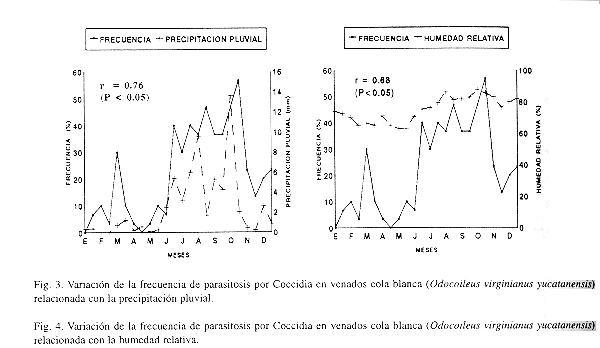
<body><![CDATA[<CENTER><FONT FACE="Arial,Helvetica"><FONT SIZE=-1>0.66&nbsp;</FONT></FONT></CENTER> </TD> </TR>  <TR> <TD VALIGN=TOP WIDTH="20%">     <CENTER><FONT FACE="Arial,Helvetica"><FONT SIZE=-1>Anoplocephalidea&nbsp;</FONT></FONT></CENTER> </TD>  <TD VALIGN=TOP WIDTH="20%">     <CENTER><FONT FACE="Arial,Helvetica"><FONT SIZE=-1>0.4&nbsp;</FONT></FONT></CENTER> </TD>  <TD VALIGN=TOP WIDTH="20%">     <CENTER><FONT FACE="Arial,Helvetica"><FONT SIZE=-1>2.8&nbsp;</FONT></FONT></CENTER> </TD>  <TD VALIGN=TOP WIDTH="20%">     <CENTER><FONT FACE="Arial,Helvetica"><FONT SIZE=-1>6.4&nbsp;</FONT></FONT></CENTER> </TD>  <TD VALIGN=TOP WIDTH="20%">     <CENTER><FONT FACE="Arial,Helvetica"><FONT SIZE=-1>3.2&nbsp;</FONT></FONT></CENTER> </TD> </TR> </TABLE></CENTER> <FONT FACE="Arial,Helvetica"><FONT SIZE=-1>&nbsp;&nbsp;&nbsp;&nbsp;&nbsp;&nbsp;&nbsp;&nbsp;&nbsp;&nbsp;&nbsp;&nbsp;&nbsp;&nbsp;&nbsp;&nbsp;&nbsp;&nbsp;&nbsp;&nbsp; C1= Zool&oacute;gico 1</FONT></FONT>     <BR><FONT FACE="Arial,Helvetica"><FONT SIZE=-1>&nbsp;&nbsp;&nbsp;&nbsp;&nbsp;&nbsp;&nbsp;&nbsp;&nbsp;&nbsp;&nbsp;&nbsp;&nbsp;&nbsp;&nbsp;&nbsp;&nbsp;&nbsp;&nbsp;&nbsp; C2= Zool&oacute;gico 2</FONT></FONT>     <BR><FONT FACE="Arial,Helvetica"><FONT SIZE=-1>&nbsp;&nbsp;&nbsp;&nbsp;&nbsp;&nbsp;&nbsp;&nbsp;&nbsp;&nbsp;&nbsp;&nbsp;&nbsp;&nbsp;&nbsp;&nbsp;&nbsp;&nbsp;&nbsp;&nbsp; C3= Criadero semiintensivo</FONT></FONT>     <BR>&nbsp;      <P><FONT FACE="Arial,Helvetica"><FONT SIZE=-1>En la <A HREF="#fig. 1">Fig. 1</A> se presentan las frecuencias y la cantidad de excresi&oacute;n de ooquistes del orden Coccidia durante el per&iacute;odo de estudio. En la<A HREF="#fig. 1"> Fig. 2</A> se presentan las frecuencias y la cantidad de excresi&oacute;n de huevecillos del orden Strongylida durante el mismo per&iacute;odo de estudio.</FONT></FONT>     ]]></body>
<body><![CDATA[<BR>&nbsp;     <BR>&nbsp;     <BR>&nbsp;     <CENTER></CENTER>      <CENTER><A NAME="fig. 1"></A><IMG SRC="/img/fbpe/rbt/v46n3/0219i01.GIF" HEIGHT=338 WIDTH=588></CENTER>       
<P>&nbsp;     <BR>&nbsp;      <P><FONT FACE="Arial,Helvetica"><FONT SIZE=-1>Se encontr&oacute; diferencia significativa en las frecuencias de los ordenes Coccidia y Strongylida entre los tres cautiverios, siendo menor en el C2 (Kruskal-Wallis p&lt;0.05). La cantidad excretada de ooquistes del g&eacute;nero Coccidia fue semejante en los tres cautiverios (Kruskal-Wallis p>0.05), pero no as&iacute; para la excresi&oacute;n de huevecillos del orden Strongylida (Kruskal-Wallis p&lt;0.05), siendo mayor para el C3.</FONT></FONT>      <P><FONT FACE="Arial,Helvetica"><FONT SIZE=-1>La frecuencia y excresi&oacute;n de ooquistes del orden Coccidia fue mayor en la &eacute;poca de lluvia (Kruskal-Wallis p&lt;0.05) que en la &eacute;poca de seca. La frecuencia y excresi&oacute;n de huevecillos del orden Strongylida fue similar en ambas estaciones del a&ntilde;o (Kruskal-Wallis p>0.05); sin embargo, se observ&oacute; una tendencia al incremento en la &eacute;poca de lluvia.</FONT></FONT>      <P><FONT FACE="Arial,Helvetica"><FONT SIZE=-1>Los PGI de los &oacute;rdenes Rahbditoidea, Enoplida y Anoplocephalidae se presentaron espor&aacute;dicamente y sin una tendencia definida durante el a&ntilde;o.</FONT></FONT>      ]]></body>
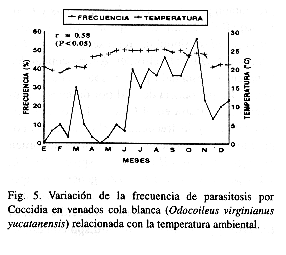
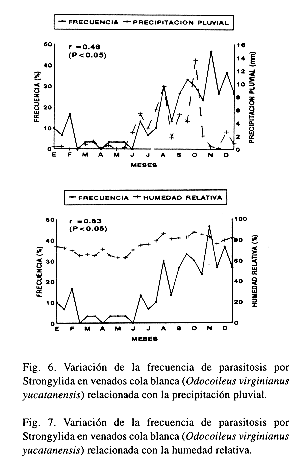
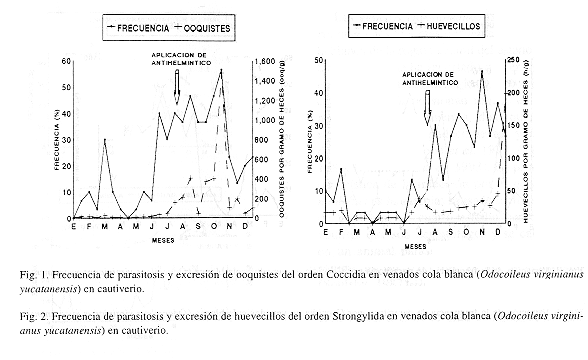
<body><![CDATA[<P><FONT FACE="Arial,Helvetica"><FONT SIZE=-1>Los rangos de variaci&oacute;n media quincenal que tuvieron la TA, HR y PP en la &eacute;poca de seca fueron de 17 a 25<SUP>o</SUP>C, de 63 a 82.9% y de 0.0 a 2.6 mm, respectivamente. En la &eacute;poca de lluvia se registraron variaciones de 23.7 a 25.4 <SUP>o</SUP>C para TA, de 70.4 a 87.4% para HR y de 1.7 a 13.6 mm para PP.</FONT></FONT>      <P><FONT FACE="Arial,Helvetica"><FONT SIZE=-1>Los valores de correlaci&oacute;n entre frecuencia de parasitosis por el orden Coccidia con la PP, HR y TA fueron de 0.76, 0.68 y 0.58, respectivamente (Spearman p&lt;0.05) (<A HREF="#fig. 2">Fig. 3, 4</A> y <A HREF="#fig. 3">5</A>). Las correlaciones significativas encontradas, fueron entre la frecuencia de parasitosis por el orden Strongylida con PP y HR, cuyos valores fueron de 0.46 y 0.83, respectivamente (Spearman p&lt;0.05) (<A HREF="#fig. 4">Fig. 6 y 7</A>).</FONT></FONT>     <BR>&nbsp;     <BR>&nbsp;     <BR>&nbsp;     <CENTER></CENTER>      <CENTER><A NAME="fig. 2"></A><IMG SRC="/img/fbpe/rbt/v46n3/0219i02.GIF" HEIGHT=342 WIDTH=592></CENTER>      
<CENTER>&nbsp;</CENTER>      <CENTER>&nbsp;</CENTER>      <CENTER></CENTER>      ]]></body>
<body><![CDATA[<CENTER><A NAME="fig. 3"></A><IMG SRC="/img/fbpe/rbt/v46n3/0219i03.GIF" HEIGHT=255 WIDTH=286></CENTER>      
<CENTER>&nbsp;</CENTER>      <CENTER>&nbsp;</CENTER>      <CENTER></CENTER>      <CENTER><A NAME="fig. 4"></A><IMG SRC="/img/fbpe/rbt/v46n3/0219i04.GIF" HEIGHT=471 WIDTH=294></CENTER> &nbsp;      
<P><B><FONT FACE="Arial,Helvetica"><FONT SIZE=-1>Discusi&oacute;n</FONT></FONT></B>      <P><FONT FACE="Arial,Helvetica"><FONT SIZE=-1>De los siete g&eacute;neros de PGI reportados en el presente estudio, seis han sido previamente determinados en venados y rumiantes dom&eacute;sticos que habitan lugares de clima templado y tropical (<A HREF="#Soulsby">Soulsby 1987</A>, <A HREF="#Domínguez, J. 1988">Dom&iacute;nguez <I>et al</I>. 1988</A>, <A HREF="#Jaimes">Jaimes <I>et al</I>. 1993</A>, <A HREF="#Torres-Acosta">Torres <I>et al</I>. 1995</A>); sin embargo, se reporta por primera vez la presencia del g&eacute;nero <I>Isospora</I> como PGI de venado cola blanca, en Yucat&aacute;n, M&eacute;xico. El g&eacute;nero <I>Isospora</I> parasita comunmente a cerdos no a rumiantes (<A HREF="#Blood, D.C.">Blood &amp; Radostits 1989</A>); por el momento no es posible explicar con certeza el origen de la parasitosis por <I>Isospora</I> en venados, puesto que no existe alg&uacute;n intercambio de material fecal o alimenticio entre los criaderos de venado estudiados con granjas porcinas; sin embargo, en los tres criaderos se encontr&oacute; alta frecuencia de <I>Isospora</I>.</FONT></FONT>      <P><FONT FACE="Arial,Helvetica"><FONT SIZE=-1>Los g&eacute;neros <I>Haemonchus, Isospora</I> y <I>Eimeria</I> fueron los PGI m&aacute;s frecuentes en venados cola blanca de la regi&oacute;n central del estado de Yucat&aacute;n, M&eacute;xico. Se ha reportado que en venados y en rumiantes dom&eacute;sticos, los g&eacute;neros <I>Haemonchus</I> y <I>Eimeria</I> ocasionan retraso en el crecimiento, debilidad, anemia, disminuci&oacute;n de la resistencia a otros padecimientos y reducci&oacute;n del apetito (<A HREF="#Prestwood">Prestwood <I>et al</I>. 1973</A>, <A HREF="#Abbas">Abbas <I>et al</I>. 1987</A>, <A HREF="#Domínguez 1993">Dom&iacute;nguez <I>et al</I>. 1993)</A>. La principal caracter&iacute;stica de la infecci&oacute;n por el g&eacute;nero <I>Haemonchus</I> es la anemia; causada tanto por efecto de las larvas de cuarto estadio como por los adultos, que son hemat&oacute;fagos y se calcula que en un animal parasitado, la p&eacute;rdida media de sangre es de 0.05 ml al d&iacute;a por par&aacute;sito (<A HREF="#Soulsby">Soulsby 1987</A>). La patogenicidad del orden Coccidia se debe a su capacidad de reproducci&oacute;n y destrucci&oacute;n de gran cantidad de c&eacute;lulas intestinales (<A HREF="#Soulsby">Soulsby 1987</A>, <A HREF="#Quiróz, H.">Quir&oacute;z 1989</A>).</FONT></FONT>      <P><FONT FACE="Arial,Helvetica"><FONT SIZE=-1>La frecuencia y din&aacute;mica de excresi&oacute;n de huevecillos del orden Strongylida fue menor en el C2, esto fue probablemente debido a la alta efectividad del antihelm&iacute;ntico (albendazol) aplicado a los venados en la &eacute;poca de lluvia. <A HREF="#Theodorides">Theodorides <I>et al</I>. (1976)</A> mencionan que el albendazol es un excelente antihelm&iacute;ntico y tiene una eficacia hasta del 97% contra nem&aacute;todos del g&eacute;nero <I>Haemonchus</I>.</FONT></FONT>      <P><FONT FACE="Arial,Helvetica"><FONT SIZE=-1>Un hecho importante fue el aumento de la frecuencia y excresi&oacute;n de ooquistes del orden Coccidia en la &eacute;poca de lluvia. Para que un ooquiste sea infectante es necesario que se realice la esporulaci&oacute;n en el ambiente externo, para ello se requiere de tres elementos principales: ox&iacute;geno, temperatura de 20 a 24<SUP>o</SUP>C y humedad ambiental superior al 70% (<A HREF="#Soulsby">Soulsby 1987</A>, <A HREF="#Quiróz, H.">Quir&oacute;z 1989</A>). En la zona centro del estado de Yucat&aacute;n, M&eacute;xico, la PP, TA y HR registradas en la estaci&oacute;n de lluvia fueron adecuadas para el desarrollo del orden Coccidia en el medio externo, lo que permiti&oacute; mayor riesgo de infecci&oacute;n en los venados. En la &eacute;poca de seca se presentaron meses con HR inferiores al 70%, lo que provocaron la desecaci&oacute;n de los ooquistes en el ambiente y la baja infecci&oacute;n de los venados. Esta tendencia en la PGI, ha sido reportado tambi&eacute;n en bovinos de clima tropical (<A HREF="#Rodríguez, N. 1988">Rodr&iacute;guez <I>et al</I>. 1988</A>, <A HREF="#Ali, S.R.">Ali y Latif 1989</A>).</FONT></FONT>      ]]></body>
<body><![CDATA[<P><FONT FACE="Arial,Helvetica"><FONT SIZE=-1>De igual manera, el orden Strongylida present&oacute; una correlaci&oacute;n positiva con la HR; este hallazgo es el resultado del desarrollo de huevecillos y el movimiento de larvas infectantes, principalmente del g&eacute;nero <I>Haemonchus</I>; las cuales depende de una HR entre 70 y 100%, lo cual ocurre en la &eacute;poca de lluvia (<A HREF="#Delgado, A. 1989.">Delgado 1989</A>).</FONT></FONT>      <P><FONT FACE="Arial,Helvetica"><FONT SIZE=-1>La cantidad de ooquistes del orden Coccidia (200-400 ooquistes por gramo de heces) y huevecillos del orden Strongylida (50-200 huevecillos por gramo de heces) excretados durante la &eacute;poca de m&aacute;ximo riesgo, ha sido usado en otros rumiantes para evaluar el grado de parasitismo (<A HREF="#Rodríguez, V.R.I. 1994">Rodr&iacute;guez <I>et al</I>. 1994</A>); sin embargo, en venados cola blanca no hay suficiente informaci&oacute;n para hacer un an&aacute;lisis al respecto. Se necesitan realizar estudios m&aacute;s precisos para determinar si la frecuencia y/o las cargas parasitarias reportadas en el presente estudio tienen un efecto significativo sobre el comportamiento productivo o reproductivo del venado cola blanca mantenidos en cautiverio en esta regi&oacute;n de M&eacute;xico.</FONT></FONT>     <BR>&nbsp;      <P><B><FONT FACE="Arial,Helvetica"><FONT SIZE=-1>Resumen</FONT></FONT></B>      <P><FONT FACE="Arial,Helvetica"><FONT SIZE=-1>El objetivo del presente estudio fue determinar los g&eacute;neros y estimar la cantidad de huevecillos y ooquistes de par&aacute;sitos gastrointestinales (PGI) excretados durante un a&ntilde;o en heces de venados cola blanca (<I>Odocoileus virginianus yucatenensis</I>) mantenidos en cautiverio en Yucat&aacute;n, M&eacute;xico. Se recolectaron muestras fecales en tres confinamientos ubicados en la zona centro del estado de Yucat&aacute;n, de enero a diciembre de 1995. Diez muestras fueron colectadas de cada confinamiento cada dos semanas. Las muestras fueron procesadas mediante la t&eacute;cnica de Flotaci&oacute;n Centrifugada y McMaster. Se realizaron cultivos de heces para obtener larvas infectantes L3 mediante la t&eacute;cnica de Corticelli-Lai. Las heces positivas a ooquistes fueron cultivados en dicromato de potasio al 2%. Se determinaron siete g&eacute;neros (<I>Haemonchus</I> spp, <I>Cooperia</I> spp, <I>Isospora</I> spp, <I>Eimeria</I> spp, <I>Trichuris</I> spp, <I>Strongyloides</I> spp y <I>Moniezia</I> spp) correspondientes a cinco &oacute;rdenes. <I>Haemonchus</I> spp, <I>Isospora</I> spp y <I>Eimeria</I> spp fueron los g&eacute;neros m&aacute;s frecuentes. El g&eacute;nero <I>Isospora</I> se reporta por primera vez en venados de la regi&oacute;n, aunque no fue posible explicar el origen de este hallazgo. La frecuencia y nivel de excresi&oacute;n de huevecillos y ooquistes de PGI fue variable durante el a&ntilde;o, con incremento en la &eacute;poca de lluvia. Se encontr&oacute; correlaci&oacute;n positiva entre humedad relativa, temperatura ambiente y precipitaci&oacute;n pluvial con los &oacute;rdenes Coccidia y Strongylida. En la zona centro del estado de Yucat&aacute;n, M&eacute;xico, las condiciones meteorol&oacute;gicas en la &eacute;poca de lluvia son propicias para el desarrollo del parasitismo gastrointestinal, lo que permite mayor riesgo de infecci&oacute;n en los venados.</FONT></FONT>     <BR>&nbsp;      <P><B><FONT FACE="Arial,Helvetica"><FONT SIZE=-1>Agradecimientos</FONT></FONT></B>      <P><FONT FACE="Arial,Helvetica"><FONT SIZE=-1>El presente trabajo de investigaci&oacute;n fue financiado por FUNDACION FORD-PROTROPICO, convenio No. 920604. Los autores agradecen a las autoridades del Parque Zool&oacute;gico del Centenario, Zool&oacute;gico de Cholul y Criadero de venados de Cementos Maya, las facilidades para la realizaci&oacute;n de este trabajo.</FONT></FONT>     <BR>&nbsp;      <P><B><FONT FACE="Arial,Helvetica"><FONT SIZE=-1>Referencias</FONT></FONT></B>      ]]></body>
<body><![CDATA[<P><A NAME="Abbas"></A>     <!-- ref --><BR><FONT FACE="Arial,Helvetica"><FONT SIZE=-1>Abbas, B., G. Post &amp; W.C. Marquardt. 1987. Merogony and gametogony of <I>Eimeria mccordocki</I> (Protozoa - Eimeridae) in the mule deer, <I>Odocoileus h. hemionus</I>. Vet. Parasitol. 24:1-5.</FONT></FONT>    &nbsp;&nbsp;&nbsp;&nbsp;&nbsp;&nbsp;&nbsp;&nbsp;[&#160;<a href="javascript:void(0);" onclick="javascript: window.open('/scielo.php?script=sci_nlinks&ref=1148556&pid=S0034-7744199800030003700001&lng=','','width=640,height=500,resizable=yes,scrollbars=1,menubar=yes,');">Links</a>&#160;]<!-- end-ref --><!-- ref --><P><A NAME="Ali, S.R."></A><FONT FACE="Arial,Helvetica"><FONT SIZE=-1>Ali, S.R. &amp; B.M. Latif. 1989. Bovine coccidiosis in Baghdad area Iraq. J. Biol. Sci. 20:483-488.</FONT></FONT>    &nbsp;&nbsp;&nbsp;&nbsp;&nbsp;&nbsp;&nbsp;&nbsp;[&#160;<a href="javascript:void(0);" onclick="javascript: window.open('/scielo.php?script=sci_nlinks&ref=1148557&pid=S0034-7744199800030003700002&lng=','','width=640,height=500,resizable=yes,scrollbars=1,menubar=yes,');">Links</a>&#160;]<!-- end-ref --><!-- ref --><P><A NAME="Anónimo. 1970."></A><FONT FACE="Arial,Helvetica"><FONT SIZE=-1>An&oacute;nimo. 1970. Centro de Investigaciones Agr&iacute;colas de la Pen&iacute;nsula de Yucat&aacute;n (CIAPY). Cultivos importantes para la Diversificaci&oacute;n Agr&iacute;cola en la Pen&iacute;nsula de Yucat&aacute;n. Instituto Nacional de Investigaciones Agr&iacute;colas. Secretar&iacute;a de Agricultura y Ganader&iacute;a. Centro de Investigaciones Agr&iacute;colas de la Pen&iacute;nsula de Yucat&aacute;n 4:1-38.</FONT></FONT>    &nbsp;&nbsp;&nbsp;&nbsp;&nbsp;&nbsp;&nbsp;&nbsp;[&#160;<a href="javascript:void(0);" onclick="javascript: window.open('/scielo.php?script=sci_nlinks&ref=1148558&pid=S0034-7744199800030003700003&lng=','','width=640,height=500,resizable=yes,scrollbars=1,menubar=yes,');">Links</a>&#160;]<!-- end-ref --><!-- ref --><P><A NAME="Blood, D.C."></A><FONT FACE="Arial,Helvetica"><FONT SIZE=-1>Blood, D.C. &amp; O.M. Radostits. 1989. Veterinary Medicine: A textbook of the diseases of cattle, sheep, pigs, goats and horses. Bailliere Tindall. Oxford, Gran Breta&ntilde;a. 1502 p.</FONT></FONT>    &nbsp;&nbsp;&nbsp;&nbsp;&nbsp;&nbsp;&nbsp;&nbsp;[&#160;<a href="javascript:void(0);" onclick="javascript: window.open('/scielo.php?script=sci_nlinks&ref=1148559&pid=S0034-7744199800030003700004&lng=','','width=640,height=500,resizable=yes,scrollbars=1,menubar=yes,');">Links</a>&#160;]<!-- end-ref --><!-- ref --><P><A NAME="Carrillo, M. F."></A><FONT FACE="Arial,Helvetica"><FONT SIZE=-1>Carrillo, M. F. 1987. Pol&iacute;ticas sobre la administraci&oacute;n del venado cola blanca en cautiverio. Rev. Univ. Aut&oacute;n. 162:78-85.</FONT></FONT>    &nbsp;&nbsp;&nbsp;&nbsp;&nbsp;&nbsp;&nbsp;&nbsp;[&#160;<a href="javascript:void(0);" onclick="javascript: window.open('/scielo.php?script=sci_nlinks&ref=1148560&pid=S0034-7744199800030003700005&lng=','','width=640,height=500,resizable=yes,scrollbars=1,menubar=yes,');">Links</a>&#160;]<!-- end-ref --><!-- ref --><P><A NAME="Delgado, A. 1989."></A><FONT FACE="Arial,Helvetica"><FONT SIZE=-1>Delgado, A. 1989. Comportamiento de las larvas de estrongilatos del bovino en el ambiente externo y su importancia en el control de estas helmintosis. Rev. Cuba. Cien. Vet. 20:127-142.</FONT></FONT>    &nbsp;&nbsp;&nbsp;&nbsp;&nbsp;&nbsp;&nbsp;&nbsp;[&#160;<a href="javascript:void(0);" onclick="javascript: window.open('/scielo.php?script=sci_nlinks&ref=1148561&pid=S0034-7744199800030003700006&lng=','','width=640,height=500,resizable=yes,scrollbars=1,menubar=yes,');">Links</a>&#160;]<!-- end-ref --><!-- ref --><P><A NAME="Domínguez, J. 1988"></A><FONT FACE="Arial,Helvetica"><FONT SIZE=-1>Dom&iacute;nguez, J., F. Victoria &amp; J. Ram&iacute;rez. 1988. Estudio preliminar de las parasitosis gastrointestinales que afectan al venado cola blanca (<I>Odocoileus virginianus</I>) criado en las condiciones de Yucat&aacute;n. Resumen del VIII Congreso Nacional de Parasitolog&iacute;a. Universidad Aut&oacute;noma de Hidalgo. Escuela de Medicina. C.E.U.N.I. 11-13 de Octubre. Pachuca, Hidalgo. M&eacute;xico. 179 p.</FONT></FONT>    &nbsp;&nbsp;&nbsp;&nbsp;&nbsp;&nbsp;&nbsp;&nbsp;[&#160;<a href="javascript:void(0);" onclick="javascript: window.open('/scielo.php?script=sci_nlinks&ref=1148562&pid=S0034-7744199800030003700007&lng=','','width=640,height=500,resizable=yes,scrollbars=1,menubar=yes,');">Links</a>&#160;]<!-- end-ref --><!-- ref --><P><A NAME="Domínguez 1993"></A><FONT FACE="Arial,Helvetica"><FONT SIZE=-1>Dom&iacute;nguez, A.J.L., V.R.I. Rodr&iacute;guez &amp; N. Honhold. 1993. Epizootiolog&iacute;a de los par&aacute;sitos gastrointestinales en bovinos del estado de Yucat&aacute;n. Vet. M&eacute;x. 24:189-193.</FONT></FONT>    &nbsp;&nbsp;&nbsp;&nbsp;&nbsp;&nbsp;&nbsp;&nbsp;[&#160;<a href="javascript:void(0);" onclick="javascript: window.open('/scielo.php?script=sci_nlinks&ref=1148563&pid=S0034-7744199800030003700008&lng=','','width=640,height=500,resizable=yes,scrollbars=1,menubar=yes,');">Links</a>&#160;]<!-- end-ref --><!-- ref --><P><A NAME="Downie, N.M."></A><FONT FACE="Arial,Helvetica"><FONT SIZE=-1>Downie, N.M. &amp; R.W. Heath. 1986. M&eacute;todos Estad&iacute;sticos Aplicados. Harla. M&eacute;xico, D.F. 380 p.</FONT></FONT>    &nbsp;&nbsp;&nbsp;&nbsp;&nbsp;&nbsp;&nbsp;&nbsp;[&#160;<a href="javascript:void(0);" onclick="javascript: window.open('/scielo.php?script=sci_nlinks&ref=1148564&pid=S0034-7744199800030003700009&lng=','','width=640,height=500,resizable=yes,scrollbars=1,menubar=yes,');">Links</a>&#160;]<!-- end-ref --><!-- ref --><P><A NAME="Dunn, A."></A><FONT FACE="Arial,Helvetica"><FONT SIZE=-1>Dunn, A. 1983. Helmintolog&iacute;a veterinaria. El Manual Moderno. M&eacute;xico, D.F. 390 p.</FONT></FONT>    &nbsp;&nbsp;&nbsp;&nbsp;&nbsp;&nbsp;&nbsp;&nbsp;[&#160;<a href="javascript:void(0);" onclick="javascript: window.open('/scielo.php?script=sci_nlinks&ref=1148565&pid=S0034-7744199800030003700010&lng=','','width=640,height=500,resizable=yes,scrollbars=1,menubar=yes,');">Links</a>&#160;]<!-- end-ref --><!-- ref --><P><A NAME="Flores, A.F.J."></A><FONT FACE="Arial,Helvetica"><FONT SIZE=-1>Flores, A.F.J. 1990. Ganader&iacute;a diversificada: Futuro sostenible para la conservaci&oacute;n de la fauna silvestre. VIII Simposio sobre fauna silvestre. Facultad de Medicina Veterinaria y Zootecnia, Universidad Nacional Aut&oacute;noma de M&eacute;xico. M&eacute;xico, D.F. 403 p.</FONT></FONT>    &nbsp;&nbsp;&nbsp;&nbsp;&nbsp;&nbsp;&nbsp;&nbsp;[&#160;<a href="javascript:void(0);" onclick="javascript: window.open('/scielo.php?script=sci_nlinks&ref=1148566&pid=S0034-7744199800030003700011&lng=','','width=640,height=500,resizable=yes,scrollbars=1,menubar=yes,');">Links</a>&#160;]<!-- end-ref --><!-- ref --><P><A NAME="García, E."></A><FONT FACE="Arial,Helvetica"><FONT SIZE=-1>Garc&iacute;a, E. 1988. Modificaciones al sistema de clasificaci&oacute;n clim&aacute;tica de K&ouml;ppen. Cuarta edici&oacute;n. Instituto de Geograf&iacute;a. Universidad Nacional Aut&oacute;noma de M&eacute;xico. M&eacute;xico, D.F. 211 p.</FONT></FONT>    &nbsp;&nbsp;&nbsp;&nbsp;&nbsp;&nbsp;&nbsp;&nbsp;[&#160;<a href="javascript:void(0);" onclick="javascript: window.open('/scielo.php?script=sci_nlinks&ref=1148567&pid=S0034-7744199800030003700012&lng=','','width=640,height=500,resizable=yes,scrollbars=1,menubar=yes,');">Links</a>&#160;]<!-- end-ref --><BR><A NAME="Jaimes"></A>     <!-- ref --><BR><FONT FACE="Arial,Helvetica"><FONT SIZE=-1>Jaimes, B., A. Orozco y V. Rodr&iacute;guez. 1993. An&aacute;lisis de excretas del venado cola blanca (<I>Odocoileus virginianus</I>) para la detecci&oacute;n de nem&aacute;todos endopar&aacute;sitos gastrointestinales del Parque El Ocotal. XI Simposio Nacional y I Simposio Internacional de Fauna Silvestre. Facultad de Medicina Veterinaria y Zootecnia, Universidad Nacional Aut&oacute;noma de M&eacute;xico, UMKA y Gobierno del Estado de Tabasco. Tabasco, M&eacute;xico. 231 p.</FONT></FONT>    &nbsp;&nbsp;&nbsp;&nbsp;&nbsp;&nbsp;&nbsp;&nbsp;[&#160;<a href="javascript:void(0);" onclick="javascript: window.open('/scielo.php?script=sci_nlinks&ref=1148569&pid=S0034-7744199800030003700013&lng=','','width=640,height=500,resizable=yes,scrollbars=1,menubar=yes,');">Links</a>&#160;]<!-- end-ref --><!-- ref --><P><A NAME="Ministry of Agriculture Fisheries and Food."></A><FONT FACE="Arial,Helvetica"><FONT SIZE=-1>Ministry of Agriculture Fisheries and Food. 1986. Manual of Veterinary Parasitological Laboratory Techniques. Reference Book 418. Her Majesty's Stationary Office, Londres. 159 p.</FONT></FONT>    &nbsp;&nbsp;&nbsp;&nbsp;&nbsp;&nbsp;&nbsp;&nbsp;[&#160;<a href="javascript:void(0);" onclick="javascript: window.open('/scielo.php?script=sci_nlinks&ref=1148570&pid=S0034-7744199800030003700014&lng=','','width=640,height=500,resizable=yes,scrollbars=1,menubar=yes,');">Links</a>&#160;]<!-- end-ref --><!-- ref --><P><A NAME="Olvera"></A><FONT FACE="Arial,Helvetica"><FONT SIZE=-1>Olvera, G.A.A. 1991. Manual de manejo del venado cola blanca (<I>Odocoileus virginianus</I>) en cautiverio. Tesis de licenciatura, Facultad de Estudios Superiores Cuautitl&aacute;n. Universidad Nacional Aut&oacute;noma de M&eacute;xico. Cuautitl&aacute;n, Estado de M&eacute;xico. M&eacute;xico.</FONT></FONT>    &nbsp;&nbsp;&nbsp;&nbsp;&nbsp;&nbsp;&nbsp;&nbsp;[&#160;<a href="javascript:void(0);" onclick="javascript: window.open('/scielo.php?script=sci_nlinks&ref=1148571&pid=S0034-7744199800030003700015&lng=','','width=640,height=500,resizable=yes,scrollbars=1,menubar=yes,');">Links</a>&#160;]<!-- end-ref --><!-- ref --><P><A NAME="Prestwood"></A><FONT FACE="Arial,Helvetica"><FONT SIZE=-1>Prestwood, A., F. Hayes, J. Hammand-Eve &amp; J. Smith. 1973. Abomasal helminths of white-tailed deer in Southeastern United State, Texas, and the Virgin Islands. J.A.V.M.A. 163:556-561.</FONT></FONT>    &nbsp;&nbsp;&nbsp;&nbsp;&nbsp;&nbsp;&nbsp;&nbsp;[&#160;<a href="javascript:void(0);" onclick="javascript: window.open('/scielo.php?script=sci_nlinks&ref=1148572&pid=S0034-7744199800030003700016&lng=','','width=640,height=500,resizable=yes,scrollbars=1,menubar=yes,');">Links</a>&#160;]<!-- end-ref --><!-- ref --><P><A NAME="Quinto, F."></A><FONT FACE="Arial,Helvetica"><FONT SIZE=-1>Quinto, F. 1994. Avances para el manejo de venados en selvas tropicales del sureste de M&eacute;xico. IV Simposio sobre venados de M&eacute;xico. Nuevo Laredo, Tamaulipas. M&eacute;xico. 245 p.</FONT></FONT>    &nbsp;&nbsp;&nbsp;&nbsp;&nbsp;&nbsp;&nbsp;&nbsp;[&#160;<a href="javascript:void(0);" onclick="javascript: window.open('/scielo.php?script=sci_nlinks&ref=1148573&pid=S0034-7744199800030003700017&lng=','','width=640,height=500,resizable=yes,scrollbars=1,menubar=yes,');">Links</a>&#160;]<!-- end-ref --><!-- ref --><P><A NAME="Quiróz, H."></A><FONT FACE="Arial,Helvetica"><FONT SIZE=-1>Quir&oacute;z, H. 1989. Parasitolog&iacute;a y enfermedades parasitarias en animales dom&eacute;sticos. Limusa. M&eacute;xico, D.F. 876 p.</FONT></FONT>    &nbsp;&nbsp;&nbsp;&nbsp;&nbsp;&nbsp;&nbsp;&nbsp;[&#160;<a href="javascript:void(0);" onclick="javascript: window.open('/scielo.php?script=sci_nlinks&ref=1148574&pid=S0034-7744199800030003700018&lng=','','width=640,height=500,resizable=yes,scrollbars=1,menubar=yes,');">Links</a>&#160;]<!-- end-ref --><!-- ref --><P><A NAME="Rivera, M.M."></A><FONT FACE="Arial,Helvetica"><FONT SIZE=-1>Rivera, M.M. 1991. Identificaci&oacute;n y cuantificaci&oacute;n de helmintos gastrointestinales del venado cola blanca (<I>Odocoileus virginianus</I>) en un rancho cineg&eacute;tico del estado de Nuevo Le&oacute;n. Tesis de licenciatura, Universidad Nacional Aut&oacute;noma de M&eacute;xico, M&eacute;xico, D.F. M&eacute;xico.</FONT></FONT>    &nbsp;&nbsp;&nbsp;&nbsp;&nbsp;&nbsp;&nbsp;&nbsp;[&#160;<a href="javascript:void(0);" onclick="javascript: window.open('/scielo.php?script=sci_nlinks&ref=1148575&pid=S0034-7744199800030003700019&lng=','','width=640,height=500,resizable=yes,scrollbars=1,menubar=yes,');">Links</a>&#160;]<!-- end-ref --><!-- ref --><P><A NAME="Roa, R. M."></A><FONT FACE="Arial,Helvetica"><FONT SIZE=-1>Roa, R. M. 1986. El venado cola blanca como animal de zool&oacute;gico. I Simposio sobre el venado en M&eacute;xico. Facultad de Medicina Veterinaria y Zootecnia, Universidad Nacional Aut&oacute;noma de M&eacute;xico, M&eacute;xico D.F. M&eacute;xico. 201 p.</FONT></FONT>    &nbsp;&nbsp;&nbsp;&nbsp;&nbsp;&nbsp;&nbsp;&nbsp;[&#160;<a href="javascript:void(0);" onclick="javascript: window.open('/scielo.php?script=sci_nlinks&ref=1148576&pid=S0034-7744199800030003700020&lng=','','width=640,height=500,resizable=yes,scrollbars=1,menubar=yes,');">Links</a>&#160;]<!-- end-ref --><!-- ref --><P><A NAME="Rodríguez, N. 1988"></A><FONT FACE="Arial,Helvetica"><FONT SIZE=-1>Rodr&iacute;guez, N., M. Percebo &amp; E. Fuentes. 1988. Coccidiosis de invierno con presencia de <I>Eimeria zuerni</I>. Rev. Cuba. Cienc. Vet. 19:93-98.</FONT></FONT>    &nbsp;&nbsp;&nbsp;&nbsp;&nbsp;&nbsp;&nbsp;&nbsp;[&#160;<a href="javascript:void(0);" onclick="javascript: window.open('/scielo.php?script=sci_nlinks&ref=1148577&pid=S0034-7744199800030003700021&lng=','','width=640,height=500,resizable=yes,scrollbars=1,menubar=yes,');">Links</a>&#160;]<!-- end-ref --><!-- ref --><P><A NAME="Rodríguez, V.R.I. 1994"></A><FONT FACE="Arial,Helvetica"><FONT SIZE=-1>Rodr&iacute;guez, V.R.I., A.J.L. Dom&iacute;nguez &amp; G.L.A. Cob. 1994. T&eacute;cnicas diagn&oacute;sticas de parasitolog&iacute;a veterinaria. Universidad Aut&oacute;noma de Yucat&aacute;n. M&eacute;rida, Yucat&aacute;n, M&eacute;xico. 236 p.</FONT></FONT>    &nbsp;&nbsp;&nbsp;&nbsp;&nbsp;&nbsp;&nbsp;&nbsp;[&#160;<a href="javascript:void(0);" onclick="javascript: window.open('/scielo.php?script=sci_nlinks&ref=1148578&pid=S0034-7744199800030003700022&lng=','','width=640,height=500,resizable=yes,scrollbars=1,menubar=yes,');">Links</a>&#160;]<!-- end-ref --><!-- ref --><P><A NAME="Rogel"></A><FONT FACE="Arial,Helvetica"><FONT SIZE=-1>Rogel, B.A.C. &amp; A.S.L. Luj&aacute;n. 1982. An&aacute;lisis preliminar sobre el ciclo de vida del venado cola blanca (<I>Odocoileus virginianus yucatanensis</I>) en cautividad, Tekax, Yucat&aacute;n. Reporte Anual. Direcci&oacute;n General de Fauna Silvestre. Subprograma de Fauna Silvestre. Secretar&iacute;a de Agricultura y Recursos Hidr&aacute;ulicos. Yucat&aacute;n, M&eacute;xico. 18 p.</FONT></FONT>    &nbsp;&nbsp;&nbsp;&nbsp;&nbsp;&nbsp;&nbsp;&nbsp;[&#160;<a href="javascript:void(0);" onclick="javascript: window.open('/scielo.php?script=sci_nlinks&ref=1148579&pid=S0034-7744199800030003700023&lng=','','width=640,height=500,resizable=yes,scrollbars=1,menubar=yes,');">Links</a>&#160;]<!-- end-ref --><!-- ref --><P><A NAME="Soulsby"></A><FONT FACE="Arial,Helvetica"><FONT SIZE=-1>Soulsby, E.J.L. 1987. Parasitolog&iacute;a y enfermedades parasitarias en los animales dom&eacute;sticos. Nueva Interamericana, M&eacute;xico, D.F. M&eacute;xico. 823 p.</FONT></FONT>    &nbsp;&nbsp;&nbsp;&nbsp;&nbsp;&nbsp;&nbsp;&nbsp;[&#160;<a href="javascript:void(0);" onclick="javascript: window.open('/scielo.php?script=sci_nlinks&ref=1148580&pid=S0034-7744199800030003700024&lng=','','width=640,height=500,resizable=yes,scrollbars=1,menubar=yes,');">Links</a>&#160;]<!-- end-ref --><!-- ref --><P><A NAME="Torres-Acosta"></A><FONT FACE="Arial,Helvetica"><FONT SIZE=-1>Torres-Acosta, J.F., R.I. Rodr&iacute;guez-Vivas &amp; R. C&aacute;mara-Sarmiento. 1995. Efecto del parto sobre la eliminaci&oacute;n de huevecillos de nem&aacute;todos y ooquistes de <I>Eimeria</I> gastrointestinales en cabras criollas. Rev. Biomed. 6:208-215.</FONT></FONT>    &nbsp;&nbsp;&nbsp;&nbsp;&nbsp;&nbsp;&nbsp;&nbsp;[&#160;<a href="javascript:void(0);" onclick="javascript: window.open('/scielo.php?script=sci_nlinks&ref=1148581&pid=S0034-7744199800030003700025&lng=','','width=640,height=500,resizable=yes,scrollbars=1,menubar=yes,');">Links</a>&#160;]<!-- end-ref --><!-- ref --><P><A NAME="Theodorides"></A><FONT FACE="Arial,Helvetica"><FONT SIZE=-1>Theodorides, V.J., R.J. Gyurik, &amp; M.D. Kingsbury. 1976. Anthelmintic activity of albendazole against liver flukes, tapeworms lung and gastrointestinal roundworms. Experientia 32:702-703.</FONT></FONT>    &nbsp;&nbsp;&nbsp;&nbsp;&nbsp;&nbsp;&nbsp;&nbsp;[&#160;<a href="javascript:void(0);" onclick="javascript: window.open('/scielo.php?script=sci_nlinks&ref=1148582&pid=S0034-7744199800030003700026&lng=','','width=640,height=500,resizable=yes,scrollbars=1,menubar=yes,');">Links</a>&#160;]<!-- end-ref --><!-- ref --><P><A NAME="Woolf, A."></A><FONT FACE="Arial,Helvetica"><FONT SIZE=-1>Woolf, A. &amp; J. Harder. 1979. Population dynamics of a captive white-tailed deer herd with emphasis on reproduction and mortality. Wildl. Monogr. 67:5-53.</FONT></FONT>    &nbsp;&nbsp;&nbsp;&nbsp;&nbsp;&nbsp;&nbsp;&nbsp;[&#160;<a href="javascript:void(0);" onclick="javascript: window.open('/scielo.php?script=sci_nlinks&ref=1148583&pid=S0034-7744199800030003700027&lng=','','width=640,height=500,resizable=yes,scrollbars=1,menubar=yes,');">Links</a>&#160;]<!-- end-ref --><P><A NAME="1a"></A><FONT FACE="Arial,Helvetica"><FONT SIZE=-1><SUP><A HREF="#1">1</A></SUP>Facultad de Medicina Veterinaria y Zootecnia. Universidad Aut&oacute;noma de Yucat&aacute;n. Apartado Postal 4-116. CP. 97100. M&eacute;rida, Yucat&aacute;n, M&eacute;xico. Fax (99) 423 205. Correo electr&oacute;nico: <A HREF="mailto:mperez@tunku.uady.mx">mperez@tunku.uady.mx</A></FONT></FONT>     ]]></body>
<body><![CDATA[ ]]></body><back>
<ref-list>
<ref id="B1">
<nlm-citation citation-type="journal">
<person-group person-group-type="author">
<name>
<surname><![CDATA[Abbas]]></surname>
<given-names><![CDATA[B.]]></given-names>
</name>
<name>
<surname><![CDATA[Post]]></surname>
<given-names><![CDATA[G.]]></given-names>
</name>
<name>
<surname><![CDATA[Marquardt.]]></surname>
<given-names><![CDATA[W.C.]]></given-names>
</name>
</person-group>
<article-title xml:lang="en"><![CDATA[Merogony and gametogony of Eimeria mccordocki (Protozoa - Eimeridae) in the mule deer, Odocoileus h. hemionus]]></article-title>
<source><![CDATA[Vet. Parasitol.]]></source>
<year>1987</year>
<volume>24</volume>
<page-range>1-5</page-range></nlm-citation>
</ref>
<ref id="B2">
<nlm-citation citation-type="journal">
<person-group person-group-type="author">
<name>
<surname><![CDATA[Ali]]></surname>
<given-names><![CDATA[S.R.]]></given-names>
</name>
<name>
<surname><![CDATA[Latif.]]></surname>
<given-names><![CDATA[B.M.]]></given-names>
</name>
</person-group>
<article-title xml:lang="en"><![CDATA[Bovine coccidiosis in Baghdad area Iraq.]]></article-title>
<source><![CDATA[J. Biol. Sci.]]></source>
<year>1989</year>
<volume>20</volume>
<page-range>483-488</page-range></nlm-citation>
</ref>
<ref id="B3">
<nlm-citation citation-type="book">
<person-group person-group-type="author">
<name>
</name>
<name>
</name>
</person-group>
<collab>Centro de Investigaciones Agrícolas de la Península de Yucatán</collab>
<source><![CDATA[Cultivos importantes para la Diversificación Agrícola en la Península de Yucatán]]></source>
<year>1970</year>
<volume>4:</volume>
<page-range>1-38</page-range><publisher-name><![CDATA[Instituto Nacional de Investigaciones Agrícolas. Secretaría de Agricultura y Ganadería. Centro de Investigaciones Agrícolas de la Península de Yucatán]]></publisher-name>
</nlm-citation>
</ref>
<ref id="B4">
<nlm-citation citation-type="book">
<person-group person-group-type="author">
<name>
<surname><![CDATA[Blood]]></surname>
<given-names><![CDATA[D.C.]]></given-names>
</name>
<name>
<surname><![CDATA[Radostits]]></surname>
<given-names><![CDATA[O.M.]]></given-names>
</name>
</person-group>
<source><![CDATA[Veterinary Medicine: A textbook of the diseases of cattle, sheep, pigs, goats and horses]]></source>
<year>1989</year>
<publisher-loc><![CDATA[Oxford ]]></publisher-loc>
<publisher-name><![CDATA[Bailliere Tindall]]></publisher-name>
</nlm-citation>
</ref>
<ref id="B5">
<nlm-citation citation-type="journal">
<person-group person-group-type="author">
<name>
<surname><![CDATA[Carrillo]]></surname>
<given-names><![CDATA[M. F.]]></given-names>
</name>
</person-group>
<article-title xml:lang="es"><![CDATA[Políticas sobre la administración del venado cola blanca en cautiverio]]></article-title>
<source><![CDATA[Rev. Univ. Autón.]]></source>
<year>1987</year>
<volume>162</volume>
<page-range>78-85</page-range></nlm-citation>
</ref>
<ref id="B6">
<nlm-citation citation-type="journal">
<person-group person-group-type="author">
<name>
<surname><![CDATA[Delgado]]></surname>
<given-names><![CDATA[A.]]></given-names>
</name>
</person-group>
<article-title xml:lang="es"><![CDATA[Comportamiento de las larvas de estrongilatos del bovino en el ambiente externo y su importancia en el control de estas helmintosis]]></article-title>
<source><![CDATA[Rev. Cuba. Cien. Vet.]]></source>
<year>1989</year>
<volume>20:</volume>
<page-range>127-142</page-range></nlm-citation>
</ref>
<ref id="B7">
<nlm-citation citation-type="confpro">
<person-group person-group-type="author">
<name>
<surname><![CDATA[Domínguez]]></surname>
<given-names><![CDATA[J.]]></given-names>
</name>
<name>
<surname><![CDATA[Victoria]]></surname>
<given-names><![CDATA[F.]]></given-names>
</name>
<name>
<surname><![CDATA[Ramírez.]]></surname>
<given-names><![CDATA[J.]]></given-names>
</name>
</person-group>
<source><![CDATA[Estudio preliminar de las parasitosis gastrointestinales que afectan al venado cola blanca (Odocoileus virginianus) criado en las condiciones de Yucatán.]]></source>
<year>1988</year>
<conf-name><![CDATA[VIII Congreso Nacional de Parasitología]]></conf-name>
<conf-date>11-13 de Octubre</conf-date>
<conf-loc>Pachuca Hidalgo</conf-loc>
</nlm-citation>
</ref>
<ref id="B8">
<nlm-citation citation-type="journal">
<person-group person-group-type="author">
<name>
<surname><![CDATA[Domínguez]]></surname>
<given-names><![CDATA[A.J.L]]></given-names>
</name>
<name>
<surname><![CDATA[Rodríguez]]></surname>
<given-names><![CDATA[V.R.I.]]></given-names>
</name>
<name>
<surname><![CDATA[Honhold.]]></surname>
<given-names><![CDATA[N.]]></given-names>
</name>
</person-group>
<article-title xml:lang="es"><![CDATA[Epizootiología de los parásitos gastrointestinales en bovinos del estado de Yucatán]]></article-title>
<source><![CDATA[Vet. Méx.]]></source>
<year>1993</year>
<volume>24</volume>
<page-range>189-193</page-range></nlm-citation>
</ref>
<ref id="B9">
<nlm-citation citation-type="book">
<person-group person-group-type="author">
<name>
<surname><![CDATA[Downie]]></surname>
<given-names><![CDATA[N.M.]]></given-names>
</name>
<name>
<surname><![CDATA[Heath]]></surname>
<given-names><![CDATA[R.W.]]></given-names>
</name>
</person-group>
<source><![CDATA[Métodos Estadísticos Aplicados]]></source>
<year>1986</year>
<publisher-loc><![CDATA[México, D.F. ]]></publisher-loc>
<publisher-name><![CDATA[Harla]]></publisher-name>
</nlm-citation>
</ref>
<ref id="B10">
<nlm-citation citation-type="book">
<person-group person-group-type="author">
<name>
<surname><![CDATA[Dunn]]></surname>
<given-names><![CDATA[A.]]></given-names>
</name>
</person-group>
<source><![CDATA[Helmintología veterinaria]]></source>
<year>1983</year>
<publisher-loc><![CDATA[México, D.F. ]]></publisher-loc>
<publisher-name><![CDATA[El Manual Moderno]]></publisher-name>
</nlm-citation>
</ref>
<ref id="B11">
<nlm-citation citation-type="confpro">
<person-group person-group-type="author">
<name>
<surname><![CDATA[Flores]]></surname>
<given-names><![CDATA[A.F.J.]]></given-names>
</name>
</person-group>
<source><![CDATA[Ganadería diversificada: Futuro sostenible para la conservación de la fauna silvestre.]]></source>
<year>1990</year>
<conf-name><![CDATA[VIII Simposio sobre fauna silvestre.]]></conf-name>
<conf-loc>México, D.F. </conf-loc>
</nlm-citation>
</ref>
<ref id="B12">
<nlm-citation citation-type="book">
<person-group person-group-type="author">
<name>
<surname><![CDATA[García]]></surname>
<given-names><![CDATA[E.]]></given-names>
</name>
</person-group>
<source><![CDATA[Modificaciones al sistema de clasificación climática de Köppen]]></source>
<year>1988</year>
<month>.</month>
<edition>Cuarta</edition>
<publisher-loc><![CDATA[México, D.F. ]]></publisher-loc>
<publisher-name><![CDATA[Instituto de Geografía. Universidad Nacional Autónoma de México]]></publisher-name>
</nlm-citation>
</ref>
<ref id="B13">
<nlm-citation citation-type="confpro">
<person-group person-group-type="author">
<name>
<surname><![CDATA[Jaimes]]></surname>
<given-names><![CDATA[B.]]></given-names>
</name>
<name>
<surname><![CDATA[Orozco]]></surname>
<given-names><![CDATA[A.]]></given-names>
</name>
<name>
<surname><![CDATA[Rodríguez]]></surname>
<given-names><![CDATA[V.]]></given-names>
</name>
</person-group>
<source><![CDATA[Análisis de excretas del venado cola blanca (Odocoileus virginianus) para la detección de nemátodos endoparásitos gastrointestinales del Parque El Ocotal.]]></source>
<year>1993</year>
<conf-name><![CDATA[XI Simposio Nacional y I Simposio Internacional de Fauna Silvestre.]]></conf-name>
<conf-loc>Tabasco Tabasco</conf-loc>
</nlm-citation>
</ref>
<ref id="B14">
<nlm-citation citation-type="book">
<collab>Ministry of Agriculture Fisheries and Food</collab>
<source><![CDATA[Manual of Veterinary Parasitological Laboratory Techniques]]></source>
<year>1986</year>
<volume>418</volume>
<publisher-loc><![CDATA[Londres ]]></publisher-loc>
<publisher-name><![CDATA[Her Majesty's Stationary Office]]></publisher-name>
</nlm-citation>
</ref>
<ref id="B15">
<nlm-citation citation-type="">
<person-group person-group-type="author">
<name>
<surname><![CDATA[Olvera]]></surname>
<given-names><![CDATA[G.A.A.]]></given-names>
</name>
</person-group>
<source><![CDATA[Manual de manejo del venado cola blanca (Odocoileus virginianus) en cautiverio.]]></source>
<year>1991</year>
</nlm-citation>
</ref>
<ref id="B16">
<nlm-citation citation-type="journal">
<person-group person-group-type="author">
<name>
<surname><![CDATA[Prestwood]]></surname>
<given-names><![CDATA[A.]]></given-names>
</name>
<name>
<surname><![CDATA[Hayes]]></surname>
<given-names><![CDATA[F.]]></given-names>
</name>
<name>
<surname><![CDATA[Hammand-Eve]]></surname>
<given-names><![CDATA[J.]]></given-names>
</name>
<name>
<surname><![CDATA[Smith]]></surname>
<given-names><![CDATA[J.]]></given-names>
</name>
</person-group>
<article-title xml:lang="en"><![CDATA[Abomasal helminths of white-tailed deer in Southeastern United State, Texas, and the Virgin Islands.]]></article-title>
<source><![CDATA[J.A.V.M.A.]]></source>
<year>1973</year>
<month>.</month>
<volume>163:</volume>
<page-range>556-561</page-range></nlm-citation>
</ref>
<ref id="B17">
<nlm-citation citation-type="confpro">
<person-group person-group-type="author">
<name>
<surname><![CDATA[Quinto]]></surname>
<given-names><![CDATA[F.]]></given-names>
</name>
</person-group>
<source><![CDATA[Avances para el manejo de venados en selvas tropicales del sureste de México]]></source>
<year>1994</year>
<conf-name><![CDATA[IV Simposio sobre venados de México]]></conf-name>
<conf-loc>Nuevo Laredo Tamaulipas</conf-loc>
</nlm-citation>
</ref>
<ref id="B18">
<nlm-citation citation-type="book">
<person-group person-group-type="author">
<name>
<surname><![CDATA[Quiróz]]></surname>
<given-names><![CDATA[H.]]></given-names>
</name>
</person-group>
<source><![CDATA[Parasitología y enfermedades parasitarias en animales domésticos]]></source>
<year>1989</year>
<publisher-loc><![CDATA[México, D.F. ]]></publisher-loc>
<publisher-name><![CDATA[Limusa]]></publisher-name>
</nlm-citation>
</ref>
<ref id="B19">
<nlm-citation citation-type="">
<person-group person-group-type="author">
<name>
<surname><![CDATA[Rivera]]></surname>
<given-names><![CDATA[M.M.]]></given-names>
</name>
</person-group>
<source><![CDATA[Identificación y cuantificación de helmintos gastrointestinales del venado cola blanca (Odocoileus virginianus) en un rancho cinegético del estado de Nuevo León]]></source>
<year>1991</year>
<month>.</month>
</nlm-citation>
</ref>
<ref id="B20">
<nlm-citation citation-type="confpro">
<person-group person-group-type="author">
<name>
<surname><![CDATA[Roa]]></surname>
<given-names><![CDATA[R. M.]]></given-names>
</name>
</person-group>
<source><![CDATA[El venado cola blanca como animal de zoológico]]></source>
<year>1986</year>
<conf-name><![CDATA[I Simposio sobre el venado en México]]></conf-name>
<conf-loc>México D.F. </conf-loc>
</nlm-citation>
</ref>
<ref id="B21">
<nlm-citation citation-type="journal">
<person-group person-group-type="author">
<name>
<surname><![CDATA[Rodríguez]]></surname>
<given-names><![CDATA[N.]]></given-names>
</name>
<name>
<surname><![CDATA[Percebo]]></surname>
<given-names><![CDATA[M.]]></given-names>
</name>
<name>
<surname><![CDATA[Fuentes]]></surname>
<given-names><![CDATA[E.]]></given-names>
</name>
</person-group>
<article-title xml:lang="es"><![CDATA[Coccidiosis de invierno con presencia de Eimeria zuerni]]></article-title>
<source><![CDATA[Rev. Cuba. Cienc. Vet.]]></source>
<year>1988</year>
<month>.</month>
<volume>19</volume>
<page-range>93-98.</page-range></nlm-citation>
</ref>
<ref id="B22">
<nlm-citation citation-type="book">
<person-group person-group-type="author">
<name>
<surname><![CDATA[Rodríguez]]></surname>
<given-names><![CDATA[V.R.I]]></given-names>
</name>
<name>
<surname><![CDATA[Domínguez]]></surname>
<given-names><![CDATA[A.J.L.]]></given-names>
</name>
<name>
<surname><![CDATA[Cob]]></surname>
<given-names><![CDATA[G.L.A.]]></given-names>
</name>
</person-group>
<source><![CDATA[Técnicas diagnósticas de parasitología veterinaria.]]></source>
<year>1994</year>
<publisher-loc><![CDATA[Mérida^eYucatán Yucatán]]></publisher-loc>
<publisher-name><![CDATA[Universidad Autónoma de Yucatán]]></publisher-name>
</nlm-citation>
</ref>
<ref id="B23">
<nlm-citation citation-type="book">
<person-group person-group-type="author">
<name>
<surname><![CDATA[Rogel]]></surname>
<given-names><![CDATA[B.A.C.]]></given-names>
</name>
<name>
<surname><![CDATA[Luján]]></surname>
<given-names><![CDATA[A.S.L.]]></given-names>
</name>
</person-group>
<source><![CDATA[Análisis preliminar sobre el ciclo de vida del venado cola blanca (Odocoileus virginianus yucatanensis) en cautividad, Tekax, Yucatán: Reporte Anual]]></source>
<year>1982</year>
<publisher-loc><![CDATA[^eYucatán Yucatán]]></publisher-loc>
<publisher-name><![CDATA[Dirección General de Fauna Silvestre. Subprograma de Fauna Silvestre. Secretaría de Agricultura y Recursos Hidráulicos.]]></publisher-name>
</nlm-citation>
</ref>
<ref id="B24">
<nlm-citation citation-type="book">
<person-group person-group-type="author">
<name>
<surname><![CDATA[oulsby]]></surname>
<given-names><![CDATA[E.J.L.]]></given-names>
</name>
</person-group>
<source><![CDATA[Parasitología y enfermedades parasitarias en los animales domésticos]]></source>
<year>1987</year>
<publisher-loc><![CDATA[México, D.F. ]]></publisher-loc>
<publisher-name><![CDATA[Nueva Interamericana]]></publisher-name>
</nlm-citation>
</ref>
<ref id="B25">
<nlm-citation citation-type="journal">
<person-group person-group-type="author">
<name>
<surname><![CDATA[Torres-Acosta]]></surname>
<given-names><![CDATA[J.F.]]></given-names>
</name>
<name>
<surname><![CDATA[Rodríguez-Vivas]]></surname>
<given-names><![CDATA[R.I.]]></given-names>
</name>
<name>
<surname><![CDATA[Cámara-Sarmiento]]></surname>
<given-names><![CDATA[R.]]></given-names>
</name>
</person-group>
<article-title xml:lang="es"><![CDATA[Efecto del parto sobre la eliminación de huevecillos de nemátodos y ooquistes de Eimeria gastrointestinales en cabras criollas]]></article-title>
<source><![CDATA[Rev. Biomed.]]></source>
<year>1995</year>
<volume>6</volume>
<page-range>208-215</page-range></nlm-citation>
</ref>
<ref id="B26">
<nlm-citation citation-type="journal">
<person-group person-group-type="author">
<name>
<surname><![CDATA[Theodorides]]></surname>
<given-names><![CDATA[V.J.]]></given-names>
</name>
<name>
<surname><![CDATA[Gyurik]]></surname>
<given-names><![CDATA[R.J.]]></given-names>
</name>
<name>
<surname><![CDATA[Kingsbury]]></surname>
<given-names><![CDATA[M.D.]]></given-names>
</name>
</person-group>
<article-title xml:lang="en"><![CDATA[Anthelmintic activity of albendazole against liver flukes, tapeworms lung and gastrointestinal roundworms]]></article-title>
<source><![CDATA[Experientia]]></source>
<year>1976</year>
<volume>32</volume>
<page-range>702-703</page-range></nlm-citation>
</ref>
<ref id="B27">
<nlm-citation citation-type="journal">
<person-group person-group-type="author">
<name>
<surname><![CDATA[Woolf]]></surname>
<given-names><![CDATA[A.]]></given-names>
</name>
<name>
<surname><![CDATA[Harder]]></surname>
<given-names><![CDATA[J.]]></given-names>
</name>
</person-group>
<article-title xml:lang="en"><![CDATA[Population dynamics of a captive white-tailed deer herd with emphasis on reproduction and mortality]]></article-title>
<source><![CDATA[Wildl. Monogr.]]></source>
<year>1979</year>
<volume>67:</volume>
<page-range>5-53</page-range></nlm-citation>
</ref>
</ref-list>
</back>
</article>