<?xml version="1.0" encoding="ISO-8859-1"?><article xmlns:mml="http://www.w3.org/1998/Math/MathML" xmlns:xlink="http://www.w3.org/1999/xlink" xmlns:xsi="http://www.w3.org/2001/XMLSchema-instance">
<front>
<journal-meta>
<journal-id>0034-7744</journal-id>
<journal-title><![CDATA[Revista de Biología Tropical]]></journal-title>
<abbrev-journal-title><![CDATA[Rev. biol. trop]]></abbrev-journal-title>
<issn>0034-7744</issn>
<publisher>
<publisher-name><![CDATA[Universidad de Costa Rica]]></publisher-name>
</publisher>
</journal-meta>
<article-meta>
<article-id>S0034-77441998000300034</article-id>
<title-group>
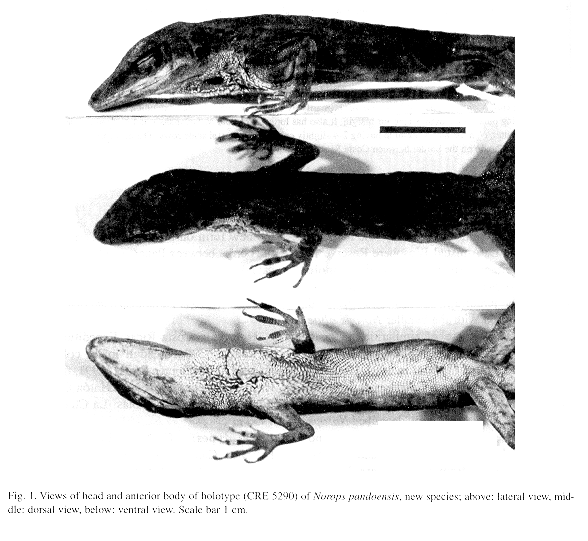
<article-title xml:lang="en"><![CDATA[A new species of anole lizard, genus Norops (Squamata: Polychrotidae), from the Cordillera de Talamanca, Costa Rica]]></article-title>
</title-group>
<contrib-group>
<contrib contrib-type="author">
<name>
<surname><![CDATA[Savage]]></surname>
<given-names><![CDATA[Jay M.]]></given-names>
</name>
<xref ref-type="aff" rid="A01"/>
</contrib>
<contrib contrib-type="author">
<name>
<surname><![CDATA[Guyer]]></surname>
<given-names><![CDATA[Craig]]></given-names>
</name>
<xref ref-type="aff" rid="A02"/>
</contrib>
</contrib-group>
<aff id="A01">
<institution><![CDATA[,University of Miami Departament of Biology ]]></institution>
<addr-line><![CDATA[ Florida]]></addr-line>
<country>USA</country>
</aff>
<aff id="A02">
<institution><![CDATA[,Auburn University Department of Zoology and Wildlife ]]></institution>
<addr-line><![CDATA[Auburn Alabama]]></addr-line>
<country>USA</country>
</aff>
<pub-date pub-type="pub">
<day>00</day>
<month>09</month>
<year>1998</year>
</pub-date>
<pub-date pub-type="epub">
<day>00</day>
<month>09</month>
<year>1998</year>
</pub-date>
<volume>46</volume>
<numero>3</numero>
<fpage>805</fpage>
<lpage>809</lpage>
<copyright-statement/>
<copyright-year/>
<self-uri xlink:href="http://www.scielo.sa.cr/scielo.php?script=sci_arttext&amp;pid=S0034-77441998000300034&amp;lng=en&amp;nrm=iso"></self-uri><self-uri xlink:href="http://www.scielo.sa.cr/scielo.php?script=sci_abstract&amp;pid=S0034-77441998000300034&amp;lng=en&amp;nrm=iso"></self-uri><self-uri xlink:href="http://www.scielo.sa.cr/scielo.php?script=sci_pdf&amp;pid=S0034-77441998000300034&amp;lng=en&amp;nrm=iso"></self-uri><abstract abstract-type="short" xml:lang="en"><p><![CDATA[A new species of anole lizard of the Norops fuscoauratus group is described from the southern Cordillera de Talamanca of Costa Rica. It differs from allied species from Costa Rica (Norops altae) and southwestern Panama (Norops exsul, N. fortunensis and N. kemptoni) primarily by having the male dewlap extending to the level of the axilla and being pink with a orange anterior margin. It also has longer legs than N. fortunensis and N. kemptoni and differs from the latter, N. altae and N. exsul in having 2-4 slightly enlarged middorsal scale rows. The new form is known only from Cerro Pando on the border between Costa Rica and Panama.]]></p></abstract>
<abstract abstract-type="short" xml:lang="es"><p><![CDATA[Se describe una especie nueva de lagartija del grupo de Norops fuscoauratus de Talamanca, Costa Rica. Difiere de las especies emparentadas de Costa Rica (Norops altae) y Panamá (Norops exsul, N. fortunensis y N. kemptoni) básicamente porque una estructura masculina ("dewlap") se extiende hasta el nivel de la axila y por ser rosado con un margen exterior anaranjado. Tambièn tiene patas más largas que N. fortunensis y N. kemptoni; difiere de este último y de N. altae y N. exsul en que tiene 2-4 filas ligeramente agrandadas de escamas medio-dorsales La especie nueva solo se conoce de Cerro Pando (frontera entre Costa Rica y Panamá).]]></p></abstract>
<kwd-group>
<kwd lng="en"><![CDATA[Reptilia]]></kwd>
<kwd lng="en"><![CDATA[Squamata]]></kwd>
<kwd lng="en"><![CDATA[Polychrotidae]]></kwd>
<kwd lng="en"><![CDATA[Norops]]></kwd>
<kwd lng="en"><![CDATA[Costa Rica]]></kwd>
</kwd-group>
</article-meta>
</front><body><![CDATA[ <CENTER><B><FONT FACE="Arial,Helvetica">A new species of anole lizard, genus <I>Norops </I>(Squamata:</FONT></B></CENTER>      <CENTER><B><FONT FACE="Arial,Helvetica">Polychrotidae), from the Cordillera de Talamanca, Costa Rica</FONT></B></CENTER>      <CENTER>&nbsp;</CENTER>      <CENTER>&nbsp;</CENTER>      <CENTER><FONT FACE="Arial,Helvetica"><FONT SIZE=-1><B>Jay M. Savage<A NAME="1"></A></B><SUP><A HREF="#1a">1</A><B><A HREF="#1 ref.">&nbsp;</A></B></SUP><B>&nbsp;&nbsp; Craig Guyer<A NAME="2"></A></B><SUP><A HREF="#2a">2</A></SUP></FONT></FONT></CENTER>      <CENTER>&nbsp;</CENTER>      <CENTER>&nbsp;</CENTER>      <CENTER><FONT FACE="Arial,Helvetica"><FONT SIZE=-1>Received 22-IX-1997. Corrected 2-IV-1998. Accepted 7-IV-1998.</FONT></FONT></CENTER>       <P>&nbsp;     <BR><B><FONT FACE="Arial,Helvetica"><FONT SIZE=-1>Abstract</FONT></FONT></B>      ]]></body>
<body><![CDATA[<P><FONT FACE="Arial,Helvetica"><FONT SIZE=-1>A new species of anole lizard of the <I>Norops fuscoauratus</I> group is described from the southern Cordillera de Talamanca of Costa Rica. It differs from allied species from Costa Rica (<I>Norops altae</I>) and southwestern Panama (<I>Norops exsul</I>, <I>N.</I> <I>fortunensis </I>and N. <I>kemptoni</I>) primarily by having the male dewlap extending to the level of the axilla and being pink with a orange anterior margin. It also has longer legs than <I>N.</I> <I>fortunensis </I>and <I>N.</I> <I>kemptoni</I> and differs from the latter, <I>N.altae</I> and <I>N.</I> <I>exsul</I> in having 2-4 slightly enlarged middorsal scale rows. The new form is known only from Cerro Pando on the border between Costa Rica and Panama.</FONT></FONT>      <P><B><FONT FACE="Arial,Helvetica"><FONT SIZE=-1>Key words</FONT></FONT></B>      <P><FONT FACE="Arial,Helvetica"><FONT SIZE=-1>Reptilia, Squamata, Polychrotidae, Norops, Costa Rica.</FONT></FONT>     <BR>&nbsp;      <P><FONT FACE="Arial,Helvetica"><FONT SIZE=-1>During a preliminary survey of the herpetofauna of the La Amistad Biosphere Reserve in 1990, specimens of an undescribed anole (genus Norops) were collected by Karen R. Lips and the junior author. Initially in the field it was confused with the smaller <I>Norops altae</I> (<A HREF="#Dunn, E. R. 1930.">Dunn, 1930</A>) because of similarities in head shape and body coloration. Subsequently, Lips collected additional material in 1991-1992 that confirmed the species distinctiveness from <I>N.altae</I>. Three allied taxa, <I>Norops kemptoni</I> (<A HREF="#Dunn, E. R. 1940.">Dunn, 1940</A>) and the recently described <I>Norops exsul</I> (<A HREF="#Arosemena, F. A.  1994">Arosemena and Iba&ntilde;ez, 1994)</A> and <I>Norops fortunensis </I>(<A HREF="#Arosemena, F. A. 1993">Arosemena and Iba&ntilde;ez, 1993</A>) are known from southwestern Panama but differences in male dewlap color and other features distinguish the new form from these species as well. In allusion to the occurrence of the new form on the slopes of Cerro Pando on the border between Panama and Costa Rica, it is called:</FONT></FONT>     <CENTER></CENTER>      <CENTER><FONT FACE="Arial,Helvetica"><FONT SIZE=-1><I>Norops pandoensis</I>,<I> sp. </I>nov.</FONT></FONT></CENTER>       <P><FONT FACE="Arial,Helvetica"><FONT SIZE=-1><B>Holotype: </B>Costa Rican Expeditions (CRE) collection 5290, an adult male; collected by Karen R. Lips, September 21, 1991, from Costa Rica: Puntarenas Province: Cant&oacute;n Coto Brus: Zona Protectora Las Tablas: La Changuinolita 1950 m.</FONT></FONT>      <P><FONT FACE="Arial,Helvetica"><FONT SIZE=-1><B>Paratypes: </B>Costa Rica: Puntarenas Province: Cant&oacute;n Coto Brus: Finca Las Tablas, 1600 m (CRE 5180, 5181); La Changuinolita, 1950 m (CRE 5291, 5321); nr. La Changuinolita, 1850-1950 m (CRE 5295, 5318, 5329).</FONT></FONT>      <P><FONT FACE="Arial,Helvetica"><FONT SIZE=-1><B>Diagnosis:</B> A small, yellowish-tan, short-legged member of the <I>Norops fuscoauratus</I> species group characterized by having enlarged postcloacals and a large, bicolored pink and orange dewlap in males and a small, plain dewlap not contrasting in color with the rest of the throat in females.</FONT></FONT>      ]]></body>
<body><![CDATA[<P><FONT FACE="Arial,Helvetica"><FONT SIZE=-1><B>General Morphology Head:</B>Head scales moderate in size, keeled at tip of snout, smooth or rugose throughout rest of head except for supraocular semicircles and canthals. 8-10 scales separate second canthals across top of head, these forming a distinct dish posteriorly. Usually 1 (occasionally 2) scale between rostral and anterior nasal. Usually 2 (occasionally 1) scale rows between supraocular semicircles. One greatly enlarged superciliary followed by 1-2 smaller superciliaries, the latter > 2 times larger than lateral granules. Canthus distinct, formed by 5-6 enlarged keeled scales. 6-8 loreal scales between posterior canthals, these pustulose; the row above the supralabials >2 times size of other loreals. Temporals granular, enlarging and flattening gradually in supratemporal region. Interparietal large, flat, plate-like; 2-3 scales between interparietal and supraocular semicircles. Suboculars in contact with supralabials. 6-8 (usually 7) sublabials to level of center of eye. Mentals wider than deep. Sublabials<U> ></U>2 times size of gulars. Transition between sublabials and gulars abrupt. Male dewlap large, extending well posterior to level of axilla; small, plain, white dewlap present in females.</FONT></FONT>      <P><FONT FACE="Arial,Helvetica"><FONT SIZE=-1><B>Trunk:</B> 2-4 middorsal scales about twice size of granular lateral scales; transition between these regions gradual. Dorsalmost scales very weakly keeled and weakly imbricate. Ventral scales smooth (occasionally very weakly keeled) and weakly imbricate.</FONT></FONT>      <P><FONT FACE="Arial,Helvetica"><FONT SIZE=-1><B>Limbs and Digits:</B> Hind legs short; fourth toe of adpressed hind limb reaching level of tympanum. Supradigital scales weakly multicarinate. 31-32 lamellae under 4th toe; 15 to 16 lamellae under phalanges ii + iii.</FONT></FONT>      <P><FONT FACE="Arial,Helvetica"><FONT SIZE=-1><B>Tail: </B>Scales at middorsum and midventer of tail slightly (&lt;2 times) larger than lateral scales and strongly keeled. Tail laterally compressed. Enlarged postcloacal scales in males.</FONT></FONT>      <P><FONT FACE="Arial,Helvetica"><FONT SIZE=-1><B>Coloration in Life: </B>Apparently having some ability for color change or with a greenish cast. Dorsum usually tan-yellow but changing to darker colors, olive-green to dark brown when captured. Darker oblique lateral bars on flanks may be present. One female with a broad middorsal light tan stripe bordered laterally by dark brown area that fades to light tan from head to tip of tail and laterally. Another female had a less distinct middorsal lighter brown stripe with a series of elongate, rectangular dark brown markings down the midline from the neck to the base of the tail. Supra- and infralabials white to pale yellow. Dewlap in males mostly pink, anterior one-fourth orange, scales white; plain white in females. Venter white to yellow-white, immaculate or suffused with brown laterally. Iris orange-red.</FONT></FONT>      <P><FONT FACE="Arial,Helvetica"><FONT SIZE=-1><B>In Preservative:</B> Generally tan dorsally with darker markings more evident. The parietal peritoneum is black.</FONT></FONT>      <P><FONT FACE="Arial,Helvetica"><FONT SIZE=-1><B>Measurements:</B> Total length to 144 mm; males 49.5-53 mm in standard length, females 49-60 mm; tail length divided by standard length 1.7-2.0, in adults.</FONT></FONT>      <P><FONT FACE="Arial,Helvetica"><FONT SIZE=-1><B>Habitat:</B> <B>T</B>his diurnal species is found in the herbaceous and low shrub zone (up to 1.5 m) in Lower Montane Rainforest (<A HREF="#Holdrige, L. R.">Holdrige, 1967</A>; <A HREF="#Tosi, J. A., Jr.">Tosi, 1969</A>).</FONT></FONT>      <P><FONT FACE="Arial,Helvetica"><FONT SIZE=-1><B>Comparisons:</B><I>N.</I> <I>pandoensis</I> is a member of the <I>fuscoauratus</I> species group. Lizards of this group are small to moderate in size, have small head scales, small dorsal scales, mostly smooth ventrals, long tails that are round to subcylindrical in cross-section. Members of this group usually have an inscriptional rib formula of 3: 1 (<A HREF="#Etheridge, R.">Etheridge, 1965</A>) as is the case with <I>N.</I> <I>pandoensis</I>.</FONT></FONT>      <P><FONT FACE="Arial,Helvetica"><FONT SIZE=-1>Among Central American members of the fuscoauratus group the new species is unlikely to be confused with Norops limifrons (including N. biscutiger) or Norops polylepis both of which have long legs, i.e., the tip of the 4th toe reaches beyond the orbit when the leg is adpressed along the side of the body. In addition, the dewlap in male N. limifrons is white with a basal yellow to orange spot and is uniform orange in male N. polylepis.</FONT></FONT>      ]]></body>
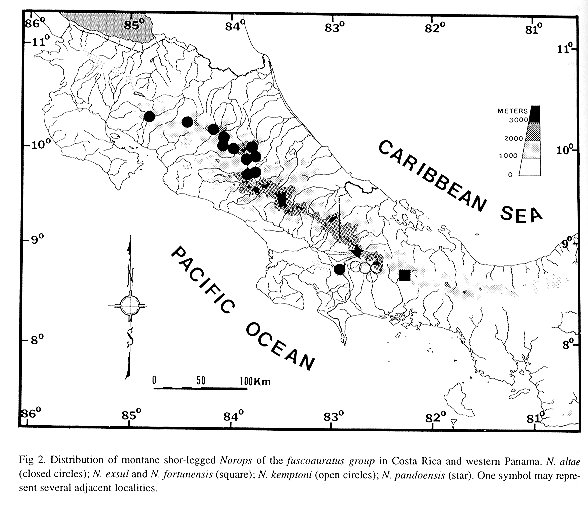
<body><![CDATA[<P><FONT FACE="Arial,Helvetica"><FONT SIZE=-1>Among short-legged members of the fuscoauratus group, N. pandoensis can be distinguished immediately from the lowland Norops carpenteri which is green, smaller (standard length 35-45 mm) and with a uniform orange dewlap color in males. Comparisons with the four short-legged species most similar to N. pandoensis in general appearance are summarized in <A HREF="#Table 1">Table 1</A>. All are upland forms and one or more of them may prove to occur sympatrically with N. pandoensis.</FONT></FONT>     <BR>&nbsp;     <BR>&nbsp;     <BR>&nbsp;     <CENTER></CENTER>      <CENTER><A NAME="fig. 1"></A><IMG SRC="/img/fbpe/rbt/v46n3/0216i01.GIF" HEIGHT=541 WIDTH=588></CENTER>      
<CENTER></CENTER>      <CENTER><A NAME="Table 1"></A><FONT FACE="Arial,Helvetica"><FONT SIZE=-1>Table 1</FONT></FONT></CENTER>      <CENTER><FONT FACE="Arial,Helvetica"><FONT SIZE=-1><I>Characteristics that differentiate</I> Norops pandoensis<I> from similar species from lower Central America.</I></FONT></FONT></CENTER> &nbsp;     <BR>&nbsp;     ]]></body>
<body><![CDATA[<CENTER><TABLE BORDER=0 CELLSPACING=0 CELLPADDING=5 WIDTH="603" > <TR> <TD VALIGN=TOP WIDTH="17%"></TD>  <TD VALIGN=TOP WIDTH="17%">     <CENTER><I><FONT FACE="Arial,Helvetica"><FONT SIZE=-1>pandoensis</FONT></FONT></I></CENTER> </TD>  <TD VALIGN=TOP WIDTH="17%">     <CENTER><I><FONT FACE="Arial,Helvetica"><FONT SIZE=-1>altae</FONT></FONT></I></CENTER> </TD>  <TD VALIGN=TOP WIDTH="17%">     <CENTER><I><FONT FACE="Arial,Helvetica"><FONT SIZE=-1>exul</FONT></FONT></I></CENTER> </TD>  <TD VALIGN=TOP WIDTH="17%">     <CENTER><I><FONT FACE="Arial,Helvetica"><FONT SIZE=-1>fortunensis</FONT></FONT></I></CENTER> </TD>  <TD VALIGN=TOP WIDTH="17%">     <CENTER><I><FONT FACE="Arial,Helvetica"><FONT SIZE=-1>keptoni</FONT></FONT></I></CENTER> </TD> </TR>  <TR> <TD VALIGN=TOP WIDTH="17%"><FONT FACE="Arial,Helvetica"><FONT SIZE=-1>SL adult males&nbsp;</FONT></FONT></TD>  <TD VALIGN=TOP WIDTH="17%">     <CENTER><FONT FACE="Arial,Helvetica"><FONT SIZE=-1>49.5-53&nbsp;</FONT></FONT></CENTER> </TD>  <TD VALIGN=TOP WIDTH="17%">     <CENTER><FONT FACE="Arial,Helvetica"><FONT SIZE=-1>32-52&nbsp;</FONT></FONT></CENTER> </TD>  <TD VALIGN=TOP WIDTH="17%">     <CENTER><FONT FACE="Arial,Helvetica"><FONT SIZE=-1>39-47&nbsp;</FONT></FONT></CENTER> </TD>  <TD VALIGN=TOP WIDTH="17%">     <CENTER><FONT FACE="Arial,Helvetica"><FONT SIZE=-1>48&nbsp;</FONT></FONT></CENTER> </TD>  <TD VALIGN=TOP WIDTH="17%">     ]]></body>
<body><![CDATA[<CENTER><FONT FACE="Arial,Helvetica"><FONT SIZE=-1>44-53&nbsp;</FONT></FONT></CENTER> </TD> </TR>  <TR> <TD VALIGN=TOP WIDTH="17%"><FONT FACE="Arial,Helvetica"><FONT SIZE=-1>adult females&nbsp;</FONT></FONT></TD>  <TD VALIGN=TOP WIDTH="17%">     <CENTER><FONT FACE="Arial,Helvetica"><FONT SIZE=-1>49-60&nbsp;</FONT></FONT></CENTER> </TD>  <TD VALIGN=TOP WIDTH="17%">     <CENTER><FONT FACE="Arial,Helvetica"><FONT SIZE=-1>39-47&nbsp;</FONT></FONT></CENTER> </TD>  <TD VALIGN=TOP WIDTH="17%">     <CENTER><FONT FACE="Arial,Helvetica"><FONT SIZE=-1>46&nbsp;</FONT></FONT></CENTER> </TD>  <TD VALIGN=TOP WIDTH="17%">     <CENTER><FONT FACE="Arial,Helvetica"><FONT SIZE=-1>--&nbsp;</FONT></FONT></CENTER> </TD>  <TD VALIGN=TOP WIDTH="17%"><FONT FACE="Arial,Helvetica"><FONT SIZE=-1>46-54&nbsp;</FONT></FONT></TD> </TR>  <TR> <TD VALIGN=TOP WIDTH="17%"><FONT FACE="Arial,Helvetica"><FONT SIZE=-1>Adpressed leg to&nbsp;</FONT></FONT></TD>  <TD VALIGN=TOP WIDTH="17%">     <CENTER><FONT FACE="Arial,Helvetica"><FONT SIZE=-1>ear&nbsp;</FONT></FONT></CENTER> </TD>  <TD VALIGN=TOP WIDTH="17%">     <CENTER><FONT FACE="Arial,Helvetica"><FONT SIZE=-1>ear&nbsp;</FONT></FONT></CENTER> </TD>  <TD VALIGN=TOP WIDTH="17%">     <CENTER><FONT FACE="Arial,Helvetica"><FONT SIZE=-1>ear&nbsp;</FONT></FONT></CENTER> </TD>  <TD VALIGN=TOP WIDTH="17%">     <CENTER><FONT FACE="Arial,Helvetica"><FONT SIZE=-1>between shoulder and ear&nbsp;</FONT></FONT></CENTER> </TD>  <TD VALIGN=TOP WIDTH="17%"><FONT FACE="Arial,Helvetica"><FONT SIZE=-1>shoulder&nbsp;</FONT></FONT></TD> </TR>  <TR> <TD VALIGN=TOP WIDTH="17%"><FONT FACE="Arial,Helvetica"><FONT SIZE=-1>Scales between&nbsp;</FONT></FONT></TD>  <TD VALIGN=TOP WIDTH="17%">     <CENTER><FONT FACE="Arial,Helvetica"><FONT SIZE=-1>1-2&nbsp;</FONT></FONT></CENTER> </TD>  <TD VALIGN=TOP WIDTH="17%">     ]]></body>
<body><![CDATA[<CENTER><FONT FACE="Arial,Helvetica"><FONT SIZE=-1>1-2&nbsp;</FONT></FONT></CENTER> </TD>  <TD VALIGN=TOP WIDTH="17%">     <CENTER><FONT FACE="Arial,Helvetica"><FONT SIZE=-1>2&nbsp;</FONT></FONT></CENTER> </TD>  <TD VALIGN=TOP WIDTH="17%">     <CENTER><FONT FACE="Arial,Helvetica"><FONT SIZE=-1>3&nbsp;</FONT></FONT></CENTER> </TD>  <TD VALIGN=TOP WIDTH="17%">     <CENTER><FONT FACE="Arial,Helvetica"><FONT SIZE=-1>1&nbsp;</FONT></FONT></CENTER> </TD> </TR>  <TR> <TD VALIGN=TOP WIDTH="17%"><FONT FACE="Arial,Helvetica"><FONT SIZE=-1>supraocular semicircles&nbsp;</FONT></FONT></TD>  <TD VALIGN=TOP WIDTH="17%">     <CENTER><FONT FACE="Arial,Helvetica"><FONT SIZE=-1>usually 2&nbsp;</FONT></FONT></CENTER> </TD>  <TD VALIGN=TOP WIDTH="17%">     <CENTER><FONT FACE="Arial,Helvetica"><FONT SIZE=-1>usually 1&nbsp;</FONT></FONT></CENTER> </TD>  <TD VALIGN=TOP WIDTH="17%"></TD>  <TD VALIGN=TOP WIDTH="17%"></TD>  <TD VALIGN=TOP WIDTH="17%"></TD> </TR>  <TR> <TD VALIGN=TOP WIDTH="17%"><FONT FACE="Arial,Helvetica"><FONT SIZE=-1>Slightly enlarged rows of dorsals&nbsp;</FONT></FONT></TD>  <TD VALIGN=TOP WIDTH="17%">     <CENTER><FONT FACE="Arial,Helvetica"><FONT SIZE=-1>2-4&nbsp;</FONT></FONT></CENTER> </TD>  <TD VALIGN=TOP WIDTH="17%">     <CENTER><FONT FACE="Arial,Helvetica"><FONT SIZE=-1>0&nbsp;</FONT></FONT></CENTER> </TD>  <TD VALIGN=TOP WIDTH="17%">     <CENTER><FONT FACE="Arial,Helvetica"><FONT SIZE=-1>0&nbsp;</FONT></FONT></CENTER> </TD>  <TD VALIGN=TOP WIDTH="17%">     <CENTER><FONT FACE="Arial,Helvetica"><FONT SIZE=-1>2-4&nbsp;</FONT></FONT></CENTER> </TD>  <TD VALIGN=TOP WIDTH="17%">     ]]></body>
<body><![CDATA[<CENTER><FONT FACE="Arial,Helvetica"><FONT SIZE=-1>0&nbsp;</FONT></FONT></CENTER> </TD> </TR>  <TR> <TD VALIGN=TOP WIDTH="17%"><FONT FACE="Arial,Helvetica"><FONT SIZE=-1>Enlarged postcloacals in males&nbsp;</FONT></FONT></TD>  <TD VALIGN=TOP WIDTH="17%">     <CENTER><FONT FACE="Arial,Helvetica"><FONT SIZE=-1>present&nbsp;</FONT></FONT></CENTER> </TD>  <TD VALIGN=TOP WIDTH="17%">     <CENTER><FONT FACE="Arial,Helvetica"><FONT SIZE=-1>absent&nbsp;</FONT></FONT></CENTER> </TD>  <TD VALIGN=TOP WIDTH="17%">     <CENTER><FONT FACE="Arial,Helvetica"><FONT SIZE=-1>absent&nbsp;</FONT></FONT></CENTER> </TD>  <TD VALIGN=TOP WIDTH="17%">     <CENTER><FONT FACE="Arial,Helvetica"><FONT SIZE=-1>present&nbsp;</FONT></FONT></CENTER> </TD>  <TD VALIGN=TOP WIDTH="17%"><FONT FACE="Arial,Helvetica"><FONT SIZE=-1>absent&nbsp;</FONT></FONT></TD> </TR>  <TR> <TD VALIGN=TOP WIDTH="17%"><FONT FACE="Arial,Helvetica"><FONT SIZE=-1>Extent of male dewlap&nbsp;</FONT></FONT></TD>  <TD VALIGN=TOP WIDTH="17%">     <CENTER><FONT FACE="Arial,Helvetica"><FONT SIZE=-1>chest&nbsp;</FONT></FONT></CENTER> </TD>  <TD VALIGN=TOP WIDTH="17%">     <CENTER><FONT FACE="Arial,Helvetica"><FONT SIZE=-1>just posterior to arm insertion&nbsp;</FONT></FONT></CENTER> </TD>  <TD VALIGN=TOP WIDTH="17%">     <CENTER><FONT FACE="Arial,Helvetica"><FONT SIZE=-1>chest&nbsp;</FONT></FONT></CENTER> </TD>  <TD VALIGN=TOP WIDTH="17%">     <CENTER><FONT FACE="Arial,Helvetica"><FONT SIZE=-1>middle of venter&nbsp;</FONT></FONT></CENTER> </TD>  <TD VALIGN=TOP WIDTH="17%"><FONT FACE="Arial,Helvetica"><FONT SIZE=-1>chest&nbsp;</FONT></FONT></TD> </TR>  <TR> <TD VALIGN=TOP WIDTH="17%"><FONT FACE="Arial,Helvetica"><FONT SIZE=-1>Dewlap in females&nbsp;</FONT></FONT></TD>  <TD VALIGN=TOP WIDTH="17%">     <CENTER><FONT FACE="Arial,Helvetica"><FONT SIZE=-1>plain white&nbsp;</FONT></FONT></CENTER> </TD>  <TD VALIGN=TOP WIDTH="17%">     ]]></body>
<body><![CDATA[<CENTER><FONT FACE="Arial,Helvetica"><FONT SIZE=-1>absent&nbsp;</FONT></FONT></CENTER> </TD>  <TD VALIGN=TOP WIDTH="17%">     <CENTER><FONT FACE="Arial,Helvetica"><FONT SIZE=-1>plain white&nbsp;</FONT></FONT></CENTER> </TD>  <TD VALIGN=TOP WIDTH="17%">     <CENTER><FONT FACE="Arial,Helvetica"><FONT SIZE=-1>--&nbsp;</FONT></FONT></CENTER> </TD>  <TD VALIGN=TOP WIDTH="17%"><FONT FACE="Arial,Helvetica"><FONT SIZE=-1>absent&nbsp;</FONT></FONT></TD> </TR>  <TR> <TD VALIGN=TOP WIDTH="17%"><FONT FACE="Arial,Helvetica"><FONT SIZE=-1>Dewlap color in males&nbsp;</FONT></FONT></TD>  <TD VALIGN=TOP WIDTH="17%">     <CENTER><FONT FACE="Arial,Helvetica"><FONT SIZE=-1>pink, anterior margin orange&nbsp;</FONT></FONT></CENTER> </TD>  <TD VALIGN=TOP WIDTH="17%">     <CENTER><FONT FACE="Arial,Helvetica"><FONT SIZE=-1>orange, margin yellow&nbsp;</FONT></FONT></CENTER> </TD>  <TD VALIGN=TOP WIDTH="17%">     <CENTER><FONT FACE="Arial,Helvetica"><FONT SIZE=-1>orange, margin cherry-red&nbsp;</FONT></FONT></CENTER> </TD>  <TD VALIGN=TOP WIDTH="17%">     <CENTER><FONT FACE="Arial,Helvetica"><FONT SIZE=-1>reddish orange, margin red&nbsp;</FONT></FONT></CENTER> </TD>  <TD VALIGN=TOP WIDTH="17%"><FONT FACE="Arial,Helvetica"><FONT SIZE=-1>red, orange spot on anterior margin&nbsp;</FONT></FONT></TD> </TR>  <TR> <TD VALIGN=TOP WIDTH="17%"><FONT FACE="Arial,Helvetica"><FONT SIZE=-1>Color of enlarged dewlap scales&nbsp;</FONT></FONT></TD>  <TD VALIGN=TOP WIDTH="17%">     <CENTER><FONT FACE="Arial,Helvetica"><FONT SIZE=-1>white&nbsp;</FONT></FONT></CENTER> </TD>  <TD VALIGN=TOP WIDTH="17%">     <CENTER><FONT FACE="Arial,Helvetica"><FONT SIZE=-1>white&nbsp;</FONT></FONT></CENTER> </TD>  <TD VALIGN=TOP WIDTH="17%">     <CENTER><FONT FACE="Arial,Helvetica"><FONT SIZE=-1>yellow&nbsp;</FONT></FONT></CENTER> </TD>  <TD VALIGN=TOP WIDTH="17%">     ]]></body>
<body><![CDATA[<CENTER><FONT FACE="Arial,Helvetica"><FONT SIZE=-1>yellow&nbsp;</FONT></FONT></CENTER> </TD>  <TD VALIGN=TOP WIDTH="17%">     <CENTER><FONT FACE="Arial,Helvetica"><FONT SIZE=-1>white&nbsp;</FONT></FONT></CENTER> </TD> </TR>  <TR> <TD VALIGN=TOP WIDTH="17%">     <CENTER><FONT FACE="Arial,Helvetica"><FONT SIZE=-1>Distribution&nbsp;</FONT></FONT></CENTER> </TD>  <TD VALIGN=TOP WIDTH="17%">     <CENTER><FONT FACE="Arial,Helvetica"><FONT SIZE=-1>Costa Rica&nbsp;</FONT></FONT></CENTER> </TD>  <TD VALIGN=TOP WIDTH="17%">     <CENTER><FONT FACE="Arial,Helvetica"><FONT SIZE=-1>Costa Rica&nbsp;</FONT></FONT></CENTER> </TD>  <TD VALIGN=TOP WIDTH="17%">     <CENTER><FONT FACE="Arial,Helvetica"><FONT SIZE=-1>W. Panama&nbsp;</FONT></FONT></CENTER> </TD>  <TD VALIGN=TOP WIDTH="17%">     <CENTER><FONT FACE="Arial,Helvetica"><FONT SIZE=-1>W. Panama&nbsp;</FONT></FONT></CENTER> </TD>  <TD VALIGN=TOP WIDTH="17%">     <CENTER><FONT FACE="Arial,Helvetica"><FONT SIZE=-1>W. Panama&nbsp;</FONT></FONT></CENTER> </TD> </TR> </TABLE></CENTER> <B><FONT FACE="Arial,Helvetica"><FONT SIZE=-1></FONT></FONT></B>      <P><B><FONT FACE="Arial,Helvetica"><FONT SIZE=-1>&nbsp;</FONT></FONT></B>     <BR><B><FONT FACE="Arial,Helvetica"><FONT SIZE=-1>&nbsp;</FONT></FONT></B>     ]]></body>
<body><![CDATA[<BR><B><FONT FACE="Arial,Helvetica"><FONT SIZE=-1>Acknowledgments</FONT></FONT></B>      <P><FONT FACE="Arial,Helvetica"><FONT SIZE=-1>Karen R. Lips, St. Lawrence University, collected most of the type series and generously make available her fieldnotes on the new taxon. Juan Diego Alfaro of the Servicio de Parques Nacional of Costa Rica, arranged for necessary permits and aided study of the Biosphere Reserve in many other ways. Bruce E. Grayson prepared the photographs for <A HREF="#fig. 1">Fig. 1</A>.</FONT></FONT>     <BR>&nbsp;     <BR><B><FONT FACE="Arial,Helvetica"><FONT SIZE=-1>&nbsp;</FONT></FONT></B>     <BR><B><FONT FACE="Arial,Helvetica"><FONT SIZE=-1>Resumen</FONT></FONT></B>      <P><FONT FACE="Arial,Helvetica"><FONT SIZE=-1>Se describe una especie nueva de lagartija del grupo de Norops fuscoauratus de Talamanca, Costa Rica. Difiere de las especies emparentadas de Costa Rica (Norops altae) y Panam&aacute; (Norops exsul, N. fortunensis y N. kemptoni) b&aacute;sicamente porque una estructura masculina ("dewlap") se extiende hasta el nivel de la axila y por ser rosado con un margen exterior anaranjado. Tambi&egrave;n tiene patas m&aacute;s largas que N. fortunensis y N. kemptoni; difiere de este &uacute;ltimo y de N. altae y N. exsul en que tiene 2-4 filas ligeramente agrandadas de escamas medio-dorsales La especie nueva solo se conoce de Cerro Pando (frontera entre Costa Rica y Panam&aacute;).</FONT></FONT>     <BR>&nbsp;     <CENTER></CENTER>      <CENTER><A NAME="fig. 2"></A><IMG SRC="/img/fbpe/rbt/v46n3/0216i02.GIF" HEIGHT=514 WIDTH=588></CENTER>      
<CENTER><A NAME="fig. 2"></A></CENTER>       ]]></body>
<body><![CDATA[<P><B><FONT FACE="Arial,Helvetica"><FONT SIZE=-1>References</FONT></FONT></B>      <!-- ref --><P><A NAME="Arosemena, F. A. 1993"></A><FONT FACE="Arial,Helvetica"><FONT SIZE=-1>Arosemena, F. A. &amp; R. Iba&ntilde;ez. 1993. Una especie nueva de Anolis (Squamata: Iguanidae) del grupo fuscoauratus de Fortuna, Panam&aacute;. Rev. Biol. Trop. 41: 267-272.</FONT></FONT>    &nbsp;&nbsp;&nbsp;&nbsp;&nbsp;&nbsp;&nbsp;&nbsp;[&#160;<a href="javascript:void(0);" onclick="javascript: window.open('/scielo.php?script=sci_nlinks&ref=1147740&pid=S0034-7744199800030003400001&lng=','','width=640,height=500,resizable=yes,scrollbars=1,menubar=yes,');">Links</a>&#160;]<!-- end-ref --><!-- ref --><P><A NAME="Arosemena, F. A.  1994"></A><FONT FACE="Arial,Helvetica"><FONT SIZE=-1>Arosemena, F. A. &amp; R. Iba&ntilde;ez. 1994. Un sauio nuevo del genero Anolis (Reptilia, Polychrotidae), grupo fuscoauratus, de las tierras altas de Chiriqu&iacute;, Panam&aacute;. Carib. J. Sci. 30: 222-227.</FONT></FONT>    &nbsp;&nbsp;&nbsp;&nbsp;&nbsp;&nbsp;&nbsp;&nbsp;[&#160;<a href="javascript:void(0);" onclick="javascript: window.open('/scielo.php?script=sci_nlinks&ref=1147741&pid=S0034-7744199800030003400002&lng=','','width=640,height=500,resizable=yes,scrollbars=1,menubar=yes,');">Links</a>&#160;]<!-- end-ref --><!-- ref --><P><A NAME="Dunn, E. R. 1930."></A><FONT FACE="Arial,Helvetica"><FONT SIZE=-1>Dunn, E. R. 1930. Notes on Central American Anolis. Proc. New Engl. Zool. Club 12: 15-24.</FONT></FONT>    &nbsp;&nbsp;&nbsp;&nbsp;&nbsp;&nbsp;&nbsp;&nbsp;[&#160;<a href="javascript:void(0);" onclick="javascript: window.open('/scielo.php?script=sci_nlinks&ref=1147742&pid=S0034-7744199800030003400003&lng=','','width=640,height=500,resizable=yes,scrollbars=1,menubar=yes,');">Links</a>&#160;]<!-- end-ref --><!-- ref --><P><A NAME="Dunn, E. R. 1940."></A><FONT FACE="Arial,Helvetica"><FONT SIZE=-1>Dunn, E. R. 1940. New and noteworthy herpetological material from Panama. Proc. Acad. Nat. Sci. Phila. 92: 105-122.</FONT></FONT>    &nbsp;&nbsp;&nbsp;&nbsp;&nbsp;&nbsp;&nbsp;&nbsp;[&#160;<a href="javascript:void(0);" onclick="javascript: window.open('/scielo.php?script=sci_nlinks&ref=1147743&pid=S0034-7744199800030003400004&lng=','','width=640,height=500,resizable=yes,scrollbars=1,menubar=yes,');">Links</a>&#160;]<!-- end-ref --><!-- ref --><P><A NAME="Etheridge, R."></A><FONT FACE="Arial,Helvetica"><FONT SIZE=-1>Etheridge, R. E. 1965. The abdominal skeletons of lizards in the family Iguanidae. Herpetologica 21: 161-168.</FONT></FONT>    &nbsp;&nbsp;&nbsp;&nbsp;&nbsp;&nbsp;&nbsp;&nbsp;[&#160;<a href="javascript:void(0);" onclick="javascript: window.open('/scielo.php?script=sci_nlinks&ref=1147744&pid=S0034-7744199800030003400005&lng=','','width=640,height=500,resizable=yes,scrollbars=1,menubar=yes,');">Links</a>&#160;]<!-- end-ref --><!-- ref --><P><A NAME="Holdrige, L. R."></A><FONT FACE="Arial,Helvetica"><FONT SIZE=-1>Holdrige, L. R. 1967. Life zone ecology. Tropical Science Center, San Jos&eacute;, Costa Rica. 206 p.</FONT></FONT>    &nbsp;&nbsp;&nbsp;&nbsp;&nbsp;&nbsp;&nbsp;&nbsp;[&#160;<a href="javascript:void(0);" onclick="javascript: window.open('/scielo.php?script=sci_nlinks&ref=1147745&pid=S0034-7744199800030003400006&lng=','','width=640,height=500,resizable=yes,scrollbars=1,menubar=yes,');">Links</a>&#160;]<!-- end-ref --><!-- ref --><P><A NAME="Tosi, J. A., Jr."></A><FONT FACE="Arial,Helvetica"><FONT SIZE=-1>Tosi, J. A., Jr. 1969. Mapa ecol&oacute;gico, Rep&uacute;blica de Costa Rica. Tropical Science Center, San Jos&eacute;, Costa Rica.</FONT></FONT>    &nbsp;&nbsp;&nbsp;&nbsp;&nbsp;&nbsp;&nbsp;&nbsp;[&#160;<a href="javascript:void(0);" onclick="javascript: window.open('/scielo.php?script=sci_nlinks&ref=1147746&pid=S0034-7744199800030003400007&lng=','','width=640,height=500,resizable=yes,scrollbars=1,menubar=yes,');">Links</a>&#160;]<!-- end-ref --><P><A NAME="1a"></A><SUP><FONT FACE="Arial,Helvetica"><FONT SIZE=-1><A HREF="#1">1</A> </FONT></FONT></SUP><FONT FACE="Arial,Helvetica"><FONT SIZE=-1>Department of Biology, University of Miami. Box 249118 Coral Galbes, Florida 33124-0421, USA; fax 305 284 3973, <A HREF="mailto: jsavage@fig.cox.miami.edu">jsavage@fig.cox.miami.edu</A></FONT></FONT>      <P><A NAME="2a"></A><FONT FACE="Arial,Helvetica"><FONT SIZE=-1><SUP><A HREF="#2">2</A></SUP> Department of Zoology and Wildlife, Auburn University, Auburn, Alabama, 36849-5414, USA.</FONT></FONT>     ]]></body>
<body><![CDATA[ ]]></body><back>
<ref-list>
<ref id="B1">
<nlm-citation citation-type="journal">
<person-group person-group-type="author">
<name>
<surname><![CDATA[Arosemena]]></surname>
<given-names><![CDATA[F. A.]]></given-names>
</name>
<name>
<surname><![CDATA[Ibañez.]]></surname>
<given-names><![CDATA[R.]]></given-names>
</name>
</person-group>
<article-title xml:lang="es"><![CDATA[Una especie nueva de Anolis (Squamata: Iguanidae) del grupo fuscoauratus de Fortuna, Panamá.]]></article-title>
<source><![CDATA[Rev. Biol. Trop.]]></source>
<year>1993</year>
<volume>41</volume>
<page-range>267-272</page-range></nlm-citation>
</ref>
<ref id="B2">
<nlm-citation citation-type="journal">
<person-group person-group-type="author">
<name>
<surname><![CDATA[Arosemena]]></surname>
<given-names><![CDATA[F. A.]]></given-names>
</name>
<name>
<surname><![CDATA[Ibañez]]></surname>
<given-names><![CDATA[R.]]></given-names>
</name>
</person-group>
<article-title xml:lang="es"><![CDATA[Un sauio nuevo del genero Anolis (Reptilia, Polychrotidae), grupo fuscoauratus, de las tierras altas de Chiriquí, Panamá]]></article-title>
<source><![CDATA[Carib. J. Sci.]]></source>
<year>1994</year>
<volume>30</volume>
<page-range>222-227.</page-range></nlm-citation>
</ref>
<ref id="B3">
<nlm-citation citation-type="journal">
<person-group person-group-type="author">
<name>
<surname><![CDATA[Dunn]]></surname>
<given-names><![CDATA[E. R.]]></given-names>
</name>
</person-group>
<article-title xml:lang="en"><![CDATA[Notes on Central American Anolis]]></article-title>
<source><![CDATA[Proc. New Engl. Zool. Club]]></source>
<year>1930</year>
<volume>12</volume>
<page-range>15-24</page-range></nlm-citation>
</ref>
<ref id="B4">
<nlm-citation citation-type="journal">
<person-group person-group-type="author">
<name>
<surname><![CDATA[Dunn]]></surname>
<given-names><![CDATA[E. R.]]></given-names>
</name>
</person-group>
<article-title xml:lang="en"><![CDATA[New and noteworthy herpetological material from Panama]]></article-title>
<source><![CDATA[Proc. Acad. Nat. Sci. Phila.]]></source>
<year>1940</year>
<volume>92</volume>
<page-range>105-122</page-range></nlm-citation>
</ref>
<ref id="B5">
<nlm-citation citation-type="journal">
<person-group person-group-type="author">
<name>
<surname><![CDATA[Etheridge]]></surname>
<given-names><![CDATA[R. E.]]></given-names>
</name>
</person-group>
<article-title xml:lang="en"><![CDATA[The abdominal skeletons of lizards in the family Iguanidae.]]></article-title>
<source><![CDATA[Herpetologica]]></source>
<year>1965</year>
<volume>21</volume>
<page-range>161-168</page-range></nlm-citation>
</ref>
<ref id="B6">
<nlm-citation citation-type="book">
<person-group person-group-type="author">
<name>
<surname><![CDATA[Holdrige]]></surname>
<given-names><![CDATA[L. R.]]></given-names>
</name>
</person-group>
<source><![CDATA[Life zone ecology.]]></source>
<year>1967</year>
<publisher-loc><![CDATA[San José ]]></publisher-loc>
<publisher-name><![CDATA[Tropical Science Center]]></publisher-name>
</nlm-citation>
</ref>
<ref id="B7">
<nlm-citation citation-type="book">
<person-group person-group-type="author">
<name>
<surname><![CDATA[Tosi]]></surname>
<given-names><![CDATA[J. A., Jr.]]></given-names>
</name>
</person-group>
<source><![CDATA[Mapa ecológico, República de Costa Rica.]]></source>
<year>1969</year>
<publisher-loc><![CDATA[San José ]]></publisher-loc>
<publisher-name><![CDATA[Tropical Science Center]]></publisher-name>
</nlm-citation>
</ref>
</ref-list>
</back>
</article>