<?xml version="1.0" encoding="ISO-8859-1"?><article xmlns:mml="http://www.w3.org/1998/Math/MathML" xmlns:xlink="http://www.w3.org/1999/xlink" xmlns:xsi="http://www.w3.org/2001/XMLSchema-instance">
<front>
<journal-meta>
<journal-id>0034-7744</journal-id>
<journal-title><![CDATA[Revista de Biología Tropical]]></journal-title>
<abbrev-journal-title><![CDATA[Rev. biol. trop]]></abbrev-journal-title>
<issn>0034-7744</issn>
<publisher>
<publisher-name><![CDATA[Universidad de Costa Rica]]></publisher-name>
</publisher>
</journal-meta>
<article-meta>
<article-id>S0034-77441998000300030</article-id>
<title-group>
<article-title xml:lang="es"><![CDATA[Estructura de la comunidad de peces en el sistema Candelaria-Panlau, Campeche, México]]></article-title>
</title-group>
<contrib-group>
<contrib contrib-type="author">
<name>
<surname><![CDATA[Ayala-Pérez]]></surname>
<given-names><![CDATA[Luis Amado]]></given-names>
</name>
<xref ref-type="aff" rid="A01"/>
</contrib>
<contrib contrib-type="author">
<name>
<surname><![CDATA[Avilés-Alatriste]]></surname>
<given-names><![CDATA[Obed Agustín]]></given-names>
</name>
<xref ref-type="aff" rid="A01"/>
</contrib>
<contrib contrib-type="author">
<name>
<surname><![CDATA[Rojas-Galaviz]]></surname>
<given-names><![CDATA[José Luis]]></given-names>
</name>
<xref ref-type="aff" rid="A02"/>
</contrib>
</contrib-group>
<aff id="A01">
<institution><![CDATA[,Universidad Autónoma Metropolitana Xochimilco Departamento El Hombre y su Ambiente ]]></institution>
<addr-line><![CDATA[México, D.F. ]]></addr-line>
</aff>
<aff id="A02">
<institution><![CDATA[,Centro EPOMEX  ]]></institution>
<addr-line><![CDATA[Campeche ]]></addr-line>
<country>México</country>
</aff>
<pub-date pub-type="pub">
<day>00</day>
<month>09</month>
<year>1998</year>
</pub-date>
<pub-date pub-type="epub">
<day>00</day>
<month>09</month>
<year>1998</year>
</pub-date>
<volume>46</volume>
<numero>3</numero>
<fpage>763</fpage>
<lpage>774</lpage>
<copyright-statement/>
<copyright-year/>
<self-uri xlink:href="http://www.scielo.sa.cr/scielo.php?script=sci_arttext&amp;pid=S0034-77441998000300030&amp;lng=en&amp;nrm=iso"></self-uri><self-uri xlink:href="http://www.scielo.sa.cr/scielo.php?script=sci_abstract&amp;pid=S0034-77441998000300030&amp;lng=en&amp;nrm=iso"></self-uri><self-uri xlink:href="http://www.scielo.sa.cr/scielo.php?script=sci_pdf&amp;pid=S0034-77441998000300030&amp;lng=en&amp;nrm=iso"></self-uri><abstract abstract-type="short" xml:lang="en"><p><![CDATA[The environmental and ecological patterns of the fish community in Candelaria-Panlau system (Mexico) are described. Parameters of the water temperature, salinity and transparency, and density, biomass and diversity of the fish community were analyzed. Between April 1993 and April 1994 five stations were sampled monthly. The fish community had 50 species (7 926 individuals, 144.7 kg of weight). The abundance and diversity values for the fish community were: 0.09 ind/m² ; 1.61 g/m²; 18.25 g/ind ; H'n = 1.879; J = 0.475 and D = 5.681. The species with ecological dominance were: Cathorops melanopus, Diapterus rhombeus, Anchoa mitchilli, Sphoeroides testudineus, Bairdiella chrysura, B. ronchus, Cynoscion arenarius, and C. nebulosus. The matrixes of the environmental parameters and of fish abundance, were tested with a factor analysis (principal components extraction method); its graphical representation confirms the dominant species and indicates that salinity, station number five and February are the components that characterize the system and the fish community.]]></p></abstract>
<abstract abstract-type="short" xml:lang="es"><p><![CDATA[Se describe el comportamiento de los parámetros de temperatura, salinidad, transparencia del agua y temperatura ambiente, y de la abundancia y diversidad de la comunidad del peces del sistema Candelaria-Panlau en escalas temporal y espacial. Los trabajos de campo se realizaron de manera mensual en cinco estaciones entre abril de 1993 y abril de 1994. La comunidad de peces quedó representada por 50 especies con 7 926 organismos y 144.7 kg de peso. Los valores de abundancia y diversidad de la comunidad fueron: 0.09 ind/m², 1.61 g/m² 18.25 g/ind, H’n = 1.879, J = 0.475 y D = 5.681. Las especies con dominio ecológico fueron: Cathorops melanopus, Diapterus rhombeus, Anchoa mitchilli, Sphoeroides testudineus, Bairdiella chrysura, B. ronchus, Cynoscion arenarius, y C. nebulosus, que en conjunto representan el 90.9 % en número y el 78.9 % en peso de la captura total. Las matrices de valores de los parámetros ambientales y de abundancia numérica de la comunidad de peces, fueron sometidas a un análisis de factores con el método de extracción de componentes principales, su representación gráfica confirma la definición de especies dominantes y demuestra que la salinidad, estación cinco y mes de febrero son los componentes que caracterizan al sistema y a la comunidad de peces.]]></p></abstract>
<kwd-group>
<kwd lng="en"><![CDATA[Fish community]]></kwd>
<kwd lng="en"><![CDATA[Candelaria-Panlau]]></kwd>
<kwd lng="en"><![CDATA[estuarine ecology]]></kwd>
<kwd lng="en"><![CDATA[tropical marsh]]></kwd>
<kwd lng="en"><![CDATA[fish ecology]]></kwd>
</kwd-group>
</article-meta>
</front><body><![CDATA[ <CENTER><B><FONT FACE="Arial,Helvetica">Estructura de la comunidad de peces en el sistema</FONT></B></CENTER>      <CENTER><B><FONT FACE="Arial,Helvetica">Candelaria-Panlau, Campeche, M&eacute;xico</FONT></B></CENTER>      <CENTER>&nbsp;</CENTER>      <CENTER>&nbsp;</CENTER>      <CENTER><FONT FACE="Arial,Helvetica"><FONT SIZE=-1><B>Luis Amado Ayala-P&eacute;rez<A NAME="1"></A></B><SUP><A HREF="#1ab">1</A></SUP><B>&nbsp;&nbsp; Obed Agust&iacute;n Avil&eacute;s-Alatriste<A NAME="1a"></A></B><SUP><A HREF="#1ab">1</A></SUP><B>&nbsp;&nbsp;&nbsp; Jos&eacute; Luis Rojas-Galaviz<A NAME="2"></A></B><SUP><A HREF="#2a">2</A></SUP></FONT></FONT></CENTER>      <CENTER>&nbsp;</CENTER>      <CENTER>&nbsp;</CENTER>      <CENTER><FONT FACE="Arial,Helvetica"><FONT SIZE=-1>Recibido 18-VII-1997. Corregido 2-IV-1998. Aceptado 4-IV-1998.</FONT></FONT></CENTER>       <P><FONT FACE="Arial,Helvetica"><FONT SIZE=-1><B>Abstract</B>.</FONT></FONT>      <P><FONT FACE="Arial,Helvetica"><FONT SIZE=-1>The environmental and ecological patterns of the fish community in Candelaria-Panlau system (Mexico) are described. Parameters of the water temperature, salinity and transparency, and density, biomass and diversity of the fish community were analyzed. Between April 1993 and April 1994 five stations were sampled monthly. The fish community had 50 species (7 926 individuals, 144.7 kg of weight). The abundance and diversity values for the fish community were: 0.09 ind/m<SUP>2</SUP>; 1.61 g/m<SUP>2</SUP>; 18.25 g/ind ; H'n = 1.879; J = 0.475 and D = 5.681. The species with ecological dominance were: <I>Cathorops melanopus</I>, <I>Diapterus rhombeus</I>, <I>Anchoa mitchilli</I>, <I>Sphoeroides testudineus</I>, <I>Bairdiella chrysura</I>, <I>B. ronchus</I>, <I>Cynoscion arenarius</I>, and <I>C. nebulosus</I>. The matrixes of the environmental parameters and of fish abundance, were tested with a factor analysis (principal components extraction method); its graphical representation confirms the dominant species and indicates that salinity, station number five and February are the components that characterize the system and the fish community.</FONT></FONT>     ]]></body>
<body><![CDATA[<BR>&nbsp;      <P><B><FONT FACE="Arial,Helvetica"><FONT SIZE=-1>Key words</FONT></FONT></B>      <P><FONT FACE="Arial,Helvetica"><FONT SIZE=-1>Fish community, Candelaria-Panlau, estuarine ecology, tropical marsh, fish ecology.</FONT></FONT>     <BR>&nbsp;      <P><FONT FACE="Arial,Helvetica"><FONT SIZE=-1>En la regi&oacute;n de la Laguna de T&eacute;rminos, en el estado de Campeche, se han realizado diversos estudios ecol&oacute;gicos que han permitido identificar el valor de la estructura y funci&oacute;n de los sistemas fluvio-lagunares asociados, los cuales constituyen un "puente ecol&oacute;gico" entre la planicie costera y la plataforma continental de la Sonda de Campeche (<A HREF="#Vera-Herrera 1988a">Vera-Herrera<I> et al.</I> 1988a</A>, <A HREF="#Ayala-Pérez 1993">Ayala-P&eacute;rez<I> et al.</I> 1993</A>, <A HREF="#Ayala-Pérez 1995">Ayala-P&eacute;rez<I> et al.</I> 1995</A>).</FONT></FONT>      <P><FONT FACE="Arial,Helvetica"><FONT SIZE=-1>Los sistemas fluvio-lagunares son &aacute;reas de almac&eacute;n y transporte de sedimentos, materia org&aacute;nica, nutrimentos, detritos y organismos, y est&aacute;n sujetos a una presi&oacute;n ambiental definida principalmente por el volumen de descarga de los r&iacute;os, el nivel de marea, la geomorfolog&iacute;a, el tipo y abundancia de la vegetaci&oacute;n asociada y la temporada clim&aacute;tica (<A HREF="#Vera-Herrera 1988a">Vera-Herrera<I> et al.</I> 1988a</A>).</FONT></FONT>      <P><FONT FACE="Arial,Helvetica"><FONT SIZE=-1>Funcionan como h&aacute;bitat de una diversa comunidad bi&oacute;tica, donde la macrofauna acu&aacute;tica m&aacute;s importante la constituyen los peces dadas sus caracter&iacute;sticas de abundancia, diversidad y distribuci&oacute;n en espacio y tiempo. Estos organismos utilizan de manera programada los distintos h&aacute;bitats, para desarrollar parte de sus ciclos de vida, unos se consideran recursos pesqueros actuales o potenciales y otros son el veh&iacute;culo de grandes cantidades de energ&iacute;a, lo cual se traduce en un gran valor ecol&oacute;gico (<A HREF="#Soberón-Chávez, G.">Sober&oacute;n-Ch&aacute;vez 1984</A>).</FONT></FONT>      <P><FONT FACE="Arial,Helvetica"><FONT SIZE=-1>Es necesario mencionar que los sistemas fluvio-lagunares forman parte de la zona declarada por Decreto del Ejecutivo Federal Mexicano como &aacute;rea natural protegida con el car&aacute;cter de &aacute;rea de protecci&oacute;n de flora y fauna "Laguna de T&eacute;rminos" (<A HREF="#Anónimo 1994a.">An&oacute;nimo 1994a</A>).</FONT></FONT>      <P><FONT FACE="Arial,Helvetica"><FONT SIZE=-1>La primera descripci&oacute;n de las comunidades de peces en los sistemas fluvio-lagunares asociados a la Laguna de T&eacute;rminos la presentan <A HREF="#Amezcua-Linares">Amezcua-Linares y Y&aacute;&ntilde;ez-Arancibia (1980</A>). Estudios m&aacute;s recientes sobre la ecolog&iacute;a y biolog&iacute;a de peces en cada uno de los sistemas son los siguientes: en Palizada-Del Este destacan <A HREF="#Morales, C.J.">Morales (1986</A>), <A HREF="#Vera-Herrera 1988b">Vera-Herrera<I> et al.</I> (1988b</A>), <A HREF="#Rojas-Galavíz, J.L.">Rojas-Galaviz<I> et al.</I> (1988</A>), <A HREF="#Ayala-Pérez, L.A. 1989">Ayala-P&eacute;rez (1989</A>), <A HREF="#Fuentes-Yaco">Fuentes-Yaco (1990</A>), en Chumpam-Balchacah, <A HREF="#Ayala-Pérez, L.A. 1996">Ayala-P&eacute;rez<I> et al.</I> (1996</A>), Ayala-P&eacute;rez y Avil&eacute;s-Alatriste, (en prep.), en el caso del sistema Pom-Atasta s&oacute;lo se han identificado reportes t&eacute;cnicos de investigaci&oacute;n (<A HREF="#Aguirre-León">Aguirre-Le&oacute;n<I> et al.</I> 1995</A>); para el sistema Candelaria-Panlau se cuenta con la informaci&oacute;n de <A HREF="#Amezcua-Linares">Amezcua-Linares y Y&aacute;&ntilde;ez-Arancibia (1980</A>),<A HREF="#Nitsch, S.L."> Nitsch (1992</A>) y finalmente un an&aacute;lisis de integraci&oacute;n para tres sistemas fluvio-lagunares es presentado por<A HREF="#Ayala-Pérez 1993"> Ayala-P&eacute;rez<I> et al.</I> (1993</A>).</FONT></FONT>      <P><FONT FACE="Arial,Helvetica"><FONT SIZE=-1>Con este marco conceptual, en este documento se describen y analizan los patrones espacio-temporales de los principales par&aacute;metros ambientales y de la estructura de la comunidad de peces en el sistema Candelaria-Panlau para un ciclo anual.</FONT></FONT>     ]]></body>
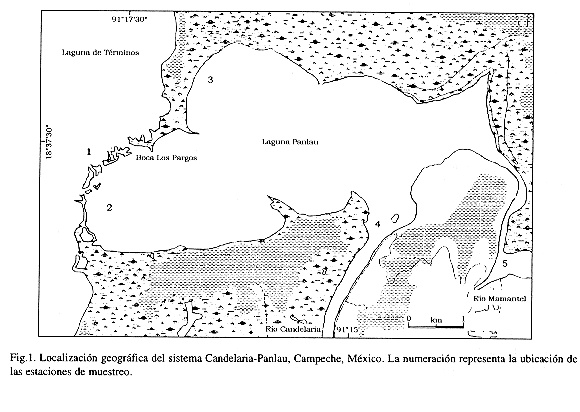
<body><![CDATA[<BR>&nbsp;      <P><B><FONT FACE="Arial,Helvetica"><FONT SIZE=-1>Materiales y M&eacute;todos</FONT></FONT></B>      <P><FONT FACE="Arial,Helvetica"><FONT SIZE=-1>El sistema Candelaria-Panlau se localiza en la porci&oacute;n este de la Laguna de T&eacute;rminos y est&aacute; integrado por las desembocaduras de los r&iacute;os Candelaria y Mamantel, la Laguna Panlau y la boca de conexi&oacute;n con la Laguna de T&eacute;rminos denominada Boca de los Pargos (<A HREF="#fig. 1">Fig. 1</A>). La cuenca del r&iacute;o Candelaria se localiza en la Pen&iacute;nsula de Yucat&aacute;n y se ha calculado que tiene un aporte de 21.5 m<SUP>3</SUP>/s (<A HREF="#Anónimo 1976.">An&oacute;nimo 1976</A>). La Laguna Panlau tiene un &aacute;rea aproximada de 14 km<SUP>2</SUP>, y la cruza de este a oeste un camino construido por los Mayas como paso comercial (seg&uacute;n habitantes de la regi&oacute;n), y que emerge cuando disminuye el nivel del agua. La profundidad de la laguna var&iacute;a entre 1.0 m y 3.5 m con un promedio de 2.0 m. El tipo de marea en la regi&oacute;n es mixta-diurna con una pleamar media de 0.18 m y una bajamar media de -0.24 m. (<A HREF="#Anónimo 1994b.">An&oacute;nimo 1994b</A>). La salinidad del agua oscila entre cinco y 26 unidades y la temperatura entre 28 y 31&deg;C. El sedimento es limo arcilloso con carbonato de calcio y la vegetaci&oacute;n circundante es <I>Rhizophora mangle</I> y <I>Avicennia germinans</I> principalmente. (<A HREF="#Amezcua-Linares">Amezcua-Linares y Y&aacute;&ntilde;ez-Arancibia 1980</A>,<A HREF="#Nitsch, S.L."> Nitsch 1992</A>).</FONT></FONT>     <BR>&nbsp;     <BR>&nbsp;     <BR>&nbsp;     <CENTER></CENTER>      <CENTER><A NAME="fig. 1"></A><IMG SRC="/img/fbpe/rbt/v46n3/0212i01.GIF" HEIGHT=412 WIDTH=580></CENTER> &nbsp;     
<BR>&nbsp;      <P><FONT FACE="Arial,Helvetica"><FONT SIZE=-1>Entre abril de 1993 y abril de 1994 se realizaron muestreos mensuales en cinco estaciones, cuya ubicaci&oacute;n se representa en la <A HREF="#fig. 1">Fig. 1</A>. Las muestras de peces se obtuvieron con una red de prueba camaronera de 5 m de largo, 2.5 m de abertura de trabajo y luz de malla de 2 cm, con tablas de arrastre de 0.8 x 0.5 m, a bordo de una lancha de 7 m de eslora con motor fuera de borda de 55 HP. El arrastre tuvo una duraci&oacute;n de 10 minutos a una velocidad promedio de 2 nudos. Las muestras se almacenaron en bolsas de pl&aacute;stico etiquetadas y se fijaron con una soluci&oacute;n de formaldeh&iacute;do al 10% (v/v).</FONT></FONT>      ]]></body>
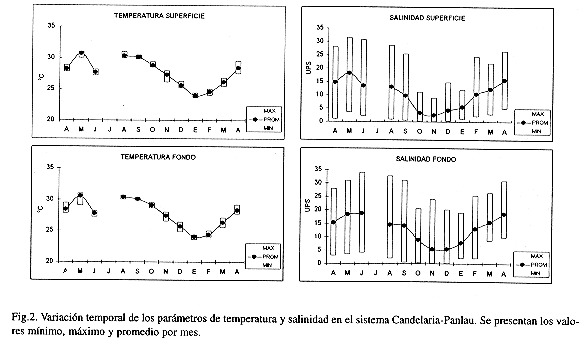
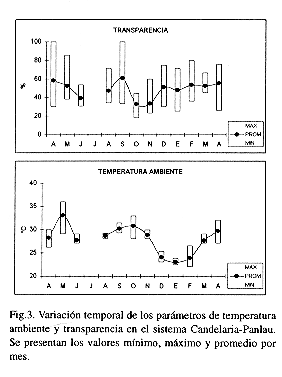
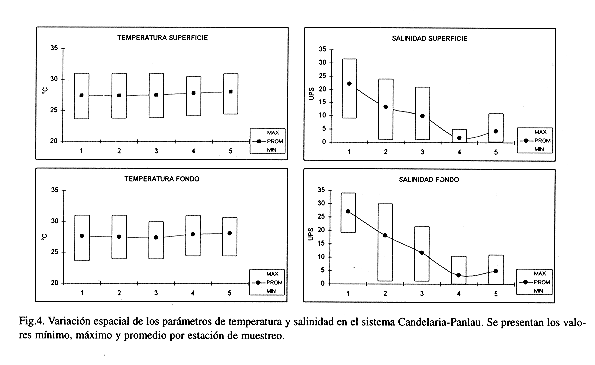
<body><![CDATA[<P><FONT FACE="Arial,Helvetica"><FONT SIZE=-1>Inmediatamente despu&eacute;s del arrastre se hicieron las mediciones de temperatura y salinidad del agua en superficie y fondo, adem&aacute;s de la transparencia, y temperatura ambiente. El equipo utilizado fue: term&oacute;metro de cubeta con precisi&oacute;n de 0.5&deg;C, salino-termo-conductiv&iacute;metro YSI con precisi&oacute;n de 0.5 unidades de salinidad, botella van Dorn, sondaleza y disco de Secchi.</FONT></FONT>      <P><FONT FACE="Arial,Helvetica"><FONT SIZE=-1>La identificaci&oacute;n taxon&oacute;mica de las especies se realiz&oacute; utilizando literatura especializada: <A HREF="#Jordan, D.S.">Jordan y Evermann (1886-1900)</A>, <A HREF="#Hildebrand">Hildebrand (1943</A>), <A HREF="#Alvarez Del Villar">Alvarez del Villar (1970</A>), <A HREF="#Castro-Aguirre">Castro-Aguirre (1978</A>), <A HREF="#Hoese, H.D.">Hoese y Moore (1977</A>), <A HREF="#Fischer, W.">Fischer (1978</A>), y <A HREF="#Reséndez, A. 1981a.">Res&eacute;ndez (1981 a</A> y <A HREF="#Reséndez, A. 1981b.">b</A>). El ordenamiento sistem&aacute;tico se hizo de acuerdo con <A HREF="#Nelson, J.S.">Nelson (1994</A>).</FONT></FONT>      <P><FONT FACE="Arial,Helvetica"><FONT SIZE=-1>Los peces se midieron con un icti&oacute;metro convencional y se pesaron con una balanza digital de 2.2 kg de capacidad y 0.1 g de precisi&oacute;n. El &aacute;rea barrida por el arte de pesca se calcul&oacute; como el producto de la velocidad de arrastre por el tiempo de operaci&oacute;n por la abertura de trabajo de la red. Los par&aacute;metros de abundancia se calcularon en t&eacute;rminos de densidad (ind/m<SUP>2</SUP>), biomasa (g/m<SUP>2</SUP>) y peso promedio (g/ind), y los de diversidad mediante las expresiones de <A HREF="#Shannon, C.E.">Shannon y Weaver (1963</A>), <A HREF="#Margalef, R.">Margalef (1969</A>) y <A HREF="#Pielou, E.C. 1966.">Pielou (1966</A>).</FONT></FONT>      <P><FONT FACE="Arial,Helvetica"><FONT SIZE=-1>Para identificar a las especies con dominio ecol&oacute;gico se sigui&oacute; el siguiente criterio: integrar a las especies que de una forma equilibrada presenten los valores m&aacute;s altos de abundancia en n&uacute;mero de individuos y en peso, de frecuencia de aparici&oacute;n y de amplitud en su distribuci&oacute;n. El n&uacute;mero total de especies dominantes se defini&oacute; por la representaci&oacute;n del 80% de la abundancia de la captura total.</FONT></FONT>      <P><FONT FACE="Arial,Helvetica"><FONT SIZE=-1>El an&aacute;lisis gr&aacute;fico y de tendencias polinomiales tanto de los par&aacute;metros ambientales como ecol&oacute;gicos se realiz&oacute; con la ayuda del programa Excel. A los par&aacute;metros ambientales y de abundancia num&eacute;rica de la comunidad de peces se les aplic&oacute; un an&aacute;lisis de factores con el m&eacute;todo de extracci&oacute;n de componentes principales y los resultados se representan gr&aacute;ficamente con la rotaci&oacute;n de varianza m&aacute;xima normalizada, se utiliz&oacute; el programa STATISTICA (<A HREF="#Pielou, E.C. 1984.">Pielou 1984</A>,<A HREF="#Ludwig, J.A."> Ludwig and Reynolds 1988</A> y <A HREF="#Gauch, H.G. Jr.">Gauch 1989</A>).</FONT></FONT>     <BR>&nbsp;      <P><B><FONT FACE="Arial,Helvetica"><FONT SIZE=-1>Resultados</FONT></FONT></B>      <P><FONT FACE="Arial,Helvetica"><FONT SIZE=-1>El comportamiento temporal de los par&aacute;metros ambientales del sistema Candelaria-Panlau para el periodo abril de 1993-abril de 1994 queda representado por la variaci&oacute;n de los par&aacute;metros de temperatura, salinidad, transparencia del agua y temperatura ambiente. En las<A HREF="#fig. 2"> Figs. dos </A>y<A HREF="#fig. 3"> tres</A> se presentan los valores m&iacute;nimo, m&aacute;ximo y promedio por mes de cada par&aacute;metro. En el caso de la temperatura del agua de superficie, los valores m&aacute;s altos se presentaron en mayo con un promedio de 30.7 &deg;C y los m&aacute;s bajos en enero con un promedio de 23.9 &deg;C. Un modelo polinomial de tercer orden (y= 0.0346x<SUP>3</SUP> - 0.7307x<SUP>2 </SUP>+ 3.9044 + 24.503) se ajust&oacute; a este comportamiento con una correlaci&oacute;n R<SUP>2</SUP>= 0.7418. Con un comportamiento similar, la temperatura del agua de fondo present&oacute; los valores m&aacute;s altos en mayo con un promedio de 30.5 &deg;C y el m&aacute;s bajo en enero con un promedio de 24.0 &deg;C. Tambi&eacute;n un modelo polinomial de tercer orden (y= 0.0335x<SUP>3</SUP>- 0.7081x<SUP>2 </SUP>+ 3.787 + 24.676) describe este comportamiento con una correlaci&oacute;n R<SUP>2</SUP>= 0.7435 (<A HREF="#fig. 2">Fig.2</A>). En el mismo sentido, el comportamiento de la salinidad del agua tanto en superficie como en fondo muestra una tendencia temporal donde los valores m&aacute;s altos se presentaron en mayo con un promedio de 18.2 UPS (Unidades Pr&aacute;cticas de Salinidad) y 18.3 UPS respectivamente y los m&aacute;s bajos se observaron en noviembre con promedio de 2.36 UPS y 5.36 UPS. El modelo polinomial que describe este comportamiento para superficie es: y= 0.0517x<SUP>3</SUP>- 0.9772x<SUP>2 </SUP>+ 1.8017 + 15.066 con una correlaci&oacute;n R<SUP>2</SUP>= 0.8431, y para fondo y= 0.0701x<SUP>3</SUP> - 1.2299x<SUP>2 </SUP>+ 4.7843 + 12.574 con una correlaci&oacute;n R<SUP>2</SUP>= 0.8704 (<A HREF="#fig. 2">Fig. 2</A>).</FONT></FONT>     <BR>&nbsp;     <BR>&nbsp;     ]]></body>
<body><![CDATA[<BR>&nbsp;     <CENTER></CENTER>      <CENTER><A NAME="fig. 2"></A><IMG SRC="/img/fbpe/rbt/v46n3/0212i02.GIF" HEIGHT=361 WIDTH=580></CENTER> &nbsp;     
<BR>&nbsp;      <P><A NAME="fig. 3"></A><IMG SRC="/img/fbpe/rbt/v46n3/0212i03.GIF" HEIGHT=377 WIDTH=282><A NAME="fig. 5"></A><IMG SRC="/img/fbpe/rbt/v46n3/0212i05.GIF" HEIGHT=357 WIDTH=286>     
<BR>&nbsp;     <BR>&nbsp;     <BR>&nbsp;      <P><A NAME="fig. 4"></A><IMG SRC="/img/fbpe/rbt/v46n3/0212i04.GIF" HEIGHT=365 WIDTH=595>     
<BR>&nbsp;      ]]></body>
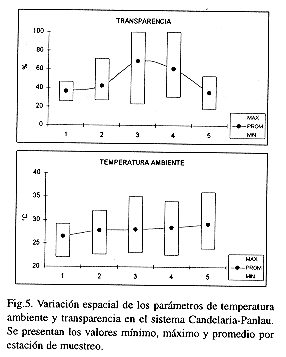
<body><![CDATA[<P><FONT FACE="Arial,Helvetica"><FONT SIZE=-1>La temperatura ambiente muestra un patr&oacute;n donde los valores m&aacute;s altos se presentaron en mayo con un promedio de 33 &deg;C y los m&aacute;s bajos en enero con un promedio de 23 &deg;C. Finalmente, la transparencia del agua muestra un &aacute;mbito de variaci&oacute;n entre 60.4 y 32.7 %, estos extremos se presentaron en septiembre y octubre respectivamente (<A HREF="#fig. 3">Fig. 3</A>).</FONT></FONT>      <P><FONT FACE="Arial,Helvetica"><FONT SIZE=-1>La representaci&oacute;n espacial del comportamiento de estos par&aacute;metros ambientales se presenta en las Figs. cuatro y cinco. La temperatura del agua en los dos niveles oscil&oacute; entre 27.4 &deg;C y 28.0 &deg;C, los valores m&aacute;ximos se registraron en la estaci&oacute;n cinco. De igual forma, la salinidad en superficie y en fondo present&oacute; valores entre 1.6 UPS y 27.0 UPS, los valores m&aacute;ximos se registraron en la estaci&oacute;n uno y los m&iacute;nimos en la estaci&oacute;n cuatro (boca del r&iacute;o Candelaria) (<A HREF="#fig. 4">Fig. 4</A>). La temperatura ambiente muestra valores promedio de entre 26.5 &deg;C en la estaci&oacute;n uno y 29.1 &deg;C en la estaci&oacute;n cinco. Finalmente, los valores promedio de transparencia oscilan entre 35.3 % para la estaci&oacute;n cinco y 68.7 % para la estaci&oacute;n tres (<A HREF="#fig. 5">Fig. 5</A>).</FONT></FONT>      <P><FONT FACE="Arial,Helvetica"><FONT SIZE=-1>La comunidad de peces en el sistema Candelaria-Panlau qued&oacute; representada por 52 especies (<A HREF="#CUADRO 1">Cuadro 1</A>), con un total de 7 926 organismos, 144.7 kg de peso, una densidad de 0.09 ind/m<SUP>2</SUP>, biomasa de 1.61 g/m<SUP>2</SUP> y peso promedio de 18.25 g/ind, el &iacute;ndice de diversidad (H’n) fue de 1.879, equitatividad (J&acute;) de 0.475 y riqueza de especies (D&acute;) de 5.681.</FONT></FONT>     <BR>&nbsp;     <BR>&nbsp;     <CENTER></CENTER>      <CENTER><A NAME="CUADRO 1"></A><FONT FACE="Arial,Helvetica"><FONT SIZE=-1>CUADRO 1</FONT></FONT></CENTER>      <CENTER><I><FONT FACE="Arial,Helvetica"><FONT SIZE=-1>Listado sistem&aacute;tico de las especies de peces</FONT></FONT></I></CENTER>      <CENTER><I><FONT FACE="Arial,Helvetica"><FONT SIZE=-1>capturadas en el sistema Candelaria-Panlau.</FONT></FONT></I></CENTER>      <CENTER><I><FONT FACE="Arial,Helvetica"><FONT SIZE=-1>&nbsp;</FONT></FONT></I></CENTER>      ]]></body>
<body><![CDATA[<CENTER><I><FONT FACE="Arial,Helvetica"><FONT SIZE=-1>&nbsp;</FONT></FONT></I></CENTER>  <TABLE BORDER=0 CELLSPACING=0 CELLPADDING=5 WIDTH="741" > <TR> <TD VALIGN=TOP WIDTH="9%"></TD>  <TD VALIGN=TOP WIDTH="23%">     <CENTER><FONT FACE="Arial,Helvetica"><FONT SIZE=-1>Familia&nbsp;</FONT></FONT></CENTER> </TD>  <TD VALIGN=TOP WIDTH="68%"><FONT FACE="Arial,Helvetica"><FONT SIZE=-1>Especie&nbsp;</FONT></FONT></TD> </TR>  <TR> <TD VALIGN=TOP WIDTH="9%"><FONT FACE="Arial,Helvetica"><FONT SIZE=-1>1.&nbsp;</FONT></FONT></TD>  <TD VALIGN=TOP WIDTH="23%">     <CENTER><FONT FACE="Arial,Helvetica"><FONT SIZE=-1>Dasyatidae&nbsp;</FONT></FONT></CENTER> </TD>  <TD VALIGN=TOP WIDTH="68%"><FONT FACE="Arial,Helvetica"><FONT SIZE=-1><I>Dasyatis sabina</I> (Le Sueur 1824)&nbsp;</FONT></FONT></TD> </TR>  <TR> <TD VALIGN=TOP WIDTH="9%"><FONT FACE="Arial,Helvetica"><FONT SIZE=-1>2.&nbsp;</FONT></FONT></TD>  <TD VALIGN=TOP WIDTH="23%">     <CENTER><FONT FACE="Arial,Helvetica"><FONT SIZE=-1>Engraulidae&nbsp;</FONT></FONT></CENTER> </TD>  <TD VALIGN=TOP WIDTH="68%"><FONT FACE="Arial,Helvetica"><FONT SIZE=-1><I>Anchoa mitchilli</I> (Hildebrand 1943)&nbsp;</FONT></FONT></TD> </TR>  <TR> <TD VALIGN=TOP WIDTH="9%"><FONT FACE="Arial,Helvetica"><FONT SIZE=-1>3.&nbsp;</FONT></FONT></TD>  <TD VALIGN=TOP WIDTH="23%"></TD>  <TD VALIGN=TOP WIDTH="68%"><FONT FACE="Arial,Helvetica"><FONT SIZE=-1><I>Cetengraulis edentulus</I> (Cuvier 1829)&nbsp;</FONT></FONT></TD> </TR>  <TR> <TD VALIGN=TOP WIDTH="9%"><FONT FACE="Arial,Helvetica"><FONT SIZE=-1>4.&nbsp;</FONT></FONT></TD>  <TD VALIGN=TOP WIDTH="23%">     <CENTER><FONT FACE="Arial,Helvetica"><FONT SIZE=-1>Clupeidae&nbsp;</FONT></FONT></CENTER> </TD>  <TD VALIGN=TOP WIDTH="68%"><FONT FACE="Arial,Helvetica"><FONT SIZE=-1><I>Dorosoma petenense</I> (G&uuml;nther 1866)&nbsp;</FONT></FONT></TD> </TR>  <TR> <TD VALIGN=TOP WIDTH="9%"><FONT FACE="Arial,Helvetica"><FONT SIZE=-1>5.&nbsp;</FONT></FONT></TD>  <TD VALIGN=TOP WIDTH="23%">     <CENTER><FONT FACE="Arial,Helvetica"><FONT SIZE=-1>Ariidae&nbsp;</FONT></FONT></CENTER> </TD>  <TD VALIGN=TOP WIDTH="68%"><FONT FACE="Arial,Helvetica"><FONT SIZE=-1><I>Bagre marinus</I> (Mitchill 1815)&nbsp;</FONT></FONT></TD> </TR>  <TR> <TD VALIGN=TOP WIDTH="9%"><FONT FACE="Arial,Helvetica"><FONT SIZE=-1>6.&nbsp;</FONT></FONT></TD>  <TD VALIGN=TOP WIDTH="23%"></TD>  <TD VALIGN=TOP WIDTH="68%"><FONT FACE="Arial,Helvetica"><FONT SIZE=-1><I>Arius felis</I> (Linnaeus 1766)&nbsp;</FONT></FONT></TD> </TR>  <TR> <TD VALIGN=TOP WIDTH="9%"><FONT FACE="Arial,Helvetica"><FONT SIZE=-1>7.&nbsp;</FONT></FONT></TD>  <TD VALIGN=TOP WIDTH="23%"></TD>  <TD VALIGN=TOP WIDTH="68%"><FONT FACE="Arial,Helvetica"><FONT SIZE=-1><I>Cathorops melanopus</I> (G&uuml;nther 1864)&nbsp;</FONT></FONT></TD> </TR>  <TR> <TD VALIGN=TOP WIDTH="9%"><FONT FACE="Arial,Helvetica"><FONT SIZE=-1>8.&nbsp;</FONT></FONT></TD>  <TD VALIGN=TOP WIDTH="23%">     <CENTER><FONT FACE="Arial,Helvetica"><FONT SIZE=-1>Synodontidae&nbsp;</FONT></FONT></CENTER> </TD>  <TD VALIGN=TOP WIDTH="68%"><FONT FACE="Arial,Helvetica"><FONT SIZE=-1><I>Synodus foetens </I>(Linnaeus 1766)&nbsp;</FONT></FONT></TD> </TR>  <TR> <TD VALIGN=TOP WIDTH="9%"><FONT FACE="Arial,Helvetica"><FONT SIZE=-1>9.&nbsp;</FONT></FONT></TD>  <TD VALIGN=TOP WIDTH="23%">     <CENTER><FONT FACE="Arial,Helvetica"><FONT SIZE=-1>Batrachoididae&nbsp;</FONT></FONT></CENTER> </TD>  <TD VALIGN=TOP WIDTH="68%"><FONT FACE="Arial,Helvetica"><FONT SIZE=-1><I>Porichthys porossissimus</I> (Valenciennes 1837)&nbsp;</FONT></FONT></TD> </TR>  <TR> <TD VALIGN=TOP WIDTH="9%"><FONT FACE="Arial,Helvetica"><FONT SIZE=-1>10.&nbsp;</FONT></FONT></TD>  <TD VALIGN=TOP WIDTH="23%"></TD>  <TD VALIGN=TOP WIDTH="68%"><FONT FACE="Arial,Helvetica"><FONT SIZE=-1><I>Opsanus beta</I> (Goode &amp; Bean 1882)&nbsp;</FONT></FONT></TD> </TR>  <TR> <TD VALIGN=TOP WIDTH="9%"><FONT FACE="Arial,Helvetica"><FONT SIZE=-1>11.&nbsp;</FONT></FONT></TD>  <TD VALIGN=TOP WIDTH="23%">     <CENTER><FONT FACE="Arial,Helvetica"><FONT SIZE=-1>Syngnathidae&nbsp;</FONT></FONT></CENTER> </TD>  <TD VALIGN=TOP WIDTH="68%"><FONT FACE="Arial,Helvetica"><FONT SIZE=-1><I>Syngnathus louisianae</I> (G&uuml;nther 1870)&nbsp;</FONT></FONT></TD> </TR>  <TR> <TD VALIGN=TOP WIDTH="9%"><FONT FACE="Arial,Helvetica"><FONT SIZE=-1>12.&nbsp;</FONT></FONT></TD>  <TD VALIGN=TOP WIDTH="23%">     <CENTER><FONT FACE="Arial,Helvetica"><FONT SIZE=-1>Triglidae&nbsp;</FONT></FONT></CENTER> </TD>  <TD VALIGN=TOP WIDTH="68%"><FONT FACE="Arial,Helvetica"><FONT SIZE=-1><I>Prionotus carolinus</I> (Linnaeus 1766)&nbsp;</FONT></FONT></TD> </TR>  <TR> <TD VALIGN=TOP WIDTH="9%"><FONT FACE="Arial,Helvetica"><FONT SIZE=-1>13.&nbsp;</FONT></FONT></TD>  <TD VALIGN=TOP WIDTH="23%"></TD>  <TD VALIGN=TOP WIDTH="68%"><FONT FACE="Arial,Helvetica"><FONT SIZE=-1><I>P. punctatus</I> Bloch 1793&nbsp;</FONT></FONT></TD> </TR>  <TR> <TD VALIGN=TOP WIDTH="9%"><FONT FACE="Arial,Helvetica"><FONT SIZE=-1>14.&nbsp;</FONT></FONT></TD>  <TD VALIGN=TOP WIDTH="23%">     ]]></body>
<body><![CDATA[<CENTER><FONT FACE="Arial,Helvetica"><FONT SIZE=-1>Centropomidae&nbsp;</FONT></FONT></CENTER> </TD>  <TD VALIGN=TOP WIDTH="68%"><FONT FACE="Arial,Helvetica"><FONT SIZE=-1><I>Centropomus parallelus</I> (Poey 1860)&nbsp;</FONT></FONT></TD> </TR>  <TR> <TD VALIGN=TOP WIDTH="9%"><FONT FACE="Arial,Helvetica"><FONT SIZE=-1>15.&nbsp;</FONT></FONT></TD>  <TD VALIGN=TOP WIDTH="23%">     <CENTER><FONT FACE="Arial,Helvetica"><FONT SIZE=-1>Carangidae&nbsp;</FONT></FONT></CENTER> </TD>  <TD VALIGN=TOP WIDTH="68%"><FONT FACE="Arial,Helvetica"><FONT SIZE=-1><I>Chloroscombrus chrysurus</I> (Linnaeus 1766)&nbsp;</FONT></FONT></TD> </TR>  <TR> <TD VALIGN=TOP WIDTH="9%"><FONT FACE="Arial,Helvetica"><FONT SIZE=-1>16.&nbsp;</FONT></FONT></TD>  <TD VALIGN=TOP WIDTH="23%"></TD>  <TD VALIGN=TOP WIDTH="68%"><FONT FACE="Arial,Helvetica"><FONT SIZE=-1><I>Vomer setapinnis</I> (Mitchill 1814)&nbsp;</FONT></FONT></TD> </TR>  <TR> <TD VALIGN=TOP WIDTH="9%"><FONT FACE="Arial,Helvetica"><FONT SIZE=-1>17.&nbsp;</FONT></FONT></TD>  <TD VALIGN=TOP WIDTH="23%"></TD>  <TD VALIGN=TOP WIDTH="68%"><FONT FACE="Arial,Helvetica"><FONT SIZE=-1><I>Caranx crysos</I> (Mitchill 1815)&nbsp;</FONT></FONT></TD> </TR>  <TR> <TD VALIGN=TOP WIDTH="9%"><FONT FACE="Arial,Helvetica"><FONT SIZE=-1>18.&nbsp;</FONT></FONT></TD>  <TD VALIGN=TOP WIDTH="23%"></TD>  <TD VALIGN=TOP WIDTH="68%"><FONT FACE="Arial,Helvetica"><FONT SIZE=-1><I>Hemicaranx amblyrhynchus</I> (Cuvier 1833)&nbsp;</FONT></FONT></TD> </TR>  <TR> <TD VALIGN=TOP WIDTH="9%"><FONT FACE="Arial,Helvetica"><FONT SIZE=-1>19.&nbsp;</FONT></FONT></TD>  <TD VALIGN=TOP WIDTH="23%">     <CENTER><FONT FACE="Arial,Helvetica"><FONT SIZE=-1>Lutjanidae&nbsp;</FONT></FONT></CENTER> </TD>  <TD VALIGN=TOP WIDTH="68%"><FONT FACE="Arial,Helvetica"><FONT SIZE=-1><I>Lutjanus griseus</I> (Linnaeus 1758)&nbsp;</FONT></FONT></TD> </TR>  <TR> <TD VALIGN=TOP WIDTH="9%"><FONT FACE="Arial,Helvetica"><FONT SIZE=-1>20.&nbsp;</FONT></FONT></TD>  <TD VALIGN=TOP WIDTH="23%">     <CENTER><FONT FACE="Arial,Helvetica"><FONT SIZE=-1>Gerreidae&nbsp;</FONT></FONT></CENTER> </TD>  <TD VALIGN=TOP WIDTH="68%"><FONT FACE="Arial,Helvetica"><FONT SIZE=-1><I>Diapterus auratus </I>(Ranzani 1842)&nbsp;</FONT></FONT></TD> </TR>  <TR> <TD VALIGN=TOP WIDTH="9%"><FONT FACE="Arial,Helvetica"><FONT SIZE=-1>21.&nbsp;</FONT></FONT></TD>  <TD VALIGN=TOP WIDTH="23%"></TD>  <TD VALIGN=TOP WIDTH="68%"><FONT FACE="Arial,Helvetica"><FONT SIZE=-1><I>D. rhombeus </I>(Cuvier &amp; Valenciennes 1829)&nbsp;</FONT></FONT></TD> </TR>  <TR> <TD VALIGN=TOP WIDTH="9%"><FONT FACE="Arial,Helvetica"><FONT SIZE=-1>22.&nbsp;</FONT></FONT></TD>  <TD VALIGN=TOP WIDTH="23%"></TD>  <TD VALIGN=TOP WIDTH="68%"><FONT FACE="Arial,Helvetica"><FONT SIZE=-1><I>Eucinostomus argenteus</I> Baird &amp; Girard 1854&nbsp;</FONT></FONT></TD> </TR>  <TR> <TD VALIGN=TOP WIDTH="9%"><FONT FACE="Arial,Helvetica"><FONT SIZE=-1>23.&nbsp;</FONT></FONT></TD>  <TD VALIGN=TOP WIDTH="23%"></TD>  <TD VALIGN=TOP WIDTH="68%"><FONT FACE="Arial,Helvetica"><FONT SIZE=-1><I>E. gula</I> (Cuvier &amp; Valenciennes 1830)&nbsp;</FONT></FONT></TD> </TR>  <TR> <TD VALIGN=TOP WIDTH="9%"><FONT FACE="Arial,Helvetica"><FONT SIZE=-1>24.&nbsp;</FONT></FONT></TD>  <TD VALIGN=TOP WIDTH="23%"></TD>  <TD VALIGN=TOP WIDTH="68%"><FONT FACE="Arial,Helvetica"><FONT SIZE=-1><I>E. melanopterus</I> (Bleecker 1863)&nbsp;</FONT></FONT></TD> </TR>  <TR> <TD VALIGN=TOP WIDTH="9%"><FONT FACE="Arial,Helvetica"><FONT SIZE=-1>25.&nbsp;</FONT></FONT></TD>  <TD VALIGN=TOP WIDTH="23%"></TD>  <TD VALIGN=TOP WIDTH="68%"><FONT FACE="Arial,Helvetica"><FONT SIZE=-1><I>Eugerres plumieri</I> (Cuvier 1830)&nbsp;</FONT></FONT></TD> </TR>  <TR> <TD VALIGN=TOP WIDTH="9%"><FONT FACE="Arial,Helvetica"><FONT SIZE=-1>26.&nbsp;</FONT></FONT></TD>  <TD VALIGN=TOP WIDTH="23%">     <CENTER><FONT FACE="Arial,Helvetica"><FONT SIZE=-1>Haemulidade&nbsp;</FONT></FONT></CENTER> </TD>  <TD VALIGN=TOP WIDTH="68%"><FONT FACE="Arial,Helvetica"><FONT SIZE=-1><I>Orthopristes chrysoptera</I> (Linnaeus 1766)&nbsp;</FONT></FONT></TD> </TR>  <TR> <TD VALIGN=TOP WIDTH="9%"><FONT FACE="Arial,Helvetica"><FONT SIZE=-1>27.&nbsp;</FONT></FONT></TD>  <TD VALIGN=TOP WIDTH="23%">     <CENTER><FONT FACE="Arial,Helvetica"><FONT SIZE=-1>Sparidae&nbsp;</FONT></FONT></CENTER> </TD>  <TD VALIGN=TOP WIDTH="68%"><FONT FACE="Arial,Helvetica"><FONT SIZE=-1><I>Archosargus probatocephalus</I> (Walbaum 1792)&nbsp;</FONT></FONT></TD> </TR>  <TR> <TD VALIGN=TOP WIDTH="9%"><FONT FACE="Arial,Helvetica"><FONT SIZE=-1>28.&nbsp;</FONT></FONT></TD>  <TD VALIGN=TOP WIDTH="23%"></TD>  <TD VALIGN=TOP WIDTH="68%"><FONT FACE="Arial,Helvetica"><FONT SIZE=-1><I>A. rhomboidalis</I> (Linnaeus 1758)&nbsp;</FONT></FONT></TD> </TR>  <TR> <TD VALIGN=TOP WIDTH="9%"><FONT FACE="Arial,Helvetica"><FONT SIZE=-1>29.&nbsp;</FONT></FONT></TD>  <TD VALIGN=TOP WIDTH="23%">     <CENTER><FONT FACE="Arial,Helvetica"><FONT SIZE=-1>Polynemidae&nbsp;</FONT></FONT></CENTER> </TD>  <TD VALIGN=TOP WIDTH="68%"><FONT FACE="Arial,Helvetica"><FONT SIZE=-1><I>Polydactylus octonemus</I> Girard 1858&nbsp;</FONT></FONT></TD> </TR>  <TR> <TD VALIGN=TOP WIDTH="9%"><FONT FACE="Arial,Helvetica"><FONT SIZE=-1>30.&nbsp;</FONT></FONT></TD>  <TD VALIGN=TOP WIDTH="23%">     <CENTER><FONT FACE="Arial,Helvetica"><FONT SIZE=-1>Sciaenidae&nbsp;</FONT></FONT></CENTER> </TD>  <TD VALIGN=TOP WIDTH="68%"><FONT FACE="Arial,Helvetica"><FONT SIZE=-1><I>Bairdiella chrysura</I> (Lacepede 1803)&nbsp;</FONT></FONT></TD> </TR>  <TR> <TD VALIGN=TOP WIDTH="9%"><FONT FACE="Arial,Helvetica"><FONT SIZE=-1>31.&nbsp;</FONT></FONT></TD>  <TD VALIGN=TOP WIDTH="23%"></TD>  <TD VALIGN=TOP WIDTH="68%"><FONT FACE="Arial,Helvetica"><FONT SIZE=-1><I>B. ronchus</I> (Cuvier &amp; Valenciennes 1830)&nbsp;</FONT></FONT></TD> </TR>  <TR> <TD VALIGN=TOP WIDTH="9%"><FONT FACE="Arial,Helvetica"><FONT SIZE=-1>32.&nbsp;</FONT></FONT></TD>  <TD VALIGN=TOP WIDTH="23%"></TD>  <TD VALIGN=TOP WIDTH="68%"><FONT FACE="Arial,Helvetica"><FONT SIZE=-1><I>Cynoscion nebulosus</I> (Cuvier 1830)&nbsp;</FONT></FONT></TD> </TR>  <TR> <TD VALIGN=TOP WIDTH="9%"><FONT FACE="Arial,Helvetica"><FONT SIZE=-1>33.&nbsp;</FONT></FONT></TD>  <TD VALIGN=TOP WIDTH="23%"></TD>  <TD VALIGN=TOP WIDTH="68%"><FONT FACE="Arial,Helvetica"><FONT SIZE=-1><I>C. arenarius</I> Ginsburg 1929&nbsp;</FONT></FONT></TD> </TR>  <TR> <TD VALIGN=TOP WIDTH="9%"><FONT FACE="Arial,Helvetica"><FONT SIZE=-1>34.&nbsp;</FONT></FONT></TD>  <TD VALIGN=TOP WIDTH="23%"></TD>  <TD VALIGN=TOP WIDTH="68%"><FONT FACE="Arial,Helvetica"><FONT SIZE=-1><I>Micropogonias undulatus</I> (Linnaeus 1766)&nbsp;</FONT></FONT></TD> </TR>  <TR> <TD VALIGN=TOP WIDTH="9%"><FONT FACE="Arial,Helvetica"><FONT SIZE=-1>35.&nbsp;</FONT></FONT></TD>  <TD VALIGN=TOP WIDTH="23%"></TD>  <TD VALIGN=TOP WIDTH="68%"><FONT FACE="Arial,Helvetica"><FONT SIZE=-1><I>Menticirrhus americanus</I> (Linnaeus 1758)&nbsp;</FONT></FONT></TD> </TR>  <TR> <TD VALIGN=TOP WIDTH="9%"><FONT FACE="Arial,Helvetica"><FONT SIZE=-1>36.&nbsp;</FONT></FONT></TD>  <TD VALIGN=TOP WIDTH="23%"></TD>  <TD VALIGN=TOP WIDTH="68%"><FONT FACE="Arial,Helvetica"><FONT SIZE=-1><I>Stellifer lanceolatus</I> Holbrook 1855&nbsp;</FONT></FONT></TD> </TR>  <TR> <TD VALIGN=TOP WIDTH="9%"><FONT FACE="Arial,Helvetica"><FONT SIZE=-1>37.&nbsp;</FONT></FONT></TD>  <TD VALIGN=TOP WIDTH="23%"></TD>  <TD VALIGN=TOP WIDTH="68%"><FONT FACE="Arial,Helvetica"><FONT SIZE=-1><I>Odontoscion dentex</I> (Cuvier 1830)&nbsp;</FONT></FONT></TD> </TR>  <TR> <TD VALIGN=TOP WIDTH="9%"><FONT FACE="Arial,Helvetica"><FONT SIZE=-1>38.&nbsp;</FONT></FONT></TD>  <TD VALIGN=TOP WIDTH="23%">     <CENTER><FONT FACE="Arial,Helvetica"><FONT SIZE=-1>Cichlidae&nbsp;</FONT></FONT></CENTER> </TD>  <TD VALIGN=TOP WIDTH="68%"><FONT FACE="Arial,Helvetica"><FONT SIZE=-1><I>Cichlasoma urophthalmus</I> (G&uuml;nther 1862)&nbsp;</FONT></FONT></TD> </TR>  <TR> <TD VALIGN=TOP WIDTH="9%"><FONT FACE="Arial,Helvetica"><FONT SIZE=-1>39.&nbsp;</FONT></FONT></TD>  <TD VALIGN=TOP WIDTH="23%"></TD>  <TD VALIGN=TOP WIDTH="68%"><FONT FACE="Arial,Helvetica"><FONT SIZE=-1><I>Cichlasoma </I>spp&nbsp;</FONT></FONT></TD> </TR>  <TR> <TD VALIGN=TOP WIDTH="9%"><FONT FACE="Arial,Helvetica"><FONT SIZE=-1>40.&nbsp;</FONT></FONT></TD>  <TD VALIGN=TOP WIDTH="23%">     <CENTER><FONT FACE="Arial,Helvetica"><FONT SIZE=-1>Gobiidae&nbsp;</FONT></FONT></CENTER> </TD>  <TD VALIGN=TOP WIDTH="68%"><FONT FACE="Arial,Helvetica"><FONT SIZE=-1><I>Gobionellus hastatus</I> Girard 1858&nbsp;</FONT></FONT></TD> </TR>  <TR> <TD VALIGN=TOP WIDTH="9%"><FONT FACE="Arial,Helvetica"><FONT SIZE=-1>41.&nbsp;</FONT></FONT></TD>  <TD VALIGN=TOP WIDTH="23%"></TD>  <TD VALIGN=TOP WIDTH="68%"><FONT FACE="Arial,Helvetica"><FONT SIZE=-1><I>Gobiosoma bosci</I> (Lacepede 1758)&nbsp;</FONT></FONT></TD> </TR>  <TR> <TD VALIGN=TOP WIDTH="9%"><FONT FACE="Arial,Helvetica"><FONT SIZE=-1>42.&nbsp;</FONT></FONT></TD>  <TD VALIGN=TOP WIDTH="23%">     ]]></body>
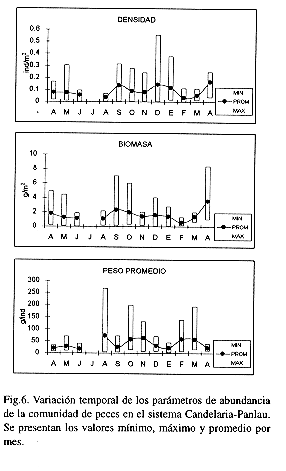
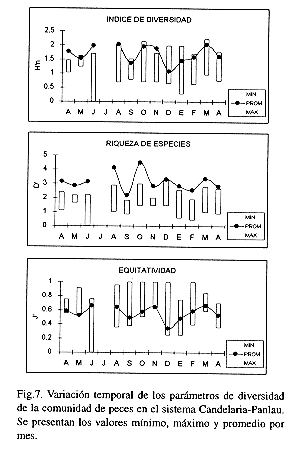
<body><![CDATA[<CENTER><FONT FACE="Arial,Helvetica"><FONT SIZE=-1>Ephippidae&nbsp;</FONT></FONT></CENTER> </TD>  <TD VALIGN=TOP WIDTH="68%"><FONT FACE="Arial,Helvetica"><FONT SIZE=-1><I>Chaetodipterus faber</I> (Broussonet 1782)&nbsp;</FONT></FONT></TD> </TR>  <TR> <TD VALIGN=TOP WIDTH="9%"><FONT FACE="Arial,Helvetica"><FONT SIZE=-1>43.&nbsp;</FONT></FONT></TD>  <TD VALIGN=TOP WIDTH="23%">     <CENTER><FONT FACE="Arial,Helvetica"><FONT SIZE=-1>Trichiuridae&nbsp;</FONT></FONT></CENTER> </TD>  <TD VALIGN=TOP WIDTH="68%"><FONT FACE="Arial,Helvetica"><FONT SIZE=-1><I>Trichiurus lepturus</I> (Linnaeus 1758)&nbsp;</FONT></FONT></TD> </TR>  <TR> <TD VALIGN=TOP WIDTH="9%"><FONT FACE="Arial,Helvetica"><FONT SIZE=-1>44.&nbsp;</FONT></FONT></TD>  <TD VALIGN=TOP WIDTH="23%">     <CENTER><FONT FACE="Arial,Helvetica"><FONT SIZE=-1>Bothidae&nbsp;</FONT></FONT></CENTER> </TD>  <TD VALIGN=TOP WIDTH="68%"><FONT FACE="Arial,Helvetica"><FONT SIZE=-1><I>Citharichthys spilopterus</I> G&uuml;nther 1862&nbsp;</FONT></FONT></TD> </TR>  <TR> <TD VALIGN=TOP WIDTH="9%"><FONT FACE="Arial,Helvetica"><FONT SIZE=-1>45.&nbsp;</FONT></FONT></TD>  <TD VALIGN=TOP WIDTH="23%">     <CENTER><FONT FACE="Arial,Helvetica"><FONT SIZE=-1>Soleidae&nbsp;</FONT></FONT></CENTER> </TD>  <TD VALIGN=TOP WIDTH="68%"><FONT FACE="Arial,Helvetica"><FONT SIZE=-1><I>Achirus lineatus</I> (Linnaeus 1758)&nbsp;</FONT></FONT></TD> </TR>  <TR> <TD VALIGN=TOP WIDTH="9%"><FONT FACE="Arial,Helvetica"><FONT SIZE=-1>46.&nbsp;</FONT></FONT></TD>  <TD VALIGN=TOP WIDTH="23%"></TD>  <TD VALIGN=TOP WIDTH="68%"><FONT FACE="Arial,Helvetica"><FONT SIZE=-1><I>Trinectes maculatus</I> (Bloch &amp; Schneider 1801)&nbsp;</FONT></FONT></TD> </TR>  <TR> <TD VALIGN=TOP WIDTH="9%"><FONT FACE="Arial,Helvetica"><FONT SIZE=-1>47.&nbsp;</FONT></FONT></TD>  <TD VALIGN=TOP WIDTH="23%">     <CENTER><FONT FACE="Arial,Helvetica"><FONT SIZE=-1>Tetraodontidae&nbsp;</FONT></FONT></CENTER> </TD>  <TD VALIGN=TOP WIDTH="68%"><FONT FACE="Arial,Helvetica"><FONT SIZE=-1><I>Sphoeroides testudineus</I> (Linnaeus 1743)&nbsp;</FONT></FONT></TD> </TR>  <TR> <TD VALIGN=TOP WIDTH="9%"><FONT FACE="Arial,Helvetica"><FONT SIZE=-1>48.&nbsp;</FONT></FONT></TD>  <TD VALIGN=TOP WIDTH="23%"></TD>  <TD VALIGN=TOP WIDTH="68%"><FONT FACE="Arial,Helvetica"><FONT SIZE=-1><I>S. nephelus</I> (Goode &amp; Bean 1758)&nbsp;</FONT></FONT></TD> </TR>  <TR> <TD VALIGN=TOP WIDTH="9%"><FONT FACE="Arial,Helvetica"><FONT SIZE=-1>49.&nbsp;</FONT></FONT></TD>  <TD VALIGN=TOP WIDTH="23%"></TD>  <TD VALIGN=TOP WIDTH="68%"><FONT FACE="Arial,Helvetica"><FONT SIZE=-1><I>S. spengleri</I> (Bloch 1785)&nbsp;</FONT></FONT></TD> </TR>  <TR> <TD VALIGN=TOP WIDTH="9%"><FONT FACE="Arial,Helvetica"><FONT SIZE=-1>50.&nbsp;</FONT></FONT></TD>  <TD VALIGN=TOP WIDTH="23%">     <CENTER><FONT FACE="Arial,Helvetica"><FONT SIZE=-1>Diodontidae&nbsp;</FONT></FONT></CENTER> </TD>  <TD VALIGN=TOP WIDTH="68%"><FONT FACE="Arial,Helvetica"><FONT SIZE=-1><I>Chilomicterus schoepfi</I> (Walbaum 1792)&nbsp;</FONT></FONT></TD> </TR> </TABLE> <FONT FACE="Arial,Helvetica"><FONT SIZE=-1>En la escala temporal, la densidad y la biomasa presentan valores promedio m&aacute;s altos en abril (0.17 ind/m2 y 3.5 g/m<SUP>2</SUP> respectivamente) y mas bajos en febrero (0.033 ind/m<SUP>2</SUP>y 0.57 g/m<SUP>2</SUP>). El peso promedio oscil&oacute; entre 30.4 g/ind en agosto y 10.8 g/ind en diciembre (<A HREF="#fig. 6">Fig. 6</A>). Los indicadores de diversidad muestran la siguiente variaci&oacute;n: &iacute;ndice de diversidad H’n entre 1.073 en diciembre y 2.037 en agosto, equitatividad (J&acute;) entre 0.338 en diciembre y 0.666 en marzo, y riqueza de especies (D&acute;) entre 2.167 en septiembre y 4.472 en octubre (<A HREF="#fig. 7">Fig.7</A>).</FONT></FONT>     <BR>&nbsp;      <P><A NAME="fig. 6"></A><IMG SRC="/img/fbpe/rbt/v46n3/0212i06.GIF" HEIGHT=471 WIDTH=286><A NAME="fig. 7"></A><IMG SRC="/img/fbpe/rbt/v46n3/0212i07.GIF" HEIGHT=456 WIDTH=290>      
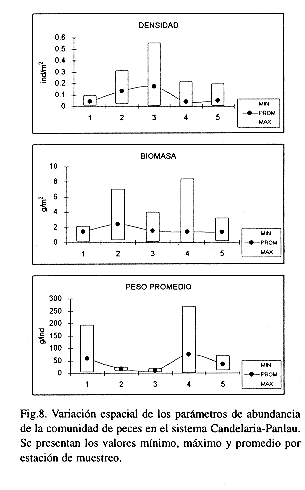
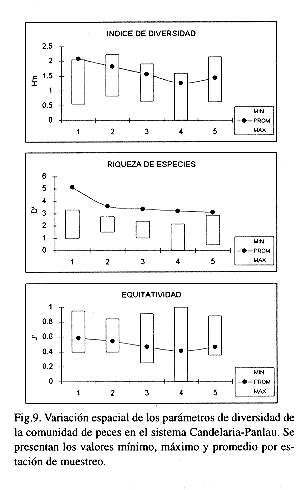
<P><FONT FACE="Arial,Helvetica"><FONT SIZE=-1>En escala espacial, los valores promedio de diversidad y abundancia presentan los siguientes intervalos: densidad entre 0.04 y 0.17 ind/m<SUP>2</SUP>, biomasa entre 1.33 y 2.41 g/m<SUP>2</SUP>, peso promedio entre 8.7 y 34.6 g/ind (<A HREF="#fig. 8">Fig. 8)</A>, &iacute;ndice de diversidad H’n entre 1.253 y 2.078, equitatividad (J&acute;) entre 0.405 y 0.585 y riqueza de especies (D&acute;) entre 3.085 y 5.116 (<A HREF="#fig. 9">Fig. 9</A>).</FONT></FONT>     <BR>&nbsp;     ]]></body>
<body><![CDATA[<BR>&nbsp;      <P><A NAME="fig. 8"></A><IMG SRC="/img/fbpe/rbt/v46n3/0212i08.GIF" BORDER=0 HEIGHT=490 WIDTH=305><IMG SRC="/img/fbpe/rbt/v46n3/0212i09.GIF" HEIGHT=490 WIDTH=305><A NAME="fig. 9"></A>     
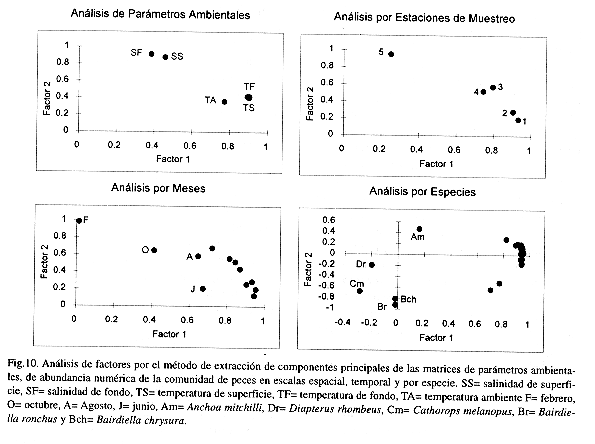
<BR>&nbsp;     <BR>&nbsp;      <P><FONT FACE="Arial,Helvetica"><FONT SIZE=-1>Bajo el an&aacute;lisis integrado de los par&aacute;metros de abundancia, distribuci&oacute;n y frecuencia de aparici&oacute;n, las especies con dominio ecol&oacute;gico en el sistema son: <I>Cathorops melanopus</I>, <I>Diapterus rhombeus</I>, <I>Anchoa mitchilli</I>, <I>Sphoeroides testudineus</I>, <I>Bairdiella chrysura, B. ronchus</I>, <I>Cynoscion arenarius, </I>y<I> C. nebulosus</I>, que en conjunto representan el 90.9 % en n&uacute;mero y el 78.9 % en peso de la captura total.</FONT></FONT>      <P><FONT FACE="Arial,Helvetica"><FONT SIZE=-1>El an&aacute;lisis de factores con el m&eacute;todo de extracci&oacute;n de componentes principales se represent&oacute; con la rotaci&oacute;n de varianza m&aacute;xima normalizada. En todos los casos la varianza porcentual acumulada para dos factores fue superior al 90 %, de manera que la representaci&oacute;n se hace en dos planos. Para el caso de la matriz de par&aacute;metros ambientales por estaci&oacute;n y por mes, el factor uno alcanz&oacute; un eigenvalor de 7.8 con una varianza total del 87.7 %, y el factor dos con un eigenvalor de 0.7 y 7.6 % de varianza total, los componentes de esta matriz con mayor valor en el factor dos son la salinidad de superficie y de fondo. En este mismo sentido la matriz de n&uacute;mero de individuos por especie y por estaci&oacute;n muestra los siguientes eigenvalores: 3.9 para el factor uno y 0.6 para el factor dos con una varianza total de 78.6 % y 12.5 % respectivamente, el valor m&aacute;s altos para el factor dos lo presenta la estaci&oacute;n cinco (<A HREF="#fig. 10">Fig. 10</A>).</FONT></FONT>     <BR>&nbsp;     <BR>&nbsp;     <CENTER></CENTER>      <CENTER><A NAME="fig. 10"></A><IMG SRC="/img/fbpe/rbt/v46n3/0212i10.GIF" HEIGHT=444 WIDTH=595></CENTER> <FONT FACE="Arial,Helvetica"><FONT SIZE=-1>&nbsp;</FONT></FONT>     
]]></body>
<body><![CDATA[<BR><FONT FACE="Arial,Helvetica"><FONT SIZE=-1>&nbsp;</FONT></FONT>     <BR><FONT FACE="Arial,Helvetica"><FONT SIZE=-1>En escala temporal, la matriz de n&uacute;mero de individuos por especie y por mes presenta un eigenvalor de 9.1 con 75.6 % de varianza total para el factor uno y un eigenvalor de 1.2 con 10.7 % de varianza total para el factor 2, los valores que se desagregan del conjunto son febrero, octubre, agosto y junio. Finalmente, la matriz de n&uacute;mero de individuos por especie y por estaci&oacute;n transpuesta presenta los eigenvalores siguientes: para el factor uno de 41.2 con 79.2 % de varianza total y para el factor dos de 3.3 con 6.4 % de varianza total, destacan los valores de: <I>Diapterus rhombeus</I>,<I> Cathorops melanopus</I>, <I>Bardiella chrysura</I>, <I>B. ronchus</I> y <I>Anchoa mitchilli</I> (<A HREF="#fig. 10">Fig. 10</A>).</FONT></FONT>     <BR>&nbsp;      <P><B><FONT FACE="Arial,Helvetica"><FONT SIZE=-1>Discusi&oacute;n</FONT></FONT></B>      <P><FONT FACE="Arial,Helvetica"><FONT SIZE=-1>De acuerdo con lo reportado por<A HREF="#Yáñez-Arancibia 1988"> Y&aacute;&ntilde;ez-Arancibia y Day (1988</A>), <A HREF="#Fuentes-Yaco">Fuentes-Yaco (1990</A>) y <A HREF="#Avilés-Alatriste">Avil&eacute;s-Alatriste (1991</A>) el comportamiento ambiental espacial y temporal en la regi&oacute;n esta condicionado b&aacute;sicamente por la ubicaci&oacute;n geogr&aacute;fica latitudinal, la descarga de los r&iacute;os, la marea, la geomorfolog&iacute;a y la circulaci&oacute;n litoral. As&iacute;, la temperatura tanto ambiental como del agua en el sistema Candelaria-Panlau es m&aacute;xima en mayo y m&iacute;nima en enero como respuesta a la estacionalidad de primavera e invierno. De la misma forma, la salinidad refleja el efecto del esfuerzo combinado de la marea y de la descarga de los r&iacute;os. La temporada de lluvias en la regi&oacute;n es entre julio y octubre y la mayor descarga de los r&iacute;os se observa justamente en noviembre como una respuesta con retraso, lo que se refleja directamente en la salinidad.</FONT></FONT>      <P><FONT FACE="Arial,Helvetica"><FONT SIZE=-1>La comunidad de peces del sistema Candelaria-Panlau, representada por un total de 52 especies e integrada a la informaci&oacute;n existente para otros sistemas fluvio-lagunares, Laguna de T&eacute;rminos y Sonda de Campeche, permite comparar la magnitud del intercambio ecol&oacute;gico entre estos ecosistemas. <A HREF="#Ayala-Pérez 1993">Ayala-P&eacute;rez<I> et al.</I> (1993</A>) reporta 41 especies de peces para el sistema Pom-Atasta, 64 para Palizada-Del Este y 50 para Chumpam-Balchacah, en conjunto se integran 81 especies. De las 52 especies identificadas en el sistema Candelaria-Panlau el 90 % se han registrado en los otros sistemas fluvio-lagunares. <I>Prionotus punctatus, Hemicaranx amblyrhynchus, Odontoscion dentex, Sphoeroides spenglery </I>y<I> Chilomicterus schoepfi,</I> son las especies propias de Candelaria-Panlau.</FONT></FONT>      <P><FONT FACE="Arial,Helvetica"><FONT SIZE=-1>Para la Laguna de T&eacute;rminos y Sonda de Campeche se han reportado 122 y 149 especies respectivamente (<A HREF="#Yáñez-Arancibia 1985">Y&aacute;&ntilde;ez-Arancibia<I> et al.</I> 1985</A>), entre las cuales se encuentra el 94 % de las especies de Candelaria-Panlau, las especies diferentes son <I>Dorosoma petenense, Vomer setapinnis </I>y<I> Hemicaranx amblyrhynchus</I>.</FONT></FONT>      <P><FONT FACE="Arial,Helvetica"><FONT SIZE=-1>Al comparar los valores de biomasa y peso promedio reportados para la Sonda de Campeche y Laguna de T&eacute;rminos con los observados en este estudio, es posible proporcionar argumentos a favor de la hip&oacute;tesis de que los sistemas fluvio-lagunares son h&aacute;bitats utilizados por una diversa comunidad de peces para actividades de crianza, crecimiento y alimentaci&oacute;n (<A HREF="#Vera-Herrera 1988b">Vera-Herrera<I> et al.</I> 1988b)</A>, as&iacute;, <A HREF="#Yáñez-Arancibia 1988a">Y&aacute;&ntilde;ez-Arancibia<I> et al.</I> (1988a</A>) reporta para la Sonda de Campeche valores de biomasa de 0.62 g/m<SUP>2 </SUP>y de peso promedio de 38.2 g/ind, del mismo modo<A HREF="#Yáñez-Arancibia 1988b"> Y&aacute;&ntilde;ez-Arancibia<I> et al.</I> (1988b)</A> para la Laguna de T&eacute;rminos puntualiza valores de 1.54 g/m<SUP>2</SUP> y 35.2 g/ind y finalmente para Candelaria-Panlau los valores fueron 1.61 g/m<SUP>2</SUP> y 18.2 g/ind respectivamente. Estas tendencias, permiten observar que los sistemas fluvio-lagunares en particular Candelaria-Panlau son usados en preferencia por abundantes organismos de tallas peque&ntilde;as.</FONT></FONT>      <P><FONT FACE="Arial,Helvetica"><FONT SIZE=-1>Por otra parte, de las ocho especies con dominancia ecol&oacute;gica, tres son netamente estuarinas y el resto son marinas con dependencia estuarina, lo cual refleja nuevamente el importante nivel de intercambio con la zona marina adyacente.</FONT></FONT>      <P><FONT FACE="Arial,Helvetica"><FONT SIZE=-1>Por el an&aacute;lisis de factores de las matrices de par&aacute;metros ambientales y de par&aacute;metros ecol&oacute;gicos, es posible discutir de manera integrada la informaci&oacute;n que hasta aqu&iacute; se ha presentado. En primer lugar, al analizar los par&aacute;metros ambientales tanto en escala espacial como temporal se identifica a la salinidad como el componente m&aacute;s importante, esto permite inferir que este par&aacute;metro es el que condiciona en mayor medida el comportamiento ambiental del sistema. Tal y como se ha mencionado anteriormente, el volumen de descarga de los r&iacute;os y la marea son las principales funciones de fuerza en los sistemas fluvio-lagunares y es la salinidad, entre los par&aacute;metros observados, la que refleja de mejor forma esta din&aacute;mica.</FONT></FONT>      ]]></body>
<body><![CDATA[<P><FONT FACE="Arial,Helvetica"><FONT SIZE=-1>En el an&aacute;lisis de las matrices de n&uacute;mero de individuos por especie por estaci&oacute;n y n&uacute;mero de individuos por especie por mes, se destacan los valores de la estaci&oacute;n cinco y del mes de febrero. La estaci&oacute;n cinco se ubica en la desembocadura del r&iacute;o Mamantel en donde el intervalo de salinidad es de 0.0 a 11.0&nbsp; UPS y en promedio es la segunda estaci&oacute;n menos salina despu&eacute;s de la estaci&oacute;n cuatro ubicada en la desembocadura del r&iacute;o Candelaria. Esta condici&oacute;n le confiere a este sitio caracter&iacute;sticas particulares que tienen un reflejo importante en la distribuci&oacute;n y abundancia de la comunidad de peces. Por otra parte, el mes de febrero que es la parte final de la &eacute;poca de nortes, presenta aportes pluviales y fluviales abundantes, lo que se reflejan en la condici&oacute;n de baja salinidad, transparencia y por consiguiente en los par&aacute;metros ecol&oacute;gicos de la comunidad de peces. En este nivel de an&aacute;lisis es importante resaltar que estos resultados permiten plantear nuevas hip&oacute;tesis.</FONT></FONT>      <P><FONT FACE="Arial,Helvetica"><FONT SIZE=-1>Finalmente, en el an&aacute;lisis de la matriz transpuesta por especies, se confirma la definici&oacute;n de las especies con dominancia ecol&oacute;gica, ya que los valores que se desagregan corresponden a las especies previamente identificadas bajo este concepto.</FONT></FONT>      <P><FONT FACE="Arial,Helvetica"><FONT SIZE=-1>Ya se ha mencionado que los sistemas fluvio-lagunares asociados a la Laguna de T&eacute;rminos, constituyen reservorios naturales de gran valor ecol&oacute;gico que tienen que ser objeto de un adecuado manejo tanto para el uso de sus recursos como para su conservaci&oacute;n, de tal forma que informaci&oacute;n como la que aqu&iacute; se ha presentado, integrada a una perspectiva regional, deben fortalecer los criterios para la toma de decisiones.</FONT></FONT>     <BR>&nbsp;      <P><B><FONT FACE="Arial,Helvetica"><FONT SIZE=-1>Resumen</FONT></FONT></B>      <P><FONT FACE="Arial,Helvetica"><FONT SIZE=-1>Se describe el comportamiento de los par&aacute;metros de temperatura, salinidad, transparencia del agua y temperatura ambiente, y de la abundancia y diversidad de la comunidad del peces del sistema Candelaria-Panlau en escalas temporal y espacial. Los trabajos de campo se realizaron de manera mensual en cinco estaciones entre abril de 1993 y abril de 1994. La comunidad de peces qued&oacute; representada por 50 especies con 7 926 organismos y 144.7 kg de peso. Los valores de abundancia y diversidad de la comunidad fueron: 0.09 ind/m<SUP>2</SUP>, 1.61 g/m<SUP>2</SUP> 18.25 g/ind, H’n = 1.879, J = 0.475 y D = 5.681. Las especies con dominio ecol&oacute;gico fueron: <I>Cathorops melanopus</I>, <I>Diapterus rhombeus</I>, <I>Anchoa mitchilli</I>, <I>Sphoeroides testudineus</I>, <I>Bairdiella chrysura, B. ronchus</I>, <I>Cynoscion arenarius, </I>y<I> C. nebulosus</I>, que en conjunto representan el 90.9 % en n&uacute;mero y el 78.9 % en peso de la captura total. Las matrices de valores de los par&aacute;metros ambientales y de abundancia num&eacute;rica de la comunidad de peces, fueron sometidas a un an&aacute;lisis de factores con el m&eacute;todo de extracci&oacute;n de componentes principales, su representaci&oacute;n gr&aacute;fica confirma la definici&oacute;n de especies dominantes y demuestra que la salinidad, estaci&oacute;n cinco y mes de febrero son los componentes que caracterizan al sistema y a la comunidad de peces.</FONT></FONT>     <BR>&nbsp;      <P><B><FONT FACE="Arial,Helvetica"><FONT SIZE=-1>Agradecimientos</FONT></FONT></B>      <P><FONT FACE="Arial,Helvetica"><FONT SIZE=-1>A Francisco Vera-Herrera, Hern&aacute;n Alvarez Guillen, Andr&eacute;s Reda Deara de la Estaci&oacute;n El Carmen, Instituto de Ciencias del Mar y Limnolog&iacute;a, UNAM, y a Arturo Aguirre-Le&oacute;n del Departamento El Hombre y su Ambiente de la Universidad Aut&oacute;noma Metropolitana Xochimilco.</FONT></FONT>     <BR>&nbsp;      ]]></body>
<body><![CDATA[<P><B><FONT FACE="Arial,Helvetica"><FONT SIZE=-1>Referencias</FONT></FONT></B>      <!-- ref --><P><A NAME="Aguirre-León"></A><FONT FACE="Arial,Helvetica"><FONT SIZE=-1>Aguirre-Le&oacute;n, A., I. Cabrera-D&iacute;az, A. Bernal-Becerra &amp; L.A. Ayala-P&eacute;rez. 1995. Ecolog&iacute;a y evaluaci&oacute;n de los recursos pesqueros asociados al sistema fluvio-lagunar Pom-Atasta, Campeche. Inf. Tec. Depto. El Hombre y su Ambiente, Universidad Aut&oacute;noma Metropolitana Xochimilco, M&eacute;xico, D.F., 130 p.</FONT></FONT>    &nbsp;&nbsp;&nbsp;&nbsp;&nbsp;&nbsp;&nbsp;&nbsp;[&#160;<a href="javascript:void(0);" onclick="javascript: window.open('/scielo.php?script=sci_nlinks&ref=1138763&pid=S0034-7744199800030003000001&lng=','','width=640,height=500,resizable=yes,scrollbars=1,menubar=yes,');">Links</a>&#160;]<!-- end-ref --><!-- ref --><P><A NAME="Alvarez Del Villar"></A><FONT FACE="Arial,Helvetica"><FONT SIZE=-1>Alvarez Del Villar, J. 1970. Peces Mexicanos (claves). Instituto Nacional de Investigaciones Biol&oacute;gico Pesqueras. Comisi&oacute;n Nacional Consultiva de Pesca. SIC, M&eacute;xico, D.F. 166 p.</FONT></FONT>    &nbsp;&nbsp;&nbsp;&nbsp;&nbsp;&nbsp;&nbsp;&nbsp;[&#160;<a href="javascript:void(0);" onclick="javascript: window.open('/scielo.php?script=sci_nlinks&ref=1138764&pid=S0034-7744199800030003000002&lng=','','width=640,height=500,resizable=yes,scrollbars=1,menubar=yes,');">Links</a>&#160;]<!-- end-ref --><!-- ref --><P><A NAME="Amezcua-Linares"></A><FONT FACE="Arial,Helvetica"><FONT SIZE=-1>Amezcua-Linares, F. &amp; A. Y&aacute;&ntilde;ez-Arancibia. 1980. Ecolog&iacute;a de los sistemas fluvio-lagunares asociados a la Laguna de T&eacute;rminos. El h&aacute;bitat y estructura de las comunidades de peces. An. Centro Cienc. del Mar y Limnol. Universidad Nacional Aut&oacute;noma de M&eacute;xico. M&eacute;xico, D.F. 7: 68-118.</FONT></FONT>    &nbsp;&nbsp;&nbsp;&nbsp;&nbsp;&nbsp;&nbsp;&nbsp;[&#160;<a href="javascript:void(0);" onclick="javascript: window.open('/scielo.php?script=sci_nlinks&ref=1138765&pid=S0034-7744199800030003000003&lng=','','width=640,height=500,resizable=yes,scrollbars=1,menubar=yes,');">Links</a>&#160;]<!-- end-ref --><!-- ref --><P><A NAME="Anónimo 1976."></A><FONT FACE="Arial,Helvetica"><FONT SIZE=-1>An&oacute;nimo 1976. Volumen de descarga del r&iacute;o Candelaria. Secretar&iacute;a de Recursos Hidr&aacute;ulicos, M&eacute;xico, D.F. 587 p.</FONT></FONT>    &nbsp;&nbsp;&nbsp;&nbsp;&nbsp;&nbsp;&nbsp;&nbsp;[&#160;<a href="javascript:void(0);" onclick="javascript: window.open('/scielo.php?script=sci_nlinks&ref=1138766&pid=S0034-7744199800030003000004&lng=','','width=640,height=500,resizable=yes,scrollbars=1,menubar=yes,');">Links</a>&#160;]<!-- end-ref --><BR><A NAME="Anónimo 1994a."></A>     <!-- ref --><BR><FONT FACE="Arial,Helvetica"><FONT SIZE=-1>An&oacute;nimo 1994a. Decreto por el que se declara como &aacute;rea natural protegida con el car&aacute;cter de protecci&oacute;n de flora y fauna, la regi&oacute;n conocida como Laguna de T&eacute;rminos, ubicada en los municipios de Carmen, Palizada y Champot&oacute;n, Estado de Campeche. Diario Oficial de la Federaci&oacute;n, Gobierno Constitucional de los Estados Unidos Mexicanos, Tomo 489 No. 4. 58-65 p.</FONT></FONT>    &nbsp;&nbsp;&nbsp;&nbsp;&nbsp;&nbsp;&nbsp;&nbsp;[&#160;<a href="javascript:void(0);" onclick="javascript: window.open('/scielo.php?script=sci_nlinks&ref=1138768&pid=S0034-7744199800030003000005&lng=','','width=640,height=500,resizable=yes,scrollbars=1,menubar=yes,');">Links</a>&#160;]<!-- end-ref --><!-- ref --><P><A NAME="Anónimo 1994b."></A><FONT FACE="Arial,Helvetica"><FONT SIZE=-1>An&oacute;nimo 1994b. Tablas de predicci&oacute;n de mareas: Datos geof&iacute;sicos serie <B>A</B> (oceanograf&iacute;a). Instituto de Geof&iacute;sica. Universidad Nacional Aut&oacute;noma de M&eacute;xico, M&eacute;xico, D.F. 191 p.</FONT></FONT>    &nbsp;&nbsp;&nbsp;&nbsp;&nbsp;&nbsp;&nbsp;&nbsp;[&#160;<a href="javascript:void(0);" onclick="javascript: window.open('/scielo.php?script=sci_nlinks&ref=1138769&pid=S0034-7744199800030003000006&lng=','','width=640,height=500,resizable=yes,scrollbars=1,menubar=yes,');">Links</a>&#160;]<!-- end-ref --><!-- ref --><P><A NAME="Avilés-Alatriste"></A><FONT FACE="Arial,Helvetica"><FONT SIZE=-1>Avil&eacute;s-Alatriste, O.A. 1991. Recopilaci&oacute;n y procesamiento primario de informaci&oacute;n estad&iacute;stica de registros meteorol&oacute;gicos y captura pesquera para el sistema Chumpam-Balchacah (Sur de Golfo de M&eacute;xico). Inf. Servicio Social. Divisi&oacute;n de Ciencias Biol&oacute;gicas y de la Salud, Universidad Aut&oacute;noma Metropolitana Xochimilco, M&eacute;xico, D.F. 24 p.</FONT></FONT>    &nbsp;&nbsp;&nbsp;&nbsp;&nbsp;&nbsp;&nbsp;&nbsp;[&#160;<a href="javascript:void(0);" onclick="javascript: window.open('/scielo.php?script=sci_nlinks&ref=1138770&pid=S0034-7744199800030003000007&lng=','','width=640,height=500,resizable=yes,scrollbars=1,menubar=yes,');">Links</a>&#160;]<!-- end-ref --><BR><A NAME="Ayala-Pérez, L.A. 1989"></A>     ]]></body>
<body><![CDATA[<!-- ref --><BR><FONT FACE="Arial,Helvetica"><FONT SIZE=-1>Ayala-P&eacute;rez, L.A. 1989. Ecolog&iacute;a y caracter&iacute;sticas poblacionales de dos especies de peces dominantes en el sistema estuarino Palizada-Del Este, sur del Golfo de M&eacute;xico: <I>Anchoa mitchilli</I> (Engraulidae) y <I>Petenia splendida</I> (Cichlidae). Tesis de Maestr&iacute;a en Ciencias del Mar. Inst. Cienc. del Mar y Limnol. Universidad Nacional Aut&oacute;noma de M&eacute;xico, M&eacute;xico, D.F. 112 p.</FONT></FONT>    &nbsp;&nbsp;&nbsp;&nbsp;&nbsp;&nbsp;&nbsp;&nbsp;[&#160;<a href="javascript:void(0);" onclick="javascript: window.open('/scielo.php?script=sci_nlinks&ref=1138772&pid=S0034-7744199800030003000008&lng=','','width=640,height=500,resizable=yes,scrollbars=1,menubar=yes,');">Links</a>&#160;]<!-- end-ref --><!-- ref --><P><A NAME="Ayala-Pérez 1993"></A><FONT FACE="Arial,Helvetica"><FONT SIZE=-1>Ayala-P&eacute;rez, L.A., A. Aguirre-Le&oacute;n, O.A. Avil&eacute;s-Alatriste, M.T. Barreiro-G&uuml;emes &amp; J.L. Rojas-Galav&iacute;z. 1993. Peces de sistemas fluvio-lagunares, Laguna de T&eacute;rminos, Campeche. p. 596-608. In: Salazar-Vallejo S.I. &amp; N.E. Gonz&aacute;lez (eds.). Biodiversidad Marina y Costera de M&eacute;xico. Com. Nal. Biodiversidad - Centro de Iinvestigaciones de Quintana Roo, M&eacute;xico.</FONT></FONT>    &nbsp;&nbsp;&nbsp;&nbsp;&nbsp;&nbsp;&nbsp;&nbsp;[&#160;<a href="javascript:void(0);" onclick="javascript: window.open('/scielo.php?script=sci_nlinks&ref=1138773&pid=S0034-7744199800030003000009&lng=','','width=640,height=500,resizable=yes,scrollbars=1,menubar=yes,');">Links</a>&#160;]<!-- end-ref --><!-- ref --><P><A NAME="Ayala-Pérez 1995"></A><FONT FACE="Arial,Helvetica"><FONT SIZE=-1>Ayala-P&eacute;rez, L.A., A. P&eacute;rez-Vel&aacute;zquez, A. Aguirre-Le&oacute;n &amp; S. D&iacute;az-Ruiz. 1995. Abundancia nictemeral de corvinas (Pisces : Sciaenidae) en un sistema costero del sur del Golfo de M&eacute;xico. Hidrobiol&oacute;gica 5: 37-44.</FONT></FONT>    &nbsp;&nbsp;&nbsp;&nbsp;&nbsp;&nbsp;&nbsp;&nbsp;[&#160;<a href="javascript:void(0);" onclick="javascript: window.open('/scielo.php?script=sci_nlinks&ref=1138774&pid=S0034-7744199800030003000010&lng=','','width=640,height=500,resizable=yes,scrollbars=1,menubar=yes,');">Links</a>&#160;]<!-- end-ref --><!-- ref --><P><A NAME="Ayala-Pérez, L.A. 1996"></A><FONT FACE="Arial,Helvetica"><FONT SIZE=-1>Ayala-P&eacute;rez, L.A., J.L. Rojas-Galav&iacute;z &amp; O.A. Avil&eacute;s-Alatriste. 1996. Crecimiento, reproducci&oacute;n y din&aacute;mica poblacional de <I>Anchoa mitchilli</I> (Pisces: Engraulidae) en el sistema Palizada-Del Este, Campeche, M&eacute;xico. Rev. Biol. Trop. 44/45: 507-518.</FONT></FONT>    &nbsp;&nbsp;&nbsp;&nbsp;&nbsp;&nbsp;&nbsp;&nbsp;[&#160;<a href="javascript:void(0);" onclick="javascript: window.open('/scielo.php?script=sci_nlinks&ref=1138775&pid=S0034-7744199800030003000011&lng=','','width=640,height=500,resizable=yes,scrollbars=1,menubar=yes,');">Links</a>&#160;]<!-- end-ref --><!-- ref --><P><A NAME="Castro-Aguirre"></A><FONT FACE="Arial,Helvetica"><FONT SIZE=-1>Castro-Aguirre, J.L. 1978. Cat&aacute;logo sistem&aacute;tico de los peces marinos que penetran a las aguas continentales de M&eacute;xico con aspectos zoogeogr&aacute;ficos y ecol&oacute;gicos. Inst. Nal. Pesca M&eacute;xico, Serie Cient&iacute;fica 19. 298 p.</FONT></FONT>    &nbsp;&nbsp;&nbsp;&nbsp;&nbsp;&nbsp;&nbsp;&nbsp;[&#160;<a href="javascript:void(0);" onclick="javascript: window.open('/scielo.php?script=sci_nlinks&ref=1138776&pid=S0034-7744199800030003000012&lng=','','width=640,height=500,resizable=yes,scrollbars=1,menubar=yes,');">Links</a>&#160;]<!-- end-ref --><!-- ref --><P><A NAME="Fischer, W."></A><FONT FACE="Arial,Helvetica"><FONT SIZE=-1>Fischer, W. (Ed.). 1978. Species identification sheets for fishery purposes. Western Central Atlantic (Fishing area 31). FAO, Roma. 897 p.</FONT></FONT>    &nbsp;&nbsp;&nbsp;&nbsp;&nbsp;&nbsp;&nbsp;&nbsp;[&#160;<a href="javascript:void(0);" onclick="javascript: window.open('/scielo.php?script=sci_nlinks&ref=1138777&pid=S0034-7744199800030003000013&lng=','','width=640,height=500,resizable=yes,scrollbars=1,menubar=yes,');">Links</a>&#160;]<!-- end-ref --><!-- ref --><P><A NAME="Fuentes-Yaco"></A><FONT FACE="Arial,Helvetica"><FONT SIZE=-1>Fuentes-Yaco, C. 1990. Din&aacute;mica hidrol&oacute;gica y an&aacute;lisis de par&aacute;metros f&iacute;sico-qu&iacute;micos en el ecosistema fluvio-delt&aacute;ico-lagunar-estuarino del r&iacute;o Palizada, Campeche. Tesis de Maestr&iacute;a en Ciencias del Mar. Inst. Cienc. del Mar y Limn&oacute;l. Universidad Nacional Aut&oacute;noma de M&eacute;xico, M&eacute;xico, D.F.</FONT></FONT>    &nbsp;&nbsp;&nbsp;&nbsp;&nbsp;&nbsp;&nbsp;&nbsp;[&#160;<a href="javascript:void(0);" onclick="javascript: window.open('/scielo.php?script=sci_nlinks&ref=1138778&pid=S0034-7744199800030003000014&lng=','','width=640,height=500,resizable=yes,scrollbars=1,menubar=yes,');">Links</a>&#160;]<!-- end-ref --><!-- ref --><P><A NAME="Gauch, H.G. Jr."></A><FONT FACE="Arial,Helvetica"><FONT SIZE=-1>Gauch, H.G. Jr. 1989. Multivariate analysis in community ecology. Cambridge University, Nueva York. 298 p.</FONT></FONT>    &nbsp;&nbsp;&nbsp;&nbsp;&nbsp;&nbsp;&nbsp;&nbsp;[&#160;<a href="javascript:void(0);" onclick="javascript: window.open('/scielo.php?script=sci_nlinks&ref=1138779&pid=S0034-7744199800030003000015&lng=','','width=640,height=500,resizable=yes,scrollbars=1,menubar=yes,');">Links</a>&#160;]<!-- end-ref --><!-- ref --><P><A NAME="Hildebrand"></A><FONT FACE="Arial,Helvetica"><FONT SIZE=-1>Hildebrand, S.F. 1943. American anchovies (Fam. Engraulidae). Bull. Binham Oceanogr. Coll. 8. 165 p.</FONT></FONT>    &nbsp;&nbsp;&nbsp;&nbsp;&nbsp;&nbsp;&nbsp;&nbsp;[&#160;<a href="javascript:void(0);" onclick="javascript: window.open('/scielo.php?script=sci_nlinks&ref=1138780&pid=S0034-7744199800030003000016&lng=','','width=640,height=500,resizable=yes,scrollbars=1,menubar=yes,');">Links</a>&#160;]<!-- end-ref --><!-- ref --><P><A NAME="Hoese, H.D."></A><FONT FACE="Arial,Helvetica"><FONT SIZE=-1>Hoese, H.D. &amp; R.S. Moore. 1977. Fishes of the Gulf of Mexico, Texas, Louisiana and Adjacent Waters. Texas A&amp;M University, Austin, Texas. 376 p.</FONT></FONT>    &nbsp;&nbsp;&nbsp;&nbsp;&nbsp;&nbsp;&nbsp;&nbsp;[&#160;<a href="javascript:void(0);" onclick="javascript: window.open('/scielo.php?script=sci_nlinks&ref=1138781&pid=S0034-7744199800030003000017&lng=','','width=640,height=500,resizable=yes,scrollbars=1,menubar=yes,');">Links</a>&#160;]<!-- end-ref --><!-- ref --><P><A NAME="Jordan, D.S."></A><FONT FACE="Arial,Helvetica"><FONT SIZE=-1>Jordan, D.S. &amp; B.W. Evermann. 1886-1900. The fish of north and middle America. Bull. Nat. Mus. USA. 3313 p.</FONT></FONT>    &nbsp;&nbsp;&nbsp;&nbsp;&nbsp;&nbsp;&nbsp;&nbsp;[&#160;<a href="javascript:void(0);" onclick="javascript: window.open('/scielo.php?script=sci_nlinks&ref=1138782&pid=S0034-7744199800030003000018&lng=','','width=640,height=500,resizable=yes,scrollbars=1,menubar=yes,');">Links</a>&#160;]<!-- end-ref --><!-- ref --><P><A NAME="Ludwig, J.A."></A><FONT FACE="Arial,Helvetica"><FONT SIZE=-1>Ludwig, J.A. &amp; J.F. Reynolds. 1988. Statistical ecology. A primer on methods and computing. Wiley. Nueva York. 337 p.</FONT></FONT>    &nbsp;&nbsp;&nbsp;&nbsp;&nbsp;&nbsp;&nbsp;&nbsp;[&#160;<a href="javascript:void(0);" onclick="javascript: window.open('/scielo.php?script=sci_nlinks&ref=1138783&pid=S0034-7744199800030003000019&lng=','','width=640,height=500,resizable=yes,scrollbars=1,menubar=yes,');">Links</a>&#160;]<!-- end-ref --><!-- ref --><P><A NAME="Magurran, A.E."></A><FONT FACE="Arial,Helvetica"><FONT SIZE=-1>Magurran, A.E. 1988. Ecological diversity and it&acute;s measurement. Princenton University, Princeton. 179 p.</FONT></FONT>    &nbsp;&nbsp;&nbsp;&nbsp;&nbsp;&nbsp;&nbsp;&nbsp;[&#160;<a href="javascript:void(0);" onclick="javascript: window.open('/scielo.php?script=sci_nlinks&ref=1138784&pid=S0034-7744199800030003000020&lng=','','width=640,height=500,resizable=yes,scrollbars=1,menubar=yes,');">Links</a>&#160;]<!-- end-ref --><!-- ref --><P><A NAME="Margalef, R."></A><FONT FACE="Arial,Helvetica"><FONT SIZE=-1>Margalef, R. 1969. Perspectives in ecological theory. Chicago University, Chicago, Ilinois. 111 p.</FONT></FONT>    &nbsp;&nbsp;&nbsp;&nbsp;&nbsp;&nbsp;&nbsp;&nbsp;[&#160;<a href="javascript:void(0);" onclick="javascript: window.open('/scielo.php?script=sci_nlinks&ref=1138785&pid=S0034-7744199800030003000021&lng=','','width=640,height=500,resizable=yes,scrollbars=1,menubar=yes,');">Links</a>&#160;]<!-- end-ref --><!-- ref --><P><A NAME="Morales, C.J."></A><FONT FACE="Arial,Helvetica"><FONT SIZE=-1>Morales, C.J. 1986. Estudio sistem&aacute;tico y ecol&oacute;gico de la ictiofauna de la Laguna del Vapor, Campeche. Tesis de Licenciatura en Biolog&iacute;a. Escuela Nacional de Ciencias Biol&oacute;gicas. Instituto Polit&eacute;cnico Nacional. M&eacute;xico, D.F.</FONT></FONT>    &nbsp;&nbsp;&nbsp;&nbsp;&nbsp;&nbsp;&nbsp;&nbsp;[&#160;<a href="javascript:void(0);" onclick="javascript: window.open('/scielo.php?script=sci_nlinks&ref=1138786&pid=S0034-7744199800030003000022&lng=','','width=640,height=500,resizable=yes,scrollbars=1,menubar=yes,');">Links</a>&#160;]<!-- end-ref --><BR><A NAME="Nelson, J.S."></A>     <!-- ref --><BR><FONT FACE="Arial,Helvetica"><FONT SIZE=-1>Nelson, J.S. 1994. Fishes of the World. Wiley. Nueva York. 465 p.</FONT></FONT>    &nbsp;&nbsp;&nbsp;&nbsp;&nbsp;&nbsp;&nbsp;&nbsp;[&#160;<a href="javascript:void(0);" onclick="javascript: window.open('/scielo.php?script=sci_nlinks&ref=1138788&pid=S0034-7744199800030003000023&lng=','','width=640,height=500,resizable=yes,scrollbars=1,menubar=yes,');">Links</a>&#160;]<!-- end-ref --><!-- ref --><P><A NAME="Nitsch, S.L."></A><FONT FACE="Arial,Helvetica"><FONT SIZE=-1>Nitsch, S.L. 1992. Ictioecolog&iacute;a del sistema fluvio-lagunar Candelaria-Panlau asociado a la Laguna de T&eacute;rminos, Campeche (sur del Golfo de M&eacute;xico). Tesis de Licenciatura en Biolog&iacute;a. Escuela Nacional de Estudios Profesionales Iztacala, Universidad Nacional Aut&oacute;noma de M&eacute;xico, M&eacute;xico, D.F.</FONT></FONT>    &nbsp;&nbsp;&nbsp;&nbsp;&nbsp;&nbsp;&nbsp;&nbsp;[&#160;<a href="javascript:void(0);" onclick="javascript: window.open('/scielo.php?script=sci_nlinks&ref=1138789&pid=S0034-7744199800030003000024&lng=','','width=640,height=500,resizable=yes,scrollbars=1,menubar=yes,');">Links</a>&#160;]<!-- end-ref --><!-- ref --><P><A NAME="Pielou, E.C. 1966."></A><FONT FACE="Arial,Helvetica"><FONT SIZE=-1>Pielou, E.C. 1966. The measurement of diversity in different types of biological collections. J. Theoret. Biol. 13: 131-144.</FONT></FONT>    &nbsp;&nbsp;&nbsp;&nbsp;&nbsp;&nbsp;&nbsp;&nbsp;[&#160;<a href="javascript:void(0);" onclick="javascript: window.open('/scielo.php?script=sci_nlinks&ref=1138790&pid=S0034-7744199800030003000025&lng=','','width=640,height=500,resizable=yes,scrollbars=1,menubar=yes,');">Links</a>&#160;]<!-- end-ref --><!-- ref --><P><A NAME="Pielou, E.C. 1984."></A><FONT FACE="Arial,Helvetica"><FONT SIZE=-1>Pielou, E.C. 1984. The interpretation of ecological data. A primer on classification and ordination. Wiley, Nueva York. 263 p.</FONT></FONT>    &nbsp;&nbsp;&nbsp;&nbsp;&nbsp;&nbsp;&nbsp;&nbsp;[&#160;<a href="javascript:void(0);" onclick="javascript: window.open('/scielo.php?script=sci_nlinks&ref=1138791&pid=S0034-7744199800030003000026&lng=','','width=640,height=500,resizable=yes,scrollbars=1,menubar=yes,');">Links</a>&#160;]<!-- end-ref --><!-- ref --><P><A NAME="Reséndez, A. 1981a."></A><FONT FACE="Arial,Helvetica"><FONT SIZE=-1>Res&eacute;ndez, A. 1981a. Estudio de los peces de la Laguna de T&eacute;rminos, Campeche, M&eacute;xico. I. Bi&oacute;tica 6: 239-291.</FONT></FONT>    &nbsp;&nbsp;&nbsp;&nbsp;&nbsp;&nbsp;&nbsp;&nbsp;[&#160;<a href="javascript:void(0);" onclick="javascript: window.open('/scielo.php?script=sci_nlinks&ref=1138792&pid=S0034-7744199800030003000027&lng=','','width=640,height=500,resizable=yes,scrollbars=1,menubar=yes,');">Links</a>&#160;]<!-- end-ref --><BR><A NAME="Reséndez, A. 1981b."></A>     <!-- ref --><BR><FONT FACE="Arial,Helvetica"><FONT SIZE=-1>Res&eacute;ndez, A. 1981b. Estudio de los peces de la Laguna de T&eacute;rminos, Campeche, M&eacute;xico. II. Bi&oacute;tica 6: 345-430.</FONT></FONT>    &nbsp;&nbsp;&nbsp;&nbsp;&nbsp;&nbsp;&nbsp;&nbsp;[&#160;<a href="javascript:void(0);" onclick="javascript: window.open('/scielo.php?script=sci_nlinks&ref=1138794&pid=S0034-7744199800030003000028&lng=','','width=640,height=500,resizable=yes,scrollbars=1,menubar=yes,');">Links</a>&#160;]<!-- end-ref --><!-- ref --><P><A NAME="Rojas-Galavíz, J.L."></A><FONT FACE="Arial,Helvetica"><FONT SIZE=-1>Rojas-Galav&iacute;z, J.L., F. Vera-Herrera, A. Y&aacute;&ntilde;ez-Arancibia &amp; J.W. Day Jr. 1988. The Usumacinta/Palizada river delta as ecosystem. Inf. T&eacute;c. CONACyT. Clave PCCNCNA-031524 Inst. Cienc. del Mar y Limn&oacute;l. Universidad Nacional Aut&oacute;noma de M&eacute;xico, M&eacute;xico, D.F. 160-184 p.</FONT></FONT>    &nbsp;&nbsp;&nbsp;&nbsp;&nbsp;&nbsp;&nbsp;&nbsp;[&#160;<a href="javascript:void(0);" onclick="javascript: window.open('/scielo.php?script=sci_nlinks&ref=1138795&pid=S0034-7744199800030003000029&lng=','','width=640,height=500,resizable=yes,scrollbars=1,menubar=yes,');">Links</a>&#160;]<!-- end-ref --><!-- ref --><P><A NAME="Shannon, C.E."></A><FONT FACE="Arial,Helvetica"><FONT SIZE=-1>Shannon, C.E. &amp; W. Weaver. 1963. The mathematical theory of communication. University of Illinois, Chicago, Ilinois. 119 p.</FONT></FONT>    &nbsp;&nbsp;&nbsp;&nbsp;&nbsp;&nbsp;&nbsp;&nbsp;[&#160;<a href="javascript:void(0);" onclick="javascript: window.open('/scielo.php?script=sci_nlinks&ref=1138796&pid=S0034-7744199800030003000030&lng=','','width=640,height=500,resizable=yes,scrollbars=1,menubar=yes,');">Links</a>&#160;]<!-- end-ref --><BR><A NAME="Soberón-Chávez, G."></A>     <!-- ref --><BR><FONT FACE="Arial,Helvetica"><FONT SIZE=-1>Sober&oacute;n-Ch&aacute;vez, G. 1984. Mecanismos de producci&oacute;n de las poblaciones de peces demersales de la plataforma continental del sur del Golfo de M&eacute;xico: Variables de interacci&oacute;n ecol&oacute;gica. Tesis de Maestr&iacute;a en Ciencias del Mar. Instituto de Ciencias del Mar y Limnolog&iacute;a. Universidad Nacional Aut&oacute;noma de M&eacute;xico, M&eacute;xico, D.F.</FONT></FONT>    &nbsp;&nbsp;&nbsp;&nbsp;&nbsp;&nbsp;&nbsp;&nbsp;[&#160;<a href="javascript:void(0);" onclick="javascript: window.open('/scielo.php?script=sci_nlinks&ref=1138798&pid=S0034-7744199800030003000031&lng=','','width=640,height=500,resizable=yes,scrollbars=1,menubar=yes,');">Links</a>&#160;]<!-- end-ref --><!-- ref --><P><A NAME="Vera-Herrera 1988a"></A><FONT FACE="Arial,Helvetica"><FONT SIZE=-1>Vera-Herrera, F., J.L. Rojas-Galav&iacute;z &amp; A. Ya&ntilde;ez-Arancibia. 1988a. Pantanos dulceacu&iacute;colas influenciados por la marea en la regi&oacute;n de la Laguna de T&eacute;rminos: Estructura ecol&oacute;gica del sistema fluvio-delt&aacute;ico del r&iacute;o Palizada. Proceedings of the Simposium on the Ecology and Conservation of the Usumacinta-Grijalva Delta. INIREB Tabasco, WWF Brehm Fonds, IUCN, ICT, Gob. Estado de Tabasco, M&eacute;xico. 383-402 p.</FONT></FONT>    &nbsp;&nbsp;&nbsp;&nbsp;&nbsp;&nbsp;&nbsp;&nbsp;[&#160;<a href="javascript:void(0);" onclick="javascript: window.open('/scielo.php?script=sci_nlinks&ref=1138799&pid=S0034-7744199800030003000032&lng=','','width=640,height=500,resizable=yes,scrollbars=1,menubar=yes,');">Links</a>&#160;]<!-- end-ref --><!-- ref --><P><A NAME="Vera-Herrera 1988b"></A><FONT FACE="Arial,Helvetica"><FONT SIZE=-1>Vera-Herrera, F., J.L. Rojas-Galav&iacute;z, C. Fuentes-Yaco, L.A. Ayala-P&eacute;rez, H. &Aacute;lvarez-Guillen &amp; C. Colorado-Molina. 1988b. Descripci&oacute;n ecol&oacute;gica del sistema fluvio-lagunar delt&aacute;ico del r&iacute;o Palizada. p. 51-88. In: A. Y&aacute;&ntilde;ez-Arancibia &amp; J.W. Day Jr. (eds.). Ecolog&iacute;a de los ecosistemas costeros en el sur del Golfo de M&eacute;xico: la Regi&oacute;n de la Laguna de T&eacute;rminos. Instituto de Ciencias del Mar y Limnolog&iacute;a, Coast. Ecol. Inst. LSU. Editorial Universitaria. Universidad Nacional Aut&oacute;noma de M&eacute;xico, M&eacute;xico, D.F.</FONT></FONT>    &nbsp;&nbsp;&nbsp;&nbsp;&nbsp;&nbsp;&nbsp;&nbsp;[&#160;<a href="javascript:void(0);" onclick="javascript: window.open('/scielo.php?script=sci_nlinks&ref=1138800&pid=S0034-7744199800030003000033&lng=','','width=640,height=500,resizable=yes,scrollbars=1,menubar=yes,');">Links</a>&#160;]<!-- end-ref --><!-- ref --><P><A NAME="Yáñez-Arancibia 1988"></A><FONT FACE="Arial,Helvetica"><FONT SIZE=-1>Y&aacute;&ntilde;ez-Arancibia, A. &amp; J.W. Day Jr. 1988. Ecological characterization of Terminos Lagoon, a tropical lagoon-estuarine system in the southern Gulf of Mexico. p. 1-26. In: A. Y&aacute;&ntilde;ez-Arancibia &amp; J.W. Day, Jr. (eds.). Ecolog&iacute;a de los ecosistemas costeros en el sur del Golfo de M&eacute;xico: La regi&oacute;n de la Laguna de T&eacute;rminos. Instituto de Ciencias del Mar y Limnolog&iacute;a, Coast. Ecol. Inst. LSU. Editorial Universitaria. Universidad Nacional Aut&oacute;noma de M&eacute;xico, M&eacute;xico, D.F.</FONT></FONT>    &nbsp;&nbsp;&nbsp;&nbsp;&nbsp;&nbsp;&nbsp;&nbsp;[&#160;<a href="javascript:void(0);" onclick="javascript: window.open('/scielo.php?script=sci_nlinks&ref=1138801&pid=S0034-7744199800030003000034&lng=','','width=640,height=500,resizable=yes,scrollbars=1,menubar=yes,');">Links</a>&#160;]<!-- end-ref --><!-- ref --><P><A NAME="Yáñez-Arancibia 1988a"></A><FONT FACE="Arial,Helvetica"><FONT SIZE=-1>Y&aacute;&ntilde;ez-Arancibia, A., A. Lara-Dom&iacute;nguez, P. S&aacute;nchez-Gil&amp; H. Alvarez-Guill&eacute;n, 1988a. Evaluaci&oacute;n ecol&oacute;gica de las comunidades de peces de la Laguna de T&eacute;rminos y Sonda de Campeche, p. 323-356. <I>In</I> A. Y&aacute;&ntilde;ez-Arancibia &amp; J.W. Day Jr. (eds.). Ecolog&iacute;a de los ecosistemas costeros en el sur del Golfo de M&eacute;xico: La regi&oacute;n de la Laguna de T&eacute;rminos. Instituto de Ciencias del Mar y Limnolog&iacute;a. Universidad Nacional Aut&oacute;noma de M&eacute;xico, Coast. Ecol. Inst. LSU. M&eacute;xico, D.F.</FONT></FONT>    &nbsp;&nbsp;&nbsp;&nbsp;&nbsp;&nbsp;&nbsp;&nbsp;[&#160;<a href="javascript:void(0);" onclick="javascript: window.open('/scielo.php?script=sci_nlinks&ref=1138802&pid=S0034-7744199800030003000035&lng=','','width=640,height=500,resizable=yes,scrollbars=1,menubar=yes,');">Links</a>&#160;]<!-- end-ref --><!-- ref --><P><A NAME="Yáñez-Arancibia 1988b"></A><FONT FACE="Arial,Helvetica"><FONT SIZE=-1>Y&aacute;&ntilde;ez-Arancibia, A., A.L. Lara-Dom&iacute;nguez, P. S&aacute;nchez-Gil, H. &Aacute;lvarez-Guill&eacute;n, G. Sober&oacute;n-Ch&aacute;vez &amp; J.W. Day, Jr., 1988b. Din&aacute;mica de las comunidades nect&oacute;nicas costeras en el sur del Golfo de M&eacute;xico, p. 357-380. <I>In</I> A. Y&aacute;&ntilde;ez-Arancibia &amp; J.W. Day Jr. (eds.). Ecolog&iacute;a de los ecosistemas costeros en el sur del Golfo de M&eacute;xico: La regi&oacute;n de la Laguna de T&eacute;rminos Instituto de Ciencias del Mar y Limnolog&iacute;a. Universidad Nacional Aut&oacute;noma de M&eacute;xico, Coast. Ecol. Inst. LSU. M&eacute;xico, D.F.</FONT></FONT>    &nbsp;&nbsp;&nbsp;&nbsp;&nbsp;&nbsp;&nbsp;&nbsp;[&#160;<a href="javascript:void(0);" onclick="javascript: window.open('/scielo.php?script=sci_nlinks&ref=1138803&pid=S0034-7744199800030003000036&lng=','','width=640,height=500,resizable=yes,scrollbars=1,menubar=yes,');">Links</a>&#160;]<!-- end-ref --><!-- ref --><P><A NAME="Yáñez-Arancibia 1985"></A><FONT FACE="Arial,Helvetica"><FONT SIZE=-1>Y&aacute;&ntilde;ez-Arancibia, A., A.L. Lara-Dom&iacute;nguez, P. S&aacute;nchez-Gil, I. Vargas-Maldonado, M.C. Garc&iacute;a-Abad, H. &Aacute;lvarez-Guill&eacute;n, M. Tapia-Garc&iacute;a, D. Flores-Hern&aacute;ndez &amp; F. Amezcua-Linares. 1985. Ecology and evaluation of fish community in coastal ecosystem: estuary shelf interrelationship in the southern Gulf of Mexico, p. 475-498. <I>In</I> A. Y&aacute;&ntilde;ez-Arancibia (ed.). Fish community ecology in estuaries and coastal lagoons: Towards and ecosystem integration. Editorial Universitaria. Universidad Nacional Aut&oacute;noma de M&eacute;xico. M&eacute;xico, D.F.</FONT></FONT>    &nbsp;&nbsp;&nbsp;&nbsp;&nbsp;&nbsp;&nbsp;&nbsp;[&#160;<a href="javascript:void(0);" onclick="javascript: window.open('/scielo.php?script=sci_nlinks&ref=1138804&pid=S0034-7744199800030003000037&lng=','','width=640,height=500,resizable=yes,scrollbars=1,menubar=yes,');">Links</a>&#160;]<!-- end-ref --><P><A NAME="1ab"></A><SUP><FONT FACE="Arial,Helvetica"><FONT SIZE=-1><A HREF="#1">1</A> </FONT></FONT></SUP><FONT FACE="Arial,Helvetica"><FONT SIZE=-1>Departamento "El Hombre y su Ambiente". Universidad Aut&oacute;noma Metropolitana Xochimilco. Calz. del Hueso 1100 Col. Villaquietud. Coyoac&aacute;n 04960 M&eacute;xico, D.F. Fax: 7 23 54 69, e-mail <A HREF="mailto:luayala@cueyatl.uam.mx">luayala@cueyatl.uam.mx</A></FONT></FONT>      <P><A NAME="2a"></A><SUP><FONT FACE="Arial,Helvetica"><FONT SIZE=-1><A HREF="#2">2</A> </FONT></FONT></SUP><FONT FACE="Arial,Helvetica"><FONT SIZE=-1>Centro EPOMEX. Av. Agust&iacute;n Melgar y Juan de la Barrera s/n. A.P. 520 Campeche 24030, Campeche, M&eacute;xico.</FONT></FONT>      ]]></body><back>
<ref-list>
<ref id="B1">
<nlm-citation citation-type="book">
<person-group person-group-type="author">
<name>
<surname><![CDATA[Aguirre-León]]></surname>
<given-names><![CDATA[A.]]></given-names>
</name>
<name>
<surname><![CDATA[Cabrera-Díaz]]></surname>
<given-names><![CDATA[I.]]></given-names>
</name>
<name>
<surname><![CDATA[Bernal-Becerra]]></surname>
<given-names><![CDATA[A.]]></given-names>
</name>
<name>
<surname><![CDATA[Ayala-Pérez]]></surname>
<given-names><![CDATA[L.A.]]></given-names>
</name>
</person-group>
<source><![CDATA[Ecología y evaluación de los recursos pesqueros asociados al sistema fluvio-lagunar Pom-Atasta, Campeche]]></source>
<year>1995</year>
<publisher-loc><![CDATA[México, D.F. ]]></publisher-loc>
<publisher-name><![CDATA[Universidad Autónoma Metropolitana Xochimilco]]></publisher-name>
</nlm-citation>
</ref>
<ref id="B2">
<nlm-citation citation-type="book">
<person-group person-group-type="author">
<name>
<surname><![CDATA[Alvarez Del Villar]]></surname>
<given-names><![CDATA[J.]]></given-names>
</name>
</person-group>
<source><![CDATA[Peces Mexicanos (claves)]]></source>
<year>1970</year>
<publisher-loc><![CDATA[México, D.F. ]]></publisher-loc>
<publisher-name><![CDATA[Instituto Nacional de Investigaciones Biológico Pesqueras. Comisión Nacional Consultiva de Pesca. SIC]]></publisher-name>
</nlm-citation>
</ref>
<ref id="B3">
<nlm-citation citation-type="journal">
<person-group person-group-type="author">
<name>
<surname><![CDATA[Amezcua-Linares]]></surname>
<given-names><![CDATA[F.]]></given-names>
</name>
<name>
<surname><![CDATA[Yáñez-Arancibia]]></surname>
<given-names><![CDATA[A.]]></given-names>
</name>
</person-group>
<article-title xml:lang="es"><![CDATA[Ecología de los sistemas fluvio-lagunares asociados a la Laguna de Términos: El hábitat y estructura de las comunidades de peces]]></article-title>
<source><![CDATA[An. Centro Cienc. del Mar y Limnol.]]></source>
<year>1980</year>
<volume>7</volume>
<page-range>68-118</page-range><publisher-loc><![CDATA[México, D.F. ]]></publisher-loc>
<publisher-name><![CDATA[Universidad Nacional Autónoma de México]]></publisher-name>
</nlm-citation>
</ref>
<ref id="B4">
<nlm-citation citation-type="book">
<person-group person-group-type="author">
<name>
</name>
<name>
</name>
</person-group>
<source><![CDATA[Volumen de descarga del río Candelaria.]]></source>
<year>1976</year>
<publisher-loc><![CDATA[México, D.F. ]]></publisher-loc>
<publisher-name><![CDATA[Secretaría de Recursos Hidráulicos]]></publisher-name>
</nlm-citation>
</ref>
<ref id="B5">
<nlm-citation citation-type="book">
<person-group person-group-type="author">
<name>
</name>
<name>
</name>
</person-group>
<source><![CDATA[Decreto por el que se declara como área natural protegida con el carácter de protección de flora y fauna, la región conocida como Laguna de Términos, ubicada en los municipios de Carmen, Palizada y Champotón, Estado de Campeche.]]></source>
<year>1994</year>
<month>a.</month>
<volume>4</volume>
<page-range>58-65</page-range><publisher-name><![CDATA[Gobierno Constitucional de los Estados Unidos Mexicanos]]></publisher-name>
</nlm-citation>
</ref>
<ref id="B6">
<nlm-citation citation-type="book">
<person-group person-group-type="author">
<name>
<surname><![CDATA[Anónimo]]></surname>
</name>
</person-group>
<source><![CDATA[Tablas de predicción de mareas: Datos geofísicos]]></source>
<year>1994</year>
<month>b</month>
<publisher-loc><![CDATA[México, D.F. ]]></publisher-loc>
<publisher-name><![CDATA[Instituto de Geofísica. Universidad Nacional Autónoma de México]]></publisher-name>
</nlm-citation>
</ref>
<ref id="B7">
<nlm-citation citation-type="book">
<person-group person-group-type="author">
<name>
<surname><![CDATA[Avilés-Alatriste]]></surname>
<given-names><![CDATA[O.A.]]></given-names>
</name>
</person-group>
<source><![CDATA[Recopilación y procesamiento primario de información estadística de registros meteorológicos y captura pesquera para el sistema Chumpam-Balchacah (Sur de Golfo de México).]]></source>
<year>1991</year>
<publisher-loc><![CDATA[México, D.F. ]]></publisher-loc>
<publisher-name><![CDATA[Inf. Servicio Social. División de Ciencias Biológicas y de la Salud, Universidad Autónoma Metropolitana Xochimilco]]></publisher-name>
</nlm-citation>
</ref>
<ref id="B8">
<nlm-citation citation-type="">
<person-group person-group-type="author">
<name>
<surname><![CDATA[Ayala-Pérez]]></surname>
<given-names><![CDATA[L.A.]]></given-names>
</name>
</person-group>
<source><![CDATA[Ecología y características poblacionales de dos especies de peces dominantes en el sistema estuarino Palizada-Del Este, sur del Golfo de México: Anchoa mitchilli (Engraulidae) y Petenia splendida (Cichlidae)]]></source>
<year>1989</year>
</nlm-citation>
</ref>
<ref id="B9">
<nlm-citation citation-type="book">
<person-group person-group-type="author">
<name>
<surname><![CDATA[Ayala-Pérez]]></surname>
<given-names><![CDATA[L.A.]]></given-names>
</name>
<name>
<surname><![CDATA[Aguirre-León]]></surname>
<given-names><![CDATA[A.]]></given-names>
</name>
<name>
<surname><![CDATA[Avilés-Alatriste]]></surname>
<given-names><![CDATA[O.A.]]></given-names>
</name>
<name>
<surname><![CDATA[Barreiro-Güemes]]></surname>
<given-names><![CDATA[M.T.]]></given-names>
</name>
<name>
<surname><![CDATA[Rojas-Galavíz]]></surname>
<given-names><![CDATA[J.L.]]></given-names>
</name>
</person-group>
<article-title xml:lang="es"><![CDATA[Peces de sistemas fluvio-lagunares, Laguna de Términos, Campeche]]></article-title>
<person-group person-group-type="editor">
<name>
<surname><![CDATA[Salazar-Vallejo]]></surname>
<given-names><![CDATA[S.I.]]></given-names>
</name>
<name>
<surname><![CDATA[González]]></surname>
<given-names><![CDATA[N.E.]]></given-names>
</name>
</person-group>
<source><![CDATA[Biodiversidad Marina y Costera de México]]></source>
<year>1993</year>
<page-range>596-608</page-range><publisher-name><![CDATA[Com. Nal. Biodiversidad - Centro de Iinvestigaciones de Quintana Roo]]></publisher-name>
</nlm-citation>
</ref>
<ref id="B10">
<nlm-citation citation-type="journal">
<person-group person-group-type="author">
<name>
<surname><![CDATA[Ayala-Pérez]]></surname>
<given-names><![CDATA[L.A.]]></given-names>
</name>
<name>
<surname><![CDATA[Pérez-Velázquez]]></surname>
<given-names><![CDATA[A.]]></given-names>
</name>
<name>
<surname><![CDATA[Aguirre-León]]></surname>
<given-names><![CDATA[A.]]></given-names>
</name>
<name>
<surname><![CDATA[Díaz-Ruiz]]></surname>
<given-names><![CDATA[S.]]></given-names>
</name>
</person-group>
<article-title xml:lang="es"><![CDATA[Abundancia nictemeral de corvinas (Pisces : Sciaenidae) en un sistema costero del sur del Golfo de México]]></article-title>
<source><![CDATA[Hidrobiológica]]></source>
<year>1995</year>
<volume>5</volume>
<page-range>37-44</page-range></nlm-citation>
</ref>
<ref id="B11">
<nlm-citation citation-type="journal">
<person-group person-group-type="author">
<name>
<surname><![CDATA[Ayala-Pérez]]></surname>
<given-names><![CDATA[L.A.]]></given-names>
</name>
<name>
<surname><![CDATA[Rojas-Galavíz]]></surname>
<given-names><![CDATA[J.L.]]></given-names>
</name>
<name>
<surname><![CDATA[Avilés-Alatriste]]></surname>
<given-names><![CDATA[O.A.]]></given-names>
</name>
</person-group>
<article-title xml:lang="es"><![CDATA[Crecimiento, reproducción y dinámica poblacional de Anchoa mitchilli (Pisces: Engraulidae) en el sistema Palizada-Del Este, Campeche, México]]></article-title>
<source><![CDATA[Rev. Biol. Trop.]]></source>
<year>1996</year>
<volume>44/45</volume>
<page-range>507-518</page-range></nlm-citation>
</ref>
<ref id="B12">
<nlm-citation citation-type="book">
<person-group person-group-type="author">
<name>
<surname><![CDATA[Castro-Aguirre]]></surname>
<given-names><![CDATA[J.L.]]></given-names>
</name>
</person-group>
<source><![CDATA[Catálogo sistemático de los peces marinos que penetran a las aguas continentales de México con aspectos zoogeográficos y ecológicos]]></source>
<year>1978</year>
<volume>19</volume>
<publisher-name><![CDATA[Inst. Nal. Pesca México]]></publisher-name>
</nlm-citation>
</ref>
<ref id="B13">
<nlm-citation citation-type="book">
<person-group person-group-type="author">
<name>
<surname><![CDATA[Fischer]]></surname>
<given-names><![CDATA[W.]]></given-names>
</name>
</person-group>
<source><![CDATA[Species identification sheets for fishery purposes]]></source>
<year>1978</year>
<publisher-loc><![CDATA[Roma ]]></publisher-loc>
<publisher-name><![CDATA[Western Central Atlantic (Fishing area 31). FAO]]></publisher-name>
</nlm-citation>
</ref>
<ref id="B14">
<nlm-citation citation-type="">
<person-group person-group-type="author">
<name>
<surname><![CDATA[Fuentes-Yaco]]></surname>
<given-names><![CDATA[C.]]></given-names>
</name>
</person-group>
<source><![CDATA[Dinámica hidrológica y análisis de parámetros físico-químicos en el ecosistema fluvio-deltáico-lagunar-estuarino del río Palizada, Campeche]]></source>
<year>1990</year>
</nlm-citation>
</ref>
<ref id="B15">
<nlm-citation citation-type="book">
<person-group person-group-type="author">
<name>
<surname><![CDATA[Gauch]]></surname>
<given-names><![CDATA[H.G. Jr.]]></given-names>
</name>
</person-group>
<source><![CDATA[Multivariate analysis in community ecology]]></source>
<year>1989</year>
<month>.</month>
<publisher-loc><![CDATA[^eNueva York Nueva York]]></publisher-loc>
<publisher-name><![CDATA[Cambridge University]]></publisher-name>
</nlm-citation>
</ref>
<ref id="B16">
<nlm-citation citation-type="journal">
<person-group person-group-type="author">
<name>
<surname><![CDATA[Hildebrand]]></surname>
<given-names><![CDATA[S.F.]]></given-names>
</name>
</person-group>
<article-title xml:lang="en"><![CDATA[American anchovies (Fam. Engraulidae).]]></article-title>
<source><![CDATA[Bull. Binham Oceanogr. Coll.]]></source>
<year>1943</year>
<volume>8</volume>
</nlm-citation>
</ref>
<ref id="B17">
<nlm-citation citation-type="book">
<person-group person-group-type="author">
<name>
<surname><![CDATA[Hoese]]></surname>
<given-names><![CDATA[H.D.]]></given-names>
</name>
<name>
<surname><![CDATA[Moore]]></surname>
<given-names><![CDATA[R.S.]]></given-names>
</name>
</person-group>
<source><![CDATA[Fishes of the Gulf of Mexico, Texas, Louisiana and Adjacent Waters]]></source>
<year>1977</year>
<publisher-loc><![CDATA[Austin^eTexas Texas]]></publisher-loc>
<publisher-name><![CDATA[Texas A. M. University]]></publisher-name>
</nlm-citation>
</ref>
<ref id="B18">
<nlm-citation citation-type="journal">
<person-group person-group-type="author">
<name>
<surname><![CDATA[Jordan]]></surname>
<given-names><![CDATA[D.S.]]></given-names>
</name>
<name>
<surname><![CDATA[Evermann]]></surname>
<given-names><![CDATA[B.W.]]></given-names>
</name>
</person-group>
<article-title xml:lang="en"><![CDATA[The fish of north and middle America]]></article-title>
<source><![CDATA[Bull. Nat. Mus.]]></source>
<year>1886</year>
<month>-1</month>
<day>90</day>
</nlm-citation>
</ref>
<ref id="B19">
<nlm-citation citation-type="book">
<person-group person-group-type="author">
<name>
<surname><![CDATA[Ludwig]]></surname>
<given-names><![CDATA[J.A.]]></given-names>
</name>
<name>
<surname><![CDATA[Reynolds]]></surname>
<given-names><![CDATA[J.F.]]></given-names>
</name>
</person-group>
<source><![CDATA[Statistical ecology: A primer on methods and computing]]></source>
<year>1988</year>
<publisher-loc><![CDATA[^eNueva York Nueva York]]></publisher-loc>
<publisher-name><![CDATA[Wiley]]></publisher-name>
</nlm-citation>
</ref>
<ref id="B20">
<nlm-citation citation-type="book">
<person-group person-group-type="author">
<name>
<surname><![CDATA[Magurran]]></surname>
<given-names><![CDATA[A.E.]]></given-names>
</name>
</person-group>
<source><![CDATA[Ecological diversity and it&acute;s measurement.]]></source>
<year>1988</year>
<publisher-loc><![CDATA[Princeton ]]></publisher-loc>
<publisher-name><![CDATA[Princenton University]]></publisher-name>
</nlm-citation>
</ref>
<ref id="B21">
<nlm-citation citation-type="book">
<person-group person-group-type="author">
<name>
<surname><![CDATA[Margalef]]></surname>
<given-names><![CDATA[R.]]></given-names>
</name>
</person-group>
<source><![CDATA[Perspectives in ecological theory]]></source>
<year>1969</year>
<publisher-loc><![CDATA[Chicago^eIlinois Ilinois]]></publisher-loc>
<publisher-name><![CDATA[Chicago University]]></publisher-name>
</nlm-citation>
</ref>
<ref id="B22">
<nlm-citation citation-type="">
<person-group person-group-type="author">
<name>
<surname><![CDATA[Morales]]></surname>
<given-names><![CDATA[C.J.]]></given-names>
</name>
</person-group>
<source><![CDATA[Estudio sistemático y ecológico de la ictiofauna de la Laguna del Vapor, Campeche]]></source>
<year>1986</year>
</nlm-citation>
</ref>
<ref id="B23">
<nlm-citation citation-type="book">
<person-group person-group-type="author">
<name>
<surname><![CDATA[Nelson]]></surname>
<given-names><![CDATA[J.S.]]></given-names>
</name>
</person-group>
<source><![CDATA[Fishes of the World]]></source>
<year>1994</year>
<publisher-loc><![CDATA[^eNueva York Nueva York]]></publisher-loc>
<publisher-name><![CDATA[Wiley]]></publisher-name>
</nlm-citation>
</ref>
<ref id="B24">
<nlm-citation citation-type="">
<person-group person-group-type="author">
<name>
<surname><![CDATA[Nitsch]]></surname>
<given-names><![CDATA[S.L.]]></given-names>
</name>
</person-group>
<source><![CDATA[Ictioecología del sistema fluvio-lagunar Candelaria-Panlau asociado a la Laguna de Términos, Campeche (sur del Golfo de México).]]></source>
<year>1992</year>
</nlm-citation>
</ref>
<ref id="B25">
<nlm-citation citation-type="journal">
<person-group person-group-type="author">
<name>
<surname><![CDATA[Pielou]]></surname>
<given-names><![CDATA[E.C.]]></given-names>
</name>
</person-group>
<article-title xml:lang="en"><![CDATA[The measurement of diversity in different types of biological collections]]></article-title>
<source><![CDATA[J. Theoret. Biol.]]></source>
<year>1966</year>
<volume>13</volume>
<page-range>131-144</page-range></nlm-citation>
</ref>
<ref id="B26">
<nlm-citation citation-type="book">
<person-group person-group-type="author">
<name>
<surname><![CDATA[Pielou]]></surname>
<given-names><![CDATA[E.C.]]></given-names>
</name>
</person-group>
<source><![CDATA[The interpretation of ecological data: A primer on classification and ordination]]></source>
<year>1984</year>
<publisher-loc><![CDATA[^eNueva York Nueva York]]></publisher-loc>
<publisher-name><![CDATA[Wiley]]></publisher-name>
</nlm-citation>
</ref>
<ref id="B27">
<nlm-citation citation-type="journal">
<person-group person-group-type="author">
<name>
<surname><![CDATA[Reséndez]]></surname>
<given-names><![CDATA[A]]></given-names>
</name>
</person-group>
<article-title xml:lang="es"><![CDATA[Estudio de los peces de la Laguna de Términos, Campeche, México]]></article-title>
<source><![CDATA[I. Biótica]]></source>
<year>1981</year>
<month>a</month>
<volume>6</volume>
<page-range>239-291</page-range></nlm-citation>
</ref>
<ref id="B28">
<nlm-citation citation-type="journal">
<person-group person-group-type="author">
<name>
<surname><![CDATA[Reséndez]]></surname>
<given-names><![CDATA[A.]]></given-names>
</name>
</person-group>
<article-title xml:lang="es"><![CDATA[Estudio de los peces de la Laguna de Términos, Campeche, México]]></article-title>
<source><![CDATA[II. Biótica]]></source>
<year>1981</year>
<month>b</month>
<volume>6</volume>
<page-range>345-430</page-range></nlm-citation>
</ref>
<ref id="B29">
<nlm-citation citation-type="book">
<person-group person-group-type="author">
<name>
<surname><![CDATA[Rojas-Galavíz]]></surname>
<given-names><![CDATA[J.L]]></given-names>
</name>
<name>
<surname><![CDATA[Vera-Herrera]]></surname>
<given-names><![CDATA[F.]]></given-names>
</name>
<name>
<surname><![CDATA[Yáñez-Arancibia]]></surname>
<given-names><![CDATA[A.]]></given-names>
</name>
<name>
<surname><![CDATA[Day Jr.]]></surname>
<given-names><![CDATA[J.W.]]></given-names>
</name>
</person-group>
<source><![CDATA[The Usumacinta/Palizada river delta as ecosystem.]]></source>
<year>1988</year>
<volume>031524</volume>
<page-range>160-184</page-range><publisher-loc><![CDATA[México, D.F. ]]></publisher-loc>
<publisher-name><![CDATA[Inst. Cienc. del Mar y Limnól. Universidad Nacional Autónoma de México]]></publisher-name>
</nlm-citation>
</ref>
<ref id="B30">
<nlm-citation citation-type="book">
<person-group person-group-type="author">
<name>
<surname><![CDATA[Shannon]]></surname>
<given-names><![CDATA[C.E.]]></given-names>
</name>
<name>
<surname><![CDATA[Weaver.]]></surname>
<given-names><![CDATA[W.]]></given-names>
</name>
</person-group>
<source><![CDATA[The mathematical theory of communication]]></source>
<year>1963</year>
<publisher-loc><![CDATA[Chicago^eIlinois Ilinois]]></publisher-loc>
<publisher-name><![CDATA[University of Illinois]]></publisher-name>
</nlm-citation>
</ref>
<ref id="B31">
<nlm-citation citation-type="">
<person-group person-group-type="author">
<name>
<surname><![CDATA[Soberón-Chávez]]></surname>
<given-names><![CDATA[G.]]></given-names>
</name>
</person-group>
<source><![CDATA[Mecanismos de producción de las poblaciones de peces demersales de la plataforma continental del sur del Golfo de México: Variables de interacción ecológica]]></source>
<year>1984</year>
<month>.</month>
</nlm-citation>
</ref>
<ref id="B32">
<nlm-citation citation-type="confpro">
<person-group person-group-type="author">
<name>
<surname><![CDATA[Vera-Herrera]]></surname>
<given-names><![CDATA[F.]]></given-names>
</name>
<name>
<surname><![CDATA[Rojas-Galavíz]]></surname>
<given-names><![CDATA[J.L.]]></given-names>
</name>
<name>
<surname><![CDATA[Yañez-Arancibia]]></surname>
<given-names><![CDATA[A.]]></given-names>
</name>
</person-group>
<source><![CDATA[Pantanos dulceacuícolas influenciados por la marea en la región de la Laguna de Términos: Estructura ecológica del sistema fluvio-deltáico del río Palizada]]></source>
<year>1988</year>
<month>a</month>
<conf-name><![CDATA[ Proceedings of the Simposium on the Ecology and Conservation of the Usumacinta-Grijalva Delta]]></conf-name>
<conf-loc> </conf-loc>
<page-range>383-402</page-range></nlm-citation>
</ref>
<ref id="B33">
<nlm-citation citation-type="book">
<person-group person-group-type="author">
<name>
<surname><![CDATA[Vera-Herrera]]></surname>
<given-names><![CDATA[F.]]></given-names>
</name>
<name>
<surname><![CDATA[Rojas-Galavíz]]></surname>
<given-names><![CDATA[J.L.]]></given-names>
</name>
<name>
<surname><![CDATA[Fuentes-Yaco]]></surname>
<given-names><![CDATA[C.]]></given-names>
</name>
<name>
<surname><![CDATA[Ayala-Pérez]]></surname>
<given-names><![CDATA[L.A.]]></given-names>
</name>
<name>
<surname><![CDATA[Álvarez-Guillen]]></surname>
<given-names><![CDATA[H.]]></given-names>
</name>
<name>
<surname><![CDATA[Colorado-Molina]]></surname>
<given-names><![CDATA[C.]]></given-names>
</name>
</person-group>
<article-title xml:lang="es"><![CDATA[Descripción ecológica del sistema fluvio-lagunar deltáico del río Palizada]]></article-title>
<person-group person-group-type="editor">
<name>
<surname><![CDATA[Yáñez-Arancibia]]></surname>
<given-names><![CDATA[A.]]></given-names>
</name>
<name>
<surname><![CDATA[Day Jr.]]></surname>
<given-names><![CDATA[J.W.]]></given-names>
</name>
</person-group>
<source><![CDATA[Ecología de los ecosistemas costeros en el sur del Golfo de México: la Región de la Laguna de Términos]]></source>
<year>1988</year>
<page-range>51-88.</page-range><publisher-loc><![CDATA[México, D.F. ]]></publisher-loc>
<publisher-name><![CDATA[Instituto de Ciencias del Mar y Limnología, Coast. Ecol. Inst. LSU. Editorial Universitaria. Universidad Nacional Autónoma de México]]></publisher-name>
</nlm-citation>
</ref>
<ref id="B34">
<nlm-citation citation-type="book">
<person-group person-group-type="author">
<name>
<surname><![CDATA[Yáñez-Arancibia]]></surname>
<given-names><![CDATA[A.]]></given-names>
</name>
<name>
<surname><![CDATA[Day Jr.]]></surname>
<given-names><![CDATA[J.W.]]></given-names>
</name>
</person-group>
<article-title xml:lang="es"><![CDATA[Ecological characterization of Terminos Lagoon, a tropical lagoon-estuarine system in the southern Gulf of Mexico.]]></article-title>
<person-group person-group-type="editor">
<name>
<surname><![CDATA[Yáñez-Arancibia]]></surname>
<given-names><![CDATA[A.]]></given-names>
</name>
<name>
<surname><![CDATA[Day, Jr.]]></surname>
<given-names><![CDATA[J.W.]]></given-names>
</name>
</person-group>
<source><![CDATA[Ecología de los ecosistemas costeros en el sur del Golfo de México: La región de la Laguna de Términos]]></source>
<year>1988</year>
<page-range>1-26</page-range><publisher-loc><![CDATA[México, D.F. ]]></publisher-loc>
<publisher-name><![CDATA[Instituto de Ciencias del Mar y Limnología, Coast. Ecol. Inst. LSU. Editorial Universitaria. Universidad Nacional Autónoma de México]]></publisher-name>
</nlm-citation>
</ref>
<ref id="B35">
<nlm-citation citation-type="book">
<person-group person-group-type="author">
<name>
<surname><![CDATA[Yáñez-Arancibia]]></surname>
<given-names><![CDATA[A.]]></given-names>
</name>
<name>
<surname><![CDATA[Lara-Domínguez]]></surname>
<given-names><![CDATA[A.]]></given-names>
</name>
<name>
<surname><![CDATA[Sánchez-Gil]]></surname>
<given-names><![CDATA[P.]]></given-names>
</name>
<name>
<surname><![CDATA[Alvarez-Guillén]]></surname>
<given-names><![CDATA[H.]]></given-names>
</name>
</person-group>
<article-title xml:lang="es"><![CDATA[. Evaluación ecológica de las comunidades de peces de la Laguna de Términos y Sonda de Campeche]]></article-title>
<person-group person-group-type="editor">
<name>
<surname><![CDATA[Yáñez-Arancibia]]></surname>
<given-names><![CDATA[A.]]></given-names>
</name>
<name>
<surname><![CDATA[Day Jr.]]></surname>
<given-names><![CDATA[J.W.]]></given-names>
</name>
</person-group>
<source><![CDATA[Ecología de los ecosistemas costeros en el sur del Golfo de México: La región de la Laguna de Términos]]></source>
<year>1988</year>
<page-range>323-356</page-range><publisher-loc><![CDATA[México, D.F. ]]></publisher-loc>
<publisher-name><![CDATA[Instituto de Ciencias del Mar y Limnología. Universidad Nacional Autónoma de México, Coast. Ecol. Inst. LSU]]></publisher-name>
</nlm-citation>
</ref>
<ref id="B36">
<nlm-citation citation-type="book">
<person-group person-group-type="author">
<name>
<surname><![CDATA[Yáñez-Arancibia]]></surname>
<given-names><![CDATA[A.]]></given-names>
</name>
<name>
<surname><![CDATA[Lara-Domínguez]]></surname>
<given-names><![CDATA[A.L.]]></given-names>
</name>
<name>
<surname><![CDATA[Sánchez-Gil]]></surname>
<given-names><![CDATA[P.]]></given-names>
</name>
<name>
<surname><![CDATA[Álvarez-Guillén]]></surname>
<given-names><![CDATA[H.]]></given-names>
</name>
<name>
<surname><![CDATA[Soberón-Chávez]]></surname>
<given-names><![CDATA[G.]]></given-names>
</name>
<name>
<surname><![CDATA[Day, Jr.]]></surname>
<given-names><![CDATA[J.W.]]></given-names>
</name>
</person-group>
<article-title xml:lang="es"><![CDATA[Dinámica de las comunidades nectónicas costeras en el sur del Golfo de México]]></article-title>
<person-group person-group-type="editor">
<name>
<surname><![CDATA[Yáñez-Arancibia]]></surname>
<given-names><![CDATA[A.]]></given-names>
</name>
<name>
<surname><![CDATA[Day Jr.]]></surname>
<given-names><![CDATA[J.W.]]></given-names>
</name>
</person-group>
<source><![CDATA[Ecología de los ecosistemas costeros en el sur del Golfo de México: La región de la Laguna de Términos]]></source>
<year>1988</year>
<month>b</month>
<page-range>357-380</page-range><publisher-loc><![CDATA[México, D.F. ]]></publisher-loc>
<publisher-name><![CDATA[Instituto de Ciencias del Mar y Limnología. Universidad Nacional Autónoma de México, Coast. Ecol. Inst. LSU]]></publisher-name>
</nlm-citation>
</ref>
<ref id="B37">
<nlm-citation citation-type="book">
<person-group person-group-type="author">
<name>
<surname><![CDATA[Yáñez-Arancibia]]></surname>
<given-names><![CDATA[A.]]></given-names>
</name>
<name>
<surname><![CDATA[Lara-Domínguez]]></surname>
<given-names><![CDATA[A.L.]]></given-names>
</name>
<name>
<surname><![CDATA[Sánchez-Gil]]></surname>
<given-names><![CDATA[P.]]></given-names>
</name>
<name>
<surname><![CDATA[Vargas-Maldonado]]></surname>
<given-names><![CDATA[I.]]></given-names>
</name>
<name>
<surname><![CDATA[García-Abad]]></surname>
<given-names><![CDATA[M.C.]]></given-names>
</name>
<name>
<surname><![CDATA[Álvarez-Guillén]]></surname>
<given-names><![CDATA[H.]]></given-names>
</name>
<name>
<surname><![CDATA[Tapia-García]]></surname>
<given-names><![CDATA[M.]]></given-names>
</name>
<name>
<surname><![CDATA[Flores-Hernández]]></surname>
<given-names><![CDATA[D.]]></given-names>
</name>
<name>
<surname><![CDATA[Amezcua-Linares]]></surname>
<given-names><![CDATA[F.]]></given-names>
</name>
</person-group>
<article-title xml:lang="en"><![CDATA[Ecology and evaluation of fish community in coastal ecosystem: estuary shelf interrelationship in the southern Gulf of Mexico]]></article-title>
<person-group person-group-type="editor">
<name>
<surname><![CDATA[Yáñez-Arancibia]]></surname>
<given-names><![CDATA[A.]]></given-names>
</name>
</person-group>
<source><![CDATA[Fish community ecology in estuaries and coastal lagoons: Towards and ecosystem integration]]></source>
<year>1985</year>
<page-range>475-498</page-range><publisher-loc><![CDATA[México, D.F. ]]></publisher-loc>
<publisher-name><![CDATA[Editorial Universitaria. Universidad Nacional Autónoma de México.]]></publisher-name>
</nlm-citation>
</ref>
</ref-list>
</back>
</article>