<?xml version="1.0" encoding="ISO-8859-1"?><article xmlns:mml="http://www.w3.org/1998/Math/MathML" xmlns:xlink="http://www.w3.org/1999/xlink" xmlns:xsi="http://www.w3.org/2001/XMLSchema-instance">
<front>
<journal-meta>
<journal-id>0034-7744</journal-id>
<journal-title><![CDATA[Revista de Biología Tropical]]></journal-title>
<abbrev-journal-title><![CDATA[Rev. biol. trop]]></abbrev-journal-title>
<issn>0034-7744</issn>
<publisher>
<publisher-name><![CDATA[Universidad de Costa Rica]]></publisher-name>
</publisher>
</journal-meta>
<article-meta>
<article-id>S0034-77441998000300028</article-id>
<title-group>
<article-title xml:lang="en"><![CDATA[A review of the leafhopper genus Jikradia with descriptions of four new species (Homoptera: Cicadellidae)]]></article-title>
</title-group>
<contrib-group>
<contrib contrib-type="author">
<name>
<surname><![CDATA[Godoy]]></surname>
<given-names><![CDATA[Carolina]]></given-names>
</name>
<xref ref-type="aff" rid="A01"/>
</contrib>
<contrib contrib-type="author">
<name>
<surname><![CDATA[Nielson]]></surname>
<given-names><![CDATA[M. W.]]></given-names>
</name>
<xref ref-type="aff" rid="A02"/>
</contrib>
</contrib-group>
<aff id="A01">
<institution><![CDATA[,Instituto Nacional de Biodiversidad  ]]></institution>
<addr-line><![CDATA[Santo Domingo Heredia]]></addr-line>
<country>Costa Rica</country>
</aff>
<aff id="A02">
<institution><![CDATA[,Brigham Young University  ]]></institution>
<addr-line><![CDATA[ ]]></addr-line>
<country>USA</country>
</aff>
<pub-date pub-type="pub">
<day>00</day>
<month>09</month>
<year>1998</year>
</pub-date>
<pub-date pub-type="epub">
<day>00</day>
<month>09</month>
<year>1998</year>
</pub-date>
<volume>46</volume>
<numero>3</numero>
<fpage>739</fpage>
<lpage>748</lpage>
<copyright-statement/>
<copyright-year/>
<self-uri xlink:href="http://www.scielo.sa.cr/scielo.php?script=sci_arttext&amp;pid=S0034-77441998000300028&amp;lng=en&amp;nrm=iso"></self-uri><self-uri xlink:href="http://www.scielo.sa.cr/scielo.php?script=sci_abstract&amp;pid=S0034-77441998000300028&amp;lng=en&amp;nrm=iso"></self-uri><self-uri xlink:href="http://www.scielo.sa.cr/scielo.php?script=sci_pdf&amp;pid=S0034-77441998000300028&amp;lng=en&amp;nrm=iso"></self-uri><abstract abstract-type="short" xml:lang="en"><p><![CDATA[The genus Jikradia Nielson extends from eastern North America to Central America and the Galapagos Islands. Four additional new species are described and illustrated: J. mexicana (Mexico) J. longa (Costa Rica, Guatemala, Mexico), J. zurquiensis (Costa Rica) and J. lizanoi (Costa Rica). J. mexicana general color is ochraceous; the aedeagus without seta-like spine. Jikradia longa, general color is light ochraceous; the aedeagus with long seta-like process subapically with three spine-like setae opposite to single subapical seta. Jikradia zurquiensis, general color brown; aedeagus with single seta-like process subapically with three small spine-like setae basad of single subapical setae on the opposite lateral margin of aedeagus. Jikradia lizanoi, general color brown; aedeagus asymmetrical, long, narrow, tube-like, in lateral aspect with sharply pointed apex, with two long seta-like processes subapically with four spine-like setae. A revised key to all known species, and subspecies, based on male genitalia, is also presented.]]></p></abstract>
<abstract abstract-type="short" xml:lang="es"><p><![CDATA[Se describen e ilustran cuatro especies nuevas de Jikradia Nielson: J. mexicana (México) J. longa (Costa Rica, Guatemala, México), J. zurquiensis (Costa Rica) y J. lizanoi (Costa Rica). El trabajo inlcuye una clave ilustrada para todas las subespecies, con base en los aparatos genitales masculinos.]]></p></abstract>
<kwd-group>
<kwd lng="en"><![CDATA[Leafhopper]]></kwd>
<kwd lng="en"><![CDATA[Cicadellidae]]></kwd>
<kwd lng="en"><![CDATA[Coelidiinae]]></kwd>
<kwd lng="en"><![CDATA[Jikradia]]></kwd>
<kwd lng="en"><![CDATA[new species]]></kwd>
<kwd lng="en"><![CDATA[key to species]]></kwd>
</kwd-group>
</article-meta>
</front><body><![CDATA[ <CENTER><B><FONT FACE="Arial,Helvetica">A review of the leafhopper genus<I>Jikradia</I> with descriptions</FONT></B></CENTER>      <CENTER><B><FONT FACE="Arial,Helvetica">of four new species (Homoptera:&nbsp; Cicadellidae)</FONT></B></CENTER>      <CENTER>&nbsp;</CENTER>      <CENTER>&nbsp;</CENTER>      <CENTER><FONT FACE="Arial,Helvetica"><FONT SIZE=-1><B>Carolina Godoy<SUP><A HREF="#1 ref.">&nbsp;<A NAME="1"></A></A></SUP></B><SUP><A HREF="#1a">1</A></SUP><B>&nbsp;&nbsp; M. W. Nielson&nbsp;<A NAME="2"></A></B><SUP><A HREF="#2a">2</A></SUP></FONT></FONT></CENTER>      <CENTER>&nbsp;</CENTER>      <CENTER>&nbsp;</CENTER>      <CENTER><FONT FACE="Arial,Helvetica"><FONT SIZE=-1>Received 3-IX-1997. Corrected 24-III-1998. Accepted 6-IV-1998.</FONT></FONT></CENTER>       <P><B><FONT FACE="Arial,Helvetica"><FONT SIZE=-1>Abstract</FONT></FONT></B>      <P><FONT FACE="Arial,Helvetica"><FONT SIZE=-1>The genus <I>Jikradia</I> Nielson extends from eastern North America to Central America and the Galapagos Islands. Four additional new species are described and illustrated: <I>J. mexicana</I> (Mexico)<I> J. longa </I>(Costa Rica, Guatemala, Mexico), <I>J.<B> </B>zurquiensis</I> (Costa Rica)<I> </I>and<I> J.<B> </B>lizanoi</I> (Costa Rica). <I>J. mexicana</I> general color is ochraceous; the aedeagus without seta-like spine. <I>Jikradialonga</I>, general color is light ochraceous; the aedeagus with long seta-like process subapically with three spine-like setae opposite to single subapical seta. <I>Jikradia</I> <I>zurquiensis</I>, general color brown; aedeagus with single seta-like process subapically with three small spine-like setae basad of single subapical setae on the opposite lateral margin of aedeagus. <I>Jikradia lizanoi</I>, general color brown; aedeagus asymmetrical, long, narrow, tube-like, in lateral aspect with sharply pointed apex, with two long seta-like processes subapically with four spine-like setae. A revised key to all known species, and subspecies, based on male genitalia, is also presented.</FONT></FONT>     ]]></body>
<body><![CDATA[<BR>&nbsp;      <P><B><FONT FACE="Arial,Helvetica"><FONT SIZE=-1>Key words</FONT></FONT></B>      <P><FONT FACE="Arial,Helvetica"><FONT SIZE=-1>Leafhopper, Cicadellidae, Coelidiinae, <I>Jikradia</I>, new species, key to species.</FONT></FONT>     <BR>&nbsp;      <P><FONT FACE="Arial,Helvetica"><FONT SIZE=-1>The Coelidiinae leafhoppers occur primarily in the tropics of the Southern Hemisphere. Only a few species occur in the Temperate Zone and these are all of tropical origin.<B> </B>Generic diversity is greatest in the Neotropical Region whereas species diversity is greatest in the Oriental realm <A HREF="#Nielson, M. W. 1975.">(Nielson 1975</A>).<B> </B>Little is known about the biology of the subfamily<B>. </B>Two species are reported to be virus vectors: <I>Calodia kirkaldyi</I> Nielson is the vector of sandalspike disease of sandalwood that is prevalent in southern India (<A HREF="#Nielson, M. W. 1982.">Nielson 1982)</A> and <I>Jikradia olitoria olitoria</I> (Say) is reported to be the vector of strawberry pallidosis (<A HREF="#Nielson, M. W. 1975.">Nielson 1975</A>) in the eastern United States.</FONT></FONT>      <P><FONT FACE="Arial,Helvetica"><FONT SIZE=-1><A HREF="#Nielson, M. W. 1979.">Nielson (1979</A>) described the genus <I>Jikradia</I>, in which he treated eight species and six subspecies. The range of this genus extends from eastern North America to Central America and the Galapagos Islands (Ecuador). <I>Jikradia serrata</I> Nielson occurs in Guatemala, Honduras, El Salvador and Panama; <I>J. uniseta</I> Nielson in Honduras, Guatemala</FONT></FONT>     <BR><FONT FACE="Arial,Helvetica"><FONT SIZE=-1>and Mexico; <I>J. basipendula</I> Nielson in Costa Rica and Mexico; <I>J</I>. <I>bispinosa </I>Nielson in Guatemala and Mexico; <I>J. krameri</I> Nielson in Honduras; <I>J. cornicula</I> Nielson in Guatemala and Mexico. The species <I>J. melanota</I> (Sp&aring;ngberg) consists of four subspecies: <I>J. melanotamelanota</I> (Sp&aring;ngberg) in the southeastern USA, Bahamas and Cuba; <I>J. melanota galapagoensis</I> (Osborn)<I> </I>in the Galapagos, Mexico and Central America; <I>J. melanota bahamensis</I> Nielson in the Bahamas; <I>J. melanotacostaricensis</I> Nielson in Panama, Costa Rica, El Salvador and Honduras. The species</FONT></FONT>     <BR><FONT FACE="Arial,Helvetica"><FONT SIZE=-1><I>J. olitoria</I> (Say) consists of two subspecies: <I>J. olitoriaolitoria </I>(Say)<I> </I>in the USA and Canada; <I>J. olitoria floridana </I>(Lawson) in the southeastern USA. This paper describes four new species from Mesoamerica, one from Costa Rica, Guatemala and Mexico and three from Costa Rica, giving a total of twelve species and six subspecies now known in the genus. Illustrations of the species and subspecies described by <A HREF="#Nielson, M. W. 1979.">Nielson (1979</A>) are also presented.</FONT></FONT>     <BR>&nbsp;      <P><B><FONT FACE="Arial,Helvetica"><FONT SIZE=-1>Materials and Methods</FONT></FONT></B>      ]]></body>
<body><![CDATA[<P><FONT FACE="Arial,Helvetica"><FONT SIZE=-1>The details of preparations of genital structures of leafhoppers for dissections and study are given by <A HREF="#Oman, P. W.">Oman (1949</A>). We have followed his method with some modifications. A system was devised in which the abdomens of 20-30 leafhoppers were cleared simultaneously. Abdomens were removed, placed in ten percent potassium hydroxide and left to soak overnight at room temperature. The following day individual abdomens were washed in water before examination and eventual preservation in glycerin in microvials.</FONT></FONT>      <P><FONT FACE="Arial,Helvetica"><FONT SIZE=-1>Specimens are deposited in the following collections:</FONT></FONT>      <P><FONT FACE="Arial,Helvetica"><FONT SIZE=-1><B>BYU:</B> Monte L. Bean Museum, Brigham Young University, Provo, USA.</FONT></FONT>     <BR><FONT FACE="Arial,Helvetica"><FONT SIZE=-1><B>CAS</B>: California Academy of Sciences, San Francisco, USA</FONT></FONT>     <BR><FONT FACE="Arial,Helvetica"><FONT SIZE=-1><B>INBi</B>o: Instituto Nacional de Biodiversidad, Santo Domingo, Heredia, Costa Rica.</FONT></FONT>     <BR><FONT FACE="Arial,Helvetica"><FONT SIZE=-1><B>NHM:</B> The Natural History Museum, London, UK</FONT></FONT>     <BR><FONT FACE="Arial,Helvetica"><FONT SIZE=-1><B>UCR:</B> University of Costa Rica, San Pedro, San Jos&eacute;, Costa Rica.</FONT></FONT>     <BR>&nbsp;     <CENTER><FONT FACE="Arial,Helvetica"><FONT SIZE=-1><A HREF="#Nielson, M. W. 1979."><I>Jikradia</I> Nielson, 1979</A></FONT></FONT></CENTER>       <P><FONT FACE="Arial,Helvetica"><FONT SIZE=-1>Type-species: <I>Jassus olitoria</I> Say</FONT></FONT>     ]]></body>
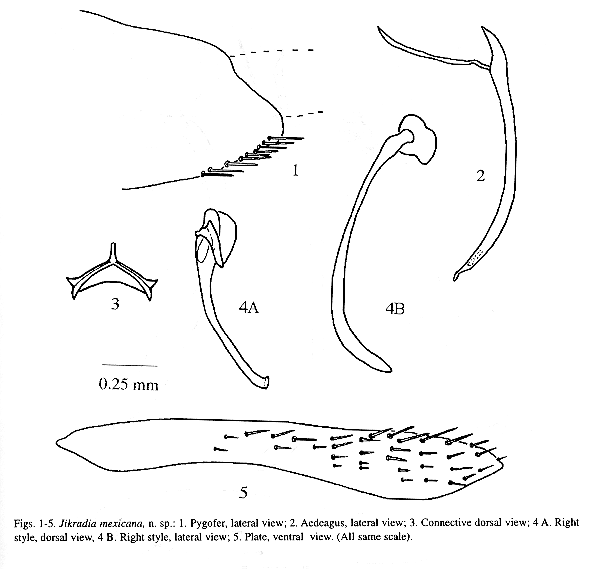
<body><![CDATA[<BR><FONT FACE="Arial,Helvetica"><FONT SIZE=-1>Medium-sized, slender leafhoppers. Color light fuscous to light piceous, sometimes ochraceous throughout.</FONT></FONT>     <BR><FONT FACE="Arial,Helvetica"><FONT SIZE=-1>Head narrower than pronotum, anterior margin broadly rounded; crown produced slightly beyond<B> </B>anterior margin of eyes,<B> </B>interocular width narrower than transocular width,slightly depressed, lateralmargins convergent basally; ocelli small, situated near anterior margin of crown;<B> </B>pronotum large, median length about equal to median length of crown;<B> </B>scutellum large<B>, </B>median length greater thanmedian length<B> </B>of pronotum; fore wing elongate,three anteapical cells<B> </B>present, outer one closed, five apical cells present;veins distinct;<B> </B>appendix well developed;<B> </B>clypeus elongate,narrow, with a prominent median longitudinal carina, lateral margins parallel, surface finely granulose; clypellus long, lateral margins prominently expanded apically. Male<B> </B>genitalia partially asymmetrical; pygofer large without caudodorsal or caudoventral processes; 10th segment<B> </B>long and narrow, without ventral processes; aedeagus asymmetrical, very long, slender, tube-like<B> </B>throughout, with or without<B> </B>subterminal processes; gonopore subapical; connective Y shaped with long arms, short stem; style long, very slender, needlelike, curved; dorsal apodeme sclerotized, slender and long; plate long and narrow, sligthly expanded at apical 1/2, setaceous at apical 1/2.</FONT></FONT>     <BR>&nbsp;     <CENTER></CENTER>      <CENTER><FONT FACE="Arial,Helvetica"><FONT SIZE=-1><I>Jikradia</I> <I>mexicana</I>, <B>new species</B></FONT></FONT></CENTER>      <CENTER><FONT FACE="Arial,Helvetica"><FONT SIZE=-1><A HREF="#fig. 1">Figs. 1-5</A></FONT></FONT></CENTER>       <P><FONT FACE="Arial,Helvetica"><FONT SIZE=-1><I>Diagnosis.</I> Length:&nbsp;<IMG SRC="/img/fbpe/rbt/v46n3/simbi06.GIF" HEIGHT=21 WIDTH=23>6 mm. General color ochraceous; fore wing with flavous spots in extreme apex of 5a cell; vertex, genae, clypeus and clypellus mustard yellow; front coxae dark brown.&nbsp;<IMG SRC="/img/fbpe/rbt/v46n3/simbi06.GIF" HEIGHT=21 WIDTH=23> Pygofer in lateral aspect without caudodorsal or caudoventral processes (<A HREF="#fig. 1">Fig.1</A>); 10th segment long and narrow without ventral processes; aedeagus asymmetrical, long, narrow, tube-like, curved in lateral aspect, with sharply pointed apex without seta-like spine, gonopore subapical (<A HREF="#fig. 1">Fig. 2</A>); connective Y-shaped, arms long, stem short (<A HREF="#fig. 1">Fig. 3</A>); style long and narrow, curved in lateral and dorsal aspect (<A HREF="#fig. 1">Figs. 4 A, 4 B</A>); plate long and narrow with numerous spines along lateral margin in apical 1/2 (<A HREF="#fig. 1">Fig. 5</A>).</FONT></FONT>     
<BR>&nbsp;     <BR>&nbsp;     <CENTER></CENTER>      ]]></body>
<body><![CDATA[<CENTER><A NAME="fig. 1"></A><IMG SRC="/img/fbpe/rbt/v46n3/0210i01.GIF" HEIGHT=569 WIDTH=595></CENTER> <FONT FACE="Arial,Helvetica"><FONT SIZE=-1>™.<IMG SRC="/img/fbpe/rbt/v46n3/simbi05.GIF" HEIGHT=27 WIDTH=20> Unknown.</FONT></FONT>      
<P><FONT FACE="Arial,Helvetica"><FONT SIZE=-1><I>Material examined</I>. Holotype (<IMG SRC="/img/fbpe/rbt/v46n3/simbi06.GIF" HEIGHT=21 WIDTH=23>). <B>MEXICO: </B>Teapa, Tabasco, March, H.H.S., Brit. Mus. 1893-141. (NHM). Paratypes. 1&nbsp;<IMG SRC="/img/fbpe/rbt/v46n3/simbi06.GIF" HEIGHT=21 WIDTH=23>, <B>MEXICO: </B>Amula, Guerrero, 600 ft., Sept.., 1893, H. H. Smith (NHM); 1<IMG SRC="/img/fbpe/rbt/v46n3/simbi06.GIF" HEIGHT=21 WIDTH=23>, Orizaba, 78, P. R. Uhler collection (NHM).</FONT></FONT>      
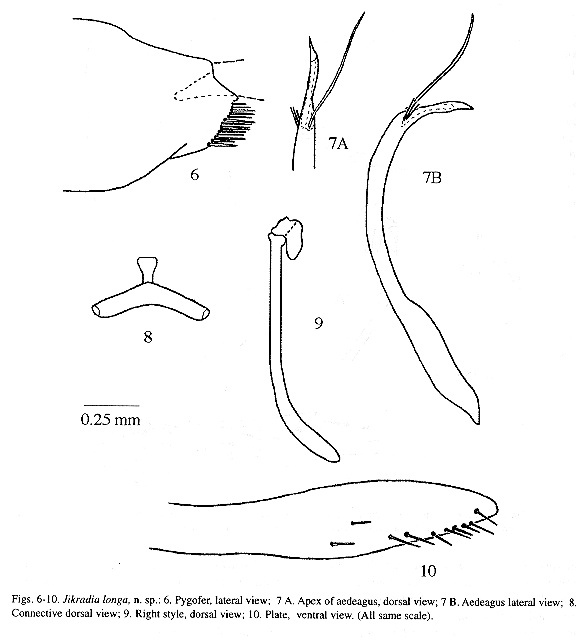
<P><FONT FACE="Arial,Helvetica"><FONT SIZE=-1><I>Remarks.</I> <I>J. mexicana </I>is similar in certain male genitalic characteristics to <I>J</I>.<I>uniseta</I> but can be distinguished from it by the lack of a long subapical seta of the aedeagus. The general color of <I>J</I>. <I>mexicana</I> is ochraceous and <I>J</I>. <I>uniseta</I> is piceous.</FONT></FONT>     <CENTER></CENTER>      <CENTER><FONT FACE="Arial,Helvetica"><FONT SIZE=-1><I>Jikradia</I> <I>longa</I>, <B>new species</B></FONT></FONT></CENTER>      <CENTER><FONT FACE="Arial,Helvetica"><FONT SIZE=-1>Figs.<A HREF="#fig. 2"> 6-10</A></FONT></FONT></CENTER>       <P><FONT FACE="Arial,Helvetica"><FONT SIZE=-1><I>Diagnosis</I>. Length:&nbsp;<IMG SRC="/img/fbpe/rbt/v46n3/simbi06.GIF" HEIGHT=21 WIDTH=23> 7.3-7.5 mm. General color light ochraceous; fore wing veins brown; vertex, genae, clypeus and clypellus light ochraceous; legs yellow.&nbsp;<IMG SRC="/img/fbpe/rbt/v46n3/simbi06.GIF" HEIGHT=21 WIDTH=23>Pygofer in lateral aspect without caudodorsal or caudoventral processes (<A HREF="#fig. 2">Fig. 6</A>); 10th segment long and narrow; aedeagus asymmetrical, long, narrow, tube-like, broadly curved in lateral aspect with sharply pointed apex, in lateral aspect with long seta-like process subapically originating laterally in ventral aspect with three spine-like setae opposite to single subapical seta, gonopore subterminal (<A HREF="#fig. 2">Figs.7 A, 7 B</A>); connective Y-shaped, arms long, stem short (<A HREF="#fig. 2">Fig. 8</A>); style long and slender, broadly curved in lateral aspect, nearly as long as aedeagus (<A HREF="#fig. 2">Fig. 9</A>); plate long and narrow, constricted subbasally with numerous spines along lateral margin on apical 1/2 (<A HREF="#fig. 2">Fig. 10</A>).</FONT></FONT>     
<BR>&nbsp;     <BR>&nbsp;     <CENTER></CENTER>      ]]></body>
<body><![CDATA[<CENTER><A NAME="fig. 2"></A><IMG SRC="/img/fbpe/rbt/v46n3/0210i02.GIF" HEIGHT=643 WIDTH=576></CENTER> &nbsp;     
<BR>&nbsp;      <P><IMG SRC="/img/fbpe/rbt/v46n3/simbi05.GIF" HEIGHT=27 WIDTH=20><FONT FACE="Arial,Helvetica"><FONT SIZE=-1> Unknown.</FONT></FONT>     
<BR><FONT FACE="Arial,Helvetica"><FONT SIZE=-1><I>Material examined. </I>Holotype (<IMG SRC="/img/fbpe/rbt/v46n3/simbi06.GIF" HEIGHT=21 WIDTH=23>). <B>COSTA RICA: </B>Guanacaste Prov., Playa Naranjo, Santa Rosa P.N., M. Zumbado, Ene. 1991, L-N 309300-353300 (INBIO). Paratypes. 1&nbsp;<IMG SRC="/img/fbpe/rbt/v46n3/simbi06.GIF" HEIGHT=21 WIDTH=23>, <B>COSTA RICA: </B>Prov. Guanacaste, San Lucas, 7-7-34, No 2884, CH Ballou, on <I>Spondias mombin </I>(NHM); 1&nbsp;<IMG SRC="/img/fbpe/rbt/v46n3/simbi06.GIF" HEIGHT=21 WIDTH=23>, Est. Sta Rosa, 300 m. P. N. Sta Rosa, (INBio); 1&nbsp;<IMG SRC="/img/fbpe/rbt/v46n3/simbi06.GIF" HEIGHT=21 WIDTH=23>, III Curso Parataxonomos, Feb. 1992, L-N 313000, 359800 (CAS); 1 male same data (UCR); 1&nbsp;<IMG SRC="/img/fbpe/rbt/v46n3/simbi06.GIF" HEIGHT=21 WIDTH=23> same data (BYU); 1&nbsp;<IMG SRC="/img/fbpe/rbt/v46n3/simbi06.GIF" HEIGHT=21 WIDTH=23>, <B>GUATEMALA: </B>Baja Verapaz, Rabinal, VII 23-1964. J. E. Slansky collector (NHM); 1&nbsp;<IMG SRC="/img/fbpe/rbt/v46n3/simbi06.GIF" HEIGHT=21 WIDTH=23>, <B>MEXICO: </B>Tuxtla Guti&eacute;rrez, El Chorriadero, Chris IX 26-61, Javier V&aacute;squez G. (NHM).</FONT></FONT>      
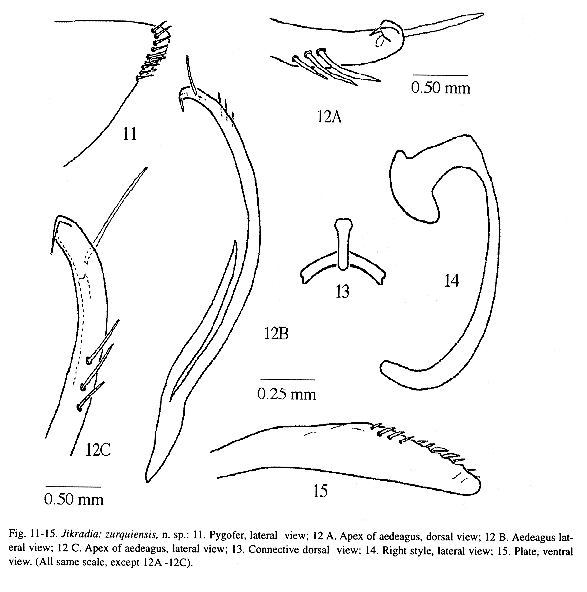
<P><FONT FACE="Arial,Helvetica"><FONT SIZE=-1><I>Remarks</I>. <I>J. longa</I> is very similar in male genitalic characteristics to <I>J</I>. <I>basipendula</I> but can be distinguished from that species by the presence of three small spine-like setae basad of the gonopore. In size <I>J. longa </I>males are longer than<I> J. basipendula.</I></FONT></FONT>     <CENTER>&nbsp;</CENTER>      <CENTER>&nbsp;</CENTER>      <CENTER><FONT FACE="Arial,Helvetica"><FONT SIZE=-1><I>Jikradia</I> <I>zurquiensis</I>, <B>new species</B></FONT></FONT></CENTER>      <CENTER><FONT FACE="Arial,Helvetica"><FONT SIZE=-1><A HREF="#fig. 3">Figs. 11-15</A></FONT></FONT></CENTER>       <P><FONT FACE="Arial,Helvetica"><FONT SIZE=-1>Diagnosis. Length:&nbsp;<IMG SRC="/img/fbpe/rbt/v46n3/simbi06.GIF" HEIGHT=21 WIDTH=23> 7 mm. General color brown; fore wing with white spots on costal margin; vertex brown or yellow, genae yellow, clypeus with median longitudinal carina with longitudinal yellow stripes, lateral margins brown, clypellus brown; legs yellow.<IMG SRC="/img/fbpe/rbt/v46n3/simbi06.GIF" HEIGHT=21 WIDTH=23> Pygofer in lateral aspect without caudodorsal or caudoventral processes (<A HREF="#fig. 3">Fig. 11</A>); 10th segment long and narrow; aedeagus asymmetrical, long, narrow<B>,</B> tube-like, broadly curved in lateral aspect with sharply pointed apex, with single seta-like process subapically originating laterally in dorsal aspect and with three small spine-like setae basad of single subapical setae on the opposite lateral margin of aedeagus in ventral aspect; gonopore subapical (<A HREF="#fig. 3">Figs. 12 A, 12 B, 12 C</A>); connective Y-shaped, arms long, stem short (<A HREF="#fig. 3">Fig. 13</A>); style long and slender, broadly curved in lateral aspect, nearly as long as aedeagus (<A HREF="#fig. 3">Fig. 14</A>); plate long and narrow with row of long stout setae on apical 1/2 (<A HREF="#fig. 3">Fig. 15</A>).</FONT></FONT>     
]]></body>
<body><![CDATA[<BR>&nbsp;     <BR>&nbsp;     <CENTER></CENTER>      <CENTER><A NAME="fig. 3"></A><IMG SRC="/img/fbpe/rbt/v46n3/0210i03.GIF" HEIGHT=592 WIDTH=587></CENTER> &nbsp;     
<BR>&nbsp;      <P><IMG SRC="/img/fbpe/rbt/v46n3/simbi05.GIF" HEIGHT=27 WIDTH=20><FONT FACE="Arial,Helvetica"><FONT SIZE=-1>Unknown.</FONT></FONT>     
<BR><FONT FACE="Arial,Helvetica"><FONT SIZE=-1><I>Material examined. </I>Holotype (<IMG SRC="/img/fbpe/rbt/v46n3/simbi06.GIF" HEIGHT=21 WIDTH=23>).<B> COSTA RICA: </B>San Jos&eacute;. P. N. Braulio Carrillo, 9.5 Km. E. t&uacute;nel, 1100 m, V-VI-1990, Godoy-Hanson (INBio). Paratypes. <B>COSTA RICA: </B>Prov. Guanacaste, 1&nbsp;<IMG SRC="/img/fbpe/rbt/v46n3/simbi06.GIF" HEIGHT=21 WIDTH=23>, Rio San Lorenzo, 1050m, Tierras Morenas, Z. P. Tenorio, Abril 1991, C. Alvarado, L-N 287800, 427600 (CAS); 1&nbsp;<IMG SRC="/img/fbpe/rbt/v46n3/simbi06.GIF" HEIGHT=21 WIDTH=23>, Prov. Lim&oacute;n, Est. Hitoy Cerere, Res. Biol. Hitoy Cerere, G. Carballo 4-20 Dic. 1991, L-N 184200-643300 (NHM); 1&nbsp;<IMG SRC="/img/fbpe/rbt/v46n3/simbi06.GIF" HEIGHT=21 WIDTH=23>, Prov. Puntarenas, Rancho Quemado, 200m, Pen&iacute;nsula de Osa, Francisco Quesada, Mar. 1992, L-S 292500, 51100 (BYU). 1&nbsp;<IMG SRC="/img/fbpe/rbt/v46n3/simbi06.GIF" HEIGHT=21 WIDTH=23>, Rio San Lorenzo, 1050m,. Estaci&oacute;n Sirena, 0-100m, P.N. Corcovado, Jun. 1991, J.C. Saborio, L-S 270500, 508300 (UCR); 1<IMG SRC="/img/fbpe/rbt/v46n3/simbi06.GIF" HEIGHT=21 WIDTH=23>, same locality, 21 mar. a 21 abr. 1992, Z. Fuentes, (INBio).</FONT></FONT>     
<BR><FONT FACE="Arial,Helvetica"><FONT SIZE=-1><I>Remarks.</I> <I>J. zurquiensis</I> is similar in male genitalic characteristics to <I>J. melanota </I>but can be distinguished from it by the longer spine-like setae and single seta-like process. The face in <I>J.</I> <I>zurquiensis</I> has longitudinal yellow stripes, a feature not observed in <I>J. melanota</I></FONT></FONT>     <BR>&nbsp;     <CENTER><FONT FACE="Arial,Helvetica"><FONT SIZE=-1><I>Jikradia lizanoi</I>, <B>new species</B></FONT></FONT></CENTER>      ]]></body>
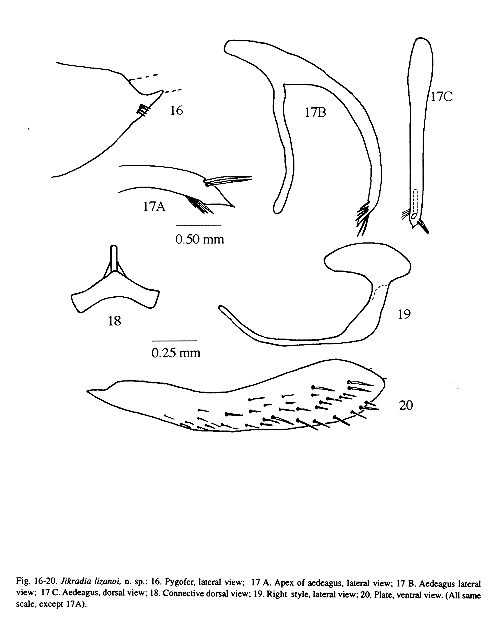
<body><![CDATA[<CENTER><FONT FACE="Arial,Helvetica"><FONT SIZE=-1>Figs. <A HREF="#fig. 4">16-20</A></FONT></FONT></CENTER>       <P><FONT FACE="Arial,Helvetica"><FONT SIZE=-1><I>Diagnosis</I>. Length:&nbsp;<IMG SRC="/img/fbpe/rbt/v46n3/simbi06.GIF" HEIGHT=21 WIDTH=23>6.5 mm. General color brown; fore wing with costal area yellow; vertex, genae, clypeus and clypellus yellow; legs brown.&nbsp;<IMG SRC="/img/fbpe/rbt/v46n3/simbi06.GIF" HEIGHT=21 WIDTH=23>Pygofer in lateral aspect without caudodorsal or caudoventral processes; 10th segment long and narrow (<A HREF="#fig. 4">Fig. 16</A>); aedeagus asymmetrical, long, narrow, tube-like, in lateral aspect with sharply pointed apex, with two long seta-like processes subapically originating laterally in ventral aspect with four spine-like setae, gonopore subterminal (<A HREF="#fig. 4">Fig. 17 A, 17 B, 17 C</A>); connective Y-shaped, arms long, stem short (<A HREF="#fig. 4">Fig. 18</A>); style long and slender, broadly curved in lateral aspect, nearly as long as aedeagus (<A HREF="#fig. 4">Fig.19</A>); plate long and slender, broadly curved in lateral aspect, nearly as long as aedeagus, long and narrow, constricted subbasally with numerous spines along lateral margin on apical 1/3 (<A HREF="#fig. 4">Fig. 20</A>).</FONT></FONT>     
<BR>&nbsp;     <CENTER></CENTER>      <CENTER><A NAME="fig. 4"></A><IMG SRC="/img/fbpe/rbt/v46n3/0210i04.GIF" HEIGHT=628 WIDTH=501></CENTER> &nbsp;     
<BR>&nbsp;      <P><IMG SRC="/img/fbpe/rbt/v46n3/simbi05.GIF" HEIGHT=27 WIDTH=20><FONT FACE="Arial,Helvetica"><FONT SIZE=-1>. Unknown.</FONT></FONT>     
<BR><FONT FACE="Arial,Helvetica"><FONT SIZE=-1><I>Material examined. </I>Holotype (<IMG SRC="/img/fbpe/rbt/v46n3/simbi06.GIF" HEIGHT=21 WIDTH=23>). <B>COSTA RICA, </B>Heredia, Vara Blanca, Finca Georgina, 2100 m. V-VI-1990. Hanson. (INBio).&nbsp;<IMG SRC="/img/fbpe/rbt/v46n3/simbi05.GIF" HEIGHT=27 WIDTH=20>. <B>COSTA RICA,</B> San Ram&oacute;n de Tres Rios, 10 Aug. 1972, Maldonado C. (NHM).</FONT></FONT>     
<BR>&nbsp;     <BR>&nbsp;     ]]></body>
<body><![CDATA[<BR>&nbsp;     <CENTER></CENTER>      <CENTER><A NAME="fig. 5"></A><IMG SRC="/img/fbpe/rbt/v46n3/0210i05.GIF" HEIGHT=780 WIDTH=592></CENTER> &nbsp;     
<BR>&nbsp;      <P><FONT FACE="Arial,Helvetica"><FONT SIZE=-1><I>Remarks.</I> <I>J. lizanoi</I> is similar in male genitalic characteristics to<I> J. melanota</I> but can be easily distinguished by the presence of two subapical aedeagal processes on the same side. We dedicate this species to Jorge Arturo Lizano for allowing us to collect on his property.</FONT></FONT>     <BR>&nbsp;     <BR>&nbsp;     <CENTER></CENTER>      <CENTER><FONT FACE="Arial,Helvetica"><FONT SIZE=-1>Key to males of <I>Jikradia</I></FONT></FONT></CENTER> &nbsp;     <BR>&nbsp; <TABLE BORDER=0 CELLSPACING=0 CELLPADDING=5 WIDTH="731" > <TR> <TD VALIGN=TOP WIDTH="68%"><FONT FACE="Arial,Helvetica"><FONT SIZE=-1>1. Aedeagus without setae on shaft&nbsp;</FONT></FONT></TD>  <TD VALIGN=TOP WIDTH="32%">     ]]></body>
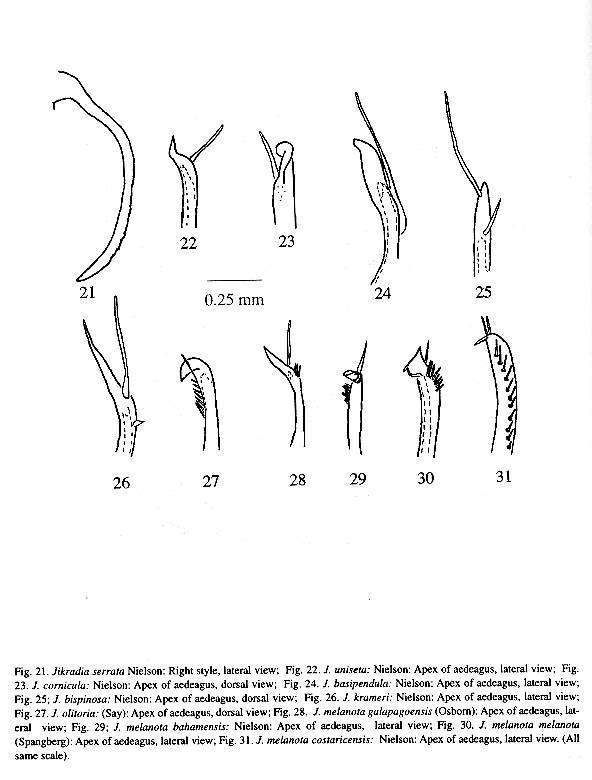
<body><![CDATA[<DIV ALIGN=right><FONT FACE="Arial,Helvetica"><FONT SIZE=-1>2&nbsp;</FONT></FONT></DIV> </TD> </TR>  <TR> <TD VALIGN=TOP WIDTH="68%"><FONT FACE="Arial,Helvetica"><FONT SIZE=-1>- Aedeagus with setae on or near apex of shaft&nbsp;</FONT></FONT></TD>  <TD VALIGN=TOP WIDTH="32%">     <DIV ALIGN=right><FONT FACE="Arial,Helvetica"><FONT SIZE=-1>3&nbsp;</FONT></FONT></DIV> </TD> </TR>  <TR> <TD VALIGN=TOP WIDTH="68%"><FONT FACE="Arial,Helvetica"><FONT SIZE=-1>2. Style with latero-apical margin serrate (<A HREF="#fig. 5">Fig. 21</A>)&nbsp;</FONT></FONT></TD>  <TD VALIGN=TOP WIDTH="32%">     <DIV ALIGN=right><FONT FACE="Arial,Helvetica"><FONT SIZE=-1>. <I>serrata</I> Nielson&nbsp;</FONT></FONT></DIV> </TD> </TR>  <TR> <TD VALIGN=TOP WIDTH="68%"><FONT FACE="Arial,Helvetica"><FONT SIZE=-1>- Style with latero-apical margin smooth (<A HREF="#fig. 1">Figs. 4</A>)&nbsp;</FONT></FONT></TD>  <TD VALIGN=TOP WIDTH="32%">     <DIV ALIGN=right><FONT FACE="Arial,Helvetica"><FONT SIZE=-1><I>mexicana</I>, n. sp&nbsp;</FONT></FONT></DIV> </TD> </TR>  <TR> <TD VALIGN=TOP WIDTH="68%"><FONT FACE="Arial,Helvetica"><FONT SIZE=-1>3. Aedeagus with only 1-2 setae apically&nbsp;</FONT></FONT></TD>  <TD VALIGN=TOP WIDTH="32%">     <DIV ALIGN=right><FONT FACE="Arial,Helvetica"><FONT SIZE=-1>. 4&nbsp;</FONT></FONT></DIV> </TD> </TR>  <TR> <TD VALIGN=TOP WIDTH="68%"><FONT FACE="Arial,Helvetica"><FONT SIZE=-1>- Aedeagus with numerous setae apically or subapically&nbsp;</FONT></FONT></TD>  <TD VALIGN=TOP WIDTH="32%">     <DIV ALIGN=right><FONT FACE="Arial,Helvetica"><FONT SIZE=-1>8&nbsp;</FONT></FONT></DIV> </TD> </TR>  <TR> <TD VALIGN=TOP WIDTH="68%"><FONT FACE="Arial,Helvetica"><FONT SIZE=-1>4. Aedeagus with 1 apical seta&nbsp;</FONT></FONT></TD>  <TD VALIGN=TOP WIDTH="32%">     <DIV ALIGN=right><FONT FACE="Arial,Helvetica"><FONT SIZE=-1>5&nbsp;</FONT></FONT></DIV> </TD> </TR>  <TR> <TD VALIGN=TOP WIDTH="68%"><FONT FACE="Arial,Helvetica"><FONT SIZE=-1>- Aedeagus with 2 apical setae&nbsp;</FONT></FONT></TD>  <TD VALIGN=TOP WIDTH="32%">     <DIV ALIGN=right><FONT FACE="Arial,Helvetica"><FONT SIZE=-1>. 7&nbsp;</FONT></FONT></DIV> </TD> </TR>  <TR> <TD VALIGN=TOP WIDTH="68%"><FONT FACE="Arial,Helvetica"><FONT SIZE=-1>5. Aedeagus with seta arising basad of gonopore</FONT></FONT></TD>  <TD VALIGN=TOP WIDTH="32%">     <DIV ALIGN=right><FONT FACE="Arial,Helvetica"><FONT SIZE=-1>. 6&nbsp;</FONT></FONT></DIV> </TD> </TR>  <TR> <TD VALIGN=TOP WIDTH="68%"><FONT FACE="Arial,Helvetica"><FONT SIZE=-1>- Aedeagus with seta arising distad or aligned with gonopore (<A HREF="#fig. 5">Fig. 22</A>)&nbsp;</FONT></FONT></TD>  <TD VALIGN=TOP WIDTH="32%">     <DIV ALIGN=right><FONT FACE="Arial,Helvetica"><FONT SIZE=-1>.<I>uniseta</I> Nielson&nbsp;</FONT></FONT></DIV> </TD> </TR>  <TR> <TD VALIGN=TOP WIDTH="68%"><FONT FACE="Arial,Helvetica"><FONT SIZE=-1>6. Aedeagus with very long seta arising considerably basad of gonopore, apex narrowed in ventral view (<A HREF="#fig. 5">Fig. 24</A>)&nbsp;</FONT></FONT></TD>  <TD VALIGN=TOP WIDTH="32%">     ]]></body>
<body><![CDATA[<DIV ALIGN=right><FONT FACE="Arial,Helvetica"><FONT SIZE=-1><I>basipendula</I> Nielson&nbsp;</FONT></FONT></DIV> </TD> </TR>  <TR> <TD VALIGN=TOP WIDTH="68%"><FONT FACE="Arial,Helvetica"><FONT SIZE=-1>- Aedeagus with moderately long seta arising basad of but near gonopore, several spicules near base of seta, apex broad in ventral view (<A HREF="#fig. 5">Fig. 23</A>)&nbsp;</FONT></FONT></TD>  <TD VALIGN=TOP WIDTH="32%">     <DIV ALIGN=right><FONT FACE="Arial,Helvetica"><FONT SIZE=-1><I>cornicula</I> Nielson&nbsp;</FONT></FONT></DIV> </TD> </TR>  <TR> <TD VALIGN=TOP WIDTH="68%"><FONT FACE="Arial,Helvetica"><FONT SIZE=-1>7. Aedeagus with gonopore basad of apical setae (<A HREF="#fig. 5">Fig. 25</A>)&nbsp;</FONT></FONT></TD>  <TD VALIGN=TOP WIDTH="32%">     <DIV ALIGN=right><FONT FACE="Arial,Helvetica"><FONT SIZE=-1><I>bispinosa</I> Nielson&nbsp;</FONT></FONT></DIV> </TD> </TR>  <TR> <TD VALIGN=TOP WIDTH="68%"><FONT FACE="Arial,Helvetica"><FONT SIZE=-1>- Aedeagus with gonopore between apical setae (<A HREF="#fig. 5">Fig. 26</A>)&nbsp;</FONT></FONT></TD>  <TD VALIGN=TOP WIDTH="32%">     <DIV ALIGN=right><FONT FACE="Arial,Helvetica"><FONT SIZE=-1>. <I>krameri</I> Nielson&nbsp;</FONT></FONT></DIV> </TD> </TR>  <TR> <TD VALIGN=TOP WIDTH="68%"><FONT FACE="Arial,Helvetica"><FONT SIZE=-1>8. Aedeagus with 1-2 long apical setae and a row of short to long subapical setae&nbsp;</FONT></FONT></TD>  <TD VALIGN=TOP WIDTH="32%">     <DIV ALIGN=right><FONT FACE="Arial,Helvetica"><FONT SIZE=-1>9&nbsp;</FONT></FONT></DIV> </TD> </TR>  <TR> <TD VALIGN=TOP WIDTH="68%"><FONT FACE="Arial,Helvetica"><FONT SIZE=-1>- Aedeagus without apical setae, but with a short to long row of subapical setae (<A HREF="#fig. 5">Fig.27</A>)&nbsp;</FONT></FONT></TD>  <TD VALIGN=TOP WIDTH="32%">     <DIV ALIGN=right><FONT FACE="Arial,Helvetica"><FONT SIZE=-1><I>olitoria</I> (Say)&nbsp;</FONT></FONT></DIV> </TD> </TR>  <TR> <TD VALIGN=TOP WIDTH="68%"><FONT FACE="Arial,Helvetica"><FONT SIZE=-1>9. Clypeus with longitudinal yellow stripes&nbsp;</FONT></FONT></TD>  <TD VALIGN=TOP WIDTH="32%">     <DIV ALIGN=right><FONT FACE="Arial,Helvetica"><FONT SIZE=-1>. <I>zurquiensis</I>, n. sp.&nbsp;</FONT></FONT></DIV> </TD> </TR>  <TR> <TD VALIGN=TOP WIDTH="68%"><FONT FACE="Arial,Helvetica"><FONT SIZE=-1>- Clypeus without longitudinal yellow stripes</FONT></FONT></TD>  <TD VALIGN=TOP WIDTH="32%">     <DIV ALIGN=right><FONT FACE="Arial,Helvetica"><FONT SIZE=-1>. 10&nbsp;</FONT></FONT></DIV> </TD> </TR>  <TR> <TD VALIGN=TOP WIDTH="68%"><FONT FACE="Arial,Helvetica"><FONT SIZE=-1>10. Length of males between 4.7 and 6.7 mm, color ochraceous, fuscus to light testaceous&nbsp;</FONT></FONT></TD>  <TD VALIGN=TOP WIDTH="32%">     <DIV ALIGN=right><FONT FACE="Arial,Helvetica"><FONT SIZE=-1>. 11&nbsp;</FONT></FONT></DIV> </TD> </TR>  <TR> <TD VALIGN=TOP WIDTH="68%"><FONT FACE="Arial,Helvetica"><FONT SIZE=-1>- Length of males between 7.3 and 7.5, color yellow (<A HREF="#fig. 2">Fig. 8</A>)&nbsp;</FONT></FONT></TD>  <TD VALIGN=TOP WIDTH="32%">     <DIV ALIGN=right><FONT FACE="Arial,Helvetica"><FONT SIZE=-1>. <I>longa</I> n. sp.&nbsp;</FONT></FONT></DIV> </TD> </TR>  <TR> <TD VALIGN=TOP WIDTH="68%"><FONT FACE="Arial,Helvetica"><FONT SIZE=-1>11. Pygofer with 4 caudodorsal spines (<A HREF="#fig. 4">Fig. 16</A>)&nbsp;</FONT></FONT></TD>  <TD VALIGN=TOP WIDTH="32%">     ]]></body>
<body><![CDATA[<DIV ALIGN=right><FONT FACE="Arial,Helvetica"><FONT SIZE=-1>. <I>lizanoi</I>, n. sp.&nbsp;</FONT></FONT></DIV> </TD> </TR>  <TR> <TD VALIGN=TOP WIDTH="68%"><FONT FACE="Arial,Helvetica"><FONT SIZE=-1>- Pygofer with 9 or more caudodorsal spines&nbsp;</FONT></FONT></TD>  <TD VALIGN=TOP WIDTH="32%">     <DIV ALIGN=right><FONT FACE="Arial,Helvetica"><FONT SIZE=-1><I>melanota</I> (Sp&aring;ngberg)&nbsp;</FONT></FONT></DIV> </TD> </TR> </TABLE>      <CENTER><FONT FACE="Arial,Helvetica"><FONT SIZE=-1>Key to the subspecies of <I>J. melanota</I></FONT></FONT></CENTER> &nbsp;     <BR>&nbsp; <TABLE BORDER=0 CELLSPACING=0 CELLPADDING=5 WIDTH="731" > <TR> <TD VALIGN=TOP WIDTH="69%"><FONT FACE="Arial,Helvetica"><FONT SIZE=-1>1. Aedeagus with a single apical seta and a row of short setae basad of apical seta (<A HREF="#fig. 5">Fig. 28</A>)&nbsp;</FONT></FONT></TD>  <TD VALIGN=TOP WIDTH="31%">     <DIV ALIGN=right><FONT FACE="Arial,Helvetica"><FONT SIZE=-1>2&nbsp;</FONT></FONT></DIV> </TD> </TR>  <TR> <TD VALIGN=TOP WIDTH="69%"><FONT FACE="Arial,Helvetica"><FONT SIZE=-1>- Aedeagus with 2 apical setae and row of short setae basad of apical setae (<A HREF="#fig. 5">Fig. 31</A>)&nbsp;</FONT></FONT></TD>  <TD VALIGN=TOP WIDTH="31%">     <DIV ALIGN=right><FONT FACE="Arial,Helvetica"><FONT SIZE=-1>3&nbsp;</FONT></FONT></DIV> </TD> </TR>  <TR> <TD VALIGN=TOP WIDTH="69%"><FONT FACE="Arial,Helvetica"><FONT SIZE=-1>2. Large, narrow species, length 5 mm or more; fore wings black with yellow or ivory costa (<A HREF="#fig. 5">Fig. 28</A>)&nbsp;</FONT></FONT></TD>  <TD VALIGN=TOP WIDTH="31%">     <DIV ALIGN=right><FONT FACE="Arial,Helvetica"><FONT SIZE=-1>. <I>m. galapagoensis</I> (Osborn)&nbsp;</FONT></FONT></DIV> </TD> </TR>  <TR> <TD VALIGN=TOP WIDTH="69%"><FONT FACE="Arial,Helvetica"><FONT SIZE=-1>- Small, narrow species, length less than 5 mm; fore wing uniformly ochraceous (<A HREF="#fig. 5">Fig. 29</A>)&nbsp;</FONT></FONT></TD>  <TD VALIGN=TOP WIDTH="31%">     <DIV ALIGN=right><FONT FACE="Arial,Helvetica"><FONT SIZE=-1><I>m</I>. <I>bahamensis</I> Nielson&nbsp;</FONT></FONT></DIV> </TD> </TR>  <TR> <TD VALIGN=TOP WIDTH="69%"><FONT FACE="Arial,Helvetica"><FONT SIZE=-1>3. Aedeagus with a short row of setae basad of apical setae (<A HREF="#fig. 5">Fig. 30</A>)&nbsp;</FONT></FONT></TD>  <TD VALIGN=TOP WIDTH="31%">     <DIV ALIGN=right><FONT FACE="Arial,Helvetica"><FONT SIZE=-1><I>m. melanota</I> (Sp&aring;ngberg)&nbsp;</FONT></FONT></DIV> </TD> </TR>  <TR> <TD VALIGN=TOP WIDTH="69%"><FONT FACE="Arial,Helvetica"><FONT SIZE=-1>- Aedeagus with a very long row of setae basad of apical setae (<A HREF="#fig. 5">Fig. 31</A>)&nbsp;</FONT></FONT></TD>  <TD VALIGN=TOP WIDTH="31%">     <DIV ALIGN=right><FONT FACE="Arial,Helvetica"><FONT SIZE=-1>. <I>m. costaricensis</I> Nielson&nbsp;</FONT></FONT></DIV> </TD> </TR> </TABLE> <B><FONT FACE="Arial,Helvetica"><FONT SIZE=-1>&nbsp;</FONT></FONT></B>     ]]></body>
<body><![CDATA[<BR><B><FONT FACE="Arial,Helvetica"><FONT SIZE=-1>&nbsp;</FONT></FONT></B>     <BR><B><FONT FACE="Arial,Helvetica"><FONT SIZE=-1>Acknowledgements</FONT></FONT></B>      <P><FONT FACE="Arial,Helvetica"><FONT SIZE=-1>The authors thank the curators of the CAS, NHM, UCR. for loans of specimens andspecially Gabriel Mejdalani, Paul Freytag, William Ramirez and Paul Hanson for their valuable comments on the manuscript.</FONT></FONT>     <BR>&nbsp;      <P><B><FONT FACE="Arial,Helvetica"><FONT SIZE=-1>Resumen</FONT></FONT></B>      <P><FONT FACE="Arial,Helvetica"><FONT SIZE=-1>Se describen e ilustran cuatro especies nuevas de <I>Jikradia</I> Nielson: <I>J. mexicana</I> (M&eacute;xico)<I> J. longa </I>(Costa Rica, Guatemala, M&eacute;xico), <I>J.<B> </B>zurquiensis</I> (Costa Rica)<I> </I>y<I> J.lizanoi</I> (Costa Rica). El trabajo inlcuye una clave ilustrada para todas las subespecies, con base en los aparatos genitales masculinos.</FONT></FONT>     <BR>&nbsp;      <P><B><FONT FACE="Arial,Helvetica"><FONT SIZE=-1>References</FONT></FONT></B>      <!-- ref --><P><A NAME="Nielson, M. W. 1975."></A><FONT FACE="Arial,Helvetica"><FONT SIZE=-1>Nielson, M. W. 1975. A revision of the Subfamily Coelidiinae (Homoptera: Cicadellidae). Tribes Tinobregmini, Sandersellini and Tharrinii. Bull. Br. Mus. Nat. Hist. Entomol. Suppl. 24.7-8</FONT></FONT>    &nbsp;&nbsp;&nbsp;&nbsp;&nbsp;&nbsp;&nbsp;&nbsp;[&#160;<a href="javascript:void(0);" onclick="javascript: window.open('/scielo.php?script=sci_nlinks&ref=1142403&pid=S0034-7744199800030002800001&lng=','','width=640,height=500,resizable=yes,scrollbars=1,menubar=yes,');">Links</a>&#160;]<!-- end-ref --><!-- ref --><P><A NAME="Nielson, M. W. 1979."></A><FONT FACE="Arial,Helvetica"><FONT SIZE=-1>Nielson, M. W. 1979. A revision of the Subfamily Coelidiinae (Homoptera: Cicadellidae) III. Tribe Teruliini. Pac.Ins. Monograph <B>35</B>: 75-95.</FONT></FONT>    &nbsp;&nbsp;&nbsp;&nbsp;&nbsp;&nbsp;&nbsp;&nbsp;[&#160;<a href="javascript:void(0);" onclick="javascript: window.open('/scielo.php?script=sci_nlinks&ref=1142404&pid=S0034-7744199800030002800002&lng=','','width=640,height=500,resizable=yes,scrollbars=1,menubar=yes,');">Links</a>&#160;]<!-- end-ref --><!-- ref --><P><A NAME="Nielson, M. W. 1982."></A><FONT FACE="Arial,Helvetica"><FONT SIZE=-1>Nielson, M. W. 1982. A revision of the Subfamily Coelidiinae (Homoptera: Cicadellidae) IV. Tribe Coelidiini. Pac.Ins. Monograph <B>38</B>: 169-170.</FONT></FONT>    &nbsp;&nbsp;&nbsp;&nbsp;&nbsp;&nbsp;&nbsp;&nbsp;[&#160;<a href="javascript:void(0);" onclick="javascript: window.open('/scielo.php?script=sci_nlinks&ref=1142405&pid=S0034-7744199800030002800003&lng=','','width=640,height=500,resizable=yes,scrollbars=1,menubar=yes,');">Links</a>&#160;]<!-- end-ref --><!-- ref --><P><A NAME="Nielson, M. W. 1989."></A><FONT FACE="Arial,Helvetica"><FONT SIZE=-1>Nielson, M. W. 1989. Additional new species of Teruliine leafhoppers with key to species (Cicadellidae: Coelidiinae: Teruliini). Great Basin Nat. <B>49</B>: 398-403.</FONT></FONT>    &nbsp;&nbsp;&nbsp;&nbsp;&nbsp;&nbsp;&nbsp;&nbsp;[&#160;<a href="javascript:void(0);" onclick="javascript: window.open('/scielo.php?script=sci_nlinks&ref=1142406&pid=S0034-7744199800030002800004&lng=','','width=640,height=500,resizable=yes,scrollbars=1,menubar=yes,');">Links</a>&#160;]<!-- end-ref --><!-- ref --><P><A NAME="Oman, P. W."></A><FONT FACE="Arial,Helvetica"><FONT SIZE=-1>Oman, P. W. 1949. The Nearctic leafhoppers (Homoptera: Cicadellidae). A generic classification and check list. Mem. Ent. Soc. Wash. three: 1-253</FONT></FONT>    &nbsp;&nbsp;&nbsp;&nbsp;&nbsp;&nbsp;&nbsp;&nbsp;[&#160;<a href="javascript:void(0);" onclick="javascript: window.open('/scielo.php?script=sci_nlinks&ref=1142407&pid=S0034-7744199800030002800005&lng=','','width=640,height=500,resizable=yes,scrollbars=1,menubar=yes,');">Links</a>&#160;]<!-- end-ref --><P><A NAME="1a"></A><FONT FACE="Arial,Helvetica"><FONT SIZE=-1><SUP><A HREF="#1">1</A></SUP>Instituto Nacional de Biodiversidad, Apartado Postal 22-3100 Santo Domingo, Heredia, Costa Rica.</FONT></FONT>      <P><A NAME="2a"></A><SUP><FONT FACE="Arial,Helvetica"><FONT SIZE=-1><A HREF="#2">2</A> </FONT></FONT></SUP><FONT FACE="Arial,Helvetica"><FONT SIZE=-1>Monte L. Bean Museum, Brigham Young University, Provo, UT 84602 USA.</FONT></FONT>      ]]></body><back>
<ref-list>
<ref id="B1">
<nlm-citation citation-type="journal">
<person-group person-group-type="author">
<name>
<surname><![CDATA[Nielson]]></surname>
<given-names><![CDATA[M. W.]]></given-names>
</name>
</person-group>
<article-title xml:lang="en"><![CDATA[A revision of the Subfamily Coelidiinae (Homoptera: Cicadellidae): Tribes Tinobregmini, Sandersellini and Tharrinii]]></article-title>
<source><![CDATA[Bull. Br. Mus. Nat. Hist. Entomol.]]></source>
<year>1975</year>
<volume>24</volume>
<numero>^sSuppl.</numero>
<issue>^sSuppl.</issue>
<supplement>Suppl.</supplement>
<page-range>7-8</page-range></nlm-citation>
</ref>
<ref id="B2">
<nlm-citation citation-type="journal">
<person-group person-group-type="author">
<name>
<surname><![CDATA[Nielson]]></surname>
<given-names><![CDATA[M. W.]]></given-names>
</name>
</person-group>
<article-title xml:lang="en"><![CDATA[A revision of the Subfamily Coelidiinae (Homoptera: Cicadellidae) III.: Tribe Teruliini.]]></article-title>
<source><![CDATA[Pac.Ins. Monograph]]></source>
<year>1979</year>
<volume>35</volume>
<page-range>75-95</page-range></nlm-citation>
</ref>
<ref id="B3">
<nlm-citation citation-type="journal">
<person-group person-group-type="author">
<name>
<surname><![CDATA[Nielson]]></surname>
<given-names><![CDATA[M. W.]]></given-names>
</name>
</person-group>
<article-title xml:lang="en"><![CDATA[A revision of the Subfamily Coelidiinae (Homoptera: Cicadellidae) IV: Tribe Coelidiini]]></article-title>
<source><![CDATA[Pac.Ins. Monograph]]></source>
<year>1982</year>
<volume>38</volume>
<page-range>169-170</page-range></nlm-citation>
</ref>
<ref id="B4">
<nlm-citation citation-type="journal">
<person-group person-group-type="author">
<name>
<surname><![CDATA[Nielson]]></surname>
<given-names><![CDATA[M. W.]]></given-names>
</name>
</person-group>
<article-title xml:lang="en"><![CDATA[Additional new species of Teruliine leafhoppers with key to species (Cicadellidae: Coelidiinae: Teruliini).]]></article-title>
<source><![CDATA[Great Basin Nat.]]></source>
<year>1989</year>
<volume>49</volume>
<page-range>398-403</page-range></nlm-citation>
</ref>
<ref id="B5">
<nlm-citation citation-type="journal">
<person-group person-group-type="author">
<name>
<surname><![CDATA[Oman]]></surname>
<given-names><![CDATA[P. W.]]></given-names>
</name>
</person-group>
<article-title xml:lang="en"><![CDATA[The Nearctic leafhoppers (Homoptera: Cicadellidae).: A generic classification and check list.]]></article-title>
<source><![CDATA[Mem. Ent. Soc. Wash]]></source>
<year>1949</year>
<volume>three</volume>
<page-range>1-253</page-range></nlm-citation>
</ref>
</ref-list>
</back>
</article>