<?xml version="1.0" encoding="ISO-8859-1"?><article xmlns:mml="http://www.w3.org/1998/Math/MathML" xmlns:xlink="http://www.w3.org/1999/xlink" xmlns:xsi="http://www.w3.org/2001/XMLSchema-instance">
<front>
<journal-meta>
<journal-id>0034-7744</journal-id>
<journal-title><![CDATA[Revista de Biología Tropical]]></journal-title>
<abbrev-journal-title><![CDATA[Rev. biol. trop]]></abbrev-journal-title>
<issn>0034-7744</issn>
<publisher>
<publisher-name><![CDATA[Universidad de Costa Rica]]></publisher-name>
</publisher>
</journal-meta>
<article-meta>
<article-id>S0034-77441998000300027</article-id>
<title-group>
<article-title xml:lang="en"><![CDATA[The Frankliniella curiosa species group (Thysanoptera: Thripidae)]]></article-title>
</title-group>
<contrib-group>
<contrib contrib-type="author">
<name>
<surname><![CDATA[Johnsen]]></surname>
<given-names><![CDATA[Roberto m]]></given-names>
</name>
<xref ref-type="aff" rid="A01"/>
</contrib>
</contrib-group>
<aff id="A01">
<institution><![CDATA[,Universidad Nacional Autónoma de México Instituto de biología ]]></institution>
<addr-line><![CDATA[Coyoacán ]]></addr-line>
<country>México</country>
</aff>
<pub-date pub-type="pub">
<day>00</day>
<month>09</month>
<year>1998</year>
</pub-date>
<pub-date pub-type="epub">
<day>00</day>
<month>09</month>
<year>1998</year>
</pub-date>
<volume>46</volume>
<numero>3</numero>
<fpage>717</fpage>
<lpage>738</lpage>
<copyright-statement/>
<copyright-year/>
<self-uri xlink:href="http://www.scielo.sa.cr/scielo.php?script=sci_arttext&amp;pid=S0034-77441998000300027&amp;lng=en&amp;nrm=iso"></self-uri><self-uri xlink:href="http://www.scielo.sa.cr/scielo.php?script=sci_abstract&amp;pid=S0034-77441998000300027&amp;lng=en&amp;nrm=iso"></self-uri><self-uri xlink:href="http://www.scielo.sa.cr/scielo.php?script=sci_pdf&amp;pid=S0034-77441998000300027&amp;lng=en&amp;nrm=iso"></self-uri><abstract abstract-type="short" xml:lang="en"><p><![CDATA[This is a review of the Mexican species Frankliniella curiosa Priesner, together with the description of eight new Mexican related species. The outstanding morphology of antennal segment III in the adults, with a ventral projected and curved beak (which covers the pedicel), is an exclusive and typical character, which allows their separation into a new and different species group in the genus. Some other morphological characters divide the group in four species assemblages. Illustrations of the head, antennae, thorax and abdomen of each species are included.]]></p></abstract>
<kwd-group>
<kwd lng="en"><![CDATA[Thysanoptera]]></kwd>
<kwd lng="en"><![CDATA[Frankliniella curiosa group]]></kwd>
<kwd lng="en"><![CDATA[new species]]></kwd>
<kwd lng="en"><![CDATA[México]]></kwd>
</kwd-group>
</article-meta>
</front><body><![CDATA[ <DIV class=Section1>     <DIV class="MsoNormal" style="tab-stops:center 234.0pt">     <CENTER><B><FONT FACE="Arial,Helvetica">The <I>Frankliniella curiosa </I>species group (Thysanoptera: Thripidae)</FONT></B></CENTER>      <CENTER>&nbsp;</CENTER>      <CENTER>&nbsp;</CENTER>      <CENTER><FONT FACE="Arial,Helvetica"><FONT SIZE=-1><B>&nbsp;Roberto m. Johnsen&nbsp;<A NAME="1"></A></B><SUP><A HREF="#1a">1</A></SUP></FONT></FONT></CENTER> </DIV>      <DIV class="MsoNormal" style="tab-stops:-36.0pt">&nbsp;     <BR><B><FONT FACE="Arial,Helvetica"><FONT SIZE=-1>Abstract</FONT></FONT></B>      <P><FONT FACE="Arial,Helvetica"><FONT SIZE=-1>This is a review of the Mexican species <I>Frankliniella curiosa</I> Priesner, together with the description of eight new Mexican related species. The outstanding morphology of antennal segment III in the adults, with a ventral projected and curved beak (which covers the pedicel), is an exclusive and typical character, which allows their separation into a new and different species group in the genus. Some other morphological characters divide the group in four species assemblages. Illustrations of the head, antennae, thorax and abdomen of each species are included.</FONT></FONT></DIV>      <DIV class="MsoNormal" style="tab-stops:-36.0pt"><B><FONT FACE="Arial,Helvetica"><FONT SIZE=-1>Key words</FONT></FONT></B></DIV>       ]]></body>
<body><![CDATA[<P class="MsoNormal" style="tab-stops:-36.0pt"><FONT FACE="Arial,Helvetica"><FONT SIZE=-1>Thysanoptera, <I>Frankliniella curiosa</I> group, new species, M&eacute;xico.</FONT></FONT>     <BR>&nbsp;      <P class="MsoNormal" style="tab-stops:-36.0pt"><FONT FACE="Arial,Helvetica"><FONT SIZE=-1>When <A HREF="#Priesner">Priesner (1932</A>) described <I>Frankliniella curiosa</I> (from specimens collected in Mexico City), he also included a good illustration of the remarkable morphology of one antenna (specially of segment III). Perhaps the name <I>curiosa</I> was derived from this fact. In the same description, <A HREF="#Priesner">Priesner (1932</A>) included his species in the "<I>F. cephalica</I> Group", according to <A HREF="#Hood">Hood (1925</A>), because of the morphology of antennal segment II: with enlarged dorsal setae and the apex projected forwards and surpassing the pedicel of segment III. The same group classification of the species was followed by <A HREF="#Moulton, D. 1948.">Moulton (1948</A>) in his key to the species of the "<I>F. cephalica</I> Group". In the present revision, some adult specimens of <I>F. curiosa</I> (both sexes) collected in several places in Mexico, supported by a careful comparison of them with type-material, allowed a reconsideration of this outstanding morphology of antennal segment III as more typical, since the dorsal apical projection found in segment II is not a constant character, even in the same specimen (one antenna has the projection, the other is normal). This evidence was later supported by the discovery of eight new Mexican species, all sharing the same morphological character (ventral beak) of antennal segment III. As a result of the critical examination of the nine reviewed species, it was found that the peculiar morphology of antennal segment III, with a ventral process (like a posteriorly curved beak), is an exclusive character in the adults of these <I>Frankliniella</I> species. It was also found that the pedicel of antennal segment III is simple: cylindrical or slightly fungiform (a character not shared with true members of the "<I>F. cephalica</I> Group". The third important antennal character, is that concerning the simple aspect of antennal segment II (bilateral symmetry) present in some species, or the produced dorsal aspect of the apex (with stouter enlarged setae), present in both antennae (bilateral symmetry), or only one antenna (unilateral asymmetry). Due to these important morphological characters of the antennae (specially of segment III), it is now impossible to classify these species in the "<I>F. cephalica</I> Group".</FONT></FONT>      <P class="MsoNormal" style="tab-stops:-36.0pt"><FONT FACE="Arial,Helvetica"><FONT SIZE=-1>Because of all the above evidence, <A HREF="#Johansen">Johansen and Mojica (1996)</A> included all the "<I>curiosa</I>" species in the "<I>F. curiosa</I> Group". The terms "group", "subgroup" and "species assemblage" are used here as neutral terms, in the sense of <A HREF="#Mayr">Mayr and Ashlock (1991</A>).</FONT></FONT>     <BR>&nbsp;     <BR>&nbsp;      <P><B><FONT FACE="Arial,Helvetica"><FONT SIZE=-1>Materials and Methods</FONT></FONT></B>      <P class="MsoNormal" style="tab-stops:-36.0pt"><FONT FACE="Arial,Helvetica"><FONT SIZE=-1>Specimens examined in this study are deposited in the following collections: IBUNAM Instituto de Biolog&iacute;a, Universidad Nacional Aut&oacute;noma de M&eacute;xico, M&eacute;xico, D.F. SMF Senckenberg Forschungsinstitut, Frankfurt am Main, Germany.</FONT></FONT>      <P class="MsoNormal" style="tab-stops:-36.0pt"><FONT FACE="Arial,Helvetica"><FONT SIZE=-1>The morphological illustrations were made using a camera lucida, with two magnifications: 400 and 1000 X. All the Canada balsam mounted specimens used in this study, are complete, that is, they were not cleared with caustic (NaOH) treatment, in order to better preserve their natural color and subhypodermal pigments.</FONT></FONT>     <BR>&nbsp;     ]]></body>
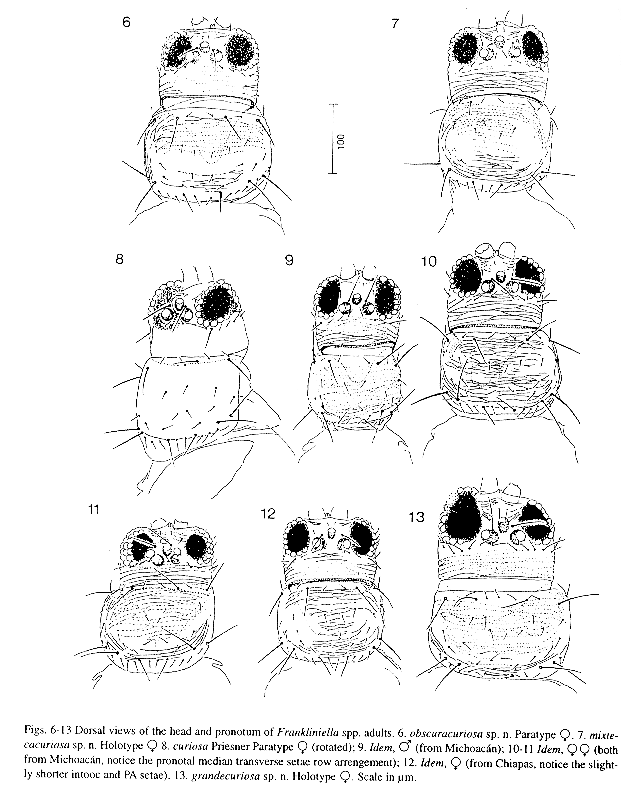
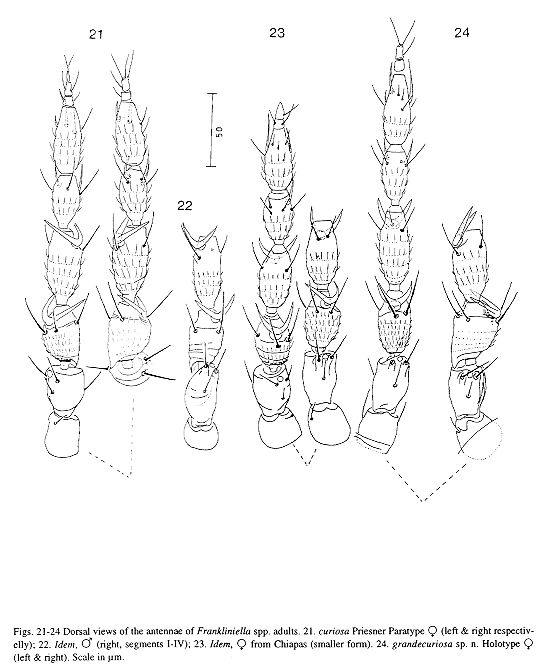
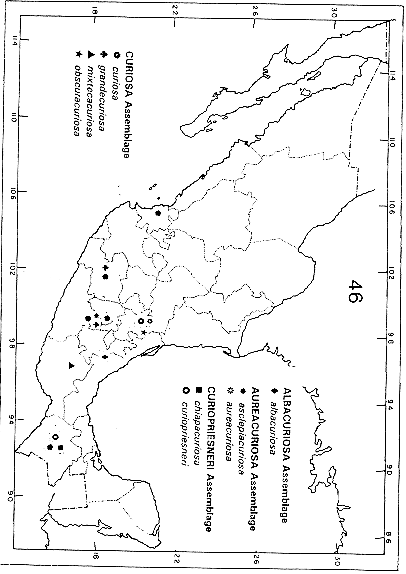
<body><![CDATA[<BR>&nbsp;     <DIV class="MsoNormal" style="tab-stops:-36.0pt"><FONT FACE="Arial,Helvetica"><FONT SIZE=-1>Abbreviations: Head, intocc = interocellar setae (pair III); postoc = postocular setae i-iii, IV. Pronotum, A A = Major anteroangular setae; A M = Major anteromarginal setae; P A = Major posteroangular setae; a a = minor anteroangular setae; a m = minor anteromarginal setae; p m = minor posteromarginal setae. Abdomen, IX i, IX ii, IX iii = Tergite IX major caudal setae; X = Tergite X major subposteromarginal setae.</FONT></FONT></DIV>      <CENTER></CENTER>      <CENTER><FONT FACE="Arial,Helvetica"><FONT SIZE=-1>The <I>Frankliniella curiosa</I> Priesner species</FONT></FONT></CENTER>      <CENTER><FONT FACE="Arial,Helvetica"><FONT SIZE=-1>group.</FONT></FONT></CENTER>       <P class="MsoNormal" style="tab-stops:-36.0pt"><FONT FACE="Arial,Helvetica"><FONT SIZE=-1><B>Diagnosis</B>: Very small species (adult females: 0.945-1.3; males: 0.675-0.945 mm in length). Body color predominantly yellow, with yellow, to orange subhypodermal pigment; antennal segment I clear: whitish to yellowish. Ocellar crescents orange to red. Head broader than long. Antennae with segment II produced or not, in apical dorsal aspect. Segment III globose to moniliform, with simple pedicel: cylindrical to slightly fungiform; always with a characteristic ventral process (like a curved beak) posteriorly directed and surpassing the pedicel (this is the main differentiating character of the species in this group). Chaetotaxy as follows: anteocellars of pair I shorter, but also longer (rarely) than ocelli; lateral anteocellars of pair II longer than those of pair I; interocellars (pair III) shorter to longer (1.0-3.0 times) than one ocellar diameter, between fore and hind ocelli; five pairs of postoculars, i-iii shorter and thinner than IV (principal), which are stouter. Pronotum sculptured with fine, transverse and confluent striae; chaetotaxy as follows: major anteroangulars and anteromarginals not longer than posteroangulars; pronotal center with or without a median transverse setae row; subposteromarginals and posteromarginals (pair ii larger) present. Tergite VIII always with a complete posteromarginal comb of microtrichia. Males with an ellipsoidal to oblong transverse glandular area, in each of sternites II-VII.</FONT></FONT>      <P class="MsoNormal" style="tab-stops:-36.0pt"><FONT FACE="Arial,Helvetica"><FONT SIZE=-1><B>Recognition of species in the group:&nbsp;&nbsp;</B> The present study was based on a total of 62 specimens, distributed in nine species as follows: 1. <I>Frankliniella curiosa&nbsp; </I><A HREF="#Priesner">Priesner</A> 34 (54.8 %); 2.<I>&nbsp; F</I>. <I>curiopriesneri</I> sp. n. 6 (9.6 %); 3.<I>F. obscuracuriosa</I>p. n. 4 (6.4 %); 4. <I>F. asclepiacuriosa&nbsp; </I>sp. n., <I>F. grandecuriosa</I> sp. n.,<I> F.</I> <I>aureacuriosa</I> sp. n.; <I>F. chiapacuriosa</I> sp. n., each with two specimens (3.2 % in each case); 5. <I>F. mixtecacuriosa</I> sp. n. and<I> F.</I> <I>albacuriosa</I> sp. n., each with the Holotype only (1.6 % in each case)</FONT></FONT>     <BR>&nbsp;     <DIV class="MsoNormal" style="tab-stops:-36.0pt"><FONT FACE="Arial,Helvetica"><FONT SIZE=-1>There were two important collecting periods: 1924 (Type series), and after the long gap of 49 years, the collections were started again: 1973-74, 1978-79, 1980-81, 1984, 1987-88, and 1991. The best represented species in the group is <I>Frankliniella curiosa</I> <A HREF="#Priesner">Priesner</A>, because of the number of specimens (34), host plants, geographic distribution (<A HREF="#Fig 46">Fig. 46</A>), but also in its intraspecific variations, which were evaluated from populations fron Chiapas, Hidalgo and Michoac&aacute;n against the only Paratype examined (<A HREF="#Fig. 6-13">Figs. 8-12</A>, <A HREF="#FIG. 21-24">21-23</A>). The major variations are: body size (<A HREF="#Fig. 6-13">Figs. 8-12</A>), antennal segments proportions: length vs. width (Figs. <A HREF="#FIG. 21-24">21-23</A>), interocellar setae (pair III) length. Pronotal chaetotaxy is also varied (Figs. <A HREF="#Fig. 6-13">8-12</A>): the median transverse row commonly has three setae in a slightly curved line (Figs. <A HREF="#Fig. 6-13">8, 10, 12</A>), rarely four or, three forming a triangle (<A HREF="#Fig. 6-13">Fig. 11</A>); the adult males commonly have three setae (as in the females), rarely two (<A HREF="#Fig. 6-13">Fig. 9</A>).</FONT></FONT></DIV>      <DIV class="MsoNormal" style="tab-stops:-36.0pt">&nbsp;     ]]></body>
<body><![CDATA[<BR><FONT FACE="Arial,Helvetica"><FONT SIZE=-1><B>Differential characters for the new species:</B> Body size and proportions vary between adults of the same, or different species. Body color varies from whitish to lemon-yellow, rarely (one species) with a dark brown median spot on each of tergites I-VIII. Antennal segments II-VI are bicolored: grayish brown or, yellow to white. Subhypodermal pigment is lemon-yellow, orange or copperish (specially in thorax and abdominal sides). Ocellar crescents are bright orange to crimsom-red. Body setae vary from dark grayish-brown to white. Fore wings are white to yellowish, or dark brown. The head shape is variable in dorsal outline (considering mounting artifacts), as is the occipital sculpture. The position and size of the anteocellar setae (pair I),the length of interocellars (pair III), and the postocular IV. The antennal segments III-VI vary in their morphology and proportions (length <I>vs</I>. width). The pronotal chaetotaxy, major setae (anteroangulars, anteromarginals and posteroangulars) vary in their length; minor setae: median transverse row: number and arrangement; subposteromarginals: number and arrangement. The mesonotal plate is variable in outline and sculpture. The male sternal glandular area on each of segments II-VII are variable in shape.</FONT></FONT></DIV>      <DIV class="MsoNormal" style="tab-stops:-36.0pt">&nbsp;     <BR><FONT FACE="Arial,Helvetica"><FONT SIZE=-1>In the case of the species with more than one specimen (<I>Frankliniella curiopriesneri</I>, <I>F. obscuracuriosa</I>, <I>F. asclepiacuriosa</I>,<I> F. grandecuriosa</I>, <I>F. aureacuriosa,</I> and <I>F. chiapacuriosa</I>) the above interspecific differential characters were considered in their intraspecific variation patterns as in the case of <I>F. curiosa</I> Priesner. Furthermore, in the cases of <I>Frankliniella mixteca</I> and <I>F. albacuriosa</I> (each with one type specimen), the characters used for their determination as new taxa, are different enough on their own, from the other species. It is true that is better to have a greater series of Type specimens. However, in many revisional works, like those of <A HREF="#Moulton, D. 1948.">Moulton (1948</A>), <A HREF="#Sakimura">Sakimura &amp; O'Neill (1979</A>), such cases are accepted.</FONT></FONT></DIV>      <DIV class="MsoNormal" style="tab-stops:-36.0pt">&nbsp;     <BR><FONT FACE="Arial,Helvetica"><FONT SIZE=-1>The above concepts, were supported by two outstanding examples of very variable <I>Frankliniella</I> species, which due to their intraspecific morphological variation, they form "morphological complexes": a) The <I>F. occidentalis</I> (Pergande) complex, a polymorphic species with four color forms in the adults, which also exhibit variations in body structure measurements, according to <A HREF="#Bryan">Bryan &amp; Smith (1956</A>). b) <I>F. insularis</I> (Franklin), whose adults exhibit variations in the morphology of antenal segment III, and the color of antennae, the chaetotaxy of head, pronotum and terga VIII-IX, as well as color variations in the legs. These examples were considered for the purposes of this study, in the sense of&nbsp; <A HREF="#Mayr">Mayr and Ashlock (1991</A>), as casuistic, but non dogmatic examples, Finally, in the description of the new species, I followed the description&nbsp; models of&nbsp; <A HREF="#Priesner">Priesner (1932)</A>, and the more modern of <A HREF="#Sakimura">Sakimura &amp; O'Neill (1979)</A>.</FONT></FONT></DIV>      <DIV class="MsoNormal" style="tab-stops:-36.0pt"><FONT FACE="Arial,Helvetica"><FONT SIZE=-1><B>Relations with other groups:</B> The remarkable and exclusive morphology of antennal segment III, with a ventral posteriorly directed process, is the diagnostic character that allows the specific group definition, and the gap between this group and the others in genus <I>Frankliniella</I>. In this sense, the <I>Frankliniella curiosa</I> <A HREF="#Priesner">Priesner</A> species group could be considered monophyletic.</FONT></FONT></DIV>      <DIV class="MsoNormal" style="tab-stops:-36.0pt"><FONT FACE="Arial,Helvetica"><FONT SIZE=-1>species in <I>F. exigua</I> Hood and also in the <I>F. ipomoeae</I> Moulton assemblages, both in the "<I>F. intonsa</I> Group". Other shared characters are: body color mainly clear yellow, sometimes with red ocellar crescents; antennal segment III not long and globose (in the <I>F. exigua</I> assemblage), but commonly humped dorsally (in the <I>F. ipomoeae</I> assemblage); the pedicel is simple: cylindric or slightly fungiform; this character brings into a closer affinity the Curiosa Group and both mentioned specific assemblages in the Intonsa Group, in spite of <A HREF="#Priesner">Priesner's (1932</A>) decision of including it in the "<I>F. cephalica</I> Group", because of the enlarged and produced dorsal aspect of apex in antennal segment II.</FONT></FONT></DIV>      <CENTER><FONT FACE="Arial,Helvetica"><FONT SIZE=-1>Key to the <I>Frankliniella</I> species groups</FONT></FONT></CENTER>       <P>&nbsp;     <DIV class="MsoNormal" style="tab-stops:right dotted 468.0pt"><FONT FACE="Arial,Helvetica"><FONT SIZE=-1>1. Pedicel of antennal segment III simple to fungiform.............................................................................2</FONT></FONT></DIV>      ]]></body>
<body><![CDATA[<DIV class="MsoNormal" style="tab-stops:right dotted 468.0pt"><FONT FACE="Arial,Helvetica"><FONT SIZE=-1>-&nbsp;&nbsp; Pedicel of antennal segment III greatly swollen and angulose (like a saucer pan) ................................&nbsp;&nbsp;&nbsp;&nbsp;&nbsp; Cephalica group.</FONT></FONT></DIV>      <DIV class="MsoNormal" style="tab-stops:right dotted 468.0pt"><FONT FACE="Arial,Helvetica"><FONT SIZE=-1>2.. Antennal segment III with a ventral curved process (like a beak) posteriorly directed and&nbsp; covering</FONT></FONT></DIV>      <DIV class="MsoNormal" style="tab-stops:right dotted 468.0pt"><FONT FACE="Arial,Helvetica"><FONT SIZE=-1>the pedicel.....................................................................................................................Curiosa group</FONT></FONT></DIV>      <DIV class="MsoNormal" style="tab-stops:right dotted 468.0pt"><FONT FACE="Arial,Helvetica"><FONT SIZE=-1>Antennal segment III with simple ventral aspect.........................................................Minuta and Intonsa groups.</FONT></FONT></DIV>      <DIV class="MsoNormal" style="tab-stops:-36.0pt"><FONT FACE="Arial,Helvetica"><FONT SIZE=-1>Taxonomic list (with species assemblages)</FONT></FONT></DIV>      <DIV class="MsoNormal" style="tab-stops:-36.0pt"><FONT FACE="Arial,Helvetica"><FONT SIZE=-1>I. Albacuriosa assemblage</FONT></FONT></DIV>      <DIV class="MsoNormal" style="tab-stops:-36.0pt"><FONT FACE="Arial,Helvetica"><FONT SIZE=-1>01. <I>albacuriosa</I> sp. n.</FONT></FONT></DIV>      <DIV class="MsoNormal" style="tab-stops:-36.0pt"><FONT FACE="Arial,Helvetica"><FONT SIZE=-1>II. Aureacuriosa assemblage</FONT></FONT></DIV>      <DIV class="MsoNormal" style="tab-stops:-36.0pt"><FONT FACE="Arial,Helvetica"><FONT SIZE=-1>02. <I>asclepiacuriosa</I> sp. n.</FONT></FONT></DIV>      <DIV class="MsoNormal" style="tab-stops:-36.0pt"><FONT FACE="Arial,Helvetica"><FONT SIZE=-1>03. <I>aureacuriosa</I> sp. n.</FONT></FONT></DIV>      ]]></body>
<body><![CDATA[<DIV class="MsoNormal" style="tab-stops:-36.0pt"><FONT FACE="Arial,Helvetica"><FONT SIZE=-1>III. Curiopriesneri assemblage</FONT></FONT></DIV>      <DIV class="MsoNormal" style="tab-stops:-36.0pt"><FONT FACE="Arial,Helvetica"><FONT SIZE=-1>04. <I>chiapacuriosa</I> sp. n.</FONT></FONT></DIV>      <DIV class="MsoNormal" style="tab-stops:-36.0pt"><FONT FACE="Arial,Helvetica"><FONT SIZE=-1>05. <I>curiopriesneri</I> sp. n.</FONT></FONT></DIV>      <DIV class="MsoNormal" style="tab-stops:-36.0pt"><FONT FACE="Arial,Helvetica"><FONT SIZE=-1>IV. Curiosa assemblage</FONT></FONT></DIV>      <DIV class="MsoNormal" style="tab-stops:-36.0pt"><FONT FACE="Arial,Helvetica"><FONT SIZE=-1>06. <I>curiosa</I> Priesner</FONT></FONT></DIV>      <DIV class="MsoNormal" style="tab-stops:-36.0pt"><FONT FACE="Arial,Helvetica"><FONT SIZE=-1>07. <I>grandecuriosa</I> sp. n.</FONT></FONT></DIV>      <DIV class="MsoNormal" style="tab-stops:-36.0pt"><FONT FACE="Arial,Helvetica"><FONT SIZE=-1>08. <I>mixtecacuriosa</I> sp. n.</FONT></FONT></DIV>      <DIV class="MsoNormal" style="tab-stops:-36.0pt"><FONT FACE="Arial,Helvetica"><FONT SIZE=-1>09. <I>obscuracuriosa</I> sp. n</FONT></FONT></DIV>      <CENTER><FONT FACE="Arial,Helvetica"><FONT SIZE=-1>key to the species in the<I> Frankliniella curiosa</I> group</FONT></FONT></CENTER>      <CENTER><FONT FACE="Arial,Helvetica"><FONT SIZE=-1>&nbsp;</FONT></FONT></CENTER>      ]]></body>
<body><![CDATA[<DIV class="MsoNormal" style="tab-stops:right dotted 468.0pt"><FONT FACE="Arial,Helvetica"><FONT SIZE=-1>Pronotum with one to several setae forming a median transverse row&nbsp; ..........2</FONT></FONT></DIV>      <DIV class="MsoNormal" style="tab-stops:right dotted 468.0pt"><FONT FACE="Arial,Helvetica"><FONT SIZE=-1>-Pronotum without any setae at center..................................<I>F. albacuriosa</I> sp. n</FONT></FONT></DIV>      <DIV class="MsoNormal" style="tab-stops:right dotted 468.0pt"><FONT FACE="Arial,Helvetica"><FONT SIZE=-1>2.Pronotum with only one median seta at center..................................................3</FONT></FONT></DIV>      <DIV class="MsoNormal" style="tab-stops:right dotted 468.0pt"><FONT FACE="Arial,Helvetica"><FONT SIZE=-1>-Pronotum with a median transverse row of two to seven setae.........................4</FONT></FONT></DIV>      <DIV class="MsoNormal" style="tab-stops:right dotted 468.0pt"><FONT FACE="Arial,Helvetica"><FONT SIZE=-1>3.Anteocellar setae of pairs I-II forming a straight transverse line.........<I>F. aureacuriosa</I> sp. n.</FONT></FONT></DIV>      <DIV class="MsoNormal" style="tab-stops:right dotted 468.0pt"><FONT FACE="Arial,Helvetica"><FONT SIZE=-1>-Anteocellar setae of pair I advanced with respect to pair II..............<I>F. asclepiacuriosa</I> sp. n.</FONT></FONT></DIV>      <DIV class="MsoNormal" style="tab-stops:right dotted 468.0pt"><FONT FACE="Arial,Helvetica"><FONT SIZE=-1>4.Pronotum with two pairs of subposteromarginal setae, the median pair advanced......5</FONT></FONT></DIV>      <DIV class="MsoNormal" style="tab-stops:right dotted 468.0pt"><FONT FACE="Arial,Helvetica"><FONT SIZE=-1>-Pronotum with only the median pair of subposteromarginal setae...................................8</FONT></FONT></DIV>      <DIV class="MsoNormal" style="tab-stops:right dotted 468.0pt"><FONT FACE="Arial,Helvetica"><FONT SIZE=-1>5.Fore wings white to yellowish; terga I-VIII each completly clear yellow....................6</FONT></FONT>     <BR><FONT FACE="Arial,Helvetica"><FONT SIZE=-1>-Fore wings dark brown; terga I-VIII each with a dark brown median spot . (Pronotal mediantransverse row with five setae. Antennal segment IV almost subequal in length to VI)................................<I>F. obscuracuriosa</I> sp. n.</FONT></FONT></DIV>      ]]></body>
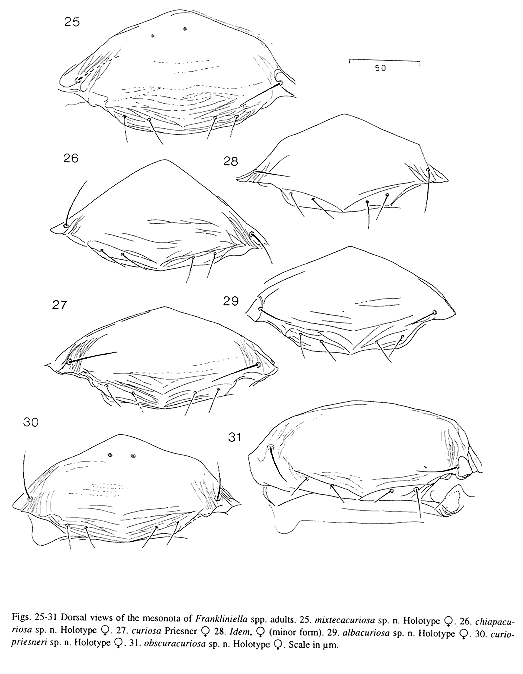
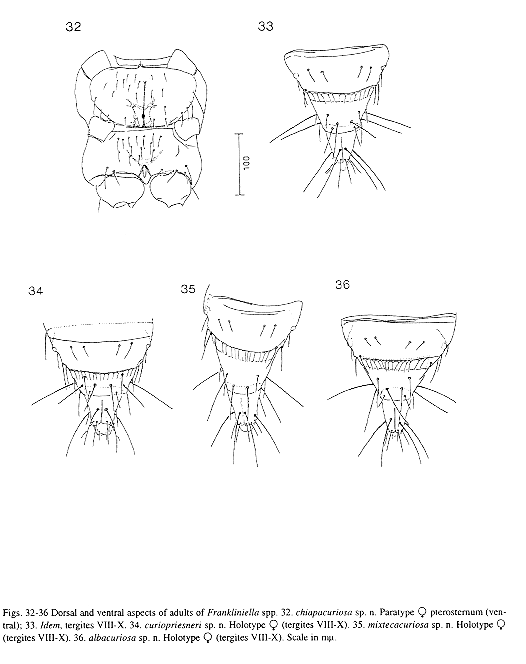
<body><![CDATA[<DIV class="MsoNormal" style="tab-stops:right dotted 468.0pt"><FONT FACE="Arial,Helvetica"><FONT SIZE=-1>6.Anteocellar setae (pair I) shorter than ocelli...............................................7</FONT></FONT></DIV>      <DIV class="MsoNormal" style="tab-stops:right dotted 468.0pt"><FONT FACE="Arial,Helvetica"><FONT SIZE=-1>Anteocellar setae (pair I) much longer than ocelli. (Pronotal median transverse row with five to seven setae; five to six subposteromarginal setae)...........................................<I>F. grandecuriosa</I> sp. n.</FONT></FONT></DIV>      <DIV class="MsoNormal" style="tab-stops:right dotted 468.0pt"><FONT FACE="Arial,Helvetica"><FONT SIZE=-1>7.Interocellar setae (pair III) longer (3.0-3.5 times of an ocellar diameter) than postocular IV. Pronotal median transverse row forming a straight to slightly curved or a triangle of two to&nbsp; four close together setae; subposteromarginal and lateral setae as long as minor&nbsp; anteromarginal.....................<I>F. curiosa</I> Priesner</FONT></FONT></DIV>      <DIV class="MsoNormal" style="tab-stops:right dotted 468.0pt"><FONT FACE="Arial,Helvetica"><FONT SIZE=-1>-.Interocellar setae (pair III) very reduced (1.0 times of an ocellar diameter). Pronotal median&nbsp; transverse row forming a zig-zag of four setae; subposteromarginal and lateral setae very minute (shorter than other minor pronotal setae)....................................<I>F. mixtecacuriosa</I> sp. n.</FONT></FONT></DIV>      <DIV class="MsoNormal" style="tab-stops:right dotted 468.0pt"><FONT FACE="Arial,Helvetica"><FONT SIZE=-1>8.Interocellar setae (pair III) short (1.0-1.5 times of an ocellar diameter). Pronotal median transverse row with three close together setae; major anteroangular and anteromarginal setae subequal to posteromarginal ii........<I>F. chiapacuriosa</I> sp. n.</FONT></FONT></DIV>      <DIV class="MsoNormal" style="tab-stops:right dotted 468.0pt"><FONT FACE="Arial,Helvetica"><FONT SIZE=-1>-Interocellar setae (pair III) long (3.0-3.5 times of an ocellar diameter). Pronotal median&nbsp; transverse row with two very spaced setae; major anteromarginal setae shorter than&nbsp; posteromarginal ii.............<I>F. curiopriesneri</I> sp. n.</FONT></FONT></DIV>      <DIV class="MsoNormal" style="tab-stops:-36.0pt"><FONT FACE="Arial,Helvetica"><FONT SIZE=-1>The Albacuriosa species assemblage. Adults of the species in this assemblage do not have setae at the center of the pronotum.</FONT></FONT></DIV>      <DIV class="MsoNormal" style="tab-stops:-36.0pt"><I><FONT FACE="Arial,Helvetica"><FONT SIZE=-1></FONT></FONT></I>&nbsp;<I><FONT FACE="Arial,Helvetica"><FONT SIZE=-1></FONT></FONT></I>      <P><FONT FACE="Arial,Helvetica"><FONT SIZE=-1><I>Frankliniella albacuriosa</I> sp. n.</FONT></FONT>     <BR><FONT FACE="Arial,Helvetica"><FONT SIZE=-1>(<A HREF="#Fig. 1-5">Figs. 1</A>, <A HREF="#FIG. 14-16">14,</A><A HREF="#Fig.  25-31">29</A>, <A HREF="#Fig. 32-36">36</A>, <A HREF="#Fig 46">46</A>)</FONT></FONT>     ]]></body>
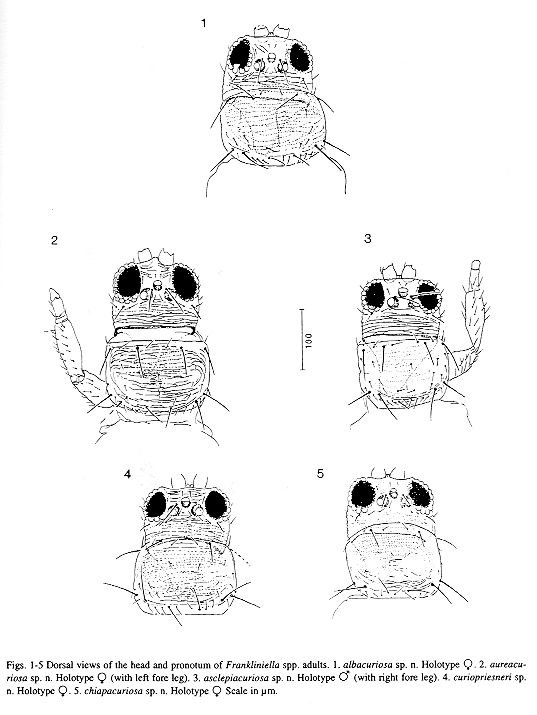
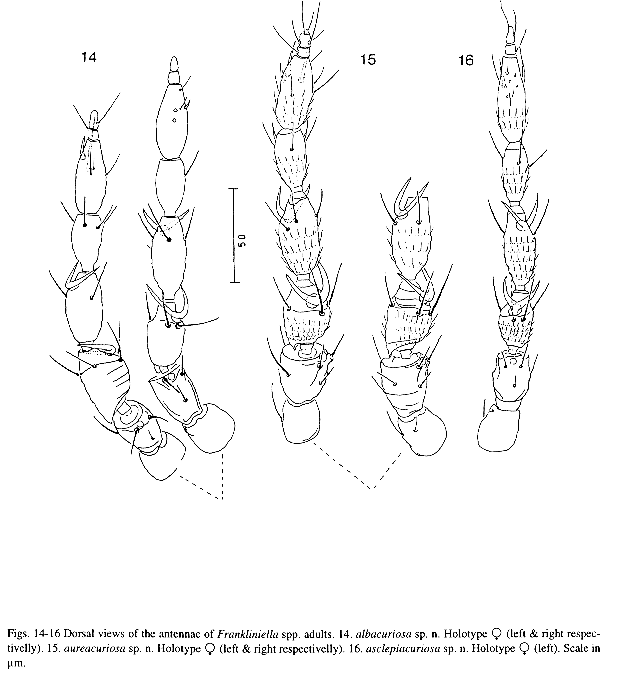
<body><![CDATA[<BR><FONT FACE="Arial,Helvetica"><FONT SIZE=-1><I>Frankliniella</I> sp. 7 (ca, <I>curiosa</I>) <A HREF="#Johansen">Johansen &amp; Mojica, 1996</A>: 265.</FONT></FONT></DIV>      <DIV class="MsoNormal" style="tab-stops:-36.0pt"><FONT FACE="Arial,Helvetica"><FONT SIZE=-1>Female. Color. Body whitish-yellow, with yellow subhypodermal pigment in thorax. Antennal segments: I-II white; III white, with a brown intermediate ring; IV yellowish-brown, white in both extremes; V white; VI brown, whitish in extreme base; VII-VIII brown. Legs white. Fore and hind wings white. Body setae white. Ocellar crescents orange to crimson red.</FONT></FONT></DIV>      <DIV class="MsoNormal" style="tab-stops:-36.0pt"><FONT FACE="Arial,Helvetica"><FONT SIZE=-1>Morphology. Head in dorsal aspect (<A HREF="#Fig. 1-5">Fig. 1</A>), broader (1.28 times) than long at middle; cheeks slightly convex; vertex with straight fore margin. Chaetotaxy as follows: interocellars (pair III) longer (2.0 times) than postocular IV. Antennal segments (<A HREF="#FIG. 14-16">Fig. 14</A>): II subcylindric, with apex not produced dorsally; III longer and stronger than VI, with simple cylindrical pedicel. Mouth-cone projected on anterior three fourths of prosternum. Pronotum broader (1.5 times) than long, and wider (1.2 times) than head; chaetotaxy as follows: no median setae row at center; two subposteromarginals. Mesonotum (<A HREF="#Fig.  25-31">Fig. 29</A>) pentagonal, nearly triangular, with almost smooth surface. Tergite X longer than broad (<A HREF="#Fig. 32-36">Fig. 36</A>).</FONT></FONT></DIV>      <DIV class="MsoNormal" style="tab-stops:-36.0pt"><FONT FACE="Arial,Helvetica"><FONT SIZE=-1>Measurements (Holotype&nbsp;<IMG SRC="/img/fbpe/rbt/v46n3/simbi05.GIF" HEIGHT=27 WIDTH=20>_ in&nbsp;<IMG SRC="/img/fbpe/rbt/v46n3/simbi16.GIF" HEIGHT=13 WIDTH=15>m). Body length: 1.12 mm.</FONT></FONT></DIV>       
<P class="MsoNormal" style="tab-stops:-36.0pt"><FONT FACE="Arial,Helvetica"><FONT SIZE=-1>Head. Dorsal length: 100, width, at eyes: 122, behind eyes: 120, middle: 128, basal: 120. Chaetotaxy, intocc: 30, postoc: i 14, IV 22. Compound eyes, length: 50, width: 30; ocelli, fore: 12, hind: 12. Antennal segments, length (width): I 26 (20), II 30 (18), III 38 (18), IV 40 (18), V 30 (16), VI 34 (16), VII 6 (6), VIII 8 (4). Thorax. Pronotum length: 104, width at middle: 156; chaetotaxy, major setae: AA 48, AM 30; PA, outer: 40, inner: 42; minor setae: aa 12, am 12, pm i: 12, ii: 24, iii: 12. Mesothorax width: 206; metathorax width: 200. Fore wings, basal width: 56, middle: 46; veins chaetotaxy, fore: 22, hind: 18. Abdomen, width at segment IV: 160. Tergite IX setae, IX i: 70, IX ii: 64. Tergite X setae, X i: 70, X ii: 64.</FONT></FONT>      <P class="MsoNormal" style="tab-stops:-36.0pt"><FONT FACE="Arial,Helvetica"><FONT SIZE=-1>Material examined. Holotype&nbsp;<IMG SRC="/img/fbpe/rbt/v46n3/simbi05.GIF" HEIGHT=27 WIDTH=20>_. M&eacute;xico: Puebla-Veracruz interstate border line (Sierra Madre Oriental-Volcanic Range), 2 km E of Esperanza, Pue., 2700 m.; 26.V.1974; in flowers of <I>Senecio salignus</I>, within <I>Pinus</I> Forest, R.M. Johansen (IBUNAM).</FONT></FONT>      
<P class="MsoNormal" style="tab-stops:-36.0pt"><FONT FACE="Arial,Helvetica"><FONT SIZE=-1>Comments. <I>Frankliniella albacuriosa</I> sp. n., differs from the other species in, the group by the lack of a pronotal median transverse seta row; the body, antennal and setae color. Etymology: from latin, alba = white; <I>curiosa</I> a related species.</FONT></FONT>     <BR>&nbsp;      <P class="MsoNormal" style="tab-stops:-36.0pt"><FONT FACE="Arial,Helvetica"><FONT SIZE=-1>The Aureacuriosa species assemblege. Adults in this assemblage, bear only one seta at the center of the pronotum. The assemblage includes two species: <I>asclepiacuriosa</I> and <I>aureacuriosa</I>.</FONT></FONT>     <BR>&nbsp;      ]]></body>
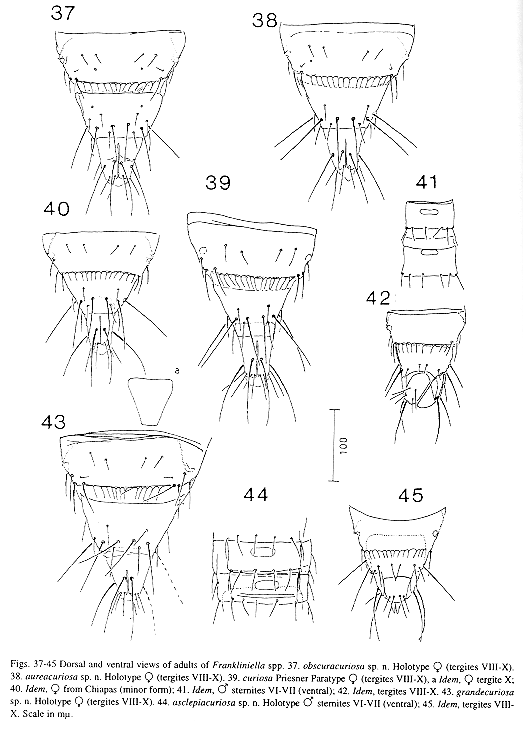
<body><![CDATA[<P class="MsoNormal" style="tab-stops:-36.0pt"><I><FONT FACE="Arial,Helvetica"><FONT SIZE=-1>Frankliniella asclepiacuriosa</FONT></FONT></I><FONT FACE="Arial,Helvetica"><FONT SIZE=-1> sp. n.</FONT></FONT>     <DIV class="MsoNormal" style="tab-stops:-36.0pt"><FONT FACE="Arial,Helvetica"><FONT SIZE=-1>(<A HREF="#Fig. 1-5">Figs. 3</A>, <A HREF="#FIG. 14-16">16</A>, <A HREF="#Fig. 37-45">44-</A><A HREF="#Fig 46">46</A>)</FONT></FONT></DIV>      <DIV class="MsoNormal" style="tab-stops:-36.0pt"><FONT FACE="Arial,Helvetica"><FONT SIZE=-1>white; III brown; IV-V white, dark brown in apical one third, one half and extreme base respectivelly; VI-VIII dark brown. Fore and hind wings whitish. Body setae brown. Ocellar crescents orange.</FONT></FONT></DIV>      <DIV class="MsoNormal" style="tab-stops:-36.0pt"><FONT FACE="Arial,Helvetica"><FONT SIZE=-1>Morphology. Head in dorsal aspect (<A HREF="#Fig. 1-5">Fig. 3</A>), broader (1.45 times) than long at middle; vertex with almost straight fore margin. Chaetotaxy as follows: interocellars (pair III) very long (3.0 times of an ocellar diameter). Antennal segments (<A HREF="#FIG. 14-16">Fig. 16</A>): II globose; III almost moniliform, with slightly fungiform pedicel, and much shorter than IV and VII. Mouth-cone nearly reaching the posterior margin of prosternum. Pronotum broader (1.38 times) than long. Abdomen; sternal glandular areas elliptical (<A HREF="#Fig. 37-45">Fig. 44)</A>; tergites VIII-X typical (<A HREF="#Fig. 37-45">Fig. 45</A>).</FONT></FONT></DIV>      <DIV class="MsoNormal" style="tab-stops:-36.0pt"><FONT FACE="Arial,Helvetica"><FONT SIZE=-1>Measurements (Holotype&nbsp;<IMG SRC="/img/fbpe/rbt/v46n3/simbi06.GIF" HEIGHT=21 WIDTH=23>_ in&nbsp;<IMG SRC="/img/fbpe/rbt/v46n3/simbi16.GIF" HEIGHT=13 WIDTH=15 ALIGN=TEXTTOP>m). Body length: 0.882 mm.</FONT></FONT></DIV>      
<DIV class="MsoNormal" style="tab-stops:-36.0pt"><FONT FACE="Arial,Helvetica"><FONT SIZE=-1>Head. Dorsal length: 80, width, at eyes: 116, behind eyes: 112 middle: 116, basal: 112. Chaetotaxy, intocc: 30. Compound eyes, width: 36. Thorax. Pronotum length: 94, width at middle: 130; chaetotaxy, major setae: AA 40, AM 32: PA, outer: 40, inner: 44; minor setae: aa 12, am 12, pm i: 14, ii: 22, iii: 10. Mesothorax width: 170; metathorax width: 190; fore wings, basal width: 60, at middle: 40; veins chaetotaxy, fore: 4 + 18, hind: 16. Abdomen; tergite IX setae, IX i: 24.</FONT></FONT></DIV>      <DIV class="MsoNormal" style="tab-stops:-36.0pt"><FONT FACE="Arial,Helvetica"><FONT SIZE=-1>Material examined. Holotype<IMG SRC="/img/fbpe/rbt/v46n3/simbi06.GIF" HEIGHT=21 WIDTH=23>, Paratype&nbsp;<IMG SRC="/img/fbpe/rbt/v46n3/simbi06.GIF" HEIGHT=21 WIDTH=23>. M&eacute;xico: Morelos, Cuernavaca, Chamilpa (Volcanic Range), 1850 m.; III.1982 (Holotype); 6.V.1988 (Paratype&nbsp;<IMG SRC="/img/fbpe/rbt/v46n3/simbi06.GIF" HEIGHT=21 WIDTH=23>); in flowers of <I>Asclepias glaucescens</I>, A. Trejo (IBUNAM).</FONT></FONT></DIV>      
<DIV class="MsoNormal" style="tab-stops:-36.0pt"><FONT FACE="Arial,Helvetica"><FONT SIZE=-1>Comments. The adults of <I>Frankliniella asclepiacuriosa</I> sp. n., are different from those of <I>F. aureacuriosa</I> (in the same assemblage) in the following characters: antennal segment II is white (brown in <I>aureacuriosa</I>). The anteocellar setae (pair I) are advanced (in <I>aureacuriosa</I> they form a straight and transverse line with those of pair II). The minor pronotal posteromarginal ii are shorter (longer in <I>aureacuriosa</I>). Etymology: <I>Asclepias</I> = the name of the host plant; <I>curiosa</I> = a related species.</FONT></FONT></DIV>      <DIV class="MsoNormal" style="tab-stops:-36.0pt"><I><FONT FACE="Arial,Helvetica"><FONT SIZE=-1></FONT></FONT></I></DIV>&nbsp;      <DIV class="MsoNormal" style="tab-stops:-36.0pt"><I><FONT FACE="Arial,Helvetica"><FONT SIZE=-1></FONT></FONT></I></DIV>       ]]></body>
<body><![CDATA[<P class="MsoNormal" style="tab-stops:-36.0pt"><FONT FACE="Arial,Helvetica"><FONT SIZE=-1><I>Frankliniella aureacuriosa </I>sp. n.</FONT></FONT>     <DIV class="MsoNormal" style="tab-stops:-36.0pt"><FONT FACE="Arial,Helvetica"><FONT SIZE=-1>(<A HREF="#Fig. 1-5">Figs. 2</A>, <A HREF="#FIG. 14-16">15</A>, <A HREF="#Fig. 37-45">38</A>, <A HREF="#Fig 46">46</A>)</FONT></FONT></DIV>      <DIV class="MsoNormal" style="tab-stops:-36.0pt"><FONT FACE="Arial,Helvetica"><FONT SIZE=-1><I>Frankliniella</I> sp. 3 (ca.<I> curiosa</I>) <A HREF="#Johansen">Johansen &amp; Mojica, 1996</A>: 265.</FONT></FONT></DIV>      <DIV class="MsoNormal" style="tab-stops:-36.0pt"><FONT FACE="Arial,Helvetica"><FONT SIZE=-1>Female. Color. Body clear lemon-yellow, with abundant yellow subhypodermal pigment (more abundant in thorax and abdominal sides); tip of segment X, with orange subhypodermal pigment. Antennal segments: I whitish-yellow; II light brown, with yellow subhypodermal pigment in apex; III dark brown, with yellowish basal one fourth; IV brown, yellow in basal one third; V yellowish brown, darker in pedicel and apical one fifth; VI-VIII dark brown.</FONT></FONT></DIV>      <DIV class="MsoNormal" style="tab-stops:-36.0pt"><FONT FACE="Arial,Helvetica"><FONT SIZE=-1>Legs light yellow. Fore wings whitish-yellow; hind wings white. Body setae brown. Ocellar crescents orange.</FONT></FONT></DIV>      <DIV class="MsoNormal" style="tab-stops:-36.0pt"><FONT FACE="Arial,Helvetica"><FONT SIZE=-1>Morphology. Head in dorsal aspect (<A HREF="#Fig. 1-5">Fig. 2</A>), with convex cheeks; broader (1.36 times) than long at middle. Vertex with undulate fore margin. Chaetotaxy as follows: anteocellars (pairs I-II) forming a horizontal transverse line; interocellars (pair III) long (three times of an ocellar diameter). Antennal segments (<A HREF="#FIG. 14-16">Fig. 15</A>): II conical, with stout dorsal apical setae, but not produced; III globose-elongate, with slightly fungiform pedicel, shorter than IV and VI, and as broad as II. Mouth-cone projected on anterior one half of prosternum. Pronotum, broader (1.43 times) than long; chaetotaxy as follows: two subposteromarginals. Tergite X broader than long <A HREF="#Fig. 37-45">(Fig. 38</A>).</FONT></FONT></DIV>      <DIV class="MsoNormal" style="tab-stops:-36.0pt"><FONT FACE="Arial,Helvetica"><FONT SIZE=-1>Measurements (Holotype&nbsp;<IMG SRC="/img/fbpe/rbt/v46n3/simbi05.GIF" HEIGHT=27 WIDTH=20>_ in&nbsp;<IMG SRC="/img/fbpe/rbt/v46n3/simbi16.GIF" HEIGHT=13 WIDTH=15>m). Body length: 1.12 mm.</FONT></FONT></DIV>      
<DIV class="MsoNormal" style="tab-stops:-36.0pt"><FONT FACE="Arial,Helvetica"><FONT SIZE=-1>Head. Dorsal length: 92, width, at eyes: 120, behind eyes: 116, middle: 126, basal: 116. Chaetotaxy, intocc: 36, postoc: i-iii 8, IV 23. Compound eyes, length: 56, with: 40; ocelli, fore: 13, hind: 14. Antennal segments, length (width): I 27 (22), II 32 (23), III 36 (23), IV 45 (20), V 32 (16), VI 41 (16), VII 6 (6), VIII 9 (5). Thorax. Pronotum length: 100, width at middle: 154; chaetotaxy, major setae: AA 40, AM 40; PA, outer: 42, inner: 52; minor setae: aa 18, am 18, pm i: 16, ii: 36, iii: 14. Mesothorax width: 200; metathorax width: 190. Fore wings, basal width: 60, at middle: 46; veins chaetotaxy, fore: 22-23, hind: 14-16. Abdomen; width at segment IV: 220. Tergite IX setae, IX i: 64, IX ii: 72, IX iii: 70. Tergite X setae, X i: 76, X ii: 64.</FONT></FONT></DIV>      <DIV class="MsoNormal" style="tab-stops:-36.0pt"><FONT FACE="Arial,Helvetica"><FONT SIZE=-1>Material examined. Holotype&nbsp;<IMG SRC="/img/fbpe/rbt/v46n3/simbi05.GIF" HEIGHT=27 WIDTH=20>; paratypes: 2<IMG SRC="/img/fbpe/rbt/v46n3/simbi05.GIF" HEIGHT=27 WIDTH=20><IMG SRC="/img/fbpe/rbt/v46n3/simbi05.GIF" HEIGHT=27 WIDTH=20>.M&eacute;xico: Hidalgo, Sierra de Zacualtip&aacute;n (Sierra Madre Oriental), on road Highway M&eacute;x-105, km 190 near Tehuetl&aacute;n, 1800 m.; 7.XI.1981.&nbsp; (Holotype&nbsp;<IMG SRC="/img/fbpe/rbt/v46n3/simbi05.GIF" HEIGHT=27 WIDTH=20>, Pararyte&nbsp;<IMG SRC="/img/fbpe/rbt/v46n3/simbi05.GIF" HEIGHT=27 WIDTH=20>) in flowers of<I> Verbesina turbacensis</I> R.M. <A HREF="#Johansen">Johansen</A>. <I>Idem </I>, on road, 18 km W of Calnalli, 1500 m.; 28.III.1981; (Paratype&nbsp;<IMG SRC="/img/fbpe/rbt/v46n3/simbi05.GIF" HEIGHT=27 WIDTH=20>) in flowers of an unknown herb, R.M. Johansen (IBUNAM).</FONT></FONT></DIV>      
<DIV class="MsoNormal" style="tab-stops:-36.0pt"><FONT FACE="Arial,Helvetica"><FONT SIZE=-1>Comments. See comments in <I>Frankliniella asclepiacuriosa</I>. Etymology:</FONT></FONT></DIV>      ]]></body>
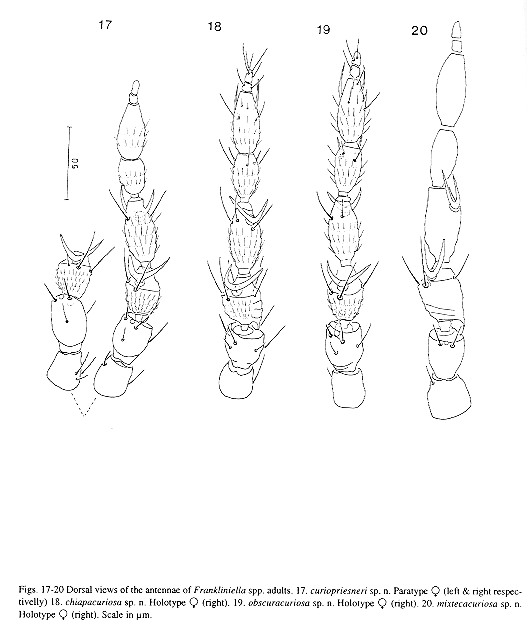
<body><![CDATA[<DIV class="MsoNormal" style="tab-stops:-36.0pt"><FONT FACE="Arial,Helvetica"><FONT SIZE=-1>From latin, aurea = golden; <I>curiosa</I> = a related species</FONT></FONT></DIV>      <DIV class="MsoNormal" style="tab-stops:-36.0pt">&nbsp;</DIV>      <DIV class="MsoNormal" style="tab-stops:-36.0pt"><FONT FACE="Arial,Helvetica"><FONT SIZE=-1>The Curiopriesneri species assemblage. Adults of the species in this assemblage bear a median transverse setae row, and only one pair of subposteromarginal setae. There are two species included: <I>chiapacuriosa</I> and <I>curiopriesneri</I>.</FONT></FONT></DIV>      <DIV class="MsoNormal" style="tab-stops:-36.0pt"><FONT FACE="Arial,Helvetica"><FONT SIZE=-1><I>Frankliniella chiapacuriosa </I>sp. n</FONT></FONT></DIV>      <DIV class="MsoNormal" style="tab-stops:-36.0pt"><FONT FACE="Arial,Helvetica"><FONT SIZE=-1>(<A HREF="#Fig. 1-5">Figs. 5</A>, <A HREF="#Fig. 17-20">18</A>, <A HREF="#Fig.  25-31">26</A>, <A HREF="#Fig. 32-36">32-33</A>, <A HREF="#Fig 46">46</A>)</FONT></FONT></DIV>      <DIV class="MsoNormal" style="tab-stops:-36.0pt"><I><FONT FACE="Arial,Helvetica"><FONT SIZE=-1></FONT></FONT></I>&nbsp;<I><FONT FACE="Arial,Helvetica"><FONT SIZE=-1></FONT></FONT></I>      <P><FONT FACE="Arial,Helvetica"><FONT SIZE=-1><I>Frankliniella&nbsp;</I> sp. 5 (ca. <I>curiosa</I>) <A HREF="#Johansen">Johansen &amp; Mojica, 1996</A>: 265.</FONT></FONT></DIV>      <DIV class="MsoNormal" style="tab-stops:-36.0pt"><FONT FACE="Arial,Helvetica"><FONT SIZE=-1>Female. Color. Body yellow, with yellow, subhypodermal pigment more abundant in thorax and sides of abdomen. Antennal segments: I whitish-yellow; II clear brown; III brown, white in basal one half; IV brown, lighter in basal one third; V brown, darker in pedicel and apical one half; VI-VIII brown. Legs light yellow. Fore wings yellowish-brown, with yellow veins; hind wings white. Body setae dark brown. Ocellar crescents crimson-red.</FONT></FONT></DIV>      <DIV class="MsoNormal" style="tab-stops:-36.0pt"><FONT FACE="Arial,Helvetica"><FONT SIZE=-1>Morphology. Head in dorsal aspect (<A HREF="#Fig. 1-5">Fig. 5</A>), with sinuous cheeks, broader (1.4 times) than long at middle; vertex with slightly undulate fore margin. Chaetotaxy as follows: interocellars (pair III) short (1.5 times of an ocellar diameter), and subequal to postocular IV. Antennal segments (<A HREF="#Fig. 17-20">Fig. 18</A>): II subconical; III moniliform, with sligtly fungiform pedicel, shorter than IV and VI, but longer than V. Mouth-cone projected on anterior two thirds of prosternum. Pronotum broader (1.25 times) than long, and slightly wider (1.06 times) than head; chaetotaxy as follows: median transverse row with three very minute setae, 2 - 3 subposteromarginals. Mesonotum (Fig. 26) almost triangular in outline, with some faint striae. Tergite X as long as broad (<A HREF="#Fig. 32-36">Fig. 33</A>).</FONT></FONT></DIV>      <DIV class="MsoNormal" style="tab-stops:-36.0pt"><FONT FACE="Arial,Helvetica"><FONT SIZE=-1>Measurements (Holotype<IMG SRC="/img/fbpe/rbt/v46n3/simbi05.GIF" HEIGHT=27 WIDTH=20> in&nbsp;<IMG SRC="/img/fbpe/rbt/v46n3/simbi16.GIF" HEIGHT=13 WIDTH=15>m). Body length: 0.945 mm.</FONT></FONT></DIV>      
]]></body>
<body><![CDATA[<DIV class="MsoNormal" style="tab-stops:-36.0pt"><FONT FACE="Arial,Helvetica"><FONT SIZE=-1>Head. Dorsal length: 90, width, at eyes: 122, behind eyes: 118, middle: 126, basal: 120. Chaetotaxy, intocc: 27, postoc: i 14, IV 27. Compound eyes, length: 50, width: 42; ocelli, fore: 11, hind: 11. Antennal segments, length (width): I 16 (19), II 27 (25), III 36 (25), IV 45 (19), V 32 (16), VI 38 (17), VII 6 (6), VIII 9 (5). Thorax. Pronotum length: 100, width at middle: 140; chaetotaxy, major setae: AA 38, AM 32; PA, outer: 50, inner: 42; minor setae: aa 14, am 14, pm i: 15, ii: 30, iii: 15. Mesothorax width: 180; metathorax width: 150. Fore wings, basal width: 70, middle: 44; veins chaetotaxy, fore: 23, hind: 15. Abdomen, width at segment IV: 190. Tergite IX setae, IX ii: 64, IX iii: 72. Tergite X setae, X i: 70, X ii: 66.</FONT></FONT></DIV>      <DIV class="MsoNormal" style="tab-stops:-36.0pt"><FONT FACE="Arial,Helvetica"><FONT SIZE=-1>Material examined. Holotype&nbsp;<IMG SRC="/img/fbpe/rbt/v46n3/simbi05.GIF" HEIGHT=27 WIDTH=20>; paratype&nbsp;<IMG SRC="/img/fbpe/rbt/v46n3/simbi05.GIF" HEIGHT=27 WIDTH=20>. M&eacute;xico; Chiapas, Ca&ntilde;&oacute;n El Sumidero, 8 km NE of Chiapa de Corzo, 450 m.; 30.IV.1978; in flowers of "pimienta cimarrona" (Myrtaceae) (Holotype&nbsp;<IMG SRC="/img/fbpe/rbt/v46n3/simbi05.GIF" HEIGHT=27 WIDTH=20>), R.M. Johansen (IBUNAM). <I>Idem et Ibidem</I>, High Border, La Coyota Sightseeing, 20 km N of Tuxtla Guti&eacute;rrez, 1300 m.; 30.IV.1978; in flowers of <I>Senecio</I> sp. (Paratype&nbsp;<IMG SRC="/img/fbpe/rbt/v46n3/simbi05.GIF" HEIGHT=27 WIDTH=20>), R.M.<A HREF="#Johansen"> Johansen</A> (IBUNAM).</FONT></FONT></DIV>      
<DIV class="MsoNormal" style="tab-stops:-36.0pt"><FONT FACE="Arial,Helvetica"><FONT SIZE=-1>Comments. <I>Frankliniella chiapacuriosa</I> sp. n., is near <I>F. curiopriesneri</I> (both in the same assemblage). However, it is different in the following characters: the much shorter interocellar setae; the minor pronotal chaetotaxy: the median transverse row bears three close together setae, the laterals and subposteromarginals are also very minute; the posteromarginal ii are shorter; the mesonotum has a triangular outline. In <I>F. curiopriesneri</I>, the interocellar setae are very long ( longer than the pronotal posteromarginal II); the pronotal median transverse row bears two spaced setae; the minor lateral and subposteromarginals are as long as other minor setae; the mesonotum is hexagonal in outline. Etymology: Chiapa = the name of a river and state in Southern Mexico; <I>curiosa</I> = a related species.</FONT></FONT></DIV>      <DIV class="MsoNormal" style="tab-stops:-36.0pt">&nbsp;</DIV>      <DIV class="MsoNormal" style="tab-stops:-36.0pt"><I><FONT FACE="Arial,Helvetica"><FONT SIZE=-1></FONT></FONT></I>      <P><FONT FACE="Arial,Helvetica"><FONT SIZE=-1><I>Frankliniella curiopriesneri&nbsp;</I> sp. n.</FONT></FONT></DIV>      <DIV class="MsoNormal" style="tab-stops:-36.0pt"><FONT FACE="Arial,Helvetica"><FONT SIZE=-1>(<A HREF="#Fig. 1-5">Figs. 4</A>, <A HREF="#Fig. 17-20">17</A>, <A HREF="#Fig.  25-31">30</A>, <A HREF="#Fig. 32-36">34</A>, <A HREF="#Fig 46">46</A>)</FONT></FONT></DIV>      <DIV class="MsoNormal" style="tab-stops:-36.0pt"><FONT FACE="Arial,Helvetica"><FONT SIZE=-1><I>Frankliniella&nbsp;</I> spp. 6 &amp; 9 (ca. <I>curiosa</I>) <A HREF="#Johansen">Johansen &amp; Mojica, 1996</A>: 265.</FONT></FONT></DIV>      <DIV class="MsoNormal" style="tab-stops:-36.0pt"><FONT FACE="Arial,Helvetica"><FONT SIZE=-1>Female. Color. Body light yellow, with dark yellow subhypodermal pigment, which becomes bright orange in the extreme of segment X; thorax dark yellow. Antennal segments: I whitish-yellow; II whitish-yellow, (with&nbsp; yellow subhypodermal pigment in apex); III brown, with clear pedicel; IV brown, lighter in basal one third; V light brown, darker in apical one third; VI-VIII brown. Fore and hind wings whitish-yellow, with yellow veins. Body setae brown. Ocellar crescents orange to crimson-red.</FONT></FONT></DIV>      <DIV class="MsoNormal" style="tab-stops:-36.0pt"><FONT FACE="Arial,Helvetica"><FONT SIZE=-1>Morphology. Head in dorsal aspect (<A HREF="#Fig. 1-5">Fig. 4</A>), with sinuous cheeks; broader (1.22 times) than long at eyes and middle. Vertex with slightly undulate (nearly straight) fore margin. Chaetotaxy as follows: interocellars (pair III) moderatelly long (2.0 times of an ocellar diameter), but longer than postocular IV. Antennal segments (<A HREF="#Fig. 17-20">Fig. 17</A>): II globose, with simple or dorsally produced apex (surpassing the pedicel of segment III); III moniliform, with pedicel, slightly fungiform, and shorter than segment IV; VI pyriform. Mouth-cone projected on anterior three fourths of prosternum. Pronotum,(<A HREF="#Fig. 1-5">Fig. 4</A>) broader (1.35 times) than long; chaetotaxy as follows: median transverse row with four spaced&nbsp; setae; three (one aberrant) subposteromarginals. Mesonotum (<A HREF="#Fig.  25-31">Fig. 30</A>) with broad base, and some faint striae at middle and sides. Tergite X longer than broad (<A HREF="#Fig. 32-36">Fig. 34</A>).</FONT></FONT></DIV>      ]]></body>
<body><![CDATA[<DIV class="MsoNormal" style="tab-stops:-36.0pt"><FONT FACE="Arial,Helvetica"><FONT SIZE=-1>Measurements (Paratype&nbsp;<IMG SRC="/img/fbpe/rbt/v46n3/simbi05.GIF" HEIGHT=27 WIDTH=20> in&nbsp;<IMG SRC="/img/fbpe/rbt/v46n3/simbi16.GIF" HEIGHT=12 WIDTH=13>m). Body length: 0.980-0.990 mm.</FONT></FONT></DIV>      
<DIV class="MsoNormal" style="tab-stops:-36.0pt"><FONT FACE="Arial,Helvetica"><FONT SIZE=-1>Head. Dorsal length: 90, width, at eyes: 110, behind eyes: 104, middle: 110, basal: 100. Chaetotaxy, intocc: 27, postoc: i 9, IV 14. Compound eyes, length: 40, width: 40; ocelli, fore: 10, hind: 10. Antennal segments, length (width): I 23 (21), II 27 (23), III 33-36 (20-23), IV 41 (19), V 29 (16), VI 38 (18); VII 6 (6), VIII 9 (5). Thorax. Pronotum length: 100, width at middle: 126; chaetotaxy, major setae: AA 36, AM 32; PA, outer: 40, inner: 48; minor setae: aa 14, am 14, pm i: 14, ii; 30, iii: 14. Mesothorax width: 170; metathorax width: 144. Fore wings, basal width: 60, at middle: 50; veins chaetotaxy, fore: 18, hind: 15. Abdomen, width at segment IV: 150. Tergite IX setae, IX i: 32, IX ii: 40-50, IX iii: 60. Tergite X setae, X i: 64, X ii: 60.</FONT></FONT></DIV>      <DIV class="MsoNormal" style="tab-stops:-36.0pt"><FONT FACE="Arial,Helvetica"><FONT SIZE=-1>Material examined. Holotype&nbsp;<IMG SRC="/img/fbpe/rbt/v46n3/simbi05.GIF" HEIGHT=27 WIDTH=20>; paratypes: 4&nbsp;<IMG SRC="/img/fbpe/rbt/v46n3/simbi05.GIF" HEIGHT=27 WIDTH=20><IMG SRC="/img/fbpe/rbt/v46n3/simbi05.GIF" HEIGHT=27 WIDTH=20>, M&eacute;xico: Chiapas; High Plateau, on road M&eacute;x-190, 77 km of Chiapa de Corzo, near San Crist&oacute;bal Las Casas, 2300 m.; 1.V.1978 (Holotype&nbsp;<IMG SRC="/img/fbpe/rbt/v46n3/simbi05.GIF" HEIGHT=27 WIDTH=20>) in terminal folliage of <I>Pinus</I> sp. tree, R.M. Johansen (IBUNAM). <I>Idem</I>, High Border of the Ca&ntilde;&oacute;n El Sumidero, La Coyota Sightseeing, (17 km N of Tuxtla Guti&eacute;rrez), 1340 m.; 20.V.1979 (Paratype&nbsp;<IMG SRC="/img/fbpe/rbt/v46n3/simbi05.GIF" HEIGHT=27 WIDTH=20>) in flowers of <I>Jacquinia aurantiaca</I>, R.M. Johansen (IBUNAM). <I>Idem et Ibidem</I>, on beach inside of the Ca&ntilde;&oacute;n El Sumidero (18 km NE of Chiapa de Corzo, 450 m.; 30.IV.1978 (paratypes: 3&nbsp;<IMG SRC="/img/fbpe/rbt/v46n3/simbi05.GIF" HEIGHT=27 WIDTH=20><IMG SRC="/img/fbpe/rbt/v46n3/simbi05.GIF" HEIGHT=27 WIDTH=20>_) in flowers of <I>Pithecellobium dulce</I>, R.M. Johansen (IBUNAM). Hidalgo, Ixtlahuaco, Sierra de Zacualtip&aacute;n (Sierra Madre Oriental), mountain in front of town, 1760 m.; 4.X.1980; in flowers of <I>Stevia</I> sp. 3&nbsp;<IMG SRC="/img/fbpe/rbt/v46n3/simbi05.GIF" HEIGHT=27 WIDTH=20><IMG SRC="/img/fbpe/rbt/v46n3/simbi05.GIF" HEIGHT=27 WIDTH=20>_, R.M. Johansen (IBUNAM). <I>Idem et Ibidem</I>, near Laguna de Atezca (Molango), 1360 m.; 21.IV.1980; in flowers of <I>Eupathorium</I> sp. 1<IMG SRC="/img/fbpe/rbt/v46n3/simbi05.GIF" HEIGHT=27 WIDTH=20>_, R.M. Johansen (IBUNAM).</FONT></FONT></DIV>       
<P class="MsoNormal" style="tab-stops:-36.0pt"><FONT FACE="Arial,Helvetica"><FONT SIZE=-1>Comments. See comments in <I>Frankliniella chiapacuriosa</I>. Etymology: this species is named honouring the late Austrian Master Prof. Dr. <A HREF="#Priesner">Hermann Priesner (1891-1974</A>), who discovered, described and named, the first "<I>curiosa</I>" species, from Mexico City.</FONT></FONT>      <P><FONT FACE="Arial,Helvetica"><FONT SIZE=-1>The Curiosa species assemblage. Adults of the species included in this assemblage, bear a median transverse row of two to seven close together setae; there are four subposteromarginals, the median pair is advanced. This is the largest assemblage in the group, with four species: <I>curiosa</I>, <I>grandecuriosa</I>, <I>mixtecacuriosa</I> and <I>obscuracuriosa</I>.</FONT></FONT>     <BR>&nbsp;      <P class="MsoNormal" style="tab-stops:-36.0pt"><FONT FACE="Arial,Helvetica"><FONT SIZE=-1><I>Frankliniella curiosa&nbsp; </I><A HREF="#Priesner">Priesner</A></FONT></FONT>     <DIV class="MsoNormal" style="tab-stops:-36.0pt"><FONT FACE="Arial,Helvetica"><FONT SIZE=-1>(Figs. <A HREF="#Fig. 6-13">8-12</A>, <A HREF="#FIG. 21-24">21-23</A>, <A HREF="#Fig.  25-31">27-28</A>, <A HREF="#Fig. 37-45">39-42</A>,<A HREF="#Fig 46"> 46</A>)</FONT></FONT></DIV>      <DIV class="MsoNormal" style="tab-stops:-36.0pt"><FONT FACE="Arial,Helvetica"><FONT SIZE=-1><I>Frankliniella curiosa&nbsp;&nbsp;&nbsp;</I> Priesner, 1932: 175</FONT></FONT></DIV>      <DIV class="MsoNormal" style="tab-stops:-36.0pt"><FONT FACE="Arial,Helvetica"><FONT SIZE=-1><I>Frankliniella curiosa&nbsp;&nbsp;&nbsp;&nbsp;&nbsp;</I> Priesner; Moulton, 1948: 90, 106</FONT></FONT></DIV>      ]]></body>
<body><![CDATA[<DIV class="MsoNormal" style="tab-stops:-36.0pt"><I><FONT FACE="Arial,Helvetica"><FONT SIZE=-1>Frankliniella curiosa&nbsp;&nbsp; </FONT></FONT></I><FONT FACE="Arial,Helvetica"><FONT SIZE=-1>Priesner; Jacot-Guillarmod, 1974: 772</FONT></FONT></DIV>      <DIV class="MsoNormal" style="tab-stops:-36.0pt"><FONT FACE="Arial,Helvetica"><FONT SIZE=-1><I>Frankliniella curiosa&nbsp;&nbsp;</I> Priesner; Johansen &amp; Mojica, 1996: 265</FONT></FONT></DIV>      <DIV class="MsoNormal" style="tab-stops:-36.0pt"><FONT FACE="Arial,Helvetica"><FONT SIZE=-1><I>Frankliniella&nbsp;&nbsp;&nbsp;</I> spp. 4, 6, 8, 11 (ca.<I> curiosa</I>) Johansen &amp; Mojica, 1996: 265.</FONT></FONT></DIV>      <DIV class="MsoNormal" style="tab-stops:-36.0pt"><FONT FACE="Arial,Helvetica"><FONT SIZE=-1>Female. Color. Body clear yellow, commonly with abundant yellow (rarely orange) subhypodermal pigment. Antennal segments: I whitish-yellow; II clear yellowish-brown, with yellow subhypodermal pigment in apex; III dark brown, white in basal one third to one sixth; IV dark brown, white in basal one half and apical third; VI-VIII dark brown. Legs light yellow. Fore and hind wings whitish-yellow. Body setae brown. Ocellar crescents orange to crimsom-red.</FONT></FONT></DIV>      <DIV class="MsoNormal" style="tab-stops:-36.0pt"><FONT FACE="Arial,Helvetica"><FONT SIZE=-1>Measurements (N = 22<IMG SRC="/img/fbpe/rbt/v46n3/simbi05.GIF" HEIGHT=27 WIDTH=20><IMG SRC="/img/fbpe/rbt/v46n3/simbi05.GIF" HEIGHT=27 WIDTH=20> in&nbsp;<IMG SRC="/img/fbpe/rbt/v46n3/simbi16.GIF" HEIGHT=13 WIDTH=15>m from Chiapas &amp; Michoac&aacute;n populations). Body length: 1.0-1.3 mm.</FONT></FONT></DIV>      
<DIV class="MsoNormal" style="tab-stops:-36.0pt"><FONT FACE="Arial,Helvetica"><FONT SIZE=-1>Head. Dorsal length: 84-100, width, at eyes: 116-118, behind eyes: 112-114, middle: 118-120, basal: 110-114. Chaetotaxy, intocc: 30-34, postoc: i 11-14, IV 18-24. Compound eyes, length: 46-52, width: 36-40; ocelli, fore: 13-14, hind: 13-14. Antennal segments, length (width): I 21-23 (22-23), II 27-27 (22-23), III 32-36 (23-23), IV 40-41 (19-21), V 32-34 (16-16), VI 41-41 (15-16), VII 5-6 (7-7), VIII 6-12 (5-5). Thorax. Pronotum length: 100-110, width at middle: 136-144; chaetotaxy, major setae: AA 30-50, AM 32-44; PM, outer: 42-60, inner: 40-56; minor setae: aa 12-20, am 12-16, pm i: 14-20, ii: 30-32, iii: 14-20. Mesothorax width: 190-210; metathorax width: 160-206. Fore wings, basal width: 60-70, at middle: 42-50; veins chaetotaxy, fore: 20-21, hind: 16-16. Abdomen, width at segment IV: 180-244. Tergite IX setae, IX i: 54-64, IX ii: 62-80, IX iii: 64-80. Tergite X setae, X i: 74-82, X ii 64-74.</FONT></FONT></DIV>      <DIV class="MsoNormal" style="tab-stops:-36.0pt"><FONT FACE="Arial,Helvetica"><FONT SIZE=-1>Male (Figs. <A HREF="#Fig. 6-13">9</A>, <A HREF="#FIG. 21-24">22</A>, <A HREF="#Fig. 37-45">41-42</A>), virtually as adult female. However smaller and lighter in body color (antennal segment VI is white in basal one third.</FONT></FONT></DIV>      <DIV class="MsoNormal" style="tab-stops:-36.0pt"><FONT FACE="Arial,Helvetica"><FONT SIZE=-1>Measurements (N = 10&nbsp;<IMG SRC="/img/fbpe/rbt/v46n3/simbi04.GIF" HEIGHT=25 WIDTH=35>in&nbsp;<IMG SRC="/img/fbpe/rbt/v46n3/simbi16.GIF" HEIGHT=13 WIDTH=15>m&nbsp;&nbsp;&nbsp; from Michoac&aacute;n population). Body length: 0.810-0.945 mm.</FONT></FONT></DIV>      
<DIV class="MsoNormal" style="tab-stops:-36.0pt"><FONT FACE="Arial,Helvetica"><FONT SIZE=-1>Head. Dorsal length: 88-100, width, at eyes: 112-120, behind eyes: 104-106, middle: 106-108, basal: 98-100. Compound eyes, length: 50, width: 30. Antennal segments, length (width): I 14-22 (21-22), II 27-40 (16-21), III 31-36 (18-22), IV 40-45 (16-18), V 30-36 (14-16), VI 40-45 (17-17), VII 5-5 (6-6), VIII 5-9 (5-7). Thorax. Pronotum length: 86, width at middle: 124-134. Mesothorax width: 160-164; metathorax width: 144-160. Fore wings veins chaetotaxy, fore: 19-27, hind: 14-22. Abdomen, width at segment IV: 120-130. Tergite IX setae, IX i 22-23, IX ii: 27-31.</FONT></FONT></DIV>      <DIV class="MsoNormal" style="tab-stops:-36.0pt"><FONT FACE="Arial,Helvetica"><FONT SIZE=-1>Material examined. Paratype (Cotype)&nbsp;<IMG SRC="/img/fbpe/rbt/v46n3/simbi05.GIF" HEIGHT=27 WIDTH=20> SMF T-9179. M&eacute;xico: Distrito Federal, Ciudad de M&eacute;xico (Lomas de Chapultepec); 6.VI.1924; in flowers of <I>Bacharis</I> sp. A. Dampf (SMF). Morelos, Yautepec (Volcanic Range); 13.XII.1973; 1&nbsp;<IMG SRC="/img/fbpe/rbt/v46n3/simbi05.GIF" HEIGHT=27 WIDTH=20> in flowers of an Asteraceae, R.M. Johansen (IBUNAM).<I> Idem</I>, Cuernavaca, Chamilpa (Volcanic Range), 1850 m.; 6.IV.1987; 3&nbsp;<IMG SRC="/img/fbpe/rbt/v46n3/simbi04.GIF" HEIGHT=25 WIDTH=35>&nbsp; in flowers of <I>Asclepias glaucescens</I>, A. Trejo (IBUNAM). <I>Idem</I>, Tepoztl&aacute;n (Volcanic Range); 15.IV.1988; 1<IMG SRC="/img/fbpe/rbt/v46n3/simbi05.GIF" HEIGHT=27 WIDTH=20> on trap within chrysanthemum field, S. Diaz &amp; A. Liceaga (IBUNAM). Michoac&aacute;n, Volcanic Range, Tzar&aacute;racua Falls Park (Cupatitzio River), 1000 m.; 2.XII.1991; 6&nbsp;<IMG SRC="/img/fbpe/rbt/v46n3/simbi05.GIF" HEIGHT=27 WIDTH=20><IMG SRC="/img/fbpe/rbt/v46n3/simbi05.GIF" HEIGHT=27 WIDTH=20>, 5<IMG SRC="/img/fbpe/rbt/v46n3/simbi04.GIF" HEIGHT=25 WIDTH=35> in flowers of an Asteraceae, R.M. Johansen &amp; A. Mojica-Guzm&aacute;n (IBUNAM). <I>Idem</I>, on road to Apatzing&aacute;n, 3 km. SE of Tzar&aacute;racua, 1380 m.; 2.XII.1991; 4&nbsp;<IMG SRC="/img/fbpe/rbt/v46n3/simbi05.GIF" HEIGHT=27 WIDTH=20><IMG SRC="/img/fbpe/rbt/v46n3/simbi05.GIF" HEIGHT=27 WIDTH=20>, 1<IMG SRC="/img/fbpe/rbt/v46n3/simbi06.GIF" HEIGHT=21 WIDTH=23> in flowers of an Asteraceae, R.M. Johansen &amp; A. Mojica-Guzm&aacute;n (IBUNAM). Hidalgo, Sierra de Zacualtip&aacute;n (Sierra Madre Oriental), on road Highway M&eacute;x-105, km 190 near Tehuetl&aacute;n, 800 m.; 7.XI.1981; 2&nbsp;<IMG SRC="/img/fbpe/rbt/v46n3/simbi05.GIF" HEIGHT=27 WIDTH=20><IMG SRC="/img/fbpe/rbt/v46n3/simbi05.GIF" HEIGHT=27 WIDTH=20> in flowers of<I> Verbesina turbacensis</I>, R.M. Johansen (IBUNAM). <I>Idem et Ibidem</I>, near Laguna de Atezca (Molango), 1360 m.; 21.IV.1980; 1<IMG SRC="/img/fbpe/rbt/v46n3/simbi05.GIF" HEIGHT=27 WIDTH=20>,1<IMG SRC="/img/fbpe/rbt/v46n3/simbi06.GIF" HEIGHT=21 WIDTH=23>in flowers of <I>Eupatorium</I> sp., R.M. Johansen (IBUNAM). Nayarit, La Chistera, 76 km N of Tepic, on road to San Blas; 30.VII.1984; 2&nbsp;<IMG SRC="/img/fbpe/rbt/v46n3/simbi04.GIF" HEIGHT=25 WIDTH=35> in flowers of <I>Piper auritum</I>, A. Ibarra (IBUNAM). Chiapas, High Border of the Ca&ntilde;&oacute;n El Sumidero, La Coyota Sightseeing, 17 km N of Tuxtla Guti&eacute;rrez, 1340 m.; 20.V.1979; 5&nbsp;<IMG SRC="/img/fbpe/rbt/v46n3/simbi05.GIF" HEIGHT=27 WIDTH=20><IMG SRC="/img/fbpe/rbt/v46n3/simbi05.GIF" HEIGHT=27 WIDTH=20> in flowers of<I> Jacquinia aurantiaca</I>, R.M. Johansen (IBUNAM). <I>Idem et Ibidem</I>, 30.V.1979; 1&nbsp;<IMG SRC="/img/fbpe/rbt/v46n3/simbi05.GIF" HEIGHT=27 WIDTH=20> in flowers of <I>Eugenia xalapensis</I>, R.M. Johansen (IBUNAM). <I>Idem et Ibidem</I>, 30.IV.1978; 2<IMG SRC="/img/fbpe/rbt/v46n3/simbi05.GIF" HEIGHT=27 WIDTH=20><IMG SRC="/img/fbpe/rbt/v46n3/simbi05.GIF" HEIGHT=27 WIDTH=20> in flowers of <I>Senecio</I> sp., R.M. Johansen (IBUNAM). <I>Idem et Ibidem</I>, inside of the Ca&ntilde;&oacute;n El Sumidero, 8 km NE of Chiapa de Corzo, 450 m.; 30.IV.1978; 1&nbsp;<IMG SRC="/img/fbpe/rbt/v46n3/simbi05.GIF" HEIGHT=27 WIDTH=20> in flowers of <I>Pithecellobium dulce</I>, R.M. Johansen (IBUNAM). <I>Idem et Ibidem</I>, 20.IV.1978; 1<IMG SRC="/img/fbpe/rbt/v46n3/simbi05.GIF" HEIGHT=27 WIDTH=20>_ in flowers of&nbsp;&nbsp; "pimienta cimarrona" (Myrtaceae), R.M. Johansen (IBUNAM).</FONT></FONT></DIV>      
]]></body>
<body><![CDATA[<DIV class="MsoNormal" style="tab-stops:-36.0pt"><FONT FACE="Arial,Helvetica"><FONT SIZE=-1>Comments. The original description of<I> Frankliniella curiosa</I> by Priesner (1932), was based in five females taken in flowers of <I>Bacharis</I> sp., and one female taken in flowers of <I>Senecio praecox</I> (in both cases from Mexico City). Until this revision and with the addition of 33 new adult specimens of both sexes, collected in several areas of Mexico (Fig. <A HREF="#Fig 46">46</A>), it was possible to improve the species concept into a more realistic redefinition, by studying the bipolarity of both adult sexes measurements (minimum <I>vs</I>. maximum), but also by clarifying some discrete morphologic variations, such as body color and pronotal chaetotaxy. This redefinition of<I> F.curiosa</I> allowed the determination of the eight new species, included herein.</FONT></FONT></DIV>      <DIV class="MsoNormal" style="tab-stops:-36.0pt"><FONT FACE="Arial,Helvetica"><FONT SIZE=-1>Mound &amp; Marullo (1996) mentioned this species as possibly present in Costa Rica, but without recording it.</FONT></FONT></DIV>      <DIV class="MsoNormal" style="tab-stops:-36.0pt"><FONT FACE="Arial,Helvetica"><FONT SIZE=-1><I>Frankliniella grandecuriosa&nbsp;</I> sp. n.</FONT></FONT></DIV>       <P class="MsoNormal" style="tab-stops:-36.0pt"><FONT FACE="Arial,Helvetica"><FONT SIZE=-1>(Figs. <A HREF="#Fig. 6-13">13</A>, <A HREF="#FIG. 21-24">24</A>, <A HREF="#Fig. 37-45">43</A>, <A HREF="#Fig 46">46</A>)</FONT></FONT>     <BR>&nbsp;     <DIV class="MsoNormal" style="tab-stops:-36.0pt"><I><FONT FACE="Arial,Helvetica"><FONT SIZE=-1></FONT></FONT></I></DIV>       <P class="MsoNormal" style="tab-stops:-36.0pt"><FONT FACE="Arial,Helvetica"><FONT SIZE=-1><I>Frankliniella&nbsp;&nbsp;</I> sp. 10 (ca. <I>curiosa</I>)<A HREF="#Johansen"> Johansen &amp; Mojica, 1996</A>: 265</FONT></FONT>      <P class="MsoNormal" style="tab-stops:-36.0pt"><FONT FACE="Arial,Helvetica"><FONT SIZE=-1>Female. Color. Body whitish-yellow, with yellow subhypodermal pigment, more abundant in thorax. Antennal segments : I white; II light brown, whitish in basal one half; III brown, whitish-yellow in basal one third; IV brown, whitish in basal one half; V whitish- yellow, brown in apical one fourth; VI-VIII brown. Legs whitish-yellow. Fore and hind wings whitish-yellow. Body setae brown. Ocellar crescents orange.</FONT></FONT>     <BR>&nbsp;      <P class="MsoNormal" style="tab-stops:-36.0pt"><FONT FACE="Arial,Helvetica"><FONT SIZE=-1>Morphology. Head in dorsal aspect (<A HREF="#FIG. 14-16">Figs. 13</A>), broader (1.43 times) than long at middle; vertex with undulate fore margin. Chaetotaxy as follows: anteocellars (pair I) much longer than ocelli; interocellars (pair III) very long ( 3.0 times of an ocellar diameter), subequal to major pronotal anteroangulars. Antennal segments (<A HREF="#FIG. 21-24">Fig. 24</A>): II subcylindrical with apex enlarged and projected dorsally; III globose-elongate, with simple pedicel, and as long as VI. Mouth-cone projected on anterior one half of prosternum. Pronotum broader (1.6 times) than long; chaetotaxy as follows: median transverse row with five to seven setae; seven&nbsp; subposteromarginals, the median pair somewhat advanced. Tergite X as long as broad (<A HREF="#Fig. 37-45">Fig. 43</A>).</FONT></FONT>      ]]></body>
<body><![CDATA[<P class="MsoNormal" style="tab-stops:-36.0pt"><FONT FACE="Arial,Helvetica"><FONT SIZE=-1>Measurements (Holotype&nbsp;<IMG SRC="/img/fbpe/rbt/v46n3/simbi05.GIF" HEIGHT=27 WIDTH=20> in&nbsp;<IMG SRC="/img/fbpe/rbt/v46n3/simbi16.GIF" HEIGHT=13 WIDTH=15>m). Body length: 1.30 mm.</FONT></FONT>      
<P class="MsoNormal" style="tab-stops:-36.0pt"><FONT FACE="Arial,Helvetica"><FONT SIZE=-1>Head. Dorsal length: 102, width, at eyes: 144, behind eyes: 142, middle: 148, basal; 148. Chaetotaxy, intocc: 40, postoc: i 16, IV 30. Compound eyes, length: 54, width: 54; ocelli, fore: 10, hind: 10. Antennal segments, length (width): I 30 (31), II 32 (20), III 40 (29), IV 42 (16), V 34 (16), VI 40 (16), VII 6 (8), VIII 10 (6). Thorax. Pronotum length: 120, width at middle: 180; chaetotaxy, major setae: AA 25, AM 16; PA, outer: 44, inner: 50; minor setae: aa 18, am 16, pm i: 16, ii: 36, iii: 16. Fore wings, basal width: 90, at middle: 50; veins chaetotaxy, fore: 26, hind: 20. Abdomen; tergite IX setae, IX i: 60, IX ii: 66, IX iii: 66. Tergite X setae, X i: 80, X ii: 70.</FONT></FONT>      <P class="MsoNormal" style="tab-stops:-36.0pt"><FONT FACE="Arial,Helvetica"><FONT SIZE=-1>Material examined. Holotype&nbsp;<IMG SRC="/img/fbpe/rbt/v46n3/simbi05.GIF" HEIGHT=27 WIDTH=20>; Paratype&nbsp;<IMG SRC="/img/fbpe/rbt/v46n3/simbi05.GIF" HEIGHT=27 WIDTH=20>. M&eacute;xico: Morelos, Cuernavaca, Chamilpa (Volcanic Range); 4.IV.1987 (Holotype&nbsp;<IMG SRC="/img/fbpe/rbt/v46n3/simbi05.GIF" HEIGHT=27 WIDTH=20>), in flowers of <I>Asclepias glaucescens</I>, A. Trejo (IBUNAM). Michoac&aacute;n, Volcanic Range, Tzar&aacute;racua Falls Park (Cupatitzio River), 1000 m.; 2.XII.1991; (Paratype&nbsp;<IMG SRC="/img/fbpe/rbt/v46n3/simbi05.GIF" HEIGHT=27 WIDTH=20>) in flowers of an Asteraceae, R.M. <A HREF="#Johansen">Johansen &amp; A. Mojica-Guzm&aacute;n </A>(IBUNAM).</FONT></FONT>      
<P class="MsoNormal" style="tab-stops:-36.0pt"><FONT FACE="Arial,Helvetica"><FONT SIZE=-1>Comments.<I> Frankliniella grandecuriosa</I> sp. n., is the largest species in the group. It is different from the adults of the other species in the group, in the body size; the morphology of antennal segment III; the long anteocellar setae (pair I), which are longer than ocelli; the different pronotal chaetotaxy: the median transverse row, and the subposteromarginals number and arrengement. Etymology: from latin, grandis = big; <I>curiosa</I>, a related species.</FONT></FONT>     <BR>&nbsp;      <P class="MsoNormal" style="tab-stops:-36.0pt"><FONT FACE="Arial,Helvetica"><FONT SIZE=-1><I>Frankliniella mixtecacuriosa s</I>p. n.</FONT></FONT>      <P class="MsoNormal" style="tab-stops:-36.0pt"><FONT FACE="Arial,Helvetica"><FONT SIZE=-1>(Figs. <A HREF="#Fig. 6-13">7</A>, <A HREF="#Fig. 17-20">20</A>, <A HREF="#Fig.  25-31">25</A>, <A HREF="#Fig. 32-36">35</A>, <A HREF="#Fig 46">46</A>) <I>Frankliniella&nbsp;</I> sp. 3 (ca.<I> curiosa</I>) <A HREF="#Johansen">Johansen &amp; Mojica, 1996</A>: 265.</FONT></FONT>      <P class="MsoNormal" style="tab-stops:-36.0pt"><FONT FACE="Arial,Helvetica"><FONT SIZE=-1>Female. Color. Body light yellow, with yellow subhypodermal pigment, more abundant in thorax and sides of abdomen; tip of abdominal segment X with orange subhypodermal pigment. Antennal segments: I white; II whitish-yellow; III white, with a median brown ring; IV brown, white in basal one half; V whitish-yellow, darkened with brown in apical one fifth; VI brown, whitish in basal one half; VII-VIII brown. Fore and hind wings white. Body setae brown. Ocellar crescents bright orange.</FONT></FONT>      <P class="MsoNormal" style="tab-stops:-36.0pt"><FONT FACE="Arial,Helvetica"><FONT SIZE=-1>Morphology. Head in dorsal aspect (<A HREF="#Fig. 6-13">Fig. 7</A>), with cheeks slightly sinuous, broader (1.43 times) than long at middle; vertex th undulate fore margin. Chaetotaxy as follows: interocellars (pair III) very short (1.0-1.5 times of an ocellar diameter) and subequal to postocular IV. Antennal segments (<A HREF="#Fig. 17-20">Fig. 20</A>): II subconical, with apex not produced dorsally; III globose and with the pedicel slightly fungiform, stronger and broader than the others, slightly longer than VI, but shorter than IV. Mouth-cone projected on anterior four fifths of prosternum. Pronotum (<A HREF="#Fig. 6-13">Fig. 7</A>) broader (1.2 times) than long; chaetotaxy as follows: median transverse row forming a zig-zag line of four setae. Mesonotum (<A HREF="#Fig.  25-31">Fig. 25</A>) typical. Tergite X as long as wide (<A HREF="#Fig. 32-36">Fig. 35</A>).</FONT></FONT>      <P class="MsoNormal" style="tab-stops:-36.0pt"><FONT FACE="Arial,Helvetica"><FONT SIZE=-1>Measurements (Holotype&nbsp;<IMG SRC="/img/fbpe/rbt/v46n3/simbi05.GIF" HEIGHT=27 WIDTH=20> in&nbsp;<IMG SRC="/img/fbpe/rbt/v46n3/simbi16.GIF" HEIGHT=13 WIDTH=15>m). Body length: 1.10 mm.</FONT></FONT>      
]]></body>
<body><![CDATA[<P class="MsoNormal" style="tab-stops:-36.0pt"><FONT FACE="Arial,Helvetica"><FONT SIZE=-1>Head. Dorsal length: 92, width, at eyes: 130, behind eyes: 124, middle: 132, basal: 120. Chaetotaxy, intocc: 14, postoc: i-iii 9, IV 14. Compound eyes, length: 56; width: 40; ocelli, fore 9, hind: 9. Antennal segments, length (width): I 24 (22), II 30 (20), III 42 (22), IV 44 (20), V 34 (14), VI 40 (16), VII 8 (6), VIII 6 (4). Thorax. Pronotum length: 128, width at middle: 146; chaetotaxy, major setae: AA 22, AM 30; PA, outer: 50, inner: 40; minor setae: aa 14, am 9, pm i: 14, ii: 27, iii: 14. Mesothorax width: 204; metathorax width: 184. Fore wings, basal width: 64, at middle: 50; veins chaetotaxy, fore: 25, hind: 17. Abdomen, width at segment IV: 170. Tergite IX setae, IX i: 44, IX ii: 60, IX iii: 70. Tergite X setae, X i: 78, X ii: 64</FONT></FONT>      <P class="MsoNormal" style="tab-stops:-36.0pt"><FONT FACE="Arial,Helvetica"><FONT SIZE=-1>Material examined. Holotype&nbsp;<IMG SRC="/img/fbpe/rbt/v46n3/simbi05.GIF" HEIGHT=27 WIDTH=20>. M&eacute;xico: Oaxaca, Sierra de Ju&aacute;rez (Sierra Madre Oriental), km. 176 on road Highway M&eacute;x-175 Oaxaca-Tuxtepec, 2500 m.; 10.III.1978; in flowers of <I>Senecio</I> sp. inside of <I>Quercus-Pinus</I> Forest, R.M.<A HREF="#Johansen"> Johansen</A> (IBUNAM).</FONT></FONT>      
<P class="MsoNormal" style="tab-stops:-36.0pt"><FONT FACE="Arial,Helvetica"><FONT SIZE=-1>Comments. <I>Frankliniella mixtecacuriosa</I> sp. n., is different from the adults of the other species in the assemblage in the following characters: the antennal coloration; the short interocellar setae (pair III); the pronotal chaetotaxy: the shorter anteroangulars <I>vs</I>. anteromarginals, and the zig-zag pattern of the median transverse setae row. Etymology: mixteca, a region, people and language of Oaxaca, Mexico; <I>curiosa </I>= a related species.</FONT></FONT>     <BR>&nbsp;     <BR>&nbsp;     <DIV class="MsoNormal" style="tab-stops:-36.0pt"><FONT FACE="Arial,Helvetica"><FONT SIZE=-1><I>Frankliniella obscuracuriosa&nbsp;</I> sp. n.</FONT></FONT>     <BR>&nbsp;</DIV>      <DIV class="MsoNormal" style="tab-stops:-36.0pt"><FONT FACE="Arial,Helvetica"><FONT SIZE=-1>(<A HREF="#Fig. 6-13">Figs. 6</A>, <A HREF="#Fig. 17-20">19</A>, <A HREF="#Fig. 32-36">31</A>, <A HREF="#Fig. 37-45">37</A>, <A HREF="#Fig 46">46</A>) <I>Frankliniella&nbsp;&nbsp;</I> sp. 1 (ca, <I>curiosa</I>) <A HREF="#Johansen">Johansen &amp; Mojica, 1996</A>: 265.</FONT></FONT></DIV>      <DIV class="MsoNormal" style="tab-stops:-36.0pt"><FONT FACE="Arial,Helvetica"><FONT SIZE=-1>Female. Color. Body light yellow, with yellow subhypodermal pigment, more abundant in thorax; tergites I-VIII each, with a dark brown median blotch, extended into each side; tip of segment X with orange subhypodermal pigment. Antennal segments: I whitish-yellow; II dark brown, whitish in basal one sixth; III dark brown, lighter in basal one third; IV dark brown, lighter in basal one fourth; V dark brown, lighter in a subbasal ring; VI-VIII dark brown. Fore wings dark brown, with a lighter subbasal and subcostal longitudinal vitta; hind wings lighter. Body setae brown. Ocellar crescents crimson-red.</FONT></FONT></DIV>      <DIV class="MsoNormal" style="tab-stops:-36.0pt"><FONT FACE="Arial,Helvetica"><FONT SIZE=-1>Morphology. Head in dorsal aspect (<A HREF="#Fig. 6-13">Fig. 6</A>), broader (1.45 times) than long at middle. Vertex with undulate fore margin. Chaetotaxy as follows: interocellars (pair III) long (2.0 times of an ocellar diameter); postocular IV slightly longer than i-iii. Antennal segments (<A HREF="#Fig. 6-13">Fig. 9</A>): I subcylindrical; II globose-elongate and not produced dorsally; III moniliform, with slightly fungiform pedicel, and almost subequal in length to V. Mouth-cone projected on anterior one half of prosternum. Pronotum, broader (1.3 times) than long; chaetotaxy as follows: median transverse row with four setae; four subposteromarginals, the median pair advanced. Mesonotum (<A HREF="#Fig.  25-31">Fig. 31</A>), oblong and smooth. Tergite X broader than long (<A HREF="#Fig. 37-45">Fig. 37</A>).</FONT></FONT></DIV>      ]]></body>
<body><![CDATA[<DIV class="MsoNormal" style="tab-stops:-36.0pt"><FONT FACE="Arial,Helvetica"><FONT SIZE=-1>Measurements (N = 2 Holotype&nbsp;<IMG SRC="/img/fbpe/rbt/v46n3/simbi05.GIF" HEIGHT=27 WIDTH=20> &amp; Paratype&nbsp;<IMG SRC="/img/fbpe/rbt/v46n3/simbi05.GIF" HEIGHT=27 WIDTH=20> in&nbsp;<IMG SRC="/img/fbpe/rbt/v46n3/simbi16.GIF" HEIGHT=13 WIDTH=15>m). Body length: 1.01-1.12 mm.</FONT></FONT></DIV>      
<DIV class="MsoNormal" style="tab-stops:-36.0pt"><FONT FACE="Arial,Helvetica"><FONT SIZE=-1>Head. Dorsal length: 86, width, at eyes: 110-120, behind eyes: 106-116, middle: 114-126, basal: 110-120. Chaetotaxy, intocc: 40, postoc: i-iii 10, IV 18. Compound eyes, length: 46, width: 30. Antennal segments, length (width): I 22 (21), II 31 (20), III 30-31 (18), IV 38-43 (19), V 27-31 (16), VI 38 (18), VII 10 (6), VIII 11 (5). Thorax. Pronotum length: 100-120, width at middle: 146-160; chaetotaxy, major setae: AA 42, AM 42; PA, outer: 46, inner; 50; minor setae: aa 44, am 18, pm i: 14, ii: 31, iii: 14. Mesothorax width: 186; metathorax width: 180. Fore wings, basal width: 64, at middle: 45; veins chaetotaxy, fore: 21-22, hind: 16-18. Abdomen, width at segment IV: 160. Tergite IX setae. IX i: 50, IX ii: 60, IX iii: 60. Tergite X setae, X i: 80, X ii: 64.</FONT></FONT></DIV>       <P class="MsoNormal" style="tab-stops:-36.0pt"><FONT FACE="Arial,Helvetica"><FONT SIZE=-1>Material examined. Holotype&nbsp;<IMG SRC="/img/fbpe/rbt/v46n3/simbi05.GIF" HEIGHT=27 WIDTH=20>; paratypes: 3&nbsp;<IMG SRC="/img/fbpe/rbt/v46n3/simbi05.GIF" HEIGHT=27 WIDTH=20><IMG SRC="/img/fbpe/rbt/v46n3/simbi05.GIF" HEIGHT=27 WIDTH=20>_. M&eacute;xico: Hidalgo, Sierra de Zacualtip&aacute;n (Sierra Madre Oriental), near Laguna de Atezca (Molango), 1360 m.; 19.IX.1979 (Holotype&nbsp;<IMG SRC="/img/fbpe/rbt/v46n3/simbi05.GIF" HEIGHT=27 WIDTH=20>) in flowers of Asteraceae, R.M. Johansen (IBUNAM). <I>Idem</I>, Ixtlahuaco, mountain in front of town, 1720 m.; 4.X.1980 (paratype: 2&nbsp;<IMG SRC="/img/fbpe/rbt/v46n3/simbi05.GIF" HEIGHT=27 WIDTH=20><IMG SRC="/img/fbpe/rbt/v46n3/simbi05.GIF" HEIGHT=27 WIDTH=20>) in flowers of <I>Stevia</I> sp., R.M. <A HREF="#Johansen">Johansen</A> (IBUNAM). <I>Idem</I>, Otongo (Compa&ntilde;&iacute;a Minera Autl&aacute;n), 1100 m.; 20.IV.1980 (Paratype&nbsp;<IMG SRC="/img/fbpe/rbt/v46n3/simbi05.GIF" HEIGHT=27 WIDTH=20>) in flowers of <I>Pluchea odorata</I> (L.), R.M. Johansen (IBUNAM).</FONT></FONT>      
<P class="MsoNormal" style="tab-stops:-36.0pt"><FONT FACE="Arial,Helvetica"><FONT SIZE=-1>Comments. Adults of <I>Frankliniella obscuracuriosa</I> sp. n., are different from those of the other species in the group, because of the very dark brown fore wings, and the terga I-VIII each with a dark brown median spot. Etymology: from latin, obscura = dark; <I>curiosa</I> = a related species</FONT></FONT>     <BR>&nbsp;     <BR>&nbsp;     <BR>&nbsp;     <CENTER></CENTER>      <CENTER><A NAME="Fig. 1-5"></A><IMG SRC="/img/fbpe/rbt/v46n3/0209i01.GIF" HEIGHT=715 WIDTH=537></CENTER>      
<CENTER>&nbsp;</CENTER>      ]]></body>
<body><![CDATA[<CENTER>&nbsp;</CENTER>      <CENTER></CENTER>      <CENTER><A NAME="Fig. 6-13"></A><IMG SRC="/img/fbpe/rbt/v46n3/0209i02.GIF" HEIGHT=799 WIDTH=621></CENTER>      
<CENTER>&nbsp;</CENTER>      <CENTER>&nbsp;</CENTER>      <CENTER></CENTER>      <CENTER><A NAME="FIG. 14-16"></A><IMG SRC="/img/fbpe/rbt/v46n3/0209i03.GIF" HEIGHT=688 WIDTH=617></CENTER>      
<CENTER>&nbsp;</CENTER>      <CENTER>&nbsp;</CENTER>      <CENTER></CENTER>      ]]></body>
<body><![CDATA[<CENTER><A NAME="Fig. 17-20"></A><IMG SRC="/img/fbpe/rbt/v46n3/0209i04.GIF" HEIGHT=636 WIDTH=527></CENTER>      
<CENTER>&nbsp;</CENTER>      <CENTER>&nbsp;</CENTER>      <CENTER></CENTER>      <CENTER><A NAME="FIG. 21-24"></A><IMG SRC="/img/fbpe/rbt/v46n3/0209i05.GIF" HEIGHT=671 WIDTH=537></CENTER>      
<CENTER>&nbsp;</CENTER>      <CENTER>&nbsp;</CENTER>      <CENTER></CENTER>      <CENTER><A NAME="Fig.  25-31"></A><IMG SRC="/img/fbpe/rbt/v46n3/0209i06.GIF" HEIGHT=674 WIDTH=523></CENTER>      
<CENTER>&nbsp;</CENTER>      ]]></body>
<body><![CDATA[<CENTER>&nbsp;</CENTER>      <CENTER></CENTER>      <CENTER><A NAME="Fig. 32-36"></A><IMG SRC="/img/fbpe/rbt/v46n3/0209i07.GIF" HEIGHT=664 WIDTH=526></CENTER>      
<CENTER>&nbsp;</CENTER>      <CENTER>&nbsp;</CENTER>      <CENTER></CENTER>      <CENTER><A NAME="Fig. 37-45"></A><IMG SRC="/img/fbpe/rbt/v46n3/0209i08.GIF" HEIGHT=737 WIDTH=523></CENTER>      
<CENTER>&nbsp;</CENTER>      <CENTER>&nbsp;</CENTER>      <CENTER></CENTER>      ]]></body>
<body><![CDATA[<CENTER><A NAME="Fig 46"></A><IMG SRC="/img/fbpe/rbt/v46n3/0209i09.GIF" HEIGHT=574 WIDTH=406></CENTER> &nbsp;     
<BR>&nbsp;      <P class="MsoNormal" style="tab-stops:-36.0pt"><B><FONT FACE="Arial,Helvetica"><FONT SIZE=-1>Geographic distribution</FONT></FONT></B>      <P class="MsoNormal" style="tab-stops:-36.0pt"><FONT FACE="Arial,Helvetica"><FONT SIZE=-1>The" frankliniella curiosa species group" has distribution in M&eacute;xico (Fig. in four main&nbsp;&nbsp;&nbsp; regions, as follows:</FONT></FONT>      <P class="MsoNormal" style="tab-stops:-36.0pt"><FONT FACE="Arial,Helvetica"><FONT SIZE=-1>I. . Sierra Madre Oriental (800-&nbsp; 2700 m.), five species:</FONT></FONT>     <DIV class="MsoNormal" style="tab-stops:-36.0pt"><FONT FACE="Arial,Helvetica"><FONT SIZE=-1>a) Albacuriosa assemblage</FONT></FONT></DIV>      <DIV class="MsoNormal" style="tab-stops:-36.0pt"><FONT FACE="Arial,Helvetica"><FONT SIZE=-1>&nbsp;&nbsp;&nbsp; 1. <I>albacuriosa</I></FONT></FONT></DIV>      <DIV class="MsoNormal" style="tab-stops:-36.0pt"><FONT FACE="Arial,Helvetica"><FONT SIZE=-1>b) Aureacuriosa assemblage</FONT></FONT></DIV>      <DIV class="MsoNormal" style="tab-stops:-36.0pt"><FONT FACE="Arial,Helvetica"><FONT SIZE=-1>&nbsp;&nbsp;&nbsp; 2. <I>aureacuriosa</I></FONT></FONT></DIV>      <DIV class="MsoNormal" style="tab-stops:-36.0pt"><FONT FACE="Arial,Helvetica"><FONT SIZE=-1>c) Curiopriesneri assemblage</FONT></FONT></DIV>      ]]></body>
<body><![CDATA[<DIV class="MsoNormal" style="tab-stops:-36.0pt"><FONT FACE="Arial,Helvetica"><FONT SIZE=-1>&nbsp;&nbsp;&nbsp; 3. <I>curiopriesneri</I></FONT></FONT></DIV>      <DIV class="MsoNormal" style="tab-stops:-36.0pt"><FONT FACE="Arial,Helvetica"><FONT SIZE=-1>d) Curiosa assemblage</FONT></FONT></DIV>      <DIV class="MsoNormal" style="tab-stops:-36.0pt"><FONT FACE="Arial,Helvetica"><FONT SIZE=-1>&nbsp;&nbsp;&nbsp; 4. <I>curiosa</I></FONT></FONT></DIV>      <DIV class="MsoNormal" style="tab-stops:-36.0pt"><FONT FACE="Arial,Helvetica"><FONT SIZE=-1>&nbsp;&nbsp;&nbsp; 5. <I>mixtecacuriosa</I></FONT></FONT></DIV>      <DIV class="MsoNormal" style="tab-stops:-36.0pt"><FONT FACE="Arial,Helvetica"><FONT SIZE=-1>II. Volcanic Range (1000-2700 m.),&nbsp; three species:</FONT></FONT></DIV>      <DIV class="MsoNormal" style="tab-stops:-36.0pt"><FONT FACE="Arial,Helvetica"><FONT SIZE=-1>a) Aureacuriosa assemblage</FONT></FONT></DIV>      <DIV class="MsoNormal" style="tab-stops:-36.0pt"><FONT FACE="Arial,Helvetica"><FONT SIZE=-1>&nbsp;&nbsp;&nbsp; 1. <I>asclepiacuriosa</I></FONT></FONT></DIV>      <DIV class="MsoNormal" style="tab-stops:-36.0pt"><FONT FACE="Arial,Helvetica"><FONT SIZE=-1>b) Curiosa assemblage</FONT></FONT></DIV>      <DIV class="MsoNormal" style="tab-stops:-36.0pt"><FONT FACE="Arial,Helvetica"><FONT SIZE=-1>&nbsp;&nbsp;&nbsp; 2. <I>curiosa</I></FONT></FONT></DIV>      <DIV class="MsoNormal" style="tab-stops:-36.0pt"><FONT FACE="Arial,Helvetica"><FONT SIZE=-1>&nbsp;&nbsp;&nbsp; 3. <I>grandecuriosa</I></FONT></FONT></DIV>      ]]></body>
<body><![CDATA[<DIV class="MsoNormal" style="tab-stops:-36.0pt"><FONT FACE="Arial,Helvetica"><FONT SIZE=-1>III. Chiapas: High Plateau (2300 m.) and Central Depression (450-1340 m.), three species:</FONT></FONT></DIV>      <DIV class="MsoNormal" style="tab-stops:-36.0pt"><FONT FACE="Arial,Helvetica"><FONT SIZE=-1>a) Curiopriesneri assemblage</FONT></FONT></DIV>      <DIV class="MsoNormal" style="tab-stops:-36.0pt"><FONT FACE="Arial,Helvetica"><FONT SIZE=-1>&nbsp;&nbsp;&nbsp; 1. <I>chiapacuriosa</I></FONT></FONT></DIV>      <DIV class="MsoNormal" style="tab-stops:-36.0pt"><FONT FACE="Arial,Helvetica"><FONT SIZE=-1>&nbsp;&nbsp;&nbsp; 2. <I>curiopriesneri</I></FONT></FONT></DIV>      <DIV class="MsoNormal" style="tab-stops:-36.0pt"><FONT FACE="Arial,Helvetica"><FONT SIZE=-1>b) Curiosa assemblage</FONT></FONT></DIV>      <DIV class="MsoNormal" style="tab-stops:-36.0pt"><FONT FACE="Arial,Helvetica"><FONT SIZE=-1>&nbsp;&nbsp;&nbsp; 3.<I> curiosa</I></FONT></FONT></DIV>      <DIV class="MsoNormal" style="tab-stops:-36.0pt"><FONT FACE="Arial,Helvetica"><FONT SIZE=-1>IV. Western M&eacute;xico, Nayarit (200 m.), one species:</FONT></FONT></DIV>      <DIV class="MsoNormal" style="tab-stops:-36.0pt"><FONT FACE="Arial,Helvetica"><FONT SIZE=-1>a) Curiosa assemblage</FONT></FONT></DIV>      <DIV class="MsoNormal" style="tab-stops:-36.0pt"><FONT FACE="Arial,Helvetica"><FONT SIZE=-1>&nbsp;&nbsp;&nbsp;&nbsp;&nbsp;&nbsp;&nbsp; 1. <I>curiosa</I></FONT></FONT></DIV>      <DIV class="MsoNormal" style="tab-stops:-36.0pt">&nbsp;</DIV>      ]]></body>
<body><![CDATA[<DIV class="MsoNormal" style="tab-stops:-36.0pt">&nbsp;     <BR><B><FONT FACE="Arial,Helvetica"><FONT SIZE=-1>Some ecological data</FONT></FONT></B></DIV>      <DIV class="MsoNormal" style="tab-stops:-36.0pt"><FONT FACE="Arial,Helvetica"><FONT SIZE=-1>Only adults of the species in this group are known. Since they are very small species, they commonly live in small floral structures of Asteraceae and Asclepiadaceae, but also in Piperaceae and Fabaceae (<I>Pithecellobium dulce</I>).</FONT></FONT></DIV>      <DIV class="MsoNormal" style="tab-stops:-36.0pt">&nbsp;     <BR><FONT FACE="Arial,Helvetica"><FONT SIZE=-1>Sympatric and synchronic species assemblages, within the group.</FONT></FONT></DIV>      <DIV class="MsoNormal" style="tab-stops:-36.0pt">&nbsp;     <BR><FONT FACE="Arial,Helvetica"><FONT SIZE=-1>In each of the following specific assemblages, the coexistence of more than one species was not observed to occur in a single flower. Collections were at random in each plant floral structure.</FONT></FONT></DIV>      <DIV class="MsoNormal" style="tab-stops:-36.0pt">&nbsp;     <BR><FONT FACE="Arial,Helvetica"><FONT SIZE=-1>1.<I> curiosa-grandecuriosa</I></FONT></FONT></DIV>      <DIV class="MsoNormal" style="tab-stops:-36.0pt"><FONT FACE="Arial,Helvetica"><FONT SIZE=-1>Michoac&aacute;n, Volcanic Range, Tzar&aacute;racua Falls Park (Cupatitzio River), 1000 m.; 2.XII.1991; in flowers of Asteraceae.</FONT></FONT></DIV>      ]]></body>
<body><![CDATA[<DIV class="MsoNormal" style="tab-stops:-36.0pt"><FONT FACE="Arial,Helvetica"><FONT SIZE=-1>2. <I>curiosa-curiopriesneri</I></FONT></FONT></DIV>      <DIV class="MsoNormal" style="tab-stops:-36.0pt"><FONT FACE="Arial,Helvetica"><FONT SIZE=-1>Chiapas, High border of the Ca&ntilde;&oacute;n El Sumidero, La Coyota Sightseeing, 17 km N of Tuxtla Guti&eacute;rrez, 1340 m.; 20.V.1979 in flowers of <I>Jacquinia aurantiaca</I>. (Theophrastaceae).</FONT></FONT></DIV>      <DIV class="MsoNormal" style="tab-stops:-36.0pt"><FONT FACE="Arial,Helvetica"><FONT SIZE=-1>3. <I>curiosa-curiopriesneri</I></FONT></FONT></DIV>      <DIV class="MsoNormal" style="tab-stops:-36.0pt"><FONT FACE="Arial,Helvetica"><FONT SIZE=-1>Chiapas, inside of the Ca&ntilde;&oacute;n El Sumidero, 8 km NE of Chiapa de Corzo, 450 m.;&nbsp; 30.IV.1978; in flowers of <I>Pithecellobium dulce</I>. (Fabaceae).</FONT></FONT></DIV>      <DIV class="MsoNormal" style="tab-stops:-36.0pt"><FONT FACE="Arial,Helvetica"><FONT SIZE=-1>4. <I>aureacuriosa-curiosa</I></FONT></FONT></DIV>      <DIV class="MsoNormal" style="tab-stops:-36.0pt"><FONT FACE="Arial,Helvetica"><FONT SIZE=-1>Hidalgo, Sierra de Zacualtip&aacute;n (Sierra Madre Oriental), Highway M&eacute;x-105, km 190 N, near&nbsp; Tehuetl&aacute;n, 800 m.; 7.XI.1981; in flowers of <I>Verbesina turbacensis</I>. (Asteraceae).</FONT></FONT></DIV>      <DIV class="MsoNormal" style="tab-stops:-36.0pt"><FONT FACE="Arial,Helvetica"><FONT SIZE=-1>5. <I>curiosa-curiopriesneri-obscuracuriosa</I></FONT></FONT></DIV>      <DIV class="MsoNormal" style="tab-stops:-36.0pt"><FONT FACE="Arial,Helvetica"><FONT SIZE=-1>Hidalgo, Sierra de Zacualtip&aacute;n (Sierra Madre Oriental); Ixtlahuaco, mountain in front of town,&nbsp; 1170 m.; 4.X.1980; in flowers of <I>Stevia</I> sp. (Asteraceae).</FONT></FONT></DIV>      <DIV class="MsoNormal" style="tab-stops:-36.0pt"><FONT FACE="Arial,Helvetica"><FONT SIZE=-1>6. <I>asclepiacuriosa-curiosa-grandecuriosa</I></FONT></FONT></DIV>      <DIV class="MsoNormal" style="tab-stops:-36.0pt"><FONT FACE="Arial,Helvetica"><FONT SIZE=-1>Morelos, Cuernavaca, Chamilpa (Volcanic Range); 6.IV.1987; in flowers of <I>Asclepias&nbsp;&nbsp; glaucescens</I>. (Asclepiadaceae).</FONT></FONT></DIV>      ]]></body>
<body><![CDATA[<DIV class="MsoNormal" style="tab-stops:-36.0pt"><FONT FACE="Arial,Helvetica"><FONT SIZE=-1>7. <I>chiapacuriosa-curiosa</I></FONT></FONT></DIV>      <DIV class="MsoNormal" style="tab-stops:-36.0pt"><FONT FACE="Arial,Helvetica"><FONT SIZE=-1>Chiapas, High Border of the Ca&ntilde;&oacute;n El Sumidero, La Coyota Sightseeing, 17 km N of Tuxtla&nbsp; Guti&eacute;rrez, 1340 m.; 30.IV.1978; in flowers of <I>Senecio </I>sp. (Asteraceae).</FONT></FONT></DIV>      <DIV class="MsoNormal" style="tab-stops:-36.0pt"><FONT FACE="Arial,Helvetica"><FONT SIZE=-1>8. <I>chiapacuriosa-curiosa</I></FONT></FONT></DIV>      <DIV class="MsoNormal" style="tab-stops:-36.0pt"><FONT FACE="Arial,Helvetica"><FONT SIZE=-1>Chiapas, inside of the Ca&ntilde;&oacute;n El Sumidero, 8 km NE of Chiapa de Corzo, 450 m.; 30.IV.1978; in flowers of "pimienta cimarrona" (Myrtaceae).</FONT></FONT></DIV> <B><FONT FACE="Arial,Helvetica"><FONT SIZE=-1>&nbsp;</FONT></FONT></B>     <BR><B><FONT FACE="Arial,Helvetica"><FONT SIZE=-1>&nbsp;</FONT></FONT></B>     <BR><B><FONT FACE="Arial,Helvetica"><FONT SIZE=-1>Acknowledgements</FONT></FONT></B>     <BR>&nbsp;     <DIV class="MsoNormal" style="tab-stops:-36.0pt"><FONT FACE="Arial,Helvetica"><FONT SIZE=-1>I am very gratefull to Richard zur Strassen from the Senckenberg Forschungsinstitut, Frankfurt am Main, Germany, for the loan of Type-material of <I>Frankliniella curiosa</I> Priesner. To Adriana Trejo (Universidad Aut&oacute;noma de Morelos), for her collection of specimens in Chamilpa, Cuernavaca. To Adolfo Ibarra (IBUNAM), for his collection of material in Nayarit. Special thanks are given to Roberto Terr&oacute;n-Sierra (Universidad Aut&oacute;noma Metropolitana-Xochimilco), Carlos R. Beutelspacher-Baigts and Lucio Ribera-Trujillo, for their kind support in field work in Hidalgo and Chiapas states. A special recognition is given to Aurea Mojica-Guzm&aacute;n (IBUNAM), who helped me many times in both field and laboratory work.</FONT></FONT></DIV> <B><FONT FACE="Arial,Helvetica"><FONT SIZE=-1>&nbsp;</FONT></FONT></B>     <BR><B><FONT FACE="Arial,Helvetica"><FONT SIZE=-1>&nbsp;</FONT></FONT></B>     <BR><B><FONT FACE="Arial,Helvetica"><FONT SIZE=-1>References</FONT></FONT></B>      ]]></body>
<body><![CDATA[<!-- ref --><P class="MsoNormal" style="tab-stops:-36.0pt"><A NAME="Bryan"></A><FONT FACE="Arial,Helvetica"><FONT SIZE=-1>Bryan, D.E. &amp; R.F. Smith. 1956. The <I>Frankliniella occidentalis</I> (Pergande) complex in California (Thysanoptera: Thripidae). <I>Univ. Calif. Public. Ent. </I>10: 359-410</FONT></FONT>    &nbsp;&nbsp;&nbsp;&nbsp;&nbsp;&nbsp;&nbsp;&nbsp;[&#160;<a href="javascript:void(0);" onclick="javascript: window.open('/scielo.php?script=sci_nlinks&ref=1144309&pid=S0034-7744199800030002700001&lng=','','width=640,height=500,resizable=yes,scrollbars=1,menubar=yes,');">Links</a>&#160;]<!-- end-ref --><!-- ref --><P class="MsoNormal" style="tab-stops:-36.0pt"><A NAME="Hood"></A><FONT FACE="Arial,Helvetica"><FONT SIZE=-1>Hood, D.J. 1925. New species of <I>Frankliniella</I> (Thysanoptera). <I>Bul. Brooklin Ent. Soc</I>.,80 (2): 71-82 + plate</FONT></FONT>    &nbsp;&nbsp;&nbsp;&nbsp;&nbsp;&nbsp;&nbsp;&nbsp;[&#160;<a href="javascript:void(0);" onclick="javascript: window.open('/scielo.php?script=sci_nlinks&ref=1144310&pid=S0034-7744199800030002700002&lng=','','width=640,height=500,resizable=yes,scrollbars=1,menubar=yes,');">Links</a>&#160;]<!-- end-ref --><P class="MsoNormal" style="tab-stops:-36.0pt"><A NAME="Jacot-Guillarmod"></A><FONT FACE="Arial,Helvetica"><FONT SIZE=-1>Jacot-Guillarmod, C.F. 1974. Catalogue of the Thysanoptera of the World, Part. 3. <I>Ann. Cape Prov. Mus. (nat. Hist.)</I>, 7 (3): 517-976</FONT></FONT>     <DIV class="MsoNormal" style="tab-stops:-36.0pt">&nbsp;     <BR><A NAME="Johansen"></A><FONT FACE="Arial,Helvetica"><FONT SIZE=-1>Johansen, R.M. &amp; A. Mojica-Guzm&aacute;n. 1996. Thysanoptera pp. 245-273 in Llorente, Garc&iacute;a &amp; Gonz&aacute;lez (Eds): <I>Biodiversidad, taxonom&iacute;a y biogeograf&iacute;a de artr&oacute;podos de M&eacute;xico: hacia una s&iacute;ntesis de su conocimiento.</I> Instituto de Biolog&iacute;a, UNAM,Facultad de Ciencias, UNAM &amp; Comisi&oacute;n Nacional para el conocimiento y uso de la biodiversidad, XL + 660 pp. M&eacute;xico</FONT></FONT></DIV>      <DIV class="MsoNormal" style="tab-stops:-36.0pt">&nbsp;     <!-- ref --><BR><A NAME="Mayr"></A><FONT FACE="Arial,Helvetica"><FONT SIZE=-1>Mayr, E. &amp; P.D. Ashlock. 1991. <I>Principles of Systematics Zoology</I>, 2nd Ed. Mc GrawHill, Inc. XVI + 475 pp. New York</FONT></FONT></DIV>    &nbsp;&nbsp;&nbsp;&nbsp;&nbsp;&nbsp;&nbsp;&nbsp;[&#160;<a href="javascript:void(0);" onclick="javascript: window.open('/scielo.php?script=sci_nlinks&ref=1144315&pid=S0034-7744199800030002700004&lng=','','width=640,height=500,resizable=yes,scrollbars=1,menubar=yes,');">Links</a>&#160;]<!-- end-ref --><DIV class="MsoNormal" style="tab-stops:-36.0pt">&nbsp;     <!-- ref --><BR><A NAME="Moulton, D. 1948."></A><FONT FACE="Arial,Helvetica"><FONT SIZE=-1>Moulton, D. 1948. The genus <I>Frankliniella</I> Karny, with keys for the determination of&nbsp; species (Thysanoptera). <I>Revta de Ent. Rio de J</I>. 19: 55-114</FONT></FONT></DIV>    &nbsp;&nbsp;&nbsp;&nbsp;&nbsp;&nbsp;&nbsp;&nbsp;[&#160;<a href="javascript:void(0);" onclick="javascript: window.open('/scielo.php?script=sci_nlinks&ref=1144317&pid=S0034-7744199800030002700005&lng=','','width=640,height=500,resizable=yes,scrollbars=1,menubar=yes,');">Links</a>&#160;]<!-- end-ref --><DIV class="MsoNormal" style="tab-stops:-36.0pt">&nbsp;     ]]></body>
<body><![CDATA[<!-- ref --><BR><A NAME="Mound, L.A. 1996"></A><FONT FACE="Arial,Helvetica"><FONT SIZE=-1>Mound, L.A. &amp; R. Marullo. 1996. <I>The Thrips of Central and South America: An Introduction (Insecta: Thysanoptera). </I>Memoirs on Entomology, International, vol.6 Associated Publishers 487 pp.</FONT></FONT></DIV>    &nbsp;&nbsp;&nbsp;&nbsp;&nbsp;&nbsp;&nbsp;&nbsp;[&#160;<a href="javascript:void(0);" onclick="javascript: window.open('/scielo.php?script=sci_nlinks&ref=1144319&pid=S0034-7744199800030002700006&lng=','','width=640,height=500,resizable=yes,scrollbars=1,menubar=yes,');">Links</a>&#160;]<!-- end-ref --><DIV class="MsoNormal" style="tab-stops:-36.0pt">&nbsp;     <!-- ref --><BR><A NAME="Priesner"></A><FONT FACE="Arial,Helvetica"><FONT SIZE=-1>Priesner, H. 1932. Neue thysanopteren aus Mexiko, gesammelt von Prof. Dr. A. Dampf. <I>Wiener Ent. Zeit</I>., 49 (3): 170-185</FONT></FONT></DIV>    &nbsp;&nbsp;&nbsp;&nbsp;&nbsp;&nbsp;&nbsp;&nbsp;[&#160;<a href="javascript:void(0);" onclick="javascript: window.open('/scielo.php?script=sci_nlinks&ref=1144321&pid=S0034-7744199800030002700007&lng=','','width=640,height=500,resizable=yes,scrollbars=1,menubar=yes,');">Links</a>&#160;]<!-- end-ref --><DIV class="MsoNormal" style="tab-stops:-36.0pt">&nbsp;     <!-- ref --><BR><A NAME="Sakimura"></A><FONT FACE="Arial,Helvetica"><FONT SIZE=-1>Sakimura, K. &amp; K. O'Neill. 1979. <I>Frankliniella</I>, Redefinition of genus and revision of Minuta Group species (Thysanoptera: Thripidae). <I>U.S. Dept. of Agriculture, Tech. Bull</I>. No.572: 1-49.</FONT></FONT>    &nbsp;&nbsp;&nbsp;&nbsp;&nbsp;&nbsp;&nbsp;&nbsp;[&#160;<a href="javascript:void(0);" onclick="javascript: window.open('/scielo.php?script=sci_nlinks&ref=1144323&pid=S0034-7744199800030002700008&lng=','','width=640,height=500,resizable=yes,scrollbars=1,menubar=yes,');">Links</a>&#160;]<!-- end-ref --><P><A NAME="1a"></A><FONT FACE="Arial,Helvetica"><FONT SIZE=-1><SUP><A HREF="#1">1</A></SUP>Instituto de biolog&iacute;a, Universidad Nacional Aut&oacute;noma de M&eacute;xico, Departamento de Zoolog&iacute;a. A.P. 70-153 M&eacute;xico 04510 (Coyoac&aacute;n), D.F.</FONT></FONT></DIV> </DIV>       ]]></body><back>
<ref-list>
<ref id="B1">
<nlm-citation citation-type="journal">
<person-group person-group-type="author">
<name>
<surname><![CDATA[Bryan]]></surname>
<given-names><![CDATA[D.E.]]></given-names>
</name>
<name>
<surname><![CDATA[Smith]]></surname>
<given-names><![CDATA[R.F.]]></given-names>
</name>
</person-group>
<article-title xml:lang="en"><![CDATA[The Frankliniella occidentalis (Pergande) complex in California (Thysanoptera: Thripidae).]]></article-title>
<source><![CDATA[Univ. Calif. Public. Ent.]]></source>
<year>1956</year>
<volume>10</volume>
<page-range>359-410</page-range></nlm-citation>
</ref>
<ref id="B2">
<nlm-citation citation-type="journal">
<person-group person-group-type="author">
<name>
<surname><![CDATA[Hood]]></surname>
<given-names><![CDATA[D.J.]]></given-names>
</name>
</person-group>
<article-title xml:lang="en"><![CDATA[New species of Frankliniella (Thysanoptera)]]></article-title>
<source><![CDATA[Bul. Brooklin Ent. Soc.]]></source>
<year>1925</year>
<volume>80</volume>
<numero>2</numero>
<issue>2</issue>
<page-range>71-82</page-range></nlm-citation>
</ref>
<ref id="B3">
<nlm-citation citation-type="book">
<person-group person-group-type="author">
<name>
<surname><![CDATA[Jacot-Guillarmod]]></surname>
<given-names><![CDATA[C.F.]]></given-names>
</name>
</person-group>
<article-title xml:lang="en"><![CDATA[Catalogue of the Thysanoptera of the World]]></article-title>
<person-group person-group-type="editor">
<name>
<surname><![CDATA[Llorente]]></surname>
</name>
<name>
<surname><![CDATA[García]]></surname>
</name>
<name>
<surname><![CDATA[González]]></surname>
</name>
</person-group>
<source><![CDATA[Biodiversidad, taxonomía y biogeografía de artrópodos de México:: hacia una síntesis de su conocimiento]]></source>
<year>1974</year>
<publisher-name><![CDATA[Instituto de Biología, UNAM,Facultad de Ciencias, UNAM & Comisión Nacional para el conocimiento y uso de la biodiversidad]]></publisher-name>
</nlm-citation>
</ref>
<ref id="B4">
<nlm-citation citation-type="book">
<person-group person-group-type="author">
<name>
<surname><![CDATA[Mayr]]></surname>
<given-names><![CDATA[E.]]></given-names>
</name>
<name>
<surname><![CDATA[Ashlock]]></surname>
<given-names><![CDATA[P.D.]]></given-names>
</name>
</person-group>
<source><![CDATA[Principles of Systematics Zoology]]></source>
<year>1991</year>
<edition>2</edition>
<publisher-name><![CDATA[Mc GrawHill]]></publisher-name>
</nlm-citation>
</ref>
<ref id="B5">
<nlm-citation citation-type="journal">
<person-group person-group-type="author">
<name>
<surname><![CDATA[Moulton]]></surname>
<given-names><![CDATA[D.]]></given-names>
</name>
</person-group>
<article-title xml:lang="en"><![CDATA[The genus Frankliniella Karny, with keys for the determination of species (Thysanoptera)]]></article-title>
<source><![CDATA[Revta de Ent. Rio de J.]]></source>
<year>1948</year>
<volume>19</volume>
<page-range>55-114 <A NAME="Mound__L_A__1996"></A></page-range></nlm-citation>
</ref>
<ref id="B6">
<nlm-citation citation-type="book">
<person-group person-group-type="author">
<name>
<surname><![CDATA[Mound]]></surname>
<given-names><![CDATA[L.A.]]></given-names>
</name>
<name>
<surname><![CDATA[Marullo]]></surname>
<given-names><![CDATA[R.]]></given-names>
</name>
</person-group>
<source><![CDATA[The Thrips of Central and South America: An Introduction (Insecta: Thysanoptera). Memoirs on Entomology, International]]></source>
<year>1996</year>
<volume>6</volume>
<publisher-name><![CDATA[Associated Publishers]]></publisher-name>
</nlm-citation>
</ref>
<ref id="B7">
<nlm-citation citation-type="journal">
<person-group person-group-type="author">
<name>
<surname><![CDATA[Priesner]]></surname>
<given-names><![CDATA[H.]]></given-names>
</name>
</person-group>
<article-title xml:lang="en"><![CDATA[Neue thysanopteren aus Mexiko, gesammelt von Prof. Dr. A. Dampf. Wiener]]></article-title>
<source><![CDATA[Ent. Zeit.]]></source>
<year>1932</year>
<volume>49</volume>
<numero>3</numero>
<issue>3</issue>
<page-range>170-185 <A NAME="Sakimura"></A></page-range></nlm-citation>
</ref>
<ref id="B8">
<nlm-citation citation-type="journal">
<person-group person-group-type="author">
<name>
<surname><![CDATA[Sakimura]]></surname>
<given-names><![CDATA[K.]]></given-names>
</name>
<name>
<surname><![CDATA[O'Neill]]></surname>
<given-names><![CDATA[K.]]></given-names>
</name>
</person-group>
<article-title xml:lang="en"><![CDATA[Frankliniella, Redefinition of genus and revision of Minuta Group species (Thysanoptera: Thripidae)]]></article-title>
<source><![CDATA[Tech. Bull.]]></source>
<year>1979</year>
<numero>572</numero>
<issue>572</issue>
<page-range>1-49</page-range></nlm-citation>
</ref>
</ref-list>
</back>
</article>