<?xml version="1.0" encoding="ISO-8859-1"?><article xmlns:mml="http://www.w3.org/1998/Math/MathML" xmlns:xlink="http://www.w3.org/1999/xlink" xmlns:xsi="http://www.w3.org/2001/XMLSchema-instance">
<front>
<journal-meta>
<journal-id>0034-7744</journal-id>
<journal-title><![CDATA[Revista de Biología Tropical]]></journal-title>
<abbrev-journal-title><![CDATA[Rev. biol. trop]]></abbrev-journal-title>
<issn>0034-7744</issn>
<publisher>
<publisher-name><![CDATA[Universidad de Costa Rica]]></publisher-name>
</publisher>
</journal-meta>
<article-meta>
<article-id>S0034-77441998000300024</article-id>
<title-group>
<article-title xml:lang="en"><![CDATA[Levels of natural resistance to Boophilus microplus (Acari: Ixodidae) in Carora breed bulls]]></article-title>
</title-group>
<contrib-group>
<contrib contrib-type="author">
<name>
<surname><![CDATA[Meléndez]]></surname>
<given-names><![CDATA[Roy D.]]></given-names>
</name>
<xref ref-type="aff" rid="A01"/>
</contrib>
<contrib contrib-type="author">
<name>
<surname><![CDATA[Coronado]]></surname>
<given-names><![CDATA[Alfredo]]></given-names>
</name>
<xref ref-type="aff" rid="A01"/>
</contrib>
<contrib contrib-type="author">
<name>
<surname><![CDATA[Mujica]]></surname>
<given-names><![CDATA[Franklin]]></given-names>
</name>
<xref ref-type="aff" rid="A01"/>
</contrib>
<contrib contrib-type="author">
<name>
<surname><![CDATA[Cerutti]]></surname>
<given-names><![CDATA[Franco]]></given-names>
</name>
<xref ref-type="aff" rid="A02"/>
</contrib>
<contrib contrib-type="author">
<name>
<surname><![CDATA[Mosquera]]></surname>
<given-names><![CDATA[Ortelio]]></given-names>
</name>
<xref ref-type="aff" rid="A03"/>
</contrib>
</contrib-group>
<aff id="A01">
<institution><![CDATA[,Universidad Centroccidental  ]]></institution>
<addr-line><![CDATA[ ]]></addr-line>
<country>Venezuela</country>
</aff>
<aff id="A02">
<institution><![CDATA[,Universitá de Milano Facoltá di Medicina Veterinaria ]]></institution>
<addr-line><![CDATA[Milan ]]></addr-line>
<country>Italy</country>
</aff>
<aff id="A03">
<institution><![CDATA[,Ministerio de Agricultura y Cría Servicio Autónomo de Sanidad Animal del Estado Lara ]]></institution>
<addr-line><![CDATA[ ]]></addr-line>
<country>Venezuela</country>
</aff>
<pub-date pub-type="pub">
<day>00</day>
<month>09</month>
<year>1998</year>
</pub-date>
<pub-date pub-type="epub">
<day>00</day>
<month>09</month>
<year>1998</year>
</pub-date>
<volume>46</volume>
<numero>3</numero>
<fpage>691</fpage>
<lpage>696</lpage>
<copyright-statement/>
<copyright-year/>
<self-uri xlink:href="http://www.scielo.sa.cr/scielo.php?script=sci_arttext&amp;pid=S0034-77441998000300024&amp;lng=en&amp;nrm=iso"></self-uri><self-uri xlink:href="http://www.scielo.sa.cr/scielo.php?script=sci_abstract&amp;pid=S0034-77441998000300024&amp;lng=en&amp;nrm=iso"></self-uri><self-uri xlink:href="http://www.scielo.sa.cr/scielo.php?script=sci_pdf&amp;pid=S0034-77441998000300024&amp;lng=en&amp;nrm=iso"></self-uri><abstract abstract-type="short" xml:lang="en"><p><![CDATA[Boophilus microplus infestation is one of the most serious limitations to cattle industry in tropical regions, even though bovines show natural resistance to ticks. This resistance was evaluated in Cross-bred Carora Bulls (CCB) a tropicalized dairy breed from Venezuela. Seven CCB were experimentally infested with B. microplus larvae, "Mozo" strain, they were considered tick-naive because they had never been infested with ticks. The mean inoculum size applied on each bull was 6 477 larvae. After life cycle was completed adult female body weight (BW), egg mass weight (EW), egg hatching rate (%EH), and reproductive index (RI) were recorded. Results revealed a high variability in the levels of resistance to B. microplus. Thus, one animal showed greater resistance (Dunnett, p< 0.05) for the analyzed parameters in contrast with three non-resistant bulls. The others had moderate resistance. The trait "resistance" should be included togheter with other traits often used in genetic selection of cattle.]]></p></abstract>
<kwd-group>
<kwd lng="en"><![CDATA[Boophilus microplus]]></kwd>
<kwd lng="en"><![CDATA[Carora breed cattle]]></kwd>
<kwd lng="en"><![CDATA[resistance to ticks]]></kwd>
<kwd lng="en"><![CDATA[natural resistance]]></kwd>
</kwd-group>
</article-meta>
</front><body><![CDATA[ <CENTER><B><FONT FACE="Arial,Helvetica">Levels of natural resistance to <I>Boophilus microplus</I></FONT></B></CENTER>      <CENTER><B><FONT FACE="Arial,Helvetica">(Acari: Ixodidae) in Carora breed bulls</FONT></B></CENTER>      <CENTER>&nbsp;</CENTER>      <CENTER>&nbsp;</CENTER>      <CENTER><FONT FACE="Arial,Helvetica"><FONT SIZE=-1><B>Roy D. Mel&eacute;ndez<A NAME="1"></A></B><SUP><A HREF="#1ab">1</A>&nbsp; </SUP><B>Alfredo Coronado<A NAME="1a"></A></B><SUP><A HREF="#1ab">1</A><B>&nbsp;</B></SUP><B>&nbsp; Franklin Mujica<A NAME="1b"></A></B><SUP><A HREF="#1ab">1</A><B>&nbsp;</B></SUP><B> Franco Cerutti<A NAME="2"></A></B><SUP><A HREF="#2a">2</A></SUP><B>&nbsp; Ortelio Mosquera&nbsp;<A NAME="3"></A></B><SUP><A HREF="#3a">3</A></SUP></FONT></FONT></CENTER>      <CENTER>&nbsp;</CENTER>      <CENTER>&nbsp;</CENTER>      <CENTER><FONT FACE="Arial,Helvetica"><FONT SIZE=-1>Received 30-X-1997. Corrected 24-IV-1998. Accepted 2-V-1998.</FONT></FONT></CENTER>       <P><B><FONT FACE="Arial,Helvetica"><FONT SIZE=-1>Abstract</FONT></FONT></B>      <P><FONT FACE="Arial,Helvetica"><FONT SIZE=-1><I>Boophilus microplus</I> infestation is one of the most serious limitations to cattle industry in tropical regions, even though bovines show natural resistance to ticks. This resistance was evaluated in Cross-bred Carora Bulls (CCB) a tropicalized dairy breed from Venezuela. Seven CCB were experimentally infested with <I>B. microplus</I> larvae, "Mozo" strain, they were considered tick-naive because they had never been infested with ticks. The mean inoculum size applied on each bull was 6 477 larvae. After life cycle was completed adult female body weight (BW), egg mass weight (EW), egg hatching rate (%EH), and reproductive index (RI) were recorded. Results revealed a high variability in the levels of resistance to <I>B.</I> <I>microplus</I>. Thus, one animal showed greater resistance (Dunnett, p&lt; 0.05) for the analyzed parameters in contrast with three non-resistant bulls. The others had moderate resistance. The trait "resistance" should be included togheter with other traits often used in genetic selection of cattle.</FONT></FONT>     ]]></body>
<body><![CDATA[<BR>&nbsp;      <P><B><FONT FACE="Arial,Helvetica"><FONT SIZE=-1>Key words</FONT></FONT></B>      <P><FONT FACE="Arial,Helvetica"><FONT SIZE=-1><I>Boophilus microplus</I>, Carora breed cattle, resistance to ticks, natural resistance.</FONT></FONT>     <BR>&nbsp;      <P><FONT FACE="Arial,Helvetica"><FONT SIZE=-1>Ticks, in particular <I>Boophilus microplus</I> Canestrini, 1887, are the most important ectoparasites of cattle in the tropics and subtropical regions, not only due to the direct damage these arthropods cause on cattle herds, but also for the transmission of diseases such as babesiosis, anaplasmosis, theileriosis and cowdriosis. On this century, tick control has been mainly carried out by chemical methods applying specific acaricides on parasitized cattle. Nonetheless, tick control by chemicals is expensive, most of these acaricides are harmful for the environment, they are often detected in milk and meat of treated animals, and its excessive and empirical use has led to the development of tick resistance to these chemicals (<A HREF="#Núñez, J.">Nu&ntilde;ez<I> et al.</I> 1982</A>). Field reports from all continents are indicating that tick resistance to acaricides is alarmingly increasing, therefore, the main objective of chemical control is not been achieved in the tropics nor in other regions (<A HREF="#Solomon, K. R.">Solomon 1983</A>, <A HREF="#Roush, R.">Roush 1993</A>). In Venezuela, the acaricide resistance situation is also similar, and therapeutic failures after acaricide treatments are well documented (<A HREF="#Coronado, A.">Coronado &amp; Mujica 1997</A>). Thus, other effective methods in tick control must be used if we want to fight successfully against these ectoparasites, and simultaneously to keep an acceptable level of milk and/or meat production in the tropics. One of these methods is the use of breeds of cattle which are either totally resistant or have some degree of resistance to ticks (<A HREF="#Frisch, J. E.">Frisch 1981</A>, <A HREF="#FAO. 1990.">FAO 1990).</A></FONT></FONT>      <P><FONT FACE="Arial,Helvetica"><FONT SIZE=-1>First attempts to evaluate natural resistance of cattle against <I>B. microplus</I> were made in Brazil (<A HREF="#Villares, J. B.">Villares 1941)</A>, using <I>Bos indicus</I> cattle to promote resistance against <I>B. microplus.</I> Later studies showed that cattle resistance to ticks was due to the mounting of a protective immune response against ticks by bovine hosts, and this response was heritable for the cattle progeny (<A HREF="#Roberts, J. A. 1968.">Roberts 1968</A>, <A HREF="#Roberts, J. A. & J. D. Kerr.">Roberts &amp; Kerr 1976</A>). In addition, it is well known that resistance to <I>B. microplus</I> varies, not only between individual</FONT></FONT>      <P><FONT FACE="Arial,Helvetica"><FONT SIZE=-1>bovines, but also from breed to breed, even in <I>B. indicus</I> (Zebu cattle) as in <I>Bos taurus</I> (European cattle) herds (<A HREF="#Francis, J.">Francis &amp; Little 1964</A>, <A HREF="#Roberts, J. A. 1968.">Roberts 1968</A>). In general, pure or cross-bred Zebu cattle is worldwide acknowledged as more resistant to <I>B. microplus</I> and other ticks than European cattle (<I>B. taurus</I>). The methodology for studying the levels of host resistance to ixodid ticks is well known (<A HREF="#Wharton, R.">Wharton &amp; Norris 1980</A>, <A HREF="#Wikel, S.">Wikel 1996</A>). Briefly, host natural or acquired resistance to ticks by a cattle breed is determined after assessing several tick’s feeding and fertility parameters, i.e., reduced engorgment weight, length of feeding period, reduction of tick egg production, reduced percentage of egg hatching, and egg and larvae mortality (<A HREF="#Wikel, S.">Wikel 1996</A>). The application of this methodology and later the genetic selection of those tick resistant cattle led in several countries, i.e. Australia, Brazil and some regions in Africa, to develop tick-resistant cattle breeds after cross-breeding <I>B. taurus</I> x <I>B. indicus.</I> Among these cattle breeds developed in the tropics are the Sahiwal, Belmont Red, Bradford, Bonsmara, N’Dama and Boran (<A HREF="#De Castro, J. J.">De Castro &amp; Newson 1993</A>). Australia has been the most successful country in raising breeds of tick-resistant cattle with significant productivity and with high adaptability to the tropical environment. In Australia this success is mainly due to the deep knowledge they have on ecology and population dynamics of ticks and because in this continental island the individual cattle resistance to ticks has been quantified (<A HREF="#Wharton, R.">Wharton &amp; Norris 1980</A>, <A HREF="#De Castro, J. J.">De Castro &amp; Newson 1993</A>).</FONT></FONT>      <P><FONT FACE="Arial,Helvetica"><FONT SIZE=-1>In Venezuela, Lara State, Carora region, a tropicalized dairy breed is in the process of developement since 1920 which has been named Carora, and it was officially accepted as a breed in 1989 by the Venezuelan Agriculture and Husbandry Ministry. This breed is the product of empirical genetic crosses among Brown Swiss cattle, indigenous Creole bovines, and <I>Bos indicus</I> in a minor degree (<A HREF="#Herrera, D. J.">Herrera 1960</A>, <A HREF="#Meléndez, R. D.">Mel&eacute;ndez &amp; Forlano 1996</A>). The Carora breed cattle shows an average milk yield /cow, per day, of 12 lts., and it shows some levels of resistance to tropical diseases (<A HREF="#Herrera, D. J.">Herrera 1960</A>).</FONT></FONT>      <P><FONT FACE="Arial,Helvetica"><FONT SIZE=-1>In 1993 a preliminary assay was conducted in order to evaluate the levels of tick resistance by Carora breed heifers and cows naturally infected with <I>B. microplus</I>. We found a <I>B. microplus</I> reproductive index (RI) of 38.16% for Carora cattle whereas Holstein cows showed a RI of 45.48% (<A HREF="#Cerutti">Cerutti<I> et al.</I> 1995)</A>. As a continuation of this previous assay this work was undertaken with the main objective of assessing the levels of natural resistance to <I>B. microplus</I> in seven (7) tick-naive cross-bred Carora bulls (CCB) which were experimentally infected with larvae of this tick.</FONT></FONT>     <BR>&nbsp;      ]]></body>
<body><![CDATA[<P><B><FONT FACE="Arial,Helvetica"><FONT SIZE=-1>Materials and Methods</FONT></FONT></B>      <P><FONT FACE="Arial,Helvetica"><FONT SIZE=-1><B>Experimental animals: </B>Seven (7) CCB with mean age of 31 months (range: 26 – 45 months) were used in order to evaluate the degree of natural resistance in this tropicalized breed against <I>B. microplus</I>. These bulls had been kept in boxes from birth to adult without contact with ticks, thus we considered them as tick-naive bovines. When the experiment started bulls were located in boxes at the Carora Artificial Insemination Center (CIAC) since they had been genetically selected as semen donors for an AI program. Bulls had a mean body weight of 623 Kg (range: 538-774 Kg) at the beginning of this trial, and they had received a last mosquicide treatment 35 days ago. Bulls were housed in individual roofed boxes and their body temperature was daily checked during the whole biological cycle of the tick (21 days). In addition, none insecticide was applied at CIAC during this period and movement of other bovines was tight controled.</FONT></FONT>      <P><FONT FACE="Arial,Helvetica"><FONT SIZE=-1><B>Tick infestation: </B>The experimental group of bulls was infested with <I>B. microplus</I> larvae, "Mozo" strain, which was kindly supplied by Dr. A. Nari, Instituto Miguel Rubino, Montevideo, Uruguay. This strain has been kept at our laboratory through passages in tick-susceptible calves. Each bull was infested with a mean inoculum of 6 477 larvae which were 21 day old for the time ticks were applied along the dorsal line of each bovine. Seventeen (17) days post infestation (PI) partially fed female <I>B. microplus</I> were counted on each bull; the process of counting was performed only on the right side of each bovine following a known technique (<A HREF="#O’Kelly, J. C.">O’Kelly &amp; Seifert 1969</A>). Later, on days 21, 22 and 23 PI all adult engorged female (EF) <I>B. microplus</I> was collected from their hosts (tick standard lenght used: 4.5 - 8.0 mm) and brought to the laboratory facilities.</FONT></FONT>      <P><B><FONT FACE="Arial,Helvetica"><FONT SIZE=-1>Incubation of<I> B. microplus</I>: </FONT></FONT></B><FONT FACE="Arial,Helvetica"><FONT SIZE=-1>Each collected tick was counted, water washed, dried and weighted, next a random sample (1.6% - 39.5%) of these ticks (<A HREF="#table 2">Table 2</A>) were adhered at masking tape and placed inside an incubator at 27&deg;C &plusmn; l&deg;C and 90% relative humidity (RH) (<A HREF="#Dalgliesh, R. J.">Dalgliesh &amp; Stewart 1982</A>). At the end of the oviposition period each normal egg mass (eggs with an oily and shinning shell plus an amber colour) was collected, weighted and placed in vials sealed with cotton plugs. Vials were properly identified and placed inside the incubator until the process of larvae hatching ocurred. A total of four (4) parameters related to tick’s feeding and fertility were recorded and later statistically analyzed. These parameters were: adult female tick body weight (BW), egg mass weight (EW), egg hatching rate (%EH), and the reproductive index (RI) (RI= EW/BW x %EH).</FONT></FONT>      <P><FONT FACE="Arial,Helvetica"><FONT SIZE=-1><B>Statistical analysis: </B>The four recorded parameters were described by their means (<SUB>X</SUB>), variance and standard error. Next, a multiple comparative study of their variances was conducted and the significant differences detected were analyzed using the Dunnett’s test (SAS: Statistical Analysis System) which led to compare Fc vs Ft (p&lt; 0.0001).</FONT></FONT>     <BR>&nbsp;      <P><B><FONT FACE="Arial,Helvetica"><FONT SIZE=-1>Results</FONT></FONT></B>      <P><FONT FACE="Arial,Helvetica"><FONT SIZE=-1><B>Tick parameters: </B><I>Boophilus microplus</I> larvae completed their life cycle in all infested bulls after 21 &plusmn; 2 days PI and no clinical signs of tick-borne diseases were seen in these bovines during the evaluation period (mean rectal temperature: 38.5&deg;C; range: 38.0&deg;C - 39.6&deg;C). The population of partially fed female <I>B. microplus</I> counted on day 17 PI on each bull showed great variations (range: 63 - 670 ticks) (<A HREF="#TABLE 1">Table 1</A>). The size of each larvae inoculum applied to each bovine plus the percentage of EF <I>B. microplus</I> recovered are also shown in <A HREF="#TABLE 1">Table 1</A> (Note: in <A HREF="#TABLE 1">tables 1</A> and <A HREF="#table 2">2 </A>each row of data belongs to each individual bull).</FONT></FONT>      <P><A NAME="TABLE 1"></A>     <CENTER><FONT FACE="Arial,Helvetica"><FONT SIZE=-1>TABLE 1</FONT></FONT></CENTER>      ]]></body>
<body><![CDATA[<CENTER><I><FONT FACE="Arial,Helvetica"><FONT SIZE=-1>Larvae inoculum applied per bull, N&deg; of partially fed female B.</FONT></FONT></I></CENTER>      <CENTER><I><FONT FACE="Arial,Helvetica"><FONT SIZE=-1>microplus counted on day 17 PI and % of EF B. microplus</FONT></FONT></I></CENTER>      <CENTER><I><FONT FACE="Arial,Helvetica"><FONT SIZE=-1>recovered from infested cross-bred Carora bulls.</FONT></FONT></I></CENTER>      <CENTER>&nbsp;</CENTER>      <CENTER></CENTER>      <CENTER><FONT FACE="Arial,Helvetica"><FONT SIZE=-1>Inoculum size&nbsp;&nbsp;&nbsp;&nbsp;&nbsp;&nbsp;&nbsp; Ticks counted&nbsp;&nbsp;&nbsp;&nbsp; Recovery of</FONT></FONT></CENTER>      <CENTER><FONT FACE="Arial,Helvetica"><FONT SIZE=-1>&nbsp;&nbsp;&nbsp;&nbsp;&nbsp;&nbsp; per bull&nbsp;&nbsp;&nbsp;&nbsp;&nbsp;&nbsp;&nbsp;&nbsp;&nbsp;&nbsp;&nbsp;&nbsp;&nbsp;&nbsp;&nbsp; on day 17 PI&nbsp;&nbsp;&nbsp;&nbsp; EF B.&nbsp; microplus</FONT></FONT></CENTER>      <CENTER><FONT FACE="Arial,Helvetica"><FONT SIZE=-1>6 150&nbsp;&nbsp;&nbsp;&nbsp;&nbsp;&nbsp;&nbsp;&nbsp;&nbsp;&nbsp;&nbsp;&nbsp;&nbsp;&nbsp;&nbsp;&nbsp;&nbsp;&nbsp; 502&nbsp;&nbsp;&nbsp;&nbsp;&nbsp;&nbsp;&nbsp;&nbsp;&nbsp;&nbsp;&nbsp;&nbsp;&nbsp;&nbsp;&nbsp;&nbsp; 28.15</FONT></FONT></CENTER> <FONT FACE="Arial,Helvetica"><FONT SIZE=-1>&nbsp;&nbsp;&nbsp;&nbsp;&nbsp;&nbsp;&nbsp;&nbsp;&nbsp;&nbsp;&nbsp;&nbsp;&nbsp;&nbsp;&nbsp;&nbsp;&nbsp;&nbsp;&nbsp;&nbsp;&nbsp;&nbsp;&nbsp;&nbsp;&nbsp;&nbsp;&nbsp;&nbsp;&nbsp;&nbsp;&nbsp;&nbsp;&nbsp;&nbsp;&nbsp;&nbsp;&nbsp;&nbsp;&nbsp;&nbsp;&nbsp;&nbsp;&nbsp;&nbsp;&nbsp;&nbsp;&nbsp;&nbsp;&nbsp;&nbsp;&nbsp;&nbsp;&nbsp;&nbsp;&nbsp;&nbsp;&nbsp;&nbsp;&nbsp;&nbsp;&nbsp;&nbsp;&nbsp;&nbsp;&nbsp;&nbsp; 6 375&nbsp;&nbsp;&nbsp;&nbsp;&nbsp;&nbsp;&nbsp;&nbsp;&nbsp;&nbsp;&nbsp;&nbsp;&nbsp;&nbsp;&nbsp;&nbsp;&nbsp; 670&nbsp;&nbsp;&nbsp;&nbsp;&nbsp;&nbsp;&nbsp;&nbsp;&nbsp;&nbsp;&nbsp;&nbsp;&nbsp;&nbsp;&nbsp;&nbsp;&nbsp; 3.43</FONT></FONT>     <CENTER><FONT FACE="Arial,Helvetica"><FONT SIZE=-1>&nbsp;6 600&nbsp;&nbsp;&nbsp;&nbsp;&nbsp;&nbsp;&nbsp;&nbsp;&nbsp;&nbsp;&nbsp;&nbsp;&nbsp;&nbsp;&nbsp;&nbsp;&nbsp;&nbsp; 652&nbsp;&nbsp;&nbsp;&nbsp;&nbsp;&nbsp;&nbsp;&nbsp;&nbsp;&nbsp;&nbsp;&nbsp;&nbsp;&nbsp;&nbsp;&nbsp; 10.76</FONT></FONT></CENTER>      <CENTER><FONT FACE="Arial,Helvetica"><FONT SIZE=-1>&nbsp;6 075&nbsp;&nbsp;&nbsp;&nbsp;&nbsp;&nbsp;&nbsp;&nbsp;&nbsp;&nbsp;&nbsp;&nbsp;&nbsp;&nbsp;&nbsp;&nbsp;&nbsp; 113&nbsp;&nbsp;&nbsp;&nbsp;&nbsp;&nbsp;&nbsp;&nbsp;&nbsp;&nbsp;&nbsp;&nbsp;&nbsp;&nbsp;&nbsp;&nbsp; 42.03</FONT></FONT></CENTER>      ]]></body>
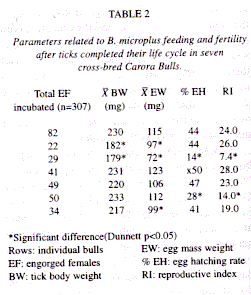
<body><![CDATA[<CENTER><FONT FACE="Arial,Helvetica"><FONT SIZE=-1>7 450&nbsp;&nbsp;&nbsp;&nbsp;&nbsp;&nbsp;&nbsp;&nbsp;&nbsp;&nbsp;&nbsp;&nbsp;&nbsp;&nbsp;&nbsp;&nbsp;&nbsp;&nbsp; 290&nbsp;&nbsp;&nbsp;&nbsp;&nbsp;&nbsp;&nbsp;&nbsp;&nbsp;&nbsp;&nbsp;&nbsp;&nbsp;&nbsp;&nbsp;&nbsp; 39.63</FONT></FONT></CENTER> <FONT FACE="Arial,Helvetica"><FONT SIZE=-1>&nbsp;&nbsp;&nbsp;&nbsp;&nbsp;&nbsp;&nbsp;&nbsp;&nbsp;&nbsp;&nbsp;&nbsp;&nbsp;&nbsp;&nbsp;&nbsp;&nbsp;&nbsp;&nbsp;&nbsp;&nbsp;&nbsp;&nbsp;&nbsp;&nbsp;&nbsp;&nbsp;&nbsp;&nbsp;&nbsp;&nbsp;&nbsp;&nbsp;&nbsp;&nbsp;&nbsp;&nbsp;&nbsp;&nbsp;&nbsp;&nbsp;&nbsp;&nbsp;&nbsp;&nbsp;&nbsp;&nbsp;&nbsp;&nbsp;&nbsp;&nbsp;&nbsp;&nbsp;&nbsp;&nbsp;&nbsp;&nbsp;&nbsp;&nbsp;&nbsp;&nbsp;&nbsp;&nbsp;&nbsp;&nbsp;&nbsp; 7 387&nbsp;&nbsp;&nbsp;&nbsp;&nbsp;&nbsp;&nbsp;&nbsp;&nbsp;&nbsp;&nbsp;&nbsp;&nbsp;&nbsp;&nbsp;&nbsp;&nbsp;&nbsp; 63&nbsp;&nbsp;&nbsp;&nbsp;&nbsp;&nbsp;&nbsp;&nbsp;&nbsp;&nbsp;&nbsp;&nbsp;&nbsp;&nbsp;&nbsp;&nbsp; 15.57</FONT></FONT>     <BR><FONT FACE="Arial,Helvetica"><FONT SIZE=-1>&nbsp;&nbsp;&nbsp;&nbsp;&nbsp;&nbsp;&nbsp;&nbsp;&nbsp;&nbsp;&nbsp;&nbsp;&nbsp;&nbsp;&nbsp;&nbsp;&nbsp;&nbsp;&nbsp;&nbsp;&nbsp;&nbsp;&nbsp;&nbsp;&nbsp;&nbsp;&nbsp;&nbsp;&nbsp;&nbsp;&nbsp;&nbsp;&nbsp;&nbsp;&nbsp;&nbsp;&nbsp;&nbsp;&nbsp;&nbsp;&nbsp;&nbsp;&nbsp;&nbsp;&nbsp;&nbsp;&nbsp;&nbsp;&nbsp;&nbsp;&nbsp;&nbsp;&nbsp;&nbsp;&nbsp;&nbsp;&nbsp;&nbsp;&nbsp;&nbsp;&nbsp;&nbsp;&nbsp;&nbsp;&nbsp;&nbsp; 5.300&nbsp;&nbsp;&nbsp;&nbsp;&nbsp;&nbsp;&nbsp;&nbsp;&nbsp;&nbsp;&nbsp;&nbsp;&nbsp;&nbsp;&nbsp;&nbsp;&nbsp;&nbsp; 373&nbsp;&nbsp;&nbsp;&nbsp;&nbsp;&nbsp;&nbsp;&nbsp;&nbsp;&nbsp;&nbsp;&nbsp;&nbsp;&nbsp;&nbsp;&nbsp; 32.64</FONT></FONT>      <P><FONT FACE="Arial,Helvetica"><FONT SIZE=-1>&nbsp;&nbsp;&nbsp;&nbsp;&nbsp;&nbsp;&nbsp;&nbsp;&nbsp;&nbsp;&nbsp;&nbsp;&nbsp;&nbsp;&nbsp;&nbsp;&nbsp;&nbsp;&nbsp;&nbsp;&nbsp;&nbsp;&nbsp;&nbsp;&nbsp;&nbsp;&nbsp;&nbsp;&nbsp;&nbsp;&nbsp;&nbsp;&nbsp;&nbsp;&nbsp;&nbsp;&nbsp;&nbsp;&nbsp;&nbsp;&nbsp;&nbsp;&nbsp;&nbsp;&nbsp;&nbsp;&nbsp;&nbsp;&nbsp;&nbsp;&nbsp;&nbsp;&nbsp;&nbsp;&nbsp;&nbsp;&nbsp;&nbsp; Rows: individual bulls</FONT></FONT>     <BR><FONT FACE="Arial,Helvetica"><FONT SIZE=-1>&nbsp;&nbsp;&nbsp;&nbsp;&nbsp;&nbsp;&nbsp;&nbsp;&nbsp;&nbsp;&nbsp;&nbsp;&nbsp;&nbsp;&nbsp;&nbsp;&nbsp;&nbsp;&nbsp;&nbsp;&nbsp;&nbsp;&nbsp;&nbsp;&nbsp;&nbsp;&nbsp;&nbsp;&nbsp;&nbsp;&nbsp;&nbsp;&nbsp;&nbsp;&nbsp;&nbsp;&nbsp;&nbsp;&nbsp;&nbsp;&nbsp;&nbsp;&nbsp;&nbsp;&nbsp;&nbsp;&nbsp;&nbsp;&nbsp;&nbsp;&nbsp;&nbsp;&nbsp;&nbsp;&nbsp;&nbsp;&nbsp;&nbsp; PI: post infestation</FONT></FONT>     <BR><FONT FACE="Arial,Helvetica"><FONT SIZE=-1>&nbsp;&nbsp;&nbsp;&nbsp;&nbsp;&nbsp;&nbsp;&nbsp;&nbsp;&nbsp;&nbsp;&nbsp;&nbsp;&nbsp;&nbsp;&nbsp;&nbsp;&nbsp;&nbsp;&nbsp;&nbsp;&nbsp;&nbsp;&nbsp;&nbsp;&nbsp;&nbsp;&nbsp;&nbsp;&nbsp;&nbsp;&nbsp;&nbsp;&nbsp;&nbsp;&nbsp;&nbsp;&nbsp;&nbsp;&nbsp;&nbsp;&nbsp;&nbsp;&nbsp;&nbsp;&nbsp;&nbsp;&nbsp;&nbsp;&nbsp;&nbsp;&nbsp;&nbsp;&nbsp;&nbsp;&nbsp;&nbsp;&nbsp; EF: engorged females</FONT></FONT>     <BR>&nbsp;      <P><FONT FACE="Arial,Helvetica"><FONT SIZE=-1>A total of 307 EF <I>B. microplus</I> were placed in incubation, these ticks had a mean BW of 213.1 mg (range: 179 - 233 mg) (<A HREF="#table 2">Table 2</A>), and their pre-oviposition period varied between 2 to 4 days. After 2 weeks of oviposition egg masses were weighted and variations were detected in this parameter (<A HREF="#table 2">Table 2)</A>. The embrionary period lasted 28 days without noticeable changes. The mean %EH was calculated after stereomicroscopic countings of a mixture of hatched larvae plus unhatched eggs from each EF incubated tick, and this parameter ranged from 14% to 50% (<A HREF="#table 2">Table 2</A>). Due to these evident variations in the %EH, the RI for each EF group of ticks also showed significant variations among the 7 bulls (<A HREF="#table 2">Table 2</A>).</FONT></FONT>     <BR>&nbsp;     <BR>&nbsp;     <BR>&nbsp;     ]]></body>
<body><![CDATA[<CENTER></CENTER>      <CENTER><A NAME="table 2"></A><IMG SRC="/img/fbpe/rbt/v46n3/0206i01.GIF" HEIGHT=300 WIDTH=300></CENTER> &nbsp;     
<BR>&nbsp;      <P><FONT FACE="Arial,Helvetica"><FONT SIZE=-1><B>Resistance of CCB to ticks:</B> The comparative analysis of variances of BW, EW, %EH and RI of collected EF <I>B. microplus</I> showed significant differences (p &lt; 0.001) between the means of these parameters. Nevertheless, when the Dunnett’s test was applied, significant differences (Dunnett p &lt;0.05) were only shown between the mean BW of ticks collected from bulls 2 and 3. In addition, no significant differences (Dunnett p > 0.05) were detected for the mean BW of ticks from other bulls (<A HREF="#table 2">Table 2)</A>. Applying the same test, significant differences (Dunnett p&lt; 0.05) were observed for the parameter EW of ticks collected from bulls 2, 3, and 7, whereas only for bulls 3 and 6 were detected significant differences (Dunnett p&lt; 0.05) for the parameter %EH (<A HREF="#table 2">Table 2</A>). Finally, the RI only showed significant differences (Dunnett p&lt; 0.05) for bulls 3 and 6 (<A HREF="#table 2">Table 2</A>).</FONT></FONT>      <P><FONT FACE="Arial,Helvetica"><FONT SIZE=-1>In summary, CCB 3 showed the highest level of resistance since it yielded EF ticks with the lowest mean BW, therefore its EF <I>B. microplus</I> laid minor egg masses, with the lowest %EH (14%) and the lowest RI (7.4) (<A HREF="#table 2">Table 2</A>). In contrast, bulls 2, 6 and 7 showed a medium level of resistance whereas the other three bulls were considered as non-resistant on the basis of comparing their studied tick parameters against those of bull 3.</FONT></FONT>     <BR>&nbsp;      <P><B><FONT FACE="Arial,Helvetica"><FONT SIZE=-1>Discussion</FONT></FONT></B>      <P><FONT FACE="Arial,Helvetica"><FONT SIZE=-1>This study has shown that CCB experimentally infested with <I>B. microplus</I> showed great variability in their natural resistance to this tick, thus one bull out of seven was statistically detected as tick-resistant after experimentally infested, three were non-resistant, and three showed moderate tick-resistant. This resistance was evaluated in the lab after a multiple comparative analysis of four EF <I>B. microplus</I> parameters. As it is well known resistance to <I>B. microplus</I> varies between individual cattle, from breed to breed, and among species of cattle. i.e., <I>Bos indicus</I> is more resistant to ticks than <I>B. taurus</I> (<A HREF="#De Castro, J. J.">De Castro &amp; Newson 1993</A>). These statements are in agreement with the finding that the character "tick resistance" is inheritable by cattle offspring almost in direct proportion to the percentage of Zebu cattle present in the dam or sire (<A HREF="#Arteche, C. P.">Arteche 1987</A>). Besides, this character is rather easy to detect and measure in the lab since the genetic composition of bovine hosts has a strong influence on the life cycle of <I>B. microplus</I> or other ticks (<A HREF="#Barriga, O., A. Da Silva 1993">Barriga<I> et al.</I> 1993)</A>. On the basis of our results, we consider that this "strong influence" was detected and evaluated in CCB due to its genetic origin.</FONT></FONT>      <P><FONT FACE="Arial,Helvetica"><FONT SIZE=-1>Carora breed cattle is the product of genetic crosses among Creole cattle, <I>Bos taurus</I>, and <I>Bos indicus</I> cattle, consequently any Carora bovine classified as tick-resistant should have a greater proportion of <I>B. indicus</I> genes, those classified as moderate tick-resistant should probably have an even proportion of <I>B. indicus</I> and <I>B. taurus</I> genes, and finally those considered as non-tick-resistant should have a predominance of <I>B. taurus</I> genes.</FONT></FONT>      <P><FONT FACE="Arial,Helvetica"><FONT SIZE=-1>The great variability detected for <I>B. microplus</I> resistance in CCB is important in particular in a tropical breed in the process of genetic consolidation, since cattle owners and field technicians should start genetic programs selecting Carora heifers and bulls, not only on the basis of phenotype, milk production and breeding data, but also including the factor levels of resistance to <I>B. microplus</I>. In general, it can be stated that the character tick resistance must be included in a genetic program of cattle breeding because it meets these 4 basic conditions: 1) it has a high genetic variability, 2) it is inheritable, 3) it is economically important and 4) it is rather easy to calculate. The levels of <I>B. microplus</I> resistance were evaluated through four parameters related to feeding and fertility of this tick, and no relying only on the EF tick burdens as it is often tested and recently questioned (<A HREF="#Barriga, O., A. Da Silva 1995">Barriga<I> et al.</I> 1995</A>). Finally, we believe that an effective program of tick control in the tropics can be accomplished only using the basic principles of integrated pest management, and in particular using tick-resistant cattle.</FONT></FONT>     ]]></body>
<body><![CDATA[<BR>&nbsp;      <P><B><FONT FACE="Arial,Helvetica"><FONT SIZE=-1>Acknowledgements</FONT></FONT></B>      <P><FONT FACE="Arial,Helvetica"><FONT SIZE=-1>To the Officers of Carora Breed Cattlemen Association (ASOCRICA), Carora, Venezuela, to the personnel of CIAC, and to Deicy Mendoza and Mar&iacute;a G. Ram&iacute;rez, Veterinary Medicine students, for their technical assistance.</FONT></FONT>     <BR>&nbsp;      <P><B><FONT FACE="Arial,Helvetica"><FONT SIZE=-1>References</FONT></FONT></B>      <!-- ref --><P><A NAME="Arteche, C. P."></A><FONT FACE="Arial,Helvetica"><FONT SIZE=-1>Arteche, C. P. 1987. Consideraciones pr&aacute;cticas sobre el empleo de razas resistentes de vacunos parala lucha contra las garrapatas en Am&eacute;rica Latina. Informe Final. Consulta de expertos sobre erradicaci&oacute;n de garrapatas, con especial referencia a Am&eacute;rica Latina. FAO. M&eacute;xico, 12 p.</FONT></FONT>    &nbsp;&nbsp;&nbsp;&nbsp;&nbsp;&nbsp;&nbsp;&nbsp;[&#160;<a href="javascript:void(0);" onclick="javascript: window.open('/scielo.php?script=sci_nlinks&ref=1136891&pid=S0034-7744199800030002400001&lng=','','width=640,height=500,resizable=yes,scrollbars=1,menubar=yes,');">Links</a>&#160;]<!-- end-ref --><!-- ref --><P><A NAME="Barriga, O.  1993"></A><FONT FACE="Arial,Helvetica"><FONT SIZE=-1>Barriga, O., A. Da Silva &amp; J. Azevedo. 1993. Inhibition and recovery of tick functions in cattle repeateadly infested with <I>Boophilus microplus</I>. J. Parasitol. 79: 710-715.</FONT></FONT>    &nbsp;&nbsp;&nbsp;&nbsp;&nbsp;&nbsp;&nbsp;&nbsp;[&#160;<a href="javascript:void(0);" onclick="javascript: window.open('/scielo.php?script=sci_nlinks&ref=1136892&pid=S0034-7744199800030002400002&lng=','','width=640,height=500,resizable=yes,scrollbars=1,menubar=yes,');">Links</a>&#160;]<!-- end-ref --><!-- ref --><P><A NAME="Barriga, O., A. Da Silva 1995"></A><FONT FACE="Arial,Helvetica"><FONT SIZE=-1>Barriga, O., A. Da Silva &amp; J. Azevedo. 1995. Relationships and influences between <I>Boophilus microplus</I> characteristics in tick-naive or repeatedly infested cattle. Vet. Parasitol. 56: 225-238.</FONT></FONT>    &nbsp;&nbsp;&nbsp;&nbsp;&nbsp;&nbsp;&nbsp;&nbsp;[&#160;<a href="javascript:void(0);" onclick="javascript: window.open('/scielo.php?script=sci_nlinks&ref=1136893&pid=S0034-7744199800030002400003&lng=','','width=640,height=500,resizable=yes,scrollbars=1,menubar=yes,');">Links</a>&#160;]<!-- end-ref --><!-- ref --><P><A NAME="Cerutti"></A><FONT FACE="Arial,Helvetica"><FONT SIZE=-1>Cerutti, F., R. Rizzi, R. D. Mel&eacute;ndez &amp; A. Coronado. 1995. Resistenza a <I>Boophilus microplus</I> nella razza bovina Carora. XI Congresso Nazionale Associazione Scientifica di Produzione Animale (ASPA). Grado, Gorizia, Italy. 2 p.</FONT></FONT>    &nbsp;&nbsp;&nbsp;&nbsp;&nbsp;&nbsp;&nbsp;&nbsp;[&#160;<a href="javascript:void(0);" onclick="javascript: window.open('/scielo.php?script=sci_nlinks&ref=1136894&pid=S0034-7744199800030002400004&lng=','','width=640,height=500,resizable=yes,scrollbars=1,menubar=yes,');">Links</a>&#160;]<!-- end-ref --><!-- ref --><P><A NAME="Coronado, A."></A><FONT FACE="Arial,Helvetica"><FONT SIZE=-1>Coronado, A. &amp; F. Mujica. 1997. Resistencia a acaricidas en <I>Boophilus microplus</I> en Venezuela. Gac. Cien. Vet. 3: 5-13.</FONT></FONT>    &nbsp;&nbsp;&nbsp;&nbsp;&nbsp;&nbsp;&nbsp;&nbsp;[&#160;<a href="javascript:void(0);" onclick="javascript: window.open('/scielo.php?script=sci_nlinks&ref=1136895&pid=S0034-7744199800030002400005&lng=','','width=640,height=500,resizable=yes,scrollbars=1,menubar=yes,');">Links</a>&#160;]<!-- end-ref --><!-- ref --><P><A NAME="Dalgliesh, R. J."></A><FONT FACE="Arial,Helvetica"><FONT SIZE=-1>Dalgliesh, R. J. &amp; N. P. Stewart. 1982. Some effects of time, temperature and feeding on infection rates with <I>Babesia bovis<B> </B></I>and<I> Babesia bigemina</I> in<I> Boophilus microplus</I> larvae. Int. J. Parasitol. 12: 323-326.</FONT></FONT>    &nbsp;&nbsp;&nbsp;&nbsp;&nbsp;&nbsp;&nbsp;&nbsp;[&#160;<a href="javascript:void(0);" onclick="javascript: window.open('/scielo.php?script=sci_nlinks&ref=1136896&pid=S0034-7744199800030002400006&lng=','','width=640,height=500,resizable=yes,scrollbars=1,menubar=yes,');">Links</a>&#160;]<!-- end-ref --><!-- ref --><P><A NAME="De Castro, J. J."></A><FONT FACE="Arial,Helvetica"><FONT SIZE=-1>De Castro, J. J. &amp; R. M. Newson. 1993. Host resistance in cattle tick control. Parasitol. Today 9: 13-17.</FONT></FONT>    &nbsp;&nbsp;&nbsp;&nbsp;&nbsp;&nbsp;&nbsp;&nbsp;[&#160;<a href="javascript:void(0);" onclick="javascript: window.open('/scielo.php?script=sci_nlinks&ref=1136897&pid=S0034-7744199800030002400007&lng=','','width=640,height=500,resizable=yes,scrollbars=1,menubar=yes,');">Links</a>&#160;]<!-- end-ref --><!-- ref --><P><A NAME="FAO. 1990."></A><FONT FACE="Arial,Helvetica"><FONT SIZE=-1>FAO. 1990. Report of the FAO Expert Consultation on revision of strategies for the control of ticks and tick-borne diseases. Parassitologia (Roma). 32: 3-12.</FONT></FONT>    &nbsp;&nbsp;&nbsp;&nbsp;&nbsp;&nbsp;&nbsp;&nbsp;[&#160;<a href="javascript:void(0);" onclick="javascript: window.open('/scielo.php?script=sci_nlinks&ref=1136898&pid=S0034-7744199800030002400008&lng=','','width=640,height=500,resizable=yes,scrollbars=1,menubar=yes,');">Links</a>&#160;]<!-- end-ref --><!-- ref --><P><A NAME="Francis, J."></A><FONT FACE="Arial,Helvetica"><FONT SIZE=-1>Francis, J. &amp; D. A. Little. 1964. Resistance of Drougtmaster cattle to tick infestation and babesiosis. Aust. Vet. J. 40: 247-253.</FONT></FONT>    &nbsp;&nbsp;&nbsp;&nbsp;&nbsp;&nbsp;&nbsp;&nbsp;[&#160;<a href="javascript:void(0);" onclick="javascript: window.open('/scielo.php?script=sci_nlinks&ref=1136899&pid=S0034-7744199800030002400009&lng=','','width=640,height=500,resizable=yes,scrollbars=1,menubar=yes,');">Links</a>&#160;]<!-- end-ref --><!-- ref --><P><A NAME="Frisch, J. E."></A><FONT FACE="Arial,Helvetica"><FONT SIZE=-1>Frisch, J. E. 1981. Factors affecting the resistance to ecto- and endoparasites of cattle in tropical areas and the implications for selection, p. 17-32. <I>In</I> IAEA (ed.). Isotopes and radiation in Parasitology IV<B>.</B> Panel Proceeding Series. Pub.<B> </B>572, Vienna.</FONT></FONT>    &nbsp;&nbsp;&nbsp;&nbsp;&nbsp;&nbsp;&nbsp;&nbsp;[&#160;<a href="javascript:void(0);" onclick="javascript: window.open('/scielo.php?script=sci_nlinks&ref=1136900&pid=S0034-7744199800030002400010&lng=','','width=640,height=500,resizable=yes,scrollbars=1,menubar=yes,');">Links</a>&#160;]<!-- end-ref --><!-- ref --><P><A NAME="Herrera, D. J."></A><FONT FACE="Arial,Helvetica"><FONT SIZE=-1>Herrera, D. J. 1960. El mestizo Pardo Suizo Carore&ntilde;o como base para un futuro tipo de ganado. Rev. Vet. Venezol. 9: 343-388.</FONT></FONT>    &nbsp;&nbsp;&nbsp;&nbsp;&nbsp;&nbsp;&nbsp;&nbsp;[&#160;<a href="javascript:void(0);" onclick="javascript: window.open('/scielo.php?script=sci_nlinks&ref=1136901&pid=S0034-7744199800030002400011&lng=','','width=640,height=500,resizable=yes,scrollbars=1,menubar=yes,');">Links</a>&#160;]<!-- end-ref --><!-- ref --><P><A NAME="Meléndez, R. D."></A><FONT FACE="Arial,Helvetica"><FONT SIZE=-1>Mel&eacute;ndez, R. D. &amp; M. Forlano. 1996. Incidence and intensity of <I>Babesia spp. </I>sporokinetes in engorged <I>Boophilus microplus</I> from a dairy herd in Venezuela, p. 148-156. <I>In</I> Camus, E., J. A. House &amp; G. Uilenberg (editors). Vector-Borne Pathogens: International Trade and Tropical Animal Diseases. Ann. New York Acad. Sci. Vol. 791. New York, USA.</FONT></FONT>    &nbsp;&nbsp;&nbsp;&nbsp;&nbsp;&nbsp;&nbsp;&nbsp;[&#160;<a href="javascript:void(0);" onclick="javascript: window.open('/scielo.php?script=sci_nlinks&ref=1136902&pid=S0034-7744199800030002400012&lng=','','width=640,height=500,resizable=yes,scrollbars=1,menubar=yes,');">Links</a>&#160;]<!-- end-ref --><!-- ref --><P><A NAME="Núñez, J."></A><FONT FACE="Arial,Helvetica"><FONT SIZE=-1>N&uacute;&ntilde;ez, J. L., M. Mu&ntilde;oz-Cobe&ntilde;as &amp; H. Moltedo. 1982. <I>Boophilus microplus</I>: The Common Cattle Tick. Springer-Verlag Editors. Berlin, Germany. 204 p.</FONT></FONT>    &nbsp;&nbsp;&nbsp;&nbsp;&nbsp;&nbsp;&nbsp;&nbsp;[&#160;<a href="javascript:void(0);" onclick="javascript: window.open('/scielo.php?script=sci_nlinks&ref=1136903&pid=S0034-7744199800030002400013&lng=','','width=640,height=500,resizable=yes,scrollbars=1,menubar=yes,');">Links</a>&#160;]<!-- end-ref --><P><A NAME="O’Kelly, J. C."></A><FONT FACE="Arial,Helvetica"><FONT SIZE=-1>O’Kelly, J. C. &amp; G. W. Seifert. 1969. Relationships between resistance to <I>Boophilus microplus</I>, nutritional status, and blood composition in Shorthorn x Hereford cattle. Aust. J. Biol. Sci. 22: 1497-1506.</FONT></FONT>      <!-- ref --><P><A NAME="Roberts, J. A. 1968."></A><FONT FACE="Arial,Helvetica"><FONT SIZE=-1>Roberts, J. A. 1968. Acquisition by the host of resistance to the cattle tick <I>Boophilus microplus</I> (Canestrini). J. Parasitol. 54: 657-662.</FONT></FONT>    &nbsp;&nbsp;&nbsp;&nbsp;&nbsp;&nbsp;&nbsp;&nbsp;[&#160;<a href="javascript:void(0);" onclick="javascript: window.open('/scielo.php?script=sci_nlinks&ref=1136905&pid=S0034-7744199800030002400014&lng=','','width=640,height=500,resizable=yes,scrollbars=1,menubar=yes,');">Links</a>&#160;]<!-- end-ref --><!-- ref --><P><A NAME="Roberts, J. A. & J. D. Kerr."></A><FONT FACE="Arial,Helvetica"><FONT SIZE=-1>Roberts, J. A. &amp; J. D. Kerr. 1976. <I>Boophilus microplus</I>: passive transfer of resistance in cattle. J. Parasitol. 62: 485-489.</FONT></FONT>    &nbsp;&nbsp;&nbsp;&nbsp;&nbsp;&nbsp;&nbsp;&nbsp;[&#160;<a href="javascript:void(0);" onclick="javascript: window.open('/scielo.php?script=sci_nlinks&ref=1136906&pid=S0034-7744199800030002400015&lng=','','width=640,height=500,resizable=yes,scrollbars=1,menubar=yes,');">Links</a>&#160;]<!-- end-ref --><!-- ref --><P><A NAME="Roush, R."></A><FONT FACE="Arial,Helvetica"><FONT SIZE=-1>Roush, R. T. 1993. Ocurrence, genetics and management of insecticide resistance. Parasitol. Today 9: 174-179.</FONT></FONT>    &nbsp;&nbsp;&nbsp;&nbsp;&nbsp;&nbsp;&nbsp;&nbsp;[&#160;<a href="javascript:void(0);" onclick="javascript: window.open('/scielo.php?script=sci_nlinks&ref=1136907&pid=S0034-7744199800030002400016&lng=','','width=640,height=500,resizable=yes,scrollbars=1,menubar=yes,');">Links</a>&#160;]<!-- end-ref --><!-- ref --><P><A NAME="Solomon, K. R."></A><FONT FACE="Arial,Helvetica"><FONT SIZE=-1>Solomon, K. R. 1983. Acaricide resistance in ticks. Adv. Vet. Sci. Comp. Med. 27: 273-296.</FONT></FONT>    &nbsp;&nbsp;&nbsp;&nbsp;&nbsp;&nbsp;&nbsp;&nbsp;[&#160;<a href="javascript:void(0);" onclick="javascript: window.open('/scielo.php?script=sci_nlinks&ref=1136908&pid=S0034-7744199800030002400017&lng=','','width=640,height=500,resizable=yes,scrollbars=1,menubar=yes,');">Links</a>&#160;]<!-- end-ref --><!-- ref --><P><A NAME="Villares, J. B."></A><FONT FACE="Arial,Helvetica"><FONT SIZE=-1>Villares, J. B. 1941. Climatolog&iacute;a Zootechnica. III. Contribucao ao estudo da resistencia e susceptibilidade genetica dos bovinos ao <I>Boophilus microplus</I>. Bol. Ind. Anim. (Sao Paulo) 4: 60-80.</FONT></FONT>    &nbsp;&nbsp;&nbsp;&nbsp;&nbsp;&nbsp;&nbsp;&nbsp;[&#160;<a href="javascript:void(0);" onclick="javascript: window.open('/scielo.php?script=sci_nlinks&ref=1136909&pid=S0034-7744199800030002400018&lng=','','width=640,height=500,resizable=yes,scrollbars=1,menubar=yes,');">Links</a>&#160;]<!-- end-ref --><!-- ref --><P><A NAME="Wharton, R."></A><FONT FACE="Arial,Helvetica"><FONT SIZE=-1>Wharton, R. H. &amp; K. R. Norris. 1980. Control of parasitic arthropods. Vet. Parasitol. 6: 135-164.</FONT></FONT>    &nbsp;&nbsp;&nbsp;&nbsp;&nbsp;&nbsp;&nbsp;&nbsp;[&#160;<a href="javascript:void(0);" onclick="javascript: window.open('/scielo.php?script=sci_nlinks&ref=1136910&pid=S0034-7744199800030002400019&lng=','','width=640,height=500,resizable=yes,scrollbars=1,menubar=yes,');">Links</a>&#160;]<!-- end-ref --><!-- ref --><P><A NAME="Wikel, S."></A><FONT FACE="Arial,Helvetica"><FONT SIZE=-1>Wikel, S. K. 1996. Host immunity to ticks. Annu. Rev. Entomol. 41: 1-22.</FONT></FONT>    &nbsp;&nbsp;&nbsp;&nbsp;&nbsp;&nbsp;&nbsp;&nbsp;[&#160;<a href="javascript:void(0);" onclick="javascript: window.open('/scielo.php?script=sci_nlinks&ref=1136911&pid=S0034-7744199800030002400020&lng=','','width=640,height=500,resizable=yes,scrollbars=1,menubar=yes,');">Links</a>&#160;]<!-- end-ref --><BR>&nbsp;     <BR>&nbsp;     <BR><A NAME="1ab"></A><FONT FACE="Arial,Helvetica"><FONT SIZE=-1><SUP><A HREF="#1">1</A></SUP> Universidad Centroccidental "Lisandro Alvarado", Decanato de Ciencias Veterinarias, Apartado postal 665, Barquisimeto, Lara, 3001-A. Venezuela. Fax: 58 51 425989, e-mail: <A HREF="mailto:rmelende@delfos.ucla.edu.ve">rmelende@delfos.ucla.edu.ve</A></FONT></FONT>      <P><A NAME="2a"></A><FONT FACE="Arial,Helvetica"><FONT SIZE=-1><SUP><A HREF="#2">2</A></SUP> Universit&aacute; de Milano, Facolt&aacute; di Medicina Veterinaria. Milan. Italy.</FONT></FONT>      ]]></body>
<body><![CDATA[<P><A NAME="3a"></A><FONT FACE="Arial,Helvetica"><FONT SIZE=-1><SUP><A HREF="#3">3</A></SUP> Ministerio de Agricultura y Cr&iacute;a (MAC). Servicio Aut&oacute;nomo de Sanidad Animal del Estado Lara (SASA). Barquisimeto. Venezuela.</FONT></FONT>      ]]></body><back>
<ref-list>
<ref id="B1">
<nlm-citation citation-type="book">
<person-group person-group-type="author">
<name>
<surname><![CDATA[Arteche]]></surname>
<given-names><![CDATA[C. P.]]></given-names>
</name>
</person-group>
<source><![CDATA[Consideraciones prácticas sobre el empleo de razas resistentes de vacunos parala lucha contra las garrapatas en América Latina: Informe Final. Consulta de expertos sobre erradicación de garrapatas, con especial referencia a América Latina]]></source>
<year>1987</year>
<publisher-name><![CDATA[FAO]]></publisher-name>
</nlm-citation>
</ref>
<ref id="B2">
<nlm-citation citation-type="journal">
<person-group person-group-type="author">
<name>
<surname><![CDATA[Barriga]]></surname>
<given-names><![CDATA[O.]]></given-names>
</name>
<name>
<surname><![CDATA[Da Silva]]></surname>
<given-names><![CDATA[A.]]></given-names>
</name>
<name>
<surname><![CDATA[Azevedo]]></surname>
<given-names><![CDATA[J.]]></given-names>
</name>
</person-group>
<article-title xml:lang="en"><![CDATA[Inhibition and recovery of tick functions in cattle repeateadly infested with Boophilus microplus.]]></article-title>
<source><![CDATA[J. Parasitol.]]></source>
<year>1993</year>
<volume>79</volume>
<page-range>710-715</page-range></nlm-citation>
</ref>
<ref id="B3">
<nlm-citation citation-type="journal">
<person-group person-group-type="author">
<name>
<surname><![CDATA[Barriga]]></surname>
<given-names><![CDATA[O.]]></given-names>
</name>
<name>
<surname><![CDATA[Da Silva]]></surname>
<given-names><![CDATA[A.]]></given-names>
</name>
<name>
<surname><![CDATA[Azevedo]]></surname>
<given-names><![CDATA[J.]]></given-names>
</name>
</person-group>
<article-title xml:lang="en"><![CDATA[Relationships and influences between Boophilus microplus characteristics in tick-naive or repeatedly infested cattle]]></article-title>
<source><![CDATA[Vet. Parasitol.]]></source>
<year>1995</year>
<volume>56</volume>
<page-range>225-238</page-range></nlm-citation>
</ref>
<ref id="B4">
<nlm-citation citation-type="confpro">
<person-group person-group-type="author">
<name>
<surname><![CDATA[Cerutti]]></surname>
<given-names><![CDATA[F.]]></given-names>
</name>
<name>
<surname><![CDATA[Rizzi]]></surname>
<given-names><![CDATA[R.]]></given-names>
</name>
<name>
<surname><![CDATA[Meléndez]]></surname>
<given-names><![CDATA[R. D.]]></given-names>
</name>
<name>
<surname><![CDATA[Coronado]]></surname>
<given-names><![CDATA[A.]]></given-names>
</name>
</person-group>
<source><![CDATA[Resistenza a Boophilus microplus nella razza bovina Carora]]></source>
<year>1995</year>
<conf-name><![CDATA[XI Congresso Nazionale Associazione Scientifica di Produzione Animale (ASPA]]></conf-name>
<conf-loc> </conf-loc>
</nlm-citation>
</ref>
<ref id="B5">
<nlm-citation citation-type="journal">
<person-group person-group-type="author">
<name>
<surname><![CDATA[Coronado]]></surname>
<given-names><![CDATA[A.]]></given-names>
</name>
<name>
<surname><![CDATA[Mujica]]></surname>
<given-names><![CDATA[F.]]></given-names>
</name>
</person-group>
<article-title xml:lang="es"><![CDATA[Resistencia a acaricidas en Boophilus microplus en Venezuela]]></article-title>
<source><![CDATA[Gac. Cien. Vet.]]></source>
<year>1997</year>
<volume>3</volume>
<page-range>5-13</page-range></nlm-citation>
</ref>
<ref id="B6">
<nlm-citation citation-type="journal">
<person-group person-group-type="author">
<name>
<surname><![CDATA[Dalgliesh]]></surname>
<given-names><![CDATA[R. J.]]></given-names>
</name>
<name>
<surname><![CDATA[Stewart]]></surname>
<given-names><![CDATA[N. P.]]></given-names>
</name>
</person-group>
<article-title xml:lang="en"><![CDATA[Some effects of time, temperature and feeding on infection rates with Babesia bovis and Babesia bigemina in Boophilus microplus larvae]]></article-title>
<source><![CDATA[Int. J. Parasitol.]]></source>
<year>1982</year>
<volume>12</volume>
<page-range>323-326</page-range></nlm-citation>
</ref>
<ref id="B7">
<nlm-citation citation-type="journal">
<person-group person-group-type="author">
<name>
<surname><![CDATA[De Castro]]></surname>
<given-names><![CDATA[J. J.]]></given-names>
</name>
<name>
<surname><![CDATA[Newson]]></surname>
<given-names><![CDATA[R. M.]]></given-names>
</name>
</person-group>
<article-title xml:lang="en"><![CDATA[Host resistance in cattle tick control]]></article-title>
<source><![CDATA[Parasitol. Today]]></source>
<year>1993</year>
<volume>9</volume>
<page-range>13-17</page-range></nlm-citation>
</ref>
<ref id="B8">
<nlm-citation citation-type="journal">
<collab>FAO</collab>
<article-title xml:lang="en"><![CDATA[Report of the FAO Expert Consultation on revision of strategies for the control of ticks and tick-borne diseases]]></article-title>
<source><![CDATA[Parassitologia (Roma).]]></source>
<year>1990</year>
<volume>32</volume>
<page-range>3-12</page-range></nlm-citation>
</ref>
<ref id="B9">
<nlm-citation citation-type="journal">
<person-group person-group-type="author">
<name>
<surname><![CDATA[Francis]]></surname>
<given-names><![CDATA[J.]]></given-names>
</name>
<name>
<surname><![CDATA[Little]]></surname>
<given-names><![CDATA[D. A.]]></given-names>
</name>
</person-group>
<article-title xml:lang="en"><![CDATA[Resistance of Drougtmaster cattle to tick infestation and babesiosis]]></article-title>
<source><![CDATA[Aust. Vet. J.]]></source>
<year>1964</year>
<volume>40</volume>
<page-range>247-253</page-range></nlm-citation>
</ref>
<ref id="B10">
<nlm-citation citation-type="">
<person-group person-group-type="author">
<name>
<surname><![CDATA[Frisch]]></surname>
<given-names><![CDATA[J. E.]]></given-names>
</name>
</person-group>
<article-title xml:lang="en"><![CDATA[Factors affecting the resistance to ecto- and endoparasites of cattle in tropical areas and the implications for selection]]></article-title>
<collab>IAEA</collab>
<source><![CDATA[Isotopes and radiation in Parasitology IV]]></source>
<year>1981</year>
<volume>572</volume>
<page-range>17-32</page-range><publisher-loc><![CDATA[Vienna ]]></publisher-loc>
</nlm-citation>
</ref>
<ref id="B11">
<nlm-citation citation-type="journal">
<person-group person-group-type="author">
<name>
<surname><![CDATA[Herrera]]></surname>
<given-names><![CDATA[D. J.]]></given-names>
</name>
</person-group>
<article-title xml:lang="es"><![CDATA[El mestizo Pardo Suizo Caroreño como base para un futuro tipo de ganado]]></article-title>
<source><![CDATA[Rev. Vet. Venezol.]]></source>
<year>1960</year>
<volume>9</volume>
<page-range>343-388</page-range></nlm-citation>
</ref>
<ref id="B12">
<nlm-citation citation-type="">
<person-group person-group-type="author">
<name>
<surname><![CDATA[Meléndez]]></surname>
<given-names><![CDATA[R. D.]]></given-names>
</name>
<name>
<surname><![CDATA[Forlano]]></surname>
<given-names><![CDATA[M.]]></given-names>
</name>
</person-group>
<article-title xml:lang="en"><![CDATA[Incidence and intensity of Babesia spp. sporokinetes in engorged Boophilus microplus from a dairy herd in Venezuela]]></article-title>
<person-group person-group-type="editor">
<name>
<surname><![CDATA[Camus]]></surname>
<given-names><![CDATA[E.]]></given-names>
</name>
<name>
<surname><![CDATA[House]]></surname>
<given-names><![CDATA[J. A.]]></given-names>
</name>
<name>
<surname><![CDATA[Uilenberg]]></surname>
<given-names><![CDATA[G.]]></given-names>
</name>
</person-group>
<source><![CDATA[Vector-Borne Pathogens: International Trade and Tropical Animal Diseases]]></source>
<year>1996</year>
<volume>791</volume>
<page-range>. 148-156</page-range><publisher-loc><![CDATA[^eNew York New York]]></publisher-loc>
</nlm-citation>
</ref>
<ref id="B13">
<nlm-citation citation-type="book">
<person-group person-group-type="author">
<name>
<surname><![CDATA[Núñez]]></surname>
<given-names><![CDATA[J. L]]></given-names>
</name>
<name>
<surname><![CDATA[Muñoz-Cobeñas]]></surname>
<given-names><![CDATA[M.]]></given-names>
</name>
<name>
<surname><![CDATA[Moltedo]]></surname>
<given-names><![CDATA[H.]]></given-names>
</name>
</person-group>
<source><![CDATA[Boophilus microplus: The Common Cattle Tick]]></source>
<year>1982</year>
<publisher-loc><![CDATA[Berlin ]]></publisher-loc>
<publisher-name><![CDATA[Springer-Verlag Editors]]></publisher-name>
</nlm-citation>
</ref>
<ref id="B14">
<nlm-citation citation-type="journal">
<person-group person-group-type="author">
<name>
<surname><![CDATA[Roberts]]></surname>
<given-names><![CDATA[J. A.]]></given-names>
</name>
</person-group>
<article-title xml:lang="en"><![CDATA[Acquisition by the host of resistance to the cattle tick Boophilus microplus (Canestrini)]]></article-title>
<source><![CDATA[J. Parasitol.]]></source>
<year>1968</year>
<month>.</month>
<volume>54</volume>
<page-range>657-662</page-range></nlm-citation>
</ref>
<ref id="B15">
<nlm-citation citation-type="journal">
<person-group person-group-type="author">
<name>
<surname><![CDATA[Roberts]]></surname>
<given-names><![CDATA[J. A.]]></given-names>
</name>
<name>
<surname><![CDATA[Kerr]]></surname>
<given-names><![CDATA[J. D.]]></given-names>
</name>
</person-group>
<article-title xml:lang="en"><![CDATA[Boophilus microplus: passive transfer of resistance in cattle]]></article-title>
<source><![CDATA[J. Parasitol.]]></source>
<year>1976</year>
<volume>62</volume>
<page-range>485-489</page-range></nlm-citation>
</ref>
<ref id="B16">
<nlm-citation citation-type="journal">
<person-group person-group-type="author">
<name>
<surname><![CDATA[Roush]]></surname>
<given-names><![CDATA[R. T.]]></given-names>
</name>
</person-group>
<article-title xml:lang="en"><![CDATA[Ocurrence, genetics and management of insecticide resistance]]></article-title>
<source><![CDATA[Parasitol. Today]]></source>
<year>1993</year>
<volume>9</volume>
<page-range>174-179</page-range></nlm-citation>
</ref>
<ref id="B17">
<nlm-citation citation-type="journal">
<person-group person-group-type="author">
<name>
<surname><![CDATA[Solomon]]></surname>
<given-names><![CDATA[K. R.]]></given-names>
</name>
</person-group>
<article-title xml:lang="en"><![CDATA[Acaricide resistance in ticks]]></article-title>
<source><![CDATA[Adv. Vet. Sci. Comp. Med.]]></source>
<year>1983</year>
<volume>27</volume>
<page-range>273-296</page-range></nlm-citation>
</ref>
<ref id="B18">
<nlm-citation citation-type="journal">
<person-group person-group-type="author">
<name>
<surname><![CDATA[Villares]]></surname>
<given-names><![CDATA[J. B.]]></given-names>
</name>
</person-group>
<article-title xml:lang="pt"><![CDATA[Climatología Zootechnica: III. Contribucao ao estudo da resistencia e susceptibilidade genetica dos bovinos ao Boophilus microplus]]></article-title>
<source><![CDATA[Bol. Ind. Anim. (Sao Paulo)]]></source>
<year>1941</year>
<volume>4</volume>
<page-range>60-80</page-range></nlm-citation>
</ref>
<ref id="B19">
<nlm-citation citation-type="journal">
<person-group person-group-type="author">
<name>
<surname><![CDATA[Wharton]]></surname>
<given-names><![CDATA[R. H.]]></given-names>
</name>
<name>
<surname><![CDATA[Norris]]></surname>
<given-names><![CDATA[K. R]]></given-names>
</name>
</person-group>
<article-title xml:lang="en"><![CDATA[Control of parasitic arthropods]]></article-title>
<source><![CDATA[Vet. Parasitol.]]></source>
<year>1980</year>
<volume>6</volume>
<page-range>135-164</page-range></nlm-citation>
</ref>
<ref id="B20">
<nlm-citation citation-type="journal">
<person-group person-group-type="author">
<name>
<surname><![CDATA[Wikel]]></surname>
<given-names><![CDATA[S. K.]]></given-names>
</name>
</person-group>
<article-title xml:lang="en"><![CDATA[Host immunity to ticks]]></article-title>
<source><![CDATA[Annu. Rev. Entomol.]]></source>
<year>1996</year>
<volume>41</volume>
<page-range>1-22</page-range></nlm-citation>
</ref>
</ref-list>
</back>
</article>
