<?xml version="1.0" encoding="ISO-8859-1"?><article xmlns:mml="http://www.w3.org/1998/Math/MathML" xmlns:xlink="http://www.w3.org/1999/xlink" xmlns:xsi="http://www.w3.org/2001/XMLSchema-instance">
<front>
<journal-meta>
<journal-id>0034-7744</journal-id>
<journal-title><![CDATA[Revista de Biología Tropical]]></journal-title>
<abbrev-journal-title><![CDATA[Rev. biol. trop]]></abbrev-journal-title>
<issn>0034-7744</issn>
<publisher>
<publisher-name><![CDATA[Universidad de Costa Rica]]></publisher-name>
</publisher>
</journal-meta>
<article-meta>
<article-id>S0034-77441998000300022</article-id>
<title-group>
<article-title xml:lang="en"><![CDATA[Corals and coral reefs of the Puerto Angel region, west coast of México]]></article-title>
</title-group>
<contrib-group>
<contrib contrib-type="author">
<name>
<surname><![CDATA[Reyes- Bonilla]]></surname>
<given-names><![CDATA[Héctor]]></given-names>
</name>
<xref ref-type="aff" rid="A01"/>
</contrib>
<contrib contrib-type="author">
<name>
<surname><![CDATA[Leyte- Morales]]></surname>
<given-names><![CDATA[Gerardo E.]]></given-names>
</name>
<xref ref-type="aff" rid="A02"/>
</contrib>
</contrib-group>
<aff id="A01">
<institution><![CDATA[,Universidad Autónoma de Baja California Sur Departamento de Biología Marina ]]></institution>
<addr-line><![CDATA[La Paz ]]></addr-line>
<country>México</country>
</aff>
<aff id="A02">
<institution><![CDATA[,Universidad del Mar Instituto de Recursos ]]></institution>
<addr-line><![CDATA[Puerto Angel Oax.]]></addr-line>
<country>México</country>
</aff>
<pub-date pub-type="pub">
<day>00</day>
<month>09</month>
<year>1998</year>
</pub-date>
<pub-date pub-type="epub">
<day>00</day>
<month>09</month>
<year>1998</year>
</pub-date>
<volume>46</volume>
<numero>3</numero>
<fpage>679</fpage>
<lpage>681</lpage>
<copyright-statement/>
<copyright-year/>
<self-uri xlink:href="http://www.scielo.sa.cr/scielo.php?script=sci_arttext&amp;pid=S0034-77441998000300022&amp;lng=en&amp;nrm=iso"></self-uri><self-uri xlink:href="http://www.scielo.sa.cr/scielo.php?script=sci_abstract&amp;pid=S0034-77441998000300022&amp;lng=en&amp;nrm=iso"></self-uri><self-uri xlink:href="http://www.scielo.sa.cr/scielo.php?script=sci_pdf&amp;pid=S0034-77441998000300022&amp;lng=en&amp;nrm=iso"></self-uri><abstract abstract-type="short" xml:lang="es"><p><![CDATA[Se presentan datos sobre la riqueza de especies y las características de tres arrecifes de coral de la región de Puerto Angel, México (15° N), visitados en 1994 y revisados en seis censos visuales de una hora, conducidos hasta 6 m de profundidad. Se encontró un total de siete especies en el área (pertenecientes a cuatro géneros), siendo la más abundante Pocillopora damicornis (L., 1758). Las especies de este género fueron las principales constructoras de la estructura arrecifal en los sitios visitados. Los corales masivos fueron poco comunes, y habitaban principalmente en la base de los arrecifes. Por la presencia de una estructura arrecifal bien cementada y una zonación clara, los arrecifes de franja de Puerto Angel deben ser considerados entre los mejor desarrollados de la costa del Pacífico de México. Un evento de mortalidad coralina y posterior recolonización fue observado en esta visita. Sin embargo, no se determinó cuál fue su causa.]]></p></abstract>
<kwd-group>
<kwd lng="en"><![CDATA[Puerto Angel]]></kwd>
<kwd lng="en"><![CDATA[México]]></kwd>
<kwd lng="en"><![CDATA[corals]]></kwd>
<kwd lng="en"><![CDATA[eastern Pacific]]></kwd>
</kwd-group>
</article-meta>
</front><body><![CDATA[  <FONT FACE="Arial,Helvetica"><FONT SIZE=-1>Brief article</FONT></FONT>     <CENTER><B><FONT FACE="Arial,Helvetica">Corals and coral reefs of the Puerto Angel region,</FONT></B></CENTER>      <CENTER><B><FONT FACE="Arial,Helvetica">west coast of M&eacute;xico</FONT></B></CENTER>      <CENTER>&nbsp;</CENTER>      <CENTER>&nbsp;</CENTER>      <CENTER><FONT FACE="Arial,Helvetica"><FONT SIZE=-1><B>H&eacute;ctor Reyes- Bonilla<A NAME="1"></A></B><SUP><A HREF="#1a">1</A></SUP><B>&nbsp;&nbsp; Gerardo E. Leyte- Morales<A NAME="2"></A></B><SUP><A HREF="#2a">2</A></SUP></FONT></FONT></CENTER>      <CENTER>&nbsp;</CENTER>      <CENTER>&nbsp;</CENTER>      <CENTER><FONT FACE="Arial,Helvetica"><FONT SIZE=-1>Received 5-VI-1997. Corrected 2-IV-1998. Acepted 6-IV-1998.</FONT></FONT></CENTER>       <P>&nbsp;     ]]></body>
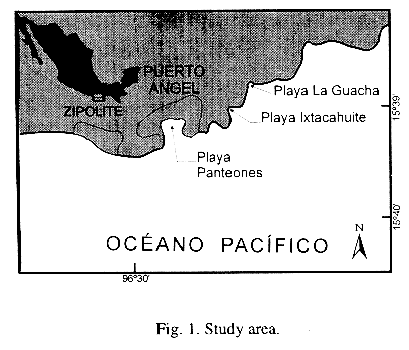
<body><![CDATA[<BR><B><FONT FACE="Arial,Helvetica"><FONT SIZE=-1>Resumen</FONT></FONT></B>      <P><FONT FACE="Arial,Helvetica"><FONT SIZE=-1>Se presentan datos sobre la riqueza de especies y las caracter&iacute;sticas de tres arrecifes de coral de la regi&oacute;n de Puerto Angel, M&eacute;xico (15&ordm; N), visitados en 1994 y revisados en seis censos visuales de una hora, conducidos hasta 6 m de profundidad. Se encontr&oacute; un total de siete especies en el &aacute;rea (pertenecientes a cuatro g&eacute;neros), siendo la m&aacute;s abundante <I>Pocillopora damicornis</I> (L., 1758). Las especies de este g&eacute;nero fueron las principales constructoras de la estructura arrecifal en los sitios visitados. Los corales masivos fueron poco comunes, y habitaban principalmente en la base de los arrecifes. Por la presencia de una estructura arrecifal bien cementada y una zonaci&oacute;n clara, los arrecifes de franja de Puerto Angel deben ser considerados entre los mejor desarrollados de la costa del Pac&iacute;fico de M&eacute;xico. Un evento de mortalidad coralina y posterior recolonizaci&oacute;n fue observado en esta visita. Sin embargo, no se determin&oacute; cu&aacute;l fue su causa.</FONT></FONT>     <BR>&nbsp;      <P><B><FONT FACE="Arial,Helvetica"><FONT SIZE=-1>Keywords</FONT></FONT></B>      <P><FONT FACE="Arial,Helvetica"><FONT SIZE=-1>Puerto Angel, M&eacute;xico, corals, eastern Pacific.</FONT></FONT>     <BR>&nbsp;      <P><FONT FACE="Arial,Helvetica"><FONT SIZE=-1>The coral communities and reefs of the eastern tropical Pacific have been studied for more than a hundred years (<A HREF="#Guzmán, H.M.">Guzm&aacute;n &amp; Cort&eacute;s 1993</A>). However, data are still lacking from several long coastal margins, especially in M&eacute;xico, where coral communities and reefs are well known only in the Gulf of California (<A HREF="#Squires, D.J.">Squires 1959</A>,<A HREF="#Reyes- Bonilla"> Reyes- Bonilla 1993</A>).</FONT></FONT>      <P><FONT FACE="Arial,Helvetica"><FONT SIZE=-1>The objective of this paper is to describe the general composition and structure of three coral reefs located near Puerto Angel, M&eacute;xico: Playa Panteones, Playa Ixtacahuite and La Guacha (<A HREF="#fig. 1">Fig. 1</A>). <A HREF="#Palmer, R.H.">Palmer (1928</A>) reviewed the geologic history of this area, described three species, and point out some general characteristics of local reefs. Later, the presence of two other coral species was confirmed (<A HREF="#Geister, J.">Geister 1975</A>, <A HREF="#Rodríguez- Palacios">Rodr&iacute;guez- Palacios<I> et al.</I> 1988</A>) and recently, <A HREF="#Glynn, P.W.">Glynn &amp; Leyte- Morales (1997</A>) and <A HREF="#Leyte- Morales,">Leyte- Morales (1997</A>) mentioned all reef areas located north of the Gulf of Tehuantepec, presented an updated species list, and emphasized the need for conservation of this biological systems.</FONT></FONT>     <BR>&nbsp;      <P><A NAME="fig. 1"></A><IMG SRC="/img/fbpe/rbt/v46n3/0204i01.GIF" HEIGHT=350 WIDTH=409>     
]]></body>
<body><![CDATA[<BR>&nbsp;      <P><FONT FACE="Arial,Helvetica"><FONT SIZE=-1>The coral communities of Puerto Angel area occupied a small plateau that gradually reached 15 to 20 m depth at a distance of 50 to 100 from shore. The site is located near the Isthmus of Tehuantepec and local upwellings may occasionally affect the coral communities (<A HREF="#Lluch- Cota">Lluch- Cota<I> et al.</I> 1997)</A>. Average sea surface temperature outside of Puerto Angel bay is 28&ordm; C <I><U>+</U></I> 1.8 (<A HREF="#Anonymous. 1983-1995.">Anonymous 1982-1995</A>). Salinity fluctuates from 33.5 to 34.5 ppm, and thermocline depth is stable at 60 m almost all year round in the area where coral development occurs (<A HREF="#Fiedler, P.C.">Fiedler 1992).</A></FONT></FONT>      <P><FONT FACE="Arial,Helvetica"><FONT SIZE=-1>For this study, a total of six one- hour visual surveys were conduced at the three localities during January 1994, with snorkel and SCUBA equipment and at depths from 0 to 6 m. Specimens of all the coral species observed were collected and deposited at the Instituto de Recursos, U. del Mar. Taxonomic determinations followed <A HREF="#Wells, J.W.">Wells (1983</A>) and<A HREF="#Veron, J.E.N."> Veron (1986)</A> criteria.</FONT></FONT>      <P><FONT FACE="Arial,Helvetica"><FONT SIZE=-1>Seven species were found in the area: <I>Pocillopora damicornis</I> (L., 1758), <I>P. capitata</I> Verrill, 1864, <I>P. meandrina</I> (Dana, 1846), <I>P. verrucosa</I> (Ellis &amp; Solander, 1786), <I>Pocillopora</I> sp., <I>Pavona gigantea</I> Verrill, 1869 and <I>Porites panamensis </I>Verrill, 1866. Of these, <I>Pocillopora damicornis</I> was consistently the most abundant species in all the localities, followed by <I>P. capitata</I>; both were distributed mainly from 1 to 10 m depth, decreasing their abundance with depth. Other pocilloporid species were uncommon. Colonies of <I>Porites panamensis</I> were extremely scarce, encrusting, and appeared only at depths &lt; 3 m. The agaricid <I>Pavona gigantea</I> was rare at all reefs, but it developed large colonies (> 1 m height), especially on rocky zones and at depths from 3 to 5 m.</FONT></FONT>      <P><FONT FACE="Arial,Helvetica"><FONT SIZE=-1>The presence of an undescribed species (<I>Pocillopora</I> sp.) was one of the most remarkable findings. Its most distinctive character is that, unlike all other pocilloporids of the east Pacific, this one had no branches, but instead developed colonies with completely flat upper surfaces. The coralla are composed by pavements of polyps arranged in several levels, each one of these physically separated from the next. All levels are built by consecutive series of polyps (<A HREF="#Leyte- Morales,">Leyte- Morales in prep</A>.).</FONT></FONT>      <P><FONT FACE="Arial,Helvetica"><FONT SIZE=-1>At La Guacha and Ixtacahuite, the reef framework projected 1 to 3 m from the bottom, it was well consolidated and composed predominantly of cemented pocilloporid corals. Large portions of its uppermost section and sides were dead and covered with coralline and fleshy algae and barnacles, but also had numerous small pocilloporid colonies (15 to 20 cm maximum diameter, 3 to 5 cm height) scattered over. Those coralla were classified as recruits, since a discontinuity among the framework and the base of the new coral existed (they were not fragments). Also, colonies were almost symmetrical and stemmed from one point, an indication of larval origin (<A HREF="#Richmond, R.R.">Richmond 1987)</A>. Massive corals were almost absent in the main framework area, but they became increasingly common in the base of the reef (> 5 m depth).</FONT></FONT>      <P><FONT FACE="Arial,Helvetica"><FONT SIZE=-1>Before the visit, we supposed that the reefs of the Puerto Angel area may have a large number of species because of their closeness to the main eastern Pacific reefs at Central America, and of a possible larval transport from the north. The actual number of recorded species (seven) is, however, very low. During field work we did not find several taxa which have been already seen in nearby sites, like <I>Gardineroseris planulata </I>(Dana, 1846) or <I>Pavona varians</I> Verrill, 1864 (<A HREF="#Leyte- Morales,">Leyte- Morales 1997</A>). The presence of sandy bottoms at north and south of Puerto Angel and the upwellings in the Gulf of Tehuantepec may be acting as isolating forces, limiting larval arrival, and restricting the number of coral species (<A HREF="#Glynn, P.W.">Glynn &amp; Leyte- Morales 1997</A>).</FONT></FONT>      <P><FONT FACE="Arial,Helvetica"><FONT SIZE=-1>The good development and zonation of the Puerto Angel reefs should result of the adequate local thermal conditions (mean monthly temperature is never lower than 27&ordm; C in the year; <A HREF="#Fiedler, P.C.">Fiedler 1992</A>). These well- structured communities are potentially as old as others that show similar conditions elsewhere (<A HREF="#Guzmán, H.M.">Guzm&aacute;n &amp; Cort&eacute;s 1993</A>). In comparison, zonation and large frameworks are uncommon at the apparently younger coral areas of the Gulf of California and the Revillagigedos (<A HREF="#Squires, D.J.">Squires 1959</A>, <A HREF="#Reyes- Bonilla">Reyes- Bonilla 1993</A>).</FONT></FONT>      <P><FONT FACE="Arial,Helvetica"><FONT SIZE=-1>There are no reports of effects that El Ni&ntilde;o events may have had on reef corals of Puerto Angel, although small thermal anomalies occurred in 1983 (&lt;1.5&ordm; C; <A HREF="#Lluch- Cota">Lluch-Cota<I> et al.</I> 1997</A>). Notwithstanding, large tracts of dead coral covered by algae were seen in 1994, all of them invaded and eroded by sea urchins (<I>Diadema </I>Gray, 1825, <I>Echinometra </I>Gray, 1825, <I>Eucidaris </I>Mortensen, 1909, <I>Centrostephanus </I>Peters, 1855 and <I>Toxopneustes </I>Agassiz, 1841), as it occurred at several bleached sites after 1982-83 (<A HREF="#Guzmán, H.M.">Guzm&aacute;n &amp; Cort&eacute;s 1993</A>). If the coral mortality of Puerto Angel was not a consequence of an ENSO, it may have been a human-caused event; human population has increased considerably in the coast in the last decade because of the creation of a large government- owned touristic infrastructure, which may have affected the coral communities in some way. However, we have no data to point to any factor as the actual cause of the dead coral tracts. New studies on this coral reefs will help to answer our questions and to evaluate its importance.</FONT></FONT>      <P><FONT FACE="Arial,Helvetica"><FONT SIZE=-1>The visit of H.R.B. to Puerto Angel was supported by Juan Gabriel D&iacute;az U. and Silvia Ram&iacute;rez L. (UMar). Jose Carriquiry (IIO-UABC, Ensenada) reviewed the manuscript and commented on several aspects here discussed. Two anonymous reviewers also suggested important additions for the paper.</FONT></FONT>     ]]></body>
<body><![CDATA[<BR>&nbsp;      <P><B><FONT FACE="Arial,Helvetica"><FONT SIZE=-1>References</FONT></FONT></B>      <!-- ref --><P><A NAME="Anonymous. 1983-1995."></A><FONT FACE="Arial,Helvetica"><FONT SIZE=-1>Anonymous. 1983-1995. Oceanographic monthly magazine. National Oceanographic and Atmospheric Agency. U.S. Dept. of Commerce, Washington, D.C.</FONT></FONT>    &nbsp;&nbsp;&nbsp;&nbsp;&nbsp;&nbsp;&nbsp;&nbsp;[&#160;<a href="javascript:void(0);" onclick="javascript: window.open('/scielo.php?script=sci_nlinks&ref=1131086&pid=S0034-7744199800030002200001&lng=','','width=640,height=500,resizable=yes,scrollbars=1,menubar=yes,');">Links</a>&#160;]<!-- end-ref --><!-- ref --><P><A NAME="Fiedler, P.C."></A><FONT FACE="Arial,Helvetica"><FONT SIZE=-1>Fiedler, P.C. 1992. Seasonal climatologies and variability of eastern tropical Pacific surface waters. NOAA Techn. Rep. NMFS 109. 65 p.</FONT></FONT>    &nbsp;&nbsp;&nbsp;&nbsp;&nbsp;&nbsp;&nbsp;&nbsp;[&#160;<a href="javascript:void(0);" onclick="javascript: window.open('/scielo.php?script=sci_nlinks&ref=1131087&pid=S0034-7744199800030002200002&lng=','','width=640,height=500,resizable=yes,scrollbars=1,menubar=yes,');">Links</a>&#160;]<!-- end-ref --><!-- ref --><P><A NAME="Geister, J."></A><FONT FACE="Arial,Helvetica"><FONT SIZE=-1>Geister, J. 1975. Occurrence of <I>Pocillopora</I> in late Pleistocene Caribbean coral reefs. Mem. Bur. Rech. Geol. Min. 89: 378-388.</FONT></FONT>    &nbsp;&nbsp;&nbsp;&nbsp;&nbsp;&nbsp;&nbsp;&nbsp;[&#160;<a href="javascript:void(0);" onclick="javascript: window.open('/scielo.php?script=sci_nlinks&ref=1131088&pid=S0034-7744199800030002200003&lng=','','width=640,height=500,resizable=yes,scrollbars=1,menubar=yes,');">Links</a>&#160;]<!-- end-ref --><!-- ref --><P><A NAME="Glynn, P.W."></A><FONT FACE="Arial,Helvetica"><FONT SIZE=-1>Glynn, P.W. &amp; G.E. Leyte- Morales. 1997. Coral reefs of Huatulco, west M&eacute;xico: reef development in upwelling Gulf of Tehuantepec. Rev. Biol. Trop. 45: 1033-1048.</FONT></FONT>    &nbsp;&nbsp;&nbsp;&nbsp;&nbsp;&nbsp;&nbsp;&nbsp;[&#160;<a href="javascript:void(0);" onclick="javascript: window.open('/scielo.php?script=sci_nlinks&ref=1131089&pid=S0034-7744199800030002200004&lng=','','width=640,height=500,resizable=yes,scrollbars=1,menubar=yes,');">Links</a>&#160;]<!-- end-ref --><!-- ref --><P><A NAME="Guzmán, H.M."></A><FONT FACE="Arial,Helvetica"><FONT SIZE=-1>Guzm&aacute;n, H.M. &amp; J. Cort&eacute;s. 1993. Arrecifes coralinos del Pac&iacute;fico oriental tropical: revisi&oacute;n y perspectivas. Rev. Biol. Trop. 41: 535-557.</FONT></FONT>    &nbsp;&nbsp;&nbsp;&nbsp;&nbsp;&nbsp;&nbsp;&nbsp;[&#160;<a href="javascript:void(0);" onclick="javascript: window.open('/scielo.php?script=sci_nlinks&ref=1131090&pid=S0034-7744199800030002200005&lng=','','width=640,height=500,resizable=yes,scrollbars=1,menubar=yes,');">Links</a>&#160;]<!-- end-ref --><!-- ref --><P><A NAME="Leyte- Morales,"></A><FONT FACE="Arial,Helvetica"><FONT SIZE=-1>Leyte- Morales, G.E. 1997. La colecci&oacute;n de corales de la Universidad del Mar. Cienc. Mar 1: 3-16.</FONT></FONT>    &nbsp;&nbsp;&nbsp;&nbsp;&nbsp;&nbsp;&nbsp;&nbsp;[&#160;<a href="javascript:void(0);" onclick="javascript: window.open('/scielo.php?script=sci_nlinks&ref=1131091&pid=S0034-7744199800030002200006&lng=','','width=640,height=500,resizable=yes,scrollbars=1,menubar=yes,');">Links</a>&#160;]<!-- end-ref --><!-- ref --><P><A NAME="Lluch- Cota"></A><FONT FACE="Arial,Helvetica"><FONT SIZE=-1>Lluch- Cota, S.E., S. Alvarez- Borrego, E.M. Santamar&iacute;a- del Angel, F. Muller- Karger &amp; S. Hern&aacute;ndez-V&aacute;zquez. 1997. El Golfo de Tehuantepec y &aacute;reas adyacentes: variaci&oacute;n espaciotemporal de pigmentos fotosint&eacute;ticos derivados de sat&eacute;lite. Cienc. Mar. 23: 329-340.</FONT></FONT>    &nbsp;&nbsp;&nbsp;&nbsp;&nbsp;&nbsp;&nbsp;&nbsp;[&#160;<a href="javascript:void(0);" onclick="javascript: window.open('/scielo.php?script=sci_nlinks&ref=1131092&pid=S0034-7744199800030002200007&lng=','','width=640,height=500,resizable=yes,scrollbars=1,menubar=yes,');">Links</a>&#160;]<!-- end-ref --><!-- ref --><P><A NAME="Palmer, R.H."></A><FONT FACE="Arial,Helvetica"><FONT SIZE=-1>Palmer, R.H. 1928. Fossil and Recent corals and coral reefs of western Mexico. Proc. Am. Philos. Soc. Philad. 67: 21-37.</FONT></FONT>    &nbsp;&nbsp;&nbsp;&nbsp;&nbsp;&nbsp;&nbsp;&nbsp;[&#160;<a href="javascript:void(0);" onclick="javascript: window.open('/scielo.php?script=sci_nlinks&ref=1131093&pid=S0034-7744199800030002200008&lng=','','width=640,height=500,resizable=yes,scrollbars=1,menubar=yes,');">Links</a>&#160;]<!-- end-ref --><!-- ref --><P><A NAME="Reyes- Bonilla"></A><FONT FACE="Arial,Helvetica"><FONT SIZE=-1>Reyes- Bonilla, H. 1993. Biogeograf&iacute;a y ecolog&iacute;a de los corales hermat&iacute;picos (Anthozoa: Scleractinia) del Pac&iacute;fico de M&eacute;xico, p. 207-222. <I>In</I> S.I. Salazar- Vallejo &amp; N.E. Gonz&aacute;lez (eds.). Biodiversidad marina y costera de M&eacute;xico. Com. Nac. Biodiversidad/ C.I.Q.R.O, Chetumal, Q.R., M&eacute;xico.</FONT></FONT>    &nbsp;&nbsp;&nbsp;&nbsp;&nbsp;&nbsp;&nbsp;&nbsp;[&#160;<a href="javascript:void(0);" onclick="javascript: window.open('/scielo.php?script=sci_nlinks&ref=1131094&pid=S0034-7744199800030002200009&lng=','','width=640,height=500,resizable=yes,scrollbars=1,menubar=yes,');">Links</a>&#160;]<!-- end-ref --><!-- ref --><P><A NAME="Richmond, R.R."></A><FONT FACE="Arial,Helvetica"><FONT SIZE=-1>Richmond, R.R. 1987. Energetic relationships and biogeographical differences among fecundity, growth and reproduction in the reef coral <I>Pocillopora damicornis. </I>Bull. Mar. Sci. 41: 594-604.</FONT></FONT>    &nbsp;&nbsp;&nbsp;&nbsp;&nbsp;&nbsp;&nbsp;&nbsp;[&#160;<a href="javascript:void(0);" onclick="javascript: window.open('/scielo.php?script=sci_nlinks&ref=1131095&pid=S0034-7744199800030002200010&lng=','','width=640,height=500,resizable=yes,scrollbars=1,menubar=yes,');">Links</a>&#160;]<!-- end-ref --><!-- ref --><P><A NAME="Rodríguez- Palacios"></A><FONT FACE="Arial,Helvetica"><FONT SIZE=-1>Rodr&iacute;guez- Palacios, C.A., L.M. Mitchell- Arana, G. Sandoval- D&iacute;az, P. G&oacute;mez y G. Green. 1988. Los moluscos de las bah&iacute;as de Huatulco y Puerto Angel, Oaxaca. Distribuci&oacute;n, diversidad y abundancia. Univ. Cienc. 5: 85-94.</FONT></FONT>    &nbsp;&nbsp;&nbsp;&nbsp;&nbsp;&nbsp;&nbsp;&nbsp;[&#160;<a href="javascript:void(0);" onclick="javascript: window.open('/scielo.php?script=sci_nlinks&ref=1131096&pid=S0034-7744199800030002200011&lng=','','width=640,height=500,resizable=yes,scrollbars=1,menubar=yes,');">Links</a>&#160;]<!-- end-ref --><!-- ref --><P><A NAME="Squires, D.J."></A><FONT FACE="Arial,Helvetica"><FONT SIZE=-1>Squires, D.J. 1959. Corals and coral reefs of the Gulf of California. Bull. Am. Mus. Nat. Hist. 118: 367-432.</FONT></FONT>    &nbsp;&nbsp;&nbsp;&nbsp;&nbsp;&nbsp;&nbsp;&nbsp;[&#160;<a href="javascript:void(0);" onclick="javascript: window.open('/scielo.php?script=sci_nlinks&ref=1131097&pid=S0034-7744199800030002200012&lng=','','width=640,height=500,resizable=yes,scrollbars=1,menubar=yes,');">Links</a>&#160;]<!-- end-ref --><!-- ref --><P><A NAME="Veron, J.E.N."></A><FONT FACE="Arial,Helvetica"><FONT SIZE=-1>Veron, J.E.N. 1986. Corals of Australia and the Indo Pacific. Angus and Robertson, Sydney. 544 p.</FONT></FONT>    &nbsp;&nbsp;&nbsp;&nbsp;&nbsp;&nbsp;&nbsp;&nbsp;[&#160;<a href="javascript:void(0);" onclick="javascript: window.open('/scielo.php?script=sci_nlinks&ref=1131098&pid=S0034-7744199800030002200013&lng=','','width=640,height=500,resizable=yes,scrollbars=1,menubar=yes,');">Links</a>&#160;]<!-- end-ref --><!-- ref --><P><A NAME="Wells, J.W."></A><FONT FACE="Arial,Helvetica"><FONT SIZE=-1>Wells, J.W. 1983. Annotated list of the scleractinian corals of the Galapagos Islands, p. 212-295. <I>In</I> Glynn, P.W. &amp; G.M. Wellington (eds.). Corals and coral reefs of the Galapagos Islands. University of California, Berkeley. 330 p.</FONT></FONT>    &nbsp;&nbsp;&nbsp;&nbsp;&nbsp;&nbsp;&nbsp;&nbsp;[&#160;<a href="javascript:void(0);" onclick="javascript: window.open('/scielo.php?script=sci_nlinks&ref=1131099&pid=S0034-7744199800030002200014&lng=','','width=640,height=500,resizable=yes,scrollbars=1,menubar=yes,');">Links</a>&#160;]<!-- end-ref --><P><A NAME="1a"></A><SUP><FONT FACE="Arial,Helvetica"><FONT SIZE=-1><A HREF="#1">1</A>&nbsp; </FONT></FONT></SUP><FONT FACE="Arial,Helvetica"><FONT SIZE=-1>Departamento de Biolog&iacute;a Marina. Universidad Aut&oacute;noma de Baja California Sur. Apartado postal 19-B, CP 23080. La Paz, B.C.S., M&eacute;xico.</FONT></FONT>      <P><A NAME="2a"></A><SUP><FONT FACE="Arial,Helvetica"><FONT SIZE=-1><A HREF="#2">2</A>&nbsp;</FONT></FONT></SUP><FONT FACE="Arial,Helvetica"><FONT SIZE=-1> Instituto de Recursos. Universidad del Mar. Apartado postal 47, CP 70902. Puerto Angel, Oax. M&eacute;xico.</FONT></FONT>      ]]></body><back>
<ref-list>
<ref id="B1">
<nlm-citation citation-type="book">
<person-group person-group-type="author">
<name>
</name>
<name>
</name>
</person-group>
<source><![CDATA[Oceanographic monthly magazine.]]></source>
<year>1995</year>
<publisher-loc><![CDATA[Washington, D.C. ]]></publisher-loc>
<publisher-name><![CDATA[National Oceanographic and Atmospheric Agency. U.S. Dept. of Commerce,]]></publisher-name>
</nlm-citation>
</ref>
<ref id="B2">
<nlm-citation citation-type="book">
<person-group person-group-type="author">
<name>
<surname><![CDATA[Fiedler]]></surname>
<given-names><![CDATA[P.C.]]></given-names>
</name>
</person-group>
<source><![CDATA[Seasonal climatologies and variability of eastern tropical Pacific surface waters]]></source>
<year>1992</year>
<volume>109</volume>
<publisher-name><![CDATA[NOAA]]></publisher-name>
</nlm-citation>
</ref>
<ref id="B3">
<nlm-citation citation-type="journal">
<person-group person-group-type="author">
<name>
<surname><![CDATA[Geister]]></surname>
<given-names><![CDATA[J.]]></given-names>
</name>
</person-group>
<article-title xml:lang="en"><![CDATA[Occurrence of Pocillopora in late Pleistocene Caribbean coral reefs]]></article-title>
<source><![CDATA[Mem. Bur. Rech. Geol. Min.]]></source>
<year>1975</year>
<volume>89</volume>
<page-range>378-388</page-range></nlm-citation>
</ref>
<ref id="B4">
<nlm-citation citation-type="journal">
<person-group person-group-type="author">
<name>
<surname><![CDATA[Glynn]]></surname>
<given-names><![CDATA[P.W.]]></given-names>
</name>
<name>
<surname><![CDATA[Leyte- Morales]]></surname>
<given-names><![CDATA[G.E.]]></given-names>
</name>
</person-group>
<article-title xml:lang="en"><![CDATA[Coral reefs of Huatulco, west México: reef development in upwelling Gulf of Tehuantepec.]]></article-title>
<source><![CDATA[Rev. Biol. Trop.]]></source>
<year>1997</year>
<volume>45</volume>
<page-range>1033-1048</page-range></nlm-citation>
</ref>
<ref id="B5">
<nlm-citation citation-type="journal">
<person-group person-group-type="author">
<name>
<surname><![CDATA[Guzmán]]></surname>
<given-names><![CDATA[H.M.]]></given-names>
</name>
<name>
<surname><![CDATA[Cortés]]></surname>
<given-names><![CDATA[J.]]></given-names>
</name>
</person-group>
<article-title xml:lang="es"><![CDATA[Arrecifes coralinos del Pacífico oriental tropical: revisión y perspectivas]]></article-title>
<source><![CDATA[Rev. Biol. Trop.]]></source>
<year>1993</year>
<volume>41</volume>
<page-range>535-557</page-range></nlm-citation>
</ref>
<ref id="B6">
<nlm-citation citation-type="journal">
<person-group person-group-type="author">
<name>
<surname><![CDATA[Leyte- Morales]]></surname>
<given-names><![CDATA[G.E.]]></given-names>
</name>
</person-group>
<article-title xml:lang="es"><![CDATA[La colección de corales de la Universidad del Mar]]></article-title>
<source><![CDATA[Cienc. Mar]]></source>
<year>1997</year>
<volume>1</volume>
<page-range>3-16</page-range></nlm-citation>
</ref>
<ref id="B7">
<nlm-citation citation-type="journal">
<person-group person-group-type="author">
<name>
<surname><![CDATA[Lluch- Cota]]></surname>
<given-names><![CDATA[S.E.]]></given-names>
</name>
<name>
<surname><![CDATA[Alvarez- Borrego]]></surname>
<given-names><![CDATA[S.]]></given-names>
</name>
<name>
<surname><![CDATA[Santamaría- del Angel]]></surname>
<given-names><![CDATA[E.M.]]></given-names>
</name>
<name>
<surname><![CDATA[Muller- Karger]]></surname>
<given-names><![CDATA[F.]]></given-names>
</name>
<name>
<surname><![CDATA[Hernández-Vázquez]]></surname>
<given-names><![CDATA[S.]]></given-names>
</name>
</person-group>
<article-title xml:lang="es"><![CDATA[El Golfo de Tehuantepec y áreas adyacentes: variación espaciotemporal de pigmentos fotosintéticos derivados de satélite]]></article-title>
<source><![CDATA[Cienc. Mar.]]></source>
<year>1997</year>
<volume>23</volume>
<page-range>329-340</page-range></nlm-citation>
</ref>
<ref id="B8">
<nlm-citation citation-type="journal">
<person-group person-group-type="author">
<name>
<surname><![CDATA[Palmer]]></surname>
<given-names><![CDATA[R.H.]]></given-names>
</name>
</person-group>
<article-title xml:lang="en"><![CDATA[Fossil and Recent corals and coral reefs of western Mexico]]></article-title>
<source><![CDATA[Proc. Am. Philos. Soc. Philad.]]></source>
<year>1928</year>
<volume>67</volume>
<page-range>21-37</page-range></nlm-citation>
</ref>
<ref id="B9">
<nlm-citation citation-type="book">
<person-group person-group-type="author">
<name>
<surname><![CDATA[Reyes- Bonilla]]></surname>
<given-names><![CDATA[H.]]></given-names>
</name>
</person-group>
<article-title xml:lang="es"><![CDATA[Biogeografía y ecología de los corales hermatípicos (Anthozoa: Scleractinia) del Pacífico de México]]></article-title>
<person-group person-group-type="editor">
<name>
<surname><![CDATA[Salazar- Vallejo]]></surname>
<given-names><![CDATA[S.I.]]></given-names>
</name>
<name>
<surname><![CDATA[González]]></surname>
<given-names><![CDATA[N.E.]]></given-names>
</name>
</person-group>
<source><![CDATA[Biodiversidad marina y costera de México]]></source>
<year>1993</year>
<page-range>207-222</page-range><publisher-name><![CDATA[Com. Nac. Biodiversidad/ C.I.Q.R.O, Chetumal, Q.R.,]]></publisher-name>
</nlm-citation>
</ref>
<ref id="B10">
<nlm-citation citation-type="journal">
<person-group person-group-type="author">
<name>
<surname><![CDATA[Richmond]]></surname>
<given-names><![CDATA[R.R.]]></given-names>
</name>
</person-group>
<article-title xml:lang="en"><![CDATA[Energetic relationships and biogeographical differences among fecundity, growth and reproduction in the reef coral Pocillopora damicornis]]></article-title>
<source><![CDATA[Bull. Mar. Sci.]]></source>
<year>1987</year>
<month>.</month>
<volume>41</volume>
<page-range>594-604</page-range></nlm-citation>
</ref>
<ref id="B11">
<nlm-citation citation-type="journal">
<person-group person-group-type="author">
<name>
<surname><![CDATA[Rodríguez- Palacios]]></surname>
<given-names><![CDATA[C.A.]]></given-names>
</name>
<name>
<surname><![CDATA[Mitchell- Arana]]></surname>
<given-names><![CDATA[L.M]]></given-names>
</name>
<name>
<surname><![CDATA[Sandoval- Díaz]]></surname>
<given-names><![CDATA[G.]]></given-names>
</name>
<name>
<surname><![CDATA[Gómez]]></surname>
<given-names><![CDATA[P.]]></given-names>
</name>
<name>
<surname><![CDATA[Green]]></surname>
<given-names><![CDATA[G.]]></given-names>
</name>
</person-group>
<article-title xml:lang="es"><![CDATA[Los moluscos de las bahías de Huatulco y Puerto Angel, Oaxaca. Distribución, diversidad y abundancia]]></article-title>
<source><![CDATA[Univ. Cienc.]]></source>
<year>1988</year>
<volume>5</volume>
<page-range>85-94</page-range></nlm-citation>
</ref>
<ref id="B12">
<nlm-citation citation-type="journal">
<person-group person-group-type="author">
<name>
<surname><![CDATA[Squires]]></surname>
<given-names><![CDATA[D.J.]]></given-names>
</name>
</person-group>
<article-title xml:lang="en"><![CDATA[Corals and coral reefs of the Gulf of California.]]></article-title>
<source><![CDATA[Bull. Am. Mus. Nat. Hist.]]></source>
<year>1959</year>
<volume>118</volume>
<page-range>367-432</page-range></nlm-citation>
</ref>
<ref id="B13">
<nlm-citation citation-type="book">
<person-group person-group-type="author">
<name>
<surname><![CDATA[Veron]]></surname>
<given-names><![CDATA[J.E.N.]]></given-names>
</name>
</person-group>
<source><![CDATA[Corals of Australia and the Indo Pacific]]></source>
<year>1986</year>
<publisher-loc><![CDATA[Sydney ]]></publisher-loc>
<publisher-name><![CDATA[Angus and Robertson]]></publisher-name>
</nlm-citation>
</ref>
<ref id="B14">
<nlm-citation citation-type="book">
<person-group person-group-type="author">
<name>
<surname><![CDATA[Wells]]></surname>
<given-names><![CDATA[J.W.]]></given-names>
</name>
</person-group>
<article-title xml:lang="en"><![CDATA[Annotated list of the scleractinian corals of the Galapagos Islands]]></article-title>
<person-group person-group-type="editor">
<name>
<surname><![CDATA[Glynn]]></surname>
<given-names><![CDATA[P.W.]]></given-names>
</name>
<name>
<surname><![CDATA[Wellington]]></surname>
<given-names><![CDATA[G.M.]]></given-names>
</name>
</person-group>
<source><![CDATA[Corals and coral reefs of the Galapagos Islands.]]></source>
<year>1983</year>
<page-range>212-295</page-range><publisher-loc><![CDATA[Berkeley ]]></publisher-loc>
<publisher-name><![CDATA[University of California]]></publisher-name>
</nlm-citation>
</ref>
</ref-list>
</back>
</article>
