<?xml version="1.0" encoding="ISO-8859-1"?><article xmlns:mml="http://www.w3.org/1998/Math/MathML" xmlns:xlink="http://www.w3.org/1999/xlink" xmlns:xsi="http://www.w3.org/2001/XMLSchema-instance">
<front>
<journal-meta>
<journal-id>0034-7744</journal-id>
<journal-title><![CDATA[Revista de Biología Tropical]]></journal-title>
<abbrev-journal-title><![CDATA[Rev. biol. trop]]></abbrev-journal-title>
<issn>0034-7744</issn>
<publisher>
<publisher-name><![CDATA[Universidad de Costa Rica]]></publisher-name>
</publisher>
</journal-meta>
<article-meta>
<article-id>S0034-77441998000300019</article-id>
<title-group>
<article-title xml:lang="es"><![CDATA[Variación estacional de lípidos en varios tejidos del cambute Strombus gigas (Mesogastropoda: Strombidae), en Quintana Roo, México]]></article-title>
</title-group>
<contrib-group>
<contrib contrib-type="author">
<name>
<surname><![CDATA[Brito Manzano]]></surname>
<given-names><![CDATA[Nancy]]></given-names>
</name>
</contrib>
<contrib contrib-type="author">
<name>
<surname><![CDATA[Aldana Aranda]]></surname>
<given-names><![CDATA[Dalila]]></given-names>
</name>
<xref ref-type="aff" rid="A01"/>
</contrib>
</contrib-group>
<aff id="A01">
<institution><![CDATA[,CINVESTAV IPN Laboratorio de Biología Marina ]]></institution>
<addr-line><![CDATA[Mérida Yucatán]]></addr-line>
<country>México</country>
</aff>
<pub-date pub-type="pub">
<day>00</day>
<month>09</month>
<year>1998</year>
</pub-date>
<pub-date pub-type="epub">
<day>00</day>
<month>09</month>
<year>1998</year>
</pub-date>
<volume>46</volume>
<numero>3</numero>
<fpage>655</fpage>
<lpage>660</lpage>
<copyright-statement/>
<copyright-year/>
<self-uri xlink:href="http://www.scielo.sa.cr/scielo.php?script=sci_arttext&amp;pid=S0034-77441998000300019&amp;lng=en&amp;nrm=iso"></self-uri><self-uri xlink:href="http://www.scielo.sa.cr/scielo.php?script=sci_abstract&amp;pid=S0034-77441998000300019&amp;lng=en&amp;nrm=iso"></self-uri><self-uri xlink:href="http://www.scielo.sa.cr/scielo.php?script=sci_pdf&amp;pid=S0034-77441998000300019&amp;lng=en&amp;nrm=iso"></self-uri><abstract abstract-type="short" xml:lang="en"><p><![CDATA[Strombus gigas samples were collected in Banco Chinchorro, Quintana Roo, Mexico (18°47'-18°23' N; 87°14' W). Shell, body and spire lenght were measured. Fat content of gonad, digestive gland and meat of male and female conchs, was analyzed by the standard and microsoxhlet methods on a monthly basis for a year. Mean lenght for shell, body and spire were 209 ± 1 mm, 137 ±1 mm and 100 ± 1 mm, respectively. Total wet weigth was 1 826 ± 7 g. Fat content in gonad-digestive gland was 1.27-9.33 g% with a mean of 4.27 g% and in meat 0.41-5.03 g% with a mean of 2.15 g%. Fat content in female gonad-digestive gland was 1.27 g% at 8.57 g% with a mean of 4.50 g%; in male: 1.87 g% at 9.33 g% with a mean of 4.01 g%. Sexes differed (t student P < 0.05). Mean fat content in meat was 2.15 g%, (males 1.97 g%, females 2.3 g%). There was not significant sexual difference for meat fat content. There was a difference between gonad-digestive gland and meat (t student P < 0.05). However, from February to September meat lipid content exceeds the percentage recommended for human consumption by the FAO.]]></p></abstract>
<abstract abstract-type="short" xml:lang="es"><p><![CDATA[Se determinó la variación mensual de lípidos en varios tejidos del cambute Strombus gigas (L.), en Banco Chinchorro, Quintana Roo, México durante un año. La longitud de la heliconcha fue 209 ± 1 mm, la del cuerpo 137 ± 1 mm, la de la espira 100 ± 1 mm y el peso húmedo total 1 826 ± 7 g. La media del contenido de lípidos en la gónada-glándula digestiva fue 4.27 g% (machos 4.01 g% y hembras 4.50 g%). El contenido de lípidos en gónada-glándula digestiva mostró diferencias sexuales significativas (p < 0.05). En la porción comestible la media fue 2.15 g%, (machos 1.97 g%, hembras 2.3 g%). Las diferencias sexuales no fueron significativas (t de student p < 0.05). El análisis estadístico mostró diferencias significativas (p < 0.05), entre los valores obtenidos en gónada-glándula digestiva con respecto a la parte comestible. Sin embargo, de febrero a septiembre el contenido de lípidos en la parte comestible excede el porcentaje de lípidos para el consumo humano recomendado por la FAO.]]></p></abstract>
<kwd-group>
<kwd lng="en"><![CDATA[Strombus]]></kwd>
<kwd lng="en"><![CDATA[lipid composition]]></kwd>
<kwd lng="en"><![CDATA[annual cycle]]></kwd>
</kwd-group>
</article-meta>
</front><body><![CDATA[ <CENTER><B><FONT FACE="Arial,Helvetica">Variaci&oacute;n estacional de l&iacute;pidos en varios tejidos del cambute</FONT></B></CENTER>      <CENTER><B><FONT FACE="Arial,Helvetica"><I>Strombus gigas</I> (Mesogastropoda: Strombidae),</FONT></B></CENTER>      <CENTER><B><FONT FACE="Arial,Helvetica">en Quintana Roo, M&eacute;xico</FONT></B></CENTER>      <CENTER>&nbsp;</CENTER>      <CENTER>&nbsp;</CENTER>      <CENTER><FONT FACE="Arial,Helvetica"><FONT SIZE=-1><B>Nancy Brito Manzano&nbsp;&nbsp;&nbsp;&nbsp; Dalila Aldana Aranda<A NAME="1"></A></B><SUP><A HREF="#1a">1</A></SUP></FONT></FONT></CENTER>      <CENTER>&nbsp;</CENTER>      <CENTER>&nbsp;</CENTER>      <CENTER><FONT FACE="Arial,Helvetica"><FONT SIZE=-1>Recibido 19-I-1998. Corregido 15-IV-1998. Aceptado 29-IV-1998.</FONT></FONT></CENTER>       <P><B><FONT FACE="Arial,Helvetica"><FONT SIZE=-1>Abstract</FONT></FONT></B>      ]]></body>
<body><![CDATA[<P><FONT FACE="Arial,Helvetica"><FONT SIZE=-1><I>Strombus gigas</I> samples were collected in Banco Chinchorro, Quintana Roo, Mexico (18&deg;47'-18&deg;23' N; 87&deg;14' W). Shell, body and spire lenght were measured. Fat content of gonad, digestive gland and meat of male and female conchs, was analyzed by the standard and microsoxhlet methods on a monthly basis for a year. Mean lenght for shell, body and spire were 209 &plusmn; 1 mm, 137 &plusmn;1 mm and 100 &plusmn; 1 mm, respectively. Total wet weigth was 1 826 &plusmn; 7 g. Fat content in gonad-digestive gland was 1.27-9.33 g% with a mean of 4.27 g% and in meat 0.41-5.03 g% with a mean of 2.15 g%. Fat content in female gonad-digestive gland was 1.27 g% at 8.57 g% with a mean of 4.50 g%; in male: 1.87 g% at 9.33 g% with a mean of 4.01 g%. Sexes differed (t student P &lt; 0.05). Mean fat content in meat was 2.15 g%, (males 1.97 g%, females 2.3 g%). There was not significant sexual difference for meat fat content. There was a difference between gonad-digestive gland and meat (t student P &lt; 0.05). However, from February to September meat lipid content exceeds the percentage recommended for human consumption by the FAO.</FONT></FONT>     <BR>&nbsp;      <P><B><FONT FACE="Arial,Helvetica"><FONT SIZE=-1>Key words</FONT></FONT></B>      <P><FONT FACE="Arial,Helvetica"><FONT SIZE=-1><I>Strombus</I>, lipid composition, annual cycle.</FONT></FONT>     <BR>&nbsp;      <P><FONT FACE="Arial,Helvetica"><FONT SIZE=-1>El cambute <I>S. gigas</I> ha sido por generaciones, una fuente primordial de prote&iacute;nas para los habitantes del Caribe, su concha es utilizada con prop&oacute;sitos ornamentales y artesanales y las v&iacute;sceras se emplean como cebo para la pesca (<A HREF="#Brownell">Brownell y Stevely 1981</A>) o se cuecen para elaborar embutidos, como es el caso en las antillas francesas (<A HREF="#Rathier, Y.">Rathier 1993</A>). <A HREF="#Appeldoorn, R.S.">Appeldoorn (1994</A>), estim&oacute; para 1991 una captura anual de 1 500 a 4 000 toneladas de carne de cambute proveniente de los diferentes pa&iacute;ses del Caribe, lo que represent&oacute; un valor comercial en el mercado de 30 millones de d&oacute;lares. Una de las razones por la que la producci&oacute;n de cambute ha disminu&iacute;do, es debido a la intensificaci&oacute;n de la explotaci&oacute;n en el Caribe. Esta se acent&uacute;a a partir de 1970, en que aumenta la demanda del producto por Estados Unidos y por el mercado europeo en 1982. Ambos mercados internacionales presentan una demanda de cambute no satisfecha. Otra de las razones por la cual la producci&oacute;n de este gaster&oacute;podo ha declinado, es por la modificaci&oacute;n ecol&oacute;gica del h&aacute;bitat donde regularmente se desarrolla, lo que ha disminu&iacute;do a&uacute;n m&aacute;s, las ya escasas poblaciones existentes, colocando a la especie en una situaci&oacute;n cr&iacute;tica para su supervivencia (<A HREF="#Rathier, Y.">Rathier 1993</A>). Por &uacute;ltimo se trata de un recurso comunitario del Caribe, por lo que las medidas biol&oacute;gico-pesqueras para su regulaci&oacute;n tendr&iacute;an que ser tomadas y aplicadas de manera inter-pa&iacute;ses en esta regi&oacute;n (<A HREF="#Stoner, A.W.">Stoner 1996</A>).</FONT></FONT>      <P><FONT FACE="Arial,Helvetica"><FONT SIZE=-1>Hoy en d&iacute;a se busca para las dietas modernas alimentos magros; as&iacute;, en la medida que la carne de cambute se consume todo el a&ntilde;o y dependiendo de la tradici&oacute;n culinaria de cada uno de los pa&iacute;ses del Caribe, se consumen diferentes tejidos, se determin&oacute; realizar para el presente estudio un an&aacute;lisis del contenido de l&iacute;pidos en g&oacute;nada-gl&aacute;ndula digestiva y en la parte comestible del cambute (m&uacute;sculo) a lo largo de un ciclo anual. Adem&aacute;s en este estudio se separaron para su an&aacute;lisis de contenido de l&iacute;pidos las hembras y los machos, en la medida que las hembras almacenan l&iacute;pidos sobre todo en gl&aacute;ndula digestiva en el per&iacute;odo pre-vitelogen&eacute;tico y en g&oacute;nada en el de vitelogenesis (<A HREF="#Voogt, P. A.">Voogt 1980)</A>.</FONT></FONT>      <P><FONT FACE="Arial,Helvetica"><FONT SIZE=-1>En este trabajo se realiza por primera vez un an&aacute;lisis del contenido de l&iacute;pidos a lo largo de todo un ciclo anual, por sexos separados y para diferentes tejidos del cambute, a diferencia de otros estudios donde los an&aacute;lisis han sido puntuales con un n&uacute;mero reducido de animales sin tomar en cuenta el sexo, ni las variaciones estacionales. Adem&aacute;s ellos han sido realizados solo para el m&uacute;sculo.</FONT></FONT>     <BR>&nbsp;      <P><B><FONT FACE="Arial,Helvetica"><FONT SIZE=-1>Materiales y M&eacute;todos</FONT></FONT></B>      ]]></body>
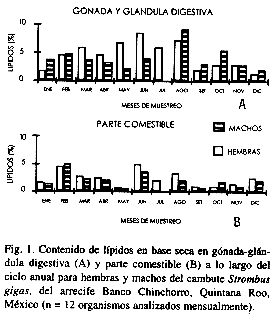
<body><![CDATA[<P><FONT FACE="Arial,Helvetica"><FONT SIZE=-1>Se capturaron por medio de buceo aut&oacute;nomo 36 organismos mensualmente a lo largo de un a&ntilde;o en Banco Chinchorro, M&eacute;xico. Banco Chinchorro est&aacute; ubicado a 18&deg;47'-18&deg;23' N y 87&deg;14' E, es un arrecife coralino que se encuentra a 30 km de la costa sureste del Estado de Quintana Roo, M&eacute;xico. Mide 40 km de largo y 18 km de ancho, abarca 700 km<SUP>2</SUP>de superficie, siendo el arrecife m&aacute;s grande de todo el Caribe (<A HREF="#Aguilar Perera, R.">Aguilar Perera 1992</A>).</FONT></FONT>      <P><FONT FACE="Arial,Helvetica"><FONT SIZE=-1>De cada uno de los cambutes se registr&oacute; el peso h&uacute;medo total, para lo cual se utiliz&oacute; una balanza de plato con una precisi&oacute;n de &plusmn; 25 g. La longitud de la heliconcha, del cuerpo y de la espira se midieron con una regla de 30 cm con divisiones de un mm, registrando los valores promedio y su desviaci&oacute;n est&aacute;ndar. Posteriormente se procedi&oacute; a separar la carne de la concha de cada cambute y en una balanza con precisi&oacute;n de 0.01 g se registr&oacute; el peso de los tejidos blandos. El cuerpo se disect&oacute;, separando la masa visceral y g&oacute;nada de los m&uacute;sculos de la columela y del pie (parte comestible), &eacute;stas partes se pesaron por separado. Para cada organismo se registr&oacute; el sexo del animal.</FONT></FONT>      <P><FONT FACE="Arial,Helvetica"><FONT SIZE=-1>Para el an&aacute;lisis de l&iacute;pidos se tomaron 138 organismos, mensualmente fueron analizados seis organismos hembras y seis organismos machos para los tejidos de la parte comestible y g&oacute;nada-gl&aacute;ndula digestiva. Las muestras de g&oacute;nada-gl&aacute;ndula digestiva, que en esta especie se encuentran formando un tejido interconectado, se tomaron en su parte media. Las muestras correspondientes a la parte comestible, fueron tomadas del m&uacute;sculo en la secci&oacute;n contigua al op&eacute;rculo.</FONT></FONT>      <P><FONT FACE="Arial,Helvetica"><FONT SIZE=-1>Las muestras de estos tejidos disectados, se pesaron en una balanza con precisi&oacute;n de 0.01 g, posteriormente fueron desecadas a 60&deg;C en una estufa durante 72 hr, que es el tiempo requerido por las muestras para obtener un valor de humedad constante (<A HREF="#Anónimo 1984.">An&oacute;nimo 1984</A>).</FONT></FONT>      <P><FONT FACE="Arial,Helvetica"><FONT SIZE=-1>Para el an&aacute;lisis de l&iacute;pidos se seleccionaron tres muestras de cada uno de los tejidos estudiados, incluyendo organismos de ambos sexos. Las muestras se molieron teniendo cuidado de no perder alguna fracci&oacute;n de la muestra. El peso de la muestra seca molida en todos los casos fue superior a dos g, que es la cantidad m&iacute;nima requerida para efectuar el an&aacute;lisis de acuerdo a las t&eacute;cnicas establecidas por <A HREF="#Anónimo 1984.">An&oacute;nimo (1984</A>). Para la determinaci&oacute;n de l&iacute;pidos crudos se utiliz&oacute; el m&eacute;todo Microsoxhlet, la cual consiste en poner una muestra seca en &eacute;ter et&iacute;lico anhidro en un dedal de papel filtro que permite el paso r&aacute;pido del disolvente. El tiempo de extracci&oacute;n puede variar desde cuatro hr a velocidad de condensaci&oacute;n de cinco a seis gotas por s, hasta 16 hr de dos a tres gotas por s. Recuperar el &eacute;ter y evaporar el residuo sobre ba&ntilde;o mar&iacute;a en lugar bien ventilado, secar el residuo a 100&ordm;C durante 30 min, enfriar y pesar hasta peso constante. El peso de l&iacute;pidos crudos en la muestra es obtenido de la diferencia entre el peso del matraz limpio y seco y el peso del matraz con el residuo de grasas. El resultado es expresado como g% del peso de la muestra inicial.</FONT></FONT>     <BR>&nbsp;      <P><B><FONT FACE="Arial,Helvetica"><FONT SIZE=-1>Resultados</FONT></FONT></B>      <P><FONT FACE="Arial,Helvetica"><FONT SIZE=-1>El peso h&uacute;medo total promedio de los organismos fue de 1 826 &plusmn; 7 g. Los valores promedios de las mediciones realizadas sobre las longitudes de la heliconcha, de la espira y el cuerpo de los organismos, fueron de 209 &plusmn; 1 mm (&plusmn; 1 D.E.), 100 &plusmn; 1 mm y 137 1 mm, respectivamente.</FONT></FONT>      <P><FONT FACE="Arial,Helvetica"><FONT SIZE=-1>En la <A HREF="#fig. 1">Fig. 1 A</A> se presentan los valores del contenido de l&iacute;pidos en base seca para hembras y machos en g&oacute;nada-gl&aacute;ndula digestiva. El valor m&aacute;ximo para las hembras se obtuvo en junio con 8.57g% y el valor m&iacute;nimo en diciembre con 1.27g%, el valor medio fue de 4.50 &plusmn; 0.03g%. Para los machos los valores m&aacute;ximo y m&iacute;nimo se presentaron en agosto y diciembre con 9.33g% y 1.87g% respectivamente, el valor medio fue de 4.01 &plusmn; 0.01g%. De agosto a febrero se encontraron m&aacute;s l&iacute;pidos en machos con respecto a las hembras, (<B>t</B> de student p &lt; 0.05), con excepci&oacute;n de noviembre. Por el contrario, de marzo a junio se encontraron m&aacute;s l&iacute;pidos en hembras que en machos, (<B>t</B> de student p &lt; 0.05). Al realizar la comparaci&oacute;n del contenido de l&iacute;pidos en la g&oacute;nada-gl&aacute;ndula digestiva entre las hembras del cambute, se encontr&oacute; que &eacute;stas presentaron diferencias significativas de febrero a agosto. Las diferencias no fueron significativas de septiembre a enero. Para los machos, solo hubo diferencias significativas en agosto (<B>t</B> de student p &lt; 0.05).</FONT></FONT>     <BR>&nbsp;     ]]></body>
<body><![CDATA[<BR>&nbsp;     <CENTER></CENTER>      <CENTER><A NAME="fig. 1"></A><IMG SRC="/img/fbpe/rbt/v46n3/0201i01.GIF" HEIGHT=314 WIDTH=278></CENTER> &nbsp;     
<BR>&nbsp;      <P><FONT FACE="Arial,Helvetica"><FONT SIZE=-1>En la <A HREF="#fig. 1">Fig. 1 B </A>se observa el contenido de l&iacute;pidos en base seca para hembras y machos en la parte comestible del cambute. El valor m&aacute;ximo en las hembras se present&oacute; en junio con 5.03g% y el m&iacute;nimo con 0.55g% en mayo, mientras que para los machos el valor m&aacute;ximo se obtuvo en febrero con 4.86g% y el valor m&iacute;nimo se present&oacute; en mayo con 0.41g%. Los valores de l&iacute;pidos de la parte comestible del cambute no mostraron diferencia sexual (<B>t</B> de student p &lt; 0.05). Al realizar la comparaci&oacute;n del contenido de l&iacute;pidos en la parte comestible entre las hembras se encontr&oacute; que &eacute;stas si presentaron diferencias significativas de febrero a agosto, y que las diferencias no fueron significativas de septiembre a enero. Para los machos, las diferencias fueron significativas de febrero a agosto (<B>t</B> de student p &lt; 0.05).</FONT></FONT>     <BR>&nbsp;      <P><B><FONT FACE="Arial,Helvetica"><FONT SIZE=-1>Discusi&oacute;n</FONT></FONT></B>      <P><FONT FACE="Arial,Helvetica"><FONT SIZE=-1>Los estudios realizados sobre la composici&oacute;n de l&iacute;pidos con diferentes especies de cambutes siempre han sido realizados con muestras puntuales y solo para el tejido de la parte comestible, como lo reportado en los trabajos realizados con <I>S. galeatus</I> por<A HREF="#Blanco"> Blanco Metzler y Montero Campos (1992)</A>, con <I>S. costatus</I> por <A HREF="#González">Gonz&aacute;lez Ferr&aacute;ez (1989</A>) y <A HREF="#Morales">Morales Adri&aacute;n (1990</A>). En estos estudios no se considera ni el sexo del molusco, ni las variaciones eventuales que puedan presentarse a lo largo de un ciclo anual en los tejidos del animal, ni las variaciones inter-tejidos.</FONT></FONT>      <P><FONT FACE="Arial,Helvetica"><FONT SIZE=-1>En el presente trabajo se realiz&oacute; la determinaci&oacute;n de l&iacute;pidos, que actualmente es un tema de inter&eacute;s en la nutrici&oacute;n humana para el consumo de alimentos marinos con bajo contenido de grasas. Se analiz&oacute; la evoluci&oacute;n de l&iacute;pidos en g&oacute;nada-gl&aacute;ndula digestiva y m&uacute;sculo del pie a lo largo de un ciclo annual, realiz&aacute;ndose &eacute;stos por separado para hembras y machos, a fin de conocer el comportamiento de los l&iacute;pidos en la carne del cambute que es la principal parte comestible, pero tambi&eacute;n en la g&oacute;nada-gl&aacute;ndula digestiva. Lo anterior debido a que en algunos pa&iacute;ses del Caribe por sus preferencias culturales y culinarias, se consume el animal completo para la elaboraci&oacute;n de embutidos.<A HREF="#González"> Gonz&aacute;lez Ferr&aacute;ez (1982)</A>, <A HREF="#Morales">Morales Adri&aacute;n (1990</A>), <A HREF="#Blanco">Blanco Metzler y Montero Campos (1992)</A> encontraron valores bajos del contenido de l&iacute;pidos en la parte comestible del cambute por lo que reportan que es bueno para consumo humano, sin embargo realizaron un an&aacute;lisis puntual, para un s&oacute;lo tejido y no tomaron en cuenta el sexo del animal ni la &eacute;poca del a&ntilde;o. En el presente trabajo se encontraron valores bajos del contenido de l&iacute;pidos en el m&uacute;sculo del cambute y en general resulta una carne magra &oacute;ptima para consumo humano. Sin embargo dependiendo de la &eacute;poca del a&ntilde;o, existen diferencias, siendo la carne m&aacute;s magra para el per&iacute;odo de septiembre a enero (2 g%) contrariamente de febrero a agosto el contenido es de casi el doble (3.6 g%).</FONT></FONT>      <P><FONT FACE="Arial,Helvetica"><FONT SIZE=-1>En g&oacute;nada-gl&aacute;ndula digestiva el contenido de l&iacute;pidos es m&aacute;s elevado con respecto al m&uacute;sculo y adem&aacute;s durante el per&iacute;odo de febrero a agosto se presenta el valor m&aacute;ximo de casi 10, mientras que de septiembre a enero el contenido es en promedio de 3 g%. En hembras de febrero a agosto el contenido de l&iacute;pidos fue mayor con respecto al de machos. Los resultados anteriores repercuten en la dieta para consumo humano, ya que la ingesta de l&iacute;pidos va a ser mayor si se consumen organismos hembras.</FONT></FONT>      ]]></body>
<body><![CDATA[<P><FONT FACE="Arial,Helvetica"><FONT SIZE=-1>Estudios puntuales efectuados con otros organismos marinos como pescados frescos, crust&aacute;ceos y moluscos presentan cantidades de grasa similares o mayores a las que se obtuvieron en el presente estudio, como se muestra en el <A HREF="#CUADRO 1">Cuadro 1.</A> En el <A HREF="#CUADRO 2">Cuadro 2 </A>se presenta una comparaci&oacute;n entre el porcentaje de l&iacute;pidos determinado en este estudio y lo reportado por otros autores para diferentes especies de gaster&oacute;podos.</FONT></FONT>     <BR>&nbsp;     <BR>&nbsp;     <BR>&nbsp;     <CENTER></CENTER>      <CENTER><A NAME="CUADRO 1"></A><FONT FACE="Arial,Helvetica"><FONT SIZE=-1>CUADRO 1</FONT></FONT></CENTER>      <CENTER></CENTER>      <CENTER><I><FONT FACE="Arial,Helvetica"><FONT SIZE=-1>Comparaci&oacute;n del contenido de l&iacute;pidos de algunos organismos marinos con los de la carne de diferentes especies de cambute. Los datos de los autores <A HREF="#Morales">Morales Adri&aacute;n </A>y<A HREF="#Blanco"> Blanco Metzler y Montero Campos</A> son puntuales. Los datos para Strombus gigas en este estudio son el valor medio obtenido a lo largo de un ciclo anual</FONT></FONT></I><FONT FACE="Arial,Helvetica"><FONT SIZE=-1>.</FONT></FONT></CENTER>       <P>&nbsp;     <CENTER><TABLE BORDER=0 CELLSPACING=0 CELLPADDING=5 WIDTH="542" > <TR> <TD VALIGN=TOP WIDTH="33%">     ]]></body>
<body><![CDATA[<CENTER><FONT FACE="Arial,Helvetica"><FONT SIZE=-1>Organismo&nbsp;</FONT></FONT></CENTER> </TD>  <TD VALIGN=TOP>     <CENTER><FONT FACE="Arial,Helvetica"><FONT SIZE=-1>Porcentaje de l&iacute;pidos&nbsp;</FONT></FONT></CENTER> </TD>  <TD VALIGN=TOP>     <CENTER><FONT FACE="Arial,Helvetica"><FONT SIZE=-1>Fuente&nbsp;</FONT></FONT></CENTER> </TD> </TR>  <TR> <TD VALIGN=TOP><FONT FACE="Arial,Helvetica"><FONT SIZE=-1>Camar&oacute;n&nbsp;</FONT></FONT></TD>  <TD VALIGN=TOP>     <CENTER><FONT FACE="Arial,Helvetica"><FONT SIZE=-1>0.2<A HREF="#*c">*</A></FONT></FONT></CENTER> </TD>  <TD VALIGN=TOP>     <CENTER><FONT FACE="Arial,Helvetica"><FONT SIZE=-1>Adams (1975)&nbsp;</FONT></FONT></CENTER> </TD> </TR>  <TR> <TD VALIGN=TOP><FONT FACE="Arial,Helvetica"><FONT SIZE=-1>Calamar&nbsp;</FONT></FONT></TD>  <TD VALIGN=TOP>     <CENTER><FONT FACE="Arial,Helvetica"><FONT SIZE=-1>0.9<A HREF="#*c">*</A></FONT></FONT></CENTER> </TD>  <TD VALIGN=TOP>     <CENTER><FONT FACE="Arial,Helvetica"><FONT SIZE=-1>Adams (1975)&nbsp;</FONT></FONT></CENTER> </TD> </TR>  <TR> <TD VALIGN=TOP><FONT FACE="Arial,Helvetica"><FONT SIZE=-1>Pescado Mero&nbsp;</FONT></FONT></TD>  <TD VALIGN=TOP>     <CENTER><FONT FACE="Arial,Helvetica"><FONT SIZE=-1>0.14<A HREF="#*c">*</A></FONT></FONT></CENTER> </TD>  <TD VALIGN=TOP>     <CENTER><FONT FACE="Arial,Helvetica"><FONT SIZE=-1>Adams (1975)&nbsp;</FONT></FONT></CENTER> </TD> </TR>  <TR> <TD VALIGN=TOP><FONT FACE="Arial,Helvetica"><FONT SIZE=-1>Pulpo&nbsp;</FONT></FONT></TD>  <TD VALIGN=TOP>     <CENTER><FONT FACE="Arial,Helvetica"><FONT SIZE=-1>0.32<A HREF="#*c">*</A></FONT></FONT></CENTER> </TD>  <TD VALIGN=TOP>     ]]></body>
<body><![CDATA[<CENTER><FONT FACE="Arial,Helvetica"><FONT SIZE=-1>Adams (1975)&nbsp;</FONT></FONT></CENTER> </TD> </TR>  <TR> <TD VALIGN=TOP><FONT FACE="Arial,Helvetica"><FONT SIZE=-1>Langostino&nbsp;</FONT></FONT></TD>  <TD VALIGN=TOP>     <CENTER><FONT FACE="Arial,Helvetica"><FONT SIZE=-1>4.26<A HREF="#*c">*</A></FONT></FONT></CENTER> </TD>  <TD VALIGN=TOP>     <CENTER><FONT FACE="Arial,Helvetica"><FONT SIZE=-1>Adams (1975)&nbsp;</FONT></FONT></CENTER> </TD> </TR>  <TR> <TD VALIGN=TOP><I><FONT FACE="Arial,Helvetica"><FONT SIZE=-1>Strombus costatus</FONT></FONT></I></TD>  <TD VALIGN=TOP>     <CENTER><FONT FACE="Arial,Helvetica"><FONT SIZE=-1>2.78<A HREF="#**c">**</A></FONT></FONT></CENTER> </TD>  <TD VALIGN=TOP>     <CENTER><FONT FACE="Arial,Helvetica"><FONT SIZE=-1>Morales Adri&aacute;n (1990)&nbsp;</FONT></FONT></CENTER> </TD> </TR>  <TR> <TD VALIGN=TOP><I><FONT FACE="Arial,Helvetica"><FONT SIZE=-1>Strombus galeatus</FONT></FONT></I></TD>  <TD VALIGN=TOP>     <CENTER><FONT FACE="Arial,Helvetica"><FONT SIZE=-1>0.26<A HREF="#*c">*</A></FONT></FONT></CENTER> </TD>  <TD VALIGN=TOP>     <CENTER><FONT FACE="Arial,Helvetica"><FONT SIZE=-1>Blanco Metzler y Montero Campos (1992)&nbsp;</FONT></FONT></CENTER> </TD> </TR>  <TR> <TD VALIGN=TOP><I><FONT FACE="Arial,Helvetica"><FONT SIZE=-1>Strombus gigas</FONT></FONT></I></TD>  <TD VALIGN=TOP>     <CENTER><FONT FACE="Arial,Helvetica"><FONT SIZE=-1>0.11 a 1.35<A HREF="#*c">*</A></FONT></FONT></CENTER> </TD>  <TD VALIGN=TOP>     <CENTER><FONT FACE="Arial,Helvetica"><FONT SIZE=-1>Este estudio&nbsp;</FONT></FONT></CENTER> </TD> </TR> </TABLE></CENTER> <A NAME="*c"></A><FONT FACE="Arial,Helvetica"><FONT SIZE=-1>* Reportados en base h&uacute;meda</FONT></FONT>     <BR><A NAME="**c"></A><FONT FACE="Arial,Helvetica"><FONT SIZE=-1>** Reportado en base seca</FONT></FONT>     ]]></body>
<body><![CDATA[<BR>&nbsp;     <BR>&nbsp;     <CENTER></CENTER>      <CENTER><A NAME="CUADRO 2"></A><FONT FACE="Arial,Helvetica"><FONT SIZE=-1>CUADRO 2</FONT></FONT></CENTER>      <CENTER></CENTER>      <CENTER><I><FONT FACE="Arial,Helvetica"><FONT SIZE=-1>Datos de la literatura sobre el porcentaje de l&iacute;pidos en la parte comestible de diferentes gaster&oacute;podos marinos y</FONT></FONT></I></CENTER>      <CENTER><I><FONT FACE="Arial,Helvetica"><FONT SIZE=-1>datos de este estudio para la parte comestible y g&oacute;nada-gl&aacute;ndula digestiva de Strombus gigas durante un ciclo anual.</FONT></FONT></I></CENTER>      <CENTER><I><FONT FACE="Arial,Helvetica"><FONT SIZE=-1>Entre par&eacute;ntesis valor promedio. Valores reportados en base h&uacute;meda.</FONT></FONT></I></CENTER>       <P>&nbsp;     <CENTER><TABLE BORDER=0 CELLSPACING=0 CELLPADDING=5 WIDTH="618" > <TR> <TD VALIGN=TOP WIDTH="33%">     ]]></body>
<body><![CDATA[<CENTER><FONT FACE="Arial,Helvetica"><FONT SIZE=-1>Gaster&oacute;podos&nbsp;</FONT></FONT></CENTER> </TD>  <TD VALIGN=TOP WIDTH="33%">     <CENTER><FONT FACE="Arial,Helvetica"><FONT SIZE=-1>Porcentaje de l&iacute;pidos&nbsp;</FONT></FONT></CENTER> </TD>  <TD VALIGN=TOP WIDTH="33%">     <CENTER><FONT FACE="Arial,Helvetica"><FONT SIZE=-1>Fuente&nbsp;</FONT></FONT></CENTER> </TD> </TR>  <TR> <TD VALIGN=TOP WIDTH="33%"></TD>  <TD VALIGN=TOP WIDTH="33%"></TD>  <TD VALIGN=TOP WIDTH="33%"></TD> </TR>  <TR> <TD VALIGN=TOP WIDTH="33%"><I><FONT FACE="Arial,Helvetica"><FONT SIZE=-1>Busycon carica</FONT></FONT></I></TD>  <TD VALIGN=TOP WIDTH="33%">     <CENTER><FONT FACE="Arial,Helvetica"><FONT SIZE=-1>0.09&nbsp;</FONT></FONT></CENTER> </TD>  <TD VALIGN=TOP WIDTH="33%">     <CENTER><FONT FACE="Arial,Helvetica"><FONT SIZE=-1>Morales Adri&aacute;n (1990)&nbsp;</FONT></FONT></CENTER> </TD> </TR>  <TR> <TD VALIGN=TOP WIDTH="33%"><I><FONT FACE="Arial,Helvetica"><FONT SIZE=-1>Pleuroploca gigantea</FONT></FONT></I></TD>  <TD VALIGN=TOP WIDTH="33%">     <CENTER><FONT FACE="Arial,Helvetica"><FONT SIZE=-1>0.27&nbsp;</FONT></FONT></CENTER> </TD>  <TD VALIGN=TOP WIDTH="33%">     <CENTER><FONT FACE="Arial,Helvetica"><FONT SIZE=-1>Morales Adri&aacute;n (1990)&nbsp;</FONT></FONT></CENTER> </TD> </TR>  <TR> <TD VALIGN=TOP WIDTH="33%"><I><FONT FACE="Arial,Helvetica"><FONT SIZE=-1>Xancus angulatus</FONT></FONT></I></TD>  <TD VALIGN=TOP WIDTH="33%">     <CENTER><FONT FACE="Arial,Helvetica"><FONT SIZE=-1>0.06&nbsp;</FONT></FONT></CENTER> </TD>  <TD VALIGN=TOP WIDTH="33%">     <CENTER><FONT FACE="Arial,Helvetica"><FONT SIZE=-1>Morales Adri&aacute;n (1990)&nbsp;</FONT></FONT></CENTER> </TD> </TR>  <TR> <TD VALIGN=TOP WIDTH="33%"><I><FONT FACE="Arial,Helvetica"><FONT SIZE=-1>Strombus costatus</FONT></FONT></I></TD>  <TD VALIGN=TOP WIDTH="33%">     <CENTER><FONT FACE="Arial,Helvetica"><FONT SIZE=-1>0.83&nbsp;</FONT></FONT></CENTER> </TD>  <TD VALIGN=TOP WIDTH="33%">     ]]></body>
<body><![CDATA[<CENTER><FONT FACE="Arial,Helvetica"><FONT SIZE=-1>Morales Adri&aacute;n (1990)&nbsp;</FONT></FONT></CENTER> </TD> </TR>  <TR> <TD VALIGN=TOP WIDTH="33%"><I><FONT FACE="Arial,Helvetica"><FONT SIZE=-1>Strombus galeatus</FONT></FONT></I></TD>  <TD VALIGN=TOP WIDTH="33%">     <CENTER><FONT FACE="Arial,Helvetica"><FONT SIZE=-1>0.26&nbsp;</FONT></FONT></CENTER> </TD>  <TD VALIGN=TOP WIDTH="33%">     <CENTER><FONT FACE="Arial,Helvetica"><FONT SIZE=-1>Blanco Metzler y Montero Campos (1992)&nbsp;</FONT></FONT></CENTER> </TD> </TR>  <TR> <TD VALIGN=TOP WIDTH="33%"><FONT FACE="Arial,Helvetica"><FONT SIZE=-1><I>Strombus gigas </I>(M&uacute;sculo)&nbsp;</FONT></FONT></TD>  <TD VALIGN=TOP WIDTH="33%">     <CENTER><FONT FACE="Arial,Helvetica"><FONT SIZE=-1>0.41 a 5.03 (2.15)&nbsp;</FONT></FONT></CENTER> </TD>  <TD VALIGN=TOP WIDTH="33%">     <CENTER><FONT FACE="Arial,Helvetica"><FONT SIZE=-1>Este estudio&nbsp;</FONT></FONT></CENTER> </TD> </TR>  <TR> <TD VALIGN=TOP WIDTH="33%"><I><FONT FACE="Arial,Helvetica"><FONT SIZE=-1>Strombus gigas</FONT></FONT></I></TD>  <TD VALIGN=TOP WIDTH="33%"></TD>  <TD VALIGN=TOP WIDTH="33%"></TD> </TR>  <TR> <TD VALIGN=TOP WIDTH="33%"><FONT FACE="Arial,Helvetica"><FONT SIZE=-1>(M&uacute;sculo de hembras)&nbsp;</FONT></FONT></TD>  <TD VALIGN=TOP WIDTH="33%">     <CENTER><FONT FACE="Arial,Helvetica"><FONT SIZE=-1>0.55 a 5.03 (2.3)&nbsp;</FONT></FONT></CENTER> </TD>  <TD VALIGN=TOP WIDTH="33%">     <CENTER><FONT FACE="Arial,Helvetica"><FONT SIZE=-1>Este estudio&nbsp;</FONT></FONT></CENTER> </TD> </TR>  <TR> <TD VALIGN=TOP WIDTH="33%"><I><FONT FACE="Arial,Helvetica"><FONT SIZE=-1>Strombus gigas</FONT></FONT></I></TD>  <TD VALIGN=TOP WIDTH="33%"></TD>  <TD VALIGN=TOP WIDTH="33%"></TD> </TR>  <TR> <TD VALIGN=TOP WIDTH="33%"><FONT FACE="Arial,Helvetica"><FONT SIZE=-1>(M&uacute;sculo de machos)&nbsp;</FONT></FONT></TD>  <TD VALIGN=TOP WIDTH="33%">     <CENTER><FONT FACE="Arial,Helvetica"><FONT SIZE=-1>0.41 a 4.86 (1.97)&nbsp;</FONT></FONT></CENTER> </TD>  <TD VALIGN=TOP WIDTH="33%">     <CENTER><FONT FACE="Arial,Helvetica"><FONT SIZE=-1>Este estudio&nbsp;</FONT></FONT></CENTER> </TD> </TR>  <TR> <TD VALIGN=TOP WIDTH="33%"><I><FONT FACE="Arial,Helvetica"><FONT SIZE=-1>Strombus gigas</FONT></FONT></I></TD>  <TD VALIGN=TOP WIDTH="33%"></TD>  <TD VALIGN=TOP WIDTH="33%"></TD> </TR>  <TR> <TD VALIGN=TOP WIDTH="33%"><FONT FACE="Arial,Helvetica"><FONT SIZE=-1>(G&oacute;nada-Gl&aacute;ndula digestiva)&nbsp;</FONT></FONT></TD>  <TD VALIGN=TOP WIDTH="33%">     <CENTER><FONT FACE="Arial,Helvetica"><FONT SIZE=-1>1.27 a 9.33 (4.27)&nbsp;</FONT></FONT></CENTER> </TD>  <TD VALIGN=TOP WIDTH="33%">     ]]></body>
<body><![CDATA[<CENTER><FONT FACE="Arial,Helvetica"><FONT SIZE=-1>Este estudio&nbsp;</FONT></FONT></CENTER> </TD> </TR>  <TR> <TD VALIGN=TOP WIDTH="33%"><I><FONT FACE="Arial,Helvetica"><FONT SIZE=-1>Strombus gigas</FONT></FONT></I></TD>  <TD VALIGN=TOP WIDTH="33%"></TD>  <TD VALIGN=TOP WIDTH="33%"></TD> </TR>  <TR> <TD VALIGN=TOP WIDTH="33%"><FONT FACE="Arial,Helvetica"><FONT SIZE=-1>(G&oacute;nada-Gl&aacute;ndula digestiva de&nbsp;&nbsp; hembras) .</FONT></FONT></TD>  <TD VALIGN=TOP WIDTH="33%">     <CENTER><FONT FACE="Arial,Helvetica"><FONT SIZE=-1>1.27 a 8.57 (4.50)&nbsp;</FONT></FONT></CENTER> </TD>  <TD VALIGN=TOP WIDTH="33%">     <CENTER><FONT FACE="Arial,Helvetica"><FONT SIZE=-1>Este estudio&nbsp;</FONT></FONT></CENTER> </TD> </TR>  <TR> <TD VALIGN=TOP WIDTH="33%"><I><FONT FACE="Arial,Helvetica"><FONT SIZE=-1>Strombus gigas</FONT></FONT></I></TD>  <TD VALIGN=TOP WIDTH="33%"></TD>  <TD VALIGN=TOP WIDTH="33%"></TD> </TR>  <TR> <TD VALIGN=TOP WIDTH="33%"><FONT FACE="Arial,Helvetica"><FONT SIZE=-1>(G&oacute;nada-Gl&aacute;ndula digestiva de machos)&nbsp;</FONT></FONT></TD>  <TD VALIGN=TOP WIDTH="33%">     <CENTER><FONT FACE="Arial,Helvetica"><FONT SIZE=-1>1.87 a 9.33 (4.01)&nbsp;</FONT></FONT></CENTER> </TD>  <TD VALIGN=TOP WIDTH="33%">     <CENTER><FONT FACE="Arial,Helvetica"><FONT SIZE=-1>Este estudio&nbsp;</FONT></FONT></CENTER> </TD> </TR> </TABLE></CENTER> <FONT FACE="Arial,Helvetica"><FONT SIZE=-1>&nbsp;</FONT></FONT>     <BR><FONT FACE="Arial,Helvetica"><FONT SIZE=-1>&nbsp;</FONT></FONT>     <BR><FONT FACE="Arial,Helvetica"><FONT SIZE=-1>De esta manera se observ&oacute; que no es lo mismo consumir la parte comestible del cambute, que la g&oacute;nada-gl&aacute;ndula digestiva, ya que &eacute;sta presenta un contenido de l&iacute;pidos mayor. De igual manera, no es lo mismo el consumo de estos dos tejidos a lo largo de un ciclo anual, en virtud de que existen meses durante los cuales se presenta un mayor contenido de l&iacute;pidos, que puede ser hasta diez veces m&aacute;s alto. Por lo que respecta a los valores del contenido de l&iacute;pidos en la parte comestible, estos indican que dependiendo de la &eacute;poca del a&ntilde;o, se puede comer el doble o el triple de grasa.</FONT></FONT>      <P><FONT FACE="Arial,Helvetica"><FONT SIZE=-1>Nuestros resultados para la parte comestible y g&oacute;nada-gl&aacute;ndula digestiva del cambute <I>S. gigas</I>, muestran que existen variaciones estacionales, inter-tejidos y ligados al sexo. Por lo que se recomienda su consumo de preferencia de septiembre a enero, donde la ingesta de l&iacute;pidos es tres veces menor.</FONT></FONT>     <BR>&nbsp;      <P><B><FONT FACE="Arial,Helvetica"><FONT SIZE=-1>Agradecimientos</FONT></FONT></B>      ]]></body>
<body><![CDATA[<P><FONT FACE="Arial,Helvetica"><FONT SIZE=-1>Agradecemos a la CEE y al Consejo Cient&iacute;fico y T&eacute;cnico del Gobierno de Francia el apoyo econ&oacute;mico brindado, a Manuel S&aacute;nchez Crespo y a los pescadores de Banco Chinchorro en la obtenci&oacute;n de organismos, y los laboratorios de biolog&iacute;a marina y nutrici&oacute;n acu&iacute;cola del CINVESTAV IPN, donde se realiz&oacute; la preparaci&oacute;n de muestras y determinaci&oacute;n de l&iacute;pidos, respectivamente.</FONT></FONT>     <BR>&nbsp;      <P><B><FONT FACE="Arial,Helvetica"><FONT SIZE=-1>Resumen</FONT></FONT></B>      <P><FONT FACE="Arial,Helvetica"><FONT SIZE=-1>Se determin&oacute; la variaci&oacute;n mensual de l&iacute;pidos en varios tejidos del cambute <I>Strombus gigas</I> (L.), en Banco Chinchorro, Quintana Roo, M&eacute;xico durante un a&ntilde;o. La longitud de la heliconcha fue 209 &plusmn; 1 mm, la del cuerpo 137 &plusmn; 1 mm, la de la espira 100 &plusmn; 1 mm y el peso h&uacute;medo total 1 826 &plusmn; 7 g. La media del contenido de l&iacute;pidos en la g&oacute;nada-gl&aacute;ndula digestiva fue 4.27 g% (machos 4.01 g% y hembras 4.50 g%). El contenido de l&iacute;pidos en g&oacute;nada-gl&aacute;ndula digestiva mostr&oacute; diferencias sexuales significativas (p &lt; 0.05). En la porci&oacute;n comestible la media fue 2.15 g%, (machos 1.97 g%, hembras 2.3 g%). Las diferencias sexuales no fueron significativas (t de student p &lt; 0.05). El an&aacute;lisis estad&iacute;stico mostr&oacute; diferencias significativas (p &lt; 0.05), entre los valores obtenidos en g&oacute;nada-gl&aacute;ndula digestiva con respecto a la parte comestible. Sin embargo, de febrero a septiembre el contenido de l&iacute;pidos en la parte comestible excede el porcentaje de l&iacute;pidos para el consumo humano recomendado por la FAO.</FONT></FONT>     <BR>&nbsp;      <P><B><FONT FACE="Arial,Helvetica"><FONT SIZE=-1>Referencias</FONT></FONT></B>      <!-- ref --><P><A NAME="Adams, C.F."></A><FONT FACE="Arial,Helvetica"><FONT SIZE=-1>Adams, C.F. 1975. Nutritive value of American foods in Common Units. Agriculture Handbook No. 456. USDA, Washington, D.C. 253 p.</FONT></FONT>    &nbsp;&nbsp;&nbsp;&nbsp;&nbsp;&nbsp;&nbsp;&nbsp;[&#160;<a href="javascript:void(0);" onclick="javascript: window.open('/scielo.php?script=sci_nlinks&ref=1135577&pid=S0034-7744199800030001900001&lng=','','width=640,height=500,resizable=yes,scrollbars=1,menubar=yes,');">Links</a>&#160;]<!-- end-ref --><!-- ref --><P><A NAME="Aguilar Perera, R."></A><FONT FACE="Arial,Helvetica"><FONT SIZE=-1>Aguilar Perera, R. 1992. Banco Chinchorro. Departamento de Acuacultura y pesquer&iacute;as. CIQROO. 2 p. Diario de Yucat&aacute;n (22 octubre).</FONT></FONT>    &nbsp;&nbsp;&nbsp;&nbsp;&nbsp;&nbsp;&nbsp;&nbsp;[&#160;<a href="javascript:void(0);" onclick="javascript: window.open('/scielo.php?script=sci_nlinks&ref=1135578&pid=S0034-7744199800030001900002&lng=','','width=640,height=500,resizable=yes,scrollbars=1,menubar=yes,');">Links</a>&#160;]<!-- end-ref --><!-- ref --><P><A NAME="Anónimo 1984."></A><FONT FACE="Arial,Helvetica"><FONT SIZE=-1>An&oacute;nimo 1984. Association of Official Analytical Chemists. Official Methods of Analysis of the AOAC. Washington, D.C. 1141 p.</FONT></FONT>    &nbsp;&nbsp;&nbsp;&nbsp;&nbsp;&nbsp;&nbsp;&nbsp;[&#160;<a href="javascript:void(0);" onclick="javascript: window.open('/scielo.php?script=sci_nlinks&ref=1135579&pid=S0034-7744199800030001900003&lng=','','width=640,height=500,resizable=yes,scrollbars=1,menubar=yes,');">Links</a>&#160;]<!-- end-ref --><!-- ref --><P><A NAME="Appeldoorn, R.S."></A><FONT FACE="Arial,Helvetica"><FONT SIZE=-1>Appeldoorn, R.S. 1994. Queen conch management and research: status, needs and priorities, p. 301-319. <I>In</I> R.S. Appeldoorn &amp; B. Rodr&iacute;guez (eds.). Biolog&iacute;a, pesquer&iacute;a y cultivo del caracol <I>Strombus gigas</I>. Ex libris, Caracas.</FONT></FONT>    &nbsp;&nbsp;&nbsp;&nbsp;&nbsp;&nbsp;&nbsp;&nbsp;[&#160;<a href="javascript:void(0);" onclick="javascript: window.open('/scielo.php?script=sci_nlinks&ref=1135580&pid=S0034-7744199800030001900004&lng=','','width=640,height=500,resizable=yes,scrollbars=1,menubar=yes,');">Links</a>&#160;]<!-- end-ref --><!-- ref --><P><A NAME="Blanco"></A><FONT FACE="Arial,Helvetica"><FONT SIZE=-1>Blanco Metzler, A. y M. Montero Campos. 1992. Composici&oacute;n qu&iacute;mico-nutricional de la carne de cambute, <I>Strombus galeatus</I> (Mesogastropoda: Strombidae). Rev. Biol. Trop. 40: 89-93.</FONT></FONT>    &nbsp;&nbsp;&nbsp;&nbsp;&nbsp;&nbsp;&nbsp;&nbsp;[&#160;<a href="javascript:void(0);" onclick="javascript: window.open('/scielo.php?script=sci_nlinks&ref=1135581&pid=S0034-7744199800030001900005&lng=','','width=640,height=500,resizable=yes,scrollbars=1,menubar=yes,');">Links</a>&#160;]<!-- end-ref --><!-- ref --><P><A NAME="Brownell"></A><FONT FACE="Arial,Helvetica"><FONT SIZE=-1>Brownell, W.N. &amp; J.M. Stevely. 1981. The biology, fisheries and management of the queen conch, <I>Strombus gigas</I>. Mar. Fish. Rev. 43: 1-2.</FONT></FONT>    &nbsp;&nbsp;&nbsp;&nbsp;&nbsp;&nbsp;&nbsp;&nbsp;[&#160;<a href="javascript:void(0);" onclick="javascript: window.open('/scielo.php?script=sci_nlinks&ref=1135582&pid=S0034-7744199800030001900006&lng=','','width=640,height=500,resizable=yes,scrollbars=1,menubar=yes,');">Links</a>&#160;]<!-- end-ref --><!-- ref --><P><A NAME="González"></A><FONT FACE="Arial,Helvetica"><FONT SIZE=-1>Gonz&aacute;lez Ferr&aacute;ez, J.A. 1989. An&aacute;lisis Bromatol&oacute;gico y determinaci&oacute;n cualitativa de amino&aacute;cidos del caracol <I>Strombus gigas</I>. Tesis de Licenciatura, Instituto Tecnol&oacute;gico de M&eacute;rida, M&eacute;xico</FONT></FONT>    &nbsp;&nbsp;&nbsp;&nbsp;&nbsp;&nbsp;&nbsp;&nbsp;[&#160;<a href="javascript:void(0);" onclick="javascript: window.open('/scielo.php?script=sci_nlinks&ref=1135583&pid=S0034-7744199800030001900007&lng=','','width=640,height=500,resizable=yes,scrollbars=1,menubar=yes,');">Links</a>&#160;]<!-- end-ref --><!-- ref --><P><A NAME="Morales"></A><FONT FACE="Arial,Helvetica"><FONT SIZE=-1>Morales Adri&aacute;n, M. 1990. Aporte nutricional del caracol blanco, <I>Strombus costatus</I> (Gmelin). Tesis de Licenciatura, Universidad Aut&oacute;noma de Yucat&aacute;n, M&eacute;rida, M&eacute;xico.</FONT></FONT>    &nbsp;&nbsp;&nbsp;&nbsp;&nbsp;&nbsp;&nbsp;&nbsp;[&#160;<a href="javascript:void(0);" onclick="javascript: window.open('/scielo.php?script=sci_nlinks&ref=1135584&pid=S0034-7744199800030001900008&lng=','','width=640,height=500,resizable=yes,scrollbars=1,menubar=yes,');">Links</a>&#160;]<!-- end-ref --><!-- ref --><P><A NAME="Rathier, Y."></A><FONT FACE="Arial,Helvetica"><FONT SIZE=-1>Rathier, Y. 1993. Le stock de lambis (<I>Strombus gigas</I>, L.) en Martinique: Analyse de la situation 1986-1987, modelisation de l'exploitation, options de gestion et d'amenagement. Th&egrave;se de Doctorat, Universit&eacute; de Bretagne Occidentale, Brest,Francia</FONT></FONT>    &nbsp;&nbsp;&nbsp;&nbsp;&nbsp;&nbsp;&nbsp;&nbsp;[&#160;<a href="javascript:void(0);" onclick="javascript: window.open('/scielo.php?script=sci_nlinks&ref=1135585&pid=S0034-7744199800030001900009&lng=','','width=640,height=500,resizable=yes,scrollbars=1,menubar=yes,');">Links</a>&#160;]<!-- end-ref --><!-- ref --><P><A NAME="Stoner, A.W."></A><FONT FACE="Arial,Helvetica"><FONT SIZE=-1>Stoner, A.W. 1996. Status of Queen conch research in the caribbean, p. 23-39. <I>In</I> Posadas, Garc&iacute;a-Moliner and Oliveras (eds.). International Queen Conch Conference. Caribbean Fishery Management Council. San Juan, Puerto Rico.</FONT></FONT>    &nbsp;&nbsp;&nbsp;&nbsp;&nbsp;&nbsp;&nbsp;&nbsp;[&#160;<a href="javascript:void(0);" onclick="javascript: window.open('/scielo.php?script=sci_nlinks&ref=1135586&pid=S0034-7744199800030001900010&lng=','','width=640,height=500,resizable=yes,scrollbars=1,menubar=yes,');">Links</a>&#160;]<!-- end-ref --><!-- ref --><P><A NAME="Voogt, P. A."></A><FONT FACE="Arial,Helvetica"><FONT SIZE=-1>Voogt, P. A. 1980. Lipids: Their Distribution and Metabolism. pp: 329-360. In: K. M. Wilbur (ed.). The Mollusca. Academic, Nueva York</FONT></FONT>    &nbsp;&nbsp;&nbsp;&nbsp;&nbsp;&nbsp;&nbsp;&nbsp;[&#160;<a href="javascript:void(0);" onclick="javascript: window.open('/scielo.php?script=sci_nlinks&ref=1135587&pid=S0034-7744199800030001900011&lng=','','width=640,height=500,resizable=yes,scrollbars=1,menubar=yes,');">Links</a>&#160;]<!-- end-ref --><BR>&nbsp;     <BR>&nbsp;     <BR><A NAME="1a"></A><FONT FACE="Arial,Helvetica"><FONT SIZE=-1><SUP><A HREF="#1">1</A></SUP>CINVESTAV IPN Unidad M&eacute;rida, Laboratorio de Biolog&iacute;a Marina, Carretera Antigua a Progreso km 6, C.P. 97310, M&eacute;rida, Yucat&aacute;n, M&eacute;xico. Fax (99) 81-29-05, E-mail: <A HREF="mailto:nbrito@kin.cieamer.conacyt.mx">nbrito@kin.cieamer.conacyt.mx</A></FONT></FONT>     ]]></body>
<body><![CDATA[ ]]></body><back>
<ref-list>
<ref id="B1">
<nlm-citation citation-type="book">
<person-group person-group-type="author">
<name>
<surname><![CDATA[Adams]]></surname>
<given-names><![CDATA[C.F.]]></given-names>
</name>
</person-group>
<source><![CDATA[Nutritive value of American foods in Common Units]]></source>
<year>1975</year>
<volume>456</volume>
<publisher-loc><![CDATA[Washington, D.C. ]]></publisher-loc>
<publisher-name><![CDATA[USDA]]></publisher-name>
</nlm-citation>
</ref>
<ref id="B2">
<nlm-citation citation-type="book">
<person-group person-group-type="author">
<name>
<surname><![CDATA[Aguilar Perera]]></surname>
<given-names><![CDATA[R.]]></given-names>
</name>
</person-group>
<source><![CDATA[CIQROO]]></source>
<year>1992</year>
<publisher-name><![CDATA[Banco Chinchorro. Departamento de Acuacultura y pesquerías]]></publisher-name>
</nlm-citation>
</ref>
<ref id="B3">
<nlm-citation citation-type="book">
<person-group person-group-type="author">
<name>
</name>
<name>
</name>
</person-group>
<source><![CDATA[Association of Official Analytical Chemists]]></source>
<year>1984</year>
<publisher-loc><![CDATA[Washington, D.C. ]]></publisher-loc>
<publisher-name><![CDATA[Official Methods of Analysis of the AOAC.]]></publisher-name>
</nlm-citation>
</ref>
<ref id="B4">
<nlm-citation citation-type="book">
<person-group person-group-type="author">
<name>
<surname><![CDATA[Appeldoorn]]></surname>
<given-names><![CDATA[R.S.]]></given-names>
</name>
</person-group>
<article-title xml:lang="en"><![CDATA[Queen conch management and research: status, needs and priorities]]></article-title>
<person-group person-group-type="editor">
<name>
<surname><![CDATA[Appeldoorn]]></surname>
<given-names><![CDATA[R.S.]]></given-names>
</name>
<name>
<surname><![CDATA[Rodríguez]]></surname>
<given-names><![CDATA[B.]]></given-names>
</name>
</person-group>
<source><![CDATA[Biología, pesquería y cultivo del caracol Strombus gigas]]></source>
<year>1994</year>
<page-range>301-319</page-range><publisher-loc><![CDATA[Caracas ]]></publisher-loc>
<publisher-name><![CDATA[Ex libris]]></publisher-name>
</nlm-citation>
</ref>
<ref id="B5">
<nlm-citation citation-type="journal">
<person-group person-group-type="author">
<name>
<surname><![CDATA[Blanco Metzler]]></surname>
<given-names><![CDATA[A.]]></given-names>
</name>
<name>
<surname><![CDATA[Montero Campos]]></surname>
<given-names><![CDATA[M.]]></given-names>
</name>
</person-group>
<article-title xml:lang="es"><![CDATA[Composición químico-nutricional de la carne de cambute, Strombus galeatus (Mesogastropoda: Strombidae)]]></article-title>
<source><![CDATA[Rev. Biol. Trop.]]></source>
<year>1992</year>
<volume>40</volume>
<page-range>89-93</page-range></nlm-citation>
</ref>
<ref id="B6">
<nlm-citation citation-type="journal">
<person-group person-group-type="author">
<name>
<surname><![CDATA[Brownell]]></surname>
<given-names><![CDATA[W.N.]]></given-names>
</name>
<name>
<surname><![CDATA[Stevely]]></surname>
<given-names><![CDATA[J.M.]]></given-names>
</name>
</person-group>
<article-title xml:lang="en"><![CDATA[The biology, fisheries and management of the queen conch, Strombus gigas.]]></article-title>
<source><![CDATA[Mar. Fish. Rev.]]></source>
<year>1981</year>
<volume>43</volume>
<page-range>1-2.</page-range></nlm-citation>
</ref>
<ref id="B7">
<nlm-citation citation-type="">
<person-group person-group-type="author">
<name>
<surname><![CDATA[González Ferráez]]></surname>
<given-names><![CDATA[J.A.]]></given-names>
</name>
</person-group>
<source><![CDATA[Análisis Bromatológico y determinación cualitativa de aminoácidos del caracol Strombus gigas]]></source>
<year>1989</year>
</nlm-citation>
</ref>
<ref id="B8">
<nlm-citation citation-type="">
<person-group person-group-type="author">
<name>
<surname><![CDATA[Morales]]></surname>
<given-names><![CDATA[Adrián, M.]]></given-names>
</name>
</person-group>
<source><![CDATA[Aporte nutricional del caracol blanco, Strombus costatus (Gmelin)]]></source>
<year>1990</year>
</nlm-citation>
</ref>
<ref id="B9">
<nlm-citation citation-type="">
<person-group person-group-type="author">
<name>
<surname><![CDATA[Rathier]]></surname>
<given-names><![CDATA[Y.]]></given-names>
</name>
</person-group>
<source><![CDATA[Le stock de lambis (Strombus gigas, L.) en Martinique: Analyse de la situation 1986-1987, modelisation de l'exploitation, options de gestion et d'amenagement.]]></source>
<year>1993</year>
</nlm-citation>
</ref>
<ref id="B10">
<nlm-citation citation-type="confpro">
<person-group person-group-type="author">
<name>
<surname><![CDATA[Stoner]]></surname>
<given-names><![CDATA[A.W.]]></given-names>
</name>
</person-group>
<article-title xml:lang="en"><![CDATA[Status of Queen conch research in the caribbean]]></article-title>
<person-group person-group-type="editor">
<name>
<surname><![CDATA[García-Moliner]]></surname>
<given-names><![CDATA[Posadas]]></given-names>
</name>
<name>
<surname><![CDATA[Oliveras]]></surname>
</name>
</person-group>
<source><![CDATA[]]></source>
<year>1996</year>
<conf-name><![CDATA[ International Queen Conch Conference]]></conf-name>
<conf-loc>San Juan </conf-loc>
<page-range>23-39</page-range></nlm-citation>
</ref>
<ref id="B11">
<nlm-citation citation-type="book">
<person-group person-group-type="author">
<name>
<surname><![CDATA[Voogt]]></surname>
<given-names><![CDATA[P. A.]]></given-names>
</name>
</person-group>
<article-title xml:lang="en"><![CDATA[Lipids: Their Distribution and Metabolism]]></article-title>
<person-group person-group-type="editor">
<name>
<surname><![CDATA[Wilbur]]></surname>
<given-names><![CDATA[K. M.]]></given-names>
</name>
</person-group>
<source><![CDATA[The Mollusca.]]></source>
<year>1980</year>
<page-range>329-360</page-range><publisher-loc><![CDATA[^eNueva York Nueva York]]></publisher-loc>
<publisher-name><![CDATA[Academic]]></publisher-name>
</nlm-citation>
</ref>
</ref-list>
</back>
</article>
