<?xml version="1.0" encoding="ISO-8859-1"?><article xmlns:mml="http://www.w3.org/1998/Math/MathML" xmlns:xlink="http://www.w3.org/1999/xlink" xmlns:xsi="http://www.w3.org/2001/XMLSchema-instance">
<front>
<journal-meta>
<journal-id>0034-7744</journal-id>
<journal-title><![CDATA[Revista de Biología Tropical]]></journal-title>
<abbrev-journal-title><![CDATA[Rev. biol. trop]]></abbrev-journal-title>
<issn>0034-7744</issn>
<publisher>
<publisher-name><![CDATA[Universidad de Costa Rica]]></publisher-name>
</publisher>
</journal-meta>
<article-meta>
<article-id>S0034-77441998000300017</article-id>
<title-group>
<article-title xml:lang="es"><![CDATA[Crecimiento y ciclo reproductivo de Polymesoda radiata (Bivalvia:Corbiculidae) en Costa Rica]]></article-title>
</title-group>
<contrib-group>
<contrib contrib-type="author">
<name>
<surname><![CDATA[Ruiz Campos]]></surname>
<given-names><![CDATA[Eleazar]]></given-names>
</name>
<xref ref-type="aff" rid="A01"/>
</contrib>
<contrib contrib-type="author">
<name>
<surname><![CDATA[Cabrera Peña]]></surname>
<given-names><![CDATA[Jorge]]></given-names>
</name>
<xref ref-type="aff" rid="A02"/>
</contrib>
<contrib contrib-type="author">
<name>
<surname><![CDATA[Cruz]]></surname>
<given-names><![CDATA[Rafael A.]]></given-names>
</name>
<xref ref-type="aff" rid="A02"/>
</contrib>
<contrib contrib-type="author">
<name>
<surname><![CDATA[Palacios]]></surname>
<given-names><![CDATA[José A.]]></given-names>
</name>
<xref ref-type="aff" rid="A02"/>
</contrib>
</contrib-group>
<aff id="A01">
<institution><![CDATA[,Universidad de Costa Rica Centro de Investigaciones en Ciencias del Mar ]]></institution>
<addr-line><![CDATA[San José ]]></addr-line>
<country>Costa Rica</country>
</aff>
<aff id="A02">
<institution><![CDATA[,Universidad Nacional Escuela de Ciencias Biológicas ]]></institution>
<addr-line><![CDATA[Heredia ]]></addr-line>
<country>Costa Rica</country>
</aff>
<pub-date pub-type="pub">
<day>00</day>
<month>09</month>
<year>1998</year>
</pub-date>
<pub-date pub-type="epub">
<day>00</day>
<month>09</month>
<year>1998</year>
</pub-date>
<volume>46</volume>
<numero>3</numero>
<fpage>643</fpage>
<lpage>648</lpage>
<copyright-statement/>
<copyright-year/>
<self-uri xlink:href="http://www.scielo.sa.cr/scielo.php?script=sci_arttext&amp;pid=S0034-77441998000300017&amp;lng=en&amp;nrm=iso"></self-uri><self-uri xlink:href="http://www.scielo.sa.cr/scielo.php?script=sci_abstract&amp;pid=S0034-77441998000300017&amp;lng=en&amp;nrm=iso"></self-uri><self-uri xlink:href="http://www.scielo.sa.cr/scielo.php?script=sci_pdf&amp;pid=S0034-77441998000300017&amp;lng=en&amp;nrm=iso"></self-uri><abstract abstract-type="short" xml:lang="en"><p><![CDATA[A population of green clam, Polymesoda radiata was sampled from August 1992 through July 1993 in Bebedero river, Guanacaste, Costa Rica (n= 978) for demographic data. Mean values (followed by ranges) were: shell length 32.29 ±7.63 mm (6.9-44.10 mm). The mean total weight was 11.13 ±5.71 g (0.4-23.98 g). Data analysis showed a isometric relationship between length and total weight, represented by the equation : Pt=2.07 x 10⁻⁴ Lt3.01 (r=0.987, p < 0.01). Von Bertalanffy's equations were: for length Lt=45 [1 - e{-1(t+0.06) (05/2 ) sen 2 ((t-065}] and for weight Pt= 26.53 (1- e [-1 (t + 0.06)])3 . The growth rate for total length was 2.25 ±0.66 mm/month for the first year (0.83 ±0.24 the second year and 0.26 ±0.1 for other months). Individuals become sexually mature throughout the year. The mean sex ratio was 1.00 male : 0.61 females. Spawning suggested that minimum size at sexual maturity was 7.80 mm of Lt. The largest number of ripe individuals was found in the dry season. Spawning peaks were in December and March. Histologically this is a dioecious bivalve with stable gonocorism.]]></p></abstract>
<abstract abstract-type="short" xml:lang="es"><p><![CDATA[Se determinó el crecimiento, biometría, desarrollo gonádico, ciclo reproductivo y talla mínima reproductiva en Polymesoda radiata en el río Bebedero, Guanacaste Costa Rica, entre agosto 1992 y julio 1993. El promedio de la longitud total fue 32.29 ±7.63 mm (ámbito entre 6.90 to 44.10 mm). El peso total fue 11.13 ±5.71 g (ámbito entre 0.4 to 23.98 g). La relación Lt-Pt determinó que el crecimiento es de tipo isométrico y se rige por la ecuación Pt= 2.07 x 10⁻⁴ Lt3.01 (r=0.987, p 0.01). La ecuación generalizada de von Bertalanffy se rige para Lt por Lt= 45 [1 - e{-1(t+0.06) (05/2 ) sen 2 ((t-065}] y para peso total por Pt= 26.53 (1- e [-1 (t + 0.06)] )³. La tasa de crecimiento para Lt fue de 2.25 ±0.66 mm/mes para el primer año, 0.83 ±0.24 mm/mes para el segundo año y 0.26 ±0.1 mm/mes para el resto de los meses. Durante todo el año se encontraron individuos en las diferentes etapas reproductivas. La proporción sexual para el periodo de estudio fue de 1.00 macho:0.61 hembras. La talla a la que se distinguen células sexuales tanto para machos como hembras fue de 6.62 mm y se establece como talla mínima reproductiva 7.80 mm, ya que a partir de ésta se observaron individuos desovados. La mayor actividad de desove se observó durante la época seca con dos picos máximos de desove al año, uno en diciembre y el otro en marzo. El análisis histológico determinó que la especie es dioica con un bajo porcentaje de hermafroditismo en la población (2.15 %).]]></p></abstract>
<kwd-group>
<kwd lng="en"><![CDATA[Polimesoda radiata]]></kwd>
<kwd lng="en"><![CDATA[bivalvia]]></kwd>
<kwd lng="en"><![CDATA[growth]]></kwd>
<kwd lng="en"><![CDATA[gonadic development]]></kwd>
<kwd lng="en"><![CDATA[spawning cycle]]></kwd>
<kwd lng="en"><![CDATA[clam]]></kwd>
<kwd lng="en"><![CDATA[Costa Rica]]></kwd>
</kwd-group>
</article-meta>
</front><body><![CDATA[ <CENTER><B><FONT FACE="Arial,Helvetica">Crecimiento y ciclo reproductivo de <I>Polymesoda radiata</I></FONT></B></CENTER>      <CENTER><B><FONT FACE="Arial,Helvetica">(Bivalvia:Corbiculidae) en Costa Rica</FONT></B></CENTER>      <CENTER>&nbsp;</CENTER>      <CENTER>&nbsp;</CENTER>      <CENTER><FONT FACE="Arial,Helvetica"><FONT SIZE=-1><B>Eleazar Ruiz Campos<A NAME="1"></A></B><SUP><A HREF="#1a">1</A></SUP>&nbsp;<B> Jorge Cabrera Pe&ntilde;a<A NAME="2"></A></B><SUP><A HREF="#2 ab">2</A></SUP><B>&nbsp; Rafael A. Cruz<A NAME="2a"></A></B><SUP><A HREF="#2 ab">2</A></SUP><B>&nbsp;&nbsp; Jos&eacute; A. Palacios<A NAME="2b"></A></B><SUP><A HREF="#2 ab">2</A></SUP></FONT></FONT></CENTER>      <CENTER>&nbsp;</CENTER>      <CENTER>&nbsp;</CENTER>      <CENTER><FONT FACE="Arial,Helvetica"><FONT SIZE=-1>Recibido 23-IX-1997. Corregido 18-VI-1998. Aceptado 23-VI-1998.</FONT></FONT></CENTER>       <P><B><FONT FACE="Arial,Helvetica"><FONT SIZE=-1>Abstract</FONT></FONT></B>      <P><FONT FACE="Arial,Helvetica"><FONT SIZE=-1>A population of green clam, <I>Polymesoda radiata</I> was sampled from August 1992 through July 1993 in Bebedero river, Guanacaste, Costa Rica (n= 978) for demographic data. Mean values (followed by ranges) were: shell length 32.29 &plusmn; 7.63 mm (6.9-44.10 mm). The mean total weight was 11.13 &plusmn; 5.71 g (0.4-23.98 g). Data analysis showed a isometric relationship between length and total weight, represented by the equation : Pt=2.07 x 10<SUP>-4 </SUP>Lt<SUP>3.01</SUP>(r=0.987, p &lt; 0.01). Von Bertalanffy&acute;s equations were: for length Lt=45 [1 - <SUP>e{-1(t+0.06) (05/2 ) sen 2 ((t-065}</SUP>] and for weight Pt= 26.53 (1- e <SUP>[-1 (t + 0.06)])3</SUP> . The growth rate for total length was 2.25 &plusmn; 0.66 mm/month for the first year (0.83 &plusmn; 0.24 the second year and 0.26 &plusmn; 0.1 for other months). Individuals become sexually mature throughout the year. The mean sex ratio was 1.00 male : 0.61 females. Spawning suggested that minimum size at sexual maturity was 7.80 mm of Lt. The largest number of ripe individuals was found in the dry season. Spawning peaks were in December and March. Histologically this is a dioecious bivalve with stable gonocorism.</FONT></FONT>     ]]></body>
<body><![CDATA[<BR>&nbsp;      <P><B><FONT FACE="Arial,Helvetica"><FONT SIZE=-1>Key words</FONT></FONT></B>      <P><FONT FACE="Arial,Helvetica"><FONT SIZE=-1><I>Polimesoda radiata</I>, bivalvia, growth, gonadic development, spawning cycle, clam, Costa Rica.</FONT></FONT>     <BR>&nbsp;      <P><FONT FACE="Arial,Helvetica"><FONT SIZE=-1><I>Polymesoda radiata</I> (Hanley 1844) conocida com&uacute;nmente como almeja verde o almeja de lodo, se distribuye desde Mazatl&aacute;n, M&eacute;xico hasta Ecuador; se encuentra principalmente cerca de la desembocadura de los r&iacute;os en la zona de transici&oacute;n entre agua salobre y dulce (<A HREF="#Morton, B. 1985.">Morton 1985</A>, <A HREF="#Severey, V.">Severey 1993</A>).</FONT></FONT>      <P><FONT FACE="Arial,Helvetica"><FONT SIZE=-1>La informaci&oacute;n de que se dispone sobre <I>P. radiata e</I>n Centroam&eacute;rica, en especial Costa Rica es escasa, se refiere principalmente a trabajos de tipo taxon&oacute;mico (<A HREF="#Olsson, A.">Olsson 1961</A>, <A HREF="#Keen, A.">Keen 1971</A>, <A HREF="#Bernard, F.">Bernard 1983</A>, <A HREF="#Severey, V.">Severey 1993</A>, <A HREF="#Cruz, R. 1994">Cruz y Jim&eacute;nez 1994</A>), a pesar de ser una especie importante para consumo humano.</FONT></FONT>      <P><FONT FACE="Arial,Helvetica"><FONT SIZE=-1>Entre los principales trabajos realizados en el g&eacute;nero <I>Polymesoda</I> se encuentran los de <A HREF="#Castaing">Castaing <I>et al</I>. (1980</A>), quienes estudiaron la distribuci&oacute;n de <I>P. inflata</I> en los manglares de la costa pac&iacute;fica de Costa Rica; <A HREF="#Duobinis-Gray, E.">Duobinis-Gray y Hackney (1982</A>), informan de la distribuci&oacute;n espacial y estacional de <I>P. caroliana </I>en Mississippi, EUA; <A HREF="#Báez, R.">B&aacute;ez (1985</A>), estudi&oacute; el ciclo reproductivo y la composici&oacute;n qu&iacute;mica de la carne de <I>P. inflata </I>en Pochote, Costa Rica; y <A HREF="#Morton, B. 1985.">Morton (1985</A>) informa de la e strategia reproductiva de <I>P. erosa </I>en Hong Kong, China.</FONT></FONT>      <P><FONT FACE="Arial,Helvetica"><FONT SIZE=-1>El objetivo de este trabajo fue determinar la biometr&iacute;a, crecimiento y ciclo reproductivo de <I>P. radiata </I>en el r&iacute;o Bebedero, Guanacaste, Costa Rica.</FONT></FONT>     <BR>&nbsp;      <P><B><FONT FACE="Arial,Helvetica"><FONT SIZE=-1>Materiales y M&eacute;todos</FONT></FONT></B>      ]]></body>
<body><![CDATA[<P><FONT FACE="Arial,Helvetica"><FONT SIZE=-1>Se trabaj&oacute; con un total de 978 ejemplares de <I>Polymesoda radiata</I>, recolectados mensualmente en forma manual y al azar entre agosto de 1992 y julio de 1993, en un banco natural en la ribera izquierda del R&iacute;o Bebedero a 5 km de Puerto N&iacute;spero, Costa Rica (10&ordm; 16' 44" N y 85&ordm; 14' 37" O).</FONT></FONT>      <P><FONT FACE="Arial,Helvetica"><FONT SIZE=-1>A cada ejemplar se le midi&oacute; longitud total (Lt), altura (A) y di&aacute;metro (D) con una precisi&oacute;n de 0.01 mm y el peso total (Pt) con una precisi&oacute;n de 0.05 g (<A HREF="#Cruz, R. A. 1989">Cruz 1989</A>, <A HREF="#Caballero, A.">Caballero <I>et al.</I> 1996/1997</A>). Se determin&oacute; la estad&iacute;stica descriptiva, matriz de correlaci&oacute;n entre las variables medidas, el crecimiento relativo Pt= a Lt<SUP>b </SUP>(<A HREF="#Theisen, B. F.">Theisen 1968</A>) y las ecuaciones de crecimiento de Von Bertalanffy (<A HREF="#Gayanilo, F.">Gayanilo <I>et al</I>. 1989</A>).</FONT></FONT>      <P><FONT FACE="Arial,Helvetica"><FONT SIZE=-1>Una muestra de 186 ejemplares se utiliz&oacute; para establecer el ciclo reproductivo y la proporci&oacute;n sexual y otra de 55 individuos para determinar la talla m&iacute;nima reproductiva; &eacute;stos se agruparon arbitrariamente en cinco &aacute;mbitos de Lt : 1 (3.60-5.60 mm), 2 (5.61-7.61 mm), 3 (7.62-9.62 mm), 4 (9.63-11.63 mm), 5 (11.64-14.64 mm). Se trabaj&oacute; con secciones de la masa visceral y del manto, las que fueron fijadas en Bouin, posteriomente incluidas en parafina y cortadas a 7 micras para su tinci&oacute;n con hematoxilina-eosina (<A HREF="#Howard, D.">Howard y Smith 1983</A>). El examen al microscopio del tejido gonadal fue realizado asignando las categor&iacute;as de inmaduro o indiferenciado, maduro y desovado (machos y hembras), para la talla a primera madurez sexual. Para el estudio histol&oacute;gico del ciclo reproductivo de los adultos (> de 7.80 mm de Lt) se asignaron las categor&iacute;as de gametog&eacute;nesis, maduros y desovados de acuerdo con <A HREF="#Cruz, R. 1984 a.">Cruz (1984 a</A>,<A HREF="#Cruz, R. 1984 b."> b</A>), <A HREF="#Palacios, J. 1985.">Palacios (1985</A>) y <A HREF="#Cruz, R. 1993">Cruz y Villalobos (1993</A>). Las mismas se definen como sigue:</FONT></FONT>      <P><FONT FACE="Arial,Helvetica"><FONT SIZE=-1><B>Gametog&eacute;nesis</B>: Fase que se caracteriza por la multiplicaci&oacute;n y ordenamiento de las c&eacute;lulas sexuales. En las hembras los oogonios se pueden encontrar en la periferia unidos a las paredes de la g&oacute;nada y tambi&eacute;n se encuentran &oacute;vulos periformes. El n&uacute;mero de &oacute;vulos libres y adheridos es aproximadamente igual. En los machos las esperm&aacute;tidas pueden estar pegadas a la periferia de los lobulillos o encontrarse sin ning&uacute;n ordenamiento.</FONT></FONT>      <P><FONT FACE="Arial,Helvetica"><FONT SIZE=-1><B>Maduros</B>: En las hembras los &oacute;vulos se ven libres en el lumen y de forma redondeada llenando todo el espacio. Los lobulillos se consideran maduros cuando el n&uacute;mero de &oacute;vulos libres es mayor que los adheridos. Los machos muestran los lobulillos totalmente llenos de espermatozoides con los flagelos dirigidos hacia el centro del lumen y formando bandas conc&eacute;ntricas.</FONT></FONT>      <P><FONT FACE="Arial,Helvetica"><FONT SIZE=-1><B>Desovados</B>: En las hembras los l&oacute;bulos se ven vac&iacute;os con pocos &oacute;vulos redondeados. En los machos se ven pocos espermatozoides hacia el centro del lumen. En ambos casos las paredes de las g&oacute;nadas se comienzan a desintegrar.</FONT></FONT>     <BR>&nbsp;      <P><B><FONT FACE="Arial,Helvetica"><FONT SIZE=-1>Resultados</FONT></FONT></B>      <P><FONT FACE="Arial,Helvetica"><FONT SIZE=-1>La estad&iacute;stica descriptiva para <I>P. radiata</I> muestra que la mayor desviaci&oacute;n est&aacute;ndar se presenta con el peso total y que el mayor &aacute;mbito se obtiene para Lt (<A HREF="#CUADRO 1">Cuadro 1</A>). La variable que mejor se ajusta para la descripci&oacute;n taxon&oacute;mica es altura, dada su poca variabilidad (coeficiente de variaci&oacute;n= 22.74). Los coeficientes de correlaci&oacute;n para las variables morfol&oacute;gicas presentan un &aacute;mbito entre 0.927 y 0.9888, o sea, explican satisfactoriamente las variables dependientes, dado que los valores son significativamente altos a un valor cr&iacute;tico de &plusmn; 0.56108 (p &lt; 0.05).</FONT></FONT>     <BR>&nbsp;     ]]></body>
<body><![CDATA[<BR>&nbsp;     <BR>&nbsp;     <CENTER></CENTER>      <CENTER><A NAME="CUADRO 1"></A><FONT FACE="Arial,Helvetica"><FONT SIZE=-1>CUADRO 1</FONT></FONT></CENTER>      <CENTER><FONT FACE="Arial,Helvetica"><FONT SIZE=-1>Estad&iacute;stica descriptiva para Polymesoda radiata en r&iacute;o Bebedero, Guanacaste, Costa Rica.</FONT></FONT></CENTER> &nbsp;     <BR>&nbsp;     <CENTER><TABLE BORDER=0 CELLSPACING=0 CELLPADDING=5 WIDTH="84%" > <TR> <TD VALIGN=TOP>     <CENTER><FONT FACE="Arial,Helvetica"><FONT SIZE=-1>Par&aacute;metro&nbsp;</FONT></FONT></CENTER> </TD>  <TD VALIGN=TOP>     <CENTER><FONT FACE="Arial,Helvetica"><FONT SIZE=-1>Promedio&nbsp;</FONT></FONT></CENTER> </TD>  <TD VALIGN=TOP>     <CENTER><FONT FACE="Arial,Helvetica"><FONT SIZE=-1>DE&nbsp;</FONT></FONT></CENTER> </TD>  <TD VALIGN=TOP>     ]]></body>
<body><![CDATA[<CENTER><FONT FACE="Arial,Helvetica"><FONT SIZE=-1>M&iacute;nimo&nbsp;</FONT></FONT></CENTER> </TD>  <TD VALIGN=TOP>     <CENTER><FONT FACE="Arial,Helvetica"><FONT SIZE=-1>M&aacute;ximo&nbsp;</FONT></FONT></CENTER> </TD>  <TD VALIGN=TOP>     <CENTER><FONT FACE="Arial,Helvetica"><FONT SIZE=-1>Coef. Var.&nbsp;</FONT></FONT></CENTER> </TD> </TR>  <TR> <TD VALIGN=TOP>     <CENTER><FONT FACE="Arial,Helvetica"><FONT SIZE=-1>Longitud total (mm)&nbsp;</FONT></FONT></CENTER> </TD>  <TD VALIGN=TOP>     <CENTER><FONT FACE="Arial,Helvetica"><FONT SIZE=-1>32.29&nbsp;</FONT></FONT></CENTER> </TD>  <TD VALIGN=TOP>     <CENTER><FONT FACE="Arial,Helvetica"><FONT SIZE=-1>7.63&nbsp;</FONT></FONT></CENTER> </TD>  <TD VALIGN=TOP WIDTH="17%">     <CENTER><FONT FACE="Arial,Helvetica"><FONT SIZE=-1>6.90&nbsp;</FONT></FONT></CENTER> </TD>  <TD VALIGN=TOP WIDTH="17%">     <CENTER><FONT FACE="Arial,Helvetica"><FONT SIZE=-1>44.10&nbsp;</FONT></FONT></CENTER> </TD>  <TD VALIGN=TOP WIDTH="17%">     <CENTER><FONT FACE="Arial,Helvetica"><FONT SIZE=-1>23.63&nbsp;</FONT></FONT></CENTER> </TD> </TR>  <TR> <TD VALIGN=TOP WIDTH="17%">     <CENTER><FONT FACE="Arial,Helvetica"><FONT SIZE=-1>Altura (mm)&nbsp;</FONT></FONT></CENTER> </TD>  <TD VALIGN=TOP WIDTH="17%">     ]]></body>
<body><![CDATA[<CENTER><FONT FACE="Arial,Helvetica"><FONT SIZE=-1>28.45&nbsp;</FONT></FONT></CENTER> </TD>  <TD VALIGN=TOP WIDTH="17%">     <CENTER><FONT FACE="Arial,Helvetica"><FONT SIZE=-1>6.47&nbsp;</FONT></FONT></CENTER> </TD>  <TD VALIGN=TOP WIDTH="17%">     <CENTER><FONT FACE="Arial,Helvetica"><FONT SIZE=-1>6.80&nbsp;</FONT></FONT></CENTER> </TD>  <TD VALIGN=TOP WIDTH="17%">     <CENTER><FONT FACE="Arial,Helvetica"><FONT SIZE=-1>40.50&nbsp;</FONT></FONT></CENTER> </TD>  <TD VALIGN=TOP WIDTH="17%">     <CENTER><FONT FACE="Arial,Helvetica"><FONT SIZE=-1>22.74&nbsp;</FONT></FONT></CENTER> </TD> </TR>  <TR> <TD VALIGN=TOP WIDTH="17%">     <CENTER><FONT FACE="Arial,Helvetica"><FONT SIZE=-1>Di&aacute;metro (mm)&nbsp;</FONT></FONT></CENTER> </TD>  <TD VALIGN=TOP WIDTH="17%">     <CENTER><FONT FACE="Arial,Helvetica"><FONT SIZE=-1>17.99&nbsp;</FONT></FONT></CENTER> </TD>  <TD VALIGN=TOP WIDTH="17%">     <CENTER><FONT FACE="Arial,Helvetica"><FONT SIZE=-1>4.18&nbsp;</FONT></FONT></CENTER> </TD>  <TD VALIGN=TOP WIDTH="17%">     <CENTER><FONT FACE="Arial,Helvetica"><FONT SIZE=-1>4.30&nbsp;</FONT></FONT></CENTER> </TD>  <TD VALIGN=TOP WIDTH="17%">     <CENTER><FONT FACE="Arial,Helvetica"><FONT SIZE=-1>32.20&nbsp;</FONT></FONT></CENTER> </TD>  <TD VALIGN=TOP WIDTH="17%">     ]]></body>
<body><![CDATA[<CENTER><FONT FACE="Arial,Helvetica"><FONT SIZE=-1>23.23&nbsp;</FONT></FONT></CENTER> </TD> </TR>  <TR> <TD VALIGN=TOP WIDTH="17%">     <CENTER><FONT FACE="Arial,Helvetica"><FONT SIZE=-1>Peso total (g)&nbsp;</FONT></FONT></CENTER> </TD>  <TD VALIGN=TOP WIDTH="17%">     <CENTER><FONT FACE="Arial,Helvetica"><FONT SIZE=-1>11.13&nbsp;</FONT></FONT></CENTER> </TD>  <TD VALIGN=TOP WIDTH="17%">     <CENTER><FONT FACE="Arial,Helvetica"><FONT SIZE=-1>5.71&nbsp;</FONT></FONT></CENTER> </TD>  <TD VALIGN=TOP WIDTH="17%">     <CENTER><FONT FACE="Arial,Helvetica"><FONT SIZE=-1>0.40&nbsp;</FONT></FONT></CENTER> </TD>  <TD VALIGN=TOP WIDTH="17%">     <CENTER><FONT FACE="Arial,Helvetica"><FONT SIZE=-1>23.98&nbsp;</FONT></FONT></CENTER> </TD>  <TD VALIGN=TOP WIDTH="17%">     <CENTER><FONT FACE="Arial,Helvetica"><FONT SIZE=-1>51.30&nbsp;</FONT></FONT></CENTER> </TD> </TR> </TABLE></CENTER> <FONT FACE="Arial,Helvetica"><FONT SIZE=-1>&nbsp;</FONT></FONT>     <BR><FONT FACE="Arial,Helvetica"><FONT SIZE=-1>La relaci&oacute;n Lt-Pt para la poblaci&oacute;n total se rige por la ecuaci&oacute;n Pt= 2.07 x 10<SUP>-4</SUP> Lt<SUP>3.01</SUP> con un coeficiente de correlaci&oacute;n (r) de 0.987 (p&lt; 0.01), lo que indica un crecimiento de tipo isom&eacute;trico.</FONT></FONT>     <BR>&nbsp;<FONT FACE="Arial,Helvetica"><FONT SIZE=-1></FONT></FONT>      <P><FONT FACE="Arial,Helvetica"><FONT SIZE=-1>El crecimiento calculado seg&uacute;n la ecuaci&oacute;n de Von Bertalanffy se rige por las ecuaciones : Lt = 45 [1 - e<SUP>{-1(t+0.06) (05/2 )</SUP> sen2 ((t-065}] para longitud total y Pt= 26.53 (1- e [-1 (t + 0.06)] )<SUP>3 </SUP>para peso total. Se estima que <I>P. radiata</I> tiene una tasa de crecimiento en Lt de 2.25 &plusmn; 0.66 mm/mes para el primer a&ntilde;o, 0.83 &plusmn; 0.24 mm/mes para el segundo a&ntilde;o y a partir de los 25 meses es 0.26 &plusmn; 0.10 mm/mes. La tasa de crecimiento en Pt es de 0.61 &plusmn; 0.33 g/mes para el primer a&ntilde;o, de 0.87 &plusmn; 0.11 g/mes para el segundo a&ntilde;o y a partir de los <I>2</I>5 meses en adelante 0.41 &plusmn; 0.14 g/mes.</FONT></FONT>      ]]></body>
<body><![CDATA[<P><FONT FACE="Arial,Helvetica"><FONT SIZE=-1>Considerando el &aacute;mbito de longitudes totales encontradas (6.09 - 44.10 mm) se estima que la estructura de edad para la poblaci&oacute;n de <I>P. radiata</I> en el r&iacute;o Bebedero oscila entre 0.25 y 3.2 a&ntilde;os.</FONT></FONT>      <P><FONT FACE="Arial,Helvetica"><FONT SIZE=-1>La frecuencia de estad&iacute;os por &aacute;mbito de tallas (<A HREF="#CUADRO 2">Cuadro 2</A>) indica que todos los ejemplares examinados y comprendidos entre los 3.60-5.60 mm de Lt son indefinidos, caracterizandose por no presentar histol&oacute;gicamente coloraci&oacute;n alguna en la regi&oacute;n gonadal y s&oacute;lo se observan c&eacute;lulas de tejido conjuntivo. A partir de la talla 6.62 mm de Lt se distinguen c&eacute;lulas sexuales tanto en machos como en hembras, sin embargo, es solo a partir de la talla 7.80 mm de Lt que se encuentran individuos desovados.</FONT></FONT>     <CENTER>&nbsp;</CENTER>      <CENTER>&nbsp;</CENTER>      <CENTER><A NAME="CUADRO 2"></A><FONT FACE="Arial,Helvetica"><FONT SIZE=-1>CUADRO 2</FONT></FONT></CENTER>      <CENTER><FONT FACE="Arial,Helvetica"><FONT SIZE=-1><I>Frecuencia de los estadios de madurez sexual para establecer la talla a la primera madurez sexual en</I> Polymesoda radiata<I> (n = 55), r&iacute;o Bebedero, Costa Rica.</I></FONT></FONT></CENTER>      <CENTER><I><FONT FACE="Arial,Helvetica"><FONT SIZE=-1>&nbsp;</FONT></FONT></I></CENTER>      <CENTER><I><FONT FACE="Arial,Helvetica"><FONT SIZE=-1>&nbsp;</FONT></FONT></I></CENTER>      <CENTER><TABLE BORDER=0 CELLSPACING=0 CELLPADDING=5 WIDTH="492" > <TR> <TD VALIGN=TOP WIDTH="20%">     <CENTER><FONT FACE="Arial,Helvetica"><FONT SIZE=-1>Tallas (mm)&nbsp;</FONT></FONT></CENTER> </TD>  <TD VALIGN=TOP COLSPAN="4" WIDTH="64%">     ]]></body>
<body><![CDATA[<CENTER><FONT FACE="Arial,Helvetica"><FONT SIZE=-1>Fases de Madurez Gon&aacute;dica&nbsp;</FONT></FONT></CENTER> </TD>  <TD VALIGN=TOP WIDTH="3%"></TD>  <TD VALIGN=TOP WIDTH="8%"></TD>  <TD VALIGN=TOP WIDTH="6%"></TD> </TR>  <TR> <TD VALIGN=TOP WIDTH="20%"></TD>  <TD VALIGN=TOP WIDTH="20%">     <CENTER><FONT FACE="Arial,Helvetica"><FONT SIZE=-1>Indefinidos&nbsp;</FONT></FONT>&nbsp;</CENTER>      <CENTER><FONT FACE="Arial,Helvetica"><FONT SIZE=-1>%&nbsp;</FONT></FONT></CENTER> </TD>  <TD VALIGN=TOP WIDTH="20%">     <CENTER><FONT FACE="Arial,Helvetica"><FONT SIZE=-1>Desovados</FONT></FONT>&nbsp;</CENTER>      <CENTER><FONT FACE="Arial,Helvetica"><FONT SIZE=-1>%&nbsp;</FONT></FONT></CENTER> </TD>  <TD VALIGN=TOP WIDTH="20%">     <CENTER><FONT FACE="Arial,Helvetica"><FONT SIZE=-1>Machos&nbsp;</FONT></FONT>&nbsp;</CENTER>      <CENTER><FONT FACE="Arial,Helvetica"><FONT SIZE=-1>%&nbsp;</FONT></FONT></CENTER> </TD>  <TD VALIGN=TOP COLSPAN="4" WIDTH="20%">     <CENTER><FONT FACE="Arial,Helvetica"><FONT SIZE=-1>Hembras&nbsp;</FONT></FONT>&nbsp;</CENTER>      <CENTER><FONT FACE="Arial,Helvetica"><FONT SIZE=-1>%&nbsp;</FONT></FONT></CENTER> </TD> </TR>  <TR> <TD VALIGN=TOP WIDTH="20%">     <CENTER><FONT FACE="Arial,Helvetica"><FONT SIZE=-1>3.60 - 5.60&nbsp;</FONT></FONT></CENTER> </TD>  <TD VALIGN=TOP WIDTH="20%">     ]]></body>
<body><![CDATA[<CENTER><FONT FACE="Arial,Helvetica"><FONT SIZE=-1>100.0&nbsp;</FONT></FONT></CENTER> </TD>  <TD VALIGN=TOP WIDTH="20%">     <CENTER><FONT FACE="Arial,Helvetica"><FONT SIZE=-1>-&nbsp;</FONT></FONT></CENTER> </TD>  <TD VALIGN=TOP WIDTH="20%">     <CENTER><FONT FACE="Arial,Helvetica"><FONT SIZE=-1>-&nbsp;</FONT></FONT></CENTER> </TD>  <TD VALIGN=TOP COLSPAN="4" WIDTH="20%">     <CENTER><FONT FACE="Arial,Helvetica"><FONT SIZE=-1>-&nbsp;</FONT></FONT></CENTER> </TD> </TR>  <TR> <TD VALIGN=TOP WIDTH="20%">     <CENTER><FONT FACE="Arial,Helvetica"><FONT SIZE=-1>5.61 - 7.61&nbsp;</FONT></FONT></CENTER> </TD>  <TD VALIGN=TOP WIDTH="20%">     <CENTER><FONT FACE="Arial,Helvetica"><FONT SIZE=-1>-&nbsp;</FONT></FONT></CENTER> </TD>  <TD VALIGN=TOP WIDTH="20%">     <CENTER><FONT FACE="Arial,Helvetica"><FONT SIZE=-1>-&nbsp;</FONT></FONT></CENTER> </TD>  <TD VALIGN=TOP WIDTH="20%">     <CENTER><FONT FACE="Arial,Helvetica"><FONT SIZE=-1>66.7&nbsp;</FONT></FONT></CENTER> </TD>  <TD VALIGN=TOP COLSPAN="4" WIDTH="20%">     <CENTER><FONT FACE="Arial,Helvetica"><FONT SIZE=-1>33.3&nbsp;</FONT></FONT></CENTER> </TD> </TR>  <TR> <TD VALIGN=TOP WIDTH="20%">     <CENTER><FONT FACE="Arial,Helvetica"><FONT SIZE=-1>7.62 - 9.62&nbsp;</FONT></FONT></CENTER> </TD>  <TD VALIGN=TOP WIDTH="20%">     ]]></body>
<body><![CDATA[<CENTER><FONT FACE="Arial,Helvetica"><FONT SIZE=-1>-&nbsp;</FONT></FONT></CENTER> </TD>  <TD VALIGN=TOP WIDTH="20%">     <CENTER><FONT FACE="Arial,Helvetica"><FONT SIZE=-1>33.3&nbsp;</FONT></FONT></CENTER> </TD>  <TD VALIGN=TOP WIDTH="20%">     <CENTER><FONT FACE="Arial,Helvetica"><FONT SIZE=-1>25.0&nbsp;</FONT></FONT></CENTER> </TD>  <TD VALIGN=TOP COLSPAN="4" WIDTH="20%">     <CENTER><FONT FACE="Arial,Helvetica"><FONT SIZE=-1>41.7&nbsp;</FONT></FONT></CENTER> </TD> </TR>  <TR> <TD VALIGN=TOP WIDTH="20%">     <CENTER><FONT FACE="Arial,Helvetica"><FONT SIZE=-1>9.63 - 11.63&nbsp;</FONT></FONT></CENTER> </TD>  <TD VALIGN=TOP WIDTH="20%">     <CENTER><FONT FACE="Arial,Helvetica"><FONT SIZE=-1>-&nbsp;</FONT></FONT></CENTER> </TD>  <TD VALIGN=TOP WIDTH="20%">     <CENTER><FONT FACE="Arial,Helvetica"><FONT SIZE=-1>5.6&nbsp;</FONT></FONT></CENTER> </TD>  <TD VALIGN=TOP WIDTH="20%">     <CENTER><FONT FACE="Arial,Helvetica"><FONT SIZE=-1>77.7&nbsp;</FONT></FONT></CENTER> </TD>  <TD VALIGN=TOP COLSPAN="4" WIDTH="20%">     <CENTER><FONT FACE="Arial,Helvetica"><FONT SIZE=-1>16.7&nbsp;</FONT></FONT></CENTER> </TD> </TR>  <TR> <TD VALIGN=TOP WIDTH="20%">     <CENTER><FONT FACE="Arial,Helvetica"><FONT SIZE=-1>12.64 -&nbsp; 14.64&nbsp;</FONT></FONT></CENTER> </TD>  <TD VALIGN=TOP WIDTH="20%">     ]]></body>
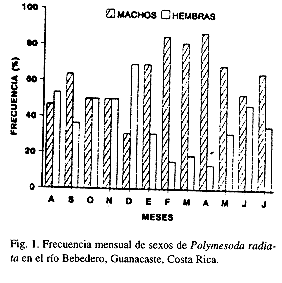
<body><![CDATA[<CENTER><FONT FACE="Arial,Helvetica"><FONT SIZE=-1>-&nbsp;</FONT></FONT></CENTER> </TD>  <TD VALIGN=TOP WIDTH="20%">     <CENTER><FONT FACE="Arial,Helvetica"><FONT SIZE=-1>-&nbsp;</FONT></FONT></CENTER> </TD>  <TD VALIGN=TOP WIDTH="20%">     <CENTER><FONT FACE="Arial,Helvetica"><FONT SIZE=-1>58.0&nbsp;</FONT></FONT></CENTER> </TD>  <TD VALIGN=TOP COLSPAN="4" WIDTH="20%">     <CENTER><FONT FACE="Arial,Helvetica"><FONT SIZE=-1>42.0&nbsp;</FONT></FONT></CENTER> </TD> </TR> </TABLE></CENTER> <FONT FACE="Arial,Helvetica"><FONT SIZE=-1>&nbsp;</FONT></FONT>     <BR><FONT FACE="Arial,Helvetica"><FONT SIZE=-1>La distribuci&oacute;n por sexos (<A HREF="#fig. 1">Fig. 1</A>), indica que durante todo el periodo de estudio predominan los machos (8 meses) y s&oacute;lo predominan las hembras en agosto y diciembre. Del total de 186 ejemplares examinados, 113 fueron machos (60.75 %) y 69 hembras (37.10 %) con una proporci&oacute;n sexual de 1.00 macho: 0.61 hembras. Se encontr&oacute; en mayo 4 ejemplares hermafroditas, lo que representa un 2.15 % del total de la poblaci&oacute;n.</FONT></FONT>     <BR>&nbsp;     <BR>&nbsp;     <BR>&nbsp;     <CENTER></CENTER>      <CENTER><A NAME="fig. 1"></A><IMG SRC="/img/fbpe/rbt/v46n3/0199i01.GIF" HEIGHT=283 WIDTH=282></CENTER>       
]]></body>
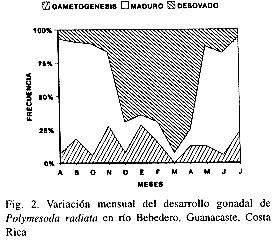
<body><![CDATA[<P><FONT FACE="Arial,Helvetica"><FONT SIZE=-1>La variaci&oacute;n mensual del desarrollo gonadal de <I>P. radiata </I>(<A HREF="#Fig2">Fig.2</A>), describe individuos en los diferentes estad&iacute;os durante todos los meses de estudio. El periodo de mayor desove ocurre desde diciembre a abril y corresponde a la &eacute;poca seca, con un pico de m&aacute;s intensidad en el mes de marzo (92.3 %) y un &aacute;mbito entre 69.2 % y 92.3 %. El mayor porcentaje de gam&eacute;tog&eacute;nesis ocurre en enero (28.60 %).</FONT></FONT>     <BR>&nbsp;     <BR>&nbsp;     <BR>&nbsp;     <CENTER></CENTER>      <CENTER><A NAME="Fig2"></A><IMG SRC="/img/fbpe/rbt/v46n3/0199i02.GIF" HEIGHT=243 WIDTH=275></CENTER>       
<P>&nbsp;     <BR><B><FONT FACE="Arial,Helvetica"><FONT SIZE=-1>Discusi&oacute;n</FONT></FONT></B>      <P><FONT FACE="Arial,Helvetica"><FONT SIZE=-1>Los valores m&aacute;ximos de longitud total, altura y di&aacute;metro encontrados en el presente estudio (44.10 mm, 40.50 mm y 32.20 mm respectivamente), son mayores que los informados para la misma especie por <A HREF="#Olsson, A.">Olsson (1961</A>) (39.5 mm, 36.00 mm y 28.0 mm), <A HREF="#Keen, A.">Keen (1971</A>) (40 mm, 36 mm y 28mm) y <A HREF="#Cruz, R. 1994">Cruz y Jim&eacute;nez (1994</A>) (43 mm de Lt y 22.5 de di&aacute;metro).</FONT></FONT>      <P><FONT FACE="Arial,Helvetica"><FONT SIZE=-1>Las correlaciones entre los par&aacute;metros morfol&oacute;gicos medidos en esta especie, explican satisfactoriamente el comportamiento de las variables dependientes (r &lt; 0.927 y p &lt; 0.05, a un valor cr&iacute;tico de &plusmn; 0.56108) y el bajo coeficiente de variaci&oacute;n de ellos, permite que estas variables puedan ser utilizadas en la caracterizaci&oacute;n taxon&oacute;mica de la especie coincidiendo con lo informado para <I>Polymesoda inflata</I> por <A HREF="#Báez, R.">B&aacute;ez (1985</A>).</FONT></FONT>      ]]></body>
<body><![CDATA[<P><FONT FACE="Arial,Helvetica"><FONT SIZE=-1>La tasa de crecimiento en Lt para el primer a&ntilde;o (2.25 &plusmn; 0.66 mm/mes), es mayor que a la informada para <I>Polymesoda carolina</I> en Mississippi, EUA por<A HREF="#Duobinis-Gray, E."> Duobinis-Gray y Hackney (1982</A>) (entre 0.7 y 1.4 mm/mes) y para <I>Donax dentifer</I> en Playa Garza, Costa Rica por <A HREF="#Palacios,J. 1983">Palacios <I>et al.</I> (1983</A>)(2.07 mm/mes); siendo menor que para <I>Donax denticulata</I> en la India por <A HREF="#Wade, B.">Wade (1969</A>) (3.0 mm/mes).</FONT></FONT>      <P><FONT FACE="Arial,Helvetica"><FONT SIZE=-1>El concepto de edad l&iacute;mite propuesto por <A HREF="#Taylor, C. C.">Taylor (1958</A>), sugiere que <I>P. radiata</I> alcanzar&iacute;a el 95 % de su Lt los 3.25 a&ntilde;os y la longitud asint&oacute;tica (45 mm) a los 3.33 a&ntilde;os.</FONT></FONT>      <P><FONT FACE="Arial,Helvetica"><FONT SIZE=-1>El crecimiento de esta especie es de tipo isom&eacute;trico entre la longitud total y el peso total. La tasas de crecimiento en Pt (entre 0.87 &plusmn; 0.11 g/mes y 0.41 &plusmn; 0.14 g/mes<I>)</I>, son menores que las informadas para <I>Dosinia exoleta </I>en Noruega por<A HREF="#Tunberg, B."> Tunberg (1983</A>) (2.81 g/mes) y para <I>Protothaca asperrima</I> en Colorado de Abangares, Costa Rica por <A HREF="#Palacios, J. 1985.">Palacios (1985</A>) (4.0 g/mes).</FONT></FONT>      <P><FONT FACE="Arial,Helvetica"><FONT SIZE=-1>Los resultados histol&oacute;gicos indican que <I>Polymesoda radiata</I> corresponde a una especie dioica, con un gonocorismo normal o estable dado su baja incidencia de hermafroditismo (2.15 %), lo que coincide con lo informado por <A HREF="#Heller, J.">Heller (1993</A>) para diferentes moluscos; por <A HREF="#Báez, R.">B&aacute;ez (1985</A>) para <I>P. inflata</I> en Costa Rica; por <A HREF="#Cruz, R. 1986.">Cruz (1986</A>) para <I>Anadara grandis</I> en Costa Rica; y <A HREF="#Cruz, R. 1993">Cruz y Villalobos (1993</A>) para <I>Mytella guyanensis</I> en el Golfo de Nicoya, Costa Rica.</FONT></FONT>      <P><FONT FACE="Arial,Helvetica"><FONT SIZE=-1>La proporci&oacute;n sexual promedio encontrada en <I>P. radiata</I> (1.00 macho:0.61 hembras) es semejante a lo informado por <A HREF="#Báez, R.">B&aacute;ez (1985</A>) para <I>Polymesoda inflata</I> en el manglar de Pochote, Costa Rica (1.00:0.65) y por <A HREF="#Palacios, J. 1985.">Palacios (1985</A>) para <I>Protothaca asperrima</I> en Colorado de Abangares, Costa Rica (1.00:0.63); difiere con lo informado por <A HREF="#Cruz, R. A. 1984 c.">Cruz (1984 c</A>) para <I>Anadara similis</I> en Jicaral, Costa Rica (1.00:0.83).</FONT></FONT>      <P><FONT FACE="Arial,Helvetica"><FONT SIZE=-1><I>P. radiata</I> presenta ejemplares desovados durante todo el a&ntilde;o, coincide con lo informado por<A HREF="#Giese, A."> Giese y Pearse (1974</A>) quienes se&ntilde;alan que los moluscos bivalvos de las zonas tropicales se caracterizan por tener desoves prolongados en su ciclo reproductivo; por <A HREF="#Báez, R.">B&aacute;ez (1985</A>) para <I>Polymesoda inflata</I> en el manglar de Pochote, Costa Rica; para <I>Protothaca asperrima</I> en Colorado de Abangares, Costa Rica por <A HREF="#Palacios, J. 1985.">Palacios (1985</A>); y para <I>Crassostrea columbensis</I> en Golfo de Nicoya, Costa Rica por <A HREF="#Caballero, A.">Caballero <I>et al.</I> (1996/1997)</A>.</FONT></FONT>      <P><FONT FACE="Arial,Helvetica"><FONT SIZE=-1>En <I>P. radiata</I> el per&iacute;odo de m&aacute;ximo desove ocurri&oacute; en los meses de la estaci&oacute;n seca y por lo tanto los m&aacute;s calientes, coincidiendo con lo informado para <I>Prototaca asperrima</I> por <A HREF="#Palacios, J. 1985.">Palacios (1985</A>) y para <I>Anadara grandis</I> por <A HREF="#Cruz, R. 1987.">Cruz (1987</A>).</FONT></FONT>      <P><FONT FACE="Arial,Helvetica"><FONT SIZE=-1>Dependiendo del tama&ntilde;o de la especie, la talla m&iacute;nima reproductiva se presenta a diferentes longitudes, es as&iacute; que en<I> P. radiata, </I>la talla m&iacute;nima para ambos sexos en que fue posible observar presencia de c&eacute;lulas sexuales fue 6.62 mm de Lt. Sin embargo, s&oacute;lo se encontr&oacute; ejemplares desovados a partir de la talla 7.80 mm de Lt por lo que se puede inferir que la talla m&iacute;nima reproductiva corresponde a esta &uacute;ltima y equivale a la cuarta parte de la longitud informada para la especie por <A HREF="#Keen, A.">Keen (1971).</A></FONT></FONT>      <P><FONT FACE="Arial,Helvetica"><FONT SIZE=-1>La talla m&iacute;nima reproductiva en <I>P. radiata</I> (7.80 mm) se encuentra en los &aacute;mbito reportados por <A HREF="#Hall, J.">Hall (1984</A>) para <I>Corbicula fluminea</I> en Carolina del Norte, EUA (6.5-10.0 mm Lt); es menor que lo informado por <A HREF="#Kennedy, V.">Kennedy y Huekelem (1985</A>) para <I>Corbicula</I> sp. en Maryland, EUA (9.6 mm Lt); por <A HREF="#Morton, B. 1985.">Morton (1985</A>) para <I>Polymesoda erosa</I> en Hong Kong, China (35 mm); por <A HREF="#Cruz, R. 1987.">Cruz (1987</A>) para <I>Anadara grandis </I>en Costa Rica (21.0 mm); y por <A HREF="#Morton, B. 1990.">Morton (1990)</A> para <I>Gafrarium pectinatum</I> en Hong Kong, China (16.0-20.0 mm).</FONT></FONT>      <P><FONT FACE="Arial,Helvetica"><FONT SIZE=-1>Si se desea establecer una explotaci&oacute;n sostenible del recurso<I> P. radiata</I>, se sugiere que su comercializaci&oacute;n se realice con espec&iacute;menes que tengan tallas superiores a los 30 mm, la que se alcanza a los 13 meses de edad, debido a que a partir de esa talla su crecimiento mensual disminuye, lo que coincide con <A HREF="#Vélez, A. R.">V&eacute;lez (1976</A>) quien se&ntilde;ala que los moluscos en el tropico disminuyen su tasa de crecimiento despu&eacute;s de haber alcanzado la madurez sexual.</FONT></FONT>     ]]></body>
<body><![CDATA[<BR>&nbsp;      <P><B><FONT FACE="Arial,Helvetica"><FONT SIZE=-1>Resumen</FONT></FONT></B>      <P><FONT FACE="Arial,Helvetica"><FONT SIZE=-1>Se determin&oacute; el crecimiento, biometr&iacute;a, desarrollo gon&aacute;dico, ciclo reproductivo y talla m&iacute;nima reproductiva en <I>Polymesoda radiata</I> en el r&iacute;o Bebedero, Guanacaste Costa Rica, entre agosto 1992 y julio 1993. El promedio de la longitud total fue 32.29 &plusmn; 7.63 mm (&aacute;mbito entre 6.90 to 44.10 mm). El peso total fue 11.13 &plusmn; 5.71 g (&aacute;mbito entre 0.4 to 23.98 g). La relaci&oacute;n Lt-Pt determin&oacute; que el crecimiento es de tipo isom&eacute;trico y se rige por la ecuaci&oacute;n Pt= 2.07 x 10<SUP>-4</SUP>Lt<SUP>3.01</SUP> (r=0.987, p 0.01). La ecuaci&oacute;n generalizada de von Bertalanffy se rige para Lt por Lt= 45 [1 - e{-1(t+0.06) (05/2 ) sen 2 ((t-065}] y para peso total por Pt= 26.53 (1- e <SUP>[-1 (t + 0.06)]</SUP> )<SUP>3</SUP>. La tasa de crecimiento para Lt fue de 2.25 &plusmn; 0.66 mm/mes para el primer a&ntilde;o, 0.83 &plusmn; 0.24 mm/mes para el segundo a&ntilde;o y 0.26 &plusmn; 0.1 mm/mes para el resto de los meses. Durante todo el a&ntilde;o se encontraron individuos en las diferentes etapas reproductivas. La proporci&oacute;n sexual para el periodo de estudio fue de 1.00 macho:0.61 hembras. La talla a la que se distinguen c&eacute;lulas sexuales tanto para machos como hembras fue de 6.62 mm y se establece como talla m&iacute;nima reproductiva 7.80 mm, ya que a partir de &eacute;sta se observaron individuos desovados. La mayor actividad de desove se observ&oacute; durante la &eacute;poca seca con dos picos m&aacute;ximos de desove al a&ntilde;o, uno en diciembre y el otro en marzo. El an&aacute;lisis histol&oacute;gico determin&oacute; que la especie es dioica con un bajo porcentaje de hermafroditismo en la poblaci&oacute;n (2.15 %).</FONT></FONT>     <BR>&nbsp;      <P><B><FONT FACE="Arial,Helvetica"><FONT SIZE=-1>Referencias</FONT></FONT></B>      <!-- ref --><P><A NAME="Báez, R."></A><FONT FACE="Arial,Helvetica"><FONT SIZE=-1>B&aacute;ez, R. 1985. Evaluaci&oacute;n de algunos aspectos de la biolog&iacute;a del molusco <I>Polymesoda inflata</I> (Philipp 1851) (Bivalvia:Corbiculidae), en el manglar de Pochote, Puntarenas, Costa Rica. Tesis de Licenciatura. Escuela de Biolog&iacute;a, Universidad de Costa Rica, San Jos&eacute;, Costa Rica. 70 p.</FONT></FONT>    &nbsp;&nbsp;&nbsp;&nbsp;&nbsp;&nbsp;&nbsp;&nbsp;[&#160;<a href="javascript:void(0);" onclick="javascript: window.open('/scielo.php?script=sci_nlinks&ref=1139489&pid=S0034-7744199800030001700001&lng=','','width=640,height=500,resizable=yes,scrollbars=1,menubar=yes,');">Links</a>&#160;]<!-- end-ref --><!-- ref --><P><A NAME="Bernard, F."></A><FONT FACE="Arial,Helvetica"><FONT SIZE=-1>Bernard, F. 1983. Catalogue of the living Bivalvia of the Eastern Pacific Ocean: BeringStrait to Cape Horn. Can. Spec. Publ. Fish. Aquat. Sci. 102 p.</FONT></FONT>    &nbsp;&nbsp;&nbsp;&nbsp;&nbsp;&nbsp;&nbsp;&nbsp;[&#160;<a href="javascript:void(0);" onclick="javascript: window.open('/scielo.php?script=sci_nlinks&ref=1139490&pid=S0034-7744199800030001700002&lng=','','width=640,height=500,resizable=yes,scrollbars=1,menubar=yes,');">Links</a>&#160;]<!-- end-ref --><!-- ref --><P><A NAME="Caballero, A."></A><FONT FACE="Arial,Helvetica"><FONT SIZE=-1>Caballero, A. F., J. Cabrera &amp; Y. Solano. 1996/1997. Descripci&oacute;n del crecimiento y madurez sexual de una poblaci&oacute;n de <I>Crassostrea columbiensis</I> (Mollusca:Bivalvia). Rev. Biol. Trop. 44/45:335-339.</FONT></FONT>    &nbsp;&nbsp;&nbsp;&nbsp;&nbsp;&nbsp;&nbsp;&nbsp;[&#160;<a href="javascript:void(0);" onclick="javascript: window.open('/scielo.php?script=sci_nlinks&ref=1139491&pid=S0034-7744199800030001700003&lng=','','width=640,height=500,resizable=yes,scrollbars=1,menubar=yes,');">Links</a>&#160;]<!-- end-ref --><!-- ref --><P><A NAME="Castaing"></A><FONT FACE="Arial,Helvetica"><FONT SIZE=-1>Castaing, A., J. Jim&eacute;nez &amp; C. Villalobos. 1980. Observaciones sobre la ecolog&iacute;a de manglares de la costa Pac&iacute;fica y en relaci&oacute;n con la distribuci&oacute;n del molusco <I>Geloina inflata</I>, (Philippi) (Pelecypoda:Corbiculidae). Rev. Biol. Trop. 28:323-339.</FONT></FONT>    &nbsp;&nbsp;&nbsp;&nbsp;&nbsp;&nbsp;&nbsp;&nbsp;[&#160;<a href="javascript:void(0);" onclick="javascript: window.open('/scielo.php?script=sci_nlinks&ref=1139492&pid=S0034-7744199800030001700004&lng=','','width=640,height=500,resizable=yes,scrollbars=1,menubar=yes,');">Links</a>&#160;]<!-- end-ref --><!-- ref --><P><A NAME="Cruz, R. 1984 a."></A><FONT FACE="Arial,Helvetica"><FONT SIZE=-1>Cruz, R. 1984 a. Algunos aspectos reproductivo y variaci&oacute;n mensual del &iacute;ndice de condici&oacute;n de <I>Anadara tuberculosa</I> (Bivalvia: Arcidae) en Costa Rica. Brenesia 31:21-24.</FONT></FONT>    &nbsp;&nbsp;&nbsp;&nbsp;&nbsp;&nbsp;&nbsp;&nbsp;[&#160;<a href="javascript:void(0);" onclick="javascript: window.open('/scielo.php?script=sci_nlinks&ref=1139493&pid=S0034-7744199800030001700005&lng=','','width=640,height=500,resizable=yes,scrollbars=1,menubar=yes,');">Links</a>&#160;]<!-- end-ref --><!-- ref --><P><A NAME="Cruz, R. 1984 b."></A><FONT FACE="Arial,Helvetica"><FONT SIZE=-1>Cruz, R. 1984 b. Algunos aspectos de la reproducci&oacute;n en <I>Anadara tuberculosa</I> (Pelecypoda:Arcidae) de Punta Morales, Puntarenas, Costa Rica. Rev. Biol. Trop. 32:45-50.</FONT></FONT>    &nbsp;&nbsp;&nbsp;&nbsp;&nbsp;&nbsp;&nbsp;&nbsp;[&#160;<a href="javascript:void(0);" onclick="javascript: window.open('/scielo.php?script=sci_nlinks&ref=1139494&pid=S0034-7744199800030001700006&lng=','','width=640,height=500,resizable=yes,scrollbars=1,menubar=yes,');">Links</a>&#160;]<!-- end-ref --><!-- ref --><P><A NAME="Cruz, R. A. 1984 c."></A><FONT FACE="Arial,Helvetica"><FONT SIZE=-1>Cruz, R. A. 1984 c. Algunos aspectos de la reproductivos y variaci&oacute;n mensual del &iacute;ndice de condici&oacute;n de <I>Anadara similis</I> (Pelecypoda: Arcidae) de Jicaral, Puntarenas, Costa Rica. Brenesia 22:95-105.</FONT></FONT>    &nbsp;&nbsp;&nbsp;&nbsp;&nbsp;&nbsp;&nbsp;&nbsp;[&#160;<a href="javascript:void(0);" onclick="javascript: window.open('/scielo.php?script=sci_nlinks&ref=1139495&pid=S0034-7744199800030001700007&lng=','','width=640,height=500,resizable=yes,scrollbars=1,menubar=yes,');">Links</a>&#160;]<!-- end-ref --><!-- ref --><P><A NAME="Cruz, R. 1986."></A><FONT FACE="Arial,Helvetica"><FONT SIZE=-1>Cruz, R. 1986. The reproductive cycle of the mangrove cockle<I> Anadara grandis </I>(Bivalvia:Arcidae), in Costa Rica. Brenesia. 27/28:37-47.</FONT></FONT>    &nbsp;&nbsp;&nbsp;&nbsp;&nbsp;&nbsp;&nbsp;&nbsp;[&#160;<a href="javascript:void(0);" onclick="javascript: window.open('/scielo.php?script=sci_nlinks&ref=1139496&pid=S0034-7744199800030001700008&lng=','','width=640,height=500,resizable=yes,scrollbars=1,menubar=yes,');">Links</a>&#160;]<!-- end-ref --><!-- ref --><P><A NAME="Cruz, R. 1987."></A><FONT FACE="Arial,Helvetica"><FONT SIZE=-1>Cruz, R. 1987. Tama&ntilde;o y madurez sexual en <I>Anadara grandis</I> (Pelecypoda:Arcidae). Brenesia 27:9 -12.</FONT></FONT>    &nbsp;&nbsp;&nbsp;&nbsp;&nbsp;&nbsp;&nbsp;&nbsp;[&#160;<a href="javascript:void(0);" onclick="javascript: window.open('/scielo.php?script=sci_nlinks&ref=1139497&pid=S0034-7744199800030001700009&lng=','','width=640,height=500,resizable=yes,scrollbars=1,menubar=yes,');">Links</a>&#160;]<!-- end-ref --><!-- ref --><P><A NAME="Cruz, R. A. 1989"></A><FONT FACE="Arial,Helvetica"><FONT SIZE=-1>Cruz, R. A. 1989. Variaci&oacute;n mensual de la condici&oacute;n, composici&oacute;n bioqu&iacute;mica (proximal) y ciclo reproductivo del mejill&oacute;n <I>Mytella guyanensis </I>(Bivalvia:Mytilidae). Tesis de Licenciatura en Biolog&iacute;a, Escuela de Ciencias Biol&oacute;gicas, Universidad Nacional, Heredia, Costa Rica. 66 p.</FONT></FONT>    &nbsp;&nbsp;&nbsp;&nbsp;&nbsp;&nbsp;&nbsp;&nbsp;[&#160;<a href="javascript:void(0);" onclick="javascript: window.open('/scielo.php?script=sci_nlinks&ref=1139498&pid=S0034-7744199800030001700010&lng=','','width=640,height=500,resizable=yes,scrollbars=1,menubar=yes,');">Links</a>&#160;]<!-- end-ref --><!-- ref --><P><A NAME="Cruz, R. 1993"></A><FONT FACE="Arial,Helvetica"><FONT SIZE=-1>Cruz, R. &amp; C. Villalobos. 1993. Shell length at sexual maturity cycle of <I>Mytella guyanensis </I>(Bivalvia: Mytilidae) from Costa Rica. Rev. Biol. Trop. 41:89-92.</FONT></FONT>    &nbsp;&nbsp;&nbsp;&nbsp;&nbsp;&nbsp;&nbsp;&nbsp;[&#160;<a href="javascript:void(0);" onclick="javascript: window.open('/scielo.php?script=sci_nlinks&ref=1139499&pid=S0034-7744199800030001700011&lng=','','width=640,height=500,resizable=yes,scrollbars=1,menubar=yes,');">Links</a>&#160;]<!-- end-ref --><!-- ref --><P><A NAME="Cruz, R. 1994"></A><FONT FACE="Arial,Helvetica"><FONT SIZE=-1>Cruz, R. &amp; J. Jim&eacute;nez. 1994. Moluscos asociados a las &aacute;reas de manglar de la Costa Pac&iacute;fica de Am&eacute;rica Central. EFUNA, Heredia, Costa Rica. 182 p.</FONT></FONT>    &nbsp;&nbsp;&nbsp;&nbsp;&nbsp;&nbsp;&nbsp;&nbsp;[&#160;<a href="javascript:void(0);" onclick="javascript: window.open('/scielo.php?script=sci_nlinks&ref=1139500&pid=S0034-7744199800030001700012&lng=','','width=640,height=500,resizable=yes,scrollbars=1,menubar=yes,');">Links</a>&#160;]<!-- end-ref --><!-- ref --><P><A NAME="Duobinis-Gray, E."></A><FONT FACE="Arial,Helvetica"><FONT SIZE=-1>Duobinis-Gray, E. &amp; C. Hackney. 1982. Seasonal and spatial distribution of carolina marsh clam, <I>Polymesoda carolina </I>(Bosch) in Mississipi Tidal marsh. Estuaries 5:102-109.</FONT></FONT>    &nbsp;&nbsp;&nbsp;&nbsp;&nbsp;&nbsp;&nbsp;&nbsp;[&#160;<a href="javascript:void(0);" onclick="javascript: window.open('/scielo.php?script=sci_nlinks&ref=1139501&pid=S0034-7744199800030001700013&lng=','','width=640,height=500,resizable=yes,scrollbars=1,menubar=yes,');">Links</a>&#160;]<!-- end-ref --><!-- ref --><P><A NAME="Gayanilo, F."></A><FONT FACE="Arial,Helvetica"><FONT SIZE=-1>Gayanilo, F. C., J. Soriano &amp; D. Pauly. 1989. A draf guide to Compleat ELEFAN. INCLARM software 2.70. International Center for Living Aquatic Resources Management. Manila. Contribution # 435:70 p.</FONT></FONT>    &nbsp;&nbsp;&nbsp;&nbsp;&nbsp;&nbsp;&nbsp;&nbsp;[&#160;<a href="javascript:void(0);" onclick="javascript: window.open('/scielo.php?script=sci_nlinks&ref=1139502&pid=S0034-7744199800030001700014&lng=','','width=640,height=500,resizable=yes,scrollbars=1,menubar=yes,');">Links</a>&#160;]<!-- end-ref --><!-- ref --><P><A NAME="Giese, A."></A><FONT FACE="Arial,Helvetica"><FONT SIZE=-1>Giese, A. &amp; J. Pearse. 1974. Introduction general principles. <I>In</I>: Reproduction of marine invertebrates. A. C. Giese y J. S. Pearse (eds). Vol. I. Academic, Nueva York. 546 p.</FONT></FONT>    &nbsp;&nbsp;&nbsp;&nbsp;&nbsp;&nbsp;&nbsp;&nbsp;[&#160;<a href="javascript:void(0);" onclick="javascript: window.open('/scielo.php?script=sci_nlinks&ref=1139503&pid=S0034-7744199800030001700015&lng=','','width=640,height=500,resizable=yes,scrollbars=1,menubar=yes,');">Links</a>&#160;]<!-- end-ref --><!-- ref --><P><A NAME="Hall, J."></A><FONT FACE="Arial,Helvetica"><FONT SIZE=-1>Hall, J. 1984. Production of immature<I> Corbicula fluminea </I>(Bivalvia: Corbiculidae), in Lake Norman, North Carolina. Nautilus 98:153-159.</FONT></FONT>    &nbsp;&nbsp;&nbsp;&nbsp;&nbsp;&nbsp;&nbsp;&nbsp;[&#160;<a href="javascript:void(0);" onclick="javascript: window.open('/scielo.php?script=sci_nlinks&ref=1139504&pid=S0034-7744199800030001700016&lng=','','width=640,height=500,resizable=yes,scrollbars=1,menubar=yes,');">Links</a>&#160;]<!-- end-ref --><!-- ref --><P><A NAME="Heller, J."></A><FONT FACE="Arial,Helvetica"><FONT SIZE=-1>Heller, J. 1993. Hermaphroditism in molluscs. Biol. J. Linnean Soc. 48:19-42.</FONT></FONT>    &nbsp;&nbsp;&nbsp;&nbsp;&nbsp;&nbsp;&nbsp;&nbsp;[&#160;<a href="javascript:void(0);" onclick="javascript: window.open('/scielo.php?script=sci_nlinks&ref=1139505&pid=S0034-7744199800030001700017&lng=','','width=640,height=500,resizable=yes,scrollbars=1,menubar=yes,');">Links</a>&#160;]<!-- end-ref --><!-- ref --><P><A NAME="Howard, D."></A><FONT FACE="Arial,Helvetica"><FONT SIZE=-1>Howard, D. &amp; C. Smith. 1983. Histological techniques for marine bivalve mollusks. NOAA Tecnical Memorandum NMFS/NEC. 25:25-97.</FONT></FONT>    &nbsp;&nbsp;&nbsp;&nbsp;&nbsp;&nbsp;&nbsp;&nbsp;[&#160;<a href="javascript:void(0);" onclick="javascript: window.open('/scielo.php?script=sci_nlinks&ref=1139506&pid=S0034-7744199800030001700018&lng=','','width=640,height=500,resizable=yes,scrollbars=1,menubar=yes,');">Links</a>&#160;]<!-- end-ref --><!-- ref --><P><A NAME="Keen, A."></A><FONT FACE="Arial,Helvetica"><FONT SIZE=-1>Keen, A. 1971. Sea shell of tropical west Am&eacute;rica. Stanford University, Stanford. 1064 p.</FONT></FONT>    &nbsp;&nbsp;&nbsp;&nbsp;&nbsp;&nbsp;&nbsp;&nbsp;[&#160;<a href="javascript:void(0);" onclick="javascript: window.open('/scielo.php?script=sci_nlinks&ref=1139507&pid=S0034-7744199800030001700019&lng=','','width=640,height=500,resizable=yes,scrollbars=1,menubar=yes,');">Links</a>&#160;]<!-- end-ref --><!-- ref --><P><A NAME="Kennedy, V."></A><FONT FACE="Arial,Helvetica"><FONT SIZE=-1>Kennedy, V. &amp; L. Huekelem. 1985. Gametogenesis and larval production in a population of the introduced asiatic clam, <I>Corbicula </I>.sp (Bivalvia:Corbiculidae), in Maryland. Biol. Bull. 168:50-60.</FONT></FONT>    &nbsp;&nbsp;&nbsp;&nbsp;&nbsp;&nbsp;&nbsp;&nbsp;[&#160;<a href="javascript:void(0);" onclick="javascript: window.open('/scielo.php?script=sci_nlinks&ref=1139508&pid=S0034-7744199800030001700020&lng=','','width=640,height=500,resizable=yes,scrollbars=1,menubar=yes,');">Links</a>&#160;]<!-- end-ref --><!-- ref --><P><A NAME="Morton, B. 1985."></A><FONT FACE="Arial,Helvetica"><FONT SIZE=-1>Morton, B. 1985. The reproductive strategy of the mangrove bivalve <I>Polymesoda </I>(<I>Geloina</I>) <I>erosa </I>(Bivalvia:Corbiculidae) in Hong Kong. Malacol. Review. 18: 83-89.</FONT></FONT>    &nbsp;&nbsp;&nbsp;&nbsp;&nbsp;&nbsp;&nbsp;&nbsp;[&#160;<a href="javascript:void(0);" onclick="javascript: window.open('/scielo.php?script=sci_nlinks&ref=1139509&pid=S0034-7744199800030001700021&lng=','','width=640,height=500,resizable=yes,scrollbars=1,menubar=yes,');">Links</a>&#160;]<!-- end-ref --><!-- ref --><P><A NAME="Morton, B. 1990."></A><FONT FACE="Arial,Helvetica"><FONT SIZE=-1>Morton, B. 1990. The life cycle and sexual strategy of <I>Gafrarium pectinatum</I> (Bivalvia:Veneridae) in a Hong Kong mangrove. Malacol. Review 23: 53-62.</FONT></FONT>    &nbsp;&nbsp;&nbsp;&nbsp;&nbsp;&nbsp;&nbsp;&nbsp;[&#160;<a href="javascript:void(0);" onclick="javascript: window.open('/scielo.php?script=sci_nlinks&ref=1139510&pid=S0034-7744199800030001700022&lng=','','width=640,height=500,resizable=yes,scrollbars=1,menubar=yes,');">Links</a>&#160;]<!-- end-ref --><!-- ref --><P><A NAME="Olsson, A."></A><FONT FACE="Arial,Helvetica"><FONT SIZE=-1>Olsson, A. 1961. Mollusks of the tropical eastern Pacific, particulary from the southern half of the Panamic-Pacific faunal province (Panam&aacute; to Per&uacute;). Panamic-Pacific Pelecypoda Paleontological Res. Inst. Ithaca, Nueva York. 574 p.</FONT></FONT>    &nbsp;&nbsp;&nbsp;&nbsp;&nbsp;&nbsp;&nbsp;&nbsp;[&#160;<a href="javascript:void(0);" onclick="javascript: window.open('/scielo.php?script=sci_nlinks&ref=1139511&pid=S0034-7744199800030001700023&lng=','','width=640,height=500,resizable=yes,scrollbars=1,menubar=yes,');">Links</a>&#160;]<!-- end-ref --><!-- ref --><P><A NAME="Palacios,J. 1983"></A><FONT FACE="Arial,Helvetica"><FONT SIZE=-1>Palacios,J. A., R. A. Cruz &amp; O. Pacheco.1983. Estructura poblacional y cuantificaci&oacute;n de <I>Donax dentifer </I>Hanley, 1843 (Pelecypoda: Donacidae) en Playa Garza, Puntarenas, Costa Rica. Rev. Biol. Trop. 31:251-255.</FONT></FONT>    &nbsp;&nbsp;&nbsp;&nbsp;&nbsp;&nbsp;&nbsp;&nbsp;[&#160;<a href="javascript:void(0);" onclick="javascript: window.open('/scielo.php?script=sci_nlinks&ref=1139512&pid=S0034-7744199800030001700024&lng=','','width=640,height=500,resizable=yes,scrollbars=1,menubar=yes,');">Links</a>&#160;]<!-- end-ref --><!-- ref --><P><A NAME="Palacios, J. 1985."></A><FONT FACE="Arial,Helvetica"><FONT SIZE=-1>Palacios, J. 1985. Biometr&iacute;a, crecimiento y maduraci&oacute;n sexual en la almeja blanca <I>Protothaca asperrima</I> (Pelecypoda:Veneridae) en Colorado de Abangares, Guanacaste, Costa Rica. Tesis de Licenciatura. Escuela de Ciencias Biol&oacute;gicas. Universidad Nacional, Heredia, Costa Rica. 85 p.</FONT></FONT>    &nbsp;&nbsp;&nbsp;&nbsp;&nbsp;&nbsp;&nbsp;&nbsp;[&#160;<a href="javascript:void(0);" onclick="javascript: window.open('/scielo.php?script=sci_nlinks&ref=1139513&pid=S0034-7744199800030001700025&lng=','','width=640,height=500,resizable=yes,scrollbars=1,menubar=yes,');">Links</a>&#160;]<!-- end-ref --><!-- ref --><P><A NAME="Severey, V."></A><FONT FACE="Arial,Helvetica"><FONT SIZE=-1>Severey, V. 1993. Taxonomic revision and phylogeny of the genus <I>Polymesoda </I>(Rafinesque 1820) (Bivalvia:Corbiculidae). Tesis Doctoral. University of Maryland, Maryland. 150 p.</FONT></FONT>    &nbsp;&nbsp;&nbsp;&nbsp;&nbsp;&nbsp;&nbsp;&nbsp;[&#160;<a href="javascript:void(0);" onclick="javascript: window.open('/scielo.php?script=sci_nlinks&ref=1139514&pid=S0034-7744199800030001700026&lng=','','width=640,height=500,resizable=yes,scrollbars=1,menubar=yes,');">Links</a>&#160;]<!-- end-ref --><!-- ref --><P><A NAME="Theisen, B. F."></A><FONT FACE="Arial,Helvetica"><FONT SIZE=-1>Theisen, B. F. 1968. Growth and mortality of culture mussels in Danish Wadden Sea. Mddr. Danm. Fisk. 6:47-48.</FONT></FONT>    &nbsp;&nbsp;&nbsp;&nbsp;&nbsp;&nbsp;&nbsp;&nbsp;[&#160;<a href="javascript:void(0);" onclick="javascript: window.open('/scielo.php?script=sci_nlinks&ref=1139515&pid=S0034-7744199800030001700027&lng=','','width=640,height=500,resizable=yes,scrollbars=1,menubar=yes,');">Links</a>&#160;]<!-- end-ref --><!-- ref --><P><A NAME="Taylor, C. C."></A><FONT FACE="Arial,Helvetica"><FONT SIZE=-1>Taylor, C. C. 1958. Cod growth and temperature. J. Cons. Inst. Explor. 23:366-370.</FONT></FONT>    &nbsp;&nbsp;&nbsp;&nbsp;&nbsp;&nbsp;&nbsp;&nbsp;[&#160;<a href="javascript:void(0);" onclick="javascript: window.open('/scielo.php?script=sci_nlinks&ref=1139516&pid=S0034-7744199800030001700028&lng=','','width=640,height=500,resizable=yes,scrollbars=1,menubar=yes,');">Links</a>&#160;]<!-- end-ref --><!-- ref --><P><A NAME="Tunberg, B."></A><FONT FACE="Arial,Helvetica"><FONT SIZE=-1>Tunberg, B. 1983. Growth of <I>Dosinia exoleta </I>L (Bivalvia) in Raunefjorden, Western Norway. SARSIA 68:41-45.</FONT></FONT>    &nbsp;&nbsp;&nbsp;&nbsp;&nbsp;&nbsp;&nbsp;&nbsp;[&#160;<a href="javascript:void(0);" onclick="javascript: window.open('/scielo.php?script=sci_nlinks&ref=1139517&pid=S0034-7744199800030001700029&lng=','','width=640,height=500,resizable=yes,scrollbars=1,menubar=yes,');">Links</a>&#160;]<!-- end-ref --><!-- ref --><P><A NAME="Vélez, A. R."></A><FONT FACE="Arial,Helvetica"><FONT SIZE=-1>V&eacute;lez, A. R. 1976. Crecimiento, edad y madurez sexual del osti&oacute;n <I>Crassostrea rhizophorae</I> de Bah&iacute;a Mochima. Bol. Inst. Oceanogr. Univ. Oriente 15:65-72</FONT></FONT>    &nbsp;&nbsp;&nbsp;&nbsp;&nbsp;&nbsp;&nbsp;&nbsp;[&#160;<a href="javascript:void(0);" onclick="javascript: window.open('/scielo.php?script=sci_nlinks&ref=1139518&pid=S0034-7744199800030001700030&lng=','','width=640,height=500,resizable=yes,scrollbars=1,menubar=yes,');">Links</a>&#160;]<!-- end-ref --><P><A NAME="Wade, B."></A><FONT FACE="Arial,Helvetica"><FONT SIZE=-1>Wade, B. 1969. Studies on biology of West Indian beach clam, <I>Donax denticulata</I> Linneaus 2. Life history. Bull. Mar. Sci.</FONT></FONT>     <BR><FONT FACE="Arial,Helvetica"><FONT SIZE=-1>18:876-901.</FONT></FONT>     <BR>&nbsp;     <BR>&nbsp;     <BR><A NAME="1a"></A><FONT FACE="Arial,Helvetica"><FONT SIZE=-1><SUP><A HREF="#1">1</A></SUP> Centro de investigaciones en Ciencias del Mar (CIMAR), Universidad de Costa Rica, 2060 San Jos&eacute;, Costa Rica.</FONT></FONT>      ]]></body>
<body><![CDATA[<P><A NAME="2 ab"></A><FONT FACE="Arial,Helvetica"><FONT SIZE=-1><SUP><A HREF="#2">2</A></SUP> Escuela de Ciencias Biol&oacute;gicas, Universidad Nacional, Heredia 86-3000, Costa Rica.</FONT></FONT>      ]]></body><back>
<ref-list>
<ref id="B1">
<nlm-citation citation-type="">
<person-group person-group-type="author">
<name>
<surname><![CDATA[Báez]]></surname>
<given-names><![CDATA[R.]]></given-names>
</name>
</person-group>
<source><![CDATA[Evaluación de algunos aspectos de la biología del molusco Polymesoda inflata (Philipp 1851) (Bivalvia:Corbiculidae), en el manglar de Pochote, Puntarenas, Costa Rica]]></source>
<year>1985</year>
</nlm-citation>
</ref>
<ref id="B2">
<nlm-citation citation-type="book">
<person-group person-group-type="author">
<name>
<surname><![CDATA[Bernard]]></surname>
<given-names><![CDATA[F.]]></given-names>
</name>
</person-group>
<source><![CDATA[Catalogue of the living Bivalvia of the Eastern Pacific Ocean:: BeringStrait to Cape Horn]]></source>
<year>1983</year>
<publisher-name><![CDATA[Can. Spec. Publ. Fish. Aquat. Sci.]]></publisher-name>
</nlm-citation>
</ref>
<ref id="B3">
<nlm-citation citation-type="journal">
<person-group person-group-type="author">
<name>
<surname><![CDATA[Caballero]]></surname>
<given-names><![CDATA[A. F]]></given-names>
</name>
<name>
<surname><![CDATA[Cabrera]]></surname>
<given-names><![CDATA[J.]]></given-names>
</name>
<name>
<surname><![CDATA[Solano]]></surname>
<given-names><![CDATA[Y.]]></given-names>
</name>
</person-group>
<article-title xml:lang="es"><![CDATA[Descripción del crecimiento y madurez sexual de una población de Crassostrea columbiensis (Mollusca:Bivalvia)]]></article-title>
<source><![CDATA[Rev. Biol. Trop.]]></source>
<year>1997</year>
<volume>44/45</volume>
<page-range>335-339</page-range></nlm-citation>
</ref>
<ref id="B4">
<nlm-citation citation-type="journal">
<person-group person-group-type="author">
<name>
<surname><![CDATA[Castaing]]></surname>
<given-names><![CDATA[A.]]></given-names>
</name>
<name>
<surname><![CDATA[Jiménez]]></surname>
<given-names><![CDATA[J.]]></given-names>
</name>
<name>
<surname><![CDATA[Villalobos]]></surname>
<given-names><![CDATA[C.]]></given-names>
</name>
</person-group>
<article-title xml:lang="es"><![CDATA[Observaciones sobre la ecología de manglares de la costa Pacífica y en relación con la distribución del molusco Geloina inflata, (Philippi) (Pelecypoda:Corbiculidae).]]></article-title>
<source><![CDATA[Rev. Biol. Trop.]]></source>
<year>1980</year>
<volume>28</volume>
<page-range>323-339.</page-range></nlm-citation>
</ref>
<ref id="B5">
<nlm-citation citation-type="journal">
<person-group person-group-type="author">
<name>
<surname><![CDATA[Cruz]]></surname>
<given-names><![CDATA[R.]]></given-names>
</name>
</person-group>
<article-title xml:lang="es"><![CDATA[Algunos aspectos reproductivo y variación mensual del índice de condición de Anadara tuberculosa (Bivalvia: Arcidae) en Costa Rica]]></article-title>
<source><![CDATA[Brenesia]]></source>
<year>1984</year>
<volume>31</volume>
<page-range>21-24</page-range></nlm-citation>
</ref>
<ref id="B6">
<nlm-citation citation-type="journal">
<person-group person-group-type="author">
<name>
<surname><![CDATA[Cruz]]></surname>
<given-names><![CDATA[R.]]></given-names>
</name>
</person-group>
<article-title xml:lang="es"><![CDATA[. Algunos aspectos de la reproducción en Anadara tuberculosa (Pelecypoda:Arcidae) de Punta Morales, Puntarenas, Costa Rica]]></article-title>
<source><![CDATA[Rev. Biol. Trop.]]></source>
<year>1984</year>
<volume>32</volume>
<page-range>45-50</page-range></nlm-citation>
</ref>
<ref id="B7">
<nlm-citation citation-type="journal">
<person-group person-group-type="author">
<name>
<surname><![CDATA[Cruz]]></surname>
<given-names><![CDATA[R. A.]]></given-names>
</name>
</person-group>
<article-title xml:lang="es"><![CDATA[. Algunos aspectos de la reproductivos y variación mensual del índice de condición de Anadara similis (Pelecypoda: Arcidae) de Jicaral, Puntarenas, Costa Rica]]></article-title>
<source><![CDATA[Brenesia]]></source>
<year>1984</year>
<volume>22</volume>
<page-range>95-105</page-range></nlm-citation>
</ref>
<ref id="B8">
<nlm-citation citation-type="journal">
<person-group person-group-type="author">
<name>
<surname><![CDATA[Cruz]]></surname>
<given-names><![CDATA[R]]></given-names>
</name>
</person-group>
<article-title xml:lang="en"><![CDATA[The reproductive cycle of the mangrove cockle Anadara grandis (Bivalvia:Arcidae), in Costa Rica]]></article-title>
<source><![CDATA[Brenesia.]]></source>
<year>1986</year>
<month>.</month>
<volume>27/28</volume>
<page-range>37-47</page-range></nlm-citation>
</ref>
<ref id="B9">
<nlm-citation citation-type="journal">
<person-group person-group-type="author">
<name>
<surname><![CDATA[Cruz]]></surname>
<given-names><![CDATA[R.]]></given-names>
</name>
</person-group>
<article-title xml:lang="es"><![CDATA[Tamaño y madurez sexual en Anadara grandis (Pelecypoda:Arcidae)]]></article-title>
<source><![CDATA[Brenesia]]></source>
<year>1987</year>
<volume>27</volume>
<page-range>9 -12</page-range></nlm-citation>
</ref>
<ref id="B10">
<nlm-citation citation-type="">
<person-group person-group-type="author">
<name>
<surname><![CDATA[Cruz]]></surname>
<given-names><![CDATA[R. A.]]></given-names>
</name>
</person-group>
<source><![CDATA[Variación mensual de la condición, composición bioquímica (proximal) y ciclo reproductivo del mejillón Mytella guyanensis (Bivalvia:Mytilidae).]]></source>
<year>1989</year>
</nlm-citation>
</ref>
<ref id="B11">
<nlm-citation citation-type="journal">
<person-group person-group-type="author">
<name>
<surname><![CDATA[Cruz]]></surname>
<given-names><![CDATA[R.]]></given-names>
</name>
<name>
<surname><![CDATA[Villalobos]]></surname>
<given-names><![CDATA[C.]]></given-names>
</name>
</person-group>
<article-title xml:lang="en"><![CDATA[Shell length at sexual maturity cycle of Mytella guyanensis (Bivalvia: Mytilidae) from Costa Rica]]></article-title>
<source><![CDATA[Rev. Biol. Trop.]]></source>
<year>1993</year>
<volume>41</volume>
<page-range>89-92</page-range></nlm-citation>
</ref>
<ref id="B12">
<nlm-citation citation-type="book">
<person-group person-group-type="author">
<name>
<surname><![CDATA[Cruz]]></surname>
<given-names><![CDATA[R.]]></given-names>
</name>
<name>
<surname><![CDATA[Jiménez]]></surname>
<given-names><![CDATA[J.]]></given-names>
</name>
</person-group>
<source><![CDATA[Moluscos asociados a las áreas de manglar de la Costa Pacífica de América Central]]></source>
<year>1994</year>
<publisher-loc><![CDATA[Heredia ]]></publisher-loc>
<publisher-name><![CDATA[EFUNA]]></publisher-name>
</nlm-citation>
</ref>
<ref id="B13">
<nlm-citation citation-type="journal">
<person-group person-group-type="author">
<name>
<surname><![CDATA[Duobinis-Gray]]></surname>
<given-names><![CDATA[E.]]></given-names>
</name>
<name>
<surname><![CDATA[Hackney]]></surname>
<given-names><![CDATA[C.]]></given-names>
</name>
</person-group>
<article-title xml:lang="en"><![CDATA[Seasonal and spatial distribution of carolina marsh clam, Polymesoda carolina (Bosch) in Mississipi Tidal marsh]]></article-title>
<source><![CDATA[Estuaries]]></source>
<year>1982</year>
<volume>5</volume>
<page-range>102-109</page-range></nlm-citation>
</ref>
<ref id="B14">
<nlm-citation citation-type="book">
<person-group person-group-type="author">
<name>
<surname><![CDATA[Gayanilo]]></surname>
<given-names><![CDATA[F. C.]]></given-names>
</name>
<name>
<surname><![CDATA[Soriano]]></surname>
<given-names><![CDATA[J.]]></given-names>
</name>
<name>
<surname><![CDATA[Pauly]]></surname>
<given-names><![CDATA[D.]]></given-names>
</name>
</person-group>
<source><![CDATA[A draf guide to Compleat ELEFAN. INCLARM software 2.70.]]></source>
<year>1989</year>
<volume>435:</volume>
<publisher-loc><![CDATA[Manila ]]></publisher-loc>
<publisher-name><![CDATA[International Center for Living Aquatic Resources Management]]></publisher-name>
</nlm-citation>
</ref>
<ref id="B15">
<nlm-citation citation-type="book">
<person-group person-group-type="author">
<name>
<surname><![CDATA[Giese]]></surname>
<given-names><![CDATA[A.]]></given-names>
</name>
<name>
<surname><![CDATA[Pearse]]></surname>
<given-names><![CDATA[J.]]></given-names>
</name>
</person-group>
<article-title xml:lang="en"><![CDATA[Introduction general principles]]></article-title>
<person-group person-group-type="editor">
<name>
<surname><![CDATA[Giese]]></surname>
<given-names><![CDATA[A. C.]]></given-names>
</name>
<name>
<surname><![CDATA[Pearse]]></surname>
<given-names><![CDATA[J. S.]]></given-names>
</name>
</person-group>
<source><![CDATA[Reproduction of marine invertebrates]]></source>
<year>1974</year>
<volume>I.</volume>
<publisher-loc><![CDATA[^eNueva York Nueva York]]></publisher-loc>
<publisher-name><![CDATA[Academic]]></publisher-name>
</nlm-citation>
</ref>
<ref id="B16">
<nlm-citation citation-type="journal">
<person-group person-group-type="author">
<name>
<surname><![CDATA[Hall]]></surname>
<given-names><![CDATA[J.]]></given-names>
</name>
</person-group>
<article-title xml:lang="en"><![CDATA[Production of immature Corbicula fluminea (Bivalvia: Corbiculidae), in Lake Norman, North Carolina]]></article-title>
<source><![CDATA[Nautilus]]></source>
<year>1984</year>
<volume>98</volume>
<page-range>153-159</page-range></nlm-citation>
</ref>
<ref id="B17">
<nlm-citation citation-type="journal">
<person-group person-group-type="author">
<name>
<surname><![CDATA[Heller]]></surname>
<given-names><![CDATA[J.]]></given-names>
</name>
</person-group>
<article-title xml:lang="en"><![CDATA[Hermaphroditism in molluscs]]></article-title>
<source><![CDATA[Biol. J. Linnean Soc.]]></source>
<year>1993</year>
<volume>48</volume>
<page-range>19-42</page-range></nlm-citation>
</ref>
<ref id="B18">
<nlm-citation citation-type="">
<person-group person-group-type="author">
<name>
<surname><![CDATA[Howard]]></surname>
<given-names><![CDATA[D.]]></given-names>
</name>
<name>
<surname><![CDATA[Smith]]></surname>
<given-names><![CDATA[C.]]></given-names>
</name>
</person-group>
<source><![CDATA[Histological techniques for marine bivalve mollusks]]></source>
<year>1983</year>
<volume>25:</volume>
<page-range>25-97</page-range></nlm-citation>
</ref>
<ref id="B19">
<nlm-citation citation-type="book">
<person-group person-group-type="author">
<name>
<surname><![CDATA[Keen]]></surname>
<given-names><![CDATA[A.]]></given-names>
</name>
</person-group>
<source><![CDATA[Sea shell of tropical west América]]></source>
<year>1971</year>
<publisher-loc><![CDATA[Stanford ]]></publisher-loc>
<publisher-name><![CDATA[Stanford University]]></publisher-name>
</nlm-citation>
</ref>
<ref id="B20">
<nlm-citation citation-type="journal">
<person-group person-group-type="author">
<name>
<surname><![CDATA[Kennedy]]></surname>
<given-names><![CDATA[V.]]></given-names>
</name>
<name>
<surname><![CDATA[Huekelem]]></surname>
<given-names><![CDATA[L.]]></given-names>
</name>
</person-group>
<article-title xml:lang="en"><![CDATA[Gametogenesis and larval production in a population of the introduced asiatic clam, Corbicula .sp (Bivalvia:Corbiculidae),]]></article-title>
<source><![CDATA[Maryland. Biol. Bull.]]></source>
<year>1985</year>
<volume>168</volume>
<page-range>50-60</page-range></nlm-citation>
</ref>
<ref id="B21">
<nlm-citation citation-type="journal">
<person-group person-group-type="author">
<name>
<surname><![CDATA[Morton]]></surname>
<given-names><![CDATA[B.]]></given-names>
</name>
</person-group>
<article-title xml:lang="en"><![CDATA[The reproductive strategy of the mangrove bivalve Polymesoda (Geloina) erosa (Bivalvia:Corbiculidae) in Hong Kong]]></article-title>
<source><![CDATA[Malacol. Review]]></source>
<year>1985</year>
<volume>18</volume>
<page-range>83-89</page-range></nlm-citation>
</ref>
<ref id="B22">
<nlm-citation citation-type="journal">
<person-group person-group-type="author">
<name>
<surname><![CDATA[Morton]]></surname>
<given-names><![CDATA[B.]]></given-names>
</name>
</person-group>
<article-title xml:lang="en"><![CDATA[The life cycle and sexual strategy of Gafrarium pectinatum (Bivalvia:Veneridae) in a Hong Kong mangrove]]></article-title>
<source><![CDATA[Malacol. Review]]></source>
<year>1990</year>
<volume>23</volume>
<page-range>53-62</page-range></nlm-citation>
</ref>
<ref id="B23">
<nlm-citation citation-type="book">
<person-group person-group-type="author">
<name>
<surname><![CDATA[Olsson]]></surname>
<given-names><![CDATA[A.]]></given-names>
</name>
</person-group>
<source><![CDATA[Mollusks of the tropical eastern Pacific, particulary from the southern half of the Panamic-Pacific faunal province (Panamá to Perú). Panamic-Pacific Pelecypoda Paleontological Res]]></source>
<year>1961</year>
<publisher-loc><![CDATA[^eNueva York Nueva York]]></publisher-loc>
<publisher-name><![CDATA[Inst. Ithaca]]></publisher-name>
</nlm-citation>
</ref>
<ref id="B24">
<nlm-citation citation-type="journal">
<person-group person-group-type="author">
<name>
<surname><![CDATA[Palacios]]></surname>
<given-names><![CDATA[J. A.]]></given-names>
</name>
<name>
<surname><![CDATA[Cruz]]></surname>
<given-names><![CDATA[R. A.]]></given-names>
</name>
<name>
<surname><![CDATA[Pacheco]]></surname>
<given-names><![CDATA[O.]]></given-names>
</name>
</person-group>
<article-title xml:lang="es"><![CDATA[Estructura poblacional y cuantificación de Donax dentifer Hanley, 1843 (Pelecypoda: Donacidae) en Playa Garza, Puntarenas, Costa Rica]]></article-title>
<source><![CDATA[Rev. Biol. Trop.]]></source>
<year>1983</year>
<volume>31:</volume>
<numero>^s251-255</numero>
<issue>^s251-255</issue>
<supplement>251-255</supplement>
</nlm-citation>
</ref>
<ref id="B25">
<nlm-citation citation-type="">
<person-group person-group-type="author">
<name>
<surname><![CDATA[Palacios]]></surname>
<given-names><![CDATA[J.]]></given-names>
</name>
</person-group>
<source><![CDATA[Biometría, crecimiento y maduración sexual en la almeja blanca Protothaca asperrima (Pelecypoda:Veneridae) en Colorado de Abangares, Guanacaste, Costa Rica]]></source>
<year>1985</year>
</nlm-citation>
</ref>
<ref id="B26">
<nlm-citation citation-type="">
<person-group person-group-type="author">
<name>
<surname><![CDATA[Severey]]></surname>
<given-names><![CDATA[V.]]></given-names>
</name>
</person-group>
<source><![CDATA[Taxonomic revision and phylogeny of the genus Polymesoda (Rafinesque 1820) (Bivalvia:Corbiculidae).]]></source>
<year>1993</year>
</nlm-citation>
</ref>
<ref id="B27">
<nlm-citation citation-type="journal">
<person-group person-group-type="author">
<name>
<surname><![CDATA[Theisen]]></surname>
<given-names><![CDATA[B. F.]]></given-names>
</name>
</person-group>
<article-title xml:lang="en"><![CDATA[Growth and mortality of culture mussels]]></article-title>
<source><![CDATA[Danish Wadden Sea. Mddr. Danm. Fisk.]]></source>
<year>1968</year>
<volume>6</volume>
<page-range>47-48</page-range></nlm-citation>
</ref>
<ref id="B28">
<nlm-citation citation-type="journal">
<person-group person-group-type="author">
<name>
<surname><![CDATA[Taylor]]></surname>
<given-names><![CDATA[C. C.]]></given-names>
</name>
</person-group>
<article-title xml:lang="en"><![CDATA[Cod growth and temperature]]></article-title>
<source><![CDATA[J. Cons. Inst. Explor.]]></source>
<year>1958</year>
<volume>23</volume>
<page-range>366-370</page-range></nlm-citation>
</ref>
<ref id="B29">
<nlm-citation citation-type="journal">
<person-group person-group-type="author">
<name>
<surname><![CDATA[Tunberg]]></surname>
<given-names><![CDATA[B.]]></given-names>
</name>
</person-group>
<article-title xml:lang="en"><![CDATA[Growth of Dosinia exoleta L (Bivalvia) in Raunefjorden, Western Norway]]></article-title>
<source><![CDATA[SARSIA]]></source>
<year>1983</year>
<volume>68</volume>
<page-range>41-45</page-range></nlm-citation>
</ref>
<ref id="B30">
<nlm-citation citation-type="journal">
<person-group person-group-type="author">
<name>
<surname><![CDATA[Vélez]]></surname>
<given-names><![CDATA[A. R.]]></given-names>
</name>
</person-group>
<article-title xml:lang="es"><![CDATA[Crecimiento, edad y madurez sexual del ostión Crassostrea rhizophorae de Bahía Mochima.]]></article-title>
<source><![CDATA[Bol. Inst. Oceanogr. Univ. Oriente]]></source>
<year>1976</year>
<volume>15</volume>
<page-range>65-72</page-range></nlm-citation>
</ref>
<ref id="B31">
<nlm-citation citation-type="journal">
<person-group person-group-type="author">
<name>
<surname><![CDATA[Wade]]></surname>
<given-names><![CDATA[B.]]></given-names>
</name>
</person-group>
<article-title xml:lang="en"><![CDATA[Studies on biology of West Indian beach clam, Donax denticulata Linneaus 2: Life history]]></article-title>
<source><![CDATA[Bull. Mar. Sci.]]></source>
<year>1969</year>
<volume>18</volume>
<page-range>876-901</page-range></nlm-citation>
</ref>
</ref-list>
</back>
</article>