<?xml version="1.0" encoding="ISO-8859-1"?><article xmlns:mml="http://www.w3.org/1998/Math/MathML" xmlns:xlink="http://www.w3.org/1999/xlink" xmlns:xsi="http://www.w3.org/2001/XMLSchema-instance">
<front>
<journal-meta>
<journal-id>0034-7744</journal-id>
<journal-title><![CDATA[Revista de Biología Tropical]]></journal-title>
<abbrev-journal-title><![CDATA[Rev. biol. trop]]></abbrev-journal-title>
<issn>0034-7744</issn>
<publisher>
<publisher-name><![CDATA[Universidad de Costa Rica]]></publisher-name>
</publisher>
</journal-meta>
<article-meta>
<article-id>S0034-77441998000300014</article-id>
<title-group>
<article-title xml:lang="es"><![CDATA[Arrecifes coralinos de Bocas del Toro, Panamá: distribución, estructura y estado de conservación de los arrecifes continentales de la Laguna de Chiriquí y la Bahía Almirante]]></article-title>
</title-group>
<contrib-group>
<contrib contrib-type="author">
<name>
<surname><![CDATA[Guzmán]]></surname>
<given-names><![CDATA[Héctor M.]]></given-names>
</name>
</contrib>
<contrib contrib-type="author">
<name>
<surname><![CDATA[Guevara]]></surname>
<given-names><![CDATA[Carlos A.]]></given-names>
</name>
<xref ref-type="aff" rid="A01"/>
</contrib>
</contrib-group>
<aff id="A01">
<institution><![CDATA[,Smithisonian Tropical Research Institute  ]]></institution>
<addr-line><![CDATA[ ]]></addr-line>
<country>U.S.A</country>
</aff>
<pub-date pub-type="pub">
<day>00</day>
<month>09</month>
<year>1998</year>
</pub-date>
<pub-date pub-type="epub">
<day>00</day>
<month>09</month>
<year>1998</year>
</pub-date>
<volume>46</volume>
<numero>3</numero>
<fpage>601</fpage>
<lpage>623</lpage>
<copyright-statement/>
<copyright-year/>
<self-uri xlink:href="http://www.scielo.sa.cr/scielo.php?script=sci_arttext&amp;pid=S0034-77441998000300014&amp;lng=en&amp;nrm=iso"></self-uri><self-uri xlink:href="http://www.scielo.sa.cr/scielo.php?script=sci_abstract&amp;pid=S0034-77441998000300014&amp;lng=en&amp;nrm=iso"></self-uri><self-uri xlink:href="http://www.scielo.sa.cr/scielo.php?script=sci_pdf&amp;pid=S0034-77441998000300014&amp;lng=en&amp;nrm=iso"></self-uri><abstract abstract-type="short" xml:lang="en"><p><![CDATA[The distribution of continental reefs is presented along 83 km of shore within Babia Almirante and 125 km within the ChIriquí Lagoon, Bocas del Toro, Panamá. Reef community structure (diversity, cover, zonation) is described on 15 coral reefs for both regions, representing tlie diversity of hydrologicat and orographical condiiions affecting the coastal zone. The coral reefs found in Bahía Almirante are well developed down to a maximum depth of 23 m, and a diversity of hard corais of 33 species, which represents approximately a 53% of the total diversity known for Panamá. Coral cover observed for the studied region ranged between 20% and 50% depending on the depth, and a total average of 35% is estimated, nearly twice the cover informed for other regions of Panamá (San Blas), where it is presumed that the reefs are better protected from human disturbances. Vertical distribution and composition of species are similar across the area; Porites furcata dominates shallow reefs down to 2 m depth, with a cover estimated at 90%, followed by a zone dominated by Agaricía tenuifolia (40%) down to 6 m depth, followed by a zone composed mainly of A. tenuifolia (15%), Madracis mirabilis (7%), and Siderastrea siderea (5%) down to 15 rn deep, .and finishing in a deeper zone dorninated by coralline algae and the coral S. siderea. The existence of a semi-continuous Porites furcata fringing reef of ca. 22 km in length, borders the entire coastal zone of Ensenada Grande de Almirante, is informed for the first tirne for the region. Sponges, second sessile organisms in importance, are widely distributed in all reefs with a diversity of 31 species and average cover of 6%. Curiously, the highest algae coverage was found in one reef (10%) while the remaining reefs presented an average cover of 4%. Only one coral reef was found in the Chiriquí Lagoon with development limited to 3 m, a diversity of corals no higher than 7 species, and coral cover of 24% (Porites furcata). The coast of the Chiriquí Lagoon is affected by continuous sediment discharges coming from various rivers, mailnly the Cricamola, Manantí, Uyama, Guarumo, and Cauchero, whose plumes of freshwater and silt extend for many kilometers, limiting the distribution and development of coral reef communities. The vertical distribution, composition, and dominance of certain coral species in the reefs described here (e.g., Siderastrea siderea, Porites furcata, Agaricia tenuifolia, Madracis decactis, and M. mirabilis) indicate that these communities were formed adapting gradually to unfavorable conditions in water quality (lower salinity, low light penetration) which has limited a more vigorous reef development, and perhaps more diverse community. These species, in spite of heing quite resistant lo environmental changes and building healthy reefs in waters of low clarity, presently live near tbeir limits of ecophysiological tolerance, which makes them particularly vulnerable to puncluated changes in the environment. It is expected that any unplanned development project in the region rnight increase sedimentation toward the coastal zone, which could weaken all reef organisms, affecting ecosystem function.]]></p></abstract>
<abstract abstract-type="short" xml:lang="es"><p><![CDATA[Se presenta la distribución de azrecifes coralinos a lo lar-go de la costa continental (tierra firrne) de la Bahía Almirante (ca. 83km) y de la Laguna de Chiñquí (ca 125km), Pro&shy;vincia de Bocas del Toro, Panarná Se describe la estructura de 15 arrecifes coralinos, los cuales representan la diversidad de condiciones hidrológicas y orográficas de la zona costera con mayor inítuencia terrígena de Bocas del Toro. Los arrecifes encontrados en la Bahía Almirante se encuentran bien desarrollados hasta una profundidad máxima de 23 m y una diversidad de corales madrepóricos de 33 especies, locual representa aproximadamente un 53 % de la diversidad conocida para Panamá. las coberturas de coral vivo observadas para la región de estudio oscilan entre 20 % y 50 % depediendo de la profundidady se estima un promedio total de 35 % casi el doble de la cobertura informada para otras regiones de Panamá (San Blas) donde se presume que los arrecifes estan mejor protegidos. La zonación y composición de especies de corales son similares en toda el área de estudio; Porites furcata domina los arrecifes someros hasta 2 m de profundidad, con una cobertura de ca. 90% seguida por una zona dominada por Agaricia tenuifolia, (40%) hasta los 6 m. seguido de una zona principalmente compuesta de A. tenuifolia (15%) Madracis mirabilis (7%) y Siderastrea siderea (50%) hasta los 15 m de profundidad, terminando en una zona profundad dominada por algas rojas calcareas Amphiroa rigida, Hydrolithon boergesenii, Sporolithon episporum y el coral S. siderea. El coral Agaricia undata, común en habitats profundos se encontró relativamente abundante (3%) y creciendo después de los 10 m. Se informa por primera vez para la región la existencia de una barrera coralina construida por Porites furcata, semi-continua de ca. 22 km de largo y que bordea la zona costera de la Bahía Almirante. El grupo de las esponjas, segundo en importancia, está ampliamente distribuido en todos los arrecifes con uns diversidad de 31 especcies y cobertura promedio de 6%. Curiosamente, se encontro un solo arrecife de los estudiados con cobertura de macroalgas inferiores al 4%. Solamente se encontró un arrecife coralino dentro de la Laguna de Chiriquí, con desarrollo limitado hasta 3 m de profundidad, una diversidad de corales no mayor a 7 especies y cobertura de coral de 24% (Porites furcata). La costa de la Laguna Chiriquí está afectada por descargas continuas de sedimentos provenientes de varios ríos, principalmente Cricamola, Manantí, Uyama, Guarumo y Cauchero, cuyas plumas de agua dulce y sedimentos se extienden mucchos kilómetros desde sus desembocaduras, limitado el asentamiento y desarrollo de comunidades coralinas. La distribución vertical y dominancia de ciertas especies de corales en los arrecifes aquí descritos (e.g. Siderastrea siderea, Porites furcata, Agaricia tenuifolia, Madracis decactis, y M. mirabilis) indican que estas comunidades se formaron adaptándose gradualmente a condiciones variables de calidad de agua (salinidad, temperatura y penetración de la luz) relativamente no óptimas para un desarrollo arrecifal más diversos y de aguas más profundas. Esto sugiere que estas especies pesar de ser bastante resistentes a cambios ambientales, viven actualmernte muy cercanas a sus límites de tolerancia ecofisiológica, lo cual las hace particularmente vulnerables a cambios puntuados. Cuaquier proyecto de desarrollo no planificado incrementará la sedimentación hacia la zona costera debilitando alos organismos arrecifales en su totalidad, afectándose así la funcionalidad del ecosistema.]]></p></abstract>
<kwd-group>
<kwd lng="en"><![CDATA[Coral reef]]></kwd>
<kwd lng="en"><![CDATA[biodiversity]]></kwd>
<kwd lng="en"><![CDATA[Caribbean]]></kwd>
<kwd lng="en"><![CDATA[reef assessment]]></kwd>
<kwd lng="en"><![CDATA[ecology]]></kwd>
</kwd-group>
</article-meta>
</front><body><![CDATA[ <DIV class=Section1>     <CENTER><B><FONT FACE="Arial,Helvetica">Arrecifes coralinos de Bocas del Toro, Panam&aacute;:</FONT></B></CENTER>      <CENTER><B><FONT FACE="Arial,Helvetica">I. Distribuci&oacute;n, estructura y estado de conservaci&oacute;n de los arrecifes</FONT></B></CENTER>      <CENTER><B><FONT FACE="Arial,Helvetica">continentales de la Laguna de Chiriqu&iacute; y la Bah&iacute;a Almirante</FONT></B></CENTER>      <CENTER>&nbsp;</CENTER>      <CENTER>&nbsp;</CENTER>      <CENTER><FONT FACE="Arial,Helvetica"><FONT SIZE=-1><B>H&eacute;ctor M. Guzm&aacute;n,&nbsp;&nbsp; Carlos A. Guevara<A NAME="1"></A></B><SUP><A HREF="#1a">1</A></SUP></FONT></FONT></CENTER>      <CENTER>&nbsp;</CENTER>      <CENTER>&nbsp;</CENTER>      <CENTER><FONT FACE="Arial,Helvetica"><FONT SIZE=-1>Recibido 17-1V- 1998. Corregido 14-VII-1998. Aceptado 24-Vll-1998.</FONT></FONT></CENTER> &nbsp;     ]]></body>
<body><![CDATA[<BR>&nbsp;     <BR><B><FONT FACE="Arial,Helvetica"><FONT SIZE=-1>Abstract</FONT></FONT></B>      <P><FONT FACE="Arial,Helvetica"><FONT SIZE=-1>The distribution of continental reefs is presented along 83 km of shore within Babia Almirante and 125 km within the ChIriqu&iacute; Lagoon, Bocas del Toro, Panam&aacute;. Reef community structure (diversity, cover, zonation) is described on 15 coral reefs for both regions, representing tlie diversity of hydrologicat and orographical condiiions affecting the coastal zone. The coral reefs found in Bah&iacute;a Almirante are well developed down to a maximum depth of 23 m, and a diversity of hard corais of 33 species, which represents approximately a 53% of the total diversity known for Panam&aacute;.Coral cover observed for the studied region ranged between 20% and 50% depending on the depth, and a total average of 35% is estimated, nearly twice the cover informed for other regions of Panam&aacute; (San Blas), where it is presumed that the reefs are better&nbsp; protected from human disturbances. Vertical distribution and composition of species are similar across the area; <I>Porites furcata</I> dominates shallow reefs down to 2 m depth, with a cover estimated at 90%, followed by a zone dominated by <I>Agaric&iacute;a tenuifolia</I>&nbsp;&nbsp; (40%) down to 6 m depth, followed by a zone composed mainly of A. tenuifolia (15%), Madracis mirabilis (7%), and&nbsp;<I> Siderastrea siderea </I>(5%) down to 15 rn deep, .and finishing in a deeper zone dorninated by coralline algae and the coral<I> S. siderea</I>. The existence of a semi-continuous <I>Porites furcata </I>fringing reef of ca. 22 km in length, borders the entire coastal zone of Ensenada Grande de Almirante, is informed for the first tirne for the region. Sponges, second sessile organisms in importance, are widely distributed in all reefs with a diversity of 31 species and average cover of 6%. Curiously, the highest algae coverage was found in one reef (10%) while the remaining reefs presented an average cover of 4%. Only one coral reef was found in the Chiriqu&iacute; Lagoon with development limited to 3 m, a diversity of corals no higher than 7 species, and coral cover of 24% (<I>Porites furcata</I>). The coast of the Chiriqu&iacute; Lagoon is affected by continuous sediment discharges coming from various rivers, mailnly the Cricamola, Manant&iacute;, Uyama, Guarumo, and Cauchero, whose plumes of freshwater and silt extend for many kilometers, limiting the distribution and development of coral reef communities. The vertical distribution, composition, and dominance of certain coral species in the reefs described here (e.g., Siderastrea siderea, Porites furcata, Agaricia tenuifolia, Madracis decactis, and M. mirabilis) indicate that these communities were formed adapting gradually to unfavorable conditions in water quality (lower salinity, low light penetration) which has limited a more vigorous reef development, and perhaps more diverse community. These species, in spite of heing quite resistant lo environmental changes and building healthy reefs in waters of low clarity, presently live near tbeir limits of ecophysiological tolerance, which makes them particularly vulnerable to puncluated changes in the environment. It is expected that any unplanned development project in the region rnight increase sedimentation toward the coastal zone, which could weaken all reef organisms, affecting ecosystem function.</FONT></FONT>     <BR>&nbsp;      <P class="p3" style="margin-left:12.0pt;line-height:normal"><B><FONT FACE="Arial,Helvetica"><FONT SIZE=-1>Key words</FONT></FONT></B>      <P class="p3" style="margin-left:12.0pt;line-height:normal"><FONT FACE="Arial,Helvetica"><FONT SIZE=-1>Coral reef, biodiversity, Caribbean, reef assessment, ecology</FONT></FONT>     <BR>&nbsp;      <P><FONT FACE="Arial,Helvetica"><FONT SIZE=-1>Los arrecifes coralinos son ecosistemas altamente productivos y diversos que cumplen funciones importantes en el mantenimiento de la zona costera, beneficiando directamente a los asentamientos humanos adyacentes y a las econom&iacute;as de muchas naciones (<A HREF="#Hatcher; B.G. 1988">Hatcher l988</A>, <A HREF="#Hatcher; B.G. 1990.">1990 </A><A HREF="#Spurgeon,">Spurgeon1992</A>) la producci&oacute;n de alimentos, la utilizaci&oacute;n de corales para medicamentos, y el turismo recreativo, entre otros. Valorar cada uno de estos beneficios es una labor muy dif&iacute;cil, pero se acepta como regla que una protecci&oacute;n adecuada de este ecosistema repercutir&aacute; en una econom&iacute;a m&aacute;s saludable en provecho de los pobladores de la zona costera (<A HREF="#Spurgeon,">Spurgeon 1992)</A>.Recientemente la destrucci&oacute;n global de arrecifes coralinos ha sido vista con preocupaci&oacute;n por cient&iacute;ficos y autoridades responsables del manejo de recursos naturales. Entre las causas principales de deterioro que se mencionan est&aacute;n la sobrepesca, la sedimentaci&oacute;n, y el enriquecimiento (cutroficaci&oacute;n) por nutrientes (<A HREF="#Roberts, C.M. 1993">Roberts 1993</A>). Las consecuencias de estas actividades, adem&aacute;s de afectar la estructura del ecosistema arrecifal, tienen un impacto econ&oacute;mico y social en muchos pa&iacute;ses del Caribe.</FONT></FONT>      <P class="p1" style="margin-left:0cm;line-height:normal"><FONT FACE="Arial,Helvetica"><FONT SIZE=-1>Actualmente, la falta de protecci&oacute;n de estos ecosistemas es la causa principal de deterioro indirecto en Panam&aacute;. El manejo inadecuado de la zona litoral y la deforestaci&oacute;n de &aacute;reas adyacentes han incrementado la destrucci&oacute;n de todos los arrecifes a nivel local, mientras el pa&iacute;s se prepara para un desarrollo que contempla entre otros planes, el uso recreativo de la zona costera, particularmente los arrecifes de coral. La Provincia de Bocas del Toro es considerada como una prioridad de desarrollo a nivel nacional y se esperar&iacute;a que se considere un ordenamiento territorial adecuado a las necesidades locales que permita el manejo de estos recursos a largo plazo.</FONT></FONT>      <P class="p1" style="margin-left:0cm;line-height:normal"><FONT FACE="Arial,Helvetica"><FONT SIZE=-1>Los recursos marinos de la zona costera de esta regi&oacute;n del pa&iacute;s no han sido evaluados apropiadamente hasta el momento, siendo una necesidad&nbsp; imperante la implementaci&oacute;n de estudios que describan la distribuci&oacute;n y estado actual de estos ecosistemas. Una revisi&oacute;n de la literatura cient&iacute;fica sobre los arrecifes coralinos de Bocas del Toro revela la existencia de poca informaci&oacute;n donde se describan estas comunidades.</FONT></FONT>     ]]></body>
<body><![CDATA[<DIV class="p2" style="line-height:normal">&nbsp;     <BR><FONT FACE="Arial,Helvetica"><FONT SIZE=-1>La informaci&oacute;n m&aacute;s completa proviene de diversos experimentos que se realizaran para estudiar la dispersi&oacute;n de petr&oacute;leo y sus efectos en comunidades marinas, como parte de los planes de contingencia ante el posible escenario de un derrame de petr&oacute;leo en la Laguna de Chiriqu&iacute;. <A HREF="#Gundlach">Gundlach et al. (1985</A>) evaluaron las comunidades costeras de esta regi&oacute;n y dentro de estas no mencionan la existencia de arrecifes coralinos, a pesar que se observa en este trabajo que el &aacute;rea de posible influencia afectar&iacute;a el sector norte de la Laguna de Chiriqu&iacute;, que incluye el Cayo Agua y las islas Popa y Bastimentos. Posteriormente, los &uacute;nicos recuentos cuantitativos sobre arrecifes, manglares y pastos marinos se dan al realizarse experimentos donde se involucran directamente a los organismos que forman estas comunidades, y para eso se seleccionaron dos cayos ubicados entre las islas Crist&oacute;bal, Popa y Bastimentos (<A HREF="#Ballou, T.G 1989a">Ballou et al. 1989a</A>, <A HREF="#Ballou, T.G. 1989b">1989b</A>, <A HREF="#Dodge. R.">Dodge y Knap 1993</A>). En estos trabajos se describen los arrecifes coralinos en tres parcelas experimentales de 900 m<SUP>2</SUP> a una profundidad inferior a 1.3 m, que fueron sometidas a diversas dosis de petr&oacute;leo. Se menciona que los principales corales observados fueron <I>Porites fucata</I> y <I>Agaricia tenuifolia</I>, encontr&aacute;ndose inicialmente una cobertura total de organismos s&eacute;siles de ca. 50%&nbsp; y de corales en ca.35%.&nbsp; Estos resultados, aunque no sirven para describir las comunidades coralinas de Bocas del Toro por lo limitado en &aacute;rea estudiada y profundidad, demuestran una cobertura de coral bastante alta para esos momentos.</FONT></FONT></DIV>      <DIV class="p3" style="margin-left:0cm;line-height:normal">&nbsp;     <BR><FONT FACE="Arial,Helvetica"><FONT SIZE=-1>Otros estudios mencionan, de forma general, la existencia de arrecifes a lo largo de la zona costera de Bocas del Toro (<A HREF="#Jackson, J.B.C.">Jackson y Coates 1993</A>) y en el Parque Nacional Marino Isla Bastimento (<A HREF="#Mou-Sue">Mou-Sue 1993</A>). Adem&aacute;s, la regi&oacute;n de Bocas del Toro se incluy&oacute; en un estudio sobre contaminaci&oacute;n por metales realizado para centroam&eacute;rica (<A HREF="#Guzmán, H. 1992">Guzm&aacute;n y Jim&eacute;nez 1992</A>). Los autores utilizaron corales y sedimentos arrecifales como indicadores de contaminaci&oacute;n en tres arrecifes de Bocas del Toro, infdorm&aacute;ndose de concentraciones elevadas para varios metales (Cu, Ni, Pb, Cr, Cd) acarreados por los r&iacute;os provenientes de la actividad bananera y de las actividades del oleoducto. Otros elementos (Al, Fe, Mn) parecieran indicar un elevado aporte de material terr&iacute;geno hacia la zona costera del archipi&eacute;lago. Recientemente, se public&oacute; el estudio m&aacute;s completo hasta la fecha para la regi&oacute;n de Bocas del Toro, en este se contemplan aspectos de sedimentolog&iacute;a, cartograf&iacute;a submarina, y se describe inicialmente las comunidades bentonicas de la Bah&iacute;a Almirante (<A HREF="#Greb, L., B.">Greb et al. 1996</A>).</FONT></FONT></DIV>      <DIV class="p2" style="line-height:normal">&nbsp;     <BR><FONT FACE="Arial,Helvetica"><FONT SIZE=-1>Debido a lo extenso del &aacute;rea geogr&aacute;fica del archipi&eacute;lago de Bocas del Toro (ca. 3 500 km<SUP>2</SUP>), el presente estudio es parte de una serie de cuatro publicaciones que contemplan la descripci&oacute;n total de los arrecifes coralinos e inventario de organismos s&eacute;siles asociados a estas comunidades en cuatro unidades geogr&aacute;ficas arbitrariamente definidas. Este primer estudio incluye unicamente los arrecifes que bordean la zona litoral continental o de tierra firme desde el R&iacute;o Changuinola hasta Punta Valiente; los arrecifes de la regi&oacute;n insular ser&aacute;n descritos posteriormente, adem&aacute;s, de la regi&oacute;n continental entre Punta Valiente-R&iacute;o Calov&eacute;vora y el Escudo de Veraguas . Una &uacute;ltima publicaci&oacute;n analizar&aacute; todos los arrecifes del &aacute;rea en conjunto, incorporando Sistema de Informaci&oacute;n Geogr&aacute;fica en el an&aacute;lisis y presentaci&oacute;n de la informaci&oacute;n. El estudio comprende tres aspectos b&aacute;sicos para la evaluaci&oacute;n de los arrecifes de coral: 1) distribuci&oacute;n de los arrecifes coralinos; 2) inventario sobre la diversidad (n&uacute;mero de especies) de corales y algunos organismos principales asociados al arrecife (plantas y animales); y 3) zonaci&oacute;n, cobertura y abundancia relativa de corales y principales organismos s&eacute;siles en arrecifes de la regi&oacute;n. Adem&aacute;s, se describe cualitativamente el estado de conservaci&oacute;n de los arrecifes y otras comunidades litorales, incluyendo las praderas de hierbas marinas, los bosques de manglar y el bosque lluvioso tropical. Esto permitir&aacute; evaluar el estado actual de las comunidades de la zona costera, con particular &eacute;nfasis en los arrecifes coralinos, y proyectar as&iacute; las &aacute;reas naturales vulnerables a programas de desarrollo presentes y futuros en la regi&oacute;n. El presente estudio tambi&eacute;n servir&aacute; de l&iacute;nea de base a futuras investigaciones que se realizar&aacute;n en la regi&oacute;n.</FONT></FONT></DIV> <B><FONT FACE="Arial,Helvetica"><FONT SIZE=-1>&nbsp;</FONT></FONT></B>     <BR><B><FONT FACE="Arial,Helvetica"><FONT SIZE=-1>&nbsp;</FONT></FONT></B>     <BR><B><FONT FACE="Arial,Helvetica"><FONT SIZE=-1>Material y M&eacute;todos</FONT></FONT></B>      <P class="p3" style="margin-left:0cm;line-height:normal"><FONT FACE="Arial,Helvetica"><FONT SIZE=-1><B>Area de estudio:</B> La Provincia de Bocas del Toro se encuentra localizada al occidente de la Rep&uacute;blica de Panam&aacute; entre los 8&deg;30' y 9&deg;40' de latitud norte, y entre 82&deg;56'&nbsp; y&nbsp; los 8l&deg;8' de longitud oeste; limita por el norte con el Mar Caribe, al sur con la Provincia de Chiriqu&iacute;, al este con la Provincia de Veraguas, y al oeste con la Rep&uacute;blica de Costa Rica. La provincia tiene una superficie de ca. 8 917 km<SUP>2</SUP> (<A HREF="#Rodriguez, E.">Rodr&iacute;guez et al. 1993</A>), estim&aacute;ndose que el 68% de su superficie terrestre est&aacute; cubierta actualmente por bosque tropical lluvioso (<A HREF="#INRENARE">INRENARE 1995</A>). El clima es altamente lluvioso, ca.287 cm, con una mayor precipitaci&oacute;n hac&iacute;a el lado sureste de la Laguna de Chiriqu&iacute; (<A HREF="#Gordon, B.L.">Gordon 1982</A>), aunque dependiendo del tipo de vegetaci&oacute;n o zona de vida la precipitaci&oacute;n puede ser superior a los 700 cm (<A HREF="#Rodriguez, E.">Rodr&iacute;guez et al. 1993</A>). Las estaciones seca y lluviosa no est&aacute;n claramente definidas, pero existen dos per&iacute;odos de poca lluviosidad (marzo y septiembre-octubre) y dos per&iacute;odos de alta Julio y diciembre). Por lo general, ocurren lluvias acompa&ntilde;adas de torrnentas en la costa durante las ma&ntilde;anas y noches en respuesta al enfriamiento de masas de aire relacionadas con la orograf&iacute;a local.</FONT></FONT>      <P class="p4" style="margin-left:0cm;line-height:normal"><FONT FACE="Arial,Helvetica"><FONT SIZE=-1><B>Geolog&iacute;a y orograf&iacute;a: </B>La Cuenca de Bocas del Toro contiene extensas secuencias del Neogeno que abarcan desde el Mioceno inferior hasta el Pleistoceno inferior, con la secuencia m&aacute;s antigua representada alrededor de los 20 Ma, identificada como lecho marino profundo tropical existente antes de la formaci&oacute;n del istmo (<A HREF="#Coates, A.G.">Coates y Jackson 1998</A>). Rocas &iacute;gneas y sedimentarias, que actualmente forman el basamento rocoso en muchas partes del archipi&eacute;lago, indican actividad volc&aacute;nica comprendidad entre 16 y 10 Ma. Al detenerse la actividad volcanica, transgresiones marinas subsecuentes permitieron la deposici&oacute;n de una secuencia sedimentaria, entre el Mioceno tard&iacute;o y el Pleistoceno cercana a la costa y hacia la plataforma externa, la cual permitir&iacute;a el asentamiento de una fauna marina diversa y abundante que incluir&iacute;a formaciones arrecifales con edad Mioceno, Plioceno, y Pleistoceno (<A HREF="#Coates, A.G.">Coates y Jackson 1998</A>). Dep&oacute;sitos del Mioceno medio encontrados en el area sugieren que durante ese per&iacute;odo ocurri&oacute; un cambio faun&iacute;stico en toda la regi&oacute;n del Caribe, el cual incrementar&iacute;a la es&shy;peciaci&oacute;n de corales formadores de arrecifes y foraminiferos b&eacute;nticos (<A HREF="#Collins">Collins el al. 1996</A>). Cambios en el nivel del mar ocurridos durante los ultimos 9 500 a&ntilde;os modificaron notable&shy;mente la batimetffa y topograf&iacute;a del archipi&eacute;la&shy;go de Bocas del Toro, resultando en epis&oacute;dios de aislamiento y uni&oacute;n de las islas entre s&iacute; y con tierra firme. Se estima que el archipi&eacute;lago actual se form&oacute; alrededor de 6 000 a&ntilde;os B.P. (<A HREF="#Summers,">Summers et al.1997</A>).</FONT></FONT>      ]]></body>
<body><![CDATA[<P class="p2" style="line-height:normal"><FONT FACE="Arial,Helvetica"><FONT SIZE=-1>La orograf&iacute;a cercana a la zona litoral la conforma una cadena monta&ntilde;osa con altitud variable de entre 50 m y 400 m que corre paralela a la costa a una distancia inferior a 3.5 km en el sector de la Laguna de Chiriqu&iacute; y a 1 km en la Bah&iacute;a Almirante (<A HREF="#IGNTG">IGNTG 1988)</A>. Numerosos r&iacute;os y quebradas drenan hac&iacute;a ambas &aacute;reas. Debido a lo corto de estos y a la distancia angosta que existe entre la costa y las monta&ntilde;as, ocurre un aumento del caudal de r&iacute;os y quebradas en respuesta inmediata a las lluvias, lo cual produce una escorrent&iacute;a constante hac&iacute;a la zona costera. El agua proveniente de estos cauces forma una lente de agua superficial de ca.0.5 m de espesor y rica en material org&aacute;nico en suspensi&oacute;n afectando la bah&iacute;a y la laguna, que posteriormente se mezcla a estratos inferiores que se encuentran bastante superficiales. La escorrent&iacute;a media anual para la regi&oacute;n de la Bah&iacute;a Almi&shy;rante podr&iacute;a estar alrededor de 1 600 mm y la precipitaci&oacute;n en 3 000 mm, mientras que para la Laguna de Chirich&iacute; podr&iacute;a ser de 2 400 mm la escorrent&iacute;a y similar la precipitaci&oacute;n (<A HREF="#IGNTG">IGNTG 1988</A>).</FONT></FONT>      <P class="p3" style="margin-left:0cm;line-height:normal"><FONT FACE="Arial,Helvetica"><FONT SIZE=-1><B>Hidrograf&iacute;a: </B>En la regi&oacute;n de Bocas del Toro la plataforma continental es bastante angosta y cercana a la costa. La zona costera presenta profundidades m&aacute;ximas de entre 20-50 m, y esta formada por dos grandes cuerpos de agua, la Bah&iacute;a Almirante y la Laguna de Chiriqu&iacute;, y un archipi&eacute;lago conformado por siete islas principales y decenas de cayos cubiertos de manglar (<A HREF="#Rodriguez, E.">Rodr&iacute;guez et al. 1993</A>, ver recuadro en<A HREF="#fig.1"> Fig. 1</A>). El oleaje y las mareas tienen un efecto mayor afuera del archipi&eacute;lago, donde las condiciones son m&aacute;s oce&aacute;nicas. Las mareas del Caribe de Panam&aacute; pueden ser semidiurnas o diurnas (mixtas), no claramente predecibles y con una amplitud inferior a 0.5 m, que son afectadas du&shy;rante la &eacute;poca seca cuando se producen mareas m&aacute;s altas que lo usual bajo la influencia de los vientos del nordeste (<A HREF="#Glynn, PW.">Glynn 1972</A>). La principal corriente costanera que afecta a Panam&aacute; corre en direcci&oacute;n.&nbsp; Este todo el a&ntilde;o, proveniente del Norte de Nicaragua y Costa Rica, y posiblemente tiene una mayor influencia entre los meses de junio y agosto cuando est&aacute; m&aacute;s cercana a la costa de Bocas del Toro (<A HREF="#DMA (Delfense Mapping Agency">DMA 1988</A>, <A HREF="#Greb, L., B.">Greb el al. 1996</A>). Los vientos de mayor influencia y dominantes a lo largo del a&ntilde;o provienen del Norte y Nordeste (<A HREF="#DMA (Delfense Mapping Agency">DMA 1988</A>).</FONT></FONT>      <P class="p2" style="line-height:normal"><FONT FACE="Arial,Helvetica"><FONT SIZE=-1>Sin embargo, la influencia de vientos, mareas y oleaje dentro de la Bah&iacute;a Almirante y la Laguna de Chiriqu&iacute; es notablemente reducida por el sistemas insular y barreras arrecifales situadas al norte del archipi&eacute;lago, permiti&eacute;ndose as&iacute; un sistema semi-lagunar con corrientes marinas de direcci&oacute;n bastante variable y gobernadas por los vientos tambi&eacute;n variables durante el d&iacute;a. Las mareas oscilan entre 2 y 15 cm y las corrientes tienen una velocidad inferior a 40 cm/seg (<A HREF="#Ballou 1985">Ballou et al. 1985</A>, <A HREF="#Gundlach">Gundlach el al. 1985</A>, <A HREF="#Greb, L., B.">Greb et al. 1996</A>)</FONT></FONT>     <BR>&nbsp;      <P class="p3" style="margin-left:0cm;line-height:normal"><B><FONT FACE="Arial,Helvetica"><FONT SIZE=-1>Reconocimiento de arrecifes y muestreo:</FONT></FONT></B>     <DIV class="p3" style="margin-left:0cm;line-height:normal"><FONT FACE="Arial,Helvetica"><FONT SIZE=-1>&nbsp;</FONT></FONT>     <BR><FONT FACE="Arial,Helvetica"><FONT SIZE=-1>El &aacute;rea de estudio se dividi&oacute; en dos regiones principales de tierra firme: Bah&iacute;a Almirante y Laguna de Chiriqu&iacute; (<A HREF="#fig.1">Fig. 1</A>). La primera regi&oacute;n comprende toda la zona costera desde la desembocadura del R&iacute;o Changuinola hasta la punta sureste del Cerro Bruja, limitando con la lsla Loma Partida. La segunda regi&oacute;n comprende la Laguna de Chiriqu&iacute;, desde la Pen&iacute;nsula de Valiente (Punta Valiente) hasta la Isla Loma Partida (lado suroeste de Isla Popa). Se hizo un reconocimiento detallado (mayo-octubre 1997) en bote de la zona costera de ambas regiones -ca.208&nbsp; km-&nbsp; describi&eacute;ndose la distribuci&oacute;n y estado actual de los arrecifes coralinos, y a su vez, se observ&oacute; las condiciones actuales de desembocaduras de r&iacute;os y quebradas, y de &aacute;reas de bosques deforestadas cercanas a la costa. Durante este recorrido se identificaron los arrecifes que ser&iacute;an usados posteriormente para la descripci&oacute;n detallada. Todos los nombres que se emplean en el presente estudio para caracterizar la localizaci&oacute;n de cada arrecife, se obtuvieron principalmente de mapas (escala 1:50 000) publicados por el <A HREF="#IGNTG">Instituto Geogr&aacute;fico Nacional 'Tommy Guardia" (1991</A>). La presentaci&oacute;n en la <A HREF="#fig. 1">Fig. 1 </A>de la distribuci&oacute;n de arrecifes coralinos se considera aproximada, debido a que no existen fotograf&iacute;as a&eacute;reas de la zona costera que sirvan para cartografiar adecuadamente este ecosistema.</FONT></FONT></DIV>      <DIV class="p2" style="line-height:normal">&nbsp;     <BR><FONT FACE="Arial,Helvetica"><FONT SIZE=-1>Para cada arrecife estudiado se realizaron dos tipos de evaluaciones que permitir&iacute;a la caracterizaci&oacute;n adecuada de la estructura de la comunidad arrecifal (adaptado de <A HREF="#Sullivan1992">Sullivan y Chiappone 1992</A>, <A HREF="#Sullivan, 1994">Sullivan et al. 1994</A>):</FONT></FONT></DIV>      <DIV class="p3" style="margin-left:0cm;line-height:normal"><FONT FACE="Arial,Helvetica"><FONT SIZE=-1></FONT></FONT>      ]]></body>
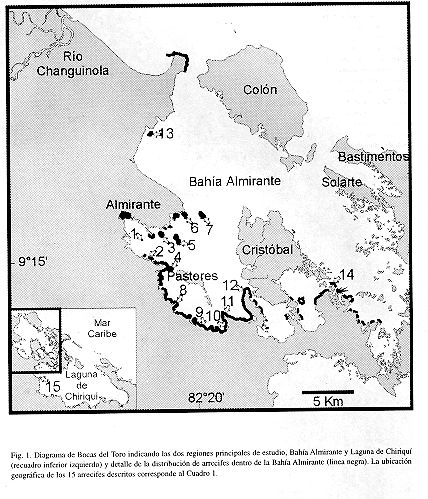
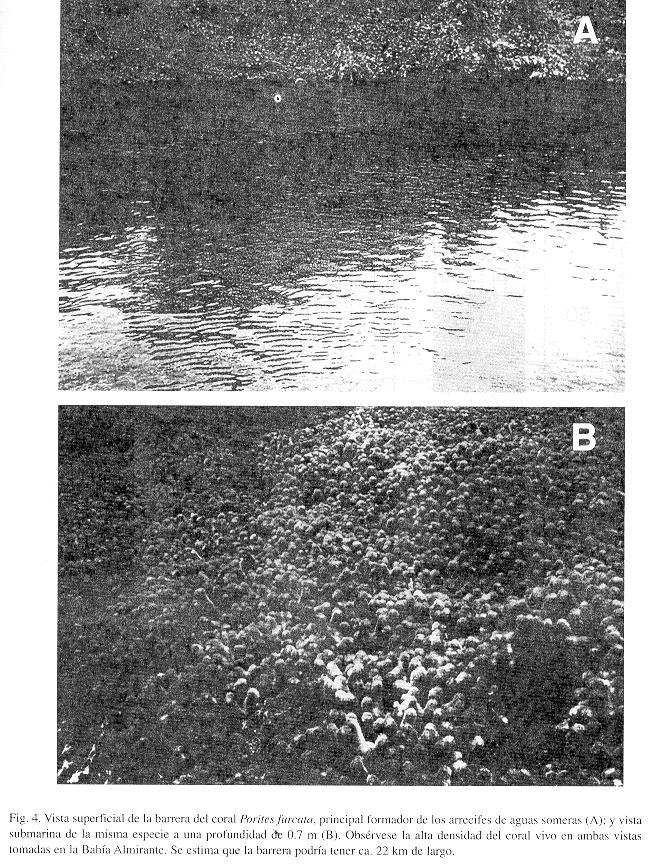
<body><![CDATA[<P><FONT FACE="Arial,Helvetica"><FONT SIZE=-1>(1) Durante 80 min se hizo un reconocimiento completo del arrecife desde la parte m&aacute;s profunda hasta lo somero, anotando la composici&oacute;n de especies y diversidad de los organismos s&eacute;siles de los tax&oacute;nes m&aacute;s comunes, incluidos los corales escleract&iacute;nidos, octocoralarios, esponjas, algas, y otros. Adem&aacute;s, se hizo una descripci&oacute;n general de la zonaci&oacute;n de las especies de coral en el arrecife para determinar su distribuci&oacute;n vertical. Las especies de organismos s&eacute;siles fueron clasificados usando referencias selectas para algas (<A HREF="#Littler, D.S.">Littler et al. 1989</A>), esponjas (<A HREF="#Zea">Zea 1987</A>, <A HREF="#Sefton">Sefton y Webster 1986</A>, <A HREF="#Humann, P. 1994a.">Humann 1994a</A>), an&eacute;monas (<A HREF="#Sefton">Sefton y Webster 1986</A>, <A HREF="#Humann, P. 1994a.">Humann 1994a</A>), octocorales (<A HREF="#Bayer, F.M. 1961.">Bayer 1961</A>, <A HREF="#Muzilt, K.">Muzik 1982</A>, <A HREF="#Guzmán, H.M. 1985">Guzm&aacute;n y Cort&eacute;s 1985</A>, <A HREF="#Humann, P. 1994b">Humann 1994b</A>), y corales escleractinidos (<A HREF="#Cairns,">Cairns 1982</A>, <A HREF="#Cortés, J. 1985">Cort&eacute;s y Guzm&aacute;n 1985</A>, <A HREF="#Humann, P. 1994b">Humann 1994b</A>).</FONT></FONT></DIV>      <DIV class="p3" style="margin-left:0cm;line-height:normal"><FONT FACE="Arial,Helvetica"><FONT SIZE=-1>&nbsp;</FONT></FONT>     <BR><FONT FACE="Arial,Helvetica"><FONT SIZE=-1>(2) Se escogieron al azar tres transectos de 5 metros de largo cada uno al azar y separados entre si por la misma distancia, paralelos a la costa y en cada una de las tres profundidades seleccionadas para describir cada arrecife (1 m, 3 m y 10 m), para un total de 45 m<U>&lt;</U> por arrecife. La distancia de cada transecto o eficiencia de muestreo fue determinada al comparar el n&uacute;mero de especies de coral versus &aacute;rea de muestreo (sensu <A HREF="#Loya Y. 1972.">Loya 1972</A>), encontr&aacute;ndose que a la distancia de 5 m se alcanzaba un nivel de diversidad constante. En cada transecto, se estim&oacute; visualmente la cobertura de cada organismo s&eacute;sil presente empleando una cuadr&iacute;cula de PVC de 1 m<U>&lt;</U> subdividida en 100 celdas de 100 cm&nbsp; <U>&lt;</U> cada una.</FONT></FONT></DIV>      <DIV class="c2" style="line-height:normal;tab-stops:36.0pt">&nbsp;      <P><B><FONT FACE="Arial,Helvetica"><FONT SIZE=-1>Resultados</FONT></FONT></B>     <BR>&nbsp;</DIV>      <DIV class="c2" style="line-height:normal;tab-stops:36.0pt"><FONT FACE="Arial,Helvetica"><FONT SIZE=-1>Se evalu&oacute; la distribuci&oacute;n de los arrecifes en ca. 83 km y 125 km de costa (tierra firme) dentro de la Bah&iacute;a Almirante (sector interno) y la Laguna de Chiriqu&iacute;, respectivamente (<A HREF="#fig.1">Fig. 1)</A>. Se describieron un total de 15 arrecifes coralinos entre ambas regiones (<A HREF="#CUADRO 1">Cuadro 1</A>), los cuales representan la diversidad de condiciones hidrol&oacute;gicas y orogr&aacute;ficas de la zona costera.</FONT></FONT></DIV>      <DIV class="p3" style="margin-left:0cm;line-height:normal">&nbsp;     <BR><FONT FACE="Arial,Helvetica"><FONT SIZE=-1><B>Bah&iacute;a Almirante:</B> Esta regi&oacute;n se caracteriz&oacute; por tener la mayor formaci&oacute;n de arrecifes a lo largo de la costa, bajo la influencia de numerosos r&iacute;os y quebradas (<A HREF="#fig.1">Fig. 1</A>). La influencia de la Ciudad de Almirante y sus alrededores se puede observar en los arrecifes cercanos a este sector. Las quebradas Nigua y Lim&oacute;n, y el R&iacute;o Oeste descargan altas cantidades enormes de sedimentos en este sector, observ&aacute;ndose el efecto de estos a varios kil&oacute;metros al sur y sureste de la Ciudad de Almirante. Los arrecifes localizados alrededor del Cayo Gerechow, al sureste de la ciudad, est&aacute;n completamente muertos y cubiertos por algas. Este cayo al igual que los restantes, se encontraba originalmente rodeado por un arrecife poco profundo construido por el coral ramificado <I>Porites furcata</I>. Actualmente el substrato del arrecife est&aacute; cubierto principalmente por el alga verde <I>Cladophora prolifera</I>, entremezclada con parches de la an&eacute;mona S<I>tichodactyla helianthus</I> y el gusano plumoso <I>Sabellastarte </I>magnifica. El coral marfil Oculina diffusa forma conjuntamente con la hierba marina <I>Syringodium filiforme</I> parches peque&ntilde;os. Hacia el lado sureste del cayo las condiciones mejoran y se comienza a encontrar arrecifes en mejores condiciones. Es importante notar que la composici&oacute;n de los sedimentos en las &aacute;reas lagunares de hierbas marinas y los taludes arrecifales de la mayor parte del &aacute;rea de estudio, indica una alta contribuci&oacute;n de carbonatos de origen biog&eacute;nico y poco sedimento fino silicocl&aacute;stico (ver <A HREF="#Greb, L., B.">Greb et al. 1996</A>).</FONT></FONT></DIV>      <DIV class="p2" style="line-height:normal">&nbsp;     ]]></body>
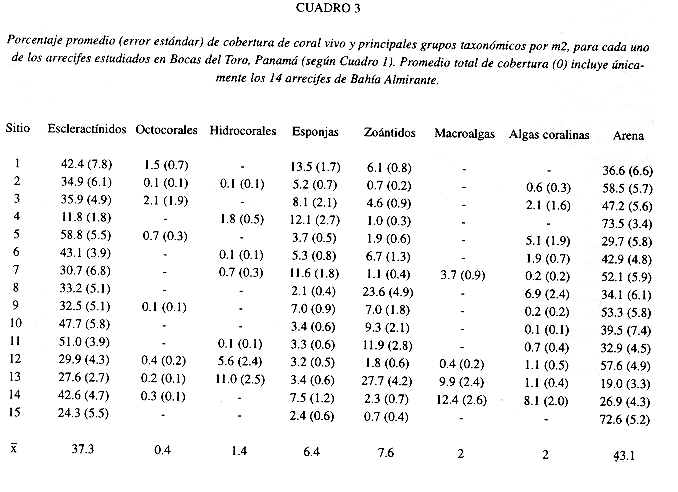
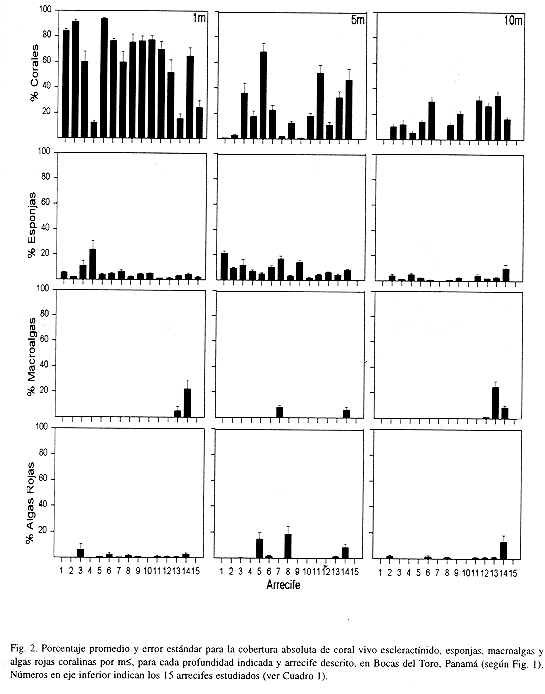
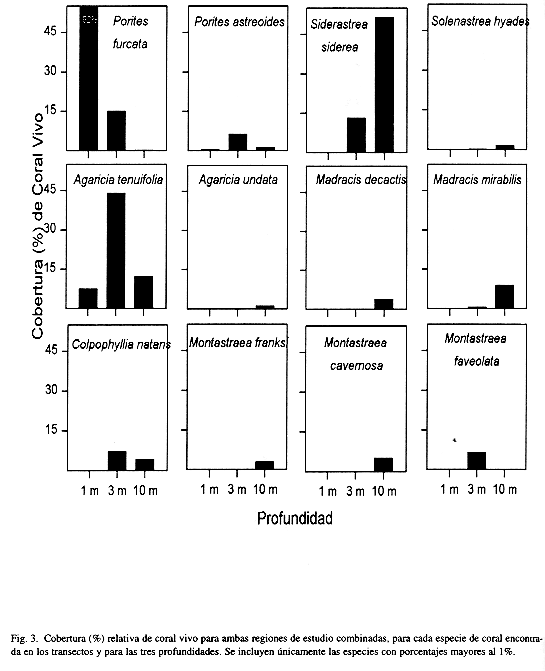
<body><![CDATA[<BR><FONT FACE="Arial,Helvetica"><FONT SIZE=-1>Se estudiaron en detalle 14 arrecifes coralinos distribuidos a lo largo de la costa y representativos de esta sub-regi&oacute;n (<A HREF="#fig.1">Fig. 1</A>, <A HREF="#CUADRO 1">Cuadro 1</A>). La diversidad y cobertura de coral viviente varia de acuerdo al arrecife y su profundidad de desarrollo. La diversidad de animales s&eacute;siles no presenta un patr&oacute;n geogr&aacute;fico definido, aunque se observa una tendencia a menor diversidad en las &aacute;reas internas (suroeste) de la bah&iacute;a. Se encontr&oacute; una mayor diversidad de corales escleract&iacute;nidos en los arrecifes 6, 13, 11 y 12 , con un n&uacute;mero superior a 20 especies, de un total de 33 encontradas en la regi&oacute;n de estudio (<A HREF="#CUADRO2">Cuadro 2</A>). La menor diversidad se da en arrecifes poco desarrollados en cuanto a profundidad e influencia de los manglares (arrecifes 1, 4, 7, y 8). <I>Acropora cervicornis</I>, una importante especie constructora de arrecifes, se encontr&oacute; casualmente en solo dos arrecifes (6, 1 3), mientras que <I>A. palmata</I> no se observ&oacute; en los arrecifes. <I>Siderastrea siderea, Porites furcata, Agaricia tenuifolia, Madracis decactis y M. mirabilis</I> son com&uacute;nes en casi todos los arrecifes (<A HREF="#CUADRO2">Cuadro 2</A>). Por lo general, las &aacute;reas arrecifales poco profundas (&lt;3 m) presentaban coberturas de coral superiores al 20% y en su mayor&iacute;a cercanas al 50% (<A HREF="#fig. 2">Fig. 2</A>). Los arrecifes 4 y 13 fueron los de menor cobertura, debido a la existencia de una barra de arena en el primero y un alto crecimiento de macroalgas en el segundo (<A HREF="#Cuadro 3">Cuadro 3</A>). Se encontr&oacute; que la cobertura de corales disminuy&oacute; con la profundidad en la mayor&iacute;a de los casos, excepto en los arrecifes 6, 9, y 11-14, donde la cobertura se mantuvo superior al 20% hasta los 10 m de profundidad (<A HREF="#fig. 2">Fig. 2)</A>. Se podr&iacute;a decir que la cobertura de coral escleract&iacute;nidos promedio fue bastante alta, oscilando entre 11% y 59% (<A HREF="#Cuadro 3">Cuadro 3</A>).</FONT></FONT></DIV>      <DIV class="p2" style="line-height:normal">&nbsp;     <BR><FONT FACE="Arial,Helvetica"><FONT SIZE=-1>La<A HREF="#fig. 3"> Figura 3</A> ilustra la zonaci&oacute;n de especies de coralpara todos los arrecifes en conjunto, y basado en la cobertura relativa de las especies. El coral ramificado o ''dedos" <I>Porites furcata</I> es la especie constructora de arrecifes m&aacute;s importante de aguas someras, siendo responsable de ca. 90% de la cobertura. Algo curioso de notar es la alta densidad (ca. 40 individuos/m<SUP>2</SUP>) de las poblaciones de la estrella fr&aacute;gil <I>Ophiothrix suensonii</I> encontradas en estadios juveniles y adultos cubriendo los arrecifes de <I>P furcata</I>. Adem&aacute;s, es importante destacar que se encontr&oacute; al coral<I> P furcata </I>formando una barrera arrecifal casi continua, hasta 2 m de profundidad, de ancho variable entre 6 y 25 m y una longitud de ca. 21.5 km, desde la primera punta de manglar que sobresale al sur del R&iacute;o Oeste hasta la Punta Bella Vista en el extremo sureste de la Ensenada Grande (ver <A HREF="#fig.1">Figs. 1</A> y <A HREF="#fig. 4">4</A>). La barrera es interrumpida en sectores donde desembocan r&iacute;os y quebradas y donde se forman peque&ntilde;as ensenadas de mangle, por lo general a distancias inferiores a los 200 m. Otras barreras similares se observaron alrededor de la Isla Pastores (ca. 11 km) y el lado Oeste de Isla Crist&oacute;bal, desde Punta Juan hasta Punta Rodr&iacute;guez (ca. 8 km), pero estas ser&aacute;n descritas en un trabajo consecuente. La segunda especie constructora de arrecifes que domina de 3 a 6 m de profundidad es el coral "<I>lechuga"</I> A<I>garicia tenuifoli</I>a (>40%), donde se mezcla con especies de crecimiento masivo como C<I>alpophyllia natans, Montastraea cavernosa, M. franksi y Siderastrea siderea,</I> entre otras (<A HREF="#fig. 3">Fig. 3</A>). Hacia aguas m&aacute;s profundas, de 10 m en adelante, domina el coral S. siderea (ca. 50%) conjuntamente con A. <I>tenuifolia</I> (ca. 15%) y parches extensos de <I>Madracis mirabilis</I> (ca. 7%), terminando la base del arrecife compuesta de colonias en forma de platos de S. siderea y el alga roja calc&aacute;rea <I>Amphiroa&nbsp;</I> rigida var. antillana y posiblemente las algas incrustantes <I>Hydrolithion boergesenii y Sporolithon episporum.</I> La especie de coral <I>Agaricia undata</I>, com&uacute;nmente encontrada en San Blas a profundidades mayores a los 25 m, se encontr&oacute; creciendo saludable y abundante (ca. 3%) despu&eacute;s de los 10 m de profundidad (<A HREF="#fig. 3">Fig. 3</A>).</FONT></FONT></DIV>      <DIV class="p2" style="line-height:normal">&nbsp;     <BR><FONT FACE="Arial,Helvetica"><FONT SIZE=-1>Otros organismos s&eacute;siles que contribuyen notablemente al desarrollo arrecifal son las esponjas. Este grupo result&oacute; bastante diverso, con 31 especies de variadas formas (<A HREF="#CUADRO 4">Cuadro 4</A>), y una cobertura de hasta 13% en algunos arrecifes (<A HREF="#Cuadro 3">Cuadro 3</A>). Por lo general, las esponjas se encontraron m&aacute;s abundantes en profundidades intermedias de hasta 5 m (<A HREF="#fig. 2">Fig. 2</A>). Se observa un patr&oacute;n aparente en la distribuci&oacute;n geogr&aacute;fica de la diversidad y abundancia de esponjas; los arrecifes del sector este de la Ensenada Grande, los m&aacute;s alejados del continente (12 y 14), tuvieron la mayor diversidad (<A HREF="#CUADRO 4">Cuadro 4)</A> pero no as&iacute; la cobertura, que se encontr&oacute; m&aacute;s alta en los arrecifes cercanos a tierra firme (<A HREF="#fig. 2">Fig. 2</A>).</FONT></FONT></DIV>      <DIV class="p2" style="line-height:normal">&nbsp;     <BR><FONT FACE="Arial,Helvetica"><FONT SIZE=-1>Las macroalgas, que por lo general se encuentran muy abundantes en todos los arrecifes del Caribe, parecieran no ser un problema en esta regi&oacute;n interna de la Bah&iacute;a de Almirante. La ausencia de algas en muchos arrecifes contrasta con la alta cobertura encontrada en un arrecife (14), el &uacute;nico donde se observ&oacute; un promedio superior al 10%&nbsp; (<A HREF="#Cuadro 3">Cuadro 3</A>), o algo mayor dependiendo de la profundidad (<A HREF="#fig. 2">Fig. 2</A>). El alga parda <I>Dyctiota ciliolata </I>es responsable de la cobertura observada en aguas someras, y el alga roja <I>Gelidium pussilum </I>en profundidades mayores a 10 m (<A HREF="#fig. 2">Fig. 2</A>). Similarmente, el alga roja coralina <I>Arnphiroa rigida var. antillana </I>domina amplias extensiones en los arrecifes, particularmente el de Punta Bella Vista (12), con coberturas superiores al 15% dependiendo de la profundidad (<A HREF="#fig. 2">Fig. 2</A>). Otras algas rojas coralinas incrustantes se distribuyen en todos los arrecifes; <I>Hydrolithon boergesenii </I>y <I>Sporolithon episporum</I> en aguas m&aacute;s profundas y <I>Titanoderma bermudense</I> en aguas someras, siempre creciendo sobre coral muerto.</FONT></FONT></DIV>      <DIV class="p2" style="line-height:normal">&nbsp;     <BR><FONT FACE="Arial,Helvetica"><FONT SIZE=-1>El grupo de los octocorales se encontr&oacute; poco diverso, con alrededor de ocho especies, formando por lo general parches monoespec&iacute;ficos dentro del arrecife, principalmente compuestos por <I>Pseudopterogorgia spp</I>., <I>Erythropodium caribaeorum</I>, o <I>Briareum asbestinurn</I> (<A HREF="#CUADRO 5">Cuadro 5</A>). Adem&aacute;s, se encontr&oacute; un extenso parche de octocorales (ca. 3 800 m<SUP>2</SUP>) y a una profundidad de 2-3.5 m, formada principalmente por <I>Pseudopte&shy;rogorgia americana</I> y <I>P. acerosa </I>en altas densidades (ca. 3-7 colonias/m<SUP>2</SUP>), y <I>Gorgonia flabellurn </I>hacia las m&aacute;rgenes del parche, ubicado entre Punta Pondsock y el arrecife de este nombre (7). La mayor cobertura de octocorales (2%) se encontr&oacute; en el arrecife insular del Cayo Ambrosia (3) (<A HREF="#Cuadro 3">Cuadro 3</A>).</FONT></FONT></DIV>      <DIV class="p1" style="margin-left:0cm;line-height:normal"><FONT FACE="Arial,Helvetica"><FONT SIZE=-1>El grupo de las an&eacute;monas present&oacute; seis especies en total, utilizando h&aacute;bitats de forma similar a los octocorales, por parches (<A HREF="#CUADRO 5">Cuadro 5</A>). La cobertura de an&eacute;monas se mantuvo por lo general con un promedio inferior al 1%, pero cabe destacar las densidades encontradas a profundidad intermedia (3-6 m) en los arrecifes 1 (<I>Stichodactyla helianthus</I>; 3.2%), y 7 (<I>Lebrunia</I> <I>danae;</I> 2.3%). El grupo de los zo&aacute;ntidos se encontr&oacute; formado solamente por <I>Zoanthus pulchellu</I>s (<A HREF="#CUADRO 5">Cuadro 5</A>), especie que compite notablemente con el coral <I>Porites furcata</I> por espacio muerto en arrecifes someros. En algunos arrecifes (6, 8-11, 13) sus densidades oscilaron entre 7% y 28% de la cobertura total a 1 m de profundidad, y en muchos otros arrecifes se encontr&oacute; coberturas promedios de 5%.</FONT></FONT></DIV>      ]]></body>
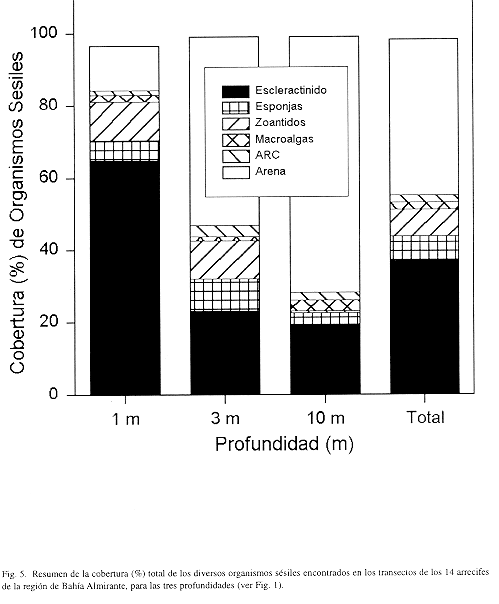
<body><![CDATA[<DIV class="p2" style="line-height:normal">&nbsp;     <BR><FONT FACE="Arial,Helvetica"><FONT SIZE=-1><B>Laguna de Chiriqu&iacute;:&nbsp;</B> Se encontr&oacute; &uacute;nicamente un arrecife coralino dentro de la Laguna de Chiriqu&iacute; (<A HREF="#fig.1">Fig. 1)</A>. Este arrecife (15) present&oacute; un desarrollo arrecifal limitado hasta los 3 m de profundidad, una diversidad de corales no mayor a las siete especies, y una cobertura de coral vivo de 24% (<I>Porites furcata</I>), que podr&iacute;a considerarse alta. La mayor parte de este &uacute;nico arrecife esta cubierto por substrato desnudo o arena (73%) y un porcentaje reducido de esponjas (2.4%) (<A HREF="#Cuadro 3">Cuadro 3</A>, <A HREF="#fig. 2">Fig. 2</A>). Se encuentran parches arrecifales de peque&ntilde;o tama&ntilde;o distribuidos dentro de la laguna al sur de la Isla Loma Partida, y al Oeste de la Pen&iacute;nsula Valiente (alrededores del Cayo Paterson), y a 3-6 m de profundidad. Estos parches aunque conspicuos en cobertura de organismos s&eacute;siles, principalmente corales agar&iacute;cidos y esponjas, no fueron descritos por considerarse comunidades coralinas, y encontrarse en avanzado estado de deterioro posiblemente debido a la sedimentaci&oacute;n en la laguna.</FONT></FONT></DIV>      <DIV class="p1" style="margin-left:0cm;line-height:normal">&nbsp;     <BR><FONT FACE="Arial,Helvetica"><FONT SIZE=-1>Las praderas de hierbas marinas y los bosques de mangle dentro de la Laguna de Chiriqu&iacute; est&aacute;n bien desarrollados, y en cierto modo su estructura y composici&oacute;n son similares a la descrita para la otra regi&oacute;n. La distribuci&oacute;n de bosques de manglar es casi continua a lo largo de toda la costa. Las &aacute;reas deforestadas de manglar y bosque coinciden por lo general con &aacute;reas de ganader&iacute;a y agricultura cercanas a Punta R&oacute;balo y los alrededores de las quebradas Las Ca&ntilde;as, La Tronosa, Grande y Cauchero, donde se observan amplios asentamientos de campesinos, o &aacute;reas alteradas por los poblados ind&iacute;genas al lado Oeste de la Pen&iacute;nsula Valiente. Se observa deforestaci&oacute;n avanzada en la Isla Loma Partida. El bosque de manglar est&aacute; bastante desarrollado entre las quebradas Los Chiricanos y Molej&oacute;n, donde el bosque puede alcanzar alturas superiores a los 25 m, y conformado en su mayor&iacute;a por especies de <I>Avicennia germinans y faguncularia racemosa</I>, entremezclado con el mangle <I>Pelliciera rhizophorae</I>. El sector noroeste del &aacute;rea de estudio est&aacute; conformado por numerosas islas de mangle rojo Rhizophora mangle bien conservado y de bajo porte. Las praderas de hierbas presentan una composici&oacute;n de especies de organismos asociados similar a Bah&iacute;a Almirante, aunque pareciera que la densidad de Thalassia y la longitud de sus hojas es mayor, creciendo favorablemente en sedimentos lodosos.</FONT></FONT></DIV>      <DIV class="p2" style="line-height:normal">&nbsp;     <BR><FONT FACE="Arial,Helvetica"><FONT SIZE=-1>En resumen, si se analiza la cobertura global (todos los 15 arrecifes estudiados) de los principales organismos s&eacute;siles, incluyendo los corales, encontramos para los arrecifes continentales una cobertura promedio superior a 35% de corales (incluye 0.8% de <I>Millepora spp.</I>), 2% macroalgas y algas coralinas, 6% esponjas, y 7% zo&aacute;ntidos (<A HREF="#fig. 5">Fig. 5</A>). Aproximadamente el 43% del substrato arrecifal est&aacute; ocupado por arena. Estas coberturas var&iacute;an considerablemente con la profundidad, encontr&aacute;ndose un 66% de corales en aguas someras y un promedio de 20% en aguas m&aacute;s profundas (<A HREF="#fig. 5">Fig. 5</A>), y diferencias significativas entre la cobertura a 1 m y las otras dos profundidades (Anova Kruskal-Wallis H= 21.8, P&lt;0.0001; y SNK). De igual forma se encontr&oacute; diferencias significativas para las esponjas de mayor profundidad (H= 10.4, P= 0.005), pero con coberturas similares entre 1 y 3 m. Las cobertura de macroalgas y algas rojas coralinas no variaron entre profundidades (H= 1.58, P= 0.452, H= 0.12, P= 0.942; respectivamente). Los zo&aacute;ntidos mostraron diferencias significativas en las profundidades de l m y 3m con respecto a la m&aacute;s profunda (H= 22.1, P&lt; 0.0001).</FONT></FONT>     <BR>&nbsp;     <BR>&nbsp;</DIV> <B><FONT FACE="Arial,Helvetica"><FONT SIZE=-1>Discusi&oacute;n</FONT></FONT></B>      <P class="p2" style="line-height:normal"><FONT FACE="Arial,Helvetica"><FONT SIZE=-1>Los arrecifes continentales estudiados en Bocas del Toro est&aacute;n bien desarrollados y bastante saludables si se les compara con otros arrecifes de Panam&aacute;. La cobertura promedio de 40% para coral vivo encontrada en la regi&oacute;n de la Ensenada Grande, Bah&iacute;a Almirante, y la cobertura de algas inferior al 3% sit&uacute;a a esta regi&oacute;n como la mejor preservada el pa&iacute;s. Los arrecifes del sector central del Caribe paname&ntilde;o presentaban para 1991 coberturas de coral de 4% en la zona industrial de Bah&iacute;a Las Minas y de 9% en el sector Portobelo-Isla Grande (<A HREF="#Guzmán, H. 1993">Guzm&aacute;n et al. 1993)</A>, y una cobertura de algas superior al 65% en mbas regiones. Adem&aacute;s, <A HREF="#Shulman, M.">Shulman y Robertson (1996)</A> informan de coberturas de 28% y 26% para algas y corales, respectivamente para el sector del Porvenir (San Blas) en 1990. Sin embargo, para 1992 se informa de una cobertura de algas de entre 55% y 82% para la regi&oacute;n de San Blas y una cobertura de coal vivo inferior al 10% en la zona de Porvenir y de 20% en los Cayos Limones y Holandeses (Guzm&aacute;n en prep.).</FONT></FONT>     <DIV class="p1" style="margin-left:0cm;text-indent:0cm;line-height:normal">&nbsp;     ]]></body>
<body><![CDATA[<BR><FONT FACE="Arial,Helvetica"><FONT SIZE=-1>Los corales encontrados dentro del &aacute;rea que comprende el presente estudio representan un 53% de la diversidad total informada para el Caribe de Panam&aacute; (<A HREF="#Holst 1993">Holst y Guzm&aacute;n 1993</A>). De igual forma se estima que la diversidad de octocorales en el &aacute;rea de estudio podr&iacute;a ser inferior al 20% de las especies conocidas para el resto del pa&iacute;s (Guzm&aacute;n en prep.). En general, las principales especies formadoras de arrecifes del Caribe est&aacute;n presentes dentro del &aacute;rea de estudio. La ausencia de las especies restantes (48%) se podr&iacute;a relacionar con el grado de desarrollo de los arrecifes, el cual no se extiende a profundidades mayores de 20 m, mientras que en otros lugares de Panam&aacute; (i.e., San Blas) estos llegan hasta m&aacute;s de 40 m de profundidad. Esta limitaci&oacute;n est&aacute; relacionada con la profundidad de penetraci&oacute;n de la luz, controlada por factores f&iacute;sico-qu&iacute;micos locales.</FONT></FONT>      <P><FONT FACE="Arial,Helvetica"><FONT SIZE=-1>Entre estos factores el m&aacute;s importante observado para la regi&oacute;n de la Bah&iacute;a Almirante, donde ocurre el mayor desarrollo arrecifal en este estudio, es la presencia casi permanente de una capa superficial de agua dulce rica en taninos, mientras que para la regi&oacute;n de la Laguna de Chiriqu&iacute; el factor m&aacute;s importante es la presencia permanente de sedimentos en suspensi&oacute;n asociados a la alta sedimentaci&oacute;n de los r&iacute;os. Para ambos casos, la penetraci&oacute;n de la luz es limitada. Adem&aacute;s, la ausencia de ciertas especies puede ocurrir al utilizar h&aacute;bitats muy espec&iacute;ficos que no se encuentran en ninguna de las dos &aacute;reas evaluadas (e.g. ambientes de alta energ&iacute;a y oleaje). Por ejemplo, la especie de coral <I>Acropora palmata </I>no se encontr&oacute; dentro del &aacute;rea de estudio.</FONT></FONT></DIV>      <DIV class="p2" style="line-height:normal">&nbsp;     <BR><FONT FACE="Arial,Helvetica"><FONT SIZE=-1>La eutroficaci&oacute;n, que por lo general conlleva a un incremento notable en la turbidez, es el resultado de m&uacute;ltiples actividades antropog&eacute;nicas asociadas a la deforestaci&oacute;n y erosi&oacute;n de suelos, que incluye la agricultura, descargas de aguas dom&eacute;sticas sin tratamiento y contaminaci&oacute;n industrial. La calidad del agua es importante para el desarrollo arrecifal y solamente un n&uacute;mero reducido de especies son tolerantes a cambios de salinidad, temperatura y turbidez (<A HREF="#Bak 1978">Bak 1978</A>, <A HREF="#Rogers, C.S. 1983">Rogers 1983</A>, <A HREF="#Muthiga">Muthiga y Szmant 1987</A>, <A HREF="#Acevedo, R.,">Acevedo et al. 1989</A>, <A HREF="#Rice,. S.">Rice y llunter 1992</A>). Por lo general, la distribuci&oacute;n y abundancia de los corales escleract&iacute;nidos es determinada por el efecto neto de m&uacute;ltiples factores ambienfales interrelacionados entre si y que pueden actuar de forma aditiva o sin&eacute;rgica (<A HREF="#Tomascik, T.">Tomascik y Sanders 1987</A>). Particularmente, la profundidad de penetraci&oacute;n de la luz limita este desarrollo y la dorninancia y diversidad de especies en el arrecife, siendo la turbidez un factor importante en la fisiolog&iacute;a del coral que normalmente es alterado con el aumento en la sedimentaci&oacute;n de la zona litoral. Se ha demostrado que la turbibez no solo disminuye la lasa fotosint&eacute;tica en el coral, sino que causa un incremento inmediato en la utilizaci&oacute;n de mol&eacute;culas org&aacute;nicas que sirven de reserva para mantener procesos metab&oacute;licos de alto costo energ&eacute;tico como son la producci&oacute;n de mucus y la limpieza de sedimentos (<A HREF="#Kendall,">Kendall et al. 1985)</A>.</FONT></FONT></DIV>      <DIV class="p2" style="line-height:normal">&nbsp;     <BR><FONT FACE="Arial,Helvetica"><FONT SIZE=-1>La composici&oacute;n y textura de los sedimentos a lo largo de la costa de la Laguna de Chiriqu&iacute;, formados por restos de moluscos, grano muy fino y alto contenido de materia org&aacute;nica (M. Best com. per.). y una alta concentraci&oacute;n de silicatos y nitratos en la columna de agua (L. D'Croz com. per.), indican una alta influencia de sedimentos silicocl&aacute;sticos provenientes de r&iacute;os y quebradas. La costa de la laguna est&aacute; afectada por descargas continuas de sedimentos provenientes de varios r&iacute;os, principalmente los Cricamola, Manant&iacute;, Uyama, Guarumo y Cauchero, cuyas plumas de agua dulce y sedimentos se extienden muchos kil&oacute;metros desde sus desembocaduras, posiblemente limitando el asentamiento y desarrollo de comunidades coralinas dentro de la Laguna de Chiriqu&iacute;. No obstante, ocurre lo contrario dentro de la Bah&iacute;a Almirante, donde a excepci&oacute;n del R&iacute;o Oeste cerca de la Ciudad de Almirante, las descargas de los r&iacute;os son bajas todav&iacute;a, y la turbidez no est&aacute; directamente asociada a sedimentaci&oacute;n como se explic&oacute; anteriormente.</FONT></FONT></DIV>      <DIV class="p2" style="line-height:normal">&nbsp;     <BR><FONT FACE="Arial,Helvetica"><FONT SIZE=-1>Existen varios mecanismos de limpieza de sedimentos en corales, siendo la producci&oacute;n de mucus una de ellas. El movimiento de limpieza de sedimentos sobre la colonia de coral es m&aacute;s efectivo si existen corrientes de agua fuertes, de lo contrario al no ser removido el mucus con el sedimento atrapado en este podr&iacute;a observarse efectos letales sobre el organismo (<A HREF="#Bak 1976">Bak y Elg ershuizen 1976</A>). Ambas regiones estudiadas de Bocas del Toro, no est&aacute;n sujetas a grandes corrientes o oleaje que permitan a los corales limpiarse el sedimento y ayudar en la remoci&oacute;n de mucus. Actualmente, no se observa producci&oacute;n generalizada de mucus en las colonias de coral, lo que sugiere que los corales est&aacute;n bastante adaptados a las condiciones ambientales actuales, con algunas excepciones. Pareciera que las especies de corales que dominan estos arrecifes, <I>Porites furcata, Agaricia tenuifolia, Madracis mirabilis, M. decactis y Siderastrea siderea</I>, presentan caracter&iacute;sticas peculiares que les permiten vivir muy cercanas a sus l&iacute;mites de tolerancia, siendo algunas de estas cualidades la foto-adaptaci&oacute;n, las cuales les permite vivir completamente aut&oacute;trofos en ambientes dif&iacute;ciles (sensu <A HREF="#Edmunds, P.">Edmunds y Spencer-Davies 1989</A>), la eficiencia en la remoci&oacute;n de sedimentos (<A HREF="#Bak 1978">Bak 1978</A>, <A HREF="#Rogers, C.S. 1983">Rogers 1983</A>, <A HREF="#Tomascik, T.">Tomascik y Sanders 1987</A>) y la alimentaci&oacute;n de material particulado en suspensi&oacute;n capturado por medio de redes de mucus (<A HREF="#Lewis, j.B.">Lewis y Price 1975</A>). Adem&aacute;s, la mayor&iacute;a de las colonias masivas (S<I>iderastrea, Montastraea, Stephanocoenia</I>) se encuentran creciendo en forma horizontal (forma de plato) en aguas despu&eacute;s de 5 m de profundidad, lo que indica que se han adaptado a ambientes de poca luminosidad como ocurre en otros h&aacute;bitats a profundidades de m&aacute;s de 25 m. En Costa Rica se observa este mismo fen&oacute;meno de adaptaci&oacute;n y desarrollo arrecifal limitado en respuesta a altas tasas de sedimentaci&oacute;n <A HREF="#Cortés, J. Risk 1985">(Cort&eacute;s y Risk1985</A>).</FONT></FONT></DIV>      <DIV class="p2" style="line-height:normal">&nbsp;     <BR><FONT FACE="Arial,Helvetica"><FONT SIZE=-1>El escenario anteriormente descrito para estos arrecifes de Bocas del Toro -alta cobertura de corales y baja cobertura de algas- es dif&iacute;cil de explicar en estos momentos debido a la falta de informaci&oacute;n general para la zona. La mayor parte de los arrecifes del Gran Caribe se encuentran parecidos a las &aacute;reas ya descritas para el resto de Panam&aacute; (baja cobertura de coral vivo y alta de macroalgas), y han sufrido en forma similar las consecuencias asociadas a disturbios naturales y antropog&eacute;nicos (ver <A HREF="#Brown, B.E. 1987.">Brown 1987</A>, <A HREF="#Goenaga, C.">Goenaga 1991</A>); el calentamiento de las aguas y blanqueamiento de corales (<A HREF="#Brown, E.E. 1993">Brown y Ogden 1993</A>, <A HREF="#Goreau, T.">Goreau y Hayes 1994</A>), falta de herb&iacute;voros producto de la mortandad masiva del erizo <I>Diadema antillarum </I>y la sobrepesca generalizada (<A HREF="#Lessios,">Lessios et al. 1984</A>, <A HREF="#Hughes, T.P.">Hughes 1994</A>), y enfermedades de corales (<A HREF="#Gladfelter, W.B.">Gladfelter 1982</A>), entre otros. Eventualmente, el &aacute;rea de estudio no ha escapado a algunos de estos eventos, y podr&iacute;a explicarse la ausencia de macroalgas y por ende la alta cobertura de coral vivo debido a: (i) la composici&oacute;n de corales tiende a especies m&aacute;s resistentes. La tolerancia de las principales especies constructores de arrecifes a ambientes de alta turbidez las hace a su vez m&aacute;s resistentes a disturbios ambientales; (u) la alta densidad (no estimada) del erizo <I>Echinometra viridis </I>encontrada en todos los h&aacute;bitats del arrecife e inclusive en las praderas de pastos marinos. Estas altas densidades del erizo posiblemente han mantenido el nivel de herbivoria requerido por estas comunidades bajo condiciones saludables. Se conoce que en San Blas y Galeta aumentaron considerablemente las poblaciones de E. <I>viridis</I> al ocurrir la mortalidad masiva de <I>D antillarum</I> en 1983 (<A HREF="#Lessios,">Lessios et al. 1984</A>).</FONT></FONT>      ]]></body>
<body><![CDATA[<P><FONT FACE="Arial,Helvetica"><FONT SIZE=-1>Sin embargo, en los arrecifes de estas dos &uacute;ltimas regiones no se observa el mismo efecto de herbivor&iacute;a que posiblemente ocurre en Bocas del Toro, y la alta cobertura de algas persiste. Adem&aacute;s, otros herb&iacute;voros importantes (peces) han sido eliminados de la regi&oacute;n de la Bah&iacute;a Almirante, donde se observan claros efectos de sobrepesca en toda el &aacute;rea. Se observa un esfuerzo de pesca alto por parte de los ind&iacute;genas, quienes emplean continuamente redes sobre los arrecifes, resultando ya en una escasez de peces a todos los niveles tr&oacute;ficos. Los efectos negativos de la sobrepesca en la estructura del arrecifes coralinos son ampliamente entendidos (ver <A HREF="#Hughes, T.P.">Hughes 1994</A>, <A HREF="#Roberts C.M. 1995">Roberts 1995</A>); y (iii) una combinaci&oacute;n de ambos procesos, corales resistentes y alta herbivor&iacute;a.</FONT></FONT></DIV>      <DIV class="p2" style="line-height:normal">&nbsp;     <BR><FONT FACE="Arial,Helvetica"><FONT SIZE=-1>Finalmente, la informaci&oacute;n de este estudio permite valorar adecuadamente el estado actual de los arrecifes en este sector de Bocas del Toro. Los arrecifes del &aacute;rea en consideraci&oacute;n, aunque no presenta un atractivo tur&iacute;stico explotable directamente, bien cumplen las funciones principales a nivel de ecosistema y sirven de apoyo a poblaciones ind&iacute;genas locales (<A HREF="#Jaén, B.">Ja&eacute;n 1993</A>). El proyectado desarrollo de esta regi&oacute;n traer&aacute; como consecuencia inmediata la sobrepoblaci&oacute;n en la zona costera, que se r&eacute;flejar&aacute; en la destrucci&oacute;n de manglares, mayor demanda por recursos del mar ya sobreexplotados a nivel artesanal, cambios culturales en las poblaciones ind&iacute;genas quienes tendr&aacute;n que competir m&aacute;s por espacio y recursos naturales, y una disminuci&oacute;n de la calidad del agua al aumentar la eutroficaci&oacute;n y sedimentaci&oacute;n. Actualmente la situaci&oacute;n es dif&iacute;cil para las comunidades ind&iacute;genas locales, quienes ya han comenzado a explotar los recursos del bosque y mar en forma comercial, y no a nivel de subsistencia (<A HREF="#Jaén, B.">Ja&eacute;n 1993</A>). Es notable, que lo anteriormente descrito afectar&aacute; la productividad y estructura de las comunidades arrecifales, manifest&aacute;ndose en una mortalidad mayor de corales y una bajas tasas de reproducci&oacute;n y asentamiento de nuevos corales, efectos que ya han sido documentados ampliamente para otras regiones (<A HREF="#Loya, Y. 1976">Loya 1976</A>, <A HREF="#Bak 1978">Bak 1978</A>, <A HREF="#Cortés, J. Risk 1985">Cort&eacute;s y Risk 1985</A>, <A HREF="#Tomascik, T.">Tomascick y Sander 1987</A>, <A HREF="#Baines, G.">Baines y Morrison 1990</A>, <A HREF="#Rogers, C.S.l990.">Rogers 1990</A>, <A HREF="#Goenaga, C.">Goenaga 1991</A>, <A HREF="#Tomascik">Tomascik 1991</A>, <A HREF="#Wittenberg">Wittenberg y Hunte 1992</A>,<A HREF="#Guzmán, H. 1993"> Guzm&aacute;n et al. 1993</A>, <A HREF="#Guzmán, H. 1993">Guzm&aacute;n y Holst 1993</A>). Es probable que los arrecifes del &aacute;rea estudiada ya est&eacute;n viviendo cercanos al l&iacute;mite de tolerancia a cambios ambientales; su composici&oacute;n y zonaci&oacute;n actual son caracter&iacute;sticas que as&iacute; lo indican.</FONT></FONT></DIV>      <DIV class="p2" style="line-height:normal">&nbsp;     <BR>&nbsp;     <BR><B><FONT FACE="Arial,Helvetica"><FONT SIZE=-1>Conclusiones y recomendaciones</FONT></FONT></B>     <BR><FONT FACE="Arial,Helvetica"><FONT SIZE=-1>&nbsp;</FONT></FONT>     <BR><FONT FACE="Arial,Helvetica"><FONT SIZE=-1>El presente estudio demuestra claramente la presencia de arrecifes bien desarrollados en la zona costera continental (no insular), zona esta que podr&iacute;a ser la m&aacute;s propensa a la influencia terr&iacute;gena asociada a la modificaci&oacute;n de bosques y cuencas hidrogr&aacute;ficas. Los arrecifes coralinos aqu&iacute; descritos definitivamente pueden ser considerados como los de mayor cobertura de coral vivo descritos para el Caribe paname&ntilde;o, si se les compara con otros arrecifes del resto del pa&iacute;s (<A HREF="#Guzmán, H. 1993">Guzm&aacute;n et al. 1993</A>, Guzm&aacute;n in prep.). Por lo tanto considerarnos importante se protejan estas comunidades litorales de la sedimentaci&oacute;n y deforestaci&oacute;n, y podemos se&ntilde;alar la imperante necesidad de encontrar soluciones adecuadas que ayuden a mitigar en lo posible el inminente impacto negativo que ocasionar&aacute; el desarrollo no planificado de la Provincia de Bocas del Toro sobre las comunidades mar&iacute;timo-costeras. Las recomendaciones que se presentan a continuaci&oacute;n, aunque algunas de aparente car&aacute;cter cient&iacute;fico, podr&iacute;an proporcionar un punto de partida para entidades gubernamentales encargadas del manejo de los recursos naturales y del desarrollo de la provincia.</FONT></FONT></DIV>      <DIV class="p3" style="margin-left:0cm;line-height:normal"><FONT FACE="Arial,Helvetica"><FONT SIZE=-1>&nbsp;</FONT></FONT>     <BR><FONT FACE="Arial,Helvetica"><FONT SIZE=-1>(1) Estudiar la din&aacute;mica y patrones de corrientes marinas dentro de las dos regiones, lo que permitir&iacute;a comprender con precisi&oacute;n la distribuci&oacute;n de los sedimentos acarreados por los r&iacute;os y quebradas a lo largo de la costa. A su vez esto permitir&iacute;a predecir cuales arrecifes y comunidades costeras estar&iacute;an m&aacute;s susceptibles a las altas tasas de sedimentaci&oacute;n a per&iacute;odos de mediano y largo plazo.</FONT></FONT></DIV>      ]]></body>
<body><![CDATA[<DIV class="p3" style="margin-left:0cm;line-height:normal"><FONT FACE="Arial,Helvetica"><FONT SIZE=-1>&nbsp;</FONT></FONT>     <BR><FONT FACE="Arial,Helvetica"><FONT SIZE=-1>(2)Establecer a la brevedad leyes y regulaciones que controlen y eviten la deforestaci&oacute;n de los bosques de manglar y los bosques lluviosos en monta&ntilde;as adyacentes a la costa. Hasta el momento la mayor parte del area presenta una cobertura boscosa saludable y las bocas de los r&iacute;os y quebradas no est&aacute;n muy alteradas. Sin embargo, es de esperarse que los planes de desarrollo para la Provincia de Bocas del Toro promueva la invasi&oacute;n de tierras, la deforestaci&oacute;n, la ganader&iacute;a, y la sobrepoblaci&oacute;n a lo largo de la costa, con consecuencias ambientales bastantes conocidas (<A HREF="#Myers, J.">Myers 1997</A>).</FONT></FONT></DIV>      <DIV class="p2" style="line-height:normal"><FONT FACE="Arial,Helvetica"><FONT SIZE=-1>&nbsp;</FONT></FONT>     <BR><FONT FACE="Arial,Helvetica"><FONT SIZE=-1>(3)Sugerimos se dise&ntilde;e e implemente una campa&ntilde;a de informaci&oacute;n ambiental que permita a los ind&iacute;genas y latinos locales conocer m&aacute;s sobre la presencia e importancia de los arrecifes, lo susceptible de estas comunidades naturales a cambios f&iacute;sicos en la costa, y la necesidad de que los mismos pobladores los protejan. Actualmente, se observan se&ntilde;ales de sobrepesca; la abundancia y diversidad de peces asociados al arrecife son muy bajas en ambas regiones estudiadas. De igual forma, ya se observan se&ntilde;ales de deforestaci&oacute;n y ganader&iacute;a cercanas al litoral.</FONT></FONT></DIV> <B><FONT FACE="Arial,Helvetica"><FONT SIZE=-1>&nbsp;</FONT></FONT></B>     <BR><B><FONT FACE="Arial,Helvetica"><FONT SIZE=-1>&nbsp;</FONT></FONT></B>     <BR><B><FONT FACE="Arial,Helvetica"><FONT SIZE=-1>Agradecimientos</FONT></FONT></B>      <P class="p4" style="margin-left:0cm;line-height:normal"><FONT FACE="Arial,Helvetica"><FONT SIZE=-1>Agradecemos a Juan Mat&eacute; por su ayuda durante el trabajo inicial en el campo. A 1. Valdespino y O. Vallarinos de la Asociaci&oacute;n para la Conservaci&oacute;n de la Naturaleza (ANCON), y 1. Rubinoff, H. Barnes, L. Motta y I. Ivancic del Smithonian Tropical Research Institute (STRI) por apoyo brindado durante esta investigaci&oacute;n. Agradecemos a M.E. Tupper y a la tripulaci&oacute;n del Y/V Starfire, P. Miller y K. Simpson, por su apoyo log&iacute;stico incondicional. Agradecemos a X. Guerra por el dise&ntilde;o del mapa y a K. Kauffman por preparar las estad&iacute;sticas descriptivas. Este estudio fue financiado parcialmente por M.E. Tupper, ANCON y STRI.</FONT></FONT>     <BR>&nbsp;      <P><B><FONT FACE="Arial,Helvetica"><FONT SIZE=-1>Resumen</FONT></FONT></B>      <P class="p4" style="margin-left:0cm;line-height:normal"><FONT FACE="Arial,Helvetica"><FONT SIZE=-1>Se presenta la distribuci&oacute;n de azrecifes coralinos a lo lar-go de la costa continental (tierra firrne) de la Bah&iacute;a Almirante (ca. 83km) y de la Laguna de Chiriqu&iacute; (ca 125km), Provincia de Bocas del Toro, Panarn&aacute;.&nbsp; Se describe la estructura de 15 arrecifes coralinos, los cuales representan la diversidad de condiciones hidrol&oacute;gicas y orogr&aacute;ficas de la zona costera con mayor in&iacute;tuencia terr&iacute;gena de Bocas del Toro. Los arrecifes encontrados en la Bah&iacute;a Almirante se encuentran bien desarrollados hasta una profundidad m&aacute;xima de 23 m y una diversidad de corales madrep&oacute;ricos de 33 especies, lo cual representa aproximadamente un 53 % de la diversidad conocida para Panam&aacute;. las coberturas de coral vivo observadas para la regi&oacute;n de estudio oscilan entre 20 % y 50 % depediendo de la profundidady se estima un&nbsp; promedio total de 35 % casi el doble de la cobertura informada para otras regiones de Panam&aacute; (San Blas) donde se presume que los arrecifes estan mejor protegidos.</FONT></FONT>     ]]></body>
<body><![CDATA[<DIV class="p4" style="margin-left:0cm;line-height:normal"><FONT FACE="Arial,Helvetica"><FONT SIZE=-1>&nbsp;</FONT></FONT>     <BR><FONT FACE="Arial,Helvetica"><FONT SIZE=-1>La zonaci&oacute;n y composici&oacute;n de especies de corales son similares en toda el &aacute;rea de estudio; <I>Porites furcata</I> domina los arrecifes someros hasta 2 m de profundidad, con una cobertura de ca. 90% seguido por una zona dominada por <I>Agaricia tenuifolia,</I> (40%) hasta los 6 m. seguido de una zona principalmente compuesta de <I>A. tenuifolia</I>&nbsp; (15%) <I>Madracis mirabilis</I> (7%) y <I>Siderastrea siderea</I> (50%) hasta los 15 m de profundidad, terminando en una zona&nbsp; profundad dominada por&nbsp; algas rojas calcareas <I>Amphiroa</I> rigida, <I>Hydrolithon boergesenii, Sporolithon episporum y el coral S. siderea</I>. El coral <I>Agariciaundata</I>, com&uacute;n&nbsp; en habitats profundos se encontr&oacute; relativamente abundante (3%) y creciendo despu&eacute;s de los 10 m. Se informa por primera vez para la regi&oacute;n la existencia de una barrera coralina construida por&nbsp; <I>Porites furcata,</I> semi-continua de ca. 22 km de largo y que bordea la zona costera de la Bah&iacute;a Almirante. El grupo de las esponjas, segundo en importancia, est&aacute; ampliamente distribuido en todos los arrecifes con una diversidad de 31 especcies y cobertura promedio de 6%. Curiosamente, se encontr&oacute; un solo arrecife de los estudiados con cobertura de macroalgas&nbsp; del 10 %,&nbsp; mientras&nbsp; que los rstantes arrecifes presentan cobertura promedio de macroalgas&nbsp; inferiores al 4%. Solamente se encontr&oacute; un arrecife coralino&nbsp; dentro de la Laguna de Chiriqu&iacute;, con desarrollo limitado hasta 3 m de profundidad, una diversidad de corales no mayor a 7 especies y cobertura de coral de 24% (<I>Porites furcata</I>). La costa de la Laguna Chiriqu&iacute; est&aacute; afectada por descargas continuas de sedimentos provenientes de varios r&iacute;os, principalmente Cricamola, Manant&iacute;, Uyama, Guarumo y Cauchero, cuyas plumas de agua dulce y sedimentos se extienden mucchos kil&oacute;metros desde sus desembocaduras, limitado el asentamiento y desarrollo de comunidades coralinas. La&nbsp; distribuci&oacute;n vertical y dominancia de ciertas especies de corales en los arrecifes aqu&iacute; descritos (e.g. <I>Siderastrea siderea,</I> <I>Porites furcata,</I> <I>Agaricia tenuifolia, Madracis decactis, y M. mirabilis</I>) indican que estas comunidades se formaron adapt&aacute;ndose gradualmente a condiciones variables de calidad de agua (salinidad, temperatura y penetraci&oacute;n de la luz)&nbsp; relativamente no &oacute;ptimas para un desarrollo arrecifal m&aacute;s diversos y de aguas m&aacute;s profundas. Esto sugiere que estas especies&nbsp; pesar de ser bastante resistentes a cambios ambientales, viven actualmernte muy cercanas a sus l&iacute;mites de tolerancia ecofisiol&oacute;gica, lo cual las hace particularmente vulnerables a cambios puntuados. Cuaquier proyecto de desarrollo no planificado incrementar&aacute; la sedimentaci&oacute;n hacia la zona costera debilitando a los organismos arrecifales en su totalidad, afect&aacute;ndose as&iacute; la funcionalidad del ecosistema.</FONT></FONT>     <BR>&nbsp;      <P><B><FONT FACE="Arial,Helvetica"><FONT SIZE=-1>Referencias</FONT></FONT></B>      <P><A NAME="Acevedo, R.,"></A><FONT FACE="Arial,Helvetica"><FONT SIZE=-1>Acevedo, R., J. Morelock &amp; R.A. Olivien. 1989. Modification of coral reef zonation by terrigenous sediment stress. Palaios 4: 92-100.</FONT></FONT>      <P><A NAME="Baines, G."></A><FONT FACE="Arial,Helvetica"><FONT SIZE=-1>Baines, G. B.K. &amp; R.J. Morrison. 1990. Marine pollution from landuse in the Pacilic Islands region. Mar. Pollut. BuIl. 21:506-515.</FONT></FONT>      <!-- ref --><P><A NAME="Ballou 1985"></A><FONT FACE="Arial,Helvetica"><FONT SIZE=-1>Ballou, T.G., M.S. Brown, R.E. Dodge, C.D. Getter, A.H. Knap, &amp; T.D. Sleeter. 1985. Tropical oil pollution investigations in coastal Systems (TROPICS): a technical status report. Research Planning Institute. Columbia. 128 p.</FONT></FONT>    &nbsp;&nbsp;&nbsp;&nbsp;&nbsp;&nbsp;&nbsp;&nbsp;[&#160;<a href="javascript:void(0);" onclick="javascript: window.open('/scielo.php?script=sci_nlinks&ref=1138503&pid=S0034-7744199800030001400003&lng=','','width=640,height=500,resizable=yes,scrollbars=1,menubar=yes,');">Links</a>&#160;]<!-- end-ref --><!-- ref --><P><A NAME="Ballou, T.G 1989a"></A><FONT FACE="Arial,Helvetica"><FONT SIZE=-1>Ballou, T.G., S.C.Hess, R.E.Dodge, A. H Knap &amp; T.D. Sleeter.1989a. Effects of untreated and chemically dispersed oil on tropical marine communities: A long-term field experiment. Proceedings of the 1989 Oil Spill Conference, American Petroleum Institute, Washington, D.C. 447-454     &nbsp;&nbsp;&nbsp;&nbsp;&nbsp;&nbsp;&nbsp;&nbsp;[&#160;<a href="javascript:void(0);" onclick="javascript: window.open('/scielo.php?script=sci_nlinks&ref=1138504&pid=S0034-7744199800030001400004&lng=','','width=640,height=500,resizable=yes,scrollbars=1,menubar=yes,');">Links</a>&#160;]<!-- end-ref -->p.</FONT></FONT>      <P><A NAME="Ballou, T.G. 1989b"></A><FONT FACE="Arial,Helvetica"><FONT SIZE=-1>Ballou, T.G., R.E. Dodge, S.C. Ress &amp; A.H. Knap. 1989b. Tropical oil pollution investigations in coastal systems (Tropics): The effects of untreated and chemically dispersed Prudhoe Bay crude oil on mangroves, seagrasses, and corals in Panama, p. 229-256. In L.M. FIaherty (ed.). Oil dispersants: new ecological approaches. American&nbsp; Societyfor&nbsp; Testing and Materlais, Philadelphia.</FONT></FONT>      ]]></body>
<body><![CDATA[<P><A NAME="Bak 1976"></A><FONT FACE="Arial,Helvetica"><FONT SIZE=-1>Bak, R.P.M. &amp; J.H.B.W. Flgershuizen, 1976. Patterns of oil-sediment rejection in corals. Mar. Biol. 37:105-113.</FONT></FONT>      <!-- ref --><P><A NAME="Bak 1978"></A><FONT FACE="Arial,Helvetica"><FONT SIZE=-1>Bak, R.P.M. 1978. Lethal and sublethal effects of dredging on reef corals. Mar. Pollut. Bull. 9:14-16.</FONT></FONT>    &nbsp;&nbsp;&nbsp;&nbsp;&nbsp;&nbsp;&nbsp;&nbsp;[&#160;<a href="javascript:void(0);" onclick="javascript: window.open('/scielo.php?script=sci_nlinks&ref=1138508&pid=S0034-7744199800030001400007&lng=','','width=640,height=500,resizable=yes,scrollbars=1,menubar=yes,');">Links</a>&#160;]<!-- end-ref --><P><A NAME="Bayer, F.M. 1961."></A><FONT FACE="Arial,Helvetica"><FONT SIZE=-1>Bayer, F.M. 1961. The shallow-water octocorallia of the West Indian region. Martinus Nijhoff, The Hague. 373 p.</FONT></FONT>      <P><A NAME="Brown, B.E. 1987."></A><FONT FACE="Arial,Helvetica"><FONT SIZE=-1>Brown, B.E. 1987. Worldwide death of corals-natural cyclical events or man-made pollution? Mar. Pollut Bul&iacute;. 18: 9-13.</FONT></FONT>      <!-- ref --><P><A NAME="Brown, E.E. 1993"></A><FONT FACE="Arial,Helvetica"><FONT SIZE=-1>Brown, E.E. &amp; J.C. Ogden.1993. Coral bleaching. Scientific America 268: 64-70.</FONT></FONT>    &nbsp;&nbsp;&nbsp;&nbsp;&nbsp;&nbsp;&nbsp;&nbsp;[&#160;<a href="javascript:void(0);" onclick="javascript: window.open('/scielo.php?script=sci_nlinks&ref=1138511&pid=S0034-7744199800030001400010&lng=','','width=640,height=500,resizable=yes,scrollbars=1,menubar=yes,');">Links</a>&#160;]<!-- end-ref --><!-- ref --><P><A NAME="Cairns,"></A><FONT FACE="Arial,Helvetica"><FONT SIZE=-1>Cairns, S.D. 1982. Stony corals (Cnidaria: Hydrozoa, Scleractinia) of Carrie Bow Cay, Belize. Smithsonian Contrib. Mar. Sci. 12: 271-302.</FONT></FONT>    &nbsp;&nbsp;&nbsp;&nbsp;&nbsp;&nbsp;&nbsp;&nbsp;[&#160;<a href="javascript:void(0);" onclick="javascript: window.open('/scielo.php?script=sci_nlinks&ref=1138512&pid=S0034-7744199800030001400011&lng=','','width=640,height=500,resizable=yes,scrollbars=1,menubar=yes,');">Links</a>&#160;]<!-- end-ref --><P><A NAME="Coates, A.G."></A><FONT FACE="Arial,Helvetica"><FONT SIZE=-1>Coates, A.G. &amp; J.B.C. Jackson. 1998. Neogene sedimenta&shy;ry basins of Costa Rica arid Panama. 1 lth Conference &iacute;nter. Bryozoology Association, Panama. 39 p.</FONT></FONT>      <!-- ref --><P><A NAME="Collins"></A><FONT FACE="Arial,Helvetica"><FONT SIZE=-1>Collins, LS., A.F Budd &amp; A.G. Coates. 1996. Earliest evolution associated with closure of the Tropical American Seaway. Nat. Acad. Sci. Proc. 93: 6069-6072.</FONT></FONT>    &nbsp;&nbsp;&nbsp;&nbsp;&nbsp;&nbsp;&nbsp;&nbsp;[&#160;<a href="javascript:void(0);" onclick="javascript: window.open('/scielo.php?script=sci_nlinks&ref=1138514&pid=S0034-7744199800030001400013&lng=','','width=640,height=500,resizable=yes,scrollbars=1,menubar=yes,');">Links</a>&#160;]<!-- end-ref --><!-- ref --><P><A NAME="Cortés, J. 1985"></A><FONT FACE="Arial,Helvetica"><FONT SIZE=-1>Cort&eacute;s, J. &amp; H.M. Guzman. 1985. Organismos de los arrecifes coralinos de Costa Rica III. Descripci&oacute;n y distribuci&oacute;n geogr&aacute;fica de los corales p&eacute;treos (Anthozoa: Scleractinia) en la costa Caribe. Brenesia 24: 63-123.</FONT></FONT>    &nbsp;&nbsp;&nbsp;&nbsp;&nbsp;&nbsp;&nbsp;&nbsp;[&#160;<a href="javascript:void(0);" onclick="javascript: window.open('/scielo.php?script=sci_nlinks&ref=1138515&pid=S0034-7744199800030001400014&lng=','','width=640,height=500,resizable=yes,scrollbars=1,menubar=yes,');">Links</a>&#160;]<!-- end-ref --><P><A NAME="Cortés, J. Risk 1985"></A><FONT FACE="Arial,Helvetica"><FONT SIZE=-1>Cort&eacute;s, J. &amp; M.J. Risk. 1985. A reef under siltalion stress: Cahuita, Costa Rica. Buil. Mar. Sci. 36: 339-356.</FONT></FONT>      ]]></body>
<body><![CDATA[<P><A NAME="DMA (Delfense Mapping Agency"></A><FONT FACE="Arial,Helvetica"><FONT SIZE=-1>DMA (Delfense Mapping Agency). 1988. Atlas of Pilot Charts for the North Atlantic Ocean. DMP, 37 p.</FONT></FONT>      <P><A NAME="Dodge. R."></A><FONT FACE="Arial,Helvetica"><FONT SIZE=-1>Dodge. R.E. &amp; A.H. Knap. 1993. Long-term monitoring (2.5 years) of effects of short-term fleid exposures of stony corals to dispersed and undispersed crude oil, p. 87-93.In R.N. Ginsburg (ed.). Global aspects of coral reefs: health, hazards and history. University of Miami, Florida.</FONT></FONT>      <P><A NAME="Edmunds, P."></A><FONT FACE="Arial,Helvetica"><FONT SIZE=-1>Edmunds, P.J. &amp; P. Spencer-Davis. 1989. An energy budget for Porites porites (Scleractinia), growing in a stressed environrnent. Cora] Reefs 8: 37-44.</FONT></FONT>      <!-- ref --><P><A NAME="Gladfelter, W.B."></A><FONT FACE="Arial,Helvetica"><FONT SIZE=-1>Gladfelter, W.B. 1982. White-band disease in Acropora palmata: implications for the structure and growth of shallow reefs. Bull. Mar. Sci. 32: 639-643.</FONT></FONT>    &nbsp;&nbsp;&nbsp;&nbsp;&nbsp;&nbsp;&nbsp;&nbsp;[&#160;<a href="javascript:void(0);" onclick="javascript: window.open('/scielo.php?script=sci_nlinks&ref=1138520&pid=S0034-7744199800030001400019&lng=','','width=640,height=500,resizable=yes,scrollbars=1,menubar=yes,');">Links</a>&#160;]<!-- end-ref --><!-- ref --><P><A NAME="Greb, L., B."></A><FONT FACE="Arial,Helvetica"><FONT SIZE=-1>Greb, L., B. Saric, H. Seyfried, T. Broszonn. S. Brauch, G. Gugau, C. Wiltschko &amp; R. Leinfelder. 1996. &Oacute;kologie ind sedimentologie eines rezenten rampensystem an der Karibikkuste von Panama. Profil, Band 10, Universitat Stuttgart, 168p.</FONT></FONT>    &nbsp;&nbsp;&nbsp;&nbsp;&nbsp;&nbsp;&nbsp;&nbsp;[&#160;<a href="javascript:void(0);" onclick="javascript: window.open('/scielo.php?script=sci_nlinks&ref=1138521&pid=S0034-7744199800030001400020&lng=','','width=640,height=500,resizable=yes,scrollbars=1,menubar=yes,');">Links</a>&#160;]<!-- end-ref --><P><A NAME="Glynn, PW."></A><FONT FACE="Arial,Helvetica"><FONT SIZE=-1>Glynn, PW. 1972. Observations on the ecology of the Caribbean and Pacific coasts of Panarna. Bull. Biol. Soc. Wash. 2:13-30.</FONT></FONT>      <!-- ref --><P><A NAME="Goenaga, C."></A><FONT FACE="Arial,Helvetica"><FONT SIZE=-1>Goenaga, C. 1991. The state of coral reefs in the wider Caribbean. Interciencia 16:12-20.</FONT></FONT>    &nbsp;&nbsp;&nbsp;&nbsp;&nbsp;&nbsp;&nbsp;&nbsp;[&#160;<a href="javascript:void(0);" onclick="javascript: window.open('/scielo.php?script=sci_nlinks&ref=1138523&pid=S0034-7744199800030001400022&lng=','','width=640,height=500,resizable=yes,scrollbars=1,menubar=yes,');">Links</a>&#160;]<!-- end-ref --><P><A NAME="Gordon, B.L."></A><FONT FACE="Arial,Helvetica"><FONT SIZE=-1>Gordon, B.L. 1982. A Panarna forest and shore: natural histoty and Amerindian culture in Bocas del Toro. The Boxproof Press, California. 178 p.</FONT></FONT>      <!-- ref --><P><A NAME="Goreau, T."></A><FONT FACE="Arial,Helvetica"><FONT SIZE=-1>Goreau, T.J. &amp; R.L. Hayes. 1994. Coral bleaching and ocean 'hot spots". Ambio 23:176-180.</FONT></FONT>    &nbsp;&nbsp;&nbsp;&nbsp;&nbsp;&nbsp;&nbsp;&nbsp;[&#160;<a href="javascript:void(0);" onclick="javascript: window.open('/scielo.php?script=sci_nlinks&ref=1138525&pid=S0034-7744199800030001400024&lng=','','width=640,height=500,resizable=yes,scrollbars=1,menubar=yes,');">Links</a>&#160;]<!-- end-ref --><!-- ref --><P><A NAME="Gundlach"></A><FONT FACE="Arial,Helvetica"><FONT SIZE=-1>Gundlach, E..R., G. Moss, F.&nbsp; de Vincenti &amp; J. Janssen. 1985. Resource mapping and contingency planning, PTP Pipeline Facilities, Panama. Proceedings 1985 Oil Spill Conference, Los Angeles, California. 229-234.</FONT></FONT>    &nbsp;&nbsp;&nbsp;&nbsp;&nbsp;&nbsp;&nbsp;&nbsp;[&#160;<a href="javascript:void(0);" onclick="javascript: window.open('/scielo.php?script=sci_nlinks&ref=1138526&pid=S0034-7744199800030001400025&lng=','','width=640,height=500,resizable=yes,scrollbars=1,menubar=yes,');">Links</a>&#160;]<!-- end-ref --><!-- ref --><P><A NAME="Guzmán, H.M. 1985"></A><FONT FACE="Arial,Helvetica"><FONT SIZE=-1>Guzm&aacute;n, H.M. &amp; J. Cort&eacute;s. 1985. Organismos de los arrecifes coralinos de Costa Rica. IV. Descripci&oacute;n y distribuci&oacute;n geogr&aacute;fica de octocorales (Anthozoa: Octocorallia) en la costa Caribe. Brenesia 24: 125-173.</FONT></FONT>    &nbsp;&nbsp;&nbsp;&nbsp;&nbsp;&nbsp;&nbsp;&nbsp;[&#160;<a href="javascript:void(0);" onclick="javascript: window.open('/scielo.php?script=sci_nlinks&ref=1138527&pid=S0034-7744199800030001400026&lng=','','width=640,height=500,resizable=yes,scrollbars=1,menubar=yes,');">Links</a>&#160;]<!-- end-ref --><!-- ref --><P><A NAME="Guzmán, H. 1992"></A><FONT FACE="Arial,Helvetica"><FONT SIZE=-1>Guzm&aacute;n, H. M. &amp; C.E. Jim&eacute;nez. 1992. Contamination of reef corals by heavy rnetals along the Caribbean coast of Central America (Costa Rica and Panama). Mar. Pollut. Bull. 24: 554-561.</FONT></FONT>    &nbsp;&nbsp;&nbsp;&nbsp;&nbsp;&nbsp;&nbsp;&nbsp;[&#160;<a href="javascript:void(0);" onclick="javascript: window.open('/scielo.php?script=sci_nlinks&ref=1138528&pid=S0034-7744199800030001400027&lng=','','width=640,height=500,resizable=yes,scrollbars=1,menubar=yes,');">Links</a>&#160;]<!-- end-ref --><P><A NAME="Guzmán Jackson,1993"></A><FONT FACE="Arial,Helvetica"><FONT SIZE=-1>Guzm&aacute;n, H.M. &amp; 1. Holst. 1993. Effects of chronic oil-sed&shy;iment pollution on the reproduction of the Caribbean rref coral SideTasirea siderea. Mar. Pollut. Bul&iacute;. 26:276-282.</FONT></FONT>      <P><A NAME="Guzmán, H. 1993"></A><FONT FACE="Arial,Helvetica"><FONT SIZE=-1>Guzm&aacute;n, H.M., I.B.C. Jackson &amp; 1. Holst. 1993. Changes aad recovery of subtidal reef corals, p. 361-446. In B.D. Keller and J.B.C. Jackson (eds.). Long-term assessment of the oil spill at Bah&iacute;a Las Minas, Panam&aacute;, synthesis Report. u.S. Department of the Interior, New Orleans.</FONT></FONT>      <!-- ref --><P><A NAME="Hatcher; B.G. 1988"></A><FONT FACE="Arial,Helvetica"><FONT SIZE=-1>Hatcher; B.G. 1988. Coral reef primary productivity: a beg&shy;gar's banquet. TREE 3:106-111.</FONT></FONT>    &nbsp;&nbsp;&nbsp;&nbsp;&nbsp;&nbsp;&nbsp;&nbsp;[&#160;<a href="javascript:void(0);" onclick="javascript: window.open('/scielo.php?script=sci_nlinks&ref=1138531&pid=S0034-7744199800030001400030&lng=','','width=640,height=500,resizable=yes,scrollbars=1,menubar=yes,');">Links</a>&#160;]<!-- end-ref --><P><A NAME="Hatcher; B.G. 1990."></A><FONT FACE="Arial,Helvetica"><FONT SIZE=-1>Hatcher; B.G. 1990. Coral reefs primary productivity: a hierarchy of pattern and process. TRIPE 5:149-155.</FONT></FONT>      <!-- ref --><P><A NAME="Holst 1993"></A><FONT FACE="Arial,Helvetica"><FONT SIZE=-1>Holst, I &amp; H.M. Guzm&aacute;n. 1993. Lista de corales hermat&iacute;picos (Anthozoa: Scleractinia; Hydrozoa: Milleporina) a ambos lados del istmo de Panam&aacute;. Rev. Biol. Trop. 41: 535-540.</FONT></FONT>    &nbsp;&nbsp;&nbsp;&nbsp;&nbsp;&nbsp;&nbsp;&nbsp;[&#160;<a href="javascript:void(0);" onclick="javascript: window.open('/scielo.php?script=sci_nlinks&ref=1138533&pid=S0034-7744199800030001400032&lng=','','width=640,height=500,resizable=yes,scrollbars=1,menubar=yes,');">Links</a>&#160;]<!-- end-ref --><!-- ref --><P><A NAME="Hughes, T.P."></A><FONT FACE="Arial,Helvetica"><FONT SIZE=-1>Hughes, T.P. 1994, Catastrophes, phase shifts, and large-scale degradation of a Caribbean coral reef. Science 265:1547-1551</FONT></FONT>    &nbsp;&nbsp;&nbsp;&nbsp;&nbsp;&nbsp;&nbsp;&nbsp;[&#160;<a href="javascript:void(0);" onclick="javascript: window.open('/scielo.php?script=sci_nlinks&ref=1138534&pid=S0034-7744199800030001400033&lng=','','width=640,height=500,resizable=yes,scrollbars=1,menubar=yes,');">Links</a>&#160;]<!-- end-ref --><!-- ref --><P><A NAME="Humann, P. 1994a."></A><FONT FACE="Arial,Helvetica"><FONT SIZE=-1>Humann, P. 1994a. Reef Creatures Identification: Florida, Caribbean and Bahamas. Paramount Miller Graphics, Florida. 320 p.</FONT></FONT>    &nbsp;&nbsp;&nbsp;&nbsp;&nbsp;&nbsp;&nbsp;&nbsp;[&#160;<a href="javascript:void(0);" onclick="javascript: window.open('/scielo.php?script=sci_nlinks&ref=1138535&pid=S0034-7744199800030001400034&lng=','','width=640,height=500,resizable=yes,scrollbars=1,menubar=yes,');">Links</a>&#160;]<!-- end-ref --><P><A NAME="Humann, P. 1994b"></A><FONT FACE="Arial,Helvetica"><FONT SIZE=-1>Humann, P. 1994b. Reef Coral Identification: Florida, Caribbean and Bahamas. Paramount Miller Gruphics, Florida. 240 p.</FONT></FONT>      ]]></body>
<body><![CDATA[<!-- ref --><P><A NAME="IGNTG"></A><FONT FACE="Arial,Helvetica"><FONT SIZE=-1>IGNTG (Instituto Geogr&aacute;fico Nacional "Tommy Guardia"). 1988.Atlas Nacional de la Rep&uacute;blica de Panama. IGNTG, Panam&aacute;. 222 p.</FONT></FONT>    &nbsp;&nbsp;&nbsp;&nbsp;&nbsp;&nbsp;&nbsp;&nbsp;[&#160;<a href="javascript:void(0);" onclick="javascript: window.open('/scielo.php?script=sci_nlinks&ref=1138537&pid=S0034-7744199800030001400036&lng=','','width=640,height=500,resizable=yes,scrollbars=1,menubar=yes,');">Links</a>&#160;]<!-- end-ref --><!-- ref --><P><A NAME="INRENARE"></A><FONT FACE="Arial,Helvetica"><FONT SIZE=-1>INRENARE (Instituto Nacional de Recursos Naturales Renovables). 1995. Informe de cobertura boscosa a 1992. Direcci&oacute;n de Cuencas Hidrogr&aacute;ficas. Sistema de Informaci&oacute;n Geogr&aacute;fica. INRENARE, Panam&aacute;.27 p,</FONT></FONT>    &nbsp;&nbsp;&nbsp;&nbsp;&nbsp;&nbsp;&nbsp;&nbsp;[&#160;<a href="javascript:void(0);" onclick="javascript: window.open('/scielo.php?script=sci_nlinks&ref=1138538&pid=S0034-7744199800030001400037&lng=','','width=640,height=500,resizable=yes,scrollbars=1,menubar=yes,');">Links</a>&#160;]<!-- end-ref --><!-- ref --><P><A NAME="Jackson, J.B.C."></A><FONT FACE="Arial,Helvetica"><FONT SIZE=-1>Jackson, J.B.C. &amp; A.G. Coates. 1993. Biolog&iacute;a y geolog&iacute;a del Istmo de Panam&aacute;. p. 35-41. <I>In</I> S. Heckadon-Moreno (ed.). Agenda Ecol&oacute;gica y Social para Bocas del Toro. Impresora Continental, S.A., Panam&aacute;.</FONT></FONT>    &nbsp;&nbsp;&nbsp;&nbsp;&nbsp;&nbsp;&nbsp;&nbsp;[&#160;<a href="javascript:void(0);" onclick="javascript: window.open('/scielo.php?script=sci_nlinks&ref=1138539&pid=S0034-7744199800030001400038&lng=','','width=640,height=500,resizable=yes,scrollbars=1,menubar=yes,');">Links</a>&#160;]<!-- end-ref --><!-- ref --><P><A NAME="Jaén, B."></A><FONT FACE="Arial,Helvetica"><FONT SIZE=-1>Ja&eacute;n, B.C. 1993. Los pueblos indigenas y el uso de los recursos naturales en Bocas del Toro, p. 119-135.I<I>n</I> S. Heckadon-Moreno (ed.). Agenda Ecol&oacute;gica y Social para Bocas del Toro. Impresora Continental, S.A., Panam&aacute;.</FONT></FONT>    &nbsp;&nbsp;&nbsp;&nbsp;&nbsp;&nbsp;&nbsp;&nbsp;[&#160;<a href="javascript:void(0);" onclick="javascript: window.open('/scielo.php?script=sci_nlinks&ref=1138540&pid=S0034-7744199800030001400039&lng=','','width=640,height=500,resizable=yes,scrollbars=1,menubar=yes,');">Links</a>&#160;]<!-- end-ref --><P><A NAME="Kendall,"></A><FONT FACE="Arial,Helvetica"><FONT SIZE=-1>Kendall, Jr., J.J., E.N. Powell, S.J. Connor, TJ. Btight &amp; CE. Zastrow.1985. Effects of turbidity on calcification rate, protein concentration and the free amino acid pool of the coral <I>Acropora cervicornis</I>. Mar. Biol. 87: 33-46.</FONT></FONT>      <P><A NAME="Lessios,"></A><FONT FACE="Arial,Helvetica"><FONT SIZE=-1>Lessios, H.A., J.D. Cubit, D.R. Roberison, M.J. Shulman, M.R. Parker, S.D. Garrity &amp; S.C. Levings. 1984. Mass mortality of <I>Diadema antillarurn </I>on the Caribbean coast of Panama. Coral Reefs 3: 173-182.</FONT></FONT>      <P><A NAME="Lewis, j.B."></A><FONT FACE="Arial,Helvetica"><FONT SIZE=-1>Lewis, J.B. &amp; W.S. Price. 1975. Feeding mechanisms and feeding strategies of Atlantic reef corals. J. ZooI., 176: 527-544.</FONT></FONT>      <!-- ref --><P><A NAME="Littler, D.S."></A><FONT FACE="Arial,Helvetica"><FONT SIZE=-1>Littler, D.S., M.M. Littler, K.E. Bucher &amp; J.M. Norris. 1989. Marine plants of the Caribbean: a field guide from Florida to Brazil. Smithsonian Institution Press, Washington, D.C. 263 p.</FONT></FONT>    &nbsp;&nbsp;&nbsp;&nbsp;&nbsp;&nbsp;&nbsp;&nbsp;[&#160;<a href="javascript:void(0);" onclick="javascript: window.open('/scielo.php?script=sci_nlinks&ref=1138544&pid=S0034-7744199800030001400043&lng=','','width=640,height=500,resizable=yes,scrollbars=1,menubar=yes,');">Links</a>&#160;]<!-- end-ref --><!-- ref --><P><A NAME="Loya Y. 1972."></A><FONT FACE="Arial,Helvetica"><FONT SIZE=-1>Loya Y. 1972. Comnunity structure and species diversity of hermatypic corals at Eilat, Red Sea. Mar. Biol. 13:100-123.</FONT></FONT>    &nbsp;&nbsp;&nbsp;&nbsp;&nbsp;&nbsp;&nbsp;&nbsp;[&#160;<a href="javascript:void(0);" onclick="javascript: window.open('/scielo.php?script=sci_nlinks&ref=1138545&pid=S0034-7744199800030001400044&lng=','','width=640,height=500,resizable=yes,scrollbars=1,menubar=yes,');">Links</a>&#160;]<!-- end-ref --><!-- ref --><P><A NAME="Loya, Y. 1976"></A><FONT FACE="Arial,Helvetica"><FONT SIZE=-1>Loya, Y. 1976. Effects of water turbid&iacute;ty and sedimentation on the community structure of Puerto Rican corals. Bull. Mar. Sci. 26: 450-466.</FONT></FONT>    &nbsp;&nbsp;&nbsp;&nbsp;&nbsp;&nbsp;&nbsp;&nbsp;[&#160;<a href="javascript:void(0);" onclick="javascript: window.open('/scielo.php?script=sci_nlinks&ref=1138546&pid=S0034-7744199800030001400045&lng=','','width=640,height=500,resizable=yes,scrollbars=1,menubar=yes,');">Links</a>&#160;]<!-- end-ref --><P><A NAME="Mou-Sue"></A><FONT FACE="Arial,Helvetica"><FONT SIZE=-1>Mou-Sue, L. 1993. Parque Nacional Marino Isla Bastimentos, p. 163-173.<I> In</I> S. Heckadon-Moreno (ed.).Agenda Ecol&oacute;gica y Social para Bocas del Toro. Impresora Continental, S. A., Panam&aacute;.</FONT></FONT>      <!-- ref --><P><A NAME="Muthiga"></A><FONT FACE="Arial,Helvetica"><FONT SIZE=-1>Muthiga, A.N. &amp; A.M. Szmant. 1987. The effects of salinity stress on the rates of aerobic respiration and phosysnthesis in the hermatypic coral <I>Siderastrea siderea</I>. Biol. Bull. 173: 539-551</FONT></FONT>    &nbsp;&nbsp;&nbsp;&nbsp;&nbsp;&nbsp;&nbsp;&nbsp;[&#160;<a href="javascript:void(0);" onclick="javascript: window.open('/scielo.php?script=sci_nlinks&ref=1138548&pid=S0034-7744199800030001400047&lng=','','width=640,height=500,resizable=yes,scrollbars=1,menubar=yes,');">Links</a>&#160;]<!-- end-ref --><!-- ref --><P><A NAME="Muzilt, K."></A><FONT FACE="Arial,Helvetica"><FONT SIZE=-1>Muzik, K. 1982. Octocorallia (Cnidaria) from Carrie Bow Cay, Belize. Smithsonian Contrib. Mar. Sci. 12:303-310.</FONT></FONT>    &nbsp;&nbsp;&nbsp;&nbsp;&nbsp;&nbsp;&nbsp;&nbsp;[&#160;<a href="javascript:void(0);" onclick="javascript: window.open('/scielo.php?script=sci_nlinks&ref=1138549&pid=S0034-7744199800030001400048&lng=','','width=640,height=500,resizable=yes,scrollbars=1,menubar=yes,');">Links</a>&#160;]<!-- end-ref --><P><A NAME="Myers, J."></A><FONT FACE="Arial,Helvetica"><FONT SIZE=-1>Myers, J. 1997. Mitigating the effects of land-use change on tropical aquatie systems. Biodiversity Network News, lO: 3-4.</FONT></FONT>      <!-- ref --><P><A NAME="Rice,. S."></A><FONT FACE="Arial,Helvetica"><FONT SIZE=-1>Rice, S. A. &amp; C. L. Hunter. 1992. Effects of suspended sediment and burial on scleractinian corals from West Central Florida patch reefs. Bull. Mar. Sci. 51: 429-442.</FONT></FONT>    &nbsp;&nbsp;&nbsp;&nbsp;&nbsp;&nbsp;&nbsp;&nbsp;[&#160;<a href="javascript:void(0);" onclick="javascript: window.open('/scielo.php?script=sci_nlinks&ref=1138551&pid=S0034-7744199800030001400050&lng=','','width=640,height=500,resizable=yes,scrollbars=1,menubar=yes,');">Links</a>&#160;]<!-- end-ref --><!-- ref --><P><A NAME="Roberts, C.M. 1993"></A><FONT FACE="Arial,Helvetica"><FONT SIZE=-1>Roberts, C.M. 1993. Coral reefs: health, hazards and history. TREE 8: 425-427.</FONT></FONT>    &nbsp;&nbsp;&nbsp;&nbsp;&nbsp;&nbsp;&nbsp;&nbsp;[&#160;<a href="javascript:void(0);" onclick="javascript: window.open('/scielo.php?script=sci_nlinks&ref=1138552&pid=S0034-7744199800030001400051&lng=','','width=640,height=500,resizable=yes,scrollbars=1,menubar=yes,');">Links</a>&#160;]<!-- end-ref --><!-- ref --><P><A NAME="Roberts C.M. 1995"></A><FONT FACE="Arial,Helvetica"><FONT SIZE=-1>Roberts C.M. 1995. Effects of fishing on the ecosystem structure of coral reefs. Conserv. Biol. 9:815-826.</FONT></FONT>    &nbsp;&nbsp;&nbsp;&nbsp;&nbsp;&nbsp;&nbsp;&nbsp;[&#160;<a href="javascript:void(0);" onclick="javascript: window.open('/scielo.php?script=sci_nlinks&ref=1138553&pid=S0034-7744199800030001400052&lng=','','width=640,height=500,resizable=yes,scrollbars=1,menubar=yes,');">Links</a>&#160;]<!-- end-ref --><!-- ref --><P><A NAME="Rodriguez, E."></A><FONT FACE="Arial,Helvetica"><FONT SIZE=-1>Rodriguez, E., R. Almanza &amp; R.Alvarado. 1993. Situaci&oacute;n biof&iacute;sica y arnbiental de la Provincia de Bocas del Toro, p.55-72. <I>In S</I>. Heckadon-Moreno (ed.). Agenda Ecol&oacute;gica y Social para Bocas del Toro. Impresora Continental, S.A. Panam&aacute;.</FONT></FONT>    &nbsp;&nbsp;&nbsp;&nbsp;&nbsp;&nbsp;&nbsp;&nbsp;[&#160;<a href="javascript:void(0);" onclick="javascript: window.open('/scielo.php?script=sci_nlinks&ref=1138554&pid=S0034-7744199800030001400053&lng=','','width=640,height=500,resizable=yes,scrollbars=1,menubar=yes,');">Links</a>&#160;]<!-- end-ref --><P><A NAME="Rogers, C.S. 1983"></A><FONT FACE="Arial,Helvetica"><FONT SIZE=-1>Rogers, C.S. l983.Sublethal and lethal effects of sediments applied to common Caribbean reef corals in the field. Mar. Pollut. Bull. 14: 378-382.</FONT></FONT>      <!-- ref --><P><A NAME="Rogers, C.S.l990."></A><FONT FACE="Arial,Helvetica"><FONT SIZE=-1>Rogers, C.S.l990. Responses of coral reefs and reef organisms lo sedimentation. Mar. Ecol. Prog.Ser. 62: 185-202.</FONT></FONT>    &nbsp;&nbsp;&nbsp;&nbsp;&nbsp;&nbsp;&nbsp;&nbsp;[&#160;<a href="javascript:void(0);" onclick="javascript: window.open('/scielo.php?script=sci_nlinks&ref=1138556&pid=S0034-7744199800030001400055&lng=','','width=640,height=500,resizable=yes,scrollbars=1,menubar=yes,');">Links</a>&#160;]<!-- end-ref --><P><A NAME="Sefton"></A><FONT FACE="Arial,Helvetica"><FONT SIZE=-1>Sefton, N. &amp; S.K. Webster. 1986. A field guide to Caribbean Reef&nbsp; lnvertebrates. Sea Challengers, Monterey, California. 112 p</FONT></FONT>      <!-- ref --><P><A NAME="Shulman, M."></A><FONT FACE="Arial,Helvetica"><FONT SIZE=-1>Shulman, M.J. &amp; D.R. Robertson. 1996. Changes in the coral reefs of San Blas, Caribbean Panama: 1983-1990. Coral Reefs 15: 231-236.</FONT></FONT>    &nbsp;&nbsp;&nbsp;&nbsp;&nbsp;&nbsp;&nbsp;&nbsp;[&#160;<a href="javascript:void(0);" onclick="javascript: window.open('/scielo.php?script=sci_nlinks&ref=1138558&pid=S0034-7744199800030001400057&lng=','','width=640,height=500,resizable=yes,scrollbars=1,menubar=yes,');">Links</a>&#160;]<!-- end-ref --><!-- ref --><P><A NAME="Spurgeon,"></A><FONT FACE="Arial,Helvetica"><FONT SIZE=-1>Spurgeon, J.P.G. 1992. The economic valuation of coral reefs. Mar. Pollut. Bull. 11:529-536.</FONT></FONT>    &nbsp;&nbsp;&nbsp;&nbsp;&nbsp;&nbsp;&nbsp;&nbsp;[&#160;<a href="javascript:void(0);" onclick="javascript: window.open('/scielo.php?script=sci_nlinks&ref=1138559&pid=S0034-7744199800030001400058&lng=','','width=640,height=500,resizable=yes,scrollbars=1,menubar=yes,');">Links</a>&#160;]<!-- end-ref --><!-- ref --><P><A NAME="Sullivan1992"></A><FONT FACE="Arial,Helvetica"><FONT SIZE=-1>Sullivan, K.M. &amp; M. Chiappone. 1992. A comparison of belt quadral and species presence/absence sampling of stony corals (scleractinia and Milleporina) and sponges for evaluating species patteming on patch reefs of the central Bahamas. Bull. Mar. Sci. 50: 464-488.</FONT></FONT>    &nbsp;&nbsp;&nbsp;&nbsp;&nbsp;&nbsp;&nbsp;&nbsp;[&#160;<a href="javascript:void(0);" onclick="javascript: window.open('/scielo.php?script=sci_nlinks&ref=1138560&pid=S0034-7744199800030001400059&lng=','','width=640,height=500,resizable=yes,scrollbars=1,menubar=yes,');">Links</a>&#160;]<!-- end-ref --><!-- ref --><P><A NAME="Sullivan, 1994"></A><FONT FACE="Arial,Helvetica"><FONT SIZE=-1>Sullivan, K.M., M. Chiappone &amp; C. Lott. 1994. Abundance patterns of stony corals on platforrn margin reefs of the Caicos Bank. Bahamas J Sci. 1: 2-12</FONT></FONT>    &nbsp;&nbsp;&nbsp;&nbsp;&nbsp;&nbsp;&nbsp;&nbsp;[&#160;<a href="javascript:void(0);" onclick="javascript: window.open('/scielo.php?script=sci_nlinks&ref=1138561&pid=S0034-7744199800030001400060&lng=','','width=640,height=500,resizable=yes,scrollbars=1,menubar=yes,');">Links</a>&#160;]<!-- end-ref --><!-- ref --><P><A NAME="Summers,"></A><FONT FACE="Arial,Helvetica"><FONT SIZE=-1>Summers, K., E. Berrningham, L. Weigt, S. McCafferty &amp; L. Dahlstrom. 1997. Phenotypic and genetic divergence in three species of dart-poison frogs with contrasting parental behavior J. Heredity 88: 8-13.</FONT></FONT>    &nbsp;&nbsp;&nbsp;&nbsp;&nbsp;&nbsp;&nbsp;&nbsp;[&#160;<a href="javascript:void(0);" onclick="javascript: window.open('/scielo.php?script=sci_nlinks&ref=1138562&pid=S0034-7744199800030001400061&lng=','','width=640,height=500,resizable=yes,scrollbars=1,menubar=yes,');">Links</a>&#160;]<!-- end-ref --><P><A NAME="Tomascik, T."></A><FONT FACE="Arial,Helvetica"><FONT SIZE=-1>Tomascik, T. &amp; F. Sanders. 1987. Effects of eutrophication un reef-building corals II. Structure of scleractinians coral communities on fringing reefs, Barbados, West Indies. Mar. Biol. 94: 53-75.</FONT></FONT>      <P><A NAME="Tomascik"></A><FONT FACE="Arial,Helvetica"><FONT SIZE=-1>Tomascik, T. 1991. Settlement patterns of Caribbean scleractinian coralson artificial substrata along a eutrophication gradient, Barbados, West Indies. Mar. Ecol. Prog. Ser., 77: 261-269.</FONT></FONT>      <P><A NAME="Wittenberg"></A><FONT FACE="Arial,Helvetica"><FONT SIZE=-1>Wittenberg, M. &amp; W. Hunter. 1992. Effects of eutrophication and sedimentation on juvenile corals. Mar.. Biol. 112:131-138.</FONT></FONT>      <!-- ref --><P><A NAME="Zea"></A><FONT FACE="Arial,Helvetica"><FONT SIZE=-1>Zea, S.1987. Esponjas del Caribe Colombiano. Editorial Cat&aacute;logo Cient&iacute;fico, Bogot&aacute;. 286 p</FONT></FONT>    &nbsp;&nbsp;&nbsp;&nbsp;&nbsp;&nbsp;&nbsp;&nbsp;[&#160;<a href="javascript:void(0);" onclick="javascript: window.open('/scielo.php?script=sci_nlinks&ref=1138566&pid=S0034-7744199800030001400065&lng=','','width=640,height=500,resizable=yes,scrollbars=1,menubar=yes,');">Links</a>&#160;]<!-- end-ref --><BR>&nbsp;     <BR>&nbsp;     <BR>&nbsp;     <CENTER></CENTER>      <CENTER><A NAME="CUADRO 1"></A><FONT FACE="Arial,Helvetica"><FONT SIZE=-1>CUADRO 1</FONT></FONT></CENTER>      <CENTER><FONT FACE="Arial,Helvetica"><FONT SIZE=-1>Localizaci&oacute;n de los 15 arrecifes coralinos de tierra firme estudiados en la Bah&iacute;a Almirante y Laguna de Chiriqu&iacute;, Bocas del</FONT></FONT></CENTER>      <CENTER><FONT FACE="Arial,Helvetica"><FONT SIZE=-1>Toro, Panam&uacute; &lt;ver <A HREF="#fig.1">Fig 1</A>), y la profundidad m&aacute;xima de desarrollo arrecifal (metros)</FONT></FONT></CENTER>       <P class="t1" style="line-height:normal;tab-stops:51.0pt 112.0pt 243.0pt 350.0pt"><FONT FACE="Arial,Helvetica"><FONT SIZE=-1>&nbsp;&nbsp; N&deg;&nbsp;&nbsp;&nbsp;&nbsp;&nbsp;&nbsp;&nbsp;&nbsp;&nbsp;&nbsp;&nbsp;&nbsp;&nbsp;&nbsp;&nbsp;&nbsp;&nbsp;&nbsp;&nbsp;&nbsp;&nbsp;&nbsp;&nbsp; Latitudid/Longitud&nbsp;&nbsp;&nbsp;&nbsp;&nbsp;&nbsp;&nbsp;&nbsp;&nbsp;&nbsp;&nbsp;&nbsp;&nbsp;&nbsp;&nbsp;&nbsp;&nbsp;&nbsp;&nbsp;&nbsp;&nbsp;&nbsp;&nbsp;&nbsp;&nbsp;&nbsp;&nbsp;&nbsp;&nbsp;&nbsp;&nbsp;&nbsp;&nbsp;&nbsp;&nbsp;&nbsp;&nbsp;&nbsp;&nbsp;&nbsp;&nbsp;&nbsp; Localidad&nbsp;&nbsp;&nbsp;&nbsp;&nbsp;&nbsp;&nbsp;&nbsp;&nbsp;&nbsp;&nbsp;&nbsp;&nbsp;&nbsp;&nbsp;&nbsp;&nbsp;&nbsp;&nbsp;&nbsp;&nbsp;&nbsp;&nbsp;&nbsp;&nbsp;&nbsp;&nbsp;&nbsp;&nbsp; Metros</FONT></FONT>     <BR>&nbsp;     <DIV class="t2" style="line-height:11.0pt;mso-line-height-rule:exactly;tab-stops:  decimal 57.0pt 180.0pt left 209.0pt decimal 366.0pt"><FONT FACE="Arial,Helvetica"><FONT SIZE=-1>&nbsp;&nbsp;&nbsp; 1&nbsp;&nbsp;&nbsp;&nbsp;&nbsp;&nbsp;&nbsp;&nbsp;&nbsp;&nbsp;&nbsp;&nbsp;&nbsp;&nbsp;&nbsp;&nbsp;&nbsp;&nbsp;&nbsp;&nbsp;&nbsp; 9&deg;16'10''N/82&deg;23'18"W&nbsp;&nbsp;&nbsp;&nbsp;&nbsp;&nbsp;&nbsp;&nbsp;&nbsp;&nbsp;&nbsp;&nbsp;&nbsp;&nbsp;&nbsp;&nbsp;&nbsp;&nbsp;&nbsp;&nbsp;&nbsp;&nbsp;&nbsp;&nbsp;&nbsp;&nbsp;&nbsp;&nbsp;&nbsp;&nbsp; Punta Quarys (Parche)&nbsp;&nbsp;&nbsp;&nbsp;&nbsp;&nbsp;&nbsp;&nbsp;&nbsp;&nbsp;&nbsp;&nbsp;&nbsp;&nbsp;&nbsp;&nbsp;&nbsp;&nbsp;&nbsp;&nbsp;&nbsp;&nbsp; 8</FONT></FONT></DIV>      ]]></body>
<body><![CDATA[<DIV class="t2" style="line-height:11.0pt;mso-line-height-rule:exactly;tab-stops:  decimal 57.0pt 180.0pt left 209.0pt decimal 366.0pt"><FONT FACE="Arial,Helvetica"><FONT SIZE=-1>&nbsp;&nbsp;&nbsp; 2&nbsp;&nbsp;&nbsp;&nbsp;&nbsp;&nbsp;&nbsp;&nbsp;&nbsp;&nbsp;&nbsp;&nbsp;&nbsp;&nbsp;&nbsp;&nbsp;&nbsp;&nbsp;&nbsp;&nbsp;&nbsp; 9&deg;15'17"N/82&deg;22'29"W&nbsp;&nbsp;&nbsp;&nbsp;&nbsp;&nbsp;&nbsp;&nbsp;&nbsp;&nbsp;&nbsp;&nbsp;&nbsp;&nbsp;&nbsp;&nbsp;&nbsp;&nbsp;&nbsp;&nbsp;&nbsp;&nbsp;&nbsp;&nbsp;&nbsp;&nbsp;&nbsp;&nbsp;&nbsp;&nbsp; Ensenada Ambrosia Sur&nbsp;&nbsp;&nbsp;&nbsp;&nbsp;&nbsp;&nbsp;&nbsp;&nbsp;&nbsp;&nbsp;&nbsp;&nbsp;&nbsp;&nbsp;&nbsp;&nbsp;&nbsp;&nbsp; 12</FONT></FONT></DIV>      <DIV class="t2" style="line-height:11.0pt;mso-line-height-rule:exactly;tab-stops:  decimal 57.0pt 180.0pt left 209.0pt decimal 366.0pt"><FONT FACE="Arial,Helvetica"><FONT SIZE=-1>&nbsp;&nbsp;&nbsp; 3&nbsp;&nbsp;&nbsp;&nbsp;&nbsp;&nbsp;&nbsp;&nbsp;&nbsp;&nbsp;&nbsp;&nbsp;&nbsp;&nbsp;&nbsp;&nbsp;&nbsp;&nbsp;&nbsp;&nbsp;&nbsp; 9&deg;16'30"N/82&deg;21'50"W&nbsp;&nbsp;&nbsp;&nbsp;&nbsp;&nbsp;&nbsp;&nbsp;&nbsp;&nbsp;&nbsp;&nbsp;&nbsp;&nbsp;&nbsp;&nbsp;&nbsp;&nbsp;&nbsp;&nbsp;&nbsp;&nbsp;&nbsp;&nbsp;&nbsp;&nbsp;&nbsp;&nbsp;&nbsp;&nbsp; Cayo Ambrosia Norte&nbsp;&nbsp;&nbsp;&nbsp;&nbsp;&nbsp;&nbsp;&nbsp;&nbsp;&nbsp;&nbsp;&nbsp;&nbsp;&nbsp;&nbsp;&nbsp;&nbsp;&nbsp;&nbsp;&nbsp;&nbsp;&nbsp;&nbsp; 15</FONT></FONT></DIV>      <DIV class="t2" style="line-height:11.0pt;mso-line-height-rule:exactly;tab-stops:  decimal 57.0pt 180.0pt left 209.0pt decimal 366.0pt"><FONT FACE="Arial,Helvetica"><FONT SIZE=-1>&nbsp;&nbsp;&nbsp; 4&nbsp;&nbsp;&nbsp;&nbsp;&nbsp;&nbsp;&nbsp;&nbsp;&nbsp;&nbsp;&nbsp;&nbsp;&nbsp;&nbsp;&nbsp;&nbsp;&nbsp;&nbsp;&nbsp;&nbsp;&nbsp; 9&deg;14'40"N/82&deg;21'33"W&nbsp;&nbsp;&nbsp;&nbsp;&nbsp;&nbsp;&nbsp;&nbsp;&nbsp;&nbsp;&nbsp;&nbsp;&nbsp;&nbsp;&nbsp;&nbsp;&nbsp;&nbsp;&nbsp;&nbsp;&nbsp;&nbsp;&nbsp;&nbsp;&nbsp;&nbsp;&nbsp;&nbsp;&nbsp;&nbsp; Punta de Gallinazo Sur&nbsp;&nbsp;&nbsp;&nbsp;&nbsp;&nbsp;&nbsp;&nbsp;&nbsp;&nbsp;&nbsp;&nbsp;&nbsp;&nbsp;&nbsp;&nbsp;&nbsp;&nbsp;&nbsp;&nbsp;&nbsp; 13</FONT></FONT></DIV>      <DIV class="t2" style="line-height:11.0pt;mso-line-height-rule:exactly;tab-stops:  decimal 57.0pt 180.0pt left 209.0pt decimal 366.0pt"><FONT FACE="Arial,Helvetica"><FONT SIZE=-1>&nbsp;&nbsp;&nbsp; 5&nbsp;&nbsp;&nbsp;&nbsp;&nbsp;&nbsp;&nbsp;&nbsp;&nbsp;&nbsp;&nbsp;&nbsp;&nbsp;&nbsp;&nbsp;&nbsp;&nbsp;&nbsp;&nbsp;&nbsp;&nbsp; 9&deg;16'00"N/82&deg;20'58"W&nbsp;&nbsp;&nbsp;&nbsp;&nbsp;&nbsp;&nbsp;&nbsp;&nbsp;&nbsp;&nbsp;&nbsp;&nbsp;&nbsp;&nbsp;&nbsp;&nbsp;&nbsp;&nbsp;&nbsp;&nbsp;&nbsp;&nbsp;&nbsp;&nbsp;&nbsp;&nbsp;&nbsp;&nbsp;&nbsp; Cayos Hermanas Sur&nbsp;&nbsp;&nbsp;&nbsp;&nbsp;&nbsp;&nbsp;&nbsp;&nbsp;&nbsp;&nbsp;&nbsp;&nbsp;&nbsp;&nbsp;&nbsp;&nbsp;&nbsp;&nbsp;&nbsp;&nbsp;&nbsp;&nbsp; 15</FONT></FONT></DIV>      <DIV class="t2" style="line-height:11.0pt;mso-line-height-rule:exactly;tab-stops:  decimal 57.0pt 180.0pt left 209.0pt decimal 366.0pt"><FONT FACE="Arial,Helvetica"><FONT SIZE=-1>&nbsp;&nbsp;&nbsp; 6&nbsp;&nbsp;&nbsp;&nbsp;&nbsp;&nbsp;&nbsp;&nbsp;&nbsp;&nbsp;&nbsp;&nbsp;&nbsp;&nbsp;&nbsp;&nbsp;&nbsp;&nbsp;&nbsp;&nbsp;&nbsp; 9&deg;17'24"N/82&deg;20'36"W&nbsp;&nbsp;&nbsp;&nbsp;&nbsp;&nbsp;&nbsp;&nbsp;&nbsp;&nbsp;&nbsp;&nbsp;&nbsp;&nbsp;&nbsp;&nbsp;&nbsp;&nbsp;&nbsp;&nbsp;&nbsp;&nbsp;&nbsp;&nbsp;&nbsp;&nbsp;&nbsp;&nbsp;&nbsp;&nbsp; Cayo Punta Pondsock&nbsp;&nbsp;&nbsp;&nbsp;&nbsp;&nbsp;&nbsp;&nbsp;&nbsp;&nbsp;&nbsp;&nbsp;&nbsp;&nbsp;&nbsp;&nbsp;&nbsp;&nbsp;&nbsp;&nbsp;&nbsp;&nbsp; 15</FONT></FONT></DIV>      <DIV class="t2" style="line-height:11.0pt;mso-line-height-rule:exactly;tab-stops:  decimal 57.0pt 180.0pt left 209.0pt decimal 366.0pt"><FONT FACE="Arial,Helvetica"><FONT SIZE=-1>&nbsp;&nbsp;&nbsp; 7&nbsp;&nbsp;&nbsp;&nbsp;&nbsp;&nbsp;&nbsp;&nbsp;&nbsp;&nbsp;&nbsp;&nbsp;&nbsp;&nbsp;&nbsp;&nbsp;&nbsp;&nbsp;&nbsp;&nbsp;&nbsp; 9&deg;17'19"N/82&deg;19'43"W&nbsp;&nbsp;&nbsp;&nbsp;&nbsp;&nbsp;&nbsp;&nbsp;&nbsp;&nbsp;&nbsp;&nbsp;&nbsp;&nbsp;&nbsp;&nbsp;&nbsp;&nbsp;&nbsp;&nbsp;&nbsp;&nbsp;&nbsp;&nbsp;&nbsp;&nbsp; Arrecife Pondsock (Naufragio)&nbsp;&nbsp;&nbsp;&nbsp;&nbsp;&nbsp;&nbsp;&nbsp;&nbsp;&nbsp;&nbsp;&nbsp;&nbsp;&nbsp;&nbsp;&nbsp;&nbsp; 6</FONT></FONT></DIV>      <DIV class="t2" style="line-height:11.0pt;mso-line-height-rule:exactly;tab-stops:  decimal 57.0pt 180.0pt left 209.0pt decimal 366.0pt"><FONT FACE="Arial,Helvetica"><FONT SIZE=-1>&nbsp;&nbsp;&nbsp; 8&nbsp;&nbsp;&nbsp;&nbsp;&nbsp;&nbsp;&nbsp;&nbsp;&nbsp;&nbsp;&nbsp;&nbsp;&nbsp;&nbsp;&nbsp;&nbsp;&nbsp;&nbsp;&nbsp;&nbsp;&nbsp; 9&deg;12'53"N/82&deg;21'07"W&nbsp;&nbsp;&nbsp;&nbsp;&nbsp;&nbsp;&nbsp;&nbsp;&nbsp;&nbsp;&nbsp;&nbsp;&nbsp;&nbsp;&nbsp;&nbsp;&nbsp;&nbsp;&nbsp;&nbsp;&nbsp;&nbsp;&nbsp;&nbsp;&nbsp;&nbsp;&nbsp;&nbsp;&nbsp;&nbsp; Quebrada Pastores&nbsp;&nbsp;&nbsp;&nbsp;&nbsp;&nbsp;&nbsp;&nbsp;&nbsp;&nbsp;&nbsp;&nbsp;&nbsp;&nbsp;&nbsp;&nbsp;&nbsp;&nbsp;&nbsp;&nbsp;&nbsp;&nbsp;&nbsp;&nbsp;&nbsp;&nbsp; 12</FONT></FONT></DIV>      <DIV class="t2" style="line-height:11.0pt;mso-line-height-rule:exactly;tab-stops:  decimal 57.0pt 180.0pt left 209.0pt decimal 366.0pt"><FONT FACE="Arial,Helvetica"><FONT SIZE=-1>&nbsp;&nbsp;&nbsp; 9&nbsp;&nbsp;&nbsp;&nbsp;&nbsp;&nbsp;&nbsp;&nbsp;&nbsp;&nbsp;&nbsp;&nbsp;&nbsp;&nbsp;&nbsp;&nbsp;&nbsp;&nbsp;&nbsp;&nbsp;&nbsp; 9&deg;11'36"N/82&deg;19'41"W&nbsp;&nbsp;&nbsp;&nbsp;&nbsp;&nbsp;&nbsp;&nbsp;&nbsp;&nbsp;&nbsp;&nbsp;&nbsp;&nbsp;&nbsp;&nbsp;&nbsp;&nbsp;&nbsp;&nbsp;&nbsp;&nbsp;&nbsp;&nbsp;&nbsp;&nbsp;&nbsp;&nbsp;&nbsp;&nbsp; Quebrada Pitshis&nbsp;&nbsp;&nbsp;&nbsp;&nbsp;&nbsp;&nbsp;&nbsp;&nbsp;&nbsp;&nbsp;&nbsp;&nbsp;&nbsp;&nbsp;&nbsp;&nbsp;&nbsp;&nbsp;&nbsp;&nbsp;&nbsp;&nbsp;&nbsp;&nbsp;&nbsp;&nbsp;&nbsp;&nbsp; 13</FONT></FONT></DIV>      <DIV class="t2" style="line-height:11.0pt;mso-line-height-rule:exactly;tab-stops:  decimal 57.0pt 180.0pt left 209.0pt decimal 366.0pt"><FONT FACE="Arial,Helvetica"><FONT SIZE=-1>&nbsp; 10&nbsp;&nbsp;&nbsp;&nbsp;&nbsp;&nbsp;&nbsp;&nbsp;&nbsp;&nbsp;&nbsp;&nbsp;&nbsp;&nbsp;&nbsp;&nbsp;&nbsp;&nbsp;&nbsp;&nbsp;&nbsp; 9&deg;11'36"N/82&deg;18'30"W&nbsp;&nbsp;&nbsp;&nbsp;&nbsp;&nbsp;&nbsp;&nbsp;&nbsp;&nbsp;&nbsp;&nbsp;&nbsp;&nbsp;&nbsp;&nbsp;&nbsp;&nbsp;&nbsp;&nbsp;&nbsp;&nbsp;&nbsp;&nbsp;&nbsp;&nbsp;&nbsp;&nbsp;&nbsp;&nbsp; Punta de Pargo Sur&nbsp;&nbsp;&nbsp;&nbsp;&nbsp;&nbsp;&nbsp;&nbsp;&nbsp;&nbsp;&nbsp;&nbsp;&nbsp;&nbsp;&nbsp;&nbsp;&nbsp;&nbsp;&nbsp;&nbsp;&nbsp;&nbsp;&nbsp;&nbsp;&nbsp;&nbsp;&nbsp; 7</FONT></FONT></DIV>      <DIV class="t2" style="line-height:11.0pt;mso-line-height-rule:exactly;tab-stops:  decimal 57.0pt 180.0pt left 209.0pt decimal 366.0pt"><FONT FACE="Arial,Helvetica"><FONT SIZE=-1>&nbsp; 11&nbsp;&nbsp;&nbsp;&nbsp;&nbsp;&nbsp;&nbsp;&nbsp;&nbsp;&nbsp;&nbsp;&nbsp;&nbsp;&nbsp;&nbsp;&nbsp;&nbsp;&nbsp;&nbsp;&nbsp;&nbsp; 9&deg;12'18''N/82&deg;18'37''W&nbsp;&nbsp;&nbsp;&nbsp;&nbsp;&nbsp;&nbsp;&nbsp;&nbsp;&nbsp;&nbsp;&nbsp;&nbsp;&nbsp;&nbsp;&nbsp;&nbsp;&nbsp;&nbsp;&nbsp;&nbsp;&nbsp;&nbsp;&nbsp;&nbsp;&nbsp;&nbsp;&nbsp;&nbsp;&nbsp; Punta de Pargo Norte&nbsp;&nbsp;&nbsp;&nbsp;&nbsp;&nbsp;&nbsp;&nbsp;&nbsp;&nbsp;&nbsp;&nbsp;&nbsp;&nbsp;&nbsp;&nbsp;&nbsp;&nbsp;&nbsp;&nbsp;&nbsp;&nbsp;&nbsp; 20</FONT></FONT></DIV>      ]]></body>
<body><![CDATA[<DIV class="t2" style="line-height:11.0pt;mso-line-height-rule:exactly;tab-stops:  decimal 57.0pt 180.0pt left 209.0pt decimal 366.0pt"><FONT FACE="Arial,Helvetica"><FONT SIZE=-1>&nbsp; 12&nbsp;&nbsp;&nbsp;&nbsp;&nbsp;&nbsp;&nbsp;&nbsp;&nbsp;&nbsp;&nbsp;&nbsp;&nbsp;&nbsp;&nbsp;&nbsp;&nbsp;&nbsp;&nbsp;&nbsp;&nbsp; 9&deg;13'29"N/82&deg;17'32"W&nbsp;&nbsp;&nbsp;&nbsp;&nbsp;&nbsp;&nbsp;&nbsp;&nbsp;&nbsp;&nbsp;&nbsp;&nbsp;&nbsp;&nbsp;&nbsp;&nbsp;&nbsp;&nbsp;&nbsp;&nbsp;&nbsp;&nbsp;&nbsp;&nbsp;&nbsp;&nbsp;&nbsp;&nbsp;&nbsp;&nbsp; Punta Bella Vista&nbsp;&nbsp;&nbsp;&nbsp;&nbsp;&nbsp;&nbsp;&nbsp;&nbsp;&nbsp;&nbsp;&nbsp;&nbsp;&nbsp;&nbsp;&nbsp;&nbsp;&nbsp;&nbsp;&nbsp;&nbsp;&nbsp;&nbsp;&nbsp;&nbsp;&nbsp;&nbsp; 16</FONT></FONT></DIV>      <DIV class="t2" style="line-height:11.0pt;mso-line-height-rule:exactly;tab-stops:  decimal 57.0pt 180.0pt left 209.0pt decimal 366.0pt"><FONT FACE="Arial,Helvetica"><FONT SIZE=-1>&nbsp; 13&nbsp;&nbsp;&nbsp;&nbsp;&nbsp;&nbsp;&nbsp;&nbsp;&nbsp;&nbsp;&nbsp;&nbsp;&nbsp;&nbsp;&nbsp;&nbsp;&nbsp;&nbsp;&nbsp;&nbsp;&nbsp; 9&deg;21'07"N/82&deg;22'05"W&nbsp;&nbsp;&nbsp;&nbsp;&nbsp;&nbsp;&nbsp;&nbsp;&nbsp;&nbsp;&nbsp;&nbsp;&nbsp;&nbsp;&nbsp;&nbsp;&nbsp;&nbsp;&nbsp;&nbsp;&nbsp;&nbsp;&nbsp;&nbsp;&nbsp;&nbsp;&nbsp;&nbsp;&nbsp;&nbsp;&nbsp; Punta Donato (Parche)&nbsp;&nbsp;&nbsp;&nbsp;&nbsp;&nbsp;&nbsp;&nbsp;&nbsp;&nbsp;&nbsp;&nbsp;&nbsp;&nbsp;&nbsp;&nbsp;&nbsp;&nbsp;&nbsp;&nbsp;&nbsp; 8</FONT></FONT></DIV>      <DIV class="t2" style="line-height:11.0pt;mso-line-height-rule:exactly;tab-stops:  decimal 57.0pt 180.0pt left 209.0pt decimal 366.0pt"><FONT FACE="Arial,Helvetica"><FONT SIZE=-1>&nbsp; 14&nbsp;&nbsp;&nbsp;&nbsp;&nbsp;&nbsp;&nbsp;&nbsp;&nbsp;&nbsp;&nbsp;&nbsp;&nbsp;&nbsp;&nbsp;&nbsp;&nbsp;&nbsp;&nbsp;&nbsp;&nbsp; 9&deg;13'48"N/82&deg;12'54"W&nbsp;&nbsp;&nbsp;&nbsp;&nbsp;&nbsp;&nbsp;&nbsp;&nbsp;&nbsp;&nbsp;&nbsp;&nbsp;&nbsp;&nbsp;&nbsp;&nbsp;&nbsp;&nbsp;&nbsp;&nbsp;&nbsp;&nbsp;&nbsp;&nbsp;&nbsp;&nbsp;&nbsp;&nbsp;&nbsp;&nbsp; Punta Tibur&oacute;n&nbsp;&nbsp;&nbsp;&nbsp;&nbsp;&nbsp;&nbsp;&nbsp;&nbsp;&nbsp;&nbsp;&nbsp;&nbsp;&nbsp;&nbsp;&nbsp;&nbsp;&nbsp;&nbsp;&nbsp;&nbsp;&nbsp;&nbsp;&nbsp;&nbsp;&nbsp;&nbsp;&nbsp;&nbsp;&nbsp;&nbsp;&nbsp; 12</FONT></FONT></DIV>      <DIV class="t2" style="line-height:11.0pt;mso-line-height-rule:exactly;tab-stops:  decimal 57.0pt 180.0pt left 209.0pt decimal 366.0pt"><FONT FACE="Arial,Helvetica"><FONT SIZE=-1>&nbsp; 15&nbsp;&nbsp;&nbsp;&nbsp;&nbsp;&nbsp;&nbsp;&nbsp;&nbsp;&nbsp;&nbsp;&nbsp;&nbsp;&nbsp;&nbsp;&nbsp;&nbsp;&nbsp;&nbsp;&nbsp;&nbsp; 9&deg;05'25"N/82&deg;14'40"W&nbsp;&nbsp;&nbsp;&nbsp;&nbsp;&nbsp;&nbsp;&nbsp;&nbsp;&nbsp;&nbsp;&nbsp;&nbsp;&nbsp;&nbsp;&nbsp;&nbsp;&nbsp;&nbsp;&nbsp;&nbsp;&nbsp;&nbsp;&nbsp;&nbsp;&nbsp;&nbsp;&nbsp;&nbsp;&nbsp;&nbsp; Punta Cilico (Laguna) Chiriqu&iacute;&nbsp;&nbsp;&nbsp;&nbsp;&nbsp;&nbsp;&nbsp;&nbsp;&nbsp;&nbsp;&nbsp; 3</FONT></FONT></DIV>      <CENTER>&nbsp;</CENTER>      <CENTER>&nbsp;</CENTER>      <CENTER>&nbsp;</CENTER>      <CENTER><A NAME="CUADRO2"></A><FONT FACE="Arial,Helvetica"><FONT SIZE=-1>CUADRO 2</FONT></FONT></CENTER>      <CENTER><FONT FACE="Arial,Helvetica"><FONT SIZE=-1>Lista de corales escleract&iacute;nidos encontrados hasta una profundidad de 23 m en cada uno de los 15 arrecifes estudiados</FONT></FONT></CENTER>      <CENTER><FONT FACE="Arial,Helvetica"><FONT SIZE=-1>en la Bah&iacute;a Almirante y Laguna de Chiriqu&iacute; Provincia de Bocas del Toro Panam&aacute; Especie presente (x)</FONT></FONT></CENTER> &nbsp;     ]]></body>
<body><![CDATA[<BR>&nbsp;      <P><FONT FACE="Arial,Helvetica"><FONT SIZE=-1>Especies&nbsp;&nbsp;&nbsp;&nbsp;&nbsp;&nbsp;&nbsp;&nbsp;&nbsp;&nbsp;&nbsp;&nbsp;&nbsp;&nbsp;&nbsp;&nbsp;&nbsp;&nbsp;&nbsp;&nbsp;&nbsp;&nbsp;&nbsp;&nbsp;&nbsp;&nbsp;&nbsp;&nbsp;&nbsp;&nbsp;&nbsp;&nbsp;&nbsp;&nbsp;&nbsp;&nbsp;&nbsp;&nbsp; 1&nbsp;&nbsp;&nbsp;&nbsp;&nbsp;&nbsp; 2&nbsp;&nbsp;&nbsp;&nbsp;&nbsp;&nbsp;&nbsp; 3&nbsp;&nbsp;&nbsp;&nbsp;&nbsp;&nbsp;&nbsp;&nbsp; 4&nbsp;&nbsp;&nbsp;&nbsp;&nbsp; 5&nbsp;&nbsp;&nbsp;&nbsp;&nbsp; 6&nbsp;&nbsp;&nbsp;&nbsp;&nbsp;&nbsp; 7&nbsp;&nbsp;&nbsp;&nbsp;&nbsp; 8&nbsp;&nbsp;&nbsp;&nbsp;&nbsp; 9&nbsp;&nbsp;&nbsp;&nbsp; 10&nbsp;&nbsp;&nbsp;&nbsp;&nbsp; 11&nbsp;&nbsp;&nbsp;&nbsp; 12&nbsp;&nbsp;&nbsp;&nbsp; 13&nbsp;&nbsp;&nbsp;&nbsp;&nbsp; 14&nbsp;&nbsp;&nbsp;&nbsp; 15</FONT></FONT>      <P><FONT FACE="Arial,Helvetica"><FONT SIZE=-1>Acropora cervicornis&nbsp;&nbsp;&nbsp;&nbsp;&nbsp;&nbsp;&nbsp;&nbsp;&nbsp;&nbsp;&nbsp;&nbsp;&nbsp;&nbsp;&nbsp;&nbsp;&nbsp;&nbsp;&nbsp;&nbsp;&nbsp;&nbsp;&nbsp;&nbsp;&nbsp;&nbsp;&nbsp;&nbsp;&nbsp;&nbsp;&nbsp;&nbsp;&nbsp;&nbsp;&nbsp;&nbsp;&nbsp;&nbsp;&nbsp;&nbsp;&nbsp;&nbsp;&nbsp;&nbsp;&nbsp;&nbsp;&nbsp;&nbsp;&nbsp;&nbsp;&nbsp;&nbsp;&nbsp;&nbsp;&nbsp;&nbsp;&nbsp;&nbsp;&nbsp;&nbsp;&nbsp;&nbsp;&nbsp;&nbsp;&nbsp;&nbsp;&nbsp;&nbsp;&nbsp;&nbsp;&nbsp;&nbsp;&nbsp;&nbsp;&nbsp;&nbsp;&nbsp;&nbsp;&nbsp;&nbsp;&nbsp;&nbsp;&nbsp;&nbsp;&nbsp;&nbsp;&nbsp;&nbsp;&nbsp;&nbsp;&nbsp;&nbsp;&nbsp;&nbsp;&nbsp;&nbsp;&nbsp;&nbsp;&nbsp;&nbsp;&nbsp;&nbsp;&nbsp;&nbsp;&nbsp;&nbsp;&nbsp;&nbsp;&nbsp;&nbsp;&nbsp;&nbsp;&nbsp;&nbsp;&nbsp;&nbsp;&nbsp;&nbsp;&nbsp;&nbsp;&nbsp;&nbsp;&nbsp;&nbsp;&nbsp;&nbsp;&nbsp; x</FONT></FONT>     <BR><FONT FACE="Arial,Helvetica"><FONT SIZE=-1>Agaricia agar&iacute;cites&nbsp;&nbsp;&nbsp;&nbsp;&nbsp;&nbsp;&nbsp;&nbsp;&nbsp;&nbsp;&nbsp;&nbsp;&nbsp;&nbsp;&nbsp;&nbsp;&nbsp;&nbsp;&nbsp;&nbsp;&nbsp;&nbsp;&nbsp;&nbsp; x&nbsp;&nbsp;&nbsp;&nbsp;&nbsp;&nbsp;&nbsp; x&nbsp;&nbsp;&nbsp;&nbsp;&nbsp;&nbsp; x&nbsp;&nbsp;&nbsp;&nbsp;&nbsp;&nbsp;&nbsp;&nbsp;&nbsp;&nbsp;&nbsp;&nbsp;&nbsp;&nbsp;&nbsp;&nbsp;&nbsp; x&nbsp;&nbsp;&nbsp;&nbsp;&nbsp; x&nbsp;&nbsp;&nbsp;&nbsp;&nbsp;&nbsp;&nbsp;&nbsp;&nbsp;&nbsp;&nbsp;&nbsp;&nbsp;&nbsp;&nbsp; x&nbsp;&nbsp;&nbsp;&nbsp; x&nbsp;&nbsp;&nbsp;&nbsp;&nbsp;&nbsp; x&nbsp;&nbsp;&nbsp;&nbsp;&nbsp;&nbsp;&nbsp; x&nbsp;&nbsp;&nbsp;&nbsp;&nbsp;&nbsp;&nbsp; x&nbsp;&nbsp;&nbsp;&nbsp;&nbsp;&nbsp; x</FONT></FONT>     <BR><FONT FACE="Arial,Helvetica"><FONT SIZE=-1>Agaricia lamarcki&nbsp;&nbsp;&nbsp;&nbsp;&nbsp;&nbsp;&nbsp;&nbsp;&nbsp;&nbsp;&nbsp;&nbsp;&nbsp;&nbsp;&nbsp;&nbsp;&nbsp;&nbsp;&nbsp;&nbsp;&nbsp;&nbsp;&nbsp;&nbsp;&nbsp;&nbsp;&nbsp;&nbsp;&nbsp;&nbsp;&nbsp;&nbsp;&nbsp;&nbsp;&nbsp; x&nbsp;&nbsp;&nbsp;&nbsp;&nbsp;&nbsp; x&nbsp;&nbsp;&nbsp;&nbsp;&nbsp;&nbsp;&nbsp;&nbsp; x&nbsp;&nbsp;&nbsp;&nbsp;&nbsp;&nbsp; x&nbsp;&nbsp;&nbsp;&nbsp;&nbsp;&nbsp; x&nbsp;&nbsp;&nbsp;&nbsp;&nbsp;&nbsp; x&nbsp;&nbsp;&nbsp;&nbsp;&nbsp; x&nbsp;&nbsp;&nbsp;&nbsp; x&nbsp;&nbsp;&nbsp;&nbsp;&nbsp;&nbsp; x&nbsp;&nbsp;&nbsp;&nbsp;&nbsp;&nbsp;&nbsp;&nbsp; x&nbsp;&nbsp;&nbsp;&nbsp;&nbsp;&nbsp;&nbsp; x&nbsp;&nbsp;&nbsp;&nbsp;&nbsp; x&nbsp;&nbsp;&nbsp;&nbsp;&nbsp;&nbsp;&nbsp; x&nbsp;&nbsp;&nbsp;&nbsp;&nbsp;&nbsp;&nbsp; x</FONT></FONT>     <BR><FONT FACE="Arial,Helvetica"><FONT SIZE=-1>Agaricia tenuifolia&nbsp;&nbsp;&nbsp;&nbsp;&nbsp;&nbsp;&nbsp;&nbsp;&nbsp;&nbsp;&nbsp;&nbsp;&nbsp;&nbsp;&nbsp;&nbsp;&nbsp;&nbsp;&nbsp;&nbsp;&nbsp;&nbsp;&nbsp;&nbsp;&nbsp; x&nbsp;&nbsp;&nbsp;&nbsp;&nbsp;&nbsp;&nbsp; x&nbsp;&nbsp;&nbsp;&nbsp;&nbsp;&nbsp; x&nbsp;&nbsp;&nbsp;&nbsp;&nbsp;&nbsp;&nbsp;&nbsp; x&nbsp;&nbsp;&nbsp;&nbsp;&nbsp;&nbsp; x&nbsp;&nbsp;&nbsp;&nbsp;&nbsp;&nbsp; x&nbsp;&nbsp;&nbsp;&nbsp;&nbsp;&nbsp; x&nbsp;&nbsp;&nbsp;&nbsp;&nbsp; x&nbsp;&nbsp;&nbsp;&nbsp; x&nbsp;&nbsp;&nbsp;&nbsp;&nbsp;&nbsp; x&nbsp;&nbsp;&nbsp;&nbsp;&nbsp;&nbsp;&nbsp;&nbsp; x&nbsp;&nbsp;&nbsp;&nbsp;&nbsp;&nbsp;&nbsp; x&nbsp;&nbsp;&nbsp;&nbsp;&nbsp; x&nbsp;&nbsp;&nbsp;&nbsp;&nbsp;&nbsp;&nbsp; x&nbsp;&nbsp;&nbsp;&nbsp;&nbsp;&nbsp;&nbsp; x</FONT></FONT>     <BR><FONT FACE="Arial,Helvetica"><FONT SIZE=-1>Agaricia undata&nbsp;&nbsp;&nbsp;&nbsp;&nbsp;&nbsp;&nbsp;&nbsp;&nbsp;&nbsp;&nbsp;&nbsp;&nbsp;&nbsp;&nbsp;&nbsp;&nbsp;&nbsp;&nbsp;&nbsp;&nbsp;&nbsp;&nbsp;&nbsp;&nbsp;&nbsp;&nbsp;&nbsp;&nbsp;&nbsp;&nbsp;&nbsp;&nbsp;&nbsp;&nbsp;&nbsp;&nbsp;&nbsp;&nbsp;&nbsp;&nbsp;&nbsp;&nbsp;&nbsp;&nbsp;&nbsp;&nbsp;&nbsp;&nbsp;&nbsp;&nbsp;&nbsp;&nbsp;&nbsp;&nbsp;&nbsp;&nbsp;&nbsp;&nbsp;&nbsp;&nbsp;&nbsp;&nbsp;&nbsp;&nbsp;&nbsp;&nbsp;&nbsp;&nbsp;&nbsp;&nbsp;&nbsp;&nbsp;&nbsp;&nbsp; x</FONT></FONT>     <BR><FONT FACE="Arial,Helvetica"><FONT SIZE=-1>Colpophyllia breviserialis&nbsp;&nbsp;&nbsp;&nbsp;&nbsp;&nbsp;&nbsp;&nbsp;&nbsp;&nbsp;&nbsp;&nbsp;&nbsp;&nbsp;&nbsp; x&nbsp;&nbsp;&nbsp;&nbsp;&nbsp;&nbsp;&nbsp;&nbsp;&nbsp;&nbsp;&nbsp;&nbsp;&nbsp;&nbsp;&nbsp;&nbsp;&nbsp;&nbsp;&nbsp;&nbsp;&nbsp;&nbsp;&nbsp;&nbsp;&nbsp;&nbsp;&nbsp;&nbsp;&nbsp;&nbsp;&nbsp;&nbsp;&nbsp;&nbsp;&nbsp;&nbsp;&nbsp;&nbsp;&nbsp;&nbsp;&nbsp;&nbsp;&nbsp; x&nbsp;&nbsp;&nbsp;&nbsp;&nbsp;&nbsp;&nbsp;&nbsp;&nbsp;&nbsp;&nbsp;&nbsp;&nbsp;&nbsp;&nbsp;&nbsp;&nbsp;&nbsp;&nbsp;&nbsp;&nbsp;&nbsp;&nbsp;&nbsp;&nbsp;&nbsp;&nbsp;&nbsp;&nbsp;&nbsp; x&nbsp;&nbsp;&nbsp;&nbsp;&nbsp;&nbsp;&nbsp;&nbsp; x&nbsp;&nbsp;&nbsp;&nbsp;&nbsp;&nbsp; x</FONT></FONT>     <DIV class="t4" style="line-height:11.0pt;mso-line-height-rule:exactly;tab-stops:  94.0pt 112.0pt 132.0pt 155.0pt 178.0pt 204.0pt 224.0pt 251.0pt 274.0pt 297.0pt 319.0pt 341.0pt 361.0pt 380.0pt 398.0pt"><FONT FACE="Arial,Helvetica"><FONT SIZE=-1>Colpophyllia natans&nbsp;&nbsp;&nbsp;&nbsp;&nbsp;&nbsp;&nbsp;&nbsp;&nbsp;&nbsp;&nbsp;&nbsp;&nbsp;&nbsp;&nbsp;&nbsp;&nbsp;&nbsp;&nbsp;&nbsp;&nbsp;&nbsp;&nbsp; x&nbsp;&nbsp;&nbsp;&nbsp;&nbsp;&nbsp;&nbsp; x&nbsp;&nbsp;&nbsp;&nbsp;&nbsp;&nbsp; x&nbsp;&nbsp;&nbsp;&nbsp;&nbsp;&nbsp;&nbsp; x&nbsp;&nbsp;&nbsp;&nbsp;&nbsp;&nbsp; x&nbsp;&nbsp;&nbsp;&nbsp;&nbsp;&nbsp; x&nbsp;&nbsp;&nbsp;&nbsp;&nbsp;&nbsp; x&nbsp;&nbsp;&nbsp;&nbsp;&nbsp;&nbsp;&nbsp;&nbsp;&nbsp;&nbsp;&nbsp; x&nbsp;&nbsp;&nbsp;&nbsp;&nbsp;&nbsp;&nbsp; x&nbsp;&nbsp;&nbsp;&nbsp;&nbsp;&nbsp;&nbsp;&nbsp; x&nbsp;&nbsp;&nbsp;&nbsp;&nbsp;&nbsp;&nbsp; x&nbsp;&nbsp;&nbsp;&nbsp;&nbsp;&nbsp; x&nbsp;&nbsp;&nbsp;&nbsp;&nbsp; x&nbsp;&nbsp;&nbsp;&nbsp;&nbsp;&nbsp;&nbsp; x</FONT></FONT></DIV> <FONT FACE="Arial,Helvetica"><FONT SIZE=-1>Diploria Tabyrinthiformis&nbsp;&nbsp;&nbsp;&nbsp;&nbsp;&nbsp;&nbsp;&nbsp;&nbsp;&nbsp;&nbsp;&nbsp;&nbsp;&nbsp;&nbsp;&nbsp;&nbsp;&nbsp;&nbsp;&nbsp;&nbsp;&nbsp;&nbsp;&nbsp;&nbsp;&nbsp;&nbsp;&nbsp;&nbsp;&nbsp;&nbsp;&nbsp;&nbsp;&nbsp;&nbsp;&nbsp;&nbsp;&nbsp;&nbsp;&nbsp;&nbsp;&nbsp;&nbsp;&nbsp;&nbsp;&nbsp;&nbsp;&nbsp;&nbsp;&nbsp;&nbsp;&nbsp;&nbsp;&nbsp;&nbsp;&nbsp;&nbsp;&nbsp;&nbsp;&nbsp;&nbsp;&nbsp;&nbsp;&nbsp;&nbsp;&nbsp;&nbsp;&nbsp;&nbsp;&nbsp;&nbsp;&nbsp;&nbsp;&nbsp;&nbsp;&nbsp;&nbsp;&nbsp;&nbsp;&nbsp;&nbsp;&nbsp;&nbsp;&nbsp;&nbsp;&nbsp;&nbsp;&nbsp;&nbsp;&nbsp;&nbsp;&nbsp;&nbsp;&nbsp;&nbsp;&nbsp;&nbsp;&nbsp;&nbsp;&nbsp;&nbsp;&nbsp;&nbsp;&nbsp;&nbsp; x&nbsp;&nbsp;&nbsp;&nbsp;&nbsp;&nbsp;&nbsp;&nbsp;&nbsp;&nbsp;&nbsp;&nbsp;&nbsp;&nbsp;&nbsp; x</FONT></FONT>     <BR><FONT FACE="Arial,Helvetica"><FONT SIZE=-1>Diploria strigosa&nbsp;&nbsp;&nbsp;&nbsp;&nbsp;&nbsp;&nbsp;&nbsp;&nbsp;&nbsp;&nbsp;&nbsp;&nbsp;&nbsp;&nbsp;&nbsp;&nbsp;&nbsp;&nbsp;&nbsp;&nbsp;&nbsp;&nbsp;&nbsp;&nbsp;&nbsp;&nbsp;&nbsp;&nbsp;&nbsp;&nbsp;&nbsp;&nbsp;&nbsp;&nbsp;&nbsp;&nbsp;&nbsp;&nbsp;&nbsp;&nbsp;&nbsp;&nbsp;&nbsp;&nbsp;&nbsp; x&nbsp;&nbsp;&nbsp;&nbsp;&nbsp;&nbsp;&nbsp;&nbsp;&nbsp;&nbsp;&nbsp;&nbsp;&nbsp;&nbsp;&nbsp;&nbsp;&nbsp;&nbsp;&nbsp;&nbsp;&nbsp;&nbsp;&nbsp;&nbsp;&nbsp; x&nbsp;&nbsp;&nbsp;&nbsp;&nbsp;&nbsp;&nbsp;&nbsp;&nbsp;&nbsp;&nbsp;&nbsp;&nbsp;&nbsp;&nbsp;&nbsp;&nbsp;&nbsp;&nbsp;&nbsp;&nbsp;&nbsp;&nbsp;&nbsp;&nbsp;&nbsp;&nbsp;&nbsp;&nbsp;&nbsp;&nbsp;&nbsp;&nbsp;&nbsp;&nbsp;&nbsp;&nbsp;&nbsp;&nbsp;&nbsp;&nbsp; x</FONT></FONT>     ]]></body>
<body><![CDATA[<BR><FONT FACE="Arial,Helvetica"><FONT SIZE=-1>Eusmilia fastigiata&nbsp;&nbsp;&nbsp;&nbsp;&nbsp;&nbsp;&nbsp;&nbsp;&nbsp;&nbsp;&nbsp;&nbsp;&nbsp;&nbsp;&nbsp;&nbsp;&nbsp;&nbsp;&nbsp;&nbsp;&nbsp;&nbsp;&nbsp;&nbsp;&nbsp;&nbsp;&nbsp;&nbsp;&nbsp;&nbsp;&nbsp;&nbsp;&nbsp;&nbsp;&nbsp;&nbsp;&nbsp;&nbsp;&nbsp;&nbsp;&nbsp;&nbsp;&nbsp;&nbsp;&nbsp;&nbsp;&nbsp;&nbsp;&nbsp;&nbsp;&nbsp;&nbsp;&nbsp;&nbsp;&nbsp;&nbsp;&nbsp;&nbsp;&nbsp;&nbsp;&nbsp;&nbsp;&nbsp;&nbsp;&nbsp;&nbsp;&nbsp;&nbsp;&nbsp;&nbsp;&nbsp;&nbsp; x&nbsp;&nbsp;&nbsp;&nbsp;&nbsp;&nbsp;&nbsp;&nbsp;&nbsp;&nbsp;&nbsp;&nbsp;&nbsp;&nbsp;&nbsp;&nbsp;&nbsp;&nbsp;&nbsp;&nbsp;&nbsp;&nbsp;&nbsp;&nbsp;&nbsp;&nbsp;&nbsp;&nbsp;&nbsp;&nbsp;&nbsp;&nbsp;&nbsp;&nbsp;&nbsp;&nbsp;&nbsp;&nbsp;&nbsp;&nbsp;&nbsp;&nbsp;&nbsp;&nbsp;&nbsp;&nbsp;&nbsp;&nbsp;&nbsp;&nbsp;&nbsp;&nbsp;&nbsp;&nbsp;&nbsp;&nbsp;&nbsp;&nbsp; x&nbsp;&nbsp;&nbsp;&nbsp;&nbsp; x</FONT></FONT>     <BR><FONT FACE="Arial,Helvetica"><FONT SIZE=-1>Favia fragum&nbsp;&nbsp;&nbsp;&nbsp;&nbsp;&nbsp;&nbsp;&nbsp;&nbsp;&nbsp;&nbsp;&nbsp;&nbsp;&nbsp;&nbsp;&nbsp;&nbsp;&nbsp;&nbsp;&nbsp;&nbsp;&nbsp;&nbsp;&nbsp;&nbsp;&nbsp;&nbsp;&nbsp;&nbsp;&nbsp;&nbsp;&nbsp;&nbsp; x&nbsp;&nbsp;&nbsp;&nbsp;&nbsp;&nbsp;&nbsp; x&nbsp;&nbsp;&nbsp;&nbsp;&nbsp;&nbsp; x&nbsp;&nbsp;&nbsp;&nbsp;&nbsp;&nbsp;&nbsp; x&nbsp;&nbsp;&nbsp;&nbsp;&nbsp;&nbsp; x&nbsp;&nbsp;&nbsp;&nbsp;&nbsp;&nbsp; x&nbsp;&nbsp;&nbsp;&nbsp;&nbsp; x&nbsp;&nbsp;&nbsp;&nbsp;&nbsp; x&nbsp;&nbsp;&nbsp;&nbsp;&nbsp; x&nbsp;&nbsp;&nbsp;&nbsp;&nbsp;&nbsp;&nbsp; x&nbsp;&nbsp;&nbsp;&nbsp;&nbsp;&nbsp;&nbsp;&nbsp; x&nbsp;&nbsp;&nbsp;&nbsp;&nbsp;&nbsp;&nbsp; x&nbsp;&nbsp;&nbsp;&nbsp;&nbsp; x&nbsp;&nbsp;&nbsp;&nbsp;&nbsp; x&nbsp;&nbsp;&nbsp;&nbsp;&nbsp;&nbsp; x</FONT></FONT>     <BR><FONT FACE="Arial,Helvetica"><FONT SIZE=-1>Leptoseris cucullata&nbsp;&nbsp;&nbsp;&nbsp;&nbsp;&nbsp;&nbsp;&nbsp;&nbsp;&nbsp;&nbsp;&nbsp;&nbsp;&nbsp;&nbsp;&nbsp;&nbsp;&nbsp;&nbsp;&nbsp;&nbsp;&nbsp;&nbsp;&nbsp;&nbsp;&nbsp;&nbsp;&nbsp;&nbsp;&nbsp;&nbsp;&nbsp;&nbsp;&nbsp;&nbsp;&nbsp;&nbsp;&nbsp;&nbsp;&nbsp;&nbsp; x&nbsp;&nbsp;&nbsp;&nbsp;&nbsp;&nbsp;&nbsp;&nbsp;&nbsp;&nbsp;&nbsp;&nbsp;&nbsp;&nbsp;&nbsp;&nbsp; x&nbsp;&nbsp;&nbsp;&nbsp;&nbsp;&nbsp; x&nbsp;&nbsp;&nbsp;&nbsp;&nbsp;&nbsp;&nbsp;&nbsp;&nbsp;&nbsp;&nbsp;&nbsp;&nbsp; x&nbsp;&nbsp;&nbsp;&nbsp;&nbsp; x&nbsp;&nbsp;&nbsp;&nbsp;&nbsp;&nbsp;&nbsp;&nbsp;&nbsp;&nbsp;&nbsp;&nbsp;&nbsp;&nbsp;&nbsp;&nbsp;&nbsp;&nbsp; x&nbsp;&nbsp;&nbsp;&nbsp;&nbsp;&nbsp; x&nbsp;&nbsp;&nbsp;&nbsp;&nbsp; x&nbsp;&nbsp;&nbsp;&nbsp;&nbsp; x</FONT></FONT>     <BR><FONT FACE="Arial,Helvetica"><FONT SIZE=-1>Madracis decacris&nbsp;&nbsp;&nbsp;&nbsp;&nbsp;&nbsp;&nbsp;&nbsp;&nbsp;&nbsp;&nbsp;&nbsp;&nbsp;&nbsp;&nbsp;&nbsp;&nbsp;&nbsp;&nbsp;&nbsp;&nbsp;&nbsp;&nbsp;&nbsp;&nbsp;&nbsp;&nbsp;&nbsp;&nbsp;&nbsp;&nbsp;&nbsp;&nbsp;&nbsp;&nbsp; x&nbsp;&nbsp;&nbsp;&nbsp;&nbsp; x&nbsp;&nbsp;&nbsp;&nbsp;&nbsp;&nbsp;&nbsp;&nbsp; x&nbsp;&nbsp;&nbsp;&nbsp;&nbsp;&nbsp; x&nbsp;&nbsp;&nbsp;&nbsp;&nbsp;&nbsp; x&nbsp;&nbsp;&nbsp;&nbsp;&nbsp;&nbsp;&nbsp;&nbsp;&nbsp;&nbsp;&nbsp;&nbsp;&nbsp;&nbsp;&nbsp;&nbsp;&nbsp;&nbsp;&nbsp;&nbsp; x&nbsp;&nbsp;&nbsp;&nbsp;&nbsp;&nbsp; x&nbsp;&nbsp;&nbsp;&nbsp;&nbsp;&nbsp;&nbsp;&nbsp;&nbsp; x&nbsp;&nbsp;&nbsp;&nbsp;&nbsp;&nbsp;&nbsp; x&nbsp;&nbsp;&nbsp;&nbsp;&nbsp; x&nbsp;&nbsp;&nbsp;&nbsp;&nbsp; x&nbsp;&nbsp;&nbsp;&nbsp;&nbsp; x</FONT></FONT>     <BR><FONT FACE="Arial,Helvetica"><FONT SIZE=-1>Madracismirabilis</FONT></FONT>     <BR><FONT FACE="Arial,Helvetica"><FONT SIZE=-1>Millepora alcinornis&nbsp;&nbsp;&nbsp;&nbsp;&nbsp;&nbsp;&nbsp;&nbsp;&nbsp;&nbsp;&nbsp;&nbsp;&nbsp;&nbsp;&nbsp;&nbsp;&nbsp;&nbsp;&nbsp;&nbsp;&nbsp;&nbsp;&nbsp;&nbsp;&nbsp;&nbsp;&nbsp;&nbsp;&nbsp;&nbsp;&nbsp;&nbsp;&nbsp;&nbsp;&nbsp;&nbsp;&nbsp;&nbsp;&nbsp;&nbsp;&nbsp;&nbsp;&nbsp;&nbsp;&nbsp;&nbsp;&nbsp;&nbsp;&nbsp;&nbsp;&nbsp;&nbsp; x&nbsp;&nbsp;&nbsp;&nbsp;&nbsp;&nbsp; x&nbsp;&nbsp;&nbsp;&nbsp;&nbsp;&nbsp; x&nbsp;&nbsp;&nbsp;&nbsp;&nbsp; x&nbsp;&nbsp;&nbsp;&nbsp;&nbsp;&nbsp;&nbsp;&nbsp;&nbsp;&nbsp;&nbsp;&nbsp;&nbsp;&nbsp;&nbsp;&nbsp;&nbsp;&nbsp;&nbsp;&nbsp;&nbsp;&nbsp; x&nbsp;&nbsp;&nbsp;&nbsp;&nbsp;&nbsp;&nbsp; x&nbsp;&nbsp;&nbsp;&nbsp;&nbsp; x&nbsp;&nbsp;&nbsp;&nbsp;&nbsp; x</FONT></FONT>     <DIV class="t4" style="line-height:11.0pt;mso-line-height-rule:exactly;tab-stops:  94.0pt 112.0pt 132.0pt 155.0pt 178.0pt 204.0pt 224.0pt 251.0pt 274.0pt 297.0pt 319.0pt 341.0pt 361.0pt 380.0pt 398.0pt"><FONT FACE="Arial,Helvetica"><FONT SIZE=-1>Montastraea annularis&nbsp;&nbsp;&nbsp;&nbsp;&nbsp;&nbsp;&nbsp;&nbsp;&nbsp;&nbsp;&nbsp;&nbsp;&nbsp;&nbsp;&nbsp;&nbsp;&nbsp;&nbsp;&nbsp;&nbsp;&nbsp;&nbsp;&nbsp;&nbsp;&nbsp;&nbsp;&nbsp;&nbsp;&nbsp;&nbsp;&nbsp;&nbsp;&nbsp;&nbsp;&nbsp;&nbsp;&nbsp;&nbsp;&nbsp;&nbsp;&nbsp;&nbsp;&nbsp;&nbsp;&nbsp;&nbsp;&nbsp;&nbsp;&nbsp;&nbsp;&nbsp;&nbsp;&nbsp;&nbsp;&nbsp;&nbsp;&nbsp;&nbsp;&nbsp;&nbsp;&nbsp;&nbsp;&nbsp;&nbsp;&nbsp;&nbsp; x&nbsp;&nbsp;&nbsp;&nbsp;&nbsp; x</FONT></FONT></DIV> <FONT FACE="Arial,Helvetica"><FONT SIZE=-1>Montastraea cavernosa&nbsp;&nbsp;&nbsp;&nbsp;&nbsp;&nbsp;&nbsp;&nbsp;&nbsp;&nbsp;&nbsp;&nbsp;&nbsp;&nbsp;&nbsp;&nbsp;&nbsp;&nbsp;&nbsp;&nbsp; x&nbsp;&nbsp;&nbsp;&nbsp;&nbsp;&nbsp; x&nbsp;&nbsp;&nbsp;&nbsp;&nbsp;&nbsp; x&nbsp;&nbsp;&nbsp;&nbsp;&nbsp;&nbsp;&nbsp; x&nbsp;&nbsp;&nbsp;&nbsp;&nbsp; x&nbsp;&nbsp;&nbsp;&nbsp;&nbsp;&nbsp; x&nbsp;&nbsp;&nbsp;&nbsp;&nbsp; x&nbsp;&nbsp;&nbsp;&nbsp;&nbsp;&nbsp;&nbsp;&nbsp;&nbsp;&nbsp;&nbsp;&nbsp;&nbsp;&nbsp;&nbsp;&nbsp;&nbsp;&nbsp;&nbsp;&nbsp;&nbsp;&nbsp;&nbsp;&nbsp;&nbsp;&nbsp;&nbsp;&nbsp;&nbsp;&nbsp;&nbsp;&nbsp; x&nbsp;&nbsp;&nbsp;&nbsp;&nbsp;&nbsp;&nbsp; x&nbsp;&nbsp;&nbsp;&nbsp;&nbsp; x&nbsp;&nbsp;&nbsp;&nbsp;&nbsp; x</FONT></FONT>     <BR><FONT FACE="Arial,Helvetica"><FONT SIZE=-1>Montastraea faveolata&nbsp;&nbsp;&nbsp;&nbsp;&nbsp;&nbsp;&nbsp;&nbsp;&nbsp;&nbsp;&nbsp;&nbsp;&nbsp;&nbsp;&nbsp;&nbsp;&nbsp;&nbsp;&nbsp;&nbsp;&nbsp;&nbsp; x&nbsp;&nbsp;&nbsp;&nbsp;&nbsp;&nbsp; x&nbsp;&nbsp;&nbsp;&nbsp;&nbsp;&nbsp;&nbsp;&nbsp;&nbsp;&nbsp;&nbsp;&nbsp;&nbsp;&nbsp;&nbsp;&nbsp;&nbsp;&nbsp;&nbsp;&nbsp;&nbsp;&nbsp;&nbsp;&nbsp;&nbsp;&nbsp;&nbsp;&nbsp;&nbsp;&nbsp;&nbsp;&nbsp; x</FONT></FONT>     <DIV class="t4" style="line-height:11.0pt;mso-line-height-rule:exactly;tab-stops:  94.0pt 112.0pt 132.0pt 155.0pt 178.0pt 204.0pt 224.0pt 251.0pt 274.0pt 297.0pt 319.0pt 341.0pt 361.0pt 380.0pt 398.0pt"><FONT FACE="Arial,Helvetica"><FONT SIZE=-1>Montastraea franksi&nbsp;&nbsp;&nbsp;&nbsp;&nbsp;&nbsp;&nbsp;&nbsp;&nbsp;&nbsp;&nbsp;&nbsp;&nbsp;&nbsp;&nbsp;&nbsp;&nbsp;&nbsp;&nbsp;&nbsp;&nbsp;&nbsp;&nbsp;&nbsp;&nbsp;&nbsp; x&nbsp;&nbsp;&nbsp;&nbsp;&nbsp;&nbsp;&nbsp;&nbsp;&nbsp;&nbsp;&nbsp;&nbsp;&nbsp;&nbsp;&nbsp;&nbsp;&nbsp;&nbsp;&nbsp;&nbsp;&nbsp;&nbsp;&nbsp;&nbsp;&nbsp;&nbsp;&nbsp;&nbsp;&nbsp;&nbsp;&nbsp;&nbsp; x&nbsp;&nbsp;&nbsp;&nbsp;&nbsp; x&nbsp;&nbsp;&nbsp;&nbsp;&nbsp;&nbsp;&nbsp;&nbsp;&nbsp;&nbsp;&nbsp;&nbsp;&nbsp;&nbsp;&nbsp;&nbsp;&nbsp;&nbsp;&nbsp;&nbsp;&nbsp;&nbsp;&nbsp;&nbsp;&nbsp;&nbsp;&nbsp;&nbsp;&nbsp;&nbsp;&nbsp; x&nbsp;&nbsp;&nbsp;&nbsp;&nbsp;&nbsp; x&nbsp;&nbsp;&nbsp;&nbsp;&nbsp;&nbsp;&nbsp;&nbsp; x&nbsp;&nbsp;&nbsp;&nbsp;&nbsp; x&nbsp;&nbsp;&nbsp;&nbsp;&nbsp; x</FONT></FONT></DIV> <FONT FACE="Arial,Helvetica"><FONT SIZE=-1>Mussa angulosa&nbsp;&nbsp;&nbsp;&nbsp;&nbsp;&nbsp;&nbsp;&nbsp;&nbsp;&nbsp;&nbsp;&nbsp;&nbsp;&nbsp;&nbsp;&nbsp;&nbsp;&nbsp;&nbsp;&nbsp;&nbsp;&nbsp;&nbsp;&nbsp;&nbsp;&nbsp;&nbsp;&nbsp;&nbsp;&nbsp;&nbsp;&nbsp;&nbsp;&nbsp;&nbsp;&nbsp;&nbsp;&nbsp;&nbsp;&nbsp;&nbsp;&nbsp;&nbsp;&nbsp;&nbsp;&nbsp;&nbsp;&nbsp;&nbsp;&nbsp;&nbsp;&nbsp;&nbsp;&nbsp;&nbsp;&nbsp;&nbsp;&nbsp;&nbsp;&nbsp;&nbsp;&nbsp;&nbsp;&nbsp;&nbsp;&nbsp;&nbsp;&nbsp;&nbsp;&nbsp;&nbsp;&nbsp;&nbsp;&nbsp;&nbsp;&nbsp;&nbsp;&nbsp;&nbsp;&nbsp;&nbsp;&nbsp;&nbsp;&nbsp;&nbsp;&nbsp;&nbsp;&nbsp;&nbsp;&nbsp;&nbsp;&nbsp;&nbsp;&nbsp;&nbsp;&nbsp;&nbsp;&nbsp;&nbsp;&nbsp;&nbsp;&nbsp;&nbsp;&nbsp;&nbsp;&nbsp;&nbsp;&nbsp;&nbsp;&nbsp;&nbsp;&nbsp;&nbsp;&nbsp;&nbsp;&nbsp;&nbsp;&nbsp;&nbsp;&nbsp;&nbsp;&nbsp;&nbsp;&nbsp;&nbsp;&nbsp;&nbsp;&nbsp;&nbsp;&nbsp;&nbsp;&nbsp;&nbsp;&nbsp;&nbsp;&nbsp; x&nbsp;&nbsp;&nbsp;&nbsp;&nbsp; x</FONT></FONT>     <BR><FONT FACE="Arial,Helvetica"><FONT SIZE=-1>Mycetophyllia a!iciae&nbsp;&nbsp;&nbsp;&nbsp;&nbsp;&nbsp;&nbsp;&nbsp;&nbsp;&nbsp;&nbsp;&nbsp;&nbsp;&nbsp;&nbsp;&nbsp;&nbsp;&nbsp;&nbsp;&nbsp;&nbsp;&nbsp;&nbsp;&nbsp;&nbsp;&nbsp;&nbsp;&nbsp;&nbsp;&nbsp;&nbsp;&nbsp;&nbsp;&nbsp;&nbsp;&nbsp;&nbsp;&nbsp;&nbsp;&nbsp;&nbsp;&nbsp;&nbsp;&nbsp;&nbsp;&nbsp;&nbsp;&nbsp;&nbsp;&nbsp;&nbsp;&nbsp;&nbsp;&nbsp;&nbsp;&nbsp;&nbsp;&nbsp;&nbsp;&nbsp;&nbsp;&nbsp;&nbsp;&nbsp;&nbsp;&nbsp; x&nbsp;&nbsp;&nbsp;&nbsp;&nbsp;&nbsp;&nbsp;&nbsp;&nbsp;&nbsp;&nbsp;&nbsp;&nbsp;&nbsp;&nbsp;&nbsp;&nbsp;&nbsp;&nbsp;&nbsp;&nbsp;&nbsp;&nbsp;&nbsp;&nbsp;&nbsp;&nbsp;&nbsp;&nbsp;&nbsp;&nbsp;&nbsp;&nbsp;&nbsp;&nbsp;&nbsp;&nbsp;&nbsp;&nbsp;&nbsp;&nbsp;&nbsp;&nbsp;&nbsp;&nbsp;&nbsp;&nbsp;&nbsp;&nbsp;&nbsp;&nbsp;&nbsp;&nbsp;&nbsp;&nbsp;&nbsp;&nbsp;&nbsp;&nbsp; x</FONT></FONT>     ]]></body>
<body><![CDATA[<BR><FONT FACE="Arial,Helvetica"><FONT SIZE=-1>Mycetophyllia lamarckiana&nbsp;&nbsp;&nbsp;&nbsp;&nbsp;&nbsp;&nbsp;&nbsp;&nbsp;&nbsp;&nbsp;&nbsp;&nbsp;&nbsp;&nbsp;&nbsp;&nbsp;&nbsp;&nbsp;&nbsp;&nbsp;&nbsp;&nbsp;&nbsp;&nbsp;&nbsp;&nbsp;&nbsp;&nbsp;&nbsp;&nbsp;&nbsp;&nbsp;&nbsp;&nbsp;&nbsp;&nbsp;&nbsp;&nbsp;&nbsp;&nbsp;&nbsp;&nbsp;&nbsp;&nbsp;&nbsp;&nbsp;&nbsp;&nbsp;&nbsp;&nbsp;&nbsp;&nbsp;&nbsp;&nbsp;&nbsp;&nbsp;&nbsp;&nbsp;&nbsp;&nbsp;&nbsp;&nbsp;&nbsp;&nbsp;&nbsp;&nbsp;&nbsp;&nbsp;&nbsp;&nbsp;&nbsp;&nbsp;&nbsp;&nbsp;&nbsp;&nbsp;&nbsp;&nbsp;&nbsp;&nbsp;&nbsp;&nbsp;&nbsp;&nbsp;&nbsp;&nbsp;&nbsp;&nbsp;&nbsp;&nbsp;&nbsp;&nbsp;&nbsp;&nbsp;&nbsp;&nbsp;&nbsp;&nbsp;&nbsp;&nbsp;&nbsp;&nbsp;&nbsp;&nbsp;&nbsp;&nbsp;&nbsp;&nbsp;&nbsp;&nbsp;&nbsp;&nbsp;&nbsp;&nbsp;&nbsp;&nbsp;&nbsp;&nbsp;&nbsp; x</FONT></FONT>     <BR><FONT FACE="Arial,Helvetica"><FONT SIZE=-1>Oculina diffusa&nbsp;&nbsp;&nbsp;&nbsp;&nbsp;&nbsp;&nbsp;&nbsp;&nbsp;&nbsp;&nbsp;&nbsp;&nbsp;&nbsp;&nbsp;&nbsp;&nbsp;&nbsp;&nbsp;&nbsp;&nbsp;&nbsp;&nbsp;&nbsp;&nbsp;&nbsp;&nbsp;&nbsp;&nbsp;&nbsp;&nbsp;&nbsp;&nbsp;&nbsp; x&nbsp;&nbsp;&nbsp;&nbsp;&nbsp;&nbsp;&nbsp;&nbsp;&nbsp;&nbsp;&nbsp;&nbsp;&nbsp;&nbsp;&nbsp;&nbsp;&nbsp;&nbsp;&nbsp;&nbsp;&nbsp;&nbsp;&nbsp;&nbsp;&nbsp;&nbsp;&nbsp;&nbsp;&nbsp;&nbsp;&nbsp;&nbsp;&nbsp;&nbsp;&nbsp;&nbsp;&nbsp;&nbsp;&nbsp;&nbsp;&nbsp;&nbsp;&nbsp;&nbsp;&nbsp;&nbsp;&nbsp;&nbsp;&nbsp;&nbsp;&nbsp;&nbsp;&nbsp;&nbsp;&nbsp;&nbsp;&nbsp;&nbsp;&nbsp;&nbsp;&nbsp;&nbsp;&nbsp;&nbsp;&nbsp;&nbsp;&nbsp;&nbsp;&nbsp;&nbsp;&nbsp;&nbsp;&nbsp;&nbsp;&nbsp;&nbsp;&nbsp;&nbsp;&nbsp;&nbsp;&nbsp;&nbsp;&nbsp;&nbsp;&nbsp;&nbsp;&nbsp;&nbsp;&nbsp;&nbsp;&nbsp;&nbsp;&nbsp;&nbsp;&nbsp;&nbsp;&nbsp;&nbsp;&nbsp;&nbsp;&nbsp;&nbsp;&nbsp;&nbsp;&nbsp;&nbsp;&nbsp;&nbsp;&nbsp;&nbsp;&nbsp;&nbsp;&nbsp;&nbsp;&nbsp;&nbsp;&nbsp;&nbsp;&nbsp; x</FONT></FONT>     <BR><FONT FACE="Arial,Helvetica"><FONT SIZE=-1>Porites astreo&iacute;des&nbsp;&nbsp;&nbsp;&nbsp;&nbsp;&nbsp;&nbsp;&nbsp;&nbsp;&nbsp;&nbsp;&nbsp;&nbsp;&nbsp;&nbsp;&nbsp;&nbsp;&nbsp;&nbsp;&nbsp;&nbsp;&nbsp;&nbsp;&nbsp;&nbsp;&nbsp;&nbsp;&nbsp;&nbsp; x&nbsp;&nbsp;&nbsp;&nbsp;&nbsp;&nbsp; x&nbsp;&nbsp;&nbsp;&nbsp;&nbsp;&nbsp; x&nbsp;&nbsp;&nbsp;&nbsp;&nbsp;&nbsp; x&nbsp;&nbsp;&nbsp;&nbsp;&nbsp;&nbsp; x&nbsp;&nbsp;&nbsp;&nbsp;&nbsp; x&nbsp;&nbsp;&nbsp;&nbsp;&nbsp;&nbsp; x&nbsp;&nbsp;&nbsp;&nbsp;&nbsp;&nbsp; x&nbsp;&nbsp;&nbsp;&nbsp;&nbsp; x&nbsp;&nbsp;&nbsp;&nbsp;&nbsp;&nbsp;&nbsp; x&nbsp;&nbsp;&nbsp;&nbsp;&nbsp;&nbsp; x&nbsp;&nbsp;&nbsp;&nbsp;&nbsp;&nbsp;&nbsp;&nbsp; x&nbsp;&nbsp;&nbsp;&nbsp;&nbsp; x&nbsp;&nbsp;&nbsp;&nbsp;&nbsp; x&nbsp;&nbsp;&nbsp;&nbsp;&nbsp;&nbsp; x</FONT></FONT>     <BR><FONT FACE="Arial,Helvetica"><FONT SIZE=-1>Porites divaricata&nbsp;&nbsp;&nbsp;&nbsp;&nbsp;&nbsp;&nbsp;&nbsp;&nbsp;&nbsp;&nbsp;&nbsp;&nbsp;&nbsp;&nbsp;&nbsp;&nbsp;&nbsp;&nbsp;&nbsp;&nbsp;&nbsp;&nbsp;&nbsp;&nbsp;&nbsp;&nbsp;&nbsp;&nbsp;&nbsp;&nbsp;&nbsp;&nbsp;&nbsp;&nbsp;&nbsp;&nbsp;&nbsp;&nbsp;&nbsp;&nbsp;&nbsp;&nbsp;&nbsp;&nbsp;&nbsp;&nbsp;&nbsp;&nbsp;&nbsp;&nbsp;&nbsp;&nbsp;&nbsp;&nbsp;&nbsp;&nbsp;&nbsp;&nbsp;&nbsp;&nbsp;&nbsp;&nbsp;&nbsp;&nbsp;&nbsp;&nbsp;&nbsp;&nbsp;&nbsp;&nbsp;&nbsp;&nbsp;&nbsp;&nbsp;&nbsp;&nbsp;&nbsp;&nbsp;&nbsp;&nbsp;&nbsp;&nbsp;&nbsp;&nbsp;&nbsp;&nbsp;&nbsp;&nbsp;&nbsp;&nbsp;&nbsp;&nbsp;&nbsp;&nbsp;&nbsp;&nbsp;&nbsp;&nbsp;&nbsp;&nbsp;&nbsp;&nbsp;&nbsp;&nbsp;&nbsp;&nbsp;&nbsp;&nbsp;&nbsp;&nbsp;&nbsp;&nbsp;&nbsp;&nbsp;&nbsp;&nbsp;&nbsp;&nbsp;&nbsp;&nbsp;&nbsp;&nbsp;&nbsp;&nbsp;&nbsp;&nbsp;&nbsp;&nbsp;&nbsp;&nbsp;&nbsp;&nbsp;&nbsp;&nbsp; x</FONT></FONT>     <BR><FONT FACE="Arial,Helvetica"><FONT SIZE=-1>Porites furcata&nbsp;&nbsp;&nbsp;&nbsp;&nbsp;&nbsp;&nbsp;&nbsp;&nbsp;&nbsp;&nbsp;&nbsp;&nbsp;&nbsp;&nbsp;&nbsp;&nbsp;&nbsp;&nbsp;&nbsp;&nbsp;&nbsp;&nbsp;&nbsp;&nbsp;&nbsp;&nbsp;&nbsp;&nbsp;&nbsp;&nbsp;&nbsp;&nbsp;&nbsp; x&nbsp;&nbsp;&nbsp;&nbsp;&nbsp;&nbsp; x&nbsp;&nbsp;&nbsp;&nbsp;&nbsp;&nbsp; x&nbsp;&nbsp;&nbsp;&nbsp;&nbsp;&nbsp; x&nbsp;&nbsp;&nbsp;&nbsp;&nbsp;&nbsp; x&nbsp;&nbsp;&nbsp;&nbsp;&nbsp; x&nbsp;&nbsp;&nbsp;&nbsp;&nbsp;&nbsp; x&nbsp;&nbsp;&nbsp;&nbsp;&nbsp;&nbsp; x&nbsp;&nbsp;&nbsp;&nbsp;&nbsp; x&nbsp;&nbsp;&nbsp;&nbsp;&nbsp;&nbsp;&nbsp; x&nbsp;&nbsp;&nbsp;&nbsp;&nbsp;&nbsp; x&nbsp;&nbsp;&nbsp;&nbsp;&nbsp;&nbsp;&nbsp;&nbsp; x&nbsp;&nbsp;&nbsp;&nbsp;&nbsp; x&nbsp;&nbsp;&nbsp;&nbsp;&nbsp; x&nbsp;&nbsp;&nbsp;&nbsp;&nbsp;&nbsp;&nbsp; x</FONT></FONT>     <BR><FONT FACE="Arial,Helvetica"><FONT SIZE=-1>Scolymia cubensis&nbsp;&nbsp;&nbsp;&nbsp;&nbsp;&nbsp;&nbsp;&nbsp;&nbsp;&nbsp;&nbsp;&nbsp;&nbsp;&nbsp;&nbsp;&nbsp;&nbsp;&nbsp;&nbsp;&nbsp;&nbsp;&nbsp;&nbsp;&nbsp;&nbsp;&nbsp;&nbsp;&nbsp;&nbsp;&nbsp;&nbsp;&nbsp;&nbsp;&nbsp;&nbsp;&nbsp;&nbsp; x&nbsp;&nbsp;&nbsp;&nbsp;&nbsp;&nbsp; x&nbsp;&nbsp;&nbsp;&nbsp;&nbsp;&nbsp;&nbsp;&nbsp;&nbsp;&nbsp;&nbsp;&nbsp;&nbsp;&nbsp;&nbsp; x&nbsp;&nbsp;&nbsp;&nbsp;&nbsp; x&nbsp;&nbsp;&nbsp;&nbsp;&nbsp;&nbsp;&nbsp;&nbsp;&nbsp;&nbsp;&nbsp;&nbsp;&nbsp;&nbsp;&nbsp; x&nbsp;&nbsp;&nbsp;&nbsp;&nbsp; x&nbsp;&nbsp;&nbsp;&nbsp;&nbsp;&nbsp;&nbsp; x&nbsp;&nbsp;&nbsp;&nbsp;&nbsp;&nbsp; x&nbsp;&nbsp;&nbsp;&nbsp;&nbsp;&nbsp;&nbsp;&nbsp; x&nbsp;&nbsp;&nbsp;&nbsp;&nbsp; x&nbsp;&nbsp;&nbsp;&nbsp;&nbsp; x</FONT></FONT>     <DIV class="t1" style="line-height:11.0pt;mso-line-height-rule:exactly;tab-stops:  94.0pt 112.0pt 133.0pt 156.0pt 179.0pt 204.0pt 227.0pt 251.0pt 275.0pt 297.0pt 320.0pt 342.0pt 362.0pt 381.0pt 399.0pt"><FONT FACE="Arial,Helvetica"><FONT SIZE=-1>Scolymia lacera&nbsp;&nbsp;&nbsp;&nbsp;&nbsp;&nbsp;&nbsp;&nbsp;&nbsp;&nbsp;&nbsp;&nbsp;&nbsp;&nbsp;&nbsp;&nbsp;&nbsp;&nbsp;&nbsp;&nbsp;&nbsp;&nbsp;&nbsp;&nbsp;&nbsp;&nbsp;&nbsp;&nbsp;&nbsp;&nbsp;&nbsp;&nbsp;&nbsp;&nbsp;&nbsp;&nbsp;&nbsp;&nbsp;&nbsp;&nbsp;&nbsp;&nbsp;&nbsp;&nbsp;&nbsp;&nbsp;&nbsp;&nbsp;&nbsp;&nbsp;&nbsp;&nbsp;&nbsp;&nbsp;&nbsp;&nbsp;&nbsp;&nbsp;&nbsp;&nbsp;&nbsp;&nbsp;&nbsp;&nbsp;&nbsp;&nbsp;&nbsp;&nbsp;&nbsp;&nbsp;&nbsp;&nbsp;&nbsp;&nbsp;&nbsp; x&nbsp;&nbsp;&nbsp;&nbsp;&nbsp;&nbsp;&nbsp;&nbsp;&nbsp;&nbsp;&nbsp;&nbsp;&nbsp;&nbsp;&nbsp;&nbsp;&nbsp;&nbsp;&nbsp;&nbsp;&nbsp;&nbsp;&nbsp;&nbsp;&nbsp;&nbsp;&nbsp;&nbsp;&nbsp;&nbsp;&nbsp;&nbsp;&nbsp; x&nbsp;&nbsp;&nbsp;&nbsp;&nbsp;&nbsp;&nbsp;&nbsp;&nbsp;&nbsp;&nbsp;&nbsp;&nbsp;&nbsp;&nbsp;&nbsp; x&nbsp;&nbsp;&nbsp;&nbsp;&nbsp; x&nbsp;&nbsp;&nbsp;&nbsp;&nbsp; x</FONT></FONT>     <BR><FONT FACE="Arial,Helvetica"><FONT SIZE=-1>Siderastrea radians&nbsp;&nbsp;&nbsp;&nbsp;&nbsp;&nbsp;&nbsp;&nbsp;&nbsp;&nbsp;&nbsp;&nbsp;&nbsp;&nbsp;&nbsp;&nbsp;&nbsp;&nbsp;&nbsp;&nbsp;&nbsp;&nbsp;&nbsp;&nbsp;&nbsp;&nbsp;&nbsp;&nbsp; x&nbsp;&nbsp;&nbsp;&nbsp;&nbsp; x&nbsp;&nbsp;&nbsp;&nbsp;&nbsp;&nbsp;&nbsp; x&nbsp;&nbsp;&nbsp;&nbsp;&nbsp; x&nbsp;&nbsp;&nbsp;&nbsp;&nbsp;&nbsp; x&nbsp;&nbsp;&nbsp;&nbsp;&nbsp; x&nbsp;&nbsp;&nbsp;&nbsp;&nbsp;&nbsp; x&nbsp;&nbsp;&nbsp;&nbsp;&nbsp;&nbsp; x&nbsp;&nbsp;&nbsp;&nbsp;&nbsp;&nbsp; x&nbsp;&nbsp;&nbsp;&nbsp;&nbsp;&nbsp;&nbsp; x&nbsp;&nbsp;&nbsp;&nbsp;&nbsp;&nbsp; x&nbsp;&nbsp;&nbsp;&nbsp;&nbsp;&nbsp;&nbsp; x&nbsp;&nbsp;&nbsp;&nbsp;&nbsp; x&nbsp;&nbsp;&nbsp;&nbsp;&nbsp; x</FONT></FONT></DIV>      <DIV class="t1" style="line-height:11.0pt;mso-line-height-rule:exactly;tab-stops:  94.0pt 112.0pt 133.0pt 156.0pt 179.0pt 204.0pt 227.0pt 251.0pt 275.0pt 297.0pt 320.0pt 342.0pt 362.0pt 381.0pt 399.0pt"><FONT FACE="Arial,Helvetica"><FONT SIZE=-1>Siderastrea siderea&nbsp;&nbsp;&nbsp;&nbsp;&nbsp;&nbsp;&nbsp;&nbsp;&nbsp;&nbsp;&nbsp;&nbsp;&nbsp;&nbsp;&nbsp;&nbsp;&nbsp;&nbsp;&nbsp;&nbsp;&nbsp;&nbsp;&nbsp;&nbsp;&nbsp;&nbsp;&nbsp;&nbsp; x&nbsp;&nbsp;&nbsp;&nbsp;&nbsp; x&nbsp;&nbsp;&nbsp;&nbsp;&nbsp;&nbsp;&nbsp; x&nbsp;&nbsp;&nbsp;&nbsp;&nbsp; x&nbsp;&nbsp;&nbsp;&nbsp;&nbsp;&nbsp; x&nbsp;&nbsp;&nbsp;&nbsp;&nbsp; x&nbsp;&nbsp;&nbsp;&nbsp;&nbsp;&nbsp; x&nbsp;&nbsp;&nbsp;&nbsp;&nbsp;&nbsp; x&nbsp;&nbsp;&nbsp;&nbsp;&nbsp;&nbsp; x&nbsp;&nbsp;&nbsp;&nbsp;&nbsp;&nbsp;&nbsp; x&nbsp;&nbsp;&nbsp;&nbsp;&nbsp;&nbsp; x&nbsp;&nbsp;&nbsp;&nbsp;&nbsp;&nbsp;&nbsp; x&nbsp;&nbsp;&nbsp;&nbsp;&nbsp; x&nbsp;&nbsp;&nbsp;&nbsp;&nbsp; x</FONT></FONT></DIV> <FONT FACE="Arial,Helvetica"><FONT SIZE=-1>Solenastrea hyades&nbsp;&nbsp;&nbsp;&nbsp;&nbsp;&nbsp;&nbsp;&nbsp;&nbsp;&nbsp;&nbsp;&nbsp;&nbsp;&nbsp;&nbsp;&nbsp;&nbsp;&nbsp;&nbsp;&nbsp;&nbsp;&nbsp;&nbsp;&nbsp;&nbsp;&nbsp;&nbsp;&nbsp;&nbsp;&nbsp;&nbsp;&nbsp;&nbsp;&nbsp;&nbsp;&nbsp; x&nbsp;&nbsp;&nbsp;&nbsp;&nbsp;&nbsp;&nbsp; x&nbsp;&nbsp;&nbsp;&nbsp; x&nbsp;&nbsp;&nbsp;&nbsp;&nbsp;&nbsp;&nbsp; x&nbsp;&nbsp;&nbsp;&nbsp; x&nbsp;&nbsp;&nbsp;&nbsp;&nbsp;&nbsp;&nbsp;&nbsp;&nbsp;&nbsp;&nbsp;&nbsp;&nbsp;&nbsp;&nbsp; x&nbsp;&nbsp;&nbsp;&nbsp;&nbsp;&nbsp; x&nbsp;&nbsp;&nbsp;&nbsp;&nbsp;&nbsp;&nbsp;&nbsp;&nbsp;&nbsp;&nbsp;&nbsp;&nbsp;&nbsp;&nbsp;&nbsp; x&nbsp;&nbsp;&nbsp;&nbsp;&nbsp;&nbsp;&nbsp; x&nbsp;&nbsp;&nbsp;&nbsp;&nbsp; x&nbsp;&nbsp;&nbsp;&nbsp;&nbsp; x</FONT></FONT>     <DIV class="t1" style="line-height:11.0pt;mso-line-height-rule:exactly;tab-stops:  94.0pt 112.0pt 133.0pt 156.0pt 179.0pt 204.0pt 227.0pt 251.0pt 275.0pt 297.0pt 320.0pt 342.0pt 362.0pt 381.0pt 399.0pt"><FONT FACE="Arial,Helvetica"><FONT SIZE=-1>Stephanocoenia intercepta&nbsp;&nbsp;&nbsp;&nbsp;&nbsp;&nbsp;&nbsp;&nbsp;&nbsp;&nbsp;&nbsp;&nbsp;&nbsp;&nbsp;&nbsp;&nbsp;&nbsp; x&nbsp;&nbsp;&nbsp;&nbsp;&nbsp; x&nbsp;&nbsp;&nbsp;&nbsp;&nbsp;&nbsp;&nbsp; x&nbsp;&nbsp;&nbsp;&nbsp;&nbsp;&nbsp;&nbsp;&nbsp;&nbsp;&nbsp;&nbsp;&nbsp;&nbsp;&nbsp; x&nbsp;&nbsp;&nbsp;&nbsp; x&nbsp;&nbsp;&nbsp;&nbsp;&nbsp;&nbsp;&nbsp;&nbsp;&nbsp;&nbsp;&nbsp;&nbsp;&nbsp;&nbsp;&nbsp; x&nbsp;&nbsp;&nbsp;&nbsp;&nbsp;&nbsp; x&nbsp;&nbsp;&nbsp;&nbsp;&nbsp;&nbsp;&nbsp;&nbsp; x&nbsp;&nbsp;&nbsp;&nbsp;&nbsp;&nbsp; x&nbsp;&nbsp;&nbsp;&nbsp;&nbsp;&nbsp;&nbsp; x&nbsp;&nbsp;&nbsp;&nbsp; x&nbsp;&nbsp;&nbsp;&nbsp;&nbsp; x</FONT></FONT></DIV>      ]]></body>
<body><![CDATA[<DIV class="t1" style="line-height:11.0pt;mso-line-height-rule:exactly;tab-stops:  94.0pt 112.0pt 133.0pt 156.0pt 179.0pt 204.0pt 227.0pt 251.0pt 275.0pt 297.0pt 320.0pt 342.0pt 362.0pt 381.0pt 399.0pt"><FONT FACE="Arial,Helvetica"><FONT SIZE=-1>Totales&nbsp;&nbsp;&nbsp;&nbsp;&nbsp;&nbsp;&nbsp;&nbsp;&nbsp;&nbsp;&nbsp;&nbsp;&nbsp;&nbsp;&nbsp;&nbsp;&nbsp;&nbsp;&nbsp;&nbsp;&nbsp;&nbsp;&nbsp;&nbsp;&nbsp;&nbsp;&nbsp;&nbsp;&nbsp;&nbsp;&nbsp;&nbsp;&nbsp;&nbsp;&nbsp;&nbsp;&nbsp;&nbsp;&nbsp;&nbsp;&nbsp;&nbsp;&nbsp;&nbsp; 11&nbsp;&nbsp;&nbsp; 16&nbsp;&nbsp;&nbsp;&nbsp;&nbsp; 18&nbsp;&nbsp;&nbsp; 12&nbsp;&nbsp;&nbsp;&nbsp; 17&nbsp;&nbsp; 27&nbsp;&nbsp;&nbsp; 10&nbsp;&nbsp;&nbsp;&nbsp; 12&nbsp;&nbsp;&nbsp;&nbsp; 14&nbsp;&nbsp;&nbsp;&nbsp;&nbsp;&nbsp; 15&nbsp;&nbsp;&nbsp;&nbsp; 21&nbsp;&nbsp;&nbsp;&nbsp; 22&nbsp;&nbsp; 27&nbsp;&nbsp;&nbsp; 23&nbsp;&nbsp;&nbsp;&nbsp;&nbsp; 9</FONT></FONT></DIV>       <P>&nbsp;      <P><A NAME="Cuadro 3"></A><IMG SRC="/img/fbpe/rbt/v46n3/0196i06.GIF" HEIGHT=492 WIDTH=678>     
<BR>&nbsp;     <CENTER></CENTER>      <CENTER><A NAME="CUADRO 4"></A><FONT FACE="Arial,Helvetica"><FONT SIZE=-1>CUADRO 4</FONT></FONT></CENTER>      <CENTER><I><FONT FACE="Arial,Helvetica"><FONT SIZE=-1>Lista de especies de esponjas encontradas hasta una profundidad de 23 m en los 15 arrecifes estudiados en la Bah&iacute;a</FONT></FONT></I></CENTER>      <CENTER><I><FONT FACE="Arial,Helvetica"><FONT SIZE=-1>Almirante y&nbsp; Laguna de Chiriqu&iacute;, Provincia de Bocas del Toro, Panam&aacute;. Especie presente (X).</FONT></FONT></I></CENTER> &nbsp;      <P><FONT FACE="Arial,Helvetica"><FONT SIZE=-1>Especies&nbsp;&nbsp;&nbsp;&nbsp;&nbsp;&nbsp;&nbsp;&nbsp;&nbsp;&nbsp;&nbsp;&nbsp;&nbsp;&nbsp;&nbsp;&nbsp;&nbsp;&nbsp;&nbsp;&nbsp;&nbsp;&nbsp;&nbsp;&nbsp;&nbsp;&nbsp;&nbsp;&nbsp;&nbsp;&nbsp; 1&nbsp;&nbsp;&nbsp;&nbsp; 2&nbsp;&nbsp;&nbsp;&nbsp; 3&nbsp;&nbsp;&nbsp;&nbsp; 4&nbsp;&nbsp;&nbsp;&nbsp; 5&nbsp;&nbsp;&nbsp;&nbsp; 6&nbsp;&nbsp;&nbsp;&nbsp; 7&nbsp;&nbsp;&nbsp;&nbsp; 8&nbsp;&nbsp;&nbsp;&nbsp; 9&nbsp;&nbsp;&nbsp;&nbsp; 10&nbsp;&nbsp;&nbsp;&nbsp; 11&nbsp;&nbsp;&nbsp;&nbsp; 12&nbsp;&nbsp;&nbsp;&nbsp; 13&nbsp;&nbsp;&nbsp;&nbsp; 14&nbsp;&nbsp;&nbsp;&nbsp; 15</FONT></FONT>      <P><FONT FACE="Arial,Helvetica"><FONT SIZE=-1>Anthosigmella varians&nbsp;&nbsp;&nbsp;&nbsp;&nbsp;&nbsp;&nbsp;&nbsp;&nbsp;&nbsp;&nbsp; x&nbsp;&nbsp;&nbsp;&nbsp;&nbsp;&nbsp;&nbsp;&nbsp;&nbsp;&nbsp;&nbsp;&nbsp;&nbsp;&nbsp;&nbsp;&nbsp;&nbsp;&nbsp;&nbsp;&nbsp;&nbsp;&nbsp;&nbsp;&nbsp;&nbsp;&nbsp;&nbsp;&nbsp;&nbsp;&nbsp;&nbsp;&nbsp;&nbsp;&nbsp;&nbsp;&nbsp;&nbsp;&nbsp;&nbsp;&nbsp;&nbsp;&nbsp;&nbsp;&nbsp;&nbsp;&nbsp; x&nbsp;&nbsp;&nbsp;&nbsp;&nbsp;&nbsp;&nbsp;&nbsp;&nbsp;&nbsp;&nbsp;&nbsp;&nbsp;&nbsp;&nbsp;&nbsp;&nbsp;&nbsp;&nbsp;&nbsp;&nbsp;&nbsp; x&nbsp;&nbsp;&nbsp;&nbsp;&nbsp;&nbsp;&nbsp;&nbsp;&nbsp;&nbsp;&nbsp;&nbsp;&nbsp;&nbsp;&nbsp;&nbsp;&nbsp;&nbsp;&nbsp;&nbsp;&nbsp;&nbsp;&nbsp;&nbsp; x</FONT></FONT>     ]]></body>
<body><![CDATA[<DIV class="t2" style="line-height:11.0pt;mso-line-height-rule:exactly;tab-stops:  94.0pt 112.0pt 132.0pt 155.0pt 178.0pt 204.0pt 227.0pt 251.0pt 274.0pt 296.0pt 318.0pt 341.0pt 361.0pt 380.0pt 398.0pt"><FONT FACE="Arial,Helvetica"><FONT SIZE=-1>Aplysina arccheri&nbsp;&nbsp;&nbsp;&nbsp;&nbsp;&nbsp;&nbsp;&nbsp;&nbsp;&nbsp;&nbsp;&nbsp;&nbsp;&nbsp;&nbsp;&nbsp;&nbsp;&nbsp;&nbsp;&nbsp;&nbsp;&nbsp;&nbsp;&nbsp;&nbsp;&nbsp;&nbsp;&nbsp;&nbsp;&nbsp;&nbsp;&nbsp;&nbsp;&nbsp;&nbsp;&nbsp;&nbsp;&nbsp;&nbsp;&nbsp;&nbsp;&nbsp;&nbsp;&nbsp;&nbsp;&nbsp;&nbsp;&nbsp;&nbsp;&nbsp;&nbsp;&nbsp;&nbsp;&nbsp;&nbsp;&nbsp;&nbsp;&nbsp;&nbsp;&nbsp;&nbsp;&nbsp;&nbsp;&nbsp;&nbsp;&nbsp;&nbsp;&nbsp;&nbsp;&nbsp;&nbsp;&nbsp;&nbsp;&nbsp;&nbsp;&nbsp;&nbsp;&nbsp;&nbsp;&nbsp;&nbsp;&nbsp;&nbsp;&nbsp;&nbsp;&nbsp;&nbsp;&nbsp;&nbsp;&nbsp;&nbsp; x</FONT></FONT></DIV>      <DIV class="t2" style="line-height:11.0pt;mso-line-height-rule:exactly;tab-stops:  94.0pt 112.0pt 132.0pt 155.0pt 178.0pt 204.0pt 227.0pt 251.0pt 274.0pt 296.0pt 318.0pt 341.0pt 361.0pt 380.0pt 398.0pt"><FONT FACE="Arial,Helvetica"><FONT SIZE=-1>Aplysina cauliformis&nbsp;&nbsp;&nbsp;&nbsp;&nbsp;&nbsp;&nbsp;&nbsp;&nbsp;&nbsp;&nbsp;&nbsp;&nbsp;&nbsp;&nbsp;&nbsp;&nbsp;&nbsp;&nbsp;&nbsp;&nbsp;&nbsp;&nbsp;&nbsp;&nbsp;&nbsp;&nbsp;&nbsp;&nbsp;&nbsp;&nbsp;&nbsp;&nbsp;&nbsp;&nbsp;&nbsp;&nbsp;&nbsp;&nbsp;&nbsp;&nbsp;&nbsp;&nbsp;&nbsp;&nbsp;&nbsp;&nbsp;&nbsp;&nbsp;&nbsp; x&nbsp;&nbsp;&nbsp;&nbsp; x&nbsp;&nbsp;&nbsp;&nbsp;&nbsp;&nbsp;&nbsp;&nbsp;&nbsp;&nbsp;&nbsp;&nbsp;&nbsp;&nbsp;&nbsp;&nbsp;&nbsp;&nbsp;&nbsp;&nbsp;&nbsp;&nbsp;&nbsp;&nbsp;&nbsp;&nbsp;&nbsp;&nbsp;&nbsp;&nbsp;&nbsp;&nbsp;&nbsp;&nbsp;&nbsp;&nbsp; x&nbsp;&nbsp;&nbsp;&nbsp;&nbsp;&nbsp; x</FONT></FONT></DIV>      <DIV class="t2" style="line-height:11.0pt;mso-line-height-rule:exactly;tab-stops:  94.0pt 112.0pt 132.0pt 155.0pt 178.0pt 204.0pt 227.0pt 251.0pt 274.0pt 296.0pt 318.0pt 341.0pt 361.0pt 380.0pt 398.0pt"><FONT FACE="Arial,Helvetica"><FONT SIZE=-1>Aplysina fistulari&nbsp;&nbsp;&nbsp;&nbsp;&nbsp;&nbsp;&nbsp;&nbsp;&nbsp;&nbsp;&nbsp;&nbsp;&nbsp;&nbsp;&nbsp;&nbsp;&nbsp;&nbsp;&nbsp;&nbsp;&nbsp;&nbsp;&nbsp;&nbsp;&nbsp;&nbsp;&nbsp; x&nbsp;&nbsp;&nbsp;&nbsp;&nbsp;&nbsp;&nbsp;&nbsp;&nbsp;&nbsp;&nbsp;&nbsp;&nbsp;&nbsp;&nbsp;&nbsp;&nbsp;&nbsp;&nbsp;&nbsp;&nbsp;&nbsp;&nbsp;&nbsp;&nbsp;&nbsp; x&nbsp;&nbsp;&nbsp;&nbsp;&nbsp;&nbsp;&nbsp;&nbsp;&nbsp;&nbsp;&nbsp;&nbsp;&nbsp;&nbsp;&nbsp;&nbsp;&nbsp;&nbsp;&nbsp;&nbsp;&nbsp;&nbsp;&nbsp;&nbsp;&nbsp;&nbsp; x&nbsp;&nbsp;&nbsp;&nbsp;&nbsp;&nbsp; x&nbsp;&nbsp;&nbsp;&nbsp;&nbsp; x&nbsp;&nbsp;&nbsp;&nbsp;&nbsp;&nbsp; x&nbsp;&nbsp;&nbsp;&nbsp;&nbsp;&nbsp;&nbsp;&nbsp; x</FONT></FONT></DIV>      <DIV class="t2" style="line-height:11.0pt;mso-line-height-rule:exactly;tab-stops:  94.0pt 112.0pt 132.0pt 155.0pt 178.0pt 204.0pt 227.0pt 251.0pt 274.0pt 296.0pt 318.0pt 341.0pt 361.0pt 380.0pt 398.0pt"><FONT FACE="Arial,Helvetica"><FONT SIZE=-1>Aplysina fulva&nbsp;&nbsp;&nbsp;&nbsp;&nbsp;&nbsp;&nbsp;&nbsp;&nbsp;&nbsp;&nbsp;&nbsp;&nbsp;&nbsp;&nbsp;&nbsp;&nbsp;&nbsp;&nbsp;&nbsp;&nbsp;&nbsp;&nbsp; x&nbsp;&nbsp;&nbsp;&nbsp;&nbsp; x&nbsp;&nbsp;&nbsp;&nbsp; x&nbsp;&nbsp;&nbsp;&nbsp; x&nbsp;&nbsp;&nbsp;&nbsp; x&nbsp;&nbsp;&nbsp;&nbsp;&nbsp;&nbsp; x&nbsp;&nbsp;&nbsp;&nbsp; x&nbsp;&nbsp;&nbsp; x&nbsp;&nbsp;&nbsp;&nbsp;&nbsp; x&nbsp;&nbsp;&nbsp;&nbsp;&nbsp; x&nbsp;&nbsp;&nbsp;&nbsp;&nbsp;&nbsp;&nbsp;&nbsp;&nbsp;&nbsp;&nbsp;&nbsp;&nbsp;&nbsp; x&nbsp;&nbsp;&nbsp;&nbsp;&nbsp;&nbsp; x&nbsp;&nbsp;&nbsp;&nbsp;&nbsp;&nbsp;&nbsp;&nbsp; x</FONT></FONT>     <BR><FONT FACE="Arial,Helvetica"><FONT SIZE=-1>Aplysina lacunosa&nbsp;&nbsp;&nbsp;&nbsp;&nbsp;&nbsp;&nbsp;&nbsp;&nbsp;&nbsp;&nbsp;&nbsp;&nbsp;&nbsp;&nbsp;&nbsp;&nbsp;&nbsp;&nbsp;&nbsp;&nbsp;&nbsp;&nbsp;&nbsp;&nbsp;&nbsp;&nbsp;&nbsp;&nbsp;&nbsp;&nbsp;&nbsp;&nbsp;&nbsp;&nbsp;&nbsp;&nbsp;&nbsp;&nbsp;&nbsp;&nbsp;&nbsp;&nbsp;&nbsp;&nbsp;&nbsp;&nbsp;&nbsp;&nbsp;&nbsp;&nbsp;&nbsp;&nbsp;&nbsp; x&nbsp;&nbsp;&nbsp;&nbsp;&nbsp;&nbsp;&nbsp;&nbsp;&nbsp;&nbsp;&nbsp;&nbsp;&nbsp;&nbsp;&nbsp;&nbsp;&nbsp;&nbsp;&nbsp;&nbsp;&nbsp;&nbsp;&nbsp;&nbsp;&nbsp;&nbsp;&nbsp;&nbsp;&nbsp;&nbsp;&nbsp;&nbsp;&nbsp;&nbsp;&nbsp;&nbsp;&nbsp;&nbsp;&nbsp;&nbsp;&nbsp;&nbsp;&nbsp;&nbsp;&nbsp;&nbsp;&nbsp;&nbsp;&nbsp;&nbsp;&nbsp;&nbsp;&nbsp;&nbsp;&nbsp;&nbsp;&nbsp;&nbsp;&nbsp;&nbsp;&nbsp;&nbsp;&nbsp;&nbsp;&nbsp;&nbsp;&nbsp;&nbsp;&nbsp;&nbsp;&nbsp; x</FONT></FONT></DIV> <FONT FACE="Arial,Helvetica"><FONT SIZE=-1>Callyspongia vaginalis&nbsp;&nbsp;&nbsp;&nbsp;&nbsp;&nbsp;&nbsp;&nbsp;&nbsp;&nbsp;&nbsp;&nbsp;&nbsp;&nbsp;&nbsp;&nbsp;&nbsp;&nbsp;&nbsp;&nbsp;&nbsp;&nbsp;&nbsp;&nbsp;&nbsp;&nbsp; x&nbsp;&nbsp;&nbsp;&nbsp;&nbsp;&nbsp;&nbsp;&nbsp;&nbsp;&nbsp;&nbsp;&nbsp;&nbsp;&nbsp;&nbsp;&nbsp;&nbsp;&nbsp;&nbsp;&nbsp;&nbsp;&nbsp;&nbsp;&nbsp;&nbsp;&nbsp;&nbsp;&nbsp;&nbsp;&nbsp;&nbsp;&nbsp;&nbsp;&nbsp;&nbsp;&nbsp;&nbsp;&nbsp;&nbsp;&nbsp; x&nbsp;&nbsp;&nbsp;&nbsp;&nbsp;&nbsp;&nbsp;&nbsp;&nbsp;&nbsp;&nbsp;&nbsp;&nbsp;&nbsp;&nbsp;&nbsp;&nbsp;&nbsp;&nbsp;&nbsp;&nbsp;&nbsp; x&nbsp;&nbsp;&nbsp;&nbsp;&nbsp;&nbsp;&nbsp;&nbsp;&nbsp;&nbsp;&nbsp;&nbsp;&nbsp;&nbsp;&nbsp;&nbsp; x</FONT></FONT>     <BR><FONT FACE="Arial,Helvetica"><FONT SIZE=-1>Chondrilla nucula&nbsp;&nbsp;&nbsp;&nbsp;&nbsp;&nbsp;&nbsp;&nbsp;&nbsp;&nbsp;&nbsp;&nbsp;&nbsp;&nbsp;&nbsp;&nbsp;&nbsp;&nbsp; x&nbsp;&nbsp;&nbsp;&nbsp;&nbsp; x&nbsp;&nbsp;&nbsp;&nbsp;&nbsp;&nbsp;&nbsp;&nbsp;&nbsp;&nbsp;&nbsp;&nbsp;&nbsp;&nbsp;&nbsp;&nbsp;&nbsp;&nbsp;&nbsp;&nbsp;&nbsp;&nbsp;&nbsp;&nbsp;&nbsp;&nbsp;&nbsp;&nbsp;&nbsp;&nbsp;&nbsp;&nbsp;&nbsp;&nbsp;&nbsp;&nbsp;&nbsp;&nbsp;&nbsp;&nbsp;&nbsp;&nbsp;&nbsp;&nbsp;&nbsp;&nbsp;&nbsp; x&nbsp;&nbsp;&nbsp;&nbsp;&nbsp;&nbsp;&nbsp;&nbsp;&nbsp;&nbsp;&nbsp;&nbsp;&nbsp;&nbsp; x&nbsp;&nbsp;&nbsp;&nbsp;&nbsp; x</FONT></FONT>     <BR><FONT FACE="Arial,Helvetica"><FONT SIZE=-1>Cliona delitrix&nbsp;&nbsp;&nbsp;&nbsp;&nbsp;&nbsp;&nbsp;&nbsp;&nbsp;&nbsp;&nbsp;&nbsp;&nbsp;&nbsp;&nbsp;&nbsp;&nbsp;&nbsp;&nbsp;&nbsp;&nbsp;&nbsp;&nbsp;&nbsp;&nbsp;&nbsp;&nbsp;&nbsp;&nbsp;&nbsp;&nbsp; x&nbsp;&nbsp;&nbsp;&nbsp;&nbsp;&nbsp;&nbsp;&nbsp;&nbsp;&nbsp;&nbsp; x&nbsp;&nbsp;&nbsp;&nbsp;&nbsp; x&nbsp;&nbsp;&nbsp;&nbsp; x&nbsp;&nbsp;&nbsp;&nbsp; x&nbsp;&nbsp;&nbsp;&nbsp;&nbsp;&nbsp;&nbsp;&nbsp;&nbsp;&nbsp;&nbsp;&nbsp; x&nbsp;&nbsp;&nbsp;&nbsp;&nbsp;&nbsp;&nbsp;&nbsp;&nbsp;&nbsp;&nbsp;&nbsp;&nbsp;&nbsp; x&nbsp;&nbsp;&nbsp;&nbsp;&nbsp; x&nbsp;&nbsp;&nbsp;&nbsp;&nbsp;&nbsp;&nbsp;&nbsp;&nbsp;&nbsp;&nbsp;&nbsp;&nbsp;&nbsp;&nbsp;&nbsp;&nbsp; x</FONT></FONT>     <BR><FONT FACE="Arial,Helvetica"><FONT SIZE=-1>Cribrochalina vasculum&nbsp;&nbsp;&nbsp;&nbsp;&nbsp;&nbsp;&nbsp;&nbsp;&nbsp;&nbsp;&nbsp;&nbsp;&nbsp;&nbsp;&nbsp;&nbsp;&nbsp;&nbsp;&nbsp;&nbsp;&nbsp;&nbsp;&nbsp;&nbsp;&nbsp;&nbsp;&nbsp;&nbsp;&nbsp;&nbsp;&nbsp;&nbsp;&nbsp;&nbsp;&nbsp;&nbsp;&nbsp;&nbsp;&nbsp;&nbsp;&nbsp;&nbsp;&nbsp;&nbsp;&nbsp;&nbsp;&nbsp;&nbsp;&nbsp;&nbsp;&nbsp;&nbsp;&nbsp;&nbsp;&nbsp;&nbsp;&nbsp;&nbsp;&nbsp;&nbsp;&nbsp;&nbsp;&nbsp;&nbsp;&nbsp;&nbsp;&nbsp;&nbsp;&nbsp;&nbsp;&nbsp;&nbsp;&nbsp;&nbsp;&nbsp;&nbsp;&nbsp;&nbsp;&nbsp;&nbsp;&nbsp;&nbsp;&nbsp;&nbsp;&nbsp;&nbsp;&nbsp;&nbsp;&nbsp;&nbsp;&nbsp;&nbsp;&nbsp;&nbsp;&nbsp;&nbsp;&nbsp;&nbsp;&nbsp;&nbsp;&nbsp;&nbsp;&nbsp;&nbsp;&nbsp;&nbsp;&nbsp;&nbsp;&nbsp;&nbsp;&nbsp;&nbsp;&nbsp;&nbsp;&nbsp;&nbsp;&nbsp;&nbsp;&nbsp;&nbsp; x</FONT></FONT>     <BR><FONT FACE="Arial,Helvetica"><FONT SIZE=-1>Ectyoplasia ferox&nbsp;&nbsp;&nbsp;&nbsp;&nbsp;&nbsp;&nbsp;&nbsp;&nbsp;&nbsp;&nbsp;&nbsp;&nbsp;&nbsp;&nbsp;&nbsp;&nbsp;&nbsp;&nbsp;&nbsp;&nbsp;&nbsp;&nbsp;&nbsp;&nbsp;&nbsp;&nbsp;&nbsp;&nbsp;&nbsp;&nbsp;&nbsp;&nbsp;&nbsp;&nbsp;&nbsp;&nbsp;&nbsp;&nbsp; x&nbsp;&nbsp;&nbsp;&nbsp;&nbsp;&nbsp; x&nbsp;&nbsp;&nbsp;&nbsp; x&nbsp;&nbsp;&nbsp;&nbsp;&nbsp;&nbsp;&nbsp;&nbsp;&nbsp;&nbsp;&nbsp; x</FONT></FONT>     <BR><FONT FACE="Arial,Helvetica"><FONT SIZE=-1>Ircinia campana&nbsp;&nbsp;&nbsp;&nbsp;&nbsp;&nbsp;&nbsp;&nbsp;&nbsp;&nbsp;&nbsp;&nbsp;&nbsp;&nbsp;&nbsp;&nbsp;&nbsp;&nbsp;&nbsp;&nbsp;&nbsp;&nbsp;&nbsp;&nbsp;&nbsp;&nbsp;&nbsp;&nbsp;&nbsp;&nbsp;&nbsp;&nbsp;&nbsp;&nbsp;&nbsp;&nbsp;&nbsp;&nbsp;&nbsp;&nbsp;&nbsp;&nbsp;&nbsp;&nbsp;&nbsp;&nbsp;&nbsp;&nbsp;&nbsp;&nbsp;&nbsp;&nbsp;&nbsp;&nbsp;&nbsp;&nbsp;&nbsp;&nbsp;&nbsp;&nbsp;&nbsp;&nbsp;&nbsp;&nbsp;&nbsp;&nbsp;&nbsp;&nbsp;&nbsp;&nbsp;&nbsp;&nbsp;&nbsp;&nbsp;&nbsp;&nbsp;&nbsp;&nbsp;&nbsp;&nbsp;&nbsp;&nbsp;&nbsp;&nbsp;&nbsp;&nbsp;&nbsp;&nbsp;&nbsp;&nbsp;&nbsp;&nbsp;&nbsp;&nbsp;&nbsp; x&nbsp;&nbsp;&nbsp;&nbsp;&nbsp;&nbsp;&nbsp;&nbsp;&nbsp;&nbsp;&nbsp;&nbsp;&nbsp;&nbsp;&nbsp;&nbsp;&nbsp;&nbsp;&nbsp;&nbsp;&nbsp;&nbsp;&nbsp;&nbsp;&nbsp; x</FONT></FONT>     ]]></body>
<body><![CDATA[<BR><FONT FACE="Arial,Helvetica"><FONT SIZE=-1>Ircinia felix&nbsp;&nbsp;&nbsp;&nbsp;&nbsp;&nbsp;&nbsp;&nbsp;&nbsp;&nbsp;&nbsp;&nbsp;&nbsp;&nbsp;&nbsp;&nbsp;&nbsp;&nbsp;&nbsp;&nbsp;&nbsp;&nbsp;&nbsp;&nbsp;&nbsp;&nbsp;&nbsp;&nbsp;&nbsp;&nbsp;&nbsp;&nbsp;&nbsp;&nbsp;&nbsp;&nbsp;&nbsp;&nbsp;&nbsp;&nbsp;&nbsp;&nbsp;&nbsp;&nbsp;&nbsp;&nbsp;&nbsp;&nbsp;&nbsp;&nbsp;&nbsp;&nbsp;&nbsp;&nbsp;&nbsp;&nbsp;&nbsp;&nbsp;&nbsp;&nbsp;&nbsp;&nbsp;&nbsp;&nbsp;&nbsp;&nbsp;&nbsp;&nbsp;&nbsp;&nbsp;&nbsp;&nbsp;&nbsp;&nbsp;&nbsp;&nbsp;&nbsp;&nbsp;&nbsp;&nbsp;&nbsp;&nbsp;&nbsp;&nbsp;&nbsp;&nbsp;&nbsp;&nbsp;&nbsp;&nbsp;&nbsp;&nbsp;&nbsp;&nbsp;&nbsp;&nbsp;&nbsp;&nbsp;&nbsp;&nbsp;&nbsp;&nbsp;&nbsp;&nbsp;&nbsp;&nbsp;&nbsp;&nbsp;&nbsp;&nbsp; x</FONT></FONT>     <BR><FONT FACE="Arial,Helvetica"><FONT SIZE=-1>Ircinia strobilina&nbsp;&nbsp;&nbsp;&nbsp;&nbsp;&nbsp;&nbsp;&nbsp;&nbsp;&nbsp;&nbsp;&nbsp;&nbsp;&nbsp;&nbsp;&nbsp;&nbsp;&nbsp;&nbsp;&nbsp;&nbsp;&nbsp;&nbsp;&nbsp;&nbsp;&nbsp;&nbsp;&nbsp;&nbsp;&nbsp;&nbsp;&nbsp;&nbsp;&nbsp;&nbsp;&nbsp;&nbsp;&nbsp;&nbsp;&nbsp;&nbsp;&nbsp;&nbsp;&nbsp;&nbsp;&nbsp;&nbsp;&nbsp;&nbsp;&nbsp;&nbsp;&nbsp;&nbsp;&nbsp;&nbsp;&nbsp;&nbsp;&nbsp;&nbsp;&nbsp;&nbsp;&nbsp;&nbsp;&nbsp; x&nbsp;&nbsp;&nbsp;&nbsp;&nbsp;&nbsp;&nbsp;&nbsp;&nbsp;&nbsp;&nbsp;&nbsp;&nbsp;&nbsp;&nbsp;&nbsp;&nbsp;&nbsp;&nbsp;&nbsp;&nbsp;&nbsp;&nbsp;&nbsp;&nbsp;&nbsp;&nbsp;&nbsp; x&nbsp;&nbsp;&nbsp;&nbsp;&nbsp; x&nbsp;&nbsp;&nbsp;&nbsp;&nbsp;&nbsp;&nbsp; x&nbsp;&nbsp;&nbsp;&nbsp;&nbsp;&nbsp;&nbsp;&nbsp;&nbsp;&nbsp;&nbsp;&nbsp;&nbsp;&nbsp;&nbsp;&nbsp;&nbsp; x</FONT></FONT>     <BR><FONT FACE="Arial,Helvetica"><FONT SIZE=-1>Iotrochota birotulata&nbsp;&nbsp;&nbsp;&nbsp;&nbsp;&nbsp;&nbsp;&nbsp;&nbsp;&nbsp;&nbsp;&nbsp;&nbsp;&nbsp;&nbsp;&nbsp;&nbsp;&nbsp;&nbsp;&nbsp;&nbsp; x&nbsp;&nbsp;&nbsp;&nbsp;&nbsp;&nbsp;&nbsp;&nbsp;&nbsp;&nbsp;&nbsp;&nbsp;&nbsp;&nbsp;&nbsp;&nbsp;&nbsp;&nbsp;&nbsp;&nbsp;&nbsp;&nbsp;&nbsp;&nbsp;&nbsp;&nbsp; x&nbsp;&nbsp;&nbsp;&nbsp;&nbsp; x&nbsp;&nbsp;&nbsp;&nbsp;&nbsp;&nbsp;&nbsp;&nbsp;&nbsp;&nbsp;&nbsp; x&nbsp;&nbsp;&nbsp;&nbsp;&nbsp; x&nbsp;&nbsp;&nbsp;&nbsp;&nbsp;&nbsp; x&nbsp;&nbsp;&nbsp;&nbsp;&nbsp; x&nbsp;&nbsp;&nbsp;&nbsp;&nbsp;&nbsp;&nbsp; x&nbsp;&nbsp;&nbsp;&nbsp;&nbsp;&nbsp;&nbsp;&nbsp; x</FONT></FONT>     <DIV class="t2" style="line-height:11.0pt;mso-line-height-rule:exactly;tab-stops:  94.0pt 112.0pt 132.0pt 155.0pt 178.0pt 204.0pt 227.0pt 251.0pt 274.0pt 296.0pt 318.0pt 341.0pt 361.0pt 380.0pt 398.0pt"><FONT FACE="Arial,Helvetica"><FONT SIZE=-1>Leucandra aspera&nbsp;&nbsp;&nbsp;&nbsp;&nbsp;&nbsp;&nbsp;&nbsp;&nbsp;&nbsp;&nbsp;&nbsp;&nbsp;&nbsp;&nbsp;&nbsp;&nbsp;&nbsp;&nbsp;&nbsp;&nbsp;&nbsp;&nbsp;&nbsp;&nbsp;&nbsp;&nbsp;&nbsp;&nbsp;&nbsp;&nbsp;&nbsp;&nbsp;&nbsp;&nbsp;&nbsp;&nbsp;&nbsp;&nbsp;&nbsp;&nbsp;&nbsp;&nbsp;&nbsp;&nbsp;&nbsp;&nbsp;&nbsp;&nbsp;&nbsp;&nbsp;&nbsp;&nbsp;&nbsp;&nbsp;&nbsp;&nbsp;&nbsp;&nbsp;&nbsp;&nbsp;&nbsp;&nbsp;&nbsp;&nbsp;&nbsp;&nbsp;&nbsp;&nbsp;&nbsp;&nbsp;&nbsp;&nbsp;&nbsp;&nbsp;&nbsp;&nbsp;&nbsp;&nbsp;&nbsp;&nbsp;&nbsp;&nbsp;&nbsp;&nbsp;&nbsp;&nbsp;&nbsp;&nbsp;&nbsp;&nbsp;&nbsp;&nbsp;&nbsp;&nbsp;&nbsp;&nbsp;&nbsp;&nbsp; x</FONT></FONT></DIV>      <DIV class="t2" style="line-height:11.0pt;mso-line-height-rule:exactly;tab-stops:  94.0pt 112.0pt 132.0pt 155.0pt 178.0pt 204.0pt 227.0pt 251.0pt 274.0pt 296.0pt 318.0pt 341.0pt 361.0pt 380.0pt 398.0pt"><FONT FACE="Arial,Helvetica"><FONT SIZE=-1>Monanchora barbadensis&nbsp;&nbsp;&nbsp;&nbsp;&nbsp;&nbsp;&nbsp;&nbsp;&nbsp;&nbsp;&nbsp;&nbsp;&nbsp;&nbsp;&nbsp;&nbsp;&nbsp;&nbsp;&nbsp;&nbsp;&nbsp;&nbsp;&nbsp;&nbsp;&nbsp;&nbsp;&nbsp;&nbsp;&nbsp;&nbsp;&nbsp;&nbsp;&nbsp;&nbsp;&nbsp;&nbsp;&nbsp;&nbsp;&nbsp;&nbsp;&nbsp;&nbsp;&nbsp;&nbsp;&nbsp;&nbsp;&nbsp;&nbsp;&nbsp;&nbsp;&nbsp;&nbsp;&nbsp;&nbsp;&nbsp;&nbsp;&nbsp;&nbsp;&nbsp;&nbsp;&nbsp;&nbsp;&nbsp;&nbsp;&nbsp;&nbsp;&nbsp;&nbsp;&nbsp;&nbsp;&nbsp;&nbsp; x&nbsp;&nbsp;&nbsp;&nbsp;&nbsp;&nbsp;&nbsp;&nbsp;&nbsp;&nbsp;&nbsp;&nbsp;&nbsp; x&nbsp;&nbsp;&nbsp;&nbsp;&nbsp;&nbsp;&nbsp; x</FONT></FONT></DIV>      <DIV class="t2" style="line-height:11.0pt;mso-line-height-rule:exactly;tab-stops:  94.0pt 112.0pt 132.0pt 155.0pt 178.0pt 204.0pt 227.0pt 251.0pt 274.0pt 296.0pt 318.0pt 341.0pt 361.0pt 380.0pt 398.0pt"><FONT FACE="Arial,Helvetica"><FONT SIZE=-1>Monanchora unguifera&nbsp;&nbsp;&nbsp;&nbsp;&nbsp;&nbsp;&nbsp;&nbsp;&nbsp;&nbsp;&nbsp;&nbsp;&nbsp;&nbsp;&nbsp;&nbsp;&nbsp;&nbsp;&nbsp;&nbsp;&nbsp;&nbsp;&nbsp;&nbsp;&nbsp;&nbsp;&nbsp;&nbsp;&nbsp;&nbsp;&nbsp;&nbsp;&nbsp;&nbsp;&nbsp;&nbsp;&nbsp;&nbsp;&nbsp;&nbsp;&nbsp;&nbsp;&nbsp;&nbsp;&nbsp;&nbsp;&nbsp;&nbsp;&nbsp;&nbsp;&nbsp;&nbsp;&nbsp;&nbsp;&nbsp;&nbsp;&nbsp;&nbsp;&nbsp;&nbsp;&nbsp;&nbsp;&nbsp;&nbsp;&nbsp;&nbsp;&nbsp;&nbsp;&nbsp;&nbsp;&nbsp;&nbsp;&nbsp;&nbsp;&nbsp;&nbsp;&nbsp;&nbsp;&nbsp;&nbsp;&nbsp;&nbsp;&nbsp;&nbsp;&nbsp;&nbsp;&nbsp;&nbsp;&nbsp;&nbsp;&nbsp;&nbsp;&nbsp;&nbsp;&nbsp;&nbsp;&nbsp;&nbsp;&nbsp;&nbsp;&nbsp;&nbsp; x&nbsp;&nbsp;&nbsp;&nbsp;&nbsp;&nbsp;&nbsp;&nbsp;&nbsp; x</FONT></FONT></DIV> <FONT FACE="Arial,Helvetica"><FONT SIZE=-1>Mycale arndti&nbsp;&nbsp;&nbsp;&nbsp;&nbsp;&nbsp;&nbsp;&nbsp;&nbsp;&nbsp;&nbsp;&nbsp;&nbsp;&nbsp;&nbsp;&nbsp;&nbsp;&nbsp;&nbsp;&nbsp;&nbsp;&nbsp;&nbsp;&nbsp;&nbsp;&nbsp;&nbsp;&nbsp;&nbsp;&nbsp;&nbsp;&nbsp;&nbsp;&nbsp;&nbsp;&nbsp;&nbsp;&nbsp; x&nbsp;&nbsp;&nbsp;&nbsp;&nbsp;&nbsp;&nbsp;&nbsp;&nbsp;&nbsp;&nbsp;&nbsp; x&nbsp;&nbsp;&nbsp;&nbsp;&nbsp;&nbsp;&nbsp;&nbsp;&nbsp;&nbsp;&nbsp;&nbsp;&nbsp;&nbsp;&nbsp;&nbsp;&nbsp;&nbsp;&nbsp;&nbsp;&nbsp;&nbsp;&nbsp;&nbsp;&nbsp;&nbsp;&nbsp;&nbsp;&nbsp;&nbsp;&nbsp;&nbsp;&nbsp;&nbsp;&nbsp;&nbsp;&nbsp;&nbsp;&nbsp;&nbsp;&nbsp;&nbsp;&nbsp;&nbsp;&nbsp;&nbsp;&nbsp;&nbsp;&nbsp;&nbsp;&nbsp;&nbsp;&nbsp;&nbsp;&nbsp;&nbsp;&nbsp;&nbsp;&nbsp;&nbsp; x</FONT></FONT>     <BR><FONT FACE="Arial,Helvetica"><FONT SIZE=-1>Mycale leavis&nbsp;&nbsp;&nbsp;&nbsp;&nbsp;&nbsp;&nbsp;&nbsp;&nbsp;&nbsp;&nbsp;&nbsp;&nbsp;&nbsp;&nbsp;&nbsp;&nbsp;&nbsp;&nbsp;&nbsp;&nbsp;&nbsp;&nbsp;&nbsp;&nbsp;&nbsp;&nbsp;&nbsp;&nbsp;&nbsp;&nbsp;&nbsp;&nbsp;&nbsp;&nbsp;&nbsp;&nbsp;&nbsp;&nbsp;&nbsp;&nbsp;&nbsp;&nbsp;&nbsp;&nbsp;&nbsp;&nbsp;&nbsp;&nbsp;&nbsp;&nbsp;&nbsp;&nbsp;&nbsp;&nbsp;&nbsp;&nbsp;&nbsp;&nbsp;&nbsp;&nbsp;&nbsp;&nbsp;&nbsp;&nbsp;&nbsp;&nbsp;&nbsp;&nbsp;&nbsp;&nbsp;&nbsp;&nbsp;&nbsp;&nbsp;&nbsp;&nbsp;&nbsp;&nbsp;&nbsp;&nbsp;&nbsp;&nbsp;&nbsp;&nbsp;&nbsp;&nbsp;&nbsp;&nbsp;&nbsp;&nbsp;&nbsp;&nbsp;&nbsp;&nbsp;&nbsp;&nbsp;&nbsp;&nbsp;&nbsp;&nbsp;&nbsp;&nbsp;&nbsp;&nbsp;&nbsp; x&nbsp;&nbsp;&nbsp;&nbsp;&nbsp;&nbsp;&nbsp; x&nbsp;&nbsp;&nbsp;&nbsp;&nbsp;&nbsp;&nbsp;&nbsp;&nbsp; x</FONT></FONT>     <DIV class="t2" style="line-height:11.0pt;mso-line-height-rule:exactly;tab-stops:  94.0pt 112.0pt 132.0pt 155.0pt 178.0pt 204.0pt 227.0pt 251.0pt 274.0pt 296.0pt 318.0pt 341.0pt 361.0pt 380.0pt 398.0pt"><FONT FACE="Arial,Helvetica"><FONT SIZE=-1>Niphates erecta&nbsp;&nbsp;&nbsp;&nbsp;&nbsp;&nbsp;&nbsp;&nbsp;&nbsp;&nbsp;&nbsp;&nbsp;&nbsp;&nbsp;&nbsp;&nbsp;&nbsp;&nbsp;&nbsp;&nbsp; x&nbsp;&nbsp;&nbsp;&nbsp;&nbsp;&nbsp;&nbsp;&nbsp;&nbsp;&nbsp;&nbsp;&nbsp; x&nbsp;&nbsp;&nbsp;&nbsp;&nbsp; x&nbsp;&nbsp;&nbsp;&nbsp;&nbsp; x&nbsp;&nbsp;&nbsp;&nbsp;&nbsp; x&nbsp;&nbsp;&nbsp;&nbsp;&nbsp; x&nbsp;&nbsp;&nbsp;&nbsp;&nbsp; x&nbsp;&nbsp;&nbsp;&nbsp; x&nbsp;&nbsp;&nbsp;&nbsp;&nbsp;&nbsp;&nbsp;&nbsp;&nbsp;&nbsp;&nbsp;&nbsp; x&nbsp;&nbsp;&nbsp;&nbsp;&nbsp; x&nbsp;&nbsp;&nbsp;&nbsp;&nbsp;&nbsp;&nbsp;&nbsp;&nbsp;&nbsp;&nbsp;&nbsp;&nbsp;&nbsp;&nbsp;&nbsp;&nbsp;&nbsp;&nbsp; x</FONT></FONT></DIV>      <DIV class="t2" style="line-height:11.0pt;mso-line-height-rule:exactly;tab-stops:  94.0pt 112.0pt 132.0pt 155.0pt 178.0pt 204.0pt 227.0pt 251.0pt 274.0pt 296.0pt 318.0pt 341.0pt 361.0pt 380.0pt 398.0pt"><FONT FACE="Arial,Helvetica"><FONT SIZE=-1>Oceanapia bartschi&nbsp;&nbsp;&nbsp;&nbsp;&nbsp;&nbsp;&nbsp;&nbsp;&nbsp;&nbsp;&nbsp;&nbsp;&nbsp;&nbsp;&nbsp;&nbsp;&nbsp;&nbsp;&nbsp;&nbsp;&nbsp;&nbsp;&nbsp;&nbsp;&nbsp;&nbsp;&nbsp;&nbsp;&nbsp;&nbsp;&nbsp;&nbsp;&nbsp;&nbsp;&nbsp;&nbsp;&nbsp;&nbsp;&nbsp;&nbsp;&nbsp;&nbsp;&nbsp;&nbsp;&nbsp;&nbsp;&nbsp;&nbsp;&nbsp;&nbsp;&nbsp;&nbsp;&nbsp; x&nbsp;&nbsp;&nbsp;&nbsp;&nbsp;&nbsp;&nbsp;&nbsp;&nbsp;&nbsp;&nbsp;&nbsp; x&nbsp;&nbsp;&nbsp;&nbsp;&nbsp;&nbsp;&nbsp;&nbsp;&nbsp;&nbsp;&nbsp;&nbsp;&nbsp;&nbsp;&nbsp;&nbsp;&nbsp;&nbsp;&nbsp;&nbsp;&nbsp;&nbsp;&nbsp;&nbsp;&nbsp;&nbsp;&nbsp; x&nbsp;&nbsp;&nbsp;&nbsp;&nbsp;&nbsp;&nbsp;&nbsp;&nbsp;&nbsp;&nbsp;&nbsp;&nbsp;&nbsp;&nbsp;&nbsp;&nbsp;&nbsp;&nbsp; x</FONT></FONT></DIV>      <DIV class="t2" style="line-height:11.0pt;mso-line-height-rule:exactly;tab-stops:  94.0pt 112.0pt 132.0pt 155.0pt 178.0pt 204.0pt 227.0pt 251.0pt 274.0pt 296.0pt 318.0pt 341.0pt 361.0pt 380.0pt 398.0pt"><FONT FACE="Arial,Helvetica"><FONT SIZE=-1>Pseudoceratina crassa&nbsp;&nbsp;&nbsp;&nbsp;&nbsp;&nbsp;&nbsp;&nbsp;&nbsp;&nbsp;&nbsp;&nbsp;&nbsp;&nbsp;&nbsp;&nbsp;&nbsp;&nbsp;&nbsp;&nbsp;&nbsp;&nbsp;&nbsp;&nbsp;&nbsp;&nbsp;&nbsp;&nbsp;&nbsp;&nbsp;&nbsp;&nbsp;&nbsp; x&nbsp;&nbsp;&nbsp;&nbsp;&nbsp;&nbsp;&nbsp;&nbsp;&nbsp;&nbsp;&nbsp;&nbsp;&nbsp; x&nbsp;&nbsp;&nbsp;&nbsp;&nbsp;&nbsp;&nbsp;&nbsp;&nbsp;&nbsp;&nbsp;&nbsp;&nbsp;&nbsp;&nbsp;&nbsp;&nbsp;&nbsp;&nbsp;&nbsp;&nbsp;&nbsp;&nbsp;&nbsp;&nbsp;&nbsp;&nbsp;&nbsp;&nbsp;&nbsp;&nbsp;&nbsp;&nbsp;&nbsp;&nbsp;&nbsp;&nbsp;&nbsp;&nbsp;&nbsp;&nbsp; x&nbsp;&nbsp;&nbsp;&nbsp;&nbsp;&nbsp;&nbsp;&nbsp; x</FONT></FONT></DIV> <FONT FACE="Arial,Helvetica"><FONT SIZE=-1>Pseudax&iacute;nella lunaecharta&nbsp;&nbsp;&nbsp;&nbsp;&nbsp;&nbsp;&nbsp;&nbsp;&nbsp;&nbsp;&nbsp;&nbsp;&nbsp;&nbsp;&nbsp;&nbsp;&nbsp;&nbsp;&nbsp;&nbsp;&nbsp; x&nbsp;&nbsp;&nbsp;&nbsp;&nbsp;&nbsp;&nbsp;&nbsp;&nbsp;&nbsp;&nbsp;&nbsp;&nbsp;&nbsp;&nbsp;&nbsp;&nbsp;&nbsp;&nbsp;&nbsp;&nbsp;&nbsp;&nbsp;&nbsp;&nbsp;&nbsp;&nbsp;&nbsp;&nbsp;&nbsp;&nbsp;&nbsp;&nbsp;&nbsp;&nbsp; x&nbsp;&nbsp;&nbsp;&nbsp;&nbsp; x&nbsp;&nbsp;&nbsp;&nbsp;&nbsp; x&nbsp;&nbsp;&nbsp;&nbsp;&nbsp;&nbsp;&nbsp;&nbsp;&nbsp;&nbsp;&nbsp;&nbsp;&nbsp;&nbsp;&nbsp;&nbsp;&nbsp;&nbsp;&nbsp;&nbsp;&nbsp;&nbsp;&nbsp;&nbsp;&nbsp;&nbsp;&nbsp;&nbsp;&nbsp;&nbsp;&nbsp;&nbsp;&nbsp; x</FONT></FONT>     ]]></body>
<body><![CDATA[<DIV class="t2" style="line-height:11.0pt;mso-line-height-rule:exactly;tab-stops:  94.0pt 112.0pt 132.0pt 155.0pt 178.0pt 204.0pt 227.0pt 251.0pt 274.0pt 296.0pt 318.0pt 341.0pt 361.0pt 380.0pt 398.0pt"><FONT FACE="Arial,Helvetica"><FONT SIZE=-1>Tedania ignis&nbsp;&nbsp;&nbsp;&nbsp;&nbsp;&nbsp;&nbsp;&nbsp;&nbsp;&nbsp;&nbsp;&nbsp;&nbsp;&nbsp;&nbsp;&nbsp;&nbsp;&nbsp;&nbsp;&nbsp;&nbsp;&nbsp;&nbsp;&nbsp;&nbsp;&nbsp;&nbsp;&nbsp;&nbsp;&nbsp;&nbsp;&nbsp;&nbsp;&nbsp;&nbsp;&nbsp;&nbsp;&nbsp;&nbsp;&nbsp;&nbsp;&nbsp;&nbsp;&nbsp;&nbsp;&nbsp;&nbsp;&nbsp;&nbsp;&nbsp;&nbsp;&nbsp;&nbsp;&nbsp;&nbsp;&nbsp;&nbsp;&nbsp;&nbsp;&nbsp;&nbsp;&nbsp;&nbsp;&nbsp;&nbsp;&nbsp;&nbsp;&nbsp;&nbsp;&nbsp;&nbsp;&nbsp;&nbsp;&nbsp;&nbsp;&nbsp;&nbsp;&nbsp;&nbsp;&nbsp;&nbsp;&nbsp;&nbsp;&nbsp;&nbsp;&nbsp;&nbsp;&nbsp;&nbsp;&nbsp;&nbsp;&nbsp;&nbsp; x</FONT></FONT></DIV>      <DIV class="t2" style="line-height:11.0pt;mso-line-height-rule:exactly;tab-stops:  94.0pt 112.0pt 132.0pt 155.0pt 178.0pt 204.0pt 227.0pt 251.0pt 274.0pt 296.0pt 318.0pt 341.0pt 361.0pt 380.0pt 398.0pt"><FONT FACE="Arial,Helvetica"><FONT SIZE=-1>Sigmadocia caerulea&nbsp;&nbsp;&nbsp;&nbsp;&nbsp;&nbsp;&nbsp;&nbsp;&nbsp;&nbsp;&nbsp;&nbsp;&nbsp;&nbsp;&nbsp;&nbsp;&nbsp;&nbsp;&nbsp;&nbsp;&nbsp;&nbsp;&nbsp;&nbsp;&nbsp;&nbsp;&nbsp;&nbsp;&nbsp;&nbsp;&nbsp;&nbsp;&nbsp;&nbsp;&nbsp;&nbsp;&nbsp;&nbsp;&nbsp;&nbsp;&nbsp;&nbsp;&nbsp;&nbsp;&nbsp;&nbsp;&nbsp;&nbsp;&nbsp;&nbsp;&nbsp;&nbsp;&nbsp;&nbsp;&nbsp;&nbsp;&nbsp;&nbsp;&nbsp;&nbsp;&nbsp;&nbsp;&nbsp;&nbsp;&nbsp;&nbsp; x&nbsp;&nbsp;&nbsp;&nbsp;&nbsp;&nbsp;&nbsp;&nbsp;&nbsp;&nbsp;&nbsp;&nbsp;&nbsp; x</FONT></FONT></DIV>      <DIV class="t2" style="line-height:11.0pt;mso-line-height-rule:exactly;tab-stops:  94.0pt 112.0pt 132.0pt 155.0pt 178.0pt 204.0pt 227.0pt 251.0pt 274.0pt 296.0pt 318.0pt 341.0pt 361.0pt 380.0pt 398.0pt"><FONT FACE="Arial,Helvetica"><FONT SIZE=-1>Spheciospongia vesparium&nbsp;&nbsp;&nbsp;&nbsp;&nbsp;&nbsp;&nbsp;&nbsp;&nbsp;&nbsp;&nbsp;&nbsp;&nbsp;&nbsp;&nbsp;&nbsp;&nbsp;&nbsp;&nbsp;&nbsp;&nbsp;&nbsp;&nbsp;&nbsp;&nbsp;&nbsp;&nbsp;&nbsp;&nbsp;&nbsp;&nbsp;&nbsp;&nbsp;&nbsp;&nbsp;&nbsp;&nbsp;&nbsp;&nbsp;&nbsp;&nbsp;&nbsp;&nbsp;&nbsp;&nbsp;&nbsp;&nbsp;&nbsp;&nbsp;&nbsp;&nbsp;&nbsp;&nbsp;&nbsp;&nbsp;&nbsp;&nbsp;&nbsp;&nbsp;&nbsp;&nbsp;&nbsp;&nbsp;&nbsp;&nbsp;&nbsp;&nbsp;&nbsp;&nbsp;&nbsp;&nbsp;&nbsp;&nbsp;&nbsp;&nbsp;&nbsp;&nbsp;&nbsp;&nbsp;&nbsp;&nbsp;&nbsp;&nbsp;&nbsp;&nbsp;&nbsp;&nbsp;&nbsp;&nbsp;&nbsp;&nbsp;&nbsp;&nbsp;&nbsp;&nbsp;&nbsp;&nbsp; x&nbsp;&nbsp;&nbsp;&nbsp;&nbsp;&nbsp;&nbsp;&nbsp; x</FONT></FONT></DIV> <FONT FACE="Arial,Helvetica"><FONT SIZE=-1>Ulosa ruetzleri&nbsp;&nbsp;&nbsp;&nbsp;&nbsp;&nbsp;&nbsp;&nbsp;&nbsp;&nbsp;&nbsp;&nbsp;&nbsp;&nbsp;&nbsp;&nbsp;&nbsp;&nbsp;&nbsp;&nbsp;&nbsp;&nbsp;&nbsp;&nbsp;&nbsp;&nbsp;&nbsp;&nbsp;&nbsp;&nbsp;&nbsp;&nbsp;&nbsp;&nbsp;&nbsp;&nbsp;&nbsp;&nbsp; x&nbsp;&nbsp;&nbsp;&nbsp;&nbsp; x&nbsp;&nbsp;&nbsp;&nbsp; x&nbsp;&nbsp;&nbsp;&nbsp;&nbsp;&nbsp;&nbsp;&nbsp;&nbsp;&nbsp;&nbsp;&nbsp;&nbsp;&nbsp;&nbsp;&nbsp;&nbsp;&nbsp;&nbsp;&nbsp;&nbsp;&nbsp;&nbsp;&nbsp;&nbsp;&nbsp;&nbsp;&nbsp;&nbsp; x&nbsp;&nbsp;&nbsp;&nbsp; x&nbsp;&nbsp;&nbsp;&nbsp;&nbsp;&nbsp;&nbsp;&nbsp;&nbsp;&nbsp;&nbsp;&nbsp;&nbsp;&nbsp;&nbsp;&nbsp;&nbsp;&nbsp;&nbsp;&nbsp;&nbsp;&nbsp; x&nbsp;&nbsp;&nbsp;&nbsp;&nbsp;&nbsp;&nbsp;&nbsp; x&nbsp;&nbsp;&nbsp;&nbsp;&nbsp;&nbsp; x</FONT></FONT>     <BR><FONT FACE="Arial,Helvetica"><FONT SIZE=-1>Verongula rigida&nbsp;&nbsp;&nbsp;&nbsp;&nbsp;&nbsp;&nbsp;&nbsp;&nbsp;&nbsp;&nbsp;&nbsp;&nbsp;&nbsp;&nbsp;&nbsp;&nbsp;&nbsp;&nbsp;&nbsp;&nbsp; x&nbsp;&nbsp;&nbsp;&nbsp;&nbsp;&nbsp;&nbsp;&nbsp;&nbsp;&nbsp;&nbsp;&nbsp;&nbsp;&nbsp;&nbsp;&nbsp;&nbsp;&nbsp;&nbsp;&nbsp;&nbsp;&nbsp;&nbsp;&nbsp;&nbsp;&nbsp;&nbsp;&nbsp;&nbsp;&nbsp;&nbsp;&nbsp;&nbsp;&nbsp;&nbsp;&nbsp;&nbsp;&nbsp;&nbsp;&nbsp;&nbsp;&nbsp;&nbsp;&nbsp;&nbsp;&nbsp;&nbsp;&nbsp;&nbsp;&nbsp;&nbsp;&nbsp;&nbsp;&nbsp;&nbsp;&nbsp;&nbsp;&nbsp;&nbsp;&nbsp;&nbsp;&nbsp;&nbsp;&nbsp;&nbsp;&nbsp;&nbsp;&nbsp;&nbsp;&nbsp;&nbsp; x</FONT></FONT>     <DIV class="t2" style="line-height:11.0pt;mso-line-height-rule:exactly;tab-stops:  94.0pt 112.0pt 132.0pt 155.0pt 178.0pt 204.0pt 227.0pt 251.0pt 274.0pt 296.0pt 318.0pt 341.0pt 361.0pt 380.0pt 398.0pt"><FONT FACE="Arial,Helvetica"><FONT SIZE=-1>Xetospongia muta&nbsp;&nbsp;&nbsp;&nbsp;&nbsp;&nbsp;&nbsp;&nbsp;&nbsp;&nbsp;&nbsp;&nbsp;&nbsp;&nbsp;&nbsp;&nbsp;&nbsp;&nbsp;&nbsp;&nbsp;&nbsp;&nbsp;&nbsp;&nbsp;&nbsp;&nbsp;&nbsp;&nbsp;&nbsp;&nbsp;&nbsp;&nbsp;&nbsp;&nbsp;&nbsp;&nbsp;&nbsp;&nbsp;&nbsp;&nbsp;&nbsp;&nbsp;&nbsp;&nbsp;&nbsp;&nbsp;&nbsp;&nbsp;&nbsp;&nbsp;&nbsp;&nbsp;&nbsp;&nbsp;&nbsp;&nbsp;&nbsp;&nbsp;&nbsp;&nbsp;&nbsp;&nbsp;&nbsp;&nbsp;&nbsp;&nbsp;&nbsp;&nbsp;&nbsp;&nbsp;&nbsp;&nbsp;&nbsp;&nbsp;&nbsp;&nbsp;&nbsp;&nbsp;&nbsp;&nbsp;&nbsp;&nbsp;&nbsp;&nbsp;&nbsp;&nbsp;&nbsp;&nbsp;&nbsp;&nbsp;&nbsp;&nbsp;&nbsp;&nbsp;&nbsp;&nbsp;&nbsp;&nbsp;&nbsp;&nbsp;&nbsp;&nbsp;&nbsp;&nbsp;&nbsp;&nbsp;&nbsp;&nbsp;&nbsp;&nbsp;&nbsp;&nbsp;&nbsp;&nbsp;&nbsp;&nbsp;&nbsp;&nbsp;&nbsp;&nbsp;&nbsp; x</FONT></FONT></DIV>      <DIV class="t2" style="line-height:11.0pt;mso-line-height-rule:exactly;tab-stops:  94.0pt 112.0pt 132.0pt 155.0pt 178.0pt 204.0pt 227.0pt 251.0pt 274.0pt 296.0pt 318.0pt 341.0pt 361.0pt 380.0pt 398.0pt"><FONT FACE="Arial,Helvetica"><FONT SIZE=-1>Xetospongia rosariensis&nbsp;&nbsp;&nbsp;&nbsp;&nbsp;&nbsp;&nbsp;&nbsp;&nbsp;&nbsp;&nbsp;&nbsp;&nbsp;&nbsp;&nbsp;&nbsp;&nbsp;&nbsp;&nbsp;&nbsp;&nbsp;&nbsp;&nbsp;&nbsp;&nbsp;&nbsp;&nbsp;&nbsp;&nbsp;&nbsp;&nbsp;&nbsp;&nbsp;&nbsp;&nbsp;&nbsp;&nbsp;&nbsp;&nbsp;&nbsp;&nbsp;&nbsp;&nbsp;&nbsp;&nbsp;&nbsp;&nbsp;&nbsp;&nbsp;&nbsp;&nbsp;&nbsp;&nbsp;&nbsp;&nbsp;&nbsp;&nbsp;&nbsp;&nbsp;&nbsp;&nbsp;&nbsp;&nbsp;&nbsp;&nbsp;&nbsp;&nbsp;&nbsp;&nbsp;&nbsp;&nbsp;&nbsp;&nbsp;&nbsp;&nbsp;&nbsp;&nbsp;&nbsp;&nbsp;&nbsp;&nbsp;&nbsp;&nbsp;&nbsp;&nbsp;&nbsp;&nbsp;&nbsp;&nbsp;&nbsp;&nbsp;&nbsp;&nbsp;&nbsp;&nbsp;&nbsp;&nbsp;&nbsp;&nbsp;&nbsp;&nbsp;&nbsp; x</FONT></FONT></DIV>      <DIV class="t3" style="line-height:normal;tab-stops:decimal 97.0pt 115.0pt 136.0pt 159.0pt 182.0pt left 203.0pt decimal 230.0pt 255.0pt 278.0pt 300.0pt 322.0pt 346.0pt 367.0pt 386.0pt 402.0pt"><FONT FACE="Arial,Helvetica"><FONT SIZE=-1>Totales&nbsp;&nbsp;&nbsp;&nbsp;&nbsp;&nbsp;&nbsp;&nbsp;&nbsp;&nbsp;&nbsp;&nbsp;&nbsp;&nbsp;&nbsp;&nbsp;&nbsp;&nbsp;&nbsp;&nbsp;&nbsp;&nbsp;&nbsp;&nbsp;&nbsp;&nbsp;&nbsp;&nbsp;&nbsp;&nbsp;&nbsp;&nbsp;&nbsp;&nbsp; 5&nbsp;&nbsp;&nbsp;&nbsp; 5&nbsp;&nbsp;&nbsp;&nbsp; 6&nbsp;&nbsp;&nbsp;&nbsp; 6&nbsp;&nbsp;&nbsp;&nbsp; 6&nbsp;&nbsp;&nbsp;&nbsp; l0&nbsp;&nbsp;&nbsp;&nbsp; 6&nbsp;&nbsp;&nbsp;&nbsp;&nbsp; 7&nbsp;&nbsp;&nbsp;&nbsp;&nbsp;&nbsp; 8&nbsp;&nbsp;&nbsp;&nbsp;&nbsp; 9&nbsp;&nbsp;&nbsp;&nbsp; 9&nbsp;&nbsp;&nbsp;&nbsp; 15&nbsp;&nbsp;&nbsp;&nbsp;&nbsp;&nbsp; 13&nbsp;&nbsp;&nbsp;&nbsp;&nbsp; 17&nbsp;&nbsp;&nbsp;&nbsp; 2</FONT></FONT></DIV>      <CENTER></CENTER>      <CENTER>&nbsp;</CENTER>      <CENTER>&nbsp;</CENTER>      ]]></body>
<body><![CDATA[<CENTER><A NAME="CUADRO 5"></A><FONT FACE="Arial,Helvetica"><FONT SIZE=-1>CUADRO 5</FONT></FONT></CENTER>      <CENTER><I><FONT FACE="Arial,Helvetica"><FONT SIZE=-1>Lista de especies de octocorales, an&eacute;monas (*) zo&aacute;ntidos (**) encontrados hasta una profundidad de 23 m en los 15</FONT></FONT></I></CENTER>      <CENTER><I><FONT FACE="Arial,Helvetica"><FONT SIZE=-1>arrecifes estudiados en la Bah&iacute;a Almirante y Laguna de Chiriqu&iacute;,. Bocas del Toro, Panam&aacute;. Especie presente (x).</FONT></FONT></I></CENTER> &nbsp;     <BR>&nbsp;     <BR>&nbsp;     <BR>&nbsp;      <P class="t1" style="line-height:normal;tab-stops:23.0pt decimal 108.0pt 127.0pt 150.0pt 173.0pt 196.0pt 221.0pt 240.0pt left 258.0pt decimal 280.0pt 302.0pt 325.0pt 347.0pt 368.0pt 403.0pt"><FONT FACE="Arial,Helvetica"><FONT SIZE=-1>Especies&nbsp;&nbsp;&nbsp;&nbsp;&nbsp;&nbsp;&nbsp;&nbsp;&nbsp;&nbsp;&nbsp;&nbsp;&nbsp;&nbsp;&nbsp;&nbsp;&nbsp;&nbsp;&nbsp;&nbsp;&nbsp;&nbsp;&nbsp;&nbsp;&nbsp;&nbsp;&nbsp;&nbsp;&nbsp;&nbsp;&nbsp;&nbsp;&nbsp; 1&nbsp;&nbsp;&nbsp;&nbsp; 2&nbsp;&nbsp;&nbsp;&nbsp; 3&nbsp;&nbsp;&nbsp;&nbsp;&nbsp; 4&nbsp;&nbsp;&nbsp;&nbsp; 5&nbsp;&nbsp;&nbsp;&nbsp; 6&nbsp;&nbsp;&nbsp;&nbsp; 7&nbsp;&nbsp;&nbsp;&nbsp; 8&nbsp;&nbsp;&nbsp;&nbsp; 9&nbsp;&nbsp;&nbsp;&nbsp; 10&nbsp;&nbsp;&nbsp;&nbsp; 11&nbsp;&nbsp;&nbsp;&nbsp; 12&nbsp;&nbsp;&nbsp;&nbsp; 13&nbsp;&nbsp;&nbsp;&nbsp; 14&nbsp;&nbsp;&nbsp;&nbsp; 15</FONT></FONT>     <BR>&nbsp;      <P><FONT FACE="Arial,Helvetica"><FONT SIZE=-1>Briareum asbestinum&nbsp;&nbsp;&nbsp;&nbsp;&nbsp;&nbsp;&nbsp;&nbsp;&nbsp;&nbsp;&nbsp;&nbsp;&nbsp;&nbsp;&nbsp;&nbsp;&nbsp;&nbsp;&nbsp;&nbsp;&nbsp;&nbsp;&nbsp;&nbsp;&nbsp;&nbsp;&nbsp;&nbsp;&nbsp;&nbsp;&nbsp;&nbsp;&nbsp;&nbsp;&nbsp;&nbsp;&nbsp;&nbsp;&nbsp;&nbsp;&nbsp;&nbsp;&nbsp;&nbsp;&nbsp;&nbsp;&nbsp;&nbsp;&nbsp;&nbsp;&nbsp;&nbsp;&nbsp;&nbsp;&nbsp;&nbsp;&nbsp;&nbsp;&nbsp;&nbsp;&nbsp;&nbsp;&nbsp;&nbsp;&nbsp;&nbsp;&nbsp;&nbsp;&nbsp;&nbsp;&nbsp;&nbsp;&nbsp;&nbsp;&nbsp;&nbsp;&nbsp;&nbsp;&nbsp;&nbsp;&nbsp;&nbsp;&nbsp;&nbsp;&nbsp;&nbsp;&nbsp;&nbsp;&nbsp;&nbsp;&nbsp;&nbsp;&nbsp;&nbsp;&nbsp;&nbsp;&nbsp;&nbsp;&nbsp;&nbsp;&nbsp;&nbsp;&nbsp;&nbsp;&nbsp;&nbsp;&nbsp;&nbsp;&nbsp;&nbsp;&nbsp;&nbsp;&nbsp;&nbsp;&nbsp;&nbsp;&nbsp; x</FONT></FONT>     <BR><FONT FACE="Arial,Helvetica"><FONT SIZE=-1>Erythropodium caribaeorum&nbsp;&nbsp;&nbsp;&nbsp;&nbsp;&nbsp;&nbsp;&nbsp;&nbsp;&nbsp;&nbsp;&nbsp;&nbsp;&nbsp;&nbsp;&nbsp;&nbsp;&nbsp;&nbsp; x&nbsp;&nbsp;&nbsp;&nbsp;&nbsp; x&nbsp;&nbsp;&nbsp;&nbsp; x&nbsp;&nbsp;&nbsp;&nbsp;&nbsp;&nbsp;&nbsp;&nbsp;&nbsp;&nbsp;&nbsp;&nbsp;&nbsp;&nbsp;&nbsp;&nbsp;&nbsp;&nbsp;&nbsp;&nbsp;&nbsp;&nbsp;&nbsp;&nbsp;&nbsp; x&nbsp;&nbsp;&nbsp;&nbsp;&nbsp;&nbsp;&nbsp;&nbsp;&nbsp;&nbsp;&nbsp;&nbsp;&nbsp;&nbsp;&nbsp; x&nbsp;&nbsp;&nbsp;&nbsp;&nbsp;&nbsp; x&nbsp;&nbsp;&nbsp;&nbsp;&nbsp;&nbsp;&nbsp; x&nbsp;&nbsp;&nbsp;&nbsp;&nbsp;&nbsp; x</FONT></FONT>     ]]></body>
<body><![CDATA[<BR><FONT FACE="Arial,Helvetica"><FONT SIZE=-1>Eunicea calyculata&nbsp;&nbsp;&nbsp;&nbsp;&nbsp;&nbsp;&nbsp;&nbsp;&nbsp;&nbsp;&nbsp;&nbsp;&nbsp;&nbsp;&nbsp;&nbsp;&nbsp;&nbsp;&nbsp;&nbsp;&nbsp;&nbsp;&nbsp;&nbsp;&nbsp;&nbsp;&nbsp;&nbsp;&nbsp;&nbsp;&nbsp;&nbsp;&nbsp;&nbsp;&nbsp;&nbsp;&nbsp;&nbsp;&nbsp;&nbsp;&nbsp;&nbsp;&nbsp;&nbsp;&nbsp;&nbsp;&nbsp;&nbsp;&nbsp;&nbsp;&nbsp;&nbsp;&nbsp;&nbsp;&nbsp;&nbsp;&nbsp;&nbsp;&nbsp;&nbsp;&nbsp;&nbsp;&nbsp;&nbsp;&nbsp;&nbsp;&nbsp;&nbsp;&nbsp;&nbsp;&nbsp;&nbsp;&nbsp;&nbsp;&nbsp;&nbsp;&nbsp;&nbsp;&nbsp;&nbsp;&nbsp;&nbsp;&nbsp;&nbsp;&nbsp;&nbsp;&nbsp;&nbsp;&nbsp;&nbsp;&nbsp;&nbsp;&nbsp;&nbsp;&nbsp;&nbsp;&nbsp;&nbsp;&nbsp;&nbsp;&nbsp;&nbsp;&nbsp;&nbsp;&nbsp;&nbsp;&nbsp;&nbsp;&nbsp;&nbsp;&nbsp;&nbsp;&nbsp;&nbsp;&nbsp;&nbsp;&nbsp;&nbsp;&nbsp;&nbsp;&nbsp; x</FONT></FONT>     <BR><FONT FACE="Arial,Helvetica"><FONT SIZE=-1>Eunicea sp.&nbsp;&nbsp;&nbsp;&nbsp;&nbsp;&nbsp;&nbsp;&nbsp;&nbsp;&nbsp;&nbsp;&nbsp;&nbsp;&nbsp;&nbsp;&nbsp;&nbsp;&nbsp;&nbsp;&nbsp;&nbsp;&nbsp;&nbsp;&nbsp;&nbsp;&nbsp;&nbsp;&nbsp;&nbsp;&nbsp;&nbsp;&nbsp;&nbsp;&nbsp;&nbsp;&nbsp;&nbsp;&nbsp;&nbsp;&nbsp;&nbsp;&nbsp;&nbsp;&nbsp;&nbsp;&nbsp;&nbsp;&nbsp;&nbsp;&nbsp;&nbsp;&nbsp;&nbsp;&nbsp;&nbsp;&nbsp;&nbsp;&nbsp;&nbsp;&nbsp;&nbsp;&nbsp;&nbsp;&nbsp;&nbsp;&nbsp;&nbsp;&nbsp;&nbsp;&nbsp;&nbsp;&nbsp;&nbsp;&nbsp;&nbsp;&nbsp;&nbsp;&nbsp;&nbsp;&nbsp;&nbsp;&nbsp;&nbsp;&nbsp;&nbsp;&nbsp;&nbsp;&nbsp;&nbsp;&nbsp;&nbsp;&nbsp;&nbsp;&nbsp;&nbsp;&nbsp;&nbsp;&nbsp;&nbsp;&nbsp;&nbsp;&nbsp;&nbsp;&nbsp;&nbsp;&nbsp;&nbsp;&nbsp;&nbsp;&nbsp;&nbsp;&nbsp;&nbsp;&nbsp;&nbsp;&nbsp;&nbsp;&nbsp;&nbsp;&nbsp;&nbsp;&nbsp;&nbsp;&nbsp;&nbsp;&nbsp;&nbsp;&nbsp;&nbsp;&nbsp;&nbsp; x</FONT></FONT>     <BR><FONT FACE="Arial,Helvetica"><FONT SIZE=-1>Pseudoplexaura sp&nbsp;&nbsp;&nbsp;&nbsp;&nbsp;&nbsp;&nbsp;&nbsp;&nbsp;&nbsp;&nbsp;&nbsp;&nbsp;&nbsp;&nbsp;&nbsp;&nbsp;&nbsp;&nbsp;&nbsp; x&nbsp;&nbsp;&nbsp;&nbsp;&nbsp;&nbsp;&nbsp;&nbsp;&nbsp;&nbsp;&nbsp;&nbsp;&nbsp;&nbsp;&nbsp;&nbsp;&nbsp;&nbsp;&nbsp;&nbsp;&nbsp;&nbsp;&nbsp;&nbsp;&nbsp;&nbsp;&nbsp;&nbsp;&nbsp;&nbsp;&nbsp;&nbsp;&nbsp;&nbsp;&nbsp;&nbsp;&nbsp;&nbsp;&nbsp;&nbsp;&nbsp;&nbsp;&nbsp;&nbsp;&nbsp; x&nbsp;&nbsp;&nbsp;&nbsp; x&nbsp;&nbsp;&nbsp;&nbsp;&nbsp;&nbsp;&nbsp;&nbsp;&nbsp;&nbsp;&nbsp;&nbsp;&nbsp;&nbsp;&nbsp;&nbsp;&nbsp;&nbsp;&nbsp;&nbsp;&nbsp;&nbsp;&nbsp;&nbsp;&nbsp;&nbsp;&nbsp;&nbsp;&nbsp;&nbsp;&nbsp;&nbsp;&nbsp;&nbsp;&nbsp;&nbsp;&nbsp;&nbsp;&nbsp;&nbsp;&nbsp;&nbsp;&nbsp; x</FONT></FONT>     <DIV class="t3" style="line-height:11.0pt;mso-line-height-rule:exactly;tab-stops:  105.0pt 147.0pt 170.0pt 258.0pt 277.0pt 321.0pt 382.0pt"><FONT FACE="Arial,Helvetica"><FONT SIZE=-1>Pseudopterogorgia acerosa&nbsp;&nbsp;&nbsp;&nbsp;&nbsp;&nbsp;&nbsp;&nbsp;&nbsp;&nbsp;&nbsp;&nbsp;&nbsp;&nbsp;&nbsp;&nbsp;&nbsp;&nbsp;&nbsp;&nbsp; x&nbsp;&nbsp;&nbsp;&nbsp;&nbsp;&nbsp;&nbsp;&nbsp;&nbsp;&nbsp;&nbsp;&nbsp;&nbsp;&nbsp;&nbsp;&nbsp;&nbsp;&nbsp;&nbsp;&nbsp;&nbsp;&nbsp;&nbsp;&nbsp;&nbsp;&nbsp;&nbsp;&nbsp;&nbsp;&nbsp;&nbsp;&nbsp;&nbsp;&nbsp;&nbsp;&nbsp;&nbsp;&nbsp;&nbsp; x&nbsp;&nbsp;&nbsp;&nbsp;&nbsp;&nbsp;&nbsp;&nbsp;&nbsp;&nbsp;&nbsp;&nbsp;&nbsp;&nbsp;&nbsp;&nbsp; x</FONT></FONT></DIV>      <DIV class="t3" style="line-height:11.0pt;mso-line-height-rule:exactly;tab-stops:  105.0pt 147.0pt 170.0pt 258.0pt 277.0pt 321.0pt 382.0pt"><FONT FACE="Arial,Helvetica"><FONT SIZE=-1>Pseudopterogorgia americana&nbsp;&nbsp;&nbsp;&nbsp;&nbsp;&nbsp;&nbsp;&nbsp;&nbsp;&nbsp;&nbsp;&nbsp;&nbsp;&nbsp;&nbsp;&nbsp;&nbsp;&nbsp;&nbsp;&nbsp;&nbsp;&nbsp;&nbsp;&nbsp;&nbsp;&nbsp;&nbsp;&nbsp;&nbsp;&nbsp;&nbsp;&nbsp;&nbsp;&nbsp;&nbsp;&nbsp;&nbsp;&nbsp;&nbsp;&nbsp;&nbsp;&nbsp;&nbsp;&nbsp;&nbsp;&nbsp;&nbsp;&nbsp;&nbsp;&nbsp;&nbsp;&nbsp;&nbsp;&nbsp;&nbsp;&nbsp;&nbsp;&nbsp;&nbsp;&nbsp;&nbsp;&nbsp;&nbsp;&nbsp;&nbsp;&nbsp;&nbsp;&nbsp;&nbsp;&nbsp;&nbsp;&nbsp;&nbsp;&nbsp;&nbsp;&nbsp;&nbsp;&nbsp;&nbsp;&nbsp;&nbsp;&nbsp;&nbsp;&nbsp;&nbsp;&nbsp;&nbsp;&nbsp;&nbsp;&nbsp;&nbsp;&nbsp;&nbsp;&nbsp;&nbsp;&nbsp;&nbsp;&nbsp;&nbsp;&nbsp;&nbsp;&nbsp;&nbsp;&nbsp; x</FONT></FONT></DIV>      <DIV class="t3" style="line-height:11.0pt;mso-line-height-rule:exactly;tab-stops:  105.0pt 147.0pt 170.0pt 258.0pt 277.0pt 321.0pt 382.0pt"><FONT FACE="Arial,Helvetica"><FONT SIZE=-1>Pseudopterogorgia bipinnata&nbsp;&nbsp;&nbsp;&nbsp;&nbsp;&nbsp;&nbsp;&nbsp;&nbsp;&nbsp;&nbsp;&nbsp;&nbsp;&nbsp;&nbsp;&nbsp;&nbsp;&nbsp; x</FONT></FONT></DIV>      <DIV class="t3" style="line-height:11.0pt;mso-line-height-rule:exactly;tab-stops:  105.0pt 147.0pt 170.0pt 258.0pt 277.0pt 321.0pt 382.0pt"><FONT FACE="Arial,Helvetica"><FONT SIZE=-1>Bartholomea annulata*&nbsp;&nbsp;&nbsp;&nbsp;&nbsp;&nbsp;&nbsp;&nbsp;&nbsp;&nbsp;&nbsp;&nbsp;&nbsp;&nbsp;&nbsp; x&nbsp;&nbsp;&nbsp;&nbsp;&nbsp;&nbsp;&nbsp;&nbsp;&nbsp;&nbsp;&nbsp;&nbsp;&nbsp;&nbsp;&nbsp;&nbsp;&nbsp; x&nbsp;&nbsp;&nbsp;&nbsp;&nbsp;&nbsp;&nbsp;&nbsp;&nbsp;&nbsp;&nbsp;&nbsp;&nbsp;&nbsp;&nbsp;&nbsp;&nbsp;&nbsp;&nbsp;&nbsp;&nbsp;&nbsp;&nbsp;&nbsp;&nbsp; x</FONT></FONT></DIV>      <DIV class="t16" style="line-height:normal;tab-stops:382.0pt"><FONT FACE="Arial,Helvetica"><FONT SIZE=-1>Bartholomea lucida*&nbsp;&nbsp;&nbsp;&nbsp;&nbsp;&nbsp;&nbsp;&nbsp;&nbsp;&nbsp;&nbsp;&nbsp;&nbsp;&nbsp;&nbsp;&nbsp;&nbsp;&nbsp;&nbsp;&nbsp;&nbsp;&nbsp;&nbsp;&nbsp;&nbsp;&nbsp;&nbsp;&nbsp;&nbsp;&nbsp;&nbsp;&nbsp;&nbsp;&nbsp;&nbsp;&nbsp;&nbsp;&nbsp; x&nbsp;&nbsp;&nbsp;&nbsp;&nbsp;&nbsp;&nbsp;&nbsp;&nbsp;&nbsp;&nbsp;&nbsp;&nbsp;&nbsp;&nbsp;&nbsp;&nbsp;&nbsp;&nbsp;&nbsp;&nbsp;&nbsp;&nbsp;&nbsp;&nbsp;&nbsp;&nbsp;&nbsp;&nbsp;&nbsp;&nbsp;&nbsp; x&nbsp;&nbsp;&nbsp;&nbsp;&nbsp; x&nbsp;&nbsp;&nbsp;&nbsp;&nbsp;&nbsp;&nbsp; x&nbsp;&nbsp;&nbsp;&nbsp;&nbsp; x&nbsp;&nbsp;&nbsp;&nbsp;&nbsp;&nbsp;&nbsp;&nbsp;&nbsp;&nbsp;&nbsp;&nbsp;&nbsp;&nbsp;&nbsp;&nbsp;&nbsp; x</FONT></FONT>     <BR><FONT FACE="Arial,Helvetica"><FONT SIZE=-1>Condylactis gjgantea*&nbsp;&nbsp;&nbsp;&nbsp;&nbsp;&nbsp;&nbsp;&nbsp;&nbsp;&nbsp;&nbsp;&nbsp;&nbsp;&nbsp;&nbsp;&nbsp; x&nbsp;&nbsp;&nbsp;&nbsp;&nbsp;&nbsp;&nbsp;&nbsp;&nbsp;&nbsp;&nbsp;&nbsp;&nbsp;&nbsp;&nbsp;&nbsp;&nbsp; x&nbsp;&nbsp;&nbsp;&nbsp;&nbsp;&nbsp;&nbsp;&nbsp;&nbsp;&nbsp;&nbsp;&nbsp;&nbsp;&nbsp;&nbsp;&nbsp;&nbsp; x&nbsp;&nbsp;&nbsp;&nbsp;&nbsp; x&nbsp;&nbsp;&nbsp;&nbsp;&nbsp;&nbsp;&nbsp;&nbsp;&nbsp;&nbsp;&nbsp;&nbsp;&nbsp;&nbsp;&nbsp;&nbsp;&nbsp;&nbsp;&nbsp;&nbsp;&nbsp;&nbsp; x&nbsp;&nbsp;&nbsp;&nbsp;&nbsp; x&nbsp;&nbsp;&nbsp;&nbsp;&nbsp;&nbsp;&nbsp;&nbsp;&nbsp; x</FONT></FONT></DIV>      <DIV class="p13" style="line-height:normal"><FONT FACE="Arial,Helvetica"><FONT SIZE=-1>Epicystis crucifer*</FONT></FONT></DIV> <FONT FACE="Arial,Helvetica"><FONT SIZE=-1>Lebrunia danae*&nbsp;&nbsp;&nbsp;&nbsp;&nbsp;&nbsp;&nbsp;&nbsp;&nbsp;&nbsp;&nbsp;&nbsp;&nbsp;&nbsp;&nbsp;&nbsp;&nbsp;&nbsp;&nbsp;&nbsp;&nbsp;&nbsp;&nbsp;&nbsp; x&nbsp;&nbsp;&nbsp;&nbsp;&nbsp;&nbsp;&nbsp;&nbsp;&nbsp; x&nbsp;&nbsp;&nbsp;&nbsp;&nbsp;&nbsp;&nbsp;&nbsp;&nbsp;&nbsp;&nbsp;&nbsp; x&nbsp;&nbsp;&nbsp;&nbsp; x&nbsp;&nbsp;&nbsp;&nbsp; x&nbsp;&nbsp;&nbsp;&nbsp; x&nbsp;&nbsp;&nbsp;&nbsp;&nbsp;&nbsp;&nbsp;&nbsp;&nbsp;&nbsp;&nbsp;&nbsp;&nbsp;&nbsp; x&nbsp;&nbsp;&nbsp;&nbsp;&nbsp;&nbsp; x&nbsp;&nbsp;&nbsp;&nbsp; x&nbsp;&nbsp;&nbsp;&nbsp;&nbsp;&nbsp;&nbsp;&nbsp;&nbsp;&nbsp;&nbsp;&nbsp;&nbsp;&nbsp;&nbsp;&nbsp;&nbsp;&nbsp; x</FONT></FONT>     ]]></body>
<body><![CDATA[<BR><FONT FACE="Arial,Helvetica"><FONT SIZE=-1>Sichodacyla helianthus&nbsp;&nbsp;&nbsp;&nbsp;&nbsp;&nbsp;&nbsp;&nbsp;&nbsp;&nbsp;&nbsp;&nbsp;&nbsp;&nbsp;&nbsp; x&nbsp;&nbsp;&nbsp;&nbsp;&nbsp;&nbsp;&nbsp;&nbsp;&nbsp;&nbsp;&nbsp;&nbsp;&nbsp;&nbsp;&nbsp;&nbsp;&nbsp;&nbsp;&nbsp;&nbsp;&nbsp;&nbsp;&nbsp;&nbsp;&nbsp;&nbsp;&nbsp;&nbsp;&nbsp;&nbsp;&nbsp;&nbsp;&nbsp;&nbsp;&nbsp;&nbsp;&nbsp;&nbsp;&nbsp;&nbsp;&nbsp;&nbsp;&nbsp;&nbsp;&nbsp;&nbsp;&nbsp;&nbsp;&nbsp;&nbsp;&nbsp;&nbsp;&nbsp;&nbsp;&nbsp;&nbsp;&nbsp;&nbsp;&nbsp;&nbsp;&nbsp;&nbsp;&nbsp;&nbsp;&nbsp;&nbsp;&nbsp;&nbsp;&nbsp;&nbsp;&nbsp;&nbsp;&nbsp;&nbsp;&nbsp;&nbsp;&nbsp; x</FONT></FONT>     <BR><FONT FACE="Arial,Helvetica"><FONT SIZE=-1>Zoanthus pulchellus**&nbsp;&nbsp;&nbsp;&nbsp;&nbsp;&nbsp;&nbsp;&nbsp;&nbsp;&nbsp;&nbsp;&nbsp;&nbsp;&nbsp;&nbsp; x&nbsp;&nbsp;&nbsp;&nbsp; x&nbsp;&nbsp;&nbsp;&nbsp;&nbsp;&nbsp;&nbsp;&nbsp;&nbsp;&nbsp;&nbsp; x&nbsp;&nbsp;&nbsp;&nbsp; x&nbsp;&nbsp;&nbsp;&nbsp; x&nbsp;&nbsp;&nbsp;&nbsp;&nbsp;&nbsp;&nbsp;&nbsp;&nbsp;&nbsp;&nbsp; x&nbsp;&nbsp;&nbsp;&nbsp;&nbsp;&nbsp;&nbsp;&nbsp;&nbsp;&nbsp;&nbsp;&nbsp;&nbsp;&nbsp; x&nbsp;&nbsp;&nbsp;&nbsp;&nbsp;&nbsp;&nbsp;&nbsp;&nbsp;&nbsp;&nbsp;&nbsp;&nbsp; x&nbsp;&nbsp;&nbsp;&nbsp;&nbsp;&nbsp;&nbsp;&nbsp;&nbsp; x&nbsp;&nbsp;&nbsp;&nbsp;&nbsp;&nbsp; x&nbsp;&nbsp;&nbsp;&nbsp;&nbsp; x</FONT></FONT>     <BR><FONT FACE="Arial,Helvetica"><FONT SIZE=-1>Totales&nbsp;&nbsp;&nbsp;&nbsp;&nbsp;&nbsp;&nbsp;&nbsp;&nbsp;&nbsp;&nbsp;&nbsp;&nbsp;&nbsp;&nbsp;&nbsp;&nbsp;&nbsp;&nbsp;&nbsp;&nbsp;&nbsp;&nbsp;&nbsp;&nbsp;&nbsp;&nbsp;&nbsp;&nbsp;&nbsp;&nbsp;&nbsp;&nbsp;&nbsp;&nbsp;&nbsp;&nbsp; 6&nbsp;&nbsp;&nbsp;&nbsp; 1&nbsp;&nbsp;&nbsp;&nbsp; 4&nbsp;&nbsp;&nbsp;&nbsp; 5&nbsp;&nbsp;&nbsp; 3&nbsp;&nbsp;&nbsp;&nbsp; 2&nbsp;&nbsp;&nbsp;&nbsp;&nbsp; 2&nbsp;&nbsp;&nbsp;&nbsp; 5&nbsp;&nbsp;&nbsp;&nbsp;&nbsp; 4&nbsp;&nbsp;&nbsp;&nbsp;&nbsp;&nbsp; 3&nbsp;&nbsp;&nbsp;&nbsp;&nbsp; 5&nbsp;&nbsp;&nbsp;&nbsp; 6&nbsp;&nbsp;&nbsp;&nbsp;&nbsp;&nbsp;&nbsp;&nbsp;&nbsp; 3&nbsp;&nbsp;&nbsp;&nbsp;&nbsp;&nbsp; 9&nbsp;&nbsp;&nbsp;&nbsp; 1</FONT></FONT>     <BR>&nbsp;     <BR>&nbsp;     <CENTER></CENTER>      <CENTER><A NAME="fig.1"></A><IMG SRC="/img/fbpe/rbt/v46n3/0196i01.GIF" HEIGHT=499 WIDTH=428></CENTER>      
<CENTER>&nbsp;</CENTER>      <CENTER></CENTER>      <CENTER><A NAME="fig. 2"></A><IMG SRC="/img/fbpe/rbt/v46n3/0196i02.GIF" HEIGHT=694 WIDTH=545></CENTER>      
]]></body>
<body><![CDATA[<CENTER>&nbsp;</CENTER>      <CENTER></CENTER>      <CENTER><A NAME="fig. 3"></A><IMG SRC="/img/fbpe/rbt/v46n3/0196i03.GIF" HEIGHT=671 WIDTH=545></CENTER>  <UL>&nbsp;     
<CENTER></CENTER>      <CENTER><IMG SRC="/img/fbpe/rbt/v46n3/0196i04.GIF" HEIGHT=866 WIDTH=650></CENTER>      
<CENTER><A NAME="fig. 4"></A></CENTER>      <CENTER>&nbsp;</CENTER>      <CENTER></CENTER>      <CENTER><A NAME="fig. 5"></A><IMG SRC="/img/fbpe/rbt/v46n3/0196i05.GIF" HEIGHT=604 WIDTH=499></CENTER>     
</UL>       ]]></body>
<body><![CDATA[<P><A NAME="1a"></A><FONT FACE="Arial,Helvetica"><FONT SIZE=-1><SUP><A HREF="#1">1</A></SUP>Smithisonian Tropical Research Institute. Unit 0948, APO AA 34002-0948, U.S.A.</FONT></FONT></DIV> </DIV>       ]]></body><back>
<ref-list>
<ref id="B1">
<nlm-citation citation-type="journal">
<person-group person-group-type="author">
<name>
<surname><![CDATA[Acevedo]]></surname>
<given-names><![CDATA[R.]]></given-names>
</name>
<name>
<surname><![CDATA[Morelock]]></surname>
<given-names><![CDATA[J.]]></given-names>
</name>
<name>
<surname><![CDATA[Olivieri]]></surname>
<given-names><![CDATA[R.A.]]></given-names>
</name>
</person-group>
<article-title xml:lang="en"><![CDATA[Modification of coral reef zonation by terrigenous sediment stress.]]></article-title>
<source><![CDATA[Palaios]]></source>
<year>1989</year>
<volume>4</volume>
<page-range>92-100</page-range></nlm-citation>
</ref>
<ref id="B2">
<nlm-citation citation-type="journal">
<person-group person-group-type="author">
<name>
<surname><![CDATA[Baines]]></surname>
<given-names><![CDATA[G. B.K.]]></given-names>
</name>
<name>
<surname><![CDATA[Morrison]]></surname>
<given-names><![CDATA[R.J.]]></given-names>
</name>
</person-group>
<article-title xml:lang="en"><![CDATA[Marine pollution from landuse in the Pacific Islands region]]></article-title>
<source><![CDATA[Mar. Pollut. BuIl.]]></source>
<year>1990</year>
<volume>21</volume>
<page-range>506-515</page-range></nlm-citation>
</ref>
<ref id="B3">
<nlm-citation citation-type="book">
<person-group person-group-type="author">
<name>
<surname><![CDATA[Ballou]]></surname>
<given-names><![CDATA[T.G]]></given-names>
</name>
<name>
<surname><![CDATA[Brown]]></surname>
<given-names><![CDATA[M.S.]]></given-names>
</name>
<name>
<surname><![CDATA[Dodge]]></surname>
<given-names><![CDATA[R.E.]]></given-names>
</name>
<name>
<surname><![CDATA[Getter]]></surname>
<given-names><![CDATA[C.D.]]></given-names>
</name>
<name>
<surname><![CDATA[Knap]]></surname>
<given-names><![CDATA[A.H.]]></given-names>
</name>
<name>
<surname><![CDATA[Sleeter]]></surname>
<given-names><![CDATA[T.D.]]></given-names>
</name>
</person-group>
<source><![CDATA[Tropical oil pollution investigations in coastal systems (TROPICS):: a technical status report.]]></source>
<year>1985</year>
<publisher-loc><![CDATA[Columbia ]]></publisher-loc>
<publisher-name><![CDATA[Research Planning Institute]]></publisher-name>
</nlm-citation>
</ref>
<ref id="B4">
<nlm-citation citation-type="confpro">
<person-group person-group-type="author">
<name>
<surname><![CDATA[Ballou]]></surname>
<given-names><![CDATA[T.G.]]></given-names>
</name>
<name>
<surname><![CDATA[Hess]]></surname>
<given-names><![CDATA[S.C.]]></given-names>
</name>
<name>
<surname><![CDATA[Dodge]]></surname>
<given-names><![CDATA[R.E.]]></given-names>
</name>
<name>
<surname><![CDATA[Knap]]></surname>
<given-names><![CDATA[A. H]]></given-names>
</name>
<name>
<surname><![CDATA[Sleeter]]></surname>
<given-names><![CDATA[T.D.]]></given-names>
</name>
</person-group>
<source><![CDATA[Effects of untreated and chemically dispersed oil on tropical marine communities:: A long-term field experiment]]></source>
<year>1989</year>
<month>a</month>
<conf-name><![CDATA[ Oil Spill Conference]]></conf-name>
<conf-date>1989</conf-date>
<conf-loc>Washington, D.C. </conf-loc>
<page-range>447-454</page-range></nlm-citation>
</ref>
<ref id="B5">
<nlm-citation citation-type="book">
<person-group person-group-type="author">
<name>
<surname><![CDATA[Ballou]]></surname>
<given-names><![CDATA[T.G.]]></given-names>
</name>
<name>
<surname><![CDATA[Dodge]]></surname>
<given-names><![CDATA[R.E.]]></given-names>
</name>
<name>
<surname><![CDATA[Hess]]></surname>
<given-names><![CDATA[S.C.]]></given-names>
</name>
<name>
<surname><![CDATA[Knap]]></surname>
<given-names><![CDATA[A.H.]]></given-names>
</name>
</person-group>
<article-title xml:lang="en"><![CDATA[Tropical oil pollution investigations in coastal systems (Tropics): The effects of untreated and chemically dispersed Prudhoe Bay crude oil on mangroves, seagrasses, and corals in Panama]]></article-title>
<person-group person-group-type="editor">
<name>
<surname><![CDATA[FIaherty]]></surname>
<given-names><![CDATA[L.M.]]></given-names>
</name>
</person-group>
<source><![CDATA[Oil dispersants: new ecological approaches]]></source>
<year>1989</year>
<month>b</month>
<page-range>229-256</page-range><publisher-loc><![CDATA[^ePhiladelphia Philadelphia]]></publisher-loc>
<publisher-name><![CDATA[American Society for Testing and Materials]]></publisher-name>
</nlm-citation>
</ref>
<ref id="B6">
<nlm-citation citation-type="journal">
<person-group person-group-type="author">
<name>
<surname><![CDATA[Bak]]></surname>
<given-names><![CDATA[R.P.M.]]></given-names>
</name>
<name>
<surname><![CDATA[Elgershuizen]]></surname>
<given-names><![CDATA[J.H.B.W.]]></given-names>
</name>
</person-group>
<article-title xml:lang="en"><![CDATA[Patterns of oil-sediment rejection in corals]]></article-title>
<source><![CDATA[Mar. Biol.]]></source>
<year>1976</year>
<volume>37</volume>
<page-range>105-113</page-range></nlm-citation>
</ref>
<ref id="B7">
<nlm-citation citation-type="journal">
<person-group person-group-type="author">
<name>
<surname><![CDATA[Bak]]></surname>
<given-names><![CDATA[R.P.M.]]></given-names>
</name>
</person-group>
<article-title xml:lang="en"><![CDATA[Lethal and sublethal effects of dredging on reef corals.]]></article-title>
<source><![CDATA[Mar. Pollut. Bull.]]></source>
<year>1978</year>
<volume>9</volume>
<page-range>14-16</page-range></nlm-citation>
</ref>
<ref id="B8">
<nlm-citation citation-type="book">
<person-group person-group-type="author">
<name>
<surname><![CDATA[Bayer]]></surname>
<given-names><![CDATA[F.M.]]></given-names>
</name>
</person-group>
<source><![CDATA[The shallow-water octocorallia of the West Indian region]]></source>
<year>1961</year>
<publisher-name><![CDATA[Martínus Nijhoff, The Hague]]></publisher-name>
</nlm-citation>
</ref>
<ref id="B9">
<nlm-citation citation-type="journal">
<person-group person-group-type="author">
<name>
<surname><![CDATA[Brown]]></surname>
<given-names><![CDATA[B.E.]]></given-names>
</name>
</person-group>
<article-title xml:lang="en"><![CDATA[Worldwide death of corals-natural cyclical events or man-made pollution?]]></article-title>
<source><![CDATA[Mar. Pollut Bull.]]></source>
<year>1987</year>
<volume>18</volume>
<page-range>9-13</page-range></nlm-citation>
</ref>
<ref id="B10">
<nlm-citation citation-type="journal">
<person-group person-group-type="author">
<name>
<surname><![CDATA[Brown]]></surname>
<given-names><![CDATA[E.E.]]></given-names>
</name>
<name>
<surname><![CDATA[Ogden]]></surname>
<given-names><![CDATA[J.C.]]></given-names>
</name>
</person-group>
<article-title xml:lang="en"><![CDATA[Coral bleaching]]></article-title>
<source><![CDATA[Scientific America]]></source>
<year>1993</year>
<volume>268</volume>
<page-range>64-70</page-range></nlm-citation>
</ref>
<ref id="B11">
<nlm-citation citation-type="journal">
<person-group person-group-type="author">
<name>
<surname><![CDATA[Cairns]]></surname>
<given-names><![CDATA[S.D.]]></given-names>
</name>
</person-group>
<article-title xml:lang="en"><![CDATA[Stony corals (Cnidaria: Hydrozoa, Scleractinia) of Carrie Bow Cay, Belize.]]></article-title>
<source><![CDATA[Smithsonian Contrib. Mar. Sci.]]></source>
<year>1982</year>
<volume>12</volume>
<page-range>271-302</page-range></nlm-citation>
</ref>
<ref id="B12">
<nlm-citation citation-type="confpro">
<person-group person-group-type="author">
<name>
<surname><![CDATA[Coates]]></surname>
<given-names><![CDATA[A.G.]]></given-names>
</name>
<name>
<surname><![CDATA[Jackson]]></surname>
<given-names><![CDATA[J.B.C.]]></given-names>
</name>
</person-group>
<source><![CDATA[Neogene sedimentary basins of Costa Rica and Panama]]></source>
<year>1998</year>
<conf-name><![CDATA[1l Conference Inter. Bryozoology Association]]></conf-name>
<conf-loc> </conf-loc>
</nlm-citation>
</ref>
<ref id="B13">
<nlm-citation citation-type="journal">
<person-group person-group-type="author">
<name>
<surname><![CDATA[Collins]]></surname>
<given-names><![CDATA[LS.]]></given-names>
</name>
<name>
<surname><![CDATA[Budd]]></surname>
<given-names><![CDATA[A.F]]></given-names>
</name>
<name>
<surname><![CDATA[Coates]]></surname>
<given-names><![CDATA[A.G.]]></given-names>
</name>
</person-group>
<article-title xml:lang="en"><![CDATA[Earliest evolution associated with closure of the Tropical American Seaway]]></article-title>
<source><![CDATA[Nat. Acad. Sci. Proc]]></source>
<year>1996</year>
<volume>93</volume>
<page-range>6069-6072</page-range></nlm-citation>
</ref>
<ref id="B14">
<nlm-citation citation-type="journal">
<person-group person-group-type="author">
<name>
<surname><![CDATA[Cortés]]></surname>
<given-names><![CDATA[J.]]></given-names>
</name>
<name>
<surname><![CDATA[Guzman]]></surname>
<given-names><![CDATA[H.M.]]></given-names>
</name>
</person-group>
<article-title xml:lang="es"><![CDATA[Organismos de los arrecifes coralinos de Costa Rica III: Descripción y distribución geográfica de los corales pétreos (Anthozoa: Scleractinia) en la costa Caribe]]></article-title>
<source><![CDATA[Brenesia]]></source>
<year>1985</year>
<volume>24</volume>
<page-range>63-123</page-range></nlm-citation>
</ref>
<ref id="B15">
<nlm-citation citation-type="journal">
<person-group person-group-type="author">
<name>
<surname><![CDATA[Cortés]]></surname>
<given-names><![CDATA[J.]]></given-names>
</name>
<name>
<surname><![CDATA[Risk]]></surname>
<given-names><![CDATA[M.J.]]></given-names>
</name>
</person-group>
<article-title xml:lang="en"><![CDATA[A reef under siltalion stress: Cahuita, Costa Rica]]></article-title>
<source><![CDATA[Bull. Mar. Sci.]]></source>
<year>1985</year>
<volume>36</volume>
<page-range>339-356</page-range></nlm-citation>
</ref>
<ref id="B16">
<nlm-citation citation-type="book">
<collab>DMA (Deffense Mapping Agency</collab>
<source><![CDATA[Atlas of Pilot Charts for the North Atlantic Ocean]]></source>
<year>1988</year>
<publisher-name><![CDATA[DMP]]></publisher-name>
</nlm-citation>
</ref>
<ref id="B17">
<nlm-citation citation-type="book">
<person-group person-group-type="author">
<name>
<surname><![CDATA[Dodge]]></surname>
<given-names><![CDATA[R.E.]]></given-names>
</name>
<name>
<surname><![CDATA[Knap.]]></surname>
<given-names><![CDATA[A.H.]]></given-names>
</name>
</person-group>
<article-title xml:lang="en"><![CDATA[Long-term monitoring (2.5 years) of effects of short-term field exposures of stony corals to dispersed and undispersed crude oil, p. 87-93]]></article-title>
<person-group person-group-type="editor">
<name>
<surname><![CDATA[Ginsburg]]></surname>
<given-names><![CDATA[R.N.]]></given-names>
</name>
</person-group>
<source><![CDATA[Global aspects of coral reefs: health, hazards and history]]></source>
<year>1993</year>
<publisher-loc><![CDATA[Florida ]]></publisher-loc>
<publisher-name><![CDATA[University of Miami]]></publisher-name>
</nlm-citation>
</ref>
<ref id="B18">
<nlm-citation citation-type="journal">
<person-group person-group-type="author">
<name>
<surname><![CDATA[Edmunds]]></surname>
<given-names><![CDATA[P.J.]]></given-names>
</name>
<name>
<surname><![CDATA[Spencer-Davis]]></surname>
<given-names><![CDATA[P.]]></given-names>
</name>
</person-group>
<article-title xml:lang="en"><![CDATA[An energy budget for Porites porites (Scleractinia), growing in a stressed environrnent.]]></article-title>
<source><![CDATA[Coral Reefs]]></source>
<year>1989</year>
<volume>8</volume>
<page-range>37-44</page-range></nlm-citation>
</ref>
<ref id="B19">
<nlm-citation citation-type="journal">
<person-group person-group-type="author">
<name>
<surname><![CDATA[Gladfelter]]></surname>
<given-names><![CDATA[W.B.]]></given-names>
</name>
</person-group>
<article-title xml:lang="en"><![CDATA[White-band disease in Acropora palmata:: implications for the structure and growth of shallow reefs.]]></article-title>
<source><![CDATA[Bull. Mar. Sci.]]></source>
<year>1982</year>
<volume>32</volume>
<page-range>639-643</page-range></nlm-citation>
</ref>
<ref id="B20">
<nlm-citation citation-type="book">
<person-group person-group-type="author">
<name>
<surname><![CDATA[Greb]]></surname>
<given-names><![CDATA[L.]]></given-names>
</name>
<name>
<surname><![CDATA[Saric]]></surname>
<given-names><![CDATA[B.]]></given-names>
</name>
<name>
<surname><![CDATA[Seyfried]]></surname>
<given-names><![CDATA[H.]]></given-names>
</name>
<name>
<surname><![CDATA[Broszonn]]></surname>
<given-names><![CDATA[T]]></given-names>
</name>
<name>
<surname><![CDATA[Brauch]]></surname>
<given-names><![CDATA[S.]]></given-names>
</name>
<name>
<surname><![CDATA[Gugau]]></surname>
<given-names><![CDATA[G.]]></given-names>
</name>
<name>
<surname><![CDATA[Wiltschko]]></surname>
<given-names><![CDATA[C.]]></given-names>
</name>
<name>
<surname><![CDATA[Leinfelder]]></surname>
<given-names><![CDATA[R.]]></given-names>
</name>
</person-group>
<source><![CDATA[Ókologie ind sedimentologie eines rezenten rampensystem an der Karibikkuste von Panama: Profil, Band 10]]></source>
<year>1996</year>
<publisher-name><![CDATA[Universitat Stuttgart]]></publisher-name>
</nlm-citation>
</ref>
<ref id="B21">
<nlm-citation citation-type="journal">
<person-group person-group-type="author">
<name>
<surname><![CDATA[Glynn]]></surname>
<given-names><![CDATA[PW.]]></given-names>
</name>
</person-group>
<article-title xml:lang="en"><![CDATA[Observations on the ecology of the Caribbean and Pacific coasts of Panama]]></article-title>
<source><![CDATA[Bull. Biol. Soc. Wash.]]></source>
<year>1972</year>
<volume>2</volume>
<page-range>13-30</page-range></nlm-citation>
</ref>
<ref id="B22">
<nlm-citation citation-type="journal">
<person-group person-group-type="author">
<name>
<surname><![CDATA[Goenaga]]></surname>
<given-names><![CDATA[C.]]></given-names>
</name>
</person-group>
<article-title xml:lang="en"><![CDATA[The state of coral reefs in the wider Caribbean]]></article-title>
<source><![CDATA[Interciencia]]></source>
<year>1991</year>
<volume>16:</volume>
<page-range>12-20</page-range></nlm-citation>
</ref>
<ref id="B23">
<nlm-citation citation-type="book">
<person-group person-group-type="author">
<name>
<surname><![CDATA[Gordon]]></surname>
<given-names><![CDATA[B.L.]]></given-names>
</name>
</person-group>
<source><![CDATA[A Panarna forest and shore: natural history and Amerindian culture in Bocas del Toro]]></source>
<year>1982</year>
<publisher-loc><![CDATA[^eCalifornia California]]></publisher-loc>
<publisher-name><![CDATA[The Boxproof Press]]></publisher-name>
</nlm-citation>
</ref>
<ref id="B24">
<nlm-citation citation-type="journal">
<person-group person-group-type="author">
<name>
<surname><![CDATA[Goreau]]></surname>
<given-names><![CDATA[T.J.]]></given-names>
</name>
<name>
<surname><![CDATA[Hayes]]></surname>
<given-names><![CDATA[R.L.]]></given-names>
</name>
</person-group>
<article-title xml:lang="en"><![CDATA[Coral bleaching and ocean 'hot spots".]]></article-title>
<source><![CDATA[Ambio]]></source>
<year>1994</year>
<volume>23</volume>
<page-range>176-180</page-range></nlm-citation>
</ref>
<ref id="B25">
<nlm-citation citation-type="confpro">
<person-group person-group-type="author">
<name>
<surname><![CDATA[Gundlach]]></surname>
<given-names><![CDATA[E..R.]]></given-names>
</name>
<name>
<surname><![CDATA[Moss]]></surname>
<given-names><![CDATA[G.]]></given-names>
</name>
<name>
<surname><![CDATA[de Vincenti]]></surname>
<given-names><![CDATA[F.]]></given-names>
</name>
<name>
<surname><![CDATA[Janssen]]></surname>
<given-names><![CDATA[J.]]></given-names>
</name>
</person-group>
<source><![CDATA[Resource mapping and contingency planning, PTP Pipeline Facilities, Panama.]]></source>
<year>1985</year>
<conf-name><![CDATA[ Oil Spill Conference]]></conf-name>
<conf-date>1985</conf-date>
<conf-loc>Los Angeles California</conf-loc>
<page-range>229-234</page-range></nlm-citation>
</ref>
<ref id="B26">
<nlm-citation citation-type="journal">
<person-group person-group-type="author">
<name>
<surname><![CDATA[Guzmán]]></surname>
<given-names><![CDATA[H.M.]]></given-names>
</name>
<name>
<surname><![CDATA[Cortés]]></surname>
<given-names><![CDATA[J.]]></given-names>
</name>
</person-group>
<article-title xml:lang="es"><![CDATA[Organismos de los arrecifes coralinos de Costa Rica: IV. Descripción y distribución geográfica de octocorales (Anthozoa: Octocorallia en la costa Caribe.]]></article-title>
<source><![CDATA[Brenesia]]></source>
<year>1985</year>
<volume>24</volume>
<page-range>125-173</page-range></nlm-citation>
</ref>
<ref id="B27">
<nlm-citation citation-type="journal">
<person-group person-group-type="author">
<name>
<surname><![CDATA[Guzmán]]></surname>
<given-names><![CDATA[H. M.]]></given-names>
</name>
<name>
<surname><![CDATA[Jiménez]]></surname>
<given-names><![CDATA[C.E.]]></given-names>
</name>
</person-group>
<article-title xml:lang="en"><![CDATA[Contamination of reef corals by heavy rnetals along the Caribbean coast of Central America (Costa Rica and Panama)]]></article-title>
<source><![CDATA[Mar. Pollut. Bull.]]></source>
<year>1992</year>
<volume>24</volume>
<page-range>554-561</page-range></nlm-citation>
</ref>
<ref id="B28">
<nlm-citation citation-type="journal">
<person-group person-group-type="author">
<name>
<surname><![CDATA[Guzmán]]></surname>
<given-names><![CDATA[H.M.]]></given-names>
</name>
<name>
<surname><![CDATA[Holst.]]></surname>
<given-names><![CDATA[I.]]></given-names>
</name>
</person-group>
<article-title xml:lang="en"><![CDATA[Effects of chronic oil-sediment pollution on the reproduction of the Caribbean rref coral Siderastrea siderea.]]></article-title>
<source><![CDATA[Mar. Pollut. Bull.]]></source>
<year>1993</year>
<volume>26</volume>
<page-range>276-282.</page-range></nlm-citation>
</ref>
<ref id="B29">
<nlm-citation citation-type="book">
<person-group person-group-type="author">
<name>
<surname><![CDATA[Guzmán]]></surname>
<given-names><![CDATA[H.M.]]></given-names>
</name>
<name>
<surname><![CDATA[Jackson]]></surname>
<given-names><![CDATA[J. B.C.]]></given-names>
</name>
<name>
<surname><![CDATA[Holst]]></surname>
<given-names><![CDATA[I.]]></given-names>
</name>
</person-group>
<article-title xml:lang="en"><![CDATA[Changes and recovery of subtidal reef corals]]></article-title>
<person-group person-group-type="editor">
<name>
<surname><![CDATA[Keller]]></surname>
<given-names><![CDATA[B.D.]]></given-names>
</name>
<name>
<surname><![CDATA[Jackson]]></surname>
<given-names><![CDATA[J.B.C.]]></given-names>
</name>
</person-group>
<source><![CDATA[Long-term assessment of the oil spill at Bahía Las Minas, Panamá, synthesis Report]]></source>
<year>1993</year>
<month>.</month>
<page-range>361-446</page-range><publisher-loc><![CDATA[New Orleans ]]></publisher-loc>
<publisher-name><![CDATA[Department of the Interior]]></publisher-name>
</nlm-citation>
</ref>
<ref id="B30">
<nlm-citation citation-type="journal">
<person-group person-group-type="author">
<name>
<surname><![CDATA[Hatcher]]></surname>
<given-names><![CDATA[B.G.]]></given-names>
</name>
</person-group>
<article-title xml:lang="en"><![CDATA[Coral reef primary productivity: a beggar's banquet.]]></article-title>
<source><![CDATA[TREE]]></source>
<year>1988</year>
<volume>3:</volume>
<page-range>106-111</page-range></nlm-citation>
</ref>
<ref id="B31">
<nlm-citation citation-type="journal">
<person-group person-group-type="author">
<name>
<surname><![CDATA[Hatcher]]></surname>
<given-names><![CDATA[B.G.]]></given-names>
</name>
</person-group>
<article-title xml:lang="en"><![CDATA[Coral reefs primary productivity: a hierarchy of pattern and process]]></article-title>
<source><![CDATA[TREE]]></source>
<year>1990</year>
<volume>5</volume>
<page-range>149-155</page-range></nlm-citation>
</ref>
<ref id="B32">
<nlm-citation citation-type="journal">
<person-group person-group-type="author">
<name>
<surname><![CDATA[Holst]]></surname>
<given-names><![CDATA[I]]></given-names>
</name>
<name>
<surname><![CDATA[Guzmán]]></surname>
<given-names><![CDATA[H.M.]]></given-names>
</name>
</person-group>
<article-title xml:lang="es"><![CDATA[Lista de corales hermatípicos (Anthozoa: Scleractinia; Hydrozoa: Milleporina) a ambos lados del istmo de Panamá]]></article-title>
<source><![CDATA[Rev. Biol. Trop.]]></source>
<year>1993</year>
<volume>41</volume>
<page-range>535-540</page-range></nlm-citation>
</ref>
<ref id="B33">
<nlm-citation citation-type="journal">
<person-group person-group-type="author">
<name>
<surname><![CDATA[Hughes]]></surname>
<given-names><![CDATA[T.P.]]></given-names>
</name>
</person-group>
<article-title xml:lang="en"><![CDATA[Catastrophes, phase shifts, and large-scale degradation of a Caribbean coral reef.]]></article-title>
<source><![CDATA[Science]]></source>
<year>1994</year>
<volume>265</volume>
<page-range>1547-1551</page-range></nlm-citation>
</ref>
<ref id="B34">
<nlm-citation citation-type="book">
<person-group person-group-type="author">
<name>
<surname><![CDATA[Humann]]></surname>
<given-names><![CDATA[P.]]></given-names>
</name>
</person-group>
<source><![CDATA[Reef Creatures Identification: Florida, Caribbean and Bahamas]]></source>
<year>1994</year>
<publisher-loc><![CDATA[^eFlorida Florida]]></publisher-loc>
<publisher-name><![CDATA[Paramount Miller Graphics]]></publisher-name>
</nlm-citation>
</ref>
<ref id="B35">
<nlm-citation citation-type="book">
<person-group person-group-type="author">
<name>
<surname><![CDATA[Humann]]></surname>
<given-names><![CDATA[P.]]></given-names>
</name>
</person-group>
<source><![CDATA[Reef Coral Identification: Florida, Caribbean and Bahamas]]></source>
<year>1994</year>
<publisher-loc><![CDATA[^eFlorida Florida]]></publisher-loc>
<publisher-name><![CDATA[Paramount Miller Graphics]]></publisher-name>
</nlm-citation>
</ref>
<ref id="B36">
<nlm-citation citation-type="book">
<collab>IGNTG (Instituto Geográfico Nacional "Tommy Guardia"</collab>
<source><![CDATA[Atlas Nacional de la República de Panama]]></source>
<year>1988</year>
<publisher-name><![CDATA[IGNTG]]></publisher-name>
</nlm-citation>
</ref>
<ref id="B37">
<nlm-citation citation-type="book">
<collab>INRENARE (Instituto Nacional de Recursos Naturales Renovables)</collab>
<source><![CDATA[Informe de cobertura boscosa a 1992]]></source>
<year>1995</year>
<publisher-name><![CDATA[Dirección de Cuencas Hidrográficas. Sistema de Información Geográfica. INRENARE]]></publisher-name>
</nlm-citation>
</ref>
<ref id="B38">
<nlm-citation citation-type="book">
<person-group person-group-type="author">
<name>
<surname><![CDATA[Jackson]]></surname>
<given-names><![CDATA[J.B.C.]]></given-names>
</name>
<name>
<surname><![CDATA[Coates]]></surname>
<given-names><![CDATA[A.G.]]></given-names>
</name>
</person-group>
<article-title xml:lang="es"><![CDATA[Biología y geología del Istmo de Panamá]]></article-title>
<person-group person-group-type="editor">
<name>
<surname><![CDATA[Heckadon-Moreno]]></surname>
<given-names><![CDATA[S.]]></given-names>
</name>
</person-group>
<source><![CDATA[Agenda Ecológica y Social para Bocas del Toro]]></source>
<year>1993</year>
<page-range>35-41</page-range><publisher-name><![CDATA[Impresora Continental, S.A.]]></publisher-name>
</nlm-citation>
</ref>
<ref id="B39">
<nlm-citation citation-type="book">
<person-group person-group-type="author">
<name>
<surname><![CDATA[Jaén]]></surname>
<given-names><![CDATA[B.C.]]></given-names>
</name>
</person-group>
<article-title xml:lang="es"><![CDATA[Los pueblos indigenas y el uso de los recursos naturales en Bocas del Toro]]></article-title>
<person-group person-group-type="editor">
<name>
<surname><![CDATA[Heckadon-Moreno]]></surname>
<given-names><![CDATA[S.]]></given-names>
</name>
</person-group>
<source><![CDATA[Agenda Ecológica y Social para Bocas del Toro.]]></source>
<year>1993</year>
<publisher-name><![CDATA[Impresora Continental, S.A]]></publisher-name>
</nlm-citation>
</ref>
<ref id="B40">
<nlm-citation citation-type="journal">
<person-group person-group-type="author">
<name>
<surname><![CDATA[Kendall, Jr.]]></surname>
<given-names><![CDATA[J.J.]]></given-names>
</name>
<name>
<surname><![CDATA[Powell]]></surname>
<given-names><![CDATA[E.N.]]></given-names>
</name>
<name>
<surname><![CDATA[Connor]]></surname>
<given-names><![CDATA[S.J.]]></given-names>
</name>
<name>
<surname><![CDATA[Bright]]></surname>
<given-names><![CDATA[T. J.]]></given-names>
</name>
<name>
<surname><![CDATA[Zastrow]]></surname>
<given-names><![CDATA[CE.]]></given-names>
</name>
</person-group>
<article-title xml:lang="en"><![CDATA[Effects of turbidity on calcification rate, protein concentration and the free amino acid pool of the coral Acropora cervicornis]]></article-title>
<source><![CDATA[Mar. Biol.]]></source>
<year>1985</year>
<volume>87</volume>
</nlm-citation>
</ref>
<ref id="B41">
<nlm-citation citation-type="journal">
<person-group person-group-type="author">
<name>
<surname><![CDATA[Lessios]]></surname>
<given-names><![CDATA[H.A.]]></given-names>
</name>
<name>
<surname><![CDATA[Cubit]]></surname>
<given-names><![CDATA[J.D.]]></given-names>
</name>
<name>
<surname><![CDATA[Robertson]]></surname>
<given-names><![CDATA[D.R.]]></given-names>
</name>
<name>
<surname><![CDATA[Shulman]]></surname>
<given-names><![CDATA[M.J.]]></given-names>
</name>
<name>
<surname><![CDATA[Parker]]></surname>
<given-names><![CDATA[M.R.]]></given-names>
</name>
<name>
<surname><![CDATA[Garrity]]></surname>
<given-names><![CDATA[S.D.]]></given-names>
</name>
<name>
<surname><![CDATA[Leving]]></surname>
<given-names><![CDATA[S.C.]]></given-names>
</name>
</person-group>
<article-title xml:lang="en"><![CDATA[Mass mortality of Diadema antillarum on the Caribbean coast of Panama.]]></article-title>
<source><![CDATA[Coral Reefs]]></source>
<year>1984</year>
<volume>3</volume>
<page-range>173-182</page-range></nlm-citation>
</ref>
<ref id="B42">
<nlm-citation citation-type="journal">
<person-group person-group-type="author">
<name>
<surname><![CDATA[Lewis]]></surname>
<given-names><![CDATA[J.B.]]></given-names>
</name>
<name>
<surname><![CDATA[Price]]></surname>
<given-names><![CDATA[W.S.]]></given-names>
</name>
</person-group>
<article-title xml:lang="en"><![CDATA[Feeding mechanisms and feeding strategies of Atlantic reef corals]]></article-title>
<source><![CDATA[J Zool.]]></source>
<year>1975</year>
<volume>176</volume>
<page-range>527-544</page-range></nlm-citation>
</ref>
<ref id="B43">
<nlm-citation citation-type="book">
<person-group person-group-type="author">
<name>
<surname><![CDATA[Littler]]></surname>
<given-names><![CDATA[D.S]]></given-names>
</name>
<name>
<surname><![CDATA[Littler]]></surname>
<given-names><![CDATA[M.M.]]></given-names>
</name>
<name>
<surname><![CDATA[Bucher]]></surname>
<given-names><![CDATA[K.E.]]></given-names>
</name>
<name>
<surname><![CDATA[Norris]]></surname>
<given-names><![CDATA[J.M.]]></given-names>
</name>
</person-group>
<source><![CDATA[Marine plants of the Caribbean: a field guide from Florida to Brazil]]></source>
<year>1989</year>
<publisher-loc><![CDATA[Washington, D.C. ]]></publisher-loc>
<publisher-name><![CDATA[Smithsonian Institution Press]]></publisher-name>
</nlm-citation>
</ref>
<ref id="B44">
<nlm-citation citation-type="journal">
<person-group person-group-type="author">
<name>
<surname><![CDATA[Loya]]></surname>
<given-names><![CDATA[Y.]]></given-names>
</name>
</person-group>
<article-title xml:lang="en"><![CDATA[Comnunity structure and species diversity of hermatypic corals at Eilat, Red Sea]]></article-title>
<source><![CDATA[Mar. Biol.]]></source>
<year>1972</year>
<volume>13</volume>
<page-range>100-123</page-range></nlm-citation>
</ref>
<ref id="B45">
<nlm-citation citation-type="journal">
<person-group person-group-type="author">
<name>
<surname><![CDATA[Loya]]></surname>
<given-names><![CDATA[Y.]]></given-names>
</name>
</person-group>
<article-title xml:lang="en"><![CDATA[Effects of water turbidíty and sedimentation on the community structure of Puerto Rican corals.]]></article-title>
<source><![CDATA[Bull. Mar. Sci.]]></source>
<year>1976</year>
<volume>26</volume>
<page-range>450-466</page-range></nlm-citation>
</ref>
<ref id="B46">
<nlm-citation citation-type="book">
<person-group person-group-type="author">
<name>
<surname><![CDATA[Mou-Sue]]></surname>
<given-names><![CDATA[L.]]></given-names>
</name>
</person-group>
<article-title xml:lang="es"><![CDATA[Parque Nacional Marino Isla Bastimentos]]></article-title>
<person-group person-group-type="editor">
<name>
<surname><![CDATA[Heckadon-Morenu]]></surname>
<given-names><![CDATA[S.]]></given-names>
</name>
</person-group>
<source><![CDATA[Agenda Ecológica y Social para Bocas del Toro.]]></source>
<year>1993</year>
<page-range>163-173</page-range><publisher-name><![CDATA[Impresora Continental, S. A.]]></publisher-name>
</nlm-citation>
</ref>
<ref id="B47">
<nlm-citation citation-type="journal">
<person-group person-group-type="author">
<name>
<surname><![CDATA[Muthiga]]></surname>
<given-names><![CDATA[A.N.]]></given-names>
</name>
<name>
<surname><![CDATA[Szmant]]></surname>
<given-names><![CDATA[A.M.]]></given-names>
</name>
</person-group>
<article-title xml:lang="en"><![CDATA[The effects of salinity stress on the rates of aerobic respiration and phosysnthesis in the hermatypic coral Siderastrea siderea.]]></article-title>
<source><![CDATA[Biol. Bull.]]></source>
<year>1987</year>
<volume>173</volume>
<page-range>539-551</page-range></nlm-citation>
</ref>
<ref id="B48">
<nlm-citation citation-type="journal">
<person-group person-group-type="author">
<name>
<surname><![CDATA[Muzik]]></surname>
<given-names><![CDATA[K.]]></given-names>
</name>
</person-group>
<article-title xml:lang="en"><![CDATA[Octocorallia (Cnidaria) from Carrie Bow Cay, Belize]]></article-title>
<source><![CDATA[Smithsonian Contrib. Mar. Sci.]]></source>
<year>1982</year>
<volume>12</volume>
<page-range>303-310</page-range></nlm-citation>
</ref>
<ref id="B49">
<nlm-citation citation-type="journal">
<person-group person-group-type="author">
<name>
<surname><![CDATA[Myers]]></surname>
<given-names><![CDATA[J.]]></given-names>
</name>
</person-group>
<article-title xml:lang="en"><![CDATA[Mitigating the effects of land-use change on tropical aquatic systems.]]></article-title>
<source><![CDATA[Biodiversity Network News]]></source>
<year>1997</year>
<volume>l0</volume>
<page-range>3-4</page-range></nlm-citation>
</ref>
<ref id="B50">
<nlm-citation citation-type="journal">
<person-group person-group-type="author">
<name>
<surname><![CDATA[Rice]]></surname>
<given-names><![CDATA[S. A.]]></given-names>
</name>
<name>
<surname><![CDATA[Hunter]]></surname>
<given-names><![CDATA[C. L.]]></given-names>
</name>
</person-group>
<article-title xml:lang="en"><![CDATA[Effects of suspended sediment and burial on scleractinian corals from West Central Florida patch reefs.]]></article-title>
<source><![CDATA[Bull. Mar. Sci.]]></source>
<year>1992</year>
<volume>51</volume>
<page-range>429-442</page-range></nlm-citation>
</ref>
<ref id="B51">
<nlm-citation citation-type="journal">
<person-group person-group-type="author">
<name>
<surname><![CDATA[Roberts]]></surname>
<given-names><![CDATA[C.M.]]></given-names>
</name>
</person-group>
<article-title xml:lang="en"><![CDATA[Coral reefs: health, hazards and history]]></article-title>
<source><![CDATA[TREE]]></source>
<year>1993</year>
<volume>8</volume>
<page-range>425-427</page-range></nlm-citation>
</ref>
<ref id="B52">
<nlm-citation citation-type="journal">
<person-group person-group-type="author">
<name>
<surname><![CDATA[Roberts]]></surname>
<given-names><![CDATA[C.M.]]></given-names>
</name>
</person-group>
<article-title xml:lang="en"><![CDATA[Effects of fishing on the ecosystem structure of coral reefs]]></article-title>
<source><![CDATA[Conserv. Biol.]]></source>
<year>1995</year>
<volume>9</volume>
<page-range>815-826</page-range></nlm-citation>
</ref>
<ref id="B53">
<nlm-citation citation-type="book">
<person-group person-group-type="author">
<name>
<surname><![CDATA[Rodriguez]]></surname>
<given-names><![CDATA[E.]]></given-names>
</name>
<name>
<surname><![CDATA[Almanza]]></surname>
<given-names><![CDATA[R.]]></given-names>
</name>
<name>
<surname><![CDATA[Alvarado]]></surname>
<given-names><![CDATA[R.]]></given-names>
</name>
</person-group>
<article-title xml:lang="es"><![CDATA[Situación biofísica y arnbiental de la Provincia de Bocas del Toro]]></article-title>
<person-group person-group-type="editor">
<name>
<surname><![CDATA[Heckadon-Moreno]]></surname>
<given-names><![CDATA[S.]]></given-names>
</name>
</person-group>
<source><![CDATA[Agenda Ecológica y Social para Bocas del Toro]]></source>
<year>1993</year>
<page-range>55-72</page-range><publisher-name><![CDATA[Impresora Continental, S.A.]]></publisher-name>
</nlm-citation>
</ref>
<ref id="B54">
<nlm-citation citation-type="journal">
<person-group person-group-type="author">
<name>
<surname><![CDATA[Rogers]]></surname>
<given-names><![CDATA[C.S.]]></given-names>
</name>
</person-group>
<article-title xml:lang="en"><![CDATA[Sublethal and lethal effects of sediments applied to common Caribbean reef corats in the field.]]></article-title>
<source><![CDATA[Mar. Pollut. Bull.]]></source>
<year>l983</year>
<volume>14</volume>
<page-range>378-382</page-range></nlm-citation>
</ref>
<ref id="B55">
<nlm-citation citation-type="journal">
<person-group person-group-type="author">
<name>
<surname><![CDATA[Rogers]]></surname>
<given-names><![CDATA[C.S.]]></given-names>
</name>
</person-group>
<article-title xml:lang="en"><![CDATA[Responses of coral reefs and reef organisms lo sedimentation]]></article-title>
<source><![CDATA[Mar. Ecol. Prog.Ser.]]></source>
<year>l990</year>
<volume>62</volume>
<page-range>185-202</page-range></nlm-citation>
</ref>
<ref id="B56">
<nlm-citation citation-type="book">
<person-group person-group-type="author">
<name>
<surname><![CDATA[Sefton]]></surname>
<given-names><![CDATA[N.]]></given-names>
</name>
<name>
<surname><![CDATA[Webster]]></surname>
<given-names><![CDATA[S.K.]]></given-names>
</name>
</person-group>
<source><![CDATA[A field guide to Caribbean Recf lnvertebrates.]]></source>
<year>1986</year>
<publisher-loc><![CDATA[Monterey^eCalifornia California]]></publisher-loc>
<publisher-name><![CDATA[Sea Challengers]]></publisher-name>
</nlm-citation>
</ref>
<ref id="B57">
<nlm-citation citation-type="journal">
<person-group person-group-type="author">
<name>
<surname><![CDATA[Shulman]]></surname>
<given-names><![CDATA[M.J.]]></given-names>
</name>
<name>
<surname><![CDATA[Robertson]]></surname>
<given-names><![CDATA[D.R.]]></given-names>
</name>
</person-group>
<article-title xml:lang="en"><![CDATA[Changes in the coral reefs of San Blas, Caribbean Panama:: 1983-1990]]></article-title>
<source><![CDATA[Coral Reefs]]></source>
<year>1996</year>
<volume>15</volume>
<page-range>231-236</page-range></nlm-citation>
</ref>
<ref id="B58">
<nlm-citation citation-type="journal">
<person-group person-group-type="author">
<name>
<surname><![CDATA[Spurgeon]]></surname>
<given-names><![CDATA[J.P.G.]]></given-names>
</name>
</person-group>
<article-title xml:lang="en"><![CDATA[The economic valuation of coral reefs]]></article-title>
<source><![CDATA[Mar. Pollut. Bull.]]></source>
<year>1992</year>
<volume>11</volume>
<page-range>529-536</page-range></nlm-citation>
</ref>
<ref id="B59">
<nlm-citation citation-type="journal">
<person-group person-group-type="author">
<name>
<surname><![CDATA[Sullivan]]></surname>
<given-names><![CDATA[K.M.]]></given-names>
</name>
<name>
<surname><![CDATA[Chiappone]]></surname>
<given-names><![CDATA[M.]]></given-names>
</name>
</person-group>
<article-title xml:lang="en"><![CDATA[A comparison of belt quadral and species presence/absence sampling of stony corals (scleractinia and Milleporina) and sponges for evaluating species patteming on patch reefs of the central Bahamas]]></article-title>
<source><![CDATA[Bull. Mar. Sci.]]></source>
<year>1992</year>
<volume>50</volume>
<page-range>464-488</page-range></nlm-citation>
</ref>
<ref id="B60">
<nlm-citation citation-type="journal">
<person-group person-group-type="author">
<name>
<surname><![CDATA[Sullivan]]></surname>
<given-names><![CDATA[K.M.]]></given-names>
</name>
<name>
<surname><![CDATA[Chiappone]]></surname>
<given-names><![CDATA[M.]]></given-names>
</name>
<name>
<surname><![CDATA[Lott.]]></surname>
<given-names><![CDATA[C.]]></given-names>
</name>
</person-group>
<article-title xml:lang="en"><![CDATA[Abundance patterns of stony corals on platforrn margin reefs of the Caicos Bank . Bahamas]]></article-title>
<source><![CDATA[J. Sci.]]></source>
<year>1994</year>
<volume>1</volume>
<page-range>2-12</page-range></nlm-citation>
</ref>
<ref id="B61">
<nlm-citation citation-type="journal">
<person-group person-group-type="author">
<name>
<surname><![CDATA[Summers]]></surname>
<given-names><![CDATA[K.]]></given-names>
</name>
<name>
<surname><![CDATA[Berrningham]]></surname>
<given-names><![CDATA[E.]]></given-names>
</name>
<name>
<surname><![CDATA[Weigt]]></surname>
<given-names><![CDATA[L.]]></given-names>
</name>
<name>
<surname><![CDATA[McCafferty]]></surname>
<given-names><![CDATA[S.]]></given-names>
</name>
<name>
<surname><![CDATA[Dahlstrom]]></surname>
<given-names><![CDATA[L.]]></given-names>
</name>
</person-group>
<article-title xml:lang="en"><![CDATA[Phenotypic and genetic divergence in three species of dart-poison frogs with contrasting parental behavior]]></article-title>
<source><![CDATA[J. Heredity]]></source>
<year>1997</year>
<volume>88</volume>
<page-range>8-13</page-range></nlm-citation>
</ref>
<ref id="B62">
<nlm-citation citation-type="journal">
<person-group person-group-type="author">
<name>
<surname><![CDATA[Tomascik]]></surname>
<given-names><![CDATA[T.]]></given-names>
</name>
<name>
<surname><![CDATA[Sanders]]></surname>
<given-names><![CDATA[F.]]></given-names>
</name>
</person-group>
<article-title xml:lang="en"><![CDATA[Effects of eutrophication on reef-building corals: II. Structure of scleractinians coral communities on fringing reefs, Barbados, West Indies]]></article-title>
<source><![CDATA[Mar. Biol.]]></source>
<year>1987</year>
<volume>94</volume>
<page-range>53-75</page-range></nlm-citation>
</ref>
<ref id="B63">
<nlm-citation citation-type="journal">
<person-group person-group-type="author">
<name>
<surname><![CDATA[Tomascik]]></surname>
<given-names><![CDATA[T.]]></given-names>
</name>
</person-group>
<article-title xml:lang="en"><![CDATA[Settlement patterns of Caribbean scleractinian corals un artificial substrata along a eutrophication gradient, Barbados, West Indies]]></article-title>
<source><![CDATA[Mar. Ecol. Prog. Ser.]]></source>
<year>1991</year>
<volume>77</volume>
<page-range>261-269</page-range></nlm-citation>
</ref>
<ref id="B64">
<nlm-citation citation-type="journal">
<person-group person-group-type="author">
<name>
<surname><![CDATA[Wittenberg]]></surname>
<given-names><![CDATA[M.]]></given-names>
</name>
<name>
<surname><![CDATA[Wunter.]]></surname>
<given-names><![CDATA[H]]></given-names>
</name>
</person-group>
<article-title xml:lang="en"><![CDATA[Effects of eutrophication and sedimentation on juvenile corals]]></article-title>
<source><![CDATA[Mar.. Biol.]]></source>
<year>1992</year>
<volume>112</volume>
<page-range>131-138</page-range></nlm-citation>
</ref>
<ref id="B65">
<nlm-citation citation-type="book">
<person-group person-group-type="author">
<name>
<surname><![CDATA[Zea]]></surname>
<given-names><![CDATA[S.]]></given-names>
</name>
</person-group>
<source><![CDATA[Esponjas del Caribe Colombiano]]></source>
<year>1987</year>
<publisher-name><![CDATA[Editorial Catálogo Científico]]></publisher-name>
</nlm-citation>
</ref>
</ref-list>
</back>
</article>