<?xml version="1.0" encoding="ISO-8859-1"?><article xmlns:mml="http://www.w3.org/1998/Math/MathML" xmlns:xlink="http://www.w3.org/1999/xlink" xmlns:xsi="http://www.w3.org/2001/XMLSchema-instance">
<front>
<journal-meta>
<journal-id>0034-7744</journal-id>
<journal-title><![CDATA[Revista de Biología Tropical]]></journal-title>
<abbrev-journal-title><![CDATA[Rev. biol. trop]]></abbrev-journal-title>
<issn>0034-7744</issn>
<publisher>
<publisher-name><![CDATA[Universidad de Costa Rica]]></publisher-name>
</publisher>
</journal-meta>
<article-meta>
<article-id>S0034-77441998000300009</article-id>
<title-group>
<article-title xml:lang="es"><![CDATA[Potencial invasor de Syzigium jambos (Myrtaceae) en fragmentos boscosos: el caso de Ciudad Colón, Costa Rica]]></article-title>
</title-group>
<contrib-group>
<contrib contrib-type="author">
<name>
<surname><![CDATA[Di Stéfano]]></surname>
<given-names><![CDATA[José Fco.]]></given-names>
</name>
</contrib>
<contrib contrib-type="author">
<name>
<surname><![CDATA[Fournier]]></surname>
<given-names><![CDATA[Luis A.]]></given-names>
</name>
</contrib>
<contrib contrib-type="author">
<name>
<surname><![CDATA[Carranza]]></surname>
<given-names><![CDATA[Julieta]]></given-names>
</name>
</contrib>
<contrib contrib-type="author">
<name>
<surname><![CDATA[Marín]]></surname>
<given-names><![CDATA[Walter]]></given-names>
</name>
</contrib>
<contrib contrib-type="author">
<name>
<surname><![CDATA[Mora]]></surname>
<given-names><![CDATA[Adriana]]></given-names>
</name>
<xref ref-type="aff" rid="A01"/>
</contrib>
</contrib-group>
<aff id="A01">
<institution><![CDATA[,Universidad de Costa Rica Escuela de Biología ]]></institution>
<addr-line><![CDATA[San José ]]></addr-line>
<country>Costa Rica</country>
</aff>
<pub-date pub-type="pub">
<day>00</day>
<month>09</month>
<year>1998</year>
</pub-date>
<pub-date pub-type="epub">
<day>00</day>
<month>09</month>
<year>1998</year>
</pub-date>
<volume>46</volume>
<numero>3</numero>
<fpage>567</fpage>
<lpage>573</lpage>
<copyright-statement/>
<copyright-year/>
<self-uri xlink:href="http://www.scielo.sa.cr/scielo.php?script=sci_arttext&amp;pid=S0034-77441998000300009&amp;lng=en&amp;nrm=iso"></self-uri><self-uri xlink:href="http://www.scielo.sa.cr/scielo.php?script=sci_abstract&amp;pid=S0034-77441998000300009&amp;lng=en&amp;nrm=iso"></self-uri><self-uri xlink:href="http://www.scielo.sa.cr/scielo.php?script=sci_pdf&amp;pid=S0034-77441998000300009&amp;lng=en&amp;nrm=iso"></self-uri><abstract abstract-type="short" xml:lang="en"><p><![CDATA[Syzigium jambos is a multiple use species native to Southeast Asia that has been introduced in many countries of the world. Similar to some other exotics, it has the potential to become naturalized and invade natural ecosystems. In Costa Rica, it has been observed in several small preserves. A sample of 48 quadrats of 0.6 m of radius, in one hectare fragment (with a 30 year-old secundary humid Premontane forest) had a density of 4.9 seedlings and 0.16 saplings per m2. Higher densities were observed near the base of the adult trees (N=3) and on the biggest of the trees investigated. Growth rates of the seedlings and saplings was very low: less than 10.5 and 0.25 cm/year in height and basal diameter, respectively. In general, the plants had low levels (<30%) of relative damage by herbivores, and fungi (one identified as a Puccinia psidii Wint.) on their leaves, although a significant increase was detected by the end of the wet season and beginning of the dry season. Small white epiphyllic liquens were abundant on mature leaves. Apparently the species is very flexible as little mechanical damage was observed.]]></p></abstract>
<abstract abstract-type="short" xml:lang="es"><p><![CDATA[Syzigium jambos es una especie de uso múltiple originaria del Sur-Este de Asia, la cual ha sido introducida en muchos países del mundo. Así como algunas otras exóticas, tiene el potencial de naturalizarse y de invadir ecosistemas naturales. En Costa Rica, se ha observado en varios fragmentos boscosos. Se establecieron 48 parcelas de 0.6 m en una hectárea de bosque secuendario de 30 años. Pertenece a la zona de vida del Premontano húmedo. Se estimó que la especie exótica alcanzó una densidad de 4.9 plántulas y 0.16 juveniles por m². La mayor densidad se observó cerca de la base del árbol adulto y el árbol más grueso. El crecimiento de las plantas fue muy bajo con tasas anuales menores a 10.5 y 0.25 cm en altura y diámetro basal, respectivamente. En general, se observaron daños relativos menores al 30% aunque se registró un aumento importante al finalizar la época lluviosa y el inicio de la seca. Las hojas maduras presentaron una abundante cantidad de manchas blaquecinas pequeñas producto de un líquen costroso epífilo. Aparentemente la planta es muy flexible puesto que los daños mecánicos fueron muy bajos.]]></p></abstract>
<kwd-group>
<kwd lng="en"><![CDATA[Invasion potential]]></kwd>
<kwd lng="en"><![CDATA[exotic species]]></kwd>
<kwd lng="en"><![CDATA[damage]]></kwd>
<kwd lng="en"><![CDATA[tropical forest fragments]]></kwd>
</kwd-group>
</article-meta>
</front><body><![CDATA[ <CENTER><B><FONT FACE="Arial,Helvetica">Potencial invasor de <I>Syzigium jambos</I> (Myrtaceae) en fragmentos</FONT></B></CENTER>      <CENTER><B><FONT FACE="Arial,Helvetica">boscosos: El caso de Ciudad Col&oacute;n, Costa Rica</FONT></B></CENTER>      <CENTER>&nbsp;</CENTER>      <CENTER>&nbsp;</CENTER>      <CENTER><FONT FACE="Arial,Helvetica"><FONT SIZE=-1><B>Jos&eacute; Fco. Di St&eacute;fano, Luis A. Fournier, Julieta Carranza, Walter Mar&iacute;n y Adriana Mora<A NAME="1"></A></B><SUP><A HREF="#1a">1</A></SUP></FONT></FONT></CENTER>      <CENTER>&nbsp;</CENTER>      <CENTER>&nbsp;</CENTER>      <CENTER><FONT FACE="Arial,Helvetica"><FONT SIZE=-1>Recibido 18-VII-1997. Corregido 24-XI--1998. Aceptado 17-IV-1998</FONT></FONT></CENTER> &nbsp;     <BR>&nbsp;     <BR><B><FONT FACE="Arial,Helvetica"><FONT SIZE=-1>Abstract</FONT></FONT></B>      ]]></body>
<body><![CDATA[<P><FONT FACE="Arial,Helvetica"><FONT SIZE=-1><I>Syzigium jambos</I> is a multiple use species native to Southeast Asia that has been introduced in many countries of the world. Similar to some other exotics, it has the potential to become naturalized and invade natural ecosystems. In Costa Rica, it has been observed in several small preserves. A sample of 48 quadrats of 0.6 m of radius, in one hectare fragment (with a 30 year-old secundary humid Premontane forest) had a density of 4.9 seedlings and 0.16 saplings per m<SUP>2</SUP>. Higher densities were observed near the base of the adult trees (N=3) and on the biggest of the trees investigated. Growth rates of the seedlings and saplings was very low: less than 10.5 and 0.25 cm/year in height and basal diameter, respectively. In general, the plants had low levels (&lt;30%) of relative damage by herbivores, and fungi (one identified as a <I>Puccinia psidii</I> Wint.) on their leaves, although a significant increase was detected by the end of the wet season and beginning of the dry season. Small white epiphyllic liquens were abundant on mature leaves. Apparently the species is very flexible as little mechanical damage was observed.</FONT></FONT>     <BR>&nbsp;      <P><B><FONT FACE="Arial,Helvetica"><FONT SIZE=-1>Key words</FONT></FONT></B>      <P><FONT FACE="Arial,Helvetica"><FONT SIZE=-1>Invasion potential, exotic species, damage, tropical forest fragments.</FONT></FONT>     <BR>&nbsp;      <P><FONT FACE="Arial,Helvetica"><FONT SIZE=-1>El intercambio de especies (flujo gen&eacute;tico) entre continentes se ha incrementado en los &uacute;ltimos siglos. Por ejemplo, para los archipi&eacute;lagos de Hawaii, la colonizaci&oacute;n natural de angiospermas ocurri&oacute; a una tasa de una especie/100.000 a&ntilde;os, pero con la ocupaci&oacute;n humana de las islas, &eacute;sta subi&oacute; a una especie/dos a&ntilde;os (<A HREF="#Loope">Loope<I> et al. </I>1988,</A> en <A HREF="#Macdonald, I.A.">Macdonald 1994)</A>. Las posibilidades de arribo de nuevas especies son a&uacute;n mayores para los ecosistemas continentales.</FONT></FONT>     <BR>&nbsp;     <BR><FONT FACE="Arial,Helvetica"><FONT SIZE=-1>Varias especies ex&oacute;ticas han desplazado a las nativas al verse favorecidas por la "liberaci&oacute;n ecol&oacute;gica" (&eacute;sta tiene menores probabilidades de encontrar depredadores y par&aacute;sitos en el nuevo sitio), y por los altos niveles de alteraci&oacute;n o estr&eacute;s en los ecosistemas donde se establecen (<A HREF="#Macdonald, I.A.">Macdonald 1994</A>). Algunas de ellas se han convertido en plagas como <I>Melaleuca sp. </I>(<A HREF="#Di Stefano, J.F. 1983">Di St&eacute;fano y Fisher 1983</A>) o <I>Schinus sp. </I>(<A HREF="#Ewel, J.">Ewel 1979</A>), en el sur de Florida, <I>Lantana camara </I>L. en las Islas Pac&iacute;fico (<A HREF="#Thaman, R.">Thaman 1974</A>), <I>Ulex europaeaus </I>L., en las cercan&iacute;as del Volc&aacute;n Po&aacute;s, Costa Rica (<A HREF="#Macey">Macey 1975</A>), o varias gram&iacute;neas africanas introducidas a Am&eacute;rica Latina (<I>e.g. Pennisetum clandestinum</I> Hochst.).</FONT></FONT>      <P><FONT FACE="Arial,Helvetica"><FONT SIZE=-1>Las reservas forestales de pocas hect&aacute;reas son todav&iacute;a frecuentes en Costa Rica, y dada su condici&oacute;n de inestabilidad ecol&oacute;gica, pueden ser sitios potenciales para el establecimiento y expansi&oacute;n de especies ex&oacute;ticas. Por ejemplo, en Tabarcia, Ciudad Col&oacute;n y San Pedro, ocurren <I>Erythrina poeppigiana </I>(Walp)Cook<I>, Coffea arabica</I> L.<I>, Citrus sp. </I>y <I>Syzigium jambos</I> (L.) Alst. (manzana rosa) tanto en el dosel como en la regeneraci&oacute;n (<A HREF="#Di Stefano, J.F.1996">Di St&eacute;fano<I> et al. </I>1996</A>, <A HREF="#Di Stéfano, J.F. 1993">Di St&eacute;fano y Morales 1993</A>), &eacute;sta &uacute;ltima, con un abundante n&uacute;mero de pl&aacute;ntulas.</FONT></FONT>      <P><FONT FACE="Arial,Helvetica"><FONT SIZE=-1>Al respecto, se decidi&oacute; estudiar la densidad, frecuencia, nivel de da&ntilde;os, supervivencia y crecimiento de <I>S. jambos </I>en un bosquete dentro de la zona de vida del Premontano H&uacute;medo (<I>sensu</I><A HREF="#Holdridge, L.">Holdridge 1978</A>), y determinar su valor de importancia.</FONT></FONT>      ]]></body>
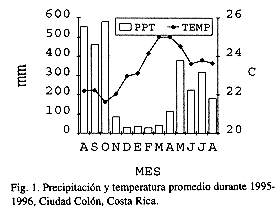
<body><![CDATA[<P><FONT FACE="Arial,Helvetica"><FONT SIZE=-1><I>S. jambos</I> es un &aacute;rbol de 15 a 20 m de altura, originario del Sur-Este tropical de Asia. Se ha introducido en muchas regiones del mundo por ser de uso m&uacute;ltiple <A HREF="#Francis">(Francis 1990</A>, <A HREF="#Little">Little, Jr. y Wadsworth 1964</A>). Se utiliza como ornamental, productor de miel de abeja, le&ntilde;a, carb&oacute;n, postes, medicina, sombra, rompevientos, y cercas vivas. Su fruto es consumido por humanos y el ganado, especialmente cerdos.</FONT></FONT>     <BR>&nbsp;     <BR><B><FONT FACE="Arial,Helvetica"><FONT SIZE=-1>&nbsp;</FONT></FONT></B>     <BR><B><FONT FACE="Arial,Helvetica"><FONT SIZE=-1>Materiales y M&eacute;todos</FONT></FONT></B>      <P><FONT FACE="Arial,Helvetica"><FONT SIZE=-1>El estudio se realiz&oacute; de setiembre de 1995 a agosto de 1996. La reserva forestal de aprox. una hect&aacute;rea, tiene m&aacute;s de 30 a&ntilde;os de estar en regeneraci&oacute;n natural. Se encuentra ubicada en Ciudad Col&oacute;n de Mora, Costa Rica, (84&ordm;15' W, 9&ordm;55' N), a 800 msnm. La temperatura y precipitaci&oacute;n total anual promedio son de 23.6 C y 2050 mm, respectivamente. Durante el estudio se registr&oacute; una mayor cantidad de lluvia <A HREF="#fig.1">(Fig. 1</A>, L.A. Fournier, datos no publicados tomados <I>in situ</I>). La altura promedio del dosel es de unos 20 m, con dos estratos. Los suelos son coluvioaluviales de muy buena fertilidad.</FONT></FONT>     <BR>&nbsp;     <BR>&nbsp;     <BR>&nbsp;     <CENTER></CENTER>      <CENTER><A NAME="fig.1"></A><IMG SRC="/img/fbpe/rbt/v46n3/0191i01.GIF" HEIGHT=224 WIDTH=279></CENTER> &nbsp;     
]]></body>
<body><![CDATA[<BR>&nbsp;      <P><FONT FACE="Arial,Helvetica"><FONT SIZE=-1>Se escogieron tres &aacute;rboles <A HREF="#Cuadro  1">(Cuadro 1) </A>de <I>S. jambos </I>separados al menos 20 m. El individuo con el alto DAP se debi&oacute; a la sumatoria de m&aacute;s de 20 tallos de rebrote. &Eacute;ste estaba en el lote antes de que se estableciera la reserva.</FONT></FONT>     <BR>&nbsp;     <CENTER></CENTER>      <CENTER><A NAME="Cuadro  1"></A><FONT FACE="Arial,Helvetica"><FONT SIZE=-1>Cuadro 1</FONT></FONT></CENTER>      <CENTER><FONT FACE="Arial,Helvetica"><FONT SIZE=-1>Caracter&iacute;sticas de los &aacute;rboles de S. jambos utilizados en el el estudio,</FONT></FONT></CENTER>      <CENTER><FONT FACE="Arial,Helvetica"><FONT SIZE=-1>Ciudad Col&oacute;n de Mora, Costa Rica<I>.</I></FONT></FONT></CENTER> &nbsp;     <BR>&nbsp;     <CENTER><TABLE BORDER=0 CELLSPACING=0 CELLPADDING=5 WIDTH="575" > <TR> <TD VALIGN=TOP WIDTH="20%">     <CENTER><FONT FACE="Arial,Helvetica"><FONT SIZE=-1>Arbol No.&nbsp;</FONT></FONT></CENTER> </TD>  <TD VALIGN=TOP WIDTH="20%">     ]]></body>
<body><![CDATA[<CENTER><FONT FACE="Arial,Helvetica"><FONT SIZE=-1>Ht (m)&nbsp;</FONT></FONT></CENTER> </TD>  <TD VALIGN=TOP WIDTH="20%">     <CENTER><FONT FACE="Arial,Helvetica"><FONT SIZE=-1>DC (m)&nbsp;</FONT></FONT></CENTER> </TD>  <TD VALIGN=TOP WIDTH="20%">     <CENTER><FONT FACE="Arial,Helvetica"><FONT SIZE=-1>AC (m<SUP>2</SUP>)&nbsp;</FONT></FONT></CENTER> </TD>  <TD VALIGN=TOP WIDTH="20%">     <CENTER><FONT FACE="Arial,Helvetica"><FONT SIZE=-1>DAP (cm)&nbsp;</FONT></FONT></CENTER> </TD> </TR>  <TR> <TD VALIGN=TOP WIDTH="20%">     <CENTER><FONT FACE="Arial,Helvetica"><FONT SIZE=-1>1&nbsp;</FONT></FONT></CENTER> </TD>  <TD VALIGN=TOP WIDTH="20%">     <CENTER><FONT FACE="Arial,Helvetica"><FONT SIZE=-1>8&nbsp;</FONT></FONT></CENTER> </TD>  <TD VALIGN=TOP WIDTH="20%">     <CENTER><FONT FACE="Arial,Helvetica"><FONT SIZE=-1>4.4&nbsp;</FONT></FONT></CENTER> </TD>  <TD VALIGN=TOP WIDTH="20%">     <CENTER><FONT FACE="Arial,Helvetica"><FONT SIZE=-1>16&nbsp;</FONT></FONT></CENTER> </TD>  <TD VALIGN=TOP WIDTH="20%">     <CENTER><FONT FACE="Arial,Helvetica"><FONT SIZE=-1>15.7&nbsp;</FONT></FONT></CENTER> </TD> </TR>  <TR> <TD VALIGN=TOP WIDTH="20%">     <CENTER><FONT FACE="Arial,Helvetica"><FONT SIZE=-1>2&nbsp;</FONT></FONT></CENTER> </TD>  <TD VALIGN=TOP WIDTH="20%">     ]]></body>
<body><![CDATA[<CENTER><FONT FACE="Arial,Helvetica"><FONT SIZE=-1>8&nbsp;</FONT></FONT></CENTER> </TD>  <TD VALIGN=TOP WIDTH="20%">     <CENTER><FONT FACE="Arial,Helvetica"><FONT SIZE=-1>7.9&nbsp;</FONT></FONT></CENTER> </TD>  <TD VALIGN=TOP WIDTH="20%">     <CENTER><FONT FACE="Arial,Helvetica"><FONT SIZE=-1>49&nbsp;</FONT></FONT></CENTER> </TD>  <TD VALIGN=TOP WIDTH="20%">     <CENTER><FONT FACE="Arial,Helvetica"><FONT SIZE=-1>10.9&nbsp;</FONT></FONT></CENTER> </TD> </TR>  <TR> <TD VALIGN=TOP WIDTH="20%">     <CENTER><FONT FACE="Arial,Helvetica"><FONT SIZE=-1>3&nbsp;</FONT></FONT></CENTER> </TD>  <TD VALIGN=TOP WIDTH="20%">     <CENTER><FONT FACE="Arial,Helvetica"><FONT SIZE=-1>12&nbsp;</FONT></FONT></CENTER> </TD>  <TD VALIGN=TOP WIDTH="20%">     <CENTER><FONT FACE="Arial,Helvetica"><FONT SIZE=-1>9.7&nbsp;</FONT></FONT></CENTER> </TD>  <TD VALIGN=TOP WIDTH="20%">     <CENTER><FONT FACE="Arial,Helvetica"><FONT SIZE=-1>74&nbsp;</FONT></FONT></CENTER> </TD>  <TD VALIGN=TOP WIDTH="20%">     <CENTER><FONT FACE="Arial,Helvetica"><FONT SIZE=-1>139.0&nbsp;</FONT></FONT></CENTER> </TD> </TR> </TABLE></CENTER> <FONT FACE="Arial,Helvetica"><FONT SIZE=-1>&nbsp;</FONT></FONT>     <BR><FONT FACE="Arial,Helvetica"><FONT SIZE=-1>&nbsp;&nbsp;&nbsp;&nbsp;&nbsp;&nbsp;&nbsp;&nbsp;&nbsp;&nbsp;&nbsp;&nbsp;&nbsp;&nbsp;&nbsp;&nbsp;&nbsp; Ht=altura. DC=di&aacute;metro de copa (promedio de dos direcciones). AC=&aacute;rea promedio de cobertura</FONT></FONT>     ]]></body>
<body><![CDATA[<BR><FONT FACE="Arial,Helvetica"><FONT SIZE=-1>&nbsp;&nbsp;&nbsp;&nbsp;&nbsp;&nbsp;&nbsp;&nbsp;&nbsp;&nbsp;&nbsp;&nbsp;&nbsp;&nbsp;&nbsp;&nbsp;&nbsp; de las copas. DAP=di&aacute;metro a la altura del pecho (1.3 m).</FONT></FONT>     <BR>&nbsp;      <P><FONT FACE="Arial,Helvetica"><FONT SIZE=-1>Para calcular la densidad de las pl&aacute;ntulas con respecto a la distancia de la base del &aacute;rbol, se establecieron un total de 48 parcelas de 0.6 m de radio en cuatro direcciones a 90&ordm; una de otra, a uno (100% bajo la copa), cuatro (8% bajo, 67% en el borde y 25% fuera de la copa), ocho y 12 m (todas fuera de la copa). Se hizo un an&aacute;lisis de varianza con los datos transformados a la ra&iacute;z cuadrada de la densidad + 0.5.</FONT></FONT>      <P><FONT FACE="Arial,Helvetica"><FONT SIZE=-1>Adem&aacute;s, se marcaron cinco puntos distribuidos uniformemente alrededor de tres anillos a 1, 4 y 8 m de la base de cada uno de los &aacute;rboles. En cada uno de los ellos se escogieron tres plantas, las m&aacute;s cercanas alrededor del mismo a las cuales se les registr&oacute;, a intervalos de uno o dos meses, la altura a la yema apical, diam&eacute;tro basal y los aparentes da&ntilde;os ocasionados por hongos (manchas redondeadas de color caf&eacute; en las hojas), herb&iacute;voros (principalmente por cortadores, aunque no siempre fue clara la distinci&oacute;n entre las aperturas dejadas por la ca&iacute;da de tejido necrosado por el hongo, y aqu&eacute;llas por insectos), mec&aacute;nicos (quebraduras y hojas dobladas o deformadas), l&iacute;quenes, y n&uacute;mero de yemas da&ntilde;adas (una vez al finalizar el experimento), tanto en pl&aacute;ntulas como juveniles.</FONT></FONT>      <P><FONT FACE="Arial,Helvetica"><FONT SIZE=-1>La estimaci&oacute;n de los da&ntilde;os fue cualitativa en una escala de 0 a 5 (0 indic&oacute; ausencia del da&ntilde;o), con valoraciones decimales. Los datos se transformaron a los porcentajes correspondientes y se analizaron con la prueba de Kruskal-Wallis donde los anillos fueron el factor de agrupaci&oacute;n.</FONT></FONT>      <P><FONT FACE="Arial,Helvetica"><FONT SIZE=-1>En marzo de 1996 se establecieron 10 cuadr&iacute;culas de 100 m<SUP>2</SUP>dentro del bosquete, colocando internamente, una de 25 m<SUP>2</SUP>, y tres de 1 m<SUP>2</SUP>. Algunas de ellas incluyeron <I>S.jambos</I> marcados anteriormente. &Eacute;stas se utilizaron para calcular el &iacute;ndice de valor de importancia (sumatoria de la densidad, frecuencia y &aacute;rea basal relativas/3). En mayo de ese a&ntilde;o, se estimaron los da&ntilde;os en las mismas categor&iacute;as y escala anotadas anteriormente.</FONT></FONT>     <BR>&nbsp;      <P><B><FONT FACE="Arial,Helvetica"><FONT SIZE=-1>Resultados</FONT></FONT></B>      <P><FONT FACE="Arial,Helvetica"><FONT SIZE=-1><I>S. jambos</I> mostr&oacute; un valor de importancia muy alto tanto para juveniles como pl&aacute;ntulas (<A HREF="#Cuadro 2">Cuadro 2</A>). La densidad promedio fue de 0.16 y 4.9 ind/m2, respectivamente, y la especie apareci&oacute; en m&aacute;s de un 70% de las parcelas. (En la categor&iacute;a de &aacute;rboles ocup&oacute; el onceavo lugar.)</FONT></FONT>     <BR>&nbsp;     ]]></body>
<body><![CDATA[<BR>&nbsp;     <CENTER></CENTER>      <CENTER><A NAME="Cuadro 2"></A><FONT FACE="Arial,Helvetica"><FONT SIZE=-1>Cuadro 2</FONT></FONT></CENTER>      <CENTER><FONT FACE="Arial,Helvetica"><FONT SIZE=-1>Primeras tres especies de acuerdo al &iacute;ndice de importancia (IVI) en una peque&ntilde;a reserva forestal,</FONT></FONT></CENTER>      <CENTER><FONT FACE="Arial,Helvetica"><FONT SIZE=-1>Ciudad Col&oacute;n, Costa Rica.</FONT></FONT></CENTER>      <CENTER><FONT FACE="Arial,Helvetica"><FONT SIZE=-1>&nbsp;</FONT></FONT></CENTER>      <CENTER><TABLE BORDER=0 CELLSPACING=0 CELLPADDING=5 WIDTH="640" > <TR> <TD VALIGN=TOP WIDTH="14%"><FONT FACE="Arial,Helvetica"><FONT SIZE=-1>Familia&nbsp;</FONT></FONT></TD>  <TD VALIGN=TOP WIDTH="14%"><FONT FACE="Arial,Helvetica"><FONT SIZE=-1>Especie&nbsp;</FONT></FONT></TD>  <TD VALIGN=TOP WIDTH="14%"><FONT FACE="Arial,Helvetica"><FONT SIZE=-1>Ht m&nbsp;</FONT></FONT></TD>  <TD VALIGN=TOP WIDTH="14%"><FONT FACE="Arial,Helvetica"><FONT SIZE=-1>Diam cm&nbsp;</FONT></FONT></TD>  <TD VALIGN=TOP WIDTH="14%"><FONT FACE="Arial,Helvetica"><FONT SIZE=-1>Dens. Tot.&nbsp;</FONT></FONT></TD>  <TD VALIGN=TOP WIDTH="14%"><FONT FACE="Arial,Helvetica"><FONT SIZE=-1>Frec. Ab.%&nbsp;</FONT></FONT></TD>  <TD VALIGN=TOP WIDTH="14%"><FONT FACE="Arial,Helvetica"><FONT SIZE=-1>IVI %&nbsp;</FONT></FONT></TD> </TR>  <TR> <TD COLSPAN="7">     <CENTER><B><FONT FACE="Arial,Helvetica"><FONT SIZE=-1>Pl&aacute;ntulas (&lt;1.5 m ht). n=30. Parcelas de 1 m<SUP>2</SUP>.</FONT></FONT></B></CENTER> </TD> </TR>  <TR> <TD><FONT FACE="Arial,Helvetica"><FONT SIZE=-1>Myrtaceae</FONT></FONT></TD>  <TD><I><FONT FACE="Arial,Helvetica"><FONT SIZE=-1>Syzigium jambos</FONT></FONT></I></TD>  <TD><FONT FACE="Arial,Helvetica"><FONT SIZE=-1>21</FONT></FONT></TD>  <TD><FONT FACE="Arial,Helvetica"><FONT SIZE=-1>42</FONT></FONT></TD>  <TD><FONT FACE="Arial,Helvetica"><FONT SIZE=-1>147</FONT></FONT></TD>  <TD><FONT FACE="Arial,Helvetica"><FONT SIZE=-1>77&nbsp;</FONT></FONT></TD>  <TD><FONT FACE="Arial,Helvetica"><FONT SIZE=-1>44</FONT></FONT></TD> </TR>  <TR> <TD><FONT FACE="Arial,Helvetica"><FONT SIZE=-1>Apocynaceae</FONT></FONT></TD>  <TD><FONT FACE="Arial,Helvetica"><FONT SIZE=-1><I>Stemmadenia -donnell-smithii</I>(Rose)Woodson</FONT></FONT></TD>  <TD><FONT FACE="Arial,Helvetica"><FONT SIZE=-1>8&nbsp;</FONT></FONT></TD>  <TD><FONT FACE="Arial,Helvetica"><FONT SIZE=-1>13</FONT></FONT></TD>  <TD><FONT FACE="Arial,Helvetica"><FONT SIZE=-1>33&nbsp;</FONT></FONT></TD>  <TD><FONT FACE="Arial,Helvetica"><FONT SIZE=-1>53</FONT></FONT></TD>  <TD><FONT FACE="Arial,Helvetica"><FONT SIZE=-1>27</FONT></FONT></TD> </TR>  <TR> <TD><FONT FACE="Arial,Helvetica"><FONT SIZE=-1>Sapindaceae</FONT></FONT></TD>  <TD><FONT FACE="Arial,Helvetica"><FONT SIZE=-1><I>Cupania guatemalensis </I>(Turcz.)Radlk<I>.</I></FONT></FONT></TD>  <TD><FONT FACE="Arial,Helvetica"><FONT SIZE=-1>3</FONT></FONT></TD>  <TD><FONT FACE="Arial,Helvetica"><FONT SIZE=-1>8&nbsp;</FONT></FONT></TD>  <TD><FONT FACE="Arial,Helvetica"><FONT SIZE=-1>24&nbsp;</FONT></FONT></TD>  <TD><FONT FACE="Arial,Helvetica"><FONT SIZE=-1>53</FONT></FONT></TD>  <TD><FONT FACE="Arial,Helvetica"><FONT SIZE=-1>20</FONT></FONT></TD> </TR>  <TR> <TD COLSPAN="7">     <CENTER><B><FONT FACE="Arial,Helvetica"><FONT SIZE=-1>Juveniles (1.5 m ht y &lt;5 cm DAP). n=10. Parcelas de 25 m<SUP>2</SUP>.</FONT></FONT></B></CENTER> </TD> </TR>  <TR> <TD><FONT FACE="Arial,Helvetica"><FONT SIZE=-1>Myrtaceae</FONT></FONT></TD>  <TD><I><FONT FACE="Arial,Helvetica"><FONT SIZE=-1>S. jambos</FONT></FONT></I></TD>  <TD><FONT FACE="Arial,Helvetica"><FONT SIZE=-1>105&nbsp;</FONT></FONT></TD>  <TD><FONT FACE="Arial,Helvetica"><FONT SIZE=-1>53</FONT></FONT></TD>  <TD><FONT FACE="Arial,Helvetica"><FONT SIZE=-1>41</FONT></FONT></TD>  <TD><FONT FACE="Arial,Helvetica"><FONT SIZE=-1>70&nbsp;</FONT></FONT></TD>  <TD><FONT FACE="Arial,Helvetica"><FONT SIZE=-1>86&nbsp;</FONT></FONT></TD> </TR>  <TR> <TD><FONT FACE="Arial,Helvetica"><FONT SIZE=-1>Lauraceae</FONT></FONT></TD>  <TD><I><FONT FACE="Arial,Helvetica"><FONT SIZE=-1>Cinnamomum brenesii</FONT></FONT></I>&nbsp;     <BR><FONT FACE="Arial,Helvetica"><FONT SIZE=-1>(Standl.)Comb. ined.</FONT></FONT></TD>  <TD><FONT FACE="Arial,Helvetica"><FONT SIZE=-1>40</FONT></FONT></TD>  <TD><FONT FACE="Arial,Helvetica"><FONT SIZE=-1>25&nbsp;</FONT></FONT></TD>  <TD><FONT FACE="Arial,Helvetica"><FONT SIZE=-1>13</FONT></FONT></TD>  <TD><FONT FACE="Arial,Helvetica"><FONT SIZE=-1>60</FONT></FONT></TD>  <TD><FONT FACE="Arial,Helvetica"><FONT SIZE=-1>27&nbsp;</FONT></FONT></TD> </TR>  <TR> <TD><FONT FACE="Arial,Helvetica"><FONT SIZE=-1>Meliaceae</FONT></FONT></TD>  <TD><FONT FACE="Arial,Helvetica"><FONT SIZE=-1><I>Trichilia havanensis</I> Jacq.</FONT></FONT></TD>  <TD><FONT FACE="Arial,Helvetica"><FONT SIZE=-1>27</FONT></FONT></TD>  <TD><FONT FACE="Arial,Helvetica"><FONT SIZE=-1>16</FONT></FONT></TD>  <TD><FONT FACE="Arial,Helvetica"><FONT SIZE=-1>11&nbsp;</FONT></FONT></TD>  <TD><FONT FACE="Arial,Helvetica"><FONT SIZE=-1>70</FONT></FONT></TD>  <TD><FONT FACE="Arial,Helvetica"><FONT SIZE=-1>20</FONT></FONT></TD> </TR>  <TR> <TD COLSPAN="7">     ]]></body>
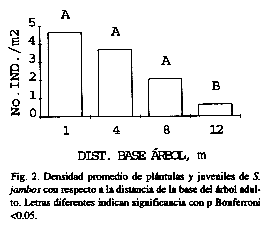
<body><![CDATA[<CENTER><B><FONT FACE="Arial,Helvetica"><FONT SIZE=-1>Adultos. (5 cm DAP). n=10. Parcelas de 100 m<SUP>2</SUP>.</FONT></FONT></B></CENTER> </TD> </TR>  <TR> <TD><FONT FACE="Arial,Helvetica"><FONT SIZE=-1>Fabaceae</FONT></FONT></TD>  <TD><I><FONT FACE="Arial,Helvetica"><FONT SIZE=-1>Lonchocarpus salvadorensis Pittier&nbsp;</FONT></FONT></I></TD>  <TD><FONT FACE="Arial,Helvetica"><FONT SIZE=-1>84</FONT></FONT></TD>  <TD><FONT FACE="Arial,Helvetica"><FONT SIZE=-1>262</FONT></FONT></TD>  <TD><FONT FACE="Arial,Helvetica"><FONT SIZE=-1>5&nbsp;</FONT></FONT></TD>  <TD><FONT FACE="Arial,Helvetica"><FONT SIZE=-1>40</FONT></FONT></TD>  <TD><FONT FACE="Arial,Helvetica"><FONT SIZE=-1>43&nbsp;</FONT></FONT></TD> </TR>  <TR> <TD><FONT FACE="Arial,Helvetica"><FONT SIZE=-1>Apocynaceae</FONT></FONT></TD>  <TD><I><FONT FACE="Arial,Helvetica"><FONT SIZE=-1>S. donnell-smithii</FONT></FONT></I></TD>  <TD><FONT FACE="Arial,Helvetica"><FONT SIZE=-1>185&nbsp;</FONT></FONT></TD>  <TD><FONT FACE="Arial,Helvetica"><FONT SIZE=-1>208&nbsp;</FONT></FONT></TD>  <TD><FONT FACE="Arial,Helvetica"><FONT SIZE=-1>16</FONT></FONT></TD>  <TD><FONT FACE="Arial,Helvetica"><FONT SIZE=-1>50</FONT></FONT></TD>  <TD><FONT FACE="Arial,Helvetica"><FONT SIZE=-1>40&nbsp;</FONT></FONT></TD> </TR>  <TR> <TD><FONT FACE="Arial,Helvetica"><FONT SIZE=-1>Fabaceae</FONT></FONT></TD>  <TD><FONT FACE="Arial,Helvetica"><FONT SIZE=-1><I>Machaerium biovulatum </I>Mich.</FONT></FONT></TD>  <TD><FONT FACE="Arial,Helvetica"><FONT SIZE=-1>123</FONT></FONT></TD>  <TD><FONT FACE="Arial,Helvetica"><FONT SIZE=-1>119</FONT></FONT></TD>  <TD><FONT FACE="Arial,Helvetica"><FONT SIZE=-1>9</FONT></FONT></TD>  <TD><FONT FACE="Arial,Helvetica"><FONT SIZE=-1>60</FONT></FONT></TD>  <TD><FONT FACE="Arial,Helvetica"><FONT SIZE=-1>21</FONT></FONT></TD> </TR> </TABLE></CENTER> <FONT FACE="Arial,Helvetica"><FONT SIZE=-1>&nbsp;</FONT></FONT>     <BR><FONT FACE="Arial,Helvetica"><FONT SIZE=-1>En general, la densidad disminuy&oacute; al alejarse de la base del &aacute;rbol adulto (<A HREF="#fig. 2">Fig. 2</A>), y la variabilidad espacial fue alta (coeficientes de variaci&oacute;n >100%), encontr&aacute;ndose la mayor abundancia alrededor del &aacute;rbol m&aacute;s viejo. Esto se debe al traslape de varios cohortes y a una posible mayor producci&oacute;n de frutos.</FONT></FONT>     <BR>&nbsp;     <BR>&nbsp;     <BR>&nbsp;     <CENTER></CENTER>      <CENTER><A NAME="fig. 2"></A><IMG SRC="/img/fbpe/rbt/v46n3/0191i02.GIF" HEIGHT=233 WIDTH=266></CENTER>       
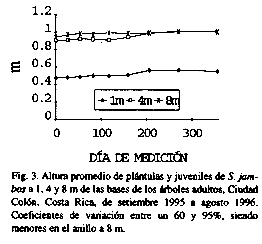
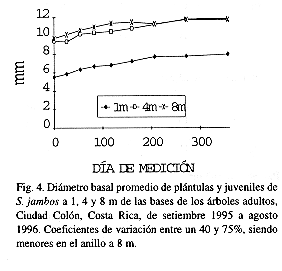
<P><FONT FACE="Arial,Helvetica"><FONT SIZE=-1>Los individuos m&aacute;s altos y gruesos tambi&eacute;n ocurrieron con mayor frecuencia en las cercan&iacute;as del &aacute;rbol viejo, pero hubo diferencias significativas (p&lt;0.01) entre anillos (<A HREF="#fig. 3">Figs. 3</A> y <A HREF="#fig. 4">4</A>). Las plantas m&aacute;s peque&ntilde;as se encontraron a 1 m de la base.</FONT></FONT>     <BR>&nbsp;     <BR>&nbsp;     ]]></body>
<body><![CDATA[<BR>&nbsp;     <CENTER></CENTER>      <CENTER><A NAME="fig. 3"></A><IMG SRC="/img/fbpe/rbt/v46n3/0191i03.GIF" HEIGHT=244 WIDTH=262><A NAME="fig. 5"></A><IMG SRC="/img/fbpe/rbt/v46n3/0191i05.GIF" HEIGHT=262 WIDTH=258></CENTER>      
<CENTER></CENTER>      <CENTER><A NAME="fig. 4"></A><IMG SRC="/img/fbpe/rbt/v46n3/0191i04.GIF" HEIGHT=271 WIDTH=282><A NAME="fig. 6"></A><IMG SRC="/img/fbpe/rbt/v46n3/0191i06.GIF" HEIGHT=275 WIDTH=279></CENTER>      
<CENTER></CENTER>      <CENTER><A NAME="fig. 7"></A><IMG SRC="/img/fbpe/rbt/v46n3/0191i07.GIF" HEIGHT=243 WIDTH=243><A NAME="fig.8"></A><IMG SRC="/img/fbpe/rbt/v46n3/0191i08.GIF" HEIGHT=288 WIDTH=305></CENTER> &nbsp;     
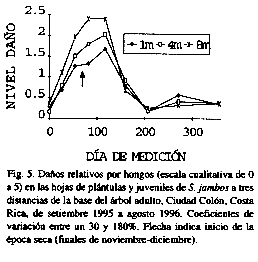
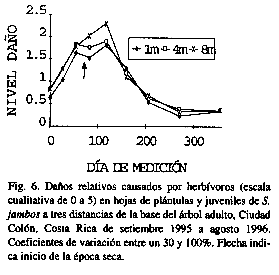
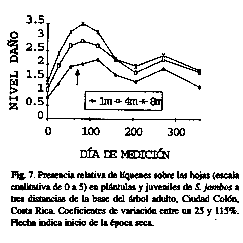
<BR>&nbsp;      <P><FONT FACE="Arial,Helvetica"><FONT SIZE=-1>Luego de 356 d&iacute;as, las plantas a 1, 4 y 8 m de la base hab&iacute;an crecido, en promedio, 7.6, 10.5, y 6.2 cm en altura, y 2.45, 2.44 y 2.04 mm en di&aacute;metro basal, respectivamente. Las primeras, a su vez, mostraron la mayor mortalidad (17.8%) comparado con 11.1 y 0% en los individuos a 4 y 8 m.</FONT></FONT>      <P><FONT FACE="Arial,Helvetica"><FONT SIZE=-1>En general, las plantas aparecieron con da&ntilde;os relativos menores al 30% en la mayor&iacute;a de las fechas (<A HREF="#fig. 5">Figs. 5</A>-<A HREF="#fig.8">8</A>). Sin embargo, hubo un aparente incremento a finales de la &eacute;poca lluviosa y principios de la seca, especialmente en las plantas m&aacute;s alejadas de la base del &aacute;rbol (diferencias significativas entre anillos de noviembre a enero (p&lt;0.05) para los hongos, y de octubre a febrero para los l&iacute;quenes (p&lt;0.02), no as&iacute; para la herbivor&iacute;a).</FONT></FONT>      ]]></body>
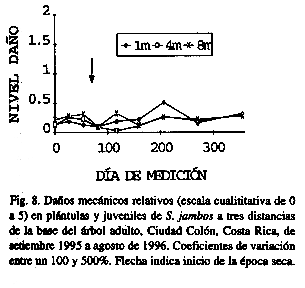
<body><![CDATA[<P><FONT FACE="Arial,Helvetica"><FONT SIZE=-1>Los da&ntilde;os mec&aacute;nicos fueron muy bajos (<A HREF="#fig.8">Fig. 8</A>). Se determin&oacute; que las pl&aacute;ntulas y juveniles son muy flexibles y aparentemente logran absorber los golpes producto de la ca&iacute;da de ramas o el pizoteo (con frecuencia los alambres usados para marcar las pl&aacute;ntulas estaban doblados, mientras que a las pl&aacute;ntulas no se les detectaba quebraduras)..</FONT></FONT>      <P><FONT FACE="Arial,Helvetica"><FONT SIZE=-1>Al analizar los da&ntilde;os en las parcelas de 1 m<SUP>2</SUP>en mayo de 1996 (al inicio de la &eacute;poca lluviosa), se determin&oacute; que las pl&aacute;ntulas de <I>S. jambos</I> presentaban una menor probabilidad de encontrarlas con da&ntilde;os mec&aacute;nicos, una mayor de que tuvieran hongos en sus hojas, y similar herbivor&iacute;a cuando se compararon con las especies nativas (<A HREF="#Cuadro 3">Cuadro 3</A>). Por otro lado, a un 8% de las pl&aacute;ntulas se les observ&oacute; con no m&aacute;s de una yema da&ntilde;ada, mientras que el 22% de las especies nativas ten&iacute;an una o m&aacute;s yemas da&ntilde;adas.</FONT></FONT>     <BR>&nbsp;     <BR>&nbsp;     <BR>&nbsp;     <CENTER></CENTER>      <CENTER><A NAME="Cuadro 3"></A><FONT FACE="Arial,Helvetica"><FONT SIZE=-1>Cuadro 3</FONT></FONT></CENTER>      <CENTER><FONT FACE="Arial,Helvetica"><FONT SIZE=-1>Frecuencia (%) de las pl&aacute;ntulas de S. jambos y especies</FONT></FONT></CENTER>      <CENTER><FONT FACE="Arial,Helvetica"><FONT SIZE=-1>nativas con da&ntilde;os, seg&uacute;n categor&iacute;a (clase 5, m&aacute;s alto), en</FONT></FONT></CENTER>      <CENTER><FONT FACE="Arial,Helvetica"><FONT SIZE=-1>un fragmento forestal, Ciudad Col&oacute;n, Costa Rica.</FONT></FONT></CENTER>      ]]></body>
<body><![CDATA[<CENTER><FONT FACE="Arial,Helvetica"><FONT SIZE=-1>Mayo de 1996.</FONT></FONT></CENTER>      <CENTER><TABLE BORDER=0 CELLSPACING=0 CELLPADDING=5 WIDTH="540" > <TR> <TD VALIGN=TOP WIDTH="14%">     <CENTER><FONT FACE="Arial,Helvetica"><FONT SIZE=-1>Sp./Clase&nbsp;</FONT></FONT></CENTER> </TD>  <TD VALIGN=TOP WIDTH="14%">     <CENTER><FONT FACE="Arial,Helvetica"><FONT SIZE=-1>0&nbsp;</FONT></FONT></CENTER> </TD>  <TD VALIGN=TOP WIDTH="14%">     <CENTER><FONT FACE="Arial,Helvetica"><FONT SIZE=-1>&lt; 1&nbsp;</FONT></FONT></CENTER> </TD>  <TD VALIGN=TOP WIDTH="14%">     <CENTER><FONT FACE="Arial,Helvetica"><FONT SIZE=-1>&lt; 2&nbsp;</FONT></FONT></CENTER> </TD>  <TD VALIGN=TOP WIDTH="14%">     <CENTER><FONT FACE="Arial,Helvetica"><FONT SIZE=-1>&lt; 3&nbsp;</FONT></FONT></CENTER> </TD>  <TD VALIGN=TOP WIDTH="14%">     <CENTER><FONT FACE="Arial,Helvetica"><FONT SIZE=-1>&lt; 4&nbsp;</FONT></FONT></CENTER> </TD>  <TD VALIGN=TOP WIDTH="14%">     <CENTER><FONT FACE="Arial,Helvetica"><FONT SIZE=-1>&lt; 5&nbsp;</FONT></FONT></CENTER> </TD> </TR>  <TR> <TD COLSPAN="7">     <CENTER><FONT FACE="Arial,Helvetica"><FONT SIZE=-1>Mec&aacute;nico</FONT></FONT></CENTER> </TD> </TR>  <TR> <TD><I><FONT FACE="Arial,Helvetica"><FONT SIZE=-1>S.jambos</FONT></FONT></I></TD>  <TD>     ]]></body>
<body><![CDATA[<CENTER><FONT FACE="Arial,Helvetica"><FONT SIZE=-1>66</FONT></FONT></CENTER> </TD>  <TD>     <CENTER><FONT FACE="Arial,Helvetica"><FONT SIZE=-1>34</FONT></FONT></CENTER> </TD>  <TD>     <CENTER><FONT FACE="Arial,Helvetica"><FONT SIZE=-1>0</FONT></FONT></CENTER> </TD>  <TD>     <CENTER><FONT FACE="Arial,Helvetica"><FONT SIZE=-1>0</FONT></FONT></CENTER> </TD>  <TD>     <CENTER><FONT FACE="Arial,Helvetica"><FONT SIZE=-1>0</FONT></FONT></CENTER> </TD>  <TD>     <CENTER><FONT FACE="Arial,Helvetica"><FONT SIZE=-1>0&nbsp;</FONT></FONT></CENTER> </TD> </TR>  <TR> <TD><FONT FACE="Arial,Helvetica"><FONT SIZE=-1>Nativas</FONT></FONT></TD>  <TD>     <CENTER><FONT FACE="Arial,Helvetica"><FONT SIZE=-1>57</FONT></FONT></CENTER> </TD>  <TD>     <CENTER><FONT FACE="Arial,Helvetica"><FONT SIZE=-1>25</FONT></FONT></CENTER> </TD>  <TD>     <CENTER><FONT FACE="Arial,Helvetica"><FONT SIZE=-1>7&nbsp;</FONT></FONT></CENTER> </TD>  <TD>     <CENTER><FONT FACE="Arial,Helvetica"><FONT SIZE=-1>9</FONT></FONT></CENTER> </TD>  <TD>     ]]></body>
<body><![CDATA[<CENTER><FONT FACE="Arial,Helvetica"><FONT SIZE=-1>2</FONT></FONT></CENTER> </TD>  <TD>     <CENTER><FONT FACE="Arial,Helvetica"><FONT SIZE=-1>0</FONT></FONT></CENTER> </TD> </TR>  <TR> <TD COLSPAN="7">     <CENTER><FONT FACE="Arial,Helvetica"><FONT SIZE=-1>Hongos</FONT></FONT></CENTER> </TD> </TR>  <TR> <TD><I><FONT FACE="Arial,Helvetica"><FONT SIZE=-1>S.jambos</FONT></FONT></I></TD>  <TD>     <CENTER><FONT FACE="Arial,Helvetica"><FONT SIZE=-1>27</FONT></FONT></CENTER> </TD>  <TD>     <CENTER><FONT FACE="Arial,Helvetica"><FONT SIZE=-1>68</FONT></FONT></CENTER> </TD>  <TD>     <CENTER><FONT FACE="Arial,Helvetica"><FONT SIZE=-1>5</FONT></FONT></CENTER> </TD>  <TD>     <CENTER><FONT FACE="Arial,Helvetica"><FONT SIZE=-1>0</FONT></FONT></CENTER> </TD>  <TD>     <CENTER><FONT FACE="Arial,Helvetica"><FONT SIZE=-1>0</FONT></FONT></CENTER> </TD>  <TD>     <CENTER><FONT FACE="Arial,Helvetica"><FONT SIZE=-1>0</FONT></FONT></CENTER> </TD> </TR>  <TR> <TD><FONT FACE="Arial,Helvetica"><FONT SIZE=-1>Nativas</FONT></FONT></TD>  <TD>     <CENTER><FONT FACE="Arial,Helvetica"><FONT SIZE=-1>72</FONT></FONT></CENTER> </TD>  <TD>     ]]></body>
<body><![CDATA[<CENTER><FONT FACE="Arial,Helvetica"><FONT SIZE=-1>19</FONT></FONT></CENTER> </TD>  <TD>     <CENTER><FONT FACE="Arial,Helvetica"><FONT SIZE=-1>7</FONT></FONT></CENTER> </TD>  <TD>     <CENTER><FONT FACE="Arial,Helvetica"><FONT SIZE=-1>1&nbsp;</FONT></FONT></CENTER> </TD>  <TD>     <CENTER><FONT FACE="Arial,Helvetica"><FONT SIZE=-1>0</FONT></FONT></CENTER> </TD>  <TD>     <CENTER><FONT FACE="Arial,Helvetica"><FONT SIZE=-1>1</FONT></FONT></CENTER> </TD> </TR>  <TR> <TD COLSPAN="7">     <CENTER><FONT FACE="Arial,Helvetica"><FONT SIZE=-1>Herbivor&iacute;a</FONT></FONT></CENTER> </TD> </TR>  <TR> <TD><I><FONT FACE="Arial,Helvetica"><FONT SIZE=-1>S.jambos</FONT></FONT></I></TD>  <TD>     <CENTER><FONT FACE="Arial,Helvetica"><FONT SIZE=-1>32</FONT></FONT></CENTER> </TD>  <TD>     <CENTER><FONT FACE="Arial,Helvetica"><FONT SIZE=-1>60</FONT></FONT></CENTER> </TD>  <TD>     <CENTER><FONT FACE="Arial,Helvetica"><FONT SIZE=-1>8&nbsp;</FONT></FONT></CENTER> </TD>  <TD>     <CENTER><FONT FACE="Arial,Helvetica"><FONT SIZE=-1>0</FONT></FONT></CENTER> </TD>  <TD>     ]]></body>
<body><![CDATA[<CENTER><FONT FACE="Arial,Helvetica"><FONT SIZE=-1>0</FONT></FONT></CENTER> </TD>  <TD>     <CENTER><FONT FACE="Arial,Helvetica"><FONT SIZE=-1>0</FONT></FONT></CENTER> </TD> </TR>  <TR> <TD><FONT FACE="Arial,Helvetica"><FONT SIZE=-1>Nativas</FONT></FONT></TD>  <TD>     <CENTER><FONT FACE="Arial,Helvetica"><FONT SIZE=-1>28</FONT></FONT></CENTER> </TD>  <TD>     <CENTER><FONT FACE="Arial,Helvetica"><FONT SIZE=-1>61</FONT></FONT></CENTER> </TD>  <TD>     <CENTER><FONT FACE="Arial,Helvetica"><FONT SIZE=-1>7</FONT></FONT></CENTER> </TD>  <TD>     <CENTER><FONT FACE="Arial,Helvetica"><FONT SIZE=-1>3</FONT></FONT></CENTER> </TD>  <TD>     <CENTER><FONT FACE="Arial,Helvetica"><FONT SIZE=-1>1</FONT></FONT></CENTER> </TD>  <TD>     <CENTER><FONT FACE="Arial,Helvetica"><FONT SIZE=-1>0</FONT></FONT></CENTER> </TD> </TR> </TABLE></CENTER> <B><FONT FACE="Arial,Helvetica"><FONT SIZE=-1></FONT></FONT></B>      <P><B><FONT FACE="Arial,Helvetica"><FONT SIZE=-1>&nbsp;</FONT></FONT></B>     <BR><B><FONT FACE="Arial,Helvetica"><FONT SIZE=-1>&nbsp;</FONT></FONT></B>     ]]></body>
<body><![CDATA[<BR><B><FONT FACE="Arial,Helvetica"><FONT SIZE=-1>Discusi&oacute;n</FONT></FONT></B>      <P><FONT FACE="Arial,Helvetica"><FONT SIZE=-1>En general, <I>S. jambos</I> present&oacute; una elevada densidad de individuos en el sotobosque. Se estim&oacute; que, dentro del bosquete, pueden haber m&aacute;s de 40.000 pl&aacute;ntulas y 1.600 juveniles. Al respecto,<A HREF="#Little"> Little y Wadsworth (1964</A>), y <A HREF="#Francis">Francis (1990</A>) mencionan que en Puerto Rico la especie se comporta como "maleza", formando densas plantaciones muy dif&iacute;ciles de erradicar. Por otra parte, <A HREF="#Aide">Aide<I> et al. </I>(1996</A>) determinaron que la especie apareci&oacute; en m&aacute;s de la mitad de 30 sitios en regeneraci&oacute;n estudiados en Puerto Rico, y en un bosque con 60 a&ntilde;os, lleg&oacute; a ser la especie dominante.</FONT></FONT>      <P><FONT FACE="Arial,Helvetica"><FONT SIZE=-1>La mayor cantidad de plantas ocurri&oacute; cerca del &aacute;rbol adulto (especialmente en el m&aacute;s viejo), pero se encontr&oacute; una alta varialbilidad en la distribuci&oacute;n de las mismas. Con frecuencia se hallaron peque&ntilde;os parches con una alta concentraci&oacute;n de individuos. Si bien la mayor&iacute;a de los frutos cae bajo la copa (ver <A HREF="#Morton, J.F.">Morton 1987</A> y <A HREF="#Francis">Francis 1990</A>), se observ&oacute; comederos de aves y peque&ntilde;os mam&iacute;feros (<I>e.g.</I> ardillas) a cierta distancia del &aacute;rbol. Adem&aacute;s, se conoce que <I>Syzigium</I> es poliembri&oacute;nica produciendo hasta cuatro embriones por semilla (<A HREF="#Francis">Francis 1990</A>, <A HREF="#Morton, J.F.">Morton 1987</A>).</FONT></FONT>      <P><FONT FACE="Arial,Helvetica"><FONT SIZE=-1>Similar a lo que predice el modelo Jansen-Connell y como se ha detectado en varias especies arb&oacute;reas (<A HREF="#Oliveira-Filho">Oliveria<I> et al.</I> 1996</A>), la mayor mortalidad de plantas ocurri&oacute; cerca del &aacute;rbol adulto. <A HREF="#Francis">Francis (1990</A>) se&ntilde;ala que las semillas necesitan germinar bajo la sombra, pero posteriormente requieren una apertura en el dosel para desarrollarse. Esto resulta dif&iacute;cil bajo la copa de <I>S. jambos </I>dado que &eacute;sta es muy cerrada y a que la especie es perennifolia. Adem&aacute;s, se observ&oacute; que las pl&aacute;ntulas m&aacute;s peque&ntilde;as fueron las m&aacute;s propensas a sufrir estr&eacute;s h&iacute;drico durante la &eacute;poca seca (esta especie es muy sensible a las sequ&iacute;as, <A HREF="#Francis">Fransis 1990</A>). Sin embargo, no se logr&oacute; detectar mayores porcentajes de da&ntilde;os en este grupo de plantas.</FONT></FONT>      <P><FONT FACE="Arial,Helvetica"><FONT SIZE=-1>Las tasas de crecimiento en altura y di&aacute;metro dentro del bosquete fueron muy bajos, inferiores a los encontradas por <A HREF="#Francis">Francis (1990</A>) en Puerto Rico en condiciones de invernadero. Estos &uacute;ltimos crecieron 24 cm en altura en 250 d&iacute;as.</FONT></FONT>      <P><FONT FACE="Arial,Helvetica"><FONT SIZE=-1>El porcentaje de da&ntilde;os en general fue menor al 30 %.<A HREF="#Francis"> Francis (1990</A>) y<A HREF="#Morton, J.F."> Morton (1987</A>) se&ntilde;alan que en Puerto Rico <I>S. jambos</I> tienen pocos enemigos naturales y no le causan mayores da&ntilde;os. Sin embargo, se observaron periodos del a&ntilde;o donde los niveles aumentaron considerablemente. <A HREF="#Filip,">Filip<I> et al. </I>(1995</A>) tambi&eacute;n determinaron variaciones anuales en las tasas de herbivor&iacute;a, aunque se&ntilde;alan que fue m&aacute;s intensa durante el primer periodo de las lluvias. Para el caso de los hongos, la segunda etapa puedo resultar la m&aacute;s favorable debido a que en este periodo la humedad fue muy alta (<A HREF="#fig.1">Fig. 1</A>). La posterior disminuci&oacute;n en el tiempo pudo deberse a la p&eacute;rdida de hojas da&ntilde;adas, a un efecto de "diluci&oacute;n" por la aparici&oacute;n de hojas juveniles inicialmente sanas, o ambos.</FONT></FONT>      <P><FONT FACE="Arial,Helvetica"><FONT SIZE=-1>Para el presente estudio, los l&iacute;quenes costrosos ep&iacute;filos sobre hojas maduras (algunas formando peque&ntilde;as &aacute;reas necrosadas alrededor), fueron los m&aacute;s evidentes, seguido por ataques de hongos (el principal causado por la roya <I>Puccinia psidii</I> Wint., el mismo detectado en Brasil, <A HREF="#Francis">Fransis 1990</A>), y la herbivor&iacute;a. Otras investigaciones han informado de ataques por <I>Asterinella </I>y <I>Glomerella</I> (Ascomicetes), y <I>Colletotrichum </I>y <I>Phyllosticta</I> (Deuteromicetes) en Estados Unidos (<A HREF="#Farr">Farr<I> et al.</I> 1990</A>) y de la presencia de manchas negruzcas en las hojas causadas por &aacute;fidos y algas (<A HREF="#Morton, J.F.">Morton 1987</A>).</FONT></FONT>      <P><FONT FACE="Arial,Helvetica"><FONT SIZE=-1>&iquest;Cu&aacute;les pueden ser algunos factores que favorecieron a que la especie presente tal agresividad? Primeramente, el sitio en regeneraci&oacute;n natural, posee suelos de buena fertilidad y precipitaciones mayores de 1700 mm, los cuales se han se&ntilde;alado como condiciones b&aacute;sicas para la superviencia de la especie (<A HREF="#Francis">Francis 1990</A>). Segundo, <I>S. jambos </I>produce una abundante cantidad de frutos muy apetecidos por la fauna silvestre, en donde la semilla, de aprox. 1 cm de di&aacute;metro, queda libre dentro del pericarpo (se reduce as&iacute;, la probabilidad de que sea da&ntilde;ada por el frug&iacute;voro). &Eacute;sta cuenta con buenas reservas nutritivas y energ&eacute;ticas, y una vez germinada, la pl&aacute;ntula es tolerante a la sombra y a la competencia, inclusive de h&eacute;rbaceas (<A HREF="#Francis">Francis 1990</A>). Desarrolla una ra&iacute;z muy profusa con alta capacidad de acumular reservas (<A HREF="#Francis">Francis 1990</A>), y las pl&aacute;ntulas y juveniles son muy flexibles, poco propensas a da&ntilde;os mec&aacute;nicos, capaces de rebrotar en caso de quebrarse. Una vez adulta, produce una densa sombra que impide el crecimiento de otras especies. Adem&aacute;s, aparentemente tiene altas concentraciones de taninos la cual puede reducir los da&ntilde;os por herb&iacute;voros, y ser alelop&aacute;tica. Al respecto, <A HREF="#Céspedes">C&eacute;spedes (1986</A>) observ&oacute; que el follaje de manzana rosa y del caf&eacute; fueron los menos consumidos, al estudiar las preferencias alimenticias del lepid&oacute;ptero <I>Dirphiopsis flora </I>(Schaus) en el laboratorio.</FONT></FONT>      <P><FONT FACE="Arial,Helvetica"><FONT SIZE=-1>Como posibles limitantes para la especie en el sitio, fueron sus muy bajas tasas de crecimiento, su alta sensibilidad a la sequ&iacute;a, y los moderados a altos niveles de da&ntilde;os foliares por el hongo <I>Puccinia psidii</I> y el liquen costroso.</FONT></FONT>      <P><FONT FACE="Arial,Helvetica"><FONT SIZE=-1>Para este bosquete, donde el objetivo principal es favorecer la mayor diversidad de especies vegetales nativas, se recomienda eliminar paulatinamente tanto los adultos (anillando y controlando los reto&ntilde;os) como la regeneraci&oacute;n (arranc&aacute;ndolas para no fomentar el rebrote, ver<A HREF="#Francis"> Francis 1990</A>). Con ello, se formar&iacute;an peque&ntilde;os claros y espacios libres los cuales pueden ser aprovechados por las plantas nativas.</FONT></FONT>     ]]></body>
<body><![CDATA[<BR>&nbsp;      <P><B><FONT FACE="Arial,Helvetica"><FONT SIZE=-1>Resumen</FONT></FONT></B>      <P><FONT FACE="Arial,Helvetica"><FONT SIZE=-1><I>Syzigium jambos</I> es una especie de uso m&uacute;ltiple originaria del Sur-Este de Asia, la cual ha sido introducida en muchos pa&iacute;ses del mundo. As&iacute; como algunas otras ex&oacute;ticas, tiene el potencial de naturalizarse y de invadir ecosistemas naturales. En Costa Rica, se ha observado en varios fragmentos boscosos. Se establecieron 48 parcelas de 0.6 m en una hect&aacute;rea de bosque secuendario de 30 a&ntilde;os. Pertenece a la zona de vida del Premontano h&uacute;medo. Se estim&oacute; que la especie ex&oacute;tica alcanz&oacute; una densidad de 4.9 pl&aacute;ntulas y 0.16 juveniles por m<SUP>2</SUP>. La mayor densidad se observ&oacute; cerca de la base del &aacute;rbol adulto y el &aacute;rbol m&aacute;s grueso. El crecimiento de las plantas fue muy bajo con tasas anuales menores a 10.5 y 0.25 cm en altura y di&aacute;metro basal, respectivamente. En general, se observaron da&ntilde;os relativos menores al 30% aunque se registr&oacute; un aumento importante al finalizar la &eacute;poca lluviosa y el inicio de la seca. Las hojas maduras presentaron una abundante cantidad de manchas blaquecinas peque&ntilde;as producto de un l&iacute;quen costroso ep&iacute;filo. Aparentemente la planta es muy flexible puesto que los da&ntilde;os mec&aacute;nicos fueron muy bajos.</FONT></FONT>     <BR>&nbsp;      <P><B><FONT FACE="Arial,Helvetica"><FONT SIZE=-1>Referencias</FONT></FONT></B>      <P><A NAME="Aide"></A><FONT FACE="Arial,Helvetica"><FONT SIZE=-1>Aide, T.M., J.K. Zimmerman, M. Rosario &amp; H. Marcano. 1996. Forest recovery in abandoned cattle pastures</FONT></FONT>     <BR><FONT FACE="Arial,Helvetica"><FONT SIZE=-1>along elevational gradient in Northeastern Puerto Rico. Biotropica 28: 537-548.</FONT></FONT>      <!-- ref --><P><A NAME="Céspedes"></A><FONT FACE="Arial,Helvetica"><FONT SIZE=-1>C&eacute;spedes, R. 1986. Ecolog&iacute;a de <I>Dirphiopsis flora</I> (Schaus, Lepidoptera: Saturniidae) e impacto sobre <I>Quercus aff. seemannii</I> Liebm. en encinares naturales de Costa Rica. Tesis Licenciatura, Universidad de Costa Rica, Costa Rica. 77p.</FONT></FONT>    &nbsp;&nbsp;&nbsp;&nbsp;&nbsp;&nbsp;&nbsp;&nbsp;[&#160;<a href="javascript:void(0);" onclick="javascript: window.open('/scielo.php?script=sci_nlinks&ref=1133098&pid=S0034-7744199800030000900002&lng=','','width=640,height=500,resizable=yes,scrollbars=1,menubar=yes,');">Links</a>&#160;]<!-- end-ref --><!-- ref --><P><A NAME="Di Stéfano, J.F. 1993"></A><FONT FACE="Arial,Helvetica"><FONT SIZE=-1>Di St&eacute;fano, J.F. &amp; C.O. Morales. 1993. Inventario flor&iacute;stico en varias &aacute;reas boscosas en Tabarcia de Mora y Palmichal de Acosta, Costa Rica. Rev. Biol. Trop. 41: 423-431.</FONT></FONT>    &nbsp;&nbsp;&nbsp;&nbsp;&nbsp;&nbsp;&nbsp;&nbsp;[&#160;<a href="javascript:void(0);" onclick="javascript: window.open('/scielo.php?script=sci_nlinks&ref=1133099&pid=S0034-7744199800030000900003&lng=','','width=640,height=500,resizable=yes,scrollbars=1,menubar=yes,');">Links</a>&#160;]<!-- end-ref --><!-- ref --><P><A NAME="Di Stefano, J.F. 1983"></A><FONT FACE="Arial,Helvetica"><FONT SIZE=-1>Di Stefano, J.F. &amp; R.F. Fisher. 1983. Invasion potential of <I>Melaleuca quinquenervia</I> in Southern Florida, U.S.A. Forest Ecol.&amp; Manag. 7: 133-141.</FONT></FONT>    &nbsp;&nbsp;&nbsp;&nbsp;&nbsp;&nbsp;&nbsp;&nbsp;[&#160;<a href="javascript:void(0);" onclick="javascript: window.open('/scielo.php?script=sci_nlinks&ref=1133100&pid=S0034-7744199800030000900004&lng=','','width=640,height=500,resizable=yes,scrollbars=1,menubar=yes,');">Links</a>&#160;]<!-- end-ref --><!-- ref --><P><A NAME="Di Stefano, J.F.1996"></A><FONT FACE="Arial,Helvetica"><FONT SIZE=-1>Di Stefano, J.F., V. Nielsen, J.Hoomans &amp; L.A. Fournier. 1996. Regeneraci&oacute;n de la vegetaci&oacute;n arb&oacute;rea en una peque&ntilde;a reserva forestal urbana del nivel premontano h&uacute;medo, Costa Rica. Rev. Biol. Trop. 44: 575-580.</FONT></FONT>    &nbsp;&nbsp;&nbsp;&nbsp;&nbsp;&nbsp;&nbsp;&nbsp;[&#160;<a href="javascript:void(0);" onclick="javascript: window.open('/scielo.php?script=sci_nlinks&ref=1133101&pid=S0034-7744199800030000900005&lng=','','width=640,height=500,resizable=yes,scrollbars=1,menubar=yes,');">Links</a>&#160;]<!-- end-ref --><!-- ref --><P><A NAME="Ewel, J."></A><FONT FACE="Arial,Helvetica"><FONT SIZE=-1>Ewel, J. 1979. Seed dynamics in <I>Shinus</I> in the successional ecosystems of Everglades National Park. Fourth Quarterly Report. Research Center, Everglades National Park. 67p.</FONT></FONT>    &nbsp;&nbsp;&nbsp;&nbsp;&nbsp;&nbsp;&nbsp;&nbsp;[&#160;<a href="javascript:void(0);" onclick="javascript: window.open('/scielo.php?script=sci_nlinks&ref=1133102&pid=S0034-7744199800030000900006&lng=','','width=640,height=500,resizable=yes,scrollbars=1,menubar=yes,');">Links</a>&#160;]<!-- end-ref --><!-- ref --><P><A NAME="Farr"></A><FONT FACE="Arial,Helvetica"><FONT SIZE=-1>Farr, D.F., G.F. Bills, G.P. Chamuris &amp; A.Y. Rossman. 1989. Fungi on plants and plant products in the U.S. APS, Saint Paul, Minnesota. 1252p.</FONT></FONT>    &nbsp;&nbsp;&nbsp;&nbsp;&nbsp;&nbsp;&nbsp;&nbsp;[&#160;<a href="javascript:void(0);" onclick="javascript: window.open('/scielo.php?script=sci_nlinks&ref=1133103&pid=S0034-7744199800030000900007&lng=','','width=640,height=500,resizable=yes,scrollbars=1,menubar=yes,');">Links</a>&#160;]<!-- end-ref --><!-- ref --><P><A NAME="Filip,"></A><FONT FACE="Arial,Helvetica"><FONT SIZE=-1>Filip, V., R. Dirzo, J.M. Maass &amp; J. Sarukh&aacute;n. 1995. Within- and among-year variation in the levels of herbivory on the foliage of trees from a Mexican tropical deciduous forest. Biotropica 27: 78-86.</FONT></FONT>    &nbsp;&nbsp;&nbsp;&nbsp;&nbsp;&nbsp;&nbsp;&nbsp;[&#160;<a href="javascript:void(0);" onclick="javascript: window.open('/scielo.php?script=sci_nlinks&ref=1133104&pid=S0034-7744199800030000900008&lng=','','width=640,height=500,resizable=yes,scrollbars=1,menubar=yes,');">Links</a>&#160;]<!-- end-ref --><!-- ref --><P><A NAME="Francis"></A><FONT FACE="Arial,Helvetica"><FONT SIZE=-1>Francis, J.K. 1990. <I>Syzygium jambos </I>(L.)Alst. Rose apple. SO-ITF-SM No. 26, Institute of Tropical Forestry, Southern Forest Exp. Station, USDA, Puerto Rico. 4 p.</FONT></FONT>    &nbsp;&nbsp;&nbsp;&nbsp;&nbsp;&nbsp;&nbsp;&nbsp;[&#160;<a href="javascript:void(0);" onclick="javascript: window.open('/scielo.php?script=sci_nlinks&ref=1133105&pid=S0034-7744199800030000900009&lng=','','width=640,height=500,resizable=yes,scrollbars=1,menubar=yes,');">Links</a>&#160;]<!-- end-ref --><!-- ref --><P><A NAME="Holdridge, L."></A><FONT FACE="Arial,Helvetica"><FONT SIZE=-1>Holdridge, L. 1978. Ecolog&iacute;a basada en zonas de vida. IICA, San Jose, Costa Rica. 216 p.</FONT></FONT>    &nbsp;&nbsp;&nbsp;&nbsp;&nbsp;&nbsp;&nbsp;&nbsp;[&#160;<a href="javascript:void(0);" onclick="javascript: window.open('/scielo.php?script=sci_nlinks&ref=1133106&pid=S0034-7744199800030000900010&lng=','','width=640,height=500,resizable=yes,scrollbars=1,menubar=yes,');">Links</a>&#160;]<!-- end-ref --><!-- ref --><P><A NAME="Little"></A><FONT FACE="Arial,Helvetica"><FONT SIZE=-1>Little, Jr., E.L. &amp; F.H. Wadsworth. 1964. Common trees of Puerto Rico and Virgin Islands. Agric. Handbook No. 249. U.S. Dept. of Agriculture, Forest Service, Washington, D.C. 548p.</FONT></FONT>    &nbsp;&nbsp;&nbsp;&nbsp;&nbsp;&nbsp;&nbsp;&nbsp;[&#160;<a href="javascript:void(0);" onclick="javascript: window.open('/scielo.php?script=sci_nlinks&ref=1133107&pid=S0034-7744199800030000900011&lng=','','width=640,height=500,resizable=yes,scrollbars=1,menubar=yes,');">Links</a>&#160;]<!-- end-ref --><!-- ref --><P><A NAME="Loope"></A><FONT FACE="Arial,Helvetica"><FONT SIZE=-1>Loope, L.L., O. Hamann &amp; C.P. Stone. 1988. Comparative conservation biology of oceanic archipielagos. Bioscience 38: 272.</FONT></FONT>    &nbsp;&nbsp;&nbsp;&nbsp;&nbsp;&nbsp;&nbsp;&nbsp;[&#160;<a href="javascript:void(0);" onclick="javascript: window.open('/scielo.php?script=sci_nlinks&ref=1133108&pid=S0034-7744199800030000900012&lng=','','width=640,height=500,resizable=yes,scrollbars=1,menubar=yes,');">Links</a>&#160;]<!-- end-ref --><!-- ref --><P><A NAME="Macdonald, I.A."></A><FONT FACE="Arial,Helvetica"><FONT SIZE=-1>Macdonald, I.A. 1994. Global change and alien invasions: Implications for biodiversity and protected area management. p. 199-210.<I> In</I> O.T. Solbrig, H.M. van Emden&amp; P.G. van Oordt (eds.) Biodiversity and Global Change. CAB International, Oxon, Gran Breta&ntilde;a.</FONT></FONT>    &nbsp;&nbsp;&nbsp;&nbsp;&nbsp;&nbsp;&nbsp;&nbsp;[&#160;<a href="javascript:void(0);" onclick="javascript: window.open('/scielo.php?script=sci_nlinks&ref=1133109&pid=S0034-7744199800030000900013&lng=','','width=640,height=500,resizable=yes,scrollbars=1,menubar=yes,');">Links</a>&#160;]<!-- end-ref --><!-- ref --><P><A NAME="Macey"></A><FONT FACE="Arial,Helvetica"><FONT SIZE=-1>Macey, A. 1975. The vegetation of Volc&aacute;n Po&aacute;s National Park, Costa Rica. Rev. Biol. Trop. 23: 239-255</FONT></FONT>    &nbsp;&nbsp;&nbsp;&nbsp;&nbsp;&nbsp;&nbsp;&nbsp;[&#160;<a href="javascript:void(0);" onclick="javascript: window.open('/scielo.php?script=sci_nlinks&ref=1133110&pid=S0034-7744199800030000900014&lng=','','width=640,height=500,resizable=yes,scrollbars=1,menubar=yes,');">Links</a>&#160;]<!-- end-ref --><!-- ref --><P><A NAME="Morton, J.F."></A><FONT FACE="Arial,Helvetica"><FONT SIZE=-1>Morton, J.F. 1987. Fruits of warm climates. Fl. Dpt. of Agric. &amp; Consumers Service, Miami, Fl. 505p.</FONT></FONT>    &nbsp;&nbsp;&nbsp;&nbsp;&nbsp;&nbsp;&nbsp;&nbsp;[&#160;<a href="javascript:void(0);" onclick="javascript: window.open('/scielo.php?script=sci_nlinks&ref=1133111&pid=S0034-7744199800030000900015&lng=','','width=640,height=500,resizable=yes,scrollbars=1,menubar=yes,');">Links</a>&#160;]<!-- end-ref --><!-- ref --><P><A NAME="Oliveira-Filho"></A><FONT FACE="Arial,Helvetica"><FONT SIZE=-1>Oliveira-Filho, A.T., A.A. Camis&atilde;o-Neto &amp; M.M.L. Volpato. 1996. Structure and dispersion of four tree populations in an area of Montane semideciduous forest in Southeastern Brazil. Biotropica 28: 762-769.</FONT></FONT>    &nbsp;&nbsp;&nbsp;&nbsp;&nbsp;&nbsp;&nbsp;&nbsp;[&#160;<a href="javascript:void(0);" onclick="javascript: window.open('/scielo.php?script=sci_nlinks&ref=1133112&pid=S0034-7744199800030000900016&lng=','','width=640,height=500,resizable=yes,scrollbars=1,menubar=yes,');">Links</a>&#160;]<!-- end-ref --><!-- ref --><P><A NAME="Thaman, R."></A><FONT FACE="Arial,Helvetica"><FONT SIZE=-1>Thaman, R. 1974. <I>Lantana camara</I>: Its introduction, dispersal, and impact on islands of the tropical Pacific Ocean. Micronesia 10: 17-39.</FONT></FONT>    &nbsp;&nbsp;&nbsp;&nbsp;&nbsp;&nbsp;&nbsp;&nbsp;[&#160;<a href="javascript:void(0);" onclick="javascript: window.open('/scielo.php?script=sci_nlinks&ref=1133113&pid=S0034-7744199800030000900017&lng=','','width=640,height=500,resizable=yes,scrollbars=1,menubar=yes,');">Links</a>&#160;]<!-- end-ref --><P>&nbsp;     <BR><A NAME="1a"></A><FONT FACE="Arial,Helvetica"><FONT SIZE=-1><SUP><A HREF="#1">1</A></SUP>Escuela de Biolog&iacute;a, Universidad de Costa Rica, 2060 San Jos&eacute;, Costa Rica.</FONT></FONT>      ]]></body><back>
<ref-list>
<ref id="B1">
<nlm-citation citation-type="journal">
<person-group person-group-type="author">
<name>
<surname><![CDATA[Aide]]></surname>
<given-names><![CDATA[T.M.]]></given-names>
</name>
<name>
<surname><![CDATA[Zimmerman]]></surname>
<given-names><![CDATA[J.K.]]></given-names>
</name>
<name>
<surname><![CDATA[Rosario]]></surname>
<given-names><![CDATA[M.]]></given-names>
</name>
<name>
<surname><![CDATA[Marcano]]></surname>
<given-names><![CDATA[H.]]></given-names>
</name>
</person-group>
<article-title xml:lang="en"><![CDATA[Forest recovery in abandoned cattle pastures along elevational gradient in Northeastern Puerto Rico]]></article-title>
<source><![CDATA[Biotropica]]></source>
<year>1996</year>
<volume>28</volume>
<page-range>537-548</page-range></nlm-citation>
</ref>
<ref id="B2">
<nlm-citation citation-type="">
<person-group person-group-type="author">
<name>
<surname><![CDATA[Céspedes]]></surname>
<given-names><![CDATA[R.]]></given-names>
</name>
</person-group>
<source><![CDATA[Ecología de Dirphiopsis flora (Schaus, Lepidoptera: Saturniidae) e impacto sobre Quercus aff. seemannii Liebm. en encinares naturales de Costa Rica]]></source>
<year>1986</year>
</nlm-citation>
</ref>
<ref id="B3">
<nlm-citation citation-type="journal">
<person-group person-group-type="author">
<name>
<surname><![CDATA[Di Stéfano]]></surname>
<given-names><![CDATA[J.F.]]></given-names>
</name>
<name>
<surname><![CDATA[Morales]]></surname>
<given-names><![CDATA[C.O.]]></given-names>
</name>
</person-group>
<article-title xml:lang="es"><![CDATA[Inventario florístico en varias áreas boscosas en Tabarcia de Mora y Palmichal de Acosta, Costa Rica]]></article-title>
<source><![CDATA[Rev. Biol. Trop.]]></source>
<year>1993</year>
<volume>41</volume>
<page-range>423-431</page-range></nlm-citation>
</ref>
<ref id="B4">
<nlm-citation citation-type="journal">
<person-group person-group-type="author">
<name>
<surname><![CDATA[Di Stefano]]></surname>
<given-names><![CDATA[J.F.]]></given-names>
</name>
<name>
<surname><![CDATA[Fisher]]></surname>
<given-names><![CDATA[R.F.]]></given-names>
</name>
</person-group>
<article-title xml:lang="en"><![CDATA[Invasion potential of Melaleuca quinquenervia in Southern Florida, U.S.A.]]></article-title>
<source><![CDATA[Forest Ecol.& Manag.]]></source>
<year>1983</year>
<volume>7</volume>
<page-range>133-141</page-range></nlm-citation>
</ref>
<ref id="B5">
<nlm-citation citation-type="journal">
<person-group person-group-type="author">
<name>
<surname><![CDATA[Di Stefano]]></surname>
<given-names><![CDATA[J.F.]]></given-names>
</name>
<name>
<surname><![CDATA[Nielsen]]></surname>
<given-names><![CDATA[V.]]></given-names>
</name>
<name>
<surname><![CDATA[Hoomans]]></surname>
<given-names><![CDATA[J.]]></given-names>
</name>
<name>
<surname><![CDATA[Fournier]]></surname>
<given-names><![CDATA[L.A.]]></given-names>
</name>
</person-group>
<article-title xml:lang="es"><![CDATA[Regeneración de la vegetación arbórea en una pequeña reserva forestal urbana del nivel premontano húmedo, Costa Rica.]]></article-title>
<source><![CDATA[Rev. Biol. Trop.]]></source>
<year>1996</year>
<volume>44</volume>
<page-range>575-580</page-range></nlm-citation>
</ref>
<ref id="B6">
<nlm-citation citation-type="book">
<person-group person-group-type="author">
<name>
<surname><![CDATA[Ewel]]></surname>
<given-names><![CDATA[J.]]></given-names>
</name>
</person-group>
<source><![CDATA[Seed dynamics in Shinus in the successional ecosystems of Everglades National Park.: Fourth Quarterly Report.]]></source>
<year>1979</year>
<publisher-name><![CDATA[Research Center, Everglades National Park.]]></publisher-name>
</nlm-citation>
</ref>
<ref id="B7">
<nlm-citation citation-type="book">
<person-group person-group-type="author">
<name>
<surname><![CDATA[Farr]]></surname>
<given-names><![CDATA[D.F.]]></given-names>
</name>
<name>
<surname><![CDATA[Bills]]></surname>
<given-names><![CDATA[G.F.]]></given-names>
</name>
<name>
<surname><![CDATA[Chamuris]]></surname>
<given-names><![CDATA[G.P.]]></given-names>
</name>
<name>
<surname><![CDATA[Rossman]]></surname>
<given-names><![CDATA[A.Y.]]></given-names>
</name>
</person-group>
<source><![CDATA[Fungi on plants and plant products in the U.S.]]></source>
<year>1989</year>
<publisher-loc><![CDATA[Saint Paul^eMinnesota Minnesota]]></publisher-loc>
<publisher-name><![CDATA[APS]]></publisher-name>
</nlm-citation>
</ref>
<ref id="B8">
<nlm-citation citation-type="journal">
<person-group person-group-type="author">
<name>
<surname><![CDATA[Filip]]></surname>
<given-names><![CDATA[V.]]></given-names>
</name>
<name>
<surname><![CDATA[Dirzo]]></surname>
<given-names><![CDATA[R.]]></given-names>
</name>
<name>
<surname><![CDATA[Maass]]></surname>
<given-names><![CDATA[J.M.]]></given-names>
</name>
<name>
<surname><![CDATA[Sarukhán]]></surname>
<given-names><![CDATA[J.]]></given-names>
</name>
</person-group>
<article-title xml:lang="en"><![CDATA[Within- and among-year variation in the levels of herbivory on the foliage of trees from a Mexican tropical deciduous forest.]]></article-title>
<source><![CDATA[Biotropica]]></source>
<year>1995</year>
<volume>27</volume>
<page-range>78-86</page-range></nlm-citation>
</ref>
<ref id="B9">
<nlm-citation citation-type="book">
<person-group person-group-type="author">
<name>
<surname><![CDATA[Francis]]></surname>
<given-names><![CDATA[J.K.]]></given-names>
</name>
</person-group>
<source><![CDATA[Syzygium jambos (L.)Alst. Rose apple]]></source>
<year>1990</year>
<publisher-name><![CDATA[Institute of Tropical Forestry, Southern Forest Exp. Station, USDA]]></publisher-name>
</nlm-citation>
</ref>
<ref id="B10">
<nlm-citation citation-type="book">
<person-group person-group-type="author">
<name>
<surname><![CDATA[Holdridge]]></surname>
<given-names><![CDATA[L.]]></given-names>
</name>
</person-group>
<source><![CDATA[Ecología basada en zonas de vida]]></source>
<year>1978</year>
<publisher-loc><![CDATA[San Jose ]]></publisher-loc>
<publisher-name><![CDATA[IICA]]></publisher-name>
</nlm-citation>
</ref>
<ref id="B11">
<nlm-citation citation-type="book">
<person-group person-group-type="author">
<name>
<surname><![CDATA[Little, Jr.]]></surname>
<given-names><![CDATA[E.L.]]></given-names>
</name>
<name>
<surname><![CDATA[Wadsworth]]></surname>
<given-names><![CDATA[F.H.]]></given-names>
</name>
</person-group>
<source><![CDATA[Common trees of Puerto Rico and Virgin Islands. Agric.]]></source>
<year>1964</year>
<volume>249</volume>
<publisher-loc><![CDATA[Washington, D.C. ]]></publisher-loc>
<publisher-name><![CDATA[U.S. Dept. of Agriculture, Forest Service]]></publisher-name>
</nlm-citation>
</ref>
<ref id="B12">
<nlm-citation citation-type="journal">
<person-group person-group-type="author">
<name>
<surname><![CDATA[Loope]]></surname>
<given-names><![CDATA[L.L.]]></given-names>
</name>
<name>
<surname><![CDATA[Hamann]]></surname>
<given-names><![CDATA[O.]]></given-names>
</name>
<name>
<surname><![CDATA[Stone]]></surname>
<given-names><![CDATA[C.P.]]></given-names>
</name>
</person-group>
<article-title xml:lang="en"><![CDATA[Comparative conservation biology of oceanic archipielagos]]></article-title>
<source><![CDATA[Bioscience]]></source>
<year>1988</year>
<volume>38</volume>
</nlm-citation>
</ref>
<ref id="B13">
<nlm-citation citation-type="book">
<person-group person-group-type="author">
<name>
<surname><![CDATA[Macdonald]]></surname>
<given-names><![CDATA[I.A.]]></given-names>
</name>
</person-group>
<article-title xml:lang="en"><![CDATA[Global change and alien invasions: Implications for biodiversity and protected area management.]]></article-title>
<person-group person-group-type="editor">
<name>
<surname><![CDATA[Solbrig]]></surname>
<given-names><![CDATA[O.T.]]></given-names>
</name>
<name>
<surname><![CDATA[van Em den]]></surname>
<given-names><![CDATA[H.M.]]></given-names>
</name>
<name>
<surname><![CDATA[van Oordt]]></surname>
<given-names><![CDATA[P.G.]]></given-names>
</name>
</person-group>
<source><![CDATA[Biodiversity and Global Change]]></source>
<year>1994</year>
<page-range>199-210</page-range><publisher-loc><![CDATA[Oxon ]]></publisher-loc>
<publisher-name><![CDATA[CAB International]]></publisher-name>
</nlm-citation>
</ref>
<ref id="B14">
<nlm-citation citation-type="journal">
<person-group person-group-type="author">
<name>
<surname><![CDATA[Macey]]></surname>
<given-names><![CDATA[A.]]></given-names>
</name>
</person-group>
<source><![CDATA[Rev. Biol. Trop]]></source>
<year></year>
<volume>23</volume>
<page-range>239-255</page-range></nlm-citation>
</ref>
<ref id="B15">
<nlm-citation citation-type="book">
<person-group person-group-type="author">
<name>
<surname><![CDATA[Morton]]></surname>
<given-names><![CDATA[J.F.]]></given-names>
</name>
</person-group>
<source><![CDATA[Fruits of warm climates.]]></source>
<year>1987</year>
<publisher-loc><![CDATA[Miami^eFl. Fl.]]></publisher-loc>
<publisher-name><![CDATA[Dpt. of Agric. & Consumers Service]]></publisher-name>
</nlm-citation>
</ref>
<ref id="B16">
<nlm-citation citation-type="journal">
<person-group person-group-type="author">
<name>
<surname><![CDATA[Oliveira-Filho]]></surname>
<given-names><![CDATA[A.T.]]></given-names>
</name>
<name>
<surname><![CDATA[Camisão-Neto]]></surname>
<given-names><![CDATA[A.A.]]></given-names>
</name>
<name>
<surname><![CDATA[Volpato]]></surname>
<given-names><![CDATA[M.M.L.]]></given-names>
</name>
</person-group>
<article-title xml:lang="en"><![CDATA[Structure and dispersion of four tree populations in an area of Montane semideciduous forest in Southeastern Brazil.]]></article-title>
<source><![CDATA[Biotropica]]></source>
<year>1996</year>
<volume>28</volume>
<page-range>762-769</page-range></nlm-citation>
</ref>
<ref id="B17">
<nlm-citation citation-type="journal">
<person-group person-group-type="author">
<name>
<surname><![CDATA[Thaman]]></surname>
<given-names><![CDATA[R.]]></given-names>
</name>
</person-group>
<article-title xml:lang="en"><![CDATA[Lantana camara: Its introduction, dispersal, and impact on islands of the tropical Pacific Ocean]]></article-title>
<source><![CDATA[Micronesia]]></source>
<year>1974</year>
<volume>10</volume>
<page-range>17-39</page-range></nlm-citation>
</ref>
</ref-list>
</back>
</article>