<?xml version="1.0" encoding="ISO-8859-1"?><article xmlns:mml="http://www.w3.org/1998/Math/MathML" xmlns:xlink="http://www.w3.org/1999/xlink" xmlns:xsi="http://www.w3.org/2001/XMLSchema-instance">
<front>
<journal-meta>
<journal-id>0034-7744</journal-id>
<journal-title><![CDATA[Revista de Biología Tropical]]></journal-title>
<abbrev-journal-title><![CDATA[Rev. biol. trop]]></abbrev-journal-title>
<issn>0034-7744</issn>
<publisher>
<publisher-name><![CDATA[Universidad de Costa Rica]]></publisher-name>
</publisher>
</journal-meta>
<article-meta>
<article-id>S0034-77441998000300007</article-id>
<title-group>
<article-title xml:lang="es"><![CDATA[Germinación, dispersión y establecimiento de plántulas de Mimosa tenuiflora (Leguminosae) en México]]></article-title>
</title-group>
<contrib-group>
<contrib contrib-type="author">
<name>
<surname><![CDATA[Camargo-Ricalde]]></surname>
<given-names><![CDATA[Sara L.]]></given-names>
</name>
</contrib>
<contrib contrib-type="author">
<name>
<surname><![CDATA[Grether]]></surname>
<given-names><![CDATA[Rosaura]]></given-names>
</name>
<xref ref-type="aff" rid="A01"/>
</contrib>
</contrib-group>
<aff id="A01">
<institution><![CDATA[,1Universidad Autónoma Metropolitana-Iztapalapa  ]]></institution>
<addr-line><![CDATA[México, D.F. ]]></addr-line>
<country>México</country>
</aff>
<pub-date pub-type="pub">
<day>00</day>
<month>09</month>
<year>1998</year>
</pub-date>
<pub-date pub-type="epub">
<day>00</day>
<month>09</month>
<year>1998</year>
</pub-date>
<volume>46</volume>
<numero>3</numero>
<fpage>543</fpage>
<lpage>554</lpage>
<copyright-statement/>
<copyright-year/>
<self-uri xlink:href="http://www.scielo.sa.cr/scielo.php?script=sci_arttext&amp;pid=S0034-77441998000300007&amp;lng=en&amp;nrm=iso"></self-uri><self-uri xlink:href="http://www.scielo.sa.cr/scielo.php?script=sci_abstract&amp;pid=S0034-77441998000300007&amp;lng=en&amp;nrm=iso"></self-uri><self-uri xlink:href="http://www.scielo.sa.cr/scielo.php?script=sci_pdf&amp;pid=S0034-77441998000300007&amp;lng=en&amp;nrm=iso"></self-uri><abstract abstract-type="short" xml:lang="en"><p><![CDATA[Mimosa tenuiflora (Willd.) Poir. is an important natural resource in Mexico, due to its diverse uses. However, seed germination, dissemination and seedling establishment of this species had not been studied up to date. Fruits and seeds were collected in the State of Chiapas, Mexico (S. L. Camargo et al. 118, UAMIZ). Germination experiments were carried out after four years of seed storage; 1 935 seeds were sown in Petri dishes containing moistened Wathman filter paper. Optimum temperatures were determined in a gradient 5-40 0C, with continuous light for mechanically scarified and non scarified seeds. Three photoperiod experiments were made: a) continuous light, b) constant darkness and c) 12 hr light/12 hr darkness. Three germinate pretreatments were applied: a) mechanical scarification, b) sulfuric acid scarification, c) fire scarification and d) control. Three replicates of 15 seeds each were made for each variable and pretreatment. Standard deviations (S) were determined, a one-way analysis of variance (ANOVA) and media comparison (Scheffé’s test) were applied (p<0.05). Analysis of fruit and seed dissemination and seedling establishment was made qualitatively on the basis of field and laboratory observations; radius of dissemination of the fruits from the mother plant was measured; development of laboratory grown seedlings was followed during three months. Seeds germinated at 10-30°C; however, the highest percentages of germination were obtained at 20°C (84.44%) and 25°C (95.55%); seeds are indistinctly photoblastic and percentages of germination, after the three germinate pretreatments, were: control (24.44-35.55%), mechanical scarification (84.44-88.88%), sulfuric acid scarification (73.33-91.11%) and fire scarification (0%). Fruits and seeds are disseminated by the wind in a radius of 5-8 m from the mother plant; rain carries them from slopes to lower plains and human activities contribute to their dissemination. Growth of seedlings is fast; they develop a paripinnate protophyll and ten biparipinnate pronomophylls; the first nomophyll develops during the weeks 12 to 14. It is concluded that optimum temperatures for seed germination of M. tenuiflora are 20 °C and 25 °C; seeds are indistinctly photoblastic; percentage and rate of germination are highly increased by coat scarification. This species has certain advantages for its establishment in open areas, given by the abundant production of seeds, their small size, the rate of germination and the fast growth, as well as by its seedling characters: the tap root system, the hypocotyl-epicotyl axis woody at the base and, the compound leaves with linear-oblong leaflets having changes in orientation in response to light. Our results confirm the invasive and typically secondary character of this species.]]></p></abstract>
<abstract abstract-type="short" xml:lang="es"><p><![CDATA[Mimosa tenuiflora (Willd.) Poir. es un recurso natural importante para México debido a sus diversos usos. Sin embargo, hasta ahora no se había estudiado la germinación, la dispersión y el establecimiento de plántulas de esta especie. Se recolectaron frutos y semillas de esta planta en el estado de Chiapas, México (S. L. Camargo et al. 118, UAMIZ). Las pruebas de germinación se hicieron después de cuatro años de almacenamiento; se sembraron en total 1 935 semillas en cajas de Petri con papel filtro Wathman humedecido. Se determinaron las temperaturas óptimas usando un gradiente de 5-40&deg;C, con luz continua, para semillas escarificadas mecánicamente y no escarificadas. Se realizaron tres pruebas de fotoperíodo: a) luz continua, b) oscuridad constante y c) luz 12hr/oscuridad 12 hr. Se aplicaron tres tratamientos pregerminativos: a) escarificación mecánica, b) ácido sulfúrico concentrado, c) fuego directo y d) ningún tratamiento. Para cada variable y pretratamiento se hicieron tres repeticiones, cada una con 15 semillas. Se aplicaron las pruebas estadísticas correspondientes: desviación estandar (S), análisis de varianza de una vía (ANOVA) y comparación de medias (Prueba de Scheffé) (p<0.05). Se hizo un análisis cualitativo de la dispersión de semillas y del establecimiento de plántulas, a partir de la observación directa en el campo y en el laboratorio; se midió el radio de dispersión de los frutos, respecto a la planta madre; se siguió el desarrollo de plántulas cultivadas en el laboratorio durante tres meses. Las semillas germinaron a temperaturas de 10-30 °C; sin embargo, el mayor porcentaje de germinación se obtuvo a 20 °C (84.44%) y 25 °C (95.55%); presentan un fotoblastismo indistinto y al aplicárseles tres tratamientos pregerminativos, los porcentajes de germinación fueron los siguientes: grupo testigo (24.44-35.55%), escarificación mecánica (84.44-88.88%), escarificación con ácido sulfúrico (73.33-91.11%) y fuego directo (0%). Los frutos y semillas se dispersan por el viento en un radio de 5-8 m a partir de la planta madre, la lluvia los arratra de los cerros a las planicies más bajas y las actividades humanas contribuyen a su diseminación. El crecimiento de las plántulas es rápido; se desarrollan una protófila paripinnada y diez pronomófilas biparipinnadas, la primera nomófila se forma en la semana 12 a 14. Se concluye que las temperaturas óptimas para la germinación de las semillas de M. tenuiflora son 20 °C y 25 °C; estas semillas son fotoblásticas indistintas y el porcentaje y velocidad de germinación se incrementan notablemente por escarificación de la testa. Esta especie tiene ciertas ventajas para su establecimiento en áreas abiertas, dadas por la producción abundante de semillas, su tamaño pequeño, la velocidad de germinación y el crecimiento rápido, así como por las características de sus plántulas: el sistema radical axonomorfo, el eje hipocótilo-epicótilo lignificado en la base y las hojas compuestas con folíolos linear-oblongos que cambian de orientación en respuesta a la luz. Los resultados confirman el carácter oportunista y típicamente secundario de esta especie.]]></p></abstract>
<kwd-group>
<kwd lng="en"><![CDATA[dissemination]]></kwd>
<kwd lng="en"><![CDATA[establishment]]></kwd>
<kwd lng="en"><![CDATA[germination]]></kwd>
<kwd lng="en"><![CDATA[invasive species]]></kwd>
<kwd lng="en"><![CDATA[Mimosa tenuiflora]]></kwd>
<kwd lng="en"><![CDATA[seed]]></kwd>
</kwd-group>
</article-meta>
</front><body><![CDATA[ <BLOCKQUOTE>     <BLOCKQUOTE> <DIR>     <CENTER><B><FONT FACE="Arial,Helvetica">Germinaci&oacute;n, dispersi&oacute;n y establecimiento de pl&aacute;ntulas de <I>Mimosa</I></FONT></B></CENTER>      <CENTER><B><FONT FACE="Arial,Helvetica"><I>tenuiflora</I> (Leguminosae) en M&eacute;xico</FONT></B></CENTER>      <CENTER><B><FONT FACE="Arial,Helvetica">&nbsp;</FONT></B></CENTER>      <CENTER><B><FONT FACE="Arial,Helvetica">&nbsp;</FONT></B></CENTER>      <CENTER><FONT FACE="Arial,Helvetica"><FONT SIZE=-1><B>Sara L. Camargo-Ricalde,&nbsp;&nbsp; Rosaura Grether&nbsp;<A NAME="1"></A></B><SUP><A HREF="#1a">1</A></SUP></FONT></FONT></CENTER>      <CENTER><FONT FACE="Arial,Helvetica"><FONT SIZE=-1>&nbsp;</FONT></FONT></CENTER>      <CENTER><FONT FACE="Arial,Helvetica"><FONT SIZE=-1>&nbsp;</FONT></FONT></CENTER>      <CENTER><FONT FACE="Arial,Helvetica"><FONT SIZE=-1>Recibido 24-IV-1998. Corregido 9-VI-1998. Aceptado 24-VI-1998.</FONT></FONT></CENTER>      ]]></body>
<body><![CDATA[<CENTER><B><FONT FACE="Arial,Helvetica"><FONT SIZE=-1>&nbsp;</FONT></FONT></B></CENTER>      <CENTER><B><FONT FACE="Arial,Helvetica"><FONT SIZE=-1>&nbsp;</FONT></FONT></B></CENTER> </DIR> </BLOCKQUOTE> </BLOCKQUOTE> <B><FONT FACE="Arial,Helvetica"><FONT SIZE=-1>Abstract</FONT></FONT></B>      <P><FONT FACE="Arial,Helvetica"><FONT SIZE=-1><I>Mimosa tenuiflora</I> (Willd.) Poir. is an important natural resource in Mexico, due to its diverse uses. However, seed germination, dissemination and seedling establishment of this species had not been studied up to date. Fruits and seeds were collected in the State of Chiapas, Mexico (S. L. Camargo <I>et al</I>. 118, UAMIZ). Germination experiments were carried out after four years of seed storage; 1 935 seeds were sown in Petri dishes containing moistened Wathman filter paper. Optimum temperatures were determined in a gradient 5-40&deg;C, with continuous light for mechanically scarified and non scarified seeds. Three photoperiod experiments were made: a) continuous light, b) constant darkness and c) 12 hr light/12 hr darkness. Three germinate pretreatments were applied: a) mechanical scarification, b) sulfuric acid scarification, c) fire scarification and d) control. Three replicates of 15 seeds each were made for each variable and pretreatment. Standard deviations (S) were determined, a one-way analysis of variance (ANOVA) and media comparison (Scheff&eacute;’s test) were applied (p&lt;0.05). Analysis of fruit and seed dissemination and seedling establishment was made qualitatively on the basis of field and laboratory observations; radius of dissemination of the fruits from the mother plant was measured; development of laboratory grown seedlings was followed during three months. Seeds germinated at 10-30&deg;C; however, the highest percentages of germination were obtained at 20&deg;C (84.44%) and 25&deg;C (95.55%); seeds are indistinctly photoblastic and percentages of germination, after the three germinate pretreatments, were: control (24.44-35.55%), mechanical scarification (84.44-88.88%), sulfuric acid scarification (73.33-91.11%) and fire scarification (0%). Fruits and seeds are disseminated by the wind in a radius of 5-8 m from the mother plant; rain carries them from slopes to lower plains and human activities contribute to their dissemination. Growth of seedlings is fast; they develop a paripinnate protophyll and ten biparipinnate pronomophylls; the first nomophyll develops during the weeks 12 to 14. It is concluded that optimum temperatures for seed germination of <I>M. tenuiflora</I> are 20&deg;C and 25&deg;C; seeds are indistinctly photoblastic; percentage and rate of germination are highly increased by coat scarification. This species has certain advantages for its establishment in open areas, given by the abundant production of seeds, their small size, the rate of germination and the fast growth, as well as by its seedling characters: the tap root system, the hypocotyl-epicotyl axis woody at the base and, the compound leaves with linear-oblong leaflets having changes in orientation in response to light. Our results confirm the invasive and typically secondary character of this species.</FONT></FONT>      <P><B><FONT FACE="Arial,Helvetica"><FONT SIZE=-1>Key words</FONT></FONT></B>      <P><FONT FACE="Arial,Helvetica"><FONT SIZE=-1>dissemination, establishment, germination, invasive species, <I>Mimosa tenuiflora</I>, seed.</FONT></FONT>     <BR>&nbsp;      <P><FONT FACE="Arial,Helvetica"><FONT SIZE=-1><I>Mimosa tenuiflora</I> (Willd.) Poir. es un arbusto o &aacute;rbol de hasta 8 m de altura con una amplia distribuci&oacute;n en Am&eacute;rica, desde Brasil hasta los estados de Oaxaca y Chiapas en M&eacute;xico (<A HREF="#Grether, R. 1988">Grether 1988</A>, <A HREF="#Barneby, R.">Barneby 1991</A>, <A HREF="#Camargo-Ricalde 1994">Camargo-Ricalde <I>et al.</I> 1994</A>, <A HREF="#Camargo-Ricalde 1995">1995</A>, <A HREF="#Camargo-Ricalde 1997">Camargo-Ricalde 1997</A>). El uso agroforestal de esta especie en Guatemala, Nicaragua, El Salvador, Honduras y Brasil ha sido registrado por <A HREF="#Nolasco">Nolasco y Landaverde (1988</A>), <A HREF="#Landaverde">Landaverde (1989</A>), <A HREF="#Kass">Kass <I>et al.</I> (1993</A>) y <A HREF="#Sampaio, E. V.">Sampaio<I> et al.</I> (1993</A>). Es un recurso de inter&eacute;s cultural y econ&oacute;mico importante a nivel regional en los estados de Oaxaca y Chiapas en M&eacute;xico; destaca su uso en el tratamiento de quemaduras y heridas superficiales de la piel y problemas gastro-intestinales, en la construcci&oacute;n de cercas y poster&iacute;a, como combustible y para la recuperaci&oacute;n de suelos y vegetaci&oacute;n (<A HREF="#Genis, M.">Genis 1987</A>, <A HREF="#Sánchez-León, V.">S&aacute;nchez-Le&oacute;n 1987</A>, <A HREF="#Lozoya">Lozoya 1988</A>, <A HREF="#Dominguez">Dom&iacute;nguez <I>et al.</I> 1989</A>, <A HREF="#Camargo-Ricalde 1994">Camargo-Ricalde <I>et al.</I> 1994</A>, <A HREF="#Camargo-Ricalde 1995">1995</A>, <A HREF="#Camargo-Ricalde 1997">Camargo-Ricalde 1997</A>).</FONT></FONT>      <P><FONT FACE="Arial,Helvetica"><FONT SIZE=-1>El presente estudio tiene como objetivos establecer los par&aacute;metros de temperatura, fotoper&iacute;odo y pretratamientos que favorecen la germinaci&oacute;n de las semillas de <I>M. tenuiflora</I>, as&iacute; como el an&aacute;lisis de los mecanismos de dispersi&oacute;n de &eacute;stas y la emergencia y establecimiento de pl&aacute;ntulas, con fines de propagaci&oacute;n y conservaci&oacute;n.</FONT></FONT>      <P><FONT FACE="Arial,Helvetica"><FONT SIZE=-1>La viabilidad y la longevidad de las semillas del g&eacute;nero <I>Mimosa</I> fueron estudiadas por primera vez por<A HREF="#Ewart"> Ewart (1908</A>), quien encontr&oacute; que &eacute;stas eran viables aun despu&eacute;s de 50 a&ntilde;os de almacenamiento, incluy&eacute;ndolas dentro de su clasificaci&oacute;n como semillas macrobi&oacute;ticas; por su parte, <A HREF="#Crocker">Crocker (1938</A>) se&ntilde;ala que las semillas de leguminosas, incluyendo al g&eacute;nero <I>Mimosa</I>, se caracterizan por la persistencia de su viabilidad durante largo tiempo.</FONT></FONT>      <P><FONT FACE="Arial,Helvetica"><FONT SIZE=-1>Otra caracter&iacute;stica importante de las semillas de <I>Mimosa</I> es la presencia de una testa dura, impermeable, resistente a la abrasi&oacute;n y cubierta de una capa de cera brillante, por lo que es necesaria la escarificaci&oacute;n, ya sea qu&iacute;mica, por inmersi&oacute;n en agua hirviendo o mec&aacute;nica para romper la latencia (<A HREF="#Compton">Compton 1912</A>, <A HREF="#Becquerel, P.">Becquerel 1934</A>, <A HREF="#Crocker">Crocker 1938</A>, <A HREF="#Dent, T.">Dent 1942</A>, <A HREF="#López-Quiles 1974">L&oacute;pez-Quiles 1974</A>, <A HREF="#Nava-Rodríguez">Nava-Rodr&iacute;guez 1974</A>, <A HREF="#Parra">Parra 1984</A>, <A HREF="#Creager">Creager 1992</A>, <A HREF="#Ferreira">Ferreira <I>et al.</I> 1992</A>). En el campo, la latencia se rompe por el efecto de abrasi&oacute;n del suelo o la acci&oacute;n de agentes microbianos, por el jugo digestivo de animales, por &aacute;cidos org&aacute;nicos o por fluctuaciones de temperatura (<A HREF="#Van Staden">Van Staden <I>et al.</I> 1989</A>, <A HREF="#Creager">Creager 1992</A>).</FONT></FONT>      ]]></body>
<body><![CDATA[<P><FONT FACE="Arial,Helvetica"><FONT SIZE=-1>La germinaci&oacute;n en las Mimosoideae generalmente es epigea, mientras que la hipogea s&oacute;lo ocurre en algunos casos (<A HREF="#Compton">Compton 1912</A>); seg&uacute;n <A HREF="#Duke, J. A.">Duke (1969</A>), la germinaci&oacute;n en esta subfamilia var&iacute;a de fanerocotilar a criptocotilar. En el g&eacute;nero <I>Mimosa</I>,<A HREF="#Parra"> Parra (1984</A>) ha observado la germinaci&oacute;n fanerocotilar de <I>M. albida</I> Humb. et Bonpl. ex Willd., <I>M. arenosa</I> (Willd.) Poir., <I>M. camporum </I>Benth. y <I>M. tenuiflora.</I></FONT></FONT>      <P><FONT FACE="Arial,Helvetica"><FONT SIZE=-1>En particular, se han realizado estudios ecofisiol&oacute;gicos en <I>M. pudica</I> L. y <I>M. pigra</I> L. por ser malezas importantes en regiones tropicales. Las semillas de <I>M. pudica</I> son viables despu&eacute;s de diez a&ntilde;os de almacenamiento; asimismo, esta especie presenta un car&aacute;cter oportunista y colonizador de sitios perturbados (<A HREF="#Juliano">Juliano 1940</A>, <A HREF="#Moreno-Casasola">Moreno-Casasola 1973</A>, <A HREF="#López-Quiles 1974">L&oacute;pez-Quiles 1974</A>, <A HREF="#Nava-Rodríguez">Nava-Rodr&iacute;guez 1974</A>, <A HREF="#López-Quiles 1976">L&oacute;pez-Quiles y V&aacute;zquez-Yanes 1976</A>, <A HREF="#López, I. 1990">L&oacute;pez y V&aacute;zquez 1990</A>). <I>M. pigra</I> es reconocida por su gran capacidad de colonizaci&oacute;n y/o invasi&oacute;n con implicaciones devastadoras para la flora y fauna de Australia (<A HREF="#Lonsdale, W. M. & R. Braithwaite.">Lonsdale y Braithwaite 1988</A>), de Africa, del sureste de Asia, Tailandia, Malasia, Indonesia y, m&aacute;s recientemente, de la Pen&iacute;nsula de la Florida en Estados Unidos (<A HREF="#Creager">Creager 1992</A>); por lo anterior, se ha estudiado la rapidez de germinaci&oacute;n y crecimiento, su dispersi&oacute;n, la sobrevivencia y el establecimiento de sus pl&aacute;ntulas, su capacidad de regeneraci&oacute;n y el control por fuego, tala y herbicidas (<A HREF="#Janzen">Janzen 1983</A>, <A HREF="#Lonsdale, W. M. 1988">Lonsdale 1988</A>, <A HREF="#Lonsdale, W. M. & R. Braithwaite.">Lonsdale y Braithwaite 1988</A>,<A HREF="#Lonsdale, W. M. 1989"> Lonsdale y Abrecht 1989</A>, <A HREF="#Creager">Creager 1992</A>, <A HREF="#Cowie">Cowie y Werner 1993</A>).</FONT></FONT>      <P><FONT FACE="Arial,Helvetica"><FONT SIZE=-1>Sin embargo, los mecanismos de dispersi&oacute;n de frutos y semillas, as&iacute; como los factores (pH, tipo de suelo, etc.) que influyen en el desarrollo y establecimiento de las pl&aacute;ntulas han sido poco estudiados en el g&eacute;nero. Para las zonas &aacute;ridas y semi&aacute;ridas se conoce el caso de <I>M. biuncifera</I> Benth. y <I>M. monancistra</I> Benth. (<A HREF="#Grether, R. 1982.">Grether 1982</A>) y para las regiones tropicales el caso de <I>M. bahamensis</I> Benth. (<A HREF="#Grether, R. 1993">Grether y Camargo-Ricalde 1993</A>) en M&eacute;xico y <I>M. bimucronata</I> (DC.) Kuntze en Brasil (<A HREF="#Ferreira">Ferreira <I>et al.</I> 1992</A>).</FONT></FONT>     <BR>&nbsp;      <P><B><FONT FACE="Arial,Helvetica"><FONT SIZE=-1>Materiales y M&eacute;todos</FONT></FONT></B>      <P><FONT FACE="Arial,Helvetica"><FONT SIZE=-1>Se recolectaron frutos y semillas de <I>M. tenuiflora</I> en el estado de Chiapas, M&eacute;xico, en el mes de marzo de 1991, en matorral espinoso, sobre suelo de tipo regosol y con clima Aw0 (c&aacute;lido subh&uacute;medo con temperatura media anual de 18&deg;C, r&eacute;gimen pluvial en verano y con una precipitaci&oacute;n anual de 800- 1000 mm (<A HREF="#García">Garc&iacute;a 1987</A>)).</FONT></FONT>      <P><FONT FACE="Arial,Helvetica"><FONT SIZE=-1>Las pruebas de germinaci&oacute;n se hicieron con un lote &uacute;nico de semillas (S. L. Camargo-Ricalde <I>et al.</I> 118 (UAMIZ)), despu&eacute;s de cuatro a&ntilde;os de almacenamiento. Las semillas se lavaron con agua destilada y despu&eacute;s con detergente comercial (tres g de detergente/100 ml de agua destilada), enjuag&aacute;ndose dos veces con agua destilada est&eacute;ril; posteriormente se lavaron en una soluci&oacute;n de hipoclorito de sodio al 10% durante diez min y se enjuagaron dos veces m&aacute;s con agua destilada est&eacute;ril. Se sembraron en cajas de Petri de nueve cm de di&aacute;metro, con dos hojas de papel filtro humedecidas con agua destilada est&eacute;ril; cada caja se sell&oacute; con una envoltura de pl&aacute;stico autoadherible y se introdujo en una bolsa de pl&aacute;stico transparente sellada herm&eacute;ticamente. Las cajas se revisaron diariamente.</FONT></FONT>      <P><FONT FACE="Arial,Helvetica"><FONT SIZE=-1>Se determinaron las temperaturas &oacute;ptimas con base en el m&eacute;todo de<A HREF="#Vázquez-Yanes, C. 1975."> V&aacute;zquez-Yanes (1975</A>), estableciendo un gradiente con temperaturas de 5&deg;, 10&deg;, 15&deg;, 20&deg;, 25&deg;, 30&deg;, 35&deg; y 40&deg;C y se us&oacute; luz continua, tanto para semillas no escarificadas como para semillas escarificadas mec&aacute;nicamente. Se utilizaron dos germinadoras Conviron, con l&aacute;mparas de luz de d&iacute;a (foco solar 20 watts/T 38/Lb/AP), localizadas a 30 cm de altura sobre las cajas de Petri, as&iacute; como una estufa R&iacute;os, S.A. Una vez determinadas las temperaturas &oacute;ptimas, se eligi&oacute; al azar una de &eacute;stas (20&deg;C) para determinar el fotoper&iacute;odo &oacute;ptimo; se realizaron tres pruebas de fotoper&iacute;odo: a) luz continua, b) oscuridad constante y c) luz 12 hr/oscuridad 12 hr.</FONT></FONT>      <P><FONT FACE="Arial,Helvetica"><FONT SIZE=-1>Se procedi&oacute; a la evaluaci&oacute;n del efecto de tres tratamientos pregerminativos sobre la viabilidad y germinaci&oacute;n de las semillas, una vez determinado el fotoblastismo indistinto de las mismas: a) escarificaci&oacute;n mec&aacute;nica (peque&ntilde;o corte opuesto a la rad&iacute;cula), b) &aacute;cido sulf&uacute;rico concentrado durante 15 min, c) fuego directo y d) ning&uacute;n tratamiento. Se aplicaron los tres fotoper&iacute;odos y las temperaturas &oacute;ptimas (20&deg; y 25&deg;C) en todos los tratamientos.</FONT></FONT>      <P><FONT FACE="Arial,Helvetica"><FONT SIZE=-1>Para cada variable y pretratamiento se llevaron a cabo tres repeticiones, cada una con 15 semillas, haciendo un total de 1 935 semillas para todo el experimento. Las pruebas estad&iacute;sticas realizadas fueron Desviaci&oacute;n Estandar (S), An&aacute;lisis de Varianza de una v&iacute;a (ANOVA) y comparaci&oacute;n de medias (Prueba de Scheff&eacute;) (<A HREF="#Winer">Winer 1971</A>).</FONT></FONT>      ]]></body>
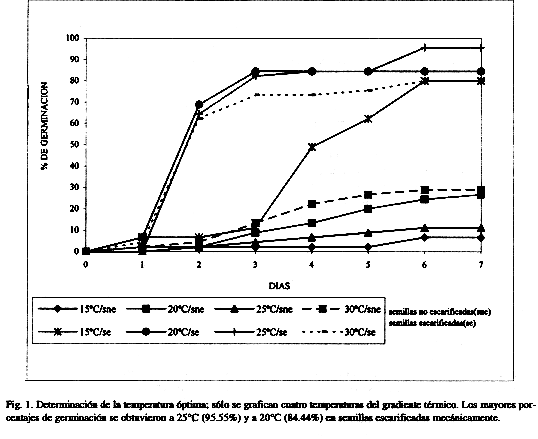
<body><![CDATA[<P><FONT FACE="Arial,Helvetica"><FONT SIZE=-1>El an&aacute;lisis de la dispersi&oacute;n de los frutos y semillas y de la emergencia y establecimiento de las pl&aacute;ntulas de <I>M. tenuiflora</I> fue cualitativo, a partir de la observaci&oacute;n directa en el campo y en el laboratorio. Se revisaron los frutos diseminados para establecer el radio de distribuci&oacute;n a partir de la planta madre; asimismo, se localizaron frutos y semillas arrastrados por el agua en la &eacute;poca de lluvias. Se revisaron las pl&aacute;ntulas establecidas en &aacute;reas de vegetaci&oacute;n primaria y de vegetaci&oacute;n secundaria; adem&aacute;s, se sigui&oacute; el desarrollo de 20 pl&aacute;ntulas cultivadas en el laboratorio, a temperatura ambiente en la Ciudad de M&eacute;xico (18-20&deg;C) durante tres meses.</FONT></FONT>     <BR>&nbsp;      <P><B><FONT FACE="Arial,Helvetica"><FONT SIZE=-1>Resultados</FONT></FONT></B>      <P><FONT FACE="Arial,Helvetica"><FONT SIZE=-1><B>Germinaci&oacute;n</B>: El tipo de germinaci&oacute;n observada en las semillas de <I>M. tenuiflora</I> es fanerocotilar. La mayor parte de las semillas escarificadas mec&aacute;nicamente germinaron al segundo d&iacute;a despu&eacute;s de la siembra; no obstante, se puede considerar que el mayor porcentaje de germinaci&oacute;n se alcanz&oacute; entre el d&iacute;a uno y el cuatro (<A HREF="#fig. 1">Fig. 1</A>).</FONT></FONT>     <BR>&nbsp;     <CENTER><A NAME="fig. 1"></A><IMG SRC="/img/fbpe/rbt/v46n3/0189i01.GIF" HEIGHT=439 WIDTH=538></CENTER>       
<P><FONT FACE="Arial,Helvetica"><FONT SIZE=-1>Con respecto al gradiente t&eacute;rmico utilizado, se observ&oacute; que, tanto las semillas escarificadas mec&aacute;nicamente como las no escarificadas tienen la capacidad de germinar entre 10 y 30&deg;C (<A HREF="#CUADRO 1">Cuadro 1</A> y <A HREF="#fig. 1">Fig. 1</A>); sin embargo, existe una diferencia significativa (p&lt;0.05) entre los porcentajes de germinaci&oacute;n de las semillas no escarificadas y los de las escarificadas; en este &uacute;ltimo caso, se presentaron los porcentajes m&aacute;s altos, alcanzando hasta un 95.55% a 25&deg;C (<A HREF="#CUADRO 1">Cuadro 1 </A>y<A HREF="#fig. 1"> Fig. 1</A>).</FONT></FONT>     <BR>&nbsp;     <BR>&nbsp;     <BR>&nbsp;     ]]></body>
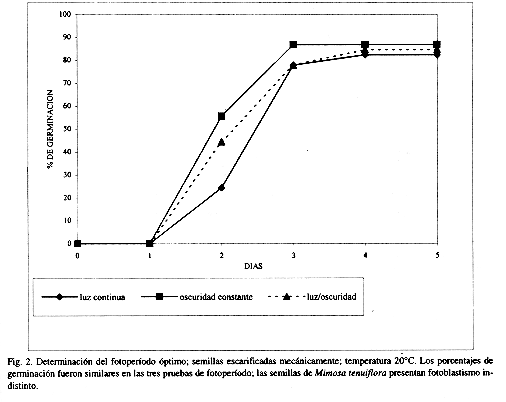
<body><![CDATA[<CENTER><A NAME="fig. 2"></A><IMG SRC="/img/fbpe/rbt/v46n3/0189i02.GIF" HEIGHT=402 WIDTH=506></CENTER>      
<CENTER>&nbsp;</CENTER>      <CENTER>&nbsp;</CENTER>      <CENTER><A NAME="CUADRO 1"></A></CENTER>      <CENTER><FONT FACE="Arial,Helvetica"><FONT SIZE=-1>CUADRO 1</FONT></FONT></CENTER>      <CENTER><FONT FACE="Arial,Helvetica"><FONT SIZE=-1>&nbsp;Porcentaje de germinaci&oacute;n de M. tenuiflora, siete d&iacute;as despu&eacute;s de la siembra en el termogradiente.</FONT></FONT></CENTER>      <CENTER><FONT FACE="Arial,Helvetica"><FONT SIZE=-1>Luz continua</FONT></FONT></CENTER>      <CENTER><FONT FACE="Arial,Helvetica"><FONT SIZE=-1>&nbsp;</FONT></FONT></CENTER>      <CENTER><FONT FACE="Arial,Helvetica"><FONT SIZE=-1>Semillas no escarificadas</FONT></FONT></CENTER>      <CENTER><FONT FACE="Arial,Helvetica"><FONT SIZE=-1>T e m p e r a t u r a</FONT></FONT></CENTER>      ]]></body>
<body><![CDATA[<CENTER><FONT FACE="Arial,Helvetica"><FONT SIZE=-1>&nbsp;</FONT></FONT></CENTER>      <CENTER><TABLE BORDER=0 CELLSPACING=0 CELLPADDING=5 WIDTH="662" > <TR> <TD VALIGN=TOP WIDTH="12%" HEIGHT="28"><FONT FACE="Arial,Helvetica"><FONT SIZE=-1>&nbsp;&nbsp; 5&deg;C&nbsp;</FONT></FONT></TD>  <TD VALIGN=TOP WIDTH="13%" HEIGHT="28"><FONT FACE="Arial,Helvetica"><FONT SIZE=-1>10&deg;C&nbsp;</FONT></FONT></TD>  <TD VALIGN=TOP WIDTH="13%" HEIGHT="28"><FONT FACE="Arial,Helvetica"><FONT SIZE=-1>15&deg;C&nbsp;</FONT></FONT></TD>  <TD VALIGN=TOP WIDTH="13%" HEIGHT="28"><FONT FACE="Arial,Helvetica"><FONT SIZE=-1>20&deg;C&nbsp;</FONT></FONT></TD>  <TD VALIGN=TOP WIDTH="12%" HEIGHT="28"><FONT FACE="Arial,Helvetica"><FONT SIZE=-1>25&deg;C&nbsp;</FONT></FONT></TD>  <TD VALIGN=TOP WIDTH="13%" HEIGHT="28"><FONT FACE="Arial,Helvetica"><FONT SIZE=-1>30&deg;C&nbsp;</FONT></FONT></TD>  <TD VALIGN=TOP WIDTH="13%" HEIGHT="28"><FONT FACE="Arial,Helvetica"><FONT SIZE=-1>35&deg;C&nbsp;</FONT></FONT></TD>  <TD VALIGN=TOP WIDTH="13%" HEIGHT="28"><FONT FACE="Arial,Helvetica"><FONT SIZE=-1>40&deg;C&nbsp;</FONT></FONT></TD> </TR>  <TR> <TD VALIGN=TOP WIDTH="12%" HEIGHT="28"><FONT FACE="Arial,Helvetica"><FONT SIZE=-1>0%&nbsp;</FONT></FONT></TD>  <TD VALIGN=TOP WIDTH="13%" HEIGHT="28"><FONT FACE="Arial,Helvetica"><FONT SIZE=-1>4.44%&nbsp;</FONT></FONT></TD>  <TD VALIGN=TOP WIDTH="13%" HEIGHT="28"><FONT FACE="Arial,Helvetica"><FONT SIZE=-1>6.66%&nbsp;</FONT></FONT></TD>  <TD VALIGN=TOP WIDTH="13%" HEIGHT="28"><FONT FACE="Arial,Helvetica"><FONT SIZE=-1>26.66%&nbsp;</FONT></FONT></TD>  <TD VALIGN=TOP WIDTH="12%" HEIGHT="28"><FONT FACE="Arial,Helvetica"><FONT SIZE=-1>11.11%&nbsp;</FONT></FONT></TD>  <TD VALIGN=TOP WIDTH="13%" HEIGHT="28"><FONT FACE="Arial,Helvetica"><FONT SIZE=-1>28.88%&nbsp;</FONT></FONT></TD>  <TD VALIGN=TOP WIDTH="13%" HEIGHT="28"><FONT FACE="Arial,Helvetica"><FONT SIZE=-1>0%&nbsp;</FONT></FONT></TD>  <TD VALIGN=TOP WIDTH="13%" HEIGHT="28"><FONT FACE="Arial,Helvetica"><FONT SIZE=-1>0%&nbsp;</FONT></FONT></TD> </TR>  <TR> <TD VALIGN=TOP WIDTH="12%" HEIGHT="28"><FONT FACE="Arial,Helvetica"><FONT SIZE=-1>S=0&nbsp;</FONT></FONT></TD>  <TD VALIGN=TOP WIDTH="13%" HEIGHT="28"><FONT FACE="Arial,Helvetica"><FONT SIZE=-1>S=1.88&nbsp;</FONT></FONT></TD>  <TD VALIGN=TOP WIDTH="13%" HEIGHT="28"><FONT FACE="Arial,Helvetica"><FONT SIZE=-1>S=2.98&nbsp;</FONT></FONT></TD>  <TD VALIGN=TOP WIDTH="13%" HEIGHT="28"><FONT FACE="Arial,Helvetica"><FONT SIZE=-1>S=4.39&nbsp;</FONT></FONT></TD>  <TD VALIGN=TOP WIDTH="12%" HEIGHT="28"><FONT FACE="Arial,Helvetica"><FONT SIZE=-1>S=2.76&nbsp;</FONT></FONT></TD>  <TD VALIGN=TOP WIDTH="13%" HEIGHT="28"><FONT FACE="Arial,Helvetica"><FONT SIZE=-1>S=4.80&nbsp;</FONT></FONT></TD>  <TD VALIGN=TOP WIDTH="13%" HEIGHT="28"><FONT FACE="Arial,Helvetica"><FONT SIZE=-1>S=0&nbsp;</FONT></FONT></TD>  <TD VALIGN=TOP WIDTH="13%" HEIGHT="28"><FONT FACE="Arial,Helvetica"><FONT SIZE=-1>S=0&nbsp;</FONT></FONT></TD> </TR> </TABLE></CENTER>      <CENTER><FONT FACE="Arial,Helvetica"><FONT SIZE=-1>&nbsp;</FONT></FONT></CENTER>      <CENTER><FONT FACE="Arial,Helvetica"><FONT SIZE=-1>Semillas escarificadas mec&aacute;nicamente</FONT></FONT></CENTER>      <CENTER><FONT FACE="Arial,Helvetica"><FONT SIZE=-1>T e m p e r a t u r a</FONT></FONT></CENTER>      <CENTER><FONT FACE="Arial,Helvetica"><FONT SIZE=-1>&nbsp;</FONT></FONT></CENTER>      <CENTER><TABLE BORDER=0 CELLSPACING=0 CELLPADDING=5 WIDTH="665" > <TR> <TD VALIGN=TOP WIDTH="12%" HEIGHT="14"><FONT FACE="Arial,Helvetica"><FONT SIZE=-1>&nbsp;&nbsp;&nbsp;&nbsp;&nbsp;&nbsp;&nbsp;&nbsp;&nbsp;&nbsp;&nbsp;&nbsp;&nbsp;&nbsp;&nbsp;&nbsp;&nbsp; 5&deg;C&nbsp;</FONT></FONT></TD>  <TD VALIGN=TOP WIDTH="13%" HEIGHT="14"><FONT FACE="Arial,Helvetica"><FONT SIZE=-1>10&deg;C&nbsp;</FONT></FONT></TD>  <TD VALIGN=TOP WIDTH="13%" HEIGHT="14"><FONT FACE="Arial,Helvetica"><FONT SIZE=-1>15&deg;C&nbsp;</FONT></FONT></TD>  <TD VALIGN=TOP WIDTH="13%" HEIGHT="14"><FONT FACE="Arial,Helvetica"><FONT SIZE=-1>20&deg;C&nbsp;</FONT></FONT></TD>  <TD VALIGN=TOP WIDTH="12%" HEIGHT="14"><FONT FACE="Arial,Helvetica"><FONT SIZE=-1>25&deg;C&nbsp;</FONT></FONT></TD>  <TD VALIGN=TOP WIDTH="13%" HEIGHT="14"><FONT FACE="Arial,Helvetica"><FONT SIZE=-1>30&deg;C&nbsp;</FONT></FONT></TD>  <TD VALIGN=TOP WIDTH="13%" HEIGHT="14"><FONT FACE="Arial,Helvetica"><FONT SIZE=-1>35&deg;C&nbsp;</FONT></FONT></TD>  <TD VALIGN=TOP WIDTH="13%" HEIGHT="14"><FONT FACE="Arial,Helvetica"><FONT SIZE=-1>40&deg;C&nbsp;</FONT></FONT></TD> </TR>  <TR> <TD VALIGN=TOP WIDTH="12%" HEIGHT="14"><FONT FACE="Arial,Helvetica"><FONT SIZE=-1>0%&nbsp;</FONT></FONT></TD>  <TD VALIGN=TOP WIDTH="13%" HEIGHT="14"><FONT FACE="Arial,Helvetica"><FONT SIZE=-1>71.11%&nbsp;</FONT></FONT></TD>  <TD VALIGN=TOP WIDTH="13%" HEIGHT="14"><FONT FACE="Arial,Helvetica"><FONT SIZE=-1>80%&nbsp;</FONT></FONT></TD>  <TD VALIGN=TOP WIDTH="13%" HEIGHT="14"><FONT FACE="Arial,Helvetica"><FONT SIZE=-1>84.44%&nbsp;</FONT></FONT></TD>  <TD VALIGN=TOP WIDTH="12%" HEIGHT="14"><FONT FACE="Arial,Helvetica"><FONT SIZE=-1>95.55%&nbsp;</FONT></FONT></TD>  <TD VALIGN=TOP WIDTH="13%" HEIGHT="14"><FONT FACE="Arial,Helvetica"><FONT SIZE=-1>80%&nbsp;</FONT></FONT></TD>  <TD VALIGN=TOP WIDTH="13%" HEIGHT="14"><FONT FACE="Arial,Helvetica"><FONT SIZE=-1>0%&nbsp;</FONT></FONT></TD>  <TD VALIGN=TOP WIDTH="13%" HEIGHT="14"><FONT FACE="Arial,Helvetica"><FONT SIZE=-1>0%&nbsp;</FONT></FONT></TD> </TR>  <TR> <TD VALIGN=TOP WIDTH="12%" HEIGHT="14"><FONT FACE="Arial,Helvetica"><FONT SIZE=-1>S=0&nbsp;</FONT></FONT></TD>  <TD VALIGN=TOP WIDTH="13%" HEIGHT="14"><FONT FACE="Arial,Helvetica"><FONT SIZE=-1>S=10.15&nbsp;</FONT></FONT></TD>  <TD VALIGN=TOP WIDTH="13%" HEIGHT="14"><FONT FACE="Arial,Helvetica"><FONT SIZE=-1>S=13.61&nbsp;</FONT></FONT></TD>  <TD VALIGN=TOP WIDTH="13%" HEIGHT="14"><FONT FACE="Arial,Helvetica"><FONT SIZE=-1>S=20.88&nbsp;</FONT></FONT></TD>  <TD VALIGN=TOP WIDTH="12%" HEIGHT="14"><FONT FACE="Arial,Helvetica"><FONT SIZE=-1>S=22.06&nbsp;</FONT></FONT></TD>  <TD VALIGN=TOP WIDTH="13%" HEIGHT="14"><FONT FACE="Arial,Helvetica"><FONT SIZE=-1>S=19.1&nbsp;</FONT></FONT></TD>  <TD VALIGN=TOP WIDTH="13%" HEIGHT="14"><FONT FACE="Arial,Helvetica"><FONT SIZE=-1>S=0&nbsp;</FONT></FONT></TD>  <TD VALIGN=TOP WIDTH="13%" HEIGHT="14"><FONT FACE="Arial,Helvetica"><FONT SIZE=-1>S=0&nbsp;</FONT></FONT></TD> </TR> </TABLE></CENTER> <FONT FACE="Arial,Helvetica"><FONT SIZE=-1>&nbsp;</FONT></FONT>     <BR><FONT FACE="Arial,Helvetica"><FONT SIZE=-1>&nbsp;</FONT></FONT>     <BR><FONT FACE="Arial,Helvetica"><FONT SIZE=-1>Los porcentajes de germinaci&oacute;n obtenidos en los distintos fotoper&iacute;odos estudiados muestran que no existe una diferencia significativa entre estos (p&lt;0.05) (<A HREF="#CUADRO 2">Cuadro 2</A> y <A HREF="#fig. 2">Fig. 2)</A>.</FONT></FONT>     <CENTER>&nbsp;</CENTER>      ]]></body>
<body><![CDATA[<CENTER>&nbsp;</CENTER>      <CENTER><A NAME="CUADRO 2"></A><FONT FACE="Arial,Helvetica"><FONT SIZE=-1>CUADRO 2</FONT></FONT></CENTER>      <CENTER><FONT FACE="Arial,Helvetica"><FONT SIZE=-1>&nbsp;Porcentaje de germinaci&oacute;n de M. tenuiflora, cinco d&iacute;as despu&eacute;s de la siembra con los tres fotoper&iacute;odos.</FONT></FONT></CENTER>      <CENTER><FONT FACE="Arial,Helvetica"><FONT SIZE=-1>Semillas escarificadas mec&aacute;nicamente (20&ordm;C)</FONT></FONT></CENTER>      <CENTER><FONT FACE="Arial,Helvetica"><FONT SIZE=-1>&nbsp;</FONT></FONT></CENTER>      <CENTER><FONT FACE="Arial,Helvetica"><FONT SIZE=-1>F o t o p e r &iacute; o d o</FONT></FONT></CENTER>      <CENTER><FONT FACE="Arial,Helvetica"><FONT SIZE=-1>&nbsp;</FONT></FONT></CENTER>      <CENTER><TABLE BORDER=0 CELLSPACING=0 CELLPADDING=5 WIDTH="627" > <TR> <TD VALIGN=TOP WIDTH="29%">     <CENTER><FONT FACE="Arial,Helvetica"><FONT SIZE=-1>&nbsp; Luz&nbsp; continua&nbsp;</FONT></FONT></CENTER> </TD>  <TD VALIGN=TOP WIDTH="41%">     <CENTER><FONT FACE="Arial,Helvetica"><FONT SIZE=-1>&nbsp;&nbsp;&nbsp;&nbsp;&nbsp; Oscuridad constante&nbsp;</FONT></FONT></CENTER> </TD>  <TD VALIGN=TOP WIDTH="30%">     ]]></body>
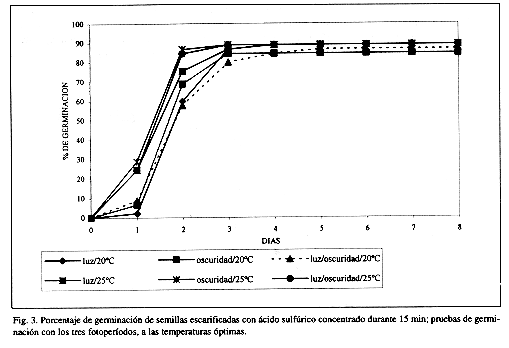
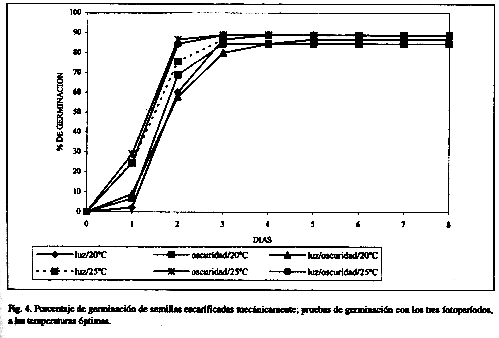
<body><![CDATA[<CENTER><FONT FACE="Arial,Helvetica"><FONT SIZE=-1>&nbsp;Luz/oscuridad&nbsp;</FONT></FONT></CENTER> </TD> </TR>  <TR> <TD VALIGN=TOP WIDTH="29%"></TD>  <TD VALIGN=TOP WIDTH="41%"></TD>  <TD VALIGN=TOP WIDTH="30%"></TD> </TR>  <TR> <TD VALIGN=TOP WIDTH="29%">     <CENTER><FONT FACE="Arial,Helvetica"><FONT SIZE=-1>82.22%&nbsp;</FONT></FONT></CENTER> </TD>  <TD VALIGN=TOP WIDTH="41%">     <CENTER><FONT FACE="Arial,Helvetica"><FONT SIZE=-1>86.66%&nbsp;</FONT></FONT></CENTER> </TD>  <TD VALIGN=TOP WIDTH="30%">     <CENTER><FONT FACE="Arial,Helvetica"><FONT SIZE=-1>84.44%&nbsp;</FONT></FONT></CENTER> </TD> </TR>  <TR> <TD VALIGN=TOP WIDTH="29%">     <CENTER><FONT FACE="Arial,Helvetica"><FONT SIZE=-1>S=20.76&nbsp;</FONT></FONT></CENTER> </TD>  <TD VALIGN=TOP WIDTH="41%">     <CENTER><FONT FACE="Arial,Helvetica"><FONT SIZE=-1>S=25.48&nbsp;</FONT></FONT></CENTER> </TD>  <TD VALIGN=TOP WIDTH="30%">     <CENTER><FONT FACE="Arial,Helvetica"><FONT SIZE=-1>S=20.69&nbsp;</FONT></FONT></CENTER> </TD> </TR> </TABLE></CENTER> <FONT FACE="Arial,Helvetica"><FONT SIZE=-1>&nbsp;</FONT></FONT>     <BR><FONT FACE="Arial,Helvetica"><FONT SIZE=-1>&nbsp;</FONT></FONT>     <BR><FONT FACE="Arial,Helvetica"><FONT SIZE=-1>Con relaci&oacute;n a los tres tratamientos pregerminativos (<A HREF="#CUADRO 3">Cuadro 3</A>), los mayores porcentajes de germinaci&oacute;n se obtuvieron a 20&deg;C con fotoper&iacute;odos de oscuridad constante (91.11%) y luz/oscuridad (88.88%), en semillas escarificadas con &aacute;cido sulf&uacute;rico (<A HREF="#fig. 3">Fig. 3</A>). Sin embargo, porcentajes similares tambi&eacute;n se obtuvieron con escarificaci&oacute;n mec&aacute;nica, tanto con temperaturas de 20&deg;C (84.44-88.88%) como de 25&deg;C (88.88%) en los tres fotoper&iacute;odos utilizados (<A HREF="#CUADRO 3">Cuadro 3</A> y <A HREF="#fig. 4">Fig. 4</A>). En el caso de la escarificaci&oacute;n por fuego directo, a diferencia de lo observado por <A HREF="#Creager">Creager (1992</A>) para <I>M. pigra</I>, las semillas de <I>M. tenuiflora</I> no germinaron.</FONT></FONT>     <BR>&nbsp;     ]]></body>
<body><![CDATA[<BR>&nbsp;     <CENTER><A NAME="fig. 3"></A><IMG SRC="/img/fbpe/rbt/v46n3/0189i03.GIF" HEIGHT=348 WIDTH=509></CENTER>      
<CENTER>&nbsp;</CENTER>      <CENTER><A NAME="CUADRO 3"></A><FONT FACE="Arial,Helvetica"><FONT SIZE=-1>CUADRO 3</FONT></FONT></CENTER>      <CENTER><FONT FACE="Arial,Helvetica"><FONT SIZE=-1>&nbsp;Porcentaje de germinaci&oacute;n de M. tenuiflora, ocho d&iacute;as despu&eacute;s de la siembra con los tratamientos pregerminativos.</FONT></FONT></CENTER>      <CENTER><FONT FACE="Arial,Helvetica"><FONT SIZE=-1>Semillas no escarificadas (Grupo testigo)</FONT></FONT></CENTER>      <CENTER>&nbsp;</CENTER>      <CENTER><FONT FACE="Arial,Helvetica"><FONT SIZE=-1>F o t o p e r &iacute; o d o</FONT></FONT></CENTER>      <CENTER><FONT FACE="Arial,Helvetica"><FONT SIZE=-1>&nbsp;</FONT></FONT></CENTER>      <CENTER><TABLE BORDER=0 CELLSPACING=0 CELLPADDING=5 WIDTH="690" > <TR> <TD VALIGN=TOP WIDTH="29%"></TD>  <TD VALIGN=TOP WIDTH="24%">     ]]></body>
<body><![CDATA[<CENTER><FONT FACE="Arial,Helvetica"><FONT SIZE=-1>&nbsp;&nbsp;&nbsp;&nbsp; Luz continua&nbsp;</FONT></FONT></CENTER> </TD>  <TD VALIGN=TOP WIDTH="24%">     <CENTER><FONT FACE="Arial,Helvetica"><FONT SIZE=-1>Oscuridad Oscuridad .&nbsp;</FONT></FONT></CENTER> </TD>  <TD VALIGN=TOP WIDTH="24%">     <CENTER><FONT FACE="Arial,Helvetica"><FONT SIZE=-1>&nbsp;&nbsp;&nbsp;&nbsp;&nbsp; Luz/oscuridad&nbsp;</FONT></FONT></CENTER> </TD> </TR>  <TR> <TD VALIGN=TOP WIDTH="29%">     <CENTER><FONT FACE="Arial,Helvetica"><FONT SIZE=-1>&nbsp;&nbsp;&nbsp; 20&ordm;C&nbsp;</FONT></FONT></CENTER> </TD>  <TD VALIGN=TOP WIDTH="24%">     <CENTER><FONT FACE="Arial,Helvetica"><FONT SIZE=-1>&nbsp;26.66%&nbsp;</FONT></FONT></CENTER> </TD>  <TD VALIGN=TOP WIDTH="24%">     <CENTER><FONT FACE="Arial,Helvetica"><FONT SIZE=-1>35.55%&nbsp;</FONT></FONT></CENTER> </TD>  <TD VALIGN=TOP WIDTH="24%">     <CENTER><FONT FACE="Arial,Helvetica"><FONT SIZE=-1>24.44%&nbsp;</FONT></FONT></CENTER> </TD> </TR>  <TR> <TD VALIGN=TOP WIDTH="29%"></TD>  <TD VALIGN=TOP WIDTH="24%">     <CENTER><FONT FACE="Arial,Helvetica"><FONT SIZE=-1>S=4.26&nbsp;</FONT></FONT></CENTER> </TD>  <TD VALIGN=TOP WIDTH="24%">     <CENTER><FONT FACE="Arial,Helvetica"><FONT SIZE=-1>S=7.89&nbsp;</FONT></FONT></CENTER> </TD>  <TD VALIGN=TOP WIDTH="24%">     <CENTER><FONT FACE="Arial,Helvetica"><FONT SIZE=-1>S=5.62&nbsp;</FONT></FONT></CENTER> </TD> </TR>  <TR> <TD VALIGN=TOP WIDTH="29%"><FONT FACE="Arial,Helvetica"><FONT SIZE=-1>Temperatura&nbsp;</FONT></FONT></TD>  <TD VALIGN=TOP WIDTH="24%"></TD>  <TD VALIGN=TOP WIDTH="24%"></TD>  <TD VALIGN=TOP WIDTH="24%"></TD> </TR>  <TR> <TD VALIGN=TOP WIDTH="29%">     ]]></body>
<body><![CDATA[<CENTER><FONT FACE="Arial,Helvetica"><FONT SIZE=-1>25&ordm;C&nbsp;</FONT></FONT></CENTER> </TD>  <TD VALIGN=TOP WIDTH="24%">     <CENTER><FONT FACE="Arial,Helvetica"><FONT SIZE=-1>28.88%&nbsp;</FONT></FONT></CENTER> </TD>  <TD VALIGN=TOP WIDTH="24%">     <CENTER><FONT FACE="Arial,Helvetica"><FONT SIZE=-1>33.33%&nbsp;</FONT></FONT></CENTER> </TD>  <TD VALIGN=TOP WIDTH="24%">     <CENTER><FONT FACE="Arial,Helvetica"><FONT SIZE=-1>28.88%&nbsp;</FONT></FONT></CENTER> </TD> </TR>  <TR> <TD VALIGN=TOP WIDTH="29%"></TD>  <TD VALIGN=TOP WIDTH="24%">     <CENTER><FONT FACE="Arial,Helvetica"><FONT SIZE=-1>S=6.75&nbsp;</FONT></FONT></CENTER> </TD>  <TD VALIGN=TOP WIDTH="24%">     <CENTER><FONT FACE="Arial,Helvetica"><FONT SIZE=-1>S=6.22&nbsp;</FONT></FONT></CENTER> </TD>  <TD VALIGN=TOP WIDTH="24%">     <CENTER><FONT FACE="Arial,Helvetica"><FONT SIZE=-1>S=6.23&nbsp;</FONT></FONT></CENTER> </TD> </TR> </TABLE></CENTER>      <CENTER><FONT FACE="Arial,Helvetica"><FONT SIZE=-1>&nbsp;</FONT></FONT></CENTER>      <CENTER><FONT FACE="Arial,Helvetica"><FONT SIZE=-1>&nbsp;Semillas escarificadas mec&aacute;nicamente</FONT></FONT></CENTER>      <CENTER><FONT FACE="Arial,Helvetica"><FONT SIZE=-1>F o t o p e r &iacute; o d o</FONT></FONT></CENTER>      ]]></body>
<body><![CDATA[<CENTER><FONT FACE="Arial,Helvetica"><FONT SIZE=-1>&nbsp;</FONT></FONT></CENTER>      <CENTER><TABLE BORDER=0 CELLSPACING=0 CELLPADDING=5 WIDTH="690" > <TR> <TD VALIGN=TOP WIDTH="29%"><FONT FACE="Arial,Helvetica"><FONT SIZE=-1>&nbsp;</FONT></FONT></TD>  <TD VALIGN=TOP WIDTH="24%">     <CENTER><FONT FACE="Arial,Helvetica"><FONT SIZE=-1>Luz&nbsp; continua&nbsp;&nbsp;&nbsp;&nbsp;&nbsp;&nbsp;&nbsp;&nbsp;&nbsp;&nbsp;&nbsp;&nbsp;&nbsp;&nbsp;&nbsp;&nbsp;&nbsp;&nbsp; .</FONT></FONT></CENTER> </TD>  <TD VALIGN=TOP WIDTH="24%"><FONT FACE="Arial,Helvetica"><FONT SIZE=-1>Oscuridad constante .&nbsp;&nbsp;&nbsp;&nbsp;&nbsp;&nbsp;&nbsp;&nbsp;&nbsp;&nbsp;&nbsp;&nbsp;&nbsp;&nbsp;&nbsp;&nbsp;&nbsp;&nbsp;&nbsp; .&nbsp;</FONT></FONT></TD>  <TD VALIGN=TOP WIDTH="24%">     <CENTER><FONT FACE="Arial,Helvetica"><FONT SIZE=-1>Luz/oscuridad&nbsp;</FONT></FONT></CENTER> </TD> </TR>  <TR> <TD VALIGN=TOP WIDTH="29%">     <CENTER><FONT FACE="Arial,Helvetica"><FONT SIZE=-1>20&ordm;C&nbsp;</FONT></FONT></CENTER> </TD>  <TD VALIGN=TOP WIDTH="24%">     <CENTER><FONT FACE="Arial,Helvetica"><FONT SIZE=-1>88.88%&nbsp;</FONT></FONT></CENTER> </TD>  <TD VALIGN=TOP WIDTH="24%">     <CENTER><FONT FACE="Arial,Helvetica"><FONT SIZE=-1>84.44%&nbsp;</FONT></FONT></CENTER> </TD>  <TD VALIGN=TOP WIDTH="24%">     <CENTER><FONT FACE="Arial,Helvetica"><FONT SIZE=-1>86.66%&nbsp;</FONT></FONT></CENTER> </TD> </TR>  <TR> <TD VALIGN=TOP WIDTH="29%"></TD>  <TD VALIGN=TOP WIDTH="24%">     <CENTER><FONT FACE="Arial,Helvetica"><FONT SIZE=-1>S=19.33&nbsp;</FONT></FONT></CENTER> </TD>  <TD VALIGN=TOP WIDTH="24%">     <CENTER><FONT FACE="Arial,Helvetica"><FONT SIZE=-1>S=19.93&nbsp;</FONT></FONT></CENTER> </TD>  <TD VALIGN=TOP WIDTH="24%">     ]]></body>
<body><![CDATA[<CENTER><FONT FACE="Arial,Helvetica"><FONT SIZE=-1>S=16.46&nbsp;</FONT></FONT></CENTER> </TD> </TR>  <TR> <TD VALIGN=TOP WIDTH="29%"><FONT FACE="Arial,Helvetica"><FONT SIZE=-1>Temperatura&nbsp;</FONT></FONT></TD>  <TD VALIGN=TOP WIDTH="24%"></TD>  <TD VALIGN=TOP WIDTH="24%"></TD>  <TD VALIGN=TOP WIDTH="24%"></TD> </TR>  <TR> <TD VALIGN=TOP WIDTH="29%">     <CENTER><FONT FACE="Arial,Helvetica"><FONT SIZE=-1>25&ordm;C&nbsp;</FONT></FONT></CENTER> </TD>  <TD VALIGN=TOP WIDTH="24%">     <CENTER><FONT FACE="Arial,Helvetica"><FONT SIZE=-1>88.88%&nbsp;</FONT></FONT></CENTER> </TD>  <TD VALIGN=TOP WIDTH="24%">     <CENTER><FONT FACE="Arial,Helvetica"><FONT SIZE=-1>88.88%&nbsp;</FONT></FONT></CENTER> </TD>  <TD VALIGN=TOP WIDTH="24%">     <CENTER><FONT FACE="Arial,Helvetica"><FONT SIZE=-1>88.88%&nbsp;</FONT></FONT></CENTER> </TD> </TR>  <TR> <TD VALIGN=TOP WIDTH="29%"></TD>  <TD VALIGN=TOP WIDTH="24%">     <CENTER><FONT FACE="Arial,Helvetica"><FONT SIZE=-1>S=17.57&nbsp;</FONT></FONT></CENTER> </TD>  <TD VALIGN=TOP WIDTH="24%">     <CENTER><FONT FACE="Arial,Helvetica"><FONT SIZE=-1>S=19.68&nbsp;</FONT></FONT></CENTER> </TD>  <TD VALIGN=TOP WIDTH="24%">     <CENTER><FONT FACE="Arial,Helvetica"><FONT SIZE=-1>S=19.85&nbsp;</FONT></FONT></CENTER> </TD> </TR> </TABLE></CENTER>      <CENTER><FONT FACE="Arial,Helvetica"><FONT SIZE=-1>&nbsp;</FONT></FONT></CENTER>      <CENTER><FONT FACE="Arial,Helvetica"><FONT SIZE=-1>Semillas escarificadas con &aacute;cido sulf&uacute;rico concentrado (15 min)</FONT></FONT></CENTER>      ]]></body>
<body><![CDATA[<CENTER><FONT FACE="Arial,Helvetica"><FONT SIZE=-1>F o t o p e r &iacute; o d o</FONT></FONT></CENTER>      <CENTER><FONT FACE="Arial,Helvetica"><FONT SIZE=-1>&nbsp;</FONT></FONT></CENTER>      <CENTER><TABLE BORDER=0 CELLSPACING=0 CELLPADDING=5 WIDTH="699" > <TR> <TD VALIGN=TOP WIDTH="29%"><FONT FACE="Arial,Helvetica"><FONT SIZE=-1>&nbsp;</FONT></FONT></TD>  <TD VALIGN=TOP WIDTH="24%"><FONT FACE="Arial,Helvetica"><FONT SIZE=-1>Luz&nbsp; continua .</FONT></FONT></TD>  <TD VALIGN=TOP WIDTH="24%"><FONT FACE="Arial,Helvetica"><FONT SIZE=-1>Oscuridad constante .&nbsp;</FONT></FONT></TD>  <TD VALIGN=TOP WIDTH="24%">     <CENTER><FONT FACE="Arial,Helvetica"><FONT SIZE=-1>Luz/oscuridad&nbsp;</FONT></FONT></CENTER> </TD> </TR>  <TR> <TD VALIGN=TOP WIDTH="29%">     <CENTER><FONT FACE="Arial,Helvetica"><FONT SIZE=-1>20&ordm;C&nbsp;</FONT></FONT></CENTER> </TD>  <TD VALIGN=TOP WIDTH="24%">     <CENTER><FONT FACE="Arial,Helvetica"><FONT SIZE=-1>80.88%&nbsp;</FONT></FONT></CENTER> </TD>  <TD VALIGN=TOP WIDTH="24%">     <CENTER><FONT FACE="Arial,Helvetica"><FONT SIZE=-1>91.11%&nbsp;</FONT></FONT></CENTER> </TD>  <TD VALIGN=TOP WIDTH="24%">     <CENTER><FONT FACE="Arial,Helvetica"><FONT SIZE=-1>88.88%&nbsp;</FONT></FONT></CENTER> </TD> </TR>  <TR> <TD VALIGN=TOP WIDTH="29%"></TD>  <TD VALIGN=TOP WIDTH="24%">     <CENTER><FONT FACE="Arial,Helvetica"><FONT SIZE=-1>S=10.93&nbsp;</FONT></FONT></CENTER> </TD>  <TD VALIGN=TOP WIDTH="24%">     <CENTER><FONT FACE="Arial,Helvetica"><FONT SIZE=-1>S=18.88&nbsp;</FONT></FONT></CENTER> </TD>  <TD VALIGN=TOP WIDTH="24%">     ]]></body>
<body><![CDATA[<CENTER><FONT FACE="Arial,Helvetica"><FONT SIZE=-1>S=16.47&nbsp;</FONT></FONT></CENTER> </TD> </TR>  <TR> <TD VALIGN=TOP WIDTH="29%"><FONT FACE="Arial,Helvetica"><FONT SIZE=-1>Temperatura&nbsp;</FONT></FONT></TD>  <TD VALIGN=TOP WIDTH="24%"></TD>  <TD VALIGN=TOP WIDTH="24%"></TD>  <TD VALIGN=TOP WIDTH="24%"></TD> </TR>  <TR> <TD VALIGN=TOP WIDTH="29%">     <CENTER><FONT FACE="Arial,Helvetica"><FONT SIZE=-1>25&ordm;C&nbsp;</FONT></FONT></CENTER> </TD>  <TD VALIGN=TOP WIDTH="24%">     <CENTER><FONT FACE="Arial,Helvetica"><FONT SIZE=-1>84.44%&nbsp;</FONT></FONT></CENTER> </TD>  <TD VALIGN=TOP WIDTH="24%">     <CENTER><FONT FACE="Arial,Helvetica"><FONT SIZE=-1>73.33%&nbsp;</FONT></FONT></CENTER> </TD>  <TD VALIGN=TOP WIDTH="24%">     <CENTER><FONT FACE="Arial,Helvetica"><FONT SIZE=-1>80%&nbsp;</FONT></FONT></CENTER> </TD> </TR>  <TR> <TD VALIGN=TOP WIDTH="29%"></TD>  <TD VALIGN=TOP WIDTH="24%">     <CENTER><FONT FACE="Arial,Helvetica"><FONT SIZE=-1>S=20.44&nbsp;</FONT></FONT></CENTER> </TD>  <TD VALIGN=TOP WIDTH="24%">     <CENTER><FONT FACE="Arial,Helvetica"><FONT SIZE=-1>S=15.94&nbsp;</FONT></FONT></CENTER> </TD>  <TD VALIGN=TOP WIDTH="24%">     <CENTER><FONT FACE="Arial,Helvetica"><FONT SIZE=-1>S=17.92&nbsp;</FONT></FONT></CENTER> </TD> </TR> </TABLE></CENTER> &nbsp;     <CENTER><A NAME="fig. 4"></A><IMG SRC="/img/fbpe/rbt/v46n3/0189i04.GIF" HEIGHT=338 WIDTH=499></CENTER>       
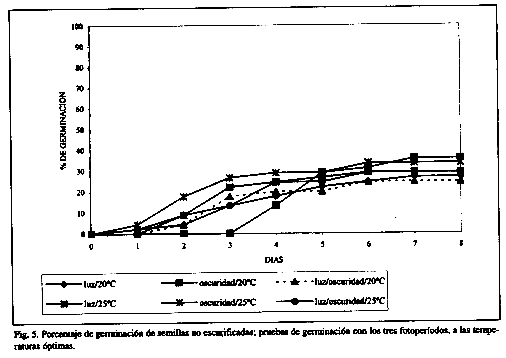
<P><FONT FACE="Arial,Helvetica"><FONT SIZE=-1>Las semillas que no fueron escarificadas presentan los porcentajes de germinaci&oacute;n m&aacute;s bajos (<A HREF="#CUADRO 3">Cuadro 3</A>, <A HREF="#fig. 5">Fig. 5</A>), significativamente diferentes (p&lt;0.05) a los obtenidos con escarificaci&oacute;n mec&aacute;nica y con &aacute;cido sulf&uacute;rico, como se observ&oacute; en el ensayo del gradiente t&eacute;rmico (<A HREF="#CUADRO 1">Cuadro 1 </A>y <A HREF="#fig. 1">Fig. 1</A>). Entre ambos tratamientos pregerminativos, escarificaci&oacute;n mec&aacute;nica y con &aacute;cido sulf&uacute;rico, las diferencias en porcentajes de germinaci&oacute;n no fueron significativas (p&lt;0.05), considerando adem&aacute;s, el fotoper&iacute;odo y las dos temperaturas empleadas (20&deg;C y 25&deg;C) (<A HREF="#CUADRO 3">Cuadro 3</A>, <A HREF="#fig. 3">Figs. 3</A>, <A HREF="#fig. 4">4</A> y <A HREF="#fig. 5">5</A>).</FONT></FONT>     ]]></body>
<body><![CDATA[<BR>&nbsp;     <BR>&nbsp;     <BR>&nbsp;     <CENTER><A NAME="fig. 5"></A><IMG SRC="/img/fbpe/rbt/v46n3/0189i05.GIF" HEIGHT=358 WIDTH=506></CENTER> &nbsp;      
<P><FONT FACE="Arial,Helvetica"><FONT SIZE=-1><B>Dispersi&oacute;n y establecimiento de pl&aacute;ntulas</B>: El viento dispersa los frutos de <I>M. tenuiflora</I> que, por su textura papir&aacute;cea, son ligeros y se han encontrado diseminados hasta 5 m a partir de la planta madre en &aacute;reas con vegetaci&oacute;n densa, como selvas y matorrales y hasta 8 m en &aacute;reas abiertas, taladas o terrenos de cultivo. La lluvia facilita el desprendimiento de los frutos y de los artejos, actuando en conjunto con el viento; tambi&eacute;n, se ha observado el arrastre de los frutos y semillas que se encuentran en el suelo, desde las partes m&aacute;s altas de cerros y lomer&iacute;os hacia los terrenos planos y m&aacute;s bajos. La dispersi&oacute;n por animales no ha sido detectada, mientras que la antropocoria es un mecanismo frecuente de dispersi&oacute;n de esta especie, debido a las actividades humanas en la regi&oacute;n.</FONT></FONT>      <P><FONT FACE="Arial,Helvetica"><FONT SIZE=-1>La emergencia de las pl&aacute;ntulas de <I>M. tenuiflora</I> en el campo ocurre a partir del inicio de la &eacute;poca de lluvias (mayo-junio). Se estima que germinan principalmente las semillas producidas en a&ntilde;os anteriores, debido a la latencia impuesta por la testa dura e impermeable. Las pl&aacute;ntulas emergen y se establecen preferentemente en &aacute;reas abiertas expuestas a la luz.</FONT></FONT>      <P><FONT FACE="Arial,Helvetica"><FONT SIZE=-1>Las pl&aacute;ntulas cultivadas en el laboratorio tuvieron un crecimiento r&aacute;pido (2-5 mm diarios). Los cotiledones son foliares y persisten despu&eacute;s de la aparici&oacute;n de la primera pronom&oacute;fila. En la primera etapa (diez d&iacute;as) la rad&iacute;cula es recta, el hipoc&oacute;tilo se desarrolla r&aacute;pidamente, el epic&oacute;tilo est&aacute; reducido a la pl&uacute;mula y los cotiledones se expanden. En la segunda etapa (seis d&iacute;as) contin&uacute;a el crecimiento del hipoc&oacute;tilo con tricomas glandulares, el epic&oacute;tilo empieza a alargarse y se desarrolla la primera e&oacute;fila (prot&oacute;fila, seg&uacute;n <A HREF="#Parra">Parra 1984</A>), paripinnada, con 4-6 pares de fol&iacute;olos linear-oblongos, 2-3 x 1 mm, con tricomas glandulares en el margen. En la tercera etapa (a partir de los 17-20 d&iacute;as despu&eacute;s de la siembra) se desarrolla la primera pronom&oacute;fila, alterna, biparipinnada, con un par de pinnas y 6-8 pares de fol&iacute;olos linear-oblongos, 1-2 x 1 mm, con tricomas glandulares en el margen. La tercera pronom&oacute;fila se desarrolla 35-40 d&iacute;as despu&eacute;s de la siembra. En total se forman hasta diez pronom&oacute;filas en un intervalo de 11-12 semanas. El sistema radical es axonomorfo y cuando el hipoc&oacute;tilo se pone en contacto con el suelo, desarrolla ra&iacute;ces adventicias. La fase de pl&aacute;ntula concluye en la semana 12 a 14, cuando se desarrolla la primera nom&oacute;fila con 4-5 pares de pinnas y 7-14 pares de fol&iacute;olos linear-oblongos, 1-3 x 1 mm, semejante a las hojas de la planta adulta.</FONT></FONT>     <BR>&nbsp;      <P><B><FONT FACE="Arial,Helvetica"><FONT SIZE=-1>Discusi&oacute;n</FONT></FONT></B>      <P><FONT FACE="Arial,Helvetica"><FONT SIZE=-1><B>Germinaci&oacute;n</B>: Los resultados de las pruebas de germinaci&oacute;n en el gradiente t&eacute;rmico sugieren un amplio &aacute;mbito de tolerancia a la temperatura (10-30&ordm; C). La ruptura de la testa permite que la mayor parte de las semillas germinen en un per&iacute;odo de cuatro d&iacute;as (<A HREF="#CUADRO 1">Cuadro 1 </A>y <A HREF="#fig. 1">Fig. 1)</A>. Adem&aacute;s, los fotoper&iacute;odos empleados indican que <I>M. tenuiflora</I> es una especie con semillas fotobl&aacute;sticas indistintas (<A HREF="#CUADRO 2">Cuadro 2</A> y <A HREF="#fig. 2">Fig. 2</A>), lo que ampl&iacute;a sus posibilidades de germinaci&oacute;n en sitios diversos.</FONT></FONT>      ]]></body>
<body><![CDATA[<P><FONT FACE="Arial,Helvetica"><FONT SIZE=-1>Las semillas de <I>M. tenuiflora</I> escarificadas por fuego directo no germinaron, pero si se considera el sistema tradicional agroforestal de roza-tumba-quema, caracter&iacute;stico de la zona en que crece, el fuego posiblemente elimina a las especies competidoras ya establecidas (otras semillas, pl&aacute;ntulas y/o plantas, par&aacute;sitos, etc.), por lo que una vez abierta el &aacute;rea, se favorece la colonizaci&oacute;n a partir de semillas, tocones, ramas y ra&iacute;ces parcialmente quemadas de <I>M. tenuiflora</I>; <A HREF="#Sampaio, E. V.">Sampaio <I>et al.</I> (1993</A>) registran un comportamiento similar de esta especie en los bosques de Caatinga del Brasil.</FONT></FONT>      <P><FONT FACE="Arial,Helvetica"><FONT SIZE=-1>En las semillas de esta especie es evidente la testa dura e impermeable, lo que sugiere la necesidad de escarificaci&oacute;n, ya sea mec&aacute;nica o qu&iacute;mica, para romper la latencia y obtener un mayor porcentaje de germinaci&oacute;n. La latencia impuesta es muy frecuente en h&aacute;bitats en los que la lluvia presenta una marcada distribuci&oacute;n estacional (<A HREF="#Vázquez-Yanes 1977">V&aacute;zquez-Yanes y P&eacute;rez-Garc&iacute;a 1977</A>), como ocurre en el caso de <I>M. tenuiflora</I>, en la que la testa dura e impermeable hace suponer un contenido bajo de humedad, trat&aacute;ndose de semillas ortodoxas con un per&iacute;odo largo de latencia. La impermeabilidad de la testa est&aacute; asociada con la desecaci&oacute;n de las semillas durante la maduraci&oacute;n (<A HREF="#Van Staden">Van Staden <I>et al.</I> 1989</A>). Las semillas de <I>M. tenuiflora</I> son lenticulares y peque&ntilde;as (4.1-4.7 mm de largo x 3.1-3.8 mm de ancho x 1.6-2.3 mm de grosor en la parte media), lo que las hace menos susceptibles a la desecaci&oacute;n y es m&aacute;s probable que germinen en h&aacute;bitats abiertos. Asimismo, sus semillas pueden considerarse como mesobi&oacute;tcas con base en los resultados de esta investigaci&oacute;n. La germinaci&oacute;n fanerocotilar observada en esta especie coincide con los resultados de<A HREF="#Parra"> Parra (1984</A>) para otras especies del g&eacute;nero.</FONT></FONT>     <BR>&nbsp;      <P><FONT FACE="Arial,Helvetica"><FONT SIZE=-1><B>Dispersi&oacute;n y establecimiento de pl&aacute;ntulas</B>: El tama&ntilde;o peque&ntilde;o de las semillas, asociado a la producci&oacute;n de un alto n&uacute;mero de &eacute;stas por individuo, favorecen la invasi&oacute;n de &aacute;reas abiertas con mayor facilidad para <I>M. tenuiflora</I> que para otras especies que producen semillas m&aacute;s grandes.</FONT></FONT>      <P><FONT FACE="Arial,Helvetica"><FONT SIZE=-1>El viento y el inicio de la &eacute;poca de lluvias coinciden con la etapa final de fructificaci&oacute;n y con el inicio de la germinaci&oacute;n de las semillas producidas principalmente en a&ntilde;os anteriores, debido a la latencia impuesta.</FONT></FONT>      <P><FONT FACE="Arial,Helvetica"><FONT SIZE=-1>El viento, la lluvia y las actividades humanas son los principales factores de dispersi&oacute;n de esta especie. Dado que sus frutos no presentan ning&uacute;n tipo de derivado epid&eacute;rmico y tienen el margen inerme, no es factible su adherencia al pelo del ganado vacuno, bovino o caprino. Sin embargo, el hombre act&uacute;a a dos niveles: 1) diseminando, intencional o accidentalmente, los frutos y semillas a trav&eacute;s de los veh&iacute;culos de transporte, al cultivar y cosechar, al cortar y al comercializar la madera, principalmente y 2) al abrir espacios favorables para el establecimiento de nuevos individuos, como consecuencia de las pr&aacute;cticas agr&iacute;colas (roza-tumba-quema), ganaderas y de comunicaci&oacute;n terrestre.</FONT></FONT>      <P><FONT FACE="Arial,Helvetica"><FONT SIZE=-1><I>M. tenuiflora</I> tiene ciertas ventajas para su establecimiento en &aacute;reas abiertas, expuestas a la luz solar y con bajo contenido de humedad del suelo, dadas por las caracter&iacute;sticas de sus pl&aacute;ntulas: el sistema radical axonomorfo que les permite captar el agua del suelo a mayor profundidad, el eje hipoc&oacute;tilo-epic&oacute;tilo lignificado en la base, as&iacute; como la formaci&oacute;n de ra&iacute;ces adventicias cuando el hipoc&oacute;tilo se pone en contacto con el suelo y la l&aacute;mina dividida de las hojas prot&oacute;fila y pronom&oacute;filas, con fol&iacute;olos peque&ntilde;os, linear-oblongos, que contribuyen a evitar la desecaci&oacute;n. Estas son caracter&iacute;sticas importantes para el establecimiento de otras especies en terrenos de cultivo en descanso (<A HREF="#Cid-Benevento">Cid-Benevento y Werner 1986</A>).</FONT></FONT>      <P><FONT FACE="Arial,Helvetica"><FONT SIZE=-1>Las semillas de <I>M. tenuiflora</I> son fotobl&aacute;sticas indistintas; sin embargo, la luz es un factor importante para la emergencia y el establecimiento de pl&aacute;ntulas en otras especies (<A HREF="#Cid-Benevento">Cid-Benevento y Werner 1986</A>) y en las pl&aacute;ntulas de <I>M. tenuiflora</I> se han observado cambios en la orientaci&oacute;n de los cotiledones foliares y de las hojas y fol&iacute;olos, en respuesta a la luz y el cierre de los mismos al anochecer y ante est&iacute;mulos mec&aacute;nicos, probablemente por un mecanismo similar al de los pulv&iacute;nulos de <I>M. pudica</I> (<A HREF="#Campbell, N. A.">Campbell y Thomson 1977</A>). La orientaci&oacute;n de las hojas contribuye a optimizar la captaci&oacute;n de luz, como ocurre en otras leguminosas (<A HREF="#Rudel, P.">Rundel 1989</A>) y posiblemente los tricomas glandulares funcionen como un mecanismo de defensa contra herb&iacute;voros.</FONT></FONT>      <P><FONT FACE="Arial,Helvetica"><FONT SIZE=-1>Adem&aacute;s, la germinaci&oacute;n, el establecimiento, el crecimiento y la r&aacute;pida expansi&oacute;n de pl&aacute;ntulas son favorecidos por diversos factores: 1) la producci&oacute;n abundante de semillas, 2) el tama&ntilde;o peque&ntilde;o de &eacute;stas, 3) la velocidad de germinaci&oacute;n y 4) el r&aacute;pido crecimiento de las pl&aacute;ntulas. En los terrenos de cultivo abandonados o en descanso y en potreros, el establecimiento de <I>M. tenuiflora</I> es favorecido por: 1) la producci&oacute;n abundante de semillas en &aacute;reas cercanas con vegetaci&oacute;n primaria o secundaria, 2) el descanso de los terrenos de cultivo durante un per&iacute;odo largo de tiempo y 3) la resistencia de las plantas j&oacute;venes al ramoneo y al pisoteo de los animales; dada la gran cantidad de semillas que se producen, muchas de las pl&aacute;ntulas logran establecerse a pesar del pisoteo. El amplio &aacute;mbito de condiciones clim&aacute;ticas y ed&aacute;ficas, en las que se establece esta especie, sugiere su plasticidad gen&eacute;tica (<A HREF="#Camargo-Ricalde 1997">Camargo-Ricalde 1997</A>).</FONT></FONT>      <P><FONT FACE="Arial,Helvetica"><FONT SIZE=-1>Por otra parte, esta especie presenta gran resistencia a la tala y a las quemas; los individuos se regeneran con facilidad a partir de tocones o ra&iacute;ces, adem&aacute;s de propagarse por el desarrollo de brotes a partir de ramas y de ra&iacute;ces expuestas y a&uacute;n parcialmente quemadas, como ocurre con <I>M. biuncifera</I>, <I>M. monanciastra</I> (<A HREF="#Grether, R. 1982.">Grether 1982</A>), <I>M. pigra</I> (<A HREF="#Lonsdale, W. M. 1989">Londsdale y Abrecht 1989</A>, <A HREF="#Creager">Creager 1992</A>) y <I>M. bahamensis</I> (<A HREF="#Grether, R. 1993">Grether y Camargo-Ricalde 1993</A>). <I>M. tenuiflora</I> se comporta de manera similar en los bosques de Caatinga del Brasil (<A HREF="#Sampaio, E. V.">Sampaio <I>et al.</I> 1993</A>).</FONT></FONT>      ]]></body>
<body><![CDATA[<P><FONT FACE="Arial,Helvetica"><FONT SIZE=-1>La suma de las caracter&iacute;sticas antes mencionadas, en conjunto con los tipos de vegetaci&oacute;n en los que se establece esta especie (selvas bajas caducifolias y subcaducifolias, bosques de <I>Pinus</I> y de <I>Pinus-Quercus</I> perturbados, matorrales altos y medianos espinosos y subinermes, y matorrales casi puros de <I>M. tenuiflora</I>), su ocurrencia a la orilla de caminos y en terrenos de cultivo en descanso o abandonados, as&iacute; como su germinaci&oacute;n y crecimiento r&aacute;pido en la etapa de pl&aacute;ntula confirman el car&aacute;cter oportunista y t&iacute;picamente secundario de esta especie. Por lo anterior, esta planta podr&iacute;a ser aprovechada ecol&oacute;gicamente para la reforestaci&oacute;n y regeneraci&oacute;n de &aacute;reas perturbadas en zonas c&aacute;lidas y muy c&aacute;lidas, h&uacute;medas y subh&uacute;medas, con un rango altitudinal de 0-1 110 msnm y preferentemente, con suelos &aacute;cidos y drenaje eficiente.</FONT></FONT>     <BR>&nbsp;      <P><B><FONT FACE="Arial,Helvetica"><FONT SIZE=-1>Resumen</FONT></FONT></B>      <P><FONT FACE="Arial,Helvetica"><FONT SIZE=-1><I>Mimosa tenuiflora</I> (Willd.) Poir. es un recurso natural importante para M&eacute;xico debido a sus diversos usos. Sin embargo, hasta ahora no se hab&iacute;a estudiado la germinaci&oacute;n, la dispersi&oacute;n y el establecimiento de pl&aacute;ntulas de esta especie. Se recolectaron frutos y semillas de esta planta en el estado de Chiapas, M&eacute;xico (S. L. Camargo <I>et al</I>. 118, UAMIZ). Las pruebas de germinaci&oacute;n se hicieron despu&eacute;s de cuatro a&ntilde;os de almacenamiento; se sembraron en total 1 935 semillas en cajas de Petri con papel filtro Wathman humedecido. Se determinaron las temperaturas &oacute;ptimas usando un gradiente de 5-40&deg;C, con luz continua, para semillas escarificadas mec&aacute;nicamente y no escarificadas. Se realizaron tres pruebas de fotoper&iacute;odo: a) luz continua, b) oscuridad constante y c) luz 12hr/oscuridad 12 hr. Se aplicaron tres tratamientos pregerminativos: a) escarificaci&oacute;n mec&aacute;nica, b) &aacute;cido sulf&uacute;rico concentrado, c) fuego directo y d) ning&uacute;n tratamiento. Para cada variable y pretratamiento se hicieron tres repeticiones, cada una con 15 semillas. Se aplicaron las pruebas estad&iacute;sticas correspondientes: desviaci&oacute;n estandar (S), an&aacute;lisis de varianza de una v&iacute;a (ANOVA) y comparaci&oacute;n de medias (Prueba de Scheff&eacute;) (p&lt;0.05). Se hizo un an&aacute;lisis cualitativo de la dispersi&oacute;n de semillas y del establecimiento de pl&aacute;ntulas, a partir de la observaci&oacute;n directa en el campo y en el laboratorio; se midi&oacute; el radio de dispersi&oacute;n de los frutos, respecto a la planta madre; se sigui&oacute; el desarrollo de pl&aacute;ntulas cultivadas en el laboratorio durante tres meses. Las semillas germinaron a temperaturas de 10-30&deg;C; sin embargo, el mayor porcentaje de germinaci&oacute;n se obtuvo a 20&deg;C (84.44%) y 25&deg;C (95.55%); presentan un fotoblastismo indistinto y al aplic&aacute;rseles tres tratamientos pregerminativos, los porcentajes de germinaci&oacute;n fueron los siguientes: grupo testigo (24.44-35.55%), escarificaci&oacute;n mec&aacute;nica (84.44-88.88%), escarificaci&oacute;n con &aacute;cido sulf&uacute;rico (73.33-91.11%) y fuego directo (0%). Los frutos y semillas se dispersan por el viento en un radio de 5-8 m a partir de la planta madre, la lluvia los arratra de los cerros a las planicies m&aacute;s bajas y las actividades humanas contribuyen a su diseminaci&oacute;n. El crecimiento de las pl&aacute;ntulas es r&aacute;pido; se desarrollan una prot&oacute;fila paripinnada y diez pronom&oacute;filas biparipinnadas, la primera nom&oacute;fila se forma en la semana 12 a 14. Se concluye que las temperaturas &oacute;ptimas para la germinaci&oacute;n de las semillas de <I>M. tenuiflora</I> son 20&deg;C y 25&deg;C; estas semillas son fotobl&aacute;sticas indistintas y el porcentaje y velocidad de germinaci&oacute;n se incrementan notablemente por escarificaci&oacute;n de la testa. Esta especie tiene ciertas ventajas para su establecimiento en &aacute;reas abiertas, dadas por la producci&oacute;n abundante de semillas, su tama&ntilde;o peque&ntilde;o, la velocidad de germinaci&oacute;n y el crecimiento r&aacute;pido, as&iacute; como por las caracter&iacute;sticas de sus pl&aacute;ntulas: el sistema radical axonomorfo, el eje hipoc&oacute;tilo-epic&oacute;tilo lignificado en la base y las hojas compuestas con fol&iacute;olos linear-oblongos que cambian de orientaci&oacute;n en respuesta a la luz. Los resultados confirman el car&aacute;cter oportunista y t&iacute;picamente secundario de esta especie.</FONT></FONT>     <BR>&nbsp;      <P><B><FONT FACE="Arial,Helvetica"><FONT SIZE=-1>Agradecimientos</FONT></FONT></B>      <P><FONT FACE="Arial,Helvetica"><FONT SIZE=-1>Agradecemos a Fernando D&iacute;az de Le&oacute;n S&aacute;nchez, Carlos Kerbel Lifshitz, Laura J. P&eacute;rez Flores y Miguel Angel Armella de la Divisi&oacute;n de Ciencias Biol&oacute;gicas y de la Salud, Universidad Aut&oacute;noma Metropolitana-Iztapalapa y a Carlos V&aacute;zquez Yanes del Instituto de Ecolog&iacute;a, Universidad Nacional Aut&oacute;noma de M&eacute;xico, por la revisi&oacute;n cr&iacute;tica del manuscrito. Este trabajo fue financiado en parte por el Consejo Nacional de Ciencia y Tecnolog&iacute;a, convenio D112-903774 y por la Direcci&oacute;n General de Investigaci&oacute;n Cient&iacute;fica y Superaci&oacute;n Acad&eacute;mica, Secretar&iacute;a de Educaci&oacute;n P&uacute;blica, convenio C90-01-0282 y forma parte de la Tesis de Maestr&iacute;a de Sara L. Camargo-Ricalde.</FONT></FONT>     <BR>&nbsp;     <BR>&nbsp;     <BR><B><FONT FACE="Arial,Helvetica"><FONT SIZE=-1>Referencias</FONT></FONT></B>      ]]></body>
<body><![CDATA[<!-- ref --><P><A NAME="Barneby, R."></A><FONT FACE="Arial,Helvetica"><FONT SIZE=-1>Barneby, R. C. 1991. Sensitivae Censitae. A description of the genus<I> Mimosa</I> L. (Mimosaceae) in the New World. Mem. New York Bot. Gard. 65: 1-835.</FONT></FONT>    &nbsp;&nbsp;&nbsp;&nbsp;&nbsp;&nbsp;&nbsp;&nbsp;[&#160;<a href="javascript:void(0);" onclick="javascript: window.open('/scielo.php?script=sci_nlinks&ref=1130994&pid=S0034-7744199800030000700001&lng=','','width=640,height=500,resizable=yes,scrollbars=1,menubar=yes,');">Links</a>&#160;]<!-- end-ref --><!-- ref --><P><A NAME="Becquerel, P."></A><FONT FACE="Arial,Helvetica"><FONT SIZE=-1>Becquerel, P. 1934. La long&eacute;vit&eacute; des graines macrobiotiques. Compt. Rend. Acad. Sci. (Paris) 199: 1662-1664.</FONT></FONT>    &nbsp;&nbsp;&nbsp;&nbsp;&nbsp;&nbsp;&nbsp;&nbsp;[&#160;<a href="javascript:void(0);" onclick="javascript: window.open('/scielo.php?script=sci_nlinks&ref=1130995&pid=S0034-7744199800030000700002&lng=','','width=640,height=500,resizable=yes,scrollbars=1,menubar=yes,');">Links</a>&#160;]<!-- end-ref --><!-- ref --><P><A NAME="Camargo-Ricalde 1997"></A><FONT FACE="Arial,Helvetica"><FONT SIZE=-1>Camargo-Ricalde, S. L. 1997. Aspectos de la biolog&iacute;a del "tepescohuite", <I>Mimosa tenuiflora</I> (Leguminosae), en M&eacute;xico. Tesis de Maestr&iacute;a, Universidad Nacional Aut&oacute;noma de M&eacute;xico, M&eacute;xico, D. F., M&eacute;xico.</FONT></FONT>    &nbsp;&nbsp;&nbsp;&nbsp;&nbsp;&nbsp;&nbsp;&nbsp;[&#160;<a href="javascript:void(0);" onclick="javascript: window.open('/scielo.php?script=sci_nlinks&ref=1130996&pid=S0034-7744199800030000700003&lng=','','width=640,height=500,resizable=yes,scrollbars=1,menubar=yes,');">Links</a>&#160;]<!-- end-ref --><!-- ref --><P><A NAME="Camargo-Ricalde 1994"></A><FONT FACE="Arial,Helvetica"><FONT SIZE=-1>Camargo-Ricalde, S. L., R. Grether &amp; A. Mart&iacute;nez-Bernal. 1994. Uso medicinal del "tepescohuite" <I>Mimosa tenuiflora</I> (Leguminosae) en M&eacute;xico. ContactoS 5: 29-34.</FONT></FONT>    &nbsp;&nbsp;&nbsp;&nbsp;&nbsp;&nbsp;&nbsp;&nbsp;[&#160;<a href="javascript:void(0);" onclick="javascript: window.open('/scielo.php?script=sci_nlinks&ref=1130997&pid=S0034-7744199800030000700004&lng=','','width=640,height=500,resizable=yes,scrollbars=1,menubar=yes,');">Links</a>&#160;]<!-- end-ref --><!-- ref --><P><A NAME="Camargo-Ricalde 1995"></A><FONT FACE="Arial,Helvetica"><FONT SIZE=-1>Camargo-Ricalde, S. L., R. Grether &amp; A. Mart&iacute;nez-Bernal. 1995. Cuatro especies oportunistas del g&eacute;nero <I>Mimosa</I> (Leguminosae) en M&eacute;xico. ContactoS 10: 5-15.</FONT></FONT>    &nbsp;&nbsp;&nbsp;&nbsp;&nbsp;&nbsp;&nbsp;&nbsp;[&#160;<a href="javascript:void(0);" onclick="javascript: window.open('/scielo.php?script=sci_nlinks&ref=1130998&pid=S0034-7744199800030000700005&lng=','','width=640,height=500,resizable=yes,scrollbars=1,menubar=yes,');">Links</a>&#160;]<!-- end-ref --><!-- ref --><P><A NAME="Campbell, N. A."></A><FONT FACE="Arial,Helvetica"><FONT SIZE=-1>Campbell, N. A. &amp; W. W. Thomson. 1977. Multivacuolate motor cells in <I>Mimosa pudica</I> L. Ann. Bot. 41: 1361-1362.</FONT></FONT>    &nbsp;&nbsp;&nbsp;&nbsp;&nbsp;&nbsp;&nbsp;&nbsp;[&#160;<a href="javascript:void(0);" onclick="javascript: window.open('/scielo.php?script=sci_nlinks&ref=1130999&pid=S0034-7744199800030000700006&lng=','','width=640,height=500,resizable=yes,scrollbars=1,menubar=yes,');">Links</a>&#160;]<!-- end-ref --><!-- ref --><P><A NAME="Cid-Benevento"></A><FONT FACE="Arial,Helvetica"><FONT SIZE=-1>Cid-Benevento, C. R. &amp; P. A. Werner. 1986. Local distributions of old-field and woodland annual plant species: demography, physiological tolerances and allocation of biomass of five species grown in experimental light and soil moisture gradients. J. Ecol. 74: 857-880.</FONT></FONT>    &nbsp;&nbsp;&nbsp;&nbsp;&nbsp;&nbsp;&nbsp;&nbsp;[&#160;<a href="javascript:void(0);" onclick="javascript: window.open('/scielo.php?script=sci_nlinks&ref=1131000&pid=S0034-7744199800030000700007&lng=','','width=640,height=500,resizable=yes,scrollbars=1,menubar=yes,');">Links</a>&#160;]<!-- end-ref --><!-- ref --><P><A NAME="Compton"></A><FONT FACE="Arial,Helvetica"><FONT SIZE=-1>Compton, R. A. 1912. Investigation of the seedling structure in the Leguminoses. J. Linn. Soc. London Bot. 41: 1-122.</FONT></FONT>    &nbsp;&nbsp;&nbsp;&nbsp;&nbsp;&nbsp;&nbsp;&nbsp;[&#160;<a href="javascript:void(0);" onclick="javascript: window.open('/scielo.php?script=sci_nlinks&ref=1131001&pid=S0034-7744199800030000700008&lng=','','width=640,height=500,resizable=yes,scrollbars=1,menubar=yes,');">Links</a>&#160;]<!-- end-ref --><!-- ref --><P><A NAME="Cowie"></A><FONT FACE="Arial,Helvetica"><FONT SIZE=-1>Cowie, I. D. &amp; P. A. Werner. 1993. Alien plant species invasive in Kakadu National Park, tropical Northern Australia. Biol. Conserv. 63: 127-135.</FONT></FONT>    &nbsp;&nbsp;&nbsp;&nbsp;&nbsp;&nbsp;&nbsp;&nbsp;[&#160;<a href="javascript:void(0);" onclick="javascript: window.open('/scielo.php?script=sci_nlinks&ref=1131002&pid=S0034-7744199800030000700009&lng=','','width=640,height=500,resizable=yes,scrollbars=1,menubar=yes,');">Links</a>&#160;]<!-- end-ref --><!-- ref --><P><A NAME="Creager"></A><FONT FACE="Arial,Helvetica"><FONT SIZE=-1>Creager, R. A. 1992. Seed germination, physical and chemical control of catclaw mimosa (<I>Mimosa pigra</I> var. <I>pigra</I>). Weed Technol. 6: 884-891.</FONT></FONT>    &nbsp;&nbsp;&nbsp;&nbsp;&nbsp;&nbsp;&nbsp;&nbsp;[&#160;<a href="javascript:void(0);" onclick="javascript: window.open('/scielo.php?script=sci_nlinks&ref=1131003&pid=S0034-7744199800030000700010&lng=','','width=640,height=500,resizable=yes,scrollbars=1,menubar=yes,');">Links</a>&#160;]<!-- end-ref --><!-- ref --><P><A NAME="Crocker"></A><FONT FACE="Arial,Helvetica"><FONT SIZE=-1>Crocker, W. 1938. Life-span of seeds. Bot. Rev. 4: 235-274.</FONT></FONT>    &nbsp;&nbsp;&nbsp;&nbsp;&nbsp;&nbsp;&nbsp;&nbsp;[&#160;<a href="javascript:void(0);" onclick="javascript: window.open('/scielo.php?script=sci_nlinks&ref=1131004&pid=S0034-7744199800030000700011&lng=','','width=640,height=500,resizable=yes,scrollbars=1,menubar=yes,');">Links</a>&#160;]<!-- end-ref --><!-- ref --><P><A NAME="Dent, T."></A><FONT FACE="Arial,Helvetica"><FONT SIZE=-1>Dent, T. V. 1942. Some records of extreme longevity of seeds of Indian forest plants. Indian Forest. 68: 617-631.</FONT></FONT>    &nbsp;&nbsp;&nbsp;&nbsp;&nbsp;&nbsp;&nbsp;&nbsp;[&#160;<a href="javascript:void(0);" onclick="javascript: window.open('/scielo.php?script=sci_nlinks&ref=1131005&pid=S0034-7744199800030000700012&lng=','','width=640,height=500,resizable=yes,scrollbars=1,menubar=yes,');">Links</a>&#160;]<!-- end-ref --><!-- ref --><P><A NAME="Dominguez"></A><FONT FACE="Arial,Helvetica"><FONT SIZE=-1>Dominguez, X. A., S. Garc&iacute;a, H. J. Williams, C. Ortiz, A. I. Scott &amp; J. H. Reibenspies. 1989. Kukulkanins A and B, new chalcones from <I>Mimosa tenuefolia</I>. J. Natur. Prod. 52: 864-867.</FONT></FONT>    &nbsp;&nbsp;&nbsp;&nbsp;&nbsp;&nbsp;&nbsp;&nbsp;[&#160;<a href="javascript:void(0);" onclick="javascript: window.open('/scielo.php?script=sci_nlinks&ref=1131006&pid=S0034-7744199800030000700013&lng=','','width=640,height=500,resizable=yes,scrollbars=1,menubar=yes,');">Links</a>&#160;]<!-- end-ref --><!-- ref --><P><A NAME="Duke, J. A."></A><FONT FACE="Arial,Helvetica"><FONT SIZE=-1>Duke, J. A. 1969. On tropical tree seedlings. I. Seeds, seedlings, systems and systematics. Ann. Missouri Bot. Gard. 56: 125-165.</FONT></FONT>    &nbsp;&nbsp;&nbsp;&nbsp;&nbsp;&nbsp;&nbsp;&nbsp;[&#160;<a href="javascript:void(0);" onclick="javascript: window.open('/scielo.php?script=sci_nlinks&ref=1131007&pid=S0034-7744199800030000700014&lng=','','width=640,height=500,resizable=yes,scrollbars=1,menubar=yes,');">Links</a>&#160;]<!-- end-ref --><!-- ref --><P><A NAME="Ewart"></A><FONT FACE="Arial,Helvetica"><FONT SIZE=-1>Ewart, A. J. 1908. On the longevity of seeds. Proc. Roy. Soc. Victoria 21: 1-210.</FONT></FONT>    &nbsp;&nbsp;&nbsp;&nbsp;&nbsp;&nbsp;&nbsp;&nbsp;[&#160;<a href="javascript:void(0);" onclick="javascript: window.open('/scielo.php?script=sci_nlinks&ref=1131008&pid=S0034-7744199800030000700015&lng=','','width=640,height=500,resizable=yes,scrollbars=1,menubar=yes,');">Links</a>&#160;]<!-- end-ref --><!-- ref --><P><A NAME="Ferreira"></A><FONT FACE="Arial,Helvetica"><FONT SIZE=-1>Ferreira, A. G., K. H. Lipp Joao &amp; E. D. Heuser. 1992. Efeitos de escarifica&ccedil;ao sobre a germina&ccedil;ao e do pH no crescimento de <I>Acacia bonariensis</I> Gill e <I>Mimosa bimucronata</I> (DC.) Kuntze. R. Bras. Fisiol. Veg. 4: 63-65.</FONT></FONT>    &nbsp;&nbsp;&nbsp;&nbsp;&nbsp;&nbsp;&nbsp;&nbsp;[&#160;<a href="javascript:void(0);" onclick="javascript: window.open('/scielo.php?script=sci_nlinks&ref=1131009&pid=S0034-7744199800030000700016&lng=','','width=640,height=500,resizable=yes,scrollbars=1,menubar=yes,');">Links</a>&#160;]<!-- end-ref --><!-- ref --><P><A NAME="García"></A><FONT FACE="Arial,Helvetica"><FONT SIZE=-1>Garc&iacute;a, E. 1987. Modificaciones al sistema de clasificaci&oacute;n clim&aacute;tica de K&ouml;ppen (para adaptarlo a las condiciones de la Rep&uacute;blica Mexicana). Instituto de Geeograf&iacute;a, UNAM, M&eacute;xico. 217 p.</FONT></FONT>    &nbsp;&nbsp;&nbsp;&nbsp;&nbsp;&nbsp;&nbsp;&nbsp;[&#160;<a href="javascript:void(0);" onclick="javascript: window.open('/scielo.php?script=sci_nlinks&ref=1131010&pid=S0034-7744199800030000700017&lng=','','width=640,height=500,resizable=yes,scrollbars=1,menubar=yes,');">Links</a>&#160;]<!-- end-ref --><!-- ref --><P><A NAME="Genis, M."></A><FONT FACE="Arial,Helvetica"><FONT SIZE=-1>Genis, M. E. 1987. El &aacute;rbol de la piel. Inf. Cient. y Tecnol. 9(135): 12-14.</FONT></FONT>    &nbsp;&nbsp;&nbsp;&nbsp;&nbsp;&nbsp;&nbsp;&nbsp;[&#160;<a href="javascript:void(0);" onclick="javascript: window.open('/scielo.php?script=sci_nlinks&ref=1131011&pid=S0034-7744199800030000700018&lng=','','width=640,height=500,resizable=yes,scrollbars=1,menubar=yes,');">Links</a>&#160;]<!-- end-ref --><!-- ref --><P><A NAME="Grether, R. 1982."></A><FONT FACE="Arial,Helvetica"><FONT SIZE=-1>Grether, R. 1982. Aspectos ecol&oacute;gicos de <I>Mimosa biuncifera</I> y <I>M. monancistra</I> en el noroeste del estado de Guanajuato. Bol. Soc. Bot. M&eacute;xico 43: 43-60.</FONT></FONT>    &nbsp;&nbsp;&nbsp;&nbsp;&nbsp;&nbsp;&nbsp;&nbsp;[&#160;<a href="javascript:void(0);" onclick="javascript: window.open('/scielo.php?script=sci_nlinks&ref=1131012&pid=S0034-7744199800030000700019&lng=','','width=640,height=500,resizable=yes,scrollbars=1,menubar=yes,');">Links</a>&#160;]<!-- end-ref --><!-- ref --><P><A NAME="Grether, R. 1988"></A><FONT FACE="Arial,Helvetica"><FONT SIZE=-1>Grether, R. 1988. Nota sobre la identidad del tepescohuite en M&eacute;xico. Bol. Soc. Bot. M&eacute;xico 48: 151-152.</FONT></FONT>    &nbsp;&nbsp;&nbsp;&nbsp;&nbsp;&nbsp;&nbsp;&nbsp;[&#160;<a href="javascript:void(0);" onclick="javascript: window.open('/scielo.php?script=sci_nlinks&ref=1131013&pid=S0034-7744199800030000700020&lng=','','width=640,height=500,resizable=yes,scrollbars=1,menubar=yes,');">Links</a>&#160;]<!-- end-ref --><!-- ref --><P><A NAME="Grether, R. 1993"></A><FONT FACE="Arial,Helvetica"><FONT SIZE=-1>Grether, R. &amp; S. L. Camargo-Ricalde. 1993. <I>Mimosa bahamensis</I> (Leguminosae) en la Pen&iacute;nsula de Yucat&aacute;n, M&eacute;xico. Bol. Soc. Bot. M&eacute;xico 53: 55-72.</FONT></FONT>    &nbsp;&nbsp;&nbsp;&nbsp;&nbsp;&nbsp;&nbsp;&nbsp;[&#160;<a href="javascript:void(0);" onclick="javascript: window.open('/scielo.php?script=sci_nlinks&ref=1131014&pid=S0034-7744199800030000700021&lng=','','width=640,height=500,resizable=yes,scrollbars=1,menubar=yes,');">Links</a>&#160;]<!-- end-ref --><!-- ref --><P><A NAME="Janzen"></A><FONT FACE="Arial,Helvetica"><FONT SIZE=-1>Janzen, D. H. 1983. <I>Mimosa pigra</I>, p. 277-278. <I>In</I> D. H. Janzen (ed.). Costa Rican Natural History. University of Chicago, Chicago.</FONT></FONT>    &nbsp;&nbsp;&nbsp;&nbsp;&nbsp;&nbsp;&nbsp;&nbsp;[&#160;<a href="javascript:void(0);" onclick="javascript: window.open('/scielo.php?script=sci_nlinks&ref=1131015&pid=S0034-7744199800030000700022&lng=','','width=640,height=500,resizable=yes,scrollbars=1,menubar=yes,');">Links</a>&#160;]<!-- end-ref --><!-- ref --><P><A NAME="Juliano"></A><FONT FACE="Arial,Helvetica"><FONT SIZE=-1>Juliano, J. B. 1940. Viability of some philippine weed seeds. The Philippine Agr. Series A 29: 313-326.</FONT></FONT>    &nbsp;&nbsp;&nbsp;&nbsp;&nbsp;&nbsp;&nbsp;&nbsp;[&#160;<a href="javascript:void(0);" onclick="javascript: window.open('/scielo.php?script=sci_nlinks&ref=1131016&pid=S0034-7744199800030000700023&lng=','','width=640,height=500,resizable=yes,scrollbars=1,menubar=yes,');">Links</a>&#160;]<!-- end-ref --><!-- ref --><P><A NAME="Kass"></A><FONT FACE="Arial,Helvetica"><FONT SIZE=-1>Kass, D. C. L., C. Foletti, L. T. Szott, R. Landaverde &amp; R. Nolasco. 1993. Traditional fallow systems of the Americas. Agroforest. Syst. 23: 207-218.</FONT></FONT>    &nbsp;&nbsp;&nbsp;&nbsp;&nbsp;&nbsp;&nbsp;&nbsp;[&#160;<a href="javascript:void(0);" onclick="javascript: window.open('/scielo.php?script=sci_nlinks&ref=1131017&pid=S0034-7744199800030000700024&lng=','','width=640,height=500,resizable=yes,scrollbars=1,menubar=yes,');">Links</a>&#160;]<!-- end-ref --><!-- ref --><P><A NAME="Landaverde"></A><FONT FACE="Arial,Helvetica"><FONT SIZE=-1>Landaverde, R. 1989. Observaciones ecol&oacute;gicas y usos de <I>Mimosa tenuiflora</I> Willd. en la zona sur de Honduras. Programa Marcala-Goascoran. Subregi&oacute;n Goascoran. Subprograma Bosque. Secretar&iacute;a de Recursos Naturales. Goascoran, Honduras. 13 p.</FONT></FONT>    &nbsp;&nbsp;&nbsp;&nbsp;&nbsp;&nbsp;&nbsp;&nbsp;[&#160;<a href="javascript:void(0);" onclick="javascript: window.open('/scielo.php?script=sci_nlinks&ref=1131018&pid=S0034-7744199800030000700025&lng=','','width=640,height=500,resizable=yes,scrollbars=1,menubar=yes,');">Links</a>&#160;]<!-- end-ref --><!-- ref --><P><A NAME="Lonsdale, W. M. 1988"></A><FONT FACE="Arial,Helvetica"><FONT SIZE=-1>Lonsdale, W. M. 1988. Litterfall in an Australian population of <I>Mimosa pigra</I>, an invasive tropical shrub. J. Trop. Ecol. 4: 381-391.</FONT></FONT>    &nbsp;&nbsp;&nbsp;&nbsp;&nbsp;&nbsp;&nbsp;&nbsp;[&#160;<a href="javascript:void(0);" onclick="javascript: window.open('/scielo.php?script=sci_nlinks&ref=1131019&pid=S0034-7744199800030000700026&lng=','','width=640,height=500,resizable=yes,scrollbars=1,menubar=yes,');">Links</a>&#160;]<!-- end-ref --><!-- ref --><P><A NAME="Lonsdale, W. M. 1989"></A><FONT FACE="Arial,Helvetica"><FONT SIZE=-1>Lonsdale, W. M. &amp; D. G. Abrecht. 1989. Seedling mortality in<I> Mimosa</I> <I>pigra</I>, an invasive tropical shrub. J. Ecol. 77: 371-385.</FONT></FONT>    &nbsp;&nbsp;&nbsp;&nbsp;&nbsp;&nbsp;&nbsp;&nbsp;[&#160;<a href="javascript:void(0);" onclick="javascript: window.open('/scielo.php?script=sci_nlinks&ref=1131020&pid=S0034-7744199800030000700027&lng=','','width=640,height=500,resizable=yes,scrollbars=1,menubar=yes,');">Links</a>&#160;]<!-- end-ref --><!-- ref --><P><A NAME="Lonsdale, W. M. & R. Braithwaite."></A><FONT FACE="Arial,Helvetica"><FONT SIZE=-1>Lonsdale, W. M. &amp; R. Braithwaite. 1988. The shrub that conquered the bush. New Scien.(October): 52-55.</FONT></FONT>    &nbsp;&nbsp;&nbsp;&nbsp;&nbsp;&nbsp;&nbsp;&nbsp;[&#160;<a href="javascript:void(0);" onclick="javascript: window.open('/scielo.php?script=sci_nlinks&ref=1131021&pid=S0034-7744199800030000700028&lng=','','width=640,height=500,resizable=yes,scrollbars=1,menubar=yes,');">Links</a>&#160;]<!-- end-ref --><!-- ref --><P><A NAME="López, I. 1990"></A><FONT FACE="Arial,Helvetica"><FONT SIZE=-1>L&oacute;pez, I. &amp; M. V&aacute;zquez. 1990. Estudio poblacional comparativo de <I>Mimosa pudica</I> L. y <I>Melampodium divaricatum</I> (Rich) DC. en la sucesi&oacute;n secundaria en la regi&oacute;n de Catemaco, Veracruz, M&eacute;xico. XI Congreso Mexicano de Bot&aacute;nica. Soc. Bot. M&eacute;xico, Oaxtepec, Morelos, M&eacute;xico. p. 191.</FONT></FONT>    &nbsp;&nbsp;&nbsp;&nbsp;&nbsp;&nbsp;&nbsp;&nbsp;[&#160;<a href="javascript:void(0);" onclick="javascript: window.open('/scielo.php?script=sci_nlinks&ref=1131022&pid=S0034-7744199800030000700029&lng=','','width=640,height=500,resizable=yes,scrollbars=1,menubar=yes,');">Links</a>&#160;]<!-- end-ref --><!-- ref --><P><A NAME="López-Quiles 1974"></A><FONT FACE="Arial,Helvetica"><FONT SIZE=-1>L&oacute;pez-Quiles, M. M. 1974. Estudio ecofisiol&oacute;gico de doce especies de plantas de la regi&oacute;n de Los Tuxtlas, Veracruz. Tesis de Licenciatura, Universidad Nacional Aut&oacute;noma de M&eacute;xico, M&eacute;xico, D. F., M&eacute;xico.</FONT></FONT>    &nbsp;&nbsp;&nbsp;&nbsp;&nbsp;&nbsp;&nbsp;&nbsp;[&#160;<a href="javascript:void(0);" onclick="javascript: window.open('/scielo.php?script=sci_nlinks&ref=1131023&pid=S0034-7744199800030000700030&lng=','','width=640,height=500,resizable=yes,scrollbars=1,menubar=yes,');">Links</a>&#160;]<!-- end-ref --><!-- ref --><P><A NAME="López-Quiles 1976"></A><FONT FACE="Arial,Helvetica"><FONT SIZE=-1>L&oacute;pez-Quiles, M. M. &amp; C. V&aacute;zquez-Yanez. 1976. Estudio sobre germinaci&oacute;n de semillas en condiciones naturales controladas, p. 250-262. <I>In</I> A. G&oacute;mez-Pompa, C. V&aacute;zquez-Yanez, S. Del Amo &amp; A. Butanda (eds.). Investigaciones sobre la regeneraci&oacute;n de selvas altas en Veracruz, M&eacute;xico. Continental, M&eacute;xico, D. F.</FONT></FONT>    &nbsp;&nbsp;&nbsp;&nbsp;&nbsp;&nbsp;&nbsp;&nbsp;[&#160;<a href="javascript:void(0);" onclick="javascript: window.open('/scielo.php?script=sci_nlinks&ref=1131024&pid=S0034-7744199800030000700031&lng=','','width=640,height=500,resizable=yes,scrollbars=1,menubar=yes,');">Links</a>&#160;]<!-- end-ref --><!-- ref --><P><A NAME="Lozoya"></A><FONT FACE="Arial,Helvetica"><FONT SIZE=-1>Lozoya, X. 1988. El tepescohuite: charlataner&iacute;a y veracidad. Inf. Cient. y Tecnol. 10(139): 9-11.</FONT></FONT>    &nbsp;&nbsp;&nbsp;&nbsp;&nbsp;&nbsp;&nbsp;&nbsp;[&#160;<a href="javascript:void(0);" onclick="javascript: window.open('/scielo.php?script=sci_nlinks&ref=1131025&pid=S0034-7744199800030000700032&lng=','','width=640,height=500,resizable=yes,scrollbars=1,menubar=yes,');">Links</a>&#160;]<!-- end-ref --><!-- ref --><P><A NAME="Moreno-Casasola"></A><FONT FACE="Arial,Helvetica"><FONT SIZE=-1>Moreno-Casasola, P. 1973. Estudio sobre viabilidad y latencia de semillas tropicales. Tesis de Licenciatura, Universidad Nacional Aut&oacute;noma de M&eacute;xico, M&eacute;xico, D. F., M&eacute;xico.</FONT></FONT>    &nbsp;&nbsp;&nbsp;&nbsp;&nbsp;&nbsp;&nbsp;&nbsp;[&#160;<a href="javascript:void(0);" onclick="javascript: window.open('/scielo.php?script=sci_nlinks&ref=1131026&pid=S0034-7744199800030000700033&lng=','','width=640,height=500,resizable=yes,scrollbars=1,menubar=yes,');">Links</a>&#160;]<!-- end-ref --><!-- ref --><P><A NAME="Nava-Rodríguez"></A><FONT FACE="Arial,Helvetica"><FONT SIZE=-1>Nava-Rodr&iacute;guez, V. 1974. Estudios sobre la ecofisiolog&iacute;a de la germinaci&oacute;n de tres especies de leguminosas ruderales. Tesis de Licenciatura, Universidad Nacional Aut&oacute;noma de M&eacute;xico, M&eacute;xico, D. F., M&eacute;xico.</FONT></FONT>    &nbsp;&nbsp;&nbsp;&nbsp;&nbsp;&nbsp;&nbsp;&nbsp;[&#160;<a href="javascript:void(0);" onclick="javascript: window.open('/scielo.php?script=sci_nlinks&ref=1131027&pid=S0034-7744199800030000700034&lng=','','width=640,height=500,resizable=yes,scrollbars=1,menubar=yes,');">Links</a>&#160;]<!-- end-ref --><!-- ref --><P><A NAME="Nolasco"></A><FONT FACE="Arial,Helvetica"><FONT SIZE=-1>Nolasco, R. &amp; R. Landaverde. 1988. Diagn&oacute;stico del sistema agroforestal tradicional ma&iacute;z-maicillo-carb&oacute;n negro (<I>Mimosa tenuiflora</I>). Programa Marcala-Goascoran (Margoas). Secretar&iacute;a de Recursos Naturales. Tegucigalpa, Honduras, 25 p.</FONT></FONT>    &nbsp;&nbsp;&nbsp;&nbsp;&nbsp;&nbsp;&nbsp;&nbsp;[&#160;<a href="javascript:void(0);" onclick="javascript: window.open('/scielo.php?script=sci_nlinks&ref=1131028&pid=S0034-7744199800030000700035&lng=','','width=640,height=500,resizable=yes,scrollbars=1,menubar=yes,');">Links</a>&#160;]<!-- end-ref --><!-- ref --><P><A NAME="Parra"></A><FONT FACE="Arial,Helvetica"><FONT SIZE=-1>Parra G., P. 1984. Estudio de la morfolog&iacute;a externa de pl&aacute;ntulas de <I>Calliandra gracilis</I>, <I>Mimosa albida</I>, <I>Mimosa arenosa</I>, <I>Mimosa camporum</I> y <I>Mimosa tenuiflora</I>. Rev. Fac. Agron. (Maracay) 13(1-4): 311-350.</FONT></FONT>    &nbsp;&nbsp;&nbsp;&nbsp;&nbsp;&nbsp;&nbsp;&nbsp;[&#160;<a href="javascript:void(0);" onclick="javascript: window.open('/scielo.php?script=sci_nlinks&ref=1131029&pid=S0034-7744199800030000700036&lng=','','width=640,height=500,resizable=yes,scrollbars=1,menubar=yes,');">Links</a>&#160;]<!-- end-ref --><!-- ref --><P><A NAME="Rudel, P."></A><FONT FACE="Arial,Helvetica"><FONT SIZE=-1>Rudel, P. W. 1989. Ecological success in relation to plant form and function in the woody legumes. <I>In</I> C. H. Stirton &amp; J. L. Zarucchi (eds.). Advances in Legume Biology. Monogr. Syst. Bot. Missouri Bot. Gard. 29: 377-398.</FONT></FONT>    &nbsp;&nbsp;&nbsp;&nbsp;&nbsp;&nbsp;&nbsp;&nbsp;[&#160;<a href="javascript:void(0);" onclick="javascript: window.open('/scielo.php?script=sci_nlinks&ref=1131030&pid=S0034-7744199800030000700037&lng=','','width=640,height=500,resizable=yes,scrollbars=1,menubar=yes,');">Links</a>&#160;]<!-- end-ref --><!-- ref --><P><A NAME="Sampaio, E. V."></A><FONT FACE="Arial,Helvetica"><FONT SIZE=-1>Sampaio, E. V. S. B., I. H. Salcedo &amp; J. B. Kauffman. 1993. Effect of different fire severities on coppicing of Caatinga vegetation in Serra Talhada, PE, Brazil. Biotropica 25: 452-460.</FONT></FONT>    &nbsp;&nbsp;&nbsp;&nbsp;&nbsp;&nbsp;&nbsp;&nbsp;[&#160;<a href="javascript:void(0);" onclick="javascript: window.open('/scielo.php?script=sci_nlinks&ref=1131031&pid=S0034-7744199800030000700038&lng=','','width=640,height=500,resizable=yes,scrollbars=1,menubar=yes,');">Links</a>&#160;]<!-- end-ref --><!-- ref --><P><A NAME="Sánchez-León, V."></A><FONT FACE="Arial,Helvetica"><FONT SIZE=-1>S&aacute;nchez-Le&oacute;n, V. 1987. Yasht&eacute;. Plantas de Chiapas, sus usos, valores e importancia: el tepescohuite. Instituto de Historia Natural, Depto. de Bot&aacute;nica, Tuxtla Guti&eacute;rrez, M&eacute;xico. 4 p.</FONT></FONT>    &nbsp;&nbsp;&nbsp;&nbsp;&nbsp;&nbsp;&nbsp;&nbsp;[&#160;<a href="javascript:void(0);" onclick="javascript: window.open('/scielo.php?script=sci_nlinks&ref=1131032&pid=S0034-7744199800030000700039&lng=','','width=640,height=500,resizable=yes,scrollbars=1,menubar=yes,');">Links</a>&#160;]<!-- end-ref --><!-- ref --><P><A NAME="Van Staden"></A><FONT FACE="Arial,Helvetica"><FONT SIZE=-1>Van Staden, J., J. C. Manning &amp; K. M. Kelly. 1989. Legume seeds, the structure:function equation. <I>In</I> C. H. Stirton &amp; J. L. Zarucchi (eds.). Advances in Legume Biology. Monogr. Syst. Bot. Missouri Bot. Gard. 29: 417-450.</FONT></FONT>    &nbsp;&nbsp;&nbsp;&nbsp;&nbsp;&nbsp;&nbsp;&nbsp;[&#160;<a href="javascript:void(0);" onclick="javascript: window.open('/scielo.php?script=sci_nlinks&ref=1131033&pid=S0034-7744199800030000700040&lng=','','width=640,height=500,resizable=yes,scrollbars=1,menubar=yes,');">Links</a>&#160;]<!-- end-ref --><!-- ref --><P><A NAME="Vázquez-Yanes, C. 1975."></A><FONT FACE="Arial,Helvetica"><FONT SIZE=-1>V&aacute;zquez-Yanes, C. 1975. The use of a thermogradient bar in the study of seed germination in <I>Ochroma lagopus</I> SW. Turrialba 25: 328-330.</FONT></FONT>    &nbsp;&nbsp;&nbsp;&nbsp;&nbsp;&nbsp;&nbsp;&nbsp;[&#160;<a href="javascript:void(0);" onclick="javascript: window.open('/scielo.php?script=sci_nlinks&ref=1131034&pid=S0034-7744199800030000700041&lng=','','width=640,height=500,resizable=yes,scrollbars=1,menubar=yes,');">Links</a>&#160;]<!-- end-ref --><!-- ref --><P><A NAME="Vázquez-Yanes 1977"></A><FONT FACE="Arial,Helvetica"><FONT SIZE=-1>V&aacute;zquez-Yanes, C. &amp; B. P&eacute;rez-Garc&iacute;a. 1977. Notas sobre la morfolog&iacute;a, la anatom&iacute;a de la testa y la fisiolog&iacute;a de las semillas de <I>Enterolobium cyclocarpum</I>. Turrialba 27: 427-430.</FONT></FONT>    &nbsp;&nbsp;&nbsp;&nbsp;&nbsp;&nbsp;&nbsp;&nbsp;[&#160;<a href="javascript:void(0);" onclick="javascript: window.open('/scielo.php?script=sci_nlinks&ref=1131035&pid=S0034-7744199800030000700042&lng=','','width=640,height=500,resizable=yes,scrollbars=1,menubar=yes,');">Links</a>&#160;]<!-- end-ref --><P><A NAME="Winer"></A><FONT FACE="Arial,Helvetica"><FONT SIZE=-1>Winer, B.J. 1971. Statistical principles in experimental design. McGraw-Hill. Nueva York.</FONT></FONT>     <BR>&nbsp;     <BR>&nbsp;     <BR><A NAME="1a"></A><FONT FACE="Arial,Helvetica"><FONT SIZE=-1><SUP><A HREF="#1">1</A></SUP>Universidad Aut&oacute;noma Metropolitana-Iztapalapa; Div. Ciencias Biol&oacute;gicas y de la Salud; Depto. Biolog&iacute;a; Apdo. Postal 55-535; 09340, M&eacute;xico, D.F. M&eacute;xico. e-mail <A HREF="mailto:slcr@xanum.uam.mx">slcr@xanum.uam.mx</A> y <A HREF="mailto:rogg@xanum.uam.mx">rogg@xanum.uam.mx</A></FONT></FONT>      ]]></body><back>
<ref-list>
<ref id="B1">
<nlm-citation citation-type="journal">
<person-group person-group-type="author">
<name>
<surname><![CDATA[Barneby]]></surname>
<given-names><![CDATA[R. C.]]></given-names>
</name>
</person-group>
<article-title xml:lang="en"><![CDATA[Sensitivae Censitae. A description of the genus Mimosa L. (Mimosaceae) in the New World. Mem. New York]]></article-title>
<source><![CDATA[Bot. Gard.]]></source>
<year>1991</year>
<volume>65</volume>
<page-range>1-835</page-range></nlm-citation>
</ref>
<ref id="B2">
<nlm-citation citation-type="journal">
<person-group person-group-type="author">
<name>
<surname><![CDATA[Becquerel]]></surname>
<given-names><![CDATA[P.]]></given-names>
</name>
</person-group>
<article-title xml:lang="fr"><![CDATA[La longévité des graines macrobiotiques]]></article-title>
<source><![CDATA[Compt. Rend. Acad. Sci. (Paris)]]></source>
<year>1934</year>
<volume>199</volume>
<page-range>1662-1664</page-range></nlm-citation>
</ref>
<ref id="B3">
<nlm-citation citation-type="">
<person-group person-group-type="author">
<name>
<surname><![CDATA[Camargo-Ricalde]]></surname>
<given-names><![CDATA[S. L.]]></given-names>
</name>
</person-group>
<source><![CDATA[Aspectos de la biología del "tepescohuite", Mimosa tenuiflora (Leguminosae), en México]]></source>
<year>1997</year>
</nlm-citation>
</ref>
<ref id="B4">
<nlm-citation citation-type="journal">
<person-group person-group-type="author">
<name>
<surname><![CDATA[Camargo-Ricalde]]></surname>
<given-names><![CDATA[S. L]]></given-names>
</name>
<name>
<surname><![CDATA[Grether]]></surname>
<given-names><![CDATA[R.]]></given-names>
</name>
<name>
<surname><![CDATA[Martínez-Bernal]]></surname>
<given-names><![CDATA[A.]]></given-names>
</name>
</person-group>
<article-title xml:lang="es"><![CDATA[Uso medicinal del "tepescohuite" Mimosa tenuiflora (Leguminosae) en México.]]></article-title>
<source><![CDATA[ContactoS]]></source>
<year>1994</year>
<volume>5</volume>
<page-range>29-34</page-range></nlm-citation>
</ref>
<ref id="B5">
<nlm-citation citation-type="journal">
<person-group person-group-type="author">
<name>
<surname><![CDATA[Camargo-Ricalde]]></surname>
<given-names><![CDATA[S. L]]></given-names>
</name>
<name>
<surname><![CDATA[Grether]]></surname>
<given-names><![CDATA[R.]]></given-names>
</name>
<name>
<surname><![CDATA[Martínez-Bernal]]></surname>
<given-names><![CDATA[A.]]></given-names>
</name>
</person-group>
<article-title xml:lang="es"><![CDATA[Cuatro especies oportunistas del género Mimosa (Leguminosae) en México]]></article-title>
<source><![CDATA[ContactoS]]></source>
<year>1995</year>
<volume>10</volume>
<page-range>5-15</page-range></nlm-citation>
</ref>
<ref id="B6">
<nlm-citation citation-type="journal">
<person-group person-group-type="author">
<name>
<surname><![CDATA[Campbell]]></surname>
<given-names><![CDATA[N. A.]]></given-names>
</name>
<name>
<surname><![CDATA[Thomson]]></surname>
<given-names><![CDATA[W. W.]]></given-names>
</name>
</person-group>
<article-title xml:lang="en"><![CDATA[Multivacuolate motor cells in Mimosa pudica L.]]></article-title>
<source><![CDATA[Ann. Bot.]]></source>
<year>1977</year>
<volume>41</volume>
<page-range>1361-1362</page-range></nlm-citation>
</ref>
<ref id="B7">
<nlm-citation citation-type="journal">
<person-group person-group-type="author">
<name>
<surname><![CDATA[Cid-Benevento]]></surname>
<given-names><![CDATA[C. R.]]></given-names>
</name>
<name>
<surname><![CDATA[Werner]]></surname>
<given-names><![CDATA[P. A.]]></given-names>
</name>
</person-group>
<article-title xml:lang="en"><![CDATA[Local distributions of old-field and woodland annual plant species: demography, physiological tolerances and allocation of biomass of five species grown in experimental light and soil moisture gradients]]></article-title>
<source><![CDATA[J. Ecol.]]></source>
<year>1986</year>
<volume>74</volume>
<page-range>857-880</page-range></nlm-citation>
</ref>
<ref id="B8">
<nlm-citation citation-type="journal">
<person-group person-group-type="author">
<name>
<surname><![CDATA[Compton]]></surname>
<given-names><![CDATA[R. A.]]></given-names>
</name>
</person-group>
<article-title xml:lang="es"><![CDATA[Investigation of the seedling structure in the Leguminoses]]></article-title>
<source><![CDATA[J. Linn. Soc. London Bot.]]></source>
<year>1912</year>
<volume>41</volume>
<page-range>1-122</page-range></nlm-citation>
</ref>
<ref id="B9">
<nlm-citation citation-type="journal">
<person-group person-group-type="author">
<name>
<surname><![CDATA[Cowie]]></surname>
<given-names><![CDATA[I. D.]]></given-names>
</name>
<name>
<surname><![CDATA[Werner]]></surname>
<given-names><![CDATA[P. A.]]></given-names>
</name>
</person-group>
<article-title xml:lang="en"><![CDATA[Alien plant species invasive in Kakadu National Park, tropical Northern Australia]]></article-title>
<source><![CDATA[Biol. Conserv.]]></source>
<year>1993</year>
<volume>63</volume>
<page-range>127-135</page-range></nlm-citation>
</ref>
<ref id="B10">
<nlm-citation citation-type="journal">
<person-group person-group-type="author">
<name>
<surname><![CDATA[Creager]]></surname>
<given-names><![CDATA[R. A.]]></given-names>
</name>
</person-group>
<article-title xml:lang="en"><![CDATA[Seed germination, physical and chemical control of catclaw mimosa (Mimosa pigra var. pigra)]]></article-title>
<source><![CDATA[Weed Technol.]]></source>
<year>1992</year>
<volume>6</volume>
<page-range>884-891</page-range></nlm-citation>
</ref>
<ref id="B11">
<nlm-citation citation-type="journal">
<person-group person-group-type="author">
<name>
<surname><![CDATA[Crocker]]></surname>
<given-names><![CDATA[W.]]></given-names>
</name>
</person-group>
<article-title xml:lang="en"><![CDATA[Life-span of seeds]]></article-title>
<source><![CDATA[Bot. Rev.]]></source>
<year>1938</year>
<volume>4</volume>
<page-range>235-274</page-range></nlm-citation>
</ref>
<ref id="B12">
<nlm-citation citation-type="journal">
<person-group person-group-type="author">
<name>
<surname><![CDATA[Dent]]></surname>
<given-names><![CDATA[T. V.]]></given-names>
</name>
</person-group>
<article-title xml:lang="en"><![CDATA[Some records of extreme longevity of seeds of Indian forest plants]]></article-title>
<source><![CDATA[Indian Forest]]></source>
<year>1942</year>
<volume>68</volume>
<page-range>617-631</page-range></nlm-citation>
</ref>
<ref id="B13">
<nlm-citation citation-type="journal">
<person-group person-group-type="author">
<name>
<surname><![CDATA[Dominguez]]></surname>
<given-names><![CDATA[X. A.]]></given-names>
</name>
<name>
<surname><![CDATA[García]]></surname>
<given-names><![CDATA[S.]]></given-names>
</name>
<name>
<surname><![CDATA[Williams]]></surname>
<given-names><![CDATA[H. J.]]></given-names>
</name>
<name>
<surname><![CDATA[Ortiz]]></surname>
<given-names><![CDATA[C.]]></given-names>
</name>
<name>
<surname><![CDATA[Scott]]></surname>
<given-names><![CDATA[A. I.]]></given-names>
</name>
<name>
<surname><![CDATA[Reibenspies]]></surname>
<given-names><![CDATA[J. H.]]></given-names>
</name>
</person-group>
<article-title xml:lang="en"><![CDATA[Kukulkanins A and B, new chalcones from Mimosa tenuefolia]]></article-title>
<source><![CDATA[J. Natur. Prod.]]></source>
<year>1989</year>
<volume>52</volume>
<page-range>864-867</page-range></nlm-citation>
</ref>
<ref id="B14">
<nlm-citation citation-type="journal">
<person-group person-group-type="author">
<name>
<surname><![CDATA[Duke]]></surname>
<given-names><![CDATA[J. A]]></given-names>
</name>
</person-group>
<article-title xml:lang="en"><![CDATA[On tropical tree seedlings: I. Seeds, seedlings, systems and systematics]]></article-title>
<source><![CDATA[Ann. Missouri Bot. Gard.]]></source>
<year>1969</year>
<volume>56</volume>
<page-range>125-165</page-range></nlm-citation>
</ref>
<ref id="B15">
<nlm-citation citation-type="journal">
<person-group person-group-type="author">
<name>
<surname><![CDATA[Ewart]]></surname>
<given-names><![CDATA[A. J.]]></given-names>
</name>
</person-group>
<article-title xml:lang="en"><![CDATA[On the longevity of seeds.]]></article-title>
<source><![CDATA[Proc. Roy. Soc. Victoria]]></source>
<year>1908</year>
<volume>21</volume>
<page-range>1-210</page-range></nlm-citation>
</ref>
<ref id="B16">
<nlm-citation citation-type="journal">
<person-group person-group-type="author">
<name>
<surname><![CDATA[Ferreira]]></surname>
<given-names><![CDATA[A. G.]]></given-names>
</name>
<name>
<surname><![CDATA[Lipp Joao]]></surname>
<given-names><![CDATA[K. H.]]></given-names>
</name>
<name>
<surname><![CDATA[Heuser]]></surname>
<given-names><![CDATA[E. D.]]></given-names>
</name>
</person-group>
<article-title xml:lang="pt"><![CDATA[Efeitos de escarificaçao sobre a germinaçao e do pH no crescimento de Acacia bonariensis Gill e Mimosa bimucronata (DC.) Kuntze.]]></article-title>
<source><![CDATA[R. Bras. Fisiol. Veg.]]></source>
<year>1992</year>
<volume>4</volume>
<page-range>63-65</page-range></nlm-citation>
</ref>
<ref id="B17">
<nlm-citation citation-type="book">
<person-group person-group-type="author">
<name>
<surname><![CDATA[García]]></surname>
<given-names><![CDATA[E.]]></given-names>
</name>
</person-group>
<source><![CDATA[Modificaciones al sistema de clasificación climática de Köppen (para adaptarlo a las condiciones de la República Mexicana)]]></source>
<year>1987</year>
<publisher-name><![CDATA[Instituto de Geeografía, UNAM]]></publisher-name>
</nlm-citation>
</ref>
<ref id="B18">
<nlm-citation citation-type="journal">
<person-group person-group-type="author">
<name>
<surname><![CDATA[Genis]]></surname>
<given-names><![CDATA[M. E.]]></given-names>
</name>
</person-group>
<article-title xml:lang="es"><![CDATA[El árbol de la piel]]></article-title>
<source><![CDATA[Inf. Cient. y Tecnol.]]></source>
<year>1987</year>
<volume>9</volume>
<numero>135</numero>
<issue>135</issue>
<page-range>12-14</page-range></nlm-citation>
</ref>
<ref id="B19">
<nlm-citation citation-type="journal">
<person-group person-group-type="author">
<name>
<surname><![CDATA[Grether]]></surname>
<given-names><![CDATA[R.]]></given-names>
</name>
</person-group>
<article-title xml:lang="es"><![CDATA[Aspectos ecológicos de Mimosa biuncifera y M. monancistra en el noroeste del estado de Guanajuato]]></article-title>
<source><![CDATA[Bol. Soc. Bot. México]]></source>
<year>1982</year>
<volume>43</volume>
<page-range>43-60</page-range></nlm-citation>
</ref>
<ref id="B20">
<nlm-citation citation-type="journal">
<person-group person-group-type="author">
<name>
<surname><![CDATA[Grether]]></surname>
<given-names><![CDATA[R.]]></given-names>
</name>
</person-group>
<article-title xml:lang="es"><![CDATA[Nota sobre la identidad del tepescohuite en México]]></article-title>
<source><![CDATA[Bol. Soc. Bot. México]]></source>
<year>1988</year>
<volume>48</volume>
<page-range>151-152</page-range></nlm-citation>
</ref>
<ref id="B21">
<nlm-citation citation-type="journal">
<person-group person-group-type="author">
<name>
<surname><![CDATA[Grether]]></surname>
<given-names><![CDATA[R.]]></given-names>
</name>
<name>
<surname><![CDATA[Camargo-Ricalde]]></surname>
<given-names><![CDATA[S. L.]]></given-names>
</name>
</person-group>
<article-title xml:lang="es"><![CDATA[Mimosa bahamensis (Leguminosae) en la Península de Yucatán, México]]></article-title>
<source><![CDATA[Bol. Soc. Bot. México]]></source>
<year>1993</year>
<volume>53</volume>
<page-range>55-72</page-range></nlm-citation>
</ref>
<ref id="B22">
<nlm-citation citation-type="book">
<person-group person-group-type="author">
<name>
<surname><![CDATA[Janzen]]></surname>
<given-names><![CDATA[D. H.]]></given-names>
</name>
</person-group>
<article-title xml:lang="en"><![CDATA[Mimosa pigra]]></article-title>
<person-group person-group-type="editor">
<name>
<surname><![CDATA[Janzen]]></surname>
<given-names><![CDATA[D. H.]]></given-names>
</name>
</person-group>
<source><![CDATA[Costa Rican Natural History]]></source>
<year>1983</year>
<page-range>277-278</page-range><publisher-loc><![CDATA[Chicago ]]></publisher-loc>
<publisher-name><![CDATA[University of Chicago]]></publisher-name>
</nlm-citation>
</ref>
<ref id="B23">
<nlm-citation citation-type="">
<person-group person-group-type="author">
<name>
<surname><![CDATA[Juliano]]></surname>
<given-names><![CDATA[J. B.]]></given-names>
</name>
</person-group>
<source><![CDATA[Viability of some philippine weed seeds]]></source>
<year>1940</year>
<page-range>313-326</page-range></nlm-citation>
</ref>
<ref id="B24">
<nlm-citation citation-type="journal">
<person-group person-group-type="author">
<name>
<surname><![CDATA[Kass]]></surname>
<given-names><![CDATA[D. C. L.]]></given-names>
</name>
<name>
<surname><![CDATA[Foletti]]></surname>
<given-names><![CDATA[C.]]></given-names>
</name>
<name>
<surname><![CDATA[Szott]]></surname>
<given-names><![CDATA[L. T.]]></given-names>
</name>
<name>
<surname><![CDATA[Landaverde]]></surname>
<given-names><![CDATA[R.]]></given-names>
</name>
<name>
<surname><![CDATA[Nolasco]]></surname>
<given-names><![CDATA[R.]]></given-names>
</name>
</person-group>
<article-title xml:lang="en"><![CDATA[Traditional fallow systems of the Americas.]]></article-title>
<source><![CDATA[Agroforest. Syst.]]></source>
<year>1993</year>
<volume>23</volume>
<page-range>207-218</page-range></nlm-citation>
</ref>
<ref id="B25">
<nlm-citation citation-type="book">
<person-group person-group-type="author">
<name>
<surname><![CDATA[Landaverde]]></surname>
<given-names><![CDATA[R.]]></given-names>
</name>
</person-group>
<source><![CDATA[Observaciones ecológicas y usos de Mimosa tenuiflora Willd. en la zona sur de Honduras]]></source>
<year>1989</year>
<publisher-loc><![CDATA[Goascoran ]]></publisher-loc>
<publisher-name><![CDATA[Programa Marcala-Goascoran. Subregión Goascoran. Subprograma Bosque. Secretaría de Recursos Naturales]]></publisher-name>
</nlm-citation>
</ref>
<ref id="B26">
<nlm-citation citation-type="journal">
<person-group person-group-type="author">
<name>
<surname><![CDATA[Lonsdale]]></surname>
<given-names><![CDATA[W. M.]]></given-names>
</name>
</person-group>
<article-title xml:lang="en"><![CDATA[Litterfall in an Australian population of Mimosa pigra, an invasive tropical shrub]]></article-title>
<source><![CDATA[J. Trop. Ecol.]]></source>
<year>1988</year>
<volume>4</volume>
<page-range>381-391</page-range></nlm-citation>
</ref>
<ref id="B27">
<nlm-citation citation-type="journal">
<person-group person-group-type="author">
<name>
<surname><![CDATA[Lonsdale]]></surname>
<given-names><![CDATA[W. M.]]></given-names>
</name>
<name>
<surname><![CDATA[Abrecht]]></surname>
<given-names><![CDATA[D. G.]]></given-names>
</name>
</person-group>
<article-title xml:lang="en"><![CDATA[Seedling mortality in Mimosa pigra, an invasive tropical shrub]]></article-title>
<source><![CDATA[J. Ecol.]]></source>
<year>1989</year>
<volume>77</volume>
<page-range>371-385</page-range></nlm-citation>
</ref>
<ref id="B28">
<nlm-citation citation-type="journal">
<person-group person-group-type="author">
<name>
<surname><![CDATA[Lonsdale]]></surname>
<given-names><![CDATA[W. M]]></given-names>
</name>
<name>
<surname><![CDATA[Braithwaite]]></surname>
<given-names><![CDATA[R.]]></given-names>
</name>
</person-group>
<article-title xml:lang="en"><![CDATA[The shrub that conquered the bush]]></article-title>
<source><![CDATA[New Scien.]]></source>
<year>1988</year>
<month>Oc</month>
<day>to</day>
<page-range>52-55</page-range></nlm-citation>
</ref>
<ref id="B29">
<nlm-citation citation-type="confpro">
<person-group person-group-type="author">
<name>
<surname><![CDATA[López]]></surname>
<given-names><![CDATA[I.]]></given-names>
</name>
<name>
<surname><![CDATA[Vázquez]]></surname>
<given-names><![CDATA[M.]]></given-names>
</name>
</person-group>
<source><![CDATA[Estudio poblacional comparativo de Mimosa pudica L. y Melampodium divaricatum (Rich) DC. en la sucesión secundaria en la región de Catemaco, Veracruz, México]]></source>
<year>1990</year>
<conf-name><![CDATA[XI Congreso Mexicano de Botánica.]]></conf-name>
<conf-loc>Oaxtepec, Morelos </conf-loc>
</nlm-citation>
</ref>
<ref id="B30">
<nlm-citation citation-type="">
<person-group person-group-type="author">
<name>
<surname><![CDATA[López-Quiles]]></surname>
<given-names><![CDATA[M. M.]]></given-names>
</name>
</person-group>
<source><![CDATA[Estudio ecofisiológico de doce especies de plantas de la región de Los Tuxtlas, Veracruz]]></source>
<year>1974</year>
</nlm-citation>
</ref>
<ref id="B31">
<nlm-citation citation-type="book">
<person-group person-group-type="author">
<name>
<surname><![CDATA[López-Quiles]]></surname>
<given-names><![CDATA[M. M.]]></given-names>
</name>
<name>
<surname><![CDATA[Vázquez-Yanez]]></surname>
<given-names><![CDATA[C.]]></given-names>
</name>
</person-group>
<article-title xml:lang="es"><![CDATA[Estudio sobre germinación de semillas en condiciones naturales controladas]]></article-title>
<person-group person-group-type="editor">
<name>
<surname><![CDATA[Gómez-Pompa]]></surname>
</name>
<name>
<surname><![CDATA[Vázquez-Yanez]]></surname>
<given-names><![CDATA[C.]]></given-names>
</name>
<name>
<surname><![CDATA[Del Amo]]></surname>
<given-names><![CDATA[S.]]></given-names>
</name>
<name>
<surname><![CDATA[Butanda]]></surname>
<given-names><![CDATA[A.]]></given-names>
</name>
</person-group>
<source><![CDATA[Investigaciones sobre la regeneración de selvas altas en Veracruz, México]]></source>
<year>1976</year>
<page-range>250-262</page-range><publisher-loc><![CDATA[México, D. F ]]></publisher-loc>
<publisher-name><![CDATA[Continental]]></publisher-name>
</nlm-citation>
</ref>
<ref id="B32">
<nlm-citation citation-type="journal">
<person-group person-group-type="author">
<name>
<surname><![CDATA[Lozoya]]></surname>
<given-names><![CDATA[X.]]></given-names>
</name>
</person-group>
<article-title xml:lang="es"><![CDATA[El tepescohuite: charlatanería y veracidad]]></article-title>
<source><![CDATA[Inf. Cient. y Tecnol.]]></source>
<year>1988</year>
<volume>10</volume>
<numero>139</numero>
<issue>139</issue>
<page-range>9-11</page-range></nlm-citation>
</ref>
<ref id="B33">
<nlm-citation citation-type="">
<person-group person-group-type="author">
<name>
<surname><![CDATA[Moreno-Casasola]]></surname>
<given-names><![CDATA[P.]]></given-names>
</name>
</person-group>
<source><![CDATA[Estudio sobre viabilidad y latencia de semillas tropicales]]></source>
<year>1973</year>
</nlm-citation>
</ref>
<ref id="B34">
<nlm-citation citation-type="">
<person-group person-group-type="author">
<name>
<surname><![CDATA[Nava-Rodríguez]]></surname>
<given-names><![CDATA[V.]]></given-names>
</name>
</person-group>
<source><![CDATA[Estudios sobre la ecofisiología de la germinación de tres especies de leguminosas ruderales.]]></source>
<year>1974</year>
</nlm-citation>
</ref>
<ref id="B35">
<nlm-citation citation-type="book">
<person-group person-group-type="author">
<name>
<surname><![CDATA[Nolasco]]></surname>
<given-names><![CDATA[R.]]></given-names>
</name>
<name>
<surname><![CDATA[Landaverde]]></surname>
<given-names><![CDATA[R.]]></given-names>
</name>
</person-group>
<source><![CDATA[Diagnóstico del sistema agroforestal tradicional maíz-maicillo-carbón negro (Mimosa tenuiflora).]]></source>
<year>1988</year>
<publisher-loc><![CDATA[Tegucigalpa ]]></publisher-loc>
<publisher-name><![CDATA[Programa Marcala-Goascoran (Margoas). Secretaría de Recursos Naturales]]></publisher-name>
</nlm-citation>
</ref>
<ref id="B36">
<nlm-citation citation-type="journal">
<person-group person-group-type="author">
<name>
<surname><![CDATA[Parra]]></surname>
<given-names><![CDATA[G., P.]]></given-names>
</name>
</person-group>
<article-title xml:lang="es"><![CDATA[Estudio de la morfología externa de plántulas de Calliandra gracilis, Mimosa albida, Mimosa arenosa, Mimosa camporum y Mimosa tenuiflora.]]></article-title>
<source><![CDATA[Rev. Fac. Agron. (Maracay)]]></source>
<year>1984</year>
<volume>13</volume>
<numero>1-4</numero>
<issue>1-4</issue>
<page-range>311-350</page-range></nlm-citation>
</ref>
<ref id="B37">
<nlm-citation citation-type="book">
<person-group person-group-type="author">
<name>
<surname><![CDATA[Rudel]]></surname>
<given-names><![CDATA[P. W.]]></given-names>
</name>
</person-group>
<article-title xml:lang="en"><![CDATA[Ecological success in relation to plant form and function in the woody legumes]]></article-title>
<person-group person-group-type="editor">
<name>
<surname><![CDATA[Stirton]]></surname>
<given-names><![CDATA[C. H.]]></given-names>
</name>
<name>
<surname><![CDATA[Zarucchi]]></surname>
<given-names><![CDATA[J. L.]]></given-names>
</name>
</person-group>
<source><![CDATA[Advances in Legume]]></source>
<year>1989</year>
<volume>29</volume>
<page-range>377-398</page-range><publisher-name><![CDATA[Missouri Bot. Gard.]]></publisher-name>
</nlm-citation>
</ref>
<ref id="B38">
<nlm-citation citation-type="journal">
<person-group person-group-type="author">
<name>
<surname><![CDATA[Sampaio]]></surname>
<given-names><![CDATA[E. V. S. B.]]></given-names>
</name>
<name>
<surname><![CDATA[Salcedo]]></surname>
<given-names><![CDATA[I. H.]]></given-names>
</name>
<name>
<surname><![CDATA[Kauffman]]></surname>
<given-names><![CDATA[J. B.]]></given-names>
</name>
</person-group>
<article-title xml:lang="en"><![CDATA[Effect of different fire severities on coppicing of Caatinga vegetation in Serra Talhada, PE, Brazil.]]></article-title>
<source><![CDATA[Biotropica]]></source>
<year>1993</year>
<volume>25</volume>
<page-range>452-460</page-range></nlm-citation>
</ref>
<ref id="B39">
<nlm-citation citation-type="book">
<person-group person-group-type="author">
<name>
<surname><![CDATA[Sánchez-León]]></surname>
<given-names><![CDATA[V.]]></given-names>
</name>
</person-group>
<source><![CDATA[Yashté. Plantas de Chiapas, sus usos, valores e importancia: el tepescohuite]]></source>
<year>1987</year>
<publisher-loc><![CDATA[Tuxtla Gutiérrez ]]></publisher-loc>
<publisher-name><![CDATA[Instituto de Historia Natural, Depto. de Botánica]]></publisher-name>
</nlm-citation>
</ref>
<ref id="B40">
<nlm-citation citation-type="book">
<person-group person-group-type="author">
<name>
<surname><![CDATA[Van Staden]]></surname>
<given-names><![CDATA[J]]></given-names>
</name>
<name>
<surname><![CDATA[Manning]]></surname>
<given-names><![CDATA[J. C.]]></given-names>
</name>
<name>
<surname><![CDATA[Kelly]]></surname>
<given-names><![CDATA[K. M.]]></given-names>
</name>
</person-group>
<article-title xml:lang="en"><![CDATA[Legume seeds, the structure: function equation]]></article-title>
<person-group person-group-type="editor">
<name>
<surname><![CDATA[Stirton]]></surname>
<given-names><![CDATA[C. H.]]></given-names>
</name>
<name>
<surname><![CDATA[Zarucchi]]></surname>
<given-names><![CDATA[J. L.]]></given-names>
</name>
</person-group>
<source><![CDATA[Advances in Legume Biology]]></source>
<year>1989</year>
<volume>29</volume>
<page-range>417-450</page-range><publisher-name><![CDATA[Missouri Bot. Gard.]]></publisher-name>
</nlm-citation>
</ref>
<ref id="B41">
<nlm-citation citation-type="journal">
<person-group person-group-type="author">
<name>
<surname><![CDATA[Vázquez-Yanes]]></surname>
<given-names><![CDATA[C.]]></given-names>
</name>
</person-group>
<article-title xml:lang="en"><![CDATA[The use of a thermogradient bar in the study of seed germination in Ochroma lagopus SW]]></article-title>
<source><![CDATA[Turrialba]]></source>
<year>1975</year>
<volume>25</volume>
<page-range>328-330</page-range></nlm-citation>
</ref>
<ref id="B42">
<nlm-citation citation-type="journal">
<person-group person-group-type="author">
<name>
<surname><![CDATA[Vázquez-Yanes]]></surname>
<given-names><![CDATA[C.]]></given-names>
</name>
<name>
<surname><![CDATA[Pérez-García]]></surname>
<given-names><![CDATA[B.]]></given-names>
</name>
</person-group>
<article-title xml:lang="es"><![CDATA[Notas sobre la morfología, la anatomía de la testa y la fisiología de las semillas de Enterolobium cyclocarpum]]></article-title>
<source><![CDATA[Turrialba]]></source>
<year>1977</year>
<volume>27</volume>
<page-range>427-430</page-range></nlm-citation>
</ref>
</ref-list>
</back>
</article>