<?xml version="1.0" encoding="ISO-8859-1"?><article xmlns:mml="http://www.w3.org/1998/Math/MathML" xmlns:xlink="http://www.w3.org/1999/xlink" xmlns:xsi="http://www.w3.org/2001/XMLSchema-instance">
<front>
<journal-meta>
<journal-id>0034-7744</journal-id>
<journal-title><![CDATA[Revista de Biología Tropical]]></journal-title>
<abbrev-journal-title><![CDATA[Rev. biol. trop]]></abbrev-journal-title>
<issn>0034-7744</issn>
<publisher>
<publisher-name><![CDATA[Universidad de Costa Rica]]></publisher-name>
</publisher>
</journal-meta>
<article-meta>
<article-id>S0034-77441998000200018</article-id>
<title-group>
<article-title xml:lang="en"><![CDATA[Theletrum lamothei sp. nov. (Digenea), parasite of Echidna nocturna from Cuajiniquil, Guanacaste, and other digenes of marine fishes from Costa Rica]]></article-title>
</title-group>
<contrib-group>
<contrib contrib-type="author">
<name>
<surname><![CDATA[Pérez-Ponce de León]]></surname>
<given-names><![CDATA[Gerardo]]></given-names>
</name>
<xref ref-type="aff" rid="A01"/>
</contrib>
<contrib contrib-type="author">
<name>
<surname><![CDATA[León-Règagnon]]></surname>
<given-names><![CDATA[Virginia]]></given-names>
</name>
<xref ref-type="aff" rid="A01"/>
</contrib>
<contrib contrib-type="author">
<name>
<surname><![CDATA[Scott]]></surname>
<given-names><![CDATA[Monks]]></given-names>
</name>
<xref ref-type="aff" rid="A02"/>
</contrib>
</contrib-group>
<aff id="A01">
<institution><![CDATA[,Instituto de Biología U.N.A.M.  ]]></institution>
<addr-line><![CDATA[ ]]></addr-line>
<country>México D.F.</country>
</aff>
<aff id="A02">
<institution><![CDATA[,University of Toronto Departament of Zoology ]]></institution>
<addr-line><![CDATA[Toronto ]]></addr-line>
</aff>
<pub-date pub-type="pub">
<day>00</day>
<month>06</month>
<year>1998</year>
</pub-date>
<pub-date pub-type="epub">
<day>00</day>
<month>06</month>
<year>1998</year>
</pub-date>
<volume>46</volume>
<numero>2</numero>
<fpage>345</fpage>
<lpage>354</lpage>
<copyright-statement/>
<copyright-year/>
<self-uri xlink:href="http://www.scielo.sa.cr/scielo.php?script=sci_arttext&amp;pid=S0034-77441998000200018&amp;lng=en&amp;nrm=iso"></self-uri><self-uri xlink:href="http://www.scielo.sa.cr/scielo.php?script=sci_abstract&amp;pid=S0034-77441998000200018&amp;lng=en&amp;nrm=iso"></self-uri><self-uri xlink:href="http://www.scielo.sa.cr/scielo.php?script=sci_pdf&amp;pid=S0034-77441998000200018&amp;lng=en&amp;nrm=iso"></self-uri><abstract abstract-type="short" xml:lang="en"><p><![CDATA[A new species of Theletrum is described from the intestine of two palenose morays, Echidna nocturna, collected in Cuajiniquil, Guanacaste Province, Costa Rica. The new species differs from the type species, T. fustiforme Linton, 1910 by having a subspherical pars prostatica, a subspherical seminal vesicle extending anteriorly to the anterior border of the acetabulum, by the presence of a poorly developed hermaphroditic sac, and by having a larger body size. We also report eight additional species of digeneans parasitizing marine fishes in several localities along the Atlantic and Pacific coast of Costa Rica: Bianium simonei, Didymozoinae (metacercariae), Ectenurus virgulus, Hypocreadium myohelicatum, Lecithochirium microstomum, Pseudolecithaster sp., Stephanostomum casum, and Tergestia laticollis. In addition, we present an updated list of helminth parasites of marine fish from Costa Rica and discuss the importance of including parasites as an integral part of biodiversity inventories.]]></p></abstract>
<abstract abstract-type="short" xml:lang="es"><p><![CDATA[Se describe una especie nueva de digéneo del género Theletrum, parásito del intestino de una "morena pecosa", Echidna nocturna, recolectada en Playa Cuajiniquil, Provincia de Guanacaste, Costa Rica. La nueva especie es diferente de T. fustiforme Linton, 1910, la especie tipo, por presentar una pars prostatica subesférica, una vesícula seminal subesférica que se extiende hasta el borde anterior del acetábulo, por la presencia de un saco hermafrodita y por una mayor longitud del cuerpo. También se registran ocho especies adicionales de digéneos parásitos de peces marinos en varias localidades de las costas del Atlántico y del Pacífico de Costa Rica. Por último, presentamos una lista actualizada de los helmintos parásitos de peces marinos y dulceacuícolas de Costa Rica y discutimos la importancia de incluir a los parásitos como una parte integral de las investigaciones sobre biodiversidad.]]></p></abstract>
<kwd-group>
<kwd lng="en"><![CDATA[Theletrum lamothei sp]]></kwd>
<kwd lng="en"><![CDATA[helminths]]></kwd>
<kwd lng="en"><![CDATA[digenean]]></kwd>
<kwd lng="en"><![CDATA[marine fish]]></kwd>
<kwd lng="en"><![CDATA[Costa Rica]]></kwd>
</kwd-group>
</article-meta>
</front><body><![CDATA[ <CENTER><B><FONT FACE="Arial,Helvetica"><I>Theletrum lamothei</I> sp. nov. (Digenea), parasite of <I>Echidna nocturna</I></FONT></B></CENTER>      <CENTER><B><FONT FACE="Arial,Helvetica">from Cuajiniquil, Guanacaste, and other digenes of</FONT></B></CENTER>      <CENTER><B><FONT FACE="Arial,Helvetica">marine fishes from Costa Rica</FONT></B></CENTER>      <CENTER>&nbsp;</CENTER>      <CENTER>&nbsp;</CENTER>      <CENTER><FONT FACE="Arial,Helvetica"><FONT SIZE=-1><B>Gerardo P&eacute;rez-Ponce de Le&oacute;n<A NAME="1"></A></B><SUP><A HREF="#1b">1</A></SUP><B> , Virginia Le&oacute;n-R&egrave;gagnon&nbsp;<A NAME="1a"></A></B><SUP><A HREF="#1b">1</A></SUP><B> , Scott Monks&nbsp;<A NAME="2"></A></B><SUP><A HREF="#2a">2</A></SUP></FONT></FONT></CENTER>      <CENTER>&nbsp;</CENTER>      <CENTER>&nbsp;</CENTER>      <CENTER><FONT FACE="Arial,Helvetica"><FONT SIZE=-1>Received 11-VI-1997. Corrected 24-II-1998. Accepted 3-III-1998.</FONT></FONT></CENTER>       <P><B><FONT FACE="Arial,Helvetica"><FONT SIZE=-1>Abstract</FONT></FONT></B>      ]]></body>
<body><![CDATA[<P><FONT FACE="Arial,Helvetica"><FONT SIZE=-1>A new species of<I> Theletrum</I> is described from the intestine of two palenose morays, <I>Echidna nocturna,</I> collected in Cuajiniquil, Guanacaste Province, Costa Rica. The new species differs from the type species, T.<I> fustiforme</I> Linton, 1910 by having a subspherical<I> pars prostatica, </I>a subspherical seminal vesicle extending anteriorly to the anterior border of the acetabulum, by the presence of a poorly developed hermaphroditic sac, and by having a larger body size. We also report eight additional species of digeneans parasitizing marine fishes in several localities along the Atlantic and Pacific coast of Costa Rica: <I>Bianium simonei, Didymozoinae (</I>metacercariae), <I>Ectenurus virgulus, Hypocreadium myohelicatum, Lecithochirium microstomum, Pseudolecithaster sp., Stephanostomum casum, and Tergestia laticollis.</I> In addition, we present an updated list of helminth parasites of marine fish from Costa Rica and discuss the importance of including parasites as an integral part of biodiversity inventories.</FONT></FONT>     <BR>&nbsp;      <P><B><FONT FACE="Arial,Helvetica"><FONT SIZE=-1>Key words</FONT></FONT></B>      <P><FONT FACE="Arial,Helvetica"><FONT SIZE=-1>Theletrum lamothei sp. nov., helminths, digenean, marine fish, Costa Rica.</FONT></FONT>     <BR>&nbsp;      <P><FONT FACE="Arial,Helvetica"><FONT SIZE=-1>Surveys of helminth parasites of wildlife in Costa Rica are relatively few; previous to this study, 60 helminth species have been collected from Costa Rican vertebrate and invertebrate hosts. Of these, 25 are parasites of marine and freshwater fishes, including five monogeneans, 11 digeneans and eight cestodes (<A HREF="#Brooks,">Brooks &amp; McCorquodale 1995</A>, <A HREF="#Marques,95">Marques et al. 1995,</A> <A HREF="#Marques, F.,96">1996;</A><A HREF="#Lamothe,97">Lamothe et al. 1997</A>), as well as one acanthocephalan (<A HREF="#Van Cleave,">Van Cleave 1940</A>, <A HREF="#Monks, S.,">Monks et al. 1997)</A>. This information is difficult to obtain because it is disperse throughout various sources, and was published over a period of 45 years. In consideration of the initiative developed by Costa Rica to establish an inventory of the biological diversity within its territory, and to facilitate their efforts to preserve biodiversity, the objectives of this paper are to compile and update information related to the knowledge of platyhelminth parasites of marine and freshwater fishes from Costa Rica. In addition, we describe a new species of digenean belonging to<I> Theletrum </I>Linton 1910, collected from a marine fish in the locality of Playa Cuajiniquil, Guanacaste Province.</FONT></FONT>     <BR>&nbsp;     <BR>&nbsp;      <P><B><FONT FACE="Arial,Helvetica"><FONT SIZE=-1>Material and Methods</FONT></FONT></B>      <P><FONT FACE="Arial,Helvetica"><FONT SIZE=-1>Information about previous records of platyhelminth parasites of fishes from Costa Rica was obtained from the data base of the Colecci&oacute;n Nacional de Helmintos (CNHE), Instituto de Biolog&iacute;a, U.N.A.M., Mexico City, as well as a bibliographical search for recent publications. The new records we present herein, along with the new species, are from the capture of several fish species we made in February, 1996, at Playa Cuajiniquil, Guanacaste Province (10&deg;, 57' N, 85&deg;, 38'W), Playa Ocotal, Guanacaste Province (10&deg;, 32' N, 85&deg;, 44' W), Playa Hermosa, Guanacaste Province (10&deg;, 38' N, 85&deg;, 38' W) and Playa Nacascolo, Bah&iacute;a Prieta, Lim&oacute;n Province (10&deg;, 38' N, 85&deg;, 38' W). Helminths were relaxed with hot tap water and fixed in AFA or Bouin's fluid. Worms were stained with Ehrlich's hematoxylin, Mayer's paracarmine or Gomori's trichrome and mounted as permanent slides with Canada balsam. Measurements are in mm unless otherwise indicated, and include the average and range in parentheses. Drawings were made with the aid of a camera lucida and all specimens were deposited at the CNHE, Mexico City, and in the United States National Parasite Collection (USNPC), Beltsville, Maryland; HWML refers to the University of Nebraska State Museum, Harold W. Manter Laboratory, Division of Parasitology, Lincoln, Nebraska.</FONT></FONT>     ]]></body>
<body><![CDATA[<BR>&nbsp;      <P><B><FONT FACE="Arial,Helvetica"><FONT SIZE=-1>Results</FONT></FONT></B>      <P><FONT FACE="Arial,Helvetica"><FONT SIZE=-1>In this study, we collected nine species of digenean parasites in six species of marine fishes from several localities of the Atlantic and Pacific coasts of Costa Rica (<A HREF="#TABLE 1">Table 1)</A>. In addition, 18 fish species examined were negative for digeneans (<A HREF="#TABLE 2">Table 2</A>). We describe a new species of <I>Theletrum </I>Linton 1910, and present additional information in relation to other digeneans that represent new host and locality records. These species are not described nor illustrated; we only note morphological features and data relating to geographical distribution.</FONT></FONT>     <CENTER></CENTER>      <CENTER><A NAME="TABLE 1"></A><FONT FACE="Arial,Helvetica"><FONT SIZE=-1>TABLE 1</FONT></FONT></CENTER> &nbsp;     <CENTER><TABLE BORDER=0 CELLSPACING=0 WIDTH="620" > <TR> <TD VALIGN=CENTER COLSPAN="4">     <CENTER><FONT FACE="Arial,Helvetica"><FONT SIZE=-1>Helminths (Monogenea, Digenea, Eucestoda, Acanthocephala, Nematoda) parasites of marine and</FONT></FONT>&nbsp;</CENTER>      <CENTER><FONT FACE="Arial,Helvetica"><FONT SIZE=-1>freshwater fishes from     Costa Rica.&nbsp;</FONT></FONT></CENTER>     <FONT FACE="Arial,Helvetica"><FONT SIZE=-1>&nbsp;</FONT></FONT></TD>     ]]></body>
<body><![CDATA[</TR>     <TR>     <TD VALIGN=CENTER WIDTH="43%"><FONT FACE="Arial,Helvetica"><FONT SIZE=-1>Helminth&nbsp;</FONT></FONT></TD>     <TD VALIGN=CENTER WIDTH="19%"><FONT FACE="Arial,Helvetica"><FONT SIZE=-1>Host&nbsp;</FONT></FONT></TD>     <TD VALIGN=CENTER WIDTH="17%"><FONT FACE="Arial,Helvetica"><FONT SIZE=-1>Locality</FONT></FONT></TD>     <TD VALIGN=CENTER WIDTH="21%"><FONT FACE="Arial,Helvetica"><FONT SIZE=-1>Reference&nbsp;</FONT></FONT></TD>     </TR>     <TR>     <TD VALIGN=CENTER WIDTH="43%"><FONT FACE="Arial,Helvetica"><FONT SIZE=-1>MONOGENEA&nbsp;</FONT></FONT></TD>     <TD VALIGN=CENTER WIDTH="19%"><FONT FACE="Arial,Helvetica"><FONT SIZE=-1>&nbsp;</FONT></FONT></TD>     ]]></body>
<body><![CDATA[<TD VALIGN=CENTER WIDTH="17%"><FONT FACE="Arial,Helvetica"><FONT SIZE=-1>&nbsp;</FONT></FONT></TD>     <TD VALIGN=CENTER WIDTH="21%"><FONT FACE="Arial,Helvetica"><FONT SIZE=-1>&nbsp;</FONT></FONT></TD>     </TR>     <TR>     <TD VALIGN=CENTER WIDTH="43%"><FONT FACE="Arial,Helvetica"><FONT SIZE=-1>Ahpua     piscicola Bravo 1973&nbsp;</FONT></FONT></TD>     <TD VALIGN=CENTER WIDTH="19%"><FONT FACE="Arial,Helvetica"><FONT SIZE=-1>Caranx     caballus</FONT></FONT></TD>     <TD VALIGN=CENTER WIDTH="17%"><FONT FACE="Arial,Helvetica"><FONT SIZE=-1>Golfo     de Nicoya</FONT></FONT></TD>     ]]></body>
<body><![CDATA[<TD VALIGN=CENTER WIDTH="21%"><FONT FACE="Arial,Helvetica"><FONT SIZE=-1>Lamothe     et al. 1997&nbsp;</FONT></FONT></TD>     </TR>     <TR>     <TD VALIGN=CENTER WIDTH="43%"><FONT FACE="Arial,Helvetica"><FONT SIZE=-1>&nbsp;</FONT></FONT></TD>     <TD VALIGN=CENTER WIDTH="19%"><FONT FACE="Arial,Helvetica"><FONT SIZE=-1>Oligoplites     altus&nbsp;</FONT></FONT></TD>     <TD VALIGN=CENTER WIDTH="17%"><FONT FACE="Arial,Helvetica"><FONT SIZE=-1>&nbsp;</FONT></FONT></TD>     <TD VALIGN=CENTER WIDTH="21%"><FONT FACE="Arial,Helvetica"><FONT SIZE=-1>&nbsp;</FONT></FONT></TD>     </TR>     ]]></body>
<body><![CDATA[<TR>     <TD VALIGN=CENTER WIDTH="43%"><FONT FACE="Arial,Helvetica"><FONT SIZE=-1>Choricotyle     louisianensis Hargis 1955.</FONT></FONT></TD>     <TD VALIGN=CENTER WIDTH="19%"><FONT FACE="Arial,Helvetica"><FONT SIZE=-1>Menticirrhus     sp.&nbsp;</FONT></FONT></TD>     <TD VALIGN=CENTER WIDTH="17%"><FONT FACE="Arial,Helvetica"><FONT SIZE=-1>Puntarenas&nbsp;</FONT></FONT></TD>     <TD VALIGN=CENTER WIDTH="21%"><FONT FACE="Arial,Helvetica"><FONT SIZE=-1>&nbsp;Bravo     &amp; Arroyo 1962b&nbsp;</FONT></FONT></TD>     </TR>     <TR>     ]]></body>
<body><![CDATA[<TD VALIGN=CENTER WIDTH="43%"><FONT FACE="Arial,Helvetica"><FONT SIZE=-1>Pseudomazocraes     monsivaesae</FONT></FONT></TD>     <TD VALIGN=CENTER WIDTH="19%"><FONT FACE="Arial,Helvetica"><FONT SIZE=-1>&nbsp;</FONT></FONT></TD>     <TD VALIGN=CENTER WIDTH="17%"><FONT FACE="Arial,Helvetica"><FONT SIZE=-1>&nbsp;</FONT></FONT></TD>     <TD VALIGN=CENTER WIDTH="21%"><FONT FACE="Arial,Helvetica"><FONT SIZE=-1>&nbsp;</FONT></FONT></TD>     </TR>     <TR>     <TD VALIGN=CENTER WIDTH="43%"><FONT FACE="Arial,Helvetica"><FONT SIZE=-1>Caballero     y Bravo 1955&nbsp;</FONT></FONT></TD>     <TD VALIGN=CENTER WIDTH="19%"><FONT FACE="Arial,Helvetica"><FONT SIZE=-1>Vomer     ]]></body>
<body><![CDATA[declivifrons&nbsp;</FONT></FONT></TD>     <TD VALIGN=CENTER WIDTH="17%"><FONT FACE="Arial,Helvetica"><FONT SIZE=-1>Puntarenas&nbsp;</FONT></FONT></TD>     <TD VALIGN=CENTER WIDTH="21%"><FONT FACE="Arial,Helvetica"><FONT SIZE=-1>Lamothe     et al. 1997&nbsp;</FONT></FONT></TD>     </TR>     <TR>     <TD VALIGN=CENTER WIDTH="43%"><FONT FACE="Arial,Helvetica"><FONT SIZE=-1>Polymicrocrocotye     manteri Lamothe 1967</FONT></FONT></TD>     <TD VALIGN=CENTER WIDTH="19%"><FONT FACE="Arial,Helvetica"><FONT SIZE=-1>Lutjanus     colorado</FONT></FONT></TD>     ]]></body>
<body><![CDATA[<TD VALIGN=CENTER WIDTH="17%"><FONT FACE="Arial,Helvetica"><FONT SIZE=-1>Golfo     de Nicoya&nbsp;</FONT></FONT></TD>     <TD VALIGN=CENTER WIDTH="21%"><FONT FACE="Arial,Helvetica"><FONT SIZE=-1>Lamothe     et al. 1997</FONT></FONT></TD>     </TR>     <TR>     <TD VALIGN=CENTER WIDTH="43%"><FONT FACE="Arial,Helvetica"><FONT SIZE=-1>Tagia     ecuadori (Meserve 1938)&nbsp;</FONT></FONT></TD>     <TD VALIGN=CENTER WIDTH="19%"><FONT FACE="Arial,Helvetica"><FONT SIZE=-1>&nbsp;</FONT></FONT></TD>     <TD VALIGN=CENTER WIDTH="17%"><FONT FACE="Arial,Helvetica"><FONT SIZE=-1>&nbsp;</FONT></FONT></TD>     ]]></body>
<body><![CDATA[<TD VALIGN=CENTER WIDTH="21%"><FONT FACE="Arial,Helvetica"><FONT SIZE=-1>&nbsp;</FONT></FONT></TD>     </TR>     <TR>     <TD VALIGN=CENTER WIDTH="43%"><FONT FACE="Arial,Helvetica"><FONT SIZE=-1>Sproston     1946&nbsp;</FONT></FONT></TD>     <TD VALIGN=CENTER WIDTH="19%"><FONT FACE="Arial,Helvetica"><FONT SIZE=-1>Sphaeroides     sp.</FONT></FONT></TD>     <TD VALIGN=CENTER WIDTH="17%"><FONT FACE="Arial,Helvetica"><FONT SIZE=-1>&nbsp;Puntarenas</FONT></FONT></TD>     <TD VALIGN=CENTER WIDTH="21%"><FONT FACE="Arial,Helvetica"><FONT SIZE=-1>Bravo     &amp; Arroyo 1962b&nbsp;</FONT></FONT></TD>     ]]></body>
<body><![CDATA[</TR>     <TR>     <TD VALIGN=CENTER WIDTH="43%"><FONT FACE="Arial,Helvetica"><FONT SIZE=-1>DIGENEA</FONT></FONT></TD>     <TD VALIGN=CENTER WIDTH="19%"><FONT FACE="Arial,Helvetica"><FONT SIZE=-1>&nbsp;</FONT></FONT></TD>     <TD VALIGN=CENTER WIDTH="17%"><FONT FACE="Arial,Helvetica"><FONT SIZE=-1>&nbsp;</FONT></FONT></TD>     <TD VALIGN=CENTER WIDTH="21%"><FONT FACE="Arial,Helvetica"><FONT SIZE=-1>&nbsp;</FONT></FONT></TD>     </TR>     <TR>     <TD VALIGN=CENTER WIDTH="43%"><FONT FACE="Arial,Helvetica"><FONT SIZE=-1>Acanthostomum     gnerii Szidat 1954</FONT></FONT></TD>     ]]></body>
<body><![CDATA[<TD VALIGN=CENTER WIDTH="19%"><FONT FACE="Arial,Helvetica"><FONT SIZE=-1>Rhamdia     rogersi&nbsp;</FONT></FONT></TD>     <TD VALIGN=CENTER WIDTH="17%"><FONT FACE="Arial,Helvetica"><FONT SIZE=-1>San     Jos&eacute;&nbsp;</FONT></FONT></TD>     <TD VALIGN=CENTER WIDTH="21%"><FONT FACE="Arial,Helvetica"><FONT SIZE=-1>Caballero     &amp; Brenes 1957&nbsp;</FONT></FONT></TD>     </TR>     <TR>     <TD VALIGN=CENTER WIDTH="43%"><FONT FACE="Arial,Helvetica"><FONT SIZE=-1>Bianium     plicitum (Linton 1928) Stunkard 1930</FONT></FONT></TD>     ]]></body>
<body><![CDATA[<TD VALIGN=CENTER WIDTH="19%"><FONT FACE="Arial,Helvetica"><FONT SIZE=-1>Sphaeroides     sp.</FONT></FONT></TD>     <TD VALIGN=CENTER WIDTH="17%"><FONT FACE="Arial,Helvetica"><FONT SIZE=-1>Puntarenas</FONT></FONT></TD>     <TD VALIGN=CENTER WIDTH="21%"><FONT FACE="Arial,Helvetica"><FONT SIZE=-1>Caballero     &amp; Brenes 1957&nbsp;</FONT></FONT></TD>     </TR>     <TR>     <TD VALIGN=CENTER WIDTH="43%"><FONT FACE="Arial,Helvetica"><FONT SIZE=-1>B.     simonei (Travassos,Freitas and Buhrheim)</FONT></FONT></TD>     <TD VALIGN=CENTER WIDTH="19%"><FONT FACE="Arial,Helvetica"><FONT SIZE=-1>&nbsp;</FONT></FONT></TD>     ]]></body>
<body><![CDATA[<TD VALIGN=CENTER WIDTH="17%"><FONT FACE="Arial,Helvetica"><FONT SIZE=-1>&nbsp;</FONT></FONT></TD>     <TD VALIGN=CENTER WIDTH="21%"><FONT FACE="Arial,Helvetica"><FONT SIZE=-1>&nbsp;</FONT></FONT></TD>     </TR>     <TR>     <TD VALIGN=CENTER WIDTH="43%"><FONT FACE="Arial,Helvetica"><FONT SIZE=-1>Yamaguti,     1971</FONT></FONT></TD>     <TD VALIGN=CENTER WIDTH="19%"><FONT FACE="Arial,Helvetica"><FONT SIZE=-1>Arothron     hispidus</FONT></FONT></TD>     <TD VALIGN=CENTER WIDTH="17%"><FONT FACE="Arial,Helvetica"><FONT SIZE=-1>Bah&iacute;a     Prieta</FONT></FONT></TD>     ]]></body>
<body><![CDATA[<TD VALIGN=CENTER WIDTH="21%"><B><FONT FACE="Arial,Helvetica"><FONT SIZE=-1>This     work&nbsp;</FONT></FONT></B></TD>     </TR>     <TR>     <TD VALIGN=CENTER WIDTH="43%"><FONT FACE="Arial,Helvetica"><FONT SIZE=-1>Bucephalus     introversus Manter, 1940</FONT></FONT></TD>     <TD VALIGN=CENTER WIDTH="19%"><FONT FACE="Arial,Helvetica"><FONT SIZE=-1>Caranx     hippos&nbsp;</FONT></FONT></TD>     <TD VALIGN=CENTER WIDTH="17%"><FONT FACE="Arial,Helvetica"><FONT SIZE=-1>Bah&iacute;a     Culebra</FONT></FONT></TD>     ]]></body>
<body><![CDATA[<TD VALIGN=CENTER WIDTH="21%"><FONT FACE="Arial,Helvetica"><FONT SIZE=-1>Manter     1940</FONT></FONT></TD>     </TR>     <TR>     <TD VALIGN=CENTER WIDTH="43%"><FONT FACE="Arial,Helvetica"><FONT SIZE=-1>Crassicutis     cichlasomae Manter 1936&nbsp;</FONT></FONT></TD>     <TD VALIGN=CENTER WIDTH="19%"><FONT FACE="Arial,Helvetica"><FONT SIZE=-1>Cichlasoma     sp.</FONT></FONT></TD>     <TD VALIGN=CENTER WIDTH="17%"><FONT FACE="Arial,Helvetica"><FONT SIZE=-1>Liberia,     Guanacaste</FONT></FONT></TD>     ]]></body>
<body><![CDATA[<TD VALIGN=CENTER WIDTH="21%"><FONT FACE="Arial,Helvetica"><FONT SIZE=-1>Bravo     &amp; Arroyo 1962a</FONT></FONT></TD>     </TR>     <TR>     <TD VALIGN=CENTER WIDTH="43%"><FONT FACE="Arial,Helvetica"><FONT SIZE=-1>Crassicutis     opisthoseminis Bravo y Arroyo 1962&nbsp;</FONT></FONT></TD>     <TD VALIGN=CENTER WIDTH="19%"><FONT FACE="Arial,Helvetica"><FONT SIZE=-1>Cichlasoma     sp.</FONT></FONT></TD>     <TD VALIGN=CENTER WIDTH="17%"><FONT FACE="Arial,Helvetica"><FONT SIZE=-1>Liberia,     Guanacaste</FONT></FONT></TD>     ]]></body>
<body><![CDATA[<TD VALIGN=CENTER WIDTH="21%"><FONT FACE="Arial,Helvetica"><FONT SIZE=-1>Bravo     &amp; Arroyo 1962a</FONT></FONT></TD>     </TR>     <TR>     <TD VALIGN=CENTER WIDTH="43%"><FONT FACE="Arial,Helvetica"><FONT SIZE=-1>Didymozoinae     Poche 1907 (Metacercarias)</FONT></FONT></TD>     <TD VALIGN=CENTER WIDTH="19%"><FONT FACE="Arial,Helvetica"><FONT SIZE=-1>&nbsp;Haemulon     maculicauda&nbsp;</FONT></FONT></TD>     <TD VALIGN=CENTER WIDTH="17%"><FONT FACE="Arial,Helvetica"><FONT SIZE=-1>Bah&iacute;a     Culebra</FONT></FONT></TD>     ]]></body>
<body><![CDATA[<TD VALIGN=CENTER WIDTH="21%"><B><FONT FACE="Arial,Helvetica"><FONT SIZE=-1>This     work&nbsp;</FONT></FONT></B></TD>     </TR>     <TR>     <TD VALIGN=CENTER WIDTH="43%"><FONT FACE="Arial,Helvetica"><FONT SIZE=-1>Ectenurus     virgulus Linton 1910</FONT></FONT></TD>     <TD VALIGN=CENTER WIDTH="19%"><FONT FACE="Arial,Helvetica"><FONT SIZE=-1>Fistularia     commersoni</FONT></FONT></TD>     <TD VALIGN=CENTER WIDTH="17%"><FONT FACE="Arial,Helvetica"><FONT SIZE=-1>Playa     Ocotal</FONT></FONT></TD>     ]]></body>
<body><![CDATA[<TD VALIGN=CENTER WIDTH="21%"><B><FONT FACE="Arial,Helvetica"><FONT SIZE=-1>This     work&nbsp;</FONT></FONT></B></TD>     </TR>     <TR>     <TD VALIGN=CENTER WIDTH="43%"><FONT FACE="Arial,Helvetica"><FONT SIZE=-1>Helicometrina     sinuata (Rudolphi, 1819)</FONT></FONT></TD>     <TD VALIGN=CENTER WIDTH="19%"><FONT FACE="Arial,Helvetica"><FONT SIZE=-1>"Moray"</FONT></FONT></TD>     <TD VALIGN=CENTER WIDTH="17%"><FONT FACE="Arial,Helvetica"><FONT SIZE=-1>Bah&iacute;a     Culebra</FONT></FONT></TD>     <TD VALIGN=CENTER WIDTH="21%"><FONT FACE="Arial,Helvetica"><FONT SIZE=-1>Manter     ]]></body>
<body><![CDATA[1940</FONT></FONT></TD>     </TR>     <TR>     <TD VALIGN=CENTER WIDTH="43%"><FONT FACE="Arial,Helvetica"><FONT SIZE=-1>Hypocreadium     myohelicatum</FONT></FONT></TD>     <TD VALIGN=CENTER WIDTH="19%"><FONT FACE="Arial,Helvetica"><FONT SIZE=-1>Epinephelus     itajara</FONT></FONT></TD>     <TD VALIGN=CENTER WIDTH="17%"><FONT FACE="Arial,Helvetica"><FONT SIZE=-1>Playa     Cuajiniquil</FONT></FONT></TD>     <TD VALIGN=CENTER WIDTH="21%"><B><FONT FACE="Arial,Helvetica"><FONT SIZE=-1>This     ]]></body>
<body><![CDATA[work</FONT></FONT></B></TD>     </TR>     <TR>     <TD VALIGN=CENTER WIDTH="43%"><FONT FACE="Arial,Helvetica"><FONT SIZE=-1>Lecithochirium     monticellii (Linton 1998)</FONT></FONT></TD>     <TD VALIGN=CENTER WIDTH="19%"><FONT FACE="Arial,Helvetica"><FONT SIZE=-1>&nbsp;</FONT></FONT></TD>     <TD VALIGN=CENTER WIDTH="17%"><FONT FACE="Arial,Helvetica"><FONT SIZE=-1>&nbsp;</FONT></FONT></TD>     <TD VALIGN=CENTER WIDTH="21%"><FONT FACE="Arial,Helvetica"><FONT SIZE=-1>&nbsp;</FONT></FONT></TD>     </TR>     <TR>     ]]></body>
<body><![CDATA[<TD VALIGN=CENTER WIDTH="43%"><FONT FACE="Arial,Helvetica"><FONT SIZE=-1>Crowcroft&nbsp;     1946</FONT></FONT></TD>     <TD VALIGN=CENTER WIDTH="19%"><FONT FACE="Arial,Helvetica"><FONT SIZE=-1>Synodus     sp.</FONT></FONT></TD>     <TD VALIGN=CENTER WIDTH="17%"><FONT FACE="Arial,Helvetica"><FONT SIZE=-1>Puntarenas</FONT></FONT></TD>     <TD VALIGN=CENTER WIDTH="21%"><FONT FACE="Arial,Helvetica"><FONT SIZE=-1>Bravo     &amp; Arroyo 1962b</FONT></FONT></TD>     </TR>     <TR>     <TD VALIGN=CENTER WIDTH="43%"><FONT FACE="Arial,Helvetica"><FONT SIZE=-1>Lecithochirium     ]]></body>
<body><![CDATA[microstomum Chandler 1935</FONT></FONT></TD>     <TD VALIGN=CENTER WIDTH="19%"><FONT FACE="Arial,Helvetica"><FONT SIZE=-1>Fistularia     commersoni</FONT></FONT></TD>     <TD VALIGN=CENTER WIDTH="17%"><FONT FACE="Arial,Helvetica"><FONT SIZE=-1>Playa     Ocotal</FONT></FONT></TD>     <TD VALIGN=CENTER WIDTH="21%"><B><FONT FACE="Arial,Helvetica"><FONT SIZE=-1>This     work&nbsp;</FONT></FONT></B></TD>     </TR>     <TR>     <TD VALIGN=CENTER WIDTH="43%"><FONT FACE="Arial,Helvetica"><FONT SIZE=-1>Manteria     ]]></body>
<body><![CDATA[brachydera (Manter 1940)</FONT></FONT></TD>     <TD VALIGN=CENTER WIDTH="19%"><FONT FACE="Arial,Helvetica"><FONT SIZE=-1>&nbsp;</FONT></FONT></TD>     <TD VALIGN=CENTER WIDTH="17%"><FONT FACE="Arial,Helvetica"><FONT SIZE=-1>&nbsp;</FONT></FONT></TD>     <TD VALIGN=CENTER WIDTH="21%"><FONT FACE="Arial,Helvetica"><FONT SIZE=-1>&nbsp;</FONT></FONT></TD>     </TR>     <TR>     <TD VALIGN=CENTER WIDTH="43%"><FONT FACE="Arial,Helvetica"><FONT SIZE=-1>Caballero     1950</FONT></FONT></TD>     <TD VALIGN=CENTER WIDTH="19%"><FONT FACE="Arial,Helvetica"><FONT SIZE=-1>Oligoplites     altus</FONT></FONT></TD>     ]]></body>
<body><![CDATA[<TD VALIGN=CENTER WIDTH="17%"><FONT FACE="Arial,Helvetica"><FONT SIZE=-1>Golfo     de Nicoya</FONT></FONT></TD>     <TD VALIGN=CENTER WIDTH="21%"><FONT FACE="Arial,Helvetica"><FONT SIZE=-1>Ponciano     1986</FONT></FONT></TD>     </TR>     <TR>     <TD VALIGN=CENTER WIDTH="43%"><FONT FACE="Arial,Helvetica"><FONT SIZE=-1>&nbsp;</FONT></FONT></TD>     <TD VALIGN=CENTER WIDTH="19%"><FONT FACE="Arial,Helvetica"><FONT SIZE=-1>O.     refulgens "</FONT></FONT></TD>     <TD VALIGN=CENTER WIDTH="17%"><FONT FACE="Arial,Helvetica"><FONT SIZE=-1>Golfo     ]]></body>
<body><![CDATA[de Nicoya</FONT></FONT></TD>     <TD VALIGN=CENTER WIDTH="21%"><FONT FACE="Arial,Helvetica"><FONT SIZE=-1>&nbsp;&nbsp;&nbsp;&nbsp;&nbsp;&nbsp;&nbsp;     "</FONT></FONT></TD>     </TR>     <TR>     <TD VALIGN=CENTER WIDTH="43%"><FONT FACE="Arial,Helvetica"><FONT SIZE=-1>&nbsp;</FONT></FONT></TD>     <TD VALIGN=CENTER WIDTH="19%"><FONT FACE="Arial,Helvetica"><FONT SIZE=-1>Caranx     caballus</FONT></FONT></TD>     <TD VALIGN=CENTER WIDTH="17%"><FONT FACE="Arial,Helvetica"><FONT SIZE=-1>Golfo     de Nicoya</FONT></FONT></TD>     ]]></body>
<body><![CDATA[<TD VALIGN=CENTER WIDTH="21%"><FONT FACE="Arial,Helvetica"><FONT SIZE=-1>&nbsp;&nbsp;&nbsp;&nbsp;&nbsp;&nbsp;&nbsp;&nbsp;     "</FONT></FONT></TD>     </TR>     <TR>     <TD VALIGN=CENTER WIDTH="43%"><FONT FACE="Arial,Helvetica"><FONT SIZE=-1>Mecoderus     oligoplitis Manter 1940</FONT></FONT></TD>     <TD VALIGN=CENTER WIDTH="19%"><FONT FACE="Arial,Helvetica"><FONT SIZE=-1>Oligoplites     sp.</FONT></FONT></TD>     <TD VALIGN=CENTER WIDTH="17%"><FONT FACE="Arial,Helvetica"><FONT SIZE=-1>Puntarenas</FONT></FONT></TD>     <TD VALIGN=CENTER WIDTH="21%"><FONT FACE="Arial,Helvetica"><FONT SIZE=-1>Bravo     ]]></body>
<body><![CDATA[&amp; Arroyo 1962b</FONT></FONT></TD>     </TR>     <TR>     <TD VALIGN=CENTER WIDTH="43%"><FONT FACE="Arial,Helvetica"><FONT SIZE=-1>&nbsp;</FONT></FONT></TD>     <TD VALIGN=CENTER WIDTH="19%"><FONT FACE="Arial,Helvetica"><FONT SIZE=-1>O.     altus, O. refulgens</FONT></FONT></TD>     <TD VALIGN=CENTER WIDTH="17%"><FONT FACE="Arial,Helvetica"><FONT SIZE=-1>Golfo     de Nicoya</FONT></FONT></TD>     <TD VALIGN=CENTER WIDTH="21%"><FONT FACE="Arial,Helvetica"><FONT SIZE=-1>Ponciano     1986</FONT></FONT></TD>     ]]></body>
<body><![CDATA[</TR>     <TR>     <TD VALIGN=CENTER WIDTH="43%"><FONT FACE="Arial,Helvetica"><FONT SIZE=-1>Proctotrema     costaricae Manter 1940</FONT></FONT></TD>     <TD VALIGN=CENTER WIDTH="19%"><FONT FACE="Arial,Helvetica"><FONT SIZE=-1>"Medialuna"</FONT></FONT></TD>     <TD VALIGN=CENTER WIDTH="17%"><FONT FACE="Arial,Helvetica"><FONT SIZE=-1>Bah&iacute;a     Culebra</FONT></FONT></TD>     <TD VALIGN=CENTER WIDTH="21%"><FONT FACE="Arial,Helvetica"><FONT SIZE=-1>Manter     1940</FONT></FONT></TD>     </TR>     ]]></body>
<body><![CDATA[<TR>     <TD VALIGN=CENTER WIDTH="43%"><FONT FACE="Arial,Helvetica"><FONT SIZE=-1>Pseudolecithaster     Campbell and Munroe 1972&nbsp;</FONT></FONT></TD>     <TD VALIGN=CENTER WIDTH="19%"><FONT FACE="Arial,Helvetica"><FONT SIZE=-1>Echidna     nocturna&nbsp;</FONT></FONT></TD>     <TD VALIGN=CENTER WIDTH="17%"><FONT FACE="Arial,Helvetica"><FONT SIZE=-1>Playa     Cuajiniquil&nbsp;</FONT></FONT></TD>     <TD VALIGN=CENTER WIDTH="21%"><B><FONT FACE="Arial,Helvetica"><FONT SIZE=-1>This     work</FONT></FONT></B></TD>     </TR>     ]]></body>
<body><![CDATA[<TR>     <TD VALIGN=CENTER WIDTH="43%"><FONT FACE="Arial,Helvetica"><FONT SIZE=-1>Stephanostomum     casum (Linton 1910)</FONT></FONT></TD>     <TD VALIGN=CENTER WIDTH="19%"><FONT FACE="Arial,Helvetica"><FONT SIZE=-1>&nbsp;</FONT></FONT></TD>     <TD VALIGN=CENTER WIDTH="17%"><FONT FACE="Arial,Helvetica"><FONT SIZE=-1>&nbsp;</FONT></FONT></TD>     <TD VALIGN=CENTER WIDTH="21%"><FONT FACE="Arial,Helvetica"><FONT SIZE=-1>&nbsp;</FONT></FONT></TD>     </TR>     <TR>     <TD VALIGN=CENTER WIDTH="43%"><FONT FACE="Arial,Helvetica"><FONT SIZE=-1>McFarlane     1934&nbsp;</FONT></FONT></TD>     ]]></body>
<body><![CDATA[<TD VALIGN=CENTER WIDTH="19%"><FONT FACE="Arial,Helvetica"><FONT SIZE=-1>Epinephelus     itajara&nbsp;</FONT></FONT></TD>     <TD VALIGN=CENTER WIDTH="17%"><FONT FACE="Arial,Helvetica"><FONT SIZE=-1>Playa     Cuajiniquil&nbsp;</FONT></FONT></TD>     <TD VALIGN=CENTER WIDTH="21%"><B><FONT FACE="Arial,Helvetica"><FONT SIZE=-1>This     work</FONT></FONT></B></TD>     </TR>     <TR>     <TD VALIGN=CENTER WIDTH="43%"><FONT FACE="Arial,Helvetica"><FONT SIZE=-1>Tergestia     laticollis (Rudolphi 1819) Stossich 1899</FONT></FONT></TD>     ]]></body>
<body><![CDATA[<TD VALIGN=CENTER WIDTH="19%"><FONT FACE="Arial,Helvetica"><FONT SIZE=-1>&nbsp;</FONT></FONT></TD>     <TD VALIGN=CENTER WIDTH="17%"><FONT FACE="Arial,Helvetica"><FONT SIZE=-1>&nbsp;</FONT></FONT></TD>     <TD VALIGN=CENTER WIDTH="21%"><FONT FACE="Arial,Helvetica"><FONT SIZE=-1>&nbsp;</FONT></FONT></TD>     </TR>     <TR>     <TD VALIGN=CENTER WIDTH="43%"><FONT FACE="Arial,Helvetica"><FONT SIZE=-1>&nbsp;</FONT></FONT></TD>     <TD VALIGN=CENTER WIDTH="19%"><FONT FACE="Arial,Helvetica"><FONT SIZE=-1>Caranx     caballus&nbsp;</FONT></FONT></TD>     <TD VALIGN=CENTER WIDTH="17%"><FONT FACE="Arial,Helvetica"><FONT SIZE=-1>Playa     Ocotal</FONT></FONT></TD>     ]]></body>
<body><![CDATA[<TD VALIGN=CENTER WIDTH="21%"><B><FONT FACE="Arial,Helvetica"><FONT SIZE=-1>This     work</FONT></FONT></B></TD>     </TR>     <TR>     <TD VALIGN=CENTER WIDTH="43%"><FONT FACE="Arial,Helvetica"><FONT SIZE=-1>&nbsp;</FONT></FONT></TD>     <TD VALIGN=CENTER WIDTH="19%"><FONT FACE="Arial,Helvetica"><FONT SIZE=-1>Caranx     caballus&nbsp;</FONT></FONT></TD>     <TD VALIGN=CENTER WIDTH="17%"><FONT FACE="Arial,Helvetica"><FONT SIZE=-1>Bah&iacute;a     Culebra</FONT></FONT></TD>     <TD VALIGN=CENTER WIDTH="21%"><FONT FACE="Arial,Helvetica"><FONT SIZE=-1>Manter     ]]></body>
<body><![CDATA[1940</FONT></FONT></TD>     </TR>     <TR>     <TD VALIGN=CENTER WIDTH="43%"><FONT FACE="Arial,Helvetica"><FONT SIZE=-1>Theletrum     lamothei sp. nov.</FONT></FONT></TD>     <TD VALIGN=CENTER WIDTH="19%"><FONT FACE="Arial,Helvetica"><FONT SIZE=-1>&nbsp;Echidna     nocturna</FONT></FONT></TD>     <TD VALIGN=CENTER WIDTH="17%"><FONT FACE="Arial,Helvetica"><FONT SIZE=-1>Playa     Cuajiniquil&nbsp;</FONT></FONT></TD>     <TD VALIGN=CENTER WIDTH="21%"><B><FONT FACE="Arial,Helvetica"><FONT SIZE=-1>This     ]]></body>
<body><![CDATA[work</FONT></FONT></B></TD>     </TR>     <TR>     <TD VALIGN=CENTER WIDTH="43%"><FONT FACE="Arial,Helvetica"><FONT SIZE=-1>&nbsp;</FONT></FONT></TD>     <TD VALIGN=CENTER WIDTH="19%"><FONT FACE="Arial,Helvetica"><FONT SIZE=-1>&nbsp;</FONT></FONT></TD>     <TD VALIGN=CENTER WIDTH="17%"><FONT FACE="Arial,Helvetica"><FONT SIZE=-1>&nbsp;</FONT></FONT></TD>     <TD VALIGN=CENTER WIDTH="21%"><FONT FACE="Arial,Helvetica"><FONT SIZE=-1>&nbsp;</FONT></FONT></TD>     </TR>     <TR>     <TD VALIGN=CENTER WIDTH="43%"><FONT FACE="Arial,Helvetica"><FONT SIZE=-1>EUCESTODA&nbsp;</FONT></FONT></TD>     ]]></body>
<body><![CDATA[<TD VALIGN=CENTER WIDTH="19%"><FONT FACE="Arial,Helvetica"><FONT SIZE=-1>&nbsp;</FONT></FONT></TD>     <TD VALIGN=CENTER WIDTH="17%"><FONT FACE="Arial,Helvetica"><FONT SIZE=-1>&nbsp;</FONT></FONT></TD>     <TD VALIGN=CENTER WIDTH="21%"><FONT FACE="Arial,Helvetica"><FONT SIZE=-1>&nbsp;</FONT></FONT></TD>     </TR>     <TR>     <TD VALIGN=CENTER WIDTH="43%"><FONT FACE="Arial,Helvetica"><FONT SIZE=-1>Acanthobothrium     nicoyaense Brooks y McCorquodale 1995</FONT></FONT></TD>     <TD VALIGN=CENTER WIDTH="19%"><FONT FACE="Arial,Helvetica"><FONT SIZE=-1>Aetobatus     narinari</FONT></FONT></TD>     <TD VALIGN=CENTER WIDTH="17%"><FONT FACE="Arial,Helvetica"><FONT SIZE=-1>Golfo     ]]></body>
<body><![CDATA[de Nicoya</FONT></FONT></TD>     <TD VALIGN=CENTER WIDTH="21%"><FONT FACE="Arial,Helvetica"><FONT SIZE=-1>&nbsp;Brooks     &amp; McCorquodale 1995&nbsp;</FONT></FONT></TD>     </TR>     <TR>     <TD VALIGN=CENTER WIDTH="43%"><FONT FACE="Arial,Helvetica"><FONT SIZE=-1>A.     costarricense Marques, Brooks y Monks 1995.&nbsp;</FONT></FONT></TD>     <TD VALIGN=CENTER WIDTH="19%"><FONT FACE="Arial,Helvetica"><FONT SIZE=-1>Dasyatis     longus&nbsp;</FONT></FONT></TD>     <TD VALIGN=CENTER WIDTH="17%"><FONT FACE="Arial,Helvetica"><FONT SIZE=-1>Golfo     ]]></body>
<body><![CDATA[de Nicoya</FONT></FONT></TD>     <TD VALIGN=CENTER WIDTH="21%"><FONT FACE="Arial,Helvetica"><FONT SIZE=-1>Marques     et al. 1995&nbsp;</FONT></FONT></TD>     </TR>     <TR>     <TD VALIGN=CENTER WIDTH="43%"><FONT FACE="Arial,Helvetica"><FONT SIZE=-1>A.     cimari Marques, Brooks y Monks 1995.</FONT></FONT></TD>     <TD VALIGN=CENTER WIDTH="19%"><FONT FACE="Arial,Helvetica"><FONT SIZE=-1>D.longus</FONT></FONT></TD>     <TD VALIGN=CENTER WIDTH="17%"><FONT FACE="Arial,Helvetica"><FONT SIZE=-1>Golfo     de Nicoya</FONT></FONT></TD>     ]]></body>
<body><![CDATA[<TD VALIGN=CENTER WIDTH="21%"><FONT FACE="Arial,Helvetica"><FONT SIZE=-1>Marques     et al. 1995&nbsp;</FONT></FONT></TD>     </TR>     <TR>     <TD VALIGN=CENTER WIDTH="43%"><FONT FACE="Arial,Helvetica"><FONT SIZE=-1>A.     puntarenense Marques, Brooks y Monks 1995.</FONT></FONT></TD>     <TD VALIGN=CENTER WIDTH="19%"><FONT FACE="Arial,Helvetica"><FONT SIZE=-1>D.longus</FONT></FONT></TD>     <TD VALIGN=CENTER WIDTH="17%"><FONT FACE="Arial,Helvetica"><FONT SIZE=-1>Golfo     de Nicoya</FONT></FONT></TD>     <TD VALIGN=CENTER WIDTH="21%"><FONT FACE="Arial,Helvetica"><FONT SIZE=-1>Marques     ]]></body>
<body><![CDATA[et al. 1995&nbsp;</FONT></FONT></TD>     </TR>     <TR>     <TD VALIGN=CENTER WIDTH="43%"><FONT FACE="Arial,Helvetica"><FONT SIZE=-1>A.     vargasi Marques, Brooks y Monks 1995.&nbsp;</FONT></FONT></TD>     <TD VALIGN=CENTER WIDTH="19%"><FONT FACE="Arial,Helvetica"><FONT SIZE=-1>D.longus</FONT></FONT></TD>     <TD VALIGN=CENTER WIDTH="17%"><FONT FACE="Arial,Helvetica"><FONT SIZE=-1>Golfo     de Nicoya</FONT></FONT></TD>     <TD VALIGN=CENTER WIDTH="21%"><FONT FACE="Arial,Helvetica"><FONT SIZE=-1>Marques     et al. 1995&nbsp;</FONT></FONT></TD>     ]]></body>
<body><![CDATA[</TR>     <TR>     <TD VALIGN=CENTER WIDTH="43%"><FONT FACE="Arial,Helvetica"><FONT SIZE=-1>A.     campbelli Marques, Brooks y Monks 1995.</FONT></FONT></TD>     <TD VALIGN=CENTER WIDTH="19%"><FONT FACE="Arial,Helvetica"><FONT SIZE=-1>Urotrygon     chilensis</FONT></FONT></TD>     <TD VALIGN=CENTER WIDTH="17%"><FONT FACE="Arial,Helvetica"><FONT SIZE=-1>Golfo     de Nicoya</FONT></FONT></TD>     <TD VALIGN=CENTER WIDTH="21%"><FONT FACE="Arial,Helvetica"><FONT SIZE=-1>Marques     et al. 1995&nbsp;</FONT></FONT></TD>     ]]></body>
<body><![CDATA[</TR>     <TR>     <TD VALIGN=CENTER WIDTH="43%"><FONT FACE="Arial,Helvetica"><FONT SIZE=-1>Acanthobothroides     pacificus Marques, Brooks y Molina 1996.</FONT></FONT></TD>     <TD VALIGN=CENTER WIDTH="19%"><FONT FACE="Arial,Helvetica"><FONT SIZE=-1>Himantura     pacifica</FONT></FONT></TD>     <TD VALIGN=CENTER WIDTH="17%"><FONT FACE="Arial,Helvetica"><FONT SIZE=-1>Bah&iacute;a     Culebra</FONT></FONT></TD>     <TD VALIGN=CENTER WIDTH="21%"><FONT FACE="Arial,Helvetica"><FONT SIZE=-1>Marques     et al. 1995&nbsp;</FONT></FONT></TD>     ]]></body>
<body><![CDATA[</TR>     <TR>     <TD VALIGN=CENTER WIDTH="43%"><FONT FACE="Arial,Helvetica"><FONT SIZE=-1>Rhinebothrium     geminum Marques, Brooks y Molina 1996.</FONT></FONT></TD>     <TD VALIGN=CENTER WIDTH="19%"><FONT FACE="Arial,Helvetica"><FONT SIZE=-1>&nbsp;</FONT></FONT></TD>     <TD VALIGN=CENTER WIDTH="17%"><FONT FACE="Arial,Helvetica"><FONT SIZE=-1>Bah&iacute;a     Culebra</FONT></FONT></TD>     <TD VALIGN=CENTER WIDTH="21%"><FONT FACE="Arial,Helvetica"><FONT SIZE=-1>Marques     et al. 1995&nbsp;</FONT></FONT></TD>     </TR>     ]]></body>
<body><![CDATA[<TR>     <TD VALIGN=CENTER WIDTH="43%"><FONT FACE="Arial,Helvetica"><FONT SIZE=-1>ACANTHOCEPHALA&nbsp;</FONT></FONT></TD>     <TD VALIGN=CENTER WIDTH="19%"><FONT FACE="Arial,Helvetica"><FONT SIZE=-1>&nbsp;</FONT></FONT></TD>     <TD VALIGN=CENTER WIDTH="17%"><FONT FACE="Arial,Helvetica"><FONT SIZE=-1>&nbsp;</FONT></FONT></TD>     <TD VALIGN=CENTER WIDTH="21%"><FONT FACE="Arial,Helvetica"><FONT SIZE=-1>&nbsp;</FONT></FONT></TD>     </TR>     <TR>     <TD VALIGN=CENTER WIDTH="43%"><FONT FACE="Arial,Helvetica"><FONT SIZE=-1>Koronacantha     pectinaria (Van Cleave 1940)&nbsp;</FONT></FONT></TD>     <TD VALIGN=CENTER WIDTH="19%"><FONT FACE="Arial,Helvetica"><FONT SIZE=-1>&nbsp;</FONT></FONT></TD>     ]]></body>
<body><![CDATA[<TD VALIGN=CENTER WIDTH="17%"><FONT FACE="Arial,Helvetica"><FONT SIZE=-1>&nbsp;</FONT></FONT></TD>     <TD VALIGN=CENTER WIDTH="21%"><FONT FACE="Arial,Helvetica"><FONT SIZE=-1>&nbsp;</FONT></FONT></TD>     </TR>     <TR>     <TD VALIGN=CENTER WIDTH="43%"><FONT FACE="Arial,Helvetica"><FONT SIZE=-1>Monks,     Marques,</FONT></FONT></TD>     <TD VALIGN=CENTER WIDTH="19%"><FONT FACE="Arial,Helvetica"><FONT SIZE=-1>Microlepidotus     brevipinnis</FONT></FONT></TD>     <TD VALIGN=CENTER WIDTH="17%"><FONT FACE="Arial,Helvetica"><FONT SIZE=-1>Playa     Cuajiniquil</FONT></FONT></TD>     ]]></body>
<body><![CDATA[<TD VALIGN=CENTER WIDTH="21%"><FONT FACE="Arial,Helvetica"><FONT SIZE=-1>Monks     et al. 1997&nbsp;</FONT></FONT></TD>     </TR>     <TR>     <TD VALIGN=CENTER WIDTH="43%"><FONT FACE="Arial,Helvetica"><FONT SIZE=-1>Le&oacute;n-R&egrave;gagnon     and P&eacute;rez-Ponce de Le&oacute;n 1996</FONT></FONT></TD>     <TD VALIGN=CENTER WIDTH="19%"><FONT FACE="Arial,Helvetica"><FONT SIZE=-1>"Medialuna"</FONT></FONT></TD>     <TD VALIGN=CENTER WIDTH="17%"><FONT FACE="Arial,Helvetica"><FONT SIZE=-1>Bah&iacute;a     Culebra&nbsp;</FONT></FONT></TD>     <TD VALIGN=CENTER WIDTH="21%"><FONT FACE="Arial,Helvetica"><FONT SIZE=-1>Van     ]]></body>
<body><![CDATA[Cleave 1940&nbsp;</FONT></FONT></TD>     </TR>     <TR>     <TD VALIGN=CENTER WIDTH="43%"><FONT FACE="Arial,Helvetica"><FONT SIZE=-1>&nbsp;</FONT></FONT></TD>     <TD VALIGN=CENTER WIDTH="19%"><FONT FACE="Arial,Helvetica"><FONT SIZE=-1>&nbsp;</FONT></FONT></TD>     <TD VALIGN=CENTER WIDTH="17%"><FONT FACE="Arial,Helvetica"><FONT SIZE=-1>&nbsp;</FONT></FONT></TD>     <TD VALIGN=CENTER WIDTH="21%"><FONT FACE="Arial,Helvetica"><FONT SIZE=-1>&nbsp;</FONT></FONT></TD>     </TR>     <TR>     <TD VALIGN=CENTER WIDTH="43%"><FONT FACE="Arial,Helvetica"><FONT SIZE=-1>NEMATODA&nbsp;</FONT></FONT></TD>     ]]></body>
<body><![CDATA[<TD VALIGN=CENTER WIDTH="19%"><FONT FACE="Arial,Helvetica"><FONT SIZE=-1>&nbsp;</FONT></FONT></TD>     <TD VALIGN=CENTER WIDTH="17%"><FONT FACE="Arial,Helvetica"><FONT SIZE=-1>&nbsp;</FONT></FONT></TD>     <TD VALIGN=CENTER WIDTH="21%"><FONT FACE="Arial,Helvetica"><FONT SIZE=-1>&nbsp;</FONT></FONT></TD>     </TR>     <TR>     <TD VALIGN=CENTER WIDTH="43%"><FONT FACE="Arial,Helvetica"><FONT SIZE=-1>Echinocephalus     janzeni Hoberg, Brooks, Molina y Erbe 1997</FONT></FONT></TD>     <TD VALIGN=CENTER WIDTH="19%"><FONT FACE="Arial,Helvetica"><FONT SIZE=-1>Himantura     pacifica&nbsp;</FONT></FONT></TD>     <TD VALIGN=CENTER WIDTH="17%"><FONT FACE="Arial,Helvetica"><FONT SIZE=-1>Playa     ]]></body>
<body><![CDATA[Cuajiniquil&nbsp;</FONT></FONT></TD>     <TD VALIGN=CENTER WIDTH="21%"><FONT FACE="Arial,Helvetica"><FONT SIZE=-1>Hoberg     et al. en prensa&nbsp;</FONT></FONT></TD>     </TR>     </TABLE></CENTER>     <CENTER></CENTER>      <CENTER>&nbsp;</CENTER>      <CENTER>&nbsp;</CENTER>      <CENTER><A NAME="TABLE 2"></A><FONT FACE="Arial,Helvetica"><FONT SIZE=-1>TABLE 2</FONT></FONT></CENTER>      <CENTER><FONT FACE="Arial,Helvetica"><FONT SIZE=-1>List of fishes examined that were negative for platyhelminths.</FONT></FONT></CENTER> &nbsp;     ]]></body>
<body><![CDATA[<BR>&nbsp;      <P><FONT FACE="Arial,Helvetica"><FONT SIZE=-1>No. of Fishes&nbsp;&nbsp;&nbsp;&nbsp;&nbsp;&nbsp;&nbsp;&nbsp;&nbsp;&nbsp;&nbsp;&nbsp;&nbsp;&nbsp; Fish Species&nbsp;&nbsp;&nbsp;&nbsp;&nbsp;&nbsp;&nbsp;&nbsp;&nbsp;&nbsp;&nbsp;&nbsp;&nbsp;&nbsp;&nbsp;&nbsp;&nbsp;&nbsp;&nbsp;&nbsp;&nbsp; No. of Fishes&nbsp;&nbsp;&nbsp;&nbsp;&nbsp;&nbsp;&nbsp;&nbsp;&nbsp;&nbsp;&nbsp;&nbsp;&nbsp;&nbsp;&nbsp;&nbsp;&nbsp;&nbsp; Fish Species</FONT></FONT>      <P><FONT FACE="Arial,Helvetica"><FONT SIZE=-1>&nbsp; 1&nbsp;&nbsp;&nbsp;&nbsp;&nbsp;&nbsp;&nbsp;&nbsp;&nbsp;&nbsp;&nbsp;&nbsp; Alphestes immaculatus Breder, 1936&nbsp;&nbsp;&nbsp;&nbsp;&nbsp;&nbsp;&nbsp;&nbsp;&nbsp;&nbsp;&nbsp;&nbsp;&nbsp;&nbsp;&nbsp; 1&nbsp;&nbsp;&nbsp;&nbsp;&nbsp;&nbsp;&nbsp; Lutjanus colorado Jordon and Gilbert, 1882</FONT></FONT>     <BR><FONT FACE="Arial,Helvetica"><FONT SIZE=-1>&nbsp; 1&nbsp;&nbsp;&nbsp;&nbsp;&nbsp;&nbsp;&nbsp;&nbsp;&nbsp;&nbsp;&nbsp;&nbsp; Anisotremus interruptus (Gill, 1862)&nbsp;&nbsp;&nbsp;&nbsp;&nbsp;&nbsp;&nbsp;&nbsp;&nbsp;&nbsp;&nbsp;&nbsp;&nbsp;&nbsp;&nbsp;&nbsp;&nbsp; 1&nbsp;&nbsp;&nbsp;&nbsp;&nbsp;&nbsp;&nbsp; Lutjanus synagris (Linnaeus, 1758)</FONT></FONT>     <BR><FONT FACE="Arial,Helvetica"><FONT SIZE=-1>&nbsp; 2&nbsp;&nbsp;&nbsp;&nbsp;&nbsp;&nbsp;&nbsp;&nbsp;&nbsp;&nbsp;&nbsp;&nbsp; Anisotremus scapularis (Tschudi, 1845)&nbsp;&nbsp;&nbsp;&nbsp;&nbsp;&nbsp;&nbsp;&nbsp;&nbsp;&nbsp;&nbsp; 1&nbsp;&nbsp;&nbsp;&nbsp;&nbsp;&nbsp;&nbsp; Muraena lentiginosa Jenyns, 1842</FONT></FONT>     <BR><FONT FACE="Arial,Helvetica"><FONT SIZE=-1>&nbsp; 5&nbsp;&nbsp;&nbsp;&nbsp;&nbsp;&nbsp;&nbsp;&nbsp;&nbsp;&nbsp;&nbsp; Calamus brachysomus (Lockington, 1880)&nbsp;&nbsp;&nbsp;&nbsp;&nbsp;&nbsp;&nbsp;&nbsp; 1&nbsp;&nbsp;&nbsp;&nbsp;&nbsp;&nbsp;&nbsp; Mycteroperca xenarcha Jordan, 1888</FONT></FONT>     <BR><FONT FACE="Arial,Helvetica"><FONT SIZE=-1>&nbsp; 1&nbsp;&nbsp;&nbsp;&nbsp;&nbsp;&nbsp;&nbsp;&nbsp;&nbsp;&nbsp;&nbsp; C. taurinus (Jenyns, 1842)&nbsp;&nbsp;&nbsp;&nbsp;&nbsp;&nbsp;&nbsp;&nbsp;&nbsp;&nbsp;&nbsp;&nbsp;&nbsp;&nbsp;&nbsp;&nbsp;&nbsp;&nbsp;&nbsp;&nbsp;&nbsp;&nbsp;&nbsp;&nbsp;&nbsp;&nbsp;&nbsp;&nbsp;&nbsp;&nbsp;&nbsp; 1&nbsp;&nbsp;&nbsp;&nbsp;&nbsp;&nbsp;&nbsp; Orthopristis forbesi (Jordan and Starks, 1897)</FONT></FONT>     <BR><FONT FACE="Arial,Helvetica"><FONT SIZE=-1>&nbsp; 3&nbsp;&nbsp;&nbsp;&nbsp;&nbsp;&nbsp;&nbsp;&nbsp;&nbsp;&nbsp;&nbsp; Centropomus viridus Lockinham, 1877&nbsp;&nbsp;&nbsp;&nbsp;&nbsp;&nbsp;&nbsp;&nbsp;&nbsp;&nbsp;&nbsp;&nbsp;&nbsp;&nbsp; 1&nbsp;&nbsp;&nbsp;&nbsp;&nbsp;&nbsp;&nbsp; Pomadasys elongatus (Steindachner, 1879)</FONT></FONT>     <BR><FONT FACE="Arial,Helvetica"><FONT SIZE=-1>&nbsp; 1&nbsp;&nbsp;&nbsp;&nbsp;&nbsp;&nbsp;&nbsp;&nbsp;&nbsp;&nbsp;&nbsp; Cirrhitus rivulatus Valenciennes, 1855&nbsp;&nbsp;&nbsp;&nbsp;&nbsp;&nbsp;&nbsp;&nbsp;&nbsp;&nbsp;&nbsp;&nbsp;&nbsp;&nbsp;&nbsp; 1&nbsp;&nbsp;&nbsp;&nbsp;&nbsp;&nbsp;&nbsp; Pseudupeneus grandisquamis (Gill, 1863)</FONT></FONT>     <BR><FONT FACE="Arial,Helvetica"><FONT SIZE=-1>&nbsp; 3&nbsp;&nbsp;&nbsp;&nbsp;&nbsp;&nbsp;&nbsp;&nbsp;&nbsp;&nbsp;&nbsp; Diodon holocanthus Linnaeus, 1758&nbsp;&nbsp;&nbsp;&nbsp;&nbsp;&nbsp;&nbsp;&nbsp;&nbsp;&nbsp;&nbsp;&nbsp;&nbsp;&nbsp;&nbsp;&nbsp;&nbsp;&nbsp; 2&nbsp;&nbsp;&nbsp;&nbsp;&nbsp;&nbsp;&nbsp; Selene brevioortii (Gill, 1863)</FONT></FONT>     ]]></body>
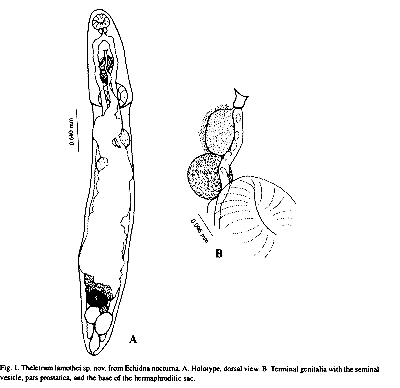
<body><![CDATA[<BR><FONT FACE="Arial,Helvetica"><FONT SIZE=-1>&nbsp; 1&nbsp;&nbsp;&nbsp;&nbsp;&nbsp;&nbsp;&nbsp;&nbsp;&nbsp;&nbsp;&nbsp; Eucinostomus currani Yanez-Aranciba, 1978&nbsp;&nbsp;&nbsp;&nbsp;&nbsp; 1&nbsp;&nbsp;&nbsp;&nbsp;&nbsp;&nbsp;&nbsp; S tegastes acapulcoensis (Fowler, 1944)</FONT></FONT>     <BR>&nbsp;     <BR>&nbsp;     <CENTER></CENTER>      <CENTER><B><FONT FACE="Arial,Helvetica"><FONT SIZE=-1>Digenea Van Beneden, 1858</FONT></FONT></B></CENTER>      <CENTER><FONT FACE="Arial,Helvetica"><FONT SIZE=-1>Familia Hemuiridae Looss 1907</FONT></FONT></CENTER>      <CENTER><B><FONT FACE="Arial,Helvetica"><FONT SIZE=-1><U>Theletrum lamothei </U>sp. nov.</FONT></FONT></B></CENTER>      <CENTER><FONT FACE="Arial,Helvetica"><FONT SIZE=-1>(<A HREF="#figura 1">Figs. 1A, 1B</A>)</FONT></FONT></CENTER>       <P><FONT FACE="Arial,Helvetica"><FONT SIZE=-1>Description (based on nine specimens): Body elongate, smooth, 3.85 (2.61-5.40) long to 0.57 (0.42-0.65) wide at the level of acetabulum. Complete circular postacetabular ridge present. Tegument not serrated and tail appendage absent. Oral sucker subterminal, 0.22 (0.17-0.27) long by 0.24 (0.19-0.28) wide. Preoral lobe present. Acetabulum 0.39 (0.31-0.45) long and 0.39 (0.27-0.47) wide, and located in anterior one-third of body. Ratio of length of oral sucker to length of acetabulum 1: 1.77 (1.43-1.99). Pharynx subspherical, 0.10 (0.08-0.14) long by 0.12 (0.11-0.14) wide. Esophagus very short. Intestinal cecae extending almost to posterior end of body.</FONT></FONT>     <BR>&nbsp;     ]]></body>
<body><![CDATA[<CENTER></CENTER>      <CENTER><A NAME="figura 1"></A><IMG SRC="/img/fbpe/rbt/v46n2/0169i01.GIF" HEIGHT=388 WIDTH=400></CENTER>       
<P><FONT FACE="Arial,Helvetica"><FONT SIZE=-1>Fig. 1. Theletrum lamothei sp. nov. from Echidna nocturna. A. Holotype, dorsal view. B. Genitalia terminal showing the seminal vesicle, pars prostatica, and the base of the hermaphroditic sac.</FONT></FONT>     <BR>&nbsp;      <P><FONT FACE="Arial,Helvetica"><FONT SIZE=-1>Testes subspherical, oblique, and postacetabular. Anterior testis 0.24 (0.12-0.34) long by 0.23 (0.17-0.29) wide; posterior testis 0.28 (0.22-0.34) long by 0.28 (0.22-0.32) wide. Seminal vesicle saccate, overlapping anterior border of acetabulum; vesicle 0.21 (0.13-0.32) long by 0.15 (0.11-0.19) wide. Pars prostatica vesicular, 0.23 (0.16-0.35) long by 0.16 (0.11-0.22) wide, surrounded by numerous glandular cells. Hermaphroditic sac membranous, indistinct, and cylindrical; 0.05 (0.04-0.05) long by 0.04 (0.03-0.07) wide. Copulatory organ absent. Genital pore postbifurcal.</FONT></FONT>      <P><FONT FACE="Arial,Helvetica"><FONT SIZE=-1>Ovary subspherical, located near posterior end of body; ovary 0.23 (0.15-0.29) long by 0.29 (0.26-0.35) wide. Vitelline glands forming two compact, oblique, postovarian masses; borders generally smooth, slightly lobate in some specimens. Vitellaria on left side 0.32 (0.23-0.36) long by 0.22 (0.18-0.27) wide; on right side 0.31 (0.22-0.56) long by 0.23 (0.17-0.29) wide. Juel's organ situated between vitelline glands and ovary. Uterine seminal receptacle present. Uterus entirely preovarian, opening at base of hermaphroditic sac. Eggs 32.15&micro;m (32-35&micro;m) long and 15.67&micro;m (13-19&micro;m) wide. Excretory vesicle "Y" shaped, excretory stem bulbous; excretory pore wide, terminal.</FONT></FONT>      <P><FONT FACE="Arial,Helvetica"><FONT SIZE=-1><B>Type-Host: </B><I>Echidna nocturna</I> (Cope, 1872)</FONT></FONT>     <BR><FONT FACE="Arial,Helvetica"><FONT SIZE=-1>(Muraenidae)</FONT></FONT>     <BR><FONT FACE="Arial,Helvetica"><FONT SIZE=-1><B>Site of infection:</B> Intestine</FONT></FONT>     <BR><FONT FACE="Arial,Helvetica"><FONT SIZE=-1><B>Type- Locality: </B>Playa Cuajiniquil, Golfo</FONT></FONT>     ]]></body>
<body><![CDATA[<BR><FONT FACE="Arial,Helvetica"><FONT SIZE=-1>Santa Elena, Guanacaste Province (10&deg;, 57' N, 85&deg;, 38' W)</FONT></FONT>     <BR><FONT FACE="Arial,Helvetica"><FONT SIZE=-1><B>Specimens deposited: </B>Holotype: CNHE No. 3179. Paratypes: CNHE No. 3180; USNPC No. 87581.</FONT></FONT>     <BR><FONT FACE="Arial,Helvetica"><FONT SIZE=-1><B>Etymology:</B> This species is named in honor of Dr. Rafael Lamothe Argumedo, who, as a collaborator with costarican parasitologists, has contributed much to the knowledge of helminth diversity of Costa Rica.</FONT></FONT>      <P><FONT FACE="Arial,Helvetica"><FONT SIZE=-1><B>Remarks: </B>The genus <I>Theletrum</I> was originally established to include T. <I>fustiforme</I> (<A HREF="#Linton,">Linton 1910</A>). Three additional species, T. <I>frontilatus </I>Manter 1969, a parasite of <I>Siganus rivulatus </I>Forskal in Moreton Bay, Queensland, Australia (subsequently allocated by <A HREF="#Yamaguti, S.">Yamaguti (1971</A>) to<I> Hysterolecithoides </I>Yamaguti, 1934), T. <I>gravida</I> <A HREF="#Manter, H.W.">Manter 1940 </A>in <I>Abudefduf saxatilis</I> Linnaeus from the Pacific coast of Mexico, and T.<I> magnasaccus</I> Sogandares-Bernal and Sogandares 1961, a parasite of A. <I>saxatilis </I>in the Atlantic coast of Panama (both later transferred by <A HREF="#Yamaguti, S.">Yamaguti (1971)</A> to genus <I>Genolinea </I>Manter 1925), were added later. <A HREF="#Gibson,">Gibson &amp; Bray (1979) </A>erected <I>Neotheletrum </I>for the latter 3 species, making <I>Theletrum </I>monotypic. Both T. <I>lamothei,</I> and the type species, have a preoral lobe and a postacetabular ridge in the tegument, as well as possessing a uterine seminal receptacle and a Juel's organ. In <A HREF="#Linton,">Linton's (1910)</A> original description of T. <I>fustiforme,</I> a seminal receptacle is mentioned, however, after examination of the original type specimens and vouchers (USNPC 8500, 39392; HWML 473, 124642), we agree with <A HREF="#Gibson,">Gibson &amp; Bray (1979)</A> that this structure is absent. The new species differs from T. <I>fustiforme</I> in the shape of the pars prostatica because, in the new species, it forms a subspherical vesicle, while in T. <I>fustiforme</I>, it is elongate. Furthermore, the two species differ in the shape of the seminal vesicle; in T. <I>lamothei</I> sp. nov. the vesicle is subspherical and only extends to the anterior border of the acetabulum, but in T. <I>fustiforme </I>it is elongate, sinuous, and extends posteriorly beyond the anterior border of the acetabulum, and the hermaphroditic sac is less developed in the new species than in T. <I>fustiforme.</I> Additionally, the new species differs from T. <I>fustiforme</I> by having a larger body size (2.6-5.4 x 0.42-0.65 vs. 1.47-1.82 x 0.35, respectively), as well as in the dimensions of suckers, testes, and ovary. The current study represents the first report of a member of this genus from the Pacific coast of Central America; T.<I> fustiforme </I>is only known from the Gulf of Mexico and the Caribbean Sea.</FONT></FONT>     <CENTER><B><FONT FACE="Arial,Helvetica"><FONT SIZE=-1>&nbsp;</FONT></FONT></B></CENTER>      <CENTER><B><FONT FACE="Arial,Helvetica"><FONT SIZE=-1>&nbsp;Larval Didymozoid (Didymozoinae Poche</FONT></FONT></B></CENTER>      <CENTER><B><FONT FACE="Arial,Helvetica"><FONT SIZE=-1>1907) not identified</FONT></FONT></B></CENTER>      <CENTER><FONT FACE="Arial,Helvetica"><FONT SIZE=-1>(Metacercariae)</FONT></FONT></CENTER>       <P><FONT FACE="Arial,Helvetica"><FONT SIZE=-1>Seven metacercariae were collected with morphometric characteristics consistent with those described in marine fishes from Australia as "species 5" by <A HREF="#KØie,">K&oslash;ie &amp; Lester (1985)</A>. <A HREF="#León-Règagnon">Le&ograve;n-R&egrave;gagnon et al. (1997</A>) recorded this didimozoinid metacercariae in 14 fish species from Chamela Bay, Mexico. They found a higher prevalence and abundance in fishes from the Haemulidae. Our results are in accordance with their findings in that we collected these specimens from <I>Haemulon maculicauda</I> Gill 1963. Taxonomic identification at the species level was not possible because specimens were collected as larval stages; adult didimozoinids are parasites in gills of larger size fishes (<A HREF="#Yamaguti, S.">Yamaguti 1971</A>).</FONT></FONT>      <P><FONT FACE="Arial,Helvetica"><FONT SIZE=-1><B>Host:</B> Haemulon maculicauda Gill 1963 (Haemulidae)</FONT></FONT>     ]]></body>
<body><![CDATA[<BR><FONT FACE="Arial,Helvetica"><FONT SIZE=-1><B>Site:</B> gills</FONT></FONT>     <BR><FONT FACE="Arial,Helvetica"><FONT SIZE=-1><B>Locality: </B>Playa Hermosa, Bah&iacute;a Culebra (10&deg;, 38' N, 85&deg;, 38' W)</FONT></FONT>     <BR><FONT FACE="Arial,Helvetica"><FONT SIZE=-1><B>Specimens deposited:</B> CNHE: 3182 (9 specimens)</FONT></FONT>     <CENTER>&nbsp;</CENTER>      <CENTER><B><FONT FACE="Arial,Helvetica"><FONT SIZE=-1><I>Ectenurus virgulus </I><A HREF="#Linton,">Linton 1910</A></FONT></FONT></B></CENTER>       <P><FONT FACE="Arial,Helvetica"><FONT SIZE=-1>We found a single specimen of E. <I>virgulus.</I> This species differs from the only other member of the genus in the Americas, E. <I>americanus</I> (Manter 1947) Manter &amp; Pritchard 1960, by having the suckers located further apart and by having a smaller acetabulum than the other species. Ectenurus virgulus is not highly host specific, having been reported as a parasite of 12 genera of fishes, representing 6 different families. This species has been reported from the Gulf of Mexico, Caribbean Sea, and the Pacific coast of Mexico (Yamaguti 1971, Lamothe et al. 1997, Le&oacute;n-R&egrave;gagnon et al. 1997). The current study is the second report of this digenean from Pacific Ocean, and represents a new host and locality record.</FONT></FONT>      <P><FONT FACE="Arial,Helvetica"><FONT SIZE=-1><B>Host:</B> Fistularia commersonii Ruppell 1835 (Fistularidae</FONT></FONT>     <BR><FONT FACE="Arial,Helvetica"><FONT SIZE=-1><B>Site</B>: Intestine.</FONT></FONT>     <BR><FONT FACE="Arial,Helvetica"><FONT SIZE=-1><B>Locality:</B> Playa Ocotal, Guanacaste Province (10&deg;, 32' N, 85&deg;, 44'&nbsp; W)</FONT></FONT>     <BR><FONT FACE="Arial,Helvetica"><FONT SIZE=-1><B>Specimens deposited: </B>CNHE: 3183 (1 specimen)</FONT></FONT>     ]]></body>
<body><![CDATA[<CENTER><B><FONT FACE="Arial,Helvetica"><FONT SIZE=-1>&nbsp;</FONT></FONT></B></CENTER>      <CENTER><B><FONT FACE="Arial,Helvetica"><FONT SIZE=-1>&nbsp;Lecithochirium microstomum Chandler</FONT></FONT></B></CENTER>      <CENTER><B><FONT FACE="Arial,Helvetica"><FONT SIZE=-1>1935</FONT></FONT></B></CENTER>       <P><FONT FACE="Arial,Helvetica"><FONT SIZE=-1>One specimen from the intestine of Fistularia commersonii was identified as L. microstomum. This species is widely spread in tropical and subtropical Atlantic and Pacific oceans around the world, and exhibits a low host specificity because it has been found in many host species from different families. The record of L. microstomum in a fistularid from Costa Rica confirms this low host specificity.</FONT></FONT>      <P><FONT FACE="Arial,Helvetica"><FONT SIZE=-1><B>Host</B>: Fistularia commersonii (Fistularidae)</FONT></FONT>     <BR><FONT FACE="Arial,Helvetica"><FONT SIZE=-1><B>Site:</B> Intestine</FONT></FONT>     <BR><FONT FACE="Arial,Helvetica"><FONT SIZE=-1><B>Locality:</B> Playa Ocotal, Guanacaste Province (10&deg;, 32' N, 85&deg;, 44' W).</FONT></FONT>     <BR><FONT FACE="Arial,Helvetica"><FONT SIZE=-1><B>Specimens deposited: </B>CNHE: 3175 (1 specimen)</FONT></FONT>     <BR>&nbsp;     <CENTER><B><FONT FACE="Arial,Helvetica"><FONT SIZE=-1>Pseudolecithaster sp.</FONT></FONT></B></CENTER>       ]]></body>
<body><![CDATA[<P><FONT FACE="Arial,Helvetica"><FONT SIZE=-1>This genus includes 2 species. The type species, P. antimorae, was described from the Western North Atlantic by Campbell and Munroe (1977). Pseudolecithaster alocytii (Tkachuk 1979) Aleshkina &amp; Gaevskaja 1985 has been recorded from the Indian Ocean, Australia, New Zealand and the Atlantic coast of Africa (Tkachuk 1979, Korotaeva 1983, Aleshkina &amp; Gaevskaya 1985). The single specimen we collected differs from both species in the shape of the ovary, which is multilobed in those species and spherical with smooth borders in our specimen. The vitelline lobes are also different in the specimen from Costa Rica, being almost spherical, in contrast with the other species, in which they are elongate. The terminal genitalia, which is of great taxonomic value, cannot be observed with detail in our specimen.</FONT></FONT>      <P><FONT FACE="Arial,Helvetica"><FONT SIZE=-1>This differences and the geographical distribution make us believe that we are dealing with an undescribed species, but the lack of additional material does not permit a description in this study.</FONT></FONT>     <BR><FONT FACE="Arial,Helvetica"><FONT SIZE=-1><B>Host:</B> Echidna nocturna (Cope, 1872) (Muraenidae)</FONT></FONT>     <BR><FONT FACE="Arial,Helvetica"><FONT SIZE=-1><B>Site:</B> Intestine</FONT></FONT>     <BR><FONT FACE="Arial,Helvetica"><FONT SIZE=-1><B>Locality: </B>Playa Cuajiniquil, Golfo Santa Elena, Guanacaste Province (10&deg;, 57' N, 85&deg;, 38' W)</FONT></FONT>     <BR><FONT FACE="Arial,Helvetica"><FONT SIZE=-1><B>Specimens deposited: </B>CNHE: 3176 (1 specimen)</FONT></FONT>     <BR>&nbsp;     <CENTER><FONT FACE="Arial,Helvetica"><FONT SIZE=-1>Family Lepocreadiidae (Odhner 1905) Nicoll</FONT></FONT></CENTER>      <CENTER><FONT FACE="Arial,Helvetica"><FONT SIZE=-1>1935</FONT></FONT></CENTER>      <CENTER><B><FONT FACE="Arial,Helvetica"><FONT SIZE=-1>Bianium simonei (Travassos, Freitas and</FONT></FONT></B></CENTER>      ]]></body>
<body><![CDATA[<CENTER><B><FONT FACE="Arial,Helvetica"><FONT SIZE=-1>Buhrnheim, 1965) Yamaguti, 1971</FONT></FONT></B></CENTER>       <P><FONT FACE="Arial,Helvetica"><FONT SIZE=-1>Eight digeneans were identified as B. simonei, a species previously described as parasite of Spheroides testudineus Linnaeus from Brazil (Yamaguti 1971). This species was originally allocated to genus Amarocotyle Travassos, Freitas and Buhrnheim, 1965 but transferred to Bianium by Yamaguti (1971) based on the examination of the type material. The present constitutes a new host and locality record.</FONT></FONT>     <BR><FONT FACE="Arial,Helvetica"><FONT SIZE=-1><B>Host:</B> Arothron hispidus (Linnaeus, 1758) (Tetraodontidae)</FONT></FONT>     <BR><FONT FACE="Arial,Helvetica"><FONT SIZE=-1><B>Site: </B>Intestine</FONT></FONT>     <BR><FONT FACE="Arial,Helvetica"><FONT SIZE=-1><B>Locality: </B>Playa Nacascolo, Bah&iacute;a Prieta, Lim&oacute;n Province (10&deg;, 38' N, 85&deg;, 38'&nbsp; W)</FONT></FONT>     <BR><FONT FACE="Arial,Helvetica"><FONT SIZE=-1><B>Specimens deposited:</B> CNHE: 3181 (8 specimens).</FONT></FONT>     <CENTER>&nbsp;</CENTER>      <CENTER><B><FONT FACE="Arial,Helvetica"><FONT SIZE=-1>Hypocreadium myohelicatum Bravo and</FONT></FONT></B></CENTER>      <CENTER><B><FONT FACE="Arial,Helvetica"><FONT SIZE=-1>Manter 1957</FONT></FONT></B></CENTER>       <P><FONT FACE="Arial,Helvetica"><FONT SIZE=-1>Twenty specimens were collected from the intestine of Epinephelus itajara Lichtenstein 1822 and identified as Hypocreadium myohelicatum. Taxonomy of this group of digeneans has been controversial; Manter (1940) and Nahhas &amp; Cable (1964) considered genus Hypocreadium Ozaki 1936 a synonym of Pseudocreadium Layman 1930. Yamaguti (1971) consider them as independent genera and, in this work, we follow Yamaguti's criteria. This species was originally described from the Pacific coast of Mexico, in Puerto Vallarta, Jalisco, as parasite of Balistes capistratus (= B. polylepis Steindachner 1876) by Bravo &amp; Manter (1957); later, Ponciano (1986) reported H. myohelicatum from Trachinotus rhodopus Gill in Puerto Angel, Oaxaca. In this work, we present a new host and locality record for H. myohelicatum.</FONT></FONT>     ]]></body>
<body><![CDATA[<BR><FONT FACE="Arial,Helvetica"><FONT SIZE=-1><B>Host: </B>Epinephelus itajara Lichtenstein 1822 (Serranidae)</FONT></FONT>     <BR><FONT FACE="Arial,Helvetica"><FONT SIZE=-1><B>Site: </B>Intestine.</FONT></FONT>     <BR><FONT FACE="Arial,Helvetica"><FONT SIZE=-1><B>Locality:</B> Playa Cuajiniquil, Golfo Santa Elena, Guanacaste Province (10&deg;, 57' N, 85&deg;, 38' W)</FONT></FONT>     <BR><FONT FACE="Arial,Helvetica"><FONT SIZE=-1><B>Specimens deposited:</B> CNHE: 3174 (18 specimens)</FONT></FONT>     <CENTER>&nbsp;</CENTER>      <CENTER><FONT FACE="Arial,Helvetica"><FONT SIZE=-1>Family Acanthocoplidae L&uuml;he 1909</FONT></FONT></CENTER>      <CENTER><B><FONT FACE="Arial,Helvetica"><FONT SIZE=-1>Stephanostomum casum (Linton 1910)</FONT></FONT></B></CENTER>      <CENTER><B><FONT FACE="Arial,Helvetica"><FONT SIZE=-1>McFarlane 1934</FONT></FONT></B></CENTER>       <P><FONT FACE="Arial,Helvetica"><FONT SIZE=-1>One specimen of S. casum was identified based on body form, sucker ratio, anterior extent of the vitellaria, extent of the cirrus sac, and the presence of 36 oral spines. However, we could not observe the uroproct, which is characteristic of this species. This species was originally described by Linton (1910) from the intestine of Lutjanus griseus Linnaeus 1758 from Tortugas, Florida. In the Pacific coasts, it was recorded by Manter (1940) in L. viridis Valenciennes 1845 from Galapagos Islands, Ecuador, and in L. jordani Gilbert 1897 from Secas Islands, Panama, and finally, from L. novemfasciatus Gill 1862 from Oaxaca, Mexico. The present constitutes a new host and locality record.</FONT></FONT>      <P><FONT FACE="Arial,Helvetica"><FONT SIZE=-1><B>Host: </B>Caranx caballus G&uuml;nther 1869 (Carangidae)</FONT></FONT>     ]]></body>
<body><![CDATA[<BR><FONT FACE="Arial,Helvetica"><FONT SIZE=-1><B>Site: </B>Intestine</FONT></FONT>     <BR><FONT FACE="Arial,Helvetica"><FONT SIZE=-1><B>Locality: </B>Playa Ocotal, Guanacaste Province (10&deg;, 32' N, 85&deg;, 44'&nbsp; W)</FONT></FONT>     <BR><FONT FACE="Arial,Helvetica"><FONT SIZE=-1><B>Specimens deposited: </B>CNHE: 3177 (1 specimen)</FONT></FONT>     <CENTER>&nbsp;</CENTER>      <CENTER><FONT FACE="Arial,Helvetica"><FONT SIZE=-1>Family Fellodistomidae Nicoll 1913</FONT></FONT></CENTER>      <CENTER><B><FONT FACE="Arial,Helvetica"><FONT SIZE=-1>Tergestia laticollis (Rudolphi, 1819)</FONT></FONT></B></CENTER>      <CENTER><B><FONT FACE="Arial,Helvetica"><FONT SIZE=-1>Stossich, 1899</FONT></FONT></B></CENTER>       <P><FONT FACE="Arial,Helvetica"><FONT SIZE=-1>Two specimens were identified as T. laticollis based on the shape and dimensions of the body, the number of cervical folds and by the presence of a semicircle of lanceolate muscular lobes around the oral sucker. This digenean was previously recorded from the Pacific coast of Costa Rica by Manter (1940) as a parasite of Caranx caballus G&uuml;nther 1864. However, this species exhibits a wide geographical distribution and low host specificity at the species level because it has been reported from 14 different fish species, mainly from Carangidae and Scombridae (Yamaguti 1971). Additional records of T. laticollis in the Pacific coast include those made by Ponciano (1986) and Castillo et al. (in press) from Caranx hippos Linnaeus 1758 from Puerto Angel, Oaxaca, and from Euthynnus lineatus Kishinouye from Chamela Bay, Jalisco, M&eacute;xico, respectively.</FONT></FONT>      <P><FONT FACE="Arial,Helvetica"><FONT SIZE=-1><B>Host: </B>Caranx caballus G&uuml;nther 1869 (Carangidae)</FONT></FONT>     <BR><FONT FACE="Arial,Helvetica"><FONT SIZE=-1><B>Site:</B> Intestine</FONT></FONT>     ]]></body>
<body><![CDATA[<BR><FONT FACE="Arial,Helvetica"><FONT SIZE=-1><B>Locality:</B> Playa Ocotal, Guanacaste Province (10&deg;, 32' N, 85&deg;, 44'&nbsp; W)</FONT></FONT>     <BR><FONT FACE="Arial,Helvetica"><FONT SIZE=-1><B>Specimens deposited: </B>CNHE: 3178 (2 specimens)</FONT></FONT>     <BR>&nbsp;      <P><B><FONT FACE="Arial,Helvetica"><FONT SIZE=-1>Discussion</FONT></FONT></B>      <P><FONT FACE="Arial,Helvetica"><FONT SIZE=-1>In this study, we report 9 species of digenean parasites of marine fishes of Costa Rica from 6 species of hosts, to increase the total number of species reported to 34. By comparison, we have recorded 148 species of helminth parasites from 98 species of fish from the Pacific coast of M&eacute;xico; these data were collected as a result of isolated studies that began in the 1940's and continue to this date (Lamothe et al. 1997). Clearly, we are still in the beginning stages of a complete understanding of the biodiversity of helminth parasites of the fishes of Costa Rica.</FONT></FONT>      <P><FONT FACE="Arial,Helvetica"><FONT SIZE=-1>It is interesting to compare the results of the current study with those from fishes collected from Chamela Bay, Jalisco, M&eacute;xico. This locality represents the northernmost extent of the dominant marine currents found in Costa Rican waters. The warm Costanera current begins near the equator, and near Chamela Bay, mixes with the cold California current (Wyrtky 1965 in Pacheco 1991). The sharing of numerous species of parasites of fishes from Costa Rica with fishes from the Pacific Coast of M&eacute;xico may be, in part, a result of these north-flowing currents from Costa Rica. Among others, the presence of the digeneans Tergestia laticollis (Castillo et al. 1997), and Lecithochirium microstomum (Le&oacute;n-R&egrave;gagnon et al. 1997), the acanthocephalan Koronacantha pectinaria (Monks et al. 1997), and the nematode Echinocephalus janzeni (Hoberg et al in press) may be either the result of migration patterns of the definitive hosts or the result of passive transport of intermediate hosts by marine currents.</FONT></FONT>      <P><FONT FACE="Arial,Helvetica"><FONT SIZE=-1>Despite the scarcity of surveys of helminths from marine fishes of Costa Rica, the proportions of each group in our study is relatively consistent with surveys of marine fishes from other localities. In our study, digeneans are the most common group (54.3%), and of these, 31.6% represent the order Hemiuriformes. This is consistent with studies of the digenean fauna of marine fishes from various other localities (Manter 1940, Nahhas &amp; Cable 1964, Overstreet 1969, Le&oacute;n-R&egrave;gagnon et al. 1997).</FONT></FONT>      <P><FONT FACE="Arial,Helvetica"><FONT SIZE=-1>Marine fishes constitute an important resource group, both as a feature of ecotourism and as a food source, so they should be considered an essential feature of initiatives for preservation and sustainable use of biodiversity. Just as with any other type of wildlife, fishes are susceptible to damage caused by parasites, and information about host-parasite relationships is essential to wise management. Thus, knowledge of the parasite fauna should be an integral part of any biodiversity inventory. Fishes are an important source of animal protein for human consumption, and the impact of parasites on fish populations, especially those maintained for aquacultural purposes, is well documented (Williams &amp; Jones 1994, Rohde 1993). In addition, the potential risk of transmission of zoonotic diseases, such as anisakiasis (Sakanari 1990) through the consumption of parasitized fish, could cause public health problems (Williams &amp; Jones 1994). In conclusion, we would like to highlight the importance making a biodiversity inventory that includes not only animals and plants that are attractive and charismatic, but also those organisms that live in close association with them, and which, at some critical moment, may alter survival rates, and in this way, break the delicate balance of the ecosystem.</FONT></FONT>     <BR>&nbsp;     <BR>&nbsp;      ]]></body>
<body><![CDATA[<P><B><FONT FACE="Arial,Helvetica"><FONT SIZE=-1>Acknowledgements</FONT></FONT></B>      <P><FONT FACE="Arial,Helvetica"><FONT SIZE=-1>We gratefully acknowledge the help of Instituto Nacional de Biodiversidad (INBio) for the kind use of their facilities, collecting permits and technical support in collecting hosts. Some of these hosts were collected while we were participating in an INBio training course in Vertebrate Parasitology for Parataxonomists at the Guanacaste Conservation Area in February, 1996; we appreciate the help and interest of the Parataxonomists involved in this training course. We also thank Helena Molina, Escuela de Biolog&iacute;a, Universidad de Costa Rica for her support to obtain and identify fishes, and Greg Klassen (Tau Biodiversity, N.B., Canada) and Fernando Marques (University of Toronto) for assistance in the field. We also thank Ralph Lichtenfels, curator of the USNPC and Scott Gardner, curator of HWML for the loan of specimens of Theletrum fustiforme. This study was partially funded by operating grant No. A7696 from the Natural Sciences and Engineering Council (NSERC) of Canada to Daniel R. Brooks, and travel expenses from INBio to GPPdL.</FONT></FONT>     <BR>&nbsp;     <BR>&nbsp;      <P><B><FONT FACE="Arial,Helvetica"><FONT SIZE=-1>Resumen</FONT></FONT></B>      <P><FONT FACE="Arial,Helvetica"><FONT SIZE=-1>Se describe una especie nueva de dig&eacute;neo del g&eacute;nero Theletrum, par&aacute;sito del intestino de una "morena pecosa", Echidna nocturna, recolectada en Playa Cuajiniquil, Provincia de Guanacaste, Costa Rica. La nueva especie es diferente de T. fustiforme Linton, 1910, la especie tipo, por presentar una pars prostatica subesf&eacute;rica, una ves&iacute;cula seminal subesf&eacute;rica que se extiende hasta el borde anterior del acet&aacute;bulo, por la presencia de un saco hermafrodita y por una mayor longitud del cuerpo. Tambi&eacute;n se registran ocho especies adicionales de dig&eacute;neos par&aacute;sitos de peces marinos en varias localidades de las costas del Atl&aacute;ntico y del Pac&iacute;fico de Costa Rica. Por &uacute;ltimo, presentamos una lista actualizada de los helmintos par&aacute;sitos de peces marinos y dulceacu&iacute;colas de Costa Rica y discutimos la importancia de incluir a los par&aacute;sitos como una parte integral de las investigaciones sobre biodiversidad.</FONT></FONT>     <BR>&nbsp;      <P><B><FONT FACE="Arial,Helvetica"><FONT SIZE=-1>References</FONT></FONT></B>      <!-- ref --><P><A NAME="Aleshkina,"></A><FONT FACE="Arial,Helvetica"><FONT SIZE=-1>Aleshkina, L.D. &amp; A. Gaevskaja. 1985. Trematodes of fish of the Atlantic coast of Africa (in Russian. Biologicheskie Nauki (Moscow). 8: 35-40.</FONT></FONT>    &nbsp;&nbsp;&nbsp;&nbsp;&nbsp;&nbsp;&nbsp;&nbsp;[&#160;<a href="javascript:void(0);" onclick="javascript: window.open('/scielo.php?script=sci_nlinks&ref=1133443&pid=S0034-7744199800020001800001&lng=','','width=640,height=500,resizable=yes,scrollbars=1,menubar=yes,');">Links</a>&#160;]<!-- end-ref --><!-- ref --><P><A NAME="Bravo,62a"></A><FONT FACE="Arial,Helvetica"><FONT SIZE=-1>Bravo, H.M. &amp; G. Arroyo. 1962a. Trem&aacute;todos de Peces de Costa Rica. I. Sobre dos especies del g&eacute;nero Crassicutis Manter, 1936 (Lepocreadiidae Nicoll, 1914) del Intestine de Cichlasoma sp. Rev. Biol. Trop. 10: 229-235.</FONT></FONT>    &nbsp;&nbsp;&nbsp;&nbsp;&nbsp;&nbsp;&nbsp;&nbsp;[&#160;<a href="javascript:void(0);" onclick="javascript: window.open('/scielo.php?script=sci_nlinks&ref=1133444&pid=S0034-7744199800020001800002&lng=','','width=640,height=500,resizable=yes,scrollbars=1,menubar=yes,');">Links</a>&#160;]<!-- end-ref --><!-- ref --><P><A NAME="Bravo,62b"></A><FONT FACE="Arial,Helvetica"><FONT SIZE=-1>Bravo, H.M. &amp; G. Arroyo. 1962b. Helmintos de Peces Costarricenses del Pac&iacute;fico. Anales Inst. Biol. Univ. Nal. Aut&oacute;n. M&eacute;x. Ser. Zool. 33: 79-95.</FONT></FONT>    &nbsp;&nbsp;&nbsp;&nbsp;&nbsp;&nbsp;&nbsp;&nbsp;[&#160;<a href="javascript:void(0);" onclick="javascript: window.open('/scielo.php?script=sci_nlinks&ref=1133445&pid=S0034-7744199800020001800003&lng=','','width=640,height=500,resizable=yes,scrollbars=1,menubar=yes,');">Links</a>&#160;]<!-- end-ref --><!-- ref --><P><A NAME="Bravo,57"></A><FONT FACE="Arial,Helvetica"><FONT SIZE=-1>Bravo, H.M. &amp; H.W. Manter. 1957. Trematodes of marine fishes from Mexican waters. X. Proc. Helminthol. Soc. Wash. 24: 35-43.</FONT></FONT>    &nbsp;&nbsp;&nbsp;&nbsp;&nbsp;&nbsp;&nbsp;&nbsp;[&#160;<a href="javascript:void(0);" onclick="javascript: window.open('/scielo.php?script=sci_nlinks&ref=1133446&pid=S0034-7744199800020001800004&lng=','','width=640,height=500,resizable=yes,scrollbars=1,menubar=yes,');">Links</a>&#160;]<!-- end-ref --><!-- ref --><P><A NAME="Brooks,"></A><FONT FACE="Arial,Helvetica"><FONT SIZE=-1>Brooks, D.R. &amp; S. McCorquodale. 1995. Acanthobothrium nicoyaense n. sp. (Eucestoda: Tetraphyllidea: Onchobothriidae) in Aetobatus narinari (Euphrasen) (Chondrichthyes: Myliobatiformes: Myliobatidae) from the Gulf of Nicoya, Costa Rica. J. Parasitol. 81: 244-246.</FONT></FONT>    &nbsp;&nbsp;&nbsp;&nbsp;&nbsp;&nbsp;&nbsp;&nbsp;[&#160;<a href="javascript:void(0);" onclick="javascript: window.open('/scielo.php?script=sci_nlinks&ref=1133447&pid=S0034-7744199800020001800005&lng=','','width=640,height=500,resizable=yes,scrollbars=1,menubar=yes,');">Links</a>&#160;]<!-- end-ref --><!-- ref --><P><A NAME="Caballero,"></A><FONT FACE="Arial,Helvetica"><FONT SIZE=-1>Caballero, E. &amp; R. Brenes 1957. Helmintos de la Rep&uacute;blica de Costa Rica VI. Algunos trem&aacute;todos de peces, reptiles y mam&iacute;feros. Anales Inst. Biol. Univ. Nal. Aut&oacute;n. M&eacute;x. Ser. Zool. 28: 217-240.</FONT></FONT>    &nbsp;&nbsp;&nbsp;&nbsp;&nbsp;&nbsp;&nbsp;&nbsp;[&#160;<a href="javascript:void(0);" onclick="javascript: window.open('/scielo.php?script=sci_nlinks&ref=1133448&pid=S0034-7744199800020001800006&lng=','','width=640,height=500,resizable=yes,scrollbars=1,menubar=yes,');">Links</a>&#160;]<!-- end-ref --><!-- ref --><P><A NAME="Campbell,"></A><FONT FACE="Arial,Helvetica"><FONT SIZE=-1>Campbell, R.A. &amp; T.A. Munroe. 1977. New hemiurid trematodes from deep-sea benthic fishes in the western north Atlantic. J. Parasitol. 63: 285-294.</FONT></FONT>    &nbsp;&nbsp;&nbsp;&nbsp;&nbsp;&nbsp;&nbsp;&nbsp;[&#160;<a href="javascript:void(0);" onclick="javascript: window.open('/scielo.php?script=sci_nlinks&ref=1133449&pid=S0034-7744199800020001800007&lng=','','width=640,height=500,resizable=yes,scrollbars=1,menubar=yes,');">Links</a>&#160;]<!-- end-ref --><!-- ref --><P><A NAME="Castillo,"></A><FONT FACE="Arial,Helvetica"><FONT SIZE=-1>Castillo, S.E., L. Garc&iacute;a P. &amp; G. P&eacute;rez-Ponce de Le&oacute;n. 1997. Helmintofauna del "barrilete" Euthynnus lineatus de la Bah&iacute;a de Chamela, Jalisco, M&eacute;xico. Rev. Biol. Trop. 45 ( 3): 1251-1254.</FONT></FONT>    &nbsp;&nbsp;&nbsp;&nbsp;&nbsp;&nbsp;&nbsp;&nbsp;[&#160;<a href="javascript:void(0);" onclick="javascript: window.open('/scielo.php?script=sci_nlinks&ref=1133450&pid=S0034-7744199800020001800008&lng=','','width=640,height=500,resizable=yes,scrollbars=1,menubar=yes,');">Links</a>&#160;]<!-- end-ref --><!-- ref --><P><A NAME="Gibson,"></A><FONT FACE="Arial,Helvetica"><FONT SIZE=-1>Gibson, D.I. &amp; R.A. Bray. 1979. The Hemiuroidea: Terminology, Systematics and Evolution. Bull. Br. Nat. Hist. Mus. (Zool.) 36: 35-146.</FONT></FONT>    &nbsp;&nbsp;&nbsp;&nbsp;&nbsp;&nbsp;&nbsp;&nbsp;[&#160;<a href="javascript:void(0);" onclick="javascript: window.open('/scielo.php?script=sci_nlinks&ref=1133451&pid=S0034-7744199800020001800009&lng=','','width=640,height=500,resizable=yes,scrollbars=1,menubar=yes,');">Links</a>&#160;]<!-- end-ref --><!-- ref --><P><A NAME="Hoberg,"></A><FONT FACE="Arial,Helvetica"><FONT SIZE=-1>Hoberg, E., D.R. Brooks, H. Molina &amp; E. Erbe. 1998. Echinocephalus janzeni sp. n. (Nematoda: Gnathostomatidae) in Himantura pacifica (Chondrichthyes: Myliobatiformes) from the Pacific Coast of Costa Rica and Mexico, with historical biogeographic analysis of the genus. J. Parasitol. ( in press).</FONT></FONT>    &nbsp;&nbsp;&nbsp;&nbsp;&nbsp;&nbsp;&nbsp;&nbsp;[&#160;<a href="javascript:void(0);" onclick="javascript: window.open('/scielo.php?script=sci_nlinks&ref=1133452&pid=S0034-7744199800020001800010&lng=','','width=640,height=500,resizable=yes,scrollbars=1,menubar=yes,');">Links</a>&#160;]<!-- end-ref --><!-- ref --><P><A NAME="KØie,"></A><FONT FACE="Arial,Helvetica"><FONT SIZE=-1>K&Oslash;ie, M. &amp; R.J. Lester. 1985. Larval Didymozoids (Trematoda) in fishes from Moreton Bay, Australia. Proc.Helminthol.Soc.Wash. 52: 196-203.</FONT></FONT>    &nbsp;&nbsp;&nbsp;&nbsp;&nbsp;&nbsp;&nbsp;&nbsp;[&#160;<a href="javascript:void(0);" onclick="javascript: window.open('/scielo.php?script=sci_nlinks&ref=1133453&pid=S0034-7744199800020001800011&lng=','','width=640,height=500,resizable=yes,scrollbars=1,menubar=yes,');">Links</a>&#160;]<!-- end-ref --><!-- ref --><P><A NAME="Korotaeva,"></A><FONT FACE="Arial,Helvetica"><FONT SIZE=-1>Korotaeva, V.D. 1983. The trematode fauna of fishes of the order Zeiformes. (in Russian). Parazitologiya (Leningr.) 16: 464-468.</FONT></FONT>    &nbsp;&nbsp;&nbsp;&nbsp;&nbsp;&nbsp;&nbsp;&nbsp;[&#160;<a href="javascript:void(0);" onclick="javascript: window.open('/scielo.php?script=sci_nlinks&ref=1133454&pid=S0034-7744199800020001800012&lng=','','width=640,height=500,resizable=yes,scrollbars=1,menubar=yes,');">Links</a>&#160;]<!-- end-ref --><!-- ref --><P><A NAME="Lamothe,97"></A><FONT FACE="Arial,Helvetica"><FONT SIZE=-1>Lamothe, A.R., L. Garc&iacute;a P., D. Osorio S. &amp; G. P&eacute;rez-Ponce de Le&oacute;n. 1997. Cat&aacute;logo de la Colecci&oacute;n Nacional de Helmintos. Publicaci&oacute;n Especial. IBUNAM-CONABIO. M&eacute;xico. 271 p.</FONT></FONT>    &nbsp;&nbsp;&nbsp;&nbsp;&nbsp;&nbsp;&nbsp;&nbsp;[&#160;<a href="javascript:void(0);" onclick="javascript: window.open('/scielo.php?script=sci_nlinks&ref=1133455&pid=S0034-7744199800020001800013&lng=','','width=640,height=500,resizable=yes,scrollbars=1,menubar=yes,');">Links</a>&#160;]<!-- end-ref --><!-- ref --><P><A NAME="Lamothe98"></A><FONT FACE="Arial,Helvetica"><FONT SIZE=-1>Lamothe A.R., C. Aranda &amp; G. P&eacute;rez-Ponce de Le&oacute;n. 1998. Choricotyle leonilavazquezae n. sp. (Monogenea: Diclidophoridae) from Microlepidotus brevipinnis (Osteichthyes: Haemulidae) from Chamela Bay, M&eacute;xico. J. Helminthol. Soc. Wash. 65 ( 1): 24-30.</FONT></FONT>    &nbsp;&nbsp;&nbsp;&nbsp;&nbsp;&nbsp;&nbsp;&nbsp;[&#160;<a href="javascript:void(0);" onclick="javascript: window.open('/scielo.php?script=sci_nlinks&ref=1133456&pid=S0034-7744199800020001800014&lng=','','width=640,height=500,resizable=yes,scrollbars=1,menubar=yes,');">Links</a>&#160;]<!-- end-ref --><!-- ref --><P><A NAME="León-Règagnon"></A><FONT FACE="Arial,Helvetica"><FONT SIZE=-1>Le&oacute;n-R&egrave;gagnon, V., G. P&eacute;rez-Ponce de Le&oacute;n &amp; R. Lamothe. 1997. Hemiuriformes de peces marinos de la Bah&iacute;a de Chamela, M&eacute;xico con la descripci&oacute;n de una nueva especie del g&eacute;nero Hysterolecitha Linton, 1910 (Digenea: Hemiuridae: Lecithasterinae). An. Inst. Biol. Univ. Nal. Auton. M&eacute;xico. (Ser. Zool.) 68: 1-34.</FONT></FONT>    &nbsp;&nbsp;&nbsp;&nbsp;&nbsp;&nbsp;&nbsp;&nbsp;[&#160;<a href="javascript:void(0);" onclick="javascript: window.open('/scielo.php?script=sci_nlinks&ref=1133457&pid=S0034-7744199800020001800015&lng=','','width=640,height=500,resizable=yes,scrollbars=1,menubar=yes,');">Links</a>&#160;]<!-- end-ref --><!-- ref --><P><A NAME="Linton,"></A><FONT FACE="Arial,Helvetica"><FONT SIZE=-1> Linton, E. 1910. Helminth fauna of the Dry Tortugas. II. Trematodes. Carnegie Instit. Pub. 133: 11-98.</FONT></FONT>    &nbsp;&nbsp;&nbsp;&nbsp;&nbsp;&nbsp;&nbsp;&nbsp;[&#160;<a href="javascript:void(0);" onclick="javascript: window.open('/scielo.php?script=sci_nlinks&ref=1133458&pid=S0034-7744199800020001800016&lng=','','width=640,height=500,resizable=yes,scrollbars=1,menubar=yes,');">Links</a>&#160;]<!-- end-ref --><!-- ref --><P><A NAME="Manter, H.W."></A><FONT FACE="Arial,Helvetica"><FONT SIZE=-1>Manter, H.W. 1940. Digenetic trematodes of fishes from the Galapagos islands and the neighboring Pacific. Allan Hancock Pac. Exp. 2: 329-497.</FONT></FONT>    &nbsp;&nbsp;&nbsp;&nbsp;&nbsp;&nbsp;&nbsp;&nbsp;[&#160;<a href="javascript:void(0);" onclick="javascript: window.open('/scielo.php?script=sci_nlinks&ref=1133459&pid=S0034-7744199800020001800017&lng=','','width=640,height=500,resizable=yes,scrollbars=1,menubar=yes,');">Links</a>&#160;]<!-- end-ref --><!-- ref --><P><A NAME="Marques,95"></A><FONT FACE="Arial,Helvetica"><FONT SIZE=-1>Marques, F., D.R. Brooks &amp; S. Monks. 1995. Five new species of Acanthobothrium Beneden, 1849 (Eucestoda: Tetraphyllidea: Onchobothriidae) in stingrays from the Gulf of Nicoya, Costa Rica. J. Parasitol. 81: 942-951.</FONT></FONT>    &nbsp;&nbsp;&nbsp;&nbsp;&nbsp;&nbsp;&nbsp;&nbsp;[&#160;<a href="javascript:void(0);" onclick="javascript: window.open('/scielo.php?script=sci_nlinks&ref=1133460&pid=S0034-7744199800020001800018&lng=','','width=640,height=500,resizable=yes,scrollbars=1,menubar=yes,');">Links</a>&#160;]<!-- end-ref --><!-- ref --><P><A NAME="Marques, F.,96"></A><FONT FACE="Arial,Helvetica"><FONT SIZE=-1>Marques, F., D.R. Brooks &amp; H. Molina. 1996. Two new species of tetraphyllidean cestodes in Himantura pacifica (Chondrichthyes: Myliobatiformes: Dasyatidae) from the northwest coast of Costa Rica. J. Parasitol. 82: 302-306.</FONT></FONT>    &nbsp;&nbsp;&nbsp;&nbsp;&nbsp;&nbsp;&nbsp;&nbsp;[&#160;<a href="javascript:void(0);" onclick="javascript: window.open('/scielo.php?script=sci_nlinks&ref=1133461&pid=S0034-7744199800020001800019&lng=','','width=640,height=500,resizable=yes,scrollbars=1,menubar=yes,');">Links</a>&#160;]<!-- end-ref --><!-- ref --><P><A NAME="Monks, S.,"></A><FONT FACE="Arial,Helvetica"><FONT SIZE=-1>Monks, S., F. Marques, V. Le&oacute;n-R&egrave;gagnon &amp; G. P&eacute;rez-Ponce de Le&oacute;n. 1997. Koronacantha mexicana n. gen., n. sp. (Acanthocephala: Illiosentidae) from marine fishes in Chamela Bay, Jalisco, Mexico. J. Parasitol. 82: 788-792.</FONT></FONT>    &nbsp;&nbsp;&nbsp;&nbsp;&nbsp;&nbsp;&nbsp;&nbsp;[&#160;<a href="javascript:void(0);" onclick="javascript: window.open('/scielo.php?script=sci_nlinks&ref=1133462&pid=S0034-7744199800020001800020&lng=','','width=640,height=500,resizable=yes,scrollbars=1,menubar=yes,');">Links</a>&#160;]<!-- end-ref --><!-- ref --><P><A NAME="Nahhas,"></A><FONT FACE="Arial,Helvetica"><FONT SIZE=-1>Nahhas, F.M. &amp; R.M. Cable. 1964. Digenetic and aspidogastrid trematodes from marine fishes from Curacao and Jamaica. Tulane Stud. Zool. Bot. 11: 169-227.</FONT></FONT>    &nbsp;&nbsp;&nbsp;&nbsp;&nbsp;&nbsp;&nbsp;&nbsp;[&#160;<a href="javascript:void(0);" onclick="javascript: window.open('/scielo.php?script=sci_nlinks&ref=1133463&pid=S0034-7744199800020001800021&lng=','','width=640,height=500,resizable=yes,scrollbars=1,menubar=yes,');">Links</a>&#160;]<!-- end-ref --><!-- ref --><P><A NAME="Overstreet, R."></A><FONT FACE="Arial,Helvetica"><FONT SIZE=-1>Overstreet, R. 1969. Digenetic trematodes of marine telesot fishes from Biscayne Bay, Florida. Tulane Stud. Zool. Bot. 15: 119-176.</FONT></FONT>    &nbsp;&nbsp;&nbsp;&nbsp;&nbsp;&nbsp;&nbsp;&nbsp;[&#160;<a href="javascript:void(0);" onclick="javascript: window.open('/scielo.php?script=sci_nlinks&ref=1133464&pid=S0034-7744199800020001800022&lng=','','width=640,height=500,resizable=yes,scrollbars=1,menubar=yes,');">Links</a>&#160;]<!-- end-ref --><!-- ref --><P><A NAME="Pacheco, S."></A><FONT FACE="Arial,Helvetica"><FONT SIZE=-1>Pacheco, S. 1991. Oceanograf&iacute;a f&iacute;sica. Corrientes y circulaci&oacute;n, 68-81. In: Lanza, E. G. (comp.) Oceanograf&iacute;a de Mares Mexicanos. AGT Editor, M&eacute;xico, D.F.</FONT></FONT>    &nbsp;&nbsp;&nbsp;&nbsp;&nbsp;&nbsp;&nbsp;&nbsp;[&#160;<a href="javascript:void(0);" onclick="javascript: window.open('/scielo.php?script=sci_nlinks&ref=1133465&pid=S0034-7744199800020001800023&lng=','','width=640,height=500,resizable=yes,scrollbars=1,menubar=yes,');">Links</a>&#160;]<!-- end-ref --><!-- ref --><P><A NAME="Ponciano,"></A><FONT FACE="Arial,Helvetica"><FONT SIZE=-1>Ponciano, R.G. 1986. Estudio Taxon&oacute;mico de Trem&aacute;todos de Peces Marinos y Dulceacu&iacute;colas de M&eacute;xico y Am&eacute;rica Central. Tesis Profesional. Facultad de Ciencias. UNAM. M&eacute;xico 128 p.</FONT></FONT>    &nbsp;&nbsp;&nbsp;&nbsp;&nbsp;&nbsp;&nbsp;&nbsp;[&#160;<a href="javascript:void(0);" onclick="javascript: window.open('/scielo.php?script=sci_nlinks&ref=1133466&pid=S0034-7744199800020001800024&lng=','','width=640,height=500,resizable=yes,scrollbars=1,menubar=yes,');">Links</a>&#160;]<!-- end-ref --><!-- ref --><P><A NAME="Rohde, K."></A><FONT FACE="Arial,Helvetica"><FONT SIZE=-1>Rohde, K. 1993. Ecology of Marine Parasites. CAB International. Wallingford, Oxford, 298 p.</FONT></FONT>    &nbsp;&nbsp;&nbsp;&nbsp;&nbsp;&nbsp;&nbsp;&nbsp;[&#160;<a href="javascript:void(0);" onclick="javascript: window.open('/scielo.php?script=sci_nlinks&ref=1133467&pid=S0034-7744199800020001800025&lng=','','width=640,height=500,resizable=yes,scrollbars=1,menubar=yes,');">Links</a>&#160;]<!-- end-ref --><!-- ref --><P><A NAME="Sakanari,"></A><FONT FACE="Arial,Helvetica"><FONT SIZE=-1>Sakanari, J. A. 1990. Anisakis-from the platter to the Microfuge. Parasitol. Today 6: 323-327.</FONT></FONT>    &nbsp;&nbsp;&nbsp;&nbsp;&nbsp;&nbsp;&nbsp;&nbsp;[&#160;<a href="javascript:void(0);" onclick="javascript: window.open('/scielo.php?script=sci_nlinks&ref=1133468&pid=S0034-7744199800020001800026&lng=','','width=640,height=500,resizable=yes,scrollbars=1,menubar=yes,');">Links</a>&#160;]<!-- end-ref --><!-- ref --><P><A NAME="Tkachuk,"></A><FONT FACE="Arial,Helvetica"><FONT SIZE=-1>Tkachuk, L.P. 1979. New species of trematodes from the deepwater Zeidae of the Indian Ocean and Atlantic Ocean (in russian). Zool. Zh. 58: 1290-1295.</FONT></FONT>    &nbsp;&nbsp;&nbsp;&nbsp;&nbsp;&nbsp;&nbsp;&nbsp;[&#160;<a href="javascript:void(0);" onclick="javascript: window.open('/scielo.php?script=sci_nlinks&ref=1133469&pid=S0034-7744199800020001800027&lng=','','width=640,height=500,resizable=yes,scrollbars=1,menubar=yes,');">Links</a>&#160;]<!-- end-ref --><!-- ref --><P><A NAME="Van Cleave,"></A><FONT FACE="Arial,Helvetica"><FONT SIZE=-1>Van Cleave, H.J. 1940. The Acanthocephala collected by the Allan Hancock Pacific Expedition. Allan Hancock Foundation Publications, series 1. 2: 501-527.</FONT></FONT>    &nbsp;&nbsp;&nbsp;&nbsp;&nbsp;&nbsp;&nbsp;&nbsp;[&#160;<a href="javascript:void(0);" onclick="javascript: window.open('/scielo.php?script=sci_nlinks&ref=1133470&pid=S0034-7744199800020001800028&lng=','','width=640,height=500,resizable=yes,scrollbars=1,menubar=yes,');">Links</a>&#160;]<!-- end-ref --><!-- ref --><P><A NAME="Williams, H."></A><FONT FACE="Arial,Helvetica"><FONT SIZE=-1>Williams, H. &amp; A. Jones. 1994. Parasitic worms of fishes. Taylor and Francis, London. 593 p.</FONT></FONT>    &nbsp;&nbsp;&nbsp;&nbsp;&nbsp;&nbsp;&nbsp;&nbsp;[&#160;<a href="javascript:void(0);" onclick="javascript: window.open('/scielo.php?script=sci_nlinks&ref=1133471&pid=S0034-7744199800020001800029&lng=','','width=640,height=500,resizable=yes,scrollbars=1,menubar=yes,');">Links</a>&#160;]<!-- end-ref --><!-- ref --><P><A NAME="Yamaguti, S."></A><FONT FACE="Arial,Helvetica"><FONT SIZE=-1>Yamaguti, S. 1971. Synopsis of digenetic trematodes of vertebrates. Keigaku, Tokyo (Vols. I-II).</FONT></FONT>    &nbsp;&nbsp;&nbsp;&nbsp;&nbsp;&nbsp;&nbsp;&nbsp;[&#160;<a href="javascript:void(0);" onclick="javascript: window.open('/scielo.php?script=sci_nlinks&ref=1133472&pid=S0034-7744199800020001800030&lng=','','width=640,height=500,resizable=yes,scrollbars=1,menubar=yes,');">Links</a>&#160;]<!-- end-ref --><P><A NAME="1b"></A><SUP><FONT FACE="Arial,Helvetica"><FONT SIZE=-1><A HREF="#1">1</A> </FONT></FONT></SUP><FONT FACE="Arial,Helvetica"><FONT SIZE=-1>Laboratorio de Helmintolog&iacute;a, Instituto de Biolog&iacute;a U.N.A.M. Ap. Postal 70-153 C.P. 04510, M&eacute;xico D.F. email: <A HREF="mailto:ppdleon@servidor.unam.mx">ppdleon@servidor.unam.mx</A></FONT></FONT>      <P><A NAME="2a"></A><FONT FACE="Arial,Helvetica"><FONT SIZE=-1><SUP><A HREF="#2">2</A></SUP> Department of Zoology, University of Toronto, Toronto, Ontario 1A1 3G5, Canada.</FONT></FONT>     ]]></body>
<body><![CDATA[ ]]></body><back>
<ref-list>
<ref id="B1">
<nlm-citation citation-type="journal">
<person-group person-group-type="author">
<name>
<surname><![CDATA[Aleshkina]]></surname>
<given-names><![CDATA[L.D.]]></given-names>
</name>
<name>
<surname><![CDATA[Gaevskaja]]></surname>
<given-names><![CDATA[A.]]></given-names>
</name>
</person-group>
<article-title xml:lang="en"><![CDATA[Trematodes of fish of the Atlantic coast of Africa]]></article-title>
<source><![CDATA[Russian. Biologicheskie Nauki (Moscow)]]></source>
<year>1985</year>
<volume>8</volume>
<page-range>35-40</page-range></nlm-citation>
</ref>
<ref id="B2">
<nlm-citation citation-type="journal">
<person-group person-group-type="author">
<name>
<surname><![CDATA[Bravo]]></surname>
<given-names><![CDATA[H.M.]]></given-names>
</name>
<name>
<surname><![CDATA[Arroyo]]></surname>
<given-names><![CDATA[G.]]></given-names>
</name>
</person-group>
<article-title xml:lang="es"><![CDATA[Tremátodos de Peces de Costa Rica.: I. Sobre dos especies del género Crassicutis Manter, 1936 (Lepocreadiidae Nicoll, 1914) del Intestine de Cichlasoma sp]]></article-title>
<source><![CDATA[Rev. Biol. Trop.]]></source>
<year>1962</year>
<volume>10</volume>
<page-range>229-235</page-range></nlm-citation>
</ref>
<ref id="B3">
<nlm-citation citation-type="journal">
<person-group person-group-type="author">
<name>
<surname><![CDATA[Bravo]]></surname>
<given-names><![CDATA[H.M.]]></given-names>
</name>
<name>
<surname><![CDATA[Arroyo]]></surname>
<given-names><![CDATA[G.]]></given-names>
</name>
</person-group>
<article-title xml:lang="es"><![CDATA[Helmintos de Peces Costarricenses del Pacífico]]></article-title>
<source><![CDATA[Anales Inst. Biol. Univ. Nal. Autón. Méx. Ser. Zool.]]></source>
<year>1962</year>
<volume>33</volume>
<page-range>79-95</page-range></nlm-citation>
</ref>
<ref id="B4">
<nlm-citation citation-type="journal">
<person-group person-group-type="author">
<name>
<surname><![CDATA[Bravo]]></surname>
<given-names><![CDATA[H.M.]]></given-names>
</name>
<name>
<surname><![CDATA[Manter]]></surname>
<given-names><![CDATA[H.W.]]></given-names>
</name>
</person-group>
<article-title xml:lang="en"><![CDATA[Trematodes of marine fishes from Mexican waters. X]]></article-title>
<source><![CDATA[Proc. Helminthol. Soc. Wash.]]></source>
<year>1957</year>
<volume>24</volume>
<page-range>35-43</page-range></nlm-citation>
</ref>
<ref id="B5">
<nlm-citation citation-type="journal">
<person-group person-group-type="author">
<name>
<surname><![CDATA[Brooks]]></surname>
<given-names><![CDATA[D.R.]]></given-names>
</name>
<name>
<surname><![CDATA[McCorquodale]]></surname>
<given-names><![CDATA[S.]]></given-names>
</name>
</person-group>
<article-title xml:lang="en"><![CDATA[Acanthobothrium nicoyaense n. sp. (Eucestoda: Tetraphyllidea: Onchobothriidae) in Aetobatus narinari (Euphrasen) (Chondrichthyes: Myliobatiformes: Myliobatidae) from the Gulf of Nicoya, Costa Rica]]></article-title>
<source><![CDATA[J. Parasitol.]]></source>
<year>1995</year>
<volume>81</volume>
<page-range>244-246</page-range></nlm-citation>
</ref>
<ref id="B6">
<nlm-citation citation-type="journal">
<person-group person-group-type="author">
<name>
<surname><![CDATA[Caballero]]></surname>
<given-names><![CDATA[E.]]></given-names>
</name>
<name>
<surname><![CDATA[Brenes]]></surname>
<given-names><![CDATA[R.]]></given-names>
</name>
</person-group>
<article-title xml:lang="es"><![CDATA[Helmintos de la República de Costa Rica VI: Algunos tremátodos de peces, reptiles y mamíferos]]></article-title>
<source><![CDATA[Anales Inst. Biol. Univ. Nal. Autón. Méx. Ser. Zool.]]></source>
<year>1957</year>
<volume>28</volume>
<page-range>217-240</page-range></nlm-citation>
</ref>
<ref id="B7">
<nlm-citation citation-type="journal">
<person-group person-group-type="author">
<name>
<surname><![CDATA[Campbell]]></surname>
<given-names><![CDATA[R.A.]]></given-names>
</name>
<name>
<surname><![CDATA[Munroe]]></surname>
<given-names><![CDATA[T.A.]]></given-names>
</name>
</person-group>
<article-title xml:lang="en"><![CDATA[New hemiurid trematodes from deep-sea benthic fishes in the western north Atlantic]]></article-title>
<source><![CDATA[J. Parasitol.]]></source>
<year>1977</year>
<volume>63</volume>
<page-range>285-294</page-range></nlm-citation>
</ref>
<ref id="B8">
<nlm-citation citation-type="journal">
<person-group person-group-type="author">
<name>
<surname><![CDATA[Castillo]]></surname>
<given-names><![CDATA[S.E.]]></given-names>
</name>
<name>
<surname><![CDATA[García P.]]></surname>
<given-names><![CDATA[L.]]></given-names>
</name>
<name>
<surname><![CDATA[Pérez-Ponce de León]]></surname>
<given-names><![CDATA[G.]]></given-names>
</name>
</person-group>
<article-title xml:lang="es"><![CDATA[Helmintofauna del "barrilete" Euthynnus lineatus de la Bahía de Chamela, Jalisco, México]]></article-title>
<source><![CDATA[Rev. Biol. Trop.]]></source>
<year>1997</year>
<volume>45</volume>
<numero>3</numero>
<issue>3</issue>
<page-range>1251-1254</page-range></nlm-citation>
</ref>
<ref id="B9">
<nlm-citation citation-type="journal">
<person-group person-group-type="author">
<name>
<surname><![CDATA[Gibson]]></surname>
<given-names><![CDATA[D.I.]]></given-names>
</name>
<name>
<surname><![CDATA[Bray]]></surname>
<given-names><![CDATA[R.A.]]></given-names>
</name>
</person-group>
<article-title xml:lang="en"><![CDATA[The Hemiuroidea: Terminology, Systematics and Evolution]]></article-title>
<source><![CDATA[Bull. Br. Nat. Hist. Mus. (Zool.)]]></source>
<year>1979</year>
<volume>36</volume>
<page-range>35-146</page-range></nlm-citation>
</ref>
<ref id="B10">
<nlm-citation citation-type="journal">
<person-group person-group-type="author">
<name>
<surname><![CDATA[Hoberg]]></surname>
<given-names><![CDATA[E.]]></given-names>
</name>
<name>
<surname><![CDATA[Brooks]]></surname>
<given-names><![CDATA[D.R.]]></given-names>
</name>
<name>
<surname><![CDATA[Molina]]></surname>
<given-names><![CDATA[H.]]></given-names>
</name>
<name>
<surname><![CDATA[Erbe]]></surname>
<given-names><![CDATA[E.]]></given-names>
</name>
</person-group>
<article-title xml:lang="en"><![CDATA[Echinocephalus janzeni sp. n. (Nematoda: Gnathostomatidae) in Himantura pacifica (Chondrichthyes: Myliobatiformes) from the Pacific Coast of Costa Rica and Mexico, with historical biogeographic analysis of the genus]]></article-title>
<source><![CDATA[J. Parasitol.]]></source>
<year>1998</year>
</nlm-citation>
</ref>
<ref id="B11">
<nlm-citation citation-type="journal">
<person-group person-group-type="author">
<name>
<surname><![CDATA[KØie]]></surname>
<given-names><![CDATA[M.]]></given-names>
</name>
<name>
<surname><![CDATA[Lester]]></surname>
<given-names><![CDATA[R.J.]]></given-names>
</name>
</person-group>
<article-title xml:lang="en"><![CDATA[Larval Didymozoids (Trematoda) in fishes from Moreton Bay, Australia]]></article-title>
<source><![CDATA[Proc.Helminthol.Soc.Wash.]]></source>
<year>1985</year>
<volume>52</volume>
<page-range>196-203</page-range></nlm-citation>
</ref>
<ref id="B12">
<nlm-citation citation-type="journal">
<person-group person-group-type="author">
<name>
<surname><![CDATA[Korotaeva]]></surname>
<given-names><![CDATA[V.D.]]></given-names>
</name>
</person-group>
<article-title xml:lang="en"><![CDATA[The trematode fauna of fishes of the order Zeiformes]]></article-title>
<source><![CDATA[Parazitologiya (Leningr.)]]></source>
<year>1983</year>
<volume>16</volume>
<page-range>464-468</page-range></nlm-citation>
</ref>
<ref id="B13">
<nlm-citation citation-type="book">
<person-group person-group-type="author">
<name>
<surname><![CDATA[Lamothe]]></surname>
<given-names><![CDATA[A.R.]]></given-names>
</name>
<name>
<surname><![CDATA[García P.]]></surname>
<given-names><![CDATA[L.]]></given-names>
</name>
<name>
<surname><![CDATA[Osorio S.]]></surname>
<given-names><![CDATA[D.]]></given-names>
</name>
<name>
<surname><![CDATA[Pérez-Ponce de León]]></surname>
<given-names><![CDATA[G.]]></given-names>
</name>
</person-group>
<source><![CDATA[Catálogo de la Colección Nacional de Helmintos]]></source>
<year>1997</year>
<page-range>271</page-range><publisher-name><![CDATA[IBUNAM-CONABIO]]></publisher-name>
</nlm-citation>
</ref>
<ref id="B14">
<nlm-citation citation-type="journal">
<person-group person-group-type="author">
<name>
<surname><![CDATA[Lamothe]]></surname>
<given-names><![CDATA[A.R.]]></given-names>
</name>
<name>
<surname><![CDATA[Aranda]]></surname>
<given-names><![CDATA[C.]]></given-names>
</name>
<name>
<surname><![CDATA[Pérez-Ponce de León]]></surname>
<given-names><![CDATA[G.]]></given-names>
</name>
</person-group>
<article-title xml:lang="en"><![CDATA[Choricotyle leonilavazquezae n. sp. (Monogenea: Diclidophoridae) from Microlepidotus brevipinnis (Osteichthyes: Haemulidae) from Chamela Bay, México]]></article-title>
<source><![CDATA[J. Helminthol. Soc. Wash.]]></source>
<year>1998</year>
<volume>65</volume>
<numero>1</numero>
<issue>1</issue>
<page-range>24-30</page-range></nlm-citation>
</ref>
<ref id="B15">
<nlm-citation citation-type="journal">
<person-group person-group-type="author">
<name>
<surname><![CDATA[León-Règagnon]]></surname>
<given-names><![CDATA[V.]]></given-names>
</name>
<name>
<surname><![CDATA[Pérez-Ponce de León]]></surname>
<given-names><![CDATA[G.]]></given-names>
</name>
<name>
<surname><![CDATA[Lamothe]]></surname>
<given-names><![CDATA[R.]]></given-names>
</name>
</person-group>
<article-title xml:lang="es"><![CDATA[Hemiuriformes de peces marinos de la Bahía de Chamela, México con la descripción de una nueva especie del género Hysterolecitha Linton, 1910 (Digenea: Hemiuridae: Lecithasterinae)]]></article-title>
<source><![CDATA[An. Inst. Biol. Univ. Nal. Auton. México. (Ser. Zool.)]]></source>
<year>1997</year>
<volume>68</volume>
<page-range>1-34</page-range></nlm-citation>
</ref>
<ref id="B16">
<nlm-citation citation-type="journal">
<person-group person-group-type="author">
<name>
<surname><![CDATA[Linton]]></surname>
<given-names><![CDATA[E.]]></given-names>
</name>
</person-group>
<article-title xml:lang="en"><![CDATA[Helminth fauna of the Dry Tortugas.: II. Trematodes]]></article-title>
<source><![CDATA[Carnegie Instit. Pub.]]></source>
<year>1910</year>
<volume>133</volume>
<page-range>11-98</page-range></nlm-citation>
</ref>
<ref id="B17">
<nlm-citation citation-type="journal">
<person-group person-group-type="author">
<name>
<surname><![CDATA[Manter]]></surname>
<given-names><![CDATA[H.W.]]></given-names>
</name>
</person-group>
<article-title xml:lang="en"><![CDATA[Digenetic trematodes of fishes from the Galapagos islands and the neighboring Pacific]]></article-title>
<source><![CDATA[Allan Hancock Pac. Exp.]]></source>
<year>1940</year>
<volume>2</volume>
<page-range>329-497</page-range></nlm-citation>
</ref>
<ref id="B18">
<nlm-citation citation-type="journal">
<person-group person-group-type="author">
<name>
<surname><![CDATA[Marques]]></surname>
<given-names><![CDATA[F.]]></given-names>
</name>
<name>
<surname><![CDATA[Brooks]]></surname>
<given-names><![CDATA[D.R.]]></given-names>
</name>
<name>
<surname><![CDATA[Monks]]></surname>
<given-names><![CDATA[S.]]></given-names>
</name>
</person-group>
<article-title xml:lang="en"><![CDATA[Five new species of Acanthobothrium Beneden, 1849 (Eucestoda: Tetraphyllidea: Onchobothriidae) in stingrays from the Gulf of Nicoya, Costa Rica]]></article-title>
<source><![CDATA[J. Parasitol.]]></source>
<year>1995</year>
<volume>81</volume>
<page-range>942-951</page-range></nlm-citation>
</ref>
<ref id="B19">
<nlm-citation citation-type="journal">
<person-group person-group-type="author">
<name>
<surname><![CDATA[Marques]]></surname>
<given-names><![CDATA[F.]]></given-names>
</name>
<name>
<surname><![CDATA[Brooks]]></surname>
<given-names><![CDATA[D.R.]]></given-names>
</name>
<name>
<surname><![CDATA[Molina]]></surname>
<given-names><![CDATA[H.]]></given-names>
</name>
</person-group>
<article-title xml:lang="en"><![CDATA[Two new species of tetraphyllidean cestodes in Himantura pacifica (Chondrichthyes: Myliobatiformes: Dasyatidae) from the northwest coast of Costa Rica]]></article-title>
<source><![CDATA[J. Parasitol.]]></source>
<year>1996</year>
<volume>82</volume>
<page-range>302-306</page-range></nlm-citation>
</ref>
<ref id="B20">
<nlm-citation citation-type="journal">
<person-group person-group-type="author">
<name>
<surname><![CDATA[Monks]]></surname>
<given-names><![CDATA[S.]]></given-names>
</name>
<name>
<surname><![CDATA[Marques]]></surname>
<given-names><![CDATA[F.]]></given-names>
</name>
<name>
<surname><![CDATA[León-Règagnon]]></surname>
<given-names><![CDATA[V.]]></given-names>
</name>
<name>
<surname><![CDATA[Pérez-Ponce de León]]></surname>
<given-names><![CDATA[G.]]></given-names>
</name>
</person-group>
<article-title xml:lang="en"><![CDATA[Koronacantha mexicana n. gen., n. sp. (Acanthocephala: Illiosentidae) from marine fishes in Chamela Bay, Jalisco, Mexico]]></article-title>
<source><![CDATA[J. Parasitol.]]></source>
<year>1997</year>
<volume>82</volume>
<page-range>788-792</page-range></nlm-citation>
</ref>
<ref id="B21">
<nlm-citation citation-type="journal">
<person-group person-group-type="author">
<name>
<surname><![CDATA[Nahhas]]></surname>
<given-names><![CDATA[F.M.]]></given-names>
</name>
<name>
<surname><![CDATA[Cable]]></surname>
<given-names><![CDATA[R.M.]]></given-names>
</name>
</person-group>
<article-title xml:lang="en"><![CDATA[Digenetic and aspidogastrid trematodes from marine fishes from Curacao and Jamaica]]></article-title>
<source><![CDATA[Tulane Stud. Zool. Bot.]]></source>
<year>1964</year>
<volume>11</volume>
<page-range>169-227</page-range></nlm-citation>
</ref>
<ref id="B22">
<nlm-citation citation-type="journal">
<person-group person-group-type="author">
<name>
<surname><![CDATA[Overstreet]]></surname>
<given-names><![CDATA[R.]]></given-names>
</name>
</person-group>
<article-title xml:lang="en"><![CDATA[Digenetic trematodes of marine telesot fishes from Biscayne Bay, Florida]]></article-title>
<source><![CDATA[Tulane Stud. Zool. Bot.]]></source>
<year>1969</year>
<volume>15</volume>
<page-range>119-176</page-range></nlm-citation>
</ref>
<ref id="B23">
<nlm-citation citation-type="book">
<person-group person-group-type="author">
<name>
<surname><![CDATA[Pacheco]]></surname>
<given-names><![CDATA[S.]]></given-names>
</name>
</person-group>
<article-title xml:lang="es"><![CDATA[Oceanografía física. Corrientes y circulación]]></article-title>
<person-group person-group-type="editor">
<name>
<surname><![CDATA[Lanza]]></surname>
<given-names><![CDATA[E. G.]]></given-names>
</name>
</person-group>
<source><![CDATA[Oceanografía de Mares Mexicanos]]></source>
<year>1991</year>
<page-range>68-81</page-range><publisher-name><![CDATA[AGT Editor]]></publisher-name>
</nlm-citation>
</ref>
<ref id="B24">
<nlm-citation citation-type="">
<person-group person-group-type="author">
<name>
<surname><![CDATA[Ponciano]]></surname>
<given-names><![CDATA[R.G.]]></given-names>
</name>
</person-group>
<source><![CDATA[Estudio Taxonómico de Tremátodos de Peces Marinos y Dulceacuícolas de México y América Central]]></source>
<year>1986</year>
</nlm-citation>
</ref>
<ref id="B25">
<nlm-citation citation-type="book">
<person-group person-group-type="author">
<name>
<surname><![CDATA[Rohde]]></surname>
<given-names><![CDATA[K.]]></given-names>
</name>
</person-group>
<source><![CDATA[Ecology of Marine Parasites]]></source>
<year>1993</year>
<publisher-loc><![CDATA[Wallingford^eOxford Oxford]]></publisher-loc>
<publisher-name><![CDATA[CAB International]]></publisher-name>
</nlm-citation>
</ref>
<ref id="B26">
<nlm-citation citation-type="journal">
<person-group person-group-type="author">
<name>
<surname><![CDATA[Sakanari]]></surname>
<given-names><![CDATA[J. A.]]></given-names>
</name>
</person-group>
<article-title xml:lang="en"><![CDATA[Anisakis-from the platter to the Microfuge]]></article-title>
<source><![CDATA[Parasitol. Today]]></source>
<year>1990</year>
<volume>6</volume>
<page-range>323-327</page-range></nlm-citation>
</ref>
<ref id="B27">
<nlm-citation citation-type="journal">
<person-group person-group-type="author">
<name>
<surname><![CDATA[Tkachuk]]></surname>
<given-names><![CDATA[L.P.]]></given-names>
</name>
</person-group>
<article-title xml:lang="en"><![CDATA[New species of trematodes from the deepwater Zeidae of the Indian Ocean and Atlantic Ocean (in russian]]></article-title>
<source><![CDATA[Zool. Zh.]]></source>
<year>1979</year>
<volume>58</volume>
<page-range>1290-1295</page-range></nlm-citation>
</ref>
<ref id="B28">
<nlm-citation citation-type="book">
<person-group person-group-type="author">
<name>
<surname><![CDATA[Van Cleave]]></surname>
<given-names><![CDATA[H.J.]]></given-names>
</name>
</person-group>
<source><![CDATA[The Acanthocephala collected by the Allan Hancock Pacific Expedition]]></source>
<year>1940</year>
<volume>2</volume>
<page-range>501-527</page-range><publisher-name><![CDATA[Allan Hancock Foundation Publications]]></publisher-name>
</nlm-citation>
</ref>
<ref id="B29">
<nlm-citation citation-type="book">
<person-group person-group-type="author">
<name>
<surname><![CDATA[Williams]]></surname>
<given-names><![CDATA[H.]]></given-names>
</name>
<name>
<surname><![CDATA[Jones]]></surname>
<given-names><![CDATA[A.]]></given-names>
</name>
</person-group>
<source><![CDATA[Parasitic worms of fishes]]></source>
<year>1994</year>
<publisher-loc><![CDATA[London ]]></publisher-loc>
<publisher-name><![CDATA[Taylor and Francis]]></publisher-name>
</nlm-citation>
</ref>
<ref id="B30">
<nlm-citation citation-type="book">
<person-group person-group-type="author">
<name>
<surname><![CDATA[Yamaguti]]></surname>
<given-names><![CDATA[S.]]></given-names>
</name>
</person-group>
<source><![CDATA[Synopsis of digenetic trematodes of vertebrates]]></source>
<year>1971</year>
<volume>I-II</volume>
<publisher-loc><![CDATA[Tokyo ]]></publisher-loc>
<publisher-name><![CDATA[Keigaku]]></publisher-name>
</nlm-citation>
</ref>
</ref-list>
</back>
</article>
