<?xml version="1.0" encoding="ISO-8859-1"?><article xmlns:mml="http://www.w3.org/1998/Math/MathML" xmlns:xlink="http://www.w3.org/1999/xlink" xmlns:xsi="http://www.w3.org/2001/XMLSchema-instance">
<front>
<journal-meta>
<journal-id>0034-7744</journal-id>
<journal-title><![CDATA[Revista de Biología Tropical]]></journal-title>
<abbrev-journal-title><![CDATA[Rev. biol. trop]]></abbrev-journal-title>
<issn>0034-7744</issn>
<publisher>
<publisher-name><![CDATA[Universidad de Costa Rica]]></publisher-name>
</publisher>
</journal-meta>
<article-meta>
<article-id>S0034-77441998000200010</article-id>
<title-group>
<article-title xml:lang="es"><![CDATA[Distribución, abundancia y reproducción de Opisthonema oglinum (Pisces: Clupeidae) en la plataforma continental del sur del Golfo de México]]></article-title>
</title-group>
<contrib-group>
<contrib contrib-type="author">
<name>
<surname><![CDATA[García-Abad]]></surname>
<given-names><![CDATA[M. C.]]></given-names>
</name>
<xref ref-type="aff" rid="A01"/>
</contrib>
<contrib contrib-type="author">
<name>
<surname><![CDATA[Yáñez-Arancibia]]></surname>
<given-names><![CDATA[A.]]></given-names>
</name>
<xref ref-type="aff" rid="A02"/>
</contrib>
<contrib contrib-type="author">
<name>
<surname><![CDATA[Sánchez-Gil]]></surname>
<given-names><![CDATA[P.]]></given-names>
</name>
<xref ref-type="aff" rid="A02"/>
</contrib>
<contrib contrib-type="author">
<name>
<surname><![CDATA[Tapia-García]]></surname>
<given-names><![CDATA[M.]]></given-names>
</name>
<xref ref-type="aff" rid="A01"/>
</contrib>
</contrib-group>
<aff id="A01">
<institution><![CDATA[,Universidad Autónoma Metropolitana-Iztapalapa  ]]></institution>
<addr-line><![CDATA[ ]]></addr-line>
<country>México</country>
</aff>
<aff id="A02">
<institution><![CDATA[,Universidad Autónoma de Campeche Programa de Ecología, Pesquerías, y Oceanografía del Golfo de México ]]></institution>
<addr-line><![CDATA[ ]]></addr-line>
<country>México</country>
</aff>
<pub-date pub-type="pub">
<day>00</day>
<month>06</month>
<year>1998</year>
</pub-date>
<pub-date pub-type="epub">
<day>00</day>
<month>06</month>
<year>1998</year>
</pub-date>
<volume>46</volume>
<numero>2</numero>
<fpage>257</fpage>
<lpage>266</lpage>
<copyright-statement/>
<copyright-year/>
<self-uri xlink:href="http://www.scielo.sa.cr/scielo.php?script=sci_arttext&amp;pid=S0034-77441998000200010&amp;lng=en&amp;nrm=iso"></self-uri><self-uri xlink:href="http://www.scielo.sa.cr/scielo.php?script=sci_abstract&amp;pid=S0034-77441998000200010&amp;lng=en&amp;nrm=iso"></self-uri><self-uri xlink:href="http://www.scielo.sa.cr/scielo.php?script=sci_pdf&amp;pid=S0034-77441998000200010&amp;lng=en&amp;nrm=iso"></self-uri><abstract abstract-type="short" xml:lang="en"><p><![CDATA[At present the ecological understanding and evaluation of tropical demersal fish communities have their bases on studies about the biology and ecology of dominant species. The Campeche Sound, in the southern Gulf of Mexico, has more than 300 species in the demersal fish community and 30 are dominants. Among these species, Opisthonema oglinum is dominant by its frequency, distribution and abundance. This work determined the pattern of abundance and distribution of O. oglinum, and its reproduction, maturity and recruitment. Fish were collected with a shrimp trawl net during six oceanographic cruises in the Campeche Sound. The cruises correspond with the three characteristic seasons in the area: rainy, "nortes", and dry season. A total of 813 individuals with sizes between 56 and 205 mm of total length were collected; they weighted 30 211.5 g. O. oglinum is a typical pelagic-neritic species, and is estuarine dependent. This species occurs in the inner shelf waters of the Campeche Sound, less than 36 m deep and mainly in areas influenced by coastal discharges. It also occurs in the Terminos Lagoon (southern Campeche Sound) and occasionally in the riverine systems that drain into the lagoon. The highest biomass and density are on depths lesser than 20 m, in June and August-October. The high density of juveniles mainly determines the higher biomass. Maturity can start at a total length of 126 mm, but the size of first maturity is 135 mm of total length. Reproduction occurs from May to October with two evident peaks during May and August in depths greater than 18 m. The juveniles are found in the shelf and inside of the Terminos Lagoon. Recruitment is from June to October (rainy season). The visceral and gonadic indices showed that the greatest alimentary activity is from June to August and in November. The condition factor is lowest in June, where the recruitment is highest, and highest in November, after spawning.]]></p></abstract>
<abstract abstract-type="short" xml:lang="es"><p><![CDATA[Se analizan diversos aspectos de la biología y ecología de Opisthonema oglinum con base en 813 individuos obtenidos en seis cruceros oceanográficos. Esta especie dependiente estuarina, se distribuye en la Sonda de Campeche entre los 12 y 36 m. Las hembras tienen una talla de primera madurez de 135 mm de LT. Se reproduce desde mayo a octubre, con dos máximos en mayo y agosto, a profundidades mayores de 18 m. Los juveniles se encuentran en la plataforma y dentro de la Laguna de Términos. El reclutamiento se presenta en junio y octubre. Las máximas abundancias se presentan alrededor de las isobatas de 12 y 36 m, y en nortes en el área carbonatada.]]></p></abstract>
<kwd-group>
<kwd lng="en"><![CDATA[By-catch]]></kwd>
<kwd lng="en"><![CDATA[demersal]]></kwd>
<kwd lng="en"><![CDATA[fish ecology]]></kwd>
<kwd lng="en"><![CDATA[fish reproduction]]></kwd>
<kwd lng="en"><![CDATA[Gulf of Mexico]]></kwd>
<kwd lng="en"><![CDATA[thread herring]]></kwd>
<kwd lng="en"><![CDATA[Opisthonema oglinum]]></kwd>
</kwd-group>
</article-meta>
</front><body><![CDATA[ <CENTER><B><FONT FACE="Arial,Helvetica">Distribuci&oacute;n, abundancia y reproducci&oacute;n de <I>Opisthonema oglinum </I>(Pisces:</FONT></B></CENTER>      <CENTER><B><FONT FACE="Arial,Helvetica">Clupeidae) en la plataforma continental del sur del Golfo de M&eacute;xico</FONT></B></CENTER>      <CENTER>&nbsp;</CENTER>      <CENTER>&nbsp;</CENTER>      <CENTER><FONT FACE="Arial,Helvetica"><FONT SIZE=-1>M<B>. C. Garc&iacute;a-Abad<A NAME="1"></A></B><SUP><A HREF="#1a">1</A></SUP>&nbsp;<B>&nbsp; A. Y&aacute;&ntilde;ez-Arancibia&nbsp;<A NAME="2"></A></B><SUP><A HREF="#2a">2</A></SUP>&nbsp;<B>&nbsp; P. S&aacute;nchez-Gil&nbsp;<A NAME="2a"></A></B><SUP><A HREF="#2a">2</A></SUP><B>&nbsp;&nbsp;&nbsp; M. Tapia-Garc&iacute;a&nbsp;<A NAME="1a"></A></B><SUP><A HREF="#1a">1</A></SUP></FONT></FONT></CENTER>      <CENTER>&nbsp;</CENTER>      <CENTER>&nbsp;</CENTER>      <CENTER><FONT FACE="Arial,Helvetica"><FONT SIZE=-1>Recibido 5-V-1997. Corregido 17-I-1998. Aceptado 25-I-1998.</FONT></FONT></CENTER>       <P><B><FONT FACE="Arial,Helvetica"><FONT SIZE=-1>Abstract</FONT></FONT></B>      <P><FONT FACE="Arial,Helvetica"><FONT SIZE=-1>At present the ecological understanding and evaluation of tropical demersal fish communities have their bases on studies about the biology and ecology of dominant species. The Campeche Sound, in the southern Gulf of Mexico, has more than 300 species in the demersal fish community and 30 are dominants. Among these species, Opisthonema oglinum is dominant by its frequency, distribution and abundance. This work determined the pattern of abundance and distribution of O. oglinum, and its reproduction, maturity and recruitment. Fish were collected with a shrimp trawl net during six oceanographic cruises in the Campeche Sound. The cruises correspond with the three characteristic seasons in the area: rainy, "nortes", and dry season. A total of 813 individuals with sizes between 56 and 205 mm of total length were collected; they weighted 30 211.5 g. O. oglinum is a typical pelagic-neritic species, and is estuarine dependent. This species occurs in the inner shelf waters of the Campeche Sound, less than 36 m deep and mainly in areas influenced by coastal discharges. It also occurs in the Terminos Lagoon (southern Campeche Sound) and occasionally in the riverine systems that drain into the lagoon. The highest biomass and density are on depths lesser than 20 m, in June and August-October. The high density of juveniles mainly determines the higher biomass. Maturity can start at a total length of 126 mm, but the size of first maturity is 135 mm of total length. Reproduction occurs from May to October with two evident peaks during May and August in depths greater than 18 m. The juveniles are found in the shelf and inside of the Terminos Lagoon. Recruitment is from June to October (rainy season). The visceral and gonadic indices showed that the greatest alimentary activity is from June to August and in November. The condition factor is lowest in June, where the recruitment is highest, and highest in November, after spawning.</FONT></FONT>     ]]></body>
<body><![CDATA[<BR>&nbsp;      <P><B><FONT FACE="Arial,Helvetica"><FONT SIZE=-1>Key words</FONT></FONT></B>      <P><FONT FACE="Arial,Helvetica"><FONT SIZE=-1>By-catch, demersal, fish ecology, fish reproduction, Gulf of Mexico, thread herring, Opisthonema oglinum.</FONT></FONT>     <BR>&nbsp;      <P><FONT FACE="Arial,Helvetica"><FONT SIZE=-1>La Sonda de Campeche en el sur del Golfo de M&eacute;xico, es una zona de intensa actividad pesquera e industrial, lo cual la coloca en una situaci&oacute;n prioritaria en cuanto a necesidades de evaluaci&oacute;n ecol&oacute;gica de sus recursos. Actualmente, el entendimiento ecol&oacute;gico de las comunidades de peces demersales de la banda tropical, as&iacute; como la evaluaci&oacute;n de su potencial pesquero se basa en el desarrollo de estudios sobre el conocimiento biol&oacute;gico y ecol&oacute;gico de las especies dominantes en particular, en t&eacute;rminos de la estructura de la poblaci&oacute;n, reproducci&oacute;n, crecimiento, alimentaci&oacute;n y su relaci&oacute;n con los diversos factores f&iacute;sico-ambientales (<A HREF="#Pauly,82">Pauly 1982</A>, <A HREF="#Yáñez-A86">Y&aacute;&ntilde;ez-Arancibia y S&aacute;nchez-Gil 1986</A>, <A HREF="#Yáñez-Ar93">Y&aacute;&ntilde;ez-Arancibia et al. 1993</A>, <A HREF="#Yáñez-Ara94">1994</A>, <A HREF="#Pauly,94">Pauly y Y&aacute;&ntilde;ez-Arancibia 1994</A>). En esta regi&oacute;n, se han realizado estudios prospectivos y de evaluaci&oacute;n cuantitativa de las comunidades de peces demersales, en los &uacute;ltimos 18 a&ntilde;os, obteni&eacute;ndose importantes avances en el conocimiento de estas comunidades de alta diversidad, en m&aacute;s de 300 especies. De &eacute;stas especies, 30 han sido detectadas como especies dominantes, con base en que presentan una amplia distribuci&oacute;n, alta frecuencia en las capturas y una gran abundancia en n&uacute;mero y peso. Entre estas especies importantes se encuentra Opisthonema oglinum (Le Sueur, 1817) (<A HREF="#Yáñez-A86">Y&aacute;&ntilde;ez-Arancibia y S&aacute;nchez-Gil 1986</A>, <A HREF="#Yáñez-A88a">1988a</A> y<A HREF="#Yáñez-88b"> b</A>).</FONT></FONT>      <P><FONT FACE="Arial,Helvetica"><FONT SIZE=-1>En el Golfo de M&eacute;xico, existen antecedentes sobre O. oglinum referentes a su distribuci&oacute;n y abundancia, mencion&aacute;ndose algunos aspectos sobre su biolog&iacute;a e importancia dentro de la comunidad (<A HREF="#Darnell,83">Darnell et al. 1983</A>, <A HREF="#Yáñez-A86">Y&aacute;&ntilde;ez-Arancibia y S&aacute;nchez-Gil 1986</A>, <A HREF="#Darnell87">Darnell y Kleypas 1987</A>). Mientras que al nivel de su potencialidad y par&aacute;metros poblacionales ha sido estudiada por <A HREF="#Houde,77">Houde (1977)</A>, <A HREF="#Reintjes,">Reintjes (1980)</A> y <A HREF="#Houde83">Houde et al. (1983)</A>.</FONT></FONT>      <P><FONT FACE="Arial,Helvetica"><FONT SIZE=-1>Para otras regiones se ha analizado al nivel de pesquer&iacute;as y su utilizaci&oacute;n industrial por <A HREF="#Ogawa,">Ogawa y Barreto (1979)</A> en el noreste de Brasil; sobre tasas de captura por <A HREF="#Harvey,">Harvey (1980)</A> y <A HREF="#Grant,">Grant (1981)</A> en Jamaica; algunos aspectos de su biolog&iacute;a y pesquer&iacute;a por <A HREF="#Valdés,">Vald&eacute;s y Sotolongo (1983)</A>, y sobre la dieta de la especie, <A HREF="#Vasconcelos,">Vasconcelos (1979)</A>.</FONT></FONT>      <P><FONT FACE="Arial,Helvetica"><FONT SIZE=-1>As&iacute;, el objetivo de este trabajo es caracterizar el patr&oacute;n de distribuci&oacute;n y abundancia, y determinar &aacute;reas de reproducci&oacute;n, maduraci&oacute;n, crianza, y reclutamiento para conocer la estructura y din&aacute;mica de la poblaci&oacute;n de O. oglinum en el &aacute;rea de estudio.</FONT></FONT>     <BR>&nbsp;      <P><B><FONT FACE="Arial,Helvetica"><FONT SIZE=-1>Materiales y M&eacute;todos</FONT></FONT></B>      ]]></body>
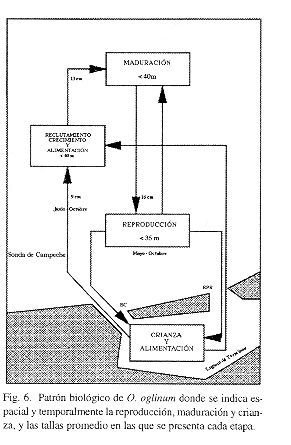
<body><![CDATA[<P><FONT FACE="Arial,Helvetica"><FONT SIZE=-1>La Sonda de Campeche al sur del Golfo de M&eacute;xico, est&aacute; situada entre 18o a 21o N. Hay tres estaciones clim&aacute;ticas: lluvias (junio-octubre), nortes (octubre-febrero) y sequ&iacute;as (febrero-mayo). Existen dos h&aacute;bitats o subsistemas ecol&oacute;gicos diferentes en la plataforma continental, ampliamente descritos por <A HREF="#Yáñez-A88a">Y&aacute;&ntilde;ez-Arancibia y S&aacute;nchez-Gil (1988a)</A> y representados como Zona A y Zona B (<A HREF="#fig1">Fig. 1</A>). La porci&oacute;n oeste o Zona A, frente de la Boca del Carmen (BC) est&aacute; permanentemente influenciada por aguas dulces y estuarinas. Presenta aguas turbias con transparencias de 7 a 42% (profundidad de extinci&oacute;n del disco de Secchi en relaci&oacute;n con la profundidad de la estaci&oacute;n de muestreo), alta concentraci&oacute;n de sedimentos suspendidos (25.2 mg/l) (<A HREF="#Carranza-E">Carranza-Edwards et al. 1993</A>), ausencia de plantas b&eacute;nticas, sedimentos limoarcillosos (10-60% de Ca CO<SUB>3</SUB>), alto contenido de materia org&aacute;nica (10%) y salinidades de 32 a 36. La porci&oacute;n este o Zona B, enfrente de la Boca de Puerto Real (BPR) es un &aacute;rea marina t&iacute;pica con aguas claras (transparencia de 53 a 99%), pastos marinos y macroalgas, sedimentos arenosos (70-90% CaCO<SUB>3</SUB>), bajo contenido de materia org&aacute;nica (&lt;10%) y salinidades de 36 a 37.</FONT></FONT>     <BR>&nbsp;     <BR>&nbsp;     <CENTER><A NAME="fig1"></A><IMG SRC="/img/fbpe/rbt/v46n2/0088i01.GIF" HEIGHT=435 WIDTH=560></CENTER> &nbsp;     
<BR>&nbsp;      <P><FONT FACE="Arial,Helvetica"><FONT SIZE=-1>Las recolectas se efectuaron en seis cruceros oceanogr&aacute;ficos realizados entre los 11 y 76 m de profundidad en junio 1978, agosto 1980, noviembre 1980, julio 1981, octubre, 1981 y marzo 1982 (<A HREF="#fig1">Fig. 1</A>). Las recolectas fueron diurnas y nocturnas con redes de arrastre comerciales de 18 m de longitud, 9 m de abertura de trabajo y malla de 1 1/3". Estos arrastres se realizaron a una velocidad promedio de dos nudos durante 30 min cada uno. Los seis cruceros se distribuyeron temporalmente abarcando las distintas &eacute;pocas clim&aacute;ticas de la regi&oacute;n y para el an&aacute;lisis temporal fueron ordenados con base en una secuencia estacional, asumi&eacute;ndose como un ciclo anual para el estudio de la especie. Las capturas fueron analizadas de acuerdo a <A HREF="#Yáñez-88b">Y&aacute;&ntilde;ez-Arancibia y S&aacute;nchez-Gil (1988b)</A>. Fueron calculados los par&aacute;metros poblacionales de densidad, biomasa, longitud promedio y peso promedio, para el &aacute;rea muestreada en cada mes de recolecta y para cada estaci&oacute;n de muestreo.</FONT></FONT>      <P><FONT FACE="Arial,Helvetica"><FONT SIZE=-1><B>Determinaci&oacute;n de sexo y madurez gon&aacute;dica:</B> La g&oacute;nada fue disectada y observada al microscopio para determinar el sexo por su forma, consistencia del tejido y por la presencia o ausencia de huevos. El estado de madurez gon&aacute;dica se determin&oacute; seg&uacute;n la escala que presenta <A HREF="#Laevastu,">Laevastu (1971)</A> en donde fase I = inmaduros indeterminados sexualmente, II = inmaduros determinados sexualmente, III = en maduraci&oacute;n, IV = maduros, V = en reproducci&oacute;n, VI = desovados y VII = adultos en descanso.</FONT></FONT>      <P><FONT FACE="Arial,Helvetica"><FONT SIZE=-1><B>Talla de primera madurez: </B>Se tom&oacute; como talla de primera madurez el centro de amplitud de las tallas de traslape de los individuos inmaduros (II) y los individuos en maduraci&oacute;n (III) (<A HREF="#Tapia-">Tapia-Garc&iacute;a et al. 1995</A>). Por otra parte, se calcularon los porcentajes de machos, hembras e individuos juveniles indeterminados sexualmente con base en la poblaci&oacute;n total y para cada mes de recolecta.</FONT></FONT>      <P><FONT FACE="Arial,Helvetica"><FONT SIZE=-1><B>&Iacute;ndice visceral:</B> Fue calculado para la poblaci&oacute;n total, por sexos y por mes seg&uacute;n la expresi&oacute;n matem&aacute;tica:</FONT></FONT>     <CENTER><FONT FACE="Arial,Helvetica"><FONT SIZE=-1>IV = V/P<SUB>T</SUB></FONT></FONT></CENTER>       ]]></body>
<body><![CDATA[<P><FONT FACE="Arial,Helvetica"><FONT SIZE=-1>IV = &iacute;ndice visceral, V = peso de las v&iacute;sceras y P<SUB>T </SUB>= peso total.</FONT></FONT>      <P><FONT FACE="Arial,Helvetica"><FONT SIZE=-1><B>&Iacute;ndice gon&aacute;dico:</B> Fue calculado matem&aacute;ticamente seg&uacute;n <A HREF="#Cailliet,">Cailliet et al. (1986)</A> como:</FONT></FONT>      <P><FONT FACE="Arial,Helvetica"><FONT SIZE=-1>IG = G/P</FONT></FONT>      <P><FONT FACE="Arial,Helvetica"><FONT SIZE=-1>IG = &iacute;ndice gon&aacute;dico, G = peso gon&aacute;dico y PT = peso total.</FONT></FONT>      <P><FONT FACE="Arial,Helvetica"><FONT SIZE=-1><B>Relaci&oacute;n talla/peso: </B>Esta relaci&oacute;n es expresada matem&aacute;ticamente seg&uacute;n la ecuaci&oacute;n:</FONT></FONT>     <CENTER><FONT FACE="Arial,Helvetica"><FONT SIZE=-1>P = aL<SUP>b</SUP>,</FONT></FONT></CENTER>       <P><FONT FACE="Arial,Helvetica"><FONT SIZE=-1>que transformada logar&iacute;tmicamente da un modelo lineal del tipo:</FONT></FONT>      <P><FONT FACE="Arial,Helvetica"><FONT SIZE=-1>Log<SUB>e</SUB>P = Log<SUB>e</SUB> a + Log<SUB>e</SUB>L</FONT></FONT>      <P><FONT FACE="Arial,Helvetica"><FONT SIZE=-1>P = peso (g), L = longitud (mm), a = ordenada al origen, b = pendiente y Log<SUB>e</SUB> = logaritmo natural.</FONT></FONT>      <P><FONT FACE="Arial,Helvetica"><FONT SIZE=-1><B>Factor de condici&oacute;n:</B> Para conocer el comportamiento de la condici&oacute;n de la poblaci&oacute;n se calcul&oacute; el factor de condici&oacute;n de <A HREF="#LeCren">Le Cren (1951):</A></FONT></FONT>     ]]></body>
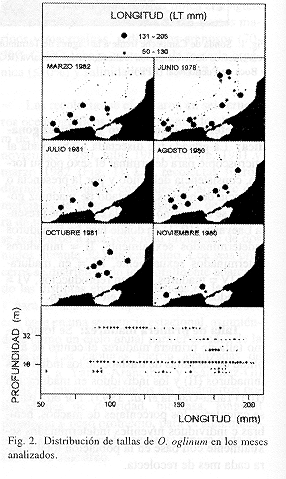
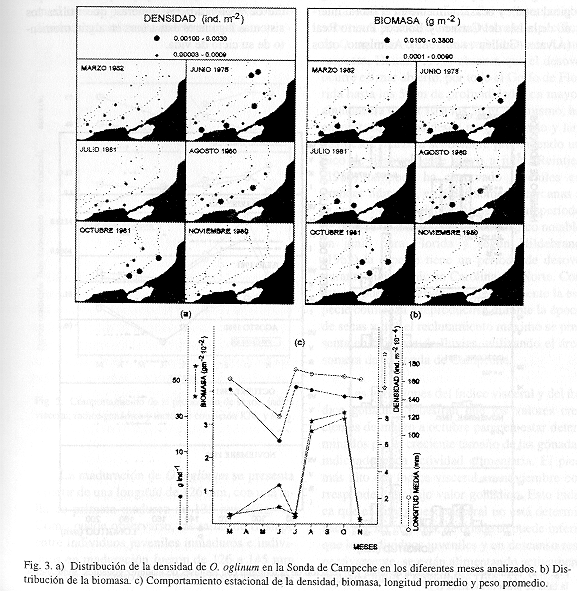
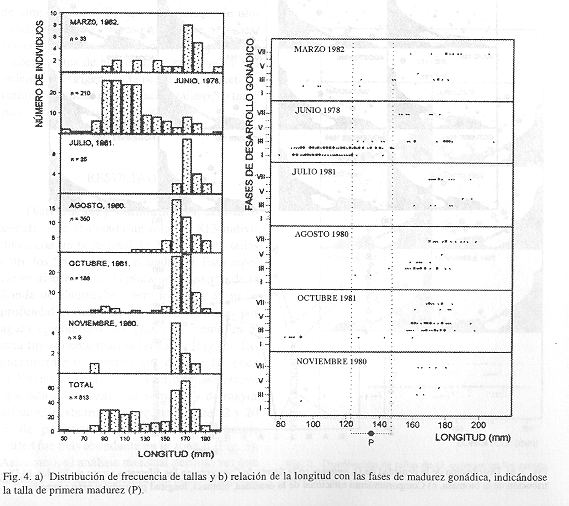
<body><![CDATA[<CENTER><FONT FACE="Arial,Helvetica"><FONT SIZE=-1>KN<SUB>1 </SUB>= P<SUB>T</SUB>/b<SUB>1</SUB>L<SUB>T<SUP>a</SUP>1</SUB> y KN<SUB>2</SUB> = PV/b<SUB>2</SUB>L<SUB>T</SUB>a<SUB>2</SUB>,</FONT></FONT></CENTER>       <P><FONT FACE="Arial,Helvetica"><FONT SIZE=-1>KN = coeficiente de condici&oacute;n, b<SUB>1</SUB> = factor de condici&oacute;n promedio para P<SUB>T</SUB>, b<SUB>2 </SUB>= factor de condici&oacute;n promedio para P<SUB>V</SUB>, a<SUB>1</SUB> = coeficiente de alometr&iacute;a para P<SUB>T</SUB>, a<SUB>2</SUB> = coeficiente de alometr&iacute;a para P<SUB>V</SUB>, P<SUB>T</SUB> = peso total, P<SUB>V</SUB> = peso desviscerado. Los factores de condici&oacute;n promedio y coeficientes de alometr&iacute;a, corresponden a la ordenada al origen y a la pendiente respectivamente, obtenidas de la relaci&oacute;n talla/peso tanto para peso total como desvicerado.</FONT></FONT>     <BR>&nbsp;     <BR>&nbsp;      <P><B><FONT FACE="Arial,Helvetica"><FONT SIZE=-1>Resultados</FONT></FONT></B>      <P><FONT FACE="Arial,Helvetica"><FONT SIZE=-1>Distribuci&oacute;n y abundancia espacio-temporal: Fue analizado un total de 813 individuos, con un peso total de 30 211.5 g y tallas entre los 56 y 205 mm (<A HREF="#cuadro1">Cuadro 1</A>). Esta especie se distribuye en la plataforma interna de la Sonda de Campeche, entre los 12 y 36 m de profundidad, tanto en &aacute;reas influenciadas por aguas epicontinentales (zona A), como en el &aacute;rea t&iacute;picamente marina (zona B) (<A HREF="#fig2">Fig. 2</A>). Espacialmente se observ&oacute; que durante la &eacute;poca de lluvias y sequ&iacute;as, la mayor biomasa estuvo asociada a las &aacute;reas mas someras y de mayor influencia estuarina en la zona A entre 12 y 20 m de profundidad principalmente. Durante nortes fue m&aacute;s abundante en la zona B (<A HREF="#fig3">Fig. 3</A>). Asimismo, el an&aacute;lisis mensual permite ver que en junio y en agosto-octubre se notan dos picos en densidad y biomasa (<A HREF="#fig3">Fig. 3</A>). El primero, se debe a un grupo numeroso de juveniles que se est&aacute; reclutando a la poblaci&oacute;n adulta y que se puede inferir al observar como se distribuyen por tallas tanto espacial como temporalmente (<A HREF="#fig2">Figs. 2</A>,<A HREF="#fig3"> 3</A> y <A HREF="#fig4">4</A>). En julio el grupo de juveniles se ha reclutado en su totalidad a la poblaci&oacute;n adulta, caracteriz&aacute;ndose por ser pocos individuos con una baja biomasa y tallas grandes (<A HREF="#fig3">Figs. 3 </A>y<A HREF="#fig4"> 4</A>). Los altos valores de densidad y biomasa en agosto est&aacute;n caracterizados por individuos en su mayor&iacute;a de tallas grandes. El m&aacute;ximo pico observado en octubre est&aacute; dado por un nuevo reclutamiento de juveniles y dos grupos de tallas, uno de individuos peque&ntilde;os y otro de adultos. En noviembre los bajos valores est&aacute;n dados por un solo grupo peque&ntilde;o de adultos (<A HREF="#fig3">Figs. 3</A> y <A HREF="#fig4">4</A>).</FONT></FONT>     <BR>&nbsp;     <BR>&nbsp;     <BR>&nbsp;     <CENTER><TABLE BORDER=0 CELLSPACING=0 WIDTH="624" > <TR> <TD VALIGN=CENTER COLSPAN="4">     ]]></body>
<body><![CDATA[<CENTER><A NAME="cuadro1"></A><FONT FACE="Arial,Helvetica"><FONT SIZE=-1>CUADRO 1&nbsp;</FONT></FONT></CENTER> </TD> </TR>  <TR> <TD VALIGN=CENTER COLSPAN="4">     <CENTER><FONT FACE="Arial,Helvetica"><FONT SIZE=-1><I>Abundancia y tallas de </I>Opisthonema oglinum <I>en los cruceros realizados.&nbsp;</I></FONT></FONT>&nbsp;</CENTER>      <CENTER><FONT FACE="Arial,Helvetica"><FONT SIZE=-1><I>Abundance and sizes of</I> Opisthonema oglinum <I>in each cruise</I>.&nbsp;</FONT></FONT></CENTER> </TD> </TR>  <TR> <TD VALIGN=CENTER WIDTH="25%"><FONT FACE="Arial,Helvetica"><FONT SIZE=-1>Crucero</FONT></FONT></TD>  <TD VALIGN=CENTER WIDTH="25%">     <CENTER><FONT FACE="Arial,Helvetica"><FONT SIZE=-1>N&uacute;mero&nbsp;</FONT></FONT>&nbsp;</CENTER>      <CENTER><FONT FACE="Arial,Helvetica"><FONT SIZE=-1>(ind.)</FONT></FONT></CENTER> </TD>  <TD VALIGN=CENTER WIDTH="25%">     <CENTER><FONT FACE="Arial,Helvetica"><FONT SIZE=-1>Peso</FONT></FONT>&nbsp;</CENTER>      <CENTER><FONT FACE="Arial,Helvetica"><FONT SIZE=-1>(g)</FONT></FONT></CENTER> </TD>  <TD VALIGN=CENTER WIDTH="25%">     <CENTER><FONT FACE="Arial,Helvetica"><FONT SIZE=-1>Tallas&nbsp;</FONT></FONT>&nbsp;</CENTER>      <CENTER><FONT FACE="Arial,Helvetica"><FONT SIZE=-1>(mm)</FONT></FONT></CENTER> </TD> </TR>  <TR> <TD VALIGN=CENTER WIDTH="25%"><FONT FACE="Arial,Helvetica"><FONT SIZE=-1>Marzo, 1982</FONT></FONT></TD>  <TD VALIGN=CENTER WIDTH="25%">     <CENTER><FONT FACE="Arial,Helvetica"><FONT SIZE=-1>33&nbsp;</FONT></FONT></CENTER> </TD>  <TD VALIGN=CENTER WIDTH="25%">     ]]></body>
<body><![CDATA[<CENTER><FONT FACE="Arial,Helvetica"><FONT SIZE=-1>1 511.3</FONT></FONT></CENTER> </TD>  <TD VALIGN=CENTER WIDTH="25%">     <CENTER><FONT FACE="Arial,Helvetica"><FONT SIZE=-1>95-203&nbsp;</FONT></FONT></CENTER> </TD> </TR>  <TR> <TD VALIGN=CENTER WIDTH="25%"><FONT FACE="Arial,Helvetica"><FONT SIZE=-1>Junio, 1978&nbsp;</FONT></FONT></TD>  <TD VALIGN=CENTER WIDTH="25%">     <CENTER><FONT FACE="Arial,Helvetica"><FONT SIZE=-1>210</FONT></FONT></CENTER> </TD>  <TD VALIGN=CENTER WIDTH="25%">     <CENTER><FONT FACE="Arial,Helvetica"><FONT SIZE=-1>3 483.0</FONT></FONT></CENTER> </TD>  <TD VALIGN=CENTER WIDTH="25%">     <CENTER><FONT FACE="Arial,Helvetica"><FONT SIZE=-1>56-205</FONT></FONT></CENTER> </TD> </TR>  <TR> <TD VALIGN=CENTER WIDTH="25%"><FONT FACE="Arial,Helvetica"><FONT SIZE=-1>Julio, 1981</FONT></FONT></TD>  <TD VALIGN=CENTER WIDTH="25%">     <CENTER><FONT FACE="Arial,Helvetica"><FONT SIZE=-1>25</FONT></FONT></CENTER> </TD>  <TD VALIGN=CENTER WIDTH="25%">     <CENTER><FONT FACE="Arial,Helvetica"><FONT SIZE=-1>1 168.6</FONT></FONT></CENTER> </TD>  <TD VALIGN=CENTER WIDTH="25%">     <CENTER><FONT FACE="Arial,Helvetica"><FONT SIZE=-1>160-193</FONT></FONT></CENTER> </TD> </TR>  <TR> <TD VALIGN=CENTER WIDTH="25%"><FONT FACE="Arial,Helvetica"><FONT SIZE=-1>Agosto, 1980</FONT></FONT></TD>  <TD VALIGN=CENTER WIDTH="25%">     <CENTER><FONT FACE="Arial,Helvetica"><FONT SIZE=-1>&nbsp;350</FONT></FONT></CENTER> </TD>  <TD VALIGN=CENTER WIDTH="25%">     <CENTER><FONT FACE="Arial,Helvetica"><FONT SIZE=-1>15 921.0</FONT></FONT></CENTER> </TD>  <TD VALIGN=CENTER WIDTH="25%">     ]]></body>
<body><![CDATA[<CENTER><FONT FACE="Arial,Helvetica"><FONT SIZE=-1>100-195</FONT></FONT></CENTER> </TD> </TR>  <TR> <TD VALIGN=CENTER WIDTH="25%"><FONT FACE="Arial,Helvetica"><FONT SIZE=-1>Octubre, 1980</FONT></FONT></TD>  <TD VALIGN=CENTER WIDTH="25%">     <CENTER><FONT FACE="Arial,Helvetica"><FONT SIZE=-1>186</FONT></FONT></CENTER> </TD>  <TD VALIGN=CENTER WIDTH="25%">     <CENTER><FONT FACE="Arial,Helvetica"><FONT SIZE=-1>7 754.1</FONT></FONT></CENTER> </TD>  <TD VALIGN=CENTER WIDTH="25%">     <CENTER><FONT FACE="Arial,Helvetica"><FONT SIZE=-1>85-200</FONT></FONT></CENTER> </TD> </TR>  <TR> <TD VALIGN=CENTER WIDTH="25%"><FONT FACE="Arial,Helvetica"><FONT SIZE=-1>Noviembre, 1980&nbsp;</FONT></FONT></TD>  <TD VALIGN=CENTER WIDTH="25%">     <CENTER><FONT FACE="Arial,Helvetica"><FONT SIZE=-1>9</FONT></FONT></CENTER> </TD>  <TD VALIGN=CENTER WIDTH="25%">     <CENTER><FONT FACE="Arial,Helvetica"><FONT SIZE=-1>373.5</FONT></FONT></CENTER> </TD>  <TD VALIGN=CENTER WIDTH="25%">     <CENTER><FONT FACE="Arial,Helvetica"><FONT SIZE=-1>95-178</FONT></FONT></CENTER> </TD> </TR>  <TR> <TD VALIGN=CENTER WIDTH="25%"><FONT FACE="Arial,Helvetica"><FONT SIZE=-1>Captura Total</FONT></FONT></TD>  <TD VALIGN=CENTER WIDTH="25%">     <CENTER><FONT FACE="Arial,Helvetica"><FONT SIZE=-1>813</FONT></FONT></CENTER> </TD>  <TD VALIGN=CENTER WIDTH="25%">     <CENTER><FONT FACE="Arial,Helvetica"><FONT SIZE=-1>30 211.5</FONT></FONT></CENTER> </TD>  <TD VALIGN=CENTER WIDTH="25%">     <CENTER><FONT FACE="Arial,Helvetica"><FONT SIZE=-1>56-205&nbsp;</FONT></FONT></CENTER> </TD> </TR> </TABLE></CENTER>      ]]></body>
<body><![CDATA[<CENTER>&nbsp;</CENTER>      <CENTER>&nbsp;</CENTER>      <CENTER><IMG SRC="/img/fbpe/rbt/v46n2/0088i02.GIF" HEIGHT=479 WIDTH=286></CENTER>      
<CENTER>&nbsp;</CENTER>      <CENTER>&nbsp;</CENTER>      <CENTER><A NAME="fig3"></A><IMG SRC="/img/fbpe/rbt/v46n2/0088i03.GIF" HEIGHT=591 WIDTH=577></CENTER> &nbsp;     
<BR>&nbsp;      <P><FONT FACE="Arial,Helvetica"><FONT SIZE=-1>No se observ&oacute; una relaci&oacute;n evidente entre distribuci&oacute;n por tallas y las condiciones estuarinas y batim&eacute;tricas de la plataforma, encontr&aacute;ndose distribuidas homog&eacute;neamente entre los 12 y 36 m de profundidad (<A HREF="#fig2">Fig. 2</A>). Sin embargo, esto no excluye que la especie pueda ser encontrada a profundidades menores donde no fue posible un muestreo debido a las caracter&iacute;sticas de las embarcaciones e incluso dentro de la Laguna de T&eacute;rminos. En &eacute;ste ecosistema O. oglinum ha sido observada espor&aacute;dicamente en los sistemas fluvio-lagunares en lluvias (44 a 140 mm de longitud total) y nortes (84 a 149 mm de longitud total), y ocasionalmente en el litoral interno de la Isla del Carmen y Boca de Puerto Real (<A HREF="#Álvarez-">&Aacute;lvarez-Guill&eacute;n et al. 1985</A>). Asimismo, otros autores en el norte del Golfo de M&eacute;xico, <A HREF="#Springer,">Springer y Bullis (1956)</A>,<A HREF="#Turner"> Turner y Johnson (1973)</A>, y <A HREF="#Darnell,83">Darnell et al. (1983)</A> han reportado a O. oglinum como especie t&iacute;pica de aguas someras, plataformas insulares y de deltas de r&iacute;os, estuarios y bah&iacute;as. <A HREF="#Houde,77">Houde (1977)</A> la reporta como una especie costera abundante en profundidades menores de 35 m, aunque espor&aacute;dicamente se le encuentra a m&aacute;s de 90 m. <A HREF="#Sogard,">Sogard et al. (1989) </A>establecen que O. oglinum es una especie de gran actividad nocturna en bancos de pastos marinos. Esto concuerda con el patr&oacute;n de distribuci&oacute;n observado en este estudio al apoyar que es una especie de profundidades someras, que utiliza los sistemas lagunares estuarinos en alg&uacute;n momento de su ciclo de vida.</FONT></FONT>     <BR>&nbsp;     <CENTER><A NAME="fig4"></A><IMG SRC="/img/fbpe/rbt/v46n2/0088i04.GIF" HEIGHT=505 WIDTH=569><FONT FACE="Arial,Helvetica"><FONT SIZE=-1>.</FONT></FONT></CENTER> &nbsp;      
]]></body>
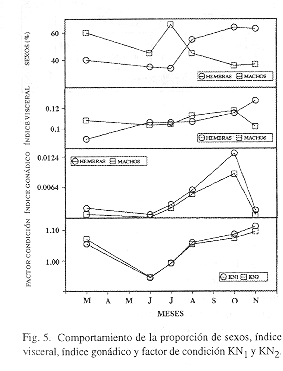
<body><![CDATA[<P><FONT FACE="Arial,Helvetica"><FONT SIZE=-1>Reproducci&oacute;n, maduraci&oacute;n y crianza: Durante todos los meses, excepto agosto, el n&uacute;mero de hembras fue mayor que el de machos (<A HREF="#fig5">Fig. 5</A>). En marzo la proporci&oacute;n hembras: machos fue de 2: 1, en junio 1.4: 1, en julio 3: 1, en agosto 1: 1.3, en octubre 2: 1 y en noviembre 2: 1. Esto podr&iacute;a estar representando una estrategia adaptativa de la especie para tener un mayor stock de huevos y por lo tanto un mayor reclutamiento de juveniles. <A HREF="#Reintjes,">Reintjes (1980)</A> menciona que se ha observado una fluctuaci&oacute;n c&iacute;clica en estas proporciones de marzo a diciembre. Por otra parte, &uacute;nicamente en el mes de junio es donde se observaron individuos sexualmente indeterminados.</FONT></FONT>     <BR>&nbsp;     <CENTER><A NAME="fig5"></A><IMG SRC="/img/fbpe/rbt/v46n2/0088i05.GIF" HEIGHT=371 WIDTH=283></CENTER> &nbsp;      
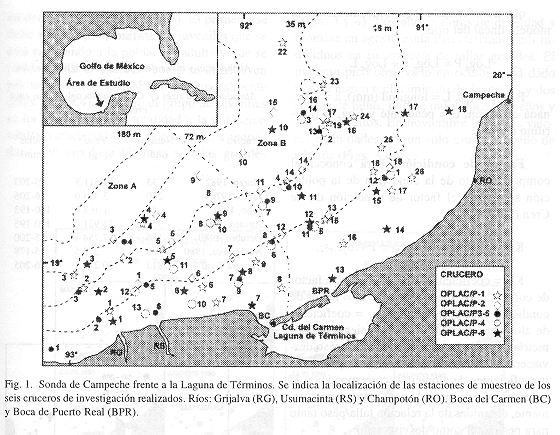
<P><FONT FACE="Arial,Helvetica"><FONT SIZE=-1>La maduraci&oacute;n de O. oglinum se presenta a partir de una longitud de 126 mm, con una talla de primera madurez de 135 mm (<A HREF="#fig4">Fig. 4</A>). Como puede observarse, las tallas de traslape entre individuos juveniles inmaduros e individuos en maduraci&oacute;n fueron de 126 a 145 mm en el mes de junio por lo que el coeficiente medio estimado fue de 135 mm. La presencia de organismos indeterminados sexualmente en junio indica el reclutamiento de juveniles en este mes y un per&iacute;odo de reproducci&oacute;n probablemente desde abril y mayo. En agosto se observan individuos de tallas grandes en descanso y en reproducci&oacute;n, previo a un reclutamiento de juveniles durante octubre en donde adem&aacute;s se encuentran organismos desovados. Los individuos juveniles m&aacute;s peque&ntilde;os y las hembras en reproducci&oacute;n y desovados se encontraron distribuidos ampliamente en la regi&oacute;n somera de la Sonda de Campeche, tanto en la zona A como en la B. Por esto, no se observa una predilecci&oacute;n de &aacute;rea m&aacute;s espec&iacute;fica de O. oglinum como zona reproductiva. A este respecto, <A HREF="#Houde,77">Houde (1977)</A> observa que el desove ocurre en mar abierto, por todo el Golfo de Florida hasta los 50 m de profundidad y en mayor abundancia de los 10 a los 30 m. Asimismo, ha encontrado huevos desde mayo a agosto y larvas desde marzo a septiembre proponiendo un pico de desove desde mayo a julio. <A HREF="#Reintjes,">Reintjes (1980)</A> tampoco ha observado juveniles en grandes n&uacute;meros, en &aacute;reas someras cercanas a la costa. <A HREF="#Fuss,">Fuss et al. (l969)</A> sugieren un per&iacute;odo de desove de marzo-agosto con un pico notable en junio para Florida y seg&uacute;n <A HREF="#Hildebrand,">Hildebrand (1963)</A> la especie tiene un periodo de desove durante mayo-junio en Carolina del Norte. Con esto se puede observar que efectivamente la especie comienza a reproducirse durante la &eacute;poca de secas y que el reclutamiento m&aacute;ximo se presenta en la &eacute;poca de lluvias, utilizando el &aacute;rea somera de la Sonda de Campeche.</FONT></FONT>      <P><FONT FACE="Arial,Helvetica"><FONT SIZE=-1>Las variaciones del &iacute;ndice visceral y del &iacute;ndice gon&aacute;dico muestran que los valores crecientes de marzo a octubre parecen estar determinados por el creciente tama&ntilde;o de las g&oacute;nadas indicando poca actividad alimentaria. El pico m&aacute;s alto del &iacute;ndice visceral en noviembre corresponde a un bajo valor gon&aacute;dico. Esto indica que el mayor peso visceral no est&aacute; determinado por las g&oacute;nadas, de donde se puede inferir que los individuos juveniles y en descanso respectivamente, se est&aacute;n alimentando activamente desde junio a noviembre (<A HREF="#fig5">Fig. 5</A>).</FONT></FONT>      <P><FONT FACE="Arial,Helvetica"><FONT SIZE=-1>El comportamiento del &iacute;ndice gon&aacute;dico concuerda con el segundo pico reproductivo y de reclutamiento observados. A partir de julio se observa un aumento de este &iacute;ndice debido al desarrollo gon&aacute;dico, hasta alcanzar el valor m&aacute;ximo en octubre cuando la especie se est&aacute; reproduciendo y baja hacia noviembre cuando se presenta el reclutamiento. El otro pico reproductivo y de reclutamiento, se puede inferir de los valores gon&aacute;dicos m&aacute;s bajos de junio caracterizado por el reclutamiento de juveniles (<A HREF="#fig5">Fig. 5</A>).</FONT></FONT>      <P><FONT FACE="Arial,Helvetica"><FONT SIZE=-1>Los valores de condici&oacute;n obtenidos tambi&eacute;n apoyan este planteamiento (<A HREF="#fig5">Fig. 5</A>). Entre julio y noviembre coinciden con el largo per&iacute;odo de maduraci&oacute;n gon&aacute;dica y el desarrollo som&aacute;tico. El valor m&aacute;s bajo coincide con la presencia de un gran n&uacute;mero de juveniles en el mes de junio, en los cuales el desarrollo som&aacute;tico es a&uacute;n muy reducido y el valor de condici&oacute;n m&aacute;s alto se observa en noviembre despu&eacute;s del desove. <A HREF="#Hale,">Hale (1984)</A> en un estudio sobre cantidad de &aacute;cidos grasos en esta especie, encontr&oacute; que hay un decrecimiento del contenido de grasas desde primavera hasta finales del verano, lo que apoya que la especie presenta un desarrollo som&aacute;tico propio de su maduraci&oacute;n durante este per&iacute;odo y poca acumulaci&oacute;n de grasa.</FONT></FONT>     <BR>&nbsp;      <P><B><FONT FACE="Arial,Helvetica"><FONT SIZE=-1>Discusi&oacute;n</FONT></FONT></B>      <P><FONT FACE="Arial,Helvetica"><FONT SIZE=-1>Patr&oacute;n biol&oacute;gico y ecol&oacute;gico: El an&aacute;lisis de la din&aacute;mica ecol&oacute;gica de O. oglinum, tanto espacial como temporalmente dentro del sistema estuario-plataforma con relaci&oacute;n a sus variaciones de distribuci&oacute;n y abundancia, rango de tallas, madurez gon&aacute;dica y reclutamiento, determina un patr&oacute;n biol&oacute;gico y ecol&oacute;gico que refleja la din&aacute;mica ecol&oacute;gica del sistema. En la <A HREF="#fig6">Fig. 6 </A>se esquematiza a grandes rasgos la exitosa estrategia biol&oacute;gica y ecol&oacute;gica de esta especie que ha permitido que sea dominante entre las casi 300 especies que integran la comunidad de peces demersales en la Sonda de Campeche. Las estrategias adaptativas de las especies de peces est&aacute;n directamente relacionadas con sus necesidades biol&oacute;gicas a nivel ecosistema, por lo que est&aacute;n en funci&oacute;n de la utilizaci&oacute;n de los procesos ecol&oacute;gicos caracter&iacute;sticos de la regi&oacute;n. O. oglinum explota y optimiza los procesos ecol&oacute;gicos t&iacute;picos de esta regi&oacute;n como son la alta productividad y el alto aporte de materia org&aacute;nica de los sistemas lagunares-estuarinos, adem&aacute;s de la gran diversidad de &aacute;reas de alimentaci&oacute;n, reproducci&oacute;n, protecci&oacute;n, reclutamiento y crianza que estos sistemas representan (<A HREF="#Yáñez-88b">Y&aacute;&ntilde;ez-Arancibia y S&aacute;nchez-Gil 1988b</A>).</FONT></FONT>     ]]></body>
<body><![CDATA[<BR>&nbsp;     <CENTER><A NAME="fig6"></A><IMG SRC="/img/fbpe/rbt/v46n2/0088i06.GIF" HEIGHT=444 WIDTH=291></CENTER>       
<P><FONT FACE="Arial,Helvetica"><FONT SIZE=-1>As&iacute;, se puede establecer que O. oglinum se distribuye en los dos subsistemas ecol&oacute;gicos de la Sonda de Campeche a profundidades menores de 36 m. Es una especie dependiente estuarina que eventualmente durante su etapa juvenil utiliza la Laguna de T&eacute;rminos y sistemas estuarinos adyacentes para protegerse, criarse y/o alimentarse, y posteriormente se recluta a la poblaci&oacute;n adulta en la Sonda de Campeche. Las hembras maduran a partir de una longitud de 126 mm, con una talla de primera madurez de 135 mm. Presenta un largo per&iacute;odo de reproducci&oacute;n en el a&ntilde;o, de mayo a octubre, con dos picos m&aacute;ximos en mayo y agosto; y en la regi&oacute;n somera (12-36 m) de la Sonda de Campeche. Se presentan dos pulsos marcados de reclutamiento de juveniles en los meses de junio y octubre, relacionados con los pulsos de m&aacute;xima abundancia. No se observa relaci&oacute;n entre la distribuci&oacute;n de tallas de los individuos de esta especie y la batimetr&iacute;a, todas se encontraron homog&eacute;neamente distribuidas entre los 12 y 36 m de profundidad, aunque esto no excluye que se le pueda encontrar a profundidades menores. Las m&aacute;ximas abundancias est&aacute;n correlacionadas con los per&iacute;odos de reclutamiento. La condici&oacute;n de la poblaci&oacute;n es baja durante el primer reclutamiento y alta durante el segundo reclutamiento, debido a la gran cantidad de organismos de tallas peque&ntilde;as en junio y su escaso desarrollo som&aacute;tico.</FONT></FONT>     <BR>&nbsp;      <P><B><FONT FACE="Arial,Helvetica"><FONT SIZE=-1>Agradecimientos</FONT></FONT></B>      <P><FONT FACE="Arial,Helvetica"><FONT SIZE=-1>Se agradece al Instituto de Ciencias del Mar y Limnolog&iacute;a de la Universidad Nacional Aut&oacute;noma de M&eacute;xico y al Programa EPOMEX de la Universidad Aut&oacute;noma de Campeche, el apoyo institucional y econ&oacute;mico para la realizaci&oacute;n del presente estudio. El trabajo form&oacute; parte de los proyectos de investigaci&oacute;n "Ecolog&iacute;a y evaluaci&oacute;n de recursos demersales marinos" (UNAM-CONACYT, clave PCCNCNA-050815) y "La pesca y los recursos pesqueros cr&iacute;ticos del Estado de Campeche" (UAC-EPOMEX-SEP, 1990).</FONT></FONT>     <BR>&nbsp;      <P><B><FONT FACE="Arial,Helvetica"><FONT SIZE=-1>Resumen</FONT></FONT></B>      <P><FONT FACE="Arial,Helvetica"><FONT SIZE=-1>Se analizan diversos aspectos de la biolog&iacute;a y ecolog&iacute;a de Opisthonema oglinum con base en 813 individuos obtenidos en seis cruceros oceanogr&aacute;ficos. Esta especie dependiente estuarina, se distribuye en la Sonda de Campeche entre los 12 y 36 m. Las hembras tienen una talla de primera madurez de 135 mm de LT. Se reproduce desde mayo a octubre, con dos m&aacute;ximos en mayo y agosto, a profundidades mayores de 18 m. Los juveniles se encuentran en la plataforma y dentro de la Laguna de T&eacute;rminos. El reclutamiento se presenta en junio y octubre. Las m&aacute;ximas abundancias se presentan alrededor de las isobatas de 12 y 36 m, y en nortes en el &aacute;rea carbonatada.</FONT></FONT>     <BR>&nbsp;      ]]></body>
<body><![CDATA[<P><B><FONT FACE="Arial,Helvetica"><FONT SIZE=-1>Referencias</FONT></FONT></B>      <!-- ref --><P><A NAME="Álvarez-"></A><FONT FACE="Arial,Helvetica"><FONT SIZE=-1>&Aacute;lvarez-Guill&eacute;n, H., A. Y&aacute;&ntilde;ez-Arancibia &amp; A.L. Lara Dom&iacute;nguez. 1985. Ecolog&iacute;a de la Boca del Carmen, Laguna de T&eacute;rminos: El h&aacute;bitat y estructura de las comunidades de peces. An. Inst. Cien. del Mar y Limnol. Univ. Nal. Aut&oacute;n. M&eacute;xico 12: 107-144.</FONT></FONT>    &nbsp;&nbsp;&nbsp;&nbsp;&nbsp;&nbsp;&nbsp;&nbsp;[&#160;<a href="javascript:void(0);" onclick="javascript: window.open('/scielo.php?script=sci_nlinks&ref=1129646&pid=S0034-7744199800020001000001&lng=','','width=640,height=500,resizable=yes,scrollbars=1,menubar=yes,');">Links</a>&#160;]<!-- end-ref --><!-- ref --><P><A NAME="Cailliet,"></A><FONT FACE="Arial,Helvetica"><FONT SIZE=-1>Cailliet, G.M., M.S. Love &amp; A.W. Ebeling. 1986. Fishes. A field and laboratory manual on their structure, identification, and natural history. Wadsworth Publishing Company, Belmont, California. 194 p.</FONT></FONT>    &nbsp;&nbsp;&nbsp;&nbsp;&nbsp;&nbsp;&nbsp;&nbsp;[&#160;<a href="javascript:void(0);" onclick="javascript: window.open('/scielo.php?script=sci_nlinks&ref=1129647&pid=S0034-7744199800020001000002&lng=','','width=640,height=500,resizable=yes,scrollbars=1,menubar=yes,');">Links</a>&#160;]<!-- end-ref --><!-- ref --><P><A NAME="Carranza-E"></A><FONT FACE="Arial,Helvetica"><FONT SIZE=-1>Carranza-Edwards, A., L. Rosales-Hoz &amp; A. Monreal-G&oacute;mez. 1993. Suspended sediments in the southeastern Gulf of Mexico. Mar. Geol. 112: 257-269.</FONT></FONT>    &nbsp;&nbsp;&nbsp;&nbsp;&nbsp;&nbsp;&nbsp;&nbsp;[&#160;<a href="javascript:void(0);" onclick="javascript: window.open('/scielo.php?script=sci_nlinks&ref=1129648&pid=S0034-7744199800020001000003&lng=','','width=640,height=500,resizable=yes,scrollbars=1,menubar=yes,');">Links</a>&#160;]<!-- end-ref --><!-- ref --><P><A NAME="Darnell,83"></A><FONT FACE="Arial,Helvetica"><FONT SIZE=-1><FONT COLOR="#000080">****</FONT> Darnell, R.M., R.E. Defenbaugh &amp; D. Moore. 1983. Northwestern gulf shelf bio-atlas; a study of the distribution of demersal fishes and penaeid shrimp of soft bottoms of the continental shelf from the Rio Grande to the Mississippi river delta. Open File Report No. 82-04. Metaire, LA: Minerals Management Service, Gulf of Mexico OCS Regional Office. 438 p.</FONT></FONT>    &nbsp;&nbsp;&nbsp;&nbsp;&nbsp;&nbsp;&nbsp;&nbsp;[&#160;<a href="javascript:void(0);" onclick="javascript: window.open('/scielo.php?script=sci_nlinks&ref=1129649&pid=S0034-7744199800020001000004&lng=','','width=640,height=500,resizable=yes,scrollbars=1,menubar=yes,');">Links</a>&#160;]<!-- end-ref --><!-- ref --><P><A NAME="Darnell87"></A><FONT FACE="Arial,Helvetica"><FONT SIZE=-1>Darnell, R.M. &amp; J.A. Kleypas. 1987. A study of the distribution of demersal fishes and penaeid shrimp of soft bottoms of the continental shelf from the Mississippi river delta to the Florida Keys. OCS STUDY MMS 86-0041.</FONT></FONT>    &nbsp;&nbsp;&nbsp;&nbsp;&nbsp;&nbsp;&nbsp;&nbsp;[&#160;<a href="javascript:void(0);" onclick="javascript: window.open('/scielo.php?script=sci_nlinks&ref=1129650&pid=S0034-7744199800020001000005&lng=','','width=640,height=500,resizable=yes,scrollbars=1,menubar=yes,');">Links</a>&#160;]<!-- end-ref --><!-- ref --><P><A NAME="Fuss,"></A><FONT FACE="Arial,Helvetica"><FONT SIZE=-1>Fuss, C.M.Jr., J.A. Kelly Jr. &amp; K.W. Prest Jr. 1969. Gulf thread herring: aspects of the developing fishery and biological research. Proc. Gulf Caribb. Fish. Inst. 21: 111-125.</FONT></FONT>    &nbsp;&nbsp;&nbsp;&nbsp;&nbsp;&nbsp;&nbsp;&nbsp;[&#160;<a href="javascript:void(0);" onclick="javascript: window.open('/scielo.php?script=sci_nlinks&ref=1129651&pid=S0034-7744199800020001000006&lng=','','width=640,height=500,resizable=yes,scrollbars=1,menubar=yes,');">Links</a>&#160;]<!-- end-ref --><!-- ref --><P><A NAME="Grant,"></A><FONT FACE="Arial,Helvetica"><FONT SIZE=-1>Grant, C.J. 1981. Gill net selectivity and catch rates of coastal pelagic fish in Jamaica. Estuar. Coast. Shelf. Sci. 12: 167-175.</FONT></FONT>    &nbsp;&nbsp;&nbsp;&nbsp;&nbsp;&nbsp;&nbsp;&nbsp;[&#160;<a href="javascript:void(0);" onclick="javascript: window.open('/scielo.php?script=sci_nlinks&ref=1129652&pid=S0034-7744199800020001000007&lng=','','width=640,height=500,resizable=yes,scrollbars=1,menubar=yes,');">Links</a>&#160;]<!-- end-ref --><!-- ref --><P><A NAME="Hale,"></A><FONT FACE="Arial,Helvetica"><FONT SIZE=-1>Hale, M.B. 1984. Proximate chemical composition and fatty acids of three small coastal pelagic species. Mar. Fish. Rev. 46: 19-21.</FONT></FONT>    &nbsp;&nbsp;&nbsp;&nbsp;&nbsp;&nbsp;&nbsp;&nbsp;[&#160;<a href="javascript:void(0);" onclick="javascript: window.open('/scielo.php?script=sci_nlinks&ref=1129653&pid=S0034-7744199800020001000008&lng=','','width=640,height=500,resizable=yes,scrollbars=1,menubar=yes,');">Links</a>&#160;]<!-- end-ref --><!-- ref --><P><A NAME="Harvey,"></A><FONT FACE="Arial,Helvetica"><FONT SIZE=-1>Harvey, G.C.McN. 1980. Preliminary studies of the coastal pelagic fishes of Jamaica. Proc. Assoc. Isl. Mar. Lab. Caribb. 15: 24.</FONT></FONT>    &nbsp;&nbsp;&nbsp;&nbsp;&nbsp;&nbsp;&nbsp;&nbsp;[&#160;<a href="javascript:void(0);" onclick="javascript: window.open('/scielo.php?script=sci_nlinks&ref=1129654&pid=S0034-7744199800020001000009&lng=','','width=640,height=500,resizable=yes,scrollbars=1,menubar=yes,');">Links</a>&#160;]<!-- end-ref --><!-- ref --><P><A NAME="Hildebrand,"></A><FONT FACE="Arial,Helvetica"><FONT SIZE=-1>Hildebrand, S.F. 1963. Family Clupeidae, p 257-454. In H.B. Bigelow (ed.). Fishes of the western North Atlantic. Part Three. Mem. Sears Found. Mar. Res. Yale University, Coneticut.</FONT></FONT>    &nbsp;&nbsp;&nbsp;&nbsp;&nbsp;&nbsp;&nbsp;&nbsp;[&#160;<a href="javascript:void(0);" onclick="javascript: window.open('/scielo.php?script=sci_nlinks&ref=1129655&pid=S0034-7744199800020001000010&lng=','','width=640,height=500,resizable=yes,scrollbars=1,menubar=yes,');">Links</a>&#160;]<!-- end-ref --><!-- ref --><P><A NAME="Houde,77"></A><FONT FACE="Arial,Helvetica"><FONT SIZE=-1>Houde, E. D. 1977. Abundance and potencial yield of the Atlantic thread herring, Opisthonema oglinum, and aspects of its early life history in the eastern Gulf of Mexico. Fish. Bull. 75: 493-512.</FONT></FONT>    &nbsp;&nbsp;&nbsp;&nbsp;&nbsp;&nbsp;&nbsp;&nbsp;[&#160;<a href="javascript:void(0);" onclick="javascript: window.open('/scielo.php?script=sci_nlinks&ref=1129656&pid=S0034-7744199800020001000011&lng=','','width=640,height=500,resizable=yes,scrollbars=1,menubar=yes,');">Links</a>&#160;]<!-- end-ref --><!-- ref --><P><A NAME="Houde83"></A><FONT FACE="Arial,Helvetica"><FONT SIZE=-1>Houde, E.D., Ch. Grall &amp; St.A. Berkeley. 1983. Population parameter estimates for three shoaling pelagic fishes in the eastern Gulf of Mexico. Ices Council Meeting, Copenhague, Dinamarca. 12 p.</FONT></FONT>    &nbsp;&nbsp;&nbsp;&nbsp;&nbsp;&nbsp;&nbsp;&nbsp;[&#160;<a href="javascript:void(0);" onclick="javascript: window.open('/scielo.php?script=sci_nlinks&ref=1129657&pid=S0034-7744199800020001000012&lng=','','width=640,height=500,resizable=yes,scrollbars=1,menubar=yes,');">Links</a>&#160;]<!-- end-ref --><!-- ref --><P><A NAME="Laevastu,"></A><FONT FACE="Arial,Helvetica"><FONT SIZE=-1>Laevastu, T. 1971. Manual de m&eacute;todos de biolog&iacute;a pesquera. Publicaci&oacute;n FAO. Acribia, Zaragoza. 243 p.</FONT></FONT>    &nbsp;&nbsp;&nbsp;&nbsp;&nbsp;&nbsp;&nbsp;&nbsp;[&#160;<a href="javascript:void(0);" onclick="javascript: window.open('/scielo.php?script=sci_nlinks&ref=1129658&pid=S0034-7744199800020001000013&lng=','','width=640,height=500,resizable=yes,scrollbars=1,menubar=yes,');">Links</a>&#160;]<!-- end-ref --><!-- ref --><P><A NAME="LeCren"></A><FONT FACE="Arial,Helvetica"><FONT SIZE=-1>LeCren, E.D. 1951. The length-weight relationships and seasonal cycle in the perch (Perca fluviatilis). J. Anim. Ecol. 20: 201-219.</FONT></FONT>    &nbsp;&nbsp;&nbsp;&nbsp;&nbsp;&nbsp;&nbsp;&nbsp;[&#160;<a href="javascript:void(0);" onclick="javascript: window.open('/scielo.php?script=sci_nlinks&ref=1129659&pid=S0034-7744199800020001000014&lng=','','width=640,height=500,resizable=yes,scrollbars=1,menubar=yes,');">Links</a>&#160;]<!-- end-ref --><!-- ref --><P><A NAME="Ogawa,"></A><FONT FACE="Arial,Helvetica"><FONT SIZE=-1>Ogawa, M. &amp; P. Barreto. 1979. Industrial Utilization of Small-Sized Fishes in Northeastern Brazil. Bol. Cienc. Mar. 33: 11</FONT></FONT>    &nbsp;&nbsp;&nbsp;&nbsp;&nbsp;&nbsp;&nbsp;&nbsp;[&#160;<a href="javascript:void(0);" onclick="javascript: window.open('/scielo.php?script=sci_nlinks&ref=1129660&pid=S0034-7744199800020001000015&lng=','','width=640,height=500,resizable=yes,scrollbars=1,menubar=yes,');">Links</a>&#160;]<!-- end-ref --><!-- ref --><P><A NAME="Pauly,82"></A><FONT FACE="Arial,Helvetica"><FONT SIZE=-1>Pauly, D. 1982. Studying single-species dynamics in a tropical context, p. 33-70. In D. Pauly, D. &amp; G.I. Murphy (eds.). Theory and management of tropical fisheries. ICLARM Conference Proceedings 9, Manila, Filipinas.</FONT></FONT>    &nbsp;&nbsp;&nbsp;&nbsp;&nbsp;&nbsp;&nbsp;&nbsp;[&#160;<a href="javascript:void(0);" onclick="javascript: window.open('/scielo.php?script=sci_nlinks&ref=1129661&pid=S0034-7744199800020001000016&lng=','','width=640,height=500,resizable=yes,scrollbars=1,menubar=yes,');">Links</a>&#160;]<!-- end-ref --><!-- ref --><P><A NAME="Pauly,94"></A><FONT FACE="Arial,Helvetica"><FONT SIZE=-1>Pauly, D. &amp; A. Y&aacute;&ntilde;ez-Arancibia. 1994. Fisheries in Coastal Lagoons, p 377-399. In B. Kjerfve (ed.). Coastal Lagoon Processes. Elsevier Oceanography Series, Amsterdan, Holanda.</FONT></FONT>    &nbsp;&nbsp;&nbsp;&nbsp;&nbsp;&nbsp;&nbsp;&nbsp;[&#160;<a href="javascript:void(0);" onclick="javascript: window.open('/scielo.php?script=sci_nlinks&ref=1129662&pid=S0034-7744199800020001000017&lng=','','width=640,height=500,resizable=yes,scrollbars=1,menubar=yes,');">Links</a>&#160;]<!-- end-ref --><!-- ref --><P><A NAME="Reintjes,"></A><FONT FACE="Arial,Helvetica"><FONT SIZE=-1>Reintjes, J. W. 1980. Marine herring and sardine resources of the northern Gulf of Mexico. In M. Flandorfer and L. Skuplen (ed.) Proceedings of a Workshop for Potential Fishery Resources of the Northern Gulf of Mexico. Nueva Orleans. Publ. No. MASGP- 80-012.</FONT></FONT>    &nbsp;&nbsp;&nbsp;&nbsp;&nbsp;&nbsp;&nbsp;&nbsp;[&#160;<a href="javascript:void(0);" onclick="javascript: window.open('/scielo.php?script=sci_nlinks&ref=1129663&pid=S0034-7744199800020001000018&lng=','','width=640,height=500,resizable=yes,scrollbars=1,menubar=yes,');">Links</a>&#160;]<!-- end-ref --><!-- ref --><P><A NAME="Sogard,"></A><FONT FACE="Arial,Helvetica"><FONT SIZE=-1>Sogard, S.M., G.V. Powell &amp; J.G. Holmquist. 1989. Utilization by fishes of shallow, seagrass-covered banks in Florida Bay: 2. Diel and tidal patterns. Environ. Biol. Fish. 24: 81-92.</FONT></FONT>    &nbsp;&nbsp;&nbsp;&nbsp;&nbsp;&nbsp;&nbsp;&nbsp;[&#160;<a href="javascript:void(0);" onclick="javascript: window.open('/scielo.php?script=sci_nlinks&ref=1129664&pid=S0034-7744199800020001000019&lng=','','width=640,height=500,resizable=yes,scrollbars=1,menubar=yes,');">Links</a>&#160;]<!-- end-ref --><!-- ref --><P><A NAME="Springer,"></A><FONT FACE="Arial,Helvetica"><FONT SIZE=-1>Springer, S. &amp; H.R. Bullis Jr. 1956. Collections by the Oregon in the Gulf of Mexico. U. S. Fish. and Wild. Serv. Spec. Sci. Rept. 196: 1-134.</FONT></FONT>    &nbsp;&nbsp;&nbsp;&nbsp;&nbsp;&nbsp;&nbsp;&nbsp;[&#160;<a href="javascript:void(0);" onclick="javascript: window.open('/scielo.php?script=sci_nlinks&ref=1129665&pid=S0034-7744199800020001000020&lng=','','width=640,height=500,resizable=yes,scrollbars=1,menubar=yes,');">Links</a>&#160;]<!-- end-ref --><!-- ref --><P><A NAME="Tapia-"></A><FONT FACE="Arial,Helvetica"><FONT SIZE=-1>Tapia-Garc&iacute;a, M., A. Y&aacute;&ntilde;ez-Arancibia, P. S&aacute;nchez-Gil &amp; M.C. Garc&iacute;a-Abad. 1995. Distribuci&oacute;n, abundancia y reproducci&oacute;n de Priacanthus arenatus Cuvier (Pisces: Priacanthidae), en la plataforma continental del sur del Golfo de M&eacute;xico. Biotropica 27: 232-237</FONT></FONT>    &nbsp;&nbsp;&nbsp;&nbsp;&nbsp;&nbsp;&nbsp;&nbsp;[&#160;<a href="javascript:void(0);" onclick="javascript: window.open('/scielo.php?script=sci_nlinks&ref=1129666&pid=S0034-7744199800020001000021&lng=','','width=640,height=500,resizable=yes,scrollbars=1,menubar=yes,');">Links</a>&#160;]<!-- end-ref --><!-- ref --><P><A NAME="Turner"></A><FONT FACE="Arial,Helvetica"><FONT SIZE=-1>Turner, W.R. &amp; G.N. Johnson. 1973. Distribution and relative abundance of fishes in New Port River, North Carolina. NOAA Tech. Rep. NMFS-SSRF- 666: 1-23.</FONT></FONT>    &nbsp;&nbsp;&nbsp;&nbsp;&nbsp;&nbsp;&nbsp;&nbsp;[&#160;<a href="javascript:void(0);" onclick="javascript: window.open('/scielo.php?script=sci_nlinks&ref=1129667&pid=S0034-7744199800020001000022&lng=','','width=640,height=500,resizable=yes,scrollbars=1,menubar=yes,');">Links</a>&#160;]<!-- end-ref --><!-- ref --><P><A NAME="Valdés,"></A><FONT FACE="Arial,Helvetica"><FONT SIZE=-1>Vald&eacute;s, E. &amp; M.C. Sotolongo. 1983. Algunos aspectos de la biolog&iacute;a y pesquer&iacute;a del machuelo (Opisthonema oglinum) de la plataforma suroriental cubana. Rev. Cub. Invest. Pesq. 8: 66-98.</FONT></FONT>    &nbsp;&nbsp;&nbsp;&nbsp;&nbsp;&nbsp;&nbsp;&nbsp;[&#160;<a href="javascript:void(0);" onclick="javascript: window.open('/scielo.php?script=sci_nlinks&ref=1129668&pid=S0034-7744199800020001000023&lng=','','width=640,height=500,resizable=yes,scrollbars=1,menubar=yes,');">Links</a>&#160;]<!-- end-ref --><!-- ref --><P><A NAME="Vasconcelos,"></A><FONT FACE="Arial,Helvetica"><FONT SIZE=-1>Vasconcelos, F.A.L. 1979. Estudo Ecologico da Regiao de Itamaraca, Pernambuco, Brasil. 4. Alimentacao da Sardinha Bandeira, Opisthonema oglinum (Le Sueur, 1817), no Canal de Santa Cruz. Trab. Oceanogr. Univ. Fed. Pernambuco. 14: 105-116.</FONT></FONT>    &nbsp;&nbsp;&nbsp;&nbsp;&nbsp;&nbsp;&nbsp;&nbsp;[&#160;<a href="javascript:void(0);" onclick="javascript: window.open('/scielo.php?script=sci_nlinks&ref=1129669&pid=S0034-7744199800020001000024&lng=','','width=640,height=500,resizable=yes,scrollbars=1,menubar=yes,');">Links</a>&#160;]<!-- end-ref --><!-- ref --><P><A NAME="Yáñez-A86"></A><FONT FACE="Arial,Helvetica"><FONT SIZE=-1>Y&aacute;&ntilde;ez-Arancibia, A. &amp; P. S&aacute;nchez-Gil. 1986. Los peces demersales de la plataforma continental del sur del Golfo de M&eacute;xico. Vol. 1. Caracterizaci&oacute;n del ecosistema y ecolog&iacute;a de las especies, poblaciones y comunidades. Inst. Cienc. del Mar y Limnol. Univ. Nal. Aut&oacute;n. M&eacute;xico. Publ. Esp. 9: 229 p.</FONT></FONT>    &nbsp;&nbsp;&nbsp;&nbsp;&nbsp;&nbsp;&nbsp;&nbsp;[&#160;<a href="javascript:void(0);" onclick="javascript: window.open('/scielo.php?script=sci_nlinks&ref=1129670&pid=S0034-7744199800020001000025&lng=','','width=640,height=500,resizable=yes,scrollbars=1,menubar=yes,');">Links</a>&#160;]<!-- end-ref --><!-- ref --><P><A NAME="Yáñez-A88a"></A><FONT FACE="Arial,Helvetica"><FONT SIZE=-1>Y&aacute;&ntilde;ez-Arancibia, A. &amp; P. S&aacute;nchez-Gil. 1988a. Caracterizaci&oacute;n ambiental de la Sonda de Campeche frente a la Laguna de T&eacute;rminos, p. 41-50. In A. Y&aacute;&ntilde;ez-Arancibia &amp; J.W. Day, Jr. (eds.). Ecolog&iacute;a de los ecosistemas costeros en el sur del Golfo de M&eacute;xico: La regi&oacute;n de la Laguna de T&eacute;rminos. Inst. Cienc. del Mar y Limnol. UNAM, Coast. Ecol. Inst. LSU. Universitaria, M&eacute;xico, D.F.</FONT></FONT>    &nbsp;&nbsp;&nbsp;&nbsp;&nbsp;&nbsp;&nbsp;&nbsp;[&#160;<a href="javascript:void(0);" onclick="javascript: window.open('/scielo.php?script=sci_nlinks&ref=1129671&pid=S0034-7744199800020001000026&lng=','','width=640,height=500,resizable=yes,scrollbars=1,menubar=yes,');">Links</a>&#160;]<!-- end-ref --><!-- ref --><P><A NAME="Yáñez-88b"></A><FONT FACE="Arial,Helvetica"><FONT SIZE=-1>Y&aacute;&ntilde;ez-Arancibia, A. &amp; P. S&aacute;nchez-Gil. 1988b. Ecolog&iacute;a de los recursos demersales marinos: Fundamentos en costas tropicales. AGT, M&eacute;xico, D. F. 228 p.</FONT></FONT>    &nbsp;&nbsp;&nbsp;&nbsp;&nbsp;&nbsp;&nbsp;&nbsp;[&#160;<a href="javascript:void(0);" onclick="javascript: window.open('/scielo.php?script=sci_nlinks&ref=1129672&pid=S0034-7744199800020001000027&lng=','','width=640,height=500,resizable=yes,scrollbars=1,menubar=yes,');">Links</a>&#160;]<!-- end-ref --><!-- ref --><P><A NAME="Yáñez-Ar93"></A><FONT FACE="Arial,Helvetica"><FONT SIZE=-1>Y&aacute;&ntilde;ez-Arancibia, A., A. L. Lara-Dom&iacute;nguez J. W. Day Jr. 1993. Interaction between mangrove and seagrasses habitat mediated by estuarine nekton assemblages: coupling of primary and secondary production. Hidrobiologia 264: 1-12</FONT></FONT>    &nbsp;&nbsp;&nbsp;&nbsp;&nbsp;&nbsp;&nbsp;&nbsp;[&#160;<a href="javascript:void(0);" onclick="javascript: window.open('/scielo.php?script=sci_nlinks&ref=1129673&pid=S0034-7744199800020001000028&lng=','','width=640,height=500,resizable=yes,scrollbars=1,menubar=yes,');">Links</a>&#160;]<!-- end-ref --><!-- ref --><P><A NAME="Yáñez-Ara94"></A><FONT FACE="Arial,Helvetica"><FONT SIZE=-1>Y&aacute;&ntilde;ez-Arancibia, A., A. L. Lara-Dom&iacute;nguez &amp; D. Pauly. 1994. Coastal lagoons as fish habitats, p. 363-376. In B. Kjerfve (ed.). Coastal Lagoon Processes. Elsevier Oceanography Series, Amsterdan, Holanda.</FONT></FONT>    &nbsp;&nbsp;&nbsp;&nbsp;&nbsp;&nbsp;&nbsp;&nbsp;[&#160;<a href="javascript:void(0);" onclick="javascript: window.open('/scielo.php?script=sci_nlinks&ref=1129674&pid=S0034-7744199800020001000029&lng=','','width=640,height=500,resizable=yes,scrollbars=1,menubar=yes,');">Links</a>&#160;]<!-- end-ref --><BR>&nbsp;     <BR>&nbsp;     <BR><A NAME="1a"></A><FONT FACE="Arial,Helvetica"><FONT SIZE=-1><SUP><A HREF="#1">1</A></SUP>Departamento de Hidrobiolog&iacute;a, D.C.B.S., Universidad Aut&oacute;noma Metropolitana-Iztapalapa, Apartado Postal 55-535, M&eacute;xico 09340, D. F. Fax 7244738. e-mail <A HREF="mailto:mtg@xanum.uam.mx">mtg@xanum.uam.mx</A></FONT></FONT>      <P><A NAME="2a"></A><FONT FACE="Arial,Helvetica"><FONT SIZE=-1><SUP><A HREF="#2">2</A></SUP>Programa de Ecolog&iacute;a, Pesquer&iacute;as, y Oceanograf&iacute;a del Golfo de M&eacute;xico (EPOMEX), Universidad Aut&oacute;noma de Campeche, Apartado Postal 520, Campeche 24030, M&eacute;xico. Fax (981) 6 59 54. e-mail <A HREF="mailto:mtg@xanum.uam.mx">mtg@xanum.uam.mx</A></FONT></FONT>      ]]></body><back>
<ref-list>
<ref id="B1">
<nlm-citation citation-type="journal">
<person-group person-group-type="author">
<name>
<surname><![CDATA[Álvarez-Guillén]]></surname>
<given-names><![CDATA[H.]]></given-names>
</name>
<name>
<surname><![CDATA[Yáñez-Arancibia]]></surname>
<given-names><![CDATA[A.]]></given-names>
</name>
<name>
<surname><![CDATA[Lara Domínguez]]></surname>
<given-names><![CDATA[A.L.]]></given-names>
</name>
</person-group>
<article-title xml:lang="es"><![CDATA[Ecología de la Boca del Carmen, Laguna de Términos: El hábitat y estructura de las comunidades de peces]]></article-title>
<source><![CDATA[An. Inst. Cien. del Mar y Limnol. Univ. Nal. Autón. México]]></source>
<year>1985</year>
<volume>12</volume>
<page-range>107-144</page-range></nlm-citation>
</ref>
<ref id="B2">
<nlm-citation citation-type="book">
<person-group person-group-type="author">
<name>
<surname><![CDATA[Cailliet]]></surname>
<given-names><![CDATA[G.M.]]></given-names>
</name>
<name>
<surname><![CDATA[Love]]></surname>
<given-names><![CDATA[M.S.]]></given-names>
</name>
<name>
<surname><![CDATA[Ebeling]]></surname>
<given-names><![CDATA[A.W.]]></given-names>
</name>
</person-group>
<source><![CDATA[Fishes. A field and laboratory manual on their structure, identification, and natural history]]></source>
<year>1986</year>
<publisher-loc><![CDATA[Belmont^eCalifornia California]]></publisher-loc>
<publisher-name><![CDATA[Wadsworth Publishing Company]]></publisher-name>
</nlm-citation>
</ref>
<ref id="B3">
<nlm-citation citation-type="journal">
<person-group person-group-type="author">
<name>
<surname><![CDATA[Carranza-Edwards]]></surname>
<given-names><![CDATA[A.]]></given-names>
</name>
<name>
<surname><![CDATA[Rosales-Hoz]]></surname>
<given-names><![CDATA[L.]]></given-names>
</name>
<name>
<surname><![CDATA[Monreal-Gómez]]></surname>
<given-names><![CDATA[A.]]></given-names>
</name>
</person-group>
<article-title xml:lang="en"><![CDATA[Suspended sediments in the southeastern Gulf of Mexico]]></article-title>
<source><![CDATA[Mar. Geol.]]></source>
<year>1993</year>
<volume>112</volume>
<page-range>257-269</page-range></nlm-citation>
</ref>
<ref id="B4">
<nlm-citation citation-type="book">
<person-group person-group-type="author">
<name>
<surname><![CDATA[Darnell]]></surname>
<given-names><![CDATA[R.M.]]></given-names>
</name>
<name>
<surname><![CDATA[Defenbaugh]]></surname>
<given-names><![CDATA[R.E.]]></given-names>
</name>
<name>
<surname><![CDATA[Moore]]></surname>
<given-names><![CDATA[D.]]></given-names>
</name>
</person-group>
<source><![CDATA[Northwestern gulf shelf bio-atlas; a study of the distribution of demersal fishes and penaeid shrimp of soft bottoms of the continental shelf from the Rio Grande to the Mississippi river delta]]></source>
<year>1983</year>
<volume>82-04</volume>
<publisher-name><![CDATA[LA: Minerals Management Service, Gulf of Mexico OCS Regional Office]]></publisher-name>
</nlm-citation>
</ref>
<ref id="B5">
<nlm-citation citation-type="book">
<person-group person-group-type="author">
<name>
<surname><![CDATA[Darnell]]></surname>
<given-names><![CDATA[R.M.]]></given-names>
</name>
<name>
<surname><![CDATA[Kleypas]]></surname>
<given-names><![CDATA[J.A.]]></given-names>
</name>
</person-group>
<source><![CDATA[A study of the distribution of demersal fishes and penaeid shrimp of soft bottoms of the continental shelf from the Mississippi river delta to the Florida Keys]]></source>
<year>1987</year>
<page-range>86-0041</page-range><publisher-name><![CDATA[OCS STUDY MMS]]></publisher-name>
</nlm-citation>
</ref>
<ref id="B6">
<nlm-citation citation-type="journal">
<person-group person-group-type="author">
<name>
<surname><![CDATA[Fuss]]></surname>
<given-names><![CDATA[C.M.Jr.]]></given-names>
</name>
<name>
<surname><![CDATA[Kelly Jr.]]></surname>
<given-names><![CDATA[J.A.]]></given-names>
</name>
<name>
<surname><![CDATA[Prest Jr.]]></surname>
<given-names><![CDATA[K.W.]]></given-names>
</name>
</person-group>
<article-title xml:lang="en"><![CDATA[Gulf thread herring: aspects of the developing fishery and biological research]]></article-title>
<source><![CDATA[Proc. Gulf Caribb. Fish. Inst.]]></source>
<year>1969</year>
<month>.</month>
<volume>21</volume>
<page-range>111-125</page-range></nlm-citation>
</ref>
<ref id="B7">
<nlm-citation citation-type="journal">
<person-group person-group-type="author">
<name>
<surname><![CDATA[Grant]]></surname>
<given-names><![CDATA[C.J.]]></given-names>
</name>
</person-group>
<article-title xml:lang="en"><![CDATA[Gill net selectivity and catch rates of coastal pelagic fish in Jamaica. Estuar]]></article-title>
<source><![CDATA[Coast. Shelf. Sci.]]></source>
<year>1981</year>
<volume>12</volume>
<page-range>167-175</page-range></nlm-citation>
</ref>
<ref id="B8">
<nlm-citation citation-type="journal">
<person-group person-group-type="author">
<name>
<surname><![CDATA[Hale]]></surname>
<given-names><![CDATA[M.B.]]></given-names>
</name>
</person-group>
<article-title xml:lang="en"><![CDATA[Proximate chemical composition and fatty acids of three small coastal pelagic species]]></article-title>
<source><![CDATA[Mar. Fish. Rev.]]></source>
<year>1984</year>
<volume>46</volume>
<page-range>19-21</page-range></nlm-citation>
</ref>
<ref id="B9">
<nlm-citation citation-type="journal">
<person-group person-group-type="author">
<name>
<surname><![CDATA[Harvey]]></surname>
<given-names><![CDATA[G.C.McN]]></given-names>
</name>
</person-group>
<article-title xml:lang="en"><![CDATA[Preliminary studies of the coastal pelagic fishes of Jamaica]]></article-title>
<source><![CDATA[Proc. Assoc. Isl. Mar. Lab. Caribb.]]></source>
<year>1980</year>
<volume>15</volume>
</nlm-citation>
</ref>
<ref id="B10">
<nlm-citation citation-type="book">
<person-group person-group-type="author">
<name>
<surname><![CDATA[Hildebrand]]></surname>
<given-names><![CDATA[S.F.]]></given-names>
</name>
</person-group>
<article-title xml:lang="en"><![CDATA[Family Clupeidae]]></article-title>
<person-group person-group-type="editor">
<name>
<surname><![CDATA[Bigelow]]></surname>
<given-names><![CDATA[H.B.]]></given-names>
</name>
</person-group>
<source><![CDATA[Fishes of the western North Atlantic: Part Three. Mem. Sears Found. Mar. Res]]></source>
<year>1963</year>
<page-range>257-454</page-range><publisher-loc><![CDATA[Coneticut ]]></publisher-loc>
<publisher-name><![CDATA[Yale University]]></publisher-name>
</nlm-citation>
</ref>
<ref id="B11">
<nlm-citation citation-type="journal">
<person-group person-group-type="author">
<name>
<surname><![CDATA[Houde]]></surname>
<given-names><![CDATA[E. D.]]></given-names>
</name>
</person-group>
<article-title xml:lang="en"><![CDATA[Abundance and potencial yield of the Atlantic thread herring, Opisthonema oglinum, and aspects of its early life history in the eastern Gulf of Mexico]]></article-title>
<source><![CDATA[Fish. Bull.]]></source>
<year>1977</year>
<volume>75</volume>
<page-range>493-512</page-range></nlm-citation>
</ref>
<ref id="B12">
<nlm-citation citation-type="book">
<person-group person-group-type="author">
<name>
<surname><![CDATA[Houde]]></surname>
<given-names><![CDATA[E.D.]]></given-names>
</name>
<name>
<surname><![CDATA[Grall]]></surname>
<given-names><![CDATA[Ch.]]></given-names>
</name>
<name>
<surname><![CDATA[Berkeley]]></surname>
<given-names><![CDATA[St.A.]]></given-names>
</name>
</person-group>
<source><![CDATA[Population parameter estimates for three shoaling pelagic fishes in the eastern Gulf of Mexico]]></source>
<year>1983</year>
<publisher-name><![CDATA[Ices Council Meeting, Copenhague, Dinamarca]]></publisher-name>
</nlm-citation>
</ref>
<ref id="B13">
<nlm-citation citation-type="book">
<person-group person-group-type="author">
<name>
<surname><![CDATA[Laevastu]]></surname>
<given-names><![CDATA[T.]]></given-names>
</name>
</person-group>
<source><![CDATA[Manual de métodos de biología pesquera]]></source>
<year>1971</year>
<publisher-loc><![CDATA[Zaragoza ]]></publisher-loc>
<publisher-name><![CDATA[Publicación FAO]]></publisher-name>
</nlm-citation>
</ref>
<ref id="B14">
<nlm-citation citation-type="journal">
<person-group person-group-type="author">
<name>
<surname><![CDATA[LeCren]]></surname>
<given-names><![CDATA[E.D.]]></given-names>
</name>
</person-group>
<article-title xml:lang="en"><![CDATA[The length-weight relationships and seasonal cycle in the perch (Perca fluviatilis)]]></article-title>
<source><![CDATA[J. Anim. Ecol.]]></source>
<year>1951</year>
<volume>20</volume>
<page-range>201-219</page-range></nlm-citation>
</ref>
<ref id="B15">
<nlm-citation citation-type="journal">
<person-group person-group-type="author">
<name>
<surname><![CDATA[Ogawa]]></surname>
<given-names><![CDATA[M.]]></given-names>
</name>
<name>
<surname><![CDATA[Barreto]]></surname>
<given-names><![CDATA[P.]]></given-names>
</name>
</person-group>
<article-title xml:lang="en"><![CDATA[Industrial Utilization of Small-Sized Fishes in Northeastern Brazil]]></article-title>
<source><![CDATA[Bol. Cienc. Mar.]]></source>
<year>1979</year>
<volume>33</volume>
</nlm-citation>
</ref>
<ref id="B16">
<nlm-citation citation-type="confpro">
<person-group person-group-type="author">
<name>
<surname><![CDATA[Pauly]]></surname>
<given-names><![CDATA[D.]]></given-names>
</name>
</person-group>
<article-title xml:lang="en"><![CDATA[Studying single-species dynamics in a tropical context]]></article-title>
<person-group person-group-type="editor">
<name>
<surname><![CDATA[D. Pauly]]></surname>
<given-names><![CDATA[D.]]></given-names>
</name>
<name>
<surname><![CDATA[Murphy]]></surname>
<given-names><![CDATA[G.I.]]></given-names>
</name>
</person-group>
<source><![CDATA[]]></source>
<year>1982</year>
<conf-name><![CDATA[9 Theory and management of tropical fisheries]]></conf-name>
<conf-loc>Manila </conf-loc>
<page-range>33-70</page-range></nlm-citation>
</ref>
<ref id="B17">
<nlm-citation citation-type="">
<person-group person-group-type="author">
<name>
<surname><![CDATA[Pauly]]></surname>
<given-names><![CDATA[D.]]></given-names>
</name>
<name>
<surname><![CDATA[Yáñez-Arancibia]]></surname>
<given-names><![CDATA[A.]]></given-names>
</name>
</person-group>
<article-title xml:lang="en"><![CDATA[Fisheries in Coastal Lagoons]]></article-title>
<person-group person-group-type="editor">
<name>
<surname><![CDATA[Kjerfve]]></surname>
<given-names><![CDATA[B.]]></given-names>
</name>
</person-group>
<source><![CDATA[Coastal Lagoon Processes]]></source>
<year>1994</year>
<page-range>377-399</page-range><publisher-loc><![CDATA[Amsterdan ]]></publisher-loc>
</nlm-citation>
</ref>
<ref id="B18">
<nlm-citation citation-type="confpro">
<person-group person-group-type="author">
<name>
<surname><![CDATA[Reintjes]]></surname>
<given-names><![CDATA[J. W.]]></given-names>
</name>
</person-group>
<article-title xml:lang="en"><![CDATA[Marine herring and sardine resources of the northern Gulf of Mexico]]></article-title>
<person-group person-group-type="editor">
<name>
<surname><![CDATA[Flandorfer]]></surname>
<given-names><![CDATA[M.]]></given-names>
</name>
<name>
<surname><![CDATA[Skuplen]]></surname>
<given-names><![CDATA[L.]]></given-names>
</name>
</person-group>
<source><![CDATA[]]></source>
<year>1980</year>
<volume>80-012</volume>
<conf-name><![CDATA[ Proceedings of a Workshop for Potential Fishery Resources of the Northern Gulf of Mexico]]></conf-name>
<conf-loc>Nueva Orleans </conf-loc>
</nlm-citation>
</ref>
<ref id="B19">
<nlm-citation citation-type="journal">
<person-group person-group-type="author">
<name>
<surname><![CDATA[Sogard]]></surname>
<given-names><![CDATA[S.M.]]></given-names>
</name>
<name>
<surname><![CDATA[Powell]]></surname>
<given-names><![CDATA[G.V.]]></given-names>
</name>
<name>
<surname><![CDATA[Holmquist]]></surname>
<given-names><![CDATA[J.G.]]></given-names>
</name>
</person-group>
<article-title xml:lang="en"><![CDATA[Utilization by fishes of shallow, seagrass-covered banks in Florida Bay: 2. Diel and tidal patterns]]></article-title>
<source><![CDATA[Environ. Biol. Fish.]]></source>
<year>1989</year>
<volume>24</volume>
<page-range>81-92</page-range></nlm-citation>
</ref>
<ref id="B20">
<nlm-citation citation-type="">
<person-group person-group-type="author">
<name>
<surname><![CDATA[Springer]]></surname>
<given-names><![CDATA[S.]]></given-names>
</name>
<name>
<surname><![CDATA[Bullis Jr.]]></surname>
<given-names><![CDATA[H.R.]]></given-names>
</name>
</person-group>
<article-title xml:lang="en"><![CDATA[Collections by the Oregon in the Gulf of Mexico]]></article-title>
<source><![CDATA[]]></source>
<year>1956</year>
</nlm-citation>
</ref>
<ref id="B21">
<nlm-citation citation-type="journal">
<person-group person-group-type="author">
<name>
<surname><![CDATA[Tapia-García]]></surname>
<given-names><![CDATA[M.]]></given-names>
</name>
<name>
<surname><![CDATA[Yáñez-Arancibia]]></surname>
<given-names><![CDATA[A.]]></given-names>
</name>
<name>
<surname><![CDATA[Sánchez-Gil]]></surname>
<given-names><![CDATA[P.]]></given-names>
</name>
<name>
<surname><![CDATA[García-Abad]]></surname>
<given-names><![CDATA[M.C.]]></given-names>
</name>
</person-group>
<article-title xml:lang="es"><![CDATA[Distribución, abundancia y reproducción de Priacanthus arenatus Cuvier (Pisces: Priacanthidae), en la plataforma continental del sur del Golfo de México]]></article-title>
<source><![CDATA[Biotropica]]></source>
<year>1995</year>
<volume>27</volume>
<page-range>232-237</page-range></nlm-citation>
</ref>
<ref id="B22">
<nlm-citation citation-type="">
<person-group person-group-type="author">
<name>
<surname><![CDATA[Turner]]></surname>
<given-names><![CDATA[W.R.]]></given-names>
</name>
<name>
<surname><![CDATA[Johnson]]></surname>
<given-names><![CDATA[G.N.]]></given-names>
</name>
</person-group>
<source><![CDATA[Distribution and relative abundance of fishes in New Port River, North Carolina]]></source>
<year>1973</year>
<volume>666</volume>
<page-range>1-23</page-range></nlm-citation>
</ref>
<ref id="B23">
<nlm-citation citation-type="journal">
<person-group person-group-type="author">
<name>
<surname><![CDATA[Valdés]]></surname>
<given-names><![CDATA[E.]]></given-names>
</name>
<name>
<surname><![CDATA[Sotolongo]]></surname>
<given-names><![CDATA[M.C.]]></given-names>
</name>
</person-group>
<article-title xml:lang="es"><![CDATA[Algunos aspectos de la biología y pesquería del machuelo (Opisthonema oglinum) de la plataforma suroriental cubana]]></article-title>
<source><![CDATA[Rev. Cub. Invest. Pesq.]]></source>
<year>1983</year>
<volume>8</volume>
<page-range>66-98</page-range></nlm-citation>
</ref>
<ref id="B24">
<nlm-citation citation-type="journal">
<person-group person-group-type="author">
<name>
<surname><![CDATA[Vasconcelos]]></surname>
<given-names><![CDATA[F.A.L.]]></given-names>
</name>
</person-group>
<article-title xml:lang="pt"><![CDATA[Estudo Ecologico da Regiao de Itamaraca, Pernambuco, Brasil: 4. Alimentacao da Sardinha Bandeira, Opisthonema oglinum (Le Sueur, 1817), no Canal de Santa Cruz]]></article-title>
<source><![CDATA[Trab. Oceanogr. Univ. Fed. Pernambuco]]></source>
<year>1979</year>
<volume>14</volume>
<page-range>105-116</page-range></nlm-citation>
</ref>
<ref id="B25">
<nlm-citation citation-type="book">
<person-group person-group-type="author">
<name>
<surname><![CDATA[Yáñez-Arancibia]]></surname>
<given-names><![CDATA[A.]]></given-names>
</name>
<name>
<surname><![CDATA[Sánchez-Gil]]></surname>
<given-names><![CDATA[P.]]></given-names>
</name>
</person-group>
<source><![CDATA[Los peces demersales de la plataforma continental del sur del Golfo de México: Vol. 1. Caracterización del ecosistema y ecología de las especies, poblaciones y comunidades]]></source>
<year>1986</year>
<volume>9</volume>
<publisher-name><![CDATA[Inst. Cienc. del Mar y Limnol. Univ. Nal. Autón.]]></publisher-name>
</nlm-citation>
</ref>
<ref id="B26">
<nlm-citation citation-type="book">
<person-group person-group-type="author">
<name>
<surname><![CDATA[Yáñez-Arancibia]]></surname>
<given-names><![CDATA[A.]]></given-names>
</name>
<name>
<surname><![CDATA[Sánchez-Gil]]></surname>
<given-names><![CDATA[P]]></given-names>
</name>
</person-group>
<article-title xml:lang="es"><![CDATA[Caracterización ambiental de la Sonda de Campeche frente a la Laguna de Términos]]></article-title>
<person-group person-group-type="editor">
<name>
<surname><![CDATA[Yáñez-Arancibia]]></surname>
<given-names><![CDATA[A.]]></given-names>
</name>
<name>
<surname><![CDATA[Day, Jr]]></surname>
<given-names><![CDATA[J.W.]]></given-names>
</name>
</person-group>
<source><![CDATA[.). Ecología de los ecosistemas costeros en el sur del Golfo de México: La región de la Laguna de Términos.]]></source>
<year>1988</year>
<page-range>41-50</page-range><publisher-name><![CDATA[Inst. Cienc. del Mar y Limnol. UNAM, Coast. Ecol. Inst. LSU. Universitaria,]]></publisher-name>
</nlm-citation>
</ref>
<ref id="B27">
<nlm-citation citation-type="book">
<person-group person-group-type="author">
<name>
<surname><![CDATA[Yáñez-Arancibia]]></surname>
<given-names><![CDATA[A.]]></given-names>
</name>
<name>
<surname><![CDATA[Sánchez-Gil]]></surname>
<given-names><![CDATA[P.]]></given-names>
</name>
</person-group>
<source><![CDATA[. Ecología de los recursos demersales marinos: Fundamentos en costas tropicales]]></source>
<year>1988</year>
<publisher-name><![CDATA[AGT]]></publisher-name>
</nlm-citation>
</ref>
<ref id="B28">
<nlm-citation citation-type="journal">
<person-group person-group-type="author">
<name>
<surname><![CDATA[Yáñez-Arancibia]]></surname>
<given-names><![CDATA[A.]]></given-names>
</name>
<name>
<surname><![CDATA[Lara-Domínguez]]></surname>
<given-names><![CDATA[A. L.]]></given-names>
</name>
<name>
<surname><![CDATA[Day Jr.]]></surname>
<given-names><![CDATA[J. W.]]></given-names>
</name>
</person-group>
<article-title xml:lang="en"><![CDATA[Interaction between mangrove and seagrasses habitat mediated by estuarine nekton assemblages: coupling of primary and secondary production]]></article-title>
<source><![CDATA[Hidrobiologia]]></source>
<year>1993</year>
<volume>264</volume>
<page-range>1-12</page-range></nlm-citation>
</ref>
<ref id="B29">
<nlm-citation citation-type="">
<person-group person-group-type="author">
<name>
<surname><![CDATA[Yáñez-Arancibia]]></surname>
<given-names><![CDATA[A.]]></given-names>
</name>
<name>
<surname><![CDATA[Lara-Domínguez]]></surname>
<given-names><![CDATA[A. L.]]></given-names>
</name>
<name>
<surname><![CDATA[Pauly]]></surname>
<given-names><![CDATA[D.]]></given-names>
</name>
</person-group>
<article-title xml:lang="en"><![CDATA[Coastal lagoons as fish habitats]]></article-title>
<person-group person-group-type="editor">
<name>
<surname><![CDATA[Kjerfve]]></surname>
<given-names><![CDATA[B.]]></given-names>
</name>
</person-group>
<source><![CDATA[Coastal Lagoon Processes]]></source>
<year>1994</year>
<page-range>363-376</page-range><publisher-loc><![CDATA[Amsterdan ]]></publisher-loc>
</nlm-citation>
</ref>
</ref-list>
</back>
</article>