<?xml version="1.0" encoding="ISO-8859-1"?><article xmlns:mml="http://www.w3.org/1998/Math/MathML" xmlns:xlink="http://www.w3.org/1999/xlink" xmlns:xsi="http://www.w3.org/2001/XMLSchema-instance">
<front>
<journal-meta>
<journal-id>0034-7744</journal-id>
<journal-title><![CDATA[Revista de Biología Tropical]]></journal-title>
<abbrev-journal-title><![CDATA[Rev. biol. trop]]></abbrev-journal-title>
<issn>0034-7744</issn>
<publisher>
<publisher-name><![CDATA[Universidad de Costa Rica]]></publisher-name>
</publisher>
</journal-meta>
<article-meta>
<article-id>S0034-77441998000200002</article-id>
<title-group>
<article-title xml:lang="es"><![CDATA[Biología floral de Passiflora foetida (Passifloraceae)]]></article-title>
</title-group>
<contrib-group>
<contrib contrib-type="author">
<name>
<surname><![CDATA[García]]></surname>
<given-names><![CDATA[María T. Amela]]></given-names>
</name>
<xref ref-type="aff" rid="A01"/>
</contrib>
<contrib contrib-type="author">
<name>
<surname><![CDATA[Hoc]]></surname>
<given-names><![CDATA[Patricia S.]]></given-names>
</name>
<xref ref-type="aff" rid="A01"/>
</contrib>
</contrib-group>
<aff id="A01">
<institution><![CDATA[,Ciudad Universitaria Depto. Cs. Biológicas ]]></institution>
<addr-line><![CDATA[ ]]></addr-line>
<country>Argentina</country>
</aff>
<pub-date pub-type="pub">
<day>00</day>
<month>06</month>
<year>1998</year>
</pub-date>
<pub-date pub-type="epub">
<day>00</day>
<month>06</month>
<year>1998</year>
</pub-date>
<volume>46</volume>
<numero>2</numero>
<fpage>191</fpage>
<lpage>202</lpage>
<copyright-statement/>
<copyright-year/>
<self-uri xlink:href="http://www.scielo.sa.cr/scielo.php?script=sci_arttext&amp;pid=S0034-77441998000200002&amp;lng=en&amp;nrm=iso"></self-uri><self-uri xlink:href="http://www.scielo.sa.cr/scielo.php?script=sci_abstract&amp;pid=S0034-77441998000200002&amp;lng=en&amp;nrm=iso"></self-uri><self-uri xlink:href="http://www.scielo.sa.cr/scielo.php?script=sci_pdf&amp;pid=S0034-77441998000200002&amp;lng=en&amp;nrm=iso"></self-uri><abstract abstract-type="short" xml:lang="en"><p><![CDATA[A reproductive experiment shows that Passiflora foetida is autocompatible. Observations of floral characteristics and visitors during anthesis, plus the analysis of pollen allowed identification of floral syndrome (melittophily) and functions for each visitor. Anthesis occurs from 6 to 11 AM. Three floral phases were identified: 1) stigmas above anthers, 2) stigmas at anther level, 3) stigmas above anthers; radii, petals and sepals become incurved. The stigmas are receptive during the whole anthesis. The concentration of sugars in nectar is 34 %. The predominant color in the visible spectrum is white. The stamens and the gynoecium contrast against the limen and androgynophore in the UV spectrum, maybe a nectar guide. Three species of hymenopterans are the most frequent and constant visitors: Ptiloglossa tarsata (Colletidae) always contact the anthers and the stigmas while sucking nectar, carry a high percentage of P. foetida pollen and visit flowers in phases 1 and 2; they can be considered the main pollinators. Pseudaugochloropsis sp. (Halictidae) rarely contact anthers and stigmas while puncturing the limen to access nectar, and visit flowers in phases 2 and 3; they are nectar robbers that rarely pollinate. Augochlorella sp. (Halictidae) collect pollen without touching the stigmas and visit flowers in phases 2 and 3; they are pollen thieves.]]></p></abstract>
<abstract abstract-type="short" xml:lang="es"><p><![CDATA[Un experimento reproductivo muestra que Passiflora foetida es autocompatible. Observaciones de las características florales y de los visitantes durante la antesis, más el análisis del polen transportado, permitieron identificar el síndrome floral (melitofilia) y las funciones de cada visitante. La antesis ocurre desde las 6 hasta las 11 hs. Se identificaron 3 fases florales: 1) estigmas por encima de las anteras, 2) estigmas a la altura de las anteras, 3) estigmas por encima de las anteras; los radii, los pétalos y los sépalos se incurvan. Los estigmas están receptivos durante toda la antesis. La concentración de azúcares del néctar es 34 %. El color predominante en el espectro visible es el blanco. En el espectro UV, los estambres y el gineceo contrastan con el limen y el androginóforo; pueden ser una guía de néctar. Tres especies de himenópteros fueron los visitantes más frecuentes y constantes: Ptiloglossa tarsata (Colletidae) siempre contactan las anteras y los estigmas cuando liban, transportan un alto porcentaje de polen de P. foetida y visitan flores en fase 1 y 2; pueden ser considerados los principales polinizadores. Pseudaugochloropsis sp. (Halictidae) raramente contactan las anteras o los estigmas cuando perforan el limen para acceder al néctar y visitan flores en fase 2 y 3; son ladrones de néctar que raramente polinizan. Augochlorella sp. (Halictidae) recolectan polen sin tocar los estigmas y visitan flores en fase 2 y 3; son hurtadores de polen.]]></p></abstract>
<kwd-group>
<kwd lng="en"><![CDATA[Reproductive system]]></kwd>
<kwd lng="en"><![CDATA[floral syndrome]]></kwd>
<kwd lng="en"><![CDATA[flower visitors]]></kwd>
<kwd lng="en"><![CDATA[pollinators]]></kwd>
<kwd lng="en"><![CDATA[Passiflora]]></kwd>
</kwd-group>
</article-meta>
</front><body><![CDATA[ <CENTER><B><FONT FACE="Arial,Helvetica">Biolog&iacute;a floral de <I>Passiflora foetida</I> (Passifloraceae<FONT SIZE=-1>)</FONT></FONT></B></CENTER>      <CENTER>&nbsp;</CENTER>      <CENTER>&nbsp;</CENTER>      <CENTER><FONT FACE="Arial,Helvetica"><FONT SIZE=-1><B>Mar&iacute;a T. Amela Garc&iacute;a&nbsp;&nbsp; Patricia S. Hoc&nbsp;<A NAME="1"></A></B><SUP><A HREF="#1a">1</A></SUP></FONT></FONT></CENTER>      <CENTER>&nbsp;</CENTER>      <CENTER>&nbsp;</CENTER>      <CENTER><FONT FACE="Arial,Helvetica"><FONT SIZE=-1>Recibido 18-IV-1997. Corregido 01-XII-1997. Aceptado 14-I.1998</FONT></FONT></CENTER>       <P><B><FONT FACE="Arial,Helvetica"><FONT SIZE=-1>Abstract</FONT></FONT></B>      <P><FONT FACE="Arial,Helvetica"><FONT SIZE=-1>A reproductive experiment shows that Passiflora <I>foetida</I> is autocompatible. Observations of floral characteristics and visitors during anthesis, plus the analysis of pollen allowed identification of floral syndrome (melittophily) and functions for each visitor. Anthesis occurs from 6 to 11 AM. Three floral phases were identified: 1) stigmas above anthers, 2) stigmas at anther level, 3) stigmas above anthers; radii, petals and sepals become incurved. The stigmas are receptive during the whole anthesis. The concentration of sugars in nectar is 34 %. The predominant color in the visible spectrum is white. The stamens and the gynoecium contrast against the limen and androgynophore in the UV spectrum, maybe a nectar guide. Three species of hymenopterans are the most frequent and constant visitors: Ptiloglossa tarsata (Colletidae) always contact the anthers and the stigmas while sucking nectar, carry a high percentage of P. <I>foetida</I> pollen and visit flowers in phases 1 and 2; they can be considered the main pollinators. Pseudaugochloropsis sp. (Halictidae) rarely contact anthers and stigmas while puncturing the limen to access nectar, and visit flowers in phases 2 and 3; they are nectar robbers that rarely pollinate. Augochlorella sp. (Halictidae) collect pollen without touching the stigmas and visit flowers in phases 2 and 3; they are pollen thieves.</FONT></FONT>     <BR>&nbsp;     ]]></body>
<body><![CDATA[<BR><B><FONT FACE="Arial,Helvetica"><FONT SIZE=-1>Key words</FONT></FONT></B>      <P><FONT FACE="Arial,Helvetica"><FONT SIZE=-1>Reproductive system, floral syndrome, flower visitors, pollinators, <I>Passiflora</I>.</FONT></FONT>     <BR>&nbsp;      <P><FONT FACE="Arial,Helvetica"><FONT SIZE=-1><I>Passiflora foetida</I> L. posee una amplia distribuci&oacute;n en Am&eacute;rica Central y Sudam&eacute;rica <A HREF="#Killip">(Killip 1938)</A>. En la Argentina, si bien ha sido recolectada en 15 provincias del centro-norte en los &uacute;ltimos dos siglos, seg&uacute;n la colecci&oacute;n del herbario SI <A HREF="#Holmgren">(Holmgren et al. 1990)</A>, parece haber desaparecido de la provincia de Buenos Aires, donde se encontr&oacute;, aunque escasa, en 1726 <A HREF="#Burkart">(Burkart 1963)</A>; esto se debi&oacute;, probablemente, a la alteraci&oacute;n del ambiente natural, convertido en campos agr&iacute;colas. A pesar de poseer propiedades medicinales <A HREF="#Killip">(Killip 1938)</A>, comestibles <A HREF="#Martin,">(Martin &amp; Nakasone 1970)</A> y ornamentales, es considerada maleza en varios lugares <A HREF="#Engstrand">(Engstrand 1980)</A>.<A HREF="#Janzen,"> </A><A HREF="#Janzen_">Janzen (1968) </A>y <A HREF="#Gottsberger_">Gottsberger et al. (1988)</A> observaron los visitantes florales y el comportamiento reproductivo de esta especie en Am&eacute;rica Central y Brasil, respectivamente, pero se desconocen los visitantes en el extremo austral de su distribuci&oacute;n. Tampoco se conoce su grado de autocompatibilidad <A HREF="#Smiley_">(Smiley 1991)</A>, aunque <A HREF="#Gottsberger_">Gottsberger et al. (1988)</A> aseguran que es autoincompatible, pero no presentan los resultados de los experimentos que realizaron. Esta especie a&uacute;n no se cultiva; ser&iacute;a importante hacerlo, tanto para su aprovechamiento como para la preservaci&oacute;n del recurso. Para dise&ntilde;ar los cultivos es necesario esclarecer su biolog&iacute;a reproductiva. El presente trabajo tiene como objetivo contribuir a ello.</FONT></FONT>     <BR>&nbsp;      <P><B><FONT FACE="Arial,Helvetica"><FONT SIZE=-1>Materiales y M&eacute;todos</FONT></FONT></B>      <P><FONT FACE="Arial,Helvetica"><FONT SIZE=-1><B>Area de estudio:</B> la floraci&oacute;n ocurre entre noviembre y abril. Las observaciones se llevaron a cabo en Charata (Chaco, Argentina, 27<SUP>0</SUP>13'S, 61<SUP>0</SUP>12'O) del 3 al 8 de enero de 1995 y del 6 al 30 de enero de 1996, en una parcela de 4 ha. Las plantas de P. <I>foetida</I>, rastreras-semitrepadoras, muchas veces se hallaban semiocultas por gram&iacute;neas de mayor porte; crec&iacute;an en los bordes de los campos sembrados, a una distancia de 102.2 m&nbsp;<IMG SRC="/img/fbpe/rbt/v46n2/simbi15.GIF" HEIGHT=15 WIDTH=16>142.5 (desde 4 a 500 m) (n=11) entre s&iacute;. Algunas de las plantas observadas durante 1996 eran las mismas del a&ntilde;o anterior. Un esp&eacute;cimen de referencia <A HREF="#Amela">(Amela Garc&iacute;a, 138)</A> se deposit&oacute; en el herbario BAFC <A HREF="#Holmgren">(Holmgren et al. 1990).</A></FONT></FONT>      
<P><FONT FACE="Arial,Helvetica"><FONT SIZE=-1><B>Sistema reproductivo:</B> se calcul&oacute; el &iacute;ndice reproductivo P/O (polen/&oacute;vulos) seg&uacute;n <A HREF="#Cruden_">Cruden (1977).</A> Se embolsaron pimpollos pr&oacute;ximos a la antesis con bolsas de tul, cuando abrieron, en algunos se indujo la autogamia y en otros la xenogamia. Otros no recibieron tratamiento, a fin de comprobar autogamia espont&aacute;nea. Las flores que recibieron estos 3 tratamientos se embolsaron hasta la maduraci&oacute;n de los frutos, para evitar da&ntilde;os por frug&iacute;voros. Por &uacute;ltimo, se marcaron flores expuestas a las visitas de los polinizadores, que se embolsaron al finalizar la antesis.</FONT></FONT>      <P><FONT FACE="Arial,Helvetica"><FONT SIZE=-1><B>Reservas y viabilidad pol&iacute;nicas:</B> se analiz&oacute; la presencia de almid&oacute;n, l&iacute;pidos y prote&iacute;nas en el polen siguiendo a <A HREF="#Johansen">Johansen (1940)</A>. La viabilidad pol&iacute;nica se estim&oacute; por la t&eacute;cnica de <A HREF="#Greissl">Greissl (1989)</A> y la de persistencia de reservas (Amela Garc&iacute;a &amp; Hoc en prensa), seg&uacute;n la cual, una vez detectadas, se cuentan los granos te&ntilde;idos.</FONT></FONT>      <P><FONT FACE="Arial,Helvetica"><FONT SIZE=-1><B>Receptividad estigm&aacute;tica:</B> se comprob&oacute; siguiendo el m&eacute;todo de <A HREF="#Osborn">Osborn et al. (1988)</A>, que consiste en colocar per&oacute;xido de hidr&oacute;geno sobre los estigmas y observar si se producen burbujas.</FONT></FONT>      ]]></body>
<body><![CDATA[<P><FONT FACE="Arial,Helvetica"><FONT SIZE=-1><B>Olor:</B> se separaron los distintos ciclos florales en sendos frasquitos de vidrio y luego de una hora se realiz&oacute; una prueba olfatoria.</FONT></FONT>      <P><FONT FACE="Arial,Helvetica"><FONT SIZE=-1><B>Patr&oacute;n de coloraci&oacute;n: </B>se compararon los colores de las distintas piezas florales con la carta de <A HREF="#Kelly">Kelly (1965)</A> para su descripci&oacute;n en el espectro visible. Las flores fueron fotografiadas con un filtro a trav&eacute;s del cual s&oacute;lo pasa la luz UV (300-400 nm) <A HREF="#Jones">(Jones &amp; Little 1983),</A> para obtener una aproximaci&oacute;n al patr&oacute;n de reflexi&oacute;n que presentan en esa parte del espectro, en el cual tambi&eacute;n ven los insectos.</FONT></FONT>      <P><FONT FACE="Arial,Helvetica"><FONT SIZE=-1><B>N&eacute;ctar:</B> la concentraci&oacute;n se midi&oacute; con un refract&oacute;metro de mano. El pH, con papel reactivo. En 1995, en flores no embolsadas se midi&oacute; el n&eacute;ctar ofrecido a distintas horas. En 1996, durante 3 d&iacute;as, se embolsaron flores con bolsas de tul antes de que abrieran. Cada 2 hs se extrajo el n&eacute;ctar acumulado en distintos grupos de flores (n=17) para componer el patr&oacute;n de secreci&oacute;n (cada flor era muestreada una vez). A otras flores (n=18) se les removi&oacute; el n&eacute;ctar cada 2 hs para conocer el efecto que provocan las extracciones sucesivas. Las remociones se realizaron con capilares de di&aacute;metro conocido, en los que se midi&oacute; la altura alcanzada por el n&eacute;ctar para calcular el volumen seg&uacute;n la f&oacute;rmula del cilindro.</FONT></FONT>      <P><FONT FACE="Arial,Helvetica"><FONT SIZE=-1><B>Visitantes:</B> se observ&oacute; su actividad en las flores constantemente durante toda la antesis. Un ejemplar de cada especie fue depositado en el Museo Argentino de Ciencias Naturales "B. Rivadavia". Se emplean los vocablos "robo" y "hurto" como traducci&oacute;n de "robbing" y "thieving", respectivamente, usados por<A HREF="#Inouye"> Inouye (l980)</A>, ya que, seg&uacute;n la Real Academia Espa&ntilde;ola <A HREF="#Anónimo_">(An&oacute;nimo 1989)</A>, el primero significa "tomar lo ajeno con violencia", lo que corresponde a "robbing" (b&uacute;squeda de n&eacute;ctar o polen causando da&ntilde;o a las flores). "Hurto", en cambio, no implica intimidaci&oacute;n <A HREF="#Amela">(An&oacute;nimo 1989),</A> corresponde por tanto a "thieving" (obtenci&oacute;n de recompensa sin causar da&ntilde;o a las flores). Los sustantivos respectivos que se usan son "ladr&oacute;n" y "hurtador". Para la denominaci&oacute;n de la actividad de los visitantes sigue a Amela Garc&iacute;a &amp; Hoc (en prensa) y para la denominaci&oacute;n de las piezas de la flor, a <A HREF="#Puri_">Puri (1948)</A>.</FONT></FONT>      <P><FONT FACE="Arial,Helvetica"><FONT SIZE=-1><B>Factores meteorol&oacute;gicos:</B> se registr&oacute; la temperatura ambiente y la humedad relativa ambiente mediante un termohigr&oacute;metro digital.</FONT></FONT>     <BR>&nbsp;      <P><B><FONT FACE="Arial,Helvetica"><FONT SIZE=-1>Resultados</FONT></FONT></B>      <P><FONT FACE="Arial,Helvetica"><FONT SIZE=-1><B>Sistema reproductivo: </B>hab&iacute;a 34&nbsp;<IMG SRC="/img/fbpe/rbt/v46n2/simbi15.GIF" HEIGHT=15 WIDTH=16>1 &oacute;vulos/ovario (n=5). El &iacute;ndice P/O fue 430&nbsp;<IMG SRC="/img/fbpe/rbt/v46n2/simbi15.GIF" HEIGHT=15 WIDTH=16> 29 (n=2). Se produjeron frutos con semilla en todos los tratamientos <A HREF="#cuadro1">(CUADRO 1)</A>. El n&uacute;mero de semillas por placenta fue semejante en cada tratamiento y entre tratamientos. En algunos frutos, se observaron unas pocas semillas inmaduras: eran m&aacute;s peque&ntilde;as, con menos endosperma (m&aacute;s opaco) y el embri&oacute;n y la pared seminal no estaban desarrollados completamente. En general, en la base de las placentas se encontraba la mayor&iacute;a de los &oacute;vulos que no fueron fecundados.</FONT></FONT>      
<P><FONT FACE="Arial,Helvetica"><FONT SIZE=-1><B>Reservas y viabilidad pol&iacute;nicas:</B> las reservas del polen son l&iacute;pidos y prote&iacute;nas. La viabilidad de los granos por la t&eacute;cnica de <A HREF="#Greissl">Greissl (1989)</A> fue del 90 %, y por la de persistencia de reservas, del 98.5 %.</FONT></FONT>      <P><FONT FACE="Arial,Helvetica"><FONT SIZE=-1><B>Antesis:</B> todas las flores abr&iacute;an despu&eacute;s que comenzaba una franja de claridad en el horizonte (5.15-5.30 hs), entre las 5.45 y 6.10 hs (n= 42). Raramente, el d&iacute;a anterior a la antesis, ca. 20 hs, algunos pimpollos presentaban los p&eacute;talos separados en el &aacute;pice, dejando ver los estigmas, pero las anteras a&uacute;n estaban indehiscentes. Cada flor demoraba en abrir aproximadamente 1 min. Diariamente abr&iacute;a una flor por nudo y por rama, en ocasiones hab&iacute;a dos en un mismo nudo. Cada planta produc&iacute;a 2&nbsp;<IMG SRC="/img/fbpe/rbt/v46n2/simbi15.GIF" HEIGHT=15 WIDTH=16>1 flores por d&iacute;a (n=25) (1-6), dependiendo de la cantidad de ramas flor&iacute;feras.</FONT></FONT>      
]]></body>
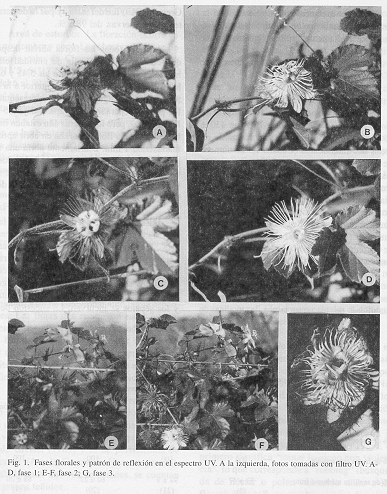
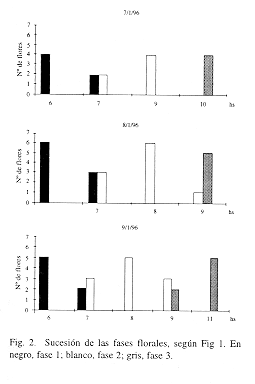
<body><![CDATA[<P><FONT FACE="Arial,Helvetica"><FONT SIZE=-1><B>Fases florales:</B> se distinguieron 3 fases <A HREF="#fig1">(Fig. 1)</A>: 1) estigmas por encima de las anteras; &eacute;stas, la corona, la corola y el c&aacute;liz, perpendiculares al eje floral; 2) estigmas a la altura de las anteras o por debajo de &eacute;stas; 3) el &aacute;pice de los estilos se recurva, quedando los estigmas por encima de las anteras; los radii, los p&eacute;talos y los s&eacute;palos se incurvan. La sucesi&oacute;n de las fases florales se muestra en la<A HREF="#fig2"> Fig. 2</A>. Duraban, aproximadamente: la fase 1, hasta las 7 hs; la fase 2, hasta las 9 hs; la fase 3, hasta las 11 hs, al final de la cual la flor se cerraba. Cuando las flores se encontraban a la sombra tardaban m&aacute;s en cambiar de fase. El 9/1/96 llov&iacute;a al amanecer, las anteras y los estigmas estuvieron m&aacute;s bajos que otros d&iacute;as. Si hab&iacute;a ocurrido fecundaci&oacute;n, al d&iacute;a siguiente de la antesis ya se detectaba al ovario con mayor tama&ntilde;o.</FONT></FONT>     <BR>&nbsp;     <BR>&nbsp;     <CENTER><TABLE BORDER=0 CELLSPACING=0 WIDTH="503" > <TR> <TD VALIGN=CENTER COLSPAN="5">     <CENTER><A NAME="cuadro1"></A><FONT FACE="Arial,Helvetica"><FONT SIZE=-1>CUADRO 1</FONT></FONT>&nbsp;</CENTER>      <CENTER><FONT FACE="Arial,Helvetica"><FONT SIZE=-1>&nbsp;</FONT></FONT></CENTER> </TD> </TR>  <TR> <TD VALIGN=CENTER COLSPAN="5">     <CENTER><I><FONT FACE="Arial,Helvetica"><FONT SIZE=-1>Porcentaje de frutos y semillas en los tratamientos reproductivos.</FONT></FONT></I>&nbsp;</CENTER>      <CENTER><I><FONT FACE="Arial,Helvetica"><FONT SIZE=-1>Los tama&ntilde;os muestrales figuran entre par&eacute;ntesis</FONT></FONT></I></CENTER> </TD> </TR>  <TR> <TD VALIGN=CENTER WIDTH="42%">     <CENTER><FONT FACE="Arial,Helvetica"><FONT SIZE=-1>Tratamiento</FONT></FONT></CENTER> </TD>  <TD VALIGN=CENTER WIDTH="14%">     <CENTER><FONT FACE="Arial,Helvetica"><FONT SIZE=-1>Autogamia</FONT></FONT>&nbsp;</CENTER>      ]]></body>
<body><![CDATA[<CENTER><FONT FACE="Arial,Helvetica"><FONT SIZE=-1>espont&aacute;nea</FONT></FONT>&nbsp;</CENTER>      <CENTER><FONT FACE="Arial,Helvetica"><FONT SIZE=-1>&nbsp;</FONT></FONT></CENTER> </TD>  <TD VALIGN=CENTER WIDTH="15%">     <CENTER><FONT FACE="Arial,Helvetica"><FONT SIZE=-1>Autogamia</FONT></FONT>&nbsp;</CENTER>      <CENTER><FONT FACE="Arial,Helvetica"><FONT SIZE=-1>inducida</FONT></FONT></CENTER> </TD>  <TD VALIGN=CENTER WIDTH="14%">     <CENTER><FONT FACE="Arial,Helvetica"><FONT SIZE=-1>Xenogamia</FONT></FONT>&nbsp;</CENTER>      <CENTER><FONT FACE="Arial,Helvetica"><FONT SIZE=-1>inducida</FONT></FONT></CENTER> </TD>  <TD VALIGN=CENTER WIDTH="15%">     <CENTER><FONT FACE="Arial,Helvetica"><FONT SIZE=-1>Polinizaci&oacute;n</FONT></FONT>&nbsp;</CENTER>      <CENTER><FONT FACE="Arial,Helvetica"><FONT SIZE=-1>libre</FONT></FONT></CENTER> </TD> </TR>  <TR> <TD VALIGN=CENTER WIDTH="42%"><FONT FACE="Arial,Helvetica"><FONT SIZE=-1>% de frutos</FONT></FONT></TD>  <TD VALIGN=CENTER WIDTH="14%">     <CENTER><FONT FACE="Arial,Helvetica"><FONT SIZE=-1>20 (12)</FONT></FONT></CENTER> </TD>  <TD VALIGN=CENTER WIDTH="15%">     <CENTER><FONT FACE="Arial,Helvetica"><FONT SIZE=-1>68 (34)</FONT></FONT></CENTER> </TD>  <TD VALIGN=CENTER WIDTH="14%">     ]]></body>
<body><![CDATA[<CENTER><FONT FACE="Arial,Helvetica"><FONT SIZE=-1>66 (44)</FONT></FONT></CENTER> </TD>  <TD VALIGN=CENTER WIDTH="15%">     <CENTER><FONT FACE="Arial,Helvetica"><FONT SIZE=-1>94 (32)</FONT></FONT></CENTER> </TD> </TR>  <TR> <TD VALIGN=CENTER WIDTH="42%"><FONT FACE="Arial,Helvetica"><FONT SIZE=-1>% de frutos con&nbsp;&nbsp;&nbsp;&nbsp; semilla&nbsp;</FONT></FONT></TD>  <TD VALIGN=CENTER WIDTH="14%">     <CENTER><FONT FACE="Arial,Helvetica"><FONT SIZE=-1>100</FONT></FONT></CENTER> </TD>  <TD VALIGN=CENTER WIDTH="15%">     <CENTER><FONT FACE="Arial,Helvetica"><FONT SIZE=-1>100</FONT></FONT></CENTER> </TD>  <TD VALIGN=CENTER WIDTH="14%">     <CENTER><FONT FACE="Arial,Helvetica"><FONT SIZE=-1>100</FONT></FONT></CENTER> </TD>  <TD VALIGN=CENTER WIDTH="15%">     <CENTER><FONT FACE="Arial,Helvetica"><FONT SIZE=-1>100</FONT></FONT></CENTER> </TD> </TR>  <TR> <TD VALIGN=CENTER WIDTH="42%"><FONT FACE="Arial,Helvetica"><FONT SIZE=-1>% de semillas maduras/fruto&nbsp;</FONT></FONT></TD>  <TD VALIGN=CENTER WIDTH="14%">     <CENTER><FONT FACE="Arial,Helvetica"><FONT SIZE=-1>53<IMG SRC="/img/fbpe/rbt/v46n2/simbi15.GIF" HEIGHT=15 WIDTH=16>47</FONT></FONT>&nbsp;</CENTER>      
<CENTER><FONT FACE="Arial,Helvetica"><FONT SIZE=-1>(2)</FONT></FONT></CENTER> </TD>  <TD VALIGN=CENTER WIDTH="15%">     <CENTER><FONT FACE="Arial,Helvetica"><FONT SIZE=-1>92<IMG SRC="/img/fbpe/rbt/v46n2/simbi15.GIF" HEIGHT=15 WIDTH=16>9</FONT></FONT>&nbsp;</CENTER>      
<CENTER><FONT FACE="Arial,Helvetica"><FONT SIZE=-1>(21)</FONT></FONT></CENTER> </TD>  <TD VALIGN=CENTER WIDTH="14%">     ]]></body>
<body><![CDATA[<CENTER><FONT FACE="Arial,Helvetica"><FONT SIZE=-1>80<IMG SRC="/img/fbpe/rbt/v46n2/simbi15.GIF" HEIGHT=15 WIDTH=16>22</FONT></FONT>&nbsp;</CENTER>      
<CENTER><FONT FACE="Arial,Helvetica"><FONT SIZE=-1>(20)</FONT></FONT></CENTER> </TD>  <TD VALIGN=CENTER WIDTH="15%">     <CENTER><FONT FACE="Arial,Helvetica"><FONT SIZE=-1>88<IMG SRC="/img/fbpe/rbt/v46n2/simbi15.GIF" HEIGHT=15 WIDTH=16>20</FONT></FONT>&nbsp;</CENTER>      
<CENTER><FONT FACE="Arial,Helvetica"><FONT SIZE=-1>(17)</FONT></FONT></CENTER> </TD> </TR>  <TR> <TD VALIGN=CENTER WIDTH="42%"><FONT FACE="Arial,Helvetica"><FONT SIZE=-1>N&amp;ordf; de semillas maduras/ placenta&nbsp;</FONT></FONT></TD>  <TD VALIGN=CENTER WIDTH="14%">     <CENTER><FONT FACE="Arial,Helvetica"><FONT SIZE=-1>6<IMG SRC="/img/fbpe/rbt/v46n2/simbi15.GIF" HEIGHT=15 WIDTH=16>2</FONT></FONT>&nbsp;</CENTER>      
<CENTER><FONT FACE="Arial,Helvetica"><FONT SIZE=-1>(2)</FONT></FONT></CENTER> </TD>  <TD VALIGN=CENTER WIDTH="15%">     <CENTER><FONT FACE="Arial,Helvetica"><FONT SIZE=-1>9<IMG SRC="/img/fbpe/rbt/v46n2/simbi15.GIF" HEIGHT=15 WIDTH=16>1</FONT></FONT>&nbsp;</CENTER>      
<CENTER><FONT FACE="Arial,Helvetica"><FONT SIZE=-1>(21)</FONT></FONT></CENTER> </TD>  <TD VALIGN=CENTER WIDTH="14%">     <CENTER><FONT FACE="Arial,Helvetica"><FONT SIZE=-1>9<IMG SRC="/img/fbpe/rbt/v46n2/simbi15.GIF" HEIGHT=15 WIDTH=16>1</FONT></FONT>&nbsp;</CENTER>      
<CENTER><FONT FACE="Arial,Helvetica"><FONT SIZE=-1>(20)</FONT></FONT></CENTER> </TD>  <TD VALIGN=CENTER WIDTH="15%">     ]]></body>
<body><![CDATA[<CENTER><FONT FACE="Arial,Helvetica"><FONT SIZE=-1>9<IMG SRC="/img/fbpe/rbt/v46n2/simbi15.GIF" HEIGHT=15 WIDTH=16>1</FONT></FONT>&nbsp;</CENTER>      
<CENTER><FONT FACE="Arial,Helvetica"><FONT SIZE=-1>(17)</FONT></FONT></CENTER> </TD> </TR>  <TR> <TD VALIGN=CENTER WIDTH="42%"><FONT FACE="Arial,Helvetica"><FONT SIZE=-1>N&amp;ordf; de semillas inmaduras/ fruto&nbsp;</FONT></FONT></TD>  <TD VALIGN=CENTER WIDTH="14%">     <CENTER><FONT FACE="Arial,Helvetica"><FONT SIZE=-1>0</FONT></FONT>&nbsp;</CENTER>      <CENTER><FONT FACE="Arial,Helvetica"><FONT SIZE=-1>&nbsp;</FONT></FONT></CENTER> </TD>  <TD VALIGN=CENTER WIDTH="15%">     <CENTER><FONT FACE="Arial,Helvetica"><FONT SIZE=-1>0.2<IMG SRC="/img/fbpe/rbt/v46n2/simbi15.GIF" HEIGHT=15 WIDTH=16>0.5</FONT></FONT>&nbsp;</CENTER>      
<CENTER><FONT FACE="Arial,Helvetica"><FONT SIZE=-1>(21)</FONT></FONT></CENTER> </TD>  <TD VALIGN=CENTER WIDTH="14%">     <CENTER><FONT FACE="Arial,Helvetica"><FONT SIZE=-1>1<IMG SRC="/img/fbpe/rbt/v46n2/simbi15.GIF" HEIGHT=15 WIDTH=16>1.9</FONT></FONT>&nbsp;</CENTER>      
<CENTER><FONT FACE="Arial,Helvetica"><FONT SIZE=-1>(20)</FONT></FONT></CENTER> </TD>  <TD VALIGN=CENTER WIDTH="15%">     <CENTER><FONT FACE="Arial,Helvetica"><FONT SIZE=-1>0.5<IMG SRC="/img/fbpe/rbt/v46n2/simbi15.GIF" HEIGHT=15 WIDTH=16>0.7</FONT></FONT>&nbsp;</CENTER>      
<CENTER><FONT FACE="Arial,Helvetica"><FONT SIZE=-1>(17)</FONT></FONT></CENTER> </TD> </TR>  <TR> <TD VALIGN=CENTER WIDTH="42%"><FONT FACE="Arial,Helvetica"><FONT SIZE=-1>% de &oacute;vulos no fecundados&nbsp;</FONT></FONT>&nbsp;     ]]></body>
<body><![CDATA[<BR><FONT FACE="Arial,Helvetica"><FONT SIZE=-1>en cada sector del ovario&nbsp;</FONT></FONT></TD>  <TD VALIGN=CENTER WIDTH="14%">     <CENTER><FONT FACE="Arial,Helvetica"><FONT SIZE=-1>apical: 0</FONT></FONT>&nbsp;</CENTER>      <CENTER><FONT FACE="Arial,Helvetica"><FONT SIZE=-1>medio: 0</FONT></FONT>&nbsp;</CENTER>      <CENTER><FONT FACE="Arial,Helvetica"><FONT SIZE=-1>basal: 100&nbsp;</FONT></FONT></CENTER> </TD>  <TD VALIGN=CENTER WIDTH="15%">     <CENTER><FONT FACE="Arial,Helvetica"><FONT SIZE=-1>apical: 15</FONT></FONT>&nbsp;</CENTER>      <CENTER><FONT FACE="Arial,Helvetica"><FONT SIZE=-1>medio: 18</FONT></FONT>&nbsp;</CENTER>      <CENTER><FONT FACE="Arial,Helvetica"><FONT SIZE=-1>basal:&nbsp;&nbsp; 67</FONT></FONT></CENTER> </TD>  <TD VALIGN=CENTER WIDTH="14%">     <CENTER><FONT FACE="Arial,Helvetica"><FONT SIZE=-1>apical: 33</FONT></FONT>&nbsp;</CENTER>      <CENTER><FONT FACE="Arial,Helvetica"><FONT SIZE=-1>medio: 26</FONT></FONT>&nbsp;</CENTER>      <CENTER><FONT FACE="Arial,Helvetica"><FONT SIZE=-1>basal:&nbsp;&nbsp; 32</FONT></FONT></CENTER> </TD>  <TD VALIGN=CENTER WIDTH="15%">     ]]></body>
<body><![CDATA[<CENTER><FONT FACE="Arial,Helvetica"><FONT SIZE=-1>apical: 18</FONT></FONT>&nbsp;</CENTER>      <CENTER><FONT FACE="Arial,Helvetica"><FONT SIZE=-1>medio: 22</FONT></FONT>&nbsp;</CENTER>      <CENTER><FONT FACE="Arial,Helvetica"><FONT SIZE=-1>basal:&nbsp;&nbsp; 30</FONT></FONT></CENTER> </TD> </TR> </TABLE></CENTER> &nbsp;     <CENTER><A NAME="fig1"></A><IMG SRC="/img/fbpe/rbt/v46n2/0080i01.GIF" HEIGHT=494 WIDTH=387></CENTER> &nbsp;     
<BR>&nbsp;      <P><FONT FACE="Arial,Helvetica"><FONT SIZE=-1><B>Receptividad:</B> los estigmas estaban receptivos en todas las fases florales; el burbujeo con per&oacute;xido de hidr&oacute;geno era m&aacute;s intenso cuando se hallaban por debajo de las anteras en la fase 2 (n=14).</FONT></FONT>     <BR>&nbsp;     <CENTER><A NAME="fig2"></A><IMG SRC="/img/fbpe/rbt/v46n2/0080i02.GIF" HEIGHT=384 WIDTH=255></CENTER> &nbsp;     
<BR>&nbsp;      <P><FONT FACE="Arial,Helvetica"><FONT SIZE=-1><B>Olor:</B> el operculum, los pali y radii presentaban un olor tenue, dulce, en las fases 1 y 2. Durante todo el d&iacute;a se percib&iacute;a olor en las br&aacute;cteas, igual al de las hojas pero m&aacute;s leve.</FONT></FONT>      ]]></body>
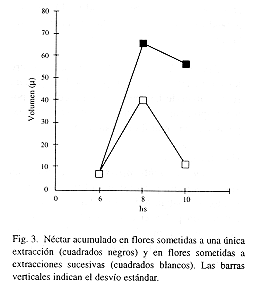
<body><![CDATA[<P><FONT FACE="Arial,Helvetica"><FONT SIZE=-1><B>Patr&oacute;n de coloraci&oacute;n:</B> en el espectro visible, los colores de las distintas piezas florales no variaban durante la antesis: pistilo, filamentos estaminales y s&eacute;palos, distintas tonalidades de verde amarillento; conectivo y borde de las anteras, amarillo claro; tecas, amarillo v&iacute;vido; operculum, limen, androgin&oacute;foro y borde de la cara abaxial de los s&eacute;palos y los p&eacute;talos, blanco; &aacute;pice y base de los radii, los pali y m&aacute;culas del limen, del androgin&oacute;foro y de los filamentos estaminales, distintas tonalidades de p&uacute;rpura rojizo. Una misma planta produc&iacute;a, adem&aacute;s, flores con los pali y el extremo de los radii p&uacute;rpura claro o blanco. En la <A HREF="#fig1">Fig. 1 </A>(A-F) se aprecia que, en el espectro UV, el gineceo y los estambres reflejaban esa luz, contrastando con el resto de las piezas, que la absorb&iacute;an, principalmente el limen y androgin&oacute;foro; y tambi&eacute;n contrastaban con las partes vegetativas de la planta (<A HREF="#fig1">Fig. 1</A>, E-F).</FONT></FONT>      <P><FONT FACE="Arial,Helvetica"><FONT SIZE=-1><B>N&eacute;ctar: </B>el porcentaje de az&uacute;cares totales fue 34 %&nbsp;<IMG SRC="/img/fbpe/rbt/v46n2/simbi15.GIF" HEIGHT=15 WIDTH=16> 5 (n=9). El pH, 5. La oferta de n&eacute;ctar fue 22.03&nbsp;<IMG SRC="/img/fbpe/rbt/v46n2/simbi16.GIF" HEIGHT=17 WIDTH=15>l&nbsp;<IMG SRC="/img/fbpe/rbt/v46n2/simbi15.GIF" HEIGHT=15 WIDTH=16>l2 .31 (n=13) en todo momento de la antesis. El patr&oacute;n de secreci&oacute;n y el efecto de las extracciones se muestran en la <A HREF="#fig3">Fig. 3</A>. La secreci&oacute;n es continua, en la fase 2 (8 hs) el volumen es considerablemente mayor que en las flores reci&eacute;n abiertas, mientras que en la fase 3 es muy escaso. El volumen menor a las 10 hs que a las 8 hs se debe a la gran variabilidad entre flores respecto a este par&aacute;metro. Las flores sometidas a extracciones sucesivas repusieron semejante volumen (aunque menor) que las que no recibieron este tratamiento.</FONT></FONT>      
<P><FONT FACE="Arial,Helvetica"><FONT SIZE=-1><B>Visitantes: </B>en 1995, casi no acudieron insectos a las flores de P. <I>foetida</I>. En 1996, la sequ&iacute;a temporaria causada por las</FONT></FONT>     <BR>&nbsp;     <CENTER><A NAME="fig3"></A><IMG SRC="/img/fbpe/rbt/v46n2/0080i03.GIF" HEIGHT=297 WIDTH=259></CENTER> &nbsp;     
<BR>&nbsp;      <P><FONT FACE="Arial,Helvetica"><FONT SIZE=-1>elevadas temperaturas, a pesar de las recientes lluvias (Gonz&aacute;les, com. pers.), aparentemente provoc&oacute; una disminuci&oacute;n en la abundancia de insectos; sin embargo, P. <I>foetida</I> recibi&oacute; visitas. A continuaci&oacute;n, se detalla el comportamiento de los visitantes en las flores:</FONT></FONT>      <P><FONT FACE="Arial,Helvetica"><FONT SIZE=-1>Hymenoptera: generalmente recorr&iacute;an 1&nbsp;<IMG SRC="/img/fbpe/rbt/v46n2/simbi15.GIF" HEIGHT=15 WIDTH=16> 1 flores/planta en cada visita (n= 34) (1-4).</FONT></FONT>      
<P><FONT FACE="Arial,Helvetica"><FONT SIZE=-1>Colletidae</FONT></FONT>     <BR><FONT FACE="Arial,Helvetica"><FONT SIZE=-1><I>Ptiloglossa tarsata </I>(Friese 1900) (machos y hembras): las visitas eran muy r&aacute;pidas. Se posaban sobre los radii con el cuerpo paralelo a &eacute;stos y libaban separando el operculum del limen. Contactaban las anteras, y los estigmas en fase 2. El polen se depositaba sobre el dorso del t&oacute;rax. Las hembras a veces se lo pasaban a las patas III. Los machos volaban hasta 15 min. alrededor de las plantas, probablemente a la espera de hembras; no siempre libaban.</FONT></FONT>      ]]></body>
<body><![CDATA[<P><FONT FACE="Arial,Helvetica"><FONT SIZE=-1><I>Caupolicana</I> sp.(machos): se posaban con el cuerpo paralelo a los radii y separaban el operculum del limen para libar, contactando las anteras con el dorso del t&oacute;rax.</FONT></FONT>      <P><FONT FACE="Arial,Helvetica"><FONT SIZE=-1>Apidae</FONT></FONT>     <BR><FONT FACE="Arial,Helvetica"><FONT SIZE=-1><I>Peponapis fervens</I> (Smith 1879) (machos): se posaban sobre los radii y libaban separando el operculum del limen, contactando las anteras con el dorso del t&oacute;rax.</FONT></FONT>      <P><FONT FACE="Arial,Helvetica"><FONT SIZE=-1><I>Apis mellifera</I> L. 1758: se posaban sobre los radii e intentaban libar pero no lo lograban; se colgaban de las anteras para recolectar polen, impregn&aacute;ndose con &eacute;ste el dorso del t&oacute;rax, patas y zona ventral del abdomen.</FONT></FONT>      <P><FONT FACE="Arial,Helvetica"><FONT SIZE=-1>Halictidae</FONT></FONT>     <BR><FONT FACE="Arial,Helvetica"><FONT SIZE=-1><I>Pseudaugochloropsis</I> sp.: se posaban sobre los radii, perforaban el limen en varios puntos y libaban todo el n&eacute;ctar. Se embadurnaban con polen el dorso del t&oacute;rax y alas; a veces se lo remov&iacute;an despu&eacute;s de la visita, sobre plantas adyacentes. Contactaban los estigmas ocasionalmente.</FONT></FONT>      <P><FONT FACE="Arial,Helvetica"><FONT SIZE=-1><I>Augochlorella</I> sp.: recolectaban polen colg&aacute;ndose de las anteras, quedando &eacute;ste en las patas y la zona ventral del abdomen; a veces perforaban el limen o intentaban libar, extendiendo el aparato bucal junto a la base del androgin&oacute;foro o entre limen y operculum.</FONT></FONT>      <P><FONT FACE="Arial,Helvetica"><FONT SIZE=-1><I>Dialictus</I> sp., <I>Halictillus</I> sp.: intentaban libar extendiendo el aparato bucal entre limen y operculum, pero no pod&iacute;an introducirlo; en la mayor&iacute;a de las visitas recolectaban polen colg&aacute;ndose de las anteras, quedando &eacute;ste en las patas y zona ventral del abdomen.</FONT></FONT>      <P><FONT FACE="Arial,Helvetica"><FONT SIZE=-1>Vespidae: inspeccionaban entre los radii.</FONT></FONT>      <P><FONT FACE="Arial,Helvetica"><FONT SIZE=-1>Lepidoptera, Sphingidae: un ejemplar lib&oacute; una flor el 18/I/96 a las 6.10 hs.</FONT></FONT>      ]]></body>
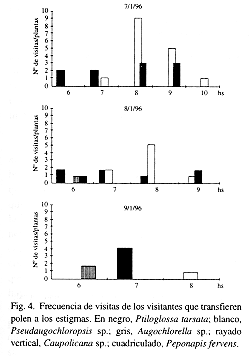
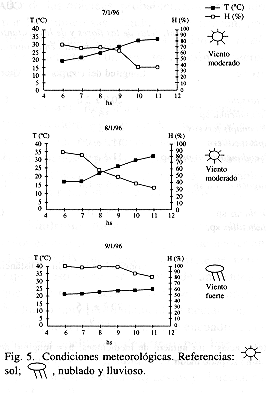
<body><![CDATA[<P><FONT FACE="Arial,Helvetica"><FONT SIZE=-1>Coleoptera, Chrysomelidae, <I>Diabrotica speciosa</I>: com&iacute;an polen y tambi&eacute;n el limen y el operculum.</FONT></FONT>      <P><FONT FACE="Arial,Helvetica"><FONT SIZE=-1>En la <A HREF="#fig4">Fig. 4 </A>se registran las frecuencias de trabajo en las flores de los visitantes que transfieren polen a los estigmas. Los m&aacute;s frecuentes y constantes fueron <I>Ptiloglossa tarsata, Pseudaugochloropsis </I>sp. y <I>Augochlorella</I> sp. En el <A HREF="#cuadro2">Cuadro 2</A> se detalla la carga pol&iacute;nica de los visitantes en los que se encontr&oacute; polen.</FONT></FONT>      <P><B><FONT FACE="Arial,Helvetica"><FONT SIZE=-1>Relaci&oacute;n entre las fases florales, frecuencia de visitas y condiciones meteorol&oacute;gicas (cfr. <A HREF="#fig2">Figs. 2</A>, <A HREF="#fig4">4</A> y <A HREF="#fig5">5</A>):</FONT></FONT></B><FONT FACE="Arial,Helvetica"><FONT SIZE=-1> entre las especies m&aacute;s frecuentes y constantes, los individuos de <I>P. tarsata</I> visitaban las flores durante las fases 1 y 2 principalmente, mientras que los de <I>Pseudaugochloropsis</I> sp. y <I>Augochlorella</I> sp. lo hac&iacute;an durante las fases 2 y 3. Las condiciones meteorol&oacute;gicas del d&iacute;a 9 provocaron una disminuci&oacute;n en la diversidad de visitantes, sin la concurrencia de los insectos m&aacute;s peque&ntilde;os.</FONT></FONT>      <P><B><FONT FACE="Arial,Helvetica"><FONT SIZE=-1>Relaci&oacute;n entre las medidas de las flores y de los visitantes (<A HREF="#cuadro3">Cuadro 3</A>): </FONT></FONT></B><FONT FACE="Arial,Helvetica"><FONT SIZE=-1>la superficie que la flor ofrece para posarse (radii) es suficiente para cualquiera de los visitantes. P. tarsata, Caupolicana sp., P. fervens y A. mellifera pueden contactar las anteras con el dorso del t&oacute;rax. A veces, debido a sus movimientos, Pseudaugochloropsis sp. tambi&eacute;n lo hace. Si bien todos los visitantes medidos alcanzan el fondo de la c&aacute;mara nectar&iacute;fera, es necesaria determinada fuerza para abrirla. P. tarsata, Caupolicana sp. y P. fervens acced&iacute;an leg&iacute;timamente al n&eacute;ctar; tambi&eacute;n Pseudaugochloropsis sp., cuando no perforaba el limen.</FONT></FONT>     <BR>&nbsp;      <P><A NAME="fig4"></A><IMG SRC="/img/fbpe/rbt/v46n2/0080i04.GIF" HEIGHT=360 WIDTH=251><A NAME="fig5"></A><IMG SRC="/img/fbpe/rbt/v46n2/0080i05.GIF" HEIGHT=393 WIDTH=266>     
<BR>&nbsp;     <CENTER><A NAME="cuadro2"></A><FONT FACE="Arial,Helvetica"><FONT SIZE=-1>CUADRO 2</FONT></FONT></CENTER>      <CENTER><TABLE BORDER=0 CELLSPACING=0 WIDTH="621" > <TR> <TD VALIGN=CENTER COLSPAN="5"></TD> </TR>  <TR> <TD VALIGN=CENTER COLSPAN="5">     <CENTER><I><FONT FACE="Arial,Helvetica"><FONT SIZE=-1>Carga pol&iacute;nica de los visitantes en los que se encontr&oacute; polen</FONT></FONT></I>&nbsp;</CENTER>      ]]></body>
<body><![CDATA[<CENTER><FONT FACE="Arial,Helvetica"><FONT SIZE=-1>&nbsp;</FONT></FONT></CENTER> </TD> </TR>  <TR> <TD VALIGN=CENTER WIDTH="20%"><FONT FACE="Arial,Helvetica"><FONT SIZE=-1>Especie</FONT></FONT></TD>  <TD VALIGN=CENTER WIDTH="39%">     <CENTER><FONT FACE="Arial,Helvetica"><FONT SIZE=-1>Parte del cuerpo*</FONT></FONT>&nbsp;</CENTER>      <CENTER><FONT FACE="Arial,Helvetica"><FONT SIZE=-1>&nbsp;</FONT></FONT></CENTER> </TD>  <TD VALIGN=CENTER WIDTH="23%">     <CENTER><FONT FACE="Arial,Helvetica"><FONT SIZE=-1>Abundancia relativa (%)</FONT></FONT>&nbsp;</CENTER>      <CENTER><FONT FACE="Arial,Helvetica"><FONT SIZE=-1>&nbsp;</FONT></FONT></CENTER> </TD> </TR>  <TR> <TD VALIGN=CENTER WIDTH="20%"><I><FONT FACE="Arial,Helvetica"><FONT SIZE=-1>Ptiloglossa tarsata</FONT></FONT></I></TD>  <TD VALIGN=CENTER WIDTH="39%"><FONT FACE="Arial,Helvetica"><FONT SIZE=-1>Dorso de cabeza, t&oacute;rax y abdomen, patas II y III</FONT></FONT></TD>  <TD VALIGN=CENTER WIDTH="23%"><FONT FACE="Arial,Helvetica"><FONT SIZE=-1>100 <I>P. foetida</I></FONT></FONT></TD> </TR>  <TR> <TD VALIGN=CENTER WIDTH="20%"><I><FONT FACE="Arial,Helvetica"><FONT SIZE=-1>Caupolicana sp.</FONT></FONT></I></TD>  <TD VALIGN=CENTER WIDTH="39%"><FONT FACE="Arial,Helvetica"><FONT SIZE=-1>Abdomen (V) y patas III</FONT></FONT></TD>  <TD VALIGN=CENTER WIDTH="23%"><FONT FACE="Arial,Helvetica"><FONT SIZE=-1>100 <I>P. foetida</I></FONT></FONT></TD> </TR>  <TR> <TD VALIGN=CENTER WIDTH="20%"><I><FONT FACE="Arial,Helvetica"><FONT SIZE=-1>Peponapis fervens</FONT></FONT></I></TD>  <TD VALIGN=CENTER WIDTH="39%"><FONT FACE="Arial,Helvetica"><FONT SIZE=-1>Patas III</FONT></FONT></TD>  <TD VALIGN=CENTER WIDTH="23%"><FONT FACE="Arial,Helvetica"><FONT SIZE=-1>100 <I>P. foetida</I></FONT></FONT></TD> </TR>  <TR> <TD VALIGN=CENTER WIDTH="20%"><I><FONT FACE="Arial,Helvetica"><FONT SIZE=-1>Pseudaugochloropsis sp.</FONT></FONT></I>&nbsp;     <BR>&nbsp;     <BR>&nbsp;      <P><FONT FACE="Arial,Helvetica"><FONT SIZE=-1>&nbsp;</FONT></FONT></TD>  <TD VALIGN=CENTER WIDTH="39%"><FONT FACE="Arial,Helvetica"><FONT SIZE=-1>Abdomen (V)</FONT></FONT>&nbsp;      <P><FONT FACE="Arial,Helvetica"><FONT SIZE=-1>Patas III</FONT></FONT>&nbsp;      <P><FONT FACE="Arial,Helvetica"><FONT SIZE=-1>Patas II</FONT></FONT>&nbsp;     ]]></body>
<body><![CDATA[<BR><FONT FACE="Arial,Helvetica"><FONT SIZE=-1>&nbsp;</FONT></FONT></TD>  <TD VALIGN=CENTER WIDTH="23%"><FONT FACE="Arial,Helvetica"><FONT SIZE=-1>87 <I>Solanum</I> spp.</FONT></FONT>&nbsp;     <BR><FONT FACE="Arial,Helvetica"><FONT SIZE=-1>13 <I>P. foetida</I></FONT></FONT>&nbsp;     <BR><FONT FACE="Arial,Helvetica"><FONT SIZE=-1>99.8 <I>Solanum</I> spp.</FONT></FONT>&nbsp;     <BR><FONT FACE="Arial,Helvetica"><FONT SIZE=-1>02. <I>P. foetida</I></FONT></FONT>&nbsp;     <BR><FONT FACE="Arial,Helvetica"><FONT SIZE=-1>100 <I>P. foetida</I></FONT></FONT></TD> </TR>  <TR> <TD VALIGN=CENTER WIDTH="20%"><I><FONT FACE="Arial,Helvetica"><FONT SIZE=-1>Augochlorella sp.</FONT></FONT></I>&nbsp;      <P><FONT FACE="Arial,Helvetica"><FONT SIZE=-1>&nbsp;</FONT></FONT></TD>  <TD VALIGN=CENTER WIDTH="39%"><FONT FACE="Arial,Helvetica"><FONT SIZE=-1>Abdomen (V)</FONT></FONT>&nbsp;      <P><FONT FACE="Arial,Helvetica"><FONT SIZE=-1>Patas III y costados t&oacute;rax</FONT></FONT>&nbsp;     <BR><FONT FACE="Arial,Helvetica"><FONT SIZE=-1>&nbsp;</FONT></FONT></TD>  <TD VALIGN=CENTER WIDTH="23%"><FONT FACE="Arial,Helvetica"><FONT SIZE=-1>91 <I>P. foetida</I></FONT></FONT>&nbsp;     <BR><FONT FACE="Arial,Helvetica"><FONT SIZE=-1>9 <I>Solanum </I>spp. + Lythraceae</FONT></FONT>&nbsp;     <BR><FONT FACE="Arial,Helvetica"><FONT SIZE=-1>100 <I>P. foetida</I></FONT></FONT></TD> </TR>  <TR> <TD VALIGN=CENTER WIDTH="20%"><I><FONT FACE="Arial,Helvetica"><FONT SIZE=-1>Dialictus sp.</FONT></FONT></I></TD>  <TD VALIGN=CENTER WIDTH="39%"><FONT FACE="Arial,Helvetica"><FONT SIZE=-1>Patas III</FONT></FONT></TD>  <TD VALIGN=CENTER WIDTH="23%"><FONT FACE="Arial,Helvetica"><FONT SIZE=-1>100 <I>Solanum </I>sp.</FONT></FONT></TD> </TR>  <TR> <TD VALIGN=CENTER WIDTH="20%"><I><FONT FACE="Arial,Helvetica"><FONT SIZE=-1>Halictillus sp.</FONT></FONT></I></TD>  <TD VALIGN=CENTER WIDTH="39%"><FONT FACE="Arial,Helvetica"><FONT SIZE=-1>Abdomen (V) y patas III</FONT></FONT></TD>  <TD VALIGN=CENTER WIDTH="23%"><FONT FACE="Arial,Helvetica"><FONT SIZE=-1>100 <I>Solanum</I> sp.</FONT></FONT></TD> </TR> </TABLE></CENTER> <FONT FACE="Arial,Helvetica"><FONT SIZE=-1>&nbsp;&nbsp;&nbsp;&nbsp;&nbsp;&nbsp;&nbsp;&nbsp;&nbsp;&nbsp;&nbsp;&nbsp;&nbsp;&nbsp;&nbsp;&nbsp;&nbsp;&nbsp;&nbsp;&nbsp;&nbsp;&nbsp;&nbsp;&nbsp; * V=parte ventral</FONT></FONT>     ]]></body>
<body><![CDATA[<BR>&nbsp;     <BR>&nbsp;     <CENTER><TABLE BORDER=0 CELLSPACING=0 WIDTH="636" > <TR> <TD VALIGN=CENTER COLSPAN="5">     <CENTER><A NAME="cuadro3"></A><FONT FACE="Arial,Helvetica"><FONT SIZE=-1>CUADRO 3</FONT></FONT>&nbsp;</CENTER>      <CENTER><FONT FACE="Arial,Helvetica"><FONT SIZE=-1>&nbsp;</FONT></FONT></CENTER> </TD> </TR>  <TR> <TD VALIGN=CENTER COLSPAN="5">     <CENTER><I><FONT FACE="Arial,Helvetica"><FONT SIZE=-1>Medidas de las flores y de los visitantes que se posan sobre los radii para libar,</FONT></FONT></I>&nbsp;</CENTER>      <CENTER><I><FONT FACE="Arial,Helvetica"><FONT SIZE=-1>importantes en la interacci&oacute;n.&nbsp; Dimensiones en mm.</FONT></FONT></I>&nbsp;</CENTER>      <CENTER><FONT FACE="Arial,Helvetica"><FONT SIZE=-1>&nbsp;</FONT></FONT></CENTER> </TD> </TR>  <TR> <TD VALIGN=CENTER WIDTH="22%"><FONT FACE="Arial,Helvetica"><FONT SIZE=-1>Especie</FONT></FONT></TD>  <TD VALIGN=CENTER WIDTH="20%">     <CENTER><FONT FACE="Arial,Helvetica"><FONT SIZE=-1>Longitud del cuerpo</FONT></FONT></CENTER> </TD>  <TD VALIGN=CENTER WIDTH="22%">     <CENTER><FONT FACE="Arial,Helvetica"><FONT SIZE=-1>Altura del t&oacute;rax</FONT></FONT></CENTER> </TD>  <TD VALIGN=CENTER WIDTH="23%">     ]]></body>
<body><![CDATA[<CENTER><FONT FACE="Arial,Helvetica"><FONT SIZE=-1>Longitud del aparato bucal</FONT></FONT></CENTER> </TD>  <TD VALIGN=CENTER WIDTH="14%">     <CENTER><FONT FACE="Arial,Helvetica"><FONT SIZE=-1>N</FONT></FONT></CENTER> </TD> </TR>  <TR> <TD VALIGN=CENTER WIDTH="22%"><I><FONT FACE="Arial,Helvetica"><FONT SIZE=-1>P. tarsata</FONT></FONT></I></TD>  <TD VALIGN=CENTER WIDTH="20%">     <CENTER><FONT FACE="Arial,Helvetica"><FONT SIZE=-1>20.9<IMG SRC="/img/fbpe/rbt/v46n2/simbi15.GIF" HEIGHT=15 WIDTH=16>2.6</FONT></FONT></CENTER> </TD>  <TD VALIGN=CENTER WIDTH="22%">     
<CENTER><FONT FACE="Arial,Helvetica"><FONT SIZE=-1>6.4<IMG SRC="/img/fbpe/rbt/v46n2/simbi15.GIF" HEIGHT=15 WIDTH=16>0.2</FONT></FONT></CENTER> </TD>  <TD VALIGN=CENTER WIDTH="23%">     
<CENTER><FONT FACE="Arial,Helvetica"><FONT SIZE=-1>*</FONT></FONT></CENTER> </TD>  <TD VALIGN=CENTER WIDTH="14%">     <CENTER><FONT FACE="Arial,Helvetica"><FONT SIZE=-1>3</FONT></FONT></CENTER> </TD> </TR>  <TR> <TD VALIGN=CENTER WIDTH="22%"><I><FONT FACE="Arial,Helvetica"><FONT SIZE=-1>Caupolicana sp.</FONT></FONT></I></TD>  <TD VALIGN=CENTER WIDTH="20%">     <CENTER><FONT FACE="Arial,Helvetica"><FONT SIZE=-1>16.2</FONT></FONT></CENTER> </TD>  <TD VALIGN=CENTER WIDTH="22%">     <CENTER><FONT FACE="Arial,Helvetica"><FONT SIZE=-1>6.1</FONT></FONT></CENTER> </TD>  <TD VALIGN=CENTER WIDTH="23%">     <CENTER><FONT FACE="Arial,Helvetica"><FONT SIZE=-1>2.6</FONT></FONT></CENTER> </TD>  <TD VALIGN=CENTER WIDTH="14%">     <CENTER><FONT FACE="Arial,Helvetica"><FONT SIZE=-1>1</FONT></FONT></CENTER> </TD> </TR>  <TR> <TD VALIGN=CENTER WIDTH="22%"><I><FONT FACE="Arial,Helvetica"><FONT SIZE=-1>Peponapis fervens</FONT></FONT></I></TD>  <TD VALIGN=CENTER WIDTH="20%">     ]]></body>
<body><![CDATA[<CENTER><FONT FACE="Arial,Helvetica"><FONT SIZE=-1>12.3</FONT></FONT></CENTER> </TD>  <TD VALIGN=CENTER WIDTH="22%">     <CENTER><FONT FACE="Arial,Helvetica"><FONT SIZE=-1>4.3</FONT></FONT></CENTER> </TD>  <TD VALIGN=CENTER WIDTH="23%">     <CENTER><FONT FACE="Arial,Helvetica"><FONT SIZE=-1>2.9</FONT></FONT></CENTER> </TD>  <TD VALIGN=CENTER WIDTH="14%">     <CENTER><FONT FACE="Arial,Helvetica"><FONT SIZE=-1>1</FONT></FONT></CENTER> </TD> </TR>  <TR> <TD VALIGN=CENTER WIDTH="22%"><I><FONT FACE="Arial,Helvetica"><FONT SIZE=-1>Apis mellifera</FONT></FONT></I></TD>  <TD VALIGN=CENTER WIDTH="20%">     <CENTER><FONT FACE="Arial,Helvetica"><FONT SIZE=-1>11.3<IMG SRC="/img/fbpe/rbt/v46n2/simbi15.GIF" HEIGHT=15 WIDTH=16>0.3</FONT></FONT></CENTER> </TD>  <TD VALIGN=CENTER WIDTH="22%">     
<CENTER><FONT FACE="Arial,Helvetica"><FONT SIZE=-1>4.3<IMG SRC="/img/fbpe/rbt/v46n2/simbi15.GIF" HEIGHT=15 WIDTH=16>0.3</FONT></FONT></CENTER> </TD>  <TD VALIGN=CENTER WIDTH="23%">     
<CENTER><FONT FACE="Arial,Helvetica"><FONT SIZE=-1>2.6<IMG SRC="/img/fbpe/rbt/v46n2/simbi15.GIF" HEIGHT=15 WIDTH=16>0.6</FONT></FONT></CENTER> </TD>  <TD VALIGN=CENTER WIDTH="14%">     
<CENTER><FONT FACE="Arial,Helvetica"><FONT SIZE=-1>3</FONT></FONT></CENTER> </TD> </TR>  <TR> <TD VALIGN=CENTER WIDTH="22%"><I><FONT FACE="Arial,Helvetica"><FONT SIZE=-1>Pseudaugochloropsis sp.</FONT></FONT></I></TD>  <TD VALIGN=CENTER WIDTH="20%">     <CENTER><FONT FACE="Arial,Helvetica"><FONT SIZE=-1>11.3<IMG SRC="/img/fbpe/rbt/v46n2/simbi15.GIF" HEIGHT=15 WIDTH=16>0.5</FONT></FONT>&nbsp;</CENTER>      
<CENTER><FONT FACE="Arial,Helvetica"><FONT SIZE=-1>&nbsp;</FONT></FONT></CENTER> </TD>  <TD VALIGN=CENTER WIDTH="22%">     ]]></body>
<body><![CDATA[<CENTER><FONT FACE="Arial,Helvetica"><FONT SIZE=-1>3.2<IMG SRC="/img/fbpe/rbt/v46n2/simbi15.GIF" HEIGHT=15 WIDTH=16>0.4</FONT></FONT>&nbsp;</CENTER>      
<CENTER><FONT FACE="Arial,Helvetica"><FONT SIZE=-1>&nbsp;</FONT></FONT></CENTER> </TD>  <TD VALIGN=CENTER WIDTH="23%">     <CENTER><FONT FACE="Arial,Helvetica"><FONT SIZE=-1>1.7</FONT></FONT>&nbsp;</CENTER>      <CENTER><FONT FACE="Arial,Helvetica"><FONT SIZE=-1>&nbsp;</FONT></FONT></CENTER> </TD>  <TD VALIGN=CENTER WIDTH="14%">     <CENTER><FONT FACE="Arial,Helvetica"><FONT SIZE=-1>n<SUB>1</SUB>=2</FONT></FONT>&nbsp;</CENTER>      <CENTER><FONT FACE="Arial,Helvetica"><FONT SIZE=-1>n<SUB>2</SUB>=1</FONT></FONT></CENTER> </TD> </TR>  <TR> <TD VALIGN=CENTER WIDTH="22%"><I><FONT FACE="Arial,Helvetica"><FONT SIZE=-1>Augochlorella sp.</FONT></FONT></I></TD>  <TD VALIGN=CENTER WIDTH="20%">     <CENTER><FONT FACE="Arial,Helvetica"><FONT SIZE=-1>4.6<IMG SRC="/img/fbpe/rbt/v46n2/simbi15.GIF" HEIGHT=15 WIDTH=16>1.6</FONT></FONT>&nbsp;</CENTER>      
<CENTER><FONT FACE="Arial,Helvetica"><FONT SIZE=-1>&nbsp;</FONT></FONT></CENTER> </TD>  <TD VALIGN=CENTER WIDTH="22%">     <CENTER><FONT FACE="Arial,Helvetica"><FONT SIZE=-1>1.6<IMG SRC="/img/fbpe/rbt/v46n2/simbi15.GIF" HEIGHT=15 WIDTH=16>0.1</FONT></FONT>&nbsp;</CENTER>      
<CENTER><FONT FACE="Arial,Helvetica"><FONT SIZE=-1>&nbsp;</FONT></FONT></CENTER> </TD>  <TD VALIGN=CENTER WIDTH="23%">     ]]></body>
<body><![CDATA[<CENTER><FONT FACE="Arial,Helvetica"><FONT SIZE=-1>2.9</FONT></FONT>&nbsp;</CENTER>      <CENTER><FONT FACE="Arial,Helvetica"><FONT SIZE=-1>&nbsp;</FONT></FONT></CENTER> </TD>  <TD VALIGN=CENTER WIDTH="14%">     <CENTER><FONT FACE="Arial,Helvetica"><FONT SIZE=-1>n<SUB>1</SUB>=2</FONT></FONT>&nbsp;</CENTER>      <CENTER><FONT FACE="Arial,Helvetica"><FONT SIZE=-1>n<SUB>2</SUB>=1</FONT></FONT></CENTER> </TD> </TR>  <TR> <TD VALIGN=CENTER WIDTH="22%"><I><FONT FACE="Arial,Helvetica"><FONT SIZE=-1>Dialictus&nbsp; sp.</FONT></FONT></I></TD>  <TD VALIGN=CENTER WIDTH="20%">     <CENTER><FONT FACE="Arial,Helvetica"><FONT SIZE=-1>4.5<IMG SRC="/img/fbpe/rbt/v46n2/simbi15.GIF" HEIGHT=15 WIDTH=16>0.1</FONT></FONT></CENTER> </TD>  <TD VALIGN=CENTER WIDTH="22%">     
<CENTER><FONT FACE="Arial,Helvetica"><FONT SIZE=-1>0.9<IMG SRC="/img/fbpe/rbt/v46n2/simbi15.GIF" HEIGHT=15 WIDTH=16>0</FONT></FONT></CENTER> </TD>  <TD VALIGN=CENTER WIDTH="23%">     
<CENTER><FONT FACE="Arial,Helvetica"><FONT SIZE=-1>*</FONT></FONT></CENTER> </TD>  <TD VALIGN=CENTER WIDTH="14%">     <CENTER><FONT FACE="Arial,Helvetica"><FONT SIZE=-1>2</FONT></FONT></CENTER> </TD> </TR>  <TR> <TD VALIGN=CENTER WIDTH="22%"><I><FONT FACE="Arial,Helvetica"><FONT SIZE=-1>Halictillus sp.</FONT></FONT></I></TD>  <TD VALIGN=CENTER WIDTH="20%">     <CENTER><FONT FACE="Arial,Helvetica"><FONT SIZE=-1>6.9</FONT></FONT></CENTER> </TD>  <TD VALIGN=CENTER WIDTH="22%">     <CENTER><FONT FACE="Arial,Helvetica"><FONT SIZE=-1>1.2</FONT></FONT></CENTER> </TD>  <TD VALIGN=CENTER WIDTH="23%">     ]]></body>
<body><![CDATA[<CENTER><FONT FACE="Arial,Helvetica"><FONT SIZE=-1>*</FONT></FONT></CENTER> </TD>  <TD VALIGN=CENTER WIDTH="14%">     <CENTER><FONT FACE="Arial,Helvetica"><FONT SIZE=-1>1</FONT></FONT></CENTER> </TD> </TR>  <TR> <TD VALIGN=CENTER WIDTH="22%"><FONT FACE="Arial,Helvetica"><FONT SIZE=-1>&nbsp;</FONT></FONT></TD>  <TD VALIGN=CENTER WIDTH="20%"><FONT FACE="Arial,Helvetica"><FONT SIZE=-1>&nbsp;</FONT></FONT></TD>  <TD VALIGN=CENTER WIDTH="22%"><FONT FACE="Arial,Helvetica"><FONT SIZE=-1>&nbsp;</FONT></FONT></TD>  <TD VALIGN=CENTER WIDTH="23%"><FONT FACE="Arial,Helvetica"><FONT SIZE=-1>&nbsp;</FONT></FONT></TD>  <TD VALIGN=CENTER WIDTH="14%"><FONT FACE="Arial,Helvetica"><FONT SIZE=-1>&nbsp;</FONT></FONT></TD> </TR>  <TR> <TD VALIGN=CENTER WIDTH="22%"><FONT FACE="Arial,Helvetica"><FONT SIZE=-1>&nbsp;</FONT></FONT></TD>  <TD VALIGN=CENTER WIDTH="20%"><FONT FACE="Arial,Helvetica"><FONT SIZE=-1>Longitud de los radii</FONT></FONT>&nbsp;     <BR><FONT FACE="Arial,Helvetica"><FONT SIZE=-1>&nbsp;</FONT></FONT></TD>  <TD VALIGN=CENTER WIDTH="22%"><FONT FACE="Arial,Helvetica"><FONT SIZE=-1>Distancia entre anteras</FONT></FONT>&nbsp;     <BR><FONT FACE="Arial,Helvetica"><FONT SIZE=-1>y radii</FONT></FONT></TD>  <TD VALIGN=CENTER WIDTH="23%"><FONT FACE="Arial,Helvetica"><FONT SIZE=-1>Profundidad de la c&aacute;mara</FONT></FONT>&nbsp;     <BR><FONT FACE="Arial,Helvetica"><FONT SIZE=-1>del n&eacute;ctar</FONT></FONT></TD>  <TD VALIGN=CENTER WIDTH="14%"><FONT FACE="Arial,Helvetica"><FONT SIZE=-1>&nbsp;</FONT></FONT></TD> </TR>  <TR> <TD VALIGN=CENTER WIDTH="22%"><FONT FACE="Arial,Helvetica"><FONT SIZE=-1>&nbsp;</FONT></FONT></TD>  <TD VALIGN=CENTER WIDTH="20%">     <CENTER><FONT FACE="Arial,Helvetica"><FONT SIZE=-1>20.7<IMG SRC="/img/fbpe/rbt/v46n2/simbi15.GIF" HEIGHT=15 WIDTH=16>1.5</FONT></FONT>&nbsp;</CENTER>      
<CENTER><FONT FACE="Arial,Helvetica"><FONT SIZE=-1>n=9</FONT></FONT></CENTER> </TD>  <TD VALIGN=CENTER WIDTH="22%">     <CENTER><FONT FACE="Arial,Helvetica"><FONT SIZE=-1>4.0<IMG SRC="/img/fbpe/rbt/v46n2/simbi15.GIF" HEIGHT=15 WIDTH=16>0.6</FONT></FONT>&nbsp;</CENTER>      
<CENTER><FONT FACE="Arial,Helvetica"><FONT SIZE=-1>n=9</FONT></FONT></CENTER> </TD>  <TD VALIGN=CENTER WIDTH="23%">     <CENTER><FONT FACE="Arial,Helvetica"><FONT SIZE=-1>1.6<IMG SRC="/img/fbpe/rbt/v46n2/simbi15.GIF" HEIGHT=15 WIDTH=16>0.8</FONT></FONT>&nbsp;</CENTER>      
]]></body>
<body><![CDATA[<CENTER><FONT FACE="Arial,Helvetica"><FONT SIZE=-1>n=7</FONT></FONT></CENTER> </TD>  <TD VALIGN=CENTER WIDTH="14%"><FONT FACE="Arial,Helvetica"><FONT SIZE=-1>&nbsp;</FONT></FONT></TD> </TR> </TABLE></CENTER> <FONT FACE="Arial,Helvetica"><FONT SIZE=-1>&nbsp;&nbsp;&nbsp;&nbsp;&nbsp;&nbsp;&nbsp;&nbsp;&nbsp;&nbsp;&nbsp;&nbsp;&nbsp;&nbsp;&nbsp;&nbsp;&nbsp;&nbsp;&nbsp;&nbsp; Referencias: n=n&uacute;mero de mediciones; n<SUB>1</SUB>=longitud del cuerpo y altura del t&oacute;rax; n<SUB>2</SUB>=longitud del aparato bucal;</FONT></FONT>     <BR><FONT FACE="Arial,Helvetica"><FONT SIZE=-1>&nbsp;&nbsp;&nbsp;&nbsp;&nbsp;&nbsp;&nbsp;&nbsp;&nbsp;&nbsp;&nbsp;&nbsp;&nbsp;&nbsp;&nbsp;&nbsp;&nbsp;&nbsp;&nbsp;&nbsp;&nbsp; *=no se pudo medir.</FONT></FONT>     <BR>&nbsp;      <P><B><FONT FACE="Arial,Helvetica"><FONT SIZE=-1>Discusi&oacute;n</FONT></FONT></B>      <P><FONT FACE="Arial,Helvetica"><FONT SIZE=-1><B>Sistema reproductivo: </B>seg&uacute;n el &iacute;ndice P/O, P. foetida ser&iacute;a aut&oacute;gama facultativa-xen&oacute;gama facultativa. La obtenci&oacute;n de semillas en todos los tratamientos indica que existe un importante grado de autogamia (principalmente cuando se induce) y de xenogamia. El porcentaje de semillas producidas por autogamia espont&aacute;nea fue menor que en el resto de los tratamientos. En condiciones naturales, el escaso polen propio en el borde de los estigmas (depositado al girar las anteras cuando las flores abren o cuando los estigmas alcanzan la altura de aqu&eacute;llas) no interfiere espacialmente con el polen transferido por los polinizadores. Por lo tanto, los frutos tendr&aacute;n semillas producto de autogamia espont&aacute;nea y xenogamia. Si una flor no recibe visitas, al menos algunas semillas ser&iacute;an producidas por autogamia. Por lo tanto, P. <I>foetida</I> ser&iacute;a xen&oacute;gama facultativa. El porcentaje de frutos obtenido por xenogamia inducida fue menor que por polinizaci&oacute;n libre, probablemente debido al desconocimiento de la relaci&oacute;n &oacute;ptima cantidad de granos de polen/&oacute;vulos. No parece haber competencia por los tubos pol&iacute;nicos entre placentas ya que el n&uacute;mero de semillas por placenta es similar en cada fruto, pero s&iacute; entre &oacute;vulos de la misma placenta, pues generalmente son fecundados los apicales, como ocurre en P. mooreana (Amela Garc&iacute;a &amp; Hoc en prensa).</FONT></FONT>      <P><FONT FACE="Arial,Helvetica"><FONT SIZE=-1><B>Reservas y viabilidad pol&iacute;nicas:</B> los visitantes que recolectan el polen de P. <I>foetida</I> (en forma directa o removi&eacute;ndolo de las partes del cuerpo donde es depositado "accidentalmente" y pas&aacute;ndolo a las patas III) son recompensados por sus reservas, de gran valor nutritivo para sus larvas. La alta viabilidad del polen indica que no existir&iacute;a esterilidad masculina y que es posible implementar su uso en cruzamientos.</FONT></FONT>      <P><FONT FACE="Arial,Helvetica"><FONT SIZE=-1><B>Antesis:</B><A HREF="#Janzen,"> </A><A HREF="#Janzen_">Janzen (1968)</A> y <A HREF="#Gottsberger_">Gottsberger et al. (1988) </A>observaron que la antesis comenzaba cuando a&uacute;n estaba oscuro, a diferencia de lo que ocurr&iacute;a en Charata; es probable, entonces, que est&eacute; m&aacute;s influenciada por la temperatura y la humedad ambientales que por las condiciones de luz. La duraci&oacute;n de la antesis coincide con la observada por <A HREF="#Janzen_">Janzen (1968)</A> pero no con la observada por <A HREF="#Gottsberger_">Gottsberger et al. (1988)</A>, que empieza y termina antes. Es posible que hayan trabajado en d&iacute;as con m&aacute;s variabilidad de los factores metereol&oacute;gicos, dado que se prolong&oacute; en d&iacute;as fr&iacute;os y nublados; en la localidad chaque&ntilde;a, en cambio, s&oacute;lo la lluvia intensa influy&oacute;, al empujar las anteras y los estigmas hacia abajo. La sincronizaci&oacute;n en la apertura concuerda con las observaciones de ambos trabajos.</FONT></FONT>      <P><FONT FACE="Arial,Helvetica"><FONT SIZE=-1><B>Fases florales:</B> se reconocen las mismas que para P. mooreana (Amela Garc&iacute;a &amp; Hoc en prensa): 1 y 3, dadoras de polen; 2, dadora y receptora de polen. Sin embargo, la duraci&oacute;n de las fases (sobre todo de la 1) es menor (debido a que la antesis es m&aacute;s breve) y,en la fase 3, los estilos quedan recurvados y la p&eacute;rdida de turgencia es m&aacute;s notoria (probablemente por la consistencia m&aacute;s tenue de los ciclos).</FONT></FONT>      <P><FONT FACE="Arial,Helvetica"><FONT SIZE=-1><B>Atractivos:</B> P. <I>foetida</I> no presenta gran cantidad de flores (igual que P. lutea,<A HREF="#Neff,"> </A><A HREF="#Neff_">Neff &amp; Rozen 1995)</A> como atractivo a larga distancia, a diferencia de otras especies m&aacute;s conspicuas de Passiflora <A HREF="#Faegri_">(Faegri &amp; van der Pijl 1979)</A>. El limen y el androgin&oacute;foro (en contraste con los estambres y el gineceo) constituir&iacute;an una gu&iacute;a de n&eacute;ctar a corta distancia en el espectro UV. El olor de la corona es tambi&eacute;n un atractivo. El olor de las br&aacute;cteas, probablemente producido por las numerosas gl&aacute;ndulas que poseen, podr&iacute;a ser disuasivo de flor&iacute;voros; <A HREF="#Durkee">Durkee et al. (1984) </A>detectaron una sustancia resinosa secretada por ellas.</FONT></FONT>      <P><FONT FACE="Arial,Helvetica"><FONT SIZE=-1><B>N&eacute;ctar:</B> registra un m&aacute;ximo durante la fase 2 (dadora y receptora de polen), que es la m&aacute;s visitada. Las extracciones sucesivas provocan menos reposici&oacute;n que en P. mooreana (Amela Garc&iacute;a &amp; Hoc en prensa), probablemente en relaci&oacute;n con la antesis m&aacute;s breve.</FONT></FONT>      ]]></body>
<body><![CDATA[<P><FONT FACE="Arial,Helvetica"><FONT SIZE=-1><B>S&iacute;ndrome floral:</B> por la antesis diurna, color en el espectro visible, gu&iacute;as de n&eacute;ctar en el especto UV, olor fresco, superficie de aterrizaje, acceso al n&eacute;ctar a trav&eacute;s de una entrada que debe reconocerse y forzarse, recompensa oculta no muy profundamente y n&eacute;ctar con alta concentraci&oacute;n de az&uacute;cares, se encuadra en el s&iacute;ndrome melit&oacute;filo descripto por <A HREF="#Faegri_">Faegri &amp; van der Pijl (1979)</A>, aunque es actinomorfa, los &oacute;rganos sexuales est&aacute;n expuestos y el n&eacute;ctar es abundante. Por sus dimensiones est&aacute; adaptada a ser polinizada por himen&oacute;pteros medianos.</FONT></FONT>      <P><FONT FACE="Arial,Helvetica"><FONT SIZE=-1><B>Visitantes:</B> para el lapso de floraci&oacute;n estudiado, puede interpretarse el papel de cada taxon visitante como sigue: P. tarsata: por su constancia, sus visitas a flores en fase 1 y 2, su contacto de las anteras y los estigmas, y el gran porcentaje de polen de P. <I>foetida</I> que transportan en partes corporales que contactan los estigmas, los individuos de esta especie son muy importantes polinizadores. Caupolicana sp. y P. fervens: por su baja frecuencia, la libaci&oacute;n de flores en fase 1, su contacto con las anteras en dicha fase y el gran porcentaje de polen de P. <I>foetida</I> que transportan en partes del cuerpo que no contactan los estigmas, hurtar&iacute;an n&eacute;ctar y polen. A. mellifera: por su baja frecuencia, su recolecta de polen en flores en fase 1 y 2, su incapacidad para acceder al n&eacute;ctar y su falta de contacto con los estigmas, hurtar&iacute;an polen, como tambi&eacute;n lo observaron <A HREF="#Gottsberger_">Gottsberger et al. (1988)</A>. Pseudaugochloropsis sp.: por su alta frecuencia y constancia, sus visitas a flores en fase 2 y 3, las perforaciones que realizan en el limen, su contacto con el polen y transferencia ocasional a los estigmas, ser&iacute;an principalmente ladrones primarios de n&eacute;ctar, hurtadores de polen, y raramente polinizar&iacute;an; la especie observada por<A HREF="#Gottsberger_"> Gottsberger et al. (1988)</A>, en cambio, no contactaba anteras ni estigmas. Augochlorella sp.: por su moderada frecuencia y constancia, sus visitas a flores en fase 2 y 3, su recolecta abundante de polen, la perforaci&oacute;n eventual del limen y su falta de contacto de los estigmas, actuar&iacute;an principalmente como hurtadores de polen y, ocasionalmente, como ladrones primarios de n&eacute;ctar. Dialictus sp. y Halictillus sp.: por su baja frecuencia, la escasa recolecta de polen (colectaban en el campo pero a los ejemplares capturados y examinados no se les encontr&oacute; polen de P. <I>foetida</I>), sus intentos fallidos en busca de n&eacute;ctar y su falta de contacto con los estigmas, ser&iacute;an hurtadores de polen poco relevantes. Vespidae: probablemente buscaban insectos entre los radii. Sphingidae: probablemente hurten n&eacute;ctar. Diabrotica speciosa: ser&iacute;an ladrones primarios de polen y flor&iacute;voros.</FONT></FONT>      <P><FONT FACE="Arial,Helvetica"><FONT SIZE=-1>En nuestra &aacute;rea de estudio, cuando las flores empezaban a marchitarse (fase 3), todav&iacute;a recib&iacute;an visitas (aunque menos frecuentes y s&oacute;lo de Pseudaugochloropsis sp. y Augochlorella sp.), a diferencia de lo observado por <A HREF="#Gottsberger_">Gottsberger et al. (1988).</A></FONT></FONT>      <P><FONT FACE="Arial,Helvetica"><FONT SIZE=-1><B>Eficiencia en el transporte de polen : </B>como la antesis es breve, la transferencia del polen entre las plantas de P. <I>foetida</I> debe ser r&aacute;pida. Los individuos de P. tarsata parecen ser eficientes; a pesar de su baja frecuencia, probablemente debida a la fumigaci&oacute;n indiscriminada que se realiza en esa regi&oacute;n agr&iacute;cola desde 1994 (Gonz&aacute;lez, com. pers.), se obtuvo un alto porcentaje de frutos mediante polinizaci&oacute;n libre. Por esto, un cultivo de P. <I>foetida</I> donde habite P. tarsata no necesitar&iacute;a de polinizaci&oacute;n manual. Seg&uacute;n el manejo que se desee realizar, se podr&aacute; inducir la autogamia o no.</FONT></FONT>      <P><FONT FACE="Arial,Helvetica"><FONT SIZE=-1><B>Grado de adaptaci&oacute;n entre la planta y sus visitantes:</B> el s&iacute;ndrome melit&oacute;filo para abejas medianas concuerda con que los polinizadores sean los individuos de P. tarsata. <A HREF="#Janzen_">Janzen (1968)</A> cita individuos de varias especies de Ptiloglossa como polinizadores espec&iacute;ficos de P. <I>foetida</I> en Am&eacute;rica Central, coincidiendo con el presente estudio el uso de las flores como fuente de n&eacute;ctar por ambos sexos, su per&iacute;odo de actividad y comportamiento en ellas, el contacto de anteras y estigmas, y las medidas de las flores y de la altura del t&oacute;rax de estos insectos. Aunque tambi&eacute;n a pleno d&iacute;a, este col&eacute;tido se encuentra activo en horas de poca luz (Roig Alsina, com. pers.), lo que coincide con la temprana apertura de las flores. Por todo esto, existir&iacute;a cierto grado de adaptaci&oacute;n entre P. <I>foetida</I> y estas especies de Ptiloglossa. Los individuos de este g&eacute;nero fueron los &uacute;nicos polinizadores registrados en Charata y en las localidades donde trabaj&oacute; <A HREF="#Janzen_">Janzen (1968)</A>; <A HREF="#Gottsberger_">Gottsberger et al. (1988)</A>, en cambio, observaron especies de Centris y Xylocopa polinizando. El resto de los visitantes que se vieron durante este estudio, ser&iacute;an oportunistas; si bien la actividad principal de la mayor&iacute;a de ellos es el hurto o el robo, no causar&iacute;an importantes efectos negativos a la planta, ya que el porcentaje de frutos con semilla obtenido por polinizaci&oacute;n libre fue elevado.</FONT></FONT>     <BR>&nbsp;      <P><B><FONT FACE="Arial,Helvetica"><FONT SIZE=-1>Agradecimientos</FONT></FONT></B>      <P><FONT FACE="Arial,Helvetica"><FONT SIZE=-1>&nbsp;Agradecemos a Jos&eacute; Luis Telma por su ayuda en el campo. A Oscar Gonz&aacute;lez por el hospedaje y apoyo brindado. A Arturo Roig Alsina por la determinaci&oacute;n de los himen&oacute;pteros y los &uacute;tiles comentarios sobre su biolog&iacute;a. Al CONICET, por el subsidio N&amp;deg; 548, con parte del cual se financi&oacute; este estudio.</FONT></FONT>     <BR>&nbsp;      <P><B><FONT FACE="Arial,Helvetica"><FONT SIZE=-1>Resumen</FONT></FONT></B>      ]]></body>
<body><![CDATA[<P><FONT FACE="Arial,Helvetica"><FONT SIZE=-1>Un experimento reproductivo muestra que <I>Passiflora foetida</I> es autocompatible. Observaciones de las caracter&iacute;sticas florales y de los visitantes durante la antesis, m&aacute;s el an&aacute;lisis del polen transportado, permitieron identificar el s&iacute;ndrome floral (melitofilia) y las funciones de cada visitante. La antesis ocurre desde las 6 hasta las 11 hs. Se identificaron 3 fases florales: 1) estigmas por encima de las anteras, 2) estigmas a la altura de las anteras, 3) estigmas por encima de las anteras; los radii, los p&eacute;talos y los s&eacute;palos se incurvan. Los estigmas est&aacute;n receptivos durante toda la antesis. La concentraci&oacute;n de az&uacute;cares del n&eacute;ctar es 34 %. El color predominante en el espectro visible es el blanco. En el espectro UV, los estambres y el gineceo contrastan con el limen y el androgin&oacute;foro; pueden ser una gu&iacute;a de n&eacute;ctar. Tres especies de himen&oacute;pteros fueron los visitantes m&aacute;s frecuentes y constantes: <I>Ptiloglossa tarsata </I>(Colletidae) siempre contactan las anteras y los estigmas cuando liban, transportan un alto porcentaje de polen de P. <I>foetida</I> y visitan flores en fase 1 y 2; pueden ser considerados los principales polinizadores. <I>Pseudaugochloropsis</I> sp. (Halictidae) raramente contactan las anteras o los estigmas cuando perforan el limen para acceder al n&eacute;ctar y visitan flores en fase 2 y 3; son ladrones de n&eacute;ctar que raramente polinizan. <I>Augochlorella</I> sp. (Halictidae) recolectan polen sin tocar los estigmas y visitan flores en fase 2 y 3; son hurtadores de polen.</FONT></FONT>     <BR>&nbsp;      <P><B><FONT FACE="Arial,Helvetica"><FONT SIZE=-1>Referencias</FONT></FONT></B>      <!-- ref --><P><A NAME="Amela"></A><FONT FACE="Arial,Helvetica"><FONT SIZE=-1>Amela Garc&iacute;a, M. T. &amp; P. S. Hoc. 1997. Aspectos de la biolog&iacute;a floral y el sistema reproductivo de Passiflora mooreana. Darwiniana (en prensa).</FONT></FONT>    &nbsp;&nbsp;&nbsp;&nbsp;&nbsp;&nbsp;&nbsp;&nbsp;[&#160;<a href="javascript:void(0);" onclick="javascript: window.open('/scielo.php?script=sci_nlinks&ref=1119076&pid=S0034-7744199800020000200001&lng=','','width=640,height=500,resizable=yes,scrollbars=1,menubar=yes,');">Links</a>&#160;]<!-- end-ref --><!-- ref --><P><A NAME="Anónimo_"></A><FONT FACE="Arial,Helvetica"><FONT SIZE=-1>An&oacute;nimo. 1989. Diccionario manual e ilustrado de la lengua espa&ntilde;ola. Real Academia Espa&ntilde;ola. Espasa-Calpe, Barcelona. 1666 p.</FONT></FONT>    &nbsp;&nbsp;&nbsp;&nbsp;&nbsp;&nbsp;&nbsp;&nbsp;[&#160;<a href="javascript:void(0);" onclick="javascript: window.open('/scielo.php?script=sci_nlinks&ref=1119077&pid=S0034-7744199800020000200002&lng=','','width=640,height=500,resizable=yes,scrollbars=1,menubar=yes,');">Links</a>&#160;]<!-- end-ref --><!-- ref --><P><A NAME="Burkart"></A><FONT FACE="Arial,Helvetica"><FONT SIZE=-1>Burkart, A. 1963. Antiguos herbarios argentinos en Gran Breta&ntilde;a y su inter&eacute;s fitogeogr&aacute;fico. Darwiniana 12: 533-558.</FONT></FONT>    &nbsp;&nbsp;&nbsp;&nbsp;&nbsp;&nbsp;&nbsp;&nbsp;[&#160;<a href="javascript:void(0);" onclick="javascript: window.open('/scielo.php?script=sci_nlinks&ref=1119078&pid=S0034-7744199800020000200003&lng=','','width=640,height=500,resizable=yes,scrollbars=1,menubar=yes,');">Links</a>&#160;]<!-- end-ref --><!-- ref --><P><A NAME="Cruden_"></A><FONT FACE="Arial,Helvetica"><FONT SIZE=-1>Cruden, R. W. 1977. Pollen-ovule ratios: a conservative indicator of breeding systems in flowering plants. Evolution 31: 32-46.</FONT></FONT>    &nbsp;&nbsp;&nbsp;&nbsp;&nbsp;&nbsp;&nbsp;&nbsp;[&#160;<a href="javascript:void(0);" onclick="javascript: window.open('/scielo.php?script=sci_nlinks&ref=1119079&pid=S0034-7744199800020000200004&lng=','','width=640,height=500,resizable=yes,scrollbars=1,menubar=yes,');">Links</a>&#160;]<!-- end-ref --><P><A NAME="Durkee"></A>      <!-- ref --><P><FONT FACE="Arial,Helvetica"><FONT SIZE=-1>Durkee, L. T., C. W. Baird &amp; P. F. Cohen. 1984. Light and electron microscopy of the resin glands of Passiflora foetida (Passifloraceae). Amer. J. Bot. 71: 596-602.</FONT></FONT>    &nbsp;&nbsp;&nbsp;&nbsp;&nbsp;&nbsp;&nbsp;&nbsp;[&#160;<a href="javascript:void(0);" onclick="javascript: window.open('/scielo.php?script=sci_nlinks&ref=1119081&pid=S0034-7744199800020000200005&lng=','','width=640,height=500,resizable=yes,scrollbars=1,menubar=yes,');">Links</a>&#160;]<!-- end-ref --><!-- ref --><P><A NAME="Engstrand"></A><FONT FACE="Arial,Helvetica"><FONT SIZE=-1>Engstrand, L. 1980. Passionsfrukt (Passiflora edulis). Svensk Bot. Tidskr. 74: 5-8.</FONT></FONT>    &nbsp;&nbsp;&nbsp;&nbsp;&nbsp;&nbsp;&nbsp;&nbsp;[&#160;<a href="javascript:void(0);" onclick="javascript: window.open('/scielo.php?script=sci_nlinks&ref=1119082&pid=S0034-7744199800020000200006&lng=','','width=640,height=500,resizable=yes,scrollbars=1,menubar=yes,');">Links</a>&#160;]<!-- end-ref --><!-- ref --><P><A NAME="Faegri_"></A><FONT FACE="Arial,Helvetica"><FONT SIZE=-1>Faegri, K. &amp; L. v. der Pijl. 1979. The principles of pollination ecology. Pergamon, Oxford. 244 p.</FONT></FONT>    &nbsp;&nbsp;&nbsp;&nbsp;&nbsp;&nbsp;&nbsp;&nbsp;[&#160;<a href="javascript:void(0);" onclick="javascript: window.open('/scielo.php?script=sci_nlinks&ref=1119083&pid=S0034-7744199800020000200007&lng=','','width=640,height=500,resizable=yes,scrollbars=1,menubar=yes,');">Links</a>&#160;]<!-- end-ref --><!-- ref --><P><A NAME="Greissl"></A><FONT FACE="Arial,Helvetica"><FONT SIZE=-1>Greissl, R. 1989. Vitality analysis of monadic and polyadic pollen grains using optical contrast-fluorescence microscopy. Sci. Tech. Inform. 15: 180-184.</FONT></FONT>    &nbsp;&nbsp;&nbsp;&nbsp;&nbsp;&nbsp;&nbsp;&nbsp;[&#160;<a href="javascript:void(0);" onclick="javascript: window.open('/scielo.php?script=sci_nlinks&ref=1119084&pid=S0034-7744199800020000200008&lng=','','width=640,height=500,resizable=yes,scrollbars=1,menubar=yes,');">Links</a>&#160;]<!-- end-ref --><!-- ref --><P><A NAME="Gottsberger_"></A><FONT FACE="Arial,Helvetica"><FONT SIZE=-1>Gottsberger, G., J. M. F. Camargo &amp; I. Silberbauer-Gottsberger. 1988. A bee-pollinated tropical community: the beach dune vegetation of Ilha de Sao Lu&iacute;s, Maranhao, Brazil. Bot. Jahrb. Syst. 109: 469-500.</FONT></FONT>    &nbsp;&nbsp;&nbsp;&nbsp;&nbsp;&nbsp;&nbsp;&nbsp;[&#160;<a href="javascript:void(0);" onclick="javascript: window.open('/scielo.php?script=sci_nlinks&ref=1119085&pid=S0034-7744199800020000200009&lng=','','width=640,height=500,resizable=yes,scrollbars=1,menubar=yes,');">Links</a>&#160;]<!-- end-ref --><!-- ref --><P><A NAME="Holmgren"></A><FONT FACE="Arial,Helvetica"><FONT SIZE=-1>Holmgren, P. K., N. H. Holmgren &amp; L. C. Barnett. 1990. Index Herbariorum. Part I: The Herbaria of the World: 1-693. Regnum Vegetabile 120. New York Botanical Garden, Nueva York.</FONT></FONT>    &nbsp;&nbsp;&nbsp;&nbsp;&nbsp;&nbsp;&nbsp;&nbsp;[&#160;<a href="javascript:void(0);" onclick="javascript: window.open('/scielo.php?script=sci_nlinks&ref=1119086&pid=S0034-7744199800020000200010&lng=','','width=640,height=500,resizable=yes,scrollbars=1,menubar=yes,');">Links</a>&#160;]<!-- end-ref --><!-- ref --><P><A NAME="Inouye"></A><FONT FACE="Arial,Helvetica"><FONT SIZE=-1>Inouye, D. W. 1980. The terminology of floral larceny. Ecology 6l: 1251-1253.</FONT></FONT>    &nbsp;&nbsp;&nbsp;&nbsp;&nbsp;&nbsp;&nbsp;&nbsp;[&#160;<a href="javascript:void(0);" onclick="javascript: window.open('/scielo.php?script=sci_nlinks&ref=1119087&pid=S0034-7744199800020000200011&lng=','','width=640,height=500,resizable=yes,scrollbars=1,menubar=yes,');">Links</a>&#160;]<!-- end-ref --><!-- ref --><P><A NAME="Janzen_"></A><FONT FACE="Arial,Helvetica"><FONT SIZE=-1>Janzen, D. H. 1968. Reproductive behaviour in the Passifloraceae and some of its pollinators in Central America. Behaviour 32: 33-48.</FONT></FONT>    &nbsp;&nbsp;&nbsp;&nbsp;&nbsp;&nbsp;&nbsp;&nbsp;[&#160;<a href="javascript:void(0);" onclick="javascript: window.open('/scielo.php?script=sci_nlinks&ref=1119088&pid=S0034-7744199800020000200012&lng=','','width=640,height=500,resizable=yes,scrollbars=1,menubar=yes,');">Links</a>&#160;]<!-- end-ref --><!-- ref --><P><A NAME="Johansen"></A><FONT FACE="Arial,Helvetica"><FONT SIZE=-1>Johansen, D. A. 1940. Plant microtechnique. McGraw Hill, Nueva York. 523 p.</FONT></FONT>    &nbsp;&nbsp;&nbsp;&nbsp;&nbsp;&nbsp;&nbsp;&nbsp;[&#160;<a href="javascript:void(0);" onclick="javascript: window.open('/scielo.php?script=sci_nlinks&ref=1119089&pid=S0034-7744199800020000200013&lng=','','width=640,height=500,resizable=yes,scrollbars=1,menubar=yes,');">Links</a>&#160;]<!-- end-ref --><!-- ref --><P><A NAME="Jones"></A><FONT FACE="Arial,Helvetica"><FONT SIZE=-1>Jones, C. E. &amp; R. J. Little. 1983. Handbook of experimental pollination biology. S&amp;AE, Nueva York. 558 p.</FONT></FONT>    &nbsp;&nbsp;&nbsp;&nbsp;&nbsp;&nbsp;&nbsp;&nbsp;[&#160;<a href="javascript:void(0);" onclick="javascript: window.open('/scielo.php?script=sci_nlinks&ref=1119090&pid=S0034-7744199800020000200014&lng=','','width=640,height=500,resizable=yes,scrollbars=1,menubar=yes,');">Links</a>&#160;]<!-- end-ref --><P><A NAME="Kelly"></A><FONT FACE="Arial,Helvetica"><FONT SIZE=-1>Kelly, K. L. 1965. Inter-Society Color Council- National Bureau of Standards color-name charts illustrated with centroid colors. Standard sample N&amp;deg; 2106 Suppl. to Nat. Bur. Standards Cir. 553. U. S. Government Printing Office, Washington, D. C. 26 p.</FONT></FONT>      <!-- ref --><P><A NAME="Killip"></A><FONT FACE="Arial,Helvetica"><FONT SIZE=-1>Killip, E. P. 1938. The American species of Passifloraceae. Field Mus. Nat. Hist. Bot. Series 19: 1-613.</FONT></FONT>    &nbsp;&nbsp;&nbsp;&nbsp;&nbsp;&nbsp;&nbsp;&nbsp;[&#160;<a href="javascript:void(0);" onclick="javascript: window.open('/scielo.php?script=sci_nlinks&ref=1119092&pid=S0034-7744199800020000200016&lng=','','width=640,height=500,resizable=yes,scrollbars=1,menubar=yes,');">Links</a>&#160;]<!-- end-ref --><!-- ref --><P><A NAME="Martin,"></A><FONT FACE="Arial,Helvetica"><FONT SIZE=-1>Martin, F. W. &amp; H. Y. Nakasone. 1970. Edible species of Passiflora. Economic Botany 24: 333-343.</FONT></FONT>    &nbsp;&nbsp;&nbsp;&nbsp;&nbsp;&nbsp;&nbsp;&nbsp;[&#160;<a href="javascript:void(0);" onclick="javascript: window.open('/scielo.php?script=sci_nlinks&ref=1119093&pid=S0034-7744199800020000200017&lng=','','width=640,height=500,resizable=yes,scrollbars=1,menubar=yes,');">Links</a>&#160;]<!-- end-ref --><!-- ref --><P><A NAME="Neff_"></A><FONT FACE="Arial,Helvetica"><FONT SIZE=-1>Neff, J. L. &amp; J. G. Rozen. 1995. Foraging and nesting biology of the bee Anthemurgus passiflorae (Hymenoptera: Apoidea), descriptions of its immature stages, and observations on its floral host (Passifloraceae). Amer. Mus. Novitates 3138: 1-19.</FONT></FONT>    &nbsp;&nbsp;&nbsp;&nbsp;&nbsp;&nbsp;&nbsp;&nbsp;[&#160;<a href="javascript:void(0);" onclick="javascript: window.open('/scielo.php?script=sci_nlinks&ref=1119094&pid=S0034-7744199800020000200018&lng=','','width=640,height=500,resizable=yes,scrollbars=1,menubar=yes,');">Links</a>&#160;]<!-- end-ref --><!-- ref --><P><A NAME="Osborn"></A><FONT FACE="Arial,Helvetica"><FONT SIZE=-1>Osborn, N. M., P. G. Kevan &amp; M. Lane. 1988. Pollination biology of Opuntia polyacantha and Opuntia phaeacantha (Cactaceae) in southern Colorado. Pl. Syst. Evol. 159: 85-94.</FONT></FONT>    &nbsp;&nbsp;&nbsp;&nbsp;&nbsp;&nbsp;&nbsp;&nbsp;[&#160;<a href="javascript:void(0);" onclick="javascript: window.open('/scielo.php?script=sci_nlinks&ref=1119095&pid=S0034-7744199800020000200019&lng=','','width=640,height=500,resizable=yes,scrollbars=1,menubar=yes,');">Links</a>&#160;]<!-- end-ref --><!-- ref --><P><A NAME="Puri_"></A><FONT FACE="Arial,Helvetica"><FONT SIZE=-1>Puri, V. 1948. Studies in floral anatomy, V. On the structure and nature of the corona in certain species of the Passifloraceae. J. Ind. Bot. Soc. 27: 130-149.</FONT></FONT>    &nbsp;&nbsp;&nbsp;&nbsp;&nbsp;&nbsp;&nbsp;&nbsp;[&#160;<a href="javascript:void(0);" onclick="javascript: window.open('/scielo.php?script=sci_nlinks&ref=1119096&pid=S0034-7744199800020000200020&lng=','','width=640,height=500,resizable=yes,scrollbars=1,menubar=yes,');">Links</a>&#160;]<!-- end-ref --><!-- ref --><P><A NAME="Smiley_"></A><FONT FACE="Arial,Helvetica"><FONT SIZE=-1>Smiley, J. T. 1991. Passiflora <I>foetida</I> (Passifloraceae) (Bombillo, Calzoncillo, Norbo, Granadilla del Monte, Pasionaria, Passion Flower), p. 301-302. In D. H. Janzen (ed.). Historia Natural de Costa Rica. Universidad de Costa Rica, San Jos&eacute;.</FONT></FONT>    &nbsp;&nbsp;&nbsp;&nbsp;&nbsp;&nbsp;&nbsp;&nbsp;[&#160;<a href="javascript:void(0);" onclick="javascript: window.open('/scielo.php?script=sci_nlinks&ref=1119097&pid=S0034-7744199800020000200021&lng=','','width=640,height=500,resizable=yes,scrollbars=1,menubar=yes,');">Links</a>&#160;]<!-- end-ref --><P><A NAME="1a"></A><SUP><FONT FACE="Arial,Helvetica"><FONT SIZE=-1><A HREF="#1">1</A> </FONT></FONT></SUP><FONT FACE="Arial,Helvetica"><FONT SIZE=-1>Lab. 11, Depto. Cs. Biol&oacute;gicas, Pab. II, Ciudad Universitaria, 1428, Bs. As. Argentina. Fax: 54-1-7820582. Correo electr&oacute;nico:<A HREF="mailto: amela@biolo.bg.fcen.uba.ar"> amela@biolo.bg.fcen.uba.ar</A></FONT></FONT>      ]]></body><back>
<ref-list>
<ref id="B1">
<nlm-citation citation-type="journal">
<person-group person-group-type="author">
<name>
<surname><![CDATA[Amela García]]></surname>
<given-names><![CDATA[M. T.]]></given-names>
</name>
<name>
<surname><![CDATA[Hoc.]]></surname>
<given-names><![CDATA[P. S.]]></given-names>
</name>
</person-group>
<article-title xml:lang="es"><![CDATA[Aspectos de la biología floral y el sistema reproductivo de Passiflora mooreana]]></article-title>
<source><![CDATA[Darwiniana]]></source>
<year>1997</year>
</nlm-citation>
</ref>
<ref id="B2">
<nlm-citation citation-type="book">
<source><![CDATA[Diccionario manual e ilustrado de la lengua española]]></source>
<year>1989</year>
<publisher-loc><![CDATA[Barcelona ]]></publisher-loc>
<publisher-name><![CDATA[Real Academia Española. Espasa-Calpe]]></publisher-name>
</nlm-citation>
</ref>
<ref id="B3">
<nlm-citation citation-type="journal">
<person-group person-group-type="author">
<name>
<surname><![CDATA[Burkart]]></surname>
<given-names><![CDATA[A.]]></given-names>
</name>
</person-group>
<article-title xml:lang="es"><![CDATA[Antiguos herbarios argentinos en Gran Bretaña y su interés fitogeográfico]]></article-title>
<source><![CDATA[Darwiniana]]></source>
<year>1963</year>
<volume>12</volume>
<page-range>533-558</page-range></nlm-citation>
</ref>
<ref id="B4">
<nlm-citation citation-type="journal">
<person-group person-group-type="author">
<name>
<surname><![CDATA[Cruden]]></surname>
<given-names><![CDATA[R. W.]]></given-names>
</name>
</person-group>
<article-title xml:lang="en"><![CDATA[Pollen-ovule ratios: a conservative indicator of breeding systems in flowering plants]]></article-title>
<source><![CDATA[Evolution]]></source>
<year>1977</year>
<volume>31</volume>
<page-range>32-46</page-range></nlm-citation>
</ref>
<ref id="B5">
<nlm-citation citation-type="journal">
<person-group person-group-type="author">
<name>
<surname><![CDATA[Durkee]]></surname>
<given-names><![CDATA[L. T.]]></given-names>
</name>
<name>
<surname><![CDATA[Baird]]></surname>
<given-names><![CDATA[C. W.]]></given-names>
</name>
<name>
<surname><![CDATA[Cohen]]></surname>
<given-names><![CDATA[P. F.]]></given-names>
</name>
</person-group>
<article-title xml:lang="en"><![CDATA[Light and electron microscopy of the resin glands of Passiflora foetida (Passifloraceae)]]></article-title>
<source><![CDATA[Amer. J. Bot.]]></source>
<year>1984</year>
<volume>71</volume>
<page-range>596-602</page-range></nlm-citation>
</ref>
<ref id="B6">
<nlm-citation citation-type="journal">
<person-group person-group-type="author">
<name>
<surname><![CDATA[Engstrand]]></surname>
<given-names><![CDATA[L.]]></given-names>
</name>
</person-group>
<article-title xml:lang="en"><![CDATA[Passionsfrukt (Passiflora edulis).]]></article-title>
<source><![CDATA[Svensk Bot. Tidskr.]]></source>
<year>1980</year>
<volume>74</volume>
<page-range>5-8</page-range></nlm-citation>
</ref>
<ref id="B7">
<nlm-citation citation-type="book">
<person-group person-group-type="author">
<name>
<surname><![CDATA[Faegri]]></surname>
<given-names><![CDATA[K.]]></given-names>
</name>
<name>
<surname><![CDATA[der Pijl.]]></surname>
<given-names><![CDATA[L. v.]]></given-names>
</name>
</person-group>
<source><![CDATA[The principles of pollination ecology]]></source>
<year>1979</year>
<publisher-loc><![CDATA[Oxford ]]></publisher-loc>
<publisher-name><![CDATA[Pergamon]]></publisher-name>
</nlm-citation>
</ref>
<ref id="B8">
<nlm-citation citation-type="journal">
<person-group person-group-type="author">
<name>
<surname><![CDATA[Greissl]]></surname>
<given-names><![CDATA[R.]]></given-names>
</name>
</person-group>
<article-title xml:lang="en"><![CDATA[Vitality analysis of monadic and polyadic pollen grains using optical contrast-fluorescence microscopy]]></article-title>
<source><![CDATA[Sci. Tech. Inform.]]></source>
<year>1989</year>
<volume>15</volume>
<page-range>180-184</page-range></nlm-citation>
</ref>
<ref id="B9">
<nlm-citation citation-type="journal">
<person-group person-group-type="author">
<name>
<surname><![CDATA[Gottsberger]]></surname>
<given-names><![CDATA[G.]]></given-names>
</name>
<name>
<surname><![CDATA[Camargo]]></surname>
<given-names><![CDATA[J. M. F.]]></given-names>
</name>
<name>
<surname><![CDATA[Silberbauer-Gottsberger]]></surname>
<given-names><![CDATA[I.]]></given-names>
</name>
</person-group>
<article-title xml:lang="en"><![CDATA[A bee-pollinated tropical community: the beach dune vegetation of Ilha de Sao Luís, Maranhao, Brazil]]></article-title>
<source><![CDATA[Bot. Jahrb. Syst.]]></source>
<year>1988</year>
<volume>109</volume>
<page-range>469-500</page-range></nlm-citation>
</ref>
<ref id="B10">
<nlm-citation citation-type="book">
<person-group person-group-type="author">
<name>
<surname><![CDATA[Holmgren]]></surname>
<given-names><![CDATA[P. K.]]></given-names>
</name>
<name>
<surname><![CDATA[Holmgren]]></surname>
<given-names><![CDATA[N. H.]]></given-names>
</name>
<name>
<surname><![CDATA[Barnett]]></surname>
<given-names><![CDATA[L. C.]]></given-names>
</name>
</person-group>
<source><![CDATA[Index Herbariorum: Part I: The Herbaria of the World: 1-693. Regnum Vegetabile 120]]></source>
<year>1990</year>
<publisher-loc><![CDATA[^eNueva York Nueva York]]></publisher-loc>
<publisher-name><![CDATA[New York Botanical Garden]]></publisher-name>
</nlm-citation>
</ref>
<ref id="B11">
<nlm-citation citation-type="journal">
<person-group person-group-type="author">
<name>
<surname><![CDATA[Inouye]]></surname>
<given-names><![CDATA[D. W.]]></given-names>
</name>
</person-group>
<article-title xml:lang="en"><![CDATA[The terminology of floral larceny]]></article-title>
<source><![CDATA[Ecology]]></source>
<year>1980</year>
<volume>6l</volume>
<page-range>1251-1253</page-range></nlm-citation>
</ref>
<ref id="B12">
<nlm-citation citation-type="journal">
<person-group person-group-type="author">
<name>
<surname><![CDATA[Janzen]]></surname>
<given-names><![CDATA[D. H.]]></given-names>
</name>
</person-group>
<article-title xml:lang="en"><![CDATA[Reproductive behaviour in the Passifloraceae and some of its pollinators in Central America]]></article-title>
<source><![CDATA[Behaviour]]></source>
<year>1968</year>
<month>.</month>
<volume>32</volume>
<page-range>33-48</page-range></nlm-citation>
</ref>
<ref id="B13">
<nlm-citation citation-type="book">
<person-group person-group-type="author">
<name>
<surname><![CDATA[Johansen]]></surname>
<given-names><![CDATA[D. A.]]></given-names>
</name>
</person-group>
<source><![CDATA[Plant microtechnique]]></source>
<year>1940</year>
<publisher-loc><![CDATA[^eNueva York Nueva York]]></publisher-loc>
<publisher-name><![CDATA[McGraw Hill]]></publisher-name>
</nlm-citation>
</ref>
<ref id="B14">
<nlm-citation citation-type="">
<person-group person-group-type="author">
<name>
<surname><![CDATA[Jones,]]></surname>
<given-names><![CDATA[C. E.]]></given-names>
</name>
<name>
<surname><![CDATA[Little]]></surname>
<given-names><![CDATA[R. J.]]></given-names>
</name>
</person-group>
<source><![CDATA[Handbook of experimental pollination biology]]></source>
<year>1983</year>
<publisher-loc><![CDATA[^eNueva York Nueva York]]></publisher-loc>
</nlm-citation>
</ref>
<ref id="B15">
<nlm-citation citation-type="book">
<person-group person-group-type="author">
<name>
<surname><![CDATA[Kelly]]></surname>
<given-names><![CDATA[K. L.]]></given-names>
</name>
</person-group>
<source><![CDATA[Inter-Society Color Council- National Bureau of Standards color-name charts illustrated with centroid colors]]></source>
<year>1965</year>
<volume>2106</volume>
<publisher-loc><![CDATA[Washington, D. C. ]]></publisher-loc>
<publisher-name><![CDATA[Government Printing Office]]></publisher-name>
</nlm-citation>
</ref>
<ref id="B16">
<nlm-citation citation-type="journal">
<person-group person-group-type="author">
<name>
<surname><![CDATA[Killip]]></surname>
<given-names><![CDATA[E. P.]]></given-names>
</name>
</person-group>
<article-title xml:lang="en"><![CDATA[The American species of Passifloraceae]]></article-title>
<source><![CDATA[Field Mus. Nat. Hist. Bot.]]></source>
<year>1938</year>
<volume>19</volume>
<page-range>1-613</page-range></nlm-citation>
</ref>
<ref id="B17">
<nlm-citation citation-type="journal">
<person-group person-group-type="author">
<name>
<surname><![CDATA[Martin]]></surname>
<given-names><![CDATA[F. W]]></given-names>
</name>
<name>
<surname><![CDATA[Nakasone]]></surname>
<given-names><![CDATA[H. Y.]]></given-names>
</name>
</person-group>
<article-title xml:lang="en"><![CDATA[Edible species of Passiflora]]></article-title>
<source><![CDATA[Economic Botany]]></source>
<year>1970</year>
<volume>24</volume>
<page-range>333-343</page-range></nlm-citation>
</ref>
<ref id="B18">
<nlm-citation citation-type="journal">
<person-group person-group-type="author">
<name>
<surname><![CDATA[Neff]]></surname>
<given-names><![CDATA[J. L.]]></given-names>
</name>
<name>
<surname><![CDATA[Rozen]]></surname>
<given-names><![CDATA[J. G.]]></given-names>
</name>
</person-group>
<article-title xml:lang="en"><![CDATA[Foraging and nesting biology of the bee Anthemurgus passiflorae (Hymenoptera: Apoidea), descriptions of its immature stages, and observations on its floral host (Passifloraceae).]]></article-title>
<source><![CDATA[Amer. Mus. Novitates]]></source>
<year>1995</year>
<volume>3138</volume>
<page-range>1-19</page-range></nlm-citation>
</ref>
<ref id="B19">
<nlm-citation citation-type="journal">
<person-group person-group-type="author">
<name>
<surname><![CDATA[Osborn]]></surname>
<given-names><![CDATA[N. M.]]></given-names>
</name>
<name>
<surname><![CDATA[Kevan]]></surname>
<given-names><![CDATA[P. G.]]></given-names>
</name>
<name>
<surname><![CDATA[Lane]]></surname>
<given-names><![CDATA[M.]]></given-names>
</name>
</person-group>
<article-title xml:lang="en"><![CDATA[Pollination biology of Opuntia polyacantha and Opuntia phaeacantha (Cactaceae) in southern Colorado]]></article-title>
<source><![CDATA[Pl. Syst. Evol.]]></source>
<year>1988</year>
<volume>159</volume>
<page-range>85-94</page-range></nlm-citation>
</ref>
<ref id="B20">
<nlm-citation citation-type="journal">
<person-group person-group-type="author">
<name>
<surname><![CDATA[Puri]]></surname>
<given-names><![CDATA[V.]]></given-names>
</name>
</person-group>
<article-title xml:lang="en"><![CDATA[Studies in floral anatomy: V. On the structure and nature of the corona in certain species of the Passifloraceae]]></article-title>
<source><![CDATA[J. Ind. Bot. Soc.]]></source>
<year>1948</year>
<volume>27</volume>
<page-range>130-149</page-range></nlm-citation>
</ref>
<ref id="B21">
<nlm-citation citation-type="book">
<person-group person-group-type="author">
<name>
<surname><![CDATA[Smiley]]></surname>
<given-names><![CDATA[J. T]]></given-names>
</name>
</person-group>
<article-title xml:lang="en"><![CDATA[Passiflora foetida (Passifloraceae) (Bombillo, Calzoncillo, Norbo, Granadilla del Monte, Pasionaria, Passion Flower)]]></article-title>
<person-group person-group-type="editor">
<name>
<surname><![CDATA[Janzen]]></surname>
<given-names><![CDATA[D. H.]]></given-names>
</name>
</person-group>
<source><![CDATA[Historia Natural de Costa Rica]]></source>
<year>1991</year>
<page-range>301-302</page-range><publisher-loc><![CDATA[San José ]]></publisher-loc>
<publisher-name><![CDATA[Universidad de Costa Rica]]></publisher-name>
</nlm-citation>
</ref>
</ref-list>
</back>
</article>