<?xml version="1.0" encoding="ISO-8859-1"?><article xmlns:mml="http://www.w3.org/1998/Math/MathML" xmlns:xlink="http://www.w3.org/1999/xlink" xmlns:xsi="http://www.w3.org/2001/XMLSchema-instance">
<front>
<journal-meta>
<journal-id>0034-7744</journal-id>
<journal-title><![CDATA[Revista de Biología Tropical]]></journal-title>
<abbrev-journal-title><![CDATA[Rev. biol. trop]]></abbrev-journal-title>
<issn>0034-7744</issn>
<publisher>
<publisher-name><![CDATA[Universidad de Costa Rica]]></publisher-name>
</publisher>
</journal-meta>
<article-meta>
<article-id>S0034-77441998000100006</article-id>
<title-group>
<article-title xml:lang="es"><![CDATA[Organismos de los arrecifes coralinos de Costa Rica: descripción, distribución geográfica e historia natural de los corales zooxantelados (Anthozoa: Scleractinia) del Pacífico]]></article-title>
</title-group>
<contrib-group>
<contrib contrib-type="author">
<name>
<surname><![CDATA[Cortés]]></surname>
<given-names><![CDATA[Jorge]]></given-names>
</name>
<xref ref-type="aff" rid="A01"/>
</contrib>
<contrib contrib-type="author">
<name>
<surname><![CDATA[Guzmán]]></surname>
<given-names><![CDATA[Héctor]]></given-names>
</name>
<xref ref-type="aff" rid="A02"/>
</contrib>
</contrib-group>
<aff id="A01">
<institution><![CDATA[,Universidad de Costa Rica  ]]></institution>
<addr-line><![CDATA[San Pedro ]]></addr-line>
<country>Costa Rica</country>
</aff>
<aff id="A02">
<institution><![CDATA[,Smithsonian Tropical Research Institute  ]]></institution>
<addr-line><![CDATA[Balboa ]]></addr-line>
<country>Panamá</country>
</aff>
<pub-date pub-type="pub">
<day>00</day>
<month>03</month>
<year>1998</year>
</pub-date>
<pub-date pub-type="epub">
<day>00</day>
<month>03</month>
<year>1998</year>
</pub-date>
<volume>46</volume>
<numero>1</numero>
<fpage>55</fpage>
<lpage>92</lpage>
<copyright-statement/>
<copyright-year/>
<self-uri xlink:href="http://www.scielo.sa.cr/scielo.php?script=sci_arttext&amp;pid=S0034-77441998000100006&amp;lng=en&amp;nrm=iso"></self-uri><self-uri xlink:href="http://www.scielo.sa.cr/scielo.php?script=sci_abstract&amp;pid=S0034-77441998000100006&amp;lng=en&amp;nrm=iso"></self-uri><self-uri xlink:href="http://www.scielo.sa.cr/scielo.php?script=sci_pdf&amp;pid=S0034-77441998000100006&amp;lng=en&amp;nrm=iso"></self-uri><abstract abstract-type="short" xml:lang="en"><p><![CDATA[Twenty two species of zooxanthellate scleractinian corals from the Pacific of Costa Rica are described and illustrated with macrophotographs. Keys to the genera and species are included. Their geographic distributions in Costa Rica and world-wide are noted, as well as aspects of the natural history of the species. Sixteen species have wide distributions, from the Red Sea or Indian Ocean to the Pacific coast of America, two species are endemic to the eastern Pacific, four species are found only in the Pacific Ocean; there are no species in common with the Caribbean-Atlantic. Two species, Leptoseris scabra and Pavona xarifea, are new records for the eastern Pacific.]]></p></abstract>
<abstract abstract-type="short" xml:lang="es"><p><![CDATA[Se describen veinte y dos especies de corales ecleractinios zooxantelados del Pacífico de Costa Rica se describen. Se incluyen claves para los géneros y especies. Se presenta su distribución geográfica en Costa Rica y en todo el mundo, así como aspectos de la historia general de las especies. Dieciséis especies tiene distribuciones muy amplias, desde en Mar Rojo o el Océano Indico hasta la costa Pacífica de América, dos especies son endémicas del Pacífico Oriental, y cuatro especies se encuentran solo en Océano Pacífico; no hay ninguna especie en común con el Caribe-Atlántico. Dos especies, Leptoseris scabra y Pavona xarifae, son registros nuevos para el Pacífico Oriental.]]></p></abstract>
<kwd-group>
<kwd lng="en"><![CDATA[Corals]]></kwd>
<kwd lng="en"><![CDATA[Eastern Pacific]]></kwd>
<kwd lng="en"><![CDATA[taxonomy]]></kwd>
<kwd lng="en"><![CDATA[marine biodiversity]]></kwd>
</kwd-group>
</article-meta>
</front><body><![CDATA[ <CENTER><B><FONT FACE="Arial,Helvetica">Organismos de los arrecifes coralinos de Costa Rica: descripci&oacute;n,</FONT></B> <B><FONT FACE="Arial,Helvetica">distribuci&oacute;n geogr&aacute;fica</FONT></B></CENTER>      <CENTER><B><FONT FACE="Arial,Helvetica">e historia natural de los corales</FONT></B> <B><FONT FACE="Arial,Helvetica">zooxantelados (Anthozoa: Scleractinia) del Pac&iacute;fico</FONT></B></CENTER>      <CENTER>&nbsp;</CENTER>      <CENTER>&nbsp;</CENTER>      <CENTER><FONT FACE="Arial,Helvetica"><FONT SIZE=-1><B>Jorge Cort&eacute;s&nbsp;<A NAME="1"></A></B><SUP><A HREF="#1a">1</A></SUP>,<B>&nbsp;&nbsp; H&eacute;ctor Guzm&aacute;n<A NAME="2"></A></B><SUP><A HREF="#2a">2</A></SUP></FONT></FONT></CENTER>      <CENTER><FONT FACE="Arial,Helvetica"><FONT SIZE=-1>&nbsp;</FONT></FONT></CENTER>      <CENTER><FONT FACE="Arial,Helvetica"><FONT SIZE=-1>&nbsp;</FONT></FONT></CENTER>      <CENTER><FONT FACE="Arial,Helvetica"><FONT SIZE=-1>Recibido 28-IV-1997.Corregido 06-X-1997. Aceptado 09-X-1997</FONT></FONT></CENTER>       <P><B><FONT FACE="Arial,Helvetica"><FONT SIZE=-1>Abstract</FONT></FONT></B>      <P><FONT FACE="Arial,Helvetica"><FONT SIZE=-1>Twenty two species of zooxanthellate scleractinian corals from the Pacific of Costa Rica are described and illustrated with macrophotographs. Keys to the genera and species are included. Their geographic distributions in Costa Rica and world-wide are noted, as well as aspects of the natural history of the species. Sixteen species have wide distributions, from the Red Sea or Indian Ocean to the Pacific coast of America, two species are endemic to the eastern Pacific, four species are found only in the Pacific Ocean; there are no species in common with the Caribbean-Atlantic. Two species, <I>Leptoseris scabra</I> and <I>Pavona xarifea</I>, are new records for the eastern Pacific.</FONT></FONT>     ]]></body>
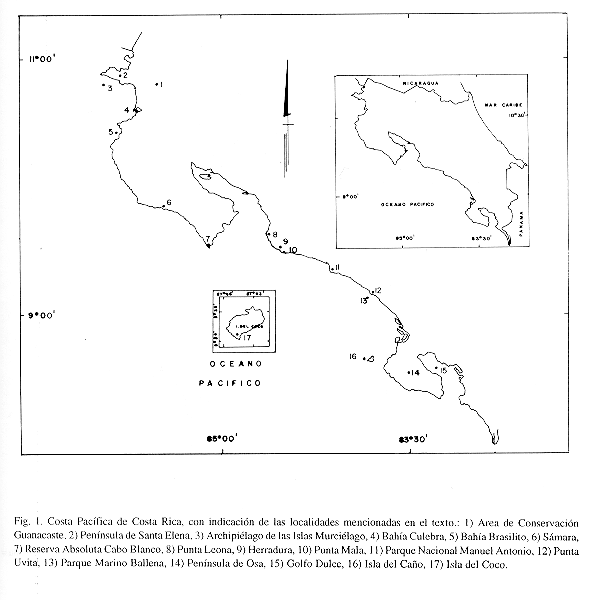
<body><![CDATA[<BR>&nbsp;     <BR><B><FONT FACE="Arial,Helvetica"><FONT SIZE=-1>Key words</FONT></FONT></B>      <P><FONT FACE="Arial,Helvetica"><FONT SIZE=-1>Corals, Eastern Pacific, taxonomy, marine biodiversity</FONT></FONT>     <BR>&nbsp;      <P><FONT FACE="Arial,Helvetica"><FONT SIZE=-1>La primera referencia a las especies de corales escleractinios del Pac&iacute;fico de Costa Rica aparece en el trabajo de <A HREF="#Durham1952">Durham yBarnard (1952)</A>, donde informan sobre corales encontrados en el Pac&iacute;fico Oriental durante las expediciones del Velero III y Velero IV de la Fundaci&oacute;n Allan Hancock de los Estados Unidos de Am&eacute;rica. <A HREF="#Hertlein,">Hertlein (1963)</A>, en su publicaci&oacute;n sobre biogeograf&iacute;a de la Isla del Coco, menciona los corales registrados por <A HREF="#Durham1952">Durham y Barnard (1952)</A> y <A HREF="#Durham1962">Durham (1962)</A>. Posteriormente, <A HREF="#Durham1966">Durham (1966)</A> da una lista m&aacute;s completa y actualizada de las especies de corales de la Isla del Coco en una publicaci&oacute;n sobre los corales del Coco y Gal&aacute;pagos, que apareci&oacute; en un volumen sobre las Islas Gal&aacute;pagos. En 1975, Bakus, publica un trabajo descriptivo de las zonas sublitorales de la Isla del Coco en el que menciona algunas especies de corales. Para esa misma &eacute;poca y posteriormente (1975 y 1978), Glynn y colaboradores trabajaron en los arrecifes del Pac&iacute;fico de Costa Rica (<A HREF="#Glynn__P_W_1983">Glynn <I>et al</I>. 1983</A>). Ellos estudiaron la muerte de corales hace unos 300 a&ntilde;os durante la Peque&ntilde;a Edad de Hielo, evidente todav&iacute;a en arrecifes muertos en Guanacaste. Existe adem&aacute;s, una lista in&eacute;dita de corales para el Parque Nacional de Manuel Antonio (<A HREF="#Dubois">Dubois &amp; Hatziolos 1982</A>). En 1985, Cort&eacute;s y Murillo publican un trabajo sobre las comunidades coralinas y arrecifes del Pac&iacute;fico de Costa Rica y dan una lista de especies de corales escleractinios encontrados. <A HREF="#Guzmán1986">Guzm&aacute;n (1986)</A> incluye una lista de corales de los arrecifes de la Isla del Ca&ntilde;o. <A HREF="#Guzmán89a">Guzm&aacute;n y Cort&eacute;s (1989a</A><A HREF="#Guzmán, H.M. & J. Cortés. 1989a.">)</A> describen los arrecifes y la distribuci&oacute;n de corales de la Isla del Ca&ntilde;o, y en una publicaci&oacute;n posterior (<A HREF="#Guzmán89b">Guzm&aacute;n &amp; Cort&eacute;s 1989b</A>) presentan las tasas de crecimiento de ocho de esas especies. <A HREF="#Hoeksema">Hoeksema (1989)</A> en su trabajo sobre los corales hongos (Familia Fungiidae) indica la presencia de dos especies en Costa Rica. En la d&eacute;cada de los 1990s se publican listas de corales de Golfo Dulce (<A HREF="#Cortés1990">Cort&eacute;s 1990</A>), Isla del Coco (Guzm&aacute;n &amp; Cort&eacute;s 1992), Parque Nacional Corcovado, Pen&iacute;nsula de Osa (<A HREF="#CortésJiménez1996">Cort&eacute;s &amp; Jim&eacute;nez 1996</A>), y del Area de Conservaci&oacute;n Guanacaste (<A HREF="#Cortés1996_1997a">Cort&eacute;s 1996-1997a</A>). <A HREF="#Cortés1996_1997b">Cort&eacute;s (1996-1997b)</A> presenta una recopilaci&oacute;n de todos los Cnidarios informados para Costa Rica, donde se incluyen todos los corales.</FONT></FONT>      <P><FONT FACE="Arial,Helvetica"><FONT SIZE=-1>Los corales del Pac&iacute;fico Oriental son muy diferentes a los del Caribe, y est&aacute;n emparentados con los corales de la Provincia biogeogr&aacute;fica del Indo-Pac&iacute;fico (<A HREF="#Cortés1986">Cort&eacute;s 1986</A>). En total se reconocen 33 especies, en 11 g&eacute;neros, de corales formadores de arrecifes e hidrocorales (Glynn en prensa). Para el Pac&iacute;fico de Costa Rica se han identificado 22 especies de corales formadores de arrecifes, 25 especies de corales ahermat&iacute;picos, y ninguna especie de hidrocoral (<A HREF="#Cortés1996_1997b">Cort&eacute;s 1996-1997b</A>).</FONT></FONT>      <P><FONT FACE="Arial,Helvetica"><FONT SIZE=-1>El presente trabajo tiene como objetivo describir las veinte y dos especies de corales escleractinios zooxantelados encontrados hasta el momento en el Pac&iacute;fico de Costa Rica (Cuadro 1), para lo cual se har&aacute; referencia a las siguientes publicaciones: <A HREF="#Durham1952">Durham y Barnard (1952)</A>, <A HREF="#Wells__J_W__1956_">Wells (1956</A>, <A HREF="#Wells__J_W__1982_">1982</A>, <A HREF="#Wells__J_W__1983_">1983</A>), <A HREF="#Veron76">Veron y Pichon (1976</A>, <A HREF="#Veron79">1979</A>, <A HREF="#Veron82">1982</A>), <A HREF="#Veron77">Veron <I>et al</I>. (1977)</A>, <A HREF="#Maragos">Maragos (1977)</A>, <A HREF="#Dinesen">Dinesen (1980)</A>, <A HREF="#Scheer">Scheer y Pillai (1983)</A>, <A HREF="#Scott,">Scott (1984)</A>, <A HREF="#Veron84">Veron y Wallace (1984</A><A HREF="#Veron, J.E.N. & C.C. Wallace. 1984.">)</A>, <A HREF="#Prahl">Prahl y Erhardt (1985)</A>, <A HREF="#Nemenzo">Nemenzo(1986)</A>, <A HREF="#Veron1986">Veron (1986</A>, <A HREF="#Veron1992">1992</A>, <A HREF="#Veron1993">1993)</A>, <A HREF="#Veron88">Veron y Kelley (1988</A><A HREF="#Veron, J.E.N. & R. Kelley. 1988.">)</A>, <A HREF="#Hoeksema">Hoeksema (1989)</A>, <A HREF="#Sheppard">Sheppard y Sheppard (1991)</A>. Se incluye adem&aacute;s, informaci&oacute;n sobre la distribuci&oacute;n geogr&aacute;fica de cada especie a nivel mundial, basada en las referencias anteriores, y para Costa Rica, basado en <A HREF="#CortésMurillo1985">Cort&eacute;s y Murillo (1985)</A>, <A HREF="#Guzmán89a">Guzm&aacute;n y Cort&eacute;s (1989a</A>, <A HREF="#Guzmán92">1992</A><A HREF="#Guzmán, H. M. & J. Cortés. 1992.">)</A>, <A HREF="#Cortés1990">Cort&eacute;s (1990</A>, <A HREF="#Cortés1996_1997a">1996-1997a)</A>, y <A HREF="#CortésJiménez1996">Cort&eacute;s y Jim&eacute;nez (1996</A>). Las localidades mencionadas en Costa Rica se indican en la <A HREF="#Figura1">Fig. 1</A>. Finalmente, se describen algunos aspectos sobre la historia natural de las especies.</FONT></FONT>     <BR>&nbsp;     <CENTER><A NAME="CUADRO_1"></A><FONT FACE="Arial,Helvetica"><FONT SIZE=-1>CUADRO 1</FONT></FONT></CENTER>      <CENTER><I><FONT FACE="Arial,Helvetica"><FONT SIZE=-1>Lista de especies de corales escleractinios zooxantelados</FONT></FONT></I></CENTER>      ]]></body>
<body><![CDATA[<CENTER><I><FONT FACE="Arial,Helvetica"><FONT SIZE=-1>encontrados en el Pac&iacute;fico de Costa Rica.</FONT></FONT></I></CENTER> &nbsp;     <BR>&nbsp;      <P><FONT FACE="Arial,Helvetica"><FONT SIZE=-1>SUBCLASE Zoantharia de Blainville, 1830</FONT></FONT>     <BR><FONT FACE="Arial,Helvetica"><FONT SIZE=-1>&nbsp;&nbsp;&nbsp; ORDEN Scleractinia Bourne, 1900</FONT></FONT>      <P><FONT FACE="Arial,Helvetica"><FONT SIZE=-1>&nbsp;&nbsp;&nbsp;&nbsp;&nbsp;&nbsp;&nbsp; SUBORDEN Astrocoeniina Vaughan &amp; Wells, 1943</FONT></FONT>      <P><FONT FACE="Arial,Helvetica"><FONT SIZE=-1>&nbsp;&nbsp;&nbsp;&nbsp;&nbsp;&nbsp;&nbsp;&nbsp;&nbsp;&nbsp;&nbsp; FAMILIA POCILLOPORIDAE Gray, 1842</FONT></FONT>     <BR><FONT FACE="Arial,Helvetica"><FONT SIZE=-1>&nbsp;&nbsp;&nbsp;&nbsp;&nbsp;&nbsp;&nbsp;&nbsp;&nbsp;&nbsp;&nbsp;&nbsp;&nbsp;&nbsp; 1. <I>Pocillopora capitata</I> Verrill, 1864</FONT></FONT>     <BR><FONT FACE="Arial,Helvetica"><FONT SIZE=-1>&nbsp;&nbsp;&nbsp;&nbsp;&nbsp;&nbsp;&nbsp;&nbsp;&nbsp;&nbsp;&nbsp;&nbsp;&nbsp;&nbsp; 2. <I>Pocillopora damicornis</I> (Linnaeus, 1758)</FONT></FONT>     <BR><FONT FACE="Arial,Helvetica"><FONT SIZE=-1>&nbsp;&nbsp;&nbsp;&nbsp;&nbsp;&nbsp;&nbsp;&nbsp;&nbsp;&nbsp;&nbsp;&nbsp;&nbsp;&nbsp; 3. <I>Pocillopora elegans</I> Dana, 1846</FONT></FONT>     <BR><FONT FACE="Arial,Helvetica"><FONT SIZE=-1>&nbsp;&nbsp;&nbsp;&nbsp;&nbsp;&nbsp;&nbsp;&nbsp;&nbsp;&nbsp;&nbsp;&nbsp;&nbsp;&nbsp; 4. <I>Pocillopora eydouxi </I>Milne Edwards &amp; Haime, 1860</FONT></FONT>     ]]></body>
<body><![CDATA[<BR><FONT FACE="Arial,Helvetica"><FONT SIZE=-1>&nbsp;&nbsp;&nbsp;&nbsp;&nbsp;&nbsp;&nbsp;&nbsp;&nbsp;&nbsp;&nbsp;&nbsp;&nbsp;&nbsp; 5. <I>Pocillopora meandrina</I> Dana, 1846</FONT></FONT>      <P><FONT FACE="Arial,Helvetica"><FONT SIZE=-1>&nbsp;&nbsp;&nbsp;&nbsp;&nbsp;&nbsp;&nbsp; SUBORDEN Fungiina Verrill, 1865</FONT></FONT>      <P><FONT FACE="Arial,Helvetica"><FONT SIZE=-1>&nbsp;&nbsp;&nbsp;&nbsp;&nbsp;&nbsp;&nbsp;&nbsp;&nbsp;&nbsp;&nbsp; FAMILIA PORITIDAE Gray, 1842</FONT></FONT>     <BR><FONT FACE="Arial,Helvetica"><FONT SIZE=-1>&nbsp;&nbsp;&nbsp;&nbsp;&nbsp;&nbsp;&nbsp;&nbsp;&nbsp;&nbsp;&nbsp;&nbsp;&nbsp;&nbsp; 6. <I>Porites lobata</I> Dana, 1840</FONT></FONT>     <BR><FONT FACE="Arial,Helvetica"><FONT SIZE=-1>&nbsp;&nbsp;&nbsp;&nbsp;&nbsp;&nbsp;&nbsp;&nbsp;&nbsp;&nbsp;&nbsp;&nbsp;&nbsp;&nbsp; 7. <I>Porites panamensis</I> Verrill, 1866</FONT></FONT>     <BR><FONT FACE="Arial,Helvetica"><FONT SIZE=-1>&nbsp;&nbsp;&nbsp;&nbsp;&nbsp;&nbsp;&nbsp;&nbsp;&nbsp;&nbsp;&nbsp;&nbsp;&nbsp;&nbsp; 8. <I>Porites (Synarea) rus</I> (Forsk&aring;l, 1775)</FONT></FONT>      <P><FONT FACE="Arial,Helvetica"><FONT SIZE=-1>&nbsp;&nbsp;&nbsp;&nbsp;&nbsp;&nbsp;&nbsp;&nbsp;&nbsp;&nbsp;&nbsp; FAMILIA SIDERASTREIDAE Vaughan &amp; Wells, 1943</FONT></FONT>     <BR><FONT FACE="Arial,Helvetica"><FONT SIZE=-1>&nbsp;&nbsp;&nbsp;&nbsp;&nbsp;&nbsp;&nbsp;&nbsp;&nbsp;&nbsp;&nbsp;&nbsp;&nbsp;&nbsp; 9. <I>Psammocora obtusangula</I> (Lamarck, 1816)</FONT></FONT>     <BR><FONT FACE="Arial,Helvetica"><FONT SIZE=-1>&nbsp;&nbsp;&nbsp;&nbsp;&nbsp;&nbsp;&nbsp;&nbsp;&nbsp;&nbsp;&nbsp;&nbsp;&nbsp;&nbsp; 10. <I>Psammocora stellata</I> (Verrill, 1866)</FONT></FONT>     <BR><FONT FACE="Arial,Helvetica"><FONT SIZE=-1>&nbsp;&nbsp;&nbsp;&nbsp;&nbsp;&nbsp;&nbsp;&nbsp;&nbsp;&nbsp;&nbsp;&nbsp;&nbsp;&nbsp; 11. <I>Psammocora superficialis</I> (Gardiner, 1898)</FONT></FONT>      ]]></body>
<body><![CDATA[<P><FONT FACE="Arial,Helvetica"><FONT SIZE=-1>&nbsp;&nbsp;&nbsp;&nbsp;&nbsp;&nbsp;&nbsp;&nbsp;&nbsp;&nbsp;&nbsp; FAMILIA AGARICIIDAE Gray, 1847</FONT></FONT>     <BR><FONT FACE="Arial,Helvetica"><FONT SIZE=-1>&nbsp;&nbsp;&nbsp;&nbsp;&nbsp;&nbsp;&nbsp;&nbsp;&nbsp;&nbsp;&nbsp;&nbsp;&nbsp;&nbsp; 12. <I>Gardineroseris planulata</I> (Dana, 1846)</FONT></FONT>     <BR><FONT FACE="Arial,Helvetica"><FONT SIZE=-1>&nbsp;&nbsp;&nbsp;&nbsp;&nbsp;&nbsp;&nbsp;&nbsp;&nbsp;&nbsp;&nbsp;&nbsp;&nbsp;&nbsp; 13. <I>Leptoseris papyracea</I> (Dana, 1846)</FONT></FONT>     <BR><FONT FACE="Arial,Helvetica"><FONT SIZE=-1>&nbsp;&nbsp;&nbsp;&nbsp;&nbsp;&nbsp;&nbsp;&nbsp;&nbsp;&nbsp;&nbsp;&nbsp;&nbsp;&nbsp; 14. <I>Leptoseris scabra</I> Vaughan, 1907</FONT></FONT>     <BR><FONT FACE="Arial,Helvetica"><FONT SIZE=-1>&nbsp;&nbsp;&nbsp;&nbsp;&nbsp;&nbsp;&nbsp;&nbsp;&nbsp;&nbsp;&nbsp;&nbsp;&nbsp;&nbsp; 15. <I>Pavona clavus</I> (Dana, 1846)</FONT></FONT>     <BR><FONT FACE="Arial,Helvetica"><FONT SIZE=-1>&nbsp;&nbsp;&nbsp;&nbsp;&nbsp;&nbsp;&nbsp;&nbsp;&nbsp;&nbsp;&nbsp;&nbsp;&nbsp;&nbsp; 16. <I>Pavona frondifera</I> (Lamarck, 1816)</FONT></FONT>     <BR><FONT FACE="Arial,Helvetica"><FONT SIZE=-1>&nbsp;&nbsp;&nbsp;&nbsp;&nbsp;&nbsp;&nbsp;&nbsp;&nbsp;&nbsp;&nbsp;&nbsp;&nbsp;&nbsp; 17. <I>Pavona gigantea</I> Verrill, 1869</FONT></FONT>     <BR><FONT FACE="Arial,Helvetica"><FONT SIZE=-1>&nbsp;&nbsp;&nbsp;&nbsp;&nbsp;&nbsp;&nbsp;&nbsp;&nbsp;&nbsp;&nbsp;&nbsp;&nbsp;&nbsp; 18. <I>Pavona maldivensis</I> (Gardiner, 1905)</FONT></FONT>     <BR><FONT FACE="Arial,Helvetica"><FONT SIZE=-1>&nbsp;&nbsp;&nbsp;&nbsp;&nbsp;&nbsp;&nbsp;&nbsp;&nbsp;&nbsp;&nbsp;&nbsp;&nbsp;&nbsp; 19. <I>Pavona varians</I> Verrill, 1864</FONT></FONT>     <BR><FONT FACE="Arial,Helvetica"><FONT SIZE=-1>&nbsp;&nbsp;&nbsp;&nbsp;&nbsp;&nbsp;&nbsp;&nbsp;&nbsp;&nbsp;&nbsp;&nbsp;&nbsp;&nbsp; 20. <I>Pavona xarifae</I> Scheer &amp; Pillai, 1974</FONT></FONT>      ]]></body>
<body><![CDATA[<P><FONT FACE="Arial,Helvetica"><FONT SIZE=-1>&nbsp;&nbsp;&nbsp;&nbsp;&nbsp;&nbsp;&nbsp;&nbsp;&nbsp;&nbsp;&nbsp; FAMILIA FUNGIIDAE Dana, 1846</FONT></FONT>     <BR><FONT FACE="Arial,Helvetica"><FONT SIZE=-1>&nbsp;&nbsp;&nbsp;&nbsp;&nbsp;&nbsp;&nbsp;&nbsp;&nbsp;&nbsp;&nbsp;&nbsp;&nbsp;&nbsp; 21. <I>Fungia (Cycloseris) curvata</I> (Verrill, 1870)</FONT></FONT>     <BR><FONT FACE="Arial,Helvetica"><FONT SIZE=-1>&nbsp;&nbsp;&nbsp;&nbsp;&nbsp;&nbsp;&nbsp;&nbsp;&nbsp;&nbsp;&nbsp;&nbsp;&nbsp;&nbsp; 22. <I>Fungia (Cycloseris) distorta</I> Michelin, 1842</FONT></FONT>     <BR>&nbsp;      <P><B><FONT FACE="Arial,Helvetica"><FONT SIZE=-1>Clave para los g&eacute;neros y especies</FONT></FONT></B>      <P><FONT FACE="Arial,Helvetica"><FONT SIZE=-1>La primera parte de esta secci&oacute;n consiste de una clave para los g&eacute;neros con varias especies y para una especie de g&eacute;nero monoespec&iacute;fico. La segunda parte es una serie de claves para las especies de g&eacute;neros multiespec&iacute;ficos.</FONT></FONT>      <P><FONT FACE="Arial,Helvetica"><FONT SIZE=-1>Se incluyen estas claves con la idea de actualizar y facilitar el estudio de la biodiversidad de escleractinios. Las claves son basadas principalmente en el an&aacute;lisis de los m&uacute;ltiples espec&iacute;menes por especie depositados en el Museo de Zoolog&iacute;a de la Universidad de Costa Rica. Es posible que con las nuevas t&eacute;cnicas de an&aacute;lisis, en particular las t&eacute;cnicas moleculares, se describan o redescriban nuevas especies para la regi&oacute;n.</FONT></FONT>      <P><FONT FACE="Arial,Helvetica"><FONT SIZE=-1>1. P&oacute;lipos individuales............................................................. <I>Fungia</I></FONT></FONT>      <P><FONT FACE="Arial,Helvetica"><FONT SIZE=-1>&nbsp;&nbsp;&nbsp; Colonias de p&oacute;lipos...................................................................... 2</FONT></FONT>      <P><FONT FACE="Arial,Helvetica"><FONT SIZE=-1>2. Colonias ramificadas..................................................................... 3</FONT></FONT>      ]]></body>
<body><![CDATA[<P><FONT FACE="Arial,Helvetica"><FONT SIZE=-1>&nbsp;&nbsp;&nbsp; Colonias masivas o incrustantes..................................................... 5</FONT></FONT>      <P><FONT FACE="Arial,Helvetica"><FONT SIZE=-1>3. Ramas cortas y gruesas o en forma de n&oacute;dulos....</FONT></FONT>     <BR><FONT FACE="Arial,Helvetica"><FONT SIZE=-1>&nbsp;&nbsp;&nbsp; ...................................................................................<I>Psammocora</I></FONT></FONT>      <P><FONT FACE="Arial,Helvetica"><FONT SIZE=-1>&nbsp;&nbsp;&nbsp; Ramas cortas y delgadas o largas y gruesas................................... 4</FONT></FONT>      <P><FONT FACE="Arial,Helvetica"><FONT SIZE=-1>4. C&aacute;lices solamente de un lado........................................... <I>Leptoseris</I></FONT></FONT>      <P><FONT FACE="Arial,Helvetica"><FONT SIZE=-1>&nbsp;&nbsp;&nbsp; C&aacute;lices todo alrededor de las ramas............................... <I>Pocillopora</I></FONT></FONT>      <P><FONT FACE="Arial,Helvetica"><FONT SIZE=-1>5. C&aacute;lices de menos de 2mm de di&aacute;metro y poco</FONT></FONT>      <P><FONT FACE="Arial,Helvetica"><FONT SIZE=-1>&nbsp;&nbsp;&nbsp; profundos ............................................................................ <I>Porites</I></FONT></FONT>      <P><FONT FACE="Arial,Helvetica"><FONT SIZE=-1>&nbsp;&nbsp;&nbsp; C&aacute;lices de m&aacute;s de 2mm de di&aacute;metro y profundos........................... 6</FONT></FONT>      <P><FONT FACE="Arial,Helvetica"><FONT SIZE=-1>6. C&aacute;lices con pocos septos y gruesos...................................... <I>Pavona</I></FONT></FONT>      ]]></body>
<body><![CDATA[<P><FONT FACE="Arial,Helvetica"><FONT SIZE=-1>&nbsp;&nbsp;&nbsp; C&aacute;lices con muchos septos y delgados...............................................</FONT></FONT>      <P><FONT FACE="Arial,Helvetica"><FONT SIZE=-1>&nbsp;&nbsp;&nbsp; ..................................................................... <I>Gardineroseris planulata</I></FONT></FONT>      <P><FONT FACE="Arial,Helvetica"><FONT SIZE=-1>CLAVE PARA LAS ESPECIES DE <I>Pocillopora</I></FONT></FONT>      <P><FONT FACE="Arial,Helvetica"><FONT SIZE=-1>1. Ramas de menos de 10 cm de largo y delgadas.................................... 2</FONT></FONT>      <P><FONT FACE="Arial,Helvetica"><FONT SIZE=-1>&nbsp;&nbsp;&nbsp; Ramas de m&aacute;s de 10 cm de largo y gruesas.......................................... 3</FONT></FONT>      <P><FONT FACE="Arial,Helvetica"><FONT SIZE=-1>2. Verrugas en las ramas............................................ <I>Pocillopora capitata</I></FONT></FONT>      <P><FONT FACE="Arial,Helvetica"><FONT SIZE=-1>&nbsp;&nbsp;&nbsp; Ramas sin verrugas prominentes.............................................................</FONT></FONT>     <BR><FONT FACE="Arial,Helvetica"><FONT SIZE=-1>&nbsp;&nbsp;&nbsp; ...........................................................................Pocillopora damicornis</FONT></FONT>      <P><FONT FACE="Arial,Helvetica"><FONT SIZE=-1>3. Ramas con terminaciones redondas..................................................... 4</FONT></FONT>      <P><FONT FACE="Arial,Helvetica"><FONT SIZE=-1>&nbsp;&nbsp;&nbsp; Ramas con terminaciones aplanadas......................................................</FONT></FONT>     ]]></body>
<body><![CDATA[<BR><FONT FACE="Arial,Helvetica"><FONT SIZE=-1>&nbsp;&nbsp;&nbsp; ........................................................................P<I>ocillopora meandrina</I></FONT></FONT>      <P><FONT FACE="Arial,Helvetica"><FONT SIZE=-1>4. Gran cantidad de verrugas a lo largo de las ramas, que&nbsp;&nbsp;&nbsp; pueden alcanzar</FONT></FONT>     <BR><FONT FACE="Arial,Helvetica"><FONT SIZE=-1>&nbsp;&nbsp;&nbsp; largos de 20 cm y di&aacute;metros de 2 a 3 cm</FONT></FONT>     <BR><FONT FACE="Arial,Helvetica"><FONT SIZE=-1>&nbsp;&nbsp;&nbsp; .............................................................................. <I>Pocillopora elegans</I></FONT></FONT>      <P><FONT FACE="Arial,Helvetica"><FONT SIZE=-1>&nbsp;&nbsp;&nbsp; Verrugas presentes pero en bajas densidades; las ramas pueden alcanzar</FONT></FONT>     <BR><FONT FACE="Arial,Helvetica"><FONT SIZE=-1>&nbsp;&nbsp;&nbsp; largos de hasta 40 cm y di&aacute;metros de 4 a</FONT></FONT>     <BR><FONT FACE="Arial,Helvetica"><FONT SIZE=-1>&nbsp;&nbsp;&nbsp; 6 cm....................................................................... <I>Pocillopora eydouxi</I></FONT></FONT>      <P><FONT FACE="Arial,Helvetica"><FONT SIZE=-1>CLAVE PARA LAS ESPECIES DE <I>Porites</I></FONT></FONT>      <P><FONT FACE="Arial,Helvetica"><FONT SIZE=-1>1. Coralitos muy peque&ntilde;os, menos de 1 mm............................... <I>Porites rus</I></FONT></FONT>      <P><FONT FACE="Arial,Helvetica"><FONT SIZE=-1>&nbsp;&nbsp;&nbsp; Coralitos de m&aacute;s de 1 mm.................................................................... 2</FONT></FONT>      ]]></body>
<body><![CDATA[<P><FONT FACE="Arial,Helvetica"><FONT SIZE=-1>2. Separaciones entre los c&aacute;lices elevados, coralitos hasta de</FONT></FONT>     <BR><FONT FACE="Arial,Helvetica"><FONT SIZE=-1>&nbsp;&nbsp;&nbsp; 1 mm......................................................................... <I>Porites panamensis</I></FONT></FONT>      <P><FONT FACE="Arial,Helvetica"><FONT SIZE=-1>&nbsp;&nbsp;&nbsp; Separaciones entre los c&aacute;lices poco pronunciadas, coralitos</FONT></FONT>     <BR><FONT FACE="Arial,Helvetica"><FONT SIZE=-1>&nbsp;&nbsp;&nbsp; de 1-2 mm, colonias grandes.............................................. <I>Porites lobata</I></FONT></FONT>      <P><FONT FACE="Arial,Helvetica"><FONT SIZE=-1>CLAVE PARA LAS ESPECIES DE <I>Psammocora</I></FONT></FONT>      <P><FONT FACE="Arial,Helvetica"><FONT SIZE=-1>1. Ramas muy delgadas, menos de 2 mm................ <I>Psammocora obtusangula</I></FONT></FONT>      <P><FONT FACE="Arial,Helvetica"><FONT SIZE=-1>&nbsp;&nbsp;&nbsp; Ramas de m&aacute;s de 2 mm........................................................................... 2</FONT></FONT>      <P><FONT FACE="Arial,Helvetica"><FONT SIZE=-1>2. Coralitos bien definidos, ramas gruesas o colonias</FONT></FONT>     <BR><FONT FACE="Arial,Helvetica"><FONT SIZE=-1>&nbsp;&nbsp;&nbsp; incrustantes.......................................................... <I>Psammocora superficialis</I></FONT></FONT>      <P><FONT FACE="Arial,Helvetica"><FONT SIZE=-1>&nbsp;&nbsp;&nbsp; Coralitos difusos, ramas de 5 a 10 mm de grueso.........................................</FONT></FONT>     ]]></body>
<body><![CDATA[<BR><FONT FACE="Arial,Helvetica"><FONT SIZE=-1>&nbsp;&nbsp;&nbsp; .................................................................................... <I>Psammocora stellata</I></FONT></FONT>      <P><FONT FACE="Arial,Helvetica"><FONT SIZE=-1>CLAVE PARA LAS ESPECIES DE <I>Leptoseris</I></FONT></FONT>      <P><FONT FACE="Arial,Helvetica"><FONT SIZE=-1>&nbsp;&nbsp;&nbsp; Colonias de ramas delgadas, despegada de sustrato.....................................</FONT></FONT>     <BR><FONT FACE="Arial,Helvetica"><FONT SIZE=-1>&nbsp;&nbsp;&nbsp; ................................................................................. <I>Leptoseris papyracea</I></FONT></FONT>      <P><FONT FACE="Arial,Helvetica"><FONT SIZE=-1>&nbsp;&nbsp;&nbsp; Colonias gruesas e incrustantes..........................................leptoseris scabra</FONT></FONT>     <BR>&nbsp;      <P><FONT FACE="Arial,Helvetica"><FONT SIZE=-1>CLAVE PARA LAS ESPECIES DE <I>Pavona</I></FONT></FONT>      <P><FONT FACE="Arial,Helvetica"><FONT SIZE=-1>1. Colonias hemisf&eacute;ricas y laminares.................................................................2</FONT></FONT>      <P><FONT FACE="Arial,Helvetica"><FONT SIZE=-1>&nbsp;&nbsp;&nbsp; Colonias incrustantes............................................................. <I>Pavona varians</I></FONT></FONT>      <P><FONT FACE="Arial,Helvetica"><FONT SIZE=-1>2. C&aacute;lices gde. (m&aacute;s de 1.5 mm de di&aacute;metro)................................................... 3</FONT></FONT>      ]]></body>
<body><![CDATA[<P><FONT FACE="Arial,Helvetica"><FONT SIZE=-1>&nbsp;&nbsp;&nbsp; C&aacute;lices peque&ntilde;os (menos de 1.5mm............................................................ 4</FONT></FONT>      <P><FONT FACE="Arial,Helvetica"><FONT SIZE=-1>3. C&aacute;lices levantados........................................................... <I>Pavona maldivensis</I></FONT></FONT>      <P><FONT FACE="Arial,Helvetica"><FONT SIZE=-1>&nbsp;&nbsp;&nbsp; C&aacute;lices no levantados............................................................. <I>Pavona gigantea</I></FONT></FONT>      <P><FONT FACE="Arial,Helvetica"><FONT SIZE=-1>4. Forma de la colonia lobulada.......................................................<I>Pavona clavus</I></FONT></FONT>      <P><FONT FACE="Arial,Helvetica"><FONT SIZE=-1>&nbsp;&nbsp;&nbsp; Colonias no lobuladas..................................................................................... 5</FONT></FONT>      <P><FONT FACE="Arial,Helvetica"><FONT SIZE=-1>5. Colonias con estructuras esquel&eacute;ticas levantadas...............................................</FONT></FONT>     <BR><FONT FACE="Arial,Helvetica"><FONT SIZE=-1>&nbsp;&nbsp;&nbsp; ............................................................................................. <I>Pavona frondifera</I></FONT></FONT>      <P><FONT FACE="Arial,Helvetica"><FONT SIZE=-1>&nbsp;&nbsp;&nbsp; Superficie de la colonia relativamente lisa..............................................................</FONT></FONT>     <BR><FONT FACE="Arial,Helvetica"><FONT SIZE=-1>&nbsp;&nbsp;&nbsp; ................................................................................................... <I>Pavona xarifae</I></FONT></FONT>      <P><FONT FACE="Arial,Helvetica"><FONT SIZE=-1>CLAVE PARA LAS ESPECIES DE <I>Fungia</I></FONT></FONT>      ]]></body>
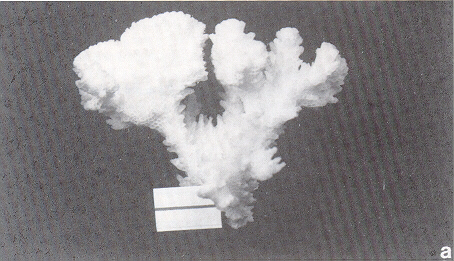
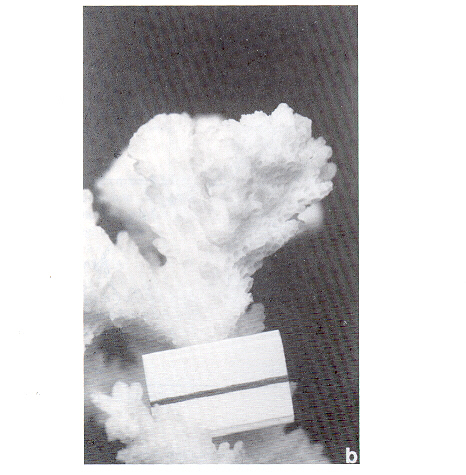
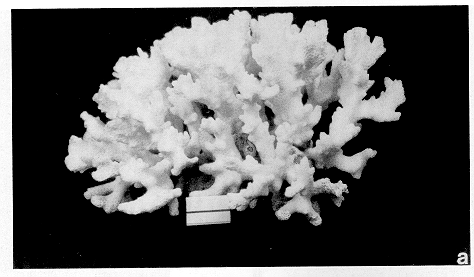
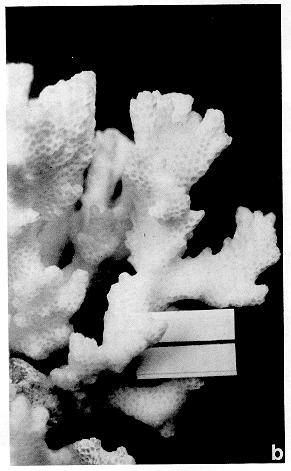
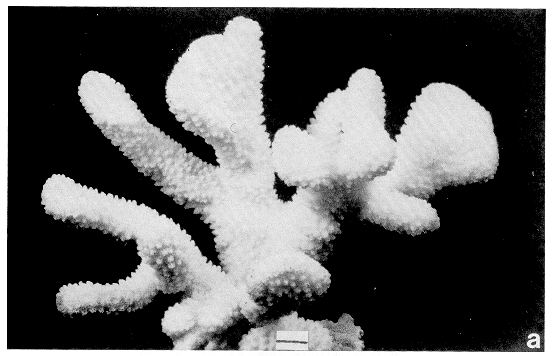
<body><![CDATA[<P><FONT FACE="Arial,Helvetica"><FONT SIZE=-1>&nbsp;&nbsp;&nbsp; Esqueleto relativamente grueso, denso, y curvado...................................................</FONT></FONT>     <BR><FONT FACE="Arial,Helvetica"><FONT SIZE=-1>&nbsp;&nbsp;&nbsp; .................................................................................. <I>Fungia (Cycloseris) curvata</I></FONT></FONT>      <P><FONT FACE="Arial,Helvetica"><FONT SIZE=-1>&nbsp;&nbsp;&nbsp; Esqueleto generalmente con fisuras, fr&aacute;gil, y relativamente</FONT></FONT>     <BR><FONT FACE="Arial,Helvetica"><FONT SIZE=-1>&nbsp;&nbsp;&nbsp; plano.......................................................................... <I>Fungia (Cycloseris) distorta</I></FONT></FONT>     <BR>&nbsp;      <P><FONT FACE="Arial,Helvetica"><FONT SIZE=-1>DESCRIPCION DE LAS ESPECIES, DISTRIBUCION E HISTORIA NATURAL</FONT></FONT>     <BR>&nbsp;      <P><FONT FACE="Arial,Helvetica"><FONT SIZE=-1>1. <B><I>Pocillopora capitata</I></B> Verrill, 1864</FONT></FONT>      <P><B><FONT FACE="Arial,Helvetica"><FONT SIZE=-1>Descripci&oacute;n:</FONT></FONT></B>      <P><FONT FACE="Arial,Helvetica"><FONT SIZE=-1>Coral de ramificaciones delgadas (menos de 2 cm) y cortas (menos de 10 cm), con verrugas puntiagudas. Los c&aacute;lices son muy sencillos ya que no hay septos u otras estructuras. Especie poco abundante, crece principalmente en plataformas, zonas de alta energ&iacute;a y lagunas someras. <A HREF="#Figura2a">Fig. 2 a</A>, <A HREF="#Figura2b">b</A>.</FONT></FONT>      ]]></body>
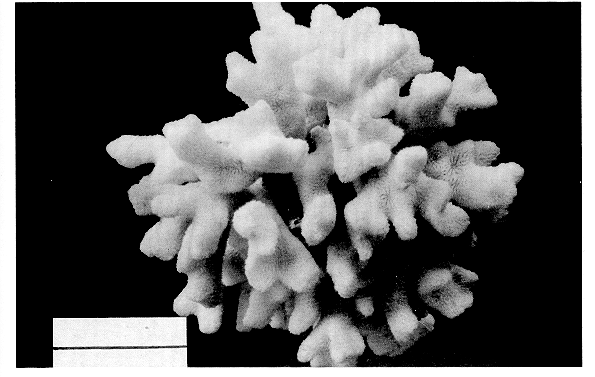
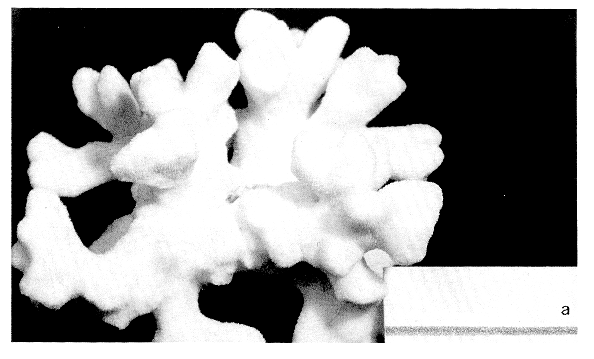
<body><![CDATA[<P><B><FONT FACE="Arial,Helvetica"><FONT SIZE=-1>Distribuci&oacute;n geogr&aacute;fica:</FONT></FONT></B>      <P><FONT FACE="Arial,Helvetica"><FONT SIZE=-1>&nbsp;&nbsp;&nbsp; Costa Rica: Bah&iacute;a Culebra, S&aacute;mara, Manuel Antonio, Isla del Ca&ntilde;o.</FONT></FONT>      <P><FONT FACE="Arial,Helvetica"><FONT SIZE=-1>&nbsp;&nbsp;&nbsp; Resto del mundo: End&eacute;mica del Pac&iacute;fico Oriental (<A HREF="#Wells__J_W__1983_">Wells 1983</A>).</FONT></FONT>     <BR>&nbsp;      <P><FONT FACE="Arial,Helvetica"><FONT SIZE=-1>2. <B><I>Pocillopora damicornis</I></B> (Linnaeus, 1758)</FONT></FONT>      <P><B><FONT FACE="Arial,Helvetica"><FONT SIZE=-1>Descripci&oacute;n:</FONT></FONT></B>      <P><FONT FACE="Arial,Helvetica"><FONT SIZE=-1>Coral de ramificaciones delgadas (menos de 2 cm) y generalmente cortas (menos de 15 cm), sin verrugas. Los c&aacute;lices son de 0,5 a 1,5 mm de di&aacute;metro y generalmente no tienen estructuras internas, e.g., septos o columnela, o est&aacute;n muy reducidas. Generalmente el tejido es amarillo. Una de las especie m&aacute;s abundantes. Se puede encontrar en forma aislada o formando estructuras arrecifales compactas. La variabilidad de la forma de la colonia es alta. <A HREF="#Figura3a">Fig. 3 a</A>, <A HREF="#Figura3b">b</A>.</FONT></FONT>      <P><B><FONT FACE="Arial,Helvetica"><FONT SIZE=-1>Distribuci&oacute;n geogr&aacute;fica:</FONT></FONT></B>      <P><FONT FACE="Arial,Helvetica"><FONT SIZE=-1>&nbsp;&nbsp;&nbsp; Costa Rica: Archipi&eacute;lago de las Islas Murci&eacute;lago, Bah&iacute;a Culebra, Bah&iacute;a Brasilito, S&aacute;mara, Cabo Blanco, Punta Leona, Herradura, Manuel Antonio, Punta Uvita, Pen&iacute;nsula de Osa, Golfo Dulce, Isla del Ca&ntilde;o, Isla del Coco.</FONT></FONT>      <P><FONT FACE="Arial,Helvetica"><FONT SIZE=-1>&nbsp;&nbsp;&nbsp; Resto del mundo: especie de distribuci&oacute;n muy amplia, Mar Rojo, Oc&eacute;ano Indico y el Oc&eacute;ano Pac&iacute;fico (<A HREF="#Veron1993">Veron 1993</A>).</FONT></FONT>     ]]></body>
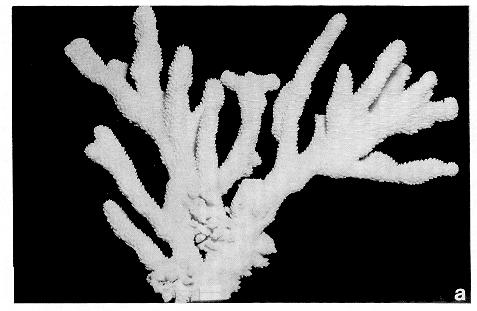
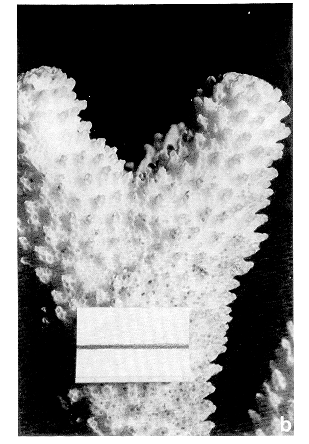
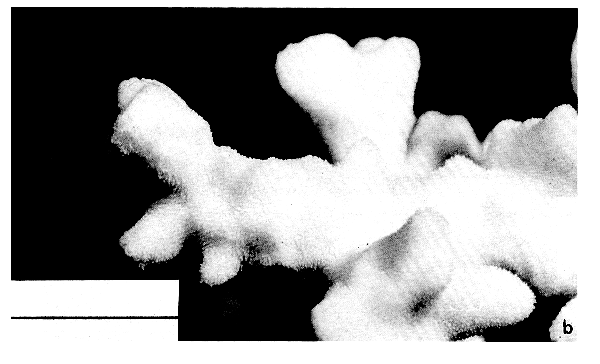
<body><![CDATA[<BR>&nbsp;      <P><FONT FACE="Arial,Helvetica"><FONT SIZE=-1>3. <B><I>Pocillopora elegans </I></B>Dana, 1846</FONT></FONT>     <BR>&nbsp;     <BR><B><FONT FACE="Arial,Helvetica"><FONT SIZE=-1>Descripci&oacute;n:</FONT></FONT></B>      <P><FONT FACE="Arial,Helvetica"><FONT SIZE=-1>Coral de ramificaciones de grosor mediano (entre 2 y 4 cm) y largas (m&aacute;s de 15 cm), con verrugas a todo lo largo de las ramas. Los c&aacute;lices tienen septos peque&ntilde;os y la columnela est&aacute; ausente o es peque&ntilde;a. Tejido generalmente amarillo pero puede ser verde tambi&eacute;n. Especie muy abundante. <A HREF="#Figura4aa">Fig. 4 a</A>, <A HREF="#Figura4b">b</A>.</FONT></FONT>      <P><B><FONT FACE="Arial,Helvetica"><FONT SIZE=-1>Distribuci&oacute;n geogr&aacute;fica:</FONT></FONT></B>      <P><FONT FACE="Arial,Helvetica"><FONT SIZE=-1>&nbsp;&nbsp;&nbsp; Costa Rica: Archipi&eacute;lago de las Islas Murci&eacute;lago, Bah&iacute;a Culebra, Pen&iacute;nsula de Osa, Isla del Ca&ntilde;o, Isla del Coco.</FONT></FONT>      <P><FONT FACE="Arial,Helvetica"><FONT SIZE=-1>&nbsp;&nbsp;&nbsp; Resto del mundo: Filipinas (<A HREF="#Nemenzo">Nemenzo 1986</A>; <A HREF="#Veron89">Veron &amp; Hodgson 1989</A>), Guam (<A HREF="#Randall">Randall &amp; Myers 1983</A>), Enewetak (<A HREF="#Devaney">Devaney &amp;</A> <A HREF="#Devaney">Lang 1987</A>), Polinesia Francesa (<A HREF="#Pichon">Pichon 1985</A>), Pac&iacute;fico Oriental (<A HREF="#Wells__J_W__1983_">Wells 1983</A>).</FONT></FONT>     <BR>&nbsp;      <P><FONT FACE="Arial,Helvetica"><FONT SIZE=-1>4. <B><I>Pocillopora eydouxi</I></B> Milne Edwards &amp; Haime, 1860</FONT></FONT>      ]]></body>
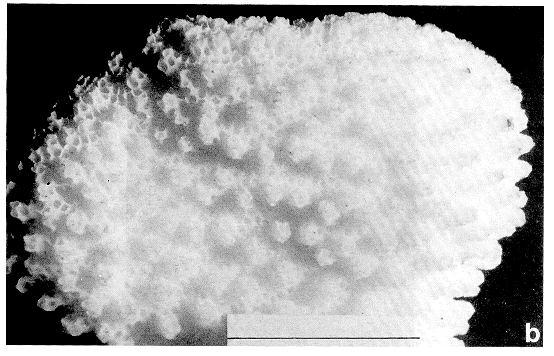
<body><![CDATA[<P><B><FONT FACE="Arial,Helvetica"><FONT SIZE=-1>Descripci&oacute;n:</FONT></FONT></B>      <P><FONT FACE="Arial,Helvetica"><FONT SIZE=-1>Coral de ramificaciones gruesas (m&aacute;s de 4 cm) y largas (m&aacute;s de 20 cm), con verrugas a todo lo largo de las ramas. Las estructuras dentro de los c&aacute;lices var&iacute;a en una misma rama, hay septos y columnela. Especie poco abundante. <A HREF="#Figura5a">Fig. 5 a</A>, <A HREF="#Figura5b">b</A>.</FONT></FONT>      <P><B><FONT FACE="Arial,Helvetica"><FONT SIZE=-1>Distribuci&oacute;n geogr&aacute;fica:</FONT></FONT></B>      <P><FONT FACE="Arial,Helvetica"><FONT SIZE=-1>&nbsp;&nbsp;&nbsp; Costa Rica: Pen&iacute;nsula de Santa Elena, Archipi&eacute;lago de las Islas Murci&eacute;lago, Bah&iacute;a Culebra, Pen&iacute;nsula de Osa, Isla del Ca&ntilde;o, Isla del Coco.</FONT></FONT>      <P><FONT FACE="Arial,Helvetica"><FONT SIZE=-1>&nbsp;&nbsp;&nbsp; Resto del mundo: Especie de distribuci&oacute;n amplia, del Mar Rojo y la costa este de Africa hasta las costas de Am&eacute;rica Central (<A HREF="#Veron1993">Veron 1993</A>).</FONT></FONT>     <BR>&nbsp;      <P><FONT FACE="Arial,Helvetica"><FONT SIZE=-1>5. <B><I>Pocillopora meandrina</I></B> Dana, 1846</FONT></FONT>      <P><B><FONT FACE="Arial,Helvetica"><FONT SIZE=-1>Descripci&oacute;n:</FONT></FONT></B>      <P><FONT FACE="Arial,Helvetica"><FONT SIZE=-1>Coral de ramificaciones de grosor (entre 2 y 4 cm) y largo mediano (entre 10 y 15 cm), con verrugas a todo lo largo de las ramas. El extremo de las ramas es caracter&iacute;sticamente aplanado; la parte superior tiene todos los c&aacute;lices unidos (llamados c&aacute;lices celulares en <A HREF="#Veron76">Veron &amp; Pichon 1976</A>). Especie poco abundante. <A HREF="#Figura6a">Fig. 6 a</A>, <A HREF="#Figura6b">b</A>.</FONT></FONT>      <P><B><FONT FACE="Arial,Helvetica"><FONT SIZE=-1>Distribuci&oacute;n geogr&aacute;fica:</FONT></FONT></B>      ]]></body>
<body><![CDATA[<P><FONT FACE="Arial,Helvetica"><FONT SIZE=-1>&nbsp;&nbsp;&nbsp; Costa Rica: Pen&iacute;nsula de Santa Elena, Archipi&eacute;lago de las Islas Murci&eacute;lago, Bah&iacute;a Culebra, Isla del Coco.</FONT></FONT>      <P><FONT FACE="Arial,Helvetica"><FONT SIZE=-1>&nbsp;&nbsp;&nbsp; Resto del mundo: Desde las Islas Nicobar en el Oc&eacute;ano Indico hasta la costa Pac&iacute;fica de Am&eacute;rica Central (<A HREF="#Veron1993">Veron 1993</A>).</FONT></FONT>     <BR>&nbsp;      <P><B><FONT FACE="Arial,Helvetica"><FONT SIZE=-1>Historia natural de las especies del g&eacute;nero <I>Pocillopora</I>:</FONT></FONT></B>      <P><FONT FACE="Arial,Helvetica"><FONT SIZE=-1>Todas las especies de <I>Pocillopora</I> son llamadas en Costa Rica por los pobladores de la costa, cirios, y los arrecifes formados por este g&eacute;nero ciriales. Este nombre se debe a lo parecido en la forma de estas especies con los cirios de las iglesias.</FONT></FONT>      <P><FONT FACE="Arial,Helvetica"><FONT SIZE=-1>Es el g&eacute;nero con la segunda mayor diversidad de especies y considerando uno de los principales constructores de arrecifes en la regi&oacute;n del Pac&iacute;fico Oriental (<A HREF="#Glynn,PW83">Glynn &amp; Wellington 1983</A>; <A HREF="#Guzmán93">Guzm&aacute;n &amp; Cort&eacute;s 1993</A>). <I>Pocillopora</I> se ha encontrado, en el Pacifico Oriental, a m&aacute;s profundidad que otras especies de corales zooxantelados (<A HREF="#Guzmán1986">Guzm&aacute;n 1986</A>). En Costa Rica, estas especies formaron grandes arrecifes a lo largo de toda la costa, principalmente en zonas pocas profundas donde formaron bajos (<A HREF="#Glynn__P_W___E_M__Druffel_">Glynn <I>et al</I>. 1983</A>;<A HREF="#Guzmán89a"> Guzm&aacute;n &amp; Cort&eacute;s 1989a</A>; <A HREF="#Cortés1996_1997a">Cort&eacute;s 1996-1997a)</A>. Esos arrecifes murieron durante la Peque&ntilde;a Edad de Hielo hace unos 400 a&ntilde;os (<A HREF="#Glynn__P_W___E_M__Druffel_">Glynn <I>et al</I>. 1983</A>). Actualmente, la mayor parte de los arrecifes de <I>Pocillopora</I> est&aacute;n muertos y cubiertos por algas coralinas incrustantes (<A HREF="#Glynn__P_W___E_M__Druffel_">Glynn <I>et al</I>. 1983</A>; <A HREF="#Cortés1996_1997a">Cort&eacute;s 1996-1997a</A>). En el pasado, algunas especies de singular belleza como <I>P. eydouxi y P. meandrina</I>, abundaban en la regi&oacute;n norte del pa&iacute;s, pero sus poblaciones fueron reducidas dram&aacute;ticamente debido a la extracci&oacute;n de colonias para venderlas a los turistas (<A HREF="#CortésMurillo1985">Cort&eacute;s &amp; Murillo 1985</A>).</FONT></FONT>      <P><FONT FACE="Arial,Helvetica"><FONT SIZE=-1>Estas especies poseen la mayor tasa de crecimiento en los corales de la regi&oacute;n (hasta 3.5 cm/a&ntilde;o en Costa Rica, <A HREF="#Guzmán89b">Guzm&aacute;n &amp; Cort&eacute;s 1989b</A>) y compiten agresivamente por espacio con el resto de las especies, principalmente con las de crecimiento lento. El principal mecanismo de reproducci&oacute;n es asexual o por fragmentaci&oacute;n (<A HREF="#Glynn__P_W___N_J_Gassman1991">Glynn <I>et al</I>. 1991)</A>. La reproducci&oacute;n sexual var&iacute;a con la especie, y ocurre m&aacute;s frecuentemente durante las lunas nueva y llena. <I>Pocillopora damicornis</I>, la m&aacute;s importante y abundante de todas las especies, se reproduce, tanto en la &eacute;poca seca como en la lluviosa, mientras que <I>P. elegans</I> se reproduce principalmente a mediados de la &eacute;poca lluviosa. Los corales <I>Pocillopora</I> del Pac&iacute;fico Oriental son de fertilizaci&oacute;n externa y no liberan larvas pl&aacute;nulas como lo hacen las especies en la mayor parte de los arrecifes del Pac&iacute;fico (<A HREF="#Glynn, P.W., N.J.Gassman1991">Glynn <I>et al</I>. 1991</A>). A pesar de que se han observado gametos de ambos sexos durante todo el a&ntilde;o, la tasa de reclutamiento por medio de larvas es casi nula para los arrecifes de la regi&oacute;n (<A HREF="#Richmond">Richmond 1985</A>). Los espermatozoides de <I>Pocillopora damicornis y de P. elegans</I> tienen n&uacute;cleos en forma de bala y mitocondrias elongadas; caracter&iacute;stica distintiva del suborden Astrocoeniina (<A HREF="#Steiner">Steiner &amp; Cort&eacute;s</A> <A HREF="#Steiner">1996</A>).</FONT></FONT>      <P><FONT FACE="Arial,Helvetica"><FONT SIZE=-1><I>Pocillopora</I> spp. son depredadas por diversos organismos entre los cuales destacan principalmente el pez timboril <I>Arothron meleagris</I>, los gastr&oacute;podos <I>Quoyula monodonta</I> (<I>Coralliophila madrepora</I>) y <I>Jenneria pustulata</I>, los cangrejos hermita&ntilde;os <I>Aniculus elegans</I> y <I>Trizopagurus magnificus</I>, y la estrella de mar <I>Acanthaster planci</I> (<A HREF="#Glynn,PW83">Glynn &amp; Wellington 1983</A>, <A HREF="#Guzmán__H_M__1988_">Guzm&aacute;n 1988</A>, <A HREF="#Guzmán89">Guzm&aacute;n &amp; Robertson 1989</A>). Esta &uacute;ltima, aunque poco abundante en Costa Rica, se ha observado depredando colonias aisladas de <I>Pocillopora</I>. Estas colonias no ten&iacute;an los cangrejos <I>Trapezia</I> spp. ni el camar&oacute;n <I>Alpheus lottini</I>, guardianes simbiontes de Pocillopora, que defienden los corales de <I>Acanthaster</I>, la estrella comedora de coral (<A HREF="#Glynn__P_W_1983">Glynn 1983</A>).</FONT></FONT>      <P><FONT FACE="Arial,Helvetica"><FONT SIZE=-1>El g&eacute;nero <I>Pocillopora</I> ha estado presente desde el inicio de la formaci&oacute;n de los arrecifes recientes hace unos 5 500 a&ntilde;os (<A HREF="#CortésMacintyre1994">Cort&eacute;s <I>et al</I>. 1994</A>). Los espesores de esos arrecifes oscila entre 0.6 y 13.4 m en la costa de Costa Rica e islas oce&aacute;nicas (<A HREF="#Macintyre">Macintyre <I>et al</I>. 1992</A>; <A HREF="#CortésMacintyre1994">Cort&eacute;s <I>et al</I>. 1994</A>).</FONT></FONT>     <BR>&nbsp;      ]]></body>
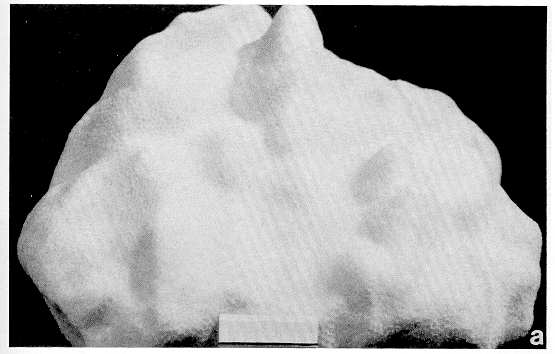
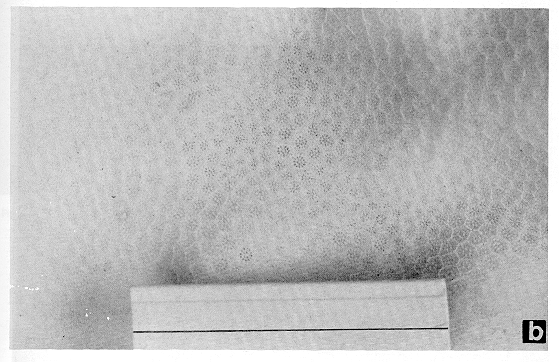
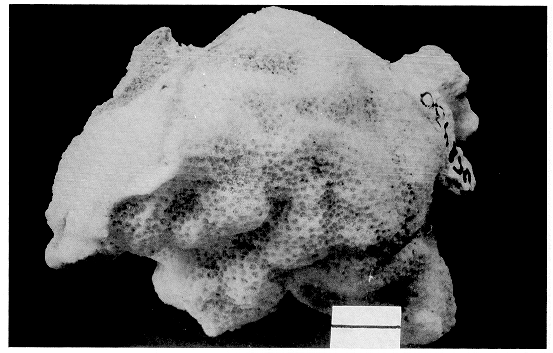
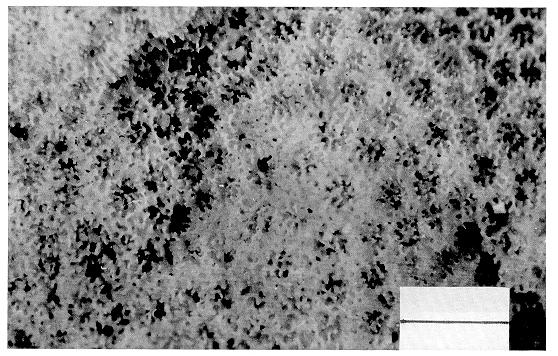
<body><![CDATA[<P><FONT FACE="Arial,Helvetica"><FONT SIZE=-1>6. <B><I>Porites lobata</I></B> Dana, 1846</FONT></FONT>      <P><B><FONT FACE="Arial,Helvetica"><FONT SIZE=-1>Descripci&oacute;n:</FONT></FONT></B>      <P><FONT FACE="Arial,Helvetica"><FONT SIZE=-1>Coral masivo de c&aacute;lices peque&ntilde;os separados por esqueleto reticulado. Las colonias pueden alcanzar gran tama&ntilde;o (varios metros de di&aacute;metro), y generalmente son pardas. Especie muy abundante en la parte sur de la costa de Costa Rica. <A HREF="#Figura7a">Fig. 7 a</A>, <A HREF="#Figura7b">b</A>.</FONT></FONT>      <P><B><FONT FACE="Arial,Helvetica"><FONT SIZE=-1>Distribuci&oacute;n geogr&aacute;fica:</FONT></FONT></B>      <P><FONT FACE="Arial,Helvetica"><FONT SIZE=-1>&nbsp;&nbsp;&nbsp; Costa Rica: Bah&iacute;a Culebra, Bah&iacute;a Brasilito, S&aacute;mara, Cabo Blanco, Punta Leona, Manuel Antonio, Punta Uvita, Pen&iacute;nsula de Osa, Golfo Dulce, Isla del Ca&ntilde;o, Isla del Coco.</FONT></FONT>      <P><FONT FACE="Arial,Helvetica"><FONT SIZE=-1>&nbsp;&nbsp;&nbsp; Resto del mundo: especie de distribuci&oacute;n muy amplia, Mar Rojo <A HREF="#Sheppard">(Sheppard &amp; Sheppard 1991</A>), y desde Mozanbique hasta las costas de Am&eacute;rica (<A HREF="#Veron1993">Veron 1993</A>).</FONT></FONT>     <BR>&nbsp;      <P><FONT FACE="Arial,Helvetica"><FONT SIZE=-1>7. <B><I>Porites panamensis</I></B> Verrill, 1866</FONT></FONT>      <P><B><FONT FACE="Arial,Helvetica"><FONT SIZE=-1>Descripci&oacute;n:</FONT></FONT></B>      <P><FONT FACE="Arial,Helvetica"><FONT SIZE=-1>Colonias peque&ntilde;as, verde brillante en la parte norte de la costa, donde es abundante, y gris en la parte sur de Costa Rica. C&aacute;lices peque&ntilde;os (&lt; 0,5 mm). <A HREF="#Figura8">Fig. 8</A>.</FONT></FONT>      ]]></body>
<body><![CDATA[<P><B><FONT FACE="Arial,Helvetica"><FONT SIZE=-1>Distribuci&oacute;n geogr&aacute;fica:</FONT></FONT></B>      <P><FONT FACE="Arial,Helvetica"><FONT SIZE=-1>&nbsp;&nbsp;&nbsp; Costa Rica: Area de Conservaci&oacute;n Guanacaste, Bah&iacute;a Culebra, S&aacute;mara, Cabo Blanco, Isla del Ca&ntilde;o.</FONT></FONT>      <P><FONT FACE="Arial,Helvetica"><FONT SIZE=-1>&nbsp;&nbsp;&nbsp; Oceano Pac&iacute;fico: End&eacute;mica del Pac&iacute;fico Oriental (<A HREF="#Wells__J_W__1983_">Wells 1983)</A>.</FONT></FONT>     <BR>&nbsp;      <P><FONT FACE="Arial,Helvetica"><FONT SIZE=-1>8. <B><I>Porites (Synarea) rus</I></B> (Forsk&aring;l, 1775)</FONT></FONT>      <P><B><FONT FACE="Arial,Helvetica"><FONT SIZE=-1>Descripci&oacute;n:</FONT></FONT></B>      <P><FONT FACE="Arial,Helvetica"><FONT SIZE=-1>Colonias peque&ntilde;as, con c&aacute;lices muy peque&ntilde;os (&lt;0.7 mm), casi indistinguibles. Especie muy poco abundante. <A HREF="#Figura9">Fig. 9</A>.</FONT></FONT>      <P><B><FONT FACE="Arial,Helvetica"><FONT SIZE=-1>Distribuci&oacute;n geogr&aacute;fica:</FONT></FONT></B>      <P><FONT FACE="Arial,Helvetica"><FONT SIZE=-1>&nbsp;&nbsp;&nbsp; Costa Rica: S&aacute;mara.</FONT></FONT>      <P><FONT FACE="Arial,Helvetica"><FONT SIZE=-1>&nbsp;&nbsp;&nbsp; Resto del mundo: Desde el Mar Rojo hasta Costa Rica (<A HREF="#Veron1993">Veron 1993</A>).</FONT></FONT>     ]]></body>
<body><![CDATA[<BR>&nbsp;      <P><B><FONT FACE="Arial,Helvetica"><FONT SIZE=-1>Comentarios:</FONT></FONT></B>      <P><FONT FACE="Arial,Helvetica"><FONT SIZE=-1>Esta especie, en el Pac&iacute;fico Oriental, se hab&iacute;a encontrado &uacute;nicamente en S&aacute;mara en 1983. No se ha vuelto a observar despu&eacute;s de El Ni&ntilde;o 1982-1983.</FONT></FONT>     <BR>&nbsp;      <P><B><FONT FACE="Arial,Helvetica"><FONT SIZE=-1>Historia natural de las especies del g&eacute;nero <I>Porites:</I></FONT></FONT></B>      <P><FONT FACE="Arial,Helvetica"><FONT SIZE=-1><I>Porites lobata</I> en Costa Rica es llamada vernacularmente n&uacute;cura; se desconoce la etimolog&iacute;a de esta palabra.</FONT></FONT>      <P><FONT FACE="Arial,Helvetica"><FONT SIZE=-1>De todas las especies, <I>Porites lobata</I> podr&iacute;a considerarse como la principal formadora de arrecifes para Costa Rica. La especie domina en m&aacute;s de un 90% en los arrecifes mejor desarrollados del pa&iacute;s: Isla del Ca&ntilde;o (<A HREF="#Guzmán89a">Guzm&aacute;n &amp; Cort&eacute;s 1989a</A>), Punta Islotes, Golfo Dulce (<A HREF="#Cortés1990">Cort&eacute;s 1990</A>), Isla del Coco (<A HREF="#Guzmán92">Guzm&aacute;n &amp; Cort&eacute;s 1992</A>). Actualmente los arrecifes de la Isla del Ca&ntilde;o son los &uacute;nicos que presentan una cobertura relativamente alta de coral vivo, ya que los de la Isla del Coco y Punta Islotes en Golfo Dulce se encuentran muy deteriorados por causas naturales o antropog&eacute;nicas, respectivamente.</FONT></FONT>      <P><FONT FACE="Arial,Helvetica"><FONT SIZE=-1>La edad de algunos de los arrecifes formados por <I>Porites lobata</I> oscila entre los 5 500 y 500 a&ntilde;os (<A HREF="#CortésMacintyre1994">Cort&eacute;s<I> et al</I>. 1994</A>). Esta especie es formadora de arrecifes o comunidades coralinas en Isla Malpelo, Colombia (<A HREF="#Birkeland">Birkeland <I>et al</I>. 1975</A>), Islas Gal&aacute;pagos (<A HREF="#Glynn,PW83">Glynn &amp; Wellington 1983</A>), e Isla Clipperton (<A HREF="#Glynn_Veron1996">Glynn <I>et al</I>. 1996</A>).</FONT></FONT>      <P><FONT FACE="Arial,Helvetica"><FONT SIZE=-1><I>Porites lobata</I> es de crecimiento lento (1 cm/a&ntilde;o para Costa Rica) aunque muy r&aacute;pido durante los primeros a&ntilde;os (1.4 - 1.9 cm/a&ntilde;o:<A HREF="#Guzmán89b"> Guzm&aacute;n &amp; Cort&eacute;s 1989b</A>). En algunos arrecifes las colonias pueden alcanzar hasta 3 m de alto. La reproducci&oacute;n sexual de P. lobata se da a mediados de la &eacute;poca lluviosa, cuando los gametos son liberados en el agua. En la Isla del Ca&ntilde;o se encontraron colonias hermafroditas (<A HREF="#Glynn94">Glynn <I>et al</I>. 1994</A>). Se piensa que en ciertos arrecifes de la regi&oacute;n <I>P. lobata</I> domina debido a que es fragmentada continuamente por el pez bal&iacute;stido <I>Pseudobalistes naufragium</I>; algunos de esos fragmentos sobreviven (<A HREF="#Guzmán89a">Guzm&aacute;n &amp; Cort&eacute;s 1989a</A>). <I>Porites panamensis</I>, a pesar de producir larvas (<A HREF="#Smith_">Smith 1991</A>), no es muy abundante en Costa Rica. Esta especie es m&aacute;s abundante en la parte norte del pa&iacute;s que en la parte sur (<A HREF="#Cortés1996_1997a">Cort&eacute;s 1996-1997a</A>). Se conocen muy pocos depredadores de Porites para Costa Rica. Se ha observado a <I>Acanthaster planci</I> depredando a esta especie &uacute;nicamente en la Isla del Coco, posiblemente debido a la ausencia de sus presas preferidas (<A HREF="#Guzmán92">Guzm&aacute;n &amp; Cort&eacute;s 1992</A>). La alta densidad de <I>bivalvos Lithophaga</I> spp. que se observa en <I>Porites lobata</I>, estimula a los peces bal&iacute;stidos que se alimentan de estos, los cuales causan heridas en las colonias. Dichas heridas regeneran relativamente r&aacute;pido sin deteriorar las colonias, y por lo contrario, pareciera que este proceso ayuda en la formaci&oacute;n de m&uacute;ltiples fragmentos o clones que al cabo de cierto tiempo se transforman en nuevas colonias si sobreviven. <I>P. lobata</I> es parte de la dieta del pez <I>Arothoron meleagris</I> (<A HREF="#Guzmán89">Guzm&aacute;n &amp; Robertson, 1989</A>), pero su efecto en las colonias no es considerable, como lo es el de <I>A. planci</I>, la cual es capaz de destruir colonias enteras.</FONT></FONT>      <P><FONT FACE="Arial,Helvetica"><FONT SIZE=-1>Dos morfos de <I>Porites lobata</I> se han observado: uno es de superficie de la colonia lisa y el otro morfo es de superficie con l&oacute;bulos de 1 a 10 cm de di&aacute;metro en la base y hasta 10 cm de alto. Sin embargo, <A HREF="#Weil, E. 1992.">Weil (1992)</A> no los separ&oacute;, pero si suguiere que las poblaciones de <I>Porites panamensis</I> analizadas podr&iacute;an representar dos especies.</FONT></FONT>     ]]></body>
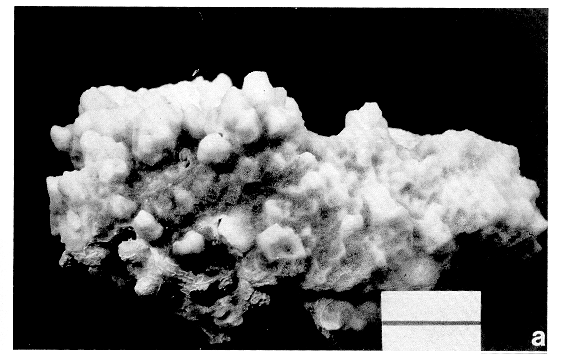
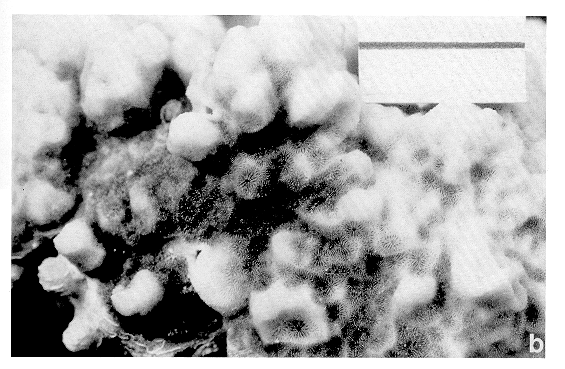
<body><![CDATA[<BR>&nbsp;      <P><FONT FACE="Arial,Helvetica"><FONT SIZE=-1>9. <B><I>Psammocora obtusangula</I></B> (Lamarck, 1816)</FONT></FONT>      <P><B><FONT FACE="Arial,Helvetica"><FONT SIZE=-1>Descripci&oacute;n:</FONT></FONT></B>      <P><FONT FACE="Arial,Helvetica"><FONT SIZE=-1>Colonia de n&oacute;dulos muy delgados. De 6 a 12 septos denticulados seg&uacute;n si est&aacute;n fusionados o no. Columnela prominente a la que llegan los septos. Colonias vivas son pardo claro. Forma parches monoespec&iacute;ficos de varios metros cuadrados en Golfo Dulce. <A HREF="#Figura10">Fig. 10</A>.</FONT></FONT>      <P><B><FONT FACE="Arial,Helvetica"><FONT SIZE=-1>Distribuci&oacute;n geogr&aacute;fica:</FONT></FONT></B>      <P><FONT FACE="Arial,Helvetica"><FONT SIZE=-1>&nbsp;&nbsp;&nbsp; Costa Rica: Golfo Dulce, Isla del Ca&ntilde;o.</FONT></FONT>      <P><FONT FACE="Arial,Helvetica"><FONT SIZE=-1>&nbsp;&nbsp;&nbsp; Resto del Mundo:</FONT></FONT>     <BR>&nbsp;      <P><FONT FACE="Arial,Helvetica"><FONT SIZE=-1>10. <B><I>Psammocora stellata</I></B> (Verrill, 1866)</FONT></FONT>      <P><B><FONT FACE="Arial,Helvetica"><FONT SIZE=-1>Descripci&oacute;n:</FONT></FONT></B>      ]]></body>
<body><![CDATA[<P><FONT FACE="Arial,Helvetica"><FONT SIZE=-1>Colonia de n&oacute;dulos de 1 a 2 cm de di&aacute;metro. C&aacute;lices poco diferenciados, con 20 septos denticulados. Generalmente son pardo claro. Especie muy abundante. <A HREF="#Figura11a">Fig. 11 a</A>, <A HREF="#Figura11b">b</A>.</FONT></FONT>     <BR>&nbsp;      <P><B><FONT FACE="Arial,Helvetica"><FONT SIZE=-1>Distribuci&oacute;n geogr&aacute;fica:</FONT></FONT></B>      <P><FONT FACE="Arial,Helvetica"><FONT SIZE=-1>&nbsp;&nbsp;&nbsp; Costa Rica: Archipi&eacute;lago de las Islas Murci&eacute;lago, Bah&iacute;a Culebra, Bah&iacute;a Brasilito, Cabo Blanco, Punta Mala, Manuel Antonio, Pen&iacute;nsula de Osa, Golfo Dulce, Isla del Ca&ntilde;o, Isla del Coco.</FONT></FONT>      <P><FONT FACE="Arial,Helvetica"><FONT SIZE=-1>&nbsp;&nbsp;&nbsp; Resto del mundo: Guam ((<A HREF="#Randall">Randall &amp; Myers 1983</A>), Hawaii (<A HREF="#Maragos">Maragos 1977</A>), Pac&iacute;fico Oriental (<A HREF="#Wells__J_W__1983_">Wells 1983</A>).</FONT></FONT>     <BR>&nbsp;     <BR>&nbsp;     <BR><FONT FACE="Arial,Helvetica"><FONT SIZE=-1>11. <B><I>Psammocora superficialis</I></B> Gardiner, 1898</FONT></FONT>      <P><B><FONT FACE="Arial,Helvetica"><FONT SIZE=-1>Descripci&oacute;n:</FONT></FONT></B>      <P><FONT FACE="Arial,Helvetica"><FONT SIZE=-1>Colonias con n&oacute;dulos de m&aacute;s de 2 cm de di&aacute;metro o incrustantes. Coralitos distribuidos en forma m&aacute;s o menos regular sobre el esqueleto. Los septos est&aacute;n fusionados a la columnela. Los c&aacute;lices se distinguen mejor que en las otras especies de este g&eacute;nero. <A HREF="#Figura12a">Fig. 12 a</A>, <A HREF="#Figura12b">b</A>.</FONT></FONT>      ]]></body>
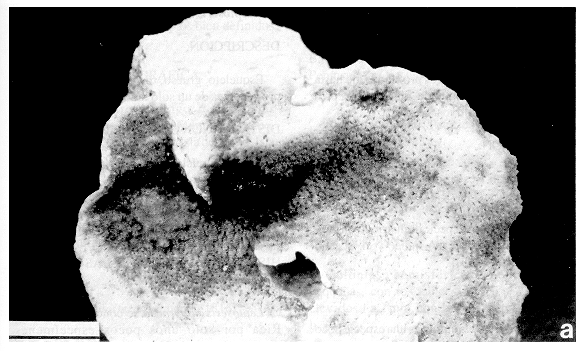
<body><![CDATA[<P><B><FONT FACE="Arial,Helvetica"><FONT SIZE=-1>Distribuci&oacute;n geogr&aacute;fica:</FONT></FONT></B>      <P><FONT FACE="Arial,Helvetica"><FONT SIZE=-1>&nbsp;&nbsp;&nbsp; Costa Rica: Pen&iacute;nsula de Osa, Isla del Ca&ntilde;o, Isla del Coco.</FONT></FONT>      <P><FONT FACE="Arial,Helvetica"><FONT SIZE=-1>&nbsp;&nbsp;&nbsp; Resto del mundo: Distribuci&oacute;n muy amplia, el Mar Rojo (<A HREF="#Sheppard">Sheppard &amp; Sheppard 1991</A>), el Golfo P&eacute;rsico (<A HREF="#Hodgson">Hodgson &amp;</A> <A HREF="#Hodgson">Carpenter 1995</A>) y desde la costa Africana hasta el Pac&iacute;fico de Am&eacute;rica (<A HREF="#Veron1993">Veron 1993</A>).</FONT></FONT>     <BR>&nbsp;      <P><B><FONT FACE="Arial,Helvetica"><FONT SIZE=-1>Historia natural de las especies del g&eacute;nero <I>Psammocora</I>:</FONT></FONT></B>      <P><FONT FACE="Arial,Helvetica"><FONT SIZE=-1>Especies oportunistas abundantes en ciertos arrecifes de Costa Rica. Se distribuye en casi todas las zonas del arrecife, pero preferiblemente en ambientes de baja energ&iacute;a. Su crecimiento es muy lento (0.6 cm/a&ntilde;o para Costa Rica: <A HREF="#Guzmán89b">Guzm&aacute;n &amp; Cort&eacute;s 1989b</A>), sin embargo, se reproduce muy r&aacute;pidamente. La reproducci&oacute;n sexual es importante, pero la reproducci&oacute;n asexual o por fragmentaci&oacute;n es m&aacute;s efectiva para dispersarse por el arrecife y colonizar &aacute;reas desnudas. <I>Psammocora</I> es depredada por <I>Acanthaster planci</I> y el pez <I>Arothoron meleagris</I> (<A HREF="#Guzmán__H_M__1988_">Guzm&aacute;n 1988</A>, <A HREF="#Guzmán91.">Guzm&aacute;n &amp; L&oacute;pez 1991</A>). Este &uacute;ltimo tiene una clara preferencia por el coral (<A HREF="#Guzmán89">Guzm&aacute;n &amp; Robertson 1989</A>; <A HREF="#Guzmán91.">Guzm&aacute;n &amp; L&oacute;pez 1991</A>), y podr&iacute;a reducir las poblaciones del coral en ausencia de otras especies como <I>Porites lobata</I>.</FONT></FONT>     <BR>&nbsp;     <BR>&nbsp;     <CENTER><A NAME="Figura1"></A><IMG SRC="/img/fbpe/rbt/v46n1/0069i01.GIF" HEIGHT=600 WIDTH=592></CENTER>      
<CENTER>&nbsp;</CENTER>      ]]></body>
<body><![CDATA[<CENTER>&nbsp;</CENTER>      <CENTER><A NAME="Figura2a"></A><IMG SRC="/img/fbpe/rbt/v46n1/0069i02.JPG" HEIGHT=261 WIDTH=454></CENTER>      
<CENTER>&nbsp;</CENTER>      <CENTER>&nbsp;</CENTER>      <CENTER><A NAME="Figura2b"></A><IMG SRC="/img/fbpe/rbt/v46n1/0069i03.JPG" HEIGHT=475 WIDTH=466></CENTER> &nbsp;     
<BR>&nbsp;     <BR><FONT FACE="Arial,Helvetica"><FONT SIZE=-1>Fig. 2. a) <I>Pocillopora capitata</I> (UCR 700), S&aacute;mara, Guanacaste, profundidad 6 m, 25.IV.1992, escala = 2 cm; b) detalle, escala = 2 cm.</FONT></FONT>     <BR>&nbsp;     <BR>&nbsp;     <CENTER><A NAME="Figura3a"></A><IMG SRC="/img/fbpe/rbt/v46n1/0069i04.GIF" HEIGHT=356 WIDTH=558></CENTER>      
]]></body>
<body><![CDATA[<CENTER>&nbsp;</CENTER>      <CENTER>&nbsp;</CENTER>      <CENTER><A NAME="Figura3b"></A><IMG SRC="/img/fbpe/rbt/v46n1/0069i05.GIF" HEIGHT=364 WIDTH=567></CENTER>       
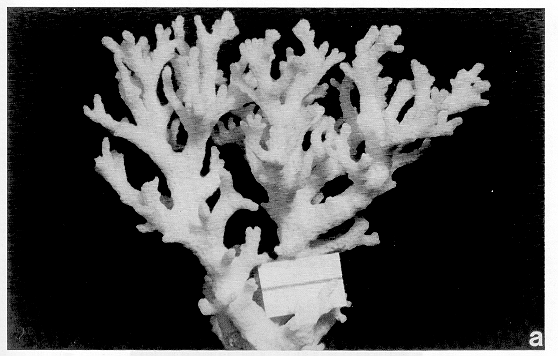
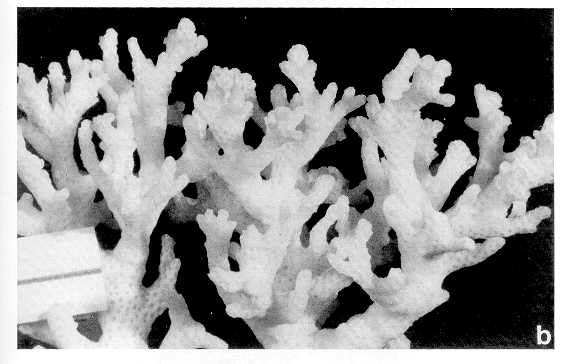
<P><FONT FACE="Arial,Helvetica"><FONT SIZE=-1>Fig. 3. a) <I>Pocillopora damicorni</I>s (UCR 703), S&aacute;ndalo, Golfo Dulce, 5 m, 8.I.1993, escala = 2 cm; b) detalle, escala = 1.2 cm.</FONT></FONT>     <BR>&nbsp;     <CENTER><A NAME="Figura4aa"></A><IMG SRC="/img/fbpe/rbt/v46n1/0069i06.GIF" HEIGHT=277 WIDTH=474></CENTER>      
<CENTER>&nbsp;</CENTER>      <CENTER>&nbsp;</CENTER>      <CENTER><A NAME="Figura4b"></A><IMG SRC="/img/fbpe/rbt/v46n1/0069i07.GIF" HEIGHT=471 WIDTH=291></CENTER>       
<P><FONT FACE="Arial,Helvetica"><FONT SIZE=-1>Fig. 4. a) <I>Pocillopora elegans</I> (UCR 748), Bajo Rojo, lado norte de la Pen&iacute;nsula de Santa Elena, Guanacaste, 5 m, 7.I.1994, escala = 2 cm; b) detalle, escala = 2 cm.</FONT></FONT>     ]]></body>
<body><![CDATA[<BR>&nbsp;     <CENTER><A NAME="Figura5a"></A><IMG SRC="/img/fbpe/rbt/v46n1/0069i08.GIF" HEIGHT=311 WIDTH=477></CENTER>      
<CENTER>&nbsp;</CENTER>      <CENTER>&nbsp;</CENTER>      <CENTER><A NAME="Figura5b"></A><IMG SRC="/img/fbpe/rbt/v46n1/0069i09.GIF" HEIGHT=444 WIDTH=309></CENTER>      
<CENTER>&nbsp;</CENTER>      <CENTER><FONT FACE="Arial,Helvetica"><FONT SIZE=-1>Fig. 5. a) <I>Pocillopora eydouxi</I> (UCR 44), Bah&iacute;a Waffer, Isla del Coco, 1.IV.1975, escala = 2 cm; b) detalle, escala = 1.8 cm.</FONT></FONT></CENTER>      <CENTER><FONT FACE="Arial,Helvetica"><FONT SIZE=-1>&nbsp;</FONT></FONT></CENTER>      <CENTER><FONT FACE="Arial,Helvetica"><FONT SIZE=-1>&nbsp;</FONT></FONT></CENTER>      <CENTER><A NAME="Figura6a"></A><IMG SRC="/img/fbpe/rbt/v46n1/0069i10.GIF" HEIGHT=356 WIDTH=558></CENTER>      
]]></body>
<body><![CDATA[<CENTER>&nbsp;</CENTER>      <CENTER>&nbsp;</CENTER>      <CENTER><A NAME="Figura6b"></A><IMG SRC="/img/fbpe/rbt/v46n1/0069i11.GIF" HEIGHT=356 WIDTH=554></CENTER>       
<P><FONT FACE="Arial,Helvetica"><FONT SIZE=-1>Fig. 6. a) <I>Pocillopora meandrina</I> (UCR 553), Punta Ballena, Isla del Ca&ntilde;o, 4 m, 5.VII.1988, escala = 2 cm; b) detalle, escala = 2 cm.</FONT></FONT>     <CENTER><A NAME="Figura7a"></A><IMG SRC="/img/fbpe/rbt/v46n1/0069i12.GIF" HEIGHT=354 WIDTH=555></CENTER>      
<CENTER>&nbsp;</CENTER>      <CENTER>&nbsp;</CENTER>      <CENTER><A NAME="Figura7b"></A><IMG SRC="/img/fbpe/rbt/v46n1/0069i13.GIF" HEIGHT=362 WIDTH=560 ALIGN=CENTER></CENTER>       
<P><FONT FACE="Arial,Helvetica"><FONT SIZE=-1>Fig. 7. a) <I>Porites lobata</I> (UCR 288), Platanillo, Isla del Ca&ntilde;o, 6 m, 24.I.1984, escala = 2 cm; b) detalle, escala = 2 cm.</FONT></FONT>     <BR>&nbsp;     ]]></body>
<body><![CDATA[<BR>&nbsp;     <CENTER><A NAME="Figura8"></A><IMG SRC="/img/fbpe/rbt/v46n1/0069i14.GIF" HEIGHT=353 WIDTH=553></CENTER>      
<CENTER><FONT FACE="Arial,Helvetica"><FONT SIZE=-1>Fig. 8. <I>Porites panamensis</I> (UCR 430), Isla del Ca&ntilde;o, 4 m, I.1980, escala = 2 cm.</FONT></FONT></CENTER>      <CENTER>&nbsp;</CENTER>      <CENTER>&nbsp;</CENTER>      <CENTER><A NAME="Figura9"></A><IMG SRC="/img/fbpe/rbt/v46n1/0069i15.GIF" HEIGHT=356 WIDTH=558></CENTER>      
<CENTER><FONT FACE="Arial,Helvetica"><FONT SIZE=-1>&nbsp;&nbsp;&nbsp;&nbsp;&nbsp;&nbsp;&nbsp;&nbsp;&nbsp;&nbsp;&nbsp;&nbsp;&nbsp;&nbsp;&nbsp;&nbsp;&nbsp; Fig. 9. Detalle de <I>Porites (Synarea) rus</I> (UCR 663), S&aacute;mara, Guanacaste, 7 m, 4.VI.1983, escala = 0.5 cm.</FONT></FONT></CENTER>      <CENTER>&nbsp;</CENTER>      <CENTER><A NAME="Figura10"></A><IMG SRC="/img/fbpe/rbt/v46n1/0069i16.GIF" HEIGHT=377 WIDTH=595></CENTER>       
<P><FONT FACE="Arial,Helvetica"><FONT SIZE=-1>Fig. 10. <I>Psammocora obtusangula</I> (UCR 556), Punta El Bajo, Golfo Dulce, Puntarenas, 3 m, 21.IX.1988, escala = 0.75 cm.</FONT></FONT>     ]]></body>
<body><![CDATA[<BR>&nbsp;     <BR>&nbsp;     <CENTER><A NAME="Figura11a"></A><IMG SRC="/img/fbpe/rbt/v46n1/0069i17.GIF" HEIGHT=359 WIDTH=594></CENTER>      
<CENTER>&nbsp;</CENTER>      <CENTER>&nbsp;</CENTER>      <CENTER><A NAME="Figura11b"></A><IMG SRC="/img/fbpe/rbt/v46n1/0069i18.GIF" HEIGHT=364 WIDTH=600></CENTER>       
<P><FONT FACE="Arial,Helvetica"><FONT SIZE=-1>Fig. 11. a) <I>Psammocora stellata</I> (UCR 337), Playas del Coco, Guanacaste, 4 m, 8.II.1984, escala = 2 cm; b) detalle, escala = 1 cm.</FONT></FONT>     <CENTER><A NAME="Figura12a"></A><IMG SRC="/img/fbpe/rbt/v46n1/0069i19.GIF" HEIGHT=354 WIDTH=565></CENTER>      
<CENTER>&nbsp;</CENTER>      <CENTER>&nbsp;</CENTER>      ]]></body>
<body><![CDATA[<CENTER><A NAME="Figura12b"></A><IMG SRC="/img/fbpe/rbt/v46n1/0069i20.GIF" HEIGHT=369 WIDTH=565></CENTER>       
<P><FONT FACE="Arial,Helvetica"><FONT SIZE=-1>Fig. 12. a) <I>Psammocora superficialis</I> (UCR 719), Punta Presidio, Isla del Coco, 17 m, 9.II.1993, escala = 2 cm; b) detalle, escala = 2 cm.</FONT></FONT>     <CENTER><A NAME="Figura13a"></A><IMG SRC="/img/fbpe/rbt/v46n1/0069i21.GIF" HEIGHT=381 WIDTH=573></CENTER>      
<CENTER>&nbsp;</CENTER>      <CENTER><A NAME="Figura13b"></A></CENTER>      <CENTER><IMG SRC="/img/fbpe/rbt/v46n1/0069i22.GIF" HEIGHT=362 WIDTH=557></CENTER>       
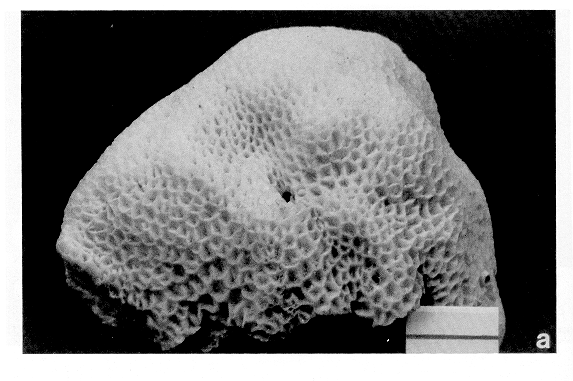
<P><FONT FACE="Arial,Helvetica"><FONT SIZE=-1>Fig. 13. a) <I>Gardineroseris planulata</I> (UCR 425), Isla del Ca&ntilde;o, 6 m, I.1980, escala = 2 cm; b) detalle, escala = 2 cm.</FONT></FONT>     <BR>&nbsp;     <CENTER><A NAME="Figura14"></A><IMG SRC="/img/fbpe/rbt/v46n1/0069i23.GIF" HEIGHT=350 WIDTH=589></CENTER>      
<CENTER><FONT FACE="Arial,Helvetica"><FONT SIZE=-1>Fig. 14. <I>Leptoseris papyracea</I> (UCR 420), Playa Ocotal, Guanacaste, 10 m, XII.1982, escala = 1 cm.</FONT></FONT></CENTER>      ]]></body>
<body><![CDATA[<CENTER><FONT FACE="Arial,Helvetica"><FONT SIZE=-1>&nbsp;</FONT></FONT></CENTER>      <CENTER><FONT FACE="Arial,Helvetica"><FONT SIZE=-1>&nbsp;</FONT></FONT></CENTER>      <CENTER><A NAME="Figura15a"></A><IMG SRC="/img/fbpe/rbt/v46n1/0069i24.GIF" HEIGHT=354 WIDTH=560></CENTER>      
<CENTER>&nbsp;</CENTER>      <CENTER>&nbsp;</CENTER>      <CENTER><A NAME="Figura15b"></A><IMG SRC="/img/fbpe/rbt/v46n1/0069i25.GIF" HEIGHT=353 WIDTH=565></CENTER> &nbsp;     
<BR>&nbsp;     <BR>&nbsp;<FONT FACE="Arial,Helvetica"><FONT SIZE=-1>Fig. 15. a)<I> Leptoseris scabra</I> (UCR 715), Punta Presidio, Isla del Coco, 12 m, 9.II.1993, escala = 1 cm; b) detalle, escala = 2 cm.</FONT></FONT>     <BR>&nbsp;     <CENTER><A NAME="Figura16a"></A><IMG SRC="/img/fbpe/rbt/v46n1/0069i26.GIF" HEIGHT=353 WIDTH=556></CENTER>      
]]></body>
<body><![CDATA[<CENTER>&nbsp;</CENTER>      <CENTER>&nbsp;</CENTER>      <CENTER><A NAME="Figura16b"></A><IMG SRC="/img/fbpe/rbt/v46n1/0069i27.GIF" HEIGHT=353 WIDTH=548></CENTER>      
<CENTER><FONT FACE="Arial,Helvetica"><FONT SIZE=-1>&nbsp;Fig. 16. a) <I>Pavona clavus</I> (UCR 321), Punta Mala, Puntarenas, 10 m, 24.II.1984, escala = 2 cm; b) detalle, escala = 0.4 cm.</FONT></FONT></CENTER>      <CENTER><FONT FACE="Arial,Helvetica"><FONT SIZE=-1>&nbsp;</FONT></FONT></CENTER>      <CENTER><FONT FACE="Arial,Helvetica"><FONT SIZE=-1>&nbsp;</FONT></FONT></CENTER>      <CENTER><A NAME="Figura17a"></A><IMG SRC="/img/fbpe/rbt/v46n1/0069i28.GIF" HEIGHT=346 WIDTH=557></CENTER>      
<CENTER>&nbsp;</CENTER>      <CENTER>&nbsp;</CENTER>      <CENTER><A NAME="Figura17b"></A><IMG SRC="/img/fbpe/rbt/v46n1/0069i29.GIF" HEIGHT=350 WIDTH=557></CENTER> &nbsp;     
]]></body>
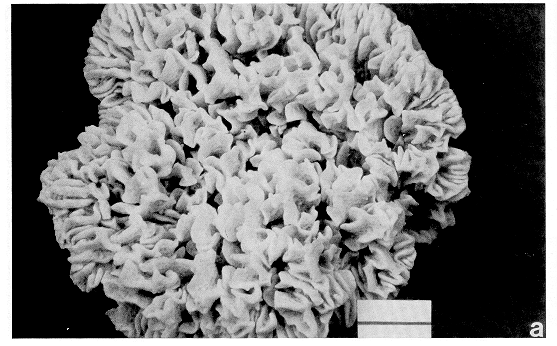
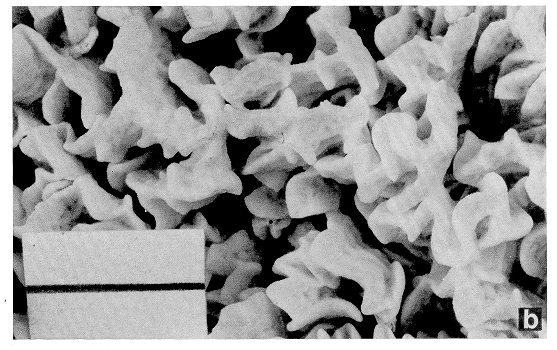
<body><![CDATA[<BR>&nbsp;     <BR><FONT FACE="Arial,Helvetica"><FONT SIZE=-1>Fig. 17. a) <I>Pavona frondifera</I> (UCR 667), Estaci&oacute;n Barracuda, Isla del Ca&ntilde;o, 16 m, 3.VI.1992; escala = 2 cm; b) detalle, escala = 2 cm.</FONT></FONT>     <CENTER><A NAME="Figura18a"></A><IMG SRC="/img/fbpe/rbt/v46n1/0069i30.GIF" HEIGHT=349 WIDTH=578></CENTER>      
<CENTER>&nbsp;</CENTER>      <CENTER>&nbsp;</CENTER>      <CENTER><A NAME="Figura18b"></A><IMG SRC="/img/fbpe/rbt/v46n1/0069i31.GIF" HEIGHT=349 WIDTH=593></CENTER>      
<CENTER>&nbsp;</CENTER>      <CENTER><A NAME="Figura18c"></A><IMG SRC="/img/fbpe/rbt/v46n1/0069i32.GIF" HEIGHT=346 WIDTH=582></CENTER>      
<CENTER>&nbsp;</CENTER>      <CENTER>&nbsp;</CENTER>      ]]></body>
<body><![CDATA[<CENTER><A NAME="Figura18d"></A><IMG SRC="/img/fbpe/rbt/v46n1/0069i33.GIF" HEIGHT=351 WIDTH=586></CENTER> &nbsp;     
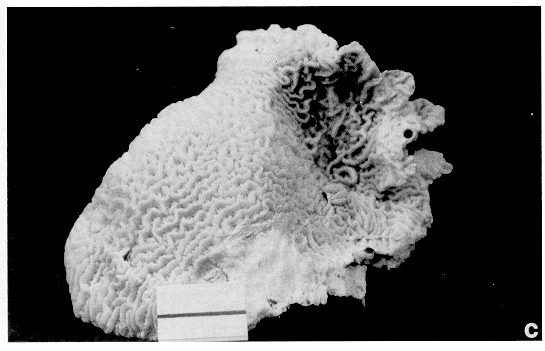
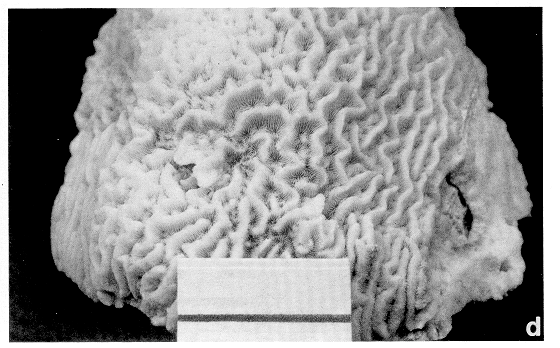
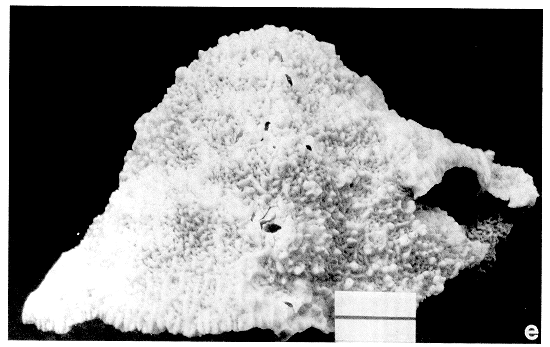
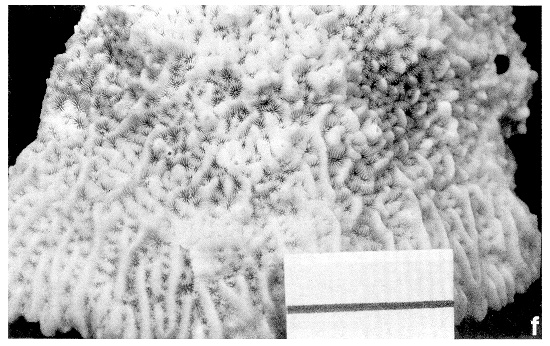
<BR>&nbsp;     <BR><FONT FACE="Arial,Helvetica"><FONT SIZE=-1>Fig. 18. a) <I>Pavona gigantea</I> (UCR 731), Punta Buena, Bah&iacute;a Culebra, Guanacaste, 2 m, 25.VI.1993, escala = 2 cm; b) detalle, escala = 2 cm; c. <I>Pavona gigantea</I> forma de profundidad (UCR 328), Playa Ocotal, Guanacaste, 16 m, 23.II.1984, escala = 2 cm; d) detalle, escala = 2 cm.</FONT></FONT>     <BR>&nbsp;     <CENTER><A NAME="Figura19a"></A><IMG SRC="/img/fbpe/rbt/v46n1/0069i34.GIF" HEIGHT=350 WIDTH=557></CENTER>      
<CENTER>&nbsp;</CENTER>      <CENTER>&nbsp;</CENTER>      <CENTER><IMG SRC="/img/fbpe/rbt/v46n1/0069i35.GIF" HEIGHT=345 WIDTH=557></CENTER>      
<CENTER><A NAME="Figura19b"></A></CENTER> &nbsp;     <BR>&nbsp;     ]]></body>
<body><![CDATA[<BR><FONT FACE="Arial,Helvetica"><FONT SIZE=-1>Fig. 19. a) <I>Pavona maldivensis</I> (UCR 710), Punta Presidio, Isla del Coco, 16 m, 9.II.1993, escala = 2 cm; b) detalle, escala = 1.2 cm.</FONT></FONT>     <CENTER><A NAME="Figura20a"></A><IMG SRC="/img/fbpe/rbt/v46n1/0069i36.GIF" HEIGHT=350 WIDTH=560></CENTER>      
<CENTER>&nbsp;</CENTER>      <CENTER>&nbsp;</CENTER>      <CENTER><A NAME="Figura20b"></A><IMG SRC="/img/fbpe/rbt/v46n1/0069i37.GIF" HEIGHT=351 WIDTH=552></CENTER>      
<CENTER>&nbsp;</CENTER>      <CENTER>&nbsp;</CENTER>      <CENTER><A NAME="Figura20c"></A><IMG SRC="/img/fbpe/rbt/v46n1/0069i38.GIF" HEIGHT=351 WIDTH=545></CENTER>      
<CENTER>&nbsp;</CENTER>      <CENTER>&nbsp;</CENTER>      ]]></body>
<body><![CDATA[<CENTER><A NAME="Figura20d"></A><IMG SRC="/img/fbpe/rbt/v46n1/0069i39.GIF" HEIGHT=348 WIDTH=560></CENTER>      
<CENTER>&nbsp;</CENTER>      <CENTER>&nbsp;</CENTER>      <CENTER><A NAME="Figura20e"></A><IMG SRC="/img/fbpe/rbt/v46n1/0069i40.GIF" HEIGHT=347 WIDTH=550></CENTER>      
<CENTER>&nbsp;</CENTER>      <CENTER>&nbsp;</CENTER>      <CENTER><A NAME="Figura20f"></A><IMG SRC="/img/fbpe/rbt/v46n1/0069i41.GIF" HEIGHT=346 WIDTH=550></CENTER> &nbsp;     
<BR>&nbsp;     <BR>&nbsp;<FONT FACE="Arial,Helvetica"><FONT SIZE=-1>Fig. 20. a) <I>Pavona varians</I> (UCR 397), Isla del Ca&ntilde;o, 13 m, 27.VII.1985, escala = 2 cm; b) detalle, escala = 2 cm; c) <I>Pavona varians</I> (UCR 712), Punta Presidio, Isla del Coco, 16 m, 9.II.1993, escala = 2 cm; d) detalle, escala = 2 cm; e) Pavona varians (UCR 685), Islas Pelonas, Bah&iacute;a Culebra, Guanacaste, 19 m, 27.VIII.1992, escala = 2 cm; f) detalle, escala = 2 cm.</FONT></FONT>     <BR>&nbsp;     ]]></body>
<body><![CDATA[<BR>&nbsp;     <CENTER><A NAME="Figura21a"></A><IMG SRC="/img/fbpe/rbt/v46n1/0069i42.GIF" HEIGHT=351 WIDTH=585></CENTER>      
<CENTER>&nbsp;</CENTER>      <CENTER>&nbsp;</CENTER>      <CENTER><A NAME="Figura21b"></A><IMG SRC="/img/fbpe/rbt/v46n1/0069i43.GIF" HEIGHT=349 WIDTH=593></CENTER> <FONT FACE="Arial,Helvetica"><FONT SIZE=-1>&nbsp;</FONT></FONT>     
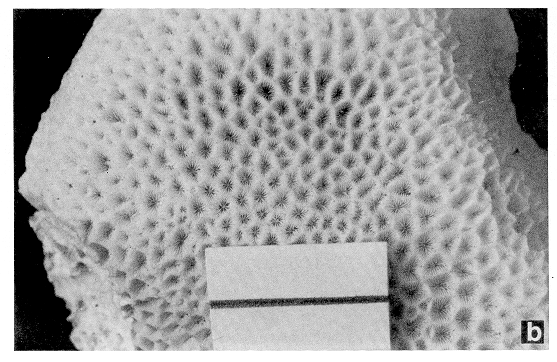
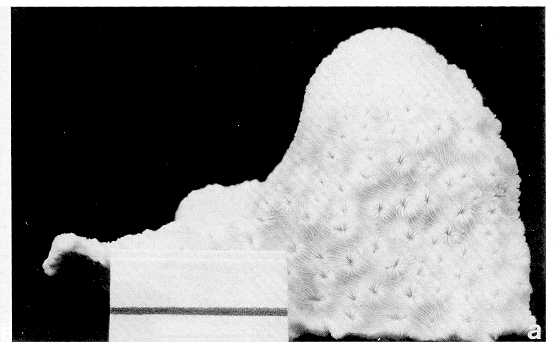
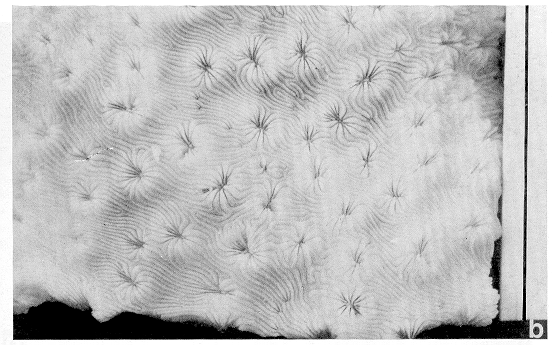
<BR><FONT FACE="Arial,Helvetica"><FONT SIZE=-1>Fig. 21. a) <I>Pavona xarifae</I> (UCR 709), Punta Presidio, Isla del Coco, 19 m, 9.II.1993, escala = 2 cm; b) detalle, escala = 1.5 cm.</FONT></FONT>     <BR>&nbsp;      <P><FONT FACE="Arial,Helvetica"><FONT SIZE=-1>12. <B><I>Gardineroseris planulata</I></B> (Dana, 1846)</FONT></FONT>      <P><B><FONT FACE="Arial,Helvetica"><FONT SIZE=-1>Descripci&oacute;n:</FONT></FONT></B>      <P><FONT FACE="Arial,Helvetica"><FONT SIZE=-1>Coral masivo con c&aacute;lices profundos, de hasta 3 mm, y de 3 a 5 mm de di&aacute;metro. Septos peque&ntilde;os pero distintivos. <A HREF="#Figura13a">Fig. 13 a</A>, <A HREF="#Figura13b">b</A>.</FONT></FONT>      ]]></body>
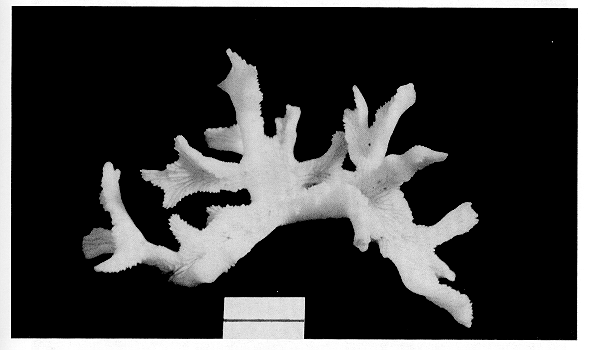
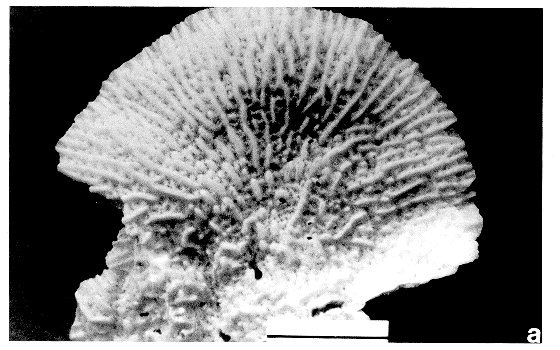
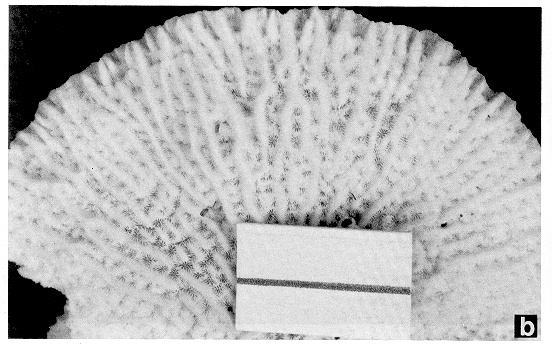
<body><![CDATA[<P><B><FONT FACE="Arial,Helvetica"><FONT SIZE=-1>Distribuci&oacute;n:</FONT></FONT></B>      <P><FONT FACE="Arial,Helvetica"><FONT SIZE=-1>&nbsp;&nbsp;&nbsp; Costa Rica: Restringido al sur del pa&iacute;s: Pen&iacute;nsula de Osa, Isla del Ca&ntilde;o, Isla del Coco.</FONT></FONT>      <P><FONT FACE="Arial,Helvetica"><FONT SIZE=-1>&nbsp;&nbsp;&nbsp; Resto del mundo: Especie de distribuci&oacute;n muy amplia, Mar Rojo, Oc&eacute;ano Indico y el Oc&eacute;ano Pac&iacute;fico (<A HREF="#Veron1993">Veron 1993</A>).</FONT></FONT>     <BR>&nbsp;      <P><B><FONT FACE="Arial,Helvetica"><FONT SIZE=-1>Historia natural:</FONT></FONT></B>      <P><FONT FACE="Arial,Helvetica"><FONT SIZE=-1><I>Gardineroseris planulata</I> es una especie poco abundante en nuestros arrecifes. Su crecimiento es masivo y lento (1 cm/a&ntilde;o para Costa Rica: <A HREF="#Guzmán89b">Guzm&aacute;n &amp; Cort&eacute;s 1989b</A>). Actualmente se encuentran muy pocas colonias de tama&ntilde;os superiores a los 50 cm. Su reproducci&oacute;n es principalmente sexual (<A HREF="#Glynn96">Glynn <I>et al</I>. 1996</A>). La especie es depredada por <I>Acanthaster planci</I>, la cual podr&iacute;a ser un factor importante en su limitada distribuci&oacute;n, abundancia y tama&ntilde;o.</FONT></FONT>     <BR>&nbsp;      <P><FONT FACE="Arial,Helvetica"><FONT SIZE=-1>13. <B><I>Leptoseris papyracea</I></B> (Dana, 1846)</FONT></FONT>      <P><B><FONT FACE="Arial,Helvetica"><FONT SIZE=-1>Descripci&oacute;n:</FONT></FONT></B>      <P><FONT FACE="Arial,Helvetica"><FONT SIZE=-1>Ramas muy delgadas (aproximadamente 5 mm), ligeramente contorsionadas, con c&aacute;lices de un solo lado, con septos bien definidos. <A HREF="#Figura14">Fig. 14</A>.</FONT></FONT>      ]]></body>
<body><![CDATA[<P><B><FONT FACE="Arial,Helvetica"><FONT SIZE=-1>Distribuci&oacute;n geogr&aacute;fica:</FONT></FONT></B>      <P><FONT FACE="Arial,Helvetica"><FONT SIZE=-1>&nbsp;&nbsp;&nbsp; Costa Rica: Bah&iacute;a Culebra, Isla del Coco.</FONT></FONT>      <P><FONT FACE="Arial,Helvetica"><FONT SIZE=-1>&nbsp;&nbsp;&nbsp; Resto del mundo: Desde Madagascar hasta el Pac&iacute;fico Americano (<A HREF="#Dinesen">Dinesen 1980</A>, <A HREF="#Veron1993">Veron 1993</A>).</FONT></FONT>     <BR>&nbsp;      <P><FONT FACE="Arial,Helvetica"><FONT SIZE=-1>14. <B><I>Leptoseris scabra</I></B> Vaughan, 1907</FONT></FONT>      <P><B><FONT FACE="Arial,Helvetica"><FONT SIZE=-1>Descripci&oacute;n:</FONT></FONT></B>      <P><FONT FACE="Arial,Helvetica"><FONT SIZE=-1>Esqueleto grueso, incrustante, con c&aacute;lices prominentes de un solo lado. <A HREF="#Figura15a">Fig. 15 a</A>, <A HREF="#Figura15b">b</A>.</FONT></FONT>      <P><B><FONT FACE="Arial,Helvetica"><FONT SIZE=-1>Distribuci&oacute;n geogr&aacute;fica:</FONT></FONT></B>      <P><FONT FACE="Arial,Helvetica"><FONT SIZE=-1>&nbsp;&nbsp;&nbsp; Costa Rica: Isla del Coco.</FONT></FONT>      <P><FONT FACE="Arial,Helvetica"><FONT SIZE=-1>&nbsp;&nbsp;&nbsp; Resto del mundo: Especie de distribuci&oacute;n amplia, Mar Rojo, Oc&eacute;ano Indico y Oc&eacute;ano Pac&iacute;fico (<A HREF="#Dinesen">Dinesen 1980</A>, <A HREF="#Veron1993">Veron</A> <A HREF="#Veron1993">1993</A>).</FONT></FONT>     ]]></body>
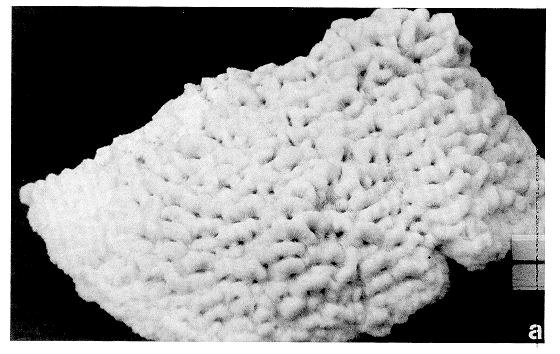
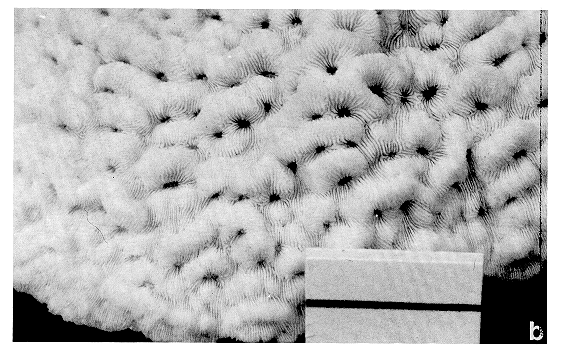
<body><![CDATA[<BR>&nbsp;      <P><B><FONT FACE="Arial,Helvetica"><FONT SIZE=-1>Historia natural de las especies del g&eacute;nero <I>Leptoseris</I>:</FONT></FONT></B>      <P><FONT FACE="Arial,Helvetica"><FONT SIZE=-1><I>Leptoseris papyracea</I> se conoc&iacute;a para Costa Rica por solo unos pocos espec&iacute;menes recolectados en 1983 en Playa Ocotal. Desde entonces y hasta 1996 no se hab&iacute;a vuelto a observar, cuando en Punta Esmeralda, Bah&iacute;a Culebra, Carlos E. Jim&eacute;nez encontr&oacute; un arrecife construido por esta especie. No se conoc&iacute;a la existencia previa de arrecifes construidos por esta especie, ya que en otras regiones del mundo es poco abundante (<A HREF="#Dinesen">Dinesen 1980</A>). El arrecife de Punta Esmeralda cubre un &aacute;rea aproximada de 2500 m<SUP>2</SUP> y se extiende desde los 8 m a los 12 m de profundidad. Huecos hechos en la estructura y pruebas con varillas de construcci&oacute;n, indican un espesor m&iacute;nimo de 0.4 m (C.E. Jim&eacute;nez com. pers. 1996).</FONT></FONT>      <P><FONT FACE="Arial,Helvetica"><FONT SIZE=-1><I>Leptoseris scabra</I> es poco abundante y solo ha sido recolectada en la Isla del Coco. Vive en forma incrustante en grietas en las rocas. Este es un nuevo registro para el Pac&iacute;fico Oriental.</FONT></FONT>     <BR>&nbsp;      <P><FONT FACE="Arial,Helvetica"><FONT SIZE=-1>15. <B><I>Pavona clavus</I></B> (Dana, 1846)</FONT></FONT>      <P><B><FONT FACE="Arial,Helvetica"><FONT SIZE=-1>Descrici&oacute;n:</FONT></FONT></B>      <P><FONT FACE="Arial,Helvetica"><FONT SIZE=-1>Colonias hemisf&eacute;ricas o lobuladas, de tama&ntilde;os variables: de unos pocos cent&iacute;metros a 10 m de di&aacute;metro en arrecifes en Guanacaste. C&aacute;lices de 2,5 a 3,5 mm de di&aacute;metro, septos bien definidos y dentados. <A HREF="#Figura16a">Fig. 16 a</A>, <A HREF="#Figura16b">b</A>.</FONT></FONT>      <P><B><FONT FACE="Arial,Helvetica"><FONT SIZE=-1>Distribuci&oacute;n geogr&aacute;fica:</FONT></FONT></B>      <P><FONT FACE="Arial,Helvetica"><FONT SIZE=-1>&nbsp;&nbsp;&nbsp; Costa Rica: Archipi&eacute;lago de las Islas Murci&eacute;lago, Bah&iacute;a Culebra, Manuel Antonio, Pen&iacute;nsula de Osa, Golfo Dulce, Isla del Ca&ntilde;o, Isla del Coco.</FONT></FONT>      ]]></body>
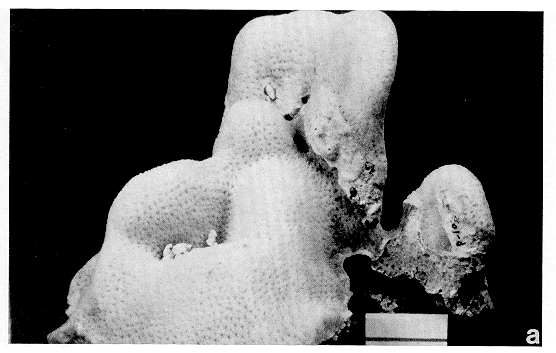
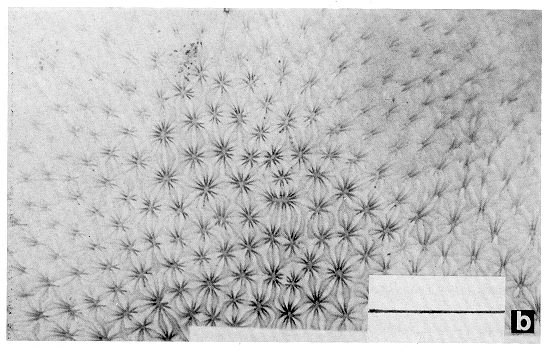
<body><![CDATA[<P><FONT FACE="Arial,Helvetica"><FONT SIZE=-1>&nbsp;&nbsp;&nbsp; Resto del mundo: Especie de distribuci&oacute;n amplia, Golfo P&eacute;rsico (<A HREF="#Sheppard">Sheppard &amp; Sheppard 1991</A>), y desde el Mar Rojo hasta la costa de Am&eacute;rica Central (<A HREF="#Veron1993">Veron 1993</A>).</FONT></FONT>     <BR>&nbsp;      <P><FONT FACE="Arial,Helvetica"><FONT SIZE=-1>16. <B><I>Pavona frondifera</I></B> (Lamarck, 1816)</FONT></FONT>      <P><B><FONT FACE="Arial,Helvetica"><FONT SIZE=-1>Descripci&oacute;n:</FONT></FONT></B>      <P><FONT FACE="Arial,Helvetica"><FONT SIZE=-1>Colonias incrustantes o hemisf&eacute;ricas, con proyecciones pronunciadas del esqueleto parecidas a hojas; desde colonias peque&ntilde;as incrustantes de unos pocos cent&iacute;metros, hasta colonias hemisf&eacute;ricas de 1 m de di&aacute;metro. <A HREF="#Figura17a">Fig. 17 a</A>, <A HREF="#Figura17b">b</A>.</FONT></FONT>      <P><B><FONT FACE="Arial,Helvetica"><FONT SIZE=-1>Distribuci&oacute;n geogr&aacute;fica:</FONT></FONT></B>      <P><FONT FACE="Arial,Helvetica"><FONT SIZE=-1>&nbsp;&nbsp;&nbsp; Costa Rica: Bah&iacute;a Culebra, Golfo Dulce, Isla del Ca&ntilde;o.</FONT></FONT>      <P><FONT FACE="Arial,Helvetica"><FONT SIZE=-1>&nbsp;&nbsp;&nbsp; Resto del mundo: Desde la costa este de Africa a la costa Pac&iacute;fica de Am&eacute;rica Central (<A HREF="#Veron1993">Veron 1993</A>).</FONT></FONT>     <BR>&nbsp;      <P><FONT FACE="Arial,Helvetica"><FONT SIZE=-1>17. <B><I>Pavona gigantea</I></B> Verrill, 1869</FONT></FONT>      ]]></body>
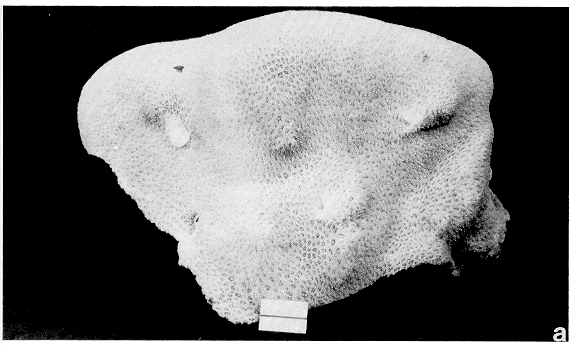
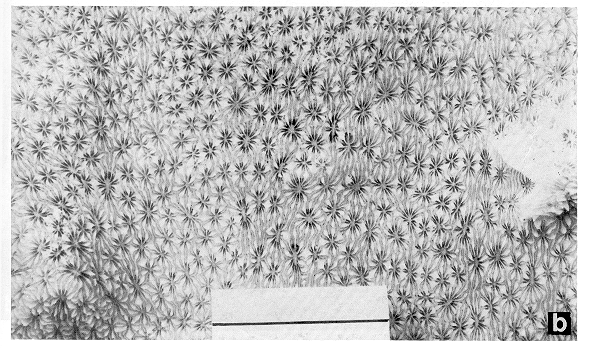
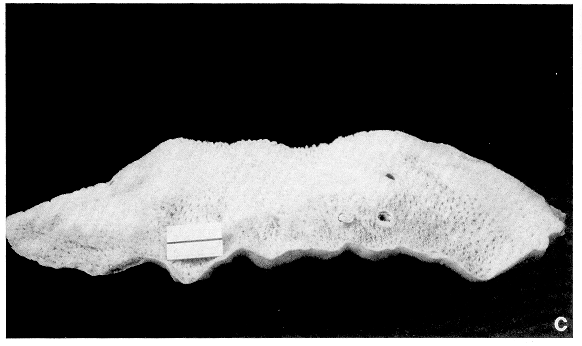
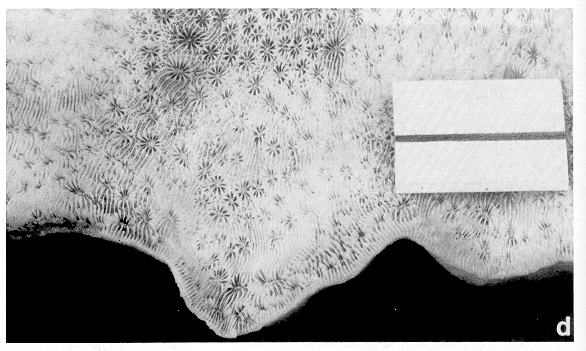
<body><![CDATA[<P><B><FONT FACE="Arial,Helvetica"><FONT SIZE=-1>Descripci&oacute;n:</FONT></FONT></B>      <P><FONT FACE="Arial,Helvetica"><FONT SIZE=-1>Colonias masivas, con c&aacute;lices grandes (> 1 mm) y generalmente con extenciones en forma de aleros en la parte inferior, especialmente a mayores profundidades. <A HREF="#Figura18a">Fig. 18 a</A>, <A HREF="#Figura18b">b</A>, <A HREF="#Figura18c">c</A>, <A HREF="#Figura18d">d</A>.</FONT></FONT>     <BR>&nbsp;     <BR><B><FONT FACE="Arial,Helvetica"><FONT SIZE=-1>Distribuci&oacute;n geogr&aacute;fica:</FONT></FONT></B>      <P><FONT FACE="Arial,Helvetica"><FONT SIZE=-1>&nbsp;&nbsp;&nbsp; Costa Rica: Area de Conservaci&oacute;n Guancaste, Bah&iacute;a Culebra, Punta Mala, Manuel Antonio, Pen&iacute;nsula de Osa, Golfo Dulce, Isla del Ca&ntilde;o, Isla del Coco.</FONT></FONT>      <P><FONT FACE="Arial,Helvetica"><FONT SIZE=-1>&nbsp;&nbsp;&nbsp; Resto del mundo: Pac&iacute;fico Oriental y la Isla Fanning (<A HREF="#Wells, J.W. 1983.">Wells 1983</A>).</FONT></FONT>     <BR>&nbsp;      <P><FONT FACE="Arial,Helvetica"><FONT SIZE=-1>18. <B><I>Pavona maldivensis</I></B> (Gardiner, 1905)</FONT></FONT>      <P><B><FONT FACE="Arial,Helvetica"><FONT SIZE=-1>Descripci&oacute;n:</FONT></FONT></B>      <P><FONT FACE="Arial,Helvetica"><FONT SIZE=-1>Colonias hemisf&eacute;ricas, generalmente peque&ntilde;as, con los c&aacute;lices de 1,5 a 2,0 mm y elevados 1 a 2 mm, con 16 a 20 septos. <A HREF="#Figura19a">Fig. 19 a</A>, <A HREF="#Figura19b">b</A>.</FONT></FONT>      ]]></body>
<body><![CDATA[<P><B><FONT FACE="Arial,Helvetica"><FONT SIZE=-1>Distribuci&oacute;n geogr&aacute;fica:</FONT></FONT></B>      <P><FONT FACE="Arial,Helvetica"><FONT SIZE=-1>&nbsp;&nbsp;&nbsp; Costa Rica: Area de Conservaci&oacute;n Guanacaste, Bah&iacute;a Culebra, Parque Marino Ballena, Isla del Ca&ntilde;o, Isla del Coco.</FONT></FONT>      <P><FONT FACE="Arial,Helvetica"><FONT SIZE=-1>&nbsp;&nbsp;&nbsp; Resto del mundo: Especie de distribuci&oacute;n muy amplia, del Mar Rojo y la costa este de Africa hasta la costa de Am&eacute;rica Central (<A HREF="#Veron1993">Veron 1993</A>).</FONT></FONT>     <BR>&nbsp;      <P><FONT FACE="Arial,Helvetica"><FONT SIZE=-1>19. <B><I>Pavona varians</I></B> Verrill, 1864</FONT></FONT>      <P><B><FONT FACE="Arial,Helvetica"><FONT SIZE=-1>Descripci&oacute;n:</FONT></FONT></B>      <P><FONT FACE="Arial,Helvetica"><FONT SIZE=-1>Colonias incrustantes, de c&aacute;lices peque&ntilde;os (&lt; 1 mm), casi rellenos por los septos y columnela. El env&eacute;s es liso y a veces con ondulaciones que corresponden a ondulaciones en la superficie superior. Esta especie muestra un amplio rango de variaci&oacute;n; algunas de las cuales posiblemente sean especies nuevas (P.W. Glynn com. pers. 1997). <A HREF="#Figura20a">Fig. 20 a</A>, <A HREF="#Figura20b">b</A>, <A HREF="#Figura20c">c</A>, <A HREF="#Figura20d">d</A>, <A HREF="#Figura20e">e</A>, <A HREF="#Figura20f">f</A>.</FONT></FONT>      <P><B><FONT FACE="Arial,Helvetica"><FONT SIZE=-1>Distribuci&oacute;n geogr&aacute;fica:</FONT></FONT></B>      <P><FONT FACE="Arial,Helvetica"><FONT SIZE=-1>&nbsp;&nbsp;&nbsp; Costa Rica: Area de Conservaci&oacute;n Guancaste, Bah&iacute;a Culebra, Punta Mala, Manuel Antonio, Pen&iacute;nsula de Osa, Golfo Dulce, Isla del Ca&ntilde;o, Isla del Coco.</FONT></FONT>      <P><FONT FACE="Arial,Helvetica"><FONT SIZE=-1>&nbsp;&nbsp;&nbsp; Resto del mundo: Especie de distribuci&oacute;n amplia desde el Mar Rojo y la costa este de Africa hasta el Pac&iacute;fico americano (<A HREF="#Veron1993">Veron 1993</A>).</FONT></FONT>     ]]></body>
<body><![CDATA[<BR>&nbsp;      <P><FONT FACE="Arial,Helvetica"><FONT SIZE=-1>20. <B><I>Pavona xarifae</I></B> Scheer &amp; Pillai, 1974</FONT></FONT>      <P><B><FONT FACE="Arial,Helvetica"><FONT SIZE=-1>Descripci&oacute;n:</FONT></FONT></B>      <P><FONT FACE="Arial,Helvetica"><FONT SIZE=-1>Colonias incrustantes con c&aacute;lices peque&ntilde;os, menos de 1 mm, alineados; aproximadamente 10 c&aacute;lices por cm2. El corallum parece una "oreja de res" (<A HREF="#Scheer">Scheer &amp; Pillai 1974</A>). De 16 a 18 septos generalmente, pero a veces hasta 24, alternando su tama&ntilde;o. Los septos se extienden de un c&aacute;lice a otro. Columnela poco desarrollada. <A HREF="#Figura21a">Fig. 21 a</A>, <A HREF="#Figura21b">b</A>.</FONT></FONT>      <P><B><FONT FACE="Arial,Helvetica"><FONT SIZE=-1>Distribuci&oacute;n geogr&aacute;fica:</FONT></FONT></B>      <P><FONT FACE="Arial,Helvetica"><FONT SIZE=-1>&nbsp;&nbsp;&nbsp; Costa Rica: Isla del Coco.</FONT></FONT>      <P><FONT FACE="Arial,Helvetica"><FONT SIZE=-1>&nbsp;&nbsp;&nbsp; Resto del mundo: Desde las Islas Nicobar en el Oce&aacute;no Indico hasta las Islas Cook en el Oc&eacute;ano Pac&iacute;fico (<A HREF="#Scheer">Scheer &amp; Pillai</A> <A HREF="#Scheer">1974</A>; <A HREF="#Veron1993">Veron 1993</A>).</FONT></FONT>      <P><B><FONT FACE="Arial,Helvetica"><FONT SIZE=-1>Comentario:</FONT></FONT></B>      <P><FONT FACE="Arial,Helvetica"><FONT SIZE=-1>Este es un nuevo registro para el Pac&iacute;fico Oriental.</FONT></FONT>     <BR>&nbsp;      ]]></body>
<body><![CDATA[<P><B><FONT FACE="Arial,Helvetica"><FONT SIZE=-1>Historia natural de las especies del g&eacute;nero <I>Pavona</I>:</FONT></FONT></B>      <P><FONT FACE="Arial,Helvetica"><FONT SIZE=-1>Las especies m&aacute;s abundantes de este g&eacute;nero y de las que se conoce m&aacute;s son: <I>Pavona clavus</I>, <I>P. gigantea</I> y <I>P. varians</I>. Estas especies son de amplia distribuci&oacute;n en el arrecife, excepto en plataformas someras y de alta energ&iacute;a. Generalmente forman parches con individuos de diversos tama&ntilde;os. <I>P. gigantea</I> pueden alcanzar m&aacute;s de un metro de alto y formar parches de varios cientos de metros cuadrados (<A HREF="#Cortés1996_1997a">Cort&eacute;s 1996-1997a</A>). <I>P. clavus</I> crece normalmente en colonias de menos de un metro, pero en Guancaste se han encontrado colonias de hasta 10 m de di&aacute;metro (Cort&eacute;s &amp; Jim&eacute;nez en prep.). En otras regiones del Pac&iacute;fico Oriental se conoce de colonias de <I>P. clavus</I> de hasta 5 metros de altura (<A HREF="#Colgan">Colgan 1990</A>). El crecimiento de estas dos especies oscila entre 0.5 y 1.2 cm/a&ntilde;o; <I>P. varians</I> es de forma incrustante y de un crecimiento inferior a 0.5 cm/a&ntilde;o (<A HREF="#Guzmán89b">Guzm&aacute;n &amp; Cort&eacute;s 1989b</A>). Sin embargo, esta &uacute;ltima especie pareciera tener una mayor capacidad para colonizar espacios libres que las otras especies. La reproducci&oacute;n de <I>P. varians</I> es sexual lo cual facilita su reclutamiento. Las tres especies son presa preferida de <I>Acanthaster planci</I>, la cual a veces limita su abundancia. La capacidad de regeneraci&oacute;n de estas especies es lenta, y generalmente las heridas por peces bal&iacute;stidos se transforman en necrosis del tejido, que son aprovechadas por los peces damiselas para expandir sus territorios.</FONT></FONT>      <P><FONT FACE="Arial,Helvetica"><FONT SIZE=-1>Dentro del g&eacute;nero <I>Pavona</I> es posible que haya m&aacute;s especies que las descritas aqu&iacute;. Por ejemplo, la revisi&oacute;n de <A HREF="#Wells__J_W__1983_">Wells (1983)</A> indica la presencia de tres especies en el Pac&iacute;fico oriental. En los &uacute;ltimos a&ntilde;os se han observado (o diferenciado otras): <I>maldivensis</I> que se inclu&iacute;a dentro de <I>gigantea </I>y<I> frondifera</I> dentro de <I>varians</I>. En este trabajo indicamos otra especie no informada anteriormente, <I>xarifae</I>, y bajo <I>varians</I> posiblemente estamos incluyendo varias especies (P.W. Glynn com. pers. 1997). Estudios morfom&eacute;tricos y gen&eacute;ticos m&aacute;s detallados son necesarios para aclarar la taxonom&iacute;a de estas especies.</FONT></FONT>     <BR>&nbsp;      <P><FONT FACE="Arial,Helvetica"><FONT SIZE=-1>21. <B><I>Fungia (Cycloseris) curvata</I></B> (Verrill, 1870)</FONT></FONT>      <P><B><FONT FACE="Arial,Helvetica"><FONT SIZE=-1>Descripci&oacute;n:</FONT></FONT></B>      <P><FONT FACE="Arial,Helvetica"><FONT SIZE=-1>Esqueleto de un solo p&oacute;lipo, relativamente grueso y denso, dif&iacute;cil de quebrar, y arqueado. Vive despegado del sustrato. Hay varios ciclos de septos de diferentes tama&ntilde;os, ornamentados con peque&ntilde;os dientes. Ilustrado en <A HREF="#Hoeksema">Hoeksema (1989)</A>.</FONT></FONT>      <P><B><FONT FACE="Arial,Helvetica"><FONT SIZE=-1>Distribuci&oacute;n geogr&aacute;fica:</FONT></FONT></B>      <P><FONT FACE="Arial,Helvetica"><FONT SIZE=-1>&nbsp;&nbsp;&nbsp; Costa Rica: Bah&iacute;a Culebra, Golfo Dulce, Isla del Coco.</FONT></FONT>      <P><FONT FACE="Arial,Helvetica"><FONT SIZE=-1>&nbsp;&nbsp;&nbsp; Resto del mundo: Mar Rojo, Zanz&iacute;bar, Golfo P&eacute;rsico, Filipinas, Indonesia, Papua Nueva Guinea, Islas Gal&aacute;pagos, M&eacute;xico (<A HREF="#Hoeksema">Hoeksema (1989</A>); Jap&oacute;n (<A HREF="#Nishihira">Nishihira &amp; Veron 1995</A>).</FONT></FONT>     ]]></body>
<body><![CDATA[<BR>&nbsp;      <P><FONT FACE="Arial,Helvetica"><FONT SIZE=-1>22. <B><I>Fungia (Cycloseris) distorta</I></B> Michelin, 1842</FONT></FONT>      <P><B><FONT FACE="Arial,Helvetica"><FONT SIZE=-1>Descripci&oacute;n:</FONT></FONT></B>      <P><FONT FACE="Arial,Helvetica"><FONT SIZE=-1>Esqueleto de un solo p&oacute;lipo, fr&aacute;gil, f&aacute;cil de quebrar, generalmente con fisuras, y relativamente planas. Viven separados del sustrato. Septos abundantes en varios ciclos y cubiertos por gr&aacute;nulos. Ilustrado en <A HREF="#Hoeksema">Hoeksema (1989)</A>.</FONT></FONT>      <P><B><FONT FACE="Arial,Helvetica"><FONT SIZE=-1>Distribuci&oacute;n geogr&aacute;fica:</FONT></FONT></B>      <P><FONT FACE="Arial,Helvetica"><FONT SIZE=-1>&nbsp;&nbsp;&nbsp; Costa Rica: Bah&iacute;a Culebra, Isla del Coco.</FONT></FONT>      <P><FONT FACE="Arial,Helvetica"><FONT SIZE=-1>&nbsp;&nbsp;&nbsp; Resto del mundo: Mar Rojo <A HREF="#Sheppard">(Sheppard &amp; Sheppard 1991</A>), Zanz&iacute;bar, Mozambique, Maldivas, Filipinas, Indonesia, Jap&oacute;n, Papua Nueva Guinea, Palau, Islas Marshall, Hawaii, M&eacute;xico (<A HREF="#Hoeksema">Hoeksema 1989</A>).</FONT></FONT>     <BR>&nbsp;      <P><B><FONT FACE="Arial,Helvetica"><FONT SIZE=-1>Historia natural de las especies del g&eacute;nero <I>Fungia</I>:</FONT></FONT></B>      <P><FONT FACE="Arial,Helvetica"><FONT SIZE=-1><I>Fungia</I> (<I>Cycloseris</I>) curvata fue descubierta viva recientemente (1996) por Carlos E. Jim&eacute;nez, en Bah&iacute;a Culebra. Hab&iacute;a sido recolectada por primera vez en Costa Rica cerca de Puerto Jim&eacute;nez, Golfo Dulce (espec&iacute;menes en el Museo de Historia Natural, Smithsonian Institution, USNM 77890, no se cuenta con otros datos), posteriormente se recolect&oacute; en la Isla del Coco en 1986, en aguas profundas (USNM 80083, 80084).</FONT></FONT>      ]]></body>
<body><![CDATA[<P><FONT FACE="Arial,Helvetica"><FONT SIZE=-1>Fragmentos muertos en forma de cu&ntilde;a de <I>Fungia (Cycloseris)</I> distorta se encuentran en forma abundante en Bah&iacute;a Culebra, Guanacaste. Actualmente la especies que se encuentra viva all&iacute; es <I>F. (C.) curvata</I>, y se ha podido observar su forma de fragmentaci&oacute;n y regeneraci&oacute;n. Esta especie se comporta similar a <I>Fungia (Cycloseris)</I> distorta (informada como <I>Diaseris distorta</I>) en Jap&oacute;n. En alg&uacute;n momento de su vida se empieza a disolver el esqueleto a lo largo de l&iacute;neas longitudinales, hasta que se separa en forma de cu&ntilde;as (<A HREF="#Yamashiro94">Yamashiro &amp; Nishihira 1994</A>). Posteriormente, cada cu&ntilde;a empieza a regenerar el resto del c&aacute;lice (<A HREF="#Yamashiro__H__1992_">Yamashiro 1992</A>).</FONT></FONT>     <BR>&nbsp;     <BR>&nbsp;     <BR><B><FONT FACE="Arial,Helvetica"><FONT SIZE=-1>Agradecimientos</FONT></FONT></B>      <P><FONT FACE="Arial,Helvetica"><FONT SIZE=-1>Se le agradece a la Vicerrector&iacute;a de Investigaci&oacute;n de la Universidad de Costa Rica (Proyectos 808-83-135, 808-92-237, 808-96-601), a CONICIT (Proyecto 90-326-BID), a Peter W. Glynn (Proyecto U.S. National Science Foundation OCE 8415615), y al Smithsonian Tropical Research Institute (STRI Research Opportunity a HMG) por la ayuda econ&oacute;mica que hizo posible las recolectas de corales y esta publicaci&oacute;n. Las mayor&iacute;a de las fotograf&iacute;as se hicieron en STRI y se cont&oacute; con la ayuda de Marco Guerra y Antonio Montaner, otras las tom&oacute; Guillermo Vargas de la Unidad de Microscop&iacute;a Electr&oacute;nica, Universidad de Costa Rica; Gerardo Ch&aacute;vez ayud&oacute; en el ordenamiento de las fotograf&iacute;as; y Rita Vargas con el mapa. Esta es una contribuci&oacute;n conjunta del Museo de Zoolog&iacute;a, Escuela de Biolog&iacute;a, y del Centro de Investigaci&oacute;n en Ciencias del Mar y Limnolog&iacute;a, ambos de la Universidad de Costa Rica.</FONT></FONT>     <BR>&nbsp;     <BR>&nbsp;     <BR><B><FONT FACE="Arial,Helvetica"><FONT SIZE=-1>Resumen</FONT></FONT></B>      <P><FONT FACE="Arial,Helvetica"><FONT SIZE=-1>Se describen veinte y dos especies de corales ecleractinios zooxantelados del Pac&iacute;fico de Costa Rica se describen. Se incluyen claves para los g&eacute;neros y especies. Se presenta su distribuci&oacute;n geogr&aacute;fica en Costa Rica y en todo el mundo, as&iacute; como aspectos de la historia general de las especies. Diecis&eacute;is especies tiene distribuciones muy amplias, desde en Mar Rojo o el Oc&eacute;ano Indico hasta la costa Pac&iacute;fica de Am&eacute;rica, dos especies son end&eacute;micas del Pac&iacute;fico Oriental, y cuatro especies se encuentran solo en Oc&eacute;ano Pac&iacute;fico; no hay ninguna especie en com&uacute;n con el Caribe-Atl&aacute;ntico. Dos especies, Leptoseris scabra y Pavona xarifae, son registros nuevos para el Pac&iacute;fico Oriental.</FONT></FONT>     <BR>&nbsp;      ]]></body>
<body><![CDATA[<P><B><FONT FACE="Arial,Helvetica"><FONT SIZE=-1>Referencias</FONT></FONT></B>      <!-- ref --><P><A NAME="Bakus"></A><FONT FACE="Arial,Helvetica"><FONT SIZE=-1>Bakus, G. J. 1975. Marine zonation and ecology of Cocos Island, off Central America. Atoll Res. Bull. 179: 1-9.</FONT></FONT>    &nbsp;&nbsp;&nbsp;&nbsp;&nbsp;&nbsp;&nbsp;&nbsp;[&#160;<a href="javascript:void(0);" onclick="javascript: window.open('/scielo.php?script=sci_nlinks&ref=1109328&pid=S0034-7744199800010000600001&lng=','','width=640,height=500,resizable=yes,scrollbars=1,menubar=yes,');">Links</a>&#160;]<!-- end-ref --><!-- ref --><P><A NAME="Birkeland"></A><FONT FACE="Arial,Helvetica"><FONT SIZE=-1>Birkeland, C., D. L. Meyer, J. P. Stames &amp; C. L. Buford. 1975. Subtidal communities of Malpelo Island. In The Biological Investigation of Malpelo Island, Colombia, J. B. Graham (ed.). Smithson. Cont. Zool. 176: 55-68.</FONT></FONT>    &nbsp;&nbsp;&nbsp;&nbsp;&nbsp;&nbsp;&nbsp;&nbsp;[&#160;<a href="javascript:void(0);" onclick="javascript: window.open('/scielo.php?script=sci_nlinks&ref=1109329&pid=S0034-7744199800010000600002&lng=','','width=640,height=500,resizable=yes,scrollbars=1,menubar=yes,');">Links</a>&#160;]<!-- end-ref --><!-- ref --><P><A NAME="Colgan"></A><FONT FACE="Arial,Helvetica"><FONT SIZE=-1>Colgan, M.W. 1990. El Ni&ntilde;o and the history of eastern Pacific reef building, p. 183-229. In Glynn PW (ed), Global ecological consequences of the 1982-83 El Ni&ntilde;o-Southern Oscillation. Elsevier, Amsterdam.</FONT></FONT>    &nbsp;&nbsp;&nbsp;&nbsp;&nbsp;&nbsp;&nbsp;&nbsp;[&#160;<a href="javascript:void(0);" onclick="javascript: window.open('/scielo.php?script=sci_nlinks&ref=1109330&pid=S0034-7744199800010000600003&lng=','','width=640,height=500,resizable=yes,scrollbars=1,menubar=yes,');">Links</a>&#160;]<!-- end-ref --><!-- ref --><P><A NAME="Cortés1986"></A><FONT FACE="Arial,Helvetica"><FONT SIZE=-1>Cort&eacute;s, J. 1986. Biogeograf&iacute;a de corales hermat&iacute;picos: el istmo Centro Americano. Anales Inst. Cien. Mar Limnol., UNAM 13: 297-304.</FONT></FONT>    &nbsp;&nbsp;&nbsp;&nbsp;&nbsp;&nbsp;&nbsp;&nbsp;[&#160;<a href="javascript:void(0);" onclick="javascript: window.open('/scielo.php?script=sci_nlinks&ref=1109331&pid=S0034-7744199800010000600004&lng=','','width=640,height=500,resizable=yes,scrollbars=1,menubar=yes,');">Links</a>&#160;]<!-- end-ref --><!-- ref --><P><A NAME="Cortés1990"></A><FONT FACE="Arial,Helvetica"><FONT SIZE=-1>Cort&eacute;s, J. 1990. The coral reefs of Golfo Dulce, Costa Rica: distribution and community structure. Atoll Res. Bull. 334: 1-37.</FONT></FONT>    &nbsp;&nbsp;&nbsp;&nbsp;&nbsp;&nbsp;&nbsp;&nbsp;[&#160;<a href="javascript:void(0);" onclick="javascript: window.open('/scielo.php?script=sci_nlinks&ref=1109332&pid=S0034-7744199800010000600005&lng=','','width=640,height=500,resizable=yes,scrollbars=1,menubar=yes,');">Links</a>&#160;]<!-- end-ref --><!-- ref --><P><A NAME="Cortés1996_1997a"></A><FONT FACE="Arial,Helvetica"><FONT SIZE=-1>Cort&eacute;s, J. 1996-1997a. Comunidades coralinas y arrecifes del Area de Conservaci&oacute;n Guanacaste, Costa Rica. Rev. Biol. Trop. 44 ( 3)/ 45 ( 1): 623-625.</FONT></FONT>    &nbsp;&nbsp;&nbsp;&nbsp;&nbsp;&nbsp;&nbsp;&nbsp;[&#160;<a href="javascript:void(0);" onclick="javascript: window.open('/scielo.php?script=sci_nlinks&ref=1109333&pid=S0034-7744199800010000600006&lng=','','width=640,height=500,resizable=yes,scrollbars=1,menubar=yes,');">Links</a>&#160;]<!-- end-ref --><!-- ref --><P><A NAME="Cortés1996_1997b"></A><FONT FACE="Arial,Helvetica"><FONT SIZE=-1>Cort&eacute;s, J. 1996-1997b. Biodiversidad marina de Costa Rica: Filo Cnidaria. Rev. Biol. Trop. 44 ( 3)/ 45 ( 1): 323-334.</FONT></FONT>    &nbsp;&nbsp;&nbsp;&nbsp;&nbsp;&nbsp;&nbsp;&nbsp;[&#160;<a href="javascript:void(0);" onclick="javascript: window.open('/scielo.php?script=sci_nlinks&ref=1109334&pid=S0034-7744199800010000600007&lng=','','width=640,height=500,resizable=yes,scrollbars=1,menubar=yes,');">Links</a>&#160;]<!-- end-ref --><!-- ref --><P><A NAME="CortésJiménez1996"></A><FONT FACE="Arial,Helvetica"><FONT SIZE=-1>Cort&eacute;s, J. &amp; C.E. Jim&eacute;nez. 1996. Coastal-marine environments of Parque Nacional Corcovado, Puntarenas, Costa Rica. Rev. Biol. Trop. 44, Suppl. 3: 35-40.</FONT></FONT>    &nbsp;&nbsp;&nbsp;&nbsp;&nbsp;&nbsp;&nbsp;&nbsp;[&#160;<a href="javascript:void(0);" onclick="javascript: window.open('/scielo.php?script=sci_nlinks&ref=1109335&pid=S0034-7744199800010000600008&lng=','','width=640,height=500,resizable=yes,scrollbars=1,menubar=yes,');">Links</a>&#160;]<!-- end-ref --><!-- ref --><P><A NAME="CortésMurillo1985"></A><FONT FACE="Arial,Helvetica"><FONT SIZE=-1>Cort&eacute;s, J. &amp; M.M. Murillo. 1985. Comunidades coralinas y arrecifes del Pac&iacute;fico de Costa Rica. Rev. Biol. Trop. 33: 197-202.</FONT></FONT>    &nbsp;&nbsp;&nbsp;&nbsp;&nbsp;&nbsp;&nbsp;&nbsp;[&#160;<a href="javascript:void(0);" onclick="javascript: window.open('/scielo.php?script=sci_nlinks&ref=1109336&pid=S0034-7744199800010000600009&lng=','','width=640,height=500,resizable=yes,scrollbars=1,menubar=yes,');">Links</a>&#160;]<!-- end-ref --><!-- ref --><P><A NAME="CortésMacintyre1994"></A><FONT FACE="Arial,Helvetica"><FONT SIZE=-1>Cort&eacute;s, J., I.G. Macintyre &amp; P.W. Glynn. 1994. Holocene growth history of an eastern Pacific fringing reef, Punta Islotes, Costa Rica. Coral Reefs 13: 65-73</FONT></FONT>    &nbsp;&nbsp;&nbsp;&nbsp;&nbsp;&nbsp;&nbsp;&nbsp;[&#160;<a href="javascript:void(0);" onclick="javascript: window.open('/scielo.php?script=sci_nlinks&ref=1109337&pid=S0034-7744199800010000600010&lng=','','width=640,height=500,resizable=yes,scrollbars=1,menubar=yes,');">Links</a>&#160;]<!-- end-ref --><!-- ref --><P><A NAME="Devaney"></A><FONT FACE="Arial,Helvetica"><FONT SIZE=-1>Devaney, D.M. &amp; J.C. Lang. 1987. Scleractinia (stony corals) of Enewetak Atoll, p. 67-76. In D.M. Devaney, E.S. Reese, B.L. Burch &amp; P. Helfrich (eds.), The Natural History of Enewetak Atoll, Vol. II Biogeography abd Systematics. U.S Dept. Energy, Washington, D.C.</FONT></FONT>    &nbsp;&nbsp;&nbsp;&nbsp;&nbsp;&nbsp;&nbsp;&nbsp;[&#160;<a href="javascript:void(0);" onclick="javascript: window.open('/scielo.php?script=sci_nlinks&ref=1109338&pid=S0034-7744199800010000600011&lng=','','width=640,height=500,resizable=yes,scrollbars=1,menubar=yes,');">Links</a>&#160;]<!-- end-ref --><!-- ref --><P><A NAME="Dinesen"></A><FONT FACE="Arial,Helvetica"><FONT SIZE=-1>Dinesen, Z. D. 1980. A revision of the coral genus Leptoseris (Scleractinia: Fungiina: Agariciidae). Mem. Qd. Mus. 20: 181-235.</FONT></FONT>    &nbsp;&nbsp;&nbsp;&nbsp;&nbsp;&nbsp;&nbsp;&nbsp;[&#160;<a href="javascript:void(0);" onclick="javascript: window.open('/scielo.php?script=sci_nlinks&ref=1109339&pid=S0034-7744199800010000600012&lng=','','width=640,height=500,resizable=yes,scrollbars=1,menubar=yes,');">Links</a>&#160;]<!-- end-ref --><!-- ref --><P><A NAME="Dubois"></A><FONT FACE="Arial,Helvetica"><FONT SIZE=-1>Dubois, R. &amp; M. Hatziolos. 1982. Inventario de recursos marinos: sin paginar. In Centro Cient&iacute;fico Tropical (ed.), El Parque Nacional Manuel Antonio, Inventario Biol&oacute;gico Terrestre y Marino, Informe Final de Consultor&iacute;a.</FONT></FONT>    &nbsp;&nbsp;&nbsp;&nbsp;&nbsp;&nbsp;&nbsp;&nbsp;[&#160;<a href="javascript:void(0);" onclick="javascript: window.open('/scielo.php?script=sci_nlinks&ref=1109340&pid=S0034-7744199800010000600013&lng=','','width=640,height=500,resizable=yes,scrollbars=1,menubar=yes,');">Links</a>&#160;]<!-- end-ref --><!-- ref --><P><A NAME="Durham1962"></A><FONT FACE="Arial,Helvetica"><FONT SIZE=-1>Durham, J.W. 1962. Corals from the Gal&aacute;pagos and Cocos Islands. Proc. Calif. Acad. Sci. 4 th Ser. XXXII ( 2): 41-56.</FONT></FONT>    &nbsp;&nbsp;&nbsp;&nbsp;&nbsp;&nbsp;&nbsp;&nbsp;[&#160;<a href="javascript:void(0);" onclick="javascript: window.open('/scielo.php?script=sci_nlinks&ref=1109341&pid=S0034-7744199800010000600014&lng=','','width=640,height=500,resizable=yes,scrollbars=1,menubar=yes,');">Links</a>&#160;]<!-- end-ref --><!-- ref --><P><A NAME="Durham1966"></A><FONT FACE="Arial,Helvetica"><FONT SIZE=-1>Durham, J.W. 1966. Coelenterates, especialy stony corals from the Gal&aacute;pagos and Cocos Islands, p. 123-135. In R.I. Bowman (ed.), The Gal&aacute;pagos. University of California, Berkeley, Los Angeles.</FONT></FONT>    &nbsp;&nbsp;&nbsp;&nbsp;&nbsp;&nbsp;&nbsp;&nbsp;[&#160;<a href="javascript:void(0);" onclick="javascript: window.open('/scielo.php?script=sci_nlinks&ref=1109342&pid=S0034-7744199800010000600015&lng=','','width=640,height=500,resizable=yes,scrollbars=1,menubar=yes,');">Links</a>&#160;]<!-- end-ref --><!-- ref --><P><A NAME="Durham1952"></A><FONT FACE="Arial,Helvetica"><FONT SIZE=-1>Durham, J.W. &amp; J.L. Barnard. 1952. Stony corals of the eastern Pacific collected by Velero III and Velero IV. Allan Hancock Pac. Exped. 16: 1-110.</FONT></FONT>    &nbsp;&nbsp;&nbsp;&nbsp;&nbsp;&nbsp;&nbsp;&nbsp;[&#160;<a href="javascript:void(0);" onclick="javascript: window.open('/scielo.php?script=sci_nlinks&ref=1109343&pid=S0034-7744199800010000600016&lng=','','width=640,height=500,resizable=yes,scrollbars=1,menubar=yes,');">Links</a>&#160;]<!-- end-ref --><!-- ref --><P><A NAME="Glynn__P_W_1983"></A><FONT FACE="Arial,Helvetica"><FONT SIZE=-1>Glynn, P.W. 1983. Crustacean symbionts and the defense of corals: coevolution on the reef?, p. 111-178. In M.H. Nitecki (ed.), Coevolution. University of Chicago, Chicago.</FONT></FONT>    &nbsp;&nbsp;&nbsp;&nbsp;&nbsp;&nbsp;&nbsp;&nbsp;[&#160;<a href="javascript:void(0);" onclick="javascript: window.open('/scielo.php?script=sci_nlinks&ref=1109344&pid=S0034-7744199800010000600017&lng=','','width=640,height=500,resizable=yes,scrollbars=1,menubar=yes,');">Links</a>&#160;]<!-- end-ref --><!-- ref --><P><A NAME="Glynn__P_W__En_Prensa"></A><FONT FACE="Arial,Helvetica"><FONT SIZE=-1>Glynn, P.W. En prensa. Eastern Pacific reef coral biogeography and faunal flux: Durham's dilemma revisited. Proc. 8th Int. Coral Reef Symp., Panam&aacute;.</FONT></FONT>    &nbsp;&nbsp;&nbsp;&nbsp;&nbsp;&nbsp;&nbsp;&nbsp;[&#160;<a href="javascript:void(0);" onclick="javascript: window.open('/scielo.php?script=sci_nlinks&ref=1109345&pid=S0034-7744199800010000600018&lng=','','width=640,height=500,resizable=yes,scrollbars=1,menubar=yes,');">Links</a>&#160;]<!-- end-ref --><!-- ref --><P><A NAME="Glynn,PW83"></A><FONT FACE="Arial,Helvetica"><FONT SIZE=-1>Glynn, P.W. &amp; G.M. Wellington. 1983. Corals and Corals Reefs of the Gal&aacute;pagos Islands. University of California, Berkeley. 330 p.</FONT></FONT>    &nbsp;&nbsp;&nbsp;&nbsp;&nbsp;&nbsp;&nbsp;&nbsp;[&#160;<a href="javascript:void(0);" onclick="javascript: window.open('/scielo.php?script=sci_nlinks&ref=1109346&pid=S0034-7744199800010000600019&lng=','','width=640,height=500,resizable=yes,scrollbars=1,menubar=yes,');">Links</a>&#160;]<!-- end-ref --><!-- ref --><P><A NAME="Glynn__P_W___E_M__Druffel_"></A><FONT FACE="Arial,Helvetica"><FONT SIZE=-1>Glynn, P.W., E.M. Druffel &amp; R.B. Dunbar. 1983. A dead Central American coral reef tract: posible link with the Little Ice Age. J. Mar. Res. 41: 605-637.</FONT></FONT>    &nbsp;&nbsp;&nbsp;&nbsp;&nbsp;&nbsp;&nbsp;&nbsp;[&#160;<a href="javascript:void(0);" onclick="javascript: window.open('/scielo.php?script=sci_nlinks&ref=1109347&pid=S0034-7744199800010000600020&lng=','','width=640,height=500,resizable=yes,scrollbars=1,menubar=yes,');">Links</a>&#160;]<!-- end-ref --><!-- ref --><P><A NAME="Glynn_Veron1996"></A><FONT FACE="Arial,Helvetica"><FONT SIZE=-1>Glynn, P.W., J.E.N. Veron &amp; G.M. Wellington. 1996. Clipperton Atoll (eastern Pacific): oceanography, geomorphology, reef-building coral ecology and biogeography. Coral Reefs 15: 71-99.</FONT></FONT>    &nbsp;&nbsp;&nbsp;&nbsp;&nbsp;&nbsp;&nbsp;&nbsp;[&#160;<a href="javascript:void(0);" onclick="javascript: window.open('/scielo.php?script=sci_nlinks&ref=1109348&pid=S0034-7744199800010000600021&lng=','','width=640,height=500,resizable=yes,scrollbars=1,menubar=yes,');">Links</a>&#160;]<!-- end-ref --><!-- ref --><P><A NAME="Glynn96"></A><FONT FACE="Arial,Helvetica"><FONT SIZE=-1>Glynn, P.W., S.B. Colley, N.J. Gassman, K. Black, J. Cort&eacute;s &amp; J.L. Mat&eacute;. 1996. Reef coral reproduction in the eastern Pacific: Costa Rica, Panama, and Galapagos Islands (Ecuador) - III. Agariciidae (Pavona gigantea and Gardineroseris planulata). Mar. Biol. 125: 579-601.</FONT></FONT>    &nbsp;&nbsp;&nbsp;&nbsp;&nbsp;&nbsp;&nbsp;&nbsp;[&#160;<a href="javascript:void(0);" onclick="javascript: window.open('/scielo.php?script=sci_nlinks&ref=1109349&pid=S0034-7744199800010000600022&lng=','','width=640,height=500,resizable=yes,scrollbars=1,menubar=yes,');">Links</a>&#160;]<!-- end-ref --><!-- ref --><P><A NAME="Glynn, P.W., N.J.Gassman1991"></A><FONT FACE="Arial,Helvetica"><FONT SIZE=-1>Glynn, P.W., N.J. Gassman, C.M. Eakin, J. Cort&eacute;s, D.B. Smith &amp; H.M. Guzm&aacute;n. 1991. Reef coral reproduction in the eastern Pacific: Costa Rica, Panama, and Galapagos Islands (Ecuador), Part I-Pocilloporidae. Mar. Biol. 109: 355-368.</FONT></FONT>    &nbsp;&nbsp;&nbsp;&nbsp;&nbsp;&nbsp;&nbsp;&nbsp;[&#160;<a href="javascript:void(0);" onclick="javascript: window.open('/scielo.php?script=sci_nlinks&ref=1109350&pid=S0034-7744199800010000600023&lng=','','width=640,height=500,resizable=yes,scrollbars=1,menubar=yes,');">Links</a>&#160;]<!-- end-ref --><!-- ref --><P><A NAME="Glynn94"></A><FONT FACE="Arial,Helvetica"><FONT SIZE=-1>Glynn, P.W., S.B. Colley, C.M. Eakin, D.B. Smith, J. Cort&eacute;s, N.J. Gassman, H.M. Guzm&aacute;n, J.B. del Rosario &amp; J. Feingold. 1994. Reef coral reproduction in the eastern Pacific: Costa Rica, Panama, and Galapagos Islands (Ecuador) - II. Poritidae. Mar. Biol. 118: 191-208.</FONT></FONT>    &nbsp;&nbsp;&nbsp;&nbsp;&nbsp;&nbsp;&nbsp;&nbsp;[&#160;<a href="javascript:void(0);" onclick="javascript: window.open('/scielo.php?script=sci_nlinks&ref=1109351&pid=S0034-7744199800010000600024&lng=','','width=640,height=500,resizable=yes,scrollbars=1,menubar=yes,');">Links</a>&#160;]<!-- end-ref --><!-- ref --><P><A NAME="Guzmán1986"></A><FONT FACE="Arial,Helvetica"><FONT SIZE=-1>Guzm&aacute;n, H.M. 1986. Estructura de la comunidad arrecifal de la Isla del Ca&ntilde;o, Costa Rica, y el efecto de perturbaciones natuales severas. Tesis de Maestr&iacute;a, Universidad de Costa Rica, San Jos&eacute;, Costa Rica. 179 p.</FONT></FONT>    &nbsp;&nbsp;&nbsp;&nbsp;&nbsp;&nbsp;&nbsp;&nbsp;[&#160;<a href="javascript:void(0);" onclick="javascript: window.open('/scielo.php?script=sci_nlinks&ref=1109352&pid=S0034-7744199800010000600025&lng=','','width=640,height=500,resizable=yes,scrollbars=1,menubar=yes,');">Links</a>&#160;]<!-- end-ref --><!-- ref --><P><A NAME="Guzmán__H_M__1988_"></A><FONT FACE="Arial,Helvetica"><FONT SIZE=-1>Guzm&aacute;n, H.M. 1988. Distribuci&oacute;n y abundancia de organismos coral&iacute;voros en los arrecifes coralinos de la Isla del Ca&ntilde;o, Costa Rica. Rev. Biol. Trop. 36: 191-207.</FONT></FONT>    &nbsp;&nbsp;&nbsp;&nbsp;&nbsp;&nbsp;&nbsp;&nbsp;[&#160;<a href="javascript:void(0);" onclick="javascript: window.open('/scielo.php?script=sci_nlinks&ref=1109353&pid=S0034-7744199800010000600026&lng=','','width=640,height=500,resizable=yes,scrollbars=1,menubar=yes,');">Links</a>&#160;]<!-- end-ref --><!-- ref --><P><A NAME="Guzmán89a"></A><FONT FACE="Arial,Helvetica"><FONT SIZE=-1>Guzm&aacute;n, H.M. &amp; J. Cort&eacute;s. 1989a. Coral reef community structure at Ca&ntilde;o Island, Pacific Costa Rica. P.S.Z.N.I: Mar. Ecol. 10: 23-41.</FONT></FONT>    &nbsp;&nbsp;&nbsp;&nbsp;&nbsp;&nbsp;&nbsp;&nbsp;[&#160;<a href="javascript:void(0);" onclick="javascript: window.open('/scielo.php?script=sci_nlinks&ref=1109354&pid=S0034-7744199800010000600027&lng=','','width=640,height=500,resizable=yes,scrollbars=1,menubar=yes,');">Links</a>&#160;]<!-- end-ref --><!-- ref --><P><A NAME="Guzmán89b"></A><FONT FACE="Arial,Helvetica"><FONT SIZE=-1>Guzm&aacute;n, H.M. &amp; J. Cort&eacute;s. 1989b. Growth rates of eight species of scleractinian corals in the eastern Pacific (Costa Rica). Bull. Mar. Sci. 44: 1186-1194.</FONT></FONT>    &nbsp;&nbsp;&nbsp;&nbsp;&nbsp;&nbsp;&nbsp;&nbsp;[&#160;<a href="javascript:void(0);" onclick="javascript: window.open('/scielo.php?script=sci_nlinks&ref=1109355&pid=S0034-7744199800010000600028&lng=','','width=640,height=500,resizable=yes,scrollbars=1,menubar=yes,');">Links</a>&#160;]<!-- end-ref --><!-- ref --><P><A NAME="Guzmán92"></A><FONT FACE="Arial,Helvetica"><FONT SIZE=-1>Guzm&aacute;n, H. M. &amp; J. Cort&eacute;s. 1992. Cocos Island (Pacific of Costa Rica) coral reefs after the 1982-83 El Ni&ntilde;o disturbance. Rev. Biol. Trop. 40: 309-324.</FONT></FONT>    &nbsp;&nbsp;&nbsp;&nbsp;&nbsp;&nbsp;&nbsp;&nbsp;[&#160;<a href="javascript:void(0);" onclick="javascript: window.open('/scielo.php?script=sci_nlinks&ref=1109356&pid=S0034-7744199800010000600029&lng=','','width=640,height=500,resizable=yes,scrollbars=1,menubar=yes,');">Links</a>&#160;]<!-- end-ref --><!-- ref --><P><A NAME="Guzmán93"></A><FONT FACE="Arial,Helvetica"><FONT SIZE=-1>Guzm&aacute;n, H.M. &amp; J. Cort&eacute;s. 1993. Los arrecifes coralinos del Pac&iacute;fico Oriental Ecuatorial: Revisi&oacute;n y perspectivas. Rev. Biol. Trop. 41: 535-557.</FONT></FONT>    &nbsp;&nbsp;&nbsp;&nbsp;&nbsp;&nbsp;&nbsp;&nbsp;[&#160;<a href="javascript:void(0);" onclick="javascript: window.open('/scielo.php?script=sci_nlinks&ref=1109357&pid=S0034-7744199800010000600030&lng=','','width=640,height=500,resizable=yes,scrollbars=1,menubar=yes,');">Links</a>&#160;]<!-- end-ref --><!-- ref --><P><A NAME="Guzmán91."></A><FONT FACE="Arial,Helvetica"><FONT SIZE=-1>Guzm&aacute;n, H.M. &amp; J.D. L&oacute;pez. 1991. Diet of the corallivorous pufferfish Arothron meleagris (Pisces: Tetradontidae) at Gorgona Island, Colombia. Rev. Biol. Trop. 39: 203-206.</FONT></FONT>    &nbsp;&nbsp;&nbsp;&nbsp;&nbsp;&nbsp;&nbsp;&nbsp;[&#160;<a href="javascript:void(0);" onclick="javascript: window.open('/scielo.php?script=sci_nlinks&ref=1109358&pid=S0034-7744199800010000600031&lng=','','width=640,height=500,resizable=yes,scrollbars=1,menubar=yes,');">Links</a>&#160;]<!-- end-ref --><!-- ref --><P><A NAME="Guzmán89"></A><FONT FACE="Arial,Helvetica"><FONT SIZE=-1>Guzm&aacute;n, H.M. &amp; D.R. Robertson. 1989. Population and feeding responses of the corallivorous pufferfish Arothron meleagris to coral mortality in the eastern Pacific. Mar. Ecol. Prog. Ser. 55: 121-131.</FONT></FONT>    &nbsp;&nbsp;&nbsp;&nbsp;&nbsp;&nbsp;&nbsp;&nbsp;[&#160;<a href="javascript:void(0);" onclick="javascript: window.open('/scielo.php?script=sci_nlinks&ref=1109359&pid=S0034-7744199800010000600032&lng=','','width=640,height=500,resizable=yes,scrollbars=1,menubar=yes,');">Links</a>&#160;]<!-- end-ref --><!-- ref --><P><A NAME="Hertlein_"></A><FONT FACE="Arial,Helvetica"><FONT SIZE=-1>Hertlein, L.G. 1963. Contribution to the biogeography of Cocos Island, including a bibliography. Proc. Calif. Acad. Sci. 4th Ser., XXXII ( 8): 219-289.</FONT></FONT>    &nbsp;&nbsp;&nbsp;&nbsp;&nbsp;&nbsp;&nbsp;&nbsp;[&#160;<a href="javascript:void(0);" onclick="javascript: window.open('/scielo.php?script=sci_nlinks&ref=1109360&pid=S0034-7744199800010000600033&lng=','','width=640,height=500,resizable=yes,scrollbars=1,menubar=yes,');">Links</a>&#160;]<!-- end-ref --><!-- ref --><P><A NAME="Hoeksema"></A><FONT FACE="Arial,Helvetica"><FONT SIZE=-1>Hoeksema, B.W. 1989. Taxonomy, phylogeny and biogeography of mushroom corals (Scleractinia: Fungiidae). Zool. Verh. Leiden 254: 1-295.</FONT></FONT>    &nbsp;&nbsp;&nbsp;&nbsp;&nbsp;&nbsp;&nbsp;&nbsp;[&#160;<a href="javascript:void(0);" onclick="javascript: window.open('/scielo.php?script=sci_nlinks&ref=1109361&pid=S0034-7744199800010000600034&lng=','','width=640,height=500,resizable=yes,scrollbars=1,menubar=yes,');">Links</a>&#160;]<!-- end-ref --><!-- ref --><P><A NAME="Hodgson"></A><FONT FACE="Arial,Helvetica"><FONT SIZE=-1>Hodgson, G. &amp; K. Carpenter. 1995. Scleractinian corals of Kuwait. Pac. Sci. 49: 227-246.</FONT></FONT>    &nbsp;&nbsp;&nbsp;&nbsp;&nbsp;&nbsp;&nbsp;&nbsp;[&#160;<a href="javascript:void(0);" onclick="javascript: window.open('/scielo.php?script=sci_nlinks&ref=1109362&pid=S0034-7744199800010000600035&lng=','','width=640,height=500,resizable=yes,scrollbars=1,menubar=yes,');">Links</a>&#160;]<!-- end-ref --><!-- ref --><P><A NAME="Macintyre"></A><FONT FACE="Arial,Helvetica"><FONT SIZE=-1>Macintyre, I.G., P.W. Glynn &amp; J. Cort&eacute;s. 1992. Holocene reef history in the eastern Pacific: mainland Costa Rica, Ca&ntilde;o Island, Cocos Island, and Gal&aacute;pagos Islands. Proc. 7th Int. Coral Reef Symp., Guam 2: 1174-1184.</FONT></FONT>    &nbsp;&nbsp;&nbsp;&nbsp;&nbsp;&nbsp;&nbsp;&nbsp;[&#160;<a href="javascript:void(0);" onclick="javascript: window.open('/scielo.php?script=sci_nlinks&ref=1109363&pid=S0034-7744199800010000600036&lng=','','width=640,height=500,resizable=yes,scrollbars=1,menubar=yes,');">Links</a>&#160;]<!-- end-ref --><!-- ref --><P><A NAME="Maragos"></A><FONT FACE="Arial,Helvetica"><FONT SIZE=-1>Maragos, J.E. 1977. Order Scleractinia, stony corals. In D.M. Devaney &amp; L.G. Eldrege (eds.), Reef and Shore Fauna of Hawaii, Section 1: Protozoa through Ctenophora. B.P. Bishop Museum Spec. Publ. 64: 158-241.</FONT></FONT>    &nbsp;&nbsp;&nbsp;&nbsp;&nbsp;&nbsp;&nbsp;&nbsp;[&#160;<a href="javascript:void(0);" onclick="javascript: window.open('/scielo.php?script=sci_nlinks&ref=1109364&pid=S0034-7744199800010000600037&lng=','','width=640,height=500,resizable=yes,scrollbars=1,menubar=yes,');">Links</a>&#160;]<!-- end-ref --><!-- ref --><P><A NAME="Nemenzo"></A><FONT FACE="Arial,Helvetica"><FONT SIZE=-1>Nemenzo, F. 1986. Guide to Philippine Flora and Fauna, Volume V: Corals. Natural Resources Management Center, Ministry of Natural Resources and University of the Philippines, Manila. 273 p.</FONT></FONT>    &nbsp;&nbsp;&nbsp;&nbsp;&nbsp;&nbsp;&nbsp;&nbsp;[&#160;<a href="javascript:void(0);" onclick="javascript: window.open('/scielo.php?script=sci_nlinks&ref=1109365&pid=S0034-7744199800010000600038&lng=','','width=640,height=500,resizable=yes,scrollbars=1,menubar=yes,');">Links</a>&#160;]<!-- end-ref --><!-- ref --><P><A NAME="Nishihira"></A><FONT FACE="Arial,Helvetica"><FONT SIZE=-1>Nishihira, M. &amp; J.E.N. Veron. 1995. Hermatypic corals of Japan. Kaiyusha, Tokio. 440 p.</FONT></FONT>    &nbsp;&nbsp;&nbsp;&nbsp;&nbsp;&nbsp;&nbsp;&nbsp;[&#160;<a href="javascript:void(0);" onclick="javascript: window.open('/scielo.php?script=sci_nlinks&ref=1109366&pid=S0034-7744199800010000600039&lng=','','width=640,height=500,resizable=yes,scrollbars=1,menubar=yes,');">Links</a>&#160;]<!-- end-ref --><!-- ref --><P><A NAME="Pichon"></A><FONT FACE="Arial,Helvetica"><FONT SIZE=-1>Pichon, M. 1985. Scleractinia. In G. Richard (ed.), R&eacute;cifs coralliens de Polyn&eacute;sie Fran&ccedil;aise. Proc. 5th Int. Coral Reef Cong., Tahiti 2: 390-403.</FONT></FONT>    &nbsp;&nbsp;&nbsp;&nbsp;&nbsp;&nbsp;&nbsp;&nbsp;[&#160;<a href="javascript:void(0);" onclick="javascript: window.open('/scielo.php?script=sci_nlinks&ref=1109367&pid=S0034-7744199800010000600040&lng=','','width=640,height=500,resizable=yes,scrollbars=1,menubar=yes,');">Links</a>&#160;]<!-- end-ref --><!-- ref --><P><A NAME="Prahl"></A><FONT FACE="Arial,Helvetica"><FONT SIZE=-1>Prahl, H. von &amp; H. Erhardt. 1985. Colombia, Corales y Arrecifes Coralinos. Presencia, Bogot&aacute;, Colombia. 325 p.</FONT></FONT>    &nbsp;&nbsp;&nbsp;&nbsp;&nbsp;&nbsp;&nbsp;&nbsp;[&#160;<a href="javascript:void(0);" onclick="javascript: window.open('/scielo.php?script=sci_nlinks&ref=1109368&pid=S0034-7744199800010000600041&lng=','','width=640,height=500,resizable=yes,scrollbars=1,menubar=yes,');">Links</a>&#160;]<!-- end-ref --><!-- ref --><P><A NAME="Randall"></A><FONT FACE="Arial,Helvetica"><FONT SIZE=-1>Randall, R.H. &amp; R.F. Myers. 1983. Guide to the coastal resources of Guam: Vol. 2, the corals. University of Guam, Mangilao, Guam. 290 p.</FONT></FONT>    &nbsp;&nbsp;&nbsp;&nbsp;&nbsp;&nbsp;&nbsp;&nbsp;[&#160;<a href="javascript:void(0);" onclick="javascript: window.open('/scielo.php?script=sci_nlinks&ref=1109369&pid=S0034-7744199800010000600042&lng=','','width=640,height=500,resizable=yes,scrollbars=1,menubar=yes,');">Links</a>&#160;]<!-- end-ref --><!-- ref --><P><A NAME="Richmond"></A><FONT FACE="Arial,Helvetica"><FONT SIZE=-1>Richmond, R.H. 1985. Variations in the population biology of Pocillopora damicornis across the Pacific Ocean. Proc. 5th Int. Coral Reef Cong., Tahiti 6: 101-106.</FONT></FONT>    &nbsp;&nbsp;&nbsp;&nbsp;&nbsp;&nbsp;&nbsp;&nbsp;[&#160;<a href="javascript:void(0);" onclick="javascript: window.open('/scielo.php?script=sci_nlinks&ref=1109370&pid=S0034-7744199800010000600043&lng=','','width=640,height=500,resizable=yes,scrollbars=1,menubar=yes,');">Links</a>&#160;]<!-- end-ref --><!-- ref --><P><A NAME="Scheer"></A><FONT FACE="Arial,Helvetica"><FONT SIZE=-1>Scheer, G. &amp; C.S.G. Pillai. 1983. Report on the stony corals from the Red Sea. Zoologica 133: 1-198.</FONT></FONT>    &nbsp;&nbsp;&nbsp;&nbsp;&nbsp;&nbsp;&nbsp;&nbsp;[&#160;<a href="javascript:void(0);" onclick="javascript: window.open('/scielo.php?script=sci_nlinks&ref=1109371&pid=S0034-7744199800010000600044&lng=','','width=640,height=500,resizable=yes,scrollbars=1,menubar=yes,');">Links</a>&#160;]<!-- end-ref --><!-- ref --><P><A NAME="Scott,"></A><FONT FACE="Arial,Helvetica"><FONT SIZE=-1>Scott, P.B. 1984. The Corals of Hong Kong. Hong Kong University, Hong Kong. 112 p.</FONT></FONT>    &nbsp;&nbsp;&nbsp;&nbsp;&nbsp;&nbsp;&nbsp;&nbsp;[&#160;<a href="javascript:void(0);" onclick="javascript: window.open('/scielo.php?script=sci_nlinks&ref=1109372&pid=S0034-7744199800010000600045&lng=','','width=640,height=500,resizable=yes,scrollbars=1,menubar=yes,');">Links</a>&#160;]<!-- end-ref --><!-- ref --><P><A NAME="Sheppard"></A><FONT FACE="Arial,Helvetica"><FONT SIZE=-1>Sheppard, C.R.C. &amp; A.L.S. Sheppard. 1991. Corals and coral communities of Arabia. Fauna Saudi Arabia 12: 1-170.</FONT></FONT>    &nbsp;&nbsp;&nbsp;&nbsp;&nbsp;&nbsp;&nbsp;&nbsp;[&#160;<a href="javascript:void(0);" onclick="javascript: window.open('/scielo.php?script=sci_nlinks&ref=1109373&pid=S0034-7744199800010000600046&lng=','','width=640,height=500,resizable=yes,scrollbars=1,menubar=yes,');">Links</a>&#160;]<!-- end-ref --><!-- ref --><P><A NAME="Smith_"></A><FONT FACE="Arial,Helvetica"><FONT SIZE=-1>Smith, D.B. 1991. The reproduction and recruitment of Porites panamensis Verrill at Uva Island, Pacific Panama. Tesis MSc, University of Miami, Miami, Florida. 65 p.</FONT></FONT>    &nbsp;&nbsp;&nbsp;&nbsp;&nbsp;&nbsp;&nbsp;&nbsp;[&#160;<a href="javascript:void(0);" onclick="javascript: window.open('/scielo.php?script=sci_nlinks&ref=1109374&pid=S0034-7744199800010000600047&lng=','','width=640,height=500,resizable=yes,scrollbars=1,menubar=yes,');">Links</a>&#160;]<!-- end-ref --><!-- ref --><P><A NAME="Steiner"></A><FONT FACE="Arial,Helvetica"><FONT SIZE=-1>Steiner, S.C.C. &amp; J. Cort&eacute;s. 1996. Spermatozoan ultrastructure of scleractinian corals from the eastern Pacific: Pocilloporidae and Agariciidae. Coral Reefs 15: 143-147.</FONT></FONT>    &nbsp;&nbsp;&nbsp;&nbsp;&nbsp;&nbsp;&nbsp;&nbsp;[&#160;<a href="javascript:void(0);" onclick="javascript: window.open('/scielo.php?script=sci_nlinks&ref=1109375&pid=S0034-7744199800010000600048&lng=','','width=640,height=500,resizable=yes,scrollbars=1,menubar=yes,');">Links</a>&#160;]<!-- end-ref --><!-- ref --><P><A NAME="Veron1986"></A><FONT FACE="Arial,Helvetica"><FONT SIZE=-1>Veron, J.E.N. 1986. Corals of Australia and the Indo-Pacific. Angus &amp; Robertson, Londres. 644 p.</FONT></FONT>    &nbsp;&nbsp;&nbsp;&nbsp;&nbsp;&nbsp;&nbsp;&nbsp;[&#160;<a href="javascript:void(0);" onclick="javascript: window.open('/scielo.php?script=sci_nlinks&ref=1109376&pid=S0034-7744199800010000600049&lng=','','width=640,height=500,resizable=yes,scrollbars=1,menubar=yes,');">Links</a>&#160;]<!-- end-ref --><!-- ref --><P><A NAME="Veron1992"></A><FONT FACE="Arial,Helvetica"><FONT SIZE=-1>Veron, J.E.N. 1992. Hermatypic corals of Japan. Aust. Inst. Mar. Sci., Mon. Ser. 9: 1-244.</FONT></FONT>    &nbsp;&nbsp;&nbsp;&nbsp;&nbsp;&nbsp;&nbsp;&nbsp;[&#160;<a href="javascript:void(0);" onclick="javascript: window.open('/scielo.php?script=sci_nlinks&ref=1109377&pid=S0034-7744199800010000600050&lng=','','width=640,height=500,resizable=yes,scrollbars=1,menubar=yes,');">Links</a>&#160;]<!-- end-ref --><!-- ref --><P><A NAME="Veron1993"></A><FONT FACE="Arial,Helvetica"><FONT SIZE=-1>Veron, J.E.N. 1993. A biogeographic database of hermatypic corals, species of the central Indo-Pacific, genera of the world. Aust. Inst. Mar. Sci., Mon. Ser. 10: 1-433.</FONT></FONT>    &nbsp;&nbsp;&nbsp;&nbsp;&nbsp;&nbsp;&nbsp;&nbsp;[&#160;<a href="javascript:void(0);" onclick="javascript: window.open('/scielo.php?script=sci_nlinks&ref=1109378&pid=S0034-7744199800010000600051&lng=','','width=640,height=500,resizable=yes,scrollbars=1,menubar=yes,');">Links</a>&#160;]<!-- end-ref --><!-- ref --><P><A NAME="Veron89"></A><FONT FACE="Arial,Helvetica"><FONT SIZE=-1>Veron, J.E.N. &amp; G. Hodgson. 1989. Annotated checklist of the hermatypic corals of the Philippines. Pac. Sci. 43: 234-287.</FONT></FONT>    &nbsp;&nbsp;&nbsp;&nbsp;&nbsp;&nbsp;&nbsp;&nbsp;[&#160;<a href="javascript:void(0);" onclick="javascript: window.open('/scielo.php?script=sci_nlinks&ref=1109379&pid=S0034-7744199800010000600052&lng=','','width=640,height=500,resizable=yes,scrollbars=1,menubar=yes,');">Links</a>&#160;]<!-- end-ref --><!-- ref --><P><A NAME="Veron88"></A><FONT FACE="Arial,Helvetica"><FONT SIZE=-1>Veron, J.E.N. &amp; R. Kelley. 1988. Species stability in reef corals of Papua New Guinea and the Indo Pacific. Ass. Aust. Pal. Mem. 6: 1-69.</FONT></FONT>    &nbsp;&nbsp;&nbsp;&nbsp;&nbsp;&nbsp;&nbsp;&nbsp;[&#160;<a href="javascript:void(0);" onclick="javascript: window.open('/scielo.php?script=sci_nlinks&ref=1109380&pid=S0034-7744199800010000600053&lng=','','width=640,height=500,resizable=yes,scrollbars=1,menubar=yes,');">Links</a>&#160;]<!-- end-ref --><!-- ref --><P><A NAME="Veron76"></A><FONT FACE="Arial,Helvetica"><FONT SIZE=-1>Veron, J.E. N. &amp; M. Pichon. 1976. Scleractinia of Eastern Australia, part I. Families Thamnasteriidae, Astrocoeniidae, Pocilloporidae. Aust. Inst. Mar. Sci., Mon. Ser. 1: 1-86.</FONT></FONT>    &nbsp;&nbsp;&nbsp;&nbsp;&nbsp;&nbsp;&nbsp;&nbsp;[&#160;<a href="javascript:void(0);" onclick="javascript: window.open('/scielo.php?script=sci_nlinks&ref=1109381&pid=S0034-7744199800010000600054&lng=','','width=640,height=500,resizable=yes,scrollbars=1,menubar=yes,');">Links</a>&#160;]<!-- end-ref --><!-- ref --><P><A NAME="Veron79"></A><FONT FACE="Arial,Helvetica"><FONT SIZE=-1>Veron, J.E.N. &amp; M. Pichon. 1979. Scleractinia of Eastern Australia, part III. Families Agariciidae, Siderastreidae, Fungiidae, Oculinidae, Merulinidae, Mussidae, Pectiniidae, Caryophlliidae, Dendrophylliodae. Aust. Inst. Mar. Sci., Mon. Ser. 4: 1-471.</FONT></FONT>    &nbsp;&nbsp;&nbsp;&nbsp;&nbsp;&nbsp;&nbsp;&nbsp;[&#160;<a href="javascript:void(0);" onclick="javascript: window.open('/scielo.php?script=sci_nlinks&ref=1109382&pid=S0034-7744199800010000600055&lng=','','width=640,height=500,resizable=yes,scrollbars=1,menubar=yes,');">Links</a>&#160;]<!-- end-ref --><!-- ref --><P><A NAME="Veron82"></A><FONT FACE="Arial,Helvetica"><FONT SIZE=-1>Veron, J.E.N. &amp; M. Pichon. 1982. Scleractinia of Eastern Australia, part IV. Family Poritidae. Aust. Inst. Mar. Sci., Mon. Ser. 5: 1-159.</FONT></FONT>    &nbsp;&nbsp;&nbsp;&nbsp;&nbsp;&nbsp;&nbsp;&nbsp;[&#160;<a href="javascript:void(0);" onclick="javascript: window.open('/scielo.php?script=sci_nlinks&ref=1109383&pid=S0034-7744199800010000600056&lng=','','width=640,height=500,resizable=yes,scrollbars=1,menubar=yes,');">Links</a>&#160;]<!-- end-ref --><!-- ref --><P><A NAME="Veron84"></A><FONT FACE="Arial,Helvetica"><FONT SIZE=-1>Veron, J.E.N. &amp; C.C. Wallace. 1984. Scleractinia of Eastern Australia, part V. Family Acroporidae. Aust. Inst. Mar. Sci., Mon. Ser. 6: 1-485.</FONT></FONT>    &nbsp;&nbsp;&nbsp;&nbsp;&nbsp;&nbsp;&nbsp;&nbsp;[&#160;<a href="javascript:void(0);" onclick="javascript: window.open('/scielo.php?script=sci_nlinks&ref=1109384&pid=S0034-7744199800010000600057&lng=','','width=640,height=500,resizable=yes,scrollbars=1,menubar=yes,');">Links</a>&#160;]<!-- end-ref --><!-- ref --><P><A NAME="Veron77"></A><FONT FACE="Arial,Helvetica"><FONT SIZE=-1>Veron, J.E. N., M. Pichon &amp; M. Wijsman-Best. 1977. Scleractinia of Eastern Australia, part II. Families Faviidae, Trachyliidae. Aust. Inst. Mar. Sci., Mon. Ser. 3: 1-233.</FONT></FONT>    &nbsp;&nbsp;&nbsp;&nbsp;&nbsp;&nbsp;&nbsp;&nbsp;[&#160;<a href="javascript:void(0);" onclick="javascript: window.open('/scielo.php?script=sci_nlinks&ref=1109385&pid=S0034-7744199800010000600058&lng=','','width=640,height=500,resizable=yes,scrollbars=1,menubar=yes,');">Links</a>&#160;]<!-- end-ref --><!-- ref --><P><A NAME="Weil, E. 1992."></A><FONT FACE="Arial,Helvetica"><FONT SIZE=-1>Weil, E. 1992. Genetic and morphological variation in Caribbean and eastern Pacific Porites (Anthozoa, Scleractinia). Preliminary results. Proc. 7th Int. Coral Reef Symp., Guam, 2: 643-656.</FONT></FONT>    &nbsp;&nbsp;&nbsp;&nbsp;&nbsp;&nbsp;&nbsp;&nbsp;[&#160;<a href="javascript:void(0);" onclick="javascript: window.open('/scielo.php?script=sci_nlinks&ref=1109386&pid=S0034-7744199800010000600059&lng=','','width=640,height=500,resizable=yes,scrollbars=1,menubar=yes,');">Links</a>&#160;]<!-- end-ref --><!-- ref --><P><A NAME="Wells__J_W__1956_"></A><FONT FACE="Arial,Helvetica"><FONT SIZE=-1>Wells, J.W. 1956. Scleractinian corals, part 9. New corals from the Gal&aacute;pagos Islands. Pac. Sci. 36: 211-219.</FONT></FONT>    &nbsp;&nbsp;&nbsp;&nbsp;&nbsp;&nbsp;&nbsp;&nbsp;[&#160;<a href="javascript:void(0);" onclick="javascript: window.open('/scielo.php?script=sci_nlinks&ref=1109387&pid=S0034-7744199800010000600060&lng=','','width=640,height=500,resizable=yes,scrollbars=1,menubar=yes,');">Links</a>&#160;]<!-- end-ref --><!-- ref --><P><A NAME="Wells__J_W__1982_"></A><FONT FACE="Arial,Helvetica"><FONT SIZE=-1>Wells, J.W. 1982. Notes on Indo-Pacific scleractinian corals. New coral species from the Galapagos Islands. Pac. Sci. 36: 211-219.</FONT></FONT>    &nbsp;&nbsp;&nbsp;&nbsp;&nbsp;&nbsp;&nbsp;&nbsp;[&#160;<a href="javascript:void(0);" onclick="javascript: window.open('/scielo.php?script=sci_nlinks&ref=1109388&pid=S0034-7744199800010000600061&lng=','','width=640,height=500,resizable=yes,scrollbars=1,menubar=yes,');">Links</a>&#160;]<!-- end-ref --><!-- ref --><P><A NAME="Wells, J.W. 1983."></A><FONT FACE="Arial,Helvetica"><FONT SIZE=-1>Wells, J.W. 1983. Annoted list of the scleractinian corals of the Gal&aacute;pagos, p. 211-291. In P.W. Glynn and G.M. Wellington, Corals and Coral Reefs of the Gal&aacute;pagos Islands. University of California, Berkeley.</FONT></FONT>    &nbsp;&nbsp;&nbsp;&nbsp;&nbsp;&nbsp;&nbsp;&nbsp;[&#160;<a href="javascript:void(0);" onclick="javascript: window.open('/scielo.php?script=sci_nlinks&ref=1109389&pid=S0034-7744199800010000600062&lng=','','width=640,height=500,resizable=yes,scrollbars=1,menubar=yes,');">Links</a>&#160;]<!-- end-ref --><!-- ref --><P><A NAME="Yamashiro__H__1992_"></A><FONT FACE="Arial,Helvetica"><FONT SIZE=-1>Yamashiro, H. 1992. Skeletal dissolution by scleractinian corals. Proc. 7th Int. Coral Reef Symp., Guam 2: 1142-1146.</FONT></FONT>    &nbsp;&nbsp;&nbsp;&nbsp;&nbsp;&nbsp;&nbsp;&nbsp;[&#160;<a href="javascript:void(0);" onclick="javascript: window.open('/scielo.php?script=sci_nlinks&ref=1109390&pid=S0034-7744199800010000600063&lng=','','width=640,height=500,resizable=yes,scrollbars=1,menubar=yes,');">Links</a>&#160;]<!-- end-ref --><!-- ref --><P><A NAME="Yamashiro94"></A><FONT FACE="Arial,Helvetica"><FONT SIZE=-1>Yamashiro, H. &amp; M. Nishihira. 1994. Radial skeletal dissolution to promote vegetative reproduction in a solitary coral Diaseris distorta. Experientia 50: 497-498.</FONT></FONT>    &nbsp;&nbsp;&nbsp;&nbsp;&nbsp;&nbsp;&nbsp;&nbsp;[&#160;<a href="javascript:void(0);" onclick="javascript: window.open('/scielo.php?script=sci_nlinks&ref=1109391&pid=S0034-7744199800010000600064&lng=','','width=640,height=500,resizable=yes,scrollbars=1,menubar=yes,');">Links</a>&#160;]<!-- end-ref --><BR>&nbsp;      <P><A NAME="1a"></A><FONT FACE="Arial,Helvetica"><FONT SIZE=-1><SUP><A HREF="#1">1</A></SUP> Museo de Zoolog&iacute;a, Escuela de Biolog&iacute;a, y Centro de Investigaci&oacute;n en Ciencias del Mar y Limnolog&iacute;a (CIMAR),</FONT></FONT>     <BR><FONT FACE="Arial,Helvetica"><FONT SIZE=-1>&nbsp; Universidad de Costa Rica, San Pedro, Costa Rica</FONT></FONT>      <P><A NAME="2a"></A><FONT FACE="Arial,Helvetica"><FONT SIZE=-1><SUP><A HREF="#2">2</A></SUP> Smithsonian Tropical Research Institute, Apartado 2072, Balboa, Panam&aacute;</FONT></FONT>      ]]></body><back>
<ref-list>
<ref id="B1">
<nlm-citation citation-type="journal">
<person-group person-group-type="author">
<name>
<surname><![CDATA[Bakus]]></surname>
<given-names><![CDATA[G. J.]]></given-names>
</name>
</person-group>
<article-title xml:lang="en"><![CDATA[Marine zonation and ecology of Cocos Island, off Central America]]></article-title>
<source><![CDATA[Atoll Res. Bull.]]></source>
<year>1975</year>
<volume>179</volume>
<page-range>1-9</page-range></nlm-citation>
</ref>
<ref id="B2">
<nlm-citation citation-type="journal">
<person-group person-group-type="author">
<name>
<surname><![CDATA[Birkeland]]></surname>
<given-names><![CDATA[C.]]></given-names>
</name>
<name>
<surname><![CDATA[Meyer]]></surname>
<given-names><![CDATA[D. L.]]></given-names>
</name>
<name>
<surname><![CDATA[Stames]]></surname>
<given-names><![CDATA[J. P.]]></given-names>
</name>
<name>
<surname><![CDATA[Buford.]]></surname>
<given-names><![CDATA[C. L.]]></given-names>
</name>
<name>
<surname><![CDATA[Graham]]></surname>
<given-names><![CDATA[J. B.]]></given-names>
</name>
</person-group>
<article-title xml:lang="enen"><![CDATA[Subtidal communities of Malpelo IslandThe Biological Investigation of Malpelo Island, Colombia]]></article-title>
<source><![CDATA[Smithson. Cont. Zool.]]></source>
<year>1975</year>
<volume>176</volume>
<page-range>55-68</page-range></nlm-citation>
</ref>
<ref id="B3">
<nlm-citation citation-type="book">
<person-group person-group-type="author">
<name>
<surname><![CDATA[Colgan]]></surname>
<given-names><![CDATA[M.W.]]></given-names>
</name>
</person-group>
<person-group person-group-type="editor">
<name>
<surname><![CDATA[Glynn]]></surname>
<given-names><![CDATA[PW]]></given-names>
</name>
</person-group>
<source><![CDATA[Global ecological consequences of the 1982-83 El Niño-Southern Oscillation]]></source>
<year>1990</year>
<publisher-loc><![CDATA[Amsterdam ]]></publisher-loc>
<publisher-name><![CDATA[Elsevier]]></publisher-name>
</nlm-citation>
</ref>
<ref id="B4">
<nlm-citation citation-type="journal">
<person-group person-group-type="author">
<name>
<surname><![CDATA[Cortés]]></surname>
<given-names><![CDATA[J.]]></given-names>
</name>
</person-group>
<article-title xml:lang="en"><![CDATA[Biogeografía de corales hermatípicos: el istmo Centro Americano]]></article-title>
<source><![CDATA[Anales Inst. Cien. Mar Limnol]]></source>
<year>1986</year>
<volume>13</volume>
<page-range>297-304</page-range><publisher-name><![CDATA[UNAM]]></publisher-name>
</nlm-citation>
</ref>
<ref id="B5">
<nlm-citation citation-type="journal">
<person-group person-group-type="author">
<name>
<surname><![CDATA[Cortés]]></surname>
<given-names><![CDATA[J.]]></given-names>
</name>
</person-group>
<article-title xml:lang="en"><![CDATA[The coral reefs of Golfo Dulce, Costa Rica: distribution and community structure]]></article-title>
<source><![CDATA[Atoll Res. Bull]]></source>
<year>1990</year>
<volume>334</volume>
<page-range>1-37</page-range></nlm-citation>
</ref>
<ref id="B6">
<nlm-citation citation-type="journal">
<person-group person-group-type="author">
<name>
<surname><![CDATA[Cortés]]></surname>
<given-names><![CDATA[J.]]></given-names>
</name>
</person-group>
<article-title xml:lang="es"><![CDATA[Comunidades coralinas y arrecifes del Area de Conservación Guanacaste, Costa Rica]]></article-title>
<source><![CDATA[Rev. Biol. Trop.]]></source>
<year>1997</year>
<month>a.</month>
<volume>44</volume><volume>45</volume>
<numero>3</numero><numero>1</numero>
<issue>3</issue><issue>1</issue>
<page-range>623-625</page-range></nlm-citation>
</ref>
<ref id="B7">
<nlm-citation citation-type="journal">
<person-group person-group-type="author">
<name>
<surname><![CDATA[Cortés]]></surname>
<given-names><![CDATA[J.]]></given-names>
</name>
</person-group>
<article-title xml:lang="es"><![CDATA[Biodiversidad marina de Costa Rica: Filo Cnidaria]]></article-title>
<source><![CDATA[Rev. Biol. Trop.]]></source>
<year>1996</year>
<month>-1</month>
<day>99</day>
<volume>44</volume><volume>45</volume>
<numero>3</numero><numero>1</numero>
<issue>3</issue><issue>1</issue>
<page-range>323-334</page-range></nlm-citation>
</ref>
<ref id="B8">
<nlm-citation citation-type="journal">
<person-group person-group-type="author">
<name>
<surname><![CDATA[Cortés]]></surname>
<given-names><![CDATA[J.]]></given-names>
</name>
<name>
<surname><![CDATA[Jiménez]]></surname>
<given-names><![CDATA[C.E.]]></given-names>
</name>
</person-group>
<article-title xml:lang="en"><![CDATA[Coastal-marine environments of Parque Nacional Corcovado, Puntarenas, Costa Rica]]></article-title>
<source><![CDATA[Rev. Biol. Trop.]]></source>
<year>1996</year>
<volume>44</volume><volume>3</volume>
<page-range>35-40</page-range></nlm-citation>
</ref>
<ref id="B9">
<nlm-citation citation-type="journal">
<person-group person-group-type="author">
<name>
<surname><![CDATA[Cortés]]></surname>
<given-names><![CDATA[J.]]></given-names>
</name>
<name>
<surname><![CDATA[Murillo]]></surname>
<given-names><![CDATA[M.M.]]></given-names>
</name>
</person-group>
<article-title xml:lang="es"><![CDATA[Comunidades coralinas y arrecifes del Pacífico de Costa Rica]]></article-title>
<source><![CDATA[Rev. Biol. Trop.]]></source>
<year>1985</year>
<volume>33</volume>
<page-range>197-202</page-range></nlm-citation>
</ref>
<ref id="B10">
<nlm-citation citation-type="journal">
<person-group person-group-type="author">
<name>
<surname><![CDATA[Cortés]]></surname>
<given-names><![CDATA[J.]]></given-names>
</name>
<name>
<surname><![CDATA[Macintyre]]></surname>
<given-names><![CDATA[I.G.]]></given-names>
</name>
<name>
<surname><![CDATA[Glynn]]></surname>
<given-names><![CDATA[P.W]]></given-names>
</name>
</person-group>
<article-title xml:lang="en"><![CDATA[Holocene growth history of an eastern Pacific fringing reef, Punta Islotes, Costa Rica]]></article-title>
<source><![CDATA[Coral Reefs]]></source>
<year>1994</year>
<volume>13</volume>
<page-range>65-73</page-range></nlm-citation>
</ref>
<ref id="B11">
<nlm-citation citation-type="book">
<person-group person-group-type="author">
<name>
<surname><![CDATA[Devaney]]></surname>
<given-names><![CDATA[D.M.]]></given-names>
</name>
<name>
<surname><![CDATA[Lang]]></surname>
<given-names><![CDATA[J.C.]]></given-names>
</name>
</person-group>
<article-title xml:lang="en"><![CDATA[Scleractinia (stony corals) of Enewetak Atoll]]></article-title>
<person-group person-group-type="editor">
<name>
<surname><![CDATA[Devaney]]></surname>
<given-names><![CDATA[D.M.]]></given-names>
</name>
<name>
<surname><![CDATA[Reese]]></surname>
<given-names><![CDATA[E.S.]]></given-names>
</name>
<name>
<surname><![CDATA[Burch]]></surname>
<given-names><![CDATA[B.L.]]></given-names>
</name>
<name>
<surname><![CDATA[Helfrich]]></surname>
<given-names><![CDATA[P.]]></given-names>
</name>
</person-group>
<source><![CDATA[The Natural History of Enewetak Atoll]]></source>
<year>1987</year>
<volume>II</volume>
<page-range>67-76</page-range><publisher-loc><![CDATA[^eWashington, D.C. Washington, D.C.]]></publisher-loc>
<publisher-name><![CDATA[U.S Dept. Energy]]></publisher-name>
</nlm-citation>
</ref>
<ref id="B12">
<nlm-citation citation-type="journal">
<person-group person-group-type="author">
<name>
<surname><![CDATA[Dinesen]]></surname>
<given-names><![CDATA[Z. D.]]></given-names>
</name>
</person-group>
<article-title xml:lang="en"><![CDATA[A revision of the coral genus Leptoseris (Scleractinia: Fungiina: Agariciidae)]]></article-title>
<source><![CDATA[Mem. Qd. Mus]]></source>
<year>1980</year>
<volume>20</volume>
<page-range>181-235</page-range></nlm-citation>
</ref>
<ref id="B13">
<nlm-citation citation-type="">
<person-group person-group-type="author">
<name>
<surname><![CDATA[Dubois]]></surname>
<given-names><![CDATA[R.]]></given-names>
</name>
<name>
<surname><![CDATA[Hatziolos]]></surname>
<given-names><![CDATA[M.]]></given-names>
</name>
</person-group>
<article-title xml:lang="es"><![CDATA[Inventario de recursos marinos: sin paginar]]></article-title>
<collab>Centro Científico Tropical</collab>
<source><![CDATA[El Parque Nacional Manuel Antonio, Inventario Biológico Terrestre y Marino: Informe Final de Consultoría]]></source>
<year>1982</year>
</nlm-citation>
</ref>
<ref id="B14">
<nlm-citation citation-type="journal">
<person-group person-group-type="author">
<name>
<surname><![CDATA[Durham]]></surname>
<given-names><![CDATA[J.W.]]></given-names>
</name>
</person-group>
<article-title xml:lang="en"><![CDATA[Corals from the Galápagos and Cocos Islands]]></article-title>
<source><![CDATA[Proc. Calif. Acad. Sci]]></source>
<year>1962</year>
<volume>XXXII</volume>
<numero>2</numero>
<issue>2</issue>
<page-range>41-56</page-range></nlm-citation>
</ref>
<ref id="B15">
<nlm-citation citation-type="book">
<person-group person-group-type="author">
<name>
<surname><![CDATA[Durham]]></surname>
<given-names><![CDATA[J.W.]]></given-names>
</name>
</person-group>
<article-title xml:lang="en"><![CDATA[Coelenterates, especialy stony corals from the Galápagos and Cocos Islands]]></article-title>
<person-group person-group-type="editor">
<name>
<surname><![CDATA[Bowman]]></surname>
<given-names><![CDATA[R.I.]]></given-names>
</name>
</person-group>
<source><![CDATA[The Galápagos]]></source>
<year>1966</year>
<page-range>123-135</page-range><publisher-loc><![CDATA[Berkeley^eLos Angeles Los Angeles]]></publisher-loc>
<publisher-name><![CDATA[University of California]]></publisher-name>
</nlm-citation>
</ref>
<ref id="B16">
<nlm-citation citation-type="journal">
<person-group person-group-type="author">
<name>
<surname><![CDATA[Durham]]></surname>
<given-names><![CDATA[J.W.]]></given-names>
</name>
<name>
<surname><![CDATA[Barnard]]></surname>
<given-names><![CDATA[J.L.]]></given-names>
</name>
</person-group>
<article-title xml:lang="en"><![CDATA[Stony corals of the eastern Pacific collected by Velero III and Velero IV. Allan Hancock Pac]]></article-title>
<source><![CDATA[Exped.]]></source>
<year>1952</year>
<volume>16</volume>
<page-range>1-110</page-range></nlm-citation>
</ref>
<ref id="B17">
<nlm-citation citation-type="book">
<person-group person-group-type="author">
<name>
<surname><![CDATA[Glynn]]></surname>
<given-names><![CDATA[P.W.]]></given-names>
</name>
</person-group>
<article-title xml:lang="en"><![CDATA[Crustacean symbionts and the defense of corals: coevolution on the reef]]></article-title>
<person-group person-group-type="editor">
<name>
<surname><![CDATA[Nitecki]]></surname>
<given-names><![CDATA[M.H.]]></given-names>
</name>
</person-group>
<source><![CDATA[Coevolution]]></source>
<year>1983</year>
<page-range>111-178</page-range><publisher-loc><![CDATA[Chicago ]]></publisher-loc>
<publisher-name><![CDATA[University of Chicago]]></publisher-name>
</nlm-citation>
</ref>
<ref id="B18">
<nlm-citation citation-type="confpro">
<person-group person-group-type="author">
<name>
<surname><![CDATA[Glynn]]></surname>
<given-names><![CDATA[P.W.]]></given-names>
</name>
</person-group>
<source><![CDATA[Eastern Pacific reef coral biogeography and faunal flux: Durham's dilemma revisited]]></source>
<year></year>
<conf-name><![CDATA[8 Int. Coral Reef Symp]]></conf-name>
<conf-loc> </conf-loc>
</nlm-citation>
</ref>
<ref id="B19">
<nlm-citation citation-type="book">
<person-group person-group-type="author">
<name>
<surname><![CDATA[Glynn]]></surname>
<given-names><![CDATA[P.W.]]></given-names>
</name>
<name>
<surname><![CDATA[Wellington]]></surname>
<given-names><![CDATA[G.M.]]></given-names>
</name>
</person-group>
<source><![CDATA[Corals and Corals Reefs of the Galápagos Islands]]></source>
<year>1983</year>
<publisher-loc><![CDATA[Berkeley ]]></publisher-loc>
<publisher-name><![CDATA[University of California]]></publisher-name>
</nlm-citation>
</ref>
<ref id="B20">
<nlm-citation citation-type="journal">
<person-group person-group-type="author">
<name>
<surname><![CDATA[Glynn]]></surname>
<given-names><![CDATA[P.W.]]></given-names>
</name>
<name>
<surname><![CDATA[Druffel]]></surname>
<given-names><![CDATA[E.M.]]></given-names>
</name>
<name>
<surname><![CDATA[Dunbar]]></surname>
<given-names><![CDATA[R.B.]]></given-names>
</name>
</person-group>
<article-title xml:lang="en"><![CDATA[A dead Central American coral reef tract: posible link with the Little Ice Age]]></article-title>
<source><![CDATA[J. Mar. Res]]></source>
<year>1983</year>
<volume>41</volume>
<page-range>605-637</page-range></nlm-citation>
</ref>
<ref id="B21">
<nlm-citation citation-type="journal">
<person-group person-group-type="author">
<name>
<surname><![CDATA[Glynn]]></surname>
<given-names><![CDATA[P.W.]]></given-names>
</name>
<name>
<surname><![CDATA[Veron]]></surname>
<given-names><![CDATA[J.E.N.]]></given-names>
</name>
<name>
<surname><![CDATA[Wellington]]></surname>
<given-names><![CDATA[G.M.]]></given-names>
</name>
</person-group>
<article-title xml:lang="en"><![CDATA[Clipperton Atoll (eastern Pacific): oceanography, geomorphology, reef-building coral ecology and biogeography]]></article-title>
<source><![CDATA[Coral Reefs]]></source>
<year>1996</year>
<volume>15</volume>
<page-range>71-99</page-range></nlm-citation>
</ref>
<ref id="B22">
<nlm-citation citation-type="journal">
<person-group person-group-type="author">
<name>
<surname><![CDATA[Glynn]]></surname>
<given-names><![CDATA[P.W.]]></given-names>
</name>
<name>
<surname><![CDATA[Colley]]></surname>
<given-names><![CDATA[S.B.]]></given-names>
</name>
<name>
<surname><![CDATA[Gassman]]></surname>
<given-names><![CDATA[N.J.]]></given-names>
</name>
<name>
<surname><![CDATA[Black]]></surname>
<given-names><![CDATA[K.]]></given-names>
</name>
<name>
<surname><![CDATA[Cortés]]></surname>
<given-names><![CDATA[J.]]></given-names>
</name>
<name>
<surname><![CDATA[Maté]]></surname>
<given-names><![CDATA[J.L.]]></given-names>
</name>
</person-group>
<article-title xml:lang="en"><![CDATA[Reef coral reproduction in the eastern Pacific: Costa Rica, Panama, and Galapagos Islands (Ecuador) - III. Agariciidae (Pavona gigantea and Gardineroseris planulata]]></article-title>
<source><![CDATA[Mar. Biol.]]></source>
<year>1996</year>
<volume>125</volume>
<page-range>579-601</page-range></nlm-citation>
</ref>
<ref id="B23">
<nlm-citation citation-type="journal">
<person-group person-group-type="author">
<name>
<surname><![CDATA[Glynn]]></surname>
<given-names><![CDATA[P.W.]]></given-names>
</name>
<name>
<surname><![CDATA[Gassman]]></surname>
<given-names><![CDATA[N.J.]]></given-names>
</name>
<name>
<surname><![CDATA[Eakin]]></surname>
<given-names><![CDATA[C.M.]]></given-names>
</name>
<name>
<surname><![CDATA[Cortés]]></surname>
<given-names><![CDATA[J.]]></given-names>
</name>
<name>
<surname><![CDATA[Smith]]></surname>
<given-names><![CDATA[D.B.]]></given-names>
</name>
<name>
<surname><![CDATA[Guzmán]]></surname>
<given-names><![CDATA[H.M.]]></given-names>
</name>
</person-group>
<article-title xml:lang="en"><![CDATA[Reef coral reproduction in the eastern Pacific: Costa Rica, Panama, and Galapagos Islands (Ecuador), Part I-Pocilloporidae]]></article-title>
<source><![CDATA[Mar. Biol.]]></source>
<year>1991</year>
<volume>109</volume>
<page-range>355-368</page-range></nlm-citation>
</ref>
<ref id="B24">
<nlm-citation citation-type="journal">
<person-group person-group-type="author">
<name>
<surname><![CDATA[Glynn]]></surname>
<given-names><![CDATA[P.W.]]></given-names>
</name>
<name>
<surname><![CDATA[Colley]]></surname>
<given-names><![CDATA[S.B.]]></given-names>
</name>
<name>
<surname><![CDATA[Eakin]]></surname>
<given-names><![CDATA[C.M.]]></given-names>
</name>
<name>
<surname><![CDATA[Smith]]></surname>
<given-names><![CDATA[D.B.]]></given-names>
</name>
<name>
<surname><![CDATA[Cortés]]></surname>
<given-names><![CDATA[J.]]></given-names>
</name>
<name>
<surname><![CDATA[Gassman]]></surname>
<given-names><![CDATA[N.J.]]></given-names>
</name>
<name>
<surname><![CDATA[Guzmán]]></surname>
<given-names><![CDATA[H.M.]]></given-names>
</name>
<name>
<surname><![CDATA[del Rosario]]></surname>
<given-names><![CDATA[J.B.]]></given-names>
</name>
<name>
<surname><![CDATA[Feingold]]></surname>
<given-names><![CDATA[J.]]></given-names>
</name>
</person-group>
<article-title xml:lang="en"><![CDATA[Reef coral reproduction in the eastern Pacific: Costa Rica, Panama, and Galapagos Islands (Ecuador) - II. Poritidae]]></article-title>
<source><![CDATA[Mar. Biol.]]></source>
<year>1994</year>
<volume>118</volume>
<page-range>191-208</page-range></nlm-citation>
</ref>
<ref id="B25">
<nlm-citation citation-type="">
<person-group person-group-type="author">
<name>
<surname><![CDATA[Guzmán]]></surname>
<given-names><![CDATA[H.M.]]></given-names>
</name>
</person-group>
<source><![CDATA[Estructura de la comunidad arrecifal de la Isla del Caño, Costa Rica, y el efecto de perturbaciones natuales severas]]></source>
<year>1986</year>
</nlm-citation>
</ref>
<ref id="B26">
<nlm-citation citation-type="journal">
<person-group person-group-type="author">
<name>
<surname><![CDATA[Guzmán]]></surname>
<given-names><![CDATA[H.M.]]></given-names>
</name>
</person-group>
<article-title xml:lang="es"><![CDATA[Distribución y abundancia de organismos coralívoros en los arrecifes coralinos de la Isla del Caño, Costa Rica]]></article-title>
<source><![CDATA[Rev. Biol. Trop.]]></source>
<year>1988</year>
<volume>36</volume>
<page-range>191-207</page-range></nlm-citation>
</ref>
<ref id="B27">
<nlm-citation citation-type="journal">
<person-group person-group-type="author">
<name>
<surname><![CDATA[Guzmán]]></surname>
<given-names><![CDATA[H.M.]]></given-names>
</name>
<name>
<surname><![CDATA[Cortés]]></surname>
<given-names><![CDATA[J.]]></given-names>
</name>
</person-group>
<article-title xml:lang="en"><![CDATA[Coral reef community structure at Caño Island, Pacific Costa Rica: P.S.Z.N.I]]></article-title>
<source><![CDATA[Mar. Ecol.]]></source>
<year>1989</year>
<volume>10</volume>
<page-range>23-41</page-range></nlm-citation>
</ref>
<ref id="B28">
<nlm-citation citation-type="journal">
<person-group person-group-type="author">
<name>
<surname><![CDATA[Guzmán]]></surname>
<given-names><![CDATA[H.M.]]></given-names>
</name>
<name>
<surname><![CDATA[Cortés]]></surname>
<given-names><![CDATA[J.]]></given-names>
</name>
</person-group>
<article-title xml:lang="en"><![CDATA[Growth rates of eight species of scleractinian corals in the eastern Pacific (Costa Rica)]]></article-title>
<source><![CDATA[Bull. Mar. Sci.]]></source>
<year>1989</year>
<volume>44</volume>
<page-range>1186-1194</page-range></nlm-citation>
</ref>
<ref id="B29">
<nlm-citation citation-type="journal">
<person-group person-group-type="author">
<name>
<surname><![CDATA[Guzmán]]></surname>
<given-names><![CDATA[H. M]]></given-names>
</name>
<name>
<surname><![CDATA[Cortés]]></surname>
<given-names><![CDATA[J.]]></given-names>
</name>
</person-group>
<article-title xml:lang="en"><![CDATA[Cocos Island (Pacific of Costa Rica) coral reefs after the 1982-83 El Niño disturbance]]></article-title>
<source><![CDATA[Rev. Biol. Trop.]]></source>
<year>1992</year>
<volume>40</volume>
<page-range>309-324</page-range></nlm-citation>
</ref>
<ref id="B30">
<nlm-citation citation-type="journal">
<person-group person-group-type="author">
<name>
<surname><![CDATA[Guzmán]]></surname>
<given-names><![CDATA[H.M]]></given-names>
</name>
<name>
<surname><![CDATA[Cortés]]></surname>
<given-names><![CDATA[J.]]></given-names>
</name>
</person-group>
<article-title xml:lang="es"><![CDATA[Los arrecifes coralinos del Pacífico Oriental Ecuatorial: Revisión y perspectivas]]></article-title>
<source><![CDATA[Rev. Biol. Trop.]]></source>
<year>1993</year>
<volume>41</volume>
<page-range>535-557</page-range></nlm-citation>
</ref>
<ref id="B31">
<nlm-citation citation-type="journal">
<person-group person-group-type="author">
<name>
<surname><![CDATA[Guzmán]]></surname>
<given-names><![CDATA[H.M.]]></given-names>
</name>
<name>
<surname><![CDATA[López]]></surname>
<given-names><![CDATA[J.D.]]></given-names>
</name>
</person-group>
<article-title xml:lang="en"><![CDATA[Diet of the corallivorous pufferfish Arothron meleagris (Pisces: Tetradontidae) at Gorgona Island, Colombia]]></article-title>
<source><![CDATA[Rev. Biol. Trop.]]></source>
<year>1991</year>
<volume>39</volume>
<page-range>203-206</page-range></nlm-citation>
</ref>
<ref id="B32">
<nlm-citation citation-type="journal">
<person-group person-group-type="author">
<name>
<surname><![CDATA[Guzmán]]></surname>
<given-names><![CDATA[H.M]]></given-names>
</name>
<name>
<surname><![CDATA[Robertson]]></surname>
<given-names><![CDATA[D.R]]></given-names>
</name>
</person-group>
<article-title xml:lang="en"><![CDATA[Population and feeding responses of the corallivorous pufferfish Arothron meleagris to coral mortality in the eastern Pacific]]></article-title>
<source><![CDATA[Mar. Ecol. Prog. Ser.]]></source>
<year>1989</year>
<volume>55</volume>
<page-range>121-131</page-range></nlm-citation>
</ref>
<ref id="B33">
<nlm-citation citation-type="journal">
<person-group person-group-type="author">
<name>
<surname><![CDATA[Hertlein]]></surname>
<given-names><![CDATA[L.G.]]></given-names>
</name>
</person-group>
<article-title xml:lang="en"><![CDATA[Contribution to the biogeography of Cocos Island, including a bibliography]]></article-title>
<source><![CDATA[Proc. Calif. Acad. Sci.]]></source>
<year>1963</year>
<volume>XXXII</volume>
<numero>8</numero>
<issue>8</issue>
<page-range>219-289</page-range></nlm-citation>
</ref>
<ref id="B34">
<nlm-citation citation-type="journal">
<person-group person-group-type="author">
<name>
<surname><![CDATA[Hoeksema]]></surname>
<given-names><![CDATA[B.W]]></given-names>
</name>
</person-group>
<article-title xml:lang="en"><![CDATA[Taxonomy, phylogeny and biogeography of mushroom corals (Scleractinia: Fungiidae)]]></article-title>
<source><![CDATA[Zool. Verh. Leiden]]></source>
<year>1989</year>
<volume>254</volume>
<page-range>1-295</page-range></nlm-citation>
</ref>
<ref id="B35">
<nlm-citation citation-type="journal">
<person-group person-group-type="author">
<name>
<surname><![CDATA[Hodgson]]></surname>
<given-names><![CDATA[G.]]></given-names>
</name>
<name>
<surname><![CDATA[Carpente]]></surname>
<given-names><![CDATA[K.]]></given-names>
</name>
</person-group>
<article-title xml:lang="en"><![CDATA[Scleractinian corals of Kuwait]]></article-title>
<source><![CDATA[Pac. Sci.]]></source>
<year>1995</year>
<volume>49</volume>
<page-range>227-246</page-range></nlm-citation>
</ref>
<ref id="B36">
<nlm-citation citation-type="journal">
<person-group person-group-type="author">
<name>
<surname><![CDATA[Macintyre]]></surname>
<given-names><![CDATA[I.G.]]></given-names>
</name>
<name>
<surname><![CDATA[Glynn]]></surname>
<given-names><![CDATA[P.W.]]></given-names>
</name>
<name>
<surname><![CDATA[Cortés]]></surname>
<given-names><![CDATA[J.]]></given-names>
</name>
</person-group>
<article-title xml:lang="en"><![CDATA[Holocene reef history in the eastern Pacific: mainland Costa Rica, Caño Island, Cocos Island, and Galápagos Islands]]></article-title>
<source><![CDATA[Guam]]></source>
<year>1992</year>
<volume>2</volume>
<conf-name><![CDATA[7 Coral Reef Symp]]></conf-name>
<conf-loc> </conf-loc>
<page-range>1174-1184</page-range></nlm-citation>
</ref>
<ref id="B37">
<nlm-citation citation-type="journal">
<person-group person-group-type="author">
<name>
<surname><![CDATA[Maragos]]></surname>
<given-names><![CDATA[J.E.]]></given-names>
</name>
</person-group>
<article-title xml:lang="en"><![CDATA[Order Scleractinia, stony corals]]></article-title>
<person-group person-group-type="editor">
<name>
<surname><![CDATA[Devaney]]></surname>
<given-names><![CDATA[D.M.]]></given-names>
</name>
<name>
<surname><![CDATA[Eldrege]]></surname>
<given-names><![CDATA[L.G.]]></given-names>
</name>
</person-group>
<source><![CDATA[Bishop Museum Spec. Publ.Reef and Shore Fauna of Hawaii, Section 1: Protozoa through Ctenophora. B.P.]]></source>
<year>1977</year>
<volume>64</volume>
<page-range>158-241</page-range></nlm-citation>
</ref>
<ref id="B38">
<nlm-citation citation-type="book">
<person-group person-group-type="author">
<name>
<surname><![CDATA[Nemenzo]]></surname>
<given-names><![CDATA[F.]]></given-names>
</name>
</person-group>
<source><![CDATA[Guide to Philippine Flora and Fauna]]></source>
<year>1986</year>
<volume>V</volume>
<publisher-loc><![CDATA[Manila ]]></publisher-loc>
<publisher-name><![CDATA[Natural Resources Management Center, Ministry of Natural Resources and University of the Philippines]]></publisher-name>
</nlm-citation>
</ref>
<ref id="B39">
<nlm-citation citation-type="book">
<person-group person-group-type="author">
<name>
<surname><![CDATA[Nishihira]]></surname>
<given-names><![CDATA[M.]]></given-names>
</name>
<name>
<surname><![CDATA[Veron]]></surname>
<given-names><![CDATA[J.E.N.]]></given-names>
</name>
</person-group>
<source><![CDATA[Hermatypic corals of Japan]]></source>
<year>1995</year>
<publisher-loc><![CDATA[Tokio ]]></publisher-loc>
<publisher-name><![CDATA[Kaiyusha]]></publisher-name>
</nlm-citation>
</ref>
<ref id="B40">
<nlm-citation citation-type="confpro">
<person-group person-group-type="author">
<name>
<surname><![CDATA[Pichon]]></surname>
<given-names><![CDATA[M.]]></given-names>
</name>
</person-group>
<person-group person-group-type="editor">
<name>
<surname><![CDATA[Richard]]></surname>
<given-names><![CDATA[G.]]></given-names>
</name>
</person-group>
<source><![CDATA[Récifs coralliens de Polynésie Française]]></source>
<year>1985</year>
<conf-name><![CDATA[5 Coral Reef Cong.]]></conf-name>
<conf-loc> </conf-loc>
<page-range>390-403</page-range></nlm-citation>
</ref>
<ref id="B41">
<nlm-citation citation-type="">
<person-group person-group-type="author">
<name>
<surname><![CDATA[Prahl]]></surname>
<given-names><![CDATA[H. von]]></given-names>
</name>
<name>
<surname><![CDATA[Erhardt]]></surname>
<given-names><![CDATA[H.]]></given-names>
</name>
</person-group>
<source><![CDATA[Colombia, Corales y Arrecifes Coralinos. Presencia]]></source>
<year>1985</year>
<publisher-loc><![CDATA[Bogotá ]]></publisher-loc>
</nlm-citation>
</ref>
<ref id="B42">
<nlm-citation citation-type="book">
<person-group person-group-type="author">
<name>
<surname><![CDATA[Randall]]></surname>
<given-names><![CDATA[R.H.]]></given-names>
</name>
<name>
<surname><![CDATA[Myers]]></surname>
<given-names><![CDATA[R.F.]]></given-names>
</name>
</person-group>
<source><![CDATA[Guide to the coastal resources of Guam]]></source>
<year>1983</year>
<volume>2</volume>
<publisher-loc><![CDATA[Mangilao ]]></publisher-loc>
<publisher-name><![CDATA[University of Guam]]></publisher-name>
</nlm-citation>
</ref>
<ref id="B43">
<nlm-citation citation-type="confpro">
<person-group person-group-type="author">
<name>
<surname><![CDATA[Richmond]]></surname>
<given-names><![CDATA[R.H.]]></given-names>
</name>
</person-group>
<source><![CDATA[Variations in the population biology of Pocillopora damicornis across the Pacific Ocean]]></source>
<year>1985</year>
<conf-name><![CDATA[5 Coral Reef Cong]]></conf-name>
<conf-loc> </conf-loc>
<page-range>101-106</page-range></nlm-citation>
</ref>
<ref id="B44">
<nlm-citation citation-type="journal">
<person-group person-group-type="author">
<name>
<surname><![CDATA[Scheer]]></surname>
<given-names><![CDATA[G.]]></given-names>
</name>
<name>
<surname><![CDATA[Pillai]]></surname>
<given-names><![CDATA[C.S.G.]]></given-names>
</name>
</person-group>
<article-title xml:lang="en"><![CDATA[Report on the stony corals from the Red Sea]]></article-title>
<source><![CDATA[Zoologica]]></source>
<year>1983</year>
<volume>133</volume>
<page-range>1-198</page-range></nlm-citation>
</ref>
<ref id="B45">
<nlm-citation citation-type="book">
<person-group person-group-type="author">
<name>
<surname><![CDATA[Scott]]></surname>
<given-names><![CDATA[P.B.]]></given-names>
</name>
</person-group>
<source><![CDATA[The Corals of Hong Kong]]></source>
<year>1984</year>
<publisher-loc><![CDATA[Hong Kong ]]></publisher-loc>
<publisher-name><![CDATA[Hong Kong University]]></publisher-name>
</nlm-citation>
</ref>
<ref id="B46">
<nlm-citation citation-type="journal">
<person-group person-group-type="author">
<name>
<surname><![CDATA[Sheppard]]></surname>
<given-names><![CDATA[C.R.C.]]></given-names>
</name>
<name>
<surname><![CDATA[Sheppard]]></surname>
<given-names><![CDATA[A.L.S.]]></given-names>
</name>
</person-group>
<article-title xml:lang="en"><![CDATA[Corals and coral communities of Arabia]]></article-title>
<source><![CDATA[Fauna Saudi Arabia]]></source>
<year>1991</year>
<volume>12</volume>
<page-range>1-170</page-range></nlm-citation>
</ref>
<ref id="B47">
<nlm-citation citation-type="">
<person-group person-group-type="author">
<name>
<surname><![CDATA[Smith]]></surname>
<given-names><![CDATA[D.B.]]></given-names>
</name>
</person-group>
<source><![CDATA[The reproduction and recruitment of Porites panamensis Verrill at Uva Island, Pacific Panama]]></source>
<year>1991</year>
</nlm-citation>
</ref>
<ref id="B48">
<nlm-citation citation-type="journal">
<person-group person-group-type="author">
<name>
<surname><![CDATA[Steiner]]></surname>
<given-names><![CDATA[S.C.C.]]></given-names>
</name>
<name>
<surname><![CDATA[Cortés]]></surname>
<given-names><![CDATA[J.]]></given-names>
</name>
</person-group>
<article-title xml:lang="en"><![CDATA[Spermatozoan ultrastructure of scleractinian corals from the eastern Pacific: Pocilloporidae and Agariciidae]]></article-title>
<source><![CDATA[Coral Reefs]]></source>
<year>1996</year>
<volume>15</volume>
<page-range>143-147</page-range></nlm-citation>
</ref>
<ref id="B49">
<nlm-citation citation-type="">
<person-group person-group-type="author">
<name>
<surname><![CDATA[Veron]]></surname>
<given-names><![CDATA[J.E.N.]]></given-names>
</name>
</person-group>
<source><![CDATA[]]></source>
<year>1986</year>
</nlm-citation>
</ref>
<ref id="B50">
<nlm-citation citation-type="journal">
<person-group person-group-type="author">
<name>
<surname><![CDATA[Veron]]></surname>
<given-names><![CDATA[J.E.N.]]></given-names>
</name>
</person-group>
<article-title xml:lang="en"><![CDATA[Hermatypic corals of Japan]]></article-title>
<source><![CDATA[Inst. Mar. Sci., Mon. Ser.]]></source>
<year>1992</year>
<month>.</month>
<volume>9</volume>
<page-range>1-244</page-range></nlm-citation>
</ref>
<ref id="B51">
<nlm-citation citation-type="journal">
<person-group person-group-type="author">
<name>
<surname><![CDATA[Veron]]></surname>
<given-names><![CDATA[J.E.N.]]></given-names>
</name>
</person-group>
<article-title xml:lang="en"><![CDATA[A biogeographic database of hermatypic corals, species of the central Indo-Pacific, genera of the world]]></article-title>
<source><![CDATA[Aust. Inst. Mar. Sci., Mon. Ser.]]></source>
<year>1993</year>
<volume>10</volume>
<page-range>1-433</page-range></nlm-citation>
</ref>
<ref id="B52">
<nlm-citation citation-type="journal">
<person-group person-group-type="author">
<name>
<surname><![CDATA[Veron]]></surname>
<given-names><![CDATA[J.E.N.]]></given-names>
</name>
<name>
<surname><![CDATA[Hodgson]]></surname>
<given-names><![CDATA[G.]]></given-names>
</name>
</person-group>
<article-title xml:lang="en"><![CDATA[Annotated checklist of the hermatypic corals of the Philippines]]></article-title>
<source><![CDATA[Pac. Sci.]]></source>
<year>1989</year>
<volume>43</volume>
<page-range>234-287</page-range></nlm-citation>
</ref>
<ref id="B53">
<nlm-citation citation-type="journal">
<person-group person-group-type="author">
<name>
<surname><![CDATA[Veron]]></surname>
<given-names><![CDATA[J.E.N.]]></given-names>
</name>
<name>
<surname><![CDATA[Kelley]]></surname>
<given-names><![CDATA[R.]]></given-names>
</name>
</person-group>
<article-title xml:lang="en"><![CDATA[Species stability in reef corals of Papua New Guinea and the Indo Pacific]]></article-title>
<source><![CDATA[Ass. Aust. Pal. Mem.]]></source>
<year>1988</year>
<volume>6</volume>
<page-range>1-69</page-range></nlm-citation>
</ref>
<ref id="B54">
<nlm-citation citation-type="journal">
<person-group person-group-type="author">
<name>
<surname><![CDATA[Veron]]></surname>
<given-names><![CDATA[J.E. N.]]></given-names>
</name>
<name>
<surname><![CDATA[Pichon]]></surname>
<given-names><![CDATA[M.]]></given-names>
</name>
</person-group>
<article-title xml:lang="en"><![CDATA[Scleractinia of Eastern Australia: part I. Families Thamnasteriidae, Astrocoeniidae, Pocilloporidae]]></article-title>
<source><![CDATA[Aust. Inst. Mar. Sci., Mon. Ser.]]></source>
<year>1976</year>
<volume>1</volume>
<page-range>1-86</page-range></nlm-citation>
</ref>
<ref id="B55">
<nlm-citation citation-type="journal">
<person-group person-group-type="author">
<name>
<surname><![CDATA[Veron]]></surname>
<given-names><![CDATA[J.E.N.]]></given-names>
</name>
<name>
<surname><![CDATA[Pichon]]></surname>
<given-names><![CDATA[M.]]></given-names>
</name>
</person-group>
<article-title xml:lang="en"><![CDATA[Scleractinia of Eastern Australia, part III. Families Agariciidae, Siderastreidae, Fungiidae, Oculinidae, Merulinidae, Mussidae, Pectiniidae, Caryophlliidae, Dendrophylliodae]]></article-title>
<source><![CDATA[Aust. Inst. Mar. Sci., Mon. Ser.]]></source>
<year>1979</year>
<volume>4</volume>
<page-range>1-471</page-range></nlm-citation>
</ref>
<ref id="B56">
<nlm-citation citation-type="journal">
<person-group person-group-type="author">
<name>
<surname><![CDATA[Veron]]></surname>
<given-names><![CDATA[J.E.N.]]></given-names>
</name>
<name>
<surname><![CDATA[Pichon]]></surname>
<given-names><![CDATA[M.]]></given-names>
</name>
</person-group>
<article-title xml:lang="en"><![CDATA[Scleractinia of Eastern Australia, part IV. Family Poritidae]]></article-title>
<source><![CDATA[Aust. Inst. Mar. Sci., Mon. Ser.]]></source>
<year>1982</year>
<volume>5</volume>
<page-range>1-159</page-range></nlm-citation>
</ref>
<ref id="B57">
<nlm-citation citation-type="journal">
<person-group person-group-type="author">
<name>
<surname><![CDATA[Veron]]></surname>
<given-names><![CDATA[J.E.N.]]></given-names>
</name>
<name>
<surname><![CDATA[Wallace]]></surname>
<given-names><![CDATA[C.C.]]></given-names>
</name>
</person-group>
<article-title xml:lang="en"><![CDATA[Scleractinia of Eastern Australia, part V. Family Acroporidae]]></article-title>
<source><![CDATA[Aust. Inst. Mar. Sci., Mon. Ser.]]></source>
<year>1984</year>
<volume>6</volume>
<page-range>1-485</page-range></nlm-citation>
</ref>
<ref id="B58">
<nlm-citation citation-type="journal">
<person-group person-group-type="author">
<name>
<surname><![CDATA[Veron]]></surname>
<given-names><![CDATA[J.E. N.]]></given-names>
</name>
<name>
<surname><![CDATA[Pichon]]></surname>
<given-names><![CDATA[M.]]></given-names>
</name>
<name>
<surname><![CDATA[Wijsman-Best]]></surname>
<given-names><![CDATA[M.]]></given-names>
</name>
</person-group>
<article-title xml:lang="en"><![CDATA[Scleractinia of Eastern Australia, part II. Families Faviidae, Trachyliidae]]></article-title>
<source><![CDATA[Aust. Inst. Mar. Sci., Mon. Ser.]]></source>
<year>1977</year>
<volume>3</volume>
<page-range>1-233</page-range></nlm-citation>
</ref>
<ref id="B59">
<nlm-citation citation-type="confpro">
<person-group person-group-type="author">
<name>
<surname><![CDATA[Weil]]></surname>
<given-names><![CDATA[E.]]></given-names>
</name>
</person-group>
<source><![CDATA[Genetic and morphological variation in Caribbean and eastern Pacific Porites (Anthozoa, Scleractinia). Preliminary results.]]></source>
<year>1992</year>
<conf-name><![CDATA[7 Coral Reef Symp]]></conf-name>
<conf-loc> </conf-loc>
<page-range>643-656</page-range></nlm-citation>
</ref>
<ref id="B60">
<nlm-citation citation-type="journal">
<person-group person-group-type="author">
<name>
<surname><![CDATA[Wells]]></surname>
<given-names><![CDATA[J.W.]]></given-names>
</name>
</person-group>
<article-title xml:lang="en"><![CDATA[Scleractinian corals, part 9. New corals from the Galápagos Islands]]></article-title>
<source><![CDATA[Pac. Sci.]]></source>
<year>1956</year>
<volume>36</volume>
<page-range>211-219</page-range></nlm-citation>
</ref>
<ref id="B61">
<nlm-citation citation-type="journal">
<person-group person-group-type="author">
<name>
<surname><![CDATA[Wells]]></surname>
<given-names><![CDATA[J.W]]></given-names>
</name>
</person-group>
<article-title xml:lang="en"><![CDATA[Notes on Indo-Pacific scleractinian corals: New coral species from the Galapagos Islands]]></article-title>
<source><![CDATA[Pac. Sci.]]></source>
<year>1982</year>
<volume>36</volume>
<page-range>211-219</page-range></nlm-citation>
</ref>
<ref id="B62">
<nlm-citation citation-type="book">
<person-group person-group-type="author">
<name>
<surname><![CDATA[Wells]]></surname>
<given-names><![CDATA[J.W.]]></given-names>
</name>
</person-group>
<article-title xml:lang="en"><![CDATA[Annoted list of the scleractinian corals of the Galápagos]]></article-title>
<person-group person-group-type="editor">
<name>
<surname><![CDATA[Glynn]]></surname>
<given-names><![CDATA[P.W.]]></given-names>
</name>
<name>
<surname><![CDATA[Wellington]]></surname>
<given-names><![CDATA[G.M.]]></given-names>
</name>
</person-group>
<source><![CDATA[Corals and Coral Reefs of the Galápagos Islands]]></source>
<year>1983</year>
<page-range>211-291</page-range><publisher-loc><![CDATA[Berkeley ]]></publisher-loc>
<publisher-name><![CDATA[University of California]]></publisher-name>
</nlm-citation>
</ref>
<ref id="B63">
<nlm-citation citation-type="confpro">
<person-group person-group-type="author">
<name>
<surname><![CDATA[Yamashiro]]></surname>
<given-names><![CDATA[H.]]></given-names>
</name>
</person-group>
<source><![CDATA[Skeletal dissolution by scleractinian corals]]></source>
<year>1992</year>
<conf-name><![CDATA[7 Coral Reef Symp]]></conf-name>
<conf-loc> </conf-loc>
<page-range>1142-1146</page-range></nlm-citation>
</ref>
<ref id="B64">
<nlm-citation citation-type="journal">
<person-group person-group-type="author">
<name>
<surname><![CDATA[Yamashiro]]></surname>
<given-names><![CDATA[H.]]></given-names>
</name>
<name>
<surname><![CDATA[Nishihira]]></surname>
<given-names><![CDATA[M.]]></given-names>
</name>
</person-group>
<article-title xml:lang="en"><![CDATA[Radial skeletal dissolution to promote vegetative reproduction in a solitary coral Diaseris distorta]]></article-title>
<source><![CDATA[Experientia]]></source>
<year>1994</year>
<volume>50</volume>
<page-range>497-498</page-range></nlm-citation>
</ref>
</ref-list>
</back>
</article>