<?xml version="1.0" encoding="ISO-8859-1"?><article xmlns:mml="http://www.w3.org/1998/Math/MathML" xmlns:xlink="http://www.w3.org/1999/xlink" xmlns:xsi="http://www.w3.org/2001/XMLSchema-instance">
<front>
<journal-meta>
<journal-id>0034-7744</journal-id>
<journal-title><![CDATA[Revista de Biología Tropical]]></journal-title>
<abbrev-journal-title><![CDATA[Rev. biol. trop]]></abbrev-journal-title>
<issn>0034-7744</issn>
<publisher>
<publisher-name><![CDATA[Universidad de Costa Rica]]></publisher-name>
</publisher>
</journal-meta>
<article-meta>
<article-id>S0034-77441998000100002</article-id>
<title-group>
<article-title xml:lang="es"><![CDATA[Efectos del enriquecimiento con N y P sobre la comunidad del fitoplancton en microcosmos de un embalse tropical (La Mariposa, Venezuela)]]></article-title>
</title-group>
<contrib-group>
<contrib contrib-type="author">
<name>
<surname><![CDATA[González]]></surname>
<given-names><![CDATA[Ernesto J.]]></given-names>
</name>
<xref ref-type="aff" rid="A01"/>
</contrib>
<contrib contrib-type="author">
<name>
<surname><![CDATA[Ortaz]]></surname>
<given-names><![CDATA[Mario]]></given-names>
</name>
<xref ref-type="aff" rid="A01"/>
</contrib>
</contrib-group>
<aff id="A01">
<institution><![CDATA[,Universidad Central de Venezuela Instituto de Biología Experimental ]]></institution>
<addr-line><![CDATA[Los Chaguaramos Caracas]]></addr-line>
<country>Venezuela</country>
</aff>
<pub-date pub-type="pub">
<day>00</day>
<month>03</month>
<year>1998</year>
</pub-date>
<pub-date pub-type="epub">
<day>00</day>
<month>03</month>
<year>1998</year>
</pub-date>
<volume>46</volume>
<numero>1</numero>
<fpage>27</fpage>
<lpage>34</lpage>
<copyright-statement/>
<copyright-year/>
<self-uri xlink:href="http://www.scielo.sa.cr/scielo.php?script=sci_arttext&amp;pid=S0034-77441998000100002&amp;lng=en&amp;nrm=iso"></self-uri><self-uri xlink:href="http://www.scielo.sa.cr/scielo.php?script=sci_abstract&amp;pid=S0034-77441998000100002&amp;lng=en&amp;nrm=iso"></self-uri><self-uri xlink:href="http://www.scielo.sa.cr/scielo.php?script=sci_pdf&amp;pid=S0034-77441998000100002&amp;lng=en&amp;nrm=iso"></self-uri><abstract abstract-type="short" xml:lang="en"><p><![CDATA[The effect of nutrient enrichment (N and P) on the phytoplankton community of La Mariposa reservoir (Venezuela) was studied. Polyethylene bags (microcosms) were filled with 10 l of filtered epilimnetic water of the reservoir, and enriched with different nutrient proportions, simulating an eutrophication process. Chlorophyll 'a', total nitrogen, total phosphorus, and phytoplankton abundance were determined. There was an increase in phytoplankton abundance because of nutrient enrichment, specially when both nutrients were present. After the experiments, Cryptophyta, Euglenophyta, and Pyrrophyta dissappeared from the microcosms, whereas Chlorophyta and Cyanobacteria increased. Numeric proportions of diatoms decreased at higher nitrogen concentration. Although the results obtained with microcosm experiments could be limited in ecological significance, they permit an useful approach to the natural situation.]]></p></abstract>
<abstract abstract-type="short" xml:lang="es"><p><![CDATA[Para evaluar el efecto del enriquecimiento con nutrientes sobre la comunidad del fitoplancton del embalse La Mariposa (Venezuela), se establecieron microcosmos "in situ" durante 6 días. Los microcosmos consistieron en bolsas de polietileno con 10 l de agua epilimnética filtrada del embalse, sometidos a diferentes combinaciones de enriquecimiento con fósforo y nitrógeno, para así simular un proceso de eutroficación. Se determinaron las concentraciones de clorofila 'a', la concentración de nitrógeno total y fósforo total y la proporción numérica de los diferentes grupos del fitoplancton. Como consecuencia del enriquecimiento de nutrientes, se produjo un aumento en la biomasa del fitoplancton, siendo las respuestas más pronunciadas en los tratamientos donde ambos nutrientes estaban presentes. Los grupos Cryptophyta, Euglenophyta y Pyrrophyta desaparecieron de los microcosmos fertilizados al finalizar el período de estudio, mientras que las Chlorophyta y las Cyanobacteria aumentaron sus proporciones relativas. Las diatomeas disminuyeron su proporción relativa a altas concentraciones de nitrógeno. Aunque la técnica del microcosmos tiene limitaciones en su significado ecológico, permite obtener una valiosa aproximación para entender lo que ocurre en las situaciones naturales.]]></p></abstract>
<kwd-group>
<kwd lng="en"><![CDATA[Microcosm]]></kwd>
<kwd lng="en"><![CDATA[nutrient enrichment]]></kwd>
<kwd lng="en"><![CDATA[eutrophication]]></kwd>
<kwd lng="en"><![CDATA[La Mariposa Reservoir]]></kwd>
<kwd lng="en"><![CDATA[Venezuela]]></kwd>
</kwd-group>
</article-meta>
</front><body><![CDATA[ <CENTER><B><FONT FACE="Arial,Helvetica">Efectos del enriquecimiento con N y P sobre la comunidad del</FONT></B></CENTER>      <CENTER><B><FONT FACE="Arial,Helvetica">fitoplancton en microcosmos de un embalse tropical</FONT></B></CENTER>      <CENTER><B><FONT FACE="Arial,Helvetica">(La Mariposa, Venezuela).</FONT></B></CENTER>      <CENTER>&nbsp;</CENTER>      <CENTER>&nbsp;</CENTER>      <CENTER><FONT FACE="Arial,Helvetica"><FONT SIZE=-1><FONT COLOR="#800000">&nbsp;</FONT><B>Ernesto J. Gonz&aacute;lez,&nbsp; Mario Ortaz&nbsp;<A NAME="1"></A></B><SUP><A HREF="#1a">1</A></SUP></FONT></FONT></CENTER>      <CENTER>&nbsp;</CENTER>      <CENTER>&nbsp;</CENTER>      <CENTER><FONT FACE="Arial,Helvetica"><FONT SIZE=-1>Recibido 04-III-1997. Corregido 15-X-1997. Aceptado 24-X-1997</FONT></FONT></CENTER>       <P>&nbsp;     ]]></body>
<body><![CDATA[<BR><B><FONT FACE="Arial,Helvetica"><FONT SIZE=-1>Abstract</FONT></FONT></B>     <BR>&nbsp;     <BR><FONT FACE="Arial,Helvetica"><FONT SIZE=-1>The effect of nutrient enrichment (N and P) on the phytoplankton community of La Mariposa reservoir (Venezuela) was studied. Polyethylene bags (microcosms) were filled with 10 l of filtered epilimnetic water of the reservoir, and enriched with different nutrient proportions, simulating an eutrophication process. Chlorophyll 'a', total nitrogen, total phosphorus, and phytoplankton abundance were determined. There was an increase in phytoplankton abundance because of nutrient enrichment, specially when both nutrients were present. After the experiments, Cryptophyta, Euglenophyta, and Pyrrophyta dissappeared from the microcosms, whereas Chlorophyta and Cyanobacteria increased. Numeric proportions of diatoms decreased at higher nitrogen concentration. Although the results obtained with microcosm experiments could be limited in ecological significance, they permit an useful approach to the natural situation.</FONT></FONT>     <BR>&nbsp;      <P><B><FONT FACE="Arial,Helvetica"><FONT SIZE=-1>Key words</FONT></FONT></B>      <P><FONT FACE="Arial,Helvetica"><FONT SIZE=-1>Microcosm, nutrient enrichment, eutrophication, La Mariposa Reservoir, Venezuela.</FONT></FONT>     <BR>&nbsp;      <P><FONT FACE="Arial,Helvetica"><FONT SIZE=-1>Los cambios estacionales en la disponibilidad de nutrientes, especialmente nitr&oacute;geno y f&oacute;sforo, pueden causar cambios en la estructura comunitaria del fitoplancton (<A HREF="#Tundisi">Tundisi y Henry 1986</A>, <A HREF="#Vanni">Vanni y Temte 1990</A>).</FONT></FONT>      <P><FONT FACE="Arial,Helvetica"><FONT SIZE=-1>El enriquecimiento con nutrientes se ha convertido en un problema a partir de la &uacute;ltima mitad del siglo XX, ya que ha generado la eutroficaci&oacute;n de numerosos cuerpos de agua (<A HREF="#Harper">Harper 1992</A>).</FONT></FONT>      <P><FONT FACE="Arial,Helvetica"><FONT SIZE=-1>En Venezuela son escasos los trabajos relacionados con el efecto del enriquecimiento de nutrientes sobre la comunidad del fitoplancton (<A HREF="#González1991">Gonz&aacute;lez <I>et al</I>. 1991</A>, <A HREF="#González_1996">Gonz&aacute;lez 1996</A>), al igual que en el tr&oacute;pico suramericano <A HREF="#Henry_">(Henry y Tundisi 1982</A>, <A HREF="#Tundisi">Tundisi y</A> <A HREF="#Tundisi">Henry 1986</A>).</FONT></FONT>      ]]></body>
<body><![CDATA[<P><FONT FACE="Arial,Helvetica"><FONT SIZE=-1>En vista de lo anterior, se plante&oacute; el objetivo de estudiar el efecto del enriquecimiento con nitr&oacute;geno y f&oacute;sforo sobre la comunidad del fitoplancton del embalse La Mariposa, y evaluar las respuestas iniciales de esta comunidad ante un proceso de eutroficaci&oacute;n. Este embalse soporta una fertilizaci&oacute;n excesiva debido al crecimiento de asentamientos humanos en su cuenca, lo cual puede afectar el uso del que es objeto en la actualidad (como suministro de agua potable a la poblaci&oacute;n).</FONT></FONT>     <BR>&nbsp;      <P><B><FONT FACE="Arial,Helvetica"><FONT SIZE=-1>Materiales y M&eacute;todos</FONT></FONT></B>      <P><FONT FACE="Arial,Helvetica"><FONT SIZE=-1>El embalse La Mariposa est&aacute; ubicado a 8 km de la ciudad de Caracas (10<SUP>o</SUP>24'41"N; 66<SUP>o</SUP>33'53" W) a 980 m.s.n.m. Este embalse represa al r&iacute;o El Valle y la quebrada Los Indios con la finalidad de abastecer de agua potable a la ciudad de Caracas; sin embargo la mayor proporci&oacute;n de agua que recibe proviene del bombeo desde otros embalses, como los de Camatagua y Lagartijo.</FONT></FONT>      <P><FONT FACE="Arial,Helvetica"><FONT SIZE=-1>El volumen de agua embalsada es de 4 000 000 m<SUP>3</SUP>, cubre un &aacute;rea de 600 000 m<SUP>2</SUP> y las profundidades m&aacute;xima y media son 20 m y 6.7 m, respectivamente (<A HREF="#Vivas">Vivas 1988</A>). En la actualidad, los afluentes del embalse est&aacute;n contaminados con materia org&aacute;nica, provenientes de las actividades de caser&iacute;os, cochineras y viveros que operan en la cuenca de drenaje.</FONT></FONT>      <P><FONT FACE="Arial,Helvetica"><FONT SIZE=-1>En una estaci&oacute;n cercana al dique, se tomaron muestras de 10 l de agua epilimn&eacute;tica. Para evitar la interferencia en el experimento, los organismos del zooplancton se excluyeron mediante el filtrado de las muestras a trav&eacute;s de una red con abertura de malla de 80&nbsp;<IMG SRC="/img/fbpe/rbt/v46n1/simbi16.GIF" HEIGHT=13 WIDTH=15>m&nbsp; antes de ser colocadas en cada una de las bolsas pl&aacute;sticas transparentes o microcosmos (30 cm de di&aacute;metro y 70 cm de longitud). Las bolsas fueron lavadas previamente con HCl 10 % y enjuagadas con agua corriente y agua del embalse.</FONT></FONT>      
<P><FONT FACE="Arial,Helvetica"><FONT SIZE=-1>El agua filtrada se someti&oacute; a diversos tratamientos con adici&oacute;n de nutrientes (cloruro de amonio y dihidr&oacute;geno fosfato de potasio), sugeridos por <A HREF="#Elser">Elser y Goldman (1991)</A> (<A HREF="#Cuadro1">Cuadro 1</A>). Para efectos de comparaci&oacute;n con los resultados registrados para ambientes tropicales, las concentraciones finales se expresaron en&nbsp;<IMG SRC="/img/fbpe/rbt/v46n1/simbi16.GIF" HEIGHT=13 WIDTH=15>g/l. Se realizaron 9 tratamientos, cada uno con su respectivo duplicado. Las muestras permanecieron suspendidas en la superficie del embalse entre el 23 y el 29 de febrero de 1996.</FONT></FONT>     
<CENTER>&nbsp;</CENTER>      <CENTER>&nbsp;</CENTER>      <CENTER><A NAME="Cuadro1"></A><FONT FACE="Arial,Helvetica"><FONT SIZE=-1>CUADRO 1</FONT></FONT></CENTER>      ]]></body>
<body><![CDATA[<CENTER><I><FONT FACE="Arial,Helvetica"><FONT SIZE=-1>Tratamientos aplicados en cada uno de los microcosmos.</FONT></FONT></I></CENTER>      <CENTER><I><FONT FACE="Arial,Helvetica"><FONT SIZE=-1>Las concentraciones fueron tomadas de <A HREF="#Elser">Elser y Goldman</A></FONT></FONT></I></CENTER>      <CENTER><FONT FACE="Arial,Helvetica"><FONT SIZE=-1><I><A HREF="#Elser">(1991)</A></I>.</FONT></FONT></CENTER>      <CENTER><FONT FACE="Arial,Helvetica"><FONT SIZE=-1>Nitr&oacute;geno (NH<SUB>4</SUB>Cl,&nbsp;<IMG SRC="/img/fbpe/rbt/v46n1/simbi16.GIF" HEIGHT=13 WIDTH=15><I>g</I>/l)</FONT></FONT></CENTER> &nbsp;     
<BR>&nbsp;     <CENTER><TABLE BORDER=0 CELLSPACING=0 WIDTH="636" > <TR> <TD VALIGN=CENTER WIDTH="46%"><FONT FACE="Arial,Helvetica"><FONT SIZE=-1>F&oacute;sforo</FONT></FONT></TD>  <TD VALIGN=CENTER WIDTH="17%"><FONT FACE="Arial,Helvetica"><FONT SIZE=-1>&nbsp;</FONT></FONT></TD>  <TD VALIGN=CENTER WIDTH="19%"><FONT FACE="Arial,Helvetica"><FONT SIZE=-1>&nbsp;</FONT></FONT></TD>  <TD VALIGN=CENTER WIDTH="19%"><FONT FACE="Arial,Helvetica"><FONT SIZE=-1>&nbsp;</FONT></FONT></TD> </TR>  <TR> <TD VALIGN=CENTER WIDTH="46%"><FONT FACE="Arial,Helvetica"><FONT SIZE=-1>(KH2PO4<IMG SRC="/img/fbpe/rbt/v46n1/simbi16.GIF" HEIGHT=13 WIDTH=15><I>g/</I>1)</FONT></FONT></TD>  <TD VALIGN=CENTER WIDTH="17%">     
<CENTER><FONT FACE="Arial,Helvetica"><FONT SIZE=-1>0</FONT></FONT></CENTER> </TD>  <TD VALIGN=CENTER WIDTH="19%">     <CENTER><FONT FACE="Arial,Helvetica"><FONT SIZE=-1>2 100</FONT></FONT></CENTER> </TD>  <TD VALIGN=CENTER WIDTH="19%">     <CENTER><FONT FACE="Arial,Helvetica"><FONT SIZE=-1>4 200</FONT></FONT></CENTER> </TD> </TR>  <TR> <TD VALIGN=CENTER WIDTH="46%"><FONT FACE="Arial,Helvetica"><FONT SIZE=-1>&nbsp;</FONT></FONT></TD>  <TD VALIGN=CENTER WIDTH="17%"><FONT FACE="Arial,Helvetica"><FONT SIZE=-1>&nbsp;</FONT></FONT></TD>  <TD VALIGN=CENTER WIDTH="19%"><FONT FACE="Arial,Helvetica"><FONT SIZE=-1>&nbsp;</FONT></FONT></TD>  <TD VALIGN=CENTER WIDTH="19%"><FONT FACE="Arial,Helvetica"><FONT SIZE=-1>&nbsp;</FONT></FONT></TD> </TR>  <TR> <TD VALIGN=CENTER WIDTH="46%"><FONT FACE="Arial,Helvetica"><FONT SIZE=-1>0&nbsp;</FONT></FONT></TD>  <TD VALIGN=CENTER WIDTH="17%">     <CENTER><FONT FACE="Arial,Helvetica"><FONT SIZE=-1>N0P0</FONT></FONT></CENTER> </TD>  <TD VALIGN=CENTER WIDTH="19%">     ]]></body>
<body><![CDATA[<CENTER><FONT FACE="Arial,Helvetica"><FONT SIZE=-1>N1P0</FONT></FONT></CENTER> </TD>  <TD VALIGN=CENTER WIDTH="19%">     <CENTER><FONT FACE="Arial,Helvetica"><FONT SIZE=-1>N2P0</FONT></FONT></CENTER> </TD> </TR>  <TR> <TD VALIGN=CENTER WIDTH="46%"><FONT FACE="Arial,Helvetica"><FONT SIZE=-1>310</FONT></FONT></TD>  <TD VALIGN=CENTER WIDTH="17%">     <CENTER><FONT FACE="Arial,Helvetica"><FONT SIZE=-1>N0P1</FONT></FONT></CENTER> </TD>  <TD VALIGN=CENTER WIDTH="19%">     <CENTER><FONT FACE="Arial,Helvetica"><FONT SIZE=-1>N1P1</FONT></FONT></CENTER> </TD>  <TD VALIGN=CENTER WIDTH="19%">     <CENTER><FONT FACE="Arial,Helvetica"><FONT SIZE=-1>N2P1</FONT></FONT></CENTER> </TD> </TR>  <TR> <TD VALIGN=CENTER WIDTH="46%"><FONT FACE="Arial,Helvetica"><FONT SIZE=-1>620</FONT></FONT></TD>  <TD VALIGN=CENTER WIDTH="17%">     <CENTER><FONT FACE="Arial,Helvetica"><FONT SIZE=-1>N0P2</FONT></FONT></CENTER> </TD>  <TD VALIGN=CENTER WIDTH="19%">     <CENTER><FONT FACE="Arial,Helvetica"><FONT SIZE=-1>N1P2</FONT></FONT></CENTER> </TD>  <TD VALIGN=CENTER WIDTH="19%">     <CENTER><FONT FACE="Arial,Helvetica"><FONT SIZE=-1>N2P2</FONT></FONT></CENTER> </TD> </TR> </TABLE></CENTER> <FONT FACE="Arial,Helvetica"><FONT SIZE=-1>&nbsp;</FONT></FONT>     <BR><FONT FACE="Arial,Helvetica"><FONT SIZE=-1>&nbsp;</FONT></FONT>     <BR><FONT FACE="Arial,Helvetica"><FONT SIZE=-1>Al inicio del experimento se tomaron muestras de agua de la misma zona para estimar las concentraciones iniciales de f&oacute;sforo total y nitr&oacute;geno total (<A HREF="#Valderrama">Valderrama 1981</A>), de clorofila 'a' (<A HREF="#Nusch">Nusch y Palme 1975</A>) y la abundancia num&eacute;rica del fitoplancton (<A HREF="#Wetzel">Wetzel y Likens 1991</A>). Adem&aacute;s, se estimaron la transparencia del agua (disco de Secchi de 20 cm de di&aacute;metro) y la conductividad el&eacute;ctrica (S/cm).</FONT></FONT>      ]]></body>
<body><![CDATA[<P><FONT FACE="Arial,Helvetica"><FONT SIZE=-1>Al final del experimento se estimaron, para cada tratamiento, la concentraci&oacute;n de clorofila 'a', las concentraciones de N total y P total y la abundancia num&eacute;rica del fitoplancton.</FONT></FONT>      <P><FONT FACE="Arial,Helvetica"><FONT SIZE=-1>Los valores de clorofila 'a' para cada tratamiento se contrastaron con un ANOVA de dos v&iacute;as (p&lt;.05), luego de verificar las condiciones para su aplicaci&oacute;n. Para comparar si hubo diferencias significativas entre el orden por rangos de las abundancias de los diferentes grupos del fitoplancton al inicio y al final de cada experimento, se aplic&oacute; una correlaci&oacute;n no param&eacute;trica de Spearman (r<SUB>S</SUB>, p&lt;.05).</FONT></FONT>     <BR>&nbsp;      <P><B><FONT FACE="Arial,Helvetica"><FONT SIZE=-1>Resultados</FONT></FONT></B>      <P><FONT FACE="Arial,Helvetica"><FONT SIZE=-1>Las condiciones del embalse, al inicio de los experimentos, fueron las siguientes:</FONT></FONT>     <BR><FONT FACE="Arial,Helvetica"><FONT SIZE=-1>El color del agua era verde oliva, y la transparencia de 0.3 m. La conductividad el&eacute;ctrica fue 225<IMG SRC="/img/fbpe/rbt/v46n1/simbi16.GIF" HEIGHT=13 WIDTH=15>S/cm, lo cual permite clasificarlo como de baja salinidad, seg&uacute;n <A HREF="#Serruya">Serruya y Pollingher (1983)</A>.</FONT></FONT>      
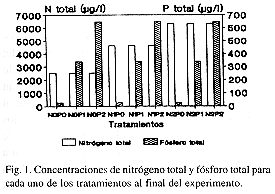
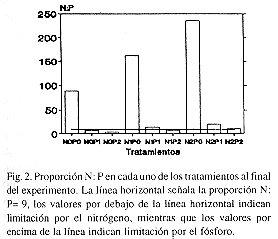
<P><FONT FACE="Arial,Helvetica"><FONT SIZE=-1>La concentraci&oacute;n de f&oacute;sforo total fue de 28.5&nbsp;<IMG SRC="/img/fbpe/rbt/v46n1/simbi16.GIF" HEIGHT=13 WIDTH=15>g/l, mientras que la de nitr&oacute;geno total fue de 2 523.0&nbsp;<IMG SRC="/img/fbpe/rbt/v46n1/simbi16.GIF" HEIGHT=13 WIDTH=15>g/l, con una relaci&oacute;n N: P de 88.5: 1, lo cual sugiere que el nutriente limitante para el crecimiento del fitoplancton es el f&oacute;sforo. Con base en la concentraci&oacute;n de f&oacute;sforo total, el embalse La Mariposa puede clasificarse, seg&uacute;n el &iacute;ndice de <A HREF="#Salas">Salas y Martin&oacute; (1990)</A>, como mesotr&oacute;fico.</FONT></FONT>      
<P><FONT FACE="Arial,Helvetica"><FONT SIZE=-1>La concentraci&oacute;n inicial de clorofila 'a' fue de 32.0&nbsp;<IMG SRC="/img/fbpe/rbt/v46n1/simbi16.GIF" HEIGHT=13 WIDTH=15>g/l.</FONT></FONT>      
<P><FONT FACE="Arial,Helvetica"><FONT SIZE=-1>En las muestras analizadas no se encontraron organismos del zooplancton, indicando que la exclusi&oacute;n con la red de abertura de malla de 80&nbsp;<IMG SRC="/img/fbpe/rbt/v46n1/simbi16.GIF" HEIGHT=13 WIDTH=15>m fue efectiva.</FONT></FONT>      
<P><FONT FACE="Arial,Helvetica"><FONT SIZE=-1>Al final del experimento, las concentraciones de N y P en el tratamiento sin enriquecer fueron las mismas que aqu&eacute;llas encontradas en el ambiente natural ("ambiente") (<A HREF="#Figura1">Fig. 1</A>).</FONT></FONT>     ]]></body>
<body><![CDATA[<BR>&nbsp;     <CENTER></CENTER>      <CENTER><A NAME="Figura1"></A><IMG SRC="/img/fbpe/rbt/v46n1/0065i01.GIF" HEIGHT=194 WIDTH=275></CENTER>       
<P>&nbsp;     <BR><FONT FACE="Arial,Helvetica"><FONT SIZE=-1>Con excepci&oacute;n de los tratamientos N0P1, N0P2 y N1P2, donde la proporci&oacute;n N: P fue menor que 9, en todos los tratamientos hubo limitaci&oacute;n por el P. En el ambiente y en los tratamientos sin enriquecer con P (P0), la relaci&oacute;n N: P fue mayor que 50: 1, lo que podr&iacute;a indicar una severa limitaci&oacute;n por el f&oacute;sforo (<A HREF="#Figura2">Fig. 2</A>).</FONT></FONT>     <BR>&nbsp;     <CENTER></CENTER>      <CENTER><A NAME="Figura2"></A><IMG SRC="/img/fbpe/rbt/v46n1/0065i02.GIF" HEIGHT=239 WIDTH=278></CENTER>       
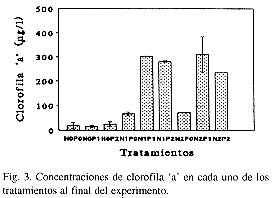
<P>&nbsp;     <BR><FONT FACE="Arial,Helvetica"><FONT SIZE=-1>En los tratamientos en los que ambos nutrientes estuvieron ausentes (N0P0) o s&oacute;lo uno de ellos estuvo ausente (N0P1, N0P2, N1P0, N2P0), las concentraciones de clorofila 'a' resultaron menores que en los casos en los que ambos nutrientes estuvieron presentes (<A HREF="#Figura3">Fig. 3</A>).</FONT></FONT>     ]]></body>
<body><![CDATA[<BR>&nbsp;     <CENTER></CENTER>      <CENTER><A NAME="Figura3"></A><IMG SRC="/img/fbpe/rbt/v46n1/0065i03.GIF" HEIGHT=198 WIDTH=274></CENTER>       
<P>&nbsp;     <BR><FONT FACE="Arial,Helvetica"><FONT SIZE=-1>La respuesta al enriquecimiento con nitr&oacute;geno solamente (N1P0 y N2P0) fue m&aacute;s pronunciada que la obtenida con f&oacute;sforo solamente (N0P1 Y N0P2), resultando en estos &uacute;ltimos casos las concentraciones de clorofila 'a' muy parecidas al tratamiento sin enriquecer con nutrientes (N0P0). Es posible que, a pesar de las altas concentraciones de N en el embalse, este elemento no se encontraba en forma disponible para los organismos del fitoplancton durante el inicio de los experimentos.</FONT></FONT>      <P><FONT FACE="Arial,Helvetica"><FONT SIZE=-1>Un ANOVA de dos v&iacute;as demostr&oacute; que hubo diferencias significativas entre los tratamientos enriquecidos con ambos nutrientes y aqu&eacute;llos en los que uno de los nutrientes o ambos estaban ausentes (<A HREF="#Cuadro2">Cuadro 2</A>). Sin embargo, no hubo diferencias significativas entre la aplicaci&oacute;n de una dosis "doble" de nutrientes (N2, P2) y la de una dosis "sencilla" (N1, P1). La prueba "a posteriori" (diferencia m&iacute;nima significativa), demostr&oacute; que los microcosmos enriquecidos resultaron ser significativamente diferentes de los no enriquecidos.</FONT></FONT>     <CENTER></CENTER>      <CENTER><A NAME="Cuadro2"></A><FONT FACE="Arial,Helvetica"><FONT SIZE=-1>CUADRO 2</FONT></FONT></CENTER>      <CENTER><I><FONT FACE="Arial,Helvetica"><FONT SIZE=-1>An&aacute;lisis de varianza. Efecto del enriquecimiento con N y P</FONT></FONT></I></CENTER>      <CENTER><FONT FACE="Arial,Helvetica"><FONT SIZE=-1><I>sobre la concentraci&oacute;n de clorofila 'a'</I>.</FONT></FONT></CENTER>       ]]></body>
<body><![CDATA[<P>&nbsp;     <CENTER><TABLE BORDER=0 CELLSPACING=0 WIDTH="621" > <TR> <TD VALIGN=CENTER WIDTH="37%">     <CENTER><FONT FACE="Arial,Helvetica"><FONT SIZE=-1>Fuente de variaci&oacute;n</FONT></FONT></CENTER> </TD>  <TD VALIGN=CENTER WIDTH="20%">     <CENTER><FONT FACE="Arial,Helvetica"><FONT SIZE=-1>SS<SUP>2</SUP></FONT></FONT></CENTER> </TD>  <TD VALIGN=CENTER WIDTH="18%">     <CENTER><FONT FACE="Arial,Helvetica"><FONT SIZE=-1>Media S<SUP>2&nbsp;</SUP></FONT></FONT></CENTER> </TD>  <TD VALIGN=CENTER WIDTH="25%">     <CENTER><FONT FACE="Arial,Helvetica"><FONT SIZE=-1>Nivel signif.</FONT></FONT></CENTER> </TD> </TR>  <TR> <TD VALIGN=CENTER WIDTH="37%"><FONT FACE="Arial,Helvetica"><FONT SIZE=-1>&nbsp;</FONT></FONT></TD>  <TD VALIGN=CENTER WIDTH="20%"><FONT FACE="Arial,Helvetica"><FONT SIZE=-1>&nbsp;</FONT></FONT></TD>  <TD VALIGN=CENTER WIDTH="18%"><FONT FACE="Arial,Helvetica"><FONT SIZE=-1>&nbsp;</FONT></FONT></TD>  <TD VALIGN=CENTER WIDTH="25%"><FONT FACE="Arial,Helvetica"><FONT SIZE=-1>&nbsp;</FONT></FONT></TD> </TR>  <TR> <TD VALIGN=CENTER WIDTH="37%">     <CENTER><FONT FACE="Arial,Helvetica"><FONT SIZE=-1>Efectos principales</FONT></FONT></CENTER> </TD>  <TD VALIGN=CENTER WIDTH="20%">     <CENTER><FONT FACE="Arial,Helvetica"><FONT SIZE=-1>232 243.18</FONT></FONT></CENTER> </TD>  <TD VALIGN=CENTER WIDTH="18%">     <CENTER><FONT FACE="Arial,Helvetica"><FONT SIZE=-1>58 060.80</FONT></FONT></CENTER> </TD>  <TD VALIGN=CENTER WIDTH="25%">     <CENTER><FONT FACE="Arial,Helvetica"><FONT SIZE=-1>.0000</FONT></FONT></CENTER> </TD> </TR>  <TR> <TD VALIGN=CENTER WIDTH="37%">     ]]></body>
<body><![CDATA[<CENTER><FONT FACE="Arial,Helvetica"><FONT SIZE=-1>Nitr&oacute;geno</FONT></FONT></CENTER> </TD>  <TD VALIGN=CENTER WIDTH="20%">     <CENTER><FONT FACE="Arial,Helvetica"><FONT SIZE=-1>147 281.12</FONT></FONT></CENTER> </TD>  <TD VALIGN=CENTER WIDTH="18%">     <CENTER><FONT FACE="Arial,Helvetica"><FONT SIZE=-1>73 640.56</FONT></FONT></CENTER> </TD>  <TD VALIGN=CENTER WIDTH="25%">     <CENTER><FONT FACE="Arial,Helvetica"><FONT SIZE=-1>.0000</FONT></FONT></CENTER> </TD> </TR>  <TR> <TD VALIGN=CENTER WIDTH="37%">     <CENTER><FONT FACE="Arial,Helvetica"><FONT SIZE=-1>F&oacute;sforo</FONT></FONT></CENTER> </TD>  <TD VALIGN=CENTER WIDTH="20%">     <CENTER><FONT FACE="Arial,Helvetica"><FONT SIZE=-1>84 962.05</FONT></FONT></CENTER> </TD>  <TD VALIGN=CENTER WIDTH="18%">     <CENTER><FONT FACE="Arial,Helvetica"><FONT SIZE=-1>42 481.03</FONT></FONT></CENTER> </TD>  <TD VALIGN=CENTER WIDTH="25%">     <CENTER><FONT FACE="Arial,Helvetica"><FONT SIZE=-1>.0001</FONT></FONT></CENTER> </TD> </TR>  <TR> <TD VALIGN=CENTER WIDTH="37%"><FONT FACE="Arial,Helvetica"><FONT SIZE=-1>&nbsp;</FONT></FONT></TD>  <TD VALIGN=CENTER WIDTH="20%"><FONT FACE="Arial,Helvetica"><FONT SIZE=-1>&nbsp;</FONT></FONT></TD>  <TD VALIGN=CENTER WIDTH="18%"><FONT FACE="Arial,Helvetica"><FONT SIZE=-1>&nbsp;</FONT></FONT></TD>  <TD VALIGN=CENTER WIDTH="25%"><FONT FACE="Arial,Helvetica"><FONT SIZE=-1>&nbsp;</FONT></FONT></TD> </TR>  <TR> <TD VALIGN=CENTER WIDTH="37%">     <CENTER><FONT FACE="Arial,Helvetica"><FONT SIZE=-1>Interacciones</FONT></FONT></CENTER> </TD>  <TD VALIGN=CENTER WIDTH="20%">     <CENTER><FONT FACE="Arial,Helvetica"><FONT SIZE=-1>43 725.79</FONT></FONT></CENTER> </TD>  <TD VALIGN=CENTER WIDTH="18%">     ]]></body>
<body><![CDATA[<CENTER><FONT FACE="Arial,Helvetica"><FONT SIZE=-1>10 931.45</FONT></FONT></CENTER> </TD>  <TD VALIGN=CENTER WIDTH="25%">     <CENTER><FONT FACE="Arial,Helvetica"><FONT SIZE=-1>.0041</FONT></FONT></CENTER> </TD> </TR>  <TR> <TD VALIGN=CENTER WIDTH="37%">     <CENTER><FONT FACE="Arial,Helvetica"><FONT SIZE=-1>N x P</FONT></FONT></CENTER> </TD>  <TD VALIGN=CENTER WIDTH="20%">     <CENTER><FONT FACE="Arial,Helvetica"><FONT SIZE=-1>43 725.79</FONT></FONT></CENTER> </TD>  <TD VALIGN=CENTER WIDTH="18%">     <CENTER><FONT FACE="Arial,Helvetica"><FONT SIZE=-1>10 931.45</FONT></FONT></CENTER> </TD>  <TD VALIGN=CENTER WIDTH="25%">     <CENTER><FONT FACE="Arial,Helvetica"><FONT SIZE=-1>.0041</FONT></FONT></CENTER> </TD> </TR>  <TR> <TD VALIGN=CENTER WIDTH="37%"><FONT FACE="Arial,Helvetica"><FONT SIZE=-1>&nbsp;</FONT></FONT></TD>  <TD VALIGN=CENTER WIDTH="20%"><FONT FACE="Arial,Helvetica"><FONT SIZE=-1>&nbsp;</FONT></FONT></TD>  <TD VALIGN=CENTER WIDTH="18%"><FONT FACE="Arial,Helvetica"><FONT SIZE=-1>&nbsp;</FONT></FONT></TD>  <TD VALIGN=CENTER WIDTH="25%"><FONT FACE="Arial,Helvetica"><FONT SIZE=-1>&nbsp;</FONT></FONT></TD> </TR>  <TR> <TD VALIGN=CENTER WIDTH="37%">     <CENTER><FONT FACE="Arial,Helvetica"><FONT SIZE=-1>Residual</FONT></FONT></CENTER> </TD>  <TD VALIGN=CENTER WIDTH="20%">     <CENTER><FONT FACE="Arial,Helvetica"><FONT SIZE=-1>11 642.14</FONT></FONT></CENTER> </TD>  <TD VALIGN=CENTER WIDTH="18%">     <CENTER><FONT FACE="Arial,Helvetica"><FONT SIZE=-1>1 293.57</FONT></FONT></CENTER> </TD>  <TD VALIGN=CENTER WIDTH="25%">     <CENTER><FONT FACE="Arial,Helvetica"><FONT SIZE=-1>&nbsp;</FONT></FONT></CENTER> </TD> </TR>  <TR> <TD VALIGN=CENTER WIDTH="37%">     ]]></body>
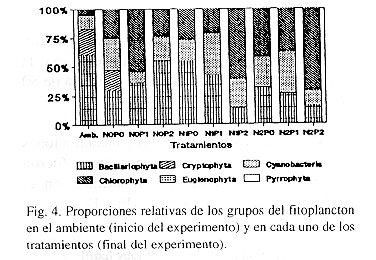
<body><![CDATA[<CENTER><FONT FACE="Arial,Helvetica"><FONT SIZE=-1>&nbsp;</FONT></FONT></CENTER> </TD>  <TD VALIGN=CENTER WIDTH="20%">     <CENTER><FONT FACE="Arial,Helvetica"><FONT SIZE=-1>&nbsp;</FONT></FONT></CENTER> </TD>  <TD VALIGN=CENTER WIDTH="18%">     <CENTER><FONT FACE="Arial,Helvetica"><FONT SIZE=-1>&nbsp;</FONT></FONT></CENTER> </TD>  <TD VALIGN=CENTER WIDTH="25%">     <CENTER><FONT FACE="Arial,Helvetica"><FONT SIZE=-1>&nbsp;</FONT></FONT></CENTER> </TD> </TR>  <TR> <TD VALIGN=CENTER WIDTH="37%">     <CENTER><FONT FACE="Arial,Helvetica"><FONT SIZE=-1>Total (corr.)</FONT></FONT></CENTER> </TD>  <TD VALIGN=CENTER WIDTH="20%">     <CENTER><FONT FACE="Arial,Helvetica"><FONT SIZE=-1>287 611.11</FONT></FONT></CENTER> </TD>  <TD VALIGN=CENTER WIDTH="18%"><FONT FACE="Arial,Helvetica"><FONT SIZE=-1>&nbsp;</FONT></FONT></TD>  <TD VALIGN=CENTER WIDTH="25%"><FONT FACE="Arial,Helvetica"><FONT SIZE=-1>&nbsp;</FONT></FONT></TD> </TR> </TABLE></CENTER> <FONT FACE="Arial,Helvetica"><FONT SIZE=-1>&nbsp;</FONT></FONT>     <BR><FONT FACE="Arial,Helvetica"><FONT SIZE=-1>&nbsp;</FONT></FONT>     <BR><FONT FACE="Arial,Helvetica"><FONT SIZE=-1>En cuanto a las proporciones del fitoplancton en el ambiente, Bacillariophyta fue el grupo dominante, representando m&aacute;s del 50 % de los organismos presentes. <I>Aulacoseira pseudogranulata</I> fue la especie dominante al inicio de los experimentos. Otras especies de diatomeas presentes fueron <I>Cyclotella meneghiniana</I>, <I>Fragilaria</I> sp. y <I>Navicula</I> sp. El grupo de las Cryptophyta, representadas por <I>Cryptomonas erosa</I>, fue el segundo en dominancia en el ambiente, seguido por las Cyanobacteria (<I>Anabaenopsis raciborskii, Chroococcus</I> sp.,<I> Dactylococcopsis acicularis, Lyngbya limnetica, Microcystis aeruginosa, Oscillatoria</I> sp., <I>Spirulina</I> sp. y <I>Synechococcus</I> sp.). Las Chlorophyta (<I>Actinastrum hantzschii, Dictyosphaerium pulchellum, Oocystis</I> sp., <I>Pediastrum simplex, Scenedesmus ecornis, Sphaerocystis schroeteri, Staurastrum</I> sp. y <I>Schroederia</I> sp.) representaron el 3.8 % del total, mientras que las Euglenophyta (<I>Trachelomonas</I> sp.) y las Pyrrophyta (Peridinium sp.) no alcanzaron el 2 % del total (<A HREF="#Figura4">Fig. 4</A>).</FONT></FONT>     <BR>&nbsp;     <CENTER></CENTER>      ]]></body>
<body><![CDATA[<CENTER><A NAME="Figura4"></A><IMG SRC="/img/fbpe/rbt/v46n1/0065i04.GIF" HEIGHT=260 WIDTH=376></CENTER>       
<P>&nbsp;      <P><FONT FACE="Arial,Helvetica"><FONT SIZE=-1>Las condiciones de encierro en los microcosmos, afectaron a los diferentes grupos del fitoplancton. Al t&eacute;rmino del per&iacute;odo de experimentaci&oacute;n, al comparar el tratamiento sin enriquecer (N0P0) con la condici&oacute;n inicial ("ambiente") (<A HREF="#Figura4">Fig. 4</A>), se pudo notar que los g&eacute;neros representantes de Pyrrophyta y de Euglenophyta desaparecieron del sistema experimental, la proporci&oacute;n de Bacillariophyta disminuy&oacute; mientras que aumentaron las proporciones de Chlorophyta y de Cyanobacteria. La proporci&oacute;n relativa de Cryptophyta se mantuvo en los mismos niveles al finalizar el experimento. Los valores de rS obtenidos indicaron diferencias significativas en las proporciones num&eacute;ricas de los distintos grupos del fitoplancton al comparar el ambiente con los distintos tratamientos experimentales. El orden de importancia relativa de los grupos del fitoplancton del tratamiento sin enriquecer (N0P0) estuvo correlacionado significativamente con el de los tratamientos enriquecidos N1P0 y N1P1 (r<SUB>S</SUB>= 0.941 y r<SUB>S</SUB>= 0.955, respectivamente).</FONT></FONT>      <P><FONT FACE="Arial,Helvetica"><FONT SIZE=-1>En general, se observ&oacute; que la fertilizaci&oacute;n con nutrientes trajo como resultado la desaparici&oacute;n de los grupos Cryptophyta, Euglenophyta y Pyrrophyta de los sistemas experimentales (<A HREF="#Figura4">Fig. 4</A>). La proporci&oacute;n relativa de las Chlorophyta, comparada con la del ambiente natural, aument&oacute; en todos los microcosmos y los g&eacute;neros m&aacute;s abundantes fueron <I>Schroederia, Sphaerocystis y Scenedesmus</I>.</FONT></FONT>      <P><FONT FACE="Arial,Helvetica"><FONT SIZE=-1>Las proporciones relativas de las Cyanobacteria aumentaron en los microcosmos con respecto al "ambiente", excepto en los tratamientos N0P1 y N2P2, donde permanecieron casi iguales que al inicio del experimento. <I>Microcystis</I> fue el g&eacute;nero dominante de este grupo, seguido por <I>Anabaenopsis</I>.</FONT></FONT>      <P><FONT FACE="Arial,Helvetica"><FONT SIZE=-1>Las Bacillariophyta fueron dominantes en los tratamientos sin enriquecer con nitr&oacute;geno (N0) y con dosis sencilla de nitr&oacute;geno (N1), excepto en el tratamiento N1P2. En los tratamientos con dosis doble de nitr&oacute;geno (N2), este grupo present&oacute; las menores proporciones relativas. El g&eacute;nero dominante de este grupo fue <I>Aulacoseira</I>.</FONT></FONT>     <BR>&nbsp;      <P><B><FONT FACE="Arial,Helvetica"><FONT SIZE=-1>Discusi&oacute;n</FONT></FONT></B>      <P><FONT FACE="Arial,Helvetica"><FONT SIZE=-1>Los ambientes experimentales empleados en este trabajo pueden considerarse como instrumentos para estudiar las propiedades de los ecosistemas en condiciones bien definidas, de manera que las observaciones puedan ser obtenidas con mejor calidad estad&iacute;stica que la posible en el campo (<A HREF="#Ringelberg">Ringelberg y Kersting 1978</A>). Este tipo de "microecosistemas" pueden tener un valor real&iacute;stico suficiente, especialmente si son de vida corta (<A HREF="#Ringelberg">Ringelberg y Kersting 1978</A>, <A HREF="#Matveev">Matveev 1991</A>). <A HREF="#Havens">Havens y</A> <A HREF="#Havens">De Costa (1986)</A> tambi&eacute;n comentan que el encierro "per se" altera el ambiente dentro de las bolsas cuando se compara con el lago, aunque los datos qu&iacute;micos de estos ambientes experimentales no lo demuestren. Esto se debe a que los ambientes dentro de las bolsas son est&aacute;ticos, ya que impiden la entrada de nutrientes. Esto explicar&iacute;a la falta de una correlaci&oacute;n entre el orden por rangos de los grupos del fitoplancton al inicio del experimento y el tratamiento N0P0.</FONT></FONT>      <P><FONT FACE="Arial,Helvetica"><FONT SIZE=-1>Seg&uacute;n <A HREF="#Edmondson">Edmondson (1957)</A>, el enriquecimiento con nutrientes provoca un r&aacute;pido aumento en las concentraciones de clorofila 'a', lo cual coincide con lo encontrado en esta experiencia. Estos resultados son similares a los obtenidos por otros investigadores al trabajar con encierros de comunidades del fitoplancton en bolsas pl&aacute;sticas o en limnocorrales, entre los que se pueden citar <A HREF="#DeCosta">De Costa <I>et al</I>. (1983)</A>, <A HREF="#Bergquist">Bergquist y Carpenter (1986)</A>, <A HREF="#Pollingher">Pollingher <I>et al</I>. (1988)</A>, <A HREF="#Elser">Elser y Goldman (1991)</A>, <A HREF="#Yasuno">Yasuno<I>et al</I>. (1993)</A>, entre muchos otros.</FONT></FONT>      ]]></body>
<body><![CDATA[<P><FONT FACE="Arial,Helvetica"><FONT SIZE=-1><A HREF="#Henry_">Henry y Tundisi (1982)</A> y <A HREF="#Tundisi">Tundisi y Henry (1986)</A>, estudiaron el efecto del enriquecimiento con nutrientes en limnocorrales en sistemas tropicales (embalse de Broa y lago Dom Helv&eacute;cio, Brasil). Al igual que en otros estudios, la adici&oacute;n de nutrientes aument&oacute; la biomasa del fitoplancton, medida como concentraci&oacute;n de clorofila 'a'. Estos investigadores encontraron que el f&oacute;sforo tuvo un rol m&aacute;s significativo en el aumento de la clorofila 'a' que el nitr&oacute;geno y otros micronutrientes. Estos mismos resultados fueron obtenidos por <A HREF="#González_1996">Gonz&aacute;lez (1996)</A> en microcosmos en el embalse El Andino, Venezuela, quien encontr&oacute; una correlaci&oacute;n positiva significativa entre el f&oacute;sforo total y las concentraciones de clorofila 'a', pero no encontr&oacute; correlaci&oacute;n entre la biomasa del fitoplancton y el nitr&oacute;geno total.</FONT></FONT>      <P><FONT FACE="Arial,Helvetica"><FONT SIZE=-1>En el caso de los microcosmos del embalse La Mariposa, a diferencia de los ejemplos anteriores, se encontr&oacute; que la biomasa del fitoplancton respondi&oacute; en mayor escala a los tratamientos con nitr&oacute;geno que a los tratamientos con f&oacute;sforo. Estos resultados coinciden con los obtenidos por <A HREF="#Cowell_">Cowell y Dawes (1991</A><A HREF="#Cowell,">)</A>, quienes encontraron que el nitr&oacute;geno (en forma de amonio) produjo aumentos significativos de la clorofila 'a' en todos sus experimentos de bioensayos en tres lagos de diferentes estados tr&oacute;ficos en Florida, Estados Unidos. En el presente estudio, en los tratamientos en los que ambos nutrientes estaban presentes, el aumento de la concentraci&oacute;n de clorofila 'a' fue m&aacute;s pronunciado que en los casos en que el N o el P estaban ausentes. Esto qued&oacute; reflejado en la prueba estad&iacute;stica aplicada (ANOVA), al resultar estad&iacute;sticamente significativa la interacci&oacute;n entre los nutrientes (N x P, <A HREF="#Cuadro2">Cuadro 2</A>).</FONT></FONT>      <P><FONT FACE="Arial,Helvetica"><FONT SIZE=-1>En el ambiente, la alta proporci&oacute;n N: P ayudar&iacute;a a explicar la dominancia de las diatomeas en esta &eacute;poca del a&ntilde;o, ya que varias especies de este grupo tienen bajos coeficientes de saturaci&oacute;n media para el f&oacute;sforo, lo cual las hace superiores competitivamente sobre especies de otros grupos cuando este elemento es limitante (<A HREF="#Margalef">Margalef 1983</A>). La alteraci&oacute;n de estas relaciones por el encierro de la comunidad en bolsas de polietileno, pudiera explicar las variaciones de las proporciones de las Bacillariophyta con respecto a los otros grupos del fitoplancton. La conducta de unas especies en una trama de variables interactuantes en la naturaleza es completamente diferente a su comportamiento bajo condiciones controladas (<A HREF="#Bloesch">Bloesch <I>et al</I></A>. <A HREF="#Bloesch">1988</A>).</FONT></FONT>      <P><FONT FACE="Arial,Helvetica"><FONT SIZE=-1><A HREF="#Sommer1983">Sommer (1983</A>, <A HREF="#Sommer1988">1988</A>) encontr&oacute; que <I>Scenedesmus</I> (Chlorophyta), es una especie t&iacute;pica en las etapas tempranas de una sucesi&oacute;n luego del enriquecimiento con nutrientes. <I>Scenedesmus</I> se encontr&oacute; com&uacute;nmente al final de los experimentos con los microcosmos en el embalse La Mariposa. Al igual que los resultados obtenidos por <A HREF="#Sommer1988">Sommer (1988)</A>, los flagelados como <I>Cryptomonas</I> no fueron especies exitosas y desaparecieron de los sistemas experimentales. Lo mismo sucedi&oacute; con <I>Peridinium</I> sp. y con <I>Trachelomonas</I> sp.</FONT></FONT>      <P><FONT FACE="Arial,Helvetica"><FONT SIZE=-1><A HREF="#Blomqvist">Blomqvist <I>et al</I>. (1994)</A> se&ntilde;alan que las Cyanobacteria no fijadoras de N proliferan cuando la fuente de nitr&oacute;geno est&aacute; en forma de cloruro de amonio, tal como la empleada en este trabajo. Esto coincidi&oacute; con el aumento de la proporci&oacute;n de Cyanobacteria en todos los microcosmos con respecto a su proporci&oacute;n en las aguas del embalse La Mariposa, excepto en los tratamientos N0P1 y N2P2.</FONT></FONT>      <P><FONT FACE="Arial,Helvetica"><FONT SIZE=-1>Generalmente, se sugiere que las Cyanobacteria son mejores competidoras por el nitr&oacute;geno, pero pobres competidoras por el f&oacute;sforo cuando se les compara con otras especies del fitoplancton (<A HREF="#Smith">Smith 1983</A>, <A HREF="#Drenner">Drenner et al. 1990</A>). Las Cyanobacteria dominar&iacute;an, por lo tanto, en situaciones en las que la proporci&oacute;n N: P fuera menor que 9. Sin embargo, la proporci&oacute;n N: P por s&iacute; sola no es suficiente para explicar la ausencia o la presencia de las diversas especies en los lagos (<A HREF="#Smith">Smith 1983</A>). <A HREF="#Sommer1990">Sommer</A> <A HREF="#Sommer1990">(1990)</A>, apunta que las tasas de suministro de N y de P, m&aacute;s que la concentraci&oacute;n de estos elementos, son las limitantes del crecimiento de las algas. Esto parece quedar en evidencia en los tratamientos N0P1 y N1P2, con proporciones N: P similares (7.5: 1 y 7.1: 1, respectivamente), pero con concentraciones de clorofila 'a' diferentes. En ambos casos, el nitr&oacute;geno parece ser el limitante, pero en N1P2, el exceso de nutrientes gener&oacute; una diferencia casi veinte veces mayor.</FONT></FONT>      <P><FONT FACE="Arial,Helvetica"><FONT SIZE=-1>Los resultados obtenidos en los microcosmos pudieran indicar que las respuestas iniciales de la comunidad del fitoplancton del embalse La Mariposa ante un proceso de eutroficaci&oacute;n, iniciado en la &eacute;poca del a&ntilde;o en la cual se realiz&oacute; el estudio, ser&iacute;an: 1) el aumento de la biomasa (como concentraci&oacute;n de clorofila 'a'); 2) la desaparici&oacute;n de los grupos Pyrrophyta, Cryptophyta y Euglenophyta; 3) el aumento de la dominancia de las Chlorophyta, en primera instancia, y de las Cyanobacteria; y 4) la disminuci&oacute;n de la dominancia de las diatomeas, especialmente a altas concentraciones de nitr&oacute;geno.</FONT></FONT>     <BR>&nbsp;      <P><B><FONT FACE="Arial,Helvetica"><FONT SIZE=-1>Agradecimientos</FONT></FONT></B>      <P><FONT FACE="Arial,Helvetica"><FONT SIZE=-1>A Paula Spiniello, Jorge Gutic, Nora Malaver, Carlos Pe&ntilde;aherrera y los integrantes del curso de Laboratorio de Ecolog&iacute;a II (1995-96), por el apoyo en el trabajo de campo y en el laboratorio. A Carlos L&oacute;pez y A&iacute;da Gonz&aacute;lez de Infante, por la revisi&oacute;n y las sugerencias para mejorar el manuscrito.</FONT></FONT>     ]]></body>
<body><![CDATA[<BR>&nbsp;      <P><B><FONT FACE="Arial,Helvetica"><FONT SIZE=-1>Resumen</FONT></FONT></B>      <P><FONT FACE="Arial,Helvetica"><FONT SIZE=-1>Para evaluar el efecto del enriquecimiento con nutrientes sobre la comunidad del fitoplancton del embalse La Mariposa (Venezuela), se establecieron microcosmos "in situ" durante 6 d&iacute;as. Los microcosmos consistieron en bolsas de polietileno con 10 l de agua epilimn&eacute;tica filtrada del embalse, sometidos a diferentes combinaciones de enriquecimiento con f&oacute;sforo y nitr&oacute;geno, para as&iacute; simular un proceso de eutroficaci&oacute;n. Se determinaron las concentraciones de clorofila 'a', la concentraci&oacute;n de nitr&oacute;geno total y f&oacute;sforo total y la proporci&oacute;n num&eacute;rica de los diferentes grupos del fitoplancton. Como consecuencia del enriquecimiento de nutrientes, se produjo un aumento en la biomasa del fitoplancton, siendo las respuestas m&aacute;s pronunciadas en los tratamientos donde ambos nutrientes estaban presentes. Los grupos Cryptophyta, Euglenophyta y Pyrrophyta desaparecieron de los microcosmos fertilizados al finalizar el per&iacute;odo de estudio, mientras que las Chlorophyta y las Cyanobacteria aumentaron sus proporciones relativas. Las diatomeas disminuyeron su proporci&oacute;n relativa a altas concentraciones de nitr&oacute;geno. Aunque la t&eacute;cnica del microcosmos tiene limitaciones en su significado ecol&oacute;gico, permite obtener una valiosa aproximaci&oacute;n para entender lo que ocurre en las situaciones naturales.</FONT></FONT>     <BR>&nbsp;      <P><B><FONT FACE="Arial,Helvetica"><FONT SIZE=-1>Referencias</FONT></FONT></B>      <!-- ref --><P><A NAME="Bergquist"></A><FONT FACE="Arial,Helvetica"><FONT SIZE=-1>Bergquist, A.M. &amp; S.R. Carpenter. 1986. Limnetic herbivory: Effects on phytoplankton populations and primary production. Ecology 67: 1351-1360.</FONT></FONT>    &nbsp;&nbsp;&nbsp;&nbsp;&nbsp;&nbsp;&nbsp;&nbsp;[&#160;<a href="javascript:void(0);" onclick="javascript: window.open('/scielo.php?script=sci_nlinks&ref=1107982&pid=S0034-7744199800010000200001&lng=','','width=640,height=500,resizable=yes,scrollbars=1,menubar=yes,');">Links</a>&#160;]<!-- end-ref --><!-- ref --><P><A NAME="Bloesch"></A><FONT FACE="Arial,Helvetica"><FONT SIZE=-1>Bloesch, J., P. Bossard, H. B&uuml;hrer, H.R. B&uuml;rgi &amp; U. Uehlingher. 1988. Can results from limnocorral experiments be transferred to in situ conditions? ( Biomanipulation in limnocorrals VI). Hydrobiologia 159: 297-308.</FONT></FONT>    &nbsp;&nbsp;&nbsp;&nbsp;&nbsp;&nbsp;&nbsp;&nbsp;[&#160;<a href="javascript:void(0);" onclick="javascript: window.open('/scielo.php?script=sci_nlinks&ref=1107983&pid=S0034-7744199800010000200002&lng=','','width=640,height=500,resizable=yes,scrollbars=1,menubar=yes,');">Links</a>&#160;]<!-- end-ref --><!-- ref --><P><A NAME="Blomqvist"></A><FONT FACE="Arial,Helvetica"><FONT SIZE=-1>Blomqvist, D.O., A. Pettersson &amp; F. Hyenstrand. 1994. Ammonium-nitrogen: a key regulatory factor causing dominance of non-nitrogen-fixing Cyanobacteria in aquatic systems. Arch. Hydrobiol. 132: 141-164.</FONT></FONT>    &nbsp;&nbsp;&nbsp;&nbsp;&nbsp;&nbsp;&nbsp;&nbsp;[&#160;<a href="javascript:void(0);" onclick="javascript: window.open('/scielo.php?script=sci_nlinks&ref=1107984&pid=S0034-7744199800010000200003&lng=','','width=640,height=500,resizable=yes,scrollbars=1,menubar=yes,');">Links</a>&#160;]<!-- end-ref --><!-- ref --><P><A NAME="Cowell_"></A><FONT FACE="Arial,Helvetica"><FONT SIZE=-1>Cowell, B. &amp; C.J. Dawes. 1991. Nutrient enrichment in three Central Florida lakes of different trophic states. Hydrobiologia 220: 217-231.</FONT></FONT>    &nbsp;&nbsp;&nbsp;&nbsp;&nbsp;&nbsp;&nbsp;&nbsp;[&#160;<a href="javascript:void(0);" onclick="javascript: window.open('/scielo.php?script=sci_nlinks&ref=1107985&pid=S0034-7744199800010000200004&lng=','','width=640,height=500,resizable=yes,scrollbars=1,menubar=yes,');">Links</a>&#160;]<!-- end-ref --><!-- ref --><P><A NAME="DeCosta"></A><FONT FACE="Arial,Helvetica"><FONT SIZE=-1>De Costa, J., A. Janicki, G. Shellito &amp; G. Wilcox. 1983. The effect of phosphorus additions in enclosures on the phytoplankton and zooplankton of an acid lake. Oikos 40: 283-294.</FONT></FONT>    &nbsp;&nbsp;&nbsp;&nbsp;&nbsp;&nbsp;&nbsp;&nbsp;[&#160;<a href="javascript:void(0);" onclick="javascript: window.open('/scielo.php?script=sci_nlinks&ref=1107986&pid=S0034-7744199800010000200005&lng=','','width=640,height=500,resizable=yes,scrollbars=1,menubar=yes,');">Links</a>&#160;]<!-- end-ref --><!-- ref --><P><A NAME="Drenner"></A><FONT FACE="Arial,Helvetica"><FONT SIZE=-1>Drenner, R.W., J.D. Smith, J.R. Mummert &amp; H.F. Lancaster. 1990. Responses of an eutrophic pond community to separated and combined effects of N: P supply and planktivorous fish: a mesocosm experiment. Hydrobiologia 208: 161-167.</FONT></FONT>    &nbsp;&nbsp;&nbsp;&nbsp;&nbsp;&nbsp;&nbsp;&nbsp;[&#160;<a href="javascript:void(0);" onclick="javascript: window.open('/scielo.php?script=sci_nlinks&ref=1107987&pid=S0034-7744199800010000200006&lng=','','width=640,height=500,resizable=yes,scrollbars=1,menubar=yes,');">Links</a>&#160;]<!-- end-ref --><!-- ref --><P><A NAME="Edmondson"></A><FONT FACE="Arial,Helvetica"><FONT SIZE=-1>Edmondson, W.T. 1957. Trophic relations of the zooplankton. Trans. Amer. Micr. Soc. 76: 225-245.</FONT></FONT>    &nbsp;&nbsp;&nbsp;&nbsp;&nbsp;&nbsp;&nbsp;&nbsp;[&#160;<a href="javascript:void(0);" onclick="javascript: window.open('/scielo.php?script=sci_nlinks&ref=1107988&pid=S0034-7744199800010000200007&lng=','','width=640,height=500,resizable=yes,scrollbars=1,menubar=yes,');">Links</a>&#160;]<!-- end-ref --><!-- ref --><P><A NAME="Elser"></A><FONT FACE="Arial,Helvetica"><FONT SIZE=-1>Elser, J.J. &amp; C.R. Goldman. 1991. Zooplankton effects on phytoplankton in lakes of contrasting trophic status. Limnol. Oceanogr. 36: 64-90.</FONT></FONT>    &nbsp;&nbsp;&nbsp;&nbsp;&nbsp;&nbsp;&nbsp;&nbsp;[&#160;<a href="javascript:void(0);" onclick="javascript: window.open('/scielo.php?script=sci_nlinks&ref=1107989&pid=S0034-7744199800010000200008&lng=','','width=640,height=500,resizable=yes,scrollbars=1,menubar=yes,');">Links</a>&#160;]<!-- end-ref --><!-- ref --><P><A NAME="González1991"></A><FONT FACE="Arial,Helvetica"><FONT SIZE=-1>Gonz&aacute;lez, E., J. Paolini &amp; A. Infante. 1991. Water chemistry, physical features and primary production of phytoplankton in a tropical blackwater reservoir (Embalse de Guri, Venezuela). Verh. Internat. Verein. Limnol. 24: 1477-1481.</FONT></FONT>    &nbsp;&nbsp;&nbsp;&nbsp;&nbsp;&nbsp;&nbsp;&nbsp;[&#160;<a href="javascript:void(0);" onclick="javascript: window.open('/scielo.php?script=sci_nlinks&ref=1107990&pid=S0034-7744199800010000200009&lng=','','width=640,height=500,resizable=yes,scrollbars=1,menubar=yes,');">Links</a>&#160;]<!-- end-ref --><!-- ref --><P><A NAME="González_1996"></A><FONT FACE="Arial,Helvetica"><FONT SIZE=-1>Gonz&aacute;lez, E.J. 1996. Interacciones fitoplancton-zooplancton en condiciones naturales y experimentales en un embalse de la cuenca del r&iacute;o Unare (embalse El Andino, Edo. Anzo&aacute;tegui). Tesis de Doctorado, Universidad Central de Venezuela, Caracas, Venezuela.</FONT></FONT>    &nbsp;&nbsp;&nbsp;&nbsp;&nbsp;&nbsp;&nbsp;&nbsp;[&#160;<a href="javascript:void(0);" onclick="javascript: window.open('/scielo.php?script=sci_nlinks&ref=1107991&pid=S0034-7744199800010000200010&lng=','','width=640,height=500,resizable=yes,scrollbars=1,menubar=yes,');">Links</a>&#160;]<!-- end-ref --><!-- ref --><P><A NAME="Harper"></A><FONT FACE="Arial,Helvetica"><FONT SIZE=-1>Harper, D. 1992. Eutrophication of freshwaters. Principles, problems and restoration. Chapman &amp; Hall, Londres. 327 p.</FONT></FONT>    &nbsp;&nbsp;&nbsp;&nbsp;&nbsp;&nbsp;&nbsp;&nbsp;[&#160;<a href="javascript:void(0);" onclick="javascript: window.open('/scielo.php?script=sci_nlinks&ref=1107992&pid=S0034-7744199800010000200011&lng=','','width=640,height=500,resizable=yes,scrollbars=1,menubar=yes,');">Links</a>&#160;]<!-- end-ref --><!-- ref --><P><A NAME="Havens"></A><FONT FACE="Arial,Helvetica"><FONT SIZE=-1>Havens, K.E. &amp; J. De Costa. 1986. A comparison of phytoplankton responses to nutrient addition in acidic and circumneutral pH lakewater. Hydrobiologia 137: 211-222.</FONT></FONT>    &nbsp;&nbsp;&nbsp;&nbsp;&nbsp;&nbsp;&nbsp;&nbsp;[&#160;<a href="javascript:void(0);" onclick="javascript: window.open('/scielo.php?script=sci_nlinks&ref=1107993&pid=S0034-7744199800010000200012&lng=','','width=640,height=500,resizable=yes,scrollbars=1,menubar=yes,');">Links</a>&#160;]<!-- end-ref --><!-- ref --><P><A NAME="Henry_"></A><FONT FACE="Arial,Helvetica"><FONT SIZE=-1>Henry, R. &amp; J.G. Tundisi. 1982. Efeitos de enriquecimento artificial por nitrato de fosfato no crescimento da comunidade fitoplanct&ocirc;nica da Represa de Lobo ("Broa", Brotas-Itirapina, SP). Ci&ecirc;ncia e Cultura 34: 518-524.</FONT></FONT>    &nbsp;&nbsp;&nbsp;&nbsp;&nbsp;&nbsp;&nbsp;&nbsp;[&#160;<a href="javascript:void(0);" onclick="javascript: window.open('/scielo.php?script=sci_nlinks&ref=1107994&pid=S0034-7744199800010000200013&lng=','','width=640,height=500,resizable=yes,scrollbars=1,menubar=yes,');">Links</a>&#160;]<!-- end-ref --><!-- ref --><P><A NAME="Margalef"></A><FONT FACE="Arial,Helvetica"><FONT SIZE=-1>Margalef, R. 1983. Limnolog&iacute;a. Omega, Barcelona. 1010 p.</FONT></FONT>    &nbsp;&nbsp;&nbsp;&nbsp;&nbsp;&nbsp;&nbsp;&nbsp;[&#160;<a href="javascript:void(0);" onclick="javascript: window.open('/scielo.php?script=sci_nlinks&ref=1107995&pid=S0034-7744199800010000200014&lng=','','width=640,height=500,resizable=yes,scrollbars=1,menubar=yes,');">Links</a>&#160;]<!-- end-ref --><!-- ref --><P><A NAME="Matveev"></A><FONT FACE="Arial,Helvetica"><FONT SIZE=-1>Matveev, V. 1991. Self-maintaining plankton: pelagic Cladocera in small microcosms with lake water. Hydrobiologia 225: 301-307.</FONT></FONT>    &nbsp;&nbsp;&nbsp;&nbsp;&nbsp;&nbsp;&nbsp;&nbsp;[&#160;<a href="javascript:void(0);" onclick="javascript: window.open('/scielo.php?script=sci_nlinks&ref=1107996&pid=S0034-7744199800010000200015&lng=','','width=640,height=500,resizable=yes,scrollbars=1,menubar=yes,');">Links</a>&#160;]<!-- end-ref --><!-- ref --><P><A NAME="Nusch"></A><FONT FACE="Arial,Helvetica"><FONT SIZE=-1>Nusch, E.A. &amp; G. Palme. 1975. Biologische Methoden f&uuml;r der Praxis der Gew&auml;sseruntersuchung, Bestimmung des Chlorophyll-a und Phaeopigment-gehaltes in Oberflachenw&auml;sser. GWF-W&auml;sser/ Abw&auml;sser 116: 562-565.</FONT></FONT>    &nbsp;&nbsp;&nbsp;&nbsp;&nbsp;&nbsp;&nbsp;&nbsp;[&#160;<a href="javascript:void(0);" onclick="javascript: window.open('/scielo.php?script=sci_nlinks&ref=1107997&pid=S0034-7744199800010000200016&lng=','','width=640,height=500,resizable=yes,scrollbars=1,menubar=yes,');">Links</a>&#160;]<!-- end-ref --><!-- ref --><P><A NAME="Pollingher"></A><FONT FACE="Arial,Helvetica"><FONT SIZE=-1>Pollingher, U., T. Berman, B. Kaplan &amp; D. Scharf. 1988. Lake Kinneret phytoplankton: response to N and P enrichments in experimental and in nature. Hydrobiologia 166: 65-75.</FONT></FONT>    &nbsp;&nbsp;&nbsp;&nbsp;&nbsp;&nbsp;&nbsp;&nbsp;[&#160;<a href="javascript:void(0);" onclick="javascript: window.open('/scielo.php?script=sci_nlinks&ref=1107998&pid=S0034-7744199800010000200017&lng=','','width=640,height=500,resizable=yes,scrollbars=1,menubar=yes,');">Links</a>&#160;]<!-- end-ref --><!-- ref --><P><A NAME="Ringelberg"></A><FONT FACE="Arial,Helvetica"><FONT SIZE=-1>Ringelberg, J. &amp; K. Kersting. 1978. Properties of an aquatic micro-ecosystem. I. General introduction to prototypes. Arch. Hydrobiol. 83: 47-68.</FONT></FONT>    &nbsp;&nbsp;&nbsp;&nbsp;&nbsp;&nbsp;&nbsp;&nbsp;[&#160;<a href="javascript:void(0);" onclick="javascript: window.open('/scielo.php?script=sci_nlinks&ref=1107999&pid=S0034-7744199800010000200018&lng=','','width=640,height=500,resizable=yes,scrollbars=1,menubar=yes,');">Links</a>&#160;]<!-- end-ref --><!-- ref --><P><A NAME="Salas"></A><FONT FACE="Arial,Helvetica"><FONT SIZE=-1>Salas, H. &amp; P. Martin&oacute;. 1990. Metodolog&iacute;as simplificadas para la evaluaci&oacute;n de eutroficaci&oacute;n en lagos c&aacute;lidos tropicales. Programa Refioval CEPIS/HPE/IOPS, Lima. 52 p.</FONT></FONT>    &nbsp;&nbsp;&nbsp;&nbsp;&nbsp;&nbsp;&nbsp;&nbsp;[&#160;<a href="javascript:void(0);" onclick="javascript: window.open('/scielo.php?script=sci_nlinks&ref=1108000&pid=S0034-7744199800010000200019&lng=','','width=640,height=500,resizable=yes,scrollbars=1,menubar=yes,');">Links</a>&#160;]<!-- end-ref --><!-- ref --><P><A NAME="Serruya"></A><FONT FACE="Arial,Helvetica"><FONT SIZE=-1>Serruya, C. &amp; U. Pollingher. 1983. Lakes of the warm belt. Cambridge University, Cambridge. 569 p.</FONT></FONT>    &nbsp;&nbsp;&nbsp;&nbsp;&nbsp;&nbsp;&nbsp;&nbsp;[&#160;<a href="javascript:void(0);" onclick="javascript: window.open('/scielo.php?script=sci_nlinks&ref=1108001&pid=S0034-7744199800010000200020&lng=','','width=640,height=500,resizable=yes,scrollbars=1,menubar=yes,');">Links</a>&#160;]<!-- end-ref --><!-- ref --><P><A NAME="Smith"></A><FONT FACE="Arial,Helvetica"><FONT SIZE=-1>Smith, V.H. 1983. Low nitrogen to phosphorus ratios favor dominance by blue-green algae in lake phytoplankton. Science 221: 669-671.</FONT></FONT>    &nbsp;&nbsp;&nbsp;&nbsp;&nbsp;&nbsp;&nbsp;&nbsp;[&#160;<a href="javascript:void(0);" onclick="javascript: window.open('/scielo.php?script=sci_nlinks&ref=1108002&pid=S0034-7744199800010000200021&lng=','','width=640,height=500,resizable=yes,scrollbars=1,menubar=yes,');">Links</a>&#160;]<!-- end-ref --><!-- ref --><P><A NAME="Sommer1983"></A><FONT FACE="Arial,Helvetica"><FONT SIZE=-1>Sommer, U. 1983. Nutrient competition between phytoplankton species in multispecies chemostat experiments. Arch. Hydrobiol. 96: 399-416.</FONT></FONT>    &nbsp;&nbsp;&nbsp;&nbsp;&nbsp;&nbsp;&nbsp;&nbsp;[&#160;<a href="javascript:void(0);" onclick="javascript: window.open('/scielo.php?script=sci_nlinks&ref=1108003&pid=S0034-7744199800010000200022&lng=','','width=640,height=500,resizable=yes,scrollbars=1,menubar=yes,');">Links</a>&#160;]<!-- end-ref --><!-- ref --><P><A NAME="Sommer1988"></A><FONT FACE="Arial,Helvetica"><FONT SIZE=-1>Sommer, U. 1988. Phytoplankton succession in microcosm experiment under simultaneous grazing presence and resource limitation. Limnol. Oceanogr. 33: 1037-1054.</FONT></FONT>    &nbsp;&nbsp;&nbsp;&nbsp;&nbsp;&nbsp;&nbsp;&nbsp;[&#160;<a href="javascript:void(0);" onclick="javascript: window.open('/scielo.php?script=sci_nlinks&ref=1108004&pid=S0034-7744199800010000200023&lng=','','width=640,height=500,resizable=yes,scrollbars=1,menubar=yes,');">Links</a>&#160;]<!-- end-ref --><!-- ref --><P><A NAME="Sommer1990"></A><FONT FACE="Arial,Helvetica"><FONT SIZE=-1>Sommer, U. 1990. Phytoplankton nutrient nutrient competition from laboratory to lake, p. 193-213. In: J.B. Grace and D. Tilman (eds.). Perspectives on plant competition. Academic., San Diego.</FONT></FONT>    &nbsp;&nbsp;&nbsp;&nbsp;&nbsp;&nbsp;&nbsp;&nbsp;[&#160;<a href="javascript:void(0);" onclick="javascript: window.open('/scielo.php?script=sci_nlinks&ref=1108005&pid=S0034-7744199800010000200024&lng=','','width=640,height=500,resizable=yes,scrollbars=1,menubar=yes,');">Links</a>&#160;]<!-- end-ref --><!-- ref --><P><A NAME="Tundisi"></A><FONT FACE="Arial,Helvetica"><FONT SIZE=-1>Tundisi, J.G. &amp; R. Henry. 1986. Effects of enrichment on the summer surface phytoplanktonic community in a stratified tropical lake ( Lake Dom Helv&eacute;cio - Parque Florestal do Rio Doce Minas Gerais). Rev. Brasil Biol. 46: 231-237.</FONT></FONT>    &nbsp;&nbsp;&nbsp;&nbsp;&nbsp;&nbsp;&nbsp;&nbsp;[&#160;<a href="javascript:void(0);" onclick="javascript: window.open('/scielo.php?script=sci_nlinks&ref=1108006&pid=S0034-7744199800010000200025&lng=','','width=640,height=500,resizable=yes,scrollbars=1,menubar=yes,');">Links</a>&#160;]<!-- end-ref --><!-- ref --><P><A NAME="Valderrama"></A><FONT FACE="Arial,Helvetica"><FONT SIZE=-1>Valderrama, J.C. 1981. The simultaneous analysis of total nitrogen and total phosphorus in natural waters. Mar. Chem. 10: 109-122.</FONT></FONT>    &nbsp;&nbsp;&nbsp;&nbsp;&nbsp;&nbsp;&nbsp;&nbsp;[&#160;<a href="javascript:void(0);" onclick="javascript: window.open('/scielo.php?script=sci_nlinks&ref=1108007&pid=S0034-7744199800010000200026&lng=','','width=640,height=500,resizable=yes,scrollbars=1,menubar=yes,');">Links</a>&#160;]<!-- end-ref --><!-- ref --><P><A NAME="Vanni"></A><FONT FACE="Arial,Helvetica"><FONT SIZE=-1>Vanni, M.J. &amp; J. Temte. 1990. Seasonal patterns of grazing and nutrient limitation of phytoplankton in a eutrophic lake. Limnol. Oceanogr. 35: 697-709.</FONT></FONT>    &nbsp;&nbsp;&nbsp;&nbsp;&nbsp;&nbsp;&nbsp;&nbsp;[&#160;<a href="javascript:void(0);" onclick="javascript: window.open('/scielo.php?script=sci_nlinks&ref=1108008&pid=S0034-7744199800010000200027&lng=','','width=640,height=500,resizable=yes,scrollbars=1,menubar=yes,');">Links</a>&#160;]<!-- end-ref --><!-- ref --><P><A NAME="Vivas"></A><FONT FACE="Arial,Helvetica"><FONT SIZE=-1>Vivas, L. 1988. Algunas caracter&iacute;sticas f&iacute;sicas y qu&iacute;micas del embalse La Mariposa (Dtto. Federal). Tesis de Licenciatura, Universidad Central de Venezuela, Caracas, Venezuela.</FONT></FONT>    &nbsp;&nbsp;&nbsp;&nbsp;&nbsp;&nbsp;&nbsp;&nbsp;[&#160;<a href="javascript:void(0);" onclick="javascript: window.open('/scielo.php?script=sci_nlinks&ref=1108009&pid=S0034-7744199800010000200028&lng=','','width=640,height=500,resizable=yes,scrollbars=1,menubar=yes,');">Links</a>&#160;]<!-- end-ref --><!-- ref --><P><A NAME="Wetzel"></A><FONT FACE="Arial,Helvetica"><FONT SIZE=-1>Wetzel, R. &amp; G.E. Likens. 1991. Limnological analyses. 2nd. edition. Springer-Verlag, Nueva York. 391 p.</FONT></FONT>    &nbsp;&nbsp;&nbsp;&nbsp;&nbsp;&nbsp;&nbsp;&nbsp;[&#160;<a href="javascript:void(0);" onclick="javascript: window.open('/scielo.php?script=sci_nlinks&ref=1108010&pid=S0034-7744199800010000200029&lng=','','width=640,height=500,resizable=yes,scrollbars=1,menubar=yes,');">Links</a>&#160;]<!-- end-ref --><!-- ref --><P><A NAME="Yasuno"></A><FONT FACE="Arial,Helvetica"><FONT SIZE=-1>Yasuno, M., N. Takamura &amp; T. Hanazato. 1993. Nutrient enrichment experiment using small microcosms, p. 181-193. In: Wetlands and ecotones. Studies on land-water interactions. B. Gopal, A. Hillbricht-Ilkowska &amp; R.G. Wetzel (eds.). National Institute of Ecology and National Scientific Publications, Nueva Delhi.</FONT></FONT>    &nbsp;&nbsp;&nbsp;&nbsp;&nbsp;&nbsp;&nbsp;&nbsp;[&#160;<a href="javascript:void(0);" onclick="javascript: window.open('/scielo.php?script=sci_nlinks&ref=1108011&pid=S0034-7744199800010000200030&lng=','','width=640,height=500,resizable=yes,scrollbars=1,menubar=yes,');">Links</a>&#160;]<!-- end-ref --><P><A NAME="1a"></A><FONT FACE="Arial,Helvetica"><FONT SIZE=-1><SUP><A HREF="#1">1</A></SUP>&nbsp; Universidad Central de Venezuela, Instituto de Biolog&iacute;a Experimental, Apartado 47106 - Los Chaguaramos, Caracas 1041, Venezuela.</FONT></FONT>      ]]></body><back>
<ref-list>
<ref id="B1">
<nlm-citation citation-type="journal">
<person-group person-group-type="author">
<name>
<surname><![CDATA[Bergquist]]></surname>
<given-names><![CDATA[A.M.]]></given-names>
</name>
<name>
<surname><![CDATA[Carpenter]]></surname>
<given-names><![CDATA[S.R.]]></given-names>
</name>
</person-group>
<article-title xml:lang="en"><![CDATA[Limnetic herbivory: Effects on phytoplankton populations and primary production]]></article-title>
<source><![CDATA[Ecology]]></source>
<year>1986</year>
<volume>67</volume>
<page-range>1351-1360</page-range></nlm-citation>
</ref>
<ref id="B2">
<nlm-citation citation-type="journal">
<person-group person-group-type="author">
<name>
<surname><![CDATA[Bloesch]]></surname>
<given-names><![CDATA[J]]></given-names>
</name>
<name>
<surname><![CDATA[Bossard]]></surname>
<given-names><![CDATA[P.]]></given-names>
</name>
<name>
<surname><![CDATA[Bührer]]></surname>
<given-names><![CDATA[H.]]></given-names>
</name>
<name>
<surname><![CDATA[Bürgi]]></surname>
<given-names><![CDATA[H.R.]]></given-names>
</name>
<name>
<surname><![CDATA[Uehlingher]]></surname>
<given-names><![CDATA[U.]]></given-names>
</name>
</person-group>
<article-title xml:lang="en"><![CDATA[Can results from limnocorral experiments be transferred to in situ conditions?: Biomanipulation in limnocorrals VI]]></article-title>
<source><![CDATA[Hydrobiologia]]></source>
<year>1988</year>
<volume>159</volume>
<page-range>297-308</page-range></nlm-citation>
</ref>
<ref id="B3">
<nlm-citation citation-type="journal">
<person-group person-group-type="author">
<name>
<surname><![CDATA[Blomqvist]]></surname>
<given-names><![CDATA[D.O]]></given-names>
</name>
<name>
<surname><![CDATA[Pettersson]]></surname>
<given-names><![CDATA[A.]]></given-names>
</name>
<name>
<surname><![CDATA[Hyenstrand]]></surname>
<given-names><![CDATA[F.]]></given-names>
</name>
</person-group>
<article-title xml:lang="en"><![CDATA[Ammonium-nitrogen: a key regulatory factor causing dominance of non-nitrogen-fixing Cyanobacteria in aquatic systems]]></article-title>
<source><![CDATA[Arch. Hydrobiol.]]></source>
<year>1994</year>
<volume>132</volume>
<page-range>141-164</page-range></nlm-citation>
</ref>
<ref id="B4">
<nlm-citation citation-type="journal">
<person-group person-group-type="author">
<name>
<surname><![CDATA[Cowell]]></surname>
<given-names><![CDATA[B.]]></given-names>
</name>
<name>
<surname><![CDATA[Dawes]]></surname>
<given-names><![CDATA[C.J.]]></given-names>
</name>
</person-group>
<article-title xml:lang="en"><![CDATA[Nutrient enrichment in three Central Florida lakes of different trophic states]]></article-title>
<source><![CDATA[Hydrobiologia]]></source>
<year>1991</year>
<volume>220</volume>
<page-range>217-231</page-range></nlm-citation>
</ref>
<ref id="B5">
<nlm-citation citation-type="journal">
<person-group person-group-type="author">
<name>
<surname><![CDATA[De Costa]]></surname>
<given-names><![CDATA[J]]></given-names>
</name>
<name>
<surname><![CDATA[Janicki]]></surname>
<given-names><![CDATA[A.]]></given-names>
</name>
<name>
<surname><![CDATA[Shellito]]></surname>
<given-names><![CDATA[G.]]></given-names>
</name>
<name>
<surname><![CDATA[Wilcox]]></surname>
<given-names><![CDATA[G.]]></given-names>
</name>
</person-group>
<article-title xml:lang="en"><![CDATA[The effect of phosphorus additions in enclosures on the phytoplankton and zooplankton of an acid lake]]></article-title>
<source><![CDATA[Oikos]]></source>
<year>1983</year>
<volume>40</volume>
<page-range>283-294</page-range></nlm-citation>
</ref>
<ref id="B6">
<nlm-citation citation-type="journal">
<person-group person-group-type="author">
<name>
<surname><![CDATA[Drenner]]></surname>
<given-names><![CDATA[R.W.]]></given-names>
</name>
<name>
<surname><![CDATA[Smith]]></surname>
<given-names><![CDATA[J.D.]]></given-names>
</name>
<name>
<surname><![CDATA[Mummert]]></surname>
<given-names><![CDATA[J.R.]]></given-names>
</name>
<name>
<surname><![CDATA[Lancaster]]></surname>
<given-names><![CDATA[H.F.]]></given-names>
</name>
</person-group>
<article-title xml:lang="en"><![CDATA[Responses of an eutrophic pond community to separated and combined effects of N: P supply and planktivorous fish: a mesocosm experiment]]></article-title>
<source><![CDATA[Hydrobiologia]]></source>
<year>1990</year>
<volume>208</volume>
<page-range>161-167</page-range></nlm-citation>
</ref>
<ref id="B7">
<nlm-citation citation-type="journal">
<person-group person-group-type="author">
<name>
<surname><![CDATA[Edmondson]]></surname>
<given-names><![CDATA[W.T.]]></given-names>
</name>
</person-group>
<article-title xml:lang="en"><![CDATA[Trophic relations of the zooplankton]]></article-title>
<source><![CDATA[Trans. Amer. Micr. Soc.]]></source>
<year>1957</year>
<volume>76</volume>
<page-range>225-245</page-range></nlm-citation>
</ref>
<ref id="B8">
<nlm-citation citation-type="journal">
<person-group person-group-type="author">
<name>
<surname><![CDATA[Elser]]></surname>
<given-names><![CDATA[J.J.]]></given-names>
</name>
<name>
<surname><![CDATA[Goldman]]></surname>
<given-names><![CDATA[C.R.]]></given-names>
</name>
</person-group>
<article-title xml:lang="en"><![CDATA[Zooplankton effects on phytoplankton in lakes of contrasting trophic status]]></article-title>
<source><![CDATA[Limnol. Oceanogr.]]></source>
<year>1991</year>
<volume>36</volume>
<page-range>64-90</page-range></nlm-citation>
</ref>
<ref id="B9">
<nlm-citation citation-type="journal">
<person-group person-group-type="author">
<name>
<surname><![CDATA[González]]></surname>
<given-names><![CDATA[E.]]></given-names>
</name>
<name>
<surname><![CDATA[Paolini]]></surname>
<given-names><![CDATA[J.]]></given-names>
</name>
<name>
<surname><![CDATA[Infante]]></surname>
<given-names><![CDATA[A.]]></given-names>
</name>
</person-group>
<article-title xml:lang="en"><![CDATA[Water chemistry, physical features and primary production of phytoplankton in a tropical blackwater reservoir: Embalse de Guri, Venezuela]]></article-title>
<source><![CDATA[Verh. Internat. Verein. Limnol.]]></source>
<year>1991</year>
<volume>24</volume>
<page-range>1477-1481</page-range></nlm-citation>
</ref>
<ref id="B10">
<nlm-citation citation-type="">
<person-group person-group-type="author">
<name>
<surname><![CDATA[González]]></surname>
<given-names><![CDATA[E.J.]]></given-names>
</name>
</person-group>
<source><![CDATA[Interacciones fitoplancton-zooplancton en condiciones naturales y experimentales en un embalse de la cuenca del río Unare (embalse El Andino, Edo. Anzoátegui)]]></source>
<year>1996</year>
</nlm-citation>
</ref>
<ref id="B11">
<nlm-citation citation-type="book">
<person-group person-group-type="author">
<name>
<surname><![CDATA[Harper]]></surname>
<given-names><![CDATA[D.]]></given-names>
</name>
</person-group>
<source><![CDATA[Eutrophication of freshwaters. Principles, problems and restoration]]></source>
<year>1992</year>
<publisher-loc><![CDATA[Londres ]]></publisher-loc>
<publisher-name><![CDATA[Chapman & Hall]]></publisher-name>
</nlm-citation>
</ref>
<ref id="B12">
<nlm-citation citation-type="journal">
<person-group person-group-type="author">
<name>
<surname><![CDATA[Havens]]></surname>
<given-names><![CDATA[K.E]]></given-names>
</name>
<name>
<surname><![CDATA[De Costa]]></surname>
<given-names><![CDATA[J.]]></given-names>
</name>
</person-group>
<article-title xml:lang="en"><![CDATA[A comparison of phytoplankton responses to nutrient addition in acidic and circumneutral pH lakewater]]></article-title>
<source><![CDATA[Hydrobiologia]]></source>
<year>1986</year>
<volume>137</volume>
<page-range>211-222</page-range></nlm-citation>
</ref>
<ref id="B13">
<nlm-citation citation-type="journal">
<person-group person-group-type="author">
<name>
<surname><![CDATA[Henry]]></surname>
<given-names><![CDATA[R.]]></given-names>
</name>
<name>
<surname><![CDATA[Tundisi]]></surname>
<given-names><![CDATA[J.G.]]></given-names>
</name>
</person-group>
<article-title xml:lang="pt"><![CDATA[Efeitos de enriquecimento artificial por nitrato de fosfato no crescimento da comunidade fitoplanctônica da Represa de Lobo ("Broa", Brotas-Itirapina, SP)]]></article-title>
<source><![CDATA[Ciência e Cultura]]></source>
<year>1982</year>
<volume>34</volume>
<page-range>518-524</page-range></nlm-citation>
</ref>
<ref id="B14">
<nlm-citation citation-type="book">
<person-group person-group-type="author">
<name>
<surname><![CDATA[Margalef]]></surname>
<given-names><![CDATA[R.]]></given-names>
</name>
</person-group>
<source><![CDATA[]]></source>
<year>1983</year>
<publisher-loc><![CDATA[Barcelona ]]></publisher-loc>
<publisher-name><![CDATA[Limnología. Omega]]></publisher-name>
</nlm-citation>
</ref>
<ref id="B15">
<nlm-citation citation-type="journal">
<person-group person-group-type="author">
<name>
<surname><![CDATA[Matveev]]></surname>
<given-names><![CDATA[V]]></given-names>
</name>
</person-group>
<article-title xml:lang="en"><![CDATA[Self-maintaining plankton: pelagic Cladocera in small microcosms with lake water]]></article-title>
<source><![CDATA[Hydrobiologia]]></source>
<year>1991</year>
<volume>225</volume>
<page-range>301-307</page-range></nlm-citation>
</ref>
<ref id="B16">
<nlm-citation citation-type="journal">
<person-group person-group-type="author">
<name>
<surname><![CDATA[Nusch]]></surname>
<given-names><![CDATA[E.A.]]></given-names>
</name>
<name>
<surname><![CDATA[Palme]]></surname>
<given-names><![CDATA[G.]]></given-names>
</name>
</person-group>
<article-title xml:lang="de"><![CDATA[Biologische Methoden für der Praxis der Gewässeruntersuchung, Bestimmung des Chlorophyll-a und Phaeopigment-gehaltes in Oberflachenwässer]]></article-title>
<source><![CDATA[GWF-Wässer/ Abwässer]]></source>
<year>1975</year>
<volume>116</volume>
<page-range>562-565</page-range></nlm-citation>
</ref>
<ref id="B17">
<nlm-citation citation-type="journal">
<person-group person-group-type="author">
<name>
<surname><![CDATA[Pollingher]]></surname>
<given-names><![CDATA[U.]]></given-names>
</name>
<name>
<surname><![CDATA[Berman]]></surname>
<given-names><![CDATA[T.]]></given-names>
</name>
<name>
<surname><![CDATA[Kaplan]]></surname>
<given-names><![CDATA[B.]]></given-names>
</name>
<name>
<surname><![CDATA[Scharf.]]></surname>
<given-names><![CDATA[D.]]></given-names>
</name>
</person-group>
<article-title xml:lang="en"><![CDATA[Lake Kinneret phytoplankton: response to N and P enrichments in experimental and in nature]]></article-title>
<source><![CDATA[Hydrobiologia]]></source>
<year>1988</year>
<volume>166</volume>
<page-range>65-75</page-range></nlm-citation>
</ref>
<ref id="B18">
<nlm-citation citation-type="journal">
<person-group person-group-type="author">
<name>
<surname><![CDATA[Ringelberg]]></surname>
<given-names><![CDATA[J.]]></given-names>
</name>
<name>
<surname><![CDATA[Kersting]]></surname>
<given-names><![CDATA[K.]]></given-names>
</name>
</person-group>
<article-title xml:lang="en"><![CDATA[Properties of an aquatic micro-ecosystem.: I. General introduction to prototypes]]></article-title>
<source><![CDATA[Arch. Hydrobiol]]></source>
<year>1978</year>
<volume>83</volume>
<page-range>47-68</page-range></nlm-citation>
</ref>
<ref id="B19">
<nlm-citation citation-type="book">
<person-group person-group-type="author">
<name>
<surname><![CDATA[Salas]]></surname>
<given-names><![CDATA[H.]]></given-names>
</name>
<name>
<surname><![CDATA[Martinó]]></surname>
<given-names><![CDATA[P.]]></given-names>
</name>
</person-group>
<source><![CDATA[Metodologías simplificadas para la evaluación de eutroficación en lagos cálidos tropicales]]></source>
<year>1990</year>
<publisher-loc><![CDATA[Lima ]]></publisher-loc>
<publisher-name><![CDATA[Programa Refioval CEPIS/HPE/IOPS]]></publisher-name>
</nlm-citation>
</ref>
<ref id="B20">
<nlm-citation citation-type="book">
<person-group person-group-type="author">
<name>
<surname><![CDATA[Serruya]]></surname>
<given-names><![CDATA[C.]]></given-names>
</name>
<name>
<surname><![CDATA[Pollingher]]></surname>
<given-names><![CDATA[U.]]></given-names>
</name>
</person-group>
<source><![CDATA[Lakes of the warm belt]]></source>
<year>1983</year>
<publisher-loc><![CDATA[Cambridge ]]></publisher-loc>
<publisher-name><![CDATA[Cambridge University]]></publisher-name>
</nlm-citation>
</ref>
<ref id="B21">
<nlm-citation citation-type="journal">
<person-group person-group-type="author">
<name>
<surname><![CDATA[Smith]]></surname>
<given-names><![CDATA[V.H.]]></given-names>
</name>
</person-group>
<article-title xml:lang="en"><![CDATA[Low nitrogen to phosphorus ratios favor dominance by blue-green algae in lake phytoplankton]]></article-title>
<source><![CDATA[Science]]></source>
<year>1983</year>
<volume>221</volume>
<page-range>669-671</page-range></nlm-citation>
</ref>
<ref id="B22">
<nlm-citation citation-type="journal">
<person-group person-group-type="author">
<name>
<surname><![CDATA[Sommer]]></surname>
<given-names><![CDATA[U.]]></given-names>
</name>
</person-group>
<article-title xml:lang="en"><![CDATA[Nutrient competition between phytoplankton species in multispecies chemostat experiments]]></article-title>
<source><![CDATA[Arch. Hydrobiol]]></source>
<year>1983</year>
<volume>96</volume>
<page-range>399-416</page-range></nlm-citation>
</ref>
<ref id="B23">
<nlm-citation citation-type="journal">
<person-group person-group-type="author">
<name>
<surname><![CDATA[Sommer]]></surname>
<given-names><![CDATA[U.]]></given-names>
</name>
</person-group>
<article-title xml:lang="en"><![CDATA[Phytoplankton succession in microcosm experiment under simultaneous grazing presence and resource limitation]]></article-title>
<source><![CDATA[Limnol. Oceanogr.]]></source>
<year>1988</year>
<volume>33</volume>
<page-range>1037-1054</page-range></nlm-citation>
</ref>
<ref id="B24">
<nlm-citation citation-type="">
<person-group person-group-type="author">
<name>
<surname><![CDATA[Sommer]]></surname>
<given-names><![CDATA[U.]]></given-names>
</name>
</person-group>
<article-title xml:lang="en"><![CDATA[Phytoplankton nutrient nutrient competition from laboratory to lake]]></article-title>
<person-group person-group-type="editor">
<name>
<surname><![CDATA[Grace]]></surname>
<given-names><![CDATA[J.B.]]></given-names>
</name>
<name>
<surname><![CDATA[Tilman]]></surname>
<given-names><![CDATA[D.]]></given-names>
</name>
</person-group>
<source><![CDATA[]]></source>
<year>1990</year>
<page-range>193-213</page-range></nlm-citation>
</ref>
<ref id="B25">
<nlm-citation citation-type="journal">
<person-group person-group-type="author">
<name>
<surname><![CDATA[Tundisi]]></surname>
<given-names><![CDATA[J.G.]]></given-names>
</name>
<name>
<surname><![CDATA[Henry]]></surname>
<given-names><![CDATA[R.]]></given-names>
</name>
</person-group>
<article-title xml:lang="en"><![CDATA[Effects of enrichment on the summer surface phytoplanktonic community in a stratified tropical lake: Lake Dom Helvécio - Parque Florestal do Rio Doce Minas Gerais]]></article-title>
<source><![CDATA[Rev. Brasil Biol.]]></source>
<year>1986</year>
<volume>46</volume>
<page-range>231-237</page-range></nlm-citation>
</ref>
<ref id="B26">
<nlm-citation citation-type="journal">
<person-group person-group-type="author">
<name>
<surname><![CDATA[Valderrama]]></surname>
<given-names><![CDATA[J.C.]]></given-names>
</name>
</person-group>
<article-title xml:lang="en"><![CDATA[The simultaneous analysis of total nitrogen and total phosphorus in natural waters]]></article-title>
<source><![CDATA[Mar. Chem.]]></source>
<year>1981</year>
<volume>10</volume>
<page-range>109-122</page-range></nlm-citation>
</ref>
<ref id="B27">
<nlm-citation citation-type="journal">
<person-group person-group-type="author">
<name>
<surname><![CDATA[Vanni]]></surname>
<given-names><![CDATA[M.J.]]></given-names>
</name>
<name>
<surname><![CDATA[Temte]]></surname>
<given-names><![CDATA[J.]]></given-names>
</name>
</person-group>
<article-title xml:lang="en"><![CDATA[Seasonal patterns of grazing and nutrient limitation of phytoplankton in a eutrophic lake]]></article-title>
<source><![CDATA[Limnol. Oceanogr.]]></source>
<year>1990</year>
<volume>35</volume>
<page-range>697-709</page-range></nlm-citation>
</ref>
<ref id="B28">
<nlm-citation citation-type="">
<person-group person-group-type="author">
<name>
<surname><![CDATA[Vivas]]></surname>
<given-names><![CDATA[L.]]></given-names>
</name>
</person-group>
<source><![CDATA[Algunas características físicas y químicas del embalse La Mariposa (Dtto. Federal)]]></source>
<year>1988</year>
</nlm-citation>
</ref>
<ref id="B29">
<nlm-citation citation-type="book">
<person-group person-group-type="author">
<name>
<surname><![CDATA[Wetzel]]></surname>
<given-names><![CDATA[R.]]></given-names>
</name>
<name>
<surname><![CDATA[Likens]]></surname>
<given-names><![CDATA[G.E.]]></given-names>
</name>
</person-group>
<source><![CDATA[Limnological analyses]]></source>
<year>1991</year>
<edition>2</edition>
<publisher-loc><![CDATA[^eNueva York Nueva York]]></publisher-loc>
<publisher-name><![CDATA[Springer-Verlag]]></publisher-name>
</nlm-citation>
</ref>
<ref id="B30">
<nlm-citation citation-type="book">
<person-group person-group-type="author">
<name>
<surname><![CDATA[Yasuno]]></surname>
<given-names><![CDATA[M]]></given-names>
</name>
<name>
<surname><![CDATA[Takamura]]></surname>
<given-names><![CDATA[N.]]></given-names>
</name>
<name>
<surname><![CDATA[Hanazato]]></surname>
<given-names><![CDATA[T.]]></given-names>
</name>
</person-group>
<article-title xml:lang="en"><![CDATA[Nutrient enrichment experiment using small microcosms]]></article-title>
<person-group person-group-type="editor">
<name>
<surname><![CDATA[Gopal]]></surname>
<given-names><![CDATA[B.]]></given-names>
</name>
<name>
<surname><![CDATA[Hillbricht-Ilkowska]]></surname>
<given-names><![CDATA[A.]]></given-names>
</name>
<name>
<surname><![CDATA[Wetzel]]></surname>
<given-names><![CDATA[R.G.]]></given-names>
</name>
</person-group>
<source><![CDATA[Wetlands and ecotones. Studies on land-water interactions]]></source>
<year>1993</year>
<page-range>181-193</page-range><publisher-loc><![CDATA[Nueva Delh ]]></publisher-loc>
<publisher-name><![CDATA[National Institute of Ecology and National Scientific Publications]]></publisher-name>
</nlm-citation>
</ref>
</ref-list>
</back>
</article>