<?xml version="1.0" encoding="ISO-8859-1"?><article xmlns:mml="http://www.w3.org/1998/Math/MathML" xmlns:xlink="http://www.w3.org/1999/xlink" xmlns:xsi="http://www.w3.org/2001/XMLSchema-instance">
<front>
<journal-meta>
<journal-id>0001-6002</journal-id>
<journal-title><![CDATA[Acta Médica Costarricense]]></journal-title>
<abbrev-journal-title><![CDATA[Acta méd. costarric]]></abbrev-journal-title>
<issn>0001-6002</issn>
<publisher>
<publisher-name><![CDATA[Colegio de Médicos y Cirujanos de Costa Rica]]></publisher-name>
</publisher>
</journal-meta>
<article-meta>
<article-id>S0001-60022014000300007</article-id>
<title-group>
<article-title xml:lang="es"><![CDATA[Quilotórax bilateral posterior a trauma de tórax cerrado]]></article-title>
<article-title xml:lang="en"><![CDATA[Bilateral chylothorax after a blunt chest trauma]]></article-title>
</title-group>
<contrib-group>
<contrib contrib-type="author">
<name>
<surname><![CDATA[Solís-Torres]]></surname>
<given-names><![CDATA[Jeffry]]></given-names>
</name>
</contrib>
<contrib contrib-type="author">
<name>
<surname><![CDATA[Méndez-Jiménez]]></surname>
<given-names><![CDATA[Edgar]]></given-names>
</name>
<xref ref-type="aff" rid="A02"/>
</contrib>
</contrib-group>
<aff id="A02">
<institution><![CDATA[,Hospital México, CCSS  ]]></institution>
<addr-line><![CDATA[ ]]></addr-line>
</aff>
<pub-date pub-type="pub">
<day>00</day>
<month>09</month>
<year>2014</year>
</pub-date>
<pub-date pub-type="epub">
<day>00</day>
<month>09</month>
<year>2014</year>
</pub-date>
<volume>56</volume>
<numero>3</numero>
<fpage>125</fpage>
<lpage>127</lpage>
<copyright-statement/>
<copyright-year/>
<self-uri xlink:href="http://www.scielo.sa.cr/scielo.php?script=sci_arttext&amp;pid=S0001-60022014000300007&amp;lng=en&amp;nrm=iso"></self-uri><self-uri xlink:href="http://www.scielo.sa.cr/scielo.php?script=sci_abstract&amp;pid=S0001-60022014000300007&amp;lng=en&amp;nrm=iso"></self-uri><self-uri xlink:href="http://www.scielo.sa.cr/scielo.php?script=sci_pdf&amp;pid=S0001-60022014000300007&amp;lng=en&amp;nrm=iso"></self-uri><abstract abstract-type="short" xml:lang="es"><p><![CDATA[El término quilotórax se refiere a la presencia de quilo en el espacio pleural, es usualmente secundario a la ruptura del conducto torácico, a una de sus ramas o debido a alguna alteración del flujo del quilo. Algunas de sus causas: son trauma, neoplasias, misceláneas e idiopáticas. Esta asociado a una alta morbilidad y mortalidad. Su manejo puede ser conservador o quirúrgico. Se presenta el caso de un paciente de 16 años, que después a un accidente de tránsito conduciendo una motocicleta, tuvo traumatismo cerrado de tórax y posteriormente desarrolló quilotórax bilateral. Este fue resuelto conservadoramente mediante toracostomía bilateral y la administración de nutrición parenteral total ysomatostatina. Hubo disminución gradual de la producción de quilo, a los once días se le suspendió la sonda de tórax izquierda y a los dieciséis días se le suspendió la sonda derecha, las radiografías control no mostraron persistencia de liquido pleural y se egresa.]]></p></abstract>
<abstract abstract-type="short" xml:lang="en"><p><![CDATA[The presence of chyle in the chest cavity is known as chylothorax. It is usually secondary to the disruption of the thoracic duct or one of its branches or due to an alterationin the flow of lymph. Some of the causes of chylothorax are: trauma, tumors, miscellaneous or idiopathic. It is associated with high morbidity and mortality. The management of thiscondition can be conservative or surgical. We report the case of a sixteen-year-old patient, who was involved in a motorcycle accident and suffered bluntthoracic trauma, thus developing bilateral chylothorax. He was treated conservatively through bilateral cheste tube insertion, parenteral nutrition and administration of somatostatin. There was a gradual drop in chyle production, the left chest tube was removed after eleven days and the right one after sixteen. Chest x-rays did not show any residual pleural fluid and the patient was discharged.]]></p></abstract>
<kwd-group>
<kwd lng="es"><![CDATA[quilotórax]]></kwd>
<kwd lng="es"><![CDATA[cavidad pleural]]></kwd>
<kwd lng="es"><![CDATA[somatostatina]]></kwd>
<kwd lng="es"><![CDATA[nutrición parenteral]]></kwd>
<kwd lng="en"><![CDATA[chylothorax]]></kwd>
<kwd lng="en"><![CDATA[pleural cavity]]></kwd>
<kwd lng="en"><![CDATA[somatostatin]]></kwd>
<kwd lng="en"><![CDATA[parenteral nutrition]]></kwd>
</kwd-group>
</article-meta>
</front><body><![CDATA[ <div class="Section1">     <p class="MsoNormal" style="text-align: right;" align="right"><b  style=""><span style="font-family: Verdana;">Caso <span class="SpellE">clinico</span><o:p></o:p></span></b></p>     <div>     <p class="MsoNormal" style="text-align: center;" align="center"><span  class="SpellE"><b style=""><span  style="font-family: Verdana; color: rgb(34, 30, 31);" lang="PT-BR">Quilot&#243;rax</span></b></span><b  style=""><span style="font-family: Verdana; color: rgb(34, 30, 31);"  lang="PT-BR"> bilateral posterior a trauma de t&#243;rax cerrado<o:p></o:p></span></b></p>     <div>     <p class="MsoNormal" style="text-align: center;" align="center"><b  style=""><span style="font-family: Verdana; color: rgb(34, 30, 31);"  lang="EN-US">    <br> Bilateral <span class="SpellE">chylothorax</span> after a blunt chest trauma    <br> <o:p></o:p></span></b></p>     <p class="MsoNormal" style="text-align: center;" align="center"><span  class="SpellE"><b style=""><span  style="font-size: 11pt; font-family: Verdana;">    <br> Jeffry</span></b></span><b style=""><span  style="font-size: 11pt; font-family: Verdana;"> Sol&#237;s-Torres<sup><a  href="#1_">1</a><a name="3_"></a>*</sup> y Edgar M&#233;ndez-Jim&#233;nez<sup><a href="#2_">2</a><a name="4_"></a>*</sup><o:p></o:p></span></b></p>     ]]></body>
<body><![CDATA[<p class="MsoNormal"><b style=""><span  style="font-size: 11pt; font-family: Verdana;"></span></b></p> <hr style="width: 100%; height: 2px;">     <p style="text-align: justify;" class="MsoNormal"><b style=""><span  style="font-size: 11pt; font-family: Verdana;">Resumen <o:p></o:p></span></b></p>     <div style="text-align: justify;"></div>     <p style="text-align: justify;" class="MsoNormal"><span  style="font-size: 10pt; font-family: Verdana;">El t&#233;rmino <span class="SpellE">quilot&#243;rax</span> se refiere a la presencia de quilo en el espacio pleural, es usualmente secundario a la ruptura del conducto tor&#225;cico, a una de sus ramas o debido a alguna alteraci&#243;n del flujo del quilo. Algunas de sus causas: son trauma, neoplasias, miscel&#225;neas e idiop&#225;ticas. Esta asociado a una alta morbilidad y mortalidad. Su manejo puede ser conservador o quir&#250;rgico.<o:p></o:p></span></p>     <div style="text-align: justify;"></div>     <p style="text-align: justify;" class="MsoNormal"><span  style="font-size: 10pt; font-family: Verdana;">Se presenta el caso de un paciente de 16 a&#241;os, que despu&#233;s a un accidente de tr&#225;nsito conduciendo una motocicleta, tuvo traumatismo cerrado de t&#243;rax y posteriormente desarroll&#243; <span class="SpellE">quilot&#243;rax</span> bilateral. Este fue resuelto conservadoramente mediante <span  class="SpellE">toracostom&#237;a</span> bilateral y la administraci&#243;n de nutrici&#243;n parenteral total <span  class="SpellE">ysomatostatina</span>. Hubo disminuci&#243;n gradual de la producci&#243;n de quilo, a los once d&#237;as se le suspendi&#243; la sonda de t&#243;rax izquierda y a los diecis&#233;is d&#237;as se le suspendi&#243; la sonda derecha, las radiograf&#237;as control no mostraron persistencia de liquido pleural y se egresa.<o:p></o:p></span></p>     <div style="text-align: justify;"></div>     <p style="text-align: justify;" class="MsoNormal"><span class="SpellE"><b><span  style="font-size: 10pt; font-family: Verdana;" lang="PT-BR">Descriptores</span></b></span><b><span  style="font-size: 10pt; font-family: Verdana;" lang="PT-BR">: </span></b><span class="SpellE"><span  style="font-size: 10pt; font-family: Verdana;" lang="PT-BR">quilot&#243;rax</span></span><span  style="font-size: 10pt; font-family: Verdana;" lang="PT-BR">, <span class="SpellE">cavidad</span> pleural, <span class="SpellE">somatostatina</span>, </span><span style="font-size: 10pt; font-family: Verdana;">nutrici&#243;n parenteral.<o:p></o:p></span></p>     <p class="MsoNormal"><b style=""><span  style="font-size: 11pt; font-family: Verdana;" lang="EN-US">Abstract <span  style="">&nbsp;&nbsp;&nbsp; </span><o:p></o:p></span></b></p>     <p style="text-align: justify;" class="MsoNormal"><span  style="font-size: 10pt; font-family: Verdana;" lang="EN-US">The presence of <span class="SpellE">chyle</span> in the chest cavity is known as <span class="SpellE">chylothorax</span>. It is usually secondary to the disruption of the thoracic duct or one of its branches or due to an <span class="SpellE">alterationin</span> the flow of lymph. Some of the causes of <span class="SpellE">chylothorax</span> are: trauma, tumors, miscellaneous or idiopathic. It is associated with high morbidity and mortality. The management of <span class="SpellE">thiscondition</span> can be conservative or surgical. We report the case of a sixteen-year-old patient, who was involved in a motorcycle accident and suffered <span class="SpellE">bluntthoracic</span> trauma, thus developing bilateral <span class="SpellE">chylothorax</span>.<o:p></o:p></span></p>     ]]></body>
<body><![CDATA[<div style="text-align: justify;"></div>     <p style="text-align: justify;" class="MsoNormal"><span  style="font-size: 10pt; font-family: Verdana;" lang="EN-US">He was treated conservatively through bilateral <span class="SpellE">cheste</span> tube insertion, <span class="SpellE">parenteral</span> nutrition and administration <span class="GramE">of <span style="">&nbsp;</span><span  class="SpellE">somatostatin</span></span>. There was a gradual drop in <span class="SpellE">chyle</span> <span  class="GramE">production,</span> the left chest tube was removed after eleven days and the right one after sixteen. Chest x-rays did not show any residual pleural fluid and the patient was discharged.<o:p></o:p></span></p>     <div style="text-align: justify;"></div>     <p style="text-align: justify;" class="MsoNormal"><b><span  style="font-size: 10pt; font-family: Verdana;" lang="EN-US">Keywords: </span></b><span  class="SpellE"><span style="font-size: 10pt; font-family: Verdana;"  lang="EN-US">chylothorax</span></span><span  style="font-size: 10pt; font-family: Verdana;" lang="EN-US">, pleural cavity, <span class="SpellE">somatostatin</span>, <span  class="SpellE">parenteral</span> nutrition. </span><span  style="font-size: 10pt; font-family: Verdana; color: rgb(34, 30, 31);"  lang="EN-US"><o:p></o:p></span></p>     <p style="text-align: justify;" class="MsoNormal"><span class="SpellE"><span  style="font-size: 10pt; font-family: Verdana;"></span></span></p> <hr style="width: 100%; height: 2px;">     <p style="text-align: justify;" class="MsoNormal"><span class="SpellE"><span  style="font-size: 10pt; font-family: Verdana;">Quilot&#243;rax</span></span><span  style="font-size: 10pt; font-family: Verdana;"> es la presencia de l&#237;quido linf&#225;tico en el espacio pleural. Sus causas son m&#250;ltiples y puede producir manifestaciones agudas, debido al <span class="SpellE">ac&#250;mulo</span> de quilo en el espacio pleural, o cr&#243;nicas, por depleci&#243;n de nutrientes, inmunoglobulinas y linfocitos. El tratamiento de elecci&#243;n actual, es el manejo conservador utilizando <span class="SpellE">somatostatina</span>, asociado a una dieta pobre en triglic&#233;ridos de cadena larga, o a nutrici&#243;n parenteral total.<o:p></o:p></span></p>     <p class="MsoNormal"><b style=""><span  style="font-size: 11pt; font-family: Verdana;">Presentaci&#243;n de caso<o:p></o:p></span></b></p>     <p style="text-align: justify;" class="MsoNormal"><span  style="font-size: 10pt; font-family: Verdana;">Masculino de 16 a&#241;os, previamente sano, sufri&#243; un accidente <span style="">&nbsp;</span>de tr&#225;nsito en motocicleta, con traumatismo craneoencef&#225;lico leve y trauma cerrado en la regi&#243;n posterior del t&#243;rax. Fue valorado en el hospital regional y una radiograf&#237;a de t&#243;rax no mostr&#243; anomal&#237;as, por lo que fue dado de alta.<o:p></o:p></span></p>     <div style="text-align: justify;"></div>     <p style="text-align: justify;" class="MsoNormal"><span  style="font-size: 10pt; font-family: Verdana;">Tres d&#237;as despu&#233;s consult&#243; con un m&#233;dico privado, por presentar dolor tor&#225;cico, taquicardia y disnea. Una nueva radiograf&#237;a de t&#243;rax mostr&#243; un derrame pleural bilateral y nuevamente fue referido al mismo hospital regional. All&#237; se le practic&#243; una <span  class="SpellE">toracostom&#237;a</span> bilateral, drenando de ambos lados un l&#237;quido amarillento tipo quiloso. Durante su estancia en ese centro dren&#243; del lado izquierdo 1420 <span class="SpellE">cc</span> y del derecho, 3250 <span class="SpellE">cc</span>. Se le inici&#243; nutrici&#243;n parenteral total (NPT) y <span class="SpellE">somatostatina</span>. Tres d&#237;as despu&#233;s fue referido al Hospital M&#233;xico y fue internado para continuar su manejo; se le efectu&#243; una tomograf&#237;a axial computarizada del t&#243;rax, la cual evidenci&#243; persistencia de l&#237;quido en cavidad pleural en ambos <span class="SpellE">hemit&#243;rax</span>. <o:p></o:p></span></p>     ]]></body>
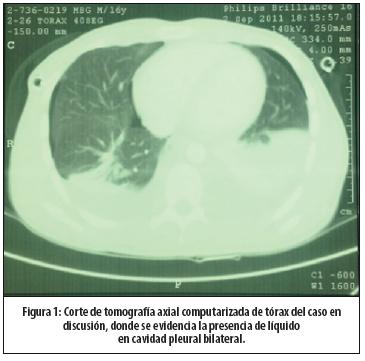
<body><![CDATA[<div style="text-align: justify;"></div>     <p style="text-align: justify;" class="MsoNormal"><span  style="font-size: 10pt; font-family: Verdana;">El l&#237;quido pleural derecho mostr&#243; triglic&#233;ridos en 1007 <span  class="SpellE">mg</span>/<span class="SpellE">dl</span> y el izquierdo, en 407 <span class="SpellE">mg</span>/<span class="SpellE">dl.</span> Continu&#243; con NPT y <span class="SpellE">somatostatina</span> (50 microgramos SC c/8 <span class="SpellE">hrs</span>), y curs&#243; con tendencia a la disminuci&#243;n del drenaje de quilo de ambos <span style="">&nbsp;</span><span class="SpellE">hemit&#243;rax</span>; 11 d&#237;as despu&#233;s se le suspendi&#243; la sonda izquierda y a los 16, la derecha, por lo que fue egresado. <a  href="/img/revistas/amc/v56n3/art07i1.jpg">Figura 1</a><o:p></o:p></span></p>     <p class="MsoNormal"><b style=""><span  style="font-size: 11pt; font-family: Verdana;">Discusi&#243;n </span></b><b><span  style="font-size: 11pt; font-family: Verdana; color: rgb(34, 30, 31);"><o:p></o:p></span></b></p>     <div>     <div style="text-align: justify;"></div>     <p style="text-align: justify;" class="MsoNormal"><span class="SpellE"><span  style="font-size: 10pt; font-family: Verdana;">Quilot&#243;rax</span></span><span  style="font-size: 10pt; font-family: Verdana;"> es la presencia de l&#237;quido linf&#225;tico en el espacio pleural, usualmente debido a lesi&#243;n del conducto tor&#225;cico o una de sus ramas tributarias.<sup><a href="#1">1</a> </sup>El conducto tor&#225;cico es la principal v&#237;a del quilo y puede presentar variantes anat&#243;micas, principalmente en la porci&#243;n tor&#225;cica; en el 50% de los casos inicia en abdomen, a la altura de la segunda v&#233;rtebra lumbar, en la cisterna del quilo (cisterna chili), asciende hacia el t&#243;rax por el hiato a&#243;rtico, contin&#250;a su trayecto por el mediastino posterior, a la derecha de las v&#233;rtebras tor&#225;cicas; aproximadamente a nivel de T-<st1:metricconverter productid="5 a" w:st="on">5 a</st1:metricconverter> T-6 cruza anterior a estas y se ubica al lado izquierdo, por donde sigue ascendiendo hasta desembocar en la uni&#243;n de las venas subclavia izquierda y yugular interna izquierda.<a href="#1"><sup><a>1-2</a> </sup></a><o:p></o:p></span></p>     <div style="text-align: justify;"></div>     <p style="text-align: justify;" class="MsoNormal"><span  style="font-size: 10pt; font-family: Verdana;">Las causas de <span class="SpellE">quilot&#243;rax</span> son, principalmente: traumas (incluyendo cirug&#237;a), malignidad, miscel&#225;neas (des&#243;rdenes m&#233;dicos no neopl&#225;sicos) e idiop&#225;ticas.<sup><a href="#3">3</a> </sup>En raros casos se presenta por trauma de t&#243;rax cerrado y este es debido a una brusca <span class="SpellE">hiperextensi&#243;n</span> de la columna vertebral, lesionando el conducto tor&#225;cico; en un 20% de los casos se asocia a fractura vertebral.<sup><a href="#4">4-5</a> </sup>La mitad de los <span class="SpellE">quilot&#243;rax</span> producidos por trauma tor&#225;cico cerrado ocurren en el lado derecho, una tercera parte en el izquierdo, y el resto son bilaterales, conforme el nivel en el que se produce la lesi&#243;n del conducto tor&#225;cico.<a href="#6"><sup><a>6</a> </sup></a><o:p></o:p></span></p>     <div style="text-align: justify;"></div>     <p style="text-align: justify;" class="MsoNormal"><span  style="font-size: 10pt; font-family: Verdana;">La presentaci&#243;n cl&#237;nica var&#237;a seg&#250;n la patolog&#237;a concomitante y la acumulaci&#243;n de quilo en la cavidad pleural; en casos agudos la disnea es el s&#237;ntoma m&#225;s com&#250;n, adem&#225;s de dolor tor&#225;cico y tos. En casos cr&#243;nicos se presenta malnutrici&#243;n e <span class="SpellE">inmunosupresi&#243;n</span>, debido la fuga de prote&#237;nas, grasas (<span class="SpellE">quilomicrones</span>), vitaminas, electrolitos, inmunoglobulinas y linfocitos T, ya que de estos se compone el quilo.<sup><a href="#3">3</a><span class="GramE">,<a  href="#8">8</a></span> </sup>Dependiendo de la ingesta de grasas y de la funci&#243;n intestinal, se producen aproximadamente de <st1:metricconverter productid="1500 a" w:st="on">1500 a</st1:metricconverter> 2500cc de quilo por d&#237;a.<a href="#7"><sup><a>7</a> </sup></a><o:p></o:p></span></p>     ]]></body>
<body><![CDATA[<div style="text-align: justify;"></div>     <div>     <div style="text-align: justify;"></div>     <p style="text-align: justify;" class="MsoNormal"><span  style="font-size: 10pt; font-family: Verdana;">El quilo usualmente es de un aspecto lechoso, sin embargo, en algunos casos, como en malnutrici&#243;n, esta caracter&#237;stica puede estar ausente.<sup>9 </sup>El diagn&#243;stico de <span class="SpellE">quilot&#243;rax</span> se hace al analizar el l&#237;quido pleural: niveles de triglic&#233;ridos mayores de 110mg/ <span class="SpellE">dl</span> lo confirman; niveles menores de 50 <span class="SpellE">mg</span>/<span class="SpellE">dl</span> lo excluyen, y cuando hay valores entre 50 y 110 <span class="SpellE">mg</span>/<span class="SpellE">dl</span>, se debe de realizar electroforesis de lipoprote&#237;nas para determinar la presencia de <span class="SpellE">quilomicrones</span>, y si los hay, se confirma el diagn&#243;stico. Algunas otras caracter&#237;sticas del quilo son: pH entre 7,4 y 7,8, niveles de linfocitos en el l&#237;quido pleural mayores a los plasm&#225;ticos, y densidad de 1,012 o mayor.<sup><a href="#1">1</a><span  class="GramE">,<a href="#6">6</a>,<a href="#10">10,11</a></span> </sup><o:p></o:p></span></p>     <p style="text-align: justify;" class="MsoNormal"><span  style="font-size: 10pt; font-family: Verdana;">Aunque no existe un consenso sobre su tratamiento, este puede ser conservador, quir&#250;rgico, o una combinaci&#243;n de ambos. <o:p></o:p></span></p>     <div style="text-align: justify;"></div>     <p style="text-align: justify;" class="MsoNormal"><span  style="font-size: 10pt; font-family: Verdana;">El manejo conservador tiene &#233;xito hasta en un 50% de los pacientes, y consiste en drenar el <span class="SpellE">quilot&#243;rax</span> y ejecutar un tratamiento nutricional basado en 2 opciones, fundamentalmente, a-nutrici&#243;n enteral pobre en triglic&#233;ridos de cadena larga, pues producen la formaci&#243;n de <span class="SpellE">quilomicrones</span>, por lo que el aporte de l&#237;pidos es por medio de triglic&#233;ridos de cadena mediana o b-reposo digestivo con NPT, para disminuir el flujo de quilo por el conducto tor&#225;cico.<sup><a href="#11">11,12</a> </sup>Adem&#225;s, se puede asociar el uso de <span class="SpellE">octre&#243;tido</span>, que es un an&#225;logo de larga duraci&#243;n de la <span class="SpellE">somatostatina</span>, el cual reduce la excreci&#243;n de fluido linf&#225;tico.<a href="#13"><sup><a>13,14</a> </sup></a><o:p></o:p></span></p>     <div style="text-align: justify;"></div>     <p style="text-align: justify;" class="MsoNormal"><span  style="font-size: 10pt; font-family: Verdana;">Algunos autores recomiendan la cirug&#237;a si el drenaje diario es mayor de <st1:metricconverter  productid="1 litro" w:st="on">1 litro</st1:metricconverter> por 5 d&#237;as, si no hay disminuci&#243;n del drenaje de quilo durante m&#225;s de 2 semanas, o si hay repercusi&#243;n nutricional o metab&#243;lica en el paciente. <o:p></o:p></span></p>     <div style="text-align: justify;"></div>     ]]></body>
<body><![CDATA[<p style="text-align: justify;" class="MsoNormal"><span  style="font-size: 10pt; font-family: Verdana;">En caso de requerir un abordaje quir&#250;rgico, se recomienda realizar una <span  class="SpellE">linfangiograf&#237;a</span> prequir&#250;rgica, o aplicar subcut&#225;nea de azul de metileno, 1 hora antes de la cirug&#237;a, para identificar el sitio de la lesi&#243;n. <o:p></o:p></span></p>     <div style="text-align: justify;"></div>     <p style="text-align: justify;" class="MsoNormal"><span  style="font-size: 10pt; font-family: Verdana;">La t&#233;cnica quir&#250;rgica cl&#225;sica es la <span class="SpellE">toracotom&#237;a</span> derecha, con ligadura del conducto tor&#225;cico al nivel del hiato a&#243;rtico, con un &#233;xito del 90% de los casos. Al realizar la ligadura a este nivel, se evita el flujo de quilo de alg&#250;n conducto accesorio lesionado, que no se ha identificado. Si el <span  class="SpellE">quilot&#243;rax</span> es unilateral, se realiza la <span class="SpellE">toracotom&#237;a</span> en el lado afectado; si se logra identificar el sitio de la lesi&#243;n, esta se puede reparar sutur&#225;ndola o, en caso contrario, se realiza la ligadura descrita, cerca del hiato a&#243;rtico. <o:p></o:p></span></p>     <p style="text-align: justify;" class="MsoNormal"><span  style="font-size: 10pt; font-family: Verdana;">Otra opci&#243;n es la cirug&#237;a tor&#225;cica asistida con video, t&#233;cnica con la cual se pueden colocar clips en el conducto tor&#225;cico proximal al hiato a&#243;rtico, o en el sitio de la lesi&#243;n.<sup><a href="#1">1</a><span class="GramE">,<a href="#8">8</a>,<a  href="#13">13</a></span> </sup><o:p></o:p></span></p>     <p class="MsoNormal"><span  style="font-size: 10pt; font-family: Verdana;">Conflicto de inter&#233;s: ninguno <o:p></o:p></span></p> </div> </div>     <div>     <div>     <p class="MsoNormal"><b style=""><span  style="font-size: 11pt; font-family: Verdana;"></span></b></p> <hr style="width: 100%; height: 2px;">     <p class="MsoNormal"><b style=""><span  style="font-size: 11pt; font-family: Verdana;">Referencias <span  style=""><o:p></o:p></span></span></b></p>     <!-- ref --><p class="MsoNormal"><span  style="font-size: 10pt; font-family: Verdana;"><a name="1"></a>1. <span  class="SpellE">Platis</span> I, <span class="SpellE">Nwogu</span> Ch. <span class="SpellE">Chylothorax</span>. <span class="SpellE">Thorac</span> <span class="SpellE">Surg</span> <span  class="SpellE">Clin</span> 2006<span class="GramE">;16:209</span>-214.    &nbsp;&nbsp;&nbsp;&nbsp;&nbsp;&nbsp;&nbsp;&nbsp;[&#160;<a href="javascript:void(0);" onclick="javascript: window.open('/scielo.php?script=sci_nlinks&ref=063509&pid=S0001-6002201400030000700001&lng=','','width=640,height=500,resizable=yes,scrollbars=1,menubar=yes,');">Links</a>&#160;]<!-- end-ref --> <o:p></o:p></span></p>     <!-- ref --><p class="MsoNormal"><span  style="font-size: 10pt; font-family: Verdana;" lang="EN-US"><a name="2"></a>2. <span class="SpellE">Merrigan</span> B, Winter D, Sullivan C. <span class="SpellE">Chylothorax</span>. </span><span  style="font-size: 10pt; font-family: Verdana;">Br J <span  class="SpellE">Surg</span> 1997<span class="GramE">;84:15</span>-20.    &nbsp;&nbsp;&nbsp;&nbsp;&nbsp;&nbsp;&nbsp;&nbsp;[&#160;<a href="javascript:void(0);" onclick="javascript: window.open('/scielo.php?script=sci_nlinks&ref=063511&pid=S0001-6002201400030000700002&lng=','','width=640,height=500,resizable=yes,scrollbars=1,menubar=yes,');">Links</a>&#160;]<!-- end-ref --> <o:p></o:p></span></p> </div>     <div>     <!-- ref --><p class="MsoNormal"><span  style="font-size: 10pt; font-family: Verdana;" lang="EN-US"><a name="3"></a>3. Clinton D, Mark A, Francis N, Jay R. Etiology of <span class="SpellE">chylothorax</span> in 203 patients. Mayo <span class="SpellE">Clin</span> Proc 2005<span class="GramE">;80:867</span>-870.    &nbsp;&nbsp;&nbsp;&nbsp;&nbsp;&nbsp;&nbsp;&nbsp;[&#160;<a href="javascript:void(0);" onclick="javascript: window.open('/scielo.php?script=sci_nlinks&ref=063514&pid=S0001-6002201400030000700003&lng=','','width=640,height=500,resizable=yes,scrollbars=1,menubar=yes,');">Links</a>&#160;]<!-- end-ref --> <o:p></o:p></span></p>     <!-- ref --><p class="MsoNormal"><span  style="font-size: 10pt; font-family: Verdana;" lang="EN-US"><a name="4"></a>4. <span class="SpellE">Kushwaha</span> R, Kumar S, <span class="SpellE">Mahajan</span> V, Prasad R. Bilateral <span class="SpellE">chylothorax</span> in a child after mild trauma. <span class="GramE">Indian J Chest <span  class="SpellE">Dis</span> Allied <span class="SpellE">Sci</span> 2008; 50: 355-357.    &nbsp;&nbsp;&nbsp;&nbsp;&nbsp;&nbsp;&nbsp;&nbsp;[&#160;<a href="javascript:void(0);" onclick="javascript: window.open('/scielo.php?script=sci_nlinks&ref=063516&pid=S0001-6002201400030000700004&lng=','','width=640,height=500,resizable=yes,scrollbars=1,menubar=yes,');">Links</a>&#160;]<!-- end-ref --></span> <o:p></o:p></span></p>     <!-- ref --><p class="MsoNormal"><span  style="font-size: 10pt; font-family: Verdana;" lang="EN-US"><a name="5"></a>5. Amador M, Robles M, <span class="SpellE">Fern&#225;ndez</span> A, <span class="SpellE">L&#243;pez</span> M. <span class="SpellE">Quilot&#243;rax</span> a <span class="SpellE">tensi&#243;n</span> <span class="SpellE">secundario</span> a <span class="SpellE">traumatismo</span> <span class="SpellE">cerrado</span> de <span class="SpellE">t&#243;rax</span>. <span class="SpellE">Emergencias</span> 2004<span class="GramE">;16:273</span>-275.    &nbsp;&nbsp;&nbsp;&nbsp;&nbsp;&nbsp;&nbsp;&nbsp;[&#160;<a href="javascript:void(0);" onclick="javascript: window.open('/scielo.php?script=sci_nlinks&ref=063518&pid=S0001-6002201400030000700005&lng=','','width=640,height=500,resizable=yes,scrollbars=1,menubar=yes,');">Links</a>&#160;]<!-- end-ref --> <o:p></o:p></span></p>     ]]></body>
<body><![CDATA[<!-- ref --><p class="MsoNormal"><span  style="font-size: 10pt; font-family: Verdana;" lang="EN-US"><a name="6"></a>6. <span class="SpellE">Seitelman</span> E, Arellano J, <span  class="SpellE">Takabe</span> K, Barrett L, Faust G, Angus G. <span class="SpellE">Chylothorax</span> after blunt trauma. J <span class="SpellE">Thorac</span> <span  class="SpellE">Dis</span> 2012<span class="GramE">;4:327</span>-330.    &nbsp;&nbsp;&nbsp;&nbsp;&nbsp;&nbsp;&nbsp;&nbsp;[&#160;<a href="javascript:void(0);" onclick="javascript: window.open('/scielo.php?script=sci_nlinks&ref=063520&pid=S0001-6002201400030000700006&lng=','','width=640,height=500,resizable=yes,scrollbars=1,menubar=yes,');">Links</a>&#160;]<!-- end-ref --> <o:p></o:p></span></p>     <!-- ref --><p class="MsoNormal"><span  style="font-size: 10pt; font-family: Verdana;" lang="EN-US"><a name="7"></a>7. Mc <span class="SpellE">Cormick</span> J, Henderson S. Blunt trauma induced bilateral <span class="SpellE">chylothorax</span>. Am J <span class="SpellE">Emerg</span> Med 1999<span class="GramE">;17:302</span>-304.    &nbsp;&nbsp;&nbsp;&nbsp;&nbsp;&nbsp;&nbsp;&nbsp;[&#160;<a href="javascript:void(0);" onclick="javascript: window.open('/scielo.php?script=sci_nlinks&ref=063522&pid=S0001-6002201400030000700007&lng=','','width=640,height=500,resizable=yes,scrollbars=1,menubar=yes,');">Links</a>&#160;]<!-- end-ref --> <o:p></o:p></span></p>     <!-- ref --><p class="MsoNormal"><span  style="font-size: 10pt; font-family: Verdana;" lang="EN-US"><a name="8"></a>8. McGrath E, Blades Z, Anderson P. <span class="SpellE">Chylothorax</span>: <span  class="SpellE">Aetiology</span>, diagnosis and therapeutic options. <span class="SpellE">Respir</span> Med 2010<span  class="GramE">;104</span>: 1-8.    &nbsp;&nbsp;&nbsp;&nbsp;&nbsp;&nbsp;&nbsp;&nbsp;[&#160;<a href="javascript:void(0);" onclick="javascript: window.open('/scielo.php?script=sci_nlinks&ref=063524&pid=S0001-6002201400030000700008&lng=','','width=640,height=500,resizable=yes,scrollbars=1,menubar=yes,');">Links</a>&#160;]<!-- end-ref --> <o:p></o:p></span></p> </div>     <!-- ref --><p class="MsoNormal"><span  style="font-size: 10pt; font-family: Verdana;" lang="EN-US"><a name="9"></a>9. Maldonado F, Hawkins F, Daniels C, <span class="SpellE">Doerr</span> C, Decker P, <span class="SpellE">Ryu</span> J. Pleural fluid characteristics of <span class="SpellE">chylothorax</span>. Mayo <span class="SpellE">Clin</span> Proc 2009<span class="GramE">;84:129</span>-133.    &nbsp;&nbsp;&nbsp;&nbsp;&nbsp;&nbsp;&nbsp;&nbsp;[&#160;<a href="javascript:void(0);" onclick="javascript: window.open('/scielo.php?script=sci_nlinks&ref=063526&pid=S0001-6002201400030000700009&lng=','','width=640,height=500,resizable=yes,scrollbars=1,menubar=yes,');">Links</a>&#160;]<!-- end-ref --> <o:p></o:p></span></p>     <!-- ref --><p class="MsoNormal"><span  style="font-size: 10pt; font-family: Verdana;" lang="EN-US"><a  name="10"></a>10. <span class="SpellE">Serin-Ezer</span> S, <span  class="SpellE"><span class="GramE">Og</span></span> <span  class="SpellE">uzkurt</span> P, <span class="SpellE">Ince</span> E, <span class="SpellE">Hi&#231;s&#246;nmez</span> A. Bilateral <span class="SpellE">chylothorax</span> after blunt thoracic trauma: a case report. Turk J <span class="SpellE">Pediatr</span> 2009<span  class="GramE">;51:504</span>-506.    &nbsp;&nbsp;&nbsp;&nbsp;&nbsp;&nbsp;&nbsp;&nbsp;[&#160;<a href="javascript:void(0);" onclick="javascript: window.open('/scielo.php?script=sci_nlinks&ref=063528&pid=S0001-6002201400030000700010&lng=','','width=640,height=500,resizable=yes,scrollbars=1,menubar=yes,');">Links</a>&#160;]<!-- end-ref --> <o:p></o:p></span></p>     ]]></body>
<body><![CDATA[<!-- ref --><p class="MsoNormal"><span  style="font-size: 10pt; font-family: Verdana;" lang="EN-US"><a  name="11"></a>11. <span class="SpellE">Pakula</span> A, Phillips W, Skinner R. A case of a traumatic <span class="SpellE">chyle</span> leak following an acute thoracic spine injury: successful resolution with strict dietary manipulation. World J <span class="SpellE">Emerg</span> <span  class="SpellE">Surg</span> 2011<span class="GramE">;6:10</span>.    &nbsp;&nbsp;&nbsp;&nbsp;&nbsp;&nbsp;&nbsp;&nbsp;[&#160;<a href="javascript:void(0);" onclick="javascript: window.open('/scielo.php?script=sci_nlinks&ref=063530&pid=S0001-6002201400030000700011&lng=','','width=640,height=500,resizable=yes,scrollbars=1,menubar=yes,');">Links</a>&#160;]<!-- end-ref --> <o:p></o:p></span></p>     <!-- ref --><p class="MsoNormal"><span  style="font-size: 10pt; font-family: Verdana;"><a name="12"></a>12. P&#233;rez L, L&#243;pez M, <span class="SpellE">Blesa</span> A. <span class="SpellE">Quilot&#243;rax</span>: efecto del tratamiento nutricional. </span><span class="SpellE"><span  style="font-size: 10pt; font-family: Verdana;" lang="EN-US">Nutr</span></span><span  style="font-size: 10pt; font-family: Verdana;" lang="EN-US"> <span class="SpellE">Clin</span> Med 2010<span class="GramE">;4:17</span>-27.    &nbsp;&nbsp;&nbsp;&nbsp;&nbsp;&nbsp;&nbsp;&nbsp;[&#160;<a href="javascript:void(0);" onclick="javascript: window.open('/scielo.php?script=sci_nlinks&ref=063532&pid=S0001-6002201400030000700012&lng=','','width=640,height=500,resizable=yes,scrollbars=1,menubar=yes,');">Links</a>&#160;]<!-- end-ref --> <o:p></o:p></span></p>     <!-- ref --><p class="MsoNormal"><span  style="font-size: 10pt; font-family: Verdana;" lang="EN-US"><a  name="13"></a>13. Sharkey A, <span class="SpellE">Rao</span> J. <span class="GramE">The successful use of <span class="SpellE">octreotide</span> in the treatment of traumatic <span class="SpellE">chylothorax</span>.</span> Tex Heart Inst J 2012<span class="GramE">;39:428</span>-30.    &nbsp;&nbsp;&nbsp;&nbsp;&nbsp;&nbsp;&nbsp;&nbsp;[&#160;<a href="javascript:void(0);" onclick="javascript: window.open('/scielo.php?script=sci_nlinks&ref=063534&pid=S0001-6002201400030000700013&lng=','','width=640,height=500,resizable=yes,scrollbars=1,menubar=yes,');">Links</a>&#160;]<!-- end-ref --> <o:p></o:p></span></p>     <!-- ref --><p class="MsoNormal"><span  style="font-size: 10pt; font-family: Verdana;" lang="EN-US"><a  name="14"></a>14. <span class="SpellE">Buettiker</span> V, Hug V, Burger R, <span class="SpellE">Baenziger</span> O. <span  class="SpellE">Somatostatin</span>: a new therapeutic option for the treatment of <span class="SpellE">Chylothorax</span>. <span class="SpellE">Intensiv</span></span><span  style="font-size: 10pt; font-family: Verdana;">e Care <span  class="SpellE">Med</span> 2001; 27: 1083-1086.    &nbsp;&nbsp;&nbsp;&nbsp;&nbsp;&nbsp;&nbsp;&nbsp;[&#160;<a href="javascript:void(0);" onclick="javascript: window.open('/scielo.php?script=sci_nlinks&ref=063536&pid=S0001-6002201400030000700014&lng=','','width=640,height=500,resizable=yes,scrollbars=1,menubar=yes,');">Links</a>&#160;]<!-- end-ref --> <o:p></o:p></span></p>     <p class="MsoNormal"><span  style="font-size: 10pt; font-family: Verdana;">Trabajo realizado en el Servicio de Cirug&#237;a de T&#243;rax, Hospital M&#233;xico.<o:p></o:p></span></p> <b><span style="font-size: 10pt; font-family: Verdana;">Afiliaci&#243;n de los autores: </span></b><sup><span  style="font-size: 10pt; font-family: Verdana; position: relative; top: -2.5pt;"></span></sup><span  style="font-size: 10pt; font-family: Verdana;"><sup><a name="1_"></a><a  href="#3_">1</a></sup>Cirug&#237;a General y     <br> <sup><span style="position: relative; top: -2.5pt;"><a name="2_"></a><a  href="#4_">2</a></span></sup>Servicio de Cirug&#237;a de T&#243;rax,<o:p></o:p> Hospital M&#233;xico, CCSS.<o:p></o:p></span><span  style="font-size: 10pt; font-family: Verdana;"> jeffrysolis@hotmail.com<o:p></o:p></span>     ]]></body>
<body><![CDATA[<p class="MsoNormal"><b><span  style="font-size: 10pt; font-family: Verdana;">Fuentes de apoyo: </span></b><span  style="font-size: 10pt; font-family: Verdana;">ninguna<o:p></o:p></span></p>     <p class="MsoNormal"><b><span  style="font-size: 10pt; font-family: Verdana;"></span></b></p> <hr style="width: 100%; height: 2px;">     <p style="text-align: center;" class="MsoNormal"><b><span  style="font-size: 10pt; font-family: Verdana;">Fecha recibido: </span></b><span  style="font-size: 10pt; font-family: Verdana;">13 de septiembre de 2013 <b>Fecha aceptado: </b>24 de abril de 2014<b><o:p></o:p></b></span></p> </div> </div> </div> </div>      ]]></body><back>
<ref-list>
<ref id="B1">
<label>1</label><nlm-citation citation-type="journal">
<person-group person-group-type="author">
<name>
<surname><![CDATA[Platis]]></surname>
<given-names><![CDATA[I]]></given-names>
</name>
<name>
<surname><![CDATA[Nwogu]]></surname>
<given-names><![CDATA[Ch]]></given-names>
</name>
</person-group>
<article-title xml:lang="en"><![CDATA[Chylothorax]]></article-title>
<source><![CDATA[Thorac Surg Clin]]></source>
<year>2006</year>
<volume>16</volume>
<page-range>209-214</page-range></nlm-citation>
</ref>
<ref id="B2">
<label>2</label><nlm-citation citation-type="journal">
<person-group person-group-type="author">
<name>
<surname><![CDATA[Merrigan]]></surname>
<given-names><![CDATA[B]]></given-names>
</name>
<name>
<surname><![CDATA[Winter]]></surname>
<given-names><![CDATA[D]]></given-names>
</name>
<name>
<surname><![CDATA[Sullivan]]></surname>
<given-names><![CDATA[C]]></given-names>
</name>
</person-group>
<article-title xml:lang="en"><![CDATA[Chylothorax]]></article-title>
<source><![CDATA[Br J Surg]]></source>
<year>1997</year>
<volume>84</volume>
<page-range>15-20</page-range></nlm-citation>
</ref>
<ref id="B3">
<label>3</label><nlm-citation citation-type="journal">
<person-group person-group-type="author">
<name>
<surname><![CDATA[Clinton]]></surname>
<given-names><![CDATA[D]]></given-names>
</name>
<name>
<surname><![CDATA[Mark]]></surname>
<given-names><![CDATA[A]]></given-names>
</name>
<name>
<surname><![CDATA[Francis]]></surname>
<given-names><![CDATA[N]]></given-names>
</name>
<name>
<surname><![CDATA[Jay]]></surname>
<given-names><![CDATA[R]]></given-names>
</name>
</person-group>
<article-title xml:lang="en"><![CDATA[Etiology of chylothorax in 203 patients]]></article-title>
<source><![CDATA[Mayo Clin Proc]]></source>
<year>2005</year>
<volume>80</volume>
<page-range>867-870</page-range></nlm-citation>
</ref>
<ref id="B4">
<label>4</label><nlm-citation citation-type="journal">
<person-group person-group-type="author">
<name>
<surname><![CDATA[Kushwaha]]></surname>
<given-names><![CDATA[R]]></given-names>
</name>
<name>
<surname><![CDATA[Kumar]]></surname>
<given-names><![CDATA[S]]></given-names>
</name>
<name>
<surname><![CDATA[Mahajan]]></surname>
<given-names><![CDATA[V]]></given-names>
</name>
<name>
<surname><![CDATA[Prasad]]></surname>
<given-names><![CDATA[R]]></given-names>
</name>
</person-group>
<article-title xml:lang="en"><![CDATA[Bilateral chylothorax in a child after mild trauma]]></article-title>
<source><![CDATA[Indian J Chest Dis Allied Sci]]></source>
<year>2008</year>
<volume>50</volume>
<page-range>355-357</page-range></nlm-citation>
</ref>
<ref id="B5">
<label>5</label><nlm-citation citation-type="journal">
<person-group person-group-type="author">
<name>
<surname><![CDATA[Amador]]></surname>
<given-names><![CDATA[M]]></given-names>
</name>
<name>
<surname><![CDATA[Robles]]></surname>
<given-names><![CDATA[M]]></given-names>
</name>
<name>
<surname><![CDATA[Fernández]]></surname>
<given-names><![CDATA[A]]></given-names>
</name>
<name>
<surname><![CDATA[López]]></surname>
<given-names><![CDATA[M]]></given-names>
</name>
</person-group>
<article-title xml:lang="es"><![CDATA[Quilotórax a tensión secundario a traumatismo cerrado de tórax]]></article-title>
<source><![CDATA[Emergencias]]></source>
<year>2004</year>
<volume>16</volume>
<page-range>273-275</page-range></nlm-citation>
</ref>
<ref id="B6">
<label>6</label><nlm-citation citation-type="journal">
<person-group person-group-type="author">
<name>
<surname><![CDATA[Seitelman]]></surname>
<given-names><![CDATA[E]]></given-names>
</name>
<name>
<surname><![CDATA[Arellano]]></surname>
<given-names><![CDATA[J]]></given-names>
</name>
<name>
<surname><![CDATA[Takabe]]></surname>
<given-names><![CDATA[K]]></given-names>
</name>
<name>
<surname><![CDATA[Barrett]]></surname>
<given-names><![CDATA[L]]></given-names>
</name>
<name>
<surname><![CDATA[Faust]]></surname>
<given-names><![CDATA[G]]></given-names>
</name>
<name>
<surname><![CDATA[Angus]]></surname>
<given-names><![CDATA[G]]></given-names>
</name>
</person-group>
<article-title xml:lang="en"><![CDATA[Chylothorax after blunt trauma]]></article-title>
<source><![CDATA[J Thorac Dis]]></source>
<year>2012</year>
<volume>4</volume>
<page-range>327-330</page-range></nlm-citation>
</ref>
<ref id="B7">
<label>7</label><nlm-citation citation-type="journal">
<person-group person-group-type="author">
<name>
<surname><![CDATA[Mc Cormick]]></surname>
<given-names><![CDATA[J]]></given-names>
</name>
<name>
<surname><![CDATA[Henderson]]></surname>
<given-names><![CDATA[S]]></given-names>
</name>
</person-group>
<article-title xml:lang="en"><![CDATA[Blunt trauma induced bilateral chylothorax]]></article-title>
<source><![CDATA[Am J Emerg Med]]></source>
<year>1999</year>
<volume>17</volume>
<page-range>302-304</page-range></nlm-citation>
</ref>
<ref id="B8">
<label>8</label><nlm-citation citation-type="journal">
<person-group person-group-type="author">
<name>
<surname><![CDATA[McGrath]]></surname>
<given-names><![CDATA[E]]></given-names>
</name>
<name>
<surname><![CDATA[Blades]]></surname>
<given-names><![CDATA[Z]]></given-names>
</name>
<name>
<surname><![CDATA[Anderson]]></surname>
<given-names><![CDATA[P]]></given-names>
</name>
</person-group>
<article-title xml:lang="en"><![CDATA[Chylothorax: Aetiology, diagnosis and therapeutic options]]></article-title>
<source><![CDATA[Respir Med]]></source>
<year>2010</year>
<volume>104</volume>
<page-range>1-8</page-range></nlm-citation>
</ref>
<ref id="B9">
<label>9</label><nlm-citation citation-type="journal">
<person-group person-group-type="author">
<name>
<surname><![CDATA[Maldonado]]></surname>
<given-names><![CDATA[F]]></given-names>
</name>
<name>
<surname><![CDATA[Hawkins]]></surname>
<given-names><![CDATA[F]]></given-names>
</name>
<name>
<surname><![CDATA[Daniels]]></surname>
<given-names><![CDATA[C]]></given-names>
</name>
<name>
<surname><![CDATA[Doerr]]></surname>
<given-names><![CDATA[C]]></given-names>
</name>
<name>
<surname><![CDATA[Decker]]></surname>
<given-names><![CDATA[P]]></given-names>
</name>
<name>
<surname><![CDATA[Ryu]]></surname>
<given-names><![CDATA[J]]></given-names>
</name>
</person-group>
<article-title xml:lang="en"><![CDATA[Pleural fluid characteristics of chylothorax]]></article-title>
<source><![CDATA[Mayo Clin Proc]]></source>
<year>2009</year>
<volume>84</volume>
<page-range>129-133</page-range></nlm-citation>
</ref>
<ref id="B10">
<label>10</label><nlm-citation citation-type="journal">
<person-group person-group-type="author">
<name>
<surname><![CDATA[Serin-Ezer]]></surname>
<given-names><![CDATA[S]]></given-names>
</name>
<name>
<surname><![CDATA[Og uzkurt]]></surname>
<given-names><![CDATA[P]]></given-names>
</name>
<name>
<surname><![CDATA[Ince]]></surname>
<given-names><![CDATA[E]]></given-names>
</name>
<name>
<surname><![CDATA[Hiçsönmez]]></surname>
<given-names><![CDATA[A]]></given-names>
</name>
</person-group>
<article-title xml:lang="en"><![CDATA[Bilateral chylothorax after blunt thoracic trauma: a case report]]></article-title>
<source><![CDATA[Turk J Pediatr]]></source>
<year>2009</year>
<volume>51</volume>
<page-range>504-506</page-range></nlm-citation>
</ref>
<ref id="B11">
<label>11</label><nlm-citation citation-type="journal">
<person-group person-group-type="author">
<name>
<surname><![CDATA[Pakula]]></surname>
<given-names><![CDATA[A]]></given-names>
</name>
<name>
<surname><![CDATA[Phillips]]></surname>
<given-names><![CDATA[W]]></given-names>
</name>
<name>
<surname><![CDATA[Skinner]]></surname>
<given-names><![CDATA[R]]></given-names>
</name>
</person-group>
<article-title xml:lang="en"><![CDATA[A case of a traumatic chyle leak following an acute thoracic spine injury: successful resolution with strict dietary manipulation]]></article-title>
<source><![CDATA[World J Emerg Surg]]></source>
<year>2011</year>
<volume>6</volume>
<numero>10</numero>
<issue>10</issue>
</nlm-citation>
</ref>
<ref id="B12">
<label>12</label><nlm-citation citation-type="journal">
<person-group person-group-type="author">
<name>
<surname><![CDATA[Pérez]]></surname>
<given-names><![CDATA[L]]></given-names>
</name>
<name>
<surname><![CDATA[López]]></surname>
<given-names><![CDATA[M]]></given-names>
</name>
<name>
<surname><![CDATA[Blesa]]></surname>
<given-names><![CDATA[A]]></given-names>
</name>
</person-group>
<article-title xml:lang="en"><![CDATA[Quilotórax: efecto del tratamiento nutricional]]></article-title>
<source><![CDATA[Nutr Clin Med]]></source>
<year>2010</year>
<volume>4</volume>
<page-range>17-27</page-range></nlm-citation>
</ref>
<ref id="B13">
<label>13</label><nlm-citation citation-type="journal">
<person-group person-group-type="author">
<name>
<surname><![CDATA[Sharkey]]></surname>
<given-names><![CDATA[A]]></given-names>
</name>
<name>
<surname><![CDATA[Rao]]></surname>
<given-names><![CDATA[J]]></given-names>
</name>
</person-group>
<article-title xml:lang="en"><![CDATA[The successful use of octreotide in the treatment of traumatic chylothorax]]></article-title>
<source><![CDATA[Tex Heart Inst J]]></source>
<year>2012</year>
<volume>39</volume>
<page-range>428-30</page-range></nlm-citation>
</ref>
<ref id="B14">
<label>14</label><nlm-citation citation-type="journal">
<person-group person-group-type="author">
<name>
<surname><![CDATA[Buettiker]]></surname>
<given-names><![CDATA[V]]></given-names>
</name>
<name>
<surname><![CDATA[Hug]]></surname>
<given-names><![CDATA[V]]></given-names>
</name>
<name>
<surname><![CDATA[Burger]]></surname>
<given-names><![CDATA[R]]></given-names>
</name>
<name>
<surname><![CDATA[Baenziger]]></surname>
<given-names><![CDATA[O]]></given-names>
</name>
</person-group>
<article-title xml:lang="en"><![CDATA[Somatostatin: a new therapeutic option for the treatment of Chylothorax]]></article-title>
<source><![CDATA[Intensive Care Med]]></source>
<year>2001</year>
<volume>27</volume>
<page-range>1083-1086</page-range></nlm-citation>
</ref>
</ref-list>
</back>
</article>