<?xml version="1.0" encoding="ISO-8859-1"?><article xmlns:mml="http://www.w3.org/1998/Math/MathML" xmlns:xlink="http://www.w3.org/1999/xlink" xmlns:xsi="http://www.w3.org/2001/XMLSchema-instance">
<front>
<journal-meta>
<journal-id>0001-6002</journal-id>
<journal-title><![CDATA[Acta Médica Costarricense]]></journal-title>
<abbrev-journal-title><![CDATA[Acta méd. costarric]]></abbrev-journal-title>
<issn>0001-6002</issn>
<publisher>
<publisher-name><![CDATA[Colegio de Médicos y Cirujanos de Costa Rica]]></publisher-name>
</publisher>
</journal-meta>
<article-meta>
<article-id>S0001-60022013000400007</article-id>
<title-group>
<article-title xml:lang="es"><![CDATA[Ehrlichiosis y anaplasmosis humanas en América]]></article-title>
<article-title xml:lang="en"><![CDATA[Human Ehrlichiosis and Anaplasmosis in America]]></article-title>
</title-group>
<contrib-group>
<contrib contrib-type="author">
<name>
<surname><![CDATA[Stephen Dumler]]></surname>
<given-names><![CDATA[J]]></given-names>
</name>
</contrib>
</contrib-group>
<aff id="A">
<institution><![CDATA[,  ]]></institution>
<addr-line><![CDATA[ ]]></addr-line>
</aff>
<pub-date pub-type="pub">
<day>00</day>
<month>07</month>
<year>2013</year>
</pub-date>
<pub-date pub-type="epub">
<day>00</day>
<month>07</month>
<year>2013</year>
</pub-date>
<volume>55</volume>
<fpage>29</fpage>
<lpage>33</lpage>
<copyright-statement/>
<copyright-year/>
<self-uri xlink:href="http://www.scielo.sa.cr/scielo.php?script=sci_arttext&amp;pid=S0001-60022013000400007&amp;lng=en&amp;nrm=iso"></self-uri><self-uri xlink:href="http://www.scielo.sa.cr/scielo.php?script=sci_abstract&amp;pid=S0001-60022013000400007&amp;lng=en&amp;nrm=iso"></self-uri><self-uri xlink:href="http://www.scielo.sa.cr/scielo.php?script=sci_pdf&amp;pid=S0001-60022013000400007&amp;lng=en&amp;nrm=iso"></self-uri><abstract abstract-type="short" xml:lang="es"><p><![CDATA[Se realiza una descripción de los agentes de Ehrlichia y Anaplasma que han sido vinculados con la generación de enfermedad los seres humanos, dando especial énfasis Ehrlichia chaffeensis, Anaplasma phagocytophilum y Ehrlichia canis. Se describe además, el cuadro clínico relacionado con cada agente, su correspondiente diagnóstico y tratamiento.]]></p></abstract>
<abstract abstract-type="short" xml:lang="en"><p><![CDATA[A description of Ehrlichia and Anaplasma agents that have been linked to human disease is presented. A particular emphasis is given to Ehrlichia chaffeensis, Anaplasma phagocytophilum, and Ehrlichia canis. The clinical features associated with each agent, as well as the corresponding diagnosis and treatment are also described.]]></p></abstract>
<kwd-group>
<kwd lng="es"><![CDATA[Ehrlichiosis]]></kwd>
<kwd lng="es"><![CDATA[anaplasmosis]]></kwd>
<kwd lng="es"><![CDATA[humanos]]></kwd>
<kwd lng="es"><![CDATA[América]]></kwd>
<kwd lng="en"><![CDATA[Ehrlichiosis]]></kwd>
<kwd lng="en"><![CDATA[anaplasmosis]]></kwd>
<kwd lng="en"><![CDATA[humans]]></kwd>
<kwd lng="en"><![CDATA[America]]></kwd>
</kwd-group>
</article-meta>
</front><body><![CDATA[ <div class="Section1">     <div>     <div>     <div>     <p class="MsoNormal" style="text-align: right;" align="right"><b  style=""><span style="font-family: Verdana;">Conferencias Magistrales<o:p></o:p></span></b></p>     <p class="MsoNormal" style="text-align: center;" align="center"><b  style=""><span style="font-family: Verdana;">Ehrlichiosis y anaplasmosis humanas en Am&#233;rica<o:p></o:p></span></b></p>     <p class="MsoNormal" style="text-align: center;" align="center"><b  style=""><span style="font-family: Verdana;" lang="EN-US">Human Ehrlichiosis and Anaplasmosis in <st1:country-region w:st="on"><st1:place  w:st="on">America</st1:place></st1:country-region><o:p></o:p></span></b></p>     <p class="MsoNormal" style="text-align: center;" align="center"><b  style=""><span style="font-size: 11pt; font-family: Verdana;">J. Stephen Dumler<o:p></o:p></span></b></p>     <p class="MsoNormal"><b style=""><span  style="font-size: 11pt; font-family: Verdana;"></span></b></p> <hr style="width: 100%; height: 2px;"><b style=""><span  style="font-size: 11pt; font-family: Verdana;">Resumen<o:p></o:p></span></b>     <p style="text-align: justify;" class="MsoNormal"><span  style="font-size: 10pt; font-family: Verdana;">Se realiza una descripci&#243;n de los agentes de <i>Ehrlichia</i> y <i>Anaplasma</i> que han sido vinculados con la generaci&#243;n de enfermedad los seres humanos, dando especial &#233;nfasis <i>Ehrlichia chaffeensis</i>, <i>Anaplasma phagocytophilum</i> y<i> Ehrlichia canis</i>. Se describe adem&#225;s, el cuadro cl&#237;nico relacionado con cada agente, su correspondiente diagn&#243;stico y tratamiento.<o:p></o:p></span></p>     ]]></body>
<body><![CDATA[<div style="text-align: justify;"></div>     <p style="text-align: justify;" class="MsoNormal"><b><span  style="font-size: 10pt; font-family: Verdana;" lang="EN-US">Descriptores:</span></b><span  style="font-size: 10pt; font-family: Verdana;" lang="EN-US"> Ehrlichiosis, anaplasmosis, humanos, Am&#233;rica<o:p></o:p></span></p>     <p class="MsoNormal"><b style=""><span  style="font-size: 11pt; font-family: Verdana;" lang="EN-US">Abstract<o:p></o:p></span></b></p>     <p style="text-align: justify;" class="MsoNormal"><span  style="font-size: 10pt; font-family: Verdana;" lang="EN-US">A description of <i>Ehrlichia</i> and <i>Anaplasma</i> agents that have been linked to human disease is presented. A particular emphasis is given to <i>Ehrlichia chaffeensis</i>, <i>Anaplasma phagocytophilum</i>, and <i>Ehrlichia canis</i>. The clinical features associated with each agent, as well as the corresponding diagnosis and treatment are also described.<o:p></o:p></span></p>     <div style="text-align: justify;"></div>     <p style="text-align: justify;" class="MsoNormal"><b><span  style="font-size: 10pt; font-family: Verdana;" lang="EN-US">Keywords:</span></b><span  style="font-size: 10pt; font-family: Verdana;" lang="EN-US"> Ehrlichiosis, anaplasmosis, humans, <st1:country-region w:st="on"><st1:place  w:st="on">America</st1:place></st1:country-region><o:p></o:p></span></p>     <p class="MsoNormal"><i><span  style="font-size: 10pt; font-family: Verdana;" lang="EN-US"></span></i></p> <hr style="width: 100%; height: 2px;">     <div style="text-align: justify;"><i><span  style="font-size: 10pt; font-family: Verdana;" lang="EN-US">Ehrlichia</span></i><span  style="font-size: 10pt; font-family: Verdana;" lang="EN-US"> and <i>Anaplasma</i> are two major genera in the family Anaplasmataceae, order Rickettsiales. While infections by these genera have been well known in animals for many years, infections by Anaplasmataceae species have only been documented in humans since the mid-1980s. Thus, the focus of this mini-review is on ehrlichiosis and anaplasmosis in humans.<o:p></o:p></span> </div>     <p style="text-align: justify;" class="MsoNormal"><span  style="font-size: 10pt; font-family: Verdana;" lang="EN-US">Since the first descriptions, human infections caused by new species, including <i>Ehrlichia chaffeensis</i> (cause of HME or human monocytic ehrlichiosis),<a href="#1"><sup>1</sup></a> <i>Ehrlichia ewingii</i>,<a href="#2"><sup>2</sup></a> an <i>Ehrlichia muris</i>-like agent (EMLA),<a href="#3"><sup>3</sup></a> the Panola Mountain Ehrlichia (PME) which has similarities to <i>Ehrlichia ruminantium</i>,<sup>4</sup> and <i>Anaplasma phagocytophilum</i> (cause of human granulocytic anaplasmosis-HGA) have been identified in the Americas.<a href="#5"><sup>5,6</sup></a> The only evidence of human infections by any of these species in Central or South America is limited to the cultivation of <i>E. canis</i> from an asymptomatic person in Venezuela,<a href="#7"><sup>7</sup></a> several cases of <i>E. canis</i> infection in symptomatic patients in Venezuela,<a href="#8"><sup>8</sup></a> a single case of <i>E. chaffeensis</i> infection in a Venezuelan child,<a href="#9"><sup>9</sup></a> or to limited serologic suspicion based on high antibody titers in seroprevalence studies or seroconversions in individual patients. All species in these genera are transmitted to their vertebrate hosts by tick bites, including <i>Amblyomma americanum</i> in the <st1:country-region  w:st="on">US</st1:country-region> for <i>E. chaffeensis</i>, <i>E. ewingii</i> and the PME; EMLA and <i>A. phagocytophilum</i> are transmitted by <i>Ixodes scapularis</i> in the <st1:country-region w:st="on"><st1:place  w:st="on">US</st1:place></st1:country-region>. It is speculated that <i>E. canis</i> is transmitted to humans in <st1:country-region  w:st="on"><st1:place w:st="on">Venezuela</st1:place></st1:country-region> by <i>Rhipicephalus sanguineus</i> ticks,<a href="#10"><sup>10</sup></a> the known vector for dogs.<o:p></o:p></span></p>     <div style="text-align: justify;"></div>     ]]></body>
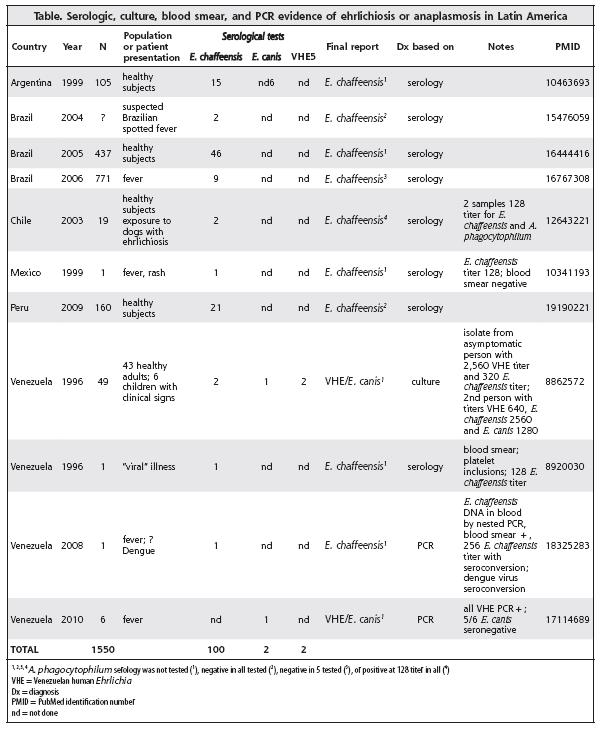
<body><![CDATA[<p style="text-align: justify;" class="MsoNormal"><span  style="font-size: 10pt; font-family: Verdana;" lang="EN-US">Since first recognized and data was collected in the <st1:country-region  w:st="on"><st1:place w:st="on">US</st1:place></st1:country-region>, the CDC has recorded 8,404 cases of HME and 10,181 cases of HGA. In the US, the geographic location for HME and <i>E. ewingii</i> infection largely correspond to areas of <i>A. americanum</i> abundance and to areas of <i>I. scapularis</i> abundance for HGA and EMLA infection.<a href="#11"><sup>11</sup></a> Whereas <i>E. canis</i> and <i>R. sanguineus</i> ticks are widely distributed throughout all of North, South and Central America, human infection has only been recognized among 7 individuals so far, and only in a single location in Lara State, Venezuela.<a  href="#7"><sup>7,8</sup></a> Although <i>A. phagocytophilum</i> has been identified as an infectious agent of dogs, horses, cattle, and wildlife in South America, human infection by this bacterium has not yet been reported either there or in Central America. In a search of PubMed using the phrases &#8220;ehrlichiosis&#8221;, &#8220;anaplasmosis&#8221;, &#8220;chaffeensis&#8221;, &#8220;phagocytophilum&#8221;, and country names in Central and South America, a total of 100 individuals had antibodies reactive with <i>E. chaffeensis, E. canis</i> and/or Venezuelan human <i>Ehrlichia</i> strain (VHE) of <i>E. canis</i> antigens in serologic tests (<a  href="/img/revistas/amc/v55s1/art07t1.jpg">Table 1</a>). In addition, 3 symptomatic persons (2 from Venezuela and 1 from Mexico) had blood smear, seroconversion, or PCR evidence of infection by <i>E. chaffeensis</i>,<sup><a href="#9">9</a>,<a  href="#12">12,13</a></sup> 4 Brazilian patients had clear <i>E. chaffeensis</i> seroconversions,<a href="#14"><sup>14</sup></a> while 6 symptomatic patients had PCR evidence of <i>E. canis</i> infection (although 5 were seronegative),<a href="#8"><sup>8</sup></a> and 1 asymptomatic seropositive individual was the source of a blood isolate similar to <i>E. canis</i>, the Venezuelan Human Ehrlichia (VHE) agent.<a href="#7"><sup>7</sup></a> At least serologic evidence of infection has been detected in Argentina (1 case),<a href="#15"><sup>15</sup></a> Brazil (57 cases),<sup><a href="#14">14</a>,<a href="#16">16,17</a></sup> Chile (2 cases),<a href="#18"><sup>18</sup></a> Mexico (1),<sup>13</sup> Peru (21 cases),<a href="#19"><sup>19</sup></a> and Venezuela (11 cases)<sup><a href="#7">7-9</a>,<a href="#12">12</a></sup> so far.<o:p></o:p></span></p>     <div style="text-align: justify;"></div>     <p style="text-align: justify;" class="MsoNormal"><span  style="font-size: 10pt; font-family: Verdana;" lang="EN-US">The median age of those diagnosed with HME and HGA is 47 to 52 years,<a href="#11"><sup>11</sup></a> and for EMLA infection, 60 years,<a href="#3"><sup>3</sup></a> yet all infection has been reported in all age groups.<a href="#11"><sup>11</sup></a> Men are affected more often than women by a ratio of 1.4:1. Infection is often reported in those with HIV infection, where the course can be fulminant.<a  href="#20"><sup>20</sup></a> Other immune compromising conditions such as cancer, diabetes, arthritis, or organ transplantation are reported in up to 12% of HME patients.<a  href="#11"><sup>11</sup></a> For HGA, increased incidence or severity of infection with HIV infection has not been well documented, and fewer (6.5%) of patients reported pre-existing immune compromising conditions, including asplenia.<a href="#11"><sup>11</sup></a><o:p></o:p></span></p>     <p style="text-align: justify;" class="MsoNormal"><span  style="font-size: 10pt; font-family: Verdana;" lang="EN-US">The clinical features of infection have been best delineated in patients from the <st1:country-region w:st="on"><st1:place  w:st="on">US</st1:place></st1:country-region>. Both are generally characterized as undifferentiated fever, and many have a recent history of tick exposure or tick bite within 10 days.<a  href="#21"><sup>21,22</sup></a> Patients often present with sudden fever (92-100%), headache (62-93%), myalgia (63-90%), malaise (73-98%), and nausea or vomiting (35-59%). Rash is more frequent in HME (median 26%) than in HGA (median 6%) where coinfection with <i>Borrelia burgdorferi </i>and the occurrence of erythema migrans can confound the presentation. Confusion or changes in mental status are reported in 19-22% of HME patients and in 16-17% of HGA patients. The laboratory features especially include thrombocytopenia (61-91%) and leukopenia (44-73%). Increased serum activities of alanine and aspartate aminotransferases, reflective of mild to moderate hepatic lobular inflammation, are frequent in both HME and HGA (69-100%). Both <i>E. ewingii</i> and EMLA infection present similarly, but with less morbidity and no deaths have yet been reported.<a href="#2"><sup>2,3</sup></a> The average age is lower and severity of infection worse for a small group of Brazilian patients with HME.<a href="#14"><sup>14</sup></a><o:p></o:p></span></p>     <div style="text-align: justify;"></div>     <p style="text-align: justify;" class="MsoNormal"><span  style="font-size: 10pt; font-family: Verdana;" lang="EN-US">Nearly 50% of HME and 36% of HGA patients require hospitalization.<a href="#11"><sup>11</sup></a> Complications of infection can occur, including a septic- or toxic-shock syndrome, acute respiratory distress syndrome, acute abdominal syndromes, cardiac failure, renal failure, cranial nerve palsies, brachial plexopathy, demyelinating polyneuropathy, meningoencephalitis (for HME), and opportunistic infections.<a href="#23"><sup>23</sup></a> There is very limited evidence that even with recovery from active infection, patients with HGA do not report feeling entirely well up to one year later.<a href="#24"><sup>24</sup></a><o:p></o:p></span></p>     <div style="text-align: justify;"></div>     <p style="text-align: justify;" class="MsoNormal"><span  style="font-size: 10pt; font-family: Verdana;" lang="EN-US">Diagnosis is suspected with undifferentiated fever or an influenza-like illness after exposures to ticks or reported tick-bites, especially given thrombocytopenia with leukopenia and mild to moderate increases in serum AST or ALT. The diagnosis can be confirmed rapidly by review of a peripheral blood or buffy coat smear stained by Giemsa, Wright or similar Romanowsky methods that demonstrate inclusions (morulae) in monocytes in up to 10% of HME patients, or in neutrophils in up to 75% of HGA patients.<a  href="#25"><sup>25</sup></a> A specific diagnosis can be made by identification of <i>Ehrlichia</i> spp. or <i>Anaplasma</i> DNA in blood, CSF or tissues using methods such as PCR. The most frequent method for diagnosis is the demonstration of a seroconversion or four-fold increase in specific antibody titer, which is highly sensitive when comparing acute and convalescent sera, but has not been rigorously tested for specificity. Diagnostic serological tests usually use indirect immunofluorescent methods, where the sensitivity and specificity are highest for IgG antibodies. A role for IgM testing has not been clearly established.<o:p></o:p></span></p>     <div style="text-align: justify;"></div>     <p style="text-align: justify;" class="MsoNormal"><span  style="font-size: 10pt; font-family: Verdana;" lang="EN-US">All forms of ehrlichiosis and anaplasmosis appear to respond to tetracycline antibiotics, especially doxycycline, although no randomized clinical trials have been conducted. All isolates so far tested are susceptible to these drugs in vitro at easily achieved MICs.<a  href="#26"><sup>26-29</sup></a> Chloramphenicol should not be used owing to lack of in vitro susceptibility and frequent empirical clinical failures. Although <i>A. phagocytophilum</i> is sensitive to fluoroquinolones <i>in vitro</i>, treatment failures with levofloxacin that required subsequent retreatment with doxycycline are reported.<a href="#30"><sup>30</sup></a> Rifampin has low MICs in vitro and has been successfully used in children in empiric studies.<a href="#31"><sup>31,32</sup></a><o:p></o:p></span></p>     ]]></body>
<body><![CDATA[<div style="text-align: justify;"></div>     <p style="text-align: justify;" class="MsoNormal"><span  style="font-size: 10pt; font-family: Verdana;" lang="EN-US">Other forms of human infections by Anaplasmataceae species are reported outside of the <st1:country-region w:st="on"><st1:place  w:st="on">Americas</st1:place></st1:country-region>, but present potential risks to people and animals residing in the western hemisphere. This includes <i>Neoehrlichia mikurensis</i> infection of humans that is reported as ranging from mild febrile illness to a sepsis-like severe infection.<a href="#33"><sup>33-36</sup></a> It is transmitted by <i>Ixodes ricinus</i> ticks in Europe and perhaps by <i>Haemaphysalis ticks</i> in China, and a related species, <i>Neoehrlichia</i> <i>lotoris</i> has been readily found in wild animals in North America.<a href="#37"><sup>37</sup></a> Likewise, <i>Neorickettsia</i> spp. related to the human pathogen, <i>Neorickettsia sennetsu</i>,<a  href="#38"><sup>38</sup></a> are abundantly present in aquatic environments throughout North and South America.<a href="#39"><sup>39</sup></a> Unlike other Anaplasmataceae prokaryotes, <i>Neorickettsia</i> are largely vectored by trematodes that require part of their life cycle to pass through fresh water snail species. The greatest risk to humans so far seems to relate to the consumption of uncooked or raw fish products, although no sushi or sashimi-related outbreaks have been reported.<o:p></o:p></span></p>     <div style="text-align: justify;"></div>     <p style="text-align: justify;" class="MsoNormal"><b><span  style="font-size: 10pt; font-family: Verdana;" lang="EN-US">Acknowledgements:</span></b><span  style="font-size: 10pt; font-family: Verdana;" lang="EN-US"> This work was supported in part by funding from the US National Institutes of Allergy and Infectious Diseases including grants R01 AI044102, R21 AI096062, and grant 011DUM2013 from the Fisher Center Discovery Program at The Johns Hopkins University.<o:p></o:p></span></p>     <div style="text-align: justify;"></div>     <p style="text-align: justify;" class="MsoNormal"><b><span  style="font-size: 10pt; font-family: Verdana;" lang="EN-US">Conflict of interest:</span></b><span  style="font-size: 10pt; font-family: Verdana;" lang="EN-US"> JSD receives royalty payments for patent on the method to grow <i>Anaplasma phagocytophilum</i> to prepare serological reagents.<o:p></o:p></span></p>     <p class="MsoNormal"><b style=""><span  style="font-size: 11pt; font-family: Verdana;" lang="EN-US"></span></b></p> <hr style="width: 100%; height: 2px;"><b style=""><span  style="font-size: 11pt; font-family: Verdana;" lang="EN-US">References<o:p></o:p></span></b>     <!-- ref --><p class="MsoNormal"><span style="font-family: &quot;Arial Unicode MS&quot;;"><a  name="1"></a>&#8201;</span><span  style="font-size: 10pt; font-family: Verdana;" lang="EN-US">1.</span><span  style="font-size: 10pt; font-family: &quot;Arial Unicode MS&quot;;">&#8194;</span><span  style="font-size: 10pt; font-family: Verdana;" lang="EN-US">Anderson BE, Dawson JE, Jones DC, Wilson KH. <i>Ehrlichia chaffeensis</i>, a new species associated with human ehrlichiosis. J Clin Microbiol 1991;29: 2838-42.    &nbsp;&nbsp;&nbsp;&nbsp;&nbsp;&nbsp;&nbsp;&nbsp;[&#160;<a href="javascript:void(0);" onclick="javascript: window.open('/scielo.php?script=sci_nlinks&ref=066019&pid=S0001-6002201300040000700001&lng=','','width=640,height=500,resizable=yes,scrollbars=1,menubar=yes,');">Links</a>&#160;]<!-- end-ref --><o:p></o:p></span></p>     <!-- ref --><p class="MsoNormal"><span  style="font-size: 10pt; font-family: &quot;Arial Unicode MS&quot;;" lang="EN-US"><a  name="2"></a>&#8201;</span><span  style="font-size: 10pt; font-family: Verdana;" lang="EN-US">2.</span><span  style="font-size: 10pt; font-family: &quot;Arial Unicode MS&quot;;">&#8194;</span><span  style="font-size: 10pt; font-family: Verdana;" lang="EN-US">Buller RS, Arens M, Hmiel SP, Paddock CD, Sumner JW, Rikihisa Y, <i>et al</i>. <i>Ehrlichia ewingii</i>, a newly recognized agent of human ehrlichiosis. N Engl J Med 1999; 341:148-55.    &nbsp;&nbsp;&nbsp;&nbsp;&nbsp;&nbsp;&nbsp;&nbsp;[&#160;<a href="javascript:void(0);" onclick="javascript: window.open('/scielo.php?script=sci_nlinks&ref=066021&pid=S0001-6002201300040000700002&lng=','','width=640,height=500,resizable=yes,scrollbars=1,menubar=yes,');">Links</a>&#160;]<!-- end-ref --><o:p></o:p></span></p>     <!-- ref --><p class="MsoNormal"><span  style="font-size: 10pt; font-family: &quot;Arial Unicode MS&quot;;" lang="EN-US"><a  name="3"></a>&#8201;</span><span  style="font-size: 10pt; font-family: Verdana;" lang="EN-US">3.</span><span  style="font-size: 10pt; font-family: &quot;Arial Unicode MS&quot;;">&#8194;</span><span  style="font-size: 10pt; font-family: Verdana;" lang="EN-US">Pritt BS, Sloan LM, Johnson DK, Munderloh UG, Paskewitz SM, McElroy, <i>et al</i>. Emergence of a new pathogenic <i>Ehrlichia </i>species, Wisconsin and Minnesota, 2009. N Engl J Med 2011; 365:422-429.    &nbsp;&nbsp;&nbsp;&nbsp;&nbsp;&nbsp;&nbsp;&nbsp;[&#160;<a href="javascript:void(0);" onclick="javascript: window.open('/scielo.php?script=sci_nlinks&ref=066023&pid=S0001-6002201300040000700003&lng=','','width=640,height=500,resizable=yes,scrollbars=1,menubar=yes,');">Links</a>&#160;]<!-- end-ref --><o:p></o:p></span></p>     <!-- ref --><p class="MsoNormal"><span  style="font-size: 10pt; font-family: &quot;Arial Unicode MS&quot;;" lang="EN-US"><a  name="4"></a>&#8201;</span><span  style="font-size: 10pt; font-family: Verdana;" lang="EN-US">4.</span><span  style="font-size: 10pt; font-family: &quot;Arial Unicode MS&quot;;">&#8194;</span><span  style="font-size: 10pt; font-family: Verdana;" lang="EN-US">Reeves WK, Loftis AD, Nicholson WL, Czarkowski AG. The first report of human illness associated with the <st1:place  w:st="on"><st1:placename w:st="on">Panola</st1:placename> <st1:placetype  w:st="on">Mountain</st1:placetype></st1:place> <i>Ehrlichia </i>species: a case report. J Med Case Reports 2008; 2:139.    &nbsp;&nbsp;&nbsp;&nbsp;&nbsp;&nbsp;&nbsp;&nbsp;[&#160;<a href="javascript:void(0);" onclick="javascript: window.open('/scielo.php?script=sci_nlinks&ref=066025&pid=S0001-6002201300040000700004&lng=','','width=640,height=500,resizable=yes,scrollbars=1,menubar=yes,');">Links</a>&#160;]<!-- end-ref --><o:p></o:p></span></p>     <!-- ref --><p class="MsoNormal"><span  style="font-size: 10pt; font-family: &quot;Arial Unicode MS&quot;;" lang="EN-US"><a  name="5"></a>&#8201;</span><span  style="font-size: 10pt; font-family: Verdana;" lang="EN-US">5.</span><span  style="font-size: 10pt; font-family: &quot;Arial Unicode MS&quot;;">&#8194;</span><span  style="font-size: 10pt; font-family: Verdana;" lang="EN-US">Bakken JS, Dumler JS, Chen SM, Eckman MR, Van Etta LL, <st1:city w:st="on"><st1:place w:st="on">Walker</st1:place></st1:city> DH. Human granulocytic ehrlichiosis in the upper Midwest <st1:country-region  w:st="on"><st1:place w:st="on">United States</st1:place></st1:country-region>. A new species emerging? JAMA 1994; 272:212-218.    &nbsp;&nbsp;&nbsp;&nbsp;&nbsp;&nbsp;&nbsp;&nbsp;[&#160;<a href="javascript:void(0);" onclick="javascript: window.open('/scielo.php?script=sci_nlinks&ref=066027&pid=S0001-6002201300040000700005&lng=','','width=640,height=500,resizable=yes,scrollbars=1,menubar=yes,');">Links</a>&#160;]<!-- end-ref --><o:p></o:p></span></p>     <!-- ref --><p class="MsoNormal"><span  style="font-size: 10pt; font-family: &quot;Arial Unicode MS&quot;;" lang="EN-US"><a  name="6"></a>&#8201;</span><span  style="font-size: 10pt; font-family: Verdana;" lang="EN-US">6.</span><span  style="font-size: 10pt; font-family: &quot;Arial Unicode MS&quot;;">&#8194;</span><span  style="font-size: 10pt; font-family: Verdana;" lang="EN-US">Chen SM, Dumler JS, Bakken JS, <st1:city w:st="on"><st1:place w:st="on">Walker</st1:place></st1:city> DH. Identification of a granulocytotropic <i>Ehrlichia </i>species as the etiologic agent of human disease. J Clin Microbiol 1994; 32:589-595.    &nbsp;&nbsp;&nbsp;&nbsp;&nbsp;&nbsp;&nbsp;&nbsp;[&#160;<a href="javascript:void(0);" onclick="javascript: window.open('/scielo.php?script=sci_nlinks&ref=066029&pid=S0001-6002201300040000700006&lng=','','width=640,height=500,resizable=yes,scrollbars=1,menubar=yes,');">Links</a>&#160;]<!-- end-ref --><o:p></o:p></span></p>     <!-- ref --><p class="MsoNormal"><span  style="font-size: 10pt; font-family: &quot;Arial Unicode MS&quot;;" lang="EN-US"><a  name="7"></a>&#8201;</span><span  style="font-size: 10pt; font-family: Verdana;" lang="EN-US">7.</span><span  style="font-size: 10pt; font-family: &quot;Arial Unicode MS&quot;;">&#8194;</span><span  style="font-size: 10pt; font-family: Verdana;" lang="EN-US">Perez M, Rikihisa Y, Wen B. <i>Ehrlichia canis</i>-like agent isolated from a man in Venezuela: antigenic and genetic characterization. J Clin Microbiol 1996; 34:2133-139.    &nbsp;&nbsp;&nbsp;&nbsp;&nbsp;&nbsp;&nbsp;&nbsp;[&#160;<a href="javascript:void(0);" onclick="javascript: window.open('/scielo.php?script=sci_nlinks&ref=066031&pid=S0001-6002201300040000700007&lng=','','width=640,height=500,resizable=yes,scrollbars=1,menubar=yes,');">Links</a>&#160;]<!-- end-ref --><o:p></o:p></span></p>     <!-- ref --><p class="MsoNormal"><span  style="font-size: 10pt; font-family: &quot;Arial Unicode MS&quot;;" lang="EN-US"><a  name="8"></a>&#8201;</span><span  style="font-size: 10pt; font-family: Verdana;" lang="EN-US">8.</span><span  style="font-size: 10pt; font-family: &quot;Arial Unicode MS&quot;;">&#8194;</span><span  style="font-size: 10pt; font-family: Verdana;" lang="EN-US">Perez M, Bodor M, Zhang C, Xiong Q, Rikihisa Y. Human infection with <i>Ehrlichia canis</i> accompanied by clinical signs in Venezuela. Ann N Y Acad Sci 2006; 1078:110-117.    &nbsp;&nbsp;&nbsp;&nbsp;&nbsp;&nbsp;&nbsp;&nbsp;[&#160;<a href="javascript:void(0);" onclick="javascript: window.open('/scielo.php?script=sci_nlinks&ref=066033&pid=S0001-6002201300040000700008&lng=','','width=640,height=500,resizable=yes,scrollbars=1,menubar=yes,');">Links</a>&#160;]<!-- end-ref --><o:p></o:p></span></p>     <!-- ref --><p class="MsoNormal"><span  style="font-size: 10pt; font-family: &quot;Arial Unicode MS&quot;;" lang="EN-US"><a  name="9"></a>&#8201;</span><span  style="font-size: 10pt; font-family: Verdana;" lang="EN-US">9.</span><span  style="font-size: 10pt; font-family: &quot;Arial Unicode MS&quot;;">&#8194;</span><span  style="font-size: 10pt; font-family: Verdana;" lang="EN-US">Mart&#237;nez MC, Guti&#233;rrez CN, Monger F, Ruiz J, Watts A, Mijares VM, <i>et al</i>. <i>Ehrlichia chaffeensis</i> in child, <st1:country-region w:st="on"><st1:place w:st="on">Venezuela</st1:place></st1:country-region>. Emerg Infect Dis 2008; 14:519-520.    &nbsp;&nbsp;&nbsp;&nbsp;&nbsp;&nbsp;&nbsp;&nbsp;[&#160;<a href="javascript:void(0);" onclick="javascript: window.open('/scielo.php?script=sci_nlinks&ref=066035&pid=S0001-6002201300040000700009&lng=','','width=640,height=500,resizable=yes,scrollbars=1,menubar=yes,');">Links</a>&#160;]<!-- end-ref --><o:p></o:p></span></p>     <!-- ref --><p class="MsoNormal"><span  style="font-size: 10pt; font-family: &quot;Arial Unicode MS&quot;;" lang="EN-US"><a  name="10"></a>&#8201;</span><span  style="font-size: 10pt; font-family: Verdana;" lang="EN-US">10.</span><span  style="font-size: 10pt; font-family: &quot;Arial Unicode MS&quot;;">&#8194;</span><span  style="font-size: 10pt; font-family: Verdana;" lang="EN-US">Unver A, Perez M, Orellana N, Huang H, Rikihisa Y. Molecular and antigenic comparison of <i>Ehrlichia canis</i> isolates from dogs, ticks, and a human in <st1:country-region w:st="on"><st1:place  w:st="on">Venezuela</st1:place></st1:country-region>. J Clin Microbiol 2001; 39:2788-2793.    &nbsp;&nbsp;&nbsp;&nbsp;&nbsp;&nbsp;&nbsp;&nbsp;[&#160;<a href="javascript:void(0);" onclick="javascript: window.open('/scielo.php?script=sci_nlinks&ref=066037&pid=S0001-6002201300040000700010&lng=','','width=640,height=500,resizable=yes,scrollbars=1,menubar=yes,');">Links</a>&#160;]<!-- end-ref --><o:p></o:p></span></p>     <!-- ref --><p class="MsoNormal"><span  style="font-size: 10pt; font-family: &quot;Arial Unicode MS&quot;;" lang="EN-US"><a  name="11"></a>&#8201;</span><span  style="font-size: 10pt; font-family: Verdana;" lang="EN-US">11.</span><span  style="font-size: 10pt; font-family: &quot;Arial Unicode MS&quot;;">&#8194;</span><span  style="font-size: 10pt; font-family: Verdana;" lang="EN-US">Dahlgren FS, Mandel EJ, Krebs JW, Massung RF, McQuiston JH. Increasing incidence of <i>Ehrlichia chaffeensis</i> and <i>Anaplasma phagocytophilum</i> in the United States, 2000-2007. Am J Trop Med Hyg 2011; 85:124-131.    &nbsp;&nbsp;&nbsp;&nbsp;&nbsp;&nbsp;&nbsp;&nbsp;[&#160;<a href="javascript:void(0);" onclick="javascript: window.open('/scielo.php?script=sci_nlinks&ref=066039&pid=S0001-6002201300040000700011&lng=','','width=640,height=500,resizable=yes,scrollbars=1,menubar=yes,');">Links</a>&#160;]<!-- end-ref --><o:p></o:p></span></p>     <!-- ref --><p class="MsoNormal"><span  style="font-size: 10pt; font-family: &quot;Arial Unicode MS&quot;;" lang="EN-US"><a  name="12"></a>&#8201;</span><span  style="font-size: 10pt; font-family: Verdana;" lang="EN-US">12.</span><span  style="font-size: 10pt; font-family: &quot;Arial Unicode MS&quot;;">&#8194;</span><span  style="font-size: 10pt; font-family: Verdana;" lang="EN-US">Arraga-Alvarado C, Montero-Ojeda M, Bernardoni A, Anderson BE, Parra O. [Human ehrlichiosis: report of the 1st case in Venezuela]. Invest Clin 1996; 37:35-49.    &nbsp;&nbsp;&nbsp;&nbsp;&nbsp;&nbsp;&nbsp;&nbsp;[&#160;<a href="javascript:void(0);" onclick="javascript: window.open('/scielo.php?script=sci_nlinks&ref=066041&pid=S0001-6002201300040000700012&lng=','','width=640,height=500,resizable=yes,scrollbars=1,menubar=yes,');">Links</a>&#160;]<!-- end-ref --><o:p></o:p></span></p>     <!-- ref --><p class="MsoNormal"><span  style="font-size: 10pt; font-family: &quot;Arial Unicode MS&quot;;" lang="EN-US"><a  name="13"></a>&#8201;</span><span  style="font-size: 10pt; font-family: Verdana;" lang="EN-US">13.</span><span  style="font-size: 10pt; font-family: &quot;Arial Unicode MS&quot;;">&#8194;</span><span  style="font-size: 10pt; font-family: Verdana;" lang="EN-US">Gongora-Biachi RA, Zavala-Velazquez J, Castro-Sansores CJ, Gonzalez-Martinez P. First case of human ehrlichiosis in <st1:country-region w:st="on"><st1:place w:st="on">Mexico</st1:place></st1:country-region>. </span><span style="font-size: 10pt; font-family: Verdana;" lang="PT-BR">Emerg Infect Dis 1999; 5:481.    &nbsp;&nbsp;&nbsp;&nbsp;&nbsp;&nbsp;&nbsp;&nbsp;[&#160;<a href="javascript:void(0);" onclick="javascript: window.open('/scielo.php?script=sci_nlinks&ref=066043&pid=S0001-6002201300040000700013&lng=','','width=640,height=500,resizable=yes,scrollbars=1,menubar=yes,');">Links</a>&#160;]<!-- end-ref --><o:p></o:p></span></p>     <!-- ref --><p class="MsoNormal"><span  style="font-size: 10pt; font-family: &quot;Arial Unicode MS&quot;;" lang="PT-BR">&#8201;</span><span  style="font-size: 10pt; font-family: Verdana;" lang="PT-BR"><a  name="14"></a>14.</span><span  style="font-size: 10pt; font-family: &quot;Arial Unicode MS&quot;;">&#8194;</span><span  style="font-size: 10pt; font-family: Verdana;" lang="PT-BR">da Costa PS, Valle LM, Brigatte ME, Greco DB. </span><span  style="font-size: 10pt; font-family: Verdana;" lang="EN-US">More about human monocytotropic ehrlichiosis in <st1:country-region  w:st="on"><st1:place w:st="on">Brazil</st1:place></st1:country-region>: serological evidence of nine new cases. Braz J Infect Dis 2006;10:7-10.    &nbsp;&nbsp;&nbsp;&nbsp;&nbsp;&nbsp;&nbsp;&nbsp;[&#160;<a href="javascript:void(0);" onclick="javascript: window.open('/scielo.php?script=sci_nlinks&ref=066045&pid=S0001-6002201300040000700014&lng=','','width=640,height=500,resizable=yes,scrollbars=1,menubar=yes,');">Links</a>&#160;]<!-- end-ref --><o:p></o:p></span></p>     <!-- ref --><p class="MsoNormal"><span  style="font-size: 10pt; font-family: &quot;Arial Unicode MS&quot;;" lang="EN-US"><a  name="15"></a>&#8201;</span><span  style="font-size: 10pt; font-family: Verdana;" lang="EN-US">15.</span><span  style="font-size: 10pt; font-family: &quot;Arial Unicode MS&quot;;">&#8194;</span><span  style="font-size: 10pt; font-family: Verdana;" lang="EN-US">Ripoll CM, Remondegui CE, Ordonez G, Arazamendi R, Fusaro H, Hyman MJ, <i>et al</i>. Evidence of rickettsial spotted fever and ehrlichial infections in a subtropical <st1:placetype w:st="on">territory</st1:placetype> of <st1:placename w:st="on">Jujuy</st1:placename>, <st1:country-region  w:st="on"><st1:place w:st="on">Argentina</st1:place></st1:country-region>. Am J Trop Med Hyg 1999; 61:350-354.    &nbsp;&nbsp;&nbsp;&nbsp;&nbsp;&nbsp;&nbsp;&nbsp;[&#160;<a href="javascript:void(0);" onclick="javascript: window.open('/scielo.php?script=sci_nlinks&ref=066047&pid=S0001-6002201300040000700015&lng=','','width=640,height=500,resizable=yes,scrollbars=1,menubar=yes,');">Links</a>&#160;]<!-- end-ref --><o:p></o:p></span></p>     <!-- ref --><p class="MsoNormal"><span  style="font-size: 10pt; font-family: &quot;Arial Unicode MS&quot;;" lang="EN-US"><a  name="16"></a>&#8201;</span><span  style="font-size: 10pt; font-family: Verdana;" lang="EN-US">16.</span><span  style="font-size: 10pt; font-family: &quot;Arial Unicode MS&quot;;">&#8194;</span><span  style="font-size: 10pt; font-family: Verdana;" lang="EN-US">Calic SB, Galv&#227;o MA, Bacellar F, Rocha CM, Mafra CL, Leite RC, <i>et al</i>. Human ehrlichioses in <st1:country-region  w:st="on"><st1:place w:st="on">Brazil</st1:place></st1:country-region>: first suspect cases. </span><span  style="font-size: 10pt; font-family: Verdana;" lang="PT-BR">Braz J Infect Dis 2004; 8:259-262.    &nbsp;&nbsp;&nbsp;&nbsp;&nbsp;&nbsp;&nbsp;&nbsp;[&#160;<a href="javascript:void(0);" onclick="javascript: window.open('/scielo.php?script=sci_nlinks&ref=066049&pid=S0001-6002201300040000700016&lng=','','width=640,height=500,resizable=yes,scrollbars=1,menubar=yes,');">Links</a>&#160;]<!-- end-ref --><o:p></o:p></span></p>     <!-- ref --><p class="MsoNormal"><span  style="font-size: 10pt; font-family: &quot;Arial Unicode MS&quot;;" lang="PT-BR"><a  name="17"></a>&#8201;</span><span  style="font-size: 10pt; font-family: Verdana;" lang="PT-BR">17.</span><span  style="font-size: 10pt; font-family: &quot;Arial Unicode MS&quot;;">&#8194;</span><span  style="font-size: 10pt; font-family: Verdana;" lang="PT-BR">da Costa PS, Brigatte ME, Greco DB. </span><span  style="font-size: 10pt; font-family: Verdana;" lang="EN-US">Antibodies to <i>Rickettsia rickettsii, Rickettsia typhi, Coxiella burnetii, Bartonella henselae, Bartonella quintana</i>, and <i>Ehrlichia chaffeensis</i> among healthy population in Minas Gerais, <st1:country-region w:st="on"><st1:place  w:st="on">Brazil</st1:place></st1:country-region>. Mem Inst Oswaldo Cruz 2005; 100:853-859.    &nbsp;&nbsp;&nbsp;&nbsp;&nbsp;&nbsp;&nbsp;&nbsp;[&#160;<a href="javascript:void(0);" onclick="javascript: window.open('/scielo.php?script=sci_nlinks&ref=066051&pid=S0001-6002201300040000700017&lng=','','width=640,height=500,resizable=yes,scrollbars=1,menubar=yes,');">Links</a>&#160;]<!-- end-ref --><o:p></o:p></span></p>     <!-- ref --><p class="MsoNormal"><span  style="font-size: 10pt; font-family: &quot;Arial Unicode MS&quot;;" lang="EN-US"><a  name="18"></a>&#8201;</span><span  style="font-size: 10pt; font-family: Verdana;" lang="EN-US">18.</span><span  style="font-size: 10pt; font-family: &quot;Arial Unicode MS&quot;;">&#8194;</span><span  style="font-size: 10pt; font-family: Verdana;" lang="EN-US">Lopez J, Rivera M, Concha JC, Gatica S, Loeffeholz M, Barriga O. [Serologic evidence for human Ehrlichiosis in Chile]. Rev Med Chil 2003; 131:67-70.    &nbsp;&nbsp;&nbsp;&nbsp;&nbsp;&nbsp;&nbsp;&nbsp;[&#160;<a href="javascript:void(0);" onclick="javascript: window.open('/scielo.php?script=sci_nlinks&ref=066053&pid=S0001-6002201300040000700018&lng=','','width=640,height=500,resizable=yes,scrollbars=1,menubar=yes,');">Links</a>&#160;]<!-- end-ref --><o:p></o:p></span></p>     <!-- ref --><p class="MsoNormal"><span  style="font-size: 10pt; font-family: &quot;Arial Unicode MS&quot;;" lang="EN-US"><a  name="19"></a>&#8201;</span><st1:street w:st="on"><st1:address w:st="on"><span  style="font-size: 10pt; font-family: Verdana;" lang="EN-US">19.</span><span  style="font-size: 10pt; font-family: &quot;Arial Unicode MS&quot;;">&#8194;</span><span  style="font-size: 10pt; font-family: Verdana;" lang="EN-US">Moro PL</span></st1:address></st1:street><span  style="font-size: 10pt; font-family: Verdana;" lang="EN-US">, Shah J, Li O, Gilman RH, Harris N, Moro MH. Short report: serologic evidence of human ehrlichiosis in <st1:country-region w:st="on"><st1:place  w:st="on">Peru</st1:place></st1:country-region>. Am J Trop Med Hyg 2009; 80:242-244.    &nbsp;&nbsp;&nbsp;&nbsp;&nbsp;&nbsp;&nbsp;&nbsp;[&#160;<a href="javascript:void(0);" onclick="javascript: window.open('/scielo.php?script=sci_nlinks&ref=066055&pid=S0001-6002201300040000700019&lng=','','width=640,height=500,resizable=yes,scrollbars=1,menubar=yes,');">Links</a>&#160;]<!-- end-ref --><o:p></o:p></span></p>     <!-- ref --><p class="MsoNormal"><span  style="font-size: 10pt; font-family: &quot;Arial Unicode MS&quot;;" lang="EN-US"><a  name="20"></a>&#8201;</span><span  style="font-size: 10pt; font-family: Verdana;" lang="EN-US">20.</span><span  style="font-size: 10pt; font-family: &quot;Arial Unicode MS&quot;;">&#8194;</span><span  style="font-size: 10pt; font-family: Verdana;" lang="EN-US">Paddock CD, Folk SM, Shore GM, Machado LJ, Huycke MM, <st1:street w:st="on"><st1:address w:st="on">Slater LN</st1:address></st1:street>, <i>et al</i>. Infections with <i>Ehrlichia chaffeensis </i>and <i>Ehrlichia ewingii</i> in persons coinfected with human immunodeficiency virus. Clin Infect Dis 2001; 33:1586-1594.    &nbsp;&nbsp;&nbsp;&nbsp;&nbsp;&nbsp;&nbsp;&nbsp;[&#160;<a href="javascript:void(0);" onclick="javascript: window.open('/scielo.php?script=sci_nlinks&ref=066057&pid=S0001-6002201300040000700020&lng=','','width=640,height=500,resizable=yes,scrollbars=1,menubar=yes,');">Links</a>&#160;]<!-- end-ref --><o:p></o:p></span></p>     <!-- ref --><p class="MsoNormal"><span  style="font-size: 10pt; font-family: &quot;Arial Unicode MS&quot;;" lang="EN-US"><a  name="21"></a>&#8201;</span><span  style="font-size: 10pt; font-family: Verdana;" lang="EN-US">21.</span><span  style="font-size: 10pt; font-family: &quot;Arial Unicode MS&quot;;">&#8194;</span><span  style="font-size: 10pt; font-family: Verdana;" lang="EN-US">Bakken JS, Dumler S. Human granulocytic anaplasmosis. Infectious disease clinics of North America 2008; 22:433-448.    &nbsp;&nbsp;&nbsp;&nbsp;&nbsp;&nbsp;&nbsp;&nbsp;[&#160;<a href="javascript:void(0);" onclick="javascript: window.open('/scielo.php?script=sci_nlinks&ref=066059&pid=S0001-6002201300040000700021&lng=','','width=640,height=500,resizable=yes,scrollbars=1,menubar=yes,');">Links</a>&#160;]<!-- end-ref --><o:p></o:p></span></p>     <!-- ref --><p class="MsoNormal"><span  style="font-size: 10pt; font-family: &quot;Arial Unicode MS&quot;;" lang="EN-US"><a  name="22"></a>&#8201;</span><span  style="font-size: 10pt; font-family: Verdana;" lang="EN-US">22.</span><span  style="font-size: 10pt; font-family: &quot;Arial Unicode MS&quot;;">&#8194;</span><st1:city  w:st="on"><st1:place w:st="on"><span  style="font-size: 10pt; font-family: Verdana;" lang="EN-US">Walker</span></st1:place></st1:city><span  style="font-size: 10pt; font-family: Verdana;" lang="EN-US"> DH, Paddock CD, Dumler JS. Emerging and re-emerging tick-transmitted rickettsial and ehrlichial infections. Med Clin North Am 2008; 92:1345-1361.    &nbsp;&nbsp;&nbsp;&nbsp;&nbsp;&nbsp;&nbsp;&nbsp;[&#160;<a href="javascript:void(0);" onclick="javascript: window.open('/scielo.php?script=sci_nlinks&ref=066061&pid=S0001-6002201300040000700022&lng=','','width=640,height=500,resizable=yes,scrollbars=1,menubar=yes,');">Links</a>&#160;]<!-- end-ref --><o:p></o:p></span></p>     <!-- ref --><p class="MsoNormal"><span  style="font-size: 10pt; font-family: &quot;Arial Unicode MS&quot;;" lang="EN-US"><a  name="23"></a>&#8201;</span><span  style="font-size: 10pt; font-family: Verdana;" lang="EN-US">23.</span><span  style="font-size: 10pt; font-family: &quot;Arial Unicode MS&quot;;">&#8194;</span><span  style="font-size: 10pt; font-family: Verdana;" lang="EN-US">Dumler JS, Madigan JE, Pusterla N, Bakken JS. Ehrlichioses in humans: epidemiology, clinical presentation, diagnosis, and treatment. Clin Infect Dis 2007; 45 Suppl 1:S45-51.    &nbsp;&nbsp;&nbsp;&nbsp;&nbsp;&nbsp;&nbsp;&nbsp;[&#160;<a href="javascript:void(0);" onclick="javascript: window.open('/scielo.php?script=sci_nlinks&ref=066063&pid=S0001-6002201300040000700023&lng=','','width=640,height=500,resizable=yes,scrollbars=1,menubar=yes,');">Links</a>&#160;]<!-- end-ref --><o:p></o:p></span></p>     <!-- ref --><p class="MsoNormal"><span  style="font-size: 10pt; font-family: &quot;Arial Unicode MS&quot;;" lang="EN-US"><a  name="24"></a>&#8201;</span><span  style="font-size: 10pt; font-family: Verdana;" lang="EN-US">24.</span><span  style="font-size: 10pt; font-family: &quot;Arial Unicode MS&quot;;">&#8194;</span><span  style="font-size: 10pt; font-family: Verdana;" lang="EN-US">Ramsey AH, Belongia EA, Gale CM, <st1:city w:st="on"><st1:place w:st="on">Davis</st1:place></st1:city> JP. Outcomes of treated human granulocytic ehrlichiosis cases. Emerg Infect Dis 2002; 8:398-401.    &nbsp;&nbsp;&nbsp;&nbsp;&nbsp;&nbsp;&nbsp;&nbsp;[&#160;<a href="javascript:void(0);" onclick="javascript: window.open('/scielo.php?script=sci_nlinks&ref=066065&pid=S0001-6002201300040000700024&lng=','','width=640,height=500,resizable=yes,scrollbars=1,menubar=yes,');">Links</a>&#160;]<!-- end-ref --><o:p></o:p></span></p>     <!-- ref --><p class="MsoNormal"><span  style="font-size: 10pt; font-family: &quot;Arial Unicode MS&quot;;" lang="EN-US"><a  name="25"></a>&#8201;</span><span  style="font-size: 10pt; font-family: Verdana;" lang="EN-US">25.</span><span  style="font-size: 10pt; font-family: &quot;Arial Unicode MS&quot;;">&#8194;</span><span  style="font-size: 10pt; font-family: Verdana;" lang="EN-US">Thomas RJ, Dumler JS, Carlyon JA. Current management of human granulocytic anaplasmosis, human monocytic ehrlichiosis and <i>Ehrlichia ewingii</i> ehrlichiosis. Expert Rev Anti Infect Ther 2009; 7:709-722.    &nbsp;&nbsp;&nbsp;&nbsp;&nbsp;&nbsp;&nbsp;&nbsp;[&#160;<a href="javascript:void(0);" onclick="javascript: window.open('/scielo.php?script=sci_nlinks&ref=066067&pid=S0001-6002201300040000700025&lng=','','width=640,height=500,resizable=yes,scrollbars=1,menubar=yes,');">Links</a>&#160;]<!-- end-ref --><o:p></o:p></span></p>     <!-- ref --><p class="MsoNormal"><span  style="font-size: 10pt; font-family: &quot;Arial Unicode MS&quot;;" lang="EN-US"><a  name="26"></a>&#8201;</span><span  style="font-size: 10pt; font-family: Verdana;" lang="EN-US">26.</span><span  style="font-size: 10pt; font-family: &quot;Arial Unicode MS&quot;;">&#8194;</span><span  style="font-size: 10pt; font-family: Verdana;" lang="EN-US">Brouqui P, Raoult D. In vitro antibiotic susceptibility of the newly recognized agent of ehrlichiosis in humans, <i>Ehrlichia chaffeensis</i>. Antimicrob Agents Chemother 1992; 36:2799-2803.    &nbsp;&nbsp;&nbsp;&nbsp;&nbsp;&nbsp;&nbsp;&nbsp;[&#160;<a href="javascript:void(0);" onclick="javascript: window.open('/scielo.php?script=sci_nlinks&ref=066069&pid=S0001-6002201300040000700026&lng=','','width=640,height=500,resizable=yes,scrollbars=1,menubar=yes,');">Links</a>&#160;]<!-- end-ref --><o:p></o:p></span></p>     <!-- ref --><p class="MsoNormal"><span  style="font-size: 10pt; font-family: &quot;Arial Unicode MS&quot;;" lang="EN-US"><a  name="27"></a>&#8201;</span><span  style="font-size: 10pt; font-family: Verdana;" lang="EN-US">27.</span><span  style="font-size: 10pt; font-family: &quot;Arial Unicode MS&quot;;">&#8194;</span><span  style="font-size: 10pt; font-family: Verdana;" lang="EN-US">Branger S, Rolain JM, Raoult D. Evaluation of antibiotic susceptibilities of <i>Ehrlichia canis</i>, <i>Ehrlichia chaffeensis</i>, and <i>Anaplasma phagocytophilum</i> by real-time PCR. Antimicrob Agents Chemother 2004; 48:4822-4828.    &nbsp;&nbsp;&nbsp;&nbsp;&nbsp;&nbsp;&nbsp;&nbsp;[&#160;<a href="javascript:void(0);" onclick="javascript: window.open('/scielo.php?script=sci_nlinks&ref=066071&pid=S0001-6002201300040000700027&lng=','','width=640,height=500,resizable=yes,scrollbars=1,menubar=yes,');">Links</a>&#160;]<!-- end-ref --><o:p></o:p></span></p>     <!-- ref --><p class="MsoNormal"><span  style="font-size: 10pt; font-family: &quot;Arial Unicode MS&quot;;" lang="EN-US"><a  name="28"></a>&#8201;</span><span  style="font-size: 10pt; font-family: Verdana;" lang="EN-US">28.</span><span  style="font-size: 10pt; font-family: &quot;Arial Unicode MS&quot;;">&#8194;</span><span  style="font-size: 10pt; font-family: Verdana;" lang="EN-US">Maurin M, Bakken JS, Dumler JS. Antibiotic susceptibilities of <i>Anaplasma</i> (<i>Ehrlichia</i>)<i> phagocytophilum</i> strains from various geographic areas in the United States. Antimicrobial agents and chemotherapy 2003; 47:413-415.    &nbsp;&nbsp;&nbsp;&nbsp;&nbsp;&nbsp;&nbsp;&nbsp;[&#160;<a href="javascript:void(0);" onclick="javascript: window.open('/scielo.php?script=sci_nlinks&ref=066073&pid=S0001-6002201300040000700028&lng=','','width=640,height=500,resizable=yes,scrollbars=1,menubar=yes,');">Links</a>&#160;]<!-- end-ref --><o:p></o:p></span></p>     <!-- ref --><p class="MsoNormal"><span  style="font-size: 10pt; font-family: &quot;Arial Unicode MS&quot;;" lang="EN-US"><a  name="29"></a>&#8201;</span><span  style="font-size: 10pt; font-family: Verdana;" lang="EN-US">29.</span><span  style="font-size: 10pt; font-family: &quot;Arial Unicode MS&quot;;">&#8194;</span><span  style="font-size: 10pt; font-family: Verdana;" lang="EN-US">Horowitz HW, Hsieh TC, Aguero-Rosenfeld ME, Kalantarpour F, Chowdhury I, Wormser GP, <i>et al</i>. Antimicrobial susceptibility of <i>Ehrlichia phagocytophila</i>. Antimicrobial agents and chemotherapy 2001; 45:786-788.    &nbsp;&nbsp;&nbsp;&nbsp;&nbsp;&nbsp;&nbsp;&nbsp;[&#160;<a href="javascript:void(0);" onclick="javascript: window.open('/scielo.php?script=sci_nlinks&ref=066075&pid=S0001-6002201300040000700029&lng=','','width=640,height=500,resizable=yes,scrollbars=1,menubar=yes,');">Links</a>&#160;]<!-- end-ref --><o:p></o:p></span></p>     <!-- ref --><p class="MsoNormal"><span  style="font-size: 10pt; font-family: &quot;Arial Unicode MS&quot;;" lang="EN-US"><a  name="30"></a>&#8201;</span><span  style="font-size: 10pt; font-family: Verdana;" lang="EN-US">30.</span><span  style="font-size: 10pt; font-family: &quot;Arial Unicode MS&quot;;">&#8194;</span><span  style="font-size: 10pt; font-family: Verdana;" lang="EN-US">Wormser GP, Filozov A, Telford SR, 3rd, et al. Dissociation between inhibition and killing by levofloxacin in human granulocytic anaplasmosis. Vec Borne Zoon Dis 2006; 6:388-394.    &nbsp;&nbsp;&nbsp;&nbsp;&nbsp;&nbsp;&nbsp;&nbsp;[&#160;<a href="javascript:void(0);" onclick="javascript: window.open('/scielo.php?script=sci_nlinks&ref=066077&pid=S0001-6002201300040000700030&lng=','','width=640,height=500,resizable=yes,scrollbars=1,menubar=yes,');">Links</a>&#160;]<!-- end-ref --><o:p></o:p></span></p>     <!-- ref --><p class="MsoNormal"><span  style="font-size: 10pt; font-family: &quot;Arial Unicode MS&quot;;" lang="EN-US"><a  name="31"></a>&#8201;</span><span  style="font-size: 10pt; font-family: Verdana;" lang="EN-US">31.</span><span  style="font-size: 10pt; font-family: &quot;Arial Unicode MS&quot;;">&#8194;</span><span  style="font-size: 10pt; font-family: Verdana;" lang="EN-US">Dhand A, Nadelman RB, Aguero-Rosenfeld M, Haddad FA, Stokes DP, Horowitz HW. Human granulocytic anaplasmosis during pregnancy: case series and literature review. Clin Infect Dis 2007; 45:589-593.    &nbsp;&nbsp;&nbsp;&nbsp;&nbsp;&nbsp;&nbsp;&nbsp;[&#160;<a href="javascript:void(0);" onclick="javascript: window.open('/scielo.php?script=sci_nlinks&ref=066079&pid=S0001-6002201300040000700031&lng=','','width=640,height=500,resizable=yes,scrollbars=1,menubar=yes,');">Links</a>&#160;]<!-- end-ref --><o:p></o:p></span></p>     <!-- ref --><p class="MsoNormal"><span  style="font-size: 10pt; font-family: &quot;Arial Unicode MS&quot;;" lang="EN-US"><a  name="32"></a>&#8201;</span><span  style="font-size: 10pt; font-family: Verdana;" lang="EN-US">32.</span><span  style="font-size: 10pt; font-family: &quot;Arial Unicode MS&quot;;">&#8194;</span><span  style="font-size: 10pt; font-family: Verdana;" lang="EN-US">Krause PJ, Corrow CL, Bakken JS. Successful treatment of human granulocytic ehrlichiosis in children using rifampin. Pediatrics 2003; 112:e252-253.    &nbsp;&nbsp;&nbsp;&nbsp;&nbsp;&nbsp;&nbsp;&nbsp;[&#160;<a href="javascript:void(0);" onclick="javascript: window.open('/scielo.php?script=sci_nlinks&ref=066081&pid=S0001-6002201300040000700032&lng=','','width=640,height=500,resizable=yes,scrollbars=1,menubar=yes,');">Links</a>&#160;]<!-- end-ref --><o:p></o:p></span></p>     <!-- ref --><p class="MsoNormal"><span  style="font-size: 10pt; font-family: &quot;Arial Unicode MS&quot;;" lang="EN-US"><a  name="33"></a>&#8201;</span><span  style="font-size: 10pt; font-family: Verdana;" lang="EN-US">33.</span><span  style="font-size: 10pt; font-family: &quot;Arial Unicode MS&quot;;">&#8194;</span><span  style="font-size: 10pt; font-family: Verdana;" lang="EN-US">Li H, Jiang JF, Liu W, Zheng YC, Huo QB, Tang K, <i>et al</i>. Human infection with Candidatus <i>Neoehrlichia mikurensis</i>, China. Emerg Infect Dis 2012; 18:1636-1639.    &nbsp;&nbsp;&nbsp;&nbsp;&nbsp;&nbsp;&nbsp;&nbsp;[&#160;<a href="javascript:void(0);" onclick="javascript: window.open('/scielo.php?script=sci_nlinks&ref=066083&pid=S0001-6002201300040000700033&lng=','','width=640,height=500,resizable=yes,scrollbars=1,menubar=yes,');">Links</a>&#160;]<!-- end-ref --><o:p></o:p></span></p>     <!-- ref --><p class="MsoNormal"><span  style="font-size: 10pt; font-family: &quot;Arial Unicode MS&quot;;" lang="EN-US"><a  name="34"></a>&#8201;</span><span  style="font-size: 10pt; font-family: Verdana;" lang="EN-US">34.</span><span  style="font-size: 10pt; font-family: &quot;Arial Unicode MS&quot;;">&#8194;</span><span  style="font-size: 10pt; font-family: Verdana;" lang="EN-US">Fehr JS, Boemberg GV, Ritter C, Hornback M, L&#252;scher TF, Weber R, <i>et al</i>. Septicemia caused by tick-borne bacterial pathogen Candidatus <i>Neoehrlichia mikurensis</i>. Emerg Infect Dis 2010; 16:1127-1129.    &nbsp;&nbsp;&nbsp;&nbsp;&nbsp;&nbsp;&nbsp;&nbsp;[&#160;<a href="javascript:void(0);" onclick="javascript: window.open('/scielo.php?script=sci_nlinks&ref=066085&pid=S0001-6002201300040000700034&lng=','','width=640,height=500,resizable=yes,scrollbars=1,menubar=yes,');">Links</a>&#160;]<!-- end-ref --><o:p></o:p></span></p>     <!-- ref --><p class="MsoNormal"><span  style="font-size: 10pt; font-family: &quot;Arial Unicode MS&quot;;" lang="EN-US"><a  name="35"></a>&#8201;</span><span  style="font-size: 10pt; font-family: Verdana;" lang="EN-US">35.</span><span  style="font-size: 10pt; font-family: &quot;Arial Unicode MS&quot;;">&#8194;</span><span  style="font-size: 10pt; font-family: Verdana;" lang="EN-US">von Loewenich FD, Geissd&#246;rfer W, Disqu&#233; C, Matten J, Schett G, Sakka SG, <i>et al</i>. Detection of &#8220;Candidatus <i>Neoehrlichia mikurensis</i>&#8221; in two patients with severe febrile illnesses: evidence for a European sequence variant. J Clin Microbiol 2010; 48:2630-2635.    &nbsp;&nbsp;&nbsp;&nbsp;&nbsp;&nbsp;&nbsp;&nbsp;[&#160;<a href="javascript:void(0);" onclick="javascript: window.open('/scielo.php?script=sci_nlinks&ref=066087&pid=S0001-6002201300040000700035&lng=','','width=640,height=500,resizable=yes,scrollbars=1,menubar=yes,');">Links</a>&#160;]<!-- end-ref --><o:p></o:p></span></p>     <!-- ref --><p class="MsoNormal"><span  style="font-size: 10pt; font-family: &quot;Arial Unicode MS&quot;;" lang="EN-US">&#8201;</span><span  style="font-size: 10pt; font-family: Verdana;" lang="EN-US"><a  name="36"></a>36.</span><span  style="font-size: 10pt; font-family: &quot;Arial Unicode MS&quot;;">&#8194;</span><span  style="font-size: 10pt; font-family: Verdana;" lang="EN-US">Welinder-Olsson C, Kjellin E, Vaht K, Jacobsson S, Wenneras C. First case of human &#8220;Candidatus <i>Neoehrlichia mikurensis</i>&#8221; infection in a febrile patient with chronic lymphocytic leukemia. J Clin Microbiol 2010; 48:1956-1959.    &nbsp;&nbsp;&nbsp;&nbsp;&nbsp;&nbsp;&nbsp;&nbsp;[&#160;<a href="javascript:void(0);" onclick="javascript: window.open('/scielo.php?script=sci_nlinks&ref=066089&pid=S0001-6002201300040000700036&lng=','','width=640,height=500,resizable=yes,scrollbars=1,menubar=yes,');">Links</a>&#160;]<!-- end-ref --><o:p></o:p></span></p>     <!-- ref --><p class="MsoNormal"><span  style="font-size: 10pt; font-family: &quot;Arial Unicode MS&quot;;" lang="EN-US"><a  name="37"></a>&#8201;</span><span  style="font-size: 10pt; font-family: Verdana;" lang="EN-US">37.</span><span  style="font-size: 10pt; font-family: &quot;Arial Unicode MS&quot;;">&#8194;</span><span  style="font-size: 10pt; font-family: Verdana;" lang="EN-US">Yabsley MJ, Murphy SM, Luttrell MP, Wilcox BR, Howerth EW, Munderloh UG. Characterization of &#8216;Candidatus Neoehrlichia lotoris&#8217; (family Anaplasmataceae) from raccoons (Procyon lotor). </span><span  style="font-size: 10pt; font-family: Verdana;">Int J Syst Evol Microbiol 2008; 58:2794-2798.    &nbsp;&nbsp;&nbsp;&nbsp;&nbsp;&nbsp;&nbsp;&nbsp;[&#160;<a href="javascript:void(0);" onclick="javascript: window.open('/scielo.php?script=sci_nlinks&ref=066091&pid=S0001-6002201300040000700037&lng=','','width=640,height=500,resizable=yes,scrollbars=1,menubar=yes,');">Links</a>&#160;]<!-- end-ref --><o:p></o:p></span></p>     <!-- ref --><p class="MsoNormal"><span  style="font-size: 10pt; font-family: &quot;Arial Unicode MS&quot;;"><a name="38"></a>&#8201;</span><span  style="font-size: 10pt; font-family: Verdana;">38.</span><span  style="font-size: 10pt; font-family: &quot;Arial Unicode MS&quot;;">&#8194;</span><span  style="font-size: 10pt; font-family: Verdana;">Newton PN, Rolain JM, Rasachak B, Mayxay M, Vathanatham K, Seng P, <i>et al</i>. </span><span  style="font-size: 10pt; font-family: Verdana;" lang="EN-US">Sennetsu neorickettsiosis: a probable fish-borne cause of fever rediscovered in Laos. Am J Trop Med Hyg 2009; 81:190-194.    &nbsp;&nbsp;&nbsp;&nbsp;&nbsp;&nbsp;&nbsp;&nbsp;[&#160;<a href="javascript:void(0);" onclick="javascript: window.open('/scielo.php?script=sci_nlinks&ref=066093&pid=S0001-6002201300040000700038&lng=','','width=640,height=500,resizable=yes,scrollbars=1,menubar=yes,');">Links</a>&#160;]<!-- end-ref --><o:p></o:p></span></p>     <!-- ref --><p class="MsoNormal"><span  style="font-size: 10pt; font-family: &quot;Arial Unicode MS&quot;;" lang="EN-US"><a  name="39"></a>&#8201;</span><span  style="font-size: 10pt; font-family: Verdana;" lang="EN-US">39.</span><span  style="font-size: 10pt; font-family: &quot;Arial Unicode MS&quot;;">&#8194;</span><span  style="font-size: 10pt; font-family: Verdana;" lang="EN-US">Tkach VV, Schroeder JA, Greiman SE, <st1:city w:st="on"><st1:place w:st="on">Vaughan</st1:place></st1:city> JA. New genetic lineages, host associations and circulation pathways of <i>Neorickettsia </i>endosymbionts of digeneans. </span><span  style="font-size: 10pt; font-family: Verdana;">Acta Parasitol 2012; 57:285-292.    &nbsp;&nbsp;&nbsp;&nbsp;&nbsp;&nbsp;&nbsp;&nbsp;[&#160;<a href="javascript:void(0);" onclick="javascript: window.open('/scielo.php?script=sci_nlinks&ref=066095&pid=S0001-6002201300040000700039&lng=','','width=640,height=500,resizable=yes,scrollbars=1,menubar=yes,');">Links</a>&#160;]<!-- end-ref --><o:p></o:p></span></p> </div> </div> </div> </div>      ]]></body><back>
<ref-list>
<ref id="B1">
<label>1</label><nlm-citation citation-type="journal">
<person-group person-group-type="author">
<name>
<surname><![CDATA[Anderson]]></surname>
<given-names><![CDATA[BE]]></given-names>
</name>
<name>
<surname><![CDATA[Dawson]]></surname>
<given-names><![CDATA[JE]]></given-names>
</name>
<name>
<surname><![CDATA[Jones]]></surname>
<given-names><![CDATA[DC]]></given-names>
</name>
<name>
<surname><![CDATA[Wilson]]></surname>
<given-names><![CDATA[KH]]></given-names>
</name>
</person-group>
<article-title xml:lang="en"><![CDATA[Ehrlichia chaffeensis, a new species associated with human ehrlichiosis]]></article-title>
<source><![CDATA[J Clin Microbiol]]></source>
<year>1991</year>
<volume>29</volume>
<numero>2838</numero>
<issue>2838</issue>
<page-range>42</page-range></nlm-citation>
</ref>
<ref id="B2">
<label>2</label><nlm-citation citation-type="journal">
<person-group person-group-type="author">
<name>
<surname><![CDATA[Buller]]></surname>
<given-names><![CDATA[RS]]></given-names>
</name>
<name>
<surname><![CDATA[Arens]]></surname>
<given-names><![CDATA[M]]></given-names>
</name>
<name>
<surname><![CDATA[Hmiel]]></surname>
<given-names><![CDATA[SP]]></given-names>
</name>
<name>
<surname><![CDATA[Paddock]]></surname>
<given-names><![CDATA[CD]]></given-names>
</name>
<name>
<surname><![CDATA[Sumner]]></surname>
<given-names><![CDATA[JW]]></given-names>
</name>
<name>
<surname><![CDATA[Rikihisa]]></surname>
<given-names><![CDATA[Y]]></given-names>
</name>
</person-group>
<article-title xml:lang="en"><![CDATA[Ehrlichia ewingii, a newly recognized agent of human ehrlichiosis]]></article-title>
<source><![CDATA[N Engl J Med]]></source>
<year>1999</year>
<volume>341</volume>
<page-range>148-55</page-range></nlm-citation>
</ref>
<ref id="B3">
<label>3</label><nlm-citation citation-type="journal">
<person-group person-group-type="author">
<name>
<surname><![CDATA[Pritt]]></surname>
<given-names><![CDATA[BS]]></given-names>
</name>
<name>
<surname><![CDATA[Sloan]]></surname>
<given-names><![CDATA[LM]]></given-names>
</name>
<name>
<surname><![CDATA[Johnson]]></surname>
<given-names><![CDATA[DK]]></given-names>
</name>
<name>
<surname><![CDATA[Munderloh]]></surname>
<given-names><![CDATA[UG]]></given-names>
</name>
<name>
<surname><![CDATA[Paskewitz]]></surname>
<given-names><![CDATA[SM]]></given-names>
</name>
<name>
<surname><![CDATA[McElroy]]></surname>
</name>
</person-group>
<article-title xml:lang="en"><![CDATA[Emergence of a new pathogenic Ehrlichia species, Wisconsin and Minnesota, 2009]]></article-title>
<source><![CDATA[N Engl J Med]]></source>
<year>2011</year>
<volume>365</volume>
<page-range>422-429</page-range></nlm-citation>
</ref>
<ref id="B4">
<label>4</label><nlm-citation citation-type="journal">
<person-group person-group-type="author">
<name>
<surname><![CDATA[Reeves]]></surname>
<given-names><![CDATA[WK]]></given-names>
</name>
<name>
<surname><![CDATA[Loftis]]></surname>
<given-names><![CDATA[AD]]></given-names>
</name>
<name>
<surname><![CDATA[Nicholson]]></surname>
<given-names><![CDATA[WL]]></given-names>
</name>
<name>
<surname><![CDATA[Czarkowski]]></surname>
<given-names><![CDATA[AG]]></given-names>
</name>
</person-group>
<article-title xml:lang="en"><![CDATA[The first report of human illness associated with the Panola Mountain Ehrlichia species: a case report]]></article-title>
<source><![CDATA[J Med Case Reports]]></source>
<year>2008</year>
<volume>2</volume>
<numero>139</numero>
<issue>139</issue>
</nlm-citation>
</ref>
<ref id="B5">
<label>5</label><nlm-citation citation-type="journal">
<person-group person-group-type="author">
<name>
<surname><![CDATA[Bakken]]></surname>
<given-names><![CDATA[JS]]></given-names>
</name>
<name>
<surname><![CDATA[Dumler]]></surname>
<given-names><![CDATA[JS]]></given-names>
</name>
<name>
<surname><![CDATA[Chen]]></surname>
<given-names><![CDATA[SM]]></given-names>
</name>
<name>
<surname><![CDATA[Eckman]]></surname>
<given-names><![CDATA[MR]]></given-names>
</name>
<name>
<surname><![CDATA[Van Etta]]></surname>
<given-names><![CDATA[LL]]></given-names>
</name>
<name>
<surname><![CDATA[Walker]]></surname>
<given-names><![CDATA[DH]]></given-names>
</name>
</person-group>
<article-title xml:lang="en"><![CDATA[Human granulocytic ehrlichiosis in the upper Midwest United States.: A new species emerging?]]></article-title>
<source><![CDATA[JAMA]]></source>
<year>1994</year>
<volume>272</volume>
<page-range>212-218</page-range></nlm-citation>
</ref>
<ref id="B6">
<label>6</label><nlm-citation citation-type="journal">
<person-group person-group-type="author">
<name>
<surname><![CDATA[Chen]]></surname>
<given-names><![CDATA[SM]]></given-names>
</name>
<name>
<surname><![CDATA[Dumler]]></surname>
<given-names><![CDATA[JS]]></given-names>
</name>
<name>
<surname><![CDATA[Bakken]]></surname>
<given-names><![CDATA[JS]]></given-names>
</name>
<name>
<surname><![CDATA[Walker]]></surname>
<given-names><![CDATA[DH]]></given-names>
</name>
</person-group>
<article-title xml:lang="en"><![CDATA[Identification of a granulocytotropic Ehrlichia species as the etiologic agent of human disease]]></article-title>
<source><![CDATA[J Clin Microbiol]]></source>
<year>1994</year>
<volume>32</volume>
<page-range>589-595</page-range></nlm-citation>
</ref>
<ref id="B7">
<label>7</label><nlm-citation citation-type="journal">
<person-group person-group-type="author">
<name>
<surname><![CDATA[Perez]]></surname>
<given-names><![CDATA[M]]></given-names>
</name>
<name>
<surname><![CDATA[Rikihisa]]></surname>
<given-names><![CDATA[Y]]></given-names>
</name>
<name>
<surname><![CDATA[Wen]]></surname>
<given-names><![CDATA[B]]></given-names>
</name>
</person-group>
<article-title xml:lang="en"><![CDATA[Ehrlichia canis-like agent isolated from a man in Venezuela: antigenic and genetic characterization]]></article-title>
<source><![CDATA[J Clin Microbiol]]></source>
<year>1996</year>
<volume>34</volume>
<page-range>2133-139</page-range></nlm-citation>
</ref>
<ref id="B8">
<label>8</label><nlm-citation citation-type="journal">
<person-group person-group-type="author">
<name>
<surname><![CDATA[Perez]]></surname>
<given-names><![CDATA[M]]></given-names>
</name>
<name>
<surname><![CDATA[Bodor]]></surname>
<given-names><![CDATA[M]]></given-names>
</name>
<name>
<surname><![CDATA[Zhang]]></surname>
<given-names><![CDATA[C]]></given-names>
</name>
<name>
<surname><![CDATA[Xiong]]></surname>
<given-names><![CDATA[Q]]></given-names>
</name>
<name>
<surname><![CDATA[Rikihisa]]></surname>
<given-names><![CDATA[Y]]></given-names>
</name>
</person-group>
<article-title xml:lang="en"><![CDATA[Human infection with Ehrlichia canis accompanied by clinical signs in Venezuela]]></article-title>
<source><![CDATA[Ann N Y Acad Sci]]></source>
<year>2006</year>
<volume>1078</volume>
<page-range>110-117</page-range></nlm-citation>
</ref>
<ref id="B9">
<label>9</label><nlm-citation citation-type="journal">
<person-group person-group-type="author">
<name>
<surname><![CDATA[Martínez]]></surname>
<given-names><![CDATA[MC]]></given-names>
</name>
<name>
<surname><![CDATA[Gutiérrez]]></surname>
<given-names><![CDATA[CN]]></given-names>
</name>
<name>
<surname><![CDATA[Monger]]></surname>
<given-names><![CDATA[F]]></given-names>
</name>
<name>
<surname><![CDATA[Ruiz]]></surname>
<given-names><![CDATA[J]]></given-names>
</name>
<name>
<surname><![CDATA[Watts]]></surname>
<given-names><![CDATA[A]]></given-names>
</name>
<name>
<surname><![CDATA[Mijares]]></surname>
<given-names><![CDATA[VM]]></given-names>
</name>
</person-group>
<article-title xml:lang="en"><![CDATA[Ehrlichia chaffeensis in child, Venezuela]]></article-title>
<source><![CDATA[Emerg Infect Dis]]></source>
<year>2008</year>
<volume>14</volume>
<page-range>519-520</page-range></nlm-citation>
</ref>
<ref id="B10">
<label>10</label><nlm-citation citation-type="journal">
<person-group person-group-type="author">
<name>
<surname><![CDATA[Unver]]></surname>
<given-names><![CDATA[A]]></given-names>
</name>
<name>
<surname><![CDATA[Perez]]></surname>
<given-names><![CDATA[M]]></given-names>
</name>
<name>
<surname><![CDATA[Orellana]]></surname>
<given-names><![CDATA[N]]></given-names>
</name>
<name>
<surname><![CDATA[Huang]]></surname>
<given-names><![CDATA[H]]></given-names>
</name>
<name>
<surname><![CDATA[Rikihisa]]></surname>
<given-names><![CDATA[Y]]></given-names>
</name>
</person-group>
<article-title xml:lang="en"><![CDATA[Molecular and antigenic comparison of Ehrlichia canis isolates from dogs, ticks, and a human in Venezuela]]></article-title>
<source><![CDATA[J Clin Microbiol]]></source>
<year>2001</year>
<volume>39</volume>
<page-range>2788-2793</page-range></nlm-citation>
</ref>
<ref id="B11">
<label>11</label><nlm-citation citation-type="journal">
<person-group person-group-type="author">
<name>
<surname><![CDATA[Dahlgren]]></surname>
<given-names><![CDATA[FS]]></given-names>
</name>
<name>
<surname><![CDATA[Mandel]]></surname>
<given-names><![CDATA[EJ]]></given-names>
</name>
<name>
<surname><![CDATA[Krebs]]></surname>
<given-names><![CDATA[JW]]></given-names>
</name>
<name>
<surname><![CDATA[Massung]]></surname>
<given-names><![CDATA[RF]]></given-names>
</name>
<name>
<surname><![CDATA[McQuiston]]></surname>
<given-names><![CDATA[JH]]></given-names>
</name>
</person-group>
<article-title xml:lang="en"><![CDATA[Increasing incidence of Ehrlichia chaffeensis and Anaplasma phagocytophilum in the United States, 2000-2007]]></article-title>
<source><![CDATA[Am J Trop Med Hyg]]></source>
<year>2011</year>
<volume>85</volume>
<page-range>124-131</page-range></nlm-citation>
</ref>
<ref id="B12">
<label>12</label><nlm-citation citation-type="journal">
<person-group person-group-type="author">
<name>
<surname><![CDATA[Arraga-Alvarado]]></surname>
<given-names><![CDATA[C]]></given-names>
</name>
<name>
<surname><![CDATA[Montero-Ojeda]]></surname>
<given-names><![CDATA[M]]></given-names>
</name>
<name>
<surname><![CDATA[Bernardoni]]></surname>
<given-names><![CDATA[A]]></given-names>
</name>
<name>
<surname><![CDATA[Anderson]]></surname>
<given-names><![CDATA[BE]]></given-names>
</name>
<name>
<surname><![CDATA[Parra]]></surname>
<given-names><![CDATA[O]]></given-names>
</name>
</person-group>
<article-title xml:lang="en"><![CDATA[Human ehrlichiosis: report of the 1st case in Venezuela]]></article-title>
<source><![CDATA[Invest Clin]]></source>
<year>1996</year>
<volume>37</volume>
<page-range>35-49</page-range></nlm-citation>
</ref>
<ref id="B13">
<label>13</label><nlm-citation citation-type="journal">
<person-group person-group-type="author">
<name>
<surname><![CDATA[Gongora-Biachi]]></surname>
<given-names><![CDATA[RA]]></given-names>
</name>
<name>
<surname><![CDATA[Zavala-Velazquez]]></surname>
<given-names><![CDATA[J]]></given-names>
</name>
<name>
<surname><![CDATA[Castro-Sansores]]></surname>
<given-names><![CDATA[CJ]]></given-names>
</name>
<name>
<surname><![CDATA[Gonzalez-Martinez]]></surname>
<given-names><![CDATA[P]]></given-names>
</name>
</person-group>
<article-title xml:lang="en"><![CDATA[First case of human ehrlichiosis in Mexico]]></article-title>
<source><![CDATA[Emerg Infect Dis]]></source>
<year>1999</year>
<volume>5</volume>
<numero>481</numero>
<issue>481</issue>
</nlm-citation>
</ref>
<ref id="B14">
<label>14</label><nlm-citation citation-type="journal">
<person-group person-group-type="author">
<name>
<surname><![CDATA[da Costa]]></surname>
<given-names><![CDATA[PS]]></given-names>
</name>
<name>
<surname><![CDATA[Valle]]></surname>
<given-names><![CDATA[LM]]></given-names>
</name>
<name>
<surname><![CDATA[Brigatte]]></surname>
<given-names><![CDATA[ME]]></given-names>
</name>
<name>
<surname><![CDATA[Greco]]></surname>
<given-names><![CDATA[DB]]></given-names>
</name>
</person-group>
<article-title xml:lang="en"><![CDATA[More about human monocytotropic ehrlichiosis in Brazil: serological evidence of nine new cases]]></article-title>
<source><![CDATA[Braz J Infect Dis]]></source>
<year>2006</year>
<volume>10</volume>
<page-range>7-10</page-range></nlm-citation>
</ref>
<ref id="B15">
<label>15</label><nlm-citation citation-type="journal">
<person-group person-group-type="author">
<name>
<surname><![CDATA[Ripoll]]></surname>
<given-names><![CDATA[CM]]></given-names>
</name>
<name>
<surname><![CDATA[Remondegui]]></surname>
<given-names><![CDATA[CE]]></given-names>
</name>
<name>
<surname><![CDATA[Ordonez]]></surname>
<given-names><![CDATA[G]]></given-names>
</name>
<name>
<surname><![CDATA[Arazamendi]]></surname>
<given-names><![CDATA[R]]></given-names>
</name>
<name>
<surname><![CDATA[Fusaro]]></surname>
<given-names><![CDATA[H]]></given-names>
</name>
<name>
<surname><![CDATA[Hyman]]></surname>
<given-names><![CDATA[MJ]]></given-names>
</name>
</person-group>
<article-title xml:lang="en"><![CDATA[Evidence of rickettsial spotted fever and ehrlichial infections in a subtropical territory of Jujuy, Argentina]]></article-title>
<source><![CDATA[Am J Trop Med Hyg]]></source>
<year>1999</year>
<volume>61</volume>
<page-range>350-354</page-range></nlm-citation>
</ref>
<ref id="B16">
<label>16</label><nlm-citation citation-type="journal">
<person-group person-group-type="author">
<name>
<surname><![CDATA[Calic]]></surname>
<given-names><![CDATA[SB]]></given-names>
</name>
<name>
<surname><![CDATA[Galvão]]></surname>
<given-names><![CDATA[MA]]></given-names>
</name>
<name>
<surname><![CDATA[Bacellar]]></surname>
<given-names><![CDATA[F]]></given-names>
</name>
<name>
<surname><![CDATA[Rocha]]></surname>
<given-names><![CDATA[CM]]></given-names>
</name>
<name>
<surname><![CDATA[Mafra]]></surname>
<given-names><![CDATA[CL]]></given-names>
</name>
<name>
<surname><![CDATA[Leite]]></surname>
<given-names><![CDATA[RC]]></given-names>
</name>
</person-group>
<article-title xml:lang="en"><![CDATA[Human ehrlichioses in Brazil: first suspect cases]]></article-title>
<source><![CDATA[Braz J Infect Dis]]></source>
<year>2004</year>
<volume>8</volume>
<page-range>259-262</page-range></nlm-citation>
</ref>
<ref id="B17">
<label>17</label><nlm-citation citation-type="journal">
<person-group person-group-type="author">
<name>
<surname><![CDATA[da Costa]]></surname>
<given-names><![CDATA[PS]]></given-names>
</name>
<name>
<surname><![CDATA[Brigatte]]></surname>
<given-names><![CDATA[ME]]></given-names>
</name>
<name>
<surname><![CDATA[Greco]]></surname>
<given-names><![CDATA[DB]]></given-names>
</name>
</person-group>
<article-title xml:lang="en"><![CDATA[Antibodies to Rickettsia rickettsii, Rickettsia typhi, Coxiella burnetii, Bartonella henselae, Bartonella quintana, and Ehrlichia chaffeensis among healthy population in Minas Gerais, Brazil]]></article-title>
<source><![CDATA[Mem Inst Oswaldo Cruz]]></source>
<year>2005</year>
<volume>100</volume>
<page-range>853-859</page-range></nlm-citation>
</ref>
<ref id="B18">
<label>18</label><nlm-citation citation-type="journal">
<person-group person-group-type="author">
<name>
<surname><![CDATA[Lopez]]></surname>
<given-names><![CDATA[J]]></given-names>
</name>
<name>
<surname><![CDATA[Rivera]]></surname>
<given-names><![CDATA[M]]></given-names>
</name>
<name>
<surname><![CDATA[Concha]]></surname>
<given-names><![CDATA[JC]]></given-names>
</name>
<name>
<surname><![CDATA[Gatica]]></surname>
<given-names><![CDATA[S]]></given-names>
</name>
<name>
<surname><![CDATA[Loeffeholz]]></surname>
<given-names><![CDATA[M]]></given-names>
</name>
<name>
<surname><![CDATA[Barriga]]></surname>
<given-names><![CDATA[O]]></given-names>
</name>
</person-group>
<article-title xml:lang="en"><![CDATA[Serologic evidence for human Ehrlichiosis in Chile]]></article-title>
<source><![CDATA[Rev Med Chil]]></source>
<year>2003</year>
<volume>131</volume>
<page-range>67-70</page-range></nlm-citation>
</ref>
<ref id="B19">
<label>19</label><nlm-citation citation-type="journal">
<person-group person-group-type="author">
<name>
<surname><![CDATA[Moro]]></surname>
<given-names><![CDATA[PL]]></given-names>
</name>
<name>
<surname><![CDATA[Shah]]></surname>
<given-names><![CDATA[J]]></given-names>
</name>
<name>
<surname><![CDATA[Li]]></surname>
<given-names><![CDATA[O]]></given-names>
</name>
<name>
<surname><![CDATA[Gilman]]></surname>
<given-names><![CDATA[RH]]></given-names>
</name>
<name>
<surname><![CDATA[Harris]]></surname>
<given-names><![CDATA[N]]></given-names>
</name>
<name>
<surname><![CDATA[Moro]]></surname>
<given-names><![CDATA[MH]]></given-names>
</name>
</person-group>
<article-title xml:lang="en"><![CDATA[Short report: serologic evidence of human ehrlichiosis in Peru]]></article-title>
<source><![CDATA[Am J Trop Med Hyg]]></source>
<year>2009</year>
<volume>80</volume>
<page-range>242-244</page-range></nlm-citation>
</ref>
<ref id="B20">
<label>20</label><nlm-citation citation-type="journal">
<person-group person-group-type="author">
<name>
<surname><![CDATA[Paddock]]></surname>
<given-names><![CDATA[CD]]></given-names>
</name>
<name>
<surname><![CDATA[Folk]]></surname>
<given-names><![CDATA[SM]]></given-names>
</name>
<name>
<surname><![CDATA[Shore]]></surname>
<given-names><![CDATA[GM]]></given-names>
</name>
<name>
<surname><![CDATA[Machado]]></surname>
<given-names><![CDATA[LJ]]></given-names>
</name>
<name>
<surname><![CDATA[Huycke]]></surname>
<given-names><![CDATA[MM]]></given-names>
</name>
<name>
<surname><![CDATA[Slater]]></surname>
<given-names><![CDATA[LN]]></given-names>
</name>
</person-group>
<article-title xml:lang="en"><![CDATA[Infections with Ehrlichia chaffeensis and Ehrlichia ewingii in persons coinfected with human immunodeficiency virus]]></article-title>
<source><![CDATA[Clin Infect Dis]]></source>
<year>2001</year>
<volume>33</volume>
<page-range>1586-1594</page-range></nlm-citation>
</ref>
<ref id="B21">
<label>21</label><nlm-citation citation-type="journal">
<person-group person-group-type="author">
<name>
<surname><![CDATA[Bakken]]></surname>
<given-names><![CDATA[JS]]></given-names>
</name>
<name>
<surname><![CDATA[Dumler]]></surname>
<given-names><![CDATA[S]]></given-names>
</name>
</person-group>
<article-title xml:lang="en"><![CDATA[Human granulocytic anaplasmosis]]></article-title>
<source><![CDATA[Infectious disease clinics of North America]]></source>
<year>2008</year>
<volume>22</volume>
<page-range>433-448</page-range></nlm-citation>
</ref>
<ref id="B22">
<label>22</label><nlm-citation citation-type="journal">
<person-group person-group-type="author">
<name>
<surname><![CDATA[Walker]]></surname>
<given-names><![CDATA[DH]]></given-names>
</name>
<name>
<surname><![CDATA[Paddock]]></surname>
<given-names><![CDATA[CD]]></given-names>
</name>
<name>
<surname><![CDATA[Dumler]]></surname>
<given-names><![CDATA[JS]]></given-names>
</name>
</person-group>
<article-title xml:lang="en"><![CDATA[Emerging and re-emerging tick-transmitted rickettsial and ehrlichial infections]]></article-title>
<source><![CDATA[Med Clin North Am]]></source>
<year>2008</year>
<volume>92</volume>
<page-range>1345-1361</page-range></nlm-citation>
</ref>
<ref id="B23">
<label>23</label><nlm-citation citation-type="journal">
<person-group person-group-type="author">
<name>
<surname><![CDATA[Dumler]]></surname>
<given-names><![CDATA[JS]]></given-names>
</name>
<name>
<surname><![CDATA[Madigan]]></surname>
<given-names><![CDATA[JE]]></given-names>
</name>
<name>
<surname><![CDATA[Pusterla]]></surname>
<given-names><![CDATA[N]]></given-names>
</name>
<name>
<surname><![CDATA[Bakken]]></surname>
<given-names><![CDATA[JS]]></given-names>
</name>
</person-group>
<article-title xml:lang="en"><![CDATA[Ehrlichioses in humans: epidemiology, clinical presentation, diagnosis, and treatment]]></article-title>
<source><![CDATA[Clin Infect Dis]]></source>
<year>2007</year>
<volume>1</volume>
<numero>^s45</numero>
<issue>^s45</issue>
<supplement>45</supplement>
<page-range>45-51</page-range></nlm-citation>
</ref>
<ref id="B24">
<label>24</label><nlm-citation citation-type="journal">
<person-group person-group-type="author">
<name>
<surname><![CDATA[Ramsey]]></surname>
<given-names><![CDATA[AH]]></given-names>
</name>
<name>
<surname><![CDATA[Belongia]]></surname>
<given-names><![CDATA[EA]]></given-names>
</name>
<name>
<surname><![CDATA[Gale]]></surname>
<given-names><![CDATA[CM]]></given-names>
</name>
<name>
<surname><![CDATA[Davis]]></surname>
<given-names><![CDATA[JP]]></given-names>
</name>
</person-group>
<article-title xml:lang="en"><![CDATA[Outcomes of treated human granulocytic ehrlichiosis cases]]></article-title>
<source><![CDATA[Emerg Infect Dis]]></source>
<year>2002</year>
<volume>8</volume>
<page-range>398-401</page-range></nlm-citation>
</ref>
<ref id="B25">
<label>25</label><nlm-citation citation-type="journal">
<person-group person-group-type="author">
<name>
<surname><![CDATA[Thomas]]></surname>
<given-names><![CDATA[RJ]]></given-names>
</name>
<name>
<surname><![CDATA[Dumler]]></surname>
<given-names><![CDATA[JS]]></given-names>
</name>
<name>
<surname><![CDATA[Carlyon]]></surname>
<given-names><![CDATA[JA]]></given-names>
</name>
</person-group>
<article-title xml:lang="en"><![CDATA[Current management of human granulocytic anaplasmosis, human monocytic ehrlichiosis and Ehrlichia ewingii ehrlichiosis]]></article-title>
<source><![CDATA[Expert Rev Anti Infect Ther]]></source>
<year>2009</year>
<volume>7</volume>
<page-range>709-722</page-range></nlm-citation>
</ref>
<ref id="B26">
<label>26</label><nlm-citation citation-type="journal">
<person-group person-group-type="author">
<name>
<surname><![CDATA[Brouqui]]></surname>
<given-names><![CDATA[P]]></given-names>
</name>
<name>
<surname><![CDATA[Raoult]]></surname>
<given-names><![CDATA[D]]></given-names>
</name>
</person-group>
<article-title xml:lang="en"><![CDATA[In vitro antibiotic susceptibility of the newly recognized agent of ehrlichiosis in humans, Ehrlichia chaffeensis]]></article-title>
<source><![CDATA[Antimicrob Agents Chemother]]></source>
<year>1992</year>
<volume>36</volume>
<page-range>2799-2803</page-range></nlm-citation>
</ref>
<ref id="B27">
<label>27</label><nlm-citation citation-type="journal">
<person-group person-group-type="author">
<name>
<surname><![CDATA[Branger]]></surname>
<given-names><![CDATA[S]]></given-names>
</name>
<name>
<surname><![CDATA[Rolain]]></surname>
<given-names><![CDATA[JM]]></given-names>
</name>
<name>
<surname><![CDATA[Raoult]]></surname>
<given-names><![CDATA[D]]></given-names>
</name>
</person-group>
<article-title xml:lang="en"><![CDATA[Evaluation of antibiotic susceptibilities of Ehrlichia canis, Ehrlichia chaffeensis, and Anaplasma phagocytophilum by real-time PCR.]]></article-title>
<source><![CDATA[Antimicrob Agents Chemother]]></source>
<year>2004</year>
<volume>48</volume>
<page-range>4822-4828</page-range></nlm-citation>
</ref>
<ref id="B28">
<label>28</label><nlm-citation citation-type="journal">
<person-group person-group-type="author">
<name>
<surname><![CDATA[Maurin]]></surname>
<given-names><![CDATA[M]]></given-names>
</name>
<name>
<surname><![CDATA[Bakken]]></surname>
<given-names><![CDATA[JS]]></given-names>
</name>
<name>
<surname><![CDATA[Dumler]]></surname>
<given-names><![CDATA[JS]]></given-names>
</name>
</person-group>
<article-title xml:lang="en"><![CDATA[Antibiotic susceptibilities of Anaplasma (Ehrlichia) phagocytophilum strains from various geographic areas in the United States]]></article-title>
<source><![CDATA[Antimicrobial agents and chemotherapy]]></source>
<year>2003</year>
<volume>47</volume>
<page-range>413-415</page-range></nlm-citation>
</ref>
<ref id="B29">
<label>29</label><nlm-citation citation-type="journal">
<person-group person-group-type="author">
<name>
<surname><![CDATA[Horowitz]]></surname>
<given-names><![CDATA[HW]]></given-names>
</name>
<name>
<surname><![CDATA[Hsieh]]></surname>
<given-names><![CDATA[TC]]></given-names>
</name>
<name>
<surname><![CDATA[Aguero-Rosenfeld]]></surname>
<given-names><![CDATA[ME]]></given-names>
</name>
<name>
<surname><![CDATA[Kalantarpour]]></surname>
<given-names><![CDATA[F]]></given-names>
</name>
<name>
<surname><![CDATA[Chowdhury]]></surname>
<given-names><![CDATA[I]]></given-names>
</name>
<name>
<surname><![CDATA[Wormser]]></surname>
<given-names><![CDATA[GP]]></given-names>
</name>
</person-group>
<article-title xml:lang="en"><![CDATA[Antimicrobial susceptibility of Ehrlichia phagocytophila]]></article-title>
<source><![CDATA[Antimicrobial agents and chemotherapy]]></source>
<year>2001</year>
<volume>45</volume>
<page-range>786-788</page-range></nlm-citation>
</ref>
<ref id="B30">
<label>30</label><nlm-citation citation-type="journal">
<person-group person-group-type="author">
<name>
<surname><![CDATA[Wormser]]></surname>
<given-names><![CDATA[GP]]></given-names>
</name>
<name>
<surname><![CDATA[Filozov]]></surname>
<given-names><![CDATA[A]]></given-names>
</name>
<name>
<surname><![CDATA[Telford]]></surname>
<given-names><![CDATA[SR]]></given-names>
</name>
</person-group>
<article-title xml:lang="en"><![CDATA[Dissociation between inhibition and killing by levofloxacin in human granulocytic anaplasmosis]]></article-title>
<source><![CDATA[Vec Borne Zoon Dis]]></source>
<year>2006</year>
<volume>6</volume>
<page-range>388-394</page-range></nlm-citation>
</ref>
<ref id="B31">
<label>31</label><nlm-citation citation-type="journal">
<person-group person-group-type="author">
<name>
<surname><![CDATA[Dhand]]></surname>
<given-names><![CDATA[A]]></given-names>
</name>
<name>
<surname><![CDATA[Nadelman]]></surname>
<given-names><![CDATA[RB]]></given-names>
</name>
<name>
<surname><![CDATA[Aguero-Rosenfeld]]></surname>
<given-names><![CDATA[M]]></given-names>
</name>
<name>
<surname><![CDATA[Haddad]]></surname>
<given-names><![CDATA[FA]]></given-names>
</name>
<name>
<surname><![CDATA[Stokes]]></surname>
<given-names><![CDATA[DP]]></given-names>
</name>
<name>
<surname><![CDATA[Horowitz]]></surname>
<given-names><![CDATA[HW]]></given-names>
</name>
</person-group>
<article-title xml:lang="en"><![CDATA[Human granulocytic anaplasmosis during pregnancy: case series and literature review]]></article-title>
<source><![CDATA[Clin Infect Dis]]></source>
<year>2007</year>
<volume>45</volume>
<page-range>589-593</page-range></nlm-citation>
</ref>
<ref id="B32">
<label>32</label><nlm-citation citation-type="journal">
<person-group person-group-type="author">
<name>
<surname><![CDATA[Krause]]></surname>
<given-names><![CDATA[PJ]]></given-names>
</name>
<name>
<surname><![CDATA[Corrow]]></surname>
<given-names><![CDATA[CL]]></given-names>
</name>
<name>
<surname><![CDATA[Bakken]]></surname>
<given-names><![CDATA[JS]]></given-names>
</name>
</person-group>
<article-title xml:lang="en"><![CDATA[Successful treatment of human granulocytic ehrlichiosis in children using rifampin]]></article-title>
<source><![CDATA[Pediatrics]]></source>
<year>2003</year>
<volume>112</volume>
<page-range>e252-253</page-range></nlm-citation>
</ref>
<ref id="B33">
<label>33</label><nlm-citation citation-type="journal">
<person-group person-group-type="author">
<name>
<surname><![CDATA[Li]]></surname>
<given-names><![CDATA[H]]></given-names>
</name>
<name>
<surname><![CDATA[Jiang]]></surname>
<given-names><![CDATA[JF]]></given-names>
</name>
<name>
<surname><![CDATA[Liu]]></surname>
<given-names><![CDATA[W]]></given-names>
</name>
<name>
<surname><![CDATA[Zheng]]></surname>
<given-names><![CDATA[YC]]></given-names>
</name>
<name>
<surname><![CDATA[Huo]]></surname>
<given-names><![CDATA[QB]]></given-names>
</name>
<name>
<surname><![CDATA[Tang]]></surname>
<given-names><![CDATA[K]]></given-names>
</name>
</person-group>
<article-title xml:lang="en"><![CDATA[Human infection with Candidatus Neoehrlichia mikurensis, China]]></article-title>
<source><![CDATA[Emerg Infect Dis]]></source>
<year>2012</year>
<volume>18</volume>
<page-range>1636-1639</page-range></nlm-citation>
</ref>
<ref id="B34">
<label>34</label><nlm-citation citation-type="journal">
<person-group person-group-type="author">
<name>
<surname><![CDATA[Fehr]]></surname>
<given-names><![CDATA[JS]]></given-names>
</name>
<name>
<surname><![CDATA[Boemberg]]></surname>
<given-names><![CDATA[GV]]></given-names>
</name>
<name>
<surname><![CDATA[Ritter]]></surname>
<given-names><![CDATA[C]]></given-names>
</name>
<name>
<surname><![CDATA[Hornback]]></surname>
<given-names><![CDATA[M]]></given-names>
</name>
<name>
<surname><![CDATA[Lüscher]]></surname>
<given-names><![CDATA[TF]]></given-names>
</name>
<name>
<surname><![CDATA[Weber]]></surname>
<given-names><![CDATA[R]]></given-names>
</name>
</person-group>
<article-title xml:lang="en"><![CDATA[Septicemia caused by tick-borne bacterial pathogen Candidatus Neoehrlichia mikurensis]]></article-title>
<source><![CDATA[Emerg Infect Dis]]></source>
<year>2010</year>
<volume>16</volume>
<page-range>1127-1129</page-range></nlm-citation>
</ref>
<ref id="B35">
<label>35</label><nlm-citation citation-type="journal">
<person-group person-group-type="author">
<name>
<surname><![CDATA[von Loewenich]]></surname>
<given-names><![CDATA[FD]]></given-names>
</name>
<name>
<surname><![CDATA[Geissdörfer]]></surname>
<given-names><![CDATA[W]]></given-names>
</name>
<name>
<surname><![CDATA[Disqué]]></surname>
<given-names><![CDATA[C]]></given-names>
</name>
<name>
<surname><![CDATA[Matten]]></surname>
<given-names><![CDATA[J]]></given-names>
</name>
<name>
<surname><![CDATA[Schett]]></surname>
<given-names><![CDATA[G]]></given-names>
</name>
<name>
<surname><![CDATA[Sakka]]></surname>
<given-names><![CDATA[SG]]></given-names>
</name>
</person-group>
<article-title xml:lang="en"><![CDATA[Detection of &#8220;Candidatus Neoehrlichia mikurensis&#8221; in two patients with severe febrile illnesses: evidence for a European sequence variant]]></article-title>
<source><![CDATA[J Clin Microbiol]]></source>
<year>2010</year>
<volume>48</volume>
<page-range>2630-2635</page-range></nlm-citation>
</ref>
<ref id="B36">
<label>36</label><nlm-citation citation-type="journal">
<person-group person-group-type="author">
<name>
<surname><![CDATA[Welinder-Olsson]]></surname>
<given-names><![CDATA[C]]></given-names>
</name>
<name>
<surname><![CDATA[Kjellin]]></surname>
<given-names><![CDATA[E]]></given-names>
</name>
<name>
<surname><![CDATA[Vaht]]></surname>
<given-names><![CDATA[K]]></given-names>
</name>
<name>
<surname><![CDATA[Jacobsson]]></surname>
<given-names><![CDATA[S]]></given-names>
</name>
<name>
<surname><![CDATA[Wenneras]]></surname>
<given-names><![CDATA[C]]></given-names>
</name>
</person-group>
<article-title xml:lang="en"><![CDATA[First case of human &#8220;Candidatus Neoehrlichia mikurensis&#8221; infection in a febrile patient with chronic lymphocytic leukemia]]></article-title>
<source><![CDATA[J Clin Microbiol]]></source>
<year>2010</year>
<volume>48</volume>
<page-range>1956-1959</page-range></nlm-citation>
</ref>
<ref id="B37">
<label>37</label><nlm-citation citation-type="journal">
<person-group person-group-type="author">
<name>
<surname><![CDATA[Yabsley]]></surname>
<given-names><![CDATA[MJ]]></given-names>
</name>
<name>
<surname><![CDATA[Murphy]]></surname>
<given-names><![CDATA[SM]]></given-names>
</name>
<name>
<surname><![CDATA[Luttrell]]></surname>
<given-names><![CDATA[MP]]></given-names>
</name>
<name>
<surname><![CDATA[Wilcox]]></surname>
<given-names><![CDATA[BR]]></given-names>
</name>
<name>
<surname><![CDATA[Howerth]]></surname>
<given-names><![CDATA[EW]]></given-names>
</name>
<name>
<surname><![CDATA[Munderloh]]></surname>
<given-names><![CDATA[UG]]></given-names>
</name>
</person-group>
<article-title xml:lang="en"><![CDATA[Characterization of &#8216;Candidatus Neoehrlichia lotoris&#8217; (family Anaplasmataceae) from raccoons (Procyon lotor)]]></article-title>
<source><![CDATA[Int J Syst Evol Microbiol]]></source>
<year>2008</year>
<volume>58</volume>
<page-range>2794-2798</page-range></nlm-citation>
</ref>
<ref id="B38">
<label>38</label><nlm-citation citation-type="journal">
<person-group person-group-type="author">
<name>
<surname><![CDATA[Newton]]></surname>
<given-names><![CDATA[PN]]></given-names>
</name>
<name>
<surname><![CDATA[Rolain]]></surname>
<given-names><![CDATA[JM]]></given-names>
</name>
<name>
<surname><![CDATA[Rasachak]]></surname>
<given-names><![CDATA[B]]></given-names>
</name>
<name>
<surname><![CDATA[Mayxay]]></surname>
<given-names><![CDATA[M]]></given-names>
</name>
<name>
<surname><![CDATA[Vathanatham]]></surname>
<given-names><![CDATA[K]]></given-names>
</name>
<name>
<surname><![CDATA[Seng]]></surname>
<given-names><![CDATA[P]]></given-names>
</name>
</person-group>
<article-title xml:lang="en"><![CDATA[Sennetsu neorickettsiosis: a probable fish-borne cause of fever rediscovered in Laos]]></article-title>
<source><![CDATA[Am J Trop Med Hyg]]></source>
<year>2009</year>
<volume>81</volume>
<page-range>190-194</page-range></nlm-citation>
</ref>
<ref id="B39">
<label>39</label><nlm-citation citation-type="journal">
<person-group person-group-type="author">
<name>
<surname><![CDATA[Tkach]]></surname>
<given-names><![CDATA[VV]]></given-names>
</name>
<name>
<surname><![CDATA[Schroeder]]></surname>
<given-names><![CDATA[JA]]></given-names>
</name>
<name>
<surname><![CDATA[Greiman]]></surname>
<given-names><![CDATA[SE]]></given-names>
</name>
<name>
<surname><![CDATA[Vaughan]]></surname>
<given-names><![CDATA[JA]]></given-names>
</name>
</person-group>
<article-title xml:lang="en"><![CDATA[New genetic lineages, host associations and circulation pathways of Neorickettsia endosymbionts of digeneans]]></article-title>
<source><![CDATA[Acta Parasitol]]></source>
<year>2012</year>
<volume>57</volume>
<page-range>285-292</page-range></nlm-citation>
</ref>
</ref-list>
</back>
</article>