<?xml version="1.0" encoding="ISO-8859-1"?><article xmlns:mml="http://www.w3.org/1998/Math/MathML" xmlns:xlink="http://www.w3.org/1999/xlink" xmlns:xsi="http://www.w3.org/2001/XMLSchema-instance">
<front>
<journal-meta>
<journal-id>0001-6002</journal-id>
<journal-title><![CDATA[Acta Médica Costarricense]]></journal-title>
<abbrev-journal-title><![CDATA[Acta méd. costarric]]></abbrev-journal-title>
<issn>0001-6002</issn>
<publisher>
<publisher-name><![CDATA[Colegio de Médicos y Cirujanos de Costa Rica]]></publisher-name>
</publisher>
</journal-meta>
<article-meta>
<article-id>S0001-60022010000300004</article-id>
<title-group>
<article-title xml:lang="es"><![CDATA[Sensibilidad y especificidad de la prueba de esfuerzo y el estudio de perfusión miocárdica con SESTAMIBI para detección de enfermedad arterial coronaria, en el Hospital San Juan de Dios]]></article-title>
<article-title xml:lang="en"><![CDATA[Sensitivity and Specificity of Treadmill Test and Myocardial Perfusion Imaging with SESTAMIBI in the detection of Coronary Artery Disease at the Hospital San Juan de Dios]]></article-title>
</title-group>
<contrib-group>
<contrib contrib-type="author">
<name>
<surname><![CDATA[Solís-Barquero]]></surname>
<given-names><![CDATA[Juan Pablo]]></given-names>
</name>
<xref ref-type="aff" rid="A01"/>
</contrib>
<contrib contrib-type="author">
<name>
<surname><![CDATA[Tortós-Guzmán]]></surname>
<given-names><![CDATA[Jaime]]></given-names>
</name>
<xref ref-type="aff" rid="A01"/>
</contrib>
</contrib-group>
<aff id="A01">
<institution><![CDATA[,Caja Costarricense de Seguro Social Hospital San Juan de Dios Servicio de Cardiología]]></institution>
<addr-line><![CDATA[ ]]></addr-line>
</aff>
<pub-date pub-type="pub">
<day>00</day>
<month>07</month>
<year>2010</year>
</pub-date>
<pub-date pub-type="epub">
<day>00</day>
<month>07</month>
<year>2010</year>
</pub-date>
<volume>52</volume>
<numero>3</numero>
<fpage>148</fpage>
<lpage>153</lpage>
<copyright-statement/>
<copyright-year/>
<self-uri xlink:href="http://www.scielo.sa.cr/scielo.php?script=sci_arttext&amp;pid=S0001-60022010000300004&amp;lng=en&amp;nrm=iso"></self-uri><self-uri xlink:href="http://www.scielo.sa.cr/scielo.php?script=sci_abstract&amp;pid=S0001-60022010000300004&amp;lng=en&amp;nrm=iso"></self-uri><self-uri xlink:href="http://www.scielo.sa.cr/scielo.php?script=sci_pdf&amp;pid=S0001-60022010000300004&amp;lng=en&amp;nrm=iso"></self-uri><abstract abstract-type="short" xml:lang="es"><p><![CDATA[Objetivo: La coronariopatía arterio esclerótica continúa siendo la principal causa de mortalidad mundial y Costa Rica no escapa a esta realidad. La prueba de esfuerzo, la imagen de perfusión con SESTAMIBI y la angiografía coronaria son métodos que permiten detectar esta entidad. El país no cuenta con datos sobre la información que proporcionan estas pruebas. El objetivo del estudio es determinar la rentabilidad diagnóstica de cada una de ellas. Métodos: Es un estudio observacional, analítico de cohorte. Se incluyeron pacientes con factores de riesgo cardiovascular, que tuvieran prueba de esfuerzo, estudio de perfusión miocárdica y angiografía coronaria realizadas en el Hospital San Juan de Dios, desde 2003 a 2007. Se calculó la sensibilidad y especificidad de estos estudios. También se llevó a cabo un análisis con una estadística descriptiva de las características de la muestra y de los diferentes factores de riesgo cardiovascular. Resultados: Se incluyeron 83 pacientes en el estudio, 75% hombres. Los principales factores de riesgo encontrados fueron dislipidemia (84%) e hipertensión arterial (70%). La prueba de esfuerzo tuvo una sensibilidad del 40% y una especificidad del 57%; el estudio de perfusión miocárdica con SESTAMIBI tuvo una sensibilidad del 66% y una especificidad del 71%. La mayoría de los pacientes tuvieron afección de uno o dos vasos coronarios, con lesiones mayores al 90%, y especialmente en la arteria descendente anterior. Conclusión: Los factores de riesgo convencionales se presentaron en un alto porcentaje de la población estudiada. La prueba de esfuerzo mostró una baja sensibilidad y especificidad, sin embargo, coincide con el rango descrito en la literatura. El estudio de perfusión miocárdica con SESTAMIBI mostró un rendimiento diagnóstico significativamente superior (p =0.05).]]></p></abstract>
<abstract abstract-type="short" xml:lang="en"><p><![CDATA[Aim: Coronary artery disease is the first cause of mortality around the world, and Costa Rica does not escape from this reality. The treadmill test, myocardial perfusion imaging with SESTAMIBI, and coronary angiography are methods for detecting this disease. Our country does not have its own data regarding these tests. The aim of this study is to determine the diagnostic performance of each one. Methods: The present is an observational, analytic, cohort study. Patients included were those with cardiovascular risk factors that underwent a treadmill test, myocardial perfusion imaging, and a coronary angiography at the Hospital San Juan de Dios, from 2003 to 2007. Sensitivity and specificity were calculated. Adescriptive statistic analysis of the different risk factors was carried out. Results: Eighty three patients were included in the study; 75% men and 25% women. The most frequently found risk factors were dyslipidemia (84%), and hypertension (70%). The treadmill test had a sensitivity of 40%, and specificity of 57%. Myocardial perfusion imaging with SESTAMIBI had a sensitivity of 66% and specificity of 71%. The majority of the patients had lesions in 1 or 2 coronary arteries, with more than 90% obstruction, mostly in the anterior artery descending. Conclusion: A high prevalence of conventional risk factors was present in this population. The treadmill test showed a low sensitivity and specificity, according with the literature. The myocardial perfusion imaging had a significant (p =0.05) better diagnostic performance than the treadmill test.]]></p></abstract>
<kwd-group>
<kwd lng="es"><![CDATA[coronariopatía]]></kwd>
<kwd lng="es"><![CDATA[prueba de esfuerzo]]></kwd>
<kwd lng="es"><![CDATA[imagen de perfusión miocárdica]]></kwd>
<kwd lng="es"><![CDATA[SESTAMIBI]]></kwd>
<kwd lng="es"><![CDATA[angiografía coronaria]]></kwd>
<kwd lng="en"><![CDATA[coronary artery disease]]></kwd>
<kwd lng="en"><![CDATA[exercise test]]></kwd>
<kwd lng="en"><![CDATA[myocardial perfusion imaging]]></kwd>
<kwd lng="en"><![CDATA[Technetium Tc 99m Sestamibi]]></kwd>
<kwd lng="en"><![CDATA[coronary angiography]]></kwd>
</kwd-group>
</article-meta>
</front><body><![CDATA[ <div class="Section1">     <div style="text-align: right;"><b><span  style="font-size: 10pt; font-family: Verdana;">Original<o:p></o:p></span></b>     <br> </div> <b><span style="font-size: 13.5pt; font-family: Verdana;">    <br> </span></b>     <div style="text-align: center;"><b><span  style="font-size: 13.5pt; font-family: Verdana;">Sensibilidad y especificidad de la </span></b><b style=""><span  style="font-size: 13.5pt; font-family: Verdana;">prueba de esfuerzo y el estudio de perfusi&#243;n mioc&#225;rdica <span class="SpellE">con SESTAMIBI</span> para detecci&#243;n de enfermedad arterial coronaria, en el Hospital San Juan de Dios <span style=""><o:p></o:p></span></span></b> </div>     <div>     <div style="text-align: center;">    <br> <b><span lang="EN-GB" style="font-family: Verdana;">(Sensitivity and Specificity of Treadmill Test and Myocardial </span></b><b style=""><span lang="EN-GB"  style="font-family: Verdana;">Perfusion Imaging with SESTAMIBI in the detection of Coronary Artery Disease at the Hospital San Juan de Dios)<span style=""><o:p></o:p></span></span></b></div>     <div> <b style=""><span style="font-size: 10pt; font-family: Verdana;">    <br> Juan Pablo Sol&#237;s-Barquero, Jaime <span class="SpellE">Tort&#243;s</span>-Guzm&#225;n <o:p></o:p></span></b>     ]]></body>
<body><![CDATA[<br> <span style="font-size: 10pt; font-family: Verdana;">Servicio de Cardiolog&#237;a Hospital San Juan de Dios, Caja Costarricense de Seguro Social <o:p></o:p></span>     <br> <b><span style="font-size: 10pt; font-family: Verdana;">    <br> Abreviaturas: </span></b><span style="font-size: 10pt; font-family: Verdana;">CP, <span  class="SpellE">coronariopat&#237;a</span>; estudio de perfusi&#243;n mioc&#225;rdica con SESTAMIBI, EPM-SESTAMIBI; FC <span  class="SpellE">max</span>, frecuencia cardiaca m&#225;xima; HSJD, Hospital San Juan de Dios; DM, diabetes <span class="SpellE">mellitus</span>; HTA, hipertensi&#243;n arterial; CLOBI, Comit&#233; Local de Bio&#233;tica; DE, desviaci&#243;n est&#225;ndar; ADA, arteria descendente anterior; ACD, arteria coronaria <span class="SpellE">derecha;ACX</span>, arteria <span  class="SpellE">circumfleja</span>. <o:p></o:p></span>     <br> <b><span style="font-size: 10pt; font-family: Verdana;">    <br> Correspondencia: <o:p></o:p></span></b><span  style="font-size: 10pt; font-family: Verdana;">Juan Pablo Sol&#237;s Barquero Correo electr&#243;nico:<span class="SpellE"><a  href="mailto:jromero@medvet.una.ac.cr">jromero@medvet.una.ac.cr</a></span>, <a href="mailto:jpsolis@ihcai.org">jpsolis@ihcai.org</a> </span>     <br> <span style="font-size: 10pt; font-family: Verdana;"><b>    <br> Apartado postal:</b> San Pedro, 201-2050<o:p></o:p> </span>     <div>     <div> <h3><span style="font-size: 10pt; font-family: Verdana;"> <hr></span></h3> <span style="font-size: 10pt; font-family: Verdana;"><span  style="color: rgb(0, 0, 0); font-family: verdana; font-weight: bold;">Resumen</span><span  style="font-weight: bold;"> </span><o:p></o:p></span> </div> <b><span style="font-size: 10pt; font-family: Verdana;">    <br> Objetivo: </span></b><span  style="font-size: 10pt; font-family: Verdana;">La <span class="SpellE">coronariopat&#237;a</span> <span class="SpellE">arterio</span> escler&#243;tica contin&#250;a siendo la principal causa de mortalidad mundial y Costa Rica no escapa a esta realidad. La prueba de esfuerzo, la imagen de perfusi&#243;n con SESTAMIBI y la angiograf&#237;a coronaria son m&#233;todos que permiten detectar esta entidad. El pa&#237;s no cuenta con datos sobre la informaci&#243;n que proporcionan estas pruebas. El objetivo del estudio es determinar la rentabilidad diagn&#243;stica de cada una de ellas. <o:p></o:p></span>     ]]></body>
<body><![CDATA[<br> <span class="SpellE"><b><span  style="font-size: 10pt; font-family: Verdana;">    <br> M&#233;todos<span class="GramE">:<span style="font-weight: normal;">Es</span></span></span></b></span><span  style="font-size: 10pt; font-family: Verdana;"> un estudio <span  class="SpellE">observacional</span>, anal&#237;tico de cohorte. Se incluyeron pacientes con factores de riesgo cardiovascular, que tuvieran prueba de esfuerzo, estudio de perfusi&#243;n mioc&#225;rdica y angiograf&#237;a coronaria realizadas en el Hospital San Juan de Dios, desde 2003 a 2007. Se calcul&#243; la sensibilidad y especificidad de estos estudios. Tambi&#233;n se llev&#243; a cabo un an&#225;lisis con una estad&#237;stica descriptiva de las caracter&#237;sticas de la muestra y de los diferentes factores de riesgo cardiovascular. <o:p></o:p></span>     <br> <b><span style="font-size: 10pt; font-family: Verdana;">    <br> Resultados: </span></b><span  style="font-size: 10pt; font-family: Verdana;">Se incluyeron 83 pacientes en el estudio, 75% hombres. Los principales factores de riesgo encontrados fueron <span class="SpellE">dislipidemia</span> (84%) e hipertensi&#243;n arterial (70%). La prueba de esfuerzo tuvo una sensibilidad del 40% y una especificidad del 57%; el estudio de perfusi&#243;n mioc&#225;rdica con SESTAMIBI tuvo una sensibilidad del 66% y una especificidad del 71%. La mayor&#237;a de los pacientes tuvieron afecci&#243;n de uno o dos vasos coronarios, con lesiones mayores al 90%, y especialmente en la arteria descendente anterior. <o:p></o:p></span>     <br> <b><span style="font-size: 10pt; font-family: Verdana;">    <br> Conclusi&#243;n: </span></b><span  style="font-size: 10pt; font-family: Verdana;">Los factores de riesgo convencionales se presentaron en un alto porcentaje de la poblaci&#243;n estudiada. La prueba de esfuerzo mostr&#243; una baja sensibilidad y especificidad, sin embargo, coincide con el rango descrito en la literatura. El estudio de perfusi&#243;n mioc&#225;rdica con SESTAMIBI mostr&#243; un rendimiento diagn&#243;stico significativamente superior (<i>p =0.05</i>). <o:p></o:p></span>     <br> <b><span style="font-size: 10pt; font-family: Verdana;">    <br> Descriptores: </span></b><span class="SpellE"><span  style="font-size: 10pt; font-family: Verdana;">coronariopat&#237;a</span></span><span  style="font-size: 10pt; font-family: Verdana;">, prueba de esfuerzo, imagen de perfusi&#243;n mioc&#225;rdica, SESTAMIBI, angiograf&#237;a coronaria.</span>     <p><span style="font-size: 10pt; font-family: Verdana;"> <hr> <o:p></o:p></span></p> </div>     <div>     ]]></body>
<body><![CDATA[<div><span lang="EN-GB" style="font-size: 10pt; font-family: Verdana;"><span  style="font-weight: bold;">Abstract </span>    <br>     <br> <o:p></o:p></span></div> <b><span lang="EN-GB" style="font-size: 10pt; font-family: Verdana;">Aim: </span></b><span lang="EN-GB"  style="font-size: 10pt; font-family: Verdana;">Coronary artery disease is the first cause of mortality around the world, and Costa Rica does not escape from this reality. The treadmill test, myocardial perfusion imaging with SESTAMIBI, and coronary angiography are methods for detecting this disease. Our country does not have its own data regarding these tests. The aim of this study is to determine the diagnostic performance of each one. <o:p></o:p></span>     <br> <b><span lang="EN-GB" style="font-size: 10pt; font-family: Verdana;">    <br> Methods: </span></b><span lang="EN-GB"  style="font-size: 10pt; font-family: Verdana;">The present is an observational, analytic, cohort study. Patients included were those with cardiovascular risk factors that underwent a treadmill test, myocardial perfusion imaging, and a coronary angiography at the Hospital San Juan de Dios, from 2003 to 2007. Sensitivity and specificity were calculated. Adescriptive statistic analysis of the different risk factors was carried out. <o:p></o:p></span>     <br> <b><span lang="EN-GB" style="font-size: 10pt; font-family: Verdana;">    <br> Results: </span></b><span lang="EN-GB"  style="font-size: 10pt; font-family: Verdana;">Eighty three patients were included in the study; 75% men and 25% women. The most frequently found risk factors were dyslipidemia (84%), and hypertension (70%). The treadmill test had a sensitivity of 40%, and specificity of 57%. Myocardial perfusion imaging with SESTAMIBI had a sensitivity of 66% and specificity of 71%. The majority of the patients had lesions in 1 or 2 coronary arteries, with more than 90% obstruction, mostly in the anterior artery descending. <o:p></o:p></span>     <br> <b><span lang="EN-GB" style="font-size: 10pt; font-family: Verdana;">    <br> Conclusion: </span></b><span lang="EN-GB"  style="font-size: 10pt; font-family: Verdana;">A high prevalence of conventional risk factors was present in this population. The treadmill test showed a low sensitivity and specificity, according with the literature. The myocardial perfusion imaging had a significant (<i>p =0.05) </i>better diagnostic performance than the treadmill test. <o:p></o:p></span>     <br> <b><span lang="EN-GB" style="font-size: 10pt; font-family: Verdana;">    ]]></body>
<body><![CDATA[<br> Keywords: </span></b><span lang="EN-GB"  style="font-size: 10pt; font-family: Verdana;">coronary artery disease, exercise test, myocardial perfusion imaging, Technetium Tc 99m Sestamibi, coronary angiography </span>     <p><span lang="EN-GB" style="font-size: 10pt; font-family: Verdana;"> <hr><o:p></o:p></span></p> <span style="font-size: 10pt; font-family: Verdana;">La presencia de lesiones <span class="SpellE">ateroscler&#243;ticas</span> en el nivel de las arterias <span class="SpellE">epic&#225;rdicas</span> en una o m&#225;s de sus ramas principales, con obstrucciones mayores al 50%, es lo que define la <span class="SpellE">coronariopat&#237;a</span> obstructiva (CP). Se sabe que m&#225;s del 90% de la cardiopat&#237;a <span class="SpellE">isqu&#233;mica</span> obedece a la CP.<sup>1-3 <o:p></o:p></sup></span>     <br> <span style="font-size: 10pt; font-family: Verdana;">    <br> Seg&#250;n datos del Centro Nacional de Estad&#237;sticas en<sup> </sup>Salud y de la Asociaci&#243;n Americana del Coraz&#243;n, las<sup> </sup>enfermedades del coraz&#243;n afectan a m&#225;s de 71 millones de<sup> </sup>estadounidenses, y causan m&#225;s del 30% de muertes en los Estados Unidos.<sup>4<span  class="GramE">,5</span> </sup>En Costa Rica, los reportes epidemiol&#243;gicos apuntan a las enfermedades de origen cardiovascular como<sup> </sup>la primera causa de mortalidad, con una tasa de 11/10,000<sup> </sup>habitantes para 2006.<sup>6 <o:p></o:p></sup></span>     <br> <span style="font-size: 10pt; font-family: Verdana;">    <br> La estimaci&#243;n de la probabilidad de tener CP se debe<sub> </sub>enfocar en la presencia de factores de riesgo.<sup>3 </sup>Existen algunas escalas, como la de <span  class="SpellE">Framingham</span>, que permiten determinar el riesgo individual para un paciente, de tener un evento coronario mayor, o muerte, en los pr&#243;ximos 10<sup> </sup>a&#241;os.<sup>7 <o:p></o:p></sup></span>     <br> <span style="font-size: 10pt; font-family: Verdana;">    <br> En el pa&#237;s se cuenta con m&#233;todos de diagn&#243;stico y evaluaci&#243;n para la CP, entre ellos la prueba de esfuerzo, los estudios de perfusi&#243;n mioc&#225;rdica con SESTAMIBI (EPM-SESTAMIBI) con esfuerzo f&#237;sico o farmacol&#243;gico, y la angiograf&#237;a coronaria.<sup>8-10 </sup>La prueba de esfuerzo presenta una sensibilidad y una especificidad muy variable, que dependen del sexo del paciente, la edad, la cantidad de vasos coronarios afectados, la frecuencia cardiaca m&#225;xima alcanzada (FC <span class="SpellE">max</span>) durante el estudio, la probabilidad de tener CP y la experiencia del cl&#237;nico que realiza la prueba.<sup>3 </sup>El EPM-<sup> </sup>SESTAMIBI es un estudio de medicina nuclear realizado en 2 etapas: reposo y ejercicio, y tiene la capacidad de diferenciar si los defectos de perfusi&#243;n son por necrosis <span class="SpellE">isqu&#233;mica</span><sub> </sub>antigua (&#8220;cicatriz&#8221;) o por isquemia mioc&#225;rdica actual.<sup>11</sup> Otra indicaci&#243;n que tiene este estudio es para la estratificaci&#243;n de riesgo en los servicios de emergencias m&#233;dicas, donde se ha visto que mejora la clasificaci&#243;n entre los pacientes de alto y de bajo riesgo.<sup>12 </sup>La angiograf&#237;a coronaria se utiliza para establecer el diagn&#243;stico definitivo de CP y se sigue<sup> </sup>considerando el &#8220;est&#225;ndar de oro&#8221;.<sup> 3, 9,13 </sup>Debido a que no se tienen en el pa&#237;s datos <span class="SpellE">predictivos</span> sobre estas pruebas, se analiz&#243; la rentabilidad diagn&#243;stica (sensibilidad, especificidad) de la prueba de esfuerzo y el EPM-SESTAMIBI en comparaci&#243;n con la angiograf&#237;a<sup> </sup>coronaria; caracterizando adem&#225;s, los factores de riesgo cardiovascular de la poblaci&#243;n del estudio. <o:p></o:p></span> </div>     <div>     <div><span style="font-size: 12pt; font-family: Verdana;">    ]]></body>
<body><![CDATA[<br> <span style="font-weight: bold;">M&#233;todos </span><o:p  style="font-weight: bold;"></o:p></span><span  style="font-weight: bold;"> </span>    <br> <span style="font-size: 10pt; font-family: Verdana;">    <br> Se trata de un estudio <span class="SpellE">observacional</span>, anal&#237;tico de cohorte. La poblaci&#243;n que se estudi&#243; fue los adultos, mayores de 18 a&#241;os, correspondientes al &#225;rea de atracci&#243;n del Hospital San Juan de Dios (HSJD) de San Jos&#233;, Costa Rica, que tuvieran factores de riesgo cardiovascular y sospecha o presencia de CP, que se hubieran realizado una prueba de esfuerzo, un EPM-SESTAMIBI y una angiograf&#237;a coronaria en este centro, durante el periodo comprendido entre el 1<sup>0 </sup>de enero de 2003 y el 31 de diciembre de 2007. <o:p></o:p></span>     <br> <span style="font-size: 10pt; font-family: Verdana;">    <br> La fuente primaria de la informaci&#243;n estuvo constituida por los expedientes cl&#237;nicos en papel o microfilmados, del archivo del HSJD. Se dise&#241;&#243; una hoja especial para recolectar los datos. A cada paciente se le identific&#243; con un n&#250;mero consecutivo y su n&#250;mero de c&#233;dula. Se recogi&#243; la informaci&#243;n de las siguientes variables: edad, sexo, presencia de los siguientes factores de riesgo cardiovascular: <i>diabetes <span class="SpellE">mellitus</span> </i>(DM), hipertensi&#243;n arterial (HTA), tabaquismo, sedentarismo, obesidad, <span class="SpellE">dislipidemia</span> e historia familiar de cardiopat&#237;a; adem&#225;s, el valor de la presi&#243;n arterial, el perfil de l&#237;pidos y el motivo de solicitud de los estudios. Finalmente, se tom&#243; el reporte de la prueba de esfuerzo como: positiva por isquemia, negativa o indeterminada, con la FC <span  class="SpellE">max</span>; el reporte del EPM-SESTAMIBI como: positivo (por isquemia o cicatriz) o negativo; y la angiograf&#237;a coronaria como: positiva por CP o negativa, con la cantidad de vasos <span class="SpellE">epic&#225;rdicos</span> afectados y el porcentaje de obstrucci&#243;n. <o:p></o:p></span>     <br> <span style="font-size: 10pt; font-family: Verdana;">    <br> Se analizaron los datos con el paquete estad&#237;stico SPSS, versi&#243;n 8.0. Se confeccionaron tablas de 2 por 2 para calcular la sensibilidad y especificidad de la prueba de esfuerzo y el EPM-SESTAMIBI, corriendo adem&#225;s una regresi&#243;n log&#237;stica para determinar la <span class="SpellE">significancia</span> estad&#237;stica. Tambi&#233;n se llev&#243; a cabo un an&#225;lisis de estad&#237;stica descriptiva, con medidas de posici&#243;n (moda, mediana) y medidas de dispersi&#243;n (desviaci&#243;n est&#225;ndar, valores m&#237;nimos y m&#225;ximos) para cada una de las variables de los factores de riesgo. <o:p></o:p></span>     <br> <span style="font-size: 10pt; font-family: Verdana;">    <br> La investigaci&#243;n se someti&#243; a los principios de autonom&#237;a, justicia, beneficencia y no maleficencia, siendo aprobada por el Comit&#233; Local de Bio&#233;tica (CLOBI) del HSJD, con el n&#250;mero CLOBI-HSJD-038-2008. <o:p></o:p></span> </div> </div>     <div>     ]]></body>
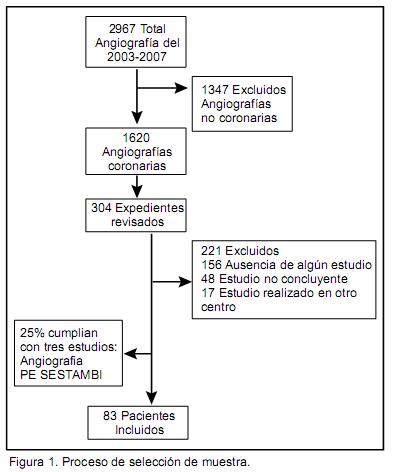
<body><![CDATA[<div><span  style="font-size: 12pt; font-family: Verdana; font-weight: bold;">    <br> Resultados <o:p></o:p></span>     <br> <span style="font-size: 10pt; font-family: Verdana;">    <br> De 2967 angiograf&#237;as realizadas en el HSJD, se excluyeron 1347, que correspond&#237;an a estudios en otros territorios (cerebro, vasos <span  class="SpellE">carot&#237;deos</span>, pulm&#243;n, aorta, vasos il&#237;acos y miembros inferiores). Las restantes 1620 fueron las angiograf&#237;as coronarias. El tama&#241;o de la muestra calculado con un nivel de confianza de 0.95, una varianza de 0.2 y un error m&#225;ximo de 0.05, fue de 214 pacientes con un ajuste poblacional. Seg&#250;n los cuadros aleatorios, se seleccionaron y se revisaron 304 expedientes, para tener un margen de 90 pacientes m&#225;s. Aunque se revis&#243; esta cantidad de expedientes, 221 no cumpl&#237;an con todos los criterios de inclusi&#243;n del estudio y la muestra final fue de 83 pacientes, que correspond&#237;an al 25% de los expedientes revisados. (<a href="#f1">Figura 1</a>) <o:p></o:p></span>     <p><a name="f1"></a></p>     <p><span style="font-size: 10pt; font-family: Verdana;">     <center><img src="/img/revistas/amc/v52n3/art04i1.jpg" width="394"  height="472"></center> <o:p></o:p></span></p> <span style="font-size: 10pt; font-family: Verdana;">    <br> De los pacientes incluidos en el estudio 62 (75%) fueron hombres y 21 (25%) fueron mujeres. El promedio de edad de los participantes fue de 61 a&#241;os, con una moda en 58 a&#241;os; la edad m&#237;nima fue de 35 a&#241;os y la m&#225;xima de 85. <o:p></o:p></span></div>     <div> <span style="font-size: 10pt; font-family: Verdana;">    <br> Los factores de riesgo encontrados en el estudio, aparte del sexo masculino y la edad mayor de 65, fueron: DM, HTA, tabaquismo, sedentarismo, obesidad, <span  class="SpellE">dislipidemia</span> e historia familiar de cardiopat&#237;a. Como lo muestra la <a href="#f2">Figura 2</a>, los principales factores de riesgo presentes en esta poblaci&#243;n fueron la <span  class="SpellE">dislipidemia</span> en el 84% y la HTA en el 70%, con una frecuencia de DM del 35% y de tabaquismo del 39%. Se desconoc&#237;a la frecuencia de sedentarismo en un 88%, de obesidad en un 61,5% y de antecedentes familiares en un 41%. <o:p></o:p></span>     ]]></body>
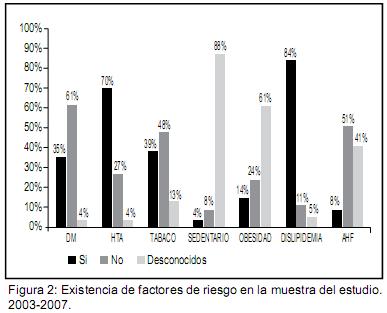
<body><![CDATA[<p><a name="f2"></a></p>     <center><img src="/img/revistas/amc/v52n3/art04i2.jpg" width="387"  height="313"></center> <span style="font-size: 10pt; font-family: Verdana;">Otros datos documentados fueron la presencia de <span class="SpellE">trombofilias</span> en 3 pacientes: dos con el diagn&#243;stico de S&#237;ndrome <span class="SpellE">Antifosfol&#237;pidos</span> y uno con d&#233;ficit de <span class="SpellE">antitrombina</span>. Adem&#225;s, 45 pacientes eran portadores de uno &#243; m&#225;s <span class="SpellE"><i>stents</i></span><i> </i>coronarios y a 16 pacientes se les realiz&#243; una cirug&#237;a de <span class="SpellE">revascularizaci&#243;n</span> <span class="SpellE">card&#237;aca</span>. <o:p></o:p></span>     <br> <span style="font-size: 10pt; font-family: Verdana;">    <br> Seg&#250;n la clasificaci&#243;n de <span class="SpellE">Framingham</span>, aproximadamente una tercera parte de los individuos correspond&#237;an a pacientes de bajo riesgo, otra tercera parte <span class="GramE">a</span> moderado riesgo, y una &#250;ltima parte a pacientes con alto riesgo. (<a href="#f3">Figura 3</a>) </span>     <p><span style="font-size: 10pt; font-family: Verdana;"><a name="f3"></a><o:p></o:p></span></p>     <center><img src="/img/revistas/amc/v52n3/art04i3.jpg" width="385"  height="270"></center> <span style="font-size: 10pt; font-family: Verdana;">Con respecto al perfil de l&#237;pidos, 79 pacientes ten&#237;an al menos un reporte en el expediente y 4 pacientes no ten&#237;an ninguno. De los datos analizados del colesterol total, el promedio fue de 189 <span class="SpellE">mg</span>/<span  class="SpellE">dl</span>, con una desviaci&#243;n est&#225;ndar (DE) de 44 <span class="SpellE">mg</span>/<span  class="SpellE">dl</span>, un valor m&#237;nimo en 92 <span class="SpellE">mg</span>/<span  class="SpellE">dl</span> y uno m&#225;ximo de 362 <span class="SpellE">mg</span>/<span  class="SpellE">dl</span>; el 61% ten&#237;a niveles inferiores a 200 <span  class="SpellE">mg</span>/<span class="SpellE">dl</span> y el 34%, niveles iguales o mayores a 200 <span class="SpellE">mg</span>/<span class="SpellE">dl.</span> Con respecto al LDL, el promedio fue de 111 <span class="SpellE">mg</span>/<span  class="SpellE">dl</span>, con una DE <span class="SpellE">de</span> 42 <span class="SpellE">mg</span>/<span class="SpellE">dl</span>, un valor m&#237;nimo de 24 <span class="SpellE">mg</span>/<span class="SpellE">dl</span> y uno m&#225;ximo de 331 <span class="SpellE">mg</span>/<span class="SpellE">dl</span>; el 39% ten&#237;an niveles inferiores a 100 <span class="SpellE">mg</span>/<span  class="SpellE">dl</span> y el 57%, iguales o mayores de 100 <span  class="SpellE">mg</span>/<span class="SpellE">dl.</span> El HDL ten&#237;a un promedio de 38 <span class="SpellE">mg</span>/<span class="SpellE">dl</span>, con una DE <span class="SpellE">de</span> 10 <span class="SpellE">mg</span>/<span  class="SpellE">dl.</span> Los triglic&#233;ridos en promedio eran de 242 <span class="SpellE">mg</span>/<span  class="SpellE">dl</span>, con una DE <span class="SpellE">de</span> 149 <span class="SpellE">mg</span>/<span class="SpellE">dl</span>, un nivel m&#237;nimo de 61 <span class="SpellE">mg</span>/<span class="SpellE">dl</span> y uno m&#225;ximo de 726 <span class="SpellE">mg</span>/<span class="SpellE">dl.</span> Los motivos de estudio de estos pacientes fueron: 33 pacientes por infarto agudo al miocardio, 18 por angor estable, 18 por angor inestable, 6 por cirug&#237;a <span class="SpellE">card&#237;aca</span>, 4 por dolor tor&#225;cico at&#237;pico, 3 por arritmia y uno para conocer la reserva <span  class="SpellE">card&#237;aca</span>. <o:p></o:p></span> </div>     <div> <span style="font-size: 10pt; font-family: Verdana;">    <br> La prueba de esfuerzo demostr&#243; una sensibilidad del 40% y una especificidad del 57%. El promedio de FC <span class="SpellE">max</span> fue del 88%. <o:p></o:p></span>     <br> <span style="font-size: 10pt; font-family: Verdana;">    <br> El EPM-SESTAMIBI demostr&#243; una sensibilidad del 66% y una especificidad del 71%. Revel&#243; la presencia de cicatriz mioc&#225;rdica en el 46%, de isquemia en el 32.5%, y defectos mixtos en el 21.5%. <o:p></o:p></span>     ]]></body>
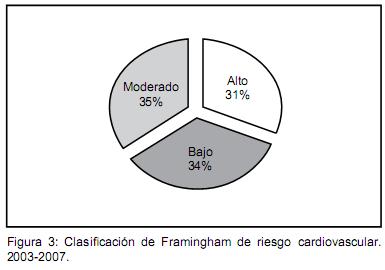
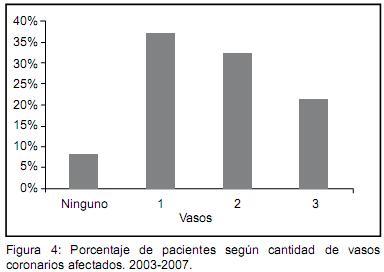
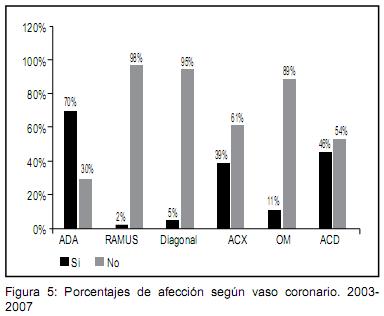
<body><![CDATA[<br> <span style="font-size: 10pt; font-family: Verdana;">    <br> El an&#225;lisis de regresi&#243;n log&#237;stica determin&#243; diferencias significativas entre el EPM-SESTAMIBI y la prueba de esfuerzo (<i>p =0.05)</i>. <o:p></o:p></span>     <br> <span style="font-size: 10pt; font-family: Verdana;">    <br> Seg&#250;n la cantidad de vasos afectados por la angiograf&#237;a coronaria, se encontr&#243; que la mayor&#237;a de los pacientes presentaban enfermedad de uno o dos vasos, en el 37% y 33%, respectivamente. El otro 22% ten&#237;a afecci&#243;n de 3 vasos coronarios. (<a href="#f3">Figura 4</a>) <o:p></o:p></span>     <p><a name="f4"></a></p>     <center><img src="/img/revistas/amc/v52n3/art04i4.jpg" width="384"  height="272"></center> <span style="font-size: 10pt; font-family: Verdana;">Seg&#250;n el porcentaje de obstrucci&#243;n del lumen del vaso coronario, hubo 140 lesiones: 14 con obstrucciones del 5070%, 39 con obstrucciones del 70-90% y 87 con obstrucciones de m&#225;s del 90%. <o:p></o:p></span>     <br> <span style="font-size: 10pt; font-family: Verdana;">    <br> La <a href="#f5">Figura 5</a> demuestra el porcentaje de afecci&#243;n de los vasos coronarios, siendo la arteria descendente anterior (ADA) la m&#225;s afectada en la muestra de este estudio, encontr&#225;ndose en un 70% de los casos, seguida por la arteria coronaria derecha (ACD) en el 46%, y la arteria <span class="SpellE">circumfleja</span> (ACX) en el 39%. <o:p></o:p></span>     <p><a name="f5"></a></p>     <p><span style="font-size: 10pt; font-family: Verdana;">     ]]></body>
<body><![CDATA[<center><img src="/img/revistas/amc/v52n3/art04i5.jpg" width="384"  height="316"></center> <o:p></o:p></span></p> </div> </div>     <div>     <div><span  style="font-size: 12pt; font-family: Verdana; font-weight: bold;">Discusi&#243;n <o:p></o:p></span>    <br> <span style="font-size: 10pt; font-family: Verdana;">    <br> La poblaci&#243;n estudiada ten&#237;a en promedio 61 a&#241;os, lo que est&#225; dentro del rango en que se presenta con m&#225;s frecuencia la CP.<sup>6 </sup>Se identificaron importantes factores de riesgo cardiovascular, especialmente la <span class="SpellE">dislipidemia</span>, la HTA, y en un tercio de ellos, DM y tabaquismo. Llama la atenci&#243;n que m&#225;s del 50% no cumpl&#237;an las metas del tratamiento &#243;ptimo de su <span class="SpellE">dislipidemia</span>; s&#243;lo el 39% de los pacientes estudiados ten&#237;an un LDL colesterol inferior a 100 <span class="SpellE">mg</span>/<span class="SpellE">dl.</span> No se documentaba en la mayor&#237;a de los expedientes la presencia de sedentarismo ni de obesidad, quedando la duda de si desempe&#241;aron alg&#250;n papel como factores de riesgo, dada la elevada <span  class="SpellE">prevalencia</span> de lesiones coronarias de alto grado en estos pacientes. <o:p></o:p></span>     <br> <span style="font-size: 10pt; font-family: Verdana;">    <br> La poblaci&#243;n en estudio se comport&#243; como pacientes de moderado y alto riesgo, pues en su mayor&#237;a ten&#237;an afecciones significativas y de varios vasos coronarios. <o:p></o:p></span>     <br> <span style="font-size: 10pt; font-family: Verdana;">    <br> La prueba de esfuerzo mostr&#243; una baja sensibilidad y especificidad, sin embargo, coincide con el rango descrito en la bibliograf&#237;a.<sup>3<span class="GramE">,13</span> </sup>Se ha visto en varios estudios, inclusive en el <span class="SpellE">metan&#225;lisis</span> de <span class="SpellE">Detrano</span>, con 24,000 pacientes <span  class="SpellE">inclu&#237;dos</span>, que los rangos de sensibilidad oscilan entre 23-100%, con un promedio del 68%, y una especificidad entre 17-100%, con un promedio del 77%.<sup>14,15 </sup><o:p></o:p></span>     <br> <span style="font-size: 10pt; font-family: Verdana;">    ]]></body>
<body><![CDATA[<br> El EPM-SESTAMIBI mostr&#243; tener un rendimiento diagn&#243;stico superior a la prueba de esfuerzo, sin embargo, con valores por debajo de lo descrito en la bibliograf&#237;a. En el estudio de <span class="SpellE">Gyongyosi</span> se document&#243; una sensibilidad entre el 81-90% y una <span class="SpellE">espacificidad</span> entre el 74-98%.<sup>16 </sup>Esto podr&#237;a estar en relaci&#243;n con el n&#250;mero de la muestra del estudio. <o:p></o:p></span>     <br> <span style="font-size: 10pt; font-family: Verdana;">    <br> Si bien el estudio tuvo la limitante de no poder alcanzar el valor ideal de la muestra, incluy&#233;ndose &#250;nicamente el 25% de los expedientes revisados, la explicaci&#243;n fue que muchos de los estudios no se realizaron oportunamente, a veces por da&#241;o o reparaci&#243;n de los equipos m&#233;dicos, o por citas programadas a varios meses plazo, por lo que en su mayor&#237;a se pasaba de inmediato a la angiograf&#237;a coronaria. <o:p></o:p></span>     <br> <span style="font-size: 10pt; font-family: Verdana;">    <br> Tiene relevancia conocer estos datos, pues son de los estudios con que se cuenta en el pa&#237;s para el diagn&#243;stico de la CP; adem&#225;s, no hay datos previos publicados. <o:p></o:p></span>    <br> <span style="font-size: 10pt; font-family: Verdana;">    <br> En conclusi&#243;n, los principales factores de riesgo en los pacientes con CP estudiados son la <span class="SpellE">dislipidemia</span> y la HTA. Adem&#225;s, el EPM-SESTAMIBI tiene un rendimiento diagn&#243;stico significativamente superior (<span  class="SpellE"><i>p=0</i></span><i>.05</i>) a la prueba de esfuerzo para la detecci&#243;n de esta entidad. Y, finalmente, la mayor&#237;a de las lesiones coronarias al momento del diagn&#243;stico tienen obstrucciones superiores al 90% del lumen del vaso, siendo la ADA la m&#225;s afectada. <o:p></o:p></span>     <br> <span style="font-size: 10pt; font-family: Verdana;">    <br> Las recomendaciones de los autores son las siguientes: <o:p></o:p></span>     <br> <span style="font-size: 10pt; font-family: Verdana;">    ]]></body>
<body><![CDATA[<br> 1. Mejorar las historias cl&#237;nicas de los expedientes, donde se contemplen factores de riesgo convencionales como el sedentarismo y la obesidad. <o:p></o:p></span>     <br> <span style="font-size: 10pt; font-family: Verdana;">2. Realizar otro estudio comparativo, idealmente prospectivo y con una muestra mayor. <o:p></o:p></span>     <div><span style="font-size: 12pt; font-family: Verdana;">    <br> <span style="font-weight: bold;">Agradecimientos: </span><o:p style="font-weight: bold;"></o:p></span>    <br> <span style="font-size: 10pt; font-family: Verdana;">    <br> A <span class="SpellE">Viviana</span> Sol&#237;s Barquero, por todo el apoyo en la parte estad&#237;stica y la confecci&#243;n de los gr&#225;ficos del art&#237;culo; a <span class="SpellE">Monserrath</span> Hern&#225;ndez Fern&#225;ndez, por la revisi&#243;n del formato y el texto del art&#237;culo. <o:p></o:p></span> <hr>     <div style="text-align: center;"><b><i><span  style="font-size: 10pt; font-family: Verdana;">Recibido: </span></i></b><i><span  style="font-size: 10pt; font-family: Verdana;">14 de agosto de 2009 <b>Aceptado:</b> 23 de febrero de 2010</span></i><span style="font-size: 10pt; font-family: Verdana;"><o:p></o:p></span></div> </div> </div> </div>     <div>     <div style="font-family: verdana;"><span lang="EN-GB"  style="font-size: 12pt;">    <br> <span style="font-weight: bold;">Referencias </span>    ]]></body>
<body><![CDATA[<br> <o:p></o:p></span>    <!-- ref --><br> <span style="font-size: 10pt;">1. Libby P, Bonow R, Zipes D and Mann D. Assessment of the physiology and pathophysiology of myocardial blood flow, myocardial metabolism, and ventricular function. En: <span class="SpellE">Braunwald</span>&#8217;s <span class="SpellE">Heart</span> <span class="SpellE">Disease</span>. 8th <span class="SpellE">edition</span>, 2007: 345-92.    &nbsp;&nbsp;&nbsp;&nbsp;&nbsp;&nbsp;&nbsp;&nbsp;[&#160;<a href="javascript:void(0);" onclick="javascript: window.open('/scielo.php?script=sci_nlinks&ref=078124&pid=S0001-6002201000030000400001&lng=','','width=640,height=500,resizable=yes,scrollbars=1,menubar=yes,');">Links</a>&#160;]<!-- end-ref --> <o:p></o:p></span>     <br> <span lang="EN-GB" style="font-size: 10pt;">    <!-- ref --><br> 2. Salguero Boda R, S&#225;nchez P&#233;rez I, <span class="SpellE">Mat&#237;a</span> Franc&#233;s R y S&#225;enz de la Calzada Campos C. Cardiopat&#237;a <span  class="SpellE">isqu&#233;mica</span>. Concepto. Aspectos epidemiol&#243;gicos. <span class="SpellE">Etiopatogenia</span>. Clasificaci&#243;n biol&#243;gica y cl&#237;nica. Implicaciones en la calidad de vida. Medicine 2005; 9: 2571-79.    &nbsp;&nbsp;&nbsp;&nbsp;&nbsp;&nbsp;&nbsp;&nbsp;[&#160;<a href="javascript:void(0);" onclick="javascript: window.open('/scielo.php?script=sci_nlinks&ref=078127&pid=S0001-6002201000030000400002&lng=','','width=640,height=500,resizable=yes,scrollbars=1,menubar=yes,');">Links</a>&#160;]<!-- end-ref --> <o:p></o:p></span>     <br> <span lang="EN-GB" style="font-size: 10pt;">    <!-- ref --><br> 3. Grech Ever D. ABC of interventional cardiology. Pathophysiology and investigation of coronary artery disease. BMJ 2003; 326: 1027-31.    &nbsp;&nbsp;&nbsp;&nbsp;&nbsp;&nbsp;&nbsp;&nbsp;[&#160;<a href="javascript:void(0);" onclick="javascript: window.open('/scielo.php?script=sci_nlinks&ref=078130&pid=S0001-6002201000030000400003&lng=','','width=640,height=500,resizable=yes,scrollbars=1,menubar=yes,');">Links</a>&#160;]<!-- end-ref --> <o:p></o:p></span> <br style="color: rgb(0, 0, 0);"> <span lang="EN-GB" style="font-size: 10pt;">    <!-- ref --><br> 4. National Center for Health Statistics, Center for Disease Control and Prevention, US Department of Health and Human Services. Fast stats A to Z: leading causes of death. Accesado en enero 2008. En: <a  href="http://%20www.cdc.gov/nchs/fastats/lcod.htm">http:// www.cdc.gov/nchs/fastats/lcod.htm</a> <o:p></o:p></span>    &nbsp;&nbsp;&nbsp;&nbsp;&nbsp;&nbsp;&nbsp;&nbsp;[&#160;<a href="javascript:void(0);" onclick="javascript: window.open('/scielo.php?script=sci_nlinks&ref=078132&pid=S0001-6002201000030000400004&lng=','','width=640,height=500,resizable=yes,scrollbars=1,menubar=yes,');">Links</a>&#160;]<!-- end-ref --><br> <span style="font-size: 10pt;">    <!-- ref --><br> 5. American Heart Association. Cardiovascular <span class="SpellE">disease</span> <span class="SpellE">statistics</span>. Recuperado en enero 2008. En: <a  href="http://www.americanheart.org/%20presenter.hml">http://www.americanheart.org/ presenter.jhml</a> <o:p></o:p></span>    &nbsp;&nbsp;&nbsp;&nbsp;&nbsp;&nbsp;&nbsp;&nbsp;[&#160;<a href="javascript:void(0);" onclick="javascript: window.open('/scielo.php?script=sci_nlinks&ref=078134&pid=S0001-6002201000030000400005&lng=','','width=640,height=500,resizable=yes,scrollbars=1,menubar=yes,');">Links</a>&#160;]<!-- end-ref --><br> <span style="font-size: 10pt;">    <!-- ref --><br> 6. Situaci&#243;n de Salud de Costa Rica 2007. Ministerio de Salud y Organizaci&#243;n Panamericana de Salud (OPS). Recuperado en enero de 2008. En: <span class="SpellE"><a  href="http://www.estadonacion.or.cr/compendio/SOC_salud96_00.htm">http://www.estadonacion.or.cr/compendio/SOC_salud96_00.htm</a></span> <o:p></o:p></span>    &nbsp;&nbsp;&nbsp;&nbsp;&nbsp;&nbsp;&nbsp;&nbsp;[&#160;<a href="javascript:void(0);" onclick="javascript: window.open('/scielo.php?script=sci_nlinks&ref=078136&pid=S0001-6002201000030000400006&lng=','','width=640,height=500,resizable=yes,scrollbars=1,menubar=yes,');">Links</a>&#160;]<!-- end-ref --><br> <span lang="EN-GB" style="font-size: 10pt;">    <!-- ref --><br> 7. Wilson PW, D`Agostino R, Levy D, Belenger AM, Silbershatz H and Kannel WB. Prediction of coronary heart disease using risk factor categories. Circulation 1998; 97: 1837-47.    &nbsp;&nbsp;&nbsp;&nbsp;&nbsp;&nbsp;&nbsp;&nbsp;[&#160;<a href="javascript:void(0);" onclick="javascript: window.open('/scielo.php?script=sci_nlinks&ref=078138&pid=S0001-6002201000030000400007&lng=','','width=640,height=500,resizable=yes,scrollbars=1,menubar=yes,');">Links</a>&#160;]<!-- end-ref --> <o:p></o:p></span>     <br> <span lang="EN-GB" style="font-size: 10pt;">    <!-- ref --><br> 8. Selker P, Zalenski RJ, Antman EM, Aufderheite TP, Bernard SA, Bonow RD et al. An evaluation of technologies for identifying acute cardiac ischemia in the emergency department: a report from a National Heart Attack Alert Program Working Group. Ann Emerg Med 1997; 29: 13-87.    &nbsp;&nbsp;&nbsp;&nbsp;&nbsp;&nbsp;&nbsp;&nbsp;[&#160;<a href="javascript:void(0);" onclick="javascript: window.open('/scielo.php?script=sci_nlinks&ref=078141&pid=S0001-6002201000030000400008&lng=','','width=640,height=500,resizable=yes,scrollbars=1,menubar=yes,');">Links</a>&#160;]<!-- end-ref --> <o:p></o:p></span>     ]]></body>
<body><![CDATA[<br> <span lang="EN-GB" style="font-size: 10pt;">    <!-- ref --><br> 9. Sanjay KP, Ravi GA, and Dudley JP. Recent development in non invasive cardiology. BMJ 2004; 329: 1386-89.    &nbsp;&nbsp;&nbsp;&nbsp;&nbsp;&nbsp;&nbsp;&nbsp;[&#160;<a href="javascript:void(0);" onclick="javascript: window.open('/scielo.php?script=sci_nlinks&ref=078144&pid=S0001-6002201000030000400009&lng=','','width=640,height=500,resizable=yes,scrollbars=1,menubar=yes,');">Links</a>&#160;]<!-- end-ref --> <o:p></o:p></span>     <br> <span lang="EN-GB" style="font-size: 10pt;">    <!-- ref --><br> 10. Kuo D, Dilsizian V, Presad R and White C. Emergency Cardiac Imaging: State of the Art. Cardiol Clin 2006; 24:53-65.    &nbsp;&nbsp;&nbsp;&nbsp;&nbsp;&nbsp;&nbsp;&nbsp;[&#160;<a href="javascript:void(0);" onclick="javascript: window.open('/scielo.php?script=sci_nlinks&ref=078147&pid=S0001-6002201000030000400010&lng=','','width=640,height=500,resizable=yes,scrollbars=1,menubar=yes,');">Links</a>&#160;]<!-- end-ref --> <o:p></o:p></span>     <br> <span lang="EN-GB" style="font-size: 10pt;">    <!-- ref --><br> 11. Mahenthiran J, Bangalore S, Yao S and Chaudhry F. Comparison of prognostic value of stress echocardiography versus stress electrocardiography in patients with suspected coronary artery disease. Am J Cardiol 2005; 96: 628-34.    &nbsp;&nbsp;&nbsp;&nbsp;&nbsp;&nbsp;&nbsp;&nbsp;[&#160;<a href="javascript:void(0);" onclick="javascript: window.open('/scielo.php?script=sci_nlinks&ref=078150&pid=S0001-6002201000030000400011&lng=','','width=640,height=500,resizable=yes,scrollbars=1,menubar=yes,');">Links</a>&#160;]<!-- end-ref --> <o:p></o:p></span> </div>     <div> <span lang="EN-GB" style="font-size: 10pt; font-family: verdana;">    ]]></body>
<body><![CDATA[<!-- ref --><br> 12. Udelson J, Beshansky J and Ballin D. Myocardial Perfusion Imaging for Evaluation and Triage of Patient with Suspected Acute Cardiac Ischemia: A randomized controlled trial. JAMA 2002; 288: 2293-00.    &nbsp;&nbsp;&nbsp;&nbsp;&nbsp;&nbsp;&nbsp;&nbsp;[&#160;<a href="javascript:void(0);" onclick="javascript: window.open('/scielo.php?script=sci_nlinks&ref=078153&pid=S0001-6002201000030000400012&lng=','','width=640,height=500,resizable=yes,scrollbars=1,menubar=yes,');">Links</a>&#160;]<!-- end-ref --> <o:p></o:p></span><span  style="font-family: verdana;"> </span><br style="font-family: verdana;"> <span lang="EN-GB" style="font-size: 10pt; font-family: verdana;">    <!-- ref --><br> 13. Junnila JL and Runkle GP. Coronary Artery Disease Screening, Treatment, and Follow-up. </span><span class="SpellE" style="font-family: verdana;"><span  style="font-size: 10pt;">Prim</span></span><span  style="font-size: 10pt; font-family: verdana;"> <span class="SpellE">Care</span> <span class="SpellE">Clin</span> Office <span class="SpellE">Pract</span> 2006; 33: 863-85.    &nbsp;&nbsp;&nbsp;&nbsp;&nbsp;&nbsp;&nbsp;&nbsp;[&#160;<a href="javascript:void(0);" onclick="javascript: window.open('/scielo.php?script=sci_nlinks&ref=078155&pid=S0001-6002201000030000400013&lng=','','width=640,height=500,resizable=yes,scrollbars=1,menubar=yes,');">Links</a>&#160;]<!-- end-ref --> <o:p></o:p></span><span style="font-family: verdana;"> </span><br style="font-family: verdana;"> <span lang="EN-GB" style="font-size: 10pt; font-family: verdana;">    <!-- ref --><br> 14. <span class="SpellE">Tort&#243;s</span>-Guzm&#225;n J. La prueba de esfuerzo en la pr&#225;ctica diaria. Actual Med Period 2002; 11: 1-7.    &nbsp;&nbsp;&nbsp;&nbsp;&nbsp;&nbsp;&nbsp;&nbsp;[&#160;<a href="javascript:void(0);" onclick="javascript: window.open('/scielo.php?script=sci_nlinks&ref=078157&pid=S0001-6002201000030000400014&lng=','','width=640,height=500,resizable=yes,scrollbars=1,menubar=yes,');">Links</a>&#160;]<!-- end-ref --> <o:p></o:p></span><span  style="font-family: verdana;"> </span><br style="font-family: verdana;"> <span lang="EN-GB" style="font-size: 10pt; font-family: verdana;">    <!-- ref --><br> 15. Detrano R, Gianrossi R and Froelicher VF. The diagnostic accuracy of the exercise electrocardiogram: a meta-analysis of 22 years of research. Prog Cardiov Dis 1989; 32: 173-206.    &nbsp;&nbsp;&nbsp;&nbsp;&nbsp;&nbsp;&nbsp;&nbsp;[&#160;<a href="javascript:void(0);" onclick="javascript: window.open('/scielo.php?script=sci_nlinks&ref=078159&pid=S0001-6002201000030000400015&lng=','','width=640,height=500,resizable=yes,scrollbars=1,menubar=yes,');">Links</a>&#160;]<!-- end-ref --> <o:p></o:p></span><span  style="font-family: verdana;"> </span><br style="font-family: verdana;"> <span lang="EN-GB" style="font-size: 10pt; font-family: verdana;">    <!-- ref --><br> 16. Gyongyosi M, Maul F, Standke R, Kattenbach M and Hor G. Coronary<span style="">&nbsp; </span>artery stenosis and occlusion: value of 99Tcm-MIBI SPECT. Nucl Med Com 1994; 15: 593-603.    &nbsp;&nbsp;&nbsp;&nbsp;&nbsp;&nbsp;&nbsp;&nbsp;[&#160;<a href="javascript:void(0);" onclick="javascript: window.open('/scielo.php?script=sci_nlinks&ref=078161&pid=S0001-6002201000030000400016&lng=','','width=640,height=500,resizable=yes,scrollbars=1,menubar=yes,');">Links</a>&#160;]<!-- end-ref --> <o:p></o:p></span><span  style="font-family: verdana;"> </span><br style="font-family: verdana;"> <span lang="EN-GB" style="font-size: 10pt; font-family: verdana;">    ]]></body>
<body><![CDATA[<!-- ref --><br> 17. Mack MB, Ringqvist I, Fisher LD, Davis KB, Chaitman BR, Kouchoukos NT et al. Coronary Artery Surgery Study Group (CASS). A randomized trial of coronary artery bypass surgery. Survival data. Circulation 1983; 68: 939-50.    &nbsp;&nbsp;&nbsp;&nbsp;&nbsp;&nbsp;&nbsp;&nbsp;[&#160;<a href="javascript:void(0);" onclick="javascript: window.open('/scielo.php?script=sci_nlinks&ref=078163&pid=S0001-6002201000030000400017&lng=','','width=640,height=500,resizable=yes,scrollbars=1,menubar=yes,');">Links</a>&#160;]<!-- end-ref --> <o:p></o:p></span><span style="font-family: verdana;"> </span><br style="font-family: verdana;"> <span lang="EN-GB" style="font-size: 10pt; font-family: verdana;">    <!-- ref --><br> 18. Gianrossi R, Detrano R, Mulvihill D, Lehmann K, Dubach P, Colombo A et al. Exercise-induced ST depression in the diagnosis of coronary artery disease: a meta-analysis. Circulation 1989; 80: 87-98.    &nbsp;&nbsp;&nbsp;&nbsp;&nbsp;&nbsp;&nbsp;&nbsp;[&#160;<a href="javascript:void(0);" onclick="javascript: window.open('/scielo.php?script=sci_nlinks&ref=078165&pid=S0001-6002201000030000400018&lng=','','width=640,height=500,resizable=yes,scrollbars=1,menubar=yes,');">Links</a>&#160;]<!-- end-ref --> <o:p></o:p></span><span  style="font-family: verdana;"> </span><br style="font-family: verdana;"> <span lang="EN-GB" style="font-size: 10pt; font-family: verdana;">    <!-- ref --><br> 19. Fleichmann KE, Hunink MG, Kuntz KM and Douglas PS. Exercise Echocardiography or Exercise SPECT Imaging? A Meta-analysis of Diagnostic Test Performance. JAMA 1998; 280: 913-20.    &nbsp;&nbsp;&nbsp;&nbsp;&nbsp;&nbsp;&nbsp;&nbsp;[&#160;<a href="javascript:void(0);" onclick="javascript: window.open('/scielo.php?script=sci_nlinks&ref=078167&pid=S0001-6002201000030000400019&lng=','','width=640,height=500,resizable=yes,scrollbars=1,menubar=yes,');">Links</a>&#160;]<!-- end-ref --> <o:p></o:p></span><span  style="font-family: verdana;"> </span><br style="font-family: verdana;"> <span lang="EN-GB" style="font-size: 10pt; font-family: verdana;">    <!-- ref --><br> 20. Gallager M, Ross M, Raff G, Goldstein J, O&#180;Neill W and O&#180;Neil B. The Diagnostic Accuracy of 64-Slice Computed Tomography Coronary Angiography Compared with Stress Nuclear Imaging in Emergency Department Low-Risk Chest Pain Patients. Ann Emerg Med 2007; 49: 125-36.    &nbsp;&nbsp;&nbsp;&nbsp;&nbsp;&nbsp;&nbsp;&nbsp;[&#160;<a href="javascript:void(0);" onclick="javascript: window.open('/scielo.php?script=sci_nlinks&ref=078169&pid=S0001-6002201000030000400020&lng=','','width=640,height=500,resizable=yes,scrollbars=1,menubar=yes,');">Links</a>&#160;]<!-- end-ref --> <o:p></o:p></span><span style="font-family: verdana;"> </span><br style="font-family: verdana;"> <span lang="EN-GB" style="font-size: 10pt; font-family: verdana;">    <!-- ref --><br> 21. Beller GA and Kramer CM. Nuclear Medicine and Computed Tomography. En: Goldman et al. Cecil Medicine. EEUU. 23rd edition. Saunders, 2007: 235-76.    &nbsp;&nbsp;&nbsp;&nbsp;&nbsp;&nbsp;&nbsp;&nbsp;[&#160;<a href="javascript:void(0);" onclick="javascript: window.open('/scielo.php?script=sci_nlinks&ref=078171&pid=S0001-6002201000030000400021&lng=','','width=640,height=500,resizable=yes,scrollbars=1,menubar=yes,');">Links</a>&#160;]<!-- end-ref --> <o:p></o:p></span><span  style="font-family: verdana;"> </span><br style="font-family: verdana;"> <span lang="EN-GB" style="font-size: 10pt; font-family: verdana;">    ]]></body>
<body><![CDATA[<!-- ref --><br> 22. Weissman I, Dickinson C, Dworkin H, O&#180;Neill W, Juni J. Cost-effectiveness of myocardial perfusion imaging with SPECT in the emergency department evaluation of patients with unexplained chest pain. Radiology 1996; 199: 353-357.    &nbsp;&nbsp;&nbsp;&nbsp;&nbsp;&nbsp;&nbsp;&nbsp;[&#160;<a href="javascript:void(0);" onclick="javascript: window.open('/scielo.php?script=sci_nlinks&ref=078173&pid=S0001-6002201000030000400022&lng=','','width=640,height=500,resizable=yes,scrollbars=1,menubar=yes,');">Links</a>&#160;]<!-- end-ref --> <o:p></o:p></span><span style="font-family: verdana;"> </span><br style="font-family: verdana;"> <span lang="EN-GB" style="font-size: 10pt; font-family: verdana;">    <!-- ref --><br> 23. Skiles JA. Nuclear Imaging. En: Griffin Brian P, and Topol Eric J.<span  style="">&nbsp; </span>Manual of Cardiovascular Medicine. EEUU. 2<sup>nd </sup>edition. Lippincott Williams &amp; Wilkins, 2004: 578-90.    &nbsp;&nbsp;&nbsp;&nbsp;&nbsp;&nbsp;&nbsp;&nbsp;[&#160;<a href="javascript:void(0);" onclick="javascript: window.open('/scielo.php?script=sci_nlinks&ref=078175&pid=S0001-6002201000030000400023&lng=','','width=640,height=500,resizable=yes,scrollbars=1,menubar=yes,');">Links</a>&#160;]<!-- end-ref --> <o:p></o:p></span><span style="font-family: verdana;"> </span><br style="font-family: verdana;"> <span style="font-size: 10pt; font-family: verdana;">    <!-- ref --><br> 24. <span class="SpellE">Ellestad</span> MH. Pruebas de esfuerzo: bases y aplicaci&#243;n cl&#237;nica. Barcelona, Espa&#241;a. 3era edici&#243;n. Ediciones Consulta, 1988: 15-76.    &nbsp;&nbsp;&nbsp;&nbsp;&nbsp;&nbsp;&nbsp;&nbsp;[&#160;<a href="javascript:void(0);" onclick="javascript: window.open('/scielo.php?script=sci_nlinks&ref=078177&pid=S0001-6002201000030000400024&lng=','','width=640,height=500,resizable=yes,scrollbars=1,menubar=yes,');">Links</a>&#160;]<!-- end-ref --> <o:p></o:p></span><span  style="font-family: verdana;"> </span><br style="font-family: verdana;"> <span style="font-size: 10pt; font-family: verdana;">    <!-- ref --><br> 25. Gonz&#225;lez U <span class="SpellE">and</span> Fonseca C. Estudio SPECT de perfusi&#243;n mioc&#225;rdica con esfuerzo f&#237;sico (Protocolo de 1 d&#237;a). Normas del Servicio de Medicina Nuclear. Hospital San Juan de Dios. CCSS. -No publicado<o:p></o:p></span><span style="font-family: verdana;    &nbsp;&nbsp;&nbsp;&nbsp;&nbsp;&nbsp;&nbsp;&nbsp;[&#160;<a href="javascript:void(0);" onclick="javascript: window.open('/scielo.php?script=sci_nlinks&ref=078179&pid=S0001-6002201000030000400025&lng=','','width=640,height=500,resizable=yes,scrollbars=1,menubar=yes,');">Links</a>&#160;]<!-- end-ref -->"> </span><br style="font-family: verdana;"> <span style="font-size: 10pt; font-family: verdana;">    <!-- ref --><br> 26. Gonz&#225;lez U <span class="SpellE">and</span> Fonseca C. Estudio SPECT de perfusi&#243;n mioc&#225;rdica con esfuerzo farmacol&#243;gico (Protocolo de 1 d&#237;a). Normas del Servicio de Medicina Nuclear. Hospital San Juan de Dios. CCSS. -No publicado-.    &nbsp;&nbsp;&nbsp;&nbsp;&nbsp;&nbsp;&nbsp;&nbsp;[&#160;<a href="javascript:void(0);" onclick="javascript: window.open('/scielo.php?script=sci_nlinks&ref=078181&pid=S0001-6002201000030000400026&lng=','','width=640,height=500,resizable=yes,scrollbars=1,menubar=yes,');">Links</a>&#160;]<!-- end-ref --> <o:p></o:p></span><span  style="font-family: verdana;"> </span><br style="font-family: verdana;"> <span style="font-size: 10pt; font-family: verdana;">    ]]></body>
<body><![CDATA[<!-- ref --><br> 27. <span class="SpellE">Strauss</span> HW, <span class="SpellE">Miller</span> D, <span class="SpellE">Wittry</span> M, <span class="SpellE">Cerqueira</span> M, Garc&#237;a E, <span  class="SpellE">Iskandrian</span> A et al. <span class="SpellE">Guidelines</span> <span class="SpellE">for</span> <span class="SpellE">Myocardial</span> <span class="SpellE">Perfusion</span> <span class="SpellE">Imaging</span>. </span><span lang="EN-GB"  style="font-size: 10pt; font-family: Verdana;"><span  style="font-family: verdana;">Society of Nuclear&nbsp; Medicine Procedure Guidelines Manual 2008; 36: 155-161.    &nbsp;&nbsp;&nbsp;&nbsp;&nbsp;&nbsp;&nbsp;&nbsp;[&#160;<a href="javascript:void(0);" onclick="javascript: window.open('/scielo.php?script=sci_nlinks&ref=078183&pid=S0001-6002201000030000400027&lng=','','width=640,height=500,resizable=yes,scrollbars=1,menubar=yes,');">Links</a>&#160;]<!-- end-ref --> </span><o:p></o:p></span> </div> </div> </div> </div> </div>      ]]></body><back>
<ref-list>
<ref id="B1">
<label>1</label><nlm-citation citation-type="">
<person-group person-group-type="author">
<name>
<surname><![CDATA[Libby]]></surname>
<given-names><![CDATA[P]]></given-names>
</name>
<name>
<surname><![CDATA[Bonow]]></surname>
<given-names><![CDATA[R]]></given-names>
</name>
<name>
<surname><![CDATA[Zipes]]></surname>
<given-names><![CDATA[D]]></given-names>
</name>
<name>
<surname><![CDATA[Mann]]></surname>
<given-names><![CDATA[D]]></given-names>
</name>
</person-group>
<article-title xml:lang="en"><![CDATA[Assessment of the physiology and pathophysiology of myocardial blood flow, myocardial metabolism, and ventricular function]]></article-title>
<source><![CDATA[Braunwald’s Heart Disease]]></source>
<year>2007</year>
<edition>8</edition>
<page-range>345-92</page-range></nlm-citation>
</ref>
<ref id="B2">
<label>2</label><nlm-citation citation-type="journal">
<person-group person-group-type="author">
<name>
<surname><![CDATA[Salguero Boda]]></surname>
<given-names><![CDATA[R]]></given-names>
</name>
<name>
<surname><![CDATA[Sánchez Pérez]]></surname>
<given-names><![CDATA[I]]></given-names>
</name>
<name>
<surname><![CDATA[Matía Francés]]></surname>
<given-names><![CDATA[R]]></given-names>
</name>
<name>
<surname><![CDATA[Sáenz de la Calzada Campos]]></surname>
<given-names><![CDATA[C]]></given-names>
</name>
</person-group>
<article-title xml:lang="es"><![CDATA[Cardiopatía isquémica]]></article-title>
<source><![CDATA[Medicine]]></source>
<year>2005</year>
<volume>9</volume>
<page-range>2571-79</page-range></nlm-citation>
</ref>
<ref id="B3">
<label>3</label><nlm-citation citation-type="journal">
<person-group person-group-type="author">
<name>
<surname><![CDATA[Grech Ever]]></surname>
<given-names><![CDATA[D]]></given-names>
</name>
</person-group>
<article-title xml:lang="en"><![CDATA[ABC of interventional cardiology. Pathophysiology and investigation of coronary artery disease]]></article-title>
<source><![CDATA[BMJ]]></source>
<year>2003</year>
<volume>326</volume>
<page-range>1027-31</page-range></nlm-citation>
</ref>
<ref id="B4">
<label>4</label><nlm-citation citation-type="">
<collab>US Department of Health and Human Services^dNational Center for Health Statistics, Center for Disease Control and Prevention</collab>
<source><![CDATA[Fast stats A to Z: leading causes of death]]></source>
<year></year>
</nlm-citation>
</ref>
<ref id="B5">
<label>5</label><nlm-citation citation-type="">
<collab>American Heart Association</collab>
<source><![CDATA[Cardiovascular disease statistics]]></source>
<year></year>
</nlm-citation>
</ref>
<ref id="B6">
<label>6</label><nlm-citation citation-type="book">
<source><![CDATA[Situación de Salud de Costa Rica 2007]]></source>
<year></year>
<publisher-name><![CDATA[Ministerio de Salud y Organización Panamericana de Salud (OPS)]]></publisher-name>
</nlm-citation>
</ref>
<ref id="B7">
<label>7</label><nlm-citation citation-type="journal">
<person-group person-group-type="author">
<name>
<surname><![CDATA[Wilson]]></surname>
<given-names><![CDATA[PW]]></given-names>
</name>
<name>
<surname><![CDATA[D`Agostino]]></surname>
<given-names><![CDATA[R]]></given-names>
</name>
<name>
<surname><![CDATA[Levy]]></surname>
<given-names><![CDATA[D]]></given-names>
</name>
<name>
<surname><![CDATA[Belenger]]></surname>
<given-names><![CDATA[AM]]></given-names>
</name>
<name>
<surname><![CDATA[Silbershatz]]></surname>
<given-names><![CDATA[H]]></given-names>
</name>
<name>
<surname><![CDATA[Kannel]]></surname>
<given-names><![CDATA[WB]]></given-names>
</name>
</person-group>
<article-title xml:lang="en"><![CDATA[Prediction of coronary heart disease using risk factor categories]]></article-title>
<source><![CDATA[Circulation]]></source>
<year>1998</year>
<volume>97</volume>
<page-range>1837-47</page-range></nlm-citation>
</ref>
<ref id="B8">
<label>8</label><nlm-citation citation-type="journal">
<person-group person-group-type="author">
<name>
<surname><![CDATA[Selker]]></surname>
<given-names><![CDATA[P]]></given-names>
</name>
<name>
<surname><![CDATA[Zalenski]]></surname>
<given-names><![CDATA[RJ]]></given-names>
</name>
<name>
<surname><![CDATA[Antman]]></surname>
<given-names><![CDATA[EM]]></given-names>
</name>
<name>
<surname><![CDATA[Aufderheite]]></surname>
<given-names><![CDATA[TP]]></given-names>
</name>
<name>
<surname><![CDATA[Bernard]]></surname>
<given-names><![CDATA[SA]]></given-names>
</name>
<name>
<surname><![CDATA[Bonow]]></surname>
<given-names><![CDATA[RD]]></given-names>
</name>
</person-group>
<article-title xml:lang="en"><![CDATA[An evaluation of technologies for identifying acute cardiac ischemia in the emergency department: a report from a National Heart Attack Alert Program Working Group]]></article-title>
<source><![CDATA[Ann Emerg Med]]></source>
<year>1997</year>
<volume>29</volume>
<page-range>13-87</page-range></nlm-citation>
</ref>
<ref id="B9">
<label>9</label><nlm-citation citation-type="journal">
<person-group person-group-type="author">
<name>
<surname><![CDATA[Sanjay]]></surname>
<given-names><![CDATA[KP]]></given-names>
</name>
<name>
<surname><![CDATA[Ravi]]></surname>
<given-names><![CDATA[GA]]></given-names>
</name>
<name>
<surname><![CDATA[Dudley]]></surname>
<given-names><![CDATA[JP]]></given-names>
</name>
</person-group>
<article-title xml:lang="en"><![CDATA[Recent development in non invasive cardiology]]></article-title>
<source><![CDATA[BMJ]]></source>
<year>2004</year>
<volume>329</volume>
<page-range>1386-89</page-range></nlm-citation>
</ref>
<ref id="B10">
<label>10</label><nlm-citation citation-type="journal">
<person-group person-group-type="author">
<name>
<surname><![CDATA[Kuo]]></surname>
<given-names><![CDATA[D]]></given-names>
</name>
<name>
<surname><![CDATA[Dilsizian]]></surname>
<given-names><![CDATA[V]]></given-names>
</name>
<name>
<surname><![CDATA[Presad]]></surname>
<given-names><![CDATA[R]]></given-names>
</name>
<name>
<surname><![CDATA[White]]></surname>
<given-names><![CDATA[C]]></given-names>
</name>
</person-group>
<article-title xml:lang="en"><![CDATA[Emergency Cardiac Imaging: State of the Art]]></article-title>
<source><![CDATA[Cardiol Clin]]></source>
<year>2006</year>
<volume>24</volume>
<page-range>53-65</page-range></nlm-citation>
</ref>
<ref id="B11">
<label>11</label><nlm-citation citation-type="journal">
<person-group person-group-type="author">
<name>
<surname><![CDATA[Mahenthiran]]></surname>
<given-names><![CDATA[J]]></given-names>
</name>
<name>
<surname><![CDATA[Bangalore]]></surname>
<given-names><![CDATA[S]]></given-names>
</name>
<name>
<surname><![CDATA[Yao]]></surname>
<given-names><![CDATA[S]]></given-names>
</name>
<name>
<surname><![CDATA[Chaudhry]]></surname>
<given-names><![CDATA[F]]></given-names>
</name>
</person-group>
<article-title xml:lang="en"><![CDATA[Comparison of prognostic value of stress echocardiography versus stress electrocardiography in patients with suspected coronary artery disease]]></article-title>
<source><![CDATA[Am J Cardiol]]></source>
<year>2005</year>
<volume>96</volume>
<page-range>628-34</page-range></nlm-citation>
</ref>
<ref id="B12">
<label>12</label><nlm-citation citation-type="journal">
<person-group person-group-type="author">
<name>
<surname><![CDATA[Udelson]]></surname>
<given-names><![CDATA[J]]></given-names>
</name>
<name>
<surname><![CDATA[Beshansky]]></surname>
<given-names><![CDATA[J]]></given-names>
</name>
<name>
<surname><![CDATA[Ballin]]></surname>
<given-names><![CDATA[D]]></given-names>
</name>
</person-group>
<article-title xml:lang="en"><![CDATA[Myocardial Perfusion Imaging for Evaluation and Triage of Patient with Suspected Acute Cardiac Ischemia: A randomized controlled trial]]></article-title>
<source><![CDATA[JAMA]]></source>
<year>2002</year>
<volume>288</volume>
<page-range>2293-00</page-range></nlm-citation>
</ref>
<ref id="B13">
<label>13</label><nlm-citation citation-type="journal">
<person-group person-group-type="author">
<name>
<surname><![CDATA[Junnila]]></surname>
<given-names><![CDATA[JL]]></given-names>
</name>
<name>
<surname><![CDATA[Runkle]]></surname>
<given-names><![CDATA[GP]]></given-names>
</name>
</person-group>
<article-title xml:lang="en"><![CDATA[Coronary Artery Disease Screening, Treatment, and Follow-up]]></article-title>
<source><![CDATA[Prim Care Clin Office Pract]]></source>
<year>2006</year>
<volume>33</volume>
<page-range>863-85</page-range></nlm-citation>
</ref>
<ref id="B14">
<label>14</label><nlm-citation citation-type="journal">
<person-group person-group-type="author">
<name>
<surname><![CDATA[Tortós-Guzmán]]></surname>
<given-names><![CDATA[J]]></given-names>
</name>
</person-group>
<article-title xml:lang="es"><![CDATA[La prueba de esfuerzo en la práctica diaria]]></article-title>
<source><![CDATA[Actual Med Period]]></source>
<year>2002</year>
<volume>11</volume>
<page-range>1-7</page-range></nlm-citation>
</ref>
<ref id="B15">
<label>15</label><nlm-citation citation-type="journal">
<person-group person-group-type="author">
<name>
<surname><![CDATA[Detrano]]></surname>
<given-names><![CDATA[R]]></given-names>
</name>
<name>
<surname><![CDATA[Gianrossi]]></surname>
<given-names><![CDATA[R]]></given-names>
</name>
<name>
<surname><![CDATA[Froelicher]]></surname>
<given-names><![CDATA[VF]]></given-names>
</name>
</person-group>
<article-title xml:lang="en"><![CDATA[The diagnostic accuracy of the exercise electrocardiogram: a meta-analysis of 22 years of research]]></article-title>
<source><![CDATA[Prog Cardiov Dis]]></source>
<year>1989</year>
<volume>32</volume>
<page-range>173-206</page-range></nlm-citation>
</ref>
<ref id="B16">
<label>16</label><nlm-citation citation-type="journal">
<person-group person-group-type="author">
<name>
<surname><![CDATA[Gyongyosi]]></surname>
<given-names><![CDATA[M]]></given-names>
</name>
<name>
<surname><![CDATA[Maul]]></surname>
<given-names><![CDATA[F]]></given-names>
</name>
<name>
<surname><![CDATA[Standke]]></surname>
<given-names><![CDATA[R]]></given-names>
</name>
<name>
<surname><![CDATA[Kattenbach]]></surname>
<given-names><![CDATA[M]]></given-names>
</name>
<name>
<surname><![CDATA[Hor]]></surname>
<given-names><![CDATA[G]]></given-names>
</name>
</person-group>
<article-title xml:lang="en"><![CDATA[Coronary artery stenosis and occlusion: value of 99Tcm-MIBI SPECT]]></article-title>
<source><![CDATA[Nucl Med Com]]></source>
<year>1994</year>
<volume>15</volume>
<page-range>593-603</page-range></nlm-citation>
</ref>
<ref id="B17">
<label>17</label><nlm-citation citation-type="journal">
<person-group person-group-type="author">
<name>
<surname><![CDATA[Mack]]></surname>
<given-names><![CDATA[MB]]></given-names>
</name>
<name>
<surname><![CDATA[Ringqvist]]></surname>
<given-names><![CDATA[I]]></given-names>
</name>
<name>
<surname><![CDATA[Fisher]]></surname>
<given-names><![CDATA[LD]]></given-names>
</name>
<name>
<surname><![CDATA[Davis]]></surname>
<given-names><![CDATA[KB]]></given-names>
</name>
<name>
<surname><![CDATA[Chaitman]]></surname>
<given-names><![CDATA[BR]]></given-names>
</name>
<name>
<surname><![CDATA[Kouchoukos]]></surname>
<given-names><![CDATA[NT]]></given-names>
</name>
</person-group>
<article-title xml:lang="en"><![CDATA[Coronary Artery Surgery Study Group (CASS): A randomized trial of coronary artery bypass surgery. Survival data]]></article-title>
<source><![CDATA[Circulation]]></source>
<year>1983</year>
<volume>68</volume>
<page-range>939-50</page-range></nlm-citation>
</ref>
<ref id="B18">
<label>18</label><nlm-citation citation-type="journal">
<person-group person-group-type="author">
<name>
<surname><![CDATA[Gianrossi]]></surname>
<given-names><![CDATA[R]]></given-names>
</name>
<name>
<surname><![CDATA[Detrano]]></surname>
<given-names><![CDATA[R]]></given-names>
</name>
<name>
<surname><![CDATA[Mulvihill]]></surname>
<given-names><![CDATA[D]]></given-names>
</name>
<name>
<surname><![CDATA[Lehmann]]></surname>
<given-names><![CDATA[K]]></given-names>
</name>
<name>
<surname><![CDATA[Dubach]]></surname>
<given-names><![CDATA[P]]></given-names>
</name>
<name>
<surname><![CDATA[Colombo]]></surname>
<given-names><![CDATA[A]]></given-names>
</name>
</person-group>
<article-title xml:lang="en"><![CDATA[Exercise-induced ST depression in the diagnosis of coronary artery disease: a meta-analysis]]></article-title>
<source><![CDATA[Circulation]]></source>
<year>1989</year>
<volume>80</volume>
<page-range>87-98</page-range></nlm-citation>
</ref>
<ref id="B19">
<label>19</label><nlm-citation citation-type="journal">
<person-group person-group-type="author">
<name>
<surname><![CDATA[Fleichmann]]></surname>
<given-names><![CDATA[KE]]></given-names>
</name>
<name>
<surname><![CDATA[Hunink]]></surname>
<given-names><![CDATA[MG]]></given-names>
</name>
<name>
<surname><![CDATA[Kuntz]]></surname>
<given-names><![CDATA[KM]]></given-names>
</name>
<name>
<surname><![CDATA[Douglas]]></surname>
<given-names><![CDATA[PS]]></given-names>
</name>
</person-group>
<article-title xml:lang="en"><![CDATA[Exercise Echocardiography or Exercise SPECT Imaging?: A Meta-analysis of Diagnostic Test Performance]]></article-title>
<source><![CDATA[JAMA]]></source>
<year>1998</year>
<volume>280</volume>
<page-range>913-20</page-range></nlm-citation>
</ref>
<ref id="B20">
<label>20</label><nlm-citation citation-type="journal">
<person-group person-group-type="author">
<name>
<surname><![CDATA[Gallager]]></surname>
<given-names><![CDATA[M]]></given-names>
</name>
<name>
<surname><![CDATA[Ross]]></surname>
<given-names><![CDATA[M]]></given-names>
</name>
<name>
<surname><![CDATA[Raff]]></surname>
<given-names><![CDATA[G]]></given-names>
</name>
<name>
<surname><![CDATA[Goldstein]]></surname>
<given-names><![CDATA[J]]></given-names>
</name>
<name>
<surname><![CDATA[O´Neill]]></surname>
<given-names><![CDATA[W]]></given-names>
</name>
<name>
<surname><![CDATA[O´Neil]]></surname>
<given-names><![CDATA[B]]></given-names>
</name>
</person-group>
<article-title xml:lang="en"><![CDATA[The Diagnostic Accuracy of 64-Slice Computed Tomography Coronary Angiography Compared with Stress Nuclear Imaging in Emergency Department Low-Risk Chest Pain Patients]]></article-title>
<source><![CDATA[Ann Emerg Med]]></source>
<year>2007</year>
<volume>49</volume>
<page-range>125-36</page-range></nlm-citation>
</ref>
<ref id="B21">
<label>21</label><nlm-citation citation-type="book">
<person-group person-group-type="author">
<name>
<surname><![CDATA[Beller]]></surname>
<given-names><![CDATA[GA]]></given-names>
</name>
<name>
<surname><![CDATA[Kramer]]></surname>
<given-names><![CDATA[CM]]></given-names>
</name>
</person-group>
<article-title xml:lang="en"><![CDATA[Nuclear Medicine and Computed Tomography]]></article-title>
<person-group person-group-type="editor">
<name>
<surname><![CDATA[Goldman]]></surname>
</name>
</person-group>
<source><![CDATA[Cecil Medicine]]></source>
<year>2007</year>
<edition>23</edition>
<page-range>235-76</page-range><publisher-name><![CDATA[Saunders]]></publisher-name>
</nlm-citation>
</ref>
<ref id="B22">
<label>22</label><nlm-citation citation-type="journal">
<person-group person-group-type="author">
<name>
<surname><![CDATA[Weissman]]></surname>
<given-names><![CDATA[I]]></given-names>
</name>
<name>
<surname><![CDATA[Dickinson]]></surname>
<given-names><![CDATA[C]]></given-names>
</name>
<name>
<surname><![CDATA[Dworkin]]></surname>
<given-names><![CDATA[H]]></given-names>
</name>
<name>
<surname><![CDATA[O´Neill]]></surname>
<given-names><![CDATA[W]]></given-names>
</name>
<name>
<surname><![CDATA[Juni]]></surname>
<given-names><![CDATA[J]]></given-names>
</name>
</person-group>
<article-title xml:lang="en"><![CDATA[Cost-effectiveness of myocardial perfusion imaging with SPECT in the emergency department evaluation of patients with unexplained chest pain]]></article-title>
<source><![CDATA[Radiology]]></source>
<year>1996</year>
<volume>199</volume>
<page-range>353-357</page-range></nlm-citation>
</ref>
<ref id="B23">
<label>23</label><nlm-citation citation-type="book">
<person-group person-group-type="author">
<name>
<surname><![CDATA[Skiles]]></surname>
<given-names><![CDATA[JA]]></given-names>
</name>
</person-group>
<article-title xml:lang="en"><![CDATA[Nuclear Imaging]]></article-title>
<person-group person-group-type="editor">
<name>
<surname><![CDATA[Griffin Brian]]></surname>
<given-names><![CDATA[P]]></given-names>
</name>
<name>
<surname><![CDATA[Topol]]></surname>
<given-names><![CDATA[Eric J]]></given-names>
</name>
</person-group>
<source><![CDATA[Manual of Cardiovascular Medicine]]></source>
<year>2004</year>
<edition>2</edition>
<page-range>578-90</page-range><publisher-name><![CDATA[Lippincott Williams & Wilkins]]></publisher-name>
</nlm-citation>
</ref>
<ref id="B24">
<label>24</label><nlm-citation citation-type="book">
<person-group person-group-type="author">
<name>
<surname><![CDATA[Ellestad]]></surname>
<given-names><![CDATA[MH]]></given-names>
</name>
</person-group>
<source><![CDATA[Pruebas de esfuerzo: bases y aplicación clínica]]></source>
<year>1988</year>
<edition>3</edition>
<page-range>15-76</page-range><publisher-loc><![CDATA[Barcelona ]]></publisher-loc>
<publisher-name><![CDATA[Ediciones Consulta]]></publisher-name>
</nlm-citation>
</ref>
<ref id="B25">
<label>25</label><nlm-citation citation-type="book">
<person-group person-group-type="author">
<name>
<surname><![CDATA[González]]></surname>
<given-names><![CDATA[U]]></given-names>
</name>
<name>
<surname><![CDATA[Fonseca]]></surname>
<given-names><![CDATA[C]]></given-names>
</name>
</person-group>
<source><![CDATA[Estudio SPECT de perfusión miocárdica con esfuerzo físico (Protocolo de 1 día): Normas del Servicio de Medicina Nuclear]]></source>
<year></year>
<publisher-name><![CDATA[Hospital San Juan de Dios. CCSS]]></publisher-name>
</nlm-citation>
</ref>
<ref id="B26">
<label>26</label><nlm-citation citation-type="book">
<person-group person-group-type="author">
<name>
<surname><![CDATA[González]]></surname>
<given-names><![CDATA[U]]></given-names>
</name>
<name>
<surname><![CDATA[Fonseca]]></surname>
<given-names><![CDATA[C]]></given-names>
</name>
</person-group>
<source><![CDATA[Estudio SPECT de perfusión miocárdica con esfuerzo farmacológico (Protocolo de 1 día): Normas del Servicio de Medicina Nuclear]]></source>
<year></year>
<publisher-name><![CDATA[Hospital San Juan de Dios. CCSS]]></publisher-name>
</nlm-citation>
</ref>
<ref id="B27">
<label>27</label><nlm-citation citation-type="">
<person-group person-group-type="author">
<name>
<surname><![CDATA[Strauss]]></surname>
<given-names><![CDATA[HW]]></given-names>
</name>
<name>
<surname><![CDATA[Miller]]></surname>
<given-names><![CDATA[D]]></given-names>
</name>
<name>
<surname><![CDATA[Wittry]]></surname>
<given-names><![CDATA[M]]></given-names>
</name>
<name>
<surname><![CDATA[Cerqueira]]></surname>
<given-names><![CDATA[M]]></given-names>
</name>
<name>
<surname><![CDATA[García]]></surname>
<given-names><![CDATA[E]]></given-names>
</name>
<name>
<surname><![CDATA[Iskandrian]]></surname>
<given-names><![CDATA[A]]></given-names>
</name>
</person-group>
<source><![CDATA[Guidelines for Myocardial Perfusion Imaging: Society of Nuclear Medicine Procedure Guidelines Manual]]></source>
<year>2008</year>
<volume>36</volume>
<page-range>155-161</page-range></nlm-citation>
</ref>
</ref-list>
</back>
</article>