<?xml version="1.0" encoding="ISO-8859-1"?><article xmlns:mml="http://www.w3.org/1998/Math/MathML" xmlns:xlink="http://www.w3.org/1999/xlink" xmlns:xsi="http://www.w3.org/2001/XMLSchema-instance">
<front>
<journal-meta>
<journal-id>0001-6002</journal-id>
<journal-title><![CDATA[Acta Médica Costarricense]]></journal-title>
<abbrev-journal-title><![CDATA[Acta méd. costarric]]></abbrev-journal-title>
<issn>0001-6002</issn>
<publisher>
<publisher-name><![CDATA[Colegio de Médicos y Cirujanos de Costa Rica]]></publisher-name>
</publisher>
</journal-meta>
<article-meta>
<article-id>S0001-60022008000500007</article-id>
<title-group>
<article-title xml:lang="es"><![CDATA[Histología de la biopsia hepática, enfoque para el clínico]]></article-title>
<article-title xml:lang="en"><![CDATA[Histopathology of the liver biopsy, clinical approach]]></article-title>
</title-group>
<contrib-group>
<contrib contrib-type="author">
<name>
<surname><![CDATA[Brenes-Pino]]></surname>
<given-names><![CDATA[Fernando]]></given-names>
</name>
</contrib>
</contrib-group>
<aff id="A">
<institution><![CDATA[,  ]]></institution>
<addr-line><![CDATA[ ]]></addr-line>
</aff>
<pub-date pub-type="pub">
<day>00</day>
<month>11</month>
<year>2008</year>
</pub-date>
<pub-date pub-type="epub">
<day>00</day>
<month>11</month>
<year>2008</year>
</pub-date>
<volume>50</volume>
<fpage>22</fpage>
<lpage>25</lpage>
<copyright-statement/>
<copyright-year/>
<self-uri xlink:href="http://www.scielo.sa.cr/scielo.php?script=sci_arttext&amp;pid=S0001-60022008000500007&amp;lng=en&amp;nrm=iso"></self-uri><self-uri xlink:href="http://www.scielo.sa.cr/scielo.php?script=sci_abstract&amp;pid=S0001-60022008000500007&amp;lng=en&amp;nrm=iso"></self-uri><self-uri xlink:href="http://www.scielo.sa.cr/scielo.php?script=sci_pdf&amp;pid=S0001-60022008000500007&amp;lng=en&amp;nrm=iso"></self-uri><abstract abstract-type="short" xml:lang="es"><p><![CDATA[La biopsia hepática es necesaria para la evaluación de la hepatitis crónica. Su utilidad reside en la valoración del grado de inflamación y fibrosis del paciente con hepatitis crónica. La utilización de un sistema semicuantitativo para la clasificación de las biopsias de hepatitis crónicas es necesaria con el fin de tener parámetros menos subjetivos, y para comparar la evolución ante una potencial terapia. Se establece una puntuación semicuantitativa que determina la graduación y el estadiaje. Se considera importante tener como mínimo para la valoración de una biopsia hepática, la presencia al menos de 3-5 espacios porta y realizar tinciones de rutina como hematoxilina eosina, tricromico, reticulita y orceina. Se considera básico para la definición de los tratamientos la actividad inflamatoria y el estadio de la fibrosis, apoyando a la parte clínica, bioquímica y de biología molecular del virus de hepatitis B.]]></p></abstract>
<abstract abstract-type="short" xml:lang="en"><p><![CDATA[The hepatic biopsy is necessary for the evaluation of chronic hepatitis. Its usefulness is relies on the assessment of the inflammation degree and fibrosis of the patient with chronic hepatitis. The use of a semi quantitative system for the classification of chronic hepatitis biopsies is necessary to keep less subjective parameters and to compare its evolution for a potential therapy. A semi quantitative score is established to determine the degree and staging. For the assessment of a hepatic biopsy, it is important to get at least 3-5 porta spaces and perform routine tinctions as hematoxylin-eosin, trichromic, reticulite and orcein. This is essential for the definition of treatments, inflammatory activity and fibrosis stage, supporting the clinical, biochemical, and molecular biology parts of the viral burden of the hepatitis B virus.]]></p></abstract>
<kwd-group>
<kwd lng="es"><![CDATA[hepatitis crónica]]></kwd>
<kwd lng="es"><![CDATA[biopsia hepática]]></kwd>
<kwd lng="es"><![CDATA[estadio de fibrosis hepática]]></kwd>
<kwd lng="es"><![CDATA[hepatitis crónica lobulillar]]></kwd>
<kwd lng="en"><![CDATA[chronic hepatitis]]></kwd>
<kwd lng="en"><![CDATA[hepatic biopsy]]></kwd>
<kwd lng="en"><![CDATA[hepatic fibrosis stage]]></kwd>
<kwd lng="en"><![CDATA[chronic lobular hepatitis]]></kwd>
</kwd-group>
</article-meta>
</front><body><![CDATA[ <div class="Section1">     <p class="MsoNormal" style="text-align: center;" align="center"><b  style=""><span style="font-family: Verdana;">Histolog&#237;a de la biopsia hep&#225;tica, enfoque para el cl&#237;nico<span style=""><o:p></o:p></span></span></b></p>     <div>     <div>     <div>     <p class="MsoNormal" style="text-align: center;" align="center"><b  style=""><span style="font-family: Verdana;" lang="EN-US">Histopathology of the liver biopsy, clinical approach<o:p></o:p></span></b></p>     <p class="MsoNormal" style="text-align: center;" align="center"><b  style=""><span style="font-size: 11pt; font-family: Verdana;">Fernando Brenes-Pino<a href="#afiliacion1">*</a><a name="afiliacion2"></a>+<o:p></o:p></span></b></p>     <div style="text-align: left;"><b style=""></b> <hr style="width: 100%; height: 2px;">     <div style="text-align: justify;"><b style=""><span  style="font-size: 10pt; font-family: Verdana;">Resumen:</span></b><span  style="font-size: 10pt; font-family: Verdana;"> La biopsia hep&#225;tica es necesaria para la evaluaci&#243;n de la hepatitis cr&#243;nica. Su utilidad reside en la valoraci&#243;n del grado de inflamaci&#243;n y fibrosis del paciente con hepatitis cr&#243;nica. La utilizaci&#243;n de un sistema <span  class="SpellE">semicuantitativo</span> para la clasificaci&#243;n de las biopsias de hepatitis cr&#243;nicas es necesaria con el fin de tener par&#225;metros menos subjetivos, y para comparar la evoluci&#243;n ante una potencial terapia. Se establece una puntuaci&#243;n <span class="SpellE">semicuantitativa</span> que determina la graduaci&#243;n y el <span class="SpellE">estadiaje</span>. Se considera importante tener como m&#237;nimo para la valoraci&#243;n de una biopsia hep&#225;tica, la presencia al menos de 3-5 espacios porta y realizar tinciones de rutina como hematoxilina eosina, <span class="SpellE">tricromico</span>, reticulita y <span class="SpellE">orceina</span>. Se considera b&#225;sico para la definici&#243;n de los tratamientos la actividad inflamatoria y el estadio de la fibrosis, apoyando a la parte cl&#237;nica, bioqu&#237;mica y de biolog&#237;a molecular del virus de hepatitis B. <o:p></o:p></span> </div> </div>     <div style="text-align: justify;"></div>     ]]></body>
<body><![CDATA[<div style="text-align: justify;"></div>     <p style="text-align: justify;" class="MsoNormal"><span class="SpellE"><b  style=""><span style="font-size: 10pt; font-family: Verdana;"  lang="EN-US">Descriptores</span></b></span><b style=""><span  style="font-size: 10pt; font-family: Verdana;" lang="EN-US">:</span></b><span  style="font-size: 10pt; font-family: Verdana;" lang="EN-US"> hepatitis <span class="SpellE">cr&#243;nica</span>, <span class="SpellE">biopsia</span> <span class="SpellE">hep&#225;tica</span>, <span class="SpellE">estadio</span> de fibrosis <span class="SpellE">hep&#225;tica</span>, hepatitis <span  class="SpellE">cr&#243;nica</span> <span class="SpellE">lobulillar</span>. <o:p></o:p></span></p>     <div style="text-align: justify;"></div>     <div style="text-align: justify;"></div>     <p style="text-align: justify;" class="MsoNormal"><b style=""><span  style="font-size: 10pt; font-family: Verdana;" lang="EN-US">Abstract:</span></b><span  style="font-size: 10pt; font-family: Verdana;" lang="EN-US"> The hepatic biopsy is necessary for the evaluation of chronic hepatitis. Its usefulness is relies on the assessment <o:p></o:p></span></p>     <div style="text-align: justify;"></div>     <div style="text-align: justify;"></div>     <div style="text-align: justify;"></div>     <p style="text-align: justify;" class="MsoNormal"><span class="GramE"><span  style="font-size: 10pt; font-family: Verdana;" lang="EN-US">of</span></span><span  style="font-size: 10pt; font-family: Verdana;" lang="EN-US"> the inflammation degree and fibrosis of the patient with chronic hepatitis. The use of a semi quantitative system for <o:p></o:p></span></p>     <div style="text-align: justify;"></div>     ]]></body>
<body><![CDATA[<div style="text-align: justify;"></div>     <div style="text-align: justify;"></div>     <p style="text-align: justify;" class="MsoNormal"><span class="GramE"><span  style="font-size: 10pt; font-family: Verdana;" lang="EN-US">the</span></span><span  style="font-size: 10pt; font-family: Verdana;" lang="EN-US"> classification of chronic hepatitis biopsies is necessary to keep less subjective parameters and to compare its evolution for a potential therapy. A semi quantitative score is established to determine the degree and staging. For the assessment of a hepatic biopsy, it is important to get at least 3-5 <span class="SpellE">porta</span> spaces and perform routine <span  class="SpellE">tinctions</span> as <span class="SpellE">hematoxylin</span>-eosin, <span class="SpellE">trichromic</span>, <span class="SpellE">reticulite</span> and <span class="SpellE">orcein</span>. This is essential for the definition of treatments, inflammatory activity and fibrosis stage, supporting the clinical, biochemical, and molecular biology parts of the viral burden of the hepatitis B virus. <o:p></o:p></span></p>     <div style="text-align: justify;"></div>     <div style="text-align: justify;"></div>     <p style="text-align: justify;" class="MsoNormal"><b style=""><span  style="font-size: 10pt; font-family: Verdana;" lang="EN-US">Key words:</span></b><span  style="font-size: 10pt; font-family: Verdana;" lang="EN-US"> chronic hepatitis, hepatic biopsy, hepatic fibrosis stage, chronic lobular hepatitis.    <br> </span></p>     <div style="text-align: left;"><span  style="font-size: 10pt; font-family: Verdana;"></span> <hr style="width: 100%; height: 2px;">     <div style="text-align: justify;"><span  style="font-size: 10pt; font-family: Verdana;">El t&#233;rmino de hepatitis cr&#243;nica con actividad ha sido utilizado en el pasado, s&#243;lo para pacientes que ten&#237;an una enfermedad hep&#225;tica conocida por m&#225;s de seis meses, con los hallazgos histopatol&#243;gicos cl&#225;sicos a nivel portal de inflamaci&#243;n, fibrosis, alteraci&#243;n de la zona de interfase portal y lobulillo y necrosis en sacabocado. Esta definici&#243;n ayud&#243; a definir un l&#237;mite en los estudios de hepatitis aguda y cr&#243;nica. Sin embargo, algunos casos de hepatitis aguda autolimitada pueden prolongarse m&#225;s all&#225; de 6 meses. <o:p></o:p></span> </div> </div>     <div style="text-align: justify;"></div>     ]]></body>
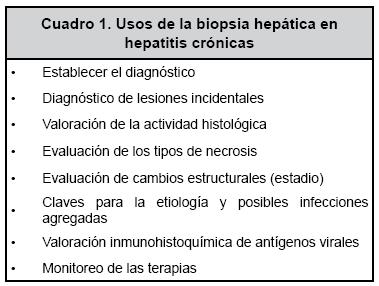
<body><![CDATA[<div style="text-align: justify;"></div>     <p style="text-align: justify;" class="MsoNormal"><span  style="font-size: 10pt; font-family: Verdana;">La nomenclatura de la hepatitis cr&#243;nica defini&#243; tres grandes grupos, una fue la hepatitis cr&#243;nica activa, en donde el componente principal era la actividad necr&#243;tica e inflamatoria <span class="SpellE">periportal</span>, y se supon&#237;a que progresar&#237;a hacia cirrosis muy r&#225;pidamente. El otro grupo fue la hepatitis cr&#243;nica persistente, que se defini&#243; como presencia de inflamaci&#243;n portal, sin lesi&#243;n necr&#243;tica <span class="SpellE">periportal</span>, la cual deber&#237;a tener un mejor pron&#243;stico evolutivo. Y por &#250;ltimo, la hepatitis cr&#243;nica <span class="SpellE">lobulillar</span>, en donde el componente inflamatorio y necr&#243;tico estaba limitado a la zona <span  class="SpellE">trabecular</span>. Poco a poco, esta clasificaci&#243;n fue cayendo en desuso, porque los avances del conocimiento de las hepatitis B y C demostraron que casos definidos inicialmente, como hepatitis cr&#243;nica persistente, pod&#237;an desarrollar un estadio final de cirrosis, a pesar de un diagn&#243;stico histopatol&#243;gico favorable. Por otro lado, se conoce que la hepatitis cr&#243;nica por virus C es muy leve, y por lo tanto, la clasificaci&#243;n antigua no nos indicaba el pron&#243;stico y la evoluci&#243;n. La aparici&#243;n de las terapias antivirales, hizo necesario una evaluaci&#243;n m&#225;s detallada de la severidad de las lesiones por parte de los pat&#243;logos para justificar la respuesta cl&#237;nica e histol&#243;gica a la terapia antiviral. <o:p></o:p></span></p>     <div style="text-align: justify;"></div>     <div style="text-align: justify;"></div>     <p style="text-align: justify;" class="MsoNormal"><span  style="font-size: 10pt; font-family: Verdana;">Por estas razones, en 1994, el Grupo Internacional de Trabajo, apoyado por los Congresos Mundiales de Gastroenterolog&#237;a, recomend&#243; que la nomenclatura deber&#237;a ser cambiada por la terminolog&#237;a m&#225;s simple de &#8220;hepatitis cr&#243;nica&#8221;, incluyendo la causa o agente causal si se conoc&#237;a, agregando el grado de actividad de la hepatitis basados, en el grado de inflamaci&#243;n, necrosis en sacabocados o en puentes (hepatitis de interfase), y el estadio de la fibrosis. <o:p></o:p></span></p>     <div style="text-align: left;"></div>     <div style="text-align: left;"></div>     <p style="text-align: justify;" class="MsoNormal"><span  style="font-size: 10pt; font-family: Verdana;">En cuanto al uso de la biopsia, en el diagn&#243;stico y tratamiento de pacientes con hepatitis cr&#243;nicas, hay opiniones divididas. Sin embargo, la histolog&#237;a contin&#250;a jugando un papel central en la valoraci&#243;n de nuevos tratamientos, y es usado por muchos m&#233;dicos para establecer un diagn&#243;stico y una gu&#237;a de tratamiento. En el cuadro 1 se definen los usos de la biopsia hep&#225;tica, aplicados en la hepatitis cr&#243;nica. <o:p></o:p></span></p>     <div style="text-align: justify;"></div>     <div style="text-align: justify;"></div>     ]]></body>
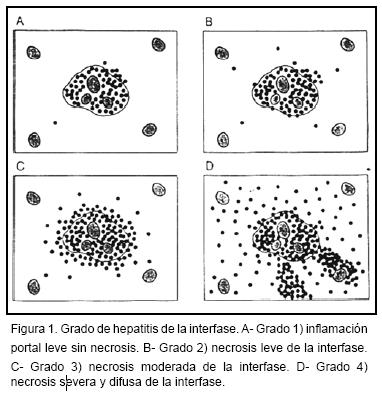
<body><![CDATA[<div style="text-align: justify;"></div>     <p style="text-align: justify;" class="MsoNormal"><span  style="font-size: 10pt; font-family: Verdana;">El nuevo esquema de valoraci&#243;n de las hepatitis cr&#243;nicas no s&#243;lo incluye las hepatitis virales y autoinmunes, sino tambi&#233;n, a hepatitis cr&#243;nicas por medicamentos o causas desconocidas, lesiones biliares como cirrosis biliar primaria o <span class="SpellE">colangitis</span> esclerosante, enfermedad de Wilson y deficiencia de alfa-antitripsina. A continuaci&#243;n, se definen los componentes histopatol&#243;gicos que deben estar incluidos en la valoraci&#243;n <span class="SpellE">semicuantitativa</span> de las biopsias. <o:p></o:p></span></p>     <div style="text-align: left;"></div>     <p class="MsoNormal"><b style=""><span  style="font-size: 11pt; font-family: Verdana;">Hepatitis de la zona de interfase <span style=""><o:p></o:p></span></span></b></p>     <p style="text-align: justify;" class="MsoNormal"><span  style="font-size: 10pt; font-family: Verdana;">La zona de interfase es aquella que comprende el borde del tejido fibroso del espacio porta y las <span class="SpellE">trab&#233;culas</span> de la zona <span  class="SpellE">acinar</span>. En esta zona se debe evaluar la presencia de necrosis <span class="SpellE">hepatocelular</span>, aunque, recientemente, se ha enfatizado m&#225;s en la apoptosis. Esta se puede observa como p&#233;rdida de hepatocitos, dejando en su lugar, &#225;reas con espacios vac&#237;os, ya que la corriente de los sinusoides se lleva los hepatocitos da&#241;ados. El infiltrado inflamatorio puede ser variable, desde leve hasta muy intenso. <o:p></o:p></span></p>     <div style="text-align: left;"> </div>     <div>     <div style="text-align: left;"></div>     <p style="text-align: left;" class="MsoNormal"><b style=""><span  style="font-size: 11pt; font-family: Verdana;">Lesi&#243;n <span  class="SpellE">lobulillar</span> o <span class="SpellE">acinar</span> <span style=""><o:p></o:p></span></span></b></p>     <div style="text-align: left;"></div>     ]]></body>
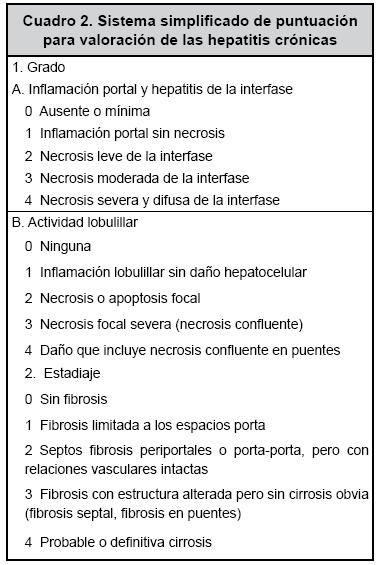
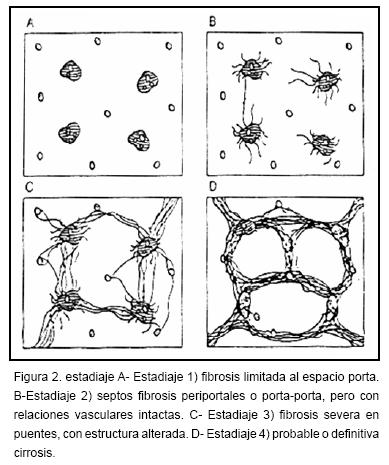
<body><![CDATA[<p style="text-align: justify;" class="MsoNormal"><span  style="font-size: 10pt; font-family: Verdana;">Dentro del par&#233;nquima hep&#225;tico hay varios grados de da&#241;o <span class="SpellE">hepatocelular</span> e inflamaci&#243;n. Generalmente, se observa necrosis focal, pero tambi&#233;n puede haber necrosis confluente y en puentes. La necrosis focal puede observarse como &#225;reas con p&#233;rdida de hepatocitos con infiltraci&#243;n por linfocitos, macr&#243;fagos y otras c&#233;lulas. La necrosis confluente se define como un &#225;rea que cubre el espacio ocupado por cuatro o cinco hepatocitos. La necrosis en puente es aquella en la que hay una gran cantidad de hepatocitos necr&#243;ticos, comprendiendo &#225;reas que abarcan zonas entre espacio porta y espacio porta, o zonas entre vena hep&#225;tica terminal y espacio porta. <o:p></o:p></span></p>     <div style="text-align: left;"></div> </div>     <div style="text-align: left;"></div>     <p class="MsoNormal"><b style=""><span  style="font-size: 11pt; font-family: Verdana;">Puntuaci&#243;n <span  class="SpellE">semicuantitativa</span>: graduaci&#243;n y <span  class="SpellE">estadiaje</span> <span style=""><o:p></o:p></span></span></b></p>     <p style="text-align: justify;" class="MsoNormal"><span  style="font-size: 10pt; font-family: Verdana;">La puntuaci&#243;n de las lesiones en hepatitis cr&#243;nica es ampliamente usada para evaluar biopsias hep&#225;ticas antes de tratamiento, monitorear los efectos de tratamiento y para valorar los efectos de nuevas terapias en pruebas cl&#237;nicas. Consiste de dos componentes, la graduaci&#243;n y el <span class="SpellE">estadiaje</span>. La graduaci&#243;n se refiere a la puntuaci&#243;n de la lesi&#243;n <span class="SpellE">necroinflamatoria</span> de una hepatitis, incluyendo los tipos y grados de da&#241;o <span  class="SpellE">hepatocelular</span> y la localizaci&#243;n y extensi&#243;n del proceso inflamatorio. El <span class="SpellE">estadiaje</span> se refiere a la extensi&#243;n de la fibrosis y los cambios estructurales, incluyendo el desarrollo de cirrosis. <a href="/img/revistas/amc/v50s3/art07t1.jpg">Cuadro 1</a> <o:p></o:p></span></p>     <div style="text-align: justify;"></div>     <p style="text-align: justify;" class="MsoNormal"><span  style="font-size: 10pt; font-family: Verdana;">La puntuaci&#243;n es <span class="SpellE">semicuantitativa</span> m&#225;s que cuantitativa, ya que no representan medidas verdaderas. Involucra la valoraci&#243;n subjetiva de las varias caracter&#237;sticas histol&#243;gicas relevantes en una biopsia, y las puntuaciones asignadas, inevitablemente variar&#225;n entre un observador y otro, dependiendo de la experiencia y sesgos. Por esta raz&#243;n, los puntajes asignados por diferentes observadores, no pueden ser comparados directamente. La manera &#243;ptima de realizarlo es hacerlo, en conjunto, entre al menos dos pat&#243;logos, con experiencia en patolog&#237;a hep&#225;tica, al frente de un microscopio de <span class="SpellE">multi</span>-observaci&#243;n.&nbsp; <o:p></o:p></span></p>     <div style="text-align: left;"> </div> </div>     <div style="text-align: left;"></div>     <div>     ]]></body>
<body><![CDATA[<div style="text-align: left;"></div>     <div>     <div style="text-align: left;"></div>     <p style="text-align: left;" class="MsoNormal"><b style=""><span  style="font-size: 11pt; font-family: Verdana;">Requisitos m&#237;nimos para la valoraci&#243;n histol&#243;gica de una biopsia de h&#237;gado <o:p></o:p></span></b></p>     <div style="text-align: left;"></div>     <p style="text-align: justify;" class="MsoNormal"><span  style="font-size: 10pt; font-family: Verdana;">Para valorar adecuadamente una biopsia hep&#225;tica, lo primero que se debe tener es una muestra representativa de h&#237;gado. Se ha debatido mucho en cuanto a qu&#233; cantidad de tejido se debe tener. En general, se considera que en las hepatitis agudas y cr&#243;nicas el h&#237;gado tiene lesiones difusas, y que la biopsia hep&#225;tica por aguja es representativa de todo el &#243;rgano. Es importante definir cu&#225;ntos espacios porta se est&#225;n observando, y se considera que cuando hay al menos de tres a cinco de ellos, la muestra es representativa. Se deben hacer de rutina las siguientes tinciones, <span class="SpellE">hematoxilinaeosina</span> para valoraci&#243;n general de la biopsia; <span class="SpellE">tricr&#243;mico</span> para fibras col&#225;genas; ret&#237;culo para valorar arquitectura; <span class="SpellE">orce&#237;na</span> para definir fibrosis verdadera versus colapso. <a href="/img/revistas/amc/v50s3/art07t2.jpg">Cuadro 2</a> <o:p></o:p></span></p>     <div style="text-align: justify;"></div>     <div style="text-align: justify;"></div> </div>     <div style="text-align: justify;"></div>     <div style="text-align: justify;"></div>     ]]></body>
<body><![CDATA[<div>     <div style="text-align: justify;"></div>     <div style="text-align: justify;"></div>     <p style="text-align: justify;" class="MsoNormal"><span  style="font-size: 10pt; font-family: Verdana;">Es importante entonces, utilizar un sistema simple, reproducible y bien definido, con el fin de minimizar las diferencias subjetivas en el sistema de puntaje. El sistema simple propuesto por el Dr. Peter <span class="SpellE">Scheuer</span> cumple estas caracter&#237;sticas y es ampliamente usado tanto en Europa como en Estados Unidos. En el cuadro 2 se definen cada uno de los par&#225;metros por evaluar. Se han propuesto otros sistemas, sin embargo, su complejidad y m&#250;ltiples par&#225;metros por evaluar no permiten que tengan una aplicaci&#243;n pr&#225;ctica. <o:p></o:p></span></p>     <div style="text-align: justify;"></div>     <div style="text-align: justify;"></div>     <div style="text-align: justify;"></div>     <p style="text-align: justify;" class="MsoNormal"><span  style="font-size: 10pt; font-family: Verdana;">Con el fin de que haya menos variabilidad entre observadores, se propone el uso de los siguientes esquemas de estudio. Una vez aplicado el puntaje en la biopsia estudiada, se debe determinar, hasta donde sea posible, la etiolog&#237;a de la hepatitis cr&#243;nica. Por lo tanto, es conveniente tener acceso a informaci&#243;n cl&#237;nica, incluyendo historia cl&#237;nica, evoluci&#243;n, sintomatolog&#237;a, ex&#225;menes de laboratorio, <span  class="SpellE">inmunohistoqu&#237;mica</span>, serolog&#237;a e imagenolog&#237;a, con el fin de hacer una correlaci&#243;n cl&#237;nico <span  class="GramE">patol&#243;gica adecuada</span> para determinar una posible etiolog&#237;a. <o:p></o:p></span></p>     <div style="text-align: justify;"></div>     <div style="text-align: justify;"></div>     ]]></body>
<body><![CDATA[<div style="text-align: justify;"></div>     <p style="text-align: justify;" class="MsoNormal"><span  style="font-size: 10pt; font-family: Verdana;">Como ejemplo del aborde <span class="SpellE">semicuantitativo</span>, el diagn&#243;stico de una biopsia se puede escribir de la siguiente manera: hepatitis cr&#243;nica, con actividad portal leve (2), actividad <span  class="SpellE">lobulillar</span> severa (3), en estadio de fibrosis moderada (2), de etiolog&#237;a por virus de la hepatitis C. <o:p></o:p></span></p>     <div style="text-align: justify;"></div>     <div style="text-align: justify;"></div>     <div style="text-align: justify;"></div>     <p style="text-align: justify;" class="MsoNormal"><span  style="font-size: 10pt; font-family: Verdana;">Siempre debe tenerse en cuenta que la posibilidad o probabilidad de variaci&#243;n de muestreo puede suceder. Tanto la localizaci&#243;n de la biopsia, si es l&#243;bulo derecho o izquierdo, como el tama&#241;o pueden llevar a error. Las muestras de longitud total menor de <st1:metricconverter  productid="20 mm" w:st="on">20 <span class="SpellE">mm</span></st1:metricconverter> han demostrado no ser consistentes con los hallazgos de muestras de mayor tama&#241;o. <o:p></o:p></span></p>     <div style="text-align: justify;"></div>     <div style="text-align: justify;"></div>     <p style="text-align: justify;" class="MsoNormal"><span  style="font-size: 10pt; font-family: Verdana;">Por lo tanto, el tener conciencia de estos factores, cuidadosos intentos para minimizar la variaci&#243;n, entre observadores y la interpretaci&#243;n de los resultados, deber&#237;an asegurar la utilidad continua de la graduaci&#243;n y el <span class="SpellE">estadiaje</span> en la pr&#225;ctica cl&#237;nica. <a href="/img/revistas/amc/v50s3/art07i1.jpg">Figura 1</a>, <a href="/img/revistas/amc/v50s3/art07i2.jpg">Figura 2</a><o:p></o:p></span></p> </div> </div>     <div>     ]]></body>
<body><![CDATA[<div><span class="SpellE"><b style=""><span  style="font-size: 11pt; font-family: Verdana;" lang="EN-US"></span></b></span> <hr style="width: 100%; height: 2px;"><span class="SpellE"><b style=""><span  style="font-size: 11pt; font-family: Verdana;" lang="EN-US">Lecturas</span></b></span><b  style=""><span style="font-size: 11pt; font-family: Verdana;"  lang="EN-US"> <span class="SpellE">recomendadas</span> <o:p></o:p></span></b>     <!-- ref --><p class="MsoNormal"><span class="SpellE"><span  style="font-size: 10pt; font-family: Verdana;" lang="EN-US">Scheuer</span></span><span  style="font-size: 10pt; font-family: Verdana;" lang="EN-US"> P.J., <span class="SpellE">Lefkowich</span> J.H. Liver Biopsy Interpretation<span class="GramE">,7th</span> Edition. <st1:city  w:st="on"><st1:place w:st="on">Philadelphia</st1:place></st1:city>: Elsevier, 2006.    &nbsp;&nbsp;&nbsp;&nbsp;&nbsp;&nbsp;&nbsp;&nbsp;[&#160;<a href="javascript:void(0);" onclick="javascript: window.open('/scielo.php?script=sci_nlinks&ref=083103&pid=S0001-6002200800050000700001&lng=','','width=640,height=500,resizable=yes,scrollbars=1,menubar=yes,');">Links</a>&#160;]<!-- end-ref --> <o:p></o:p></span></p>     <!-- ref --><p class="MsoNormal"><span class="SpellE"><span  style="font-size: 10pt; font-family: Verdana;" lang="EN-US">GastroInternational</span></span><span  style="font-size: 10pt; font-family: Verdana;" lang="EN-US"> Working Party Terminology of chronic hepatitis, hepatic allograft rejection, and nodular lesions of the liver: summary of recommendations developed by an International Working Party, supported by the World Congresses of Gastroenterology, <st1:city w:st="on"><st1:place w:st="on">Los Angeles</st1:place></st1:city>, 1994. Am J <span class="SpellE">Gastroenterol</span> 1994<span  class="GramE">;89:S177</span>&#8211;81.    &nbsp;&nbsp;&nbsp;&nbsp;&nbsp;&nbsp;&nbsp;&nbsp;[&#160;<a href="javascript:void(0);" onclick="javascript: window.open('/scielo.php?script=sci_nlinks&ref=083105&pid=S0001-6002200800050000700002&lng=','','width=640,height=500,resizable=yes,scrollbars=1,menubar=yes,');">Links</a>&#160;]<!-- end-ref --> <o:p></o:p></span></p>     <!-- ref --><p class="MsoNormal"><span  style="font-size: 10pt; font-family: Verdana;">Paz, MO, Brenes F, <span class="SpellE">Karayiannis</span> P, <span  class="SpellE">Jowett</span> TP, <span class="SpellE">Scheuer</span> PJ, Thomas HC. </span><span  class="GramE"><span style="font-size: 10pt; font-family: Verdana;"  lang="EN-US">Chronic hepatitis B virus infection.</span></span><span  style="font-size: 10pt; font-family: Verdana;" lang="EN-US"> Viral replication and patterns of inflammatory activity: serological, clinical and histological correlations. <span class="GramE">J <span class="SpellE">Hepatol</span>.</span> <span  class="GramE">1986; 3: 371-7.    &nbsp;&nbsp;&nbsp;&nbsp;&nbsp;&nbsp;&nbsp;&nbsp;[&#160;<a href="javascript:void(0);" onclick="javascript: window.open('/scielo.php?script=sci_nlinks&ref=083107&pid=S0001-6002200800050000700003&lng=','','width=640,height=500,resizable=yes,scrollbars=1,menubar=yes,');">Links</a>&#160;]<!-- end-ref --></span> <o:p></o:p></span></p>     <!-- ref --><p class="MsoNormal"><span class="SpellE"><span  style="font-size: 10pt; font-family: Verdana;">Salom</span></span><span  style="font-size: 10pt; font-family: Verdana;"> I, <span class="SpellE">Roman</span> S, Macaya G, Fonseca J, Brenes F, Mora C, <span class="SpellE">Mart&#233;n</span> A. Revisi&#243;n <span  class="SpellE">retrospective</span> de la prevalencia del virus de la hepatitis B in varios grupos de poblaci&#243;n. <span class="SpellE">Rev</span> Bol <span class="SpellE">Trop</span> 1990; 38: 83-6.    &nbsp;&nbsp;&nbsp;&nbsp;&nbsp;&nbsp;&nbsp;&nbsp;[&#160;<a href="javascript:void(0);" onclick="javascript: window.open('/scielo.php?script=sci_nlinks&ref=083109&pid=S0001-6002200800050000700004&lng=','','width=640,height=500,resizable=yes,scrollbars=1,menubar=yes,');">Links</a>&#160;]<!-- end-ref --> <o:p></o:p></span></p>     <!-- ref --><p class="MsoNormal"><span class="SpellE"><span  style="font-size: 10pt; font-family: Verdana;" lang="EN-US">Scheuer</span></span><span  style="font-size: 10pt; font-family: Verdana;" lang="EN-US"> PJ. Classification of chronic viral hepatitis: a need for reassessment. J <span class="SpellE">Hepatol</span> 1991<span class="GramE">;13</span>: 372-374.    &nbsp;&nbsp;&nbsp;&nbsp;&nbsp;&nbsp;&nbsp;&nbsp;[&#160;<a href="javascript:void(0);" onclick="javascript: window.open('/scielo.php?script=sci_nlinks&ref=083111&pid=S0001-6002200800050000700005&lng=','','width=640,height=500,resizable=yes,scrollbars=1,menubar=yes,');">Links</a>&#160;]<!-- end-ref --> <o:p></o:p></span></p> </div>     <div>     <!-- ref --><p class="MsoNormal"><span class="SpellE"><span class="GramE"><span  style="font-size: 10pt; font-family: Verdana;" lang="EN-US">Batts</span></span></span><span  class="GramE"><span style="font-size: 10pt; font-family: Verdana;"  lang="EN-US"> KP, Ludwig <span class="SpellE">J.Chronic</span> hepatitis&#8212;an update on terminology and reporting.</span></span><span  style="font-size: 10pt; font-family: Verdana;" lang="EN-US"> Am J <span class="SpellE">Surg</span> <span class="SpellE">Pathol</span> 1995<span class="GramE">;19:1409</span>&#8211;17.    &nbsp;&nbsp;&nbsp;&nbsp;&nbsp;&nbsp;&nbsp;&nbsp;[&#160;<a href="javascript:void(0);" onclick="javascript: window.open('/scielo.php?script=sci_nlinks&ref=083114&pid=S0001-6002200800050000700006&lng=','','width=640,height=500,resizable=yes,scrollbars=1,menubar=yes,');">Links</a>&#160;]<!-- end-ref --> <o:p></o:p></span></p>     <!-- ref --><p class="MsoNormal"><span  style="font-size: 10pt; font-family: Verdana;" lang="EN-US">R A <span  class="SpellE">Standish<span class="GramE">,<st1:place w:st="on">E Cholongitas</st1:place>, A </span>Dhillon</span>, A K Burroughs, A P <span class="SpellE">Dhillon</span>. <span class="GramE">An appraisal of the <span class="SpellE">histopathological</span> assessment of liver fibrosis.</span> Gut 2006; 55: 569-78.    &nbsp;&nbsp;&nbsp;&nbsp;&nbsp;&nbsp;&nbsp;&nbsp;[&#160;<a href="javascript:void(0);" onclick="javascript: window.open('/scielo.php?script=sci_nlinks&ref=083116&pid=S0001-6002200800050000700007&lng=','','width=640,height=500,resizable=yes,scrollbars=1,menubar=yes,');">Links</a>&#160;]<!-- end-ref --> </span><span style="font-size: 10pt; font-family: Verdana;"><o:p></o:p></span></p>     <!-- ref --><p class="MsoNormal"><span class="SpellE"><span class="GramE"><span  style="font-size: 10pt; font-family: Verdana;" lang="EN-US">Tsui</span></span></span><span  class="GramE"><span style="font-size: 10pt; font-family: Verdana;"  lang="EN-US"> <span class="SpellE">W.New</span> classification of chronic hepatitis and more.</span></span><span  style="font-size: 10pt; font-family: Verdana;" lang="EN-US"> Adv <span  class="SpellE">Anat</span> <span class="SpellE">Pathol</span> 1996<span class="GramE"> 3 64</span>,70.    &nbsp;&nbsp;&nbsp;&nbsp;&nbsp;&nbsp;&nbsp;&nbsp;[&#160;<a href="javascript:void(0);" onclick="javascript: window.open('/scielo.php?script=sci_nlinks&ref=083118&pid=S0001-6002200800050000700008&lng=','','width=640,height=500,resizable=yes,scrollbars=1,menubar=yes,');">Links</a>&#160;]<!-- end-ref --> <o:p></o:p></span></p>     <!-- ref --><p class="MsoNormal"><span class="SpellE"><span  style="font-size: 10pt; font-family: Verdana;" lang="EN-US">Saadeh</span></span><span  style="font-size: 10pt; font-family: Verdana;" lang="EN-US"> S, <span class="SpellE">Cammell</span> G, Carey WD. The role of liver biopsy in chronic hepatitis C. <span class="SpellE">Hepatology</span> 2001; 33: 196-200.    &nbsp;&nbsp;&nbsp;&nbsp;&nbsp;&nbsp;&nbsp;&nbsp;[&#160;<a href="javascript:void(0);" onclick="javascript: window.open('/scielo.php?script=sci_nlinks&ref=083120&pid=S0001-6002200800050000700009&lng=','','width=640,height=500,resizable=yes,scrollbars=1,menubar=yes,');">Links</a>&#160;]<!-- end-ref --> <o:p></o:p></span></p>     ]]></body>
<body><![CDATA[<!-- ref --><p class="MsoNormal"><span class="SpellE"><span  style="font-size: 10pt; font-family: Verdana;" lang="EN-US">Fattovich</span></span><span  style="font-size: 10pt; font-family: Verdana;" lang="EN-US"> G. Natural history and prognosis of hepatitis B. <span class="SpellE"><span  class="GramE">Sem</span></span> Liver Dis.2003; 23: 47-58.    &nbsp;&nbsp;&nbsp;&nbsp;&nbsp;&nbsp;&nbsp;&nbsp;[&#160;<a href="javascript:void(0);" onclick="javascript: window.open('/scielo.php?script=sci_nlinks&ref=083122&pid=S0001-6002200800050000700010&lng=','','width=640,height=500,resizable=yes,scrollbars=1,menubar=yes,');">Links</a>&#160;]<!-- end-ref --> <o:p></o:p></span></p>     <!-- ref --><p class="MsoNormal"><st1:place w:st="on"><st1:city w:st="on"><span  class="GramE"><span style="font-size: 10pt; font-family: Verdana;"  lang="EN-US">Campbell</span></span></st1:city><span class="GramE"><span  style="font-size: 10pt; font-family: Verdana;" lang="EN-US"> <st1:state  w:st="on">MS</st1:state></span></span></st1:place><span class="GramE"><span  style="font-size: 10pt; font-family: Verdana;" lang="EN-US">, Reddy KR.</span></span><span  style="font-size: 10pt; font-family: Verdana;" lang="EN-US"> <span  class="GramE">The evolving role of liver biopsy.</span> <span class="SpellE">Alim</span> <span class="SpellE">Pharmacol</span> <span class="SpellE">Ther</span> 2004; 20: 249-259.    &nbsp;&nbsp;&nbsp;&nbsp;&nbsp;&nbsp;&nbsp;&nbsp;[&#160;<a href="javascript:void(0);" onclick="javascript: window.open('/scielo.php?script=sci_nlinks&ref=083124&pid=S0001-6002200800050000700011&lng=','','width=640,height=500,resizable=yes,scrollbars=1,menubar=yes,');">Links</a>&#160;]<!-- end-ref --> <o:p></o:p></span></p>     <!-- ref --><p class="MsoNormal"><span class="SpellE"><span  style="font-size: 10pt; font-family: Verdana;" lang="EN-US">Rousselet</span></span><span  style="font-size: 10pt; font-family: Verdana;" lang="EN-US"> MC, <span class="SpellE">Michalak</span> S, <span class="SpellE">Dupr&#233;</span> F. et al. Sources of variability in histological scoring of chronic hepatitis. </span><span class="SpellE"><span  style="font-size: 10pt; font-family: Verdana;" lang="PT-BR">Hepatology</span></span><span  style="font-size: 10pt; font-family: Verdana;" lang="PT-BR"> 2005; 257-264.    &nbsp;&nbsp;&nbsp;&nbsp;&nbsp;&nbsp;&nbsp;&nbsp;[&#160;<a href="javascript:void(0);" onclick="javascript: window.open('/scielo.php?script=sci_nlinks&ref=083126&pid=S0001-6002200800050000700012&lng=','','width=640,height=500,resizable=yes,scrollbars=1,menubar=yes,');">Links</a>&#160;]<!-- end-ref --> <o:p></o:p></span></p>     <!-- ref --><p class="MsoNormal"><span  style="font-size: 10pt; font-family: Verdana;" lang="PT-BR">Guido M, <span  class="SpellE">Rugge</span> M. <span class="SpellE">Liver</span> <span  class="SpellE">biopsy</span> <span class="SpellE">sampling</span> in <span class="SpellE">chronic</span> viral <span class="SpellE">hepatitis</span>. Sem <span class="SpellE">Liver</span> <span class="SpellE">Dis</span> 2004; 24: 89-97.    &nbsp;&nbsp;&nbsp;&nbsp;&nbsp;&nbsp;&nbsp;&nbsp;[&#160;<a href="javascript:void(0);" onclick="javascript: window.open('/scielo.php?script=sci_nlinks&ref=083128&pid=S0001-6002200800050000700013&lng=','','width=640,height=500,resizable=yes,scrollbars=1,menubar=yes,');">Links</a>&#160;]<!-- end-ref --> </span><span style="font-size: 10pt; font-family: Verdana;"></span></p>     <p class="MsoNormal"><span  style="font-size: 10pt; font-family: Verdana;">    <br> <a name="afiliacion1"></a><a href="#afiliacion2">*</a>Pat&#243;logo. Hospital M&#233;xico, Caja Costarricense de Seguro Social</span><span  style="font-size: 10pt; font-family: Verdana;" lang="PT-BR"> <o:p></o:p></span></p> </div> </div> </div> </div> </div>     ]]></body>
<body><![CDATA[ ]]></body><back>
<ref-list>
<ref id="B1">
<nlm-citation citation-type="book">
<person-group person-group-type="author">
<name>
<surname><![CDATA[Scheuer]]></surname>
<given-names><![CDATA[P.J]]></given-names>
</name>
<name>
<surname><![CDATA[Lefkowich]]></surname>
<given-names><![CDATA[J.H]]></given-names>
</name>
</person-group>
<source><![CDATA[Liver Biopsy Interpretation]]></source>
<year>2006</year>
<edition>7</edition>
<publisher-loc><![CDATA[Philadelphia ]]></publisher-loc>
<publisher-name><![CDATA[Elsevier]]></publisher-name>
</nlm-citation>
</ref>
<ref id="B2">
<nlm-citation citation-type="journal">
<article-title xml:lang="en"><![CDATA[GastroInternational Working Party Terminology of chronic hepatitis, hepatic allograft rejection, and nodular lesions of the liver: summary of recommendations developed by an International Working Party, supported by the World Congresses of Gastroenterology, Los Angeles, 1994]]></article-title>
<source><![CDATA[Am J Gastroenterol]]></source>
<year>1994</year>
<volume>89</volume>
<page-range>S177-81</page-range></nlm-citation>
</ref>
<ref id="B3">
<nlm-citation citation-type="journal">
<person-group person-group-type="author">
<name>
<surname><![CDATA[Paz]]></surname>
<given-names><![CDATA[MO]]></given-names>
</name>
<name>
<surname><![CDATA[Brenes]]></surname>
<given-names><![CDATA[F]]></given-names>
</name>
<name>
<surname><![CDATA[Karayiannis]]></surname>
<given-names><![CDATA[P]]></given-names>
</name>
<name>
<surname><![CDATA[Jowett]]></surname>
<given-names><![CDATA[TP]]></given-names>
</name>
<name>
<surname><![CDATA[Scheuer]]></surname>
<given-names><![CDATA[PJ]]></given-names>
</name>
<name>
<surname><![CDATA[Thomas]]></surname>
<given-names><![CDATA[HC]]></given-names>
</name>
</person-group>
<article-title xml:lang="en"><![CDATA[Chronic hepatitis B virus infection. Viral replication and patterns of inflammatory activity: serological, clinical and histological correlations]]></article-title>
<source><![CDATA[J Hepatol]]></source>
<year>1986</year>
<volume>3</volume>
<page-range>371-7</page-range></nlm-citation>
</ref>
<ref id="B4">
<nlm-citation citation-type="journal">
<person-group person-group-type="author">
<name>
<surname><![CDATA[Salom]]></surname>
<given-names><![CDATA[I]]></given-names>
</name>
<name>
<surname><![CDATA[Roman]]></surname>
<given-names><![CDATA[S]]></given-names>
</name>
<name>
<surname><![CDATA[Macaya]]></surname>
<given-names><![CDATA[G]]></given-names>
</name>
<name>
<surname><![CDATA[Fonseca]]></surname>
<given-names><![CDATA[J]]></given-names>
</name>
<name>
<surname><![CDATA[Brenes]]></surname>
<given-names><![CDATA[F]]></given-names>
</name>
<name>
<surname><![CDATA[Mora]]></surname>
<given-names><![CDATA[C]]></given-names>
</name>
<name>
<surname><![CDATA[Martén]]></surname>
<given-names><![CDATA[A]]></given-names>
</name>
</person-group>
<article-title xml:lang="en"><![CDATA[Revisión retrospective de la prevalencia del virus de la hepatitis B in varios grupos de población]]></article-title>
<source><![CDATA[Rev Bol Trop]]></source>
<year>1990</year>
<volume>38</volume>
<page-range>83-6</page-range></nlm-citation>
</ref>
<ref id="B5">
<nlm-citation citation-type="journal">
<person-group person-group-type="author">
<name>
<surname><![CDATA[Scheuer]]></surname>
<given-names><![CDATA[PJ]]></given-names>
</name>
</person-group>
<article-title xml:lang="en"><![CDATA[Classification of chronic viral hepatitis: a need for reassessment]]></article-title>
<source><![CDATA[J Hepatol]]></source>
<year>1991</year>
<volume>13</volume>
<page-range>372-374</page-range></nlm-citation>
</ref>
<ref id="B6">
<nlm-citation citation-type="journal">
<person-group person-group-type="author">
<name>
<surname><![CDATA[Batts]]></surname>
<given-names><![CDATA[KP]]></given-names>
</name>
<name>
<surname><![CDATA[Ludwig]]></surname>
<given-names><![CDATA[J]]></given-names>
</name>
</person-group>
<article-title xml:lang="en"><![CDATA[Chronic hepatitis-an update on terminology and reporting]]></article-title>
<source><![CDATA[Am J Surg Pathol]]></source>
<year>1995</year>
<volume>19</volume>
<page-range>1409-17</page-range></nlm-citation>
</ref>
<ref id="B7">
<nlm-citation citation-type="journal">
<person-group person-group-type="author">
<name>
<surname><![CDATA[Standish]]></surname>
<given-names><![CDATA[R A]]></given-names>
</name>
<name>
<surname><![CDATA[Cholongitas]]></surname>
<given-names><![CDATA[E]]></given-names>
</name>
<name>
<surname><![CDATA[Dhillon]]></surname>
<given-names><![CDATA[A]]></given-names>
</name>
<name>
<surname><![CDATA[Burroughs]]></surname>
<given-names><![CDATA[A K]]></given-names>
</name>
<name>
<surname><![CDATA[Dhillon]]></surname>
<given-names><![CDATA[A P]]></given-names>
</name>
</person-group>
<article-title xml:lang="en"><![CDATA[An appraisal of the histopathological assessment of liver fibrosis]]></article-title>
<source><![CDATA[Gut]]></source>
<year>2006</year>
<volume>55</volume>
<page-range>569-78</page-range></nlm-citation>
</ref>
<ref id="B8">
<nlm-citation citation-type="journal">
<person-group person-group-type="author">
<name>
<surname><![CDATA[Tsui]]></surname>
<given-names><![CDATA[W]]></given-names>
</name>
</person-group>
<article-title xml:lang="en"><![CDATA[New classification of chronic hepatitis and more]]></article-title>
<source><![CDATA[Adv Anat Pathol]]></source>
<year>1996</year>
<volume>3</volume>
<page-range>64, 70</page-range></nlm-citation>
</ref>
<ref id="B9">
<nlm-citation citation-type="journal">
<person-group person-group-type="author">
<name>
<surname><![CDATA[Saadeh]]></surname>
<given-names><![CDATA[S]]></given-names>
</name>
<name>
<surname><![CDATA[Cammell]]></surname>
<given-names><![CDATA[G]]></given-names>
</name>
<name>
<surname><![CDATA[Carey]]></surname>
<given-names><![CDATA[WD]]></given-names>
</name>
</person-group>
<article-title xml:lang="en"><![CDATA[The role of liver biopsy in chronic hepatitis C]]></article-title>
<source><![CDATA[Hepatology]]></source>
<year>2001</year>
<volume>33</volume>
<page-range>196-200</page-range></nlm-citation>
</ref>
<ref id="B10">
<nlm-citation citation-type="journal">
<person-group person-group-type="author">
<name>
<surname><![CDATA[Fattovich]]></surname>
<given-names><![CDATA[G]]></given-names>
</name>
</person-group>
<article-title xml:lang="en"><![CDATA[Natural history and prognosis of hepatitis B]]></article-title>
<source><![CDATA[Sem Liver Dis]]></source>
<year>2003</year>
<volume>23</volume>
<page-range>47-58</page-range></nlm-citation>
</ref>
<ref id="B11">
<nlm-citation citation-type="journal">
<person-group person-group-type="author">
<name>
<surname><![CDATA[Campbell]]></surname>
<given-names><![CDATA[MS]]></given-names>
</name>
<name>
<surname><![CDATA[Reddy]]></surname>
<given-names><![CDATA[KR]]></given-names>
</name>
</person-group>
<article-title xml:lang="en"><![CDATA[The evolving role of liver biopsy]]></article-title>
<source><![CDATA[Alim Pharmacol Ther]]></source>
<year>2004</year>
<volume>20</volume>
<page-range>249-259</page-range></nlm-citation>
</ref>
<ref id="B12">
<nlm-citation citation-type="journal">
<person-group person-group-type="author">
<name>
<surname><![CDATA[Rousselet]]></surname>
<given-names><![CDATA[MC]]></given-names>
</name>
<name>
<surname><![CDATA[Michalak]]></surname>
<given-names><![CDATA[S]]></given-names>
</name>
<name>
<surname><![CDATA[Dupré]]></surname>
<given-names><![CDATA[F]]></given-names>
</name>
</person-group>
<article-title xml:lang="en"><![CDATA[Sources of variability in histological scoring of chronic hepatitis]]></article-title>
<source><![CDATA[Hepatology]]></source>
<year>2005</year>
<page-range>257-264</page-range></nlm-citation>
</ref>
<ref id="B13">
<nlm-citation citation-type="journal">
<person-group person-group-type="author">
<name>
<surname><![CDATA[Guido]]></surname>
<given-names><![CDATA[M]]></given-names>
</name>
<name>
<surname><![CDATA[Rugge]]></surname>
<given-names><![CDATA[M]]></given-names>
</name>
</person-group>
<article-title xml:lang="en"><![CDATA[Liver biopsy sampling in chronic viral hepatitis]]></article-title>
<source><![CDATA[Sem Liver Dis]]></source>
<year>2004</year>
<volume>24</volume>
<page-range>89-97</page-range></nlm-citation>
</ref>
</ref-list>
</back>
</article>