<?xml version="1.0" encoding="ISO-8859-1"?><article xmlns:mml="http://www.w3.org/1998/Math/MathML" xmlns:xlink="http://www.w3.org/1999/xlink" xmlns:xsi="http://www.w3.org/2001/XMLSchema-instance">
<front>
<journal-meta>
<journal-id>0001-6002</journal-id>
<journal-title><![CDATA[Acta Médica Costarricense]]></journal-title>
<abbrev-journal-title><![CDATA[Acta méd. costarric]]></abbrev-journal-title>
<issn>0001-6002</issn>
<publisher>
<publisher-name><![CDATA[Colegio de Médicos y Cirujanos de Costa Rica]]></publisher-name>
</publisher>
</journal-meta>
<article-meta>
<article-id>S0001-60022008000500006</article-id>
<title-group>
<article-title xml:lang="es"><![CDATA[Diagnóstico serológico de la Hepatitis B]]></article-title>
<article-title xml:lang="en"><![CDATA[Serologic diagnostic of Hepatitis type B]]></article-title>
</title-group>
<contrib-group>
<contrib contrib-type="author">
<name>
<surname><![CDATA[García-Solano]]></surname>
<given-names><![CDATA[Zaida]]></given-names>
</name>
</contrib>
</contrib-group>
<aff id="A">
<institution><![CDATA[,  ]]></institution>
<addr-line><![CDATA[ ]]></addr-line>
</aff>
<pub-date pub-type="pub">
<day>00</day>
<month>11</month>
<year>2008</year>
</pub-date>
<pub-date pub-type="epub">
<day>00</day>
<month>11</month>
<year>2008</year>
</pub-date>
<volume>50</volume>
<fpage>16</fpage>
<lpage>21</lpage>
<copyright-statement/>
<copyright-year/>
<self-uri xlink:href="http://www.scielo.sa.cr/scielo.php?script=sci_arttext&amp;pid=S0001-60022008000500006&amp;lng=en&amp;nrm=iso"></self-uri><self-uri xlink:href="http://www.scielo.sa.cr/scielo.php?script=sci_abstract&amp;pid=S0001-60022008000500006&amp;lng=en&amp;nrm=iso"></self-uri><self-uri xlink:href="http://www.scielo.sa.cr/scielo.php?script=sci_pdf&amp;pid=S0001-60022008000500006&amp;lng=en&amp;nrm=iso"></self-uri><abstract abstract-type="short" xml:lang="es"><p><![CDATA[Existen varios marcadores serol&#972;gicos del virus de hepatitis B, siendo los más importantes el HBsAg, HBcAg, HBeAg y sus anticuerpos como el anti-HBs, el anticore, anticore IG M, anticore total y el anti e. Basado en la presencia del antígeno de superficie, se ha medido la seroprevalencia del virus de hepatitis B. Se considera a un país de alta prevalencia, si en la población estudiada los niveles son mayores del 8%. Se considera intermedia cuando oscila entre 2 y 8% y baja si es menos del 2%. La Caja Costarricense del Seguro Social cuenta con una red de 98 laboratorios, de los cuales 17 están dotados con los equipos necesarios para la determinación de los antígenos y anticuerpos del virus de la hepatitis B. Un estudio realizado en el 2005 determinó, en el ámbito nacional, una seroprevalencia del antígeno de superficie del 0.1% considerándose, a Costa Rica, como un país de baja incidencia del virus B. Se ha determinado también que San Isidro del General tiene una seroprevalencia intermedia del HBsAg. El Colegio Americano de Patólogos realiza un tipo de control externo para la CCSS en lo que se refiere a estas técnicas de laboratorio para la determinación y control del virus de hepatitis B. La aparición de los diferentes antigenos y anticuerpos mencionados se relacionan con momentos clínicos que se explican, considerándose de importancia, la persistencia del antígeno de superficie, por más de 6 meses, como un portador crónico.]]></p></abstract>
<abstract abstract-type="short" xml:lang="en"><p><![CDATA[The hepatitis B surface antigen (HBsAg), the hepatitis B core antigen (HBcAg), the hepatitis B e antigen (HBeAg) and its antibodies such as the anti-HBs, the anticore (HBcAb), the IG M anticore (HBcAb Ig M), the total anticore; and the anti HBe (HBeAb) are found to be the most important among several serological markers for hepatitis B virus. The seroprevalence of hepatitis B virus was measured based on the presence of surface antigen. Any country is considered highly prevalent if the levels of the population under study are higher than 8%. The prevalence is considered intermediate if levels are between 2 and 8%; and it is low if they are less than 2%. The Caja Costarricense de Seguro Social relies on a network of 98 laboratories each with the necessary equipment to find out the antigens and antibodies of hepatitis B virus. A study carried out in 2005 determined a surface antigen seroprevalence of 0.1% in all the country. Therefore, Costa Rica has been ranked as a country with low incidence of HBV. It has also been determined that San Isidro del General holds an intermediate seroprevalence of HBsAg. The American Pathologists College executes an external control for CCSS regarding the laboratory techniques used to determine and control the hepatitis B virus. The appearance of the different antigens and antibodies mentioned is related to clinical moments that are explained. It is also considered as important, the persistence of surface antigen for more than 6 months as a chronic carrier.]]></p></abstract>
<kwd-group>
<kwd lng="es"><![CDATA[HBsAg]]></kwd>
<kwd lng="es"><![CDATA[HBeAg]]></kwd>
<kwd lng="es"><![CDATA[anticore]]></kwd>
<kwd lng="es"><![CDATA[prevalencia]]></kwd>
<kwd lng="es"><![CDATA[marcadores serol&#972;gicos]]></kwd>
<kwd lng="en"><![CDATA[CAP]]></kwd>
<kwd lng="en"><![CDATA[College of American Pathologists]]></kwd>
</kwd-group>
</article-meta>
</front><body><![CDATA[ <div class="Section1">     <div>     <div>     <p class="MsoNormal" style="text-align: center;" align="center"><b  style=""><span style="font-family: Verdana;">Diagn&#243;stico serol&#243;gico de la Hepatitis B<o:p></o:p></span></b></p> </div>     <div>     <div>     <p class="MsoNormal" style="text-align: center;" align="center"><b  style=""><span style="font-family: Verdana;"><span class="SpellE">Serologic</span> <span class="SpellE">diagnostic</span> <span class="SpellE">of</span> Hepatitis <span class="SpellE">type</span> B<o:p></o:p></span></b></p>     <p class="MsoNormal" style="text-align: center;" align="center"><b  style=""><span style="font-size: 11pt; font-family: Verdana;">Zaida Garc&#237;a-Solano<a href="#Correspondencia1">*</a><a name="correspondencia2"></a>+<o:p></o:p></span></b></p>     <p class="MsoNormal"><span  style="font-size: 10pt; font-family: Verdana;"></span></p>     <div style="text-align: left;"><b style=""><span  style="font-size: 10pt; font-family: Verdana;"></span></b> <hr style="width: 100%; height: 2px;">     ]]></body>
<body><![CDATA[<div style="text-align: justify;"><b style=""><span  style="font-size: 10pt; font-family: Verdana;">Resumen:</span></b><span  style="font-size: 10pt; font-family: Verdana;"> Existen varios marcadores <span class="SpellE">serol&#972;gicos</span> del virus de hepatitis B, siendo los m&#225;s importantes el <span class="SpellE">HBsAg</span>, <span  class="SpellE">HBcAg</span>, <span class="SpellE">HBeAg</span> y sus anticuerpos como el <span  class="SpellE">anti</span>-<span class="SpellE">HBs</span>, el <span  class="SpellE">anticore</span>, <span class="SpellE">anticore</span> IG M, <span class="SpellE">anticore</span> total y el <span class="SpellE">anti</span> e. Basado en la presencia del ant&#237;geno de superficie, se ha medido la <span class="SpellE">seroprevalencia</span> del virus de hepatitis B. Se considera a un pa&#237;s de alta prevalencia, si en la poblaci&#243;n estudiada los niveles son mayores del 8%. Se considera intermedia cuando oscila entre 2 y 8% y baja si es menos del 2%. La Caja Costarricense del Seguro Social cuenta con una red de 98 laboratorios, de los cuales 17 est&#225;n dotados con los equipos necesarios para la determinaci&#243;n de los ant&#237;genos y anticuerpos del virus de la hepatitis B. Un estudio realizado en el 2005 determin&#243;, en el &#225;mbito nacional, una <span class="SpellE">seroprevalencia</span> del ant&#237;geno de superficie del 0.1% consider&#225;ndose, a Costa Rica, como un pa&#237;s de baja incidencia del virus B. Se ha determinado tambi&#233;n que San Isidro del General tiene una <span class="SpellE">seroprevalencia</span> intermedia del <span class="SpellE">HBsAg</span>. El Colegio Americano de Pat&#243;logos realiza un tipo de control externo para la CCSS en lo que se refiere a estas t&#233;cnicas de laboratorio para la determinaci&#243;n y control del virus de hepatitis B. La aparici&#243;n de los diferentes <span class="SpellE">antigenos</span> y anticuerpos mencionados se relacionan con momentos cl&#237;nicos que se explican, consider&#225;ndose de importancia, la persistencia del ant&#237;geno de superficie, por m&#225;s de 6 meses, como un portador cr&#243;nico. <o:p></o:p></span> </div> </div>     <div style="text-align: justify;"></div>     <div style="text-align: justify;"></div>     <p style="text-align: justify;" class="MsoNormal"><span class="SpellE"><b  style=""><span style="font-size: 10pt; font-family: Verdana;"  lang="EN-US">Descriptores</span></b></span><b style=""><span  style="font-size: 10pt; font-family: Verdana;" lang="EN-US">:</span></b><span  style="font-size: 10pt; font-family: Verdana;" lang="EN-US"> <span  class="SpellE">HBsAg</span>, <span class="SpellE">HBeAg</span>, <span  class="SpellE">anticore</span>, <span class="SpellE">prevalencia</span>, <span class="SpellE">marcadores</span> <span class="SpellE">serol</span></span><span  style="font-size: 10pt; font-family: Verdana;">&#972;</span><span  class="SpellE"><span style="font-size: 10pt; font-family: Verdana;"  lang="EN-US">gicos</span></span><span  style="font-size: 10pt; font-family: Verdana;" lang="EN-US">. <o:p></o:p></span></p>     <div style="text-align: justify;"></div>     <div style="text-align: justify;"></div>     <div style="text-align: justify;"></div>     <p style="text-align: justify;" class="MsoNormal"><b style=""><span  style="font-size: 10pt; font-family: Verdana;" lang="EN-US">Abstract:</span></b><span  style="font-size: 10pt; font-family: Verdana;" lang="EN-US"> The hepatitis B surface antigen (<span class="SpellE">HBsAg</span>), the hepatitis B core antigen (<span class="SpellE">HBcAg</span>), the hepatitis B e antigen (<span class="SpellE">HBeAg</span>) and its antibodies such as the anti-<span class="SpellE">HBs</span>, the <span class="SpellE">anticore</span> (<span class="SpellE">HBcAb</span>), the IG M <span class="SpellE">anticore</span> (<span class="SpellE">HBcAb</span> <span class="SpellE">Ig</span> M), the total <span class="SpellE">anticore</span>; and the anti <span  class="SpellE">HBe</span> (<span class="SpellE">HBeAb</span>) are found to be the most important among several serological markers for hepatitis B virus. The <span class="SpellE">seroprevalence</span> of hepatitis B virus was measured based on the presence of surface antigen. Any country is considered highly prevalent if the levels of the population under study are higher than 8%. The prevalence is considered intermediate if levels are between 2 and 8%; and it is low if they are less than 2%. The <span  class="SpellE">Caja</span> <span class="SpellE">Costarricense</span> de <span class="SpellE">Seguro</span> Social relies on a network of 98 laboratories each with the necessary equipment to find out the antigens and antibodies of hepatitis B virus. A study carried out in 2005 determined a surface antigen <span class="SpellE">seroprevalence</span> of 0.1% in all the country. Therefore, <st1:country-region w:st="on"><st1:place w:st="on">Costa Rica</st1:place></st1:country-region> has been ranked as a country with low incidence of HBV. It has also been determined that <st1:city w:st="on">San Isidro</st1:city> <st1:place w:st="on"><st1:state  w:st="on"><span class="GramE">del</span></st1:state></st1:place> General holds an intermediate <span class="SpellE">seroprevalence</span> of <span  class="SpellE">HBsAg</span>. The <st1:place w:st="on"><st1:placename w:st="on">American</st1:placename> <st1:placename w:st="on">Pathologists</st1:placename> <st1:placetype  w:st="on">College</st1:placetype></st1:place> executes an external control for CCSS regarding the laboratory techniques used to determine and control the hepatitis B virus. The appearance of the different antigens and antibodies mentioned is related to clinical moments that are explained. It is also considered as important, the persistence of surface antigen for more than 6 months as a chronic carrier. <o:p></o:p></span></p>     <div style="text-align: left;"></div>     <p style="text-align: left;" class="MsoNormal"><b style=""><span  style="font-size: 10pt; font-family: Verdana;" lang="EN-US">Key Words:</span></b><span  style="font-size: 10pt; font-family: Verdana;" lang="EN-US"> CAP, College of American Pathologists. <o:p></o:p></span></p> <span style="font-size: 10pt; font-family: Verdana;"></span> <hr style="width: 100%; height: 2px;"><span  style="font-size: 10pt; font-family: Verdana;">El virus de la hepatitis pertenece a la familia <span class="SpellE"><i>Hepadnaviridae</i></span>, se estima que alrededor de 400 millones de personas est&#225;n infectadas en el &#225;mbito mundial, lo que representa un problema de salud p&#250;blica. <o:p></o:p></span>     ]]></body>
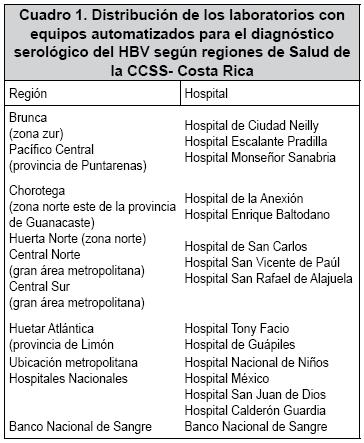
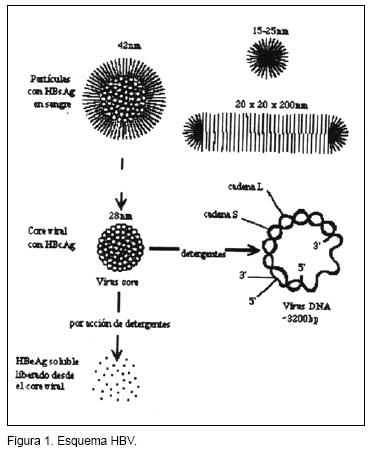
<body><![CDATA[<div style="text-align: justify;"></div>     <div style="text-align: justify;"></div>     <p style="text-align: justify;" class="MsoNormal"><span  style="font-size: 10pt; font-family: Verdana;">El HBV tiene un genoma de ADN parcialmente de doble banda de 3.2 <span  class="SpellE">kb</span>, el cual consiste, en una hebra negativa completa y una positiva incompleta. Posee una envoltura lip&#237;dica rica en una prote&#237;na viral llamada ant&#237;geno de superficie o prote&#237;na S de <st1:metricconverter  productid="40 a" w:st="on">40 a</st1:metricconverter> <st1:metricconverter  productid="42 mm" w:st="on">42 <span class="SpellE">mm</span></st1:metricconverter> de di&#225;metro una <span class="SpellE">nucleocappside</span>, constituida por una prote&#237;na como &#8220;<span class="SpellE">core</span>&#8221;, con simetr&#237;a <span class="SpellE">icosahedrica</span> de 27 <span  class="SpellE">nm</span> de di&#225;metro. (<a  href="/img/revistas/amc/v50s3/art06i1.jpg">Figura 1</a>) <o:p></o:p></span></p>     <div style="text-align: justify;"></div>     <div style="text-align: justify;"></div>     <div style="text-align: justify;"></div>     <p style="text-align: justify;" class="MsoNormal"><span  style="font-size: 10pt; font-family: Verdana;">Este virus, en los individuos infectados puede producir hepatitis aguda y cr&#243;nica. Aproximadamente, el 90% de la hepatitis B agudas, son cl&#237;nicamente silenciosas, especialmente cuando la infecci&#243;n es adquirida en etapas tempranas de la vida. La probabilidad de la progresi&#243;n a la cronicidad depende de la edad del paciente, del sexo y del estado inmunol&#243;gico del individuo afectado. Sus v&#237;as de transmisi&#243;n son la parental por el uso de jeringas infectadas al inyectarse drogas, por un pinchazo accidental por una jeringa contaminada, sexual; perinatal; por transfusi&#243;n; trasplante renal; hemodi&#225;lisis y por contacto intrafamiliar y mediante utensilios contaminados con sangre (peines, cuchillas de afeitar, toallas y otros). La esperma, la saliva, la sangre, las secreciones cervicales y vaginales, la orina y la leche materna son fuentes de infecci&#243;n. El HBV se distribuye a nivel mundial y su prevalencia var&#237;a geogr&#225;ficamente y <span  class="SpellE">epidemiol&#243;gicamente</span>. Las zonas de alto riesgo son aquellas donde la prevalencia de <span class="SpellE">HBsAg</span> supera el 8%, de riesgo intermedio, cuando la prevalencia de este marcador est&#225; entre un 2 y un 8% y de bajo riesgo, cuando la prevalencia es menor al 2%. Estudios <span class="SpellE">seroepidemiol&#243;gicos</span> realizados en Costa Rica, en las &#225;reas de San Carlos, P&#233;rez Zeled&#243;n, San Vito de Coto Brus, San Ram&#243;n- Palmares y en donantes de sangre en todo el territorio (para el a&#241;o 2005 una seropositividad de 0.1% del <span class="SpellE">HBsAg</span>) han demostrado, que en Costa Rica, se clasifica como regi&#243;n de baja <span  class="SpellE">endemicidad</span>, sin embargo, la zona de P&#233;rez Zeled&#243;n se clasifica como prevalencia intermedia. Las consecuencias de la infecci&#243;n por el HBV van desde una leve incapacidad de la persona infectada, hasta la incapacidad permanente y consecuente muerte por hepatitis fulminante, cirrosis hep&#225;tica o <span class="SpellE">hepatocarcinoma</span> celular primario (HCCP). <o:p></o:p></span></p>     <p class="MsoNormal"><b style=""><span  style="font-size: 11pt; font-family: Verdana;">Pruebas para el diagn&#243;stico en laboratorio <o:p></o:p></span></b></p>     <p style="text-align: justify;" class="MsoNormal"><span  style="font-size: 10pt; font-family: Verdana;">En un primer contacto con el virus surgen los s&#237;ntomas asociados, y se producen en el plasma humano ant&#237;geno y anticuerpos &#250;nicos que hacen no s&#243;lo posible el diagn&#243;stico del tipo de hepatitis sino tambi&#233;n, determinan el estado de infecci&#243;n y el probable pron&#243;stico. El diagn&#243;stico se basa en la determinaci&#243;n, a partir de suero o plasma, de diferentes marcadores serol&#243;gicos y virol&#243;gicos que correlacionan con la enfermedad en sus diferentes estadios. Actualmente, se recurre no solo a las pruebas convencionales sino tambi&#233;n, a m&#233;todos moleculares para su diagn&#243;stico y control. <o:p></o:p></span></p>     <div style="text-align: justify;"></div>     ]]></body>
<body><![CDATA[<div style="text-align: justify;"></div>     <div style="text-align: justify;"></div>     <p style="text-align: justify;" class="MsoNormal"><span  style="font-size: 10pt; font-family: Verdana;">Las pruebas para la determinaci&#243;n de marcadores, en el diagn&#243;stico de la hepatitis, han obtenido un gran desarrollo y optimizaci&#243;n desde su desarrollo inicial. Las mejoras est&#225;n desde la fuente y purificaci&#243;n de las prote&#237;nas antig&#233;nicas empleadas como los anticuerpos y principios t&#233;cnicos en que fundamentan las pruebas.&nbsp; <o:p></o:p></span></p>     <div style="text-align: justify;"></div>     <div style="text-align: justify;"></div>     <div style="text-align: justify;"></div> </div>     <div style="text-align: justify;"></div>     <div style="text-align: justify;"></div>     <div style="text-align: justify;"></div>     <div>     ]]></body>
<body><![CDATA[<div style="text-align: justify;"></div>     <div style="text-align: justify;"></div>     <div style="text-align: justify;"></div>     <p style="text-align: justify;" class="MsoNormal"><span  style="font-size: 10pt; font-family: Verdana;">Adem&#225;s, coadyuva a lo anterior, el advenimiento global, en el desarrollo de sistemas automatizados, que han permitido el seguimiento de la trazabilidad total de las muestras, disminuyendo, sustancialmente, el consumo de recursos en t&#233;rmino de costos y cargas de trabajo. CCSS cuenta con una red de 98 laboratorios, 29 son hospitales, 17 de los cuales est&#225;n dotados de equipos analizadores para la realizaci&#243;n de los ex&#225;menes serol&#243;gicos para el diagn&#243;stico de la hepatitis por virus B, los cuales funcionan en una red de referencia y <span class="SpellE">contrareferencia</span>. <o:p></o:p></span></p>     <div style="text-align: justify;"></div>     <div style="text-align: justify;"></div>     <div style="text-align: justify;"></div>     <p style="text-align: justify;" class="MsoNormal"><span  style="font-size: 10pt; font-family: Verdana;">Para la presentaci&#243;n de la distribuci&#243;n geogr&#225;fica de los laboratorios que realizan la serolog&#237;a por HBV, se presenta la divisi&#243;n por regiones de la CCSS, distribuidas de acuerdo al <a  href="/img/revistas/amc/v50s3/art06t1.jpg">cuadro 1</a>. <o:p></o:p></span></p>     <div style="text-align: left;"></div>     <div style="text-align: left;"></div>     ]]></body>
<body><![CDATA[<p style="text-align: justify;" class="MsoNormal"><span  style="font-size: 10pt; font-family: Verdana;">Es importante indicar que los laboratorios de la CCSS que realizan las pruebas serol&#243;gicas para el diagn&#243;stico del HBV, participan en un programa de control de calidad externo con una entidad de reconocido prestigio mundial como lo es el Colegio Americano de Pat&#243;logos (CAP), el cual es el m&#225;s grande de los programas de evaluaci&#243;n del desempe&#241;o y acreditaci&#243;n en el mundo ubicado en los Estados Unidos. Eso permite a los laboratorios ser evaluados regularmente en su desempe&#241;o, brindando seguridad, veracidad y confiabilidad en el resultado que se entrega. Los laboratorios son evaluados con muestras desconocidas enviadas para realizarles las pruebas de diagn&#243;stico en laboratorio; el participante las analiza y regresa los resultados al CAP para ser evaluados. Cada laboratorio recibe la evaluaci&#243;n de su desempe&#241;o y un reporte resumen de todos los participantes. <o:p></o:p></span></p>     <div style="text-align: justify;"></div>     <p style="text-align: justify;" class="MsoNormal"><span  style="font-size: 10pt; font-family: Verdana;">La CCSS, desde el inicio del a&#241;o 2000, hasta los que llevamos del 2006, en cuanto a licitaciones realizadas, a nivel central, han invertido solo en el diagn&#243;stico de la infecci&#243;n por el VHB un total de $1.905.423.38 millones para un total de 1.110.100 pruebas distribuidas entre <span  class="SpellE">HBsAg</span></span>, <span class="SpellE"><span  style="font-size: 10pt; font-family: Verdana;">IgM</span></span><span  style="font-size: 10pt; font-family: Verdana;"> <span class="SpellE">core</span>, <span class="SpellE">Anti</span> <span class="SpellE">core</span> total, <span class="SpellE">HBe</span> <span class="SpellE">Ag</span>, <span class="SpellE">anti</span> <span  class="SpellE">HBe</span> dando cobertura a todo el territorio nacional. <o:p></o:p></span></p>     <div>     <p class="MsoNormal"><b style=""><span  style="font-size: 11pt; font-family: Verdana;">Marcadores serol&#243;gicos (cuadro 4) <span style=""><o:p></o:p></span></span></b></p>     <p style="text-align: justify;" class="MsoNormal"><span  style="font-size: 10pt; font-family: Verdana;">Cuando un paciente se presenta con s&#237;ntomas o antecedentes que sugieren una hepatitis viral, despu&#233;s de un periodo de incubaci&#243;n, que puede durar hasta 10 semanas, se desarrolla la infecci&#243;n aguda con s&#237;ntomas o no, resolvi&#233;ndose o continua en cronicidad. <o:p></o:p></span></p>     <div style="text-align: justify;"></div>     <div style="text-align: justify;"></div>     <div style="text-align: justify;"></div>     <p style="text-align: justify;" class="MsoNormal"><span  style="font-size: 10pt; font-family: Verdana;">Se debe estudiar en la sangre de <span class="GramE">una</span> individuo expuesto al virus, la presencia o no de ant&#237;genos virales como: el <span  class="SpellE">HBsAg</span> y el ant&#237;geno &#8220;e&#8221; <span class="SpellE">HBeAg</span>. <o:p></o:p></span></p>     ]]></body>
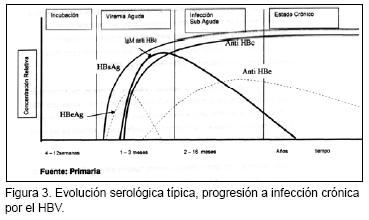
<body><![CDATA[<div style="text-align: justify;"></div>     <div style="text-align: justify;"></div>     <div style="text-align: justify;"></div>     <p style="text-align: justify;" class="MsoNormal"><span  style="font-size: 10pt; font-family: Verdana;">El <span class="SpellE">HBsAg</span> es el primer marcador serol&#243;gico que se detecta. Aparece semanas o meses (1 a 6 meses) luego de la exposici&#243;n al virus. Su t&#237;tulo llega a un pico en varias semanas, persiste durante un periodo variable, disminuye y desaparece con la recuperaci&#243;n cl&#237;nica. <o:p></o:p></span></p>     <div style="text-align: justify;"></div>     <div style="text-align: justify;"></div>     <div style="text-align: justify;"></div>     <p style="text-align: justify;" class="MsoNormal"><span  style="font-size: 10pt; font-family: Verdana;">El <span class="SpellE">HBsAg</span> est&#225; presente durante la fase aguda de la infecci&#243;n en paralelo o a los pocos d&#237;as aparece el ant&#237;geno, que indica un estado altamente infeccioso, por la replicaci&#243;n activa del virus donde el ADN del HBV esta circulando en la sangre y declina en <span class="SpellE">parelelo</span> con el <span  class="SpellE">HBsAg</span>. <o:p></o:p></span></p>     <div style="text-align: justify;"></div>     <div style="text-align: justify;"></div>     ]]></body>
<body><![CDATA[<div style="text-align: justify;"></div>     <p style="text-align: justify;" class="MsoNormal"><span  style="font-size: 10pt; font-family: Verdana;">El diagn&#243;stico del estadio de la enfermedad se completa por la evidencia de la lesi&#243;n hep&#225;tica con pruebas de laboratorio como transaminasas y anatomopatol&#243;gicas. <o:p></o:p></span></p>     <div style="text-align: justify;"></div>     <div style="text-align: justify;"></div>     <div style="text-align: justify;"></div>     <p style="text-align: justify;" class="MsoNormal"><span  style="font-size: 10pt; font-family: Verdana;">Tambi&#233;n debe de valorarse la respuesta de anticuerpos espec&#237;ficos contra los ant&#237;genos <span class="SpellE">HBsAg</span>, <span class="SpellE">HBeAg</span> y <span class="SpellE">HBcAg</span>. <o:p></o:p></span></p>     <div style="text-align: justify;"></div>     <div style="text-align: justify;"></div>     <div style="text-align: justify;"></div>     <p style="text-align: justify;" class="MsoNormal"><span  style="font-size: 10pt; font-family: Verdana;">El primer anticuerpo en aparecer es el <span class="SpellE">anti</span>-<span  class="SpellE">HBc</span> tipo <span class="SpellE">IgM</span>. La <span class="SpellE">IgM</span> va declinando y desaparece como a los seis meses, pero la <span  class="SpellE">IgM</span>-<span class="SpellE">anti</span>-<span  class="SpellE">HBc</span> persiste durante a&#241;os. <o:p></o:p></span></p>     ]]></body>
<body><![CDATA[<div style="text-align: justify;"></div>     <div style="text-align: justify;"></div>     <div style="text-align: justify;"></div>     <p style="text-align: justify;" class="MsoNormal"><span  style="font-size: 10pt; font-family: Verdana;">Muy frecuentemente, los pacientes se presentan, tard&#237;amente, durante el curso de la enfermedad, cuando el <span class="SpellE">HBsAg</span> ya ha desaparecido, la detecci&#243;n de <span class="SpellE">IgM</span> <span  class="SpellE">anti</span>-<span class="SpellE">HBc</span> es el marcador serol&#243;gico de mayor valor en una infecci&#243;n aguda por HBV. <o:p></o:p></span></p>     <div style="text-align: justify;"></div>     <div style="text-align: justify;"></div>     <p style="text-align: justify;" class="MsoNormal"><span  style="font-size: 10pt; font-family: Verdana;">El <span class="SpellE">HBe</span> <span class="SpellE">Ag</span> es reemplazado con el anticuerpo <span class="SpellE">Anti</span>-<span class="SpellE">HBe</span>, al comienzo de la recuperaci&#243;n cl&#237;nica. Este anticuerpo, persiste 1-2 a&#241;os tras desaparecer la infecci&#243;n aguda por hepatitis B. <o:p></o:p></span></p>     <div style="text-align: justify;"></div>     <div style="text-align: justify;"><span  style="font-size: 10pt; font-family: Verdana;">A los 4-6 meses suele desaparecer <span class="SpellE">HBsAg</span> y aparece el anticuerpo <span class="SpellE">Anti</span>-<span class="SpellE">HBs</span> el cual se manifiesta durante la fase de <o:p></o:p></span><span class="GramE"><span  style="font-size: 10pt; font-family: Verdana;">convalecencia</span></span><span  style="font-size: 10pt; font-family: Verdana;">. Alcanza un t&#237;tulo alto semanas o meses m&#225;s tarde y luego disminuye gradualmente. En una mayor&#237;a de los casos, un &#8220;periodo de ventana&#8221; puede ocurrir, al no ser detectables ambos marcadores, solo resistencia a la inmunoterapia espec&#237;fica para prevenir la infecci&#243;n en neonatos de madres infectadas adem&#225;s, los virus con determinadas mutaciones en el determinante &#8220;a&#8221;, podr&#237;an no ser detectables, en el <span class="SpellE">tamizaje</span> de los hemoderivados, debido a los falsos negativos en la detecci&#243;n de <span class="SpellE">HBsAg</span>. Aunque la infecci&#243;n aguda es preocupante en lo que concierne a la enfermedad fulminante y a las p&#233;rdidas econ&#243;micas debidas a ella, la mayor preocupaci&#243;n acerca de la hepatitis B, es la infecci&#243;n persistente, como resultado del estado de portador del <span  class="SpellE">HBsAg</span>, que se asocia con hepatitis cr&#243;nica y sus secuelas. En el 10% de los pacientes nunca hay <span class="SpellE">seroconversi&#243;n</span>, no se detecta <span class="SpellE">anti</span>-<span class="SpellE">HBs</span> y se mantiene el <span class="SpellE">HBsAg</span> durante m&#225;s de seis meses, estableci&#233;ndose un estado de persistencia cr&#243;nica del HBV. <o:p></o:p></span></div>     <div style="text-align: left;"></div>     ]]></body>
<body><![CDATA[<p style="text-align: justify;" class="MsoNormal"><span  style="font-size: 10pt; font-family: Verdana;">Los varios marcadores de infecciones a HBV est&#225;n presentes en diferentes momentos y var&#237;an las combinaciones a trav&#233;s del curso de la infecci&#243;n. En la <a href="/img/revistas/amc/v50s3/art06i2.jpg">figura 2</a> se ilustra un caso t&#237;pico. Las secuencias serol&#243;gicas mostrada en la <a  href="/img/revistas/amc/v50s3/art06i2.jpg">figura 2</a> ocurre en el 75-85% de los pacientes con hepatitis aguda tipo B. <o:p></o:p></span></p>     <div style="text-align: justify;"></div>     <div style="text-align: justify;"></div>     <div style="text-align: justify;"></div>     <div style="text-align: justify;"></div>     <p style="text-align: justify;" class="MsoNormal"><span  style="font-size: 10pt; font-family: Verdana;">Infecci&#243;n cr&#243;nica por HBV se define con la persistencia del <span class="SpellE">HBsAg</span>, detectado en sangre, por un periodo mayor de 6 meses, producto de una incapacidad del individuo para eliminar el virus, este puede persistir por el resto de la vida del paciente o, en algunos casos, ser eliminado de forma espont&#225;nea. Aunque el 90-95% de los adultos con HBV se recuperan completamente, el virus puede da&#241;ar severamente el h&#237;gado y causar la muerte. El riesgo de desarrollar cronicidad por HBV depende en gran medida de la edad en que se infecta la persona. Cuando la infecci&#243;n ocurre por v&#237;a vertical o perinatal, el riesgo de cronicidad llega a valores hasta de un 90%. <o:p></o:p></span></p>     <div style="text-align: justify;"></div>     <div style="text-align: justify;"></div>     <div style="text-align: justify;"></div>     <p style="text-align: justify;" class="MsoNormal"><span  style="font-size: 10pt; font-family: Verdana;">Estos ni&#241;os se convierten en replicadores activos del virus y por consiguiente, en diseminadores de la infecci&#243;n, en poblaciones infantiles adem&#225;s que tambi&#233;n poseen un elevado riesgo de padecer afecciones del h&#237;gado y morir cuando llegan a ser adultos o j&#243;venes. Los ni&#241;os que se infectaron por v&#237;a perinatal tienen un riesgo que va de 30 a un 60% de infectarse y de convertirse en portadores cr&#243;nicos de HBV en los primeros 5 a&#241;os de vida, por el contacto estrecho y continuo con las personas infectadas. <o:p></o:p></span></p>     ]]></body>
<body><![CDATA[<div style="text-align: justify;"></div>     <div style="text-align: justify;"></div>     <div style="text-align: justify;"></div>     <div style="text-align: justify;"></div>     <p style="text-align: justify;" class="MsoNormal"><span  style="font-size: 10pt; font-family: Verdana;">Ni&#241;os de madres que son <span class="SpellE">HBsAg</span> y <span  class="SpellE">HBeAg</span> positivos, el riesgo de transmisi&#243;n perinatal es de <st1:metricconverter  productid="70 a" w:st="on">70 a</st1:metricconverter> 90%, pero disminuye a <st1:metricconverter productid="5 a" w:st="on">5 a</st1:metricconverter> 20% de ni&#241;os de madres <span class="SpellE">anti</span> <span class="SpellE">HBe</span> positivo. Entre un <st1:metricconverter productid="5 a" w:st="on">5 a</st1:metricconverter> un 10% de los individuos que se infectan despu&#233;s de los 5 a&#241;os de edad, no logran resolver su infecci&#243;n y quedan como portadores del virus. <o:p></o:p></span></p>     <div style="text-align: left;"></div>     <div style="text-align: left;"></div>     <p style="text-align: justify;" class="MsoNormal"><span  style="font-size: 10pt; font-family: Verdana;">En la infecci&#243;n cr&#243;nica, el ant&#237;geno <span class="SpellE">HBsAg</span>, persiste durante a&#241;os o d&#233;cadas. El t&#237;tulo puede disminuir, un poco, a medida que pasan los a&#241;os, pero se mantiene durante toda la vida. Se pueden detectar el ant&#237;geno <span  class="SpellE">HBeAg</span>, <span class="SpellE">anti</span> <span class="SpellE">HBe</span> y el ADN del HBV en el suero de individuos infectados. Los pacientes con mutaciones en la prote&#237;na viral <span class="SpellE">pre</span> <span class="SpellE">core</span>/<span  class="SpellE">core</span> mostrar&#225;n presencia de <span class="SpellE">anti</span> <span class="SpellE">HBe</span> y de viremia. <o:p></o:p></span></p>     <div style="text-align: justify;"></div>     <div style="text-align: justify;"></div>     ]]></body>
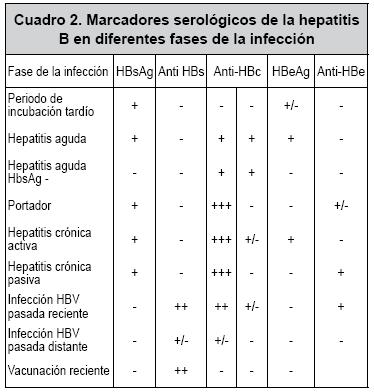
<body><![CDATA[<div style="text-align: justify;"></div>     <p style="text-align: justify;" class="MsoNormal"><span  style="font-size: 10pt; font-family: Verdana;">El ADN del HBV puede, eventualmente, integrarse al ADN del hepatocito, lo cual resulta ser importante en la aparici&#243;n de carcinoma <span class="SpellE">hapatocelular</span> primario, la complicaci&#243;n m&#225;s grave de esta enfermedad. <o:p></o:p></span></p>     <div style="text-align: justify;"></div>     <div style="text-align: justify;"></div>     <div style="text-align: justify;"></div>     <div style="text-align: justify;"></div>     <p style="text-align: justify;" class="MsoNormal"><span  style="font-size: 10pt; font-family: Verdana;">El anticuerpo <span class="SpellE">anti</span>-<span class="SpellE">HBc</span> (una <span class="SpellE">IgG</span>) esta invariablemente presente en el suero de los portadores; hay muy pocas <span class="SpellE">IgM</span> presente, los anticuerpos <span class="SpellE">anti</span>-<span class="SpellE">HBc</span> totales pueden detectarse, tanto en infecci&#243;n aguda, cr&#243;nica, como en aquellos que ha resuelto una hepatitis B. <o:p></o:p></span></p>     <div style="text-align: justify;"></div>     <div style="text-align: justify;"></div>     <p style="text-align: justify;" class="MsoNormal"><span  style="font-size: 10pt; font-family: Verdana;">En la <a href="/img/revistas/amc/v50s3/art06i3.jpg">Figura 3</a> se ilustra una evoluci&#243;n serol&#243;gica t&#237;pica de una infecci&#243;n cr&#243;nica por HBV y en el <a  href="/img/revistas/amc/v50s3/art06t2.jpg">cuadro 2</a> se describe los marcadores serol&#243;gicos en diferentes patrones de infecci&#243;n. <o:p></o:p></span></p> </div> </div>     ]]></body>
<body><![CDATA[<div>     <div>     <p class="MsoNormal"><b style=""><span  style="font-size: 11pt; font-family: Verdana;">Control de un paciente con hepatitis B <span style=""><o:p></o:p></span></span></b></p>     <p style="text-align: justify;" class="MsoNormal"><span  style="font-size: 10pt; font-family: Verdana;">Una vez que una infecci&#243;n con HBV ha sido confirmada por pruebas serol&#243;gicas, es importante determinar el estado de la infecci&#243;n y el pron&#243;stico, con el objeto de realizar el tratamiento apropiado e iniciar las medidas de control entre los contactos &#237;ntimos. <o:p></o:p></span></p>     <div style="text-align: justify;"></div>     <div style="text-align: justify;"></div>     <p style="text-align: justify;" class="MsoNormal"><span  style="font-size: 10pt; font-family: Verdana;">Las pruebas para los siguientes marcadores pueden ser utilizadas para controlar el proceso: <span class="SpellE">HBsAg</span>, <span class="SpellE">Anti</span> <span class="SpellE">HBe</span> y <span class="SpellE">Anti</span>-<span  class="SpellE">HBs</span>. El control de la muestra original del paciente para <span  class="SpellE">HBeAg</span> y <span class="SpellE">Anti</span> <span class="SpellE">HBe</span> ayudar&#225; a determinar el estado de la infecci&#243;n y qu&#233; tan infecciosa es la persona. Si la muestra original fue negativa, se debe controlar al paciente aproximadamente un mes despu&#233;s, realizando las pruebas para <span  class="SpellE">HBs</span> <span class="SpellE">Ag</span>, <span  class="SpellE">Anti</span>-<span class="SpellE">HBc</span> <span  class="SpellE">IgM</span>, <span class="SpellE">HBeAg</span> con lo cual se llegar&#225; a igual fin. <o:p></o:p></span></p>     <div style="text-align: justify;"></div>     <div style="text-align: justify;"></div>     <div style="text-align: justify;"></div>     ]]></body>
<body><![CDATA[<p style="text-align: justify;" class="MsoNormal"><span  style="font-size: 10pt; font-family: Verdana;">Si <span class="SpellE">HBs</span> <span class="SpellE">Ag</span> y <span class="SpellE">HBeAg</span> son positivas entonces, los fluidos del paciente son altamente infecciosos y todav&#237;a existe una activa replicaci&#243;n viral, si <span class="SpellE">anti</span>-<span  class="SpellE">HBeAg</span> y <span class="SpellE">HBsAg</span> son positivas, la replicaci&#243;n viral, por lo general han remitido y la enfermedad ha de resolverse en corto tiempo. En este caso, la desaparici&#243;n del <span class="SpellE">HbsAg</span> en controles posteriores a intervalos mensuales, deber&#237;a confirmar el pron&#243;stico. Despu&#233;s de la p&#233;rdida de niveles detectables de <span class="SpellE">HBsAg</span>, el control mensual del <span  class="SpellE">anti</span>-<span class="SpellE">HBs</span> confirmar&#225; la inmunidad y la recuperaci&#243;n cl&#237;nica. <o:p></o:p></span></p>     <div style="text-align: justify;"></div>     <div style="text-align: justify;"></div> </div>     <div style="text-align: justify;"></div>     <div style="text-align: justify;"></div>     <div>     <div style="text-align: justify;"></div>     <div style="text-align: justify;"></div>     <p style="text-align: justify;" class="MsoNormal"><span  style="font-size: 10pt; font-family: Verdana;">Por otra parte, la persistencia de <span class="SpellE">HbeAg</span> y <span  class="SpellE">HBsAg</span> durante <st1:metricconverter productid="8 a" w:st="on">8 a</st1:metricconverter> 10 semanas indica que el paciente, probablemente, no resolver&#225; r&#225;pidamente la infecci&#243;n viral y podr&#237;a ocurrir un estado de portador cr&#243;nico. Estos pacientes pueden ser evaluados cada 3 meses para determinar el estado de la infecci&#243;n y la posibles <span  class="SpellE">sero</span>-conversi&#243;n a <span class="SpellE">Anti</span>-<span  class="SpellE">HBe</span>. <o:p></o:p></span></p>     <div style="text-align: justify;"></div>     ]]></body>
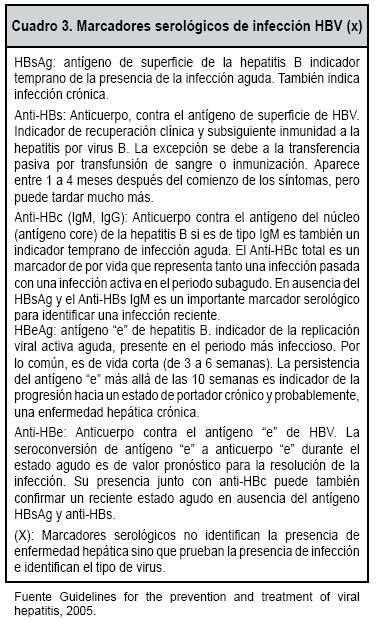
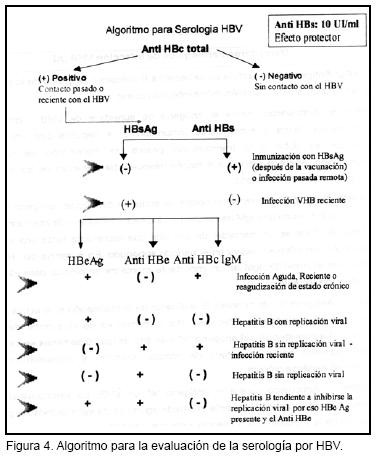
<body><![CDATA[<div style="text-align: justify;"></div>     <div style="text-align: justify;"></div>     <p style="text-align: justify;" class="MsoNormal"><span  style="font-size: 10pt; font-family: Verdana;">En el &#250;ltimo caso, estos individuos, en su mayor&#237;a, no desarrollan una severa enfermedad hep&#225;tica. Cuando un paciente se presenta con s&#237;ntomas o antecedentes que sugieren una hepatitis aguda viral, las primeras pruebas apropiadas para una evaluaci&#243;n son el <span  class="SpellE">HBsAg</span>, el <span class="SpellE">Anti</span>-<span  class="SpellE">HBc</span> <span class="SpellE">IgM</span>, el <span  class="SpellE">Anti</span>-<span class="SpellE">HbC</span> total. <o:p></o:p></span></p>     <div style="text-align: justify;"></div>     <div style="text-align: justify;"></div>     <p style="text-align: justify;" class="MsoNormal"><span  style="font-size: 10pt; font-family: Verdana;">El <a  href="/img/revistas/amc/v50s3/art06t2.jpg">cuadro 2</a> resume los cuadros t&#237;picos vistos con estas pruebas y sus interpretaciones cl&#237;nicas. <a  href="/img/revistas/amc/v50s3/art06t3.jpg">Cuadro 3</a>, <a  href="/img/revistas/amc/v50s3/art06i4.jpg">figura 4</a><o:p></o:p></span></p> </div> </div>     <div>     <div> <b style=""><span style="font-size: 11pt; font-family: Verdana;"></span></b> <hr style="width: 100%; height: 2px;"><b style=""><span  style="font-size: 11pt; font-family: Verdana;">Lecturas recomendadas <span style=""><o:p></o:p></span></span></b>     <!-- ref --><p class="MsoNormal"><span  style="font-size: 10pt; font-family: Verdana;" lang="PT-BR">Aguilera AG, Romero YS, <span class="SpellE">Regueiro</span> BJ. </span><span style="font-size: 10pt; font-family: Verdana;">Epidemiolog&#237;a y manifestaciones cl&#237;nicas de las hepatitis virales. </span><span  class="SpellE"><span style="font-size: 10pt; font-family: Verdana;"  lang="PT-BR">Enferm</span></span><span  style="font-size: 10pt; font-family: Verdana;" lang="PT-BR"> <span  class="SpellE">Infec</span> <span class="SpellE">Microbiol</span> <span class="SpellE">Clin</span>. 2006; <span class="GramE">24:264</span>-276.    &nbsp;&nbsp;&nbsp;&nbsp;&nbsp;&nbsp;&nbsp;&nbsp;[&#160;<a href="javascript:void(0);" onclick="javascript: window.open('/scielo.php?script=sci_nlinks&ref=082935&pid=S0001-6002200800050000600001&lng=','','width=640,height=500,resizable=yes,scrollbars=1,menubar=yes,');">Links</a>&#160;]<!-- end-ref --> <o:p></o:p></span></p>     ]]></body>
<body><![CDATA[<!-- ref --><p class="MsoNormal"><span class="SpellE"><span  style="font-size: 10pt; font-family: Verdana;" lang="PT-BR">Brezmes</span></span><span  style="font-size: 10pt; font-family: Verdana;" lang="PT-BR"> MF, Ochoa C, <span class="SpellE">Eiros</span> JM. </span><span  style="font-size: 10pt; font-family: Verdana;" lang="EN-US">Cost <span  class="SpellE">an&#225;lisis</span> in a clinical microbiology laboratory. </span><span  class="SpellE"><span style="font-size: 10pt; font-family: Verdana;">Eur</span></span><span  style="font-size: 10pt; font-family: Verdana;"> J <span class="SpellE">Clin</span> Microbiol <span class="SpellE">Infect</span> <span class="SpellE">Dis</span> 2002; 21:582-8.    &nbsp;&nbsp;&nbsp;&nbsp;&nbsp;&nbsp;&nbsp;&nbsp;[&#160;<a href="javascript:void(0);" onclick="javascript: window.open('/scielo.php?script=sci_nlinks&ref=082937&pid=S0001-6002200800050000600002&lng=','','width=640,height=500,resizable=yes,scrollbars=1,menubar=yes,');">Links</a>&#160;]<!-- end-ref --> <o:p></o:p></span></p>     <!-- ref --><p class="MsoNormal"><span  style="font-size: 10pt; font-family: Verdana;">Bruguera M, Forns X. Epidemiolog&#237;a actual de las hepatitis virales &#191;Qui&#233;n la padece y quien puede protegerse<span class="GramE">?.</span><span  class="SpellE">Enf</span> <span class="SpellE">Infecc</span> Microbiol <span class="SpellE">Clin</span> 2004; 22:443-447.    &nbsp;&nbsp;&nbsp;&nbsp;&nbsp;&nbsp;&nbsp;&nbsp;[&#160;<a href="javascript:void(0);" onclick="javascript: window.open('/scielo.php?script=sci_nlinks&ref=082939&pid=S0001-6002200800050000600003&lng=','','width=640,height=500,resizable=yes,scrollbars=1,menubar=yes,');">Links</a>&#160;]<!-- end-ref --> <o:p></o:p></span></p>     <!-- ref --><p class="MsoNormal"><span  style="font-size: 10pt; font-family: Verdana;">Caja Costarricense de Seguro Social, Direcci&#243;n t&#233;cnica de servicios de salud-secci&#243;n de laboratorios. Informe de Bancos de sangre a&#241;o 2000-2001, 2002-2003, 2004-2005; San Jos&#233; Costa Rica; 2005. Serie de Informes T&#233;cnicos: 2000-2005.    &nbsp;&nbsp;&nbsp;&nbsp;&nbsp;&nbsp;&nbsp;&nbsp;[&#160;<a href="javascript:void(0);" onclick="javascript: window.open('/scielo.php?script=sci_nlinks&ref=082941&pid=S0001-6002200800050000600004&lng=','','width=640,height=500,resizable=yes,scrollbars=1,menubar=yes,');">Links</a>&#160;]<!-- end-ref --> <o:p></o:p></span></p>     <!-- ref --><p class="MsoNormal"><span class="SpellE"><span  style="font-size: 10pt; font-family: Verdana;">Codo&#241;er</span></span><span  style="font-size: 10pt; font-family: Verdana;"> <span class="SpellE">F.P</span>. Hepatitis B, el virus, t&#233;cnicas de diagn&#243;stico epidemiolog&#237;a, enfermedad y sus posibilidades evolutivas. </span><span style="font-size: 10pt; font-family: Verdana;"  lang="EN-US">An <span class="SpellE">Pediatr</span> 2003<span  class="GramE">;58:478</span>-81.    &nbsp;&nbsp;&nbsp;&nbsp;&nbsp;&nbsp;&nbsp;&nbsp;[&#160;<a href="javascript:void(0);" onclick="javascript: window.open('/scielo.php?script=sci_nlinks&ref=082943&pid=S0001-6002200800050000600005&lng=','','width=640,height=500,resizable=yes,scrollbars=1,menubar=yes,');">Links</a>&#160;]<!-- end-ref --> <o:p></o:p></span></p>     <!-- ref --><p class="MsoNormal"><span class="SpellE"><span  style="font-size: 10pt; font-family: Verdana;" lang="EN-US">Chein</span></span><span  style="font-size: 10pt; font-family: Verdana;" lang="EN-US"> Fu H, Shih <span class="SpellE">Shen</span> L, Young <span  class="SpellE">Chyuan</span> H et al. The immune response induced by hepatitis B virus principal antigens. </span><span class="SpellE"><span  style="font-size: 10pt; font-family: Verdana;">Cell</span></span><span  style="font-size: 10pt; font-family: Verdana;"> Mol <span  class="SpellE">Inmunol</span> 2006; 3:97-106.    &nbsp;&nbsp;&nbsp;&nbsp;&nbsp;&nbsp;&nbsp;&nbsp;[&#160;<a href="javascript:void(0);" onclick="javascript: window.open('/scielo.php?script=sci_nlinks&ref=082945&pid=S0001-6002200800050000600006&lng=','','width=640,height=500,resizable=yes,scrollbars=1,menubar=yes,');">Links</a>&#160;]<!-- end-ref --> <o:p></o:p></span></p>     ]]></body>
<body><![CDATA[<!-- ref --><p class="MsoNormal"><span  style="font-size: 10pt; font-family: Verdana;">Delgado A, Echeverr&#237;a JM, Le&#243;n P. Serolog&#237;a de la hepatitis v&#237;ricas. 2&#176; ed. En: Cercenado E, Cant&#243;n R. Procedimientos en microbiolog&#237;a cl&#237;nica. Recomendaciones de la Sociedad Espa&#241;ola de enfermedades infecciosas y microbiolog&#237;a cl&#237;nica. </span><st1:state w:st="on"><st1:place w:st="on"><span  style="font-size: 10pt; font-family: Verdana;" lang="EN-US">Madrid</span></st1:place></st1:state><span  style="font-size: 10pt; font-family: Verdana;" lang="EN-US">: SEIMC; 2004.    &nbsp;&nbsp;&nbsp;&nbsp;&nbsp;&nbsp;&nbsp;&nbsp;[&#160;<a href="javascript:void(0);" onclick="javascript: window.open('/scielo.php?script=sci_nlinks&ref=082947&pid=S0001-6002200800050000600007&lng=','','width=640,height=500,resizable=yes,scrollbars=1,menubar=yes,');">Links</a>&#160;]<!-- end-ref --> <o:p></o:p></span></p>     <!-- ref --><p class="MsoNormal"><span class="SpellE"><span class="GramE"><span  style="font-size: 10pt; font-family: Verdana;" lang="EN-US">Guildelines</span></span></span><span  class="GramE"><span style="font-size: 10pt; font-family: Verdana;"  lang="EN-US"> for the Prevention and treatment of Viral Hepatitis.</span></span><span  style="font-size: 10pt; font-family: Verdana;" lang="EN-US"> October 2005. <span class="GramE">Federal Bureau of <span  class="SpellE">Prisions</span>.</span> <span class="GramE">Clinical Practice <span class="SpellE">Guildelines</span>.</span> 2005<span class="GramE">;1</span>-70.    &nbsp;&nbsp;&nbsp;&nbsp;&nbsp;&nbsp;&nbsp;&nbsp;[&#160;<a href="javascript:void(0);" onclick="javascript: window.open('/scielo.php?script=sci_nlinks&ref=082949&pid=S0001-6002200800050000600008&lng=','','width=640,height=500,resizable=yes,scrollbars=1,menubar=yes,');">Links</a>&#160;]<!-- end-ref --> <o:p></o:p></span></p>     <!-- ref --><p class="MsoNormal"><span class="SpellE"><span  style="font-size: 10pt; font-family: Verdana;" lang="EN-US">Holliger</span></span><span  style="font-size: 10pt; font-family: Verdana;" lang="EN-US"> FB. 1996 Chapter 86: Hepatitis B fields Virology, <span class="SpellE"><span  class="GramE">ed</span></span> B.N Fields, DM. <span class="SpellE">Knipe</span> PM. <span class="SpellE">Holowey</span> et al. Third edition. <span  class="GramE">Lippincott- Raven <span class="SpellE">Pubhlisher</span>, <st1:city w:st="on"><st1:place  w:st="on">Philadelphia</st1:place></st1:city>.    &nbsp;&nbsp;&nbsp;&nbsp;&nbsp;&nbsp;&nbsp;&nbsp;[&#160;<a href="javascript:void(0);" onclick="javascript: window.open('/scielo.php?script=sci_nlinks&ref=082951&pid=S0001-6002200800050000600009&lng=','','width=640,height=500,resizable=yes,scrollbars=1,menubar=yes,');">Links</a>&#160;]<!-- end-ref --></span> <o:p></o:p></span></p>     <!-- ref --><p class="MsoNormal"><span class="SpellE"><span  style="font-size: 10pt; font-family: Verdana;" lang="EN-US">Jinlin</span></span><span  style="font-size: 10pt; font-family: Verdana;" lang="EN-US"> H, <span class="SpellE">Zhiua</span> L, Fan G. Epidemiology and prevention of hepatitis B virus infection Review. <span class="SpellE">Int</span> J Med <span class="SpellE">Sci</span> 2005; 2: 50-58.    &nbsp;&nbsp;&nbsp;&nbsp;&nbsp;&nbsp;&nbsp;&nbsp;[&#160;<a href="javascript:void(0);" onclick="javascript: window.open('/scielo.php?script=sci_nlinks&ref=082953&pid=S0001-6002200800050000600010&lng=','','width=640,height=500,resizable=yes,scrollbars=1,menubar=yes,');">Links</a>&#160;]<!-- end-ref --> <o:p></o:p></span></p>     <!-- ref --><p class="MsoNormal"><span  style="font-size: 10pt; font-family: Verdana;" lang="EN-US">Kenneth WL, Kirchner JT. Hepatitis B. Am <span class="SpellE"><span  class="GramE">Fam</span></span> Phys 2004; 69:75-82.    &nbsp;&nbsp;&nbsp;&nbsp;&nbsp;&nbsp;&nbsp;&nbsp;[&#160;<a href="javascript:void(0);" onclick="javascript: window.open('/scielo.php?script=sci_nlinks&ref=082955&pid=S0001-6002200800050000600011&lng=','','width=640,height=500,resizable=yes,scrollbars=1,menubar=yes,');">Links</a>&#160;]<!-- end-ref --> <o:p></o:p></span></p>     ]]></body>
<body><![CDATA[<!-- ref --><p class="MsoNormal"><span class="SpellE"><span  style="font-size: 10pt; font-family: Verdana;" lang="EN-US">Khourime</span></span><span  style="font-size: 10pt; font-family: Verdana;" lang="EN-US"> M, <span class="SpellE">Aparecida</span> V, Review Hepatitis B: Epidemiological, immunological and serological considerations emphasizing mutation. <span  class="GramE">Rev Hosp <span class="SpellE">Clin</span> <span  class="SpellE">Fac</span> Med <st1:place w:st="on">S Paulo</st1:place> 2004; 59:216-224.    &nbsp;&nbsp;&nbsp;&nbsp;&nbsp;&nbsp;&nbsp;&nbsp;[&#160;<a href="javascript:void(0);" onclick="javascript: window.open('/scielo.php?script=sci_nlinks&ref=082957&pid=S0001-6002200800050000600012&lng=','','width=640,height=500,resizable=yes,scrollbars=1,menubar=yes,');">Links</a>&#160;]<!-- end-ref --></span> <o:p></o:p></span></p>     <!-- ref --><p class="MsoNormal"><span class="SpellE"><span class="GramE"><span  style="font-size: 10pt; font-family: Verdana;" lang="EN-US">Khouri</span></span></span><span  class="GramE"><span style="font-size: 10pt; font-family: Verdana;"  lang="EN-US"> M. Hepatitis B epidemiology, <span class="SpellE">inmunology</span> and serology.</span></span><span  style="font-size: 10pt; font-family: Verdana;" lang="EN-US"> <span  class="GramE">Rev Hosp <span class="SpellE">Clin</span> <span  class="SpellE">Fac</span> Med <st1:place w:st="on">S Paulo</st1:place> 2004; 59:216-224.    &nbsp;&nbsp;&nbsp;&nbsp;&nbsp;&nbsp;&nbsp;&nbsp;[&#160;<a href="javascript:void(0);" onclick="javascript: window.open('/scielo.php?script=sci_nlinks&ref=082959&pid=S0001-6002200800050000600013&lng=','','width=640,height=500,resizable=yes,scrollbars=1,menubar=yes,');">Links</a>&#160;]<!-- end-ref --></span> <o:p></o:p></span></p>     <!-- ref --><p class="MsoNormal"><span  style="font-size: 10pt; font-family: Verdana;" lang="EN-US">Mahoney FJ. Update on diagnosis, management and prevention <span class="SpellE"><span class="GramE">od</span></span> Hepatitis B virus infection. <span class="SpellE"><span class="GramE">Clin</span></span><span  class="GramE"> <span class="SpellE">Microbiol</span> Rev 1999; 12: 351-366.    &nbsp;&nbsp;&nbsp;&nbsp;&nbsp;&nbsp;&nbsp;&nbsp;[&#160;<a href="javascript:void(0);" onclick="javascript: window.open('/scielo.php?script=sci_nlinks&ref=082961&pid=S0001-6002200800050000600014&lng=','','width=640,height=500,resizable=yes,scrollbars=1,menubar=yes,');">Links</a>&#160;]<!-- end-ref --></span> <o:p></o:p></span></p>     <!-- ref --><p class="MsoNormal"><span  style="font-size: 10pt; font-family: Verdana;" lang="EN-US">Miller <span  class="SpellE">Rh</span>, <span class="SpellE">Kanicko</span> S, Chung C. Compact organization of the hepatitis B virus genome. <span class="SpellE">Hepatology</span> 2006; 9:322-327.    &nbsp;&nbsp;&nbsp;&nbsp;&nbsp;&nbsp;&nbsp;&nbsp;[&#160;<a href="javascript:void(0);" onclick="javascript: window.open('/scielo.php?script=sci_nlinks&ref=082963&pid=S0001-6002200800050000600015&lng=','','width=640,height=500,resizable=yes,scrollbars=1,menubar=yes,');">Links</a>&#160;]<!-- end-ref --> <o:p></o:p></span></p>     <!-- ref --><p class="MsoNormal"><span  style="font-size: 10pt; font-family: Verdana;" lang="EN-US">Ortiz de <span  class="SpellE">Lejarazu</span> R, <span class="SpellE">Avell&#243;n</span> Ana, <span class="SpellE">Eiros</span> JM. <span class="SpellE"><span  class="GramE">Diagn&#243;stico</span></span><span class="GramE"> <span  class="SpellE">microbiol&#243;gico</span> de <span class="SpellE">las</span> hepatitis <span class="SpellE">v&#237;ricas</span>.</span> <span class="SpellE">Enf</span> <span class="SpellE">Infecc</span> <span  class="SpellE">Microbiol</span> <span class="SpellE">Clin</span> 2006; 24:194-2004.    &nbsp;&nbsp;&nbsp;&nbsp;&nbsp;&nbsp;&nbsp;&nbsp;[&#160;<a href="javascript:void(0);" onclick="javascript: window.open('/scielo.php?script=sci_nlinks&ref=082965&pid=S0001-6002200800050000600016&lng=','','width=640,height=500,resizable=yes,scrollbars=1,menubar=yes,');">Links</a>&#160;]<!-- end-ref --> <o:p></o:p></span></p>     ]]></body>
<body><![CDATA[<!-- ref --><p class="MsoNormal"><span  style="font-size: 10pt; font-family: Verdana;" lang="EN-US">Park W, Keefe EB. <span class="GramE">Diagnosis and treatment o chronic hepatitis BB.</span> Minerva <span class="SpellE">Gastr</span> <span class="SpellE">Enterol</span> <span class="SpellE">Dietol</span> 2004; 50: 289-303.    &nbsp;&nbsp;&nbsp;&nbsp;&nbsp;&nbsp;&nbsp;&nbsp;[&#160;<a href="javascript:void(0);" onclick="javascript: window.open('/scielo.php?script=sci_nlinks&ref=082967&pid=S0001-6002200800050000600017&lng=','','width=640,height=500,resizable=yes,scrollbars=1,menubar=yes,');">Links</a>&#160;]<!-- end-ref --> <o:p></o:p></span></p>     <!-- ref --><p class="MsoNormal"><span class="SpellE"><span  style="font-size: 10pt; font-family: Verdana;" lang="EN-US">Rakesh</span></span><span  style="font-size: 10pt; font-family: Verdana;" lang="EN-US"> A, <span class="SpellE">Piyush</span> R, Preventing ant treating hepatitis B infection. BJM 2004; 329<span class="GramE">;1080</span>-1086.    &nbsp;&nbsp;&nbsp;&nbsp;&nbsp;&nbsp;&nbsp;&nbsp;[&#160;<a href="javascript:void(0);" onclick="javascript: window.open('/scielo.php?script=sci_nlinks&ref=082969&pid=S0001-6002200800050000600018&lng=','','width=640,height=500,resizable=yes,scrollbars=1,menubar=yes,');">Links</a>&#160;]<!-- end-ref --> <o:p></o:p></span></p>     <!-- ref --><p class="MsoNormal"><span  style="font-size: 10pt; font-family: Verdana;" lang="EN-US">Salas O, <span  class="SpellE">Informe</span> <span class="SpellE">automatizaci&#243;n</span> de <span class="SpellE">laboratorios</span> a Junta <span class="SpellE">Directiva</span> CCSS. <span  class="SpellE"><span class="GramE">Departamento</span></span><span  class="GramE"> de <span class="SpellE">regulaci&#243;n</span> y <span class="SpellE">Sistematizaci&#243;n</span> <span class="SpellE">&#193;rea</span> <span class="SpellE">Laboratorios</span> <span class="SpellE">Cl&#237;nicos</span>, 2002.    &nbsp;&nbsp;&nbsp;&nbsp;&nbsp;&nbsp;&nbsp;&nbsp;[&#160;<a href="javascript:void(0);" onclick="javascript: window.open('/scielo.php?script=sci_nlinks&ref=082971&pid=S0001-6002200800050000600019&lng=','','width=640,height=500,resizable=yes,scrollbars=1,menubar=yes,');">Links</a>&#160;]<!-- end-ref --></span> <o:p></o:p></span></p>     <!-- ref --><p class="MsoNormal"><st1:place w:st="on"><st1:city w:st="on"><span  class="SpellE"><span style="font-size: 10pt; font-family: Verdana;"  lang="EN-US">Sanjeev</span></span></st1:city><span  style="font-size: 10pt; font-family: Verdana;" lang="EN-US"> <st1:state  w:st="on">KS</st1:state></span></st1:place><span  style="font-size: 10pt; font-family: Verdana;" lang="EN-US">, <span class="SpellE">Nitin</span> S, <span class="SpellE">Yogesh</span> C. Study protocol hepatitis B Virus: Inactive carriers. Virology J.2005<span  class="GramE">;82:1</span>-5.    &nbsp;&nbsp;&nbsp;&nbsp;&nbsp;&nbsp;&nbsp;&nbsp;[&#160;<a href="javascript:void(0);" onclick="javascript: window.open('/scielo.php?script=sci_nlinks&ref=082973&pid=S0001-6002200800050000600020&lng=','','width=640,height=500,resizable=yes,scrollbars=1,menubar=yes,');">Links</a>&#160;]<!-- end-ref --> <o:p></o:p></span></p>     <!-- ref --><p class="MsoNormal"><span class="GramE"><span  style="font-size: 10pt; font-family: Verdana;" lang="EN-US">Torres Al, Gar MZ.</span></span><span  style="font-size: 10pt; font-family: Verdana;" lang="EN-US"> <span class="SpellE">Revista</span> <span class="SpellE">Costarricense</span> de <span class="SpellE">Ciencias</span> <span class="SpellE">M&#233;dicas</span> 2004; 25: 21-25.    &nbsp;&nbsp;&nbsp;&nbsp;&nbsp;&nbsp;&nbsp;&nbsp;[&#160;<a href="javascript:void(0);" onclick="javascript: window.open('/scielo.php?script=sci_nlinks&ref=082975&pid=S0001-6002200800050000600021&lng=','','width=640,height=500,resizable=yes,scrollbars=1,menubar=yes,');">Links</a>&#160;]<!-- end-ref --> <o:p></o:p></span></p>     ]]></body>
<body><![CDATA[<!-- ref --><p class="MsoNormal"><span class="GramE"><span  style="font-size: 10pt; font-family: Verdana;" lang="EN-US">Uchida T. Genetic <span class="SpellE">c&#237;avariations</span> of the Hepatitis B virus and their clinical <span class="SpellE">relavence</span>.</span></span><span  style="font-size: 10pt; font-family: Verdana;" lang="EN-US"> </span><span  style="font-size: 10pt; font-family: Verdana;">Microbiol <span  class="SpellE">Inmunol</span> 1993<span class="GramE">;37:425</span>-439.    &nbsp;&nbsp;&nbsp;&nbsp;&nbsp;&nbsp;&nbsp;&nbsp;[&#160;<a href="javascript:void(0);" onclick="javascript: window.open('/scielo.php?script=sci_nlinks&ref=082977&pid=S0001-6002200800050000600022&lng=','','width=640,height=500,resizable=yes,scrollbars=1,menubar=yes,');">Links</a>&#160;]<!-- end-ref --> <o:p></o:p></span></p>     <!-- ref --><p class="MsoNormal"><span class="SpellE"><span  style="font-size: 10pt; font-family: Verdana;">Vison&#225;</span></span><span  style="font-size: 10pt; font-family: Verdana;"> KA, <span  class="SpellE">Eduarte</span> CE, Zamora E, Salazar LM. Estudio epidemiol&#243;gico de las hepatitis virales en San Ram&#243;n y Palmares de 1972-1985. <span class="SpellE">Act</span> <span  class="SpellE">Med</span> <span class="SpellE">Costarric</span>.1998<span class="GramE">;33:69</span>-77.    &nbsp;&nbsp;&nbsp;&nbsp;&nbsp;&nbsp;&nbsp;&nbsp;[&#160;<a href="javascript:void(0);" onclick="javascript: window.open('/scielo.php?script=sci_nlinks&ref=082979&pid=S0001-6002200800050000600023&lng=','','width=640,height=500,resizable=yes,scrollbars=1,menubar=yes,');">Links</a>&#160;]<!-- end-ref --> <o:p></o:p></span></p>     <!-- ref --><p class="MsoNormal"><span  style="font-size: 10pt; font-family: Verdana;">Zunino M. ENNA. Epidemiolog&#237;a de la Hepatitis B en Chile y esquemas de vacunaci&#243;n en <span class="SpellE">Latinoamerica</span>. <span  class="SpellE">Rev</span> <span class="SpellE">Chil</span> <span  class="SpellE">Infecctol</span>.2002<span class="GramE">;19:140</span>-155.    &nbsp;&nbsp;&nbsp;&nbsp;&nbsp;&nbsp;&nbsp;&nbsp;[&#160;<a href="javascript:void(0);" onclick="javascript: window.open('/scielo.php?script=sci_nlinks&ref=082981&pid=S0001-6002200800050000600024&lng=','','width=640,height=500,resizable=yes,scrollbars=1,menubar=yes,');">Links</a>&#160;]<!-- end-ref --><br> </span></p>     <p class="MsoNormal"><span  style="font-size: 10pt; font-family: Verdana;"><a  name="Correspondencia1"></a><a href="#correspondencia2">*</a>Microbi&#243;loga, Caja Costarricense de Seguro Social. <o:p></o:p></span></p> <b style=""><span style="font-size: 10pt; font-family: Verdana;">Abreviaturas:</span></b><span  style="font-size: 10pt; font-family: Verdana;"> CAP, Colegio Americano de Pat&#243;logos.</span><span style="font-size: 10pt; font-family: Verdana;"> <o:p></o:p></span> </div> </div> </div> </div> </div>      ]]></body><back>
<ref-list>
<ref id="B1">
<nlm-citation citation-type="journal">
<person-group person-group-type="author">
<name>
<surname><![CDATA[Aguilera]]></surname>
<given-names><![CDATA[AG]]></given-names>
</name>
<name>
<surname><![CDATA[Romero]]></surname>
<given-names><![CDATA[YS]]></given-names>
</name>
<name>
<surname><![CDATA[Regueiro]]></surname>
<given-names><![CDATA[BJ]]></given-names>
</name>
</person-group>
<article-title xml:lang="es"><![CDATA[Epidemiología y manifestaciones clínicas de las hepatitis virales]]></article-title>
<source><![CDATA[Enferm Infec Microbiol Clin]]></source>
<year>2006</year>
<volume>24</volume>
<page-range>264-276</page-range></nlm-citation>
</ref>
<ref id="B2">
<nlm-citation citation-type="journal">
<person-group person-group-type="author">
<name>
<surname><![CDATA[Brezmes]]></surname>
<given-names><![CDATA[MF]]></given-names>
</name>
<name>
<surname><![CDATA[Ochoa]]></surname>
<given-names><![CDATA[C]]></given-names>
</name>
<name>
<surname><![CDATA[Eiros]]></surname>
<given-names><![CDATA[JM]]></given-names>
</name>
</person-group>
<article-title xml:lang="es"><![CDATA[Cost análisis in a clinical microbiology laboratory]]></article-title>
<source><![CDATA[Eur J Clin Microbiol Infect Dis]]></source>
<year>2002</year>
<volume>21</volume>
<page-range>582-8</page-range></nlm-citation>
</ref>
<ref id="B3">
<nlm-citation citation-type="journal">
<person-group person-group-type="author">
<name>
<surname><![CDATA[Bruguera]]></surname>
<given-names><![CDATA[M]]></given-names>
</name>
<name>
<surname><![CDATA[Forns]]></surname>
<given-names><![CDATA[X]]></given-names>
</name>
</person-group>
<article-title xml:lang="es"><![CDATA[Epidemiología actual de las hepatitis virales: ¿Quién la padece y quien puede protegerse?]]></article-title>
<source><![CDATA[Enf Infecc Microbiol Clin]]></source>
<year>2004</year>
<volume>22</volume>
<page-range>443-447</page-range></nlm-citation>
</ref>
<ref id="B4">
<nlm-citation citation-type="">
<collab>Caja Costarricense de Seguro Social^dDirección técnica de servicios de salud-sección de laboratorios</collab>
<source><![CDATA[Informe de Bancos de sangre año 2000-2001, 2002-2003, 2004-2005; San José Costa Rica; 2005: Serie de Informes Técnicos: 2000-2005]]></source>
<year></year>
</nlm-citation>
</ref>
<ref id="B5">
<nlm-citation citation-type="journal">
<person-group person-group-type="author">
<name>
<surname><![CDATA[Codoñer]]></surname>
<given-names><![CDATA[F.P]]></given-names>
</name>
</person-group>
<article-title xml:lang="es"><![CDATA[Hepatitis B, el virus, técnicas de diagnóstico epidemiología, enfermedad y sus posibilidades evolutivas]]></article-title>
<source><![CDATA[An Pediatr]]></source>
<year>2003</year>
<volume>58</volume>
<page-range>478-81</page-range></nlm-citation>
</ref>
<ref id="B6">
<nlm-citation citation-type="journal">
<person-group person-group-type="author">
<name>
<surname><![CDATA[H]]></surname>
<given-names><![CDATA[Chein Fu]]></given-names>
</name>
<name>
<surname><![CDATA[Shih Shen]]></surname>
<given-names><![CDATA[L]]></given-names>
</name>
<name>
<surname><![CDATA[Young Chyuan]]></surname>
<given-names><![CDATA[H]]></given-names>
</name>
</person-group>
<article-title xml:lang="en"><![CDATA[The immune response induced by hepatitis B virus principal antigens]]></article-title>
<source><![CDATA[Cell Mol Inmunol]]></source>
<year>2006</year>
<volume>3</volume>
<page-range>97-106</page-range></nlm-citation>
</ref>
<ref id="B7">
<nlm-citation citation-type="book">
<person-group person-group-type="author">
<name>
<surname><![CDATA[Delgado]]></surname>
<given-names><![CDATA[A]]></given-names>
</name>
<name>
<surname><![CDATA[Echeverría]]></surname>
<given-names><![CDATA[JM]]></given-names>
</name>
<name>
<surname><![CDATA[León]]></surname>
<given-names><![CDATA[P]]></given-names>
</name>
</person-group>
<article-title xml:lang="es"><![CDATA[Serología de la hepatitis víricas]]></article-title>
<person-group person-group-type="editor">
<name>
<surname><![CDATA[Cercenado]]></surname>
<given-names><![CDATA[E]]></given-names>
</name>
<name>
<surname><![CDATA[Cantón]]></surname>
<given-names><![CDATA[R]]></given-names>
</name>
</person-group>
<source><![CDATA[Procedimientos en microbiología clínica: Recomendaciones de la Sociedad Española de enfermedades infecciosas y microbiología clínica]]></source>
<year>2004</year>
<publisher-loc><![CDATA[Madrid ]]></publisher-loc>
<publisher-name><![CDATA[SEIMC]]></publisher-name>
</nlm-citation>
</ref>
<ref id="B8">
<nlm-citation citation-type="journal">
<article-title xml:lang="en"><![CDATA[Guildelines for the Prevention and treatment of Viral Hepatitis]]></article-title>
<source><![CDATA[Clinical Practice Guildelines]]></source>
<year>Octo</year>
<month>be</month>
<day>r </day>
<page-range>1-70</page-range></nlm-citation>
</ref>
<ref id="B9">
<nlm-citation citation-type="book">
<person-group person-group-type="author">
<name>
<surname><![CDATA[Holliger]]></surname>
<given-names><![CDATA[FB]]></given-names>
</name>
</person-group>
<source><![CDATA[1996 Chapter 86: Hepatitis B fields Virology, ed B.N Fields, DM. Knipe PM. Holowey]]></source>
<year></year>
<edition>Third</edition>
<publisher-loc><![CDATA[Philadelphia ]]></publisher-loc>
<publisher-name><![CDATA[Lippincott- Raven Pubhlisher]]></publisher-name>
</nlm-citation>
</ref>
<ref id="B10">
<nlm-citation citation-type="journal">
<person-group person-group-type="author">
<name>
<surname><![CDATA[Jinlin]]></surname>
<given-names><![CDATA[H]]></given-names>
</name>
<name>
<surname><![CDATA[Zhiua]]></surname>
<given-names><![CDATA[L]]></given-names>
</name>
<name>
<surname><![CDATA[Fan]]></surname>
<given-names><![CDATA[G]]></given-names>
</name>
</person-group>
<article-title xml:lang="en"><![CDATA[Epidemiology and prevention of hepatitis B virus infection Review]]></article-title>
<source><![CDATA[Int J Med Sci]]></source>
<year>2005</year>
<volume>2</volume>
<page-range>50-58</page-range></nlm-citation>
</ref>
<ref id="B11">
<nlm-citation citation-type="journal">
<person-group person-group-type="author">
<name>
<surname><![CDATA[Kenneth]]></surname>
<given-names><![CDATA[WL]]></given-names>
</name>
<name>
<surname><![CDATA[Kirchner]]></surname>
<given-names><![CDATA[JT]]></given-names>
</name>
<name>
<surname><![CDATA[Hepatitis]]></surname>
<given-names><![CDATA[B]]></given-names>
</name>
</person-group>
<source><![CDATA[Am Fam Phys]]></source>
<year>2004</year>
<volume>69</volume>
<page-range>75-82</page-range></nlm-citation>
</ref>
<ref id="B12">
<nlm-citation citation-type="journal">
<person-group person-group-type="author">
<name>
<surname><![CDATA[Khourime]]></surname>
<given-names><![CDATA[M]]></given-names>
</name>
<name>
<surname><![CDATA[Aparecida]]></surname>
<given-names><![CDATA[V]]></given-names>
</name>
</person-group>
<article-title xml:lang="en"><![CDATA[Review Hepatitis B: Epidemiological, immunological and serological considerations emphasizing mutation]]></article-title>
<source><![CDATA[Rev Hosp Clin Fac Med S Paulo]]></source>
<year>2004</year>
<volume>59</volume>
<page-range>216-224</page-range></nlm-citation>
</ref>
<ref id="B13">
<nlm-citation citation-type="journal">
<person-group person-group-type="author">
<name>
<surname><![CDATA[Khouri]]></surname>
<given-names><![CDATA[M]]></given-names>
</name>
</person-group>
<article-title xml:lang="en"><![CDATA[Hepatitis B epidemiology, inmunology and serology]]></article-title>
<source><![CDATA[Rev Hosp Clin Fac Med S Paulo]]></source>
<year>2004</year>
<volume>59</volume>
<page-range>216-224</page-range></nlm-citation>
</ref>
<ref id="B14">
<nlm-citation citation-type="journal">
<person-group person-group-type="author">
<name>
<surname><![CDATA[Mahoney]]></surname>
<given-names><![CDATA[FJ]]></given-names>
</name>
</person-group>
<article-title xml:lang="en"><![CDATA[Update on diagnosis, management and prevention od Hepatitis B virus infection]]></article-title>
<source><![CDATA[Clin Microbiol Rev]]></source>
<year>1999</year>
<volume>12</volume>
<page-range>351-366</page-range></nlm-citation>
</ref>
<ref id="B15">
<nlm-citation citation-type="journal">
<person-group person-group-type="author">
<name>
<surname><![CDATA[Miller]]></surname>
<given-names><![CDATA[Rh]]></given-names>
</name>
<name>
<surname><![CDATA[Kanicko]]></surname>
<given-names><![CDATA[S]]></given-names>
</name>
<name>
<surname><![CDATA[Chung]]></surname>
<given-names><![CDATA[C]]></given-names>
</name>
</person-group>
<article-title xml:lang="en"><![CDATA[Compact organization of the hepatitis B virus genome]]></article-title>
<source><![CDATA[Hepatology]]></source>
<year>2006</year>
<volume>9</volume>
<page-range>322-327</page-range></nlm-citation>
</ref>
<ref id="B16">
<nlm-citation citation-type="journal">
<person-group person-group-type="author">
<name>
<surname><![CDATA[Ortiz de Lejarazu]]></surname>
<given-names><![CDATA[R]]></given-names>
</name>
<name>
<surname><![CDATA[Avellón]]></surname>
<given-names><![CDATA[Ana]]></given-names>
</name>
<name>
<surname><![CDATA[Eiros]]></surname>
<given-names><![CDATA[JM]]></given-names>
</name>
</person-group>
<article-title xml:lang="es"><![CDATA[Diagnóstico microbiológico de las hepatitis víricas]]></article-title>
<source><![CDATA[Enf Infecc Microbiol Clin]]></source>
<year>2006</year>
<volume>24</volume>
<page-range>194-2004</page-range></nlm-citation>
</ref>
<ref id="B17">
<nlm-citation citation-type="journal">
<person-group person-group-type="author">
<name>
<surname><![CDATA[Park]]></surname>
<given-names><![CDATA[W]]></given-names>
</name>
<name>
<surname><![CDATA[Keefe]]></surname>
<given-names><![CDATA[EB]]></given-names>
</name>
</person-group>
<article-title xml:lang="en"><![CDATA[Diagnosis and treatment o chronic hepatitis BB]]></article-title>
<source><![CDATA[Minerva Gastr Enterol Dietol]]></source>
<year>2004</year>
<volume>50</volume>
<page-range>289-303</page-range></nlm-citation>
</ref>
<ref id="B18">
<nlm-citation citation-type="journal">
<person-group person-group-type="author">
<name>
<surname><![CDATA[Rakesh]]></surname>
<given-names><![CDATA[A]]></given-names>
</name>
<name>
<surname><![CDATA[Piyush]]></surname>
<given-names><![CDATA[R]]></given-names>
</name>
</person-group>
<article-title xml:lang="en"><![CDATA[Preventing ant treating hepatitis B infection]]></article-title>
<source><![CDATA[BJM]]></source>
<year>2004</year>
<volume>329</volume>
<page-range>1080-1086</page-range></nlm-citation>
</ref>
<ref id="B19">
<nlm-citation citation-type="">
<person-group person-group-type="author">
<name>
<surname><![CDATA[Salas]]></surname>
<given-names><![CDATA[O]]></given-names>
</name>
</person-group>
<source><![CDATA[Informe automatización de laboratorios a Junta Directiva CCSS: Departamento de regulación y Sistematización Área Laboratorios Clínicos, 2002]]></source>
<year></year>
</nlm-citation>
</ref>
<ref id="B20">
<nlm-citation citation-type="journal">
<person-group person-group-type="author">
<name>
<surname><![CDATA[Sanjeev]]></surname>
<given-names><![CDATA[KS]]></given-names>
</name>
<name>
<surname><![CDATA[Nitin]]></surname>
<given-names><![CDATA[S]]></given-names>
</name>
<name>
<surname><![CDATA[Yogesh]]></surname>
<given-names><![CDATA[C]]></given-names>
</name>
</person-group>
<article-title xml:lang="en"><![CDATA[Study protocol hepatitis B Virus: Inactive carriers]]></article-title>
<source><![CDATA[Virology J]]></source>
<year>2005</year>
<volume>82</volume>
<page-range>1-5</page-range></nlm-citation>
</ref>
<ref id="B21">
<nlm-citation citation-type="journal">
<person-group person-group-type="author">
<name>
<surname><![CDATA[Torres]]></surname>
<given-names><![CDATA[Al]]></given-names>
</name>
<name>
<surname><![CDATA[Gar]]></surname>
<given-names><![CDATA[MZ]]></given-names>
</name>
</person-group>
<source><![CDATA[Revista Costarricense de Ciencias Médicas]]></source>
<year>2004</year>
<volume>25</volume>
<page-range>21-25</page-range></nlm-citation>
</ref>
<ref id="B22">
<nlm-citation citation-type="journal">
<person-group person-group-type="author">
<name>
<surname><![CDATA[Uchida]]></surname>
<given-names><![CDATA[T]]></given-names>
</name>
</person-group>
<article-title xml:lang="en"><![CDATA[Genetic cíavariations of the Hepatitis B virus and their clinical relavence]]></article-title>
<source><![CDATA[Microbiol Inmunol]]></source>
<year>1993</year>
<volume>37</volume>
<page-range>425-439</page-range></nlm-citation>
</ref>
<ref id="B23">
<nlm-citation citation-type="journal">
<person-group person-group-type="author">
<name>
<surname><![CDATA[Visoná]]></surname>
<given-names><![CDATA[KA]]></given-names>
</name>
<name>
<surname><![CDATA[Eduarte]]></surname>
<given-names><![CDATA[CE]]></given-names>
</name>
<name>
<surname><![CDATA[Zamora]]></surname>
<given-names><![CDATA[E]]></given-names>
</name>
<name>
<surname><![CDATA[Salazar]]></surname>
<given-names><![CDATA[LM]]></given-names>
</name>
</person-group>
<article-title xml:lang="es"><![CDATA[Estudio epidemiológico de las hepatitis virales en San Ramón y Palmares de 1972-1985]]></article-title>
<source><![CDATA[Act Med Costarric]]></source>
<year>1998</year>
<volume>33</volume>
<page-range>69-77</page-range></nlm-citation>
</ref>
<ref id="B24">
<nlm-citation citation-type="journal">
<person-group person-group-type="author">
<name>
<surname><![CDATA[Zunino]]></surname>
<given-names><![CDATA[M]]></given-names>
</name>
</person-group>
<article-title xml:lang="es"><![CDATA[ENNA: Epidemiología de la Hepatitis B en Chile y esquemas de vacunación en Latinoamerica]]></article-title>
<source><![CDATA[Chil Infecctol]]></source>
<year>2002</year>
<volume>19</volume>
<page-range>140-155</page-range></nlm-citation>
</ref>
</ref-list>
</back>
</article>