<?xml version="1.0" encoding="ISO-8859-1"?><article xmlns:mml="http://www.w3.org/1998/Math/MathML" xmlns:xlink="http://www.w3.org/1999/xlink" xmlns:xsi="http://www.w3.org/2001/XMLSchema-instance">
<front>
<journal-meta>
<journal-id>0001-6002</journal-id>
<journal-title><![CDATA[Acta Médica Costarricense]]></journal-title>
<abbrev-journal-title><![CDATA[Acta méd. costarric]]></abbrev-journal-title>
<issn>0001-6002</issn>
<publisher>
<publisher-name><![CDATA[Colegio de Médicos y Cirujanos de Costa Rica]]></publisher-name>
</publisher>
</journal-meta>
<article-meta>
<article-id>S0001-60022001000400004</article-id>
<title-group>
<article-title xml:lang="es"><![CDATA[Ultrasonografía transvaginal e histerosonografía en el diagnóstico de patologías endometriales]]></article-title>
</title-group>
<contrib-group>
<contrib contrib-type="author">
<name>
<surname><![CDATA[Salazar Mora]]></surname>
<given-names><![CDATA[Ronald]]></given-names>
</name>
<xref ref-type="aff" rid="A01"/>
</contrib>
<contrib contrib-type="author">
<name>
<surname><![CDATA[Calderón Zuñiga]]></surname>
<given-names><![CDATA[Alberto]]></given-names>
</name>
<xref ref-type="aff" rid="A02"/>
</contrib>
</contrib-group>
<aff id="A01">
<institution><![CDATA[,CCSS Hospital de las Mujeres ]]></institution>
<addr-line><![CDATA[Heredia ]]></addr-line>
</aff>
<aff id="A02">
<institution><![CDATA[,CCSS Hospital de las Mujeres Clínica Servicio de Ginecología]]></institution>
<addr-line><![CDATA[ ]]></addr-line>
</aff>
<pub-date pub-type="pub">
<day>00</day>
<month>10</month>
<year>2001</year>
</pub-date>
<pub-date pub-type="epub">
<day>00</day>
<month>10</month>
<year>2001</year>
</pub-date>
<volume>43</volume>
<numero>4</numero>
<fpage>175</fpage>
<lpage>177</lpage>
<copyright-statement/>
<copyright-year/>
<self-uri xlink:href="http://www.scielo.sa.cr/scielo.php?script=sci_arttext&amp;pid=S0001-60022001000400004&amp;lng=en&amp;nrm=iso"></self-uri><self-uri xlink:href="http://www.scielo.sa.cr/scielo.php?script=sci_abstract&amp;pid=S0001-60022001000400004&amp;lng=en&amp;nrm=iso"></self-uri><self-uri xlink:href="http://www.scielo.sa.cr/scielo.php?script=sci_pdf&amp;pid=S0001-60022001000400004&amp;lng=en&amp;nrm=iso"></self-uri><abstract abstract-type="short" xml:lang="es"><p><![CDATA[Justificación y Objetivo: A pesar que en los últimos años la ultrasonografía transvaginal se ha convertido en una gran herramienta en la evaluación de pacientes con sangrado uterino anormal, ha mostrado cierta limitación en el diagnóstico de patología endometrial. La infusión salina intracavitaria en el momento de la realización de la sonografía ha demostrado ser un método más preciso. En el siguiente trabajo el objetivo principal fue comparar la sensibilidad y especificidad del ultrasonido transvaginal versus el uso de la histerosonografía en el diagnóstico de estas patologías. Metodología: treinta y seis pacientes con sangrado uterino anormal fueron seleccionadas de forma consecutiva, según referencia para ultrasonografía vaginal. A todas se les realizó un ultrasonido transvaginal y luego la histerosonografía, siendo los resultados comparados con el diagnóstico histológico, el cual fue considerado como el "estándar dorado". Resultados: 38% de las pacientes mostraron un endometrio normal, el 30% tuvo pólipo endometrial, 30% tuvo hiperplasia endometrial, 19% miomas intramurales y/o adenomiosis y 7.6% miomas submucosos. La sensibilidad y especificidad del ultrasonido transvaginal fue de un 42,8%, y 91,6% respectivamente, comparada con de 92.8% y 100% para al histerosonografía. Conclusiones: La histerosonografía es más precisa en el diagnóstico de patología endometrial enpacientes con sangrado uterino anormal.]]></p></abstract>
<abstract abstract-type="short" xml:lang="en"><p><![CDATA[Justification and objectives: In spite than in the last year the vaginal ultrasound has become a powerful tool in the evaluation of patients with abnormal uterine bleeding, it has shown some limitations for the diagnosis of endometrial pathology. Intracavitary saline infusion during the ultrasonographic procedure, has shown to be a more sensitive method. Our main objetive was to compare the sensitivity and specificity of the vaginal ultrasound versus the histerosonography in the diagnosis of various endometrial pathologies. Methodology: In this study, 36 patients with the diagnosis of abnormal uterine bleeding were selected consecutively as they were refered for vaginal ultrasound. All of them had vaginal ultrasound and then histerosonography, comparing the results with the histologic diagnosis as the "gold estandar". Results: Thirty eight oercent had normal endometrium 30% had endometrial polyp, 305 had endometrial hyperplasia, 19% intramural myomas and/or adenomyosis, and submucus myomas were found in 7.6% of the patients. The sensitivity and specificity for the vaginal ultrasound was 42.8% and 91.6% and for the histerosonography were 92.8% y 100% respectively. Were conclude that histerosonography was more precise in the diagnosis of endometrial pathology in patients with abnormal uterine bleeding.]]></p></abstract>
<kwd-group>
<kwd lng="es"><![CDATA[sonohisterografía]]></kwd>
<kwd lng="es"><![CDATA[histerosonografía]]></kwd>
<kwd lng="es"><![CDATA[endometrio]]></kwd>
<kwd lng="es"><![CDATA[ultrasonido transvaginal]]></kwd>
<kwd lng="es"><![CDATA[pólipos endometriales]]></kwd>
<kwd lng="es"><![CDATA[miomas intrauterinos]]></kwd>
<kwd lng="es"><![CDATA[hiperplasia]]></kwd>
<kwd lng="es"><![CDATA[endometrial]]></kwd>
<kwd lng="es"><![CDATA[postmenopausia]]></kwd>
</kwd-group>
</article-meta>
</front><body><![CDATA[  <B><FONT FACE="Arial"><FONT SIZE=-1>Comunicaci&oacute;n Breve</FONT></FONT></B>     <CENTER>&nbsp;</CENTER>      <CENTER><B><FONT FACE="Arial">Ultrasonograf&iacute;a transvaginal e histerosonograf&iacute;a en el diagn&oacute;stico de patolog&iacute;as endometriales</FONT></B></CENTER> &nbsp;     <BR><FONT FACE="Arial"><FONT SIZE=-1>&nbsp;</FONT></FONT>     <CENTER><FONT FACE="Arial"><FONT SIZE=-1>Ronald Salazar – Mora,<A NAME="R1"></A><SUP><A HREF="#A1">1</A></SUP> Alberto Calder&oacute;n - Zu&ntilde;iga<SUP> <A HREF="#A1">2</A></SUP></FONT></FONT></CENTER> &nbsp;     <BR>&nbsp;     <BR><FONT FACE="Arial"><FONT SIZE=-1><B>Justificaci&oacute;n y Objetivo:</B> A pesar que en los &uacute;ltimos a&ntilde;os la ultrasonograf&iacute;a transvaginal se ha convertido en una gran herramienta en la evaluaci&oacute;n de pacientes con sangrado uterino anormal, ha mostrado cierta limitaci&oacute;n en el diagn&oacute;stico de patolog&iacute;a endometrial. La infusi&oacute;n salina intracavitaria en el momento de la realizaci&oacute;n de la sonograf&iacute;a ha demostrado ser un m&eacute;todo m&aacute;s preciso. En el siguiente trabajo el objetivo principal fue comparar la sensibilidad y especificidad del ultrasonido transvaginal versus el uso de la histerosonograf&iacute;a en el diagn&oacute;stico de estas patolog&iacute;as.</FONT></FONT>      <P><FONT FACE="Arial"><FONT SIZE=-1><B>Metodolog&iacute;a:</B> treinta y seis pacientes con sangrado uterino anormal fueron seleccionadas de forma consecutiva, seg&uacute;n referencia para ultrasonograf&iacute;a vaginal. A todas se les realiz&oacute; un ultrasonido transvaginal y luego la histerosonograf&iacute;a, siendo los resultados comparados con el diagn&oacute;stico histol&oacute;gico, el cual fue considerado como el "est&aacute;ndar dorado".</FONT></FONT>      <P><FONT FACE="Arial"><FONT SIZE=-1><B>Resultados:</B> 38% de las pacientes mostraron un endometrio normal, el 30% tuvo p&oacute;lipo endometrial, 30% tuvo hiperplasia endometrial, 19% miomas intramurales y/o adenomiosis y 7.6% miomas submucosos. La sensibilidad y especificidad del ultrasonido transvaginal fue de un 42,8%, y 91,6% respectivamente, comparada con de 92.8% y 100% para al histerosonograf&iacute;a.</FONT></FONT>      <P><FONT FACE="Arial"><FONT SIZE=-1><B>Conclusiones:</B> La histerosonograf&iacute;a es m&aacute;s precisa en el diagn&oacute;stico de patolog&iacute;a endometrial enpacientes con sangrado uterino anormal.</FONT></FONT>      ]]></body>
<body><![CDATA[<P><FONT FACE="Arial"><FONT SIZE=-1><B>Descriptores:</B> sonohisterograf&iacute;a, histerosonograf&iacute;a, endometrio, ultrasonido transvaginal, p&oacute;lipos endometriales, miomas intrauterinos, hiperplasia, endometrial, postmenopausia</FONT></FONT>      <P><FONT FACE="Arial"><FONT SIZE=-1>Recibido: 7 de marzo de 2001.</FONT></FONT>     <BR><FONT FACE="Arial"><FONT SIZE=-1>Aceptado: 10 de octubre de 2001.</FONT></FONT>      <P><B><FONT FACE="Arial"><FONT SIZE=-1>Introducci&oacute;n</FONT></FONT></B>      <P><FONT FACE="Arial"><FONT SIZE=-1>La infusi&oacute;n de soluci&oacute;n salina dentro de la cavidad endometrial durante la realizaci&oacute;n de la ultrasonograf&iacute;a transvaginal mejora la imagen y el diagn&oacute;stico de las enfermedades endometriales. A esta t&eacute;cnica se le denomina histerosonograf&iacute;a. <SUP><A HREF="#1">1</A></SUP></FONT></FONT>      <P><FONT FACE="Arial"><FONT SIZE=-1>En 1981 Nannini y col <SUP><A HREF="#2">2</A></SUP> fueron los primeros en describir esta t&eacute;cnica. En 1986, Randolph et al, <SUP><A HREF="#3">3</A></SUP> usando soluci&oacute;n salina intrauterina en combinaci&oacute;n con la ultrasonograf&iacute;a abdominal, identificaron correctamente 53 anormalidades en 54 pacientes que luego fueron sometidas a histerectom&iacute;a.</FONT></FONT>      <P><FONT SIZE=-1><FONT FACE="Arial">En 1993, Parsons y Lense </FONT><SUP><FONT FACE="Arial,Helvetica"><A HREF="#4">4</A></FONT></SUP><FONT FACE="Arial"> modificaron la t&eacute;cnica utilizando la ultrasonograf&iacute;a transvaginal. En este estudio fueron evaluadas 39 pacientes por sangrado uterino anormal 16 ten&iacute;an p&oacute;lipos endometriales, 4 hiperplasia endometrial, 2 c&aacute;ncer de endometrio, 2 endometrio normal y todos los diagn&oacute;sticos fueron confirmados histol&oacute;gicamente.</FONT></FONT>      <P><FONT FACE="Arial"><FONT SIZE=-1>Goldstein et al<B> </B><SUP><A HREF="#5">5</A></SUP> reportaron los beneficios de la infusi&oacute;n salina intracavitaria (ISI) en pacientes perimenop&aacute;usicas con sangrado. Los autores reconocieron la slimitaciones de la ultrasonograf&iacute;a transvaginal en la evaluaci&oacute;n del endometrio en estas pacientes.</FONT></FONT>      <P><FONT FACE="Arial"><FONT SIZE=-1>Basados en los resultados de estos investigadores nos planteamos el objetivo del presente estudio con el fin de detrminar la sensiblidad y especificidad de la histerosonograf&iacute;a, comparada con la ultrasonograf&iacute;a transvaginal de alta resoluci&oacute;n para el diagn&oacute;stico de enfermedades endometriales, tomando como est&aacute;ndar de oro el reporte histol&oacute;gico.</FONT></FONT>      <P><B><FONT FACE="Arial"><FONT SIZE=-1>Materiales y M&eacute;todos</FONT></FONT></B>      ]]></body>
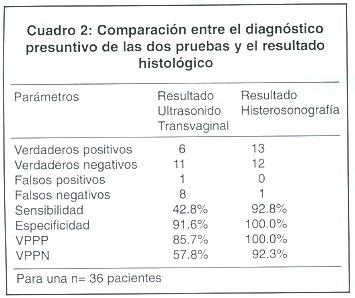
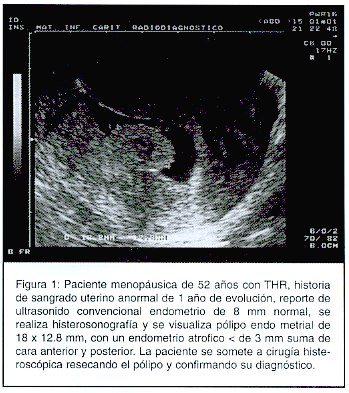
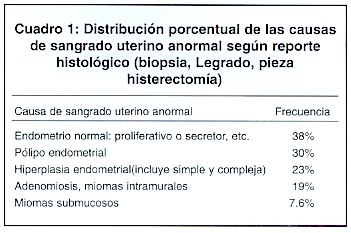
<body><![CDATA[<P><FONT FACE="Arial"><FONT SIZE=-1>Se trata de un estudio prospectivo que va de 01 marzo a 31 Julio del 2000, en el se incluyeron en forma consecutiva un total de 36 mujeres con diagn&oacute;stico de sangrado uterino anormal, ellas fueron referidas para estudio sonogr&aacute;fico y cumpl&iacute;an los criterios de inclusi&oacute;n establecidos para este estudio diagn&oacute;stico.</FONT></FONT>      <P><FONT FACE="Arial"><FONT SIZE=-1>La edad promedio de las pacientes fue de 42 a&ntilde;os. A ellas se les realiz&oacute; un ultrasonido transvaginal y luego se practic&oacute; la infusi&oacute;n de suero salino intracavitario (histerosonograf&iacute;a). Ambos resultados presuntivos se corroboraron luego con el reporte histol&oacute;gico, (biopsia de endometrio, legrado instrumental o histerectom&iacute;a), y de esa forma se calcul&oacute; la sensibilidad y especificidad de cada uno de los m&eacute;todos.</FONT></FONT>      <P><FONT FACE="Arial"><FONT SIZE=-1><B>T&eacute;cnica de la histerosonograf&iacute;a:</B> El procedimiento se realiz&oacute; despu&eacute;s de obtener el consentimiento infromado de la paciente. Se insert&oacute; el esp&eacute;culo a la paciente visualizando el cervix, el cual se limpia con soluci&oacute;n de yodo. Se introdujo entonces en la cavidad una sonda nasog&aacute;strica de ni&ntilde;o #8 o una sonda foley #8 en aquellas cervices muy dilatados que pudieran permitir el escape del fluido. Antes de introducir el cateter, &eacute;ste fue "purgado" para evitar que las burbujas de aire produzcan un artefacto dentro de la cavidad. Una vez introducido el cat&eacute;ter se retir&oacute; el esp&eacute;culo est&eacute;ril y se introdujo el transductor vaginal del ultrasonido, se inici&oacute; entonces la infusi&oacute;n de 20 a 40 cc de soluci&oacute;n salina a trav&eacute;s de cat&eacute;ter y se visualiz&oacute; en tiempo real la separaci&oacute;n del endometrio (<A HREF="#fig1">Figura 1</A>). Se realizaron barridos de cuerno a cuerno (transversales) y longitudinales, midiendo por separado el grosor del endometrio (cara anterior y posterior). Ambos procedimientos fueron realizados en 10 a 15 minutos. No se reportaron complicaciones mayores ni menores.</FONT></FONT>      <P><B><FONT FACE="Arial"><FONT SIZE=-1>Resultados</FONT></FONT></B>      <P><FONT FACE="Arial"><FONT SIZE=-1>En la mayor&iacute;a de las pacientes se encontr&oacute; un endometrio normal, luego en orden de frecuencia aparecieron p&oacute;lipos endometriales, hipeplasia endometrial y miomas submucosos. Ante la presencia de miomas, la histerosonograf&iacute;a permiti&oacute; delimitar mejor su localizaci&oacute;n exacta y el tama&ntilde;o (<A HREF="#cuadro1">Cuadro 1</A>).</FONT></FONT>      <P><FONT FACE="Arial"><FONT SIZE=-1>La limitaci&oacute;n de l ultrasonido transvaginal en relaci&oacute;n con la histerosonograf&iacute;a, se nota en el n&uacute;mero de falsos negativos. Donde por el ultrasonido transvaginal se sospechaba la presencia de enfermedad, la histerosonograf&iacute;a y el resultado histol&oacute;gico lo descartaron (<A HREF="#cuadro2">Cuadro 2</A>).</FONT></FONT>     <BR><FONT FACE="Arial"><FONT SIZE=-1>&nbsp;</FONT></FONT>     <CENTER><A NAME="cuadro1"></A><IMG SRC="/img/fbpe/amc/v43n4/2378i02.JPG" HEIGHT=233 WIDTH=351></CENTER>      
<CENTER>&nbsp;</CENTER>      <CENTER><A NAME="cuadro2"></A><IMG SRC="/img/fbpe/amc/v43n4/2378i03.JPG" HEIGHT=298 WIDTH=355></CENTER>      
]]></body>
<body><![CDATA[<CENTER></CENTER>      <CENTER><A NAME="fig1"></A><IMG SRC="/img/fbpe/amc/v43n4/2378i01.JPG" BORDER=0 HEIGHT=393 WIDTH=349></CENTER> <B><FONT FACE="Arial"><FONT SIZE=-1>&nbsp;</FONT></FONT></B>     
<BR><B><FONT FACE="Arial"><FONT SIZE=-1>Discusi&oacute;n</FONT></FONT></B>      <P><FONT FACE="Arial"><FONT SIZE=-1>Al comparar nuestro resultados con la experiencia de otros autores, vemos el gran beneficio de esta modalidad para el diagn&oacute;stico m&aacute;s preciso de patolog&iacute;a endometrial en pacientes con sagrado uterino anormal, siendo los resultados obtenidos similares a los reportados por la literatura revisada.</FONT></FONT>      <P><FONT FACE="Arial"><FONT SIZE=-1>Durante la realizaci&oacute;n de la histerosonograf&iacute;a el endomentrio normal aparece sim&eacute;trico y bien demarcado, por lo que se pueden medir ambas capas por separado. En la premenopausia el grosor va de 4 a 8 mm durante la fase proliferativa, y de 8 a 14 mm durante fase secretora, 6 mientras que en la paciente posmenop&aacute;usica es anormal todo endomentrio con grosor mayor a 5mm y ello exige un estudio histol&oacute;gico. La histerosonagraf&iacute;a permite seleccionar con gran exactitud cu&aacute;les de estas pacientes requieren o no estudio histol&oacute;gico.</FONT></FONT>      <P><FONT FACE="Arial"><FONT SIZE=-1>Kupfer et al , <SUP><A HREF="#7">7</A> </SUP>encontraron que el p&oacute;lipo endomerial engruesa el endometrio y crea una imagen de d hiperplesia endometrial en el ultrasonido transvaginal, sin embargo en la histerosonograf&iacute;a se logra visualizar, y ubicar el p&oacute;lipo en un 100% de loscasos, y brinda informaci&oacute;n de si su base es s&eacute;sil o pediculado, lo cual es de gran ayuda para decidir el tipo de cirug&iacute;a a practicar (legrado a ciegas, resecci&oacute;n histerosc&oacute;pica, etc).</FONT></FONT>      <P><FONT FACE="Arial"><FONT SIZE=-1>Adem&aacute;s, el p&oacute;lipo y el mioma submucosos tienen caracter&iacute;sticas sonogr&aacute;ficas particulares en la histerosonograf&iacute;a.</FONT></FONT>      <P><FONT FACE="Arial"><FONT SIZE=-1>Los miomas muchas veces son dif&iacute;ciles de localizar con exactitud con la ultrasonograf&iacute;a convencional. La histerosonograf&iacute;a tiene grandes ventajas ya que ubica el mioma y lo clasifica de acuerdo a su localizaci&oacute;n, tama&ntilde;o y grado de extensi&oacute;n intramural. <SUP><A HREF="#8">8</A></SUP> De esa forma se puede valorar la resectabilidad histerosc&oacute;pica y ser menos agresivos en el tratamiento de muchas pacientes.</FONT></FONT>      <P><FONT FACE="Arial"><FONT SIZE=-1>Todas las anteriores experiencias, comparadas con las de otros investigadores, se corroboraron en nuestro estudio, tal y como lo demuestran los resultados obtenidos. El gran beneficio de la histerosonograf&iacute;a en pacientes con sangrado uterino anormal en edad reproductiva, es el obtener mayor certeza diagn&oacute;stica de las patolog&iacute;as endometriales y la localizaci&oacute;n de estas lesiones como muestran nuestros resultados. En la mujer postmenop&aacute;usica con sangrado las ventajas son mayores y actualmente, al igual que nosotros, muchos autores la recomiendan, como examen inicial, en la valoraci&oacute;n del sangrado en este grupo de pacientes, <SUP><A HREF="#9">9</A></SUP> para luego obtener el espec&iacute;men histol&oacute;gico con mayor precisi&oacute;n diagn&oacute;stica.</FONT></FONT>      <P><B><FONT FACE="Arial"><FONT SIZE=-1>Abstract</FONT></FONT></B>      ]]></body>
<body><![CDATA[<P><FONT FACE="Arial"><FONT SIZE=-1><B>Justification and objectives:</B> In spite than in the last year the vaginal ultrasound has become a powerful tool in the evaluation of patients with abnormal uterine bleeding, it has shown some limitations for the diagnosis of endometrial pathology.</FONT></FONT>      <P><FONT FACE="Arial"><FONT SIZE=-1>Intracavitary saline infusion during the ultrasonographic procedure, has shown to be a more sensitive method.</FONT></FONT>      <P><FONT FACE="Arial"><FONT SIZE=-1>Our main objetive was to compare the sensitivity and specificity of the vaginal ultrasound versus the histerosonography in the diagnosis of various endometrial pathologies.</FONT></FONT>      <P><FONT FACE="Arial"><FONT SIZE=-1><B>Methodology:</B> In this study, 36 patients with the diagnosis of abnormal uterine bleeding were selected consecutively as they were refered for vaginal ultrasound.</FONT></FONT>      <P><FONT FACE="Arial"><FONT SIZE=-1>All of them had vaginal ultrasound and then histerosonography, comparing the results with the histologic diagnosis as the "gold est&aacute;ndar".</FONT></FONT>      <P><FONT FACE="Arial"><FONT SIZE=-1><B>Results:</B> Thirty eight oercent had normal endometrium 30% had endometrial polyp, 305 had endometrial hyperplasia, 19% intramural myomas and/or adenomyosis, and submucus myomas were found in 7.6% of the patients.</FONT></FONT>      <P><FONT FACE="Arial"><FONT SIZE=-1>The sensitivity and specificity for the vaginal ultrasound was 42.8% and 91.6% and for the histerosonography were 92.8% y 100% respectively.</FONT></FONT>      <P><FONT FACE="Arial"><FONT SIZE=-1>Were conclude that histerosonography was more precise in the diagnosis of endometrial pathology in patients with abnormal uterine bleeding.</FONT></FONT>      <P><B><FONT FACE="Arial"><FONT SIZE=-1>Agradecimiento</FONT></FONT></B>      <P><FONT FACE="Arial"><FONT SIZE=-1>Queremos agradecerle al Servicio de Radiolog&iacute;a del Hospital de la Mujeres la ayuda brindada para al realizaci&oacute;n de esta investigaci&oacute;n.</FONT></FONT>      ]]></body>
<body><![CDATA[<P><FONT FACE="Arial"><FONT SIZE=-1><B>Abreviaturas:</B> ISI, infusi&oacute;n salina intracavitaria; THR, tratamiento hormonal de reemplazo.</FONT></FONT>      <P><B><FONT FACE="Arial"><FONT SIZE=-1>Referencias</FONT></FONT></B>      <!-- ref --><P><A NAME="1"></A><FONT FACE="Arial"><FONT SIZE=-1>1. Cullinan JA, Fleischer AC, Kepple DM, et al: Sonohysterography: A techninque for endometrial evaluation. Radigraphics 1995; 15: 501-514.</FONT></FONT>    &nbsp;&nbsp;&nbsp;&nbsp;&nbsp;&nbsp;&nbsp;&nbsp;[&#160;<a href="javascript:void(0);" onclick="javascript: window.open('/scielo.php?script=sci_nlinks&ref=007820&pid=S0001-6002200100040000400001&lng=','','width=640,height=500,resizable=yes,scrollbars=1,menubar=yes,');">Links</a>&#160;]<!-- end-ref --><!-- ref --><P><A NAME="2"></A><FONT FACE="Arial"><FONT SIZE=-1>2. Nannini R, Chelo E, Branconi F, et al: Dynamic echohysteroscopy: A new diagnostic technique in the study of female infertility. Acta Eur Fertil 1981; 12: 165-171.</FONT></FONT>    &nbsp;&nbsp;&nbsp;&nbsp;&nbsp;&nbsp;&nbsp;&nbsp;[&#160;<a href="javascript:void(0);" onclick="javascript: window.open('/scielo.php?script=sci_nlinks&ref=007821&pid=S0001-6002200100040000400002&lng=','','width=640,height=500,resizable=yes,scrollbars=1,menubar=yes,');">Links</a>&#160;]<!-- end-ref --><P><A NAME="3"></A><FONT FACE="Arial"><FONT SIZE=-1>3. Randolph JR, Ying YK, Maier DB, et al. Comparison of real-time ultrasonography, hysterosalpingraphy, and laparoscopy/hysteroscopy in evaluation ofuterine abnormalities and tubal patency. Fertil Steril 1986; 46: 828-832.</FONT></FONT>      <!-- ref --><P><A NAME="4"></A><FONT FACE="Arial"><FONT SIZE=-1>4. Parsons AK, Lense JJ. Sonography for endometrial abnormalities: Preliminary results. J Clin Ultrasound 1993; 231: 87-95.</FONT></FONT>    &nbsp;&nbsp;&nbsp;&nbsp;&nbsp;&nbsp;&nbsp;&nbsp;[&#160;<a href="javascript:void(0);" onclick="javascript: window.open('/scielo.php?script=sci_nlinks&ref=007823&pid=S0001-6002200100040000400004&lng=','','width=640,height=500,resizable=yes,scrollbars=1,menubar=yes,');">Links</a>&#160;]<!-- end-ref --><!-- ref --><P><A NAME="5"></A><FONT FACE="Arial"><FONT SIZE=-1>5. Goldstein SR, Zeltser I, Horan CK, et al. Ultrasonography-based triage for perimenopausal patiens with abnormal uterine bleeding. Am J Obstet Gynecol 1997; 177: 102-108.</FONT></FONT>    &nbsp;&nbsp;&nbsp;&nbsp;&nbsp;&nbsp;&nbsp;&nbsp;[&#160;<a href="javascript:void(0);" onclick="javascript: window.open('/scielo.php?script=sci_nlinks&ref=007824&pid=S0001-6002200100040000400005&lng=','','width=640,height=500,resizable=yes,scrollbars=1,menubar=yes,');">Links</a>&#160;]<!-- end-ref --><!-- ref --><P><A NAME="6"></A><FONT FACE="Arial"><FONT SIZE=-1>6. Granberg S, Wikland M, Karlsson B, et al. Endometrial thickness as measured by endovaginal ultrasonography for identifying endometrial abnormality. Am J Obstet Gynecol 1991; 64: 47-52.</FONT></FONT>    &nbsp;&nbsp;&nbsp;&nbsp;&nbsp;&nbsp;&nbsp;&nbsp;[&#160;<a href="javascript:void(0);" onclick="javascript: window.open('/scielo.php?script=sci_nlinks&ref=007825&pid=S0001-6002200100040000400006&lng=','','width=640,height=500,resizable=yes,scrollbars=1,menubar=yes,');">Links</a>&#160;]<!-- end-ref --><!-- ref --><P><A NAME="7"></A><FONT FACE="Arial"><FONT SIZE=-1>7. Kupfer M, Schiller V, Hansen G, et al. Transvaginal sonographic evaluation of endometrial polyps. J Ultrasound Med 1994; 13: 535-539.</FONT></FONT>    &nbsp;&nbsp;&nbsp;&nbsp;&nbsp;&nbsp;&nbsp;&nbsp;[&#160;<a href="javascript:void(0);" onclick="javascript: window.open('/scielo.php?script=sci_nlinks&ref=007826&pid=S0001-6002200100040000400007&lng=','','width=640,height=500,resizable=yes,scrollbars=1,menubar=yes,');">Links</a>&#160;]<!-- end-ref --><!-- ref --><P><A NAME="8"></A><FONT FACE="Arial"><FONT SIZE=-1>8. Shimizu B, Fukuda K, Yomura W, et al. Transvaginal hysterosonography for differential diagnosis between submucous and intramural myoma. Gynecol Obstet Invest 1993; 35: 236-239.</FONT></FONT>    &nbsp;&nbsp;&nbsp;&nbsp;&nbsp;&nbsp;&nbsp;&nbsp;[&#160;<a href="javascript:void(0);" onclick="javascript: window.open('/scielo.php?script=sci_nlinks&ref=007827&pid=S0001-6002200100040000400008&lng=','','width=640,height=500,resizable=yes,scrollbars=1,menubar=yes,');">Links</a>&#160;]<!-- end-ref --><!-- ref --><P><A NAME="9"></A><FONT FACE="Arial"><FONT SIZE=-1>9. Cacciatore B, Ramsay T, Lehtovirta P, et al. Transvaginal sonography and hysteroscopy in postmenopausal bleeding. Acta obstet Gynecol Scand 1994; 73: 413-416.</FONT></FONT>    &nbsp;&nbsp;&nbsp;&nbsp;&nbsp;&nbsp;&nbsp;&nbsp;[&#160;<a href="javascript:void(0);" onclick="javascript: window.open('/scielo.php?script=sci_nlinks&ref=007828&pid=S0001-6002200100040000400009&lng=','','width=640,height=500,resizable=yes,scrollbars=1,menubar=yes,');">Links</a>&#160;]<!-- end-ref --><BR><FONT FACE="Arial"><FONT SIZE=-1>&nbsp;</FONT></FONT>      <P><A NAME="A1"></A><FONT FACE="Arial"><FONT SIZE=-1><A HREF="#R1">1</A> Residente Postgrado de Ginecolog&iacute;a y Obstetricia, Hospital de las Mujeres "Adolfo Carit Eva"</FONT></FONT>      <P><FONT FACE="Arial"><FONT SIZE=-1><A HREF="#R1">2</A> Cl&iacute;nica Servicio de Ginecolog&iacute;a, Hospital de las Mujeres "Adolfo Carit Eva"</FONT></FONT>      <P><FONT FACE="Arial"><FONT SIZE=-1><B>Correspondencia:</B> Ronald Salazar Mora, direcci&oacute;n: Heredia 250mts oeste de la estaci&oacute;n de Bomberos, tel&eacute;fono 391-12-86, fax 261-12-42. E mail: <A HREF="mailto:ronitol@latinmail.com">ronitol@latinmail.com</A></FONT></FONT>      ]]></body><back>
<ref-list>
<ref id="B1">
<nlm-citation citation-type="journal">
<person-group person-group-type="author">
<name>
<surname><![CDATA[Cullinan]]></surname>
<given-names><![CDATA[JA]]></given-names>
</name>
<name>
<surname><![CDATA[Fleischer]]></surname>
<given-names><![CDATA[A]]></given-names>
</name>
<name>
<surname><![CDATA[Kepple]]></surname>
<given-names><![CDATA[DM]]></given-names>
</name>
</person-group>
<article-title xml:lang="en"><![CDATA[Sonohysterography: A techninque for endometrial evaluation]]></article-title>
<source><![CDATA[Radigraphics]]></source>
<year>1995</year>
<volume>15</volume>
<page-range>501-514</page-range></nlm-citation>
</ref>
<ref id="B2">
<nlm-citation citation-type="journal">
<person-group person-group-type="author">
<name>
<surname><![CDATA[Nannini]]></surname>
<given-names><![CDATA[R]]></given-names>
</name>
<name>
<surname><![CDATA[Chelo]]></surname>
<given-names><![CDATA[E]]></given-names>
</name>
<name>
<surname><![CDATA[Branconi]]></surname>
<given-names><![CDATA[F]]></given-names>
</name>
</person-group>
<article-title xml:lang="en"><![CDATA[Dynamic echohysteroscopy: A new diagnostic technique in the study of female infertility]]></article-title>
<source><![CDATA[Acta Eur Fertil]]></source>
<year>1981</year>
<volume>12</volume>
<page-range>165-171</page-range></nlm-citation>
</ref>
<ref id="B3">
<nlm-citation citation-type="journal">
<person-group person-group-type="author">
<name>
<surname><![CDATA[Randolph]]></surname>
<given-names><![CDATA[JR]]></given-names>
</name>
<name>
<surname><![CDATA[Ying]]></surname>
<given-names><![CDATA[YK]]></given-names>
</name>
</person-group>
<article-title xml:lang="en"><![CDATA[Comparison of real-time ultrasonography, hysterosalpingraphy, and laparoscopy/hysteroscopy in evaluation ofuterine abnormalities and tubal patency]]></article-title>
<source><![CDATA[Fertil Steril]]></source>
<year>1986</year>
<volume>46</volume>
<page-range>828-832</page-range></nlm-citation>
</ref>
<ref id="B4">
<nlm-citation citation-type="journal">
<person-group person-group-type="author">
<name>
<surname><![CDATA[Parsons]]></surname>
<given-names><![CDATA[AK]]></given-names>
</name>
<name>
<surname><![CDATA[Lense]]></surname>
<given-names><![CDATA[JJ]]></given-names>
</name>
</person-group>
<article-title xml:lang="en"><![CDATA[Sonography for endometrial abnormalities: Preliminary results]]></article-title>
<source><![CDATA[J Clin Ultrasound]]></source>
<year>1993</year>
<volume>231</volume>
<page-range>87-95</page-range></nlm-citation>
</ref>
<ref id="B5">
<nlm-citation citation-type="journal">
<person-group person-group-type="author">
<name>
<surname><![CDATA[Goldstein]]></surname>
<given-names><![CDATA[SR]]></given-names>
</name>
<name>
<surname><![CDATA[Zeltser]]></surname>
<given-names><![CDATA[I]]></given-names>
</name>
<name>
<surname><![CDATA[Horan]]></surname>
<given-names><![CDATA[CK]]></given-names>
</name>
</person-group>
<article-title xml:lang="en"><![CDATA[Ultrasonography-based triage for perimenopausal patiens with abnormal uterine bleeding]]></article-title>
<source><![CDATA[Am J Obstet Gynecol]]></source>
<year>1997</year>
<volume>177</volume>
<page-range>102-108</page-range></nlm-citation>
</ref>
<ref id="B6">
<nlm-citation citation-type="journal">
<person-group person-group-type="author">
<name>
<surname><![CDATA[Granberg]]></surname>
<given-names><![CDATA[S]]></given-names>
</name>
<name>
<surname><![CDATA[Wikland]]></surname>
<given-names><![CDATA[M]]></given-names>
</name>
<name>
<surname><![CDATA[Karlsson]]></surname>
<given-names><![CDATA[B]]></given-names>
</name>
</person-group>
<article-title xml:lang="en"><![CDATA[Endometrial thickness as measured by endovaginal ultrasonography for identifying endometrial abnormality]]></article-title>
<source><![CDATA[Am J Obstet Gynecol]]></source>
<year>1991</year>
<volume>64</volume>
<page-range>47-52</page-range></nlm-citation>
</ref>
<ref id="B7">
<nlm-citation citation-type="journal">
<person-group person-group-type="author">
<name>
<surname><![CDATA[Kupfer]]></surname>
<given-names><![CDATA[M]]></given-names>
</name>
<name>
<surname><![CDATA[Schiller]]></surname>
<given-names><![CDATA[V]]></given-names>
</name>
<name>
<surname><![CDATA[Hansen]]></surname>
<given-names><![CDATA[G]]></given-names>
</name>
</person-group>
<article-title xml:lang="en"><![CDATA[Transvaginal sonographic evaluation of endometrial polyps]]></article-title>
<source><![CDATA[J Ultrasound Med]]></source>
<year>1994</year>
<volume>13</volume>
<page-range>535-539</page-range></nlm-citation>
</ref>
<ref id="B8">
<nlm-citation citation-type="journal">
<person-group person-group-type="author">
<name>
<surname><![CDATA[Shimizu]]></surname>
<given-names><![CDATA[B]]></given-names>
</name>
<name>
<surname><![CDATA[Fukuda]]></surname>
<given-names><![CDATA[K]]></given-names>
</name>
<name>
<surname><![CDATA[Yomura]]></surname>
<given-names><![CDATA[W]]></given-names>
</name>
</person-group>
<article-title xml:lang="en"><![CDATA[Transvaginal hysterosonography for differential diagnosis between submucous and intramural myoma]]></article-title>
<source><![CDATA[Gynecol Obstet Invest]]></source>
<year>1993</year>
<volume>35</volume>
<page-range>236-239</page-range></nlm-citation>
</ref>
<ref id="B9">
<nlm-citation citation-type="journal">
<person-group person-group-type="author">
<name>
<surname><![CDATA[Cacciatore]]></surname>
<given-names><![CDATA[B]]></given-names>
</name>
<name>
<surname><![CDATA[Ramsay]]></surname>
<given-names><![CDATA[T]]></given-names>
</name>
<name>
<surname><![CDATA[Lehtovirta]]></surname>
<given-names><![CDATA[P]]></given-names>
</name>
</person-group>
<article-title xml:lang="en"><![CDATA[Transvaginal sonography and hysteroscopy in postmenopausal bleeding]]></article-title>
<source><![CDATA[Acta obstet Gynecol Scand]]></source>
<year>1994</year>
<volume>73</volume>
<page-range>413-416</page-range></nlm-citation>
</ref>
</ref-list>
</back>
</article>