<?xml version="1.0" encoding="ISO-8859-1"?><article xmlns:mml="http://www.w3.org/1998/Math/MathML" xmlns:xlink="http://www.w3.org/1999/xlink" xmlns:xsi="http://www.w3.org/2001/XMLSchema-instance">
<front>
<journal-meta>
<journal-id>0001-6002</journal-id>
<journal-title><![CDATA[Acta Médica Costarricense]]></journal-title>
<abbrev-journal-title><![CDATA[Acta méd. costarric]]></abbrev-journal-title>
<issn>0001-6002</issn>
<publisher>
<publisher-name><![CDATA[Colegio de Médicos y Cirujanos de Costa Rica]]></publisher-name>
</publisher>
</journal-meta>
<article-meta>
<article-id>S0001-60022001000400001</article-id>
<title-group>
<article-title xml:lang="es"><![CDATA[Seroprevalencia de los virus de la Hepatitis A y B en grupos etarios de Costa Rica]]></article-title>
</title-group>
<contrib-group>
<contrib contrib-type="author">
<name>
<surname><![CDATA[Taylor]]></surname>
<given-names><![CDATA[Mayra L.]]></given-names>
</name>
<xref ref-type="aff" rid="A01"/>
</contrib>
<contrib contrib-type="author">
<name>
<surname><![CDATA[García]]></surname>
<given-names><![CDATA[Zaida]]></given-names>
</name>
<xref ref-type="aff" rid="A01"/>
</contrib>
<contrib contrib-type="author">
<name>
<surname><![CDATA[Holst]]></surname>
<given-names><![CDATA[Ileana]]></given-names>
</name>
<xref ref-type="aff" rid="A02"/>
</contrib>
<contrib contrib-type="author">
<name>
<surname><![CDATA[Somogye]]></surname>
<given-names><![CDATA[Teresita]]></given-names>
</name>
<xref ref-type="aff" rid="A02"/>
</contrib>
<contrib contrib-type="author">
<name>
<surname><![CDATA[Cunningham]]></surname>
<given-names><![CDATA[Lowella]]></given-names>
</name>
<xref ref-type="aff" rid="A02"/>
</contrib>
<contrib contrib-type="author">
<name>
<surname><![CDATA[Visoná]]></surname>
<given-names><![CDATA[Kristen A.]]></given-names>
</name>
<xref ref-type="aff" rid="A01"/>
</contrib>
</contrib-group>
<aff id="A01">
<institution><![CDATA[,Universidad del Estado de Louisiana Centro Internacional de Investigación Médico ]]></institution>
<addr-line><![CDATA[ ]]></addr-line>
</aff>
<aff id="A02">
<institution><![CDATA[,Universidad de Costa Rica Facultad de Microbiología ]]></institution>
<addr-line><![CDATA[ ]]></addr-line>
</aff>
<aff id="A03">
<institution><![CDATA[,Instituto Costarricense de Investigación y Enseñanza en Nutrición y Salud  ]]></institution>
<addr-line><![CDATA[ ]]></addr-line>
</aff>
<pub-date pub-type="pub">
<day>00</day>
<month>10</month>
<year>2001</year>
</pub-date>
<pub-date pub-type="epub">
<day>00</day>
<month>10</month>
<year>2001</year>
</pub-date>
<volume>43</volume>
<numero>4</numero>
<fpage>153</fpage>
<lpage>158</lpage>
<copyright-statement/>
<copyright-year/>
<self-uri xlink:href="http://www.scielo.sa.cr/scielo.php?script=sci_arttext&amp;pid=S0001-60022001000400001&amp;lng=en&amp;nrm=iso"></self-uri><self-uri xlink:href="http://www.scielo.sa.cr/scielo.php?script=sci_abstract&amp;pid=S0001-60022001000400001&amp;lng=en&amp;nrm=iso"></self-uri><self-uri xlink:href="http://www.scielo.sa.cr/scielo.php?script=sci_pdf&amp;pid=S0001-60022001000400001&amp;lng=en&amp;nrm=iso"></self-uri><abstract abstract-type="short" xml:lang="es"><p><![CDATA[Justificación y Objetivos: Debido a la persistencia de casos y brotes de hepatitis viral A y B en el país, junto con la observación de un aumento importante de infecciones por el tipo A en la población de adultos, se planteó la necesidad de establecer la prevalencia de estos dos tipos de hepatitis en diferentes grupos etarios en nuestro país. Métodos: La seroprevalencia de los virus de la hepatitis A (VHA) y de hepatitis (VHB); fueron investigadas en 873 muestras de niños pre-escolares menores de 7 años de la encuesta nacional de nutrición en 1996; 614 niños escolares de 9 a 15 años de una encuesta de nutrición de la Universidad de Costa Rica realizada en 1997 y 996 muestras en adultos, estudiantes y funcionario de esta misma universidad recolectadas en 1994. Las muestras se analizaron por anticuerpos totales contra al VHA (anti-VHA total), VHB antígeno de superficie (HbsAG) y anticuerpos totales contra la proteína del núcleo o "core" (anti-HBc total). Resultados: Se encontró un 6.8%, 13.2% y 71.7% de anti-VHA total en los prescolares, escolares y adultos, respectivamente, con una creciente prevalencia en relación con la edad. La presencia de estos anticuerpos en los escolares estuvo asociada con la escolaridad de los padres y su condición socieconómica; siendo mayor cuando los padres tenían un menor nivel de escolaridad (24% con secundaria incompleta versus 7.6% con nivel educativo superior) y entre padres sin capacitación técnica o profesionales (16% versus 8.7% en los padres con estudios superiores). También se encontró una diferencia en la prevalencia de anti-VHA entre estudiantes de escuelas públicas (19.5%) versus privadas (6.9%). En los preescolares, el único grupo con representación estadística geográfica; la provincia de Guanacaste presentó un riesgo de 2 a 3 veces mayor de tener anticuerpos contra el VHA (21%) que los niños procedentes de otras provincias, lo cual es concordante con los datos relacionados con condiciones socioeconómicas más bajas, falta de agua potable, letrinización y hacinamiento en las áreas rurales. En cuanto a los marcadores de VHB, se encontró una prevalencia de 0.5%, 0.2% para HbsAG y 2.8%, 0.3% y 4.0% para el anti-HBc total en preescolares, escolares y adultos, respectivamente. No hubo ninguna relación entre las condiciones socioeconómicas o la edad, para estas prevalencias, pero el anti-HBc fue más alto en los hombres (6.9% en hombres y 2.3% en mujeres). Conclusiones: Al comparar los datos obtenidos en décadas en Costa Rica sobre estos dos tipos de hepatitis se encontró que la hepatitis B, sigue teniendo un patrón epidemiológico similar de baja prevalencia, mientras que la hepatitis A presentó un cambio de patrón durante la infancia, al pasar de una prevalencia alta a intermedia a baja. Este cambio requiere de una intervención oportuna para evitar brotes epidémicos y un aumento en el número de casos severos en jóvenes y adultos.]]></p></abstract>
<abstract abstract-type="short" xml:lang="en"><p><![CDATA[Justification and objetives: Due to persistence of acute cases and outbreaks of viral hepatitis A and B in our country and the observation of an important increase of type A infections in the adult population, it was considered necesary to establish the prevalence of these two types of hepatitis in different age groups in our country. Methods: Seroprevalence of viral hepatitis A (HAV) and viral hepatitis B (HBV), was studied in a population which included 873 pre-scholar children < 7 years from a national nutritional survey in 1996; 614 scholar children 9-15 years from a national nutritional survey carried out by the University of Costa Rica during 1996 and 1997, and 996 samples from students and personnel from this same university collected during 1994. These samples were analyzed for total antibodies to HAV (anti-HAV total), HBV surface antigen (HbsAg) and total antibodies against core (anti-HBc total). Results: The percentage of anti-HAV was established to be 6.8%, 13.2% and 71.7% for the pre-scholar children, scholars and adults, respectively, with an increasing prevalence related to age. The presence of antibodies in the "scholar group" was associated with education level of the parents and their socioeconomic status, being higher for parents with a lower education level (24% with incomplete high school versus 7.6% with higher education level) and among parents with-out technical or professional training (16% versus 8.7% in the parents with higher education level). Also, it was a difference between the presence of anti-HAV among students from public schools (19.5%) versus private schools (6.9%). In the prescholar children, which was the only group with geographic statistical significance, the province of Guanacaste showed a 2-3 times higher risk to have HAV antibodies (21%) than in children from other provinces. This is in concordance with data related to low socio-economical status, lack of potable water and poor sanitary conditions. The study shower a prevalence of HBv markers to be 0.5%, 0.2% and 0.2% for HbsAg, and 2.8%, 0.3% and 4.0% for anti-HBc in pre-scholars, scholars and adults, respectively. There was no relationship between the socioeconomic status or age, with these prevalences; but the anti-HBc was found to be higher in men (6.9% in men and 2.3% in women). Conclusions: When comparing the data obtained in earlier decades in Costa Rica for these two types of hepatitis, it was found that hepatitis B continues to have a similar epidemiological pattern during childhood from a high prevalence. This change requires an adequate intervention to avoid epidemic outbreaks and increase in the number of severe cases in the young and adult population.]]></p></abstract>
</article-meta>
</front><body><![CDATA[  <B><FONT FACE="Arial"><FONT SIZE=-1>ORIGINALES</FONT></FONT></B>     <CENTER><B><FONT FACE="Arial">Seroprevalencia de los Virus de la Hepatitis A y B en Grupos Etarios de Costa Rica</FONT></B></CENTER> &nbsp;     <BR>&nbsp;     <CENTER><FONT FACE="Arial"><FONT SIZE=-1>Mayra L. Taylor, <SUP><A HREF="#A1">1</A></SUP> Zaida Garc&iacute;a, <SUP><A HREF="#A1">1</A></SUP> Ileana Holst, <SUP><A HREF="#A1">2</A></SUP> Teresita Somogye, <SUP><A HREF="#A1">2</A></SUP> Lowella Cunningham,<SUP> <A HREF="#A1">3</A></SUP>&nbsp; Kristen A. Vison&aacute;&nbsp;<A NAME="R1"></A><SUP><A HREF="#A1">1</A></SUP></FONT></FONT></CENTER> &nbsp;     <BR><B><FONT FACE="Arial"><FONT SIZE=-1>&nbsp;</FONT></FONT></B>     <BR><FONT FACE="Arial"><FONT SIZE=-1><B>Justificaci&oacute;n y Objetivos:</B> Debido a la persistencia de casos y brotes de hepatitis viral A y B en el pa&iacute;s, junto con la observaci&oacute;n de un aumento importante de infecciones por el tipo A en la poblaci&oacute;n de adultos, se plante&oacute; la necesidad de establecer la prevalencia de estos dos tipos de hepatitis en diferentes grupos etarios en nuestro pa&iacute;s.</FONT></FONT>      <P><FONT FACE="Arial"><FONT SIZE=-1><B>M&eacute;todos:</B> La seroprevalencia de los virus de la hepatitis A (VHA) y de hepatitis (VHB); fueron investigadas en 873 muestras de ni&ntilde;os pre-escolares menores de 7 a&ntilde;os de la encuesta nacional de nutrici&oacute;n en 1996; 614 ni&ntilde;os escolares de 9 a 15 a&ntilde;os de una encuesta de nutrici&oacute;n de la Universidad de Costa Rica realizada en 1997 y 996 muestras en adultos, estudiantes y funcionario de esta misma universidad recolectadas en 1994. Las muestras se analizaron por anticuerpos totales contra al VHA (anti-VHA total), VHB ant&iacute;geno de superficie (HbsAG) y anticuerpos totales contra la prote&iacute;na del n&uacute;cleo o "core" (anti-HBc total).</FONT></FONT>      <P><FONT FACE="Arial"><FONT SIZE=-1><B>Resultados:</B> Se encontr&oacute; un 6.8%, 13.2% y 71.7% de anti-VHA total en los prescolares, escolares y adultos, respectivamente, con una creciente prevalencia en relaci&oacute;n con la edad. La presencia de estos anticuerpos en los escolares estuvo asociada con la escolaridad de los padres y su condici&oacute;n sociecon&oacute;mica; siendo mayor cuando los padres ten&iacute;an un menor nivel de escolaridad (24% con secundaria incompleta versus 7.6% con nivel educativo superior) y entre padres sin capacitaci&oacute;n t&eacute;cnica o profesionales (16% versus 8.7% en los padres con estudios superiores). Tambi&eacute;n se encontr&oacute; una diferencia en la prevalencia de anti-VHA entre estudiantes de escuelas p&uacute;blicas (19.5%) versus privadas (6.9%). En los preescolares, el &uacute;nico grupo con representaci&oacute;n estad&iacute;stica geogr&aacute;fica; la provincia de Guanacaste present&oacute; un riesgo de 2 a 3 veces mayor de tener anticuerpos contra el VHA (21%) que los ni&ntilde;os procedentes de otras provincias, lo cual es concordante con los datos relacionados con condiciones socioecon&oacute;micas m&aacute;s bajas, falta de agua potable, letrinizaci&oacute;n y hacinamiento en las &aacute;reas rurales.</FONT></FONT>      <P><FONT FACE="Arial"><FONT SIZE=-1>En cuanto a los marcadores de VHB, se encontr&oacute; una prevalencia de 0.5%, 0.2% para HbsAG y 2.8%, 0.3% y 4.0% para el anti-HBc total en preescolares, escolares y adultos, respectivamente. No hubo ninguna relaci&oacute;n entre las condiciones socioecon&oacute;micas o la edad, para estas prevalencias, pero el anti-HBc fue m&aacute;s alto en los hombres (6.9% en hombres y 2.3% en mujeres).</FONT></FONT>      <P><FONT FACE="Arial"><FONT SIZE=-1><B>Conclusiones: </B>Al comparar los datos obtenidos en d&eacute;cadas en Costa Rica sobre estos dos tipos de hepatitis se encontr&oacute; que la hepatitis B, sigue teniendo un patr&oacute;n epidemiol&oacute;gico similar de baja prevalencia, mientras que la hepatitis A present&oacute; un cambio de patr&oacute;n durante la infancia, al pasar de una prevalencia alta a intermedia a baja. Este cambio requiere de una intervenci&oacute;n oportuna para evitar brotes epid&eacute;micos y un aumento en el n&uacute;mero de casos severos en j&oacute;venes y adultos.</FONT></FONT>     ]]></body>
<body><![CDATA[<BR>&nbsp;     <BR><B><FONT FACE="Arial"><FONT SIZE=-1>Introducci&oacute;n</FONT></FONT></B>      <P><FONT FACE="Arial"><FONT SIZE=-1>Los virus de hepatitis A y B durante la fase aguda de la infecci&oacute;n, puede causar enfermedad cl&iacute;nica y casos fulminantes o permanecer como infecci&oacute;n asintom&aacute;tica. Los dos tipos de virus pueden producir cuadros agudos semejantes con inflamaci&oacute;n del h&iacute;gado, alteraci&oacute;n de los marcadores bioqu&iacute;micos de funci&oacute;n hep&aacute;tica, malestar general, v&oacute;mitos, anorexia, fatiga, heces de color claro (hipocolia o acolia), orina oscura (coluria) y en algunos casos ictericia. <SUP><A HREF="#1">1</A>,<A HREF="#2">2</A></SUP></FONT></FONT>      <P><FONT FACE="Arial"><FONT SIZE=-1>El virus de la hepatitis A, se identific&oacute; en 1973, y se clasific&oacute; como un oicornavirus del g&eacute;nero de los hepatovirus. <SUP><A HREF="#3">3</A></SUP> Su transmisi&oacute;n se produce por v&iacute;a fecal-oral, se asocia con el consumo de agua y alimentos contaminados, contacto de persona a persona y se relaciona con el nivel sanitario e higi&eacute;nico de una poblaci&oacute;n. <SUP><A HREF="#1">1</A>,<A HREF="#4">4</A></SUP> Se han reportado infecciones nosocomiales principalmente en reci&eacute;n nacidos de unidades de cuidados intensivos, guarder&iacute;as infantiles <SUP><A HREF="#5">5</A>,<A HREF="#6">6</A></SUP> y m&aacute;s recientemente infecci&oacute;n causada por transfusi&oacute;n de derivados sangu&iacute;neos. <SUP><A HREF="#7">7</A>,<A HREF="#8">8</A></SUP></FONT></FONT>      <P><FONT FACE="Arial"><FONT SIZE=-1>La hepatitis A, transcurre en gran parte desapercibida en ni&ntilde;os. En adolescentes y adultos la enfermedad es m&aacute;s severa y se presentan aproximadamente un 2% de casos fulminantes.<SUP> <A HREF="#1">1</A></SUP> Este virus no produce cronicidad y los anticuerpos contra VHA tipo IgG persisten por largo tiempo otorgando inmunidad contra todos los genotipos.<SUP><A HREF="#9">9</A></SUP></FONT></FONT>      <P><FONT FACE="Arial"><FONT SIZE=-1>Se consideran pa&iacute;ses de alta prevalencia por Virus de Hepatitis A (VHA) cuando el 30%-40% de ni&ntilde;os menores de 5 a&ntilde;os y el 70%-100% de adolescentes tienen anticuerpos, prevalencia intermedia con 10%-25% en menores de 5 a&ntilde;os y aproximadamente 50% en personas mayores de 15 a&ntilde;os y prevalencia baja con porcentajes menores a los indicados anteriormente. <SUP><A HREF="#10">10</A></SUP> Costa Rica se encontraba documentada hasta ahora entre los pa&iacute;ses con una alta prevalencia de infecci&oacute;n por VHA.<SUP><A HREF="#11">11</A></SUP></FONT></FONT>      <P><FONT FACE="Arial"><FONT SIZE=-1>El mejoramiento de las condiciones sanitarias en una comunidad o poblaci&oacute;n retarda la exposici&oacute;n al VHA y por consiguiente la posibilidad de adquirir la infecci&oacute;n, reduciendo as&iacute; la prevalencia en ni&ntilde;os y aumentando el riesgo en adultos. <SUP><A HREF="#12">12-14</A></SUP> En estudios realizados por el Centro Internacional de Investigaci&oacute;n y Adiestramiento M&eacute;dico (CIIAM) en los &uacute;ltimos 10 a&ntilde;os, se observa un aumento en la mortalidad por VHA en j&oacute;venes y adultos. Un estudio de 108 estudiantes de medicina de la Universidad de costa Rica, mostr&oacute; que el 60% de esta poblaci&oacute;n era susceptible a la infecci&oacute;n por VHA, lo cual sugiere que en Costa Rica se est&aacute; estableciendo un patr&oacute;n intermedio de infecci&oacute;n y con un riesgo substancial para que adultos adquieran la infecci&oacute;n y padecer la enfermedad (Datos no publicados del CIIAM).</FONT></FONT>      <P><FONT FACE="Arial"><FONT SIZE=-1>Las estrategias aplicadas durante las &uacute;ltimas d&eacute;cadas para el control del VHA consist&iacute;a en el mejoramiento ambiental, control microbiol&oacute;gico y la correcta manipulaci&oacute;n de loa alimentos, ninguna de las cuales es efectiva individualmente. <SUP><A HREF="#10">10</A></SUP> En la actualidad se dispone; adem&aacute;s, de vacunas que pueden brindar una herramienta efectiva para el control de brotes y epidemias y eventual erradicaci&oacute;n de la enfermedad. Sin embargo, el costo elevado de las mismas, hacen inaccesibles campa&ntilde;as de vacunaci&oacute;n masiva en los pa&iacute;ses en desarrollo. <SUP><A HREF="#12">12</A>,<A HREF="#15">15</A>,<A HREF="#16">16</A></SUP></FONT></FONT>      <P><FONT FACE="Arial"><FONT SIZE=-1>El virus de la hepatitis B(VHB), es un miembro de la familia Hepadnaviridae. Se transmite principalmente por v&iacute;a parenteral, sexual, perinatal y por contacto intrafamiliar. El VHB es causante de portadores cr&oacute;nicos los cuales se determinan por la circulaci&oacute;n de HBsAG en la sangre por m&aacute;s de 6 meses. <SUP><A HREF="#2">2</A></SUP> El riesgo de una poblaci&oacute;n de infectarse con el VHB depende de la prevalencia de portadores cr&oacute;nicos, genotipos circulantes y la pr&aacute;ctica de h&aacute;bitos de riesgos. <SUP><A HREF="#17">17</A>, <A HREF="#18">18</A></SUP> Se estima que actualmente existen entre 250 y 350 millones de personas portadoras cr&oacute;nicas del VHB en el mundo. <SUP><A HREF="#2">2</A>,<A HREF="#19">19</A></SUP></FONT></FONT>      <P><FONT SIZE=-1><FONT FACE="Arial">El porcentaje de cronicidad producido por el VHB var&iacute;a seg&uacute;n la edad de adquisici&oacute;n e la enfermedad. </FONT><SUP><FONT FACE="Arial,Helvetica"><A HREF="#2">2</A>,<A HREF="#20">20</A></FONT></SUP><FONT FACE="Arial"> Cuando la infecci&oacute;n es adquirida por v&iacute;a perinatal el riesgo de desarrollo de cronicidad es de hasta un 90%; si la infecci&oacute;n ocurre durante los primeros 5 a&ntilde;os de vida el riesgo es del 30%-40%, y de 5%-10% si se adquiere despu&eacute;s de los 5 a&ntilde;os. El estado de cronicidad neonatal desarrollado durante la ni&ntilde;ez tiene un mayor riesgo de evolucionar a enfermedad hep&aacute;tica severa a temprana edad como cirrosis y/o c&aacute;ncer, con una alta tasa de mortalidad.<SUP><A HREF="#21">21</A></SUP></FONT></FONT>      ]]></body>
<body><![CDATA[<P><FONT FACE="Arial"><FONT SIZE=-1>La prevalencia del VHB var&iacute;a seg&uacute;n las diferencias zonas geogr&aacute;ficas y distribuci&oacute;n demogr&aacute;fica. <SUP><A HREF="#19">19</A>,<A HREF="#22">22</A>,<A HREF="#23">23</A></SUP> Se consideran zonas de alto riesgo cuando la prevalencia de portadores supera el 8% de riesgo intermedio con prevalencia es menor del 2%. El contacto previo con el VHB evidenciado por la presencia de anti-core, es de 5 a 15 veces mayor que la prevalencia de HbsAG de portadores cr&oacute;nico. <SUP><A HREF="#24">24</A></SUP></FONT></FONT>      <P><FONT FACE="Arial"><FONT SIZE=-1>Estudios seroepidemiol&oacute;gicos realizados por el CIIMA en donantes de sangre, del &aacute;rea metropolitana, as&iacute; como tambi&eacute;n de las zonas de San Carlos, P&eacute;rez Zeled&oacute;n, San Vito de Coto Brus y San Ram&oacute;n-Palmares, demostraron que Costa Rica puede ubicarse dentro de una regi&oacute;n con un patr&oacute;n de baja endemicidad para la hepatitis B (0.5%-1%), con excepci&oacute;n de P&eacute;rez Zeled&oacute;n donde la prevalencia es intermedia (2%-3%). <SUP><A HREF="#25">25</A>,<A HREF="#26">26</A></SUP></FONT></FONT>      <P><FONT FACE="Arial"><FONT SIZE=-1>Los programas de vacunaci&oacute;n contra la hepatitis B durante las dos &uacute;ltimas d&eacute;cadas han tenido gran impacto en la prevenci&oacute;n y control del VHB. <SUP><A HREF="#27">27</A>, <A HREF="#28">28</A></SUP></FONT></FONT>      <P><FONT FACE="Arial"><FONT SIZE=-1>El objetivo del presente estudio fue conocer en diferentes grupos etarios del pa&iacute;s, la prevalencia de inmunidad contra el VHA y de infecci&oacute;n presente o pasada por el VHB, con el fin de que estos resultados permitan ayudar a las autoridades pertinentes a dise&ntilde;ar planes estrat&eacute;gicos adecuados de prevenci&oacute;n, vacunaci&oacute;n y respuesta a brotes epid&eacute;micos.</FONT></FONT>      <P><B><FONT FACE="Arial"><FONT SIZE=-1>Materiales y M&eacute;todos</FONT></FONT></B>      <P><FONT FACE="Arial"><FONT SIZE=-1><B>Poblaci&oacute;n en estudio:</B> Se analizaron 873 muestras de sangre de ni&ntilde;os preescolares (menores de 7 a&ntilde;os) del banco de suero de la Encuesta Nacional de Nutrici&oacute;n, con representaci&oacute;n estad&iacute;stica, efectuada por el Ministerio de Salud durante 1996; 614 muestras de ni&ntilde;os de 9 a 15 a&ntilde;os del banco de sueros de una encuesta nutricional metropolitana de la Universidad de Costa Rica realizada en 1997; y muestras de 996 estudiantes y funcionarios de la Universidad de Costa Rica que asistieron a servicios de salud durante 1994.</FONT></FONT>      <P><FONT SIZE=-1><FONT FACE="Arial"><B>Recolecci&oacute;n de la informaci&oacute;n:</B> se usaron las bases de datos existentes (Ministerio de Salud. Encuesta Nacional de Nutrici&oacute;n. 1 Fasc&iacute;culo Antropometr&iacute;a . Costa Rica. 1996. Ministerio de Salud. INCIENSA) para los ni&ntilde;os </FONT><FONT FACE=Symbol>&lt;</FONT><FONT FACE="Arial"> 7 a&ntilde;os que incluyeron datos de edad, sexo, lugar de residencia, escolaridad, ocupaci&oacute;n de los padres y condici&oacute;n de vivienda.</FONT></FONT>      <P><FONT FACE="Arial"><FONT SIZE=-1>Del grupos de los escolares de 9-15 a&ntilde;os, la base de datos fue proporcionada por la Universidad de Costa Rica, con la siguiente informaci&oacute;n : edad, sexo, lugar de residencia, tipo de escuela, nivel escolar del ni&ntilde;o, escolaridad de los padres, ocupaci&oacute;n y condici&oacute;n y tendencia de vivienda.</FONT></FONT>      <P><FONT FACE="Arial"><FONT SIZE=-1>Finalmente, se recolect&oacute; la informaci&oacute;n pertinente de estudiantes y funcionarios de los expedientes de la Oficina de Salud de la Universidad de Costa Rica, mediante el uso de un cuestionario dise&ntilde;ado para tal efecto. Se incluyeron datos de edad, sexo y lugar de residencia.</FONT></FONT>      <P><FONT SIZE=-1><FONT FACE="Arial"><B>Metodolog&iacute;a:</B> Para la determinaci&oacute;n de anti-VHA se us&oacute; un reactivo comercial de los Laboratorios Abbott, Chicago, IL., EIA-HAVAB y/o el RIA anti-HAV desarrollado por el CIIAM. Los dos m&eacute;todos se basan en una metodolog&iacute;a competitiva previamente descrita. Brevemente, 5 &micro;1 de muestra se pone a competir en 95 &micro;1 de un anti-HAV marcado con </FONT><SUP><FONT FACE="Arial,Helvetica">125</FONT></SUP><FONT FACE="Arial">I previamente titulado por el virus de hepatitis A capturado en una placa de polestireno. Se incuba durante 2 horas a 40&deg;C, se lava y se leen en las cuentas por minuto en un contador gamma (1470 Wizard, Wallac). Se considera una reacci&oacute;n positiva aquella donde se disminuya igual o m&aacute;s del 50% de la lectura promedio de los controles positivos y negativos. <SUP><A HREF="#29">29,30</A></SUP> Reactivos comerciales de los laboratorios Abbott, Chicago, fueron utilizados para detecci&oacute;n de HbsAg (Auzyme), anti-HBc (EIA-Corab) y/o reactivos desarrollados por CIIAM, RIA-HbsAg RIA-anti-HBC. Los m&eacute;todos comerciales y del CIAM fueron basados en metodolog&iacute;as semejantes. Se us&oacute; el principio de sadwich simple para el HbsAg y de competencia para el anti-HBc. <SUP><A HREF="#31">31</A></SUP> Para la detecci&oacute;n de HbsAg, 100 &micro;l de muestra se incuban durante una hora en una placa recubierta con anticuerpos anti-HbsAg (anti-HBs), se lavan y se incuban por 2 horas con un anti-HBs marcado con <SUP>125</SUP> I. Se lava y se lee en un contador gamma. Se considera positiva toda muestra con valores 2.1 veces superiores al promedio de los controles negativos. El principio de la prueba de anti-HBc es similar al anteriormente descrito para el anti-HAV usando como ant&iacute;geno una prote&iacute;na "core" recombinante. <SUP><A HREF="#31">31</A></SUP></FONT></FONT>      ]]></body>
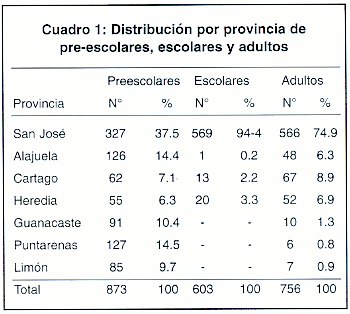
<body><![CDATA[<P><B><FONT FACE="Arial"><FONT SIZE=-1>Resultados</FONT></FONT></B>      <P><FONT FACE="Arial"><FONT SIZE=-1>El <A HREF="#cuadro1">Cuadro 1</A>, muestra la distribuci&oacute;n por provincia de las tres poblaciones del estudio, reflejando la falta de muestras obtenidas en el grupo escolar en las provincias de Guanacaste, Puntarenas y Lim&oacute;n.</FONT></FONT>     <BR>&nbsp;     <CENTER><A NAME="cuadro1"></A><IMG SRC="/img/fbpe/amc/v43n4/2375i01.JPG" HEIGHT=314 WIDTH=350></CENTER> &nbsp;     
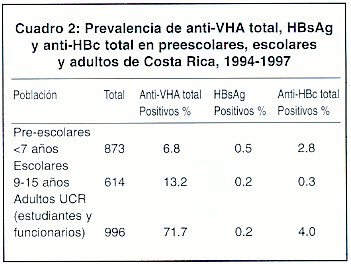
<BR><FONT FACE="Arial"><FONT SIZE=-1>La prevalencia de anticuerpos contra el VHA mostr&oacute; una variaci&oacute;n importante entre las tres poblaciones, con una notable tendencia a aumentar de manera proporcional con la edad (<A HREF="#cuadro2">Cuadro 2</A>). Al subdividir el grupo escolar en dos categor&iacute;a etarias de 9-11 a&ntilde;os (n=355) y de 12-15 a&ntilde;os (n=259), se observ&oacute; un aumento significativo en la prevalencia por anti-VHA de 9.3% a 18.5%, respectivamente (p.&lt;0.001). Los marcadores de hepatitis B tienen una baja prevalencia en todas las poblaciones estudiadas.</FONT></FONT>     <BR><FONT FACE="Arial"><FONT SIZE=-1>&nbsp;</FONT></FONT>     <CENTER><A NAME="cuadro2"></A><IMG SRC="/img/fbpe/amc/v43n4/2375i02.JPG" HEIGHT=264 WIDTH=351></CENTER> <FONT FACE="Arial"><FONT SIZE=-1>&nbsp;</FONT></FONT>     
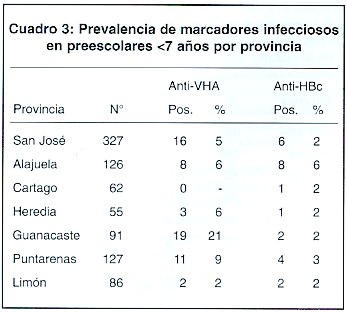
<BR><FONT FACE="Arial"><FONT SIZE=-1>La distribuci&oacute;n por provincia de la prevalencia de anti-VHA y anti-HBc en la poblaci&oacute;n pre-escolar se muestra en el <A HREF="#cuadro3">Cuadro 3</A>. Los resultados revelaron poca fluctuaci&oacute;n en la prevalencia de los dos marcadores entre provincias, excepto para el anti-VHA que en Guanacaste muestra una prevalencia 2-3 veces mayor.</FONT></FONT>     <BR>&nbsp;     <CENTER><A NAME="cuadro3"></A><IMG SRC="/img/fbpe/amc/v43n4/2375i03.JPG" HEIGHT=313 WIDTH=347></CENTER> &nbsp;     
]]></body>
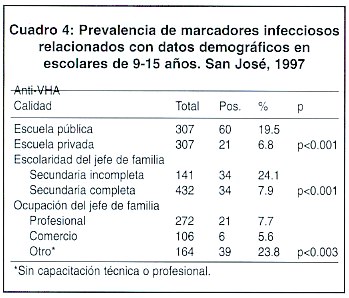
<body><![CDATA[<BR><FONT FACE="Arial"><FONT SIZE=-1>En el grupo de escolares se analizaron los datos demogr&aacute;ficos disponibles y los resultados se muestran en el <A HREF="#cuadro4">Cuadro 4</A>. Se evidencia que la prevalencia de anti-VHA es muy inferior en los ni&ntilde;os que asisten a las escuelas privadas en comparaci&oacute;n con las p&uacute;blicas (6.8% versus 19.5%).</FONT></FONT>      <P><FONT FACE="Arial"><FONT SIZE=-1>El nivel de educaci&oacute;n y ocupaci&oacute;n de los padres tambi&eacute;n revel&oacute; una diferencia significativa, mostrando prevalencia m&aacute;s bajas de anti-VHA en los escolares con padres de niveles de educaci&oacute;n y ocupaci&oacute;n superiores (profesional y comercio).</FONT></FONT>     <BR><FONT FACE="Arial"><FONT SIZE=-1>&nbsp;</FONT></FONT>     <CENTER><A NAME="cuadro4"></A><IMG SRC="/img/fbpe/amc/v43n4/2375i04.JPG" HEIGHT=298 WIDTH=349></CENTER> &nbsp;     
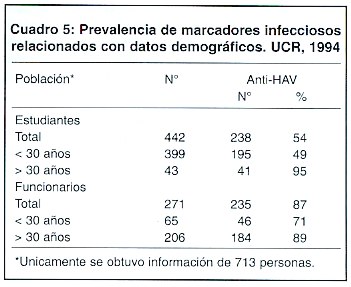
<BR><FONT SIZE=-1><FONT FACE="Arial">El <A HREF="#cuadro5">Cuadro 5</A>, muestra la relaci&oacute;n de los datos demogr&aacute;ficos entre la poblaci&oacute;n adulta. En los grupos de estudiantes y funcionarios se observan prevalencias muy alta en la poblaci&oacute;n de </FONT><FONT FACE=Symbol>></FONT><FONT FACE="Arial"> 30 a&ntilde;os, fluctuando entre 89% y 95%. Tambi&eacute;n es importante observar que los estudiantes </FONT><FONT FACE=Symbol>&lt;</FONT><FONT FACE="Arial"> 30 a&ntilde;os tuvieron una prevalencia m&aacute;s baja que en los funcionarios </FONT><FONT FACE=Symbol>&lt;</FONT><FONT FACE="Arial"> 30 a&ntilde;os (49% versus 71%).</FONT></FONT>     <BR>&nbsp;     <CENTER><A NAME="cuadro5"></A><IMG SRC="/img/fbpe/amc/v43n4/2375i05.JPG" HEIGHT=287 WIDTH=351></CENTER> &nbsp;     
<BR><B><FONT FACE="Arial"><FONT SIZE=-1>Discusi&oacute;n</FONT></FONT></B>      <P><FONT FACE="Arial"><FONT SIZE=-1>Las hepatitis A y B son end&eacute;micas en Costa Rica con prevalencias altas y bajas, respectivamente.</FONT></FONT>      <P><FONT SIZE=-1><FONT FACE="Arial">En un estudio realizado por el CIIAM en 1981, se encontr&oacute; que en grupos de ni&ntilde;os de 5-6 a&ntilde;os de un &aacute;rea rural (San Ram&oacute;n y Palmares), con alta y baja condici&oacute;n socioecon&oacute;mica la prevalencia de anti-VHA fue de 11% versus 90%, respectivamente. Sin embargo, el promerio de prevalencia en este mismo grupo de ni&ntilde;os fue de 33% que contrasta con un 7% en ni&ntilde;os </FONT><FONT FACE=Symbol>&lt;</FONT><FONT FACE="Arial"> 7 a&ntilde;os del presente estudio <SUP><A HREF="#32">32</A>,<A HREF="#33">33</A></SUP> Esta marcada diferencia puede ser debida a mejoras en las condiciones de la poblaci&oacute;n, las cuales han ido sucediendo paulativamente, como una mayor cobertura de agua potable y letrinizaci&oacute;n.<SUP> <A HREF="#34">34</A></SUP></FONT></FONT>      ]]></body>
<body><![CDATA[<P><FONT SIZE=-1><FONT FACE="Arial">A pesar de estas mejoras, la transmisi&oacute;n de VHA seg&uacute;n este estudio, sigue asociada a condiciones sociecon&oacute;micas de acuerdo con nuestros resultados. Tambi&eacute;n se observ&oacute; un aumento de la presencia de anti-VHA entre los escolares conforme aumenta la edad. Por otra parte, la prevalencia en estudiantes universitarios </FONT><FONT FACE=Symbol>&lt;</FONT><FONT FACE="Arial"> 30 a&ntilde;os fue mucho menor que en la d&eacute;cada de los 70&acute;s. <SUP><A HREF="#11">11</A></SUP> De acuerdo con los resultados de este estudio, en la poblaci&oacute;n de ni&ntilde;os, Costa Rica pas&oacute; de un pa&iacute;s de alta prevalencia de VHA a tener una prevalencia intermedia, con tendencia a seguir bajando. Probablemente, &eacute;ste ea un cambio que ocurri&oacute; recientemente. Observaciones similares han sido reportadas en otros pa&iacute;ses como Argentina, Brasil, Chile, Guyana Francesa y Asia. <SUP><A HREF="#35">35-40</A></SUP></FONT></FONT>      <P><FONT SIZE=-1><FONT FACE="Arial">Actualmente, se encuentran pa&iacute;ses con prevalencias baja, intermedias y altas para la hepatitis B en la Am&eacute;rica Latina. <SUP><A HREF="#23">23</A>,<A HREF="#41">41</A>,<A HREF="#42">42</A></SUP> Seg&uacute;n estas observaciones y estudios previos, Costa Rica se podr&iacute;a clasificar como un pa&iacute;s con prevalencias bajas, excepto en la regi&oacute;n de San Isidro del General, en donde se presentan prevalencias intermedias. Debido a las bajas prevalencias de HBsAg encontradas en el presente estudio, no se pudo establecer una correlaci&oacute;n entre las variables de riesgo y los datos disponibles. A&uacute;n cuando no se encontraron diferencias significativas entre las poblaciones analizadas. Se observaron m&aacute;s portadores en los ni&ntilde;os </FONT><FONT FACE=Symbol>&lt;</FONT><FONT FACE="Arial"> 7 a&ntilde;os (<A HREF="#cuadro2">Cuadro 2</A>), lo que puede sugerir un mecanismo de transmisi&oacute;n horizontal entre ellos. <SUP><A HREF="#25">25</A>,<A HREF="#42">42</A></SUP> La infecci&oacute;n por VHB, como ya es conocido, parece estar asociada al sexo masculino. </FONT><SUP><FONT FACE="Arial,Helvetica"><A HREF="#2">2</A></FONT></SUP><FONT FACE="Arial"> Esto se evidencia en el estudio de adultos, con una prevalencia de 6,9% en hombres y 2,3% en mujeres con anti-HBc, el marcador de uso para determinar infecciones presentes o pasadas por VHB.</FONT></FONT>      <P><FONT SIZE=-1><FONT FACE="Arial">En la actualidad en Costa Rica se est&aacute;n implementando medidas de prevenci&oacute;n y control para VHB a trav&eacute;s de un programa de vacunaci&oacute;n para todos los reci&eacute;n nacidos y diferentes grupos de riesgos, personal hospitalario, poblaciones promiscuas, etc. Recientemente, se realiz&oacute; un estudio de evaluaci&oacute;n de respuesta a la vacuna en reci&eacute;n nacidos en la zona de prevalencia intermedia obteni&eacute;ndose resultados similares a lo reportado en la literatura, con una respuesta superior. </FONT><SUP><FONT FACE="Arial,Helvetica"><A HREF="#43">43</A></FONT></SUP></FONT>      <P><FONT FACE="Arial"><FONT SIZE=-1>La vacuna para hepatitis A est&aacute; disponible, pero todav&iacute;a tiene un costo muy elevado para campa&ntilde;as de vacunaci&oacute;n masiva. En vista de los resultados presentados en este estudio se debe hacer conciencia en la poblaci&oacute;n sobre el cambio de patrones de prevalencia y los mecanismos de riesgo de infecci&oacute;n por VHA, especialmente entre los grupos de adolescentes y adultos en donde el curso de la enfermedad puede tener manifestaciones severas.</FONT></FONT>      <P><B><FONT FACE="Arial"><FONT SIZE=-1>Agradecimientos</FONT></FONT></B>      <P><FONT FACE="Arial"><FONT SIZE=-1>Nuestro especial agradecimiento a la Srta. Sof&iacute;a Castillo R., Depto. de Archivo, Oficina de Salud, UCR, al Dr. Luis Tacsan, Ministerio de Salud, a la Compa&ntilde;&iacute;a Smith Kline Beecham, y a todas aquellas personas que nos brindaron su colaboraci&oacute;n para la conclusi&oacute;n de este estudio.</FONT></FONT>      <P><B><FONT FACE="Arial"><FONT SIZE=-1>Abstract</FONT></FONT></B>      <P><B><FONT FACE="Arial"><FONT SIZE=-1>Justification and objetives:</FONT></FONT></B><FONT FACE="Arial"><FONT SIZE=-1> Due to persistence of acute cases and outbreaks of viral hepatitis A and B in our country and the observation of an important increase of type A infections in the adult population, it was considered necesary to establish the prevalence of these two types of hepatitis in different age groups in our country.</FONT></FONT>      <P><FONT SIZE=-1><FONT FACE="Arial"><B>Methods</B>: Seroprevalence of viral hepatitis A (HAV) and viral hepatitis B (HBV), was studied in a population which included 873 pre-scholar children </FONT><FONT FACE=Symbol>&lt;</FONT><FONT FACE="Arial"> 7 years from a national nutritional survey in 1996; 614 scholar children 9-15 years from a national nutritional survey carried out by the University of Costa Rica during 1996 and 1997, and 996 samples from students and personnel from this same university collected during 1994. These samples were analyzed for total antibodies to HAV (anti-HAV total), HBV surface antigen (HbsAg) and total antibodies against core (anti-HBc total).</FONT></FONT>      <P><FONT FACE="Arial"><FONT SIZE=-1><B>Results:</B> The percentage of anti-HAV was established to be 6.8%, 13.2% and 71.7% for the pre-scholar children, scholars and adults, respectively, with an increasing prevalence related to age. The presence of antibodies in the "scholar group" was associated with education level of the parents and their socioeconomic status, being higher for parents with a lower education level (24% with incomplete high school versus 7.6% with higher education level) and among parents with-out technical or professional training (16% versus 8.7% in the parents with higher education level). Also, it was a difference between the presence of anti-HAV among students from public schools (19.5%) versus private schools (6.9%). In the prescholar children, which was the only group with geographic statistical significance, the province of Guanacaste showed a 2-3 times higher risk to have HAV antibodies (21%) than in children from other provinces. This is in concordance with data related to low socio-economical status, lack of potable water and poor sanitary conditions.</FONT></FONT>      ]]></body>
<body><![CDATA[<P><FONT FACE="Arial"><FONT SIZE=-1>The study shower a prevalence of HBv markers to be 0.5%, 0.2% and 0.2% for HbsAg, and 2.8%, 0.3% and 4.0% for anti-HBc in pre-scholars, scholars and adults, respectively. There was no relationship between the socioeconomic status or age, with these prevalences; but the anti-HBc was found to be higher in men (6.9% in men and 2.3% in women).</FONT></FONT>      <P><FONT FACE="Arial"><FONT SIZE=-1><B>Conclusions: </B>When comparing the data obtained in earlier decades in Costa Rica for these two types of hepatitis, it was found that hepatitis B continues to have a similar epidemiological pattern during childhood from a high prevalence. This change requires an adequate intervention to avoid epidemic outbreaks and increase in the number of severe cases in the young and adult population.</FONT></FONT>      <P><B><FONT FACE="Arial"><FONT SIZE=-1>Referencias</FONT></FONT></B>      <P><A NAME="1"></A><FONT FACE="Arial"><FONT SIZE=-1>1. Hollinger FB, and Ticehurst JR. Hepatitis A Virus. En :Fields BN, Knipe DM, Peter MH, et al., eds. Virology. 3ra ed. Vol. 1: Part II. Specific Virus Families. Picomaviridae. Philadelphia. New York. Lippincott-Raven Publishers. 1996; 735-782.</FONT></FONT>      <P><A NAME="2"></A><FONT FACE="Arial"><FONT SIZE=-1>2. Hollinger FE. Hepatitis B Virus. En: Fields BN, Knipe DM, Peter MH, et al., eds. Virology. 3ra ed. Vol. 2: Part II. Specific Virus Families. Hepadnaviridae. Philadelphia. New York. Lippincott-Raven Publishers. 1996; 2738-2807.</FONT></FONT>      <!-- ref --><P><A NAME="3"></A><FONT FACE="Arial"><FONT SIZE=-1>3. Feinstone SM, Kapikian AZ, Purcell PH. Hepatitis A. Detection by irnmune electron microscopy of a virus like antigen association with acute illness. Science 1973; 182:1026-1028.</FONT></FONT>    &nbsp;&nbsp;&nbsp;&nbsp;&nbsp;&nbsp;&nbsp;&nbsp;[&#160;<a href="javascript:void(0);" onclick="javascript: window.open('/scielo.php?script=sci_nlinks&ref=007273&pid=S0001-6002200100040000100003&lng=','','width=640,height=500,resizable=yes,scrollbars=1,menubar=yes,');">Links</a>&#160;]<!-- end-ref --><!-- ref --><P><A NAME="4"></A><FONT FACE="Arial"><FONT SIZE=-1>4. Raymond SK. Hepatitis A. Lancet 1998; 34: 1643-1649.</FONT></FONT>    &nbsp;&nbsp;&nbsp;&nbsp;&nbsp;&nbsp;&nbsp;&nbsp;[&#160;<a href="javascript:void(0);" onclick="javascript: window.open('/scielo.php?script=sci_nlinks&ref=007274&pid=S0001-6002200100040000100004&lng=','','width=640,height=500,resizable=yes,scrollbars=1,menubar=yes,');">Links</a>&#160;]<!-- end-ref --><!-- ref --><P><A NAME="5"></A><FONT FACE="Arial"><FONT SIZE=-1>5. Rosemblum LS, Villarino ME, Nainan OV, et al. Hepatitis A outbreak in a neonatal intensive care unit: risk factors for transmission and evidence of prolonged viral excretion among preterm infants. J. Infect. Dis. 1991; 164: 476-482.</FONT></FONT>    &nbsp;&nbsp;&nbsp;&nbsp;&nbsp;&nbsp;&nbsp;&nbsp;[&#160;<a href="javascript:void(0);" onclick="javascript: window.open('/scielo.php?script=sci_nlinks&ref=007275&pid=S0001-6002200100040000100005&lng=','','width=640,height=500,resizable=yes,scrollbars=1,menubar=yes,');">Links</a>&#160;]<!-- end-ref --><!-- ref --><P><A NAME="6"></A><FONT FACE="Arial"><FONT SIZE=-1>6. Pa&ntilde;ella B., Bayas JM, Maldonado R, Cayl&aacute; JA, Vilella A, Sala C, et al. Brote epid&eacute;mico de hepatitis A relacionado con una guarder&iacute;a. Gastroenterol y Hepatol 1998; 21: 319-323.</FONT></FONT>    &nbsp;&nbsp;&nbsp;&nbsp;&nbsp;&nbsp;&nbsp;&nbsp;[&#160;<a href="javascript:void(0);" onclick="javascript: window.open('/scielo.php?script=sci_nlinks&ref=007276&pid=S0001-6002200100040000100006&lng=','','width=640,height=500,resizable=yes,scrollbars=1,menubar=yes,');">Links</a>&#160;]<!-- end-ref --><!-- ref --><P><A NAME="7"></A><FONT FACE="Arial"><FONT SIZE=-1>7. Chudy M, Budek I, Keller-Stanislawski B, McCaustland KA, Neidhold S, Robertson B, et al. A new cluster of Hepatitis A infection in hemophiliacs traced to a contaminated plasma pool. J Med Virol 1999;<I> </I>57: 91-99.</FONT></FONT>    &nbsp;&nbsp;&nbsp;&nbsp;&nbsp;&nbsp;&nbsp;&nbsp;[&#160;<a href="javascript:void(0);" onclick="javascript: window.open('/scielo.php?script=sci_nlinks&ref=007277&pid=S0001-6002200100040000100007&lng=','','width=640,height=500,resizable=yes,scrollbars=1,menubar=yes,');">Links</a>&#160;]<!-- end-ref --><P><A NAME="8"></A><FONT FACE="Arial"><FONT SIZE=-1>8. Soucie JM, Robertson BH, Bell BP, McCaustland KA, Evatt, BL. Hepatitis A virus infections associated with clotting factor concentrate in the United States. Transfusion 1998; 38: 573-579.</FONT></FONT>      <!-- ref --><P><A NAME="9"></A><FONT FACE="Arial"><FONT SIZE=-1>9. Robertson BH, Jansen RW, Khanna B, et al. Genetics relatedness of hepatitis A virus strains recovered from different geographical regions. J Gen Virol 1992; 73: 1365-1377.</FONT></FONT>    &nbsp;&nbsp;&nbsp;&nbsp;&nbsp;&nbsp;&nbsp;&nbsp;[&#160;<a href="javascript:void(0);" onclick="javascript: window.open('/scielo.php?script=sci_nlinks&ref=007279&pid=S0001-6002200100040000100009&lng=','','width=640,height=500,resizable=yes,scrollbars=1,menubar=yes,');">Links</a>&#160;]<!-- end-ref --><!-- ref --><P><A NAME="10"></A><FONT FACE="Arial"><FONT SIZE=-1>10. Centers for Disease Control and Prevention (CDC). Recomendations and Reports. Prevention of Hepatitis A Through Active or Passive Immunization. Recomendations of the Advisory Committee on Immunization Practices (ACIP). U.S. Department of Health and Human Services. Public Health Services. Atlanta Georgia. MMWR 1999; 48 (RR-12).</FONT></FONT>    &nbsp;&nbsp;&nbsp;&nbsp;&nbsp;&nbsp;&nbsp;&nbsp;[&#160;<a href="javascript:void(0);" onclick="javascript: window.open('/scielo.php?script=sci_nlinks&ref=007280&pid=S0001-6002200100040000100010&lng=','','width=640,height=500,resizable=yes,scrollbars=1,menubar=yes,');">Links</a>&#160;]<!-- end-ref --><!-- ref --><P><A NAME="11"></A><FONT FACE="Arial"><FONT SIZE=-1>11. Villarejos VM, Serra J, Anderson-Vison&aacute; K, Mosley J. Hepatitis A in households. Am J Epidemiol 1982; 115: 577-586.</FONT></FONT>    &nbsp;&nbsp;&nbsp;&nbsp;&nbsp;&nbsp;&nbsp;&nbsp;[&#160;<a href="javascript:void(0);" onclick="javascript: window.open('/scielo.php?script=sci_nlinks&ref=007281&pid=S0001-6002200100040000100011&lng=','','width=640,height=500,resizable=yes,scrollbars=1,menubar=yes,');">Links</a>&#160;]<!-- end-ref --><!-- ref --><P><A NAME="12"></A><FONT FACE="Arial"><FONT SIZE=-1>12. Dal-R&eacute; R, Garc&iacute;a-Corbeira P and Garc&iacute;a de Lomas J. A large percentage of the spanish population under 30 years of age is not protected against hepatitis A. J Med Virol 2000; 60: 363-366.</FONT></FONT>    &nbsp;&nbsp;&nbsp;&nbsp;&nbsp;&nbsp;&nbsp;&nbsp;[&#160;<a href="javascript:void(0);" onclick="javascript: window.open('/scielo.php?script=sci_nlinks&ref=007282&pid=S0001-6002200100040000100012&lng=','','width=640,height=500,resizable=yes,scrollbars=1,menubar=yes,');">Links</a>&#160;]<!-- end-ref --><P><A NAME="13"></A><FONT FACE="Arial"><FONT SIZE=-1>13. Cruells MR, Mescia G, Gaibisso R, Ram&iacute;rez M, Guti&eacute;rrez M, Kohen S, et al. Estudio epidemiol&oacute;gico de los virus de la hepatitis A y E en diferentes poblaciones de Uruguay. Gatroenterol y Hepatol 1997; 20: 295298.</FONT></FONT>      <P><A NAME="14"></A><FONT FACE="Arial"><FONT SIZE=-1>14. Sathar MA, Soni PN, Fernandes-Costa FJTD, Wittenberg DF, and Simjee AE. Racial differences in the seroprevalence of hepatitis A virus infection in Nata/KwaZulu, South African J Med Virol 1994; 44: 9-12.</FONT></FONT>      <!-- ref --><P><A NAME="15"></A><FONT FACE="Arial"><FONT SIZE=-1>15. McMahon BJ, Beller M, William J, et al. A program to control of outbreaks of hepatitis A in Alaska by using an inactivated hepatitis A vaccine. Arch Pediatr Adolesc Med 1996; 150: 733-739.</FONT></FONT>    &nbsp;&nbsp;&nbsp;&nbsp;&nbsp;&nbsp;&nbsp;&nbsp;[&#160;<a href="javascript:void(0);" onclick="javascript: window.open('/scielo.php?script=sci_nlinks&ref=007285&pid=S0001-6002200100040000100015&lng=','','width=640,height=500,resizable=yes,scrollbars=1,menubar=yes,');">Links</a>&#160;]<!-- end-ref --><P><A NAME="16"></A><FONT FACE="Arial"><FONT SIZE=-1>16. Sagliocca L, Amoroso P, Stroffolini T, Adamo B, Tosti ME, Lettieri G, et al. Efficacy of hepatitis A vaccine in prevention of secundary hepatitis A infection: a randomised trial. Lancet 1999; 353: 1136-1139.</FONT></FONT>      <!-- ref --><P><A NAME="17"></A><FONT FACE="Arial"><FONT SIZE=-1>17. Alter MJ, Hadler SC, Margolis HS, et al. The Changing epidemiology of Hepatitis B in the United States: need for alternative vaccination strategies. JAMA. 1990; 263: 1218-1222.</FONT></FONT>    &nbsp;&nbsp;&nbsp;&nbsp;&nbsp;&nbsp;&nbsp;&nbsp;[&#160;<a href="javascript:void(0);" onclick="javascript: window.open('/scielo.php?script=sci_nlinks&ref=007287&pid=S0001-6002200100040000100017&lng=','','width=640,height=500,resizable=yes,scrollbars=1,menubar=yes,');">Links</a>&#160;]<!-- end-ref --><P><A NAME="18"></A><FONT FACE="Arial"><FONT SIZE=-1>18. Davison F, Alexander GJM, Trowbridge R, Fagan EA, Williams R. Detection of hepatitis B virus DNA in spermatozoa, urine, saliva and leucocytes of chronic HBsAg carriers. Hepatology 1987; 4: 37-44</FONT></FONT>      <!-- ref --><P><A NAME="19"></A><FONT FACE="Arial"><FONT SIZE=-1>19. The program of the World Health Organization in the international surveillance of viral hepatitis B. Am J Med Sci 1975; 270: 283-285.</FONT></FONT>    &nbsp;&nbsp;&nbsp;&nbsp;&nbsp;&nbsp;&nbsp;&nbsp;[&#160;<a href="javascript:void(0);" onclick="javascript: window.open('/scielo.php?script=sci_nlinks&ref=007289&pid=S0001-6002200100040000100019&lng=','','width=640,height=500,resizable=yes,scrollbars=1,menubar=yes,');">Links</a>&#160;]<!-- end-ref --><!-- ref --><P><A NAME="20"></A><FONT FACE="Arial"><FONT SIZE=-1>20. Forns X y Ampurdarn&eacute;s S. Cl&iacute;nica de las hepatitis virales, hepatitis aguda, hepatitis cr&oacute;nica, carcinoma hepatocelular. Enfermedades Infecciosas y Microbiolog&iacute;a Cl&iacute;nica 1995; 13 (supl.1): 71-83.</FONT></FONT>    &nbsp;&nbsp;&nbsp;&nbsp;&nbsp;&nbsp;&nbsp;&nbsp;[&#160;<a href="javascript:void(0);" onclick="javascript: window.open('/scielo.php?script=sci_nlinks&ref=007290&pid=S0001-6002200100040000100020&lng=','','width=640,height=500,resizable=yes,scrollbars=1,menubar=yes,');">Links</a>&#160;]<!-- end-ref --><!-- ref --><P><A NAME="21"></A><FONT FACE="Arial"><FONT SIZE=-1>21. Rodrigo L, Rodr&iacute;guez M, Linares A. Etiolog&iacute;a y epidemiolog&iacute;a de la hepatitis cr&oacute;nica. Gastroenterol y Hepatol1994; 17:50-59.</FONT></FONT>    &nbsp;&nbsp;&nbsp;&nbsp;&nbsp;&nbsp;&nbsp;&nbsp;[&#160;<a href="javascript:void(0);" onclick="javascript: window.open('/scielo.php?script=sci_nlinks&ref=007291&pid=S0001-6002200100040000100021&lng=','','width=640,height=500,resizable=yes,scrollbars=1,menubar=yes,');">Links</a>&#160;]<!-- end-ref --><!-- ref --><P><A NAME="22"></A><FONT FACE="Arial"><FONT SIZE=-1>22. Centers of Disease Control and Prevention (CDC). Final 1993 report of specified notifiable diseases. U.S. Department of Health and Human Services. Public Health Services. Atlanta Georgia MMWR 1994, 43: 597-603.</FONT></FONT>    &nbsp;&nbsp;&nbsp;&nbsp;&nbsp;&nbsp;&nbsp;&nbsp;[&#160;<a href="javascript:void(0);" onclick="javascript: window.open('/scielo.php?script=sci_nlinks&ref=007292&pid=S0001-6002200100040000100022&lng=','','width=640,height=500,resizable=yes,scrollbars=1,menubar=yes,');">Links</a>&#160;]<!-- end-ref --><!-- ref --><P><A NAME="23"></A><FONT FACE="Arial"><FONT SIZE=-1>23. Tanaka J. Hepatitis B epidemiology in Latin America. Vaccine 2000; 18 (Suppl 1): SI7-S19.</FONT></FONT>    &nbsp;&nbsp;&nbsp;&nbsp;&nbsp;&nbsp;&nbsp;&nbsp;[&#160;<a href="javascript:void(0);" onclick="javascript: window.open('/scielo.php?script=sci_nlinks&ref=007293&pid=S0001-6002200100040000100023&lng=','','width=640,height=500,resizable=yes,scrollbars=1,menubar=yes,');">Links</a>&#160;]<!-- end-ref --><P><A NAME="24"></A><FONT FACE="Arial"><FONT SIZE=-1>24. Sagliocca L, Stroffolini T, Amoraso P, Manzillo G, Ferrigno L, Converti F, Palumbo F, Izzo E, and Mele A. Risk factors for acute hepatitis B: a case-control study. J V Hepatitis 1997; 4:63-66.</FONT></FONT>      <!-- ref --><P><A NAME="25"></A><FONT FACE="Arial"><FONT SIZE=-1>25. Vison&aacute; KA, Eduarte CE, Zamora E y Salazar LM. Estudio epidemiol&oacute;gico de las hepatitis virales en San Ram&oacute;n y Palmares de 1972-1985. Acta Med Costarric 1989; 33: 69-77.</FONT></FONT>    &nbsp;&nbsp;&nbsp;&nbsp;&nbsp;&nbsp;&nbsp;&nbsp;[&#160;<a href="javascript:void(0);" onclick="javascript: window.open('/scielo.php?script=sci_nlinks&ref=007295&pid=S0001-6002200100040000100025&lng=','','width=640,height=500,resizable=yes,scrollbars=1,menubar=yes,');">Links</a>&#160;]<!-- end-ref --><P><A NAME="26"></A><FONT FACE="Arial"><FONT SIZE=-1>26. Esquivel J, Fern&aacute;ndez L, Hevia F, Mart&eacute;n A, Mora J y Sal&oacute;m I. Diagn&oacute;stico y prevenci&oacute;n de las hepatitis virales. En: Esquivel IM. 1 Hepatitis. 2 Hepatitis Viral Humana, 1ra. ed EDENASSS-CCSS. San Jos&eacute;. Costa Rica. 1990; 1-22.</FONT></FONT>      <!-- ref --><P><A NAME="27"></A><FONT FACE="Arial"><FONT SIZE=-1>27. Wu JS, Hwang L- Y, Goodman KJ. Hepatitis B vaccination in high-risk infants: 10-year follow-up. J Infect Dis 1999; 179: 1319-1325.</FONT></FONT>    &nbsp;&nbsp;&nbsp;&nbsp;&nbsp;&nbsp;&nbsp;&nbsp;[&#160;<a href="javascript:void(0);" onclick="javascript: window.open('/scielo.php?script=sci_nlinks&ref=007297&pid=S0001-6002200100040000100027&lng=','','width=640,height=500,resizable=yes,scrollbars=1,menubar=yes,');">Links</a>&#160;]<!-- end-ref --><!-- ref --><P><A NAME="28"></A><FONT FACE="Arial"><FONT SIZE=-1>28. Harpaz R, McMahon BJ. Elimination of new chronic hepatitis B virus infection: results of the Alaska immunization programo J Infest Dis 2000; 181: 413-418.</FONT></FONT>    &nbsp;&nbsp;&nbsp;&nbsp;&nbsp;&nbsp;&nbsp;&nbsp;[&#160;<a href="javascript:void(0);" onclick="javascript: window.open('/scielo.php?script=sci_nlinks&ref=007298&pid=S0001-6002200100040000100028&lng=','','width=640,height=500,resizable=yes,scrollbars=1,menubar=yes,');">Links</a>&#160;]<!-- end-ref --><P><A NAME="29"></A><FONT FACE="Arial"><FONT SIZE=-1>29. Decker RH, Overby LR, Ling CM, Frosner G, Deinhardt F, Boggs J. Serologic studies of transmission of hepatitis A in humans. J Infect Dis 1979; 139: 74-82.</FONT></FONT>      <!-- ref --><P><A NAME="30"></A><FONT FACE="Arial"><FONT SIZE=-1>30. Vison&aacute; KA. Viral Hepatitis in a Developing Country. Ph.D Thesis, 1992; University of Copenhagen, Denmark.</FONT></FONT>    &nbsp;&nbsp;&nbsp;&nbsp;&nbsp;&nbsp;&nbsp;&nbsp;[&#160;<a href="javascript:void(0);" onclick="javascript: window.open('/scielo.php?script=sci_nlinks&ref=007300&pid=S0001-6002200100040000100030&lng=','','width=640,height=500,resizable=yes,scrollbars=1,menubar=yes,');">Links</a>&#160;]<!-- end-ref --><P><A NAME="31"></A><FONT FACE="Arial"><FONT SIZE=-1>31. Arauz R. P., Norder H., Visona K. A., and Magnius OL. Genotype F Prevails in HBV Infected Patients of Hispanic Origin in Central America and May Carry The precore Stop Mutant. J Med Virol 1997; 51: 305-312.</FONT></FONT>      <P><A NAME="32"></A><FONT FACE="Arial"><FONT SIZE=-1>32. Serra J, Vison&aacute; KA, Villarejos VM, Castillo C, Serrano AM. Inmunidad pasiva contra la hepatitis A y B por anticuerpos maternos. VII Jornadas Latinoamericanas y I Congreso Nacional de Hepatolog&iacute;a. San Jos&eacute;, Costa Rica 1981; octubre 21-24.</FONT></FONT>      <P><A NAME="33"></A><FONT FACE="Arial"><FONT SIZE=-1>33. Villarejos VM, Vison&aacute; KA, Serra J, Mosley JW. Observaciones sobre la ocurrencia de infecciones por el virus de hepatitis tipo A en un &aacute;rea end&eacute;mica. VII Jornadas Latinoamericanas y I Congreso Nacional de Hepatolog&iacute;a. San Jos&eacute;, Costa Rica, 1981; octubre 21-24.</FONT></FONT>      <!-- ref --><P><A NAME="34"></A><FONT FACE="Arial"><FONT SIZE=-1>34. Ministerio de Planificaci&oacute;n Nacional y Pol&iacute;tica Econ&oacute;mica (MIDEPLAN). Area de An&aacute;lisis del Desarrollo: Unidad de Desarrollo Social. Sistema de Indicadores Sobre Desarrollo Sostenible (SIDES). Principales indicadores sociales de Costa Rica. 1997; Serie N&deg;2, 81-105.</FONT></FONT>    &nbsp;&nbsp;&nbsp;&nbsp;&nbsp;&nbsp;&nbsp;&nbsp;[&#160;<a href="javascript:void(0);" onclick="javascript: window.open('/scielo.php?script=sci_nlinks&ref=007304&pid=S0001-6002200100040000100034&lng=','','width=640,height=500,resizable=yes,scrollbars=1,menubar=yes,');">Links</a>&#160;]<!-- end-ref --><P><A NAME="35"></A><FONT FACE="Arial"><FONT SIZE=-1>35. Daruich JR, Rey JA, Pinchuk L, Igart&uacute;a EB, Zeilicoff R, Michellini J, et al. Prevalencia de anti HA V en poblaci&oacute;n general en Buenos Aires, Argentina. XV Congresso da Associa&ccedil;ao Latino-Americana para o Estudio do F&iacute;gado-ALEF. G. E. D. 1998; 17 (supl.): 57.</FONT></FONT>      <P><A NAME="36"></A><FONT FACE="Arial"><FONT SIZE=-1>36. Pinto PTA, M&uuml;ller AM, Vieira MTM, N&oacute;brega ICP, Correa VLF. Soroprevalencia da hepatite A em servi&ccedil;o de medicina de familia. XV Congresso da Associa&ccedil;ao Latino-Americana para o Estudio do F&iacute;gado-ALEF. G. E. D. 1998; 17 (supl.): 57.</FONT></FONT>      <P><A NAME="37"></A><FONT FACE="Arial"><FONT SIZE=-1>37. Lagos R, Potin M, Mu&ntilde;oz A, Abrego P, Martin O S, Ureta A M, et al. Anticuerpos s&eacute;ricos contra el virus de la hepatitis A entre personas de niveles socioecon&oacute;micos medios y bajos en un &aacute;rea urbana de Santiago, Chile. Rev Med Chil. 1999; 127: 429-436.</FONT></FONT>      ]]></body>
<body><![CDATA[<P><A NAME="38"></A><FONT FACE="Arial"><FONT SIZE=-1>38. Talarmin A, Kazanji M, Cardoso T, Pouliquen J-F, Sankale-Suzanon J, Sarthou J-L. Prevalence of antibodies to hepatitis A, C, and E viruses in different ethnic groups in French Guiana. J Med Virol 1997; 52: 430-435.</FONT></FONT>      <P><A NAME="39"></A><FONT FACE="Arial"><FONT SIZE=-1>39. Mayorga PO, Morales W, Paniagua M and Strannegard O. Prevalence of Antibodies to Hepatitis A, B, C, and E Viruses in a Healthy Population in Le&oacute;n, Nicaragua. Am J Trop Med Hyg 1996; 55 17-21.</FONT></FONT>      <P><A NAME="40"></A><FONT FACE="Arial"><FONT SIZE=-1>40. Kunasol P, Cooskley G, Chan V F, Isahak I, John J, et al. Hepatitis A virus: declining seroprevalence in children and adolescents in southeast Asia. Southeast Asian J Trop Med Public Health 1998; 29: 255-262.</FONT></FONT>      <P><A NAME="41"></A><FONT FACE="Arial"><FONT SIZE=-1>41. Galvao-Alves J, Tyll J, Brum A, Rzetelna H, Mello MAS, Moner&oacute; F, et al. Incidencia de HBsAg em 90632 doadores de sangue. XV Congresso da Associa&ccedil;ao Latino-Americana para o Estudio do F&iacute;gado-ALEF. G. E. D. 1998; 17 (supl.): 59.</FONT></FONT>      <P><A NAME="42"></A><FONT FACE="Arial"><FONT SIZE=-1>42. Cabezas C, Re&aacute;tegui J, Suar&eacute;z M, Romero DG, Carrillo C, Vallenas F, et al. Hiperendemicidad de hepatitis virales B y delta en pueblos ind&iacute;genas de la amazonia peruana. XV Congresso daAssocia&ccedil;ao Latino-Americana para o Estudo do F&iacute;gado-ALEF. G. E. D. 1998; 17 (supl.): 61.</FONT></FONT>      <P><A NAME="43"></A><FONT FACE="Arial"><FONT SIZE=-1>43. Calvo N. Evaluaci&oacute;n serol&oacute;gica de la inmunizaci&oacute;n infantil contra el virus de hepatitis B en P&eacute;rez Zeled&oacute;n. Costa Rica, 1999. Universidad Nacional Aut&oacute;noma, Sistema de Pos grado. Posgrado Regional en Ciencias veterinarias Tropicales. Menci&oacute;n en Epidemiolog&iacute;a, Heredia, noviembre 19, 2000.</FONT></FONT>      <P><B><FONT FACE="Arial"><FONT SIZE=-1>&nbsp;</FONT></FONT></B>     <BR><A NAME="A1"></A><FONT FACE="Arial"><FONT SIZE=-1><A HREF="#R1">1</A>.&nbsp; Centro Internacional de Investigaci&oacute;n M&eacute;dico de la Universidad del Estado de Louisiana (LSU-CIIAM).</FONT></FONT>     <BR><FONT FACE="Arial"><FONT SIZE=-1><A HREF="#R1">2</A>.&nbsp; Facultad de Microbiolog&iacute;a, Universidad de Costa Rica, UCR.</FONT></FONT>     <BR><FONT FACE="Arial"><FONT SIZE=-1><A HREF="#R1">3</A>.&nbsp; Instituto Costarricense de Investigaci&oacute;n y Ense&ntilde;anza en Nutrici&oacute;n y Salud (INCIENSA)</FONT></FONT>      ]]></body>
<body><![CDATA[<P><FONT FACE="Arial"><FONT SIZE=-1>Correspondencia:&nbsp; M. Lizeth Taylor C. SJO 321, 1601 N.W. 97Th Ave, P.O.Box 10155-1000 San Jos&eacute;.&nbsp; Fax: (506) 279 3119.&nbsp; Correo electr&oacute;nico: <A HREF="mailto:lizethtaylor@hotmail.com">lizethtaylor@hotmail.com</A></FONT></FONT>      <P><FONT FACE="Arial"><FONT SIZE=-1>&nbsp;</FONT></FONT>      <P><FONT FACE="Arial"><FONT SIZE=-1>&nbsp;</FONT></FONT>      ]]></body><back>
<ref-list>
<ref id="B1">
<label>1</label><nlm-citation citation-type="book">
<person-group person-group-type="author">
<name>
<surname><![CDATA[Hollinger]]></surname>
<given-names><![CDATA[FB]]></given-names>
</name>
<name>
<surname><![CDATA[Ticehurst]]></surname>
<given-names><![CDATA[JR]]></given-names>
</name>
</person-group>
<article-title xml:lang="en"><![CDATA[Hepatitis A Virus]]></article-title>
<person-group person-group-type="editor">
<name>
<surname><![CDATA[Fields]]></surname>
<given-names><![CDATA[BN]]></given-names>
</name>
<name>
<surname><![CDATA[Knipe]]></surname>
<given-names><![CDATA[DM]]></given-names>
</name>
</person-group>
<source><![CDATA[. Virology]]></source>
<year>1996</year>
<volume>3ra ed</volume>
<page-range>735-782</page-range><publisher-loc><![CDATA[Philadelphia^eNew York New York]]></publisher-loc>
<publisher-name><![CDATA[Lippincott-Raven Publishers]]></publisher-name>
</nlm-citation>
</ref>
<ref id="B2">
<label>2</label><nlm-citation citation-type="book">
<person-group person-group-type="author">
<name>
<surname><![CDATA[Hollinger]]></surname>
<given-names><![CDATA[FE]]></given-names>
</name>
</person-group>
<article-title xml:lang="en"><![CDATA[Hepatitis B Virus]]></article-title>
<person-group person-group-type="editor">
<name>
<surname><![CDATA[Fields]]></surname>
<given-names><![CDATA[BN]]></given-names>
</name>
<name>
<surname><![CDATA[Knipe]]></surname>
<given-names><![CDATA[DM]]></given-names>
</name>
</person-group>
<source><![CDATA[Virology]]></source>
<year>1996</year>
<edition>3ra ed</edition>
<page-range>2738-2807</page-range><publisher-loc><![CDATA[Philadelphia^eNew York New York]]></publisher-loc>
<publisher-name><![CDATA[Lippincott-Raven Publishers]]></publisher-name>
</nlm-citation>
</ref>
<ref id="B3">
<label>3</label><nlm-citation citation-type="journal">
<person-group person-group-type="author">
<name>
<surname><![CDATA[Feinstone]]></surname>
<given-names><![CDATA[SM]]></given-names>
</name>
<name>
<surname><![CDATA[Kapikian]]></surname>
<given-names><![CDATA[AZ]]></given-names>
</name>
<name>
<surname><![CDATA[Purcell]]></surname>
<given-names><![CDATA[PH]]></given-names>
</name>
</person-group>
<article-title xml:lang="en"><![CDATA[Hepatitis A. Detection by irnmune electron microscopy of a virus like antigen association with acute illness]]></article-title>
<source><![CDATA[Science]]></source>
<year>1973</year>
<volume>182</volume>
<page-range>1026-1028</page-range></nlm-citation>
</ref>
<ref id="B4">
<label>4</label><nlm-citation citation-type="journal">
<person-group person-group-type="author">
<name>
<surname><![CDATA[Raymond]]></surname>
<given-names><![CDATA[SK]]></given-names>
</name>
</person-group>
<article-title xml:lang="en"><![CDATA[Hepatitis A]]></article-title>
<source><![CDATA[Lancet]]></source>
<year>1998</year>
<volume>34</volume>
<page-range>1643-1649</page-range></nlm-citation>
</ref>
<ref id="B5">
<label>5</label><nlm-citation citation-type="journal">
<person-group person-group-type="author">
<name>
<surname><![CDATA[Rosemblum]]></surname>
<given-names><![CDATA[LS]]></given-names>
</name>
<name>
<surname><![CDATA[Villarino]]></surname>
<given-names><![CDATA[ME]]></given-names>
</name>
<name>
<surname><![CDATA[Nainan]]></surname>
<given-names><![CDATA[OV]]></given-names>
</name>
</person-group>
<article-title xml:lang="en"><![CDATA[Hepatitis A outbreak in a neonatal intensive care unit: risk factors for transmission and evidence of prolonged viral excretion among preterm infants]]></article-title>
<source><![CDATA[J. Infect. Dis]]></source>
<year>1991</year>
<volume>164</volume>
<page-range>476-482</page-range></nlm-citation>
</ref>
<ref id="B6">
<label>6</label><nlm-citation citation-type="journal">
<person-group person-group-type="author">
<name>
<surname><![CDATA[Pañella]]></surname>
<given-names><![CDATA[B]]></given-names>
</name>
<name>
<surname><![CDATA[Bayas]]></surname>
<given-names><![CDATA[JM]]></given-names>
</name>
<name>
<surname><![CDATA[Maldonado]]></surname>
<given-names><![CDATA[R]]></given-names>
</name>
<name>
<surname><![CDATA[Caylá]]></surname>
<given-names><![CDATA[JA]]></given-names>
</name>
<name>
<surname><![CDATA[Vilella]]></surname>
<given-names><![CDATA[A]]></given-names>
</name>
<name>
<surname><![CDATA[Sala]]></surname>
<given-names><![CDATA[C]]></given-names>
</name>
</person-group>
<article-title xml:lang="en"><![CDATA[Brote epidémico de hepatitis A relacionado con una guardería]]></article-title>
<source><![CDATA[Gastroenterol y Hepatol]]></source>
<year>1998</year>
<volume>21</volume>
<page-range>319-323</page-range></nlm-citation>
</ref>
<ref id="B7">
<label>7</label><nlm-citation citation-type="journal">
<person-group person-group-type="author">
<name>
<surname><![CDATA[Chudy]]></surname>
<given-names><![CDATA[M]]></given-names>
</name>
<name>
<surname><![CDATA[Budek]]></surname>
<given-names><![CDATA[I]]></given-names>
</name>
<name>
<surname><![CDATA[Keller-Stanislawski]]></surname>
<given-names><![CDATA[B]]></given-names>
</name>
<name>
<surname><![CDATA[McCaustland]]></surname>
<given-names><![CDATA[KA]]></given-names>
</name>
<name>
<surname><![CDATA[Neidhold]]></surname>
<given-names><![CDATA[S]]></given-names>
</name>
<name>
<surname><![CDATA[Robertson]]></surname>
<given-names><![CDATA[B]]></given-names>
</name>
</person-group>
<article-title xml:lang="en"><![CDATA[A new cluster of Hepatitis A infection in hemophiliacs traced to a contaminated plasma pool]]></article-title>
<source><![CDATA[J Med Virol]]></source>
<year>1999</year>
<volume>57</volume>
<page-range>91-99</page-range></nlm-citation>
</ref>
<ref id="B8">
<label>8</label><nlm-citation citation-type="journal">
<person-group person-group-type="author">
<name>
<surname><![CDATA[Soucie]]></surname>
<given-names><![CDATA[JM]]></given-names>
</name>
<name>
<surname><![CDATA[Robertson]]></surname>
<given-names><![CDATA[BH]]></given-names>
</name>
<name>
<surname><![CDATA[Bell]]></surname>
<given-names><![CDATA[BP]]></given-names>
</name>
</person-group>
<article-title xml:lang="en"><![CDATA[Hepatitis A virus infections associated with clotting factor concentrate in the United States]]></article-title>
<source><![CDATA[Transfusion]]></source>
<year>1998</year>
<volume>38</volume>
<page-range>573-579</page-range></nlm-citation>
</ref>
<ref id="B9">
<label>9</label><nlm-citation citation-type="journal">
<person-group person-group-type="author">
<name>
<surname><![CDATA[Robertson]]></surname>
<given-names><![CDATA[BH]]></given-names>
</name>
<name>
<surname><![CDATA[Jansen]]></surname>
<given-names><![CDATA[RW]]></given-names>
</name>
<name>
<surname><![CDATA[Khanna]]></surname>
<given-names><![CDATA[B]]></given-names>
</name>
</person-group>
<article-title xml:lang="en"><![CDATA[Genetics relatedness of hepatitis A virus strains recovered from different geographical regions]]></article-title>
<source><![CDATA[J Gen Virol]]></source>
<year>1992</year>
<volume>73</volume>
<page-range>1365-1377</page-range></nlm-citation>
</ref>
<ref id="B10">
<label>10</label><nlm-citation citation-type="journal">
<collab>Centers for Disease Control and Prevention (CDC)</collab>
<source><![CDATA[MMWRRecomendations and Reports. Prevention of Hepatitis A Through Active or Passive Immunization. Recomendations of the Advisory Committee on Immunization Practices (ACIP). U.S. Department of Health and Human Services]]></source>
<year>1999</year>
<volume>48</volume>
<publisher-loc><![CDATA[Atlanta^eGeorgia Georgia]]></publisher-loc>
</nlm-citation>
</ref>
<ref id="B11">
<label>11</label><nlm-citation citation-type="journal">
<person-group person-group-type="author">
<name>
<surname><![CDATA[Villarejos]]></surname>
<given-names><![CDATA[VM]]></given-names>
</name>
<name>
<surname><![CDATA[Serra]]></surname>
<given-names><![CDATA[J]]></given-names>
</name>
<name>
<surname><![CDATA[Anderson-Visoná]]></surname>
<given-names><![CDATA[K]]></given-names>
</name>
<name>
<surname><![CDATA[Mosley]]></surname>
<given-names><![CDATA[J]]></given-names>
</name>
</person-group>
<article-title xml:lang="en"><![CDATA[Hepatitis A in households]]></article-title>
<source><![CDATA[Am J Epidemiol]]></source>
<year>1982</year>
<volume>115</volume>
<page-range>577-586</page-range></nlm-citation>
</ref>
<ref id="B12">
<label>12</label><nlm-citation citation-type="journal">
<person-group person-group-type="author">
<name>
<surname><![CDATA[Dal-Ré]]></surname>
<given-names><![CDATA[R]]></given-names>
</name>
<name>
<surname><![CDATA[García-Corbeira]]></surname>
<given-names><![CDATA[P]]></given-names>
</name>
<name>
<surname><![CDATA[García de Lomas]]></surname>
<given-names><![CDATA[J]]></given-names>
</name>
</person-group>
<article-title xml:lang="en"><![CDATA[A large percentage of the spanish population under 30 years of age is not protected against hepatitis]]></article-title>
<source><![CDATA[A. J Med Virol]]></source>
<year>2000</year>
<volume>60</volume>
<page-range>363-366</page-range></nlm-citation>
</ref>
<ref id="B13">
<label>13</label><nlm-citation citation-type="journal">
<person-group person-group-type="author">
<name>
<surname><![CDATA[Cruells]]></surname>
<given-names><![CDATA[MR]]></given-names>
</name>
<name>
<surname><![CDATA[Mescia]]></surname>
<given-names><![CDATA[G]]></given-names>
</name>
<name>
<surname><![CDATA[Gaibisso]]></surname>
<given-names><![CDATA[R]]></given-names>
</name>
</person-group>
<article-title xml:lang="es"><![CDATA[Estudio epidemiológico de los virus de la hepatitis A y E en diferentes poblaciones de Uruguay]]></article-title>
<source><![CDATA[Gatroenterol y Hepatol]]></source>
<year>1997</year>
<volume>20</volume>
<page-range>295-298</page-range></nlm-citation>
</ref>
<ref id="B14">
<label>14</label><nlm-citation citation-type="journal">
<person-group person-group-type="author">
<name>
<surname><![CDATA[Sathar]]></surname>
<given-names><![CDATA[MA]]></given-names>
</name>
<name>
<surname><![CDATA[Soni]]></surname>
<given-names><![CDATA[PN]]></given-names>
</name>
<name>
<surname><![CDATA[Fernandes-Costa]]></surname>
<given-names><![CDATA[FJTD]]></given-names>
</name>
</person-group>
<article-title xml:lang="en"><![CDATA[Racial differences in the seroprevalence of hepatitis A virus infection in Nata/KwaZulu]]></article-title>
<source><![CDATA[South African J Med Virol]]></source>
<year>1994</year>
<volume>44</volume>
<page-range>9-12</page-range></nlm-citation>
</ref>
<ref id="B15">
<label>15</label><nlm-citation citation-type="journal">
<person-group person-group-type="author">
<name>
<surname><![CDATA[McMahon]]></surname>
<given-names><![CDATA[BJ]]></given-names>
</name>
<name>
<surname><![CDATA[Beller]]></surname>
<given-names><![CDATA[M]]></given-names>
</name>
<name>
<surname><![CDATA[William]]></surname>
<given-names><![CDATA[J]]></given-names>
</name>
</person-group>
<article-title xml:lang="en"><![CDATA[A program to control of outbreaks of hepatitis A in Alaska by using an inactivated hepatitis A vaccine]]></article-title>
<source><![CDATA[Arch Pediatr Adolesc Med]]></source>
<year>1996</year>
<volume>150</volume>
<page-range>733-739</page-range></nlm-citation>
</ref>
<ref id="B16">
<label>16</label><nlm-citation citation-type="journal">
<person-group person-group-type="author">
<name>
<surname><![CDATA[Sagliocca]]></surname>
<given-names><![CDATA[L]]></given-names>
</name>
<name>
<surname><![CDATA[Amoroso]]></surname>
<given-names><![CDATA[P]]></given-names>
</name>
<name>
<surname><![CDATA[Stroffolini]]></surname>
<given-names><![CDATA[T]]></given-names>
</name>
</person-group>
<article-title xml:lang="en"><![CDATA[Efficacy of hepatitis A vaccine in prevention of secundary hepatitis A infection: a randomised trial]]></article-title>
<source><![CDATA[Lancet]]></source>
<year>1999</year>
<volume>353</volume>
<page-range>1136-1139</page-range></nlm-citation>
</ref>
<ref id="B17">
<label>17</label><nlm-citation citation-type="journal">
<person-group person-group-type="author">
<name>
<surname><![CDATA[Alter]]></surname>
<given-names><![CDATA[MJ]]></given-names>
</name>
<name>
<surname><![CDATA[Hadler]]></surname>
<given-names><![CDATA[SC]]></given-names>
</name>
<name>
<surname><![CDATA[Margolis]]></surname>
<given-names><![CDATA[HS]]></given-names>
</name>
</person-group>
<article-title xml:lang="en"><![CDATA[The Changing epidemiology of Hepatitis B in the United States: need for alternative vaccination strategies]]></article-title>
<source><![CDATA[JAMA]]></source>
<year>1990</year>
<volume>263</volume>
<page-range>1218-1222</page-range></nlm-citation>
</ref>
<ref id="B18">
<label>18</label><nlm-citation citation-type="journal">
<person-group person-group-type="author">
<name>
<surname><![CDATA[Davison]]></surname>
<given-names><![CDATA[F]]></given-names>
</name>
<name>
<surname><![CDATA[Alexander]]></surname>
<given-names><![CDATA[GJM]]></given-names>
</name>
<name>
<surname><![CDATA[Trowbridge]]></surname>
<given-names><![CDATA[R]]></given-names>
</name>
</person-group>
<article-title xml:lang="en"><![CDATA[Detection of hepatitis B virus DNA in spermatozoa, urine, saliva and leucocytes of chronic HBsAg carriers]]></article-title>
<source><![CDATA[Hepatology]]></source>
<year>1987</year>
<volume>4</volume>
<page-range>37-44</page-range></nlm-citation>
</ref>
<ref id="B19">
<label>19</label><nlm-citation citation-type="journal">
<article-title xml:lang="en"><![CDATA[The program of the World Health Organization in the international surveillance of viral hepatitis B]]></article-title>
<source><![CDATA[Am J Med Sci]]></source>
<year>1975</year>
<volume>270</volume>
<page-range>283-285</page-range></nlm-citation>
</ref>
<ref id="B20">
<label>20</label><nlm-citation citation-type="journal">
<person-group person-group-type="author">
<name>
<surname><![CDATA[Forns]]></surname>
<given-names><![CDATA[X]]></given-names>
</name>
<name>
<surname><![CDATA[Ampurdarnés]]></surname>
<given-names><![CDATA[S]]></given-names>
</name>
</person-group>
<article-title xml:lang="es"><![CDATA[Clínica de las hepatitis virales, hepatitis aguda, hepatitis crónica, carcinoma hepatocelular]]></article-title>
<source><![CDATA[Enfermedades Infecciosas y Microbiología Clínica]]></source>
<year>1995</year>
<volume>13</volume>
<numero>^s1</numero>
<issue>^s1</issue>
<supplement>1</supplement>
<page-range>71-83</page-range></nlm-citation>
</ref>
<ref id="B21">
<label>21</label><nlm-citation citation-type="journal">
<person-group person-group-type="author">
<name>
<surname><![CDATA[Rodrigo]]></surname>
<given-names><![CDATA[L]]></given-names>
</name>
<name>
<surname><![CDATA[Rodríguez]]></surname>
<given-names><![CDATA[M]]></given-names>
</name>
<name>
<surname><![CDATA[Linares]]></surname>
<given-names><![CDATA[A]]></given-names>
</name>
</person-group>
<article-title xml:lang="es"><![CDATA[Etiología y epidemiología de la hepatitis crónica]]></article-title>
<source><![CDATA[Gastroenterol y Hepatol]]></source>
<year>1994</year>
<volume>17</volume>
<page-range>50-59</page-range></nlm-citation>
</ref>
<ref id="B22">
<label>22</label><nlm-citation citation-type="journal">
<collab>Centers of Disease Control and Prevention (CDC)</collab>
<article-title xml:lang="en"><![CDATA[Final 1993 report of specified notifiable diseases. U.S. Department of Health and Human Services. Public Health Services]]></article-title>
<source><![CDATA[Atlanta Georgia MMWR]]></source>
<year>1994</year>
<volume>43</volume>
<page-range>597-603</page-range></nlm-citation>
</ref>
<ref id="B23">
<label>23</label><nlm-citation citation-type="journal">
<person-group person-group-type="author">
<name>
<surname><![CDATA[Tanaka]]></surname>
<given-names><![CDATA[J]]></given-names>
</name>
</person-group>
<article-title xml:lang="en"><![CDATA[Hepatitis B epidemiology in Latin America]]></article-title>
<source><![CDATA[Vaccine]]></source>
<year>2000</year>
<volume>18</volume>
<numero>^s1</numero>
<issue>^s1</issue>
<supplement>1</supplement>
<page-range>SI7-S19</page-range></nlm-citation>
</ref>
<ref id="B24">
<label>24</label><nlm-citation citation-type="journal">
<person-group person-group-type="author">
<name>
<surname><![CDATA[Sagliocca]]></surname>
<given-names><![CDATA[L]]></given-names>
</name>
<name>
<surname><![CDATA[Stroffolini]]></surname>
<given-names><![CDATA[T]]></given-names>
</name>
<name>
<surname><![CDATA[Amoraso]]></surname>
<given-names><![CDATA[P]]></given-names>
</name>
</person-group>
<article-title xml:lang="en"><![CDATA[Risk factors for acute hepatitis B: a case-control study]]></article-title>
<source><![CDATA[J V Hepatitis]]></source>
<year>1997</year>
<volume>4</volume>
<page-range>63-66</page-range></nlm-citation>
</ref>
<ref id="B25">
<label>25</label><nlm-citation citation-type="journal">
<person-group person-group-type="author">
<name>
<surname><![CDATA[Visoná]]></surname>
<given-names><![CDATA[KA]]></given-names>
</name>
<name>
<surname><![CDATA[Eduarte]]></surname>
<given-names><![CDATA[CE]]></given-names>
</name>
<name>
<surname><![CDATA[Zamora]]></surname>
<given-names><![CDATA[E]]></given-names>
</name>
<name>
<surname><![CDATA[Salazar]]></surname>
<given-names><![CDATA[LM]]></given-names>
</name>
</person-group>
<article-title xml:lang="es"><![CDATA[Estudio epidemiológico de las hepatitis virales en San Ramón y Palmares de 1972-1985]]></article-title>
<source><![CDATA[Acta Med Costarric]]></source>
<year>1989</year>
<volume>33</volume>
<page-range>69-77</page-range></nlm-citation>
</ref>
<ref id="B26">
<label>26</label><nlm-citation citation-type="book">
<person-group person-group-type="author">
<name>
<surname><![CDATA[Esquivel]]></surname>
<given-names><![CDATA[J]]></given-names>
</name>
<name>
<surname><![CDATA[Fernández]]></surname>
<given-names><![CDATA[L]]></given-names>
</name>
<name>
<surname><![CDATA[Hevia]]></surname>
<given-names><![CDATA[F]]></given-names>
</name>
</person-group>
<article-title xml:lang="es"><![CDATA[Diagnóstico y prevención de las hepatitis virales]]></article-title>
<person-group person-group-type="editor">
<name>
<surname><![CDATA[Esquivel]]></surname>
<given-names><![CDATA[IM]]></given-names>
</name>
</person-group>
<source><![CDATA[1 Hepatitis. 2 Hepatitis Viral Humana]]></source>
<year>1990</year>
<edition>1ra. ed</edition>
<page-range>1-22</page-range><publisher-loc><![CDATA[San José ]]></publisher-loc>
<publisher-name><![CDATA[EDENASSS-CCSS]]></publisher-name>
</nlm-citation>
</ref>
<ref id="B27">
<label>27</label><nlm-citation citation-type="journal">
<person-group person-group-type="author">
<name>
<surname><![CDATA[Wu]]></surname>
<given-names><![CDATA[JS]]></given-names>
</name>
<name>
<surname><![CDATA[Hwang]]></surname>
<given-names><![CDATA[L- Y]]></given-names>
</name>
<name>
<surname><![CDATA[Goodman]]></surname>
<given-names><![CDATA[KJ]]></given-names>
</name>
</person-group>
<article-title xml:lang="en"><![CDATA[Hepatitis B vaccination in high-risk infants: 10-year follow-up]]></article-title>
<source><![CDATA[J Infect Dis]]></source>
<year>1999</year>
<volume>179</volume>
<page-range>1319-1325</page-range></nlm-citation>
</ref>
<ref id="B28">
<label>28</label><nlm-citation citation-type="journal">
<person-group person-group-type="author">
<name>
<surname><![CDATA[Harpaz]]></surname>
<given-names><![CDATA[R]]></given-names>
</name>
<name>
<surname><![CDATA[McMahon]]></surname>
<given-names><![CDATA[BJ]]></given-names>
</name>
</person-group>
<article-title xml:lang="en"><![CDATA[Elimination of new chronic hepatitis B virus infection: results of the Alaska immunization program]]></article-title>
<source><![CDATA[J Infest Dis]]></source>
<year>2000</year>
<volume>181</volume>
<page-range>413-418</page-range></nlm-citation>
</ref>
<ref id="B29">
<label>29</label><nlm-citation citation-type="journal">
<person-group person-group-type="author">
<name>
<surname><![CDATA[Decker]]></surname>
<given-names><![CDATA[RH]]></given-names>
</name>
<name>
<surname><![CDATA[Overby]]></surname>
<given-names><![CDATA[LR]]></given-names>
</name>
<name>
<surname><![CDATA[Ling]]></surname>
<given-names><![CDATA[CM]]></given-names>
</name>
<name>
<surname><![CDATA[Frosner]]></surname>
<given-names><![CDATA[G]]></given-names>
</name>
</person-group>
<article-title xml:lang="en"><![CDATA[Serologic studies of transmission of hepatitis A in humans]]></article-title>
<source><![CDATA[J Infect Dis]]></source>
<year>1979</year>
<volume>139</volume>
<page-range>74-82</page-range></nlm-citation>
</ref>
<ref id="B30">
<label>30</label><nlm-citation citation-type="">
<person-group person-group-type="author">
<name>
<surname><![CDATA[Visoná]]></surname>
<given-names><![CDATA[KA]]></given-names>
</name>
</person-group>
<source><![CDATA[Viral Hepatitis in a Developing Country]]></source>
<year></year>
</nlm-citation>
</ref>
<ref id="B31">
<label>31</label><nlm-citation citation-type="journal">
<person-group person-group-type="author">
<name>
<surname><![CDATA[Arauz]]></surname>
<given-names><![CDATA[R. P]]></given-names>
</name>
<name>
<surname><![CDATA[Norder]]></surname>
<given-names><![CDATA[H]]></given-names>
</name>
<name>
<surname><![CDATA[Visona]]></surname>
<given-names><![CDATA[K. A]]></given-names>
</name>
</person-group>
<article-title xml:lang="en"><![CDATA[Genotype F Prevails in HBV Infected Patients of Hispanic Origin in Central America and May Carry The precore Stop Mutant]]></article-title>
<source><![CDATA[J Med Virol]]></source>
<year>1997</year>
<volume>51</volume>
<page-range>305-312</page-range></nlm-citation>
</ref>
<ref id="B32">
<label>32</label><nlm-citation citation-type="confpro">
<person-group person-group-type="author">
<name>
<surname><![CDATA[Serra]]></surname>
<given-names><![CDATA[J]]></given-names>
</name>
<name>
<surname><![CDATA[Visoná]]></surname>
<given-names><![CDATA[KA]]></given-names>
</name>
<name>
<surname><![CDATA[Villarejos]]></surname>
<given-names><![CDATA[VM]]></given-names>
</name>
<name>
<surname><![CDATA[Castillo]]></surname>
<given-names><![CDATA[C]]></given-names>
</name>
</person-group>
<source><![CDATA[Inmunidad pasiva contra la hepatitis A y B por anticuerpos maternos]]></source>
<year></year>
<conf-name><![CDATA[ VII Jornadas Latinoamericanas y I Congreso Nacional de Hepatología]]></conf-name>
<conf-date>1981</conf-date>
<conf-loc>San José </conf-loc>
</nlm-citation>
</ref>
<ref id="B33">
<label>33</label><nlm-citation citation-type="confpro">
<person-group person-group-type="author">
<name>
<surname><![CDATA[Villarejos]]></surname>
<given-names><![CDATA[VM]]></given-names>
</name>
<name>
<surname><![CDATA[Visoná]]></surname>
<given-names><![CDATA[KA]]></given-names>
</name>
<name>
<surname><![CDATA[Serra]]></surname>
<given-names><![CDATA[J]]></given-names>
</name>
</person-group>
<source><![CDATA[Observaciones sobre la ocurrencia de infecciones por el virus de hepatitis tipo A en un área endémica]]></source>
<year></year>
<conf-name><![CDATA[ VII Jornadas Latinoamericanas y I Congreso Nacional de Hepatología]]></conf-name>
<conf-date>1981</conf-date>
<conf-loc>San José </conf-loc>
</nlm-citation>
</ref>
<ref id="B34">
<label>34</label><nlm-citation citation-type="">
<collab>Ministerio de Planificación Nacional y Política Económica (MIDEPLAN)</collab>
<source><![CDATA[Sistema de Indicadores Sobre Desarrollo Sostenible (SIDES). Principales indicadores sociales de Costa Rica]]></source>
<year>1997</year>
<volume>2</volume>
<page-range>81-105</page-range></nlm-citation>
</ref>
<ref id="B35">
<label>35</label><nlm-citation citation-type="confpro">
<person-group person-group-type="author">
<name>
<surname><![CDATA[Daruich]]></surname>
<given-names><![CDATA[JR]]></given-names>
</name>
<name>
<surname><![CDATA[Rey]]></surname>
<given-names><![CDATA[JA]]></given-names>
</name>
<name>
<surname><![CDATA[Pinchuk]]></surname>
<given-names><![CDATA[L]]></given-names>
</name>
<name>
<surname><![CDATA[Igartúa]]></surname>
<given-names><![CDATA[EB]]></given-names>
</name>
</person-group>
<source><![CDATA[Prevalencia de anti HA V en población general en Buenos Aires, Argentina]]></source>
<year></year>
<volume>17</volume>
<conf-name><![CDATA[ XV Congresso da Associaçao Latino-Americana para o Estudio do Fígado]]></conf-name>
<conf-date>1998</conf-date>
<conf-loc> </conf-loc>
<page-range>57</page-range></nlm-citation>
</ref>
<ref id="B36">
<label>36</label><nlm-citation citation-type="confpro">
<person-group person-group-type="author">
<name>
<surname><![CDATA[Pinto]]></surname>
<given-names><![CDATA[PTA]]></given-names>
</name>
<name>
<surname><![CDATA[Müller]]></surname>
<given-names><![CDATA[AM]]></given-names>
</name>
<name>
<surname><![CDATA[Vieira]]></surname>
<given-names><![CDATA[MTM]]></given-names>
</name>
</person-group>
<source><![CDATA[Soroprevalencia da hepatite A em serviço de medicina de familia]]></source>
<year></year>
<volume>17</volume>
<conf-name><![CDATA[ XV Congresso da Associaçao Latino-Americana para o Estudio do Fígado]]></conf-name>
<conf-date>1998</conf-date>
<conf-loc> </conf-loc>
<page-range>57</page-range></nlm-citation>
</ref>
<ref id="B37">
<label>37</label><nlm-citation citation-type="journal">
<person-group person-group-type="author">
<name>
<surname><![CDATA[Lagos]]></surname>
<given-names><![CDATA[R]]></given-names>
</name>
<name>
<surname><![CDATA[Potin]]></surname>
<given-names><![CDATA[M]]></given-names>
</name>
<name>
<surname><![CDATA[Muñoz]]></surname>
<given-names><![CDATA[A]]></given-names>
</name>
</person-group>
<article-title xml:lang="es"><![CDATA[Anticuerpos séricos contra el virus de la hepatitis A entre personas de niveles socioeconómicos medios y bajos en un área urbana de Santiago, Chile]]></article-title>
<source><![CDATA[Rev Med Chil]]></source>
<year>1999</year>
<volume>127</volume>
<page-range>429-436</page-range></nlm-citation>
</ref>
<ref id="B38">
<label>38</label><nlm-citation citation-type="journal">
<person-group person-group-type="author">
<name>
<surname><![CDATA[Talarmin]]></surname>
<given-names><![CDATA[A]]></given-names>
</name>
<name>
<surname><![CDATA[Kazanji]]></surname>
<given-names><![CDATA[M]]></given-names>
</name>
<name>
<surname><![CDATA[Cardoso]]></surname>
<given-names><![CDATA[T]]></given-names>
</name>
</person-group>
<article-title xml:lang="en"><![CDATA[Prevalence of antibodies to hepatitis A, C, and E viruses in different ethnic groups in French Guiana]]></article-title>
<source><![CDATA[J Med Virol]]></source>
<year>1997</year>
<volume>52</volume>
<page-range>430-435</page-range></nlm-citation>
</ref>
<ref id="B39">
<label>39</label><nlm-citation citation-type="journal">
<person-group person-group-type="author">
<name>
<surname><![CDATA[Mayorga]]></surname>
<given-names><![CDATA[PO]]></given-names>
</name>
<name>
<surname><![CDATA[Morales]]></surname>
<given-names><![CDATA[W]]></given-names>
</name>
<name>
<surname><![CDATA[Paniagua]]></surname>
<given-names><![CDATA[M]]></given-names>
</name>
</person-group>
<article-title xml:lang="en"><![CDATA[Prevalence of Antibodies to Hepatitis A, B, C, and E Viruses in a Healthy Population in León, Nicaragua]]></article-title>
<source><![CDATA[Am J Trop Med Hyg]]></source>
<year>1996</year>
<volume>55</volume>
<page-range>17-21</page-range></nlm-citation>
</ref>
<ref id="B40">
<label>40</label><nlm-citation citation-type="journal">
<person-group person-group-type="author">
<name>
<surname><![CDATA[Kunasol]]></surname>
<given-names><![CDATA[P]]></given-names>
</name>
<name>
<surname><![CDATA[Cooskley]]></surname>
<given-names><![CDATA[G]]></given-names>
</name>
<name>
<surname><![CDATA[Chan]]></surname>
<given-names><![CDATA[V F]]></given-names>
</name>
</person-group>
<article-title xml:lang="en"><![CDATA[Hepatitis A virus: declining seroprevalence in children and adolescents in southeast Asia. Southeast Asian]]></article-title>
<source><![CDATA[J Trop Med Public Health]]></source>
<year>1998</year>
<volume>29</volume>
<page-range>255-262</page-range></nlm-citation>
</ref>
</ref-list>
</back>
</article>