<?xml version="1.0" encoding="ISO-8859-1"?><article xmlns:mml="http://www.w3.org/1998/Math/MathML" xmlns:xlink="http://www.w3.org/1999/xlink" xmlns:xsi="http://www.w3.org/2001/XMLSchema-instance">
<front>
<journal-meta>
<journal-id>0001-6002</journal-id>
<journal-title><![CDATA[Acta Médica Costarricense]]></journal-title>
<abbrev-journal-title><![CDATA[Acta méd. costarric]]></abbrev-journal-title>
<issn>0001-6002</issn>
<publisher>
<publisher-name><![CDATA[Colegio de Médicos y Cirujanos de Costa Rica]]></publisher-name>
</publisher>
</journal-meta>
<article-meta>
<article-id>S0001-60022001000200009</article-id>
<title-group>
<article-title xml:lang="es"><![CDATA[Hemangioendotelioma Epitelioide Pulmonar: reporte de un caso]]></article-title>
</title-group>
<contrib-group>
<contrib contrib-type="author">
<name>
<surname><![CDATA[Monterroso-Azofeifa]]></surname>
<given-names><![CDATA[Victoria]]></given-names>
</name>
<xref ref-type="aff" rid="A01"/>
</contrib>
<contrib contrib-type="author">
<name>
<surname><![CDATA[Otero-Reyes]]></surname>
<given-names><![CDATA[Douglas]]></given-names>
</name>
<xref ref-type="aff" rid="A02"/>
</contrib>
<contrib contrib-type="author">
<name>
<surname><![CDATA[Naranjo-Quirós]]></surname>
<given-names><![CDATA[José]]></given-names>
</name>
<xref ref-type="aff" rid="A03"/>
</contrib>
<contrib contrib-type="author">
<name>
<surname><![CDATA[Segura-Fonseca]]></surname>
<given-names><![CDATA[Juan José]]></given-names>
</name>
<xref ref-type="aff" rid="A04"/>
</contrib>
<contrib contrib-type="author">
<name>
<surname><![CDATA[Salazar-Vargas]]></surname>
<given-names><![CDATA[Carlos]]></given-names>
</name>
<xref ref-type="aff" rid="A05"/>
</contrib>
</contrib-group>
<aff id="A01">
<institution><![CDATA[,Hospital México  ]]></institution>
<addr-line><![CDATA[ ]]></addr-line>
</aff>
<aff id="A02">
<institution><![CDATA[,Hospital México  ]]></institution>
<addr-line><![CDATA[ ]]></addr-line>
</aff>
<aff id="A03">
<institution><![CDATA[,Hospital México  ]]></institution>
<addr-line><![CDATA[ ]]></addr-line>
</aff>
<aff id="A04">
<institution><![CDATA[,Hospital San Juan de Dios  ]]></institution>
<addr-line><![CDATA[ ]]></addr-line>
</aff>
<aff id="A05">
<institution><![CDATA[,Hospital México  ]]></institution>
<addr-line><![CDATA[ ]]></addr-line>
</aff>
<pub-date pub-type="pub">
<day>00</day>
<month>06</month>
<year>2001</year>
</pub-date>
<pub-date pub-type="epub">
<day>00</day>
<month>06</month>
<year>2001</year>
</pub-date>
<volume>43</volume>
<numero>2</numero>
<fpage>84</fpage>
<lpage>88</lpage>
<copyright-statement/>
<copyright-year/>
<self-uri xlink:href="http://www.scielo.sa.cr/scielo.php?script=sci_arttext&amp;pid=S0001-60022001000200009&amp;lng=en&amp;nrm=iso"></self-uri><self-uri xlink:href="http://www.scielo.sa.cr/scielo.php?script=sci_abstract&amp;pid=S0001-60022001000200009&amp;lng=en&amp;nrm=iso"></self-uri><self-uri xlink:href="http://www.scielo.sa.cr/scielo.php?script=sci_pdf&amp;pid=S0001-60022001000200009&amp;lng=en&amp;nrm=iso"></self-uri><abstract abstract-type="short" xml:lang="es"><p><![CDATA[En 1983 se reportaron 20 enfermos con un tumor pulmonar raro que fue entonces llamado IVBAT, por sus siglas en inglés (tumor intravascular bronquio-alveolar). Los pacientes se presentaron con numerosos nódulos pulmonares, de crecimiento lento, cuyos hallazgos histológicos variaban desde una apariencia benigna granulomatosa hasta una claramente maligna sarcomatosa. Eventualmente se demostró que el tumor era de origen vascular y se le llamó hemangioendotelioma epiteliode (HEE). Poco después se describió en otras regiones anatómicas. Reportamos aquí el primer caso costarricense de esta estirpe histológica y de presentación pulmonar. Un hombre de 42 años de edad, nos fue referido en fase final con metástasis generalizadas, aunque en buenas condiciones generales. Se le practicó una biopsia pulmonar para definir la histología, pero falleció poco tiempo después sin responder a la terapia instituida. Dieciséis años antes se le habían descubierto nódulos pulmonares pequeños bilaterales y mediante una biopsia abierta se le hizo el diagnostico de HEE. Como el curso de su enfermedad fue considerado estable durante ese tiempo había sido seguido clínicamente. Se comparó el material de la biopsia inicial con el de la reciente, encontrándose mucho mayor celularidad y atipia en la última. Se efectuaron análisis inmunohistoquímicos con un panel de anticuerpos, que permitió establecer la naturaleza vascular del tumor. El HEE es un tumor muy raro, de crecimiento lento y de bajo potencial metastásico, a pesar de ser de origen vascular. Llama la atención el fenómeno de dependencia hormonal de este tumor, que se plantea en la literatura, y que sugiere otras avenidas terapéuticas.]]></p></abstract>
<abstract abstract-type="short" xml:lang="en"><p><![CDATA[In 1983 an uncommon type of lung tumor was reported in 20 patients, it was then named IVBAT (intravascular, bronchioalveolar tumor). The patients presented with multiple slow growing pulmonary nodules, that ranged microscopically from (apparently) benign looking granulomas to clearly developed sarcomas. Eventually the tumor was found to be of vascular origin, and was called epithelioid hemangio endothelioma (EHE), later on it was also reported in other anatomical regions. We describe here, as far as we could find, the first costarican case of this particular neoplasia. A 42 year old male was referred to us with disseminated metastatic disease. He had been seen 16 years prior with asymptomatic, bilateral, small lung nodules. At that time he underwent a lung biopsy and the diagnosis of epitheliod hemangioendothelioma was made. He had remained stable, on no therapy, until his current and final presentation. We elected to biopsy his lung again to verify the histology and to see weather the tumor had undergone differentiation. He did not respond to chemotherapy and died shortly thereafter. The original lung biopsy material was compared to the recent one, finding much more cellularity and atypiae in the latter one. Immuno-histochemistry studies were carried out on the tissue samples and the endothelial origin of the tumor was demonstrated. EHE is an unusual type of neoplasia, it grows very slowly and has low metastatic potential in spite of its vascular origin, interestingly some authors have shown a hormonal dependency and this needs to be explored to see if therapeutic applications can be developed.]]></p></abstract>
</article-meta>
</front><body><![CDATA[  <B><FONT FACE="Arial"><FONT COLOR="#000000">Caso Cl&iacute;nico</FONT></FONT></B>     <CENTER><B><FONT FACE="Arial">Hemangioendotelioma Epitelioide Pulmonar: reporte de un caso</FONT></B></CENTER> &nbsp;     <BR>&nbsp;     <CENTER><B><FONT FACE="Arial"><FONT SIZE=-1>Victoria Monterroso-Azofeifa<A NAME="1ab"></A></FONT></FONT></B><SUP><FONT FACE="Arial,Helvetica"><FONT SIZE=-2><A HREF="#1a">1</A></FONT></FONT></SUP><FONT FACE="Arial"><FONT SIZE=-1>&nbsp; <B>Douglas Otero-Reyes</B></FONT></FONT><SUP><FONT FACE="Arial,Helvetica"><FONT SIZE=-2><A HREF="#2a">2</A></FONT></FONT></SUP><FONT FACE="Arial"><FONT SIZE=-1>&nbsp; <B>Jos&eacute; Naranjo-Quir&oacute;s</B></FONT></FONT><SUP><FONT FACE="Arial,Helvetica"><FONT SIZE=-2><A HREF="#3a">3</A></FONT></FONT></SUP><FONT FACE="Arial"><FONT SIZE=-1>&nbsp; <B>Juan Jos&eacute; Segura-Fonseca</B></FONT></FONT><SUP><FONT FACE="Arial,Helvetica"><FONT SIZE=-2><A HREF="#4a">4</A></FONT></FONT></SUP></CENTER>      <CENTER><B><FONT FACE="Arial"><FONT SIZE=-1>Carlos Salazar-Vargas</FONT></FONT></B><SUP><FONT FACE="Arial,Helvetica"><FONT SIZE=-2><A HREF="#5a">5</A></FONT></FONT></SUP></CENTER> &nbsp;      <P><B><FONT FACE="Arial"><FONT SIZE=-1>Resumen</FONT></FONT></B>      <P><FONT FACE="Arial"><FONT SIZE=-1>En 1983 se reportaron 20 enfermos con un tumor pulmonar raro que fue entonces llamado IVBAT, por sus siglas en ingl&eacute;s (tumor intravascular bronquio-alveolar). Los pacientes se presentaron con numerosos n&oacute;dulos pulmonares, de crecimiento lento, cuyos hallazgos histol&oacute;gicos variaban desde una apariencia benigna granulomatosa hasta una claramente maligna sarcomatosa.</FONT></FONT>      <P><FONT FACE="Arial"><FONT SIZE=-1>Eventualmente se demostr&oacute; que el tumor era de origen vascular y se le llam&oacute; hemangioendotelioma epiteliode (HEE). Poco despu&eacute;s se describi&oacute; en otras regiones anat&oacute;micas.</FONT></FONT>      <P><FONT FACE="Arial"><FONT SIZE=-1>Reportamos aqu&iacute; el primer caso costarricense de esta estirpe histol&oacute;gica y de presentaci&oacute;n pulmonar.</FONT></FONT>      <P><FONT FACE="Arial"><FONT SIZE=-1>Un hombre de 42 a&ntilde;os de edad, nos fue referido en fase final con met&aacute;stasis generalizadas, aunque en buenas condiciones generales. Se le practic&oacute; una biopsia pulmonar para definir la histolog&iacute;a, pero falleci&oacute; poco tiempo despu&eacute;s sin responder a la terapia instituida. Diecis&eacute;is a&ntilde;os antes se le hab&iacute;an descubierto n&oacute;dulos pulmonares peque&ntilde;os bilaterales y mediante una biopsia abierta se le hizo el diagnostico de HEE. Como el curso de su enfermedad fue considerado estable durante ese tiempo hab&iacute;a sido seguido cl&iacute;nicamente.</FONT></FONT>      ]]></body>
<body><![CDATA[<P><FONT FACE="Arial"><FONT SIZE=-1>Se compar&oacute; el material de la biopsia inicial con el de la reciente, encontr&aacute;ndose mucho mayor celularidad y atipia en la &uacute;ltima. Se efectuaron an&aacute;lisis inmunohistoqu&iacute;micos con un panel de anticuerpos, que permiti&oacute; establecer la naturaleza vascular del tumor.</FONT></FONT>      <P><FONT FACE="Arial"><FONT SIZE=-1>El HEE es un tumor muy raro, de crecimiento lento y de bajo potencial metast&aacute;sico, a pesar de ser de origen vascular. Llama la atenci&oacute;n el fen&oacute;meno de dependencia hormonal de este tumor, que se plantea en la literatura, y que sugiere otras avenidas terap&eacute;uticas.</FONT></FONT>      <P><I><FONT FACE="Arial"><FONT SIZE=-1>Recibido: 27 de febrero de 2001</FONT></FONT></I>     <BR><I><FONT FACE="Arial"><FONT SIZE=-1>Aceptado: 17 de abril de 2001.</FONT></FONT></I>     <BR>&nbsp;      <P><FONT FACE="Arial"><FONT SIZE=-1>En 1983 un grupo de pat&oacute;logos report&oacute; 20 pacientes de diferentes partes del mundo con un tipo particular de tumor pulmonar que llamaron IVBAT, por sus siglas en ingl&eacute;s, (tumor intravascular, bronquiolar y alveolar), que hab&iacute;an empezado a recolectar desde 1962.</FONT></FONT><SUP><FONT FACE="Arial,Helvetica"><FONT SIZE=-2><A HREF="#1">1</A></FONT></FONT></SUP>      <P><FONT FACE="Arial"><FONT SIZE=-1>La presentaci&oacute;n m&aacute;s frecuente en este grupo fue de n&oacute;dulos pulmonares bilaterales de crecimiento muy lento, que en ocasiones eran encontrados fortuitamente, y que suger&iacute;an enfermedades granulomatosas a algunos observadores y met&aacute;stasis a otros. La mayor&iacute;a de los enfermos eran del sexo femenino y solo 2 eran mayores de 50 a&ntilde;os.</FONT></FONT>      <P><FONT FACE="Arial"><FONT SIZE=-1>Desde el punto de vista histol&oacute;gico, los pacientes les hab&iacute;an sido referidos con diagn&oacute;sticos que variaban desde adenocarcinoma y sarcoma en lo maligno, hasta granulomas o infartos pulmonares en v&iacute;as de organizaci&oacute;n, en lo benigno.</FONT></FONT>      <P><FONT FACE="Arial"><FONT SIZE=-1>Corrin y cols. demostraron ultraestructuralmente en muestras de esos tejidos, los cuerpos de Weibel-Palade,</FONT></FONT><SUP><FONT FACE="Arial,Helvetica"><FONT SIZE=-2><A HREF="#2">2</A>&nbsp; </FONT></FONT></SUP><FONT FACE="Arial"><FONT SIZE=-1>los cuales son caracter&iacute;sticos de las c&eacute;lulas endoteliales. Posteriormente el desarrollo y la confirmaci&oacute;n de marcadores endoteliales como la aglutinina de Ulex europeus, el CD31 y CD34 avalaron este origen.</FONT></FONT>      <P><FONT FACE="Arial"><FONT SIZE=-1>En 1982, Weiss y Enzinger acu&ntilde;aron un mejor t&eacute;rmino para esta clase de tumor: Heman gioendotelioma Epitelioide (HEE). En esa serie los tumores estaban primariamente localizados en tejidos blandos, eran de un curso cl&iacute;nico intermedio entre hemangiomas y hemangiosarcomas y caracter&iacute;sticamente eran de baja malignidad.</FONT></FONT><SUP><FONT FACE="Arial,Helvetica"><FONT SIZE=-2><A HREF="#3">3</A></FONT></FONT></SUP>      ]]></body>
<body><![CDATA[<P><FONT FACE="Arial"><FONT SIZE=-1>Luego se describi&oacute; la presentaci&oacute;n de HEE en ganglios linf&aacute;ticos, cavidad oral, est&oacute;mago, coraz&oacute;n y en &oacute;rganos parenquimatosos como el bazo y el cerebro,</FONT></FONT><SUP><FONT FACE="Arial,Helvetica"><FONT SIZE=-2><A HREF="#3">3</A></FONT></FONT></SUP><FONT FACE="Arial"><FONT SIZE=-1> y otros autores reportaron luego esta neoplasia en el h&iacute;gado,</FONT></FONT><SUP><FONT FACE="Arial,Helvetica"><FONT SIZE=-2><A HREF="#4">4,5</A></FONT></FONT></SUP><FONT FACE="Arial"><FONT SIZE=-1> el pene,</FONT></FONT><SUP><FONT FACE="Arial,Helvetica"><FONT SIZE=-2><A HREF="#6">6</A></FONT></FONT></SUP><FONT FACE="Arial"><FONT SIZE=-1> la columna vertebral,</FONT></FONT><SUP><FONT FACE="Arial,Helvetica"><FONT SIZE=-2><A HREF="#7">7</A></FONT></FONT></SUP><FONT FACE="Arial"><FONT SIZE=-1> el cerebro,</FONT></FONT><SUP><FONT FACE="Arial,Helvetica"><FONT SIZE=-2><A HREF="#8">8</A></FONT></FONT></SUP><FONT FACE="Arial"><FONT SIZE=-1> el mediastino,</FONT></FONT><SUP><FONT FACE="Arial,Helvetica"><FONT SIZE=-2><A HREF="#9">9</A></FONT></FONT></SUP><FONT FACE="Arial"><FONT SIZE=-1> la pleura</FONT></FONT><SUP><FONT FACE="Arial,Helvetica"><FONT SIZE=-2><A HREF="#10">10,11</A></FONT></FONT></SUP><FONT FACE="Arial"><FONT SIZE=-1> y un caso de compromiso m&uacute;ltiple concomitante, sin poderse establecer el sitio original del primario.</FONT></FONT><SUP><FONT FACE="Arial,Helvetica"><FONT SIZE=-2><A HREF="#12">12</A></FONT></FONT></SUP><FONT FACE="Arial"><FONT SIZE=-1> Tambi&eacute;n se report&oacute; el primer caso de un hemangioma epitelioide del coraz&oacute;n.</FONT></FONT><SUP><FONT FACE="Arial,Helvetica"><FONT SIZE=-2><A HREF="#13">13</A></FONT></FONT></SUP>      <P><FONT FACE="Arial"><FONT SIZE=-1>Presentamos aqu&iacute;, hasta donde hemos podido constatar, el primer paciente costarricense con un HEE, en este caso de localizaci&oacute;n pulmonar.</FONT></FONT>     <BR>&nbsp;     <BR>&nbsp;      <P><B><FONT FACE="Arial"><FONT SIZE=-1>Reporte del caso</FONT></FONT></B>      <P><FONT FACE="Arial"><FONT SIZE=-1>Un hombre de 42 a&ntilde;os consult&oacute; con su m&eacute;dico por presentar discreta disnea de esfuerzo y dolor en la espalda y en las caderas, que atribu&iacute;a a haber realizado labores poco habituales para &eacute;l, relacionadas con la construcci&oacute;n de su casa. Se le practic&oacute; una tele-radiograf&iacute;a de t&oacute;rax en octubre de 1998 y fue referido.</FONT></FONT>      <P><FONT FACE="Arial"><FONT SIZE=-1>Diecis&eacute;is a&ntilde;os antes, en un estudio radiol&oacute;gico de t&oacute;rax de rutina, se le hab&iacute;an descubierto n&oacute;dulos pulmonares, bien definidos, no calcificados, distribuidos bilateralmente, aunque con predominio del campo medio izquierdo. Su dimensi&oacute;n promedio era de 9 mm. A ra&iacute;z de ello fue sometido a una biopsia de la l&iacute;ngula en el Hospital San Juan de Dios. Se hizo as&iacute; el diagn&oacute;stico histol&oacute;gico de IVBAT, hoy conocido como HEE.</FONT></FONT>      <P><FONT FACE="Arial"><FONT SIZE=-1>El paciente sigui&oacute; en control anual cl&iacute;nico y radiol&oacute;gico, pero sin recibir tratamiento alguno, ya que la enfermedad aparentemente se mantuvo estable.</FONT></FONT>      <P><FONT FACE="Arial"><FONT SIZE=-1>Hab&iacute;a fumado durante 10 a&ntilde;os, antes del diagn&oacute;stico y a partir de mayo de 1998, dej&oacute; de hacerlo. Inger&iacute;a licor solo socialmente.</FONT></FONT>      <P><FONT FACE="Arial"><FONT SIZE=-1>El examen f&iacute;sico en la presente ocasi&oacute;n fue negativo, excepto por discreta disminuci&oacute;n de la ventilaci&oacute;n, sobretodo en el campo pulmonar izquierdo, y por dolor a la presi&oacute;n sobre las caderas. Los ex&aacute;menes de laboratorio estaban normales y el grupo sangu&iacute;neo era B+. La nueva radiograf&iacute;a de t&oacute;rax mostr&oacute; m&uacute;ltiples n&oacute;dulos de diverso tama&ntilde;o en ambos campos pulmonares y la serie &oacute;sea evidenci&oacute; lesiones metast&aacute;sicas en cr&aacute;neo, costillas, v&eacute;rtebras y huesos il&iacute;acos.</FONT></FONT>      ]]></body>
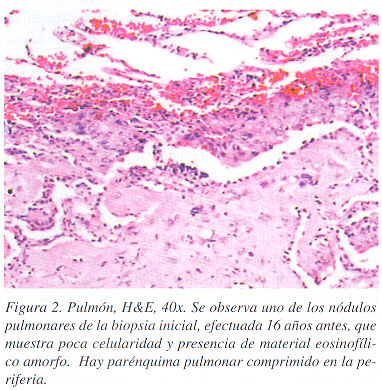
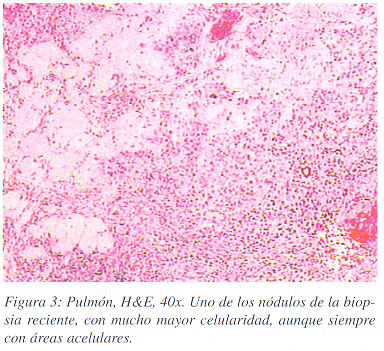
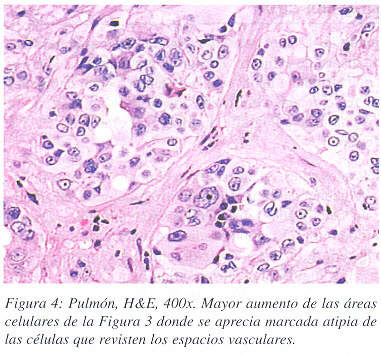
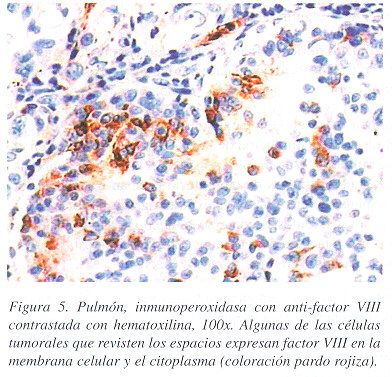
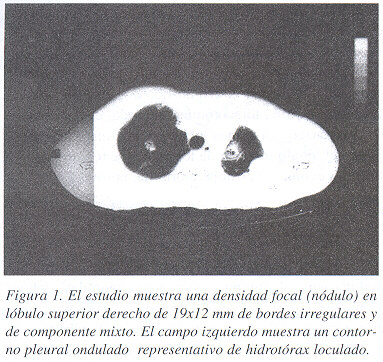
<body><![CDATA[<P><FONT FACE="Arial"><FONT SIZE=-1>La tomograf&iacute;a axial computarizada de t&oacute;rax coincidi&oacute; con las placas convencionales, excepci&oacute;n hecha de observarse un n&uacute;mero mayor de lesiones y de la presencia de una masa hiliar izquierda (<A HREF="#figura1">Figura 1</A>). Tambi&eacute;n se notaron numerosas &aacute;reas hipodensas hep&aacute;ticas.</FONT></FONT>      <P><FONT FACE="Arial"><FONT SIZE=-1>Debido a que el diagn&oacute;stico inicial era el de una neoplasia tan infrecuente y a la explosiva presentaci&oacute;n actual de la enfermedad, despu&eacute;s de tantos a&ntilde;os de estabilidad, se decidi&oacute; obtener una nueva biopsia, para ver si hab&iacute;a habido un cambio histol&oacute;gico y reconfirmar el diagn&oacute;stico original. Se practic&oacute; entonces una peque&ntilde;a toracotom&iacute;a izquierda, encontr&aacute;ndose n&oacute;dulos blancuzcos en ambos l&oacute;bulos y una masa hiliar, dependiente del l&oacute;bulo inferior, de los cuales se tomaron varias muestras. La evoluci&oacute;n postoperatoria fue normal.</FONT></FONT>      <P><FONT FACE="Arial"><FONT SIZE=-1>El material obtenido en 1982 a&uacute;n se conservaba y fue comparado con el de 1998.</FONT></FONT>      <P><FONT FACE="Arial"><FONT SIZE=-1>En los dos grupos de muestras el tumor exhibi&oacute; el mismo patr&oacute;n nodular general, compuesto por zonas centrales acelulares, hialinizadas, con microcalcificaciones ocasionales, rodeadas por grupos de c&eacute;lulas epitelioides con abundante citoplasma eosinof&iacute;lico (<A HREF="#figura2">Figuras 2</A>, <A HREF="#figura3">3</A> y <A HREF="#figura4">4</A>), en ambas muestras se encontraron algunas vacuolas intra-citoplasmaticas con eritrocitos en su interior. Se encontr&oacute; invasi&oacute;n de las estructuras alveolares y de los vasos peque&ntilde;os pero no de los grandes ni de los bronquiolos.</FONT></FONT>      <P><FONT FACE="Arial"><FONT SIZE=-1>A pesar de las similitudes mantenidas a trav&eacute;s del tiempo, encontramos tambi&eacute;n varias diferencias entre las biopsias iniciales y las actuales. En estas &uacute;ltimas, 1) los n&uacute;cleos eran menos regulares, con una menor relaci&oacute;n n&uacute;cleo/citoplasma y con un nucleolo mucho m&aacute;s prominente, 2) hab&iacute;a multinucleaci&oacute;n ocasional, 3) se agreg&oacute; la presencia de algunas mitosis t&iacute;picas y at&iacute;picas, 4) se present&oacute; una mayor densidad de la poblaci&oacute;n celular, que adem&aacute;s mostr&oacute; zonas de un patr&oacute;n alveolar, 5) hab&iacute;a extensas zonas de necrosis, 6) se observ&oacute; moderada infiltraci&oacute;n por linfocitos y c&eacute;lulas plasm&aacute;ticas y 7) hab&iacute;a una leve reacci&oacute;n desmopl&aacute;stica y algunos ac&uacute;mulos de macr&oacute;fagos espumosos.</FONT></FONT>      <P><FONT FACE="Arial"><FONT SIZE=-1>En el material de biopsia reciente se efectuaron an&aacute;lisis inmunohistoquimicos (<A HREF="#figura5">Figura 5</A>). Las c&eacute;lulas tumorales expresaron vimentina, un marcador mesenquimal, y tambi&eacute;n factor VIII, un marcador endotelial, y no expresaron queratina, ni ant&iacute;geno epitelial de membrana. Esto permiti&oacute; confirmar la naturaleza endotelial del tumor y descartar entonces mesotelioma, adenocarcinoma, y melanoma, tumores que se inclu&iacute;an dentro del diagn&oacute;stico diferencial, que expresan queratina, pero no factor VIII.</FONT></FONT>      <P><FONT FACE="Arial"><FONT SIZE=-1>Debido a la agresiva presentaci&oacute;n de la enfermedad en esta etapa, se recomend&oacute; quimioterapia con "MAID" modificada (mesna, epirubicina, isofosfamida, y dacarbacina), planeada en ciclos cada 28 d&iacute;as.</FONT></FONT>      <P><FONT FACE="Arial"><FONT SIZE=-1>El paciente recibi&oacute; 2 ciclos de tratamiento, sin observarse respuesta, sino m&aacute;s bien progresi&oacute;n cl&iacute;nica de la enfermedad. Posteriormente, hizo met&aacute;stasis submentonianas y a cuero cabelludo, y un derrame pleural izquierdo. Falleci&oacute; en febrero de 1999, en su casa y no se practic&oacute; autopsia.</FONT></FONT>     <BR>&nbsp;     <CENTER><A NAME="figura1"></A><IMG SRC="/img/fbpe/amc/v43n2/0833i1.JPG" HEIGHT=362 WIDTH=383></CENTER> &nbsp;     
]]></body>
<body><![CDATA[<CENTER><A NAME="figura2"></A><IMG SRC="/img/fbpe/amc/v43n2/0833i2.JPG" HEIGHT=390 WIDTH=382></CENTER>      
<CENTER>&nbsp;</CENTER>      <CENTER><A NAME="figura3"></A><IMG SRC="/img/fbpe/amc/v43n2/0833i3.JPG" HEIGHT=351 WIDTH=384></CENTER>      
<CENTER>&nbsp;</CENTER>      <CENTER><A NAME="figura4"></A><IMG SRC="/img/fbpe/amc/v43n2/0833i4.JPG" HEIGHT=356 WIDTH=381></CENTER>      
<CENTER>&nbsp;</CENTER>      <CENTER><A NAME="figura5"></A><IMG SRC="/img/fbpe/amc/v43n2/0833i5.JPG" HEIGHT=377 WIDTH=392></CENTER> &nbsp;      
<P>&nbsp;     <BR><B><FONT FACE="Arial"><FONT SIZE=-1>Discusi&oacute;n</FONT></FONT></B>      <P><FONT FACE="Arial"><FONT SIZE=-1><B>Aspectos cl&iacute;nicos:</B> El HEE es un tumor raro de origen endotelial, que puede desarrollarse en cualquier tejido pero es m&aacute;s com&uacute;n en el h&iacute;gado y en el pulm&oacute;n, su comportamiento depende del &oacute;rgano primario de origen, pero en general su curso es lento.</FONT></FONT><SUP><FONT FACE="Arial,Helvetica"><FONT SIZE=-2><A HREF="#3">3</A></FONT></FONT></SUP>      ]]></body>
<body><![CDATA[<P><FONT FACE="Arial"><FONT SIZE=-1>Cuando se origina en los tejidos blandos, ocurre en cualquier parte del cuerpo, siendo entonces m&aacute;s f&aacute;cil de diagnosticar porque aparece como una tumoraci&oacute;n dura y frecuentemente dolorosa, de crecimiento lento, a veces de a&ntilde;os de evoluci&oacute;n. En estos casos la excisi&oacute;n y radioterapia es capaz de controlar el tumor. De 24 casos seguidos por 36 meses, solamente 4 pacientes murieron de enfermedad tumoral.</FONT></FONT><SUP><FONT FACE="Arial,Helvetica"><FONT SIZE=-2><A HREF="#14">14</A></FONT></FONT></SUP>      <P><FONT FACE="Arial"><FONT SIZE=-1>Se ha descrito que si el sitio primario es de tejidos blandos, la mortalidad a los 4 a&ntilde;os de seguimiento es de 13%, 35% si es del h&iacute;gado y 65% si el primario es en el pulm&oacute;n.</FONT></FONT><SUP><FONT FACE="Arial,Helvetica"><FONT SIZE=-2><A HREF="#11">11</A></FONT></FONT></SUP><FONT FACE="Arial"><FONT SIZE=-1> Una vez que el tumor permea los vasos, lentamente destruye el &oacute;rgano original, muriendo el paciente de insuficiencia hep&aacute;tica,</FONT></FONT><SUP><FONT FACE="Arial,Helvetica"><FONT SIZE=-2><A HREF="#5">5</A></FONT></FONT></SUP><FONT FACE="Arial"><FONT SIZE=-1> o respiratoria,</FONT></FONT><SUP><FONT FACE="Arial,Helvetica"><FONT SIZE=-2><A HREF="#1">1</A></FONT></FONT></SUP><FONT FACE="Arial"><FONT SIZE=-1> seg&uacute;n sea el caso.</FONT></FONT>      <P><FONT FACE="Arial"><FONT SIZE=-1>En el caso del HEE de origen &oacute;seo, aunque tiende a ser multifocal, cursa lentamente, y tiene bajo potencial metast&aacute;tico.</FONT></FONT><SUP><FONT FACE="Arial,Helvetica"><FONT SIZE=-2><A HREF="#12">12</A></FONT></FONT></SUP>      <P><FONT FACE="Arial"><FONT SIZE=-1>El otro aspecto interesante de esta neoplasia, es su restringida capacidad de metastatizar, ya que a pesar de ser un tumor vascular por definici&oacute;n, y por ende con amplio acceso al torrente sangu&iacute;neo, no todos lo hacen. Esto sucede solamente en el 20% de los casos de tejidos blandos, el 15% de los originarios del pulm&oacute;n y el 25% de los hep&aacute;ticos. Los sitios preferidos de las met&aacute;stasis son los ganglios linf&aacute;ticos, el h&iacute;gado y los pulmones.</FONT></FONT><SUP><FONT FACE="Arial,Helvetica"><FONT SIZE=-2><A HREF="#15">15</A></FONT></FONT></SUP>      <P><FONT FACE="Arial"><FONT SIZE=-1>Como el curso es lento y frecuentemente silencioso desde el punto de vista cl&iacute;nico, en ocasiones al presentarse el paciente ya con enfermedad diseminada, es dif&iacute;cil determinar el origen del primario y entonces se cataloga como un primario multic&eacute;ntrico simult&aacute;neo.</FONT></FONT><SUP><FONT FACE="Arial,Helvetica"><FONT SIZE=-2><A HREF="#12">12</A></FONT></FONT></SUP>      <P><FONT FACE="Arial"><FONT SIZE=-1>Tanto el HEE hep&aacute;tico como el pulmonar muestran una fuerte preferencia por el sexo femenino.</FONT></FONT><SUP><FONT FACE="Arial,Helvetica"><FONT SIZE=-2><A HREF="#12">12</A></FONT></FONT></SUP><FONT FACE="Arial"><FONT SIZE=-1> Este hecho aunado a observaciones de la aparici&oacute;n de esta neoplasia en mujeres que usaron contraceptivos orales, sugiere una posible influencia hormonal en el desarrollo de los mismos.</FONT></FONT><SUP><FONT FACE="Arial,Helvetica"><FONT SIZE=-2><A HREF="#16">16</A></FONT></FONT></SUP><FONT FACE="Arial"><FONT SIZE=-1> De hecho Ohori y cols. reportaron receptores estrog&eacute;nicos en el tejido de una de 5 pacientes con este tumor.</FONT></FONT>     <BR>&nbsp;      <P><B><FONT FACE="Arial"><FONT SIZE=-1>Aspectos radiol&oacute;gicos</FONT></FONT></B>      <P><FONT FACE="Arial"><FONT SIZE=-1>Los hallazgos radiol&oacute;gicos pulmonares de nuestro paciente coinciden con los descritos en los pacientes de la serie original de Dail y cols. B&aacute;sicamente, se encuentran numerosos n&oacute;dulos, no calcificados, menores de 20 mm de di&aacute;metro y la ausencia de adenopat&iacute;as mediastinales.</FONT></FONT><SUP><FONT FACE="Arial,Helvetica"><FONT SIZE=-2><A HREF="#1">1</A></FONT></FONT></SUP>      <P><FONT FACE="Arial"><FONT SIZE=-1>Ciertamente de no haber existido el conocimiento previo de la histolog&iacute;a, en este paciente, esta rara entidad no se habr&iacute;a propuesto, sino m&aacute;s bien el diagnostico diferencial radiol&oacute;gico ser&iacute;a entre n&oacute;dulos granulomatosos y actividad metast&aacute;sica de otro origen primario. El hecho de haber descubierto invasi&oacute;n del h&iacute;gado, nos permite sugerir el tamizaje abdominal m&aacute;s tempranamente.</FONT></FONT>      ]]></body>
<body><![CDATA[<P><FONT FACE="Arial"><FONT SIZE=-1>Recientemente otros autores han descrito una presentaci&oacute;n radiol&oacute;gica diferente, que puede confundirse con un proceso inflamatorio o intersticial, y que posiblemente represente una variedad de tumor m&aacute;s agresivo.</FONT></FONT><SUP><FONT FACE="Arial,Helvetica"><FONT SIZE=-2><A HREF="#18">18</A></FONT></FONT></SUP>     <BR>&nbsp;      <P><B><FONT FACE="Arial"><FONT SIZE=-1>Aspectos terap&eacute;uticos</FONT></FONT></B>      <P><FONT FACE="Arial"><FONT SIZE=-1>Si el tumor est&aacute; bien localizado y es factible su extirpaci&oacute;n completa, esta debe de realizarse.</FONT></FONT>      <P><FONT FACE="Arial"><FONT SIZE=-1>Recientemente se ha reportado el trasplante hep&aacute;tico como tratamiento para el HEE de dicho &oacute;rgano.</FONT></FONT><SUP><FONT FACE="Arial,Helvetica"><FONT SIZE=-2><A HREF="#19">19</A></FONT></FONT></SUP>      <P><FONT FACE="Arial"><FONT SIZE=-1>Debido a que es un tumor de tejidos blandos, de bajo grado de malignidad, pero con un curso intermedio entre hemangioma y angiosarcoma, algunos investigadores han utilizado quimioterapia en su tratamiento. El esquema est&aacute;ndar recomendado para sarcomas de partes blandas ha sido el "MAID", que consiste en mesna, adriamicina, isofosfamida, y dacarbacina,</FONT></FONT><SUP><FONT FACE="Arial,Helvetica"><FONT SIZE=-2><A HREF="#18">18</A></FONT></FONT></SUP><FONT FACE="Arial"><FONT SIZE=-1> siendo el primer medicamento un reno protector, y el &uacute;ltimo actualmente ha sido eliminado del r&eacute;gimen, porque no aporta beneficio y por otro lado aumenta la toxicidad. Debido a la r&aacute;pida y agresiva presentaci&oacute;n de nuestro enfermo se opt&oacute; por una quimioterapia intensa para tratar de obtener una respuesta objetiva, se utiliz&oacute; MAI sustituyendo doxorubicina por epirubicina, sin embargo el paciente no respondi&oacute;. Se reportan casos de respuesta completa de tumores en diferentes regiones a la quimioterapia.</FONT></FONT><SUP><FONT FACE="Arial,Helvetica"><FONT SIZE=-2><A HREF="#12">12</A>,<A HREF="#21">21</A></FONT></FONT></SUP>     <BR>&nbsp;      <P><B><FONT FACE="Arial"><FONT SIZE=-1>Aspectos anatomopatol&oacute;gicos</FONT></FONT></B>      <P><FONT FACE="Arial"><FONT SIZE=-1>Los pacientes referidos a los autores que originalmente describieron esta entidad presentaban n&oacute;dulos, caracter&iacute;sticamente m&uacute;ltiples, menores de 2 cms de di&aacute;metro, sin extensi&oacute;n microsc&oacute;pica vascular o bronquial. Histol&oacute;gicamente estos ten&iacute;an zonas centrales acelulares, hialinizadas o mixoides, rodeadas por cantidad variable de c&eacute;lulas de aspecto epitelioide, con citoplasma claro o granular y n&uacute;cleos redondos u ovalados, sin atipias, con nucleolos ausentes o incospicuos, dispuestas en nidos y cordones. Las mitosis eran escasas.</FONT></FONT><SUP><FONT FACE="Arial,Helvetica"><FONT SIZE=-2><A HREF="#1">1</A></FONT></FONT></SUP>      <P><FONT FACE="Arial"><FONT SIZE=-1>Dos hallazgos histol&oacute;gicos sugirieron a estos autores el posible origen vascular de este tumor: la presencia de vacuolas citoplasm&aacute;ticas, algunas de ellas con eritrocitos en su interior; y un grado variable de permeaci&oacute;n vascular.</FONT></FONT>      ]]></body>
<body><![CDATA[<P><FONT FACE="Arial"><FONT SIZE=-1>En el mismo estudio demostraron, por an&aacute;lisis inmunohistoqu&iacute;mico, que las c&eacute;lulas tumorales y las vacuolas intracitopl&aacute;smicas expresaban el ant&iacute;geno relacionado con el factor VIII.</FONT></FONT>      <P><FONT FACE="Arial"><FONT SIZE=-1>Un criterio importante para el diagn&oacute;stico es la evidencia inmuno histoqu&iacute;mica de diferenciaci&oacute;n endotelial.y aunque el marcador m&aacute;s espec&iacute;fico y sensible es el CD31 algunas lesiones vasculares son negativas y deber&aacute;n estudiarse con otros marcadores como el factor VIII o el Ulex europeus.</FONT></FONT>      <P><FONT FACE="Arial"><FONT SIZE=-1>En este caso, en el que fue posible seguir la evoluci&oacute;n histopatol&oacute;gica a trav&eacute;s de 16 a&ntilde;os, se notaron varias caracter&iacute;sticas que indican una progresi&oacute;n a un estado tumoral m&aacute;s agresivo, como son: mayor at&iacute;pica celular, presencia de mitosis t&iacute;picas y at&iacute;picas, no observadas en el tumor inicial y zonas de necrosis indicativas de un crecimiento acelerado por encima de su capacidad de irrigaci&oacute;n. Adem&aacute;s se evidenciaron dos tipos de reacci&oacute;n del organismo contra el tumor: un infiltrado linfo/plasmocitario denso zonal y una leve respuesta desmopl&aacute;sica.</FONT></FONT>      <P><FONT FACE="Arial"><FONT SIZE=-1>En conclusi&oacute;n el HEE es un tumor maligno de origen vascular, de tejidos blandos o de cualquier &oacute;rgano, es muy poco frecuente, se presenta m&aacute;s en mujeres, tiene una influencia hormonal, y es de lenta evoluci&oacute;n.</FONT></FONT>     <BR>&nbsp;      <P><B><FONT FACE="Arial"><FONT SIZE=-1>Abstract</FONT></FONT></B>      <P><FONT FACE="Arial"><FONT SIZE=-1>In 1983 an uncommon type of lung tumor was reported in 20 patients, it was then named IVBAT (intravascular, bronchioalveolar tumor). The patients presented with multiple slow growing pulmonary nodules, that ranged microscopically from (apparently) benign looking granulomas to clearly developed sarcomas.</FONT></FONT>      <P><FONT FACE="Arial"><FONT SIZE=-1>Eventually the tumor was found to be of vascular origin, and was called epithelioid hemangio endothelioma (EHE), later on it was also reported in other anatomical regions.</FONT></FONT>      <P><FONT FACE="Arial"><FONT SIZE=-1>We describe here, as far as we could find, the first costarican case of this particular neoplasia.</FONT></FONT>      <P><FONT FACE="Arial"><FONT SIZE=-1>A 42 year old male was referred to us with disseminated metastatic disease. He had been seen 16 years prior with asymptomatic, bilateral, small lung nodules. At that time he underwent a lung biopsy and the diagnosis of epitheliod hemangioendothelioma was made. He had remained stable, on no therapy, until his current and final presentation. We elected to biopsy his lung again to verify the histology and to see weather the tumor had undergone differentiation. He did not respond to chemotherapy and died shortly thereafter.</FONT></FONT>      ]]></body>
<body><![CDATA[<P><FONT FACE="Arial"><FONT SIZE=-1>The original lung biopsy material was compared to the recent one, finding much more cellularity and atypiae in the latter one. Immuno-histochemistry studies were carried out on the tissue samples and the endothelial origin of the tumor was demonstrated.</FONT></FONT>      <P><FONT FACE="Arial"><FONT SIZE=-1>EHE is an unusual type of neoplasia, it grows very slowly and has low metastatic potential in spite of its vascular origin, interestingly some authors have shown a hormonal dependency and this needs to be explored to see if therapeutic applications can be developed.</FONT></FONT>     <BR>&nbsp;      <P><B><FONT FACE="Arial"><FONT SIZE=-1>Referencias</FONT></FONT></B>      <!-- ref --><P><A NAME="1"></A><FONT FACE="Arial,Helvetica"><FONT SIZE=-1>1. Dail DH , Liebow AA, Gmelich JT , Friedman PJ, Miyai K, Myer W, et al. Intravascular, bronchiolar, and alveolar tumor of the lung (IVBAT): an analysis of 20 cases of a peculiar sclerosing endothelial tumor. Cancer 1983; 51: 452-464.</FONT></FONT>    &nbsp;&nbsp;&nbsp;&nbsp;&nbsp;&nbsp;&nbsp;&nbsp;[&#160;<a href="javascript:void(0);" onclick="javascript: window.open('/scielo.php?script=sci_nlinks&ref=006094&pid=S0001-6002200100020000900001&lng=','','width=640,height=500,resizable=yes,scrollbars=1,menubar=yes,');">Links</a>&#160;]<!-- end-ref --><!-- ref --><P><A NAME="2"></A><FONT FACE="Arial,Helvetica"><FONT SIZE=-1>2. Corrin B, Manners B, Millard M, Weaver L. Histogenesis of the so-called "intravascular bronchioalveolar tumor". J Pathol 1979; 128: 163-167.</FONT></FONT>    &nbsp;&nbsp;&nbsp;&nbsp;&nbsp;&nbsp;&nbsp;&nbsp;[&#160;<a href="javascript:void(0);" onclick="javascript: window.open('/scielo.php?script=sci_nlinks&ref=006095&pid=S0001-6002200100020000900002&lng=','','width=640,height=500,resizable=yes,scrollbars=1,menubar=yes,');">Links</a>&#160;]<!-- end-ref --><!-- ref --><P><A NAME="3"></A><FONT FACE="Arial,Helvetica"><FONT SIZE=-1>3. Weiss SW., Enzinger FM. Epithelioid hemangioendothelioma: a vascular tumor often mistaken for a carcinoma. Cancer 1982; 50: 970-981.</FONT></FONT>    &nbsp;&nbsp;&nbsp;&nbsp;&nbsp;&nbsp;&nbsp;&nbsp;[&#160;<a href="javascript:void(0);" onclick="javascript: window.open('/scielo.php?script=sci_nlinks&ref=006096&pid=S0001-6002200100020000900003&lng=','','width=640,height=500,resizable=yes,scrollbars=1,menubar=yes,');">Links</a>&#160;]<!-- end-ref --><!-- ref --><P><A NAME="4"></A><FONT FACE="Arial,Helvetica"><FONT SIZE=-1>4. Ishak Kg, Sesterhenn Ia, Goodman ZD, Rabin L, Stromeyer FW. Epithelioid hemangioendothelioma of the liver: a clinico-pathologic and follow up study of 32 cases. Hum Pathol 1984; 15: 839-842.</FONT></FONT>    &nbsp;&nbsp;&nbsp;&nbsp;&nbsp;&nbsp;&nbsp;&nbsp;[&#160;<a href="javascript:void(0);" onclick="javascript: window.open('/scielo.php?script=sci_nlinks&ref=006097&pid=S0001-6002200100020000900004&lng=','','width=640,height=500,resizable=yes,scrollbars=1,menubar=yes,');">Links</a>&#160;]<!-- end-ref --><!-- ref --><P><A NAME="5"></A><FONT FACE="Arial,Helvetica"><FONT SIZE=-1>5. Dietze O, Davies SE, Williams R, Portmann B. Malignant epithelioid hemangioendothelioma of the liver: a clinicopathological and histochemical study of 12 cases. Histopathology 1988; 15:225-237.</FONT></FONT>    &nbsp;&nbsp;&nbsp;&nbsp;&nbsp;&nbsp;&nbsp;&nbsp;[&#160;<a href="javascript:void(0);" onclick="javascript: window.open('/scielo.php?script=sci_nlinks&ref=006098&pid=S0001-6002200100020000900005&lng=','','width=640,height=500,resizable=yes,scrollbars=1,menubar=yes,');">Links</a>&#160;]<!-- end-ref --><!-- ref --><P><A NAME="6"></A><FONT FACE="Arial,Helvetica"><FONT SIZE=-1>6. Haidar A, Batman P. Epithelioid hemangioendothelioma of the penile shaft. Brit J Urol 1995; 5 (6): 796-797.</FONT></FONT>    &nbsp;&nbsp;&nbsp;&nbsp;&nbsp;&nbsp;&nbsp;&nbsp;[&#160;<a href="javascript:void(0);" onclick="javascript: window.open('/scielo.php?script=sci_nlinks&ref=006099&pid=S0001-6002200100020000900006&lng=','','width=640,height=500,resizable=yes,scrollbars=1,menubar=yes,');">Links</a>&#160;]<!-- end-ref --><!-- ref --><P><A NAME="7"></A><FONT FACE="Arial,Helvetica"><FONT SIZE=-1>7. Ellis Ts, Schwartz A, Starr JK, Riedel CJ. Epithelioid hemangioendothelioma of the vertebral column: case report and review of the literature. Neurosurgery 1996; 38 (2): 402-407.</FONT></FONT>    &nbsp;&nbsp;&nbsp;&nbsp;&nbsp;&nbsp;&nbsp;&nbsp;[&#160;<a href="javascript:void(0);" onclick="javascript: window.open('/scielo.php?script=sci_nlinks&ref=006100&pid=S0001-6002200100020000900007&lng=','','width=640,height=500,resizable=yes,scrollbars=1,menubar=yes,');">Links</a>&#160;]<!-- end-ref --><!-- ref --><P><A NAME="8"></A><FONT FACE="Arial,Helvetica"><FONT SIZE=-1>8. Nora FE, Scheithauer BW. Primary epithelioid hemangioendothelioma of the brain. Am J Surg Pathol 1996; 20 (6): 707-714.</FONT></FONT>    &nbsp;&nbsp;&nbsp;&nbsp;&nbsp;&nbsp;&nbsp;&nbsp;[&#160;<a href="javascript:void(0);" onclick="javascript: window.open('/scielo.php?script=sci_nlinks&ref=006101&pid=S0001-6002200100020000900008&lng=','','width=640,height=500,resizable=yes,scrollbars=1,menubar=yes,');">Links</a>&#160;]<!-- end-ref --><!-- ref --><P><A NAME="9"></A><FONT FACE="Arial,Helvetica"><FONT SIZE=-1>9. Begbie SD, Bell DR, Nevell DF. Mediastinal epithelioid hemangioendothelioma in a patient with type IV Ehlers-Danlos syndrome: a case report and review of the literature. Am J Clin Oncol 1997; 20 (4): 412-415.</FONT></FONT>    &nbsp;&nbsp;&nbsp;&nbsp;&nbsp;&nbsp;&nbsp;&nbsp;[&#160;<a href="javascript:void(0);" onclick="javascript: window.open('/scielo.php?script=sci_nlinks&ref=006102&pid=S0001-6002200100020000900009&lng=','','width=640,height=500,resizable=yes,scrollbars=1,menubar=yes,');">Links</a>&#160;]<!-- end-ref --><!-- ref --><P><A NAME="10"></A><FONT FACE="Arial,Helvetica"><FONT SIZE=-1>10. Pinet C, Magnan A, Garbe L, Payan MJ, Vervloet D. Aggressive form of pleural epithelioid hemangioendothelioma: complete response after chemotherapy. Eur Respir J 1999; 14 (1):237-238.</FONT></FONT>    &nbsp;&nbsp;&nbsp;&nbsp;&nbsp;&nbsp;&nbsp;&nbsp;[&#160;<a href="javascript:void(0);" onclick="javascript: window.open('/scielo.php?script=sci_nlinks&ref=006103&pid=S0001-6002200100020000900010&lng=','','width=640,height=500,resizable=yes,scrollbars=1,menubar=yes,');">Links</a>&#160;]<!-- end-ref --><!-- ref --><P><A NAME="11"></A><FONT FACE="Arial,Helvetica"><FONT SIZE=-1>11. Crotty EJ, McAdams HP, Erasmus JJ, Sporn TA, Roggli VL. Epithelioid hemangioendothelioma of the pleura. AJR 2000; 175: 1545-1549</FONT></FONT>    &nbsp;&nbsp;&nbsp;&nbsp;&nbsp;&nbsp;&nbsp;&nbsp;[&#160;<a href="javascript:void(0);" onclick="javascript: window.open('/scielo.php?script=sci_nlinks&ref=006104&pid=S0001-6002200100020000900011&lng=','','width=640,height=500,resizable=yes,scrollbars=1,menubar=yes,');">Links</a>&#160;]<!-- end-ref --><!-- ref --><P><A NAME="12"></A><FONT FACE="Arial,Helvetica"><FONT SIZE=-1>12. Bollinger BK, Laskin WB, Knight CB. Epitheliod hemangioendothelioma with multiple site involvement. Cancer 1994; 73: 610-615.</FONT></FONT>    &nbsp;&nbsp;&nbsp;&nbsp;&nbsp;&nbsp;&nbsp;&nbsp;[&#160;<a href="javascript:void(0);" onclick="javascript: window.open('/scielo.php?script=sci_nlinks&ref=006105&pid=S0001-6002200100020000900012&lng=','','width=640,height=500,resizable=yes,scrollbars=1,menubar=yes,');">Links</a>&#160;]<!-- end-ref --><!-- ref --><P><A NAME="13"></A><FONT FACE="Arial,Helvetica"><FONT SIZE=-1>13. de Nictolis M, Brancorsini D, Goteri G, Prat J. Epithelioid hemangioma of the heart. Virchows Arch 1996; 428 (2): 119-123.</FONT></FONT>    &nbsp;&nbsp;&nbsp;&nbsp;&nbsp;&nbsp;&nbsp;&nbsp;[&#160;<a href="javascript:void(0);" onclick="javascript: window.open('/scielo.php?script=sci_nlinks&ref=006106&pid=S0001-6002200100020000900013&lng=','','width=640,height=500,resizable=yes,scrollbars=1,menubar=yes,');">Links</a>&#160;]<!-- end-ref --><!-- ref --><P><A NAME="14"></A><FONT FACE="Arial,Helvetica"><FONT SIZE=-1>14. Mentzel T, Beham A, Calonje E, Katenkamp D, Fletcher CDM. Epitheliod hemangioendothelioma of skin and soft tissues: clinicopathologic and immunohistochemical study of 30 cases. Am J Surg Pathol 1997; 21 (4): 363-374.</FONT></FONT>    &nbsp;&nbsp;&nbsp;&nbsp;&nbsp;&nbsp;&nbsp;&nbsp;[&#160;<a href="javascript:void(0);" onclick="javascript: window.open('/scielo.php?script=sci_nlinks&ref=006107&pid=S0001-6002200100020000900014&lng=','','width=640,height=500,resizable=yes,scrollbars=1,menubar=yes,');">Links</a>&#160;]<!-- end-ref --><!-- ref --><P><A NAME="15"></A><FONT FACE="Arial,Helvetica"><FONT SIZE=-1>15. Weiss SW, Ishak KG, Dalil GH, Sweet DE, Enzinger FM. Epithelioid hemangioendothelioma and related lesions. Semin Diagn Pathol 1986; 3: 259-287.</FONT></FONT>    &nbsp;&nbsp;&nbsp;&nbsp;&nbsp;&nbsp;&nbsp;&nbsp;[&#160;<a href="javascript:void(0);" onclick="javascript: window.open('/scielo.php?script=sci_nlinks&ref=006108&pid=S0001-6002200100020000900015&lng=','','width=640,height=500,resizable=yes,scrollbars=1,menubar=yes,');">Links</a>&#160;]<!-- end-ref --><!-- ref --><P><A NAME="16"></A><FONT FACE="Arial,Helvetica"><FONT SIZE=-1>16. Dean PJ, Haggitt RC, O_Hara CJ. Malignant epithelioid hemangioendothelioma of the liver in young women: relationship to oral contraceptive use. Am J Surg Pathol 1985; 9: 695-704.</FONT></FONT>    &nbsp;&nbsp;&nbsp;&nbsp;&nbsp;&nbsp;&nbsp;&nbsp;[&#160;<a href="javascript:void(0);" onclick="javascript: window.open('/scielo.php?script=sci_nlinks&ref=006109&pid=S0001-6002200100020000900016&lng=','','width=640,height=500,resizable=yes,scrollbars=1,menubar=yes,');">Links</a>&#160;]<!-- end-ref --><!-- ref --><P><A NAME="17"></A><FONT FACE="Arial,Helvetica"><FONT SIZE=-1>17. Ohori NP, Yousem SA, Sonmez-Alpan E, Colby TV. Estrogen and progesterone receptors in lymphangioleiomyomatosis, epitheliod hemangioendotheliloma and sclerosis hemangioma of the lung.Am J Clin Pathol 1991; 96: 529-535.</FONT></FONT>    &nbsp;&nbsp;&nbsp;&nbsp;&nbsp;&nbsp;&nbsp;&nbsp;[&#160;<a href="javascript:void(0);" onclick="javascript: window.open('/scielo.php?script=sci_nlinks&ref=006110&pid=S0001-6002200100020000900017&lng=','','width=640,height=500,resizable=yes,scrollbars=1,menubar=yes,');">Links</a>&#160;]<!-- end-ref --><!-- ref --><P><A NAME="18"></A><FONT FACE="Arial,Helvetica"><FONT SIZE=-1>18. Mukundan G, Urban BA, Askin FB, Fishman EK. Pulmonary epithelioid hemangioendothelioma: atypical radiological findings of a rare tumor with pathologic correlation. J Computer Assisted Tom 2000; 24 (5): 719-720.</FONT></FONT>    &nbsp;&nbsp;&nbsp;&nbsp;&nbsp;&nbsp;&nbsp;&nbsp;[&#160;<a href="javascript:void(0);" onclick="javascript: window.open('/scielo.php?script=sci_nlinks&ref=006111&pid=S0001-6002200100020000900018&lng=','','width=640,height=500,resizable=yes,scrollbars=1,menubar=yes,');">Links</a>&#160;]<!-- end-ref --><!-- ref --><P><A NAME="19"></A><FONT FACE="Arial,Helvetica"><FONT SIZE=-1>19. Hung CF, Jeng LB, Lee WC, Lin DY, Tan PP, Chen MF. Liver transplantation for epitheliod hemangioendothelioma. Transplant Proc 1998; 30 (7): 3307-3309.</FONT></FONT>    &nbsp;&nbsp;&nbsp;&nbsp;&nbsp;&nbsp;&nbsp;&nbsp;[&#160;<a href="javascript:void(0);" onclick="javascript: window.open('/scielo.php?script=sci_nlinks&ref=006112&pid=S0001-6002200100020000900019&lng=','','width=640,height=500,resizable=yes,scrollbars=1,menubar=yes,');">Links</a>&#160;]<!-- end-ref --><!-- ref --><P><A NAME="20"></A><FONT FACE="Arial,Helvetica"><FONT SIZE=-1>20. Elias A, Ryan L, Sulkes A, Collins J, Aisner J, Antman KH. Response to mesna, doxorubicin, ifosfamide, and dacarbazine in 108 patients with metastatic or unresectable sarcoma and no prior chemotherapy. J Clin Oncol 1989; 7 (9): 1208-1216.</FONT></FONT>    &nbsp;&nbsp;&nbsp;&nbsp;&nbsp;&nbsp;&nbsp;&nbsp;[&#160;<a href="javascript:void(0);" onclick="javascript: window.open('/scielo.php?script=sci_nlinks&ref=006113&pid=S0001-6002200100020000900020&lng=','','width=640,height=500,resizable=yes,scrollbars=1,menubar=yes,');">Links</a>&#160;]<!-- end-ref --><!-- ref --><P><A NAME="21"></A><FONT FACE="Arial,Helvetica"><FONT SIZE=-1>21.Idilman R, Dokmeci A, Beyler AR, Bastemir M, Ormeci N, Aras N, Ekinci C, Uzunalimoglu O, De Maria N, Van Thiel DH. Succesful medical treatment of an epitheliod hemangioendothelioma of the liver. Oncology 1997; 54 (2): 171-175.</FONT></FONT>    &nbsp;&nbsp;&nbsp;&nbsp;&nbsp;&nbsp;&nbsp;&nbsp;[&#160;<a href="javascript:void(0);" onclick="javascript: window.open('/scielo.php?script=sci_nlinks&ref=006114&pid=S0001-6002200100020000900021&lng=','','width=640,height=500,resizable=yes,scrollbars=1,menubar=yes,');">Links</a>&#160;]<!-- end-ref --><BR>&nbsp;      <P><B><FONT FACE="Arial"><FONT SIZE=-1>Abreviaturas</FONT></FONT></B>      <P><FONT FACE="Arial"><FONT SIZE=-1>IVBAT, tumor intravascular bronquio-alveolar; HEE, hemangio-endotelioma epitelioide</FONT></FONT>     <BR>&nbsp;      <P><A NAME="1a"></A><FONT SIZE=-1><SUP><FONT FACE="Arial,Helvetica"><A HREF="#1ab">1</A></FONT></SUP><FONT FACE="Arial"> Servicio de Anatom&iacute;a Patol&oacute;gica, Hospital M&eacute;xico.</FONT></FONT>     ]]></body>
<body><![CDATA[<BR><A NAME="2a"></A><FONT SIZE=-1><SUP><FONT FACE="Arial,Helvetica"><A HREF="#1ab">2</A></FONT></SUP><FONT FACE="Arial"> Servicio de Oncolog&iacute;a, Hospital M&eacute;xico.</FONT></FONT>     <BR><A NAME="3a"></A><FONT SIZE=-1><SUP><FONT FACE="Arial,Helvetica"><A HREF="#1ab">3</A></FONT></SUP><FONT FACE="Arial"> Servicio de Im&aacute;genes M&eacute;dicas, Hospital M&eacute;xico.</FONT></FONT>     <BR><A NAME="4a"></A><FONT SIZE=-1><SUP><FONT FACE="Arial,Helvetica"><A HREF="#1ab">4</A></FONT></SUP><FONT FACE="Arial"> Servicio de Anatom&iacute;a Patol&oacute;gica, Hospital San Juan de Dios.</FONT></FONT>     <BR><A NAME="5a"></A><FONT SIZE=-1><SUP><FONT FACE="Arial,Helvetica"><A HREF="#1ab">5</A></FONT></SUP><FONT FACE="Arial"> Servicio de Cirug&iacute;a de T&oacute;rax y Cardiovascular, Hospital M&eacute;xico.</FONT></FONT>     <BR>&nbsp;      <P><FONT FACE="Arial"><FONT SIZE=-1><B>Correspondencia: </B>Carlos Salazar Vargas. Apartado 1826-1250 Escaz&uacute;.</FONT></FONT>      ]]></body><back>
<ref-list>
<ref id="B1">
<label>1</label><nlm-citation citation-type="journal">
<person-group person-group-type="author">
<name>
<surname><![CDATA[Dail]]></surname>
<given-names><![CDATA[DH]]></given-names>
</name>
<name>
<surname><![CDATA[Liebow]]></surname>
<given-names><![CDATA[AA]]></given-names>
</name>
<name>
<surname><![CDATA[Gmelich]]></surname>
<given-names><![CDATA[JT]]></given-names>
</name>
<name>
<surname><![CDATA[Friedman]]></surname>
<given-names><![CDATA[PJ]]></given-names>
</name>
<name>
<surname><![CDATA[Miyai]]></surname>
<given-names><![CDATA[K]]></given-names>
</name>
<name>
<surname><![CDATA[Myer]]></surname>
<given-names><![CDATA[W]]></given-names>
</name>
</person-group>
<article-title xml:lang="en"><![CDATA[Intravascular, bronchiolar, and alveolar tumor of the lung (IVBAT): an analysis of 20 cases of a peculiar sclerosing endothelial tumor]]></article-title>
<source><![CDATA[Cancer]]></source>
<year>1983</year>
<volume>51</volume>
<page-range>452-464</page-range></nlm-citation>
</ref>
<ref id="B2">
<label>2</label><nlm-citation citation-type="journal">
<person-group person-group-type="author">
<name>
<surname><![CDATA[Corrin]]></surname>
<given-names><![CDATA[B]]></given-names>
</name>
<name>
<surname><![CDATA[Manners]]></surname>
<given-names><![CDATA[B]]></given-names>
</name>
<name>
<surname><![CDATA[Millard]]></surname>
<given-names><![CDATA[M]]></given-names>
</name>
<name>
<surname><![CDATA[Weaver]]></surname>
<given-names><![CDATA[L]]></given-names>
</name>
</person-group>
<article-title xml:lang="en"><![CDATA[Histogenesis of the so-called "intravascular bronchioalveolar tumor"]]></article-title>
<source><![CDATA[J Pathol]]></source>
<year>1979</year>
<volume>128</volume>
<page-range>163-167</page-range></nlm-citation>
</ref>
<ref id="B3">
<label>3</label><nlm-citation citation-type="journal">
<person-group person-group-type="author">
<name>
<surname><![CDATA[Weiss]]></surname>
<given-names><![CDATA[SW]]></given-names>
</name>
<name>
<surname><![CDATA[Enzinger]]></surname>
<given-names><![CDATA[FM]]></given-names>
</name>
</person-group>
<article-title xml:lang="en"><![CDATA[Epithelioid hemangioendothelioma: a vascular tumor often mistaken for a carcinoma]]></article-title>
<source><![CDATA[Cancer]]></source>
<year>1982</year>
<volume>50</volume>
<page-range>970-981</page-range></nlm-citation>
</ref>
<ref id="B4">
<label>4</label><nlm-citation citation-type="journal">
<person-group person-group-type="author">
<name>
<surname><![CDATA[Ishak]]></surname>
<given-names><![CDATA[Kg]]></given-names>
</name>
<name>
<surname><![CDATA[Sesterhenn]]></surname>
<given-names><![CDATA[Ia]]></given-names>
</name>
<name>
<surname><![CDATA[Goodman]]></surname>
<given-names><![CDATA[ZD]]></given-names>
</name>
<name>
<surname><![CDATA[Rabin]]></surname>
<given-names><![CDATA[L]]></given-names>
</name>
<name>
<surname><![CDATA[Stromeyer]]></surname>
<given-names><![CDATA[FW]]></given-names>
</name>
</person-group>
<article-title xml:lang="en"><![CDATA[Epithelioid hemangioendothelioma of the liver: a clinico-pathologic and follow up study of 32 cases]]></article-title>
<source><![CDATA[Hum Pathol]]></source>
<year>1984</year>
<volume>15</volume>
<page-range>839-842</page-range></nlm-citation>
</ref>
<ref id="B5">
<label>5</label><nlm-citation citation-type="journal">
<person-group person-group-type="author">
<name>
<surname><![CDATA[Dietze]]></surname>
<given-names><![CDATA[O]]></given-names>
</name>
<name>
<surname><![CDATA[Davies]]></surname>
<given-names><![CDATA[SE]]></given-names>
</name>
<name>
<surname><![CDATA[Williams]]></surname>
<given-names><![CDATA[R]]></given-names>
</name>
<name>
<surname><![CDATA[Portmann]]></surname>
<given-names><![CDATA[B]]></given-names>
</name>
</person-group>
<article-title xml:lang="en"><![CDATA[Malignant epithelioid hemangioendothelioma of the liver: a clinicopathological and histochemical study of 12 cases]]></article-title>
<source><![CDATA[Histopathology]]></source>
<year>1988</year>
<volume>15</volume>
<page-range>225-237</page-range></nlm-citation>
</ref>
<ref id="B6">
<label>6</label><nlm-citation citation-type="journal">
<person-group person-group-type="author">
<name>
<surname><![CDATA[Haidar]]></surname>
<given-names><![CDATA[A]]></given-names>
</name>
<name>
<surname><![CDATA[Batman]]></surname>
<given-names><![CDATA[P]]></given-names>
</name>
</person-group>
<article-title xml:lang="en"><![CDATA[Epithelioid hemangioendothelioma of the penile shaft]]></article-title>
<source><![CDATA[Brit J Urol]]></source>
<year>1995</year>
<volume>5</volume>
<numero>6</numero>
<issue>6</issue>
<page-range>796-797</page-range></nlm-citation>
</ref>
<ref id="B7">
<label>7</label><nlm-citation citation-type="journal">
<person-group person-group-type="author">
<name>
<surname><![CDATA[Ellis]]></surname>
<given-names><![CDATA[Ts]]></given-names>
</name>
<name>
<surname><![CDATA[Schwartz]]></surname>
<given-names><![CDATA[A]]></given-names>
</name>
<name>
<surname><![CDATA[Starr]]></surname>
<given-names><![CDATA[JK]]></given-names>
</name>
<name>
<surname><![CDATA[Riedel]]></surname>
<given-names><![CDATA[CJ]]></given-names>
</name>
</person-group>
<article-title xml:lang="en"><![CDATA[Epithelioid hemangioendothelioma of the vertebral column: case report and review of the literature]]></article-title>
<source><![CDATA[Neurosurgery]]></source>
<year>1996</year>
<volume>38</volume>
<numero>2</numero>
<issue>2</issue>
<page-range>402-407</page-range></nlm-citation>
</ref>
<ref id="B8">
<label>8</label><nlm-citation citation-type="journal">
<person-group person-group-type="author">
<name>
<surname><![CDATA[Nora]]></surname>
<given-names><![CDATA[FE]]></given-names>
</name>
<name>
<surname><![CDATA[Scheithauer]]></surname>
<given-names><![CDATA[BW]]></given-names>
</name>
</person-group>
<article-title xml:lang="en"><![CDATA[Primary epithelioid hemangioendothelioma of the brain]]></article-title>
<source><![CDATA[Am J Surg Pathol]]></source>
<year>1996</year>
<volume>20</volume>
<numero>6</numero>
<issue>6</issue>
<page-range>707-714</page-range></nlm-citation>
</ref>
<ref id="B9">
<label>9</label><nlm-citation citation-type="journal">
<person-group person-group-type="author">
<name>
<surname><![CDATA[Begbie]]></surname>
<given-names><![CDATA[SD]]></given-names>
</name>
<name>
<surname><![CDATA[Bell]]></surname>
<given-names><![CDATA[DR]]></given-names>
</name>
<name>
<surname><![CDATA[Nevell]]></surname>
<given-names><![CDATA[DF]]></given-names>
</name>
</person-group>
<article-title xml:lang="en"><![CDATA[Mediastinal epithelioid hemangioendothelioma in a patient with type IV Ehlers-Danlos syndrome: a case report and review of the literature]]></article-title>
<source><![CDATA[Am J Clin Oncol]]></source>
<year>1997</year>
<volume>20</volume>
<numero>4</numero>
<issue>4</issue>
<page-range>412-415</page-range></nlm-citation>
</ref>
<ref id="B10">
<label>10</label><nlm-citation citation-type="journal">
<person-group person-group-type="author">
<name>
<surname><![CDATA[Pinet]]></surname>
<given-names><![CDATA[C]]></given-names>
</name>
<name>
<surname><![CDATA[Magnan]]></surname>
<given-names><![CDATA[A]]></given-names>
</name>
<name>
<surname><![CDATA[Garbe]]></surname>
<given-names><![CDATA[L]]></given-names>
</name>
<name>
<surname><![CDATA[Payan]]></surname>
<given-names><![CDATA[MJ]]></given-names>
</name>
<name>
<surname><![CDATA[Vervloet]]></surname>
<given-names><![CDATA[D]]></given-names>
</name>
</person-group>
<article-title xml:lang="en"><![CDATA[Aggressive form of pleural epithelioid hemangioendothelioma: complete response after chemotherapy]]></article-title>
<source><![CDATA[Eur Respir J]]></source>
<year>1999</year>
<volume>14</volume>
<numero>1</numero>
<issue>1</issue>
<page-range>237-238</page-range></nlm-citation>
</ref>
<ref id="B11">
<label>11</label><nlm-citation citation-type="journal">
<person-group person-group-type="author">
<name>
<surname><![CDATA[Crotty]]></surname>
<given-names><![CDATA[EJ]]></given-names>
</name>
<name>
<surname><![CDATA[McAdams]]></surname>
<given-names><![CDATA[HP]]></given-names>
</name>
<name>
<surname><![CDATA[Erasmus]]></surname>
<given-names><![CDATA[JJ]]></given-names>
</name>
<name>
<surname><![CDATA[Sporn]]></surname>
<given-names><![CDATA[TA]]></given-names>
</name>
<name>
<surname><![CDATA[Roggli]]></surname>
<given-names><![CDATA[VL]]></given-names>
</name>
</person-group>
<article-title xml:lang="en"><![CDATA[Epithelioid hemangioendothelioma of the pleura]]></article-title>
<source><![CDATA[AJR]]></source>
<year>2000</year>
<volume>175</volume>
<page-range>1545-1549</page-range></nlm-citation>
</ref>
<ref id="B12">
<label>12</label><nlm-citation citation-type="journal">
<person-group person-group-type="author">
<name>
<surname><![CDATA[Bollinger]]></surname>
<given-names><![CDATA[BK]]></given-names>
</name>
<name>
<surname><![CDATA[Laskin]]></surname>
<given-names><![CDATA[WB]]></given-names>
</name>
<name>
<surname><![CDATA[Knight]]></surname>
<given-names><![CDATA[CB]]></given-names>
</name>
</person-group>
<article-title xml:lang="en"><![CDATA[Epitheliod hemangioendothelioma with multiple site involvement]]></article-title>
<source><![CDATA[Cancer]]></source>
<year>1994</year>
<volume>73</volume>
<page-range>610-615</page-range></nlm-citation>
</ref>
<ref id="B13">
<label>13</label><nlm-citation citation-type="journal">
<person-group person-group-type="author">
<name>
<surname><![CDATA[de Nictolis]]></surname>
<given-names><![CDATA[M]]></given-names>
</name>
<name>
<surname><![CDATA[Brancorsini]]></surname>
<given-names><![CDATA[D]]></given-names>
</name>
<name>
<surname><![CDATA[Goteri]]></surname>
<given-names><![CDATA[G]]></given-names>
</name>
<name>
<surname><![CDATA[Prat]]></surname>
<given-names><![CDATA[J]]></given-names>
</name>
</person-group>
<article-title xml:lang="en"><![CDATA[Epithelioid hemangioma of the heart]]></article-title>
<source><![CDATA[Virchows Arch]]></source>
<year>1996</year>
<volume>428</volume>
<numero>2</numero>
<issue>2</issue>
<page-range>119-123</page-range></nlm-citation>
</ref>
<ref id="B14">
<label>14</label><nlm-citation citation-type="journal">
<person-group person-group-type="author">
<name>
<surname><![CDATA[Mentzel]]></surname>
<given-names><![CDATA[T]]></given-names>
</name>
<name>
<surname><![CDATA[Beham]]></surname>
<given-names><![CDATA[A]]></given-names>
</name>
<name>
<surname><![CDATA[Calonje]]></surname>
<given-names><![CDATA[E]]></given-names>
</name>
<name>
<surname><![CDATA[Katenkamp]]></surname>
<given-names><![CDATA[D]]></given-names>
</name>
<name>
<surname><![CDATA[Fletcher]]></surname>
<given-names><![CDATA[CDM]]></given-names>
</name>
</person-group>
<article-title xml:lang="en"><![CDATA[Epitheliod hemangioendothelioma of skin and soft tissues: clinicopathologic and immunohistochemical study of 30 cases]]></article-title>
<source><![CDATA[Am J Surg Pathol]]></source>
<year>1997</year>
<volume>21</volume>
<numero>4</numero>
<issue>4</issue>
<page-range>363-374</page-range></nlm-citation>
</ref>
<ref id="B15">
<label>15</label><nlm-citation citation-type="journal">
<person-group person-group-type="author">
<name>
<surname><![CDATA[Weiss]]></surname>
<given-names><![CDATA[SW]]></given-names>
</name>
<name>
<surname><![CDATA[Ishak]]></surname>
<given-names><![CDATA[KG]]></given-names>
</name>
<name>
<surname><![CDATA[Dalil]]></surname>
<given-names><![CDATA[GH]]></given-names>
</name>
<name>
<surname><![CDATA[Sweet]]></surname>
<given-names><![CDATA[DE]]></given-names>
</name>
<name>
<surname><![CDATA[Enzinger]]></surname>
<given-names><![CDATA[FM]]></given-names>
</name>
</person-group>
<article-title xml:lang="en"><![CDATA[Epithelioid hemangioendothelioma and related lesions]]></article-title>
<source><![CDATA[Semin Diagn Pathol]]></source>
<year>1986</year>
<volume>3</volume>
<page-range>259-287</page-range></nlm-citation>
</ref>
<ref id="B16">
<label>16</label><nlm-citation citation-type="journal">
<person-group person-group-type="author">
<name>
<surname><![CDATA[Dean]]></surname>
<given-names><![CDATA[PJ]]></given-names>
</name>
<name>
<surname><![CDATA[Haggitt]]></surname>
<given-names><![CDATA[RC]]></given-names>
</name>
<name>
<surname><![CDATA[O_Hara]]></surname>
<given-names><![CDATA[CJ]]></given-names>
</name>
</person-group>
<article-title xml:lang="en"><![CDATA[Malignant epithelioid hemangioendothelioma of the liver in young women: relationship to oral contraceptive use]]></article-title>
<source><![CDATA[Am J Surg Pathol]]></source>
<year>1985</year>
<volume>9</volume>
<page-range>695-704</page-range></nlm-citation>
</ref>
<ref id="B17">
<label>17</label><nlm-citation citation-type="journal">
<person-group person-group-type="author">
<name>
<surname><![CDATA[Ohori]]></surname>
<given-names><![CDATA[NP]]></given-names>
</name>
<name>
<surname><![CDATA[Yousem]]></surname>
<given-names><![CDATA[SA]]></given-names>
</name>
<name>
<surname><![CDATA[Sonmez-Alpan]]></surname>
<given-names><![CDATA[E]]></given-names>
</name>
<name>
<surname><![CDATA[Colby]]></surname>
<given-names><![CDATA[TV]]></given-names>
</name>
</person-group>
<article-title xml:lang="en"><![CDATA[Estrogen and progesterone receptors in lymphangioleiomyomatosis, epitheliod hemangioendotheliloma and sclerosis hemangioma of the lung]]></article-title>
<source><![CDATA[Am J Clin Pathol]]></source>
<year>1991</year>
<volume>96</volume>
<page-range>529-535</page-range></nlm-citation>
</ref>
<ref id="B18">
<label>18</label><nlm-citation citation-type="journal">
<person-group person-group-type="author">
<name>
<surname><![CDATA[Mukundan]]></surname>
<given-names><![CDATA[G]]></given-names>
</name>
<name>
<surname><![CDATA[Urban]]></surname>
<given-names><![CDATA[BA]]></given-names>
</name>
<name>
<surname><![CDATA[Askin]]></surname>
<given-names><![CDATA[FB]]></given-names>
</name>
<name>
<surname><![CDATA[Fishman]]></surname>
<given-names><![CDATA[EK]]></given-names>
</name>
</person-group>
<article-title xml:lang="en"><![CDATA[Pulmonary epithelioid hemangioendothelioma: atypical radiological findings of a rare tumor with pathologic correlation]]></article-title>
<source><![CDATA[J Computer Assisted Tom]]></source>
<year>2000</year>
<volume>24</volume>
<numero>5</numero>
<issue>5</issue>
<page-range>719-720</page-range></nlm-citation>
</ref>
<ref id="B19">
<label>19</label><nlm-citation citation-type="journal">
<person-group person-group-type="author">
<name>
<surname><![CDATA[Hung]]></surname>
<given-names><![CDATA[CF]]></given-names>
</name>
<name>
<surname><![CDATA[Jeng]]></surname>
<given-names><![CDATA[LB]]></given-names>
</name>
<name>
<surname><![CDATA[Lee]]></surname>
<given-names><![CDATA[WC]]></given-names>
</name>
<name>
<surname><![CDATA[Lin]]></surname>
<given-names><![CDATA[DY]]></given-names>
</name>
<name>
<surname><![CDATA[Tan]]></surname>
<given-names><![CDATA[PP]]></given-names>
</name>
<name>
<surname><![CDATA[Chen]]></surname>
<given-names><![CDATA[MF]]></given-names>
</name>
</person-group>
<article-title xml:lang="en"><![CDATA[Liver transplantation for epitheliod hemangioendothelioma]]></article-title>
<source><![CDATA[Transplant Proc]]></source>
<year>1998</year>
<volume>30</volume>
<numero>7</numero>
<issue>7</issue>
<page-range>3307-3309</page-range></nlm-citation>
</ref>
<ref id="B20">
<label>20</label><nlm-citation citation-type="journal">
<person-group person-group-type="author">
<name>
<surname><![CDATA[Elias]]></surname>
<given-names><![CDATA[A]]></given-names>
</name>
<name>
<surname><![CDATA[Ryan]]></surname>
<given-names><![CDATA[L]]></given-names>
</name>
<name>
<surname><![CDATA[Sulkes]]></surname>
<given-names><![CDATA[A]]></given-names>
</name>
<name>
<surname><![CDATA[Collins]]></surname>
<given-names><![CDATA[J]]></given-names>
</name>
<name>
<surname><![CDATA[Aisner]]></surname>
<given-names><![CDATA[J]]></given-names>
</name>
<name>
<surname><![CDATA[Antman]]></surname>
<given-names><![CDATA[KH]]></given-names>
</name>
</person-group>
<article-title xml:lang="en"><![CDATA[Response to mesna, doxorubicin, ifosfamide, and dacarbazine in 108 patients with metastatic or unresectable sarcoma and no prior chemotherapy]]></article-title>
<source><![CDATA[J Clin Oncol]]></source>
<year>1989</year>
<volume>7</volume>
<numero>9</numero>
<issue>9</issue>
<page-range>1208-1216</page-range></nlm-citation>
</ref>
<ref id="B21">
<label>21</label><nlm-citation citation-type="journal">
<person-group person-group-type="author">
<name>
<surname><![CDATA[Idilman]]></surname>
<given-names><![CDATA[R]]></given-names>
</name>
<name>
<surname><![CDATA[Dokmeci]]></surname>
<given-names><![CDATA[A]]></given-names>
</name>
<name>
<surname><![CDATA[Beyler]]></surname>
<given-names><![CDATA[AR]]></given-names>
</name>
<name>
<surname><![CDATA[Bastemir]]></surname>
<given-names><![CDATA[M]]></given-names>
</name>
<name>
<surname><![CDATA[Ormeci]]></surname>
<given-names><![CDATA[N]]></given-names>
</name>
<name>
<surname><![CDATA[Aras]]></surname>
<given-names><![CDATA[N]]></given-names>
</name>
<name>
<surname><![CDATA[Ekinci]]></surname>
<given-names><![CDATA[C]]></given-names>
</name>
<name>
<surname><![CDATA[Uzunalimoglu]]></surname>
<given-names><![CDATA[O]]></given-names>
</name>
<name>
<surname><![CDATA[De Maria]]></surname>
<given-names><![CDATA[N]]></given-names>
</name>
<name>
<surname><![CDATA[Van Thiel]]></surname>
<given-names><![CDATA[DH]]></given-names>
</name>
</person-group>
<article-title xml:lang="en"><![CDATA[Succesful medical treatment of an epitheliod hemangioendothelioma of the liver]]></article-title>
<source><![CDATA[Oncology]]></source>
<year>1997</year>
<volume>54</volume>
<numero>2</numero>
<issue>2</issue>
<page-range>171-175</page-range></nlm-citation>
</ref>
</ref-list>
</back>
</article>