<?xml version="1.0" encoding="ISO-8859-1"?><article xmlns:mml="http://www.w3.org/1998/Math/MathML" xmlns:xlink="http://www.w3.org/1999/xlink" xmlns:xsi="http://www.w3.org/2001/XMLSchema-instance">
<front>
<journal-meta>
<journal-id>0001-6002</journal-id>
<journal-title><![CDATA[Acta Médica Costarricense]]></journal-title>
<abbrev-journal-title><![CDATA[Acta méd. costarric]]></abbrev-journal-title>
<issn>0001-6002</issn>
<publisher>
<publisher-name><![CDATA[Colegio de Médicos y Cirujanos de Costa Rica]]></publisher-name>
</publisher>
</journal-meta>
<article-meta>
<article-id>S0001-60022000000100007</article-id>
<title-group>
<article-title xml:lang="es"><![CDATA[Inmunoglobulina G Anti Helicobacter Pylori por Elisa y Western-blot en pacientes del Servicio de Gastroenterología del Hospital San Vicente de Paúl, Heredia]]></article-title>
</title-group>
<contrib-group>
<contrib contrib-type="author">
<name>
<surname><![CDATA[Quintana Guzmán]]></surname>
<given-names><![CDATA[Eugenia Ma]]></given-names>
</name>
<xref ref-type="aff" rid="A01"/>
</contrib>
<contrib contrib-type="author">
<name>
<surname><![CDATA[Schosinsky Nevermann]]></surname>
<given-names><![CDATA[Karl]]></given-names>
</name>
<xref ref-type="aff" rid="A01"/>
</contrib>
<contrib contrib-type="author">
<name>
<surname><![CDATA[Davidovich Rose]]></surname>
<given-names><![CDATA[Henry]]></given-names>
</name>
<xref ref-type="aff" rid="A02"/>
</contrib>
<contrib contrib-type="author">
<name>
<surname><![CDATA[Taylor Castillo]]></surname>
<given-names><![CDATA[Lizeth]]></given-names>
</name>
<xref ref-type="aff" rid="A03"/>
</contrib>
<contrib contrib-type="author">
<name>
<surname><![CDATA[Arias Echandi]]></surname>
<given-names><![CDATA[María Laura]]></given-names>
</name>
<xref ref-type="aff" rid="A04"/>
</contrib>
</contrib-group>
<aff id="A01">
<institution><![CDATA[,Universidad de Costa Rica  ]]></institution>
<addr-line><![CDATA[ ]]></addr-line>
</aff>
<aff id="A02">
<institution><![CDATA[,Hospital San Vicente de Paúl  ]]></institution>
<addr-line><![CDATA[Heredia ]]></addr-line>
</aff>
<aff id="A03">
<institution><![CDATA[,Centro Internacional de Investigación y Adiestramiento Médico  ]]></institution>
<addr-line><![CDATA[ ]]></addr-line>
</aff>
<aff id="A04">
<institution><![CDATA[,Universidad de Costa Rica  ]]></institution>
<addr-line><![CDATA[ ]]></addr-line>
</aff>
<pub-date pub-type="pub">
<day>00</day>
<month>03</month>
<year>2000</year>
</pub-date>
<pub-date pub-type="epub">
<day>00</day>
<month>03</month>
<year>2000</year>
</pub-date>
<volume>42</volume>
<numero>1</numero>
<fpage>19</fpage>
<lpage>24</lpage>
<copyright-statement/>
<copyright-year/>
<self-uri xlink:href="http://www.scielo.sa.cr/scielo.php?script=sci_arttext&amp;pid=S0001-60022000000100007&amp;lng=en&amp;nrm=iso"></self-uri><self-uri xlink:href="http://www.scielo.sa.cr/scielo.php?script=sci_abstract&amp;pid=S0001-60022000000100007&amp;lng=en&amp;nrm=iso"></self-uri><self-uri xlink:href="http://www.scielo.sa.cr/scielo.php?script=sci_pdf&amp;pid=S0001-60022000000100007&amp;lng=en&amp;nrm=iso"></self-uri><abstract abstract-type="short" xml:lang="es"><p><![CDATA[Justificación y Objetivo: En Costa Rica el cáncer gástrico es una de las malignidades más frecuentes y de la mayor mortalidad y otros estudios han encontrado asociación entre este y el Helicobacter pylori. Esta bacteria es capaz de producir sustancias que alteran la mucosa gástrica, antígenos que han sido reconocidos por medio del Western-blot. El propósito de este trabajo fue realizar, por primera vez en nuestro país, un estudio de anticuerpos IgG-anti H. pylori por medio de Western-blot y lograr identificar los tipos de antígenos contra los cuales se desarrolla la respuesta inmunológica. Para ello se utilizaron sueros y cepas de H. pylori aisladas de pacientes costarricenses. Asimismo, se compararon los resultados obtenidos del Western-blot con una prueba de ELISA para determinar la sensibilidad y especificidad diagnóstica, utilizando como referencia el estudio histológico de biopsia gástrica. Métodos: Se obtuvieron muestras de biopsia gástrica y suero de 83 pacientes referidos al Servicio de Gastroscopía del Hospital San Vicente de Paúl, Heredia. A cada uno se le realizó estudio histológico de biopsia gástrica y de anticuerpos IgG-anti H. pylori, por los métodos de ELISA y Western-blot. Resultados y Conclusiones: Por Western-blot se observaron bandas de proteínas de diferentes pesos moleculares, con un predominio de antígenos de H. pylori de bajo peso molecular. El Western-blot y el ELISA presentaron sensibilidades diagnósticas del 89% y el 88% y especificades diagnósticas del 73% y el 71%, respectivamente, comparados con el estudio histológico.]]></p></abstract>
<abstract abstract-type="short" xml:lang="en"><p><![CDATA[Background and aim: In Costa Rica the gastric cancer is the malignancy that produces more deaths. In other studies their pathology it has been associated with Helicobacter pylori. This bacteria is able to produce substances that alter the gastric mucosa, antigens that have been caracterized by Western-blot. The purpose of this study was to performed for the first time in our country a study of IgG-anti H. pylori by Western-blot to identify the antigens that induce an immune response, using sera and strains of H. pylori isolated from Costa Rican patients. Also the results obtained by Western-blot were compared with an ELISA test to determine the clinical sensibility and specificity using the gastric biopsy as reference. Method: Samples consisted of gastric biopsies and sera from 83 patients refered to the Endoscopy Service of the San Vicente de Paul Hospital, Heredia. To each patient a histologic study of gastric biopsy was realized and antibodies study of IgG anti H. pylori by ELISA and Western-blot. Results and conclutions: In the Western-blot protein bands of different molecular weight with a predominance of H. pylori antigens of low molecular weight were observed. The Western-blot and ELISA had a clinical sensitivity of 89% and 88% and a clinical specificity of 73% and 71% respectively, when compared with the histology.]]></p></abstract>
<kwd-group>
<kwd lng="es"><![CDATA[H. pylori]]></kwd>
<kwd lng="es"><![CDATA[IgG]]></kwd>
<kwd lng="es"><![CDATA[Elisa]]></kwd>
<kwd lng="es"><![CDATA[Western-blot]]></kwd>
<kwd lng="es"><![CDATA[suero]]></kwd>
</kwd-group>
</article-meta>
</front><body><![CDATA[  <B><FONT FACE="Arial">Originales</FONT></B>     <BR>&nbsp;     <BR>&nbsp;     <CENTER></CENTER>      <CENTER><B><FONT FACE="Arial">Inmunoglobulina G <I>Anti Helicobacter Pylori </I>por Elisa y Western-blot en pacientes del Servicio de Gastroenterolog&iacute;a del Hospital San Vicente de Pa&uacute;l, Heredia</FONT></B></CENTER> &nbsp;     <BR>&nbsp;     <CENTER><FONT FACE="Arial"><FONT SIZE=-1><B>Eugenia Ma. Quintana Guzm&aacute;n, Karl Schosinsky Nevermann,<A NAME="*a"></A></B><A HREF="#*">*</A><B> Henry Davidovich Rose,<A NAME="**a"></A></B><A HREF="#**">**</A><B> Lizeth Taylor Castillo</B>&nbsp;<A NAME="***a"></A><A HREF="#***">***</A><B> y Mar&iacute;a Laura Arias Echandi<A NAME="****a"></A></B><A HREF="#****">****</A></FONT></FONT></CENTER>      <CENTER>&nbsp;</CENTER>       <P><B><FONT FACE="Arial"><FONT SIZE=-1>Justificaci&oacute;n y Objetivo</FONT></FONT></B>      <P><FONT FACE="Arial"><FONT SIZE=-1>En Costa Rica el c&aacute;ncer g&aacute;strico es una de las malignidades m&aacute;s frecuentes y de la mayor mortalidad y otros estudios han encontrado asociaci&oacute;n entre este y el Helicobacter pylori. Esta bacteria es capaz de producir sustancias que alteran la mucosa g&aacute;strica, ant&iacute;genos que han sido reconocidos por medio del Western-blot. El prop&oacute;sito de este trabajo fue realizar, por primera vez en nuestro pa&iacute;s, un estudio de anticuerpos IgG-anti H. pylori por medio de Western-blot y lograr identificar los tipos de ant&iacute;genos contra los cuales se desarrolla la respuesta inmunol&oacute;gica. Para ello se utilizaron sueros y cepas de H. pylori aisladas de pacientes costarricenses. Asimismo, se compararon los resultados obtenidos del Western-blot con una prueba de ELISA para determinar la sensibilidad y especificidad diagn&oacute;stica, utilizando como referencia el estudio histol&oacute;gico de biopsia g&aacute;strica.</FONT></FONT>     ]]></body>
<body><![CDATA[<BR>&nbsp;      <P><B><FONT FACE="Arial"><FONT SIZE=-1>M&eacute;todos</FONT></FONT></B>      <P><FONT FACE="Arial"><FONT SIZE=-1>Se obtuvieron muestras de biopsia g&aacute;strica y suero de 83 pacientes referidos al Servicio de Gastroscop&iacute;a del Hospital San Vicente de Pa&uacute;l, Heredia. A cada uno se le realiz&oacute; estudio histol&oacute;gico de biopsia g&aacute;strica y de anticuerpos IgG-anti H. pylori, por los m&eacute;todos de ELISA y Western-blot.</FONT></FONT>     <BR>&nbsp;      <P><B><FONT FACE="Arial"><FONT SIZE=-1>Resultados y Conclusiones</FONT></FONT></B>      <P><FONT FACE="Arial"><FONT SIZE=-1>Por Western-blot se observaron bandas de prote&iacute;nas de diferentes pesos moleculares, con un predominio de ant&iacute;genos de H. pylori de bajo peso molecular. El Western-blot y el ELISA presentaron sensibilidades diagn&oacute;sticas del 89% y el 88% y especificades diagn&oacute;sticas del 73% y el 71%, respectivamente, comparados con el estudio histol&oacute;gico.</FONT></FONT>      <P><B><FONT FACE="Arial"><FONT SIZE=-1>Descriptores</FONT></FONT></B>      <P><FONT FACE="Arial"><FONT SIZE=-1><I>H. pylori</I>, IgG, Elisa, Western-blot, suero.</FONT></FONT>     <BR>&nbsp;      <P><B><FONT FACE="Arial"><FONT SIZE=-1>Introducci&oacute;n</FONT></FONT></B>      ]]></body>
<body><![CDATA[<P><FONT FACE="Arial"><FONT SIZE=-1>La detecci&oacute;n de H. pylori es fundamental por ser la causa m&aacute;s importante de gastritis cr&oacute;nica.</FONT></FONT><SUP><FONT FACE="Arial,Helvetica"><FONT SIZE=-2><A HREF="#1">1-4</A></FONT></FONT></SUP><FONT FACE="Arial"><FONT SIZE=-1> Adem&aacute;s es el factor etiol&oacute;gico m&aacute;s importante en la formaci&oacute;n de &uacute;lcera duodenal</FONT></FONT><SUP><FONT FACE="Arial,Helvetica"><FONT SIZE=-2><A HREF="#5">5-7</A></FONT></FONT></SUP><FONT FACE="Arial"><FONT SIZE=-1> y &uacute;lcera g&aacute;strica.</FONT></FONT><SUP><FONT FACE="Arial,Helvetica"><FONT SIZE=-2><A HREF="#3">3,</A><A HREF="#8">8-10</A></FONT></FONT></SUP><FONT FACE="Arial"><FONT SIZE=-1> Probablemente participa en la patog&eacute;nesis del c&aacute;ncer g&aacute;strico,</FONT></FONT><SUP><FONT FACE="Arial,Helvetica"><FONT SIZE=-2><A HREF="#11">11-17</A></FONT></FONT></SUP><FONT FACE="Arial"><FONT SIZE=-1> malignidad que causa la mayor mortalidad por c&aacute;ncer en Costa Rica, por lo que el estudio de H. pylori es muy importante en nuestra poblaci&oacute;n.</FONT></FONT><SUP><FONT FACE="Arial,Helvetica"><FONT SIZE=-2><A HREF="#18">18-19</A></FONT></FONT></SUP>      <P><FONT FACE="Arial"><FONT SIZE=-1>Actualmente se ha demostrado que esta bacteria infecta la mitad de la poblaci&oacute;n de los Estados Unidos.</FONT></FONT><SUP><FONT FACE="Arial,Helvetica"><FONT SIZE=-2><A HREF="#8">8</A></FONT></FONT></SUP><FONT FACE="Arial"><FONT SIZE=-1> En Costa Rica se describi&oacute; por primera vez en 1988 y se ha reportado su presencia en un 70% de los pacientes con gastritis, en el 90% de los pacientes con &uacute;lceras p&eacute;pticas y en el 20% de los pacientes asintom&aacute;ticos con c&aacute;ncer.</FONT></FONT><SUP><FONT FACE="Arial,Helvetica"><FONT SIZE=-2><A HREF="#20">20-21</A></FONT></FONT></SUP>      <P><FONT FACE="Arial"><FONT SIZE=-1>H. pylori es capaz de elaborar diferentes sustancias que act&uacute;an sobre la mucosa g&aacute;strica, da&ntilde;&aacute;ndola e influyendo en la patog&eacute;nesis de la enfermedad. Algunas cepas producen una toxina vacuolizante</FONT></FONT><SUP><FONT FACE="Arial,Helvetica"><FONT SIZE=-2><A HREF="#22">22</A></FONT></FONT></SUP><FONT FACE="Arial"><FONT SIZE=-1> que ha sido purificada y caracterizada como la Vac A y otra prote&iacute;na cuyo gen se ha denominado Cag A.</FONT></FONT><SUP><FONT FACE="Arial,Helvetica"><FONT SIZE=-2><A HREF="#23.">23-26</A></FONT></FONT></SUP>      <P><FONT FACE="Arial"><FONT SIZE=-1>Las cepas que presentan la toxina Vac A y la prote&iacute;na del gen Cag A se denominan tipo I y las que carecen de &eacute;stas son llamadas tipo II.</FONT></FONT><SUP><FONT FACE="Arial,Helvetica"><FONT SIZE=-2><A HREF="#27">27-28</A></FONT></FONT></SUP>      <P><FONT FACE="Arial"><FONT SIZE=-1>La presencia de la prote&iacute;na Vac A de peso molecular de 84 y 89 kDa y la de Cag A de peso molecular de 120-140 kDa est&aacute;n relacionadas con el potencial de H. pylori de producir da&ntilde;o g&aacute;strico.</FONT></FONT><SUP><FONT FACE="Arial,Helvetica"><FONT SIZE=-2><A HREF="#23.">23</A></FONT></FONT></SUP><FONT FACE="Arial"><FONT SIZE=-1> De las personas que se encuentran infectadas con H. pylori y solo en una proporci&oacute;n de ellas se pueden reconocer consecuencias cl&iacute;nicas de la infecci&oacute;n; adem&aacute;s algunos pacientes son asintom&aacute;ticos, mientras otros desarrollan enfermedad g&aacute;strica o duodenal.</FONT></FONT><SUP><FONT FACE="Arial,Helvetica"><FONT SIZE=-2><A HREF="#24">24</A></FONT></FONT></SUP><FONT FACE="Arial"><FONT SIZE=-1> Una posible explicaci&oacute;n a esto podr&iacute;a ser la heterogeneidad que presentan las cepas de H. pylori, ya que solo del 60% al 80% de estas cepas expresan la prote&iacute;na Vac A.</FONT></FONT><SUP><FONT FACE="Arial,Helvetica"><FONT SIZE=-2><A HREF="#23.">23-24</A></FONT></FONT></SUP>      <P><FONT FACE="Arial"><FONT SIZE=-1>Actualmente se han logrado identificar algunos otros ant&iacute;genos de H. pylori, entre los que se encuentran las flagelinas de 56 y 57 kDa,</FONT></FONT><SUP><FONT FACE="Arial,Helvetica"><FONT SIZE=-2><A HREF="#29">29</A></FONT></FONT></SUP><FONT FACE="Arial"><FONT SIZE=-1> las subunidades de ureasa de 31 y de 61 a 66 kDa,30-31 una lipoprote&iacute;na de membrana de 29 kDa,</FONT></FONT><SUP><FONT FACE="Arial,Helvetica"><FONT SIZE=-2><A HREF="#32">32-33</A></FONT></FONT></SUP><FONT FACE="Arial"><FONT SIZE=-1> porinas de 31, 48, 49, 50, 67 y 90 kDa</FONT></FONT><SUP><FONT FACE="Arial,Helvetica"><FONT SIZE=-2><A HREF="#34">34-35</A></FONT></FONT></SUP><FONT FACE="Arial"><FONT SIZE=-1> y el factor activador de neutr&oacute;filos de 150 kDa.</FONT></FONT><SUP><FONT FACE="Arial,Helvetica"><FONT SIZE=-2><A HREF="#36">36</A></FONT></FONT></SUP>      <P><FONT FACE="Arial"><FONT SIZE=-1>Se han desarrollado varios m&eacute;todos serol&oacute;gicos para la detecci&oacute;n de <I>H. pylori</I>,</FONT></FONT><SUP><FONT FACE="Arial,Helvetica"><FONT SIZE=-2><A HREF="#37">37</A></FONT></FONT></SUP><FONT FACE="Arial"><FONT SIZE=-1> siendo el ELISA el m&aacute;s sensible y m&aacute;s utilizado.</FONT></FONT><SUP><FONT FACE="Arial,Helvetica"><FONT SIZE=-2><A HREF="#38">38</A></FONT></FONT></SUP><FONT FACE="Arial"><FONT SIZE=-1> Este es un m&eacute;todo diagn&oacute;stico sencillo y r&aacute;pido que posibilita la realizaci&oacute;n de estudios epidemiol&oacute;gicos permitiendo obtener resultados cuantitativos y estableciendo distintos valores de positividad para diferentes grupos pobla- cionales.</FONT></FONT><SUP><FONT FACE="Arial,Helvetica"><FONT SIZE=-2><A HREF="#39">39</A></FONT></FONT></SUP>      <P><FONT FACE="Arial"><FONT SIZE=-1>El aislamiento, la identificaci&oacute;n y la purificaci&oacute;n de ant&iacute;genos espec&iacute;ficos han permitido desarrollar varios sistemas de ELISA, algunos de los cuales han sido incorporados a juegos de reactivos comerciales disponibles,</FONT></FONT><SUP><FONT FACE="Arial,Helvetica"><FONT SIZE=-2><A HREF="#40">40-41</A></FONT></FONT></SUP><FONT FACE="Arial"><FONT SIZE=-1> que tienen una sensibilidad y especificidad cl&iacute;nica superior al 90% y su valor ya ha sido comprobado en investigaciones seroepidemiol&oacute;gicas.</FONT></FONT><SUP><FONT FACE="Arial,Helvetica"><FONT SIZE=-2><A HREF="#38">38</A></FONT></FONT></SUP>      <P><FONT FACE="Arial"><FONT SIZE=-1>El reconocimiento serol&oacute;gico de la Cag A, por medio de inmunoensayos enzim&aacute;ticos, se ha convertido en un indicador importante altamente espec&iacute;fico de infecci&oacute;n por cepas de H. pylori tipo I.</FONT></FONT><SUP><FONT FACE="Arial,Helvetica"><FONT SIZE=-2><A HREF="#24">24</A></FONT></FONT></SUP><FONT FACE="Arial"><FONT SIZE=-1> Asimismo, la presencia de la prote&iacute;na Vac A y de anticuerpos dirigidos contra ella est&aacute; altamente asociado con un aumento en el riesgo de desarrollar una &uacute;lcera p&eacute;ptica.</FONT></FONT><SUP><FONT FACE="Arial,Helvetica"><FONT SIZE=-2><A HREF="#24">24</A>,<A HREF="#42">42-44</A></FONT></FONT></SUP>      <P><FONT FACE="Arial"><FONT SIZE=-1>El prop&oacute;sito del presente trabajo fue llevar a cabo un estudio de anticuerpos IgG-anti <I>H. pylori</I> por medio de Western-blot, por primera vez en Costa Rica, para identificar los tipos de ant&iacute;genos que desarrollan respuesta inmunol&oacute;gica, utilizando tanto sueros como cepas de<I> H. pylori</I> aisladas de pacientes costarricenses.</FONT></FONT>      ]]></body>
<body><![CDATA[<P><FONT FACE="Arial"><FONT SIZE=-1>Asimismo, se compararon los resultados obtenidos del Western-blot con una prueba comercial de ELISA, y se determin&oacute; la sensibilidad y especificidad diagn&oacute;stica de ambas pruebas serol&oacute;gicas utilizando el estudio histol&oacute;gico de biopsia g&aacute;strica como referencia o regla de oro.</FONT></FONT><SUP><FONT FACE="Arial,Helvetica"><FONT SIZE=-2><A HREF="#45">45</A></FONT></FONT></SUP>      <P><B><FONT FACE="Arial"><FONT SIZE=-1>Materiales y m&eacute;todos</FONT></FONT></B>      <P><FONT FACE="Arial"><FONT SIZE=-1><I>Muestras:</I> se utilizaron sueros obtenidos por venopunci&oacute;n con material descartable de 83 pacientes referidos al Servicio de Gastroscop&iacute;a del Hospital San Vicente de Pa&uacute;l, Heredia. Todos los pacientes incluidos en el estudio dieron su consentimiento para participar en la investigaci&oacute;n, que cont&oacute; con la aprobaci&oacute;n del Comit&eacute; de &Eacute;tica del Hospital. A cada paciente se le realiz&oacute; un an&aacute;lisis histol&oacute;gico de 4 biopsias de antro g&aacute;strico donde se busc&oacute; la presencia de H. pylori y un estudio de anticuerpos IgG-anti H. pylori por un m&eacute;todo comercial de ELISA y por Western–blot.</FONT></FONT>      <P><FONT FACE="Arial"><FONT SIZE=-1><I>Estudio histol&oacute;gico: </I>el estudio histol&oacute;gico de las muestras se llev&oacute; a cabo en el Servicio de Patolog&iacute;a del Hospital M&eacute;xico, usando la tinci&oacute;n de hematoxilina–eosina y azul de touilidina, que permite identificar al H. pylori, como parte de la rutina de trabajo del servicio.</FONT></FONT>      <P><FONT FACE="Arial"><FONT SIZE=-1><I>M&eacute;todo de ELISA comercial:</I> se utiliz&oacute; seg&uacute;n las recomendaciones de la casa comercial, un juego de reactivos de IgG H. pylori Milenia de la DPC Biermann GmbH.</FONT></FONT><SUP><FONT FACE="Arial,Helvetica"><FONT SIZE=-2><A HREF="#46">46</A></FONT></FONT></SUP>      <P><FONT FACE="Arial"><FONT SIZE=-1><I>M&eacute;todo de Western–blot</I>: se empleo el equipo Mini Protean II de Bio Rad, seg&uacute;n el procedimiento utilizado en el Centro Internacional de Investigaci&oacute;n y Adiestramiento M&eacute;dico (ICMRT).</FONT></FONT><SUP><FONT FACE="Arial,Helvetica"><FONT SIZE=-2><A HREF="#47">47</A></FONT></FONT></SUP><FONT FACE="Arial"><FONT SIZE=-1> Se utilizaron marcadores proteicos de peso mo-lecular de Bio Rad (Broad Standard) y como ant&iacute;geno un sonicado crudo de 41 cepas de <I>H. pylori</I> aisladas en Agar Sangre (Columbia) y sonicadas en soluci&oacute;n salina hasta su completa lisis, cepas obtenidas previamente de biopsia g&aacute;strica de los mismos pacientes estudiados por serolog&iacute;a. Este extracto se corri&oacute; en un gel de acrilamida al 10% transfiri&eacute;ndose a nitrocelulosa, la cual se puso en contacto con el suero del paciente, y la reacci&oacute;n se revel&oacute; por un m&eacute;todo enzim&aacute;tico. Las bandas obtenidas se compararon con un patr&oacute;n de migraci&oacute;n prot&eacute;ica de <I>H. pylori</I> por Western-blot de la DPC Biermann GmbH para la identificaci&oacute;n respectiva de pesos moleculares.</FONT></FONT>     <BR>&nbsp;      <P><B><FONT FACE="Arial"><FONT SIZE=-1>Resultados</FONT></FONT></B>      <P><FONT FACE="Arial"><FONT SIZE=-1>De las 83 muestras analizadas, 61 de ellas presentaron biopsia positiva por <I>H. pylori</I>, mientras que 22 fueron negativas.</FONT></FONT>     <CENTER><A NAME="cuadro1"></A><IMG SRC="/img/fbpe/amc/v42n1/0762i1.GIF" HEIGHT=298 WIDTH=600></CENTER> &nbsp;     
]]></body>
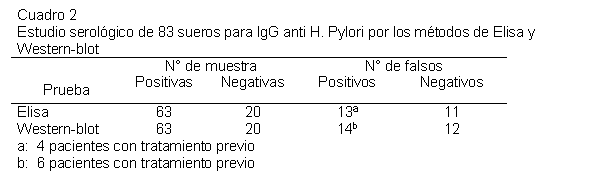
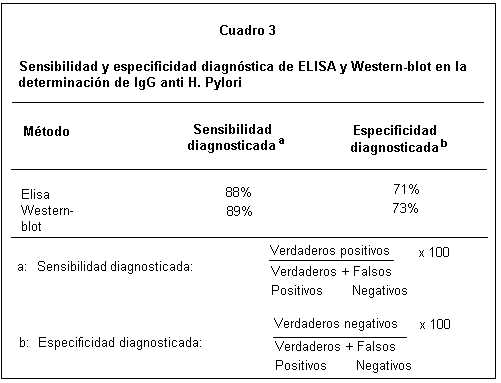
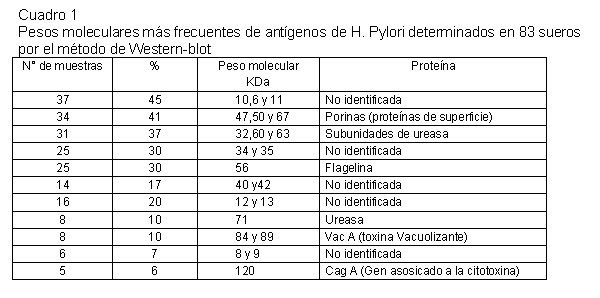
<body><![CDATA[<BR>&nbsp;      <P><FONT FACE="Arial"><FONT SIZE=-1>En el <A HREF="#cuadro1">Cuadro 1</A> se anotan las bandas de peso molecular m&aacute;s frecuentes encontradas en los 83 pacientes estudiados por IgG-anti <I>H. pylori</I> por Western–blot. Los anticuerpos m&aacute;s frecuentes (37 pacientes; 45%) se observaron contra ant&iacute;genos de peso molecular de 10,6 y 11 kDa, siendo prote&iacute;nas de <I>H. pylori</I> que a&uacute;n no han sido descritas y caracterizadas en inmunoelectrotransferencias. Le siguen en orden de frecuencia (41%) las bandas de peso molecular de 47, 50 y 67 kDa correspondiendo a porinas y prote&iacute;nas de superficie de la bacteria.34 Bandas de 32, 60 y 63 kDa caracterizadas como subunidades de ureasa 30-31 se presentaron en el Western-blot de 31 (37%) pacientes y otros 25 (30%) mostraron en el Western-blot bandas de 56 kDa correspondientes a la flagelina bacteriana.29 Asimismo, 25 (30%) pacientes presentaron en el Western-blot bandas de 34 y 35 kDa y 14 (17%) pacientes bandas de 40 y 42 kDa en su Western-blot, prote&iacute;nas a&uacute;n no identificadas. Ocho (10%) pacientes presentaron en el Western-blot reacci&oacute;n antig&eacute;nica contra una banda desconocida de 71 kDa.</FONT></FONT>      <P><FONT FACE="Arial"><FONT SIZE=-1>El <A HREF="#cuadro2">Cuadro 2</A> muestra los resultados obtenidos por el m&eacute;todo serol&oacute;gico de ELISA y con el Western–blot. El <A HREF="#cuadro3">Cuadro 3</A> presenta los valores de sensibilidad y especificidad diagn&oacute;stica del ELISA y del Western–blot, al compararlo con el estudio histol&oacute;gico.</FONT></FONT>     <BR>&nbsp;     <BR>&nbsp;     <BR>&nbsp;     <CENTER></CENTER>      <CENTER><A NAME="cuadro2"></A><IMG SRC="/img/fbpe/amc/v42n1/0762i2.GIF" HEIGHT=187 WIDTH=592></CENTER> &nbsp;     
<BR>&nbsp;     <BR>&nbsp;     ]]></body>
<body><![CDATA[<BR>&nbsp;      <P><B><FONT FACE="Arial"><FONT SIZE=-1>Discusi&oacute;n</FONT></FONT></B>     <BR>&nbsp;      <P><FONT FACE="Arial"><FONT SIZE=-1>La serolog&iacute;a ha encontrado su principal aplicaci&oacute;n en los estudios epidemiol&oacute;gicos y ha servido para conocer la prevalencia de H. pylori en varias poblaciones e investigar factores de origen geogr&aacute;fico, la situaci&oacute;n socioecon&oacute;mica, los antecedentes &eacute;tnicos y la edad.</FONT></FONT><SUP><FONT FACE="Arial,Helvetica"><FONT SIZE=-2><A HREF="#48">48</A></FONT></FONT></SUP>     <BR>&nbsp;     <BR>&nbsp;     <CENTER></CENTER>      <CENTER><A NAME="cuadro3"></A><IMG SRC="/img/fbpe/amc/v42n1/0762i3.GIF" BORDER=0 HEIGHT=383 WIDTH=501></CENTER> &nbsp;     
<BR>&nbsp;     <BR>&nbsp;      ]]></body>
<body><![CDATA[<P><FONT SIZE=-1><FONT FACE="Arial">En el </FONT><FONT FACE="Arial,Helvetica"><A HREF="#cuadro1">Cuadro 1</A></FONT><FONT FACE="Arial"> est&aacute;n anotadas las bandas de diferentes pesos moleculares m&aacute;s frecuentes encontradas en la prueba serol&oacute;gica de Western–blot. Cada una de ellas corresponde a los anticuerpos tipo IgG presentes en los sueros de los pacientes que reaccionaron ante la presencia de las diferentes prote&iacute;nas del <I>H. Pylori.</I></FONT></FONT>      <P><FONT FACE="Arial"><FONT SIZE=-1>Contra la banda de 120 kDa descrita como el Cag A, gen asociado a la citotoxina,</FONT></FONT><SUP><FONT FACE="Arial,Helvetica"><FONT SIZE=-2><A HREF="#23.">23-26 </A></FONT></FONT></SUP><FONT FACE="Arial"><FONT SIZE=-1>mostraron anticuerpos &uacute;nicamente 5 pacientes (6%), y contra la prote&iacute;na de 84 y 89 kDa denominada Vac A,</FONT></FONT><SUP><FONT FACE="Arial,Helvetica"><FONT SIZE=-2><A HREF="#22">22</A></FONT></FONT></SUP><FONT FACE="Arial"><FONT SIZE=-1> &uacute;nicamente dieron reacci&oacute;n inmunol&oacute;gica 8 pacientes (10%). Esto hace pensar que la mayor&iacute;a de las cepas de H. pylori aisladas de los pacientes probablemente sean tipo II, ya que muy pocas muestras evidenciaron presencia de anticuerpos tipo IgG contra las prote&iacute;nas Cag A y Vac A, y ninguno present&oacute; ambas bandas de peso molecular simult&aacute;neamente.</FONT></FONT>      <P><FONT FACE="Arial"><FONT SIZE=-1>Al comparar los resultados obtenidos con las muestras de suero estudiadas serol&oacute;gicamente por ELISA y Western–blot, se pueden observar resultados semejantes entre ambos m&eacute;todos.</FONT></FONT>      <P><FONT FACE="Arial"><FONT SIZE=-1>De las de 14 muestras negativas por biopsia con resultado positivo para Western-blot, 6 de ellas pertenecen a pacientes que recibieron tratamiento previo con antibi&oacute;ticos contra H. pylori, por lo que presentaron resultado positivo. De las 13 muestras negativas con resultados positivos para ELISA, 4 de ellas tambi&eacute;n pertenecen a pacientes que recibieron tratamiento. Por lo tanto estas 10 muestras no deben ser considerados como resultados falsos positivos verdaderos, pues es de esperar que dieran resultado negativo en el estudio histol&oacute;gico.</FONT></FONT>      <P><FONT FACE="Arial"><FONT SIZE=-1>De los falsos negativos por ambos m&eacute;todos serol&oacute;gicos, se podr&iacute;a suponer que se trata de pacientes reci&eacute;n infectados. La presencia de falsos positivos por serolog&iacute;a podr&iacute;a obedecer a reacciones cruzadas o al efecto de parche, debido a la distribuci&oacute;n desigual del <I>H. pylori</I> en la mucosa g&aacute;strica.</FONT></FONT><FONT SIZE=-2><SUP><FONT FACE="Arial,Helvetica"><A HREF="#45">45</A></FONT></SUP><FONT FACE="Arial">,</FONT><SUP><FONT FACE="Arial,Helvetica"><A HREF="#49">49-51</A></FONT></SUP></FONT>      <P><FONT FACE="Arial"><FONT SIZE=-1>El m&eacute;todo de ELISA como el de Weastern-blot presenta sensibilidad y especificidad diagn&oacute;stica semejantes, siendo la sensibilidad mayor que la especificidad, por lo que se observa mayor n&uacute;mero de falsos positivos. Sin embargo, para este c&aacute;lculo se excluyeron las 10 muestras cuyos pacientes hab&iacute;an recibido tratamiento. Algunos autores han informado la especificidad y la sensibilidad de las pruebas de ELISA comerciales superiores al 90%,</FONT></FONT><SUP><FONT FACE="Arial,Helvetica"><FONT SIZE=-2><A HREF="#40">40-41</A></FONT></FONT></SUP><FONT FACE="Arial"><FONT SIZE=-1> m&aacute;s altas que las obtenidas en nuestro estudio.</FONT></FONT>      <P><FONT FACE="Arial"><FONT SIZE=-1>En las diversas t&eacute;cnicas serol&oacute;gicas, como ELISA y el Western–blot, desarrolladas para la detecci&oacute;n de anticuerpos espec&iacute;ficos contra H. pylori se han empleado diferentes preparaciones antig&eacute;nicas, incluyendo organismos vivos, bacterias tratadas con formalina, sonicado bacteriano, tratados con calor, ultracentrifugado de sonicados bacteriano, ant&iacute;genos termoestables, extractos antig&eacute;nicos con glicerina &aacute;cida, preparaciones de ureasa bacteriana, ant&iacute;geno de citotoxina, prote&iacute;nas celulares de alto peso molecular y prote&iacute;nas de membrana externa.</FONT></FONT><SUP><FONT FACE="Arial,Helvetica"><FONT SIZE=-2><A HREF="#48">48</A></FONT></FONT></SUP>      <P><FONT FACE="Arial"><FONT SIZE=-1>Con objeto de que la t&eacute;cnica sea lo m&aacute;s sensible y espec&iacute;fica posible, el ant&iacute;geno usado debe contener componentes compartidos por la mayor&iacute;a de cepas de <I>H. pylori</I>, sin mostrar reacciones cruzadas con otros ant&iacute;genos bacterianos. La introducci&oacute;n de ant&iacute;genos m&aacute;s puros reduce la aparici&oacute;n de reacciones cruzadas y mejora la especificidad de la t&eacute;cnica.</FONT></FONT>      <P><FONT FACE="Arial"><FONT SIZE=-1>A pesar de la alta especificidad aportada por estos ant&iacute;genos parcial o altamente purificados, su empleo individual puede conllevar algunas desventajas, principalmente debidas a la reducci&oacute;n del nivel de sensibilidad del m&eacute;todo.</FONT></FONT><SUP><FONT FACE="Arial,Helvetica"><FONT SIZE=-2><A HREF="#48">48</A></FONT></FONT></SUP>      <P><FONT FACE="Arial"><FONT SIZE=-1>Si bien la composici&oacute;n del ant&iacute;geno ideal todav&iacute;a no ha sido determinada, parece razonable pensar que la combinaci&oacute;n de dos o m&aacute;s ant&iacute;genos purificados podr&iacute;a considerarse adecuada.</FONT></FONT><SUP><FONT FACE="Arial,Helvetica"><FONT SIZE=-2><A HREF="#48">48</A></FONT></FONT></SUP>      ]]></body>
<body><![CDATA[<P><FONT FACE="Arial"><FONT SIZE=-1>En este estudio se utiliz&oacute; un ant&iacute;geno completo de <I>H. pylori</I> para llevar a cabo la inmunoelectrotransferencia y ensayo enzim&aacute;tico, ya que se prepar&oacute; un sonicado de 41 cepas de las bacterias previamente aisladas, de los mismos pacientes a quienes se les realiz&oacute; el estudio serol&oacute;gico. Cabe recalcar que en este estudio solamente se trabaj&oacute; con un extracto crudo sonicado y que posiblemente si se utilizara un ant&iacute;geno m&aacute;s purificado se obtendr&iacute;a una mayor sensibilidad y especificidad de la prueba, pero al ser el primer estudio que se realiza en Costa Rica con esta metodolog&iacute;a para estudiar <I>H. pylori</I>, consideramos que los resultados obtenidos son muy prometedores y deber&iacute;a intentarse la estandarizaci&oacute;n de la metodolog&iacute;a.</FONT></FONT>      <P><FONT FACE="Arial"><FONT SIZE=-1>A pesar de que en el ELISA comercial se usaron cepas de <I>H. pylori</I> ajenas a nuestro medio, los resultados del desempe&ntilde;o cl&iacute;nico fueron muy semejantes a los obtenidos por Western-blot.</FONT></FONT>      <P><FONT FACE="Arial"><FONT SIZE=-1>Si bien la aplicaci&oacute;n de la serolog&iacute;a aporta ventajas al diagn&oacute;stico y al mejor conocimiento a nivel epidemiol&oacute;gico de la infecci&oacute;n por <I>H. pylori</I>, la interpretaci&oacute;n de los resultados obtenidos mediante procedimientos serol&oacute;gicos debe ser cautelosa y acompa&ntilde;arse de la historia cl&iacute;nica del paciente. Se recomienda realizar un estudio histol&oacute;gico de biopsia g&aacute;strica para un adecuado diagn&oacute;stico de la presencia de <I>H. pylori</I> en la mucosa g&aacute;strica.</FONT></FONT>     <BR>&nbsp;      <P><B><FONT FACE="Arial"><FONT SIZE=-1>Abstract</FONT></FONT></B>      <P><B><FONT FACE="Arial"><FONT SIZE=-1>Background and aim</FONT></FONT></B>      <P><FONT FACE="Arial"><FONT SIZE=-1>In Costa Rica the gastric cancer is the malignancy that produces more deaths. In other studies their pathology it has been associated with Helicobacter pylori. This bacteria is able to produce substances that alter the gastric mucosa, antigens that have been caracterized by Western-blot. The purpose of this study was to performed for the first time in our country a study of IgG-anti <I>H. pylori</I> by Western-blot to identify the antigens that induce an immune response, using sera and strains of H. pylori isolated from Costa Rican patients. Also the results obtained by Western-blot were compared with an ELISA test to determine the clinical sensibility and specificity using the gastric biopsy as reference.</FONT></FONT>      <P><B><FONT FACE="Arial"><FONT SIZE=-1>Method</FONT></FONT></B>      <P><FONT FACE="Arial"><FONT SIZE=-1>Samples consisted of gastric biopsies and sera from 83 patients refered to the Endoscopy Service of the San Vicente de Paul Hospital, Heredia. To each patient a histologic study of gastric biopsy was realized and antibodies study of IgG anti <I>H. pylori</I> by ELISA and Western-blot.</FONT></FONT>     <BR>&nbsp;      ]]></body>
<body><![CDATA[<P><B><FONT FACE="Arial"><FONT SIZE=-1>Results and conclutions</FONT></FONT></B>      <P><FONT FACE="Arial"><FONT SIZE=-1>In the Western-blot protein bands of different molecular weight with a predominance of <I>H. pylori</I> antigens of low molecular weight were observed. The Western-blot and ELISA had a clinical sensitivity of 89% and 88% and a clinical specificity of 73% and 71% respectively, when compared with the histology.</FONT></FONT>      <P><B><FONT FACE="Arial"><FONT SIZE=-1>Referencias</FONT></FONT></B>     <!-- ref --><BR>&nbsp; <DIR><A NAME="1"></A><FONT FACE="Arial,Helvetica"><FONT SIZE=-1>1. Peura D. Helicobacter pylori: practical guidelines for diagnosis and treatment. Gastroenterology 1993; 1(4): 291-295.</FONT></FONT>    &nbsp;&nbsp;&nbsp;&nbsp;&nbsp;&nbsp;&nbsp;&nbsp;[&#160;<a href="javascript:void(0);" onclick="javascript: window.open('/scielo.php?script=sci_nlinks&ref=000334&pid=S0001-6002200000010000700001&lng=','','width=640,height=500,resizable=yes,scrollbars=1,menubar=yes,');">Links</a>&#160;]<!-- end-ref --><!-- ref --><P><A NAME="2"></A><FONT FACE="Arial,Helvetica"><FONT SIZE=-1>2. Fennerty M. Helicobacter pylori. Arch Intern Med 1994; 154(7):721-727.</FONT></FONT>    &nbsp;&nbsp;&nbsp;&nbsp;&nbsp;&nbsp;&nbsp;&nbsp;[&#160;<a href="javascript:void(0);" onclick="javascript: window.open('/scielo.php?script=sci_nlinks&ref=000335&pid=S0001-6002200000010000700002&lng=','','width=640,height=500,resizable=yes,scrollbars=1,menubar=yes,');">Links</a>&#160;]<!-- end-ref --><!-- ref --><P><A NAME="3"></A><FONT FACE="Arial,Helvetica"><FONT SIZE=-1>3. Labenz J, Borsch G. Evidence for the essential role of Helicobacter pylori in gastric ulcer disease. Gut 1994; 35(1): 19-22.</FONT></FONT>    &nbsp;&nbsp;&nbsp;&nbsp;&nbsp;&nbsp;&nbsp;&nbsp;[&#160;<a href="javascript:void(0);" onclick="javascript: window.open('/scielo.php?script=sci_nlinks&ref=000336&pid=S0001-6002200000010000700003&lng=','','width=640,height=500,resizable=yes,scrollbars=1,menubar=yes,');">Links</a>&#160;]<!-- end-ref --><!-- ref --><P><A NAME="4"></A><FONT FACE="Arial,Helvetica"><FONT SIZE=-1>4. Fontham E, Ruiz B, P&eacute;rez A, Hunter F, Correa P. Determinants of Helicobacter pylori infection and chronic gastritis. Am J Gastroenterol 1995; 90(7): 1094-1101.</FONT></FONT>    &nbsp;&nbsp;&nbsp;&nbsp;&nbsp;&nbsp;&nbsp;&nbsp;[&#160;<a href="javascript:void(0);" onclick="javascript: window.open('/scielo.php?script=sci_nlinks&ref=000337&pid=S0001-6002200000010000700004&lng=','','width=640,height=500,resizable=yes,scrollbars=1,menubar=yes,');">Links</a>&#160;]<!-- end-ref --><!-- ref --><P><A NAME="5"></A><FONT FACE="Arial,Helvetica"><FONT SIZE=-1>5. Rex D. An etiologic approach to management of duodenal and gastric ulcer. J Fam Pract 1994; 38(1): 60-67.</FONT></FONT>    &nbsp;&nbsp;&nbsp;&nbsp;&nbsp;&nbsp;&nbsp;&nbsp;[&#160;<a href="javascript:void(0);" onclick="javascript: window.open('/scielo.php?script=sci_nlinks&ref=000338&pid=S0001-6002200000010000700005&lng=','','width=640,height=500,resizable=yes,scrollbars=1,menubar=yes,');">Links</a>&#160;]<!-- end-ref --><!-- ref --><P><A NAME="6"></A><FONT FACE="Arial,Helvetica"><FONT SIZE=-1>6. Partipilo M, Woster P. The role of Helicobacter pylori in peptic ulcer disease. Pharmacotherapy 1993; 13(4): 330-339.</FONT></FONT>    &nbsp;&nbsp;&nbsp;&nbsp;&nbsp;&nbsp;&nbsp;&nbsp;[&#160;<a href="javascript:void(0);" onclick="javascript: window.open('/scielo.php?script=sci_nlinks&ref=000339&pid=S0001-6002200000010000700006&lng=','','width=640,height=500,resizable=yes,scrollbars=1,menubar=yes,');">Links</a>&#160;]<!-- end-ref --><!-- ref --><P><A NAME="7"></A><FONT FACE="Arial,Helvetica"><FONT SIZE=-1>7. Velhuyzen S, Sherman Ph. Helicobacter pylori infection as a cause of gastritis, duodenal ulcer, gastric cancer and non ulcer dyspepsia: a systematic overview. Can Med Assoc J 1994; 150(2): 177-185.</FONT></FONT>    &nbsp;&nbsp;&nbsp;&nbsp;&nbsp;&nbsp;&nbsp;&nbsp;[&#160;<a href="javascript:void(0);" onclick="javascript: window.open('/scielo.php?script=sci_nlinks&ref=000340&pid=S0001-6002200000010000700007&lng=','','width=640,height=500,resizable=yes,scrollbars=1,menubar=yes,');">Links</a>&#160;]<!-- end-ref --><!-- ref --><P><A NAME="8"></A><FONT FACE="Arial,Helvetica"><FONT SIZE=-1>8. Marshall B. Helicobacter pylori: a primer for 1994. Gastroenterologist 1993; 1(4): 241-247.</FONT></FONT>    &nbsp;&nbsp;&nbsp;&nbsp;&nbsp;&nbsp;&nbsp;&nbsp;[&#160;<a href="javascript:void(0);" onclick="javascript: window.open('/scielo.php?script=sci_nlinks&ref=000341&pid=S0001-6002200000010000700008&lng=','','width=640,height=500,resizable=yes,scrollbars=1,menubar=yes,');">Links</a>&#160;]<!-- end-ref --><!-- ref --><P><A NAME="9"></A><FONT FACE="Arial,Helvetica"><FONT SIZE=-1>9. O'Connor H. The role of Helicobacter pylori in peptic ulcer disease. Scand Gastroenterol Suppl 1994; 201: 11-15.</FONT></FONT>    &nbsp;&nbsp;&nbsp;&nbsp;&nbsp;&nbsp;&nbsp;&nbsp;[&#160;<a href="javascript:void(0);" onclick="javascript: window.open('/scielo.php?script=sci_nlinks&ref=000342&pid=S0001-6002200000010000700009&lng=','','width=640,height=500,resizable=yes,scrollbars=1,menubar=yes,');">Links</a>&#160;]<!-- end-ref --><!-- ref --><P><A NAME="10"></A><FONT FACE="Arial,Helvetica"><FONT SIZE=-1>10. Levine T, Price A. Helicobacter pylori: enough to give anyone an ulcer! Br J Clin Pract 1994; 47(6): 328-332.</FONT></FONT>    &nbsp;&nbsp;&nbsp;&nbsp;&nbsp;&nbsp;&nbsp;&nbsp;[&#160;<a href="javascript:void(0);" onclick="javascript: window.open('/scielo.php?script=sci_nlinks&ref=000343&pid=S0001-6002200000010000700010&lng=','','width=640,height=500,resizable=yes,scrollbars=1,menubar=yes,');">Links</a>&#160;]<!-- end-ref --><!-- ref --><P><A NAME="11"></A><FONT FACE="Arial,Helvetica"><FONT SIZE=-1>11. Tatsuta M, Tishi H, Okuda S, Taniguchi H, Vokota Y. The association of Helicobacter pylori with differentiated type early gastric cancer. Cancer 1993; 2(6): 1841-1845.</FONT></FONT>    &nbsp;&nbsp;&nbsp;&nbsp;&nbsp;&nbsp;&nbsp;&nbsp;[&#160;<a href="javascript:void(0);" onclick="javascript: window.open('/scielo.php?script=sci_nlinks&ref=000344&pid=S0001-6002200000010000700011&lng=','','width=640,height=500,resizable=yes,scrollbars=1,menubar=yes,');">Links</a>&#160;]<!-- end-ref --><!-- ref --><P><A NAME="12"></A><FONT FACE="Arial,Helvetica"><FONT SIZE=-1>12. Hu P, Mitchell H, Li Y, Zhou M, Hazell S. Association of Helicobacter pylori with gastric cancer and observations on the detection of this bacterium in gastric cancer cases . Am J G astroenterol 1994; 89(10): 1806-1810.</FONT></FONT>    &nbsp;&nbsp;&nbsp;&nbsp;&nbsp;&nbsp;&nbsp;&nbsp;[&#160;<a href="javascript:void(0);" onclick="javascript: window.open('/scielo.php?script=sci_nlinks&ref=000345&pid=S0001-6002200000010000700012&lng=','','width=640,height=500,resizable=yes,scrollbars=1,menubar=yes,');">Links</a>&#160;]<!-- end-ref --><!-- ref --><P><A NAME="13"></A><FONT FACE="Arial,Helvetica"><FONT SIZE=-1>13. DeKoster E, Ruset M, Fern&aacute;ndez E, Delteme M. Helicobacter pylori, the link with gastric cancer. Eur J Cancer Prev 1994; 3(3): 247-257.</FONT></FONT>    &nbsp;&nbsp;&nbsp;&nbsp;&nbsp;&nbsp;&nbsp;&nbsp;[&#160;<a href="javascript:void(0);" onclick="javascript: window.open('/scielo.php?script=sci_nlinks&ref=000346&pid=S0001-6002200000010000700013&lng=','','width=640,height=500,resizable=yes,scrollbars=1,menubar=yes,');">Links</a>&#160;]<!-- end-ref --><!-- ref --><P><A NAME="14"></A><FONT FACE="Arial,Helvetica"><FONT SIZE=-1>14. Correa P. Human gastric carcinogenesis: a multistep and multifactorial process-First American Cancer Society award lecture on cancer epidemiology and prevention. Cancer Research 1992; 52: 6735-6740.</FONT></FONT>    &nbsp;&nbsp;&nbsp;&nbsp;&nbsp;&nbsp;&nbsp;&nbsp;[&#160;<a href="javascript:void(0);" onclick="javascript: window.open('/scielo.php?script=sci_nlinks&ref=000347&pid=S0001-6002200000010000700014&lng=','','width=640,height=500,resizable=yes,scrollbars=1,menubar=yes,');">Links</a>&#160;]<!-- end-ref --><!-- ref --><P><A NAME="15"></A><FONT FACE="Arial,Helvetica"><FONT SIZE=-1>15. Goh K, Parasakthi N, Peh S, Puthucheary S, Wong N. The rapid urease test in the diagnosis of Helicobacter pylori infection. Singapore Med J 1994;35(2):161-162.</FONT></FONT>    &nbsp;&nbsp;&nbsp;&nbsp;&nbsp;&nbsp;&nbsp;&nbsp;[&#160;<a href="javascript:void(0);" onclick="javascript: window.open('/scielo.php?script=sci_nlinks&ref=000348&pid=S0001-6002200000010000700015&lng=','','width=640,height=500,resizable=yes,scrollbars=1,menubar=yes,');">Links</a>&#160;]<!-- end-ref --><!-- ref --><P><A NAME="16"></A><FONT FACE="Arial,Helvetica"><FONT SIZE=-1>16. Correa P. Helicobacter pylori and gastric carcinogenesis. Am J Sur Phatol 1995; 19 (suppl I): 537-543.</FONT></FONT>    &nbsp;&nbsp;&nbsp;&nbsp;&nbsp;&nbsp;&nbsp;&nbsp;[&#160;<a href="javascript:void(0);" onclick="javascript: window.open('/scielo.php?script=sci_nlinks&ref=000349&pid=S0001-6002200000010000700016&lng=','','width=640,height=500,resizable=yes,scrollbars=1,menubar=yes,');">Links</a>&#160;]<!-- end-ref --><!-- ref --><P><A NAME="17"></A><FONT FACE="Arial,Helvetica"><FONT SIZE=-1>17. Matamoros M and Bertoli M. Helicobacter pylori y el c&aacute;ncer g&aacute;strico &iquest;Hacia d&oacute;nde dirigir nuestros esfuerzos? Sem Epidemiolog 1996; 49: 1-2.</FONT></FONT>    &nbsp;&nbsp;&nbsp;&nbsp;&nbsp;&nbsp;&nbsp;&nbsp;[&#160;<a href="javascript:void(0);" onclick="javascript: window.open('/scielo.php?script=sci_nlinks&ref=000350&pid=S0001-6002200000010000700017&lng=','','width=640,height=500,resizable=yes,scrollbars=1,menubar=yes,');">Links</a>&#160;]<!-- end-ref --><!-- ref --><P><A NAME="18"></A><FONT FACE="Arial,Helvetica"><FONT SIZE=-1>18. Bartels G, Herrera A, Salas P, Sierra R, Lomonte B. Antibodies to Helicobacter pylori in dyspeptic patients, asymptomatic adults, and children from Costa Rica. MIS 1995; 103: 428-432.</FONT></FONT>    &nbsp;&nbsp;&nbsp;&nbsp;&nbsp;&nbsp;&nbsp;&nbsp;[&#160;<a href="javascript:void(0);" onclick="javascript: window.open('/scielo.php?script=sci_nlinks&ref=000351&pid=S0001-6002200000010000700018&lng=','','width=640,height=500,resizable=yes,scrollbars=1,menubar=yes,');">Links</a>&#160;]<!-- end-ref --><!-- ref --><P><A NAME="19"></A><FONT FACE="Arial,Helvetica"><FONT SIZE=-1>19. Sierra R, Mu&ntilde;oz R, Pe&ntilde;a A, Biemond I, Van Duijn W, Lamers C, Teuchmann S. Antibodies to Helicobacter pylori and pepsinogen level in children from Costa Rica: Comparison of two areas with different risks for stomach cancer. Cancer Epidemiol Biomark Prevent 1992; 1: 449-454.</FONT></FONT>    &nbsp;&nbsp;&nbsp;&nbsp;&nbsp;&nbsp;&nbsp;&nbsp;[&#160;<a href="javascript:void(0);" onclick="javascript: window.open('/scielo.php?script=sci_nlinks&ref=000352&pid=S0001-6002200000010000700019&lng=','','width=640,height=500,resizable=yes,scrollbars=1,menubar=yes,');">Links</a>&#160;]<!-- end-ref --><!-- ref --><P><A NAME="20"></A><FONT FACE="Arial,Helvetica"><FONT SIZE=-1>20. Hern&aacute;ndez F, Rivera P. Infecciones por Helicobacter pylori en ni&ntilde;os. Acta Ped Costarric 1995; 9 (3): 90-93.</FONT></FONT>    &nbsp;&nbsp;&nbsp;&nbsp;&nbsp;&nbsp;&nbsp;&nbsp;[&#160;<a href="javascript:void(0);" onclick="javascript: window.open('/scielo.php?script=sci_nlinks&ref=000353&pid=S0001-6002200000010000700020&lng=','','width=640,height=500,resizable=yes,scrollbars=1,menubar=yes,');">Links</a>&#160;]<!-- end-ref --><!-- ref --><P><A NAME="21"></A><FONT FACE="Arial,Helvetica"><FONT SIZE=-1>21. Hern&aacute;ndez F, Rivera P, Sigar&aacute;n M, Miranda S., Rodr&iacute;guez O, Murillo M, Con-Wong R. Helicobacter pylori en pacientes con &uacute;lceras p&eacute;pticas y en individuos sin alteraciones gastrointestinales. Rev Cost Cienc Med 1994, 15 (1,2): 31-34.</FONT></FONT>    &nbsp;&nbsp;&nbsp;&nbsp;&nbsp;&nbsp;&nbsp;&nbsp;[&#160;<a href="javascript:void(0);" onclick="javascript: window.open('/scielo.php?script=sci_nlinks&ref=000354&pid=S0001-6002200000010000700021&lng=','','width=640,height=500,resizable=yes,scrollbars=1,menubar=yes,');">Links</a>&#160;]<!-- end-ref --><!-- ref --><P><A NAME="22"></A><FONT FACE="Arial,Helvetica"><FONT SIZE=-1>22. Leunk R. Production of a cytotoxin by Helicobacter pylori. Rev Infect Dis 1991; 13(suppl 8): S686-689.</FONT></FONT>    &nbsp;&nbsp;&nbsp;&nbsp;&nbsp;&nbsp;&nbsp;&nbsp;[&#160;<a href="javascript:void(0);" onclick="javascript: window.open('/scielo.php?script=sci_nlinks&ref=000355&pid=S0001-6002200000010000700022&lng=','','width=640,height=500,resizable=yes,scrollbars=1,menubar=yes,');">Links</a>&#160;]<!-- end-ref --><!-- ref --><P><A NAME="23."></A><FONT FACE="Arial,Helvetica"><FONT SIZE=-1>23. Covacci A, Censini S, Bugnoli M, Petracca R, Burroni D, Macchia G, Massone A, Papini E, Xiang Z, Figura N, Rappuoli R. Molecular characterization of the 128 kDa inmunodominant antigen of Helicobacter pylori associated with citotoxicity and duodenal ulcer. Proc Natl Acad Sci EEUU 1993; 90: 5791-5795.</FONT></FONT>    &nbsp;&nbsp;&nbsp;&nbsp;&nbsp;&nbsp;&nbsp;&nbsp;[&#160;<a href="javascript:void(0);" onclick="javascript: window.open('/scielo.php?script=sci_nlinks&ref=000356&pid=S0001-6002200000010000700023&lng=','','width=640,height=500,resizable=yes,scrollbars=1,menubar=yes,');">Links</a>&#160;]<!-- end-ref --><!-- ref --><P><A NAME="24"></A><FONT FACE="Arial,Helvetica"><FONT SIZE=-1>24. Tummuru M, Cover T and Blaser M. Cloning and expression of a high - molecular - mass major antigen of Helicobacter pylori: evidence of linkage to cytotoxin production. Infect Imm 1993; 61 (5): 1799-1809.</FONT></FONT>    &nbsp;&nbsp;&nbsp;&nbsp;&nbsp;&nbsp;&nbsp;&nbsp;[&#160;<a href="javascript:void(0);" onclick="javascript: window.open('/scielo.php?script=sci_nlinks&ref=000357&pid=S0001-6002200000010000700024&lng=','','width=640,height=500,resizable=yes,scrollbars=1,menubar=yes,');">Links</a>&#160;]<!-- end-ref --><!-- ref --><P><A NAME="25"></A><FONT FACE="Arial,Helvetica"><FONT SIZE=-1>25. Phadnis S, Ilver D, Janson L, Normark S and Westblom U. Pathological significance and molecular characterization of the vacuolating toxin gene of Helicobacter pylori. Infect Imm 1994; 62 (5): 1557-1565.</FONT></FONT>    &nbsp;&nbsp;&nbsp;&nbsp;&nbsp;&nbsp;&nbsp;&nbsp;[&#160;<a href="javascript:void(0);" onclick="javascript: window.open('/scielo.php?script=sci_nlinks&ref=000358&pid=S0001-6002200000010000700025&lng=','','width=640,height=500,resizable=yes,scrollbars=1,menubar=yes,');">Links</a>&#160;]<!-- end-ref --><!-- ref --><P><A NAME="26"></A><FONT FACE="Arial,Helvetica"><FONT SIZE=-1>26. Husson M, Gottrand F, Vachee A, Dhaenens L, Martin E, Turck D, Houcke M, Lecler H. Importance in diagnosis of gastritis of detection by PCR of the cag A gene in Helicobacter pylori strains isolated from children. J Clin Microbiol 1995; 33 (12): 3300-3303.</FONT></FONT>    &nbsp;&nbsp;&nbsp;&nbsp;&nbsp;&nbsp;&nbsp;&nbsp;[&#160;<a href="javascript:void(0);" onclick="javascript: window.open('/scielo.php?script=sci_nlinks&ref=000359&pid=S0001-6002200000010000700026&lng=','','width=640,height=500,resizable=yes,scrollbars=1,menubar=yes,');">Links</a>&#160;]<!-- end-ref --><!-- ref --><P><A NAME="27"></A><FONT FACE="Arial,Helvetica"><FONT SIZE=-1>27. Covacci A, Falkow S, Berg D, Rappuoli R. Did the inheritance of a pathogenicity island modify the virulence of Helicobacter pylori? Trends in Microbiol 1977; 5(5): 205-208.</FONT></FONT>    &nbsp;&nbsp;&nbsp;&nbsp;&nbsp;&nbsp;&nbsp;&nbsp;[&#160;<a href="javascript:void(0);" onclick="javascript: window.open('/scielo.php?script=sci_nlinks&ref=000360&pid=S0001-6002200000010000700027&lng=','','width=640,height=500,resizable=yes,scrollbars=1,menubar=yes,');">Links</a>&#160;]<!-- end-ref --><!-- ref --><P><A NAME="28"></A><FONT FACE="Arial,Helvetica"><FONT SIZE=-1>28. Xiang Z, Censini S, Bayeli P, Telford J, Figura n, Rappuoli R, Covacci A. Analysis of expression of Cag A and Vac A virulence factors in 43 strains of Helicobacter pylori reveals that clinical isolates can be divided into two major types and that Cag A is not necessary for expresion of the vacuolating cytotoxin. Infect Imm 1995; 63 (1): 94-98.</FONT></FONT>    &nbsp;&nbsp;&nbsp;&nbsp;&nbsp;&nbsp;&nbsp;&nbsp;[&#160;<a href="javascript:void(0);" onclick="javascript: window.open('/scielo.php?script=sci_nlinks&ref=000361&pid=S0001-6002200000010000700028&lng=','','width=640,height=500,resizable=yes,scrollbars=1,menubar=yes,');">Links</a>&#160;]<!-- end-ref --><!-- ref --><P><A NAME="29"></A><FONT FACE="Arial,Helvetica"><FONT SIZE=-1>29. Kostrzynska M, Betts J, Austin J, Trust T. Identification, characterization and spatial localization of two flagellin species in Helicobacter pylori flagela. J Bacteriol 1991; 173: 937-946.</FONT></FONT>    &nbsp;&nbsp;&nbsp;&nbsp;&nbsp;&nbsp;&nbsp;&nbsp;[&#160;<a href="javascript:void(0);" onclick="javascript: window.open('/scielo.php?script=sci_nlinks&ref=000362&pid=S0001-6002200000010000700029&lng=','','width=640,height=500,resizable=yes,scrollbars=1,menubar=yes,');">Links</a>&#160;]<!-- end-ref --><!-- ref --><P><A NAME="30"></A><FONT FACE="Arial,Helvetica"><FONT SIZE=-1>30. Austin J, Doig P, Stewart M, Trust T. Structural comparison of urease and a GroEL analog from Helicobacter pylori. J Bacteriol 1992; 174: 7470-7473.</FONT></FONT>    &nbsp;&nbsp;&nbsp;&nbsp;&nbsp;&nbsp;&nbsp;&nbsp;[&#160;<a href="javascript:void(0);" onclick="javascript: window.open('/scielo.php?script=sci_nlinks&ref=000363&pid=S0001-6002200000010000700030&lng=','','width=640,height=500,resizable=yes,scrollbars=1,menubar=yes,');">Links</a>&#160;]<!-- end-ref --><!-- ref --><P><A NAME="31"></A><FONT FACE="Arial,Helvetica"><FONT SIZE=-1>31. Dunn B, Cambell G, Perezperez G, Blaser M. Purification and charaterization of urease from Helicobacter pylori. J Biol Chem 1990; 254: 9464-9469.</FONT></FONT>    &nbsp;&nbsp;&nbsp;&nbsp;&nbsp;&nbsp;&nbsp;&nbsp;[&#160;<a href="javascript:void(0);" onclick="javascript: window.open('/scielo.php?script=sci_nlinks&ref=000364&pid=S0001-6002200000010000700031&lng=','','width=640,height=500,resizable=yes,scrollbars=1,menubar=yes,');">Links</a>&#160;]<!-- end-ref --><!-- ref --><P><A NAME="32"></A><FONT FACE="Arial,Helvetica"><FONT SIZE=-1>32. Kostrzynska M, O’toole P, Taylor D, Trust T. Molecular characterization of a conserved 20 -kilodalton membrane- associated lipoprotein antigen of Helicobacter pylori. J Bacteriol 1994; 176 (19): 5938-5948.</FONT></FONT>    &nbsp;&nbsp;&nbsp;&nbsp;&nbsp;&nbsp;&nbsp;&nbsp;[&#160;<a href="javascript:void(0);" onclick="javascript: window.open('/scielo.php?script=sci_nlinks&ref=000365&pid=S0001-6002200000010000700032&lng=','','width=640,height=500,resizable=yes,scrollbars=1,menubar=yes,');">Links</a>&#160;]<!-- end-ref --><!-- ref --><P><A NAME="33"></A><FONT FACE="Arial,Helvetica"><FONT SIZE=-1>33. Doig P, Austin J, Kostrzynska M, Trust T. Production of a conserved adhesin by the human gastroduodenal pathogen Helicobacter pylori. J Bacteriol 1992; 174(8): 2539-2547.</FONT></FONT>    &nbsp;&nbsp;&nbsp;&nbsp;&nbsp;&nbsp;&nbsp;&nbsp;[&#160;<a href="javascript:void(0);" onclick="javascript: window.open('/scielo.php?script=sci_nlinks&ref=000366&pid=S0001-6002200000010000700033&lng=','','width=640,height=500,resizable=yes,scrollbars=1,menubar=yes,');">Links</a>&#160;]<!-- end-ref --><!-- ref --><P><A NAME="34"></A><FONT FACE="Arial,Helvetica"><FONT SIZE=-1>34. Exner M, Doig P, Trust T, Hancock R. Isolation and characterization of a family of porin proteins from Helicobacter pylori. Inf Imm 1995; 63(4): 1567-1572.</FONT></FONT>    &nbsp;&nbsp;&nbsp;&nbsp;&nbsp;&nbsp;&nbsp;&nbsp;[&#160;<a href="javascript:void(0);" onclick="javascript: window.open('/scielo.php?script=sci_nlinks&ref=000367&pid=S0001-6002200000010000700034&lng=','','width=640,height=500,resizable=yes,scrollbars=1,menubar=yes,');">Links</a>&#160;]<!-- end-ref --><!-- ref --><P><A NAME="35"></A><FONT FACE="Arial,Helvetica"><FONT SIZE=-1>35. Doig P, Exner M, Hancock R, Trust T. Isolation and characterizastion of a conserved porin protein from Helicobacter pylori. J Bacteriol 1995; 177(19): 5447-5442.</FONT></FONT>    &nbsp;&nbsp;&nbsp;&nbsp;&nbsp;&nbsp;&nbsp;&nbsp;[&#160;<a href="javascript:void(0);" onclick="javascript: window.open('/scielo.php?script=sci_nlinks&ref=000368&pid=S0001-6002200000010000700035&lng=','','width=640,height=500,resizable=yes,scrollbars=1,menubar=yes,');">Links</a>&#160;]<!-- end-ref --><!-- ref --><P><A NAME="36"></A><FONT FACE="Arial,Helvetica"><FONT SIZE=-1>36. Evans D, Evans D, Takemura T, Nakano H, Lampert H, Graham D, Granger D, Kuietys P. Characterization of a Helicobacter pylori neutrophil-activating protein. Infect Imm 1995; 63 (6): 2143-2220.</FONT></FONT>    &nbsp;&nbsp;&nbsp;&nbsp;&nbsp;&nbsp;&nbsp;&nbsp;[&#160;<a href="javascript:void(0);" onclick="javascript: window.open('/scielo.php?script=sci_nlinks&ref=000369&pid=S0001-6002200000010000700036&lng=','','width=640,height=500,resizable=yes,scrollbars=1,menubar=yes,');">Links</a>&#160;]<!-- end-ref --><!-- ref --><P><A NAME="37"></A><FONT FACE="Arial,Helvetica"><FONT SIZE=-1>37. Simor A, Lin E, Saibil F, Cohen L, Louie M, Pearen S, Donhoffer H. Evaluation of enzyme immunoassay for detection of salivary antibody to Helicobacter pylori. J Clin Microbiol 1996; 34 (3): 550-553.</FONT></FONT>    &nbsp;&nbsp;&nbsp;&nbsp;&nbsp;&nbsp;&nbsp;&nbsp;[&#160;<a href="javascript:void(0);" onclick="javascript: window.open('/scielo.php?script=sci_nlinks&ref=000370&pid=S0001-6002200000010000700037&lng=','','width=640,height=500,resizable=yes,scrollbars=1,menubar=yes,');">Links</a>&#160;]<!-- end-ref --><!-- ref --><P><A NAME="38"></A><FONT FACE="Arial,Helvetica"><FONT SIZE=-1>38. Newell D. The principles and practices of the serodiagnosis of Helicobacter pylori infection. Lab Medica International 1991; VIII (6): 7-11.</FONT></FONT>    &nbsp;&nbsp;&nbsp;&nbsp;&nbsp;&nbsp;&nbsp;&nbsp;[&#160;<a href="javascript:void(0);" onclick="javascript: window.open('/scielo.php?script=sci_nlinks&ref=000371&pid=S0001-6002200000010000700038&lng=','','width=640,height=500,resizable=yes,scrollbars=1,menubar=yes,');">Links</a>&#160;]<!-- end-ref --><!-- ref --><P><A NAME="39"></A><FONT FACE="Arial,Helvetica"><FONT SIZE=-1>39. L&oacute;pez-Brea M, Mart&iacute;n E, Alarc&oacute;n T, Acu&ntilde;a M, Gimeno M, Sanz J. Seguimiento de la respuesta serol&oacute;gica cuantitativa al tratamiento de la infecci&oacute;n por Helicobacter pylori en ni&ntilde;os. Enf Infecc Microbiol Clin 1993; 11 (1): 33-35.</FONT></FONT>    &nbsp;&nbsp;&nbsp;&nbsp;&nbsp;&nbsp;&nbsp;&nbsp;[&#160;<a href="javascript:void(0);" onclick="javascript: window.open('/scielo.php?script=sci_nlinks&ref=000372&pid=S0001-6002200000010000700039&lng=','','width=640,height=500,resizable=yes,scrollbars=1,menubar=yes,');">Links</a>&#160;]<!-- end-ref --><!-- ref --><P><A NAME="40"></A><FONT FACE="Arial,Helvetica"><FONT SIZE=-1>40. Gossens H, Glupczynski Y, Burette A, van den Borre C, Butzler J. Evaluation of a comercially available second-generation in inmunoglobulin G enzyme immunoassay for detection of Helicobacter pylori infection. J Clin Microbiol 1995; 30: 179-180.</FONT></FONT>    &nbsp;&nbsp;&nbsp;&nbsp;&nbsp;&nbsp;&nbsp;&nbsp;[&#160;<a href="javascript:void(0);" onclick="javascript: window.open('/scielo.php?script=sci_nlinks&ref=000373&pid=S0001-6002200000010000700040&lng=','','width=640,height=500,resizable=yes,scrollbars=1,menubar=yes,');">Links</a>&#160;]<!-- end-ref --><!-- ref --><P><A NAME="41"></A><FONT FACE="Arial,Helvetica"><FONT SIZE=-1>41. Loffeld R, Uriese W, Stobberingh E. Usefulness of several comercial enzyme- linked immunoassays for detection of Helicobacter pylori in clinical medicine. Eur J Gastroenterol Hepatol 1993; 5: 333-337.</FONT></FONT>    &nbsp;&nbsp;&nbsp;&nbsp;&nbsp;&nbsp;&nbsp;&nbsp;[&#160;<a href="javascript:void(0);" onclick="javascript: window.open('/scielo.php?script=sci_nlinks&ref=000374&pid=S0001-6002200000010000700041&lng=','','width=640,height=500,resizable=yes,scrollbars=1,menubar=yes,');">Links</a>&#160;]<!-- end-ref --><!-- ref --><P><A NAME="42"></A><FONT FACE="Arial,Helvetica"><FONT SIZE=-1>42. Tummuru M, Cover T and Blaser M. Mutation of the citotoxin - Associated cag A genes does not affect the vacuolating cytotoxin activity of Helicobacter pylor. Infect Imm 1994; 62 (6): 2609-2613.</FONT></FONT>    &nbsp;&nbsp;&nbsp;&nbsp;&nbsp;&nbsp;&nbsp;&nbsp;[&#160;<a href="javascript:void(0);" onclick="javascript: window.open('/scielo.php?script=sci_nlinks&ref=000375&pid=S0001-6002200000010000700042&lng=','','width=640,height=500,resizable=yes,scrollbars=1,menubar=yes,');">Links</a>&#160;]<!-- end-ref --><!-- ref --><P><A NAME="43"></A><FONT FACE="Arial,Helvetica"><FONT SIZE=-1>43. Taylor D, Eaton M, Chang N and Salama S. Construction of a Helicobacter pylori Genoma Map and Demonstration of Diversity at the Genoma Level. J Bacteriol 1992; 174 (21): 6800-6806.</FONT></FONT>    &nbsp;&nbsp;&nbsp;&nbsp;&nbsp;&nbsp;&nbsp;&nbsp;[&#160;<a href="javascript:void(0);" onclick="javascript: window.open('/scielo.php?script=sci_nlinks&ref=000376&pid=S0001-6002200000010000700043&lng=','','width=640,height=500,resizable=yes,scrollbars=1,menubar=yes,');">Links</a>&#160;]<!-- end-ref --><!-- ref --><P><A NAME="44"></A><FONT FACE="Arial,Helvetica"><FONT SIZE=-1>44. Husson M, Gottran F, Vachee A, Dhaenens L, Martin E, Turcke D, et.al. Importance in diagnosis of gastritis of detection by PCR of the Cag A gene in Helicobacter pyklori strains isolated from children. J Clin Microbiol 1995; 33(12): 3300-3303.</FONT></FONT>    &nbsp;&nbsp;&nbsp;&nbsp;&nbsp;&nbsp;&nbsp;&nbsp;[&#160;<a href="javascript:void(0);" onclick="javascript: window.open('/scielo.php?script=sci_nlinks&ref=000377&pid=S0001-6002200000010000700044&lng=','','width=640,height=500,resizable=yes,scrollbars=1,menubar=yes,');">Links</a>&#160;]<!-- end-ref --><!-- ref --><P><A NAME="45"></A><FONT FACE="Arial,Helvetica"><FONT SIZE=-1>45. Barthel J, Everett D. Diagnosis of Campylobacter pylori infections: the "Gold Standard" and the alternatives. Rev Infect Dis 1990, 12(Suppl1): 5107-5114.</FONT></FONT>    &nbsp;&nbsp;&nbsp;&nbsp;&nbsp;&nbsp;&nbsp;&nbsp;[&#160;<a href="javascript:void(0);" onclick="javascript: window.open('/scielo.php?script=sci_nlinks&ref=000378&pid=S0001-6002200000010000700045&lng=','','width=640,height=500,resizable=yes,scrollbars=1,menubar=yes,');">Links</a>&#160;]<!-- end-ref --><!-- ref --><P><A NAME="46"></A><FONT FACE="Arial,Helvetica"><FONT SIZE=-1>46. Milenia IgG H pylori. DPC Biermann GmbH. Diagnostic Product Corporation. PIMKHP-C.</FONT></FONT>    &nbsp;&nbsp;&nbsp;&nbsp;&nbsp;&nbsp;&nbsp;&nbsp;[&#160;<a href="javascript:void(0);" onclick="javascript: window.open('/scielo.php?script=sci_nlinks&ref=000379&pid=S0001-6002200000010000700046&lng=','','width=640,height=500,resizable=yes,scrollbars=1,menubar=yes,');">Links</a>&#160;]<!-- end-ref --><!-- ref --><P><A NAME="47"></A><FONT FACE="Arial,Helvetica"><FONT SIZE=-1>47. Garc&iacute;a Z, Taylor L, Arauz P. Manual de inmunoelectrotransferencia y ensayo enzim&aacute;tico (Western-Blot) para la determinaci&oacute;n de anticuerpos contra el virus de inmunodeficiencia humano tipo (VIH-1). Centro Internacional de Investigaci&oacute;n y Adiestramiento M&eacute;dico (ICMRT) Agosto 1992, Tres R&iacute;os, Cartago.</FONT></FONT>    &nbsp;&nbsp;&nbsp;&nbsp;&nbsp;&nbsp;&nbsp;&nbsp;[&#160;<a href="javascript:void(0);" onclick="javascript: window.open('/scielo.php?script=sci_nlinks&ref=000380&pid=S0001-6002200000010000700047&lng=','','width=640,height=500,resizable=yes,scrollbars=1,menubar=yes,');">Links</a>&#160;]<!-- end-ref --><!-- ref --><P><A NAME="48"></A><FONT FACE="Arial,Helvetica"><FONT SIZE=-1>48. Sanz J, L&oacute;pez-Brea M. Diagn&oacute;stico serol&oacute;gico de la infecci&oacute;n por Helicobacter pylori. En L&oacute;pez-Brea M. Helicobacter pylori. Microbiolog&iacute;a, cl&iacute;nica y tratamiento. s.ed.: Mosby/Doyma Libros, 1995; Madrid, Espa&ntilde;a, 153-174.</FONT></FONT>    &nbsp;&nbsp;&nbsp;&nbsp;&nbsp;&nbsp;&nbsp;&nbsp;[&#160;<a href="javascript:void(0);" onclick="javascript: window.open('/scielo.php?script=sci_nlinks&ref=000381&pid=S0001-6002200000010000700048&lng=','','width=640,height=500,resizable=yes,scrollbars=1,menubar=yes,');">Links</a>&#160;]<!-- end-ref --><!-- ref --><P><A NAME="49"></A><FONT FACE="Arial,Helvetica"><FONT SIZE=-1>49. Azuma T, Kato T, Hirai M, et.al. Diagnosis of Helicobacter pylori infection. J Gastroenterol Hepatol 1996, 11(7): 662-669.</FONT></FONT>    &nbsp;&nbsp;&nbsp;&nbsp;&nbsp;&nbsp;&nbsp;&nbsp;[&#160;<a href="javascript:void(0);" onclick="javascript: window.open('/scielo.php?script=sci_nlinks&ref=000382&pid=S0001-6002200000010000700049&lng=','','width=640,height=500,resizable=yes,scrollbars=1,menubar=yes,');">Links</a>&#160;]<!-- end-ref --><!-- ref --><P><A NAME="50"></A><FONT FACE="Arial,Helvetica"><FONT SIZE=-1>50. Kjoller M, Fischer A and Justesen T. Transport conditions and number of biopsies necessary for culture of Helicobacter pylor. Eur J Clin Microbiol Infect Dis 1992, 10: 166-167.</FONT></FONT>    &nbsp;&nbsp;&nbsp;&nbsp;&nbsp;&nbsp;&nbsp;&nbsp;[&#160;<a href="javascript:void(0);" onclick="javascript: window.open('/scielo.php?script=sci_nlinks&ref=000383&pid=S0001-6002200000010000700050&lng=','','width=640,height=500,resizable=yes,scrollbars=1,menubar=yes,');">Links</a>&#160;]<!-- end-ref --><!-- ref --><P><A NAME="51"></A><FONT FACE="Arial,Helvetica"><FONT SIZE=-1>51. Van der Hulst R, Verheul S, Weel J, Gerrits Y, tenKate F, Dankert J. Efect of specimen collection techniques, transport media and incubation of cultures on the detection rate of Helicobacter pylori. Eur J Clin Microbiol Infect Dis 1996, 15: 211-215.</FONT></FONT>    &nbsp;&nbsp;&nbsp;&nbsp;&nbsp;&nbsp;&nbsp;&nbsp;[&#160;<a href="javascript:void(0);" onclick="javascript: window.open('/scielo.php?script=sci_nlinks&ref=000384&pid=S0001-6002200000010000700051&lng=','','width=640,height=500,resizable=yes,scrollbars=1,menubar=yes,');">Links</a>&#160;]<!-- end-ref --><P> <HR SIZE=0 WIDTH="100%">      <P><A NAME="*"></A><FONT FACE="Arial,Helvetica"><FONT SIZE=-1><A HREF="#*a">*</A> Departamento de An&aacute;lisis Cl&iacute;nicos,&nbsp; Facultad de Microbiolog&iacute;a. Universidad de Costa Rica.</FONT></FONT>     <BR><FONT FACE="Arial,Helvetica"><FONT SIZE=-1><B>Correspondencia</B>: Eugenia Ma. Quintana Guzm&aacute;n, Departamento de An&aacute;lisis Cl&iacute;nicos, Facultad de Microbiolog&iacute;a, Universidad de Costa Rica, San Pedro, San Jos&eacute;. E-mail: <A HREF="mailto:eugenia_quintana@quorum.nacion.co.cr">eugenia_quintana@quorum.nacion.co.cr</A></FONT></FONT>      <P><A NAME="**"></A><FONT FACE="Arial,Helvetica"><FONT SIZE=-1><A HREF="#**a">**</A> Coordinador del Servicio de Gastroenterolog&iacute;a, Hospital San Vicente de Pa&uacute;l, Heredia.</FONT></FONT>      <P><A NAME="***"></A><FONT FACE="Arial,Helvetica"><FONT SIZE=-1><A HREF="#***a">***</A> Centro Internacional de Investigaci&oacute;n y Adiestramiento M&eacute;dico (ICMRT).</FONT></FONT>     <BR><A NAME="****"></A><FONT FACE="Arial,Helvetica"><FONT SIZE=-1><A HREF="#****a">****</A> Departamento de Microbiolog&iacute;a, Facultad de Microbiolog&iacute;a, Universidad de Costa Rica.</FONT></FONT>     ]]></body>
<body><![CDATA[<BR>&nbsp;     <BR>&nbsp;</DIR>       ]]></body><back>
<ref-list>
<ref id="B1">
<nlm-citation citation-type="journal">
<person-group person-group-type="author">
<name>
<surname><![CDATA[Peura]]></surname>
<given-names><![CDATA[D]]></given-names>
</name>
</person-group>
<article-title xml:lang="en"><![CDATA[Helicobacter pylori:: practical guidelines for diagnosis and treatment]]></article-title>
<source><![CDATA[Gastroenterology]]></source>
<year>1993</year>
<volume>1</volume>
<numero>^s4</numero>
<issue>^s4</issue>
<supplement>4</supplement>
<page-range>291-295</page-range></nlm-citation>
</ref>
<ref id="B2">
<nlm-citation citation-type="journal">
<person-group person-group-type="author">
<name>
<surname><![CDATA[Fennerty]]></surname>
<given-names><![CDATA[M]]></given-names>
</name>
</person-group>
<article-title xml:lang="en"><![CDATA[Helicobacter pylori]]></article-title>
<source><![CDATA[Arch Intern Med]]></source>
<year>1994</year>
<volume>154</volume>
<numero>^s7</numero>
<issue>^s7</issue>
<supplement>7</supplement>
<page-range>721-727</page-range></nlm-citation>
</ref>
<ref id="B3">
<nlm-citation citation-type="journal">
<person-group person-group-type="author">
<name>
<surname><![CDATA[Labenz]]></surname>
<given-names><![CDATA[J]]></given-names>
</name>
<name>
<surname><![CDATA[Borsch]]></surname>
<given-names><![CDATA[G]]></given-names>
</name>
</person-group>
<article-title xml:lang="en"><![CDATA[Evidence for the essential role of Helicobacter pylori in gastric ulcer disease]]></article-title>
<source><![CDATA[Gut]]></source>
<year>1994</year>
<volume>35</volume>
<numero>^s1</numero>
<issue>^s1</issue>
<supplement>1</supplement>
<page-range>19-22</page-range></nlm-citation>
</ref>
<ref id="B4">
<nlm-citation citation-type="journal">
<person-group person-group-type="author">
<name>
<surname><![CDATA[Fontham]]></surname>
<given-names><![CDATA[E]]></given-names>
</name>
<name>
<surname><![CDATA[Ruiz]]></surname>
<given-names><![CDATA[B]]></given-names>
</name>
<name>
<surname><![CDATA[Pérez]]></surname>
<given-names><![CDATA[A]]></given-names>
</name>
<name>
<surname><![CDATA[Hunter]]></surname>
<given-names><![CDATA[F]]></given-names>
</name>
<name>
<surname><![CDATA[Correa]]></surname>
<given-names><![CDATA[P]]></given-names>
</name>
</person-group>
<article-title xml:lang="en"><![CDATA[Determinants of Helicobacter pylori infection and chronic gastritis]]></article-title>
<source><![CDATA[Am J Gastroenterol]]></source>
<year>1995</year>
<volume>90</volume>
<numero>^s7</numero>
<issue>^s7</issue>
<supplement>7</supplement>
<page-range>1094-1101</page-range></nlm-citation>
</ref>
<ref id="B5">
<nlm-citation citation-type="journal">
<person-group person-group-type="author">
<name>
<surname><![CDATA[Rex]]></surname>
<given-names><![CDATA[D]]></given-names>
</name>
</person-group>
<article-title xml:lang="en"><![CDATA[An etiologic approach to management of duodenal and gastric ulcer]]></article-title>
<source><![CDATA[J Fam Pract]]></source>
<year>1994</year>
<volume>38</volume>
<numero>^s1</numero>
<issue>^s1</issue>
<supplement>1</supplement>
<page-range>60-67</page-range></nlm-citation>
</ref>
<ref id="B6">
<nlm-citation citation-type="journal">
<person-group person-group-type="author">
<name>
<surname><![CDATA[Partipilo]]></surname>
<given-names><![CDATA[M]]></given-names>
</name>
<name>
<surname><![CDATA[Woster]]></surname>
<given-names><![CDATA[P]]></given-names>
</name>
</person-group>
<article-title xml:lang="en"><![CDATA[The role of Helicobacter pylori in peptic ulcer disease]]></article-title>
<source><![CDATA[Pharmacotherapy]]></source>
<year>1993</year>
<volume>13</volume>
<numero>^s4</numero>
<issue>^s4</issue>
<supplement>4</supplement>
<page-range>330-339</page-range></nlm-citation>
</ref>
<ref id="B7">
<nlm-citation citation-type="journal">
<person-group person-group-type="author">
<name>
<surname><![CDATA[Velhuyzen]]></surname>
<given-names><![CDATA[S]]></given-names>
</name>
<name>
<surname><![CDATA[Sherman]]></surname>
<given-names><![CDATA[Ph]]></given-names>
</name>
</person-group>
<article-title xml:lang="en"><![CDATA[Helicobacter pylori infection as a cause of gastritis, duodenal ulcer, gastric cancer and non ulcer dyspepsia:: a systematic overview]]></article-title>
<source><![CDATA[Can Med Assoc J]]></source>
<year>1994</year>
<volume>150</volume>
<numero>^s2</numero>
<issue>^s2</issue>
<supplement>2</supplement>
<page-range>177-185</page-range></nlm-citation>
</ref>
<ref id="B8">
<nlm-citation citation-type="journal">
<person-group person-group-type="author">
<name>
<surname><![CDATA[Marshall]]></surname>
<given-names><![CDATA[B]]></given-names>
</name>
</person-group>
<article-title xml:lang="en"><![CDATA[Helicobacter pylori:: a primer for 1994]]></article-title>
<source><![CDATA[Gastroenterologist]]></source>
<year>1993</year>
<volume>1</volume>
<numero>^s4</numero>
<issue>^s4</issue>
<supplement>4</supplement>
<page-range>241-247</page-range></nlm-citation>
</ref>
<ref id="B9">
<nlm-citation citation-type="journal">
<person-group person-group-type="author">
<name>
<surname><![CDATA[O'Connor]]></surname>
<given-names><![CDATA[H]]></given-names>
</name>
</person-group>
<article-title xml:lang="en"><![CDATA[The role of Helicobacter pylori in peptic ulcer disease]]></article-title>
<source><![CDATA[Scand Gastroenterol Suppl]]></source>
<year>1994</year>
<volume>201</volume>
<page-range>11-15</page-range></nlm-citation>
</ref>
<ref id="B10">
<nlm-citation citation-type="journal">
<person-group person-group-type="author">
<name>
<surname><![CDATA[Levine]]></surname>
<given-names><![CDATA[T]]></given-names>
</name>
<name>
<surname><![CDATA[Price]]></surname>
<given-names><![CDATA[A]]></given-names>
</name>
</person-group>
<article-title xml:lang="en"><![CDATA[Helicobacter pylori:: enough to give anyone an ulcer!]]></article-title>
<source><![CDATA[Br J Clin Pract]]></source>
<year>1994</year>
<volume>47</volume>
<numero>^s6</numero>
<issue>^s6</issue>
<supplement>6</supplement>
<page-range>328-332</page-range></nlm-citation>
</ref>
<ref id="B11">
<nlm-citation citation-type="journal">
<person-group person-group-type="author">
<name>
<surname><![CDATA[Tatsuta]]></surname>
<given-names><![CDATA[M]]></given-names>
</name>
<name>
<surname><![CDATA[Tishi]]></surname>
<given-names><![CDATA[H]]></given-names>
</name>
<name>
<surname><![CDATA[Okuda]]></surname>
<given-names><![CDATA[S]]></given-names>
</name>
<name>
<surname><![CDATA[Taniguchi]]></surname>
<given-names><![CDATA[H]]></given-names>
</name>
<name>
<surname><![CDATA[Vokota]]></surname>
<given-names><![CDATA[Y]]></given-names>
</name>
</person-group>
<article-title xml:lang="en"><![CDATA[The association of Helicobacter pylori with differentiated type early gastric cancer]]></article-title>
<source><![CDATA[Cancer]]></source>
<year>1993</year>
<volume>2</volume>
<numero>^s6</numero>
<issue>^s6</issue>
<supplement>6</supplement>
<page-range>1841-1845</page-range></nlm-citation>
</ref>
<ref id="B12">
<nlm-citation citation-type="journal">
<person-group person-group-type="author">
<name>
<surname><![CDATA[Hu]]></surname>
<given-names><![CDATA[P]]></given-names>
</name>
<name>
<surname><![CDATA[Mitchell]]></surname>
<given-names><![CDATA[H]]></given-names>
</name>
<name>
<surname><![CDATA[Li]]></surname>
<given-names><![CDATA[Y]]></given-names>
</name>
<name>
<surname><![CDATA[Zhou]]></surname>
<given-names><![CDATA[M]]></given-names>
</name>
<name>
<surname><![CDATA[Hazell]]></surname>
<given-names><![CDATA[S]]></given-names>
</name>
</person-group>
<article-title xml:lang="en"><![CDATA[Association of Helicobacter pylori with gastric cancer and observations on the detection of this bacterium in gastric cancer cases]]></article-title>
<source><![CDATA[Am J G astroenterol]]></source>
<year>1994</year>
<volume>89</volume>
<numero>^s10</numero>
<issue>^s10</issue>
<supplement>10</supplement>
<page-range>1806-1810</page-range></nlm-citation>
</ref>
<ref id="B13">
<nlm-citation citation-type="journal">
<person-group person-group-type="author">
<name>
<surname><![CDATA[DeKoster]]></surname>
<given-names><![CDATA[E]]></given-names>
</name>
<name>
<surname><![CDATA[Ruset]]></surname>
<given-names><![CDATA[M]]></given-names>
</name>
<name>
<surname><![CDATA[Fernández]]></surname>
<given-names><![CDATA[E]]></given-names>
</name>
<name>
<surname><![CDATA[Delteme]]></surname>
<given-names><![CDATA[M]]></given-names>
</name>
</person-group>
<article-title xml:lang="en"><![CDATA[Helicobacter pylori, the link with gastric cancer]]></article-title>
<source><![CDATA[Eur J Cancer Prev]]></source>
<year>1994</year>
<volume>3</volume>
<numero>^s3</numero>
<issue>^s3</issue>
<supplement>3</supplement>
<page-range>247-257</page-range></nlm-citation>
</ref>
<ref id="B14">
<nlm-citation citation-type="journal">
<person-group person-group-type="author">
<name>
<surname><![CDATA[Correa]]></surname>
<given-names><![CDATA[P]]></given-names>
</name>
</person-group>
<article-title xml:lang="en"><![CDATA[Human gastric carcinogenesis:: a multistep and multifactorial process-First American Cancer Society award lecture on cancer epidemiology and prevention]]></article-title>
<source><![CDATA[Cancer Research]]></source>
<year>1992</year>
<volume>52</volume>
<page-range>6735-6740</page-range></nlm-citation>
</ref>
<ref id="B15">
<nlm-citation citation-type="journal">
<person-group person-group-type="author">
<name>
<surname><![CDATA[Goh]]></surname>
<given-names><![CDATA[K]]></given-names>
</name>
<name>
<surname><![CDATA[Parasakthi]]></surname>
<given-names><![CDATA[N]]></given-names>
</name>
<name>
<surname><![CDATA[Peh]]></surname>
<given-names><![CDATA[S]]></given-names>
</name>
<name>
<surname><![CDATA[Puthucheary]]></surname>
<given-names><![CDATA[S]]></given-names>
</name>
<name>
<surname><![CDATA[Wong]]></surname>
<given-names><![CDATA[N]]></given-names>
</name>
</person-group>
<article-title xml:lang="en"><![CDATA[The rapid urease test in the diagnosis of Helicobacter pylori infection]]></article-title>
<source><![CDATA[Singapore Med J]]></source>
<year>1994</year>
<volume>35</volume>
<numero>^s2</numero>
<issue>^s2</issue>
<supplement>2</supplement>
<page-range>161-162</page-range></nlm-citation>
</ref>
<ref id="B16">
<nlm-citation citation-type="journal">
<person-group person-group-type="author">
<name>
<surname><![CDATA[Correa]]></surname>
<given-names><![CDATA[P]]></given-names>
</name>
</person-group>
<article-title xml:lang="en"><![CDATA[Helicobacter pylori and gastric carcinogenesis]]></article-title>
<source><![CDATA[Am J Sur Phatol]]></source>
<year>1995</year>
<volume>19</volume>
<numero>^sI</numero>
<issue>^sI</issue>
<supplement>I</supplement>
<page-range>537-543</page-range></nlm-citation>
</ref>
<ref id="B17">
<nlm-citation citation-type="journal">
<person-group person-group-type="author">
<name>
<surname><![CDATA[Matamoros]]></surname>
<given-names><![CDATA[M]]></given-names>
</name>
<name>
<surname><![CDATA[Bertoli]]></surname>
<given-names><![CDATA[M]]></given-names>
</name>
</person-group>
<article-title xml:lang="es"><![CDATA[Helicobacter pylori y el cáncer gástrico &iquest;Hacia dónde dirigir nuestros esfuerzos?]]></article-title>
<source><![CDATA[Sem Epidemiolog]]></source>
<year>1996</year>
<volume>49</volume>
<page-range>1-2</page-range></nlm-citation>
</ref>
<ref id="B18">
<nlm-citation citation-type="journal">
<person-group person-group-type="author">
<name>
<surname><![CDATA[Bartels]]></surname>
<given-names><![CDATA[G]]></given-names>
</name>
<name>
<surname><![CDATA[Herrera]]></surname>
<given-names><![CDATA[A]]></given-names>
</name>
<name>
<surname><![CDATA[Salas]]></surname>
<given-names><![CDATA[P]]></given-names>
</name>
<name>
<surname><![CDATA[Sierra]]></surname>
<given-names><![CDATA[R]]></given-names>
</name>
<name>
<surname><![CDATA[Lomonte]]></surname>
<given-names><![CDATA[B]]></given-names>
</name>
</person-group>
<article-title xml:lang="en"><![CDATA[Antibodies to Helicobacter pylori in dyspeptic patients, asymptomatic adults, and children from Costa Rica]]></article-title>
<source><![CDATA[MIS]]></source>
<year>1995</year>
<volume>103</volume>
<page-range>428-432</page-range></nlm-citation>
</ref>
<ref id="B19">
<nlm-citation citation-type="journal">
<person-group person-group-type="author">
<name>
<surname><![CDATA[Sierra]]></surname>
<given-names><![CDATA[R]]></given-names>
</name>
<name>
<surname><![CDATA[Muñoz]]></surname>
<given-names><![CDATA[R]]></given-names>
</name>
<name>
<surname><![CDATA[Peña]]></surname>
<given-names><![CDATA[A]]></given-names>
</name>
<name>
<surname><![CDATA[Biemond]]></surname>
<given-names><![CDATA[I]]></given-names>
</name>
<name>
<surname><![CDATA[Van Duijn]]></surname>
<given-names><![CDATA[W]]></given-names>
</name>
<name>
<surname><![CDATA[Lamers]]></surname>
<given-names><![CDATA[C]]></given-names>
</name>
<name>
<surname><![CDATA[Teuchmann]]></surname>
<given-names><![CDATA[S]]></given-names>
</name>
</person-group>
<article-title xml:lang="en"><![CDATA[Antibodies to Helicobacter pylori and pepsinogen level in children from Costa Rica:: Comparison of two areas with different risks for stomach cancer]]></article-title>
<source><![CDATA[Cancer Epidemiol Biomark Prevent]]></source>
<year>1992</year>
<volume>1</volume>
<page-range>449-454</page-range></nlm-citation>
</ref>
<ref id="B20">
<nlm-citation citation-type="journal">
<person-group person-group-type="author">
<name>
<surname><![CDATA[Hernández]]></surname>
<given-names><![CDATA[F]]></given-names>
</name>
<name>
<surname><![CDATA[Rivera]]></surname>
<given-names><![CDATA[P]]></given-names>
</name>
</person-group>
<article-title xml:lang="es"><![CDATA[Infecciones por Helicobacter pylori en niños]]></article-title>
<source><![CDATA[Acta Ped Costarric]]></source>
<year>1995</year>
<volume>9</volume>
<numero>^s3</numero>
<issue>^s3</issue>
<supplement>3</supplement>
<page-range>90-93</page-range></nlm-citation>
</ref>
<ref id="B21">
<nlm-citation citation-type="journal">
<person-group person-group-type="author">
<name>
<surname><![CDATA[Hernández]]></surname>
<given-names><![CDATA[F]]></given-names>
</name>
<name>
<surname><![CDATA[Rivera]]></surname>
<given-names><![CDATA[P]]></given-names>
</name>
<name>
<surname><![CDATA[Sigarán]]></surname>
<given-names><![CDATA[M]]></given-names>
</name>
<name>
<surname><![CDATA[Miranda]]></surname>
<given-names><![CDATA[S]]></given-names>
</name>
<name>
<surname><![CDATA[Rodríguez]]></surname>
<given-names><![CDATA[O]]></given-names>
</name>
<name>
<surname><![CDATA[Murillo]]></surname>
<given-names><![CDATA[M]]></given-names>
</name>
<name>
<surname><![CDATA[Con-Wong]]></surname>
<given-names><![CDATA[R]]></given-names>
</name>
</person-group>
<article-title xml:lang="es"><![CDATA[Helicobacter pylori en pacientes con úlceras pépticas y en individuos sin alteraciones gastrointestinales]]></article-title>
<source><![CDATA[Rev Cost Cienc Med]]></source>
<year>1994</year>
<volume>15</volume>
<numero>^s1,2</numero>
<issue>^s1,2</issue>
<supplement>1,2</supplement>
<page-range>31-34</page-range></nlm-citation>
</ref>
<ref id="B22">
<nlm-citation citation-type="journal">
<person-group person-group-type="author">
<name>
<surname><![CDATA[Leunk]]></surname>
<given-names><![CDATA[R]]></given-names>
</name>
</person-group>
<article-title xml:lang="en"><![CDATA[Production of a cytotoxin by Helicobacter pylori]]></article-title>
<source><![CDATA[Rev Infect Dis]]></source>
<year>1991</year>
<volume>13</volume>
<numero>^s8</numero>
<issue>^s8</issue>
<supplement>8</supplement>
<page-range>S686-689</page-range></nlm-citation>
</ref>
<ref id="B23">
<nlm-citation citation-type="journal">
<person-group person-group-type="author">
<name>
<surname><![CDATA[Covacci]]></surname>
<given-names><![CDATA[A]]></given-names>
</name>
<name>
<surname><![CDATA[Censini]]></surname>
<given-names><![CDATA[S]]></given-names>
</name>
<name>
<surname><![CDATA[Bugnoli]]></surname>
<given-names><![CDATA[M]]></given-names>
</name>
<name>
<surname><![CDATA[Petracca]]></surname>
<given-names><![CDATA[R]]></given-names>
</name>
<name>
<surname><![CDATA[Burroni]]></surname>
<given-names><![CDATA[D]]></given-names>
</name>
<name>
<surname><![CDATA[Macchia]]></surname>
<given-names><![CDATA[G]]></given-names>
</name>
<name>
<surname><![CDATA[Massone]]></surname>
<given-names><![CDATA[A]]></given-names>
</name>
<name>
<surname><![CDATA[Papini]]></surname>
<given-names><![CDATA[E]]></given-names>
</name>
<name>
<surname><![CDATA[Xiang]]></surname>
<given-names><![CDATA[Z]]></given-names>
</name>
<name>
<surname><![CDATA[Figura]]></surname>
<given-names><![CDATA[N]]></given-names>
</name>
<name>
<surname><![CDATA[Rappuoli]]></surname>
<given-names><![CDATA[R]]></given-names>
</name>
</person-group>
<article-title xml:lang="en"><![CDATA[Molecular characterization of the 128 kDa inmunodominant antigen of Helicobacter pylori associated with citotoxicity and duodenal ulcer]]></article-title>
<source><![CDATA[Proc Natl Acad Sci EEUU]]></source>
<year>1993</year>
<volume>90</volume>
<page-range>5791-5795</page-range></nlm-citation>
</ref>
<ref id="B24">
<nlm-citation citation-type="journal">
<person-group person-group-type="author">
<name>
<surname><![CDATA[Tummuru]]></surname>
<given-names><![CDATA[M]]></given-names>
</name>
<name>
<surname><![CDATA[Cover]]></surname>
<given-names><![CDATA[T]]></given-names>
</name>
<name>
<surname><![CDATA[Blaser]]></surname>
<given-names><![CDATA[M]]></given-names>
</name>
</person-group>
<article-title xml:lang="en"><![CDATA[Cloning and expression of a high - molecular - mass major antigen of Helicobacter pylori: evidence of linkage to cytotoxin production]]></article-title>
<source><![CDATA[Infect Imm]]></source>
<year>1993</year>
<volume>61</volume>
<numero>^s5</numero>
<issue>^s5</issue>
<supplement>5</supplement>
<page-range>1799-1809</page-range></nlm-citation>
</ref>
<ref id="B25">
<nlm-citation citation-type="journal">
<person-group person-group-type="author">
<name>
<surname><![CDATA[Phadnis]]></surname>
<given-names><![CDATA[S]]></given-names>
</name>
<name>
<surname><![CDATA[Ilver]]></surname>
<given-names><![CDATA[D]]></given-names>
</name>
<name>
<surname><![CDATA[Janson]]></surname>
<given-names><![CDATA[L]]></given-names>
</name>
<name>
<surname><![CDATA[Normark]]></surname>
<given-names><![CDATA[S]]></given-names>
</name>
<name>
<surname><![CDATA[Westblom]]></surname>
<given-names><![CDATA[U]]></given-names>
</name>
</person-group>
<article-title xml:lang="en"><![CDATA[Pathological significance and molecular characterization of the vacuolating toxin gene of Helicobacter pylori]]></article-title>
<source><![CDATA[Infect Imm]]></source>
<year>1994</year>
<volume>62</volume>
<numero>^s5</numero>
<issue>^s5</issue>
<supplement>5</supplement>
<page-range>1557-1565</page-range></nlm-citation>
</ref>
<ref id="B26">
<nlm-citation citation-type="journal">
<person-group person-group-type="author">
<name>
<surname><![CDATA[Husson]]></surname>
<given-names><![CDATA[M]]></given-names>
</name>
<name>
<surname><![CDATA[Gottrand]]></surname>
<given-names><![CDATA[F]]></given-names>
</name>
<name>
<surname><![CDATA[Vachee]]></surname>
<given-names><![CDATA[A]]></given-names>
</name>
<name>
<surname><![CDATA[Dhaenens]]></surname>
<given-names><![CDATA[L]]></given-names>
</name>
<name>
<surname><![CDATA[Martin]]></surname>
<given-names><![CDATA[E]]></given-names>
</name>
<name>
<surname><![CDATA[Turck]]></surname>
<given-names><![CDATA[D]]></given-names>
</name>
<name>
<surname><![CDATA[Houcke]]></surname>
<given-names><![CDATA[M]]></given-names>
</name>
<name>
<surname><![CDATA[Lecler]]></surname>
<given-names><![CDATA[H]]></given-names>
</name>
</person-group>
<article-title xml:lang="en"><![CDATA[Importance in diagnosis of gastritis of detection by PCR of the cag A gene in Helicobacter pylori strains isolated from children]]></article-title>
<source><![CDATA[J Clin Microbiol]]></source>
<year>1995</year>
<volume>33</volume>
<numero>^s12</numero>
<issue>^s12</issue>
<supplement>12</supplement>
<page-range>3300-3303</page-range></nlm-citation>
</ref>
<ref id="B27">
<nlm-citation citation-type="journal">
<person-group person-group-type="author">
<name>
<surname><![CDATA[Covacci]]></surname>
<given-names><![CDATA[A]]></given-names>
</name>
<name>
<surname><![CDATA[Falkow]]></surname>
<given-names><![CDATA[S]]></given-names>
</name>
<name>
<surname><![CDATA[Berg]]></surname>
<given-names><![CDATA[D]]></given-names>
</name>
<name>
<surname><![CDATA[Rappuoli]]></surname>
<given-names><![CDATA[R]]></given-names>
</name>
</person-group>
<article-title xml:lang="en"><![CDATA[Did the inheritance of a pathogenicity island modify the virulence of Helicobacter pylori?]]></article-title>
<source><![CDATA[Trends in Microbiol]]></source>
<year>1977</year>
<volume>5</volume>
<numero>^s5</numero>
<issue>^s5</issue>
<supplement>5</supplement>
<page-range>205-208</page-range></nlm-citation>
</ref>
<ref id="B28">
<nlm-citation citation-type="journal">
<person-group person-group-type="author">
<name>
<surname><![CDATA[Xiang]]></surname>
<given-names><![CDATA[Z]]></given-names>
</name>
<name>
<surname><![CDATA[Censini]]></surname>
<given-names><![CDATA[S]]></given-names>
</name>
<name>
<surname><![CDATA[Bayeli]]></surname>
<given-names><![CDATA[P]]></given-names>
</name>
<name>
<surname><![CDATA[Telford]]></surname>
<given-names><![CDATA[J]]></given-names>
</name>
<name>
<surname><![CDATA[Figura]]></surname>
<given-names><![CDATA[n]]></given-names>
</name>
<name>
<surname><![CDATA[Rappuoli]]></surname>
<given-names><![CDATA[R]]></given-names>
</name>
<name>
<surname><![CDATA[Covacci]]></surname>
<given-names><![CDATA[A]]></given-names>
</name>
</person-group>
<article-title xml:lang="en"><![CDATA[Analysis of expression of Cag A and Vac A virulence factors in 43 strains of Helicobacter pylori reveals that clinical isolates can be divided into two major types and that Cag A is not necessary for expresion of the vacuolating cytotoxin]]></article-title>
<source><![CDATA[Infect Imm]]></source>
<year>1995</year>
<volume>63</volume>
<numero>^s1</numero>
<issue>^s1</issue>
<supplement>1</supplement>
<page-range>94-98</page-range></nlm-citation>
</ref>
<ref id="B29">
<nlm-citation citation-type="journal">
<person-group person-group-type="author">
<name>
<surname><![CDATA[Kostrzynska]]></surname>
<given-names><![CDATA[M]]></given-names>
</name>
<name>
<surname><![CDATA[Betts]]></surname>
<given-names><![CDATA[J]]></given-names>
</name>
<name>
<surname><![CDATA[Austin]]></surname>
<given-names><![CDATA[J]]></given-names>
</name>
<name>
<surname><![CDATA[Trust]]></surname>
<given-names><![CDATA[T]]></given-names>
</name>
</person-group>
<article-title xml:lang="en"><![CDATA[Identification, characterization and spatial localization of two flagellin species in Helicobacter pylori flagela]]></article-title>
<source><![CDATA[J Bacteriol]]></source>
<year>1991</year>
<volume>173</volume>
<page-range>937-946</page-range></nlm-citation>
</ref>
<ref id="B30">
<nlm-citation citation-type="journal">
<person-group person-group-type="author">
<name>
<surname><![CDATA[Austin]]></surname>
<given-names><![CDATA[J]]></given-names>
</name>
<name>
<surname><![CDATA[Doig]]></surname>
<given-names><![CDATA[P]]></given-names>
</name>
<name>
<surname><![CDATA[Stewart]]></surname>
<given-names><![CDATA[M]]></given-names>
</name>
<name>
<surname><![CDATA[Trust]]></surname>
<given-names><![CDATA[T]]></given-names>
</name>
</person-group>
<article-title xml:lang="en"><![CDATA[Structural comparison of urease and a GroEL analog from Helicobacter pylori]]></article-title>
<source><![CDATA[J Bacteriol]]></source>
<year>1992</year>
<volume>174</volume>
<page-range>7470-7473</page-range></nlm-citation>
</ref>
<ref id="B31">
<nlm-citation citation-type="journal">
<person-group person-group-type="author">
<name>
<surname><![CDATA[Dunn]]></surname>
<given-names><![CDATA[B]]></given-names>
</name>
<name>
<surname><![CDATA[Cambell]]></surname>
<given-names><![CDATA[G]]></given-names>
</name>
<name>
<surname><![CDATA[Perez perez]]></surname>
<given-names><![CDATA[G]]></given-names>
</name>
<name>
<surname><![CDATA[Blaser]]></surname>
<given-names><![CDATA[M]]></given-names>
</name>
</person-group>
<article-title xml:lang="en"><![CDATA[Purification and charaterization of urease from Helicobacter pylori]]></article-title>
<source><![CDATA[J Biol Chem]]></source>
<year>1990</year>
<volume>25</volume>
<numero>^s4</numero>
<issue>^s4</issue>
<supplement>4</supplement>
<page-range>9464-9469</page-range></nlm-citation>
</ref>
<ref id="B32">
<nlm-citation citation-type="journal">
<person-group person-group-type="author">
<name>
<surname><![CDATA[Kostrzynska]]></surname>
<given-names><![CDATA[M]]></given-names>
</name>
<name>
<surname><![CDATA[O’toole]]></surname>
<given-names><![CDATA[P]]></given-names>
</name>
<name>
<surname><![CDATA[Taylor]]></surname>
<given-names><![CDATA[D]]></given-names>
</name>
<name>
<surname><![CDATA[Trust]]></surname>
<given-names><![CDATA[T]]></given-names>
</name>
</person-group>
<article-title xml:lang="en"><![CDATA[Molecular characterization of a conserved 20 -kilodalton membrane- associated lipoprotein antigen of Helicobacter pylori]]></article-title>
<source><![CDATA[J Bacteriol]]></source>
<year>1994</year>
<volume>176</volume>
<numero>^s19</numero>
<issue>^s19</issue>
<supplement>19</supplement>
<page-range>5938-5948</page-range></nlm-citation>
</ref>
<ref id="B33">
<nlm-citation citation-type="journal">
<person-group person-group-type="author">
<name>
<surname><![CDATA[Doig]]></surname>
<given-names><![CDATA[P]]></given-names>
</name>
<name>
<surname><![CDATA[Austin]]></surname>
<given-names><![CDATA[J]]></given-names>
</name>
<name>
<surname><![CDATA[Kostrzynska]]></surname>
<given-names><![CDATA[M]]></given-names>
</name>
<name>
<surname><![CDATA[Trust]]></surname>
<given-names><![CDATA[T]]></given-names>
</name>
</person-group>
<article-title xml:lang="en"><![CDATA[Production of a conserved adhesin by the human gastroduodenal pathogen Helicobacter pylori]]></article-title>
<source><![CDATA[J Bacteriol]]></source>
<year>1992</year>
<volume>174</volume>
<numero>^s8</numero>
<issue>^s8</issue>
<supplement>8</supplement>
<page-range>2539-2547</page-range></nlm-citation>
</ref>
<ref id="B34">
<nlm-citation citation-type="journal">
<person-group person-group-type="author">
<name>
<surname><![CDATA[Exner]]></surname>
<given-names><![CDATA[M]]></given-names>
</name>
<name>
<surname><![CDATA[Doig]]></surname>
<given-names><![CDATA[P]]></given-names>
</name>
<name>
<surname><![CDATA[Trust]]></surname>
<given-names><![CDATA[T]]></given-names>
</name>
<name>
<surname><![CDATA[Hancock]]></surname>
<given-names><![CDATA[R]]></given-names>
</name>
</person-group>
<article-title xml:lang="en"><![CDATA[Isolation and characterization of a family of porin proteins from Helicobacter pylori]]></article-title>
<source><![CDATA[Inf Imm]]></source>
<year>1995</year>
<volume>63</volume>
<numero>^s4</numero>
<issue>^s4</issue>
<supplement>4</supplement>
<page-range>1567-1572</page-range></nlm-citation>
</ref>
<ref id="B35">
<nlm-citation citation-type="journal">
<person-group person-group-type="author">
<name>
<surname><![CDATA[Doig]]></surname>
<given-names><![CDATA[P]]></given-names>
</name>
<name>
<surname><![CDATA[Exner]]></surname>
<given-names><![CDATA[M]]></given-names>
</name>
<name>
<surname><![CDATA[Hancock]]></surname>
<given-names><![CDATA[R]]></given-names>
</name>
<name>
<surname><![CDATA[Trust]]></surname>
<given-names><![CDATA[T]]></given-names>
</name>
</person-group>
<article-title xml:lang="en"><![CDATA[Isolation and characterizastion of a conserved porin protein from Helicobacter pylori]]></article-title>
<source><![CDATA[J Bacteriol]]></source>
<year>1995</year>
<volume>177</volume>
<numero>^s19</numero>
<issue>^s19</issue>
<supplement>19</supplement>
<page-range>5447-5442</page-range></nlm-citation>
</ref>
<ref id="B36">
<nlm-citation citation-type="journal">
<person-group person-group-type="author">
<name>
<surname><![CDATA[Evans]]></surname>
<given-names><![CDATA[D]]></given-names>
</name>
<name>
<surname><![CDATA[Evans]]></surname>
<given-names><![CDATA[D]]></given-names>
</name>
<name>
<surname><![CDATA[Takemura]]></surname>
<given-names><![CDATA[T]]></given-names>
</name>
<name>
<surname><![CDATA[Nakano]]></surname>
<given-names><![CDATA[H]]></given-names>
</name>
<name>
<surname><![CDATA[Lampert]]></surname>
<given-names><![CDATA[H]]></given-names>
</name>
<name>
<surname><![CDATA[Graham]]></surname>
<given-names><![CDATA[D]]></given-names>
</name>
<name>
<surname><![CDATA[Granger]]></surname>
<given-names><![CDATA[D]]></given-names>
</name>
<name>
<surname><![CDATA[Kuietys]]></surname>
<given-names><![CDATA[P]]></given-names>
</name>
</person-group>
<article-title xml:lang="en"><![CDATA[Characterization of a Helicobacter pylori neutrophil-activating protein]]></article-title>
<source><![CDATA[Infect Imm]]></source>
<year>1995</year>
<volume>63</volume>
<numero>^s6</numero>
<issue>^s6</issue>
<supplement>6</supplement>
<page-range>2143-2220</page-range></nlm-citation>
</ref>
<ref id="B37">
<nlm-citation citation-type="journal">
<person-group person-group-type="author">
<name>
<surname><![CDATA[Simor]]></surname>
<given-names><![CDATA[A]]></given-names>
</name>
<name>
<surname><![CDATA[Lin]]></surname>
<given-names><![CDATA[E]]></given-names>
</name>
<name>
<surname><![CDATA[Saibil]]></surname>
<given-names><![CDATA[F]]></given-names>
</name>
<name>
<surname><![CDATA[Cohen]]></surname>
<given-names><![CDATA[L]]></given-names>
</name>
<name>
<surname><![CDATA[Louie]]></surname>
<given-names><![CDATA[M]]></given-names>
</name>
<name>
<surname><![CDATA[Pearen]]></surname>
<given-names><![CDATA[S]]></given-names>
</name>
<name>
<surname><![CDATA[Donhoffer]]></surname>
<given-names><![CDATA[H]]></given-names>
</name>
</person-group>
<article-title xml:lang="en"><![CDATA[Evaluation of enzyme immunoassay for detection of salivary antibody to Helicobacter pylori]]></article-title>
<source><![CDATA[J Clin Microbiol]]></source>
<year>1996</year>
<volume>34</volume>
<numero>^s3</numero>
<issue>^s3</issue>
<supplement>3</supplement>
<page-range>550-553</page-range></nlm-citation>
</ref>
<ref id="B38">
<nlm-citation citation-type="journal">
<person-group person-group-type="author">
<name>
<surname><![CDATA[Newell]]></surname>
<given-names><![CDATA[D]]></given-names>
</name>
</person-group>
<article-title xml:lang="en"><![CDATA[The principles and practices of the serodiagnosis of Helicobacter pylori infection]]></article-title>
<source><![CDATA[Lab Medica International]]></source>
<year>1991</year>
<volume>VIII</volume>
<numero>^s6</numero>
<issue>^s6</issue>
<supplement>6</supplement>
<page-range>7-11</page-range></nlm-citation>
</ref>
<ref id="B39">
<nlm-citation citation-type="journal">
<person-group person-group-type="author">
<name>
<surname><![CDATA[López-Brea]]></surname>
<given-names><![CDATA[M]]></given-names>
</name>
<name>
<surname><![CDATA[Martín]]></surname>
<given-names><![CDATA[E]]></given-names>
</name>
<name>
<surname><![CDATA[Alarcón]]></surname>
<given-names><![CDATA[T]]></given-names>
</name>
<name>
<surname><![CDATA[Acuña]]></surname>
<given-names><![CDATA[M]]></given-names>
</name>
<name>
<surname><![CDATA[Gimeno]]></surname>
<given-names><![CDATA[M]]></given-names>
</name>
<name>
<surname><![CDATA[Sanz]]></surname>
<given-names><![CDATA[J]]></given-names>
</name>
</person-group>
<article-title xml:lang="es"><![CDATA[Seguimiento de la respuesta serológica cuantitativa al tratamiento de la infección por Helicobacter pylori en niños]]></article-title>
<source><![CDATA[Enf Infecc Microbiol Clin]]></source>
<year>1993</year>
<volume>11</volume>
<numero>^s1</numero>
<issue>^s1</issue>
<supplement>1</supplement>
<page-range>33-35</page-range></nlm-citation>
</ref>
<ref id="B40">
<nlm-citation citation-type="">
<person-group person-group-type="author">
<name>
<surname><![CDATA[Gossens]]></surname>
<given-names><![CDATA[H]]></given-names>
</name>
<name>
<surname><![CDATA[Glupczynski]]></surname>
<given-names><![CDATA[Y]]></given-names>
</name>
<name>
<surname><![CDATA[Burette]]></surname>
<given-names><![CDATA[A]]></given-names>
</name>
<name>
<surname><![CDATA[van den Borre]]></surname>
<given-names><![CDATA[C]]></given-names>
</name>
<name>
<surname><![CDATA[Butzler]]></surname>
<given-names><![CDATA[J]]></given-names>
</name>
</person-group>
<article-title xml:lang="en"><![CDATA[Evaluation of a comercially available second-generation in inmunoglobulin G enzyme immunoassay for detection of Helicobacter pylori infection]]></article-title>
<source><![CDATA[]]></source>
<year></year>
</nlm-citation>
</ref>
<ref id="B41">
<nlm-citation citation-type="journal">
<person-group person-group-type="author">
<name>
<surname><![CDATA[Loffeld]]></surname>
<given-names><![CDATA[R]]></given-names>
</name>
<name>
<surname><![CDATA[Uriese]]></surname>
<given-names><![CDATA[W]]></given-names>
</name>
<name>
<surname><![CDATA[Stobberingh]]></surname>
<given-names><![CDATA[E]]></given-names>
</name>
</person-group>
<article-title xml:lang="en"><![CDATA[Usefulness of several comercial enzyme- linked immunoassays for detection of Helicobacter pylori in clinical medicine]]></article-title>
<source><![CDATA[Eur J Gastroenterol Hepatol]]></source>
<year>1993</year>
<volume>5</volume>
<page-range>333-337</page-range></nlm-citation>
</ref>
<ref id="B42">
<nlm-citation citation-type="journal">
<person-group person-group-type="author">
<name>
<surname><![CDATA[Tummuru]]></surname>
<given-names><![CDATA[M]]></given-names>
</name>
<name>
<surname><![CDATA[Cover]]></surname>
<given-names><![CDATA[T]]></given-names>
</name>
<name>
<surname><![CDATA[Blaser]]></surname>
<given-names><![CDATA[M]]></given-names>
</name>
</person-group>
<article-title xml:lang="en"><![CDATA[Mutation of the citotoxin - Associated cag A genes does not affect the vacuolating cytotoxin activity of Helicobacter pylor]]></article-title>
<source><![CDATA[Infect Imm]]></source>
<year>1994</year>
<volume>62</volume>
<numero>^s6</numero>
<issue>^s6</issue>
<supplement>6</supplement>
<page-range>2609-2613</page-range></nlm-citation>
</ref>
<ref id="B43">
<nlm-citation citation-type="journal">
<person-group person-group-type="author">
<name>
<surname><![CDATA[Taylor]]></surname>
<given-names><![CDATA[D]]></given-names>
</name>
<name>
<surname><![CDATA[Eaton]]></surname>
<given-names><![CDATA[M]]></given-names>
</name>
<name>
<surname><![CDATA[Chang]]></surname>
<given-names><![CDATA[N]]></given-names>
</name>
<name>
<surname><![CDATA[Salama]]></surname>
<given-names><![CDATA[S]]></given-names>
</name>
</person-group>
<article-title xml:lang="en"><![CDATA[Construction of a Helicobacter pylori Genoma Map and Demonstration of Diversity at the Genoma Level]]></article-title>
<source><![CDATA[J Bacteriol]]></source>
<year>1992</year>
<volume>174</volume>
<numero>^s21</numero>
<issue>^s21</issue>
<supplement>21</supplement>
<page-range>6800-6806</page-range></nlm-citation>
</ref>
<ref id="B44">
<nlm-citation citation-type="journal">
<person-group person-group-type="author">
<name>
<surname><![CDATA[Husson]]></surname>
<given-names><![CDATA[M]]></given-names>
</name>
<name>
<surname><![CDATA[Gottran]]></surname>
<given-names><![CDATA[F]]></given-names>
</name>
<name>
<surname><![CDATA[Vachee]]></surname>
<given-names><![CDATA[A]]></given-names>
</name>
<name>
<surname><![CDATA[Dhaenens]]></surname>
<given-names><![CDATA[L]]></given-names>
</name>
<name>
<surname><![CDATA[Martin]]></surname>
<given-names><![CDATA[E]]></given-names>
</name>
<name>
<surname><![CDATA[Turcke]]></surname>
<given-names><![CDATA[D]]></given-names>
</name>
</person-group>
<article-title xml:lang="en"><![CDATA[Importance in diagnosis of gastritis of detection by PCR of the Cag A gene in Helicobacter pyklori strains isolated from children]]></article-title>
<source><![CDATA[J Clin Microbiol]]></source>
<year>1995</year>
<volume>33</volume>
<numero>^s12</numero>
<issue>^s12</issue>
<supplement>12</supplement>
<page-range>3300-3303</page-range></nlm-citation>
</ref>
<ref id="B45">
<nlm-citation citation-type="journal">
<person-group person-group-type="author">
<name>
<surname><![CDATA[Barthel]]></surname>
<given-names><![CDATA[J]]></given-names>
</name>
<name>
<surname><![CDATA[Everett]]></surname>
<given-names><![CDATA[D]]></given-names>
</name>
</person-group>
<article-title xml:lang="en"><![CDATA[Diagnosis of Campylobacter pylori infections:: the "Gold Standard" and the alternatives]]></article-title>
<source><![CDATA[Rev Infect Dis]]></source>
<year>1990</year>
<volume>12</volume>
<numero>^s1</numero>
<issue>^s1</issue>
<supplement>1</supplement>
<page-range>5107-5114</page-range></nlm-citation>
</ref>
<ref id="B46">
<nlm-citation citation-type="">
<source><![CDATA[Milenia IgG H pylori. DPC Biermann GmbH]]></source>
<year></year>
</nlm-citation>
</ref>
<ref id="B47">
<nlm-citation citation-type="book">
<person-group person-group-type="author">
<name>
<surname><![CDATA[García]]></surname>
<given-names><![CDATA[Z]]></given-names>
</name>
<name>
<surname><![CDATA[Taylor]]></surname>
<given-names><![CDATA[L]]></given-names>
</name>
<name>
<surname><![CDATA[Arauz]]></surname>
<given-names><![CDATA[P]]></given-names>
</name>
</person-group>
<source><![CDATA[Manual de inmunoelectrotransferencia y ensayo enzimático (Western-Blot) para la determinación de anticuerpos contra el virus de inmunodeficiencia humano tipo (VIH-1)]]></source>
<year>Agos</year>
<month>to</month>
<day> 1</day>
<publisher-loc><![CDATA[Tres Ríos^eCartago Cartago]]></publisher-loc>
<publisher-name><![CDATA[Centro Internacional de Investigación y Adiestramiento Médico (ICMRT)]]></publisher-name>
</nlm-citation>
</ref>
<ref id="B48">
<nlm-citation citation-type="book">
<person-group person-group-type="author">
<name>
<surname><![CDATA[Sanz]]></surname>
<given-names><![CDATA[J]]></given-names>
</name>
<name>
<surname><![CDATA[López-Brea]]></surname>
<given-names><![CDATA[M]]></given-names>
</name>
</person-group>
<article-title xml:lang="es"><![CDATA[Diagnóstico serológico de la infección por Helicobacter pylori]]></article-title>
<person-group person-group-type="editor">
<name>
<surname><![CDATA[López-Brea]]></surname>
<given-names><![CDATA[M]]></given-names>
</name>
</person-group>
<source><![CDATA[Helicobacter pylori. Microbiología, clínica y tratamiento]]></source>
<year>1995</year>
<edition>s.ed</edition>
<page-range>153-174</page-range><publisher-loc><![CDATA[Madrid ]]></publisher-loc>
<publisher-name><![CDATA[Mosby/Doyma Libros]]></publisher-name>
</nlm-citation>
</ref>
<ref id="B49">
<nlm-citation citation-type="journal">
<person-group person-group-type="author">
<name>
<surname><![CDATA[Azuma]]></surname>
<given-names><![CDATA[T]]></given-names>
</name>
<name>
<surname><![CDATA[Kato]]></surname>
<given-names><![CDATA[T]]></given-names>
</name>
<name>
<surname><![CDATA[Hirai]]></surname>
<given-names><![CDATA[M]]></given-names>
</name>
</person-group>
<article-title xml:lang="en"><![CDATA[Diagnosis of Helicobacter pylori infection]]></article-title>
<source><![CDATA[J Gastroenterol Hepatol]]></source>
<year>1996</year>
<volume>11</volume>
<numero>^s7</numero>
<issue>^s7</issue>
<supplement>7</supplement>
<page-range>662-669</page-range></nlm-citation>
</ref>
<ref id="B50">
<nlm-citation citation-type="journal">
<person-group person-group-type="author">
<name>
<surname><![CDATA[Kjoller]]></surname>
<given-names><![CDATA[M]]></given-names>
</name>
<name>
<surname><![CDATA[Fischer]]></surname>
<given-names><![CDATA[A]]></given-names>
</name>
<name>
<surname><![CDATA[Justesen]]></surname>
<given-names><![CDATA[T]]></given-names>
</name>
</person-group>
<article-title xml:lang="en"><![CDATA[Transport conditions and number of biopsies necessary for culture of Helicobacter pylor]]></article-title>
<source><![CDATA[Eur J Clin Microbiol Infect Dis]]></source>
<year>1992</year>
<volume>10</volume>
<page-range>166-167</page-range></nlm-citation>
</ref>
<ref id="B51">
<nlm-citation citation-type="journal">
<person-group person-group-type="author">
<name>
<surname><![CDATA[Van der Hulst]]></surname>
<given-names><![CDATA[R]]></given-names>
</name>
<name>
<surname><![CDATA[Verheul]]></surname>
<given-names><![CDATA[S]]></given-names>
</name>
<name>
<surname><![CDATA[Weel]]></surname>
<given-names><![CDATA[J]]></given-names>
</name>
<name>
<surname><![CDATA[Gerrits]]></surname>
<given-names><![CDATA[Y]]></given-names>
</name>
<name>
<surname><![CDATA[tenKate]]></surname>
<given-names><![CDATA[F]]></given-names>
</name>
<name>
<surname><![CDATA[Dankert]]></surname>
<given-names><![CDATA[J]]></given-names>
</name>
</person-group>
<article-title xml:lang="en"><![CDATA[Efect of specimen collection techniques, transport media and incubation of cultures on the detection rate of Helicobacter pylori]]></article-title>
<source><![CDATA[Eur J Clin Microbiol Infect Dis]]></source>
<year>1996</year>
<volume>15</volume>
<page-range>211-215</page-range></nlm-citation>
</ref>
</ref-list>
</back>
</article>